US10247685B2 - High-temperature structure for measuring properties of curved thermoelectric device, and system and method for measuring properties of curved thermoelectric device using the same - Google Patents
High-temperature structure for measuring properties of curved thermoelectric device, and system and method for measuring properties of curved thermoelectric device using the same Download PDFInfo
- Publication number
- US10247685B2 US10247685B2 US15/219,429 US201615219429A US10247685B2 US 10247685 B2 US10247685 B2 US 10247685B2 US 201615219429 A US201615219429 A US 201615219429A US 10247685 B2 US10247685 B2 US 10247685B2
- Authority
- US
- United States
- Prior art keywords
- curved
- thermoelectric device
- heating element
- temperature
- cartridge heaters
- Prior art date
- Legal status (The legal status is an assumption and is not a legal conclusion. Google has not performed a legal analysis and makes no representation as to the accuracy of the status listed.)
- Active, expires
Links
Images


Classifications
-
- G—PHYSICS
- G01—MEASURING; TESTING
- G01N—INVESTIGATING OR ANALYSING MATERIALS BY DETERMINING THEIR CHEMICAL OR PHYSICAL PROPERTIES
- G01N25/00—Investigating or analyzing materials by the use of thermal means
- G01N25/20—Investigating or analyzing materials by the use of thermal means by investigating the development of heat, i.e. calorimetry, e.g. by measuring specific heat, by measuring thermal conductivity
-
- G—PHYSICS
- G01—MEASURING; TESTING
- G01N—INVESTIGATING OR ANALYSING MATERIALS BY DETERMINING THEIR CHEMICAL OR PHYSICAL PROPERTIES
- G01N25/00—Investigating or analyzing materials by the use of thermal means
- G01N25/18—Investigating or analyzing materials by the use of thermal means by investigating thermal conductivity
-
- G—PHYSICS
- G01—MEASURING; TESTING
- G01N—INVESTIGATING OR ANALYSING MATERIALS BY DETERMINING THEIR CHEMICAL OR PHYSICAL PROPERTIES
- G01N25/00—Investigating or analyzing materials by the use of thermal means
- G01N25/20—Investigating or analyzing materials by the use of thermal means by investigating the development of heat, i.e. calorimetry, e.g. by measuring specific heat, by measuring thermal conductivity
- G01N25/22—Investigating or analyzing materials by the use of thermal means by investigating the development of heat, i.e. calorimetry, e.g. by measuring specific heat, by measuring thermal conductivity on combustion or catalytic oxidation, e.g. of components of gas mixtures
- G01N25/28—Investigating or analyzing materials by the use of thermal means by investigating the development of heat, i.e. calorimetry, e.g. by measuring specific heat, by measuring thermal conductivity on combustion or catalytic oxidation, e.g. of components of gas mixtures the rise in temperature of the gases resulting from combustion being measured directly
- G01N25/30—Investigating or analyzing materials by the use of thermal means by investigating the development of heat, i.e. calorimetry, e.g. by measuring specific heat, by measuring thermal conductivity on combustion or catalytic oxidation, e.g. of components of gas mixtures the rise in temperature of the gases resulting from combustion being measured directly using electric temperature-responsive elements
- G01N25/32—Investigating or analyzing materials by the use of thermal means by investigating the development of heat, i.e. calorimetry, e.g. by measuring specific heat, by measuring thermal conductivity on combustion or catalytic oxidation, e.g. of components of gas mixtures the rise in temperature of the gases resulting from combustion being measured directly using electric temperature-responsive elements using thermoelectric elements
-
- G—PHYSICS
- G01—MEASURING; TESTING
- G01N—INVESTIGATING OR ANALYSING MATERIALS BY DETERMINING THEIR CHEMICAL OR PHYSICAL PROPERTIES
- G01N3/00—Investigating strength properties of solid materials by application of mechanical stress
- G01N3/08—Investigating strength properties of solid materials by application of mechanical stress by applying steady tensile or compressive forces
- G01N3/18—Performing tests at high or low temperatures
-
- H—ELECTRICITY
- H10—SEMICONDUCTOR DEVICES; ELECTRIC SOLID-STATE DEVICES NOT OTHERWISE PROVIDED FOR
- H10N—ELECTRIC SOLID-STATE DEVICES NOT OTHERWISE PROVIDED FOR
- H10N10/00—Thermoelectric devices comprising a junction of dissimilar materials, i.e. devices exhibiting Seebeck or Peltier effects
Definitions
- the present invention relates generally to a high-temperature structure for measuring properties of a curved thermoelectric device, and a system and a method for measuring the properties using the same. More particularly, the present invention relates to a high-temperature structure for measuring properties of a curved thermoelectric device, which is capable of precisely measuring the properties of a medium-temperature curved thermoelectric device that is applied to a tube-type waste heat source and is used in research, and to a system and a method for measuring the properties using the same.
- thermoelectric generation technology also known as low-efficient energy conversion technology, may have efficiency of 10% or more in a region of medium temperature (300 to 700° C.). Further, thermoelectric generation technology is appealing as a new energy regeneration technology, and is being actively researched around the world.
- thermoelectric module As illustrated in FIG. 1A , a general thermoelectric module is usually manufactured to be in a flat shape. However, in recent years, in order to apply the thermoelectric module directly to a pipe where a large quantity of waste heat is generated, namely, to a tube-type waste heat source, those skilled in the art have shown interest in the manufacture of a curved thermoelectric module, as illustrated in FIG. 1B .
- thermoelectric-module measuring apparatus In order to develop the above-mentioned thermoelectric module, it is necessary to precisely measure the properties of the thermoelectric module.
- a conventional thermoelectric-module measuring apparatus is problematic in that it is possible to measure only a flat thermoelectric module, as described in Korean Patent Application Publication No. 10-2015-0007686, so that the properties of the curved thermoelectric module cannot be measured.
- the present invention has been made keeping in mind the above problems occurring in the related art, and the present invention is intended to propose a high-temperature structure for measuring properties of a curved thermoelectric device, and a system and a method for measuring the properties using the same, in which a contact surface between the thermoelectric device is formed into a curved surface and a surface temperature of the high-temperature structure is kept uniform, thus being capable of precisely measuring the properties of the curved thermoelectric device.
- the present invention is intended to propose a high-temperature structure for measuring properties of a curved thermoelectric device, the high-temperature structure including a plurality of rod-shaped cartridge heaters; and a heating element having a surface that is a curved surface coming into contact with a lower end of the curved thermoelectric device, having a plurality of holes for accommodating the plurality of cartridge heaters, and directly heating the lower end of the curved thermoelectric device.
- the plurality of holes may include a plurality of first holes that have the same distance from a center to the surface.
- the plurality of cartridge heaters may include a plurality of first rod-shaped cartridge heaters each having a first diameter; and a plurality of second rod-shaped cartridge heaters each having a second diameter that is smaller than the first diameter, wherein the plurality of holes may include a plurality of second holes accommodating the plurality of first rod-shaped cartridge heaters; and a plurality of third holes placed above the plurality of second holes to be located therebetween, and accommodating the plurality of second rod-shaped cartridge heaters.
- the high-temperature structure may further include a heat flow meter measuring heat conductivity distribution of heat that is outputted from the plurality of cartridge heaters; a temperature sensor measuring surface temperature distribution of the heating element; and a feedback control receiving the heat conductivity distribution and the surface temperature distribution, and controlling heat-generation temperature of the plurality of cartridge heaters such that the heat conductivity distribution and the surface temperature distribution are uniform.
- the present invention is intended to propose a system for measuring properties of a curved thermoelectric device, the system including a low-temperature section having a surface that is a curved surface coming into contact with an upper end of the curved thermoelectric device, and directly cooling the upper end of the curved thermoelectric device; a plurality of cartridge heaters each having a rod shape; a heating element having a surface that is a curved surface coming into contact with a lower end of the curved thermoelectric device, having a plurality of holes for accommodating the plurality of cartridge heaters, and directly heating the lower end of the curved thermoelectric device; a shielding section surrounding the heating element; a heat-insulation section disposed on a lower end of the heating element and made of a heat insulation material; and a measuring section connected with both the low-temperature section and the heating element to measure thermoelectric performance of the curved thermoelectric device.
- the plurality of holes may include a plurality of first holes that have the same distance from a center to the surface.
- the plurality of cartridge heaters may include a plurality of first rod-shaped cartridge heaters each having a first diameter; and a plurality of second rod-shaped cartridge heaters each having a second diameter that is smaller than the first diameter, wherein the plurality of holes may include a plurality of second holes accommodating the plurality of first rod-shaped cartridge heaters; and a plurality of third holes placed above the plurality of second holes to be located therebetween, and accommodating the plurality of second rod-shaped cartridge heaters.
- the system may further include a heat flow meter measuring heat conductivity distribution of heat that is outputted from the plurality of cartridge heaters; a temperature sensor measuring surface temperature distribution of the heating element; and a feedback control receiving the heat conductivity distribution and the surface temperature distribution, and controlling heat-generation temperature of the plurality of cartridge heaters such that the heat conductivity distribution and the surface temperature distribution are uniform.
- the shielding section may have a curved frame structure to surround an upper portion of a side of the heating element.
- the present invention is intended to propose a method for measuring properties using a high-temperature structure for measuring properties of a curved thermoelectric device, using a heating element that has a surface that is a curved surface coming into contact with a lower end of the curved thermoelectric device, has a plurality of holes for accommodating the plurality of cartridge heaters, and directly heats the lower end of the curved thermoelectric device, the method including measuring surface temperature distribution of the heating element; measuring heat conductivity distribution of heat that is outputted from the plurality of cartridge heaters; receiving the heat conductivity distribution and the surface temperature distribution, and controlling heat-generation temperature of the plurality of cartridge heaters such that the heat conductivity distribution and the surface temperature distribution are uniform; directly cooling an upper end of the curved thermoelectric device, and directly heating a lower end of the curved thermoelectric device using the heating element; and measuring thermoelectric performance of the curved thermoelectric device.
- the present invention provides a high-temperature structure for measuring properties of a curved thermoelectric device, and a system and a method for measuring the properties using the same, in which a heating element having a curved surface for forming a heat contact state is provided in measuring the properties of the curved thermoelectric device, and various heater arrangements are provided using a rod-shaped cartridge heater, thus keeping the surface temperature of the high-temperature structure that is the heating element uniform, and thereby allowing the properties of the curved thermoelectric device to be precisely measured.
- FIGS. 1A and 1B are views illustrating expected structures of a flat thermoelectric module and a curved thermoelectric module
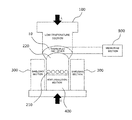
- FIG. 2 is a view illustrating a properties measuring system using a high-temperature structure for measuring properties of a curved thermoelectric device according to an embodiment of the present invention
- FIGS. 3A, 3B, 3C and 3D are views illustrating an embodiment of the high-temperature structure for measuring the properties of the curved thermoelectric device according to the embodiment of the present invention
- FIGS. 4A and 4B are views illustrating another embodiment of the high-temperature structure for measuring the properties of the curved thermoelectric device according to the embodiment of the present invention.
- FIG. 5 is a view illustrating a method for measuring properties using a high-temperature structure for measuring properties of a curved thermoelectric device according to an embodiment of the present invention
- FIG. 6 is a view illustrating an embodiment of a shielding section in a properties measuring system using the high-temperature structure for measuring the properties of the curved thermoelectric device according to the embodiment of the present invention
- FIGS. 7A and 7B are views illustrating the distribution of a surface temperature and a surface heat flux of the high-temperature structure for measuring the properties of the curved thermoelectric device to which the shielding section of FIG. 6 is applied;
- FIGS. 8A and 8B are views illustrating the distribution of a surface temperature and a surface heat flux of a high-temperature structure for measuring properties of a curved thermoelectric device to which no shielding section is applied.
- first and ‘second’ may be used to describe various components, but they should not limit the various components.
- a first component may be referred to as a second component
- a second component may be referred to as a first component.
- connection/coupled refers to one component not only directly coupling another component but also indirectly coupling another component through an intermediate component.
- directly connected/directly coupled refers to one component directly coupling another component without an intermediate component.
- the steps may be performed in an order different from a specified order unless the context clearly dictates otherwise.
- the steps may be performed in the same order as the specified order or in reverse order.
- FIG. 2 is a view illustrating a properties measuring system using a high-temperature structure for measuring properties of a curved thermoelectric device according to an embodiment of the present invention.
- the properties measuring system using the high-temperature structure for measuring properties of the curved thermoelectric device according to the embodiment of the present invention may include a low-temperature section 100 , a cartridge heater 210 , a heating element 220 , a shielding section 300 , a heat-insulation section 400 , and a measuring section 500 .
- the low-temperature section 100 is aligned with the heating element 220 to fix a curved thermoelectric device 10 that is to be measured, and is provided with a surface that is a curved surface coming into contact with an upper end of the curved thermoelectric device 10 .
- the low-temperature section 100 may directly cool the upper end of the curved thermoelectric device 10 in a Peltier cooling method or the like.
- the surface coming into contact with the upper end of the curved thermoelectric device 10 may be continuously cooled using coolant or air circulation, without being limited to the above-mentioned method.
- the heating element 220 has a surface that is a curved surface coming into contact with a lower end of the curved thermoelectric device 10 , has a plurality of holes for accommodating a plurality of cartridge heaters 210 , and directly heats the lower end of the curved thermoelectric device 10 .
- the heating element 220 is preferably a block made of a copper (Cu) material having good heat conductivity.
- Cu copper
- external force A and B such as elastic force from a side opposite to a side coming into contact with the curved thermoelectric device 10 towards the curved thermoelectric device 10 .
- cartridge heaters 210 cause the heating element 220 to generate heat, and preferably have a rod shape to facilitate replacement and realize various arrangements.
- the shielding section 300 surrounds the heating element 220 to shield convection and radiation heat, thus allowing the measuring section 500 to precisely measure the properties of the curved thermoelectric device 10 .
- the heat-insulation section 400 has heat insulation properties, is disposed on the lower end of the heating element 220 , and serves to insulate heat from the heating element 220 .
- the measuring section 500 is connected with the low-temperature section 100 and the heating element 220 to measure the thermoelectric performance of the curved thermoelectric device 10 .
- the measuring section 500 may measure the temperature, the current and the voltage on the upper and lower ends of the curved thermoelectric device 10 so as to measure the thermoelectric performance. That is, the thermoelectric performance for evaluating the thermoelectric conversion properties of the thermoelectric device may be evaluated through the thermoelectric figure of merit (Z, 1/K) that is calculated by the following Equation 1.
- ⁇ represents a Seebeck coefficient (V/K)
- ⁇ represents a resistivity ( ⁇ m)
- ⁇ represents a heat conductivity (W/m ⁇ K).
- the temperature on the surface of the heating element 220 that is in direct contact with the thermoelectric module should be precisely maintained as desired, and the temperature distribution throughout the entire surface of the heating element 220 should be uniform.
- FIGS. 3A to 3D are views illustrating an embodiment of the high-temperature structure for measuring the properties of the curved thermoelectric device according to the embodiment of the present invention. These drawings illustrate various arrangements of the cartridge heaters 210 that are accommodated in the heating element 220 to make the temperature on the surface of the heating element 220 uniform.
- the surface coming into contact with the lower end of the curved thermoelectric device 10 of the heating element 220 has the shape of a curved surface, namely, a cylindrical side surface.
- a difference in temperature between a central portion and an edge portion on a surface of the heating element 220 may occur.
- the heating element 220 may have a plurality of first holes 221 that have the same distance from the center to the surface coming into contact with the lower end of the curved thermoelectric device 10 of the heating element 220 so as to eliminate the difference in temperature between the central portion and the edge portion on the surface of the heating element 220 .
- the plurality of cartridge heaters 210 may be classified into two kinds, namely, a plurality of first rod-shaped cartridge heaters 212 each having a first diameter, and a plurality of second rod-shaped cartridge heaters 211 each having a second diameter that is smaller than the first diameter.
- a plurality of second holes 222 that accommodate the first rod-shaped cartridge heaters 212 and a plurality of third holes 223 that are placed above the second holes 222 to be located therebetween to accommodate the second rod-shaped cartridge heaters 211 may be formed in the heating element 220 .
- a desired temperature may be roughly achieved by the first rod-shaped cartridge heaters 212 each having a large diameter, and then the surface temperature of the heating element 220 may be uniformly adjusted by arranging the second rod-shaped cartridge heaters 211 each having a small diameter between the first rod-shaped cartridge heaters 212 .
- FIGS. 3C and 3D there may be present various arrangements of the cartridge heaters 210 that have various sizes to make the surface temperature of the heating element 220 uniform. This causes the temperature distribution on the surface of the curved heating element 220 to be constant, thus allowing the thermoelectric performance to be delicately measured.
- FIGS. 4A and 4B are views illustrating another embodiment of the high-temperature structure for measuring the properties of the curved thermoelectric device according to the embodiment of the present invention.
- the high-temperature structure for measuring the properties of the curved thermoelectric device of the present invention may further include a heat flow meter 600 , a temperature sensor 700 , and a feedback control 800 .
- the heat flow meter 600 measures the heat conductivity distribution of heat that is outputted from the plurality of cartridge heaters 210 , and then transmits the measured heat conductivity distribution to the feedback control 800 . That is, in order to measure efficiency, the heat conduction of the heating element 220 is measured.
- the temperature sensor 700 detects the surface temperature distribution of the heating element 220 , and then transmits the detected surface temperature distribution to the feedback control 800 .
- a plurality of temperature sensors 700 may be arranged and used as the heat flow meter 600 . However, the invention is not limited thereto.
- the feedback control 800 receives the heat conductivity distribution that is inputted from the heat flow meter 600 , receives the surface temperature distribution that is inputted from the temperature sensor 700 , analyzes the inputted heat conductivity distribution and surface temperature distribution, and controls the heat-generating temperature of the cartridge heaters 210 so that the heat conductivity distribution and the surface temperature distribution become uniform.
- the feedback control 800 is connected to only the heat flow meter 600 , the temperature sensor 700 , and the cartridge heater 210 that are disposed in a predetermined region C.
- the feedback control 800 of the present invention may transmit and receive a signal to and from the heat flow meter 600 , the temperature sensor 700 , and the cartridge heater 210 all which are disposed in other regions E and D.
- the plurality of cartridge heaters 210 In order to cause the surface temperature of the heating element 220 to reach a desired temperature, the plurality of cartridge heaters 210 generates heat. However, the surface temperature of the heating element 220 may be non-uniform. In order to solve the problem, as illustrated in FIG. 4B , temperature sensors 700 may be arranged around the surfaces of the plurality of heating elements 220 to detect surface temperatures for predetermined regions, for example, three regions C, D and E as illustrated in FIG. 4B and adjust the degree to which the cartridge heaters 210 generate heat, based on the distribution of the surface temperature measured by and inputted from the feedback control 800 .
- the feedback control 800 regulates the degree to which the cartridge heaters 210 disposed in the edge regions C and E generate heat so that the heat-generation degree is gradually increased.
- Such a regulating process may be performed until the temperature measured by the temperature sensor 700 in the central region D becomes equal to the temperature measured by the temperature sensors 700 in the edge regions C and E.
- the heat flow meter 600 is disposed around the lower ends of the plurality of temperature sensors 700 , and measures heat conductivities for predetermined regions, for example, three regions C, D and E, respectively, as in FIG. 4B .
- the heat flow meter 600 receives the distribution of the heat conductivity that is measured by and inputted from the feedback control 800 to adjust the degree to which the cartridge heaters 210 generates heat.
- the feedback control 800 may function to maintain environment that is suitable to measure the thermoelectric performance of the curved thermoelectric device 10 , in other words, uniform surface temperature and heat conductivity distribution.
- FIG. 5 is a view illustrating a method for measuring properties using a high-temperature structure for measuring properties of a curved thermoelectric device according to an embodiment of the present invention.
- the properties measuring method using the high-temperature structure for measuring the properties of the curved thermoelectric device according to the embodiment of the present invention will be described below with reference to FIGS. 2 to 5 .
- the plurality of cartridge heaters 210 generates heat, the surface temperature distribution of the heating element 220 is measured by the temperature sensor 700 , and then the measured surface temperature distribution is transmitted to the feedback control 800 , at S 100 .
- the heat flow meter 600 measures the heat conductivity distribution of the heat outputted from the plurality of cartridge heaters 210 , and outputs the measured heat conductivity distribution to the feedback control 800 , at S 200 .
- the feedback control 800 receives the heat conductivity distribution and the surface temperature distribution that are inputted from the heat flow meter 600 and the temperature sensor 700 , and controls the heat generation temperature of the plurality of cartridge heaters 210 such that the heat conductivity distribution and the surface temperature distribution are uniform, at S 300 .
- the curved thermoelectric device 10 is interposed between the low-temperature section 100 and the heating element 220 , so that the upper end of the curved thermoelectric device 10 is directly cooled using the low-temperature section 100 and the lower end of the curved thermoelectric device 10 is directly heated using the heating element 220 , at S 400 .
- the measuring section 500 measures the thermoelectric performance of the curved thermoelectric device 10 , at S 500 .
- the measuring section 500 may measure the temperature, the current, the voltage and the like of the upper and lower ends of the curved thermoelectric device 10 to measure the thermoelectric performance.
- FIG. 6 is a view illustrating an embodiment of a shielding section 300 a in the properties measuring system using the high-temperature structure for measuring the properties of the curved thermoelectric device according to the embodiment of the present invention
- FIGS. 7A and 7B are views illustrating the distribution of the surface temperature and the surface heat flux of the high-temperature structure for measuring the properties of the curved thermoelectric device to which the shielding section 300 a of FIG. 6 is applied
- FIGS. 8A and 8B are views illustrating the distribution of a surface temperature and a surface heat flux of a high-temperature structure for measuring properties of a curved thermoelectric device to which no shielding section 300 , 300 a is applied. They will be described below in detail.
- the shielding section 300 a has a curved frame structure that surrounds the upper portion of the side of the heating element 220 .
- the shielding section 300 a may include a support means to secure it to the upper portion of the side of the heating element 220 .
- the shielding section 300 a By surrounding the upper portion of the side of the heating element 220 with the shielding section 300 a , it is possible to prevent heat from escaping from the surface of the heating element 220 .
- the latter allows the surface temperature of the heating element 220 to be uniformly distributed. That is, when the temperature of the heating element 220 is adjusted to be 400° C., it is observed that a delta value ⁇ T of the surface temperature is only 2.92° C. when the shielding section 300 a is used, and the delta value is increased up to 9.54° C. when the shielding section 300 a is not used.
- the entire side of the heating element 220 is not surrounded by the shielding section 300 a but only the upper portion of the side of the heating element 220 is surrounded by the shielding section 300 a , it is possible to maintain the accuracy of the heat-flux measurement value that is measured in the height direction of the heating element 220 , as illustrated in FIGS. 7B and 8B , while allowing the surface temperature of the heating element 220 to be uniform.
Landscapes
- Chemical & Material Sciences (AREA)
- General Health & Medical Sciences (AREA)
- Life Sciences & Earth Sciences (AREA)
- Health & Medical Sciences (AREA)
- Analytical Chemistry (AREA)
- Biochemistry (AREA)
- Physics & Mathematics (AREA)
- General Physics & Mathematics (AREA)
- Immunology (AREA)
- Pathology (AREA)
- Engineering & Computer Science (AREA)
- Combustion & Propulsion (AREA)
- Chemical Kinetics & Catalysis (AREA)
- Investigating Or Analyzing Materials Using Thermal Means (AREA)
Abstract
Description
Claims (9)
Applications Claiming Priority (2)
| Application Number | Priority Date | Filing Date | Title |
|---|---|---|---|
| KR10-2016-0010700 | 2016-01-18 | ||
| KR20160010700 | 2016-01-28 |
Publications (2)
| Publication Number | Publication Date |
|---|---|
| US20170205364A1 US20170205364A1 (en) | 2017-07-20 |
| US10247685B2 true US10247685B2 (en) | 2019-04-02 |
Family
ID=59315049
Family Applications (1)
| Application Number | Title | Priority Date | Filing Date |
|---|---|---|---|
| US15/219,429 Active 2036-12-18 US10247685B2 (en) | 2016-01-28 | 2016-07-26 | High-temperature structure for measuring properties of curved thermoelectric device, and system and method for measuring properties of curved thermoelectric device using the same |
Country Status (2)
| Country | Link |
|---|---|
| US (1) | US10247685B2 (en) |
| KR (1) | KR101898037B1 (en) |
Families Citing this family (6)
| Publication number | Priority date | Publication date | Assignee | Title |
|---|---|---|---|---|
| US10578570B2 (en) * | 2014-06-10 | 2020-03-03 | An{acute over (j)}un Jin | Test system of thermoelectric module and test method for thermoelectric module |
| US10900918B2 (en) * | 2016-12-07 | 2021-01-26 | Anjun Jin | Test system of thermoelectric module and test method for thermoelectric module |
| KR101956820B1 (en) * | 2017-10-27 | 2019-03-13 | 한국에너지기술연구원 | Assessment method of thermoelectric module properties and assessment device for the method |
| KR102092894B1 (en) * | 2017-11-21 | 2020-03-25 | 한밭대학교 산학협력단 | Method of manufacturing a curved thermoelectric element |
| KR102006959B1 (en) * | 2018-01-19 | 2019-08-02 | 한국에너지기술연구원 | Apparatus for measuring of contact resistance of thermoelectric device and method thereof |
| KR101991323B1 (en) * | 2018-05-14 | 2019-06-21 | 한국에너지기술연구원 | Estimation Method of Thermoelectric Conversion Efficiency of Thermoelectric Devices Using AC Impedance Spectroscopy |
Citations (13)
| Publication number | Priority date | Publication date | Assignee | Title |
|---|---|---|---|---|
| JPH06159936A (en) | 1992-11-27 | 1994-06-07 | Kao Corp | Heating roll with cartridge heater |
| KR19980016273A (en) | 1996-08-27 | 1998-05-25 | 양재신 | Cold django for automobile |
| KR19980016273U (en) | 1996-09-17 | 1998-06-25 | 김종진 | Optical pyrometer and thermocouple combined calibration tube |
| US6306673B1 (en) * | 1995-11-13 | 2001-10-23 | Ngk Insulators, Ltd. | Thermoelectric conversion module and method of manufacturing the same |
| US20010052246A1 (en) * | 1998-04-24 | 2001-12-20 | Shigeto Kamata | Heating apparatus and method |
| JP2002511939A (en) | 1997-07-04 | 2002-04-16 | ヨーロピアン・アトミック・エナジー・コミュニティー(ユーラトム) | Heat dissipation measurement analyzer |
| JP2005129784A (en) | 2003-10-24 | 2005-05-19 | Toshiba Corp | Thermoelectric conversion module, method for manufacturing the same, and flow rate measuring device |
| JP2007059462A (en) | 2005-08-22 | 2007-03-08 | Chiba Univ | Thermoelectric element characteristic evaluation method |
| US20070220902A1 (en) * | 2004-05-31 | 2007-09-27 | Denso Corporation | Thermoelectric Converter |
| US20110209740A1 (en) * | 2002-08-23 | 2011-09-01 | Bsst, Llc | High capacity thermoelectric temperature control systems |
| KR20110130760A (en) | 2010-05-28 | 2011-12-06 | 한국표준과학연구원 | Thermoelectric element measuring device and measuring method thereof |
| KR20150007686A (en) | 2013-07-12 | 2015-01-21 | 서울대학교산학협력단 | Thermoelectric property measurement system |
| KR20150037458A (en) | 2013-09-30 | 2015-04-08 | 한국전자통신연구원 | Apparatus and method for measuring thermoelectric device |
-
2016
- 2016-07-26 US US15/219,429 patent/US10247685B2/en active Active
- 2016-12-16 KR KR1020160172455A patent/KR101898037B1/en active Active
Patent Citations (13)
| Publication number | Priority date | Publication date | Assignee | Title |
|---|---|---|---|---|
| JPH06159936A (en) | 1992-11-27 | 1994-06-07 | Kao Corp | Heating roll with cartridge heater |
| US6306673B1 (en) * | 1995-11-13 | 2001-10-23 | Ngk Insulators, Ltd. | Thermoelectric conversion module and method of manufacturing the same |
| KR19980016273A (en) | 1996-08-27 | 1998-05-25 | 양재신 | Cold django for automobile |
| KR19980016273U (en) | 1996-09-17 | 1998-06-25 | 김종진 | Optical pyrometer and thermocouple combined calibration tube |
| JP2002511939A (en) | 1997-07-04 | 2002-04-16 | ヨーロピアン・アトミック・エナジー・コミュニティー(ユーラトム) | Heat dissipation measurement analyzer |
| US20010052246A1 (en) * | 1998-04-24 | 2001-12-20 | Shigeto Kamata | Heating apparatus and method |
| US20110209740A1 (en) * | 2002-08-23 | 2011-09-01 | Bsst, Llc | High capacity thermoelectric temperature control systems |
| JP2005129784A (en) | 2003-10-24 | 2005-05-19 | Toshiba Corp | Thermoelectric conversion module, method for manufacturing the same, and flow rate measuring device |
| US20070220902A1 (en) * | 2004-05-31 | 2007-09-27 | Denso Corporation | Thermoelectric Converter |
| JP2007059462A (en) | 2005-08-22 | 2007-03-08 | Chiba Univ | Thermoelectric element characteristic evaluation method |
| KR20110130760A (en) | 2010-05-28 | 2011-12-06 | 한국표준과학연구원 | Thermoelectric element measuring device and measuring method thereof |
| KR20150007686A (en) | 2013-07-12 | 2015-01-21 | 서울대학교산학협력단 | Thermoelectric property measurement system |
| KR20150037458A (en) | 2013-09-30 | 2015-04-08 | 한국전자통신연구원 | Apparatus and method for measuring thermoelectric device |
Also Published As
| Publication number | Publication date |
|---|---|
| US20170205364A1 (en) | 2017-07-20 |
| KR20170090351A (en) | 2017-08-07 |
| KR101898037B1 (en) | 2018-09-12 |
Similar Documents
| Publication | Publication Date | Title |
|---|---|---|
| US20170205364A1 (en) | High-temperature structure for measuring properties of curved thermoelectric device, and system and method for measuring properties of curved thermoelectric device using the same | |
| Zhu et al. | Realizing high conversion efficiency of Mg3Sb2-based thermoelectric materials | |
| Hu et al. | Experimental study on water-cooled thermoelectric cooler for CPU under severe environment | |
| US7244913B2 (en) | Temperature regulator for microchemical chip | |
| US8109328B2 (en) | Fluid temperature control device | |
| US9970801B2 (en) | Thermal mass-flow meter and mass-flow control device using same | |
| Sullivan et al. | Array of thermoelectric coolers for on-chip thermal management | |
| KR101102414B1 (en) | Thermoelectric element measuring device and measuring method thereof | |
| Gong et al. | Transient thermal stress analysis of a thermoelectric cooler under pulsed thermal loading | |
| US9377421B2 (en) | Thermal conductivity measuring device and method of measuring the thermal conductivity | |
| CN103781550A (en) | Cooling/heating device | |
| US9846089B2 (en) | Calorimeter and method for designing calorimeter | |
| CN101479578B (en) | Steel plate temperature measuring method, temperature measuring device, and steel plate temperature control method | |
| KR101401275B1 (en) | Contactless temperature measuring apparatus and contactless temperature measuring method | |
| JPWO2014041621A1 (en) | Heat pump device and temperature control device using electric calorie effect | |
| KR101889818B1 (en) | Thermal conductivity mearsuring device and measuring method thereof | |
| JP5822448B2 (en) | Temperature control device and temperature element | |
| KR101975455B1 (en) | Performance Assessment Apparatus for Flexible Thermoelectric Device and Method of the Same | |
| KR102662386B1 (en) | Device for measuring thermoelectric performance | |
| KR101082353B1 (en) | Apparatus for evaluating thermoelectric element and Thermoelectric element evaluation system using the same | |
| KR20150130782A (en) | Apparatus for measuring heating value and method of measuring heating value | |
| US20190107337A1 (en) | Heat exchanger | |
| KR20150071270A (en) | Test device and test method for heat insulation property of the multi-layer insulation | |
| KR101980217B1 (en) | Reliability Assessment Apparatus for Thermoelectric Devices and Assessment Method of the Same | |
| US20130160808A1 (en) | Thermoelectric generating apparatus and module |
Legal Events
| Date | Code | Title | Description |
|---|---|---|---|
| AS | Assignment |
Owner name: KOREA INSTITUTE OF ENERGY RESEARCH, KOREA, REPUBLI Free format text: ASSIGNMENT OF ASSIGNORS INTEREST;ASSIGNORS:PARK, SANG HYUN;YOO, CHUNG-YUL;KIM, HONG SOO;AND OTHERS;SIGNING DATES FROM 20160714 TO 20160715;REEL/FRAME:039470/0966 Owner name: KOREA ADVANCED INSTITUTE OF SCIENCE AND TECHNOLOGY Free format text: ASSIGNMENT OF ASSIGNORS INTEREST;ASSIGNORS:PARK, SANG HYUN;YOO, CHUNG-YUL;KIM, HONG SOO;AND OTHERS;SIGNING DATES FROM 20160714 TO 20160715;REEL/FRAME:039470/0966 |
|
| FEPP | Fee payment procedure |
Free format text: ENTITY STATUS SET TO SMALL (ORIGINAL EVENT CODE: SMAL); ENTITY STATUS OF PATENT OWNER: SMALL ENTITY |
|
| FEPP | Fee payment procedure |
Free format text: PETITION RELATED TO MAINTENANCE FEES GRANTED (ORIGINAL EVENT CODE: PTGR); ENTITY STATUS OF PATENT OWNER: SMALL ENTITY |
|
| STCF | Information on status: patent grant |
Free format text: PATENTED CASE |
|
| MAFP | Maintenance fee payment |
Free format text: PAYMENT OF MAINTENANCE FEE, 4TH YR, SMALL ENTITY (ORIGINAL EVENT CODE: M2551); ENTITY STATUS OF PATENT OWNER: SMALL ENTITY Year of fee payment: 4 |
|
| MAFP | Maintenance fee payment |
Free format text: PAYMENT OF MAINTENANCE FEE, 8TH YR, SMALL ENTITY (ORIGINAL EVENT CODE: M2552); ENTITY STATUS OF PATENT OWNER: SMALL ENTITY Year of fee payment: 8 |