US10230050B2 - Amino phosphazene bases as n-dopants in organic electronics - Google Patents
Amino phosphazene bases as n-dopants in organic electronics Download PDFInfo
- Publication number
- US10230050B2 US10230050B2 US15/544,490 US201515544490A US10230050B2 US 10230050 B2 US10230050 B2 US 10230050B2 US 201515544490 A US201515544490 A US 201515544490A US 10230050 B2 US10230050 B2 US 10230050B2
- Authority
- US
- United States
- Prior art keywords
- phenyl
- bis
- dopant
- diphenyl
- naphthalen
- Prior art date
- Legal status (The legal status is an assumption and is not a legal conclusion. Google has not performed a legal analysis and makes no representation as to the accuracy of the status listed.)
- Expired - Fee Related
Links
- 0 [1*]P([2*])(C)=NC Chemical compound [1*]P([2*])(C)=NC 0.000 description 21
- XIYLJKDSPVXWSV-UHFFFAOYSA-N CN=P(N(C)C)(N(C)C)N(C)C Chemical compound CN=P(N(C)C)(N(C)C)N(C)C XIYLJKDSPVXWSV-UHFFFAOYSA-N 0.000 description 9
- HTIKMMGXAPKUKJ-UHFFFAOYSA-N CC(C)=NP(C)(=NC1=CC=CC=C1)N(C)C.CC(C)=NP(N=C(C)N(C)C)(N=C(C)N(C)C)=NP(=N)(N=C(C)N(C)C)N=C(N(C)C)N(C)C.CC(N)=N/C(N=C(N)N)=N/P(=N)(N=C(N=C(N)N)N=C(N)N)N=C(N=C(N)N)N=C(N)N.CN1CCN(C)C1=NP(=N)(N=C1N(C)CCN1C)N=C1N(C)CCN1C Chemical compound CC(C)=NP(C)(=NC1=CC=CC=C1)N(C)C.CC(C)=NP(N=C(C)N(C)C)(N=C(C)N(C)C)=NP(=N)(N=C(C)N(C)C)N=C(N(C)C)N(C)C.CC(N)=N/C(N=C(N)N)=N/P(=N)(N=C(N=C(N)N)N=C(N)N)N=C(N=C(N)N)N=C(N)N.CN1CCN(C)C1=NP(=N)(N=C1N(C)CCN1C)N=C1N(C)CCN1C HTIKMMGXAPKUKJ-UHFFFAOYSA-N 0.000 description 3
- MBJUXGQMGFPCSE-UHFFFAOYSA-N C1=CN(P2(N3C=CN=C3)=NP(N3C=CN=C3)(N3C=CN=C3)=NP(N3C=CN=C3)(N3C=CN=C3)=N2)C=C1.C1CCN(P2(N3CCCC3)=NP(N3CCCC3)(N3CCCC3)=NP(N3CCCC3)(N3CCCC3)=N2)C1.CP1(N)=NP(N)(N)=NP(N)(N)=N1 Chemical compound C1=CN(P2(N3C=CN=C3)=NP(N3C=CN=C3)(N3C=CN=C3)=NP(N3C=CN=C3)(N3C=CN=C3)=N2)C=C1.C1CCN(P2(N3CCCC3)=NP(N3CCCC3)(N3CCCC3)=NP(N3CCCC3)(N3CCCC3)=N2)C1.CP1(N)=NP(N)(N)=NP(N)(N)=N1 MBJUXGQMGFPCSE-UHFFFAOYSA-N 0.000 description 2
- SEHQHIHXWJDFTC-UHFFFAOYSA-N CC(C)=NP(N=C(C)N(C)C)(N=C(C)N(C)C)=NP(=N)(N=C(C)N(C)C)N=C(N(C)C)N(C)C.CC(N)=N/C(N=C(N)N)=N/P(=N)(N=C(N=C(N)N)N=C(N)N)N=C(N=C(N)N)N=C(N)N Chemical compound CC(C)=NP(N=C(C)N(C)C)(N=C(C)N(C)C)=NP(=N)(N=C(C)N(C)C)N=C(N(C)C)N(C)C.CC(N)=N/C(N=C(N)N)=N/P(=N)(N=C(N=C(N)N)N=C(N)N)N=C(N=C(N)N)N=C(N)N SEHQHIHXWJDFTC-UHFFFAOYSA-N 0.000 description 2
- PTDSLJFRGIJNGC-UHFFFAOYSA-N CN.CN(C)P(C)(=N/P=N/C(C)(C)C)N=P(N(C)C)(N(C)C)N(C)C.CN(C)P(C)(C)=NP(=NC(C)(C)C)(N=P(C)(C)N(C)C)N=P(N=P(C)(N(C)C)N(C)C)(N(C)C)N(C)C.CN(C)P(C)(C)=NP(=NC(C)(C)C)(N=P(C)(N(C)C)N(C)C)N(C)C.CN(C)P(C)(C)=NP(=NC(C)(C)C)(N=P(C)(N(C)C)N(C)C)N=P(C)(N(C)C)N(C)C.CN(C)P(C)(C)=NP(=NP(C)(=NC(C)(C)C)N(C)C)(N(C)C)N(C)C.CN(C)P(C)(C)=NP(C)(=NC(C)(C)C)N(C)C.CN(C)P1(=NC(C)(C)C)N(C)CCCN1C Chemical compound CN.CN(C)P(C)(=N/P=N/C(C)(C)C)N=P(N(C)C)(N(C)C)N(C)C.CN(C)P(C)(C)=NP(=NC(C)(C)C)(N=P(C)(C)N(C)C)N=P(N=P(C)(N(C)C)N(C)C)(N(C)C)N(C)C.CN(C)P(C)(C)=NP(=NC(C)(C)C)(N=P(C)(N(C)C)N(C)C)N(C)C.CN(C)P(C)(C)=NP(=NC(C)(C)C)(N=P(C)(N(C)C)N(C)C)N=P(C)(N(C)C)N(C)C.CN(C)P(C)(C)=NP(=NP(C)(=NC(C)(C)C)N(C)C)(N(C)C)N(C)C.CN(C)P(C)(C)=NP(C)(=NC(C)(C)C)N(C)C.CN(C)P1(=NC(C)(C)C)N(C)CCCN1C PTDSLJFRGIJNGC-UHFFFAOYSA-N 0.000 description 2
- MHTBSSFUPOBOCN-UHFFFAOYSA-N C1=CC2=CC=CC3=C2C(=C1)NP1(=NP2(=NP4(=N1)NC1=C5C(=CC=C1)/C=C\C=C/5N4)CC1=CC=CC4=C1C(C=CC4)N2)C3.C1=CC=C(NP2(NC3=CC=CC=C3)=NP(NC3=CC=CC=C3)(NC3=CC=CC=C3)=NP(NC3=CC=CC=C3)(NC3=CC=CC=C3)=N2)C=C1.C1CCC(NP2(NC3CCCCC3)=NP(NC3CCCCC3)(NC3CCCCC3)=NP(NC3CCCCC3)(NC3CCCCC3)=N2)CC1.C1CN(P2(N3CCOCC3)=NP(N3CCOCC3)(N3CCOCC3)=NP(N3CCOCC3)(N3CCOCC3)=N2)CCO1 Chemical compound C1=CC2=CC=CC3=C2C(=C1)NP1(=NP2(=NP4(=N1)NC1=C5C(=CC=C1)/C=C\C=C/5N4)CC1=CC=CC4=C1C(C=CC4)N2)C3.C1=CC=C(NP2(NC3=CC=CC=C3)=NP(NC3=CC=CC=C3)(NC3=CC=CC=C3)=NP(NC3=CC=CC=C3)(NC3=CC=CC=C3)=N2)C=C1.C1CCC(NP2(NC3CCCCC3)=NP(NC3CCCCC3)(NC3CCCCC3)=NP(NC3CCCCC3)(NC3CCCCC3)=N2)CC1.C1CN(P2(N3CCOCC3)=NP(N3CCOCC3)(N3CCOCC3)=NP(N3CCOCC3)(N3CCOCC3)=N2)CCO1 MHTBSSFUPOBOCN-UHFFFAOYSA-N 0.000 description 1
- AFGJIILOEANNNU-UHFFFAOYSA-N C1=CC2=CC=CC3=C2C(=C1)NP1(=NP2(=NP4(=N1)NC1=C5C(=CC=C1)/C=C\C=C/5N4)CC1=CC=CC4=C1C(C=CC4)N2)C3.C1CCN(P2(N3CCOCC3)=NP(N3CCOCC3)(N3CCOCC3)=NP(N3CCOCC3)(N3CCOCC3)=N2)CC1 Chemical compound C1=CC2=CC=CC3=C2C(=C1)NP1(=NP2(=NP4(=N1)NC1=C5C(=CC=C1)/C=C\C=C/5N4)CC1=CC=CC4=C1C(C=CC4)N2)C3.C1CCN(P2(N3CCOCC3)=NP(N3CCOCC3)(N3CCOCC3)=NP(N3CCOCC3)(N3CCOCC3)=N2)CC1 AFGJIILOEANNNU-UHFFFAOYSA-N 0.000 description 1
- CGIYTOAIZZATIT-UHFFFAOYSA-N CC(C)(C)N=P(C)(C)C.CN.CN.CN(C)P(C)(=N/P=N/C(C)(C)C)N=P(N(C)C)(N(C)C)N(C)C.CN(C)P(C)(C)=NP(=NC(C)(C)C)(N=P(C)(C)N(C)C)N=P(N=P(C)(N(C)C)N(C)C)(N(C)C)N(C)C.CN(C)P(C)(C)=NP(=NC(C)(C)C)(N=P(C)(N(C)C)N(C)C)N(C)C.CN(C)P(C)(C)=NP(=NC(C)(C)C)(N=P(C)(N(C)C)N(C)C)N=P(C)(N(C)C)N(C)C.CN(C)P(C)(C)=NP(=NP(C)(=NC(C)(C)C)N(C)C)(N(C)C)N(C)C.CN(C)P(C)(C)=NP(C)(=NC(C)(C)C)N(C)C.CN(C)P1(=NC(C)(C)C)N(C)CCCN1C Chemical compound CC(C)(C)N=P(C)(C)C.CN.CN.CN(C)P(C)(=N/P=N/C(C)(C)C)N=P(N(C)C)(N(C)C)N(C)C.CN(C)P(C)(C)=NP(=NC(C)(C)C)(N=P(C)(C)N(C)C)N=P(N=P(C)(N(C)C)N(C)C)(N(C)C)N(C)C.CN(C)P(C)(C)=NP(=NC(C)(C)C)(N=P(C)(N(C)C)N(C)C)N(C)C.CN(C)P(C)(C)=NP(=NC(C)(C)C)(N=P(C)(N(C)C)N(C)C)N=P(C)(N(C)C)N(C)C.CN(C)P(C)(C)=NP(=NP(C)(=NC(C)(C)C)N(C)C)(N(C)C)N(C)C.CN(C)P(C)(C)=NP(C)(=NC(C)(C)C)N(C)C.CN(C)P1(=NC(C)(C)C)N(C)CCCN1C CGIYTOAIZZATIT-UHFFFAOYSA-N 0.000 description 1
- WJFLROCMOLQMCZ-UHFFFAOYSA-N CN=P(N=P(C)(C)N(C)C)(N=P(C)(N(C)C)N(C)C)N=P(N(C)C)(N(C)C)N(C)C Chemical compound CN=P(N=P(C)(C)N(C)C)(N=P(C)(N(C)C)N(C)C)N=P(N(C)C)(N(C)C)N(C)C WJFLROCMOLQMCZ-UHFFFAOYSA-N 0.000 description 1
Images


Classifications
-
- H01L51/005—
-
- H—ELECTRICITY
- H10—SEMICONDUCTOR DEVICES; ELECTRIC SOLID-STATE DEVICES NOT OTHERWISE PROVIDED FOR
- H10K—ORGANIC ELECTRIC SOLID-STATE DEVICES
- H10K85/00—Organic materials used in the body or electrodes of devices covered by this subclass
- H10K85/60—Organic compounds having low molecular weight
-
- C—CHEMISTRY; METALLURGY
- C07—ORGANIC CHEMISTRY
- C07F—ACYCLIC, CARBOCYCLIC OR HETEROCYCLIC COMPOUNDS CONTAINING ELEMENTS OTHER THAN CARBON, HYDROGEN, HALOGEN, OXYGEN, NITROGEN, SULFUR, SELENIUM OR TELLURIUM
- C07F9/00—Compounds containing elements of Groups 5 or 15 of the Periodic Table
- C07F9/02—Phosphorus compounds
- C07F9/06—Phosphorus compounds without P—C bonds
- C07F9/062—Organo-phosphoranes without P-C bonds
- C07F9/065—Phosphoranes containing the structure P=N-
-
- C—CHEMISTRY; METALLURGY
- C07—ORGANIC CHEMISTRY
- C07F—ACYCLIC, CARBOCYCLIC OR HETEROCYCLIC COMPOUNDS CONTAINING ELEMENTS OTHER THAN CARBON, HYDROGEN, HALOGEN, OXYGEN, NITROGEN, SULFUR, SELENIUM OR TELLURIUM
- C07F9/00—Compounds containing elements of Groups 5 or 15 of the Periodic Table
- C07F9/02—Phosphorus compounds
- C07F9/547—Heterocyclic compounds, e.g. containing phosphorus as a ring hetero atom
- C07F9/553—Heterocyclic compounds, e.g. containing phosphorus as a ring hetero atom having one nitrogen atom as the only ring hetero atom
- C07F9/572—Five-membered rings
-
- C—CHEMISTRY; METALLURGY
- C07—ORGANIC CHEMISTRY
- C07F—ACYCLIC, CARBOCYCLIC OR HETEROCYCLIC COMPOUNDS CONTAINING ELEMENTS OTHER THAN CARBON, HYDROGEN, HALOGEN, OXYGEN, NITROGEN, SULFUR, SELENIUM OR TELLURIUM
- C07F9/00—Compounds containing elements of Groups 5 or 15 of the Periodic Table
- C07F9/02—Phosphorus compounds
- C07F9/547—Heterocyclic compounds, e.g. containing phosphorus as a ring hetero atom
- C07F9/645—Heterocyclic compounds, e.g. containing phosphorus as a ring hetero atom having two nitrogen atoms as the only ring hetero atoms
- C07F9/6503—Five-membered rings
- C07F9/6506—Five-membered rings having the nitrogen atoms in positions 1 and 3
-
- C—CHEMISTRY; METALLURGY
- C07—ORGANIC CHEMISTRY
- C07F—ACYCLIC, CARBOCYCLIC OR HETEROCYCLIC COMPOUNDS CONTAINING ELEMENTS OTHER THAN CARBON, HYDROGEN, HALOGEN, OXYGEN, NITROGEN, SULFUR, SELENIUM OR TELLURIUM
- C07F9/00—Compounds containing elements of Groups 5 or 15 of the Periodic Table
- C07F9/02—Phosphorus compounds
- C07F9/547—Heterocyclic compounds, e.g. containing phosphorus as a ring hetero atom
- C07F9/6524—Heterocyclic compounds, e.g. containing phosphorus as a ring hetero atom having four or more nitrogen atoms as the only ring hetero atoms
-
- C—CHEMISTRY; METALLURGY
- C07—ORGANIC CHEMISTRY
- C07F—ACYCLIC, CARBOCYCLIC OR HETEROCYCLIC COMPOUNDS CONTAINING ELEMENTS OTHER THAN CARBON, HYDROGEN, HALOGEN, OXYGEN, NITROGEN, SULFUR, SELENIUM OR TELLURIUM
- C07F9/00—Compounds containing elements of Groups 5 or 15 of the Periodic Table
- C07F9/02—Phosphorus compounds
- C07F9/547—Heterocyclic compounds, e.g. containing phosphorus as a ring hetero atom
- C07F9/6564—Heterocyclic compounds, e.g. containing phosphorus as a ring hetero atom having phosphorus atoms, with or without nitrogen, oxygen, sulfur, selenium or tellurium atoms, as ring hetero atoms
- C07F9/6581—Heterocyclic compounds, e.g. containing phosphorus as a ring hetero atom having phosphorus atoms, with or without nitrogen, oxygen, sulfur, selenium or tellurium atoms, as ring hetero atoms having phosphorus and nitrogen atoms with or without oxygen or sulfur atoms, as ring hetero atoms
- C07F9/65812—Cyclic phosphazenes [P=N-]n, n>=3
- C07F9/65815—Cyclic phosphazenes [P=N-]n, n>=3 n = 3
-
- C—CHEMISTRY; METALLURGY
- C07—ORGANIC CHEMISTRY
- C07F—ACYCLIC, CARBOCYCLIC OR HETEROCYCLIC COMPOUNDS CONTAINING ELEMENTS OTHER THAN CARBON, HYDROGEN, HALOGEN, OXYGEN, NITROGEN, SULFUR, SELENIUM OR TELLURIUM
- C07F9/00—Compounds containing elements of Groups 5 or 15 of the Periodic Table
- C07F9/02—Phosphorus compounds
- C07F9/547—Heterocyclic compounds, e.g. containing phosphorus as a ring hetero atom
- C07F9/6564—Heterocyclic compounds, e.g. containing phosphorus as a ring hetero atom having phosphorus atoms, with or without nitrogen, oxygen, sulfur, selenium or tellurium atoms, as ring hetero atoms
- C07F9/6581—Heterocyclic compounds, e.g. containing phosphorus as a ring hetero atom having phosphorus atoms, with or without nitrogen, oxygen, sulfur, selenium or tellurium atoms, as ring hetero atoms having phosphorus and nitrogen atoms with or without oxygen or sulfur atoms, as ring hetero atoms
- C07F9/6584—Heterocyclic compounds, e.g. containing phosphorus as a ring hetero atom having phosphorus atoms, with or without nitrogen, oxygen, sulfur, selenium or tellurium atoms, as ring hetero atoms having phosphorus and nitrogen atoms with or without oxygen or sulfur atoms, as ring hetero atoms having one phosphorus atom as ring hetero atom
- C07F9/65848—Cyclic amide derivatives of acids of phosphorus, in which two nitrogen atoms belong to the ring
-
- C—CHEMISTRY; METALLURGY
- C09—DYES; PAINTS; POLISHES; NATURAL RESINS; ADHESIVES; COMPOSITIONS NOT OTHERWISE PROVIDED FOR; APPLICATIONS OF MATERIALS NOT OTHERWISE PROVIDED FOR
- C09D—COATING COMPOSITIONS, e.g. PAINTS, VARNISHES OR LACQUERS; FILLING PASTES; CHEMICAL PAINT OR INK REMOVERS; INKS; CORRECTING FLUIDS; WOODSTAINS; PASTES OR SOLIDS FOR COLOURING OR PRINTING; USE OF MATERIALS THEREFOR
- C09D5/00—Coating compositions, e.g. paints, varnishes or lacquers, characterised by their physical nature or the effects produced; Filling pastes
- C09D5/24—Electrically-conducting paints
-
- H01L51/002—
-
- H01L51/0052—
-
- H01L51/0072—
-
- H—ELECTRICITY
- H10—SEMICONDUCTOR DEVICES; ELECTRIC SOLID-STATE DEVICES NOT OTHERWISE PROVIDED FOR
- H10K—ORGANIC ELECTRIC SOLID-STATE DEVICES
- H10K50/00—Organic light-emitting devices
- H10K50/10—OLEDs or polymer light-emitting diodes [PLED]
- H10K50/14—Carrier transporting layers
- H10K50/16—Electron transporting layers
-
- H—ELECTRICITY
- H10—SEMICONDUCTOR DEVICES; ELECTRIC SOLID-STATE DEVICES NOT OTHERWISE PROVIDED FOR
- H10K—ORGANIC ELECTRIC SOLID-STATE DEVICES
- H10K71/00—Manufacture or treatment specially adapted for the organic devices covered by this subclass
- H10K71/30—Doping active layers, e.g. electron transporting layers
-
- H—ELECTRICITY
- H10—SEMICONDUCTOR DEVICES; ELECTRIC SOLID-STATE DEVICES NOT OTHERWISE PROVIDED FOR
- H10K—ORGANIC ELECTRIC SOLID-STATE DEVICES
- H10K85/00—Organic materials used in the body or electrodes of devices covered by this subclass
- H10K85/60—Organic compounds having low molecular weight
- H10K85/615—Polycyclic condensed aromatic hydrocarbons, e.g. anthracene
-
- H—ELECTRICITY
- H10—SEMICONDUCTOR DEVICES; ELECTRIC SOLID-STATE DEVICES NOT OTHERWISE PROVIDED FOR
- H10K—ORGANIC ELECTRIC SOLID-STATE DEVICES
- H10K85/00—Organic materials used in the body or electrodes of devices covered by this subclass
- H10K85/60—Organic compounds having low molecular weight
- H10K85/631—Amine compounds having at least two aryl rest on at least one amine-nitrogen atom, e.g. triphenylamine
-
- H—ELECTRICITY
- H10—SEMICONDUCTOR DEVICES; ELECTRIC SOLID-STATE DEVICES NOT OTHERWISE PROVIDED FOR
- H10K—ORGANIC ELECTRIC SOLID-STATE DEVICES
- H10K85/00—Organic materials used in the body or electrodes of devices covered by this subclass
- H10K85/60—Organic compounds having low molecular weight
- H10K85/649—Aromatic compounds comprising a hetero atom
- H10K85/657—Polycyclic condensed heteroaromatic hydrocarbons
- H10K85/6572—Polycyclic condensed heteroaromatic hydrocarbons comprising only nitrogen in the heteroaromatic polycondensed ring system, e.g. phenanthroline or carbazole
-
- H01L51/5076—
-
- H—ELECTRICITY
- H10—SEMICONDUCTOR DEVICES; ELECTRIC SOLID-STATE DEVICES NOT OTHERWISE PROVIDED FOR
- H10K—ORGANIC ELECTRIC SOLID-STATE DEVICES
- H10K50/00—Organic light-emitting devices
- H10K50/10—OLEDs or polymer light-emitting diodes [PLED]
- H10K50/14—Carrier transporting layers
- H10K50/16—Electron transporting layers
- H10K50/165—Electron transporting layers comprising dopants
Definitions
- WO 2009/153276 A1 discloses an organic light-emitting diode containing at least one cyclic phosphazene compound of the following formula
- a light-emitting layer composed of at least one matrix material and at least one emitter material, the at least one matrix material comprising at least one cyclic phosphazene compound, the use of cyclic phosphazene compounds in organic light-emitting diodes, and a device selected from the group consisting of stationary screens, mobile screens, and lighting units comprising at least one organic light-emitting diode of the invention and selected cyclic phosphazene compounds, and methods for their production.
- WO 2012 175219 A1 discloses an electronic device which comprises a compound A-B, where
- —Ar 1 is a C6-C18 arylene, which may be mono- or polycyclic and may optionally be substituted by one or more C1-C10 alkyl or C3-C10 cycloalkyl groups
- —Ar 2 is a C6-C18 arene skeleton which is optionally substituted by electron-donating groups R 4
- —B 1 and B 2 independently are selected from B and Ar 2
- —B 3 is selected independently from the same group as B
- —R 1 , R 2 and R 3 independently are selected from alkyl, arylalkyl, cycloalkyl, aryl and dialkylamino
- —X is selected from 0, 1, 2 and 3, where for x>1 each Ar1 may be different, —y is a nonzero integer up to the total number of valence sites, on the arene skeleton, —z is an integer from zero up to the total number of valence sites on the arene skeleton minus y
- inventive methods are provided for producing n-conducting organic-electrical layers.
- the inventive methods may comprise depositing an n-dopant comprising at least one aminophosphazene group of the formula
- the present inventive methods provide that the n-dopants and the electron transport materials upon deposition react with one another.
- a layer comprising an n-dopant volume % thickness concentration of about ⁇ 0.01% and about ⁇ 30% is formed.
- the invention provides further methods for producing n-conducting organic-electrical layers.
- the methods may comprise depositing an n-dopant with an electron transport material wherein the n-dopant has the formula 2 below
- the dopants are compounds having noncyclic aminophosphazene scaffolds.
- the n-dopants and the electron transport materials may react with one another.
- the present invention provides methods for producing n-conducting organic-electrical layers.
- the methods may comprise depositing an n-dopant comprising ⁇ 2 and ⁇ 7 aminophosphazene groups of the formula
- n-dopant preferably comprises at least one compound of formulae 3-28:
- the methods provide for the formation of n-conducting organic-electrical layers comprising a n-dopant volume % thickness concentration of ⁇ 0.01% and ⁇ 30%.
- n-dopants of the invention properties of the n-dopants of the invention, and possible embodiments of electrical components in which the dopants may be used, are elucidated in more detail below:
- FIG. 1 shows diagrammatically the structure of an organic light-emitting diode ( 10 ).
- the light-emitting diode is composed of a glass layer ( 1 ); silicone or indium-tin oxide (ITO) layer ( 2 ); hole injector layer ( 3 ); hole transport layer (HTL) ( 4 ); emitter layer (EML) ( 5 ); hole blocker layer (HBL) ( 6 ); electron transport layer (ETL) ( 7 ); electron injector layer ( 8 ); and a cathode layer ( 9 ).
- FIG. 2 shows diagrammatically the structure of an organic solar cell with PIN structure ( 20 ), which converts light ( 21 ) into electrical current.
- the solar cell consists of a layer of indium-tin oxide ( 22 ); a p-doped layer ( 23 ); an absorption layer ( 24 ); an n-doped layer ( 25 ); and a metal layer ( 26 ).
- FIG. 3 shows diagrammatically a possible cross section of an organic field-effect transistor ( 30 ).
- a gate electrode 32
- a gate dielectric 33
- a source and drain contact 34 + 35
- an organic semiconductor 36 .
- the shaded areas show the areas at which contact doping is useful.
- FIG. 4 shows an IV characteristic curve of an electron-conducting matrix material (ETM036, Merck) which has been doped with an n-dopant of the invention (P4-tBu).
- ETM036, Merck electron-conducting matrix material
- P4-tBu n-dopant of the invention
- FIG. 5 shows an IV characteristic curve of a further electron-conducting matrix material (ETM019, Merck) which has been doped with an n-dopant of the invention (P4-tBu).
- ETM019, Merck electron-conducting matrix material
- P4-tBu n-dopant of the invention
- FIG. 6 shows an IV characteristic curve of a further electron-conducting matrix material (TMM004, Merck) which has been doped with an n-dopant of the invention (P4-tBu).
- TMM004, Merck electron-conducting matrix material
- P4-tBu n-dopant of the invention
- FIG. 7 shows an IV characteristic curve of a further electron-conducting matrix material (Alq3, aluminum tris(8-hydroxyquinoline)) which has been doped with an n-dopant of the invention (P4-tBu).
- Alq3, aluminum tris(8-hydroxyquinoline) Alq3, aluminum tris(8-hydroxyquinoline)
- P4-tBu n-dopant of the invention
- the n-dopant for doping organic electron transport materials is characterized in that the n-dopant has at least one aminophosphazene group of formula 1
- n-dopants which have an aminophosphazene group of Formula 1 are capable of significantly increasing the electron conductivity of organic electron transport materials. This effect is not attributable to the intrinsic conductivity of the n-dopants of the invention, but instead results from the interaction of the n-dopants of the invention with electron transport materials. This significant increase in conductivity can be obtained not only with substances which have only aminophosphazene groups as functional units, but also with substances in which the aminophosphazene group represents only one constituent of the functional groups in the molecule.
- the improved suitability for increasing the electron conductivity derives from the fact that the functional aminophosphazene group is particularly electron-rich, by virtue of the 4 nitrogen atoms bonded to the phosphorus atom. This gives this aminophosphazene group an unusual basicity, which allows particularly effective interaction with organic electron transport materials and leads to a particularly effective doping outcome. This contrasts with phosphazene compounds which do not have 4 nitrogen atoms bonded to a phosphorus atom. These compounds, indeed, exhibit reduced basicity and, accordingly, are less suitable as n-dopants. Additionally, the aminophosphazenes of the invention prove, in the context of their use in organic electronics, to be very stable chemically, active kinetically, and deployable multilaterally. One possible mechanism for the increase in the conductivity is evident from the scheme below:
- doping mechanisms there are various conceivable doping mechanisms.
- the dopant with the electron transport material (ETM), thus forming a “charge transfer complex” (structure A).
- This complex has new limiting orbitals (HOMO or SOMO and LUMO), whose energetic positions enable good interaction (e.g., hopping of an electron from the “charge transfer complex” onto a matrix molecule) with undoped matrix molecules, thereby achieving increased conductivity.
- the transfer of a whole charge from the dopant to the matrix may result in an increase in its electron density and hence also in its conductivity (structure B).
- the ETM molecule may also dissociate again from the dopant, thereby forming a radical anion of the matrix and a radical cation of the phosphazene dopant (structure C).
- structure C a radical anion of the matrix and a radical cation of the phosphazene dopant
- aminophosphazene group in the sense of the invention refers to a compound which has at least one aminophosphazene group of the formula 1 in the molecule.
- This may be an uncharged molecule or else a salt compound having ions, in which case at least one ion comprises an aminophosphazene group.
- Significant for the aminophosphazene group is the attachment of 4 nitrogen atoms to the central phosphorus atom.
- This central unit may be repeated in the dopant and, moreover, a plurality of aminophosphazene groups may also be joined to one another linearly or cyclically.
- the dopant of the invention it is also possible, however, for the dopant of the invention to have further functional groups as well as the aminophosphazene groups.
- the substances having at least one aminophosphazene group are used as n-dopant.
- these substances are not in accordance with the invention for these substances to be used alone within a layer in an organic-electronic component. The reason is that the basic conductivity of this class of compound is inadequate for effective organic-electronic components.
- This dopant is intended for interaction with an electron transport material.
- the HOMO levels of the n-dopants of the invention are apparently such that they are able to interact effectively with the LUMO levels of the common electron transport materials.
- a dopant in this context therefore, is a substance which is deposited together with the electron transport material by production methods known to the skilled person.
- the molar fraction of the n-dopant in the layer not to be above the molar fraction of the electron transport material.
- concentration of the n-dopants of the invention in a layer are usually much lower than that of the electron transport material.
- the n-dopants of the invention have a much lower electrical conductivity than layers comprising electron transport materials.
- the joint deposition significantly increases the maximum conductivity of the electron transport materials and, moreover, there is a much higher current flow even at lower voltages.
- Further underpinning the n-dopant function is the fact that in p-conducting layers, the n-dopants of the invention act as blocking materials. They also do this in contradistinction to electron transport materials.
- n-dopants may conform to formula 2 below
- R 1 to R 4 independently of one another are selected from the group of R comprising a bond, H, D, C1-C60 saturated or unsaturated alkyl, cycloalkyl, heteroalkyl, heterocycloalkyl; C1-C60 aryl, alkylaryl, heteroaryl;
- n-Dopants with the substitution pattern indicated above have proven particularly suitable for the doping of electron transport materials. Without being tied to any theory, it is believed that this may be attributable to the fact that the stated substituents significantly increase the basicity of the compound, producing improved doping in conjunction with electron transport materials.
- Another result of the stated substitution of the aminophosphazene group is to obtain a sterically suitable molecule which can be processed effectively in both wet and dry processes and which subsequently exhibits little tendency to crystallize in conjunction with the electron transport materials.
- the individual substituents bonded to the nitrogen atoms of the aminophosphazene group may in each case form ring structures with one another. Examples of these joined substituents are indicated below. It is in accordance with an embodiment of the invention, furthermore, that one or more aminophosphazene units may be associated via [—P(NR 2 ) 2 ⁇ N—] n units to form cyclic structures. These cyclic structures, in particular, may allow charges which arise in the doping context to be distributed across the whole of the inner rings. This may contribute to particularly stable and effective doping.
- the substituents R 1 -R 4 may independently of one another be selected from the group of R′ comprising a bond, C1-C20 substituted or unsubstituted alkyl, cycloalkyl;
- the short- to medium-chain alkyl and cycloalkyl substituents specifically lead to particularly good suitability of the n-dopants for increasing the conductivity of electron transport materials. Without being tied to a theory, it is believed that this is very likely due to the inductive effect of these substituents, which leads to increased basicity on the part of the functional group.
- the steric architecture of these substituents is such that there is very rapid and effective interaction with electron transport materials.
- the layer thickness concentration (volume %) of the n-dopants in a layer may be ⁇ 0.01% and ⁇ 30%. Within this concentration range it is possible with the n-dopants of the invention to achieve a sufficient increase in the n-conductivity of electron transport layers. Higher concentrations of n-dopants are less preferable, since the result may be a reduction in the conductivity of the layers. This can be attributed to the fact that the fraction of electron conductor in the layer becomes too small.
- the aminophosphazenes of the invention are particularly suitable as an n-dopants and not as electron transport materials.
- the molar concentration of the n-dopants in a layer may be ⁇ 0.1% and ⁇ 25%, preferably ⁇ 1% and ⁇ 20%. Quantitative determination of the molar fractions of substances within a layer is known to the skilled person. For example, the layers may be dissolved and analyzed by common quantitative determination methods, such as HPLC, for example.
- the number of aminophosphazene groups in the dopant may be ⁇ 2 and ⁇ 7.
- the dopants may carry a higher number of aminophosphazene groups. Without being tied to a theory, it is believed this enables the dopant to interact with a plurality of molecules of the matrix material or, possibly, to transfer a plurality of charges to the matrix material. This may contribute to increasing the conductivity of the layer. Furthermore, the interactions with a plurality of matrix molecules may result in a decrease in the crystallization tendency of the layer. This may contribute to prolonged shelf life of components comprising these layers.
- the dopants may be a compound having a noncyclic aminophosphazene scaffold.
- the linear dopants which contain at least one aminophosphazene group have proven to be particularly suitable for the doping of organic electron transport materials. Without being tied to any theory, it is believed that this is very likely due to the fact that the steric properties of this class of substances permit particularly effective approximation to the electron transport materials, which may lead subsequently to very rapid and efficient charge transfer. Additionally, the linear geometry of the n-dopants may mean that because of the reduced tendency toward crystallization, organic components containing this class of substance attain a longer life.
- the dopants may comprise at least one compound of the formulae 3-28 below:
- n-dopants where ⁇ 1 and ⁇ 4 substituents of the R 1 -R 4 and R 6 are tert-butyl substituents ( t Bu).
- the aminophosphazene compounds in which tertiary-butyl groups are bonded to the nitrogen atoms, in particular, are notable for a particularly good doping effect.
- the reason for this may be that the tertiary-butyl groups have not only suitable inductive properties but also a suitable steric architecture which is capable not only of raising the basicity of the compound but also of enabling easy access of the matrix materials to the dopant.
- a higher number of tertiary butyl groups may be less advantageous, since in that case access of the matrix material may be hindered.
- the dopants may have a cyclic structure with two to four linked aminophosphazene units.
- the cyclic structures of the aminophosphazene units may be in a position to achieve particularly effective doping of electron transport materials. This may be the likely a result of the fact that the basicity of the compound is boosted further by cyclic arrangement. Furthermore, the charges which occur after doping can be distributed effectively across the whole ring system.
- the linking of 2 units produces a 4-membered ring
- the linking of 3 units produces a 6-membered ring
- the linking of 4 units produces an 8-membered ring.
- This ring size also permits effective processing of the compounds both in wet processes and in vacuum deposition. Larger ring structures, in contrast, may be a disadvantage, since in these cases the effective evaporation of the substances may be hindered.
- At least one of the substituents on each noncyclic nitrogen may be a C1-C60 alkyl, cycloalkyl, aryl or heteroaryl radical which is bonded via a carbon, it being possible for the individual substituents to be joined to one another. It has discovered that the substitution of the noncyclic nitrogen atoms by the above-stated substitution pattern allows a particularly suitable increase in the basicity of the aminophosphazene compounds without causing any negative effect on the kinetics of a subsequent conversion reaction with electron transport materials. For this reason, therefore, it may be advantageous for at least one of the substituents on the noncyclic nitrogen atoms to be occupied by one of the substituents indicated above.
- each of the substituents on each noncyclic nitrogen may be a C1-C30 alkyl, cycloalkyl, aryl or heteroaryl radical which is bonded via a carbon, it being possible for the individual substituents to be joined to one another.
- particularly effective n-dopants may be formed, probably because of the inductive effects.
- the short- to medium-chain alkyl and aryl compounds appear particularly suitable for this purpose. These compounds are easily processed in both wet and vacuum processes, and yield doped layers possessing long-term stability.
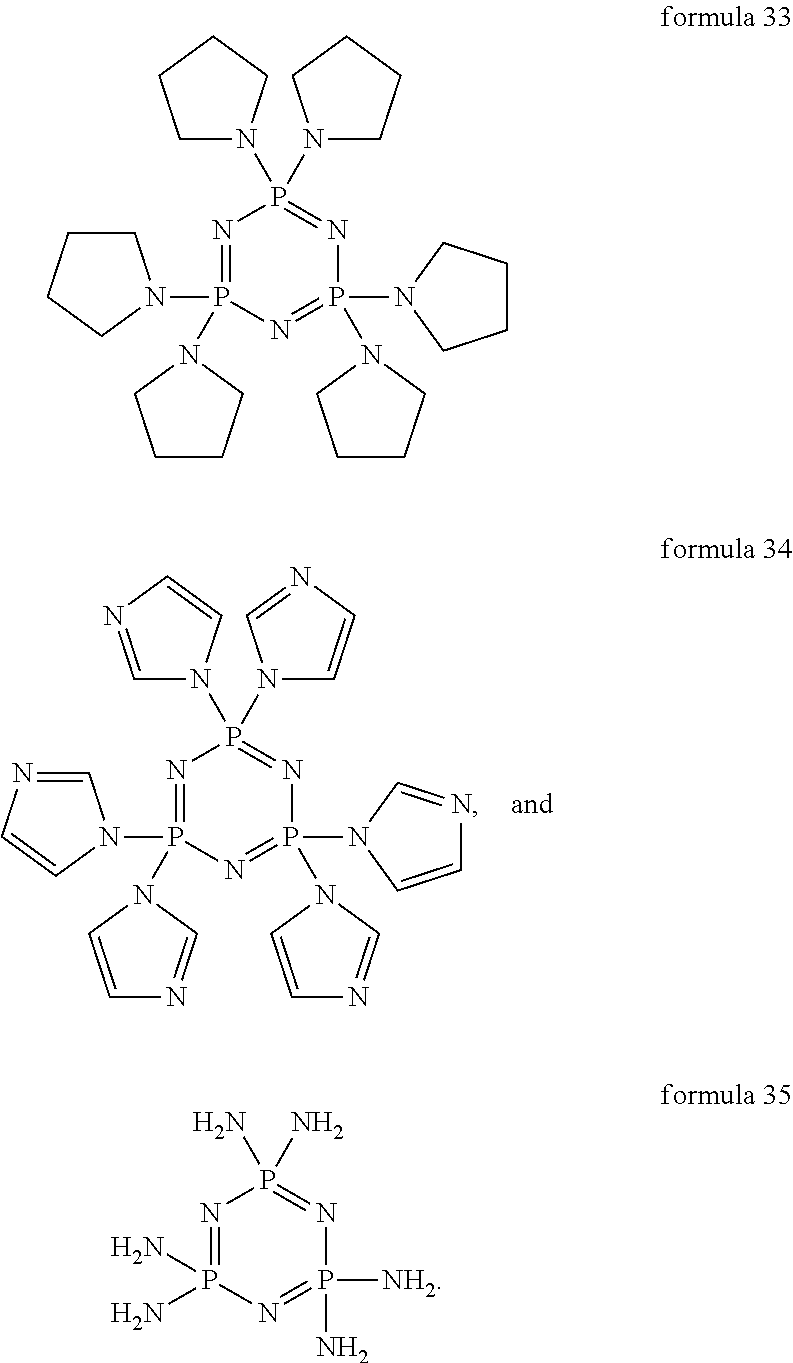
- the dopants may comprise at least one of the following formulae 29-35 below:
- the cyclic compounds of the formulae 29-35 appear to be particularly suitable on the basis of their steric architecture and the electrical properties dictated by the substituent pattern, for the n-doping of electron transport layers.
- the molecular mass of these compounds moreover, allows effective processing in vacuum processes.
- n-conducting organic-electrical layers wherein the organic n-dopant is deposited together with an organic electron transport material within a layer and the n-dopant and the electron transport material are reacted.
- the reacting here may take place according to the reaction mechanism indicated above. There may therefore first be electrostatic interaction of the n-dopants of the invention with the electron transport materials, possibly leading subsequently to a transfer of electrons to the electron transport materials. This reaction may take place automatically, on the basis of suitable reaction kinetics, through the simultaneous deposition in a layer.
- the reaction may also take place via subsequent thermal excitation.
- the common electron transport materials which are familiar to the skilled person in the context of organic electronics. Both materials may be deposited from the wet phase and/or by means of a vacuum process.
- the aminophosphazene serves as an n-dopant here and may develop its doping effect either by coevaporation with an electron transport material or by mixing of an aminophosphazene with an ETM followed by liquid processing (e.g. spincoating, inkjet printing, slot coating etc.).
- the aminophosphazene bases are especially suitable for liquid processing.
- the larger molecules e.g., a P4 base
- the organic electron transport material may be selected from the group consisting of 2,2′,2′′-(1,3,5-benzinetriyl)tris(1-phenyl-1-H-benzimidazole), 2-(4-biphenylyl)-5-(4-tert-butylphenyl)-1,3,4-oxadiazole; 2,9-dimethyl-4,7-diphenyl-1,10-phenanthroline (BCP), 8-hydroxyquinolinolatolithium; 4-(naphthalen-1-yl)-3,5-diphenyl-4H-1,2,4-triazole; 1,3-bis[2-(2,2′-bipyridine-6-yl)-1,3,4-oxadiazo-5-yl]benzene; 4,7-diphenyl-1,10-phenanthroline (BPhen); 3-(4-biphenylyl)-4-phenyl-5-tert-butylphenyl-1,2,4-tris(1-phenyl-1
- These electron transport materials may be reacted readily with the aminophosphazene dopants of the invention, on account of their electronic properties (HOMO/LUMO level).
- the additional incorporation of the aminophosphazene dopants can be used in particular to significantly increase the conductivity of the electron transport materials.
- an n-conducting organic-electrical layer which has been produced by a method of the invention.
- a method presented above it is possible to obtain homogeneous layers which are suitable for use in components of organic electronics.
- the aminophosphazenes of the invention are particularly suitable to be processed by the standard methods of organic electronics.
- a feature of the layers produced in this way is that they exhibit low crystallization tendency, so contributing to a longer life of organic components containing these layers.
- an organic-electrical component wherein the component comprises an n-conducting organic-electrical layer of the invention.
- the n-dopants of the invention and the methods of the invention for producing doped electron transport layers can be utilized to particularly good effect for the production of organic-electrical components. This way, long-lived, efficient components are obtained.
- the organic-electrical components in this context may comprise the standard components of organic electronics, namely organic photodiodes, solar cells, bipolar and field-effect transistors, and organic light-emitting diodes.
- n-dopants in accordance with the invention is demonstrated using the doping of various organic electron conductors.
- the n-dopant used is the aminophosphazene base P 4 - t Bu
- the phosphazene base P 4 - t Bu is available commercially from Sigma-Aldrich as a 0.8 M solution in n-hexane.
- the solution (1 ml) was introduced into a Schlenk tube in a glovebox and evaporated to dryness by reduced pressure.
- the white residue was subsequently sublimed three times at 105° C. under a high vacuum (3 ⁇ 4 ⁇ 10 ⁇ 6 mbar).
- the product was obtained in a yield of 73% as a white, partially crystalline solid.
- the layer thickness fraction (volume %) of dopant is 18% in cases 1. to 3., whereas 17% of dopant was used in the doping of Alq3.
- FIGS. 4-7 The comparison of the doped electron-conducting matrix materials with the undoped matrix materials is shown in FIGS. 4-7 .
- FIG. 4 shows the current-voltage characteristic curve for the doping of ETM-036, FIG. 5 for the doping of ETM-019, FIG. 6 for the doping of TMM-004, and FIG. 7 for the doping of Alq3, in each case with P 4 - t Bu.
- the current density in the doped layer rises sharply above and below 0 V, whereas for the intrinsic (undoped) layer (black curve) a typical diode characteristic curve is observed.
- the undoped layers a significant overvoltage (built-in voltage) is necessary before the current density rises.
- the doped layers display increased current densities even at negative voltages. This also enables efficient electron injection on the part of the anode (ITO).
Landscapes
- Chemical & Material Sciences (AREA)
- Organic Chemistry (AREA)
- Life Sciences & Earth Sciences (AREA)
- Health & Medical Sciences (AREA)
- Biochemistry (AREA)
- General Health & Medical Sciences (AREA)
- Molecular Biology (AREA)
- Engineering & Computer Science (AREA)
- Materials Engineering (AREA)
- Physics & Mathematics (AREA)
- Spectroscopy & Molecular Physics (AREA)
- Manufacturing & Machinery (AREA)
- Wood Science & Technology (AREA)
- Optics & Photonics (AREA)
- Electroluminescent Light Sources (AREA)
- Photovoltaic Devices (AREA)
- Thin Film Transistor (AREA)
Abstract

Description

a light-emitting layer composed of at least one matrix material and at least one emitter material, the at least one matrix material comprising at least one cyclic phosphazene compound, the use of cyclic phosphazene compounds in organic light-emitting diodes, and a device selected from the group consisting of stationary screens, mobile screens, and lighting units comprising at least one organic light-emitting diode of the invention and selected cyclic phosphazene compounds, and methods for their production.

in which —Ar1 is a C6-C18 arylene, which may be mono- or polycyclic and may optionally be substituted by one or more C1-C10 alkyl or C3-C10 cycloalkyl groups, —Ar2 is a C6-C18 arene skeleton which is optionally substituted by electron-donating groups R4, —B1 and B2 independently are selected from B and Ar2, —B3 is selected independently from the same group as B, —R1, R2 and R3 independently are selected from alkyl, arylalkyl, cycloalkyl, aryl and dialkylamino, —X is selected from 0, 1, 2 and 3, where for x>1 each Ar1 may be different, —y is a nonzero integer up to the total number of valence sites, on the arene skeleton, —z is an integer from zero up to the total number of valence sites on the arene skeleton minus y, and also a corresponding compound of formula AB.

with an organic electron transport material. In a preferred embodiment, the present inventive methods provide that the n-dopants and the electron transport materials upon deposition react with one another. Preferably, according to some embodiments, a layer comprising an n-dopant volume % thickness concentration of about ≥0.01% and about ≤30% is formed.


with an organic electron transport material. The n-dopant preferably comprises at least one compound of formulae 3-28:


having 4 nitrogen atoms bonded to a phosphorus atom. It has been discovered, surprisingly, that n-dopants which have an aminophosphazene group of Formula 1, in particular, are capable of significantly increasing the electron conductivity of organic electron transport materials. This effect is not attributable to the intrinsic conductivity of the n-dopants of the invention, but instead results from the interaction of the n-dopants of the invention with electron transport materials. This significant increase in conductivity can be obtained not only with substances which have only aminophosphazene groups as functional units, but also with substances in which the aminophosphazene group represents only one constituent of the functional groups in the molecule. Without being bound by a theory, it is believed that the improved suitability for increasing the electron conductivity derives from the fact that the functional aminophosphazene group is particularly electron-rich, by virtue of the 4 nitrogen atoms bonded to the phosphorus atom. This gives this aminophosphazene group an unusual basicity, which allows particularly effective interaction with organic electron transport materials and leads to a particularly effective doping outcome. This contrasts with phosphazene compounds which do not have 4 nitrogen atoms bonded to a phosphorus atom. These compounds, indeed, exhibit reduced basicity and, accordingly, are less suitable as n-dopants. Additionally, the aminophosphazenes of the invention prove, in the context of their use in organic electronics, to be very stable chemically, active kinetically, and deployable multilaterally. One possible mechanism for the increase in the conductivity is evident from the scheme below:


where m in


I. Purification of the n-dopant
-
- glass substrate
- ITO (indium-tin oxide) as anode
- 200 nm electron-conducting matrix material
- calcium as cathode
- aluminum as outer layer to protect the reactive Ca cathode
-
- 1. ETM-036, Merck
- 2. ETM-019, Merck
- 3. TMM-004, Merck
- 4. Alq3
Claims (9)


Applications Claiming Priority (4)
| Application Number | Priority Date | Filing Date | Title |
|---|---|---|---|
| DE102015200699.9 | 2015-01-19 | ||
| DE102015200699.9A DE102015200699A1 (en) | 2015-01-19 | 2015-01-19 | Aminophosphazene bases as n-dopants in organic electronics |
| DE102015200699 | 2015-01-19 | ||
| PCT/EP2015/078749 WO2016116202A1 (en) | 2015-01-19 | 2015-12-07 | Amino phosphazene bases as n-dopants in organic electronics |
Publications (2)
| Publication Number | Publication Date |
|---|---|
| US20180019396A1 US20180019396A1 (en) | 2018-01-18 |
| US10230050B2 true US10230050B2 (en) | 2019-03-12 |
Family
ID=55022423
Family Applications (1)
| Application Number | Title | Priority Date | Filing Date |
|---|---|---|---|
| US15/544,490 Expired - Fee Related US10230050B2 (en) | 2015-01-19 | 2015-12-07 | Amino phosphazene bases as n-dopants in organic electronics |
Country Status (7)
| Country | Link |
|---|---|
| US (1) | US10230050B2 (en) |
| EP (1) | EP3230295B1 (en) |
| JP (1) | JP6526211B2 (en) |
| KR (1) | KR102073261B1 (en) |
| CN (1) | CN107210364B (en) |
| DE (1) | DE102015200699A1 (en) |
| WO (1) | WO2016116202A1 (en) |
Families Citing this family (5)
| Publication number | Priority date | Publication date | Assignee | Title |
|---|---|---|---|---|
| DE102015200699A1 (en) | 2015-01-19 | 2016-07-21 | Siemens Aktiengesellschaft | Aminophosphazene bases as n-dopants in organic electronics |
| CN108239117B (en) * | 2016-12-26 | 2020-08-14 | 青岛博远高分子材料研究院有限公司 | Cyclic oligomeric phosphazene compound and preparation method and application thereof |
| JP7092381B2 (en) | 2016-12-26 | 2022-06-28 | 青島科技大学 | Oligophosphazene compounds and their preparation methods and uses |
| JP7232016B2 (en) * | 2018-11-15 | 2023-03-02 | 日本放送協会 | Organic thin film, method for producing organic thin film, organic electroluminescence device, display device, lighting device, organic thin film solar cell, thin film transistor, coating composition |
| CN110172275A (en) * | 2019-05-22 | 2019-08-27 | 深圳市华星光电半导体显示技术有限公司 | Electron transfer layer ink and preparation method thereof, electroluminescent device |
Citations (17)
| Publication number | Priority date | Publication date | Assignee | Title |
|---|---|---|---|---|
| JPH0512990A (en) | 1991-06-27 | 1993-01-22 | Canon Inc | Method of manufacturing MIM type electron-emitting device |
| JP2006278549A (en) * | 2005-03-28 | 2006-10-12 | Fuji Photo Film Co Ltd | Organic el device and organic el display |
| US20060279204A1 (en) | 2005-03-31 | 2006-12-14 | Stephen Forrest | OLEDs utilizing direct injection to the triplet state |
| US20070037010A1 (en) * | 2003-09-19 | 2007-02-15 | Horst Vestweber | Organic electroluminescent element |
| JP2007273978A (en) | 2006-03-21 | 2007-10-18 | Novaled Ag | Mixture comprising matrix material and doping material and method for producing layer comprising doped organic material |
| JP2008031348A (en) * | 2006-07-31 | 2008-02-14 | Polyplastics Co | Method for producing stabilized polyacetal resin, stabilized polyacetal resin, composition and molded article |
| WO2009153276A1 (en) | 2008-06-20 | 2009-12-23 | Basf Se | Cyclic phosphazene compounds and use thereof in organic light emitting diodes |
| JP2010062334A (en) | 2008-09-03 | 2010-03-18 | Japan Vam & Poval Co Ltd | Coating liquid for diffusing phosphor |
| US20110108772A1 (en) | 2006-03-22 | 2011-05-12 | Novaled Ag | Use of Heterocyclic Radicals for Doping Organic Semiconductors |
| US20110266525A1 (en) | 2009-10-29 | 2011-11-03 | E. I. Du Pont De Nemours And Company | Organic light-emitting diode luminaires |
| WO2012175535A1 (en) | 2011-06-22 | 2012-12-27 | Novaled Ag | Organic electronic component |
| WO2012175219A1 (en) | 2011-06-22 | 2012-12-27 | Novaled Ag | Electronic device and compound |
| US20130285027A1 (en) | 2010-11-09 | 2013-10-31 | Koninklijke Philips Electronics N.V. | Organic electroluminescent device |
| DE102012217587A1 (en) | 2012-09-27 | 2014-03-27 | Siemens Aktiengesellschaft | Salts of cyclopentadiene as n-dopants for organic electronics |
| WO2014136758A1 (en) | 2013-03-05 | 2014-09-12 | 国立大学法人九州大学 | Charge transport material, host material, thin film and organic light emitting element |
| WO2016116202A1 (en) | 2015-01-19 | 2016-07-28 | Siemens Aktiengesellschaft | Amino phosphazene bases as n-dopants in organic electronics |
| US20160293896A1 (en) * | 2013-12-05 | 2016-10-06 | Osram Oled Gmbh | Organic Light-Emitting Device and Method for Producing the Organic Light-Emitting Device |
Family Cites Families (1)
| Publication number | Priority date | Publication date | Assignee | Title |
|---|---|---|---|---|
| ATE394800T1 (en) * | 2006-03-21 | 2008-05-15 | Novaled Ag | HETEROCYCLIC RADICAL OR DIRADICAL, THEIR DIMERS, OLIGOMERS, POLYMERS, DISPIR COMPOUNDS AND POLYCYCLES, THEIR USE, ORGANIC SEMICONDUCTIVE MATERIAL AND ELECTRONIC COMPONENT |
-
2015
- 2015-01-19 DE DE102015200699.9A patent/DE102015200699A1/en not_active Withdrawn
- 2015-12-07 EP EP15816100.0A patent/EP3230295B1/en not_active Not-in-force
- 2015-12-07 CN CN201580073924.7A patent/CN107210364B/en not_active Expired - Fee Related
- 2015-12-07 JP JP2017537399A patent/JP6526211B2/en not_active Expired - Fee Related
- 2015-12-07 US US15/544,490 patent/US10230050B2/en not_active Expired - Fee Related
- 2015-12-07 KR KR1020177023143A patent/KR102073261B1/en not_active Expired - Fee Related
- 2015-12-07 WO PCT/EP2015/078749 patent/WO2016116202A1/en not_active Ceased
Patent Citations (24)
| Publication number | Priority date | Publication date | Assignee | Title |
|---|---|---|---|---|
| JPH0512990A (en) | 1991-06-27 | 1993-01-22 | Canon Inc | Method of manufacturing MIM type electron-emitting device |
| US20070037010A1 (en) * | 2003-09-19 | 2007-02-15 | Horst Vestweber | Organic electroluminescent element |
| JP2006278549A (en) * | 2005-03-28 | 2006-10-12 | Fuji Photo Film Co Ltd | Organic el device and organic el display |
| JP2008535266A (en) | 2005-03-31 | 2008-08-28 | ザ、トラスティーズ オブ プリンストン ユニバーシティ | OLED using direct injection into triplet state |
| US20060279204A1 (en) | 2005-03-31 | 2006-12-14 | Stephen Forrest | OLEDs utilizing direct injection to the triplet state |
| JP2007273978A (en) | 2006-03-21 | 2007-10-18 | Novaled Ag | Mixture comprising matrix material and doping material and method for producing layer comprising doped organic material |
| US20110108772A1 (en) | 2006-03-22 | 2011-05-12 | Novaled Ag | Use of Heterocyclic Radicals for Doping Organic Semiconductors |
| JP2008031348A (en) * | 2006-07-31 | 2008-02-14 | Polyplastics Co | Method for producing stabilized polyacetal resin, stabilized polyacetal resin, composition and molded article |
| WO2009153276A1 (en) | 2008-06-20 | 2009-12-23 | Basf Se | Cyclic phosphazene compounds and use thereof in organic light emitting diodes |
| US8859110B2 (en) | 2008-06-20 | 2014-10-14 | Basf Se | Cyclic phosphazene compounds and use thereof in organic light emitting diodes |
| JP2010062334A (en) | 2008-09-03 | 2010-03-18 | Japan Vam & Poval Co Ltd | Coating liquid for diffusing phosphor |
| US20110266525A1 (en) | 2009-10-29 | 2011-11-03 | E. I. Du Pont De Nemours And Company | Organic light-emitting diode luminaires |
| JP2013509726A (en) | 2009-10-29 | 2013-03-14 | イー・アイ・デュポン・ドウ・ヌムール・アンド・カンパニー | Organic light-emitting diode luminaire |
| JP2014502041A (en) | 2010-11-09 | 2014-01-23 | コーニンクレッカ フィリップス エヌ ヴェ | Organic electroluminescence device |
| US20130285027A1 (en) | 2010-11-09 | 2013-10-31 | Koninklijke Philips Electronics N.V. | Organic electroluminescent device |
| WO2012175219A1 (en) | 2011-06-22 | 2012-12-27 | Novaled Ag | Electronic device and compound |
| US20140203254A1 (en) | 2011-06-22 | 2014-07-24 | Max-Planck-Gesellschaft Zur Foerderung Der Wissenschaften E.V. | Organic Electronic Component |
| WO2012175535A1 (en) | 2011-06-22 | 2012-12-27 | Novaled Ag | Organic electronic component |
| DE102012217587A1 (en) | 2012-09-27 | 2014-03-27 | Siemens Aktiengesellschaft | Salts of cyclopentadiene as n-dopants for organic electronics |
| US20150243889A1 (en) | 2012-09-27 | 2015-08-27 | Siemens Aktiengesellschaft | Salts of cyclopentadiene as n-dopants for organic electronics |
| WO2014136758A1 (en) | 2013-03-05 | 2014-09-12 | 国立大学法人九州大学 | Charge transport material, host material, thin film and organic light emitting element |
| US20160020409A1 (en) | 2013-03-05 | 2016-01-21 | Kyushu University National University Corporation | Charge transport material, host material, thin film and organic light emitting element |
| US20160293896A1 (en) * | 2013-12-05 | 2016-10-06 | Osram Oled Gmbh | Organic Light-Emitting Device and Method for Producing the Organic Light-Emitting Device |
| WO2016116202A1 (en) | 2015-01-19 | 2016-07-28 | Siemens Aktiengesellschaft | Amino phosphazene bases as n-dopants in organic electronics |
Non-Patent Citations (18)
| Title |
|---|
| Allcock, Harry R. et al., "Quaternized Cyclic and High Polymeric Phospazhenes and Their Interactions with Tetracynoquinodimethane," Inorganic Chemistry, vol. 25, pp. 2281-2288, Sep. 24, 1985. |
| Bickley, Jamie F. et al., "Supramolecular Variations on a Molecular Theme: The Structural Diversity of Phosphazenes (RNH)6P3N3 in the Solid State," The International Journal for Inorganic, Organometallic and Bioinorganic Chemistry, vol. 7, pp. 1235-1244, Feb. 26, 2003. |
| Butour, Jean-Luc, "Spectrofluorometric and Spectrophotometric Investigations of Cyclophosphazene-DNA Complexes," Journal of Molecular Structure, vol. 65, pp. 51-60, Sep. 28, 1979. |
| CHEMICAL ABSTRACTS, 14 February 2008, Columbus, Ohio, US; HARASHINA HATSUHIKO , NAKAO HIROAKI: "Odorless stable polyacetals, their manufacture including heat treatment, their compositions, and their moldings" XP002754874 |
| CHEMICAL ABSTRACTS, Columbus, Ohio, US; XP002755228 |
| Database Registry (Online) Chemical Abstracts Service, Columbus, Ohio, US, XP002755228, 1 page, Feb. 29, 2016. |
| German Office Action, Application No. 102015200699.9, 9 pages, dated Aug. 11, 2015. |
| Harashina, Hatsuhiko et al., "Odorless Stable Polyacetals, Their Manufacture Including Heat Treatment, Their Compositions, and Their Moldings," XP002754874, 6 pages, Feb. 29, 2016. |
| International Search Report and Written Opinion, Application No. PCT/EP2015/078749, 54 pages, dated Mar. 16, 2016. |
| Ishikawa, Tsutomu, "Superbases for Organic Synthesis—Guanidines, Amidines, Phosphazenes and Related Organocatalysts," Wiley, ISBN: 978-0-470-51800-7, 340 Pages, 2009. |
| Japanese Office Action, Application No. 2017537399, 9 pages, dated Oct. 16, 2018. |
| Kaljurand, Ivari et al., "Acid-Base Equilibria in Nonpolar Media. 4. Extension of the Self-Consistent Basicity Scale in THF Medium. Gas-Phase Basicities of Phosphazenes," The Journal of Organic Chemistry, vol. 68, No. 26, pp. 9988-9993, Apr. 28, 2003. |
| Kondoh, Azusa et al., "Phosphazene-Catalyzed Intramolecular Cyclization of Nitrogen-Tethered Alkynylesters," Chemical Communications—Royal Society of Chemistry, vol. 49, No. 87, pp. 10254-10256, Sep. 10, 2013. |
| Lawson, Gavin T. et al., "Cis-Tri Hydrogen Cyclotriphosphazenates-Acidic Anions in Strongly Basic Media," Chemical Communications—Royal Society of Chemistry, vol. 5, pp. 341-342, Jan. 26, 2000. |
| Machine Translation of JP2006278549. * |
| Núñez, Andrés et al., "Bell-Shaped pH-Rate Profile in a Reaction Involving a Pentacoordinated Phosphorus Intermediate," Journal of Organic Chemistry, vol. 61, pp. 8386-8390, Apr. 18, 1996. |
| Schwesigner, Von Reinhard et al., "Peralkylierte Polyaminophosphazene-Extrem Starke Neutrale Stickstoffbasen," Angew. Chem., vol. 99; No. 11, pp. 1212-1214 (German language w/ English Statement of Relevance), 1987. |
| Vorontsov, Ivan I. et al., "X-ray Crystal Structures and OFT Calculations of Differently Charged Aminocyclophosphazenes," Journal of Molecular Structure, vol. 928, No. 1-3, pp. 1-11, Mar. 12, 2009. |
Also Published As
| Publication number | Publication date |
|---|---|
| CN107210364B (en) | 2021-05-04 |
| EP3230295B1 (en) | 2019-07-31 |
| KR20170102024A (en) | 2017-09-06 |
| WO2016116202A1 (en) | 2016-07-28 |
| JP6526211B2 (en) | 2019-06-05 |
| EP3230295A1 (en) | 2017-10-18 |
| JP2018505162A (en) | 2018-02-22 |
| KR102073261B1 (en) | 2020-02-04 |
| DE102015200699A1 (en) | 2016-07-21 |
| CN107210364A (en) | 2017-09-26 |
| US20180019396A1 (en) | 2018-01-18 |
Similar Documents
| Publication | Publication Date | Title |
|---|---|---|
| US12120946B2 (en) | Green and red organic light-emitting diodes employing excimer emitters | |
| US12448405B2 (en) | Blue phosphorescent emitters employing functionalized imidazophenthridine and analogues | |
| US20210261589A1 (en) | Fluorinated porphyrin derivatives for optoelectronic applications | |
| EP2665342B1 (en) | Composition for organic electroluminescent element, organic electroluminescent element, display device, and illuminator | |
| KR101460021B1 (en) | Use of a heterocyclic radical or heterocyclic diradical, the dimers, oligomers, polymers, dispiro compounds and polycycles thereof as a dopant for doping an organic semiconductive matrix material | |
| US10297767B2 (en) | Organic electronic device | |
| US20210376260A1 (en) | Efficient and stable near-infrared oled employing metal complex aggregates as host materials | |
| US11787965B2 (en) | Ink composition for forming an organic layer of a semiconductor | |
| US10230050B2 (en) | Amino phosphazene bases as n-dopants in organic electronics | |
| EP3462516A1 (en) | Electronic device and method for preparing the same | |
| US20230240137A1 (en) | Organic Electronic Device Comprising a Compound of Formula (I), Display Device Comprising the Organic Electronic Device as Well as Compounds of Formula (I) for Use in Organic Electronic Devices | |
| US10361376B2 (en) | Proazaphosphatranes as n-dopants in organic electronics | |
| US20200091430A1 (en) | Organic Electronic Device, Organic Semiconducting Material and a Borane Compound | |
| US12168661B2 (en) | Functional materials based on stable chemical structure | |
| US20220013733A1 (en) | White oleds employing blue fluorescent emitters and orange phosphorescent excimers | |
| EP3591725A1 (en) | Electronic device, method for preparing the same and a display device comprising the same | |
| US20230147780A1 (en) | Chemical stability of blue emitting tadf materials | |
| US20250212599A1 (en) | OLED with Doped Transmitting Layer | |
| US12545678B2 (en) | Blue thermally activated delayed fluorescent emitters and hosts based on functionalized imidazolyl groups | |
| US20220073551A1 (en) | Non-planar blue phosphorescent emitters based on functionalized imidazolyl group | |
| Hase et al. | Doping in organic |
Legal Events
| Date | Code | Title | Description |
|---|---|---|---|
| AS | Assignment |
Owner name: SIEMENS AKTIENGESELLSCHAFT, GERMANY Free format text: ASSIGNMENT OF ASSIGNORS INTEREST;ASSIGNORS:KESSLER, FLORIAN;REGENSBURGER, STEFAN;SCHMID, GUENTER;SIGNING DATES FROM 20170704 TO 20170710;REEL/FRAME:043897/0001 |
|
| STCF | Information on status: patent grant |
Free format text: PATENTED CASE |
|
| FEPP | Fee payment procedure |
Free format text: MAINTENANCE FEE REMINDER MAILED (ORIGINAL EVENT CODE: REM.); ENTITY STATUS OF PATENT OWNER: LARGE ENTITY |
|
| LAPS | Lapse for failure to pay maintenance fees |
Free format text: PATENT EXPIRED FOR FAILURE TO PAY MAINTENANCE FEES (ORIGINAL EVENT CODE: EXP.); ENTITY STATUS OF PATENT OWNER: LARGE ENTITY |
|
| STCH | Information on status: patent discontinuation |
Free format text: PATENT EXPIRED DUE TO NONPAYMENT OF MAINTENANCE FEES UNDER 37 CFR 1.362 |
|
| FP | Lapsed due to failure to pay maintenance fee |
Effective date: 20230312 |