US10208184B2 - Photosensitive resin composition and adhesives composition - Google Patents
Photosensitive resin composition and adhesives composition Download PDFInfo
- Publication number
- US10208184B2 US10208184B2 US15/535,116 US201515535116A US10208184B2 US 10208184 B2 US10208184 B2 US 10208184B2 US 201515535116 A US201515535116 A US 201515535116A US 10208184 B2 US10208184 B2 US 10208184B2
- Authority
- US
- United States
- Prior art keywords
- group
- formula
- photosensitive resin
- resin composition
- compound
- Prior art date
- Legal status (The legal status is an assumption and is not a legal conclusion. Google has not performed a legal analysis and makes no representation as to the accuracy of the status listed.)
- Expired - Fee Related, expires
Links
- 0 CCC(C)CC.CCCCCC.C[2*][Y][1*]OC(=O)NCNC(=O)OC Chemical compound CCC(C)CC.CCCCCC.C[2*][Y][1*]OC(=O)NCNC(=O)OC 0.000 description 7
- BUEFAMIFDHEKKX-UHFFFAOYSA-N C=C(C)C(=O)OCC(O)CC.CCC(O)COC1CCC(C(C)(C)C2CCC(OCC(O)COC(=O)C3CCCCC3C(=O)OC)CC2)CC1 Chemical compound C=C(C)C(=O)OCC(O)CC.CCC(O)COC1CCC(C(C)(C)C2CCC(OCC(O)COC(=O)C3CCCCC3C(=O)OC)CC2)CC1 BUEFAMIFDHEKKX-UHFFFAOYSA-N 0.000 description 1
Classifications
-
- C—CHEMISTRY; METALLURGY
- C08—ORGANIC MACROMOLECULAR COMPOUNDS; THEIR PREPARATION OR CHEMICAL WORKING-UP; COMPOSITIONS BASED THEREON
- C08K—Use of inorganic or non-macromolecular organic substances as compounding ingredients
- C08K5/00—Use of organic ingredients
- C08K5/04—Oxygen-containing compounds
- C08K5/09—Carboxylic acids; Metal salts thereof; Anhydrides thereof
-
- C—CHEMISTRY; METALLURGY
- C08—ORGANIC MACROMOLECULAR COMPOUNDS; THEIR PREPARATION OR CHEMICAL WORKING-UP; COMPOSITIONS BASED THEREON
- C08G—MACROMOLECULAR COMPOUNDS OBTAINED OTHERWISE THAN BY REACTIONS ONLY INVOLVING UNSATURATED CARBON-TO-CARBON BONDS
- C08G18/00—Polymeric products of isocyanates or isothiocyanates
- C08G18/06—Polymeric products of isocyanates or isothiocyanates with compounds having active hydrogen
- C08G18/28—Polymeric products of isocyanates or isothiocyanates with compounds having active hydrogen characterised by the compounds used containing active hydrogen
- C08G18/40—High-molecular-weight compounds
- C08G18/62—Polymers of compounds having carbon-to-carbon double bonds
-
- C—CHEMISTRY; METALLURGY
- C08—ORGANIC MACROMOLECULAR COMPOUNDS; THEIR PREPARATION OR CHEMICAL WORKING-UP; COMPOSITIONS BASED THEREON
- C08G—MACROMOLECULAR COMPOUNDS OBTAINED OTHERWISE THAN BY REACTIONS ONLY INVOLVING UNSATURATED CARBON-TO-CARBON BONDS
- C08G18/00—Polymeric products of isocyanates or isothiocyanates
- C08G18/06—Polymeric products of isocyanates or isothiocyanates with compounds having active hydrogen
- C08G18/28—Polymeric products of isocyanates or isothiocyanates with compounds having active hydrogen characterised by the compounds used containing active hydrogen
- C08G18/40—High-molecular-weight compounds
- C08G18/62—Polymers of compounds having carbon-to-carbon double bonds
- C08G18/6204—Polymers of olefins
- C08G18/6208—Hydrogenated polymers of conjugated dienes
-
- C—CHEMISTRY; METALLURGY
- C08—ORGANIC MACROMOLECULAR COMPOUNDS; THEIR PREPARATION OR CHEMICAL WORKING-UP; COMPOSITIONS BASED THEREON
- C08G—MACROMOLECULAR COMPOUNDS OBTAINED OTHERWISE THAN BY REACTIONS ONLY INVOLVING UNSATURATED CARBON-TO-CARBON BONDS
- C08G18/00—Polymeric products of isocyanates or isothiocyanates
- C08G18/06—Polymeric products of isocyanates or isothiocyanates with compounds having active hydrogen
- C08G18/28—Polymeric products of isocyanates or isothiocyanates with compounds having active hydrogen characterised by the compounds used containing active hydrogen
- C08G18/67—Unsaturated compounds having active hydrogen
- C08G18/671—Unsaturated compounds having only one group containing active hydrogen
- C08G18/672—Esters of acrylic or alkyl acrylic acid having only one group containing active hydrogen
-
- C—CHEMISTRY; METALLURGY
- C08—ORGANIC MACROMOLECULAR COMPOUNDS; THEIR PREPARATION OR CHEMICAL WORKING-UP; COMPOSITIONS BASED THEREON
- C08K—Use of inorganic or non-macromolecular organic substances as compounding ingredients
- C08K5/00—Use of organic ingredients
- C08K5/04—Oxygen-containing compounds
- C08K5/10—Esters; Ether-esters
- C08K5/101—Esters; Ether-esters of monocarboxylic acids
- C08K5/103—Esters; Ether-esters of monocarboxylic acids with polyalcohols
-
- C—CHEMISTRY; METALLURGY
- C08—ORGANIC MACROMOLECULAR COMPOUNDS; THEIR PREPARATION OR CHEMICAL WORKING-UP; COMPOSITIONS BASED THEREON
- C08L—COMPOSITIONS OF MACROMOLECULAR COMPOUNDS
- C08L75/00—Compositions of polyureas or polyurethanes; Compositions of derivatives of such polymers
- C08L75/04—Polyurethanes
- C08L75/14—Polyurethanes having carbon-to-carbon unsaturated bonds
- C08L75/16—Polyurethanes having carbon-to-carbon unsaturated bonds having terminal carbon-to-carbon unsaturated bonds
-
- C—CHEMISTRY; METALLURGY
- C09—DYES; PAINTS; POLISHES; NATURAL RESINS; ADHESIVES; COMPOSITIONS NOT OTHERWISE PROVIDED FOR; APPLICATIONS OF MATERIALS NOT OTHERWISE PROVIDED FOR
- C09J—ADHESIVES; NON-MECHANICAL ASPECTS OF ADHESIVE PROCESSES IN GENERAL; ADHESIVE PROCESSES NOT PROVIDED FOR ELSEWHERE; USE OF MATERIALS AS ADHESIVES
- C09J175/00—Adhesives based on polyureas or polyurethanes; Adhesives based on derivatives of such polymers
- C09J175/04—Polyurethanes
- C09J175/14—Polyurethanes having carbon-to-carbon unsaturated bonds
- C09J175/16—Polyurethanes having carbon-to-carbon unsaturated bonds having terminal carbon-to-carbon unsaturated bonds
-
- C—CHEMISTRY; METALLURGY
- C09—DYES; PAINTS; POLISHES; NATURAL RESINS; ADHESIVES; COMPOSITIONS NOT OTHERWISE PROVIDED FOR; APPLICATIONS OF MATERIALS NOT OTHERWISE PROVIDED FOR
- C09J—ADHESIVES; NON-MECHANICAL ASPECTS OF ADHESIVE PROCESSES IN GENERAL; ADHESIVE PROCESSES NOT PROVIDED FOR ELSEWHERE; USE OF MATERIALS AS ADHESIVES
- C09J4/00—Adhesives based on organic non-macromolecular compounds having at least one polymerisable carbon-to-carbon unsaturated bond ; adhesives, based on monomers of macromolecular compounds of groups C09J183/00 - C09J183/16
- C09J4/06—Organic non-macromolecular compounds having at least one polymerisable carbon-to-carbon unsaturated bond in combination with a macromolecular compound other than an unsaturated polymer of groups C09J159/00 - C09J187/00
-
- G—PHYSICS
- G03—PHOTOGRAPHY; CINEMATOGRAPHY; ANALOGOUS TECHNIQUES USING WAVES OTHER THAN OPTICAL WAVES; ELECTROGRAPHY; HOLOGRAPHY
- G03F—PHOTOMECHANICAL PRODUCTION OF TEXTURED OR PATTERNED SURFACES, e.g. FOR PRINTING, FOR PROCESSING OF SEMICONDUCTOR DEVICES; MATERIALS THEREFOR; ORIGINALS THEREFOR; APPARATUS SPECIALLY ADAPTED THEREFOR
- G03F7/00—Photomechanical, e.g. photolithographic, production of textured or patterned surfaces, e.g. printing surfaces; Materials therefor, e.g. comprising photoresists; Apparatus specially adapted therefor
- G03F7/004—Photosensitive materials
- G03F7/027—Non-macromolecular photopolymerisable compounds having carbon-to-carbon double bonds, e.g. ethylenic compounds
-
- G—PHYSICS
- G03—PHOTOGRAPHY; CINEMATOGRAPHY; ANALOGOUS TECHNIQUES USING WAVES OTHER THAN OPTICAL WAVES; ELECTROGRAPHY; HOLOGRAPHY
- G03F—PHOTOMECHANICAL PRODUCTION OF TEXTURED OR PATTERNED SURFACES, e.g. FOR PRINTING, FOR PROCESSING OF SEMICONDUCTOR DEVICES; MATERIALS THEREFOR; ORIGINALS THEREFOR; APPARATUS SPECIALLY ADAPTED THEREFOR
- G03F7/00—Photomechanical, e.g. photolithographic, production of textured or patterned surfaces, e.g. printing surfaces; Materials therefor, e.g. comprising photoresists; Apparatus specially adapted therefor
- G03F7/004—Photosensitive materials
- G03F7/027—Non-macromolecular photopolymerisable compounds having carbon-to-carbon double bonds, e.g. ethylenic compounds
- G03F7/028—Non-macromolecular photopolymerisable compounds having carbon-to-carbon double bonds, e.g. ethylenic compounds with photosensitivity-increasing substances, e.g. photoinitiators
- G03F7/031—Organic compounds not covered by group G03F7/029
-
- G—PHYSICS
- G03—PHOTOGRAPHY; CINEMATOGRAPHY; ANALOGOUS TECHNIQUES USING WAVES OTHER THAN OPTICAL WAVES; ELECTROGRAPHY; HOLOGRAPHY
- G03F—PHOTOMECHANICAL PRODUCTION OF TEXTURED OR PATTERNED SURFACES, e.g. FOR PRINTING, FOR PROCESSING OF SEMICONDUCTOR DEVICES; MATERIALS THEREFOR; ORIGINALS THEREFOR; APPARATUS SPECIALLY ADAPTED THEREFOR
- G03F7/00—Photomechanical, e.g. photolithographic, production of textured or patterned surfaces, e.g. printing surfaces; Materials therefor, e.g. comprising photoresists; Apparatus specially adapted therefor
- G03F7/004—Photosensitive materials
- G03F7/027—Non-macromolecular photopolymerisable compounds having carbon-to-carbon double bonds, e.g. ethylenic compounds
- G03F7/032—Non-macromolecular photopolymerisable compounds having carbon-to-carbon double bonds, e.g. ethylenic compounds with binders
- G03F7/035—Non-macromolecular photopolymerisable compounds having carbon-to-carbon double bonds, e.g. ethylenic compounds with binders the binders being polyurethanes
Definitions
- the present invention relates to a photosensitive resin composition for forming a moisture vapor transmission-preventing membrane for a solid-state imaging element such as a CMOS image sensor. Further, the present invention relates to an adhesive composition having properties in which adhesion is exerted before exposure and adhesion decreases due to curing after exposure.
- FIG. 1 illustrates that the circumference of a light-transmitting substrate 2 is sealed with a moisture impermeable resin 6 such as a water-repellent resin.
- Patent Document 1 describes that “as a color filter used in the solid-state imaging element, a color filter obtained by mixing a dye or a pigment in a gel, polyvinyl alcohol, or the like and applying the mixture is often used, but spectral properties are likely to be deteriorated by humidity and temperature.
- Patent Document 1 further describes that “when the circumference of the light-transmitting substrate is sealed with a moisture impermeable resin having a moisture vapor transmission rate of several tens g/m 2 ⁇ 24 hr or less, the lifetime of an element can be extended.”
- Patent Documents 2 and 3 disclose an adhesive composition to be cured in a short time by irradiation with ultraviolet light.
- the adhesive composition disclosed in Patent Document 2 contains a urethane (meth)acrylate-based resin [A] and an aliphatic or alicyclic alkyl (meth)acrylate [B]. Further, a photopolymerization initiator is added to the adhesive composition.
- the adhesive composition disclosed in Patent Document 3 contains a urethane (meth)acrylate-based resin [A] and an ethylenically unsaturated monomer [B]. Further, a photopolymerization initiator is added to the adhesive composition.
- Each adhesive sheet obtained from the adhesive compositions is bonded to a SUS polished substrate, and rolled by a 2-kg roller twice, and after 30 minutes, a 180° peeling test is performed, and the adhesion is evaluated.
- Patent Document 1 Japanese Patent Application Publication No. 2000-323692 (JP 2000-323692A)
- Patent Document 2 Japanese Patent Application Publication No. 2002-309185 (JP 2002-309185 A)
- Patent Document 3 Japanese Patent Application Publication No. 2004-143233 (JP 2004-143233 A)
- An object of the present invention is to provide a photosensitive resin composition in which the adhesion after exposure decreases by improving the curing properties, to express organic solvent resistance.
- the present invention is a photosensitive resin composition
- R 1 and R 2 are each independently a single bond, a methylene group, or an ethylene group
- Y is an alkylene group of Formula (2) or a combination of the alkylene group of Formula (2) with an alkylene group of Formula (3)
- n is an integer of 1 to 110
- X is a divalent aliphatic hydrocarbon group, a divalent alicyclic hydrocarbon group, or a divalent aromatic hydrocarbon group
- A is a divalent alicyclic hydrocarbon group
- R 3 and R 4 are each independently a single bond, a methylene group, or an ethylene group
- R 5 and R 6 are each independently a hydrogen atom or a methyl group
- R 7 is a methylene group, an ethylene group, a propylene group, or a trimethylene group, m is an integer of 2 to 4, and Z is a C 4-9 organic group
- a photo-radical generator and an organic solvent
- the compound of Formula (4) is contained in an amount of 5% by mass to 50% by mass
- the compound of Formula (5) is contained in an amount of 0.1% by mass to 10% by mass, relative to the content of the polymer.
- the photosensitive resin composition of the present invention is useful as a composition for forming a moisture vapor transmission-preventing membrane or an adhesive composition.
- a membrane formed from the photosensitive resin composition of the present invention has moisture vapor transmission which is sufficient for a moisture vapor transmission-preventing membrane of a solid-state imaging element. Further, the membrane has properties in which adhesion is exerted before exposure and adhesion decreases due to curing after exposure.
- the composition of the present invention contains a polymer having a repeating structural unit of Formula (1) and a (meth)acryloyl group at both ends.
- a hydrogenated polybutadiene-based urethane acrylate resin is preferably used. Examples thereof include UV-3630ID80 and UV-3635ID80 (all available from The Nippon Synthetic Chemical Industry Co., Ltd.).
- the polymer may be used alone or two or more types thereof may be used in combination.
- the polymer has a weight average molecular weight of 10,000 to 100,000.
- composition of the present invention contains a bifunctional (meth)acrylate compound of Formula (4).
- the compound include tricyclodecane dimethanol diacrylate, tricyclodecane dimethanol dimethacrylate, tricyclodecane diethanol diacrylate, and tricyclodecane diethanol dimethacrylate.
- the compound of Formula (4) is available as a commercial product. Examples thereof include A-DCP and DCP (all available from Shin Nakamura Chemical Co., Ltd.).
- the compound of Formula (4) may be used alone or two or more types thereof may be used in combination.
- the content of the compound of Formula (4) in the composition of the present invention is 5% by mass to 50% by mass, and preferably 10% by mass to 30% by mass, relative to the content of the polymer.
- composition of the present invention contains a multifunctional thiol compound of Formula (5).
- the compound include pentaerythritol tetrakis(3-mercaptobutyrate), 1,4-bis(3-mercaptobutyryloxy)butane, 1,3,5-tris(3-mercaptobutyryloxyethyl)-1,3,5-triazine-2,4,6(1H,3H,5H)-trione, trimethylolpropane tris(3-mercaptobutyrate), and trimethylolethane tris(3-mercaptobutyrate).
- the compound of Formula (5) is available as a commercial product.
- examples thereof include KarenzMT (registered trademark) PE1, BD1, and NR1 (all available from Showa Denko K.K.).
- the content of the compound of Formula (5) in the composition of the present invention is 0.1% by mass to 10% by mass, and preferably 1% by mass to 5% by mass, relative to the content of the polymer.
- the composition of the present invention contains a photo-radical generator.
- the photo-radical generator is not particularly limited as long as it is a compound having an absorption property for a light source used during light curing. Examples thereof include organic peroxides such as tert-butylperoxy-iso-butyrate, 2,5-dimethyl-2,5-bis(benzoyldioxy)hexane, 1,4-bis[ ⁇ -(tert-butyldioxy)-iso-propoxy]benzene, di-tert-butyl peroxide, 2,5-dimethyl-2,5-bis(tert-butyldioxy)hexene hydroperoxide, ⁇ -(iso-propylphenyl)-iso-propyl hydroperoxide, tert-butyl hydroperoxide, 1,1-bis(tert-butyldioxy)-3,3,5-trimethyl cyclohexane, butyl-4,4-bis(tert
- the photo-radical generator is available as a commercial product. Examples thereof include IRGACURE (registered trademark) 651, 184, 500, 2959, 127, 754, 907, 369, 379, 379EG, 819, 819DW, 1800, 1870, 784, OXE01, OXE02, 250, 1173, MBF, TPO, and 4265 (all available from BASF Japan Ltd.), KAYACURE (registered trademark) DETX, MBP, DMBI, EPA, and OA (all available from NIPPON KAYAKU Co., Ltd.), VICURE-10 and 55 (all available from STAUFFER Co.
- IRGACURE registered trademark
- KAYACURE registered trademark
- DETX
- the photo-radical generator may be used alone or two or more types thereof may be used in combination.
- the content of the photo-radical generator in the composition of the present invention is 0.1 phr to 30 phr, and preferably 1 phr to 20 phr, relative to the content of the polymer. When the content does not satisfy the lower limit, sufficient curing properties are not achieved.
- phr represents the mass of a photopolymerization initiator relative to a mass of the polymer of 100 g.
- the composition of the present invention contains an organic solvent.
- the organic solvent is not particularly limited as long as it is capable of dissolving each component contained in the composition of the present invention.
- Examples thereof include ketones such as cyclopentanone, cyclohexanone, methyl isoamyl ketone, 2-butanone, and 2-heptanone; polyhydric alcohols and derivatives thereof such as ethylene glycol, ethylene glycol monoacetate, diethylene glycol, diethylene glycol monoacetate, propylene glycol, propylene glycol monoacetate, dipropylene glycol, or dipropylene glycol monoacetate, and monomethyl ether, monoethyl ether, monopropyl ether, monobutyl ether, and monophenyl ether thereof; cyclic ethers such as dioxane; lactones such as ⁇ -butyrolactone; and esters such as methyl lactate, ethyl lactate, methyl acetate, ethyl a
- the organic solvent may be used alone or two or more types thereof may be used in combination.
- a solid content defined as all components containing the components and other additives described below except for the organic solvent can be contained, for example, in an amount of 0.5% by mass to 95% by mass, and preferably 1% by mass to 90% by mass, relative to the composition of the present invention.
- composition of the present invention may contain an additive such as a monofunctional (meth)acrylate and a surfactant, if necessary, as long as the effects of the present invention are not impaired.
- the monofunctional (meth)acrylate is a monomer having one (meth)acryloyl group.
- examples thereof include isodecyl acrylate, isodecyl methacrylate, isostearyl acrylate, methoxypolyethylene glycol acrylate, 2-acryloyloxyethyl succinate, isostearyl methacrylate, methoxypolyethylene glycol methacrylate, and 2-methacryloyloxyethyl succinate.
- the monofunctional (meth)acrylate is available as a commercial product.
- examples thereof include NK ester AM-90G, A-SA, S-1800A, M-90G, S, and SA (all available from Shin Nakamura Chemical Co., Ltd.).
- surfactant examples include nonionic surfactants including polyoxyethylene alkyl ethers such as polyoxyethylene lauryl ether, polyoxyethylene stearyl ether, polyoxyethylene cetyl ether, and polyoxyethylene oleyl ether; polyoxyethylene alkylaryl ethers such as polyoxyethylene octylphenyl ether and polyoxyethylene nonylphenyl ether; polyoxyethylene-polyoxypropylene block copolymers; sorbitan fatty acid esters such as sorbitan monolaurate, sorbitan monopalmitate, sorbitan monostearate, sorbitan monooleate, sorbitan trioleate, and sorbitan tristearate; and polyoxyethylene sorbitan fatty acid esters such as polyoxyethylene sorbitan monolaurate, polyoxyethylene sorbitan monopalmitate, polyoxyethylene sorbitan monostearate, polyoxyethylene sorbitan trioleate, and polyoxyethylene sorbitan tristearate
- the surfactant is available as a commercial product.
- fluorine-based surfactants such as Eftop (registered trademark) EF301, EF303, and EF352 (available from Mitsubishi Materials Electronic Chemicals Co., Ltd.), MEGAFACE (registered trademark) F-553, F-554, F-556, F-477, F171, F173, R-08, R-30, R-30N, R-40, and R-40-LM (available from DIC Corporation), FLUORAD FC430 and FC431 (available from Sumitomo 3M, Ltd.), trade name ASAHI GUARD (registered trademark) AG710, and SURFLON (registered trademark) S-382, SC101, SC102, SC103, SC104, SC105, and SC106 (available from Asahi Glass Co., Ltd.); and organosiloxane polymer KP341 (available from Shin-Etsu Chemical Co., Ltd.).
- composition of the present invention can be prepared by dissolving the polymer having a repeating structural unit of Formula (1) and a (meth)acryloyl group at both ends, the bifunctional (meth)acrylate compound of Formula (4), the polyfunctional thiol compound of Formula (5), and the radical generator in the organic solvent.
- the obtained polymer was analyzed by GPC.
- the weight average molecular weight in terms of standard polystyrene was 4,100.
- the obtained polymer is considered to be a polymer having a structural unit of the following Formula and a methacrylic group at an end of the polymer.
- UV-3630ID80 (available from The Nippon Synthetic Chemical Industry Co., Ltd.) being a hydrogenated polybutadiene-based urethane acrylate resin
- UV-3635ID80 (available from The Nippon Synthetic Chemical Industry Co., Ltd.) being a hydrogenated polybutadiene-based urethane acrylate resin
- IRGACURE184 available from BASF Japan Ltd.
- 11.40 g of tricyclodecane dimethanol diacrylate (available from Shin Nakamura Chemical Co., Ltd.), and 0.76 g of pentaerythritol tetrakis(3-mercaptobutyrate) (available from Showa Denko K.K.) were dissolved in 15.16 g of cyclohexanone to prepare a composition.
- UV-3635ID80 (available from The Nippon Synthetic Chemical Industry Co., Ltd.) being a hydrogenated polybutadiene-based urethane acrylate resin
- IRGACURE184 available from BASF Ltd.
- tricyclodecane dimethanol diacrylate available from Shin Nakamura Chemical Co., Ltd.
- pentaerythritol tetrakis(3-mercaptobutyrate) available from Showa Denko K.K.
- UV-3630ID80 (available from The Nippon Synthetic Chemical Industry Co., Ltd.) being hydrogenated polybutadiene-based urethane acrylate resin, and 1.65 g of IRGACURE184 (available from BASF Ltd.) were dissolved in 16.12 g of cyclohexanone to prepare a composition.
- a membrane was formed on Kapton film (available from DU PONT-TORAY CO., LTD.), pre-baked at 120° C., exposed to light (ghi line broad band, exposure dose: 3,000 mJ/cm 2 ) by an aligner (PLA-501, manufactured by Canon Inc.), then baked at 150° C., and developed in a mixed solution of cyclohexanone and 2-propanol, to obtain a target membrane.
- PPA-501 manufactured by Canon Inc.
- calcium chloride was put into a dish for measurement of moisture vapor transmission rate, and the obtained membrane was provided so that the membrane diameter was 6 cm. The initial total mass was measured.
- the dish was set in a constant temperature and humidity chamber of 40° C./60%, and the total mass after 24 hours was measured. The amount of increase in the mass of water was calculated.
- the moisture vapor transmission rate of the membrane was evaluated.
- the moisture vapor transmission rate of the membrane obtained from the composition in Example 1 was 35.2 g/m 2 ⁇ day, and the moisture vapor transmission rate of the membrane obtained from the composition in Comparative Example 1 was 59.4 g/m 2 ⁇ day. This shows that the former membrane has superior moisture vapor transmission-preventing properties.
- a membrane was formed on a silicon wafer, and pre-baked at 120° C. to obtain a target membrane.
- Each pre-baked membrane was exposed to light (ghi line broad band, exposure dose: 3,000 mJ/cm 2 ) by an aligner (PLA-501, manufactured by Canon Inc.), baked at 150° C., and developed in a mixed solution of cyclohexanone and 2-propanol, to obtain a target membrane.
- a cylindrical indenter was pushed against and pulled from each of the obtained four types of membranes. A tackiness test of measuring the adhesion stress at that time was carried out.
- the test temperature was 23° C.
- the diameter of indenter shape was 2 mm
- the testing speed was 50 mm/min
- the initial pressure was 1 MPa.
- An apparatus used in the test was a digital material tester (55R-5867, manufactured by INSTRON).
- the adhesion stress of the membrane obtained from the composition in Example 1 was 3.5 MPa before exposure, and 1.0 MPa after exposure and development.
- the adhesion stress of the membrane obtained from the composition in Comparative Example 2 was 4.2 MPa before exposure, and 2.4 MPa after exposure and development.
- a membrane was formed on a silicon wafer, pre-baked at 120° C., exposed to light (ghi line broad band, exposure dose: 3,000 mJ/cm 2 ) by an aligner (PLA-501, manufactured by Canon Inc.), then baked at 150° C., and developed in a mixed solution of cyclohexanone and 2-propanol, to obtain a target membrane.
- the obtained two types of membranes were each processed into a tape shape with a width of 10 mm and a length of 10 cm, to obtain a sample.
- the sample processed into a tape shape was attached to a stainless plate having a polished surface using a pressing roller at a load of 1 kg.
- a force required to peel the sample in a direction of 180° was measured.
- the adhesion stress of the sample processed into a tape shape from the membrane which was obtained from the composition in Example 1 was 0.12 N/10 cm.
- the adhesion stress of the sample processed into a tape shape from the membrane which was obtained from the composition in Comparative Example 2 was 0.44 N/10 cm. The results show that the adhesion of the sample processed into a tape shape from the membrane after exposure and development which is obtained from the composition in Example 1 is lower than that of the sample processed into a tape shape from the membrane after exposure and development which is obtained from the composition in Comparative Example 2.
- the membrane formed from the photosensitive resin composition of the present invention has high moisture vapor transmission which is satisfied in a moisture vapor transmission-preventing membrane of a solid-state imaging element such as a CMOS image sensor. Therefore, the photosensitive resin composition of the present invention is useful as a composition for forming a moisture vapor transmission-preventing membrane of a solid-state imaging element. Since the photosensitive resin composition of the present invention after exposure has lower adhesion, the photosensitive resin composition is also useful as an excellent adhesive composition.
Landscapes
- Chemical & Material Sciences (AREA)
- Organic Chemistry (AREA)
- Physics & Mathematics (AREA)
- Chemical Kinetics & Catalysis (AREA)
- Medicinal Chemistry (AREA)
- Polymers & Plastics (AREA)
- Health & Medical Sciences (AREA)
- Spectroscopy & Molecular Physics (AREA)
- General Physics & Mathematics (AREA)
- Macromonomer-Based Addition Polymer (AREA)
- Materials For Photolithography (AREA)
- Adhesives Or Adhesive Processes (AREA)
- Paints Or Removers (AREA)
- Addition Polymer Or Copolymer, Post-Treatments, Or Chemical Modifications (AREA)
Abstract

(wherein R1 and R2 are each independently a single bond, a methylene group, or an ethylene group, Y is an alkylene group of Formula (2) or a combination of the alkylene group of Formula (2) with an alkylene group of Formula (3), n is an integer of 1 to 110, and X is a divalent aliphatic hydrocarbon group, a divalent alicyclic hydrocarbon group, or a divalent aromatic hydrocarbon group) and a (meth)acryloyl group at both ends, a bifunctional (meth)acrylate compound, a polyfunctional thiol compound, a photo-radical generator and an organic solvent, and then the bifunctional (meth)acrylate compound contained in an amount of 5% to 50% by mass and the polyfunctional thiol compound is contained in an amount of 0.1% to 10% by mass, relative to the content of the polymer.
Description
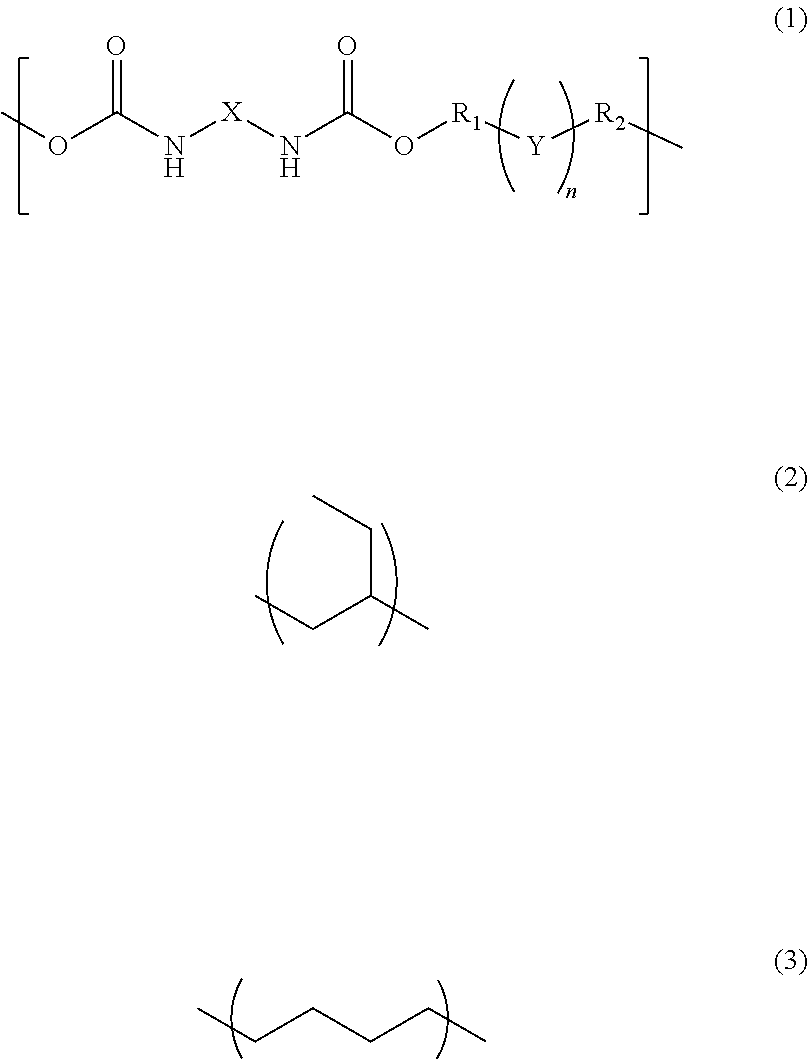
(wherein R1 and R2 are each independently a single bond, a methylene group, or an ethylene group, Y is an alkylene group of Formula (2) or a combination of the alkylene group of Formula (2) with an alkylene group of Formula (3), n is an integer of 1 to 110, and X is a divalent aliphatic hydrocarbon group, a divalent alicyclic hydrocarbon group, or a divalent aromatic hydrocarbon group), and a (meth)acryloyl group at both ends, a compound of the following Formula (4):

(wherein A is a divalent alicyclic hydrocarbon group, R3 and R4 are each independently a single bond, a methylene group, or an ethylene group, and R5 and R6 are each independently a hydrogen atom or a methyl group), a compound of the following Formula (5):

(wherein R7 is a methylene group, an ethylene group, a propylene group, or a trimethylene group, m is an integer of 2 to 4, and Z is a C4-9 organic group), a photo-radical generator, and an organic solvent, wherein the compound of Formula (4) is contained in an amount of 5% by mass to 50% by mass, and the compound of Formula (5) is contained in an amount of 0.1% by mass to 10% by mass, relative to the content of the polymer.
- Apparatus: integrated high-performance GPC system HLC-8220GPC manufactured by TOSOH CORPORATION
- Column: KF-G, KF804L
- Column Temperature: 40° C.
- Solvent: tetrahydrofuran (THF)
- Flow rate: 1.0 mL/min
- Standard sample: polystyrene
- Detector: RI

Claims (10)


Applications Claiming Priority (3)
| Application Number | Priority Date | Filing Date | Title |
|---|---|---|---|
| JP2014-258798 | 2014-12-22 | ||
| JP2014258798 | 2014-12-22 | ||
| PCT/JP2015/084930 WO2016104218A1 (en) | 2014-12-22 | 2015-12-14 | Photosensitive resin composition and adhesive composition |
Publications (2)
| Publication Number | Publication Date |
|---|---|
| US20170342238A1 US20170342238A1 (en) | 2017-11-30 |
| US10208184B2 true US10208184B2 (en) | 2019-02-19 |
Family
ID=56150246
Family Applications (1)
| Application Number | Title | Priority Date | Filing Date |
|---|---|---|---|
| US15/535,116 Expired - Fee Related US10208184B2 (en) | 2014-12-22 | 2015-12-14 | Photosensitive resin composition and adhesives composition |
Country Status (7)
| Country | Link |
|---|---|
| US (1) | US10208184B2 (en) |
| JP (1) | JP6421953B2 (en) |
| KR (1) | KR20170098221A (en) |
| CN (1) | CN107111231B (en) |
| SG (1) | SG11201704956UA (en) |
| TW (1) | TWI656170B (en) |
| WO (1) | WO2016104218A1 (en) |
Families Citing this family (6)
| Publication number | Priority date | Publication date | Assignee | Title |
|---|---|---|---|---|
| EP3562903A4 (en) * | 2016-12-29 | 2020-09-16 | Henkel AG & Co. KGaA | Photo-curable adhesive composition, cured product and use thereof |
| US20200347187A1 (en) * | 2017-10-31 | 2020-11-05 | Arkema France | Curable compositions containing thiol compounds |
| JPWO2019093157A1 (en) * | 2017-11-13 | 2021-01-14 | 日本化薬株式会社 | UV-curable adhesive composition, a cured product thereof, and a method for manufacturing an optical member using the UV-curable adhesive composition. |
| WO2019208517A1 (en) * | 2018-04-23 | 2019-10-31 | 日本化薬株式会社 | Ultraviolet-curable adhesive composition, cured product thereof, and optical member production method |
| KR102676015B1 (en) * | 2018-10-05 | 2024-06-17 | 닛뽕소다 가부시키가이샤 | adhesive composition |
| JP7302333B2 (en) * | 2019-06-27 | 2023-07-04 | 株式会社レゾナック | Photosensitive resin composition, photosensitive resin film, method for producing cured product, laminate, and electronic component |
Citations (7)
| Publication number | Priority date | Publication date | Assignee | Title |
|---|---|---|---|---|
| JP2000323692A (en) | 1999-05-07 | 2000-11-24 | Canon Inc | Solid-state imaging device |
| JP2002309185A (en) | 2001-04-13 | 2002-10-23 | Nippon Synthetic Chem Ind Co Ltd:The | Active energy ray-curable pressure-sensitive adhesive composition |
| JP2004143233A (en) | 2002-10-23 | 2004-05-20 | Nippon Synthetic Chem Ind Co Ltd:The | Active energy ray-curable pressure-sensitive adhesive composition |
| WO2013031678A1 (en) | 2011-08-26 | 2013-03-07 | 電気化学工業株式会社 | Curable resin composition |
| JP2014080497A (en) | 2012-10-16 | 2014-05-08 | Bridgestone Corp | Photocurable elastomer composition, sealing material, and device |
| WO2014196415A1 (en) | 2013-06-06 | 2014-12-11 | 横浜ゴム株式会社 | Photocurable resin and photocurable resin composition |
| JP2014237734A (en) | 2013-06-06 | 2014-12-18 | 昭和電工株式会社 | Photocurable resin composition and display device with touch panel |
Family Cites Families (6)
| Publication number | Priority date | Publication date | Assignee | Title |
|---|---|---|---|---|
| JP2000250212A (en) * | 1999-03-02 | 2000-09-14 | Nippon Synthetic Chem Ind Co Ltd:The | Photosensitive resin composition |
| JP2007206600A (en) * | 2006-02-06 | 2007-08-16 | Konica Minolta Medical & Graphic Inc | Photosensitive lithographic printing plate material and plate making method using same |
| JP5051365B2 (en) * | 2006-08-24 | 2012-10-17 | Jsr株式会社 | Photosensitive resin composition, display panel spacer and display panel |
| CN103543608A (en) * | 2009-02-26 | 2014-01-29 | 日立化成工业株式会社 | Photosensitive resin composition, and photosensitive element, resist pattern formation method and printed circuit board production method each utilizing same |
| JP4735778B1 (en) * | 2009-12-28 | 2011-07-27 | 東レ株式会社 | Positive photosensitive resin composition |
| JP5741017B2 (en) * | 2011-01-28 | 2015-07-01 | 富士ゼロックス株式会社 | Electrophotographic photosensitive member, process cartridge, and image forming apparatus |
-
2015
- 2015-12-14 JP JP2016566125A patent/JP6421953B2/en not_active Expired - Fee Related
- 2015-12-14 KR KR1020177016317A patent/KR20170098221A/en not_active Abandoned
- 2015-12-14 SG SG11201704956UA patent/SG11201704956UA/en unknown
- 2015-12-14 US US15/535,116 patent/US10208184B2/en not_active Expired - Fee Related
- 2015-12-14 WO PCT/JP2015/084930 patent/WO2016104218A1/en not_active Ceased
- 2015-12-14 CN CN201580069713.6A patent/CN107111231B/en not_active Expired - Fee Related
- 2015-12-22 TW TW104143192A patent/TWI656170B/en not_active IP Right Cessation
Patent Citations (7)
| Publication number | Priority date | Publication date | Assignee | Title |
|---|---|---|---|---|
| JP2000323692A (en) | 1999-05-07 | 2000-11-24 | Canon Inc | Solid-state imaging device |
| JP2002309185A (en) | 2001-04-13 | 2002-10-23 | Nippon Synthetic Chem Ind Co Ltd:The | Active energy ray-curable pressure-sensitive adhesive composition |
| JP2004143233A (en) | 2002-10-23 | 2004-05-20 | Nippon Synthetic Chem Ind Co Ltd:The | Active energy ray-curable pressure-sensitive adhesive composition |
| WO2013031678A1 (en) | 2011-08-26 | 2013-03-07 | 電気化学工業株式会社 | Curable resin composition |
| JP2014080497A (en) | 2012-10-16 | 2014-05-08 | Bridgestone Corp | Photocurable elastomer composition, sealing material, and device |
| WO2014196415A1 (en) | 2013-06-06 | 2014-12-11 | 横浜ゴム株式会社 | Photocurable resin and photocurable resin composition |
| JP2014237734A (en) | 2013-06-06 | 2014-12-18 | 昭和電工株式会社 | Photocurable resin composition and display device with touch panel |
Non-Patent Citations (2)
| Title |
|---|
| Mar. 8, 2016 Search Report issued in International Patent Application No. PCT/JP2015/084930. |
| Mar. 8, 2016 Written Opinion issued in International Patent Application No. PCT/JP2015/084930. |
Also Published As
| Publication number | Publication date |
|---|---|
| CN107111231B (en) | 2020-06-09 |
| US20170342238A1 (en) | 2017-11-30 |
| JP6421953B2 (en) | 2018-11-14 |
| KR20170098221A (en) | 2017-08-29 |
| SG11201704956UA (en) | 2017-07-28 |
| JPWO2016104218A1 (en) | 2017-10-19 |
| CN107111231A (en) | 2017-08-29 |
| WO2016104218A1 (en) | 2016-06-30 |
| TWI656170B (en) | 2019-04-11 |
| TW201638215A (en) | 2016-11-01 |
Similar Documents
| Publication | Publication Date | Title |
|---|---|---|
| US10208184B2 (en) | Photosensitive resin composition and adhesives composition | |
| JP6379390B2 (en) | Solvent-free photocurable resin composition | |
| JP2010265403A (en) | Active energy ray-curable releasing agent composition, method for forming coating film using the same, and release liner | |
| KR20160078336A (en) | Imprint material containing modified silicone compound and silsesquioxane compound | |
| KR20130054960A (en) | Highly abrasion-resistant imprint material | |
| WO2014112452A1 (en) | Cured-film-forming resin composition | |
| JP2010275500A (en) | Active energy ray curable release agent composition, method of forming coated film using the same, and release liner | |
| TWI895262B (en) | protective film | |
| JP6569875B2 (en) | Photocurable resin composition | |
| JP5884988B2 (en) | High scratch-resistant imprint material containing urethane compound | |
| JP5654848B2 (en) | Active energy ray-curable release agent composition, coating film forming method using the same, release liner | |
| KR20170033813A (en) | Resin composition for forming cured film, cured film, electrically conductive member, and method for preventing migration | |
| KR102411425B1 (en) | Imprinting material | |
| JP6061073B2 (en) | Imprint material | |
| WO2018043342A1 (en) | Photosensitive adhesive composition | |
| CN115136072A (en) | Pellicle and method for manufacturing same | |
| CN114685551B (en) | Compound for packaging film, composition and packaging film | |
| WO2026063112A1 (en) | Curable composition for hard coat | |
| JPWO2019031360A1 (en) | Replica mold material for imprint |
Legal Events
| Date | Code | Title | Description |
|---|---|---|---|
| AS | Assignment |
Owner name: NISSAN CHEMICAL INDUSTRIES, LTD., JAPAN Free format text: ASSIGNMENT OF ASSIGNORS INTEREST;ASSIGNORS:OHASHI, TAKUYA;SATO, TETSUO;TAMURA, MAMORU;AND OTHERS;REEL/FRAME:042675/0511 Effective date: 20170607 |
|
| STCF | Information on status: patent grant |
Free format text: PATENTED CASE |
|
| FEPP | Fee payment procedure |
Free format text: MAINTENANCE FEE REMINDER MAILED (ORIGINAL EVENT CODE: REM.); ENTITY STATUS OF PATENT OWNER: LARGE ENTITY |
|
| LAPS | Lapse for failure to pay maintenance fees |
Free format text: PATENT EXPIRED FOR FAILURE TO PAY MAINTENANCE FEES (ORIGINAL EVENT CODE: EXP.); ENTITY STATUS OF PATENT OWNER: LARGE ENTITY |
|
| STCH | Information on status: patent discontinuation |
Free format text: PATENT EXPIRED DUE TO NONPAYMENT OF MAINTENANCE FEES UNDER 37 CFR 1.362 |
|
| FP | Lapsed due to failure to pay maintenance fee |
Effective date: 20230219 |