US10196592B2 - Enhanced catalyst stability for alkaline detergent formulations - Google Patents
Enhanced catalyst stability for alkaline detergent formulations Download PDFInfo
- Publication number
- US10196592B2 US10196592B2 US14/303,706 US201414303706A US10196592B2 US 10196592 B2 US10196592 B2 US 10196592B2 US 201414303706 A US201414303706 A US 201414303706A US 10196592 B2 US10196592 B2 US 10196592B2
- Authority
- US
- United States
- Prior art keywords
- catalyst
- detergent composition
- detergent
- solid
- stabilized catalyst
- Prior art date
- Legal status (The legal status is an assumption and is not a legal conclusion. Google has not performed a legal analysis and makes no representation as to the accuracy of the status listed.)
- Active, expires
Links
- 239000000203 mixture Substances 0.000 title claims abstract description 188
- 239000003054 catalyst Substances 0.000 title claims abstract description 174
- 239000003599 detergent Substances 0.000 title claims abstract description 113
- 238000009472 formulation Methods 0.000 title abstract description 25
- 238000000034 method Methods 0.000 claims abstract description 48
- 229920002678 cellulose Polymers 0.000 claims abstract description 37
- 239000001913 cellulose Substances 0.000 claims abstract description 37
- 239000007787 solid Substances 0.000 claims abstract description 31
- 238000004061 bleaching Methods 0.000 claims abstract description 29
- 238000004140 cleaning Methods 0.000 claims abstract description 20
- -1 alkali metal bicarbonate Chemical class 0.000 claims description 39
- 239000004094 surface-active agent Substances 0.000 claims description 23
- 229920000642 polymer Polymers 0.000 claims description 21
- 239000004615 ingredient Substances 0.000 claims description 20
- 239000001866 hydroxypropyl methyl cellulose Substances 0.000 claims description 17
- 229920003088 hydroxypropyl methyl cellulose Polymers 0.000 claims description 17
- 235000010979 hydroxypropyl methyl cellulose Nutrition 0.000 claims description 17
- UFVKGYZPFZQRLF-UHFFFAOYSA-N hydroxypropyl methyl cellulose Chemical compound OC1C(O)C(OC)OC(CO)C1OC1C(O)C(O)C(OC2C(C(O)C(OC3C(C(O)C(O)C(CO)O3)O)C(CO)O2)O)C(CO)O1 UFVKGYZPFZQRLF-UHFFFAOYSA-N 0.000 claims description 17
- QVGXLLKOCUKJST-UHFFFAOYSA-N atomic oxygen Chemical compound [O] QVGXLLKOCUKJST-UHFFFAOYSA-N 0.000 claims description 13
- 229910052760 oxygen Inorganic materials 0.000 claims description 13
- 239000001301 oxygen Substances 0.000 claims description 13
- 150000002500 ions Chemical class 0.000 claims description 12
- 238000005406 washing Methods 0.000 claims description 9
- 229910052783 alkali metal Inorganic materials 0.000 claims description 8
- 229910000288 alkali metal carbonate Inorganic materials 0.000 claims description 5
- 150000008041 alkali metal carbonates Chemical class 0.000 claims description 5
- 150000001340 alkali metals Chemical class 0.000 claims description 5
- 150000008044 alkali metal hydroxides Chemical class 0.000 claims description 4
- 229910052910 alkali metal silicate Inorganic materials 0.000 claims description 4
- 230000008901 benefit Effects 0.000 claims description 4
- 238000004065 wastewater treatment Methods 0.000 claims description 3
- 238000006735 epoxidation reaction Methods 0.000 claims description 2
- 229940071207 sesquicarbonate Drugs 0.000 claims 1
- 238000000576 coating method Methods 0.000 abstract description 24
- 239000011248 coating agent Substances 0.000 abstract description 16
- XLYOFNOQVPJJNP-UHFFFAOYSA-N water Substances O XLYOFNOQVPJJNP-UHFFFAOYSA-N 0.000 description 43
- 239000011572 manganese Substances 0.000 description 39
- 229910001868 water Inorganic materials 0.000 description 39
- PWHULOQIROXLJO-UHFFFAOYSA-N Manganese Chemical compound [Mn] PWHULOQIROXLJO-UHFFFAOYSA-N 0.000 description 35
- 229910052748 manganese Inorganic materials 0.000 description 32
- 239000000243 solution Substances 0.000 description 31
- MHAJPDPJQMAIIY-UHFFFAOYSA-N Hydrogen peroxide Chemical compound OO MHAJPDPJQMAIIY-UHFFFAOYSA-N 0.000 description 22
- 239000000463 material Substances 0.000 description 20
- 239000003795 chemical substances by application Substances 0.000 description 18
- 239000012141 concentrate Substances 0.000 description 17
- 150000002927 oxygen compounds Chemical class 0.000 description 15
- 239000013042 solid detergent Substances 0.000 description 14
- 125000000217 alkyl group Chemical group 0.000 description 13
- 239000003446 ligand Substances 0.000 description 13
- 229910052751 metal Inorganic materials 0.000 description 11
- 239000002184 metal Substances 0.000 description 11
- 239000000047 product Substances 0.000 description 11
- 239000002689 soil Substances 0.000 description 11
- 229920000742 Cotton Polymers 0.000 description 10
- 150000001875 compounds Chemical class 0.000 description 10
- 230000000813 microbial effect Effects 0.000 description 10
- HEMHJVSKTPXQMS-UHFFFAOYSA-M Sodium hydroxide Chemical compound [OH-].[Na+] HEMHJVSKTPXQMS-UHFFFAOYSA-M 0.000 description 9
- 239000007844 bleaching agent Substances 0.000 description 9
- 238000005538 encapsulation Methods 0.000 description 9
- 229910019142 PO4 Inorganic materials 0.000 description 8
- 229920000623 Cellulose acetate phthalate Polymers 0.000 description 7
- 229940081734 cellulose acetate phthalate Drugs 0.000 description 7
- 239000002738 chelating agent Substances 0.000 description 7
- 230000009467 reduction Effects 0.000 description 7
- 150000003839 salts Chemical class 0.000 description 7
- 239000003352 sequestering agent Substances 0.000 description 7
- LFQSCWFLJHTTHZ-UHFFFAOYSA-N Ethanol Chemical compound CCO LFQSCWFLJHTTHZ-UHFFFAOYSA-N 0.000 description 6
- 125000000623 heterocyclic group Chemical group 0.000 description 6
- 235000021317 phosphate Nutrition 0.000 description 6
- 238000003860 storage Methods 0.000 description 6
- 229910052723 transition metal Inorganic materials 0.000 description 6
- 239000004372 Polyvinyl alcohol Substances 0.000 description 5
- RWRDLPDLKQPQOW-UHFFFAOYSA-N Pyrrolidine Chemical compound C1CCNC1 RWRDLPDLKQPQOW-UHFFFAOYSA-N 0.000 description 5
- 239000002253 acid Substances 0.000 description 5
- 230000003213 activating effect Effects 0.000 description 5
- 239000007864 aqueous solution Substances 0.000 description 5
- 235000014113 dietary fatty acids Nutrition 0.000 description 5
- 239000000194 fatty acid Substances 0.000 description 5
- 229930195729 fatty acid Natural products 0.000 description 5
- 230000004048 modification Effects 0.000 description 5
- 238000012986 modification Methods 0.000 description 5
- 150000004965 peroxy acids Chemical class 0.000 description 5
- 229920002451 polyvinyl alcohol Polymers 0.000 description 5
- 239000011734 sodium Substances 0.000 description 5
- 150000003624 transition metals Chemical class 0.000 description 5
- ITWBWJFEJCHKSN-UHFFFAOYSA-N 1,4,7-triazonane Chemical group C1CNCCNCCN1 ITWBWJFEJCHKSN-UHFFFAOYSA-N 0.000 description 4
- IJGRMHOSHXDMSA-UHFFFAOYSA-N Atomic nitrogen Chemical compound N#N IJGRMHOSHXDMSA-UHFFFAOYSA-N 0.000 description 4
- SCKXCAADGDQQCS-UHFFFAOYSA-N Performic acid Chemical compound OOC=O SCKXCAADGDQQCS-UHFFFAOYSA-N 0.000 description 4
- CDBYLPFSWZWCQE-UHFFFAOYSA-L Sodium Carbonate Chemical compound [Na+].[Na+].[O-]C([O-])=O CDBYLPFSWZWCQE-UHFFFAOYSA-L 0.000 description 4
- 244000269722 Thea sinensis Species 0.000 description 4
- 239000002518 antifoaming agent Substances 0.000 description 4
- 229920013750 conditioning polymer Polymers 0.000 description 4
- 239000008367 deionised water Substances 0.000 description 4
- 229910021641 deionized water Inorganic materials 0.000 description 4
- 238000010790 dilution Methods 0.000 description 4
- 239000012895 dilution Substances 0.000 description 4
- 230000000694 effects Effects 0.000 description 4
- 125000004185 ester group Chemical group 0.000 description 4
- 239000004744 fabric Substances 0.000 description 4
- 150000004665 fatty acids Chemical class 0.000 description 4
- 239000008187 granular material Substances 0.000 description 4
- 244000005700 microbiome Species 0.000 description 4
- 125000004433 nitrogen atom Chemical group N* 0.000 description 4
- 230000003647 oxidation Effects 0.000 description 4
- 238000007254 oxidation reaction Methods 0.000 description 4
- 229910052708 sodium Inorganic materials 0.000 description 4
- 150000003467 sulfuric acid derivatives Chemical class 0.000 description 4
- 238000012360 testing method Methods 0.000 description 4
- NLXLAEXVIDQMFP-UHFFFAOYSA-N Ammonia chloride Chemical group [NH4+].[Cl-] NLXLAEXVIDQMFP-UHFFFAOYSA-N 0.000 description 3
- RCTHWQBPLNOHAE-UHFFFAOYSA-N CC([O-])CC(C)[O-] Chemical compound CC([O-])CC(C)[O-] RCTHWQBPLNOHAE-UHFFFAOYSA-N 0.000 description 3
- KCXVZYZYPLLWCC-UHFFFAOYSA-N EDTA Chemical compound OC(=O)CN(CC(O)=O)CCN(CC(O)=O)CC(O)=O KCXVZYZYPLLWCC-UHFFFAOYSA-N 0.000 description 3
- DGAQECJNVWCQMB-PUAWFVPOSA-M Ilexoside XXIX Chemical compound C[C@@H]1CC[C@@]2(CC[C@@]3(C(=CC[C@H]4[C@]3(CC[C@@H]5[C@@]4(CC[C@@H](C5(C)C)OS(=O)(=O)[O-])C)C)[C@@H]2[C@]1(C)O)C)C(=O)O[C@H]6[C@@H]([C@H]([C@@H]([C@H](O6)CO)O)O)O.[Na+] DGAQECJNVWCQMB-PUAWFVPOSA-M 0.000 description 3
- QPCDCPDFJACHGM-UHFFFAOYSA-N N,N-bis{2-[bis(carboxymethyl)amino]ethyl}glycine Chemical compound OC(=O)CN(CC(O)=O)CCN(CC(=O)O)CCN(CC(O)=O)CC(O)=O QPCDCPDFJACHGM-UHFFFAOYSA-N 0.000 description 3
- 229920003171 Poly (ethylene oxide) Polymers 0.000 description 3
- KWYUFKZDYYNOTN-UHFFFAOYSA-M Potassium hydroxide Chemical compound [OH-].[K+] KWYUFKZDYYNOTN-UHFFFAOYSA-M 0.000 description 3
- 229920002472 Starch Polymers 0.000 description 3
- 230000009471 action Effects 0.000 description 3
- 230000004913 activation Effects 0.000 description 3
- 150000001412 amines Chemical class 0.000 description 3
- 239000003945 anionic surfactant Substances 0.000 description 3
- 230000000845 anti-microbial effect Effects 0.000 description 3
- 125000004432 carbon atom Chemical group C* 0.000 description 3
- 150000007942 carboxylates Chemical class 0.000 description 3
- 239000003093 cationic surfactant Substances 0.000 description 3
- 239000004205 dimethyl polysiloxane Substances 0.000 description 3
- 238000004851 dishwashing Methods 0.000 description 3
- VTIIJXUACCWYHX-UHFFFAOYSA-L disodium;carboxylatooxy carbonate Chemical compound [Na+].[Na+].[O-]C(=O)OOC([O-])=O VTIIJXUACCWYHX-UHFFFAOYSA-L 0.000 description 3
- 238000005187 foaming Methods 0.000 description 3
- 150000004676 glycans Chemical class 0.000 description 3
- 230000036571 hydration Effects 0.000 description 3
- 238000006703 hydration reaction Methods 0.000 description 3
- 125000002496 methyl group Chemical group [H]C([H])([H])* 0.000 description 3
- 229910052757 nitrogen Inorganic materials 0.000 description 3
- 239000002736 nonionic surfactant Substances 0.000 description 3
- 239000013110 organic ligand Substances 0.000 description 3
- 229960003330 pentetic acid Drugs 0.000 description 3
- 150000002978 peroxides Chemical class 0.000 description 3
- NBIIXXVUZAFLBC-UHFFFAOYSA-K phosphate Chemical compound [O-]P([O-])([O-])=O NBIIXXVUZAFLBC-UHFFFAOYSA-K 0.000 description 3
- 239000010452 phosphate Substances 0.000 description 3
- 150000003013 phosphoric acid derivatives Chemical class 0.000 description 3
- 229920003023 plastic Polymers 0.000 description 3
- 239000004033 plastic Substances 0.000 description 3
- 229920000233 poly(alkylene oxides) Polymers 0.000 description 3
- 229920000435 poly(dimethylsiloxane) Polymers 0.000 description 3
- 229920001282 polysaccharide Polymers 0.000 description 3
- 239000005017 polysaccharide Substances 0.000 description 3
- 230000008569 process Effects 0.000 description 3
- 238000011012 sanitization Methods 0.000 description 3
- MWNQXXOSWHCCOZ-UHFFFAOYSA-L sodium;oxido carbonate Chemical compound [Na+].[O-]OC([O-])=O MWNQXXOSWHCCOZ-UHFFFAOYSA-L 0.000 description 3
- 241000894007 species Species 0.000 description 3
- 235000019698 starch Nutrition 0.000 description 3
- 239000000126 substance Substances 0.000 description 3
- 125000000547 substituted alkyl group Chemical group 0.000 description 3
- 125000004169 (C1-C6) alkyl group Chemical group 0.000 description 2
- 0 *OCC1O[C@@H](C)C(O*)C(*O)C1OC Chemical compound *OCC1O[C@@H](C)C(O*)C(*O)C1OC 0.000 description 2
- URDCARMUOSMFFI-UHFFFAOYSA-N 2-[2-[bis(carboxymethyl)amino]ethyl-(2-hydroxyethyl)amino]acetic acid Chemical compound OCCN(CC(O)=O)CCN(CC(O)=O)CC(O)=O URDCARMUOSMFFI-UHFFFAOYSA-N 0.000 description 2
- CIEZZGWIJBXOTE-UHFFFAOYSA-N 2-[bis(carboxymethyl)amino]propanoic acid Chemical compound OC(=O)C(C)N(CC(O)=O)CC(O)=O CIEZZGWIJBXOTE-UHFFFAOYSA-N 0.000 description 2
- 241000894006 Bacteria Species 0.000 description 2
- KXDHJXZQYSOELW-UHFFFAOYSA-N Carbamic acid Chemical compound NC(O)=O KXDHJXZQYSOELW-UHFFFAOYSA-N 0.000 description 2
- BVKZGUZCCUSVTD-UHFFFAOYSA-L Carbonate Chemical compound [O-]C([O-])=O BVKZGUZCCUSVTD-UHFFFAOYSA-L 0.000 description 2
- VEXZGXHMUGYJMC-UHFFFAOYSA-M Chloride anion Chemical compound [Cl-] VEXZGXHMUGYJMC-UHFFFAOYSA-M 0.000 description 2
- IAYPIBMASNFSPL-UHFFFAOYSA-N Ethylene oxide Chemical compound C1CO1 IAYPIBMASNFSPL-UHFFFAOYSA-N 0.000 description 2
- PIICEJLVQHRZGT-UHFFFAOYSA-N Ethylenediamine Chemical compound NCCN PIICEJLVQHRZGT-UHFFFAOYSA-N 0.000 description 2
- DBVJJBKOTRCVKF-UHFFFAOYSA-N Etidronic acid Chemical compound OP(=O)(O)C(O)(C)P(O)(O)=O DBVJJBKOTRCVKF-UHFFFAOYSA-N 0.000 description 2
- YLQBMQCUIZJEEH-UHFFFAOYSA-N Furan Chemical compound C=1C=COC=1 YLQBMQCUIZJEEH-UHFFFAOYSA-N 0.000 description 2
- 229920000663 Hydroxyethyl cellulose Polymers 0.000 description 2
- 239000004354 Hydroxyethyl cellulose Substances 0.000 description 2
- 229920002153 Hydroxypropyl cellulose Polymers 0.000 description 2
- SPAGIJMPHSUYSE-UHFFFAOYSA-N Magnesium peroxide Chemical compound [Mg+2].[O-][O-] SPAGIJMPHSUYSE-UHFFFAOYSA-N 0.000 description 2
- 229910002651 NO3 Inorganic materials 0.000 description 2
- 239000002202 Polyethylene glycol Substances 0.000 description 2
- VYPSYNLAJGMNEJ-UHFFFAOYSA-N Silicium dioxide Chemical compound O=[Si]=O VYPSYNLAJGMNEJ-UHFFFAOYSA-N 0.000 description 2
- NINIDFKCEFEMDL-UHFFFAOYSA-N Sulfur Chemical compound [S] NINIDFKCEFEMDL-UHFFFAOYSA-N 0.000 description 2
- BGRWYDHXPHLNKA-UHFFFAOYSA-N Tetraacetylethylenediamine Chemical compound CC(=O)N(C(C)=O)CCN(C(C)=O)C(C)=O BGRWYDHXPHLNKA-UHFFFAOYSA-N 0.000 description 2
- UAOKXEHOENRFMP-ZJIFWQFVSA-N [(2r,3r,4s,5r)-2,3,4,5-tetraacetyloxy-6-oxohexyl] acetate Chemical compound CC(=O)OC[C@@H](OC(C)=O)[C@@H](OC(C)=O)[C@H](OC(C)=O)[C@@H](OC(C)=O)C=O UAOKXEHOENRFMP-ZJIFWQFVSA-N 0.000 description 2
- 150000007513 acids Chemical class 0.000 description 2
- 239000012190 activator Substances 0.000 description 2
- 150000001298 alcohols Chemical class 0.000 description 2
- 125000001931 aliphatic group Chemical group 0.000 description 2
- 125000003342 alkenyl group Chemical group 0.000 description 2
- 125000003118 aryl group Chemical group 0.000 description 2
- 230000009286 beneficial effect Effects 0.000 description 2
- 229920001400 block copolymer Polymers 0.000 description 2
- 230000005587 bubbling Effects 0.000 description 2
- 125000003917 carbamoyl group Chemical group [H]N([H])C(*)=O 0.000 description 2
- 125000002837 carbocyclic group Chemical group 0.000 description 2
- 125000003178 carboxy group Chemical group [H]OC(*)=O 0.000 description 2
- 230000005779 cell damage Effects 0.000 description 2
- 208000037887 cell injury Diseases 0.000 description 2
- 239000012459 cleaning agent Substances 0.000 description 2
- 239000008139 complexing agent Substances 0.000 description 2
- 229920001577 copolymer Polymers 0.000 description 2
- 125000000753 cycloalkyl group Chemical group 0.000 description 2
- 239000000645 desinfectant Substances 0.000 description 2
- 230000001627 detrimental effect Effects 0.000 description 2
- 239000003085 diluting agent Substances 0.000 description 2
- 238000001035 drying Methods 0.000 description 2
- DUYCTCQXNHFCSJ-UHFFFAOYSA-N dtpmp Chemical compound OP(=O)(O)CN(CP(O)(O)=O)CCN(CP(O)(=O)O)CCN(CP(O)(O)=O)CP(O)(O)=O DUYCTCQXNHFCSJ-UHFFFAOYSA-N 0.000 description 2
- 150000002148 esters Chemical class 0.000 description 2
- 238000002474 experimental method Methods 0.000 description 2
- 150000002191 fatty alcohols Chemical class 0.000 description 2
- 150000002334 glycols Chemical class 0.000 description 2
- NAQMVNRVTILPCV-UHFFFAOYSA-N hexane-1,6-diamine Chemical compound NCCCCCCN NAQMVNRVTILPCV-UHFFFAOYSA-N 0.000 description 2
- 239000001257 hydrogen Substances 0.000 description 2
- 229910052739 hydrogen Inorganic materials 0.000 description 2
- 125000004435 hydrogen atom Chemical group [H]* 0.000 description 2
- 235000019447 hydroxyethyl cellulose Nutrition 0.000 description 2
- 239000001863 hydroxypropyl cellulose Substances 0.000 description 2
- 235000010977 hydroxypropyl cellulose Nutrition 0.000 description 2
- 239000003112 inhibitor Substances 0.000 description 2
- 230000000670 limiting effect Effects 0.000 description 2
- 239000007788 liquid Substances 0.000 description 2
- NUJOXMJBOLGQSY-UHFFFAOYSA-N manganese dioxide Chemical compound O=[Mn]=O NUJOXMJBOLGQSY-UHFFFAOYSA-N 0.000 description 2
- OXHQNTSSPHKCPB-IYEMJOQQSA-L manganese(2+);(2r,3s,4r,5r)-2,3,4,5,6-pentahydroxyhexanoate Chemical compound [Mn+2].OC[C@@H](O)[C@@H](O)[C@H](O)[C@@H](O)C([O-])=O.OC[C@@H](O)[C@@H](O)[C@H](O)[C@@H](O)C([O-])=O OXHQNTSSPHKCPB-IYEMJOQQSA-L 0.000 description 2
- 238000004519 manufacturing process Methods 0.000 description 2
- 239000008204 material by function Substances 0.000 description 2
- 229910021645 metal ion Inorganic materials 0.000 description 2
- 125000000956 methoxy group Chemical group [H]C([H])([H])O* 0.000 description 2
- 229920000609 methyl cellulose Polymers 0.000 description 2
- 239000001923 methylcellulose Substances 0.000 description 2
- 235000010981 methylcellulose Nutrition 0.000 description 2
- 230000003641 microbiacidal effect Effects 0.000 description 2
- MGFYIUFZLHCRTH-UHFFFAOYSA-N nitrilotriacetic acid Chemical compound OC(=O)CN(CC(O)=O)CC(O)=O MGFYIUFZLHCRTH-UHFFFAOYSA-N 0.000 description 2
- 229920000847 nonoxynol Polymers 0.000 description 2
- 150000002894 organic compounds Chemical class 0.000 description 2
- 239000007800 oxidant agent Substances 0.000 description 2
- 150000002924 oxiranes Chemical class 0.000 description 2
- 239000011236 particulate material Substances 0.000 description 2
- UEZVMMHDMIWARA-UHFFFAOYSA-M phosphonate Chemical compound [O-]P(=O)=O UEZVMMHDMIWARA-UHFFFAOYSA-M 0.000 description 2
- 239000004417 polycarbonate Substances 0.000 description 2
- 229920005646 polycarboxylate Polymers 0.000 description 2
- 229920001223 polyethylene glycol Polymers 0.000 description 2
- 229920000139 polyethylene terephthalate Polymers 0.000 description 2
- 239000005020 polyethylene terephthalate Substances 0.000 description 2
- 229920005996 polystyrene-poly(ethylene-butylene)-polystyrene Polymers 0.000 description 2
- BWHMMNNQKKPAPP-UHFFFAOYSA-L potassium carbonate Chemical compound [K+].[K+].[O-]C([O-])=O BWHMMNNQKKPAPP-UHFFFAOYSA-L 0.000 description 2
- 238000010944 pre-mature reactiony Methods 0.000 description 2
- 230000001681 protective effect Effects 0.000 description 2
- 230000002829 reductive effect Effects 0.000 description 2
- 229920006395 saturated elastomer Polymers 0.000 description 2
- 229910000029 sodium carbonate Inorganic materials 0.000 description 2
- 229940045872 sodium percarbonate Drugs 0.000 description 2
- JQWHASGSAFIOCM-UHFFFAOYSA-M sodium periodate Chemical compound [Na+].[O-]I(=O)(=O)=O JQWHASGSAFIOCM-UHFFFAOYSA-M 0.000 description 2
- 159000000000 sodium salts Chemical class 0.000 description 2
- 239000008247 solid mixture Substances 0.000 description 2
- 238000007711 solidification Methods 0.000 description 2
- 230000008023 solidification Effects 0.000 description 2
- 239000002904 solvent Substances 0.000 description 2
- 239000003381 stabilizer Substances 0.000 description 2
- 230000000087 stabilizing effect Effects 0.000 description 2
- 125000001424 substituent group Chemical group 0.000 description 2
- 150000003871 sulfonates Chemical class 0.000 description 2
- 229910052717 sulfur Inorganic materials 0.000 description 2
- 239000011593 sulfur Substances 0.000 description 2
- 239000002888 zwitterionic surfactant Substances 0.000 description 2
- LPLXQXYZLABPRN-VLGUWGOYSA-N (2R,3S,4S,5R)-3,4,5-trihexadecyl-2,3,4,5-tetrahydroxy-2-(hydroxymethyl)-1-phenyldocosane-1,6-dione Chemical compound C(C1=CC=CC=C1)(=O)[C@@]([C@]([C@@]([C@](C(=O)CCCCCCCCCCCCCCCC)(O)CCCCCCCCCCCCCCCC)(O)CCCCCCCCCCCCCCCC)(O)CCCCCCCCCCCCCCCC)(O)CO LPLXQXYZLABPRN-VLGUWGOYSA-N 0.000 description 1
- JNYAEWCLZODPBN-JGWLITMVSA-N (2r,3r,4s)-2-[(1r)-1,2-dihydroxyethyl]oxolane-3,4-diol Chemical compound OC[C@@H](O)[C@H]1OC[C@H](O)[C@H]1O JNYAEWCLZODPBN-JGWLITMVSA-N 0.000 description 1
- UYXFOIMFLBVYDL-UHFFFAOYSA-N 1,2,4,7-tetramethyl-1,4,7-triazonane Chemical compound CC1CN(C)CCN(C)CCN1C UYXFOIMFLBVYDL-UHFFFAOYSA-N 0.000 description 1
- UPNNXUSUOSTIIM-UHFFFAOYSA-N 1,2-dithietane Chemical compound C1CSS1 UPNNXUSUOSTIIM-UHFFFAOYSA-N 0.000 description 1
- BPSYZMLXRKCSJY-UHFFFAOYSA-N 1,3,2-dioxaphosphepan-2-ium 2-oxide Chemical compound O=[P+]1OCCCCO1 BPSYZMLXRKCSJY-UHFFFAOYSA-N 0.000 description 1
- WLDGDTPNAKWAIR-UHFFFAOYSA-N 1,4,7-trimethyl-1,4,7-triazonane Chemical compound CN1CCN(C)CCN(C)CC1 WLDGDTPNAKWAIR-UHFFFAOYSA-N 0.000 description 1
- VQFZKDXSJZVGDA-UHFFFAOYSA-N 1,5,9-triazacyclododecane Chemical compound C1CNCCCNCCCNC1 VQFZKDXSJZVGDA-UHFFFAOYSA-N 0.000 description 1
- LRPVVAOGGZFVFO-UHFFFAOYSA-N 1,5,9-trimethyl-1,5,9-triazacyclododecane Chemical compound CN1CCCN(C)CCCN(C)CCC1 LRPVVAOGGZFVFO-UHFFFAOYSA-N 0.000 description 1
- JKTCBAGSMQIFNL-UHFFFAOYSA-N 2,3-dihydrofuran Chemical compound C1CC=CO1 JKTCBAGSMQIFNL-UHFFFAOYSA-N 0.000 description 1
- IEORSVTYLWZQJQ-UHFFFAOYSA-N 2-(2-nonylphenoxy)ethanol Chemical compound CCCCCCCCCC1=CC=CC=C1OCCO IEORSVTYLWZQJQ-UHFFFAOYSA-N 0.000 description 1
- GOHZKUSWWGUUNR-UHFFFAOYSA-N 2-(4,5-dihydroimidazol-1-yl)ethanol Chemical compound OCCN1CCN=C1 GOHZKUSWWGUUNR-UHFFFAOYSA-N 0.000 description 1
- FNZXYRPYOMKZHY-UHFFFAOYSA-N 2-hexanoyloxybenzenesulfonic acid Chemical compound CCCCCC(=O)OC1=CC=CC=C1S(O)(=O)=O FNZXYRPYOMKZHY-UHFFFAOYSA-N 0.000 description 1
- KSNGEYQWLMRSIR-UHFFFAOYSA-L 2-hydroxypropanoate;manganese(2+) Chemical compound [Mn+2].CC(O)C([O-])=O.CC(O)C([O-])=O KSNGEYQWLMRSIR-UHFFFAOYSA-L 0.000 description 1
- NZCIWANIJJJEML-UHFFFAOYSA-N 2-methyl-1,4,7-triazonane Chemical compound CC1CNCCNCCN1 NZCIWANIJJJEML-UHFFFAOYSA-N 0.000 description 1
- MUZDXNQOSGWMJJ-UHFFFAOYSA-N 2-methylprop-2-enoic acid;prop-2-enoic acid Chemical compound OC(=O)C=C.CC(=C)C(O)=O MUZDXNQOSGWMJJ-UHFFFAOYSA-N 0.000 description 1
- RSEBUVRVKCANEP-UHFFFAOYSA-N 2-pyrroline Chemical compound C1CC=CN1 RSEBUVRVKCANEP-UHFFFAOYSA-N 0.000 description 1
- NOWKCMXCCJGMRR-UHFFFAOYSA-N Aziridine Chemical compound C1CN1 NOWKCMXCCJGMRR-UHFFFAOYSA-N 0.000 description 1
- BVKZGUZCCUSVTD-UHFFFAOYSA-M Bicarbonate Chemical class OC([O-])=O BVKZGUZCCUSVTD-UHFFFAOYSA-M 0.000 description 1
- FWPGFXUUUZFCCA-UHFFFAOYSA-N C1C2CC1C2.[Y] Chemical compound C1C2CC1C2.[Y] FWPGFXUUUZFCCA-UHFFFAOYSA-N 0.000 description 1
- OKTJSMMVPCPJKN-UHFFFAOYSA-N Carbon Chemical compound [C] OKTJSMMVPCPJKN-UHFFFAOYSA-N 0.000 description 1
- 239000004215 Carbon black (E152) Substances 0.000 description 1
- 229920002134 Carboxymethyl cellulose Polymers 0.000 description 1
- 229920002284 Cellulose triacetate Polymers 0.000 description 1
- ZAMOUSCENKQFHK-UHFFFAOYSA-N Chlorine atom Chemical compound [Cl] ZAMOUSCENKQFHK-UHFFFAOYSA-N 0.000 description 1
- KRKNYBCHXYNGOX-UHFFFAOYSA-K Citrate Chemical compound [O-]C(=O)CC(O)(CC([O-])=O)C([O-])=O KRKNYBCHXYNGOX-UHFFFAOYSA-K 0.000 description 1
- 241000195493 Cryptophyta Species 0.000 description 1
- 241000192700 Cyanobacteria Species 0.000 description 1
- 229920000089 Cyclic olefin copolymer Polymers 0.000 description 1
- FBPFZTCFMRRESA-KVTDHHQDSA-N D-Mannitol Chemical compound OC[C@@H](O)[C@@H](O)[C@H](O)[C@H](O)CO FBPFZTCFMRRESA-KVTDHHQDSA-N 0.000 description 1
- 125000002353 D-glucosyl group Chemical group C1([C@H](O)[C@@H](O)[C@H](O)[C@H](O1)CO)* 0.000 description 1
- BVTJGGGYKAMDBN-UHFFFAOYSA-N Dioxetane Chemical compound C1COO1 BVTJGGGYKAMDBN-UHFFFAOYSA-N 0.000 description 1
- 102000004190 Enzymes Human genes 0.000 description 1
- 108090000790 Enzymes Proteins 0.000 description 1
- 241000233866 Fungi Species 0.000 description 1
- UFHFLCQGNIYNRP-UHFFFAOYSA-N Hydrogen Chemical compound [H][H] UFHFLCQGNIYNRP-UHFFFAOYSA-N 0.000 description 1
- 229910021380 Manganese Chloride Inorganic materials 0.000 description 1
- GLFNIEUTAYBVOC-UHFFFAOYSA-L Manganese chloride Chemical compound Cl[Mn]Cl GLFNIEUTAYBVOC-UHFFFAOYSA-L 0.000 description 1
- 229930195725 Mannitol Natural products 0.000 description 1
- JYXGIOKAKDAARW-UHFFFAOYSA-N N-(2-hydroxyethyl)iminodiacetic acid Chemical compound OCCN(CC(O)=O)CC(O)=O JYXGIOKAKDAARW-UHFFFAOYSA-N 0.000 description 1
- MUBZPKHOEPUJKR-UHFFFAOYSA-N Oxalic acid Chemical compound OC(=O)C(O)=O MUBZPKHOEPUJKR-UHFFFAOYSA-N 0.000 description 1
- 241001596784 Pegasus Species 0.000 description 1
- ABLZXFCXXLZCGV-UHFFFAOYSA-N Phosphorous acid Chemical compound OP(O)=O ABLZXFCXXLZCGV-UHFFFAOYSA-N 0.000 description 1
- OAICVXFJPJFONN-UHFFFAOYSA-N Phosphorus Chemical compound [P] OAICVXFJPJFONN-UHFFFAOYSA-N 0.000 description 1
- 229920002845 Poly(methacrylic acid) Polymers 0.000 description 1
- 239000004111 Potassium silicate Substances 0.000 description 1
- XBDQKXXYIPTUBI-UHFFFAOYSA-N Propionic acid Chemical class CCC(O)=O XBDQKXXYIPTUBI-UHFFFAOYSA-N 0.000 description 1
- 229920001131 Pulp (paper) Polymers 0.000 description 1
- 239000002262 Schiff base Substances 0.000 description 1
- 150000004753 Schiff bases Chemical class 0.000 description 1
- 239000004115 Sodium Silicate Substances 0.000 description 1
- 229920002125 Sokalan® Polymers 0.000 description 1
- ULUAUXLGCMPNKK-UHFFFAOYSA-N Sulfobutanedioic acid Chemical class OC(=O)CC(C(O)=O)S(O)(=O)=O ULUAUXLGCMPNKK-UHFFFAOYSA-N 0.000 description 1
- WYURNTSHIVDZCO-UHFFFAOYSA-N Tetrahydrofuran Chemical compound C1CCOC1 WYURNTSHIVDZCO-UHFFFAOYSA-N 0.000 description 1
- 240000004824 Trimezia steyermarkii Species 0.000 description 1
- 241000726445 Viroids Species 0.000 description 1
- 241000700605 Viruses Species 0.000 description 1
- NNLVGZFZQQXQNW-ADJNRHBOSA-N [(2r,3r,4s,5r,6s)-4,5-diacetyloxy-3-[(2s,3r,4s,5r,6r)-3,4,5-triacetyloxy-6-(acetyloxymethyl)oxan-2-yl]oxy-6-[(2r,3r,4s,5r,6s)-4,5,6-triacetyloxy-2-(acetyloxymethyl)oxan-3-yl]oxyoxan-2-yl]methyl acetate Chemical compound O([C@@H]1O[C@@H]([C@H]([C@H](OC(C)=O)[C@H]1OC(C)=O)O[C@H]1[C@@H]([C@@H](OC(C)=O)[C@H](OC(C)=O)[C@@H](COC(C)=O)O1)OC(C)=O)COC(=O)C)[C@@H]1[C@@H](COC(C)=O)O[C@@H](OC(C)=O)[C@H](OC(C)=O)[C@H]1OC(C)=O NNLVGZFZQQXQNW-ADJNRHBOSA-N 0.000 description 1
- YAWYUSRBDMEKHZ-UHFFFAOYSA-N [2-hydroxyethyl(phosphonomethyl)amino]methylphosphonic acid Chemical compound OCCN(CP(O)(O)=O)CP(O)(O)=O YAWYUSRBDMEKHZ-UHFFFAOYSA-N 0.000 description 1
- YDONNITUKPKTIG-UHFFFAOYSA-N [Nitrilotris(methylene)]trisphosphonic acid Chemical compound OP(O)(=O)CN(CP(O)(O)=O)CP(O)(O)=O YDONNITUKPKTIG-UHFFFAOYSA-N 0.000 description 1
- 150000001242 acetic acid derivatives Chemical class 0.000 description 1
- NIXOWILDQLNWCW-UHFFFAOYSA-N acrylic acid group Chemical group C(C=C)(=O)O NIXOWILDQLNWCW-UHFFFAOYSA-N 0.000 description 1
- 229920006243 acrylic copolymer Polymers 0.000 description 1
- 125000004442 acylamino group Chemical group 0.000 description 1
- 239000000654 additive Substances 0.000 description 1
- 230000002411 adverse Effects 0.000 description 1
- 238000013019 agitation Methods 0.000 description 1
- 125000002723 alicyclic group Chemical group 0.000 description 1
- 229910052784 alkaline earth metal Inorganic materials 0.000 description 1
- 125000003545 alkoxy group Chemical group 0.000 description 1
- 125000004453 alkoxycarbonyl group Chemical group 0.000 description 1
- 125000005194 alkoxycarbonyloxy group Chemical group 0.000 description 1
- 150000003973 alkyl amines Chemical class 0.000 description 1
- 125000004457 alkyl amino carbonyl group Chemical group 0.000 description 1
- 125000003282 alkyl amino group Chemical group 0.000 description 1
- 125000004947 alkyl aryl amino group Chemical group 0.000 description 1
- 125000002877 alkyl aryl group Chemical group 0.000 description 1
- 150000008055 alkyl aryl sulfonates Chemical class 0.000 description 1
- 125000003806 alkyl carbonyl amino group Chemical group 0.000 description 1
- 125000004448 alkyl carbonyl group Chemical group 0.000 description 1
- 125000005196 alkyl carbonyloxy group Chemical group 0.000 description 1
- 125000005599 alkyl carboxylate group Chemical group 0.000 description 1
- 125000005907 alkyl ester group Chemical group 0.000 description 1
- 150000008051 alkyl sulfates Chemical class 0.000 description 1
- 125000004644 alkyl sulfinyl group Chemical group 0.000 description 1
- 229940045714 alkyl sulfonate alkylating agent Drugs 0.000 description 1
- 150000008052 alkyl sulfonates Chemical class 0.000 description 1
- 125000004691 alkyl thio carbonyl group Chemical group 0.000 description 1
- 125000004414 alkyl thio group Chemical group 0.000 description 1
- 125000000304 alkynyl group Chemical group 0.000 description 1
- 150000001408 amides Chemical class 0.000 description 1
- 125000004397 aminosulfonyl group Chemical group NS(=O)(=O)* 0.000 description 1
- 235000019270 ammonium chloride Nutrition 0.000 description 1
- 238000004458 analytical method Methods 0.000 description 1
- 125000000129 anionic group Chemical group 0.000 description 1
- 239000004599 antimicrobial Substances 0.000 description 1
- 125000003710 aryl alkyl group Chemical group 0.000 description 1
- 125000001769 aryl amino group Chemical group 0.000 description 1
- 125000004658 aryl carbonyl amino group Chemical group 0.000 description 1
- 125000005129 aryl carbonyl group Chemical group 0.000 description 1
- 125000005199 aryl carbonyloxy group Chemical group 0.000 description 1
- 125000005110 aryl thio group Chemical group 0.000 description 1
- 125000005200 aryloxy carbonyloxy group Chemical group 0.000 description 1
- 125000004104 aryloxy group Chemical group 0.000 description 1
- HONIICLYMWZJFZ-UHFFFAOYSA-N azetidine Chemical compound C1CNC1 HONIICLYMWZJFZ-UHFFFAOYSA-N 0.000 description 1
- 125000000852 azido group Chemical group *N=[N+]=[N-] 0.000 description 1
- 230000001580 bacterial effect Effects 0.000 description 1
- SRSXLGNVWSONIS-UHFFFAOYSA-M benzenesulfonate Chemical compound [O-]S(=O)(=O)C1=CC=CC=C1 SRSXLGNVWSONIS-UHFFFAOYSA-M 0.000 description 1
- CADWTSSKOVRVJC-UHFFFAOYSA-N benzyl(dimethyl)azanium;chloride Chemical compound [Cl-].C[NH+](C)CC1=CC=CC=C1 CADWTSSKOVRVJC-UHFFFAOYSA-N 0.000 description 1
- FXJNQQZSGLEFSR-UHFFFAOYSA-M benzyl-dimethyl-tetradecylazanium;chloride;hydrate Chemical compound O.[Cl-].CCCCCCCCCCCCCC[N+](C)(C)CC1=CC=CC=C1 FXJNQQZSGLEFSR-UHFFFAOYSA-M 0.000 description 1
- 239000011230 binding agent Substances 0.000 description 1
- 229920001222 biopolymer Polymers 0.000 description 1
- MRNZSTMRDWRNNR-UHFFFAOYSA-N bis(hexamethylene)triamine Chemical compound NCCCCCCNCCCCCCN MRNZSTMRDWRNNR-UHFFFAOYSA-N 0.000 description 1
- 150000003842 bromide salts Chemical class 0.000 description 1
- 239000000872 buffer Substances 0.000 description 1
- 125000000484 butyl group Chemical group [H]C([*])([H])C([H])([H])C([H])([H])C([H])([H])[H] 0.000 description 1
- 125000001951 carbamoylamino group Chemical group C(N)(=O)N* 0.000 description 1
- 229910052799 carbon Inorganic materials 0.000 description 1
- 150000001732 carboxylic acid derivatives Chemical class 0.000 description 1
- 150000001733 carboxylic acid esters Chemical class 0.000 description 1
- 230000015556 catabolic process Effects 0.000 description 1
- 125000002091 cationic group Chemical group 0.000 description 1
- 230000008859 change Effects 0.000 description 1
- 239000013522 chelant Substances 0.000 description 1
- 150000001805 chlorine compounds Chemical class 0.000 description 1
- 239000013065 commercial product Substances 0.000 description 1
- 239000000356 contaminant Substances 0.000 description 1
- 238000010411 cooking Methods 0.000 description 1
- 230000007797 corrosion Effects 0.000 description 1
- 238000005260 corrosion Methods 0.000 description 1
- 125000004093 cyano group Chemical group *C#N 0.000 description 1
- 125000006165 cyclic alkyl group Chemical group 0.000 description 1
- 125000006448 cycloalkyl cycloalkyl group Chemical group 0.000 description 1
- 125000000582 cycloheptyl group Chemical group [H]C1([H])C([H])([H])C([H])([H])C([H])([H])C([H])(*)C([H])([H])C1([H])[H] 0.000 description 1
- 125000000113 cyclohexyl group Chemical group [H]C1([H])C([H])([H])C([H])([H])C([H])(*)C([H])([H])C1([H])[H] 0.000 description 1
- 125000000640 cyclooctyl group Chemical group [H]C1([H])C([H])([H])C([H])([H])C([H])([H])C([H])(*)C([H])([H])C([H])([H])C1([H])[H] 0.000 description 1
- 125000001511 cyclopentyl group Chemical group [H]C1([H])C([H])([H])C([H])([H])C([H])(*)C1([H])[H] 0.000 description 1
- 125000001559 cyclopropyl group Chemical group [H]C1([H])C([H])([H])C1([H])* 0.000 description 1
- 230000006378 damage Effects 0.000 description 1
- 125000002704 decyl group Chemical group [H]C([H])([H])C([H])([H])C([H])([H])C([H])([H])C([H])([H])C([H])([H])C([H])([H])C([H])([H])C([H])([H])C([H])([H])* 0.000 description 1
- 238000006731 degradation reaction Methods 0.000 description 1
- 230000001419 dependent effect Effects 0.000 description 1
- 230000000249 desinfective effect Effects 0.000 description 1
- 125000004663 dialkyl amino group Chemical group 0.000 description 1
- 125000004473 dialkylaminocarbonyl group Chemical group 0.000 description 1
- 125000004986 diarylamino group Chemical group 0.000 description 1
- ZBCBWPMODOFKDW-UHFFFAOYSA-N diethanolamine Chemical compound OCCNCCO ZBCBWPMODOFKDW-UHFFFAOYSA-N 0.000 description 1
- MTHSVFCYNBDYFN-UHFFFAOYSA-N diethylene glycol Chemical compound OCCOCCO MTHSVFCYNBDYFN-UHFFFAOYSA-N 0.000 description 1
- 230000004069 differentiation Effects 0.000 description 1
- 238000007865 diluting Methods 0.000 description 1
- ORXJMBXYSGGCHG-UHFFFAOYSA-N dimethyl 2-methoxypropanedioate Chemical compound COC(=O)C(OC)C(=O)OC ORXJMBXYSGGCHG-UHFFFAOYSA-N 0.000 description 1
- ASQQEOXYFGEFKQ-UHFFFAOYSA-N dioxirane Chemical compound C1OO1 ASQQEOXYFGEFKQ-UHFFFAOYSA-N 0.000 description 1
- 239000002270 dispersing agent Substances 0.000 description 1
- 238000009826 distribution Methods 0.000 description 1
- CTGHONDBXRRMRC-UHFFFAOYSA-N dithiete Chemical compound C1=CSS1 CTGHONDBXRRMRC-UHFFFAOYSA-N 0.000 description 1
- 239000009136 dragon's blood Substances 0.000 description 1
- 238000005553 drilling Methods 0.000 description 1
- 239000000975 dye Substances 0.000 description 1
- 238000005516 engineering process Methods 0.000 description 1
- 150000002170 ethers Chemical class 0.000 description 1
- 125000001495 ethyl group Chemical group [H]C([H])([H])C([H])([H])* 0.000 description 1
- 238000011156 evaluation Methods 0.000 description 1
- 150000002193 fatty amides Chemical class 0.000 description 1
- 150000002194 fatty esters Chemical class 0.000 description 1
- 239000000945 filler Substances 0.000 description 1
- 239000012530 fluid Substances 0.000 description 1
- 239000006260 foam Substances 0.000 description 1
- 239000003205 fragrance Substances 0.000 description 1
- 239000007789 gas Substances 0.000 description 1
- 230000002070 germicidal effect Effects 0.000 description 1
- 125000002791 glucosyl group Chemical group C1([C@H](O)[C@@H](O)[C@H](O)[C@H](O1)CO)* 0.000 description 1
- 150000002314 glycerols Chemical class 0.000 description 1
- 150000004820 halides Chemical class 0.000 description 1
- 125000005843 halogen group Chemical group 0.000 description 1
- 125000003187 heptyl group Chemical group [H]C([*])([H])C([H])([H])C([H])([H])C([H])([H])C([H])([H])C([H])([H])C([H])([H])[H] 0.000 description 1
- 125000001072 heteroaryl group Chemical group 0.000 description 1
- DKPHLYCEFBDQKM-UHFFFAOYSA-H hexapotassium;1-phosphonato-n,n-bis(phosphonatomethyl)methanamine Chemical compound [K+].[K+].[K+].[K+].[K+].[K+].[O-]P([O-])(=O)CN(CP([O-])([O-])=O)CP([O-])([O-])=O DKPHLYCEFBDQKM-UHFFFAOYSA-H 0.000 description 1
- 125000004051 hexyl group Chemical group [H]C([H])([H])C([H])([H])C([H])([H])C([H])([H])C([H])([H])C([H])([H])* 0.000 description 1
- BHEPBYXIRTUNPN-UHFFFAOYSA-N hydridophosphorus(.) (triplet) Chemical compound [PH] BHEPBYXIRTUNPN-UHFFFAOYSA-N 0.000 description 1
- 229930195733 hydrocarbon Natural products 0.000 description 1
- 150000002430 hydrocarbons Chemical class 0.000 description 1
- 125000001183 hydrocarbyl group Chemical group 0.000 description 1
- DLINORNFHVEIFE-UHFFFAOYSA-N hydrogen peroxide;zinc Chemical compound [Zn].OO DLINORNFHVEIFE-UHFFFAOYSA-N 0.000 description 1
- 239000003752 hydrotrope Substances 0.000 description 1
- 125000002887 hydroxy group Chemical group [H]O* 0.000 description 1
- 150000002460 imidazoles Chemical class 0.000 description 1
- 150000002462 imidazolines Chemical class 0.000 description 1
- 230000006872 improvement Effects 0.000 description 1
- 238000010348 incorporation Methods 0.000 description 1
- 229940060367 inert ingredients Drugs 0.000 description 1
- 150000004966 inorganic peroxy acids Chemical class 0.000 description 1
- 230000003993 interaction Effects 0.000 description 1
- 230000002452 interceptive effect Effects 0.000 description 1
- 150000004694 iodide salts Chemical class 0.000 description 1
- 230000002427 irreversible effect Effects 0.000 description 1
- 125000000959 isobutyl group Chemical group [H]C([H])([H])C([H])(C([H])([H])[H])C([H])([H])* 0.000 description 1
- 125000001449 isopropyl group Chemical group [H]C([H])([H])C([H])(*)C([H])([H])[H] 0.000 description 1
- 231100000518 lethal Toxicity 0.000 description 1
- 230000001665 lethal effect Effects 0.000 description 1
- 230000007774 longterm Effects 0.000 description 1
- 229960004995 magnesium peroxide Drugs 0.000 description 1
- 229940071125 manganese acetate Drugs 0.000 description 1
- 239000011656 manganese carbonate Substances 0.000 description 1
- 235000006748 manganese carbonate Nutrition 0.000 description 1
- 229940093474 manganese carbonate Drugs 0.000 description 1
- 239000011565 manganese chloride Substances 0.000 description 1
- 235000002867 manganese chloride Nutrition 0.000 description 1
- 229940099607 manganese chloride Drugs 0.000 description 1
- 239000011683 manganese gluconate Substances 0.000 description 1
- 235000014012 manganese gluconate Nutrition 0.000 description 1
- 229940072543 manganese gluconate Drugs 0.000 description 1
- AMWRITDGCCNYAT-UHFFFAOYSA-L manganese oxide Inorganic materials [Mn].O[Mn]=O.O[Mn]=O AMWRITDGCCNYAT-UHFFFAOYSA-L 0.000 description 1
- 229940099596 manganese sulfate Drugs 0.000 description 1
- 239000011702 manganese sulphate Substances 0.000 description 1
- 235000007079 manganese sulphate Nutrition 0.000 description 1
- UOGMEBQRZBEZQT-UHFFFAOYSA-L manganese(2+);diacetate Chemical compound [Mn+2].CC([O-])=O.CC([O-])=O UOGMEBQRZBEZQT-UHFFFAOYSA-L 0.000 description 1
- MIVBAHRSNUNMPP-UHFFFAOYSA-N manganese(2+);dinitrate Chemical compound [Mn+2].[O-][N+]([O-])=O.[O-][N+]([O-])=O MIVBAHRSNUNMPP-UHFFFAOYSA-N 0.000 description 1
- WPBNNNQJVZRUHP-UHFFFAOYSA-L manganese(2+);methyl n-[[2-(methoxycarbonylcarbamothioylamino)phenyl]carbamothioyl]carbamate;n-[2-(sulfidocarbothioylamino)ethyl]carbamodithioate Chemical compound [Mn+2].[S-]C(=S)NCCNC([S-])=S.COC(=O)NC(=S)NC1=CC=CC=C1NC(=S)NC(=O)OC WPBNNNQJVZRUHP-UHFFFAOYSA-L 0.000 description 1
- PPNAOCWZXJOHFK-UHFFFAOYSA-N manganese(2+);oxygen(2-) Chemical class [O-2].[Mn+2] PPNAOCWZXJOHFK-UHFFFAOYSA-N 0.000 description 1
- MMIPFLVOWGHZQD-UHFFFAOYSA-N manganese(3+) Chemical compound [Mn+3] MMIPFLVOWGHZQD-UHFFFAOYSA-N 0.000 description 1
- 229910000016 manganese(II) carbonate Inorganic materials 0.000 description 1
- SQQMAOCOWKFBNP-UHFFFAOYSA-L manganese(II) sulfate Chemical compound [Mn+2].[O-]S([O-])(=O)=O SQQMAOCOWKFBNP-UHFFFAOYSA-L 0.000 description 1
- XMWCXZJXESXBBY-UHFFFAOYSA-L manganese(ii) carbonate Chemical compound [Mn+2].[O-]C([O-])=O XMWCXZJXESXBBY-UHFFFAOYSA-L 0.000 description 1
- YWCHFICUZGOQAE-UHFFFAOYSA-N manganese;2-pyridin-2-ylpyridin-3-amine Chemical class [Mn].NC1=CC=CN=C1C1=CC=CC=N1 YWCHFICUZGOQAE-UHFFFAOYSA-N 0.000 description 1
- 239000000594 mannitol Substances 0.000 description 1
- 235000010355 mannitol Nutrition 0.000 description 1
- 239000011159 matrix material Substances 0.000 description 1
- 230000010534 mechanism of action Effects 0.000 description 1
- 229920003145 methacrylic acid copolymer Polymers 0.000 description 1
- 150000005451 methyl sulfates Chemical class 0.000 description 1
- 239000002480 mineral oil Substances 0.000 description 1
- 239000003607 modifier Substances 0.000 description 1
- HICYUNOFRYFIMG-UHFFFAOYSA-N n,n-dimethyl-1-naphthalen-1-ylmethanamine;hydrochloride Chemical compound [Cl-].C1=CC=C2C(C[NH+](C)C)=CC=CC2=C1 HICYUNOFRYFIMG-UHFFFAOYSA-N 0.000 description 1
- 239000008239 natural water Substances 0.000 description 1
- 150000002823 nitrates Chemical class 0.000 description 1
- 125000000449 nitro group Chemical group [O-][N+](*)=O 0.000 description 1
- 125000001400 nonyl group Chemical group [H]C([*])([H])C([H])([H])C([H])([H])C([H])([H])C([H])([H])C([H])([H])C([H])([H])C([H])([H])C([H])([H])[H] 0.000 description 1
- UHGIMQLJWRAPLT-UHFFFAOYSA-N octadecyl dihydrogen phosphate Chemical compound CCCCCCCCCCCCCCCCCCOP(O)(O)=O UHGIMQLJWRAPLT-UHFFFAOYSA-N 0.000 description 1
- 125000002347 octyl group Chemical group [H]C([*])([H])C([H])([H])C([H])([H])C([H])([H])C([H])([H])C([H])([H])C([H])([H])C([H])([H])[H] 0.000 description 1
- 239000003921 oil Substances 0.000 description 1
- 230000003287 optical effect Effects 0.000 description 1
- 150000004967 organic peroxy acids Chemical class 0.000 description 1
- AHHWIHXENZJRFG-UHFFFAOYSA-N oxetane Chemical compound C1COC1 AHHWIHXENZJRFG-UHFFFAOYSA-N 0.000 description 1
- 230000001590 oxidative effect Effects 0.000 description 1
- 239000002245 particle Substances 0.000 description 1
- 125000001147 pentyl group Chemical group C(CCCC)* 0.000 description 1
- VLTRZXGMWDSKGL-UHFFFAOYSA-N perchloric acid Chemical class OCl(=O)(=O)=O VLTRZXGMWDSKGL-UHFFFAOYSA-N 0.000 description 1
- 125000000864 peroxy group Chemical group O(O*)* 0.000 description 1
- 150000004978 peroxycarbonates Chemical class 0.000 description 1
- 150000004968 peroxymonosulfuric acids Chemical class 0.000 description 1
- 125000005342 perphosphate group Chemical group 0.000 description 1
- VVTMNCICAIKIRN-UHFFFAOYSA-N phenyl benzoate;sodium Chemical compound [Na].C=1C=CC=CC=1C(=O)OC1=CC=CC=C1 VVTMNCICAIKIRN-UHFFFAOYSA-N 0.000 description 1
- 229910052698 phosphorus Inorganic materials 0.000 description 1
- 239000011574 phosphorus Substances 0.000 description 1
- 229920001983 poloxamer Polymers 0.000 description 1
- 229920003214 poly(methacrylonitrile) Polymers 0.000 description 1
- 229920002492 poly(sulfone) Polymers 0.000 description 1
- 229920002401 polyacrylamide Polymers 0.000 description 1
- 229920000058 polyacrylate Polymers 0.000 description 1
- 239000004584 polyacrylic acid Substances 0.000 description 1
- 229920002239 polyacrylonitrile Polymers 0.000 description 1
- 229920000515 polycarbonate Polymers 0.000 description 1
- 229920005862 polyol Polymers 0.000 description 1
- 229920001296 polysiloxane Polymers 0.000 description 1
- XAEFZNCEHLXOMS-UHFFFAOYSA-M potassium benzoate Chemical compound [K+].[O-]C(=O)C1=CC=CC=C1 XAEFZNCEHLXOMS-UHFFFAOYSA-M 0.000 description 1
- 229910000027 potassium carbonate Inorganic materials 0.000 description 1
- NNHHDJVEYQHLHG-UHFFFAOYSA-N potassium silicate Chemical compound [K+].[K+].[O-][Si]([O-])=O NNHHDJVEYQHLHG-UHFFFAOYSA-N 0.000 description 1
- 229910052913 potassium silicate Inorganic materials 0.000 description 1
- 235000019353 potassium silicate Nutrition 0.000 description 1
- 239000000843 powder Substances 0.000 description 1
- 239000002243 precursor Substances 0.000 description 1
- 239000003755 preservative agent Substances 0.000 description 1
- 230000002335 preservative effect Effects 0.000 description 1
- 238000002203 pretreatment Methods 0.000 description 1
- 125000001436 propyl group Chemical group [H]C([*])([H])C([H])([H])C([H])([H])[H] 0.000 description 1
- QQONPFPTGQHPMA-UHFFFAOYSA-N propylene Natural products CC=C QQONPFPTGQHPMA-UHFFFAOYSA-N 0.000 description 1
- 125000004805 propylene group Chemical group [H]C([H])([H])C([H])([*:1])C([H])([H])[*:2] 0.000 description 1
- 239000003223 protective agent Substances 0.000 description 1
- 125000002577 pseudohalo group Chemical group 0.000 description 1
- 230000005180 public health Effects 0.000 description 1
- 238000004076 pulp bleaching Methods 0.000 description 1
- ZVJHJDDKYZXRJI-UHFFFAOYSA-N pyrroline Natural products C1CC=NC1 ZVJHJDDKYZXRJI-UHFFFAOYSA-N 0.000 description 1
- 150000003242 quaternary ammonium salts Chemical class 0.000 description 1
- 230000002441 reversible effect Effects 0.000 description 1
- 239000006254 rheological additive Substances 0.000 description 1
- 229930195734 saturated hydrocarbon Natural products 0.000 description 1
- 125000002914 sec-butyl group Chemical group [H]C([H])([H])C([H])([H])C([H])(*)C([H])([H])[H] 0.000 description 1
- 238000005204 segregation Methods 0.000 description 1
- 239000000377 silicon dioxide Substances 0.000 description 1
- 239000000779 smoke Substances 0.000 description 1
- 239000000344 soap Substances 0.000 description 1
- GCLGEJMYGQKIIW-UHFFFAOYSA-H sodium hexametaphosphate Chemical compound [Na]OP1(=O)OP(=O)(O[Na])OP(=O)(O[Na])OP(=O)(O[Na])OP(=O)(O[Na])OP(=O)(O[Na])O1 GCLGEJMYGQKIIW-UHFFFAOYSA-H 0.000 description 1
- 235000019982 sodium hexametaphosphate Nutrition 0.000 description 1
- QSKQNALVHFTOQX-UHFFFAOYSA-M sodium nonanoyloxybenzenesulfonate Chemical compound [Na+].CCCCCCCCC(=O)OC1=CC=CC=C1S([O-])(=O)=O QSKQNALVHFTOQX-UHFFFAOYSA-M 0.000 description 1
- PFUVRDFDKPNGAV-UHFFFAOYSA-N sodium peroxide Chemical compound [Na+].[Na+].[O-][O-] PFUVRDFDKPNGAV-UHFFFAOYSA-N 0.000 description 1
- 229940048086 sodium pyrophosphate Drugs 0.000 description 1
- NTHWMYGWWRZVTN-UHFFFAOYSA-N sodium silicate Chemical compound [Na+].[Na+].[O-][Si]([O-])=O NTHWMYGWWRZVTN-UHFFFAOYSA-N 0.000 description 1
- 229910052911 sodium silicate Inorganic materials 0.000 description 1
- 235000019832 sodium triphosphate Nutrition 0.000 description 1
- 230000009295 sperm incapacitation Effects 0.000 description 1
- 239000007921 spray Substances 0.000 description 1
- 239000008107 starch Substances 0.000 description 1
- 150000003445 sucroses Chemical class 0.000 description 1
- 235000000346 sugar Nutrition 0.000 description 1
- 150000008163 sugars Chemical class 0.000 description 1
- BJHZMIPASCHBRO-UHFFFAOYSA-N sulfomethaneperoxoic acid Chemical compound OOC(=O)S(O)(=O)=O BJHZMIPASCHBRO-UHFFFAOYSA-N 0.000 description 1
- 125000005420 sulfonamido group Chemical group S(=O)(=O)(N*)* 0.000 description 1
- ZLSOEGVSXYPCHL-UHFFFAOYSA-N sulfuric acid;tetrahydrate Chemical compound O.O.O.O.OS(O)(=O)=O ZLSOEGVSXYPCHL-UHFFFAOYSA-N 0.000 description 1
- 125000000999 tert-butyl group Chemical group [H]C([H])([H])C(*)(C([H])([H])[H])C([H])([H])[H] 0.000 description 1
- RYCLIXPGLDDLTM-UHFFFAOYSA-J tetrapotassium;phosphonato phosphate Chemical compound [K+].[K+].[K+].[K+].[O-]P([O-])(=O)OP([O-])([O-])=O RYCLIXPGLDDLTM-UHFFFAOYSA-J 0.000 description 1
- 239000001577 tetrasodium phosphonato phosphate Substances 0.000 description 1
- 239000004753 textile Substances 0.000 description 1
- 239000002562 thickening agent Substances 0.000 description 1
- XSROQCDVUIHRSI-UHFFFAOYSA-N thietane Chemical compound C1CSC1 XSROQCDVUIHRSI-UHFFFAOYSA-N 0.000 description 1
- VOVUARRWDCVURC-UHFFFAOYSA-N thiirane Chemical compound C1CS1 VOVUARRWDCVURC-UHFFFAOYSA-N 0.000 description 1
- 150000003553 thiiranes Chemical class 0.000 description 1
- 125000002023 trifluoromethyl group Chemical group FC(F)(F)* 0.000 description 1
- GETQZCLCWQTVFV-UHFFFAOYSA-N trimethylamine Chemical compound CN(C)C GETQZCLCWQTVFV-UHFFFAOYSA-N 0.000 description 1
- LWIHDJKSTIGBAC-UHFFFAOYSA-K tripotassium phosphate Chemical compound [K+].[K+].[K+].[O-]P([O-])([O-])=O LWIHDJKSTIGBAC-UHFFFAOYSA-K 0.000 description 1
- 238000001429 visible spectrum Methods 0.000 description 1
- 239000002351 wastewater Substances 0.000 description 1
- 239000001993 wax Substances 0.000 description 1
- 230000002087 whitening effect Effects 0.000 description 1
- 229940105296 zinc peroxide Drugs 0.000 description 1
Classifications
-
- C—CHEMISTRY; METALLURGY
- C11—ANIMAL OR VEGETABLE OILS, FATS, FATTY SUBSTANCES OR WAXES; FATTY ACIDS THEREFROM; DETERGENTS; CANDLES
- C11D—DETERGENT COMPOSITIONS; USE OF SINGLE SUBSTANCES AS DETERGENTS; SOAP OR SOAP-MAKING; RESIN SOAPS; RECOVERY OF GLYCEROL
- C11D17/00—Detergent materials or soaps characterised by their shape or physical properties
- C11D17/0039—Coated compositions or coated components in the compositions, (micro)capsules
-
- C—CHEMISTRY; METALLURGY
- C11—ANIMAL OR VEGETABLE OILS, FATS, FATTY SUBSTANCES OR WAXES; FATTY ACIDS THEREFROM; DETERGENTS; CANDLES
- C11D—DETERGENT COMPOSITIONS; USE OF SINGLE SUBSTANCES AS DETERGENTS; SOAP OR SOAP-MAKING; RESIN SOAPS; RECOVERY OF GLYCEROL
- C11D17/00—Detergent materials or soaps characterised by their shape or physical properties
- C11D17/0047—Detergents in the form of bars or tablets
-
- C—CHEMISTRY; METALLURGY
- C11—ANIMAL OR VEGETABLE OILS, FATS, FATTY SUBSTANCES OR WAXES; FATTY ACIDS THEREFROM; DETERGENTS; CANDLES
- C11D—DETERGENT COMPOSITIONS; USE OF SINGLE SUBSTANCES AS DETERGENTS; SOAP OR SOAP-MAKING; RESIN SOAPS; RECOVERY OF GLYCEROL
- C11D17/00—Detergent materials or soaps characterised by their shape or physical properties
- C11D17/06—Powder; Flakes; Free-flowing mixtures; Sheets
-
- C—CHEMISTRY; METALLURGY
- C11—ANIMAL OR VEGETABLE OILS, FATS, FATTY SUBSTANCES OR WAXES; FATTY ACIDS THEREFROM; DETERGENTS; CANDLES
- C11D—DETERGENT COMPOSITIONS; USE OF SINGLE SUBSTANCES AS DETERGENTS; SOAP OR SOAP-MAKING; RESIN SOAPS; RECOVERY OF GLYCEROL
- C11D3/00—Other compounding ingredients of detergent compositions covered in group C11D1/00
- C11D3/02—Inorganic compounds ; Elemental compounds
- C11D3/04—Water-soluble compounds
- C11D3/044—Hydroxides or bases
-
- C—CHEMISTRY; METALLURGY
- C11—ANIMAL OR VEGETABLE OILS, FATS, FATTY SUBSTANCES OR WAXES; FATTY ACIDS THEREFROM; DETERGENTS; CANDLES
- C11D—DETERGENT COMPOSITIONS; USE OF SINGLE SUBSTANCES AS DETERGENTS; SOAP OR SOAP-MAKING; RESIN SOAPS; RECOVERY OF GLYCEROL
- C11D3/00—Other compounding ingredients of detergent compositions covered in group C11D1/00
- C11D3/02—Inorganic compounds ; Elemental compounds
- C11D3/04—Water-soluble compounds
- C11D3/08—Silicates
-
- C—CHEMISTRY; METALLURGY
- C11—ANIMAL OR VEGETABLE OILS, FATS, FATTY SUBSTANCES OR WAXES; FATTY ACIDS THEREFROM; DETERGENTS; CANDLES
- C11D—DETERGENT COMPOSITIONS; USE OF SINGLE SUBSTANCES AS DETERGENTS; SOAP OR SOAP-MAKING; RESIN SOAPS; RECOVERY OF GLYCEROL
- C11D3/00—Other compounding ingredients of detergent compositions covered in group C11D1/00
- C11D3/02—Inorganic compounds ; Elemental compounds
- C11D3/04—Water-soluble compounds
- C11D3/10—Carbonates ; Bicarbonates
-
- C—CHEMISTRY; METALLURGY
- C11—ANIMAL OR VEGETABLE OILS, FATS, FATTY SUBSTANCES OR WAXES; FATTY ACIDS THEREFROM; DETERGENTS; CANDLES
- C11D—DETERGENT COMPOSITIONS; USE OF SINGLE SUBSTANCES AS DETERGENTS; SOAP OR SOAP-MAKING; RESIN SOAPS; RECOVERY OF GLYCEROL
- C11D3/00—Other compounding ingredients of detergent compositions covered in group C11D1/00
- C11D3/16—Organic compounds
- C11D3/20—Organic compounds containing oxygen
- C11D3/22—Carbohydrates or derivatives thereof
-
- C—CHEMISTRY; METALLURGY
- C11—ANIMAL OR VEGETABLE OILS, FATS, FATTY SUBSTANCES OR WAXES; FATTY ACIDS THEREFROM; DETERGENTS; CANDLES
- C11D—DETERGENT COMPOSITIONS; USE OF SINGLE SUBSTANCES AS DETERGENTS; SOAP OR SOAP-MAKING; RESIN SOAPS; RECOVERY OF GLYCEROL
- C11D3/00—Other compounding ingredients of detergent compositions covered in group C11D1/00
- C11D3/16—Organic compounds
- C11D3/20—Organic compounds containing oxygen
- C11D3/22—Carbohydrates or derivatives thereof
- C11D3/222—Natural or synthetic polysaccharides, e.g. cellulose, starch, gum, alginic acid or cyclodextrin
- C11D3/225—Natural or synthetic polysaccharides, e.g. cellulose, starch, gum, alginic acid or cyclodextrin etherified, e.g. CMC
-
- C—CHEMISTRY; METALLURGY
- C11—ANIMAL OR VEGETABLE OILS, FATS, FATTY SUBSTANCES OR WAXES; FATTY ACIDS THEREFROM; DETERGENTS; CANDLES
- C11D—DETERGENT COMPOSITIONS; USE OF SINGLE SUBSTANCES AS DETERGENTS; SOAP OR SOAP-MAKING; RESIN SOAPS; RECOVERY OF GLYCEROL
- C11D3/00—Other compounding ingredients of detergent compositions covered in group C11D1/00
- C11D3/39—Organic or inorganic per-compounds
- C11D3/3902—Organic or inorganic per-compounds combined with specific additives
- C11D3/3905—Bleach activators or bleach catalysts
- C11D3/3907—Organic compounds
- C11D3/3917—Nitrogen-containing compounds
-
- C—CHEMISTRY; METALLURGY
- C11—ANIMAL OR VEGETABLE OILS, FATS, FATTY SUBSTANCES OR WAXES; FATTY ACIDS THEREFROM; DETERGENTS; CANDLES
- C11D—DETERGENT COMPOSITIONS; USE OF SINGLE SUBSTANCES AS DETERGENTS; SOAP OR SOAP-MAKING; RESIN SOAPS; RECOVERY OF GLYCEROL
- C11D3/00—Other compounding ingredients of detergent compositions covered in group C11D1/00
- C11D3/39—Organic or inorganic per-compounds
- C11D3/3902—Organic or inorganic per-compounds combined with specific additives
- C11D3/3905—Bleach activators or bleach catalysts
- C11D3/3907—Organic compounds
- C11D3/3917—Nitrogen-containing compounds
- C11D3/392—Heterocyclic compounds, e.g. cyclic imides or lactames
-
- C—CHEMISTRY; METALLURGY
- C11—ANIMAL OR VEGETABLE OILS, FATS, FATTY SUBSTANCES OR WAXES; FATTY ACIDS THEREFROM; DETERGENTS; CANDLES
- C11D—DETERGENT COMPOSITIONS; USE OF SINGLE SUBSTANCES AS DETERGENTS; SOAP OR SOAP-MAKING; RESIN SOAPS; RECOVERY OF GLYCEROL
- C11D3/00—Other compounding ingredients of detergent compositions covered in group C11D1/00
- C11D3/39—Organic or inorganic per-compounds
- C11D3/3902—Organic or inorganic per-compounds combined with specific additives
- C11D3/3905—Bleach activators or bleach catalysts
- C11D3/3932—Inorganic compounds or complexes
-
- C—CHEMISTRY; METALLURGY
- C11—ANIMAL OR VEGETABLE OILS, FATS, FATTY SUBSTANCES OR WAXES; FATTY ACIDS THEREFROM; DETERGENTS; CANDLES
- C11D—DETERGENT COMPOSITIONS; USE OF SINGLE SUBSTANCES AS DETERGENTS; SOAP OR SOAP-MAKING; RESIN SOAPS; RECOVERY OF GLYCEROL
- C11D3/00—Other compounding ingredients of detergent compositions covered in group C11D1/00
- C11D3/39—Organic or inorganic per-compounds
- C11D3/3902—Organic or inorganic per-compounds combined with specific additives
- C11D3/3905—Bleach activators or bleach catalysts
- C11D3/3935—Bleach activators or bleach catalysts granulated, coated or protected
-
- C—CHEMISTRY; METALLURGY
- C11—ANIMAL OR VEGETABLE OILS, FATS, FATTY SUBSTANCES OR WAXES; FATTY ACIDS THEREFROM; DETERGENTS; CANDLES
- C11D—DETERGENT COMPOSITIONS; USE OF SINGLE SUBSTANCES AS DETERGENTS; SOAP OR SOAP-MAKING; RESIN SOAPS; RECOVERY OF GLYCEROL
- C11D3/00—Other compounding ingredients of detergent compositions covered in group C11D1/00
- C11D3/39—Organic or inorganic per-compounds
- C11D3/3942—Inorganic per-compounds
-
- C—CHEMISTRY; METALLURGY
- C11—ANIMAL OR VEGETABLE OILS, FATS, FATTY SUBSTANCES OR WAXES; FATTY ACIDS THEREFROM; DETERGENTS; CANDLES
- C11D—DETERGENT COMPOSITIONS; USE OF SINGLE SUBSTANCES AS DETERGENTS; SOAP OR SOAP-MAKING; RESIN SOAPS; RECOVERY OF GLYCEROL
- C11D7/00—Compositions of detergents based essentially on non-surface-active compounds
- C11D7/02—Inorganic compounds
- C11D7/04—Water-soluble compounds
- C11D7/06—Hydroxides
-
- C—CHEMISTRY; METALLURGY
- C11—ANIMAL OR VEGETABLE OILS, FATS, FATTY SUBSTANCES OR WAXES; FATTY ACIDS THEREFROM; DETERGENTS; CANDLES
- C11D—DETERGENT COMPOSITIONS; USE OF SINGLE SUBSTANCES AS DETERGENTS; SOAP OR SOAP-MAKING; RESIN SOAPS; RECOVERY OF GLYCEROL
- C11D7/00—Compositions of detergents based essentially on non-surface-active compounds
- C11D7/02—Inorganic compounds
- C11D7/04—Water-soluble compounds
- C11D7/10—Salts
- C11D7/12—Carbonates bicarbonates
-
- C—CHEMISTRY; METALLURGY
- C11—ANIMAL OR VEGETABLE OILS, FATS, FATTY SUBSTANCES OR WAXES; FATTY ACIDS THEREFROM; DETERGENTS; CANDLES
- C11D—DETERGENT COMPOSITIONS; USE OF SINGLE SUBSTANCES AS DETERGENTS; SOAP OR SOAP-MAKING; RESIN SOAPS; RECOVERY OF GLYCEROL
- C11D7/00—Compositions of detergents based essentially on non-surface-active compounds
- C11D7/02—Inorganic compounds
- C11D7/04—Water-soluble compounds
- C11D7/10—Salts
- C11D7/14—Silicates
-
- C—CHEMISTRY; METALLURGY
- C11—ANIMAL OR VEGETABLE OILS, FATS, FATTY SUBSTANCES OR WAXES; FATTY ACIDS THEREFROM; DETERGENTS; CANDLES
- C11D—DETERGENT COMPOSITIONS; USE OF SINGLE SUBSTANCES AS DETERGENTS; SOAP OR SOAP-MAKING; RESIN SOAPS; RECOVERY OF GLYCEROL
- C11D7/00—Compositions of detergents based essentially on non-surface-active compounds
- C11D7/22—Organic compounds
- C11D7/26—Organic compounds containing oxygen
- C11D7/268—Carbohydrates or derivatives thereof
-
- D—TEXTILES; PAPER
- D21—PAPER-MAKING; PRODUCTION OF CELLULOSE
- D21C—PRODUCTION OF CELLULOSE BY REMOVING NON-CELLULOSE SUBSTANCES FROM CELLULOSE-CONTAINING MATERIALS; REGENERATION OF PULPING LIQUORS; APPARATUS THEREFOR
- D21C9/00—After-treatment of cellulose pulp, e.g. of wood pulp, or cotton linters ; Treatment of dilute or dewatered pulp or process improvement taking place after obtaining the raw cellulosic material and not provided for elsewhere
- D21C9/10—Bleaching ; Apparatus therefor
- D21C9/1026—Other features in bleaching processes
- D21C9/1036—Use of compounds accelerating or improving the efficiency of the processes
-
- D—TEXTILES; PAPER
- D21—PAPER-MAKING; PRODUCTION OF CELLULOSE
- D21H—PULP COMPOSITIONS; PREPARATION THEREOF NOT COVERED BY SUBCLASSES D21C OR D21D; IMPREGNATING OR COATING OF PAPER; TREATMENT OF FINISHED PAPER NOT COVERED BY CLASS B31 OR SUBCLASS D21G; PAPER NOT OTHERWISE PROVIDED FOR
- D21H17/00—Non-fibrous material added to the pulp, characterised by its constitution; Paper-impregnating material characterised by its constitution
- D21H17/20—Macromolecular organic compounds
- D21H17/21—Macromolecular organic compounds of natural origin; Derivatives thereof
- D21H17/24—Polysaccharides
- D21H17/25—Cellulose
- D21H17/27—Esters thereof
-
- D—TEXTILES; PAPER
- D21—PAPER-MAKING; PRODUCTION OF CELLULOSE
- D21H—PULP COMPOSITIONS; PREPARATION THEREOF NOT COVERED BY SUBCLASSES D21C OR D21D; IMPREGNATING OR COATING OF PAPER; TREATMENT OF FINISHED PAPER NOT COVERED BY CLASS B31 OR SUBCLASS D21G; PAPER NOT OTHERWISE PROVIDED FOR
- D21H17/00—Non-fibrous material added to the pulp, characterised by its constitution; Paper-impregnating material characterised by its constitution
- D21H17/20—Macromolecular organic compounds
- D21H17/33—Synthetic macromolecular compounds
- D21H17/34—Synthetic macromolecular compounds obtained by reactions only involving carbon-to-carbon unsaturated bonds
- D21H17/36—Polyalkenyalcohols; Polyalkenylethers; Polyalkenylesters
-
- D—TEXTILES; PAPER
- D21—PAPER-MAKING; PRODUCTION OF CELLULOSE
- D21H—PULP COMPOSITIONS; PREPARATION THEREOF NOT COVERED BY SUBCLASSES D21C OR D21D; IMPREGNATING OR COATING OF PAPER; TREATMENT OF FINISHED PAPER NOT COVERED BY CLASS B31 OR SUBCLASS D21G; PAPER NOT OTHERWISE PROVIDED FOR
- D21H21/00—Non-fibrous material added to the pulp, characterised by its function, form or properties; Paper-impregnating or coating material, characterised by its function, form or properties
- D21H21/14—Non-fibrous material added to the pulp, characterised by its function, form or properties; Paper-impregnating or coating material, characterised by its function, form or properties characterised by function or properties in or on the paper
- D21H21/32—Bleaching agents
Definitions
- the invention relates to stabilized compositions employing a cellulose derivative coating to impart shelf stability of solid detergent compositions containing a catalyst activator.
- the solid, stabilized catalyst compositions are suitable for protecting catalysts in a variety of alkaline detergent compositions.
- the catalyst activator is coated by an encapsulate having at least one or a plurality of layers of the protective cellulose derivative(s) to prevent premature reaction of the catalyst during storage and/or transportation, thereby allowing the reactive component to be formulated into a shelf-stable detergent block composition. Methods of use are further provided.
- compositions have stabilized catalysts using water soluble ligands or complexing agents, including for example EDTA, DTPA, NTA, and alkaline metal and alkaline earth metal salts, along with alkaline metal tryphosphates and the like, such as disclosed in EP10141470.
- water soluble ligands or complexing agents including for example EDTA, DTPA, NTA, and alkaline metal and alkaline earth metal salts, along with alkaline metal tryphosphates and the like, such as disclosed in EP10141470.
- Such compositions form water and soluble salts with the manganese to attempt to prevent release of magnesium dioxide.
- biopolymers and polysaccharides, including starches is disclosed for use in stabilizing catalysts in U.S. Pat. No. 5,480,575.
- Sugars, such as mannitol are disclosed in EP2655588 for use with sulfonated polymers as coating materials for catalysts.
- the shelf life of a cleaning product may be regarded as the period of time over which the product may be stored while retaining its required performance efficacy.
- a satisfactory shelf life is in many instances a crucial factor for the success of a commercial product.
- a product with a short shelf life generally dictates that the product is made in small batches and is rapidly sold to the consumer.
- products with a longer shelf life may be made in larger batches, maintained in storage for a longer period of time and/or maintained by a consumer for a longer period of time before use. Accordingly, it is an objective of the claimed invention to develop detergents having increased shelf life and stability when employing catalysts.
- a further object of the invention is to provide methods of protection and/or coating a catalyst material in a solid detergent block with a cellulose derivative to protect the catalyst from the alkaline detergent.
- An advantage of the invention is an improved shelf stability of solid alkaline detergent compositions containing a bleach catalyst. It is an unexpected benefit of the present invention that a catalyst is coated or encapsulated with a cellulose derivative (or a plurality of coatings thereof) to prevent premature reaction and/or degradation with the detergent formulation in a solid block detergent formulation. Beneficially, the storage and/or transportation stability of the compositions are significantly increased by the cellulose derivative encapsulation allowing formulation of the catalyst into solid detergent block compositions.
- the present invention provides solid stabilized catalyst detergent compositions.
- the compositions include: at least one alkalinity source and a stabilized catalyst comprising a cellulose derivative encapsulate coating and a catalyst.
- the catalyst has the following formula: [(L p Mn q ) n X r ]Y s , wherein each L independently is an organic ligand containing at least three nitrogen atoms and/or at least two carboxyl groups that coordinate with the Mn metal; wherein each X independently is a coordinating or bridging group selected from the group consisting of H 2 O, OH ⁇ , SH ⁇ , HO 2 ⁇ , O 2 ⁇ , O 2 2 ⁇ , S 2 ⁇ , F ⁇ , Cl ⁇ , Br ⁇ , I ⁇ , NO 3 ⁇ , NO 2 ⁇ , SO 4 2 ⁇ , SO 3 2 ⁇ , PO 4 3 ⁇ , N 3 ⁇ , CN ⁇ , NR 3 , NCS
- R is a hydrogen or a C 1 to C 6 alkyl group; wherein p is an integer from 1 to 4; wherein q is an integer from 1 to 2; wherein r is an integer from 0 to 6; wherein Y is a counter ion; and wherein s is the number of counter ions.
- the cellulose derivative is hydroxypropyl methyl cellulose (HPMC).
- the alkalinity source is selected from the group consisting of alkali metal carbonates, alkali metal silicates, alkali metal metasilicates, alkali metal bicarbonates, alkali metal sesquicarbonates, alkali metal hydroxides, and combinations thereof.
- the present invention provides methods of cleaning and/or bleaching comprising: providing the solid stabilized catalyst detergent compositions; generating a use solution; and contacting a surface or object in need of cleaning and/or bleaching with the use solution of the detergent composition.
- the use solution of the detergent composition is further contacted with an active oxygen source to provide enhanced bleaching.
- range such as from 1 to 6 should be considered to have specifically disclosed sub-ranges such as from 1 to 3, from 1 to 4, from 1 to 5, from 2 to 4, from 2 to 6, from 3 to 6 etc., as well as individual numbers within that range, for example, 1, 2, 3, 4, 5, and 6. This applies regardless of the breadth of the range.
- the term “about,” as used herein, refers to variation in the numerical quantity that can occur, for example, through typical measuring and liquid handling procedures used for making concentrates or use solutions in the real world; through inadvertent error in these procedures; through differences in the manufacture, source, or purity of the ingredients used to make the compositions or carry out the methods; and the like.
- the term “about” also encompasses amounts that differ due to different equilibrium conditions for a composition resulting from a particular initial mixture. Whether or not modified by the term “about”, the claims include equivalents to the quantities.
- actives or “percent actives” or “percent by weight actives” or “actives concentration” are used interchangeably herein and refers to the concentration of those ingredients involved in cleaning expressed as a percentage minus inert ingredients such as water or salts.
- the term “cleaning” refers to a method used to facilitate or aid in soil removal, bleaching, microbial population reduction, and any combination thereof.
- the term “microorganism” refers to any noncellular or unicellular (including colonial) organism. Microorganisms include all prokaryotes. Microorganisms include bacteria (including cyanobacteria), spores, lichens, fungi, protozoa, virinos, viroids, viruses, phages, and some algae.
- the term “microbe” is synonymous with microorganism. For the purpose of this patent application, successful microbial reduction is achieved when the microbial populations are reduced by at least about 50%, or by significantly more than is achieved by a wash with water. Larger reductions in microbial population provide greater levels of protection.
- Antimicrobial compositions can affect two kinds of microbial cell damage. The first is a lethal, irreversible action resulting in complete microbial cell destruction or incapacitation. The second type of cell damage is reversible, such that if the organism is rendered free of the agent, it can again multiply.
- the former is termed microbiocidal and the later, microbistatic.
- a sanitizer and a disinfectant are, by definition, agents which provide antimicrobial or microbiocidal activity.
- a preservative is generally described as an inhibitor or microbistatic composition
- sanitizer refers to an agent that reduces the number of bacterial contaminants to safe levels as judged by public health requirements.
- sanitizers for use in this invention will provide at least a 3 log reduction and more preferably a 5-log order reduction. These reductions can be evaluated using a procedure set out in Germicidal and Detergent Sanitizing Action of Disinfectants , Official Methods of Analysis of the Association of Official Analytical Chemists, paragraph 960.09 and applicable sections, 15th Edition, 1990 (EPA Guideline 91-2).
- ware refers to items such as eating and cooking utensils, dishes, and other hard surfaces such as showers, sinks, toilets, bathtubs, countertops, windows, mirrors, transportation vehicles, and floors.
- warewashing refers to washing, cleaning, or rinsing ware. Ware also refers to items made of plastic.
- Types of plastics that can be cleaned with the compositions according to the invention include but are not limited to, those that include polycarbonate polymers (PC), acrilonitrile-butadiene-styrene polymers (ABS), and polysulfone polymers (PS).
- PC polycarbonate polymers
- ABS acrilonitrile-butadiene-styrene polymers
- PS polysulfone polymers
- Another exemplary plastic that can be cleaned using the compounds and compositions of the invention include polyethylene terephthalate (PET).
- weight percent refers to the concentration of a substance as the weight of that substance divided by the total weight of the composition and multiplied by 100. It is understood that, as used here, “percent,” “%,” and the like are intended to be synonymous with “weight percent,” “wt-%,” etc.
- compositions of the present invention may comprise, consist essentially of, or consist of the components and ingredients of the present invention as well as other ingredients described herein.
- “consisting essentially of” means that the methods and compositions may include additional steps, components or ingredients, but only if the additional steps, components or ingredients do not materially alter the basic and novel characteristics of the claimed methods and compositions.
- Exemplary ranges of the stabilized catalyst detergent compositions according to aspects of the invention are shown in Table 1 in weight percentage of the solid detergent compositions.
- the ratio of the cellulose derivative coating to the catalyst material contained therein is in a ratio of from about 0.05:1 to about 1:1, preferably a ratio of the cellulose derivative coating to the active catalyst material is from 0.5:1 to about 1:1
- the stabilized catalyst (provided in the form of an encapsulated catalyst with at least one encapsulate layer of the cellulose derivatives) is included in the solid alkaline detergent in the amount from about 0.5 wt-% to about 2.5 wt-%, and more preferably from about 1 wt-% to about 2.5 wt-%.
- all ranges for the ratios recited are inclusive of the numbers defining the range and include each integer within the defined range of ratios.
- the solid detergent compositions are preferably provided as concentrate compositions which may be diluted to form use compositions.
- a concentrate refers to a composition that is intended to be diluted with water to provide a use solution that contacts an object to provide the desired cleaning, bleaching, or the like.
- the detergent composition that contacts the articles to be washed can be referred to as a concentrate or a use composition (or use solution) dependent upon the formulation employed in methods according to the invention. It should be understood that the concentration of the catalyst, cellulose derivative encapsulate for the catalyst, surfactants, alkalinity source(s) and other additional functional ingredients in the detergent composition will vary depending on solid concentrate provided and the desired use solution thereof.
- the solid, stabilized catalyst detergent compositions maintain shelf stability for at least about 1 year at room temperature.
- the stabilized catalyst detergent compositions according to the invention includes an encapsulate coating for the catalyst.
- the encapsulate coating surrounding the catalyst provides a method of protecting the catalyst from the alkaline detergent formulation according to an aspect of the invention, thereby eliminating stability problems associated with prior art systems.
- the encapsulate coating according to the invention provides at least one or a plurality of coatings (e.g. layers of the encapsulate coating) surrounding the catalyst.
- the encapsulate coating provides at least one or a plurality of coatings having a thickness of from about 0.001-15 uM, from about 0.01-10 uM, or from about 0.1-10 uM.
- the encapsulate coating provides a coating to protect the bleach catalysts, allowing its incorporation into a solid detergent formulation without incurring any problems of stability and/or integrity.
- the coated catalysts having at least one or a plurality of coatings employing the cellulose derivatives are generally powdered encapsulated materials. Thereafter, the powder (comprising the encapsulated catalyst) is pressed into the solid detergent compositions.
- Suitable encapsulate coatings include cellulose derivative polymers.
- Cellulose derivatives refer to organic compounds derived from the polysaccharide cellulose. Cellulose has the formula (C 6 H 10 O 5 ) n representing a linear chain of variable length glucose units.
- cellulose derivatives refer to organic compounds derived from the polysaccharide cellulose consisting of a linear chain of several hundred to tens of thousands beta(1 ⁇ 4) linked D-glucose units.
- An exemplary cellulose derivative suitable for the compositions according to the invention is hydroxypropyl methylcellulose (HPMC) which is a semisynthetic, viscoelastic polymer having the formula
- cellulosic materials suitable for the compositions according to the invention include carboxymethylcellulose (CMC), hydroxyethylcellulose (HEC), hydroxypropylcellulose (HPC), methylcellulose (MC), and cellulose triacetate.
- the cellulose derivatives are water-soluble.
- water-soluble it is meant herein that the cellulose derivatives have solubility in water in the compositions according to the invention.
- water-soluble refers to polymers being soluble in water at about 25° C. at a concentration of at least about 1 wt-%, preferably at least about 5 wt-%, more preferably at least about 1-wt-% and most preferably at about 50-wt %.
- the cellulose derivative has a concentration in a solid, stabilized catalyst detergent compositions from about 0.1 wt-% to about 10 wt-%, from about 0.5 wt-% to about 10 wt-%, from about 0.5 wt-% to about 5 wt-%, or from about 0.5 wt-% to about 2.5 wt-%. It is to be understood that all values and ranges between these values and ranges are encompassed by the invention.
- the stabilized catalyst detergent compositions according to the invention include at least one catalyst.
- catalyst refers to an agent, such as transition metals, used to activate a source of oxygen, such as hydrogen peroxide and/or percarbonate, providing improved bleaching activity and/or bubbling of a use solution to provide enhanced cleaning efficacy.
- catalysts are suitable for converting or decomposing active oxygen sources (i.e. oxidation) to generate catalytically enhanced bleaching species.
- the catalyst is readily degraded and therefore is in need of the coating using the cellulose derivative polymers according to the invention.
- Mn (II) or Mn (III) are readily oxidated to form Mn (IV) species (turning to MnO 2 ), in particular when combined with oxidants and/or in an alkaline environment.
- the catalyst agent is metallic.
- the catalyst agent is can include various forms of metallic agents, including transition metals, including for example manganese.
- the catalyst agent includes at least once source of manganese.
- the manganese source is derived from manganese metal, manganese oxides, colloidal manganese, inorganic or organic complexes of manganese, including manganese sulfate, manganese carbonate, manganese acetate, manganese lactate, manganese nitrate, manganese gluconate, or manganese chloride, or any of the salts of salt forming species with manganese.
- manganese-gluconate complexes are described in EP0237111; manganese-bi-pyridylamine complexes are described in EP0392593; and manganese-polyol complexes are described in EP0443651, as peroxygen bleach catalysts.
- manganese catalysts are sold under the tradename Pegasus (Di[manganese(1+)], 1,2-bis(octahydro-4,7-dimethyl-1H-1,4,7-triazonine-1-yl-kN 1 , kN 4 , kN 7 )-ethane-di- ⁇ -oxo- ⁇ -(ethanoato-kO, kO′)-, di[chloride (1 ⁇ )]), or Dragon (also known as Dragon's Blood or Dragon A350) (bis(octahydro-1,4,7-trimethyl-1H-1,4,7-triazonine-kN 1 , kN 4 , kN 7 )-tri- ⁇ -oxo-Di[manganese(1+)] sulfate tetrahydrate), available from Catexel Ltd.
- Pegasus Di[manganese(1+)], 1,2-bis(octahydro-4,7-di
- the catalyst agent is a manganese-based complex that is a mononuclear or dinuclear complex of a Mn(III) or Mn(IV) transition metal.
- the catalyst agent contains at least one organic ligand containing at least three nitrogen atoms that coordinate with the manganese.
- An exemplary structure is 1,4,7-triazacyclononane (TACN), 1,4,7-trimethyl-1,4,7-triazacyclononane (Me-TACN), 1,5,9-triazacyclododecane, 1,5,9-trimethyl-1,5,9-triazacyclododecane (Me-TACD), 2-methyl-1,4,7-triazacyclononane (Me/TACN), 2-methyl-1,4,7-trimethyl-1,4,7-triazacyclononane (Me/Me-TACN), N,N′,N′′-(2-hyroxyethyl)1,4,7-triazacyclononane.
- the ratio of the manganese atoms to the nitrogen atoms is 1:3.
- Catalysts can also contain from 0 to 6 coordinating or bridging groups per manganese atom.
- coordinating groups are for example selected from —OMe, —O—CH 2 —CH 3 , or —O—CH 2 —CH 2 —CH 3 .
- bridging groups may be selected, among others, from —O—, —O—O—, or —O—CH(Me)-O—.
- the catalyst can also contain one or more monovalent or multivalent counter ions leading to charge neutrality.
- the number of such monovalent or multivalent counter ions will depend on the charge of the manganese complex which can be 0 or positive.
- the type of the counter ions needed for the charge neutrality of the complex is not critical and the counter ions may be selected for example from halides such as chlorides, bromides and iodides, pseudohalides, sulphates, nitrates, methylsulfates, phosphates, acetates, perchlorates, hexafluorophosphates, or tetrafluoro-borates.
- the catalysts suitable for use according to the invention may be defined according the following formula: [(L p Mn q ) n X r ]Y s , wherein each L independently is an organic ligand containing at least three nitrogen atoms and/or at least two carboxyl groups that coordinate with the Mn metal; each X independently is a coordinating or bridging group selected from the group consisting of H 2 O, OH ⁇ , SH ⁇ , HO 2 ⁇ , O 2 ⁇ , O 2 2 ⁇ , S 2 ⁇ , F ⁇ , Cl ⁇ , Br ⁇ , I ⁇ , NO 3 ⁇ , NO 2 ⁇ , SO 4 2 ⁇ , SO 3 2 ⁇ , PO 4 3 ⁇ , N 3 ⁇ , CN ⁇ , NR 3 , NCS ⁇ , RCN, RS ⁇ , RCO 2 ⁇ , RO ⁇ , and
- R being hydrogen or a C 1 to C 6 alkyl group
- p is an integer from 1 to 4
- q is an integer from 1 to 2
- r is an integer from 0 to 6
- Y is a counter ion
- s is the number of counter ions.
- the catalysts suitable for use according to the invention may also be defined according the following formula for a dinuclear manganese complex:
- M is a Mn metal
- L 1 and L 2 can either be separate ligands or where L 1 and L 2 can combine to be a single molecule.
- the ligands are selected from the group consisting triazacyclononane, triazacyclononane derivatives, Schiff-base containing ligands, polypyridineamine ligands, pentadentate nitrogen-donor ligands, bispidon-type ligands, and macrocyclic tetraamidate ligands. Examples for those classes of ligands are described by R. Hage and A Lienke (Hage, Ronald; Lienke, Achim. Applications of Transition-Metal Catalysts to Textile and Wood-Pulp Bleaching. Angewandte Chemie International Edition, 2005, 45. Jg., Nr. 2, pp. 206-222), which is incorporated herein by reference in its entirety. Another group of preferred ligands are dicarboxylates, in particular oxalate.
- catalyst structures that are particularly useful in the stabilized catalyst detergent compositions according to the invention include the following:
- the catalyst has a concentration in solid, stabilized catalyst detergent compositions from about 0.01 wt-% to about 15 wt-%, from about 0.1 wt-% to about 10 wt-%, or from about 0.5 wt-% to about 5 wt-%. It is to be understood that all values and ranges between these values and ranges are encompassed by the invention.
- the amounts of catalysts employed in the solid compositions is a relatively small quantity, including down to the hundredths of a percent in a use solution for example, which are quantities much lower than bleach precursors which are often formulated into a detergent composition.
- the solid detergent formulations according to the invention providing the cellulose derivative encapsulated coating of the catalyst allow the formulation of the manganese-complex catalysts directly into the solid formulations and to be readily dissolved into a use solution of the stabilized catalyst detergent composition.
- the catalyst may be combined with inert materials, fillers and/or binders prior to encapsulation according to the invention. In an aspect, the catalyst is combined with an inert material such as cellulose prior to encapsulation with the cellulose derivative.
- the encapsulated catalysts beneficially overcomes another limitation within the art which is the difficulty of accurately dosing the catalyst at the low dosages while also achieving a homogenous distribution of the catalyst throughout the detergent composition to provide sufficient efficacy within a use solution.
- the solid stabilized catalyst detergent compositions of the present invention include at least one alkalinity source.
- the alkalinity source(s) function as a hydratable salt to form the solid compositions.
- the hydratable salt can be referred to as substantially anhydrous.
- the alkalinity source(s) includes alkali metal carbonates.
- the alkalinity source(s) may include alkali metal hydroxides and/or alkali metal silicates.
- suitable alkalinity sources include but are not limited to: sodium hydroxide, potassium hydroxide, sodium carbonate, potassium carbonate, sodium silicate, potassium silicate, a mixture of alkali metal hydroxides, a mixture of alkali metal carbonates, a mixture of alkali metal silicates, and any mixtures of the same.
- the alkalinity source(s) may include alkali metal metasilicates, bicarbonates, sesquicarbonates, and mixtures thereof.
- the alkalinity source(s) largely control the pH of the resulting solution when water is added to the detergent composition to form a use solution.
- the alkalinity source(s) e.g. sodium carbonate
- the alkalinity source(s) provide a high alkaline detergent.
- the pH of the use solution is between approximately 10 and approximately 13 in order to provide sufficient detergency properties.
- the pH of the use solution is between about 10 and about 12.
- the stabilized catalyst detergent compositions can be formulated into alkaline and/or highly alkaline detergent compositions while still protecting the catalyst material.
- the alkalinity sources are included in the solid stabilized catalyst detergent compositions, at a concentration of from about 10 wt-% to about 90 wt-%, from about 25 wt-% to about 90 wt-%, from about 30 wt-% to about 90 wt-%, from about 20 wt-% to about 70 wt-%, from about 40 wt-% to about 80 wt-%, from about 40 wt-% to about 75 wt-%, from about 30 wt-% to about 60 wt-%, or from about 30 wt-% to about 50 wt-%. It is to be understood that all values and ranges between these values and ranges are encompassed by the invention.
- the compositions of the present invention include a surfactant or surfactant system.
- surfactants can be used in a detergent compositions, including, but not limited to: anionic, nonionic, cationic, and zwitterionic surfactants.
- Exemplary surfactants that can be used are commercially available from a number of sources. For a discussion of surfactants, see for example, Kirk-Othmer, Encyclopedia of Chemical Technology, Third Edition, volume 8, pages 900-912, “Surface Active Agents and Detergents,” Vol. I and II by Schwartz, Perry and Berch, each of which are herein incorporated by reference in its entirety.
- anionic surfactants useful in the detergent composition include, but are not limited to: carboxylates such as alkylcarboxylates and polyalkoxycarboxylates, alcohol ethoxylate carboxylates, nonylphenol ethoxylate carboxylates; sulfonates such as alkylsulfonates, alkylbenzenesulfonates, alkylarylsulfonates, sulfonated fatty acid esters; sulfates such as sulfated alcohols, sulfated alcohol ethoxylates, sulfated alkylphenols, alkylsulfates, sulfosuccinates, and alkylether sulfates.
- Exemplary anionic surfactants include, but are not limited to: sodium alkylarylsulfonate, alpha-olefinsulfonate, and fatty alcohol sulfates.
- Non-limiting examples of nonionic surfactants useful in the detergent composition include, but are not limited to, those having a polyalkylene oxide polymer as a portion of the surfactant molecule.
- Such nonionic surfactants include, but are not limited to: chlorine-, benzyl-, methyl-, ethyl-, propyl-, butyl- and other like alkyl-capped polyethylene glycol ethers of fatty alcohols; polyalkylene oxide free nonionics such as alkyl polyglycosides; sorbitan and sucrose esters and their ethoxylates; alkoxylated amines such as alkoxylated ethylene diamine; alcohol alkoxylates such as alcohol ethoxylate propoxylates, alcohol propoxylates, alcohol propoxylate ethoxylate propoxylates, alcohol ethoxylate butoxylates; nonylphenol ethoxylate, polyoxyethylene glycol ether; carboxylic acid esters such as glyce
- Non-limiting examples of cationic surfactants that can be used in the detergent composition include, but are not limited to: amines such as primary, secondary and tertiary monoamines with C18 alkyl or alkenyl chains, ethoxylated alkylamines, alkoxylates of ethylenediamine, imidazoles such as a 1-(2-hydroxyethyl)-2-imidazoline, a 2-alkyl-1-(2-hydroxyethyl)-2-imidazoline, and the like; and quaternary ammonium salts, as for example, alkylquaternary ammonium chloride surfactants such as n-alkyl(C12-C18)dimethylbenzyl ammonium chloride, n-tetradecyldimethylbenzylammonium chloride monohydrate, and a naphthylene-substituted quaternary ammonium chloride such as dimethyl-1-naphthylmethylammonium chloride.
- Non-limiting examples of zwitterionic surfactants that can be used in the detergent composition include, but are not limited to: betaines, imidazolines, and propionates.
- the surfactants selected can be those that provide an acceptable level of foaming when used inside a dishwashing or ware washing machine. It should be understood that ware washing compositions for use in automatic dishwashing or ware washing machines are generally considered to be low-foaming compositions.
- the cleaning agent is provided in an amount effective to provide a desired level of cleaning.
- the compositions of the present invention include about 1 wt-% to about 60 wt-% of a surfactant. In other embodiments the compositions of the present invention include about 5 wt-% to about 50 wt-% of a surfactant. In still yet other embodiments, the compositions of the present invention include about 10 wt-% to about 50 wt-% of a surfactant, or from about 15 wt-% to about 45 wt-% of a surfactant.
- the components of the detergent composition can further be combined with various functional components.
- the solid, stabilized catalyst detergent composition including the cellulose derivative, catalyst, alkalinity source and surfactants make up a large amount, or even substantially all of the total weight of the detergent composition. For example, in some embodiments few or no additional functional ingredients are disposed therein.
- additional functional ingredients may be included in the compositions.
- the functional ingredients provide desired properties and functionalities to the compositions.
- the term “functional ingredient” includes a material that when dispersed or dissolved in a use and/or concentrate solution, such as an aqueous solution, provides a beneficial property in a particular use.
- the compositions may include solvents, activating agents, defoaming agents, enzymes, anti-redeposition agents, additional bleaching agents, solubility modifiers, dispersants, rinse aids, metal protecting agents, stabilizing agents, corrosion inhibitors, surface modification polymers, such as soil release polymers, starches, fluid repellants, whitening additives, such as optical brighteners or hueing agents, additional sequestrants and/or chelating agents, fragrances and/or dyes, rheology modifiers or thickeners, hydrotropes or couplers, buffers, solvents and the like.
- the compositions include an activating agent to further increase the activity of the active oxygen source (e.g. percarbonate) which may be combined with the compositions according to the invention (e.g. combined with a use solution of the detergent composition).
- an activating agent can be used in addition to the catalyst.
- Suitable activating agents include sodium-4-benzoyloxy benzene sulphonate (SBOBS); N,N,N′,N′-tetraacetyl ethylene diamine (TAED); sodium-1-methyl-2-benzoyloxy benzene-4-sulphonate; sodium-4-methyl-3-benzoyloxy benzoate; SPCC trimethyl ammonium toluyloxy benzene sulphonate; sodium nonanoyloxybenzene sulphonate, sodium 3,5,5,-trimethyl hexanoyloxybenzene sulphonate; penta acetyl glucose (PAG); octanoyl tetra acetyl glucose and benzoyl tetracetyl glucose.
- SBOBS sodium-4-benzoyloxy benzene sulphonate
- TAED N,N,N′,N′-tetraacetyl ethylene diamine
- TAED sodium-1
- the compositions include a chelant/sequestering agent.
- Suitable chelating/sequestering agents are, for example, citrate, aminocarboxylic acid, condensed phosphate, phosphonate, and polyacrylate.
- a chelating agent is a molecule capable of coordinating (i.e., binding) the metal ions commonly found in natural water to prevent the metal ions from interfering with the action of the other detersive ingredients of a cleaning composition.
- chelating/sequestering agents can generally be referred to as a type of builder.
- the chelating/sequestering agent may also function as a threshold agent when included in an effective amount.
- the concentrated detergent composition can include 0.1 to 70% by weight, preferably 5 to 60% by weight, more preferably 5 to 50% by weight, most preferably 10 to 40% by weight of a chelating/sequestering agent.
- Suitable aminocarboxylic acids include, for example, methylglycinediacetic acid (MGDA), N-hydroxyethyliminodiacetic acid, nitrilotriacetic acid (NTA), ethylenediaminetetraacetic acid (EDTA), N-hydroxyethyl-ethylenediaminetriacetic acid (HEDTA), and diethylenetriaminepentaacetic acid (DTPA).
- MGDA methylglycinediacetic acid
- NTA nitrilotriacetic acid
- EDTA ethylenediaminetetraacetic acid
- HEDTA N-hydroxyethyl-ethylenediaminetriacetic acid
- DTPA diethylenetriaminepentaacetic acid
- condensed phosphates include sodium and potassium orthophosphate, sodium and potassium pyrophosphate, sodium tripolyphosphate, sodium hexametaphosphate, and the like.
- a condensed phosphate may also assist, to a limited extent, in solid
- the chelating/sequestering agent may also be a water conditioning polymer that can be used as a form of builder.
- exemplary water conditioning polymers include polycarboxylates.
- Exemplary polycarboxylates that can be used as water conditioning polymers include polyacrylic acid, maleic/olefin copolymer, acrylic/maleic copolymer, polymethacrylic acid, acrylic acid-methacrylic acid copolymers, hydrolyzed polyacrylamide, hydrolyzed polymethacrylamide, hydrolyzed polyamide-methacrylamide copolymers, hydrolyzed polyacrylonitrile, hydrolyzed polymethacrylonitrile, and hydrolyzed acrylonitrile-methacrylonitrile copolymers.
- the concentrated detergent composition may include the water conditioning polymer in an amount of 0 to 20% by weight, preferably 0.1 to 5% by weight.
- the compositions include a defoaming agent, which may be in addition to low or no-foaming surfactants.
- suitable defoaming agents include, for example, ethylene oxide/propylene block copolymers such as those available under the name Pluronic N-3, silicone compounds such as silica dispersed in polydimethylsiloxane, polydimethylsiloxane, and functionalized polydimethylsiloxane, fatty amides, hydrocarbon waxes, fatty acids, fatty esters, fatty alcohols, fatty acid soaps, ethoxylates, mineral oils, polyethylene glycol esters, and alkyl phosphate esters such as monostearyl phosphate.
- the stabilized catalyst detergent compositions according to the invention can be combined with at least one active oxygen compound.
- the stabilized catalyst detergent compositions are combined at a point of use or in a use solution with an active oxygen compound to provide enhanced bleaching when combined with the catalyst.
- the active oxygen sources suitable for use according to the invention can be inorganic or organic, and can be a mixture thereof.
- active oxygen compound examples include peroxygen compounds, peroxygen compound adducts, hydrogen peroxide, hydrogen peroxide liberating or generating compounds, and inorganic and organic peroxyacids.
- Many active oxygen compounds are peroxygen compounds, including for example hydrogen peroxide, group 1 (IA) active oxygen compounds (e.g., sodium peroxide), group 2 (IIA) active oxygen compounds (e.g., magnesium peroxide), group 12 (IIB) active oxygen compounds (e.g., zinc peroxide), group 13 (IIIA) active oxygen compounds (e.g., perborates), group 14 (IVA) active oxygen compounds (e.g., persilicates and peroxycarbonates), group 15 (VA) active oxygen compounds (e.g., perphosphates), group 16 (VIA) active oxygen compounds (e.g., peroxysulfuric acids and their salts), group 17 (VITA) active oxygen compounds (e.g., sodium periodate), and transition metal peroxides.
- Sodium percarbonate (2Na 2 CO 3 .3H 2 O 2 ) can also be employed as the active oxygen compound for the stabilized catalyst detergent compositions.
- Percarbonate is an alternative to solid peroxide for use in solid detergent formulations.
- Sodium percarbonate is commercially-available in the form of coated granulates to provide enhanced stability.
- Active oxygen compounds including organic active oxygen compounds may also include peroxycarboxylic acids, such as a mono- or di-peroxycarboxylic acid, an alkali metal salt including these types of compounds, or an adduct of such a compound.
- peroxycarboxylic acids such as a mono- or di-peroxycarboxylic acid, an alkali metal salt including these types of compounds, or an adduct of such a compound.
- Peracid, peroxyacid, percarboxylic acid and peroxycarboxylic acid each refer synonymously to acids having the general formula R(CO 3 H) n .
- the R group can be saturated or unsaturated as well as substituted or unsubstituted.
- R is an alkyl, arylalkyl, cycloalkyl, aromatic, heterocyclic, or ester group, such as an alkyl ester group.
- N is one, two, or three, and named by prefixing the parent acid with peroxy.
- Ester groups are defined as R groups including organic moieties (such as those listed above for R) and ester moieties.
- ester groups include aliphatic ester groups, such as R 1 OC(O) 2 , where each of R 1 and R 2 can be aliphatic, preferably alkyl, groups described above for R.
- R 1 and R 2 are each independently small alkyl groups, such as alkyl groups with 1 to 5 carbon atoms.
- alkyl refers to saturated hydrocarbons having one or more carbon atoms, including straight-chain alkyl groups (e.g., methyl, ethyl, propyl, butyl, pentyl, hexyl, heptyl, octyl, nonyl, decyl, etc.), cyclic alkyl groups (or “cycloalkyl” or “alicyclic” or “carbocyclic” groups) (e.g., cyclopropyl, cyclopentyl, cyclohexyl, cycloheptyl, cyclooctyl, etc.), branched-chain alkyl groups (e.g., isopropyl, tert-butyl, sec-butyl, isobutyl, etc.), and alkyl-substituted alkyl groups (e.g., alkyl-substituted
- alkyl includes both “unsubstituted alkyls” and “substituted alkyls.”
- substituted alkyls refers to alkyl groups having substituents replacing one or more hydrogens on one or more carbons of the hydrocarbon backbone.
- substituents may include, for example, alkenyl, alkynyl, halogeno, hydroxyl, alkylcarbonyloxy, arylcarbonyloxy, alkoxycarbonyloxy, aryloxy, aryloxycarbonyloxy, carboxylate, alkylcarbonyl, arylcarbonyl, alkoxycarbonyl, aminocarbonyl, alkylaminocarbonyl, dialkylaminocarbonyl, alkylthiocarbonyl, alkoxyl, phosphate, phosphonato, phosphinato, cyano, amino (including alkyl amino, dialkylamino, arylamino, diarylamino, and alkylarylamino), acylamino (including alkylcarbonylamino, arylcarbonylamino, carbamoyl and ureido), imino, sulfhydryl, alkylthio, arylthio, thiocarboxylate,
- substituted alkyls can include a heterocyclic group.
- heterocyclic group includes closed ring structures analogous to carbocyclic groups in which one or more of the carbon atoms in the ring is an element other than carbon, for example, nitrogen, sulfur or oxygen. Heterocyclic groups may be saturated or unsaturated.
- heterocyclic groups include, but are not limited to, aziridine, ethylene oxide (epoxides, oxiranes), thiirane (episulfides), dioxirane, azetidine, oxetane, thietane, dioxetane, dithietane, dithiete, azolidine, pyrrolidine, pyrroline, oxolane, dihydrofuran, and furan.
- aziridine ethylene oxide (epoxides, oxiranes), thiirane (episulfides), dioxirane, azetidine, oxetane, thietane, dioxetane, dithietane, dithiete, azolidine, pyrrolidine, pyrroline, oxolane, dihydrofuran, and furan.
- Sulfoperoxycarboxylic acid, sulfonated peracid, or sulfonated peroxycarboxylic acid each refer synonymously to the peroxycarboxylic acid form of a sulfonated carboxylic acid. Additional description of suitable peracids for use according to the invention is set forth, for example, in U.S. Patent Publication Nos. 2013/0047345 and 2013/0018099.
- the stabilized catalyst detergent compositions are suitable for use in various applications that requires protection of a catalyst material from other components in a formula (e.g. alkalinity).
- the stabilized catalyst compositions are particularly suitable for the protection of oxidation catalysts in bleaching systems, such as for laundry and ware washing.
- the bleaching systems may include ware wash detergents, coffee and/or tea destainers, clean-in-place (CIP) applications employing peroxygen activation catalysts for peroxide or peracid cleaners, surgical instrument cleaning and the like, laundry applications, and the like.
- the bleach product e.g. inactivated sodium percarbonate
- the invention is combined with the detergent compositions according to the invention.
- the stabilized catalyst compositions are suitable for protection of oxidation catalysts in wastewater treatment, epoxidation reactions, and many other applications.
- microbes e.g. wastewater treatment
- detergent compositions containing a strong oxidant are employed to convert these compounds efficiently to their odor free derivatives e.g. the sulfates, phosphates and amine oxides.
- the stabilized catalyst compositions are suitable for protection of oxidation catalysts in pulp and paper bleaching.
- pulp and paper bleaching may be employed in the “papermaking process,” referring to methods of making paper products from pulp generally comprising forming an aqueous cellulosic papermaking furnish, draining the furnish to form a sheet and drying, the sheet.
- the steps of forming the papermaking furnish, draining, and drying may be carried out in any conventional manner generally known to those skilled in the art.
- the pulp may be any either or both of virgin pulp and recycled pulp.
- the stabilized catalyst detergent compositions are preferably for use in an automatic washing detergent formulation e.g. such as a dishwasher detergent or a laundry detergent.
- the detergent compositions are contacted by a diluent, such as water to generate a concentrate and/or use solution for the various applications of use.
- the detergent compositions can include concentrate compositions or can be diluted to form use compositions.
- a concentrate refers to a composition that is intended to be diluted with water to provide a use solution that contacts an object to provide the desired cleaning, rinsing, or the like.
- the detergent composition that contacts the articles to be washed can be referred to as the use composition.
- the use solution can include additional functional ingredients at a level suitable for cleaning, bleaching, or the like.
- a use solution may be prepared from the concentrate by diluting the concentrate with water at a dilution ratio that provides a use solution having desired detersive properties.
- the water that is used to dilute the concentrate to form the use composition can be referred to as water of dilution or a diluent, and can vary from one location to another.
- the typical dilution factor is between approximately 1 and approximately 10,000 but will depend on factors including water hardness, the amount of soil to be removed and the like.
- the concentrate is diluted at a ratio of between about 1:10 and about 1:1000 concentrate to water. Particularly, the concentrate is diluted at a ratio of between about 1:100 and about 1:5000 concentrate to water.
- the concentrate compositions according to the invention are provided in the dilution range of about 0.01 g/L to about 10 g/L, from about 0.1 g/L to 10 g/L, from about 0.4 g/L to 5.5 g/L, or from about 0.5 g/L to 5 g/L, which will depend upon the dosing required for a particular application of use (e.g. ware wash detergent, laundry detergent, or the like).
- the use solutions according to the invention provide a desired level of catalyst from about 0.01 ppm to about 5 ppm, from about 0.02 ppm to about 5 ppm, from about 0.05 ppm to about 2 ppm.
- the use solution is combined with a source of active oxygen for activation and/or enhanced bleaching according to various methods of use thereof.
- the active oxygen source is added concurrently (e.g. during a wash step) with the detergent composition use solution.
- the stabilized catalyst is available to provide activation of the bleach source and therefore increase overall stain removal.
- the present invention provides methods for removing soils from a surface, e.g., a hard surface, and/or bleaching a surface.
- the method comprises applying a use solution of the detergent composition (e.g. contacting) to the surface, and removing the composition from the surface after an amount of time sufficient to facilitate soil removal and/or bleaching.
- the contacting step can last for any suitable time. In some embodiments, the contacting step lasts for at least 10 seconds, 20 seconds, 30 seconds, 40 seconds, 50 seconds, 1 minute, 10 minutes, 30 minutes, 1 hour, 2 hours, 4 hours, 8 hours, 16 hours, 1 day, 3 days, 1 week, or longer.
- the detergent composition can be applied to the surface (or target for soil removal and/or bleaching) in any suitable manner. In some embodiments, the detergent composition is applied by means of a spray, a foam, or the like.
- the methods can be used to achieve any suitable removal of soil (e.g. cleaning), sanitizing, disinfecting, bleaching and/or reduction of the microbial population in and/or on the surface or target.
- the methods can be used to reduce the microbial population by at least one log 10.
- the present methods can be used to reduce the microbial population in and/or on the target or the treated target composition by at least two log 10.
- the present methods can be used to reduce the microbial population in and/or on the target or the treated target composition by at least three log 10.
- the method further comprises rinsing the surface. In some embodiments, the method further comprises generating a bubbling effect of the detergent compositions containing the active oxygen source and catalyst (and/or an active oxygen source combined with the detergent composition containing the catalyst). In some embodiments, the method further comprises a mechanical application of force, agitation and/or pressure to assist in removing the soils and/or bleaching the surface.
- the methods of the present invention can be used to remove a variety of soils from a variety of surfaces and/or bleaching a variety of surfaces.
- surfaces suitable for cleaning using the methods of the present invention include, but are not limited to, walls, floors, ware, dishes, flatware, pots and pans, heat exchange coils, ovens, fryers, smoke houses, sewer drain lines, and the like.
- the methods of the present invention are followed by only a rinse step. In other embodiments, the methods of the present invention are followed by a conventional CIP method suitable for the surface to be cleaned. In still yet other embodiments, the methods of the present invention are followed by a CIP method such as those described in U.S. Pat. Nos. 8,398,781 and 8,114,222 entitled “Methods for Cleaning Industrial Equipment with Pre-treatment,” both of which are hereby incorporated by reference in their entirety.
- the methods protect catalysts formulated within an alkaline solid stabilized catalyst detergent compositions prior to a point of use.
- Embodiments of the present invention are further defined in the following non-limiting Examples. It should be understood that these Examples, while indicating certain embodiments of the invention, are given by way of illustration only. From the above discussion and these Examples, one skilled in the art can ascertain the essential characteristics of this invention, and without departing from the spirit and scope thereof, can make various changes and modifications of the embodiments of the invention to adapt it to various usages and conditions. Thus, various modifications of the embodiments of the invention, in addition to those shown and described herein, will be apparent to those skilled in the art from the foregoing description. Such modifications are also intended to fall within the scope of the appended claims.
- the catalyst was coated by cellulose acetate phthalate (CAP) polymer and evaluated.
- Catalyst solutions were prepared by dissolving 1.96 g of the manganese catalyst-CAP encapsulate (2.5% active catalyst) into 100 g of deionized water. Of that aqueous solution, 0.5 g was dosed into 1 L of water, to deliver an active catalyst concentration of 0.25 ppm.
- uncoated manganese catalyst control 0.049 g was dissolved into 100 g of deionized water. Of that aqueous solution, 0.5 g was dosed into 1 L of water, to deliver an active catalyst concentration of 0.25 ppm.
- Wash testing was completed in the tergotometer at 122° F.
- One liter of 5 grain water was added to each pot, and each experiment was performed in triplicate.
- Each pot contained two each of tea on cotton and coffee on poly/cotton fabric swatches.
- a commercially available low-alkaline liquid detergent (Detergent 120)
- 1.0 g of 35% hydrogen peroxide 1.0 g of 35% hydrogen peroxide
- 1.2 g of a commercially available NaOH based alkaline builder (Builder C) 0.5 g of the aqueous catalyst solutions described above were added to each pot.
- the swatches were removed from each pot, rinsed under cold water and air dried overnight.
- SR percent (%) stain removal
- Table 2 shows stain removal performance of the catalyst after encapsulation (prior to formulation into a solid detergent) with the cellulose derivative polymer cellulose acetate phthalate (CAP).
- CAP cellulose derivative polymer cellulose acetate phthalate
- encapsulates including an additional cellulose derivative, were evaluated.
- the manganese catalyst of Example 1 was coated with polyvinyl alcohol (PVA) and compared to the same manganese catalyst encapsulated with hydroxypropyl methylcellulose (HPMC).
- Encapsulated catalyst solutions were prepared by dissolving 1.2 g of the manganese catalyst encapsulate (2.5% active catalyst) into 100 g of deionized water. Of that aqueous solution, 0.66 g was dosed into 1 L of water, to deliver an active catalyst concentration of 0.2 ppm.
- Table 3 shows the stain removal performance to assess catalyst stability after encapsulation, prior to formulation into a detergent.
- the process of encapsulating the manganese catalyst with the polyvinyl alcohol (PVA) polymer had an immediately detrimental effect on catalyst performance, in comparison to the use of a cellulose derivative.
- PVA polyvinyl alcohol
- the stable catalyst coated with the HPMC encapsulate according to Example 2 was formulated into a solid detergent block composition for further evaluation of stability and efficacy in comparison to uncoated compositions.
- the formulation is shown in Table 4.
Landscapes
- Chemical & Material Sciences (AREA)
- Life Sciences & Earth Sciences (AREA)
- Engineering & Computer Science (AREA)
- Chemical Kinetics & Catalysis (AREA)
- Wood Science & Technology (AREA)
- Oil, Petroleum & Natural Gas (AREA)
- Organic Chemistry (AREA)
- Inorganic Chemistry (AREA)
- Health & Medical Sciences (AREA)
- Molecular Biology (AREA)
- Emergency Medicine (AREA)
- Detergent Compositions (AREA)
Abstract
Stabilized catalyst detergent compositions are provided in solid alkaline detergent formulations are disclosed. The compositions are suitable for use with additional detergent and/or bleaching compositions while providing stabilized catalysts within an encapsulated cellulose derivative coating. Methods of use for cleaning are disclosed.
Description
This application is related to U.S. patent application Ser. No. 14/303,700, now U.S. Pat. No. 9,624,119 filed simultaneously herewith and entitled Enhanced Catalyst Stability in Activated Peroxygen and/or Alkaline Detergent Formulations. The entire contents of this patent application are hereby expressly incorporated herein by reference including, without limitation, the specification, claims, and abstract, as well as any FIGURES, tables, or drawings thereof.
The invention relates to stabilized compositions employing a cellulose derivative coating to impart shelf stability of solid detergent compositions containing a catalyst activator. The solid, stabilized catalyst compositions are suitable for protecting catalysts in a variety of alkaline detergent compositions. In particular, the catalyst activator is coated by an encapsulate having at least one or a plurality of layers of the protective cellulose derivative(s) to prevent premature reaction of the catalyst during storage and/or transportation, thereby allowing the reactive component to be formulated into a shelf-stable detergent block composition. Methods of use are further provided.
The use of active oxygen sources (e.g. peroxide) with a transition metal catalyst is known to improve bleaching performance; see for example U.S. Pat. No. 5,246,612. The improved efficacy for bleaching is beneficial for removing stains such as tea and/or coffee as well as starch soils on wares. However, the delivery of catalyst materials in detergent formulations, including highly alkaline compositions, suffers from numerous stability challenges. In many instances, formulation of the metal catalysts into solid alkaline detergents suffer from limited stability.
The use of coatings and/or encapsulation of particulate materials has been used for bleaching catalyst granules to increase stability; see for example, GB2428694, WO 03/093405 and WO 02/06659. Similarly, agglomerated forms have been disclosed in EP0072116 and EP0124341, and granules have been disclosed in EP544440, WO 1994021777, WO1995006710 and EP141470. The use of granular detergent products (e.g. formulations for consumer detergent use, see for example U.S. Pat. No. 5,703,034) has been used to incorporate bleach catalysts directly into a granular detergent product; however, stability concerns remain for formulating solid and/or multi-use detergent compositions containing catalysts. Therefore, when formulating solid block compositions there is a need for further stability and segregation of catalysts from the alkaline detergents.
In addition, prior compositions have stabilized catalysts using water soluble ligands or complexing agents, including for example EDTA, DTPA, NTA, and alkaline metal and alkaline earth metal salts, along with alkaline metal tryphosphates and the like, such as disclosed in EP10141470. Such compositions form water and soluble salts with the manganese to attempt to prevent release of magnesium dioxide. Further, use of biopolymers and polysaccharides, including starches is disclosed for use in stabilizing catalysts in U.S. Pat. No. 5,480,575. Sugars, such as mannitol are disclosed in EP2655588 for use with sulfonated polymers as coating materials for catalysts.
However, such methods do not overcome difficulties in use of catalysts, such as storage instability of the catalysts. Moreover, use of commercially-available catalyst materials (e.g. formulations containing metal and protective ligand) requires protection of the metal/ligand catalyst as opposed to prior art's use of water soluble ligands or complexing agents simply stabilizing the metal catalyst itself. A further disadvantage with encapsulates and granules is that they are generally bound to certain particle size constraints. An additional problem associated with such coatings and/or encapsulation is that the materials providing the protection may themselves have an adverse interaction with the component to be protected. Therefore, in some products stability has been increased by removing any easily oxidisable materials from the compositions. However, there remains a need to increase the shelf life of a highly alkaline solid detergent composition containing a catalyst.
The shelf life of a cleaning product may be regarded as the period of time over which the product may be stored while retaining its required performance efficacy. A satisfactory shelf life is in many instances a crucial factor for the success of a commercial product. A product with a short shelf life generally dictates that the product is made in small batches and is rapidly sold to the consumer. Beneficially, products with a longer shelf life may be made in larger batches, maintained in storage for a longer period of time and/or maintained by a consumer for a longer period of time before use. Accordingly, it is an objective of the claimed invention to develop detergents having increased shelf life and stability when employing catalysts.
It is an object of the present invention to mitigate the problems outlined above and/or to further improve the stability of particulate material comprising a bleach catalyst.
A further object of the invention is to provide methods of protection and/or coating a catalyst material in a solid detergent block with a cellulose derivative to protect the catalyst from the alkaline detergent.
Other objects, advantages and features of the present invention will become apparent from the following specification taken in conjunction with the accompanying drawings.
An advantage of the invention is an improved shelf stability of solid alkaline detergent compositions containing a bleach catalyst. It is an unexpected benefit of the present invention that a catalyst is coated or encapsulated with a cellulose derivative (or a plurality of coatings thereof) to prevent premature reaction and/or degradation with the detergent formulation in a solid block detergent formulation. Beneficially, the storage and/or transportation stability of the compositions are significantly increased by the cellulose derivative encapsulation allowing formulation of the catalyst into solid detergent block compositions.
In an embodiment, the present invention provides solid stabilized catalyst detergent compositions. The compositions include: at least one alkalinity source and a stabilized catalyst comprising a cellulose derivative encapsulate coating and a catalyst. In an aspect, the catalyst has the following formula: [(LpMnq)nXr]Ys, wherein each L independently is an organic ligand containing at least three nitrogen atoms and/or at least two carboxyl groups that coordinate with the Mn metal; wherein each X independently is a coordinating or bridging group selected from the group consisting of H2O, OH−, SH−, HO2 −, O2−, O2 2−, S2−, F−, Cl−, Br−, I−, NO3 −, NO2 −, SO4 2−, SO3 2−, PO4 3−, N3 −, CN−, NR3, NCS−, RCN, RS−, RCO2 −, RO−, and

wherein R is a hydrogen or a C1 to C6 alkyl group; wherein p is an integer from 1 to 4; wherein q is an integer from 1 to 2; wherein r is an integer from 0 to 6; wherein Y is a counter ion; and wherein s is the number of counter ions. In some aspects, the cellulose derivative is hydroxypropyl methyl cellulose (HPMC). In some aspects, the alkalinity source is selected from the group consisting of alkali metal carbonates, alkali metal silicates, alkali metal metasilicates, alkali metal bicarbonates, alkali metal sesquicarbonates, alkali metal hydroxides, and combinations thereof.
In a still further embodiment, the present invention provides methods of cleaning and/or bleaching comprising: providing the solid stabilized catalyst detergent compositions; generating a use solution; and contacting a surface or object in need of cleaning and/or bleaching with the use solution of the detergent composition. In a further aspect, the use solution of the detergent composition is further contacted with an active oxygen source to provide enhanced bleaching.
While multiple embodiments are disclosed, still other embodiments of the present invention will become apparent to those skilled in the art from the following detailed description, which shows and describes illustrative embodiments of the invention. Accordingly, the drawings and detailed description are to be regarded as illustrative in nature and not restrictive.
The embodiments of this invention are not limited to particular detergent formulations employing the cellulose derivative coatings for the catalyst to enhance product stability, which can vary and are understood by skilled artisans. It is further to be understood that all terminology used herein is for the purpose of describing particular embodiments only, and is not intended to be limiting in any manner or scope. For example, as used in this specification and the appended claims, the singular forms “a,” “an” and “the” can include plural referents unless the content clearly indicates otherwise. Further, all units, prefixes, and symbols may be denoted in its SI accepted form.
Numeric ranges recited within the specification are inclusive of the numbers defining the range and include each integer within the defined range. Throughout this disclosure, various aspects of this invention are presented in a range format. It should be understood that the description in range format is merely for convenience and brevity and should not be construed as an inflexible limitation on the scope of the invention. Accordingly, the description of a range should be considered to have specifically disclosed all the possible sub-ranges as well as individual numerical values within that range. For example, description of a range such as from 1 to 6 should be considered to have specifically disclosed sub-ranges such as from 1 to 3, from 1 to 4, from 1 to 5, from 2 to 4, from 2 to 6, from 3 to 6 etc., as well as individual numbers within that range, for example, 1, 2, 3, 4, 5, and 6. This applies regardless of the breadth of the range.
So that the present invention may be more readily understood, certain terms are first defined. Unless defined otherwise, all technical and scientific terms used herein have the same meaning as commonly understood by one of ordinary skill in the art to which embodiments of the invention pertain. Many methods and materials similar, modified, or equivalent to those described herein can be used in the practice of the embodiments of the present invention without undue experimentation, the preferred materials and methods are described herein. In describing and claiming the embodiments of the present invention, the following terminology will be used in accordance with the definitions set out below.
The term “about,” as used herein, refers to variation in the numerical quantity that can occur, for example, through typical measuring and liquid handling procedures used for making concentrates or use solutions in the real world; through inadvertent error in these procedures; through differences in the manufacture, source, or purity of the ingredients used to make the compositions or carry out the methods; and the like. The term “about” also encompasses amounts that differ due to different equilibrium conditions for a composition resulting from a particular initial mixture. Whether or not modified by the term “about”, the claims include equivalents to the quantities.
The term “actives” or “percent actives” or “percent by weight actives” or “actives concentration” are used interchangeably herein and refers to the concentration of those ingredients involved in cleaning expressed as a percentage minus inert ingredients such as water or salts.
As used herein, the term “cleaning” refers to a method used to facilitate or aid in soil removal, bleaching, microbial population reduction, and any combination thereof. As used herein, the term “microorganism” refers to any noncellular or unicellular (including colonial) organism. Microorganisms include all prokaryotes. Microorganisms include bacteria (including cyanobacteria), spores, lichens, fungi, protozoa, virinos, viroids, viruses, phages, and some algae. As used herein, the term “microbe” is synonymous with microorganism. For the purpose of this patent application, successful microbial reduction is achieved when the microbial populations are reduced by at least about 50%, or by significantly more than is achieved by a wash with water. Larger reductions in microbial population provide greater levels of protection.
Differentiation of antimicrobial “-cidal” or “-static” activity, the definitions which describe the degree of efficacy, and the official laboratory protocols for measuring this efficacy are considerations for understanding the relevance of antimicrobial agents and compositions. Antimicrobial compositions can affect two kinds of microbial cell damage. The first is a lethal, irreversible action resulting in complete microbial cell destruction or incapacitation. The second type of cell damage is reversible, such that if the organism is rendered free of the agent, it can again multiply. The former is termed microbiocidal and the later, microbistatic. A sanitizer and a disinfectant are, by definition, agents which provide antimicrobial or microbiocidal activity. In contrast, a preservative is generally described as an inhibitor or microbistatic composition
As used herein, the term “sanitizer” refers to an agent that reduces the number of bacterial contaminants to safe levels as judged by public health requirements. In an embodiment, sanitizers for use in this invention will provide at least a 3 log reduction and more preferably a 5-log order reduction. These reductions can be evaluated using a procedure set out in Germicidal and Detergent Sanitizing Action of Disinfectants, Official Methods of Analysis of the Association of Official Analytical Chemists, paragraph 960.09 and applicable sections, 15th Edition, 1990 (EPA Guideline 91-2).
As used herein, the term “ware” refers to items such as eating and cooking utensils, dishes, and other hard surfaces such as showers, sinks, toilets, bathtubs, countertops, windows, mirrors, transportation vehicles, and floors. As used herein, the term “warewashing” refers to washing, cleaning, or rinsing ware. Ware also refers to items made of plastic. Types of plastics that can be cleaned with the compositions according to the invention include but are not limited to, those that include polycarbonate polymers (PC), acrilonitrile-butadiene-styrene polymers (ABS), and polysulfone polymers (PS). Another exemplary plastic that can be cleaned using the compounds and compositions of the invention include polyethylene terephthalate (PET).
The term “weight percent,” “wt-%,” “percent by weight,” “% by weight,” and variations thereof, as used herein, refer to the concentration of a substance as the weight of that substance divided by the total weight of the composition and multiplied by 100. It is understood that, as used here, “percent,” “%,” and the like are intended to be synonymous with “weight percent,” “wt-%,” etc.
The methods and compositions of the present invention may comprise, consist essentially of, or consist of the components and ingredients of the present invention as well as other ingredients described herein. As used herein, “consisting essentially of” means that the methods and compositions may include additional steps, components or ingredients, but only if the additional steps, components or ingredients do not materially alter the basic and novel characteristics of the claimed methods and compositions.
Stabilized Catalyst Compositions
Exemplary ranges of the stabilized catalyst detergent compositions according to aspects of the invention are shown in Table 1 in weight percentage of the solid detergent compositions.
| TABLE 1 | ||||
| Third | Fourth | |||
| First | Second | Exemplary | Exemplary | |
| Exemplary | Exemplary | Range | Range | |
| Material | Range wt-% | Range wt-% | wt-% | wt-% |
| Alkaline | 10-80 | 20-70 | 30-60 | 30-50 |
| Solidification | ||||
| Matrix | ||||
| (e.g. carbonate) | ||||
| Stabilized Catalyst | 0.01-15 | 0.1-10 | 1-10 | 1-5 |
| (e.g. coated/ | ||||
| encapsulated | ||||
| catalyst) | ||||
| Surfactants | 1-60 | 5-50 | 10-50 | 15-45 |
| Additional | 0-45 | 0.1-30 | 1-30 | 1-25 |
| Functional | ||||
| Ingredients | ||||
In some aspects the ratio of the cellulose derivative coating to the catalyst material contained therein is in a ratio of from about 0.05:1 to about 1:1, preferably a ratio of the cellulose derivative coating to the active catalyst material is from 0.5:1 to about 1:1 In some aspects the stabilized catalyst (provided in the form of an encapsulated catalyst with at least one encapsulate layer of the cellulose derivatives) is included in the solid alkaline detergent in the amount from about 0.5 wt-% to about 2.5 wt-%, and more preferably from about 1 wt-% to about 2.5 wt-%. In addition, without being limited according to the invention, all ranges for the ratios recited are inclusive of the numbers defining the range and include each integer within the defined range of ratios.
The solid detergent compositions are preferably provided as concentrate compositions which may be diluted to form use compositions. In general, a concentrate refers to a composition that is intended to be diluted with water to provide a use solution that contacts an object to provide the desired cleaning, bleaching, or the like. The detergent composition that contacts the articles to be washed can be referred to as a concentrate or a use composition (or use solution) dependent upon the formulation employed in methods according to the invention. It should be understood that the concentration of the catalyst, cellulose derivative encapsulate for the catalyst, surfactants, alkalinity source(s) and other additional functional ingredients in the detergent composition will vary depending on solid concentrate provided and the desired use solution thereof.
In some aspects, the solid, stabilized catalyst detergent compositions maintain shelf stability for at least about 1 year at room temperature.
Cellulose Derivative Encapsulate
The stabilized catalyst detergent compositions according to the invention includes an encapsulate coating for the catalyst. Beneficially, the encapsulate coating surrounding the catalyst provides a method of protecting the catalyst from the alkaline detergent formulation according to an aspect of the invention, thereby eliminating stability problems associated with prior art systems. The encapsulate coating according to the invention provides at least one or a plurality of coatings (e.g. layers of the encapsulate coating) surrounding the catalyst.
In an aspect, the encapsulate coating provides at least one or a plurality of coatings having a thickness of from about 0.001-15 uM, from about 0.01-10 uM, or from about 0.1-10 uM. In an aspect, the encapsulate coating provides a coating to protect the bleach catalysts, allowing its incorporation into a solid detergent formulation without incurring any problems of stability and/or integrity. Without being limited to a particular mechanism of action or methods of making the solid stabilized detergent compositions, the coated catalysts having at least one or a plurality of coatings employing the cellulose derivatives are generally powdered encapsulated materials. Thereafter, the powder (comprising the encapsulated catalyst) is pressed into the solid detergent compositions.
Suitable encapsulate coatings include cellulose derivative polymers. Cellulose derivatives refer to organic compounds derived from the polysaccharide cellulose. Cellulose has the formula (C6H10O5)n representing a linear chain of variable length glucose units. In an aspect, cellulose derivatives refer to organic compounds derived from the polysaccharide cellulose consisting of a linear chain of several hundred to tens of thousands beta(1→4) linked D-glucose units. An exemplary cellulose derivative suitable for the compositions according to the invention is hydroxypropyl methylcellulose (HPMC) which is a semisynthetic, viscoelastic polymer having the formula

wherein R is H, CH3 or CH2CH(OH)CH3. Additional examples of cellulosic materials suitable for the compositions according to the invention include carboxymethylcellulose (CMC), hydroxyethylcellulose (HEC), hydroxypropylcellulose (HPC), methylcellulose (MC), and cellulose triacetate.
In an aspect, the cellulose derivatives are water-soluble. By water-soluble, it is meant herein that the cellulose derivatives have solubility in water in the compositions according to the invention. In an aspect, water-soluble refers to polymers being soluble in water at about 25° C. at a concentration of at least about 1 wt-%, preferably at least about 5 wt-%, more preferably at least about 1-wt-% and most preferably at about 50-wt %. In aspects of the invention, the cellulose derivative has a concentration in a solid, stabilized catalyst detergent compositions from about 0.1 wt-% to about 10 wt-%, from about 0.5 wt-% to about 10 wt-%, from about 0.5 wt-% to about 5 wt-%, or from about 0.5 wt-% to about 2.5 wt-%. It is to be understood that all values and ranges between these values and ranges are encompassed by the invention.
Catalyst
The stabilized catalyst detergent compositions according to the invention include at least one catalyst. The term “catalyst,” as used herein, refers to an agent, such as transition metals, used to activate a source of oxygen, such as hydrogen peroxide and/or percarbonate, providing improved bleaching activity and/or bubbling of a use solution to provide enhanced cleaning efficacy. In an aspect, catalysts are suitable for converting or decomposing active oxygen sources (i.e. oxidation) to generate catalytically enhanced bleaching species. In an aspect of the invention, the catalyst is readily degraded and therefore is in need of the coating using the cellulose derivative polymers according to the invention. For example, Mn (II) or Mn (III) are readily oxidated to form Mn (IV) species (turning to MnO2), in particular when combined with oxidants and/or in an alkaline environment.
In an aspect of the invention, the catalyst agent is metallic. In a further aspect, the catalyst agent is can include various forms of metallic agents, including transition metals, including for example manganese.
In some aspects, the catalyst agent includes at least once source of manganese. In some embodiments, the manganese source is derived from manganese metal, manganese oxides, colloidal manganese, inorganic or organic complexes of manganese, including manganese sulfate, manganese carbonate, manganese acetate, manganese lactate, manganese nitrate, manganese gluconate, or manganese chloride, or any of the salts of salt forming species with manganese. Exemplary manganese-gluconate complexes are described in EP0237111; manganese-bi-pyridylamine complexes are described in EP0392593; and manganese-polyol complexes are described in EP0443651, as peroxygen bleach catalysts.
Commercially-available manganese catalysts are sold under the tradename Pegasus (Di[manganese(1+)], 1,2-bis(octahydro-4,7-dimethyl-1H-1,4,7-triazonine-1-yl-kN1, kN4, kN7)-ethane-di-μ-oxo-μ-(ethanoato-kO, kO′)-, di[chloride (1−)]), or Dragon (also known as Dragon's Blood or Dragon A350) (bis(octahydro-1,4,7-trimethyl-1H-1,4,7-triazonine-kN1, kN4, kN7)-tri-μ-oxo-Di[manganese(1+)] sulfate tetrahydrate), available from Catexel Ltd.
In an aspect, the catalyst agent is a manganese-based complex that is a mononuclear or dinuclear complex of a Mn(III) or Mn(IV) transition metal. In a further aspect, the catalyst agent contains at least one organic ligand containing at least three nitrogen atoms that coordinate with the manganese. An exemplary structure is 1,4,7-triazacyclononane (TACN), 1,4,7-trimethyl-1,4,7-triazacyclononane (Me-TACN), 1,5,9-triazacyclododecane, 1,5,9-trimethyl-1,5,9-triazacyclododecane (Me-TACD), 2-methyl-1,4,7-triazacyclononane (Me/TACN), 2-methyl-1,4,7-trimethyl-1,4,7-triazacyclononane (Me/Me-TACN), N,N′,N″-(2-hyroxyethyl)1,4,7-triazacyclononane. In a preferred embodiment, the ratio of the manganese atoms to the nitrogen atoms is 1:3.
Catalysts can also contain from 0 to 6 coordinating or bridging groups per manganese atom. When the manganese based catalyst is a mononuclear complex, coordinating groups are for example selected from —OMe, —O—CH2—CH3, or —O—CH2—CH2—CH3. When the manganese based catalyst is a dinuclear complex, bridging groups may be selected, among others, from —O—, —O—O—, or —O—CH(Me)-O—. The catalyst can also contain one or more monovalent or multivalent counter ions leading to charge neutrality. The number of such monovalent or multivalent counter ions will depend on the charge of the manganese complex which can be 0 or positive. The type of the counter ions needed for the charge neutrality of the complex is not critical and the counter ions may be selected for example from halides such as chlorides, bromides and iodides, pseudohalides, sulphates, nitrates, methylsulfates, phosphates, acetates, perchlorates, hexafluorophosphates, or tetrafluoro-borates.
The catalysts suitable for use according to the invention may be defined according the following formula: [(LpMnq)nXr]Ys, wherein each L independently is an organic ligand containing at least three nitrogen atoms and/or at least two carboxyl groups that coordinate with the Mn metal; each X independently is a coordinating or bridging group selected from the group consisting of H2O, OH−, SH−, HO2 −, O2−, O2 2−, S2−, F−, Cl−, Br−, I−, NO3 −, NO2 −, SO4 2−, SO3 2−, PO4 3−, N3 −, CN−, NR3, NCS−, RCN, RS−, RCO2 −, RO−, and

with R being hydrogen or a C1 to C6 alkyl group; p is an integer from 1 to 4; q is an integer from 1 to 2; r is an integer from 0 to 6; Y is a counter ion; and
s is the number of counter ions.
The catalysts suitable for use according to the invention may also be defined according the following formula for a dinuclear manganese complex:

Wherein M is a Mn metal; L1 and L2 can either be separate ligands or where L1 and L2 can combine to be a single molecule. Among the coordinating or bridging groups, the groups O2−, O2 2−, CH3O—, CH3CO2−,
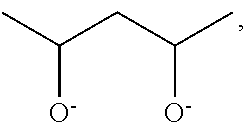
or Cl— are particularly preferred. In some aspects, the ligands are selected from the group consisting triazacyclononane, triazacyclononane derivatives, Schiff-base containing ligands, polypyridineamine ligands, pentadentate nitrogen-donor ligands, bispidon-type ligands, and macrocyclic tetraamidate ligands. Examples for those classes of ligands are described by R. Hage and A Lienke (Hage, Ronald; Lienke, Achim. Applications of Transition-Metal Catalysts to Textile and Wood-Pulp Bleaching. Angewandte Chemie International Edition, 2005, 45. Jg., Nr. 2, pp. 206-222), which is incorporated herein by reference in its entirety. Another group of preferred ligands are dicarboxylates, in particular oxalate.
Examples of catalyst structures that are particularly useful in the stabilized catalyst detergent compositions according to the invention include the following:

Additional disclosure of metal complexes for catalysts is provided for example, in U.S. Pat. Nos. 5,227,084, 5,194,416, 4,728,455, 4,478,733, and 4,430,243, and European Patent Nos. 693,550, 549,271, 549,272, 544,519, 544,490, 544,440, 509,787, 458,397 and 458,398, each of which is herein incorporated by reference in its entirety.
In aspects of the invention, the catalyst has a concentration in solid, stabilized catalyst detergent compositions from about 0.01 wt-% to about 15 wt-%, from about 0.1 wt-% to about 10 wt-%, or from about 0.5 wt-% to about 5 wt-%. It is to be understood that all values and ranges between these values and ranges are encompassed by the invention.
As one skilled in the art will ascertain from the description herein of the stabilized catalyst detergent compositions, the amounts of catalysts employed in the solid compositions is a relatively small quantity, including down to the hundredths of a percent in a use solution for example, which are quantities much lower than bleach precursors which are often formulated into a detergent composition. Beneficially, the solid detergent formulations according to the invention providing the cellulose derivative encapsulated coating of the catalyst allow the formulation of the manganese-complex catalysts directly into the solid formulations and to be readily dissolved into a use solution of the stabilized catalyst detergent composition. As one skilled in the art will ascertain, the catalyst may be combined with inert materials, fillers and/or binders prior to encapsulation according to the invention. In an aspect, the catalyst is combined with an inert material such as cellulose prior to encapsulation with the cellulose derivative.
In an aspect, the encapsulated catalysts beneficially overcomes another limitation within the art which is the difficulty of accurately dosing the catalyst at the low dosages while also achieving a homogenous distribution of the catalyst throughout the detergent composition to provide sufficient efficacy within a use solution.
Alkalinity Sources
The solid stabilized catalyst detergent compositions of the present invention include at least one alkalinity source. In some aspects, the alkalinity source(s) function as a hydratable salt to form the solid compositions. In some aspects, the hydratable salt can be referred to as substantially anhydrous. As one skilled in the art will ascertain from the disclosure herein, there may also be included with the alkalinity source(s) in the solid detergent composition water of hydration to hydrate the alkalinity source(s). It should be understood that the reference to water includes both water of hydration and free water.
In some aspects, the alkalinity source(s) includes alkali metal carbonates. In some aspects, the alkalinity source(s) may include alkali metal hydroxides and/or alkali metal silicates. Examples of suitable alkalinity sources include but are not limited to: sodium hydroxide, potassium hydroxide, sodium carbonate, potassium carbonate, sodium silicate, potassium silicate, a mixture of alkali metal hydroxides, a mixture of alkali metal carbonates, a mixture of alkali metal silicates, and any mixtures of the same. In additional aspects, the alkalinity source(s) may include alkali metal metasilicates, bicarbonates, sesquicarbonates, and mixtures thereof.
The alkalinity source(s) largely control the pH of the resulting solution when water is added to the detergent composition to form a use solution. In some aspects, the alkalinity source(s) (e.g. sodium carbonate) provide a milder alkaline detergent, such as a pH greater than about 7; such as disclosed in U.S. Pat. No. 7,094,746, which is incorporated herein by reference in its entirety. In other aspects, the alkalinity source(s) provide a high alkaline detergent. In such aspects, The pH of the use solution is between approximately 10 and approximately 13 in order to provide sufficient detergency properties. In some aspects, the pH of the use solution is between about 10 and about 12. Beneficially, the stabilized catalyst detergent compositions can be formulated into alkaline and/or highly alkaline detergent compositions while still protecting the catalyst material.
In aspects of the invention the alkalinity sources are included in the solid stabilized catalyst detergent compositions, at a concentration of from about 10 wt-% to about 90 wt-%, from about 25 wt-% to about 90 wt-%, from about 30 wt-% to about 90 wt-%, from about 20 wt-% to about 70 wt-%, from about 40 wt-% to about 80 wt-%, from about 40 wt-% to about 75 wt-%, from about 30 wt-% to about 60 wt-%, or from about 30 wt-% to about 50 wt-%. It is to be understood that all values and ranges between these values and ranges are encompassed by the invention.
Surfactants
In some embodiments, the compositions of the present invention include a surfactant or surfactant system. A variety of surfactants can be used in a detergent compositions, including, but not limited to: anionic, nonionic, cationic, and zwitterionic surfactants. Exemplary surfactants that can be used are commercially available from a number of sources. For a discussion of surfactants, see for example, Kirk-Othmer, Encyclopedia of Chemical Technology, Third Edition, volume 8, pages 900-912, “Surface Active Agents and Detergents,” Vol. I and II by Schwartz, Perry and Berch, each of which are herein incorporated by reference in its entirety.
Non-limiting examples of anionic surfactants useful in the detergent composition include, but are not limited to: carboxylates such as alkylcarboxylates and polyalkoxycarboxylates, alcohol ethoxylate carboxylates, nonylphenol ethoxylate carboxylates; sulfonates such as alkylsulfonates, alkylbenzenesulfonates, alkylarylsulfonates, sulfonated fatty acid esters; sulfates such as sulfated alcohols, sulfated alcohol ethoxylates, sulfated alkylphenols, alkylsulfates, sulfosuccinates, and alkylether sulfates. Exemplary anionic surfactants include, but are not limited to: sodium alkylarylsulfonate, alpha-olefinsulfonate, and fatty alcohol sulfates.
Non-limiting examples of nonionic surfactants useful in the detergent composition include, but are not limited to, those having a polyalkylene oxide polymer as a portion of the surfactant molecule. Such nonionic surfactants include, but are not limited to: chlorine-, benzyl-, methyl-, ethyl-, propyl-, butyl- and other like alkyl-capped polyethylene glycol ethers of fatty alcohols; polyalkylene oxide free nonionics such as alkyl polyglycosides; sorbitan and sucrose esters and their ethoxylates; alkoxylated amines such as alkoxylated ethylene diamine; alcohol alkoxylates such as alcohol ethoxylate propoxylates, alcohol propoxylates, alcohol propoxylate ethoxylate propoxylates, alcohol ethoxylate butoxylates; nonylphenol ethoxylate, polyoxyethylene glycol ether; carboxylic acid esters such as glycerol esters, polyoxyethylene esters, ethoxylated and glycol esters of fatty acids; carboxylic amides such as diethanolamine condensates, monoalkanolamine condensates, polyoxyethylene fatty acid amides; and polyalkylene oxide block copolymers.
Non-limiting examples of cationic surfactants that can be used in the detergent composition include, but are not limited to: amines such as primary, secondary and tertiary monoamines with C18 alkyl or alkenyl chains, ethoxylated alkylamines, alkoxylates of ethylenediamine, imidazoles such as a 1-(2-hydroxyethyl)-2-imidazoline, a 2-alkyl-1-(2-hydroxyethyl)-2-imidazoline, and the like; and quaternary ammonium salts, as for example, alkylquaternary ammonium chloride surfactants such as n-alkyl(C12-C18)dimethylbenzyl ammonium chloride, n-tetradecyldimethylbenzylammonium chloride monohydrate, and a naphthylene-substituted quaternary ammonium chloride such as dimethyl-1-naphthylmethylammonium chloride. The cationic surfactant can be used to provide sanitizing properties.
Non-limiting examples of zwitterionic surfactants that can be used in the detergent composition include, but are not limited to: betaines, imidazolines, and propionates.
In some aspects, where the detergent composition is intended to be used in an automatic dishwashing or ware washing machine, the surfactants selected, if any surfactant is used, can be those that provide an acceptable level of foaming when used inside a dishwashing or ware washing machine. It should be understood that ware washing compositions for use in automatic dishwashing or ware washing machines are generally considered to be low-foaming compositions.
When the detergent composition includes a surfactant as a cleaning agent, the cleaning agent is provided in an amount effective to provide a desired level of cleaning. In some embodiments, the compositions of the present invention include about 1 wt-% to about 60 wt-% of a surfactant. In other embodiments the compositions of the present invention include about 5 wt-% to about 50 wt-% of a surfactant. In still yet other embodiments, the compositions of the present invention include about 10 wt-% to about 50 wt-% of a surfactant, or from about 15 wt-% to about 45 wt-% of a surfactant.
Additional Functional Ingredients
The components of the detergent composition can further be combined with various functional components. In some embodiments, the solid, stabilized catalyst detergent composition including the cellulose derivative, catalyst, alkalinity source and surfactants make up a large amount, or even substantially all of the total weight of the detergent composition. For example, in some embodiments few or no additional functional ingredients are disposed therein.
In other embodiments, additional functional ingredients may be included in the compositions. The functional ingredients provide desired properties and functionalities to the compositions. For the purpose of this application, the term “functional ingredient” includes a material that when dispersed or dissolved in a use and/or concentrate solution, such as an aqueous solution, provides a beneficial property in a particular use. Some particular examples of functional materials are discussed in more detail below, although the particular materials discussed are given by way of example only, and that a broad variety of other functional ingredients may be used. For example, many of the functional materials discussed below relate to materials used in cleaning, specifically ware wash and/or laundry applications. However, other embodiments may include functional ingredients for use in other applications.
In some embodiments, the compositions may include solvents, activating agents, defoaming agents, enzymes, anti-redeposition agents, additional bleaching agents, solubility modifiers, dispersants, rinse aids, metal protecting agents, stabilizing agents, corrosion inhibitors, surface modification polymers, such as soil release polymers, starches, fluid repellants, whitening additives, such as optical brighteners or hueing agents, additional sequestrants and/or chelating agents, fragrances and/or dyes, rheology modifiers or thickeners, hydrotropes or couplers, buffers, solvents and the like.
Activating Agents
In some embodiments, the compositions include an activating agent to further increase the activity of the active oxygen source (e.g. percarbonate) which may be combined with the compositions according to the invention (e.g. combined with a use solution of the detergent composition). Such an activating agent can be used in addition to the catalyst. Suitable activating agents include sodium-4-benzoyloxy benzene sulphonate (SBOBS); N,N,N′,N′-tetraacetyl ethylene diamine (TAED); sodium-1-methyl-2-benzoyloxy benzene-4-sulphonate; sodium-4-methyl-3-benzoyloxy benzoate; SPCC trimethyl ammonium toluyloxy benzene sulphonate; sodium nonanoyloxybenzene sulphonate, sodium 3,5,5,-trimethyl hexanoyloxybenzene sulphonate; penta acetyl glucose (PAG); octanoyl tetra acetyl glucose and benzoyl tetracetyl glucose.
Chelants
In some embodiments, the compositions include a chelant/sequestering agent. Suitable chelating/sequestering agents are, for example, citrate, aminocarboxylic acid, condensed phosphate, phosphonate, and polyacrylate. In general, a chelating agent is a molecule capable of coordinating (i.e., binding) the metal ions commonly found in natural water to prevent the metal ions from interfering with the action of the other detersive ingredients of a cleaning composition. In general, chelating/sequestering agents can generally be referred to as a type of builder. The chelating/sequestering agent may also function as a threshold agent when included in an effective amount. The concentrated detergent composition can include 0.1 to 70% by weight, preferably 5 to 60% by weight, more preferably 5 to 50% by weight, most preferably 10 to 40% by weight of a chelating/sequestering agent.
Suitable aminocarboxylic acids include, for example, methylglycinediacetic acid (MGDA), N-hydroxyethyliminodiacetic acid, nitrilotriacetic acid (NTA), ethylenediaminetetraacetic acid (EDTA), N-hydroxyethyl-ethylenediaminetriacetic acid (HEDTA), and diethylenetriaminepentaacetic acid (DTPA). Examples of condensed phosphates include sodium and potassium orthophosphate, sodium and potassium pyrophosphate, sodium tripolyphosphate, sodium hexametaphosphate, and the like. A condensed phosphate may also assist, to a limited extent, in solidification of the composition by fixing the free water present in the composition as water of hydration. The composition may include a phosphonate such as 1-hydroxyethane-1,1-diphosphonic acid CH3C(OH)[PO(OH)2]2(HEDP); amino tri(methylenephosphonic acid) N[CH2PO(OH)2]3; aminotri(methylenephosphonate), sodium salt (NaO)(HO)P(OCH2N[CH2PO(ONa)2]2); 2-hydroxyethyliminobis(methylenephosphonic acid) HOCH2CH2N[CH2PO(OH)2]2; diethylenetriaminepenta(methylenephosphonic acid) (HO)2POCH2N[CH2CH2N[CH2PO(OH)2]2]2; diethylenetriaminepenta(methylenephosphonate), sodium salt C9H(28-x)N3NaxO15P5 (x=7); hexamethylenediamine(tetramethylenephosphonate), potassium salt C10H(28-x)N2KxO12P4 (x=6); bis(hexamethylene)triamine(pentamethylenephosphonic acid) (HO2)POCH2N[CH2)6N[CH2PO(OH)2]2]2; and phosphorus acid H3PO3.
The chelating/sequestering agent may also be a water conditioning polymer that can be used as a form of builder. Exemplary water conditioning polymers include polycarboxylates. Exemplary polycarboxylates that can be used as water conditioning polymers include polyacrylic acid, maleic/olefin copolymer, acrylic/maleic copolymer, polymethacrylic acid, acrylic acid-methacrylic acid copolymers, hydrolyzed polyacrylamide, hydrolyzed polymethacrylamide, hydrolyzed polyamide-methacrylamide copolymers, hydrolyzed polyacrylonitrile, hydrolyzed polymethacrylonitrile, and hydrolyzed acrylonitrile-methacrylonitrile copolymers. The concentrated detergent composition may include the water conditioning polymer in an amount of 0 to 20% by weight, preferably 0.1 to 5% by weight.
Defoaming Agents
In some embodiments, the compositions include a defoaming agent, which may be in addition to low or no-foaming surfactants. In some aspects, suitable defoaming agents include, for example, ethylene oxide/propylene block copolymers such as those available under the name Pluronic N-3, silicone compounds such as silica dispersed in polydimethylsiloxane, polydimethylsiloxane, and functionalized polydimethylsiloxane, fatty amides, hydrocarbon waxes, fatty acids, fatty esters, fatty alcohols, fatty acid soaps, ethoxylates, mineral oils, polyethylene glycol esters, and alkyl phosphate esters such as monostearyl phosphate.
Active Oxygen Source
The stabilized catalyst detergent compositions according to the invention can be combined with at least one active oxygen compound. In an preferred aspect, the stabilized catalyst detergent compositions are combined at a point of use or in a use solution with an active oxygen compound to provide enhanced bleaching when combined with the catalyst. The active oxygen sources suitable for use according to the invention can be inorganic or organic, and can be a mixture thereof.
Some examples of active oxygen compound include peroxygen compounds, peroxygen compound adducts, hydrogen peroxide, hydrogen peroxide liberating or generating compounds, and inorganic and organic peroxyacids. Many active oxygen compounds are peroxygen compounds, including for example hydrogen peroxide, group 1 (IA) active oxygen compounds (e.g., sodium peroxide), group 2 (IIA) active oxygen compounds (e.g., magnesium peroxide), group 12 (IIB) active oxygen compounds (e.g., zinc peroxide), group 13 (IIIA) active oxygen compounds (e.g., perborates), group 14 (IVA) active oxygen compounds (e.g., persilicates and peroxycarbonates), group 15 (VA) active oxygen compounds (e.g., perphosphates), group 16 (VIA) active oxygen compounds (e.g., peroxysulfuric acids and their salts), group 17 (VITA) active oxygen compounds (e.g., sodium periodate), and transition metal peroxides. Any of a variety of hydrogen peroxide and/or hydrogen peroxide adducts are suitable for use in the present invention.
Sodium percarbonate (2Na2CO3.3H2O2) can also be employed as the active oxygen compound for the stabilized catalyst detergent compositions. Percarbonate is an alternative to solid peroxide for use in solid detergent formulations. Sodium percarbonate is commercially-available in the form of coated granulates to provide enhanced stability.
Active oxygen compounds, including organic active oxygen compounds may also include peroxycarboxylic acids, such as a mono- or di-peroxycarboxylic acid, an alkali metal salt including these types of compounds, or an adduct of such a compound.
Peracid, peroxyacid, percarboxylic acid and peroxycarboxylic acid each refer synonymously to acids having the general formula R(CO3H)n. The R group can be saturated or unsaturated as well as substituted or unsubstituted. As described herein, R is an alkyl, arylalkyl, cycloalkyl, aromatic, heterocyclic, or ester group, such as an alkyl ester group. N is one, two, or three, and named by prefixing the parent acid with peroxy. Ester groups are defined as R groups including organic moieties (such as those listed above for R) and ester moieties. Exemplary ester groups include aliphatic ester groups, such as R1OC(O)2, where each of R1 and R2 can be aliphatic, preferably alkyl, groups described above for R. Preferably R1 and R2 are each independently small alkyl groups, such as alkyl groups with 1 to 5 carbon atoms. As used herein, the term “alkyl” or “alkyl groups” refers to saturated hydrocarbons having one or more carbon atoms, including straight-chain alkyl groups (e.g., methyl, ethyl, propyl, butyl, pentyl, hexyl, heptyl, octyl, nonyl, decyl, etc.), cyclic alkyl groups (or “cycloalkyl” or “alicyclic” or “carbocyclic” groups) (e.g., cyclopropyl, cyclopentyl, cyclohexyl, cycloheptyl, cyclooctyl, etc.), branched-chain alkyl groups (e.g., isopropyl, tert-butyl, sec-butyl, isobutyl, etc.), and alkyl-substituted alkyl groups (e.g., alkyl-substituted cycloalkyl groups and cycloalkyl-substituted alkyl groups). Unless otherwise specified, the term “alkyl” includes both “unsubstituted alkyls” and “substituted alkyls.” As used herein, the term “substituted alkyls” refers to alkyl groups having substituents replacing one or more hydrogens on one or more carbons of the hydrocarbon backbone. Such substituents may include, for example, alkenyl, alkynyl, halogeno, hydroxyl, alkylcarbonyloxy, arylcarbonyloxy, alkoxycarbonyloxy, aryloxy, aryloxycarbonyloxy, carboxylate, alkylcarbonyl, arylcarbonyl, alkoxycarbonyl, aminocarbonyl, alkylaminocarbonyl, dialkylaminocarbonyl, alkylthiocarbonyl, alkoxyl, phosphate, phosphonato, phosphinato, cyano, amino (including alkyl amino, dialkylamino, arylamino, diarylamino, and alkylarylamino), acylamino (including alkylcarbonylamino, arylcarbonylamino, carbamoyl and ureido), imino, sulfhydryl, alkylthio, arylthio, thiocarboxylate, sulfates, alkylsulfinyl, sulfonates, sulfamoyl, sulfonamido, nitro, trifluoromethyl, cyano, azido, heterocyclic, alkylaryl, or aromatic (including heteroaromatic) groups. In some embodiments, substituted alkyls can include a heterocyclic group. As used herein, the term “heterocyclic group” includes closed ring structures analogous to carbocyclic groups in which one or more of the carbon atoms in the ring is an element other than carbon, for example, nitrogen, sulfur or oxygen. Heterocyclic groups may be saturated or unsaturated. Exemplary heterocyclic groups include, but are not limited to, aziridine, ethylene oxide (epoxides, oxiranes), thiirane (episulfides), dioxirane, azetidine, oxetane, thietane, dioxetane, dithietane, dithiete, azolidine, pyrrolidine, pyrroline, oxolane, dihydrofuran, and furan.
Sulfoperoxycarboxylic acid, sulfonated peracid, or sulfonated peroxycarboxylic acid each refer synonymously to the peroxycarboxylic acid form of a sulfonated carboxylic acid. Additional description of suitable peracids for use according to the invention is set forth, for example, in U.S. Patent Publication Nos. 2013/0047345 and 2013/0018099.
Methods of Use
In some aspects, the stabilized catalyst detergent compositions are suitable for use in various applications that requires protection of a catalyst material from other components in a formula (e.g. alkalinity). Without being limited according to the applications of use of the invention, the stabilized catalyst compositions are particularly suitable for the protection of oxidation catalysts in bleaching systems, such as for laundry and ware washing. In particular, the bleaching systems may include ware wash detergents, coffee and/or tea destainers, clean-in-place (CIP) applications employing peroxygen activation catalysts for peroxide or peracid cleaners, surgical instrument cleaning and the like, laundry applications, and the like. In aspects, the bleach product (e.g. inactivated sodium percarbonate) is combined with the detergent compositions according to the invention.
In a further aspect however, the stabilized catalyst compositions are suitable for protection of oxidation catalysts in wastewater treatment, epoxidation reactions, and many other applications. In such applications there is a need for the removal of microbes (e.g. wastewater treatment) from wastewater which is often rich in malodorous compounds of reduced sulfur, nitrogen, phosphorous and the like. In such aspects, detergent compositions containing a strong oxidant are employed to convert these compounds efficiently to their odor free derivatives e.g. the sulfates, phosphates and amine oxides. These same properties are very useful in the treatment of other water sources, including industrial applications (e.g. treatment of slick water and other applications customary in oil and/or gas drilling) where the property of bleaching is also of great utility.
In still further aspects, the stabilized catalyst compositions are suitable for protection of oxidation catalysts in pulp and paper bleaching. As referred to herein, pulp and paper bleaching may be employed in the “papermaking process,” referring to methods of making paper products from pulp generally comprising forming an aqueous cellulosic papermaking furnish, draining the furnish to form a sheet and drying, the sheet. The steps of forming the papermaking furnish, draining, and drying may be carried out in any conventional manner generally known to those skilled in the art. The pulp may be any either or both of virgin pulp and recycled pulp.
In some aspects, the stabilized catalyst detergent compositions are preferably for use in an automatic washing detergent formulation e.g. such as a dishwasher detergent or a laundry detergent.
In some aspects, the detergent compositions are contacted by a diluent, such as water to generate a concentrate and/or use solution for the various applications of use. The detergent compositions can include concentrate compositions or can be diluted to form use compositions. In general, a concentrate refers to a composition that is intended to be diluted with water to provide a use solution that contacts an object to provide the desired cleaning, rinsing, or the like. The detergent composition that contacts the articles to be washed can be referred to as the use composition. The use solution can include additional functional ingredients at a level suitable for cleaning, bleaching, or the like.
A use solution may be prepared from the concentrate by diluting the concentrate with water at a dilution ratio that provides a use solution having desired detersive properties. The water that is used to dilute the concentrate to form the use composition can be referred to as water of dilution or a diluent, and can vary from one location to another. The typical dilution factor is between approximately 1 and approximately 10,000 but will depend on factors including water hardness, the amount of soil to be removed and the like. In one embodiment, the concentrate is diluted at a ratio of between about 1:10 and about 1:1000 concentrate to water. Particularly, the concentrate is diluted at a ratio of between about 1:100 and about 1:5000 concentrate to water.
In some aspects, the concentrate compositions according to the invention are provided in the dilution range of about 0.01 g/L to about 10 g/L, from about 0.1 g/L to 10 g/L, from about 0.4 g/L to 5.5 g/L, or from about 0.5 g/L to 5 g/L, which will depend upon the dosing required for a particular application of use (e.g. ware wash detergent, laundry detergent, or the like).
In some aspects, the use solutions according to the invention provide a desired level of catalyst from about 0.01 ppm to about 5 ppm, from about 0.02 ppm to about 5 ppm, from about 0.05 ppm to about 2 ppm.
In some aspects, the use solution is combined with a source of active oxygen for activation and/or enhanced bleaching according to various methods of use thereof. In an aspect, the active oxygen source is added concurrently (e.g. during a wash step) with the detergent composition use solution. Beneficially, the stabilized catalyst is available to provide activation of the bleach source and therefore increase overall stain removal.
In some aspects, the present invention provides methods for removing soils from a surface, e.g., a hard surface, and/or bleaching a surface. In some embodiments, the method comprises applying a use solution of the detergent composition (e.g. contacting) to the surface, and removing the composition from the surface after an amount of time sufficient to facilitate soil removal and/or bleaching. The contacting step can last for any suitable time. In some embodiments, the contacting step lasts for at least 10 seconds, 20 seconds, 30 seconds, 40 seconds, 50 seconds, 1 minute, 10 minutes, 30 minutes, 1 hour, 2 hours, 4 hours, 8 hours, 16 hours, 1 day, 3 days, 1 week, or longer. The detergent composition can be applied to the surface (or target for soil removal and/or bleaching) in any suitable manner. In some embodiments, the detergent composition is applied by means of a spray, a foam, or the like.
The methods can be used to achieve any suitable removal of soil (e.g. cleaning), sanitizing, disinfecting, bleaching and/or reduction of the microbial population in and/or on the surface or target. In some embodiments, the methods can be used to reduce the microbial population by at least one log 10. In other embodiments, the present methods can be used to reduce the microbial population in and/or on the target or the treated target composition by at least two log 10. In still other embodiments, the present methods can be used to reduce the microbial population in and/or on the target or the treated target composition by at least three log 10.
In some embodiments, the method further comprises rinsing the surface. In some embodiments, the method further comprises generating a bubbling effect of the detergent compositions containing the active oxygen source and catalyst (and/or an active oxygen source combined with the detergent composition containing the catalyst). In some embodiments, the method further comprises a mechanical application of force, agitation and/or pressure to assist in removing the soils and/or bleaching the surface.
The methods of the present invention can be used to remove a variety of soils from a variety of surfaces and/or bleaching a variety of surfaces. For example, surfaces suitable for cleaning using the methods of the present invention include, but are not limited to, walls, floors, ware, dishes, flatware, pots and pans, heat exchange coils, ovens, fryers, smoke houses, sewer drain lines, and the like.
In some embodiments, the methods of the present invention are followed by only a rinse step. In other embodiments, the methods of the present invention are followed by a conventional CIP method suitable for the surface to be cleaned. In still yet other embodiments, the methods of the present invention are followed by a CIP method such as those described in U.S. Pat. Nos. 8,398,781 and 8,114,222 entitled “Methods for Cleaning Industrial Equipment with Pre-treatment,” both of which are hereby incorporated by reference in their entirety.
Beneficially, according to the various aspects, the methods protect catalysts formulated within an alkaline solid stabilized catalyst detergent compositions prior to a point of use.
All publications and patent applications in this specification are indicative of the level of ordinary skill in the art to which this invention pertains. All publications and patent applications are herein incorporated by reference to the same extent as if each individual publication or patent application was specifically and individually indicated as incorporated by reference.
Embodiments of the present invention are further defined in the following non-limiting Examples. It should be understood that these Examples, while indicating certain embodiments of the invention, are given by way of illustration only. From the above discussion and these Examples, one skilled in the art can ascertain the essential characteristics of this invention, and without departing from the spirit and scope thereof, can make various changes and modifications of the embodiments of the invention to adapt it to various usages and conditions. Thus, various modifications of the embodiments of the invention, in addition to those shown and described herein, will be apparent to those skilled in the art from the foregoing description. Such modifications are also intended to fall within the scope of the appended claims.
Various formulations of standalone catalyst performance were assessed after encapsulation without formulating into a solid detergent composition. A commercially-available manganese catalyst-Di[manganese(1+)], 1,2-bis(octahydro-4,7-dimethyl-1H-1,4,7-triazonine-1-yl-kN1, kN4, kN7)-ethane-di-μ-oxo-μ-(ethanoato-kO, kO′)-, di[chloride (1−)] was employed in the examples.
Initially, the catalyst was coated by cellulose acetate phthalate (CAP) polymer and evaluated. Catalyst solutions were prepared by dissolving 1.96 g of the manganese catalyst-CAP encapsulate (2.5% active catalyst) into 100 g of deionized water. Of that aqueous solution, 0.5 g was dosed into 1 L of water, to deliver an active catalyst concentration of 0.25 ppm.
For the uncoated manganese catalyst control, 0.049 g was dissolved into 100 g of deionized water. Of that aqueous solution, 0.5 g was dosed into 1 L of water, to deliver an active catalyst concentration of 0.25 ppm.
Wash testing was completed in the tergotometer at 122° F. One liter of 5 grain water was added to each pot, and each experiment was performed in triplicate. Each pot contained two each of tea on cotton and coffee on poly/cotton fabric swatches. At the start of a 12 minute wash run 0.5 g of a commercially available low-alkaline liquid detergent (Detergent 120), 1.0 g of 35% hydrogen peroxide, 1.2 g of a commercially available NaOH based alkaline builder (Builder C) and 0.5 g of the aqueous catalyst solutions described above were added to each pot. At the end of 12 minutes, the swatches were removed from each pot, rinsed under cold water and air dried overnight.
To determine the percent (%) stain removal (SR) the reflectance of the fabric sample was measured on a spectrophotometer (ColorQuest XE, Hunter Associates Laboratory). The “L value” is a direct reading supplied by the spectrophotometer. L generally is indicative of broad visible spectrum reflectance, where a value of 100% would be absolute white. The % soil removal was calculated using the following formula:
SR=((L final −L initial)/(96L initial))*100%
SR=((L final −L initial)/(96L initial))*100%
| TABLE 2 | |||
| Tea (cotton) | Coffee (poly/cotton) | ||
| Uncoated | 63.92 | 71.87 | ||
| CAP coated | 39.86 | 44.64 | ||
Table 2 shows stain removal performance of the catalyst after encapsulation (prior to formulation into a solid detergent) with the cellulose derivative polymer cellulose acetate phthalate (CAP). As can be seen in Table 2, the cellulose derivative cellulose acetate phthalate (CAP) polymer had an immediately detrimental effect on catalyst performance, therefore demonstrating this polymer would not be a suitable choice for further studies testing stability when formulated into the detergent.
Additional encapsulates, including an additional cellulose derivative, were evaluated. The manganese catalyst of Example 1 was coated with polyvinyl alcohol (PVA) and compared to the same manganese catalyst encapsulated with hydroxypropyl methylcellulose (HPMC). Encapsulated catalyst solutions were prepared by dissolving 1.2 g of the manganese catalyst encapsulate (2.5% active catalyst) into 100 g of deionized water. Of that aqueous solution, 0.66 g was dosed into 1 L of water, to deliver an active catalyst concentration of 0.2 ppm.
For the uncoated manganese catalyst control, 0.03 g was dissolved into 100 g of deionized water. Of that aqueous solution, 0.66 g was dosed into 1 L of water, to deliver an active catalyst concentration of 0.2 ppm.
Wash testing was completed in the tergotometer at 104° F. One liter of 5 grain water was added to each pot, and each experiment was performed in triplicate. Each pot contained two each of tea on cotton and coffee on poly/cotton fabric swatches. At the start of a 10 minute wash run 0.66 g of the solid alkaline detergent, 1.0 g of 35% hydrogen peroxide and 1.3 g of a commercially available NaOH based alkaline builder (Builder C) were added to each pot. At the end of 10 minutes, the swatches were removed from each pot, rinsed under cold water and air dried overnight. To determine the percent (%) stain removal (SR) the reflectance of the fabric sample was measured according to the methods of Example 1.
| TABLE 3 | |||
| Tea (cotton) | Coffee (poly/cotton) | ||
| Uncoated | 39.99 | 56.56 | ||
| PVA coated | 20.52 | 35.15 | ||
| HPMC coated | 37.70 | 56.76 | ||
Table 3 shows the stain removal performance to assess catalyst stability after encapsulation, prior to formulation into a detergent. As shown in Table 3, the process of encapsulating the manganese catalyst with the polyvinyl alcohol (PVA) polymer had an immediately detrimental effect on catalyst performance, in comparison to the use of a cellulose derivative. By contrast, manganese catalyst encapsulated with HPMC stayed fully stable after the encapsulation process.
The stable catalyst coated with the HPMC encapsulate according to Example 2 was formulated into a solid detergent block composition for further evaluation of stability and efficacy in comparison to uncoated compositions. The formulation is shown in Table 4.
| TABLE 4 | |||||
| Carbonate Alkalinity Source | 42.40 | 42.40 | 42.40 | ||
| Manganese Catalyst, 50% | 0.06 | ||||
| (e.g. uncoated catalyst) | |||||
| Manganese Catalyst 50%, | 1.2 | ||||
| HPMC coated | |||||
| Surfactants | 38 | 38 | 38 | ||
| Stabilizer | 6.00 | 6.00 | 6.00 | ||
| Additional Functional | 13.58 | 13.58 | 13.58 | ||
| Ingredients | |||||
| TOTAL | 100 | 100 | 100 | ||
After formulation, samples were stored in a 122° F. oven. Aliquots were taken initially and after 4 weeks storage, and the performance compared over time as shown in Table 5.
| TABLE 5 | |||
| Tea (cotton) | Coffee (poly/cotton) | ||
| Day |
| 0 | 28 | 0 | 28 | ||
| H2O2 alone (no catalyst) | 21.83 | 25.89 | 32.41 | 25.77 |
| Manganese Catalyst - | 53.75 | 27.45 | 63.63 | 24.99 |
| Uncoated | ||||
| Manganese Catalyst - | 51.67 | 56.87 | 63.55 | 68.54 |
| HPMC coated | ||||
Immediately after formulation (day 0), both the uncoated and HPMC coated manganese catalyst show a significant performance increase over hydrogen peroxide alone. However, after four weeks of long term storage at 122° F., with the uncoated manganese catalyst the performance improvement was completely eliminated, i.e. there was no difference with the catalyst containing detergent compared to hydrogen peroxide alone. By contrast, the manganese catalyst coated with HPMC was fully stable, with no change in performance from day 0 to day 28. For the testing shown in Table 5 hydrogen peroxide was added directly to the sample at a use solution.
The inventions being thus described, it will be obvious that the same may be varied in many ways. Such variations are not to be regarded as a departure from the spirit and scope of the inventions and all such modifications are intended to be included within the scope of the following claims. The above specification provides a description of the manufacture and use of the disclosed compositions and methods. Since many embodiments can be made without departing from the spirit and scope of the invention, the invention resides in the claims.
Claims (14)
1. A solid stabilized catalyst detergent composition comprising:
from about 40-60 wt-% of at least one alkali metal carbonate alkalinity source;
a stabilized catalyst, wherein the catalyst comprises C20H43Mn2N6O4Ys, wherein Y is a counter ion and s is the number of counter ions; wherein the stabilized catalyst is encapsulated by a polymer, wherein the polymer comprises hydroxypropyl methylcellulose (HPMC)
wherein said solid stabilized catalyst detergent composition is formulated into a solid block composition, and wherein the composition has a use pH of at least about 8.5.
2. The detergent composition according to claim 1 , further comprising an additional alkalinity source, wherein said additional alkalinity source is an alkali metal silicate, alkali metal metasilicate, alkali metal bicarbonate, alkali metal sesquicarbonate, and/or alkali metal hydroxide.
3. The detergent composition according to claim 2 , wherein the composition has a use pH of between approximately 10 and approximately 13.
4. The detergent composition according to claim 1 , wherein the stabilized catalyst comprises an inner portion consisting of the catalyst and at least one outer portion comprising the cellulose derivative.
5. The detergent composition according to claim 4 , wherein the inner portion consists of between 0.5 wt-% and 10 wt-% of the catalyst.
6. The detergent composition according to claim 4 , wherein the outer portion comprises a plurality of layers of the cellulose derivative encapsulate.
7. The detergent composition according to claim 1 , comprising from about 40-50 wt-% of the alkalinity source, from about 0.5-10 wt-% of the stabilized catalyst, from about 0-45 wt-% of at least one surfactant, and from about 0-30 wt-% of at least one additional functional ingredient.
8. A solid stabilized catalyst detergent
composition comprising:
from about 40-60 wt-% of an alkali metal carbonate alkalinity source;
from about 1-60 wt-% of at least one surfactant;
from about 0.1-30 wt-% of at least one additional functional ingredient; and
from about 0.5-10 wt-% a stabilized catalyst, wherein the stabilized catalyst is encapsulated by a polymer and comprises C20H43Mn2N6O4Ys; wherein Y is a counter ion; wherein s is the number of counter ions, wherein the polymer comprises hydroxypropyl methylcellulose (HPMC); and
wherein said solid stabilized catalyst detergent composition is formulated into a solid block composition, and wherein the composition has a use pH of at least about 8.5.
9. The detergent composition according to claim 8 , wherein the composition has a use pH of between approximately 10 and approximately 13.
10. The detergent composition according to claim 8 , wherein the stabilized catalyst comprises an inner portion consisting of between 0.5 wt-% and 10 wt-% of the catalyst, and an outer portion comprising a plurality of layers of the cellulose derivative encapsulate.
11. A method of cleaning and/or bleaching comprising: providing the solid stabilized catalyst detergent composition of claim 1 ; generating a use solution of the detergent composition; and
contacting a surface or object in need of cleaning and/or bleaching with the use solution of the detergent composition.
12. The method according to claim 11 , further comprising the addition of an active oxygen source to the use solution of the detergent composition to provide bleaching benefits with the stabilized catalyst.
13. The method according to claim 11 , wherein the use solution of the detergent composition is employed in a ware washing and/or laundry application, and wherein the solid stabilized catalyst detergent composition maintains stability of the catalyst while formulated into the alkaline detergent composition.
14. The method according to claim 11 , wherein the use solution of the detergent composition is employed in a pulp and/or paper bleaching, wastewater treatment and/or epoxidation reaction application, and wherein the solid stabilized catalyst detergent composition maintains stability of the catalyst while formulated into the alkaline detergent composition.
Priority Applications (2)
| Application Number | Priority Date | Filing Date | Title |
|---|---|---|---|
| US14/303,706 US10196592B2 (en) | 2014-06-13 | 2014-06-13 | Enhanced catalyst stability for alkaline detergent formulations |
| PCT/US2015/035350 WO2015191865A1 (en) | 2014-06-13 | 2015-06-11 | Enhanced catalyst stability for alkaline detergent formulations |
Applications Claiming Priority (1)
| Application Number | Priority Date | Filing Date | Title |
|---|---|---|---|
| US14/303,706 US10196592B2 (en) | 2014-06-13 | 2014-06-13 | Enhanced catalyst stability for alkaline detergent formulations |
Publications (2)
| Publication Number | Publication Date |
|---|---|
| US20150361385A1 US20150361385A1 (en) | 2015-12-17 |
| US10196592B2 true US10196592B2 (en) | 2019-02-05 |
Family
ID=54834318
Family Applications (1)
| Application Number | Title | Priority Date | Filing Date |
|---|---|---|---|
| US14/303,706 Active 2034-07-12 US10196592B2 (en) | 2014-06-13 | 2014-06-13 | Enhanced catalyst stability for alkaline detergent formulations |
Country Status (2)
| Country | Link |
|---|---|
| US (1) | US10196592B2 (en) |
| WO (1) | WO2015191865A1 (en) |
Cited By (3)
| Publication number | Priority date | Publication date | Assignee | Title |
|---|---|---|---|---|
| US11149237B2 (en) * | 2016-09-30 | 2021-10-19 | Dow Global Technologies Llc | Detergent bars |
| US11225631B2 (en) | 2018-03-19 | 2022-01-18 | Ecolab Usa Inc. | Acidic liquid detergent compositions containing bleach catalyst and free of anionic surfactant |
| US11421186B2 (en) | 2019-02-28 | 2022-08-23 | Ecolab Usa Inc. | Hardness additives and block detergents containing hardness additives to improve edge hardening |
Families Citing this family (3)
| Publication number | Priority date | Publication date | Assignee | Title |
|---|---|---|---|---|
| GB0718777D0 (en) * | 2007-09-26 | 2007-11-07 | Reckitt Benckiser Nv | Composition |
| EP3589777A4 (en) | 2017-02-28 | 2021-02-17 | Ecolab USA Inc. | ALKALINE CLEANING COMPOSITIONS CONTAINING AN ALKYLAMINOHYDROXY ACID AND / OR A SECONDARY AMINE AND METHODS FOR REDUCING METAL CORROSION |
| WO2018183690A1 (en) * | 2017-03-29 | 2018-10-04 | Ecolab Usa Inc. | Detergent composition and methods of preventing aluminum discoloration |
Citations (37)
| Publication number | Priority date | Publication date | Assignee | Title |
|---|---|---|---|---|
| US4430243A (en) | 1981-08-08 | 1984-02-07 | The Procter & Gamble Company | Bleach catalyst compositions and use thereof in laundry bleaching and detergent compositions |
| US4478733A (en) | 1982-12-17 | 1984-10-23 | Lever Brothers Company | Detergent compositions |
| EP0141470A2 (en) | 1983-11-08 | 1985-05-15 | Unilever N.V. | Manganese adjuncts, their preparation and use |
| US4623357A (en) | 1985-04-02 | 1986-11-18 | Lever Brothers Company | Bleach compositions |
| US4728455A (en) | 1986-03-07 | 1988-03-01 | Lever Brothers Company | Detergent bleach compositions, bleaching agents and bleach activators |
| EP0510761A1 (en) | 1991-04-24 | 1992-10-28 | Unilever N.V. | Wax-encapsulated particles and method for making same |
| US5194416A (en) | 1991-11-26 | 1993-03-16 | Lever Brothers Company, Division Of Conopco, Inc. | Manganese catalyst for activating hydrogen peroxide bleaching |
| EP0544490A1 (en) | 1991-11-26 | 1993-06-02 | Unilever Plc | Detergent bleach compositions |
| EP0544440A2 (en) | 1991-11-20 | 1993-06-02 | Unilever Plc | Bleach catalyst composition, manufacture and use thereof in detergent and/or bleach compositions |
| EP0549271A1 (en) | 1991-12-20 | 1993-06-30 | Unilever Plc | Bleach activation |
| EP0549272A1 (en) | 1991-12-20 | 1993-06-30 | Unilever Plc | Bleach activation |
| US5227084A (en) | 1991-04-17 | 1993-07-13 | Lever Brothers Company, Division Of Conopco, Inc. | Concentrated detergent powder compositions |
| US5246612A (en) | 1991-08-23 | 1993-09-21 | Lever Brothers Company, Division Of Conopco, Inc. | Machine dishwashing composition containing peroxygen bleach, manganese complex and enzymes |
| WO1994021777A1 (en) | 1993-03-18 | 1994-09-29 | Unilever N.V. | Bleach catalyst composition |
| WO1995006710A1 (en) | 1993-09-03 | 1995-03-09 | Unilever Plc | Bleach catalyst composition |
| US5409627A (en) | 1993-03-18 | 1995-04-25 | Lever Brothers Company, Division Of Conopco, Inc. | Particulate bleaching detergent compositions containing zeolite map and a stable bleach catalyst |
| US5429769A (en) | 1993-07-26 | 1995-07-04 | Lever Brothers Company, Division Of Conopco, Inc. | Peroxycarboxylic acids and manganese complex catalysts |
| US5480575A (en) | 1992-12-03 | 1996-01-02 | Lever Brothers, Division Of Conopco, Inc. | Adjuncts dissolved in molecular solid solutions |
| EP0693550A2 (en) | 1994-07-21 | 1996-01-24 | Ciba-Geigy Ag | Fabric bleaching composition |
| WO1996006154A1 (en) | 1994-08-19 | 1996-02-29 | Unilever N.V. | Detergent bleach composition |
| US5536441A (en) | 1993-09-03 | 1996-07-16 | Lever Brothers Company, Division Of Conopco, Inc. | Bleach catalyst composition |
| EP0458398B1 (en) | 1990-05-21 | 1997-03-26 | Unilever N.V. | Bleach activation |
| WO1997022680A1 (en) | 1995-12-20 | 1997-06-26 | The Procter & Gamble Company | Bleach catalyst plus enzyme particles |
| US5703034A (en) | 1995-10-30 | 1997-12-30 | The Procter & Gamble Company | Bleach catalyst particles |
| WO2003072688A1 (en) | 2002-02-26 | 2003-09-04 | Carnegie Mellon University | Detergent composition |
| US20040266641A1 (en) | 2001-12-21 | 2004-12-30 | Pavel Gentschev | Support-fixed bleaching catalyst complex compounds suitable as catalysts for peroxygen compounds |
| EP1360268B1 (en) | 2001-02-16 | 2006-01-04 | Unilever Plc | Bleaching composition of enhanced stability and a process for making such a composition |
| US7070820B2 (en) * | 2000-10-02 | 2006-07-04 | Novozymes A/S | Coated particles containing an active |
| EP1499702B1 (en) | 2002-05-02 | 2007-01-03 | The Procter & Gamble Company | Detergent compositions and components thereof |
| WO2009040545A1 (en) | 2007-09-26 | 2009-04-02 | Reckitt Benckiser N.V. | Composition |
| WO2010115582A1 (en) | 2009-04-11 | 2010-10-14 | Clariant International Ltd | Bleach granules comprising an active coating |
| WO2010139689A1 (en) | 2009-06-01 | 2010-12-09 | Reckitt Benckiser N.V. | Composition |
| US20120070554A1 (en) | 2009-06-05 | 2012-03-22 | Solvay Sa | Process for the manufacture of oxidized starch, oxidized starch and its use |
| EP2106437B1 (en) | 2006-11-27 | 2012-05-02 | Henkel Kommanditgesellschaft auf Aktien | Granulated bleached catalysts |
| WO2012085534A1 (en) | 2010-12-21 | 2012-06-28 | Reckitt Benckiser N.V. | Bleach catalyst particle |
| US20130061883A1 (en) * | 2011-09-13 | 2013-03-14 | Juan Felipe Miravet Celades | Encapsulates |
| US9624119B2 (en) * | 2014-06-13 | 2017-04-18 | Ecolab Usa Inc. | Enhanced catalyst stability in activated peroxygen and/or alkaline detergent formulations |
-
2014
- 2014-06-13 US US14/303,706 patent/US10196592B2/en active Active
-
2015
- 2015-06-11 WO PCT/US2015/035350 patent/WO2015191865A1/en not_active Ceased
Patent Citations (45)
| Publication number | Priority date | Publication date | Assignee | Title |
|---|---|---|---|---|
| US4430243A (en) | 1981-08-08 | 1984-02-07 | The Procter & Gamble Company | Bleach catalyst compositions and use thereof in laundry bleaching and detergent compositions |
| US4478733A (en) | 1982-12-17 | 1984-10-23 | Lever Brothers Company | Detergent compositions |
| EP0141470A2 (en) | 1983-11-08 | 1985-05-15 | Unilever N.V. | Manganese adjuncts, their preparation and use |
| US4623357A (en) | 1985-04-02 | 1986-11-18 | Lever Brothers Company | Bleach compositions |
| US4728455A (en) | 1986-03-07 | 1988-03-01 | Lever Brothers Company | Detergent bleach compositions, bleaching agents and bleach activators |
| EP0458397B1 (en) | 1990-05-21 | 1997-03-26 | Unilever N.V. | Bleach activation |
| EP0458398B1 (en) | 1990-05-21 | 1997-03-26 | Unilever N.V. | Bleach activation |
| EP0509787B1 (en) | 1991-04-17 | 1995-02-01 | Unilever Plc | Concentrated detergent powder compositions |
| US5227084A (en) | 1991-04-17 | 1993-07-13 | Lever Brothers Company, Division Of Conopco, Inc. | Concentrated detergent powder compositions |
| CA2066871C (en) | 1991-04-24 | 1996-12-10 | David John Lang | Wax-encapsulated particles and method for making same |
| EP0510761A1 (en) | 1991-04-24 | 1992-10-28 | Unilever N.V. | Wax-encapsulated particles and method for making same |
| EP0510761B1 (en) | 1991-04-24 | 1995-03-08 | Unilever N.V. | Wax-encapsulated particles and method for making same |
| US5246612A (en) | 1991-08-23 | 1993-09-21 | Lever Brothers Company, Division Of Conopco, Inc. | Machine dishwashing composition containing peroxygen bleach, manganese complex and enzymes |
| EP0544440A2 (en) | 1991-11-20 | 1993-06-02 | Unilever Plc | Bleach catalyst composition, manufacture and use thereof in detergent and/or bleach compositions |
| US5356554A (en) | 1991-11-20 | 1994-10-18 | Lever Brothers Company, Division Of Conopco, Inc. | Bleach catalyst composition, manufacture and use thereof in detergent and/or bleach compositions |
| US5194416A (en) | 1991-11-26 | 1993-03-16 | Lever Brothers Company, Division Of Conopco, Inc. | Manganese catalyst for activating hydrogen peroxide bleaching |
| EP0544519B1 (en) | 1991-11-26 | 1997-01-15 | Unilever Plc | Bleach manganese catalyst and its use |
| EP0544490A1 (en) | 1991-11-26 | 1993-06-02 | Unilever Plc | Detergent bleach compositions |
| EP0549272A1 (en) | 1991-12-20 | 1993-06-30 | Unilever Plc | Bleach activation |
| EP0549271A1 (en) | 1991-12-20 | 1993-06-30 | Unilever Plc | Bleach activation |
| US5480575A (en) | 1992-12-03 | 1996-01-02 | Lever Brothers, Division Of Conopco, Inc. | Adjuncts dissolved in molecular solid solutions |
| WO1994021777A1 (en) | 1993-03-18 | 1994-09-29 | Unilever N.V. | Bleach catalyst composition |
| US5409627A (en) | 1993-03-18 | 1995-04-25 | Lever Brothers Company, Division Of Conopco, Inc. | Particulate bleaching detergent compositions containing zeolite map and a stable bleach catalyst |
| US5429769A (en) | 1993-07-26 | 1995-07-04 | Lever Brothers Company, Division Of Conopco, Inc. | Peroxycarboxylic acids and manganese complex catalysts |
| WO1995006710A1 (en) | 1993-09-03 | 1995-03-09 | Unilever Plc | Bleach catalyst composition |
| US5536441A (en) | 1993-09-03 | 1996-07-16 | Lever Brothers Company, Division Of Conopco, Inc. | Bleach catalyst composition |
| EP0693550A2 (en) | 1994-07-21 | 1996-01-24 | Ciba-Geigy Ag | Fabric bleaching composition |
| WO1996006154A1 (en) | 1994-08-19 | 1996-02-29 | Unilever N.V. | Detergent bleach composition |
| US5703034A (en) | 1995-10-30 | 1997-12-30 | The Procter & Gamble Company | Bleach catalyst particles |
| WO1997022680A1 (en) | 1995-12-20 | 1997-06-26 | The Procter & Gamble Company | Bleach catalyst plus enzyme particles |
| US7070820B2 (en) * | 2000-10-02 | 2006-07-04 | Novozymes A/S | Coated particles containing an active |
| EP1360268B1 (en) | 2001-02-16 | 2006-01-04 | Unilever Plc | Bleaching composition of enhanced stability and a process for making such a composition |
| US20040266641A1 (en) | 2001-12-21 | 2004-12-30 | Pavel Gentschev | Support-fixed bleaching catalyst complex compounds suitable as catalysts for peroxygen compounds |
| WO2003072688A1 (en) | 2002-02-26 | 2003-09-04 | Carnegie Mellon University | Detergent composition |
| EP1499702B1 (en) | 2002-05-02 | 2007-01-03 | The Procter & Gamble Company | Detergent compositions and components thereof |
| EP2106437B1 (en) | 2006-11-27 | 2012-05-02 | Henkel Kommanditgesellschaft auf Aktien | Granulated bleached catalysts |
| WO2009040545A1 (en) | 2007-09-26 | 2009-04-02 | Reckitt Benckiser N.V. | Composition |
| WO2010115582A1 (en) | 2009-04-11 | 2010-10-14 | Clariant International Ltd | Bleach granules comprising an active coating |
| US8486881B2 (en) | 2009-04-11 | 2013-07-16 | Clariant Finance (Bvi) Limited | Bleach granules comprising an active coating |
| WO2010139689A1 (en) | 2009-06-01 | 2010-12-09 | Reckitt Benckiser N.V. | Composition |
| US20120070554A1 (en) | 2009-06-05 | 2012-03-22 | Solvay Sa | Process for the manufacture of oxidized starch, oxidized starch and its use |
| WO2012085534A1 (en) | 2010-12-21 | 2012-06-28 | Reckitt Benckiser N.V. | Bleach catalyst particle |
| CA2822012A1 (en) | 2010-12-21 | 2012-06-28 | Reckitt Benckiser N.V. | Bleach catalyst particle |
| US20130061883A1 (en) * | 2011-09-13 | 2013-03-14 | Juan Felipe Miravet Celades | Encapsulates |
| US9624119B2 (en) * | 2014-06-13 | 2017-04-18 | Ecolab Usa Inc. | Enhanced catalyst stability in activated peroxygen and/or alkaline detergent formulations |
Non-Patent Citations (3)
| Title |
|---|
| "Pegasus Chloride 50" Product Data Sheet, Catexel Limited, 2 pages. Aug. 30, 2012. |
| EP 2106437 B1—Henkel—English Translation May 2, 2012. |
| PCT, "International Search Report and Written Opinion", issued in connection to International Application No. PCT/US2015/035350, 13 pages, dated Sep. 11, 2015. |
Cited By (6)
| Publication number | Priority date | Publication date | Assignee | Title |
|---|---|---|---|---|
| US11149237B2 (en) * | 2016-09-30 | 2021-10-19 | Dow Global Technologies Llc | Detergent bars |
| US11225631B2 (en) | 2018-03-19 | 2022-01-18 | Ecolab Usa Inc. | Acidic liquid detergent compositions containing bleach catalyst and free of anionic surfactant |
| US12331268B2 (en) | 2018-03-19 | 2025-06-17 | Ecolab Usa Inc. | Nonionic surfactant-based liquid detergent compositions containing a manganese bleach catalyst |
| US11421186B2 (en) | 2019-02-28 | 2022-08-23 | Ecolab Usa Inc. | Hardness additives and block detergents containing hardness additives to improve edge hardening |
| US11788032B2 (en) | 2019-02-28 | 2023-10-17 | Ecolab Usa Inc. | Hardness additives comprising an aminocarboxylate chelant mixture and block detergents containing this mixture to improve edge hardening |
| US12065629B2 (en) | 2019-02-28 | 2024-08-20 | Ecolab Usa Inc. | Hardness additives comprising an acrylate/aminocarboxylate mixture and block detergents containing said mixture to improve edge hardening |
Also Published As
| Publication number | Publication date |
|---|---|
| WO2015191865A1 (en) | 2015-12-17 |
| US20150361385A1 (en) | 2015-12-17 |
Similar Documents
| Publication | Publication Date | Title |
|---|---|---|
| US9624119B2 (en) | Enhanced catalyst stability in activated peroxygen and/or alkaline detergent formulations | |
| US10196592B2 (en) | Enhanced catalyst stability for alkaline detergent formulations | |
| US10557106B2 (en) | Enhanced peroxygen stability using anionic surfactant in TAED-containing peroxygen solid | |
| US11731889B2 (en) | Enhanced peroxygen stability in multi-dispense TAED-containing peroxygen solid | |
| US12331268B2 (en) | Nonionic surfactant-based liquid detergent compositions containing a manganese bleach catalyst | |
| US11193093B2 (en) | Enhanced peroxygen stability using fatty acid in bleach activating agent containing peroxygen solid |
Legal Events
| Date | Code | Title | Description |
|---|---|---|---|
| AS | Assignment |
Owner name: ECOLAB USA INC., MINNESOTA Free format text: ASSIGNMENT OF ASSIGNORS INTEREST;ASSIGNORS:PHAM, JOANNA A.;FAST, JONATHAN P.;SIGNING DATES FROM 20140527 TO 20140528;REEL/FRAME:033095/0354 |
|
| STCF | Information on status: patent grant |
Free format text: PATENTED CASE |
|
| CC | Certificate of correction | ||
| MAFP | Maintenance fee payment |
Free format text: PAYMENT OF MAINTENANCE FEE, 4TH YEAR, LARGE ENTITY (ORIGINAL EVENT CODE: M1551); ENTITY STATUS OF PATENT OWNER: LARGE ENTITY Year of fee payment: 4 |