US10172873B2 - Methods for treating inflammatory bowel disease using prostate specific membrane antigen (PSMA) inhibitors - Google Patents
Methods for treating inflammatory bowel disease using prostate specific membrane antigen (PSMA) inhibitors Download PDFInfo
- Publication number
- US10172873B2 US10172873B2 US15/502,009 US201515502009A US10172873B2 US 10172873 B2 US10172873 B2 US 10172873B2 US 201515502009 A US201515502009 A US 201515502009A US 10172873 B2 US10172873 B2 US 10172873B2
- Authority
- US
- United States
- Prior art keywords
- group
- pmpa
- psma
- disease
- ibd
- Prior art date
- Legal status (The legal status is an assumption and is not a legal conclusion. Google has not performed a legal analysis and makes no representation as to the accuracy of the status listed.)
- Active
Links
- 208000022559 Inflammatory bowel disease Diseases 0.000 title claims abstract description 88
- 102100041003 Glutamate carboxypeptidase 2 Human genes 0.000 title claims abstract description 85
- 101000892862 Homo sapiens Glutamate carboxypeptidase 2 Proteins 0.000 title claims abstract description 85
- 238000000034 method Methods 0.000 title claims abstract description 49
- 239000003112 inhibitor Substances 0.000 title claims abstract description 45
- -1 pivaloyloxymethyl Chemical group 0.000 claims description 99
- ISEYJGQFXSTPMQ-UHFFFAOYSA-N 2-(phosphonomethyl)pentanedioic acid Chemical group OC(=O)CCC(C(O)=O)CP(O)(O)=O ISEYJGQFXSTPMQ-UHFFFAOYSA-N 0.000 claims description 59
- 208000011231 Crohn disease Diseases 0.000 claims description 50
- 206010009900 Colitis ulcerative Diseases 0.000 claims description 42
- 201000006704 Ulcerative Colitis Diseases 0.000 claims description 42
- 229940002612 prodrug Drugs 0.000 claims description 36
- 239000000651 prodrug Substances 0.000 claims description 36
- 150000002148 esters Chemical class 0.000 claims description 14
- 239000000829 suppository Substances 0.000 claims description 11
- 230000002378 acidificating effect Effects 0.000 claims description 7
- MWCPLQUVTBQKPR-UHFFFAOYSA-N 3-phenyl-1-(2-sulfanylethyl)cyclohexa-3,5-diene-1,2-dicarboxylic acid Chemical group C1=CC(C(O)=O)(CCS)C(C(=O)O)C(C=2C=CC=CC=2)=C1 MWCPLQUVTBQKPR-UHFFFAOYSA-N 0.000 claims description 4
- UEZVMMHDMIWARA-UHFFFAOYSA-M phosphonate Chemical compound [O-]P(=O)=O UEZVMMHDMIWARA-UHFFFAOYSA-M 0.000 claims description 4
- 229940100618 rectal suppository Drugs 0.000 claims description 4
- 239000006215 rectal suppository Substances 0.000 claims description 4
- 150000007942 carboxylates Chemical class 0.000 claims description 3
- 125000004185 ester group Chemical group 0.000 claims 1
- 150000001875 compounds Chemical class 0.000 abstract description 61
- 125000000217 alkyl group Chemical group 0.000 description 65
- 125000001424 substituent group Chemical group 0.000 description 45
- 125000003118 aryl group Chemical group 0.000 description 40
- 208000037265 diseases, disorders, signs and symptoms Diseases 0.000 description 37
- 201000010099 disease Diseases 0.000 description 34
- 150000003839 salts Chemical class 0.000 description 33
- 125000000753 cycloalkyl group Chemical group 0.000 description 31
- 230000000694 effects Effects 0.000 description 31
- 125000004404 heteroalkyl group Chemical group 0.000 description 28
- 125000000592 heterocycloalkyl group Chemical group 0.000 description 25
- 125000001072 heteroaryl group Chemical group 0.000 description 24
- GLVAUDGFNGKCSF-UHFFFAOYSA-N mercaptopurine Chemical compound S=C1NC=NC2=C1NC=N2 GLVAUDGFNGKCSF-UHFFFAOYSA-N 0.000 description 23
- 125000004432 carbon atom Chemical group C* 0.000 description 21
- 206010009887 colitis Diseases 0.000 description 21
- 241000699670 Mus sp. Species 0.000 description 19
- IJGRMHOSHXDMSA-UHFFFAOYSA-N Atomic nitrogen Chemical compound N#N IJGRMHOSHXDMSA-UHFFFAOYSA-N 0.000 description 18
- 239000002253 acid Substances 0.000 description 18
- 230000004054 inflammatory process Effects 0.000 description 17
- 239000000203 mixture Substances 0.000 description 17
- TVZRAEYQIKYCPH-UHFFFAOYSA-N 3-(trimethylsilyl)propane-1-sulfonic acid Chemical compound C[Si](C)(C)CCCS(O)(=O)=O TVZRAEYQIKYCPH-UHFFFAOYSA-N 0.000 description 16
- 206010061218 Inflammation Diseases 0.000 description 16
- 229910052757 nitrogen Inorganic materials 0.000 description 16
- 238000011282 treatment Methods 0.000 description 16
- 229910052799 carbon Inorganic materials 0.000 description 14
- 239000003795 chemical substances by application Substances 0.000 description 14
- 125000005842 heteroatom Chemical group 0.000 description 14
- 238000002560 therapeutic procedure Methods 0.000 description 14
- 239000003814 drug Substances 0.000 description 13
- 229910052739 hydrogen Inorganic materials 0.000 description 13
- 239000001257 hydrogen Substances 0.000 description 13
- 241000282414 Homo sapiens Species 0.000 description 12
- 102000003814 Interleukin-10 Human genes 0.000 description 12
- 108090000174 Interleukin-10 Proteins 0.000 description 12
- 125000002947 alkylene group Chemical group 0.000 description 12
- 210000001072 colon Anatomy 0.000 description 12
- 125000004122 cyclic group Chemical group 0.000 description 12
- 229960001428 mercaptopurine Drugs 0.000 description 12
- 125000002496 methyl group Chemical group [H]C([H])([H])* 0.000 description 12
- 125000006239 protecting group Chemical group 0.000 description 12
- 229910052717 sulfur Inorganic materials 0.000 description 12
- 229910052736 halogen Inorganic materials 0.000 description 11
- 125000004435 hydrogen atom Chemical group [H]* 0.000 description 11
- 229910052760 oxygen Inorganic materials 0.000 description 11
- 125000000547 substituted alkyl group Chemical group 0.000 description 11
- 125000004429 atom Chemical group 0.000 description 10
- 229920006395 saturated elastomer Polymers 0.000 description 10
- 208000024891 symptom Diseases 0.000 description 10
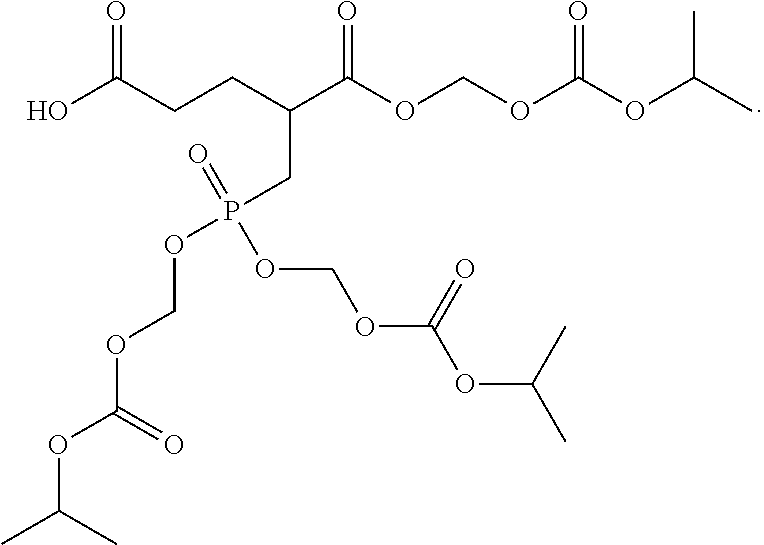
- GRVYWRWWFIILGB-UHFFFAOYSA-N C(C)(C)OC(=O)OCOP(=O)(OCOC(=O)OC(C)C)CC(CCC(=O)O)C(=O)OCOC(=O)OC(C)C Chemical compound C(C)(C)OC(=O)OCOP(=O)(OCOC(=O)OC(C)C)CC(CCC(=O)O)C(=O)OCOC(=O)OC(C)C GRVYWRWWFIILGB-UHFFFAOYSA-N 0.000 description 9
- 108090000369 Glutamate Carboxypeptidase II Proteins 0.000 description 9
- 102000003958 Glutamate Carboxypeptidase II Human genes 0.000 description 9
- NINIDFKCEFEMDL-UHFFFAOYSA-N Sulfur Chemical compound [S] NINIDFKCEFEMDL-UHFFFAOYSA-N 0.000 description 9
- 229940079593 drug Drugs 0.000 description 9
- 210000001519 tissue Anatomy 0.000 description 9
- 125000002252 acyl group Chemical group 0.000 description 8
- 125000003545 alkoxy group Chemical group 0.000 description 8
- 150000002367 halogens Chemical class 0.000 description 8
- 210000004877 mucosa Anatomy 0.000 description 8
- 125000000449 nitro group Chemical group [O-][N+](*)=O 0.000 description 8
- 239000000126 substance Substances 0.000 description 8
- OKTJSMMVPCPJKN-UHFFFAOYSA-N Carbon Chemical compound [C] OKTJSMMVPCPJKN-UHFFFAOYSA-N 0.000 description 7
- 241001465754 Metazoa Species 0.000 description 7
- 125000003710 aryl alkyl group Chemical group 0.000 description 7
- QVGXLLKOCUKJST-UHFFFAOYSA-N atomic oxygen Chemical compound [O] QVGXLLKOCUKJST-UHFFFAOYSA-N 0.000 description 7
- LMEKQMALGUDUQG-UHFFFAOYSA-N azathioprine Chemical compound CN1C=NC([N+]([O-])=O)=C1SC1=NC=NC2=C1NC=N2 LMEKQMALGUDUQG-UHFFFAOYSA-N 0.000 description 7
- 229960002170 azathioprine Drugs 0.000 description 7
- 238000006243 chemical reaction Methods 0.000 description 7
- 230000000112 colonic effect Effects 0.000 description 7
- 125000004093 cyano group Chemical group *C#N 0.000 description 7
- 125000000524 functional group Chemical group 0.000 description 7
- 238000007912 intraperitoneal administration Methods 0.000 description 7
- 238000010172 mouse model Methods 0.000 description 7
- 125000004433 nitrogen atom Chemical group N* 0.000 description 7
- QJGQUHMNIGDVPM-UHFFFAOYSA-N nitrogen group Chemical group [N] QJGQUHMNIGDVPM-UHFFFAOYSA-N 0.000 description 7
- 239000001301 oxygen Substances 0.000 description 7
- 108090000623 proteins and genes Proteins 0.000 description 7
- WYWHKKSPHMUBEB-UHFFFAOYSA-N tioguanine Chemical compound N1C(N)=NC(=S)C2=C1N=CN2 WYWHKKSPHMUBEB-UHFFFAOYSA-N 0.000 description 7
- 125000002023 trifluoromethyl group Chemical group FC(F)(F)* 0.000 description 7
- WEVYAHXRMPXWCK-UHFFFAOYSA-N Acetonitrile Chemical compound CC#N WEVYAHXRMPXWCK-UHFFFAOYSA-N 0.000 description 6
- 206010018691 Granuloma Diseases 0.000 description 6
- 102000004377 Thiopurine S-methyltransferases Human genes 0.000 description 6
- 108090000958 Thiopurine S-methyltransferases Proteins 0.000 description 6
- 125000003342 alkenyl group Chemical group 0.000 description 6
- 125000000304 alkynyl group Chemical group 0.000 description 6
- 230000007423 decrease Effects 0.000 description 6
- 125000000623 heterocyclic group Chemical group 0.000 description 6
- 229930195733 hydrocarbon Natural products 0.000 description 6
- 125000002887 hydroxy group Chemical group [H]O* 0.000 description 6
- 229960000598 infliximab Drugs 0.000 description 6
- 239000011593 sulfur Substances 0.000 description 6
- 239000004215 Carbon black (E152) Substances 0.000 description 5
- 208000012287 Prolapse Diseases 0.000 description 5
- 150000001413 amino acids Chemical group 0.000 description 5
- 125000003277 amino group Chemical group 0.000 description 5
- 239000002775 capsule Substances 0.000 description 5
- 125000003178 carboxy group Chemical group [H]OC(*)=O 0.000 description 5
- 150000001732 carboxylic acid derivatives Chemical group 0.000 description 5
- 230000009266 disease activity Effects 0.000 description 5
- 230000002255 enzymatic effect Effects 0.000 description 5
- 210000001035 gastrointestinal tract Anatomy 0.000 description 5
- 125000005843 halogen group Chemical group 0.000 description 5
- 150000002430 hydrocarbons Chemical class 0.000 description 5
- 210000004347 intestinal mucosa Anatomy 0.000 description 5
- 230000007935 neutral effect Effects 0.000 description 5
- 150000007524 organic acids Chemical group 0.000 description 5
- 239000008194 pharmaceutical composition Substances 0.000 description 5
- 229920000036 polyvinylpyrrolidone Polymers 0.000 description 5
- 235000013855 polyvinylpyrrolidone Nutrition 0.000 description 5
- 239000000243 solution Substances 0.000 description 5
- 230000001225 therapeutic effect Effects 0.000 description 5
- 206010012735 Diarrhoea Diseases 0.000 description 4
- 102000004190 Enzymes Human genes 0.000 description 4
- 108090000790 Enzymes Proteins 0.000 description 4
- 208000018522 Gastrointestinal disease Diseases 0.000 description 4
- OTCCIMWXFLJLIA-UHFFFAOYSA-N N-acetyl-DL-aspartic acid Natural products CC(=O)NC(C(O)=O)CC(O)=O OTCCIMWXFLJLIA-UHFFFAOYSA-N 0.000 description 4
- OTCCIMWXFLJLIA-BYPYZUCNSA-N N-acetyl-L-aspartic acid Chemical compound CC(=O)N[C@H](C(O)=O)CC(O)=O OTCCIMWXFLJLIA-BYPYZUCNSA-N 0.000 description 4
- QAOWNCQODCNURD-UHFFFAOYSA-L Sulfate Chemical compound [O-]S([O-])(=O)=O QAOWNCQODCNURD-UHFFFAOYSA-L 0.000 description 4
- 102100040247 Tumor necrosis factor Human genes 0.000 description 4
- 150000007513 acids Chemical class 0.000 description 4
- 125000003282 alkyl amino group Chemical group 0.000 description 4
- 229940024606 amino acid Drugs 0.000 description 4
- 235000001014 amino acid Nutrition 0.000 description 4
- WPYMKLBDIGXBTP-UHFFFAOYSA-N benzoic acid Chemical compound OC(=O)C1=CC=CC=C1 WPYMKLBDIGXBTP-UHFFFAOYSA-N 0.000 description 4
- 239000003246 corticosteroid Substances 0.000 description 4
- 229960001334 corticosteroids Drugs 0.000 description 4
- 125000000113 cyclohexyl group Chemical group [H]C1([H])C([H])([H])C([H])([H])C([H])(*)C([H])([H])C1([H])[H] 0.000 description 4
- 239000008298 dragée Substances 0.000 description 4
- 229940088598 enzyme Drugs 0.000 description 4
- 125000001495 ethyl group Chemical group [H]C([H])([H])C([H])([H])* 0.000 description 4
- 238000009472 formulation Methods 0.000 description 4
- 125000004474 heteroalkylene group Chemical group 0.000 description 4
- 125000001183 hydrocarbyl group Chemical group 0.000 description 4
- 230000000670 limiting effect Effects 0.000 description 4
- 125000005647 linker group Chemical group 0.000 description 4
- BDAGIHXWWSANSR-UHFFFAOYSA-N methanoic acid Natural products OC=O BDAGIHXWWSANSR-UHFFFAOYSA-N 0.000 description 4
- 239000000178 monomer Substances 0.000 description 4
- 229960005027 natalizumab Drugs 0.000 description 4
- 235000005985 organic acids Nutrition 0.000 description 4
- 125000004430 oxygen atom Chemical group O* 0.000 description 4
- 229910052698 phosphorus Inorganic materials 0.000 description 4
- 229920001223 polyethylene glycol Polymers 0.000 description 4
- 235000018102 proteins Nutrition 0.000 description 4
- 102000004169 proteins and genes Human genes 0.000 description 4
- JFINOWIINSTUNY-UHFFFAOYSA-N pyrrolidin-3-ylmethanesulfonamide Chemical compound NS(=O)(=O)CC1CCNC1 JFINOWIINSTUNY-UHFFFAOYSA-N 0.000 description 4
- 239000011347 resin Substances 0.000 description 4
- 229920005989 resin Polymers 0.000 description 4
- 230000002269 spontaneous effect Effects 0.000 description 4
- 125000003107 substituted aryl group Chemical group 0.000 description 4
- 125000004434 sulfur atom Chemical group 0.000 description 4
- 239000003826 tablet Substances 0.000 description 4
- 125000000391 vinyl group Chemical group [H]C([*])=C([H])[H] 0.000 description 4
- 125000003903 2-propenyl group Chemical group [H]C([*])([H])C([H])=C([H])[H] 0.000 description 3
- UIJIQXGRFSPYQW-UHFFFAOYSA-N 6-methylthiopurine Chemical compound CSC1=NC=NC2=C1N=CN2 UIJIQXGRFSPYQW-UHFFFAOYSA-N 0.000 description 3
- 208000004998 Abdominal Pain Diseases 0.000 description 3
- AGVRFHUTWFXJEA-UHFFFAOYSA-N CCCC(CP(=O)(O)O)C(=O)O Chemical compound CCCC(CP(=O)(O)O)C(=O)O AGVRFHUTWFXJEA-UHFFFAOYSA-N 0.000 description 3
- XNSBZLAUMMJCPD-UHFFFAOYSA-N CCCC1=CC=CC(C2=CC(C(=O)O)=CC=C2)=C1C(=O)O Chemical compound CCCC1=CC=CC(C2=CC(C(=O)O)=CC=C2)=C1C(=O)O XNSBZLAUMMJCPD-UHFFFAOYSA-N 0.000 description 3
- 108010010803 Gelatin Proteins 0.000 description 3
- PEDCQBHIVMGVHV-UHFFFAOYSA-N Glycerine Chemical compound OCC(O)CO PEDCQBHIVMGVHV-UHFFFAOYSA-N 0.000 description 3
- UFHFLCQGNIYNRP-UHFFFAOYSA-N Hydrogen Chemical compound [H][H] UFHFLCQGNIYNRP-UHFFFAOYSA-N 0.000 description 3
- CPELXLSAUQHCOX-UHFFFAOYSA-N Hydrogen bromide Chemical compound Br CPELXLSAUQHCOX-UHFFFAOYSA-N 0.000 description 3
- 102000014150 Interferons Human genes 0.000 description 3
- 108010050904 Interferons Proteins 0.000 description 3
- WHUUTDBJXJRKMK-VKHMYHEASA-N L-glutamic acid Chemical compound OC(=O)[C@@H](N)CCC(O)=O WHUUTDBJXJRKMK-VKHMYHEASA-N 0.000 description 3
- OKKJLVBELUTLKV-UHFFFAOYSA-N Methanol Chemical compound OC OKKJLVBELUTLKV-UHFFFAOYSA-N 0.000 description 3
- 229920002472 Starch Polymers 0.000 description 3
- 206010054094 Tumour necrosis Diseases 0.000 description 3
- 239000004480 active ingredient Substances 0.000 description 3
- 229960002964 adalimumab Drugs 0.000 description 3
- 125000004453 alkoxycarbonyl group Chemical group 0.000 description 3
- HSFWRNGVRCDJHI-UHFFFAOYSA-N alpha-acetylene Natural products C#C HSFWRNGVRCDJHI-UHFFFAOYSA-N 0.000 description 3
- 238000004458 analytical method Methods 0.000 description 3
- 230000000259 anti-tumor effect Effects 0.000 description 3
- 125000002102 aryl alkyloxo group Chemical group 0.000 description 3
- 125000004104 aryloxy group Chemical group 0.000 description 3
- 238000003556 assay Methods 0.000 description 3
- 125000001797 benzyl group Chemical group [H]C1=C([H])C([H])=C(C([H])=C1[H])C([H])([H])* 0.000 description 3
- 210000004369 blood Anatomy 0.000 description 3
- 239000008280 blood Substances 0.000 description 3
- 230000037396 body weight Effects 0.000 description 3
- 239000011203 carbon fibre reinforced carbon Substances 0.000 description 3
- 210000004027 cell Anatomy 0.000 description 3
- 229960003115 certolizumab pegol Drugs 0.000 description 3
- 125000000392 cycloalkenyl group Chemical group 0.000 description 3
- 238000011161 development Methods 0.000 description 3
- 125000004663 dialkyl amino group Chemical group 0.000 description 3
- 208000035475 disorder Diseases 0.000 description 3
- 125000002534 ethynyl group Chemical group [H]C#C* 0.000 description 3
- 125000001153 fluoro group Chemical group F* 0.000 description 3
- 229920000159 gelatin Polymers 0.000 description 3
- 239000008273 gelatin Substances 0.000 description 3
- 235000019322 gelatine Nutrition 0.000 description 3
- 235000011852 gelatine desserts Nutrition 0.000 description 3
- 230000002068 genetic effect Effects 0.000 description 3
- 210000003405 ileum Anatomy 0.000 description 3
- 230000006872 improvement Effects 0.000 description 3
- 239000012442 inert solvent Substances 0.000 description 3
- 230000005764 inhibitory process Effects 0.000 description 3
- 238000002347 injection Methods 0.000 description 3
- 239000007924 injection Substances 0.000 description 3
- NOESYZHRGYRDHS-UHFFFAOYSA-N insulin Chemical compound N1C(=O)C(NC(=O)C(CCC(N)=O)NC(=O)C(CCC(O)=O)NC(=O)C(C(C)C)NC(=O)C(NC(=O)CN)C(C)CC)CSSCC(C(NC(CO)C(=O)NC(CC(C)C)C(=O)NC(CC=2C=CC(O)=CC=2)C(=O)NC(CCC(N)=O)C(=O)NC(CC(C)C)C(=O)NC(CCC(O)=O)C(=O)NC(CC(N)=O)C(=O)NC(CC=2C=CC(O)=CC=2)C(=O)NC(CSSCC(NC(=O)C(C(C)C)NC(=O)C(CC(C)C)NC(=O)C(CC=2C=CC(O)=CC=2)NC(=O)C(CC(C)C)NC(=O)C(C)NC(=O)C(CCC(O)=O)NC(=O)C(C(C)C)NC(=O)C(CC(C)C)NC(=O)C(CC=2NC=NC=2)NC(=O)C(CO)NC(=O)CNC2=O)C(=O)NCC(=O)NC(CCC(O)=O)C(=O)NC(CCCNC(N)=N)C(=O)NCC(=O)NC(CC=3C=CC=CC=3)C(=O)NC(CC=3C=CC=CC=3)C(=O)NC(CC=3C=CC(O)=CC=3)C(=O)NC(C(C)O)C(=O)N3C(CCC3)C(=O)NC(CCCCN)C(=O)NC(C)C(O)=O)C(=O)NC(CC(N)=O)C(O)=O)=O)NC(=O)C(C(C)CC)NC(=O)C(CO)NC(=O)C(C(C)O)NC(=O)C1CSSCC2NC(=O)C(CC(C)C)NC(=O)C(NC(=O)C(CCC(N)=O)NC(=O)C(CC(N)=O)NC(=O)C(NC(=O)C(N)CC=1C=CC=CC=1)C(C)C)CC1=CN=CN1 NOESYZHRGYRDHS-UHFFFAOYSA-N 0.000 description 3
- 229940047124 interferons Drugs 0.000 description 3
- 230000000968 intestinal effect Effects 0.000 description 3
- 210000000936 intestine Anatomy 0.000 description 3
- 239000007788 liquid Substances 0.000 description 3
- 208000019423 liver disease Diseases 0.000 description 3
- 125000001570 methylene group Chemical group [H]C([H])([*:1])[*:2] 0.000 description 3
- 238000012986 modification Methods 0.000 description 3
- 230000004048 modification Effects 0.000 description 3
- 239000000546 pharmaceutical excipient Substances 0.000 description 3
- 229920000642 polymer Polymers 0.000 description 3
- 239000001267 polyvinylpyrrolidone Substances 0.000 description 3
- 238000002360 preparation method Methods 0.000 description 3
- 125000002924 primary amino group Chemical group [H]N([H])* 0.000 description 3
- 210000000664 rectum Anatomy 0.000 description 3
- 230000002829 reductive effect Effects 0.000 description 3
- 230000004043 responsiveness Effects 0.000 description 3
- 229910052710 silicon Inorganic materials 0.000 description 3
- 210000000813 small intestine Anatomy 0.000 description 3
- 238000006467 substitution reaction Methods 0.000 description 3
- 230000009885 systemic effect Effects 0.000 description 3
- 229940124597 therapeutic agent Drugs 0.000 description 3
- 125000005309 thioalkoxy group Chemical group 0.000 description 3
- 229960003087 tioguanine Drugs 0.000 description 3
- VZCYOOQTPOCHFL-UHFFFAOYSA-N trans-butenedioic acid Natural products OC(=O)C=CC(O)=O VZCYOOQTPOCHFL-UHFFFAOYSA-N 0.000 description 3
- 229920002554 vinyl polymer Polymers 0.000 description 3
- 125000004178 (C1-C4) alkyl group Chemical group 0.000 description 2
- 125000004209 (C1-C8) alkyl group Chemical group 0.000 description 2
- 125000003088 (fluoren-9-ylmethoxy)carbonyl group Chemical group 0.000 description 2
- 125000001494 2-propynyl group Chemical group [H]C#CC([H])([H])* 0.000 description 2
- OSWFIVFLDKOXQC-UHFFFAOYSA-N 4-(3-methoxyphenyl)aniline Chemical compound COC1=CC=CC(C=2C=CC(N)=CC=2)=C1 OSWFIVFLDKOXQC-UHFFFAOYSA-N 0.000 description 2
- YEGKYFQLKYGHAR-UHFFFAOYSA-N 6-methylthioguanine Chemical compound CSC1=NC(N)=NC2=C1NC=N2 YEGKYFQLKYGHAR-UHFFFAOYSA-N 0.000 description 2
- QTBSBXVTEAMEQO-UHFFFAOYSA-M Acetate Chemical compound CC([O-])=O QTBSBXVTEAMEQO-UHFFFAOYSA-M 0.000 description 2
- QGZKDVFQNNGYKY-UHFFFAOYSA-N Ammonia Chemical compound N QGZKDVFQNNGYKY-UHFFFAOYSA-N 0.000 description 2
- QGZKDVFQNNGYKY-UHFFFAOYSA-O Ammonium Chemical compound [NH4+] QGZKDVFQNNGYKY-UHFFFAOYSA-O 0.000 description 2
- 241000283690 Bos taurus Species 0.000 description 2
- CPELXLSAUQHCOX-UHFFFAOYSA-M Bromide Chemical compound [Br-] CPELXLSAUQHCOX-UHFFFAOYSA-M 0.000 description 2
- COVZYZSDYWQREU-UHFFFAOYSA-N Busulfan Chemical compound CS(=O)(=O)OCCCCOS(C)(=O)=O COVZYZSDYWQREU-UHFFFAOYSA-N 0.000 description 2
- OYPRJOBELJOOCE-UHFFFAOYSA-N Calcium Chemical compound [Ca] OYPRJOBELJOOCE-UHFFFAOYSA-N 0.000 description 2
- BVKZGUZCCUSVTD-UHFFFAOYSA-L Carbonate Chemical compound [O-]C([O-])=O BVKZGUZCCUSVTD-UHFFFAOYSA-L 0.000 description 2
- KRKNYBCHXYNGOX-UHFFFAOYSA-K Citrate Chemical compound [O-]C(=O)CC(O)(CC([O-])=O)C([O-])=O KRKNYBCHXYNGOX-UHFFFAOYSA-K 0.000 description 2
- 206010009944 Colon cancer Diseases 0.000 description 2
- CMSMOCZEIVJLDB-UHFFFAOYSA-N Cyclophosphamide Chemical compound ClCCN(CCCl)P1(=O)NCCCO1 CMSMOCZEIVJLDB-UHFFFAOYSA-N 0.000 description 2
- FBPFZTCFMRRESA-FSIIMWSLSA-N D-Glucitol Natural products OC[C@H](O)[C@H](O)[C@@H](O)[C@H](O)CO FBPFZTCFMRRESA-FSIIMWSLSA-N 0.000 description 2
- FBPFZTCFMRRESA-JGWLITMVSA-N D-glucitol Chemical compound OC[C@H](O)[C@@H](O)[C@H](O)[C@H](O)CO FBPFZTCFMRRESA-JGWLITMVSA-N 0.000 description 2
- RGHNJXZEOKUKBD-SQOUGZDYSA-M D-gluconate Chemical compound OC[C@@H](O)[C@@H](O)[C@H](O)[C@@H](O)C([O-])=O RGHNJXZEOKUKBD-SQOUGZDYSA-M 0.000 description 2
- FEWJPZIEWOKRBE-JCYAYHJZSA-N Dextrotartaric acid Chemical compound OC(=O)[C@H](O)[C@@H](O)C(O)=O FEWJPZIEWOKRBE-JCYAYHJZSA-N 0.000 description 2
- 241000283086 Equidae Species 0.000 description 2
- 241000282412 Homo Species 0.000 description 2
- VEXZGXHMUGYJMC-UHFFFAOYSA-N Hydrochloric acid Chemical compound Cl VEXZGXHMUGYJMC-UHFFFAOYSA-N 0.000 description 2
- 206010020880 Hypertrophy Diseases 0.000 description 2
- DGAQECJNVWCQMB-PUAWFVPOSA-M Ilexoside XXIX Chemical compound C[C@@H]1CC[C@@]2(CC[C@@]3(C(=CC[C@H]4[C@]3(CC[C@@H]5[C@@]4(CC[C@@H](C5(C)C)OS(=O)(=O)[O-])C)C)[C@@H]2[C@]1(C)O)C)C(=O)O[C@H]6[C@@H]([C@H]([C@@H]([C@H](O6)CO)O)O)O.[Na+] DGAQECJNVWCQMB-PUAWFVPOSA-M 0.000 description 2
- 208000026350 Inborn Genetic disease Diseases 0.000 description 2
- 208000005016 Intestinal Neoplasms Diseases 0.000 description 2
- UETNIIAIRMUTSM-UHFFFAOYSA-N Jacareubin Natural products CC1(C)OC2=CC3Oc4c(O)c(O)ccc4C(=O)C3C(=C2C=C1)O UETNIIAIRMUTSM-UHFFFAOYSA-N 0.000 description 2
- GUBGYTABKSRVRQ-QKKXKWKRSA-N Lactose Natural products OC[C@H]1O[C@@H](O[C@H]2[C@H](O)[C@@H](O)C(O)O[C@@H]2CO)[C@H](O)[C@@H](O)[C@H]1O GUBGYTABKSRVRQ-QKKXKWKRSA-N 0.000 description 2
- 208000034800 Leukoencephalopathies Diseases 0.000 description 2
- AFVFQIVMOAPDHO-UHFFFAOYSA-N Methanesulfonic acid Chemical compound CS(O)(=O)=O AFVFQIVMOAPDHO-UHFFFAOYSA-N 0.000 description 2
- WHNWPMSKXPGLAX-UHFFFAOYSA-N N-Vinyl-2-pyrrolidone Chemical compound C=CN1CCCC1=O WHNWPMSKXPGLAX-UHFFFAOYSA-N 0.000 description 2
- 206010028980 Neoplasm Diseases 0.000 description 2
- 206010030113 Oedema Diseases 0.000 description 2
- 229910019142 PO4 Inorganic materials 0.000 description 2
- KDLHZDBZIXYQEI-UHFFFAOYSA-N Palladium Chemical compound [Pd] KDLHZDBZIXYQEI-UHFFFAOYSA-N 0.000 description 2
- OAICVXFJPJFONN-UHFFFAOYSA-N Phosphorus Chemical compound [P] OAICVXFJPJFONN-UHFFFAOYSA-N 0.000 description 2
- 239000002202 Polyethylene glycol Substances 0.000 description 2
- ZLMJMSJWJFRBEC-UHFFFAOYSA-N Potassium Chemical compound [K] ZLMJMSJWJFRBEC-UHFFFAOYSA-N 0.000 description 2
- 206010037660 Pyrexia Diseases 0.000 description 2
- 238000012228 RNA interference-mediated gene silencing Methods 0.000 description 2
- 206010049416 Short-bowel syndrome Diseases 0.000 description 2
- 241000282887 Suidae Species 0.000 description 2
- FEWJPZIEWOKRBE-UHFFFAOYSA-N Tartaric Acid Chemical class [H+].[H+].[O-]C(=O)C(O)C(O)C([O-])=O FEWJPZIEWOKRBE-UHFFFAOYSA-N 0.000 description 2
- GWEVSGVZZGPLCZ-UHFFFAOYSA-N Titan oxide Chemical compound O=[Ti]=O GWEVSGVZZGPLCZ-UHFFFAOYSA-N 0.000 description 2
- YZCKVEUIGOORGS-NJFSPNSNSA-N Tritium Chemical compound [3H] YZCKVEUIGOORGS-NJFSPNSNSA-N 0.000 description 2
- 208000025865 Ulcer Diseases 0.000 description 2
- 206010000269 abscess Diseases 0.000 description 2
- 125000002777 acetyl group Chemical group [H]C([H])([H])C(*)=O 0.000 description 2
- 125000004442 acylamino group Chemical group 0.000 description 2
- 125000001931 aliphatic group Chemical group 0.000 description 2
- 125000000278 alkyl amino alkyl group Chemical group 0.000 description 2
- 239000012491 analyte Substances 0.000 description 2
- 238000010171 animal model Methods 0.000 description 2
- 125000006615 aromatic heterocyclic group Chemical group 0.000 description 2
- 125000002029 aromatic hydrocarbon group Chemical group 0.000 description 2
- 125000005161 aryl oxy carbonyl group Chemical group 0.000 description 2
- 230000008901 benefit Effects 0.000 description 2
- SRSXLGNVWSONIS-UHFFFAOYSA-M benzenesulfonate Chemical compound [O-]S(=O)(=O)C1=CC=CC=C1 SRSXLGNVWSONIS-UHFFFAOYSA-M 0.000 description 2
- 125000001584 benzyloxycarbonyl group Chemical group C(=O)(OCC1=CC=CC=C1)* 0.000 description 2
- 230000000903 blocking effect Effects 0.000 description 2
- BEWYHVAWEKZDPP-UHFFFAOYSA-N bornane Chemical compound C1CC2(C)CCC1C2(C)C BEWYHVAWEKZDPP-UHFFFAOYSA-N 0.000 description 2
- 239000000872 buffer Substances 0.000 description 2
- 239000011575 calcium Substances 0.000 description 2
- 229910052791 calcium Inorganic materials 0.000 description 2
- 150000001721 carbon Chemical group 0.000 description 2
- 239000001768 carboxy methyl cellulose Substances 0.000 description 2
- 239000000969 carrier Substances 0.000 description 2
- 238000000576 coating method Methods 0.000 description 2
- 238000007796 conventional method Methods 0.000 description 2
- 230000002596 correlated effect Effects 0.000 description 2
- 230000000875 corresponding effect Effects 0.000 description 2
- WZHCOOQXZCIUNC-UHFFFAOYSA-N cyclandelate Chemical compound C1C(C)(C)CC(C)CC1OC(=O)C(O)C1=CC=CC=C1 WZHCOOQXZCIUNC-UHFFFAOYSA-N 0.000 description 2
- 125000001316 cycloalkyl alkyl group Chemical group 0.000 description 2
- 125000000582 cycloheptyl group Chemical group [H]C1([H])C([H])([H])C([H])([H])C([H])([H])C([H])(*)C([H])([H])C1([H])[H] 0.000 description 2
- MGNZXYYWBUKAII-UHFFFAOYSA-N cyclohexa-1,3-diene Chemical compound C1CC=CC=C1 MGNZXYYWBUKAII-UHFFFAOYSA-N 0.000 description 2
- ZSWFCLXCOIISFI-UHFFFAOYSA-N cyclopentadiene Chemical compound C1C=CC=C1 ZSWFCLXCOIISFI-UHFFFAOYSA-N 0.000 description 2
- 125000001511 cyclopentyl group Chemical group [H]C1([H])C([H])([H])C([H])([H])C([H])(*)C1([H])[H] 0.000 description 2
- 229960004397 cyclophosphamide Drugs 0.000 description 2
- 125000004186 cyclopropylmethyl group Chemical group [H]C([H])(*)C1([H])C([H])([H])C1([H])[H] 0.000 description 2
- NNBZCPXTIHJBJL-UHFFFAOYSA-N decalin Chemical compound C1CCCC2CCCCC21 NNBZCPXTIHJBJL-UHFFFAOYSA-N 0.000 description 2
- 208000007784 diverticulitis Diseases 0.000 description 2
- 239000003937 drug carrier Substances 0.000 description 2
- 238000010828 elution Methods 0.000 description 2
- 229950005627 embonate Drugs 0.000 description 2
- 210000003238 esophagus Anatomy 0.000 description 2
- 238000002474 experimental method Methods 0.000 description 2
- 239000000945 filler Substances 0.000 description 2
- 230000003890 fistula Effects 0.000 description 2
- 235000019253 formic acid Nutrition 0.000 description 2
- 239000000499 gel Substances 0.000 description 2
- 230000009368 gene silencing by RNA Effects 0.000 description 2
- 208000016361 genetic disease Diseases 0.000 description 2
- 229940050410 gluconate Drugs 0.000 description 2
- 229930195712 glutamate Natural products 0.000 description 2
- 125000001188 haloalkyl group Chemical group 0.000 description 2
- 238000007327 hydrogenolysis reaction Methods 0.000 description 2
- 230000002519 immonomodulatory effect Effects 0.000 description 2
- 230000000977 initiatory effect Effects 0.000 description 2
- 230000003993 interaction Effects 0.000 description 2
- 201000002313 intestinal cancer Diseases 0.000 description 2
- 125000001449 isopropyl group Chemical group [H]C([H])([H])C([H])(*)C([H])([H])[H] 0.000 description 2
- 239000008101 lactose Substances 0.000 description 2
- 238000001294 liquid chromatography-tandem mass spectrometry Methods 0.000 description 2
- 230000004807 localization Effects 0.000 description 2
- 159000000003 magnesium salts Chemical class 0.000 description 2
- HQKMJHAJHXVSDF-UHFFFAOYSA-L magnesium stearate Chemical compound [Mg+2].CCCCCCCCCCCCCCCCCC([O-])=O.CCCCCCCCCCCCCCCCCC([O-])=O HQKMJHAJHXVSDF-UHFFFAOYSA-L 0.000 description 2
- VZCYOOQTPOCHFL-UPHRSURJSA-N maleic acid Chemical compound OC(=O)\C=C/C(O)=O VZCYOOQTPOCHFL-UPHRSURJSA-N 0.000 description 2
- 238000007726 management method Methods 0.000 description 2
- 238000005259 measurement Methods 0.000 description 2
- 230000001404 mediated effect Effects 0.000 description 2
- 239000002207 metabolite Substances 0.000 description 2
- 125000000956 methoxy group Chemical group [H]C([H])([H])O* 0.000 description 2
- 150000007522 mineralic acids Chemical class 0.000 description 2
- 125000004573 morpholin-4-yl group Chemical group N1(CCOCC1)* 0.000 description 2
- 230000016379 mucosal immune response Effects 0.000 description 2
- 125000004108 n-butyl group Chemical group [H]C([H])([H])C([H])([H])C([H])([H])C([H])([H])* 0.000 description 2
- 125000004123 n-propyl group Chemical group [H]C([H])([H])C([H])([H])C([H])([H])* 0.000 description 2
- XBXCNNQPRYLIDE-UHFFFAOYSA-M n-tert-butylcarbamate Chemical group CC(C)(C)NC([O-])=O XBXCNNQPRYLIDE-UHFFFAOYSA-M 0.000 description 2
- 230000009826 neoplastic cell growth Effects 0.000 description 2
- 210000000440 neutrophil Anatomy 0.000 description 2
- 150000002823 nitrates Chemical class 0.000 description 2
- 231100000252 nontoxic Toxicity 0.000 description 2
- 230000003000 nontoxic effect Effects 0.000 description 2
- 125000004043 oxo group Chemical group O=* 0.000 description 2
- 230000035699 permeability Effects 0.000 description 2
- 239000000825 pharmaceutical preparation Substances 0.000 description 2
- 230000000144 pharmacologic effect Effects 0.000 description 2
- 230000009038 pharmacological inhibition Effects 0.000 description 2
- NBIIXXVUZAFLBC-UHFFFAOYSA-K phosphate Chemical compound [O-]P([O-])([O-])=O NBIIXXVUZAFLBC-UHFFFAOYSA-K 0.000 description 2
- 239000010452 phosphate Substances 0.000 description 2
- OJMIONKXNSYLSR-UHFFFAOYSA-N phosphorous acid Chemical class OP(O)O OJMIONKXNSYLSR-UHFFFAOYSA-N 0.000 description 2
- 239000011574 phosphorus Substances 0.000 description 2
- 230000004962 physiological condition Effects 0.000 description 2
- 125000003367 polycyclic group Chemical group 0.000 description 2
- 239000011591 potassium Substances 0.000 description 2
- 229910052700 potassium Inorganic materials 0.000 description 2
- 238000012545 processing Methods 0.000 description 2
- 230000000750 progressive effect Effects 0.000 description 2
- 150000003254 radicals Chemical class 0.000 description 2
- 230000002285 radioactive effect Effects 0.000 description 2
- 239000011541 reaction mixture Substances 0.000 description 2
- 238000002271 resection Methods 0.000 description 2
- YGSDEFSMJLZEOE-UHFFFAOYSA-M salicylate Chemical compound OC1=CC=CC=C1C([O-])=O YGSDEFSMJLZEOE-UHFFFAOYSA-M 0.000 description 2
- 229960001860 salicylate Drugs 0.000 description 2
- 238000004904 shortening Methods 0.000 description 2
- 239000011734 sodium Substances 0.000 description 2
- 229910052708 sodium Inorganic materials 0.000 description 2
- 239000000600 sorbitol Substances 0.000 description 2
- 210000000952 spleen Anatomy 0.000 description 2
- 239000003381 stabilizer Substances 0.000 description 2
- 235000019698 starch Nutrition 0.000 description 2
- 210000002784 stomach Anatomy 0.000 description 2
- KDYFGRWQOYBRFD-UHFFFAOYSA-L succinate(2-) Chemical compound [O-]C(=O)CCC([O-])=O KDYFGRWQOYBRFD-UHFFFAOYSA-L 0.000 description 2
- 235000000346 sugar Nutrition 0.000 description 2
- PXQLVRUNWNTZOS-UHFFFAOYSA-N sulfanyl Chemical compound [SH] PXQLVRUNWNTZOS-UHFFFAOYSA-N 0.000 description 2
- NCEXYHBECQHGNR-QZQOTICOSA-N sulfasalazine Chemical compound C1=C(O)C(C(=O)O)=CC(\N=N\C=2C=CC(=CC=2)S(=O)(=O)NC=2N=CC=CC=2)=C1 NCEXYHBECQHGNR-QZQOTICOSA-N 0.000 description 2
- 229960001940 sulfasalazine Drugs 0.000 description 2
- NCEXYHBECQHGNR-UHFFFAOYSA-N sulfasalazine Natural products C1=C(O)C(C(=O)O)=CC(N=NC=2C=CC(=CC=2)S(=O)(=O)NC=2N=CC=CC=2)=C1 NCEXYHBECQHGNR-UHFFFAOYSA-N 0.000 description 2
- 239000006228 supernatant Substances 0.000 description 2
- 239000000454 talc Substances 0.000 description 2
- 229910052623 talc Inorganic materials 0.000 description 2
- 229940095064 tartrate Drugs 0.000 description 2
- 125000000999 tert-butyl group Chemical group [H]C([H])([H])C(*)(C([H])([H])[H])C([H])([H])[H] 0.000 description 2
- 230000009261 transgenic effect Effects 0.000 description 2
- 125000004954 trialkylamino group Chemical group 0.000 description 2
- 229910052722 tritium Inorganic materials 0.000 description 2
- 239000002451 tumor necrosis factor inhibitor Substances 0.000 description 2
- 125000004417 unsaturated alkyl group Chemical group 0.000 description 2
- LNAZSHAWQACDHT-XIYTZBAFSA-N (2r,3r,4s,5r,6s)-4,5-dimethoxy-2-(methoxymethyl)-3-[(2s,3r,4s,5r,6r)-3,4,5-trimethoxy-6-(methoxymethyl)oxan-2-yl]oxy-6-[(2r,3r,4s,5r,6r)-4,5,6-trimethoxy-2-(methoxymethyl)oxan-3-yl]oxyoxane Chemical compound CO[C@@H]1[C@@H](OC)[C@H](OC)[C@@H](COC)O[C@H]1O[C@H]1[C@H](OC)[C@@H](OC)[C@H](O[C@H]2[C@@H]([C@@H](OC)[C@H](OC)O[C@@H]2COC)OC)O[C@@H]1COC LNAZSHAWQACDHT-XIYTZBAFSA-N 0.000 description 1
- PSLCKQYQNVNTQI-BHFSHLQUSA-N (2s)-2-aminobutanedioic acid;(2s)-2-aminopentanedioic acid Chemical compound OC(=O)[C@@H](N)CC(O)=O.OC(=O)[C@@H](N)CCC(O)=O PSLCKQYQNVNTQI-BHFSHLQUSA-N 0.000 description 1
- 125000003837 (C1-C20) alkyl group Chemical group 0.000 description 1
- GHOKWGTUZJEAQD-ZETCQYMHSA-N (D)-(+)-Pantothenic acid Chemical compound OCC(C)(C)[C@@H](O)C(=O)NCCC(O)=O GHOKWGTUZJEAQD-ZETCQYMHSA-N 0.000 description 1
- DSSYKIVIOFKYAU-XCBNKYQSSA-N (R)-camphor Chemical compound C1C[C@@]2(C)C(=O)C[C@@H]1C2(C)C DSSYKIVIOFKYAU-XCBNKYQSSA-N 0.000 description 1
- NWUYHJFMYQTDRP-UHFFFAOYSA-N 1,2-bis(ethenyl)benzene;1-ethenyl-2-ethylbenzene;styrene Chemical compound C=CC1=CC=CC=C1.CCC1=CC=CC=C1C=C.C=CC1=CC=CC=C1C=C NWUYHJFMYQTDRP-UHFFFAOYSA-N 0.000 description 1
- KEIFWROAQVVDBN-UHFFFAOYSA-N 1,2-dihydronaphthalene Chemical compound C1=CC=C2C=CCCC2=C1 KEIFWROAQVVDBN-UHFFFAOYSA-N 0.000 description 1
- IXPNQXFRVYWDDI-UHFFFAOYSA-N 1-methyl-2,4-dioxo-1,3-diazinane-5-carboximidamide Chemical compound CN1CC(C(N)=N)C(=O)NC1=O IXPNQXFRVYWDDI-UHFFFAOYSA-N 0.000 description 1
- 125000001637 1-naphthyl group Chemical group [H]C1=C([H])C([H])=C2C(*)=C([H])C([H])=C([H])C2=C1[H] 0.000 description 1
- 125000000530 1-propynyl group Chemical group [H]C([H])([H])C#C* 0.000 description 1
- 125000004214 1-pyrrolidinyl group Chemical group [H]C1([H])N(*)C([H])([H])C([H])([H])C1([H])[H] 0.000 description 1
- 125000001462 1-pyrrolyl group Chemical group [*]N1C([H])=C([H])C([H])=C1[H] 0.000 description 1
- 125000004206 2,2,2-trifluoroethyl group Chemical group [H]C([H])(*)C(F)(F)F 0.000 description 1
- XOQVDBCNWPUEPS-UHFFFAOYSA-N 2-(phosphonomethyl)butanedioic acid Chemical compound OC(=O)CC(C(O)=O)CP(O)(O)=O XOQVDBCNWPUEPS-UHFFFAOYSA-N 0.000 description 1
- IEMMBWWQXVXBEU-UHFFFAOYSA-N 2-acetylfuran Chemical compound CC(=O)C1=CC=CO1 IEMMBWWQXVXBEU-UHFFFAOYSA-N 0.000 description 1
- QKNYBSVHEMOAJP-UHFFFAOYSA-N 2-amino-2-(hydroxymethyl)propane-1,3-diol;hydron;chloride Chemical compound Cl.OCC(N)(CO)CO QKNYBSVHEMOAJP-UHFFFAOYSA-N 0.000 description 1
- 125000004174 2-benzimidazolyl group Chemical group [H]N1C(*)=NC2=C([H])C([H])=C([H])C([H])=C12 0.000 description 1
- 125000002941 2-furyl group Chemical group O1C([*])=C([H])C([H])=C1[H] 0.000 description 1
- HZLCGUXUOFWCCN-UHFFFAOYSA-N 2-hydroxynonadecane-1,2,3-tricarboxylic acid Chemical compound CCCCCCCCCCCCCCCCC(C(O)=O)C(O)(C(O)=O)CC(O)=O HZLCGUXUOFWCCN-UHFFFAOYSA-N 0.000 description 1
- 125000001622 2-naphthyl group Chemical group [H]C1=C([H])C([H])=C2C([H])=C(*)C([H])=C([H])C2=C1[H] 0.000 description 1
- 125000000094 2-phenylethyl group Chemical group [H]C1=C([H])C([H])=C(C([H])=C1[H])C([H])([H])C([H])([H])* 0.000 description 1
- 125000004105 2-pyridyl group Chemical group N1=C([*])C([H])=C([H])C([H])=C1[H] 0.000 description 1
- 125000000389 2-pyrrolyl group Chemical group [H]N1C([*])=C([H])C([H])=C1[H] 0.000 description 1
- 125000000175 2-thienyl group Chemical group S1C([*])=C([H])C([H])=C1[H] 0.000 description 1
- 125000000474 3-butynyl group Chemical group [H]C#CC([H])([H])C([H])([H])* 0.000 description 1
- FEWJPZIEWOKRBE-UHFFFAOYSA-M 3-carboxy-2,3-dihydroxypropanoate Chemical compound OC(=O)C(O)C(O)C([O-])=O FEWJPZIEWOKRBE-UHFFFAOYSA-M 0.000 description 1
- ALKYHXVLJMQRLQ-UHFFFAOYSA-M 3-carboxynaphthalen-2-olate Chemical compound C1=CC=C2C=C(C([O-])=O)C(O)=CC2=C1 ALKYHXVLJMQRLQ-UHFFFAOYSA-M 0.000 description 1
- 125000003682 3-furyl group Chemical group O1C([H])=C([*])C([H])=C1[H] 0.000 description 1
- 125000003349 3-pyridyl group Chemical group N1=C([H])C([*])=C([H])C([H])=C1[H] 0.000 description 1
- 125000001397 3-pyrrolyl group Chemical group [H]N1C([H])=C([*])C([H])=C1[H] 0.000 description 1
- 125000001541 3-thienyl group Chemical group S1C([H])=C([*])C([H])=C1[H] 0.000 description 1
- 125000000339 4-pyridyl group Chemical group N1=C([H])C([H])=C([*])C([H])=C1[H] 0.000 description 1
- KDDQRKBRJSGMQE-UHFFFAOYSA-N 4-thiazolyl Chemical group [C]1=CSC=N1 KDDQRKBRJSGMQE-UHFFFAOYSA-N 0.000 description 1
- CWDWFSXUQODZGW-UHFFFAOYSA-N 5-thiazolyl Chemical group [C]1=CN=CS1 CWDWFSXUQODZGW-UHFFFAOYSA-N 0.000 description 1
- HBAQYPYDRFILMT-UHFFFAOYSA-N 8-[3-(1-cyclopropylpyrazol-4-yl)-1H-pyrazolo[4,3-d]pyrimidin-5-yl]-3-methyl-3,8-diazabicyclo[3.2.1]octan-2-one Chemical class C1(CC1)N1N=CC(=C1)C1=NNC2=C1N=C(N=C2)N1C2C(N(CC1CC2)C)=O HBAQYPYDRFILMT-UHFFFAOYSA-N 0.000 description 1
- 239000005541 ACE inhibitor Substances 0.000 description 1
- 244000215068 Acacia senegal Species 0.000 description 1
- 229920001817 Agar Polymers 0.000 description 1
- 229940077274 Alpha glucosidase inhibitor Drugs 0.000 description 1
- GUBGYTABKSRVRQ-XLOQQCSPSA-N Alpha-Lactose Chemical compound O[C@@H]1[C@@H](O)[C@@H](O)[C@@H](CO)O[C@H]1O[C@@H]1[C@@H](CO)O[C@H](O)[C@H](O)[C@H]1O GUBGYTABKSRVRQ-XLOQQCSPSA-N 0.000 description 1
- 208000019901 Anxiety disease Diseases 0.000 description 1
- 241000416162 Astragalus gummifer Species 0.000 description 1
- BVKZGUZCCUSVTD-UHFFFAOYSA-M Bicarbonate Chemical compound OC([O-])=O BVKZGUZCCUSVTD-UHFFFAOYSA-M 0.000 description 1
- 229940123208 Biguanide Drugs 0.000 description 1
- 208000019838 Blood disease Diseases 0.000 description 1
- 241000283725 Bos Species 0.000 description 1
- SGVUUNQVSWNFJH-UHFFFAOYSA-N C1CCCCC1.CC Chemical compound C1CCCCC1.CC SGVUUNQVSWNFJH-UHFFFAOYSA-N 0.000 description 1
- QKFRZNUHOINYOS-UHFFFAOYSA-N C=CCC(C)C.C=CCOC(=O)C(C)C.CC(=O)C(C)C.CC(C)C.CC(C)C(=O)OC(C)(C)C.CC(C)C(=O)OCC1=CC=CC=C1.CC(C)C(=O)OCC1C2=CC=CC=C2C2=C1/C=C\C=C/2.CC(C)C(=O)OCC[Si](C)(C)C.CC(C)C(C)(C)C.CC(C)C(C1=CC=CC=C1)(C1=CC=CC=C1)C1=CC=CC=C1.CC(C)CC1=CC=C(CO)C=C1.CC(C)CC1=CC=CC=C1.CC(C)[Si](C)(C)C(C)(C)C.CC1=CC=C(S(=O)(=O)C(C)C)C=C1 Chemical compound C=CCC(C)C.C=CCOC(=O)C(C)C.CC(=O)C(C)C.CC(C)C.CC(C)C(=O)OC(C)(C)C.CC(C)C(=O)OCC1=CC=CC=C1.CC(C)C(=O)OCC1C2=CC=CC=C2C2=C1/C=C\C=C/2.CC(C)C(=O)OCC[Si](C)(C)C.CC(C)C(C)(C)C.CC(C)C(C1=CC=CC=C1)(C1=CC=CC=C1)C1=CC=CC=C1.CC(C)CC1=CC=C(CO)C=C1.CC(C)CC1=CC=CC=C1.CC(C)[Si](C)(C)C(C)(C)C.CC1=CC=C(S(=O)(=O)C(C)C)C=C1 QKFRZNUHOINYOS-UHFFFAOYSA-N 0.000 description 1
- 229940127291 Calcium channel antagonist Drugs 0.000 description 1
- 241000282465 Canis Species 0.000 description 1
- 241000282472 Canis lupus familiaris Species 0.000 description 1
- 241000283707 Capra Species 0.000 description 1
- OKTJSMMVPCPJKN-NJFSPNSNSA-N Carbon-14 Chemical compound [14C] OKTJSMMVPCPJKN-NJFSPNSNSA-N 0.000 description 1
- 229920002134 Carboxymethyl cellulose Polymers 0.000 description 1
- 208000024172 Cardiovascular disease Diseases 0.000 description 1
- 241000282693 Cercopithecidae Species 0.000 description 1
- VEXZGXHMUGYJMC-UHFFFAOYSA-M Chloride anion Chemical compound [Cl-] VEXZGXHMUGYJMC-UHFFFAOYSA-M 0.000 description 1
- 229920001268 Cholestyramine Polymers 0.000 description 1
- 241000723346 Cinnamomum camphora Species 0.000 description 1
- 229910021580 Cobalt(II) chloride Inorganic materials 0.000 description 1
- 229920002261 Corn starch Polymers 0.000 description 1
- PMATZTZNYRCHOR-CGLBZJNRSA-N Cyclosporin A Chemical compound CC[C@@H]1NC(=O)[C@H]([C@H](O)[C@H](C)C\C=C\C)N(C)C(=O)[C@H](C(C)C)N(C)C(=O)[C@H](CC(C)C)N(C)C(=O)[C@H](CC(C)C)N(C)C(=O)[C@@H](C)NC(=O)[C@H](C)NC(=O)[C@H](CC(C)C)N(C)C(=O)[C@H](C(C)C)NC(=O)[C@H](CC(C)C)N(C)C(=O)CN(C)C1=O PMATZTZNYRCHOR-CGLBZJNRSA-N 0.000 description 1
- 229930105110 Cyclosporin A Natural products 0.000 description 1
- 108010036949 Cyclosporine Proteins 0.000 description 1
- FBPFZTCFMRRESA-KVTDHHQDSA-N D-Mannitol Chemical compound OC[C@@H](O)[C@@H](O)[C@H](O)[C@H](O)CO FBPFZTCFMRRESA-KVTDHHQDSA-N 0.000 description 1
- 108020004414 DNA Proteins 0.000 description 1
- YZCKVEUIGOORGS-OUBTZVSYSA-N Deuterium Chemical compound [2H] YZCKVEUIGOORGS-OUBTZVSYSA-N 0.000 description 1
- SNRUBQQJIBEYMU-UHFFFAOYSA-N Dodecane Natural products CCCCCCCCCCCC SNRUBQQJIBEYMU-UHFFFAOYSA-N 0.000 description 1
- 208000030453 Drug-Related Side Effects and Adverse reaction Diseases 0.000 description 1
- KCXVZYZYPLLWCC-UHFFFAOYSA-N EDTA Chemical compound OC(=O)CN(CC(O)=O)CCN(CC(O)=O)CC(O)=O KCXVZYZYPLLWCC-UHFFFAOYSA-N 0.000 description 1
- 241000283074 Equus asinus Species 0.000 description 1
- 241000283073 Equus caballus Species 0.000 description 1
- VGGSQFUCUMXWEO-UHFFFAOYSA-N Ethene Chemical compound C=C VGGSQFUCUMXWEO-UHFFFAOYSA-N 0.000 description 1
- 239000005977 Ethylene Substances 0.000 description 1
- 206010015943 Eye inflammation Diseases 0.000 description 1
- 241000282324 Felis Species 0.000 description 1
- 241000282326 Felis catus Species 0.000 description 1
- 206010016654 Fibrosis Diseases 0.000 description 1
- 206010016717 Fistula Diseases 0.000 description 1
- KRHYYFGTRYWZRS-UHFFFAOYSA-M Fluoride anion Chemical compound [F-] KRHYYFGTRYWZRS-UHFFFAOYSA-M 0.000 description 1
- PXGOKWXKJXAPGV-UHFFFAOYSA-N Fluorine Chemical compound FF PXGOKWXKJXAPGV-UHFFFAOYSA-N 0.000 description 1
- BDAGIHXWWSANSR-UHFFFAOYSA-M Formate Chemical compound [O-]C=O BDAGIHXWWSANSR-UHFFFAOYSA-M 0.000 description 1
- VZCYOOQTPOCHFL-OWOJBTEDSA-N Fumaric acid Chemical compound OC(=O)\C=C\C(O)=O VZCYOOQTPOCHFL-OWOJBTEDSA-N 0.000 description 1
- 206010071602 Genetic polymorphism Diseases 0.000 description 1
- WHUUTDBJXJRKMK-UHFFFAOYSA-N Glutamic acid Natural products OC(=O)C(N)CCC(O)=O WHUUTDBJXJRKMK-UHFFFAOYSA-N 0.000 description 1
- 229920000084 Gum arabic Polymers 0.000 description 1
- 229940121710 HMGCoA reductase inhibitor Drugs 0.000 description 1
- 239000012981 Hank's balanced salt solution Substances 0.000 description 1
- 208000032843 Hemorrhage Diseases 0.000 description 1
- 241001272567 Hominoidea Species 0.000 description 1
- 101000610640 Homo sapiens U4/U6 small nuclear ribonucleoprotein Prp3 Proteins 0.000 description 1
- 206010020751 Hypersensitivity Diseases 0.000 description 1
- 208000029462 Immunodeficiency disease Diseases 0.000 description 1
- 102000004877 Insulin Human genes 0.000 description 1
- 108090001061 Insulin Proteins 0.000 description 1
- 229940122355 Insulin sensitizer Drugs 0.000 description 1
- 102000004551 Interleukin-10 Receptors Human genes 0.000 description 1
- 108010017550 Interleukin-10 Receptors Proteins 0.000 description 1
- 208000008081 Intestinal Fistula Diseases 0.000 description 1
- 108090000862 Ion Channels Proteins 0.000 description 1
- 102000004310 Ion Channels Human genes 0.000 description 1
- XETQTCAMTVHYPO-UHFFFAOYSA-N Isocamphan von ungewisser Konfiguration Natural products C1CC2C(C)(C)C(C)C1C2 XETQTCAMTVHYPO-UHFFFAOYSA-N 0.000 description 1
- 208000000913 Kidney Calculi Diseases 0.000 description 1
- JVTAAEKCZFNVCJ-UHFFFAOYSA-M Lactate Chemical compound CC(O)C([O-])=O JVTAAEKCZFNVCJ-UHFFFAOYSA-M 0.000 description 1
- 241000283953 Lagomorpha Species 0.000 description 1
- 241000283986 Lepus Species 0.000 description 1
- 235000019759 Maize starch Nutrition 0.000 description 1
- 241000124008 Mammalia Species 0.000 description 1
- 229930195725 Mannitol Natural products 0.000 description 1
- 102000005741 Metalloproteases Human genes 0.000 description 1
- 108010006035 Metalloproteases Proteins 0.000 description 1
- 241001529936 Murinae Species 0.000 description 1
- 241000699666 Mus <mouse, genus> Species 0.000 description 1
- QRKUHYFDBWGLHJ-UHFFFAOYSA-N N-(tert-butyldimethylsilyl)-N-methyltrifluoroacetamide Chemical compound FC(F)(F)C(=O)N(C)[Si](C)(C)C(C)(C)C QRKUHYFDBWGLHJ-UHFFFAOYSA-N 0.000 description 1
- 229910002651 NO3 Inorganic materials 0.000 description 1
- 206010029148 Nephrolithiasis Diseases 0.000 description 1
- 108010025020 Nerve Growth Factor Proteins 0.000 description 1
- 102000007072 Nerve Growth Factors Human genes 0.000 description 1
- NHNBFGGVMKEFGY-UHFFFAOYSA-N Nitrate Chemical compound [O-][N+]([O-])=O NHNBFGGVMKEFGY-UHFFFAOYSA-N 0.000 description 1
- 229910003849 O-Si Inorganic materials 0.000 description 1
- 241001400033 Omia Species 0.000 description 1
- 208000001388 Opportunistic Infections Diseases 0.000 description 1
- 241000283973 Oryctolagus cuniculus Species 0.000 description 1
- 229910003872 O—Si Inorganic materials 0.000 description 1
- 206010033645 Pancreatitis Diseases 0.000 description 1
- 241001494479 Pecora Species 0.000 description 1
- 108010020346 Polyglutamic Acid Proteins 0.000 description 1
- 241000288906 Primates Species 0.000 description 1
- 229940122569 Prostate-specific membrane antigen inhibitor Drugs 0.000 description 1
- 102000001708 Protein Isoforms Human genes 0.000 description 1
- 108010029485 Protein Isoforms Proteins 0.000 description 1
- 241000700159 Rattus Species 0.000 description 1
- 102000007056 Recombinant Fusion Proteins Human genes 0.000 description 1
- 108010008281 Recombinant Fusion Proteins Proteins 0.000 description 1
- 206010038063 Rectal haemorrhage Diseases 0.000 description 1
- FTALBRSUTCGOEG-UHFFFAOYSA-N Riluzole Chemical compound C1=C(OC(F)(F)F)C=C2SC(N)=NC2=C1 FTALBRSUTCGOEG-UHFFFAOYSA-N 0.000 description 1
- 241000283984 Rodentia Species 0.000 description 1
- 101001110823 Saccharomyces cerevisiae (strain ATCC 204508 / S288c) 60S ribosomal protein L6-A Proteins 0.000 description 1
- 101000712176 Saccharomyces cerevisiae (strain ATCC 204508 / S288c) 60S ribosomal protein L6-B Proteins 0.000 description 1
- 229910007161 Si(CH3)3 Inorganic materials 0.000 description 1
- XUIMIQQOPSSXEZ-UHFFFAOYSA-N Silicon Chemical compound [Si] XUIMIQQOPSSXEZ-UHFFFAOYSA-N 0.000 description 1
- 206010040943 Skin Ulcer Diseases 0.000 description 1
- 229920002125 Sokalan® Polymers 0.000 description 1
- CZMRCDWAGMRECN-UGDNZRGBSA-N Sucrose Chemical compound O[C@H]1[C@H](O)[C@@H](CO)O[C@@]1(CO)O[C@@H]1[C@H](O)[C@@H](O)[C@H](O)[C@@H](CO)O1 CZMRCDWAGMRECN-UGDNZRGBSA-N 0.000 description 1
- 229930006000 Sucrose Natural products 0.000 description 1
- 208000033809 Suppuration Diseases 0.000 description 1
- QJJXYPPXXYFBGM-LFZNUXCKSA-N Tacrolimus Chemical compound C1C[C@@H](O)[C@H](OC)C[C@@H]1\C=C(/C)[C@@H]1[C@H](C)[C@@H](O)CC(=O)[C@H](CC=C)/C=C(C)/C[C@H](C)C[C@H](OC)[C@H]([C@H](C[C@H]2C)OC)O[C@@]2(O)C(=O)C(=O)N2CCCC[C@H]2C(=O)O1 QJJXYPPXXYFBGM-LFZNUXCKSA-N 0.000 description 1
- 229920002253 Tannate Polymers 0.000 description 1
- 206010070863 Toxicity to various agents Diseases 0.000 description 1
- 229920001615 Tragacanth Polymers 0.000 description 1
- 239000007983 Tris buffer Substances 0.000 description 1
- 102100040374 U4/U6 small nuclear ribonucleoprotein Prp3 Human genes 0.000 description 1
- 206010046851 Uveitis Diseases 0.000 description 1
- 241000251539 Vertebrata <Metazoa> Species 0.000 description 1
- PTFCDOFLOPIGGS-UHFFFAOYSA-N Zinc dication Chemical compound [Zn+2] PTFCDOFLOPIGGS-UHFFFAOYSA-N 0.000 description 1
- 0 [1*]C1CCC([2*])CC1.[1*]C1CCCC([2*])C1.[1*]C1CCCCC1[2*] Chemical compound [1*]C1CCC([2*])CC1.[1*]C1CCCC([2*])C1.[1*]C1CCCCC1[2*] 0.000 description 1
- 230000002159 abnormal effect Effects 0.000 description 1
- 235000010489 acacia gum Nutrition 0.000 description 1
- 239000000205 acacia gum Substances 0.000 description 1
- 238000009825 accumulation Methods 0.000 description 1
- DHKHKXVYLBGOIT-UHFFFAOYSA-N acetaldehyde Diethyl Acetal Chemical group CCOC(C)OCC DHKHKXVYLBGOIT-UHFFFAOYSA-N 0.000 description 1
- 150000001241 acetals Chemical group 0.000 description 1
- 150000001242 acetic acid derivatives Chemical class 0.000 description 1
- DPXJVFZANSGRMM-UHFFFAOYSA-N acetic acid;2,3,4,5,6-pentahydroxyhexanal;sodium Chemical compound [Na].CC(O)=O.OCC(O)C(O)C(O)C(O)C=O DPXJVFZANSGRMM-UHFFFAOYSA-N 0.000 description 1
- 239000003377 acid catalyst Substances 0.000 description 1
- 230000004913 activation Effects 0.000 description 1
- 239000013543 active substance Substances 0.000 description 1
- 230000001154 acute effect Effects 0.000 description 1
- 125000002015 acyclic group Chemical group 0.000 description 1
- 125000004423 acyloxy group Chemical group 0.000 description 1
- 125000005073 adamantyl group Chemical group C12(CC3CC(CC(C1)C3)C2)* 0.000 description 1
- 239000008272 agar Substances 0.000 description 1
- 235000010419 agar Nutrition 0.000 description 1
- 229940040563 agaric acid Drugs 0.000 description 1
- 230000002776 aggregation Effects 0.000 description 1
- 238000004220 aggregation Methods 0.000 description 1
- 235000010443 alginic acid Nutrition 0.000 description 1
- 239000000783 alginic acid Substances 0.000 description 1
- 229920000615 alginic acid Polymers 0.000 description 1
- 229960001126 alginic acid Drugs 0.000 description 1
- 150000004781 alginic acids Chemical class 0.000 description 1
- 125000004183 alkoxy alkyl group Chemical group 0.000 description 1
- 125000005115 alkyl carbamoyl group Chemical group 0.000 description 1
- 125000004414 alkyl thio group Chemical group 0.000 description 1
- 125000005012 alkyl thioether group Chemical group 0.000 description 1
- 125000005237 alkyleneamino group Chemical group 0.000 description 1
- 125000005238 alkylenediamino group Chemical group 0.000 description 1
- 125000005282 allenyl group Chemical group 0.000 description 1
- 239000003888 alpha glucosidase inhibitor Substances 0.000 description 1
- 230000004075 alteration Effects 0.000 description 1
- 230000001668 ameliorated effect Effects 0.000 description 1
- 125000003368 amide group Chemical group 0.000 description 1
- 150000001412 amines Chemical class 0.000 description 1
- 125000004103 aminoalkyl group Chemical group 0.000 description 1
- 229910021529 ammonia Inorganic materials 0.000 description 1
- 206010002022 amyloidosis Diseases 0.000 description 1
- 208000007502 anemia Diseases 0.000 description 1
- 229940044094 angiotensin-converting-enzyme inhibitor Drugs 0.000 description 1
- 210000004102 animal cell Anatomy 0.000 description 1
- 230000001773 anti-convulsant effect Effects 0.000 description 1
- 229940121363 anti-inflammatory agent Drugs 0.000 description 1
- 239000002260 anti-inflammatory agent Substances 0.000 description 1
- 230000003110 anti-inflammatory effect Effects 0.000 description 1
- 229940125681 anticonvulsant agent Drugs 0.000 description 1
- 239000001961 anticonvulsive agent Substances 0.000 description 1
- 229940082992 antihypertensives mao inhibitors Drugs 0.000 description 1
- 239000000063 antileukemic agent Substances 0.000 description 1
- 239000000939 antiparkinson agent Substances 0.000 description 1
- 239000003443 antiviral agent Substances 0.000 description 1
- 230000036506 anxiety Effects 0.000 description 1
- 239000007864 aqueous solution Substances 0.000 description 1
- 125000003435 aroyl group Chemical group 0.000 description 1
- 125000005239 aroylamino group Chemical group 0.000 description 1
- 206010003246 arthritis Diseases 0.000 description 1
- 125000005251 aryl acyl group Chemical group 0.000 description 1
- 125000004659 aryl alkyl thio group Chemical group 0.000 description 1
- 125000001769 aryl amino group Chemical group 0.000 description 1
- 125000005110 aryl thio group Chemical group 0.000 description 1
- 125000000732 arylene group Chemical group 0.000 description 1
- 230000004888 barrier function Effects 0.000 description 1
- 229940077388 benzenesulfonate Drugs 0.000 description 1
- 150000001558 benzoic acid derivatives Chemical class 0.000 description 1
- 125000003236 benzoyl group Chemical group [H]C1=C([H])C([H])=C(C([H])=C1[H])C(*)=O 0.000 description 1
- 239000002876 beta blocker Substances 0.000 description 1
- 229940097320 beta blocking agent Drugs 0.000 description 1
- 150000004283 biguanides Chemical class 0.000 description 1
- 239000011230 binding agent Substances 0.000 description 1
- 238000011953 bioanalysis Methods 0.000 description 1
- 238000002306 biochemical method Methods 0.000 description 1
- 230000008512 biological response Effects 0.000 description 1
- 125000000319 biphenyl-4-yl group Chemical group [H]C1=C([H])C([H])=C([H])C([H])=C1C1=C([H])C([H])=C([*])C([H])=C1[H] 0.000 description 1
- 230000000740 bleeding effect Effects 0.000 description 1
- 210000001185 bone marrow Anatomy 0.000 description 1
- 229930006742 bornane Natural products 0.000 description 1
- 125000001246 bromo group Chemical group Br* 0.000 description 1
- 125000004369 butenyl group Chemical group C(=CCC)* 0.000 description 1
- 125000004744 butyloxycarbonyl group Chemical group 0.000 description 1
- 239000000480 calcium channel blocker Substances 0.000 description 1
- 229930008380 camphor Natural products 0.000 description 1
- 229960000846 camphor Drugs 0.000 description 1
- 150000004657 carbamic acid derivatives Chemical class 0.000 description 1
- 125000003917 carbamoyl group Chemical group [H]N([H])C(*)=O 0.000 description 1
- 125000001951 carbamoylamino group Chemical group C(N)(=O)N* 0.000 description 1
- 125000005587 carbonate group Chemical group 0.000 description 1
- 125000002915 carbonyl group Chemical group [*:2]C([*:1])=O 0.000 description 1
- 235000010948 carboxy methyl cellulose Nutrition 0.000 description 1
- 239000008112 carboxymethyl-cellulose Substances 0.000 description 1
- 229940105329 carboxymethylcellulose Drugs 0.000 description 1
- 238000006555 catalytic reaction Methods 0.000 description 1
- 210000004534 cecum Anatomy 0.000 description 1
- 238000004113 cell culture Methods 0.000 description 1
- 230000033077 cellular process Effects 0.000 description 1
- 239000001913 cellulose Substances 0.000 description 1
- 229920002678 cellulose Polymers 0.000 description 1
- 238000005119 centrifugation Methods 0.000 description 1
- 230000008859 change Effects 0.000 description 1
- 125000003636 chemical group Chemical group 0.000 description 1
- 239000003153 chemical reaction reagent Substances 0.000 description 1
- 239000012069 chiral reagent Substances 0.000 description 1
- 125000001309 chloro group Chemical group Cl* 0.000 description 1
- 239000000544 cholinesterase inhibitor Substances 0.000 description 1
- 238000004587 chromatography analysis Methods 0.000 description 1
- 208000019902 chronic diarrheal disease Diseases 0.000 description 1
- 230000001684 chronic effect Effects 0.000 description 1
- 208000037976 chronic inflammation Diseases 0.000 description 1
- 230000006020 chronic inflammation Effects 0.000 description 1
- 229960001265 ciclosporin Drugs 0.000 description 1
- HGCIXCUEYOPUTN-UHFFFAOYSA-N cis-cyclohexene Natural products C1CCC=CC1 HGCIXCUEYOPUTN-UHFFFAOYSA-N 0.000 description 1
- 150000001860 citric acid derivatives Chemical class 0.000 description 1
- 208000029742 colonic neoplasm Diseases 0.000 description 1
- 239000000039 congener Substances 0.000 description 1
- 125000006165 cyclic alkyl group Chemical group 0.000 description 1
- 125000006448 cycloalkyl cycloalkyl group Chemical group 0.000 description 1
- 125000002993 cycloalkylene group Chemical group 0.000 description 1
- 125000001047 cyclobutenyl group Chemical group C1(=CCC1)* 0.000 description 1
- 125000002188 cycloheptatrienyl group Chemical group C1(=CC=CC=CC1)* 0.000 description 1
- 125000001162 cycloheptenyl group Chemical group C1(=CCCCCC1)* 0.000 description 1
- 125000000596 cyclohexenyl group Chemical group C1(=CCCCC1)* 0.000 description 1
- 125000004956 cyclohexylene group Chemical group 0.000 description 1
- 125000000522 cyclooctenyl group Chemical group C1(=CCCCCCC1)* 0.000 description 1
- 125000002433 cyclopentenyl group Chemical group C1(=CCCC1)* 0.000 description 1
- 125000000298 cyclopropenyl group Chemical group [H]C1=C([H])C1([H])* 0.000 description 1
- 125000001559 cyclopropyl group Chemical group [H]C1([H])C([H])([H])C1([H])* 0.000 description 1
- 229930182912 cyclosporin Natural products 0.000 description 1
- 230000001086 cytosolic effect Effects 0.000 description 1
- 230000002950 deficient Effects 0.000 description 1
- 229910052805 deuterium Inorganic materials 0.000 description 1
- 206010012601 diabetes mellitus Diseases 0.000 description 1
- 125000005117 dialkylcarbamoyl group Chemical group 0.000 description 1
- ACYGYJFTZSAZKR-UHFFFAOYSA-J dicalcium;2-[2-[bis(carboxylatomethyl)amino]ethyl-(carboxylatomethyl)amino]acetate Chemical compound [Ca+2].[Ca+2].[O-]C(=O)CN(CC([O-])=O)CCN(CC([O-])=O)CC([O-])=O ACYGYJFTZSAZKR-UHFFFAOYSA-J 0.000 description 1
- 208000010643 digestive system disease Diseases 0.000 description 1
- 239000000539 dimer Substances 0.000 description 1
- 239000001177 diphosphate Substances 0.000 description 1
- XPPKVPWEQAFLFU-UHFFFAOYSA-J diphosphate(4-) Chemical compound [O-]P([O-])(=O)OP([O-])([O-])=O XPPKVPWEQAFLFU-UHFFFAOYSA-J 0.000 description 1
- 235000011180 diphosphates Nutrition 0.000 description 1
- 239000002934 diuretic Substances 0.000 description 1
- 229940030606 diuretics Drugs 0.000 description 1
- 125000003438 dodecyl group Chemical group [H]C([H])([H])C([H])([H])C([H])([H])C([H])([H])C([H])([H])C([H])([H])C([H])([H])C([H])([H])C([H])([H])C([H])([H])C([H])([H])C([H])([H])* 0.000 description 1
- 239000002552 dosage form Substances 0.000 description 1
- 239000003651 drinking water Substances 0.000 description 1
- 235000020188 drinking water Nutrition 0.000 description 1
- 238000012377 drug delivery Methods 0.000 description 1
- 210000001198 duodenum Anatomy 0.000 description 1
- 230000008482 dysregulation Effects 0.000 description 1
- 229940009662 edetate Drugs 0.000 description 1
- 238000005516 engineering process Methods 0.000 description 1
- 230000007613 environmental effect Effects 0.000 description 1
- 210000000981 epithelium Anatomy 0.000 description 1
- 229950000206 estolate Drugs 0.000 description 1
- CCIVGXIOQKPBKL-UHFFFAOYSA-M ethanesulfonate Chemical compound CCS([O-])(=O)=O CCIVGXIOQKPBKL-UHFFFAOYSA-M 0.000 description 1
- 125000003754 ethoxycarbonyl group Chemical group C(=O)(OCC)* 0.000 description 1
- 125000005745 ethoxymethyl group Chemical group [H]C([H])([H])C([H])([H])OC([H])([H])* 0.000 description 1
- 230000005713 exacerbation Effects 0.000 description 1
- 230000007717 exclusion Effects 0.000 description 1
- 239000010685 fatty oil Substances 0.000 description 1
- 230000001605 fetal effect Effects 0.000 description 1
- 230000004761 fibrosis Effects 0.000 description 1
- 229910052731 fluorine Inorganic materials 0.000 description 1
- 239000011737 fluorine Substances 0.000 description 1
- 229940014144 folate Drugs 0.000 description 1
- OVBPIULPVIDEAO-LBPRGKRZSA-N folic acid Chemical compound C=1N=C2NC(N)=NC(=O)C2=NC=1CNC1=CC=C(C(=O)N[C@@H](CCC(O)=O)C(O)=O)C=C1 OVBPIULPVIDEAO-LBPRGKRZSA-N 0.000 description 1
- 235000019152 folic acid Nutrition 0.000 description 1
- 239000011724 folic acid Substances 0.000 description 1
- 230000037406 food intake Effects 0.000 description 1
- 229940050411 fumarate Drugs 0.000 description 1
- VZCYOOQTPOCHFL-OWOJBTEDSA-L fumarate(2-) Chemical class [O-]C(=O)\C=C\C([O-])=O VZCYOOQTPOCHFL-OWOJBTEDSA-L 0.000 description 1
- 108010074605 gamma-Globulins Proteins 0.000 description 1
- 229920000370 gamma-poly(glutamate) polymer Polymers 0.000 description 1
- 208000018685 gastrointestinal system disease Diseases 0.000 description 1
- 238000010363 gene targeting Methods 0.000 description 1
- 229960001731 gluceptate Drugs 0.000 description 1
- KWMLJOLKUYYJFJ-VFUOTHLCSA-N glucoheptonic acid Chemical compound OC[C@@H](O)[C@@H](O)[C@H](O)[C@@H](O)[C@@H](O)C(O)=O KWMLJOLKUYYJFJ-VFUOTHLCSA-N 0.000 description 1
- 229940049906 glutamate Drugs 0.000 description 1
- WHUUTDBJXJRKMK-VKHMYHEASA-L glutamate group Chemical group N[C@@H](CCC(=O)[O-])C(=O)[O-] WHUUTDBJXJRKMK-VKHMYHEASA-L 0.000 description 1
- 235000013922 glutamic acid Nutrition 0.000 description 1
- 239000004220 glutamic acid Substances 0.000 description 1
- 239000008187 granular material Substances 0.000 description 1
- 238000000227 grinding Methods 0.000 description 1
- 239000003102 growth factor Substances 0.000 description 1
- 230000003394 haemopoietic effect Effects 0.000 description 1
- 150000004820 halides Chemical class 0.000 description 1
- 125000003106 haloaryl group Chemical group 0.000 description 1
- 230000036541 health Effects 0.000 description 1
- 208000014951 hematologic disease Diseases 0.000 description 1
- 208000018706 hematopoietic system disease Diseases 0.000 description 1
- 208000006454 hepatitis Diseases 0.000 description 1
- 231100000283 hepatitis Toxicity 0.000 description 1
- 125000004446 heteroarylalkyl group Chemical group 0.000 description 1
- 125000005549 heteroarylene group Chemical group 0.000 description 1
- 125000004366 heterocycloalkenyl group Chemical group 0.000 description 1
- 125000006588 heterocycloalkylene group Chemical group 0.000 description 1
- 125000006038 hexenyl group Chemical group 0.000 description 1
- 125000005980 hexynyl group Chemical group 0.000 description 1
- 230000013632 homeostatic process Effects 0.000 description 1
- XGIHQYAWBCFNPY-AZOCGYLKSA-N hydrabamine Chemical compound C([C@@H]12)CC3=CC(C(C)C)=CC=C3[C@@]2(C)CCC[C@@]1(C)CNCCNC[C@@]1(C)[C@@H]2CCC3=CC(C(C)C)=CC=C3[C@@]2(C)CCC1 XGIHQYAWBCFNPY-AZOCGYLKSA-N 0.000 description 1
- 150000003840 hydrochlorides Chemical class 0.000 description 1
- XMBWDFGMSWQBCA-UHFFFAOYSA-N hydrogen iodide Chemical compound I XMBWDFGMSWQBCA-UHFFFAOYSA-N 0.000 description 1
- 230000007062 hydrolysis Effects 0.000 description 1
- 238000006460 hydrolysis reaction Methods 0.000 description 1
- 125000002768 hydroxyalkyl group Chemical group 0.000 description 1
- 239000002471 hydroxymethylglutaryl coenzyme A reductase inhibitor Substances 0.000 description 1
- 239000001866 hydroxypropyl methyl cellulose Substances 0.000 description 1
- 235000010979 hydroxypropyl methyl cellulose Nutrition 0.000 description 1
- 229920003088 hydroxypropyl methyl cellulose Polymers 0.000 description 1
- UFVKGYZPFZQRLF-UHFFFAOYSA-N hydroxypropyl methyl cellulose Chemical compound OC1C(O)C(OC)OC(CO)C1OC1C(O)C(O)C(OC2C(C(O)C(OC3C(C(O)C(O)C(CO)O3)O)C(CO)O2)O)C(CO)O1 UFVKGYZPFZQRLF-UHFFFAOYSA-N 0.000 description 1
- 210000003767 ileocecal valve Anatomy 0.000 description 1
- 125000002632 imidazolidinyl group Chemical group 0.000 description 1
- 125000002636 imidazolinyl group Chemical group 0.000 description 1
- 230000006028 immune-suppresssive effect Effects 0.000 description 1
- 230000002055 immunohistochemical effect Effects 0.000 description 1
- 239000003018 immunosuppressive agent Substances 0.000 description 1
- 229940125721 immunosuppressive agent Drugs 0.000 description 1
- 125000003387 indolinyl group Chemical group N1(CCC2=CC=CC=C12)* 0.000 description 1
- 208000015181 infectious disease Diseases 0.000 description 1
- 210000004969 inflammatory cell Anatomy 0.000 description 1
- 208000027866 inflammatory disease Diseases 0.000 description 1
- 230000002757 inflammatory effect Effects 0.000 description 1
- 230000002401 inhibitory effect Effects 0.000 description 1
- 229940125396 insulin Drugs 0.000 description 1
- 230000002452 interceptive effect Effects 0.000 description 1
- 208000003243 intestinal obstruction Diseases 0.000 description 1
- 238000007917 intracranial administration Methods 0.000 description 1
- 238000007918 intramuscular administration Methods 0.000 description 1
- 238000007919 intrasynovial administration Methods 0.000 description 1
- 238000007913 intrathecal administration Methods 0.000 description 1
- 238000001990 intravenous administration Methods 0.000 description 1
- 238000010253 intravenous injection Methods 0.000 description 1
- 238000007914 intraventricular administration Methods 0.000 description 1
- XMBWDFGMSWQBCA-YPZZEJLDSA-N iodane Chemical compound [125IH] XMBWDFGMSWQBCA-YPZZEJLDSA-N 0.000 description 1
- 229940044173 iodine-125 Drugs 0.000 description 1
- 125000002346 iodo group Chemical group I* 0.000 description 1
- 239000003456 ion exchange resin Substances 0.000 description 1
- 229920003303 ion-exchange polymer Polymers 0.000 description 1
- 150000002500 ions Chemical class 0.000 description 1
- SUMDYPCJJOFFON-UHFFFAOYSA-N isethionic acid Chemical compound OCCS(O)(=O)=O SUMDYPCJJOFFON-UHFFFAOYSA-N 0.000 description 1
- 125000000959 isobutyl group Chemical group [H]C([H])([H])C([H])(C([H])([H])[H])C([H])([H])* 0.000 description 1
- 125000001972 isopentyl group Chemical group [H]C([H])([H])C([H])(C([H])([H])[H])C([H])([H])C([H])([H])* 0.000 description 1
- 230000000155 isotopic effect Effects 0.000 description 1
- 230000000366 juvenile effect Effects 0.000 description 1
- 239000004922 lacquer Substances 0.000 description 1
- 229940001447 lactate Drugs 0.000 description 1
- 229940099584 lactobionate Drugs 0.000 description 1
- JYTUSYBCFIZPBE-AMTLMPIISA-N lactobionic acid Chemical compound OC(=O)[C@H](O)[C@@H](O)[C@@H]([C@H](O)CO)O[C@@H]1O[C@H](CO)[C@H](O)[C@H](O)[C@H]1O JYTUSYBCFIZPBE-AMTLMPIISA-N 0.000 description 1
- 210000002429 large intestine Anatomy 0.000 description 1
- 230000003902 lesion Effects 0.000 description 1
- 239000008297 liquid dosage form Substances 0.000 description 1
- 229940057995 liquid paraffin Drugs 0.000 description 1
- 239000000314 lubricant Substances 0.000 description 1
- 239000006166 lysate Substances 0.000 description 1
- 229920002521 macromolecule Polymers 0.000 description 1
- 235000019359 magnesium stearate Nutrition 0.000 description 1
- 229940049920 malate Drugs 0.000 description 1
- 150000002688 maleic acid derivatives Chemical class 0.000 description 1
- BJEPYKJPYRNKOW-UHFFFAOYSA-N malic acid Chemical compound OC(=O)C(O)CC(O)=O BJEPYKJPYRNKOW-UHFFFAOYSA-N 0.000 description 1
- IWYDHOAUDWTVEP-UHFFFAOYSA-M mandelate Chemical compound [O-]C(=O)C(O)C1=CC=CC=C1 IWYDHOAUDWTVEP-UHFFFAOYSA-M 0.000 description 1
- 239000000594 mannitol Substances 0.000 description 1
- 235000010355 mannitol Nutrition 0.000 description 1
- 238000004519 manufacturing process Methods 0.000 description 1
- 239000000463 material Substances 0.000 description 1
- 239000011159 matrix material Substances 0.000 description 1
- 229910052751 metal Inorganic materials 0.000 description 1
- 239000002184 metal Substances 0.000 description 1
- AFVFQIVMOAPDHO-UHFFFAOYSA-M methanesulfonate group Chemical class CS(=O)(=O)[O-] AFVFQIVMOAPDHO-UHFFFAOYSA-M 0.000 description 1
- HRDXJKGNWSUIBT-UHFFFAOYSA-N methoxybenzene Chemical group [CH2]OC1=CC=CC=C1 HRDXJKGNWSUIBT-UHFFFAOYSA-N 0.000 description 1
- 125000001160 methoxycarbonyl group Chemical group [H]C([H])([H])OC(*)=O 0.000 description 1
- 229920000609 methyl cellulose Polymers 0.000 description 1
- 238000007069 methylation reaction Methods 0.000 description 1
- 239000001923 methylcellulose Substances 0.000 description 1
- 235000010981 methylcellulose Nutrition 0.000 description 1
- GRVDJDISBSALJP-UHFFFAOYSA-N methyloxidanyl Chemical group [O]C GRVDJDISBSALJP-UHFFFAOYSA-N 0.000 description 1
- 238000010369 molecular cloning Methods 0.000 description 1
- 239000002899 monoamine oxidase inhibitor Substances 0.000 description 1
- 125000002950 monocyclic group Chemical group 0.000 description 1
- 125000006682 monohaloalkyl group Chemical group 0.000 description 1
- 125000004572 morpholin-3-yl group Chemical group N1C(COCC1)* 0.000 description 1
- 125000002757 morpholinyl group Chemical group 0.000 description 1
- 210000000214 mouth Anatomy 0.000 description 1
- 210000003097 mucus Anatomy 0.000 description 1
- 230000035772 mutation Effects 0.000 description 1
- 229960004866 mycophenolate mofetil Drugs 0.000 description 1
- RTGDFNSFWBGLEC-SYZQJQIISA-N mycophenolate mofetil Chemical compound COC1=C(C)C=2COC(=O)C=2C(O)=C1C\C=C(/C)CCC(=O)OCCN1CCOCC1 RTGDFNSFWBGLEC-SYZQJQIISA-N 0.000 description 1
- 125000003136 n-heptyl group Chemical group [H]C([H])([H])C([H])([H])C([H])([H])C([H])([H])C([H])([H])C([H])([H])C([H])([H])* 0.000 description 1
- 125000001298 n-hexoxy group Chemical group [H]C([H])([H])C([H])([H])C([H])([H])C([H])([H])C([H])([H])C([H])([H])O* 0.000 description 1
- 125000001280 n-hexyl group Chemical group C(CCCCC)* 0.000 description 1
- 125000000740 n-pentyl group Chemical group [H]C([H])([H])C([H])([H])C([H])([H])C([H])([H])C([H])([H])* 0.000 description 1
- 125000004923 naphthylmethyl group Chemical group C1(=CC=CC2=CC=CC=C12)C* 0.000 description 1
- 125000005484 neopentoxy group Chemical group 0.000 description 1
- 125000001971 neopentyl group Chemical group [H]C([*])([H])C(C([H])([H])[H])(C([H])([H])[H])C([H])([H])[H] 0.000 description 1
- 239000003900 neurotrophic factor Substances 0.000 description 1
- 125000006574 non-aromatic ring group Chemical group 0.000 description 1
- 125000005485 noradamantyl group Chemical group 0.000 description 1
- 108020004707 nucleic acids Proteins 0.000 description 1
- 150000007523 nucleic acids Chemical class 0.000 description 1
- 102000039446 nucleic acids Human genes 0.000 description 1
- 239000002773 nucleotide Substances 0.000 description 1
- 125000003729 nucleotide group Chemical group 0.000 description 1
- QIQXTHQIDYTFRH-UHFFFAOYSA-N octadecanoic acid Chemical compound CCCCCCCCCCCCCCCCCC(O)=O QIQXTHQIDYTFRH-UHFFFAOYSA-N 0.000 description 1
- 125000004365 octenyl group Chemical group C(=CCCCCCC)* 0.000 description 1
- 230000003287 optical effect Effects 0.000 description 1
- 239000003960 organic solvent Substances 0.000 description 1
- 239000003791 organic solvent mixture Substances 0.000 description 1
- 229910052763 palladium Inorganic materials 0.000 description 1
- 229940014662 pantothenate Drugs 0.000 description 1
- 235000019161 pantothenic acid Nutrition 0.000 description 1
- 239000011713 pantothenic acid Substances 0.000 description 1
- 230000001575 pathological effect Effects 0.000 description 1
- 230000007170 pathology Effects 0.000 description 1
- 239000013610 patient sample Substances 0.000 description 1
- 125000002255 pentenyl group Chemical group C(=CCCC)* 0.000 description 1
- 125000005981 pentynyl group Chemical group 0.000 description 1
- 125000001997 phenyl group Chemical group [H]C1=C([H])C([H])=C(*)C([H])=C1[H] 0.000 description 1
- 125000000286 phenylethyl group Chemical group [H]C1=C([H])C([H])=C(C([H])=C1[H])C([H])([H])C([H])([H])* 0.000 description 1
- UYWQUFXKFGHYNT-UHFFFAOYSA-N phenylmethyl ester of formic acid Natural products O=COCC1=CC=CC=C1 UYWQUFXKFGHYNT-UHFFFAOYSA-N 0.000 description 1
- 230000000704 physical effect Effects 0.000 description 1
- 239000002504 physiological saline solution Substances 0.000 description 1
- 239000000049 pigment Substances 0.000 description 1
- 239000006187 pill Substances 0.000 description 1
- 125000004193 piperazinyl group Chemical group 0.000 description 1
- 125000000587 piperidin-1-yl group Chemical group [H]C1([H])N(*)C([H])([H])C([H])([H])C([H])([H])C1([H])[H] 0.000 description 1
- 125000004483 piperidin-3-yl group Chemical group N1CC(CCC1)* 0.000 description 1
- 125000005936 piperidyl group Chemical group 0.000 description 1
- 239000004014 plasticizer Substances 0.000 description 1
- 239000002798 polar solvent Substances 0.000 description 1
- 125000006684 polyhaloalkyl group Polymers 0.000 description 1
- 238000006116 polymerization reaction Methods 0.000 description 1
- 229920001184 polypeptide Polymers 0.000 description 1
- 229920001592 potato starch Polymers 0.000 description 1
- 230000003389 potentiating effect Effects 0.000 description 1
- 229940069328 povidone Drugs 0.000 description 1
- 102000004196 processed proteins & peptides Human genes 0.000 description 1
- 108090000765 processed proteins & peptides Proteins 0.000 description 1
- 238000004393 prognosis Methods 0.000 description 1
- 125000004368 propenyl group Chemical group C(=CC)* 0.000 description 1
- 238000011321 prophylaxis Methods 0.000 description 1
- 125000006308 propyl amino group Chemical group 0.000 description 1
- 125000001436 propyl group Chemical group [H]C([*])([H])C([H])([H])C([H])([H])[H] 0.000 description 1
- QQONPFPTGQHPMA-UHFFFAOYSA-N propylene Natural products CC=C QQONPFPTGQHPMA-UHFFFAOYSA-N 0.000 description 1
- 125000004805 propylene group Chemical group [H]C([H])([H])C([H])([*:1])C([H])([H])[*:2] 0.000 description 1
- 238000002731 protein assay Methods 0.000 description 1
- 230000006920 protein precipitation Effects 0.000 description 1
- 125000000561 purinyl group Chemical group N1=C(N=C2N=CNC2=C1)* 0.000 description 1
- 210000004915 pus Anatomy 0.000 description 1
- 125000003373 pyrazinyl group Chemical group 0.000 description 1
- 125000003072 pyrazolidinyl group Chemical group 0.000 description 1
- 125000002755 pyrazolinyl group Chemical group 0.000 description 1
- 125000005344 pyridylmethyl group Chemical group [H]C1=C([H])C([H])=C([H])C(=N1)C([H])([H])* 0.000 description 1
- 125000000719 pyrrolidinyl group Chemical group 0.000 description 1
- 125000001422 pyrrolinyl group Chemical group 0.000 description 1
- 125000004621 quinuclidinyl group Chemical group N12C(CC(CC1)CC2)* 0.000 description 1
- ZAHRKKWIAAJSAO-UHFFFAOYSA-N rapamycin Natural products COCC(O)C(=C/C(C)C(=O)CC(OC(=O)C1CCCCN1C(=O)C(=O)C2(O)OC(CC(OC)C(=CC=CC=CC(C)CC(C)C(=O)C)C)CCC2C)C(C)CC3CCC(O)C(C3)OC)C ZAHRKKWIAAJSAO-UHFFFAOYSA-N 0.000 description 1
- 201000010727 rectal prolapse Diseases 0.000 description 1
- 230000000306 recurrent effect Effects 0.000 description 1
- 238000011160 research Methods 0.000 description 1
- 238000012552 review Methods 0.000 description 1
- 229940100486 rice starch Drugs 0.000 description 1
- 229960004181 riluzole Drugs 0.000 description 1
- 125000006413 ring segment Chemical group 0.000 description 1
- 239000000523 sample Substances 0.000 description 1
- 229930195734 saturated hydrocarbon Natural products 0.000 description 1
- 125000002914 sec-butyl group Chemical group [H]C([H])([H])C([H])([H])C([H])(*)C([H])([H])[H] 0.000 description 1
- 125000003548 sec-pentyl group Chemical group [H]C([H])([H])C([H])([H])C([H])([H])C([H])(*)C([H])([H])[H] 0.000 description 1
- 238000000926 separation method Methods 0.000 description 1
- 230000019491 signal transduction Effects 0.000 description 1
- 239000010703 silicon Substances 0.000 description 1
- DRNXZGJGRSUXHW-UHFFFAOYSA-N silyl carbamate Chemical class NC(=O)O[SiH3] DRNXZGJGRSUXHW-UHFFFAOYSA-N 0.000 description 1
- QFJCIRLUMZQUOT-HPLJOQBZSA-N sirolimus Chemical compound C1C[C@@H](O)[C@H](OC)C[C@@H]1C[C@@H](C)[C@H]1OC(=O)[C@@H]2CCCCN2C(=O)C(=O)[C@](O)(O2)[C@H](C)CC[C@H]2C[C@H](OC)/C(C)=C/C=C/C=C/[C@@H](C)C[C@@H](C)C(=O)[C@H](OC)[C@H](O)/C(C)=C/[C@@H](C)C(=O)C1 QFJCIRLUMZQUOT-HPLJOQBZSA-N 0.000 description 1
- 229960002930 sirolimus Drugs 0.000 description 1
- 231100000019 skin ulcer Toxicity 0.000 description 1
- 239000002002 slurry Substances 0.000 description 1
- 235000010413 sodium alginate Nutrition 0.000 description 1
- 239000000661 sodium alginate Substances 0.000 description 1
- 229940005550 sodium alginate Drugs 0.000 description 1
- 235000019812 sodium carboxymethyl cellulose Nutrition 0.000 description 1
- 239000012064 sodium phosphate buffer Substances 0.000 description 1
- 239000007901 soft capsule Substances 0.000 description 1
- 239000007787 solid Substances 0.000 description 1
- 239000007909 solid dosage form Substances 0.000 description 1
- 239000012439 solid excipient Substances 0.000 description 1
- 239000008107 starch Substances 0.000 description 1
- 238000007920 subcutaneous administration Methods 0.000 description 1
- 239000000758 substrate Substances 0.000 description 1
- 150000003890 succinate salts Chemical class 0.000 description 1
- 239000005720 sucrose Substances 0.000 description 1
- 150000008163 sugars Chemical class 0.000 description 1
- 125000000446 sulfanediyl group Chemical group *S* 0.000 description 1
- BDHFUVZGWQCTTF-UHFFFAOYSA-M sulfonate Chemical compound [O-]S(=O)=O BDHFUVZGWQCTTF-UHFFFAOYSA-M 0.000 description 1
- 150000003467 sulfuric acid derivatives Chemical class 0.000 description 1
- 239000013589 supplement Substances 0.000 description 1
- 230000001629 suppression Effects 0.000 description 1
- 238000001356 surgical procedure Methods 0.000 description 1
- 239000000725 suspension Substances 0.000 description 1
- 238000003786 synthesis reaction Methods 0.000 description 1
- 239000006188 syrup Substances 0.000 description 1
- 235000020357 syrup Nutrition 0.000 description 1
- 238000007910 systemic administration Methods 0.000 description 1
- 229960001967 tacrolimus Drugs 0.000 description 1
- QJJXYPPXXYFBGM-SHYZHZOCSA-N tacrolimus Natural products CO[C@H]1C[C@H](CC[C@@H]1O)C=C(C)[C@H]2OC(=O)[C@H]3CCCCN3C(=O)C(=O)[C@@]4(O)O[C@@H]([C@H](C[C@H]4C)OC)[C@@H](C[C@H](C)CC(=C[C@@H](CC=C)C(=O)C[C@H](O)[C@H]2C)C)OC QJJXYPPXXYFBGM-SHYZHZOCSA-N 0.000 description 1
- 235000012222 talc Nutrition 0.000 description 1
- 150000003892 tartrate salts Chemical class 0.000 description 1
- 210000004876 tela submucosa Anatomy 0.000 description 1
- 229950002757 teoclate Drugs 0.000 description 1
- 125000001981 tert-butyldimethylsilyl group Chemical group [H]C([H])([H])[Si]([H])(C([H])([H])[H])[*]C(C([H])([H])[H])(C([H])([H])[H])C([H])([H])[H] 0.000 description 1
- 125000004192 tetrahydrofuran-2-yl group Chemical group [H]C1([H])OC([H])(*)C([H])([H])C1([H])[H] 0.000 description 1
- 125000003718 tetrahydrofuranyl group Chemical group 0.000 description 1
- CXWXQJXEFPUFDZ-UHFFFAOYSA-N tetralin Chemical compound C1=CC=C2CCCCC2=C1 CXWXQJXEFPUFDZ-UHFFFAOYSA-N 0.000 description 1
- 230000008719 thickening Effects 0.000 description 1
- 125000003396 thiol group Chemical class [H]S* 0.000 description 1
- 150000003573 thiols Chemical class 0.000 description 1
- 125000004568 thiomorpholinyl group Chemical group 0.000 description 1
- 239000004408 titanium dioxide Substances 0.000 description 1
- 230000000699 topical effect Effects 0.000 description 1
- 231100000331 toxic Toxicity 0.000 description 1
- 230000002588 toxic effect Effects 0.000 description 1
- 230000001988 toxicity Effects 0.000 description 1
- 231100000419 toxicity Toxicity 0.000 description 1
- 230000007704 transition Effects 0.000 description 1
- 210000003384 transverse colon Anatomy 0.000 description 1
- 125000006168 tricyclic group Chemical group 0.000 description 1
- 239000013638 trimer Substances 0.000 description 1
- LENZDBCJOHFCAS-UHFFFAOYSA-N tris Chemical compound OCC(N)(CO)CO LENZDBCJOHFCAS-UHFFFAOYSA-N 0.000 description 1
- 125000002221 trityl group Chemical group [H]C1=C([H])C([H])=C([H])C([H])=C1C([*])(C1=C(C(=C(C(=C1[H])[H])[H])[H])[H])C1=C([H])C([H])=C([H])C([H])=C1[H] 0.000 description 1
- 231100000397 ulcer Toxicity 0.000 description 1
- 230000036269 ulceration Effects 0.000 description 1
- XSQUKJJJFZCRTK-UHFFFAOYSA-N urea group Chemical group NC(=O)N XSQUKJJJFZCRTK-UHFFFAOYSA-N 0.000 description 1
- 239000003981 vehicle Substances 0.000 description 1
- PXXNTAGJWPJAGM-UHFFFAOYSA-N vertaline Natural products C1C2C=3C=C(OC)C(OC)=CC=3OC(C=C3)=CC=C3CCC(=O)OC1CC1N2CCCC1 PXXNTAGJWPJAGM-UHFFFAOYSA-N 0.000 description 1
- 239000003643 water by type Substances 0.000 description 1
- 230000004580 weight loss Effects 0.000 description 1
- 229940100445 wheat starch Drugs 0.000 description 1
Images
Classifications
-
- A—HUMAN NECESSITIES
- A61—MEDICAL OR VETERINARY SCIENCE; HYGIENE
- A61K—PREPARATIONS FOR MEDICAL, DENTAL OR TOILETRY PURPOSES
- A61K31/00—Medicinal preparations containing organic active ingredients
- A61K31/66—Phosphorus compounds
- A61K31/662—Phosphorus acids or esters thereof having P—C bonds, e.g. foscarnet, trichlorfon
-
- A—HUMAN NECESSITIES
- A61—MEDICAL OR VETERINARY SCIENCE; HYGIENE
- A61K—PREPARATIONS FOR MEDICAL, DENTAL OR TOILETRY PURPOSES
- A61K31/00—Medicinal preparations containing organic active ingredients
- A61K31/185—Acids; Anhydrides, halides or salts thereof, e.g. sulfur acids, imidic, hydrazonic or hydroximic acids
- A61K31/19—Carboxylic acids, e.g. valproic acid
- A61K31/194—Carboxylic acids, e.g. valproic acid having two or more carboxyl groups, e.g. succinic, maleic or phthalic acid
-
- A—HUMAN NECESSITIES
- A61—MEDICAL OR VETERINARY SCIENCE; HYGIENE
- A61K—PREPARATIONS FOR MEDICAL, DENTAL OR TOILETRY PURPOSES
- A61K9/00—Medicinal preparations characterised by special physical form
- A61K9/0012—Galenical forms characterised by the site of application
- A61K9/0031—Rectum, anus
-
- A—HUMAN NECESSITIES
- A61—MEDICAL OR VETERINARY SCIENCE; HYGIENE
- A61K—PREPARATIONS FOR MEDICAL, DENTAL OR TOILETRY PURPOSES
- A61K9/00—Medicinal preparations characterised by special physical form
- A61K9/0012—Galenical forms characterised by the site of application
- A61K9/0053—Mouth and digestive tract, i.e. intraoral and peroral administration
-
- A—HUMAN NECESSITIES
- A61—MEDICAL OR VETERINARY SCIENCE; HYGIENE
- A61K—PREPARATIONS FOR MEDICAL, DENTAL OR TOILETRY PURPOSES
- A61K9/00—Medicinal preparations characterised by special physical form
- A61K9/02—Suppositories; Bougies; Bases therefor; Ovules
-
- A—HUMAN NECESSITIES
- A61—MEDICAL OR VETERINARY SCIENCE; HYGIENE
- A61P—SPECIFIC THERAPEUTIC ACTIVITY OF CHEMICAL COMPOUNDS OR MEDICINAL PREPARATIONS
- A61P1/00—Drugs for disorders of the alimentary tract or the digestive system
-
- A—HUMAN NECESSITIES
- A61—MEDICAL OR VETERINARY SCIENCE; HYGIENE
- A61P—SPECIFIC THERAPEUTIC ACTIVITY OF CHEMICAL COMPOUNDS OR MEDICINAL PREPARATIONS
- A61P29/00—Non-central analgesic, antipyretic or antiinflammatory agents, e.g. antirheumatic agents; Non-steroidal antiinflammatory drugs [NSAID]
Definitions
- IBD Inflammatory Bowel Disease
- CD Crohn's disease
- UC ulcerative colitis
- IBD ulcerative colitis
- Anti-tumor necrosis factor (TNF)-based therapies such as infliximab (IFX), adalimumab and certolizumab pegol are currently the most effective therapies for severe UC and CD (Hanauer et al., 2002; Kozuch and Hanauer, 2008; Colombel et al., 2007; Schreiber et al., 2007).
- IFX infliximab
- adalimumab and certolizumab pegol are currently the most effective therapies for severe UC and CD (Hanauer et al., 2002; Kozuch and Hanauer, 2008; Colombel et al., 2007; Schreiber et al., 2007).
- IFX infliximab
- adalimumab and certolizumab pegol are currently the most effective therapies for severe UC and CD (Hanauer et al., 2002; Kozuch and Hanauer, 2008; Colombel
- natalizumab Patients with extensive disease or who are at risk for short gut syndrome due to prior resections are usually poor surgical candidates.
- the only approved medication for patients who have failed an anti-TNF agent is natalizumab.
- natalizumab has been associated with several cases of progressive and often fatal multifocal leukoencephalopathy (PML) (Van et al., 2005). This emphasizes the significance of exploring and identifying new and more effective therapies in patients with IBD.
- PML multifocal leukoencephalopathy
- the presently disclosed subject matter provides a method for treating an inflammatory bowel disease (IBD) in a subject in need thereof, the method comprising administering to the subject a therapeutically effective amount of a Prostate Specific Membrane Antigen (PSMA) inhibitor.
- IBD inflammatory bowel disease
- PSMA Prostate Specific Membrane Antigen
- the PSMA inhibitor for use in the methods of the presently disclosed subject matter is 2-(phosphonomethyl)-pentanedioic acid (2-PMPA), having the structure:
- the IBD is selected from the group consisting of Crohn's disease (CD) and ulcerative colitis (UC), and the 2-PMPA is administered parenterally.
- CD Crohn's disease
- UC ulcerative colitis
- the PSMA inhibitor for use in the methods of the presently disclosed subject matter is (3-2-Mercaptoethyl)biphenyl-2,3-dicarboxylic acid (E2072), having the structure:
- the IBD is selected from the group consisting of CD and UC, and the E2072 is administered parenterally.
- the PSMA inhibitor for use in the methods of the presently disclosed subject matter is an ester prodrug of 2-PMPA (e.g. a phosphonate or carboxylate prodrug of 2-PMPA), wherein acidic moieties in the ester prodrug have been capped with pivaloyloxymethyl (POM) or propyloxycarbonyloxymethyl (POC).
- the ester prodrug of 2-PMPA is Tris-propyloxycarbonyloxymethyl-2-(phosphonomethyl)-pentanedioic acid (Tris-POC-2-PMPA), having the structure:
- the IBD is selected from the group consisting of CD and UC, and the ester prodrug of 2-PMPA is administered orally. In further aspects, the IBD is selected from the group consisting of CD and UC, and the Tris-POC-2-PMPA is administered orally. In further aspects, the IBD is selected from the group consisting of CD and UC, and the ester prodrug of 2-PMPA is administered via a suppository. In further aspects, the IBD is selected from the group consisting of CD and UC, and the Tris-POC-2-PMPA is administered via a suppository. In some embodiments, the suppository is a rectal suppository.
- FIG. 1A and FIG. 1B show the marked increase of PSMA expression in the villous epithelium from ileal sample of CD patient (Zhang et al., 2012). Immunohistochemical localization of PSMA (indicated by arrows) in: ( FIG. 1A ) control non-IBD subject; and ( FIG. 1B ) diseased ileal mucosa from the proximal margin of resected ileum from an ileal CD subject. Magnification is 100 ⁇ . Bar is 200 mm;
- FIG. 2A and FIG. 2B show the marked elevation of PMSA activity in the inflamed (disease) intestinal mucosa of patients with IBD.
- FIG. 2A comparison between IBD (active disease vs. normal/uninvolved tissues) vs. non-IBD controls; and
- FIG. 2B comparison between active disease vs. normal/uninvolved of the same patients (CD, Crohn's disease; UC, ulcerative colitis; the Arabic numbers refer to different patients).
- GCPII is also highly upregulated in colon cancer (see A). *P ⁇ 0.05;
- FIG. 3 shows that PSMAi (2-PMPA) ameliorates disease activity in DSS-induced murine model of colitis.
- C57/B6 mice (approximately 8 weeks old) that were induced to develop colitis with DSS (2.5%, 7 days in drinking water) were treated simultaneously with the vehicle or 2-PMPA (100 mg/kg), respectively.
- Disease activity index (DAI) which positively correlated with the disease severity, was used as a measure for clinical activity. *P ⁇ 0.05;
- FIG. 4 shows that PSMAi (2-PMPA) effectively suppresses PSMA activity in the colonic or cecal mucosa of DSS-induced murine model of colitis. PSMA activity was measured using extract from mucosa;
- FIG. 5 shows that 2-PMPA treatment reduces size and weight of spleen DSS-induced murine model of colitis
- FIG. 6A , FIG. 6B , FIG. 6C , and FIG. 6D show that PSMAi (2-PMPA) treatment leads to not only improvement of disease but even retraction of prolapse in IL-10 knockout (IL-10 KO) mice that spontaneously develop colitis.
- IL-10 KO mice C57/B6; 3 month old were treated with 2-PMPA (100 mg/kg) for 2 weeks:
- FIG. 6A improvement of prolapse and colonic macroscopic disease (inflammation, hypertrophy, stool inconsistency);
- FIG. 6B colon weight changes;
- FIG. 6C body weight after 2-PMPA; and
- FIG. 6D prolapse retraction after treatment.
- FIG. 7 shows that E2072, a PSMAi that is structurally distinct from 2-PMPA, also ameliorates disease activity in DSS-induced murine model of colitis.
- DAI Disease activity index
- FIG. 8A and FIG. 8B show orally available Tris POC 2-PMPA prodrug:
- FIG. 8A plasma 2-PMPA concentrations following 30 mg/kg per oral administration of 2-PMPA (red squares) or 2-PMPA prodrug (black circles).
- 2-PMPA prodrug achieved 20-30-fold enhancements in permeability;
- FIG. 8B comparison of plasma and colonic 2-PMPA concentrations following 100 mg/kg i.p. administration of 2-PMPA (red bars) or 2-PMPA prodrug (blue bars).
- 2-PMPA prodrug achieved concentrations similar to 2-PMPA i.p. dose which was efficacious in both DSS and IL-10 knockout models; and
- FIG. 9 shows that prodrug Tris POC 2-PMPA treatment reverses the colon shortening of DSS colitis mice.
- RNA interference RNA interference
- Immune-mediated gastrointestinal disorders encompass a wide range of debilitating gastrointestinal diseases of various etiologies.
- IBD inflammatory bowel disease
- CD Crohn's disease
- UC ulcerative colitis
- the onset of IBD typically occurs during young adulthood, with the most common symptoms being diarrhea, abdominal pain, and fever. The diarrhea may range from mild to severe and in ulcerative colitis often is accompanied by bleeding. Anemia and weight loss are additional common signs of IBD.
- 6-Mercaptopurine (6-MP) and azathioprine (AZA), a pro-drug that is non-enzymatically converted to 6-mercaptopurine (6-MP), are 6-MP drugs that have been used as treatments for inflammatory bowel diseases such as Crohn's disease and ulcerative colitis (Kirschner, 1998).
- 6-MP can be enzymatically converted to various 6-MP metabolites, including 6-methyl-mercaptopurine (6-MMP) and 6-thioguanine (6-TG) and their nucleotides. 6-TG nucleotides are thought to be the active metabolite in mediating many of the effects of 6-MP drug treatment.
- TPMT Thiopurine methyltransferase
- 6-MP 6-methylthioguanine
- 6-MTG 6-methylthioguanine
- TPMT exhibits genetic polymorphism, with 89% of Caucasians and African Americans having high activity, 11% intermediate activity and 1 in 300 TPMT deficient.
- Clinical studies with AZA and 6-MP have shown an inverse relationship between TPMT activity and 6-TGN accumulation. Patients who less efficiently methylate these thiopurines have more extensive conversion to 6-TGN, which can lead to potentially fatal hematopoietic toxicity. Therefore, patients who have less active TPMT can be more susceptible to toxic side effects of 6-MP therapy.
- 6-MP and AZA drugs such as 6-MP and AZA have been used for treating IBD, non-responsiveness and drug toxicity unfortunately have complicated treatment in some patients. Complications associated with 6-MP drug treatment include allergic reactions, neoplasia, opportunistic infections, hepatitis, bone marrow suppression, and pancreatitis. Therefore, many physicians are reluctant to treat patients with AZA because of its potential side effects, especially infection and neoplasia.
- Anti-tumor necrosis factor (TNF)-based therapies such as infliximab (IFX), adalimumab and certolizumab pegol are currently the most effective therapies for severe UC and CD (Hanauer et al., 2002; Kozuch and Hanauer, 2008; Colombel et al., 2007; Schreiber et al., 2007).
- IFX infliximab
- adalimumab and certolizumab pegol are currently the most effective therapies for severe UC and CD (Hanauer et al., 2002; Kozuch and Hanauer, 2008; Colombel et al., 2007; Schreiber et al., 2007).
- IBD Infliximab
- adalimumab and certolizumab pegol are currently the most effective therapies for severe UC and CD (Hanauer et al., 2002; Kozuch and Hanauer, 2008; Colombel e
- PSMA Prostate Specific Membrane Antigen
- the presently disclosed subject matter provides a method for treating Inflammatory Bowel Disease (IBD) in a subject in need thereof with a therapeutically effective amount of a Prostate Specific Membrane Antigen (PSMA) inhibitor.
- IBD Inflammatory Bowel Disease
- PSMA Prostate Specific Membrane Antigen
- PSMA also termed Glutamate Carboxypeptidase II (GCPII) and Folate Hydrolase I (FOLH1)
- GCPII Glutamate Carboxypeptidase II
- FOLH1 Folate Hydrolase I
- PSMA PSMA polypeptide
- PSMA polypeptide refers to a naturally occurring or endogenous PSMA and to proteins having an amino acid sequence which is the same as that of a naturally occurring or endogenous PSMA (e.g., recombinant proteins). Accordingly, as defined herein, the term includes mature PSMA, glycosylated or unglycosylated PSMA proteins, polymorphic or allelic variants, and other isoforms of PSMA (e.g., produced by alternative splicing or other cellular processes).
- a PSMA inhibitor is a molecule that decreases or inhibits the activity of PSMA.
- the modulation of the activity of PSMA may be detected by use of an assay for the intrinsic N-acetylated alpha-linked acidic dipeptidase (NAALADase) activity of PSMA (Tang et al., 2003; Robinson et al. 1987; Lupold et al., 2002; U.S. Patent App. Pub. No. 20110064657).
- Inhibition curves may be determined using semi-log plots and IC 50 values determined at the concentration at which enzyme activity was inhibited by 50%.
- the PSMA inhibitor has an IC 50 value ranging from about 0.1 to about 200 nM.
- the PSMA inhibitor has an IC 50 value ranging from about 0.5 to about 118 nM.
- the PSMA inhibitor may interact with PSMA directly (e.g., via interaction with the binding site of PSMA) or may interact with another molecule that results in a decrease in the activity of PSMA.
- the binding site of PSMA contains a binuclear zinc ion and two substrate binding pockets, i.e., an S1 (nonpharmacophore) pocket and an S1′ (pharmacophore) pocket.
- the active site also contains a chloride ion in the S1 pocket.
- a funnel-shaped tunnel In the vicinity of the S1 pocket resides a funnel-shaped tunnel with a depth of approximately 20 ⁇ and a width of 8-9 ⁇ . Similarly, a narrow cavity is present near the S1′ pocket.
- the PSMA inhibitor for use within the methods of the presently disclosed subject matter is 2-(phosphonomethyl)-pentanedioic acid (2-PMPA), having the structure:
- the PSMA inhibitor for use within the methods of the presently disclosed subject matter is (3-2-Mercaptoethyl)biphenyl-2,3-dicarboxylic acid (E2072), having the structure:
- the PSMA inhibitor for use within the methods of the presently disclosed subject matter is an ester prodrug of 2-PMPA (e.g. a phosphonate or carboxylate prodrug of 2-PMPA) wherein acidic moieties have been capped with pivaloyloxymethyl (POM) or propyloxycarbonyloxymethyl (POC).
- ester prodrugs of 2-PMPA of use herein are described in international PCT Application entitled “Prodrugs of PSMA Inhibitor” filed concurrently herewith PCT/US2015/044053 which is herein incorporated by reference in its entirety.
- the ester prodrug of 2-PMPA is Tris-propyloxycarbonyloxymethyl-2-(phosphonomethyl)-pentanedioic acid (Tris-POC-2-PMPA), having the structure:
- the term “elevated PSMA activity” means an increase of PSMA activity in a subject with IBD as compared to the PSMA activity in a subject without IBD, such as an increase of approximately 100%, 200%, 300%, 400%, 500%, 600%, 700%, 800%, 900%, 1000%, or more.
- the presently disclosed subject matter provides methods for inhibiting PMSA activity in a subject with IBD.
- the term “inhibit” means to decrease or diminish PSMA activity in a subject in need thereof.
- the term “inhibit” also may mean to decrease, suppress, attenuate, diminish, arrest, or stabilize the development or progression of a disease or condition, such as IBD. Inhibition may occur, for e.g., by at least 10%, 20%, 30%, 40%, 50%, 60%, 70%, 80%, 90%, 95%, 98%, 99%, or even 100% compared to an untreated control subject or a subject without the disease or disorder.
- the terms “treat,” “treating,” “treatment,” and the like refer to reducing or ameliorating a disease or condition, such as IBD, and/or symptoms associated therewith. It will be appreciated that, although not precluded, treating a disease or condition, such as IBD, does not require that the disorder, condition or symptoms associated therewith be completely eliminated.
- the term “decrease” is meant to inhibit, suppress, attenuate, diminish, arrest, or stabilize at least one symptom of IBD (e.g., rectal prolapse, gut inflammation, colonic hypertrophy, stool inconsistency, and the like).
- a subject having inflammatory bowel disease is synonymous with the term “a subject diagnosed with having an inflammatory bowel disease,” and means a patient having Crohn's disease or ulcerative colitis.
- Crohn's disease regional enteritis
- Crohn's disease is a disease of chronic inflammation that can involve any part of the gastrointestinal tract. Commonly, the distal portion of the small intestine (ileum) and cecum are affected. In other cases, the disease is confined to the small intestine, colon or anorectal region. Crohn's disease occasionally involves the duodenum and stomach, and more rarely the esophagus and oral cavity.
- CD Crohn's disease
- the variable clinical manifestations of Crohn's disease are, in part, a result of the varying anatomic localization of the disease.
- the most frequent symptoms of CD are abdominal pain, diarrhea and recurrent fever.
- CD is commonly associated with intestinal obstruction or fistula, which is an abnormal passage between diseased loops of bowel, for example.
- Crohn's disease also includes complications such as inflammation of the eye, joints and skin; liver disease; kidney stones or amyloidosis.
- CD is associated with an increased risk of intestinal cancer.
- the inflammation associated with CD involves all layers of the bowel wall. Thickening and edema, for example, typically also appear throughout the bowel wall, with fibrosis also present in long-standing disease.
- the inflammation characteristic of CD also is discontinuous in that segments of inflamed tissue, known as “skip lesions,” are separated by apparently normal intestine.
- linear ulcerations, edema, and inflammation of the intervening tissue lead to a “cobblestone” appearance of the intestinal mucosa, which is distinctive of CD.
- Crohn's disease A hallmark of Crohn's disease is the presence of discrete aggregations of inflammatory cells, known as granulomas, which are generally found in the submucosa. Some Crohn's disease cases display the typical discrete granulomas, while others show nonspecific transmural inflammation. As a result, the presence of discrete granulomas is indicative of CD, although the absence of granulomas also is consistent with the disease. Thus, transmural or discontinuous inflammation, rather than the presence of granulomas, is a preferred diagnostic indicator of Crohn's disease (Rubin and Farber, 1994).
- Ulcerative colitis is a disease of the large intestine characterized by chronic diarrhea with cramping abdominal pain, rectal bleeding, and loose discharges of blood, pus and mucus. The manifestations of ulcerative colitis vary widely. A pattern of exacerbations and remissions typifies the clinical course of most UC patients (70%), although continuous symptoms without remission are present in some patients with UC. Local and systemic complications of UC include arthritis, eye inflammation such as uveitis, skin ulcers and liver disease. In addition, ulcerative colitis and especially long-standing, extensive disease is associated with an increased risk of colon carcinoma.
- Ulcerative colitis is a diffuse disease that usually extends from the most distal part of the rectum for a variable distance proximally.
- the term left-sided colitis describes an inflammation that involves the distal portion of the colon, extending as far as the splenic flexure. Sparing of the rectum or involvement of the right side (proximal portion) of the colon alone is unusual in ulcerative colitis.
- the inflammatory process of ulcerative colitis is limited to the colon and does not involve, for example, the small intestine, stomach or esophagus.
- ulcerative colitis is distinguished by a superficial inflammation of the mucosa that generally spares the deeper layers of the bowel wall. Crypt abscesses, in which degenerated intestinal crypts are filled with neutrophils, also are typical of ulcerative colitis (Rubin and Farber, 1994).
- ulcerative colitis In comparison with Crohn's disease, which is a patchy disease with frequent sparing of the rectum, ulcerative colitis is characterized by a continuous inflammation of the colon that usually is more severe distally than proximally. The inflammation in ulcerative colitis is superficial in that it is usually limited to the mucosal layer and is characterized by an acute inflammatory infiltrate with neutrophils and crypt abscesses. In contrast, Crohn's disease affects the entire thickness of the bowel wall with granulomas often, although not always, present.
- the present disclosure provides a pharmaceutical composition including a PSMA inhibitor alone or in combination with one or more additional therapeutic agents in admixture with a pharmaceutically acceptable excipient.
- a pharmaceutical composition including a PSMA inhibitor alone or in combination with one or more additional therapeutic agents in admixture with a pharmaceutically acceptable excipient.
- the pharmaceutical compositions include the pharmaceutically acceptable salts of the compounds described above.
- the PSMA inhibitor for use within the methods of the presently disclosed subject matter can be formulated for a variety of modes of administration, including oral, systemic, and topical or localized administration. Techniques and formulations generally may be found in Remington: The Science and Practice of Pharmacy (20 th ed.) Lippincott, Williams & Wilkins (2000).
- the PSMA inhibitor for use within the methods of the presently disclosed subject matter is an ester prodrug of 2-PMPA wherein acidic moieties have been capped with pivaloyloxymethyl (POM) or propyloxycarbonyloxymethyl (POC)
- the PSMA inhibitor is formulated for oral administration.
- the PSMA inhibitor formulated for oral administration for use within the methods of the presently disclosed subject matter is Tris-POC-2-PMPA.
- the PSMA inhibitor is formulated for administration via a suppository.
- the PSMA inhibitor formulated for administration via a suppository is Tris-POC-2-PMPA.
- the suppository is a rectal suppository.
- the agents may be delivered, for example, in a timed- or sustained-low release form as is known to those skilled in the art. Techniques for formulation and administration may be found in Remington: The Science and Practice of Pharmacy (20 th ed.) Lippincott, Williams & Wilkins (2000).
- compositions for oral use can be obtained by combining the active compounds with solid excipients, optionally grinding a resulting mixture, and processing the mixture of granules, after adding suitable auxiliaries, if desired, to obtain tablets or dragee cores.
- suitable excipients are, in particular, fillers such as sugars, including lactose, sucrose, mannitol, or sorbitol; cellulose preparations, for example, maize starch, wheat starch, rice starch, potato starch, gelatin, gum tragacanth, methyl cellulose, hydroxypropylmethyl-cellulose, sodium carboxymethyl-cellulose (CMC), and/or polyvinylpyrrolidone (PVP: povidone).
- disintegrating agents may be added, such as the cross-linked polyvinylpyrrolidone, agar, or alginic acid or a salt thereof such as sodium alginate.
- Dragee cores are provided with suitable coatings.
- suitable coatings may be used, which may optionally contain gum arabic, talc, polyvinylpyrrolidone, carbopol gel, polyethylene glycol (PEG), and/or titanium dioxide, lacquer solutions, and suitable organic solvents or solvent mixtures.
- Dye-stuffs or pigments may be added to the tablets or dragee coatings for identification or to characterize different combinations of active compound doses.
- compositions that can be used orally include push-fit capsules made of gelatin, as well as soft, sealed capsules made of gelatin, and a plasticizer, such as glycerol or sorbitol.
- the push-fit capsules can contain the active ingredients in admixture with filler such as lactose, binders such as starches, and/or lubricants such as talc or magnesium stearate and, optionally, stabilizers.
- the active compounds may be dissolved or suspended in suitable liquids, such as fatty oils, liquid paraffin, or liquid polyethylene glycols (PEGs).
- PEGs liquid polyethylene glycols
- stabilizers may be added.
- the PSMA inhibitor for use within the methods of the presently disclosed subject matter is 2-PMPA or E2072
- the PSMA inhibitor may be formulated into liquid or solid dosage forms and administered systemically or locally.
- Suitable routes may include rectal (e.g., via a suppository), intestinal, or intraperitoneal delivery.
- Other suitable routes may include various forms of parenteral delivery, including intramuscular, subcutaneous, intramedullary injections, as well as intrathecal, direct intraventricular, intravenous, intra-articullar, intra-sternal, intra-synovial, intra-hepatic, intralesional, intracranial, intraperitoneal, intranasal, or intraocular injections or other modes of delivery.
- the agents of the disclosure may be formulated and diluted in aqueous solutions, such as in physiologically compatible buffers such as Hank's solution, Ringer's solution, or physiological saline buffer.
- physiologically compatible buffers such as Hank's solution, Ringer's solution, or physiological saline buffer.
- penetrants appropriate to the barrier to be permeated are used in the formulation. Such penetrants are generally known in the art.
- compositions of the present disclosure in particular, those formulated as solutions, may be administered parenterally, such as by intravenous injection.
- the compounds can be formulated readily using pharmaceutically acceptable carriers well known in the art into dosages suitable for oral administration.
- Such carriers enable the compounds of the disclosure to be formulated as tablets, pills, capsules, liquids, gels, syrups, slurries, suspensions and the like, for oral ingestion by a subject (e.g., patient) to be treated.
- the compounds according to the disclosure are effective over a wide dosage range.
- dosages from 0.01 to 1000 mg, from 0.5 to 100 mg, from 1 to 50 mg per day, and from 5 to 40 mg per day are examples of dosages that may be used.
- a non-limiting dosage is 10 to 30 mg per day.
- the exact dosage will depend upon the route of administration, the form in which the compound is administered, the subject to be treated, the body weight of the subject to be treated, and the preference and experience of the attending physician.
- salts are generally well known to those of ordinary skill in the art, and may include, by way of example but not limitation, acetate, benzenesulfonate, besylate, benzoate, bicarbonate, bitartrate, bromide, calcium edetate, carnsylate, carbonate, citrate, edetate, edisylate, estolate, esylate, fumarate, gluceptate, gluconate, glutamate, glycollylarsanilate, hexylresorcinate, hydrabamine, hydrobromide, hydrochloride, hydroxynaphthoate, iodide, isethionate, lactate, lactobionate, malate, maleate, mandelate, mesylate, mucate, napsylate, nitrate, pamoate (embonate), pantothenate, phosphate/diphosphate, polygalacturonate, salicylate, steacetate
- salts may be found in, for example, Remington: The Science and Practice of Pharmacy (20 th ed.) Lippincott, Williams & Wilkins (2000).
- Pharmaceutically acceptable salts include, for example, acetate, benzoate, bromide, carbonate, citrate, gluconate, hydrobromide, hydrochloride, maleate, mesylate, napsylate, pamoate (embonate), phosphate, salicylate, succinate, sulfate, or tartrate.
- compositions suitable for use in the present disclosure include compositions wherein the active ingredients are contained in an effective amount to achieve its intended purpose. Determination of the effective amounts is well within the capability of those skilled in the art, especially in light of the detailed disclosure provided herein.
- these pharmaceutical compositions may contain suitable pharmaceutically acceptable carriers comprising excipients and auxiliaries which facilitate processing of the active compounds into preparations which can be used pharmaceutically.
- suitable pharmaceutically acceptable carriers comprising excipients and auxiliaries which facilitate processing of the active compounds into preparations which can be used pharmaceutically.
- the preparations formulated for oral administration may be in the form of tablets, dragees, capsules, or solutions.
- Additional therapeutic agents which are normally administered to treat or prevent IBD, may be administered together with the PSMA inhibitors within the methods of the presently disclosed subject matter.
- anti-tumor necrosis factor (TNF)-based therapies such as infliximab (IFX), adalimumab and certolizumab pegol, may be combined with the PSMA inhibitors of this disclosure to treat IBD.
- IFX infliximab
- adalimumab and certolizumab pegol may be combined with the PSMA inhibitors of this disclosure to treat IBD.
- agents with which the disclosed PSMA inhibitors may also be combined include, without limitation, anti-inflammatory agents such as corticosteroids, TNF blockers, IL-I RA, azathioprine, cyclophosphamide, and sulfasalazine; immunomodulatory and immunosuppressive agents such as cyclosporin, tacrolimus, rapamycin, mycophenolate mofetil, interferons, corticosteroids, cyclophophamide, azathioprine, and sulfasalazine; neurotrophic factors, such as acetylcholinesterase inhibitors, MAO inhibitors, interferons, anti-convulsants, ion channel blockers, riluzole, and antiparkinsonian agents; agents for treating cardiovascular disease such as beta-blockers, ACE inhibitors, diuretics, nitrates, calcium channel blockers, and statins; agents for treating liver disease such as corticosteroids, cholesters,
- these additional agents may be administered separately, as part of a multiple dosage regimen, from the inhibitor-containing composition.
- these agents may be part of a single dosage form, mixed together with the inhibitor in a single composition.
- substituent refers to the ability, as appreciated by one skilled in this art, to change one functional group for another functional group provided that the valency of all atoms is maintained.
- substituents may be either the same or different at every position.
- the substituents also may be further substituted (e.g., an aryl group substituent may have another substituent off it, such as another aryl group, which is further substituted, for example, with fluorine at one or more positions).
- substituent groups or linking groups are specified by their conventional chemical formulae, written from left to right, they equally encompass the chemically identical substituents that would result from writing the structure from right to left, e.g., —CH 2 O— is equivalent to —OCH 2 —; —C( ⁇ O)O— is equivalent to —OC( ⁇ O)—; —OC( ⁇ O)NR— is equivalent to —NRC( ⁇ O)O—, and the like.
- R groups such as groups R 1 , R 2 , and the like, or variables, such as “m” and “n”
- R 1 and R 2 can be substituted alkyls, or R 1 can be hydrogen and R 2 can be a substituted alkyl, and the like.
- a when used in reference to a group of substituents herein, mean at least one.
- a compound is substituted with “an” alkyl or aryl, the compound is optionally substituted with at least one alkyl and/or at least one aryl.
- the group may be referred to as “R-substituted.” Where a moiety is R-substituted, the moiety is substituted with at least one R substituent and each R substituent is optionally different.
- R or group will generally have the structure that is recognized in the art as corresponding to a group having that name, unless specified otherwise herein.
- certain representative “R” groups as set forth above are defined below.
- hydrocarbon refers to any chemical group comprising hydrogen and carbon.
- the hydrocarbon may be substituted or unsubstituted. As would be known to one skilled in this art, all valencies must be satisfied in making any substitutions.
- the hydrocarbon may be unsaturated, saturated, branched, unbranched, cyclic, polycyclic, or heterocyclic.
- Illustrative hydrocarbons are further defined herein below and include, for example, methyl, ethyl, n-propyl, iso-propyl, cyclopropyl, allyl, vinyl, n-butyl, tert-butyl, ethynyl, cyclohexyl, methoxy, diethylamino, and the like.
- alkyl by itself or as part of another substituent, means, unless otherwise stated, a straight (i.e., unbranched) or branched chain, acyclic or cyclic hydrocarbon group, or combination thereof, which may be fully saturated, mono- or polyunsaturated and can include di- and multivalent groups, having the number of carbon atoms designated (i.e., C 1 -C 10 means one to ten carbons).
- alkyl refers to C 1-20 inclusive, linear (i.e., “straight-chain”), branched, or cyclic, saturated or at least partially and in some cases fully unsaturated (i.e., alkenyl and alkynyl) hydrocarbon radicals derived from a hydrocarbon moiety containing between one and twenty carbon atoms by removal of a single hydrogen atom.
- saturated hydrocarbon groups include, but are not limited to, methyl, ethyl, n-propyl, isopropyl, n-butyl, isobutyl, sec-butyl, tert-butyl, n-pentyl, sec-pentyl, iso-pentyl, neopentyl, n-hexyl, sec-hexyl, n-heptyl, n-octyl, n-decyl, n-undecyl, dodecyl, cyclohexyl, (cyclohexyl)methyl, cyclopropylmethyl, and homologs and isomers thereof.
- Branched refers to an alkyl group in which a lower alkyl group, such as methyl, ethyl or propyl, is attached to a linear alkyl chain.
- Lower alkyl refers to an alkyl group having 1 to about 8 carbon atoms (i.e., a C 1-8 alkyl), e.g., 1, 2, 3, 4, 5, 6, 7, or 8 carbon atoms.
- Higher alkyl refers to an alkyl group having about 10 to about 20 carbon atoms, e.g., 10, 11, 12, 13, 14, 15, 16, 17, 18, 19, or 20 carbon atoms.
- alkyl refers, in particular, to C 1-8 straight-chain alkyls. In other embodiments, “alkyl” refers, in particular, to C 1-8 branched-chain alkyls.
- Alkyl groups can optionally be substituted (a “substituted alkyl”) with one or more alkyl group substituents, which can be the same or different.
- alkyl group substituent includes but is not limited to alkyl, substituted alkyl, halo, arylamino, acyl, hydroxyl, aryloxyl, alkoxyl, alkylthio, arylthio, aralkyloxyl, aralkylthio, carboxyl, alkoxycarbonyl, oxo, and cycloalkyl.
- alkyl chain There can be optionally inserted along the alkyl chain one or more oxygen, sulfur or substituted or unsubstituted nitrogen atoms, wherein the nitrogen substituent is hydrogen, lower alkyl (also referred to herein as “alkylaminoalkyl”), or aryl.
- substituted alkyl includes alkyl groups, as defined herein, in which one or more atoms or functional groups of the alkyl group are replaced with another atom or functional group, including for example, alkyl, substituted alkyl, halogen, aryl, substituted aryl, alkoxyl, hydroxyl, nitro, amino, alkylamino, dialkylamino, sulfate, and mercapto.
- heteroalkyl by itself or in combination with another term, means, unless otherwise stated, a stable straight or branched chain, or cyclic hydrocarbon group, or combinations thereof, consisting of at least one carbon atoms and at least one heteroatom selected from the group consisting of O, N, P, Si and S, and wherein the nitrogen, phosphorus, and sulfur atoms may optionally be oxidized and the nitrogen heteroatom may optionally be quaternized.
- the heteroatom(s) O, N, P and S and Si may be placed at any interior position of the heteroalkyl group or at the position at which alkyl group is attached to the remainder of the molecule.
- Examples include, but are not limited to, —CH 2 —CH 2 —O—CH 3 , —CH 2 —CH 2 —NH—CH 3 , —CH 2 —CH 2 —N(CH 3 )—CH 3 , —CH 2 —S—CH 2 —CH 3 , —CH 2 —CH 25 —S(O)—CH 3 , —CH 2 —CH 2 —S(O) 2 —CH 3 , —CH ⁇ CH—O—CH 3 , —Si(CH 3 ) 3 , —CH 2 —CH ⁇ N—OCH 3 , —CH ⁇ CH—N(CH 3 )—CH 3 , 0—CH 3 , —0—CH 2 —CH 3 , and —CN.
- Up to two or three heteroatoms may be consecutive, such as, for example, —CH 2 —NH—OCH 3 and —CH 2 —O—Si(CH 3 ) 3 .
- heteroalkyl groups include those groups that are attached to the remainder of the molecule through a heteroatom, such as —C(O)R′, —C(O)NR′, —NR′R′′, —OR′, —SR, and/or —SO 2 R′.
- heteroalkyl is recited, followed by recitations of specific heteroalkyl groups, such as —NR′R or the like, it will be understood that the terms heteroalkyl and —NR′R′′ are not redundant or mutually exclusive. Rather, the specific heteroalkyl groups are recited to add clarity. Thus, the term “heteroalkyl” should not be interpreted herein as excluding specific heteroalkyl groups, such as —NR′R′′ or the like.
- Cyclic and “cycloalkyl” refer to a non-aromatic mono- or multicyclic ring system of about 3 to about 10 carbon atoms, e.g., 3, 4, 5, 6, 7, 8, 9, or 10 carbon atoms.
- the cycloalkyl group can be optionally partially unsaturated.
- the cycloalkyl group also can be optionally substituted with an alkyl group substituent as defined herein, oxo, and/or alkylene.
- cyclic alkyl chain There can be optionally inserted along the cyclic alkyl chain one or more oxygen, sulfur or substituted or unsubstituted nitrogen atoms, wherein the nitrogen substituent is hydrogen, alkyl, substituted alkyl, aryl, or substituted aryl, thus providing a heterocyclic group.
- Representative monocyclic cycloalkyl rings include cyclopentyl, cyclohexyl, and cycloheptyl.
- Multicyclic cycloalkyl rings include adamantyl, octahydronaphthyl, decalin, camphor, camphane, and noradamantyl, and fused ring systems, such as dihydro- and tetrahydronaphthalene, and the like.
- cycloalkylalkyl refers to a cycloalkyl group as defined hereinabove, which is attached to the parent molecular moiety through an alkyl group, also as defined above.
- alkyl group also as defined above.
- examples of cycloalkylalkyl groups include cyclopropylmethyl and cyclopentylethyl.
- cycloheteroalkyl or “heterocycloalkyl” refer to a non-aromatic ring system, unsaturated or partially unsaturated ring system, such as a 3- to 10-member substituted or unsubstituted cycloalkyl ring system, including one or more heteroatoms, which can be the same or different, and are selected from the group consisting of nitrogen (N), oxygen (O), sulfur (S), phosphorus (P), and silicon (Si), and optionally can include one or more double bonds.
- N nitrogen
- O oxygen
- S sulfur
- P phosphorus
- Si silicon
- the cycloheteroalkyl ring can be optionally fused to or otherwise attached to other cycloheteroalkyl rings and/or non-aromatic hydrocarbon rings.
- Heterocyclic rings include those having from one to three heteroatoms independently selected from oxygen, sulfur, and nitrogen, in which the nitrogen and sulfur heteroatoms may optionally be oxidized and the nitrogen heteroatom may optionally be quaternized.
- heterocylic refers to a non-aromatic 5-, 6-, or 7-membered ring or a polycyclic group wherein at least one ring atom is a heteroatom selected from O, S, and N (wherein the nitrogen and sulfur heteroatoms may be optionally oxidized), including, but not limited to, a bi- or tri-cyclic group, comprising fused six-membered rings having between one and three heteroatoms independently selected from the oxygen, sulfur, and nitrogen, wherein (i) each 5-membered ring has 0 to 2 double bonds, each 6-membered ring has 0 to 2 double bonds, and each 7-membered ring has 0 to 3 double bonds, (ii) the nitrogen and sulfur heteroatoms may be optionally oxidized, (iii) the nitrogen heteroatom may optionally be quaternized, and (iv) any of the above heterocyclic rings may be fused to an aryl or heteroaryl ring.
- Representative cycloheteroalkyl ring systems include, but are not limited to pyrrolidinyl, pyrrolinyl, imidazolidinyl, imidazolinyl, pyrazolidinyl, pyrazolinyl, piperidyl, piperazinyl, indolinyl, quinuclidinyl, morpholinyl, thiomorpholinyl, thiadiazinanyl, tetrahydrofuranyl, and the like.
- cycloalkyl and “heterocycloalkyl”, by themselves or in combination with other terms, represent, unless otherwise stated, cyclic versions of “alkyl” and “heteroalkyl”, respectively. Additionally, for heterocycloalkyl, a heteroatom can occupy the position at which the heterocycle is attached to the remainder of the molecule. Examples of cycloalkyl include, but are not limited to, cyclopentyl, cyclohexyl, 1-cyclohexenyl, 3-cyclohexenyl, cycloheptyl, and the like.
- heterocycloalkyl examples include, but are not limited to, 1-(1,2,5,6-tetrahydropyridyl), 1-piperidinyl, 2-piperidinyl, 3-piperidinyl, 4-morpholinyl, 3-morpholinyl, tetrahydrofuran-2-yl, tetrahydrofuran-3-yl, tetrahydrothien-2-yl, tetrahydrothien-3-yl, 1-piperazinyl, 2-piperazinyl, and the like.
- cycloalkylene and “heterocycloalkylene” refer to the divalent derivatives of cycloalkyl and heterocycloalkyl, respectively.
- An unsaturated alkyl group is one having one or more double bonds or triple bonds.
- unsaturated alkyl groups include, but are not limited to, vinyl, 2-propenyl, crotyl, 2-isopentenyl, 2-(butadienyl), 2,4-pentadienyl, 3-(1,4-pentadienyl), ethynyl, 1- and 3-propynyl, 3-butynyl, and the higher homologs and isomers.
- Alkyl groups which are limited to hydrocarbon groups are termed “homoalkyl.”
- alkenyl refers to a monovalent group derived from a C 1-20 inclusive straight or branched hydrocarbon moiety having at least one carbon-carbon double bond by the removal of a single hydrogen atom.
- Alkenyl groups include, for example, ethenyl (i.e., vinyl), propenyl, butenyl, 1-methyl-2-buten-1-yl, pentenyl, hexenyl, octenyl, and butadienyl.
- cycloalkenyl refers to a cyclic hydrocarbon containing at least one carbon-carbon double bond.
- Examples of cycloalkenyl groups include cyclopropenyl, cyclobutenyl, cyclopentenyl, cyclopentadiene, cyclohexenyl, 1,3-cyclohexadiene, cycloheptenyl, cycloheptatrienyl, and cyclooctenyl.
- alkynyl refers to a monovalent group derived from a straight or branched C 1-20 hydrocarbon of a designed number of carbon atoms containing at least one carbon-carbon triple bond.
- alkynyl include ethynyl, 2-propynyl (propargyl), 1-propynyl, pentynyl, hexynyl, heptynyl, and allenyl groups, and the like.
- alkylene by itself or a part of another substituent refers to a straight or branched bivalent aliphatic hydrocarbon group derived from an alkyl group having from 1 to about 20 carbon atoms, e.g., 1, 2, 3, 4, 5, 6, 7, 8, 9, 10, 11, 12, 13, 14, 15, 16, 17, 18, 19, or 20 carbon atoms.
- the alkylene group can be straight, branched or cyclic.
- the alkylene group also can be optionally unsaturated and/or substituted with one or more “alkyl group substituents.” There can be optionally inserted along the alkylene group one or more oxygen, sulfur or substituted or unsubstituted nitrogen atoms (also referred to herein as “alkylaminoalkyl”), wherein the nitrogen substituent is alkyl as previously described.
- alkylene groups include methylene (—CH 2 —); ethylene (—CH 2 —CH 2 —); propylene (—(CH 2 ) 3 —); cyclohexylene (—C 6 H 10 —); —CH ⁇ CH—CH ⁇ CH—; —CH ⁇ CH—CH 2 —; —CH 2 CH 2 CH 2 CH 2 —, —CH 2 CH ⁇ CHCH 2 —, —CH 2 CsCCH 2 —, —CH 2 CH 2 CH(CH 2 CH 2 CH 3 )CH 2 —, —(CH 2 ) q —N(R)—(CH 2 ) r —, wherein each of q and r is independently an integer from 0 to about 20, e.g., 0, 1, 2, 3, 4, 5, 6, 7, 8, 9, 10, 11, 12, 13, 14, 15, 16, 17, 18, 19, or 20, and R is hydrogen or lower alkyl; methylenedioxyl (—O—CH 2 —O—); and ethylenedioxyl (—O—(CH 2 —
- An alkylene group can have about 2 to about 3 carbon atoms and can further have 6-20 carbons. Typically, an alkyl (or alkylene) group will have from 1 to 24 carbon atoms, with those groups having 10 or fewer carbon atoms being some embodiments of the present disclosure.
- a “lower alkyl” or “lower alkylene” is a shorter chain alkyl or alkylene group, generally having eight or fewer carbon atoms.
- heteroalkylene by itself or as part of another substituent means a divalent group derived from heteroalkyl, as exemplified, but not limited by, —CH 2 —CH 2 —S—CH 2 —CH 2 — and —CH 2 —S—CH 2 —CH 2 —NH—CH 2 —.
- heteroalkylene groups heteroatoms can also occupy either or both of the chain termini (e.g., alkyleneoxo, alkylenedioxo, alkyleneamino, alkylenediamino, and the like).
- no orientation of the linking group is implied by the direction in which the formula of the linking group is written.
- the formula —C(O)OR′— represents both —C(O)OR′— and —R′OC(O)—.
- aryl means, unless otherwise stated, an aromatic hydrocarbon substituent that can be a single ring or multiple rings (such as from 1 to 3 rings), which are fused together or linked covalently.
- heteroaryl refers to aryl groups (or rings) that contain from one to four heteroatoms (in each separate ring in the case of multiple rings) selected from N, O, and S, wherein the nitrogen and sulfur atoms are optionally oxidized, and the nitrogen atom(s) are optionally quaternized.
- a heteroaryl group can be attached to the remainder of the molecule through a carbon or heteroatom.
- Non-limiting examples of aryl and heteroaryl groups include phenyl, 1-naphthyl, 2-naphthyl, 4-biphenyl, 1-pyrrolyl, 2-pyrrolyl, 3-pyrrolyl, 3-pyrazolyl, 2-imidazolyl, 4-imidazolyl, pyrazinyl, 2-oxazolyl, 4-oxazolyl, 2-phenyl-4-oxazolyl, 5-oxazolyl, 3-isoxazolyl, 4-isoxazolyl, 5-isoxazolyl, 2-thiazolyl, 4-thiazolyl, 5-thiazolyl, 2-furyl, 3-furyl, 2-thienyl, 3-thienyl, 2-pyridyl, 3-pyridyl, 4-pyridyl, 2-pyrimidyl, 4-pyrimidyl, 5-benzothiazolyl, purinyl, 2-benzimidazolyl, 5-indolyl, 1-isoquinoly
- arylene and heteroarylene refer to the divalent forms of aryl and heteroaryl, respectively.
- aryl when used in combination with other terms (e.g., aryloxo, arylthioxo, arylalkyl) includes both aryl and heteroaryl rings as defined above.
- arylalkyl and heteroarylalkyl are meant to include those groups in which an aryl or heteroaryl group is attached to an alkyl group (e.g., benzyl, phenethyl, pyridylmethyl, furylmethyl, and the like) including those alkyl groups in which a carbon atom (e.g., a methylene group) has been replaced by, for example, an oxygen atom (e.g., phenoxymethyl, 2-pyridyloxymethyl, 3-(1-naphthyloxy)propyl, and the like).
- haloaryl as used herein is meant to cover only aryls substituted with one or more halogens.
- heteroalkyl where a heteroalkyl, heterocycloalkyl, or heteroaryl includes a specific number of members (e.g. “3 to 7 membered”), the term “member” refers to a carbon or heteroatom.
- a ring structure for example, but not limited to a 3-carbon, a 4-carbon, a 5-carbon, a 6-carbon, a 7-carbon, and the like, aliphatic and/or aromatic cyclic compound, including a saturated ring structure, a partially saturated ring structure, and an unsaturated ring structure, comprising a substituent R group, wherein the R group can be present or absent, and when present, one or more R groups can each be substituted on one or more available carbon atoms of the ring structure.
- the presence or absence of the R group and number of R groups is determined by the value of the variable “n,” which is an integer generally having a value ranging from 0 to the number of carbon atoms on the ring available for substitution.
- n is an integer generally having a value ranging from 0 to the number of carbon atoms on the ring available for substitution.
- Each R group if more than one, is substituted on an available carbon of the ring structure rather than on another R group.
- a dashed line representing a bond in a cyclic ring structure indicates that the bond can be either present or absent in the ring. That is, a dashed line representing a bond in a cyclic ring structure indicates that the ring structure is selected from the group consisting of a saturated ring structure, a partially saturated ring structure, and an unsaturated ring structure.
- Substituents for alkyl, heteroalkyl, cycloalkyl, heterocycloalkyl monovalent and divalent derivative groups can be one or more of a variety of groups selected from, but not limited to: —OR′, ⁇ O, ⁇ NR′, ⁇ N—OR′, —NR′R′′, —SR′, -halogen, —SiR′R′′R′′′, —OC(O)R′, —C(O)R′, —CO 2 R′, —C(O)NR′R′′, —OC(O)NR′R′′, —NR′′C(O)R′, —NR′—C(O)NR′′R′′′, —NR′′C(O)OR′,
- R′, R′′, R′′′ and R′′′′ each may independently refer to hydrogen, substituted or unsubstituted heteroalkyl, substituted or unsubstituted cycloalkyl, substituted or unsubstituted heterocycloalkyl, substituted or unsubstituted aryl (e.g., aryl substituted with 1-3 halogens), substituted or unsubstituted alkyl, alkoxy or thioalkoxy groups, or arylalkyl groups.
- an “alkoxy” group is an alkyl attached to the remainder of the molecule through a divalent oxygen.
- each of the R groups is independently selected as are each R′, R′′, R′′′ and R′′′′ groups when more than one of these groups is present.
- R′ and R′′ are attached to the same nitrogen atom, they can be combined with the nitrogen atom to form a 4-, 5-, 6-, or 7-membered ring.
- —NR′R′′ is meant to include, but not be limited to, 1-pyrrolidinyl and 4-morpholinyl.
- alkyl is meant to include groups including carbon atoms bound to groups other than hydrogen groups, such as haloalkyl (e.g., —CF 3 and —CH 2 CF 3 ) and acyl (e.g., —C(O)CH 3 , —C(O)CF 3 , —C(O)CH 2 OCH 3 , and the like).
- haloalkyl e.g., —CF 3 and —CH 2 CF 3
- acyl e.g., —C(O)CH 3 , —C(O)CF 3 , —C(O)CH 2 OCH 3 , and the like.
- exemplary substituents for aryl and heteroaryl groups are varied and are selected from, for example: halogen, —OR′, —NR′R′′, —SR′, -halogen, —SiR′R′′R′′, —OC(O)R′, —C(O)R′, —CO 2 R′, —C(O)NR′R′′, —OC(O)NR′R′′, —NR′′C(O)R′, —NR′—C(O)NR′′R′′′, —NR′′C(O)OR′, —NR—C(NR′R′′R′′′) ⁇ NR′′′′, —NR—C(NR′R′′) ⁇ NR′′′—S(O)R′, —S(O) 2 R′, —S(O) 2 NR′R′′, —NRSO 2 R′, —CN and —NO 2 , —CN and —NO 2 , —CN and —NO 2 , —CN and —
- Two of the substituents on adjacent atoms of aryl or heteroaryl ring may optionally form a ring of the formula -T-C(O)—(CRR′) q —U—, wherein T and U are independently —NR—, —O—, —CRR′— or a single bond, and q is an integer of from 0 to 3.
- two of the substituents on adjacent atoms of aryl or heteroaryl ring may optionally be replaced with a substituent of the formula -A-(CH 2 ) r —B—, wherein A and B are independently —CRR′—, —O—, —NR—, —S—, —S(O)—, —S(O) 2 —, —S(O) 2 NR′— or a single bond, and r is an integer of from 1 to 4.
- One of the single bonds of the new ring so formed may optionally be replaced with a double bond.
- two of the substituents on adjacent atoms of aryl or heteroaryl ring may optionally be replaced with a substituent of the formula —(CRR′) s —X′—(C′′R′′′) d —, where s and d are independently integers of from 0 to 3, and X′ is —O—, —NR′—, —S—, —S(O)—, —S(O) 2 —, or —S(O) 2 NR′—.
- the substituents R, R′, R′′ and R′′′ may be independently selected from hydrogen, substituted or unsubstituted alkyl, substituted or unsubstituted cycloalkyl, substituted or unsubstituted heterocycloalkyl, substituted or unsubstituted aryl, and substituted or unsubstituted heteroaryl.
- acyl refers to an organic acid group wherein the —OH of the carboxyl group has been replaced with another substituent and has the general formula RC( ⁇ O)—, wherein R is an alkyl, alkenyl, alkynyl, aryl, carbocylic, heterocyclic, or aromatic heterocyclic group as defined herein).
- R is an alkyl, alkenyl, alkynyl, aryl, carbocylic, heterocyclic, or aromatic heterocyclic group as defined herein).
- acyl specifically includes arylacyl groups, such as an acetylfuran and a phenacyl group. Specific examples of acyl groups include acetyl and benzoyl.
- alkoxyl or “alkoxy” are used interchangeably herein and refer to a saturated (i.e., alkyl-O—) or unsaturated (i.e., alkenyl-O— and alkynyl-O—) group attached to the parent molecular moiety through an oxygen atom, wherein the terms “alkyl,” “alkenyl,” and “alkynyl” are as previously described and can include C 1-20 inclusive, linear, branched, or cyclic, saturated or unsaturated oxo-hydrocarbon chains, including, for example, methoxyl, ethoxyl, propoxyl, isopropoxyl, n-butoxyl, sec-butoxyl, t-butoxyl, and n-pentoxyl, neopentoxy, n-hexoxy, and the like.
- alkoxyalkyl refers to an alkyl-O-alkyl ether, for example, a methoxyethyl or an ethoxymethyl group.
- Aryloxyl refers to an aryl-O— group wherein the aryl group is as previously described, including a substituted aryl.
- aryloxyl as used herein can refer to phenyloxyl or hexyloxyl, and alkyl, substituted alkyl, halo, or alkoxyl substituted phenyloxyl or hexyloxyl.
- Alkyl refers to an aryl-alkyl-group wherein aryl and alkyl are as previously described, and included substituted aryl and substituted alkyl.
- exemplary aralkyl groups include benzyl, phenylethyl, and naphthylmethyl.
- Alkyloxyl refers to an aralkyl-O— group wherein the aralkyl group is as previously described.
- An exemplary aralkyloxyl group is benzyloxyl.
- Alkoxycarbonyl refers to an alkyl-O—CO— group.
- exemplary alkoxycarbonyl groups include methoxycarbonyl, ethoxycarbonyl, butyloxycarbonyl, and t-butyloxycarbonyl.
- Aryloxycarbonyl refers to an aryl-O—CO— group.
- exemplary aryloxycarbonyl groups include phenoxy- and naphthoxy-carbonyl.
- Alkoxycarbonyl refers to an aralkyl-O—CO— group.
- An exemplary aralkoxycarbonyl group is benzyloxycarbonyl.
- Carbamoyl refers to an amide group of the formula —CONH 2 .
- Alkylcarbamoyl refers to a R′RN—CO— group wherein one of R and R′ is hydrogen and the other of R and R′ is alkyl and/or substituted alkyl as previously described.
- Dialkylcarbamoyl refers to a R′RN—CO— group wherein each of R and R′ is independently alkyl and/or substituted alkyl as previously described.
- carbonyldioxyl refers to a carbonate group of the formula —O—CO—OR.
- acyloxyl refers to an acyl-O— group wherein acyl is as previously described.
- amino refers to the —NH 2 group and also refers to a nitrogen containing group as is known in the art derived from ammonia by the replacement of one or more hydrogen radicals by organic radicals.
- acylamino and alkylamino refer to specific N-substituted organic radicals with acyl and alkyl substituent groups respectively.
- aminoalkyl refers to an amino group covalently bound to an alkylene linker. More particularly, the terms alkylamino, dialkylamino, and trialkylamino as used herein refer to one, two, or three, respectively, alkyl groups, as previously defined, attached to the parent molecular moiety through a nitrogen atom.
- alkylamino refers to a group having the structure —NHR′ wherein R′ is an alkyl group, as previously defined; whereas the term dialkylamino refers to a group having the structure —NR′R′′, wherein R′ and R′′ are each independently selected from the group consisting of alkyl groups.
- trialkylamino refers to a group having the structure —NR′R′′R′′, wherein R′, R′′, and R′ are each independently selected from the group consisting of alkyl groups. Additionally, R′, R′′, and/or R′ taken together may optionally be —(CH 2 ) k — where k is an integer from 2 to 6. Examples include, but are not limited to, methylamino, dimethylamino, ethylamino, diethylamino, diethylaminocarbonyl, methylethylamino, iso-propylamino, piperidino, trimethylamino, and propylamino.
- the amino group is —NR′R′′, wherein R′ and R′′ are typically selected from hydrogen, substituted or unsubstituted alkyl, substituted or unsubstituted heteroalkyl, substituted or unsubstituted cycloalkyl, substituted or unsubstituted heterocycloalkyl, substituted or unsubstituted aryl, or substituted or unsubstituted heteroaryl.
- alkylthioether and thioalkoxyl refer to a saturated (i.e., alkyl-S—) or unsaturated (i.e., alkenyl-S— and alkynyl-S—) group attached to the parent molecular moiety through a sulfur atom.
- thioalkoxyl moieties include, but are not limited to, methylthio, ethylthio, propylthio, isopropylthio, n-butylthio, and the like.
- “Acylamino” refers to an acyl-NH— group wherein acyl is as previously described.
- “Aroylamino” refers to an aroyl-NH— group wherein aroyl is as previously described.
- carbonyl refers to the —(C ⁇ O)— group.
- carboxyl refers to the —COOH group. Such groups also are referred to herein as a “carboxylic acid” moiety.
- halo refers to fluoro, chloro, bromo, and iodo groups. Additionally, terms such as “haloalkyl,” are meant to include monohaloalkyl and polyhaloalkyl.
- halo(C 1 -C 4 )alkyl is mean to include, but not be limited to, trifluoromethyl, 2,2,2-trifluoroethyl, 4-chlorobutyl, 3-bromopropyl, and the like.
- hydroxyl refers to the —OH group.
- hydroxyalkyl refers to an alkyl group substituted with an —OH group.
- mercapto refers to the —SH group.
- oxo as used herein means an oxygen atom that is double bonded to a carbon atom or to another element.
- nitro refers to the —NO 2 group.
- thio refers to a compound described previously herein wherein a carbon or oxygen atom is replaced by a sulfur atom.
- thiohydroxyl or thiol refers to a group of the formula —SH.
- ureido refers to a urea group of the formula —NH—CO—NH 2 .
- a “substituent group,” as used herein, includes a functional group selected from one or more of the following moieties, which are defined herein:
- a “lower substituent” or “lower substituent group,” as used herein means a group selected from all of the substituents described hereinabove for a “substituent group,” wherein each substituted or unsubstituted alkyl is a substituted or unsubstituted C 1 -C 8 alkyl, each substituted or unsubstituted heteroalkyl is a substituted or unsubstituted 2 to 8 membered heteroalkyl, each substituted or unsubstituted cycloalkyl is a substituted or unsubstituted C 5 -C 7 cycloalkyl, and each substituted or unsubstituted heterocycloalkyl is a substituted or unsubstituted 5 to 7 membered heterocycloalkyl.
- a “size-limited substituent” or “size-limited substituent group,” as used herein means a group selected from all of the substituents described above for a “substituent group,” wherein each substituted or unsubstituted alkyl is a substituted or unsubstituted C 1 -C 20 alkyl, each substituted or unsubstituted heteroalkyl is a substituted or unsubstituted 2 to 20 membered heteroalkyl, each substituted or unsubstituted cycloalkyl is a substituted or unsubstituted C 4 -C 8 cycloalkyl, and each substituted or unsubstituted heterocycloalkyl is a substituted or unsubstituted 4 to 8 membered heterocycloalkyl.
- Certain compounds of the present disclosure possess asymmetric carbon atoms (optical or chiral centers) or double bonds; the enantiomers, racemates, diastereomers, tautomers, geometric isomers, stereoisometric forms that may be defined, in terms of absolute stereochemistry, as (R)- or (S)- or, as (D)- or (L)- for amino acids, and individual isomers are encompassed within the scope of the present disclosure.
- the compounds of the present disclosure do not include those which are known in art to be too unstable to synthesize and/or isolate.
- the present disclosure is meant to include compounds in racemic and optically pure forms.
- Optically active (R)- and (S)-, or (D)- and (L)-isomers may be prepared using chiral synthons or chiral reagents, or resolved using conventional techniques.
- the compounds described herein contain olefenic bonds or other centers of geometric asymmetry, and unless specified otherwise, it is intended that the compounds include both E and Z geometric isomers.
- structures depicted herein are also meant to include all stereochemical forms of the structure; i.e., the R and S configurations for each asymmetric center. Therefore, single stereochemical isomers as well as enantiomeric and diastereomeric mixtures of the present compounds are within the scope of the disclosure.
- tautomer refers to one of two or more structural isomers which exist in equilibrium and which are readily converted from one isomeric form to another.
- structures depicted herein are also meant to include compounds which differ only in the presence of one or more isotopically enriched atoms.
- compounds having the present structures except for the replacement of a hydrogen by a deuterium or tritium, or the replacement of a carbon by 13 C- or 14 C-enriched carbon are within the scope of this disclosure.
- the compounds of the present disclosure may also contain unnatural proportions of atomic isotopes at one or more of atoms that constitute such compounds.
- the compounds may be radiolabeled with radioactive isotopes, such as for example tritium ( 3 H), iodine-125 ( 125 I) or carbon-14 ( 14 C). All isotopic variations of the compounds of the present disclosure, whether radioactive or not, are encompassed within the scope of the present disclosure.
- the term “monomer” refers to a molecule that can undergo polymerization, thereby contributing constitutional units to the essential structure of a macromolecule or polymer.
- a “polymer” is a molecule of high relative molecule mass, the structure of which essentially comprises the multiple repetition of unit derived from molecules of low relative molecular mass, i.e., a monomer.
- an “oligomer” includes a few monomer units, for example, in contrast to a polymer that potentially can comprise an unlimited number of monomers. Dimers, trimers, and tetramers are non-limiting examples of oligomers.
- the compounds of the present disclosure may exist as salts.
- the present disclosure includes such salts.
- Examples of applicable salt forms include hydrochlorides, hydrobromides, sulfates, methanesulfonates, nitrates, maleates, acetates, citrates, fumarates, tartrates (e.g. (+)-tartrates, ( ⁇ )-tartrates or mixtures thereof including racemic mixtures, succinates, benzoates and salts with amino acids such as glutamic acid.
- These salts may be prepared by methods known to those skilled in art.
- base addition salts such as sodium, potassium, calcium, ammonium, organic amino, or magnesium salt, or a similar salt.
- acid addition salts can be obtained by contacting the neutral form of such compounds with a sufficient amount of the desired acid, either neat or in a suitable inert solvent.
- acceptable acid addition salts include those derived from inorganic acids like hydrochloric, hydrobromic, nitric, carbonic, monohydrogencarbonic, phosphoric, monohydrogenphosphoric, dihydrogenphosphoric, sulfuric, monohydrogensulfuric, hydriodic, or phosphorous acids and the like, as well as the salts derived organic acids like acetic, propionic, isobutyric, maleic, malonic, benzoic, succinic, suberic, fumaric, lactic, mandelic, phthalic, benzenesulfonic, p-tolylsulfonic, citric, tartaric, methanesulfonic, and the like.
- salts of amino acids such as arginate and the like, and salts of organic acids like glucuronic or galactunoric acids and the like.
- Certain specific compounds of the present disclosure contain both basic and acidic functionalities that allow the compounds to be converted into either base or acid addition salts.
- the neutral forms of the compounds may be regenerated by contacting the salt with a base or acid and isolating the parent compound in the conventional manner.
- the parent form of the compound differs from the various salt forms in certain physical properties, such as solubility in polar solvents.
- Certain compounds of the present disclosure can exist in unsolvated forms as well as solvated forms, including hydrated forms. In general, the solvated forms are equivalent to unsolvated forms and are encompassed within the scope of the present disclosure. Certain compounds of the present disclosure may exist in multiple crystalline or amorphous forms. In general, all physical forms are equivalent for the uses contemplated by the present disclosure and are intended to be within the scope of the present disclosure.
- salts are meant to include salts of active compounds which are prepared with relatively nontoxic acids or bases, depending on the particular substituent moieties found on the compounds described herein.
- base addition salts can be obtained by contacting the neutral form of such compounds with a sufficient amount of the desired base, either neat or in a suitable inert solvent.
- pharmaceutically acceptable base addition salts include sodium, potassium, calcium, ammonium, organic amino, or magnesium salt, or a similar salt.
- acid addition salts can be obtained by contacting the neutral form of such compounds with a sufficient amount of the desired acid, either neat or in a suitable inert solvent.
- Examples of pharmaceutically acceptable acid addition salts include those derived from inorganic acids like hydrochloric, hydrobromic, nitric, carbonic, monohydrogencarbonic, phosphoric, monohydrogenphosphoric, dihydrogenphosphoric, sulfuric, monohydrogensulfuric, hydriodic, or phosphorous acids and the like, as well as the salts derived from relatively nontoxic organic acids like acetic, propionic, isobutyric, maleic, malonic, benzoic, succinic, suberic, fumaric, lactic, mandelic, phthalic, benzenesulfonic, p-tolylsulfonic, citric, tartaric, methanesulfonic, and the like.
- inorganic acids like hydrochloric, hydrobromic, nitric, carbonic, monohydrogencarbonic, phosphoric, monohydrogenphosphoric, dihydrogenphosphoric, sulfuric, monohydrogensulfuric, hydriodic, or phosphorous acids and
- salts of amino acids such as arginate and the like, and salts of organic acids like glucuronic or galactunoric acids and the like ⁇ see, for example, Berge et al, “Pharmaceutical Salts”, Journal of Pharmaceutical Science, 1977, 66, 1-19).
- Certain specific compounds of the present disclosure contain both basic and acidic functionalities that allow the compounds to be converted into either base or acid addition salts.
- the present disclosure provides compounds, which are in a prodrug form.
- Prodrugs of the compounds described herein are those compounds that readily undergo chemical changes under physiological conditions to provide the compounds of the present disclosure.
- prodrugs can be converted to the compounds of the present disclosure by chemical or biochemical methods in an ex vivo environment. For example, prodrugs can be slowly converted to the compounds of the present disclosure when placed in a transdermal patch reservoir with a suitable enzyme or chemical reagent.
- protecting group refers to chemical moieties that block some or all reactive moieties of a compound and prevent such moieties from participating in chemical reactions until the protective group is removed, for example, those moieties listed and described in T. W. Greene, P. G. M. Wuts, Protective Groups in Organic Synthesis, 3rd ed. John Wiley & Sons (1999). It may be advantageous, where different protecting groups are employed, that each (different) protective group be removable by a different means. Protective groups that are cleaved under totally disparate reaction conditions allow differential removal of such protecting groups. For example, protective groups can be removed by acid, base, and hydrogenolysis.
- Groups such as trityl, dimethoxytrityl, acetal and tert-butyldimethylsilyl are acid labile and may be used to protect carboxy and hydroxy reactive moieties in the presence of amino groups protected with Cbz groups, which are removable by hydrogenolysis, and Fmoc groups, which are base labile.
- Carboxylic acid and hydroxy reactive moieties may be blocked with base labile groups such as, without limitation, methyl, ethyl, and acetyl in the presence of amines blocked with acid labile groups such as tert-butyl carbamate or with carbamates that are both acid and base stable but hydrolytically removable.
- Carboxylic acid and hydroxy reactive moieties may also be blocked with hydrolytically removable protective groups such as the benzyl group, while amine groups capable of hydrogen bonding with acids may be blocked with base labile groups such as Fmoc.
- Carboxylic acid reactive moieties may be blocked with oxidatively-removable protective groups such as 2,4-dimethoxybenzyl, while co-existing amino groups may be blocked with fluoride labile silyl carbamates.
- Allyl blocking groups are useful in the presence of acid- and base-protecting groups since the former are stable and can be subsequently removed by metal or pi-acid catalysts.
- an allyl-blocked carboxylic acid can be deprotected with a palladium(O)— catalyzed reaction in the presence of acid labile t-butyl carbamate or base-labile acetate amine protecting groups.
- Yet another form of protecting group is a resin to which a compound or intermediate may be attached. As long as the residue is attached to the resin, that functional group is blocked and cannot react. Once released from the resin, the functional group is available to react.
- Typical blocking/protecting groups include, but are not limited to the following moieties:
- a “subject” can include a human subject for medical purposes, such as for the treatment of an existing condition or disease or the prophylactic treatment for preventing the onset of a condition or disease, or an animal subject for medical, veterinary purposes, or developmental purposes.
- Suitable animal subjects include mammals including, but not limited to, primates, e.g., humans, monkeys, apes, and the like; bovines, e.g., cattle, oxen, and the like; ovines, e.g., sheep and the like; caprines, e.g., goats and the like; porcines, e.g., pigs, hogs, and the like; equines, e.g., horses, donkeys, zebras, and the like; felines, including wild and domestic cats; canines, including dogs; lagomorphs, including rabbits, hares, and the like; and rodents, including mice, rats, and the like.
- mammals including, but not limited to, primates, e.g., humans, monkeys, apes, and the like; bovines, e.g., cattle, oxen, and the like; ovines, e.g., sheep and the like; cap
- an animal may be a transgenic animal.
- the subject is a human including, but not limited to, fetal, neonatal, infant, juvenile, and adult subjects.
- a “subject” can include a patient afflicted with or suspected of being afflicted with a condition or disease.
- the terms “subject” and “patient” are used interchangeably herein.
- the “effective amount” of an active agent or drug delivery device refers to the amount necessary to elicit the desired biological response.
- the effective amount of an agent or device may vary depending on such factors as the desired biological endpoint, the agent to be delivered, the composition of the encapsulating matrix, the target tissue, and the like.
- the term “about,” when referring to a value can be meant to encompass variations of, in some embodiments, ⁇ 100% in some embodiments ⁇ 50%, in some embodiments ⁇ 20%, in some embodiments ⁇ 10%, in some embodiments ⁇ 5%, in some embodiments ⁇ 1%, in some embodiments ⁇ 0.5%, and in some embodiments ⁇ 0.1% from the specified amount, as such variations are appropriate to perform the disclosed methods or employ the disclosed compositions.
- Murine models of IBD IL-10 knockout (KO) and DSS-induced colitis.
- DSS-induced colitis model was generated as described previously (Alex et al., 2009; Alex et al., 2010).
- IL-10-KO mice generated by gene-targeting, exhibited spontaneous colitis when maintained in H. polyri-positive condition, is one of the most widely used and most relevant murine models of colitis, was described in details previously (Kuhn et al., 1993).
- Bioanalysis of 2-PMPA Blood and colonic mucosa were collected for drug PK analysis. Plasma was generated from blood by centrifugation and all samples were stored at ⁇ 80° C. until further analysis. Concentrations of inhibitors in plasma and tissue were determined via LC/MS/MS as described previously (Rais et al., 2013). Briefly, 2-PMPA was extracted from plasma and tissue by protein precipitation with 5 ⁇ methanol containing 2-(phosphonomethyl) succinic acid (2-PMSA; 1 ⁇ M) as an internal standard. The samples were vortexed (30 s) and centrifuged (10,000 g for 10 min). Supernatant was dried under a gentle stream of nitrogen at 45° C.
- Separation of the analyte from potentially interfering material was achieved at ambient temperature using Waters X-terraR, RP18, 3.5 ⁇ m, and (2.1 ⁇ 50 mm).
- the mobile phase used was composed of 0.1% formic acid in acetonitrile and 0.1% formic acid in H 2 O with gradient elution, starting with 90% (organic) linearly increasing to 99% up to 2.5 min, maintaining at 99% (2.5-4.0 min) and reequlibrating to 90% by 5 min.
- the total run time for each analyte was 5.0 min.
- the [M+H]+ ion transitions of derivatized 2-PMPA at m/z 683.0>551.4 and that of the internal standard at m/z 669.0>537.2 were monitored with the total run time of 5 min.
- GCPII ex vivo activity assay On the day of the ex vivo experiment, the tissues were weighed and immersed in 0.5 ml of ice-cold 50 mM Tris Buffer (pH 7.7 at RT). While on ice, each tissue was sonicated for 30-60 seconds (medium output, 60) via use of a Kontes Ultrasonic Cell Disrupter. After a 2 min spin at 13,000 rpm, supernatants were analyzed for protein content (Dc Protein Assay Kit; Bio Rad). NAAG-hydrolyzing activity measurements were carried out, based on published procedures Robinson et al., 1987; Rojas et al., 2002).
- the reaction mixture (total volume of 50 ⁇ L) contained NAA[3H]G (70 nM, 50 Ci/mmol) and tissue lysates (7 concentrations each, tested in quadruplicate), in Tris-HCl (pH 7.4, 40 mM) containing 1 mM CoCl 2 .
- Assay standards were comprised of human recombinant GCPII enzyme (40-200 pM, final). The reaction was carried out at 37° C. for 40-45 min and stopped with ice-cold sodium phosphate buffer (pH 7.4, 0.1 M, 50 ⁇ L). Blanks were obtained by incubating the reaction mixture in the absence of enzyme source.
- a 90 ⁇ L aliquot from each terminated reaction was transferred to a well in a 96-well spin column containing AG1X8 ion-exchange resin; the plate was centrifuged at 1500 rpm for 5 min using a Beckman GS-6R centrifuge equipped with a PTS-2000 rotor. NAA[3H]G bound to the resin and [3H]-G eluted in the flow through. Columns were then washed twice with formate (1 M, 90 ⁇ L) to ensure complete elution of [3H]-G.
- FIG. 1A and FIG. 1B Previously gene-profiling and immuno-histological analyses ( FIG. 1A and FIG. 1B ) showed that PSMA is significantly upregulated in the intestinal mucosa of patients with Crohn's disease (Zhang et al., 2012).
- PSMA functional enzymatic activity was examined in normal and diseased mucosa of 32 surgical intestinal specimens from 20 subjects ( FIG. 2A and FIG. 2B ), including healthy controls, patients with IBD, and non-IBD controls (diverticulitis).
- PSMA protein kinase inhibitor
- DSS-induced colitis a genetic model that develops spontaneous colitis
- IL-10 KO mice a genetic model that develops spontaneous colitis
- PSMA inhibitor treatment dramatically ameliorated symptoms.
- PSMA inhibition significantly reduced the disease activity index ( FIG. 3 ).
- the PSMA activity in the colonic and cecal mucosa of DSS-treated mice was potently inhibited by 2-PMPA, indicating target engagement ( FIG. 4 ).
- 2-PMPA also significantly reduced spleen inflammation ( FIG. 5 ) on mice with DSS-colitis, suggesting its immune-suppressive effect on systemic inflammation, in addition to gut inflammation.
- E2072 ((3-2-Mercaptoethyl)biphenyl-2,3-dicarboxylic acid, another PSMA inhibitor that is structurally distinct from 2-PMPA, exhibited similar ameliorating effects on DSS-induced colitis ( FIG. 7 ).
- TRIS POC 2-PMPA Novel Prodrug of 2-PMPA
- 2-PMPA demonstrated excellent efficacy following i.p. administration at 100 mg/kg in both the DSS and IL 10 knock out model ( FIGS. 4 and 6 ).
- An orally bioavailable prodrug of 2-PMPA that enabled approximately 20 fold enhancement in permeability ( FIG. 8A ) in mice has now been identified. More importantly, the prodrug exhibits similar concentrations to 100 mg/kg i.p. administration when dosed p.o.
- FIG. 8A shows direct comparison of prodrug (30 mg/kg equiv) to 2-PMPA (100 mg/kg i.p.) in plasma and colon samples collected after 8 days of daily dosing in DSS mice. On day 8 the animals were sacrificed 2 h after dosing.
- the prodrug at a lower dose demonstrated comparable concentrations in both plasma and colon (approximately 15 ⁇ M at 30 mg/kg) compared to 2-PMPA (approximately 25 ⁇ M at 100 mg/kg).
- TRIS POC 2-PMPA Oral administration of TRIS POC 2-PMPA exhibited similar ameliorating effects on DSS-induced colitis, although a larger number of mice are needed in each experimental group to achieve statistical significance.
- colon shortening (a signature of DSS-colitis) of DSS-colitis mice was reversed after oral administration of prodrug Tris POC 2-PMPA.
- the presently disclosed genomic, clinical, and pharmacological data implicate PSMA in the etiology of inflammatory bowel disease (IBD).
- IBD inflammatory bowel disease
- mice exhibit novel immunomodulatory effects and are more susceptible to dextran sulphate sodium induced colitis. J. Immunol. 2010, 184:3988-3996.
Landscapes
- Health & Medical Sciences (AREA)
- Pharmacology & Pharmacy (AREA)
- Veterinary Medicine (AREA)
- Chemical & Material Sciences (AREA)
- Public Health (AREA)
- General Health & Medical Sciences (AREA)
- Medicinal Chemistry (AREA)
- Animal Behavior & Ethology (AREA)
- Life Sciences & Earth Sciences (AREA)
- Epidemiology (AREA)
- Organic Chemistry (AREA)
- Nuclear Medicine, Radiotherapy & Molecular Imaging (AREA)
- General Chemical & Material Sciences (AREA)
- Chemical Kinetics & Catalysis (AREA)
- Nutrition Science (AREA)
- Physiology (AREA)
- Rheumatology (AREA)
- Pain & Pain Management (AREA)
- Engineering & Computer Science (AREA)
- Bioinformatics & Cheminformatics (AREA)
- Pharmaceuticals Containing Other Organic And Inorganic Compounds (AREA)
- Medicinal Preparation (AREA)
Abstract
Methods and compounds are disclosed for treating inflammatory bowel disease (IBD) by using Prostate Specific Membrane Antigen (PSMA) inhibitors.
Description
This application is a 35 U.S.C. § 371 National Stage Entry of International Application No. PCT/US2015/044025 having an international filing date of Aug. 6, 2015, which claims the benefit of U.S. Provisional Application No. 62/033,948, filed Aug. 6, 2014, the contents of which are incorporated herein by reference in their entirety.
This invention was made with government support under grant no. CA161056, awarded by the National Institute of Health. The government has certain rights in the invention.
Inflammatory Bowel Disease (IBD), an idiopathic, chronic and frequently disabling inflammatory disorder of the intestine, has two subtypes: Crohn's disease (CD) and ulcerative colitis (UC), each accounting for approximately 50% of IBD patients (Xavier and Podolsky, 2007; Srober et al., 2007; Sartor, 2006). IBD is a widespread GI disease, with a prevalence of approximately 0.2% in the Western population. In the United States alone, there are 1.4 million diagnosed IBD patients, resulting in enormous suffering and health-care costs. It is increasingly clear that IBD is a complex multifactorial disease with both genetic and environmental contributions, the interaction of which leads to IBD (Xavier and Podolsky; Strober et al., 2007; Sartor, 2006; Kaser et al., 2010). Unfortunately, the etiology of this mucosal dysregulation in UC and CD remain elusive (Kaser et al., 2010). Despite increasing therapeutic options available for the management of IBD, approximately ⅓ of IBD patients do not respond to any given therapy, and there is no cure for IBD (Hamilton et al., 2012). Anti-tumor necrosis factor (TNF)-based therapies, such as infliximab (IFX), adalimumab and certolizumab pegol are currently the most effective therapies for severe UC and CD (Hanauer et al., 2002; Kozuch and Hanauer, 2008; Colombel et al., 2007; Schreiber et al., 2007). However, one-third of patients with CD do not respond to anti-TNF therapies and another third lose responsiveness within six months of initiating therapy (Regueiro et al., 2007; Lawrance, 2014). These non-responders have more aggressive mucosal immune responses and additional treatments are indicated (Schmidt et al., 2007). Patients with extensive disease or who are at risk for short gut syndrome due to prior resections are usually poor surgical candidates. Currently, the only approved medication for patients who have failed an anti-TNF agent is natalizumab. However, natalizumab has been associated with several cases of progressive and often fatal multifocal leukoencephalopathy (PML) (Van et al., 2005). This emphasizes the significance of exploring and identifying new and more effective therapies in patients with IBD.
In one aspect, the presently disclosed subject matter provides a method for treating an inflammatory bowel disease (IBD) in a subject in need thereof, the method comprising administering to the subject a therapeutically effective amount of a Prostate Specific Membrane Antigen (PSMA) inhibitor.
In a particular aspect, the PSMA inhibitor for use in the methods of the presently disclosed subject matter is 2-(phosphonomethyl)-pentanedioic acid (2-PMPA), having the structure:
In further aspects, the IBD is selected from the group consisting of Crohn's disease (CD) and ulcerative colitis (UC), and the 2-PMPA is administered parenterally.
In another particular aspect, the PSMA inhibitor for use in the methods of the presently disclosed subject matter is (3-2-Mercaptoethyl)biphenyl-2,3-dicarboxylic acid (E2072), having the structure:
In further aspects, the IBD is selected from the group consisting of CD and UC, and the E2072 is administered parenterally.
In another particular aspect, the PSMA inhibitor for use in the methods of the presently disclosed subject matter is an ester prodrug of 2-PMPA (e.g. a phosphonate or carboxylate prodrug of 2-PMPA), wherein acidic moieties in the ester prodrug have been capped with pivaloyloxymethyl (POM) or propyloxycarbonyloxymethyl (POC). In yet another particular aspect, the ester prodrug of 2-PMPA is Tris-propyloxycarbonyloxymethyl-2-(phosphonomethyl)-pentanedioic acid (Tris-POC-2-PMPA), having the structure:
In further aspects, the IBD is selected from the group consisting of CD and UC, and the ester prodrug of 2-PMPA is administered orally. In further aspects, the IBD is selected from the group consisting of CD and UC, and the Tris-POC-2-PMPA is administered orally. In further aspects, the IBD is selected from the group consisting of CD and UC, and the ester prodrug of 2-PMPA is administered via a suppository. In further aspects, the IBD is selected from the group consisting of CD and UC, and the Tris-POC-2-PMPA is administered via a suppository. In some embodiments, the suppository is a rectal suppository.
Certain aspects of the presently disclosed subject matter having been stated hereinabove, which are addressed in whole or in part by the presently disclosed subject matter, other aspects will become evident as the description proceeds when taken in connection with the accompanying Examples and Figures as best described herein below.
Having thus described the presently disclosed subject matter in general terms, reference will now be made to the accompanying Figures, which are not necessarily drawn to scale, and wherein:
The patent or application file contains at least one drawing executed in color. Copies of this patent or patent application publication with color drawings will be provided by the Office upon request and payment of the necessary fee.
The presently disclosed subject matter now will be described more fully hereinafter with reference to the accompanying Figures, in which some, but not all embodiments of the inventions are shown. Like numbers refer to like elements throughout. The presently disclosed subject matter may be embodied in many different forms and should not be construed as limited to the embodiments set forth herein; rather, these embodiments are provided so that this disclosure will satisfy applicable legal requirements. Indeed, many modifications and other embodiments of the presently disclosed subject matter set forth herein will come to mind to one skilled in the art to which the presently disclosed subject matter pertains having the benefit of the teachings presented in the foregoing descriptions and the associated Figures. Therefore, it is to be understood that the presently disclosed subject matter is not to be limited to the specific embodiments disclosed and that modifications and other embodiments are intended to be included within the scope of the appended claims.
The practice of the present invention will typically employ, unless otherwise indicated, conventional techniques of cell biology, cell culture, molecular biology, transgenic biology, microbiology, recombinant nucleic acid (e.g., DNA) technology, immunology, and RNA interference (RNAi) which are within the skill of the art. Non-limiting descriptions of certain of these techniques are found in the following publications: Ausubel, F., et al., (eds.), Current Protocols in Molecular Biology, Current Protocols in Immunology, Current Protocols in Protein Science, and Current Protocols in Cell Biology, all John Wiley & Sons, N.Y., edition as of December 2008; Sambrook, Russell, and Sambrook, Molecular Cloning. A Laboratory Manual, 3rd ed., Cold Spring Harbor Laboratory Press, Cold Spring Harbor, 2001; Harlow, E. and Lane, D., Antibodies—A Laboratory Manual, Cold Spring Harbor Laboratory Press, Cold Spring Harbor, 1988; Freshney, R. I., “Culture of Animal Cells, A Manual of Basic Technique”, 5th ed., John Wiley & Sons, Hoboken, N.J., 2005. Non-limiting information regarding therapeutic agents and human diseases is found in Goodman and Gilman's The Pharmacological Basis of Therapeutics, 11th Ed., McGraw Hill, 2005, Katzung, B. (ed.) Basic and Clinical Pharmacology, McGraw-Hill/Appleton & Lange 10th ed. (2006) or 11th edition (July 2009). Non-limiting information regarding genes and genetic disorders is found in McKusick, V. A.: Mendelian Inheritance in Man. A Catalog of Human Genes and Genetic Disorders. Baltimore: Johns Hopkins University Press, 1998 (12th edition) or the more recent online database: Online Mendelian Inheritance in Man, OMIM™. McKusick-Nathans Institute of Genetic Medicine, Johns Hopkins University (Baltimore, Md.) and National Center for Biotechnology Information, National Library of Medicine (Bethesda, Md.), as of May 1, 2010, World Wide Web URL: http://www.ncbi.nlm.nih.gov/omim/ and in Online Mendelian Inheritance in Animals (OMIA), a database of genes, inherited disorders and traits in animal species (other than human and mouse), at http://omia.angis.org.au/contact.shtml.
Immune-mediated gastrointestinal disorders encompass a wide range of debilitating gastrointestinal diseases of various etiologies. One such immune-mediated gastrointestinal disorder, inflammatory bowel disease (IBD), is the collective term used to describe two gastrointestinal disorders of unknown etiology: Crohn's disease (CD) and ulcerative colitis (UC). The course and prognosis of IBD, which occurs world-wide and is reported to afflict as many as two million people, varies widely. The onset of IBD typically occurs during young adulthood, with the most common symptoms being diarrhea, abdominal pain, and fever. The diarrhea may range from mild to severe and in ulcerative colitis often is accompanied by bleeding. Anemia and weight loss are additional common signs of IBD. Ten percent to fifteen percent of all patients with IBD will require surgery over a ten year period. In addition, patients with IBD are at increased risk for the development of intestinal cancer. Increased occurrence of psychological problems, including anxiety and depression, are perhaps not surprising symptoms of what is often a debilitating disease that strikes people in the prime of life.
6-Mercaptopurine (6-MP) and azathioprine (AZA), a pro-drug that is non-enzymatically converted to 6-mercaptopurine (6-MP), are 6-MP drugs that have been used as treatments for inflammatory bowel diseases such as Crohn's disease and ulcerative colitis (Kirschner, 1998). 6-MP can be enzymatically converted to various 6-MP metabolites, including 6-methyl-mercaptopurine (6-MMP) and 6-thioguanine (6-TG) and their nucleotides. 6-TG nucleotides are thought to be the active metabolite in mediating many of the effects of 6-MP drug treatment.
Thiopurine methyltransferase (TPMT) is a cytoplasmic enzyme that preferentially catalyzes the S-methylation of 6-MP and 6-TG to form S-methylated metabolites such as 6-MMP and 6-methylthioguanine (6-MTG), respectively. TPMT exhibits genetic polymorphism, with 89% of Caucasians and African Americans having high activity, 11% intermediate activity and 1 in 300 TPMT deficient. Clinical studies with AZA and 6-MP have shown an inverse relationship between TPMT activity and 6-TGN accumulation. Patients who less efficiently methylate these thiopurines have more extensive conversion to 6-TGN, which can lead to potentially fatal hematopoietic toxicity. Therefore, patients who have less active TPMT can be more susceptible to toxic side effects of 6-MP therapy.
Although drugs such as 6-MP and AZA have been used for treating IBD, non-responsiveness and drug toxicity unfortunately have complicated treatment in some patients. Complications associated with 6-MP drug treatment include allergic reactions, neoplasia, opportunistic infections, hepatitis, bone marrow suppression, and pancreatitis. Therefore, many physicians are reluctant to treat patients with AZA because of its potential side effects, especially infection and neoplasia.
Anti-tumor necrosis factor (TNF)-based therapies, such as infliximab (IFX), adalimumab and certolizumab pegol are currently the most effective therapies for severe UC and CD (Hanauer et al., 2002; Kozuch and Hanauer, 2008; Colombel et al., 2007; Schreiber et al., 2007). Despite increasing therapeutic options available for the management of IBD, approximately ⅓ of IBD patients do not respond to any given therapy, and there is no cure for IBD (Hamilton et al., 2012). For example, one-third of patients with CD do not respond to anti-TNF therapies and another third lose responsiveness within six months of initiating therapy (Regueiro et al., 2007; Lawrance, 2014). These non-responders have more aggressive mucosal immune responses and additional treatments are indicated (Schmidt et al., 2007). Patients with extensive disease or who are at risk for short gut syndrome due to prior resections are usually poor surgical candidates. Currently, the only approved medication for patients who have failed an anti-TNF agent is natalizumab. However, natalizumab has been associated with several cases of progressive and often fatal multifocal leukoencephalopathy (PML) (Van et al., 2005). This emphasizes the significance of exploring and identifying new and more effective therapies in patients with IBD.
As described more fully in the Examples below, the presently disclosed subject matter relates to the discovery that Prostate Specific Membrane Antigen (PSMA) enzymatic activity is consistently and robustly activated in human IBD, and that pharmacological inhibition of PSMA using multiple structurally distinct inhibitors ameliorate IBD symptoms in two murine preclinical models.
I. Methods of Treating Inflammatory Bowel Disease with a Prostate Specific Membrane Antigen Inhibitor
In one embodiment, the presently disclosed subject matter provides a method for treating Inflammatory Bowel Disease (IBD) in a subject in need thereof with a therapeutically effective amount of a Prostate Specific Membrane Antigen (PSMA) inhibitor.
PSMA, also termed Glutamate Carboxypeptidase II (GCPII) and Folate Hydrolase I (FOLH1), is a metallopeptidase that catalyzes the hydrolysis of N-acetylated aspartate-glutamate (NAAG) to N-acetyl aspartate (NAA) and glutamate and cleaves terminal glutamate moieties sequentially from folate polyglutamate (Ristau et al., 2013; Mesters et al., 2006; Slusher et al., 2013). As used herein, the terms “PSMA” or “PSMA polypeptide” refer to a naturally occurring or endogenous PSMA and to proteins having an amino acid sequence which is the same as that of a naturally occurring or endogenous PSMA (e.g., recombinant proteins). Accordingly, as defined herein, the term includes mature PSMA, glycosylated or unglycosylated PSMA proteins, polymorphic or allelic variants, and other isoforms of PSMA (e.g., produced by alternative splicing or other cellular processes).
As used herein, a PSMA inhibitor is a molecule that decreases or inhibits the activity of PSMA. The modulation of the activity of PSMA may be detected by use of an assay for the intrinsic N-acetylated alpha-linked acidic dipeptidase (NAALADase) activity of PSMA (Tang et al., 2003; Robinson et al. 1987; Lupold et al., 2002; U.S. Patent App. Pub. No. 20110064657). Inhibition curves may be determined using semi-log plots and IC50 values determined at the concentration at which enzyme activity was inhibited by 50%. In some embodiments, the PSMA inhibitor has an IC50 value ranging from about 0.1 to about 200 nM. In a further embodiment, the PSMA inhibitor has an IC50 value ranging from about 0.5 to about 118 nM.
The PSMA inhibitor may interact with PSMA directly (e.g., via interaction with the binding site of PSMA) or may interact with another molecule that results in a decrease in the activity of PSMA. The binding site of PSMA contains a binuclear zinc ion and two substrate binding pockets, i.e., an S1 (nonpharmacophore) pocket and an S1′ (pharmacophore) pocket. The active site also contains a chloride ion in the S1 pocket. In the vicinity of the S1 pocket resides a funnel-shaped tunnel with a depth of approximately 20 Å and a width of 8-9 Å. Similarly, a narrow cavity is present near the S1′ pocket.
In one embodiment, the PSMA inhibitor for use within the methods of the presently disclosed subject matter is 2-(phosphonomethyl)-pentanedioic acid (2-PMPA), having the structure:
In another embodiment, the PSMA inhibitor for use within the methods of the presently disclosed subject matter is (3-2-Mercaptoethyl)biphenyl-2,3-dicarboxylic acid (E2072), having the structure:
In another embodiment, the PSMA inhibitor for use within the methods of the presently disclosed subject matter is an ester prodrug of 2-PMPA (e.g. a phosphonate or carboxylate prodrug of 2-PMPA) wherein acidic moieties have been capped with pivaloyloxymethyl (POM) or propyloxycarbonyloxymethyl (POC). Non-limiting examples of ester prodrugs of 2-PMPA of use herein are described in international PCT Application entitled “Prodrugs of PSMA Inhibitor” filed concurrently herewith PCT/US2015/044053 which is herein incorporated by reference in its entirety. In one embodiment, the ester prodrug of 2-PMPA is Tris-propyloxycarbonyloxymethyl-2-(phosphonomethyl)-pentanedioic acid (Tris-POC-2-PMPA), having the structure:
As described more fully in the Examples below, there is a marked elevation of PMSA activity in the diseased intestinal mucosa of subjects with IBD. As used herein, the term “elevated PSMA activity” means an increase of PSMA activity in a subject with IBD as compared to the PSMA activity in a subject without IBD, such as an increase of approximately 100%, 200%, 300%, 400%, 500%, 600%, 700%, 800%, 900%, 1000%, or more.
In some embodiments, the presently disclosed subject matter provides methods for inhibiting PMSA activity in a subject with IBD. As used herein, the term “inhibit” means to decrease or diminish PSMA activity in a subject in need thereof. The term “inhibit” also may mean to decrease, suppress, attenuate, diminish, arrest, or stabilize the development or progression of a disease or condition, such as IBD. Inhibition may occur, for e.g., by at least 10%, 20%, 30%, 40%, 50%, 60%, 70%, 80%, 90%, 95%, 98%, 99%, or even 100% compared to an untreated control subject or a subject without the disease or disorder.
In general, using the presently disclosed methods to treat the IBD in a subject results in a decrease in the severity of the IBD. As used herein, the terms “treat,” “treating,” “treatment,” and the like refer to reducing or ameliorating a disease or condition, such as IBD, and/or symptoms associated therewith. It will be appreciated that, although not precluded, treating a disease or condition, such as IBD, does not require that the disorder, condition or symptoms associated therewith be completely eliminated. The term “decrease” is meant to inhibit, suppress, attenuate, diminish, arrest, or stabilize at least one symptom of IBD (e.g., rectal prolapse, gut inflammation, colonic hypertrophy, stool inconsistency, and the like).
IBD has been classified into the broad categories of Crohn's disease and ulcerative colitis. Accordingly, as used herein, “a subject having inflammatory bowel disease” is synonymous with the term “a subject diagnosed with having an inflammatory bowel disease,” and means a patient having Crohn's disease or ulcerative colitis. Crohn's disease (regional enteritis) is a disease of chronic inflammation that can involve any part of the gastrointestinal tract. Commonly, the distal portion of the small intestine (ileum) and cecum are affected. In other cases, the disease is confined to the small intestine, colon or anorectal region. Crohn's disease occasionally involves the duodenum and stomach, and more rarely the esophagus and oral cavity.
The variable clinical manifestations of Crohn's disease are, in part, a result of the varying anatomic localization of the disease. The most frequent symptoms of CD are abdominal pain, diarrhea and recurrent fever. CD is commonly associated with intestinal obstruction or fistula, which is an abnormal passage between diseased loops of bowel, for example. Crohn's disease also includes complications such as inflammation of the eye, joints and skin; liver disease; kidney stones or amyloidosis. In addition, CD is associated with an increased risk of intestinal cancer.
Several features are characteristic of the pathology of Crohn's disease. The inflammation associated with CD, known as transmural inflammation, involves all layers of the bowel wall. Thickening and edema, for example, typically also appear throughout the bowel wall, with fibrosis also present in long-standing disease. The inflammation characteristic of CD also is discontinuous in that segments of inflamed tissue, known as “skip lesions,” are separated by apparently normal intestine. Furthermore, linear ulcerations, edema, and inflammation of the intervening tissue lead to a “cobblestone” appearance of the intestinal mucosa, which is distinctive of CD.
A hallmark of Crohn's disease is the presence of discrete aggregations of inflammatory cells, known as granulomas, which are generally found in the submucosa. Some Crohn's disease cases display the typical discrete granulomas, while others show nonspecific transmural inflammation. As a result, the presence of discrete granulomas is indicative of CD, although the absence of granulomas also is consistent with the disease. Thus, transmural or discontinuous inflammation, rather than the presence of granulomas, is a preferred diagnostic indicator of Crohn's disease (Rubin and Farber, 1994).
Ulcerative colitis (UC) is a disease of the large intestine characterized by chronic diarrhea with cramping abdominal pain, rectal bleeding, and loose discharges of blood, pus and mucus. The manifestations of ulcerative colitis vary widely. A pattern of exacerbations and remissions typifies the clinical course of most UC patients (70%), although continuous symptoms without remission are present in some patients with UC. Local and systemic complications of UC include arthritis, eye inflammation such as uveitis, skin ulcers and liver disease. In addition, ulcerative colitis and especially long-standing, extensive disease is associated with an increased risk of colon carcinoma.
Several pathologic features characterize UC in distinction to other inflammatory bowel diseases. Ulcerative colitis is a diffuse disease that usually extends from the most distal part of the rectum for a variable distance proximally. The term left-sided colitis describes an inflammation that involves the distal portion of the colon, extending as far as the splenic flexure. Sparing of the rectum or involvement of the right side (proximal portion) of the colon alone is unusual in ulcerative colitis. The inflammatory process of ulcerative colitis is limited to the colon and does not involve, for example, the small intestine, stomach or esophagus. In addition, ulcerative colitis is distinguished by a superficial inflammation of the mucosa that generally spares the deeper layers of the bowel wall. Crypt abscesses, in which degenerated intestinal crypts are filled with neutrophils, also are typical of ulcerative colitis (Rubin and Farber, 1994).
In comparison with Crohn's disease, which is a patchy disease with frequent sparing of the rectum, ulcerative colitis is characterized by a continuous inflammation of the colon that usually is more severe distally than proximally. The inflammation in ulcerative colitis is superficial in that it is usually limited to the mucosal layer and is characterized by an acute inflammatory infiltrate with neutrophils and crypt abscesses. In contrast, Crohn's disease affects the entire thickness of the bowel wall with granulomas often, although not always, present. Disease that terminates at the ileocecal valve, or in the colon distal to it, is indicative of ulcerative colitis, while involvement of the terminal ileum, a cobblestone-like appearance, discrete ulcers or fistulas suggest Crohn's disease.
II. Pharmaceutical Compositions and Administration
In another aspect, the present disclosure provides a pharmaceutical composition including a PSMA inhibitor alone or in combination with one or more additional therapeutic agents in admixture with a pharmaceutically acceptable excipient. One of skill in the art will recognize that the pharmaceutical compositions include the pharmaceutically acceptable salts of the compounds described above.
In therapeutic and/or diagnostic applications, the PSMA inhibitor for use within the methods of the presently disclosed subject matter can be formulated for a variety of modes of administration, including oral, systemic, and topical or localized administration. Techniques and formulations generally may be found in Remington: The Science and Practice of Pharmacy (20th ed.) Lippincott, Williams & Wilkins (2000).
In one embodiment, where the PSMA inhibitor for use within the methods of the presently disclosed subject matter is an ester prodrug of 2-PMPA wherein acidic moieties have been capped with pivaloyloxymethyl (POM) or propyloxycarbonyloxymethyl (POC), the PSMA inhibitor is formulated for oral administration. In a particular embodiment, the PSMA inhibitor formulated for oral administration for use within the methods of the presently disclosed subject matter is Tris-POC-2-PMPA. In a particular embodiment, the PSMA inhibitor is formulated for administration via a suppository. In a particular embodiment, the PSMA inhibitor formulated for administration via a suppository is Tris-POC-2-PMPA. In some embodiments, the suppository is a rectal suppository. The agents may be delivered, for example, in a timed- or sustained-low release form as is known to those skilled in the art. Techniques for formulation and administration may be found in Remington: The Science and Practice of Pharmacy (20th ed.) Lippincott, Williams & Wilkins (2000).
Pharmaceutical preparations for oral use can be obtained by combining the active compounds with solid excipients, optionally grinding a resulting mixture, and processing the mixture of granules, after adding suitable auxiliaries, if desired, to obtain tablets or dragee cores. Suitable excipients are, in particular, fillers such as sugars, including lactose, sucrose, mannitol, or sorbitol; cellulose preparations, for example, maize starch, wheat starch, rice starch, potato starch, gelatin, gum tragacanth, methyl cellulose, hydroxypropylmethyl-cellulose, sodium carboxymethyl-cellulose (CMC), and/or polyvinylpyrrolidone (PVP: povidone). If desired, disintegrating agents may be added, such as the cross-linked polyvinylpyrrolidone, agar, or alginic acid or a salt thereof such as sodium alginate.
Dragee cores are provided with suitable coatings. For this purpose, concentrated sugar solutions may be used, which may optionally contain gum arabic, talc, polyvinylpyrrolidone, carbopol gel, polyethylene glycol (PEG), and/or titanium dioxide, lacquer solutions, and suitable organic solvents or solvent mixtures. Dye-stuffs or pigments may be added to the tablets or dragee coatings for identification or to characterize different combinations of active compound doses.
Pharmaceutical preparations that can be used orally include push-fit capsules made of gelatin, as well as soft, sealed capsules made of gelatin, and a plasticizer, such as glycerol or sorbitol. The push-fit capsules can contain the active ingredients in admixture with filler such as lactose, binders such as starches, and/or lubricants such as talc or magnesium stearate and, optionally, stabilizers. In soft capsules, the active compounds may be dissolved or suspended in suitable liquids, such as fatty oils, liquid paraffin, or liquid polyethylene glycols (PEGs). In addition, stabilizers may be added.
In another embodiment, where the PSMA inhibitor for use within the methods of the presently disclosed subject matter is 2-PMPA or E2072, the PSMA inhibitor may be formulated into liquid or solid dosage forms and administered systemically or locally. Suitable routes may include rectal (e.g., via a suppository), intestinal, or intraperitoneal delivery. Other suitable routes may include various forms of parenteral delivery, including intramuscular, subcutaneous, intramedullary injections, as well as intrathecal, direct intraventricular, intravenous, intra-articullar, intra-sternal, intra-synovial, intra-hepatic, intralesional, intracranial, intraperitoneal, intranasal, or intraocular injections or other modes of delivery.
For injection, the agents of the disclosure may be formulated and diluted in aqueous solutions, such as in physiologically compatible buffers such as Hank's solution, Ringer's solution, or physiological saline buffer. For such transmucosal administration, penetrants appropriate to the barrier to be permeated are used in the formulation. Such penetrants are generally known in the art.
Use of pharmaceutically acceptable inert carriers to formulate the compounds herein disclosed for the practice of the disclosure into dosages suitable for systemic administration is within the scope of the disclosure. With proper choice of carrier and suitable manufacturing practice, the compositions of the present disclosure, in particular, those formulated as solutions, may be administered parenterally, such as by intravenous injection. The compounds can be formulated readily using pharmaceutically acceptable carriers well known in the art into dosages suitable for oral administration. Such carriers enable the compounds of the disclosure to be formulated as tablets, pills, capsules, liquids, gels, syrups, slurries, suspensions and the like, for oral ingestion by a subject (e.g., patient) to be treated.
The compounds according to the disclosure are effective over a wide dosage range. For example, in the treatment of adult humans, dosages from 0.01 to 1000 mg, from 0.5 to 100 mg, from 1 to 50 mg per day, and from 5 to 40 mg per day are examples of dosages that may be used. A non-limiting dosage is 10 to 30 mg per day. The exact dosage will depend upon the route of administration, the form in which the compound is administered, the subject to be treated, the body weight of the subject to be treated, and the preference and experience of the attending physician.
Pharmaceutically acceptable salts are generally well known to those of ordinary skill in the art, and may include, by way of example but not limitation, acetate, benzenesulfonate, besylate, benzoate, bicarbonate, bitartrate, bromide, calcium edetate, carnsylate, carbonate, citrate, edetate, edisylate, estolate, esylate, fumarate, gluceptate, gluconate, glutamate, glycollylarsanilate, hexylresorcinate, hydrabamine, hydrobromide, hydrochloride, hydroxynaphthoate, iodide, isethionate, lactate, lactobionate, malate, maleate, mandelate, mesylate, mucate, napsylate, nitrate, pamoate (embonate), pantothenate, phosphate/diphosphate, polygalacturonate, salicylate, stearate, subacetate, succinate, sulfate, tannate, tartrate, or teoclate. Other pharmaceutically acceptable salts may be found in, for example, Remington: The Science and Practice of Pharmacy (20th ed.) Lippincott, Williams & Wilkins (2000). Pharmaceutically acceptable salts include, for example, acetate, benzoate, bromide, carbonate, citrate, gluconate, hydrobromide, hydrochloride, maleate, mesylate, napsylate, pamoate (embonate), phosphate, salicylate, succinate, sulfate, or tartrate.
Pharmaceutical compositions suitable for use in the present disclosure include compositions wherein the active ingredients are contained in an effective amount to achieve its intended purpose. Determination of the effective amounts is well within the capability of those skilled in the art, especially in light of the detailed disclosure provided herein.
In addition to the active ingredients, these pharmaceutical compositions may contain suitable pharmaceutically acceptable carriers comprising excipients and auxiliaries which facilitate processing of the active compounds into preparations which can be used pharmaceutically. The preparations formulated for oral administration may be in the form of tablets, dragees, capsules, or solutions.
Additional therapeutic agents, which are normally administered to treat or prevent IBD, may be administered together with the PSMA inhibitors within the methods of the presently disclosed subject matter. For example, anti-tumor necrosis factor (TNF)-based therapies, such as infliximab (IFX), adalimumab and certolizumab pegol, may be combined with the PSMA inhibitors of this disclosure to treat IBD.
Other examples of agents with which the disclosed PSMA inhibitors may also be combined include, without limitation, anti-inflammatory agents such as corticosteroids, TNF blockers, IL-I RA, azathioprine, cyclophosphamide, and sulfasalazine; immunomodulatory and immunosuppressive agents such as cyclosporin, tacrolimus, rapamycin, mycophenolate mofetil, interferons, corticosteroids, cyclophophamide, azathioprine, and sulfasalazine; neurotrophic factors, such as acetylcholinesterase inhibitors, MAO inhibitors, interferons, anti-convulsants, ion channel blockers, riluzole, and antiparkinsonian agents; agents for treating cardiovascular disease such as beta-blockers, ACE inhibitors, diuretics, nitrates, calcium channel blockers, and statins; agents for treating liver disease such as corticosteroids, cholestyramine, interferons, and anti-viral agents; agents for treating blood disorders, such as corticosteroids, anti-leukemic agents, and growth factors; agents for treating diabetes such as insulin, insulin analogues, alpha glucosidase inhibitors, biguanides, and insulin sensitizers; and agents for treating immunodeficiency disorders such as gamma globulin.
These additional agents may be administered separately, as part of a multiple dosage regimen, from the inhibitor-containing composition. Alternatively, these agents may be part of a single dosage form, mixed together with the inhibitor in a single composition.
III. Definitions
Although specific terms are employed herein, they are used in a generic and descriptive sense only and not for purposes of limitation. Unless otherwise defined, all technical and scientific terms used herein have the same meaning as commonly understood by one of ordinary skill in the art to which this presently described subject matter belongs.
While the following terms in relation to PSMA inhibitors are believed to be well understood by one of ordinary skill in the art, the following definitions are set forth to facilitate explanation of the presently disclosed subject matter. These definitions are intended to supplement and illustrate, not preclude, the definitions that would be apparent to one of ordinary skill in the art upon review of the present disclosure.
The terms substituted, whether preceded by the term “optionally” or not, and substituent, as used herein, refer to the ability, as appreciated by one skilled in this art, to change one functional group for another functional group provided that the valency of all atoms is maintained. When more than one position in any given structure may be substituted with more than one substituent selected from a specified group, the substituent may be either the same or different at every position. The substituents also may be further substituted (e.g., an aryl group substituent may have another substituent off it, such as another aryl group, which is further substituted, for example, with fluorine at one or more positions).
Where substituent groups or linking groups are specified by their conventional chemical formulae, written from left to right, they equally encompass the chemically identical substituents that would result from writing the structure from right to left, e.g., —CH2O— is equivalent to —OCH2—; —C(═O)O— is equivalent to —OC(═O)—; —OC(═O)NR— is equivalent to —NRC(═O)O—, and the like.
When the term “independently selected” is used, the substituents being referred to (e.g., R groups, such as groups R1, R2, and the like, or variables, such as “m” and “n”), can be identical or different. For example, both R1 and R2 can be substituted alkyls, or R1 can be hydrogen and R2 can be a substituted alkyl, and the like.
The terms “a,” “an,” or “a(n),” when used in reference to a group of substituents herein, mean at least one. For example, where a compound is substituted with “an” alkyl or aryl, the compound is optionally substituted with at least one alkyl and/or at least one aryl. Moreover, where a moiety is substituted with an R substituent, the group may be referred to as “R-substituted.” Where a moiety is R-substituted, the moiety is substituted with at least one R substituent and each R substituent is optionally different.
A named “R” or group will generally have the structure that is recognized in the art as corresponding to a group having that name, unless specified otherwise herein. For the purposes of illustration, certain representative “R” groups as set forth above are defined below.
Description of compounds of the present disclosure is limited by principles of chemical bonding known to those skilled in the art. Accordingly, where a group may be substituted by one or more of a number of substituents, such substitutions are selected so as to comply with principles of chemical bonding and to give compounds which are not inherently unstable and/or would be known to one of ordinary skill in the art as likely to be unstable under ambient conditions, such as aqueous, neutral, and several known physiological conditions. For example, a heterocycloalkyl or heteroaryl is attached to the remainder of the molecule via a ring heteroatom in compliance with principles of chemical bonding known to those skilled in the art thereby avoiding inherently unstable compounds.
The term hydrocarbon, as used herein, refers to any chemical group comprising hydrogen and carbon. The hydrocarbon may be substituted or unsubstituted. As would be known to one skilled in this art, all valencies must be satisfied in making any substitutions. The hydrocarbon may be unsaturated, saturated, branched, unbranched, cyclic, polycyclic, or heterocyclic. Illustrative hydrocarbons are further defined herein below and include, for example, methyl, ethyl, n-propyl, iso-propyl, cyclopropyl, allyl, vinyl, n-butyl, tert-butyl, ethynyl, cyclohexyl, methoxy, diethylamino, and the like.
The term “alkyl,” by itself or as part of another substituent, means, unless otherwise stated, a straight (i.e., unbranched) or branched chain, acyclic or cyclic hydrocarbon group, or combination thereof, which may be fully saturated, mono- or polyunsaturated and can include di- and multivalent groups, having the number of carbon atoms designated (i.e., C1-C10 means one to ten carbons). In particular embodiments, the term “alkyl” refers to C1-20 inclusive, linear (i.e., “straight-chain”), branched, or cyclic, saturated or at least partially and in some cases fully unsaturated (i.e., alkenyl and alkynyl) hydrocarbon radicals derived from a hydrocarbon moiety containing between one and twenty carbon atoms by removal of a single hydrogen atom.
Representative saturated hydrocarbon groups include, but are not limited to, methyl, ethyl, n-propyl, isopropyl, n-butyl, isobutyl, sec-butyl, tert-butyl, n-pentyl, sec-pentyl, iso-pentyl, neopentyl, n-hexyl, sec-hexyl, n-heptyl, n-octyl, n-decyl, n-undecyl, dodecyl, cyclohexyl, (cyclohexyl)methyl, cyclopropylmethyl, and homologs and isomers thereof.
“Branched” refers to an alkyl group in which a lower alkyl group, such as methyl, ethyl or propyl, is attached to a linear alkyl chain. “Lower alkyl” refers to an alkyl group having 1 to about 8 carbon atoms (i.e., a C1-8 alkyl), e.g., 1, 2, 3, 4, 5, 6, 7, or 8 carbon atoms. “Higher alkyl” refers to an alkyl group having about 10 to about 20 carbon atoms, e.g., 10, 11, 12, 13, 14, 15, 16, 17, 18, 19, or 20 carbon atoms. In certain embodiments, “alkyl” refers, in particular, to C1-8 straight-chain alkyls. In other embodiments, “alkyl” refers, in particular, to C1-8 branched-chain alkyls.
Alkyl groups can optionally be substituted (a “substituted alkyl”) with one or more alkyl group substituents, which can be the same or different. The term “alkyl group substituent” includes but is not limited to alkyl, substituted alkyl, halo, arylamino, acyl, hydroxyl, aryloxyl, alkoxyl, alkylthio, arylthio, aralkyloxyl, aralkylthio, carboxyl, alkoxycarbonyl, oxo, and cycloalkyl. There can be optionally inserted along the alkyl chain one or more oxygen, sulfur or substituted or unsubstituted nitrogen atoms, wherein the nitrogen substituent is hydrogen, lower alkyl (also referred to herein as “alkylaminoalkyl”), or aryl.
Thus, as used herein, the term “substituted alkyl” includes alkyl groups, as defined herein, in which one or more atoms or functional groups of the alkyl group are replaced with another atom or functional group, including for example, alkyl, substituted alkyl, halogen, aryl, substituted aryl, alkoxyl, hydroxyl, nitro, amino, alkylamino, dialkylamino, sulfate, and mercapto.
The term “heteroalkyl,” by itself or in combination with another term, means, unless otherwise stated, a stable straight or branched chain, or cyclic hydrocarbon group, or combinations thereof, consisting of at least one carbon atoms and at least one heteroatom selected from the group consisting of O, N, P, Si and S, and wherein the nitrogen, phosphorus, and sulfur atoms may optionally be oxidized and the nitrogen heteroatom may optionally be quaternized. The heteroatom(s) O, N, P and S and Si may be placed at any interior position of the heteroalkyl group or at the position at which alkyl group is attached to the remainder of the molecule. Examples include, but are not limited to, —CH2—CH2—O—CH3, —CH2—CH2—NH—CH3, —CH2—CH2—N(CH3)—CH3, —CH2—S—CH2—CH3, —CH2—CH25—S(O)—CH3, —CH2—CH2—S(O)2—CH3, —CH═CH—O—CH3, —Si(CH3)3, —CH2—CH═N—OCH3, —CH═CH—N(CH3)—CH3, 0—CH3, —0—CH2—CH3, and —CN. Up to two or three heteroatoms may be consecutive, such as, for example, —CH2—NH—OCH3 and —CH2—O—Si(CH3)3.
As described above, heteroalkyl groups, as used herein, include those groups that are attached to the remainder of the molecule through a heteroatom, such as —C(O)R′, —C(O)NR′, —NR′R″, —OR′, —SR, and/or —SO2R′. Where “heteroalkyl” is recited, followed by recitations of specific heteroalkyl groups, such as —NR′R or the like, it will be understood that the terms heteroalkyl and —NR′R″ are not redundant or mutually exclusive. Rather, the specific heteroalkyl groups are recited to add clarity. Thus, the term “heteroalkyl” should not be interpreted herein as excluding specific heteroalkyl groups, such as —NR′R″ or the like.
“Cyclic” and “cycloalkyl” refer to a non-aromatic mono- or multicyclic ring system of about 3 to about 10 carbon atoms, e.g., 3, 4, 5, 6, 7, 8, 9, or 10 carbon atoms. The cycloalkyl group can be optionally partially unsaturated. The cycloalkyl group also can be optionally substituted with an alkyl group substituent as defined herein, oxo, and/or alkylene. There can be optionally inserted along the cyclic alkyl chain one or more oxygen, sulfur or substituted or unsubstituted nitrogen atoms, wherein the nitrogen substituent is hydrogen, alkyl, substituted alkyl, aryl, or substituted aryl, thus providing a heterocyclic group. Representative monocyclic cycloalkyl rings include cyclopentyl, cyclohexyl, and cycloheptyl. Multicyclic cycloalkyl rings include adamantyl, octahydronaphthyl, decalin, camphor, camphane, and noradamantyl, and fused ring systems, such as dihydro- and tetrahydronaphthalene, and the like.
The term “cycloalkylalkyl,” as used herein, refers to a cycloalkyl group as defined hereinabove, which is attached to the parent molecular moiety through an alkyl group, also as defined above. Examples of cycloalkylalkyl groups include cyclopropylmethyl and cyclopentylethyl.
The terms “cycloheteroalkyl” or “heterocycloalkyl” refer to a non-aromatic ring system, unsaturated or partially unsaturated ring system, such as a 3- to 10-member substituted or unsubstituted cycloalkyl ring system, including one or more heteroatoms, which can be the same or different, and are selected from the group consisting of nitrogen (N), oxygen (O), sulfur (S), phosphorus (P), and silicon (Si), and optionally can include one or more double bonds.
The cycloheteroalkyl ring can be optionally fused to or otherwise attached to other cycloheteroalkyl rings and/or non-aromatic hydrocarbon rings. Heterocyclic rings include those having from one to three heteroatoms independently selected from oxygen, sulfur, and nitrogen, in which the nitrogen and sulfur heteroatoms may optionally be oxidized and the nitrogen heteroatom may optionally be quaternized. In certain embodiments, the term heterocylic refers to a non-aromatic 5-, 6-, or 7-membered ring or a polycyclic group wherein at least one ring atom is a heteroatom selected from O, S, and N (wherein the nitrogen and sulfur heteroatoms may be optionally oxidized), including, but not limited to, a bi- or tri-cyclic group, comprising fused six-membered rings having between one and three heteroatoms independently selected from the oxygen, sulfur, and nitrogen, wherein (i) each 5-membered ring has 0 to 2 double bonds, each 6-membered ring has 0 to 2 double bonds, and each 7-membered ring has 0 to 3 double bonds, (ii) the nitrogen and sulfur heteroatoms may be optionally oxidized, (iii) the nitrogen heteroatom may optionally be quaternized, and (iv) any of the above heterocyclic rings may be fused to an aryl or heteroaryl ring. Representative cycloheteroalkyl ring systems include, but are not limited to pyrrolidinyl, pyrrolinyl, imidazolidinyl, imidazolinyl, pyrazolidinyl, pyrazolinyl, piperidyl, piperazinyl, indolinyl, quinuclidinyl, morpholinyl, thiomorpholinyl, thiadiazinanyl, tetrahydrofuranyl, and the like.
The terms “cycloalkyl” and “heterocycloalkyl”, by themselves or in combination with other terms, represent, unless otherwise stated, cyclic versions of “alkyl” and “heteroalkyl”, respectively. Additionally, for heterocycloalkyl, a heteroatom can occupy the position at which the heterocycle is attached to the remainder of the molecule. Examples of cycloalkyl include, but are not limited to, cyclopentyl, cyclohexyl, 1-cyclohexenyl, 3-cyclohexenyl, cycloheptyl, and the like. Examples of heterocycloalkyl include, but are not limited to, 1-(1,2,5,6-tetrahydropyridyl), 1-piperidinyl, 2-piperidinyl, 3-piperidinyl, 4-morpholinyl, 3-morpholinyl, tetrahydrofuran-2-yl, tetrahydrofuran-3-yl, tetrahydrothien-2-yl, tetrahydrothien-3-yl, 1-piperazinyl, 2-piperazinyl, and the like. The terms “cycloalkylene” and “heterocycloalkylene” refer to the divalent derivatives of cycloalkyl and heterocycloalkyl, respectively.
An unsaturated alkyl group is one having one or more double bonds or triple bonds. Examples of unsaturated alkyl groups include, but are not limited to, vinyl, 2-propenyl, crotyl, 2-isopentenyl, 2-(butadienyl), 2,4-pentadienyl, 3-(1,4-pentadienyl), ethynyl, 1- and 3-propynyl, 3-butynyl, and the higher homologs and isomers. Alkyl groups which are limited to hydrocarbon groups are termed “homoalkyl.”
More particularly, the term “alkenyl” as used herein refers to a monovalent group derived from a C1-20 inclusive straight or branched hydrocarbon moiety having at least one carbon-carbon double bond by the removal of a single hydrogen atom. Alkenyl groups include, for example, ethenyl (i.e., vinyl), propenyl, butenyl, 1-methyl-2-buten-1-yl, pentenyl, hexenyl, octenyl, and butadienyl.
The term “cycloalkenyl” as used herein refers to a cyclic hydrocarbon containing at least one carbon-carbon double bond. Examples of cycloalkenyl groups include cyclopropenyl, cyclobutenyl, cyclopentenyl, cyclopentadiene, cyclohexenyl, 1,3-cyclohexadiene, cycloheptenyl, cycloheptatrienyl, and cyclooctenyl.
The term “alkynyl” as used herein refers to a monovalent group derived from a straight or branched C1-20 hydrocarbon of a designed number of carbon atoms containing at least one carbon-carbon triple bond. Examples of “alkynyl” include ethynyl, 2-propynyl (propargyl), 1-propynyl, pentynyl, hexynyl, heptynyl, and allenyl groups, and the like.
The term “alkylene” by itself or a part of another substituent refers to a straight or branched bivalent aliphatic hydrocarbon group derived from an alkyl group having from 1 to about 20 carbon atoms, e.g., 1, 2, 3, 4, 5, 6, 7, 8, 9, 10, 11, 12, 13, 14, 15, 16, 17, 18, 19, or 20 carbon atoms. The alkylene group can be straight, branched or cyclic. The alkylene group also can be optionally unsaturated and/or substituted with one or more “alkyl group substituents.” There can be optionally inserted along the alkylene group one or more oxygen, sulfur or substituted or unsubstituted nitrogen atoms (also referred to herein as “alkylaminoalkyl”), wherein the nitrogen substituent is alkyl as previously described. Exemplary alkylene groups include methylene (—CH2—); ethylene (—CH2—CH2—); propylene (—(CH2)3—); cyclohexylene (—C6H10—); —CH═CH—CH═CH—; —CH═CH—CH2—; —CH2CH2CH2CH2—, —CH2CH═CHCH2—, —CH2CsCCH2—, —CH2CH2CH(CH2CH2CH3)CH2—, —(CH2)q—N(R)—(CH2)r—, wherein each of q and r is independently an integer from 0 to about 20, e.g., 0, 1, 2, 3, 4, 5, 6, 7, 8, 9, 10, 11, 12, 13, 14, 15, 16, 17, 18, 19, or 20, and R is hydrogen or lower alkyl; methylenedioxyl (—O—CH2—O—); and ethylenedioxyl (—O—(CH2)2—O—). An alkylene group can have about 2 to about 3 carbon atoms and can further have 6-20 carbons. Typically, an alkyl (or alkylene) group will have from 1 to 24 carbon atoms, with those groups having 10 or fewer carbon atoms being some embodiments of the present disclosure. A “lower alkyl” or “lower alkylene” is a shorter chain alkyl or alkylene group, generally having eight or fewer carbon atoms.
The term “heteroalkylene” by itself or as part of another substituent means a divalent group derived from heteroalkyl, as exemplified, but not limited by, —CH2—CH2—S—CH2—CH2— and —CH2—S—CH2—CH2—NH—CH2—. For heteroalkylene groups, heteroatoms can also occupy either or both of the chain termini (e.g., alkyleneoxo, alkylenedioxo, alkyleneamino, alkylenediamino, and the like). Still further, for alkylene and heteroalkylene linking groups, no orientation of the linking group is implied by the direction in which the formula of the linking group is written. For example, the formula —C(O)OR′— represents both —C(O)OR′— and —R′OC(O)—.
The term “aryl” means, unless otherwise stated, an aromatic hydrocarbon substituent that can be a single ring or multiple rings (such as from 1 to 3 rings), which are fused together or linked covalently. The term “heteroaryl” refers to aryl groups (or rings) that contain from one to four heteroatoms (in each separate ring in the case of multiple rings) selected from N, O, and S, wherein the nitrogen and sulfur atoms are optionally oxidized, and the nitrogen atom(s) are optionally quaternized. A heteroaryl group can be attached to the remainder of the molecule through a carbon or heteroatom. Non-limiting examples of aryl and heteroaryl groups include phenyl, 1-naphthyl, 2-naphthyl, 4-biphenyl, 1-pyrrolyl, 2-pyrrolyl, 3-pyrrolyl, 3-pyrazolyl, 2-imidazolyl, 4-imidazolyl, pyrazinyl, 2-oxazolyl, 4-oxazolyl, 2-phenyl-4-oxazolyl, 5-oxazolyl, 3-isoxazolyl, 4-isoxazolyl, 5-isoxazolyl, 2-thiazolyl, 4-thiazolyl, 5-thiazolyl, 2-furyl, 3-furyl, 2-thienyl, 3-thienyl, 2-pyridyl, 3-pyridyl, 4-pyridyl, 2-pyrimidyl, 4-pyrimidyl, 5-benzothiazolyl, purinyl, 2-benzimidazolyl, 5-indolyl, 1-isoquinolyl, 5-isoquinolyl, 2-quinoxalinyl, 5-quinoxalinyl, 3-quinolyl, and 6-quinolyl. Substituents for each of above noted aryl and heteroaryl ring systems are selected from the group of acceptable substituents described below. The terms “arylene” and “heteroarylene” refer to the divalent forms of aryl and heteroaryl, respectively.
For brevity, the term “aryl” when used in combination with other terms (e.g., aryloxo, arylthioxo, arylalkyl) includes both aryl and heteroaryl rings as defined above. Thus, the terms “arylalkyl” and “heteroarylalkyl” are meant to include those groups in which an aryl or heteroaryl group is attached to an alkyl group (e.g., benzyl, phenethyl, pyridylmethyl, furylmethyl, and the like) including those alkyl groups in which a carbon atom (e.g., a methylene group) has been replaced by, for example, an oxygen atom (e.g., phenoxymethyl, 2-pyridyloxymethyl, 3-(1-naphthyloxy)propyl, and the like). However, the term “haloaryl,” as used herein is meant to cover only aryls substituted with one or more halogens.
Where a heteroalkyl, heterocycloalkyl, or heteroaryl includes a specific number of members (e.g. “3 to 7 membered”), the term “member” refers to a carbon or heteroatom.
Further, a structure represented generally by the formula:
as used herein refers to a ring structure, for example, but not limited to a 3-carbon, a 4-carbon, a 5-carbon, a 6-carbon, a 7-carbon, and the like, aliphatic and/or aromatic cyclic compound, including a saturated ring structure, a partially saturated ring structure, and an unsaturated ring structure, comprising a substituent R group, wherein the R group can be present or absent, and when present, one or more R groups can each be substituted on one or more available carbon atoms of the ring structure. The presence or absence of the R group and number of R groups is determined by the value of the variable “n,” which is an integer generally having a value ranging from 0 to the number of carbon atoms on the ring available for substitution. Each R group, if more than one, is substituted on an available carbon of the ring structure rather than on another R group. For example, the structure above where n is 0 to 2 would comprise compound groups including, but not limited to:
A dashed line representing a bond in a cyclic ring structure indicates that the bond can be either present or absent in the ring. That is, a dashed line representing a bond in a cyclic ring structure indicates that the ring structure is selected from the group consisting of a saturated ring structure, a partially saturated ring structure, and an unsaturated ring structure.
When a named atom of an aromatic ring or a heterocyclic aromatic ring is defined as being “absent,” the named atom is replaced by a direct bond.
Each of above terms (e.g., “alkyl,” “heteroalkyl,” “cycloalkyl, and “heterocycloalkyl”, “aryl,” “heteroaryl,” “phosphonate,” and “sulfonate” as well as their divalent derivatives) are meant to include both substituted and unsubstituted forms of the indicated group. Optional substituents for each type of group are provided below.
Substituents for alkyl, heteroalkyl, cycloalkyl, heterocycloalkyl monovalent and divalent derivative groups (including those groups often referred to as alkylene, alkenyl, heteroalkylene, heteroalkenyl, alkynyl, cycloalkyl, heterocycloalkyl, cycloalkenyl, and heterocycloalkenyl) can be one or more of a variety of groups selected from, but not limited to: —OR′, ═O, ═NR′, ═N—OR′, —NR′R″, —SR′, -halogen, —SiR′R″R′″, —OC(O)R′, —C(O)R′, —CO2R′, —C(O)NR′R″, —OC(O)NR′R″, —NR″C(O)R′, —NR′—C(O)NR″R′″, —NR″C(O)OR′, —NR—C(NR′R″)═NR′″, —S(O)R′, —S(O)2R′, —S(O)2NR′R″, —NRSO2R′, —CN and —NO2 in a number ranging from zero to (2m′+1), where m′ is the total number of carbon atoms in such groups. R′, R″, R′″ and R″″ each may independently refer to hydrogen, substituted or unsubstituted heteroalkyl, substituted or unsubstituted cycloalkyl, substituted or unsubstituted heterocycloalkyl, substituted or unsubstituted aryl (e.g., aryl substituted with 1-3 halogens), substituted or unsubstituted alkyl, alkoxy or thioalkoxy groups, or arylalkyl groups. As used herein, an “alkoxy” group is an alkyl attached to the remainder of the molecule through a divalent oxygen. When a compound of the disclosure includes more than one R group, for example, each of the R groups is independently selected as are each R′, R″, R′″ and R″″ groups when more than one of these groups is present. When R′ and R″ are attached to the same nitrogen atom, they can be combined with the nitrogen atom to form a 4-, 5-, 6-, or 7-membered ring. For example, —NR′R″ is meant to include, but not be limited to, 1-pyrrolidinyl and 4-morpholinyl. From the above discussion of substituents, one of skill in the art will understand that the term “alkyl” is meant to include groups including carbon atoms bound to groups other than hydrogen groups, such as haloalkyl (e.g., —CF3 and —CH2CF3) and acyl (e.g., —C(O)CH3, —C(O)CF3, —C(O)CH2OCH3, and the like).
Similar to the substituents described for alkyl groups above, exemplary substituents for aryl and heteroaryl groups (as well as their divalent derivatives) are varied and are selected from, for example: halogen, —OR′, —NR′R″, —SR′, -halogen, —SiR′R″R″, —OC(O)R′, —C(O)R′, —CO2R′, —C(O)NR′R″, —OC(O)NR′R″, —NR″C(O)R′, —NR′—C(O)NR″R′″, —NR″C(O)OR′, —NR—C(NR′R″R′″)═NR″″, —NR—C(NR′R″)═NR′″—S(O)R′, —S(O)2R′, —S(O)2NR′R″, —NRSO2R′, —CN and —NO2, —R′, —N3, —CH(Ph)2, fluoro(C1-C4)alkoxo, and fluoro(C1-C4)alkyl, in a number ranging from zero to the total number of open valences on aromatic ring system; and where R′, R″, R′″ and R″″ may be independently selected from hydrogen, substituted or unsubstituted alkyl, substituted or unsubstituted heteroalkyl, substituted or unsubstituted cycloalkyl, substituted or unsubstituted heterocycloalkyl, substituted or unsubstituted aryl and substituted or unsubstituted heteroaryl. When a compound of the disclosure includes more than one R group, for example, each of the R groups is independently selected as are each R′, R″, R′″ and R″″ groups when more than one of these groups is present.
Two of the substituents on adjacent atoms of aryl or heteroaryl ring may optionally form a ring of the formula -T-C(O)—(CRR′)q—U—, wherein T and U are independently —NR—, —O—, —CRR′— or a single bond, and q is an integer of from 0 to 3. Alternatively, two of the substituents on adjacent atoms of aryl or heteroaryl ring may optionally be replaced with a substituent of the formula -A-(CH2)r—B—, wherein A and B are independently —CRR′—, —O—, —NR—, —S—, —S(O)—, —S(O)2—, —S(O)2NR′— or a single bond, and r is an integer of from 1 to 4.
One of the single bonds of the new ring so formed may optionally be replaced with a double bond. Alternatively, two of the substituents on adjacent atoms of aryl or heteroaryl ring may optionally be replaced with a substituent of the formula —(CRR′)s—X′—(C″R′″)d—, where s and d are independently integers of from 0 to 3, and X′ is —O—, —NR′—, —S—, —S(O)—, —S(O)2—, or —S(O)2NR′—. The substituents R, R′, R″ and R′″ may be independently selected from hydrogen, substituted or unsubstituted alkyl, substituted or unsubstituted cycloalkyl, substituted or unsubstituted heterocycloalkyl, substituted or unsubstituted aryl, and substituted or unsubstituted heteroaryl.
As used herein, the term “acyl” refers to an organic acid group wherein the —OH of the carboxyl group has been replaced with another substituent and has the general formula RC(═O)—, wherein R is an alkyl, alkenyl, alkynyl, aryl, carbocylic, heterocyclic, or aromatic heterocyclic group as defined herein). As such, the term “acyl” specifically includes arylacyl groups, such as an acetylfuran and a phenacyl group. Specific examples of acyl groups include acetyl and benzoyl.
The terms “alkoxyl” or “alkoxy” are used interchangeably herein and refer to a saturated (i.e., alkyl-O—) or unsaturated (i.e., alkenyl-O— and alkynyl-O—) group attached to the parent molecular moiety through an oxygen atom, wherein the terms “alkyl,” “alkenyl,” and “alkynyl” are as previously described and can include C1-20 inclusive, linear, branched, or cyclic, saturated or unsaturated oxo-hydrocarbon chains, including, for example, methoxyl, ethoxyl, propoxyl, isopropoxyl, n-butoxyl, sec-butoxyl, t-butoxyl, and n-pentoxyl, neopentoxy, n-hexoxy, and the like.
The term “alkoxyalkyl” as used herein refers to an alkyl-O-alkyl ether, for example, a methoxyethyl or an ethoxymethyl group.
“Aryloxyl” refers to an aryl-O— group wherein the aryl group is as previously described, including a substituted aryl. The term “aryloxyl” as used herein can refer to phenyloxyl or hexyloxyl, and alkyl, substituted alkyl, halo, or alkoxyl substituted phenyloxyl or hexyloxyl.
“Aralkyl” refers to an aryl-alkyl-group wherein aryl and alkyl are as previously described, and included substituted aryl and substituted alkyl. Exemplary aralkyl groups include benzyl, phenylethyl, and naphthylmethyl.
“Aralkyloxyl” refers to an aralkyl-O— group wherein the aralkyl group is as previously described. An exemplary aralkyloxyl group is benzyloxyl.
“Alkoxycarbonyl” refers to an alkyl-O—CO— group. Exemplary alkoxycarbonyl groups include methoxycarbonyl, ethoxycarbonyl, butyloxycarbonyl, and t-butyloxycarbonyl.
“Aryloxycarbonyl” refers to an aryl-O—CO— group. Exemplary aryloxycarbonyl groups include phenoxy- and naphthoxy-carbonyl.
“Aralkoxycarbonyl” refers to an aralkyl-O—CO— group. An exemplary aralkoxycarbonyl group is benzyloxycarbonyl.
“Carbamoyl” refers to an amide group of the formula —CONH2. “Alkylcarbamoyl” refers to a R′RN—CO— group wherein one of R and R′ is hydrogen and the other of R and R′ is alkyl and/or substituted alkyl as previously described. “Dialkylcarbamoyl” refers to a R′RN—CO— group wherein each of R and R′ is independently alkyl and/or substituted alkyl as previously described.
The term carbonyldioxyl, as used herein, refers to a carbonate group of the formula —O—CO—OR.
“Acyloxyl” refers to an acyl-O— group wherein acyl is as previously described.
The term “amino” refers to the —NH2 group and also refers to a nitrogen containing group as is known in the art derived from ammonia by the replacement of one or more hydrogen radicals by organic radicals. For example, the terms “acylamino” and “alkylamino” refer to specific N-substituted organic radicals with acyl and alkyl substituent groups respectively.
An “aminoalkyl” as used herein refers to an amino group covalently bound to an alkylene linker. More particularly, the terms alkylamino, dialkylamino, and trialkylamino as used herein refer to one, two, or three, respectively, alkyl groups, as previously defined, attached to the parent molecular moiety through a nitrogen atom. The term alkylamino refers to a group having the structure —NHR′ wherein R′ is an alkyl group, as previously defined; whereas the term dialkylamino refers to a group having the structure —NR′R″, wherein R′ and R″ are each independently selected from the group consisting of alkyl groups. The term trialkylamino refers to a group having the structure —NR′R″R″, wherein R′, R″, and R′ are each independently selected from the group consisting of alkyl groups. Additionally, R′, R″, and/or R′ taken together may optionally be —(CH2)k— where k is an integer from 2 to 6. Examples include, but are not limited to, methylamino, dimethylamino, ethylamino, diethylamino, diethylaminocarbonyl, methylethylamino, iso-propylamino, piperidino, trimethylamino, and propylamino.
The amino group is —NR′R″, wherein R′ and R″ are typically selected from hydrogen, substituted or unsubstituted alkyl, substituted or unsubstituted heteroalkyl, substituted or unsubstituted cycloalkyl, substituted or unsubstituted heterocycloalkyl, substituted or unsubstituted aryl, or substituted or unsubstituted heteroaryl.
The terms alkylthioether and thioalkoxyl refer to a saturated (i.e., alkyl-S—) or unsaturated (i.e., alkenyl-S— and alkynyl-S—) group attached to the parent molecular moiety through a sulfur atom. Examples of thioalkoxyl moieties include, but are not limited to, methylthio, ethylthio, propylthio, isopropylthio, n-butylthio, and the like.
“Acylamino” refers to an acyl-NH— group wherein acyl is as previously described. “Aroylamino” refers to an aroyl-NH— group wherein aroyl is as previously described.
The term “carbonyl” refers to the —(C═O)— group.
The term “carboxyl” refers to the —COOH group. Such groups also are referred to herein as a “carboxylic acid” moiety.
The terms “halo,” “halide,” or “halogen” as used herein refer to fluoro, chloro, bromo, and iodo groups. Additionally, terms such as “haloalkyl,” are meant to include monohaloalkyl and polyhaloalkyl. For example, the term “halo(C1-C4)alkyl” is mean to include, but not be limited to, trifluoromethyl, 2,2,2-trifluoroethyl, 4-chlorobutyl, 3-bromopropyl, and the like.
The term “hydroxyl” refers to the —OH group.
The term “hydroxyalkyl” refers to an alkyl group substituted with an —OH group.
The term “mercapto” refers to the —SH group.
The term “oxo” as used herein means an oxygen atom that is double bonded to a carbon atom or to another element.
The term “nitro” refers to the —NO2 group.
The term “thio” refers to a compound described previously herein wherein a carbon or oxygen atom is replaced by a sulfur atom.
The term “sulfate” refers to the —SO4 group.
The term thiohydroxyl or thiol, as used herein, refers to a group of the formula —SH.
The term ureido refers to a urea group of the formula —NH—CO—NH2.
Unless otherwise explicitly defined, a “substituent group,” as used herein, includes a functional group selected from one or more of the following moieties, which are defined herein:
(A) —OH, —NH2, —SH, —CN, —CF3, —NO2, oxo, halogen, unsubstituted alkyl, unsubstituted heteroalkyl, unsubstituted cycloalkyl, unsubstituted heterocycloalkyl, unsubstituted aryl, unsubstituted heteroaryl, and
(B) alkyl, heteroalkyl, cycloalkyl, heterocycloalkyl, aryl, and heteroaryl, substituted with at least one substituent selected from:
(i) oxo, —OH, —NH2, —SH, —CN, —CF3, —NO2, halogen, unsubstituted alkyl, unsubstituted heteroalkyl, unsubstituted cycloalkyl, unsubstituted heterocycloalkyl, unsubstituted aryl, unsubstituted heteroaryl, and
(ii) alkyl, heteroalkyl, cycloalkyl, heterocycloalkyl, aryl, and heteroaryl, substituted with at least one substituent selected from:
(a) oxo, —OH, —NH2, —SH, —CN, —CF3, —NO2, halogen, unsubstituted alkyl, unsubstituted heteroalkyl, unsubstituted cycloalkyl, unsubstituted heterocycloalkyl, unsubstituted aryl, unsubstituted heteroaryl, and
(b) alkyl, heteroalkyl, cycloalkyl, heterocycloalkyl, aryl, or heteroaryl, substituted with at least one substituent selected from oxo, —OH, —NH2, —SH, —CN, —CF3, —NO2, halogen, unsubstituted alkyl, unsubstituted heteroalkyl, unsubstituted cycloalkyl, unsubstituted heterocycloalkyl, unsubstituted aryl, and unsubstituted heteroaryl.
A “lower substituent” or “lower substituent group,” as used herein means a group selected from all of the substituents described hereinabove for a “substituent group,” wherein each substituted or unsubstituted alkyl is a substituted or unsubstituted C1-C8 alkyl, each substituted or unsubstituted heteroalkyl is a substituted or unsubstituted 2 to 8 membered heteroalkyl, each substituted or unsubstituted cycloalkyl is a substituted or unsubstituted C5-C7 cycloalkyl, and each substituted or unsubstituted heterocycloalkyl is a substituted or unsubstituted 5 to 7 membered heterocycloalkyl.
A “size-limited substituent” or “size-limited substituent group,” as used herein means a group selected from all of the substituents described above for a “substituent group,” wherein each substituted or unsubstituted alkyl is a substituted or unsubstituted C1-C20 alkyl, each substituted or unsubstituted heteroalkyl is a substituted or unsubstituted 2 to 20 membered heteroalkyl, each substituted or unsubstituted cycloalkyl is a substituted or unsubstituted C4-C8 cycloalkyl, and each substituted or unsubstituted heterocycloalkyl is a substituted or unsubstituted 4 to 8 membered heterocycloalkyl.
Throughout the specification and claims, a given chemical formula or name shall encompass all tautomers, congeners, and optical- and stereoisomers, as well as racemic mixtures where such isomers and mixtures exist.
Certain compounds of the present disclosure possess asymmetric carbon atoms (optical or chiral centers) or double bonds; the enantiomers, racemates, diastereomers, tautomers, geometric isomers, stereoisometric forms that may be defined, in terms of absolute stereochemistry, as (R)- or (S)- or, as (D)- or (L)- for amino acids, and individual isomers are encompassed within the scope of the present disclosure. The compounds of the present disclosure do not include those which are known in art to be too unstable to synthesize and/or isolate. The present disclosure is meant to include compounds in racemic and optically pure forms. Optically active (R)- and (S)-, or (D)- and (L)-isomers may be prepared using chiral synthons or chiral reagents, or resolved using conventional techniques. When the compounds described herein contain olefenic bonds or other centers of geometric asymmetry, and unless specified otherwise, it is intended that the compounds include both E and Z geometric isomers.
Unless otherwise stated, structures depicted herein are also meant to include all stereochemical forms of the structure; i.e., the R and S configurations for each asymmetric center. Therefore, single stereochemical isomers as well as enantiomeric and diastereomeric mixtures of the present compounds are within the scope of the disclosure.
It will be apparent to one skilled in the art that certain compounds of this disclosure may exist in tautomeric forms, all such tautomeric forms of the compounds being within the scope of the disclosure. The term “tautomer,” as used herein, refers to one of two or more structural isomers which exist in equilibrium and which are readily converted from one isomeric form to another.
Unless otherwise stated, structures depicted herein are also meant to include compounds which differ only in the presence of one or more isotopically enriched atoms. For example, compounds having the present structures except for the replacement of a hydrogen by a deuterium or tritium, or the replacement of a carbon by 13C- or 14C-enriched carbon are within the scope of this disclosure.
The compounds of the present disclosure may also contain unnatural proportions of atomic isotopes at one or more of atoms that constitute such compounds. For example, the compounds may be radiolabeled with radioactive isotopes, such as for example tritium (3H), iodine-125 (125I) or carbon-14 (14C). All isotopic variations of the compounds of the present disclosure, whether radioactive or not, are encompassed within the scope of the present disclosure.
As used herein the term “monomer” refers to a molecule that can undergo polymerization, thereby contributing constitutional units to the essential structure of a macromolecule or polymer.
A “polymer” is a molecule of high relative molecule mass, the structure of which essentially comprises the multiple repetition of unit derived from molecules of low relative molecular mass, i.e., a monomer.
As used herein, an “oligomer” includes a few monomer units, for example, in contrast to a polymer that potentially can comprise an unlimited number of monomers. Dimers, trimers, and tetramers are non-limiting examples of oligomers.
The compounds of the present disclosure may exist as salts. The present disclosure includes such salts. Examples of applicable salt forms include hydrochlorides, hydrobromides, sulfates, methanesulfonates, nitrates, maleates, acetates, citrates, fumarates, tartrates (e.g. (+)-tartrates, (−)-tartrates or mixtures thereof including racemic mixtures, succinates, benzoates and salts with amino acids such as glutamic acid. These salts may be prepared by methods known to those skilled in art. Also included are base addition salts such as sodium, potassium, calcium, ammonium, organic amino, or magnesium salt, or a similar salt. When compounds of the present disclosure contain relatively basic functionalities, acid addition salts can be obtained by contacting the neutral form of such compounds with a sufficient amount of the desired acid, either neat or in a suitable inert solvent. Examples of acceptable acid addition salts include those derived from inorganic acids like hydrochloric, hydrobromic, nitric, carbonic, monohydrogencarbonic, phosphoric, monohydrogenphosphoric, dihydrogenphosphoric, sulfuric, monohydrogensulfuric, hydriodic, or phosphorous acids and the like, as well as the salts derived organic acids like acetic, propionic, isobutyric, maleic, malonic, benzoic, succinic, suberic, fumaric, lactic, mandelic, phthalic, benzenesulfonic, p-tolylsulfonic, citric, tartaric, methanesulfonic, and the like. Also included are salts of amino acids such as arginate and the like, and salts of organic acids like glucuronic or galactunoric acids and the like. Certain specific compounds of the present disclosure contain both basic and acidic functionalities that allow the compounds to be converted into either base or acid addition salts.
The neutral forms of the compounds may be regenerated by contacting the salt with a base or acid and isolating the parent compound in the conventional manner. The parent form of the compound differs from the various salt forms in certain physical properties, such as solubility in polar solvents.
Certain compounds of the present disclosure can exist in unsolvated forms as well as solvated forms, including hydrated forms. In general, the solvated forms are equivalent to unsolvated forms and are encompassed within the scope of the present disclosure. Certain compounds of the present disclosure may exist in multiple crystalline or amorphous forms. In general, all physical forms are equivalent for the uses contemplated by the present disclosure and are intended to be within the scope of the present disclosure.
The term “pharmaceutically acceptable salts” is meant to include salts of active compounds which are prepared with relatively nontoxic acids or bases, depending on the particular substituent moieties found on the compounds described herein. When compounds of the present disclosure contain relatively acidic functionalities, base addition salts can be obtained by contacting the neutral form of such compounds with a sufficient amount of the desired base, either neat or in a suitable inert solvent. Examples of pharmaceutically acceptable base addition salts include sodium, potassium, calcium, ammonium, organic amino, or magnesium salt, or a similar salt. When compounds of the present disclosure contain relatively basic functionalities, acid addition salts can be obtained by contacting the neutral form of such compounds with a sufficient amount of the desired acid, either neat or in a suitable inert solvent. Examples of pharmaceutically acceptable acid addition salts include those derived from inorganic acids like hydrochloric, hydrobromic, nitric, carbonic, monohydrogencarbonic, phosphoric, monohydrogenphosphoric, dihydrogenphosphoric, sulfuric, monohydrogensulfuric, hydriodic, or phosphorous acids and the like, as well as the salts derived from relatively nontoxic organic acids like acetic, propionic, isobutyric, maleic, malonic, benzoic, succinic, suberic, fumaric, lactic, mandelic, phthalic, benzenesulfonic, p-tolylsulfonic, citric, tartaric, methanesulfonic, and the like. Also included are salts of amino acids such as arginate and the like, and salts of organic acids like glucuronic or galactunoric acids and the like {see, for example, Berge et al, “Pharmaceutical Salts”, Journal of Pharmaceutical Science, 1977, 66, 1-19). Certain specific compounds of the present disclosure contain both basic and acidic functionalities that allow the compounds to be converted into either base or acid addition salts.
In addition to salt forms, the present disclosure provides compounds, which are in a prodrug form. Prodrugs of the compounds described herein are those compounds that readily undergo chemical changes under physiological conditions to provide the compounds of the present disclosure. Additionally, prodrugs can be converted to the compounds of the present disclosure by chemical or biochemical methods in an ex vivo environment. For example, prodrugs can be slowly converted to the compounds of the present disclosure when placed in a transdermal patch reservoir with a suitable enzyme or chemical reagent.
The term “protecting group” refers to chemical moieties that block some or all reactive moieties of a compound and prevent such moieties from participating in chemical reactions until the protective group is removed, for example, those moieties listed and described in T. W. Greene, P. G. M. Wuts, Protective Groups in Organic Synthesis, 3rd ed. John Wiley & Sons (1999). It may be advantageous, where different protecting groups are employed, that each (different) protective group be removable by a different means. Protective groups that are cleaved under totally disparate reaction conditions allow differential removal of such protecting groups. For example, protective groups can be removed by acid, base, and hydrogenolysis. Groups such as trityl, dimethoxytrityl, acetal and tert-butyldimethylsilyl are acid labile and may be used to protect carboxy and hydroxy reactive moieties in the presence of amino groups protected with Cbz groups, which are removable by hydrogenolysis, and Fmoc groups, which are base labile. Carboxylic acid and hydroxy reactive moieties may be blocked with base labile groups such as, without limitation, methyl, ethyl, and acetyl in the presence of amines blocked with acid labile groups such as tert-butyl carbamate or with carbamates that are both acid and base stable but hydrolytically removable.
Carboxylic acid and hydroxy reactive moieties may also be blocked with hydrolytically removable protective groups such as the benzyl group, while amine groups capable of hydrogen bonding with acids may be blocked with base labile groups such as Fmoc. Carboxylic acid reactive moieties may be blocked with oxidatively-removable protective groups such as 2,4-dimethoxybenzyl, while co-existing amino groups may be blocked with fluoride labile silyl carbamates.
Allyl blocking groups are useful in the presence of acid- and base-protecting groups since the former are stable and can be subsequently removed by metal or pi-acid catalysts. For example, an allyl-blocked carboxylic acid can be deprotected with a palladium(O)— catalyzed reaction in the presence of acid labile t-butyl carbamate or base-labile acetate amine protecting groups. Yet another form of protecting group is a resin to which a compound or intermediate may be attached. As long as the residue is attached to the resin, that functional group is blocked and cannot react. Once released from the resin, the functional group is available to react.
Typical blocking/protecting groups include, but are not limited to the following moieties:
The subject treated by the presently disclosed methods in their many embodiments is desirably a human subject, although it is to be understood that the methods described herein are effective with respect to all vertebrate species, which are intended to be included in the term “subject.” Accordingly, a “subject” can include a human subject for medical purposes, such as for the treatment of an existing condition or disease or the prophylactic treatment for preventing the onset of a condition or disease, or an animal subject for medical, veterinary purposes, or developmental purposes. Suitable animal subjects include mammals including, but not limited to, primates, e.g., humans, monkeys, apes, and the like; bovines, e.g., cattle, oxen, and the like; ovines, e.g., sheep and the like; caprines, e.g., goats and the like; porcines, e.g., pigs, hogs, and the like; equines, e.g., horses, donkeys, zebras, and the like; felines, including wild and domestic cats; canines, including dogs; lagomorphs, including rabbits, hares, and the like; and rodents, including mice, rats, and the like. An animal may be a transgenic animal. In some embodiments, the subject is a human including, but not limited to, fetal, neonatal, infant, juvenile, and adult subjects. Further, a “subject” can include a patient afflicted with or suspected of being afflicted with a condition or disease. Thus, the terms “subject” and “patient” are used interchangeably herein.
In general, the “effective amount” of an active agent or drug delivery device refers to the amount necessary to elicit the desired biological response. As will be appreciated by those of ordinary skill in this art, the effective amount of an agent or device may vary depending on such factors as the desired biological endpoint, the agent to be delivered, the composition of the encapsulating matrix, the target tissue, and the like.
Following long-standing patent law convention, the terms “a,” “an,” and “the” refer to “one or more” when used in this application, including the claims. Thus, for example, reference to “a subject” includes a plurality of subjects, unless the context clearly is to the contrary (e.g., a plurality of subjects), and so forth.
Throughout this specification and the claims, the terms “comprise,” “comprises,” and “comprising” are used in a non-exclusive sense, except where the context requires otherwise. Likewise, the term “include” and its grammatical variants are intended to be non-limiting, such that recitation of items in a list is not to the exclusion of other like items that can be substituted or added to the listed items.
For the purposes of this specification and appended claims, unless otherwise indicated, all numbers expressing amounts, sizes, dimensions, proportions, shapes, formulations, parameters, percentages, parameters, quantities, characteristics, and other numerical values used in the specification and claims, are to be understood as being modified in all instances by the term “about” even though the term “about” may not expressly appear with the value, amount or range. Accordingly, unless indicated to the contrary, the numerical parameters set forth in the following specification and attached claims are not and need not be exact, but may be approximate and/or larger or smaller as desired, reflecting tolerances, conversion factors, rounding off, measurement error and the like, and other factors known to those of skill in the art depending on the desired properties sought to be obtained by the presently disclosed subject matter. For example, the term “about,” when referring to a value can be meant to encompass variations of, in some embodiments, ±100% in some embodiments ±50%, in some embodiments ±20%, in some embodiments ±10%, in some embodiments ±5%, in some embodiments ±1%, in some embodiments ±0.5%, and in some embodiments ±0.1% from the specified amount, as such variations are appropriate to perform the disclosed methods or employ the disclosed compositions.
Further, the term “about” when used in connection with one or more numbers or numerical ranges, should be understood to refer to all such numbers, including all numbers in a range and modifies that range by extending the boundaries above and below the numerical values set forth. The recitation of numerical ranges by endpoints includes all numbers, e.g., whole integers, including fractions thereof, subsumed within that range (for example, the recitation of 1 to 5 includes 1, 2, 3, 4, and 5, as well as fractions thereof, e.g., 1.5, 2.25, 3.75, 4.1, and the like) and any range within that range.
The following Examples have been included to provide guidance to one of ordinary skill in the art for practicing representative embodiments of the presently disclosed subject matter. In light of the present disclosure and the general level of skill in the art, those of skill can appreciate that the following Examples are intended to be exemplary only and that numerous changes, modifications, and alterations can be employed without departing from the scope of the presently disclosed subject matter. The synthetic descriptions and specific examples that follow are only intended for the purposes of illustration, and are not to be construed as limiting in any manner to make compounds of the disclosure by other methods.
Murine models of IBD: IL-10 knockout (KO) and DSS-induced colitis. DSS-induced colitis model was generated as described previously (Alex et al., 2009; Alex et al., 2010). IL-10-KO mice, generated by gene-targeting, exhibited spontaneous colitis when maintained in H. polyri-positive condition, is one of the most widely used and most relevant murine models of colitis, was described in details previously (Kuhn et al., 1993). The fact that mutations in either IL-10 or IL-10 receptors in human lead to spontaneous Crohn's disease at very early age (usually less than 1 year old) (Glocker et al., 2011), further emphasize the critical role of IL-10 signaling pathway in its anti-inflammatory and immune-modulatory effects in the gut and the homeostasis of healthy gut.
Bioanalysis of 2-PMPA: Blood and colonic mucosa were collected for drug PK analysis. Plasma was generated from blood by centrifugation and all samples were stored at −80° C. until further analysis. Concentrations of inhibitors in plasma and tissue were determined via LC/MS/MS as described previously (Rais et al., 2013). Briefly, 2-PMPA was extracted from plasma and tissue by protein precipitation with 5× methanol containing 2-(phosphonomethyl) succinic acid (2-PMSA; 1 μM) as an internal standard. The samples were vortexed (30 s) and centrifuged (10,000 g for 10 min). Supernatant was dried under a gentle stream of nitrogen at 45° C. and the residue was reconstituted with 100 μL of acetonitrile and vortexed. 50 μL of derivatizing agent N-tert-Butyldimethysilyl-N-methyltrifluoro-acetamide (MTBSTFA) was added to microcentrifuge tubes, vortexed, and heated at approximately 60° C. for 40 min. At the end of 40 min, the derivatized samples were analyzed via LC/MS/MS. Chromatographic analysis was performed using an Accela™ ultra high-performance system consisting of an analytical pump, and an autosampler coupled with TSQ Vantage mass spectrometer (Thermo Fisher Scientific Inc., Waltham Mass.). Separation of the analyte from potentially interfering material was achieved at ambient temperature using Waters X-terraR, RP18, 3.5 μm, and (2.1×50 mm). The mobile phase used was composed of 0.1% formic acid in acetonitrile and 0.1% formic acid in H2O with gradient elution, starting with 90% (organic) linearly increasing to 99% up to 2.5 min, maintaining at 99% (2.5-4.0 min) and reequlibrating to 90% by 5 min. The total run time for each analyte was 5.0 min. The [M+H]+ ion transitions of derivatized 2-PMPA at m/z 683.0>551.4 and that of the internal standard at m/z 669.0>537.2 were monitored with the total run time of 5 min.
GCPII ex vivo activity assay: On the day of the ex vivo experiment, the tissues were weighed and immersed in 0.5 ml of ice-cold 50 mM Tris Buffer (pH 7.7 at RT). While on ice, each tissue was sonicated for 30-60 seconds (medium output, 60) via use of a Kontes Ultrasonic Cell Disrupter. After a 2 min spin at 13,000 rpm, supernatants were analyzed for protein content (Dc Protein Assay Kit; Bio Rad). NAAG-hydrolyzing activity measurements were carried out, based on published procedures Robinson et al., 1987; Rojas et al., 2002). Briefly, the reaction mixture (total volume of 50 μL) contained NAA[3H]G (70 nM, 50 Ci/mmol) and tissue lysates (7 concentrations each, tested in quadruplicate), in Tris-HCl (pH 7.4, 40 mM) containing 1 mM CoCl2. Assay standards were comprised of human recombinant GCPII enzyme (40-200 pM, final). The reaction was carried out at 37° C. for 40-45 min and stopped with ice-cold sodium phosphate buffer (pH 7.4, 0.1 M, 50 μL). Blanks were obtained by incubating the reaction mixture in the absence of enzyme source. A 90 μL aliquot from each terminated reaction was transferred to a well in a 96-well spin column containing AG1X8 ion-exchange resin; the plate was centrifuged at 1500 rpm for 5 min using a Beckman GS-6R centrifuge equipped with a PTS-2000 rotor. NAA[3H]G bound to the resin and [3H]-G eluted in the flow through. Columns were then washed twice with formate (1 M, 90 μL) to ensure complete elution of [3H]-G. The flow through and the washes were collected in a deep 96-well block; from each well with a total volume of 270 μL, a 200 μL aliquot was transferred to its respective well in a solid scintillator-coated 96-well plate (Packard) and dried to completion. The radioactivity corresponding to [3H]-G was determined with a scintillation counter (Topcount NXT, Packard, counting efficiency 80%). Enzymatic activity (fmol/mg total protein/hour) determinations were based on slopes of lines obtained from CPM→DPM→molar conversion per unit time vs protein concentrations. Results were generated via use of Microsoft Office Excel 2007 and GraphPad Prism 5 programs.
Previously gene-profiling and immuno-histological analyses (FIG. 1A and FIG. 1B ) showed that PSMA is significantly upregulated in the intestinal mucosa of patients with Crohn's disease (Zhang et al., 2012). To further determine the relevance of PSMA to IBD, PSMA functional enzymatic activity was examined in normal and diseased mucosa of 32 surgical intestinal specimens from 20 subjects (FIG. 2A and FIG. 2B ), including healthy controls, patients with IBD, and non-IBD controls (diverticulitis). A very significant and robust 300-1,000% increase in PSMA activity was found in the intestinal mucosa with active IBD when compared to that in an uninvolved area of the same patients, or the intestine from healthy and non-IBD controls. These data suggest a clear positive association between activation of PSMA and IBD.
To investigate whether PSMA can be a suitable novel therapeutic target for clinical intervention against IBD, the effect of PSMA prototype inhibitors on two most widely used murine models of IBD, DSS-induced colitis, and IL-10 knockout (IL-10 KO) mice (a genetic model that develops spontaneous colitis), was tested. In both models, PSMA inhibitor treatment dramatically ameliorated symptoms. In the DSS colitis model, PSMA inhibition significantly reduced the disease activity index (FIG. 3 ). Moreover, the PSMA activity in the colonic and cecal mucosa of DSS-treated mice was potently inhibited by 2-PMPA, indicating target engagement (FIG. 4 ). 2-PMPA also significantly reduced spleen inflammation (FIG. 5 ) on mice with DSS-colitis, suggesting its immune-suppressive effect on systemic inflammation, in addition to gut inflammation.
The efficacy of 2-PMPA in treatment of spontaneous colitis in IL-10 KO mice was also remarkable. 2-PMPA significantly reduced the disease severity, including macroscopic disease, colonic hypotrophy, and provided better stool consistency (FIGS. 6A-6B ). More interestingly, a complete retraction of prolapse was observed in 2 of the 20 mice (10%) treated with the inhibitor (FIG. 6D ), a phenomenon that has never been seen in more than 800 IL-10 KO mice used in previous efforts. The improvement of these prolapse-retracting mice was unequivocally obvious in that their body weight increased dramatically when compared to that of untreated control IL-10 KO mice (FIG. 6C ). In conclusion, using three major animal models of IBD, the significance of PSMA as a novel therapeutic target for treatment of IBD was demonstrated.
E2072 ((3-2-Mercaptoethyl)biphenyl-2,3-dicarboxylic acid, another PSMA inhibitor that is structurally distinct from 2-PMPA, exhibited similar ameliorating effects on DSS-induced colitis (FIG. 7 ).
2-PMPA demonstrated excellent efficacy following i.p. administration at 100 mg/kg in both the DSS and IL 10 knock out model (FIGS. 4 and 6 ). An orally bioavailable prodrug of 2-PMPA that enabled approximately 20 fold enhancement in permeability (FIG. 8A ) in mice has now been identified. More importantly, the prodrug exhibits similar concentrations to 100 mg/kg i.p. administration when dosed p.o. FIG. 8A shows direct comparison of prodrug (30 mg/kg equiv) to 2-PMPA (100 mg/kg i.p.) in plasma and colon samples collected after 8 days of daily dosing in DSS mice. On day 8 the animals were sacrificed 2 h after dosing. The prodrug at a lower dose demonstrated comparable concentrations in both plasma and colon (approximately 15 μM at 30 mg/kg) compared to 2-PMPA (approximately 25 μM at 100 mg/kg).
Oral administration of TRIS POC 2-PMPA exhibited similar ameliorating effects on DSS-induced colitis, although a larger number of mice are needed in each experimental group to achieve statistical significance. As shown in FIG. 9 , colon shortening (a signature of DSS-colitis) of DSS-colitis mice was reversed after oral administration of prodrug Tris POC 2-PMPA.
The presently disclosed genomic, clinical, and pharmacological data implicate PSMA in the etiology of inflammatory bowel disease (IBD). The data illustrate that PSMA enzymatic activity is consistently and robustly activated with the human clinical disease and that pharmacological inhibition of PSMA using multiple structurally distinct inhibitors ameliorate IBD symptoms.
All publications, patent applications, patents, and other references mentioned in the specification are indicative of the level of those skilled in the art to which the presently disclosed subject matter pertains. All publications, patent applications, patents, and other references (e.g., websites, databases, etc.) mentioned in the specification are herein incorporated by reference in their entirety to the same extent as if each individual publication, patent application, patent, and other reference was specifically and individually indicated to be incorporated by reference. It will be understood that, although a number of patent applications, patents, and other references are referred to herein, such reference does not constitute an admission that any of these documents forms part of the common general knowledge in the art. In case of a conflict between the specification and any of the incorporated references, the specification (including any amendments thereof, which may be based on an incorporated reference), shall control. Standard art-accepted meanings of terms are used herein unless indicated otherwise. Standard abbreviations for various terms are used herein.
Alex, P.; Zachos, N.C.; Nguyen, T.; Gonzales, L.; Chen, T. E.; Conklin, L. S.; Centola, M.; Li, X. Distinct cytokine patterns identified from multiplex profiles of murine DSS and TNBS-induced colitis. Inflamm. Bowel Dis. 2009, 15:341-352.
Alex, P.; Ye, M.; Zachos, N. Z.; Sipes, J.; Nguyen, T.; Suhodrev, M.; Gonzales, L.; Arora, Z.; Zhang, T.; Centola, M.; Guggino, S. E.; Li, X. Clc-5 Knockout mice exhibit novel immunomodulatory effects and are more susceptible to dextran sulphate sodium induced colitis. J. Immunol. 2010, 184:3988-3996.
Barditch-Crovo, P.; Deeks, S. G.; Collier, A.; Safrin, S.; Coakley, D. F.; Miller, M.; Kearney, B. P.; Coleman, R. L.; Lamy, P. D.; Kahn, J. O.; McGowan, I.; Lietman, P. S. Phase i/ii trial of the pharmacokinetics, safety, and antiretroviral activity of tenofovir disoproxil fumarate in human immunodeficiency virus-infected adults. Antimicrob. Agents Chemother. 2001, 45:2733-2739.
Barditch-Crovo, P.; Toole, J.; Hendrix, C. W.; Cundy, K. C.; Ebeling, D.; Jaffe, H. S.; Lietman, P. S. Anti-human immunodeficiency virus (HIV) activity, safety, and pharmacokinetics of adefovir dipivoxil (9-[2-(bis-pivaloyloxymethyl)-phosphonylmethoxyethyl]adenine) in HIV-infected patients. J. Infect. Dis. 1997, 176:406-413.
Colombel, J. F.; Sandborn, W. J.; Rutgeerts, P.; Enns, R.; Hanauer, S. B.; Panaccione, R.; Schreiber, S.; Byczkowski, D.; Li, J.; Kent, J. D.; Pollack, P. F., Adalimumab for maintenance of clinical response and remission in patients with Crohn's disease: the CHARM trial. Gastroenterology 2007, 132:52-65.
Cundy, K. C.; Sue, I. L.; Visor, G. C.; Marshburn, J.; Nakamura, C.; Lee, W. A.; Shaw, J. P. Oral formulations of adefovir dipivoxil: in vitro dissolution and in vivo bioavailability in dogs. J. Pharm. Sci. 1997, 86:1334-1338.
Glocker, E. O.; Kotlarz, D.; Klein, C.; Shah, C.; Grimbacher, B., IL-10 and IL-10 receptor defects in humans. Ann. NY Acad. Sci. 2011; 1246: 102-107.
Hamilton, M. J.; Snapper, S. B.; Blumberg, R. S., Update on biologic pathways in inflammatory bowel disease and their therapeutic relevance. J. Gastroenterol. 2012, 47:1-8.
Hanauer, S. B.; Feagan, B. G.; Lichtenstein, G. R.; Mayer, L. F.; Schreiber, S.; Colombel, J. F.; Rachmilewitz, D.; Wolf, D. C.; Olson, A.; Bao, W.; Rutgeerts, P., Maintenance infliximab for Crohn's disease: the ACCENT I randomised trial. Lancet 2002, 359:1541-1549.
Kaser, A.; Zeissig, S.; Blumberg, R. S., Inflammatory bowel disease. Annu. Rev. Immunol. 2010, 28:573-621.
Kirshner, B. S., Safety of azathioprine and 6-mercaptopurine in pediatric patients with inflammatory bowel disease. Gastroenterology. 1998, 115:813-821.
Kozuch, P. L. and Hanauer, S. B., Treatment of inflammatory bowel disease: A review of medical therapy. World J. Gastroenterol. 2008, 14:354-377.
Kühn, R.; Lühler, J.; Rennick, D.; Rajewsky, K.; Müller, W., Interleukin-10-deficient mice develop chronic enterocolitis. Cell 1993, 75: 263-74.
Lawrance, I. C. What is left when anti-tumour necrosis factor therapy in inflammatory bowel diseases fails? World J. Gastroenterol. 2014, 20:1248-1258.
Lupold, S. E.; Hicke, B. J.; Lin, Y.; and Coffey, D. S., Identification and characterization of nuclease-stabilized RNA molecules that bind human prostate cancer cells via the prostate-specific membrane antigen. Cancer Res. 2002, 62:4029-4033.
Mesters, J. R.; Barinka, C.; Li, W.; Tsukamoto, T.; Majer, P.; Slusher, B. S.; Konvalinka, J.; Hilgenfeld, R., Structure of glutamate carboxypeptidase II, a drug target in neuronal damage and prostate cancer. EMBO J. 2006, 25:1375-1384.
Rais, R.; Rojas, C.; Wozniak, K.; Wu, Y.; Zhao, M.; Tsukamoto, T.; Rudek, M. A.; Slusher, B. S., Bioanalytical method for evaluating the pharmacokinetics of the GCP-II inhibitor 2-phosphonomethyl pentanedioic acid (2-PMPA). J. Pharm. Biomed. Anal. 2014, 88:162-169; Epub Aug. 30, 2013.
Regueiro, M.; Siemanowski, B.; Kip, K. E.; Plevy, S., Infliximab dose intensification in Crohn's disease. Inflamm. Bowel Dis. 2007, 13:1093-1099.
Ristau, B. T.; O'Keefe, D. S.; Bacich, D. J., The prostate-specific membrane antigen: Lessons and current clinical implications from 20 years of research. Urol. Oncol. 2013, 32(3):272-9.
Robinson, M. B.; Blakely, R. D.; Couto, R.; Coyle, J. T., Hydrolysis of the brain dipeptide N-acetyl-L-aspartyl-L-glutamate. Identification and characterization of a novel N-acetylated alpha-linked acidic dipeptidase activity from rat brain. J. Biol. Chem. 1987, 262:14498-506.
Rojas, C.; Frazier, S. T.; Flanary, J.; Slusher, B. S., Kinetics and inhibition of glutamate carboxypeptidase II using a microplate assay. Anal. Biochem. 2002, 310: 50-4.
Rubin, E. and Farber, J. L., Pathology (Second Edition) Philadelphia: J. B. Lippincott Company, 1994.
Sartor, R. B., Mechanisms of disease: pathogenesis of Crohn's disease and ulcerative colitis. Nat. Clin. Pract. Gastroenterol. Hepatol. 2006, 3:390-407.
Schreiber, S.; Khaliq-Kareemi, M.; Lawrance, I. C.; Thomsen, O. O.; Hanauer, S. B.; McColm, J.; Bloomfield, R.; Sandborn, W. J., Maintenance therapy with certolizumab pegol for Crohn's disease. N. Engl. J. Med. 2007, 357:239-250.
Schmidt, C.; Giese, T.; Hermann, E.; Zeuzem, S.; Meuer, S. C.; Stallmach, A., Predictive value of mucosal TNF-alpha transcripts in steroid-refractory Crohn's disease patients receiving intensive immunosuppressive therapy. Inflamm. Bowel Dis. 2007, 13:65-70.
Slusher, B. S.; Rojas, C.; Coyle, J. T., Glutamate Carboxypeptidase II. In: Rawlings and Salvesen, editors. Handbook for Proteolytic Enzymes, Academic Press. 3rd Edition. 2013, 1620-1626.
Strober, W.; Fuss, I.; and Mannon, P., The fundamental basis of inflammatory bowel disease. J. Clin. Invest. 2007, 117:514-521.
Tang H.; Brown M.; Ye Y.; Huang G.; Zhang Y.; Wang Y.; Zhai H.; Chen X.; Shen T. Y.; Tenniswood M., Prostate targeting ligands based on N-acetylated alpha-linked acidic dipeptidase. Biochem. Biophys. Res. Commun. 2003, 307:8-14.
Thackaberry, E. A. Vehicle selection for nonclinical oral safety studies. Expert Opin. Drug Metab. Toxicol. 2013, 9:1635-1646.
Van, A. G.; Van, R. M.; Sciot, R.; Dubois, B.; Vermeire, S.; Noman, M.; Verbeeck, J.; Geboes, K.; Robberecht, W.; Rutgeerts, P., Progressive multifocal leukoencephalopathy after natalizumab therapy for Crohn's disease. N. Engl. J. Med. 2005, 353:362-368.
Xavier, R. J. and Podolsky, D. K., Unravelling the pathogenesis of inflammatory bowel disease. Nature 2007, 448:427-434.
Zhang, T.; Song, B.; Zhu, W.; Xu, X.; Gong, Q. Q.; Morando, C.; Dassopoulos, T.; Newberry, R. D.; Hunt, S. R.; Li, E., An ileal Crohn's disease gene signature based on whole human genome expression profiles of disease unaffected ileal mucosal biopsies. PLoS ONE 2012; 7:e37139.
Although the foregoing subject matter has been described in some detail by way of illustration and example for purposes of clarity of understanding, it will be understood by those skilled in the art that certain changes and modifications can be practiced within the scope of the appended claims.
Claims (16)
1. A method for treating an inflammatory bowel disease (IBD) in a subject in need thereof, the method comprising administering to the subject a therapeutically effective amount of a Prostate Specific Membrane Antigen (PSMA) inhibitor, wherein the PSMA inhibitor is 2-(phosphonomethyl)-pentanedioic acid (2-PMPA), having the structure:
2. The method of claim 1 , wherein the IBD is selected from the group consisting of Crohn's disease (CD) and ulcerative colitis (UC).
3. The method of claim 2 , wherein the 2-PMPA is administered to the subject parenterally.
4. A method for treating an inflammatory bowel disease (IBD) in a subject in need thereof, the method comprising administering to the subject a therapeutically effective amount of a Prostate Specific Membrane Antigen (PSMA) inhibitor, wherein the PSMA inhibitor is (3-2-Mercaptoethyl)biphenyl-2,3-dicarboxylic acid (E2072), having the structure:
5. The method of claim 4 , wherein the IBD is selected from the group consisting of Crohn's disease (CD) and ulcerative colitis (UC).
6. The method of claim 5 , wherein the E2072 is administered to the subject parenterally.
7. A method for treating an inflammatory bowel disease (IBD) in a subject in need thereof, the method comprising administering to the subject a therapeutically effective amount of a Prostate Specific Membrane Antigen (PSMA) inhibitor, wherein the PSMA inhibitor is an ester prodrug of 2-(phosphonomethyl)-pentanedioic acid (2-PMPA), wherein acidic moieties in the ester prodrug have been capped with pivaloyloxymethyl (POM) or propyloxycarbonyloxymethyl (POC).
8. The method of claim 7 , wherein the ester prodrug of 2-PMPA is a phosphonate or carboxylate prodrug of 2-PMPA.
10. The method of claim 9 , wherein the IBD is selected from the group consisting of Crohn's disease (CD) and ulcerative colitis (UC).
11. The method of claim 10 , wherein the ester prodrug of 2-PMPA is administered to the subject orally.
12. The method of claim 10 , wherein the Tris-POC-2-PMPA is administered to the subject orally.
13. The method of claim 10 , wherein the ester prodrug or 2-PMPA is administered to the subject via a suppository.
14. The method of claim 13 , wherein the suppository is a rectal suppository.
15. The method of claim 10 , wherein the Tris-POC-2-PMPA is administered to the subject via a suppository.
16. The method of claim 15 , wherein the suppository is a rectal suppository.
Priority Applications (1)
| Application Number | Priority Date | Filing Date | Title |
|---|---|---|---|
| US15/502,009 US10172873B2 (en) | 2014-08-06 | 2015-08-06 | Methods for treating inflammatory bowel disease using prostate specific membrane antigen (PSMA) inhibitors |
Applications Claiming Priority (3)
| Application Number | Priority Date | Filing Date | Title |
|---|---|---|---|
| US201462033948P | 2014-08-06 | 2014-08-06 | |
| PCT/US2015/044025 WO2016022809A2 (en) | 2014-08-06 | 2015-08-06 | Methods for treating inflammatory bowel disease using prostate specific membrane antigen (psma) inhibitors |
| US15/502,009 US10172873B2 (en) | 2014-08-06 | 2015-08-06 | Methods for treating inflammatory bowel disease using prostate specific membrane antigen (PSMA) inhibitors |
Related Parent Applications (1)
| Application Number | Title | Priority Date | Filing Date |
|---|---|---|---|
| PCT/US2015/044025 A-371-Of-International WO2016022809A2 (en) | 2014-08-06 | 2015-08-06 | Methods for treating inflammatory bowel disease using prostate specific membrane antigen (psma) inhibitors |
Related Child Applications (1)
| Application Number | Title | Priority Date | Filing Date |
|---|---|---|---|
| US16/190,792 Division US10849915B2 (en) | 2014-08-06 | 2018-11-14 | Methods for treating inflammatory bowel disease using prostate specific membrane antigen (PSMA) inhibitors |
Publications (2)
| Publication Number | Publication Date |
|---|---|
| US20170224709A1 US20170224709A1 (en) | 2017-08-10 |
| US10172873B2 true US10172873B2 (en) | 2019-01-08 |
Family
ID=55264768
Family Applications (2)
| Application Number | Title | Priority Date | Filing Date |
|---|---|---|---|
| US15/502,009 Active US10172873B2 (en) | 2014-08-06 | 2015-08-06 | Methods for treating inflammatory bowel disease using prostate specific membrane antigen (PSMA) inhibitors |
| US16/190,792 Active US10849915B2 (en) | 2014-08-06 | 2018-11-14 | Methods for treating inflammatory bowel disease using prostate specific membrane antigen (PSMA) inhibitors |
Family Applications After (1)
| Application Number | Title | Priority Date | Filing Date |
|---|---|---|---|
| US16/190,792 Active US10849915B2 (en) | 2014-08-06 | 2018-11-14 | Methods for treating inflammatory bowel disease using prostate specific membrane antigen (PSMA) inhibitors |
Country Status (4)
| Country | Link |
|---|---|
| US (2) | US10172873B2 (en) |
| EP (1) | EP3177298A4 (en) |
| CA (1) | CA2961575C (en) |
| WO (1) | WO2016022809A2 (en) |
Cited By (1)
| Publication number | Priority date | Publication date | Assignee | Title |
|---|---|---|---|---|
| US20190076447A1 (en) * | 2014-08-06 | 2019-03-14 | The Johns Hopkins University | Methods for treating inflammatory bowel disease using prostate specific membrane antigen (psma) inhibitors |
Families Citing this family (6)
| Publication number | Priority date | Publication date | Assignee | Title |
|---|---|---|---|---|
| SG11201602249RA (en) | 2013-10-18 | 2016-05-30 | Deutsches Krebsforsch | Labeled inhibitors of prostate specific membrane antigen (psma), their use as imaging agents and pharmaceutical agents for the treatment of prostate cancer |
| EP3177632B1 (en) * | 2014-08-06 | 2022-01-12 | The Johns Hopkins University | Prodrugs of prostate specific membrane antigen (psma) inhibitor |
| EP3609544B1 (en) * | 2017-04-11 | 2025-04-09 | The Johns Hopkins University | Prodrugs of 2-pmpa for healthy tissue protection during psma-targeted cancer imaging or radiotherapy |
| WO2021155167A1 (en) * | 2020-01-31 | 2021-08-05 | The Johns Hopkins University | Bile acid-gcpii inhibitor conjugates to treat inflammatory diseases |
| JP2025538914A (en) | 2023-07-31 | 2025-12-03 | キュリウム ユーエス エルエルシー | [177LU]Lutetium-PSMA I&T Compositions and Dosimetry, Kits, Methods of Making Same, and Methods of Using Same |
| WO2025038942A1 (en) * | 2023-08-16 | 2025-02-20 | The Johns Hopkins University | Prostate-specific membrane antigen as an imaging biomarker in inflammatory bowel disease |
Citations (4)
| Publication number | Priority date | Publication date | Assignee | Title |
|---|---|---|---|---|
| US20070041934A1 (en) | 2005-08-12 | 2007-02-22 | Regents Of The University Of Michigan | Dendrimer based compositions and methods of using the same |
| WO2009070302A1 (en) | 2007-11-30 | 2009-06-04 | The Johns Hopkins University | Prostate specific membrane antigen (psma) targeted nanoparticles for therapy of prostate cancer |
| US20110064657A1 (en) | 2007-06-26 | 2011-03-17 | The Johns Hopkins University | Labeled inhibitors of prostate specific membrane antigen (psma), biological evaluation, and use as imaging agents |
| WO2013144176A1 (en) | 2012-03-30 | 2013-10-03 | Laboratorios Del Dr. Esteve, S.A. | Controlled release formulatin comprising mesalamine |
Family Cites Families (2)
| Publication number | Priority date | Publication date | Assignee | Title |
|---|---|---|---|---|
| EP3177632B1 (en) * | 2014-08-06 | 2022-01-12 | The Johns Hopkins University | Prodrugs of prostate specific membrane antigen (psma) inhibitor |
| CA2961575C (en) * | 2014-08-06 | 2023-09-19 | The Johns Hopkins University | Methods for treating inflammatory bowel disease using prostate specific membrane antigen (psma) inhibitors |
-
2015
- 2015-08-06 CA CA2961575A patent/CA2961575C/en active Active
- 2015-08-06 WO PCT/US2015/044025 patent/WO2016022809A2/en not_active Ceased
- 2015-08-06 EP EP15829737.4A patent/EP3177298A4/en not_active Withdrawn
- 2015-08-06 US US15/502,009 patent/US10172873B2/en active Active
-
2018
- 2018-11-14 US US16/190,792 patent/US10849915B2/en active Active
Patent Citations (4)
| Publication number | Priority date | Publication date | Assignee | Title |
|---|---|---|---|---|
| US20070041934A1 (en) | 2005-08-12 | 2007-02-22 | Regents Of The University Of Michigan | Dendrimer based compositions and methods of using the same |
| US20110064657A1 (en) | 2007-06-26 | 2011-03-17 | The Johns Hopkins University | Labeled inhibitors of prostate specific membrane antigen (psma), biological evaluation, and use as imaging agents |
| WO2009070302A1 (en) | 2007-11-30 | 2009-06-04 | The Johns Hopkins University | Prostate specific membrane antigen (psma) targeted nanoparticles for therapy of prostate cancer |
| WO2013144176A1 (en) | 2012-03-30 | 2013-10-03 | Laboratorios Del Dr. Esteve, S.A. | Controlled release formulatin comprising mesalamine |
Non-Patent Citations (38)
| Title |
|---|
| Alex P, Ye M, Zachos NZ, Sipes J, Nguyen T, Suhodrev M, Gonzales L, Arora Z, Zhang T, Centola M, Guggino SE, Li X. Clc-5 Knockout Mice Exhibit Novel Immunomodulatory Effects and Are More Susceptible to Dextran Sulphate Sodium Induced Colitis. J Immunol 2010;184:3988-3996. |
| Alex P, Zachos NC, Nguyen T, Gonzales L, Chen TE, Conklin LS, Centola M, Li X. Distinct cytokine patterns identified from multiplex profiles of murine DSS and TNBS-induced colitis. Inflamm Bowel Dis 2009;15:341-352. |
| Ba{hacek over (r)}inka C, Rojas C, Slusher B, Pomper M. Glutamate carboxypeptidase II in diagnosis an treatment of Neurologic disorders and prostate cancer. Curr Med Chem. 2012; 19(6): 856-870. |
| Barditch-Crovo P, Deeks SG, Collier A, Safrin S, Coakley DF, Miller M, Kearney BP, Coleman RL, Lamy PD, Kahn JO, McGowan I, Lietman PS. Phase i/ii trial of the pharmacokinetics, safety, and antiretroviral activity of tenofovir disoproxil fumarate in human immunodeficiency virus-infected adults. Antimicrob Agents Chemother 2001;45:2733-2739. |
| Barditch-Crovo P, Toole J, Hendrix CW, Cundy KC, Ebeling D, Jaffe HS, Lietman PS. Anti-human immunodeficiency virus (HIV) activity, safety, and pharmacokinetics of adefovir dipivoxil (9-[2-(bis-pivaloyloxymethyl)-phosphonylmethoxyethyl]adenine) in HIV-infected patients. J Infect Dis 1997;176:406-413. |
| Colombel JF, Sandborn WJ, Rutgeerts P, Enns R, Hanauer SB, Panaccione R, Schreiber S, Byczkowski D, Li J, Kent JD, Pollack PF. Adalimumab for maintenance of clinical response and remission in patients with Crohn's disease: the CHARM trial. Gastroenterology 2007;132:52-65. |
| Cundy KC, Sue IL, Visor GC, Marshburn J, Nakamura C, Lee WA, Shaw JP. Oral formulations of adefovir dipivoxil: in vitro dissolution and in vivo bioavailability in dogs. J Pharm Sci 1997;86:1334-1338. |
| European Patent Office Extended Search Report for Application No. 15829737.4 dated Mar. 12, 2018 (6 pages). |
| Fakoury M, Negrulj R, Mooranian A, Al-Salami H., Inflammatory bowel disease: clinical aspects and treatments. Journal of Inflammation Research 2014; 7: 113-120. |
| Glocker EO, Kotlarz D, Klein C, Shah N, Grimbacher B. IL-10 and IL-10 receptor defects in humans. Ann. N.Y. Acad. Sci. 2011; 1246: 102-107. |
| Hamilton MJ, Snapper SB, Blumberg RS. Update on biologic pathways in inflammatory bowel disease and their therapeutic relevance. J Gastroenterol 2012;47:1-8. |
| Hanauer SB, Feagan BG, Lichtenstein GR, Mayer LF, Schreiber S, Colombel JF, Rachmilewitz D, Wolf DC, Olson A, Bao W, Rutgeerts P. Maintenance infliximab for Crohn's disease: the ACCENT I randomised trial. Lancet 2002;359:1541-1549. |
| Harsányi K, Domany G, Greiner I, Forintos H, Keglevich G. Synthesis of 2-phosphinoxidomethyl- and 2-phosphonomethyl glutaric acid derivatives. Heteroatom Chem. 2005; 16: 562-565. |
| International Search Report and Written Opinion for Application No. PCT/US2015/044025 dated Nov. 19, 2015 (4 pages). |
| Kaser A, Zeissig S, Blumberg RS. Inflammatory bowel disease. Annu Rev Immunol 2010;28:573-621. |
| Kirschner B. Safety of azathioprine and 6-mercaptopurine an pediatric patients with inflammatory bowel disease. Gastroenterology 1998; 115: 813-821. |
| Kozuch PL, Hanauer SB. Treatment of inflammatory bowel disease: A review of medical therapy. World J Gastroenterol 2008;14:354-377. |
| Kühn R, Löhler J, Rennick D, Rajewsky K, Müller W. Intetleukin-10-deficient mice develop chronic enterocolitis. Cell 1993; 75: 263-274. |
| Lautenschläger C, Schmidt C, Fischer D, Stallmach A. Drug delivery strategies in the therapy of inflammatory bowel disease. Adv Drug Deliv Rev. 2014; 71:58-76. |
| Lawrance IC. What is left when anti-tumour necrosis factor therapy in inflammatory bowel diseases fails? World J Gastroenterol 2014;20:1248-1258. |
| Lupold S, Hicke B, Lin Y, Coffey DS. Identification and characterization of nuclease-stabalized RNA molecules that bind human prostate cancer cells via the prostate-specific membrane antigen. Cancer Reasearch 2002; 62: 4029-4033. |
| Mesters JR, Barinka C, Li W, Tsukamoto T, Majer P, Slusher BS, Konvalinka J, Hilgenfeld R. Structure of glutamate carboxypeptidase II, a drug target in neuronal damage and prostate cancer. EMBO J 2006;25:1375-1384. |
| Rais R, Rojas C, Wozniak K, Wu Y, Zhao M, Tsukamoto T, Rudek MA, Slusher BS. Bioanalytical method for evaluating the pharmacokinetics of the GCP-II inhibitor 2-phosphonomethyl pentanedioic acid (2-PMPA). J Pharm Biomed Anal 2014;88:162-169. |
| Regueiro M, Siemanowski B, Kip KE, Plevy S. Infliximab dose intensification in Crohn's disease. Inflamm Bowel Dis 2007;13:1093-1099. |
| Ristau BT, O'Keefe DS, Bacich DJ. The prostate-specific membrane antigen: Lessons and current clinical implications from 20 years of research. Urol Oncol 2013. |
| Robinson M, Blakely RD, Couto R, Coyle JT. Hydrolysis of the brain dipeptide N- acetyl-l-aspartyl-l-glutamate. J Bio Chem 1987; 262: 14498-14506. |
| Rojas C, Frazier ST, Flanary J, Slusher BS. Kinetics and inhibition of glutamate carboxypeptidase II using a microplate assay. Analytical biochemistry 2002; 310(1): 50-54. |
| Sartor RB. Mechanisms of disease: pathogenesis of Crohn's disease and ulcerative colitis. Nat Clin Pract Gastroenterol Hepatol 2006;3:390-407. |
| Schmidt C, Giese T, Hermann E, Zeuzem S, Meuer SC, Stallmach A. Predictive value of mucosal TNF-alpha transcripts in steroid-refractory Crohn's disease patients receiving intensive immunosuppressive therapy. Inflamm Bowel Dis 2007;13:65-70. |
| Schreiber S, Khaliq-Kareemi M, Lawrance IC, Thomsen OO, Hanauer SB, McColm J, Bloomfield R, Sandborn WJ. Maintenance therapy with certolizumab pegol for Crohn's disease. N Engl J Med 2007;357:239-250. |
| Strober W, Fuss I, Mannon P. The fundamental basis of inflammatory bowel disease. J Clin Invest 2007;117:514-521. |
| Tang H, Brown M, Ye Y, Huang G, Zhang Y, Wang Y, Zhai H, Chen X, Shen TY, Tenniswood M. Prostate targeting ligands based on n-acetylated alpha-linked acidic dipeptidase. Biochem Biophys Res Commun. 2003; 307(1): 8-14. |
| Thackaberry EA. Vehicle selection for nonclinical oral safety studies. Expert Opin Drug Metab Toxicol 2013;9:1635-1646. |
| U.S. Appl. No. 15/502,105, filed Feb. 2017, Shameem, G. * |
| Van AG, Van RM, Sciot R, Dubois B, Vermeire S, Noman M, Verbeeck J, Geboes K, Robberecht W, Rutgeerts P. Progressive multifocal leukoencephalopathy after natalizumab therapy for Crohn's disease. N Engl J Med 2005;353:362-368. |
| Wozniak et al: "The Orally Active Glutamate Carboxypeptidase II Inhibitor E2072 Exhibits Sustained Nerve Exposure and Attenuates Peripheral Neuropathy", Journal of Pharmacology and Experimental Therapeutics,vol. 343, No. 3, Dec. 1, 2012, pp. 746-754. |
| Xavier RJ, Podolsky DK. Unravelling the pathogenesis of inflammatory bowel disease. Nature 2007;448:427-434. |
| Zhang T, Song B, Zhu W, Xu X, Gong QQ, Morando C, Dassopoulos T, Newberry RD, Hunt SR, Li E. An ileal Crohn's disease gene signature based on whole human genome expression profiles of disease unaffected ileal mucosal biopsies. PLoS ONE 2012;7:e37139. |
Cited By (2)
| Publication number | Priority date | Publication date | Assignee | Title |
|---|---|---|---|---|
| US20190076447A1 (en) * | 2014-08-06 | 2019-03-14 | The Johns Hopkins University | Methods for treating inflammatory bowel disease using prostate specific membrane antigen (psma) inhibitors |
| US10849915B2 (en) * | 2014-08-06 | 2020-12-01 | The Johns Hopkins University | Methods for treating inflammatory bowel disease using prostate specific membrane antigen (PSMA) inhibitors |
Also Published As
| Publication number | Publication date |
|---|---|
| EP3177298A2 (en) | 2017-06-14 |
| US20190076447A1 (en) | 2019-03-14 |
| CA2961575A1 (en) | 2016-02-11 |
| EP3177298A4 (en) | 2018-04-11 |
| US20170224709A1 (en) | 2017-08-10 |
| CA2961575C (en) | 2023-09-19 |
| US10849915B2 (en) | 2020-12-01 |
| WO2016022809A2 (en) | 2016-02-11 |
Similar Documents
| Publication | Publication Date | Title |
|---|---|---|
| US10849915B2 (en) | Methods for treating inflammatory bowel disease using prostate specific membrane antigen (PSMA) inhibitors | |
| US11932664B2 (en) | Prodrugs of prostate specific membrane antigen (PSMA) inhibitor | |
| JP7073270B2 (en) | High-affinity drug targeting prostate-specific membrane antigen for internal radiation therapy for prostate cancer | |
| EP3609544B1 (en) | Prodrugs of 2-pmpa for healthy tissue protection during psma-targeted cancer imaging or radiotherapy | |
| KR20200063230A (en) | Imaging and radiation therapy targeting fibroblast-activated protein-α (FAP-α) | |
| US10232058B2 (en) | Prostate-specific membrane antigen-targeted photosensitizers for photodynamic therapy | |
| KR102531494B1 (en) | Nuclear imaging and radiotherapy agents targeting carbonic anhydrase IX and uses thereof | |
| US20210338846A1 (en) | Competitive prostate-specific membrane antigen (psma) binding agents for reduction of non-target organ uptake of radiolabeled psma inhibitors for psma positive tumor imaging and radiopharmaceutical therapy | |
| WO2021087082A1 (en) | Prodrugs of itaconate and methyl itaconate | |
| CA3105464A1 (en) | Methods of treating refractory inflammatory disease using transcriptomic and genetic risk signatures | |
| Ingrasciotta et al. | Safety and potential interaction of immunosuppressive drugs for the treatment of inflammatory bowel disease in elderly patients | |
| US20240115574A1 (en) | INHIBITION OF nSMase FOR THE TREATMENT OF HUMAN IMMUNODEFICIENCY VIRUS INFECTION | |
| US20240287108A1 (en) | nSMASE2 INHIBITOR PRODRUGS WITH ENHANCED ORAL AND BRAIN EXPOSURES | |
| US20230322853A1 (en) | Compounds and compositions for the treatment of proliferative diseases and disorders | |
| CA3059741C (en) | Prodrugs of 2-pmpa for healthy tissue protection during psma-targeted cancer imaging or radiotherapy | |
| Golightly et al. | Letter C | |
| WO2022046910A1 (en) | Prodrugs of 6-mercaptopurine | |
| CA2865879A1 (en) | Inhibitory agent for body cavity fluid accumulation | |
| HK1259764B (en) | Prostate-specific membrane antigen targeted high-affinity agents for endoradiotherapy of prostate cancer |
Legal Events
| Date | Code | Title | Description |
|---|---|---|---|
| AS | Assignment |
Owner name: THE JOHNS HOPKINS UNIVERSITY, MARYLAND Free format text: ASSIGNMENT OF ASSIGNORS INTEREST;ASSIGNORS:SLUSHER, BARBARA;LI, XUHANG;RAIS, RANA;SIGNING DATES FROM 20140922 TO 20141006;REEL/FRAME:042979/0671 |
|
| STCF | Information on status: patent grant |
Free format text: PATENTED CASE |
|
| MAFP | Maintenance fee payment |
Free format text: PAYMENT OF MAINTENANCE FEE, 4TH YR, SMALL ENTITY (ORIGINAL EVENT CODE: M2551); ENTITY STATUS OF PATENT OWNER: SMALL ENTITY Year of fee payment: 4 |
|
| CC | Certificate of correction |