US10170817B2 - Superconducting airbridge crossover using superconducting sacrificial material - Google Patents

Superconducting airbridge crossover using superconducting sacrificial material Download PDF

Info

Publication number
US10170817B2
US10170817B2 US14/749,143 US201514749143A US10170817B2 US 10170817 B2 US10170817 B2 US 10170817B2 US 201514749143 A US201514749143 A US 201514749143A US 10170817 B2 US10170817 B2 US 10170817B2
Authority
US
United States
Prior art keywords
superconducting
lift
ground plane
cross
over
Prior art date
Legal status (The legal status is an assumption and is not a legal conclusion. Google has not performed a legal analysis and makes no representation as to the accuracy of the status listed.)
Expired - Fee Related, expires
Application number
US14/749,143
Other versions
US20170062898A1 (en
Inventor
Josephine B. Chang
John M. Cotte
Current Assignee (The listed assignees may be inaccurate. Google has not performed a legal analysis and makes no representation or warranty as to the accuracy of the list.)
International Business Machines Corp
Original Assignee
International Business Machines Corp
Priority date (The priority date is an assumption and is not a legal conclusion. Google has not performed a legal analysis and makes no representation as to the accuracy of the date listed.)
Filing date
Publication date
Application filed by International Business Machines Corp filed Critical International Business Machines Corp
Priority to US14/749,143 priority Critical patent/US10170817B2/en
Assigned to INTERNATIONAL BUSINESS MACHINES CORPORATION reassignment INTERNATIONAL BUSINESS MACHINES CORPORATION ASSIGNMENT OF ASSIGNORS INTEREST (SEE DOCUMENT FOR DETAILS). Assignors: CHANG, JOSEPHINE B., COTTE, JOHN M.
Publication of US20170062898A1 publication Critical patent/US20170062898A1/en
Priority to US16/050,507 priority patent/US11380974B2/en
Application granted granted Critical
Publication of US10170817B2 publication Critical patent/US10170817B2/en
Expired - Fee Related legal-status Critical Current
Adjusted expiration legal-status Critical

Links

Images

Classifications

    • HELECTRICITY
    • H01ELECTRIC ELEMENTS
    • H01PWAVEGUIDES; RESONATORS, LINES, OR OTHER DEVICES OF THE WAVEGUIDE TYPE
    • H01P7/00Resonators of the waveguide type
    • H01P7/08Strip line resonators
    • HELECTRICITY
    • H01ELECTRIC ELEMENTS
    • H01PWAVEGUIDES; RESONATORS, LINES, OR OTHER DEVICES OF THE WAVEGUIDE TYPE
    • H01P11/00Apparatus or processes specially adapted for manufacturing waveguides or resonators, lines, or other devices of the waveguide type
    • H01P11/001Manufacturing waveguides or transmission lines of the waveguide type
    • H01P11/003Manufacturing lines with conductors on a substrate, e.g. strip lines, slot lines
    • HELECTRICITY
    • H01ELECTRIC ELEMENTS
    • H01PWAVEGUIDES; RESONATORS, LINES, OR OTHER DEVICES OF THE WAVEGUIDE TYPE
    • H01P11/00Apparatus or processes specially adapted for manufacturing waveguides or resonators, lines, or other devices of the waveguide type
    • H01P11/008Manufacturing resonators
    • HELECTRICITY
    • H01ELECTRIC ELEMENTS
    • H01PWAVEGUIDES; RESONATORS, LINES, OR OTHER DEVICES OF THE WAVEGUIDE TYPE
    • H01P3/00Waveguides; Transmission lines of the waveguide type
    • H01P3/02Waveguides; Transmission lines of the waveguide type with two longitudinal conductors
    • H01P3/08Microstrips; Strip lines
    • HELECTRICITY
    • H01ELECTRIC ELEMENTS
    • H01PWAVEGUIDES; RESONATORS, LINES, OR OTHER DEVICES OF THE WAVEGUIDE TYPE
    • H01P5/00Coupling devices of the waveguide type
    • H01P5/02Coupling devices of the waveguide type with invariable factor of coupling
    • H01P5/022Transitions between lines of the same kind and shape, but with different dimensions
    • H01P5/028Transitions between lines of the same kind and shape, but with different dimensions between strip lines
    • HELECTRICITY
    • H01ELECTRIC ELEMENTS
    • H01PWAVEGUIDES; RESONATORS, LINES, OR OTHER DEVICES OF THE WAVEGUIDE TYPE
    • H01P7/00Resonators of the waveguide type
    • H01P7/06Cavity resonators
    • HELECTRICITY
    • H01ELECTRIC ELEMENTS
    • H01PWAVEGUIDES; RESONATORS, LINES, OR OTHER DEVICES OF THE WAVEGUIDE TYPE
    • H01P7/00Resonators of the waveguide type
    • H01P7/08Strip line resonators
    • H01P7/086Coplanar waveguide resonators
    • HELECTRICITY
    • H05ELECTRIC TECHNIQUES NOT OTHERWISE PROVIDED FOR
    • H05KPRINTED CIRCUITS; CASINGS OR CONSTRUCTIONAL DETAILS OF ELECTRIC APPARATUS; MANUFACTURE OF ASSEMBLAGES OF ELECTRICAL COMPONENTS
    • H05K3/00Apparatus or processes for manufacturing printed circuits
    • HELECTRICITY
    • H05ELECTRIC TECHNIQUES NOT OTHERWISE PROVIDED FOR
    • H05KPRINTED CIRCUITS; CASINGS OR CONSTRUCTIONAL DETAILS OF ELECTRIC APPARATUS; MANUFACTURE OF ASSEMBLAGES OF ELECTRICAL COMPONENTS
    • H05K1/00Printed circuits
    • H05K1/02Details
    • H05K1/0213Electrical arrangements not otherwise provided for
    • H05K1/0237High frequency adaptations
    • HELECTRICITY
    • H05ELECTRIC TECHNIQUES NOT OTHERWISE PROVIDED FOR
    • H05KPRINTED CIRCUITS; CASINGS OR CONSTRUCTIONAL DETAILS OF ELECTRIC APPARATUS; MANUFACTURE OF ASSEMBLAGES OF ELECTRICAL COMPONENTS
    • H05K1/00Printed circuits
    • H05K1/02Details
    • H05K1/09Use of materials for the conductive, e.g. metallic pattern
    • HELECTRICITY
    • H05ELECTRIC TECHNIQUES NOT OTHERWISE PROVIDED FOR
    • H05KPRINTED CIRCUITS; CASINGS OR CONSTRUCTIONAL DETAILS OF ELECTRIC APPARATUS; MANUFACTURE OF ASSEMBLAGES OF ELECTRICAL COMPONENTS
    • H05K3/00Apparatus or processes for manufacturing printed circuits
    • H05K3/46Manufacturing multilayer circuits
    • H05K3/4685Manufacturing of cross-over conductors
    • YGENERAL TAGGING OF NEW TECHNOLOGICAL DEVELOPMENTS; GENERAL TAGGING OF CROSS-SECTIONAL TECHNOLOGIES SPANNING OVER SEVERAL SECTIONS OF THE IPC; TECHNICAL SUBJECTS COVERED BY FORMER USPC CROSS-REFERENCE ART COLLECTIONS [XRACs] AND DIGESTS
    • Y10TECHNICAL SUBJECTS COVERED BY FORMER USPC
    • Y10TTECHNICAL SUBJECTS COVERED BY FORMER US CLASSIFICATION
    • Y10T29/00Metal working
    • Y10T29/49Method of mechanical manufacture
    • Y10T29/49002Electrical device making
    • Y10T29/49014Superconductor

Definitions

  • the present invention relates to superconducting techniques, and more specifically, to a superconducting airbridge crossover using a superconducting sacrificial material.
  • Quantum computing employs resonant structures called qubits to store information, and resonators (e.g., as a two-dimensional (2D) planar waveguide or as a three-dimensional (3D) microwave cavity) to read out and manipulate the qubits.
  • resonators e.g., as a two-dimensional (2D) planar waveguide or as a three-dimensional (3D) microwave cavity
  • a major focus has been on improving lifetimes of the qubits in order to allow calculations (i.e., manipulation and readout) to take place before the information is lost to decoherence of the qubits.
  • qubit coherence times can be as high as 100 microseconds and efforts are being made to increase the coherence times.
  • One area of research with respect to increasing coherence times is focused on eliminating material at the edges of the qubit (i.e., edges) in order to reduce the electric field in that area.
  • the material in proximity to the qubit includes imperfections that support defects known as two-level systems (TLS).
  • a method of forming a superconducting airbridge on a structure includes forming a first ground plane, a resonator, and a second ground plane on a substrate, and forming a first lift-off pattern of a first lift-off resist and a first photoresist, where the first photoresist is deposited on the first lift-off resist.
  • the method includes depositing a superconducting sacrificial layer while using the first lift-off pattern, removing the first lift-off pattern, and forming a cross-over lift-off pattern of a second lift-off resist and a second photoresist. The second photoresist is deposited on the second lift-off resist.
  • the method includes depositing a cross-over superconducting material to be formed as the superconducting airbridge while using the cross-over lift-off pattern, removing the cross-over lift-off pattern, and forming the superconducting airbridge connecting the first ground plane and the second ground plane by removing the superconducting sacrificial layer underneath the cross-over superconducting material.
  • the superconducting airbridge crosses over the resonator.
  • a method of forming a superconducting airbridge on a structure includes forming a first ground plane, a resonator, and a second ground plane all on a substrate, patterning the substrate to have recessed portions between the first ground plane and the resonator as well as between the resonator and the second ground plane, and forming a protective layer on the recessed portions.
  • the method includes forming a first lift-off pattern of a first lift-off resist and a first photoresist, where the first photoresist is deposited on the first lift-off resist, depositing a superconducting sacrificial layer while using the first lift-off pattern, and removing the first lift-off pattern.
  • the method includes forming a cross-over lift-off pattern of a second lift-off resist and a second photoresist, where the second photoresist is deposited on the second lift-off resist, and depositing a cross-over superconducting material to be utilized as the superconducting airbridge while using the cross-over lift-off pattern. Further, the method includes removing the cross-over lift-off pattern, and forming the superconducting airbridge connecting the first ground plane and the second ground plane by removing the superconducting sacrificial layer underneath the cross-over superconducting material. The superconducting airbridge crosses over the resonator.
  • a superconducting microwave structure includes a first ground plane, a resonator, and a second ground plane formed on a substrate.
  • a superconducting airbridge connects the first ground plane and the second ground plane, and the superconducting airbridge has an airgap underneath from where a superconducting sacrificial layer has been removed. A residual portion of the superconducting sacrificial layer remains on at least one of the first ground plane, the resonator, the second ground plane, and/or the superconducting airbridge.
  • FIGS. 1A through 1N illustrate a process of fabricating a superconducting airbridge using a superconducting sacrificial material according to an embodiment, in which:
  • FIG. 1A is a top-down view of a superconducting microwave structure
  • FIG. 1B is a top-down view of an enlarged view of the superconducting microwave structure
  • FIG. 1C is a cross-sectional view of the enlarged view of the superconducting microwave structure
  • FIG. 1D is a cross-sectional view illustrating a lift-off pattern of bilayers
  • FIG. 1E is a cross-sectional view illustrating deposition of a sacrificial superconducting material
  • FIG. 1F is a cross-sectional view illustrating that the lift-off process removes the first lift-off pattern
  • FIG. 1G is a top-down view of the superconducting microwave structure showing the sacrificial superconducting material
  • FIG. 1H is a cross-sectional view illustrating a second lift-off pattern of bilayers
  • FIG. 1I is a cross-sectional view illustrating deposition of a cross-over superconducting material that is to form the superconducting airbridge;
  • FIG. 1J is a cross-sectional view illustrating that the lift-off process removes the second lift-off pattern
  • FIG. 1K is a top-down view of the superconducting microwave structure showing the superconducting material crossing over the sacrificial superconducting material;
  • FIG. 1L is a top-down view illustrating the superconducting material crossing over the sacrificial superconducting material
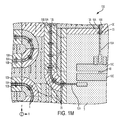
  • FIG. 1M is a top-down view of the superconducting microwave structure showing junction fabrication of a superconducting tunnel junction
  • FIG. 1N is a cross-sectional view illustrating removal of the sacrificial superconducting material to form the superconducting airbridge
  • FIG. 2 illustrates a cross-sectional view according to another embodiment
  • FIGS. 3A and 3B together illustrate a method of forming a superconducting airbridge on a superconducting microwave structure according to an embodiment
  • FIGS. 4A and 4B together illustrate a method of forming a superconducting airbridge on a superconducting microwave structure according to another embodiment
  • FIG. 5 illustrates an example showing one or more residual portions that may remain after etching the residual sacrificial superconducting material according to an embodiment.
  • a superconducting airbridge cross-overs using a superconducting sacrificial material is beneficial because the use of a superconducting sacrificial material minimizes any dielectric losses associated with residual sacrificial material (e.g., remaining after the removal process of the superconducting sacrificial material).
  • embodiments disclose the use of a vapor etch, e.g., such as XeF 2 , for the removal of superconducting sacrificial material under the cross-overs.
  • a vapor etch e.g., such as XeF 2
  • the removal of superconducting sacrificial material is performed as a final step in the device fabrication, e.g., after all mechanically stressful steps such as dicing, lift-off with sonication, or wirebonding have been completed.
  • FIGS. 1A through 1N illustrate a process of fabricating a superconducting airbridge using a superconducting sacrificial material according to an embodiment.
  • FIG. 1A begins with a starting schematic of a superconducting microwave structure 100 for building the superconducting airbridge.
  • FIG. 1A is a top-down view of the superconducting microwave structure 100 .
  • FIG. 1A shows a linear part 105 and a non-linear part 107 .
  • Superconducting material 10 is deposited on a substrate 5 .
  • the superconducting material 10 is patterned into various features including resonator layer 10 A, ground plane layers 10 B, and pad layers (paddles) 10 C.
  • the substrate 5 may be a material intended not to conduct electricity (e.g., intentionally without doping so as not to be conductive) in one case.
  • the substrate 5 may be sapphire.
  • the substrate may be high purity silicon.
  • the superconducting material 10 forming the resonator layer 10 A, ground plane layers 10 B, and paddles 10 C may be aluminum, titanium nitride, or any other superconducting material which is robust to endure the etch used to remove the sacrificial material.
  • the superconducting material 10 is intended not to be etched away during the etching of the superconducting sacrificial layer discussed further below.
  • Superconducting material may be defined as a material that can conduct electricity or transport electrons from one atom to another with no resistance when the superconducting material has reached “critical temperature” (Tc), or the temperature at which the material becomes superconductive. Conducting electricity or transporting electrons from one atom to another with no resistance means that no heat, sound, or any other form of energy would be released from the material as understood by one skilled in the art.
  • critical temperature Tc
  • Conducting electricity or transporting electrons from one atom to another with no resistance means that no heat, sound, or any other form of energy would be released from the material as understood by one skilled in the art.
  • FIG. 1B is a top-down view illustrating a breakout of the enlarged view 110 of the superconducting microwave structure 100 .
  • FIG. 1B shows the resonator 10 A separated from the ground planes 10 B by the substrate 5 .
  • the width of the resonator 10 A in the x-axis may range from about 10 nanometers (nm) to 100 micrometers (um).
  • the width of the ground planes in the x-axis may range from about three times the resonator width to an “infinite” ground plane which extends across the entire substrate surface. It is understood that the resonator 10 A and ground planes 10 B meander along the superconducting microwave structure 100 and their widths may not always be along the x-axis.
  • FIG. 1C is a cross-sectional view of the enlarged view 110 of the superconducting microwave structure 100 with the resonator 10 A and ground planes 10 B.
  • the cross-sectional view is taken along line A-A of the enlarged view 110 in FIG. 1B .
  • the thickness of the superconducting material 10 may range from 1 nm to 1 um, typically between 40 nm and 300 nm.
  • FIG. 1D is a cross-sectional view illustrating a first lift-off pattern 25 of bilayers in preparation for sacrificial material lithography.
  • the bilayers of the lift-off pattern 25 include a lift-off resist layer 15 patterned on top of the ground planes 10 B and a photoresist layer 20 patterned on top of the lift-off resist 15 .
  • the height of the lift-off resist 15 may range from about 300 nm to 1 um.
  • the height of the photoresist 20 may range from about 50 to 300 nm. In one implementation the height in the z-axis of the lift-off resist 15 may be 800 nanometers (nm).
  • the photoresist forms a mold, into which the desired material is deposited.
  • the desired features are completed when photoresist under unwanted areas is dissolved and when the unwanted material is “lifted off”.
  • the reentrant profile 25 can be obtained by using an underlayer 15 which develops away faster than the optically patterned layer 20 .
  • layer 20 may be a deposited hard mask such as germanium (Ge), which is patterned using lithography and etching.
  • FIG. 1E is a cross-sectional view illustrating deposition of the sacrificial superconducting material 30 .
  • the sacrificial superconducting material 30 is deposited on top of the resonator 10 A, substrate 5 , and ground planes 10 B within the mold of the pattern 25 . Additionally, sacrificial superconducting material 30 is deposited on top of the photoresist layer 20 .
  • the sacrificial superconducting material 30 may be, e.g., niobium and/or tantalum.
  • the thickness in the z-axis of the sacrificial superconducting material 30 may range from 40 to 300 nm.
  • the sacrificial superconducting material 30 may be deposited by, e.g., e-beam evaporation or any other directional deposition method.
  • the deposition of the sacrificial superconducting material 30 forms in the center of the opening in the lift-off pattern 25 without completely filling the mold due to the directionality of the deposition.
  • FIG. 1F is a cross-sectional view illustrating that the lift-off process removes the first lift-off pattern 25 .
  • the lift-off process etches off the lift-off resist layer 15 , along with any layers on top such as the photoresist layer 20 and sacrificial superconducting material 30 .
  • the sacrificial superconducting material 30 deposited directly on top of the resonator 10 A, substrate 5 , and ground planes 10 B remains, and is not lifted off
  • the etchant (wet and/or dry) used during the lift-off process is designed to selectively attack the lift-off resist layer 15 (same analogy for lift-off resist layer 17 discussed below) such that the lift-off resist layer 15 is selectively dissolved.
  • feature 30 could be obtained using subtractive patterning, where a blanket layer of material is deposited and then unwanted portions are etched away using lithography and wet or dry etching.
  • FIG. 1G is a top-down view of the superconducting microwave structure 100 showing the sacrificial superconducting material 30 deposited directly deposited on top of the resonator 10 A, substrate 5 , and ground planes 10 B.
  • the sacrificial superconducting material 30 is outlined as a rectangular shape so as not to obscure the figure.
  • FIG. 1H is a cross-sectional view illustrating a second lift-off pattern 27 (i.e., cross-over lift-off pattern) of bilayers in preparation for cross-over lithography.
  • the bilayers of the second lift-off pattern 27 include a lift-off resist layer 17 patterned on top of the ground planes 10 B and a photoresist layer 22 patterned on top of the lift-off resist 17 .
  • the photoresist layers 20 and 22 may be of the same materials, such as for example, positive resist or negative resist layers.
  • the photoresist layers 20 and 22 are light sensitive such that they can be imaged with light and etched as desired without affecting other layers.
  • the lift-off resist layer 15 and 17 may be of the same materials, such that the materials are dissolvable by the etchant during the lift-off process.
  • FIG. 1I is a cross-sectional view illustrating deposition of cross-over superconducting material 35 that is to form the superconducting airbridge.
  • the cross-over superconducting material 35 is deposited on top of the sacrificial superconducting material 30 and ground planes 10 B within the mold of the cross-over lift-off pattern 27 . Additionally, cross-over superconducting material 35 is deposited on top of the photoresist layer 22 .
  • the thickness in the z-axis of the cross-over superconducting material 35 (to form the superconducting airbridge) may range from 40 to 300 nm.
  • the cross-over superconducting material 35 may be aluminum.
  • the cross-over superconducting material 35 may be titanium nitride.
  • feature 35 could be obtained using subtractive patterning, where a blanket layer of material is deposited and then unwanted portions are etched away using lithography and wet or dry etch.
  • FIG. 1J is a cross-sectional view illustrating that the lift-off process removes the second lift-off pattern 27 .
  • the lift-off process etches off the lift-off resist layer 17 , along with any layers on top such as the photoresist layer 20 and superconducting material 35 .
  • the cross-over superconducting material 35 deposited directly on top of the sacrificial superconducting material 30 and on top of the ground planes 10 B remains.
  • FIG. 1K is a top-down view of the superconducting microwave structure 100 showing the superconducting material 35 crossing over the sacrificial superconducting material 30 while contacting the ground planes 10 B on both sides of the resonator 10 A.
  • FIG. 1K also shows the sacrificial superconducting material 30 deposited directly on top of the resonator 10 A, the substrate 5 , and the ground planes 10 B.
  • both the superconducting material 35 (future airbridge) and the sacrificial superconducting material 30 are outlined as rectangular shapes so as not to obscure the figure.
  • FIG. 1L is a top-down view illustrating the enlarged view 110 of the superconducting microwave structure 100 . Illustrated as a dashed line rectangular shape so as not to obscure the underlying layers, FIG. 1L shows the superconducting material 35 crossing over the sacrificial superconducting material 30 while contacting the grounds planes 10 B on both sides of the resonator 10 A. Also, illustrated as a dashed line rectangular shape so as not to obscure underlying layer, FIG. 1L shows the sacrificial superconducting material 30 directly on top of the resonator 10 A, the substrate 5 , and the ground planes 10 B.
  • FIG. 1M is a top-down view of the superconducting microwave structure 100 showing junction fabrication of a superconducting tunnel junction 40 in contact with paddles 10 C.
  • the process of fabricating the superconducting tunnel junction 40 is understood by one skilled in the art.
  • the superconducting tunnel junction (STJ), also known as a superconductor-insulator-superconductor tunnel junction (SIS), is an electronic device consisting of two superconductors separated by a very thin layer of insulating material. Current passes through the junction via the process of quantum tunneling.
  • the STJ is a type of Josephson junction and is an important part of the qubit.
  • FIG. 1N is a cross-sectional view of the enlarged view 110 of the superconducting microwave structure 100 illustrating removal of the sacrificial superconducting material 30 .
  • the superconducting material 35 is an airbridge from one ground plane 10 B to the other ground plane 10 B, all while crossing over the resonator 10 A.
  • the airbridge of superconducting material 35 is suspended over the airgap 45 .
  • the sacrificial superconducting material 30 may be etched using a dry etch such as vapor etching or a wet etch.
  • the vapor etchant may be XeF 2 and the sacrificial superconducting material 30 may be niobium.
  • the sacrificial superconducting material 30 may be tantalum.
  • the vapor etchant dissolves the sacrificial superconducting material 30 while leaving the substrate 5 , the airbridge of superconducting material 35 , the tunnel junction 40 (e.g., qubit), and the superconducting material 10 (e.g., resonator 10 A, ground planes 10 B, paddles 10 C) all undamaged.
  • the tunnel junction 40 e.g., qubit
  • the superconducting material 10 e.g., resonator 10 A, ground planes 10 B, paddles 10 C
  • Etching the sacrificial superconducting material 30 does not negatively impact the previously formed tunnel junction 40 .
  • the superconducting materials of the airbridge of superconducting material 35 , tunnel junction 40 , and superconducting material layer 10 are different from the sacrificial superconducting material 30 .
  • the superconducting materials of the airbridge of superconducting material 35 , tunnel junction 40 , and superconducting material layer 10 may be aluminum that is not etched away by the vapor etchant.
  • the residual sacrificial superconducting material 30 does not include any lossy resist residue (after the removal process for the sacrificial resist material in the state-of-the-art) because no sacrificial resist material is utilized to form the airbridge of superconducting material 35 . Additionally, the residual sacrificial superconducting material 30 does not degrade the performance of the superconducting microwave structure 100 . According to an embodiment, FIG.
  • FIG. 5 illustrates an example showing one or more residual portions 30 A that may remain after etching the residual sacrificial superconducting material 30 .
  • these example residual portions 30 A of sacrificial superconducting material 30 do not cause losses to the energy in tunnel junction 40 (qubit energy) because the residual sacrificial superconducting material 30 (i.e., residual portions 30 A) is superconducting material.
  • the state-the-art may have residual sacrificial resist material, and the leftover resist can drain the excitation energy from the qubit thus degrading the performance of the superconducting microwave structure.
  • the removal of the sacrificial superconducting material 30 using a vapor etch such as XeF 2 is compatible with highly delicate tunnel junctions 40 , and thus suspension (i.e., creation of the airbridge of superconducting material 35 ) can be performed as the last step of device fabrication (e.g., after formation of the tunnel junction 40 ).
  • XeF 2 is a room temperature, non-energetic etchant which has been shown not to affect Al—Al x O y —Al tunnel junctions.
  • all mechanically stressful steps such as dicing, lift-off with sonication, or wirebonding are performed before removal of the sacrificial superconducting material 30 . Therefore, none of the mechanical stress associated with dicing, lift-off with sonication, or wirebonding is passed on to the superconducting airbridge 35 because the superconducting airbridge 35 has not been formed yet.
  • FIG. 2 illustrates a cross-sectional view of the enlarged view 110 according to another embodiment.
  • FIG. 2 may include the fabrication process discussed in FIG. 1 along with additional operations discussed below.
  • the superconducting material 10 may be titanium nitride
  • the substrate 5 may be silicon.
  • the substrate 5 e.g., wafer
  • the substrate 5 is annealed in N 2 or O 2 gas after patterning the superconducting material 10 (e.g., titanium nitride) into the resonator 10 A, ground planes 10 B, and paddles 10 C.
  • the substrate 5 may be recessed between the resonator 10 A and ground planes 10 B.
  • the N 2 or O 2 gas forms a protective layer 210 in recesses 205 .
  • the protective layer 210 extends upward to be formed partially along the sides of the resonator 10 A and the ground planes 10 B.
  • the protective layer 210 may be silicon nitride or silicon dioxide depending on the gas utilized during annealing, and may be patterned as needed. These additional fabrication processes occur before proceeding with the cross-over fabrication. For example, these additional fabrication processes occur after FIG. 1C but before FIG. 1D .
  • the protective layer is needed in the case of XeF 2 etch and silicon substrates, since XeF 2 attacks silicon; the protective layer 210 protects the silicon substrate during etching. However, in the case of sapphire substrates, the protective layer 210 is not needed since XeF 2 does not attack sapphire.
  • FIGS. 3A and 3B illustrate a method 300 of forming a superconducting airbridge on a structure 100 according to an embodiment.
  • the first ground plane 10 B, a resonator 10 A, and a second ground plane 10 B are all formed on the substrate 5 .
  • the first lift-off pattern 25 is formed of a first lift-off resist 15 and a first photoresist 20 .
  • An example is shown in FIG. 1D .
  • the superconducting sacrificial layer 30 is deposited while using the first lift-off pattern 25 as a mold.
  • An example is shown in FIG. 1E .
  • the first lift-off pattern 25 is removed, such that the desired pattern of the superconducting sacrificial layer 30 remains, as shown in FIGS. 1F, 1G .
  • a cross-over lift-off pattern 27 is formed of a second lift-off resist 17 and a second photoresist 22 .
  • An example is shown in FIG. 1H .
  • the cross-over superconducting material 35 is deposited to be utilized as the superconducting airbridge 35 while using the cross-over lift-off pattern 27 as a mold.
  • An example is shown in FIG. 1I .
  • the cross-over lift-off pattern 27 is removed.
  • the layers remaining after performing lift-off are illustrated in FIG. 1J, 1K, 1L .
  • the superconducting airbridge 35 connecting the first ground plane 10 B and the second ground plane 10 B is formed by removing the superconducting sacrificial layer 30 underneath the cross-over superconducting material 35 , where the superconducting airbridge 35 crosses over the resonator 10 A.
  • FIG. 1N shows the superconducting airbridge 35 with the airgap 45 underneath.
  • the first lift-off resist 15 is formed on top of the first ground plane 10 B (e.g., to the left of the resonator 10 A) and the second ground plane 10 B (e.g., to the right of the resonator 10 A).
  • the first photoresist 20 is formed on top of the first lift-off resist 15 . Reference can be made to FIG. 1D .
  • the second lift-off resist 17 is formed on top of the first ground plane 10 B (e.g., to the left of the resonator 10 A) and the second ground plane 10 B (e.g., to the right of the resonator 10 A).
  • the second photoresist 22 is formed on top of the second lift-off resist 17 . Reference can be made to FIG. 1H .
  • Removing the superconducting sacrificial layer 30 underneath the cross-over superconducting material 35 to thereby form the superconducting airbridge 35 is performed by vapor etching utilizing a vapor etchant.
  • the vapor etchant has a high selectivity for etching the superconducting sacrificial layer 30 (e.g., niobium), while not etching the first ground plane 10 B, the resonator 10 A, the second ground plane 10 B, and the substrate 5 (along with the paddles 10 C and tunnel junction 40 ). Since the vapor etchant has a high selectivity for etching the superconducting sacrificial layer 30 , all other layers on the superconducting microwave structure 100 remain unaffected by the vapor etching.
  • the superconducting sacrificial layer 30 is niobium. In another implementation, the superconducting sacrificial layer 30 is tantalum.
  • the substrate 5 includes sapphire.
  • the first ground plane 10 B, the resonator 10 A, and the second ground plane 10 B are a superconducting material not etched by the vapor etchant. In one case, the substrate 5 includes silicon.
  • the tunnel junction 40 is formed on the substrate 5 connecting first paddle 10 C (e.g., in front of the tunnel junction 40 ) to the second paddle 10 C (e.g., behind the tunnel junction 40 ), as illustrated in FIG. 1M .
  • the tunnel junction 40 is a qubit.
  • the resonator 10 A is a readout resonator configured to read a state of the qubit.
  • Removing the superconducting sacrificial layer 30 underneath the cross-over superconducting material 35 to thereby form the superconducting airbridge 35 is performed by wet etching.
  • FIGS. 4A and 4B illustrate a method 400 of forming a superconducting airbridge on a structure 100 .
  • the first ground plane 10 B, the resonator 10 A, and the second ground plane 10 B are all formed the substrate 5 .
  • the substrate 5 is patterned to have to have recessed portions 205 between the first ground plane 10 B (e.g., to the left of the resonator 10 A) and the resonator 10 A as well as between the resonator 10 A and the second ground plane 10 B (e.g., to the right of the resonator 10 A).
  • the first ground plane 10 B e.g., to the left of the resonator 10 A
  • the second ground plane 10 B e.g., to the right of the resonator 10 A
  • the protective layer 210 is formed on the recessed portions 205 .
  • An example is illustrated in FIG. 2 .
  • the first lift-off pattern 25 is formed of a first lift-off resist 15 and a first photoresist 15 .
  • An example is shown in FIG. 1D with the modification of having the recessed portions 205 and protective layer 210 from FIG. 2 .
  • the superconducting sacrificial layer 30 is deposited while using the first lift-off pattern 25 as a mold. Reference can be made to FIG. 1E while taking into account changes made in FIG. 2 .
  • the first lift-off pattern 25 is removed, such that the desired pattern of the superconducting sacrificial layer 30 remains, as shown in FIGS. 1F, 1G in view of changes made in FIG. 2 .
  • a cross-over lift-off pattern 27 is formed of a second lift-off resist 17 and a second photoresist 22 .
  • FIG. 1H in view of changes made in FIG. 2 .
  • the cross-over superconducting material 35 is deposited to be utilized as the superconducting airbridge 35 while using the cross-over lift-off pattern 27 as a mold.
  • An example is shown in FIG. 1I in view of the changes made in FIG. 2 .
  • the cross-over lift-off pattern 27 is removed.
  • the layers remaining after performing lift-off are illustrated in FIG. 1J, 1K, 1L in view of the modifications made in FIG. 2
  • the superconducting airbridge 35 connecting the first ground plane 10 B and the second ground plane 10 B is formed by removing the superconducting sacrificial layer 30 underneath the cross-over superconducting material 35 , where the superconducting airbridge 35 crosses over the resonator 10 A.
  • FIG. 2 shows the superconducting airbridge 35 with the airgap 45 underneath, along with the protective layer 210 and recessed portions 205 .
  • the protective layer 210 is at least one of a nitride layer and/or an oxide layer.
  • the substrate 5 is silicon.
  • the first ground plane 10 B, the resonator 10 A, and the second ground plane 10 B are a superconducting material different from the superconducting sacrificial layer 30 .
  • the superconducting material of the first ground plane 10 B, the resonator 10 A, and the second ground plane 10 B (along with the tunnel junction 40 and paddles 10 C) includes titanium nitride.
  • Deposition is any process that grows, coats, or otherwise transfers a material onto the wafer.
  • Available technologies include physical vapor deposition (PVD), chemical vapor deposition (CVD), electrochemical deposition (ECD), molecular beam epitaxy (MBE) and more recently, atomic layer deposition (ALD) among others.
  • Removal is any process that removes material from the wafer: examples include etch processes (either wet or dry), and chemical-mechanical planarization (CMP), etc.
  • Patterning is the shaping or altering of deposited materials, and is generally referred to as lithography.
  • the wafer is coated with a chemical called a photoresist; then, a machine called a stepper focuses, aligns, and moves a mask, exposing select portions of the wafer below to short wavelength light; the exposed regions are washed away by a developer solution. After etching or other processing, the remaining photoresist is removed.
  • Patterning also includes electron-beam lithography.
  • Modification of electrical properties may include doping, such as doping transistor sources and drains, generally by diffusion and/or by ion implantation. These doping processes are followed by furnace annealing or by rapid thermal annealing (RTA). Annealing serves to activate the implanted dopants.
  • doping such as doping transistor sources and drains
  • RTA rapid thermal annealing
  • each block in the flowchart or block diagrams may represent a module, segment, or portion of instructions, which comprises one or more executable instructions for implementing the specified logical function(s).
  • the functions noted in the block may occur out of the order noted in the figures.
  • two blocks shown in succession may, in fact, be executed substantially concurrently, or the blocks may sometimes be executed in the reverse order, depending upon the functionality involved.

Landscapes

  • Engineering & Computer Science (AREA)
  • Manufacturing & Machinery (AREA)
  • Microelectronics & Electronic Packaging (AREA)
  • Superconductor Devices And Manufacturing Methods Thereof (AREA)

Abstract

A technique relates to a superconducting airbridge on a structure. A first ground plane, resonator, and second ground plane are formed on a substrate. A first lift-off pattern is formed of a first lift-off resist and a first photoresist. The first photoresist is deposited on the first lift-off resist. A superconducting sacrificial layer is deposited while using the first lift-off pattern. The first lift-off pattern is removed. A cross-over lift-off pattern is formed of a second lift-off resist and a second photoresist. The second photoresist is deposited on the second lift-off resist. A cross-over superconducting material is deposited to be formed as the superconducting airbridge while using the cross-over lift-off pattern. The cross-over lift-off pattern is removed. The superconducting airbridge is formed to connect the first and second ground planes by removing the superconducting sacrificial layer underneath the cross-over superconducting material. The superconducting airbridge crosses over the resonator.

Description

DOMESTIC PRIORITY
This application is a continuation of U.S. patent application Ser. No. 14/700,335, filed Apr. 30, 2015, which is now U.S. Pat. No. 9,614,270 issued on Apr. 4, 2017, the disclosure of which is incorporated by reference herein in its entirety.
STATEMENT REGARDING FEDERALLY SPONSORED RESEARCH OR DEVELOPMENT
This invention was made with Government support under Contract No.: W911NF-10-1-0324 awarded by the Advanced Research Development Agency. The Government has certain rights to this invention.
BACKGROUND
The present invention relates to superconducting techniques, and more specifically, to a superconducting airbridge crossover using a superconducting sacrificial material.
Quantum computing employs resonant structures called qubits to store information, and resonators (e.g., as a two-dimensional (2D) planar waveguide or as a three-dimensional (3D) microwave cavity) to read out and manipulate the qubits. To date, a major focus has been on improving lifetimes of the qubits in order to allow calculations (i.e., manipulation and readout) to take place before the information is lost to decoherence of the qubits. Currently, qubit coherence times can be as high as 100 microseconds and efforts are being made to increase the coherence times. One area of research with respect to increasing coherence times is focused on eliminating material at the edges of the qubit (i.e., edges) in order to reduce the electric field in that area. The material in proximity to the qubit includes imperfections that support defects known as two-level systems (TLS).
SUMMARY
According to one embodiment, a method of forming a superconducting airbridge on a structure is provided. The method includes forming a first ground plane, a resonator, and a second ground plane on a substrate, and forming a first lift-off pattern of a first lift-off resist and a first photoresist, where the first photoresist is deposited on the first lift-off resist. The method includes depositing a superconducting sacrificial layer while using the first lift-off pattern, removing the first lift-off pattern, and forming a cross-over lift-off pattern of a second lift-off resist and a second photoresist. The second photoresist is deposited on the second lift-off resist. Also, the method includes depositing a cross-over superconducting material to be formed as the superconducting airbridge while using the cross-over lift-off pattern, removing the cross-over lift-off pattern, and forming the superconducting airbridge connecting the first ground plane and the second ground plane by removing the superconducting sacrificial layer underneath the cross-over superconducting material. The superconducting airbridge crosses over the resonator.
According to one embodiment, a method of forming a superconducting airbridge on a structure is provided. The method includes forming a first ground plane, a resonator, and a second ground plane all on a substrate, patterning the substrate to have recessed portions between the first ground plane and the resonator as well as between the resonator and the second ground plane, and forming a protective layer on the recessed portions. The method includes forming a first lift-off pattern of a first lift-off resist and a first photoresist, where the first photoresist is deposited on the first lift-off resist, depositing a superconducting sacrificial layer while using the first lift-off pattern, and removing the first lift-off pattern. Also, the method includes forming a cross-over lift-off pattern of a second lift-off resist and a second photoresist, where the second photoresist is deposited on the second lift-off resist, and depositing a cross-over superconducting material to be utilized as the superconducting airbridge while using the cross-over lift-off pattern. Further, the method includes removing the cross-over lift-off pattern, and forming the superconducting airbridge connecting the first ground plane and the second ground plane by removing the superconducting sacrificial layer underneath the cross-over superconducting material. The superconducting airbridge crosses over the resonator.
According to one embodiment, a superconducting microwave structure is provided. The structure includes a first ground plane, a resonator, and a second ground plane formed on a substrate. A superconducting airbridge connects the first ground plane and the second ground plane, and the superconducting airbridge has an airgap underneath from where a superconducting sacrificial layer has been removed. A residual portion of the superconducting sacrificial layer remains on at least one of the first ground plane, the resonator, the second ground plane, and/or the superconducting airbridge.
Additional features and advantages are realized through the techniques of the present invention. Other embodiments and aspects of the invention are described in detail herein and are considered a part of the claimed invention. For a better understanding of the invention with the advantages and the features, refer to the description and to the drawings.
BRIEF DESCRIPTION OF THE DRAWINGS
The subject matter which is regarded as the invention is particularly pointed out and distinctly claimed in the claims at the conclusion of the specification. The forgoing and other features, and advantages of the invention are apparent from the following detailed description taken in conjunction with the accompanying drawings in which:
FIGS. 1A through 1N illustrate a process of fabricating a superconducting airbridge using a superconducting sacrificial material according to an embodiment, in which:
FIG. 1A is a top-down view of a superconducting microwave structure;
FIG. 1B is a top-down view of an enlarged view of the superconducting microwave structure;
FIG. 1C is a cross-sectional view of the enlarged view of the superconducting microwave structure;
FIG. 1D is a cross-sectional view illustrating a lift-off pattern of bilayers;
FIG. 1E is a cross-sectional view illustrating deposition of a sacrificial superconducting material;
FIG. 1F is a cross-sectional view illustrating that the lift-off process removes the first lift-off pattern;
FIG. 1G is a top-down view of the superconducting microwave structure showing the sacrificial superconducting material;
FIG. 1H is a cross-sectional view illustrating a second lift-off pattern of bilayers;
FIG. 1I is a cross-sectional view illustrating deposition of a cross-over superconducting material that is to form the superconducting airbridge;
FIG. 1J is a cross-sectional view illustrating that the lift-off process removes the second lift-off pattern;
FIG. 1K is a top-down view of the superconducting microwave structure showing the superconducting material crossing over the sacrificial superconducting material;
FIG. 1L is a top-down view illustrating the superconducting material crossing over the sacrificial superconducting material;
FIG. 1M is a top-down view of the superconducting microwave structure showing junction fabrication of a superconducting tunnel junction; and
FIG. 1N is a cross-sectional view illustrating removal of the sacrificial superconducting material to form the superconducting airbridge;
FIG. 2 illustrates a cross-sectional view according to another embodiment;
FIGS. 3A and 3B together illustrate a method of forming a superconducting airbridge on a superconducting microwave structure according to an embodiment;
FIGS. 4A and 4B together illustrate a method of forming a superconducting airbridge on a superconducting microwave structure according to another embodiment; and
FIG. 5 illustrates an example showing one or more residual portions that may remain after etching the residual sacrificial superconducting material according to an embodiment.
DETAILED DESCRIPTION
In superconducting cavity quantum electrodynamics (cQED) circuits meant to be operated at microwave frequencies, separate ground planes should be tied together to prevent parasitic resonances which can be a source of decoherence for qubits within the circuit.
Most work in superconducting cQED circuits relies on wirebonding to tie together separate ground planes together. In the state-of-the-art, a microfabricated airbridge cross-over structure has been demonstrated which uses resist as a sacrificial material. This process results in lossy resist residue (after the removal process for the sacrificial resist material) which degrades the performance of the device. Another disadvantage to the method is the fact that the sacrificial material removal is not compatible with highly delicate tunnel junctions, andthus suspension (the airbridge) cannot be performed as the last step of device fabrication. (That is, the hardened resist used as a sacrificial material must be removed with processes such as O2 plasma etching, but energetic processes such as O2 plasma etching will breakdown the highly delicate tunnel junctions.) This leaves suspended structures which must be mechanically robust enough to survive the subsequent mechanically stressful steps such as dicing, lift-off with sonication, or wirebonding.
According to an embodiment, disclosed is the fabrication of superconducting airbridge cross-overs using a superconducting sacrificial material. This innovation is beneficial because the use of a superconducting sacrificial material minimizes any dielectric losses associated with residual sacrificial material (e.g., remaining after the removal process of the superconducting sacrificial material).
Additionally, embodiments disclose the use of a vapor etch, e.g., such as XeF2, for the removal of superconducting sacrificial material under the cross-overs. The removal of superconducting sacrificial material is performed as a final step in the device fabrication, e.g., after all mechanically stressful steps such as dicing, lift-off with sonication, or wirebonding have been completed.
Now turning to the figures, FIGS. 1A through 1N illustrate a process of fabricating a superconducting airbridge using a superconducting sacrificial material according to an embodiment.
FIG. 1A begins with a starting schematic of a superconducting microwave structure 100 for building the superconducting airbridge. FIG. 1A is a top-down view of the superconducting microwave structure 100.
FIG. 1A shows a linear part 105 and a non-linear part 107. Superconducting material 10 is deposited on a substrate 5. The superconducting material 10 is patterned into various features including resonator layer 10A, ground plane layers 10B, and pad layers (paddles) 10C. The substrate 5 may be a material intended not to conduct electricity (e.g., intentionally without doping so as not to be conductive) in one case. In one implementation, the substrate 5 may be sapphire. In another implementation, the substrate may be high purity silicon. The superconducting material 10 forming the resonator layer 10A, ground plane layers 10B, and paddles 10C may be aluminum, titanium nitride, or any other superconducting material which is robust to endure the etch used to remove the sacrificial material. The superconducting material 10 is intended not to be etched away during the etching of the superconducting sacrificial layer discussed further below.
Superconducting material may be defined as a material that can conduct electricity or transport electrons from one atom to another with no resistance when the superconducting material has reached “critical temperature” (Tc), or the temperature at which the material becomes superconductive. Conducting electricity or transporting electrons from one atom to another with no resistance means that no heat, sound, or any other form of energy would be released from the material as understood by one skilled in the art.
Also, a circle is designated in FIG. 1A to illustrate an enlarged view 110 that is discussed below. FIG. 1B is a top-down view illustrating a breakout of the enlarged view 110 of the superconducting microwave structure 100. FIG. 1B shows the resonator 10A separated from the ground planes 10B by the substrate 5. The width of the resonator 10A in the x-axis may range from about 10 nanometers (nm) to 100 micrometers (um). The width of the ground planes in the x-axis may range from about three times the resonator width to an “infinite” ground plane which extends across the entire substrate surface. It is understood that the resonator 10A and ground planes 10B meander along the superconducting microwave structure 100 and their widths may not always be along the x-axis.
FIG. 1C is a cross-sectional view of the enlarged view 110 of the superconducting microwave structure 100 with the resonator 10A and ground planes 10B. The cross-sectional view is taken along line A-A of the enlarged view 110 in FIG. 1B. The thickness of the superconducting material 10 may range from 1 nm to 1 um, typically between 40 nm and 300 nm.
FIG. 1D is a cross-sectional view illustrating a first lift-off pattern 25 of bilayers in preparation for sacrificial material lithography. The bilayers of the lift-off pattern 25 include a lift-off resist layer 15 patterned on top of the ground planes 10B and a photoresist layer 20 patterned on top of the lift-off resist 15. The height of the lift-off resist 15 may range from about 300 nm to 1 um. The height of the photoresist 20 may range from about 50 to 300 nm. In one implementation the height in the z-axis of the lift-off resist 15 may be 800 nanometers (nm). In a lift-off process, the photoresist forms a mold, into which the desired material is deposited. The desired features are completed when photoresist under unwanted areas is dissolved and when the unwanted material is “lifted off”. The reentrant profile 25 can be obtained by using an underlayer 15 which develops away faster than the optically patterned layer 20. Alternately, layer 20 may be a deposited hard mask such as germanium (Ge), which is patterned using lithography and etching.
FIG. 1E is a cross-sectional view illustrating deposition of the sacrificial superconducting material 30. The sacrificial superconducting material 30 is deposited on top of the resonator 10A, substrate 5, and ground planes 10B within the mold of the pattern 25. Additionally, sacrificial superconducting material 30 is deposited on top of the photoresist layer 20. The sacrificial superconducting material 30 may be, e.g., niobium and/or tantalum. The thickness in the z-axis of the sacrificial superconducting material 30 may range from 40 to 300 nm. The sacrificial superconducting material 30 may be deposited by, e.g., e-beam evaporation or any other directional deposition method. The deposition of the sacrificial superconducting material 30 forms in the center of the opening in the lift-off pattern 25 without completely filling the mold due to the directionality of the deposition.
FIG. 1F is a cross-sectional view illustrating that the lift-off process removes the first lift-off pattern 25. The lift-off process etches off the lift-off resist layer 15, along with any layers on top such as the photoresist layer 20 and sacrificial superconducting material 30. However, the sacrificial superconducting material 30 deposited directly on top of the resonator 10A, substrate 5, and ground planes 10B remains, and is not lifted off The etchant (wet and/or dry) used during the lift-off process is designed to selectively attack the lift-off resist layer 15 (same analogy for lift-off resist layer 17 discussed below) such that the lift-off resist layer 15 is selectively dissolved. Consequently, dissolving the lift-off resist layer 15 causes any layers on top to be lifted off along with the lift-off resist layer 15. Alternately, feature 30 could be obtained using subtractive patterning, where a blanket layer of material is deposited and then unwanted portions are etched away using lithography and wet or dry etching.
FIG. 1G is a top-down view of the superconducting microwave structure 100 showing the sacrificial superconducting material 30 deposited directly deposited on top of the resonator 10A, substrate 5, and ground planes 10B. In FIG. 1G, the sacrificial superconducting material 30 is outlined as a rectangular shape so as not to obscure the figure.
FIG. 1H is a cross-sectional view illustrating a second lift-off pattern 27 (i.e., cross-over lift-off pattern) of bilayers in preparation for cross-over lithography. The bilayers of the second lift-off pattern 27 include a lift-off resist layer 17 patterned on top of the ground planes 10B and a photoresist layer 22 patterned on top of the lift-off resist 17. The photoresist layers 20 and 22 may be of the same materials, such as for example, positive resist or negative resist layers. The photoresist layers 20 and 22 are light sensitive such that they can be imaged with light and etched as desired without affecting other layers. The lift-off resist layer 15 and 17 may be of the same materials, such that the materials are dissolvable by the etchant during the lift-off process.
FIG. 1I is a cross-sectional view illustrating deposition of cross-over superconducting material 35 that is to form the superconducting airbridge. The cross-over superconducting material 35 is deposited on top of the sacrificial superconducting material 30 and ground planes 10B within the mold of the cross-over lift-off pattern 27. Additionally, cross-over superconducting material 35 is deposited on top of the photoresist layer 22. The thickness in the z-axis of the cross-over superconducting material 35 (to form the superconducting airbridge) may range from 40 to 300 nm. In one implementation, the cross-over superconducting material 35 may be aluminum. In another implementation, the cross-over superconducting material 35 may be titanium nitride. Alternately, feature 35 could be obtained using subtractive patterning, where a blanket layer of material is deposited and then unwanted portions are etched away using lithography and wet or dry etch.
FIG. 1J is a cross-sectional view illustrating that the lift-off process removes the second lift-off pattern 27. The lift-off process etches off the lift-off resist layer 17, along with any layers on top such as the photoresist layer 20 and superconducting material 35. However, after lift-off, the cross-over superconducting material 35 deposited directly on top of the sacrificial superconducting material 30 and on top of the ground planes 10B remains.
FIG. 1K is a top-down view of the superconducting microwave structure 100 showing the superconducting material 35 crossing over the sacrificial superconducting material 30 while contacting the ground planes 10B on both sides of the resonator 10A. FIG. 1K also shows the sacrificial superconducting material 30 deposited directly on top of the resonator 10A, the substrate 5, and the ground planes 10B. In FIG. 1K, both the superconducting material 35 (future airbridge) and the sacrificial superconducting material 30 are outlined as rectangular shapes so as not to obscure the figure.
FIG. 1L is a top-down view illustrating the enlarged view 110 of the superconducting microwave structure 100. Illustrated as a dashed line rectangular shape so as not to obscure the underlying layers, FIG. 1L shows the superconducting material 35 crossing over the sacrificial superconducting material 30 while contacting the grounds planes 10B on both sides of the resonator 10A. Also, illustrated as a dashed line rectangular shape so as not to obscure underlying layer, FIG. 1L shows the sacrificial superconducting material 30 directly on top of the resonator 10A, the substrate 5, and the ground planes 10B.
FIG. 1M is a top-down view of the superconducting microwave structure 100 showing junction fabrication of a superconducting tunnel junction 40 in contact with paddles 10C. The process of fabricating the superconducting tunnel junction 40 is understood by one skilled in the art. The superconducting tunnel junction (STJ), also known as a superconductor-insulator-superconductor tunnel junction (SIS), is an electronic device consisting of two superconductors separated by a very thin layer of insulating material. Current passes through the junction via the process of quantum tunneling. The STJ is a type of Josephson junction and is an important part of the qubit.
FIG. 1N is a cross-sectional view of the enlarged view 110 of the superconducting microwave structure 100 illustrating removal of the sacrificial superconducting material 30. In FIG. 1N, the superconducting material 35 is an airbridge from one ground plane 10B to the other ground plane 10B, all while crossing over the resonator 10A. The airbridge of superconducting material 35 is suspended over the airgap 45.
To form the airbridge of superconducting material 35, the sacrificial superconducting material 30 may be etched using a dry etch such as vapor etching or a wet etch. In one implementation, the vapor etchant may be XeF2 and the sacrificial superconducting material 30 may be niobium. In another implementation, the sacrificial superconducting material 30 may be tantalum. The vapor etchant dissolves the sacrificial superconducting material 30 while leaving the substrate 5, the airbridge of superconducting material 35, the tunnel junction 40 (e.g., qubit), and the superconducting material 10 (e.g., resonator 10A, ground planes 10B, paddles 10C) all undamaged.
Etching the sacrificial superconducting material 30 does not negatively impact the previously formed tunnel junction 40. The superconducting materials of the airbridge of superconducting material 35, tunnel junction 40, and superconducting material layer 10 are different from the sacrificial superconducting material 30. For example, when the sacrificial superconducting material 30 is niobium, the superconducting materials of the airbridge of superconducting material 35, tunnel junction 40, and superconducting material layer 10 may be aluminum that is not etched away by the vapor etchant.
In one case, if there happens to be a little residual sacrificial superconducting material 30 remaining on, e.g., the resonator 10A, ground planes 10B, paddles 10C, and/or the airbridge of superconducting material 35, the residual sacrificial superconducting material 30 (if any) does not include any lossy resist residue (after the removal process for the sacrificial resist material in the state-of-the-art) because no sacrificial resist material is utilized to form the airbridge of superconducting material 35. Additionally, the residual sacrificial superconducting material 30 does not degrade the performance of the superconducting microwave structure 100. According to an embodiment, FIG. 5 illustrates an example showing one or more residual portions 30A that may remain after etching the residual sacrificial superconducting material 30. However, these example residual portions 30A of sacrificial superconducting material 30 do not cause losses to the energy in tunnel junction 40 (qubit energy) because the residual sacrificial superconducting material 30 (i.e., residual portions 30A) is superconducting material.
In contrast, the state-the-art may have residual sacrificial resist material, and the leftover resist can drain the excitation energy from the qubit thus degrading the performance of the superconducting microwave structure.
The removal of the sacrificial superconducting material 30 using a vapor etch such as XeF2 is compatible with highly delicate tunnel junctions 40, and thus suspension (i.e., creation of the airbridge of superconducting material 35) can be performed as the last step of device fabrication (e.g., after formation of the tunnel junction 40). XeF2 is a room temperature, non-energetic etchant which has been shown not to affect Al—AlxOy—Al tunnel junctions. Although not shown for the sake of conciseness, all mechanically stressful steps such as dicing, lift-off with sonication, or wirebonding are performed before removal of the sacrificial superconducting material 30. Therefore, none of the mechanical stress associated with dicing, lift-off with sonication, or wirebonding is passed on to the superconducting airbridge 35 because the superconducting airbridge 35 has not been formed yet.
FIG. 2 illustrates a cross-sectional view of the enlarged view 110 according to another embodiment. FIG. 2 may include the fabrication process discussed in FIG. 1 along with additional operations discussed below. In this case, the superconducting material 10 may be titanium nitride, and the substrate 5 may be silicon. Unlike the description in FIG. 1, the substrate 5 (e.g., wafer) is annealed in N2 or O2 gas after patterning the superconducting material 10 (e.g., titanium nitride) into the resonator 10A, ground planes 10B, and paddles 10C. Also, the substrate 5 may be recessed between the resonator 10A and ground planes 10B. The N2 or O2 gas forms a protective layer 210 in recesses 205. The protective layer 210 extends upward to be formed partially along the sides of the resonator 10A and the ground planes 10B. The protective layer 210 may be silicon nitride or silicon dioxide depending on the gas utilized during annealing, and may be patterned as needed. These additional fabrication processes occur before proceeding with the cross-over fabrication. For example, these additional fabrication processes occur after FIG. 1C but before FIG. 1D. The protective layer is needed in the case of XeF2 etch and silicon substrates, since XeF2 attacks silicon; the protective layer 210 protects the silicon substrate during etching. However, in the case of sapphire substrates, the protective layer 210 is not needed since XeF2 does not attack sapphire.
FIGS. 3A and 3B illustrate a method 300 of forming a superconducting airbridge on a structure 100 according to an embodiment.
At block 305, the first ground plane 10B, a resonator 10A, and a second ground plane 10B are all formed on the substrate 5. There are two ground planes 10B on both sides of the resonator 10A, as shown in FIGS. 1A, 1B, 1C.
At block 310, the first lift-off pattern 25 is formed of a first lift-off resist 15 and a first photoresist 20. An example is shown in FIG. 1D.
At block 315, the superconducting sacrificial layer 30 is deposited while using the first lift-off pattern 25 as a mold. An example is shown in FIG. 1E.
At block 320, the first lift-off pattern 25 is removed, such that the desired pattern of the superconducting sacrificial layer 30 remains, as shown in FIGS. 1F, 1G.
At block 325, a cross-over lift-off pattern 27 is formed of a second lift-off resist 17 and a second photoresist 22. An example is shown in FIG. 1H.
At block 330, the cross-over superconducting material 35 is deposited to be utilized as the superconducting airbridge 35 while using the cross-over lift-off pattern 27 as a mold. An example is shown in FIG. 1I.
At block 335, the cross-over lift-off pattern 27 is removed. The layers remaining after performing lift-off are illustrated in FIG. 1J, 1K, 1L.
At block 340, the superconducting airbridge 35 connecting the first ground plane 10B and the second ground plane 10B is formed by removing the superconducting sacrificial layer 30 underneath the cross-over superconducting material 35, where the superconducting airbridge 35 crosses over the resonator 10A. For example, FIG. 1N shows the superconducting airbridge 35 with the airgap 45 underneath.
The first lift-off resist 15 is formed on top of the first ground plane 10B (e.g., to the left of the resonator 10A) and the second ground plane 10B (e.g., to the right of the resonator 10A). The first photoresist 20 is formed on top of the first lift-off resist 15. Reference can be made to FIG. 1D.
The second lift-off resist 17 is formed on top of the first ground plane 10B (e.g., to the left of the resonator 10A) and the second ground plane 10B (e.g., to the right of the resonator 10A). The second photoresist 22 is formed on top of the second lift-off resist 17. Reference can be made to FIG. 1H.
Removing the superconducting sacrificial layer 30 underneath the cross-over superconducting material 35 to thereby form the superconducting airbridge 35 is performed by vapor etching utilizing a vapor etchant. The vapor etchant has a high selectivity for etching the superconducting sacrificial layer 30 (e.g., niobium), while not etching the first ground plane 10B, the resonator 10A, the second ground plane 10B, and the substrate 5 (along with the paddles 10C and tunnel junction 40). Since the vapor etchant has a high selectivity for etching the superconducting sacrificial layer 30, all other layers on the superconducting microwave structure 100 remain unaffected by the vapor etching.
In one implementation, the superconducting sacrificial layer 30 is niobium. In another implementation, the superconducting sacrificial layer 30 is tantalum. The substrate 5 includes sapphire. The first ground plane 10B, the resonator 10A, and the second ground plane 10B are a superconducting material not etched by the vapor etchant. In one case, the substrate 5 includes silicon.
The tunnel junction 40 is formed on the substrate 5 connecting first paddle 10C (e.g., in front of the tunnel junction 40) to the second paddle 10C (e.g., behind the tunnel junction 40), as illustrated in FIG. 1M. The tunnel junction 40 is a qubit. The resonator 10A is a readout resonator configured to read a state of the qubit.
Removing the superconducting sacrificial layer 30 underneath the cross-over superconducting material 35 to thereby form the superconducting airbridge 35 is performed by wet etching.
FIGS. 4A and 4B illustrate a method 400 of forming a superconducting airbridge on a structure 100.
At block 405, the first ground plane 10B, the resonator 10A, and the second ground plane 10B are all formed the substrate 5. Reference can be made to FIGS. 1A, 1B, 1C.
At block 410, the substrate 5 is patterned to have to have recessed portions 205 between the first ground plane 10B (e.g., to the left of the resonator 10A) and the resonator 10A as well as between the resonator 10A and the second ground plane 10B (e.g., to the right of the resonator 10A). Reference can be made to FIG. 2.
At block 415, the protective layer 210 is formed on the recessed portions 205. An example is illustrated in FIG. 2.
At block 420, the first lift-off pattern 25 is formed of a first lift-off resist 15 and a first photoresist 15. An example is shown in FIG. 1D with the modification of having the recessed portions 205 and protective layer 210 from FIG. 2.
At block 425, the superconducting sacrificial layer 30 is deposited while using the first lift-off pattern 25 as a mold. Reference can be made to FIG. 1E while taking into account changes made in FIG. 2.
At block 430, the first lift-off pattern 25 is removed, such that the desired pattern of the superconducting sacrificial layer 30 remains, as shown in FIGS. 1F, 1G in view of changes made in FIG. 2.
At block 435, a cross-over lift-off pattern 27 is formed of a second lift-off resist 17 and a second photoresist 22. Reference is made to FIG. 1H in view of changes made in FIG. 2.
At block 440, the cross-over superconducting material 35 is deposited to be utilized as the superconducting airbridge 35 while using the cross-over lift-off pattern 27 as a mold. An example is shown in FIG. 1I in view of the changes made in FIG. 2.
At block 445, the cross-over lift-off pattern 27 is removed. The layers remaining after performing lift-off are illustrated in FIG. 1J, 1K, 1L in view of the modifications made in FIG. 2
At block 450, the superconducting airbridge 35 connecting the first ground plane 10B and the second ground plane 10B is formed by removing the superconducting sacrificial layer 30 underneath the cross-over superconducting material 35, where the superconducting airbridge 35 crosses over the resonator 10A. As an example, FIG. 2 shows the superconducting airbridge 35 with the airgap 45 underneath, along with the protective layer 210 and recessed portions 205.
The protective layer 210 is at least one of a nitride layer and/or an oxide layer. The substrate 5 is silicon. The first ground plane 10B, the resonator 10A, and the second ground plane 10B are a superconducting material different from the superconducting sacrificial layer 30. The superconducting material of the first ground plane 10B, the resonator 10A, and the second ground plane 10B (along with the tunnel junction 40 and paddles 10C) includes titanium nitride.
It will be noted that various semiconductor device fabrication methods may be utilized to fabricate the components/elements discussed herein as understood by one skilled in the art. In semiconductor device fabrication, the various processing steps fall into four general categories: deposition, removal, patterning, and modification of electrical properties.
Deposition is any process that grows, coats, or otherwise transfers a material onto the wafer. Available technologies include physical vapor deposition (PVD), chemical vapor deposition (CVD), electrochemical deposition (ECD), molecular beam epitaxy (MBE) and more recently, atomic layer deposition (ALD) among others.
Removal is any process that removes material from the wafer: examples include etch processes (either wet or dry), and chemical-mechanical planarization (CMP), etc.
Patterning is the shaping or altering of deposited materials, and is generally referred to as lithography. For example, in conventional lithography, the wafer is coated with a chemical called a photoresist; then, a machine called a stepper focuses, aligns, and moves a mask, exposing select portions of the wafer below to short wavelength light; the exposed regions are washed away by a developer solution. After etching or other processing, the remaining photoresist is removed. Patterning also includes electron-beam lithography.
Modification of electrical properties may include doping, such as doping transistor sources and drains, generally by diffusion and/or by ion implantation. These doping processes are followed by furnace annealing or by rapid thermal annealing (RTA). Annealing serves to activate the implanted dopants.
The flowchart and block diagrams in the Figures illustrate the architecture, functionality, and operation of possible implementations of systems, methods, and computer program products according to various embodiments of the present invention. In this regard, each block in the flowchart or block diagrams may represent a module, segment, or portion of instructions, which comprises one or more executable instructions for implementing the specified logical function(s). In some alternative implementations, the functions noted in the block may occur out of the order noted in the figures. For example, two blocks shown in succession may, in fact, be executed substantially concurrently, or the blocks may sometimes be executed in the reverse order, depending upon the functionality involved. It will also be noted that each block of the block diagrams and/or flowchart illustration, and combinations of blocks in the block diagrams and/or flowchart illustration, can be implemented by special purpose hardware-based systems that perform the specified functions or acts or carry out combinations of special purpose hardware and computer instructions.

Claims (19)

What is claimed is:
1. A method of forming a superconducting airbridge on a structure, the method comprising:
forming a first ground plane, a resonator, and a second ground plane on a substrate;
forming a first lift-off pattern of a first lift-off resist and a first photoresist, the first photoresist being deposited on the first lift-off resist;
depositing a superconducting sacrificial layer while using the first lift-off pattern;
removing the first lift-off pattern;
forming a cross-over lift-off pattern of a second lift-off resist and a second photoresist, the second photoresist being deposited on the second lift-off resist;
depositing a cross-over superconducting material to be formed as the superconducting airbridge while using the cross-over lift-off pattern;
removing the cross-over lift-off pattern; and
forming the superconducting airbridge connecting the first ground plane and the second ground plane by removing the superconducting sacrificial layer underneath the cross-over superconducting material, wherein the superconducting airbridge crosses over the resonator.
2. The method of claim 1, wherein the first lift-off resist is formed on the first ground plane and the second ground plane.
3. The method of claim 2, wherein the first photoresist is formed on top of the first lift-off resist.
4. The method of claim 3, wherein the second lift-off resist is formed on the first ground plane and the second ground plane.
5. The method of claim 4, wherein the second photoresist is formed on top of the second lift-off resist.
6. The method of claim 1, wherein removing the superconducting sacrificial layer underneath the cross-over superconducting material to thereby form the superconducting airbridge is performed by vapor etching utilizing a vapor etchant.
7. The method of claim 6, wherein the vapor etchant has a high selectivity for etching the superconducting sacrificial layer, while not etching the first ground plane, the resonator, the second ground plane, and the substrate.
8. The method of claim 6, wherein the superconducting sacrificial layer is niobium.
9. The method of claim 6, wherein the superconducting sacrificial layer is tantalum.
10. The method of claim 6, wherein the substrate includes sapphire.
11. The method of claim 6, wherein the first ground plane, the resonator, and the second ground plane are a superconducting material not etched by the vapor etchant.
12. The method of claim 11, wherein the substrate includes silicon.
13. The method of claim 1, wherein a tunnel junction is formed on the substrate.
14. The method of claim 13, wherein the tunnel junction is a qubit.
15. The method of claim 14, wherein the resonator is a readout resonator configured to read a state of the qubit.
16. The method of claim 1, wherein removing the superconducting sacrificial layer underneath the cross-over superconducting material to thereby form the superconducting airbridge is performed by wet etching.
17. A method of forming a superconducting airbridge on a structure, the method comprising:
forming a first ground plane, a resonator, and a second ground plane all on a substrate;
patterning the substrate to have recessed portions between the first ground plane and the resonator as well as between the resonator and the second ground plane;
forming a protective layer on the recessed portions;
forming a first lift-off pattern of a first lift-off resist and a first photoresist, the first photoresist being deposited on the first lift-off resist;
depositing a superconducting sacrificial layer while using the first lift-off pattern;
removing the first lift-off pattern;
forming a cross-over lift-off pattern of a second lift-off resist and a second photoresist, the second photoresist being deposited on the second lift-off resist;
depositing a cross-over superconducting material to be utilized as the superconducting airbridge while using the cross-over lift-off pattern;
removing the cross-over lift-off pattern; and
forming the superconducting airbridge connecting the first ground plane and the second ground plane by removing the superconducting sacrificial layer underneath the cross-over superconducting material, wherein the superconducting airbridge crosses over the resonator.
18. The method of claim 17, wherein the protective layer is at least one of a nitride layer and an oxide layer.
19. The method of claim 17, wherein the substrate is silicon;
wherein the first ground plane, the resonator, and the second ground plane are a superconducting material different from the superconducting sacrificial layer; and
wherein the superconducting material includes titanium nitride.
US14/749,143 2015-04-30 2015-06-24 Superconducting airbridge crossover using superconducting sacrificial material Expired - Fee Related US10170817B2 (en)

Priority Applications (2)

Application Number Priority Date Filing Date Title
US14/749,143 US10170817B2 (en) 2015-04-30 2015-06-24 Superconducting airbridge crossover using superconducting sacrificial material
US16/050,507 US11380974B2 (en) 2015-04-30 2018-07-31 Superconducting airbridge crossover using superconducting sacrificial material

Applications Claiming Priority (2)

Application Number Priority Date Filing Date Title
US14/700,335 US9614270B2 (en) 2015-04-30 2015-04-30 Superconducting airbridge crossover using superconducting sacrificial material
US14/749,143 US10170817B2 (en) 2015-04-30 2015-06-24 Superconducting airbridge crossover using superconducting sacrificial material

Related Parent Applications (1)

Application Number Title Priority Date Filing Date
US14/700,335 Continuation US9614270B2 (en) 2015-04-30 2015-04-30 Superconducting airbridge crossover using superconducting sacrificial material

Related Child Applications (1)

Application Number Title Priority Date Filing Date
US16/050,507 Continuation US11380974B2 (en) 2015-04-30 2018-07-31 Superconducting airbridge crossover using superconducting sacrificial material

Publications (2)

Publication Number Publication Date
US20170062898A1 US20170062898A1 (en) 2017-03-02
US10170817B2 true US10170817B2 (en) 2019-01-01

Family

ID=57204226

Family Applications (3)

Application Number Title Priority Date Filing Date
US14/700,335 Active 2035-05-18 US9614270B2 (en) 2015-04-30 2015-04-30 Superconducting airbridge crossover using superconducting sacrificial material
US14/749,143 Expired - Fee Related US10170817B2 (en) 2015-04-30 2015-06-24 Superconducting airbridge crossover using superconducting sacrificial material
US16/050,507 Active 2037-09-15 US11380974B2 (en) 2015-04-30 2018-07-31 Superconducting airbridge crossover using superconducting sacrificial material

Family Applications Before (1)

Application Number Title Priority Date Filing Date
US14/700,335 Active 2035-05-18 US9614270B2 (en) 2015-04-30 2015-04-30 Superconducting airbridge crossover using superconducting sacrificial material

Family Applications After (1)

Application Number Title Priority Date Filing Date
US16/050,507 Active 2037-09-15 US11380974B2 (en) 2015-04-30 2018-07-31 Superconducting airbridge crossover using superconducting sacrificial material

Country Status (1)

Country Link
US (3) US9614270B2 (en)

Cited By (1)

* Cited by examiner, † Cited by third party
Publication number Priority date Publication date Assignee Title
US11380974B2 (en) 2015-04-30 2022-07-05 International Business Machines Corporation Superconducting airbridge crossover using superconducting sacrificial material

Families Citing this family (25)

* Cited by examiner, † Cited by third party
Publication number Priority date Publication date Assignee Title
US10265374B2 (en) 2014-09-12 2019-04-23 Mississippi State University Occidiofungin formations and uses thereof
WO2018160185A1 (en) * 2017-03-03 2018-09-07 Intel Corporation Floating shield coplanar waveguide transmission line structures for qubits
WO2018160187A1 (en) * 2017-03-03 2018-09-07 Intel Corporation Superconducting qubit devices with hexagonal boron nitride josephson junctions
WO2018160184A1 (en) * 2017-03-03 2018-09-07 Intel Corporation Grounded coplanar waveguide transmission line structures for qubits
US10483610B2 (en) * 2017-08-23 2019-11-19 United States Of America As Represented By The Administrator Of Nasa Waveguide mount for microstrip circuit and material characterization
CN111033773B (en) * 2017-08-31 2023-09-29 谷歌有限责任公司 Methods for forming quantum information processing devices
US10431866B2 (en) 2017-09-15 2019-10-01 International Business Machines Corporation Microfabricated air bridges for planar microwave resonator circuits
US10381708B2 (en) 2017-10-30 2019-08-13 International Business Machines Corporation Superconducting resonator to limit vertical connections in planar quantum devices
US10305015B1 (en) 2017-11-30 2019-05-28 International Business Machines Corporation Low loss architecture for superconducting qubit circuits
US10263170B1 (en) 2017-11-30 2019-04-16 International Business Machines Corporation Bumped resonator structure
WO2019117974A1 (en) * 2017-12-17 2019-06-20 Intel Corporation Qubit vertical transmission line with a ground structure surrounding a signal line
WO2019117973A1 (en) * 2017-12-17 2019-06-20 Intel Corporation Qubit vertical transmission line with two parallel ground planes
US10686007B2 (en) 2018-06-20 2020-06-16 Intel Corporation Quantum circuit assemblies with at least partially buried transmission lines and capacitors
US11121302B2 (en) 2018-10-11 2021-09-14 SeeQC, Inc. System and method for superconducting multi-chip module
CN112054113B (en) * 2019-06-06 2024-03-22 阿里巴巴集团控股有限公司 Superconducting circuit and preparation method thereof
US11575077B2 (en) 2020-01-13 2023-02-07 International Business Machines Corporation Microfabricated air bridges for quantum circuits
US11889770B2 (en) * 2020-04-16 2024-01-30 International Business Machines Corporation Low loss conductive line using bridged conductor
CN113675172B (en) 2020-05-13 2024-06-14 阿里巴巴集团控股有限公司 Packaging structure, method for manufacturing packaging structure, and quantum processor
CN115441147B (en) * 2020-05-29 2023-10-10 本源量子计算科技(合肥)股份有限公司 Methods for constructing coplanar waveguide resonator layouts and methods for constructing air bridge layers
US12048254B2 (en) 2020-10-15 2024-07-23 International Business Machines Corporation Sacrificial material facilitating protection of a substrate in a qubit device
CN113764261B (en) * 2020-10-15 2023-08-22 腾讯科技(深圳)有限公司 Hollow bridge structure and manufacturing method thereof, superconducting quantum chip and manufacturing method thereof
CN115267607B (en) * 2022-08-09 2024-06-14 本源量子计算科技(合肥)股份有限公司 An air bridge test assembly
CN115867116B (en) * 2022-12-21 2025-07-11 量子科技长三角产业创新中心 A method for preparing air bridge in quantum chip and superconducting quantum chip
CN115915907B (en) * 2023-01-05 2023-09-12 量子科技长三角产业创新中心 Preparation method of superconducting quantum chip and superconducting quantum chip
WO2026003557A1 (en) * 2024-06-27 2026-01-02 Bayerische Akademie Der Wissenschaftn Method for manufacturing a bridge structure, electronic circuit and superconducting qubit including a bridge structure

Citations (4)

* Cited by examiner, † Cited by third party
Publication number Priority date Publication date Assignee Title
US5194833A (en) * 1991-11-15 1993-03-16 Motorola, Inc. Airbridge compensated microwave conductors
US20160148112A1 (en) 2014-11-25 2016-05-26 Samsung Electronics Co., Ltd. Multi-qubit coupling structure
WO2017189053A1 (en) 2016-04-25 2017-11-02 Google Inc. Coupling architectures for superconducting flux qubits
US9818796B2 (en) 2013-03-04 2017-11-14 Globalfoundries Inc. Planar qubits having increased coherence times

Family Cites Families (13)

* Cited by examiner, † Cited by third party
Publication number Priority date Publication date Assignee Title
US5298337A (en) 1989-07-05 1994-03-29 Alabama Cryogenic Engineering, Inc. Perforated plates for cryogenic regenerators and method of fabrication
US5212147A (en) 1991-05-15 1993-05-18 Hewlett-Packard Company Method of forming a patterned in-situ high Tc superconductive film
US5324683A (en) 1993-06-02 1994-06-28 Motorola, Inc. Method of forming a semiconductor structure having an air region
US5527766A (en) * 1993-12-13 1996-06-18 Superconductor Technologies, Inc. Method for epitaxial lift-off for oxide films utilizing superconductor release layers
KR20000011585A (en) 1998-07-28 2000-02-25 윤덕용 Semiconductor device and method for manufacturing the same
AU2439200A (en) * 2000-01-19 2001-07-31 Fractus, S.A. Fractal and space-filling transmission lines, resonators, filters and passive network elements
FI114658B (en) 2002-06-03 2004-11-30 Metorex Internat Oy Superconducting antenna-coupled hot spot microbolometer, methods for its manufacture and use, and a bolometric imaging arrangement
US7145213B1 (en) * 2004-05-24 2006-12-05 The United States Of America As Represented By The Secretary Of The Air Force MEMS RF switch integrated process
US20060065622A1 (en) 2004-09-27 2006-03-30 Floyd Philip D Method and system for xenon fluoride etching with enhanced efficiency
US7855623B2 (en) * 2007-06-22 2010-12-21 Tessera, Inc. Low loss RF transmission lines having a reference conductor with a recess portion opposite a signal conductor
EP2266919A1 (en) * 2009-06-25 2010-12-29 Nxp B.V. Mems devices
US9177814B2 (en) 2013-03-15 2015-11-03 International Business Machines Corporation Suspended superconducting qubits
US9614270B2 (en) 2015-04-30 2017-04-04 International Business Machines Corporation Superconducting airbridge crossover using superconducting sacrificial material

Patent Citations (4)

* Cited by examiner, † Cited by third party
Publication number Priority date Publication date Assignee Title
US5194833A (en) * 1991-11-15 1993-03-16 Motorola, Inc. Airbridge compensated microwave conductors
US9818796B2 (en) 2013-03-04 2017-11-14 Globalfoundries Inc. Planar qubits having increased coherence times
US20160148112A1 (en) 2014-11-25 2016-05-26 Samsung Electronics Co., Ltd. Multi-qubit coupling structure
WO2017189053A1 (en) 2016-04-25 2017-11-02 Google Inc. Coupling architectures for superconducting flux qubits

Non-Patent Citations (5)

* Cited by examiner, † Cited by third party
Title
Josephine B. Chang, et al., "Superconducting Airbridge Crossover Using Superconducting Sacrificial Material," Related Application, U.S. Appl. No. 16/050,507, filed Jul. 31, 2018.
Josephine B. Chang, et al.; "Superconducting Airbridge Crossover Using Superconducting Sacrificial Material"; U.S. Appl. No. 14/700,335, filed Apr. 30, 2015.
List of IBM Patents or Patent Applications Treated as Related; (Appendix P), Filed Jul. 31, 2018; pp. 1-2.
List of IBM Patents or Patent Applications Treated as Related-Date Filed: Aug. 24, 2015; 1 page.
List of IBM Patents or Patent Applications Treated as Related—Date Filed: Aug. 24, 2015; 1 page.

Cited By (1)

* Cited by examiner, † Cited by third party
Publication number Priority date Publication date Assignee Title
US11380974B2 (en) 2015-04-30 2022-07-05 International Business Machines Corporation Superconducting airbridge crossover using superconducting sacrificial material

Also Published As

Publication number Publication date
US20190067787A1 (en) 2019-02-28
US20160322693A1 (en) 2016-11-03
US9614270B2 (en) 2017-04-04
US20170062898A1 (en) 2017-03-02
US11380974B2 (en) 2022-07-05

Similar Documents

Publication Publication Date Title
US11380974B2 (en) Superconducting airbridge crossover using superconducting sacrificial material
US11133452B2 (en) Trilayer Josephson junction structure with small air bridge and no interlevel dielectric for superconducting qubits
US10256106B2 (en) Sacrificial shorting straps for superconducting qubits
US20150340584A1 (en) Suspended superconducting qubits
EP3703141B1 (en) Capping layer for reducing ion mill damage
CN113330572B (en) Fabrication of quantum devices
US7948042B2 (en) Suspended structures
CN111386610B (en) Method for manufacturing electronic components with dual quantum dots
CN104393037B (en) Sub-micron gate length GaN HEMT device and preparation method thereof
CN114175288B (en) Method for fabricating semiconductor nanowires coupled to superconductors
CN114597307A (en) How to make a Josephson junction
US20240213351A1 (en) Graphene device and method of fabricating a graphene device
RU2813240C2 (en) Manufacturing nanowire structure for quantum device
US20240113015A1 (en) Anti-fuse and fuse structures for improving the functionality of qubit circuits
CN111697131B (en) Preparation method of MRAM
JP3416898B2 (en) Method for manufacturing semiconductor-coupled superconducting element
HK40053241B (en) Fabrication of a quantum device
KR100380883B1 (en) Method for making a fine pattern and metal line

Legal Events

Date Code Title Description
AS Assignment

Owner name: INTERNATIONAL BUSINESS MACHINES CORPORATION, NEW Y

Free format text: ASSIGNMENT OF ASSIGNORS INTEREST;ASSIGNORS:CHANG, JOSEPHINE B.;COTTE, JOHN M.;SIGNING DATES FROM 20150424 TO 20150427;REEL/FRAME:035899/0008

STCF Information on status: patent grant

Free format text: PATENTED CASE

FEPP Fee payment procedure

Free format text: MAINTENANCE FEE REMINDER MAILED (ORIGINAL EVENT CODE: REM.); ENTITY STATUS OF PATENT OWNER: LARGE ENTITY

LAPS Lapse for failure to pay maintenance fees

Free format text: PATENT EXPIRED FOR FAILURE TO PAY MAINTENANCE FEES (ORIGINAL EVENT CODE: EXP.); ENTITY STATUS OF PATENT OWNER: LARGE ENTITY

STCH Information on status: patent discontinuation

Free format text: PATENT EXPIRED DUE TO NONPAYMENT OF MAINTENANCE FEES UNDER 37 CFR 1.362

FP Lapsed due to failure to pay maintenance fee

Effective date: 20230101