US10168118B2 - Barrel clamp - Google Patents

Barrel clamp Download PDF

Info

Publication number
US10168118B2
US10168118B2 US15/000,293 US201615000293A US10168118B2 US 10168118 B2 US10168118 B2 US 10168118B2 US 201615000293 A US201615000293 A US 201615000293A US 10168118 B2 US10168118 B2 US 10168118B2
Authority
US
United States
Prior art keywords
barrel clamp
muzzle
muzzle housing
orifices
housing
Prior art date
Legal status (The legal status is an assumption and is not a legal conclusion. Google has not performed a legal analysis and makes no representation as to the accuracy of the status listed.)
Expired - Fee Related
Application number
US15/000,293
Other versions
US20170205177A1 (en
Inventor
Brian F. Abbott
Current Assignee (The listed assignees may be inaccurate. Google has not performed a legal analysis and makes no representation or warranty as to the accuracy of the list.)
Empty Shell LLC
Original Assignee
Individual
Priority date (The priority date is an assumption and is not a legal conclusion. Google has not performed a legal analysis and makes no representation as to the accuracy of the date listed.)
Filing date
Publication date
Application filed by Individual filed Critical Individual
Priority to US15/000,293 priority Critical patent/US10168118B2/en
Priority to EP17764304.6A priority patent/EP3469294A1/en
Priority to AU2017230900A priority patent/AU2017230900A1/en
Priority to PCT/US2017/023013 priority patent/WO2017156554A1/en
Publication of US20170205177A1 publication Critical patent/US20170205177A1/en
Assigned to EMPTY SHELL LLC reassignment EMPTY SHELL LLC ASSIGNMENT OF ASSIGNORS INTEREST (SEE DOCUMENT FOR DETAILS). Assignors: ABBOTT, BRIAN
Priority to PH12018501760A priority patent/PH12018501760A1/en
Application granted granted Critical
Publication of US10168118B2 publication Critical patent/US10168118B2/en
Expired - Fee Related legal-status Critical Current
Anticipated expiration legal-status Critical

Links

Images

Classifications

    • FMECHANICAL ENGINEERING; LIGHTING; HEATING; WEAPONS; BLASTING
    • F41WEAPONS
    • F41AFUNCTIONAL FEATURES OR DETAILS COMMON TO BOTH SMALLARMS AND ORDNANCE, e.g. CANNONS; MOUNTINGS FOR SMALLARMS OR ORDNANCE
    • F41A21/00Barrels; Gun tubes; Muzzle attachments; Barrel mounting means
    • F41A21/32Muzzle attachments or glands
    • F41A21/34Flash dampers
    • FMECHANICAL ENGINEERING; LIGHTING; HEATING; WEAPONS; BLASTING
    • F41WEAPONS
    • F41AFUNCTIONAL FEATURES OR DETAILS COMMON TO BOTH SMALLARMS AND ORDNANCE, e.g. CANNONS; MOUNTINGS FOR SMALLARMS OR ORDNANCE
    • F41A21/00Barrels; Gun tubes; Muzzle attachments; Barrel mounting means
    • F41A21/06Plural barrels
    • F41A21/08Barrel junctions
    • FMECHANICAL ENGINEERING; LIGHTING; HEATING; WEAPONS; BLASTING
    • F41WEAPONS
    • F41AFUNCTIONAL FEATURES OR DETAILS COMMON TO BOTH SMALLARMS AND ORDNANCE, e.g. CANNONS; MOUNTINGS FOR SMALLARMS OR ORDNANCE
    • F41A21/00Barrels; Gun tubes; Muzzle attachments; Barrel mounting means
    • F41A21/24Barrels or gun tubes with fins or ribs, e.g. for cooling
    • FMECHANICAL ENGINEERING; LIGHTING; HEATING; WEAPONS; BLASTING
    • F41WEAPONS
    • F41AFUNCTIONAL FEATURES OR DETAILS COMMON TO BOTH SMALLARMS AND ORDNANCE, e.g. CANNONS; MOUNTINGS FOR SMALLARMS OR ORDNANCE
    • F41A21/00Barrels; Gun tubes; Muzzle attachments; Barrel mounting means
    • F41A21/48Barrel mounting means, e.g. releasable mountings for replaceable barrels
    • F41A21/487Barrel mounting means, e.g. releasable mountings for replaceable barrels using friction, e.g. by clamping a barrel surface
    • FMECHANICAL ENGINEERING; LIGHTING; HEATING; WEAPONS; BLASTING
    • F41WEAPONS
    • F41FAPPARATUS FOR LAUNCHING PROJECTILES OR MISSILES FROM BARRELS, e.g. CANNONS; LAUNCHERS FOR ROCKETS OR TORPEDOES; HARPOON GUNS
    • F41F1/00Launching apparatus for projecting projectiles or missiles from barrels, e.g. cannons; Harpoon guns
    • F41F1/08Multibarrel guns, e.g. twin guns
    • F41F1/10Revolving-cannon guns, i.e. multibarrel guns with the barrels and their respective breeches mounted on a rotor; Breech mechanisms therefor

Definitions

  • the present invention relates to the field of firearms and more particularly relates to a barrel clamp for a multiple barreled rotary firearm.
  • the modern “mini-gun,” or M-134 can trace its origins to the original Gatling gun of the mid-nineteenth century. It is a machine gun which fires projectiles in an automatic fashion. In the process of firing these projectiles, the gun utilizes a plurality of barrels (usually six) which consecutively rotate in a circular circuit into a single position which allows for the firing of a projectile. Each barrel, then, is only used to fire one-sixth of the projectiles, spending the remaining time cooling in an air current caused by the rotation of the barrels. Over time, many improvements have been made to the original Gatling gun, resulting in the modern M-134. However, each variant of the M-134 has always featured the rotatable barrels which are the signature characteristic of this family of firearms.
  • Muzzle flash is a problem for many firearms, and the M-134 and other multi-barreled firearms are no exception. Muzzle flash is a complex phenomenon with a number of components. Two primary components of muzzle flash are unburnt powder/explosive and the mixing of ambient air and gasses from the firing explosion. Hot, fuel-rich gasses mix with ambient air in the latter case, causing an explosive flash. In the case of the former, the unburnt powder sparks as it leaves the barrel, causing a source of light and heat. In the case of a multi-barreled firearm such as an M-134, the problem of muzzle flash is compounded by ammunition being rapidly fired. This presents not only more opportunity for muzzle flash, but also a potential for component build-up leading to larger and more noticeable muzzle flashes.
  • the present invention is a barrel clamp for a Gatling-style, multi-barreled, rotary firearm, such as the M-134, which not only serves to support the barrels of the firearm, but also features vanes which direct airflow inward in a manner to lessen muzzle flash and also assist in cooling barrels after use in the firing cycle.
  • Prior art barrel clamps and muzzle brakes have used vanes in an effort to direct airflow associated with firing a mini-gun, however these structures were used to deflect the expanding muzzle gasses outward, reducing pressure around the barrels and contributing torque to the system in an effort to assist the rotation of the barrels. Directing fresh air into the system increases torque against the rotation of the barrels and is counter-intuitive to traditional designs.
  • the present invention represents a departure from the prior art in that the barrel clamp of the present invention directs fresh air currents onto the barrels of the firearm and doing so in a manner to disrupt the accumulation of fuel-rich gasses from the act of firing ammunition, thus reducing muzzle flash.
  • a barrel clamp for a multi-barreled firearm such as for an M-134
  • a barrel clamp for a multi-barreled firearm may direct fresh air into proximity of firing barrels, thereby disrupting the mixture of firing gasses and dissipating unburnt explosive residue before they can produce muzzle flash.
  • Such a barrel clamp should be easily installed and effective as a barrel clamp on existing and newly developed platforms, effective in the dissipation of combustible by-products which contribute to muzzle flash, intuitive in use and operation, and robust in construction.
  • the barrel clamp may comprise a brace plate with a central support tube extending therefrom.
  • a muzzle housing may reside at an end of the support tube opposite the base plate, surrounding the muzzle ends of the multiple barrels of the firearm.
  • the barrel housing may feature at least one vane, which may serve to direct ambient, fresh air directly onto one or more muzzles and associated barrels.
  • the barrel clamp would directly contribute to both the cooling of the barrels and to the dispelling of left over explosive gasses from firing each round of ammunition. This, in turn, would reduce muzzle flash and allow for more rapid rates of fire.
  • there could be at least one vane for each barrel as this would evenly distribute fresh air for the cooling effect of the barrel clamp.
  • FIG. 1 is a perspective view of an M-134 variant machine gun with a barrel clamp that exemplifies one embodiment of the present invention.
  • FIG. 2 is a perspective view of the machine gun of FIG. 1 , in broken line, highlighting the barrel clamp.
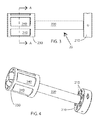
  • FIG. 3 is a side elevation of the barrel clamp of FIG. 2 .
  • FIG. 4 is a perspective view of the barrel clamp of FIG. 2 .
  • FIG. 5 is an alternate perspective view of the barrel clamp of FIG. 2
  • FIG. 6 is an alternate perspective view of the barrel clamp of FIG. 2 .
  • FIG. 7 is an alternate perspective view of the barrel clamp of FIG. 2 , emphasizing the muzzle area.
  • FIG. 8 is a front elevation of the barrel clamp of FIG. 2 .
  • FIG. 9 is a sectional view of the barrel clamp of FIG. 7 , taken along line A-A in FIG. 3 .
  • FIG. 10 is a sectional view of the barrel clamp of FIG. 8 , taken along line A-A in FIG. 3 .
  • the barrel clamp 20 is a part of a comprehensive rotating, multi-barrel weapon system that directly supports barrels 10 at two locations along their length, near muzzles 12 and at some point further along the length of the barrel 10 as determined by the manufacturer.
  • the barrel clamp is a simple construction. It features a base plate 210 at one end of a support tube 220 and a muzzle housing 230 at the support tube's opposite end.
  • the base plate 210 and muzzle housing 230 each feature paired holes 215 , 235 , one of each pair being located on the muzzle housing 230 and one located on the base plate 210 , through which the barrels 10 extend ( FIGS. 5 and 6 ).
  • the barrel clamp 20 helps maintain position of the barrels 10 relative to each other and the weapon system as a whole. This is the primary function of any barrel clamp.
  • the muzzle housing 230 of the barrel clamp 20 also features a wall with a plurality of vanes 240 and associated vents 245 .
  • the vanes 240 are positioned such that rotation R of the barrels 10 and the associated barrel clamp 20 will direct fresh air through the vents 245 and over the barrels 10 of the weapon ( FIG. 10 ).
  • the barrels 10 are therefore constantly bathed in streams of fresh air 250 while the barrels 10 are in motion. This directly aids in the cooling of those barrels 10 , particularly in the vicinity of the muzzles 12 .
  • the constant air currents 250 also interrupt the accumulation of fuel-rich exhaust gasses from the constant explosions of projectiles being fired from the barrels 10 . These gasses are forced to leave the higher-pressure, central chamber 233 inside the muzzle housing 230 and are thus dissipated, reducing their presence and ability to cause muzzle flash.
  • the support tube 220 is hollow, providing a possible egress 225 for exhaust gasses.
  • the use of a tube also reduces the weight of the clamp 20 and the associated system.
  • a solid rod may be used in place of a tube.
  • the air currents 250 are directed on the barrels 10 of the weapon (or towards holes 235 , representing the position of barrels 10 when the barrel clamp is installed thereon) as this aids in cooling the barrels 10 .
  • the vanes 240 should direct the air currents 250 such that a maximal amount of the barrels 10 are covered by the air currents 250 .
  • the number of vanes 240 should comport with the number of barrels 10 (usually 6), in either having that number or a whole number multiple thereof, such that each barrel has at least one air current 250 directed upon it. However, any number of vanes 240 will at least contribute to the dissipation of exhaust gasses and have some cooling effect on the barrels.
  • barrel clamp Given the nature of the use of the barrel clamp, it is readily understood that strong, supportive materials, such as metals, are preferred. However, any material of sufficient strength, such as a composite or polymers, may also be utilized. It is also to be understood that while this barrel clamp has been described with reference to the modern M-134 and its current variants, the principals of this invention may be applied to any multi-barreled, rotary firearm in existence or later developed and is not unique to an M-134 platform.

Landscapes

  • Engineering & Computer Science (AREA)
  • General Engineering & Computer Science (AREA)
  • Toys (AREA)
  • Clamps And Clips (AREA)

Abstract

A barrel clamp for a Gatling-style firearm, or “mini-gun,” provides vanes for the direction of fresh air currents into the muzzle area of the firearm. The directed air streams contribute to cooling the barrels while in the firing cycle and also towards the disruption of fuel-rich gasses which contribute to muzzle flash.

Description

FIELD OF THE INVENTION
The present invention relates to the field of firearms and more particularly relates to a barrel clamp for a multiple barreled rotary firearm.
BACKGROUND OF THE INVENTION
The modern “mini-gun,” or M-134, can trace its origins to the original Gatling gun of the mid-nineteenth century. It is a machine gun which fires projectiles in an automatic fashion. In the process of firing these projectiles, the gun utilizes a plurality of barrels (usually six) which consecutively rotate in a circular circuit into a single position which allows for the firing of a projectile. Each barrel, then, is only used to fire one-sixth of the projectiles, spending the remaining time cooling in an air current caused by the rotation of the barrels. Over time, many improvements have been made to the original Gatling gun, resulting in the modern M-134. However, each variant of the M-134 has always featured the rotatable barrels which are the signature characteristic of this family of firearms.
Muzzle flash is a problem for many firearms, and the M-134 and other multi-barreled firearms are no exception. Muzzle flash is a complex phenomenon with a number of components. Two primary components of muzzle flash are unburnt powder/explosive and the mixing of ambient air and gasses from the firing explosion. Hot, fuel-rich gasses mix with ambient air in the latter case, causing an explosive flash. In the case of the former, the unburnt powder sparks as it leaves the barrel, causing a source of light and heat. In the case of a multi-barreled firearm such as an M-134, the problem of muzzle flash is compounded by ammunition being rapidly fired. This presents not only more opportunity for muzzle flash, but also a potential for component build-up leading to larger and more noticeable muzzle flashes.
Many strategies have been developed in the past to combat muzzle flash, in particular with the M-134 and its variants. One of the most common is to attempt to hide the flash with a large collar around the barrels; but, this method really does not solve the problem as muzzle flash still occurs and may be seen at certain angles outside of a target zone. Other mechanical methods of reducing muzzle flash, specifically using flash suppressors and muzzle brakes, have also been attempted. These devices tend to disrupt the flow of propulsive gasses, in particular the initial shock wave from the explosion, which contribute to the muzzle flash. However, this strategy would require a suppressor on each barrel of an M-134 or other rotary multi-barreled weapon. Another strategy is to add chemical compounds, usually salts, to the powder so as to neutralize the fuel-rich gasses. However, this strategy tends to increase both smoke and residue.
The present invention is a barrel clamp for a Gatling-style, multi-barreled, rotary firearm, such as the M-134, which not only serves to support the barrels of the firearm, but also features vanes which direct airflow inward in a manner to lessen muzzle flash and also assist in cooling barrels after use in the firing cycle. Prior art barrel clamps and muzzle brakes have used vanes in an effort to direct airflow associated with firing a mini-gun, however these structures were used to deflect the expanding muzzle gasses outward, reducing pressure around the barrels and contributing torque to the system in an effort to assist the rotation of the barrels. Directing fresh air into the system increases torque against the rotation of the barrels and is counter-intuitive to traditional designs.
The present invention represents a departure from the prior art in that the barrel clamp of the present invention directs fresh air currents onto the barrels of the firearm and doing so in a manner to disrupt the accumulation of fuel-rich gasses from the act of firing ammunition, thus reducing muzzle flash.
SUMMARY OF THE INVENTION
In view of the foregoing disadvantages inherent in the known types of barrel clamps and muzzle flash suppression devices, a barrel clamp for a multi-barreled firearm, such as for an M-134, may direct fresh air into proximity of firing barrels, thereby disrupting the mixture of firing gasses and dissipating unburnt explosive residue before they can produce muzzle flash. Such a barrel clamp should be easily installed and effective as a barrel clamp on existing and newly developed platforms, effective in the dissipation of combustible by-products which contribute to muzzle flash, intuitive in use and operation, and robust in construction.
To accomplish these objectives, the barrel clamp may comprise a brace plate with a central support tube extending therefrom. A muzzle housing may reside at an end of the support tube opposite the base plate, surrounding the muzzle ends of the multiple barrels of the firearm. The barrel housing may feature at least one vane, which may serve to direct ambient, fresh air directly onto one or more muzzles and associated barrels. By directing fresh air inwards and onto the barrels, the barrel clamp would directly contribute to both the cooling of the barrels and to the dispelling of left over explosive gasses from firing each round of ammunition. This, in turn, would reduce muzzle flash and allow for more rapid rates of fire. Ideally, there could be at least one vane for each barrel as this would evenly distribute fresh air for the cooling effect of the barrel clamp.
The more important features of a barrel clamp serving as one embodiment of the invention thus been outlined in order that the more detailed description that follows may be better understood and in order that the present contribution to the art may better be appreciated. Additional features of the invention will be described hereinafter and will form the subject matter of the claims that follow.
Many objects of this invention will appear from the following description and appended claims, reference being made to the accompanying drawings forming a part of this specification wherein like reference characters designate corresponding parts in the several views.
Before explaining at least one embodiment of the invention in detail, it is to be understood that the invention is not limited in its application to the details of construction and the arrangements of the components set forth in the following description or illustrated in the drawings. The invention is capable of other embodiments and of being practiced and carried out in various ways. Also it is to be understood that the phraseology and terminology employed herein are for the purpose of description and should not be regarded as limiting.
As such, those skilled in the art will appreciate that the conception, upon which this disclosure is based, may readily be utilized as a basis for the designing of other structures, methods, and systems for carrying out the several purposes of the present invention. It is important, therefore, that the claims be regarded as including such equivalent constructions insofar as they do not depart from the spirit and scope of the present invention.
BRIEF DESCRIPTION OF THE DRAWINGS
FIG. 1 is a perspective view of an M-134 variant machine gun with a barrel clamp that exemplifies one embodiment of the present invention.
FIG. 2 is a perspective view of the machine gun of FIG. 1, in broken line, highlighting the barrel clamp.
FIG. 3 is a side elevation of the barrel clamp of FIG. 2.
FIG. 4 is a perspective view of the barrel clamp of FIG. 2.
FIG. 5 is an alternate perspective view of the barrel clamp of FIG. 2
FIG. 6 is an alternate perspective view of the barrel clamp of FIG. 2.
FIG. 7 is an alternate perspective view of the barrel clamp of FIG. 2, emphasizing the muzzle area.
FIG. 8 is a front elevation of the barrel clamp of FIG. 2.
FIG. 9 is a sectional view of the barrel clamp of FIG. 7, taken along line A-A in FIG. 3.
FIG. 10 is a sectional view of the barrel clamp of FIG. 8, taken along line A-A in FIG. 3.
DETAILED DESCRIPTION OF THE PREFERRED EMBODIMENT
With reference now to the drawings, the preferred embodiment of the barrel clamp is herein described. It should be noted that the articles “a”, “an”, and “the”, as used in this specification, include plural referents unless the content clearly dictates otherwise.
With reference to FIGS. 1 and 2, the barrel clamp 20 is a part of a comprehensive rotating, multi-barrel weapon system that directly supports barrels 10 at two locations along their length, near muzzles 12 and at some point further along the length of the barrel 10 as determined by the manufacturer. As seen in FIGS. 3 and 4, the barrel clamp is a simple construction. It features a base plate 210 at one end of a support tube 220 and a muzzle housing 230 at the support tube's opposite end. The base plate 210 and muzzle housing 230 each feature paired holes 215, 235, one of each pair being located on the muzzle housing 230 and one located on the base plate 210, through which the barrels 10 extend (FIGS. 5 and 6). The barrel clamp 20 helps maintain position of the barrels 10 relative to each other and the weapon system as a whole. This is the primary function of any barrel clamp.
With reference to FIGS. 5-10, the muzzle housing 230 of the barrel clamp 20 also features a wall with a plurality of vanes 240 and associated vents 245. The vanes 240 are positioned such that rotation R of the barrels 10 and the associated barrel clamp 20 will direct fresh air through the vents 245 and over the barrels 10 of the weapon (FIG. 10). The barrels 10 are therefore constantly bathed in streams of fresh air 250 while the barrels 10 are in motion. This directly aids in the cooling of those barrels 10, particularly in the vicinity of the muzzles 12. The constant air currents 250 also interrupt the accumulation of fuel-rich exhaust gasses from the constant explosions of projectiles being fired from the barrels 10. These gasses are forced to leave the higher-pressure, central chamber 233 inside the muzzle housing 230 and are thus dissipated, reducing their presence and ability to cause muzzle flash.
In the best mode, the support tube 220 is hollow, providing a possible egress 225 for exhaust gasses. The use of a tube also reduces the weight of the clamp 20 and the associated system. However, it is conceivable that a solid rod may be used in place of a tube.
Ideally, the air currents 250 are directed on the barrels 10 of the weapon (or towards holes 235, representing the position of barrels 10 when the barrel clamp is installed thereon) as this aids in cooling the barrels 10. The vanes 240 should direct the air currents 250 such that a maximal amount of the barrels 10 are covered by the air currents 250. Also, the number of vanes 240 should comport with the number of barrels 10 (usually 6), in either having that number or a whole number multiple thereof, such that each barrel has at least one air current 250 directed upon it. However, any number of vanes 240 will at least contribute to the dissipation of exhaust gasses and have some cooling effect on the barrels.
Given the nature of the use of the barrel clamp, it is readily understood that strong, supportive materials, such as metals, are preferred. However, any material of sufficient strength, such as a composite or polymers, may also be utilized. It is also to be understood that while this barrel clamp has been described with reference to the modern M-134 and its current variants, the principals of this invention may be applied to any multi-barreled, rotary firearm in existence or later developed and is not unique to an M-134 platform.
Although the present invention has been described with reference to preferred embodiments, numerous modifications and variations can be made and still the result will come within the scope of the invention. No limitation with respect to the specific embodiments disclosed herein is intended or should be inferred.

Claims (12)

What is claimed is:
1. A barrel clamp comprising:
a. a base plate;
b. a central support structure defining an axis; and
c. a muzzle housing positioned on an extreme end of the support structure opposite the base plate, said muzzle housing further comprising a wall with a plurality of vanes, each with at least one associated vent, each said vent positioned to direct airflow into a central chamber of the muzzle housing when the barrel clamp is rotated about the axis,
wherein the base plate and said muzzle housing each have a plurality of orifices such that there is an equal number of said orifices on the base plate and on the muzzle housing, each said orifice on the muzzle housing being paired to an opposed said orifice on the base plate so that barrels may be inserted therethrough, with each said orifice on said muzzle housing opening inside the central chamber.
2. The barrel clamp of claim 1, the plurality of said vanes equaling the plurality of said orifices in the muzzle housing.
3. The barrel clamp of claim 2, each said vane and each said vent being positioned in a manner to direct airflow over one of the orifices in the muzzle housing.
4. The barrel clamp of claim 1, each said vane and each said vent being positioned in a manner to direct airflow over one of the orifices in the muzzle housing.
5. The barrel clamp of claim 1, the support structure being a tube with an opening in the central chamber of the muzzle housing, said opening serving as a vent.
6. The barrel clamp of claim 5, the plurality of said vanes equaling the plurality of said orifices in the muzzle housing.
7. The barrel clamp of claim 6, each said vane and each said vent being positioned in a manner to direct airflow over one of the orifices in the muzzle housing.
8. The barrel clamp of claim 5, each said vane and each said vent being positioned in a manner to direct airflow over one of the orifices in the muzzle housing.
9. A barrel clamp comprising:
a. a base plate;
b. a central tube support structure having a length greater than its diameter, said length defining an axis; and
c. a muzzle housing, said muzzle housing further comprising a plurality of vanes, each associated with one of a plurality of wall vents positioned to direct airflow into a central chamber of the muzzle housing when the barrel clamp is rotated about the axis,
d. the central support tube having an opening within the central chamber of the muzzle housing serving as a central vent;
wherein the base plate and said muzzle housing each have a plurality of orifices such that there is an equal number of said orifices on the base plate and on the muzzle housing, each said orifice on the muzzle housing being paired to an opposed said orifice on the base plate so barrels may be inserted therethrough, with each said orifice on said muzzle housing opening inside the central chamber.
10. The barrel clamp of claim 9, the plurality of said vanes equaling the plurality of said orifices in the muzzle housing.
11. The barrel clamp of claim 10, each said vane and each said wall vent being positioned in a manner to direct airflow over one of the orifices in the muzzle housing.
12. The barrel clamp of claim 9, each said vane and each said wall vent being positioned in a manner to direct airflow over one of the orifices in the muzzle housing.
US15/000,293 2016-01-19 2016-01-19 Barrel clamp Expired - Fee Related US10168118B2 (en)

Priority Applications (5)

Application Number Priority Date Filing Date Title
US15/000,293 US10168118B2 (en) 2016-01-19 2016-01-19 Barrel clamp
EP17764304.6A EP3469294A1 (en) 2016-01-19 2017-03-17 Barrel clamp
AU2017230900A AU2017230900A1 (en) 2016-01-19 2017-03-17 Barrel clamp
PCT/US2017/023013 WO2017156554A1 (en) 2016-01-19 2017-03-17 Barrel clamp
PH12018501760A PH12018501760A1 (en) 2016-01-19 2018-08-17 Barrel clamp

Applications Claiming Priority (1)

Application Number Priority Date Filing Date Title
US15/000,293 US10168118B2 (en) 2016-01-19 2016-01-19 Barrel clamp

Publications (2)

Publication Number Publication Date
US20170205177A1 US20170205177A1 (en) 2017-07-20
US10168118B2 true US10168118B2 (en) 2019-01-01

Family

ID=59314734

Family Applications (1)

Application Number Title Priority Date Filing Date
US15/000,293 Expired - Fee Related US10168118B2 (en) 2016-01-19 2016-01-19 Barrel clamp

Country Status (5)

Country Link
US (1) US10168118B2 (en)
EP (1) EP3469294A1 (en)
AU (1) AU2017230900A1 (en)
PH (1) PH12018501760A1 (en)
WO (1) WO2017156554A1 (en)

Cited By (3)

* Cited by examiner, † Cited by third party
Publication number Priority date Publication date Assignee Title
US20190137204A1 (en) * 2017-11-09 2019-05-09 Brian F. Abbott Ammunition Delinker for a Firearm
US11385005B1 (en) * 2021-06-16 2022-07-12 TMP Weapons, LLC Firearm rotor and method of use
US20250146779A1 (en) * 2021-10-15 2025-05-08 Kristopher Lee Paulson Silencer for multi barrel weapon systems

Families Citing this family (4)

* Cited by examiner, † Cited by third party
Publication number Priority date Publication date Assignee Title
US10807339B2 (en) 2017-03-03 2020-10-20 University Of South Carolina Multi-chamber pellet die system
USD958210S1 (en) * 2018-03-02 2022-07-19 University Of South Carolina Multi-chamber pellet die apparatus
CN110701949B (en) * 2019-10-17 2022-02-08 扬州工业职业技术学院 Vane type rotating tube weapon
CN113188369B (en) * 2021-05-07 2022-12-30 扬州工业职业技术学院 Rotary driving device for rotating tube weapon

Citations (6)

* Cited by examiner, † Cited by third party
Publication number Priority date Publication date Assignee Title
US1328230A (en) * 1915-03-13 1920-01-13 James S Johnston Machine-gun
FR846077A (en) * 1939-09-08
US3703122A (en) * 1970-12-10 1972-11-21 Gen Electric Muzzle brake torque assist for multi-barrel weapons
US3898910A (en) * 1973-12-11 1975-08-12 Us Air Force Paddle wheel diffuser
US4015508A (en) * 1975-09-29 1977-04-05 General Electric Company Burst dispersion control
US20160091270A1 (en) * 2013-06-03 2016-03-31 Profense, Llc Minigun with Improved Barrel Clamp

Patent Citations (6)

* Cited by examiner, † Cited by third party
Publication number Priority date Publication date Assignee Title
FR846077A (en) * 1939-09-08
US1328230A (en) * 1915-03-13 1920-01-13 James S Johnston Machine-gun
US3703122A (en) * 1970-12-10 1972-11-21 Gen Electric Muzzle brake torque assist for multi-barrel weapons
US3898910A (en) * 1973-12-11 1975-08-12 Us Air Force Paddle wheel diffuser
US4015508A (en) * 1975-09-29 1977-04-05 General Electric Company Burst dispersion control
US20160091270A1 (en) * 2013-06-03 2016-03-31 Profense, Llc Minigun with Improved Barrel Clamp

Cited By (3)

* Cited by examiner, † Cited by third party
Publication number Priority date Publication date Assignee Title
US20190137204A1 (en) * 2017-11-09 2019-05-09 Brian F. Abbott Ammunition Delinker for a Firearm
US11385005B1 (en) * 2021-06-16 2022-07-12 TMP Weapons, LLC Firearm rotor and method of use
US20250146779A1 (en) * 2021-10-15 2025-05-08 Kristopher Lee Paulson Silencer for multi barrel weapon systems

Also Published As

Publication number Publication date
US20170205177A1 (en) 2017-07-20
PH12018501760A1 (en) 2019-05-15
AU2017230900A1 (en) 2018-09-06
EP3469294A1 (en) 2019-04-17
WO2017156554A1 (en) 2017-09-14

Similar Documents

Publication Publication Date Title
US10168118B2 (en) Barrel clamp
US10274278B2 (en) Firearm attachment
US10429146B2 (en) Firearm suppression device
US11054207B2 (en) Integrally suppressed firearm utilizing segregated expansion chambers
US10180299B2 (en) Flash suppressor assembly and method
US5596161A (en) Muzzle flash suppressor
US7302774B2 (en) Flash suppressor apparatus and methods
US8820473B1 (en) Gas dispersion nozzle for a fire arm silencer
US1667186A (en) Muzzle attachment for guns
US9134099B2 (en) Net throwing device
US4869151A (en) Noise and recoil suppressor apparatus for high powered rifles
US4008538A (en) Gun
US10024618B1 (en) Muzzle brake for a combat rifle
US9933223B2 (en) Cover system for sound suppressor
US10508879B1 (en) Device for dampening residual effects from a firearm suppressor
US1315504A (en) Itreabm
US2791155A (en) Recoil reducing device for firearms
RU2396747C1 (en) Method of wild animals scaring and device for its implementation
CN107218855A (en) A kind of lethal canister shot of medium caliber
US10451373B2 (en) Firearm barrel
US9273940B2 (en) Gun firing method for the simultaneous dispersion of projectiles in square pattern
RU105983U1 (en) CARTRIDGE
KR20030013350A (en) Three way barrel type rifle for 22 rim fire
UA51892A (en) Compensator gas unit

Legal Events

Date Code Title Description
AS Assignment

Owner name: EMPTY SHELL LLC, TEXAS

Free format text: ASSIGNMENT OF ASSIGNORS INTEREST;ASSIGNOR:ABBOTT, BRIAN;REEL/FRAME:043846/0192

Effective date: 20171006

STCF Information on status: patent grant

Free format text: PATENTED CASE

FEPP Fee payment procedure

Free format text: MAINTENANCE FEE REMINDER MAILED (ORIGINAL EVENT CODE: REM.); ENTITY STATUS OF PATENT OWNER: SMALL ENTITY

LAPS Lapse for failure to pay maintenance fees

Free format text: PATENT EXPIRED FOR FAILURE TO PAY MAINTENANCE FEES (ORIGINAL EVENT CODE: EXP.); ENTITY STATUS OF PATENT OWNER: SMALL ENTITY

STCH Information on status: patent discontinuation

Free format text: PATENT EXPIRED DUE TO NONPAYMENT OF MAINTENANCE FEES UNDER 37 CFR 1.362

FP Lapsed due to failure to pay maintenance fee

Effective date: 20230101