US10164698B2 - Systems and methods for exploiting inter-cell multiplexing gain in wireless cellular systems via distributed input distributed output technology - Google Patents
Systems and methods for exploiting inter-cell multiplexing gain in wireless cellular systems via distributed input distributed output technology Download PDFInfo
- Publication number
- US10164698B2 US10164698B2 US13/797,950 US201313797950A US10164698B2 US 10164698 B2 US10164698 B2 US 10164698B2 US 201313797950 A US201313797950 A US 201313797950A US 10164698 B2 US10164698 B2 US 10164698B2
- Authority
- US
- United States
- Prior art keywords
- ues
- enodebs
- cluster
- antenna
- btss
- Prior art date
- Legal status (The legal status is an assumption and is not a legal conclusion. Google has not performed a legal analysis and makes no representation as to the accuracy of the status listed.)
- Active, expires
Links
Images




Classifications
-
- H—ELECTRICITY
- H04—ELECTRIC COMMUNICATION TECHNIQUE
- H04B—TRANSMISSION
- H04B7/00—Radio transmission systems, i.e. using radiation field
- H04B7/02—Diversity systems; Multi-antenna system, i.e. transmission or reception using multiple antennas
- H04B7/04—Diversity systems; Multi-antenna system, i.e. transmission or reception using multiple antennas using two or more spaced independent antennas
- H04B7/06—Diversity systems; Multi-antenna system, i.e. transmission or reception using multiple antennas using two or more spaced independent antennas at the transmitting station
- H04B7/0613—Diversity systems; Multi-antenna system, i.e. transmission or reception using multiple antennas using two or more spaced independent antennas at the transmitting station using simultaneous transmission
- H04B7/0615—Diversity systems; Multi-antenna system, i.e. transmission or reception using multiple antennas using two or more spaced independent antennas at the transmitting station using simultaneous transmission of weighted versions of same signal
- H04B7/0619—Diversity systems; Multi-antenna system, i.e. transmission or reception using multiple antennas using two or more spaced independent antennas at the transmitting station using simultaneous transmission of weighted versions of same signal using feedback from receiving side
- H04B7/0621—Feedback content
- H04B7/0626—Channel coefficients, e.g. channel state information [CSI]
-
- H—ELECTRICITY
- H04—ELECTRIC COMMUNICATION TECHNIQUE
- H04B—TRANSMISSION
- H04B7/00—Radio transmission systems, i.e. using radiation field
- H04B7/02—Diversity systems; Multi-antenna system, i.e. transmission or reception using multiple antennas
- H04B7/04—Diversity systems; Multi-antenna system, i.e. transmission or reception using multiple antennas using two or more spaced independent antennas
- H04B7/0413—MIMO systems
- H04B7/0452—Multi-user MIMO systems
Definitions
- LTE Long-term evolution
- 3GPP 3 rd generation partnership project
- 4G fourth generation wireless cellular systems
- LTE can achieve theoretically up to 4 ⁇ improvement in downlink spectral efficiency over previous 3G and HSPA+ standards by exploiting the spatial components of wireless channels via multiple-input multiple-output (MIMO) technology.
- MIMO multiple-input multiple-output
- LTE-Advanced is the evolution of LTE, currently under standardization, that will enable theoretically up to 8 ⁇ increase in spectral efficiency over 3G standard systems.
- LTE-Advanced the evolution of LTE standard
- MIMO techniques the density of “small cells”
- DIDO distributed-input distributed-output
- link adaptation techniques can be used to switch dynamically between diversity and multiplexing schemes based on propagation conditions [20-23].
- link adaptation schemes described in [22-23] showed that beamforming or Orthogonal Space-Time Block Codes (OSTBC) are preferred schemes in low SNR regime or channels characterized by low spatial selectivity.
- OSTBC Orthogonal Space-Time Block Codes
- spatial multiplexing can provide significant gain in data rate for channels with high SNR and high spatial selectivity.
- multiplexing region 101 characterized by high SNR (due to proximity to the cell tower or base station) where the spatial degrees of freedom of the channel can be exploited via spatial multiplexing to increase data rate
- diversity region 102 or cell-edge where spatial multiplexing techniques are not as effective and diversity methods can be used to improve SNR and coverage (yielding only marginal increase in data rate).
- the circle of the macrocell 103 in FIG. 1 labels the shaded center of the circle as the “multiplexing region” and the unshaded outer region of the circle as the “diversity region”. This same region designation is used throughout FIGS. 1, 3-5 , where the shaded region is the “multiplexing region” and the unshaded region is the “diversity region”, even if they are not labeled.
- the same designation is used for the small-cell 104 in FIG. 1 .
- MIMO multiplexing schemes [1,19] provide gain in data rate in high SNR regime and in scenarios with enough spatial degrees of freedom in the channel (e.g., rich multipath environments with high spatial selectivity [16-18]) to support multiple parallel data streams over wireless links.
- the LTE standard supports different multiplexing techniques for single-user MIMO (SU-MIMO) and multi-user MIMO (MU-MIMO) [31].
- SU-MIMO schemes have two modes of operation: i) closed-loop, exploiting feedback information from the UE to select the DL precoding weights; ii) open-loop, used when feedback from the UE is unavailable or the UE is moving too fast to support closed-loop schemes.
- Closed-loop schemes use a set of pre-computed weights selected from a codebook. These weights can support two or four transmit antennas as well as one to four parallel data streams (identified by number of layers of the precoding matrix), depending on the UE request and decision of the scheduler at the BTS.
- LTE-Advanced will include new transmission modes up to MIMO 8 ⁇ 8 to provide up to 8 ⁇ increase in spectral efficiency via spatial processing [62].
- MU-MIMO schemes are defined for both UL and DL channels [31,50].
- every UE sends a reference signal to the BTS (consisting of cyclically shifted version of the Zadoff-Chu sequence [33]).
- Those reference signals are orthogonal, such that the BTS can estimate the channel from all UEs and demodulate data streams from multiple UEs simultaneously via spatial processing.
- precoding weights for different UEs are selected from codebooks based on the feedback from the UEs and the scheduler (similarly to closed-loop SU-MIMO schemes) and only rank-1 precoding is allowed for every UE (e.g., each UE receives only one data stream).
- Intra-cell multiplexing techniques employing spatial processing provide satisfactory performance only in propagation scenarios characterized by high SNR (or SINR) and high spatial selectivity (multipath-rich environments). For conventional macrocells, these conditions may be harder to achieve as BTSs are typically far from the UEs and the distribution of the SINR is typically centered at low values [43]. In these scenarios, MU-MIMO schemes or diversity techniques may be better choices than SU-MIMO with spatial multiplexing.
- small cells [30,47] are to reduce the size of conventional macro-cells, thereby allowing higher cell density and larger throughput per area of coverage.
- Small-cells are typically deployed through inexpensive access points 106 with low power transmission (as depicted in FIG. 1 ) as opposed to tall and expensive cell towers used for macro-cells.
- Two types of small cells are defined in LTE-Advanced: i) metrocells, for outdoor installation in urban areas, supporting up 32 to 64 simultaneous users; and ii) femtocells, for indoor use, can serve at most 4 active users.
- One advantage of small cells is that the density of UEs close to the BTS is statistically higher, yielding better SNR that can be exploited via spatial multiplexing to increase data rate.
- small cells require complex real-time coordination across BTSs to avoid interference as in self-organized networks (SON) [30,51-52] and sophisticated cell-planning tools (even more complex than conventional cellular systems, due to higher density of small cells) to plan their optimal location [48,49].
- SON self-organized networks
- handoff is a limiting factor for small cells deployment, particularly in scenarios where groups of subscribers switch cells at the same time, causing large amount of handoff overhead over the backhaul, resulting in high latency and unavoidable dropped calls.
- any such approach would be highly specific, not only to the static plan of the macrocell and small cell, but to the dynamic circumstances of a particular time interval. Typically, the full throughput of the channel to each UE cannot be achieved.
- HetNet heterogeneous network
- small-cells e.g., metro-cells, pico-cells and femto-cells
- ICIC inter-cell interference coordination
- Cell-autonomous ICIC schemes avoid inter-cell interference via different frequency reuse patterns depicted in FIG. 2 , where the hexagons represent the cells and the colors refer to different carrier frequencies.
- Three types of schemes are considered in LTE: i) full frequency reuse (or reuse 1), where the cells utilize all the available bandwidth as in FIG. 2 a , thereby producing high interference at the cell-edge; ii) hard frequency reuse (HFR), where every cell is assigned with a different frequency band as in FIG. 2 b (with typical reuse factor of 3) to avoid interference across adjacent cells; iii) fractional frequency reuse (FFR), where the center of the cell is assigned with the whole available bandwidth as in frequency reuse 1, whereas the cell-edge operates in HFR mode to mitigate inter-cell interference as in FIG. 2 c.
- full frequency reuse or reuse 1
- HFR hard frequency reuse
- FFR fractional frequency reuse
- Coordinated ICIC methods enable cooperation across BTSs to improve performance of wireless networks. These techniques are a special case of methods taught in Related Patents and Applications as described above to enable cooperation across wireless transceivers in the general case of distributed antenna networks for multiple UEs all using the same frequency simultaneously.
- Cooperation across BTSs to remove inter-cell interference for the particular case of cellular systems for a single UE at a given time at a given frequency was described in [53].
- the system in [53] divides every macrocell into multiple subcells and enables soft-handoff across subcells by employing dedicated beamforming from coordinated BTSs to improve link robustness at a single UE at a single frequency, as it moves along the subcell boundaries.
- CoMP networks are actively becoming part of LTE-Advanced standard as a solution to mitigate inter-cell interference in next generation cellular networks [62-64].
- Three CoMP solutions have been proposed so far in the standard to remove inter-cell interference: i) coordinated scheduling/beamforming (CS/CB), where the UE receives its data stream from only one BTS via beamfoming and coordination across BTSs is enabled to remove interference via beamforming or scheduling techniques; ii) dynamic cell selection (DCS) that chooses dynamically the cell for every UE on a per-subframe basis, transparently to the UE; iii) joint transmission (JT), where data for given UE is jointly transmitted from multiple BTSs to improve received signal quality and eliminate inter-cell interference.
- CoMP-JT yields larger gains than CoMP-CS/CB at the expenses of higher overhead in the backhaul to enable coordination across BTSs.
- Prior art multi-user wireless systems add complexity and introduce limitations to wireless networks which result in a situation where a given user's experience (e.g. available throughput, latency, predictability, reliability) is impacted by the utilization of the spectrum by other users in the area.
- a given user's experience e.g. available throughput, latency, predictability, reliability
- the utilization of the spectrum by other users in the area e.g. available throughput, latency, predictability, reliability
- prior art multi-user wireless technology suffers from many limitations. Indeed, with the limited availability of spectrum suitable for particular types of wireless communications (e.g. at wavelengths that are efficient in penetrating building walls), prior art wireless techniques will be insufficient to meet the increasing demands for bandwidth that is reliable, predictable and low-latency.
- Prior art intra-cell diversity and multiplexing methods can only provide up to a theoretical 4 ⁇ increase in throughput over current cellular networks for LTE (through MIMO 4 ⁇ 4) or at most a theoretical 8 ⁇ for LTE-Advanced (through MIMO 8 ⁇ 8), although higher orders of MIMO achieve diminishing improvements in increasing throughput in a given multipath environment, particularly as UEs (such as smartphones) get smaller and more constrained in terms of antenna placement.
- Other marginal throughput gains in next generation cellular systems may be obtained from additional spectrum allocation (e.g., FCC national broadband plan), exploited via carrier aggregation techniques, and more dense distribution of BTSs via small cell networks and SON [30,46]. All the above techniques, however, still rely heavily on spectrum or time sharing techniques to enable multi-user transmissions, since the spectral efficiency gains obtained by spatial processing is limited.
- FIG. 3 shows one example of cellular networks with three BTSs, each one characterized by its own coverage area or cell. The power transmitted from each BTS is constrained to limit the amount of interference across cells, depicted in FIG. 3 by the areas where the cells overlap. As these systems operate in the low SINR regime at the interference region, their gains in spectral efficiency is only marginal, similarly to intra-cell schemes for SU-MIMO. To truly obtain significant capacity gains in inter-cell cooperative networks, power constraints limited to cell-boundaries must be relaxed and spatial multiplexing techniques should be enabled throughout the cells where the SINR is high (not just at the cell-edge with poor SINR performance as in prior art approaches).
- FIG. 4 shows the case where the power transmitted from the three BTSs 401 all transmitting simultaneously at the same frequency is increased, thereby allowing a higher level of interference throughout the cell 402 .
- interference would result in incoherent interference (disrupting UE signal reception) throughout the interfering areas of the BTSs, but this interference is actually exploited in the present invention through novel inter-cell multiplexing methods using spatial processing to create areas of coherent interference (enhancing UE signal reception) around every UE, thereby providing simultaneous non-interfering data streams to every UE and increasing their SINR throughout the cell.
- the scenario depicted in FIG. 4 is described in [89] for the particular case of cellular systems.
- the system in [89] consists of several BTSs identifying different cells that are grouped into clusters. Cooperation is allowed only across BTSs from adjacent cells within the same clusters. In this case it was shown that, as the power transmitted from the BTSs increases, there is a limit to the capacity (or spectral efficiency) achievable through inter-cell multiplexing methods. In fact, as the transmit power increases, the out-of-cluster interference increases proportionally, producing a saturation regime for the SINR and consequently for the capacity.
- the system in [89] can theoretically achieve at most 3 ⁇ gain in capacity (i.e., at most three cells within the cluster) and any additional cell included in the cluster would reduce capacity due to increased out-of-cluster interference (e.g., the case of 21 cells per cluster yields lower capacity than the case of 3 cells per cluster).
- the fundamental capacity limit in [89] holds because the BTSs are constrained to predefined locations, as in cellular systems, and multiplexing gain is achieved by increasing transmit power from the BTSs. To obtain theoretically unlimited capacity gain via inter-cell multiplexing methods, the constraint on the BTS placement must be removed, allowing the BTSs to be placed anywhere is convenient.
- the serendipitous access points are distributed-input distributed-output (DIDO) access points and the inter-cell multiplexing gain is achieved through DIDO methods as described above and [77-78].
- the serendipitous access points are low power transceivers, similar to inexpensive Wi-Fi access points or small-cells [30,47], thereby providing smaller areas of coverage overlapping throughout the macro-cell as shown in FIG. 5 .
- prior art inter-cell methods [53-64] avoid incoherent interference by intentionally limiting the transmit power from every BTS as in FIG. 3 and eliminate residual inter-cell interference (on the overlapping areas between cells) via spatial processing, thereby providing improved SINR and inter-cell diversity gain.
- [89] constrains BTS placement to cell planning while increasing transmit power, thereby limiting the achievable capacity due to out-of-cluster interference, and as such it is still limited by interference.
- the present invention exploits incoherent interference to create coherent interference around the UEs, by transmitting higher power from every BTS serendipitously placed, thereby improving signal quality at the UE that is necessary condition to obtain inter-cell multiplexing gain throughout the cell via spatial processing.
- the systems described in prior art cannot be used to achieve unlimited inter-cell multiplexing gain via spatial processing, since there is not sufficient SINR throughout the cell (due to the limited transmit power from the BTSs or the out-of-cluster interference when transmit power is increased) to enable inter-cell multiplexing methods as in the present invention.
- the systems described in prior art would be inoperable to achieve the multiplexing gain achieved in the present invention depicted in FIGS. 4-5 , given that prior art systems were designed to avoid inter-cell interference within the diversity regions shown in the shaded area of FIG. 1 and FIGS. 3-5 rather than exploit inter-cell interference in the multiplexing regions to obtain inter-cell multiplexing gain as achieved in the present invention.
- FIG. 1 illustrates multiplexing and diversity regions for a macro-cell and a small-cell.
- FIG. 2 a illustrates full frequency reuse pattern in conventional cellular systems.
- FIG. 2 c illustrates fractional frequency reuse (FFR) pattern in conventional cellular systems.
- FIG. 3 illustrates the interference region between adjacent macro-cells.
- FIG. 4 illustrates multiple BTSs transmitting at higher power to increase the level of interference between cells.
- FIG. 5 illustrates one example where many access points are added to deliberately increase the level of incoherent interference throughout the cell.
- FIG. 6 illustrates the network elements in LTE networks.
- FIG. 7 a illustrates the LTE frame structure for FDD operation.
- FIG. 7 b illustrates the LTE frame structure for TDD operation.
- FIG. 8 a illustrates the LTE “resource elements” and “resource blocks” in the OFDM DL channel.
- FIG. 8 b illustrates the LTE “resource elements” and “resource blocks” in the SC-FDMA UL channel.
- FIG. 9 illustrates one embodiment of a multi-user (MU) multiple antenna system (MAS), or MU-MAS, consisting of antenna-clusters and user-clusters.
- MU multi-user
- MAS multiple antenna system
- FIG. 11 illustrates one embodiment of a MU-MAS wherein the same set of cell IDs are assigned to the antenna-subclusters with given repetition pattern.
- FIG. 12 illustrates the SNR distribution for practical deployment of MU-MAS systems in downtown San Francisco, Calif., with sparsely and densely populated areas.
- FIG. 13 illustrates one embodiment of a MU-MAS consisting of CP, distributed BTSs and multiple UEs.
- FIG. 14 illustrates one embodiment of a MU-MAS consisting of CP, distributed BTSs, multiple devices and one UE connected to the devices as well as the BTSs via network interfaces.
- FIG. 15 illustrates one embodiment of a MU-MAS wherein the UE is in a case that physically attaches to the user device.
- DIDO Distributed-Input Distributed-Output
- the present invention applies to any wireless network where multiplexing gain is achieved by transmitting signals from multiple antennas that interfere where received by multiple UEs so as to create simultaneous non-interfering data streams to multiple UEs.
- the stream of bits is the complex baseband signal produced by the centralized processor and quantized over given number of bits to be sent to one of the M transceiver stations.
- the MU-MAS is a distributed-input distributed-output (DIDO) system as described in Related Patents and Patent Applications.
- DIDO distributed-input distributed-output
- the MU-MAS depicted in FIG. 13 consists of:
- LTE is designed with a flat network architecture (as opposed a hierarchical architecture from previous cellular standards) to provide: reduced latency, reduced packet losses via ARQ, reduced call setup time, improved coverage and throughput via macro-diversity.
- the network elements in LTE networks depicted in FIG. 6 are per [79]:
- the MU-MAS network is an LTE network wherein the UE is the LTE UE, the BTS is the LTE eNodeB, the CTR is the LTE eNodeB or MME, the CP is the LTE GW, the BSN is the S1 or X1 interface.
- the terms distributed antennas, BTS and eNodeB interchangeably to refer to any base station in MU-MAS, DIDO or LTE systems.
- the LTE frame has duration of 10 msec and consists of ten subframes as depicted in FIG. 7 [33,80]. Every subframe is divided in two slots of duration 0.5 msec each.
- the LTE standards defines two types of frames: i) type 1 for FDD operation as in FIG. 7 a ), where all subframes are assigned either for the DL or UL channels; ii) type 2 for TDD operation as in FIG. 7 b ), where, part of the subframes are assigned to the DL and part to the UL (depending on the selected configuration), whereas a few subframes are reserved for “special use”.
- Resource blocks for every UE are assigned on a subframe basis. Since the MU-MAS in the present invention uses spatial processing to send multiple data streams to different UEs, at every subframe all resource blocks can be allocated to the same UE. In one embodiment, all or a subset of resource blocks are allocated to every UE and simultaneous non-interfering data streams are sent to the UEs via precoding.
- the LTE standard defines the synchronization procedure.
- the BTS sends two consecutive signals to the UE: the primary synchronization signal (P-SS) sent over the primary synchronization channel (PSCH) and the secondary synchronization signal (S-SS) sent over the secondary synchronization channel (SSCH). Both signals are used by the UE for time/frequency synchronization as well as to retrieve the cell ID.
- the P-SS consists of length-63 Zadoff-Chu sequence from which the UE derives the physical layer ID (0 to 2).
- the S-SS is an interleaved concatenation of two length-31 binary sequences and is used to derive the cell ID group number (0 to 167). From the two identity numbers above, the UE derives the physical cell ID (PCI, defined from 0 to 503).
- PCI physical cell ID
- FIG. 9 shows the main antenna-cluster 901 and one adjacent antenna-cluster 902 . Every antenna-cluster consists of multiple BTSs 903 .
- the cell ID can be used in MU-MAS and DIDO systems to differentiate the antenna-clusters.
- the same cell ID is transmitted from all BTSs of the same antenna-cluster via the P-SS and S-SS.
- different antenna-clusters employ different cell IDs.
- all BTSs within the same antenna-cluster 1001 are grouped into “antenna-subclusters” 1003 depicted in FIG. 10 with different shaded colors and a different cell ID 1004 is associated to every antenna-subcluster.
- the antenna-subclusters are defined statically according to predefined cluster planning or based on GPS positioning information.
- LTE broadcast channels e.g., P-SS and S-SS
- destructive interference may degrade the performance of time or frequency synchronization enabled by the broadcast channel.
- Destructive interference may be caused by multipaths generated from spatially distributed BTSs that recombine incoherently at some UE locations.
- only one BTS out of all BTSs within the same antenna-cluster or antenna-subcluster transmits the LTE broadcast channels (e.g., P-SS and S-SS) to all UEs.
- the BTS that transmits the LTE broadcast channels is selected to maximize the power received at the UEs over the broadcast channels.
- only a limited set of BTSs is selected to transmit simultaneously the LTE broadcast channels to all UEs, such that destructive interference is avoided at the UE.
- the LTE broadcast channels are sent at higher power than the payload to reach all the UEs within the same antenna-cluster or antenna-subcluster.
- LTE-Advanced supports carrier aggregation (CA) schemes to increase data rate over the DL channel.
- CA can be used in combination with precoding to increase per-user data rate.
- transmit precoding is applied to different portions of the RF spectrum (inter-band CA) or different bands within the same portion of the spectrum (intra-band CA) to increase per-user data rate.
- inter-band CA pathloss at different bands may change significantly as those bands are centered at different carrier frequencies.
- frequency bands at lower carrier frequencies may experience lower pathloss than higher carrier frequencies.
- applying inter-band CA in cellular systems may cause undesired inter-cell interference at lower carrier frequencies.
- the MU-MAS in the present invention is not limited by interference at the cell boundary as the BTSs are distributed and there is no concept of cell.
- This more flexible system layout allows different methods for inter-band CA in MU-MAS.
- the MU-MAS enables inter-band CA by employing one set of BTSs to operate at lower carrier frequencies and another set of BTSs to operate at higher carrier frequencies, such that the two sets intersect or one set is the subset of the other.
- the MU-MAS with precoding employs CA methods in conjunction with frequency hopping patterns to improve robustness against frequency-selective fading or interference.
- MU-MAS closed-loop schemes can be used either in time-division duplex (TDD) or frequency division duplex (FDD) systems.
- TDD time-division duplex
- FDD frequency division duplex
- DL and UL channels operate at different frequencies and therefore the DL channel state information (CSI) must be estimated at the UE side and reported back to the CP through the BTSs or the CTRs via the UL channel.
- CSI channel state information
- DL and UL channels are set at the same frequency and the system may employ either closed-loop techniques or open-loop schemes exploiting channel reciprocity (as described in the following section).
- the main disadvantage of closed-loop schemes is they require feedback, resulting in larger overhead for control information over the UL.
- the general mechanism for closed-loop schemes in MU-MASs is described as follows: i) the BTSs send signaling information to the UEs over the DL; ii) the UEs exploit that signaling information to estimate the DL CSI from all the “active BTSs”; iii) the UEs quantize the DL CSI or use codebooks to select the precoding weights to be used for the next transmission; iv) the UEs send the quantized CSI or the codebook index to the BTSs or CTRs via the UL channel; v) the BTSs or CTRs report the CSI information or codebook index to the CP that calculates the precoding weights for data transmission over the DL.
- the “active BTSs” are defined as the set of BTSs that are reached by given UE.
- the “user-cluster” 905 as the set of BTSs that are reached by given UE, as depicted in FIG. 9 .
- the number of active BTSs are limited to a user-cluster so as to reduce the amount of CSI to be estimated from the BTSs to given UE, thereby reducing the feedback overhead over the UL and the complexity of the MU-MAS precoding calculation at the CP.
- MU-MAS precoding employs either linear or non-linear methods.
- non-linear methods e.g., dirty-paper coding [68-70] or Tomlinson-Harashima precoding [71-72], lattice techniques or trellis precoding [73-74], vector perturbation techniques [75-76]
- successive interference cancellation is applied at the transmitter to avoid inter-user interference.
- the precoding matrix is computed accounting for the CSI to all the UEs within the antenna-cluster.
- linear precoding methods e.g., zero-forcing [65], block-diagonalization [66-67], matrix inversion, etc.
- linear precoding methods can be used on a user-cluster basis, since the precoding weights for every UE are computed independent on the other UEs.
- linear versus non-linear precoding methods offer different computational performance.
- the MU-MAS consists of K UEs per antenna-cluster, M eNodeBs per antenna-cluster and C eNodeBs per user-cluster, the complexity of linear precoding is O(K*C 3 ) whereas for non-linear precoding it is O(M*K 2 ). It is thus desirable to develop a method that dynamically switches between the two types of precoding techniques based on the number if UEs and eNodeBs in MU-MASs to reduce the computational complexity at the CP.
- the MU-MAS employs linear precoding methods.
- the MU-MAS employs non-linear precoding methods.
- the MU-MAS dynamically switches between linear and non-linear precoding methods based on the number of UEs and eNodeBs in the antenna-clusters and user-clusters to reduce computational complexity at the CP.
- the MU-MAS switches between precoding multiplexing methods for UEs experiencing good channel quality (e.g., in the proximity of eNodeBs) and beamforming or diversity methods for UEs with poor link quality (e.g., far away from the eNodeBs).
- the LTE standard defines two types of reference signals (RS) that can be used for DL signaling in closed-loop schemes [33,50,82-83]: i) cell-specific reference signal (CRS); ii) UE specific RS such as channel state information (CSI) reference signal (CSI-RS) and demodulation RS (DM-RS).
- CRS is used in LTE Release 8 that employs SU/MU-MIMO codebook-based techniques with up to four antennas in every cell.
- LTE-Advanced Release 10 supports non-codebook based SU/MU-MIMO schemes with up to eight transmit antennas as well as CoMP schemes with antennas distributed over different cells. As such, Release 10 allows for more flexible signaling schemes via CSI-RS.
- CSI-RS channel state information reference signal
- DM-RS demodulation RS
- the CRS is employed in LTE (Release 8) systems to estimate the CSI from all transmit antennas at the BTS to the UE [80,84].
- the CRS is obtained as the product of a two-dimensional orthogonal sequence and a two-dimensional pseudo-random numerical (PRN) sequence.
- PRN pseudo-random numerical
- Each of the three orthogonal CRSS is associated to one of the three physical layer IDs (0 to 2) that generate a different cell ID, as explained in the previous subsection.
- the CRS is transmitted within the first and third-last OFDM symbol of every slot, and every sixth subcarrier.
- Orthogonal patterns in time and frequency are designed for every transmit antenna of the BTS, for the UE to uniquely estimate the CSI from each of transmit antennas.
- Release 8 defines up to four orthogonal patters per CRS, one for each of the four transmit antennas employed in MIMO 4 ⁇ 4. This high density of CRS in time and frequency (i.e., sent every slot of 0.5 msec, and every sixth subcarrier), producing 5% overhead, was designed intentionally to support scenarios with fast channel variations over time and frequency [83].
- the antenna-cluster 1001 is divided into three antenna-subclusters 1005 as in FIG. 10 .
- Different physical layer IDs or cell IDs
- each antenna-subcluster is assigned with one of the three orthogonal CRSs with four orthogonal patterns (i.e., each antenna-subcluster can support up to four BTS without causing interference to the CRS from other BTSs).
- every cluster can support up to 12 BTSs without causing interference to the CRS.
- antenna-subclusters 1003 per antenna-cluster 1101 and assign the same three physical layer IDs (or cell ID 1104 from 0 to 2) to the antenna-subclusters 1103 with a repetition pattern as shown in FIG. 11 .
- the antenna-subclusters may come in different shapes and are defined in such a way that every user-cluster 1102 cannot reach two antenna-subclusters with the same physical layer ID, thereby avoiding interference to the CRS.
- one way to achieve that is to define the area of the antenna-subcluster 1103 larger than the user-cluster 1102 and avoid that adjacent antenna-subcluster use the same physical layer ID.
- the multiple antenna-subclusters are placed within the same antenna-cluster with repetition patterns such that their respective CRSs do not interfere, thereby enabling simultaneous non-interfering transmissions from more than twelve BTSs.
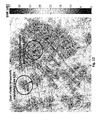
- FIG. 12 shows the SNR distribution for practical deployment of DIDO or MU-MAS systems in downtown San Francisco, Calif.
- the propagation model is based on 3GPP pathloss/shadowing model [81] and assumes a carrier frequency of 900 MHz.
- the dots in the map indicate the location of the DIDO-BTSs, whereas the dark circle represents the user-cluster (with the UE being located at the center of the circle).
- sparsely populated areas 1201 the UE sees only a few BTSs within its user-cluster (e.g., as low as three BTSs for the example in FIG. 12 ), whereas in densely populated areas 1202 each user-cluster may comprise as many as 26 BTSs as in FIG. 12 .
- the high redundancy of the CRS can be exploited in MU-MASs to enable CSI estimation from any number of transmit antennas greater than four. For example, if the channel is fixed-wireless or characterized by low Doppler effects, there is no need to compute the CSI from all four transmit antennas every 0.5 msec (slot duration). Likewise, if the channel is frequency-flat, estimating the CSI every sixth subcarrier is redundant. In that case, the resource elements (RE) occupied by the redundant CRS can be re-allocated for other transmit antennas or BTSs in the MU-MAS. In one embodiment of the invention, the system allocates resource elements of redundant CRS to extra antennas or BTSs in the MU-MAS system. In another embodiment, the system estimates time and frequency selectivity of the channel and dynamically allocates the CRS for different BTSs or only the BTSs within the user-cluster to different resource elements.
- RE resource elements
- the number of BTSs included in every user-cluster depends on the signal power level measured at the UE from all BTSs in the user-cluster relative to the noise power level, or signal-to-noise ratio (SNR).
- the UE estimates the SNR from all BTSs in its neighborhood and selects the BTSs that belong to its user-cluster based on the SNR information.
- the CP is aware of the SNR from the BTSs to every UE (based on feedback information from the UEs or information obtained from the UL channel, assuming UL/DL channel reciprocity) and selects the set of BTSs to be included in every user-cluster.
- the number of BTSs included in every user-cluster determines the performance of the MU-MAS methods described in the present invention. For example, if the number of BTSs per user-cluster is low, the UE experiences higher level of out-of-cluster interference, resulting in high signal-to-interference-plus-noise ratio (SINR) and low data rate. Similarly, if large number of BTSs is selected for every user-cluster, the SNR measured at the UE from the BTSs at the edge of the user-cluster is low and may be dominated by the out-of-cluster interference from adjacent BTSs outside the user-cluster. There is an optimal number of BTSs per user-cluster that produces the highest SINR and data rate.
- SINR signal-to-interference-plus-noise ratio
- the CP selects the optimal number of BTSs per user-cluster to maximize SINR and data rate to the UE.
- the BTSs per user-cluster are dynamically selected to adapt to the changing conditions of the propagation environment or UE mobility.
- the BTSs per user-cluster are selected to achieve optimal tradeoff between SINR or data rate performance and computational complexity of the MU-MAS precoder.
- the BTSs per user-cluster are dynamically selected based on tradeoffs between propagation conditions and computational resources available in the MU-MAS.
- the CSI-RS is used by every UE to estimate the CSI from the BTSs [33,83].
- the standard defines orthogonal CSI-RS for different transmitters at the BTS, so that the UE can differentiate the CSI from different BTSs.
- Up to eight transmit antennas at the BTS are supported by the CSI-RS as in Tables 6.10.5.2-1,2 in [33].
- the CSI-RS is sent with a periodicity that ranges between 5 and 80 subframes (i.e., CSI-RS send every 5 to 80 msec) as in Tables 6.10.5.3-1 in [33].
- the periodicity of the CSI-RS in LTE-Advanced was designed intentionally larger than the CRS in LTE to avoid excessive overhead of control information, particularly for legacy LTE terminals unable to make use of these extra resources.
- Another reference signal used for CSI estimation is to demodulation RS (DM-RS).
- the DM-RS is a demodulation reference signal intended to a specific UE and transmitted only in the resource block assigned for transmission to that UE.
- every UE uses the CSI-RS or the DM-RS or combination of both to estimate the CSI from all active BTSs in its own user-cluster.
- the DIDO system detects the number of BTSs within the user-cluster and whether or not the user-cluster is compliant to the LTE-Advanced standard (supporting at most eight antennas). If it not compliant, the DIDO system employs alternative techniques to enable DL signaling from the BTSs to the current UE. In one embodiment, the transmit power from the BTSs is reduced until at most eight BTSs are reachable by the UE within its user-cluster. This solution, however, may result in reduction of data rate as coverage would be reduced.
- Another solution is to divide the BTSs in the user-cluster in subsets and send one set of CSI-RS for every subset at a time. For example, if the CSI-RS periodicity is 5 subframes (i.e., 5 msec) as in Table 6.10.5.3-1 in [33], every 5 msec the CSI-RS is sent from a new subset of BTSs. Note that this solution works as long as the CSI-RS periodicity is short enough to cover all BTS subsets within the channel coherence time of the UE (which is a function of the Doppler velocity of the UE).
- the DIDO system estimates the channel coherence time of the UE and decides how many BTSs can be supported within the user-cluster for given CSI-RS periodicity, to avoid degradation due to channel variations and Doppler effect.
- the solutions for CSI-RS proposed so far are all compliant with the LTE standard and can be deployed within the framework of conventional LTE systems.
- the proposed method that allows more than eight antennas per user-cluster would not require modifications of the UE LTE hardware and software implementation, and only slight modification of the protocols used at the BTSs and CP to enable selection of BTSs subset at any given time.
- SDR software defined radio
- the UE feedbacks information to the BTS to communicate its current channel conditions as well as the precoding weights for closed-loop transmission over the DL channel.
- Three different channel indicators are included in those standards [35]:
- the PMI and CQI reporting can be wideband or per sub-band, depending on the frequency-selectivity of the channel.
- These indicators are transmitted in the UL over two different types of physical channels: i) the physical uplink control channel (PUCCH), used only for control information; ii) the physical uplink shared channel (PUSCH), used for both data and control information, allocated over one resource block (RB) and on a sub-frame basis.
- the procedure to report the RI, PMI and CQI is periodic and the indicators can be either wideband (for frequency-flat channels) or UE-selected on a sub-band basis (for frequency-selective channels).
- the feedback procedure is aperiodic and can be UE-selected on a sub-band basis (for frequency-selective channels) or higher-layer configured sub-band (e.g., for transmission mode 9 in LTE-Advance with eight transmitters).
- the DIDO or MU-MAS system employs RI, PMI and CQI to report to BTSs and CP its current channel conditions as well as precoding information.
- the UE uses the PUCCH channel to report those indicators to the CP.
- the UE employs the PUSCH to report additional indicators to the CP.
- the UE can exploit extra UL resources to report the PMI for a larger number of antennas in the DIDO systems.
- the UE or BTSs or CP estimate the channel frequency selectivity and, in case the channel is frequency-flat, the UE exploits the extra UL resources to report the PMI for larger number of BTSs.
- Open-loop MU-MAS precoding schemes can only be used in time-division duplex (TDD) systems employing RF calibration and exploiting channel reciprocity.
- the general mechanism of open-loop schemes in MU-MASs consists of: i) the UEs send signaling information to the BTSs or CTRs over the UL; ii) the BTSs or CTRs exploit that signaling information to estimate the UL CSI from all UEs; iii) the BTSs or CTRs employ RF calibration to convert the UL CSI into DL CSI; iv) the BTSs or CTRs send the DL CSI or codebook index to the CP via the BSN; v) based on that DL CSI, the CP calculates the precoding weights for data transmission over the DL.
- user-clusters can be employed to reduce the amount of CSI to be estimated at the BTSs from the UEs, thereby reducing the computational burden at the BTSs as well as the amount of signaling required over the UL.
- open-loop precoding techniques are employed to send simultaneous non-interfering data streams from the BTSs to the UEs over the DL channel.
- the DMRS is employed in open-loop precoding systems to estimate the UL channels form all UEs to all BTSs.
- the DMRS is sent at the fourth OFDM symbol (when a normal cyclic prefix is used) of every LTE slot (of duration 0.5 msec).
- the DMRS sent over the PUSCH is mapped for every UE to the same resource block (RB) used by that UE for UL data transmission.
- M RS mN RB
- up to twelve DMRSs are generated from one base Zadoff-Chu [88] or computer-generated constant amplitude zero autocorrelation (CG-CAZAC) sequence, via twelve possible cyclic shifts of the base sequence.
- the 30 base sequences are not guaranteed to be orthogonal and are designed to reduce interference across cells, without eliminating it completely.
- the 12 cyclic shifts of the same base sequence are orthogonal, thereby allowing up to 12 UEs to transmit in the UL over the same RB without interference.
- the value of cyclic shift to be used by every UE is provided by the BTS through the downlink control information (DCI) message sent over the PDCCH.
- DCI downlink control information
- the DCI in Release 8 consists of 3 bits, that enables the UE to use only up to 8 values of cyclic shift in the pool of twelve possible options.
- the cyclic shifts of the base DMRS sequence are exploited in the present invention to enable MU-MIMO schemes over the UL channel as well as to estimate the CSI from multiple UEs for DL precoding when channel reciprocity is exploited in TDD mode.
- open-loop precoding methods are employed to send simultaneous non-interfering data streams from the distributed BTSs to the UEs over the DL channel.
- open-loop MU-MIMO methods are employed to receive simultaneous non-interfering data streams from the UEs to the BTSs over the UL channel.
- the same CSI estimated over the UL from all active UEs can be used to compute the receiver spatial filter for MU-MIMO operation in the UL as well as the weights for DL precoding. Since Release 8 defines only up to 8 orthogonal DMRSs (due to limited DCI bits, as explained above), MU-MIMO schemes for the UL channel and MU-MAS precoding schemes for the DL channel can support at most eight UEs, assuming all UEs utilize the full UL bandwidth.
- One way to increase the number of simultaneous UEs being served through MU-MIMO in UL or MU-MAS precoding in DL is to multiplex the DMRS of the UEs over the frequency domain. For example, if 10 MHz bandwidth is used in TDD mode, there are 50 RBs that can be allocated to the UEs. In this case, 25 interleaved RBs can be assigned to one set of eight UEs and the remaining 25 interleaved RBs to another set of UEs, totaling to 16 UEs that can be served simultaneously. Then, the CSI is computed by interpolating the estimates from the DMRS sent over interleaved RBs.
- DMRSs are assigned to the UEs over orthogonal interleaved RBs to increase the number of UEs to be supported via MU-MIMO or MU-MAS precoding.
- the interleaved RBs are assigned statically.
- the interleaved RBs are assigned dynamically according to certain frequency hopping pattern.
- An alternative solution is to multiplex the DMRS of different UEs in the time domain.
- the UEs are divided into different groups and the DMRSs for those groups are sent over consecutive time slots (of duration 0.5 msec each).
- the periodicity of the DMRS assignment for different groups is lower than the channel coherence time of the fastest moving UE.
- this is necessary condition to guarantee that the channel does not vary for all UEs from the time the CSI is estimated via DMRS to the time system transmits DL data streams to the UEs via DIDO precoding.
- the system divides the active UEs into groups and assigns the same set of DMRS to each group over consecutive time slots.
- the system estimates the shortest channel coherence time for all active UEs and calculates the maximum number of UE groups as well as the periodicity of the DMRS time multiplexing based on that information.
- Another solution is to spatially separate different groups of UEs employing the same sets of DMRSs.
- the same set of orthogonal DMRSs can be used for all the UEs from different antenna-subclusters in FIG. 11 identified by the same cell ID.
- groups of UEs employing the same set of orthogonal DMRSs are spatially separated to avoid interference between the groups.
- the same set of orthogonal DMRSs is employed by different antenna-subclusters identified by the same cell ID.
- the MU-MAS may assign the UEs to “virtual cells” to maximize the number of DMRS that can be used in the UL.
- the present invention employs open-loop MU-MIMO schemes over the UL channel to receive simultaneous UL data streams from all UEs to the BTSs.
- the UL open-loop MU-MIMO scheme consists of the following steps: i) UEs send signaling information and data payload to all BTSs; ii) the BTSs compute the channel estimations from all UEs using the signaling information; iii) the BTSs send the channel estimates and data payloads to the CP; iv) the CP uses the channel estimates to remove inter-channel interference from all UEs' data payloads via spatial filtering and demodulates the data streams form all UEs.
- the open-loop MU-MIMO system employs single-carrier frequency division multiple access (SC-FDMA) to increase the number of UL channels from the UEs to the BTSs and multiplex them in the frequency domain.
- SC-FDMA single-carrier frequency division multiple access
- synchronization among UEs is achieved via signaling from the DL and all BTSs are assumed locked to the same time/frequency reference clock, either via direct wiring to the same clock or sharing a common time/frequency reference, in one embodiment through GPSDO. Variations in channel delay spread at different UEs may generate jitter among the time references of different UEs that may affect the performance of MU-MIMO methods over the UL. In one embodiment, only the UEs within the same antenna-cluster (e.g., UEs in close proximity with one another) are processed with MU-MIMO methods to reduce the relative propagation delay spread across different UEs. In another embodiment, the relative propagation delays between UEs are compensated at the UEs or at the BTSs to guarantee simultaneous reception of data payloads from different UEs at the BTSs.
- LTE networks are already in operation or are in the process of being deployed and/or committed to be deployed. It would be of significant benefit to LTE operators if they could gradually deploy DIDO or MU-MAS capability into their existing or already-committed deployments. In this way, they could deploy DIDO or MU-MAS in areas where it would provide the most immediate benefit, and gradually expand the DIDO or MU-MAS capability to cover more their network.
- they can choose to cease using cells entirely, and instead switch entirely to DIDO or MU-MAS and achieve much higher spectral density at much lower cost.
- the LTE operator's wireless customers will never see a loss in service. Rather, they'll simply see their data throughput and reliability improve, while the operator will see its costs decline.
- DIDO-LTE BTSs the BTSs for DIDO or MU-MAS will be referred as DIDO-LTE BTSs and will utilize one of the LTE-compatible DIDO or MU-MAS embodiments described above, or other LTE-compatible embodiments as they may be developed in the future.
- the DIDO-LTE BTSs will utilize a slight variant of the LTE standard, such as those described above and the UEs will either be updated (e.g. if a software update is sufficient to modify the UE to be DIDO or MU-MAS compatible), or a new generation of UEs that are DIDO- or MU-MAS-compatible will be deployed.
- the new BTSs that support DIDO or MU-MAS either within the constraints of the LTE standard, or as a variant of the LTE standard will be referred to below as DIDO-LTE BTSs.
- the LTE standard supports various channel bandwidths (e.g., 1.4, 3, 5, 10, 15 and 20 MHz).
- an operator with an existing LTE network would either allocate new bandwidth for the LTE-DIDO BTSs, or would subdivide the existing LTE spectrum (e.g. 20 MHz could be subdivided into two 10 MHz blocks) to support conventional LTE BTSs in a cellular configuration in one block of spectrum and DIDO LTE BTSs in another block of spectrum. Effectively, this would establish two separate LTE networks, and UE devices would be configured to use one or the other network, or select between the two.
- the spectrum could be divided evenly between the conventional LTE network and the DIDO-LTE BTS network, or unevenly, allocated more spectrum to whichever network could best utilize it given the level of cellular LTE BTS and DIDO-LTE BTS deployment and/or UE usage patterns. This subdivision could change as needed over time, and at some point, when there are sufficient DIDO-LTE BTSs deployed to provide the same or better coverage as the cellular BTSs, all of the spectrum can be allocated to DIDO-LTE BTSs, and the cellular BTSs can be decommissioned.
- the conventional cellular LTE BTSs can be configured to be coordinated with the DIDO-LTE BTSs such that they share the same spectrum, but take turns using the spectrum. For example, if they were sharing the spectrum use equally, then each BTS network would utilize one 10 ms frame time in alternation, e.g. one 10 ms frame for the cellular LTE BTS, followed by one 10 ms frame for the DIDO-LTE BTS. The frame times could be subdivided in unequal intervals as well.
- This interval splitting could change as needed over time, and at some point, when there are sufficient DIDO-LTE BTSs deployed to provide the same or better coverage as the cellular BTSs, all of the time can be allocated to DIDO-LTE BTSs, and the cellular BTSs can be decommissioned.
- DIDO or MU-MAS is employed as LOS or NLOS wireless backhaul to small cells in LTE and LTE-Advanced networks.
- DIDO or MU-MAS provides high-speed wireless backhaul to those small cells.
- DIDO-LTE BTSs are used to replace gradually small-cells, thereby exploiting inter-cell interference to provide increased network capacity.
- MU-MAS distributed antennas or BTSs transmit simultaneous precoded data streams to multiple UEs.
- the number of BTSs must be equal or larger than the number of UEs to enable simultaneous data transmissions.
- the number of UEs may exceed the number of BTSs.
- the extra UEs can be selected for transmission at different time slots or frequency bands according to certain scheduling policy.
- the scheduler exploits the channel quality information of the UEs to decide the best set of UEs to be serviced at a give time and frequency. Different scheduling methods are used in the present invention, including proportional fair scheduler, round-robin or greedy algorithms.
- the LTE standard defines two parameters to inform the scheduler about the link quality of every UE: CQI and SRS.
- the CQI measures the quality of the DL channel and is fed back from the UE to the BTS.
- the SRS is signaling information sent from the UE to the BTS to measure the UL channel quality. Both indicators provide information of the UL/DL channel quality over time and frequency domains.
- the DL scheduler In FDD systems, the DL scheduler must use the CQI as performance measure, since the DL and UL channel quality may vary due to different carrier frequencies.
- TDD mode the DL schedule employs either the CSI or the SRS or combination of both to perform its scheduling decision. The same performance metrics can be used for UL scheduling.
- the MU-MAS scheduler employs the CQI and SRS as performance metrics used by the scheduling algorithm.
- the MU-MAS described in the present invention enables one additional channel quality indicator not disclosed in prior art: the spatial selectivity indicator (SSI), described in related U.S. application Ser. No. 13/475,598, entitled “Systems and Methods to enhance spatial diversity in distributed-input distributed-output wireless systems”.
- the SSI can be computed based on the CSI obtained from all UEs via feedback mechanisms or from the UL channel (applying UL/DL channel reciprocity).
- the scheduler employs the SSI as performance metric.
- the SSI is a measure of the spatial diversity available in the wireless link.
- the SSI depends on the spatial characteristics of the BTSs as well as the UEs.
- the scheduler obtains the SSI from all the UEs and schedules the UEs with the “optimal” SSI according to certain scheduling criterion. If more BTSs are available than the active BTSs, the users selection criterion described above is combined with the antenna selection method described in related U.S. application Ser. No. 13/475,598, entitled “Systems and Methods to enhance spatial diversity in distributed-input distributed-output wireless systems”. In one embodiment of the invention, the scheduler selects the optimal subset of BTSs and UEs based on certain scheduling criterion.
- the scheduler measures the level of interference between antenna-clusters or antenna-subclusters and schedules the UEs to minimize the effect of that interference over the wireless link.
- the antenna selection algorithm described in related U.S. application Ser. No. 13/475,598, entitled “Systems and Methods to enhance spatial diversity in distributed-input distributed-output wireless systems” is employed in the present invention to select the optimal set of active BTSs based on the SSI.
- This antenna selection algorithm may require high computational complexity as MU-MAS precoding processing must be applied over all possible permutations of antenna subsets before making a decision on the best subset based on the SSI performance metric. In MU-MAS with large number of cooperative BTSs, this computational burden may become expensive or untenable to achieve in practical deployments. It is thus desirable to develop alternative techniques to reduce the number of antenna subsets while maintaining good performance of the antenna selection method.
- the MU-MAS employs methods based on queuing of the antenna subset ID numbers, hereafter referred to as “antenna shuffling method”.
- the antenna shuffling method subdivides the queue containing all possible antenna subset IDs (i.e., all possible permutations of active BTSs for given set of available BTSs) into different groups and assigns different priorities to those groups. These groups are defined to assign fair chances to all subset IDs to be selected, but the SSI metric is computed only for limited number of subsets (e.g., those ones with highest priority) thereby reducing computational complexity.
- the queue of subset ID is divided into three groups where each group is assigned a different rule: i) group #1 contains the IDs with highest priority which are pulled out of the group only in case a new subset with higher priority is identified; ii) group #2 where new antenna subsets (selected from group #3) are included at every iteration of the method; iii) group #3 where the antenna subset IDs are shuffled according to round-robin policy. All subset IDs within group #1 and #2 are sorted at each iteration of the method based on their priority to give opportunity to subsets IDs from group #2 to be upgraded to group #1.
- the SSI is computed only for the subsets within groups #1 and #2 and the antenna selection algorithm is applied only to those subsets.
- the present invention comprises of different designs of the LTE UE.
- the UE is an LTE UE that is compatible with the MU-MAS employing precoding as described above and depicted in FIG. 13 .
- the UE 1401 connects to different devices 1402 and 1403 through a first network interface 1404 (e.g., Wi-Fi, USB, Ethernet, Bluetooth, optical fiber, etc.) and to the MU-MAS through a second network interface 1405 as shown in FIG. 14 .
- the UE in FIG. 14 is equipped with two different network interfaces wherein each network interface comprises of one or multiple antennas (although in alternative embodiments, first network interface 1404 may be a wired interface without antennas).
- the antennas of the first network interface are denoted with circles, whereas the antennas of the second network interface are denoted with triangles.
- the second network interface supports MU-MAS precoding, MU-MAS implemented with LTE-compliant protocols, or MU-MAS (implemented with or without LTE-compliant protocols) and an alternative network.
- the alternative network is a cellular network, an LTE network or Wi-Fi network.
- the UE works with either and/or both MU-MAS and/or the alternative network and the UE selects either MU-MAS or the alternative network based on some criteria.
- the criteria are: i) whether only one network is available and is chosen; ii) whether one network has better performance; iii) whether one network is more economical; iv) whether one network is less congested; v) whether one network uses less UE resources.
- the UE 1501 is in a case that physically attaches to the user device 1502 as depicted in FIG. 15 .
- the case serves as a decorative addition to the user device.
- the case serves to protect the user device from physical damage.
- the UE comprises of battery 1503 , and one or multiple network interfaces 1504 .
- the UE is configured to communicate to the user device.
- the UE can be reset (e.g., via switch, or by removing power) so the user device can initially connect to it, and once the connection is established, the UE can be configured by the user device.
- Such configuration includes configuring a private password and/or other security protocols.
- the UE includes a means to be configured to communicate with the user device. Such configuration is done via a communications port to another device, wherein the communications port is USB, or via controls and/or buttons on the UE, or via display, wherein buttons or touch input are used.
- the same RF chain is used for MU-MAS communications as well as for the alternative network.
- a different RF chain is used for MU-MAS communications and the alternative network.
- NICTA “InterfereX”, http://www.nicta.com.au/research/archive/research_themes/networked_systems/interfe rex
Landscapes
- Engineering & Computer Science (AREA)
- Computer Networks & Wireless Communication (AREA)
- Signal Processing (AREA)
- Mobile Radio Communication Systems (AREA)
- Quality & Reliability (AREA)
Abstract
A multiple antenna system (MAS) with multiuser (MU) transmissions (“MU-MAS”) exploiting inter-cell multiplexing gain via spatial processing to increase capacity in wireless communications networks.
Description
This application may be related to the following co-pending U.S. Patent Applications/U.S. Patents:
U.S. application Ser. No. 13/633,702, entitled “Systems and Methods for wireless backhaul in distributed-input distributed-output wireless systems”
U.S. application Ser. No. 13/475,598, entitled “Systems and Methods to enhance spatial diversity in distributed-input distributed-output wireless systems”
U.S. application Ser. No. 13/233,006, entitled “System and Methods for planned evolution and obsolescence of multiuser spectrum”
U.S. application Ser. No. 13/232,996, entitled “Systems and Methods to Exploit Areas of Coherence in Wireless Systems”
U.S. application Ser. No. 13/464,648, entitled “System and Methods to Compensate for Doppler Effects in Distributed-Input Distributed Output Systems”
U.S. application Ser. No. 12/917,257, entitled “Systems And Methods To Coordinate Transmissions In Distributed Wireless Systems Via User Clustering”
U.S. application Ser. No. 12/802,988, entitled “Interference Management, Handoff, Power Control And Link Adaptation In Distributed-Input Distributed-Output (DIDO) Communication Systems”
U.S. application Ser. No. 12/802,974, entitled “System And Method For Managing Inter-Cluster Handoff Of Clients Which Traverse Multiple DIDO Clusters”
U.S. application Ser. No. 12/802,989, entitled “System And Method For Managing Handoff Of A Client Between Different Distributed-Input-Distributed-Output (DIDO) Networks Based On Detected Velocity Of The Client”
U.S. application Ser. No. 12/802,958, entitled “System And Method For Power Control And Antenna Grouping In A Distributed-Input-Distributed-Output (DIDO) Network”
U.S. application Ser. No. 12/802,975, entitled “System And Method For Link adaptation In DIDO Multicarrier Systems”
U.S. application Ser. No. 12/802,938, entitled “System And Method For DIDO Precoding Interpolation In Multicarrier Systems”
U.S. application Ser. No. 12/630,627, entitled “System and Method For Distributed Antenna Wireless Communications”
U.S. Pat. No. 8,170,081, issued May 1, 2012, entitled “System And Method For Adjusting DIDO Interference Cancellation Based On Signal Strength Measurements”
U.S. Pat. No. 8,160,121, issued Apr. 17, 2012, entitled, “System and Method For Distributed Input-Distributed Output Wireless Communications”;
U.S. Pat. No. 7,885,354, issued Feb. 8, 2011, entitled “System and Method For Enhancing Near Vertical Incidence Skywave (“NVIS”) Communication Using Space-Time Coding.”
U.S. Pat. No. 7,711,030, issued May 4, 2010, entitled “System and Method For Spatial-Multiplexed Tropospheric Scatter Communications”;
U.S. Pat. No. 7,636,381, issued Dec. 22, 2009, entitled “System and Method for Distributed Input Distributed Output Wireless Communication”;
U.S. Pat. No. 7,633,994, issued Dec. 15, 2009, entitled “System and Method for Distributed Input Distributed Output Wireless Communication”;
U.S. Pat. No. 7,599,420, issued Oct. 6, 2009, entitled “System and Method for Distributed Input Distributed Output Wireless Communication”;
U.S. Pat. No. 7,418,053, issued Aug. 26, 2008, entitled “System and Method for Distributed Input Distributed Output Wireless Communication”;
In the last three decades, the wireless cellular market has experienced increasing number of subscribers worldwide as well as demand for better services shifting from voice to web-browsing and real-time HD video streaming. This increasing demand for services that requires higher data rate, lower latency and improved reliability has driven a radical evolution of wireless technologies through different standards. Beginning from the first generation analog AMPS and TACS (for voice service) in the early 1980s, to 2G and 2.5G digital GSM, IS-95 and CPRS (for voice and data services) in the 1990s, to 3G with UMTS and CDMA2000 (for web-browsing) in the early 2000s, and finally LTE (for high-speed internet connectivity) currently under deployment in different countries worldwide.
Long-term evolution (LTE) is the standard developed by the 3rd generation partnership project (3GPP) for fourth generation (4G) wireless cellular systems. LTE can achieve theoretically up to 4× improvement in downlink spectral efficiency over previous 3G and HSPA+ standards by exploiting the spatial components of wireless channels via multiple-input multiple-output (MIMO) technology. LTE-Advanced is the evolution of LTE, currently under standardization, that will enable theoretically up to 8× increase in spectral efficiency over 3G standard systems.
Despite this technology evolution, it is very likely that in the next three years wireless carriers will not be able to satisfy the growing demand for data rate due to raising market penetration of smartphones and tables, offering more data-hungry applications like real-time HD video streaming, video conferencing and gaming. It has been estimated that capacity of wireless networks will grow 5× in Europe from 2011 to 2015 due to improved technologies such as LTE as well as more spectrum made available by the government [25]. For example, the FCC is planning to free 500 MHz of spectrum by 2020 (of which 300 MHz will be available by 2015) to promote wireless Internet connectivity throughout the US as part of the National Broadband Plan [24]. Unfortunately, the forecast for capacity usage by 2015 is 23× over 2011 in Europe [25] and similar spectrum deficit is expected to happen in the US by 2014 [26-27]. As a result of this data crunch, revenues for wireless carriers may drop below their CAPEX and OPEX with potentially devastating impact on the wireless market [28].
As capacity gains offered by LTE deployment and increased spectrum availability are insufficient, the only foreseeable solution to prevent this upcoming spectrum crisis is to promote new wireless technologies [29]. LTE-Advanced (the evolution of LTE standard) promises additional gains over LTE through more sophisticated MIMO techniques and by increasing the density of “small cells” [30]. However, there are limits to the number of cells that can fit a certain area without incurring interference issues or increasing the complexity of the backhaul to allow coordination across cells.
One promising technology that will provide orders of magnitude increase in spectral efficiency over wireless links without the limitations of conventional cellular systems is distributed-input distributed-output (DIDO) technology (see Related Patents and Applications as described above. The present invention describes DIDO technology employed in the context of cellular systems (such as LTE or LTE-Advanced), both within and without the constraints of cellular standards, to provide significant performance benefits over conventional wireless systems. We begin with an overview on MIMO and review different spatial processing techniques employed by LTE and LTE-Advanced. Then we show how the present invention provides significant capacity gains for next generation wireless communications systems compared to prior art approaches.
MIMO employs multiple antennas at the transmitter and receiver sides of the wireless link and uses spatial processing to improve link reliability via diversity techniques (i.e., diversity gain) or provide higher data rate via multiplexing schemes (i.e., multiplexing gain) [1-2]. Diversity gain is a measure of enhanced robustness to signal fading, resulting in higher signal-to-noise ratio (SNR) for fixed data rate. Multiplexing gain is obtained by exploiting additional spatial degrees of freedom of the wireless channel to increase data rate for fixed probability of error. Fundamental tradeoffs between diversity and multiplexing in MIMO systems were described in [3-4].
In practical MIMO systems, link adaptation techniques can be used to switch dynamically between diversity and multiplexing schemes based on propagation conditions [20-23]. For example, link adaptation schemes described in [22-23] showed that beamforming or Orthogonal Space-Time Block Codes (OSTBC) are preferred schemes in low SNR regime or channels characterized by low spatial selectivity. By contrast, spatial multiplexing can provide significant gain in data rate for channels with high SNR and high spatial selectivity. For example, FIG. 1 shows that cells can be divided in two regions: i) multiplexing region 101, characterized by high SNR (due to proximity to the cell tower or base station) where the spatial degrees of freedom of the channel can be exploited via spatial multiplexing to increase data rate; ii) diversity region 102 or cell-edge, where spatial multiplexing techniques are not as effective and diversity methods can be used to improve SNR and coverage (yielding only marginal increase in data rate). Note that the circle of the macrocell 103 in FIG. 1 labels the shaded center of the circle as the “multiplexing region” and the unshaded outer region of the circle as the “diversity region”. This same region designation is used throughout FIGS. 1, 3-5 , where the shaded region is the “multiplexing region” and the unshaded region is the “diversity region”, even if they are not labeled. For example, the same designation is used for the small-cell 104 in FIG. 1 .
The LTE (Release 8) and LTE-Advanced (Release 10) standards define a set of ten transmission modes (TM) including either diversity or multiplexing schemes [35,85-86]:
-
- Mode 1: Single antenna port,
port 0 - Mode 2: Transmit diversity
- Mode 3: Large-delay cyclic delay diversity (CDD), extension of open-loop spatial multiplexing for single-user MIMO (SU-MIMO)
- Mode 4: Closed-loop spatial multiplexing for SU-MIMO
- Mode 5: Multi-user MIMO (MU-MIMO)
- Mode 6: Closed-loop spatial multiplexing, using a single transmission layer
- Mode 7: Single antenna port, UE-specific RS (port 5)
- Mode 8: Single or dual-layer transmission with UE-specific RS (
ports 7 and/or 8) - Mode 9: Single or up to eight layers closed-loop SU-MIMO (added in Release 10)
- Mode 10: Multi-layer closed-loop SU-MIMO, up to eight layers (added in Release 10)
- Mode 1: Single antenna port,
Hereafter we describe diversity and multiplexing schemes commonly used in cellular systems as well as specific methods employed in LTE as outlined above, and compare them against techniques that are unique for DIDO communications. We first identify two types of transmission methods: i) intra-cell methods (exploiting micro-diversity in cellular systems), using multiple antennas to improve link reliability or data rate within one cell; ii) inter-cell methods (exploiting macro-diversity), allowing cooperation between cells to provide additional diversity or multiplexing gains. Then we describe how the present invention provides significant advantages (including spectral capacity gain) over prior art.
1. Intra-cell Diversity Methods
Intra-cell diversity methods operate within one cell and are designed to increase SNR in scenarios with poor link quality (e.g., users at the cell-edge subject to high pathloss from the central tower or base station). Typical diversity schemes employed in MIMO communications are beamforming [5-11] and orthogonal space-time block codes (OSTBC) [12-15].
Diversity techniques supported by the LTE standard are transmit diversity, closed-loop rank-1 precoding and dedicated beamforming [31-35]. Transmit diversity scheme supports two or four transmit antennas over the downlink (DL) and only two antennas for the uplink (UL). In the DL channel, it is implemented via space-frequency block codes (SFBC) combined with frequency-switched transmit diversity (FSTD) to exploit space as well as frequency selectivity [31]. Rank-1 precoding creates a dedicated beam to one user based on quantized weights selected from a codebook (pre-designed using limited feedback techniques [36-42]) to reduce the feedback overhead from the user equipment (UE) to the base transceiver station (BTS 105 in FIG. 1 , or eNodeB using LTE terminology). Alternatively, dedicated beamforming weights can be computed based on UE-specific reference signal.
2. Intra-cell Multiplexing Methods
MIMO multiplexing schemes [1,19] provide gain in data rate in high SNR regime and in scenarios with enough spatial degrees of freedom in the channel (e.g., rich multipath environments with high spatial selectivity [16-18]) to support multiple parallel data streams over wireless links.
The LTE standard supports different multiplexing techniques for single-user MIMO (SU-MIMO) and multi-user MIMO (MU-MIMO) [31]. SU-MIMO schemes have two modes of operation: i) closed-loop, exploiting feedback information from the UE to select the DL precoding weights; ii) open-loop, used when feedback from the UE is unavailable or the UE is moving too fast to support closed-loop schemes. Closed-loop schemes use a set of pre-computed weights selected from a codebook. These weights can support two or four transmit antennas as well as one to four parallel data streams (identified by number of layers of the precoding matrix), depending on the UE request and decision of the scheduler at the BTS. LTE-Advanced will include new transmission modes up to MIMO 8×8 to provide up to 8× increase in spectral efficiency via spatial processing [62].
MU-MIMO schemes are defined for both UL and DL channels [31,50]. In the UL, every UE sends a reference signal to the BTS (consisting of cyclically shifted version of the Zadoff-Chu sequence [33]). Those reference signals are orthogonal, such that the BTS can estimate the channel from all UEs and demodulate data streams from multiple UEs simultaneously via spatial processing. In the DL, precoding weights for different UEs are selected from codebooks based on the feedback from the UEs and the scheduler (similarly to closed-loop SU-MIMO schemes) and only rank-1 precoding is allowed for every UE (e.g., each UE receives only one data stream).
Intra-cell multiplexing techniques employing spatial processing provide satisfactory performance only in propagation scenarios characterized by high SNR (or SINR) and high spatial selectivity (multipath-rich environments). For conventional macrocells, these conditions may be harder to achieve as BTSs are typically far from the UEs and the distribution of the SINR is typically centered at low values [43]. In these scenarios, MU-MIMO schemes or diversity techniques may be better choices than SU-MIMO with spatial multiplexing.
Other techniques and network solutions contemplated by LTE-Advanced to achieve additional multiplexing gain (without requiring spatial processing through MIMO) are: carrier aggregation (CA) and small cells. CA [30,44-47] combines different portions of the RF spectrum to increase signal bandwidth up to 100 MHz [85], thereby yielding higher data rates. Intra-band CA combines different bands within the same portion of the spectrum. As such it can use the same RF chain for multiple channels, and multiple data streams are recombined in software. Inter-band CA requires different RF chains to operate at different portions of the spectrum as well as signal processing to recombine multiple data streams from different bands.
The key idea of small cells [30,47] is to reduce the size of conventional macro-cells, thereby allowing higher cell density and larger throughput per area of coverage. Small-cells are typically deployed through inexpensive access points 106 with low power transmission (as depicted in FIG. 1 ) as opposed to tall and expensive cell towers used for macro-cells. Two types of small cells are defined in LTE-Advanced: i) metrocells, for outdoor installation in urban areas, supporting up 32 to 64 simultaneous users; and ii) femtocells, for indoor use, can serve at most 4 active users. One advantage of small cells is that the density of UEs close to the BTS is statistically higher, yielding better SNR that can be exploited via spatial multiplexing to increase data rate. There are, however, still many concerns about practical deployment of small cells, particularly related to the backhaul. In fact, it may be challenging to reach BTSs of every small cell via high-speed wireline connections, especially considering the high density of metrocells and femtocells in a given coverage area. While using Line-Of-Sight (LOS) backhaul to small cells can often be implemented inexpensively, compared to wireline backhaul, there often are no practical LOS backhaul paths available for preferred small cell BTS placements, and there is no general solution for Non-Line-Of-Sight (NLOS) wireless backhaul to small cell BTSs. Moreover, small cells require complex real-time coordination across BTSs to avoid interference as in self-organized networks (SON) [30,51-52] and sophisticated cell-planning tools (even more complex than conventional cellular systems, due to higher density of small cells) to plan their optimal location [48,49]. Finally, handoff is a limiting factor for small cells deployment, particularly in scenarios where groups of subscribers switch cells at the same time, causing large amount of handoff overhead over the backhaul, resulting in high latency and unavoidable dropped calls.
It can be trivially shown there is no practical general solution that enables small cells to co-exist with macrocells and achieve optimal, or necessarily even improved, throughput. Among the myriad of such unsolvable situations is when a small cell is located such that its UEs unavoidably overlap with a macrocell transmission and the small cell and the macrocell use the same frequencies to reach their respective UEs. Clearly in this situation, the macrocell transmission will interfere with the small cell transmission. While there may be some approach that mitigates such interference for particular circumstances of a particular macrocell, a particular small cell, the particular macrocell and small cell UEs involved, the throughput requirements of those UEs, and environmental circumstances, etc., any such approach would be highly specific, not only to the static plan of the macrocell and small cell, but to the dynamic circumstances of a particular time interval. Typically, the full throughput of the channel to each UE cannot be achieved.
3. Inter-cell Diversity Methods
In a heterogeneous network (HetNet) [90] where macro-cells coexist with small-cells (e.g., metro-cells, pico-cells and femto-cells) it is necessary to employ different techniques to eliminate inter-cell interference. While HetNets provide better coverage through small-cells, the gains in data rate are only marginal since they require sharing the spectrum through different forms of frequency reuse patterns or using spatial processing to remove interference rather than achieve multiplexing gain. The LTE standards employ inter-cell interference coordination (ICIC) schemes to remove interference particularly at the cell-edge. There are two types of ICIC methods: cell-autonomous and coordinated between BTSs.
Cell-autonomous ICIC schemes avoid inter-cell interference via different frequency reuse patterns depicted in FIG. 2 , where the hexagons represent the cells and the colors refer to different carrier frequencies. Three types of schemes are considered in LTE: i) full frequency reuse (or reuse 1), where the cells utilize all the available bandwidth as in FIG. 2a , thereby producing high interference at the cell-edge; ii) hard frequency reuse (HFR), where every cell is assigned with a different frequency band as in FIG. 2b (with typical reuse factor of 3) to avoid interference across adjacent cells; iii) fractional frequency reuse (FFR), where the center of the cell is assigned with the whole available bandwidth as in frequency reuse 1, whereas the cell-edge operates in HFR mode to mitigate inter-cell interference as in FIG. 2 c.
Coordinated ICIC methods enable cooperation across BTSs to improve performance of wireless networks. These techniques are a special case of methods taught in Related Patents and Applications as described above to enable cooperation across wireless transceivers in the general case of distributed antenna networks for multiple UEs all using the same frequency simultaneously. Cooperation across BTSs to remove inter-cell interference for the particular case of cellular systems for a single UE at a given time at a given frequency was described in [53]. The system in [53] divides every macrocell into multiple subcells and enables soft-handoff across subcells by employing dedicated beamforming from coordinated BTSs to improve link robustness at a single UE at a single frequency, as it moves along the subcell boundaries.
More recently, this class of cooperative wireless cellular networks has been defined in the MIMO literature as “network MIMO” or “coordinated multi-point” (CoMP) systems. Theoretical analysis and simulated results on the benefits obtained in network MIMO by eliminating inter-cell interference are presented in [54-61]. The key advantage of network MIMO and CoMP is to remove inter-cell interference in the overlapping regions of the cells denoted as “interference region” 301 in FIG. 3 for the case of macro-cells 302.
CoMP networks are actively becoming part of LTE-Advanced standard as a solution to mitigate inter-cell interference in next generation cellular networks [62-64]. Three CoMP solutions have been proposed so far in the standard to remove inter-cell interference: i) coordinated scheduling/beamforming (CS/CB), where the UE receives its data stream from only one BTS via beamfoming and coordination across BTSs is enabled to remove interference via beamforming or scheduling techniques; ii) dynamic cell selection (DCS) that chooses dynamically the cell for every UE on a per-subframe basis, transparently to the UE; iii) joint transmission (JT), where data for given UE is jointly transmitted from multiple BTSs to improve received signal quality and eliminate inter-cell interference. CoMP-JT yields larger gains than CoMP-CS/CB at the expenses of higher overhead in the backhaul to enable coordination across BTSs.
4. Inter-cell Multiplexing Methods
Prior art multi-user wireless systems add complexity and introduce limitations to wireless networks which result in a situation where a given user's experience (e.g. available throughput, latency, predictability, reliability) is impacted by the utilization of the spectrum by other users in the area. Given the increasing demands for aggregate throughput within wireless spectrum shared by multiple users, and the increasing growth of applications that can rely upon multi-user wireless network reliability, predictability and low latency for a given user, it is apparent that prior art multi-user wireless technology suffers from many limitations. Indeed, with the limited availability of spectrum suitable for particular types of wireless communications (e.g. at wavelengths that are efficient in penetrating building walls), prior art wireless techniques will be insufficient to meet the increasing demands for bandwidth that is reliable, predictable and low-latency.
Prior art intra-cell diversity and multiplexing methods can only provide up to a theoretical 4× increase in throughput over current cellular networks for LTE (through MIMO 4×4) or at most a theoretical 8× for LTE-Advanced (through MIMO 8×8), although higher orders of MIMO achieve diminishing improvements in increasing throughput in a given multipath environment, particularly as UEs (such as smartphones) get smaller and more constrained in terms of antenna placement. Other marginal throughput gains in next generation cellular systems may be obtained from additional spectrum allocation (e.g., FCC national broadband plan), exploited via carrier aggregation techniques, and more dense distribution of BTSs via small cell networks and SON [30,46]. All the above techniques, however, still rely heavily on spectrum or time sharing techniques to enable multi-user transmissions, since the spectral efficiency gains obtained by spatial processing is limited.
While prior art inter-cell methods (e.g., network MIMO and CoMP systems [53-64]) can improve reliability of cellular networks by eliminating inter-cell interference, their capacity gains are only marginal. In fact, those systems constrain power transmitted from every BTS to be contained within the cell boundaries and are only effective to eliminate inter-cell interference due to power leakage across cells. FIG. 3 shows one example of cellular networks with three BTSs, each one characterized by its own coverage area or cell. The power transmitted from each BTS is constrained to limit the amount of interference across cells, depicted in FIG. 3 by the areas where the cells overlap. As these systems operate in the low SINR regime at the interference region, their gains in spectral efficiency is only marginal, similarly to intra-cell schemes for SU-MIMO. To truly obtain significant capacity gains in inter-cell cooperative networks, power constraints limited to cell-boundaries must be relaxed and spatial multiplexing techniques should be enabled throughout the cells where the SINR is high (not just at the cell-edge with poor SINR performance as in prior art approaches).
The scenario depicted in FIG. 4 is described in [89] for the particular case of cellular systems. The system in [89] consists of several BTSs identifying different cells that are grouped into clusters. Cooperation is allowed only across BTSs from adjacent cells within the same clusters. In this case it was shown that, as the power transmitted from the BTSs increases, there is a limit to the capacity (or spectral efficiency) achievable through inter-cell multiplexing methods. In fact, as the transmit power increases, the out-of-cluster interference increases proportionally, producing a saturation regime for the SINR and consequently for the capacity. As a consequence of this effect, the system in [89] can theoretically achieve at most 3× gain in capacity (i.e., at most three cells within the cluster) and any additional cell included in the cluster would reduce capacity due to increased out-of-cluster interference (e.g., the case of 21 cells per cluster yields lower capacity than the case of 3 cells per cluster). We observe that the fundamental capacity limit in [89] holds because the BTSs are constrained to predefined locations, as in cellular systems, and multiplexing gain is achieved by increasing transmit power from the BTSs. To obtain theoretically unlimited capacity gain via inter-cell multiplexing methods, the constraint on the BTS placement must be removed, allowing the BTSs to be placed anywhere is convenient.
It would thus be desirable to provide a system that achieves orders of magnitudes increase in spectral efficiency exploiting inter-cell multiplexing gain via spatial processing by removing any constraint on the power transmitted from distributed BSTSs 501 as well as on their placement. FIG. 5 shows one example where many additional access points 502 are added to deliberately increase the level of incoherent interference throughout the cell 503, that is exploited in the present invention to generate areas of coherent interference around UEs, thereby yielding theoretically unlimited inter-cell multiplexing gain. The additional access points are placed serendipitously wherever it is convenient and are not constrained to any specific cell planning, as in cellular systems described in prior art. In an exemplary embodiment of the invention, the serendipitous access points are distributed-input distributed-output (DIDO) access points and the inter-cell multiplexing gain is achieved through DIDO methods as described above and [77-78]. In another embodiment, the serendipitous access points are low power transceivers, similar to inexpensive Wi-Fi access points or small-cells [30,47], thereby providing smaller areas of coverage overlapping throughout the macro-cell as shown in FIG. 5 .
We observe that prior art inter-cell methods [53-64] avoid incoherent interference by intentionally limiting the transmit power from every BTS as in FIG. 3 and eliminate residual inter-cell interference (on the overlapping areas between cells) via spatial processing, thereby providing improved SINR and inter-cell diversity gain. We further observe that [89] constrains BTS placement to cell planning while increasing transmit power, thereby limiting the achievable capacity due to out-of-cluster interference, and as such it is still limited by interference. By contrast, the present invention exploits incoherent interference to create coherent interference around the UEs, by transmitting higher power from every BTS serendipitously placed, thereby improving signal quality at the UE that is necessary condition to obtain inter-cell multiplexing gain throughout the cell via spatial processing. As such, the systems described in prior art cannot be used to achieve unlimited inter-cell multiplexing gain via spatial processing, since there is not sufficient SINR throughout the cell (due to the limited transmit power from the BTSs or the out-of-cluster interference when transmit power is increased) to enable inter-cell multiplexing methods as in the present invention. Moreover, the systems described in prior art would be inoperable to achieve the multiplexing gain achieved in the present invention depicted in FIGS. 4-5 , given that prior art systems were designed to avoid inter-cell interference within the diversity regions shown in the shaded area of FIG. 1 and FIGS. 3-5 rather than exploit inter-cell interference in the multiplexing regions to obtain inter-cell multiplexing gain as achieved in the present invention.
A better understanding of the present invention can be obtained from the following detailed description in conjunction with the drawings, in which:
One solution to overcome many of the above prior art limitations is an embodiment of Distributed-Input Distributed-Output (DIDO) technology. DIDO technology is described in the following patents and patent applications, all of which are assigned the assignee of the present patent and are incorporated by reference. These patents and applications are sometimes referred to collectively herein as the “Related Patents and Applications.”
U.S. application Ser. No. 13/633,702, entitled “Systems and Methods for wireless backhaul in distributed-input distributed-output wireless systems”
U.S. application Ser. No. 13/475,598, entitled “Systems and Methods to enhance spatial diversity in distributed-input distributed-output wireless systems”
U.S. application Ser. No. 13/233,006, entitled “System and Methods for planned evolution and obsolescence of multiuser spectrum”
U.S. application Ser. No. 13/232,996, entitled “Systems and Methods to Exploit Areas of Coherence in Wireless Systems”
U.S. application Ser. No. 13/464,648, entitled “System and Methods to Compensate for Doppler Effects in Distributed-Input Distributed Output Systems”
U.S. application Ser. No. 12/917,257, entitled “Systems And Methods To Coordinate Transmissions In Distributed Wireless Systems Via User Clustering”
U.S. application Ser. No. 12/802,988, entitled “Interference Management, Handoff, Power Control And Link Adaptation In Distributed-Input Distributed-Output (DIDO) Communication Systems”
U.S. application Ser. No. 12/802,974, entitled “System And Method For Managing Inter-Cluster Handoff Of Clients Which Traverse Multiple DIDO Clusters”
U.S. application Ser. No. 12/802,989, entitled “System And Method For Managing Handoff Of A Client Between Different Distributed-Input-Distributed-Output (DIDO) Networks Based On Detected Velocity Of The Client”
U.S. application Ser. No. 12/802,958, entitled “System And Method For Power Control And Antenna Grouping In A Distributed-Input-Distributed-Output (DIDO) Network”
U.S. application Ser. No. 12/802,975, entitled “System And Method For Link adaptation In DIDO Multicarrier Systems”
U.S. application Ser. No. 12/802,938, entitled “System And Method For DIDO Precoding Interpolation In Multicarrier Systems”
U.S. application Ser. No. 12/630,627, entitled “System and Method For Distributed Antenna Wireless Communications”
U.S. Pat. No. 8,170,081, issued May 1, 2012, entitled “System And Method For Adjusting DIDO Interference Cancellation Based On Signal Strength Measurements”
U.S. Pat. No. 8,160,121, issued Apr. 17, 2012, entitled, “System and Method For Distributed Input-Distributed Output Wireless Communications”;
U.S. Pat. No. 7,885,354, issued Feb. 8, 2011, entitled “System and Method For Enhancing Near Vertical Incidence Skywave (“NVIS”) Communication Using Space-Time Coding.”
U.S. Pat. No. 7,711,030, issued May 4, 2010, entitled “System and Method For Spatial-Multiplexed Tropospheric Scatter Communications”;
U.S. Pat. No. 7,636,381, issued Dec. 22, 2009, entitled “System and Method for Distributed Input Distributed Output Wireless Communication”;
U.S. Pat. No. 7,633,994, issued Dec. 15, 2009, entitled “System and Method for Distributed Input Distributed Output Wireless Communication”;
U.S. Pat. No. 7,599,420, issued Oct. 6, 2009, entitled “System and Method for Distributed Input Distributed Output Wireless Communication”;
U.S. Pat. No. 7,418,053, issued Aug. 26, 2008, entitled “System and Method for Distributed Input Distributed Output Wireless Communication”;
To reduce the size and complexity of the present patent application, the disclosure of some of the Related Patents and Applications is not explicitly set forth below. Please see the Related Patents and Applications for a full description of the disclosure.
The present invention describes system and methods to exploit inter-cell multiplexing gain in wireless communications networks via spatial processing, employing a multiple antenna system (MAS) with multi-user (MU) transmissions (a Multi-User Multiple Antenna System, or “MU-MAS”), where the multiple antennas are placed serendipitously. In one embodiment of the invention, the power transmitted from the multiple antennas is constrained to minimize interference at cell boundaries (as in conventional cellular systems) and spatial processing methods are employed only to eliminate inter-cell interference. In another embodiment of the invention, the power transmitted from the multiple antennas is not constrained to any particular power level (as long as their power emission level falls within the regulatory, safety or practical (e.g. available power, transmitter and/or antenna specifications) limits), thereby creating intentionally higher levels of inter-cell interference throughout the cell that is exploited to achieve inter-cell multiplexing gain and increase the capacity of the wireless communications network.
In one embodiment, the wireless communications network is a cellular network as in FIGS. 1 and 3 , such as a cellular network based on LTE standards and the multiple antennas serendipitously deployed are transceivers for macro-cells or small-cells. In another embodiment of the invention, the wireless communications network is not constrained to any particular cell layout and the cell boundaries can extend over larger areas as in FIGS. 4-5 . For example, the wireless communications network could be a wireless local area network (WLAN) with multiple antennas being WiFi access points, or a mesh, ad-hoc or sensor network, or a distributed antenna system, or a DIDO system with access points placed serendipitously without any transmit power constraint. But, such example network structures should not be considered as limiting the general applicability of the present invention to wireless communications networks. The present invention applies to any wireless network where multiplexing gain is achieved by transmitting signals from multiple antennas that interfere where received by multiple UEs so as to create simultaneous non-interfering data streams to multiple UEs.
The MU-MAS consists of a centralized processor, a network and M transceiver stations (or distributed antennas) communicating wirelessly to N client devices or UEs. The centralized processor unit receives N streams of information with different network content (e.g., videos, web-pages, video games, text, voice, etc., streamed from Web servers or other network sources) intended for different client devices. Hereafter, we use the term “stream of information” to refer to any stream of data sent over the network containing information that can be demodulated or decoded as a standalone stream, according to certain modulation/coding scheme or protocol, to produce any data, including but not limited to audio, Web and video content. In one embodiment, the stream of information is a sequence of bits carrying network content that can be demodulated or decoded as a standalone stream.
The centralized processor utilizes precoding transformation to combine (according to algorithms, such as those described in the Related Patents and Applications) the N streams of information from the network content into M streams of bits. By way of example, but not limitation, the precoding transformation can be linear (e.g., zero-forcing [65], block-diagonalization [66-67], matrix inversion, etc.) or non-linear (e.g., dirty-paper coding [68-70] or Tomlinson-Harashima precoding [71-72], lattice techniques or trellis precoding [73-74], vector perturbation techniques [75-76]). Hereafter, we use the term “stream of bits” to refer to any sequence of bits that does not necessarily contain any useful bit of information and as such cannot be demodulated or decoded as a standalone stream to retrieve the network content. In one embodiment of the invention, the stream of bits is the complex baseband signal produced by the centralized processor and quantized over given number of bits to be sent to one of the M transceiver stations.
Precoding is computed at the centralized processor by employing the Channel State Information (CSI) and applied over the DL or UL channels to multiplex data streams to or from multiple users. In one embodiment of the invention, the centralized processor is aware of the CSI between the distributed antennas and the client devices, and utilizes the CSI to precode data sent over the DL or UL channels. In the same embodiment, the CSI is estimated at the client devices and fed back to the distributed antennas. In another embodiment, the DL-CSI is derived at the distributed antennas from the UL-CSI using radio frequency (RF) calibration and exploiting UL/DL channel reciprocity.
In one embodiment, the MU-MAS is a distributed-input distributed-output (DIDO) system as described in Related Patents and Patent Applications. In another embodiment, the MU-MAS depicted in FIG. 13 consists of:
-
- User Equipment (UE) 1301: An RF transceiver for fixed and/or mobile clients receiving data streams over the downlink (DL) channel from the backhaul and transmitting data to the backhaul via the uplink (UL) channel
- Base Transceiver Station (BTS) 1302: The BTSs interface the backhaul with the wireless channel. BTSs of one embodiment are access points consisting of Digital-to-Analog Converter (DAC)/Analog-to-Digital Converter (ADC) and radio frequency (RF) chain to convert the baseband signal to RF. In some cases, the BTS is a simple RF transceiver equipped with power amplifier/antenna and the RF signal is carried to the BTS via RF-over-fiber technology as described in Related Patents and Applications.
- Controller (CTR) 1303: A CTR is one particular type of BTS designed for certain specialized features such as transmitting training signals for time/frequency synchronization of the BTSs and/or the UEs, receiving/transmitting control information from/to the UEs, receiving the channel state information (CSI) or channel quality information from the UEs. One or multiple CTR stations can be included in any MU-MAS system. When multiple CTRs are available, the information to or from those stations can be combined to increase diversity and improve link quality. In one embodiment, the CSI is received from multiple CTRs via maximum ratio combining (MRC) techniques to improve CSI demodulation. In another embodiment, the control information is sent from multiple CTRs via maximum ratio transmission (MRT) to improve SNR at the receiver side. The scope of the invention is not limited to MRC or MRT, and any other diversity technique (such as antenna selection, etc.) can be employed to improve wireless links between CTRs and UEs.
- Centralized Processor (CP) 1304: The CP is a server interfacing the Internet or other types of
external networks 1306 with the backhaul. In one embodiment, the CP computes the MU-MAS baseband processing and sends the waveforms to the distributed BTSs for DL transmission - Base Station Network (BSN) 1305: The BSN is the network connecting the CP to the distributed BTSs carrying information for either the DL or the UL channel. The BSN is a wireline or a wireless network or a combination of the two. For example, the BSN is a DSL, cable, optical fiber network, or Line-of-Sight (LOS) or Non-Line-of-Sight (NLOS) wireless link. Furthermore, the BSN is a proprietary network, or a local area network, or the Internet.
Hereafter we describe how the above MU-MAS framework is incorporated into the LTE standard for cellular systems (and also non-cellular system utilizing LTE protocols) to achieve additional gains in spectral efficiency. We begin with a general overview of LTE framework and modulation techniques employed in the DL and UL channels. Then we provide a brief description of the physical layer frame structure and resource allocation in the LTE standard. Finally, we define MU-MAS precoding methods for downlink (DL) and uplink (UL) channels in multi-user scenarios using the LTE framework. For the DL schemes, we propose two solutions: open-loop and closed-loop DIDO schemes.
LTE is designed with a flat network architecture (as opposed a hierarchical architecture from previous cellular standards) to provide: reduced latency, reduced packet losses via ARQ, reduced call setup time, improved coverage and throughput via macro-diversity. The network elements in LTE networks depicted in FIG. 6 are per [79]:
-
- GW (gateway): is the router connecting the LTE network to external networks (i.e., the Internet). The GW is split into serving gateway (S-GW) 601 that terminates the
E-UTRAN interface 608 and PDN gateway (P-GW) 602 being the interface with external networks. The S-GW and P-GW are part of the so called evolved packet core (EPC) 609; - MME (mobility management entity) 603: manages mobility, security parameters and UE identity. The MME is also part of the LTE EPC;
- eNodeB (enhanced Node-B) 604: is the base station handling radio resource management, user mobility and scheduling;
- UE (user equipment) 605: is the mobile station.
- S1 and X2 interfaces (606 and 607): are the wireline or wireless backhauls between the MME and eNodeBs (S1-MME), the S-GW and eNodeBs (S1-U) and between multiple eNodeBs (X2).
- GW (gateway): is the router connecting the LTE network to external networks (i.e., the Internet). The GW is split into serving gateway (S-GW) 601 that terminates the
In one embodiment of the invention, the MU-MAS network is an LTE network wherein the UE is the LTE UE, the BTS is the LTE eNodeB, the CTR is the LTE eNodeB or MME, the CP is the LTE GW, the BSN is the S1 or X1 interface. Hereafter we use the terms distributed antennas, BTS and eNodeB interchangeably to refer to any base station in MU-MAS, DIDO or LTE systems.
The LTE frame has duration of 10 msec and consists of ten subframes as depicted in FIG. 7 [33,80]. Every subframe is divided in two slots of duration 0.5 msec each. The LTE standards defines two types of frames: i) type 1 for FDD operation as in FIG. 7a ), where all subframes are assigned either for the DL or UL channels; ii) type 2 for TDD operation as in FIG. 7b ), where, part of the subframes are assigned to the DL and part to the UL (depending on the selected configuration), whereas a few subframes are reserved for “special use”. These is at least one special subframe per frame and it consists of three fields: i) downlink pilot time slot (DwPTS) reserved for DL transmission; ii) guard period (GP); iii) uplink pilot time slot (UpPTS), for UL transmission.
LTE employs orthogonal frequency division multiplexing (OFDM) and orthogonal frequency division multiple access (OFDMA) modulation for the DL and single-carrier frequency division multiple access (SC-FDMA) for the UL. The “resource element” (RE) is the smallest modulation structure in LTE and consists of one OFDM subcarrier in frequency and one OFDM symbol duration in time, as shown in FIG. 8a for the DL channel and in FIG. 8b for the UL channel. The “resource block” (RB) consists of 12 subcarriers in frequency and one 0.5 msec slot in time (consisting of 3 to 7 OFDM symbol periods, depending on DL versus UL channel and type of cyclic prefix). Resource blocks for every UE are assigned on a subframe basis. Since the MU-MAS in the present invention uses spatial processing to send multiple data streams to different UEs, at every subframe all resource blocks can be allocated to the same UE. In one embodiment, all or a subset of resource blocks are allocated to every UE and simultaneous non-interfering data streams are sent to the UEs via precoding.
To setup the link between the BTS and the UEs, the LTE standard defines the synchronization procedure. The BTS sends two consecutive signals to the UE: the primary synchronization signal (P-SS) sent over the primary synchronization channel (PSCH) and the secondary synchronization signal (S-SS) sent over the secondary synchronization channel (SSCH). Both signals are used by the UE for time/frequency synchronization as well as to retrieve the cell ID. The P-SS consists of length-63 Zadoff-Chu sequence from which the UE derives the physical layer ID (0 to 2). The S-SS is an interleaved concatenation of two length-31 binary sequences and is used to derive the cell ID group number (0 to 167). From the two identity numbers above, the UE derives the physical cell ID (PCI, defined from 0 to 503).
In the MU-MAS system described in the present invention, there are no cell boundaries as the power transmitted from the BTSs is increased intentionally to produce interference that is exploited to create areas of coherence around the UEs. In the present invention, different BTSs are grouped into “antenna-clusters” or “DIDO-clusters” as defined in related U.S. Pat. No. 8,170,081, issued May 1, 2012, entitled “System And Method For Adjusting DIDO Interference Cancellation Based On Signal Strength Measurements”. For example, FIG. 9 shows the main antenna-cluster 901 and one adjacent antenna-cluster 902. Every antenna-cluster consists of multiple BTSs 903.
The cell ID can be used in MU-MAS and DIDO systems to differentiate the antenna-clusters. In one embodiment of the invention, the same cell ID is transmitted from all BTSs of the same antenna-cluster via the P-SS and S-SS. In the same embodiment, different antenna-clusters employ different cell IDs. In another embodiment of the invention, all BTSs within the same antenna-cluster 1001 are grouped into “antenna-subclusters” 1003 depicted in FIG. 10 with different shaded colors and a different cell ID 1004 is associated to every antenna-subcluster. In one embodiment, the antenna-subclusters are defined statically according to predefined cluster planning or based on GPS positioning information. In another embodiment, the antenna-subclusters are defined dynamically based on measurements of relative signal strength between BTSs or GPS positioning information. In a different embodiment of the invention, a different cell ID is assigned to every area of coherence (described in related co-pending U.S. application Ser. No. 13/232,996, entitled “Systems and Methods to Exploit Areas of Coherence in Wireless Systems”) associated to the UEs.
When all BTSs within the same antenna-cluster or antenna-subcluster transmit the LTE broadcast channels (e.g., P-SS and S-SS) to the UEs, destructive interference may degrade the performance of time or frequency synchronization enabled by the broadcast channel. Destructive interference may be caused by multipaths generated from spatially distributed BTSs that recombine incoherently at some UE locations. To avoid or mitigate this effect, in one embodiment of the invention, only one BTS out of all BTSs within the same antenna-cluster or antenna-subcluster transmits the LTE broadcast channels (e.g., P-SS and S-SS) to all UEs. In the same embodiment, the BTS that transmits the LTE broadcast channels is selected to maximize the power received at the UEs over the broadcast channels. In another embodiment, only a limited set of BTSs is selected to transmit simultaneously the LTE broadcast channels to all UEs, such that destructive interference is avoided at the UE. In a different embodiment of the invention, the LTE broadcast channels are sent at higher power than the payload to reach all the UEs within the same antenna-cluster or antenna-subcluster.
As described above, LTE-Advanced supports carrier aggregation (CA) schemes to increase data rate over the DL channel. In MU-MASs, CA can be used in combination with precoding to increase per-user data rate. In one embodiment of this invention, transmit precoding is applied to different portions of the RF spectrum (inter-band CA) or different bands within the same portion of the spectrum (intra-band CA) to increase per-user data rate. When employing inter-band CA, pathloss at different bands may change significantly as those bands are centered at different carrier frequencies. In conventional LTE cellular systems, frequency bands at lower carrier frequencies may experience lower pathloss than higher carrier frequencies. Hence, applying inter-band CA in cellular systems may cause undesired inter-cell interference at lower carrier frequencies. By contrast, the MU-MAS in the present invention is not limited by interference at the cell boundary as the BTSs are distributed and there is no concept of cell. This more flexible system layout allows different methods for inter-band CA in MU-MAS. In one embodiment of the present invention, the MU-MAS enables inter-band CA by employing one set of BTSs to operate at lower carrier frequencies and another set of BTSs to operate at higher carrier frequencies, such that the two sets intersect or one set is the subset of the other. In another embodiment, the MU-MAS with precoding employs CA methods in conjunction with frequency hopping patterns to improve robustness against frequency-selective fading or interference.
1. Downlink Closed-loop MU-MAS Precoding Methods in LTE
MU-MAS closed-loop schemes can be used either in time-division duplex (TDD) or frequency division duplex (FDD) systems. In FDD systems, DL and UL channels operate at different frequencies and therefore the DL channel state information (CSI) must be estimated at the UE side and reported back to the CP through the BTSs or the CTRs via the UL channel. In TDD systems, DL and UL channels are set at the same frequency and the system may employ either closed-loop techniques or open-loop schemes exploiting channel reciprocity (as described in the following section). The main disadvantage of closed-loop schemes is they require feedback, resulting in larger overhead for control information over the UL.
The general mechanism for closed-loop schemes in MU-MASs is described as follows: i) the BTSs send signaling information to the UEs over the DL; ii) the UEs exploit that signaling information to estimate the DL CSI from all the “active BTSs”; iii) the UEs quantize the DL CSI or use codebooks to select the precoding weights to be used for the next transmission; iv) the UEs send the quantized CSI or the codebook index to the BTSs or CTRs via the UL channel; v) the BTSs or CTRs report the CSI information or codebook index to the CP that calculates the precoding weights for data transmission over the DL. The “active BTSs” are defined as the set of BTSs that are reached by given UE. For example, in related co-pending U.S. application Ser. No. 12/802,974, entitled “System And Method For Managing Inter-Cluster Handoff Of Clients Which Traverse Multiple DIDO Clusters” and related co-pending U.S. application Ser. No. 12/917,257, entitled “Systems And Methods To Coordinate Transmissions In Distributed Wireless Systems Via User Clustering” we defined the “user-cluster” 905 as the set of BTSs that are reached by given UE, as depicted in FIG. 9 . The number of active BTSs are limited to a user-cluster so as to reduce the amount of CSI to be estimated from the BTSs to given UE, thereby reducing the feedback overhead over the UL and the complexity of the MU-MAS precoding calculation at the CP.
As described at paragraph [0083], MU-MAS precoding employs either linear or non-linear methods. In the case of non-linear methods (e.g., dirty-paper coding [68-70] or Tomlinson-Harashima precoding [71-72], lattice techniques or trellis precoding [73-74], vector perturbation techniques [75-76]), successive interference cancellation is applied at the transmitter to avoid inter-user interference. In this case the precoding matrix is computed accounting for the CSI to all the UEs within the antenna-cluster. Alternatively, linear precoding methods (e.g., zero-forcing [65], block-diagonalization [66-67], matrix inversion, etc.) can be used on a user-cluster basis, since the precoding weights for every UE are computed independent on the other UEs. Depending on the number of UEs and eNodeBs inside the antenna-cluster and user-clusters, linear versus non-linear precoding methods offer different computational performance. For example, if the MU-MAS consists of K UEs per antenna-cluster, M eNodeBs per antenna-cluster and C eNodeBs per user-cluster, the complexity of linear precoding is O(K*C3) whereas for non-linear precoding it is O(M*K2). It is thus desirable to develop a method that dynamically switches between the two types of precoding techniques based on the number if UEs and eNodeBs in MU-MASs to reduce the computational complexity at the CP. In one embodiment of the invention, the MU-MAS employs linear precoding methods. In another embodiment, the MU-MAS employs non-linear precoding methods. In the same embodiment of the invention, the MU-MAS dynamically switches between linear and non-linear precoding methods based on the number of UEs and eNodeBs in the antenna-clusters and user-clusters to reduce computational complexity at the CP. In a different embodiment, the MU-MAS switches between precoding multiplexing methods for UEs experiencing good channel quality (e.g., in the proximity of eNodeBs) and beamforming or diversity methods for UEs with poor link quality (e.g., far away from the eNodeBs).
1.1 Downlink MU-MAS Signaling Methods within the LTE Standard
The LTE standard defines two types of reference signals (RS) that can be used for DL signaling in closed-loop schemes [33,50,82-83]: i) cell-specific reference signal (CRS); ii) UE specific RS such as channel state information (CSI) reference signal (CSI-RS) and demodulation RS (DM-RS). The cell-specific RS is not precoded, whereas the UE-specific RS is precoded [50]. CRS is used in LTE Release 8 that employs SU/MU-MIMO codebook-based techniques with up to four antennas in every cell. LTE-Advanced Release 10 supports non-codebook based SU/MU-MIMO schemes with up to eight transmit antennas as well as CoMP schemes with antennas distributed over different cells. As such, Release 10 allows for more flexible signaling schemes via CSI-RS. In the present invention, we describe how either types of signaling schemes can be used in MU-MAS systems to enable precoding.
1.1.1 MU-MAS Signaling Using CRS
The CRS is employed in LTE (Release 8) systems to estimate the CSI from all transmit antennas at the BTS to the UE [80,84]. The CRS is obtained as the product of a two-dimensional orthogonal sequence and a two-dimensional pseudo-random numerical (PRN) sequence. There are 3 orthogonal sequences (i.e., placed on orthogonal sets of OFDM subcarriers) and 168 possible PRN sequences, for a total of 504 different CRS sequences. Every sequence uniquely identifies one cell. Each of the three orthogonal CRSS is associated to one of the three physical layer IDs (0 to 2) that generate a different cell ID, as explained in the previous subsection. The CRS is transmitted within the first and third-last OFDM symbol of every slot, and every sixth subcarrier. Orthogonal patterns in time and frequency are designed for every transmit antenna of the BTS, for the UE to uniquely estimate the CSI from each of transmit antennas. Release 8 defines up to four orthogonal patters per CRS, one for each of the four transmit antennas employed in MIMO 4×4. This high density of CRS in time and frequency (i.e., sent every slot of 0.5 msec, and every sixth subcarrier), producing 5% overhead, was designed intentionally to support scenarios with fast channel variations over time and frequency [83].
In Release 8, since there are up to 3 orthogonal CRSs with 4 orthogonal patterns each for multi-antenna modes (or 6 orthogonal CRSs for single antenna mode), it is possible to discriminate up to 12 transmit antennas within the same coverage area, without causing interference to the CRS. In one embodiment of the invention, the antenna-cluster 1001 is divided into three antenna-subclusters 1005 as in FIG. 10 . Different physical layer IDs (or cell IDs) are associated to each of the antenna-subclusters, such that each antenna-subcluster is assigned with one of the three orthogonal CRSs with four orthogonal patterns (i.e., each antenna-subcluster can support up to four BTS without causing interference to the CRS from other BTSs). In this embodiment, every cluster can support up to 12 BTSs without causing interference to the CRS.
In scenarios where more than twelve BTSs are placed within the same cluster, it is desirable to increase the number of available orthogonal CRSs to support larger number of active BTSs (i.e., BTSs that simultaneously transmit precoded signals to the UEs). One way to achieve that is to define more than three antenna-subclusters 1003 per antenna-cluster 1101 and assign the same three physical layer IDs (or cell ID 1104 from 0 to 2) to the antenna-subclusters 1103 with a repetition pattern as shown in FIG. 11 . We observe that the antenna-subclusters may come in different shapes and are defined in such a way that every user-cluster 1102 cannot reach two antenna-subclusters with the same physical layer ID, thereby avoiding interference to the CRS. For example, one way to achieve that is to define the area of the antenna-subcluster 1103 larger than the user-cluster 1102 and avoid that adjacent antenna-subcluster use the same physical layer ID. In one embodiment of the invention, the multiple antenna-subclusters are placed within the same antenna-cluster with repetition patterns such that their respective CRSs do not interfere, thereby enabling simultaneous non-interfering transmissions from more than twelve BTSs.
In practical MU-MAS systems, it may be the case that every UE sees more than only four BTSs within its user-cluster. For example, FIG. 12 shows the SNR distribution for practical deployment of DIDO or MU-MAS systems in downtown San Francisco, Calif. The propagation model is based on 3GPP pathloss/shadowing model [81] and assumes a carrier frequency of 900 MHz. The dots in the map indicate the location of the DIDO-BTSs, whereas the dark circle represents the user-cluster (with the UE being located at the center of the circle). In sparsely populated areas 1201, the UE sees only a few BTSs within its user-cluster (e.g., as low as three BTSs for the example in FIG. 12 ), whereas in densely populated areas 1202 each user-cluster may comprise as many as 26 BTSs as in FIG. 12 .
The high redundancy of the CRS can be exploited in MU-MASs to enable CSI estimation from any number of transmit antennas greater than four. For example, if the channel is fixed-wireless or characterized by low Doppler effects, there is no need to compute the CSI from all four transmit antennas every 0.5 msec (slot duration). Likewise, if the channel is frequency-flat, estimating the CSI every sixth subcarrier is redundant. In that case, the resource elements (RE) occupied by the redundant CRS can be re-allocated for other transmit antennas or BTSs in the MU-MAS. In one embodiment of the invention, the system allocates resource elements of redundant CRS to extra antennas or BTSs in the MU-MAS system. In another embodiment, the system estimates time and frequency selectivity of the channel and dynamically allocates the CRS for different BTSs or only the BTSs within the user-cluster to different resource elements.
The number of BTSs included in every user-cluster depends on the signal power level measured at the UE from all BTSs in the user-cluster relative to the noise power level, or signal-to-noise ratio (SNR). In one embodiment, the UE estimates the SNR from all BTSs in its neighborhood and selects the BTSs that belong to its user-cluster based on the SNR information. In another embodiment, the CP is aware of the SNR from the BTSs to every UE (based on feedback information from the UEs or information obtained from the UL channel, assuming UL/DL channel reciprocity) and selects the set of BTSs to be included in every user-cluster.
The number of BTSs included in every user-cluster determines the performance of the MU-MAS methods described in the present invention. For example, if the number of BTSs per user-cluster is low, the UE experiences higher level of out-of-cluster interference, resulting in high signal-to-interference-plus-noise ratio (SINR) and low data rate. Similarly, if large number of BTSs is selected for every user-cluster, the SNR measured at the UE from the BTSs at the edge of the user-cluster is low and may be dominated by the out-of-cluster interference from adjacent BTSs outside the user-cluster. There is an optimal number of BTSs per user-cluster that produces the highest SINR and data rate. In one embodiment of the invention, the CP selects the optimal number of BTSs per user-cluster to maximize SINR and data rate to the UE. In another embodiment of the invention, the BTSs per user-cluster are dynamically selected to adapt to the changing conditions of the propagation environment or UE mobility.
Another drawback of using large number of BTSs per user-cluster is high computational load. In fact, the more BTSs in the user-cluster the larger the computation complexity of the MU-MAS precoder. In one embodiment of the inventions, the BTSs per user-cluster are selected to achieve optimal tradeoff between SINR or data rate performance and computational complexity of the MU-MAS precoder. In another embodiment, the BTSs per user-cluster are dynamically selected based on tradeoffs between propagation conditions and computational resources available in the MU-MAS.
1.1.2 MU-MAS Signaling Using CSI-RS and DM-RS
In the LTE-Advanced (Release 10) standard the CSI-RS is used by every UE to estimate the CSI from the BTSs [33,83]. The standard defines orthogonal CSI-RS for different transmitters at the BTS, so that the UE can differentiate the CSI from different BTSs. Up to eight transmit antennas at the BTS are supported by the CSI-RS as in Tables 6.10.5.2-1,2 in [33]. The CSI-RS is sent with a periodicity that ranges between 5 and 80 subframes (i.e., CSI-RS send every 5 to 80 msec) as in Tables 6.10.5.3-1 in [33]. The periodicity of the CSI-RS in LTE-Advanced was designed intentionally larger than the CRS in LTE to avoid excessive overhead of control information, particularly for legacy LTE terminals unable to make use of these extra resources. Another reference signal used for CSI estimation is to demodulation RS (DM-RS). The DM-RS is a demodulation reference signal intended to a specific UE and transmitted only in the resource block assigned for transmission to that UE.
When more than eight antennas (maximum number of transmitters supported by the LTE-Advanced standard) are within the user-cluster, alternative techniques must be employed to enable DIDO precoding while maintaining system compliance to the LTE-Advanced standard. In one embodiment of the invention, every UE uses the CSI-RS or the DM-RS or combination of both to estimate the CSI from all active BTSs in its own user-cluster. In the same embodiment, the DIDO system detects the number of BTSs within the user-cluster and whether or not the user-cluster is compliant to the LTE-Advanced standard (supporting at most eight antennas). If it not compliant, the DIDO system employs alternative techniques to enable DL signaling from the BTSs to the current UE. In one embodiment, the transmit power from the BTSs is reduced until at most eight BTSs are reachable by the UE within its user-cluster. This solution, however, may result in reduction of data rate as coverage would be reduced.
Another solution is to divide the BTSs in the user-cluster in subsets and send one set of CSI-RS for every subset at a time. For example, if the CSI-RS periodicity is 5 subframes (i.e., 5 msec) as in Table 6.10.5.3-1 in [33], every 5 msec the CSI-RS is sent from a new subset of BTSs. Note that this solution works as long as the CSI-RS periodicity is short enough to cover all BTS subsets within the channel coherence time of the UE (which is a function of the Doppler velocity of the UE). For example, if the selected CSI-RS periodicity is 5 msec and the channel coherence time is 100 msec, it is possible to define up to 20 BTS subsets of 8 BTS each, adding up to a total of 160 BTSs within the user-cluster. In another embodiment of the invention, the DIDO system estimates the channel coherence time of the UE and decides how many BTSs can be supported within the user-cluster for given CSI-RS periodicity, to avoid degradation due to channel variations and Doppler effect.
The solutions for CSI-RS proposed so far are all compliant with the LTE standard and can be deployed within the framework of conventional LTE systems. For example, the proposed method that allows more than eight antennas per user-cluster would not require modifications of the UE LTE hardware and software implementation, and only slight modification of the protocols used at the BTSs and CP to enable selection of BTSs subset at any given time. These modifications can be easily implemented in a cloud-based software defined radio (SDR) platform, which is one promising deployment paradigm for DIDO and MU-MAS systems. Alternatively, if it is possible to relax the constraints of the LTE standard and develop slightly modified hardware and software for LTE UEs to support similar, but non-LTE-compliant DIDO or MU-MAS modes of operation, so as enable UEs to be able to operate in full LTE-compliant mode, or in a modified mode that supports non-LTE-compliant DIDO or MU-MAS operation. For example, this would enable another solution is to increase the amount of CSI-RS to enable higher number of BTSs in the system. In another embodiment of the invention, different CSI-RS patterns and periodicities are allowed as a means to increase the number of supported BTSs per user-cluster. Such slight modifications to the LTE standard may be small enough that existing LTE UE chipsets can be used with simply software modification. Or, if hardware modification would be needed to the chipsets, the changes would be small.
1.2 Uplink MU-MAS CSI Feedback Methods within the LTE Standard
In the LTE and LTE-Advanced standards, the UE feedbacks information to the BTS to communicate its current channel conditions as well as the precoding weights for closed-loop transmission over the DL channel. Three different channel indicators are included in those standards [35]:
-
- Rank indicator (RI): indicates how many spatial streams are transmitted to given UE. This number is always equal or less than the number of transmit antennas.
- Precoding matrix indicator (PMI): is the index of the codebook used for precoding over the DL channel.
- Channel quality indicator (CQI): defines the modulation and forward error correction (FEC) coding scheme to be used over the DL to maintain predefined error rate performance for given channel conditions
Only one RI is reported for the whole bandwidth, whereas the PMI and CQI reporting can be wideband or per sub-band, depending on the frequency-selectivity of the channel. These indicators are transmitted in the UL over two different types of physical channels: i) the physical uplink control channel (PUCCH), used only for control information; ii) the physical uplink shared channel (PUSCH), used for both data and control information, allocated over one resource block (RB) and on a sub-frame basis. On the PUCCH, the procedure to report the RI, PMI and CQI is periodic and the indicators can be either wideband (for frequency-flat channels) or UE-selected on a sub-band basis (for frequency-selective channels). On the PUSCH, the feedback procedure is aperiodic and can be UE-selected on a sub-band basis (for frequency-selective channels) or higher-layer configured sub-band (e.g., for transmission mode 9 in LTE-Advance with eight transmitters).
In one embodiment of the invention, the DIDO or MU-MAS system employs RI, PMI and CQI to report to BTSs and CP its current channel conditions as well as precoding information. In one embodiment, the UE uses the PUCCH channel to report those indicators to the CP. In another embodiment, in case a larger number of indicators is necessary for DIDO precoding, the UE employs the PUSCH to report additional indicators to the CP. In case the channel is frequency-flat, the UE can exploit extra UL resources to report the PMI for a larger number of antennas in the DIDO systems. In one embodiment of the invention, the UE or BTSs or CP estimate the channel frequency selectivity and, in case the channel is frequency-flat, the UE exploits the extra UL resources to report the PMI for larger number of BTSs.
2. Downlink Open-loop MU-MAS Precoding Methods in LTE
Open-loop MU-MAS precoding schemes can only be used in time-division duplex (TDD) systems employing RF calibration and exploiting channel reciprocity. The general mechanism of open-loop schemes in MU-MASs consists of: i) the UEs send signaling information to the BTSs or CTRs over the UL; ii) the BTSs or CTRs exploit that signaling information to estimate the UL CSI from all UEs; iii) the BTSs or CTRs employ RF calibration to convert the UL CSI into DL CSI; iv) the BTSs or CTRs send the DL CSI or codebook index to the CP via the BSN; v) based on that DL CSI, the CP calculates the precoding weights for data transmission over the DL. Similarly to closed-loop MU-MAS precoding schemes, user-clusters can be employed to reduce the amount of CSI to be estimated at the BTSs from the UEs, thereby reducing the computational burden at the BTSs as well as the amount of signaling required over the UL. In one embodiment of the invention, open-loop precoding techniques are employed to send simultaneous non-interfering data streams from the BTSs to the UEs over the DL channel.
In LTE there are two types of reference signal for the uplink channel [31,33,87]; i) sounding reference signal (SRS), used for scheduling and link adaptation; ii) demodulation reference signal (DMRS), used for data reception. In one embodiment of the invention, the DMRS is employed in open-loop precoding systems to estimate the UL channels form all UEs to all BTSs. In the time domain, the DMRS is sent at the fourth OFDM symbol (when a normal cyclic prefix is used) of every LTE slot (of duration 0.5 msec). In the frequency domain, the DMRS sent over the PUSCH is mapped for every UE to the same resource block (RB) used by that UE for UL data transmission.
The length of the DMRS is MRS=mNRB, where m is the number of RBs and NRB=12 is the number of subcarriers per RB. To support multiple UEs, up to twelve DMRSs are generated from one base Zadoff-Chu [88] or computer-generated constant amplitude zero autocorrelation (CG-CAZAC) sequence, via twelve possible cyclic shifts of the base sequence. Base sequences are divided into 30 groups and neighbor LTE cells select DMRS from different groups to reduce inter-cell interference. For example, if the maximum number of resource blocks within one OFDM symbol is 110 (i.e., assuming 20 MHz overall signal bandwidth), it is possible to generate up to 110×30=3300 different sequences. We observe that the 30 base sequences are not guaranteed to be orthogonal and are designed to reduce interference across cells, without eliminating it completely. By contrast, the 12 cyclic shifts of the same base sequence are orthogonal, thereby allowing up to 12 UEs to transmit in the UL over the same RB without interference. The value of cyclic shift to be used by every UE is provided by the BTS through the downlink control information (DCI) message sent over the PDCCH. The DCI in Release 8 consists of 3 bits, that enables the UE to use only up to 8 values of cyclic shift in the pool of twelve possible options.
The cyclic shifts of the base DMRS sequence are exploited in the present invention to enable MU-MIMO schemes over the UL channel as well as to estimate the CSI from multiple UEs for DL precoding when channel reciprocity is exploited in TDD mode. In one embodiment of the invention, open-loop precoding methods are employed to send simultaneous non-interfering data streams from the distributed BTSs to the UEs over the DL channel. In a different embodiment of the invention, open-loop MU-MIMO methods are employed to receive simultaneous non-interfering data streams from the UEs to the BTSs over the UL channel. The same CSI estimated over the UL from all active UEs can be used to compute the receiver spatial filter for MU-MIMO operation in the UL as well as the weights for DL precoding. Since Release 8 defines only up to 8 orthogonal DMRSs (due to limited DCI bits, as explained above), MU-MIMO schemes for the UL channel and MU-MAS precoding schemes for the DL channel can support at most eight UEs, assuming all UEs utilize the full UL bandwidth.
One way to increase the number of simultaneous UEs being served through MU-MIMO in UL or MU-MAS precoding in DL is to multiplex the DMRS of the UEs over the frequency domain. For example, if 10 MHz bandwidth is used in TDD mode, there are 50 RBs that can be allocated to the UEs. In this case, 25 interleaved RBs can be assigned to one set of eight UEs and the remaining 25 interleaved RBs to another set of UEs, totaling to 16 UEs that can be served simultaneously. Then, the CSI is computed by interpolating the estimates from the DMRS sent over interleaved RBs. Larger number of simultaneous UEs can be supported by increasing the number of interleaving patterns of the UL RBs. These patterns can be assigned to different UEs statically or dynamically according to certain frequency hopping sequence. In one embodiment of the invention, DMRSs are assigned to the UEs over orthogonal interleaved RBs to increase the number of UEs to be supported via MU-MIMO or MU-MAS precoding. In the same embodiment, the interleaved RBs are assigned statically. In another embodiment, the interleaved RBs are assigned dynamically according to certain frequency hopping pattern.
An alternative solution is to multiplex the DMRS of different UEs in the time domain. For example, the UEs are divided into different groups and the DMRSs for those groups are sent over consecutive time slots (of duration 0.5 msec each). In this case, however, it is necessary to guarantee that the periodicity of the DMRS assignment for different groups is lower than the channel coherence time of the fastest moving UE. In fact, this is necessary condition to guarantee that the channel does not vary for all UEs from the time the CSI is estimated via DMRS to the time system transmits DL data streams to the UEs via DIDO precoding. In one embodiment of the invention, the system divides the active UEs into groups and assigns the same set of DMRS to each group over consecutive time slots. In the same embodiment, the system estimates the shortest channel coherence time for all active UEs and calculates the maximum number of UE groups as well as the periodicity of the DMRS time multiplexing based on that information.
Another solution is to spatially separate different groups of UEs employing the same sets of DMRSs. For example, the same set of orthogonal DMRSs can be used for all the UEs from different antenna-subclusters in FIG. 11 identified by the same cell ID. In one embodiment of the invention, groups of UEs employing the same set of orthogonal DMRSs are spatially separated to avoid interference between the groups. In the same embodiment, the same set of orthogonal DMRSs is employed by different antenna-subclusters identified by the same cell ID. The MU-MAS may assign the UEs to “virtual cells” to maximize the number of DMRS that can be used in the UL. In one exemplary embodiment, the virtual cell is the area of coherence (described in related co-pending U.S. application Ser. No. 13/232,996, entitled “Systems and Methods to Exploit Areas of Coherence in Wireless Systems”) around the UE and the DIDO system generates up to 3300 areas of coherence for different UEs. In another embodiment of the invention, each of the 30 base sequences is assigned to a different antenna-cluster (clusters are defined in related U.S. Pat. No. 8,170,081, issued May 1, 2012, entitled “System And Method For Adjusting DIDO Interference Cancellation Based On Signal Strength Measurements”) to reduce inter-cluster interference across adjacent antenna-clusters.
3. Uplink MU-MAS Methods in LTE
The present invention employs open-loop MU-MIMO schemes over the UL channel to receive simultaneous UL data streams from all UEs to the BTSs. The UL open-loop MU-MIMO scheme consists of the following steps: i) UEs send signaling information and data payload to all BTSs; ii) the BTSs compute the channel estimations from all UEs using the signaling information; iii) the BTSs send the channel estimates and data payloads to the CP; iv) the CP uses the channel estimates to remove inter-channel interference from all UEs' data payloads via spatial filtering and demodulates the data streams form all UEs. In one embodiment, the open-loop MU-MIMO system employs single-carrier frequency division multiple access (SC-FDMA) to increase the number of UL channels from the UEs to the BTSs and multiplex them in the frequency domain.
In one embodiment, synchronization among UEs is achieved via signaling from the DL and all BTSs are assumed locked to the same time/frequency reference clock, either via direct wiring to the same clock or sharing a common time/frequency reference, in one embodiment through GPSDO. Variations in channel delay spread at different UEs may generate jitter among the time references of different UEs that may affect the performance of MU-MIMO methods over the UL. In one embodiment, only the UEs within the same antenna-cluster (e.g., UEs in close proximity with one another) are processed with MU-MIMO methods to reduce the relative propagation delay spread across different UEs. In another embodiment, the relative propagation delays between UEs are compensated at the UEs or at the BTSs to guarantee simultaneous reception of data payloads from different UEs at the BTSs.
The methods for enabling signaling information for data demodulation over the UL are the same methods used for signaling in the downlink open-loop DIDO scheme described at the previous section. The CP employs different spatial processing techniques to remove inter-channel interference from the UEs data payload. In one embodiment of the invention, the CP employs non-linear spatial processing methods such as maximum likelihood (ML), decision feedback equalization (DFE) or successive interference cancellation (SIC) receivers. In another embodiment the CP employs linear filters such as zeros-forcing (ZF) or minimum mean squared error (MMSE) receivers to cancel co-channel interference and demodulate the uplink data streams individually.
4. Integration with Existing LTE Networks
In the United States and other regions of the world, LTE networks are already in operation or are in the process of being deployed and/or committed to be deployed. It would be of significant benefit to LTE operators if they could gradually deploy DIDO or MU-MAS capability into their existing or already-committed deployments. In this way, they could deploy DIDO or MU-MAS in areas where it would provide the most immediate benefit, and gradually expand the DIDO or MU-MAS capability to cover more their network. In time, once they have sufficient DIDO or MU-MAS coverage in an area, they can choose to cease using cells entirely, and instead switch entirely to DIDO or MU-MAS and achieve much higher spectral density at much lower cost. Throughout this entire transition from cellular to DIDO or MU-MAS, the LTE operator's wireless customers will never see a loss in service. Rather, they'll simply see their data throughput and reliability improve, while the operator will see its costs decline.
There are several embodiments that would enable a gradual integration of DIDO or MU-MAS into existing LTE networks. In all cases, the BTSs for DIDO or MU-MAS will be referred as DIDO-LTE BTSs and will utilize one of the LTE-compatible DIDO or MU-MAS embodiments described above, or other LTE-compatible embodiments as they may be developed in the future. Or, the DIDO-LTE BTSs will utilize a slight variant of the LTE standard, such as those described above and the UEs will either be updated (e.g. if a software update is sufficient to modify the UE to be DIDO or MU-MAS compatible), or a new generation of UEs that are DIDO- or MU-MAS-compatible will be deployed. In either case, the new BTSs that support DIDO or MU-MAS either within the constraints of the LTE standard, or as a variant of the LTE standard will be referred to below as DIDO-LTE BTSs.
The LTE standard supports various channel bandwidths (e.g., 1.4, 3, 5, 10, 15 and 20 MHz). In one embodiment, an operator with an existing LTE network would either allocate new bandwidth for the LTE-DIDO BTSs, or would subdivide the existing LTE spectrum (e.g. 20 MHz could be subdivided into two 10 MHz blocks) to support conventional LTE BTSs in a cellular configuration in one block of spectrum and DIDO LTE BTSs in another block of spectrum. Effectively, this would establish two separate LTE networks, and UE devices would be configured to use one or the other network, or select between the two. In the case of subdivided spectrum, the spectrum could be divided evenly between the conventional LTE network and the DIDO-LTE BTS network, or unevenly, allocated more spectrum to whichever network could best utilize it given the level of cellular LTE BTS and DIDO-LTE BTS deployment and/or UE usage patterns. This subdivision could change as needed over time, and at some point, when there are sufficient DIDO-LTE BTSs deployed to provide the same or better coverage as the cellular BTSs, all of the spectrum can be allocated to DIDO-LTE BTSs, and the cellular BTSs can be decommissioned.
In another embodiment, the conventional cellular LTE BTSs can be configured to be coordinated with the DIDO-LTE BTSs such that they share the same spectrum, but take turns using the spectrum. For example, if they were sharing the spectrum use equally, then each BTS network would utilize one 10 ms frame time in alternation, e.g. one 10 ms frame for the cellular LTE BTS, followed by one 10 ms frame for the DIDO-LTE BTS. The frame times could be subdivided in unequal intervals as well. This interval splitting could change as needed over time, and at some point, when there are sufficient DIDO-LTE BTSs deployed to provide the same or better coverage as the cellular BTSs, all of the time can be allocated to DIDO-LTE BTSs, and the cellular BTSs can be decommissioned.
In another embodiment of the invention, DIDO or MU-MAS is employed as LOS or NLOS wireless backhaul to small cells in LTE and LTE-Advanced networks. As small-cells are deployed in LTE networks, DIDO or MU-MAS provides high-speed wireless backhaul to those small cells. As the demand for higher data rate increases, more small-cells are added to the network until the wireless network reaches a limit where no more small-cells can be added in a given area without causing inter-cell interference. In the same embodiment of the invention, DIDO-LTE BTSs are used to replace gradually small-cells, thereby exploiting inter-cell interference to provide increased network capacity.
5. MU-MAS LTE Scheduler
In MU-MAS, distributed antennas or BTSs transmit simultaneous precoded data streams to multiple UEs. As described in Related Patents and Applications, the number of BTSs must be equal or larger than the number of UEs to enable simultaneous data transmissions. In practical deployments, the number of UEs may exceed the number of BTSs. In this case, the extra UEs can be selected for transmission at different time slots or frequency bands according to certain scheduling policy. The scheduler exploits the channel quality information of the UEs to decide the best set of UEs to be serviced at a give time and frequency. Different scheduling methods are used in the present invention, including proportional fair scheduler, round-robin or greedy algorithms.
As described in the previous sections, the LTE standard defines two parameters to inform the scheduler about the link quality of every UE: CQI and SRS. The CQI measures the quality of the DL channel and is fed back from the UE to the BTS. The SRS is signaling information sent from the UE to the BTS to measure the UL channel quality. Both indicators provide information of the UL/DL channel quality over time and frequency domains. In FDD systems, the DL scheduler must use the CQI as performance measure, since the DL and UL channel quality may vary due to different carrier frequencies. In TDD mode, the DL schedule employs either the CSI or the SRS or combination of both to perform its scheduling decision. The same performance metrics can be used for UL scheduling. In one embodiment of the invention, the MU-MAS scheduler employs the CQI and SRS as performance metrics used by the scheduling algorithm.
The MU-MAS described in the present invention enables one additional channel quality indicator not disclosed in prior art: the spatial selectivity indicator (SSI), described in related U.S. application Ser. No. 13/475,598, entitled “Systems and Methods to enhance spatial diversity in distributed-input distributed-output wireless systems”. The SSI can be computed based on the CSI obtained from all UEs via feedback mechanisms or from the UL channel (applying UL/DL channel reciprocity). In one embodiment of the invention, the scheduler employs the SSI as performance metric. The SSI is a measure of the spatial diversity available in the wireless link. The SSI depends on the spatial characteristics of the BTSs as well as the UEs. In one exemplary embodiment of the invention, the scheduler obtains the SSI from all the UEs and schedules the UEs with the “optimal” SSI according to certain scheduling criterion. If more BTSs are available than the active BTSs, the users selection criterion described above is combined with the antenna selection method described in related U.S. application Ser. No. 13/475,598, entitled “Systems and Methods to enhance spatial diversity in distributed-input distributed-output wireless systems”. In one embodiment of the invention, the scheduler selects the optimal subset of BTSs and UEs based on certain scheduling criterion.
With respect to FIGS. 9, 10 and 11 , in certain scenarios there may not be enough orthogonal signaling sequences to enable large number of BTSs within the same antenna-cluster or antenna-subcluster. In this case, some level of interference may occur if additional BTSs are activated to cover regions with larger numbers of active UEs. In one embodiment of the invention, the scheduler measures the level of interference between antenna-clusters or antenna-subclusters and schedules the UEs to minimize the effect of that interference over the wireless link.
The antenna selection algorithm described in related U.S. application Ser. No. 13/475,598, entitled “Systems and Methods to enhance spatial diversity in distributed-input distributed-output wireless systems” is employed in the present invention to select the optimal set of active BTSs based on the SSI. This antenna selection algorithm, however, may require high computational complexity as MU-MAS precoding processing must be applied over all possible permutations of antenna subsets before making a decision on the best subset based on the SSI performance metric. In MU-MAS with large number of cooperative BTSs, this computational burden may become expensive or untenable to achieve in practical deployments. It is thus desirable to develop alternative techniques to reduce the number of antenna subsets while maintaining good performance of the antenna selection method. In one embodiment of the invention, the MU-MAS employs methods based on queuing of the antenna subset ID numbers, hereafter referred to as “antenna shuffling method”. In one embodiment of the invention, the antenna shuffling method subdivides the queue containing all possible antenna subset IDs (i.e., all possible permutations of active BTSs for given set of available BTSs) into different groups and assigns different priorities to those groups. These groups are defined to assign fair chances to all subset IDs to be selected, but the SSI metric is computed only for limited number of subsets (e.g., those ones with highest priority) thereby reducing computational complexity. In one exemplary embodiment, the queue of subset ID is divided into three groups where each group is assigned a different rule: i) group # 1 contains the IDs with highest priority which are pulled out of the group only in case a new subset with higher priority is identified; ii) group # 2 where new antenna subsets (selected from group #3) are included at every iteration of the method; iii) group # 3 where the antenna subset IDs are shuffled according to round-robin policy. All subset IDs within group # 1 and #2 are sorted at each iteration of the method based on their priority to give opportunity to subsets IDs from group # 2 to be upgraded to group # 1. The SSI is computed only for the subsets within groups # 1 and #2 and the antenna selection algorithm is applied only to those subsets.
6. MU-MAS LTE User Equipment
The present invention comprises of different designs of the LTE UE. In one embodiment, the UE is an LTE UE that is compatible with the MU-MAS employing precoding as described above and depicted in FIG. 13 .
In a different embodiment, the UE 1401 connects to different devices 1402 and 1403 through a first network interface 1404 (e.g., Wi-Fi, USB, Ethernet, Bluetooth, optical fiber, etc.) and to the MU-MAS through a second network interface 1405 as shown in FIG. 14 . The UE in FIG. 14 is equipped with two different network interfaces wherein each network interface comprises of one or multiple antennas (although in alternative embodiments, first network interface 1404 may be a wired interface without antennas). The antennas of the first network interface are denoted with circles, whereas the antennas of the second network interface are denoted with triangles. In the same embodiment, the second network interface supports MU-MAS precoding, MU-MAS implemented with LTE-compliant protocols, or MU-MAS (implemented with or without LTE-compliant protocols) and an alternative network. In the same embodiment, the alternative network is a cellular network, an LTE network or Wi-Fi network. In the same embodiment, the UE works with either and/or both MU-MAS and/or the alternative network and the UE selects either MU-MAS or the alternative network based on some criteria. In the same embodiment, the criteria are: i) whether only one network is available and is chosen; ii) whether one network has better performance; iii) whether one network is more economical; iv) whether one network is less congested; v) whether one network uses less UE resources.
In one embodiment of the invention, the UE 1501 is in a case that physically attaches to the user device 1502 as depicted in FIG. 15 . In the same embodiment, the case serves as a decorative addition to the user device. In another embodiment, the case serves to protect the user device from physical damage. The UE comprises of battery 1503, and one or multiple network interfaces 1504.
In one embodiment, the UE electronics are embedded within a case. In the same embodiment, the UE electronics include a battery 1503. The battery includes a power charger coupling through a physical electrical contact or a wireless contact. Exemplary power couplings are conductive, inductive, RF, light, or thermal, but power couplings are not limited these approaches. In the same embodiment, the UE electronics are coupled to receive power from the user device. This power coupling is through a physical contact or through an inductive or wireless contact. In the same embodiment, the user device is coupled to receive power from the MU-MAS UE. This coupling is through a physical contact or through an inductive or wireless contact. In a different embodiment, the same power charger powers both the user device and the MU_MAS UE.
In one embodiment of the invention, the UE is configured to communicate to the user device. In the same embodiment, the UE can be reset (e.g., via switch, or by removing power) so the user device can initially connect to it, and once the connection is established, the UE can be configured by the user device. Such configuration includes configuring a private password and/or other security protocols. In a different embodiment, the UE includes a means to be configured to communicate with the user device. Such configuration is done via a communications port to another device, wherein the communications port is USB, or via controls and/or buttons on the UE, or via display, wherein buttons or touch input are used.
In another embodiment, the same RF chain is used for MU-MAS communications as well as for the alternative network. In another embodiment, a different RF chain is used for MU-MAS communications and the alternative network.
[1] A. Paulraj, R. Nabar, and D. Gore, Introduction to Space-Time Wireless Communications, Cambridge University Press, 40 West 20th Street, New York, N.Y., USA, 2003
[2] D. Gesbert, M. Shafi, D. Shiu, P. J. Smith and A. Naguib, “From theory to practice: an overview of MIMO space-time coded wireless systems”, IEEE Journal on Selected Areas on Communications, vol. 2, n.3, pp. 281-302, April 2003
[3] L. Zheng and D. N. C. Tse, “Diversity and multiplexing: a fundamental tradeoff in multiple-antenna channels,” IEEE Trans. Info. Th., vol. 49, no. 5, pp. 1073-1096, May 2003
[4] D. N. C. Tse, P. Viswanath, and L. Zheng, “Diversity-multiplexing tradeoff in multiple-access channels”, IEEE Trans. Info. Th., vol. 50, no. 9, pp. 1859-1874, September 2004
[5] E. Visotsky and U. Madhow, “Space-time transmit precoding with imperfect feedback,” IEEE Trans. Info. Th., vol. 47, pp. 2632-2639, September 2001.
[6] S. A. Jafar, S. Vishwanath, and A. Goldsmith, “Channel capacity and beamforming for multiple transmit and receive antennas with covariance feedback,” Proc. IEEE Int. Conf. on Comm., vol. 7, pp. 2266-2270, June 2001.
[7] S. A. Jafar and A. Goldsmith, “Transmitter optimization and optimality of beamforming for multiple antenna systems,” IEEE Trans. Wireless Comm., vol. 3, pp. 1165-1175, July 2004.
[8] E. A. Jorswieck and H. Boche, “Channel capacity and capacity-range of beamforming in MIMO wireless systems under correlated fading with covariance feedback,” IEEE Trans. Wireless Comm., vol. 3, pp. 1543-1553, September 2004.
[9] A. L. Moustakas and S. H. Simon, “Optimizing multiple-input single-output (MISO) communication systems with general Gaussian channels: nontrivial covariance and nonzero mean,” IEEE Trans. Info. Th., vol. 49, pp. 2770-2780, October 2003.
[10] M. Kang and M. S. Alouini, “Water-filling capacity and beamforming performance of MIMO systems with covariance feedback,” IEEE Work. on Sign. Proc. Adv. in Wire. Comm., pp. 556-560, June 2003.
[11] S. H. Simon and A. L. Moustakas, “Optimizing MIMO antenna systems with channel covariance feedback,” IEEE Jour. Select. Areas in Comm., vol. 21, pp. 406-417, April 2003.
[12] S. M. Alamouti, “A simple transmit diversity technique for wireless communications,” IEEE Jour. Select. Areas in Comm., vol. 16, no. 8, pp. 1451-1458, October 1998.
[13] V. Tarokh, N. Seshadri, and A. R. Calderbank, “Space-time codes for high data rate wireless communication: Performance criterion and code construction,” IEEE Trans. Info. Th., vol. 44, pp. 744-65, March 1998.
[14] V. Tarokh, H. Jafarkhani, and A. R. Calderbank, “Space-time block codes from orthogonal designs,” IEEE Trans. Info. Th., vol. 45, pp. 1456-467, July 1999.
[15] E. N. Onggosanusi, A. G. Dabak, and T. A. Schmidl, “High rate space-time block coded scheme: performance and improvement in correlated fading channels,” Proc. IEEE Wireless Comm. and Net. Conf., vol. 1, pp. 194-199, March 2002.
[16] G. D. Durgin, Space-Time Wireless Channels, Prentice Hall, Upper Saddle River, N.J., USA, 2003
[17] D.-S. Shiu, G. J. Foschini, M. J. Gans, and J. M. Kahn, “Fading correlation and its effect on the capacity of multielement antenna systems,” IEEE Trans. Comm., vol. 48, no. 3, pp. 502-513, March 2000
[18] A. Forenza and R. W. Heath Jr., “Impact of antenna geometry on MIMO communication in indoor clustered channels,” Proc. IEEE Antennas and Prop. Symp., vol. 2, pp. 1700-1703, June 2004.
[19] E. A. Jorswieck and H. Boche, “Channel capacity and capacity-range of beamforming in MIMO wireless systems under correlated fading with covariance feedback,” IEEE Trans. Wireless Comm., vol. 3, pp. 1543-1553, September 2004
[20] R. W. Heath Jr. and A. Paulraj, “Switching between multiplexing and diversity based on constellation distance,” Proc. of Allerton Conf. on 208, Comm. Control and Comp., September 2000.
[21] S. Catreux, V. Erceg, D. Gesbert, and R. W. Heath Jr., “Adaptive modulation and MIMO coding for broadband wireless data networks,” IEEE Comm. Mag., vol. 2, pp. 108-115, June 2002.
[22] A. Forenza, A. Pandharipande, H. Kim, and R. W. Heath Jr., “Adaptive MIMO transmission scheme: Exploiting the spatial selectivity of wireless channels,” Proc. IEEE Veh. Technol. Conf., vol. 5, pp. 3188-3192, May 2005
[23] C. B. Chae, A. Forenza, R. W. Heath, Jr., M. R. McKay, and I. B. Collings, “Adaptive MIMO Transmission Techniques for Broadband Wireless Communication Systems,” IEEE Communications Magazine, vol. 48, no. 5, pp. 112-118, May 2010
[24] FCC, “Broadband action agenda”, National Broadband Plan, 2010 http://www.broadband.gov/plan/national-broadband-plan-action-agenda.pdf
[25], N. Delfas, F. Meunier, S. Flannery, T. Tsusaka, E. Gelblum and S. Kovler, “Mobile data wave: who dares to invest, wins”, Morgan Stanley Research Global, Jun. 13, 2012
- [26] D. Goldman, “Sorry, America: your wireless airwaves are full”, CNN Money http://money.cnn.com/2012/02/21/technology/spectrum_crunch/index.htm
[27] P. Rysavy, “No silver bullets for FCC, NTIA spectrum challange”, Daily report for executives, Bloomberg BNA, August 2012 http://www.rysavy.com/Articles/2012_09_No_Spectrum_Silver_Bullets.pdf
[28] T. W. Hazlett, “Radio spectrum for a hungry wireless world”, Sep. 22, 2011
[29] B. J. Love, D. J. Love and J. V. Krogmeier, “Like deck chairs on the Titanic: why spectrum reallocation won't avert the coming data crunch but technology might keep the wireless industry afloat”, February 2012
[30] Qualcomm, “The 1000× data challenge, the latest on wireless, voice, services and chipset evolution”, 4G World, Oct. 31st, 2012
[31] J. Lee, J.-K. Han, J. Zhang, “MIMO technologies in 3GPP LTE and LTE-advanced”, EURASIP Journal on Wireless Comm. and Net., Hindawi, May 2009
[32] 3GPP, TS 36.201, “Evolved Universal Terrestrial Radio Access (E-UTRA); LTE Physical Layer-General Description (Release 8)”
[33] 3GPP, TS 36.211, “Evolved Universal Terrestrial Radio Access (E-UTRA); Physical Channels and Modulation (Release 8)”
[34] 3GPP, TS 36.212, “Evolved Universal Terrestrial Radio Access (E-UTRA); Multiplexing and channel coding (Release 8)”
[35] 3GPP, TS 36.213, “Evolved Universal Terrestrial Radio Access (E-UTRA); Physical layer procedures (Release 8)”
[36] T. Yoo, N. Jindal, and A. Goldsmith, “Multi-antenna broadcast channels with limited feedback and user selection,” IEEE Journal on Sel. Areas in Communications, vol. 25, pp. 1478-91, July 2007.
[37] P. Ding, D. J. Love, and M. D. Zoltowski, “On the sum rate of channel subspace feedback for multi-antenna broadcast channels,” in Proc., IEEE Globecom, vol. 5, pp. 2699-2703, November 2005.
[38] N. Jindal, “MIMO broadcast channels with finite-rate feedback,” IEEE Trans. on Info. Theory, vol. 52, pp. 5045-60, November 2006.
[39] D. J. Love, R. W. Heath, Jr., V. K. N. Lau, D. Gesbert, B. D. Rao, and M. Andrews, “An Overview of Limited Feedback in Wireless Communication Systems,” IEEE Journal on Sel. Areas in Comm., Special Issue on Exploiting Limited Feedback in Tomorrow's Wireless Communication Networks, vol. 26, no. 8, pp. 1341-1365, October 2008. R. W. Heath, Jr., D. J. Love, V. K. N. Lau, D. Gesbert, B. D. Rao, and M. Andrews, “Exploiting Limited Feedback in Tomorrow's Wireless Communication Networks,” IEEE Journal on Sel. Areas in Comm., Special Issue on Exploiting Limited Feedback in Tomorrow's Wireless Communication Networks, vol. 26, no. 8, pp. 1337-1340, October 2008.
[41] D. J. Love, R. W. Heath, Jr., and T. Strohmer, “Grassmannian Beamforming for Multiple-Input Multiple-Output Wireless Systems,” IEEE Trans. on Info. Theory special issue on MIMO Communication, vol. 49, pp. 2735-2747, October 2003
[42] C. B. Chae, D. Mazzarese, N. Jindal and R. W. Heath, Jr., “Coordinated Beamforming with Limited Feedback in the MIMO Broadcast Channel” IEEE Journal on Sel. Areas in Comm., Special Issue on Exploiting Limited Feedback in Tomorrow's Wireless Comm. Networks, vol. 26, no. 8, pp. 1505-1515, October 2008
[43] A. Paulraj, “Is OFDMA, MIMO and OS the right stuff for mobile broad-band?” http://www.ieeevtc.org/vtc2005fall/presentations/paulraj.pdf, September 2005
[44] J. Wannstrom, “Carrier aggregation explained”, 3GPP http://www.3gpp.org/Carrier-Aggregation-explained [45] 3GPP, TS 36.808, “Evolved Universal Terrestrial Radio Access (E-UTRA); Carrier Aggregation (Release 10)”, v10.0.0, June 2012
[46] Nokia Siemens Networks, “2020: beyond 4G, radio evolution for the gigabit experience”, White Paper, 2011, www.nokiasiemensnetworks.com
[47] S. Marek, “AT&T's Rinne talks about carrier aggregation trials, small cells and more”, http://www.fiercebroadbandwireless.com/story/atts-rinne-talks-about-carrier-aggregation-trials-small-cells-and-more/2012-11-08
[48] M. Reed, “InterfereX”, Tech23, 2011 http://www.youtube.com/watch?v=YPpELm6iip8
[49] NICTA, “InterfereX”, http://www.nicta.com.au/research/archive/research_themes/networked_systems/interfe rex
[50] J. Duplicity, et al., “MU-MIMO in LTE systems”, EURASIP Journal on Wireless Communications and Netowrking, March 2011
[51] S. Feng and E. Seidel, “Self-organizing networks (SON) in 3GPP LTE”, Nomor research, May 2008
[52] NEC, “Self organizing networks”, White paper, February 2009
[53] U.S. Pat. No. 5,809,422, issued Sep. 15, 1998, entitled “Distributed microcellular communications system”, G. R. Raleigh, M. A. Pollack
[54] G. J. Foschini, H. C. Huang, K. Karakayali, R. A. Valenzuela, and S. Venkatesan. The Value of Coherent Base Station Coordination. In Conference on In-formation Sciences and Systems (CISS 2005), March 2005
[55] M. K. Karakayali, G. J. Foschini, R. A. Valenzuela, and R. D. Yates, “On the maximum common rate achievable in a coordinated network,” Proc. of the Intl Conf. on Communications (ICC '06), vol. 9, pp. 4333-4338, June 2006.
[56] M. K. Karakayali, G. J. Foschini, and R. A. Valenzuela, “Network coordination for spectrally efficient communications in cellular systems,” IEEE Wireless Communications Magazine, vol. 13, no. 4, pp. 56-61, August 2006.
[57] G. J. Foschini, M. K. Karakayali, and R. A. Valenzuela, “Coordinating multiple antenna cellular networks to achieve enormous spectral efficiency,” Pro-ceedings of the IEEE, vol. 153, no. 4, pp. 548-555, August 2006.
[58] S. Venkatesan, A. Lozano, and R. Valenzuela, “Network MIMO: overcoming inter-cell interference in indoor wireless systems”, Proc. of Asilomar conf., pp. 83-87, November 2007
[59] S. Venkatesan, H. Huang, A. Lozano, and R. Valenzuela, “A WiMAX-based implementation of network MIMO for indoor wireless systems”, EURASIP Journal on Advances in Signal Processing, September 2009
[60] Y. Liang, R. Valenzuela, G. Foschini, D. Chizhik, and A. Goldsmith, “Interference suppression in wireless cellular networks through picocells”, ACSSC, pp. 1041-1045, November 2007
[61] A. Papadogiannis, H. J. Bang, D. Gesbert, and E. Hardouin, “Efficient selective feedback design for multicell cooperative networks”, IEEE Trans. On Vehicular Techn., pp. 196-205, vol. 60, n. 1, January 2011
[62] I. F. Akyildiz, D. M. Guterrez-Estevez, E. C. Reyes, “The evolution to 4G cellular systems: LTE-Advanced”, Physical Comm., Elsevier, pp. 217-244, 2010
[63] A. Barbieri, P. Gaal, S. Geirhofer, T. Ji, D. Malladi, Y. Wei, and F. Xue, “Coordinated downlink multi-point communications in heterogeneous cellular networks”, (Qualcomm), Information Theory and App. Workshop, pp. 7-16, February 2012
[64] S. Parkvall, E. Dahlman, A. Furuskar, Y. Jading, M. Olsson, S. Wanstedt, and K. Zangi, “LTE-Advanced-evolving LTE towards IMT-Advanced”, (Ericsson) IEEE VTC, pp. 1-5, September 2008
[65] R. A. Monziano and T. W. Miller, Introduction to Adaptive Arrays, New York: Wiley, 1980.
[66] K. K. Wong, R. D. Murch, and K. B. Letaief, “A joint channel diagonalization for multiuser MIMO antenna systems,” IEEE Trans. Wireless Comm., vol. 2, pp. 773-786, July 2003;
[67] R. Chen, R. W. Heath, Jr., and J. G. Andrews, “Transmit Selection Diversity for Unitary Precoded Multiuser Spatial Multiplexing Systems with Linear Receivers,” IEEE Trans. on Signal Proc., vol. 55, no. 3, pp. 1159-1171, March 2007.
[68] M. Costa, “Writing on dirty paper,” IEEE Transactions on Information Theory, Vol. 29, No. 3, Page(s): 439-441, May 1983.
[69] G. Caire and S. Shamai, “On the achievable throughput of a multiantenna Gaussian broadcast channel,” IEEE Trans. Info. Th., vol. 49, pp. 1691-1706, July 2003.
[70] N. Jindal & A. Goldsmith, “Dirty Paper Coding vs. TDMA for MIMO Broadcast Channels”, IEEE Trans. on Info. Theory, vol. 51, pp. 1783-1794, May 2005
[71] M. Tomlinson, “New automatic equalizer employing modulo arithmetic,” Electronics Letters, Page(s): 138-139, March 1971.
[72] H. Miyakawa and H. Harashima, “A method of code conversion for digital communication channels with intersymbol interference,” Trans. of the Inst. of Electronic
[73] U. Erez, S. Shamai (Shitz), and R. Zamir, “Capacity and lattice-strategies for cancelling known interference,” Proceedings of International Symposium on Information Theory, Honolulu, Hi., November 2000.
[74] W. Yu and J. M. Cioffi, “Trellis Precoding for the Broadcast Channel”, IEEE Globecom, vol. 2, pp. 1344-1348, 2001
[75] B. M. Hochwald, C. B. Peel, and A. L. Swindlehurst, “A Vector-Perturbation Technique for Near-Capacity Multiantenna Multiuser Communication—Part I: Channel Inversion and Regularization”, IEEE Trans. On Communications, vol. 53, n. 1, pp. 195-202, January 2005
[76] B. M. Hochwald, C. B. Peel, and A. L. Swindlehurst, “A Vector-Perturbation Technique for Near-Capacity Multiantenna Multiuser Communication—Part II: Perturbation”, IEEE Trans. On Comm., vol. 53, n. 3, pp. 537-544, March 2005
[77] S. Perlman and A. Forenza, “Distributed-input distributed-output (DIDO) wireless technology: a new approach to multiuser wireless”, Rearden Labs White Paper, July 2011, http://www.reardenwireless.com/110727-DIDO-A%20New%20Approach%20to%20Multiuser%20Wireless.pdf
[78] A. Vance, “Steve Perlman's wireless fix”, Businessweek, July 2011 http://www.businessweek.com/magazine/the-edison-of-silicon-valley-07272011.html
[79] M. Lindström (Ericsson), “LTE-Advanced Radio Layer 2 and RRC aspects”, 3GPP TSG-RAN WG2
[80] Anritsu, “LTE resource guide”, www.us.anritsu.com [81] 3GPP, “Spatial Channel Model AHG (Combined ad-hoc from 3GPP & 3GPP2)”, SCM Text V6.0, Apr. 22, 2003
[82] J. Lee, “Introduction of LTE-Advanced DL/UL MIMO”, Samsung Electronics, September 2009
[83] E. Dahlman, S. Parkvall and J. Skold, “4G: LTE/LTE-Advanced for mobile broadband”, Elsevier, 2011
[84] J. Syren, “Overview on the 3GPP long term evolution physical layer”, Freescale White Paper, July 2007
[85] M. Baker, “LTE-Advanced physical layer”, Alcatel-Lucent, December 2009
[86] J. Xu, “LTE-Advanced signal generation and measurements using SystemVue”, Agilent Technologies
[87] X. Hou and H. Kayama, “Demodulation reference signal design and channel estimation for LTE-Advanced uplink”, DOCOMO, Adv. in Vehic. Netw. Tech., April 2011
[88] D. C. Chu, “Polyphase codes with good periodic correlation properties”, IEEE Trans. Info. Theory, vol. 18, n. 4, pp. 531-532, July 1972
[89] A. Lozano, R. W. Heath and J. Andrews, “Fundamental limits of cooperation”, March 2012, http://arxiv.org/pdf/1204.0011.pdf
[90] J. G. Andrews, “Seven ways that HetNet are a cellular paradigm shift” http://users.ece.utexas.eduhjandrews/pubs/And_HetNet_CommMag2012_v3.pdf
Claims (112)
1. A multiple antenna system (MAS) with multiuser (MU) transmissions (“MU-MAS”) comprising of a plurality of distributed wireless transceivers or access points forming a plurality of cells, wherein the cells have overlapping coverage and interfere with each other, and two or more distributed wireless transceivers cooperatively use spatial processing to create a plurality of concurrent non-interfering wireless links within the same frequency band to a plurality of client devices to increase data capacity through spatial multiplexing gain in a wireless communications network.
2. The system as in claim 1 wherein power transmitted from the multiple antennas is constrained to minimize interference at the cell boundaries and spatial processing is employed to eliminate inter-cell interference.
3. The system as in claim 1 wherein power transmitted from the multiple antennas is not constrained to any particular power level, such that inter-cell interference is intentionally created throughout the cell and exploited to increase capacity of the wireless communications network.
4. The system as in claim 1 wherein the wireless communications network is a distributed antenna system and the multiple antennas are access points placed serendipitously without any transmit power constraint (as long as transmit power emissions meet the FCC rules).
5. The system as in claim 1 comprising of a plurality of distributed antennas interconnected to a centralized processor (CP) via the base stations network (BSN) and employing precoding to communicate with the plurality of client devices.
6. The system as in claim 5 wherein the centralized processor is aware of the channel state information (CSI) between the distributed antennas and the client devices, and utilizes the CSI to precode data sent over the downlink (DL) or uplink (UL) channels.
7. The system as in claim 6 wherein the CSI is estimated at the client devices and fed back to the distributed antennas.
8. The system as in claim 6 wherein the DL-CSI is derived at the distributed antennas from the UL-CSI using radio frequency (RF) calibration and exploiting UL/DL channel reciprocity.
9. The system as in claim 5 wherein the wireless communications network is a cellular network such as the LTE network, the client devices are LTE user equipments (UEs), the distributed antennas are LTE enhanced NodeBs (eNodeBs) or mobility management entities (MMEs), the CP is the LTE gateway (GW), the BSN is the S1 or X1 interface.
10. The system as in claim 9 wherein eNodeBs are grouped into “antenna-clusters” such that a different cell ID is associated to every antenna-cluster and all eNodeBs from the same antenna-cluster transmit the same cell ID via the primary synchronization signal (P-SS) and the secondary synchronization signal (S-SS).
11. The system as in claim 9 wherein multiple cell IDs are associated to the same antenna-cluster.
12. The system as in claim 11 wherein eNodeBs within the same antenna-clusters are grouped into multiple “antenna-subclusters”, such that a different cell ID is associated to every antenna-subcluster.
13. The system as in claim 12 wherein the antenna-subclusters are defined statically based on predefined planning or GPS positioning information.
14. The system as in claim 12 wherein the antenna-subclusters are defined dynamically based on measurements of relative signal strength between eNodeBs or GPS positioning information.
15. The system as in claim 9 wherein a different cell ID is assigned to every area of coherence associated to the UEs.
16. The system as in claim 9 wherein all or a subset of the DL resource blocks (RBs) are assigned to every UE and simultaneous non-interfering data streams are sent from the BTSs to the UEs via precoding.
17. The system as in claim 16 wherein precoding is used in combination with carrier aggregation (CA) and applied to different portions of the radio frequency (RF) spectrum (inter-band CA) or different bands within the same portion of the spectrum (intra-band CA) to increase per-user data rate.
18. The system as in claim 1 wherein the multiple antennas are small-cells transceivers or WiFi access points.
19. The system as in claim 12 wherein every antenna-subcluster is assigned with one of the three orthogonal cell-specific reference signals (CRSs).
20. The system as in claim 12 wherein multiple antenna-subclusters are placed within one antenna-cluster with repetition patterns designed such that their respective CRSs do not interfere, thereby enabling simultaneous non-interfering transmissions from a plurality of eNodeBs.
21. The system as in claim 9 wherein closed-loop precoding methods are employed to send simultaneous non-interfering data streams from the eNodeBs to the UEs over the DL channel.
22. The system as in claim 21 wherein every UE uses the CRS to estimate the channel state information (CSI) from all eNodeBs or from only the BTSs within its own user-cluster.
23. The system as in claim 22 wherein the system estimates the time and frequency selectivity of the channel and dynamically re-allocates the CRS for different BTSs to different resource elements.
24. The system as in claim 21 wherein every UE uses the CSI reference signal (CSI-RS) or the demodulation reference signal (DM-RS) or combination of both to estimate the CSI from all eNodeBs or from only the eNodeBs within its own user-cluster.
25. The system as in claim 24 wherein the transmit power from the eNodeBs is decreased to reduce the number of eNodeBs in the user-cluster below the maximum number of antennas (i.e., eight) supported by the CSI-RS scheme in the LTE standard.
26. The system as in claim 24 wherein the eNodeBs within the user-cluster are divided into subsets of eight antennas each and the CSI-RS is sent from one subset at a time with given periodicity.
27. The system as in claim 26 wherein the periodicity of the CSI-RS for different subsets is determined based on the channel coherence time of the UE as well as the periodicity values supported by the LTE standard.
28. The system as in claim 24 wherein different patterns and periodicity than in the LTE standard are allowed for the CSI-RS to enable higher number of eNodeBs in the system.
29. The system as in claim 21 wherein the UE reports the rank indicator (RI), precoding matrix indicator (PMI) and channel quality indicator (CQI) to the CP via the PUCCH.
30. The system as in claim 21 wherein the UE report the RI, PMI and CQI to the CP via the PUSCH.
31. The system as in claim 30 wherein the system estimates the channel frequency-selectivity and dynamically adjusts the PMI to support larger number of eNodeBs for the same available UL resource.
32. The system as in claim 9 wherein open-loop precoding methods are employed to send simultaneous non-interfering data streams from the eNodeBs to the UEs over the DL channel.
33. The system as in claim 9 wherein open-loop MU-MIMO methods are employed to receive simultaneous non-interfering data streams from the UEs to the eNodeBs over the UL channel.
34. The system as in claim 32 or 33 wherein the DMRS is used to estimate the channel impulse response from all UEs to at eNodeBs.
35. The system as in claim 34 wherein the DMRS are assigned to the UEs over orthogonal interleaved RBs to increase the number of simultaneous UEs being supported in via spatial processing over the UL and DL channels.
36. The system as in claim 35 wherein the interleaved RBs are assigned statically.
37. The system as in claim 35 wherein the interleaved RBs are assigned dynamically according to certain frequency hopping pattern.
38. The system as in claim 34 wherein the active UEs are divided into groups such that the same set of DMRS is assigned to each group over consecutive time slots.
39. The system as in claim 38 wherein the shortest channel coherence time is estimated for all active UEs, and the maximum number of UE groups as well as the periodicity of the DMRS time multiplexing scheme is calculated based on that information.
40. The system as in claim 34 wherein groups of UEs employing the same set of orthogonal DMRSs are spatially separated to avoid interference between the groups.
41. The system as in claim 40 wherein the same set of orthogonal DMRSs is employed by different-subclusters identified by the same cell ID.
42. The system as in claim 34 wherein different DMRSs are assigned to different areas of coherence around the UEs.
43. The system as in claim 34 wherein different DMRS are assigned to different clusters to reduce inter-cluster interference.
44. The system as in claim 33 wherein time and frequency synchronization among UEs is achieved by exploiting DL signaling information.
45. The system as in claim 44 wherein the BTSs are synchronized to the same reference clock via direct wiring to the same physical clock or sharing a common time and frequency reference through GPSDOs.
46. The system as in claim 44 wherein relative propagation delays between UEs are avoided by processing only UEs within the same cluster via UL MU-MIMO, thereby guaranteeing UEs time synchronization.
47. The system as in claim 44 wherein relative propagation delays between UEs are compensated at the UE side before UL transmission to guarantee time synchronization of the UEs at the UL MU-MIMO receiver.
48. The system as in claim 33 wherein non-linear spatial filters, such as maximum likelihood (ML), decision feedback equalization (DFE) or successive interference cancellation (SIC) receivers, are employed to remove interference between UEs' data streams.
49. The system as in claim 33 wherein linear spatial filters, such as zero-forcing (ZF) or minimum mean squared error (MMSE) receivers, are employed to remove interference between UEs' data streams.
50. The system as in claim 33 wherein SC-FMDA is used to multiplex the UEs in the frequency domain.
51. The system as in claim 9 wherein eNodeBs are grouped into “user-clusters” and every UE estimates the signal-to-noise ratio (SNR) from all the eNodeBs in its neighborhood and selects the eNodeBs that belong to its user-cluster based on the SNR information.
52. The system as in claim 51 wherein the CP is aware of the SNR from the eNodeBs to every UE (based on feedback information from the UEs or information obtained from the UL channel, assuming UL/DL channel reciprocity) and selects the set of eNodeBs to be included in every user-cluster.
53. The system as in claim 51 wherein the CP selects the optimal number of BTSs per user-cluster to maximize SINR and data rate to the UE.
54. The system as in claim 51 wherein the BTSs per user-cluster are dynamically selected to adapt to the changing conditions of the propagation environment or UE mobility.
55. The system as in claim 51 wherein the BTSs per user-cluster are selected to achieve optimal tradeoff between SINR or data rate performance and computational complexity of the MU-MAS precoder.
56. The system as in claim 51 wherein the BTSs per user-cluster are dynamically selected based on tradeoffs between propagation conditions and computational resources available in the MU-MAS.
57. A method implemented within a multiple antenna system (MAS) with multiuser (MU) transmissions (“MU-MAS”) comprising of a plurality of distributed wireless transceivers forming a plurality of cells, wherein the cells have overlapping coverage and interfere with each other, and two or more distributed wireless transceivers cooperatively use spatial processing to create a plurality of concurrent non-interfering wireless links within the same frequency band to a plurality of client devices to increase data capacity through spatial multiplexing gain in a wireless communications network.
58. The method as in claim 57 wherein power transmitted from the multiple antennas is constrained to minimize interference at the cell boundaries and spatial processing is employed to eliminate inter-cell interference.
59. The method as in claim 57 wherein power transmitted from the multiple antennas is not constrained to any particular power level, such that inter-cell interference is intentionally created throughout the cell and exploited to increase capacity of the wireless communications network.
60. The method as in claim 57 wherein the wireless communications network is a distributed antenna system and the multiple antennas are access points placed serendipitously without any transmit power constraint (as long as transmit power emissions meet the FCC rules).
61. The method as in claim 57 comprising of a plurality of distributed antennas interconnected to a centralized processor (CP) via the base stations network (BSN) and employing precoding to communicate with the plurality of client devices.
62. The method as in claim 61 wherein the centralized processor is aware of the channel state information (CSI) between the distributed antennas and the client devices, and utilizes the CSI to precode data sent over the downlink (DL) or uplink (UL) channels.
63. The method as in claim 62 wherein the CSI is estimated at the client devices and fed back to the distributed antennas.
64. The method as in claim 62 wherein the DL-CSI is derived at the distributed antennas from the UL-CSI using radio frequency (RF) calibration and exploiting UL/DL channel reciprocity.
65. The method as in claim 61 wherein the wireless communications network is a cellular network such as the LTE network, the client devices are LTE user equipments (UEs), the distributed antennas are LTE enhanced NodeBs (eNodeBs) or mobility management entities (MMEs), the CP is the LTE gateway (GW), the BSN is the S1 or X1 interface.
66. The method as in claim 65 wherein eNodeBs are grouped into “antenna-clusters” such that a different cell ID is associated to every antenna-cluster and all eNodeBs from the same antenna-cluster transmit the same cell ID via the primary synchronization signal (P-SS) and the secondary synchronization signal (S-SS).
67. The method as in claim 65 wherein multiple cell IDs are associated to the same antenna-cluster.
68. The method as in claim 67 wherein eNodeBs within the same antenna-clusters are grouped into multiple “antenna-subcluster”, such that a different cell ID is associated to every antenna-subclusters.
69. The method as in claim 68 wherein the antenna-subclusters are defined statically based on predefined planning or GPS positioning information.
70. The method as in claim 68 wherein the antenna-subclusters are defined dynamically based on measurements of relative signal strength between eNodeBs or GPS positioning information.
71. The method as in claim 65 wherein a different cell ID is assigned to every area of coherence associated to the UEs.
72. The method as in claim 65 wherein all or a subset of the DL resource blocks (RBs) are assigned to every UE and simultaneous non-interfering data streams are sent from the BTSs to the UEs via precoding.
73. The method as in claim 72 wherein precoding is used in combination with carrier aggregation (CA) and applied to different portions of the radio frequency (RF) spectrum (inter-band CA) or different bands within the same portion of the spectrum (intra-band CA) to increase per-user data rate.
74. The method as in claim 57 wherein the multiple antennas are small-cells transceivers or WiFi access points.
75. The method as in claim 69 wherein every antenna-subcluster is assigned with one of the three orthogonal cell-specific reference signals (CRSs).
76. The method as in claim 69 wherein multiple antenna-subclusters are placed within one antenna-cluster with repetition patterns designed such that their respective CRSs do not interfere, thereby enabling simultaneous non-interfering transmissions from a plurality of eNodeBs.
77. The method as in claim 65 wherein closed-loop precoding methods are employed to send simultaneous non-interfering data streams from the eNodeBs to the UEs over the DL channel.
78. The method as in claim 77 wherein every UE uses the CRS to estimate the channel state information (CSI) from all eNodeBs or from only the BTSs within its own user-cluster.
79. The method as in claim 78 wherein the method estimates the time and frequency selectivity of the channel and dynamically re-allocates the CRS for different BTSs to different resource elements.
80. The method as in claim 77 wherein every UE uses the CSI reference signal (CSI-RS) or the demodulation reference signal (DM-RS) or combination of both to estimate the CSI from all eNodeBs or from only the eNodeBs within its own user-cluster.
81. The method as in claim 80 wherein the transmit power from the eNodeBs is decreased to reduce the number of eNodeBs in the user-cluster below the maximum number of antennas (i.e., eight) supported by the CSI-RS scheme in the LTE standard.
82. The method as in claim 80 wherein the eNodeBs within the user-cluster are divided into subsets of eight antennas each and the CSI-RS is sent from one subset at a time with given periodicity.
83. The method as in claim 82 wherein the periodicity of the CSI-RS for different subsets is determined based on the channel coherence time of the UE as well as the periodicity values supported by the LTE standard.
84. The method as in claim 82 wherein different patterns and periodicity than in the LTE standard are allowed for the CSI-RS to enable higher number of eNodeBs in the system.
85. The method as in claim 77 wherein the UE reports the rank indicator (RI), precoding matrix indicator (PMI) and channel quality indicator (CQI) to the CP via the PUCCH.
86. The method as in claim 77 wherein the UE report the RI, PMI and CQI to the CP via the PUSCH.
87. The method as in claim 86 wherein the method estimates the channel frequency-selectivity and dynamically adjusts the PMI to support larger number of eNodeBs for the same available UL resource.
88. The method as in claim 65 wherein open-loop precoding methods are employed to send simultaneous non-interfering data streams from the eNodeBs to the UEs over the DL channel.
89. The method as in claim 65 wherein open-loop MU-MIMO methods are employed to receive simultaneous non-interfering data streams from the UEs to the eNodeBs over the UL channel.
90. The method as in claim 88 or 89 wherein the DMRS is used to estimate the channel impulse response from all UEs to at eNodeBs.
91. The method as in claim 90 wherein the DMRS are assigned to the UEs over orthogonal interleaved RBs to increase the number of simultaneous UEs being supported in via spatial processing over the UL and DL channels.
92. The method as in claim 91 wherein the interleaved RBs are assigned statically.
93. The method as in claim 85 wherein the interleaved RBs are assigned dynamically according to certain frequency hopping pattern.
94. The method as in claim 90 wherein the active UEs are divided into groups such that the same set of DMRS is assigned to each group over consecutive time slots.
95. The method as in claim 94 wherein the shortest channel coherence time is estimated for all active UEs, and the maximum number of UE groups as well as the periodicity of the DMRS time multiplexing scheme is calculated based on that information.
96. The method as in claim 90 wherein groups of UEs employing the same set of orthogonal DMRSs are spatially separated to avoid interference between the groups.
97. The method as in claim 96 wherein the same set of orthogonal DMRSs is employed by different-subclusters identified by the same cell ID.
98. The method as in claim 90 wherein different DMRSs are assigned to different areas of coherence around the UEs.
99. The method as in claim 90 wherein different DMRS are assigned to different clusters to reduce inter-cluster interference.
100. The method as in claim 89 wherein time and frequency synchronization among UEs is achieved by exploiting DL signaling information.
101. The method as in claim 90 wherein the BTSs are synchronized to the same reference clock via direct wiring to the same physical clock or sharing a common time and frequency reference through GPSDOs.
102. The method as in claim 90 wherein relative propagation delays between UEs are avoided by processing only UEs within the same cluster via UL MU-MIMO, thereby guaranteeing UEs time synchronization.
103. The method as in claim 90 wherein relative propagation delays between UEs are compensated at the UE side before UL transmission to guarantee time synchronization of the UEs at the UL MU-MIMO receiver.
104. The method as in claim 89 wherein non-linear spatial filters, such as maximum likelihood (ML), decision feedback equalization (DFE) or successive interference cancellation (SIC) receivers, are employed to remove interference between UEs' data streams.
105. The method as in claim 89 wherein linear spatial filters, such as zero-forcing (ZF) or minimum mean squared error (MMSE) receivers, are employed to remove interference between UEs' data streams.
106. The method as in claim 89 wherein SC-FMDA is used to multiplex the UEs in the frequency domain.
107. The method as in claim 65 wherein eNodeBs are grouped into “user-clusters” and every UE estimates the signal-to-noise ratio (SNR) from all the eNodeBs in its neighborhood and selects the eNodeBs that belong to its user-cluster based on the SNR information.
108. The method as in claim 107 wherein the CP is aware of the SNR from the eNodeBs to every UE (based on feedback information from the UEs or information obtained from the UL channel, assuming UL/DL channel reciprocity) and selects the set of eNodeBs to be included in every user-cluster.
109. The method as in claim 107 wherein the CP selects the optimal number of BTSs per user-cluster to maximize SINR and data rate to the UE.
110. The method as in claim 107 wherein the BTSs per user-cluster are dynamically selected to adapt to the changing conditions of the propagation environment or UE mobility.
111. The method as in claim 107 wherein the BTSs per user-cluster are selected to achieve optimal tradeoff between SINR or data rate performance and computational complexity of the MU-MAS precoder.
112. The method as in claim 107 wherein the BTSs per user-cluster are dynamically selected based on tradeoffs between propagation conditions and computational resources available in the MU-MAS.
Priority Applications (8)
| Application Number | Priority Date | Filing Date | Title |
|---|---|---|---|
| US13/797,950 US10164698B2 (en) | 2013-03-12 | 2013-03-12 | Systems and methods for exploiting inter-cell multiplexing gain in wireless cellular systems via distributed input distributed output technology |
| TW103107524A TWI663847B (en) | 2013-03-12 | 2014-03-05 | Systems and methods for exploiting inter-cell multiplexing gain in wireless cellular systems via distributed input distributed output technology |
| PCT/US2014/025108 WO2014165293A2 (en) | 2013-03-12 | 2014-03-12 | Systems and methods for exploiting inter-cell multiplexing gain in wireless cellular systems via distributed input distributed output technology |
| US16/188,841 US10848225B2 (en) | 2013-03-12 | 2018-11-13 | Systems and methods for exploiting inter-cell multiplexing gain in wireless cellular systems via distributed input distributed output technology |
| US17/100,875 US11451281B2 (en) | 2013-03-12 | 2020-11-21 | Systems and methods for exploiting inter-cell multiplexing gain in wireless cellular systems via distributed input distributed output technology |
| US17/946,856 US11901992B2 (en) | 2013-03-12 | 2022-09-16 | Systems and methods for exploiting inter-cell multiplexing gain in wireless cellular systems via distributed input distributed output technology |
| US18/439,711 US12537580B2 (en) | 2013-03-12 | 2024-02-12 | Systems and methods for exploiting inter-cell multiplexing gain in wireless cellular systems via distributed input distributed output technology |
| US19/415,582 US20260100743A1 (en) | 2013-03-12 | 2025-12-10 | Systems and methods for exploiting inter-cell multiplexing gainin wireless cellular systems via distributed input distributed output technology |
Applications Claiming Priority (1)
| Application Number | Priority Date | Filing Date | Title |
|---|---|---|---|
| US13/797,950 US10164698B2 (en) | 2013-03-12 | 2013-03-12 | Systems and methods for exploiting inter-cell multiplexing gain in wireless cellular systems via distributed input distributed output technology |
Related Child Applications (1)
| Application Number | Title | Priority Date | Filing Date |
|---|---|---|---|
| US16/188,841 Continuation US10848225B2 (en) | 2013-03-12 | 2018-11-13 | Systems and methods for exploiting inter-cell multiplexing gain in wireless cellular systems via distributed input distributed output technology |
Publications (2)
| Publication Number | Publication Date |
|---|---|
| US20140269492A1 US20140269492A1 (en) | 2014-09-18 |
| US10164698B2 true US10164698B2 (en) | 2018-12-25 |
Family
ID=51526739
Family Applications (6)
| Application Number | Title | Priority Date | Filing Date |
|---|---|---|---|
| US13/797,950 Active 2034-03-02 US10164698B2 (en) | 2013-03-12 | 2013-03-12 | Systems and methods for exploiting inter-cell multiplexing gain in wireless cellular systems via distributed input distributed output technology |
| US16/188,841 Active US10848225B2 (en) | 2013-03-12 | 2018-11-13 | Systems and methods for exploiting inter-cell multiplexing gain in wireless cellular systems via distributed input distributed output technology |
| US17/100,875 Active US11451281B2 (en) | 2013-03-12 | 2020-11-21 | Systems and methods for exploiting inter-cell multiplexing gain in wireless cellular systems via distributed input distributed output technology |
| US17/946,856 Active US11901992B2 (en) | 2013-03-12 | 2022-09-16 | Systems and methods for exploiting inter-cell multiplexing gain in wireless cellular systems via distributed input distributed output technology |
| US18/439,711 Active US12537580B2 (en) | 2013-03-12 | 2024-02-12 | Systems and methods for exploiting inter-cell multiplexing gain in wireless cellular systems via distributed input distributed output technology |
| US19/415,582 Pending US20260100743A1 (en) | 2013-03-12 | 2025-12-10 | Systems and methods for exploiting inter-cell multiplexing gainin wireless cellular systems via distributed input distributed output technology |
Family Applications After (5)
| Application Number | Title | Priority Date | Filing Date |
|---|---|---|---|
| US16/188,841 Active US10848225B2 (en) | 2013-03-12 | 2018-11-13 | Systems and methods for exploiting inter-cell multiplexing gain in wireless cellular systems via distributed input distributed output technology |
| US17/100,875 Active US11451281B2 (en) | 2013-03-12 | 2020-11-21 | Systems and methods for exploiting inter-cell multiplexing gain in wireless cellular systems via distributed input distributed output technology |
| US17/946,856 Active US11901992B2 (en) | 2013-03-12 | 2022-09-16 | Systems and methods for exploiting inter-cell multiplexing gain in wireless cellular systems via distributed input distributed output technology |
| US18/439,711 Active US12537580B2 (en) | 2013-03-12 | 2024-02-12 | Systems and methods for exploiting inter-cell multiplexing gain in wireless cellular systems via distributed input distributed output technology |
| US19/415,582 Pending US20260100743A1 (en) | 2013-03-12 | 2025-12-10 | Systems and methods for exploiting inter-cell multiplexing gainin wireless cellular systems via distributed input distributed output technology |
Country Status (3)
| Country | Link |
|---|---|
| US (6) | US10164698B2 (en) |
| TW (1) | TWI663847B (en) |
| WO (1) | WO2014165293A2 (en) |
Cited By (5)
| Publication number | Priority date | Publication date | Assignee | Title |
|---|---|---|---|---|
| US10499456B1 (en) | 2013-03-15 | 2019-12-03 | Tarana Wireless, Inc. | Distributed capacity base station architecture for broadband access with enhanced in-band GPS co-existence |
| US20200313738A1 (en) * | 2019-04-01 | 2020-10-01 | Qualcomm Incorporated | Network-sensitive transmit diversity scheme |
| US11115111B1 (en) | 2014-03-14 | 2021-09-07 | Tarana Wireless, Inc. | System architecture and method for high mobility networking including air based nodes and computing devices |
| US11831372B2 (en) | 2012-04-12 | 2023-11-28 | Tarana Wireless, Inc. | Non-line of sight wireless communication system and method |
| US12206616B1 (en) | 2012-04-12 | 2025-01-21 | Tarana Wireless, Inc. | Duplexing transceivers, system, and methods for optimizing the capacity of adaptive communication systems |
Families Citing this family (17)
| Publication number | Priority date | Publication date | Assignee | Title |
|---|---|---|---|---|
| US9667395B2 (en) * | 2013-04-12 | 2017-05-30 | Telefonaktiebolaget Lm Ericsson (Publ) | Demodulation reference signal (DMRS) format selection |
| US9735945B2 (en) * | 2013-07-26 | 2017-08-15 | Nec Corporation | Resource management with device-device communication in next generation cellular networks |
| CN104125598B (en) * | 2014-08-07 | 2017-11-17 | 宇龙计算机通信科技(深圳)有限公司 | Communication means and communication system based on microcell base station |
| CN107836089B (en) * | 2015-04-15 | 2021-05-11 | 梁平 | Hybrid beamforming multi-antenna wireless system |
| US9974089B2 (en) * | 2015-09-29 | 2018-05-15 | Huawei Technologies Co., Ltd. | Methods and systems for selection of channels for unlicensed wireless communications |
| US10764020B2 (en) | 2016-07-26 | 2020-09-01 | Lg Electronics Inc. | Uplink signal transmission method and user equipment, and uplink signal reception method and base station |
| US10333595B2 (en) * | 2017-02-21 | 2019-06-25 | Qualcomm Incorporated | Reference signal and Tx/Rx precoding for UE multiplexing in NR SS |
| CN108427987A (en) * | 2018-03-08 | 2018-08-21 | 四川大学 | A kind of Modulation Mode Recognition method based on convolutional neural networks |
| US10756863B2 (en) | 2018-05-11 | 2020-08-25 | At&T Intellectual Property I, L.P. | Transmitting reference signals in 5G or other next generation communication systems |
| KR102617896B1 (en) * | 2018-06-11 | 2023-12-26 | 삼성전자주식회사 | Method and apparatus for transmitting and receiving data channel in wireless communication system |
| US11265891B1 (en) * | 2018-08-21 | 2022-03-01 | Raft Technologies Ltd. | Priority based transmission |
| US11362793B2 (en) * | 2019-12-13 | 2022-06-14 | At&T Intellectual Property I, L.P. | Determining channel state information in 5G or other next generation wireless communication systems with multiple transmission points |
| US12425152B2 (en) * | 2020-10-30 | 2025-09-23 | Qualcomm Incorporated | Uplink non-codebook based precoder selection using DMRS measurement |
| CN113132286B (en) * | 2021-04-02 | 2022-10-25 | 广东金融学院 | High-diversity and multiplexing-gain multi-carrier power domain non-orthogonal transmission design method |
| US12010631B2 (en) * | 2022-08-01 | 2024-06-11 | Apple Inc. | Dynamic activation of network hardware based on real-time conditions |
| CN116599561B (en) * | 2023-02-10 | 2024-07-26 | 北京环佳通信技术有限公司 | Wireless ad hoc network multiple-input multiple-output transmission method |
| US20250142482A1 (en) * | 2023-10-26 | 2025-05-01 | Qualcomm Incorporated | Power consumption savings based on channel delay spread reporting |
Citations (371)
| Publication number | Priority date | Publication date | Assignee | Title |
|---|---|---|---|---|
| US3887925A (en) | 1973-07-31 | 1975-06-03 | Itt | Linearly polarized phased antenna array |
| US4003016A (en) | 1975-10-06 | 1977-01-11 | The United States Of America As Represented By The Secretary Of The Navy | Digital beamforming system |
| US4253193A (en) | 1977-11-05 | 1981-02-24 | The Marconi Company Limited | Tropospheric scatter radio communication systems |
| US4564935A (en) | 1984-01-10 | 1986-01-14 | The United States Of America As Represented By The Secretary Of The Air Force | Tropospheric scatter communication system having angle diversity |
| US4771289A (en) | 1982-05-28 | 1988-09-13 | Hazeltine Corporation | Beamforming/null-steering adaptive array |
| JPH03179948A (en) | 1989-10-10 | 1991-08-05 | Hughes Aircraft Co | Hf high data rate modem |
| US5045862A (en) | 1988-12-28 | 1991-09-03 | Her Majesty The Queen In Right Of Canada, As Represented By The Minister Of Communications | Dual polarization microstrip array antenna |
| US5095500A (en) | 1989-12-07 | 1992-03-10 | Motorola, Inc. | Cellular radiotelephone diagnostic system |
| US5321414A (en) | 1990-03-01 | 1994-06-14 | Her Majesty In Right Of Canada As Represented By The Minister Of Communications | Dual polarization dipole array antenna |
| US5377183A (en) | 1992-04-13 | 1994-12-27 | Ericsson-Ge Mobile Communications Inc. | Calling channel in CDMA communications system |
| US5400037A (en) | 1991-05-31 | 1995-03-21 | East; Thomas W. R. | Self-focusing antenna array |
| US5483667A (en) * | 1993-07-08 | 1996-01-09 | Northern Telecom Limited | Frequency plan for a cellular network |
| US5600326A (en) | 1991-12-16 | 1997-02-04 | Martin Marietta Corp. | Adaptive digital beamforming architecture and algorithm for nulling mainlobe and multiple sidelobe radar jammers while preserving monopulse ratio angle estimation accuracy |
| US5661765A (en) | 1995-02-08 | 1997-08-26 | Mitsubishi Denki Kabushiki Kaisha | Receiver and transmitter-receiver |
| US5742253A (en) | 1996-03-12 | 1998-04-21 | California Institute Of Technology | System and method for controlling the phase of an antenna array |
| US5872814A (en) | 1997-02-24 | 1999-02-16 | At&T Wireless Services Inc. | Method for linearization of RF transmission electronics using baseband pre-distortion in T/R compensation pilot signals |
| WO1999023767A1 (en) | 1997-10-31 | 1999-05-14 | Interdigital Technology Corporation | Communication station with multiple antennas |
| US5950124A (en) | 1995-09-06 | 1999-09-07 | Telxon Corporation | Cellular communication system with dynamically modified data transmission parameters |
| US5983104A (en) | 1994-08-19 | 1999-11-09 | Telia Ab | Mobile communications system with mobile unit speed identification features |
| US6005516A (en) | 1995-06-08 | 1999-12-21 | Metawave Communications Corporation | Diversity among narrow antenna beams |
| US6005856A (en) | 1993-11-01 | 1999-12-21 | Omnipoint Corporation | Communication protocol for spread spectrum wireless communication system |
| US6052582A (en) | 1994-03-17 | 2000-04-18 | Endlink Corporation | Sectorized multi-function communication system |
| US6061021A (en) | 1996-10-22 | 2000-05-09 | Sagem Sa | Locatable mobile cellular telephony terminal |
| CN1256803A (en) | 1997-11-03 | 2000-06-14 | 摩托罗拉公司 | Antenna beam patterns having wide nulls |
| US6252912B1 (en) | 1997-12-24 | 2001-06-26 | General Dynamics Government Systems Corporation | Adaptive predistortion system |
| JP2001217759A (en) | 2000-01-31 | 2001-08-10 | Matsushita Electric Ind Co Ltd | Wireless communication device and wireless communication method using adaptive array |
| US20010031647A1 (en) | 1999-12-01 | 2001-10-18 | Scherzer Shimon B. | Adaptive antenna array wireless data access point |
| US6308080B1 (en) | 1997-05-16 | 2001-10-23 | Texas Instruments Incorporated | Power control in point-to-multipoint systems |
| WO2002001732A2 (en) | 2000-06-02 | 2002-01-03 | Nokia Corporation | Closed loop feedback system for improved down link performance |
| WO2002008785A1 (en) | 2000-07-26 | 2002-01-31 | Alenia Marconi Systems Limited | Near-vertical incidence hf radar |
| US20020051433A1 (en) | 1999-12-23 | 2002-05-02 | Institut National De La Recherche Scientifique | Interference suppression in CDMA systems |
| US6400761B1 (en) | 1999-09-15 | 2002-06-04 | Princeton University | Method and apparatus for adaptively compensating channel or system variations in precoded communications system |
| US6411612B1 (en) | 1998-05-19 | 2002-06-25 | Harris Communication | Selective modification of antenna directivity pattern to adaptively cancel co-channel interference in TDMA cellular communication system |
| US6442151B1 (en) | 1999-04-06 | 2002-08-27 | Ericsson Inc. | System and method for variable reassignment of transmission channels |
| US6445910B1 (en) | 1998-07-28 | 2002-09-03 | Siemens Aktiengesellschaft | Reception diversity method, and a radio communication system using diversity reception |
| JP2002281551A (en) | 2001-03-16 | 2002-09-27 | Mitsubishi Electric Corp | Data transmission device, transmission permission device, data transmission method, and transmission permission method |
| US6473467B1 (en) | 2000-03-22 | 2002-10-29 | Qualcomm Incorporated | Method and apparatus for measuring reporting channel state information in a high efficiency, high performance communications system |
| WO2002093784A1 (en) | 2001-05-11 | 2002-11-21 | Qualcomm Incorporated | Method and apparatus for processing data in a multiple-input multiple-output (mimo) communication system utilizing channel state information |
| US20020181444A1 (en) | 1997-01-17 | 2002-12-05 | Anthony Acampora | Hybrid universal broadband telecommunications using small radio cells interconnected by free-space optical links |
| WO2002099995A2 (en) | 2001-06-06 | 2002-12-12 | Qualcomm Incorporated | Method and apparatus for antenna diversity in a wireless communication system |
| JP2002374224A (en) | 2001-04-09 | 2002-12-26 | Nippon Telegr & Teleph Corp <Ntt> | OFDM signal transmission system, OFDM signal transmission device, and OFDM signal reception device |
| US20030003863A1 (en) | 2001-05-04 | 2003-01-02 | Jorn Thielecke | Link adaptation for MIMO transmission schemes |
| WO2003003604A1 (en) | 2001-06-29 | 2003-01-09 | Koninklijke Philips Electronics N.V. | Radio communication system |
| JP2003018054A (en) | 2001-07-02 | 2003-01-17 | Ntt Docomo Inc | Wireless communication method and system, and communication device |
| US20030036359A1 (en) | 2001-07-26 | 2003-02-20 | Dent Paul W. | Mobile station loop-back signal processing |
| US20030043887A1 (en) | 2001-04-03 | 2003-03-06 | Hudson John E. | Communication system and methods of estimating channel impulse responses therein |
| US20030043929A1 (en) | 2001-09-06 | 2003-03-06 | Hemanth Sampath | Transmit signal preprocessing based on transmit antennae correlations for muliple antennae systems |
| US20030048753A1 (en) | 2001-08-30 | 2003-03-13 | Ahmad Jalali | Method and apparatus for multi-path elimination in a wireless communication system |
| US20030065779A1 (en) | 2001-09-28 | 2003-04-03 | Dale Malik | Methods and systems for a communications and information resource manager |
| US20030125040A1 (en) | 2001-11-06 | 2003-07-03 | Walton Jay R. | Multiple-access multiple-input multiple-output (MIMO) communication system |
| US20030125026A1 (en) | 2001-12-28 | 2003-07-03 | Hitachi, Ltd. | Radio terminal |
| US20030138206A1 (en) | 2002-01-23 | 2003-07-24 | Yunlong Sheng | Diffraction compensation of fbg phase masks for multi-channel sampling applications |
| US20030147362A1 (en) | 2002-02-05 | 2003-08-07 | Interdigital Technology Corporation | Method and apparatus for synchronizing base stations |
| US20030148738A1 (en) | 2002-02-07 | 2003-08-07 | Lucent Technologies Inc. | Method and apparatus for feedback error detection in a wireless communications systems |
| US20030161282A1 (en) | 2002-02-26 | 2003-08-28 | Irina Medvedev | Multiple-input, multiple-output (MIMO) systems with multiple transmission modes |
| JP2003284128A (en) | 2002-03-22 | 2003-10-03 | Sanyo Electric Co Ltd | Wireless device, spatial path control method, and spatial path control program |
| WO2003084092A2 (en) | 2002-03-27 | 2003-10-09 | Qualcomm, Incorporated | Precoding for a multipath channel in a mimo system |
| EP1359683A1 (en) | 2002-04-30 | 2003-11-05 | Motorola, Inc. | Wireless communication using multi-transmit multi-receive antenna arrays |
| US20030214431A1 (en) | 2002-05-13 | 2003-11-20 | Hager James R. | Methods and apparatus for determination of a filter center frequency |
| US20030220112A1 (en) * | 2002-01-16 | 2003-11-27 | Engim, Incorporated | System and method for enabling the use of spatially distributed multichannel wireless access points/base stations |
| US20030222820A1 (en) | 1996-09-09 | 2003-12-04 | Tracbeam Llc | Wireless location using hybrid techniques |
| US20030223391A1 (en) | 2002-06-04 | 2003-12-04 | Malaender Laurence Eugene | Method and system employing antenna arrays |
| US20030235146A1 (en) | 2002-06-21 | 2003-12-25 | Yunnan Wu | Bezout precoder for transmitter in MIMO communications network |
| US20040002835A1 (en) | 2002-06-26 | 2004-01-01 | Nelson Matthew A. | Wireless, battery-less, asset sensor and communication system: apparatus and method |
| US20040009755A1 (en) | 2002-05-21 | 2004-01-15 | Shousei Yoshida | Antenna transmission and reception system |
| US20040008650A1 (en) | 2002-07-12 | 2004-01-15 | Khiem Le | Wireless communications system having built-in packet data compression and support for enabling non-standard features between network elements |
| EP1392029A1 (en) | 2002-08-15 | 2004-02-25 | Kabushiki Kaisha Toshiba | Channel tracking and signal detection in MIMO systems |
| US20040043784A1 (en) | 2002-06-06 | 2004-03-04 | Stanislaw Czaja | Power control of plural packet data control channels |
| JP2004104206A (en) | 2002-09-05 | 2004-04-02 | Sony Corp | Space division multiple access control method, wireless communication system, base station, and mobile station |
| US20040082356A1 (en) | 2002-10-25 | 2004-04-29 | Walton J. Rodney | MIMO WLAN system |
| US20040097197A1 (en) | 2002-02-14 | 2004-05-20 | Carsten Juncker | Mobile station speed estimation |
| US20040095907A1 (en) | 2000-06-13 | 2004-05-20 | Agee Brian G. | Method and apparatus for optimization of wireless multipoint electromagnetic communication networks |
| US6760388B2 (en) | 2001-12-07 | 2004-07-06 | Qualcomm Incorporated | Time-domain transmit and receive processing with channel eigen-mode decomposition for MIMO systems |
| US20040131011A1 (en) | 2002-09-26 | 2004-07-08 | Kabushiki Kaisha Toshiba | Transmission signals, method and apparatus |
| US6763225B1 (en) | 1999-05-26 | 2004-07-13 | Motorola, Inc. | Phase alignment transmit diversity system for radio communications systems |
| CN1516370A (en) | 2003-01-03 | 2004-07-28 | 华为技术有限公司 | An Adaptive Space-Time Closed-Loop Transmit Diversity Method and System |
| US6771706B2 (en) | 2001-03-23 | 2004-08-03 | Qualcomm Incorporated | Method and apparatus for utilizing channel state information in a wireless communication system |
| US20040152480A1 (en) | 2002-11-22 | 2004-08-05 | Telefonaktiebolaget Lm Ericsson (Publ) | Method and apparatus for generating a neighbor cell list |
| US20040176097A1 (en) | 2003-02-06 | 2004-09-09 | Fiona Wilson | Allocation of sub channels of MIMO channels of a wireless network |
| US6791508B2 (en) | 2002-06-06 | 2004-09-14 | The Boeing Company | Wideband conical spiral antenna |
| US6792259B1 (en) | 1997-05-09 | 2004-09-14 | Ronald J. Parise | Remote power communication system and method thereof |
| US20040179627A1 (en) | 2002-10-25 | 2004-09-16 | Ketchum John W. | Pilots for MIMO communication systems |
| US20040185909A1 (en) | 2003-03-20 | 2004-09-23 | Angeliki Alexiou | Linear transformation of symbols to at least partially compensate for correlation between antennas in space time block coded systems |
| US20040190636A1 (en) | 2003-03-31 | 2004-09-30 | Oprea Alexandru M. | System and method for wireless communication systems |
| US6801580B2 (en) | 2002-04-09 | 2004-10-05 | Qualcomm, Incorporated | Ordered successive interference cancellation receiver processing for multipath channels |
| US6804311B1 (en) | 1999-04-08 | 2004-10-12 | Texas Instruments Incorporated | Diversity detection for WCDMA |
| US20040203347A1 (en) | 2002-03-12 | 2004-10-14 | Hung Nguyen | Selecting a set of antennas for use in a wireless communication system |
| US20040209579A1 (en) | 2003-04-10 | 2004-10-21 | Chandra Vaidyanathan | System and method for transmit weight computation for vector beamforming radio communication |
| US20040252632A1 (en) | 2002-08-22 | 2004-12-16 | Andre Bourdoux | Method and apparatus for multi-user multi-input multi-output transmission |
| US6834043B1 (en) | 2000-07-24 | 2004-12-21 | Motorola, Inc. | Method and device for exploiting transmit diversity in time varying wireless communication systems |
| US6836673B1 (en) | 2000-12-22 | 2004-12-28 | Arraycomm, Inc. | Mitigating ghost signal interference in adaptive array systems |
| US20050003865A1 (en) | 2003-07-03 | 2005-01-06 | Roc Lastinger | Method and apparatus for high throughput multiple radio sectorized wireless cell |
| US20050020237A1 (en) | 2003-07-16 | 2005-01-27 | Angeliki Alexiou | Method and apparatus for transmitting signals in a multi-antenna mobile communications system that compensates for channel variations |
| US20050031047A1 (en) | 2003-08-08 | 2005-02-10 | Maltsev Alexander A. | Adaptive multicarrier wireless communication system, apparatus and associated methods |
| JP2005039822A (en) | 2003-07-14 | 2005-02-10 | Lucent Technol Inc | Method and apparatus for adaptive and online assignment in hierarchical overlay network |
| US20050041751A1 (en) | 2002-12-16 | 2005-02-24 | France Telecom | Signal transmission multiple antenna method and device |
| US20050041750A1 (en) | 2003-08-19 | 2005-02-24 | Kin Nang Lau | System and method for multi-access MIMO channels with feedback capacity constraint |
| US20050043031A1 (en) | 2003-08-18 | 2005-02-24 | Samsung Electronics Co., Ltd. | Apparatus and method for scheduling resource in a multiuser MIMO radio communication system |
| US20050047515A1 (en) | 2003-08-27 | 2005-03-03 | Walton J. Rodney | Frequency-independent spatial processing for wideband MISO and MIMO systems |
| US20050058217A1 (en) | 2003-09-15 | 2005-03-17 | Sumeet Sandhu | Multicarrier transmitter, multicarrier receiver, and methods for communicating multiple spatial signal streams |
| US20050096058A1 (en) | 2003-10-29 | 2005-05-05 | Robert Warner | Method and system for an adaptive wireless communication system optimized for economic benefit |
| US20050101352A1 (en) | 2003-11-10 | 2005-05-12 | Telefonaktiebolaget Lm Ericsson (Publ), | Method and apparatus for a multi-beam antenna system |
| WO2005046081A1 (en) | 2003-11-06 | 2005-05-19 | Nortel Networks Limited | Method to determine precoding-weights based on channel state information in a mimo communication system |
| US20050111406A1 (en) | 2003-11-21 | 2005-05-26 | Nokia Corporation | Multi-user multicarrier allocation in a communication system |
| WO2005064871A1 (en) | 2003-12-30 | 2005-07-14 | Telefonaktiebolaget Lm Ericsson (Publ) | Calibration method to achieve reciprocity of bidirectional communication channels |
| US6919857B2 (en) | 2003-01-27 | 2005-07-19 | Ethertronics, Inc. | Differential mode capacitively loaded magnetic dipole antenna |
| US6920192B1 (en) | 2000-08-03 | 2005-07-19 | Lucent Technologies Inc. | Adaptive antenna array methods and apparatus for use in a multi-access wireless communication system |
| US20050169396A1 (en) | 2002-05-27 | 2005-08-04 | Paul-Walter Baier | Method for transmitting information in a mimo radio communication system and radio communication system |
| US20050174977A1 (en) | 2004-02-06 | 2005-08-11 | M-Stack Limited | Apparatus and method for operating a communications device in a mobile communications network |
| US20050186991A1 (en) | 2004-02-10 | 2005-08-25 | Bateman Blaine R. | Wireless access point with enhanced coverage |
| US20050239406A1 (en) | 1997-05-23 | 2005-10-27 | Shattil Steve J | Cancellation system for frequency reuse in microwave communications |
| EP1597842A1 (en) | 2003-02-11 | 2005-11-23 | IPWireless, Inc. | Method, base station and mobile station for tdd operation in a communication system |
| CN1703113A (en) | 2004-05-28 | 2005-11-30 | 株式会社Ntt都科摩 | A frequency selection apparatus, a mobile communications system, and a multi-band frequency resource management method |
| CN1734972A (en) | 2004-07-30 | 2006-02-15 | 瑞登有限公司 | System and method for distributed input distributed output wireless communication |
| US7006043B1 (en) | 2004-01-16 | 2006-02-28 | The United States Of America, As Represented By The Secretary Of The Army | Wideband circularly polarized single layer compact microstrip antenna |
| US20060046658A1 (en) | 2002-09-05 | 2006-03-02 | Cruz Rene L | Scheduling methods for wireless networks |
| US20060050804A1 (en) | 2002-06-14 | 2006-03-09 | Philippe Leclair | Method for decoding linear space-time codes in a multiple-antenna wireless transmission system and decoder therefor |
| US7013144B2 (en) | 1999-11-24 | 2006-03-14 | Fujitsu Limited | Base station control equipment, mobile station equipment, and radio communication system |
| US20060062180A1 (en) | 2004-09-21 | 2006-03-23 | Sayeedi Shahab M | Method and apparatus to facilitate inter-AN HRPD hard handoff |
| US20060098754A1 (en) | 2004-10-21 | 2006-05-11 | Samsung Electronics Co., Ltd. | Beam and power allocation method for MIMO communication system |
| WO2006049417A1 (en) | 2004-11-01 | 2006-05-11 | Lg Electronics Inc. | A method of transmitting a precoding matrix in a multi-input multi-output (mimo) system |
| US7068704B1 (en) | 2001-09-26 | 2006-06-27 | Itt Manufacturing Enterpprises, Inc. | Embedded chirp signal for position determination in cellular communication systems |
| US7072693B2 (en) | 2002-08-05 | 2006-07-04 | Calamp Corp. | Wireless communications structures and methods utilizing frequency domain spatial processing |
| US20060146755A1 (en) | 2004-12-30 | 2006-07-06 | Ntt Docomo Inc. | MIMO communication system and method capable of adaptive user scheduling |
| US20060159160A1 (en) | 2005-01-14 | 2006-07-20 | Qualcomm Incorporated | Optimal weights for MMSE space-time equalizer of multicode CDMA system |
| WO2006078019A1 (en) | 2005-01-24 | 2006-07-27 | Ntt Docomo, Inc. | Mobile communication terminal and method for controlling activation of multi-path interference removing apparatus |
| US20060165120A1 (en) | 2005-01-27 | 2006-07-27 | Karabinis Peter D | Satellite/terrestrial wireless communications systems and methods using disparate channel separation codes |
| US7095723B2 (en) | 1999-05-28 | 2006-08-22 | Interdigital Technology Corporation | Base station for code group synchronization |
| US20060198461A1 (en) | 2005-03-02 | 2006-09-07 | Shigenori Hayase | Wireless data communication system and wireless data communication method |
| US20060209979A1 (en) | 2005-01-07 | 2006-09-21 | Kabushiki Kaisha Toshiba | Frequency offset tracking |
| US7116723B2 (en) | 2000-07-21 | 2006-10-03 | Samsung Electronics Co., Ltd. | Closed loop transmit diversity method and apparatus using complex basis vector sets for antenna selection |
| US7120440B2 (en) | 2003-05-23 | 2006-10-10 | Samsung Electronics Co., Ltd. | Velocity estimation apparatus and method using level crossing rate |
| WO2006110737A2 (en) | 2005-04-07 | 2006-10-19 | Interdigital Technology Corporation | Method and apparatus for antenna mapping selection in mimo-ofdm wireless networks |
| WO2006113872A1 (en) | 2005-04-19 | 2006-10-26 | Qualcomm Incorporated | Channel quality reporting for adaptive sectorization |
| US7139527B2 (en) | 2001-12-28 | 2006-11-21 | Hitachi, Ltd. | Multi point wireless transmission repeater system and wireless equipments |
| US7142154B2 (en) | 2002-01-10 | 2006-11-28 | Roke Manor Research Limited | Time and frequency synchronizations of equipment at different locations |
| US20060281421A1 (en) | 2005-06-14 | 2006-12-14 | Interdigital Technology Corporation | Method and apparatus for generating feedback information for transmit power control in a multiple-input multiple-output wireless communication system |
| US20060287743A1 (en) | 2005-06-16 | 2006-12-21 | Hemanth Sampath | Negotiated channel information reporting in a wireless communication system |
| US7154936B2 (en) | 2001-12-03 | 2006-12-26 | Qualcomm, Incorporated | Iterative detection and decoding for a MIMO-OFDM system |
| US7154960B2 (en) | 2002-12-31 | 2006-12-26 | Lucent Technologies Inc. | Method of determining the capacity of each transmitter antenna in a multiple input/multiple output (MIMO) wireless system |
| US20060292990A1 (en) | 2005-06-21 | 2006-12-28 | Karabinis Peter D | Communications systems including adaptive antenna systems and methods for inter-system and intra-system interference reduction |
| US20070004337A1 (en) | 2005-06-29 | 2007-01-04 | Ashim Biswas | Multicarrier receiver and method for carrier frequency offset correction and channel estimation for receipt of simultaneous transmissions over a multi-user uplink |
| US7167684B2 (en) | 2002-06-20 | 2007-01-23 | Qualcomm Incorporated | Rate control for multi-channel communications systems |
| US20070025464A1 (en) | 2004-07-30 | 2007-02-01 | Perlman Stephen G | System and method for spatial-multiplexed tropospheric scatter communications |
| WO2007024913A1 (en) | 2005-08-22 | 2007-03-01 | Qualcomm Incorporated | Method and apparatus for selection of virtual antennas |
| US20070054633A1 (en) | 2005-09-08 | 2007-03-08 | Nokia Corporation | Data transmission scheme in wireless communication system |
| WO2007027825A2 (en) | 2005-08-30 | 2007-03-08 | Qualcomm Incorporated | Transmission mode selection, precoding and sdma support |
| JP2007060106A (en) | 2005-08-23 | 2007-03-08 | Tokyo Institute Of Technology | IQ imbalance compensation method in MIMO-OFDM communication system |
| US7193991B2 (en) | 2001-05-01 | 2007-03-20 | Koninklijke Philips Electronics N.V. | Radio communication arrangements |
| US20070064823A1 (en) | 2005-09-16 | 2007-03-22 | Samsung Electronics Co., Ltd. | Apparatus and method for calibrating channel in radio communication system using multiple antennas |
| US20070082674A1 (en) | 2001-10-11 | 2007-04-12 | Pedersen Erling J | Adaptive broadband platforms and methods of operation |
| US20070093274A1 (en) | 2005-10-24 | 2007-04-26 | Hamid Jafarkhani | Apparatus and method for a system architecture for multiple antenna wireless communication systems using round robin channel estimation and transmit beam forming algorithms |
| US20070093273A1 (en) | 2005-10-08 | 2007-04-26 | Alcatel | Distributed base station, communication system, and signal transmission method thereof |
| US20070099665A1 (en) | 2005-10-10 | 2007-05-03 | Samsung Electronics Co., Ltd. | Apparatus and method for improving reception performance in a smart antenna system |
| US20070132653A1 (en) | 2005-12-08 | 2007-06-14 | University Of South Florida | Zero-Order Energy Smart Antenna and Repeater |
| US20070135125A1 (en) | 2005-12-10 | 2007-06-14 | Samsung Electronics Co., Ltd. | Apparatus and method for hard handover in a wireless communication system |
| US7248879B1 (en) | 2001-05-16 | 2007-07-24 | Qualcomm Incorporated | Method and apparatus for allocating downlink resources in a multiple-input multiple-output (MIMO) communication system |
| US20070183362A1 (en) | 2006-02-06 | 2007-08-09 | Motorola, Inc. | Method and apparatus for performing spatial-division multiple access |
| US20070206504A1 (en) | 2006-03-01 | 2007-09-06 | Interdigital Technology Corporation | Method and apparatus for calibration and channel state feedback to support transmit beamforming in a mimo system |
| US20070211747A1 (en) | 2006-02-21 | 2007-09-13 | Samsung Electronics Co., Ltd. | Adaptive channel prediction apparatus and method for performing uplink pre-equalization depending on downlink channel variation in OFDM/TDD mobile communication system |
| US7272294B2 (en) | 2006-02-21 | 2007-09-18 | Fujitsu Limited | Wireless communication system and receiving device |
| WO2007114654A1 (en) | 2006-04-06 | 2007-10-11 | Lg Electronics Inc. | Method for transmitting channel state information in multiple antenna system |
| US20070242782A1 (en) | 2006-03-13 | 2007-10-18 | Samsung Electronics Co., Ltd. | Channel estimation apparatus and method for interference cancellation in mobile communication system |
| US20070253508A1 (en) | 2006-04-19 | 2007-11-01 | Samsung Electronics Co., Ltd. | Apparatus and method for selecting effective channel in a multi-user MIMO system |
| US20070254602A1 (en) | 2006-05-01 | 2007-11-01 | Qinghua Li | Channel feedback using channel state predictions based also on delays |
| US20070258531A1 (en) | 2006-05-04 | 2007-11-08 | Winbond Electronics Corporation | Adaptive Quantization Method and Apparatus For An OFDM Receiver |
| US20070263736A1 (en) | 2004-09-28 | 2007-11-15 | Matsushita Electric Industrial Co., Ltd. | Multicarrier Communication Apparatus and Multicarrier Communication Method |
| US20070280116A1 (en) | 2006-06-05 | 2007-12-06 | Hong Kong University Of Science And Technology | Adaptive multi-user mimo non-cooperative threshold-based wireless communication system using limited channel feedback |
| US20080013644A1 (en) | 2006-07-14 | 2008-01-17 | Klaus Hugl | Data processing method, data transmission method, data reception method, apparatus, codebook, computer program product, computer program distribution medium |
| US7333540B2 (en) | 2002-10-15 | 2008-02-19 | Kabushiki Kaisha Toshiba | Equalisation apparatus and methods |
| US20080051150A1 (en) | 2006-08-23 | 2008-02-28 | Fujitsu Limited | Wireless communication apparatus and wireless communication method |
| US20080080635A1 (en) | 2006-10-02 | 2008-04-03 | Nokia Corporation | Advanced feedback signaling for multi-antenna transmission systems |
| US20080089396A1 (en) | 2006-09-18 | 2008-04-17 | Hongyuan Zhang | Calibration Correction for Implicit Beamforming in a Wireless MIMO Communication System |
| US20080102881A1 (en) | 2006-10-25 | 2008-05-01 | Samsung Electronics Co., Ltd. | Method and apparatus for adaptively allocating transmission power for beam-forming combined with OSTBCs in a distributed wireless communication system |
| US20080107135A1 (en) | 2003-04-17 | 2008-05-08 | Wavecom | Radio Data Transmission Method Employing Several Different Pilot Patterns, Corresponding Base Station, Mobile, System and Reception Method |
| US20080117961A1 (en) | 2006-11-22 | 2008-05-22 | Samsung Electronics Co.; Ltd | Method and apparatus of adaptively allocating transmission power for beamforming combined with orthogonal space-time block codes based on symbol error rate in distributed wireless communication system |
| US20080125051A1 (en) | 2006-06-30 | 2008-05-29 | Samsung Electronics Co., Ltd. | Apparatus and method for transmitting/receiving data in a closed-loop multi-antenna system |
| RU2330381C2 (en) | 2002-10-25 | 2008-07-27 | Квэлкомм Инкорпорейтед | System with multiple inputs and multiple outputs (mimo) with multiple modes of space multiplexing |
| US20080181285A1 (en) | 2007-01-29 | 2008-07-31 | Samsung Electronics Co., Ltd. | Precoder and precoding method in a multi-antenna system |
| CN101238648A (en) | 2005-06-14 | 2008-08-06 | 高通股份有限公司 | Transmitting spatial diversity for cellular single frequency networks |
| US7412212B2 (en) | 2002-10-07 | 2008-08-12 | Nokia Corporation | Communication system |
| US20080192683A1 (en) | 2004-06-23 | 2008-08-14 | Jin-Kyu Han | Apparatus and Method for Transmitting and Receiving Packet Data Using Multiple Antennas in a Wireless Communication System |
| US20080192697A1 (en) | 2007-02-12 | 2008-08-14 | Interdigital Technology Corporation | Method and apparatus for supporting handover from lte/eutran to gprs/geran |
| US20080205538A1 (en) | 2007-02-22 | 2008-08-28 | Shuangfeng Han | Method for ser approximation for ostbc in distributed wire communication systems |
| US20080214185A1 (en) | 2004-04-14 | 2008-09-04 | Samsung Electronics Co., Ltd. | System and method for reselecting antennas in a cellular mobile communication system using multiple antennas |
| US20080227422A1 (en) | 2007-03-14 | 2008-09-18 | Samsung Electronics Co. Ltd. | Apparatus and method for interference cancellation in multi-antenna system |
| US20080232394A1 (en) | 2003-09-30 | 2008-09-25 | Werner Kozek | Method For Regulating the Transmission Parameters of Broadband Transmission Channels Assembled to Form a Group |
| US20080233902A1 (en) | 2007-03-21 | 2008-09-25 | Interdigital Technology Corporation | Method and apparatus for communicating precoding or beamforming information to users in mimo wireless communication systems |
| US20080239938A1 (en) | 2006-03-30 | 2008-10-02 | Beceem Communications Inc. | Method and system for uplink coordinated reception in orthogonal frequency division multiple access systems |
| US7437177B2 (en) | 1996-06-27 | 2008-10-14 | Interdigital Communications Corp. | Method employed by a base station for controlling initial power ramp-up using short codes |
| US20080260054A1 (en) | 2006-08-17 | 2008-10-23 | Interdigital Technology Corporation | Method and apparatus for reducing a peak-to-average power ratio in a multiple-input multiple-output system |
| US20080261587A1 (en) | 2005-11-16 | 2008-10-23 | Telefonaktiebolaget L M Ericsson (Publ) | Expert System |
| US20080317014A1 (en) | 2007-06-21 | 2008-12-25 | Elektrobit Wireless Communications Ltd. | Method for optimizing spatial modulation in a wireless link and network element thereto |
| US20090023467A1 (en) | 2007-07-18 | 2009-01-22 | Kaibin Huang | Method and apparatus for performing space division multiple access in a wireless communication network |
| US20090034636A1 (en) | 2007-08-03 | 2009-02-05 | Kotecha Jayesh H | Feedback scheduling to reduce feedback rates in MIMO systems |
| US20090046678A1 (en) | 2007-08-17 | 2009-02-19 | Industry-Academic Cooperation Foundation Of Kyung Hee University | Method for predicting the mobility in mobile ad hoc networks |
| US20090046800A1 (en) | 2007-08-13 | 2009-02-19 | Qualcomm Incorporated | Feedback and rate adaptation for mimo transmission in a time division duplexed (tdd) communication system |
| US20090060013A1 (en) | 2007-08-31 | 2009-03-05 | Ashikhmin Alexei E | Optimizing precoder settings using average sinr reports for groups of tones |
| US7502420B2 (en) | 2001-10-15 | 2009-03-10 | Qualcomm Incorporated | Method and apparatus for determining power allocation in a MIMO communication system |
| US20090067402A1 (en) | 2007-08-20 | 2009-03-12 | Antonio Forenza | System and Method For Distributed Input-Distributed Output Wireless Communications |
| US20090075686A1 (en) | 2007-09-19 | 2009-03-19 | Gomadam Krishna S | Method and apparatus for wideband transmission based on multi-user mimo and two-way training |
| US20090086648A1 (en) | 2007-10-02 | 2009-04-02 | Nortel Networks Limited | Rank Adaptation for an Open Loop Multi-Antenna Mode of Wireless Communication |
| CN101405965A (en) | 2006-03-20 | 2009-04-08 | 英特尔公司 | Downlink resource allocation and mapping |
| US20090135944A1 (en) | 2006-10-23 | 2009-05-28 | Dyer Justin S | Cooperative-MIMO Communications |
| US7548752B2 (en) | 2004-12-22 | 2009-06-16 | Qualcomm Incorporated | Feedback to support restrictive reuse |
| US20090195355A1 (en) | 2008-02-01 | 2009-08-06 | Cynthia Sue Mitchell | Methods and apparatus for place shifting content to a vehicle entertainment system |
| US20090209206A1 (en) | 2008-02-15 | 2009-08-20 | The Hong Kong University Of Science And Technology | Optimal mimo isi channel estimation using loosely synchronized codes and their variations |
| US20090207822A1 (en) | 2007-12-31 | 2009-08-20 | Lg Electronics Inc. | Method for transmitting and receiving signals using collaborative MIMO scheme |
| US20090227249A1 (en) | 2008-03-10 | 2009-09-10 | Elektrobit Wireless Communications Oy | Adaptive transmission method and a base station using the method |
| JP2009213052A (en) | 2008-03-06 | 2009-09-17 | Sumitomo Electric Ind Ltd | Wireless communication apparatus |
| US7599420B2 (en) | 2004-07-30 | 2009-10-06 | Rearden, Llc | System and method for distributed input distributed output wireless communications |
| WO2009125962A2 (en) | 2008-04-07 | 2009-10-15 | Samsung Electronics Co., Ltd. | Methods and apparatus to improve communication in a relay channel |
| US20090262695A1 (en) | 2008-04-22 | 2009-10-22 | Texas Instruments Incorporated | Rank and pmi in download control signaling for uplink single-user mimo (ul su-mimo) |
| US20090268675A1 (en) | 2008-04-28 | 2009-10-29 | Hyung-Nam Choi | Apparatus and methods for transmission and reception of data in multi-antenna systems |
| US20090274196A1 (en) | 2003-06-02 | 2009-11-05 | Qualcomm Incorporated | Communication receiver with hybrid equalizer |
| JP2009273167A (en) | 2005-03-31 | 2009-11-19 | Ntt Docomo Inc | Transmitter, receiver, mobile telecommunication system and transmission control method |
| US20090285156A1 (en) | 2006-10-26 | 2009-11-19 | Huawei Technologies Co., Ltd. | Method, apparatus and system for scheduling sdma codebooks |
| JP2009540692A (en) | 2006-06-09 | 2009-11-19 | インテル コーポレイション | Determination of Doppler frequency of mobile radio equipment |
| US20090290517A1 (en) | 2008-05-21 | 2009-11-26 | Rao Sudarshan A | Calibrating radiofrequency paths of a phased-array antenna |
| US7630337B2 (en) | 2005-09-21 | 2009-12-08 | Broadcom Corporation | Method and system for an improved user group selection scheme with finite-rate channel state information feedback for FDD multiuser MIMO downlink transmission |
| US7633994B2 (en) | 2004-07-30 | 2009-12-15 | Rearden, LLC. | System and method for distributed input-distributed output wireless communications |
| US7636381B2 (en) | 2004-07-30 | 2009-12-22 | Rearden, Llc | System and method for distributed input-distributed output wireless communications |
| US20090318183A1 (en) | 2008-06-23 | 2009-12-24 | Nokia Corporation | Method, apparatus and computer program for downlink mu-mimo power settings and control |
| US20090316807A1 (en) | 2006-01-13 | 2009-12-24 | Sang Gook Kim | Method and apparatus for achieving transmit diversity and spatial multiplexing using antenna selection based on feedback information |
| US20100008331A1 (en) | 2008-07-09 | 2010-01-14 | Qinghua Li | Bandwidth allocation base station and method for allocating uplink bandwidth using sdma |
| JP2010016674A (en) | 2008-07-04 | 2010-01-21 | Fujitsu Ltd | Radio communication apparatus, system and method |
| US20100034151A1 (en) | 2008-08-07 | 2010-02-11 | Angeliki Alexiou | Method of joint resource allocation and clustering of base stations |
| WO2010017482A1 (en) | 2008-08-07 | 2010-02-11 | Qualcomm Incorporated | Method and apparatus for supporting multi-user and single-user mimo in a wireless communication system |
| US20100068999A1 (en) | 2006-11-27 | 2010-03-18 | Joakim Bangs | Near field rf communicators and near field rf communications-enabled devices |
| CN101682432A (en) | 2007-05-29 | 2010-03-24 | 三菱电机株式会社 | Calibration method, communication system, frequency control method, and communication apparatus |
| JP2010068496A (en) | 2008-09-12 | 2010-03-25 | Fujitsu Ltd | Communication characteristic control method, pilot control method, base station device and mobile station device |
| US20100099428A1 (en) | 2008-04-22 | 2010-04-22 | Qualcomm Incorporated | Null pilots for interference estimation in a wireless communication network |
| US20100098030A1 (en) | 2006-11-01 | 2010-04-22 | Yi-Pin Eric Wang | Method and Arrangement for SINR Feedback in MIMO Based Wireless Communication Systems |
| US7729443B2 (en) | 2004-12-28 | 2010-06-01 | Panasonic Corporation | Wireless communication apparatus and wireless communication method |
| US7729433B2 (en) | 2006-03-07 | 2010-06-01 | Motorola, Inc. | Method and apparatus for hybrid CDM OFDMA wireless transmission |
| WO2010067419A1 (en) | 2008-12-09 | 2010-06-17 | 株式会社日立製作所 | Wireless communication system and wireless communication method |
| US20100157861A1 (en) | 2008-12-18 | 2010-06-24 | Cisco Technology, Inc. | Beamforming spatial de-multiplexing for collaborative spatially multiplexed wireless communication |
| US7751368B2 (en) | 2006-05-01 | 2010-07-06 | Intel Corporation | Providing CQI feedback to a transmitter station in a closed-loop MIMO system |
| US20100178934A1 (en) | 2009-01-13 | 2010-07-15 | Qualcomm Incorporated | Environment-specific measurement weighting in wireless positioning |
| US20100183099A1 (en) | 2007-04-24 | 2010-07-22 | Kyocera Corporation | Reception Control Method and Wireless Communication Apparatus |
| US20100189191A1 (en) | 2007-06-19 | 2010-07-29 | Ntt Docomo, Inc. | Transmitter and transmission method |
| US20100195527A1 (en) | 2009-02-02 | 2010-08-05 | Qualcomm Incorporated | Scheduling algorithms for cooperative beamforming based on resource quality indication |
| US20100203887A1 (en) | 2009-02-10 | 2010-08-12 | Kim Hakscong | Method and apparatus for coordinated multiple point transmission and reception |
| US20100220679A1 (en) | 2009-02-27 | 2010-09-02 | Qualcomm Incorporated | Methods and apparatuses for scheduling uplink request spatial division multiple access (rsdma) messages in an sdma capable wireless lan |
| US20100238984A1 (en) | 2009-03-19 | 2010-09-23 | Motorola, Inc. | Spatial Information Feedback in Wireless Communication Systems |
| US20100265842A1 (en) | 2009-04-21 | 2010-10-21 | Qualcomm Incorporated | Enabling support for transparent relays in wireless communication |
| EP2244390A2 (en) | 2009-04-23 | 2010-10-27 | NTT DoCoMo, Inc. | Radio communication apparatus and method |
| US20100290369A1 (en) | 2009-05-12 | 2010-11-18 | Airhop Communications, Inc. | Dual mode radio for frequency division duplexing and time division duplexing communication modes |
| US20100296591A1 (en) | 2006-10-31 | 2010-11-25 | Hao Xu | Unified design and centralized scheduling for dynamic simo, su-mimo and mu-mimo operation for rl transmissions |
| US20100316154A1 (en) | 2007-02-07 | 2010-12-16 | Sung Ho Park | Method for performing virtual multiple antenna transmission in uplink using feedback information and mobile terminal supporting the same |
| US20100322176A1 (en) | 2009-06-19 | 2010-12-23 | Runhua Chen | Multiple CQI Feedback for Cellular Networks |
| US20110003607A1 (en) | 2004-04-02 | 2011-01-06 | Antonio Forenza | Interference management, handoff, power control and link adaptation in distributed-input distributed-output (DIDO) communication systems |
| US20110007856A1 (en) | 2008-03-07 | 2011-01-13 | Nortel Networks Limited | Method and system for reduced system-time overhead parameter length representation for inter-radio access technology communication |
| US20110019715A1 (en) | 2009-07-24 | 2011-01-27 | At&T Mobility Ii Llc | Asymmetrical receivers for wireless communication |
| JP2011035912A (en) | 2009-08-05 | 2011-02-17 | Ntt Docomo Inc | Method and base station for obtaining channel quality indicator information |
| US20110038436A1 (en) | 2008-05-07 | 2011-02-17 | Jae Wan Kim | Method for transmitting and receiving data in a cooperative multiple-input multiple-output mobile communication system |
| WO2011018121A1 (en) | 2009-08-14 | 2011-02-17 | Nokia Siemens Networks Oy | Improvements for coordinated multipoint transmission |
| CN101981826A (en) | 2008-03-28 | 2011-02-23 | 爱立信电话股份有限公司 | Method and apparatus for antenna selection in a MIMO system |
| US20110051832A1 (en) | 2009-08-26 | 2011-03-03 | Qualcomm Incorporated | Methods for determining reconstruction weights in a mimo system with successive interference cancellation |
| US20110085610A1 (en) | 2009-10-12 | 2011-04-14 | Motorola, Inc. | Configurable Spatial Channel Information Feedback in Wireless Communication System |
| US20110090840A1 (en) | 2008-07-21 | 2011-04-21 | Electronics And Telecommunications Research Institute | Communication system for removing transmission overhead |
| US20110105174A1 (en) | 2009-10-02 | 2011-05-05 | Interdigital Patent Holdings, Inc. | Method and apparatus for transmit power control for multiple antenna transmissions in the uplink |
| US20110111781A1 (en) | 2009-11-09 | 2011-05-12 | Qualcomm Incorporated | Reference signaling for a high-mobility wireless communication device |
| US20110135308A1 (en) | 2009-12-09 | 2011-06-09 | Luigi Tarlazzi | Distributed antenna system for mimo signals |
| US20110164697A1 (en) | 2008-09-12 | 2011-07-07 | Telefonaktiebolaget Lm Ericsson (Publ) | Methods and devices for spatial coding |
| US20110164597A1 (en) | 2009-08-17 | 2011-07-07 | Broadcom Corporation | Multi-user uplink communications within multiple user, multiple access, and/or MIMO wireless communication systems |
| US20110195670A1 (en) | 2010-02-08 | 2011-08-11 | Sriraman Dakshinamurthy | Method and system for uplink beamforming calibration in a multi-antenna wireless communication system |
| WO2011099802A2 (en) | 2010-02-11 | 2011-08-18 | Lg Electronics Inc. | Method and apparatus of recovering backhaul link failure between base station and relay node |
| US20110199946A1 (en) | 2010-02-17 | 2011-08-18 | Qualcomm Incorporated | Method and apparatus for supporting adaptive channel state information feedback rate in multi-user communication systems |
| WO2011100492A1 (en) | 2010-02-12 | 2011-08-18 | Interdigital Technology Corporation | Data split between multiple sites |
| US20110205963A1 (en) | 2010-02-24 | 2011-08-25 | Futurewei Technologies, Inc. | System and Method for Reduced Feedback in Multiuser Multiple Input, Multiple Output Wireless Communications |
| US20110211485A1 (en) | 2007-06-14 | 2011-09-01 | Kai Xu | Method and system for operating a multi-user multiple-input multiple output (mu-mimo) wireless communications system |
| US20110216662A1 (en) | 2010-01-21 | 2011-09-08 | Chun Nie | Coopmax: a cooperative mac with randomized distributed space time coding for an ieee 802.16 network |
| WO2011116824A1 (en) | 2010-03-25 | 2011-09-29 | Telefonaktiebolaget L M Ericsson (Publ) | Method for backhaul link protection in a mimo wireless link |
| US8041362B2 (en) | 2006-03-20 | 2011-10-18 | Intel Corporation | Downlink resource allocation and mapping |
| US20110261769A1 (en) | 2010-04-26 | 2011-10-27 | Samsung Electronics Co. Ltd. | Method and apparatus for controlling inter-cell interference of control channels in ofdm-based hierarchical cellular system |
| US20110294527A1 (en) | 2010-05-26 | 2011-12-01 | Qualcomm Incorporate | Apparatus for Clustering Cells Using Neighbor Relations |
| US20110305195A1 (en) | 2008-10-27 | 2011-12-15 | Andreas Forck | Method for Network Co-ordination in a Mobile Communications System and Apparatus Thereof |
| US20110306381A1 (en) | 2010-06-15 | 2011-12-15 | Futurewei Technologies, Inc. | System and Method for Transparent Coordinated Beam-Forming |
| WO2011155763A2 (en) | 2010-06-08 | 2011-12-15 | 엘지전자 주식회사 | Method and device for transmitting/receiving channel state information in coordinated multipoint communication system |
| US20110310994A1 (en) | 2009-02-13 | 2011-12-22 | Lg Electronics Inc. | Data transmission method and apparatus in multiple antenna system |
| US20120002743A1 (en) | 2010-06-30 | 2012-01-05 | Charles Casimiro Cavalcante | Statistical Joint Precoding in Multi-Cell, Multi-User MIMO |
| KR20120003781A (en) | 2010-07-05 | 2012-01-11 | 주식회사 팬택 | Transmission apparatus and its communication method, receiving apparatus and its communication method |
| US20120014415A1 (en) | 2009-02-19 | 2012-01-19 | Atheros Communications, Inc. | Transmitter beamforming steering matrix processing and storage |
| US20120021707A1 (en) | 2010-07-26 | 2012-01-26 | Qualcomm Incorporated | Apparatus and method for adjustment of transmitter power in a system |
| US20120051257A1 (en) * | 2009-06-18 | 2012-03-01 | Hyung Tae Kim | Method and apparatus for feeding back channel state information |
| TW201212570A (en) | 2010-01-20 | 2012-03-16 | Broadcom Corp | A method and system for orthogonalized beamforming in multiple user multiple input multiple output (MU-MIMO) communication systems |
| US20120076023A1 (en) | 2010-09-26 | 2012-03-29 | Lg Electronics Inc. | Method and apparats for performing efficient feedback in wireless communication system supporting multiple antenna |
| US20120076042A1 (en) | 2009-06-07 | 2012-03-29 | Sung Duck Chun | Method and apparatus for random access in a multi-carrier wireless communication system |
| US20120082038A1 (en) | 2010-10-01 | 2012-04-05 | Clear Wireless, Llc | Enabling coexistence between fdd and tdd wireless networks |
| WO2012044969A1 (en) | 2010-10-01 | 2012-04-05 | Andrew Llc | Distributed antenna system for mimo signals |
| US20120087430A1 (en) | 2004-04-02 | 2012-04-12 | Antonio Forenza | Systems and methods to exploit areas of coherence in wireless systems |
| US20120093078A1 (en) | 2004-04-02 | 2012-04-19 | Perlman Stephen G | System and methods for planned evolution and obsolescence of multiuser spectrum |
| US8170081B2 (en) | 2004-04-02 | 2012-05-01 | Rearden, LLC. | System and method for adjusting DIDO interference cancellation based on signal strength measurements |
| WO2012058600A2 (en) | 2010-10-29 | 2012-05-03 | Lilee Systems, Ltd | System and method of frequency offset compensation for radio system with fast doppler shift |
| WO2012061325A1 (en) | 2010-11-01 | 2012-05-10 | Rearden, Llc | Systems and methods to coordinate transmissions in distributed wireless systems via user clustering |
| US20120114021A1 (en) | 2009-07-13 | 2012-05-10 | Lg Electronics Inc. | Method and apparatus for configuring a transmission mode for a backhaul link transmission |
| US20120151305A1 (en) | 2009-09-23 | 2012-06-14 | Huawei Technologies Co., Ltd. | Filtering method, system and equipment |
| JP2012124859A (en) | 2010-12-10 | 2012-06-28 | Sharp Corp | Communication system, base station device, communication method and communication program |
| US20120188988A1 (en) | 2009-10-12 | 2012-07-26 | Lg Electronics Inc. | Method and apparatus for providing downlink reference signal transmission power information in a wireless communication system that supports multiple antennas |
| WO2012108976A1 (en) | 2011-02-11 | 2012-08-16 | Qualcomm Incorporated | Cooperation of a macro node and remote radio heads in heterogeneous networks |
| US20120218968A1 (en) | 2009-11-05 | 2012-08-30 | Lg Electronics Inc. | Method for transmitting channel quality information, and apparatus for same |
| US20120224528A1 (en) | 2011-03-04 | 2012-09-06 | Pablo Tapia | Packet-switched core network architecture for voice services on second- and third- generation wireless access networks |
| US20120230691A1 (en) | 2011-03-11 | 2012-09-13 | Dennis Hui | Method of downlink signal transport over backhaul communications through distributed processing |
| WO2012130071A1 (en) | 2011-03-25 | 2012-10-04 | 北京新岸线无线技术有限公司 | Resource scheduling method and device |
| US20120281622A1 (en) | 2007-12-17 | 2012-11-08 | Ofer Saban | Multiple data services over a distributed antenna system |
| US20120281555A1 (en) | 2011-05-02 | 2012-11-08 | Research In Motion Limited | Systems and Methods of Wireless Communication with Remote Radio Heads |
| US20120288022A1 (en) * | 2011-05-09 | 2012-11-15 | Jiann-Ching Guey | Channel estimation for a very large-scale multiple-input multiple-output (mimo) system |
| US8320432B1 (en) | 2009-04-27 | 2012-11-27 | Indian Institute of Science at Bangalore | Device and method for precoding vectors in a communication system |
| US20130010840A1 (en) | 2008-09-25 | 2013-01-10 | Research In Motion Limited | X-MIMO Systems with Multi-Transmitters and Multi-Receivers |
| US20130039332A1 (en) * | 2011-08-12 | 2013-02-14 | Interdigital Patent Holdings, Inc. | Method and apparatus for multiple-input multiple-output operation |
| US20130039349A1 (en) | 2011-08-12 | 2013-02-14 | Research In Motion Limited | Methods of Channel State Information Feedback and Transmission in Coordinated Multi-Point Wireless Communications System |
| JP2013507064A (en) | 2009-09-30 | 2013-02-28 | クゥアルコム・インコーポレイテッド | Scrambling sequence initialization for cooperative multi-point transmission |
| WO2013040089A2 (en) | 2011-09-14 | 2013-03-21 | Rearden, Llc | Systems and methods to exploit areas of coherence in wireless systems |
| US20130077514A1 (en) * | 2011-09-23 | 2013-03-28 | Esmael Hejazi Dinan | Channel State Information Transmission |
| US20130083681A1 (en) | 2011-09-30 | 2013-04-04 | Research In Motion Limited | Methods of Channel State Information Feedback and Transmission in Coordinated Multi-Point Wireless Communications System |
| US20130089009A1 (en) | 2011-09-19 | 2013-04-11 | Li Erran Li | Method and apparatus for interference cancellation for antenna arrays |
| US20130089159A1 (en) | 2010-06-18 | 2013-04-11 | Nec Corporation | Precoding techniques for downlink coordinated multipoint transmission in radio communications system |
| US8428177B2 (en) | 2009-02-25 | 2013-04-23 | Samsung Electronics Co., Ltd. | Method and apparatus for multiple input multiple output (MIMO) transmit beamforming |
| US20130115986A1 (en) | 2008-09-30 | 2013-05-09 | Apple Inc. | Methods and apparatus for partial interference reduction within wireless networks |
| US20130114437A1 (en) * | 2011-11-04 | 2013-05-09 | Qualcomm Incorporated | Method and apparatus for interference cancellation by a user equipment using blind detection |
| JP2013102450A (en) | 2007-11-02 | 2013-05-23 | Alcatel-Lucent Usa Inc | Interpolation method and apparatus for increasing efficiency of crosstalk estimation |
| US8451764B2 (en) | 2007-03-21 | 2013-05-28 | Alcatel Lucent | Method and apparatus for supporting MBMS in system architecture evolution |
| US20130142290A1 (en) | 2011-12-02 | 2013-06-06 | Futurewei Technologies, Inc. | Method and Apparatus for Modulation and Coding Scheme Adaption in a MIMO System |
| US8482462B2 (en) | 2007-05-25 | 2013-07-09 | Rambus Inc. | Multi-antenna beam-forming system for transmitting constant envelope signals decomposed from a variable envelope signal |
| US20130195086A1 (en) | 2012-02-01 | 2013-08-01 | Qualcomm Incorporated | Timing management in uplink (ul) coordinated multipoint (comp) transmission |
| US20130208604A1 (en) | 2011-08-12 | 2013-08-15 | Interdigital Patent Holdings, Inc. | Interference Measurement In Wireless Networks |
| US20130208671A1 (en) | 2012-02-03 | 2013-08-15 | Telefonaktiebolaget L M Ericsson (Publ) | Apparatus, systems, methods, and computer products suitable for use in an advanced digital baseband processor |
| US20130242956A1 (en) * | 2005-11-01 | 2013-09-19 | At&T Intellectual Property Ii, L.P. | Non-interference technique for spatially aware mobile ad hoc networking |
| US20130286997A1 (en) | 2011-02-07 | 2013-10-31 | Intel Corporation | Wireless communication sysytem with common cell id |
| WO2013166464A1 (en) | 2012-05-04 | 2013-11-07 | Rearden, Llc | System and methods for coping with doppler effects in distributed-input distributed-output wireless systems |
| WO2013173809A1 (en) | 2012-05-18 | 2013-11-21 | Rearden, Llc | Systems and methods to enhance spatial diversity in distributed input distributed output wireless systems |
| US8705484B2 (en) | 2008-08-15 | 2014-04-22 | Ntt Docomo, Inc. | Method for varying transmit power patterns in a multi-cell environment |
| US20140112216A1 (en) * | 2011-06-29 | 2014-04-24 | Lg Electronics Inc. | Method and apparatus for controlling inter-cell interference in wireless communication system |
| US20140146756A1 (en) * | 2010-11-10 | 2014-05-29 | Interdigital Patent Holdings, Inc. | Method and apparatus for interference mitigation via successive cancellation in heterogeneous networks |
| US20140185700A1 (en) | 2011-09-06 | 2014-07-03 | Huawei Technologies Co., Ltd. | Method and apparatus for linear precoding in multi-user multiple-input multiple-output system |
| US20140198744A1 (en) * | 2011-05-17 | 2014-07-17 | Interdigital Patent Holdings, Inc. | Method and apparatus for data-splitting transmission from multiple sites |
| US20140206280A1 (en) | 2011-08-04 | 2014-07-24 | Telefonaktiebolaget L M Ericsson (Publ) | Enhanced Rank For Outdoor to Indoor Coverage |
| US20140219202A1 (en) | 2011-08-19 | 2014-08-07 | Lg Electronics Inc. | Method for transmitting uplink control information, user equipment, method for receiving uplink control information, and base station |
| US20140219267A1 (en) | 2013-02-07 | 2014-08-07 | Airvana Llc | Radio access networks |
| US20140219142A1 (en) | 2013-02-04 | 2014-08-07 | Gary D. Schulz | Agile duplexing wireless radio devices |
| US20140225788A1 (en) | 2013-02-08 | 2014-08-14 | Ubiquiti Networks, Inc. | Radio system for long-range high speed wireless communication |
| US20140241209A1 (en) | 2007-08-16 | 2014-08-28 | Nokia Solutions And Networks Oy | Integration apparatus, communication network and method for integrating a network node into a communication network |
| US20140241240A1 (en) | 2013-02-28 | 2014-08-28 | Cisco Technology, Inc. | Distributed Processing Distributed-Input Distributed-Output (DIDO) Wireless Communication |
| US20140245095A1 (en) | 2012-02-08 | 2014-08-28 | Telefonaktiebolaget L M Ericsson (Publ) | Methods of communicating data including shared ack/nack messages and related devices |
| US8849339B2 (en) | 2011-08-12 | 2014-09-30 | Telefonaktiebolaget L M Ericsson (Publ) | Closed loop power control in a heterogeneous network by selecting among sets of accumulative power step values |
| US20140301345A1 (en) | 2011-11-17 | 2014-10-09 | Lg Electronics Inc. | Method for receiving uplink signal, base station, method for transmitting uplink signal and user equipment |
| US20140340260A1 (en) | 2008-03-13 | 2014-11-20 | Cubic Corporation | Digital beamforming antenna and datalink array |
| US20140341143A1 (en) | 2012-01-20 | 2014-11-20 | Lg Electronnics Inc, | Method of sending/receiving control information and device therefor |
| US8902862B2 (en) | 2008-08-20 | 2014-12-02 | Qualcomm Incorporated | Method and apparatus for sharing signals on a single channel |
| US20150003311A1 (en) | 2012-01-26 | 2015-01-01 | Panasonic Intellectual Property Corporation Of America | Discontinuous reception operation with additional wake-up opportunities |
| US20150016317A1 (en) * | 2012-03-17 | 2015-01-15 | Lg Electronics Inc. | Method for controlling transmission power of sounding reference signal in wireless communication system and apparatus for same |
| US20150098410A1 (en) | 2013-09-19 | 2015-04-09 | Telefonaktiebolaget L M Ericsson (Publ) | System and method for providing interference characteristics for interference mitigation |
| EP2889957A1 (en) | 2013-12-30 | 2015-07-01 | Clemens Rheinfelder | Active antenna system with distributed transceiver system |
| US9094180B2 (en) | 2009-08-24 | 2015-07-28 | Nokia Siemens Networks Oy | Channel-adaptive transmission in a distributed coordinated multi-point transmission system |
| US20150270882A1 (en) | 2001-04-26 | 2015-09-24 | Genghiscomm Holdings, LLC | Coordinated Multipoint Systems |
| US20150271003A1 (en) | 2008-06-18 | 2015-09-24 | Centre Of Excellence In Wireless Technology | Precoding for single transmission streams in multiple antenna systems |
| US20150296533A1 (en) | 2012-06-25 | 2015-10-15 | Kt Corporation | Method and terminal for transmitting and receiving physical uplink data channel mapping information |
| US20150304855A1 (en) | 2014-04-16 | 2015-10-22 | Stephen G. Perlman | Systems and methods for concurrent spectrum usage within actively used spectrum |
| US20150305010A1 (en) | 2012-12-31 | 2015-10-22 | Huawei Technologies Co., Ltd. | Information Transmission Method and Apparatus |
| US20160013855A1 (en) * | 2013-02-16 | 2016-01-14 | Cable Television Laboratories, Inc. | Multiple-input multiple-output (mimo) communication system |
| US9252858B2 (en) | 2007-05-15 | 2016-02-02 | Lattice Semiconductor Corporation | Multi-antenna transmitter for multi-tone signaling |
| US20160094318A1 (en) * | 2001-04-26 | 2016-03-31 | Genghiscomm Holdings, LLC | Single-Carrier OFDMA |
| US9331882B2 (en) | 2013-06-05 | 2016-05-03 | Telefonaktiebolaget L M Ericsson (Publ) | Crest factor reduction of carrier aggregated signals |
| US20160157146A1 (en) * | 2008-07-07 | 2016-06-02 | Odyssey Wireless, Inc. | Systems/methods of spatial multiplexing |
| US20160248559A1 (en) | 2013-10-08 | 2016-08-25 | Zte Corporation | Inter-Node Interference Reduction Method, Node and System |
| US20160302028A1 (en) | 2012-02-15 | 2016-10-13 | Maxlinear, Inc. | Method and system for broadband near-field communication (bnc) utilizing full spectrum capture (fsc) supporting bridging across wall |
| US20160353290A1 (en) | 2015-05-27 | 2016-12-01 | Telefonaktiebolaget L M Ericsson (Publ) | Method to improve the performance in cell range expansion using location based codebook subset restriction |
| US20160374070A1 (en) | 2015-06-19 | 2016-12-22 | Intel IP Corporation | Controlling uplink transmissions in communication systems with scheduled trigger frames |
| US9698881B2 (en) | 2014-11-14 | 2017-07-04 | Telefonaktiebolaget Lm Ericsson (Publ) | Feedback channel transmission and detection in multi antenna wireless communication systems |
| AU2018200832A1 (en) | 2012-11-26 | 2018-02-22 | Rearden, Llc | Exploiting inter-cell multiplexing gain in wireless cellular systems |
Family Cites Families (397)
| Publication number | Priority date | Publication date | Assignee | Title |
|---|---|---|---|---|
| US6041365A (en) | 1985-10-29 | 2000-03-21 | Kleinerman; Aurel | Apparatus and method for high performance remote application gateway servers |
| US4943811A (en) | 1987-11-23 | 1990-07-24 | Canadian Patents And Development Limited | Dual polarization electromagnetic power reception and conversion system |
| JPH0724347B2 (en) | 1989-02-10 | 1995-03-15 | 沖電気工業株式会社 | Digichain connection method |
| US5088091A (en) | 1989-06-22 | 1992-02-11 | Digital Equipment Corporation | High-speed mesh connected local area network |
| CA2006481C (en) | 1989-12-19 | 1999-09-21 | Adrian W. Alden | Low noise dual polarization electromagnetic power reception and conversion system |
| US5315309A (en) | 1991-09-06 | 1994-05-24 | Mcdonnell Douglas Helicopter Company | Dual polarization antenna |
| US5606165A (en) | 1993-11-19 | 1997-02-25 | Ail Systems Inc. | Square anti-symmetric uniformly redundant array coded aperture imaging system |
| US5619503A (en) | 1994-01-11 | 1997-04-08 | Ericsson Inc. | Cellular/satellite communications system with improved frequency re-use |
| US5787344A (en) | 1994-06-28 | 1998-07-28 | Scheinert; Stefan | Arrangements of base transceiver stations of an area-covering network |
| GB2300547B (en) | 1995-05-02 | 1999-08-25 | Plessey Semiconductors Ltd | Wireless local area neworks |
| US5838671A (en) | 1995-06-23 | 1998-11-17 | Ntt Mobile Communications Network Inc. | Method and apparatus for call admission control in CDMA mobile communication system |
| US6421543B1 (en) | 1996-01-29 | 2002-07-16 | Ericsson Inc. | Cellular radiotelephone base stations and methods using selected multiple diversity reception |
| US5809422A (en) | 1996-03-08 | 1998-09-15 | Watkins Johnson Company | Distributed microcellular communications system |
| WO1998009385A2 (en) | 1996-08-29 | 1998-03-05 | Cisco Technology, Inc. | Spatio-temporal processing for communication |
| US6732183B1 (en) | 1996-12-31 | 2004-05-04 | Broadware Technologies, Inc. | Video and audio streaming for multiple users |
| US6925127B1 (en) | 1997-07-22 | 2005-08-02 | Ericsson Inc. | Method and apparatus for subtracting multiple rays of multiple interfering received signals |
| US6519478B1 (en) | 1997-09-15 | 2003-02-11 | Metawave Communications Corporation | Compact dual-polarized adaptive antenna array communication method and apparatus |
| US6760603B1 (en) | 1997-09-15 | 2004-07-06 | Kathrein-Werke Kg | Compact dual-polarized adaptive antenna array communication method and apparatus |
| US6014107A (en) | 1997-11-25 | 2000-01-11 | The United States Of America As Represented By The Secretary Of The Navy | Dual orthogonal near vertical incidence skywave antenna |
| US7299071B1 (en) | 1997-12-10 | 2007-11-20 | Arraycomm, Llc | Downlink broadcasting by sequential transmissions from a communication station having an antenna array |
| JPH11252613A (en) | 1998-03-05 | 1999-09-17 | Tsushin Hoso Kiko | Mobile communication system |
| FR2783126B1 (en) | 1998-09-03 | 2001-03-30 | Cit Alcatel | CHANGING FROM THE MICROCELLULAR LAYER TO THE MACROCELLULAR LAYER IN A TWO-LAYERED CELL OF A TELECOMMUNICATIONS NETWORK |
| US6615024B1 (en) | 1998-05-01 | 2003-09-02 | Arraycomm, Inc. | Method and apparatus for determining signatures for calibrating a communication station having an antenna array |
| US6377782B1 (en) | 1999-03-01 | 2002-04-23 | Mediacell, Inc. | Method and apparatus for communicating between a client device and a linear broadband network |
| SE521606C2 (en) | 1999-03-05 | 2003-11-18 | Ericsson Telefon Ab L M | Method and circuit-switched, frame-based communication system for bandwidth-adapted use of communication link |
| US6453177B1 (en) | 1999-07-14 | 2002-09-17 | Metawave Communications Corporation | Transmitting beam forming in smart antenna array system |
| US6067290A (en) | 1999-07-30 | 2000-05-23 | Gigabit Wireless, Inc. | Spatial multiplexing in a cellular network |
| US6275738B1 (en) | 1999-08-19 | 2001-08-14 | Kai Technologies, Inc. | Microwave devices for medical hyperthermia, thermotherapy and diagnosis |
| WO2001024399A1 (en) | 1999-09-27 | 2001-04-05 | Metawave Communications Corporation | Methods of phase recovery in cellular communication systems |
| US6799026B1 (en) | 1999-11-09 | 2004-09-28 | Kathrein-Werke Kg | Handset diversity in wireless communications system |
| US6232921B1 (en) | 2000-01-11 | 2001-05-15 | Lucent Technologies Inc. | Method and system for adaptive signal processing for an antenna array |
| US6888809B1 (en) | 2000-01-13 | 2005-05-03 | Lucent Technologies Inc. | Space-time processing for multiple-input, multiple-output, wireless systems |
| US7016649B1 (en) | 2000-03-17 | 2006-03-21 | Kathrein-Werke Kg | Space-time and space-frequency hopping for capacity enhancement of mobile data systems |
| US6448937B1 (en) | 2000-04-25 | 2002-09-10 | Lucent Technologies Inc. | Phased array antenna with active parasitic elements |
| US20020027985A1 (en) | 2000-06-12 | 2002-03-07 | Farrokh Rashid-Farrokhi | Parallel processing for multiple-input, multiple-output, DSL systems |
| JP3473555B2 (en) | 2000-06-30 | 2003-12-08 | 日本電気株式会社 | Transmission power control system, control method, base station, control station, and recording medium |
| US6323823B1 (en) | 2000-07-17 | 2001-11-27 | Metawave Communications Corporation | Base station clustered adaptive antenna array |
| US7194006B2 (en) | 2000-07-18 | 2007-03-20 | Kathrein-Werke Kg | Directed maximum ratio combining methods and systems for high data rate traffic |
| US6859652B2 (en) | 2000-08-02 | 2005-02-22 | Mobile Satellite Ventures, Lp | Integrated or autonomous system and method of satellite-terrestrial frequency reuse using signal attenuation and/or blockage, dynamic assignment of frequencies and/or hysteresis |
| EP1316233B1 (en) | 2000-08-02 | 2011-10-05 | ATC Technologies, LLC | Coordinated frequency reuse of a terrestrial and a satellite system. |
| US6895258B1 (en) | 2000-08-14 | 2005-05-17 | Kathrein-Werke Kg | Space division multiple access strategy for data service |
| US6330460B1 (en) | 2000-08-21 | 2001-12-11 | Metawave Communications Corporation | Simultaneous forward link beam forming and learning method for mobile high rate data traffic |
| US7242964B1 (en) | 2000-09-28 | 2007-07-10 | Lucent Technologies Inc. | Shaping of EM field for transmission to multiple terminals |
| US6718184B1 (en) | 2000-09-28 | 2004-04-06 | Lucent Technologies Inc. | Method and system for adaptive signal processing for an antenna array |
| US6795413B1 (en) | 2000-09-29 | 2004-09-21 | Arraycomm, Inc. | Radio communications system in which traffic is transmitted on the broadcast channel |
| US7519011B2 (en) | 2000-09-29 | 2009-04-14 | Intel Corporation | Frame structure for radio communications system |
| US7430197B1 (en) | 2000-09-29 | 2008-09-30 | Arraycomm, Llc | Radio communications system with a shared broadcast channel |
| US6760599B1 (en) | 2000-09-29 | 2004-07-06 | Arraycomm, Inc. | Method and apparatus for selecting a base station |
| US7158493B1 (en) | 2000-09-29 | 2007-01-02 | Arraycomm, Llc | Radio communications system with a minimal broadcast channel |
| US6684366B1 (en) | 2000-09-29 | 2004-01-27 | Arraycomm, Inc. | Multi-rate codec with puncture control |
| US6996060B1 (en) | 2001-03-20 | 2006-02-07 | Arraycomm, Inc. | Closing a communications stream between terminals of a communications system |
| US7085240B2 (en) | 2000-10-03 | 2006-08-01 | Kathrein-Werke Kg | Directed maximum ratio combining and scheduling of high rate transmission for data networks |
| US6718180B1 (en) | 2000-10-24 | 2004-04-06 | Telefonaktiebolaget Lm Ericsson (Publ) | Power level convergence in a communications system |
| US7002929B2 (en) | 2001-01-19 | 2006-02-21 | Raze Technologies, Inc. | Wireless access system for allocating and synchronizing uplink and downlink of TDD frames and method of operation |
| JP4636479B2 (en) | 2000-11-17 | 2011-02-23 | 三井化学東セロ株式会社 | Polyolefin multilayer film and package |
| US6870515B2 (en) | 2000-12-28 | 2005-03-22 | Nortel Networks Limited | MIMO wireless communication system |
| US7978673B1 (en) | 2000-12-29 | 2011-07-12 | Intel Corporation | Channel allocation based on random plus planned processes |
| US6888795B2 (en) | 2000-12-30 | 2005-05-03 | Durham Logistics Llc | Resource allocation in a circuit switched network |
| GB0102316D0 (en) | 2001-01-30 | 2001-03-14 | Koninkl Philips Electronics Nv | Radio communication system |
| US6697644B2 (en) | 2001-02-06 | 2004-02-24 | Kathrein-Werke Kg | Wireless link quality using location based learning |
| US7116722B2 (en) | 2001-02-09 | 2006-10-03 | Lucent Technologies Inc. | Wireless communication system using multi-element antenna having a space-time architecture |
| FR2821217B1 (en) | 2001-02-21 | 2003-04-25 | France Telecom | METHOD AND SYSTEM FOR ITERATIVE CODING-DECODING OF DIGITAL DATA STREAMS ENCODED BY SPATIO-TEMPORAL COMBINATIONS, IN MULTIPLE TRANSMISSION AND RECEPTION |
| US6847832B2 (en) | 2001-03-09 | 2005-01-25 | Kathrein-Werke Kg | System and method for providing phase matching with optimized beam widths |
| US7027415B1 (en) | 2001-03-20 | 2006-04-11 | Arraycomm, Inc. | Dynamic allocation and de-allocation of multiple communication channels for bandwidth on-demand |
| US7339906B1 (en) | 2001-03-20 | 2008-03-04 | Arraycomm, Llc | Opening a communications stream between a user terminal and a base station |
| US7227855B1 (en) | 2001-03-20 | 2007-06-05 | Arraycomm Llc | Resource allocation in a wireless network |
| US7406315B2 (en) | 2001-03-20 | 2008-07-29 | Arraycomm Llc | Method and apparatus for resource management in a wireless data communication system |
| US6611231B2 (en) | 2001-04-27 | 2003-08-26 | Vivato, Inc. | Wireless packet switched communication systems and networks using adaptively steered antenna arrays |
| WO2002093813A1 (en) | 2001-05-15 | 2002-11-21 | Nokia Corporation | A method of channel allocation for a mobile terminal moving in a cellular communication network |
| US7047016B2 (en) | 2001-05-16 | 2006-05-16 | Qualcomm, Incorporated | Method and apparatus for allocating uplink resources in a multiple-input multiple-output (MIMO) communication system |
| US7072413B2 (en) | 2001-05-17 | 2006-07-04 | Qualcomm, Incorporated | Method and apparatus for processing data for transmission in a multi-channel communication system using selective channel inversion |
| US7096040B1 (en) | 2001-06-11 | 2006-08-22 | Kathrein-Werke Kg | Passive shapable sectorization antenna gain determination |
| US7031754B2 (en) | 2001-06-11 | 2006-04-18 | Kathrein-Werke Kg | Shapable antenna beams for cellular networks |
| ATE384365T1 (en) | 2001-06-21 | 2008-02-15 | Koninkl Philips Electronics Nv | TRANSMISSION METHOD AND DEVICE IN A RADIO COMMUNICATIONS NETWORK |
| US7027523B2 (en) | 2001-06-22 | 2006-04-11 | Qualcomm Incorporated | Method and apparatus for transmitting data in a time division duplexed (TDD) communication system |
| US20030012315A1 (en) | 2001-07-06 | 2003-01-16 | John Fan | System and method for multistage error correction coding wirelessly transmitted information in a multiple antennae communication system |
| US20030045297A1 (en) | 2001-08-24 | 2003-03-06 | Dent Paul W. | Communication system employing channel estimation loop-back signals |
| US7224942B2 (en) | 2001-07-26 | 2007-05-29 | Telefonaktiebolaget Lm Ericsson (Publ) | Communications system employing non-polluting pilot codes |
| US6996380B2 (en) | 2001-07-26 | 2006-02-07 | Ericsson Inc. | Communication system employing transmit macro-diversity |
| US7209511B2 (en) | 2001-08-31 | 2007-04-24 | Ericsson Inc. | Interference cancellation in a CDMA receiving system |
| US7363376B2 (en) | 2001-07-31 | 2008-04-22 | Arraycomm Llc | Method and apparatus for generating an identifier to facilitate delivery of enhanced data services in a mobile computing environment |
| US7339908B2 (en) | 2001-07-31 | 2008-03-04 | Arraycomm, Llc. | System and related methods to facilitate delivery of enhanced data services in a mobile wireless communications environment |
| JP2003051775A (en) | 2001-08-06 | 2003-02-21 | Matsushita Electric Ind Co Ltd | W-CDMA / TDD base station and array antenna directivity control method |
| US7117014B1 (en) | 2001-08-17 | 2006-10-03 | Kathrein-Werke Kg | System and method for selecting optimized beam configuration |
| US6731936B2 (en) | 2001-08-20 | 2004-05-04 | Qualcomm Incorporated | Method and system for a handoff in a broadcast communication system |
| US6956537B2 (en) | 2001-09-12 | 2005-10-18 | Kathrein-Werke Kg | Co-located antenna array for passive beam forming |
| US8086271B2 (en) | 2001-09-12 | 2011-12-27 | Ericsson Inc. | Network architecture for mobile communication network with billing module for shared resources |
| US7155192B2 (en) | 2001-09-25 | 2006-12-26 | At&T Corp. | Multi-antenna/multi-receiver array diversity system |
| US7027837B1 (en) | 2001-09-27 | 2006-04-11 | Arraycomm Llc. | Antenna array for point-to-point microwave radio system |
| US7369841B1 (en) | 2001-09-28 | 2008-05-06 | Durham Logistics Llc | Wireless network infrastructure |
| US7336626B1 (en) | 2001-09-28 | 2008-02-26 | Arraycomm, Inc | Operating time division duplex (TDD) wireless systems in paired spectrum (FDD) allocations |
| US7181167B2 (en) | 2001-11-21 | 2007-02-20 | Texas Instruments Incorporated | High data rate closed loop MIMO scheme combining transmit diversity and data multiplexing |
| RU2304352C2 (en) | 2001-11-29 | 2007-08-10 | Квэлкомм Инкорпорейтед | Mode and an arrangement for definition of logarithmical likelihood ratio with preliminary coding |
| US20030114165A1 (en) | 2001-12-07 | 2003-06-19 | Mills Donald Charles | Method for enhanced wireless signal distribution |
| JP2003179948A (en) | 2001-12-10 | 2003-06-27 | Furukawa Electric Co Ltd:The | Monitoring system for CATV system |
| US7139593B2 (en) | 2001-12-14 | 2006-11-21 | Samsung Electronics Co., Ltd. | System and method for improving performance of an adaptive antenna array in a vehicular environment |
| US6947756B2 (en) | 2001-12-24 | 2005-09-20 | Telefonaktiebolaget Lm Ericsson | Method of balancing backhaul delays for a series of daisy chained radio base stations |
| WO2003058848A1 (en) | 2001-12-26 | 2003-07-17 | Celletra Ltd | Modular base station antenna control system |
| US7849173B1 (en) | 2001-12-31 | 2010-12-07 | Christopher Uhlik | System for on-demand access to local area networks |
| US7020110B2 (en) | 2002-01-08 | 2006-03-28 | Qualcomm Incorporated | Resource allocation for MIMO-OFDM communication systems |
| US7020482B2 (en) | 2002-01-23 | 2006-03-28 | Qualcomm Incorporated | Reallocation of excess power for full channel-state information (CSI) multiple-input, multiple-output (MIMO) systems |
| US7079809B1 (en) | 2002-02-07 | 2006-07-18 | Kathrein-Werke Kg | Systems and methods for providing improved wireless signal quality using diverse antenna beams |
| US7151938B2 (en) | 2002-04-15 | 2006-12-19 | America Online, Inc. | Dynamically managing and reconfiguring wireless mesh networks |
| EP1359684A1 (en) | 2002-04-30 | 2003-11-05 | Motorola Energy Systems Inc. | Wireless transmission using an adaptive transmit antenna array |
| KR100605824B1 (en) | 2002-05-13 | 2006-07-31 | 삼성전자주식회사 | Broadcasting Service Method of Code Division Multiple Access Mobile Communication System |
| US6794939B2 (en) | 2002-05-31 | 2004-09-21 | Lucent Technologies Inc. | Signal predistortion using a combination of multiple predistortion techniques |
| US7269231B2 (en) | 2002-05-31 | 2007-09-11 | Lucent Technologies Inc. | System and method for predistorting a signal using current and past signal samples |
| US7751843B2 (en) | 2002-07-29 | 2010-07-06 | Qualcomm Incorporated | Reducing interference with a multiple format channel in a communication system |
| US7263132B2 (en) | 2002-08-13 | 2007-08-28 | Mitsubishi Electric Research Laboratories, Inc. | Adaptive space-time transmit diversity coding for MIMO systems |
| US7031336B2 (en) | 2002-08-26 | 2006-04-18 | Colubris Networks, Inc. | Space-time-power scheduling for wireless networks |
| US8194770B2 (en) | 2002-08-27 | 2012-06-05 | Qualcomm Incorporated | Coded MIMO systems with selective channel inversion applied per eigenmode |
| US20040051676A1 (en) | 2002-08-30 | 2004-03-18 | Travis Edward C. | Signal cross polarization system and method |
| US7729316B2 (en) | 2002-09-30 | 2010-06-01 | Intel Corporation | Receiving signals on a channel used for traffic and access in a communications system |
| US7492743B2 (en) | 2002-09-30 | 2009-02-17 | Intel Corporation | Assigning training sequences based on spatial channels in a wireless communications system |
| US7352774B2 (en) | 2002-09-30 | 2008-04-01 | Arraycomm, Llc | Multiplexing different types of data sequences |
| US7606192B2 (en) | 2002-09-30 | 2009-10-20 | Intel Corporation | Transmitting signals on a channel used for traffic and access in a communications system |
| US7366519B2 (en) | 2002-10-21 | 2008-04-29 | Hong Kong Applied Science And Technology Research Institute Co., Ltd. | Systems and methods for managing wireless communications using link space information |
| WO2004038962A1 (en) | 2002-10-24 | 2004-05-06 | Nakagawa Laboratories, Inc. | Illumination light communication device |
| US7477920B2 (en) | 2002-10-25 | 2009-01-13 | Intel Corporation | System and method for automatically configuring and integrating a radio base station into an existing wireless cellular communication network with full bi-directional roaming and handover capability |
| US7184492B2 (en) | 2003-02-10 | 2007-02-27 | Ericsson Inc. | Using antenna arrays in multipath environment |
| US20040162037A1 (en) | 2003-02-18 | 2004-08-19 | Eran Shpak | Multi-channel WLAN transceiver with antenna diversity |
| US7095790B2 (en) | 2003-02-25 | 2006-08-22 | Qualcomm, Incorporated | Transmission schemes for multi-antenna communication systems utilizing multi-carrier modulation |
| US7369876B2 (en) | 2003-03-04 | 2008-05-06 | Samsung Electronics Co., Ltd. | Apparatus and method for estimating a velocity of a mobile station in a mobile communication system |
| US7389096B2 (en) | 2003-04-07 | 2008-06-17 | Bellow Bellows Llc | Monitoring system using multi-antenna transceivers |
| CA2526889C (en) | 2003-04-22 | 2010-10-19 | Interdigital Technology Corporation | Method and system for integrating resource allocation between time division duplex and frequency division duplex in wireless communication systems |
| SE0301259D0 (en) | 2003-04-24 | 2003-04-24 | Ericsson Telefon Ab L M | Improvements in or relating to distributed radio units |
| CN1820424A (en) | 2003-06-02 | 2006-08-16 | 高通股份有限公司 | Receiving device with hybrid equalizer and RAKE receiver and corresponding receiving method |
| US8284075B2 (en) | 2003-06-13 | 2012-10-09 | Baker Hughes Incorporated | Apparatus and methods for self-powered communication and sensor network |
| US7499548B2 (en) | 2003-06-24 | 2009-03-03 | Intel Corporation | Terminal authentication in a wireless network |
| US9179495B1 (en) | 2003-07-08 | 2015-11-03 | Hewlett-Packard Development Company, L.P. | Implementing “all wireless” network over WiFi equipment using “scheduled TDMA” |
| US7558575B2 (en) | 2003-07-24 | 2009-07-07 | Motorola Inc. | Method and apparatus for wireless communication in a high velocity environment |
| US7313403B2 (en) | 2003-08-06 | 2007-12-25 | Hong Kong Applied Science And Technology Research Institute Co., Ltd. | Location positioning in wireless networks |
| US7394858B2 (en) | 2003-08-08 | 2008-07-01 | Intel Corporation | Systems and methods for adaptive bit loading in a multiple antenna orthogonal frequency division multiplexed communication system |
| US20050042988A1 (en) | 2003-08-18 | 2005-02-24 | Alcatel | Combined open and closed loop transmission diversity system |
| US7471736B2 (en) | 2003-09-30 | 2008-12-30 | Alcatel-Lucent Usa Inc. | Frequency based modulator compensation |
| US7616698B2 (en) | 2003-11-04 | 2009-11-10 | Atheros Communications, Inc. | Multiple-input multiple output system and method |
| JP2005159448A (en) | 2003-11-20 | 2005-06-16 | National Institute Of Information & Communication Technology | Broadband wireless communication system |
| US7298805B2 (en) | 2003-11-21 | 2007-11-20 | Qualcomm Incorporated | Multi-antenna transmission for spatial division multiple access |
| US7075485B2 (en) | 2003-11-24 | 2006-07-11 | Hong Kong Applied Science And Technology Research Institute Co., Ltd. | Low cost multi-beam, multi-band and multi-diversity antenna systems and methods for wireless communications |
| US7366202B2 (en) | 2003-12-08 | 2008-04-29 | Colubris Networks, Inc. | System and method for interference mitigation for wireless communication |
| AU2003290492A1 (en) | 2003-12-22 | 2005-07-14 | Telefonaktiebolaget Lm Ericsson (Publ) | Method and system of communications |
| US7352819B2 (en) | 2003-12-24 | 2008-04-01 | Intel Corporation | Multiantenna communications apparatus, methods, and system |
| US7450489B2 (en) | 2003-12-30 | 2008-11-11 | Intel Corporation | Multiple-antenna communication systems and methods for communicating in wireless local area networks that include single-antenna communication devices |
| US7801490B1 (en) | 2004-03-17 | 2010-09-21 | Hewlett-Packard Company | Interference based scheduling using cognitive radios |
| JP4012167B2 (en) | 2004-03-31 | 2007-11-21 | 株式会社東芝 | Wireless communication system |
| US8571086B2 (en) | 2004-04-02 | 2013-10-29 | Rearden, Llc | System and method for DIDO precoding interpolation in multicarrier systems |
| US9819403B2 (en) | 2004-04-02 | 2017-11-14 | Rearden, Llc | System and method for managing handoff of a client between different distributed-input-distributed-output (DIDO) networks based on detected velocity of the client |
| US10985811B2 (en) | 2004-04-02 | 2021-04-20 | Rearden, Llc | System and method for distributed antenna wireless communications |
| US9826537B2 (en) | 2004-04-02 | 2017-11-21 | Rearden, Llc | System and method for managing inter-cluster handoff of clients which traverse multiple DIDO clusters |
| US9312929B2 (en) | 2004-04-02 | 2016-04-12 | Rearden, Llc | System and methods to compensate for Doppler effects in multi-user (MU) multiple antenna systems (MAS) |
| US8654815B1 (en) | 2004-04-02 | 2014-02-18 | Rearden, Llc | System and method for distributed antenna wireless communications |
| US10886979B2 (en) | 2004-04-02 | 2021-01-05 | Rearden, Llc | System and method for link adaptation in DIDO multicarrier systems |
| US10187133B2 (en) | 2004-04-02 | 2019-01-22 | Rearden, Llc | System and method for power control and antenna grouping in a distributed-input-distributed-output (DIDO) network |
| US7492749B2 (en) | 2004-05-19 | 2009-02-17 | The Directv Group, Inc. | Method and system for providing multi-input-multi-output (MIMO) downlink transmission |
| US7689639B2 (en) | 2004-06-04 | 2010-03-30 | Telefonaktiebolaget Lm Ericsson (Publ) | Complex logarithmic ALU |
| US20080267142A1 (en) | 2004-06-18 | 2008-10-30 | Stellaris Ltd. | Distributed Antenna Wlan Access-Point System and Method |
| US7327983B2 (en) | 2004-06-25 | 2008-02-05 | Mitsubishi Electric Research Laboratories, Inc. | RF-based antenna selection in MIMO systems |
| US7137594B2 (en) | 2004-06-30 | 2006-11-21 | The Boeing Company | Aircraft interior configuration detection system |
| US7110463B2 (en) | 2004-06-30 | 2006-09-19 | Qualcomm, Incorporated | Efficient computation of spatial filter matrices for steering transmit diversity in a MIMO communication system |
| US7684753B2 (en) | 2004-07-21 | 2010-03-23 | Nokia Corporation | Method and device for transmission parameter selection in mobile communications |
| US9685997B2 (en) | 2007-08-20 | 2017-06-20 | Rearden, Llc | Systems and methods to enhance spatial diversity in distributed-input distributed-output wireless systems |
| US8023589B2 (en) | 2004-08-09 | 2011-09-20 | Texas Instruments Incorporated | Wireless MIMO transmitter with antenna and tone precoding blocks |
| US7366245B2 (en) | 2004-09-10 | 2008-04-29 | Intel Corporation | Calibration in MIMO systems |
| US7599443B2 (en) | 2004-09-13 | 2009-10-06 | Nokia Corporation | Method and apparatus to balance maximum information rate with quality of service in a MIMO system |
| KR100909539B1 (en) | 2004-11-09 | 2009-07-27 | 삼성전자주식회사 | Apparatus and method for supporting various multi-antenna technologies in a broadband wireless access system using multiple antennas |
| US7428268B2 (en) | 2004-12-07 | 2008-09-23 | Adaptix, Inc. | Cooperative MIMO in multicell wireless networks |
| US7573851B2 (en) | 2004-12-07 | 2009-08-11 | Adaptix, Inc. | Method and system for switching antenna and channel assignments in broadband wireless networks |
| US7719993B2 (en) | 2004-12-30 | 2010-05-18 | Intel Corporation | Downlink transmit beamforming |
| CN1805304A (en) | 2005-01-11 | 2006-07-19 | 松下电器产业株式会社 | Adaptive multi-antenna system and its layer-span method |
| US20060159187A1 (en) | 2005-01-14 | 2006-07-20 | Haifeng Wang | System and method for utilizing different known guard intervals in single/multiple carrier communication systems |
| US10148897B2 (en) | 2005-07-20 | 2018-12-04 | Rearden, Llc | Apparatus and method for capturing still images and video using coded lens imaging techniques |
| US9154211B2 (en) | 2005-03-11 | 2015-10-06 | Qualcomm Incorporated | Systems and methods for beamforming feedback in multi antenna communication systems |
| US7801521B2 (en) | 2005-05-18 | 2010-09-21 | Telefonaktiebolaget L M Ericsson (Publ) | System and method for communicating with aircraft through cellular base station towers |
| CN101204016B (en) | 2005-05-23 | 2013-02-13 | 思科技术公司 | Method and system for interference reduction |
| US7451839B2 (en) | 2005-05-24 | 2008-11-18 | Rearden, Llc | System and method for powering a vehicle using radio frequency generators |
| US7609751B1 (en) | 2005-05-24 | 2009-10-27 | L-3 Communications Corporation | Method and apparatus to initiate communications between an unknown node and an existing secure network |
| US7616930B2 (en) | 2005-05-24 | 2009-11-10 | Magnolia Broadband Inc. | Determining a phase adjustment in accordance with power trends |
| US8307922B2 (en) | 2005-05-24 | 2012-11-13 | Rearden, Llc | System and method for powering an aircraft using radio frequency signals and feedback |
| US7603141B2 (en) | 2005-06-02 | 2009-10-13 | Qualcomm, Inc. | Multi-antenna station with distributed antennas |
| KR100946924B1 (en) | 2005-06-24 | 2010-03-09 | 삼성전자주식회사 | User terminal selection method in zero forcing beamforming algorithm |
| US7242961B2 (en) | 2005-07-13 | 2007-07-10 | Broadcom Corporation | Channel reciprocity matrix determination in a wireless MIMO communication system |
| US7917100B2 (en) | 2005-09-21 | 2011-03-29 | Broadcom Corporation | Method and system for a double search user group selection scheme with range in TDD multiuser MIMO downlink transmission |
| US8139672B2 (en) | 2005-09-23 | 2012-03-20 | Qualcomm Incorporated | Method and apparatus for pilot communication in a multi-antenna wireless communication system |
| JP2007110456A (en) | 2005-10-14 | 2007-04-26 | Hitachi Ltd | Wireless communication device |
| US7720173B2 (en) | 2005-10-17 | 2010-05-18 | Samsung Electronics Co., Ltd | Apparatus and method for transmitting/receiving data in multi-user multi-antenna communication system |
| EP1791278A1 (en) | 2005-11-29 | 2007-05-30 | Interuniversitair Microelektronica Centrum (IMEC) | Device and method for calibrating MIMO systems |
| CN100488306C (en) | 2006-03-01 | 2009-05-13 | 中兴通讯股份有限公司 | Apparatus and method for inhibiting interference between wireless systems |
| US8612619B2 (en) | 2006-03-31 | 2013-12-17 | Alcatel Lucent | Method and apparatus for improved multicast streaming in wireless networks |
| US20070249380A1 (en) | 2006-04-19 | 2007-10-25 | Motorola, Inc. | Apparatus and method for broadcasting data |
| JP4775288B2 (en) | 2006-04-27 | 2011-09-21 | ソニー株式会社 | Wireless communication system, wireless communication apparatus, and wireless communication method |
| US7633944B1 (en) | 2006-05-12 | 2009-12-15 | Juniper Networks, Inc. | Managing timeouts for dynamic flow capture and monitoring of packet flows |
| EP2025072A1 (en) | 2006-06-02 | 2009-02-18 | Qualcomm Incorporated | Multi-antenna station with distributed antennas |
| US7581702B2 (en) | 2006-06-09 | 2009-09-01 | Insitu, Inc. | Wirelessly controlling unmanned aircraft and accessing associated surveillance data |
| US7620370B2 (en) | 2006-07-13 | 2009-11-17 | Designart Networks Ltd | Mobile broadband wireless access point network with wireless backhaul |
| JP4806307B2 (en) | 2006-07-28 | 2011-11-02 | 京セラ株式会社 | Wireless communication method, wireless base station, wireless communication terminal, and base station control device |
| US8271043B2 (en) | 2006-08-21 | 2012-09-18 | Qualcomm Incorporated | Approach to a unified SU-MIMO/MU-MIMO operation |
| CN101141165A (en) | 2006-09-05 | 2008-03-12 | 华为技术有限公司 | System and method for implementing transmit and receive diversity |
| US8126510B1 (en) | 2006-11-15 | 2012-02-28 | Nextel Communications Inc. | Public safety communications network architecture |
| CN104202279A (en) | 2006-12-26 | 2014-12-10 | 大力系统有限公司 | Method and system for baseband predistortion linearization in multi-channel wideband communication systems |
| US20080165866A1 (en) | 2007-01-08 | 2008-07-10 | Koon Hoo Teo | Cooperative Communication and Shared Handoff among Base, Relay, and Mobile Stations in OFDMA Cellular Networks |
| CN101622843A (en) | 2007-01-12 | 2010-01-06 | 诺基亚公司 | Method and apparatus for providing automatic control channel mapping |
| KR20080077793A (en) | 2007-02-21 | 2008-08-26 | 삼성전자주식회사 | System and method cell formation using distributed antenna in wimax mobile communication system |
| KR101002877B1 (en) | 2007-03-06 | 2010-12-21 | 한국과학기술원 | Multi-user scheduling method and apparatus in communication system |
| US8676223B2 (en) | 2007-03-23 | 2014-03-18 | Qualcomm Incorporated | Backhaul communication for interference management |
| US20080268833A1 (en) | 2007-03-30 | 2008-10-30 | Leping Huang | System and Method for Self-Optimization of Interference Coordination in Communication Systems |
| CN101282566B (en) | 2007-04-03 | 2011-10-26 | 中兴通讯股份有限公司 | Interference suppression method |
| US8787469B2 (en) | 2007-04-04 | 2014-07-22 | Samsung Electronics Co., Ltd. | Method for codebook design and beamforming vector selection in per-user unitary rate control (PU2RC) system |
| US8942219B2 (en) | 2007-04-13 | 2015-01-27 | Hart Communication Foundation | Support for network management and device communications in a wireless network |
| CN101291503B (en) | 2007-04-17 | 2011-11-16 | 展讯通信(上海)有限公司 | Calibrating method and apparatus for radio frequency circuit of time division duplexing MIMO multi-antenna communicating system |
| US7864663B2 (en) | 2007-05-25 | 2011-01-04 | Telefonaktiebolaget Lm Ericsson (Publ) | Orthogonal spread-spectrum waveform generation with non-contiguous spectral occupancy for use in CDMA communications |
| US8010116B2 (en) | 2007-06-26 | 2011-08-30 | Lgc Wireless, Inc. | Distributed antenna communications system |
| US8369450B2 (en) | 2007-08-07 | 2013-02-05 | Samsung Electronics Co., Ltd. | Pilot boosting and traffic to pilot ratio estimation in a wireless communication system |
| US7907677B2 (en) | 2007-08-10 | 2011-03-15 | Intel Corporation | Open loop MU-MIMO |
| US8989155B2 (en) | 2007-08-20 | 2015-03-24 | Rearden, Llc | Systems and methods for wireless backhaul in distributed-input distributed-output wireless systems |
| CN103501193B (en) | 2007-08-20 | 2017-04-12 | 瑞登有限责任公司 | Method for compensating for MU-MAS and dynamically adapting to MU-MAS |
| AU2014200745B2 (en) | 2007-08-20 | 2016-09-29 | Rearden, Llc | System and method for distributed input distributed output wireless communications |
| JP4472737B2 (en) | 2007-08-31 | 2010-06-02 | Okiセミコンダクタ株式会社 | Semiconductor device, semiconductor element and substrate |
| US8036099B2 (en) | 2007-09-06 | 2011-10-11 | Telefonaktiebolaget Lm Ericsson (Publ) | Method and apparatus for linearly precoding downlink transmissions to reduce temporal variations in interference |
| US8077809B2 (en) | 2007-09-28 | 2011-12-13 | Cisco Technology, Inc. | Link adaptation based on generic CINR measurement according to log-likelihood ratio distribution |
| US8811334B2 (en) | 2007-10-12 | 2014-08-19 | Alcatel Lucent | Methods for idle registration and idle handoff in a femto environment |
| CN101843132A (en) | 2007-10-30 | 2010-09-22 | Lm爱立信电话有限公司 | Distributed Antenna System |
| US20090186611A1 (en) | 2007-12-18 | 2009-07-23 | Voyant International Corporation | Aircraft broadband wireless system and methods |
| US8055211B2 (en) | 2007-12-31 | 2011-11-08 | Motorola Mobility, Inc. | Method and system for utilizing transmit local oscillator for improved cell search and multi-link communication in multi-mode device |
| US20090326688A1 (en) | 2008-02-01 | 2009-12-31 | Nike, Inc. | Systems and Methods for Fitting Golfers with Golf Clubs |
| US8509291B2 (en) | 2008-02-08 | 2013-08-13 | Qualcomm Incorporated | Open-loop transmit diversity schemes with four transmit antennas |
| US8594733B2 (en) | 2008-03-08 | 2013-11-26 | Qualcomm Incorporated | Methods and apparatus for using polarized antennas in wireless networks including single sector base stations |
| US8260145B2 (en) | 2008-03-12 | 2012-09-04 | Deepnarayan Gupta | Digital radio frequency tranceiver system and method |
| US9100068B2 (en) | 2008-03-17 | 2015-08-04 | Qualcomm, Incorporated | Multi-resolution beamforming in MIMO systems |
| US8300615B2 (en) | 2008-04-04 | 2012-10-30 | Powerwave Cognition, Inc. | Synchronization of time in a mobile ad-hoc network |
| US8174428B2 (en) | 2008-05-21 | 2012-05-08 | Integrated Device Technology, Inc. | Compression of signals in base transceiver systems |
| US8218422B2 (en) | 2008-06-03 | 2012-07-10 | Nec Laboratories America, Inc. | Coordinated linear beamforming in downlink multi-cell wireless networks |
| US8204028B2 (en) | 2008-06-12 | 2012-06-19 | Intel Corporation | Techniques for spatial reuse in wireless personal area networks based on virtual time divisional multiple access |
| US7995973B2 (en) | 2008-12-19 | 2011-08-09 | Telefonaktiebolaget Lm Ericsson (Publ) | Own transmitter interference tolerant transceiver and receiving methods |
| CN102119495B (en) | 2008-07-16 | 2014-11-05 | 爱立信电话股份有限公司 | Base and repeater stations |
| US8340605B2 (en) | 2008-08-06 | 2012-12-25 | Qualcomm Incorporated | Coordinated transmissions between cells of a base station in a wireless communications system |
| US8687545B2 (en) | 2008-08-11 | 2014-04-01 | Qualcomm Incorporated | Anchor carrier in a multiple carrier wireless communication system |
| JP5309825B2 (en) | 2008-09-18 | 2013-10-09 | 日本電気株式会社 | COMMUNICATION SYSTEM, TRANSMISSION DEVICE, RECEPTION DEVICE, AND COMMUNICATION METHOD |
| US8635645B2 (en) | 2008-09-30 | 2014-01-21 | Qualcomm Incorporated | Apparatus and methods of providing and receiving venue level transmissions and services |
| JP5492218B2 (en) | 2008-10-29 | 2014-05-14 | テレフオンアクチーボラゲット エル エム エリクソン(パブル) | Sharing cell type information between neighboring base stations |
| FR2939005A1 (en) | 2008-11-21 | 2010-05-28 | Thomson Licensing | DATA TRANSMITTING METHOD AND CORRESPONDING RECEIVING METHOD |
| US8090320B2 (en) | 2008-12-19 | 2012-01-03 | Telefonaktiebolaget Lm Ericsson (Publ) | Strong signal tolerant OFDM receiver and receiving methods |
| CN101442388B (en) | 2008-12-29 | 2012-07-04 | 北京邮电大学 | Precoding method and apparatus for multi-input multi-output system |
| US8068844B2 (en) | 2008-12-31 | 2011-11-29 | Intel Corporation | Arrangements for beam refinement in a wireless network |
| JP4993778B2 (en) | 2009-02-18 | 2012-08-08 | 日本電信電話株式会社 | Distributed antenna system and distributed antenna control method |
| US8223705B2 (en) | 2009-03-02 | 2012-07-17 | Mitsubishi Electric Research Laboratories, Inc. | Method for optimizing performance in multi-cell OFDMA networks |
| CN101494491B (en) | 2009-03-04 | 2013-04-17 | 北京邮电大学 | Method and apparatus for processing acceptance signal of multiaerial system |
| KR101584689B1 (en) | 2009-03-04 | 2016-01-13 | 삼성전자주식회사 | Apparatus and method for interference cancellation of multi user in multi-antenna system |
| US20100234071A1 (en) | 2009-03-12 | 2010-09-16 | Comsys Communication & Signal Processing Ltd. | Vehicle integrated communications system |
| US20100232336A1 (en) | 2009-03-13 | 2010-09-16 | Sharp Laboratories Of America, Inc. | Systems and methods for selecting antennas for coordinated multipoint transmission |
| US8867495B2 (en) | 2009-03-20 | 2014-10-21 | Qualcomm Incorporated | Feedback mechanisms for beamforming operation |
| CN102362443B (en) | 2009-03-23 | 2015-10-07 | Lg电子株式会社 | Method and device for transmitting a reference signal in a multi-antenna system |
| KR101530200B1 (en) | 2009-03-25 | 2015-06-19 | 삼성전자주식회사 | Terminal device and network control device |
| US8762971B2 (en) | 2009-04-02 | 2014-06-24 | International Business Machines Corporation | Servicing a production program in an integrated development environment |
| US20100260060A1 (en) | 2009-04-08 | 2010-10-14 | Qualcomm Incorporated | Integrated calibration protocol for wireless lans |
| US8380135B2 (en) | 2009-05-04 | 2013-02-19 | Lg Electronics Inc. | Method of transmitting control information in wireless communication system |
| US8107965B2 (en) | 2009-05-14 | 2012-01-31 | Telefonaktiebolaget L M Ericsson (Publ) | Distributed computation of precoding weights for coordinated multipoint transmission on the downlink |
| EP2252109A1 (en) | 2009-05-15 | 2010-11-17 | ST-NXP Wireless France | Method and apparatus for performing inter radio access technology radio measurements |
| US8320926B2 (en) | 2009-05-20 | 2012-11-27 | Telefonaktiebolaget L M Ericsson (Publ) | Methods and arrangements in a wireless communication system |
| US20110130098A1 (en) | 2009-05-22 | 2011-06-02 | Qualcomm Incorporated | Systems, apparatus and methods for distributed scheduling to facilitate interference management |
| US8116710B2 (en) | 2009-06-04 | 2012-02-14 | Telefonaktiebolaget L M Ericsson (Publ) | Continuous sequential scatterer estimation |
| JP2011004161A (en) | 2009-06-18 | 2011-01-06 | Sharp Corp | Communication system, communication equipment and communication method |
| US20100323611A1 (en) | 2009-06-19 | 2010-12-23 | Sharp Laboratories Of America, Inc. | Systems and methods for coherent precoding with antenna selection for coordinated multipoint transmission |
| US8923143B2 (en) | 2009-06-29 | 2014-12-30 | Qualcomm Incorporated | Open loop channel reporting in a wireless communication system |
| PE20121189A1 (en) | 2009-07-31 | 2012-09-06 | Amcor Ltd | HOT FILL CONTAINER |
| EP2282574B1 (en) | 2009-08-07 | 2017-08-09 | Intel Deutschland GmbH | Arrangement and method for estimating network traffic based on angle of arrival determination in a cellular network |
| US20110194504A1 (en) | 2009-08-12 | 2011-08-11 | Qualcomm Incorporated | Method and apparatus for supporting single-user multiple-input multiple-output (su-mimo) and multi-user mimo (mu-mimo) |
| JP5354498B2 (en) | 2009-09-24 | 2013-11-27 | 独立行政法人情報通信研究機構 | Cognitive communication network system and communication method thereof |
| JP4896196B2 (en) | 2009-10-01 | 2012-03-14 | 株式会社エヌ・ティ・ティ・ドコモ | Cooperative transmission method, cooperative transmission system, aggregation station, and radio base station |
| US8185088B2 (en) | 2009-10-09 | 2012-05-22 | At&T Mobility Ii Llc | Mobile device leasing with customized operational features |
| US20110090885A1 (en) | 2009-10-15 | 2011-04-21 | Saeid Safavi | Methods and apparatus for centralized and coordinated interference mitigation in a wlan network |
| US20110090820A1 (en) | 2009-10-16 | 2011-04-21 | Osama Hussein | Self-optimizing wireless network |
| JP5455026B2 (en) | 2009-10-28 | 2014-03-26 | 京セラ株式会社 | Radio base station and radio communication method |
| KR101585067B1 (en) | 2009-10-28 | 2016-01-13 | 삼성전자주식회사 | Communication system having network access structure |
| KR101948082B1 (en) | 2009-11-24 | 2019-04-25 | 한국전자통신연구원 | Data Protection in Multi-User MIMO based Wireless Communication System |
| EP2471200A4 (en) | 2009-12-10 | 2012-10-17 | Lg Electronics Inc | Method and apparatus of transmitting training signal in wireless local area network system |
| US20120044111A1 (en) | 2009-12-28 | 2012-02-23 | Masahiko Nagoshi | Antenna apparatus resonating in plural frequency bands in inverted f antenna |
| CN102131245B (en) | 2010-01-15 | 2016-01-20 | 中兴通讯股份有限公司 | The transmission method of auxiliary carrier pairing information, the Node B realizing transmission and system |
| US8638880B2 (en) | 2010-01-18 | 2014-01-28 | Telefonaktiebolaget Lm Ericsson (Publ) | Radio base station and user equipment and methods therein |
| KR101588747B1 (en) | 2010-01-20 | 2016-02-12 | 엘지전자 주식회사 | Apparatus of transmitting and receiving signal in distributed antenna system |
| CN102158272B (en) | 2010-02-12 | 2014-05-07 | 华为技术有限公司 | Method, device and system for calibrating radio-frequency channels |
| JP5392723B2 (en) | 2010-02-23 | 2014-01-22 | 株式会社Nttドコモ | Transmission path information feedback system, feedback signal transmission apparatus, feedback signal reception apparatus, and transmission path information feedback method |
| AU2011233858B2 (en) | 2010-03-29 | 2015-01-29 | Lg Electronics Inc. | Method and apparatus for measurement for inter-cell interference coordination in radio communication system |
| US8780740B2 (en) | 2010-05-06 | 2014-07-15 | Qualcomm Incorporated | System and method for controlling downlink packet latency |
| US9089002B2 (en) | 2010-05-16 | 2015-07-21 | Qualcomm Incorporated | Efficient group ID management for wireless local area networks (WLANs) |
| US8838161B2 (en) | 2010-06-16 | 2014-09-16 | Samsung Electronics Co., Ltd | Uplink power control method for mobile communication system |
| KR20110138742A (en) | 2010-06-21 | 2011-12-28 | 주식회사 팬택 | Method of transmitting channel information of device, device, base station, method of transmitting base station |
| KR101770571B1 (en) | 2010-06-28 | 2017-09-06 | 엘지전자 주식회사 | Method and apparatus for transmitting sinchronization signal in multi-node system |
| CN102300213B (en) | 2010-06-28 | 2016-08-03 | 中兴通讯股份有限公司 | The method and device of spectral coordination is realized between TDD system and FDD system |
| WO2012002673A2 (en) | 2010-06-29 | 2012-01-05 | 엘지전자 주식회사 | Method and device for transmitting/receiving channel state information in a wireless communication system |
| CN101873281B (en) | 2010-07-15 | 2013-01-23 | 西安电子科技大学 | Reciprocity loss compensation method of 2*2 TDD-MIMO system channel |
| CN102340784B (en) | 2010-07-16 | 2014-11-05 | 上海贝尔股份有限公司 | Method and device for enhancing correction of reciprocal error of uplink and downlink by selecting user terminal |
| US8879437B2 (en) | 2010-08-13 | 2014-11-04 | Qualcomm Incorporated | Backward compatible LTE system design for asymmetric uplink/downlink spectrum |
| US9332510B2 (en) | 2010-08-17 | 2016-05-03 | Qualcomm Incorporated | Apparatus and method for controlling inter-cell interference between femtocells and macrocells |
| US8660057B2 (en) | 2010-08-26 | 2014-02-25 | Golba, Llc | Method and system for distributed communication |
| US8346758B2 (en) | 2010-08-31 | 2013-01-01 | International Business Machines Corporation | Method and system for transmitting a query in a wireless network |
| WO2012033877A1 (en) | 2010-09-08 | 2012-03-15 | Mediatek Singapore Pte. Ltd. | Psmp-based downlink multi-user mimo communications |
| US8891438B2 (en) | 2010-09-08 | 2014-11-18 | Intel Corporation | Packet-data network and methods for RAN-agnostic multimedia content distribution |
| CN105141513B (en) | 2010-09-14 | 2018-12-14 | 大力系统有限公司 | The method for operating the method for distributing antenna system and being communicated within the system |
| US8687555B2 (en) | 2010-09-29 | 2014-04-01 | Lg Electronics Inc. | Method and apparatus for performing effective feedback in wireless communication system supporting multiple antennas |
| US9107199B2 (en) | 2010-09-30 | 2015-08-11 | Lg Electronics Inc. | Method for transmitting signal in multi-node system |
| US8576742B2 (en) | 2010-10-06 | 2013-11-05 | Qualcomm Incorporated | Dynamic switching between common reference signal interference cancellation and resource element puncturing in a co-channel heterogeneous network |
| US9675250B2 (en) | 2010-11-01 | 2017-06-13 | Oxirate, Inc. | System and method for measurement of vital signs of a human |
| CN103477568B (en) | 2010-11-15 | 2017-02-22 | 爱立信(中国)通信有限公司 | Method and device for two-dimensional UE pairing in MIMO systems |
| JP5557712B2 (en) | 2010-12-03 | 2014-07-23 | 株式会社日立製作所 | Radio base station apparatus performing antenna transmission power control |
| FI3319395T3 (en) | 2010-12-03 | 2023-08-01 | Interdigital Patent Holdings Inc | METHOD AND DEVICE FOR PERFORMING COMBINATION OF CARRIERS OF MULTI-RADIO INTERFACE TECHNOLOGY |
| WO2012079619A1 (en) | 2010-12-14 | 2012-06-21 | Gn Netcom A/S | Docking station for a handheld telecommunication device |
| KR101595526B1 (en) | 2010-12-23 | 2016-02-26 | 한국전자통신연구원 | Synchronous transmission system and method for contents |
| JP5265657B2 (en) | 2010-12-27 | 2013-08-14 | シャープ株式会社 | Base station apparatus, terminal apparatus, communication system, and communication method |
| KR20120076891A (en) | 2010-12-30 | 2012-07-10 | 주식회사 팬택 | Communicating method with base station and terminal, base station thereof and terminal thereof in coordinated multi-point transmission/reception system |
| CN102594420B (en) | 2011-01-10 | 2015-08-05 | 上海贝尔股份有限公司 | Disturbance restraining method in multipoint coordinated transmission system and device |
| US8462683B2 (en) | 2011-01-12 | 2013-06-11 | Adc Telecommunications, Inc. | Distinct transport path for MIMO transmissions in distributed antenna systems |
| KR101777424B1 (en) | 2011-01-19 | 2017-09-12 | 엘지전자 주식회사 | Method and apparatus for receiving signal in multi-node system |
| GB2487756B (en) | 2011-02-03 | 2015-11-04 | Nvidia Corp | System and method for reducing interference |
| CN107104869B (en) | 2011-02-07 | 2020-12-25 | 大力系统有限公司 | Wireless communication transmission |
| EP2673976B1 (en) | 2011-02-09 | 2015-03-04 | Telefonaktiebolaget L M Ericsson (PUBL) | Point-dependent resource symbol configuration in a wireless cell |
| KR101856235B1 (en) | 2011-02-11 | 2018-05-10 | 한국전자통신연구원 | Wireless communication system using multiple transmission and reception point |
| US9054842B2 (en) | 2011-02-14 | 2015-06-09 | Qualcomm Incorporated | CRS (common reference signal) and CSI-RS (channel state information reference signal) transmission for remote radio heads (RRHs) |
| US10187859B2 (en) | 2011-02-14 | 2019-01-22 | Qualcomm Incorporated | Power control and user multiplexing for heterogeneous network coordinated multipoint operations |
| JP5723627B2 (en) | 2011-02-17 | 2015-05-27 | シャープ株式会社 | Wireless transmission device, wireless reception device, wireless communication system, control program, and integrated circuit |
| CN102647722B (en) | 2011-02-18 | 2016-09-07 | 中兴通讯股份有限公司 | A kind of TDD cell is the method and system of Terminal for service |
| KR101830738B1 (en) | 2011-02-22 | 2018-04-04 | 엘지전자 주식회사 | Method of controlling uplink transmission power at ue in wireless communication system and apparatus thereof |
| JP5780316B2 (en) | 2011-03-10 | 2015-09-16 | 富士通株式会社 | Interference coordination method, base station and user equipment |
| JP5271373B2 (en) | 2011-03-24 | 2013-08-21 | シャープ株式会社 | Base station, terminal, communication system, communication method, and integrated circuit |
| US8442579B2 (en) | 2011-03-31 | 2013-05-14 | Intel Corporation | Distributed adaptive resource allocation to enhance cell edge throughput |
| KR20120119175A (en) | 2011-04-20 | 2012-10-30 | 주식회사 팬택 | Method and apparatus for transmitting/receiving channel state information in wireless communication system |
| EP2702699A1 (en) | 2011-04-27 | 2014-03-05 | Fujitsu Limited | Wireless communication with co-operating cells |
| WO2012148136A2 (en) | 2011-04-29 | 2012-11-01 | 엘지전자 주식회사 | Method and apparatus for transmitting channel status information in wireless communication system |
| EP2702703A2 (en) | 2011-04-29 | 2014-03-05 | Interdigital Patent Holdings, Inc. | Open loop spatial processing |
| WO2012150807A2 (en) | 2011-05-02 | 2012-11-08 | 엘지전자 주식회사 | Method for transmitting/receiving data in wireless access system and base station for same |
| US8478190B2 (en) | 2011-05-02 | 2013-07-02 | Motorola Mobility Llc | Multi-cell coordinated transmissions in wireless communication network |
| US20120282942A1 (en) | 2011-05-02 | 2012-11-08 | Nokia Siemens Networks Oy | Methods, apparatuses and computer program products for configuring frequency aggregation |
| GB2491157B (en) | 2011-05-24 | 2013-08-07 | Toshiba Res Europ Ltd | Method and apparatus for antenna selection in wireless communications systems |
| CN103621035B (en) | 2011-06-09 | 2017-06-23 | 康普技术有限责任公司 | Distributing antenna system interface for processing the data signal of standardized format |
| CN103621155B (en) | 2011-06-21 | 2018-09-28 | 瑞典爱立信有限公司 | User equipment and its method for the transmission power control that uplink is sent |
| EP2727300B1 (en) | 2011-06-29 | 2022-11-02 | ADC Telecommunications, Inc. | Evolved distributed antenna system |
| JP5978566B2 (en) | 2011-07-07 | 2016-08-24 | ソニー株式会社 | COMMUNICATION DEVICE, COMMUNICATION METHOD, AND BASE STATION |
| US9344909B2 (en) | 2011-07-25 | 2016-05-17 | Lg Electronics Inc. | Method and apparatus for monitoring a wireless link in a wireless communication system |
| EP2740290B1 (en) | 2011-08-01 | 2018-05-30 | BlackBerry Limited | Joint transmission using interference alignment |
| JP6026415B2 (en) | 2011-08-05 | 2016-11-16 | パナソニック インテレクチュアル プロパティ コーポレーション オブ アメリカPanasonic Intellectual Property Corporation of America | Terminal, transmission apparatus, reception quality report method, and reception method |
| US8693420B2 (en) | 2011-08-10 | 2014-04-08 | Futurewei Technologies, Inc. | System and method for signaling and transmitting uplink reference signals |
| US9462557B2 (en) | 2011-08-15 | 2016-10-04 | Telefonaktiebolaget Lm Ericsson (Publ) | Method and an apparatus in a user equipment for controlling transmission power of the user equipment |
| US8855227B2 (en) | 2011-08-19 | 2014-10-07 | Telefonaktiebolaget L M Ericsson (Publ) | Methods of receiving multiple input multiple output signals and related communication devices |
| US8469800B2 (en) | 2011-08-24 | 2013-06-25 | Igt | Mobile device interfaces at an electronic gaming machine |
| US20130064216A1 (en) | 2011-09-12 | 2013-03-14 | Research In Motion Limited | DMRS Association and Signaling for Enhanced PDCCH in LTE Systems |
| US8743791B2 (en) | 2011-09-22 | 2014-06-03 | Samsung Electronics Co., Ltd. | Apparatus and method for uplink transmission in wireless communication systems |
| US20140294108A1 (en) | 2011-09-23 | 2014-10-02 | Raul Hernan Etkin | Extrapolating Channel State Information ("CSI") Estimates From Multiple Packets Sent Over Different Antennas to Generate a Combined CSI Estimate for a MIMO-OFDM System |
| EP3048536B1 (en) | 2011-10-05 | 2020-02-19 | Analog Devices, Inc. | Two-wire communication system for high-speed data and power distribution |
| EP2777315A1 (en) | 2011-11-07 | 2014-09-17 | Nokia Solutions and Networks Oy | Method and apparatus for receiving uplink signals |
| JP2013123080A (en) | 2011-11-07 | 2013-06-20 | Ntt Docomo Inc | Radio communication system, radio base station apparatus, user terminal, and radio communication method |
| US9264120B2 (en) | 2011-11-09 | 2016-02-16 | Telefonaktiebolaget L M Ericsson (Publ) | CSI reporting for a set of CSI-RS resources |
| US20130128821A1 (en) | 2011-11-18 | 2013-05-23 | Nokia Siemens Networks Oy | Demodulation Reference Signal Arrangement For Uplink Coordinated Multi-Point Reception |
| WO2013080582A1 (en) | 2011-12-02 | 2013-06-06 | Nec Corporation | Method of providing control information for user equipment in lte communication system |
| GB2498815A (en) | 2012-01-30 | 2013-07-31 | Renesas Mobile Corp | Enhanced PHICH with multibit ACK/NAK |
| CN103249167B (en) | 2012-02-01 | 2016-12-21 | 华为技术有限公司 | Physical Random Access Channel cut-in method, base station and subscriber equipment |
| US10158472B2 (en) | 2012-02-28 | 2018-12-18 | Lg Electronics Inc. | Method for transmitting channel state information report and user equipment, and method for receiving channel state information report and base station |
| US9172439B2 (en) | 2012-03-05 | 2015-10-27 | Telefonaktiebolaget L M Ericsson (Publ) | Configuring channel-state information resources used for reference-signal-received-power feedback |
| US9526091B2 (en) | 2012-03-16 | 2016-12-20 | Intel Corporation | Method and apparatus for coordination of self-optimization functions in a wireless network |
| US9143984B2 (en) | 2012-04-13 | 2015-09-22 | Intel Corporation | Mapping of enhanced physical downlink control channels in a wireless communication network |
| US9603124B2 (en) | 2012-04-24 | 2017-03-21 | Apple Inc. | Methods and apparatus for opportunistic radio resource allocation in multi-carrier communication systems |
| EP2850750B1 (en) | 2012-05-16 | 2016-10-12 | Telefonaktiebolaget LM Ericsson (publ) | Method and arrangement in a wireless communication system |
| US8995410B2 (en) | 2012-05-25 | 2015-03-31 | University Of Southern California | Airsync: enabling distributed multiuser MIMO with full multiplexing gain |
| US20150181568A1 (en) | 2012-06-05 | 2015-06-25 | Lg Electronics Inc. | Method and apparatus for receiving control information in wireless communication system |
| WO2013184968A1 (en) | 2012-06-06 | 2013-12-12 | Eden Rock Communications, Llc | Adjacent network aware self organizing network system |
| CN103517360B (en) | 2012-06-25 | 2017-04-19 | 华为终端有限公司 | Switching method, system and device |
| CN103582017B (en) | 2012-07-31 | 2017-04-26 | 华为技术有限公司 | Terminal, network devices and network system access method |
| TWI587677B (en) | 2012-09-26 | 2017-06-11 | 蘋果公司 | Method for simultaneously receiving lte and 1x in srlte device |
| US8908743B2 (en) | 2012-09-26 | 2014-12-09 | Intel Mobile Communications GmbH | Receiver with multi layer interference cancellation |
| US9055425B2 (en) | 2012-09-27 | 2015-06-09 | Nokia Technologies Oy | Method and apparatus for enhancing emergency calling with mobile devices |
| AU2013327697B2 (en) | 2012-10-02 | 2017-03-02 | Rearden, Llc | Systems and methods for wireless backhaul in distributed-input distributed-output wireless systems |
| US9842684B2 (en) | 2012-11-16 | 2017-12-12 | Witricity Corporation | Systems and methods for wireless power system with improved performance and/or ease of use |
| US9191993B2 (en) | 2012-11-20 | 2015-11-17 | Adc Telecommunications, Inc. | Distributed antenna system with uplink bandwidth for signal analysis |
| US20150229372A1 (en) | 2014-02-07 | 2015-08-13 | Rearden, Llc | Systems and methods for mapping virtual radio instances into physical volumes of coherence in distributed antenna wireless systems |
| US9407302B2 (en) | 2012-12-03 | 2016-08-02 | Intel Corporation | Communication device, mobile terminal, method for requesting information and method for providing information |
| US9497745B2 (en) | 2013-02-11 | 2016-11-15 | Telefonaktiebolaget L M Ericsson (Publ) | Virtual macro cells |
| US9923657B2 (en) | 2013-03-12 | 2018-03-20 | Rearden, Llc | Systems and methods for exploiting inter-cell multiplexing gain in wireless cellular systems via distributed input distributed output technology |
| US10547358B2 (en) | 2013-03-15 | 2020-01-28 | Rearden, Llc | Systems and methods for radio frequency calibration exploiting channel reciprocity in distributed input distributed output wireless communications |
| CN103152807B (en) | 2013-03-19 | 2015-07-15 | 东南大学 | Method for distributing power between multiple base stations and multiple antennae of TDD (Time Division Duplex) cooperative wireless network |
| US9252863B2 (en) | 2013-04-04 | 2016-02-02 | Mbit Wireless, Inc. | Method and apparatus for adaptive antenna sharing |
| WO2014176173A1 (en) | 2013-04-23 | 2014-10-30 | Dali Systems Co. Ltd. | Real-time locating system using gps time difference of arrival with digital off-air access units and remote units |
| BR112016002425A2 (en) | 2013-08-09 | 2017-08-01 | Ericsson Telefon Ab L M | method for handling subframe scheduling and subframe scheduling, and first and second base station |
| HK1223459A1 (en) | 2013-09-05 | 2017-07-28 | 英特尔公司 | Adaptive sectorization of a spational region for parallel multi-user transmissions |
| US9915419B2 (en) | 2013-09-27 | 2018-03-13 | Hayward Industries, Inc. | Light with expanding compression member |
| US9585408B2 (en) | 2013-10-28 | 2017-03-07 | Elwha Llc | Non-thermal electromagnetic sterilization |
| TWI676373B (en) | 2014-06-20 | 2019-11-01 | 美商3M新設資產公司 | Data communication apparatus, system, and method |
| US9638028B2 (en) | 2014-08-27 | 2017-05-02 | Schlumberger Technology Corporation | Electromagnetic telemetry for measurement and logging while drilling and magnetic ranging between wellbores |
| WO2016037305A1 (en) | 2014-09-08 | 2016-03-17 | Qualcomm Incorporated | Flexible transmissions on one or more frequency division duplexing resources |
| US9307506B1 (en) | 2014-09-09 | 2016-04-05 | Sprint Communications Company L.P. | Implementation of a fiber distributed antenna system network while maintaining synchronization |
| KR101967925B1 (en) | 2014-10-09 | 2019-04-10 | 앤드류 와이어리스 시스템즈 게엠베하 | Distributed antenna system for MIMO signals |
| US10205513B1 (en) | 2015-03-27 | 2019-02-12 | Lockheed Martin Corporation | System and method for improved beyond line-of-sight communications using natural phenomena |
| CN108292986B (en) | 2015-10-23 | 2021-04-20 | 三星电子株式会社 | Method and apparatus for transmitting and receiving channel state information in a mobile communication system |
| CN106685495A (en) | 2015-11-05 | 2017-05-17 | 索尼公司 | Wireless communication method and wireless communication equipment |
| US10305175B2 (en) | 2016-08-24 | 2019-05-28 | Samsung Electronics Co., Ltd. | Waveguide and antenna apparatus for extending connection coverage |
| US11055615B2 (en) | 2016-12-07 | 2021-07-06 | Arilou Information Security Technologies Ltd. | System and method for using signal waveform analysis for detecting a change in a wired network |
| US12153156B2 (en) | 2017-01-13 | 2024-11-26 | Origin Research Wireless, Inc. | Method, apparatus, and system for wireless monitoring with improved accuracy |
| CN108964723A (en) | 2017-05-17 | 2018-12-07 | 索尼公司 | Electronic equipment and communication means |
| JP6728481B2 (en) | 2017-06-14 | 2020-07-22 | エルジー エレクトロニクス インコーポレイティド | Method and apparatus for transmitting/receiving channel state information in wireless communication system |
| US11720168B1 (en) | 2022-05-25 | 2023-08-08 | Microsoft Technology Licensing, Llc | Inferred body movement using wearable RF antennas |
-
2013
- 2013-03-12 US US13/797,950 patent/US10164698B2/en active Active
-
2014
- 2014-03-05 TW TW103107524A patent/TWI663847B/en active
- 2014-03-12 WO PCT/US2014/025108 patent/WO2014165293A2/en not_active Ceased
-
2018
- 2018-11-13 US US16/188,841 patent/US10848225B2/en active Active
-
2020
- 2020-11-21 US US17/100,875 patent/US11451281B2/en active Active
-
2022
- 2022-09-16 US US17/946,856 patent/US11901992B2/en active Active
-
2024
- 2024-02-12 US US18/439,711 patent/US12537580B2/en active Active
-
2025
- 2025-12-10 US US19/415,582 patent/US20260100743A1/en active Pending
Patent Citations (415)
| Publication number | Priority date | Publication date | Assignee | Title |
|---|---|---|---|---|
| US3887925A (en) | 1973-07-31 | 1975-06-03 | Itt | Linearly polarized phased antenna array |
| US4003016A (en) | 1975-10-06 | 1977-01-11 | The United States Of America As Represented By The Secretary Of The Navy | Digital beamforming system |
| US4253193A (en) | 1977-11-05 | 1981-02-24 | The Marconi Company Limited | Tropospheric scatter radio communication systems |
| US4771289A (en) | 1982-05-28 | 1988-09-13 | Hazeltine Corporation | Beamforming/null-steering adaptive array |
| US4564935A (en) | 1984-01-10 | 1986-01-14 | The United States Of America As Represented By The Secretary Of The Air Force | Tropospheric scatter communication system having angle diversity |
| US5045862A (en) | 1988-12-28 | 1991-09-03 | Her Majesty The Queen In Right Of Canada, As Represented By The Minister Of Communications | Dual polarization microstrip array antenna |
| CA1307842C (en) | 1988-12-28 | 1992-09-22 | Adrian William Alden | Dual polarization microstrip array antenna |
| JPH03179948A (en) | 1989-10-10 | 1991-08-05 | Hughes Aircraft Co | Hf high data rate modem |
| US5097485A (en) | 1989-10-10 | 1992-03-17 | Hughes Aircraft Company | Hf high data rate modem |
| US5095500A (en) | 1989-12-07 | 1992-03-10 | Motorola, Inc. | Cellular radiotelephone diagnostic system |
| US5321414A (en) | 1990-03-01 | 1994-06-14 | Her Majesty In Right Of Canada As Represented By The Minister Of Communications | Dual polarization dipole array antenna |
| CA2011298C (en) | 1990-03-01 | 1999-05-25 | Adrian William Alden | Dual polarization dipole array antenna |
| US5400037A (en) | 1991-05-31 | 1995-03-21 | East; Thomas W. R. | Self-focusing antenna array |
| US5600326A (en) | 1991-12-16 | 1997-02-04 | Martin Marietta Corp. | Adaptive digital beamforming architecture and algorithm for nulling mainlobe and multiple sidelobe radar jammers while preserving monopulse ratio angle estimation accuracy |
| US5377183A (en) | 1992-04-13 | 1994-12-27 | Ericsson-Ge Mobile Communications Inc. | Calling channel in CDMA communications system |
| US5483667A (en) * | 1993-07-08 | 1996-01-09 | Northern Telecom Limited | Frequency plan for a cellular network |
| US6005856A (en) | 1993-11-01 | 1999-12-21 | Omnipoint Corporation | Communication protocol for spread spectrum wireless communication system |
| US6052582A (en) | 1994-03-17 | 2000-04-18 | Endlink Corporation | Sectorized multi-function communication system |
| US5983104A (en) | 1994-08-19 | 1999-11-09 | Telia Ab | Mobile communications system with mobile unit speed identification features |
| US5661765A (en) | 1995-02-08 | 1997-08-26 | Mitsubishi Denki Kabushiki Kaisha | Receiver and transmitter-receiver |
| US6005516A (en) | 1995-06-08 | 1999-12-21 | Metawave Communications Corporation | Diversity among narrow antenna beams |
| US5950124A (en) | 1995-09-06 | 1999-09-07 | Telxon Corporation | Cellular communication system with dynamically modified data transmission parameters |
| US5742253A (en) | 1996-03-12 | 1998-04-21 | California Institute Of Technology | System and method for controlling the phase of an antenna array |
| US7437177B2 (en) | 1996-06-27 | 2008-10-14 | Interdigital Communications Corp. | Method employed by a base station for controlling initial power ramp-up using short codes |
| US20030222820A1 (en) | 1996-09-09 | 2003-12-04 | Tracbeam Llc | Wireless location using hybrid techniques |
| US6061021A (en) | 1996-10-22 | 2000-05-09 | Sagem Sa | Locatable mobile cellular telephony terminal |
| US20020181444A1 (en) | 1997-01-17 | 2002-12-05 | Anthony Acampora | Hybrid universal broadband telecommunications using small radio cells interconnected by free-space optical links |
| US5872814A (en) | 1997-02-24 | 1999-02-16 | At&T Wireless Services Inc. | Method for linearization of RF transmission electronics using baseband pre-distortion in T/R compensation pilot signals |
| US6792259B1 (en) | 1997-05-09 | 2004-09-14 | Ronald J. Parise | Remote power communication system and method thereof |
| US6308080B1 (en) | 1997-05-16 | 2001-10-23 | Texas Instruments Incorporated | Power control in point-to-multipoint systems |
| US20050239406A1 (en) | 1997-05-23 | 2005-10-27 | Shattil Steve J | Cancellation system for frequency reuse in microwave communications |
| CN1538636A (en) | 1997-10-31 | 2004-10-20 | �����ּ�����˾ | multi-antenna communication station |
| WO1999023767A1 (en) | 1997-10-31 | 1999-05-14 | Interdigital Technology Corporation | Communication station with multiple antennas |
| CN1256803A (en) | 1997-11-03 | 2000-06-14 | 摩托罗拉公司 | Antenna beam patterns having wide nulls |
| US6252912B1 (en) | 1997-12-24 | 2001-06-26 | General Dynamics Government Systems Corporation | Adaptive predistortion system |
| US6411612B1 (en) | 1998-05-19 | 2002-06-25 | Harris Communication | Selective modification of antenna directivity pattern to adaptively cancel co-channel interference in TDMA cellular communication system |
| US6445910B1 (en) | 1998-07-28 | 2002-09-03 | Siemens Aktiengesellschaft | Reception diversity method, and a radio communication system using diversity reception |
| US6442151B1 (en) | 1999-04-06 | 2002-08-27 | Ericsson Inc. | System and method for variable reassignment of transmission channels |
| US6804311B1 (en) | 1999-04-08 | 2004-10-12 | Texas Instruments Incorporated | Diversity detection for WCDMA |
| US6763225B1 (en) | 1999-05-26 | 2004-07-13 | Motorola, Inc. | Phase alignment transmit diversity system for radio communications systems |
| US7095723B2 (en) | 1999-05-28 | 2006-08-22 | Interdigital Technology Corporation | Base station for code group synchronization |
| US6400761B1 (en) | 1999-09-15 | 2002-06-04 | Princeton University | Method and apparatus for adaptively compensating channel or system variations in precoded communications system |
| US7013144B2 (en) | 1999-11-24 | 2006-03-14 | Fujitsu Limited | Base station control equipment, mobile station equipment, and radio communication system |
| US20010031647A1 (en) | 1999-12-01 | 2001-10-18 | Scherzer Shimon B. | Adaptive antenna array wireless data access point |
| US20020051433A1 (en) | 1999-12-23 | 2002-05-02 | Institut National De La Recherche Scientifique | Interference suppression in CDMA systems |
| JP2001217759A (en) | 2000-01-31 | 2001-08-10 | Matsushita Electric Ind Co Ltd | Wireless communication device and wireless communication method using adaptive array |
| US6473467B1 (en) | 2000-03-22 | 2002-10-29 | Qualcomm Incorporated | Method and apparatus for measuring reporting channel state information in a high efficiency, high performance communications system |
| WO2002001732A2 (en) | 2000-06-02 | 2002-01-03 | Nokia Corporation | Closed loop feedback system for improved down link performance |
| JP2004502376A (en) | 2000-06-02 | 2004-01-22 | ノキア コーポレーション | Closed loop feedback system to improve down link performance |
| US20040095907A1 (en) | 2000-06-13 | 2004-05-20 | Agee Brian G. | Method and apparatus for optimization of wireless multipoint electromagnetic communication networks |
| US7116723B2 (en) | 2000-07-21 | 2006-10-03 | Samsung Electronics Co., Ltd. | Closed loop transmit diversity method and apparatus using complex basis vector sets for antenna selection |
| US6834043B1 (en) | 2000-07-24 | 2004-12-21 | Motorola, Inc. | Method and device for exploiting transmit diversity in time varying wireless communication systems |
| WO2002008785A1 (en) | 2000-07-26 | 2002-01-31 | Alenia Marconi Systems Limited | Near-vertical incidence hf radar |
| US20030156056A1 (en) | 2000-07-26 | 2003-08-21 | Perry Kenneth H | Near-vertical incidence hf radar |
| US6920192B1 (en) | 2000-08-03 | 2005-07-19 | Lucent Technologies Inc. | Adaptive antenna array methods and apparatus for use in a multi-access wireless communication system |
| US6836673B1 (en) | 2000-12-22 | 2004-12-28 | Arraycomm, Inc. | Mitigating ghost signal interference in adaptive array systems |
| JP2002281551A (en) | 2001-03-16 | 2002-09-27 | Mitsubishi Electric Corp | Data transmission device, transmission permission device, data transmission method, and transmission permission method |
| US6771706B2 (en) | 2001-03-23 | 2004-08-03 | Qualcomm Incorporated | Method and apparatus for utilizing channel state information in a wireless communication system |
| US20030043887A1 (en) | 2001-04-03 | 2003-03-06 | Hudson John E. | Communication system and methods of estimating channel impulse responses therein |
| JP2002374224A (en) | 2001-04-09 | 2002-12-26 | Nippon Telegr & Teleph Corp <Ntt> | OFDM signal transmission system, OFDM signal transmission device, and OFDM signal reception device |
| US20160094318A1 (en) * | 2001-04-26 | 2016-03-31 | Genghiscomm Holdings, LLC | Single-Carrier OFDMA |
| US20150270882A1 (en) | 2001-04-26 | 2015-09-24 | Genghiscomm Holdings, LLC | Coordinated Multipoint Systems |
| US7193991B2 (en) | 2001-05-01 | 2007-03-20 | Koninklijke Philips Electronics N.V. | Radio communication arrangements |
| US20030003863A1 (en) | 2001-05-04 | 2003-01-02 | Jorn Thielecke | Link adaptation for MIMO transmission schemes |
| WO2002093784A1 (en) | 2001-05-11 | 2002-11-21 | Qualcomm Incorporated | Method and apparatus for processing data in a multiple-input multiple-output (mimo) communication system utilizing channel state information |
| US6785341B2 (en) | 2001-05-11 | 2004-08-31 | Qualcomm Incorporated | Method and apparatus for processing data in a multiple-input multiple-output (MIMO) communication system utilizing channel state information |
| US7248879B1 (en) | 2001-05-16 | 2007-07-24 | Qualcomm Incorporated | Method and apparatus for allocating downlink resources in a multiple-input multiple-output (MIMO) communication system |
| WO2002099995A2 (en) | 2001-06-06 | 2002-12-12 | Qualcomm Incorporated | Method and apparatus for antenna diversity in a wireless communication system |
| WO2003003604A1 (en) | 2001-06-29 | 2003-01-09 | Koninklijke Philips Electronics N.V. | Radio communication system |
| JP2003018054A (en) | 2001-07-02 | 2003-01-17 | Ntt Docomo Inc | Wireless communication method and system, and communication device |
| US20030036359A1 (en) | 2001-07-26 | 2003-02-20 | Dent Paul W. | Mobile station loop-back signal processing |
| US20030048753A1 (en) | 2001-08-30 | 2003-03-13 | Ahmad Jalali | Method and apparatus for multi-path elimination in a wireless communication system |
| US20030043929A1 (en) | 2001-09-06 | 2003-03-06 | Hemanth Sampath | Transmit signal preprocessing based on transmit antennae correlations for muliple antennae systems |
| US7068704B1 (en) | 2001-09-26 | 2006-06-27 | Itt Manufacturing Enterpprises, Inc. | Embedded chirp signal for position determination in cellular communication systems |
| US20030065779A1 (en) | 2001-09-28 | 2003-04-03 | Dale Malik | Methods and systems for a communications and information resource manager |
| US20070082674A1 (en) | 2001-10-11 | 2007-04-12 | Pedersen Erling J | Adaptive broadband platforms and methods of operation |
| US7502420B2 (en) | 2001-10-15 | 2009-03-10 | Qualcomm Incorporated | Method and apparatus for determining power allocation in a MIMO communication system |
| US20030125040A1 (en) | 2001-11-06 | 2003-07-03 | Walton Jay R. | Multiple-access multiple-input multiple-output (MIMO) communication system |
| US7154936B2 (en) | 2001-12-03 | 2006-12-26 | Qualcomm, Incorporated | Iterative detection and decoding for a MIMO-OFDM system |
| US6760388B2 (en) | 2001-12-07 | 2004-07-06 | Qualcomm Incorporated | Time-domain transmit and receive processing with channel eigen-mode decomposition for MIMO systems |
| US7139527B2 (en) | 2001-12-28 | 2006-11-21 | Hitachi, Ltd. | Multi point wireless transmission repeater system and wireless equipments |
| US20030125026A1 (en) | 2001-12-28 | 2003-07-03 | Hitachi, Ltd. | Radio terminal |
| US7142154B2 (en) | 2002-01-10 | 2006-11-28 | Roke Manor Research Limited | Time and frequency synchronizations of equipment at different locations |
| US20030220112A1 (en) * | 2002-01-16 | 2003-11-27 | Engim, Incorporated | System and method for enabling the use of spatially distributed multichannel wireless access points/base stations |
| US20030138206A1 (en) | 2002-01-23 | 2003-07-24 | Yunlong Sheng | Diffraction compensation of fbg phase masks for multi-channel sampling applications |
| US20030147362A1 (en) | 2002-02-05 | 2003-08-07 | Interdigital Technology Corporation | Method and apparatus for synchronizing base stations |
| US20030148738A1 (en) | 2002-02-07 | 2003-08-07 | Lucent Technologies Inc. | Method and apparatus for feedback error detection in a wireless communications systems |
| US20040097197A1 (en) | 2002-02-14 | 2004-05-20 | Carsten Juncker | Mobile station speed estimation |
| US20030161282A1 (en) | 2002-02-26 | 2003-08-28 | Irina Medvedev | Multiple-input, multiple-output (MIMO) systems with multiple transmission modes |
| US6862271B2 (en) | 2002-02-26 | 2005-03-01 | Qualcomm Incorporated | Multiple-input, multiple-output (MIMO) systems with multiple transmission modes |
| US20040203347A1 (en) | 2002-03-12 | 2004-10-14 | Hung Nguyen | Selecting a set of antennas for use in a wireless communication system |
| JP2003284128A (en) | 2002-03-22 | 2003-10-03 | Sanyo Electric Co Ltd | Wireless device, spatial path control method, and spatial path control program |
| US20110207416A1 (en) | 2002-03-22 | 2011-08-25 | Sanyo Electric Co., Ltd. | Radio apparatus, and method and program for controlling spatial path |
| US7197084B2 (en) | 2002-03-27 | 2007-03-27 | Qualcomm Incorporated | Precoding for a multipath channel in a MIMO system |
| WO2003084092A2 (en) | 2002-03-27 | 2003-10-09 | Qualcomm, Incorporated | Precoding for a multipath channel in a mimo system |
| US6801580B2 (en) | 2002-04-09 | 2004-10-05 | Qualcomm, Incorporated | Ordered successive interference cancellation receiver processing for multipath channels |
| WO2003094460A2 (en) | 2002-04-30 | 2003-11-13 | Ericsson Inc. | Mobile station loop-back signal processing |
| EP1359683A1 (en) | 2002-04-30 | 2003-11-05 | Motorola, Inc. | Wireless communication using multi-transmit multi-receive antenna arrays |
| US20030214431A1 (en) | 2002-05-13 | 2003-11-20 | Hager James R. | Methods and apparatus for determination of a filter center frequency |
| US20040009755A1 (en) | 2002-05-21 | 2004-01-15 | Shousei Yoshida | Antenna transmission and reception system |
| US20050169396A1 (en) | 2002-05-27 | 2005-08-04 | Paul-Walter Baier | Method for transmitting information in a mimo radio communication system and radio communication system |
| US20030223391A1 (en) | 2002-06-04 | 2003-12-04 | Malaender Laurence Eugene | Method and system employing antenna arrays |
| US20040043784A1 (en) | 2002-06-06 | 2004-03-04 | Stanislaw Czaja | Power control of plural packet data control channels |
| US6791508B2 (en) | 2002-06-06 | 2004-09-14 | The Boeing Company | Wideband conical spiral antenna |
| US20060050804A1 (en) | 2002-06-14 | 2006-03-09 | Philippe Leclair | Method for decoding linear space-time codes in a multiple-antenna wireless transmission system and decoder therefor |
| US7167684B2 (en) | 2002-06-20 | 2007-01-23 | Qualcomm Incorporated | Rate control for multi-channel communications systems |
| US20030235146A1 (en) | 2002-06-21 | 2003-12-25 | Yunnan Wu | Bezout precoder for transmitter in MIMO communications network |
| US20040002835A1 (en) | 2002-06-26 | 2004-01-01 | Nelson Matthew A. | Wireless, battery-less, asset sensor and communication system: apparatus and method |
| US20040008650A1 (en) | 2002-07-12 | 2004-01-15 | Khiem Le | Wireless communications system having built-in packet data compression and support for enabling non-standard features between network elements |
| US7072693B2 (en) | 2002-08-05 | 2006-07-04 | Calamp Corp. | Wireless communications structures and methods utilizing frequency domain spatial processing |
| EP1392029A1 (en) | 2002-08-15 | 2004-02-25 | Kabushiki Kaisha Toshiba | Channel tracking and signal detection in MIMO systems |
| WO2004017586A1 (en) | 2002-08-15 | 2004-02-26 | Kabushiki Kaisha Toshiba | Channel tracking and signal detection in mimo systems |
| US20040252632A1 (en) | 2002-08-22 | 2004-12-16 | Andre Bourdoux | Method and apparatus for multi-user multi-input multi-output transmission |
| JP2004104206A (en) | 2002-09-05 | 2004-04-02 | Sony Corp | Space division multiple access control method, wireless communication system, base station, and mobile station |
| US20060046658A1 (en) | 2002-09-05 | 2006-03-02 | Cruz Rene L | Scheduling methods for wireless networks |
| US20040131011A1 (en) | 2002-09-26 | 2004-07-08 | Kabushiki Kaisha Toshiba | Transmission signals, method and apparatus |
| US7412212B2 (en) | 2002-10-07 | 2008-08-12 | Nokia Corporation | Communication system |
| US7333540B2 (en) | 2002-10-15 | 2008-02-19 | Kabushiki Kaisha Toshiba | Equalisation apparatus and methods |
| US20040179627A1 (en) | 2002-10-25 | 2004-09-16 | Ketchum John W. | Pilots for MIMO communication systems |
| US20040082356A1 (en) | 2002-10-25 | 2004-04-29 | Walton J. Rodney | MIMO WLAN system |
| US20100119001A1 (en) | 2002-10-25 | 2010-05-13 | Qualcomm Incorporated | Mimo system with multiple spatial multiplexing modes |
| US7986742B2 (en) | 2002-10-25 | 2011-07-26 | Qualcomm Incorporated | Pilots for MIMO communication system |
| RU2330381C2 (en) | 2002-10-25 | 2008-07-27 | Квэлкомм Инкорпорейтед | System with multiple inputs and multiple outputs (mimo) with multiple modes of space multiplexing |
| US20040152480A1 (en) | 2002-11-22 | 2004-08-05 | Telefonaktiebolaget Lm Ericsson (Publ) | Method and apparatus for generating a neighbor cell list |
| US20050041751A1 (en) | 2002-12-16 | 2005-02-24 | France Telecom | Signal transmission multiple antenna method and device |
| US7154960B2 (en) | 2002-12-31 | 2006-12-26 | Lucent Technologies Inc. | Method of determining the capacity of each transmitter antenna in a multiple input/multiple output (MIMO) wireless system |
| CN1516370A (en) | 2003-01-03 | 2004-07-28 | 华为技术有限公司 | An Adaptive Space-Time Closed-Loop Transmit Diversity Method and System |
| US6919857B2 (en) | 2003-01-27 | 2005-07-19 | Ethertronics, Inc. | Differential mode capacitively loaded magnetic dipole antenna |
| US20040176097A1 (en) | 2003-02-06 | 2004-09-09 | Fiona Wilson | Allocation of sub channels of MIMO channels of a wireless network |
| EP1597842A1 (en) | 2003-02-11 | 2005-11-23 | IPWireless, Inc. | Method, base station and mobile station for tdd operation in a communication system |
| US7197082B2 (en) | 2003-03-20 | 2007-03-27 | Lucent Technologies Inc. | Linear transformation of symbols to at least partially compensate for correlation between antennas in space time block coded systems |
| US20040185909A1 (en) | 2003-03-20 | 2004-09-23 | Angeliki Alexiou | Linear transformation of symbols to at least partially compensate for correlation between antennas in space time block coded systems |
| US7327795B2 (en) | 2003-03-31 | 2008-02-05 | Vecima Networks Inc. | System and method for wireless communication systems |
| US20040190636A1 (en) | 2003-03-31 | 2004-09-30 | Oprea Alexandru M. | System and method for wireless communication systems |
| US20040209579A1 (en) | 2003-04-10 | 2004-10-21 | Chandra Vaidyanathan | System and method for transmit weight computation for vector beamforming radio communication |
| US20080107135A1 (en) | 2003-04-17 | 2008-05-08 | Wavecom | Radio Data Transmission Method Employing Several Different Pilot Patterns, Corresponding Base Station, Mobile, System and Reception Method |
| US7120440B2 (en) | 2003-05-23 | 2006-10-10 | Samsung Electronics Co., Ltd. | Velocity estimation apparatus and method using level crossing rate |
| US20090274196A1 (en) | 2003-06-02 | 2009-11-05 | Qualcomm Incorporated | Communication receiver with hybrid equalizer |
| US20050003865A1 (en) | 2003-07-03 | 2005-01-06 | Roc Lastinger | Method and apparatus for high throughput multiple radio sectorized wireless cell |
| JP2005039822A (en) | 2003-07-14 | 2005-02-10 | Lucent Technol Inc | Method and apparatus for adaptive and online assignment in hierarchical overlay network |
| US7242724B2 (en) | 2003-07-16 | 2007-07-10 | Lucent Technologies Inc. | Method and apparatus for transmitting signals in a multi-antenna mobile communications system that compensates for channel variations |
| US20050020237A1 (en) | 2003-07-16 | 2005-01-27 | Angeliki Alexiou | Method and apparatus for transmitting signals in a multi-antenna mobile communications system that compensates for channel variations |
| US20050031047A1 (en) | 2003-08-08 | 2005-02-10 | Maltsev Alexander A. | Adaptive multicarrier wireless communication system, apparatus and associated methods |
| US20050043031A1 (en) | 2003-08-18 | 2005-02-24 | Samsung Electronics Co., Ltd. | Apparatus and method for scheduling resource in a multiuser MIMO radio communication system |
| US20050041750A1 (en) | 2003-08-19 | 2005-02-24 | Kin Nang Lau | System and method for multi-access MIMO channels with feedback capacity constraint |
| US20050047515A1 (en) | 2003-08-27 | 2005-03-03 | Walton J. Rodney | Frequency-independent spatial processing for wideband MISO and MIMO systems |
| US20050058217A1 (en) | 2003-09-15 | 2005-03-17 | Sumeet Sandhu | Multicarrier transmitter, multicarrier receiver, and methods for communicating multiple spatial signal streams |
| US20080232394A1 (en) | 2003-09-30 | 2008-09-25 | Werner Kozek | Method For Regulating the Transmission Parameters of Broadband Transmission Channels Assembled to Form a Group |
| US20050096058A1 (en) | 2003-10-29 | 2005-05-05 | Robert Warner | Method and system for an adaptive wireless communication system optimized for economic benefit |
| WO2005046081A1 (en) | 2003-11-06 | 2005-05-19 | Nortel Networks Limited | Method to determine precoding-weights based on channel state information in a mimo communication system |
| US20050101352A1 (en) | 2003-11-10 | 2005-05-12 | Telefonaktiebolaget Lm Ericsson (Publ), | Method and apparatus for a multi-beam antenna system |
| US20050111406A1 (en) | 2003-11-21 | 2005-05-26 | Nokia Corporation | Multi-user multicarrier allocation in a communication system |
| WO2005064871A1 (en) | 2003-12-30 | 2005-07-14 | Telefonaktiebolaget Lm Ericsson (Publ) | Calibration method to achieve reciprocity of bidirectional communication channels |
| US7006043B1 (en) | 2004-01-16 | 2006-02-28 | The United States Of America, As Represented By The Secretary Of The Army | Wideband circularly polarized single layer compact microstrip antenna |
| US20050174977A1 (en) | 2004-02-06 | 2005-08-11 | M-Stack Limited | Apparatus and method for operating a communications device in a mobile communications network |
| US20050186991A1 (en) | 2004-02-10 | 2005-08-25 | Bateman Blaine R. | Wireless access point with enhanced coverage |
| US20120093078A1 (en) | 2004-04-02 | 2012-04-19 | Perlman Stephen G | System and methods for planned evolution and obsolescence of multiuser spectrum |
| US8170081B2 (en) | 2004-04-02 | 2012-05-01 | Rearden, LLC. | System and method for adjusting DIDO interference cancellation based on signal strength measurements |
| US20120087430A1 (en) | 2004-04-02 | 2012-04-12 | Antonio Forenza | Systems and methods to exploit areas of coherence in wireless systems |
| US20110003607A1 (en) | 2004-04-02 | 2011-01-06 | Antonio Forenza | Interference management, handoff, power control and link adaptation in distributed-input distributed-output (DIDO) communication systems |
| US8971380B2 (en) | 2004-04-02 | 2015-03-03 | Rearden, Llc | System and method for adjusting DIDO interference cancellation based on signal strength measurements |
| US7486931B2 (en) | 2004-04-14 | 2009-02-03 | Samsung Electronics Co., Ltd. | System and method for reselecting antennas in a cellular mobile communication system using multiple antennas |
| US20080214185A1 (en) | 2004-04-14 | 2008-09-04 | Samsung Electronics Co., Ltd. | System and method for reselecting antennas in a cellular mobile communication system using multiple antennas |
| CN1703113A (en) | 2004-05-28 | 2005-11-30 | 株式会社Ntt都科摩 | A frequency selection apparatus, a mobile communications system, and a multi-band frequency resource management method |
| US20050271009A1 (en) | 2004-05-28 | 2005-12-08 | Ntt Docomo, Inc | Frequency selection apparatus, a mobile communications system, and a multi-band frequency resource management method |
| US20080192683A1 (en) | 2004-06-23 | 2008-08-14 | Jin-Kyu Han | Apparatus and Method for Transmitting and Receiving Packet Data Using Multiple Antennas in a Wireless Communication System |
| US20070025464A1 (en) | 2004-07-30 | 2007-02-01 | Perlman Stephen G | System and method for spatial-multiplexed tropospheric scatter communications |
| CN1734972A (en) | 2004-07-30 | 2006-02-15 | 瑞登有限公司 | System and method for distributed input distributed output wireless communication |
| US7633994B2 (en) | 2004-07-30 | 2009-12-15 | Rearden, LLC. | System and method for distributed input-distributed output wireless communications |
| JP2006081162A (en) | 2004-07-30 | 2006-03-23 | Rearden Inc | System and method for input-distributed, output-distributed type wireless communications |
| US7418053B2 (en) | 2004-07-30 | 2008-08-26 | Rearden, Llc | System and method for distributed input-distributed output wireless communications |
| US7599420B2 (en) | 2004-07-30 | 2009-10-06 | Rearden, Llc | System and method for distributed input distributed output wireless communications |
| US7636381B2 (en) | 2004-07-30 | 2009-12-22 | Rearden, Llc | System and method for distributed input-distributed output wireless communications |
| US20060062180A1 (en) | 2004-09-21 | 2006-03-23 | Sayeedi Shahab M | Method and apparatus to facilitate inter-AN HRPD hard handoff |
| US20070263736A1 (en) | 2004-09-28 | 2007-11-15 | Matsushita Electric Industrial Co., Ltd. | Multicarrier Communication Apparatus and Multicarrier Communication Method |
| US20060098754A1 (en) | 2004-10-21 | 2006-05-11 | Samsung Electronics Co., Ltd. | Beam and power allocation method for MIMO communication system |
| WO2006049417A1 (en) | 2004-11-01 | 2006-05-11 | Lg Electronics Inc. | A method of transmitting a precoding matrix in a multi-input multi-output (mimo) system |
| US7548752B2 (en) | 2004-12-22 | 2009-06-16 | Qualcomm Incorporated | Feedback to support restrictive reuse |
| US7729443B2 (en) | 2004-12-28 | 2010-06-01 | Panasonic Corporation | Wireless communication apparatus and wireless communication method |
| US20060146755A1 (en) | 2004-12-30 | 2006-07-06 | Ntt Docomo Inc. | MIMO communication system and method capable of adaptive user scheduling |
| US7688789B2 (en) | 2004-12-30 | 2010-03-30 | Ntt Docomo, Inc. | MIMO communication system and method capable of adaptive user scheduling |
| US20060209979A1 (en) | 2005-01-07 | 2006-09-21 | Kabushiki Kaisha Toshiba | Frequency offset tracking |
| US20060159160A1 (en) | 2005-01-14 | 2006-07-20 | Qualcomm Incorporated | Optimal weights for MMSE space-time equalizer of multicode CDMA system |
| WO2006078019A1 (en) | 2005-01-24 | 2006-07-27 | Ntt Docomo, Inc. | Mobile communication terminal and method for controlling activation of multi-path interference removing apparatus |
| US20060165120A1 (en) | 2005-01-27 | 2006-07-27 | Karabinis Peter D | Satellite/terrestrial wireless communications systems and methods using disparate channel separation codes |
| US20060198461A1 (en) | 2005-03-02 | 2006-09-07 | Shigenori Hayase | Wireless data communication system and wireless data communication method |
| JP2009273167A (en) | 2005-03-31 | 2009-11-19 | Ntt Docomo Inc | Transmitter, receiver, mobile telecommunication system and transmission control method |
| WO2006110737A2 (en) | 2005-04-07 | 2006-10-19 | Interdigital Technology Corporation | Method and apparatus for antenna mapping selection in mimo-ofdm wireless networks |
| CN102185641A (en) | 2005-04-07 | 2011-09-14 | 美商内数位科技公司 | Method and apparatus for antenna mapping selection in MIMO-OFDM wireless networks |
| WO2006113872A1 (en) | 2005-04-19 | 2006-10-26 | Qualcomm Incorporated | Channel quality reporting for adaptive sectorization |
| CN101238648A (en) | 2005-06-14 | 2008-08-06 | 高通股份有限公司 | Transmitting spatial diversity for cellular single frequency networks |
| US20060281421A1 (en) | 2005-06-14 | 2006-12-14 | Interdigital Technology Corporation | Method and apparatus for generating feedback information for transmit power control in a multiple-input multiple-output wireless communication system |
| US20060287743A1 (en) | 2005-06-16 | 2006-12-21 | Hemanth Sampath | Negotiated channel information reporting in a wireless communication system |
| US20060292990A1 (en) | 2005-06-21 | 2006-12-28 | Karabinis Peter D | Communications systems including adaptive antenna systems and methods for inter-system and intra-system interference reduction |
| US20070004337A1 (en) | 2005-06-29 | 2007-01-04 | Ashim Biswas | Multicarrier receiver and method for carrier frequency offset correction and channel estimation for receipt of simultaneous transmissions over a multi-user uplink |
| WO2007024913A1 (en) | 2005-08-22 | 2007-03-01 | Qualcomm Incorporated | Method and apparatus for selection of virtual antennas |
| JP2007060106A (en) | 2005-08-23 | 2007-03-08 | Tokyo Institute Of Technology | IQ imbalance compensation method in MIMO-OFDM communication system |
| WO2007027825A2 (en) | 2005-08-30 | 2007-03-08 | Qualcomm Incorporated | Transmission mode selection, precoding and sdma support |
| US20070054633A1 (en) | 2005-09-08 | 2007-03-08 | Nokia Corporation | Data transmission scheme in wireless communication system |
| US20070064823A1 (en) | 2005-09-16 | 2007-03-22 | Samsung Electronics Co., Ltd. | Apparatus and method for calibrating channel in radio communication system using multiple antennas |
| US7630337B2 (en) | 2005-09-21 | 2009-12-08 | Broadcom Corporation | Method and system for an improved user group selection scheme with finite-rate channel state information feedback for FDD multiuser MIMO downlink transmission |
| US20070093273A1 (en) | 2005-10-08 | 2007-04-26 | Alcatel | Distributed base station, communication system, and signal transmission method thereof |
| US20070099665A1 (en) | 2005-10-10 | 2007-05-03 | Samsung Electronics Co., Ltd. | Apparatus and method for improving reception performance in a smart antenna system |
| US20070093274A1 (en) | 2005-10-24 | 2007-04-26 | Hamid Jafarkhani | Apparatus and method for a system architecture for multiple antenna wireless communication systems using round robin channel estimation and transmit beam forming algorithms |
| US20130242956A1 (en) * | 2005-11-01 | 2013-09-19 | At&T Intellectual Property Ii, L.P. | Non-interference technique for spatially aware mobile ad hoc networking |
| US20080261587A1 (en) | 2005-11-16 | 2008-10-23 | Telefonaktiebolaget L M Ericsson (Publ) | Expert System |
| US20070132653A1 (en) | 2005-12-08 | 2007-06-14 | University Of South Florida | Zero-Order Energy Smart Antenna and Repeater |
| US20070135125A1 (en) | 2005-12-10 | 2007-06-14 | Samsung Electronics Co., Ltd. | Apparatus and method for hard handover in a wireless communication system |
| US20090316807A1 (en) | 2006-01-13 | 2009-12-24 | Sang Gook Kim | Method and apparatus for achieving transmit diversity and spatial multiplexing using antenna selection based on feedback information |
| US20070183362A1 (en) | 2006-02-06 | 2007-08-09 | Motorola, Inc. | Method and apparatus for performing spatial-division multiple access |
| US20070211747A1 (en) | 2006-02-21 | 2007-09-13 | Samsung Electronics Co., Ltd. | Adaptive channel prediction apparatus and method for performing uplink pre-equalization depending on downlink channel variation in OFDM/TDD mobile communication system |
| US7272294B2 (en) | 2006-02-21 | 2007-09-18 | Fujitsu Limited | Wireless communication system and receiving device |
| US20070206504A1 (en) | 2006-03-01 | 2007-09-06 | Interdigital Technology Corporation | Method and apparatus for calibration and channel state feedback to support transmit beamforming in a mimo system |
| US7729433B2 (en) | 2006-03-07 | 2010-06-01 | Motorola, Inc. | Method and apparatus for hybrid CDM OFDMA wireless transmission |
| US20070242782A1 (en) | 2006-03-13 | 2007-10-18 | Samsung Electronics Co., Ltd. | Channel estimation apparatus and method for interference cancellation in mobile communication system |
| US8041362B2 (en) | 2006-03-20 | 2011-10-18 | Intel Corporation | Downlink resource allocation and mapping |
| CN101405965A (en) | 2006-03-20 | 2009-04-08 | 英特尔公司 | Downlink resource allocation and mapping |
| US20080239938A1 (en) | 2006-03-30 | 2008-10-02 | Beceem Communications Inc. | Method and system for uplink coordinated reception in orthogonal frequency division multiple access systems |
| US20090016463A1 (en) | 2006-04-06 | 2009-01-15 | Dong Wook Roh | Method for transmitting channel state information in multiple antenna system |
| WO2007114654A1 (en) | 2006-04-06 | 2007-10-11 | Lg Electronics Inc. | Method for transmitting channel state information in multiple antenna system |
| US20070253508A1 (en) | 2006-04-19 | 2007-11-01 | Samsung Electronics Co., Ltd. | Apparatus and method for selecting effective channel in a multi-user MIMO system |
| US7751368B2 (en) | 2006-05-01 | 2010-07-06 | Intel Corporation | Providing CQI feedback to a transmitter station in a closed-loop MIMO system |
| US20070254602A1 (en) | 2006-05-01 | 2007-11-01 | Qinghua Li | Channel feedback using channel state predictions based also on delays |
| US20070258531A1 (en) | 2006-05-04 | 2007-11-08 | Winbond Electronics Corporation | Adaptive Quantization Method and Apparatus For An OFDM Receiver |
| US20070280116A1 (en) | 2006-06-05 | 2007-12-06 | Hong Kong University Of Science And Technology | Adaptive multi-user mimo non-cooperative threshold-based wireless communication system using limited channel feedback |
| JP2009540692A (en) | 2006-06-09 | 2009-11-19 | インテル コーポレイション | Determination of Doppler frequency of mobile radio equipment |
| US20080125051A1 (en) | 2006-06-30 | 2008-05-29 | Samsung Electronics Co., Ltd. | Apparatus and method for transmitting/receiving data in a closed-loop multi-antenna system |
| US20080013644A1 (en) | 2006-07-14 | 2008-01-17 | Klaus Hugl | Data processing method, data transmission method, data reception method, apparatus, codebook, computer program product, computer program distribution medium |
| US20080260054A1 (en) | 2006-08-17 | 2008-10-23 | Interdigital Technology Corporation | Method and apparatus for reducing a peak-to-average power ratio in a multiple-input multiple-output system |
| US20080051150A1 (en) | 2006-08-23 | 2008-02-28 | Fujitsu Limited | Wireless communication apparatus and wireless communication method |
| CN101542938A (en) | 2006-09-18 | 2009-09-23 | 马维尔国际贸易有限公司 | Calibration correction for implicit beamforming in wireless MIMO communication systems |
| US20080089396A1 (en) | 2006-09-18 | 2008-04-17 | Hongyuan Zhang | Calibration Correction for Implicit Beamforming in a Wireless MIMO Communication System |
| US20080080635A1 (en) | 2006-10-02 | 2008-04-03 | Nokia Corporation | Advanced feedback signaling for multi-antenna transmission systems |
| US20090135944A1 (en) | 2006-10-23 | 2009-05-28 | Dyer Justin S | Cooperative-MIMO Communications |
| US20080102881A1 (en) | 2006-10-25 | 2008-05-01 | Samsung Electronics Co., Ltd. | Method and apparatus for adaptively allocating transmission power for beam-forming combined with OSTBCs in a distributed wireless communication system |
| US20090285156A1 (en) | 2006-10-26 | 2009-11-19 | Huawei Technologies Co., Ltd. | Method, apparatus and system for scheduling sdma codebooks |
| US8675768B2 (en) | 2006-10-31 | 2014-03-18 | Qualcomm Incorporated | Unified design and centralized scheduling for dynamic SIMO, SU-MIMO and MU-MIMO operation for RL transmissions |
| TW201220741A (en) | 2006-10-31 | 2012-05-16 | Qualcomm Inc | Unified design and centralized scheduling for dynamic SIMO, SU-MIMO and MU-MIMO operation for RL transmissions |
| US20100296591A1 (en) | 2006-10-31 | 2010-11-25 | Hao Xu | Unified design and centralized scheduling for dynamic simo, su-mimo and mu-mimo operation for rl transmissions |
| US20100098030A1 (en) | 2006-11-01 | 2010-04-22 | Yi-Pin Eric Wang | Method and Arrangement for SINR Feedback in MIMO Based Wireless Communication Systems |
| US20080117961A1 (en) | 2006-11-22 | 2008-05-22 | Samsung Electronics Co.; Ltd | Method and apparatus of adaptively allocating transmission power for beamforming combined with orthogonal space-time block codes based on symbol error rate in distributed wireless communication system |
| US20100068999A1 (en) | 2006-11-27 | 2010-03-18 | Joakim Bangs | Near field rf communicators and near field rf communications-enabled devices |
| US20080181285A1 (en) | 2007-01-29 | 2008-07-31 | Samsung Electronics Co., Ltd. | Precoder and precoding method in a multi-antenna system |
| US20100316154A1 (en) | 2007-02-07 | 2010-12-16 | Sung Ho Park | Method for performing virtual multiple antenna transmission in uplink using feedback information and mobile terminal supporting the same |
| US20080192697A1 (en) | 2007-02-12 | 2008-08-14 | Interdigital Technology Corporation | Method and apparatus for supporting handover from lte/eutran to gprs/geran |
| US20080205538A1 (en) | 2007-02-22 | 2008-08-28 | Shuangfeng Han | Method for ser approximation for ostbc in distributed wire communication systems |
| US20080227422A1 (en) | 2007-03-14 | 2008-09-18 | Samsung Electronics Co. Ltd. | Apparatus and method for interference cancellation in multi-antenna system |
| US8451764B2 (en) | 2007-03-21 | 2013-05-28 | Alcatel Lucent | Method and apparatus for supporting MBMS in system architecture evolution |
| US20080233902A1 (en) | 2007-03-21 | 2008-09-25 | Interdigital Technology Corporation | Method and apparatus for communicating precoding or beamforming information to users in mimo wireless communication systems |
| US20100183099A1 (en) | 2007-04-24 | 2010-07-22 | Kyocera Corporation | Reception Control Method and Wireless Communication Apparatus |
| US9252858B2 (en) | 2007-05-15 | 2016-02-02 | Lattice Semiconductor Corporation | Multi-antenna transmitter for multi-tone signaling |
| US8482462B2 (en) | 2007-05-25 | 2013-07-09 | Rambus Inc. | Multi-antenna beam-forming system for transmitting constant envelope signals decomposed from a variable envelope signal |
| CN101682432A (en) | 2007-05-29 | 2010-03-24 | 三菱电机株式会社 | Calibration method, communication system, frequency control method, and communication apparatus |
| US20100150013A1 (en) | 2007-05-29 | 2010-06-17 | Mitsubishi Electric Corporation | Calibration method, communication system, frequency control method, and communication device |
| US20110211485A1 (en) | 2007-06-14 | 2011-09-01 | Kai Xu | Method and system for operating a multi-user multiple-input multiple output (mu-mimo) wireless communications system |
| US20100189191A1 (en) | 2007-06-19 | 2010-07-29 | Ntt Docomo, Inc. | Transmitter and transmission method |
| US20080317014A1 (en) | 2007-06-21 | 2008-12-25 | Elektrobit Wireless Communications Ltd. | Method for optimizing spatial modulation in a wireless link and network element thereto |
| US20090023467A1 (en) | 2007-07-18 | 2009-01-22 | Kaibin Huang | Method and apparatus for performing space division multiple access in a wireless communication network |
| US20090034636A1 (en) | 2007-08-03 | 2009-02-05 | Kotecha Jayesh H | Feedback scheduling to reduce feedback rates in MIMO systems |
| US20090046800A1 (en) | 2007-08-13 | 2009-02-19 | Qualcomm Incorporated | Feedback and rate adaptation for mimo transmission in a time division duplexed (tdd) communication system |
| US20140241209A1 (en) | 2007-08-16 | 2014-08-28 | Nokia Solutions And Networks Oy | Integration apparatus, communication network and method for integrating a network node into a communication network |
| US20090046678A1 (en) | 2007-08-17 | 2009-02-19 | Industry-Academic Cooperation Foundation Of Kyung Hee University | Method for predicting the mobility in mobile ad hoc networks |
| RU2010110620A (en) | 2007-08-20 | 2011-09-27 | Риарден, Ллк (Us) | SYSTEM AND METHOD OF WIRELESS COMMUNICATION WITH DISTRIBUTED INPUTS AND DISTRIBUTED OUTPUTS |
| JP2010537577A (en) | 2007-08-20 | 2010-12-02 | リアデン リミテッド ライアビリティ カンパニー | System and method for distributed input distributed output wireless communication |
| US20090067402A1 (en) | 2007-08-20 | 2009-03-12 | Antonio Forenza | System and Method For Distributed Input-Distributed Output Wireless Communications |
| US20090060013A1 (en) | 2007-08-31 | 2009-03-05 | Ashikhmin Alexei E | Optimizing precoder settings using average sinr reports for groups of tones |
| US20090075686A1 (en) | 2007-09-19 | 2009-03-19 | Gomadam Krishna S | Method and apparatus for wideband transmission based on multi-user mimo and two-way training |
| US20090086648A1 (en) | 2007-10-02 | 2009-04-02 | Nortel Networks Limited | Rank Adaptation for an Open Loop Multi-Antenna Mode of Wireless Communication |
| JP2013102450A (en) | 2007-11-02 | 2013-05-23 | Alcatel-Lucent Usa Inc | Interpolation method and apparatus for increasing efficiency of crosstalk estimation |
| US20120281622A1 (en) | 2007-12-17 | 2012-11-08 | Ofer Saban | Multiple data services over a distributed antenna system |
| US20120108278A1 (en) | 2007-12-31 | 2012-05-03 | Jae Wan Kim | Method for reducing inter-cell interference |
| US20090207822A1 (en) | 2007-12-31 | 2009-08-20 | Lg Electronics Inc. | Method for transmitting and receiving signals using collaborative MIMO scheme |
| US20090195355A1 (en) | 2008-02-01 | 2009-08-06 | Cynthia Sue Mitchell | Methods and apparatus for place shifting content to a vehicle entertainment system |
| WO2009099752A1 (en) | 2008-02-01 | 2009-08-13 | Dish Network Llc | Methods and apparatus for place shifting content to a vehicle entertainment system |
| US20090209206A1 (en) | 2008-02-15 | 2009-08-20 | The Hong Kong University Of Science And Technology | Optimal mimo isi channel estimation using loosely synchronized codes and their variations |
| JP2009213052A (en) | 2008-03-06 | 2009-09-17 | Sumitomo Electric Ind Ltd | Wireless communication apparatus |
| US20110007856A1 (en) | 2008-03-07 | 2011-01-13 | Nortel Networks Limited | Method and system for reduced system-time overhead parameter length representation for inter-radio access technology communication |
| US20090227249A1 (en) | 2008-03-10 | 2009-09-10 | Elektrobit Wireless Communications Oy | Adaptive transmission method and a base station using the method |
| US20140340260A1 (en) | 2008-03-13 | 2014-11-20 | Cubic Corporation | Digital beamforming antenna and datalink array |
| CN101981826A (en) | 2008-03-28 | 2011-02-23 | 爱立信电话股份有限公司 | Method and apparatus for antenna selection in a MIMO system |
| WO2009125962A2 (en) | 2008-04-07 | 2009-10-15 | Samsung Electronics Co., Ltd. | Methods and apparatus to improve communication in a relay channel |
| JP2011517393A (en) | 2008-04-07 | 2011-06-02 | サムスン エレクトロニクス カンパニー リミテッド | Method and equipment for improving communication in a relay channel |
| US20090262695A1 (en) | 2008-04-22 | 2009-10-22 | Texas Instruments Incorporated | Rank and pmi in download control signaling for uplink single-user mimo (ul su-mimo) |
| US20100099428A1 (en) | 2008-04-22 | 2010-04-22 | Qualcomm Incorporated | Null pilots for interference estimation in a wireless communication network |
| US20090268675A1 (en) | 2008-04-28 | 2009-10-29 | Hyung-Nam Choi | Apparatus and methods for transmission and reception of data in multi-antenna systems |
| CN102007707A (en) | 2008-05-07 | 2011-04-06 | Lg电子株式会社 | Method for transmitting and receiving data in a cooperative multiple-input multiple-output mobile communication system |
| US20110038436A1 (en) | 2008-05-07 | 2011-02-17 | Jae Wan Kim | Method for transmitting and receiving data in a cooperative multiple-input multiple-output mobile communication system |
| US8731480B2 (en) | 2008-05-07 | 2014-05-20 | Lg Electronics Inc. | Method for transmitting and receiving data in a cooperative multiple-input multiple-output mobile communication system |
| US20090290517A1 (en) | 2008-05-21 | 2009-11-26 | Rao Sudarshan A | Calibrating radiofrequency paths of a phased-array antenna |
| US20150271003A1 (en) | 2008-06-18 | 2015-09-24 | Centre Of Excellence In Wireless Technology | Precoding for single transmission streams in multiple antenna systems |
| US20090318183A1 (en) | 2008-06-23 | 2009-12-24 | Nokia Corporation | Method, apparatus and computer program for downlink mu-mimo power settings and control |
| JP2010016674A (en) | 2008-07-04 | 2010-01-21 | Fujitsu Ltd | Radio communication apparatus, system and method |
| US20160157146A1 (en) * | 2008-07-07 | 2016-06-02 | Odyssey Wireless, Inc. | Systems/methods of spatial multiplexing |
| US20100008331A1 (en) | 2008-07-09 | 2010-01-14 | Qinghua Li | Bandwidth allocation base station and method for allocating uplink bandwidth using sdma |
| JP2010021999A (en) | 2008-07-09 | 2010-01-28 | Intel Corp | Bandwidth allocation base station and method for allocating uplink bandwidth using sdma |
| US20110090840A1 (en) | 2008-07-21 | 2011-04-21 | Electronics And Telecommunications Research Institute | Communication system for removing transmission overhead |
| US20100034151A1 (en) | 2008-08-07 | 2010-02-11 | Angeliki Alexiou | Method of joint resource allocation and clustering of base stations |
| WO2010017482A1 (en) | 2008-08-07 | 2010-02-11 | Qualcomm Incorporated | Method and apparatus for supporting multi-user and single-user mimo in a wireless communication system |
| US8705484B2 (en) | 2008-08-15 | 2014-04-22 | Ntt Docomo, Inc. | Method for varying transmit power patterns in a multi-cell environment |
| US8902862B2 (en) | 2008-08-20 | 2014-12-02 | Qualcomm Incorporated | Method and apparatus for sharing signals on a single channel |
| US20110164697A1 (en) | 2008-09-12 | 2011-07-07 | Telefonaktiebolaget Lm Ericsson (Publ) | Methods and devices for spatial coding |
| JP2010068496A (en) | 2008-09-12 | 2010-03-25 | Fujitsu Ltd | Communication characteristic control method, pilot control method, base station device and mobile station device |
| US20130010840A1 (en) | 2008-09-25 | 2013-01-10 | Research In Motion Limited | X-MIMO Systems with Multi-Transmitters and Multi-Receivers |
| US20130115986A1 (en) | 2008-09-30 | 2013-05-09 | Apple Inc. | Methods and apparatus for partial interference reduction within wireless networks |
| US20110305195A1 (en) | 2008-10-27 | 2011-12-15 | Andreas Forck | Method for Network Co-ordination in a Mobile Communications System and Apparatus Thereof |
| WO2010067419A1 (en) | 2008-12-09 | 2010-06-17 | 株式会社日立製作所 | Wireless communication system and wireless communication method |
| US20100157861A1 (en) | 2008-12-18 | 2010-06-24 | Cisco Technology, Inc. | Beamforming spatial de-multiplexing for collaborative spatially multiplexed wireless communication |
| TW201031243A (en) | 2009-01-13 | 2010-08-16 | Qualcomm Inc | Environment-specific measurement weighting in wireless positioning |
| US20100178934A1 (en) | 2009-01-13 | 2010-07-15 | Qualcomm Incorporated | Environment-specific measurement weighting in wireless positioning |
| US20100195527A1 (en) | 2009-02-02 | 2010-08-05 | Qualcomm Incorporated | Scheduling algorithms for cooperative beamforming based on resource quality indication |
| US20100203887A1 (en) | 2009-02-10 | 2010-08-12 | Kim Hakscong | Method and apparatus for coordinated multiple point transmission and reception |
| US20110310994A1 (en) | 2009-02-13 | 2011-12-22 | Lg Electronics Inc. | Data transmission method and apparatus in multiple antenna system |
| US20120014415A1 (en) | 2009-02-19 | 2012-01-19 | Atheros Communications, Inc. | Transmitter beamforming steering matrix processing and storage |
| US8428177B2 (en) | 2009-02-25 | 2013-04-23 | Samsung Electronics Co., Ltd. | Method and apparatus for multiple input multiple output (MIMO) transmit beamforming |
| US20100220679A1 (en) | 2009-02-27 | 2010-09-02 | Qualcomm Incorporated | Methods and apparatuses for scheduling uplink request spatial division multiple access (rsdma) messages in an sdma capable wireless lan |
| US20100238984A1 (en) | 2009-03-19 | 2010-09-23 | Motorola, Inc. | Spatial Information Feedback in Wireless Communication Systems |
| US20100265842A1 (en) | 2009-04-21 | 2010-10-21 | Qualcomm Incorporated | Enabling support for transparent relays in wireless communication |
| EP2244390A2 (en) | 2009-04-23 | 2010-10-27 | NTT DoCoMo, Inc. | Radio communication apparatus and method |
| US8320432B1 (en) | 2009-04-27 | 2012-11-27 | Indian Institute of Science at Bangalore | Device and method for precoding vectors in a communication system |
| US20100290369A1 (en) | 2009-05-12 | 2010-11-18 | Airhop Communications, Inc. | Dual mode radio for frequency division duplexing and time division duplexing communication modes |
| US20120076042A1 (en) | 2009-06-07 | 2012-03-29 | Sung Duck Chun | Method and apparatus for random access in a multi-carrier wireless communication system |
| US20120051257A1 (en) * | 2009-06-18 | 2012-03-01 | Hyung Tae Kim | Method and apparatus for feeding back channel state information |
| US20100322176A1 (en) | 2009-06-19 | 2010-12-23 | Runhua Chen | Multiple CQI Feedback for Cellular Networks |
| US20120114021A1 (en) | 2009-07-13 | 2012-05-10 | Lg Electronics Inc. | Method and apparatus for configuring a transmission mode for a backhaul link transmission |
| US20110019715A1 (en) | 2009-07-24 | 2011-01-27 | At&T Mobility Ii Llc | Asymmetrical receivers for wireless communication |
| JP2011035912A (en) | 2009-08-05 | 2011-02-17 | Ntt Docomo Inc | Method and base station for obtaining channel quality indicator information |
| JP2013502117A (en) | 2009-08-14 | 2013-01-17 | ノキア シーメンス ネットワークス オサケユキチュア | Improvements for multipoint coordinated transmission |
| WO2011018121A1 (en) | 2009-08-14 | 2011-02-17 | Nokia Siemens Networks Oy | Improvements for coordinated multipoint transmission |
| US20110164597A1 (en) | 2009-08-17 | 2011-07-07 | Broadcom Corporation | Multi-user uplink communications within multiple user, multiple access, and/or MIMO wireless communication systems |
| US9094180B2 (en) | 2009-08-24 | 2015-07-28 | Nokia Siemens Networks Oy | Channel-adaptive transmission in a distributed coordinated multi-point transmission system |
| US20110051832A1 (en) | 2009-08-26 | 2011-03-03 | Qualcomm Incorporated | Methods for determining reconstruction weights in a mimo system with successive interference cancellation |
| US20120151305A1 (en) | 2009-09-23 | 2012-06-14 | Huawei Technologies Co., Ltd. | Filtering method, system and equipment |
| JP2013507064A (en) | 2009-09-30 | 2013-02-28 | クゥアルコム・インコーポレイテッド | Scrambling sequence initialization for cooperative multi-point transmission |
| US20110105174A1 (en) | 2009-10-02 | 2011-05-05 | Interdigital Patent Holdings, Inc. | Method and apparatus for transmit power control for multiple antenna transmissions in the uplink |
| US20120188988A1 (en) | 2009-10-12 | 2012-07-26 | Lg Electronics Inc. | Method and apparatus for providing downlink reference signal transmission power information in a wireless communication system that supports multiple antennas |
| US20110085610A1 (en) | 2009-10-12 | 2011-04-14 | Motorola, Inc. | Configurable Spatial Channel Information Feedback in Wireless Communication System |
| US20120218968A1 (en) | 2009-11-05 | 2012-08-30 | Lg Electronics Inc. | Method for transmitting channel quality information, and apparatus for same |
| US20110111781A1 (en) | 2009-11-09 | 2011-05-12 | Qualcomm Incorporated | Reference signaling for a high-mobility wireless communication device |
| US20110135308A1 (en) | 2009-12-09 | 2011-06-09 | Luigi Tarlazzi | Distributed antenna system for mimo signals |
| TW201212570A (en) | 2010-01-20 | 2012-03-16 | Broadcom Corp | A method and system for orthogonalized beamforming in multiple user multiple input multiple output (MU-MIMO) communication systems |
| US20110216662A1 (en) | 2010-01-21 | 2011-09-08 | Chun Nie | Coopmax: a cooperative mac with randomized distributed space time coding for an ieee 802.16 network |
| US20110195670A1 (en) | 2010-02-08 | 2011-08-11 | Sriraman Dakshinamurthy | Method and system for uplink beamforming calibration in a multi-antenna wireless communication system |
| WO2011099802A2 (en) | 2010-02-11 | 2011-08-18 | Lg Electronics Inc. | Method and apparatus of recovering backhaul link failure between base station and relay node |
| WO2011100492A1 (en) | 2010-02-12 | 2011-08-18 | Interdigital Technology Corporation | Data split between multiple sites |
| US20110199946A1 (en) | 2010-02-17 | 2011-08-18 | Qualcomm Incorporated | Method and apparatus for supporting adaptive channel state information feedback rate in multi-user communication systems |
| US20110205963A1 (en) | 2010-02-24 | 2011-08-25 | Futurewei Technologies, Inc. | System and Method for Reduced Feedback in Multiuser Multiple Input, Multiple Output Wireless Communications |
| WO2011116824A1 (en) | 2010-03-25 | 2011-09-29 | Telefonaktiebolaget L M Ericsson (Publ) | Method for backhaul link protection in a mimo wireless link |
| US20110261769A1 (en) | 2010-04-26 | 2011-10-27 | Samsung Electronics Co. Ltd. | Method and apparatus for controlling inter-cell interference of control channels in ofdm-based hierarchical cellular system |
| US20110294527A1 (en) | 2010-05-26 | 2011-12-01 | Qualcomm Incorporate | Apparatus for Clustering Cells Using Neighbor Relations |
| US20130058307A1 (en) | 2010-06-08 | 2013-03-07 | Lg Electronics Inc. | Method and device for transmitting/receiving channel state information in coordinated multipoint communication system |
| WO2011155763A2 (en) | 2010-06-08 | 2011-12-15 | 엘지전자 주식회사 | Method and device for transmitting/receiving channel state information in coordinated multipoint communication system |
| US20110306381A1 (en) | 2010-06-15 | 2011-12-15 | Futurewei Technologies, Inc. | System and Method for Transparent Coordinated Beam-Forming |
| US20130089159A1 (en) | 2010-06-18 | 2013-04-11 | Nec Corporation | Precoding techniques for downlink coordinated multipoint transmission in radio communications system |
| WO2012001086A1 (en) | 2010-06-30 | 2012-01-05 | Telefonaktiebolaget L M Ericsson (Publ) | Joint precoding in a mu-mimo communication system using an algorithm for optimizing the ergodic sum capacity based on feedback of statistical channel information |
| US20120002743A1 (en) | 2010-06-30 | 2012-01-05 | Charles Casimiro Cavalcante | Statistical Joint Precoding in Multi-Cell, Multi-User MIMO |
| KR20120003781A (en) | 2010-07-05 | 2012-01-11 | 주식회사 팬택 | Transmission apparatus and its communication method, receiving apparatus and its communication method |
| US20130114763A1 (en) | 2010-07-05 | 2013-05-09 | Pantech Co., Ltd. | Transmitting device and a method of communicating therewith, and receiving device and a method of communicating therewith |
| US20120021707A1 (en) | 2010-07-26 | 2012-01-26 | Qualcomm Incorporated | Apparatus and method for adjustment of transmitter power in a system |
| US20120076023A1 (en) | 2010-09-26 | 2012-03-29 | Lg Electronics Inc. | Method and apparats for performing efficient feedback in wireless communication system supporting multiple antenna |
| US20130170360A1 (en) | 2010-10-01 | 2013-07-04 | Clearwire Ip Holdings Llc | Enabling coexistence between fdd and tdd wireless networks |
| US20120082038A1 (en) | 2010-10-01 | 2012-04-05 | Clear Wireless, Llc | Enabling coexistence between fdd and tdd wireless networks |
| WO2012044969A1 (en) | 2010-10-01 | 2012-04-05 | Andrew Llc | Distributed antenna system for mimo signals |
| WO2012058600A2 (en) | 2010-10-29 | 2012-05-03 | Lilee Systems, Ltd | System and method of frequency offset compensation for radio system with fast doppler shift |
| WO2012061325A1 (en) | 2010-11-01 | 2012-05-10 | Rearden, Llc | Systems and methods to coordinate transmissions in distributed wireless systems via user clustering |
| US20140146756A1 (en) * | 2010-11-10 | 2014-05-29 | Interdigital Patent Holdings, Inc. | Method and apparatus for interference mitigation via successive cancellation in heterogeneous networks |
| JP2012124859A (en) | 2010-12-10 | 2012-06-28 | Sharp Corp | Communication system, base station device, communication method and communication program |
| US20130286997A1 (en) | 2011-02-07 | 2013-10-31 | Intel Corporation | Wireless communication sysytem with common cell id |
| WO2012108976A1 (en) | 2011-02-11 | 2012-08-16 | Qualcomm Incorporated | Cooperation of a macro node and remote radio heads in heterogeneous networks |
| US20120224528A1 (en) | 2011-03-04 | 2012-09-06 | Pablo Tapia | Packet-switched core network architecture for voice services on second- and third- generation wireless access networks |
| US20120230691A1 (en) | 2011-03-11 | 2012-09-13 | Dennis Hui | Method of downlink signal transport over backhaul communications through distributed processing |
| US20140064206A1 (en) | 2011-03-25 | 2014-03-06 | Dongshan Bao | Resource Scheduling Method and Device |
| WO2012130071A1 (en) | 2011-03-25 | 2012-10-04 | 北京新岸线无线技术有限公司 | Resource scheduling method and device |
| US20120281555A1 (en) | 2011-05-02 | 2012-11-08 | Research In Motion Limited | Systems and Methods of Wireless Communication with Remote Radio Heads |
| US20120288022A1 (en) * | 2011-05-09 | 2012-11-15 | Jiann-Ching Guey | Channel estimation for a very large-scale multiple-input multiple-output (mimo) system |
| US20140198744A1 (en) * | 2011-05-17 | 2014-07-17 | Interdigital Patent Holdings, Inc. | Method and apparatus for data-splitting transmission from multiple sites |
| US20140112216A1 (en) * | 2011-06-29 | 2014-04-24 | Lg Electronics Inc. | Method and apparatus for controlling inter-cell interference in wireless communication system |
| US20140206280A1 (en) | 2011-08-04 | 2014-07-24 | Telefonaktiebolaget L M Ericsson (Publ) | Enhanced Rank For Outdoor to Indoor Coverage |
| US8849339B2 (en) | 2011-08-12 | 2014-09-30 | Telefonaktiebolaget L M Ericsson (Publ) | Closed loop power control in a heterogeneous network by selecting among sets of accumulative power step values |
| US20130208604A1 (en) | 2011-08-12 | 2013-08-15 | Interdigital Patent Holdings, Inc. | Interference Measurement In Wireless Networks |
| US20130039349A1 (en) | 2011-08-12 | 2013-02-14 | Research In Motion Limited | Methods of Channel State Information Feedback and Transmission in Coordinated Multi-Point Wireless Communications System |
| US20130039332A1 (en) * | 2011-08-12 | 2013-02-14 | Interdigital Patent Holdings, Inc. | Method and apparatus for multiple-input multiple-output operation |
| US20140219202A1 (en) | 2011-08-19 | 2014-08-07 | Lg Electronics Inc. | Method for transmitting uplink control information, user equipment, method for receiving uplink control information, and base station |
| US20140185700A1 (en) | 2011-09-06 | 2014-07-03 | Huawei Technologies Co., Ltd. | Method and apparatus for linear precoding in multi-user multiple-input multiple-output system |
| WO2013040089A2 (en) | 2011-09-14 | 2013-03-21 | Rearden, Llc | Systems and methods to exploit areas of coherence in wireless systems |
| US20130089009A1 (en) | 2011-09-19 | 2013-04-11 | Li Erran Li | Method and apparatus for interference cancellation for antenna arrays |
| US20130077514A1 (en) * | 2011-09-23 | 2013-03-28 | Esmael Hejazi Dinan | Channel State Information Transmission |
| US20130083681A1 (en) | 2011-09-30 | 2013-04-04 | Research In Motion Limited | Methods of Channel State Information Feedback and Transmission in Coordinated Multi-Point Wireless Communications System |
| US20130114437A1 (en) * | 2011-11-04 | 2013-05-09 | Qualcomm Incorporated | Method and apparatus for interference cancellation by a user equipment using blind detection |
| US20140301345A1 (en) | 2011-11-17 | 2014-10-09 | Lg Electronics Inc. | Method for receiving uplink signal, base station, method for transmitting uplink signal and user equipment |
| US20130142290A1 (en) | 2011-12-02 | 2013-06-06 | Futurewei Technologies, Inc. | Method and Apparatus for Modulation and Coding Scheme Adaption in a MIMO System |
| US20140341143A1 (en) | 2012-01-20 | 2014-11-20 | Lg Electronnics Inc, | Method of sending/receiving control information and device therefor |
| US20150003311A1 (en) | 2012-01-26 | 2015-01-01 | Panasonic Intellectual Property Corporation Of America | Discontinuous reception operation with additional wake-up opportunities |
| US20130195086A1 (en) | 2012-02-01 | 2013-08-01 | Qualcomm Incorporated | Timing management in uplink (ul) coordinated multipoint (comp) transmission |
| US20130208671A1 (en) | 2012-02-03 | 2013-08-15 | Telefonaktiebolaget L M Ericsson (Publ) | Apparatus, systems, methods, and computer products suitable for use in an advanced digital baseband processor |
| US20140245095A1 (en) | 2012-02-08 | 2014-08-28 | Telefonaktiebolaget L M Ericsson (Publ) | Methods of communicating data including shared ack/nack messages and related devices |
| US20160302028A1 (en) | 2012-02-15 | 2016-10-13 | Maxlinear, Inc. | Method and system for broadband near-field communication (bnc) utilizing full spectrum capture (fsc) supporting bridging across wall |
| US20150016317A1 (en) * | 2012-03-17 | 2015-01-15 | Lg Electronics Inc. | Method for controlling transmission power of sounding reference signal in wireless communication system and apparatus for same |
| WO2013166464A1 (en) | 2012-05-04 | 2013-11-07 | Rearden, Llc | System and methods for coping with doppler effects in distributed-input distributed-output wireless systems |
| WO2013173809A1 (en) | 2012-05-18 | 2013-11-21 | Rearden, Llc | Systems and methods to enhance spatial diversity in distributed input distributed output wireless systems |
| US20150296533A1 (en) | 2012-06-25 | 2015-10-15 | Kt Corporation | Method and terminal for transmitting and receiving physical uplink data channel mapping information |
| AU2018200832A1 (en) | 2012-11-26 | 2018-02-22 | Rearden, Llc | Exploiting inter-cell multiplexing gain in wireless cellular systems |
| US20150305010A1 (en) | 2012-12-31 | 2015-10-22 | Huawei Technologies Co., Ltd. | Information Transmission Method and Apparatus |
| US20140219142A1 (en) | 2013-02-04 | 2014-08-07 | Gary D. Schulz | Agile duplexing wireless radio devices |
| US20140219267A1 (en) | 2013-02-07 | 2014-08-07 | Airvana Llc | Radio access networks |
| US20140225788A1 (en) | 2013-02-08 | 2014-08-14 | Ubiquiti Networks, Inc. | Radio system for long-range high speed wireless communication |
| US20160013855A1 (en) * | 2013-02-16 | 2016-01-14 | Cable Television Laboratories, Inc. | Multiple-input multiple-output (mimo) communication system |
| US20140241240A1 (en) | 2013-02-28 | 2014-08-28 | Cisco Technology, Inc. | Distributed Processing Distributed-Input Distributed-Output (DIDO) Wireless Communication |
| US9331882B2 (en) | 2013-06-05 | 2016-05-03 | Telefonaktiebolaget L M Ericsson (Publ) | Crest factor reduction of carrier aggregated signals |
| US20150098410A1 (en) | 2013-09-19 | 2015-04-09 | Telefonaktiebolaget L M Ericsson (Publ) | System and method for providing interference characteristics for interference mitigation |
| US20160248559A1 (en) | 2013-10-08 | 2016-08-25 | Zte Corporation | Inter-Node Interference Reduction Method, Node and System |
| EP2889957A1 (en) | 2013-12-30 | 2015-07-01 | Clemens Rheinfelder | Active antenna system with distributed transceiver system |
| US20150304855A1 (en) | 2014-04-16 | 2015-10-22 | Stephen G. Perlman | Systems and methods for concurrent spectrum usage within actively used spectrum |
| US9698881B2 (en) | 2014-11-14 | 2017-07-04 | Telefonaktiebolaget Lm Ericsson (Publ) | Feedback channel transmission and detection in multi antenna wireless communication systems |
| US20160353290A1 (en) | 2015-05-27 | 2016-12-01 | Telefonaktiebolaget L M Ericsson (Publ) | Method to improve the performance in cell range expansion using location based codebook subset restriction |
| US20160374070A1 (en) | 2015-06-19 | 2016-12-22 | Intel IP Corporation | Controlling uplink transmissions in communication systems with scheduled trigger frames |
Non-Patent Citations (810)
| Title |
|---|
| 3GPP Technical Specification Group, "Spatial channel model, SCM-134 text V6.0", Spatial Channel Model AHG (Combined ad-hoc from 3GPP and 3GPP2), Apr. 2003, pp. 1-45. |
| 3GPP TR 25.876 V7.0.0 (Mar. 2007)., "Technical Report 3rd Generation Partnership Project; Technical Specification Group Radio Access Network; Multiple Input Multiple Output in UTRA; (Release 7)3GPP TR 25.876 v7.0.0 (Mar. 2007)," Mar. 2007, pp. 2-76. |
| 3GPP TR 25.912, "Feasibility Study for Evolved UTRA and UTRAN", V9.0.0 (Oct. 2009), Oct. 2009, pp. 1-66. |
| 3GPP TR 25.913, "Requirements for Evolved UTRA (E-UTRA) and Evolved UTRAN (EUTRAN)", V8.0.0 (Jan. 2009), Jan. 2009, pp. 1-20. |
| 3GPP TR 36.819, "3rd Generation Partnership Project; Technical Specification Group Radio Access Network; Coordinated multi-point operation for LTE physical layer aspects (Release 11)," Dec. 20, 2011, 69 pages. |
| 3GPP TS 36.211 V8.7.0 (May 2009), "Technical Specification 3rd Generation Partnership Project; Technical Specification Group Radio Access Network; Evolved Universal Terrestrial Radio Access (E-UTRA); Physical Channels and Modulation (Release 8) 3GPP TS 36.211 V8.7.0 (May 2009)," May 2009, pp. 1-83. |
| 3GPP TS 36.212 V9.1.0 Release 9, LTE; Evolved Universal Terrestrial Radio Access (E-UTRA); Multiplexing and channel coding, ETSI TS 136 212 (Apr. 2010), Technical Specification, Apr. 2010, pp. 1-63. |
| 3GPP, "LTE", downloaded from http://www.3gpp.org/LTE on Aug. 14, 2014, 4 pages. |
| 3GPP, "UMTS", Universal Mobile Telecommunications System, downloaded from www.3gpp.org/articleumts on Nov. 17, 2014, 2 pages. |
| 3GPP, TS 36.212.V8.7.0 (May 2009), "Technical Specification 3rd Generation Partnership Project; Technical Specification Group Radio Access Network; Evolved Universal Terrestrial Radio Access (E-UTRA); Multiplexing and channel Coding (Release 8) 3GPP, TS 36.212.V8.7.0 (May 2009)," May 2009, 60 pages. |
| 3GPP, TS 36.808, "Evolved Universal Terrestrial Radio Access (E-UTRA); Carrier Aggregation (Release 10)", v10.0.0, Jun. 2012, 28 pages. |
| Abandonment from U.S. Appl. No. 13/475,598, dated Feb. 8, 2016, 1 page. |
| Abandonment from U.S. Appl. No. 14/086,700, dated Dec. 26, 2017, 2 pages. |
| Abbasi N., "Capacity estimation of HF-MIMO systems," International Conference on Ionospheric Systems and Techniques, 2009, 5 pages. |
| Adrian K., et al., "Quantum Tagging: Authenticating Location via Quantum Information and Relativistic Signalling Constraints," 2010, Phys. Rev. A84, 012326 (2011), DOI: 10.1103/PhysRevA.84.012326, arXiv: 1008.2147, 9 pages. |
| Advisory Action for U.S. Appl. No. 12/802,989, dated May 4, 2017, 3 pages. |
| Aggarwal R., et al., "On the Design of Large Scale Wireless Systems," IEEE Journal of Selected Areas Communications, Jun. 2012, vol. 31 (2), pp. 1-50. |
| AIRGO-Wireless without Limits-Homepage, http:www.airgonetworks.com, printed on Apr. 9, 2004, 1 page. |
| AIRGO—Wireless without Limits—Homepage, http:www.airgonetworks.com, printed on Apr. 9, 2004, 1 page. |
| Akbudak T., et al., "CoMP in Heterogeneous networks: A Low-Complexity Linear Transceiver Design," Workshop on Cooperative and Cognitice Mobile Networks, Communications (ICC), 2012 IEEE International Conference on, IEEE, Jun. 10, 2012, pp. 5624-5629. |
| Aktas D., et al., "Scaling Results on the Sum Capacity of Cellular Networks with MIMO Links", IEEE Transactions on Information Theory, 2006, vol. 52, pp. 3264-3274. |
| Akyildiz I.F., et al., "The Evolution to 4G Cellular Systems: LTE-Advanced," Physical Communication, Elsevier, 2010, vol. 3 (2010), pp. 217-244. |
| Alamouti S.M., et al., "A simple transmit diversity technique for wireless communications," IEEE Journal on Selected Areas in Communications, 1998, vol. 16(8), pp. 1451-1458. |
| Alrabadi O.N., et al., "Beamforming via Large and Dense Antenna Arrays above a Clutter," Institute of Electrical and Electronics Engineers Journal on Selected Areas in Communications, 2013, vol. 31 (2), pp. 314-325. |
| Andersen J. B., et al., "The MIMO Cube-a Compact MIMO Antenna," IEEE Proceedings of Wireless Personal Multimedia Communications International Symposium, vol. 1, Oct. 2002, pp. 112-114. |
| Andersen J. B., et al., "The MIMO Cube—a Compact MIMO Antenna," IEEE Proceedings of Wireless Personal Multimedia Communications International Symposium, vol. 1, Oct. 2002, pp. 112-114. |
| Andersen J.B., "Antenna Arrays in Mobile Communications: Gain, diversity, and Channel Capacity.1", IEEE Antennas and Propagation Magazine, vol. 42 (2), Apr. 2000, pp. 12-16. |
| Anderson A.L., et al., "Beamforming in large-scale MIMO Multiuser Links Under a Per-node Power Constraint," Proceedings in International Symposium on Wireless Communication Systems, Aug. 2012, pp. 821-825. |
| Andrews J.G., "Seven Ways That Hetnet are a Cellular Paradigm Shift," IEEE Communications Magazine, Mar. 2013, [online], Retrieved from the Internet: http://users.ece.utexas.edu/-jandrews/pubs/And HetNet CommMag2012v3.pdf, pp. 136-144. |
| Andrews M.R., et al., "Tripling the Capacity of Wireless Communications using Electromagnetic Polarization," Nature, 2001, vol. 409, pp. 316-318. |
| Anritsu, "LTE resource guide", 18 pages, 2009, www.us.anritsu.com. |
| Araujo D. C., et al., "Channel Estimation for Millimeter-Wave Very-Large MIMO Systems," EUSPICO 2014, in proceedings, 5 pages. |
| Arnau J., et al., "Dissection of Multibeam Satellite Communications with a Large-scale Antenna System Toolbox," European Wireless 2014 (EW2014), pp. 548-553. |
| ArrayComm, "Field-Proven Results," Improving wireless economics through MAS software, printed on Mar. 28, 2011, www.arraycomm.comserve.phppage=proof, 3 pages. |
| Artigue C., et al.,"On the Precoder Design of Flat Fading MIMO Systems Equipped with Mmse Receivers: A Large System Approach", IEEE Trans. Inform. Theory, 2011, vol. 57 (7), pp. 4138-4155. |
| AT&T, "1946: First Mobile Telephone Call" 1 page, Jun. 17, 1946 [online]. Retrieved from the Internet: http:www.corp.att.comattlabsreputationtimeline46mobile.html. |
| Baker M., "L TE-Advanced Physical Layer," Alcatel-Lucent, Dec. 2009, 48 pages. |
| Barbieri A., et al., "Coordinated Downlink Multi-point Communications in Heterogeneous Cellular Networks", (Qualcomm), Information Theory and App. Workshop, Feb. 2012, pp. 7-16. |
| BelAir Networks, "Small cells", 4 pages, 2007 [online], retrieved from the Internet: http:www.belairnetworks.comsitesdefaultfilesVVP SmallCells.pdf. |
| Benedetto M.D., et al., "Analysis of the effect of the I/Q baseband Filter mismatch in an OFDM modem," Wireless personal communications, 2000, pp. 175-186. |
| Bengtsson E.L., "UE Antenna Properties and Their Influence on Massive MIMO System Performance," 2002, 5 pages. |
| Bengtsson M., "A Pragmatic Approach to Multi-User Spatial Multiplexing," IEEE, 2002. pp. 130-134. |
| Bernstein D.J., et al., "Post-quantum cryptography", 2009, 248 Pages. |
| Besson O., et al., "On parameter estimation of MIMO flat-fading channels with frequency offsets," IEEE Transactions on Transaction, Signal Processing, see also Acoustics, Speech, and Signal Processing, vol. 51 (3), 2003, pp. 602-613. |
| Bhagavatula R., et al., "Sizing up MIMO Arrays," IEEE Vehicular Technology Magazine, 2008, vol. 3 (4), pp. 31-38. |
| Bjornson E, et al., Designing Multi-User MIMO for Energy Efficiency: When is Massive MIMO the Answer?, IEEE Wireless Communications and Networking Conference (WCNC), Istanbul, Turkey, Apr. 2014, 6 pages. |
| Bjornson E, et al., Massive MIMO and Small Cells: Improving Energy Efficiency by Optimal Soft-Cell Coordination, ICT, 2013, Wireless Communications Symposium, pp. 5442-5447. |
| Blelloch G.E., "Introduction to Data Compression", Jan. 31, 2013, pp. 1-55. |
| Bloomberg BusinessWeek, "Steve Perlman's Wireless Fix", Aug. 14, 2014, 7 pages [online], Retrieved from the Internet: http://www.businessweek.commagazinethe-edison-of-silicon-valley-07272011.html. |
| Boche H., et al., "A General Duality Theory for Uplink and Downlink Beamforming", 2002, vol. 1, pp. 87-91. |
| Boche H., et al., "Analysis of Different Precoding decoding Strategies for Multiuser Beamforming", IEEE Vehicular Technology Conference, 2003, vol. 1, pp. 39-43. |
| Brassard G., et al., "A Quantum Bit Commitment Scheme Provably Unbreakable by both Parties", 1993, pp. 362-371. |
| Brodersen R. et al., "Degrees of Freedom in Multiple Antenna Channels: A Signal Space Approach," IEEE Transactions on Information Theory, 2005, vol. 51 (2), pp. 523-536. |
| Buhrman H., et al., "Position-Based Quantum Cryptography: Impossibility and Constructions," 2010, 27 pages. |
| Bydon, "Silicon Valley Inventor's Radical Rewrite of Wireless", The Wall Street Journal [online]. [retrieved on Jul. 28, 2011] Retrieved from the Internet: URL: http:blogs.wsj.comdigits20110728silicon-valley-inventors-radical-rewrite-of-wireless, 2 pages. |
| C. Guthy, W. Utschick, and M.L. Honig, Large System Analysis of Projection Based Algorithms for the MIMO Broadcast Channel, in Proc. of the IEEE Intl Symp. Inform. Theory, Austin, U.S.A., Jun. 2010, 5 pages. |
| Caire, "On Achivable Rates in a Multi-Antenna Broadcast Downlink," IEEE Transactions on Information Theory, 2003, vol. 49, pp. 1691-1706. |
| Catreux S., et al., "Adaptive Modulation and MIMO Coding for Broadband Wireless Data Networks," IEEE Communications Magazine, 2002, vol. 2, pp. 108-115. |
| Cerato B., et al., Hardware implementation of low-complexity detector for large MIMO, in Proc. IEEE ISCAS'2009, Taipei, May 2009, pp. 593-596. |
| Cetiner B.A., et al., "Multifunctional Reconfigurable MEMS Integrated Antennas for Adaptive MIMO Systems", Adaptive Antennas and MIMO Systems for Wireless Systems, IEEE Communications Magazine, vol. 42 (12), Dec. 2004, pp. 62-70. |
| Cetiner et al., "A Reconfigurable Spiral Antenna for Adaptive MIMO Systems", EURSIP Journal on Wireless Communications and Networking 2005:3, 382-389, plus International Journal of Digital Multimedia Broadcasting, Special Issue on: Audio Coding, Indexing, and Effects for Broadcasting Applications, Call for Papers Hindawi Publishing Corporation, http://www.hindawi.com, pp. 1, and Special Issue on: Advances in 3DTV: Theory and Practice, Call for Papers Hindawi Publishing Corporation, http://www.hindawi.com, pp. 1. |
| Chae C B., et al., "Adaptive MIMO Transmission Techniques for Broadband Wireless Communication Systems", IEEE Communications Magazine, 2010, vol. 48 (5), pp. 112-118. |
| Chae C B., et al., "Coordinated Beamforming with Limited Feedback in the MIMO Broadcast Channel," Special Issue on Exploiting Limited Feedback in Tomorrow's Wireless Comm. Networks, IEEE Journal on Selected Areas in Communications, 2008, vol. 26 (8), pp. 1505-1515. |
| Chandran N., et al., "Position-Based Cryptography", Department of Computer Science, UCLA, 2009, 50 pages. |
| Chandrasekaran S., et al., "Near-Optimal Large-MIMO Detection Using Randomized MCMC and Randomized Search Algorithms," Proceeding in Institute of Electrical and Electronics Engineers International Conference on Communications, 2011, 5 pages. |
| Chapter 26-Electromagnetic-Wave Propagation, 1973, pp. 1-32, Reference Data for Radio Engineers, 5th Edition, Howard W. Sams & Co., Inc. |
| Chapter 26—Electromagnetic-Wave Propagation, 1973, pp. 1-32, Reference Data for Radio Engineers, 5th Edition, Howard W. Sams & Co., Inc. |
| Chen R., "Multiuser Space-Time Block Coded MIMO System with Downlink," IEEE Communications Society, 2004, pp. 2689-2693. |
| Chen R., et al., "Transmit selection diversity for unitary precoded multiuser spatial multiplexing systems with linear receivers," IEEE Trans. on Signal Processing, 2005, pp. 1-30. |
| Chen R., et al., "Transmit Selection Diversity for Unitary Precoded Multiuser Spatial Multiplexing Systems with Linear Receivers," IEEE Trans. on Signal Processing, 2007, vol. 55 (3), pp. 1159-1171. |
| Chockalingam A., "Low-Complexity Algorithms for Large-MIMO Detection," International Symposium on Communications, Control and Signal Processing, 2010, 6 pages. |
| Choi J., et al., "Downlink Training Techniques for FDD Massive MIMO Systems: Open-Loop and Closed-Loop Training with Memory," IEEE Journal of Selected Topics in Signal Processing on Signal Processing for Large-Scale MIMO Communications, 2013, 13 pages. |
| Choi J., et al., "Interpolation Based Transmit Beamforming for MIMO-OFDM with Limited Feedback," IEEE Transactions on Signal Processing, 2005, vol. 53 (11), pp. 4125-4135. |
| Choi J., et al., "Interpolation Based Unitary Precoding for Spatial Multiplexing MIMO-OFDM with Limited Feedback," Global Telecommunications Conference 2004 (GLOBECOM '04), IEEE, Dec. 3, 2004, pp. 214-218. |
| Choi J., et al., "Noncoherent Trellis Coded Quantization: A Practical Limited Feedback Technique for Massive MIMO Systems," 8 Nov. 2013, pp. 1-14. |
| Choi L.U., et al., "A transmit preprocessing technique for multiuser MIMO systems using a decomposition approach," IEEE Trans. Wireless Comm, 2004, vol. 3 (1), pp. 20-24. |
| Choi W., et al., "Opportunistic space division multiple access with beam selection," IEEE Trans. on Communications, 2006, pp. 1-23. |
| Christian C., et al., "Oblivious Transfer with a Memory-Bounded Receiver", IEEE, 1998, pp. 493-502. |
| Chu D., et al., "Polyphase codes with good periodic correlation properties (corresp.)," IEEE Trans. Inform. Theory, 1972, vol. 18 (4), pp. 531-532. |
| Chuah C N., et al., "Capacity Scaling in MIMO Wireless Systems under Correlated Fading", IEEE Trans. Inform. Theory, 2002, vol. 48 (3), pp. 637-650. |
| Cohn H., et al., "Group-theoretic Algorithms for Matrix Multiplication", IEEE Symposium on Foundations of Computer Science, 2005, pp. 379-388. |
| Communication pursuant to Article 94(3) EPC for Application No. EP13856705.2, dated Jul. 18, 2017, 5 pages. |
| Communication pursuant to Article 94(3) EPC for Application No. EP13856705.2, dated Mar. 13, 2018, 6 pages. |
| Communication pursuant to Article 94(3) EPC for European Application No. 08798313.6, dated May 2, 2017, 7 pages. |
| Communication pursuant to Article 94(3) EPC for European Application No. 10156950.7, dated May 9, 2017, 9 pages. |
| Communication pursuant to Article 94(3) EPC for European Application No. 10156954, dated Jan. 25, 2017, 5 pages. |
| Communication Pursuant to Article 94(3) EPC from foreign counterpart European Application No. 13784690.3, dated Aug. 23, 2018, 6 pages. |
| Communication under rule 71(3) EPC for European Application No. 08798313.6, dated Oct. 24, 2017, 8 pages. |
| Coopersmith D., et al., "Matrix Multiplication via Arithmetic Progression", Journal of Symbolic Computation, 1990, vol. 9, pp. 251-280. |
| Corrected Notice of Allowance from U.S. Appl. No. 13/797,984), dated Feb. 8, 2018, 4 pages. |
| Corrected Notice of Allowance from U.S. Appl. No. 13/797,984, dated Apr. 5, 2018, 12 pages. |
| Costa, "Writing on Dirty Paper," IEEE Transactions on Information Theory, 1983, vol. IT-29 (3), pp. 439-441. |
| Couillet R., et al., "A Deterministic Equivalent for the Analysis of Correlated MIMO Multiple Access Channels," IEEE Trans. Inform. Theory, 2011, vol. 57 (6), pp. 3493-3514. |
| Coulson J., et al., "Maximum likelihood synchronization for OFDM using a pilot symbol: analysis," IEEE Journal on Selected Areas in Communications, 2001, vol. 19 (12), pp. 2495-2503. |
| Dahlman E., et al., "4G: LTE/LTE-Advanced for Mobile Broadband", Elsevier, 2011, Cover page, Title page, Copyright page, Table of Contents, 21 pages. |
| Dai et al., "Reduced-complexity performance-lossless (quasi-)maximum-likelihood detectors for S-QAM modulated MIMO systems," Electronics Letters, 2013, vol. 49(11), pp. 724-725. |
| Dai et al., "Reducing the Complexity of Quasi-ML Detectors for MIMO Systems Through Simplified Branch Metric and Accumulated Branch Metric Based Detection," Communications Letters, 2013, vol. 17(5), pp. 916-919. |
| Dai X., et al., "Carrier frequency offset estimation for OFDM/SDMA systems using consecutive pilots," IEEE Proceedings Communications, 2005, vol. 152, pp. 624-632. |
| Damgard I., et al., "Cryptography in the Bounded Quantum-Storage Model", IEEE, 2005, pp. 24-27. |
| Daniel J., "Introduction to public safety: RF Signal Distribution Using Fiber Optics," 2009, 13 pages, http://www.rfsolutions.com/fiber.pdf. |
| Datta et al., "Random-Restart Reactive Tabu Search Algorithm for Detection in Large-MIMO Systems," IEEE Communications Letters, 2010, vol. 14(12), pp. 1107-1109. |
| Datta T., et al., "A Novel MCMC Based Receiver for Large-Scale Uplink Multiuser MIMO Systems" Jan. 2012, 37 pages. |
| Datta, et al., "A Hybrid RTS-BP Algorithm for Improved Detection of Large-MIMO M-QAM Signals," in Proc. IEEE National Conference on Communication, 2011, 6 pages. |
| Debbah M., et al., "MIMO Channel Modelling and the Principle of Maximum Entropy," IEEE Transactions on Information Theory, 2005, vol. 51 (5), pp. 1667-1690. |
| Decision of Grant a Patent for Japanese Application No. 2016120928, dated Apr. 10, 2017, 6 pages. |
| Decision of Grant from foreign counterpart Japanese Patent Application No. 2015-510498), dated Jun. 14, 2017, 6 pages. |
| Decision of Grant from foreign counterpart Russian Patent Application No. 2014151216, dated Jan. 31, 2017, 18 pages. |
| Decision of Refusal from foreign counterpart Japanese Patent Application No. 2014530763, dated Dec. 19, 2016, 6 pages. |
| Decision to Grant a patentfrom foreign counterpart Japanese Patent Application No. 2017-110950, dated Nov. 15, 2017, 6 pages. |
| Degen C.. et al., "Performance evaluation of MIMO systems using dual-polarized antennas," International Conference on Telecommunications, 2003, vol. 2, pp. 1520-1525. |
| Delfas N., "Mobile Data Wave: Who Dares to Invest, Wins," Morgan Stanley Research Global, Jun. 13, 2012, pp. 1-62. |
| Derrick W K et al., "Energy-Efficient Resource Allocation in OfFDM Systems with Large Numbers of Base Station Antennas", 2011, 30 pages. |
| Devasirvatham, "Radio Propagation Measurements at 850MHz. 1.7GHz and 4GHz Inside Two Dissimilar Office Buildings," Electronics Letter, 1990, vol. 26 (7), pp. 445-447. |
| Devasirvatham, "Time Delay Spread and Signal Level Measurements of 850 MHz Radio Waves in Building Environments," IEEE Transactions on Antennas and Propagation, 1986, vol. AP-34 (11), pp. 1300-1305. |
| Devasirvatham, "Time Delay Spread Measurements at 850 MHz and 1 7 GHz Inside a Metropolitan Office Building," Electronics Letters, 1989, vol. 25 (3), pp. 194-196. |
| Devillers B., et al. Mutual coupling effects in multiuser massive MIMO base stations, IEEE Antennas and Propagation Society International Symposium (APSURSI), Jul. 2012, 2 pages. |
| Dietrich C B., et al., "Spatial, polarization, and pattern diversity for wireless handheld terminals," Proc. IEEE Antennas and Prop. Symp, 2001, vol. 49, pp. 1271-1281. |
| Dighe et al., "Analysis of Transmit-Receive Diversity in Rayleigh Fading", IEEE Transactions on Communications, vol. 51 (4), Apr. 2003, pp. 694-703. |
| DigitalAir wireless, GeoDesy Laser Links 1.25Gbps Full Duplex, downloaded from URL: http:www.digitalairwireless.comoutdoor-wireless-networkspoint-to-point-wirelesslaser-fso-linksgeodesy-fso-laser-links.html on Oct. 2, 2015, 4 pages. |
| DigitalAir wireless, Outdoor Wireless, 5 pages, downloaded from http:www.digitalairwireless.com/outdoor-wireless-networks.html on Sep. 29, 2015 on 5 pages. |
| Ding P., et al., "On the sum rate of channel subspace feedback for multi-antenna broadcast channels," IEEE Globecom, 2005 vol. 5, pp. 2699-2703. |
| Discussion Draft, A bill, 112th congress, 1st session, Jul. 12, 2011, House Republicans, Spectrum Innovation Act of 2011, 2011, 55 pages. |
| Dohler M., et al., "A Step towards MIMO: Virtual Antenna Arrays," European Cooperation in the Field of Scientific and Technical Research, 2003, 9 pages. |
| Dong L., et al., "Multiple-input multiple-output wireless communication systems using antenna pattern diversity," Proceedings of IEEE Globe Telecommunications Conference, 2002, vol. 1, pp. 997-1001. |
| Dumont J., et al. "On the Capacity Achieving Transmit Covariance Matrices for MIMO Rician Channels: An Asymptotic Approach," IEEE Transactions on Information Theory, 2010, vol. 56 (3), pp. 1048-1069. |
| Duplicity J., et al., "MU-MIMO in LTE Systems," EURASIP Journal on Wireless Communications and Networking, 2011, 10 pages. |
| Dupuy, et al., On the Capacity Achieving Covariance Matrix for Frequency Selective MIMO Channels Using the Asymptotic Approach, IEEE Trans. Inform. Theory, 2010, pp. 2153-2157. |
| Dupuy, et al., On the Capacity Achieving Covariance Matrix for Frequency Selective MIMO Channels Using the Asymptotic Approach, IEEE Trans. Inform. Theory, 2011, vol. 57 (9), pp. 5737-5753. |
| Durgin, "Space-Time Wireless Channels", Prentice Hall Communications Engineering and Emerging Technologies Series, 2003, Upper Saddle River, NJ, Cover page, Title pages, Copyright page, Table of Contents, Preface, 16 pages, USA. |
| Eklund C., et al., "IEEE Standard 802.16: A Technical Overview of the WirelessMAN Air Interface for Broadband Wireless Access," IEEE Communications Magazine, Jun. 2002, 12 pages, http://ieee802.org/16/docs/02/C80216-02_05.pdf. |
| Ekstrom H., et al., "Technical Solutions for the 3G Long-Term Evolution", IEEE Communications Magazine, 2006, pp. 38-45. |
| Erceg V., et al., "TGn Channel Models," IEEE 802.11-03940r4, May 2004, 45 pages. |
| Ericsson, The evolution of EDGE, Feb. 2007, 18 pages, downloaded from http:www.ericsson.com/res/docs/whitepapersevolution_to_edge.pdf. |
| ETSI Reconfigurable Radio Systems: Status and Future Directions on Software Defined Radio and Cognitive Radio Standards, IEEE Communications Magazine, IEEE Service Center, Sep. 2010, vol. 48 (9), pp. 78-86. |
| ETSI, Mobile Technologies GSM, Retrieved from the Internet: URL: http://www.etsi.org/WebSite/Technologies/gsm.asp on Aug. 14, 2014, 2 pages. |
| European Search Report for Application No. 10156954.9-2411, dated Sep. 2, 2010, 5 pages. |
| Examination Report from foreign counterpart Australian Patent Application No. 2016219662, dated Sep. 9, 2016, 2 pages. |
| Examination Report from foreign counterpart New Zealand Patent Application No. 622137, dated Dec. 21, 2016, 3 pages. |
| Examination Report No. 1 from Foreign Counterpart Patent Application No. 2012308632, dated Oct. 11, 2016, 3 pages. |
| Examination Report No. 2 from Foreign Counterpart Patent Application No. 2012308632, dated Jun. 6, 2017, 5 pages. |
| Examination report No. 4 from foreign counterpart Australia Patent Application No. 2013347803, dated Jan. 25, 2018, 6 pages. |
| Examiner's Report for Canadian Patent Application No. 2539333, dated Dec. 4, 2012, 15 pages. |
| Examiner's Report from counterpart Australian Patent Application No. 2013256044, dated May 9, 2016, pages. |
| Examiner's Report from counterpart Canadian Patent Application No. 28656772, dated Jan. 7, 2016, 3 pages. |
| Extended European search report for Application No. 08798313.6, dated Nov. 14, 2012, 10 pages. |
| Extended European Search Report for Application No. 11838640.8, dated May 31, 2017, 15 pages. |
| Extended European Search Report for Application No. 14770916.6, dated Jan. 24, 2017, 12 pages. |
| Extended European Search Report for Application No. 15746217.7, dated Jan. 22, 2018, 18 pages. |
| Extended European Search Report for Application No. 15780522.7, dated Feb. 6, 2018, 13 pages. |
| Extended European Search Report for Application No. EP05254757, dated Sep. 13, 2005, 9 pages. |
| Extended European Search Report from EP Application No. 10156950.7, dated Jun. 11, 2012, 10 pages. |
| Extended European Search Report from EP Application No. 10184659.0, dated Nov. 29, 2012, 8 pages. |
| Extended European Search Report from EP Application No. 13843203.4, dated Feb. 15, 2016, 8 pages. |
| Extended European Search Report from EP Application No. 13856705.2, dated Mar. 2, 2016, 10 pages. |
| Extended European Search Report from European Patent Application No. 14779084.4, dated Sep. 29, 2016, 8 pages. |
| Extended Search Report from counterpart European Patent Application No. EP13784690.3, dated Nov. 23, 2015, 4 pages. |
| Extended Search Report Office Action from counterpart European Patent Application No. EP13790935.4, dated Dec. 1, 2015, 9 pages. |
| Fakhereddin M.J., et al., "Combined effect of polarization diversity and mutual coupling on MIMO capacity," Proc. IEEE Antennas and Prop. Symp, 2003, vol. 2, pp. 495-498. |
| FCC, Broadband action agenda, National Broadband Plan, 2010, pp. 1-8, Retrieved from the Internet: http://www.broadband.gov/plan/national-broadband-plan-action-agenda.pdf. |
| FCC, Open commission meeting, Sep. 23, 2010, Retrieved from the Internet: http:reboot.fcc.govopen-meetings2010september, 3 pages. |
| Federal Communications Commission, "Authorization of Spread Spectrum Systems under Parts 15 and 90 of the FCC Rules and Regulations", Jun. 1985, 18 pages. |
| Fella A., "Adaptive WiMAX Antennas: The promise of higher ROI," http:www.wimax.comcommentaryspotlightspotlight8-08-2005searchterm=Adlane Fella, printed May 9, 2008, Aug. 8, 2005, 3 pages. |
| Feng S., et al., "Self-organizing networks (SON) in 3GPP LTE", Nom or Research, May 2008, pp. 1-15. |
| Final Office Action for Japanese Application No. 2005223345, dated May 12, 2011, 9 pages. |
| Final Office Action from U.S. Appl. No. 10/817,731, dated Jul. 9, 2008, 21 pages. |
| Final Office Action from U.S. Appl. No. 10/817,731, dated Sep. 11, 2009, 36 pages. |
| Final Office Action from U.S. Appl. No. 12/630,627, dated Apr. 2, 2013, 23 pages. |
| Final Office Action from U.S. Appl. No. 12/630,627, dated Oct. 20, 2011, 13 pages. |
| Final Office Action from U.S. Appl. No. 12/802,958, dated Apr. 29, 2016, 33 pages. |
| Final Office Action from U.S. Appl. No. 12/802,958, dated Jun. 25, 2013, 48 pages. |
| Final Office Action from U.S. Appl. No. 12/802,958, dated Jun. 7, 2017, 18 pages. |
| Final Office Action from U.S. Appl. No. 12/802,974, dated Aug. 1, 2014, 23 pages. |
| Final Office Action from U.S. Appl. No. 12/802,974, dated Nov. 30, 2015, 22 pages. |
| Final Office Action from U.S. Appl. No. 12/802,975, dated Aug. 4, 2014, 40 pages. |
| Final Office Action from U.S. Appl. No. 12/802,975, dated Dec. 14, 2015, 26 pages. |
| Final Office Action from U.S. Appl. No. 12/802,975, dated Dec. 22, 2016, 29 pages. |
| Final Office Action from U.S. Appl. No. 12/802,975, dated Jun. 22, 2018, 27 pages. |
| Final Office Action from U.S. Appl. No. 12/802,988, dated Aug. 2, 2013, 13 pages. |
| Final Office Action from U.S. Appl. No. 12/802,988, dated Feb. 8, 2017, 13 pages. |
| Final Office Action from U.S. Appl. No. 12/802,988, dated Jan. 13, 2016, 11 pages. |
| Final Office Action from U.S. Appl. No. 12/802,988, dated Jan. 22, 2018, 11 pages. |
| Final Office Action from U.S. Appl. No. 12/802,988, dated Oct. 21, 2014, 13 pages. |
| Final Office Action from U.S. Appl. No. 12/802,988, dated Sep. 5, 2012, 8 pages. |
| Final Office Action from U.S. Appl. No. 12/802,989, dated Jun. 12, 2014, 17 pages. |
| Final Office Action from U.S. Appl. No. 12/802,989, dated Nov. 2, 2016, 14 pages. |
| Final Office Action from U.S. Appl. No. 12/802,989, datled Nov. 27, 2012, 12 pages. |
| Final Office Action from U.S. Appl. No. 13/232,996, dated Apr. 11, 2017, 149 pages. |
| Final Office Action from U.S. Appl. No. 13/232,996, dated Jul. 31, 2013, 12 pages. |
| Final Office Action from U.S. Appl. No. 13/232,996, dated Mar. 21, 2018, 20 pages. |
| Final Office Action from U.S. Appl. No. 13/232,996, dated Nov. 12, 2015, 14 pages. |
| Final Office Action from U.S. Appl. No. 13/232,996, dated Oct. 23, 2014, 15 pages. |
| Final Office Action from U.S. Appl. No. 13/233,006, dated Dec. 19, 2017, 114 pages. |
| Final Office Action from U.S. Appl. No. 13/233,006, dated Feb. 18, 2014, 18 pages. |
| Final Office Action from U.S. Appl. No. 13/233,006, dated Nov. 5, 2015, 10 pages. |
| Final Office Action from U.S. Appl. No. 13/233,006, dated Oct. 12, 2016, 10 pages. |
| Final Office Action from U.S. Appl. No. 13/464,648, dated Aug. 1, 2013, 10 page. |
| Final Office Action from U.S. Appl. No. 13/475,598, dated Aug. 27, 2014, 30 pages. |
| Final Office Action from U.S. Appl. No. 13/797,984, dated Sep. 29, 2016, 13 pages. |
| Final Office Action from U.S. Appl. No. 13/844,355, dated Dec. 15, 2016, 23 pages. |
| Final Office Action from U.S. Appl. No. 13/844,355, dated Feb. 7, 2018, 24 pages. |
| Final Office Action from U.S. Appl. No. 14/023,302, dated Mar. 2, 2015, 5 pages. |
| Final Office Action from U.S. Appl. No. 14/086,700, dated Oct. 14, 2016, 11 pages. |
| Final Office Action from U.S. Appl. No. 14/611,565, dated Jun. 16, 2016, 22 pages. |
| Final Office Action from U.S. Appl. No. 14/611,565, dated Oct. 25, 2017, 25 pages. |
| Final Office Action from U.S. Appl. No. 14/611,565, dated Oct. 25, 2018, 20 pages. |
| Final Office Action from U.S. Appl. No. 14/672,014, dated Oct. 16, 2017, 9 pages. |
| Final office action from U.S. Appl. No. 15/057,002, dated Jul. 16, 2018, 13 pages. |
| Final Office Action from U.S. Appl. No. 15/181,383, dated Jan. 11, 2018, 8 pages. |
| Final Office Action with partial English translation for Japanese Patent Application No. 2005223345, dated Feb. 18, 2014, 23 pages. |
| First Exam Report from counterpart New Zealand Application No. 701567, dated Feb. 3, 2016, 4 pages. |
| First Exam Report from counterpart New Zealand Application No. 701691, dated Feb. 10, 2016, 4 pages. |
| First Exam Report from counterpart New Zealand Patent Application No. 717370, dated Apr. 8, 2016, 2 pages. |
| First Examination Report for foreign counterpart New Zealand Patent Application No. 728719, dated May 31, 2017, 4 pages. |
| First Examination Report from counterpart Australian Patent Application No. 2014248533, dated Mar. 1, 2017, 5 pages. |
| First Examination Report from counterpart New Zealand Application No. 729017, dated Jun. 30, 2017, 3 pages. |
| First Examination Report from foreign counterpart Australian Patent Application No. AU2017245425, dated May 9, 2018, 9 pages. |
| First Examination Report from foreign counterpart New Zealand Application No. 742186, dated Jun. 28, 2018, 4 pages. |
| First Examination Report from foreign counterpart New Zealand Application No. 743604, dated Jul. 10, 2018, 5 pages. |
| First Office Action and Search Report from counterpart Taiwan Application No. 100139880, dated Feb. 26, 2016, 27 pages. |
| First Office Action and Search report from foreign counterpart China Patent Application No. 201380026522.2, dated Mar. 27, 2017, 20 pages. |
| First Office Action and Search Report from foreign counterpart Chinese Patent Application No. 201480016091.6, dated Apr. 25, 2018, 17 pages. |
| First Office Action dated Apr. 24, 2015 for foreign counterpart Mexican Patent Application No. Mx/a/2014/002900, dated Apr. 24, 2015, 3 pages. |
| First Office Action for counterpart Japan Patent Application No. JP2014264325, dated Nov. 12, 2015, 4 pages. |
| First Office Action from counterpart China Patent Application No. 200880102933.4, dated Dec. 7, 2012, 20 pages. |
| First Office Action from counterpart European Patent Application No. 201380035543.0, dated Feb. 15, 2016, 8 pages. |
| First Office Action from counterpart Korean Patent Application No. 10-2015-7033311, dated Feb. 16, 2016, 12 pages. |
| First Office Action from counterpart Taiwan Patent Application No. 102117728, dated Aug. 9, 2016, 11 pages. |
| First Office Action from European Patent Application No. 05254757.7, dated Dec. 3, 2012, 6 pages. |
| First Office Action from foreign counterpart Mexican Patent Application No. MXa2014013795, dated Nov. 1, 2016, 3 pages. |
| First Office Action mailed for counterpart European Patent Application No. 12762167.0, dated Jan. 4, 2016, 4 pages. |
| First Office Action Report for counterpart Chinese Patent Application No. 201310407419.4, dated Nov. 20, 2015, 8 pages. |
| Fletcher P.N., et al., "Mutual coupling in multi-element array antennas and its influence on MIMO channel capacity," IEEE Electronics Letters, 2003, vol. 39 (4), pp. 342-344. |
| Forax RF-over-fiber Communications Systems, Syntonics, 2011, 2 pages, http://www.syntonicscorp.com/products/products-foraxRF.html. |
| Forenza A., et al., "Adaptive MIMO Transmission for Exploiting the Capacity of Spatially Correlated Channels," IEEE Trans. on Veh. Tech, 2007, vol. 56 (2), pp. 619-630. |
| Forenza A., et al., "Adaptive MIMO transmission scheme: Exploiting the spatial selectivity of wireless channels", Proceedings Institute of Electrical and Electronics Engineers Vehicular Technology Conference, 2005, vol. 5, pp. 3188-3192. |
| Forenza A., et al., "Benefit of Pattern Diversity via 2-element Array of Circular Patch Antennas in Indoor Clustered MIMO Channels," IEEE Trans. on Communications, 2006, vol. 54 (5), pp. 943-954. |
| Forenza A., et al., "Impact of Antenna Geometry on MIMO Communication in Indoor Clustered Channels," Proc. IEEE Antennas and Prop. Symp, 2004, vol. 2, pp. 1700-1703. |
| Forenza A., et al., "Link Adaptation and Channel Prediction in Wireless OFDM Systems," Proceeding of IEEE International Midwest Symposium on Circuits and Systems, 2002, pp. 211- 214. |
| Forenza A., et al., "Optimization Methodology for Designing 2-CPAs Exploiting Pattern Diversity in Clustered MIMO Channels", Institute of Electrical and Electronics Engineers Transactions on Communications, 2008, vol. 56(10), pp. 1748 -1759. |
| Forenza A., et al., "Switching Between OSTBC and Spatial Multiplexing with Linear Receivers in Spatially Correlated MIMO Channels," IEEE Configuration Guide: Unified Model, 2006, pp. 1-5. |
| Foschin, et al., "Coordinating multiple antenna cellular networks to achieve enormous spectral efficiency", Proceedings of the IEEE, Aug. 2006, vol. 153 (4), pp. 548-555. |
| Foschini G.J., et al., "Simplified processing for high spectral efficiency wireless communication employing multi-element arrays," IEEE Jour. Select. Areas in Comm, 1999, vol. 17 (11), pp. 1841-1852. |
| Foschini, et al., The Value of Coherent Base Station Coordination, Conference on In-formation Sciences and Systems (CISS 2005), Mar. 16-18, 2005, 6 pages. |
| Friends of CRC, "The Friends of CRC Association", Home page, printed on May 14, 2008, 3 pages, http://www.friendsofcrc.ca/. |
| Friends of CRC, SHARP (Stationary High Altitude Relay Platform), http://www.friendsofcrc.ca/Projects/SHARP.html, page created on Jun. 25, 1996 by Cynthia Boyko, pp. 1-5. |
| Further Examination Report (Postponed Acceptance) from foreign counterpart New Zealand Patent Application No. 728719, dated Jan. 31, 2018, 2 pages. |
| Further Examination Report for foreign counterpart New Zealand Patent Application No. 717370, dated Aug. 3, 2017, 4 pages. |
| Further Examination Report from counterpart New Zealand Application No. 701567, dated Aug. 24, 2016, 6 pages. |
| Further Examination Report from counterpart New Zealand Application No. 701691, dated Sep. 26, 2016, 3 pages. |
| Fusco T., et al., "Blind Frequency-offset Estimation for OFDM/OQAM Systems," IEEE Transactions on [see also Acoustics, Speech, and Signal Processing, IEEE Transactions on], 2007, vol. 55, pp. 1828-1838. |
| G. Caire, et al., "On the Achievable Throughput of a Multiantenna Gaussian Broadcast Channel," IEEE Transactions on Information Theory, Jul. 23, 2001, vol. 49, pp. 1-46. |
| Gao X., et al., "Linear Pre-Coding Performance in Measured Very-Large MIMO Channels," IEEE Vehicular Technology, 2011, pp. 1-5. |
| Garcia C.R., "Channel Model for Train to Train Communication Using the 400 MHz Band," in Proc. of IEEE Vehicular Technology Conference, 2008, pp. 3082-3086. |
| Gesbert D., et al., "From Theory to Practice: An Overview of MIMO Space-Time Coded Wireless Systems," IEEE Journal on Selected Areas in Communications, 2003, vol. 21 (3), pp. 281-302. |
| Gesbert D., et al., "Multi-Cell MIMO Cooperative Networks: A New Look at Interference," IEEE Journal on Selected Areas in Communications, 2010, vol. 28 (9), pp. 1380-1408. |
| Gesbert D., et al., "Outdoor MIMO Wireless Channels: Models and Performance Prediction," IEEE Transactions on Communications, 2002, vol. 50 (12), pp. 1926-1934. |
| Gesbert D., et al., "From Theory to Practice: An Overview of MIMO Space—Time Coded Wireless Systems," IEEE Journal on Selected Areas in Communications, 2003, vol. 21 (3), pp. 281-302. |
| Ghogho M., et al., "Training design for multipath channel and frequency offset estimation in MIOMO systems," IEEE Transactions on Signal Processing, 2006, vol. 54 (10), pp. 3957-3965. |
| Glazunov A.A., et al., "Experimental Characterization of the Propagation Channel along a Very Large Virtual Array in a Reverberation Chamber", Progress in Electromagnetics Research B, 2014, vol. 59, pp. 205-217. |
| Goldman D., "Sorry, America: your wireless airwaves are full", CNN Money, 3 pages, http://money.cnn.com/2012/02/21/technology/spectrum crunch/index.html. |
| Gopalakrishnan B., et al., "An Analysis of Pilot Contamination on Multi-User MIMO Cellular Systems with Many Antennas," Proceedings in Signal Processing Advances in Wireless Communications, 2011, pp. 381-385. |
| Govindasamy S., et al., "Asymptotic Spectral Efficiency of the Uplink in Spatially Distributed Wireless Networks with Multi-Antenna Base Stations," IEEE Transactions on Communications, 2013, vol. 61(7), pp. 1-13. |
| GSMA, GSM technology, 2014, 1 page [online]. Retrieved from the Internet: URL: http:www.gsmworld.comtechnologyindex.html. |
| Guillaud M., et al., "A Specular Approach to MIMO Frequency selective Channel Tracking and Prediction," in Proceedings IEEE Signal Processing Advances in Wireless Communications, Jul. 2004, pp. 59-63. |
| Gunashekar G., "Investigations into the Feasibility of MIMO Techniques within the HF Band: Preliminary Results," Radio Science, 2009, 33 pages. |
| Guthy C., et al., "Large System Analysis of Sum Capacity in the Gaussian MIMO Broadcast Channel", IEEE J. Sel. Areas Communication, 2013, vol. 31 (2), pp. 149-159. |
| Guthy, et al., Large System Analysis of the Successive Encoding Successive Allocation Method for the MIMO BC, Proc. of the International ITG Workshop on Smart Antennas, Bremen, Germany, Feb. 2010. |
| Hachem W., et al., "A New Approach for Mutual Information Analysis of Large Dimensional Multi-Antenna Channels," IEEE Transactions on Information Theory, 2008, vol. 54(9), pp. 3987-4004. |
| Hakkarainen A., et al., "Widely-Linear Beamforming and RF Impairment Suppression in Massive Antenna Arrays", Journal of Communications and Networks, 2013, vol. 15 (4), pp. 383-397. |
| Hallen H., "Long-Range Prediction of Fading Signals", Institute of Electrical and Electronics Engineers Signal Processing Magazine, 2000, vol. 17 (3), pp. 62-75. |
| Haring L., "Residual carrier and sampling frequency synchronization in multiuser OFDM systems," IEEE 63rd Vehicular Technology Conference, 2006, vol. 4, pp. 1937-1941. |
| Hazlett et al., "Radio Spectrum for a Hungry Wireless World", Sep. 22, 2011, 41 pages. |
| Heath R W., et al., "Antenna Selection for Spatial Multiplexing Systems with Linear Receivers," IEEE Trans. Comm, 2001, vol. 5, pp. 142-144. |
| Heath R W., et al., "Switching between diversity and multiplexing in MIMO systems," IEEE Trans. Comm, 2005, vol. 53 (6), pp. 962-968. |
| Heath R.W., et al., "Exploiting Limited Feedback in Tomorrow's Wireless Communication Networks," IEEE Journal on Sel. Areas in Comm., Special Issue on Exploiting Limited Feedback in Tomorrow's Wireless Communication Networks, 2008, vol. 26 (8), pp. 1337-1340. |
| Heath R.W., et al., "Switching between Multiplexing and Diversity Based on Constellation Distance," Proc. of Allerton Conf on 208, Comm. Control and Comp, Oct. 4-6, 2000, pp. 212-221. |
| Hewlett Packard., "GPS and Precision Timing Applications," Application Note 1272, May 1996, pp. 1-28. |
| High Frequency Active Auroroal Research Program-Homepage, printed Apr. 9, 2004, http:www.haarp.alaska.edu, 1 page. |
| High Frequency Active Auroroal Research Program—Homepage, printed Apr. 9, 2004, http:www.haarp.alaska.edu, 1 page. |
| Hochwald B., et al., "Multi-Antenna Channel Hardening and its Implications for Rate Feedback and Scheduling", Institute of Electrical and Electronics Engineers Transactions on Information Theory, Sep. 2004, vol. 50 (9), pp. 1893-1909. |
| Hochwald B.M., et al., "A Vector-Perturbation Technique for Near-Capacity Multiantenna Multiuser Communication-Part I: Channel Inversion and Regularization", Institute of Electrical and Electronics Engineers Transactions on Communications, 2005, vol. 53 (1), pp. 195-202. |
| Hochwald B.M., et al., "A Vector-Perturbation Technique for Near-Capacity Multiantenna Multiuser Communication-Part II: Perturbation", Institute of Electrical and Electronics Engineers Transactions on Communications, 2005, vol. 53 (3), pp. 537-544. |
| Hochwald B.M., et al., "A Vector-Perturbation Technique for Near-Capacity Multiantenna Multiuser Communication—Part I: Channel Inversion and Regularization", Institute of Electrical and Electronics Engineers Transactions on Communications, 2005, vol. 53 (1), pp. 195-202. |
| Hochwald B.M., et al., "A Vector-Perturbation Technique for Near-Capacity Multiantenna Multiuser Communication—Part II: Perturbation", Institute of Electrical and Electronics Engineers Transactions on Communications, 2005, vol. 53 (3), pp. 537-544. |
| Hong M., et al., "Joint Base Station Clustering and Beamformer Design for Partial Coordinated Transmission in Heterogeneous Networks," IEEE Journal on Selected Areas in Communications, Nov. 2012, vol. 31 (2), pp. 1-20. |
| Hosseini K., et al., "Massive MIMO and Small Cells: How to Densify Heterogeneous Networks," Wireless Communications Symposium, IEEE ICC, 2013, pp. 5442-5447. |
| Hoydis J., et al., "Iterative Deterministic Equivalents for the Performance Analysis of Communication Systems," Dec. 18, 2011, pp. 1-43. |
| Huang Y., et al., "Joint Beamforrning and Power Control in Coordinated Multicell: Max-Min Duality, Effective Network and Large System Transition," IEEE Transactions on Wireless Communications, 2013, pp. 1-14. |
| Huawei, CMCC, RITT "CoMP Clarification of definitions and TP," R1-084351, Nov. 10-14, 2008, 3GPP TSG RAN WG1 Meeting #55, 7 pages. |
| Huff G.H., et al., "A Novel Radiation Pattern and Frequency Reconfigurable Single Turn Square Spiral Microstrip Antenna", IEEE Microwave and Wireless Components Letters, vol. 13 (2), Feb. 2003, pp. 57-59. |
| Huh H., et al., Achieving "Massive MIMO" Spectral Efficiency with a Not-so-Large Number of Antennas. IEEE Transactions on Wireless Communications, Sep. 2012, vol. 11 (9), pp. 3226-3239. |
| Huh H., et al., Multi-cell MIMO Downlink with Cell Cooperation and Fair Scheduling: A Large-System Limit Analysis, IEEE Transactions on Information Theory, 2010, vol. 57 (12), pp. 1-29. |
| IEEE 802.22, "IEEE 802.22 Working Group on Wireless Regional Area Networks", [online], [retrieved on Aug. 14, 2014], Retrieved from the Internet: URL:http:www.ieee802.org/22/, 1 page. |
| IntelliCell: A Fully Adaptive Approach to Smart Antennas, ArrayComm, Incorporated, WP-ISA-031502-2.0, 2002, pp. 1-18. |
| International Preliminary Report on Patentability and Written Opinion for Application No. PCT/US2013/071749, dated Jun. 4, 2015, 7 pages. |
| International Preliminary Report on Patentability and Written Opinion for Application No. PCT/US2014/025102, dated Sep. 24, 2015, 10 pages. |
| International Preliminary Report on Patentability and Written Opinion for Application No. PCT/US2014/025108, dated Sep. 24, 2015, 8 pages. |
| International Preliminary Report on Patentability and Written Opinion for Application No. PCT/US2014/025123, dated Sep. 24, 2015, 10 pages. |
| International Preliminary Report on Patentability and Written Opinion for Application No. PCT/US2015/014511, dated Aug. 18, 2016, 5 pages. |
| International Preliminary Report on Patentability for Application No. PCT/US06/41009, dated Apr. 23, 2008. 4 pages. |
| International Preliminary Report on Patentability for Application No. PCT/US11/58663, dated May 7, 2013, 26 pages. |
| International Preliminary Report on Patentability for Application No. PCT/US2005/11033, dated Jun. 3, 2008, 7 pages. |
| International Preliminary Report on Patentability for Application No. PCT/US2008/073780, dated Mar. 4, 2010, 10 pages. |
| International Preliminary Report on Patentability for Application No. PCT/US2012/054937, dated Mar. 27, 2014, 13 pages. |
| International Preliminary Report on Patentability for Application No. PCT/US2013/039580, dated Nov. 4, 2014, 7 pages. |
| International Preliminary Report on Patentability for Application No. PCT/US2013/041726, dated Nov. 18, 2014, 6 pages. |
| International Preliminary Report on Patentability for Application No. PCT/US2015/023436, dated Oct. 27, 2016, 6 pages. |
| International Search Report and the Written Opinion for Application No. PCT/US2013/039580, dated Aug. 20, 2013, 12 pages. |
| International Search Report and the Written Opinion for Application No. PCT/US2013/061493, dated Dec. 6, 2013, 9 pages. |
| International Search Report and the Written Opinion of the International Searching Authority for International Application No. PCT/US2014/025108, dated Sep. 19, 2014, 10 pages. |
| International Search Report and Written opinion for Application No. PCT/US 06/41009, dated May 24, 2007, 6 Pages. |
| International Search Report and Written opinion for Application No. PCT/US05/11033, dated May 2, 2008, 10 pages. |
| International Search Report and Written Opinion for Application No. PCT/US2008/073780, dated Nov. 19, 2008. |
| International Search Report and Written Opinion for Application No. PCT/US2012/054937, dated Apr. 2, 2013, 17 pages. |
| International Search Report and Written opinion for Application No. PCT/US2014/025105, dated Jul. 14, 2014, 12 pages. |
| International Search Report and Written Opinion for Application No. PCT/US2015/023436, dated Aug. 19, 2015, 10 pages. |
| International Search Report and Written Opinion for Application No. PCT/US2017/047963, dated Nov. 3, 2017, 9 pages. |
| International Search Report and Written Opinion for Application No. PCT/US2017/058291, dated Mar. 8, 2018, 12 pages. |
| International Search Report and Written opinion for International Application No. PCT/US2013/071749, dated Apr. 8, 2014, 9 pages. |
| International Search Report and Written opinion for International Application No. PCT/US2014/025102, dated Jul. 18, 2014, 11 pages. |
| International Search Report and Written opinion for International Application No. PCT/US2014/025123, dated Jul. 18, 2014, 11 pages. |
| International Search Report and Written Opinion for PCT Application No. PCT/US 11/58663, dated Mar. 29, 2012, 33 pages. |
| International Search Report and Written Opinion from foreign counterpart PCT Application No. PCT/US13/41726, dated Jul. 16, 2013, 7 pages. |
| ITU, "ISM Band," [online], Aug. 4, 2014. Retrieved from the Internet: http://www.itu.int/ITUR/terrestrial/faq/index.html#g013, pp. 1-8. |
| Jafar S.A., et al., "Channel Capacity and Beamforming for Multiple Transmit and Receive Antennas with Covariance Feedback," Proc. IEEE Int. Conf. on Comm, Jun. 2001, vol. 7, pp. 2266-2270. |
| Jafar S.A., et al., "Transmitter Optimization and Optimality of Beamforming for Multiple Antenna Systems," IEEE Trans Wireless Comm, Jul. 2004, vol. 3, No. 4, pp. 1165-1175. |
| Jakes W.C., Microwave Mobile Communications, IEEE Press, 1974, Table of Contents, 4 pages. |
| Jindal N., "MIMO Broadcast Channels with Finite-Rate Feedback," IEEE Trans. on Info. Theory, 2006, vol. 52, pp. 5045-5060. |
| Jindal N., et al., "Dirty Paper Coding vs. TDMA for MIMO Broadcast Channels", IEEE Trans. on Information Theory, vol. 51, May 2005, pp. 1783-1794. |
| Jindal N., et al., "Multi-Antenna Broadcast Channels with Limited Feedback and User Selection," IEEE Journal on Selected Areas in Communications, 2007, vol. 25(7), pp. 1478-1491. |
| Jing J., et al. "A Downlink Max-SINR Precoding for Massive MIMO System," International Journal of Future Generation Communication and Networking, 2014, vol. 7 (3), pp. 107-116. |
| Joho D., et al., "Articles of the Electronic Information and Communication Society", vol. J87-C (5), May 2004, pp. 1-19. |
| Jorswieck E.A., et al., "Channel Capacity and Capacity-Range of Beamforming in MIMO Wireless Systems under Correlated Fading with Covariance Feedback," IEEE Transactions on Wireless Communications, Sep. 2004, vol. 3, pp. 1543-1553. |
| Jose J., "Channel Estimation and Linear Precoding in Multiuser Multiple-Antenna TDD Systems," IEEE Transactions on Vehicular Technology, 2011, vol. 60 (5), pp. 2102-2116. |
| Jose J., et al. "Pilot Contamination and Precoding in Multi-cell TDD Systems," IEEE Transactions on Wireless Communications, 2011, vol. 10 (8), pp. 2640-2651. |
| Judge P., "GreenTouch Shows Low Power Wireless," TechWeekEurope UK, [online], Feb. 1, 2011, Retrieved from the Internet: http://www.techweekeruope.co.uk/workspace/greentouch-showslow, 3 pages. |
| Jungnickel V., et al., "Capacity of MIMO systems with closely spaced antennas," IEEE, 2003, vol. 7 (8), pp. 361-363. |
| Kamata H, et. al, "Effects of IQ Imbalance and an Effective Compensation Scheme in the MIMO-OFDM Communication System", Proceedings of the 2005 Institute of Electronics, Information and Communication General Conference, Mar. 7, 2005, B-5-90, 5 pages. |
| Kang M., et al., "Water-Filling Capacity and Beamforming Performance of MIMO Systems With Covariance Feedback," IEEE Workshop on Signal Processing Advances in Wireless Communications, Jun. 2003, pp. 556-560. |
| Kannan T.P., et al., "Separation of Cochannel Signals Under Imperfect Timing and Carrier Synchronization," IEEE Trans. Veh. Technol, 2001, vol. 50 (1), pp. 79-96. |
| Karakayali M.K., et al. "Network Coordination for Spectrally Efficient Communications in Cellular Systems," IEEE Wireless Communications Magazine, 2006, vol. 13 (4), pp. 56-61. |
| Karakayali M.K., et al., "On the Maximum Common Rate Achievable in a Coordinated Network," Proceedings of the International Conference on Communications (ICC'06), Mar. 3, 2006, vol. 9, pp. 1-6. |
| Kayama H., et al., "Demodulation Reference Signal Design and Channel Estimation for LTE-Advanced Uplink," Advances in Vehicular Networking Technologies, 2011, pp. 418-432. |
| Kermoal J.P., et al., "A Stochastic MIMO Radio Channel Model with Experimental Validation," IEEE Journal on Selected Areas in Communications, 2002, vol. 20 (6), pp. 1211-1226. |
| Khaled N., et al., "Interpolation Based Multi-Mode Precoding for MIMO-OFDM Systems with Limited Feedback," IEEE Transactions on Wireless Communications, vol. 6 (3), Mar. 2007, pp. 1003-1013. |
| Knievel C, Low Complexity Receiver for Large-MIMO Space Time Coded Systems, in Proc. IEEE VTC-Fall'2011, Sep. 2011, 5 pages. |
| Knievel C, Low Complexity Receiver for Large-MIMO Space Time Coded Systems, in Proc. IEEE VTC—Fall'2011, Sep. 2011, 5 pages. |
| Knievel C., et al., "On Particle Swarm Optimization for MIMO Channel Estimation", Article ID 614384, Journal of Electrical and Computer Engineering, 2012, vol. 2012, 10 pages. |
| Kouassi B. et al., "Reciprocity-Based Cognitive Transmissions using a MU Massive MIMO Approach", 2013, pp. 1331-1335. |
| Kountouris M., et al., "HetNets and Massive MIMO: Modeling, Potential Gains, and Performance Analysis," in Proc. IEEE-APS Topical Conference on Antennas and Propagation in Wireless Communications, Sep. 2013, 5 pages. |
| Krim H., et al., "Two Decades of Array Signal Processing Research," IEEE Signal Proceedings Magazine, 1996, pp. 67-94. |
| Krishnan N., et al., "Cellular Systems with Many Antennas: Large System Analysis under Pilot Contamination," in Proceedings of the 50th Annual Allerton Conference on Communication, Control, and Computing, 2012, pp. 1220-1224. |
| Kumagawa S., et al., "A Study of Introducing Distributed Transmit Power Control to Distributed Antenna System," 2011, 30 pages. |
| Kumar K.R., et al. "Asymptotic Performance of Linear Receivers in MIMO Fading Channels," IEEE Information Theory Workshop, Feb. 19, 2009, 48 pages. |
| Lang S., et al., "Design and development of a 5.25 GHz software defined wireless OFDM communication platform," IEEE Communications Magazine, 2004, vol. 42 (6), 7 pages. |
| Lau H.K., et al., "Insecurity of Position-Based Quantum-cryptography Protocols against Entanglement Attacks," Physical Review A, 2010, vol. 83, 13 pages. |
| Lee C, Network Massive MIMO for Cell-Boundary Users: From a Precoding Normalization Perspective, IEEE Goblecom Workshops, 2012, 5 pages. |
| Lee D., et al., "Coordinated Multipoint Transmission and Reception in LTE-Advanced: Deployment Scenarios and Operational Challenges." IEEE Communications Magazine, Feb. 2012, pp. 148-155. |
| Lee J., "Introduction of LTE-Advanced DL/UL MIMO," Samsung Electronics, Sep. 2009, 18 pages. |
| Lee J., et al, "A Compressed Analog Feedback Strategy for Spatially Correlated Massive MIMO Systems," in Proceedings IEEE Vehicular Technology Conference (VTC), Quebec, Canada, Sep. 2012, pp. 1-6. |
| Lee J., et al, "MIMO Technologies in 3GPP LTE and LTE-Advanced," EURASIP Journal on Wireless Communications and Networking, 2009, 10 pages. |
| Lee K., et al., "Frequency-offset estimation for MIMO and OFDM systems using orthogonal training sequences," IEEE Trans. Veh. Technol, 2007, vol. 56 (1), pp. 146-156. |
| Letter Restarting Period for Response from U.S. Appl. No. 13/233,006, dated Apr. 15, 2016, 9 pages. |
| Li P., et al., Multiple Output Selection-LAS Algorithm in Large MIMO Systems, IEEE Commun., 2010, vol. 14 (5), pp. 399-401. |
| Li P., et al., Multiple Output Selection—LAS Algorithm in Large MIMO Systems, IEEE Commun., 2010, vol. 14 (5), pp. 399-401. |
| Liang et al., "Asymptotic Performance of MMSE Receivers for Large Systems Using Random Matrix Theory," IEEE Transactions on Information Theory, 2007, vol. 53(11), pp. 4173-4190. |
| Liang Y., et al., "Interference Suppression in Wireless Cellular Networks through Picocells," Annual Conference on Social Studies Communication and Education, 2007, vol. 2007, pp. 1041-1045. |
| Liang Y., et al., "On the Relationship Between MMSE-SIC and BI-GDFE Receivers for Large Multiple-Input Multiple-Output Channels," IEEE Transactions on Signal Processing, 2008, vol. 56 (8), pp. 3627-3637. |
| Liang Y.C., et al., "Block-iterative Generalized Decision Feedback Equalizers (BI-GDFE) for Large MIMO Systems: Algorithm Design and Asymptotic Performance Analysis," IEEE Transactions on Signal Processing, 2006, vol. 54(6), pp. 2035-2048. |
| Like deck chairs on the Titanic: why spectrum reallocation won't avert the coming data crunch but technology might keep the wireless industry afloat, Feb. 2012, pp. 705-719. |
| Lindstrom M., (Ericsson), "LTE-Advanced Radio Layer 2 and RRC Aspects," 3GPP TSG-RAN WG2, Dec. 17-18, 2009, 38 pages. |
| Liu G., "Time and frequency offset estimation for distributed multiple-input multiple-output orthogonal frequency division multiplexing system," Institute of Engineering and Technology Communications, 2010, vol. 4 (6). pp. 708-715. |
| Love D J., et al., "An Overview of Limited Feedback in Wireless Communication Systems," Special Issue on Exploiting Limited Feedback in Tomorrow's Wireless Communication Networks, IEEE Journal on Sel. Areas in Comm., 2008, vol. 26 (8), pp. 1341-1365. |
| Love D J., et al.,"Grassmannian Beamforming for Multiple-Input Multiple-Output Wireless Systems", IEEE Trans. on Info. Theory special issue on MiIMO Communication, 2003, vol. 49, pp. 2735-2747. |
| Lozano A., et al., "Fundamental Limits of Cooperation", Mar. 2012, 27 pages. |
| Luise M., et al., "Carrier frequency acquisition and tracking for OFDM systems," IEEE, 1996, vol. 44 (11), pp. 1590-1598. |
| Luise M., et al., "Low-complexity blind carrier frequency recovery for OFDM signals over frequency-selective radio channels," IEEE Transactions. Communications, 2002, vol. 50 (7), pp. 1182-1188. |
| Lunghi T., et al., "Experimental Bit Commitment Based on Quantum Communication and Special Relativity," Physical review letters, 2013, vol. 111 (18), pp. 1-16. |
| Malaney R.A., et al. "Location-Dependent Communications Using Quantum Entanglement," Physical Review A, 2010, vol. 81 (4), 11 pages. |
| Marek S., "AT&T's Rinne talks about carrier aggregation trials, small cells and more", Retrieved from the Internet: URL: http:www.fiercebroadbandwireless.comstoryatts-rinne-talks-about-carrieraggregation-trials-small-cells-and-more2012-11-08, 3 pages. |
| Martinez A.O., et al "Very Large Aperture Massive MIMO: a Measurement Based Study", 2014, 6 pages. |
| Martinez A.O., et al., "Energy Detection Using Very Large Antenna Array Receivers", 48th Asilomar Conference on Signals, Systems, and Computers Proceedings, 2014, 5 pages. |
| Marzetta L.A., et al., "Noncooperative Cellular Wireless with Unlimited Number of Base Station Antennas," IEEE Transactions on Wireless Communications, 2010, vol. 9(11), pp. 3590-3600. |
| Masouros C., et al., "Large-Scale MIMO Transmitters in Fixed Physical Spaces: The Effect of Transmit Correlation and Mutual Coupling", IEEE Trans. Commun., 2013, vol. 61 (7), pp. 2794-2804. |
| Matthaiou M., et al. "Sum Rate Analysis of ZF Receivers in Distributed MIMO Systems," IEEE Journal on Selected Areas in Communications, 2013, vol. 31 (2), pp. 180-191. |
| Matthaiou M., et al., "Sum Rate Analysis of ZF Receivers in Distributed MIMO Systems with Rayleigh/Lognormal Fading," 2012 IEEE International Conference on Communications, ICC 2012, Ottawa, Jun. 10-15 pp. 3857-3861. |
| Mattheijssen P., "Antenna-Pattern Diversity versus Space Diversity for use at Handhelds," IEEE Trans. on Veh. Technol, 2004, vol. 53 (4), pp. 1035-1042. |
| Mayers D., "Unconditionally Secure Quantum Bit Commitment is Impossible," Physical Review Letters, APS, 1997, vol. 78 (17), pp. 1-5. |
| Mazrouei-Sebdani M., "Vector Perturbation Precoding and User Scheduling for Network MIMO," IEEE WCNC, ISBN 978-1-61284-254-7, 2011, pp. 203-208. |
| McKay M R., et al., "A throughput-based adaptive MIMO BICM approach for spatially-correlated channels," IEEE to appear in Proc. ICC, 2006, 5 pages. |
| McKay M R., et al., "Multiplexing/beamforming switching for coded MIMO in spatially correlated channels based on Closed-Form BER Approximations," IEEE Transactions on Vehicular Technology, 2007, vol. 56 (5), pp. 2555-2567. |
| McLean J S., et al., "A re-examination of the fundamental limits on the radiation Q of electrically small antennas," IEEE Transactions on Antennas and Propagation, 1996, vol. 44 (5), pp. 672-676. |
| MikroTik, "Routerboard," [online], 2015, 30 pages, Retrieved from the Internet: URL: http:routerboard.com. |
| MIMO System uses SDMA for IEEE802.11n, Electronicstalk, 2004, pp. 1-3, http://www.electronicstalk.com/news/ime/ime149.html. |
| Minn., et al., "A robust timing and frequency synchronization for OFDM systems," IEEE Trans. Wireless Commun, 2003, vol. 2 (4), pp. 822-839. |
| Mitsubishi Electric, "Leakage-based Precoding for CoMP in LTE-A," 3GPP RAN1#56, R1-090596, Feb. 9-13, 2009, 14 pages. |
| Miyakawa H., et al., "A Method of Code Conversion for Digital Communication Channels with Intersymbol Interference," Transactions of the Institute of Engineers of Japan, vol. 52-A (6), 1969, pp. 272-273. |
| Mohammed S.K., et al., "A Low-Complexity Precoder for Large Multiuser MISO Systems", IEEE Vehicular Technology Conference, 2008, pp. 797-801. |
| Mohammed S.K., et al., "Constant-Envelope Multi-User Precoding for Frequency-Selective Massive MIMO Systems," IEEE Wireless Communications Letters, 2013, vol. 2(5), pp. 1-10. |
| Mohammed S.K., et al., "Per-Antenna Constant Envelope Precoding for Large Multi-User MIMO Systems," IEEE Transactions on Communications, Jan. 2012, vol. 61(3), pp. 1-24. |
| Mohammed S.K., et al., "Single-User Beamforming in Large-Scale MISO Systems with Per-Antenna Constant-Envelope Constraints," IEEE Transactions on Wireless Communications, Sep. 2012, vol. 2012, pp. 3992-4005. |
| Molisch et al., "MIMO Systems with Antenna Selection", IEEE Microwave Magazine, vol. 5 (1), Mar. 2004, pp. 46-56. |
| Montgomery B.G., "Analog RF-over-fiber technology, Syntonics LLC," 2008, pp. 2-51, http:chesapeakebayaoc.orgdocumentsSyntonics_AOC_RF_over-Fiber_19_Jan_08.pdf. |
| Monziano R. A., et al., "Introduction to Adaptive Arrays," New York, Wiley, 1980, Table of Contents 21 pages. |
| Moose P H., et al., "A technique for orthogonal frequency division multiplexing frequency offset correction," IEEE Trans. Commun, 1994, vol. 42 (10), pp. 2908-2914. |
| Morelli M., et al., "An improved frequency offset estimator for OFDM applications," IEEE Commun. Lett., 1999, vol. 3 (3), pp. 106-109. |
| Morelli M., et al., "Frequency ambiguity resolution in OFDM systems," IEEE Commun. Lett, 2000, vol. 4 (4), pp. 134-136. |
| Morris M. L., et al., "The Impact of Array Configuration on MIMO Wireless Channel Capacity," Proc. IEEE Antennas and Propagation Symposium, Jun. 2002, vol. 3, pp. 214-217. |
| Morris M.L., et al., "Network model for MIMO systems with coupled antennas and noisy amplifiers," IEEE Transactions on Antennas and Propagation, 2005, vol. 53, pp. 545-552. |
| Motorola, "Long Term Evolution (LTE): A Technical Overview," 2007, Retrieved from the Internet: http:business.motorola.comexperienceltepdfLTETechnicalOverview.pdf, 15 pages. |
| Moustakas A., et al., "MIMO Capacity through Correlated Channels in the Presence of Correlated Interferers and Noise: A (Not so) Large N Analysis", Institute of Electrical and Electronics Engineers Transformations and Information Theory, 2003, vol. 49 (10), pp. 2545-2561. |
| Moustakas A.L., et al., "Optimizing Multiple-Input Single-Output (MISO) Communication Systems with General Gaussian channels: Nontrivial Covariance and Nonzero Mean", Institute of Electrical and Electronics Engineers Transactions on Information Theory, 2003, vol. 49, pp. 2770-2780. |
| Muharar R., et al., "Downlink Beamforming with Transmit-Side Channel Correlation: A Large System Analysis," in Proc. IEEE International Conference on Communications (ICC), Kyoto, Japan, Jun. 2011, 5 pages. |
| Muller R., et al., "Vector Precoding for Wireless MIMO Systems and its Replica Analysis," IEEE J. Sel. Areas Commun, 2008, vol. 26 (3), pp. 530-540. |
| Muller R.R., et al., "Blind Pilot Decontamination," IEEE Journal of Selected Topics in Signal Processing on Signal Processing for Large-Scale MIMO Communications, 2013, 31 pages. |
| Nam J., et al., "Joint Spatial Division and Multiplexing: Realizing Massive MIMO Gains with Limited Channel State Information," in Proceedings Conference on Information Sciences and Systems, IEEE, Mar. 2012, 6 pages. |
| Narasimhan, et al., "M-ary Detection and q-ary Decoding in Large-Scale MIMO: A Non-Binary Belief Propagation Approach," Oct. 16, 2013, 7 pages. |
| NEC, "Self organizing networks", White paper, Feb. 2009, 5 pages. |
| Netsukuku, 8 pages, printed on Sep. 30, 2015, [online], Retrieved from the Internet: URL: http:netsukuku.freaknet.org. |
| Ngo H.Q., et al., Energy and Spectral Efficiency of Very Large Multiuser MIMO Systems, IEEE Transactions on Communications. May 21, 2012, vol. 61 (4), pp. 1436-1449. |
| Ngo H.Q., et al., Evd-Based Channel Estimations for Multicell Multiuser MIMO with Very Large Antenna Arrays, IEEE International Conference on Acoustics, Speed and Signal Processing (ICASSP), Kyoto, Japan, Mar. 2012, 5 pages. |
| Ngo H.Q., et al., Massive MU-MIMO Downlink TDD Systems with Linear Precoding and Downlink Pilots, Proceedings in Allerton Conference on Communication, Control, and Computing, Urbana-Champaign, Illinois, Oct. 2013, 6 pages. |
| Ngo H.Q., et al., The multicell multiuser MIMO uplink with very large antenna arrays and a finite-dimensional channel, IEEE Transactions Communications, 2013, vol. 61 (6), pp. 2350- 2361. |
| Ngo H.Q., et al., Uplink Performance Analysis of Multicell MU-MIMO Systems with ZF Receivers, Jun. 2012, pp. 1-32. |
| Nguyen S., et al., "Compressive Sensing-Based Channel Estimation for Massive Multiuser MIMO Systems" in proceeding IEEE WCNC, 2013, 6 pages. |
| Nguyen S., et al., "Precoding for Multicell Massive MIMO Systems With Compressive Rank-Q Channel Approximation," 24th IEEE International Symposium, 2013, pp. 1227-1232. |
| Nguyen, et al., "Multiuser Transmit Beamforming via Regularized Channel Inversion: A Large System Analysis" IEEE Global Communications Conference, New Orleans, LO, US, Dec. 2008, pp. 1-4. |
| Nicta, "InterfereX". downloaded Jun. 22, 2015, 3 pages, http://www.interfereX.com. |
| Nokia Siemens Networks, "2020: Beyond 4g, Radio Evolution for the Gigabit Experience", White Paper, 2011, www.nokiasiemensnetworks.com, 16 pages. |
| Non Final Office Action from U.S. Appl. No. 13/797,984, dated Feb. 28, 2017, 13 pages. |
| Non-Final Office Action from U.S. Appl. No. 10/817,731, dated Jan. 21, 2009, 23 pages. |
| Non-Final Office Action from U.S. Appl. No. 10/817,731, dated Jan. 4, 2008, 14 pages. |
| Non-Final Office Action from U.S. Appl. No. 10/817,731, dated Mar. 15, 2010, 26 pages. |
| Non-Final Office Action from U.S. Appl. No. 10/817,731, dated May 18, 2007, 16 pages. |
| Non-Final Office Action from U.S. Appl. No. 10/902,978, dated Apr. 10, 2008. 8 pages. |
| Non-Final Office Action from U.S. Appl. No. 10/902,978, dated Nov. 6, 2007, 11 pages. |
| Non-Final Office Action from U.S. Appl. No. 11/256,478, dated Sep. 19, 2008, 14 pages. |
| Non-Final Office Action from U.S. Appl. No. 11/894,362, dated Oct. 29, 2008, 17 pages. |
| Non-Final Office Action from U.S. Appl. No. 11/894,394, dated Oct. 28, 2008, 13 pages. |
| Non-Final Office Action from U.S. Appl. No. 11/894,540, dated Apr. 29, 2009, 8 pages. |
| Non-Final Office Action from U.S. Appl. No. 11/894,540, dated Oct. 29, 2008, 13 pages. |
| Non-Final Office Action from U.S. Appl. No. 12/143,503, dated Dec. 9, 2010, 15 pages. |
| Non-Final Office Action from U.S. Appl. No. 12/630,627, dated Aug. 22, 2012, 23 pages. |
| Non-Final Office Action from U.S. Appl. No. 12/630,627, dated Mar. 16, 2011, 5 pages. |
| Non-Final Office Action from U.S. Appl. No. 12/637,643, dated Jun. 7, 2012, 25 pages. |
| Non-Final Office Action from U.S. Appl. No. 12/637,643, dated Sep. 23, 2011, 18 pages. |
| Non-Final Office Action from U.S. Appl. No. 12/802,958, dated Jan. 16, 2018, 118 pages. |
| Non-Final Office Action from U.S. Appl. No. 12/802,958, dated Jun. 23, 2014, 24 pages. |
| Non-Final Office Action from U.S. Appl. No. 12/802,958, dated Nov. 21, 2012, 17 pages. |
| Non-Final Office Action from U.S. Appl. No. 12/802,958, dated Nov. 4, 2016, 19 pages. |
| Non-Final Office Action from U.S. Appl. No. 12/802,974, dated Aug. 1, 2013, 35 pages. |
| Non-Final Office Action from U.S. Appl. No. 12/802,974, dated Dec. 19, 2012, 7 pages. |
| Non-Final Office Action from U.S. Appl. No. 12/802,975, dated Aug. 1, 2013, 27 pages. |
| Non-Final Office Action from U.S. Appl. No. 12/802,975, dated Aug. 14, 2013, 26 pages. |
| Non-Final Office Action from U.S. Appl. No. 12/802,975, dated Dec. 19, 2012, 16 pages. |
| Non-Final Office Action from U.S. Appl. No. 12/802,975, dated Jul. 1, 2016, 21 pages. |
| Non-Final Office Action from U.S. Appl. No. 12/802,975, dated Sep. 14, 2017, 23 pages. |
| Non-Final Office Action from U.S. Appl. No. 12/802,988 , dated Aug. 15, 2016, 19 pages. |
| Non-Final Office Action from U.S. Appl. No. 12/802,988, dated Apr. 12, 2013, 45 pages. |
| Non-Final Office Action from U.S. Appl. No. 12/802,988, dated Apr. 17, 2012, 10 pages. |
| Non-Final Office Action from U.S. Appl. No. 12/802,988, dated Mar. 24, 2014, 11 pages. |
| Non-Final Office Action from U.S. Appl. No. 12/802,988, dated Sep. 15, 2017, 11 pages. |
| Non-Final Office Action from U.S. Appl. No. 12/802,989, dated Jun. 14, 2012, 10 pages. |
| Non-Final Office Action from U.S. Appl. No. 12/802,989, dated Mar. 30, 2016, 35 pages. |
| Non-Final Office Action from U.S. Appl. No. 12/802,989, dated Nov. 25, 2014, 17 pages. |
| Non-Final Office Action from U.S. Appl. No. 12/802,989, dated Nov. 26, 2013, 27 pages. |
| Non-Final Office Action from U.S. Appl. No. 13/232,996, dated Apr. 11, 2013, 23 pages. |
| Non-Final Office Action from U.S. Appl. No. 13/232,996, dated Jun. 20, 2016, 30 pages. |
| Non-Final Office Action from U.S. Appl. No. 13/232,996, dated Mar. 21, 2014, 9 pages. |
| Non-Final Office Action from U.S. Appl. No. 13/232,996, dated Sep. 21, 2017, 15 pages. |
| Non-Final Office Action from U.S. Appl. No. 13/233,006, dated Apr. 1, 2016, 9 pages. |
| Non-Final Office Action from U.S. Appl. No. 13/233,006, dated Apr. 16, 2013, 8 pages. |
| Non-Final Office Action from U.S. Appl. No. 13/233,006, dated Apr. 28, 2017, 10 pages. |
| Non-Final Office Action from U.S. Appl. No. 13/233,006, dated Jul. 11, 2018, 29 pages. |
| Non-Final Office Action from U.S. Appl. No. 13/233,006, dated Sep. 12, 2013, 6 pages. |
| Non-Final Office Action from U.S. Appl. No. 13/233,006, dated Sep. 24, 2014, 9 pages. |
| Non-Final Office Action from U.S. Appl. No. 13/461,682, dated Feb. 25, 2014, 37 pages. |
| Non-Final Office Action from U.S. Appl. No. 13/464,648, dated Feb. 12, 2013, 12 pages. |
| Non-Final Office Action from U.S. Appl. No. 13/464,648, dated Feb. 14, 2014, 11 pages. |
| Non-Final Office Action from U.S. Appl. No. 13/475,598, dated Dec. 30, 2013, 16 pages. |
| Non-Final Office Action from U.S. Appl. No. 13/633,702, dated Dec. 17, 2013, 21 pages. |
| Non-Final Office Action from U.S. Appl. No. 13/797,971, dated Oct. 4, 2016, 56 pages. |
| Non-Final Office Action from U.S. Appl. No. 13/797,984, dated Jan. 14, 2016, 14 pages. |
| Non-Final Office Action from U.S. Appl. No. 13/844,355, dated Apr. 18, 2016, 21 pages. |
| Non-Final Office Action from U.S. Appl. No. 13/844,355, dated Aug. 27, 2018, 39 pages. |
| Non-Final Office Action from U.S. Appl. No. 13/844,355, dated Jun. 30, 2017, 159 pages. |
| Non-Final Office Action from U.S. Appl. No. 14/023,302, dated Jul. 17, 2014, 37 pages. |
| Non-Final Office Action from U.S. Appl. No. 14/086,700, dated Mar. 4, 2016, 10 pages. |
| Non-Final Office Action from U.S. Appl. No. 14/086,700, dated May 25, 2017, 12 pages. |
| Non-Final Office Action from U.S. Appl. No. 14/156,254, dated Sep. 11, 2014, 44 pages. |
| Non-Final Office Action from U.S. Appl. No. 14/611,565, dated Apr. 19, 2018, 141 pages. |
| Non-Final Office Action from U.S. Appl. No. 14/611,565, dated Mar. 14, 2017, 23 pages. |
| Non-Final Office Action from U.S. Appl. No. 14/672,014, dated Dec. 30, 2016, 7 pages. |
| Non-Final Office Action from U.S. Appl. No. 14/672,014, dated Jun. 14, 2018, 129 pages. |
| Non-Final office action from U.S. Appl. No. 15/057,002, dated Oct. 23, 2017, 60 pages. |
| Non-Final Office Action from U.S. Appl. No. 15/181,383, dated Jun. 25, 2018, 7 pages. |
| Non-Final Office Action from U.S. Appl. No. 15/181,383, dated May 22, 2017, 48 pages. |
| Non-Final Office Action from U.S. Appl. No. 15/201,276, dated Jan. 25, 2018, 77 pages. |
| Non-Final Office Action from U.S. Appl. No. 15/201,276, dated Mar. 1, 2017, 107 pages. |
| Non-Final Office Action from U.S. Appl. No. 15/340,914, dated Apr. 25, 2018, 15 pages. |
| Non-Final Office Action from U.S. Appl. No. 15/340,914, dated Jul. 21, 2017, 114 pages. |
| Non-Final Office Action from U.S. Appl. No. 15/616,817, dated Nov. 1, 2017, 14 pages. |
| Notice of Acceptance from foreign counterpart Australian Patent Application No. 2013327697, dated Feb. 15, 2017, 4 pages. |
| Notice of Acceptance from foreign counterpart Australian Patent Application No. 2014248533, dated Jun. 28, 2017, 4 pages. |
| Notice of Acceptance from foreign counterpart Australian Patent Application No. 20160219662, dated May 5, 2017, 3 pages. |
| Notice of Acceptance from foreign counterpart Australian Patent Application No. AU20140200745, dated Sep. 19, 2016, 3 page. |
| Notice of Acceptance from foreign counterpart New Zealand Patent Application No. 717370, dated Jan. 10, 2018, 1 page. |
| Notice of Acceptance from foreign counterpart New Zealand Patent Application No. 729017, dated Jun. 28, 2018, 1 page. |
| Notice of Acceptance from Foreign Counterpart Patent Application No. 2012308632, dated Sep. 13, 2017, 4 pages. |
| Notice of Allowance and Search Report from foreign counterpart Taiwan Patent Application No. 102134408, dated Feb. 17, 2017, 9 pages. |
| Notice of Allowance from counterpart Australian Patent Application No. 2011323559, dated May 13, 2016, 2 pages. |
| Notice of Allowance from counterpart Mexican Patent Application No. MX/a/2014/002900, Nov. 26, 2015, 4 pages. Translation attached. |
| Notice of Allowance from counterpart U.S. Appl. No. 12/917,257, dated Dec. 6, 2012, 8 pages. |
| Notice of Allowance from foreign counterpart Canadian Patent Application No. 2695799, dated Feb. 9, 2016, 1 page. |
| Notice of Allowance from foreign counterpart Korean Patent Application No. 2015-7002560, dated Feb. 4, 2016, 2 pages. |
| Notice of Allowance from U.S. Appl. No. 10/817,731, dated Sep. 30, 2010, 6 pages. |
| Notice of Allowance from U.S. Appl. No. 10/902,978, dated Apr. 16, 2008, 7 pages. |
| Notice of Allowance from U.S. Appl. No. 10/902,978, dated Jun. 27, 2008, 7 pages. |
| Notice of Allowance from U.S. Appl. No. 11/256,478, dated Jan. 26, 2010, 9 pages. |
| Notice of Allowance from U.S. Appl. No. 11/256,478, dated Jul. 30, 2009, 9 pages. |
| Notice of Allowance from U.S. Appl. No. 11/256,478, dated Oct. 29, 2009, 16 pages. |
| Notice of Allowance from U.S. Appl. No. 11/894,362, dated Mar. 23, 2009, 10 pages. |
| Notice of Allowance from U.S. Appl. No. 11/894,362, dated Nov. 10, 2009, 5 pages. |
| Notice of Allowance from U.S. Appl. No. 11/894,362, dated Sep. 3, 2009, 12 pages. |
| Notice of Allowance from U.S. Appl. No. 11/894,394, dated Jul. 30, 2009, 14 pages. |
| Notice of Allowance from U.S. Appl. No. 11/894,394, dated Jun. 26, 2009, 7 pages. |
| Notice of Allowance from U.S. Appl. No. 11/894,394, dated Mar. 6, 2009, 11 pages. |
| Notice of Allowance from U.S. Appl. No. 11/894,540, dated Nov. 9, 2009, 5 pages. |
| Notice of Allowance from U.S. Appl. No. 11/894,540, dated Sep. 14, 2009, 13 pages. |
| Notice of Allowance from U.S. Appl. No. 12/143,503, dated Apr. 11, 2011, 9 pages. |
| Notice of Allowance from U.S. Appl. No. 12/143,503, dated Aug. 18, 2011, 12 pages. |
| Notice of Allowance from U.S. Appl. No. 12/143,503, dated Dec. 9, 2011, 11 pages. |
| Notice of Allowance from U.S. Appl. No. 12/630,627, dated Sep. 25, 2013, 11 pages. |
| Notice of Allowance from U.S. Appl. No. 12/637,643, dated Jan. 17, 2013, 11 pages. |
| Notice of Allowance from U.S. Appl. No. 12/802,938, dated Apr. 4, 2013, 16 pages. |
| Notice of Allowance from U.S. Appl. No. 12/802,938, dated Dec. 6, 2012, 37 pages. |
| Notice of Allowance from U.S. Appl. No. 12/802,938, dated May 24, 2013, 10 pages. |
| Notice of Allowance from U.S. Appl. No. 12/802,938, dated Sep. 19, 2012, 8 pages. |
| Notice of Allowance from U.S. Appl. No. 12/802,958, dated Sep. 19, 2018, 22 pages. |
| Notice of Allowance from U.S. Appl. No. 12/802,974, dated Feb. 28, 2017, 15 pages. |
| Notice of Allowance from U.S. Appl. No. 12/802,974, dated Jun. 30, 2017, 89 pages. |
| Notice of Allowance from U.S. Appl. No. 12/802,974, dated Oct. 4, 2017, 17 pages. |
| Notice of Allowance from U.S. Appl. No. 12/802,974, dated Sep. 13, 2016, 43 pages. |
| Notice of Allowance from U.S. Appl. No. 12/802,974, dated Sep. 29, 2016, 5 pages. |
| Notice of Allowance from U.S. Appl. No. 12/802,976, dated Apr. 14, 2011, 16 pages. |
| Notice of Allowance from U.S. Appl. No. 12/802,976, dated Aug. 22, 2011, 8 pages. |
| Notice of Allowance from U.S. Appl. No. 12/802,976, dated Dec. 9, 2011, 11 pages. |
| Notice of Allowance from U.S. Appl. No. 12/802,976, dated Mar. 14, 2011, 9 pages. |
| Notice of Allowance from U.S. Appl. No. 12/802,976, dated Nov. 29, 2010, 7 pages. |
| Notice of Allowance from U.S. Appl. No. 12/802,988, dated Sep. 25, 2018, 96 pages. |
| Notice of Allowance from U.S. Appl. No. 12/802,989, dated Jun. 27, 2017, 121 pages. |
| Notice of Allowance from U.S. Appl. No. 12/917,257, dated May 31, 2013, 12 pages. |
| Notice of Allowance from U.S. Appl. No. 13/232,996, dated Oct. 12, 2016, 5 pages. |
| Notice of Allowance from U.S. Appl. No. 13/232,996, dated Oct. 26, 2016, 4 pages. |
| Notice of Allowance from U.S. Appl. No. 13/461,682, dated Oct. 2, 2014, 10 pages. |
| Notice of Allowance from U.S. Appl. No. 13/464,648, dated Apr. 24, 2015, 23 pages. |
| Notice of Allowance from U.S. Appl. No. 13/464,648, dated Aug. 25, 2015, 4 pages. |
| Notice of Allowance from U.S. Appl. No. 13/464,648, dated Feb. 23, 2016, 15 pages. |
| Notice of Allowance from U.S. Appl. No. 13/464,648, dated Jan. 9, 2015, 11 pages. |
| Notice of Allowance from U.S. Appl. No. 13/464,648, dated Nov. 30, 2015, 12 pages. |
| Notice of Allowance from U.S. Appl. No. 13/464,648, dated Sep. 19, 2014, 5 pages. |
| Notice of Allowance from U.S. Appl. No. 13/475,598, dated Feb. 14, 2017, 41 page. |
| Notice of Allowance from U.S. Appl. No. 13/633,702, dated Aug. 15, 2014, 11 pages. |
| Notice of Allowance from U.S. Appl. No. 13/633,702, dated Jan. 6, 2015, 27 pages. |
| Notice of Allowance from U.S. Appl. No. 13/797,971, dated Jan. 29, 2018, 15 pages. |
| Notice of Allowance from U.S. Appl. No. 13/797,971, dated May 4, 2017, 8 pages. |
| Notice of Allowance from U.S. Appl. No. 13/797,971, dated Oct. 18, 2017, 144 pages. |
| Notice of Allowance from U.S. Appl. No. 13/797,984, dated Jan. 17, 2018, 146 pages. |
| Notice of Allowance from U.S. Appl. No. 13/797,984, dated Oct. 19 , 2017, 10 pages. |
| Notice of Allowance from U.S. Appl. No. 14/023,302, dated Apr. 27, 2016, 3 pages. |
| Notice of Allowance from U.S. Appl. No. 14/023,302, dated Feb. 5, 2016, 27 pages. |
| Notice of Allowance from U.S. Appl. No. 14/023,302, dated May 17, 2016 5 pages. |
| Notice of Allowance from U.S. Appl. No. 14/086,700, dated Feb. 28, 2018, 5 pages. |
| Notice of Allowance from U.S. Appl. No. 14/086,700, dated May 18, 2018, 21 pages. |
| Notice of Allowance from U.S. Appl. No. 14/086,700, dated Sep. 28, 2018, 21 pages. |
| Notice of Allowance from U.S. Appl. No. 14/156,254, dated Feb. 26, 2016, 21 pages. |
| Notice of Allowance from U.S. Appl. No. 14/156,254, dated Nov. 3, 2015, 29 pages. |
| Notice of Allowance from U.S. Appl. No. 15/201,276, dated Nov. 27, 2017, 7 pages. |
| Notice of Allowance from U.S. Appl. No. 15/201,276, dated Oct. 11, 2018, 5 pages. |
| Notice of Allowance from U.S. Appl. No. 15/616,817, dated Apr. 25, 2018, 10 pages. |
| Notice of Allowance from U.S. Appl. No. 15/616,817, dated Jun. 26, 2018, 131 pages. |
| Notice of Allowance from U.S. Appl. No. 15/616,817, dated Oct. 22, 2018, 21 pages. |
| Notice of Allowance mailed for U.S. Appl. No. 12/917,257, dated Feb. 15, 2013, 18 pages. |
| Notice of Reasons for Rejection from foreign counterpart Japanese Patent Application No. 20150510498, dated Sep. 26, 2016, 21 pages. |
| Notice of Reasons for Rejection from foreign counterpart Japanese Patent Application No. 2016-501744, dated Mar. 5, 2018, 15 pages. |
| Notification for Granting Patent Right from foreign counterpart China Patent Application No. 201180061132.X, dated Apr. 6, 2017, 6 pages. |
| Notification of Reasons for Refusal from foreign counterpart Japanese Patent Application No. 2017-112639, dated Aug. 13, 2018, 4 pages. |
| Notification on Grant of Patent Right for Invention from foreign counterpart China Patent Application No. 201210466082.X, dated Jan. 26, 2017, 3 pages. |
| Oberli C., et al., "Maximum likelihood tracking algorithms for MIMOOFDM, in Communications," IEEE International Conference on Networking, Jun. 20-24, 2004, vol. 4, pp. 2468-2472. |
| Oda Y., "Measured Path Loss and Multipath Propagation Characteristics in UHF and Microwave Frequency Bands for Urban Mobile Communications," IEEE, 2001, pp. 337-341. |
| Office Action and Search Report from foreign counterpart China Patent Application No. CN201380035543, dated Jan. 3, 2017, 22 pages. |
| Office Action and Search Report from foreign counterpart Russian Patent Application No. 2014148791/28(078479), dated Apr. 13, 2017, 14 pages. |
| Office Action and Search Report from foreign counterpart Russian Patent Application No. 2015143188/07, dated Dec. 15, 2017, 13 pages. |
| Office Action and Search Report from foreign counterpart Taiwan Patent Application No. 103107541, dated Dec. 6, 2017, 15 pages. |
| Office Action and Search Report from foreign counterpart Taiwan Patent Application No. 105143637, dated Jan. 19, 2018, 12 pages. |
| Office Action for foreign counterpart China Patent Application No. 20051008867.1, dated on Oct. 26, 2010, 4 pages. |
| Office Action from foreign counterpart Australian Patent Application No. 2004203336, dated Jun. 5, 2009, 2 pages. |
| Office Action from foreign counterpart Canada Patent Application No. 2514383, dated Jul. 26, 2012, 3 pages. |
| Office Action from foreign counterpart China Patent Application No. 200510088676 dated Jan. 25, 2011, 8 pages. |
| Office Action from foreign counterpart China Patent Application No. 200510088676.1 dated Feb. 5, 2010,18 pages. |
| Office Action from foreign counterpart China Patent Application No. 200510088676.1 dated Mar. 20, 2009, 24 pages. |
| Office Action from foreign counterpart China Patent Application No. 201180061132.X, dated Oct. 10, 2016, 11 pages. |
| Office Action from foreign counterpart for Japan Patent Application No. 2007-506302, dated Jan. 11, 2011, 5 pages. |
| Office Action from foreign counterpart Japanese Patent Application No. 2012-057351, dated Jul. 1, 2013, 6 pages. |
| Office Action from foreign counterpart Japanese Patent Application No. 2012-057351, dated Mar. 10, 2014, 2 pages. |
| Office Action from foreign counterpart Japanese Patent Application No. 2014-140413, dated Jun. 27, 2015, 6 pages. |
| Office Action from foreign counterpart Japanese Patent Application No. 20150162819, dated Oct. 3, 2016, 6 pages. |
| Office Action from foreign counterpart Korean Patent Application No. 1020107006265, dated Jul. 29, 2014, 10 pages. |
| Office Action from foreign counterpart Korean Patent Application No. 20050070079, dated Jul. 29, 2011, 3 pages. |
| Office Action from foreign counterpart mailed for New Zealand Patent Application No. 610463 dated Jan. 22, 2014, 2 pages. |
| Office Action from foreign counterpart Mexican Patent Application No. MX/a/2014/013377, dated Mar. 22, 2016, 20 pages. |
| Office Action from foreign counterpart Mexican Patent Application No. MX/a/2014/013377, dated Nov. 30, 2017, 4 pages. |
| Office Action from foreign counterpart Mexican Patent Application No. MxX/a/2015/002992, dated Nov. 8, 2016, 4 pages. |
| Office Action from foreign counterpart Russian Patent Application No. 2014151216, dated Sep. 30, 2016, 12 pages. |
| Office Action from foreign counterpart Russian Patent Application No. 2016144927, dated Dec. 21, 2016, 6 pages. |
| Office Action from foreign counterpart Taiwan Application No. 100139880, dated Jan. 26, 2017, 7 pages. |
| Office Action from Foreign Counterpart Taiwan Patent Application No. 094125985, dated Jan. 6, 2012, 7 pages. |
| Office Action from foreign counterpart Taiwan Patent Application No. 101133865, dated Oct. 28, 2016, 5 pages. |
| Office Action from foreign counterpart Taiwan Patent Application No. 102116145, dated Mar. 31, 2017, 7 pages. |
| Office Action from foreign counterpart Taiwan Patent Application No. 102117728, dated Nov. 29, 2016, 6 pages. |
| Office Action from U.S. Appl. No. 13/844,355, dated Jan. 8, 2015, 23 pages. |
| Onggosanusi E. N., et al., High Rate Space-Time Block Coded Scheme: Performance and Improvement in Correlated Fading Channels, Proc. IEEE Wireless Comm. and Net. Conf, Mar. 2002, vol. 1, pp. 194-199. |
| Optimized Markov Chain Monte Carlo for Signal Detection in MIMO Systems: An Analysis of the Stationary Distribution and Mixing Time, Signal Processing, vol. 62, No. 17, Sep. 2014. |
| Ozgur A., et al., "Spatial Degrees of Freedom of Large Distributed MIMO Systems and Wireless Ad Hoc Networks", Institute of Electrical and Electronics Engineers Journal on Selected Areas in Communications, 2013, vol. 31 (2), pp. 202-214. |
| Pan, et al, "Precoding and Power allocation for Cooperative MIMO systems", International Conference on Wireless Communications, Networking and Mobile Computing, IEEE, 2006, 4 pages. |
| Panasonic, "Target scenarios for new carrier types," 3GPP TSG-RAN WGI#72, R1-130684, Jan. 28, 2013-Feb. 1, 2013, 7 pages. |
| Papadogiannis A., et al "Efficient Selective Feedback Design for Multicell Cooperative Networks," Institute of Electrical and Electronics Engineers Transactions on Vehicular Technology, 2010, vol. 60 (1), pp. 196-205. |
| Papadopoulos H.C., et al., Achieving Large Spectral Efficiencies from MU-MIMO with Tens of Antennas: Location-Adaptive TDD MU-MIMO Design and User Scheduling, in Proc. IEEE Asilomar Conf. on Signals, Systems, and Computers (ACSSC), Pacific Grove, CA, Nov. 2010, pp. 636-643. |
| Partial Supplementary European Search Report for Application No. 15780522.7, dated Oct. 20, 2017, 7 pages. |
| Parvall, et al., "LTE Advanced-Evolving LTE Towards IMT-Advanced," IEEE VTC 2008, 978-1-4244-1722-3/08/$25.00, 5 pages. |
| Paulraj A., et al., "Introduction to Space-Time Wireless Communications", 2003, 33 Pages. |
| Paulraj, "Is OFDMA, MIMO and OS the right stuff for mobile broad-band?" 63 pages, http://www.ieeevtc.org/vtc2005fall/presentations/paulraj.pdf, Sep. 2005. |
| Payami S., et al., Channel Measurements and Analysis for Very Large Array Systems at 2.6 GHz, in Proc. 6th European Conference on Antennas and Propagation, EuCAP 2012, Prague, Czech Republic, Mar. 26, 2012, 5 pages. |
| Per-Erik ., et al., "VDSL2: Next Important Broadband Technology", Ericsson Review No. 1, 2006, pp. 36-47. |
| Perlman et al., "Distributed-Input Distributed-Output (Dido), Wireless Technology: A New Approach to Multiuser Wireless", Rearden Labs White Paper, 19 pages, Jul. 2011, Retrieved from the Internet: http://www.reardenwireless.com11 0727-DIDOA %20New%20Approach%20to%20Multiuser%20Wireless.pdf. |
| Perlman, et al., Distributed-Input Distributed-Output (Dido), Wireless Technology: A New Approach to Multiuser Wireless, Aug. 2011, Retrieved from the Internet: http://www.rearden.com/DIDO/DIDO White Paper 110727.pdf. |
| Piazza D., et al., "Design and Evaluation of a Reconfigurable Antenna Array for MIMO Systems", IEEE Transactions on Antennas and Propagation, 2008, vol. 56 (3), pp. 869-881. |
| Ping-Heng., et al., "Compressive Sensing Based Channel Feedback Protocols for Spatially-Correlated Massive Antenna Arrays", in Proc. IEEE Wireless Communications and Networking Conference (WCNC 2012), Apr. 2012, pp. 492-497. |
| Pitarokoilis A. et al., "On the Optimality of Single-Carrier Transmission in Large-Scale Antenna Systems," IEEE Wireless Commun. Lett., Aug. 2012, vol. 1, No. 4, pp. 276-279. |
| Pitarokoilis, "Effect of Oscillator Phase Noise on Uplink Performance of Large MU-MIMO Systems," in Proc. of the 50th Annual Allerton Conference on Communication, Control, and Computing, Oct. 2012, 9 pages. |
| Pohl V., et al., "Antenna spacing in MIMO indoor channels," IEEE Proc. Veh. Technol. Conf, 2002, vol. 2, pp. 749-753. |
| Pollock et al., "Antenna Saturation Effects on MIMO Capacity," IEEE International Conference on Communications, 2003, vol. 4, pp. 2301-2305. |
| Post-quantum Cryptography [Web], Retrieved on Nov. 14, 2014, 3 pages. Retrieved from the Internet: http://pqcrypto.org/. |
| Preliminary Report on Patentability and Written Opinion for Application No. PCT/US2014/025105, dated Sep. 24, 2015, 10 pages. |
| Proakis J., "Digital Communications Fourth edition," 2001, pp. 9, Department of Electrical and Computer Engineering, Northeastern University, ISBN 0-07-232111-3, Cover page, Title page, Table of Contents. |
| Proakis J.G., "Communication System Engineering," Prentice Hall, Table of Contents, 1994, 11 pages. |
| Propagation, 2 pages, printed Oct. 21, 2005, http://home.planet.nl/˜alphe078/propagat1.htm. |
| Qian, "Partially Adaptive Beamforming for Correlated Interference Rejection", IEEE Trans. on Sign. Proc., 1995, vol. 43 (2), pp. 506-515. |
| Qibi, "A Forward Link Performance Study of the 1 xEV-DO Rev. 0 System Using Field Measurements and Simulations," Lucent Technologies. Retrieved from the Internet: http://www.cdg.org/resources/white%5Fpapers/files/white_papers/files/Lucent%201xEV-DO%20Rev%20O%20Mar%2004.pdf, Mar. 2004, 19 pages. |
| Qualcomm, "The 1000x Data Challenge, the Latest on Wireless, Voice, Services and Chipset Evolution," 4G World, Oct. 31, 2012, 61 pages, Submitted as Parts 1-3. |
| Quantum Cryptography. Wikipedia: The Free Encyclopedia. Wikimedia Foundation, Inc. Jul. 26, 2014 [Web], Retrieved on Nov. 14, 2014, 5 pages [online] Retrieved from the Internet: https://en.wikipedia.org/wiki/Quantum_cryptography. |
| Rao R., et al., "I/Q mismatch cancellation for MIMO-OFDM systems in Personal, Indoor and Mobile Radio Communication," PIMRC, vol. 4, 2004, pp. 2710-2714. |
| Rao R.M., et al., "Multi-antenna testbeds for research and education in wireless communications," IEEE Communications Magazine, 2004, vol. 42 (12), pp. 72-81. |
| Rapajic P., et al., Information Capacity of Random Signature Multiple-Input Multiple Output Channel, IEEE Trans. Commun., 2000, vol. 48 (8), pp. 1245-1248. |
| Rappaport T., "Wireless Communications Principles and Practice," 2002, 13 pages, Prentice Hall. |
| Ravindran N., et al., "MIMO Broadcast Channels with Block Diagonalization and Finite Rate Feedback," IEEE, ICASSP Apr. 2007, pp. III-13-III-16. |
| Reconfigurable Radio Systems (RRS),; Radio Base Station (RBS), Software Defined Radio (SDR), status implementations and costs aspects including future possibilities, Technical Report, ETSI, No. V1.1.1, 2009, 24 pages. |
| Rejection Decision from foreign counterpart Japan Patent Application No. JP2014264325, dated Oct. 3, 2016, 7 pages. |
| Requirement for Restriction/Election from U.S. Appl. No. 15/792,610, dated Jun. 11, 2018, 6 pages. |
| Riegler, et al., "Asymptotic Statistics of the Mutual Information for Spatially Correlated Rician Fading Mimo Channels with Interference", IEEE Trans. Inform. Theory, 2010, vol. 56 (4), pp. 1542-1559. |
| Robert K., et al. "Unconditional Security from Noisy Quantum Storage," IEEE Transactions on Information Theory, Mar. 2012, vol. 58 (3), pp. 1962-1984. |
| Robinson S., "Toward an Optimal Algorithm for Matrix Multiplication," Nov. 2005, vol. 38 (9), 3 pages. |
| Ruckus wireless, "Long-range 802.11n (5GHz) Wi-Fi Point-to-Point/Multipoint backhaul," Sep. 4, 2015, 2 pages, Retrieved from the Internet: URL: http://www.ruckuswireless.com/products/ZoneFlex-outdoor7731. |
| Rusek, et al., "Scaling up MIMO: Opportunities and Challenges with Very Large Arrays", IEEE Signal Proces. Mag., Jan. 2012, vol. 30 (1), pp. 1-30. |
| Rysavy P., "No silver bullets for FCC, NTIA spectrum challenge", Daily report for executives, Bloomberg BNA, Aug. 2012, pp. 1-4, http://www.rysavy.com/Articles/2012 09 No Spectrum Silver Bullets.pdf. |
| Saleh A.A.M., et al., "A Statistical Model for Indoor Multipath Propagation ", Institute of Electrical and Electronics Engineers Journal on Selected Areas in Communications, 1987, vol. SAC-5 (2), pp. 128-137. |
| Samsung: "Discussion on open-loop CoMP schemes", 3GPP Draft; R1-093377 Open-Loop Comp, 3rd Generation Partnership Project (3GPP), Mobile Competence Centre; 650, Route Des Lucioles ; F-06921 Sophia-Antipolis Cedex, France, Aug. 19, 2009, 4 pages. |
| Schafhuber D et al., "MMSE and Adaptive Prediction of Time-Varying Channels for OFDM Systems", IEEE Trans. Wireless Commun., 2005, vol. 4 (2), pp. 593-602. |
| Schmidl T.M., et al., "Robust frequency and timing synchronization for OFDM," IEEE Trans. Commun, 1997, vol. 45 (12), pp. 1613-1621. |
| Schubert M., et al., "Joint 'Dirty Paper' Pre-Coding and Downlink Beamforming," Spread Spectrum Techniques and Applications, 2002 IEEE Seventh International Symposium, Dec. 2002, vol. 2, pp. 536-540. |
| Schubert M., et al., "Joint ‘Dirty Paper’ Pre-Coding and Downlink Beamforming," Spread Spectrum Techniques and Applications, 2002 IEEE Seventh International Symposium, Dec. 2002, vol. 2, pp. 536-540. |
| Schuchert S., et al., "A novel I/Q imbalance compensation scheme for the reception of OFDM signals," IEEE Transaction on Consumer Electronics, 2001, pp. 313-318. |
| Second Office Action and Search Report from foreign counterpart China Patent Application No. 201180061132.X dated Mar. 11, 2016, 11 pages. |
| Second Office Action and Search report from foreign counterpart China Patent Application No. 201280044869.5, dated Jan. 17, 2017, 19 pages. |
| Second Office Action from counterpart Mexican Patent Application No. MX/a/2014/013795, dated Feb. 3, 2016, 7 pages. |
| Serpedin E., et al., "Blind channel and carrier frequency offset estimation using periodic modulation precoders," IEEE Signal Processing, IEEE Transactions on [see also Acoustics, Speech, and Signal Processing, IEEE Transactions on], 2000, vol. 48 (8), pp. 2389-2405. |
| Sharif M., et al., "On the capacity of MIMO broadcast channel with partial side information," IEEE Trans. Info. Th, Feb. 2005, vol. 51 (2), pp. 506-522. |
| Shen Z., et al., "Low complexity user selection algorithms for multiuser MIMO systems with block diagonalization," IEEE Transactions on Signal Processing, 2005, pp. 1-12. |
| Shen Z., et al., "Sum capacity of multiuser MIMO broadcast channels with block diagonalization," IEEE Trans. Wireless Comm, 2005, 5 pages. |
| Shepard C., Argos: Practical Many-Antenna Base Stations, in Proc. ACM Int. Conf. Mobile Computing and Networking (MobiCom), Aug. 2012, 12 pages. |
| Shepard C., ArgosV2: A Flexible Many-Antenna Research Platform, Extended Abstract for demonstration in Proc. ACM Int. Conf. Mobile Computing and Networking (MobiCom), Oct. 2013, 3 pages. |
| Shi K., et al., "Coarse frame and carrier synchronization of OFDM systems: a new metric and comparison," IEEE Trans. Wireless Commun, 2004, vol. 3 (4), pp. 1271-1284. |
| Shiu D., et al., "Fading correlation and its effect on the capacity of multielement antenna systems," IEEE Trans. Comm, 2000, vol. 48 (3), pp. 502-513. |
| Shuangqing Wei., et al., "On the Asymptotic capacity of MIMO Systems with Fixed Length Linear Antenna Arrays," IEEE International Conference on Communications, 2003, vol. 4, pp. 2633-2637. |
| Simon S.H., et al., "Optimizing MIMO Antenna Systems with Channel Covariance Feedback," IEEE Journal on Selected Areas in Communications, 2003, vol. 2003, pp. 406-417. |
| Simon, M, K., et al., "Digital Communication over Fading Channels" A Unified Approach to Performance Analysis, Wiley Series in Telecommunications and Signal Processing, 2000, 10 pages. |
| Spencer Q H., et al., "Adaptive Antennas and MIMO Systems for Wireless Communications-An Introduction to the Multi-User MIMI Downlink," IEEE Communications Magazine, 2004, pp. 60-67. |
| Spencer Q H., et al., "Zero-forcing methods for downlink spatial multiplexing in multiuser MIMO channels," IEEE Trans. Sig. Proc, 2004, vol. 52, pp. 461-471. |
| Spencer Q H., et al., "Adaptive Antennas and MIMO Systems for Wireless Communications—An Introduction to the Multi-User MIMI Downlink," IEEE Communications Magazine, 2004, pp. 60-67. |
| Srinidhi N., et al., "Layered Tabu Search Algorithm for Large-MIMO Detection and a Lower Bound on ML Performance", IEEE Trans. Commun, 2010, 5 pages. |
| Srinidhi N., et al., "Layered Tabu Search Algorithm for Large-MIMO Detection and a Lower Bound on ML Performance", IEEE Trans. Commun, vol. 59, No. 11, pp. 2955-2963, Nov. 2011. |
| Stancil D.D., et al., "Doubling wireless channel capacity using co-polarised, co-located electric and magnetic dipoles", Electronics Letters, 2002, vol. 38 (14), pp. 746-747. |
| Stanley M "Mobile Data Wave: Who Dares to Invest, Wins," Jun. 13, 2012, 23 pages. |
| Sternad M., et al., "Channel Estimation and Prediction for Adaptive OFDM Downlinks [Vehicular Applications]," in Proceeding IEEE Vehicular Technology Conference, vol. 2, Oct. 2003, pp. 1283-1287. |
| Stoytchev M., et al., "Compact antenna arrays for MIMO applications," IEEE Proc. IEEE Antennas and Prop. Symp., 2001, vol. 3, pp. 708-711. |
| Strangeways H., "Determination of the Correlation Distance for Spaced Antennas on Multipath HF Links and Implications for Design of SIMO and MIMO Systems," School of Electronic and Electrical Engineering, University of Leeds, IEEE First European Conf. on Antennas and Prop., 12 pages. |
| Strangways H.J., "Investigation of signal correlation for spaced and co-located antennas on multipath HF links and implications for the design of SIMO and MIMO system," IEEE First European Conf. on Antennas and Propagation (EuCAP 2006), Nov. 2006, pp. 1-6. |
| Strohmer T., "Application of Time-Reversal with MMSE Equalizer to UWB Communication," Proc. of IEEE Globecom, 2004, vol. 5, pp. 3123-3127. |
| Studer C., et al., "PAR-Aware Large-Scale Multi-User MIMO-OFDM Downlink", IEEE J. Sel. Areas Commun., Sep. 4, 2012, vol. 31 (2), pp. 303-313. |
| Sulonen K., et al. "Comparison of MIMO Antenna Configurations in Picocell and Microcell Environments," IEEE Journal on Selected Areas in Communications, 2003, vol. 21 (5), pp. 703-712. |
| Supplementary European Search Report for Application No. EP05733294 dated Apr. 5, 2012, 4 pages. |
| Supplementary Partial European Search Report for Application No. EP11838640.8, dated Mar. 2, 2017, 13 pages. |
| Supplementary Partial European Search Report for Application No. EP14770916, dated Oct. 21, 2016, 6 pages. |
| Suraweera H.A., et al., Multi-Pair Amplify-and-Forward Relaying with Very Large Antenna Arrays, Proceedings in IEEE International Conference on Communications (ICC), Budapest, Hungary, Jun. 2013, 7 pages. |
| Suthisopapan P., et al., "Near Capacity Approaching Capacity of Large MIMO Systems by Non-Binary LDPC Codes and MMSE Detection", in Proc. of the IEEE International Symposium on Information Theory, Mar. 2012, 7 pages. |
| Suzuki H., et al., Highly Spectrally Efficient Ngara Rural Wireless Broadband Access Demonstrator, Proceedings in IEEE International Symposium on Communications and Information Technologies (ISCIT), Oct. 2012, 6 pages. |
| Suzuki H., et al., Large-scale multiple antenna fixed wireless systems for rural areas, Proceedings in IEEE PIMRC, Sep. 2012, 6 pages. |
| Svac P., et al., Soft-Heuristic Detectors for Large MIMO Systems, IEEE Trans. Signal Processing, 2013, vol. 61 (18), pp. 4573-4586. |
| Svantesson T., et al., "Analysis of Electromagnetic Field Polarizations in Multiantenna Systems", IEEE Transactions on Wireless Communications, vol. 3 (2), Mar. 2004, pp. 641-646. |
| Svantesson T., et al., "On Capacity and Correlation of Multi-Antenna Systems Employing Multiple Polarizations," IEEE Antennas and Propagation Society, 2002, vol. 3, pp. 202-205. |
| Takeuchi K., et al. "On an Achievable Rate of Large Rayleigh Block-Fading MIMO Channels with No CSI," IEEE Transactions on Information Theory, 2011, 47 pages. |
| Taluja P S., et al., Diversity Limits of Compact Broadband Multi-Antenna Systems, IEEE J. Sel. Areas Communication, 2013, vol. 31 (2), pp. 326-337. |
| Tang T., et al., "Joint frequency offset estimation and interference cancellation for MIMO-OFDM systems [mobile radio]," 2004 IEEE 60th Vehicular Technology Conference, VTC2004-Fal, 2004, vol. 3, pp. 1553-1557. |
| Tang T., et al., "Joint frequency offset estimation and interference cancellation for MIMO-OFDM systems [mobile radio]," 2004 IEEE 60th Vehicular Technology Conference, VTC2004—Fal, 2004, vol. 3, pp. 1553-1557. |
| Tanumay Datta., et al., "A Novel Monte-Carlo-Sampling-Based Receiver for Large-Scale Uplink Multiuser MIMO Systems," IEEE Transactions on Vehicular Technology, 2013, vol. 62(7), pp. 3019-3038. |
| Taricco G., et al., "Asymptotic Mutual Information Statistics of Separately-Correlated Rician Fading MIMO Channels," IEEE Trans. Inform. Theory, Aug. 2008, vol. 54 (8), pp. 3490-3504. |
| Tarighat A., et al., "Compensation schemes and performance analysis of IQ imbalances in OFDM receivers," IEEE Signal Processing, Transactions on [see also Acoustics, Speech, and Signal Processing, IEEE Transactions on], 2005, vol. 53, pp. 3257-3268. |
| Tarighat, et al., "MIMO OFDM receivers for systems with IQ imbalances," IEEE Trans. Sig. Pro, for orthogonal space-time block codes (OSTBC), 2005, vol. 53, pp. 3583-3596. |
| Tarokh V., et al., "Space-time block codes from orthogonal designs," IEEE Trans. Info, 1999, vol. 45, pp. 1456-1467. |
| Tarokh V., et al., "Space-Time Codes for High Data Rate Wireless Communication: Performance Criterion and Code Construction," IEEE Transactions on Information Theory, 1998, vol. 44, pp. 744-765. |
| Teletar I.E., "Capacity of Multi-antenna Gaussian Channels", European Transactions on Telecommunications, vol. 10, Nov. 1999, pp. 1-28. |
| Texas Instruments, "Aspects of Coordinated Multi-Point Transmission for Advanced E-UTRA," Nov. 11-15, 2008, 3GPP TSG RAN WG1 #55, R1-084444, 5 pages. |
| The White House, "Presidential Memorandum: Unleashing the Wireless Broadband Revolution", [retrieved on Jun. 28, 2010] Retrieved from the Internet: URL: http://www.whitehouse.gov/the-press-office/presidential-memorandurn-unleashing-wireless-broadband-revolution. |
| Third Office Action from counterpart Mexican Patent Application No. MX/a/2014/013795 dated Jul. 27, 2016, 6 pages. |
| Third Office Action from foreign counterpart China Patent Application No. 201280044869.5, dated Aug. 31, 2017, 15 pages. |
| Tomlinson M., "New Automatic Equaliser Employing Modulo Arithmetic," Electronics Letters, 1971, vol. 7 (5/6), pp. 138-139. |
| Tran L.N., et al. "A Conic Quadratic Programming Approach to Physical Layer Multicasting for Large-Scale Antenna Arrays," IEEE Signal Processing Letters, 2014, vol. 21 (1), pp. 114-117. |
| Truong K.T., et al. "Effects of Channel Aging in Massive MIMO Systems," Journal of Communications and Networks, Special Issue on Massive MIMO, 2013, vol. 15 (4), pp. 338-351. |
| Truong K.T., et al., "The Viability of Distributed Antennas for Massive MIMO Systems," Proceedings of the Asilomar Conference on Signals, Systems, and Computers, Pacific Grove, CA, Nov. 3-6, 2013, pp. 1318-1323. |
| Tsakalaki E. P., et al., On the Beamforming Performance of Large-Scale Antenna Arrays , Proc. Loughborough Antennas and Propagation Conference (LAPC), Nov. 12-13, 2012, 4 pages. |
| Tse D et al., "Diversity-multiplexing tradeoff in multiple-access channels", IEEE Trans. Info. Th., Mar. 2004, vol. 50 (9), pp. 1859-1874. |
| Tse et al., "Performance Tradeoffs between Maximum Ratio Transmission and Switched-Transmit Diversity", in Proc. 11.sup.th IEEE International Symposium on Personal, Indoor and Mobile Radio Communication, vol. 2, Sep. 2000, pp. 1485-1489. |
| Tureli U., et al., "OFDM blind carrier offset estimation: ESPRIT," IEEE Trans. Commun, 2000, vol. 48 (9), pp. 1459-1461. |
| Ubuquiti, "airFiber", downloaded from http://www.ubnt.com/airfiber on Sep. 4, 2015, 10 pages. |
| Ubuquiti, "airMAX", [online], Retrieved from the Internet: http:www.ubnt.comairmax, 2015, 10 pages. |
| Valkama M., et al., "Advanced methods for I/O imbalance compensation in communication receivers," IEEE Transactions on Signal Processing, vol. 49, No. 10, 2001, pp. 2335-2344. |
| Vallet P., et al., Improved Subspace Estimation for Multivariate Observations of High Dimension: The Deterministic Signals Case, IEEE Trans. Inform. Theory, Feb. 2012, vol. 58 (2), pp. 1043-1068. |
| Van B.D. et al.,"Beamforming: A Versatile Approach to Spatial Filtering," IEEE ASSP Magazine, 1988, pp. 4-24. |
| Van De Beek J., et al., "ML estimation of time and frequency offset in OFDM systems," IEEE Transactions, Signal Processing, 1997, vol. 45 (7), pp. 1800-1805. |
| Vance, "Steve Perlman's wireless fix", BusinessWeek, Jul. 2011, 10 pages [online], retrieved from the Internet: URL:http:www.businessweek.com/magazine/the-edison-of-silicon-valley-07272011.html. |
| Vaughan R.G., "On Optimum Combining at the Mobile," IEEE Transactions on Vehicular Technology, Nov. 1988, vol. 37(4), pp. 181-188. |
| Vaughn R., et al., "Switched parasitic elements for antenna diversity," IEEE Transactions on Antennas and Propagation, 1999, vol. 47, pp. 399-405. |
| Venkatesan et al., "Network MIMO: Overcoming InterCell Interference in Indoor Wireless Systems," ASILOMAR Conference on Signals, 2007, vol. 2007, pp. 83-87. |
| Venkatesan S., et al., "A WiMAX-Based Implementation of Network MIMO for Indoor Wireless Systems," EURASIP Journal on Advances in Signal Processing, 2009, vol. 2009, 11 pages. |
| Vieira J., et al., "A flexible 100-antenna testbed for Massive MIMO," in Proc IEEE Globecom 2014 Workshop-Massive MIMO: From Theory to Practice, Austin, Texas, USA, Dec. 2014, pp. 287-293. |
| Vieira J., et al., "A flexible 100-antenna testbed for Massive MIMO," in Proc IEEE Globecom 2014 Workshop—Massive MIMO: From Theory to Practice, Austin, Texas, USA, Dec. 2014, pp. 287-293. |
| Vishwanath S., "Duality, Achievable Rates, and Sum-Rate Capacity of Gaussian MIMO Broadcast Channels," IEEE Trans. Info. Th, 2003, vol. 49 (10), pp. 2658-2668. |
| Visotsky E., et al., "Space-Time Transmit Precoding with Imperfect Feedback," IEEE Transactions on Information Theory, 2001, vol. 47, pp. 2632-2639. |
| Visuri et al "Colocated Antenna Arrays: Design Desiderata for Wireless Communications," 2002, vol. 2002, pp. 580-584. |
| Viswanath P., et al., "Opportunistic beamforming using dump antennas," IEEE Transactions on Information Theory, 2002, vol. 48, pp. 1277-1294. |
| Viswanath, "Sum Capacity of the Vector Gaussian Broadcast Channel and Uplink-Downlink Duality," IEEE Transactions on Information Theory, 2003, vol. 49 (8), pp. 1912-1921. |
| Vivato-Homepage, http://www.vivato.net/, printed Apr. 9, 2004, 1 page. |
| Vivato—Homepage, http://www.vivato.net/, printed Apr. 9, 2004, 1 page. |
| Wagner et al., "Large System Analysis of Linear Precoding in MISO Broadcast Channels with Limited Feedback," IEEE Transactions on Information Theory, 2012, vol. 58(7), pp. 4509-4537. |
| Waldschmidt C., et al., "Compact MIMO-arrays based on polarisation-diversity", Proc. IEEE Antennas and Prop. Symp., 2003, vol. 2, pp. 499-502. |
| Waldschmidt C., et al., "Complete RF system model for analysis of compact MIMO arrays," IEEE Trans. on Vehicular Technologies, 2004, vol. 53, pp. 579-586. |
| Wallace J W., et al., "Termination-dependent diversity performance of coupled antennas: Network theory analysis," IEEE Transactions on Antennas and Propagation, 2004, vol. 52, pp. 98-105. |
| Wallace J.W., et al., "Statistical Characteristics of Measured MIMO Wireless Channel Data and Comparison to Conventional Models," Proceedings IEEE Vehicular Technology Conference, Oct. 2001, vol. 2 (7-11), pp. 1078-1082. |
| Wang Z., et al., "Enhanced downlink MU-Comp schemes for TD-LTE-Advanced," Wireless Communications and Networking Conference (WCNC), IEEE, 2010, 6 pages. |
| Wang Z., Performance of uplink multiuser massive MIMO system, International Conference on Acoustics Speech, and Signal Processing, Florence, Italy, 2014, 5 pages. |
| Wannstrom J., "Carrier Aggregation Explained," 3GPP, Jun. 2013, 6 pages, Retrieved from the Internet: URL: http://www.3gpp.org/Carrier-Aggregation-explained. |
| Warrington et al.. "Measurement and Modeling of HF Channel Directional Spread Characteristics for Northerly Path," Radio Science, RS2006, 2006, vol. 41, pp. 1-13. |
| Watrous, et al., "Zero-Knowledge against Quantum Attacks," SIAM Journal on Scientific Computing, 2009, vol. 2009, pp. 25-58. |
| Webpass, Buildings online, printed on Sep. 4, 2015, Retrieved from the Internet: http://www.webpass.net/buildings?city=san+francisco&column=address&order=asc, 3 pages. |
| Weedon W.H., et al., "MEMS-switched reconfigurable antennas", IEEE Antennas and Propagation Society, AP-S International Symposium (Digest), vol. 3, 2001, pp. 654-657. |
| Weedon W.H., et al., "MEMS—switched reconfigurable antennas", IEEE Antennas and Propagation Society, AP-S International Symposium (Digest), vol. 3, 2001, pp. 654-657. |
| Wen C K., et al., "Asymptotic Mutual Information for Rician MIMO-MA Channels with Arbitrary Inputs: A Replica Analysis", IEEE Trans. Commun., 2010, vol. 58 (10), pp. 2782-2788. |
| Wen C K., et al., "On the Sum-Rate of Multiuser MIMO Uplink Channels with Jointly-Correlated Rician fading", IEEE Trans. Commun., 2011, vol. 59 (10), pp. 2883-2895. |
| Wennestrom et al., "An Antenna Solution for MIMO Channels: The Switched Parasitic Antenna", IEEE International Symposium on Personal, Indoor and Mobile Radio Communications, PIMRC, vol. 1, 2001, pp. 159-163. |
| Wheeler H A., et al., "Small antennas," IEEE Transactions on Antennas and Propagation, 1975, vol. AP-23 (4), pp. 462-469. |
| Wi-Fi alliance, "Wi-Fi certified makes it Wi-Fi" 2009, http://www.wi-fi.org/files/WFA_Certification_Overview_WP_en.pdf, 1 page. |
| Wi-Fi alliance, "Wi-Fi certified makes it Wi-Fi: What Retailers and Consumers Need to Know" pp. 1-8, Sep. 2009, Retrieved from the Internet: URL: http://www.wi-fi.org/files/WFA_Certification_Overview_WP_en.pdf. |
| Wi-Fi alliance, homepage, pp. 1-3, printed on Aug. 14, 2014, Retrieved from the Internet: URL: www.wi-fi.org. |
| Wikipedia, "List of ad hoc routing protocols", printed on Mar. 8, 2011, 1 page, http://en.wikipedia.org/wiki/List_of_ad-hoc_routing_protocols. |
| Wikipedia, "Mobile ad hoc network," 2011, pp. 1-3, http://en.wikipedia.org/wiki/Mobile_ad_hoc_network. |
| Wikipedia, 2014, 6 pages [online]. "IS-95" Retrieved from the Internet: URL: http:en.wikipedia.orgwikiIS-95. |
| Wikipedia, Advanced Mobile Phone System. 2014, 6 pages [online]. Retrieved from the Internet: URL: https://en.wikipedia.org/wiki/AdvancedMobilePhoneSystem. |
| WiMAX forum, 1 page, Aug. 14, 2014 http://www.wimaxforum.org/. |
| Wired, Has OnLive's Steve Perlman Discovered Holy Grail of Wireless?, Jun. 30, 2011 Retrieved from the Internet: http:www.wired.comepicenter201106perlman-holy-grail-wireless. |
| Wong I., et al., "Long Range Channel Prediction for Adaptive OFDM Systems," Proceedings IEEE Asilomar Conf. on Signals, Systems, and Computers, vol. 1,pp. 723-736, Pacific Grove, CA, USA, Nov. 7-10, 2004. |
| Wong I.C., et al., "Exploiting Spatia-Temporal Correlations in MIMO Wireless Channel Prediction," Dec. 2006, IEEE GLOBECOM Conference, 5 pages. |
| Wong K., et al., "A Joint-Channel Diagonalization for Multiuser MIMO Antenna Systems," IEEE Transactions on Wireless Communications, 2003, vol. 2 (4), pp. 773-786. |
| Wong, "Performance Enhancement of Multiuser MIMO Wireless Communication Systems," IEEE Transactions on Communications, 2002, vol. 50 (12), pp. 1960-1970. |
| Wong, I.C., et al., "Joint Channel Estimation and Prediction for OFDM Systems," Proceedings in IEEE Global Telecommunications Conference, St. Louis, MO, 2005, pp. 2255-2259. |
| Wu M., et al., "Approximate Matrix Inversion for High-Throughput Data Detection in the Large-scale MIMO Uplink," IEEE International Symposium on Circuits and Systems (ISCAS), May 2013, pp. 2155-2158. |
| Xiao L., et al., "A Comparative Study of MIMO Capacity with Different Antenna Topologies," IEEE ICCS'02, vol. 1, Nov. 2002, pp. 431-435. |
| Xu J., "LTE-Advanced Signal Generation and Measurements using SystemVue," Agilent Technologies, Dec. 23, 2010, 46 pages. |
| Yang W., et al., "On the Capacity of Large-MIMO Block-Fading Channels," IEEE Journal on Selected Areas in Communications, Sep. 30, 2012, vol. 31(2), pp. 1-16. |
| Yin B., et al., "Full-Duplex in Large-Scale Wireless System," Proceeding of the Asilomar Conference on Signals, Systems and Computers, 2013, 5 pages. |
| Yin B., et al., "Implementation trade-offs for linear detection in large-scale MIMO systems," Proceeding Institute of Electrical and Electronics Engineers International Conference on Acoustics Speech, and Signal Processing, 2013, 5 pages. |
| Yin H., et al., A Coordinated Approach to Channel Estimation in Large-scale Multiple-antenna Systems, IEEE Journal on Selected Areas in Communications, Sep. 2, 2012, vol. 31 (2), pp. 1-10. |
| Yoo, "Multi-Antenna Downlink Channels with Limited Feedback and User Selection," IEEE Journal on Selected Areas in Communications, Sep. 2007, vol. 25 (7), pp. 1478-1491. |
| Yoo, et al., "Multi-antenna broadcast channels with limited feedback and user selection," Draft Version, 36 pages, dated Jun. 8, 2006 of IEEE Journal on Sel. Areas in Communications, vol. 25, pp. 1478-1491, Jul. 2007. |
| Yu W., et al., "Trellis Precoding for the Broadcast Channel," IEEE GLOBECOM, 2001, vol. 2, pp. 1344-1348. |
| Yu, "Sum Capacity of Gaussian Vector Broadcast Channels," IEEE Transactions on Information Theory, 2004, vol. 50 (9), pp. 1875-1892. |
| Zaidel B., et al., "Vector Precoding for Gaussian MIMO Broadcast Channels: Impact of Replica Symmetry Breaking", Institute of Electrical and Electronics Engineers Transactions on Information Theory, Mar. 2012, vol. 58 (3), pp. 1413-1440. |
| Zakhour R., et al., "Min-Max Fair Coordinated Beamforming via Large Systems Analysis,", in Proc. of the IEEE International Symposium on Information Theory, St. Petersburg, Jul. 2011. |
| Zamir R ., et al., "Capacity and lattice-strategies for cancelling known interference," Proceedings of International Symposium on Information Theory, Honolulu, Hawaii, Nov. 2000, pp. 1-32. |
| Zhang H., et al., Cochannel Interference Mitigation and Cooperative Processing in Downlink Multicell Multiuser MIMO Networks, EURASIP Journal on Wireless Communications and Networking, vol. 2004 (2), Jul. 2004, pp. 222-235. |
| Zhang J., et al. "On Capacity of Large-Scale MIMO Multiple Access Channels with Distributed Sets of Correlated Antennas," IEEE Journal on Selected Areas in Communications, Sep. 26, 2012, vol. 31 (2), pp. 1-52. |
| Zhang J., et al., "Hermitian Precoding for Distributed MIMO Systems with Individual Channel State Information," IEEE Journal on Selected Areas in Communications, 2013, vol. 31 (2), pp. 241-250. |
| Zhang R., et al. Electromagnetic Lens-focusing Antenna Enabled Massive MiIMO, Jun. 6, 2013, pp. 1-7. |
| Zhang, "Coordinated Multi-Cell MIMO Systems with Cellular Block Diagonalization," IEEE, 2007, pp. 1669-1673. |
| Zhang, "Networked MIMO with Clustered Linear," IEEE Transactions on Wireless Communications, 2009, vol. 8 (4), pp. 1910-1921. |
| Zheng L., et al., "Diversity and multiplexing: a fundamental tradeoff in multiple antenna channels," IEEE Trans. Info. Th., 2003, vol. 49 (5), pp. 1073-1096. |
| Zhou Q., et al., "An Improved LR-aided K-Best Algorithm for MIMO Detection," in Proc. IEEE International Conference on Wireless Communications and Signal Processing (WCSP), Oct. 2012, 5 pages. |
| Zhuang X., et al., "Channel models for link and system level simulations," IEEE 802.16 Broadband Wireless Access Working Group, 2004, 15 pages. |
| Zogg, "Multipath Delay Spread in a Hilly Region at 210 MHz," IEEE Transactions on Vehicular Technology, 1987, vol. VT-36 (4), pp. 184-187. |
| Zou R., et al., "Li Reducing the Complexity of Quasi-Maximum- Likelihood Detectors Through Companding for Coded MIMO Systems," IEEE Transactions on Vehicular Technology, Mar. 2012, vol. 2012, pp. 1109-1123. |
| Zyren J., "Overview on the 3GPP Long Term Evolution Physical Layer," Freescale White Paper, Jul. 2007, 27 pages. |
Cited By (7)
| Publication number | Priority date | Publication date | Assignee | Title |
|---|---|---|---|---|
| US11831372B2 (en) | 2012-04-12 | 2023-11-28 | Tarana Wireless, Inc. | Non-line of sight wireless communication system and method |
| US12206616B1 (en) | 2012-04-12 | 2025-01-21 | Tarana Wireless, Inc. | Duplexing transceivers, system, and methods for optimizing the capacity of adaptive communication systems |
| US10499456B1 (en) | 2013-03-15 | 2019-12-03 | Tarana Wireless, Inc. | Distributed capacity base station architecture for broadband access with enhanced in-band GPS co-existence |
| US11115111B1 (en) | 2014-03-14 | 2021-09-07 | Tarana Wireless, Inc. | System architecture and method for high mobility networking including air based nodes and computing devices |
| US12255724B2 (en) | 2014-03-14 | 2025-03-18 | Tarana Wireless, Inc. | System architecture and method for duplexing with high mobility networks including air based nodes and computing devices |
| US20200313738A1 (en) * | 2019-04-01 | 2020-10-01 | Qualcomm Incorporated | Network-sensitive transmit diversity scheme |
| US11569886B2 (en) * | 2019-04-01 | 2023-01-31 | Qualcomm Incorporated | Network-sensitive transmit diversity scheme |
Also Published As
| Publication number | Publication date |
|---|---|
| US11901992B2 (en) | 2024-02-13 |
| US20190115965A1 (en) | 2019-04-18 |
| US20210105056A1 (en) | 2021-04-08 |
| US20240187066A1 (en) | 2024-06-06 |
| US12537580B2 (en) | 2026-01-27 |
| US20140269492A1 (en) | 2014-09-18 |
| WO2014165293A2 (en) | 2014-10-09 |
| US20260100743A1 (en) | 2026-04-09 |
| US20230015048A1 (en) | 2023-01-19 |
| US10848225B2 (en) | 2020-11-24 |
| US11451281B2 (en) | 2022-09-20 |
| TWI663847B (en) | 2019-06-21 |
| WO2014165293A3 (en) | 2014-11-20 |
| TW201503620A (en) | 2015-01-16 |
Similar Documents
| Publication | Publication Date | Title |
|---|---|---|
| US12355519B2 (en) | Systems and methods for radio frequency calibration exploiting channel reciprocity in distributed input distributed output wireless communications | |
| AU2022231767B2 (en) | Systems and methods for exploiting inter-cell multiplexing gain in wireless cellular systems via distributed input distributed output technology | |
| US12537580B2 (en) | Systems and methods for exploiting inter-cell multiplexing gain in wireless cellular systems via distributed input distributed output technology | |
| US9973246B2 (en) | Systems and methods for exploiting inter-cell multiplexing gain in wireless cellular systems via distributed input distributed output technology |
Legal Events
| Date | Code | Title | Description |
|---|---|---|---|
| AS | Assignment |
Owner name: REARDEN, LLC, CALIFORNIA Free format text: ASSIGNMENT OF ASSIGNORS INTEREST;ASSIGNORS:FORENZA, ANTONIO;PERLMAN, STEPHEN G.;REEL/FRAME:030771/0756 Effective date: 20130529 |
|
| STCF | Information on status: patent grant |
Free format text: PATENTED CASE |
|
| MAFP | Maintenance fee payment |
Free format text: PAYMENT OF MAINTENANCE FEE, 4TH YR, SMALL ENTITY (ORIGINAL EVENT CODE: M2551); ENTITY STATUS OF PATENT OWNER: SMALL ENTITY Year of fee payment: 4 |