US10164194B2 - Compound for organic electroluminescent device - Google Patents
Compound for organic electroluminescent device Download PDFInfo
- Publication number
- US10164194B2 US10164194B2 US14/604,754 US201514604754A US10164194B2 US 10164194 B2 US10164194 B2 US 10164194B2 US 201514604754 A US201514604754 A US 201514604754A US 10164194 B2 US10164194 B2 US 10164194B2
- Authority
- US
- United States
- Prior art keywords
- substituted
- group
- unsubstituted
- compound
- organic
- Prior art date
- Legal status (The legal status is an assumption and is not a legal conclusion. Google has not performed a legal analysis and makes no representation as to the accuracy of the status listed.)
- Expired - Fee Related, expires
Links
- 0 CC.CC.[1*]C1([2*])C2=CC3=C(C=C2C2=C1/C=C\C(*[Ar][Ar])=C/2)C1=C(C=CC=C1)C1=C3C=CC=C1.[Ar] Chemical compound CC.CC.[1*]C1([2*])C2=CC3=C(C=C2C2=C1/C=C\C(*[Ar][Ar])=C/2)C1=C(C=CC=C1)C1=C3C=CC=C1.[Ar] 0.000 description 5
- QFMZVKYZXKYKEG-UHFFFAOYSA-N BrC1=C2/C=C\C3=CC=CC4=C3C2=C(C=C1)/C=[C+]\4.CC1(C)OB(C2=CC(C3=C4/C=C\C5=CC=CC6=C5C4=C(C=C3)/C=C\6)=CC=C2)OC1(C)C.CC1(C)OB(C2=CC=CC(B3OC(C)(C)C(C)(C)O3)=C2)OC1(C)C Chemical compound BrC1=C2/C=C\C3=CC=CC4=C3C2=C(C=C1)/C=[C+]\4.CC1(C)OB(C2=CC(C3=C4/C=C\C5=CC=CC6=C5C4=C(C=C3)/C=C\6)=CC=C2)OC1(C)C.CC1(C)OB(C2=CC=CC(B3OC(C)(C)C(C)(C)O3)=C2)OC1(C)C QFMZVKYZXKYKEG-UHFFFAOYSA-N 0.000 description 1
- YMXKQUIUGYIJGQ-UHFFFAOYSA-N BrC1=C2C=CC=CC2=C(C2=CC3=C(C=CC=C3)C=C2)C2=C1C=CC=C2.CC1(C)OB(C2=CC(C3=C4C=CC=CC4=C(C4=CC5=C(C=CC=C5)C=C4)C4=C3C=CC=C4)=CC=C2)OC1(C)C.CC1(C)OB(C2=CC=CC(B3OC(C)(C)C(C)(C)O3)=C2)OC1(C)C Chemical compound BrC1=C2C=CC=CC2=C(C2=CC3=C(C=CC=C3)C=C2)C2=C1C=CC=C2.CC1(C)OB(C2=CC(C3=C4C=CC=CC4=C(C4=CC5=C(C=CC=C5)C=C4)C4=C3C=CC=C4)=CC=C2)OC1(C)C.CC1(C)OB(C2=CC=CC(B3OC(C)(C)C(C)(C)O3)=C2)OC1(C)C YMXKQUIUGYIJGQ-UHFFFAOYSA-N 0.000 description 1
- YWNWUUABHMMJAX-UHFFFAOYSA-N BrC1=CC=CC(C2=CC=CC=C2)=C1.CC1(C)OB(B2OC(C)(C)C(C)(C)O2)OC1(C)C.CC1(C)OB(C2=CC=CC(C3=CC=CC=C3)=C2)OC1(C)C Chemical compound BrC1=CC=CC(C2=CC=CC=C2)=C1.CC1(C)OB(B2OC(C)(C)C(C)(C)O2)OC1(C)C.CC1(C)OB(C2=CC=CC(C3=CC=CC=C3)=C2)OC1(C)C YWNWUUABHMMJAX-UHFFFAOYSA-N 0.000 description 1
- KBDACDLQZWDKBH-UHFFFAOYSA-N BrC1=CC=CC(C2=CC=[C+]C=C2)=C1.CC1(C)OB(C2=CC(C3=CC=CC(C4=CC=CC=C4)=C3)=CC=C2)OC1(C)C.CC1(C)OB(C2=CC=CC(B3OC(C)(C)C(C)(C)O3)=C2)OC1(C)C Chemical compound BrC1=CC=CC(C2=CC=[C+]C=C2)=C1.CC1(C)OB(C2=CC(C3=CC=CC(C4=CC=CC=C4)=C3)=CC=C2)OC1(C)C.CC1(C)OB(C2=CC=CC(B3OC(C)(C)C(C)(C)O3)=C2)OC1(C)C KBDACDLQZWDKBH-UHFFFAOYSA-N 0.000 description 1
- HYGLETVERPVXOS-UHFFFAOYSA-N Brc1ccc(cc2)c3c1ccc1cccc2c31 Chemical compound Brc1ccc(cc2)c3c1ccc1cccc2c31 HYGLETVERPVXOS-UHFFFAOYSA-N 0.000 description 1
- BNLWHNMMOZOPLQ-UHFFFAOYSA-M C1=CC=C(C2=CC(C3=CC=C4C=CC=CC4=C3)=NC3=C4/N=C(C5=CC6=C(C=CC=C6)C=C5)\C=C(\C5=CC=CC=C5)C4=CC=C23)C=C1.CC1(C)C2=CC3=C(C=C2C2=C1/C=C(C1=NC(C4=CC=CC=C4)=NC(C4=CC=CC=C4)=N1)\C=C/2)C1=C(C=CC=C1)C1=C3C=CC=C1.CC1(C)C2=CC3=C(C=C2C2=C1/C=C\C(C1=NC(C4=CC(C5=CC=CC=C5)=CC(C5=CC=CC=C5)=C4)=NC(C4=CC(C5=CC=CC=C5)=CC(C5=CC=CC=C5)=C4)=N1)=C/2)C1=C(C=CC=C1)C1=C3C=CC=C1.CC1(C)C2=CC3=C(C=C2C2=C1/C=C\C(C1=NC4=C(C=C1)C=CC1=C4N=C(C4=CC=CC=C4)C=C1)=C/2)C1=C(C=CC=C1)C1=C3C=CC=C1.[Li]1OC2=CC=CC3=C2N1=CC=C3 Chemical compound C1=CC=C(C2=CC(C3=CC=C4C=CC=CC4=C3)=NC3=C4/N=C(C5=CC6=C(C=CC=C6)C=C5)\C=C(\C5=CC=CC=C5)C4=CC=C23)C=C1.CC1(C)C2=CC3=C(C=C2C2=C1/C=C(C1=NC(C4=CC=CC=C4)=NC(C4=CC=CC=C4)=N1)\C=C/2)C1=C(C=CC=C1)C1=C3C=CC=C1.CC1(C)C2=CC3=C(C=C2C2=C1/C=C\C(C1=NC(C4=CC(C5=CC=CC=C5)=CC(C5=CC=CC=C5)=C4)=NC(C4=CC(C5=CC=CC=C5)=CC(C5=CC=CC=C5)=C4)=N1)=C/2)C1=C(C=CC=C1)C1=C3C=CC=C1.CC1(C)C2=CC3=C(C=C2C2=C1/C=C\C(C1=NC4=C(C=C1)C=CC1=C4N=C(C4=CC=CC=C4)C=C1)=C/2)C1=C(C=CC=C1)C1=C3C=CC=C1.[Li]1OC2=CC=CC3=C2N1=CC=C3 BNLWHNMMOZOPLQ-UHFFFAOYSA-M 0.000 description 1
- PUOAXBUADCMUDI-UHFFFAOYSA-N C1=CC=C(N(C2=CC=C(C3=CC=C(N(C4=CC=CC=C4)C4=C5C=CC=CC5=CC=C4)C=C3)C=C2)C2=CC=CC3=C2C=CC=C3)C=C1.CC1(C)C2=CC3=C(C=C2C2=C1/C=C(C1=C4C=CC=CC4=C(C4=CC=C5C=CC=CC5=C4)C4=C1C=CC=C4)\C=C/2)C1=C(C=CC=C1)C1=C3C=CC=C1.CC1(C)C2=CC3=C(C=C2C2=C1/C=C(C1=CC=C(C4=CC=C5C/C=C6/CC=CC7=C6C5=C4C=C7)C=C1)\C=C/2)C1=C(C=CC=C1)C1=C3C=CC=C1.CC1=CC(N(C2=CC=CC(C)=C2)C2=CC=C3/C=C\C4=C(N(C5=CC=CC(C)=C5)C5=CC=CC(C)=C5)C=CC5=C4C3=C2C=C5)=CC=C1.[C-]#[N+]C1=NC2=C(N=C1C#N)C1=C(N=C(C#N)C(C#N)=N1)C1=C2N=C([N+]#[C-])C([N+]#[C-])=N1 Chemical compound C1=CC=C(N(C2=CC=C(C3=CC=C(N(C4=CC=CC=C4)C4=C5C=CC=CC5=CC=C4)C=C3)C=C2)C2=CC=CC3=C2C=CC=C3)C=C1.CC1(C)C2=CC3=C(C=C2C2=C1/C=C(C1=C4C=CC=CC4=C(C4=CC=C5C=CC=CC5=C4)C4=C1C=CC=C4)\C=C/2)C1=C(C=CC=C1)C1=C3C=CC=C1.CC1(C)C2=CC3=C(C=C2C2=C1/C=C(C1=CC=C(C4=CC=C5C/C=C6/CC=CC7=C6C5=C4C=C7)C=C1)\C=C/2)C1=C(C=CC=C1)C1=C3C=CC=C1.CC1=CC(N(C2=CC=CC(C)=C2)C2=CC=C3/C=C\C4=C(N(C5=CC=CC(C)=C5)C5=CC=CC(C)=C5)C=CC5=C4C3=C2C=C5)=CC=C1.[C-]#[N+]C1=NC2=C(N=C1C#N)C1=C(N=C(C#N)C(C#N)=N1)C1=C2N=C([N+]#[C-])C([N+]#[C-])=N1 PUOAXBUADCMUDI-UHFFFAOYSA-N 0.000 description 1
- FIXCLNBPLSOKMS-UHFFFAOYSA-N C1=CC=C2C(=C1)[Ir]N1=CC=CC=C21.CC1(C)C2=CC3=C(C=C2C2=C1/C=C\C(C1=CC(C4=C5C=CC=CC5=C(C5=CC6=C(C=CC=C6)C=C5)C5=C4C=CC=C5)=CC=C1)=C/2)C1=C(C=CC=C1)C1=C3C=CC=C1.CC1(C)C2=CC3=C(C=C2C2=C1/C=C\C(C1=CC(C4=CC=CC(C5=CC=CC=C5)=C4)=CC=C1)=C/2)C1=C(C=CC=C1)C1=C3C=CC=C1.CC1(C)C2=CC3=C(C=C2C2=C1/C=C\C(C1=CC(C4=CC=CC=C4)=CC=C1)=C/2)C1=C(C=CC=C1)C1=C3C=CC=C1.CC1(C)C2=CC3=C(C=C2C2=C1C=CC(C1=C4SC5=C(C=CC=C5)C4=CC=C1)=C2)C1=C(C=CC=C1)C1=C3C=CC=C1 Chemical compound C1=CC=C2C(=C1)[Ir]N1=CC=CC=C21.CC1(C)C2=CC3=C(C=C2C2=C1/C=C\C(C1=CC(C4=C5C=CC=CC5=C(C5=CC6=C(C=CC=C6)C=C5)C5=C4C=CC=C5)=CC=C1)=C/2)C1=C(C=CC=C1)C1=C3C=CC=C1.CC1(C)C2=CC3=C(C=C2C2=C1/C=C\C(C1=CC(C4=CC=CC(C5=CC=CC=C5)=C4)=CC=C1)=C/2)C1=C(C=CC=C1)C1=C3C=CC=C1.CC1(C)C2=CC3=C(C=C2C2=C1/C=C\C(C1=CC(C4=CC=CC=C4)=CC=C1)=C/2)C1=C(C=CC=C1)C1=C3C=CC=C1.CC1(C)C2=CC3=C(C=C2C2=C1C=CC(C1=C4SC5=C(C=CC=C5)C4=CC=C1)=C2)C1=C(C=CC=C1)C1=C3C=CC=C1 FIXCLNBPLSOKMS-UHFFFAOYSA-N 0.000 description 1
- RIVDIEPISGKKES-UHFFFAOYSA-N CC(C)(C)C1=C2C=CC=CC2=C(C(C)(C)C)C2=C1C=CC=C2.CC(C)(C)C1=CC2=C(C=C1)C1=C(C=C(C(C)(C)C)C=C1)/C=C\2.CC(C)(C)C1=CC=C(C(C)(C)C)C2=C1C=CC=C2.CC(C)(C)C1=CC=C(C(C)(C)C)C=C1.CC(C)(C)C1=CC=C2C=C(C(C)(C)C)C=CC2=C1.CC(C)(C)C1=CC=C2C=C3C=C(C(C)(C)C)C=CC3=CC2=C1.CC(C)(C)C1=CC=CC(C(C)(C)C)=C1.CC(C)(C)C1=CC=CC2=C1/C=C\C1=C2C=CC=C1C(C)(C)C.CC(C)(C)C1=CC=CC2=C1C=CC=C2C(C)(C)C.CC(C)(C)C1=CC=CC=C1C(C)(C)C Chemical compound CC(C)(C)C1=C2C=CC=CC2=C(C(C)(C)C)C2=C1C=CC=C2.CC(C)(C)C1=CC2=C(C=C1)C1=C(C=C(C(C)(C)C)C=C1)/C=C\2.CC(C)(C)C1=CC=C(C(C)(C)C)C2=C1C=CC=C2.CC(C)(C)C1=CC=C(C(C)(C)C)C=C1.CC(C)(C)C1=CC=C2C=C(C(C)(C)C)C=CC2=C1.CC(C)(C)C1=CC=C2C=C3C=C(C(C)(C)C)C=CC3=CC2=C1.CC(C)(C)C1=CC=CC(C(C)(C)C)=C1.CC(C)(C)C1=CC=CC2=C1/C=C\C1=C2C=CC=C1C(C)(C)C.CC(C)(C)C1=CC=CC2=C1C=CC=C2C(C)(C)C.CC(C)(C)C1=CC=CC=C1C(C)(C)C RIVDIEPISGKKES-UHFFFAOYSA-N 0.000 description 1
- ISUNQRSFQUFBAB-UHFFFAOYSA-N CC(C)(C)C1=C2C=CC=CC2=C(C(C)(C)C)C2=C1C=CC=C2.CC(C)(C)C1=CC2=C(C=C1)C1=C(C=C2)C=C(C(C)(C)C)C=C1.CC(C)(C)C1=CC2=C3C=CC=CC3=C(C(C)(C)C)C=C2C2=C1C=CC=C2.CC(C)(C)C1=CC=C(C(C)(C)C)C2=C1C=CC=C2.CC(C)(C)C1=CC=C2/C=C\C3=C(C(C)(C)C)\C=C/C4=C3C2=C1C=C4.CC(C)(C)C1=CC=C2C=C(C(C)(C)C)C=CC2=C1.CC(C)(C)C1=CC=C2C=C3C=C(C(C)(C)C)C=CC3=CC2=C1.CC(C)(C)C1=CC=CC(C(C)(C)C)=C1.CC(C)(C)C1=CC=CC2=C1C=CC1=C2C=CC=C1C(C)(C)C.CC(C)(C)C1=CC=CC2=C1C=CC=C2C(C)(C)C.CC(C)(C)C1=CC=CC=C1C(C)(C)C Chemical compound CC(C)(C)C1=C2C=CC=CC2=C(C(C)(C)C)C2=C1C=CC=C2.CC(C)(C)C1=CC2=C(C=C1)C1=C(C=C2)C=C(C(C)(C)C)C=C1.CC(C)(C)C1=CC2=C3C=CC=CC3=C(C(C)(C)C)C=C2C2=C1C=CC=C2.CC(C)(C)C1=CC=C(C(C)(C)C)C2=C1C=CC=C2.CC(C)(C)C1=CC=C2/C=C\C3=C(C(C)(C)C)\C=C/C4=C3C2=C1C=C4.CC(C)(C)C1=CC=C2C=C(C(C)(C)C)C=CC2=C1.CC(C)(C)C1=CC=C2C=C3C=C(C(C)(C)C)C=CC3=CC2=C1.CC(C)(C)C1=CC=CC(C(C)(C)C)=C1.CC(C)(C)C1=CC=CC2=C1C=CC1=C2C=CC=C1C(C)(C)C.CC(C)(C)C1=CC=CC2=C1C=CC=C2C(C)(C)C.CC(C)(C)C1=CC=CC=C1C(C)(C)C ISUNQRSFQUFBAB-UHFFFAOYSA-N 0.000 description 1
- FVNRLBFUXIQFJN-UHFFFAOYSA-N CC(C)(C)C1=C2C=CC=CC2=C2/C=C\C3=C(C=CC=C3)C2=C1.CC(C)(C)C1=C2C=CC=CC2=CC2=C1C=CC=C2.CC(C)(C)C1=CC2=C(C=C1)C1=C(C=CC=C1)C=C2.CC(C)(C)C1=CC=C2C=C3C=CC=CC3=CC2=C1.CC(C)(C)C1=CC=C2C=CC3=CC=CC4=C3C2=C1/C=C\4.CC(C)(C)C1=CC=C2C=CC=CC2=C1.CC(C)(C)C1=CC=CC2=C1C=CC1=C2C=CC=C1.CC(C)(C)C1=CC=CC2=C1C=CC=C2.CC(C)(C)C1=CC=CC=C1 Chemical compound CC(C)(C)C1=C2C=CC=CC2=C2/C=C\C3=C(C=CC=C3)C2=C1.CC(C)(C)C1=C2C=CC=CC2=CC2=C1C=CC=C2.CC(C)(C)C1=CC2=C(C=C1)C1=C(C=CC=C1)C=C2.CC(C)(C)C1=CC=C2C=C3C=CC=CC3=CC2=C1.CC(C)(C)C1=CC=C2C=CC3=CC=CC4=C3C2=C1/C=C\4.CC(C)(C)C1=CC=C2C=CC=CC2=C1.CC(C)(C)C1=CC=CC2=C1C=CC1=C2C=CC=C1.CC(C)(C)C1=CC=CC2=C1C=CC=C2.CC(C)(C)C1=CC=CC=C1 FVNRLBFUXIQFJN-UHFFFAOYSA-N 0.000 description 1
- UXDROCSOGWGCLE-UHFFFAOYSA-N CC(C)(C)C1=C2C=CC=CC2=C2/C=C\C3=C(C=CC=C3)C2=C1.CC(C)(C)C1=C2C=CC=CC2=CC2=C1C=CC=C2.CC(C)(C)C1=CC2=C(C=C1)C1=C(C=CC=C1)C=C2.CC(C)(C)C1=CC=C2C=C3C=CC=CC3=CC2=C1.CC(C)(C)C1=CC=C2C=CC=CC2=C1.CC(C)(C)C1=CC=CC2=C1C=CC1=C2C=CC=C1.CC(C)(C)C1=CC=CC2=C1C=CC=C2.CC(C)(C)C1=CC=CC=C1 Chemical compound CC(C)(C)C1=C2C=CC=CC2=C2/C=C\C3=C(C=CC=C3)C2=C1.CC(C)(C)C1=C2C=CC=CC2=CC2=C1C=CC=C2.CC(C)(C)C1=CC2=C(C=C1)C1=C(C=CC=C1)C=C2.CC(C)(C)C1=CC=C2C=C3C=CC=CC3=CC2=C1.CC(C)(C)C1=CC=C2C=CC=CC2=C1.CC(C)(C)C1=CC=CC2=C1C=CC1=C2C=CC=C1.CC(C)(C)C1=CC=CC2=C1C=CC=C2.CC(C)(C)C1=CC=CC=C1 UXDROCSOGWGCLE-UHFFFAOYSA-N 0.000 description 1
- DMKPTIARFPLVMG-UHFFFAOYSA-N CC(C)(C)C1=CC2=C(C=C(C(C)(C)C)C3=C2C=CC=C3)C2=C1C=CC=C2.CC(C)(C)C1=CC=C2/C=C\C3=C(C(C)(C)C)\C=C/C4=C3C2=C1C=C4 Chemical compound CC(C)(C)C1=CC2=C(C=C(C(C)(C)C)C3=C2C=CC=C3)C2=C1C=CC=C2.CC(C)(C)C1=CC=C2/C=C\C3=C(C(C)(C)C)\C=C/C4=C3C2=C1C=C4 DMKPTIARFPLVMG-UHFFFAOYSA-N 0.000 description 1
- FUJBXRKJMGUQFP-UHFFFAOYSA-N CC(C)(C)C1=CC=C(C(C)(C)C)C=C1.CC(C)(C)C1=CC=C(C2=CC(C(C)(C)C)=CC=C2)C=C1.CC(C)(C)C1=CC=C(C2=CC=C(C(C)(C)C)C=C2)C=C1.CC(C)(C)C1=CC=CC(C(C)(C)C)=C1.CC(C)(C)C1=CC=CC(C2=C(C(C)(C)C)C=CC=C2)=C1.CC(C)(C)C1=CC=CC(C2=CC=CC(C(C)(C)C)=C2)=C1.CC(C)(C)C1=CC=CC=C1C(C)(C)C.CC1=CC(C(C)(C)C)=CC(C(C)(C)C)=C1 Chemical compound CC(C)(C)C1=CC=C(C(C)(C)C)C=C1.CC(C)(C)C1=CC=C(C2=CC(C(C)(C)C)=CC=C2)C=C1.CC(C)(C)C1=CC=C(C2=CC=C(C(C)(C)C)C=C2)C=C1.CC(C)(C)C1=CC=CC(C(C)(C)C)=C1.CC(C)(C)C1=CC=CC(C2=C(C(C)(C)C)C=CC=C2)=C1.CC(C)(C)C1=CC=CC(C2=CC=CC(C(C)(C)C)=C2)=C1.CC(C)(C)C1=CC=CC=C1C(C)(C)C.CC1=CC(C(C)(C)C)=CC(C(C)(C)C)=C1 FUJBXRKJMGUQFP-UHFFFAOYSA-N 0.000 description 1
- UKWYRKBQWQDMEI-UHFFFAOYSA-N CC(C)(C)C1=CC=C(C(C)(C)C)C=C1.CC(C)(C)C1=CC=C(C2=CC(C(C)(C)C)=CC=C2)C=C1.CC(C)(C)C1=CC=C(C2=CC=C(C(C)(C)C)C=C2)C=C1.CC(C)(C)C1=CC=CC(C2=C(C(C)(C)C)C=CC=C2)=C1.CC(C)(C)C1=CC=CC(C2=CC=CC(C(C)(C)C)=C2)=C1.CC(C)(C)C1=CC=CC=C1C(C)(C)C.CC1=CC(C(C)(C)C)=CC(C(C)(C)C)=C1 Chemical compound CC(C)(C)C1=CC=C(C(C)(C)C)C=C1.CC(C)(C)C1=CC=C(C2=CC(C(C)(C)C)=CC=C2)C=C1.CC(C)(C)C1=CC=C(C2=CC=C(C(C)(C)C)C=C2)C=C1.CC(C)(C)C1=CC=CC(C2=C(C(C)(C)C)C=CC=C2)=C1.CC(C)(C)C1=CC=CC(C2=CC=CC(C(C)(C)C)=C2)=C1.CC(C)(C)C1=CC=CC=C1C(C)(C)C.CC1=CC(C(C)(C)C)=CC(C(C)(C)C)=C1 UKWYRKBQWQDMEI-UHFFFAOYSA-N 0.000 description 1
- ZYXJTAIHNOPJNK-UHFFFAOYSA-N CC1(C)C2=C(C=C3C(=C2)C2=C(C=CC=C2)C2=C3C=CC=C2)C2=C1/C=C\C(Br)=C/2.CC1(C)C2=C(C=C3C(=C2)C2=C(C=CC=C2)C2=C3C=CC=C2)C2=C1/C=C\C(C1=C3C=CC=CC3=C(C3=C4C=CC=CC4=CC=C3)C3=C1C=CC=C3)=C/2.OBOC1=C2C=CC=CC2=C(C2=C3C=CC=CC3=CC=C2)C2=C1C=CC=C2 Chemical compound CC1(C)C2=C(C=C3C(=C2)C2=C(C=CC=C2)C2=C3C=CC=C2)C2=C1/C=C\C(Br)=C/2.CC1(C)C2=C(C=C3C(=C2)C2=C(C=CC=C2)C2=C3C=CC=C2)C2=C1/C=C\C(C1=C3C=CC=CC3=C(C3=C4C=CC=CC4=CC=C3)C3=C1C=CC=C3)=C/2.OBOC1=C2C=CC=CC2=C(C2=C3C=CC=CC3=CC=C2)C2=C1C=CC=C2 ZYXJTAIHNOPJNK-UHFFFAOYSA-N 0.000 description 1
- WPYPSZOCCUBRQA-UHFFFAOYSA-N CC1(C)C2=C(C=C3C(=C2)C2=C(C=CC=C2)C2=C3C=CC=C2)C2=C1/C=C\C(Br)=C/2.CC1(C)C2=C(C=C3C(=C2)C2=C(C=CC=C2)C2=C3C=CC=C2)C2=C1/C=C\C(C1=CC(C3=C4/C=C\C5=CC=CC6=CC=C(C=C3)C4=C65)=CC=C1)=C/2.CC1(C)OB(C2=CC(C3=C4/C=C\C5=CC=CC6=C5C4=C(C=C3)/C=C\6)=CC=C2)OC1(C)C Chemical compound CC1(C)C2=C(C=C3C(=C2)C2=C(C=CC=C2)C2=C3C=CC=C2)C2=C1/C=C\C(Br)=C/2.CC1(C)C2=C(C=C3C(=C2)C2=C(C=CC=C2)C2=C3C=CC=C2)C2=C1/C=C\C(C1=CC(C3=C4/C=C\C5=CC=CC6=CC=C(C=C3)C4=C65)=CC=C1)=C/2.CC1(C)OB(C2=CC(C3=C4/C=C\C5=CC=CC6=C5C4=C(C=C3)/C=C\6)=CC=C2)OC1(C)C WPYPSZOCCUBRQA-UHFFFAOYSA-N 0.000 description 1
- DXTYSFGEVOIKDK-UHFFFAOYSA-N CC1(C)C2=C(C=C3C(=C2)C2=C(C=CC=C2)C2=C3C=CC=C2)C2=C1/C=C\C(Br)=C/2.CC1(C)C2=C(C=C3C(=C2)C2=C(C=CC=C2)C2=C3C=CC=C2)C2=C1/C=C\C(C1=CC(C3=C4C=CC=CC4=C(C4=CC5=C(C=CC=C5)C=C4)C4=C3C=CC=C4)=CC=C1)=C/2.CC1(C)OB(C2=CC(C3=C4C=CC=CC4=C(C4=CC5=C(C=CC=C5)C=C4)C4=C3C=CC=C4)=CC=C2)OC1(C)C Chemical compound CC1(C)C2=C(C=C3C(=C2)C2=C(C=CC=C2)C2=C3C=CC=C2)C2=C1/C=C\C(Br)=C/2.CC1(C)C2=C(C=C3C(=C2)C2=C(C=CC=C2)C2=C3C=CC=C2)C2=C1/C=C\C(C1=CC(C3=C4C=CC=CC4=C(C4=CC5=C(C=CC=C5)C=C4)C4=C3C=CC=C4)=CC=C1)=C/2.CC1(C)OB(C2=CC(C3=C4C=CC=CC4=C(C4=CC5=C(C=CC=C5)C=C4)C4=C3C=CC=C4)=CC=C2)OC1(C)C DXTYSFGEVOIKDK-UHFFFAOYSA-N 0.000 description 1
- UTYCETCXJGCZNJ-UHFFFAOYSA-N CC1(C)C2=C(C=C3C(=C2)C2=C(C=CC=C2)C2=C3C=CC=C2)C2=C1/C=C\C(Br)=C/2.CC1(C)C2=C(C=C3C(=C2)C2=C(C=CC=C2)C2=C3C=CC=C2)C2=C1/C=C\C(C1=CC(C3=CC=CC(C4=CC=CC=C4)=C3)=CC=C1)=C/2.CC1(C)OB(C2=CC=CC(C3=CC=CC(C4=CC=CC=C4)=C3)=C2)OC1(C)C Chemical compound CC1(C)C2=C(C=C3C(=C2)C2=C(C=CC=C2)C2=C3C=CC=C2)C2=C1/C=C\C(Br)=C/2.CC1(C)C2=C(C=C3C(=C2)C2=C(C=CC=C2)C2=C3C=CC=C2)C2=C1/C=C\C(C1=CC(C3=CC=CC(C4=CC=CC=C4)=C3)=CC=C1)=C/2.CC1(C)OB(C2=CC=CC(C3=CC=CC(C4=CC=CC=C4)=C3)=C2)OC1(C)C UTYCETCXJGCZNJ-UHFFFAOYSA-N 0.000 description 1
- PCGALOLEHCFXIP-UHFFFAOYSA-N CC1(C)C2=C(C=C3C(=C2)C2=C(C=CC=C2)C2=C3C=CC=C2)C2=C1/C=C\C(Br)=C/2.CC1(C)C2=C(C=C3C(=C2)C2=C(C=CC=C2)C2=C3C=CC=C2)C2=C1/C=C\C(C1=CC(C3=CC=CC=C3)=CC=C1)=C/2.CC1(C)OB(C2=CC=CC(C3=CC=CC=C3)=C2)OC1(C)C Chemical compound CC1(C)C2=C(C=C3C(=C2)C2=C(C=CC=C2)C2=C3C=CC=C2)C2=C1/C=C\C(Br)=C/2.CC1(C)C2=C(C=C3C(=C2)C2=C(C=CC=C2)C2=C3C=CC=C2)C2=C1/C=C\C(C1=CC(C3=CC=CC=C3)=CC=C1)=C/2.CC1(C)OB(C2=CC=CC(C3=CC=CC=C3)=C2)OC1(C)C PCGALOLEHCFXIP-UHFFFAOYSA-N 0.000 description 1
- ZHHYCWQZJRNSAH-UHFFFAOYSA-N CC1(C)C2=C(C=C3C(=C2)C2=C(C=CC=C2)C2=C3C=CC=C2)C2=C1/C=C\C(Br)=C/2.CC1(C)C2=C(C=C3C(=C2)C2=C(C=CC=C2)C2=C3C=CC=C2)C2=C1/C=C\C(C1=CC=C(C3=C4/C=C\C5=CC=CC6=C5C4=C(C=C6)C=C3)C=C1)=C/2.CC1(C)OB(C2=CC=C(C3=C4/C=C\C5=CC=CC6=C5C4=C(C=C3)/C=C\6)C=C2)OC1(C)C Chemical compound CC1(C)C2=C(C=C3C(=C2)C2=C(C=CC=C2)C2=C3C=CC=C2)C2=C1/C=C\C(Br)=C/2.CC1(C)C2=C(C=C3C(=C2)C2=C(C=CC=C2)C2=C3C=CC=C2)C2=C1/C=C\C(C1=CC=C(C3=C4/C=C\C5=CC=CC6=C5C4=C(C=C6)C=C3)C=C1)=C/2.CC1(C)OB(C2=CC=C(C3=C4/C=C\C5=CC=CC6=C5C4=C(C=C3)/C=C\6)C=C2)OC1(C)C ZHHYCWQZJRNSAH-UHFFFAOYSA-N 0.000 description 1
- MTXMDXFNYAPJAU-UHFFFAOYSA-N CC1(C)C2=CC(C3=C(C4=CC=CC=C4)C=CC=C3)=CC=C2C2=C1/C=C\C(Br)=C/2.CC1(C)C2=CC3=C4C=CC=CC4=C4C=CC=CC4=C3C=C2C2=C1/C=C\C(Br)=C/2 Chemical compound CC1(C)C2=CC(C3=C(C4=CC=CC=C4)C=CC=C3)=CC=C2C2=C1/C=C\C(Br)=C/2.CC1(C)C2=CC3=C4C=CC=CC4=C4C=CC=CC4=C3C=C2C2=C1/C=C\C(Br)=C/2 MTXMDXFNYAPJAU-UHFFFAOYSA-N 0.000 description 1
- WVLFPTYEUKQNQY-UHFFFAOYSA-N CC1(C)C2=CC(C3=C(C4=CC=CC=C4)C=CC=C3)=CC=C2C2=C1/C=C\C(Br)=C/2.CC1(C)C2=CC=C(Br)C=C2C2=C1/C=C\C(Br)=C/2.OB(O)C1=C(C2=CC=CC=C2)C=CC=C1 Chemical compound CC1(C)C2=CC(C3=C(C4=CC=CC=C4)C=CC=C3)=CC=C2C2=C1/C=C\C(Br)=C/2.CC1(C)C2=CC=C(Br)C=C2C2=C1/C=C\C(Br)=C/2.OB(O)C1=C(C2=CC=CC=C2)C=CC=C1 WVLFPTYEUKQNQY-UHFFFAOYSA-N 0.000 description 1
- ZVRFFIUVXAQHBD-UHFFFAOYSA-N CC1(C)C2=CC3=C(C=C2C2=C1/C=C\C(C1=C4/C=C\C5=C6C(=C(C7=CC(C8=CC=CC9=C8C=CC=C9)=CC=C7)C=C5)C=CC(=C46)C=C1)=C/2)C1=C(C=CC=C1)C1=C3C=CC=C1.CC1(C)C2=CC3=C(C=C2C2=C1/C=C\C(C1=C4C=CC=CC4=C(C4=C5/C=C\C6=CC=CC7=C6C5=C(C=C7)C=C4)C4=C1C=CC=C4)=C/2)C1=C(C=CC=C1)C1=C3C=CC=C1.CC1(C)C2=CC3=C(C=C2C2=C1/C=C\C(C1=C4C=CC=CC4=C(C4=C5/C=C\C6=CC=CC7=C6C5=C(C=C7)C=C4)C=C1)=C/2)C1=C(C=CC=C1)C1=C3C=CC=C1.CC1(C)C2=CC3=C(C=C2C2=C1/C=C\C(C1=CC(C4=C5C=CC=CC5=C(C5=C6/C=C\C7=CC=CC8=C7C6=C(C=C8)C=C5)C5=C4C=CC=C5)=CC=C1)=C/2)C1=C(C=CC=C1)C1=C3C=CC=C1.CC1(C)C2=CC3=C(C=C2C2=C1/C=C\C(C1=CC(C4=CC5=C(C=C(C6=CC=CC=C6)C6=C5C=CC=C6)C5=C4C=CC=C5)=CC=C1)=C/2)C1=C(C=CC=C1)C1=C3C=CC=C1.CC1(C)C2=CC3=C(C=C2C2=C1/C=C\C(C1=CC(C4=CC=C5C(=C4)C=CC4=C5C=CC(C5=CC=CC=C5)=C4)=CC=C1)=C/2)C1=C(C=CC=C1)C1=C3C=CC=C1 Chemical compound CC1(C)C2=CC3=C(C=C2C2=C1/C=C\C(C1=C4/C=C\C5=C6C(=C(C7=CC(C8=CC=CC9=C8C=CC=C9)=CC=C7)C=C5)C=CC(=C46)C=C1)=C/2)C1=C(C=CC=C1)C1=C3C=CC=C1.CC1(C)C2=CC3=C(C=C2C2=C1/C=C\C(C1=C4C=CC=CC4=C(C4=C5/C=C\C6=CC=CC7=C6C5=C(C=C7)C=C4)C4=C1C=CC=C4)=C/2)C1=C(C=CC=C1)C1=C3C=CC=C1.CC1(C)C2=CC3=C(C=C2C2=C1/C=C\C(C1=C4C=CC=CC4=C(C4=C5/C=C\C6=CC=CC7=C6C5=C(C=C7)C=C4)C=C1)=C/2)C1=C(C=CC=C1)C1=C3C=CC=C1.CC1(C)C2=CC3=C(C=C2C2=C1/C=C\C(C1=CC(C4=C5C=CC=CC5=C(C5=C6/C=C\C7=CC=CC8=C7C6=C(C=C8)C=C5)C5=C4C=CC=C5)=CC=C1)=C/2)C1=C(C=CC=C1)C1=C3C=CC=C1.CC1(C)C2=CC3=C(C=C2C2=C1/C=C\C(C1=CC(C4=CC5=C(C=C(C6=CC=CC=C6)C6=C5C=CC=C6)C5=C4C=CC=C5)=CC=C1)=C/2)C1=C(C=CC=C1)C1=C3C=CC=C1.CC1(C)C2=CC3=C(C=C2C2=C1/C=C\C(C1=CC(C4=CC=C5C(=C4)C=CC4=C5C=CC(C5=CC=CC=C5)=C4)=CC=C1)=C/2)C1=C(C=CC=C1)C1=C3C=CC=C1 ZVRFFIUVXAQHBD-UHFFFAOYSA-N 0.000 description 1
- OKCFIYBPSCAKNT-UHFFFAOYSA-N CC1(C)C2=CC3=C(C=C2C2=C1/C=C\C(C1=C4/C=C\C5=C6C(=C(C7=CC(C8=CC=CC9=C8C=CC=C9)=CC=C7)C=C5)C=CC(=C46)C=C1)=C/2)C1=C(C=CC=C1)C1=C3C=CC=C1.CC1(C)C2=CC3=C(C=C2C2=C1/C=C\C(C1=C4C=CC=CC4=C(C4=C5/C=C\C6=CC=CC7=C6C5=C(C=C7)C=C4)C4=C1C=CC=C4)=C/2)C1=C(C=CC=C1)C1=C3C=CC=C1.CC1(C)C2=CC3=C(C=C2C2=C1/C=C\C(C1=CC(C4=C5C=CC=CC5=C(C5=C6/C=C\C7=CC=CC8=C7C6=C(C=C8)C=C5)C5=C4C=CC=C5)=CC=C1)=C/2)C1=C(C=CC=C1)C1=C3C=CC=C1.CC1(C)C2=CC3=C(C=C2C2=C1/C=C\C(C1=CC(C4=CC5=C(C=C(C6=CC=CC=C6)C6=C5C=CC=C6)C5=C4C=CC=C5)=CC=C1)=C/2)C1=C(C=CC=C1)C1=C3C=CC=C1.CC1(C)C2=CC3=C(C=C2C2=C1/C=C\C(C1=CC(C4=CC=C5C(=C4)C=CC4=C5C=CC(C5=CC=CC=C5)=C4)=CC=C1)=C/2)C1=C(C=CC=C1)C1=C3C=CC=C1 Chemical compound CC1(C)C2=CC3=C(C=C2C2=C1/C=C\C(C1=C4/C=C\C5=C6C(=C(C7=CC(C8=CC=CC9=C8C=CC=C9)=CC=C7)C=C5)C=CC(=C46)C=C1)=C/2)C1=C(C=CC=C1)C1=C3C=CC=C1.CC1(C)C2=CC3=C(C=C2C2=C1/C=C\C(C1=C4C=CC=CC4=C(C4=C5/C=C\C6=CC=CC7=C6C5=C(C=C7)C=C4)C4=C1C=CC=C4)=C/2)C1=C(C=CC=C1)C1=C3C=CC=C1.CC1(C)C2=CC3=C(C=C2C2=C1/C=C\C(C1=CC(C4=C5C=CC=CC5=C(C5=C6/C=C\C7=CC=CC8=C7C6=C(C=C8)C=C5)C5=C4C=CC=C5)=CC=C1)=C/2)C1=C(C=CC=C1)C1=C3C=CC=C1.CC1(C)C2=CC3=C(C=C2C2=C1/C=C\C(C1=CC(C4=CC5=C(C=C(C6=CC=CC=C6)C6=C5C=CC=C6)C5=C4C=CC=C5)=CC=C1)=C/2)C1=C(C=CC=C1)C1=C3C=CC=C1.CC1(C)C2=CC3=C(C=C2C2=C1/C=C\C(C1=CC(C4=CC=C5C(=C4)C=CC4=C5C=CC(C5=CC=CC=C5)=C4)=CC=C1)=C/2)C1=C(C=CC=C1)C1=C3C=CC=C1 OKCFIYBPSCAKNT-UHFFFAOYSA-N 0.000 description 1
- SUTZYPZDRVAJDT-UHFFFAOYSA-N CC1(C)C2=CC3=C(C=C2C2=C1/C=C\C(C1=C4/C=C\C5=C6C(=C(C7=CC(C8=CC=CC=C8)=CC(C8=CC=CC=C8)=C7)C=C5)C=CC(=C46)C=C1)=C/2)C1=C(C=CC=C1)C1=C3C=CC=C1.CC1(C)C2=CC3=C(C=C2C2=C1/C=C\C(C1=C4/C=C\C5=C6C(=C(C7=CC(C8=CC=CC=C8)=CC=C7)C=C5)C=CC(=C46)C=C1)=C/2)C1=C(C=CC=C1)C1=C3C=CC=C1.CC1(C)C2=CC3=C(C=C2C2=C1/C=C\C(C1=C4C=CC=CC4=C(C4=C5/C=C\C6=CC=CC7=C6C5=C(C=C7)C=C4)C=C1)=C/2)C1=C(C=CC=C1)C1=C3C=CC=C1.CC1(C)C2=CC3=C(C=C2C2=C1/C=C\C(C1=CC(C4=CC=C5/C=C\C6=C(C7=CC=CC=C7)C=CC7=C6C5=C4C=C7)=CC=C1)=C/2)C1=C(C=CC=C1)C1=C3C=CC=C1.CC1(C)C2=CC3=C(C=C2C2=C1/C=C\C(C1=CC=C(C4=C5/C=C\C6=CC=C(C7=CC=CC=C7)C7=C6C5=C(C=C4)C=C7)C=C1)=C/2)C1=C(C=CC=C1)C1=C3C=CC=C1 Chemical compound CC1(C)C2=CC3=C(C=C2C2=C1/C=C\C(C1=C4/C=C\C5=C6C(=C(C7=CC(C8=CC=CC=C8)=CC(C8=CC=CC=C8)=C7)C=C5)C=CC(=C46)C=C1)=C/2)C1=C(C=CC=C1)C1=C3C=CC=C1.CC1(C)C2=CC3=C(C=C2C2=C1/C=C\C(C1=C4/C=C\C5=C6C(=C(C7=CC(C8=CC=CC=C8)=CC=C7)C=C5)C=CC(=C46)C=C1)=C/2)C1=C(C=CC=C1)C1=C3C=CC=C1.CC1(C)C2=CC3=C(C=C2C2=C1/C=C\C(C1=C4C=CC=CC4=C(C4=C5/C=C\C6=CC=CC7=C6C5=C(C=C7)C=C4)C=C1)=C/2)C1=C(C=CC=C1)C1=C3C=CC=C1.CC1(C)C2=CC3=C(C=C2C2=C1/C=C\C(C1=CC(C4=CC=C5/C=C\C6=C(C7=CC=CC=C7)C=CC7=C6C5=C4C=C7)=CC=C1)=C/2)C1=C(C=CC=C1)C1=C3C=CC=C1.CC1(C)C2=CC3=C(C=C2C2=C1/C=C\C(C1=CC=C(C4=C5/C=C\C6=CC=C(C7=CC=CC=C7)C7=C6C5=C(C=C4)C=C7)C=C1)=C/2)C1=C(C=CC=C1)C1=C3C=CC=C1 SUTZYPZDRVAJDT-UHFFFAOYSA-N 0.000 description 1
- LKSJTTPJRIPJSS-UHFFFAOYSA-N CC1(C)C2=CC3=C(C=C2C2=C1/C=C\C(C1=C4/C=C\C5=C6C(=C(C7=CC(C8=CC=CC=C8)=CC(C8=CC=CC=C8)=C7)C=C5)C=CC(=C46)C=C1)=C/2)C1=C(C=CC=C1)C1=C3C=CC=C1.CC1(C)C2=CC3=C(C=C2C2=C1/C=C\C(C1=C4/C=C\C5=C6C(=C(C7=CC(C8=CC=CC=C8)=CC=C7)C=C5)C=CC(=C46)C=C1)=C/2)C1=C(C=CC=C1)C1=C3C=CC=C1.CC1(C)C2=CC3=C(C=C2C2=C1/C=C\C(C1=CC(C4=CC=C5/C=C\C6=C(C7=CC=CC=C7)C=CC7=C6C5=C4C=C7)=CC=C1)=C/2)C1=C(C=CC=C1)C1=C3C=CC=C1.CC1(C)C2=CC3=C(C=C2C2=C1/C=C\C(C1=CC=C(C4=C5/C=C\C6=CC=C(C7=CC=CC=C7)C7=C6C5=C(C=C4)C=C7)C=C1)=C/2)C1=C(C=CC=C1)C1=C3C=CC=C1 Chemical compound CC1(C)C2=CC3=C(C=C2C2=C1/C=C\C(C1=C4/C=C\C5=C6C(=C(C7=CC(C8=CC=CC=C8)=CC(C8=CC=CC=C8)=C7)C=C5)C=CC(=C46)C=C1)=C/2)C1=C(C=CC=C1)C1=C3C=CC=C1.CC1(C)C2=CC3=C(C=C2C2=C1/C=C\C(C1=C4/C=C\C5=C6C(=C(C7=CC(C8=CC=CC=C8)=CC=C7)C=C5)C=CC(=C46)C=C1)=C/2)C1=C(C=CC=C1)C1=C3C=CC=C1.CC1(C)C2=CC3=C(C=C2C2=C1/C=C\C(C1=CC(C4=CC=C5/C=C\C6=C(C7=CC=CC=C7)C=CC7=C6C5=C4C=C7)=CC=C1)=C/2)C1=C(C=CC=C1)C1=C3C=CC=C1.CC1(C)C2=CC3=C(C=C2C2=C1/C=C\C(C1=CC=C(C4=C5/C=C\C6=CC=C(C7=CC=CC=C7)C7=C6C5=C(C=C4)C=C7)C=C1)=C/2)C1=C(C=CC=C1)C1=C3C=CC=C1 LKSJTTPJRIPJSS-UHFFFAOYSA-N 0.000 description 1
- AXQXLSLDERTUQK-UHFFFAOYSA-N CC1(C)C2=CC3=C(C=C2C2=C1/C=C\C(C1=C4C=CC=CC4=C(C4=C5C=CC=CC5=C(C5=CC=CC=C5)C5=C4C=CC=C5)C=C1)=C/2)C1=C(C=CC=C1)C1=C3C=CC=C1.CC1(C)C2=CC3=C(C=C2C2=C1/C=C\C(C1=C4C=CC=CC4=C(C4=C5C=CC=CC5=CC=C4)C4=C1C=CC=C4)=C/2)C1=C(C=CC=C1)C1=C3C=CC=C1.CC1(C)C2=CC3=C(C=C2C2=C1/C=C\C(C1=C4C=CC=CC4=C(C4=CC(C5=CC=CC=C5)=CC(C5=CC=CC=C5)=C4)C4=C1C=CC=C4)=C/2)C1=C(C=CC=C1)C1=C3C=CC=C1.CC1(C)C2=CC3=C(C=C2C2=C1/C=C\C(C1=C4C=CC=CC4=C(C4=CC(C5=CC=CC=C5)=CC=C4)C4=C1C=CC=C4)=C/2)C1=C(C=CC=C1)C1=C3C=CC=C1.CC1(C)C2=CC3=C(C=C2C2=C1/C=C\C(C1=C4C=CC=CC4=C(C4=CC5=C(C=CC=C5)C=C4)C4=C1C=CC=C4)=C/2)C1=C(C=CC=C1)C1=C3C=CC=C1.CC1(C)C2=CC3=C(C=C2C2=C1/C=C\C(C1=CC(C4=CC=C5/C=C\C6=CC=CC7=C6C5=C4C=C7)=CC=C1)=C/2)C1=C(C=CC=C1)C1=C3C=CC=C1.CC1(C)C2=CC3=C(C=C2C2=C1/C=C\C(C1=CC=C(C4=C5/C=C\C6=CC=CC7=C6C5=C(C=C7)C=C4)C=C1)=C/2)C1=C(C=CC=C1)C1=C3C=CC=C1 Chemical compound CC1(C)C2=CC3=C(C=C2C2=C1/C=C\C(C1=C4C=CC=CC4=C(C4=C5C=CC=CC5=C(C5=CC=CC=C5)C5=C4C=CC=C5)C=C1)=C/2)C1=C(C=CC=C1)C1=C3C=CC=C1.CC1(C)C2=CC3=C(C=C2C2=C1/C=C\C(C1=C4C=CC=CC4=C(C4=C5C=CC=CC5=CC=C4)C4=C1C=CC=C4)=C/2)C1=C(C=CC=C1)C1=C3C=CC=C1.CC1(C)C2=CC3=C(C=C2C2=C1/C=C\C(C1=C4C=CC=CC4=C(C4=CC(C5=CC=CC=C5)=CC(C5=CC=CC=C5)=C4)C4=C1C=CC=C4)=C/2)C1=C(C=CC=C1)C1=C3C=CC=C1.CC1(C)C2=CC3=C(C=C2C2=C1/C=C\C(C1=C4C=CC=CC4=C(C4=CC(C5=CC=CC=C5)=CC=C4)C4=C1C=CC=C4)=C/2)C1=C(C=CC=C1)C1=C3C=CC=C1.CC1(C)C2=CC3=C(C=C2C2=C1/C=C\C(C1=C4C=CC=CC4=C(C4=CC5=C(C=CC=C5)C=C4)C4=C1C=CC=C4)=C/2)C1=C(C=CC=C1)C1=C3C=CC=C1.CC1(C)C2=CC3=C(C=C2C2=C1/C=C\C(C1=CC(C4=CC=C5/C=C\C6=CC=CC7=C6C5=C4C=C7)=CC=C1)=C/2)C1=C(C=CC=C1)C1=C3C=CC=C1.CC1(C)C2=CC3=C(C=C2C2=C1/C=C\C(C1=CC=C(C4=C5/C=C\C6=CC=CC7=C6C5=C(C=C7)C=C4)C=C1)=C/2)C1=C(C=CC=C1)C1=C3C=CC=C1 AXQXLSLDERTUQK-UHFFFAOYSA-N 0.000 description 1
- MCAPSJBWVAIQRV-UHFFFAOYSA-N CC1(C)C2=CC3=C(C=C2C2=C1/C=C\C(C1=C4C=CC=CC4=C(C4=C5C=CC=CC5=C(C5=CC=CC=C5)C5=C4C=CC=C5)C=C1)=C/2)C1=C(C=CC=C1)C1=C3C=CC=C1.CC1(C)C2=CC3=C(C=C2C2=C1/C=C\C(C1=C4C=CC=CC4=C(C4=C5C=CC=CC5=CC=C4)C4=C1C=CC=C4)=C/2)C1=C(C=CC=C1)C1=C3C=CC=C1.CC1(C)C2=CC3=C(C=C2C2=C1/C=C\C(C1=C4C=CC=CC4=C(C4=CC(C5=CC=CC=C5)=CC=C4)C4=C1C=CC=C4)=C/2)C1=C(C=CC=C1)C1=C3C=CC=C1.CC1(C)C2=CC3=C(C=C2C2=C1/C=C\C(C1=C4C=CC=CC4=C(C4=CC5=C(C=CC=C5)C=C4)C4=C1C=CC=C4)=C/2)C1=C(C=CC=C1)C1=C3C=CC=C1 Chemical compound CC1(C)C2=CC3=C(C=C2C2=C1/C=C\C(C1=C4C=CC=CC4=C(C4=C5C=CC=CC5=C(C5=CC=CC=C5)C5=C4C=CC=C5)C=C1)=C/2)C1=C(C=CC=C1)C1=C3C=CC=C1.CC1(C)C2=CC3=C(C=C2C2=C1/C=C\C(C1=C4C=CC=CC4=C(C4=C5C=CC=CC5=CC=C4)C4=C1C=CC=C4)=C/2)C1=C(C=CC=C1)C1=C3C=CC=C1.CC1(C)C2=CC3=C(C=C2C2=C1/C=C\C(C1=C4C=CC=CC4=C(C4=CC(C5=CC=CC=C5)=CC=C4)C4=C1C=CC=C4)=C/2)C1=C(C=CC=C1)C1=C3C=CC=C1.CC1(C)C2=CC3=C(C=C2C2=C1/C=C\C(C1=C4C=CC=CC4=C(C4=CC5=C(C=CC=C5)C=C4)C4=C1C=CC=C4)=C/2)C1=C(C=CC=C1)C1=C3C=CC=C1 MCAPSJBWVAIQRV-UHFFFAOYSA-N 0.000 description 1
- HKQMXOWQTFUUFK-UHFFFAOYSA-N CC1(C)C2=CC3=C(C=C2C2=C1/C=C\C(C1=C4C=CC=CC4=C(C4=C5C=CC=CC5=CC=C4)C4=C1C=CC=C4)=C/2)C1=C(C=CC=C1)C1=C3C=CC=C1.CC1(C)C2=CC3=C(C=C2C2=C1/C=C\C(C1=CC(C4=CC=C5/C=C\C6=CC=CC7=C6C5=C4C=C7)=CC=C1)=C/2)C1=C(C=CC=C1)C1=C3C=CC=C1.CC1(C)C2=CC3=C(C=C2C2=C1/C=C\C(C1=CC=C(C4=C5/C=C\C6=CC=CC7=C6C5=C(C=C7)C=C4)C=C1)=C/2)C1=C(C=CC=C1)C1=C3C=CC=C1 Chemical compound CC1(C)C2=CC3=C(C=C2C2=C1/C=C\C(C1=C4C=CC=CC4=C(C4=C5C=CC=CC5=CC=C4)C4=C1C=CC=C4)=C/2)C1=C(C=CC=C1)C1=C3C=CC=C1.CC1(C)C2=CC3=C(C=C2C2=C1/C=C\C(C1=CC(C4=CC=C5/C=C\C6=CC=CC7=C6C5=C4C=C7)=CC=C1)=C/2)C1=C(C=CC=C1)C1=C3C=CC=C1.CC1(C)C2=CC3=C(C=C2C2=C1/C=C\C(C1=CC=C(C4=C5/C=C\C6=CC=CC7=C6C5=C(C=C7)C=C4)C=C1)=C/2)C1=C(C=CC=C1)C1=C3C=CC=C1 HKQMXOWQTFUUFK-UHFFFAOYSA-N 0.000 description 1
- HINLSYKPVVTARU-UHFFFAOYSA-N CC1(C)C2=CC3=C(C=C2C2=C1/C=C\C(C1=C4C=CC=CC4=C(C4=CC(C5=CC=CC=C5)=CC(C5=CC=CC=C5)=C4)C4=C1C=CC=C4)=C/2)C1=C(C=CC=C1)C1=C3C=CC=C1.CC1(C)C2=CC3=C(C=C2C2=C1/C=C\C(C1=CC(C4=CC=C5/C=C\C6=CC=CC7=C6C5=C4C=C7)=CC=C1)=C/2)C1=C(C=CC=C1)C1=C3C=CC=C1.CC1(C)C2=CC3=C(C=C2C2=C1/C=C\C(C1=CC=C(C4=C5/C=C\C6=CC=CC7=C6C5=C(C=C7)C=C4)C=C1)=C/2)C1=C(C=CC=C1)C1=C3C=CC=C1 Chemical compound CC1(C)C2=CC3=C(C=C2C2=C1/C=C\C(C1=C4C=CC=CC4=C(C4=CC(C5=CC=CC=C5)=CC(C5=CC=CC=C5)=C4)C4=C1C=CC=C4)=C/2)C1=C(C=CC=C1)C1=C3C=CC=C1.CC1(C)C2=CC3=C(C=C2C2=C1/C=C\C(C1=CC(C4=CC=C5/C=C\C6=CC=CC7=C6C5=C4C=C7)=CC=C1)=C/2)C1=C(C=CC=C1)C1=C3C=CC=C1.CC1(C)C2=CC3=C(C=C2C2=C1/C=C\C(C1=CC=C(C4=C5/C=C\C6=CC=CC7=C6C5=C(C=C7)C=C4)C=C1)=C/2)C1=C(C=CC=C1)C1=C3C=CC=C1 HINLSYKPVVTARU-UHFFFAOYSA-N 0.000 description 1
- PEQQGZLPKMYMLY-UHFFFAOYSA-N CC1(C)C2=CC3=C(C=C2C2=C1/C=C\C(C1=C4C=CC=CC4=C(C4=CC=C(C5=CC6=C(C=CC=C6)C=C5)C=C4)C4=C1C=CC=C4)=C/2)C1=C(C=CC=C1)C1=C3C=CC=C1.CC1(C)C2=CC3=C(C=C2C2=C1/C=C\C(C1=CC(C4=C5C=CC=CC5=C(C5=CC6=C(C=CC=C6)C=C5)C5=C4C=CC=C5)=CC=C1)=C/2)C1=C(C=CC=C1)C1=C3C=CC=C1.CC1(C)C2=CC3=C(C=C2C2=C1/C=C\C(C1=CC(C4=CC=C(C5=CC=CC=C5)C=C4)=CC=C1)=C/2)C1=C(C=CC=C1)C1=C3C=CC=C1.CC1(C)C2=CC3=C(C=C2C2=C1/C=C\C(C1=CC(C4=CC=CC(C5=C6C=CC=CC6=CC=C5)=C4)=CC=C1)=C/2)C1=C(C=CC=C1)C1=C3C=CC=C1.CC1(C)C2=CC3=C(C=C2C2=C1/C=C\C(C1=CC(C4=CC=CC(C5=CC(C6=CC=CC=C6)=CC=C5)=C4)=CC=C1)=C/2)C1=C(C=CC=C1)C1=C3C=CC=C1.CC1(C)C2=CC3=C(C=C2C2=C1/C=C\C(C1=CC(C4=CC=CC(C5=CC=CC=C5)=C4)=CC=C1)=C/2)C1=C(C=CC=C1)C1=C3C=CC=C1.CC1(C)C2=CC3=C(C=C2C2=C1/C=C\C(C1=CC(C4=CC=CC5=C4C=CC=C5C4=CC=CC=C4)=CC=C1)=C/2)C1=C(C=CC=C1)C1=C3C=CC=C1.CC1(C)C2=CC3=C(C=C2C2=C1/C=C\C(C1=CC(C4=CC=CC=C4)=CC(C4=CC=CC=C4)=C1)=C/2)C1=C(C=CC=C1)C1=C3C=CC=C1.CC1(C)C2=CC3=C(C=C2C2=C1/C=C\C(C1=CC(C4=CC=CC=C4)=CC=C1)=C/2)C1=C(C=CC=C1)C1=C3C=CC=C1 Chemical compound CC1(C)C2=CC3=C(C=C2C2=C1/C=C\C(C1=C4C=CC=CC4=C(C4=CC=C(C5=CC6=C(C=CC=C6)C=C5)C=C4)C4=C1C=CC=C4)=C/2)C1=C(C=CC=C1)C1=C3C=CC=C1.CC1(C)C2=CC3=C(C=C2C2=C1/C=C\C(C1=CC(C4=C5C=CC=CC5=C(C5=CC6=C(C=CC=C6)C=C5)C5=C4C=CC=C5)=CC=C1)=C/2)C1=C(C=CC=C1)C1=C3C=CC=C1.CC1(C)C2=CC3=C(C=C2C2=C1/C=C\C(C1=CC(C4=CC=C(C5=CC=CC=C5)C=C4)=CC=C1)=C/2)C1=C(C=CC=C1)C1=C3C=CC=C1.CC1(C)C2=CC3=C(C=C2C2=C1/C=C\C(C1=CC(C4=CC=CC(C5=C6C=CC=CC6=CC=C5)=C4)=CC=C1)=C/2)C1=C(C=CC=C1)C1=C3C=CC=C1.CC1(C)C2=CC3=C(C=C2C2=C1/C=C\C(C1=CC(C4=CC=CC(C5=CC(C6=CC=CC=C6)=CC=C5)=C4)=CC=C1)=C/2)C1=C(C=CC=C1)C1=C3C=CC=C1.CC1(C)C2=CC3=C(C=C2C2=C1/C=C\C(C1=CC(C4=CC=CC(C5=CC=CC=C5)=C4)=CC=C1)=C/2)C1=C(C=CC=C1)C1=C3C=CC=C1.CC1(C)C2=CC3=C(C=C2C2=C1/C=C\C(C1=CC(C4=CC=CC5=C4C=CC=C5C4=CC=CC=C4)=CC=C1)=C/2)C1=C(C=CC=C1)C1=C3C=CC=C1.CC1(C)C2=CC3=C(C=C2C2=C1/C=C\C(C1=CC(C4=CC=CC=C4)=CC(C4=CC=CC=C4)=C1)=C/2)C1=C(C=CC=C1)C1=C3C=CC=C1.CC1(C)C2=CC3=C(C=C2C2=C1/C=C\C(C1=CC(C4=CC=CC=C4)=CC=C1)=C/2)C1=C(C=CC=C1)C1=C3C=CC=C1 PEQQGZLPKMYMLY-UHFFFAOYSA-N 0.000 description 1
- DHQXRHBQYMWPAE-UHFFFAOYSA-N CC1(C)C2=CC3=C(C=C2C2=C1/C=C\C(C1=C4C=CC=CC4=C(C4=CC=C(C5=CC6=C(C=CC=C6)C=C5)C=C4)C4=C1C=CC=C4)=C/2)C1=C(C=CC=C1)C1=C3C=CC=C1.CC1(C)C2=CC3=C(C=C2C2=C1/C=C\C(C1=CC(C4=C5C=CC=CC5=C(C5=CC6=C(C=CC=C6)C=C5)C5=C4C=CC=C5)=CC=C1)=C/2)C1=C(C=CC=C1)C1=C3C=CC=C1.CC1(C)C2=CC3=C(C=C2C2=C1/C=C\C(C1=CC(C4=CC=CC(C5=C6C=CC=CC6=CC=C5)=C4)=CC=C1)=C/2)C1=C(C=CC=C1)C1=C3C=CC=C1.CC1(C)C2=CC3=C(C=C2C2=C1/C=C\C(C1=CC(C4=CC=CC5=C4C=CC=C5C4=CC=CC=C4)=CC=C1)=C/2)C1=C(C=CC=C1)C1=C3C=CC=C1 Chemical compound CC1(C)C2=CC3=C(C=C2C2=C1/C=C\C(C1=C4C=CC=CC4=C(C4=CC=C(C5=CC6=C(C=CC=C6)C=C5)C=C4)C4=C1C=CC=C4)=C/2)C1=C(C=CC=C1)C1=C3C=CC=C1.CC1(C)C2=CC3=C(C=C2C2=C1/C=C\C(C1=CC(C4=C5C=CC=CC5=C(C5=CC6=C(C=CC=C6)C=C5)C5=C4C=CC=C5)=CC=C1)=C/2)C1=C(C=CC=C1)C1=C3C=CC=C1.CC1(C)C2=CC3=C(C=C2C2=C1/C=C\C(C1=CC(C4=CC=CC(C5=C6C=CC=CC6=CC=C5)=C4)=CC=C1)=C/2)C1=C(C=CC=C1)C1=C3C=CC=C1.CC1(C)C2=CC3=C(C=C2C2=C1/C=C\C(C1=CC(C4=CC=CC5=C4C=CC=C5C4=CC=CC=C4)=CC=C1)=C/2)C1=C(C=CC=C1)C1=C3C=CC=C1 DHQXRHBQYMWPAE-UHFFFAOYSA-N 0.000 description 1
- HKDWGEVCRKEWOS-UHFFFAOYSA-N CC1(C)C2=CC3=C(C=C2C2=C1/C=C\C(C1=CC(C4=CC=C(C5=CC=CC=C5)C=C4)=CC=C1)=C/2)C1=C(C=CC=C1)C1=C3C=CC=C1.CC1(C)C2=CC3=C(C=C2C2=C1/C=C\C(C1=CC(C4=CC=CC(C5=CC(C6=CC=CC=C6)=CC=C5)=C4)=CC=C1)=C/2)C1=C(C=CC=C1)C1=C3C=CC=C1.CC1(C)C2=CC3=C(C=C2C2=C1/C=C\C(C1=CC(C4=CC=CC(C5=CC=CC=C5)=C4)=CC=C1)=C/2)C1=C(C=CC=C1)C1=C3C=CC=C1.CC1(C)C2=CC3=C(C=C2C2=C1/C=C\C(C1=CC(C4=CC=CC=C4)=CC(C4=CC=CC=C4)=C1)=C/2)C1=C(C=CC=C1)C1=C3C=CC=C1.CC1(C)C2=CC3=C(C=C2C2=C1/C=C\C(C1=CC(C4=CC=CC=C4)=CC=C1)=C/2)C1=C(C=CC=C1)C1=C3C=CC=C1 Chemical compound CC1(C)C2=CC3=C(C=C2C2=C1/C=C\C(C1=CC(C4=CC=C(C5=CC=CC=C5)C=C4)=CC=C1)=C/2)C1=C(C=CC=C1)C1=C3C=CC=C1.CC1(C)C2=CC3=C(C=C2C2=C1/C=C\C(C1=CC(C4=CC=CC(C5=CC(C6=CC=CC=C6)=CC=C5)=C4)=CC=C1)=C/2)C1=C(C=CC=C1)C1=C3C=CC=C1.CC1(C)C2=CC3=C(C=C2C2=C1/C=C\C(C1=CC(C4=CC=CC(C5=CC=CC=C5)=C4)=CC=C1)=C/2)C1=C(C=CC=C1)C1=C3C=CC=C1.CC1(C)C2=CC3=C(C=C2C2=C1/C=C\C(C1=CC(C4=CC=CC=C4)=CC(C4=CC=CC=C4)=C1)=C/2)C1=C(C=CC=C1)C1=C3C=CC=C1.CC1(C)C2=CC3=C(C=C2C2=C1/C=C\C(C1=CC(C4=CC=CC=C4)=CC=C1)=C/2)C1=C(C=CC=C1)C1=C3C=CC=C1 HKDWGEVCRKEWOS-UHFFFAOYSA-N 0.000 description 1
- PLFNXXLDRLYEKF-UHFFFAOYSA-N CC1(C)OB(c2cc(-c3c(ccc4cccc(cc5)c44)c4c5cc3)ccc2)OC1(C)C Chemical compound CC1(C)OB(c2cc(-c3c(ccc4cccc(cc5)c44)c4c5cc3)ccc2)OC1(C)C PLFNXXLDRLYEKF-UHFFFAOYSA-N 0.000 description 1
- LLQQCDJVSYEQQQ-UHFFFAOYSA-N CC1(C)OB(c2cccc(B3OC(C)(C)C(C)(C)O3)c2)OC1(C)C Chemical compound CC1(C)OB(c2cccc(B3OC(C)(C)C(C)(C)O3)c2)OC1(C)C LLQQCDJVSYEQQQ-UHFFFAOYSA-N 0.000 description 1
Images


Classifications
-
- C—CHEMISTRY; METALLURGY
- C07—ORGANIC CHEMISTRY
- C07C—ACYCLIC OR CARBOCYCLIC COMPOUNDS
- C07C13/00—Cyclic hydrocarbons containing rings other than, or in addition to, six-membered aromatic rings
- C07C13/28—Polycyclic hydrocarbons or acyclic hydrocarbon derivatives thereof
- C07C13/32—Polycyclic hydrocarbons or acyclic hydrocarbon derivatives thereof with condensed rings
- C07C13/62—Polycyclic hydrocarbons or acyclic hydrocarbon derivatives thereof with condensed rings with more than three condensed rings
-
- H01L51/0056—
-
- C—CHEMISTRY; METALLURGY
- C07—ORGANIC CHEMISTRY
- C07C—ACYCLIC OR CARBOCYCLIC COMPOUNDS
- C07C13/00—Cyclic hydrocarbons containing rings other than, or in addition to, six-membered aromatic rings
- C07C13/28—Polycyclic hydrocarbons or acyclic hydrocarbon derivatives thereof
- C07C13/32—Polycyclic hydrocarbons or acyclic hydrocarbon derivatives thereof with condensed rings
- C07C13/62—Polycyclic hydrocarbons or acyclic hydrocarbon derivatives thereof with condensed rings with more than three condensed rings
- C07C13/66—Polycyclic hydrocarbons or acyclic hydrocarbon derivatives thereof with condensed rings with more than three condensed rings the condensed ring system contains only four rings
-
- C—CHEMISTRY; METALLURGY
- C09—DYES; PAINTS; POLISHES; NATURAL RESINS; ADHESIVES; COMPOSITIONS NOT OTHERWISE PROVIDED FOR; APPLICATIONS OF MATERIALS NOT OTHERWISE PROVIDED FOR
- C09K—MATERIALS FOR MISCELLANEOUS APPLICATIONS, NOT PROVIDED FOR ELSEWHERE
- C09K11/00—Luminescent materials, e.g. electroluminescent or chemiluminescent
- C09K11/06—Luminescent materials, e.g. electroluminescent or chemiluminescent containing organic luminescent materials
-
- H01L51/0058—
-
- H—ELECTRICITY
- H10—SEMICONDUCTOR DEVICES; ELECTRIC SOLID-STATE DEVICES NOT OTHERWISE PROVIDED FOR
- H10K—ORGANIC ELECTRIC SOLID-STATE DEVICES
- H10K85/00—Organic materials used in the body or electrodes of devices covered by this subclass
- H10K85/60—Organic compounds having low molecular weight
- H10K85/615—Polycyclic condensed aromatic hydrocarbons, e.g. anthracene
- H10K85/624—Polycyclic condensed aromatic hydrocarbons, e.g. anthracene containing six or more rings
-
- H—ELECTRICITY
- H10—SEMICONDUCTOR DEVICES; ELECTRIC SOLID-STATE DEVICES NOT OTHERWISE PROVIDED FOR
- H10K—ORGANIC ELECTRIC SOLID-STATE DEVICES
- H10K85/00—Organic materials used in the body or electrodes of devices covered by this subclass
- H10K85/60—Organic compounds having low molecular weight
- H10K85/615—Polycyclic condensed aromatic hydrocarbons, e.g. anthracene
- H10K85/626—Polycyclic condensed aromatic hydrocarbons, e.g. anthracene containing more than one polycyclic condensed aromatic rings, e.g. bis-anthracene
-
- C—CHEMISTRY; METALLURGY
- C09—DYES; PAINTS; POLISHES; NATURAL RESINS; ADHESIVES; COMPOSITIONS NOT OTHERWISE PROVIDED FOR; APPLICATIONS OF MATERIALS NOT OTHERWISE PROVIDED FOR
- C09K—MATERIALS FOR MISCELLANEOUS APPLICATIONS, NOT PROVIDED FOR ELSEWHERE
- C09K2211/00—Chemical nature of organic luminescent or tenebrescent compounds
- C09K2211/10—Non-macromolecular compounds
- C09K2211/1003—Carbocyclic compounds
- C09K2211/1011—Condensed systems
-
- H01L51/0054—
-
- H01L51/006—
-
- H01L51/0067—
-
- H01L51/0072—
-
- H01L51/0074—
-
- H01L51/0085—
-
- H01L51/5012—
-
- H01L51/5016—
-
- H01L51/5072—
-
- H—ELECTRICITY
- H10—SEMICONDUCTOR DEVICES; ELECTRIC SOLID-STATE DEVICES NOT OTHERWISE PROVIDED FOR
- H10K—ORGANIC ELECTRIC SOLID-STATE DEVICES
- H10K2101/00—Properties of the organic materials covered by group H10K85/00
- H10K2101/10—Triplet emission
-
- H—ELECTRICITY
- H10—SEMICONDUCTOR DEVICES; ELECTRIC SOLID-STATE DEVICES NOT OTHERWISE PROVIDED FOR
- H10K—ORGANIC ELECTRIC SOLID-STATE DEVICES
- H10K50/00—Organic light-emitting devices
- H10K50/10—OLEDs or polymer light-emitting diodes [PLED]
- H10K50/11—OLEDs or polymer light-emitting diodes [PLED] characterised by the electroluminescent [EL] layers
-
- H—ELECTRICITY
- H10—SEMICONDUCTOR DEVICES; ELECTRIC SOLID-STATE DEVICES NOT OTHERWISE PROVIDED FOR
- H10K—ORGANIC ELECTRIC SOLID-STATE DEVICES
- H10K50/00—Organic light-emitting devices
- H10K50/10—OLEDs or polymer light-emitting diodes [PLED]
- H10K50/14—Carrier transporting layers
- H10K50/16—Electron transporting layers
-
- H—ELECTRICITY
- H10—SEMICONDUCTOR DEVICES; ELECTRIC SOLID-STATE DEVICES NOT OTHERWISE PROVIDED FOR
- H10K—ORGANIC ELECTRIC SOLID-STATE DEVICES
- H10K85/00—Organic materials used in the body or electrodes of devices covered by this subclass
- H10K85/30—Coordination compounds
- H10K85/341—Transition metal complexes, e.g. Ru(II)polypyridine complexes
- H10K85/342—Transition metal complexes, e.g. Ru(II)polypyridine complexes comprising iridium
-
- H—ELECTRICITY
- H10—SEMICONDUCTOR DEVICES; ELECTRIC SOLID-STATE DEVICES NOT OTHERWISE PROVIDED FOR
- H10K—ORGANIC ELECTRIC SOLID-STATE DEVICES
- H10K85/00—Organic materials used in the body or electrodes of devices covered by this subclass
- H10K85/60—Organic compounds having low molecular weight
- H10K85/615—Polycyclic condensed aromatic hydrocarbons, e.g. anthracene
- H10K85/622—Polycyclic condensed aromatic hydrocarbons, e.g. anthracene containing four rings, e.g. pyrene
-
- H—ELECTRICITY
- H10—SEMICONDUCTOR DEVICES; ELECTRIC SOLID-STATE DEVICES NOT OTHERWISE PROVIDED FOR
- H10K—ORGANIC ELECTRIC SOLID-STATE DEVICES
- H10K85/00—Organic materials used in the body or electrodes of devices covered by this subclass
- H10K85/60—Organic compounds having low molecular weight
- H10K85/631—Amine compounds having at least two aryl rest on at least one amine-nitrogen atom, e.g. triphenylamine
- H10K85/633—Amine compounds having at least two aryl rest on at least one amine-nitrogen atom, e.g. triphenylamine comprising polycyclic condensed aromatic hydrocarbons as substituents on the nitrogen atom
-
- H—ELECTRICITY
- H10—SEMICONDUCTOR DEVICES; ELECTRIC SOLID-STATE DEVICES NOT OTHERWISE PROVIDED FOR
- H10K—ORGANIC ELECTRIC SOLID-STATE DEVICES
- H10K85/00—Organic materials used in the body or electrodes of devices covered by this subclass
- H10K85/60—Organic compounds having low molecular weight
- H10K85/649—Aromatic compounds comprising a hetero atom
- H10K85/654—Aromatic compounds comprising a hetero atom comprising only nitrogen as heteroatom
-
- H—ELECTRICITY
- H10—SEMICONDUCTOR DEVICES; ELECTRIC SOLID-STATE DEVICES NOT OTHERWISE PROVIDED FOR
- H10K—ORGANIC ELECTRIC SOLID-STATE DEVICES
- H10K85/00—Organic materials used in the body or electrodes of devices covered by this subclass
- H10K85/60—Organic compounds having low molecular weight
- H10K85/649—Aromatic compounds comprising a hetero atom
- H10K85/657—Polycyclic condensed heteroaromatic hydrocarbons
- H10K85/6572—Polycyclic condensed heteroaromatic hydrocarbons comprising only nitrogen in the heteroaromatic polycondensed ring system, e.g. phenanthroline or carbazole
-
- H—ELECTRICITY
- H10—SEMICONDUCTOR DEVICES; ELECTRIC SOLID-STATE DEVICES NOT OTHERWISE PROVIDED FOR
- H10K—ORGANIC ELECTRIC SOLID-STATE DEVICES
- H10K85/00—Organic materials used in the body or electrodes of devices covered by this subclass
- H10K85/60—Organic compounds having low molecular weight
- H10K85/649—Aromatic compounds comprising a hetero atom
- H10K85/657—Polycyclic condensed heteroaromatic hydrocarbons
- H10K85/6576—Polycyclic condensed heteroaromatic hydrocarbons comprising only sulfur in the heteroaromatic polycondensed ring system, e.g. benzothiophene
Definitions
- the present invention generally relates to a compound and organic electroluminescent (herein referred to as organic EL) device using the compound. More specifically, the present invention relates to the compound having general formula (I), an organic EL device employing the compound as fluorescent emitting host, phosphorescent emitting host.
- organic EL organic electroluminescent
- Organic electroluminescent is a light-emitting diode (LED) in which the emissive layer is a film made by organic compounds which emits light in response to an electric current.
- the emissive layer of organic compound is sandwiched between two electrodes.
- Organic EL is applied in flat panel displays due to their high illumination, low weight, ultra-thin profile, self-illumination without back light, low power consumption, wide viewing angle, high contrast, simple fabrication methods and rapid response time.
- the first diode device was reported by Ching W. Tang and Steven Van Slyke at Eastman Kodak in 1987.
- the device used a two-layer structure with separate hole transporting and electron transporting layers resulted in reduction in operating voltage and improvement of the efficiency, that led to the current era of organic EL research and device production.
- organic EL device is composed of layers of organic materials situated between two electrodes, which include a hole transporting layer (HTL), an emitting layer (EML), an electron transporting layer (ETL).
- HTL hole transporting layer
- EML emitting layer
- ETL electron transporting layer
- the basic mechanism of organic EL involves the injection of the carrier, transport, recombination of carriers and exciton formed to emit light.
- an external voltage is applied to an organic EL device, electrons and holes are injected from a cathode and an anode, respectively, electrons will be injected from a cathode into a LUMO (lowest unoccupied molecular orbital) and holes will be injected from an anode into a HOMO (highest occupied molecular orbital).
- an exciton When the electrons recombine with holes in the emitting layer, excitons are formed and then emit light.
- an exciton When luminescent molecules absorb energy to achieve an excited state, an exciton may either be in a singlet state or a triplet state depending on how the spins of the electron and hole have been combined. 75% of the excitons form by recombination of electrons and holes to achieve a triplet excited state. Decay from triplet states is spin forbidden. Thus, a fluorescence electroluminescent device has only 25% internal quantum efficiency.
- phosphorescent organic EL device make use of spin-orbit interactions to facilitate intersystem crossing between singlet and triplet states, thus obtaining emission from both singlet and triplet states and the internal quantum efficiency of electroluminescent devices from 25% to 100%.
- TADF thermally activated delayed fluorescence
- the organic EL utilizes both triplet and singlet excitons.
- the phosphorescent organic EL generally need an additional hole blocking layer (HBL) between the emitting layer (EML) and the electron transporting layer (ETL) or the electron transporting layer with hole blocking ability instead of typical ETL.
- HBL hole blocking layer
- EML emitting layer
- ETL electron transporting layer
- HBETL electron transporting layer
- the hole blocking materials must have HOMO (highest occupied molecular orbital) and LUMO (lowest unoccupied molecular orbital) energy levels suitable to block hole transport from the EML to the ETL and to pass electrons from the ETL to the EML, in addition, the good thermal and electrochemical stability of the phosphorescent emitting host material are also needed.
- HOMO highest occupied molecular orbital
- LUMO lowest unoccupied molecular orbital
- the present invention has the objective of resolving such problems of the prior-art such as US20140131664A1, US20140175384A1 and US20140209866A1.
- the prior compounds used diaryl group linked to the position 12 of indenotriphenylene core.
- the present invention utilize a diaryl substituted arylene group linked to the position 13 of indenotriphenylene core and offering a light emitting device which is excellent in its thermal stability, high luminance efficiency, high luminance and long half-life time than the prior materials.
- a compound can use as fluorescent emitting host, phosphorescent emitting host, for organic EL device.
- the compound can overcome the drawbacks of the prior materials such as US20140131664A1, US20140175384A1 and US20140209866A1 like as lower efficiency, half-lifetime and higher power consumption.
- An object of the present invention is to provide the compound which can be used as fluorescent emitting host, phosphorescent emitting host for organic EL device.
- the present invention has the economic advantages for industrial practice. Accordingly the present invention, the compound which can be used for organic EL device is disclosed. The mentioned the compound is represented by the following formula (I)
- L represent a single bond, a substituted or unsubstituted divalent arylene group having 6 to 30 ring carbon atoms.
- Ar 1 , Ar 2 independently selected from the group consisting of a substituted or unsubstituted phenyl group, a substituted or unsubstituted naphthyl group, a substituted or unsubstituted anthracenyl group, a substituted or unsubstituted phenanthrenyl group, a substituted or unsubstituted pyrenyl group, a substituted or unsubstituted chrysenyl group.
- m represent an integer of 0 to 3.
- n represent an integer of 0 to 10.
- R 1 to R 4 independently selected from the group consisting of a hydrogen atom, a substituted or unsubstituted alkyl group having 1 to 20 carbon atoms, a substituted or unsubstituted aryl group having 6 to 30 carbon atoms, a substituted or unsubstituted aralkyl group having 6 to 30 carbon atoms, a substituted or unsubstituted heteroaryl group having 3 to 30 carbon atoms.
- FIG. 1 show one example of organic EL device in the present invention.
- 6 is transparent electrode
- 13 is metal electrode
- 7 is hole injection layer which is deposited onto 6
- 8 is hole transport layer which is deposited onto 7
- 9 is fluorescent or phosphorescent emitting layer which is deposited onto 8
- 10 is hole blocking layer which is deposited onto 9
- 11 is electron transport layer which is deposited onto 10
- 12 is electron injection layer which is deposited on to 11 .
- FIG. 2 show the 1 H NMR spectrogram of Intermediate I which is important synthetic intermediate of the position 13 of indenotriphenylene skeleton for the present invention formula (I).
- the compound which can be used as fluorescent emitting host, phosphorescent emitting host for organic EL device are disclosed.
- the mentioned material are represented by the following formula (I)
- L represent a single bond, a substituted or unsubstituted divalent arylene group having 6 to 30 ring carbon atoms.
- Ar 1 , Ar 2 independently selected from the group consisting of a substituted or unsubstituted phenyl group, a substituted or unsubstituted naphthyl group, a substituted or unsubstituted anthracenyl group, a substituted or unsubstituted phenanthrenyl group, a substituted or unsubstituted pyrenyl group, a substituted or unsubstituted chrysenyl group.
- m represent an integer of 0 to 3.
- n represent an integer of 0 to 10.
- R 1 to R 4 independently selected from the group consisting of a hydrogen atom, a substituted or unsubstituted alkyl group having 1 to 20 carbon atoms, a substituted or unsubstituted aryl group having 6 to 30 carbon atoms, a substituted or unsubstituted aralkyl group having 6 to 30 carbon atoms, a substituted or unsubstituted heteroaryl group having 3 to 30 carbon atoms.
- EXAMPLE 1 ⁇ 6 show the preparation for some EXAMPLES of the compound in the present invention.
- EXAMPLE 7 ⁇ 8 show the fabrication of organic EL device and I-V-B, half-life time of organic EL device testing report.
- the reaction mixture was extracted with ethyl acetate and water, dried with anhydrous magnesium sulfate, the solvent was evaporated in vacuum.
- the residue was purified by column using a mixture of hexanes and ethyl acetate as eluent to get 3.8 g of light white product (yield 43%).
- the reaction mixture was extracted with ethyl acetate and water, dried with anhydrous magnesium sulfate, the solvent was evaporated in vacuum.
- the residue was purified by column using a mixture of hexanes and ethyl acetate as eluent to get 3.7 g of white product (yield 37%).
- reaction mixture was extracted with ethyl acetate and water, dried with anhydrous magnesium sulfate, the solvent was evaporated in vacuum.
- the residue was purified by column using a mixture of hexanes and ethyl acetate as eluent to get 4.0 g of yellow product (yield 32%).
- ITO-coated glasses with 9 ⁇ 12 ohm/square in resistance and 120 ⁇ 160 nm in thickness are provided (hereinafter ITO substrate) and cleaned in a number of cleaning steps in an ultrasonic bath (e.g. detergent, deionized water). Before vapor deposition of the organic layers, cleaned ITO substrates are further treated by UV and ozone. All pre-treatment processes for ITO substrate are under clean room (class 100).
- an ultrasonic bath e.g. detergent, deionized water
- These organic layers are applied onto the ITO substrate in order by vapor deposition in a high-vacuum unit (10 ⁇ 7 Torr), such as: resistively heated quartz boats.
- a high-vacuum unit 10 ⁇ 7 Torr
- the thickness of the respective layer and the vapor deposition rate (0.1 ⁇ 0.3 nm/sec) are precisely monitored or set with the aid of a quartz-crystal monitor.
- individual layers can consist of more than one compound, i.e. in general a host material doped with a dopant material. This is achieved by co-vaporization from two or more sources.
- Dipyrazino[2,3-f:2,3-]quinoxaline-2,3,6,7,10,11-hexacarbonitrile (HAT-CN) is used as hole injection layer in this organic EL device.
- N,N-Bis(naphthalene-1-yl)-N,N-bis(phenyl)-benzidine (NPB) is most widely used as the hole transporting layer.
- 2-(10,10-dimethyl-10H-indeno[2,1-b]triphenylen-13-yl)-9-phenyl-1,10-phenanthroline is used as electron transporting material (ET1) to co-deposit with 5% Li
- Tris(2-phenylpyridinato)iridium(III) (D2) is used as phosphorescent dopant.
- 4-(10,10-dimethyl-10H-indeno[2,1-b]triphenylen-13-yl)dibenzo[b,d]thiophene (H1) is used as hole blocking material in organic phosphorescent EL device.
- the prior art of OLED materials for producing standard organic EL device control and comparable material in this invention shown its chemical structure as following:
- a typical organic EL device consists of low work function metals, such as Al, Mg, Ca, Li and K, as the cathode by thermal evaporation, and the low work function metals can help electrons injecting the electron transporting layer from cathode.
- the low work function metals can help electrons injecting the electron transporting layer from cathode.
- a thin-film electron injecting layer is introduced between the cathode and the electron transporting layer.
- Conventional materials of electron injecting layer are metal halide or metal oxide with low work function, such as: LiF, LiQ, MgO, or Li 2 O.
- EL spectra and CIE coordination are measured by using a PR650 spectra scan spectrometer.
- the current/voltage, luminescence/voltage and yield/voltage characteristics are taken with a Keithley 2400 programmable voltage-current source.
- the above-mentioned apparatuses are operated at room temperature (about 25° C.) and under atmospheric pressure.
- fluorescent blue-emitting organic EL device having the following device structure I and II was produced (See FIG. 1 ).
- Device I ITO/HAT-CN (20 nm)/NPB (130 nm)/fluorescent host doped 5% D1 (30 nm)/ETM doped 5% Li (35 nm)/Al (160 nm).
- Device II ITO/HAT-CN (20 nm)/NPB (130 nm)/fluorescent host doped 5% D1 (30 nm)/ETM co-deposit 50% LiQ (40 nm)/LiQ (1 nm)/Al (160 nm).
- the I-V-B (at 1000 nits) and half-life time of fluorescent blue-emitting organic EL device testing report as Table 1 and Table 2. The half-life time is defined that the initial luminance of 1000 cd/m 2 has dropped to half.
- phosphorescent emitting organic EL device having the following device structures are produced (See FIG. 1 .): ITO/HAT-CN (20 nm)/NPB (130 nm)/phosphorescent host (PHhost)+12% D2 (30 nm)/H1 (15 nm)/ET2 co-deposit 50% Li (40 nm)/LiQ (1 nm)/Al (160 nm).
- the I-V-B (at 1000 nits) and half-life time of phosphorescent emitting organic EL device testing report as Table 3. The half-life time is defined that the initial luminance of 3000 cd/m 2 has dropped to half.
- the present invention discloses a compound which can be used for organic EL device is disclosed. More specifically, an organic EL device employing the compound as fluorescent emitting host, phosphorescent emitting host.
- the mentioned compound are represented by the following formula (I)
- L represent a single bond, a substituted or unsubstituted divalent arylene group having 6 to 30 ring carbon atoms.
- Ar 1 , Ar 2 independently selected from the group consisting of a substituted or unsubstituted phenyl group, a substituted or unsubstituted naphthyl group, a substituted or unsubstituted anthracenyl group, a substituted or unsubstituted phenanthrenyl group, a substituted or unsubstituted pyrenyl group, a substituted or unsubstituted chrysenyl group.
- m represent an integer of 0 to 3.
- n represent an integer of 0 to 10.
- R 1 to R 4 independently selected from the group consisting of a hydrogen atom, a substituted or unsubstituted alkyl group having 1 to 20 carbon atoms, a substituted or unsubstituted aryl group having 6 to 30 carbon atoms, a substituted or unsubstituted aralkyl group having 6 to 30 carbon atoms, a substituted or unsubstituted heteroaryl group having 3 to 30 carbon atoms.
Landscapes
- Chemical & Material Sciences (AREA)
- Engineering & Computer Science (AREA)
- Materials Engineering (AREA)
- Physics & Mathematics (AREA)
- Spectroscopy & Molecular Physics (AREA)
- Organic Chemistry (AREA)
- Electroluminescent Light Sources (AREA)
Abstract
The present invention discloses a compound is represented by the following formula (I), the organic EL device employing the compound as fluorescent host material, phosphorescent host material, can display good performance like as lower driving voltage and power consumption, increasing efficiency and half-life time.

The same definition as described in the present invention.
Description
The present invention generally relates to a compound and organic electroluminescent (herein referred to as organic EL) device using the compound. More specifically, the present invention relates to the compound having general formula (I), an organic EL device employing the compound as fluorescent emitting host, phosphorescent emitting host.
Organic electroluminescent (organic EL) is a light-emitting diode (LED) in which the emissive layer is a film made by organic compounds which emits light in response to an electric current. The emissive layer of organic compound is sandwiched between two electrodes. Organic EL is applied in flat panel displays due to their high illumination, low weight, ultra-thin profile, self-illumination without back light, low power consumption, wide viewing angle, high contrast, simple fabrication methods and rapid response time.
The first observation of electroluminescence in organic materials were in the early 1950s by Andre Bernanose and co-workers at the Nancy-University in France. Martin Pope and his co-workers at New York University first observed direct current (DC) electroluminescence on a single pure crystal of anthracene doped with tetracene under vacuum in 1963.
The first diode device was reported by Ching W. Tang and Steven Van Slyke at Eastman Kodak in 1987. The device used a two-layer structure with separate hole transporting and electron transporting layers resulted in reduction in operating voltage and improvement of the efficiency, that led to the current era of organic EL research and device production.
Typically organic EL device is composed of layers of organic materials situated between two electrodes, which include a hole transporting layer (HTL), an emitting layer (EML), an electron transporting layer (ETL). The basic mechanism of organic EL involves the injection of the carrier, transport, recombination of carriers and exciton formed to emit light. When an external voltage is applied to an organic EL device, electrons and holes are injected from a cathode and an anode, respectively, electrons will be injected from a cathode into a LUMO (lowest unoccupied molecular orbital) and holes will be injected from an anode into a HOMO (highest occupied molecular orbital). When the electrons recombine with holes in the emitting layer, excitons are formed and then emit light. When luminescent molecules absorb energy to achieve an excited state, an exciton may either be in a singlet state or a triplet state depending on how the spins of the electron and hole have been combined. 75% of the excitons form by recombination of electrons and holes to achieve a triplet excited state. Decay from triplet states is spin forbidden. Thus, a fluorescence electroluminescent device has only 25% internal quantum efficiency. In contrast to fluorescence electroluminescent device, phosphorescent organic EL device make use of spin-orbit interactions to facilitate intersystem crossing between singlet and triplet states, thus obtaining emission from both singlet and triplet states and the internal quantum efficiency of electroluminescent devices from 25% to 100%.
Recently, a new type of fluorescent organic EL device incorporating mechanism of thermally activated delayed fluorescence (TADF) has been developed by Adachi and coworkers is a promising way to obtain a high efficiency of exciton formation by converting spin-forbidden triplet excitons up to the siglet level by the mechanism of reverse intersystem crossing (RISC).
The organic EL utilizes both triplet and singlet excitons. Cause of longer lifetime and the diffusion length of triplet excitons compared to those of singlet excitons, the phosphorescent organic EL generally need an additional hole blocking layer (HBL) between the emitting layer (EML) and the electron transporting layer (ETL) or the electron transporting layer with hole blocking ability instead of typical ETL. The purpose of the use of HBL or HBETL is to confine the recombination of injected holes and electrons and the relaxation of created excitons within the EML, hence the device's efficiency can be improved. To meet such roles, the hole blocking materials must have HOMO (highest occupied molecular orbital) and LUMO (lowest unoccupied molecular orbital) energy levels suitable to block hole transport from the EML to the ETL and to pass electrons from the ETL to the EML, in addition, the good thermal and electrochemical stability of the phosphorescent emitting host material are also needed.
There continues to be a need for organic EL materials which is able to efficiently transport electrons or holes and block holes, with good thermal stability and more efficient EML material for high emitting efficiency. According to the reasons described above, the present invention has the objective of resolving such problems of the prior-art such as US20140131664A1, US20140175384A1 and US20140209866A1. The prior compounds used diaryl group linked to the position 12 of indenotriphenylene core. The present invention utilize a diaryl substituted arylene group linked to the position 13 of indenotriphenylene core and offering a light emitting device which is excellent in its thermal stability, high luminance efficiency, high luminance and long half-life time than the prior materials.
Provided a compound can use as fluorescent emitting host, phosphorescent emitting host, for organic EL device. The compound can overcome the drawbacks of the prior materials such as US20140131664A1, US20140175384A1 and US20140209866A1 like as lower efficiency, half-lifetime and higher power consumption.
An object of the present invention is to provide the compound which can be used as fluorescent emitting host, phosphorescent emitting host for organic EL device.
The present invention has the economic advantages for industrial practice. Accordingly the present invention, the compound which can be used for organic EL device is disclosed. The mentioned the compound is represented by the following formula (I)

Wherein L represent a single bond, a substituted or unsubstituted divalent arylene group having 6 to 30 ring carbon atoms. Ar1, Ar2 independently selected from the group consisting of a substituted or unsubstituted phenyl group, a substituted or unsubstituted naphthyl group, a substituted or unsubstituted anthracenyl group, a substituted or unsubstituted phenanthrenyl group, a substituted or unsubstituted pyrenyl group, a substituted or unsubstituted chrysenyl group. m represent an integer of 0 to 3. n represent an integer of 0 to 10. R1 to R4 independently selected from the group consisting of a hydrogen atom, a substituted or unsubstituted alkyl group having 1 to 20 carbon atoms, a substituted or unsubstituted aryl group having 6 to 30 carbon atoms, a substituted or unsubstituted aralkyl group having 6 to 30 carbon atoms, a substituted or unsubstituted heteroaryl group having 3 to 30 carbon atoms.
What probed into the invention is the compound and organic EL device using the compound. Detailed descriptions of the production, structure and elements will be provided in the following to make the invention thoroughly understood. Obviously, the application of the invention is not confined to specific details familiar to those who are skilled in the art. On the other hand, the common elements and procedures that are known to everyone are not described in details to avoid unnecessary limits of the invention. Some preferred embodiments of the present invention will now be described in greater detail in the following. However, it should be recognized that the present invention can be practiced in a wide range of other embodiments besides those explicitly described, that is, this invention can also be applied extensively to other embodiments, and the scope of the present invention is expressly not limited except as specified in the accompanying claims.
In a first embodiment of the present invention, the compound which can be used as fluorescent emitting host, phosphorescent emitting host for organic EL device are disclosed. The mentioned material are represented by the following formula (I)

Wherein L represent a single bond, a substituted or unsubstituted divalent arylene group having 6 to 30 ring carbon atoms. Ar1, Ar2 independently selected from the group consisting of a substituted or unsubstituted phenyl group, a substituted or unsubstituted naphthyl group, a substituted or unsubstituted anthracenyl group, a substituted or unsubstituted phenanthrenyl group, a substituted or unsubstituted pyrenyl group, a substituted or unsubstituted chrysenyl group. m represent an integer of 0 to 3. n represent an integer of 0 to 10. R1 to R4 independently selected from the group consisting of a hydrogen atom, a substituted or unsubstituted alkyl group having 1 to 20 carbon atoms, a substituted or unsubstituted aryl group having 6 to 30 carbon atoms, a substituted or unsubstituted aralkyl group having 6 to 30 carbon atoms, a substituted or unsubstituted heteroaryl group having 3 to 30 carbon atoms.
According to the above-mentioned formula (I) wherein L is represented the following:

According to the above-mentioned formula (I) wherein Ar1 is represented the following:


According to the above-mentioned formula (I) wherein Ar2 is represented the following:

In this embodiment, some materials are shown below:


Detailed preparation for the compound in the present invention could be clarified by exemplary embodiments, but the present invention is not limited to exemplary embodiments. EXAMPLE 1˜6 show the preparation for some EXAMPLES of the compound in the present invention. EXAMPLE 7˜8 show the fabrication of organic EL device and I-V-B, half-life time of organic EL device testing report.

A mixture of 35.2 g (100 mmol) of 3,6-dibromo-9,9-dimethyl-9H-fluorene, 21.8 g (110 mmol) of biphenyl-2-ylboronic acid, 2.31 g (2 mmol) of Pd(PPh3)4, 75 ml of 2M Na2CO3, 150 ml of EtOH and 300 ml toluene was degassed and placed under nitrogen, and then heated at 100° C. for 12 h. After finishing the reaction, the mixture was allowed to cool to room temperature. The organic layer was extracted with ethyl acetate and water, dried with anhydrous magnesium sulfate, the solvent was removed and the residue was purified by column chromatography on silica to give product (26.8 g, 63.0 mmol, 63%) as a white solid.
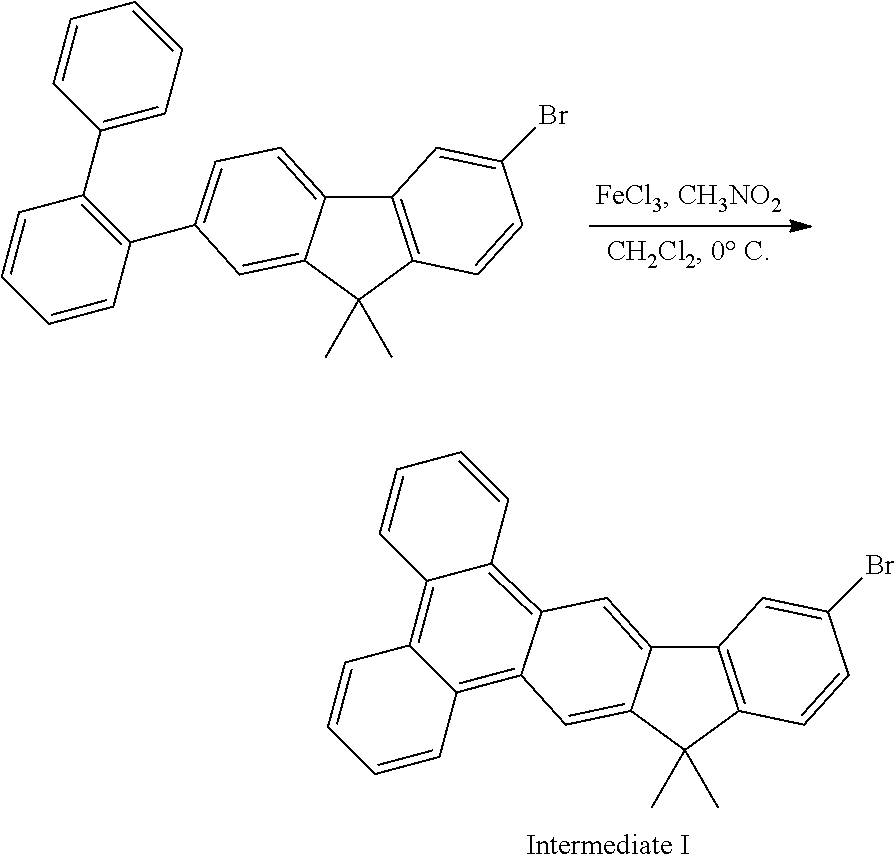
In a 3000 ml three-necked flask that had been degassed and filled with nitrogen, 26.8 g (60 mmol) of 2-(biphenyl-2-yl)-7-bromo-9,9-Dimethyl-9H-fluorene was dissolved in anhydrous dichloromethane (1500 ml), 97.5 g (600 mmol) iron (III) chloride was then added, and the mixture was stirred one hour. Methanol 500 ml were added to the mixture and the organic layer was separated and the solvent removed in vacuo. The residue was purified by column chromatography on silica (hexane-dichloromethane) afforded a white solid (10.7 g, 25.3 mmol, 40%). 1H NMR (CDCl3, 500 MHz): chemical shift (ppm) 8.93 (s, 1H), 8.77˜8.71 (m, 2H), 8.67˜8.65 (m, 3H), 8.08 (d, J=1.5 Hz, 1H), 7.71˜7.64 (m, 4H), 7.49 (dd, J1=8.5 Hz, J2=1.5 Hz, 1H), 7.37 (d, J=8.5 Hz, 1H), 1.62 (s, 6H).

A mixture of 14.4 g (61.9 mmol) of 3-bromobiphenyl, 19 g (75 mmol) of bis(pinacolato)diboron, 1.4 (1.2 mmol) of tetrakis(triphenylphosphine)palladium, 9.1 g (93 mmol) of potassium acetate, and 450 ml of 1,4-dioxane was degassed and placed under nitrogen, and then heated at 90° C. for 24 hours. After finishing the reaction, the mixture was allowed to cool to room temperature. The organic layer was extracted with ethyl acetate and water, dried with anhydrous magnesium sulfate, the solvent was removed and the product was purified by column using a mixture of hexanes and ethyl acetate as eluent to get 11.8 g of light white product (yield 68%).

A mixture of 4.28 g (10.1 mmol) of intermediate I, 3.4 g (12 mmol) of 2-(biphenyl-3-yl)-4,4,5,5-tetramethyl-1,3,2-dioxaborolane, 0.22 g (0.2 mmol) of tetrakis(triphenylphosphine)palladium, 15 ml of 2M Na2CO3, 20 ml of EtOH and 40 ml toluene was degassed and placed under nitrogen, and then heated at 90° C. overnight. After finishing the reaction, the mixture was allowed to cool to room temperature. The solution was extracted with 100 mL of ethyl acetate and 500 ml of water. The organic layer was dried with anhydrous magnesium sulfate and the solvent was evaporated under reduced pressure. The residue was purified by column chromatography on silica (Hx˜CH2Cl2) to give product 2.7 g (54%). MS (m/z, FAB+): 496.3; 1H NMR (CDCl3, 500 MHz): chemical shift (ppm) 9.09 (s, 1H), 8.85˜8.75 (m, 2H), 8.73 (s, 1H), 8.68˜8.66 (d, J=8.5 Hz, 2H), 8.13˜7.84 (m, 6H), 7.78˜7.63 (m, 4H), 7.56˜7.48 (m, 6H), 1.72 (s, 6H).

A mixture of 8.3 g (25 mmol) of 1,3-bis(4,4,5,5-tetramethyl-1,3,2-dioxaborolan-2-yl)benzene, 5.8 g (25 mmol) of 3-bromobiphenyl, 0.6 g (0.5 mmol) of tetrakis(triphenylphosphine)palladium, 20 ml of 2M Na2CO3, 20 ml of EtOH and 50 ml toluene was degassed and placed under nitrogen, and then heated at 75° C. overnight. After finishing the reaction, the mixture was allowed to cool to room temperature. The reaction mixture was extracted with ethyl acetate and water, dried with anhydrous magnesium sulfate, the solvent was evaporated in vacuum. The residue was purified by column using a mixture of hexanes and ethyl acetate as eluent to get 3.8 g of light white product (yield 43%).

4,4,5,5-tetramethyl-2-(3′-phenylbiphenyl-3-yl)-1,3,2-dioxa borolane instead of 2-(biphenyl-3-yl)-4,4,5,5-tetramethyl-1,3,2-dioxa borolane, except for using the same method as in synthesis example 1, the desired compound of example 2 (3.3 g, yield-54%) was obtained. MS (m/z, FAB+): 572.3; 1H NMR (CDCl3, 500 MHz): chemical shift (ppm) 9.03 (s, 1H), 8.87˜8.78 (m, 2H), 8.75 (s, 1H), 8.71˜8.69 (d, J=8.5 Hz, 2H), 8.15˜7.84 (m, 7H), 7.81˜7.61 (m, 5H), 7.55˜7.38 (m, 8H), 1.75 (s, 6H).

A mixture of 8.3 g (25 mmol) of 1,3-bis(4,4,5,5-tetramethyl-1,3,2-dioxaborolan-2-yl)benzene, 7 g (25 mmol) of 1-bromopyrene, 0.6 g (0.5 mmol) of tetrakis(triphenylphosphine)palladium, 20 ml of 2M Na2CO3, 20 ml of EtOH and 50 ml toluene was degassed and placed under nitrogen, and then heated at 75° C. overnight. After finishing the reaction, the mixture was allowed to cool to room temperature. The reaction mixture was extracted with ethyl acetate and water, dried with anhydrous magnesium sulfate, the solvent was evaporated in vacuum. The residue was purified by column using a mixture of hexanes and ethyl acetate as eluent to get 3.7 g of white product (yield 37%).

A mixture of 3.4 g (8 mmol) of intermediate I, 3.7 g (9.1 mmol) of 4,4,5,5-tetramethyl-2-(3-(pyren-1-yl)phenyl)-1,3,2-dioxaborolane, 0.2 g (0.17 mmol) of tetrakis(triphenylphosphine)palladium, 15 ml of 2M Na2CO3, 20 ml of EtOH and 40 ml toluene was degassed and placed under nitrogen, and then heated at 90° C. overnight. After finishing the reaction, the mixture was allowed to cool to room temperature. The solution was extracted with 100 mL of ethyl acetate and 500 ml of water. The organic layer was dried with anhydrous magnesium sulfate and the solvent was evaporated under reduced pressure. The residue was purified by column chromatography on silica (Hx˜CH2Cl2) to give product 3.1 g (63%). MS (m/z, FAB+): 620.8; 1 NMR CDCl3, 500 MHz): chemical shift (ppm) 9.09 (s, 1H), 8.85˜8.84 (d, 1H), 8.78˜8.76 (d, 1H), 8.71 (s, 1H), 8.69˜8.65 (d, J=8.5 Hz, 2H), 8.27˜8.19 (m, 5H), 8.12˜8.00 (m, 5H), 7.93˜7.92 (dd, J=8.5 Hz, 2H), 7.84˜7.61 (m, 8H) 1.73 (s, 6H).

4,4,5,5-tetramethyl-2-(4-(pyren-1-yl)phenyl)-1,3,2-dioxaborolane instead of 4,4,5,5-tetramethyl-2-(3-(pyren-1-yl)phenyl)-1,3,2-dioxaborolane, except for using the same method as in synthesis example 3, the desired compound of example 4 (2.2 g, yield=31%) was obtained. MS (m/z, FAB+): 620.8; 1H NMR (CDCl3, 500 MHz): chemical shift (ppm) 9.09 (s, 1H), 8.86˜8.84 (d, 1H), 8.79˜8.76 (d, 1H), 8.72 (s, 1H), 8.69˜8.66 (d, J=8.5 Hz, 2H), 8.31˜8.17 (m, 5H), 8.13˜8.00 (m, 5H), 7.95˜7.93 (dd, J=8.5 Hz, 2H), 7.79˜7.63 (m, 8H) 1.73 (s, 6H).

A mixture of 8.3 g (25 mmol) of 1,3-bis(4,4,5,5-tetramethyl-1,3,2-dioxaborolan-2-yl)benzene, 9.6 g (25 mmol) of 9-bromo-10-(naphthalen-2-yl)anthracene, 0.6 g (0.5 mmol) of tetrakis (triphenylphosphine)palladium, 20 ml of 2M Na2CO3, 20 ml of EtOH and 50 ml toluene was degassed and placed under nitrogen, and then heated at 75° C. overnight. After finishing the reaction, the mixture was allowed to cool to room temperature. The reaction mixture was extracted with ethyl acetate and water, dried with anhydrous magnesium sulfate, the solvent was evaporated in vacuum. The residue was purified by column using a mixture of hexanes and ethyl acetate as eluent to get 4.0 g of yellow product (yield 32%).

4,4,5,5-tetramethyl-2-(3-(10-(naphthalen-2-yl)anthracen-9-yl)phenyl)-1,3,2-dioxaborolane of 4,4,5,5-tetramethyl-2-(3-(pyren-1-yl)phenyl)-1,3,2-dioxaborolane, except for using the same method as in synthesis example 3, the desired compound of example 5 (3.3 g, yield-47%) was obtained. MS (m/z, FAB+): 722.5; 1H NMR (CDCl3, 500 MHz): chemical shift (ppm) 9.03 (s, 1H), 8.82˜8.79 (d, 1H), 8.76˜8.73 (d, 1H), 8.71 (s, 1H), 8.68˜8.64 (d, J=8.5 Hz, 2H), 8.31˜8.17 (m, 5H), 8.13˜7.91 (m, 7H), 7.85˜7.63 (m, 10H), 7.51˜7.47 (m, 4H) 1.73 (s, 6H).

10-(naphthalen-1-yl)anthracen-9-ylboronic acid instead of 4,4,5,5-tetramethyl-2-(3-(pyren-1-yl)phenyl)-1,3,2-dioxaborolane, except for using the same method as in synthesis example 3, the desired compound of example 6 (4.8 g, yield=69%) was obtained. MS (m/z, FAB+): 646.3; 1H NMR (CDCl3, 500 MHz): chemical shift (ppm) 9.04 (s, 1H), 8.84˜8.81 (d, 1H), 8.79˜8.76 (d, 1H), 8.73 (s, 1H), 8.67˜8.64 (d, J=8.5 Hz, 2H), 8.31˜8.17 (m, 5H), 8.13˜7.91 (m, 7H), 7.85˜7.63 (m, 8H), 7.51˜7.47 (m, 2H) 1.71 (s, 6H).
ITO-coated glasses with 9˜12 ohm/square in resistance and 120˜160 nm in thickness are provided (hereinafter ITO substrate) and cleaned in a number of cleaning steps in an ultrasonic bath (e.g. detergent, deionized water). Before vapor deposition of the organic layers, cleaned ITO substrates are further treated by UV and ozone. All pre-treatment processes for ITO substrate are under clean room (class 100).
These organic layers are applied onto the ITO substrate in order by vapor deposition in a high-vacuum unit (10−7 Torr), such as: resistively heated quartz boats. The thickness of the respective layer and the vapor deposition rate (0.1˜0.3 nm/sec) are precisely monitored or set with the aid of a quartz-crystal monitor. It is also possible, as described above, for individual layers to consist of more than one compound, i.e. in general a host material doped with a dopant material. This is achieved by co-vaporization from two or more sources.
Dipyrazino[2,3-f:2,3-]quinoxaline-2,3,6,7,10,11-hexacarbonitrile (HAT-CN) is used as hole injection layer in this organic EL device. N,N-Bis(naphthalene-1-yl)-N,N-bis(phenyl)-benzidine (NPB) is most widely used as the hole transporting layer. 10,10-Dimethyl-12-(4-(pyren-1-yl)phenyl)-10H-indeno[1,2-b]triphenylene(PT-312, US20140175384) or 10,10-dimethyl-12-(10-(naphthalen-2-yl)anthracen-9-yl)-10H-indeno[2,1-b]triphenylene (PT-3 13, US2040209866) is used as blue emitting host in organic EL device for comparison and N1,N1,N6,N6-tetram-tolylpyrene-1,6-diamine (D1) is used as blue guest. 2-(10,10-dimethyl-10H-indeno[2,1-b]triphenylen-13-yl)-9-phenyl-1,10-phenanthroline is used as electron transporting material (ET1) to co-deposit with 5% Li, 2-(10,10-dimethyl-10H-indeno[2,1-b]triphenylen-12-yl)-4,6-diphenyl-1,3,5-triazine (ET2), 2-(10,10-dimethyl-10H-indeno[2,1-b]triphenylen-13-yl)-4,6-bis 5-phenylbiphenyl-3-yl)-1,3,5-triazineto (ET3) or 2,9-di(naphthalen-2-yl)-4,7-diphenyl-1,10-phenanthroline (ET4) is used as electron transporting material to co-deposit with 8-hydroxyquinolato-lithium (LiQ) in organic EL device for comparison. Tris(2-phenylpyridinato)iridium(III) (D2) is used as phosphorescent dopant. 4-(10,10-dimethyl-10H-indeno[2,1-b]triphenylen-13-yl)dibenzo[b,d]thiophene (H1) is used as hole blocking material in organic phosphorescent EL device. The prior art of OLED materials for producing standard organic EL device control and comparable material in this invention shown its chemical structure as following:


A typical organic EL device consists of low work function metals, such as Al, Mg, Ca, Li and K, as the cathode by thermal evaporation, and the low work function metals can help electrons injecting the electron transporting layer from cathode. In addition, for reducing the electron injection barrier and improving the organic EL device performance, a thin-film electron injecting layer is introduced between the cathode and the electron transporting layer. Conventional materials of electron injecting layer are metal halide or metal oxide with low work function, such as: LiF, LiQ, MgO, or Li2O. On the other hand, after the organic EL device fabrication, EL spectra and CIE coordination are measured by using a PR650 spectra scan spectrometer. Furthermore, the current/voltage, luminescence/voltage and yield/voltage characteristics are taken with a Keithley 2400 programmable voltage-current source. The above-mentioned apparatuses are operated at room temperature (about 25° C.) and under atmospheric pressure.
Using a procedure analogous to the above mentioned general method, fluorescent blue-emitting organic EL device having the following device structure I and II was produced (See FIG. 1 ). Device I: ITO/HAT-CN (20 nm)/NPB (130 nm)/fluorescent host doped 5% D1 (30 nm)/ETM doped 5% Li (35 nm)/Al (160 nm). Device II: ITO/HAT-CN (20 nm)/NPB (130 nm)/fluorescent host doped 5% D1 (30 nm)/ETM co-deposit 50% LiQ (40 nm)/LiQ (1 nm)/Al (160 nm). The I-V-B (at 1000 nits) and half-life time of fluorescent blue-emitting organic EL device testing report as Table 1 and Table 2. The half-life time is defined that the initial luminance of 1000 cd/m2 has dropped to half.
| TABLE 1 | |||||
| Effi- | |||||
| Fluorescent | ETM doped | Voltage | ciency | Half- | |
| Host | |||||
| 5% Li | (V) | (cd/A) | CIE(y) | time (hour) | |
| PT-312 | ET1 | 5.0 | 3.3 | 0.172 | 330 |
| PT-313 | ET1 | 5.0 | 3.1 | 0.175 | 210 |
| A8 | ET1 | 4.8 | 3.6 | 0.172 | 230 |
| A10 | ET1 | 5.2 | 3.5 | 0.171 | 250 |
| A15 | ET1 | 4.5 | 4.3 | 0.173 | 380 |
| A16 | ET1 | 4.8 | 4.0 | 0.172 | 350 |
| A15 | ET4 | 5.1 | 2.4 | 0.172 | 180 |
| TABLE 2 | |||||
| Volt- | Effi- | ||||
| Fluorescent | ETM co-deposit | age | ciency | Half-life | |
| Host | 50% LiQ | (V) | (cd/A) | CIE(y) | time (hour) |
| PT-312 | ET3 | 5.0 | 4.8 | 0.181 | 360 |
| PT-313 | ET3 | 5.1 | 4.5 | 0.180 | 260 |
| A8 | ET3 | 4.8 | 5.0 | 0.181 | 280 |
| A10 | ET3 | 4.8 | 5.1 | 0.182 | 250 |
| A15 | ET3 | 4.5 | 5.2 | 0.179 | 380 |
| A16 | ET3 | 4.5 | 5.2 | 0.180 | 420 |
| A15 | ET2 | 4.3 | 5.0 | 0.181 | 400 |
| A16 | ET2 | 4.6 | 5.4 | 0.182 | 320 |
| A15 | ET4 | 5.8 | 4.2 | 0.180 | 110 |
Using a procedure analogous to the above mentioned general method, phosphorescent emitting organic EL device having the following device structures are produced (See FIG. 1 .): ITO/HAT-CN (20 nm)/NPB (130 nm)/phosphorescent host (PHhost)+12% D2 (30 nm)/H1 (15 nm)/ET2 co-deposit 50% Li (40 nm)/LiQ (1 nm)/Al (160 nm). The I-V-B (at 1000 nits) and half-life time of phosphorescent emitting organic EL device testing report as Table 3. The half-life time is defined that the initial luminance of 3000 cd/m2 has dropped to half.
| TABLE 3 | ||||||
| Effi- | ||||||
| Voltage | ciency | Half-life | ||||
| PHhost | HBM | ETM | (V) | (cd/A) | CIE(x, y) | time (hour) |
| A1 | H1 | ET3 | 4.5 | 39 | 0.35, 0.54 | 450 |
| A2 | H1 | ET3 | 4.2 | 43 | 0.36, 0.54 | 460 |
| A1 | H1 | ET2 | 4.0 | 38 | 0.36, 0.55 | 550 |
| A2 | H1 | ET2 | 4.3 | 42 | 0.35, 0.56 | 500 |
| A2 | H1 | ET4 | 5.0 | 28 | 0.36, 0.55 | 250 |
| A2 | — | ET2 | 4.3 | 38 | 0.34, 0.56 | 410 |
In the above preferred embodiments for organic EL device test report (see Table 1 to Table 3), we show that with a general formula (I) in the present invention display good performance and more purpose (A1,A2 is used for phosphorescent host) than the prior art of OLED materials US20140131664 A1, US20140175384A1 and US20140209866A1. More specifically, the organic EL device in the present invention to collocate with H1 (hole blocking layer) and ET1, ET2 or ET3 (electron transporting layer) shown lower power consumption, higher efficiency and longer half-life time than the prior art of OLED materials ET4.
To sum up, the present invention discloses a compound which can be used for organic EL device is disclosed. More specifically, an organic EL device employing the compound as fluorescent emitting host, phosphorescent emitting host. The mentioned compound are represented by the following formula (I)

Wherein L represent a single bond, a substituted or unsubstituted divalent arylene group having 6 to 30 ring carbon atoms. Ar1, Ar2 independently selected from the group consisting of a substituted or unsubstituted phenyl group, a substituted or unsubstituted naphthyl group, a substituted or unsubstituted anthracenyl group, a substituted or unsubstituted phenanthrenyl group, a substituted or unsubstituted pyrenyl group, a substituted or unsubstituted chrysenyl group. m represent an integer of 0 to 3. n represent an integer of 0 to 10. R1 to R4 independently selected from the group consisting of a hydrogen atom, a substituted or unsubstituted alkyl group having 1 to 20 carbon atoms, a substituted or unsubstituted aryl group having 6 to 30 carbon atoms, a substituted or unsubstituted aralkyl group having 6 to 30 carbon atoms, a substituted or unsubstituted heteroaryl group having 3 to 30 carbon atoms.
Claims (8)
1. A compound with one of the following formulas:


2. A compound comprising a general formula (I) as following:

wherein L represents a single bond, or a substituted or unsubstituted divalent arylene group having 6 to 30 ring carbon atoms, Ar1, Ar2 are independently selected from the group consisting of a substituted or unsubstituted phenyl group, a substituted or unsubstituted naphthyl group, a substituted or unsubstituted anthracenyl group, a substituted or unsubstituted phenanthrenyl group, a substituted or unsubstituted pyrenyl group, and a substituted or unsubstituted chrysenyl group, Ar1 is represented as the following:

and
Ar2 is represented as the following:

when L represents a substituted or unsubstituted divalent arylene group having 6 to 30 ring carbon atoms, L is represented as the following:

m represents an integer of 0 to 3, n represents an integer of 0 to 10, and R1 to R4 are independently selected from the group consisting of a hydrogen atom, a substituted or unsubstituted alkyl group having 1 to 20 carbon atoms, a substituted or unsubstituted aryl group having 6 to 30 carbon atoms, a substituted or unsubstituted aralkyl group having 6 to 30 carbon atoms, and a substituted or unsubstituted heteroaryl group having 3 to 30 carbon atoms.
3. A organic electroluminescent device comprising a pair of electrodes consisting of a cathode and an anode and between the pair of electrodes comprising at least an emitting layer of the compound with the general formula (I) according to claim 2 .
4. The organic electroluminescent device according to claim 3 , wherein the emitting layer comprises the compound with a general formula (I).
5. The organic electroluminescent device according to claim 4 , wherein the emitting layer comprising the compound with the general formula (I) is a fluorescent host material or phosphorescent host material.
6. The organic electroluminescent device according to claim 4 , wherein the emitting layer comprises fluorescent dopant or phosphorescent dopant.
7. The organic electroluminescent device according to claim 6 , wherein the phosphorescent dopant comprises iridium (Ir) complexes.
8. The organic electroluminescent device according to claim 4 , wherein the emitting layer comprises lithium or 8-hydroxyuinolinolato-lithium.
Priority Applications (4)
| Application Number | Priority Date | Filing Date | Title |
|---|---|---|---|
| US14/604,754 US10164194B2 (en) | 2015-01-26 | 2015-01-26 | Compound for organic electroluminescent device |
| US14/949,830 US10312451B2 (en) | 2015-01-26 | 2015-11-23 | Compound for organic electroluminescent device |
| TW104139842A TWI601710B (en) | 2015-01-26 | 2015-11-30 | Compound and organic electroluminescent device using the same |
| CN201510880399.1A CN105820027B (en) | 2015-01-26 | 2015-12-03 | Compound and organic electroluminescence device using same |
Applications Claiming Priority (1)
| Application Number | Priority Date | Filing Date | Title |
|---|---|---|---|
| US14/604,754 US10164194B2 (en) | 2015-01-26 | 2015-01-26 | Compound for organic electroluminescent device |
Related Child Applications (1)
| Application Number | Title | Priority Date | Filing Date |
|---|---|---|---|
| US14/949,830 Continuation-In-Part US10312451B2 (en) | 2015-01-26 | 2015-11-23 | Compound for organic electroluminescent device |
Publications (2)
| Publication Number | Publication Date |
|---|---|
| US20160218292A1 US20160218292A1 (en) | 2016-07-28 |
| US10164194B2 true US10164194B2 (en) | 2018-12-25 |
Family
ID=56432846
Family Applications (1)
| Application Number | Title | Priority Date | Filing Date |
|---|---|---|---|
| US14/604,754 Expired - Fee Related US10164194B2 (en) | 2015-01-26 | 2015-01-26 | Compound for organic electroluminescent device |
Country Status (3)
| Country | Link |
|---|---|
| US (1) | US10164194B2 (en) |
| CN (1) | CN105820027B (en) |
| TW (1) | TWI601710B (en) |
Families Citing this family (2)
| Publication number | Priority date | Publication date | Assignee | Title |
|---|---|---|---|---|
| US9537103B1 (en) * | 2015-08-14 | 2017-01-03 | Luminescence Technology Corporation | Material for organic electroluminescence device and organic electroluminescence device using the same |
| US10115905B2 (en) * | 2015-09-22 | 2018-10-30 | Feng-wen Yen | Organic compound for organic electroluminescence device and using the same |
Citations (35)
| Publication number | Priority date | Publication date | Assignee | Title |
|---|---|---|---|---|
| US20030071247A1 (en) * | 2000-12-29 | 2003-04-17 | Petrovskaia Olga G. | Novel indeno-fused photochromic naphthopyrans |
| US20070247063A1 (en) * | 2004-05-21 | 2007-10-25 | Toray Industries Inc. | Light-Emitting Device Material and Light-Emitting Device |
| US20080160347A1 (en) * | 2006-10-05 | 2008-07-03 | Guofang Wang | Benzofluorene compound, emission materials and organic electroluminescent device |
| US20090096356A1 (en) * | 2005-09-08 | 2009-04-16 | Seiichiro Murase | Light-emitting device material and light-emitting device |
| US20090284140A1 (en) * | 2008-05-16 | 2009-11-19 | Semiconductor Energy Laboratory Co., Ltd. | Triarylamine Derivative, Light-Emitting Substance, Light-Emitting Element, Light-Emitting Device, and Electronic Device |
| US20100032658A1 (en) * | 2008-07-14 | 2010-02-11 | Gracel Display Inc. | Novel organic electroluminescent compounds and organic electroluminescent device using the same |
| US20100066241A1 (en) * | 2008-06-25 | 2010-03-18 | Gracel Display Inc. | Novel organic electroluminescent compounds and organic electroluminescent device using the same |
| US20100301744A1 (en) * | 2009-05-29 | 2010-12-02 | Semiconductor Energy Laboratory Co., Ltd. | Fluorene derivative, light-emitting element, light-emitting device, electronic device, and lighting device |
| US20120001154A1 (en) * | 2010-06-30 | 2012-01-05 | Idemitsu Kosan Co., Ltd. | Aromatic amine derivative and organic electroluminescence device using the same |
| US20120001161A1 (en) * | 2009-03-30 | 2012-01-05 | Toray Industries, Inc. | Light emitting device material and light emitting device |
| KR20120072784A (en) * | 2010-12-24 | 2012-07-04 | 에스에프씨 주식회사 | Heterocyclic compounds and organic light-emitting diode including the same |
| WO2013009079A1 (en) * | 2011-07-11 | 2013-01-17 | 주식회사 두산 | Triphenylene-based compound and organic electroluminescent diode using same |
| US8431244B2 (en) * | 2007-05-28 | 2013-04-30 | Canon Kabushiki Kaisha | Indenochrysene derivative and organic light-emitting device using same |
| US8525158B2 (en) * | 2008-09-02 | 2013-09-03 | Doosan Corporation | Anthracene derivative and organic electroluminescence element using the same |
| US20130249968A1 (en) * | 2010-12-24 | 2013-09-26 | Canon Kabushiki Kaisha | Fused polycyclic compound and organic light emitting device using the same |
| JP2013232520A (en) | 2012-04-27 | 2013-11-14 | Udc Ireland Ltd | Organic electroluminescent element, compound and organic electroluminescent element material usable for the same, and light emitting device, display device and lighting device using said element |
| US20140001456A1 (en) * | 2011-11-22 | 2014-01-02 | Idemitsu Kosan Co., Ltd. | Aromatic heterocyclic derivative, material for organic eletroluminescent element, and organic electroluminescent element |
| CN103508835A (en) * | 2013-03-25 | 2014-01-15 | 颜丰文 | Indenobenzophenanthrene derivative and organic electroluminescent device using same |
| US20140131664A1 (en) * | 2012-11-12 | 2014-05-15 | Luminescence Technology Corporation | Indenotriphenylene derivatives and organic light emitting device using the same |
| US20140151645A1 (en) * | 2012-11-30 | 2014-06-05 | Feng-wen Yen | Fluorene compound and organic electroluminescent device using the same |
| US20140166988A1 (en) * | 2012-12-17 | 2014-06-19 | Luminescence Technology Corporation | Organic compound and organic electroluminescent device using the same |
| US20140175384A1 (en) * | 2012-12-26 | 2014-06-26 | Luminescence Technology Corporation | Material for organic electroluminescent device |
| US20140175383A1 (en) * | 2012-12-20 | 2014-06-26 | Luminescence Technology Corporation | Indenotriphenylene derivatives and organic light emitting device using the same |
| US20140197392A1 (en) * | 2011-06-28 | 2014-07-17 | Canon Kabushiki Kaisha | Triphenyleno-benzofuran compound and organic light emitting element including the same |
| US20140209866A1 (en) * | 2013-01-29 | 2014-07-31 | Luminescence Technology Corporation | Organic compound for organic electroluminescent device |
| US20140231754A1 (en) | 2013-02-20 | 2014-08-21 | Feng-wen Yen | Ditriphenylene derivative and organic electroluminescent device using the same |
| US20140275530A1 (en) * | 2011-10-20 | 2014-09-18 | Merck Patent Gmbh | Materials for organic electroluminescent devices |
| US20140364625A1 (en) * | 2012-01-16 | 2014-12-11 | Rohm And Haas Electronic Materials Korea Ltd. | Novel organic electroluminescent compounds and organic electroluminescent device using the same |
| US20140374717A1 (en) * | 2013-06-19 | 2014-12-25 | Samsung Display Co., Ltd. | Amine-based compound and organic light-emitting diode including the same |
| WO2015005559A1 (en) * | 2013-07-10 | 2015-01-15 | 제일모직 주식회사 | Organic composition, and organic optoelectronic element and display device |
| US20150162533A1 (en) * | 2013-12-09 | 2015-06-11 | Samsung Display Co., Ltd. | Material for organic electroluminescence device and organic electroluminescence device having the same |
| US9184396B2 (en) * | 2013-03-22 | 2015-11-10 | National Tsing Hua University | 6H-indeno[2,1-B]quinoline derivative and organic light emitting diode using the same |
| US9273002B2 (en) * | 2010-10-08 | 2016-03-01 | Idemitsu Kosan Co., Ltd. | Benzo[k]fluoranthene derivative and organic electroluminescence device containing the same |
| US20160218293A1 (en) * | 2015-01-26 | 2016-07-28 | Luminescence Technology Corporation | Compound for organic electroluminescent device |
| US20160240784A1 (en) * | 2015-02-17 | 2016-08-18 | Feng-wen Yen | Indenotriphenylene-based amine derivative for organic electroluminescent device |
Family Cites Families (1)
| Publication number | Priority date | Publication date | Assignee | Title |
|---|---|---|---|---|
| KR101061890B1 (en) * | 2002-12-19 | 2011-09-02 | 가부시키가이샤 한도오따이 에네루기 켄큐쇼 | Organic light emitting device, light emitting device using organic light emitting device and electric appliance using the light emitting device |
-
2015
- 2015-01-26 US US14/604,754 patent/US10164194B2/en not_active Expired - Fee Related
- 2015-11-30 TW TW104139842A patent/TWI601710B/en not_active IP Right Cessation
- 2015-12-03 CN CN201510880399.1A patent/CN105820027B/en not_active Expired - Fee Related
Patent Citations (43)
| Publication number | Priority date | Publication date | Assignee | Title |
|---|---|---|---|---|
| US20030071247A1 (en) * | 2000-12-29 | 2003-04-17 | Petrovskaia Olga G. | Novel indeno-fused photochromic naphthopyrans |
| US20120138907A1 (en) * | 2004-05-21 | 2012-06-07 | Toray Industries, Inc. | Light-emitting device material and light-emitting device |
| US20070247063A1 (en) * | 2004-05-21 | 2007-10-25 | Toray Industries Inc. | Light-Emitting Device Material and Light-Emitting Device |
| US20090096356A1 (en) * | 2005-09-08 | 2009-04-16 | Seiichiro Murase | Light-emitting device material and light-emitting device |
| US20080160347A1 (en) * | 2006-10-05 | 2008-07-03 | Guofang Wang | Benzofluorene compound, emission materials and organic electroluminescent device |
| US8431244B2 (en) * | 2007-05-28 | 2013-04-30 | Canon Kabushiki Kaisha | Indenochrysene derivative and organic light-emitting device using same |
| US20090284140A1 (en) * | 2008-05-16 | 2009-11-19 | Semiconductor Energy Laboratory Co., Ltd. | Triarylamine Derivative, Light-Emitting Substance, Light-Emitting Element, Light-Emitting Device, and Electronic Device |
| US20100066241A1 (en) * | 2008-06-25 | 2010-03-18 | Gracel Display Inc. | Novel organic electroluminescent compounds and organic electroluminescent device using the same |
| US20100032658A1 (en) * | 2008-07-14 | 2010-02-11 | Gracel Display Inc. | Novel organic electroluminescent compounds and organic electroluminescent device using the same |
| US8525158B2 (en) * | 2008-09-02 | 2013-09-03 | Doosan Corporation | Anthracene derivative and organic electroluminescence element using the same |
| US20120001161A1 (en) * | 2009-03-30 | 2012-01-05 | Toray Industries, Inc. | Light emitting device material and light emitting device |
| US20100301744A1 (en) * | 2009-05-29 | 2010-12-02 | Semiconductor Energy Laboratory Co., Ltd. | Fluorene derivative, light-emitting element, light-emitting device, electronic device, and lighting device |
| US9051239B2 (en) * | 2009-05-29 | 2015-06-09 | Semiconductor Energy Laboratory Co., Ltd. | Fluorene derivative, light-emitting element, light-emitting device, electronic device, and lighting device |
| US20120001154A1 (en) * | 2010-06-30 | 2012-01-05 | Idemitsu Kosan Co., Ltd. | Aromatic amine derivative and organic electroluminescence device using the same |
| US9273002B2 (en) * | 2010-10-08 | 2016-03-01 | Idemitsu Kosan Co., Ltd. | Benzo[k]fluoranthene derivative and organic electroluminescence device containing the same |
| US20130249968A1 (en) * | 2010-12-24 | 2013-09-26 | Canon Kabushiki Kaisha | Fused polycyclic compound and organic light emitting device using the same |
| KR20120072784A (en) * | 2010-12-24 | 2012-07-04 | 에스에프씨 주식회사 | Heterocyclic compounds and organic light-emitting diode including the same |
| US20140197392A1 (en) * | 2011-06-28 | 2014-07-17 | Canon Kabushiki Kaisha | Triphenyleno-benzofuran compound and organic light emitting element including the same |
| WO2013009079A1 (en) * | 2011-07-11 | 2013-01-17 | 주식회사 두산 | Triphenylene-based compound and organic electroluminescent diode using same |
| US20140275530A1 (en) * | 2011-10-20 | 2014-09-18 | Merck Patent Gmbh | Materials for organic electroluminescent devices |
| US20140001456A1 (en) * | 2011-11-22 | 2014-01-02 | Idemitsu Kosan Co., Ltd. | Aromatic heterocyclic derivative, material for organic eletroluminescent element, and organic electroluminescent element |
| US20140364625A1 (en) * | 2012-01-16 | 2014-12-11 | Rohm And Haas Electronic Materials Korea Ltd. | Novel organic electroluminescent compounds and organic electroluminescent device using the same |
| JP2013232520A (en) | 2012-04-27 | 2013-11-14 | Udc Ireland Ltd | Organic electroluminescent element, compound and organic electroluminescent element material usable for the same, and light emitting device, display device and lighting device using said element |
| US20140131664A1 (en) * | 2012-11-12 | 2014-05-15 | Luminescence Technology Corporation | Indenotriphenylene derivatives and organic light emitting device using the same |
| US9260363B2 (en) * | 2012-11-12 | 2016-02-16 | Luminescence Technology Corporation | Indenotriphenylene derivatives and organic light emitting device using the same |
| US20140151645A1 (en) * | 2012-11-30 | 2014-06-05 | Feng-wen Yen | Fluorene compound and organic electroluminescent device using the same |
| US9040174B2 (en) * | 2012-11-30 | 2015-05-26 | Feng-wen Yen | Fluorene compound and organic electroluminescent device using the same |
| US8993130B2 (en) * | 2012-12-17 | 2015-03-31 | Feng-wen Yen | Organic compound and organic electroluminescent device using the same |
| US20140166988A1 (en) * | 2012-12-17 | 2014-06-19 | Luminescence Technology Corporation | Organic compound and organic electroluminescent device using the same |
| US20140175383A1 (en) * | 2012-12-20 | 2014-06-26 | Luminescence Technology Corporation | Indenotriphenylene derivatives and organic light emitting device using the same |
| US20140175384A1 (en) * | 2012-12-26 | 2014-06-26 | Luminescence Technology Corporation | Material for organic electroluminescent device |
| US8962160B2 (en) * | 2012-12-26 | 2015-02-24 | Feng-Wen Yen | Material for organic electroluminescent device |
| US9048437B2 (en) * | 2013-01-29 | 2015-06-02 | Luminescence Technology Corporation | Organic compound for organic electroluminescent device |
| US20140209866A1 (en) * | 2013-01-29 | 2014-07-31 | Luminescence Technology Corporation | Organic compound for organic electroluminescent device |
| US20140231754A1 (en) | 2013-02-20 | 2014-08-21 | Feng-wen Yen | Ditriphenylene derivative and organic electroluminescent device using the same |
| US9184396B2 (en) * | 2013-03-22 | 2015-11-10 | National Tsing Hua University | 6H-indeno[2,1-B]quinoline derivative and organic light emitting diode using the same |
| CN103508835A (en) * | 2013-03-25 | 2014-01-15 | 颜丰文 | Indenobenzophenanthrene derivative and organic electroluminescent device using same |
| US20140374717A1 (en) * | 2013-06-19 | 2014-12-25 | Samsung Display Co., Ltd. | Amine-based compound and organic light-emitting diode including the same |
| WO2015005559A1 (en) * | 2013-07-10 | 2015-01-15 | 제일모직 주식회사 | Organic composition, and organic optoelectronic element and display device |
| US20160072073A1 (en) * | 2013-07-10 | 2016-03-10 | Samsung Sdi Co., Ltd. | Organic composition, and organic optoelectronic element and display device |
| US20150162533A1 (en) * | 2013-12-09 | 2015-06-11 | Samsung Display Co., Ltd. | Material for organic electroluminescence device and organic electroluminescence device having the same |
| US20160218293A1 (en) * | 2015-01-26 | 2016-07-28 | Luminescence Technology Corporation | Compound for organic electroluminescent device |
| US20160240784A1 (en) * | 2015-02-17 | 2016-08-18 | Feng-wen Yen | Indenotriphenylene-based amine derivative for organic electroluminescent device |
Also Published As
| Publication number | Publication date |
|---|---|
| TWI601710B (en) | 2017-10-11 |
| CN105820027B (en) | 2018-12-04 |
| US20160218292A1 (en) | 2016-07-28 |
| CN105820027A (en) | 2016-08-03 |
| TW201627261A (en) | 2016-08-01 |
Similar Documents
| Publication | Publication Date | Title |
|---|---|---|
| US9812649B2 (en) | Indenotriphenylene-based amine derivative for organic electroluminescent device | |
| US9190619B2 (en) | Compound for organic electroluminescence device | |
| US9698351B2 (en) | Organic material for electroluminescent device | |
| US9893305B2 (en) | Indenotriphenylene-based iridium complexes for organic electroluminescence device | |
| US9905772B2 (en) | Material for organic electroluminescence device and use thereof | |
| EP3042944B1 (en) | Compound for organic electroluminescent device | |
| US9793493B2 (en) | Organic material and organic electroluminescent device using the same | |
| US10079347B2 (en) | Compounds for organic electroluminescence device | |
| US20160380207A1 (en) | Triphenylene-based fused biscarbazole derivative and use thereof | |
| US9698357B2 (en) | Phenanthroline-based compound and use thereof | |
| US10056561B2 (en) | Organic material and organic electroluminescent device using the same | |
| US10686146B2 (en) | Paracyclophane-based iridium complexes for organic electroluminescence device | |
| US9831444B1 (en) | Phenanthroline-based compound for organic electroluminescence device | |
| US10807972B2 (en) | Indenotriphenylene-based amine derivative and organic electroluminescence device using the same | |
| US10014478B2 (en) | Indenotriphenylene-based diamine derivative and organic electroluminescence device using the same | |
| US10418567B2 (en) | Organic compound for organic EL device and using the same | |
| US9911922B2 (en) | Organic compound for electroluminescence device | |
| US9929351B2 (en) | Indenotriphenylene-based amine derivative for organic electroluminescent device | |
| US20180166640A1 (en) | Organic compound for organic el device and using the same | |
| US10312451B2 (en) | Compound for organic electroluminescent device | |
| US9537103B1 (en) | Material for organic electroluminescence device and organic electroluminescence device using the same | |
| US10164194B2 (en) | Compound for organic electroluminescent device | |
| US9768390B2 (en) | Phenanthroline derivative for organic electroluminescent device | |
| US9692003B2 (en) | Phenanthroline derivative and use thereof |
Legal Events
| Date | Code | Title | Description |
|---|---|---|---|
| STCF | Information on status: patent grant |
Free format text: PATENTED CASE |
|
| FEPP | Fee payment procedure |
Free format text: MAINTENANCE FEE REMINDER MAILED (ORIGINAL EVENT CODE: REM.); ENTITY STATUS OF PATENT OWNER: SMALL ENTITY |
|
| LAPS | Lapse for failure to pay maintenance fees |
Free format text: PATENT EXPIRED FOR FAILURE TO PAY MAINTENANCE FEES (ORIGINAL EVENT CODE: EXP.); ENTITY STATUS OF PATENT OWNER: SMALL ENTITY |
|
| STCH | Information on status: patent discontinuation |
Free format text: PATENT EXPIRED DUE TO NONPAYMENT OF MAINTENANCE FEES UNDER 37 CFR 1.362 |
|
| FP | Lapsed due to failure to pay maintenance fee |
Effective date: 20221225 |