US10160838B2 - Crosslinking materials from biorenewable aconitic acid - Google Patents
Crosslinking materials from biorenewable aconitic acid Download PDFInfo
- Publication number
- US10160838B2 US10160838B2 US15/470,279 US201715470279A US10160838B2 US 10160838 B2 US10160838 B2 US 10160838B2 US 201715470279 A US201715470279 A US 201715470279A US 10160838 B2 US10160838 B2 US 10160838B2
- Authority
- US
- United States
- Prior art keywords
- bio
- groups
- aconitic acid
- derived
- derived crosslinking
- Prior art date
- Legal status (The legal status is an assumption and is not a legal conclusion. Google has not performed a legal analysis and makes no representation as to the accuracy of the status listed.)
- Active, expires
Links
- 239000000463 material Substances 0.000 title claims abstract description 405
- 238000004132 cross linking Methods 0.000 title claims abstract description 266
- GTZCVFVGUGFEME-UHFFFAOYSA-N trans-aconitic acid Natural products OC(=O)CC(C(O)=O)=CC(O)=O GTZCVFVGUGFEME-UHFFFAOYSA-N 0.000 title claims abstract description 102
- GTZCVFVGUGFEME-IWQZZHSRSA-N cis-aconitic acid Chemical compound OC(=O)C\C(C(O)=O)=C\C(O)=O GTZCVFVGUGFEME-IWQZZHSRSA-N 0.000 title claims abstract description 91
- 239000001124 (E)-prop-1-ene-1,2,3-tricarboxylic acid Substances 0.000 title claims abstract description 41
- 229940091181 aconitic acid Drugs 0.000 title claims abstract description 41
- 238000006243 chemical reaction Methods 0.000 claims abstract description 164
- 238000000034 method Methods 0.000 claims abstract description 142
- 125000002843 carboxylic acid group Chemical group 0.000 claims abstract description 4
- 230000000977 initiatory effect Effects 0.000 claims abstract description 4
- 239000004205 dimethyl polysiloxane Substances 0.000 claims description 134
- 229920000435 poly(dimethylsiloxane) Polymers 0.000 claims description 134
- GTZCVFVGUGFEME-HNQUOIGGSA-N trans-aconitic acid Chemical class OC(=O)C\C(C(O)=O)=C/C(O)=O GTZCVFVGUGFEME-HNQUOIGGSA-N 0.000 claims description 78
- QTBSBXVTEAMEQO-UHFFFAOYSA-N Acetic acid Chemical group CC(O)=O QTBSBXVTEAMEQO-UHFFFAOYSA-N 0.000 claims description 77
- 125000003396 thiol group Chemical group [H]S* 0.000 claims description 75
- 125000000391 vinyl group Chemical group [H]C([*])=C([H])[H] 0.000 claims description 44
- NIXOWILDQLNWCW-UHFFFAOYSA-M acrylate group Chemical group C(C=C)(=O)[O-] NIXOWILDQLNWCW-UHFFFAOYSA-M 0.000 claims description 22
- 125000002887 hydroxy group Chemical group [H]O* 0.000 claims description 21
- 238000013005 condensation curing Methods 0.000 claims description 20
- 239000000203 mixture Substances 0.000 claims description 13
- -1 polydimethylsiloxane Polymers 0.000 claims description 11
- 238000006722 reduction reaction Methods 0.000 claims 3
- 125000000524 functional group Chemical group 0.000 abstract description 13
- 239000003054 catalyst Substances 0.000 description 56
- 229920000642 polymer Polymers 0.000 description 53
- 239000004971 Cross linker Substances 0.000 description 42
- 238000010586 diagram Methods 0.000 description 40
- BASFCYQUMIYNBI-UHFFFAOYSA-N platinum Chemical compound [Pt] BASFCYQUMIYNBI-UHFFFAOYSA-N 0.000 description 39
- 150000003573 thiols Chemical class 0.000 description 30
- 238000001723 curing Methods 0.000 description 25
- OXBLVCZKDOZZOJ-UHFFFAOYSA-N 2,3-Dihydrothiophene Chemical compound C1CC=CS1 OXBLVCZKDOZZOJ-UHFFFAOYSA-N 0.000 description 24
- WFDIJRYMOXRFFG-UHFFFAOYSA-N acetic acid anhydride Natural products CC(=O)OC(C)=O WFDIJRYMOXRFFG-UHFFFAOYSA-N 0.000 description 22
- 238000007259 addition reaction Methods 0.000 description 17
- 229910052697 platinum Inorganic materials 0.000 description 17
- CSNNHWWHGAXBCP-UHFFFAOYSA-L Magnesium sulfate Chemical compound [Mg+2].[O-][S+2]([O-])([O-])[O-] CSNNHWWHGAXBCP-UHFFFAOYSA-L 0.000 description 14
- ATJFFYVFTNAWJD-UHFFFAOYSA-N Tin Chemical compound [Sn] ATJFFYVFTNAWJD-UHFFFAOYSA-N 0.000 description 14
- 238000011068 loading method Methods 0.000 description 14
- ZMANZCXQSJIPKH-UHFFFAOYSA-N Triethylamine Chemical compound CCN(CC)CC ZMANZCXQSJIPKH-UHFFFAOYSA-N 0.000 description 12
- SMZOUWXMTYCWNB-UHFFFAOYSA-N 2-(2-methoxy-5-methylphenyl)ethanamine Chemical compound COC1=CC=C(C)C=C1CCN SMZOUWXMTYCWNB-UHFFFAOYSA-N 0.000 description 11
- NIXOWILDQLNWCW-UHFFFAOYSA-N 2-Propenoic acid Natural products OC(=O)C=C NIXOWILDQLNWCW-UHFFFAOYSA-N 0.000 description 11
- 239000012044 organic layer Substances 0.000 description 10
- 238000006467 substitution reaction Methods 0.000 description 10
- XLYOFNOQVPJJNP-UHFFFAOYSA-N water Chemical compound O XLYOFNOQVPJJNP-UHFFFAOYSA-N 0.000 description 10
- RTZKZFJDLAIYFH-UHFFFAOYSA-N Diethyl ether Chemical compound CCOCC RTZKZFJDLAIYFH-UHFFFAOYSA-N 0.000 description 9
- NBIIXXVUZAFLBC-UHFFFAOYSA-N Phosphoric acid Chemical compound OP(O)(O)=O NBIIXXVUZAFLBC-UHFFFAOYSA-N 0.000 description 9
- QAOWNCQODCNURD-UHFFFAOYSA-N Sulfuric acid Chemical compound OS(O)(=O)=O QAOWNCQODCNURD-UHFFFAOYSA-N 0.000 description 9
- YXFVVABEGXRONW-UHFFFAOYSA-N Toluene Chemical compound CC1=CC=CC=C1 YXFVVABEGXRONW-UHFFFAOYSA-N 0.000 description 9
- BHELZAPQIKSEDF-UHFFFAOYSA-N allyl bromide Chemical compound BrCC=C BHELZAPQIKSEDF-UHFFFAOYSA-N 0.000 description 9
- JUJWROOIHBZHMG-UHFFFAOYSA-N Pyridine Chemical compound C1=CC=NC=C1 JUJWROOIHBZHMG-UHFFFAOYSA-N 0.000 description 8
- WYURNTSHIVDZCO-UHFFFAOYSA-N Tetrahydrofuran Chemical compound C1CCOC1 WYURNTSHIVDZCO-UHFFFAOYSA-N 0.000 description 8
- XXROGKLTLUQVRX-UHFFFAOYSA-N allyl alcohol Chemical compound OCC=C XXROGKLTLUQVRX-UHFFFAOYSA-N 0.000 description 8
- 239000002904 solvent Substances 0.000 description 8
- 229910052943 magnesium sulfate Inorganic materials 0.000 description 7
- VJIKFWJCVWFZIN-UHFFFAOYSA-N 2-ethylsulfanylacetic acid Chemical compound CCSCC(O)=O VJIKFWJCVWFZIN-UHFFFAOYSA-N 0.000 description 6
- 239000002253 acid Substances 0.000 description 6
- 239000002585 base Substances 0.000 description 6
- 238000006482 condensation reaction Methods 0.000 description 6
- KPUWHANPEXNPJT-UHFFFAOYSA-N disiloxane Chemical class [SiH3]O[SiH3] KPUWHANPEXNPJT-UHFFFAOYSA-N 0.000 description 6
- 239000012280 lithium aluminium hydride Substances 0.000 description 6
- PSHKMPUSSFXUIA-UHFFFAOYSA-N n,n-dimethylpyridin-2-amine Chemical compound CN(C)C1=CC=CC=N1 PSHKMPUSSFXUIA-UHFFFAOYSA-N 0.000 description 6
- 0 *CCC(OC(CC(C(OC(CCN)=O)=O)=CC(OC(CC*)=O)=O)=O)=O Chemical compound *CCC(OC(CC(C(OC(CCN)=O)=O)=CC(OC(CC*)=O)=O)=O)=O 0.000 description 5
- ZMXDDKWLCZADIW-UHFFFAOYSA-N N,N-Dimethylformamide Chemical compound CN(C)C=O ZMXDDKWLCZADIW-UHFFFAOYSA-N 0.000 description 5
- 239000000243 solution Substances 0.000 description 5
- CYNYIHKIEHGYOZ-UHFFFAOYSA-N 1-bromopropane Chemical compound CCCBr CYNYIHKIEHGYOZ-UHFFFAOYSA-N 0.000 description 4
- GQHTUMJGOHRCHB-UHFFFAOYSA-N 2,3,4,6,7,8,9,10-octahydropyrimido[1,2-a]azepine Chemical compound C1CCCCN2CCCN=C21 GQHTUMJGOHRCHB-UHFFFAOYSA-N 0.000 description 4
- QTBSBXVTEAMEQO-UHFFFAOYSA-M Acetate Chemical compound CC([O-])=O QTBSBXVTEAMEQO-UHFFFAOYSA-M 0.000 description 4
- 238000005917 acylation reaction Methods 0.000 description 4
- 150000001412 amines Chemical class 0.000 description 4
- 239000003999 initiator Substances 0.000 description 4
- 235000019341 magnesium sulphate Nutrition 0.000 description 4
- 125000006239 protecting group Chemical group 0.000 description 4
- UMJSCPRVCHMLSP-UHFFFAOYSA-N pyridine Natural products COC1=CC=CN=C1 UMJSCPRVCHMLSP-UHFFFAOYSA-N 0.000 description 4
- 239000011541 reaction mixture Substances 0.000 description 4
- YLQBMQCUIZJEEH-UHFFFAOYSA-N tetrahydrofuran Natural products C=1C=COC=1 YLQBMQCUIZJEEH-UHFFFAOYSA-N 0.000 description 4
- JOXIMZWYDAKGHI-UHFFFAOYSA-N toluene-4-sulfonic acid Chemical compound CC1=CC=C(S(O)(=O)=O)C=C1 JOXIMZWYDAKGHI-UHFFFAOYSA-N 0.000 description 4
- 239000002879 Lewis base Substances 0.000 description 3
- HEMHJVSKTPXQMS-UHFFFAOYSA-M Sodium hydroxide Chemical compound [OH-].[Na+] HEMHJVSKTPXQMS-UHFFFAOYSA-M 0.000 description 3
- 229910000147 aluminium phosphate Inorganic materials 0.000 description 3
- 238000010533 azeotropic distillation Methods 0.000 description 3
- 239000012267 brine Substances 0.000 description 3
- KRKNYBCHXYNGOX-UHFFFAOYSA-N citric acid Chemical compound OC(=O)CC(O)(C(O)=O)CC(O)=O KRKNYBCHXYNGOX-UHFFFAOYSA-N 0.000 description 3
- 238000004440 column chromatography Methods 0.000 description 3
- 238000004821 distillation Methods 0.000 description 3
- 239000010410 layer Substances 0.000 description 3
- 150000007527 lewis bases Chemical class 0.000 description 3
- 150000003008 phosphonic acid esters Chemical class 0.000 description 3
- 238000010992 reflux Methods 0.000 description 3
- HPALAKNZSZLMCH-UHFFFAOYSA-M sodium;chloride;hydrate Chemical compound O.[Na+].[Cl-] HPALAKNZSZLMCH-UHFFFAOYSA-M 0.000 description 3
- 239000000758 substrate Substances 0.000 description 3
- 150000003460 sulfonic acids Chemical class 0.000 description 3
- XOLBLPGZBRYERU-UHFFFAOYSA-N tin dioxide Chemical class O=[Sn]=O XOLBLPGZBRYERU-UHFFFAOYSA-N 0.000 description 3
- LMVRUEOCXIABRQ-XVNBXDOJSA-N CC/C=C(/CO)CCO Chemical compound CC/C=C(/CO)CCO LMVRUEOCXIABRQ-XVNBXDOJSA-N 0.000 description 2
- TZKYEPAGFMYZGA-QPJJXVBHSA-N CCC/C(=C\CO)CO Chemical compound CCC/C(=C\CO)CO TZKYEPAGFMYZGA-QPJJXVBHSA-N 0.000 description 2
- LFQSCWFLJHTTHZ-UHFFFAOYSA-N Ethanol Chemical compound CCO LFQSCWFLJHTTHZ-UHFFFAOYSA-N 0.000 description 2
- 229910002621 H2PtCl6 Inorganic materials 0.000 description 2
- 239000004698 Polyethylene Substances 0.000 description 2
- 239000004743 Polypropylene Substances 0.000 description 2
- XUIMIQQOPSSXEZ-UHFFFAOYSA-N Silicon Chemical compound [Si] XUIMIQQOPSSXEZ-UHFFFAOYSA-N 0.000 description 2
- DTQVDTLACAAQTR-UHFFFAOYSA-N Trifluoroacetic acid Chemical compound OC(=O)C(F)(F)F DTQVDTLACAAQTR-UHFFFAOYSA-N 0.000 description 2
- UKLDJPRMSDWDSL-UHFFFAOYSA-L [dibutyl(dodecanoyloxy)stannyl] dodecanoate Chemical compound CCCCCCCCCCCC(=O)O[Sn](CCCC)(CCCC)OC(=O)CCCCCCCCCCC UKLDJPRMSDWDSL-UHFFFAOYSA-L 0.000 description 2
- WETWJCDKMRHUPV-UHFFFAOYSA-N acetyl chloride Chemical compound CC(Cl)=O WETWJCDKMRHUPV-UHFFFAOYSA-N 0.000 description 2
- 239000012346 acetyl chloride Substances 0.000 description 2
- HFBMWMNUJJDEQZ-UHFFFAOYSA-N acryloyl chloride Chemical compound ClC(=O)C=C HFBMWMNUJJDEQZ-UHFFFAOYSA-N 0.000 description 2
- 238000013006 addition curing Methods 0.000 description 2
- RWCCWEUUXYIKHB-UHFFFAOYSA-N benzophenone Chemical compound C=1C=CC=CC=1C(=O)C1=CC=CC=C1 RWCCWEUUXYIKHB-UHFFFAOYSA-N 0.000 description 2
- 239000012965 benzophenone Substances 0.000 description 2
- 150000001732 carboxylic acid derivatives Chemical class 0.000 description 2
- 230000003197 catalytic effect Effects 0.000 description 2
- 239000012975 dibutyltin dilaurate Substances 0.000 description 2
- 230000026030 halogenation Effects 0.000 description 2
- 238000005658 halogenation reaction Methods 0.000 description 2
- 238000006459 hydrosilylation reaction Methods 0.000 description 2
- 150000002576 ketones Chemical class 0.000 description 2
- 239000003960 organic solvent Substances 0.000 description 2
- 229920000573 polyethylene Polymers 0.000 description 2
- 229920001155 polypropylene Polymers 0.000 description 2
- BWHMMNNQKKPAPP-UHFFFAOYSA-L potassium carbonate Chemical compound [K+].[K+].[O-]C([O-])=O BWHMMNNQKKPAPP-UHFFFAOYSA-L 0.000 description 2
- 229910052710 silicon Inorganic materials 0.000 description 2
- 239000010703 silicon Substances 0.000 description 2
- 239000000725 suspension Substances 0.000 description 2
- RIOQSEWOXXDEQQ-UHFFFAOYSA-N triphenylphosphine Chemical compound C1=CC=CC=C1P(C=1C=CC=CC=1)C1=CC=CC=C1 RIOQSEWOXXDEQQ-UHFFFAOYSA-N 0.000 description 2
- OPWXOSDGXNFVNM-LZCJLJQNSA-N (E)-3-(hydroxymethyl)pent-2-ene-1,5-diol Chemical compound OC/C(=C/CO)/CCO OPWXOSDGXNFVNM-LZCJLJQNSA-N 0.000 description 1
- OPWXOSDGXNFVNM-BHQIHCQQSA-N (z)-3-(hydroxymethyl)pent-2-ene-1,5-diol Chemical compound OCC\C(CO)=C\CO OPWXOSDGXNFVNM-BHQIHCQQSA-N 0.000 description 1
- DKIDEFUBRARXTE-UHFFFAOYSA-N 3-mercaptopropanoic acid Chemical compound OC(=O)CCS DKIDEFUBRARXTE-UHFFFAOYSA-N 0.000 description 1
- GBUAWAUWSLQGCG-UHFFFAOYSA-P CC(C)([N+](C)(C)C(C)(C)O[N+](C)(C)CCC(OCC=C(CCOC(CC[NH3+])=O)COC(CC[NH3+])=O)=O)O[N+](C)(C)C Chemical compound CC(C)([N+](C)(C)C(C)(C)O[N+](C)(C)CCC(OCC=C(CCOC(CC[NH3+])=O)COC(CC[NH3+])=O)=O)O[N+](C)(C)C GBUAWAUWSLQGCG-UHFFFAOYSA-P 0.000 description 1
- OWPHWRVDKPPPOC-UHFFFAOYSA-N CCC(C)([N](C)(C)C(C)(C)O[N](C)(C)C)O[N](C)(C)C=C Chemical compound CCC(C)([N](C)(C)C(C)(C)O[N](C)(C)C)O[N](C)(C)C=C OWPHWRVDKPPPOC-UHFFFAOYSA-N 0.000 description 1
- UBVLDWIZWWWIJF-GXDHUFHOSA-N NCCCOCC(C=O)/C(/C(OCCCN)=O)=C\C(O)OCCCN Chemical compound NCCCOCC(C=O)/C(/C(OCCCN)=O)=C\C(O)OCCCN UBVLDWIZWWWIJF-GXDHUFHOSA-N 0.000 description 1
- WWNDGAAPVBZSRO-OUKQBFOZSA-N NCCCOCC/C(/C(OCCCN)=O)=C\C(OCCCN)=O Chemical compound NCCCOCC/C(/C(OCCCN)=O)=C\C(OCCCN)=O WWNDGAAPVBZSRO-OUKQBFOZSA-N 0.000 description 1
- 240000000111 Saccharum officinarum Species 0.000 description 1
- 235000007201 Saccharum officinarum Nutrition 0.000 description 1
- KEAYESYHFKHZAL-UHFFFAOYSA-N Sodium Chemical compound [Na] KEAYESYHFKHZAL-UHFFFAOYSA-N 0.000 description 1
- 229920006397 acrylic thermoplastic Polymers 0.000 description 1
- 239000008346 aqueous phase Substances 0.000 description 1
- 239000012298 atmosphere Substances 0.000 description 1
- 125000003178 carboxy group Chemical group [H]OC(*)=O 0.000 description 1
- 239000011248 coating agent Substances 0.000 description 1
- 238000000576 coating method Methods 0.000 description 1
- 229920006037 cross link polymer Polymers 0.000 description 1
- 239000003431 cross linking reagent Substances 0.000 description 1
- 239000008367 deionised water Substances 0.000 description 1
- 229910021641 deionized water Inorganic materials 0.000 description 1
- 230000007717 exclusion Effects 0.000 description 1
- 238000000605 extraction Methods 0.000 description 1
- 239000000314 lubricant Substances 0.000 description 1
- 230000004048 modification Effects 0.000 description 1
- 238000012986 modification Methods 0.000 description 1
- 150000007524 organic acids Chemical class 0.000 description 1
- 229920003229 poly(methyl methacrylate) Polymers 0.000 description 1
- 239000004417 polycarbonate Substances 0.000 description 1
- 229920000515 polycarbonate Polymers 0.000 description 1
- 239000004814 polyurethane Substances 0.000 description 1
- 229910000027 potassium carbonate Inorganic materials 0.000 description 1
- 150000003839 salts Chemical class 0.000 description 1
- 239000002453 shampoo Substances 0.000 description 1
- 239000012312 sodium hydride Substances 0.000 description 1
- 229910000104 sodium hydride Inorganic materials 0.000 description 1
- 238000002174 soft lithography Methods 0.000 description 1
- 238000003756 stirring Methods 0.000 description 1
- ISXSCDLOGDJUNJ-UHFFFAOYSA-N tert-butyl prop-2-enoate Chemical compound CC(C)(C)OC(=O)C=C ISXSCDLOGDJUNJ-UHFFFAOYSA-N 0.000 description 1
- ITMCEJHCFYSIIV-UHFFFAOYSA-N triflic acid Chemical compound OS(=O)(=O)C(F)(F)F ITMCEJHCFYSIIV-UHFFFAOYSA-N 0.000 description 1
- 238000010626 work up procedure Methods 0.000 description 1
Images


Classifications
-
- C—CHEMISTRY; METALLURGY
- C08—ORGANIC MACROMOLECULAR COMPOUNDS; THEIR PREPARATION OR CHEMICAL WORKING-UP; COMPOSITIONS BASED THEREON
- C08J—WORKING-UP; GENERAL PROCESSES OF COMPOUNDING; AFTER-TREATMENT NOT COVERED BY SUBCLASSES C08B, C08C, C08F, C08G or C08H
- C08J3/00—Processes of treating or compounding macromolecular substances
- C08J3/24—Crosslinking, e.g. vulcanising, of macromolecules
-
- C—CHEMISTRY; METALLURGY
- C07—ORGANIC CHEMISTRY
- C07C—ACYCLIC OR CARBOCYCLIC COMPOUNDS
- C07C29/00—Preparation of compounds having hydroxy or O-metal groups bound to a carbon atom not belonging to a six-membered aromatic ring
- C07C29/132—Preparation of compounds having hydroxy or O-metal groups bound to a carbon atom not belonging to a six-membered aromatic ring by reduction of an oxygen containing functional group
- C07C29/136—Preparation of compounds having hydroxy or O-metal groups bound to a carbon atom not belonging to a six-membered aromatic ring by reduction of an oxygen containing functional group of >C=O containing groups, e.g. —COOH
- C07C29/147—Preparation of compounds having hydroxy or O-metal groups bound to a carbon atom not belonging to a six-membered aromatic ring by reduction of an oxygen containing functional group of >C=O containing groups, e.g. —COOH of carboxylic acids or derivatives thereof
-
- C—CHEMISTRY; METALLURGY
- C07—ORGANIC CHEMISTRY
- C07C—ACYCLIC OR CARBOCYCLIC COMPOUNDS
- C07C319/00—Preparation of thiols, sulfides, hydropolysulfides or polysulfides
- C07C319/02—Preparation of thiols, sulfides, hydropolysulfides or polysulfides of thiols
- C07C319/12—Preparation of thiols, sulfides, hydropolysulfides or polysulfides of thiols by reactions not involving the formation of mercapto groups
-
- C—CHEMISTRY; METALLURGY
- C07—ORGANIC CHEMISTRY
- C07C—ACYCLIC OR CARBOCYCLIC COMPOUNDS
- C07C319/00—Preparation of thiols, sulfides, hydropolysulfides or polysulfides
- C07C319/22—Preparation of thiols, sulfides, hydropolysulfides or polysulfides of hydropolysulfides or polysulfides
- C07C319/24—Preparation of thiols, sulfides, hydropolysulfides or polysulfides of hydropolysulfides or polysulfides by reactions involving the formation of sulfur-to-sulfur bonds
-
- C—CHEMISTRY; METALLURGY
- C07—ORGANIC CHEMISTRY
- C07C—ACYCLIC OR CARBOCYCLIC COMPOUNDS
- C07C41/00—Preparation of ethers; Preparation of compounds having groups, groups or groups
- C07C41/01—Preparation of ethers
-
- C—CHEMISTRY; METALLURGY
- C07—ORGANIC CHEMISTRY
- C07C—ACYCLIC OR CARBOCYCLIC COMPOUNDS
- C07C41/00—Preparation of ethers; Preparation of compounds having groups, groups or groups
- C07C41/01—Preparation of ethers
- C07C41/16—Preparation of ethers by reaction of esters of mineral or organic acids with hydroxy or O-metal groups
-
- C—CHEMISTRY; METALLURGY
- C07—ORGANIC CHEMISTRY
- C07C—ACYCLIC OR CARBOCYCLIC COMPOUNDS
- C07C51/00—Preparation of carboxylic acids or their salts, halides or anhydrides
- C07C51/54—Preparation of carboxylic acid anhydrides
- C07C51/56—Preparation of carboxylic acid anhydrides from organic acids, their salts, their esters or their halides, e.g. by carboxylation
-
- C—CHEMISTRY; METALLURGY
- C07—ORGANIC CHEMISTRY
- C07C—ACYCLIC OR CARBOCYCLIC COMPOUNDS
- C07C67/00—Preparation of carboxylic acid esters
-
- C—CHEMISTRY; METALLURGY
- C07—ORGANIC CHEMISTRY
- C07C—ACYCLIC OR CARBOCYCLIC COMPOUNDS
- C07C67/00—Preparation of carboxylic acid esters
- C07C67/02—Preparation of carboxylic acid esters by interreacting ester groups, i.e. transesterification
-
- C—CHEMISTRY; METALLURGY
- C07—ORGANIC CHEMISTRY
- C07C—ACYCLIC OR CARBOCYCLIC COMPOUNDS
- C07C67/00—Preparation of carboxylic acid esters
- C07C67/08—Preparation of carboxylic acid esters by reacting carboxylic acids or symmetrical anhydrides with the hydroxy or O-metal group of organic compounds
-
- C—CHEMISTRY; METALLURGY
- C07—ORGANIC CHEMISTRY
- C07C—ACYCLIC OR CARBOCYCLIC COMPOUNDS
- C07C67/00—Preparation of carboxylic acid esters
- C07C67/10—Preparation of carboxylic acid esters by reacting carboxylic acids or symmetrical anhydrides with ester groups or with a carbon-halogen bond
-
- C—CHEMISTRY; METALLURGY
- C07—ORGANIC CHEMISTRY
- C07C—ACYCLIC OR CARBOCYCLIC COMPOUNDS
- C07C67/00—Preparation of carboxylic acid esters
- C07C67/10—Preparation of carboxylic acid esters by reacting carboxylic acids or symmetrical anhydrides with ester groups or with a carbon-halogen bond
- C07C67/11—Preparation of carboxylic acid esters by reacting carboxylic acids or symmetrical anhydrides with ester groups or with a carbon-halogen bond being mineral ester groups
-
- C—CHEMISTRY; METALLURGY
- C07—ORGANIC CHEMISTRY
- C07F—ACYCLIC, CARBOCYCLIC OR HETEROCYCLIC COMPOUNDS CONTAINING ELEMENTS OTHER THAN CARBON, HYDROGEN, HALOGEN, OXYGEN, NITROGEN, SULFUR, SELENIUM OR TELLURIUM
- C07F7/00—Compounds containing elements of Groups 4 or 14 of the Periodic Table
-
- C—CHEMISTRY; METALLURGY
- C08—ORGANIC MACROMOLECULAR COMPOUNDS; THEIR PREPARATION OR CHEMICAL WORKING-UP; COMPOSITIONS BASED THEREON
- C08G—MACROMOLECULAR COMPOUNDS OBTAINED OTHERWISE THAN BY REACTIONS ONLY INVOLVING UNSATURATED CARBON-TO-CARBON BONDS
- C08G77/00—Macromolecular compounds obtained by reactions forming a linkage containing silicon with or without sulfur, nitrogen, oxygen or carbon in the main chain of the macromolecule
- C08G77/04—Polysiloxanes
- C08G77/38—Polysiloxanes modified by chemical after-treatment
-
- C—CHEMISTRY; METALLURGY
- C08—ORGANIC MACROMOLECULAR COMPOUNDS; THEIR PREPARATION OR CHEMICAL WORKING-UP; COMPOSITIONS BASED THEREON
- C08G—MACROMOLECULAR COMPOUNDS OBTAINED OTHERWISE THAN BY REACTIONS ONLY INVOLVING UNSATURATED CARBON-TO-CARBON BONDS
- C08G77/00—Macromolecular compounds obtained by reactions forming a linkage containing silicon with or without sulfur, nitrogen, oxygen or carbon in the main chain of the macromolecule
- C08G77/48—Macromolecular compounds obtained by reactions forming a linkage containing silicon with or without sulfur, nitrogen, oxygen or carbon in the main chain of the macromolecule in which at least two but not all the silicon atoms are connected by linkages other than oxygen atoms
- C08G77/50—Macromolecular compounds obtained by reactions forming a linkage containing silicon with or without sulfur, nitrogen, oxygen or carbon in the main chain of the macromolecule in which at least two but not all the silicon atoms are connected by linkages other than oxygen atoms by carbon linkages
-
- C—CHEMISTRY; METALLURGY
- C08—ORGANIC MACROMOLECULAR COMPOUNDS; THEIR PREPARATION OR CHEMICAL WORKING-UP; COMPOSITIONS BASED THEREON
- C08L—COMPOSITIONS OF MACROMOLECULAR COMPOUNDS
- C08L83/00—Compositions of macromolecular compounds obtained by reactions forming in the main chain of the macromolecule a linkage containing silicon with or without sulfur, nitrogen, oxygen or carbon only; Compositions of derivatives of such polymers
- C08L83/04—Polysiloxanes
-
- C—CHEMISTRY; METALLURGY
- C08—ORGANIC MACROMOLECULAR COMPOUNDS; THEIR PREPARATION OR CHEMICAL WORKING-UP; COMPOSITIONS BASED THEREON
- C08G—MACROMOLECULAR COMPOUNDS OBTAINED OTHERWISE THAN BY REACTIONS ONLY INVOLVING UNSATURATED CARBON-TO-CARBON BONDS
- C08G77/00—Macromolecular compounds obtained by reactions forming a linkage containing silicon with or without sulfur, nitrogen, oxygen or carbon in the main chain of the macromolecule
- C08G77/04—Polysiloxanes
- C08G77/12—Polysiloxanes containing silicon bound to hydrogen
-
- C—CHEMISTRY; METALLURGY
- C08—ORGANIC MACROMOLECULAR COMPOUNDS; THEIR PREPARATION OR CHEMICAL WORKING-UP; COMPOSITIONS BASED THEREON
- C08J—WORKING-UP; GENERAL PROCESSES OF COMPOUNDING; AFTER-TREATMENT NOT COVERED BY SUBCLASSES C08B, C08C, C08F, C08G or C08H
- C08J2383/00—Characterised by the use of macromolecular compounds obtained by reactions forming in the main chain of the macromolecule a linkage containing silicon with or without sulfur, nitrogen, oxygen, or carbon only; Derivatives of such polymers
- C08J2383/04—Polysiloxanes
- C08J2383/06—Polysiloxanes containing silicon bound to oxygen-containing groups
-
- Y—GENERAL TAGGING OF NEW TECHNOLOGICAL DEVELOPMENTS; GENERAL TAGGING OF CROSS-SECTIONAL TECHNOLOGIES SPANNING OVER SEVERAL SECTIONS OF THE IPC; TECHNICAL SUBJECTS COVERED BY FORMER USPC CROSS-REFERENCE ART COLLECTIONS [XRACs] AND DIGESTS
- Y02—TECHNOLOGIES OR APPLICATIONS FOR MITIGATION OR ADAPTATION AGAINST CLIMATE CHANGE
- Y02P—CLIMATE CHANGE MITIGATION TECHNOLOGIES IN THE PRODUCTION OR PROCESSING OF GOODS
- Y02P20/00—Technologies relating to chemical industry
- Y02P20/50—Improvements relating to the production of bulk chemicals
- Y02P20/55—Design of synthesis routes, e.g. reducing the use of auxiliary or protecting groups
Definitions
- Polydimethylsiloxane is among the most widely used silicon-based polymers, and the most widely used organic silicon-based polymer.
- PDMS materials have a wide range of applications including contact lenses, medical devices, soft lithography processes, shampoos, caulking, and lubricants (among other alternatives).
- One reason for the wide-ranging applications for PDMS materials is the variety of ways in which the properties of PDMS may be controlled through polymer crosslinking. By employing PDMS and small organic molecules with different organic functional groups, many possibilities exist for different PDMS materials to be crosslinked in different ways.
- a process of forming a bio-derived crosslinking material from biorenewable aconitic acid includes initiating a chemical reaction to form a bio-derived crosslinking material that includes multiple functional groups.
- the chemical reaction includes converting each carboxylic acid group of a biorenewable aconitic acid molecule to one of the multiple functional groups.
- a process of forming a crosslinked polymeric material includes utilizing a material derived from a biorenewable aconitic acid molecule as a bio-derived crosslinking material to form the crosslinked polymeric material.
- a crosslinked polydimethylsiloxane (PDMS) material is disclosed.
- the crosslinked PDMS material is formed by a process that comprises chemically reacting a functionalized PDMS material with a bio-derived crosslinking material that is derived from a biorenewable aconitic acid molecule.
- FIG. 1A is a chemical reaction diagram illustrating a process of forming a crosslinked PDMS material using a bio-derived crosslinking material having multiple vinyl groups that is formed from a biorenewable cis-aconitic acid molecule, according to one embodiment.
- FIG. 1B is a chemical reaction diagram illustrating a process of forming a crosslinked PDMS material using a bio-derived crosslinking material having multiple vinyl groups that is formed from a biorenewable trans-aconitic acid molecule, according to one embodiment.
- FIG. 2A is a chemical reaction diagram illustrating a process of forming a crosslinked PDMS material using a bio-derived crosslinking material having multiple acetate groups that is formed from a biorenewable cis-aconitic acid molecule, according to one embodiment.
- FIG. 2B is a chemical reaction diagram illustrating a process of forming a crosslinked PDMS material using a bio-derived crosslinking material having multiple acetate groups that is formed from a biorenewable trans-aconitic acid molecule, according to one embodiment.
- FIG. 3A is a chemical reaction diagram illustrating a process of forming a crosslinked PDMS material using a bio-derived crosslinking material having multiple thiol groups that is formed from a biorenewable cis-aconitic acid molecule, according to one embodiment.
- FIG. 3B is a chemical reaction diagram illustrating a process of forming a crosslinked PDMS material using a bio-derived crosslinking material having multiple thiol groups that is formed from a biorenewable trans-aconitic acid molecule, according to one embodiment.
- FIG. 4A is a chemical reaction diagram illustrating a process of forming a crosslinked PDMS material using a bio-derived crosslinking material having multiple thiol groups that is formed from a biorenewable cis-aconitic acid molecule, according to one embodiment.
- FIG. 4B is a chemical reaction diagram illustrating a process of forming a crosslinked PDMS material using a bio-derived crosslinking material having multiple thiol groups that is formed from a biorenewable trans-aconitic acid molecule, according to one embodiment.
- FIG. 5A is a chemical reaction diagram illustrating a process of forming a crosslinked PDMS material using a bio-derived crosslinking material having multiple hydroxyl groups that is formed via reduction of a biorenewable cis-aconitic acid molecule, according to one embodiment.
- FIG. 5B is a chemical reaction diagram illustrating a process of forming a crosslinked PDMS material using a bio-derived crosslinking material having multiple hydroxyl groups that is formed via reduction of a biorenewable trans-aconitic acid molecule, according to one embodiment.
- FIG. 6A is a chemical reaction diagram illustrating a process of forming a crosslinked PDMS material using a bio-derived crosslinking material having multiple vinyl groups that is formed from the bio-derived crosslinking material of FIG. 5A , according to one embodiment.
- FIG. 6B is a chemical reaction diagram illustrating a process of forming a crosslinked PDMS material using a bio-derived crosslinking material having multiple vinyl groups that is formed from the bio-derived crosslinking material of FIG. 5B , according to one embodiment.
- FIG. 7A is a chemical reaction diagram illustrating a process of forming a crosslinked PDMS material using a bio-derived crosslinking material having multiple vinyl groups that is formed from the bio-derived crosslinking material of FIG. 5A , according to one embodiment.
- FIG. 7B is a chemical reaction diagram illustrating a process of forming a crosslinked PDMS material using a bio-derived crosslinking material having multiple vinyl groups that is formed from the bio-derived crosslinking material of FIG. 5B , according to one embodiment.
- FIG. 8A is a chemical reaction diagram illustrating a process of forming a crosslinked PDMS material using a bio-derived crosslinking material having multiple acetate groups that is formed from the bio-derived crosslinking material of FIG. 5A , according to one embodiment.
- FIG. 8B is a chemical reaction diagram illustrating a process of forming a crosslinked PDMS material using a bio-derived crosslinking material having multiple acetate groups that is formed from the bio-derived crosslinking material of FIG. 5B , according to one embodiment.
- FIG. 9A is a chemical reaction diagram illustrating a process of forming a crosslinked PDMS material using a bio-derived crosslinking material having multiple thiol groups that is formed from the bio-derived crosslinking material of FIG. 5A , according to one embodiment.
- FIG. 9B is a chemical reaction diagram illustrating a process of forming a crosslinked PDMS material using a bio-derived crosslinking material having multiple thiol groups that is formed from the bio-derived crosslinking material of FIG. 5B , according to one embodiment.
- FIG. 10A is a chemical reaction diagram illustrating a process of forming a crosslinked PDMS material using a bio-derived crosslinking material having multiple thiol groups that is formed from the bio-derived crosslinking material of FIG. 5A , according to one embodiment.
- FIG. 10B is a chemical reaction diagram illustrating a process of forming a crosslinked PDMS material using a bio-derived crosslinking material having multiple thiol groups that is formed from the bio-derived crosslinking material of FIG. 5B , according to one embodiment.
- the present disclosure describes crosslinkers derived from the biorenewable molecule aconitic acid (cis-aconitic acid and/or trans-aconitic acid) and methods of forming bio-derived crosslinkers from the biorenewable molecule aconitic acid.
- the biorenewable molecule aconitic acid is an organic acid that may be derived from sugarcane or citric acid.
- the multiple carboxyl groups make the biorenewable molecule aconitic acid a suitable cross-linking agent.
- aconitic acid prior to cross-linking, may be reacted with other bio-derived organic molecules, reduced, or reduced and then reacted with other bio-derived organic molecules to synthesize different cross-linkable molecules with a variety of functional groups (e.g., for binding into a variety of polymer systems).
- Utilizing derivatives of biorenewable aconitic acid as crosslinking materials may increase the biorenewable content of a crosslinked polymeric material, such as a crosslinked polydimethylsiloxane (PDMS) material, for use in various applications.
- PDMS crosslinked polydimethylsiloxane
- the bio-derived crosslinking materials of the present disclosure may be applied to PDMS (or other polymers) for different applications.
- PDMS polyethylene
- PP polypropylene
- PC polycarbonate
- PU polyurethane
- acrylics acrylics
- curing may be performed during processing of a desired material, resulting in a completely crosslinked polymer.
- the crosslinkers may be mixed with PDMS but left in a partial or un-crosslinked state that can be left to crosslink upon addition to the PDMS for a particular desired application (e.g., for a caulking or coating application, among other alternatives).
- FIGS. 1A, 1B, 2A, 2B, 3A, 3B, 4A, and 4B illustrate examples of cross-linkable molecules that may be formed from the biorenewable molecule aconitic acid.
- FIGS. 1A, 2A, 3A , and 4 A illustrate that the cis-aconitic acid isomer may be modified with one of a variety of functional groups that are used to cross-link or cure polymers, such as PDMS (among other alternatives).
- FIGS. 1B, 2B, 3B, and 4B illustrate that the trans-aconitic acid isomer may modified with one of a variety of functional groups that are used to cross-link or cure polymers, such as PDMS (among other alternatives).
- FIGS. 5A and 5B illustrate that the biorenewable molecule aconitic acid may be reduced to a tri-alcohol and used on its own as a cross-linker, with FIG. 5A illustrating the reduction of the cis-aconitic acid isomer and FIG. 5B illustrating the reduction of the trans-aconitic acid isomer.
- FIGS. 6A, 6B, 7A, 7B, 8A, 8B, 9A, 9B, 10A, and 10B illustrate examples of cross-linkable molecules that may be formed from the reduced aconitic acid molecules depicted in FIGS. 5A and 5B .
- FIGS. 6A, 7A, 8A, 9A, and 10A illustrate that the reduced aconitic acid molecule formed from the cis-aconitic acid isomer (as depicted in FIG. 5A ) may modified with one of a variety of functional groups that are used to cross-link or cure polymers, such as PDMS (among other alternatives).
- 6B, 7B, 8B, 9B, and 10B illustrate that the reduced aconitic acid molecule formed from the trans-aconitic acid isomer (as depicted in FIG. 5B ) may modified with one of a variety of functional groups that are used to cross-link or cure polymers, such as PDMS (among other alternatives).
- PDMS cross-link or cure polymers
- a chemical reaction diagram 100 illustrates a particular embodiment of a process of utilizing the biorenewable cis-aconitic acid isomer to form a first bio-derived crosslinking material (identified as “Bio-Derived Crosslinker(1)” in FIG. 1A ) that includes multiple vinyl groups.
- FIG. 1A further illustrates that the first bio-derived crosslinking material may be utilized to form a crosslinked polymeric material (e.g., a crosslinked PDMS material), according to one embodiment.
- the first chemical reaction depicted at the top of FIG. 1A illustrates that the cis-aconitic acid molecule may be reacted with allyl bromide via a substitution reaction to form a crosslinker with multiple vinyl groups.
- the allyl bromide may be synthesized in one step from biorenewable allyl alcohol.
- cis-aconitic acid may be added to a suspension or solution of a base (e.g., potassium carbonate) in an organic solvent, such as ethanol, at 0° C.
- a base e.g., potassium carbonate
- organic solvent such as ethanol
- the reaction mixture may be stirred for 10 minutes before adding allyl bromide (4 equiv.), dropwise.
- the reaction mixture may be stirred for approximately 7 days and then deionized water is added to generate an aqueous phase.
- the aqueous and organic layers may then be separated.
- the aqueous layer may be extracted with a suitable solvent and rinsed with brine.
- the organic layer may be dried over magnesium sulfate (MgSO 4 ) and the solvent may be removed in vacuo. The residue is purified by distillation or column chromatography.
- MgSO 4 magnesium sulfate
- FIG. 1A illustrates a particular embodiment of an addition reaction that utilizes a platinum (Pt) catalyst.
- Pt platinum
- a hydride-functionalized siloxane may be blended with the first bio-derived crosslinking material having multiple vinyl groups (1-20% w/w) and Pt catalyst, such as Speier's catalyst (H 2 PtCl 6 ) or Karstedt's catalyst (C 24 H 54 O3Pt 2 Si 6 ), and are then mixed.
- An addition cure reaction via hydrosilation may be performed on the mixture.
- FIG. 1A depicts an example in which all three vinyl groups of the bio-derived crosslinking material react in the addition reaction.
- all three vinyl groups may be used to crosslink the PDMS polymer or less than three vinyl groups may be used for crosslinking.
- catalyst type other tin or platinum catalyst may be used
- catalyst loading catalyst loading
- stoichiometry a fraction of the vinyl groups can be used for PDMS crosslinking.
- the ability to control the number of vinyl groups that react may enable better control of the mechanical properties of the final polymer.
- FIG. 1A illustrates an example of a process of forming a bio-derived crosslinking material having multiple vinyl groups from the biorenewable cis-aconitic acid isomer and utilizing the bio-derived crosslinking material to form a crosslinked polymeric material via an addition reaction.
- the bio-derived crosslinking material of FIG. 1A may be used to increase the biorenewable content of a resulting crosslinked polymeric material (e.g., a crosslinked PDMS material).
- a chemical reaction diagram 110 illustrates a particular embodiment of a process of utilizing the biorenewable trans-aconitic acid isomer to form a second bio-derived crosslinking material (identified as “Bio-Derived Crosslinker(2)” in FIG. 1B ) that includes multiple vinyl groups.
- FIG. 1B further illustrates that the second bio-derived crosslinking material may be utilized to form a crosslinked polymeric material (e.g., a crosslinked PDMS material), according to one embodiment.
- the first chemical reaction depicted at the top of FIG. 1B illustrates that the trans-aconitic acid molecule may be reacted with allyl bromide via a substitution reaction to form a crosslinker with multiple vinyl groups.
- the allyl bromide may be synthesized in one step from biorenewable allyl alcohol.
- the bio-derived crosslinking material depicted in FIG. 1B may be formed according to a process that is similar to the process previously described herein with respect to the bio-derived crosslinking material of FIG. 1A .
- the second chemical reaction depicted at the bottom of FIG. 1B illustrates that the bio-derived crosslinking material having multiple vinyl groups may be utilized to form a crosslinked polymeric material (identified as “Crosslinked PDMS Material(2)” in FIG. 1B ).
- the crosslinked polymeric material depicted in FIG. 1B may be formed according to a process that is similar to the process previously described herein with respect to the crosslinked polymeric material of FIG. 1A .
- FIG. 1B depicts an example in which all three vinyl groups of the bio-derived crosslinking material react in the addition reaction.
- all three vinyl groups may be used to crosslink the PDMS polymer or less than three vinyl groups may be used for crosslinking.
- catalyst type other tin or platinum catalyst may be used
- catalyst loading catalyst loading
- stoichiometry a fraction of the vinyl groups can be used for PDMS crosslinking.
- the ability to control the number of vinyl groups that react may enable better control of the mechanical properties of the final polymer.
- FIG. 1B illustrates an example of a process of forming a bio-derived crosslinking material having multiple vinyl groups from the biorenewable trans-aconitic acid isomer and utilizing the bio-derived crosslinking material to form a crosslinked polymeric material via an addition reaction.
- the bio-derived crosslinking material of FIG. 1B may be used to increase the biorenewable content of a resulting crosslinked polymeric material (e.g., a crosslinked PDMS material).
- a chemical reaction diagram 200 illustrates a particular embodiment of a process of utilizing the biorenewable cis-aconitic acid isomer to form a third bio-derived crosslinking material (identified as “Bio-Derived Crosslinker(3)” in FIG. 2A ) that includes multiple acetate groups.
- FIG. 2A further illustrates that the bio-derived crosslinking material may be utilized to form a crosslinked polymeric material (e.g., a crosslinked PDMS material), according to one embodiment.
- the first chemical reaction depicted at the top of FIG. 2A illustrates that the cis-aconitic acid molecule may be reacted with acetic acid or acetic anhydride via an acylation reaction to form a crosslinker that includes multiple acetate groups.
- acetyl chloride may be formed from the acetic acid or purchased from a commercial source, and may be used in place of acetic acid along with an amine which may be pyridine or triethylamine.
- the acetic acid may be obtained from renewable sources, and acetic anhydride can be synthesized from acetic acid.
- cis-aconitic acid (1 equiv.), acetic acid (4.5-5.0 equiv.), catalytic p-toluenesulfonic acid (or other catalysts such as sulfonic acids, sulfuric acid, phosphoric acid, hydrogen sulfates, dihydrogen phosphates, phosphonic acid esters, or dialkyl tin dioxides) or a Lewis base such as dimethylaminopyridine (DMAP), and a suitable amount of toluene (or other water-azeotrope forming solvents) may be added to a reaction vessel and heated under azeotropic distillation conditions (e.g., refluxing using a Dean-Stark apparatus) until water is no longer removed from the reaction.
- the mixture may be cooled to room temperature, and the organic layer may be separated, rinsed with water, dried, and purified.
- the second chemical reaction depicted at the bottom of FIG. 2A illustrates that the bio-derived crosslinking material having multiple acetate groups may be utilized to form a crosslinked polymeric material via a condensation cure reaction.
- a hydroxy-functionalized siloxane may be mixed with the second bio-derived crosslinker having multiple acetate groups (1-50% w/w) and blended with exclusion of moisture.
- the blended mixture may be stored under moisture-free conditions.
- the blended mixture may be applied to surfaces and materials and allowed to cure under atmospheric conditions.
- FIG. 2A depicts an example in which all three acetate groups of the bio-derived crosslinking material react in the condensation cure reaction. Depending on the reaction conditions, all three acetate groups may be used to crosslink the PDMS polymer or less than three acetate groups may be used for crosslinking. The ability to control the number of acetate groups that react may enable better control of the mechanical properties of the final polymer.
- FIG. 2A illustrates an example of a process of forming a bio-derived crosslinking material having multiple acetate groups from the biorenewable cis-aconitic acid isomer and utilizing the bio-derived crosslinking material to form a crosslinked polymeric material via a condensation cure reaction.
- the bio-derived crosslinking material of FIG. 2A may be used to increase the biorenewable content of a resulting crosslinked polymeric material (e.g., a crosslinked PDMS material).
- a chemical reaction diagram 210 illustrates a particular embodiment of a process of utilizing the biorenewable trans-aconitic acid isomer to form a fourth bio-derived crosslinking material (identified as “Bio-Derived Crosslinker(4)” in FIG. 2B ) that includes multiple acetate groups.
- FIG. 2B further illustrates that the bio-derived crosslinking material may be utilized to form a crosslinked polymeric material (e.g., a crosslinked PDMS material), according to one embodiment.
- the first chemical reaction depicted at the top of FIG. 2B illustrates that the trans-aconitic acid molecule may be reacted with acetic acid or acetic anhydride via an acylation reaction to form a crosslinker that includes multiple acetate groups.
- acetyl chloride may be formed from the acetic acid or purchased from a commercial source, and may be used in place of acetic acid along with an amine which may be pyridine or triethylamine.
- the acetic acid may be obtained from renewable sources, and acetic anhydride can be synthesized from acetic acid.
- the bio-derived crosslinking material depicted in FIG. 2B may be formed according to a process that is similar to the process previously described herein with respect to the bio-derived crosslinking material of FIG. 2A .
- the second chemical reaction depicted at the bottom of FIG. 2B illustrates that the bio-derived crosslinking material having multiple acetate groups may be utilized to form a crosslinked polymeric material via a condensation cure reaction.
- the crosslinked polymeric material depicted in FIG. 2B may be formed according to a process that is similar to the process previously described herein with respect to the crosslinked polymeric material of FIG. 2A .
- FIG. 2B depicts an example in which all three acetate groups of the bio-derived crosslinking material react in the condensation cure reaction. Depending on the reaction conditions, all three acetate groups may be used to crosslink the PDMS polymer or less than three acetate groups may be used for crosslinking. The ability to control the number of acetate groups that react may enable better control of the mechanical properties of the final polymer.
- FIG. 2B illustrates an example of a process of forming a bio-derived crosslinking material having multiple acetate groups from the biorenewable trans-aconitic acid isomer and utilizing the bio-derived crosslinking material to form a crosslinked polymeric material via a condensation cure reaction.
- the bio-derived crosslinking material of FIG. 2B may be used to increase the biorenewable content of a resulting crosslinked polymeric material (e.g., a crosslinked PDMS material).
- a chemical reaction diagram 300 illustrates a particular embodiment of a process of utilizing the biorenewable cis-aconitic acid isomer to form a fifth bio-derived crosslinking material (identified as “Bio-Derived Crosslinker(5)” in FIG. 3A ) that includes multiple thiol (or mercapto) groups.
- FIG. 3A further illustrates that the bio-derived crosslinking material may be utilized to form a crosslinked polymeric material (e.g., a crosslinked PDMS material), according to one embodiment.
- the first chemical reaction depicted at the top of FIG. 3A illustrates that the cis-aconitic acid molecule may be reacted with ethyl mercaptoacetic acid via a condensation reaction (acid/base promoted) to synthesize a crosslinker with multiple thiol (or mercapato) groups.
- the ethyl mercaptoacetic acid may be synthesized from biorenewable acrylic acid via subsequent halogenation and substitution reactions.
- the mixture may be cooled to room temperature, and the organic layer may be
- the second chemical reaction depicted at the bottom of FIG. 3A illustrates that the bio-derived crosslinking material having multiple thiol groups may be utilized to form a crosslinked polymeric material via a thiol-ene cure reaction.
- the bio-derived crosslinking material having multiple thiol groups (2-6% w/w) may be mixed with a vinyl-functionalized siloxane.
- the mixture may include a radical initiator, such as Micheler's ketone, an alpha-amino-ketone, an alpha-hydroxy-ketone, a benzyldimethyl ketal, or benzophenone (among other alternatives).
- the mixture may be applied to molds or coated onto a substrate and cured under UV light at a time and temperature suitable to the included radical initiators that are appropriate for the desired applications.
- FIG. 3A depicts an example in which all three thiol groups of the bio-derived crosslinking material react in the thiol-ene cure reaction.
- all three thiol groups may be used to crosslink the PDMS polymer or less than three thiol groups may be used for crosslinking.
- the ability to control the number of thiol groups that react may enable better control of the mechanical properties of the final polymer.
- FIG. 3A illustrates an example of a process of forming a bio-derived crosslinking material having multiple thiol (or mercapto) groups from the biorenewable cis-aconitic acid isomer and utilizing the bio-derived crosslinking material to form a crosslinked polymeric material via a thiol-ene cure reaction.
- the bio-derived crosslinking material of FIG. 3A may be used to increase the biorenewable content of a resulting crosslinked polymeric material (e.g., a crosslinked PDMS material).
- a chemical reaction diagram 310 illustrates a particular embodiment of a process of utilizing the biorenewable trans-aconitic acid isomer to form a sixth bio-derived crosslinking material (identified as “Bio-Derived Crosslinker(6)” in FIG. 3B ) that includes multiple thiol (or mercapto) groups.
- FIG. 3B further illustrates that the bio-derived crosslinking material may be utilized to form a crosslinked polymeric material (e.g., a crosslinked PDMS material), according to one embodiment.
- the first chemical reaction depicted at the top of FIG. 3B illustrates that the trans-aconitic acid molecule may be reacted with ethyl mercaptoacetic acid via a condensation reaction (acid/base promoted) to synthesize a crosslinker with multiple thiol (or mercapato) groups.
- the ethyl mercaptoacetic acid may be synthesized from biorenewable acrylic acid via subsequent halogenation and substitution reactions.
- the bio-derived crosslinking material depicted in FIG. 3B may be formed according to a process that is similar to the process previously described herein with respect to the bio-derived crosslinking material of FIG. 3A .
- the second chemical reaction depicted at the bottom of FIG. 3B illustrates that the bio-derived crosslinking material having multiple thiol groups may be utilized to form a crosslinked polymeric material via a thiol-ene cure reaction.
- the crosslinked polymeric material depicted in FIG. 3B may be formed according to a process that is similar to the process previously described herein with respect to the crosslinked polymeric material of FIG. 3A .
- FIG. 3B depicts an example in which all three thiol groups of the bio-derived crosslinking material react in the thiol-ene cure reaction.
- all three thiol groups may be used to crosslink the PDMS polymer or less than three thiol groups may be used for crosslinking.
- the ability to control the number of thiol groups that react may enable better control of the mechanical properties of the final polymer.
- FIG. 3B illustrates an example of a process of forming a bio-derived crosslinking material having multiple thiol (or mercapto) groups from the biorenewable trans-aconitic acid isomer and utilizing the bio-derived crosslinking material to form a crosslinked polymeric material via a thiol-ene cure reaction.
- the bio-derived crosslinking material of FIG. 3B may be used to increase the biorenewable content of a resulting crosslinked polymeric material (e.g., a crosslinked PDMS material).
- a chemical reaction diagram 400 illustrates a particular embodiment of a process of utilizing the biorenewable cis-aconitic acid isomer to form a seventh bio-derived crosslinking material (identified as “Bio-Derived Crosslinker(7)” in FIG. 4A ) that includes multiple thiol (or mercapto) groups.
- FIG. 4A further illustrates that the bio-derived crosslinking material may be utilized to form a crosslinked polymeric material (e.g., a crosslinked PDMS material), according to one embodiment.
- the first chemical reaction depicted at the top of FIG. 4A illustrates that the cis-aconitic acid molecule may be utilized to form a crosslinker with multiple thiol (or mercapto) groups via a multiple step reaction that includes the use of an acetate protected thiol bromopropane (commercially available) and substitution chemistry, then removing the protecting group.
- cis-aconitic acid may be added to a suspension or solution of a base (e.g., sodium hydride) in an organic solvent, such as tetrahydrofuran (THF), diethyl ether, or N,N-dimethylformamide (DMF) at 0° C.
- a base e.g., sodium hydride
- organic solvent such as tetrahydrofuran (THF), diethyl ether, or N,N-dimethylformamide (DMF)
- the reaction mixture may be stirred for 30 minutes before adding S-(3-bromopropyl)ethanethioic acid ester (>3 equiv.), dropwise.
- the reaction mixture may be stirred for approximately 3 hours, and then neutralized by hydrochloric (HCl) acid.
- HCl hydrochloric
- the aqueous and organic layers may then be separated.
- the aqueous layer may be extracted with diethyl ether, and rinsed with brine.
- the organic layer may be dried over magnesium sulfate (MgSO 4 ), and the solvent may be removed in vacuo.
- the residue may be purified by distillation or column chromatography.
- the resultant product may be dissolved in DCM at 0° C. and an acid such as trifluoroacetic acid may be added, dropwise.
- the reaction may be stirred for 3 hours at room temperature, and poured into water.
- the aqueous and organic layers may then be separated.
- the aqueous layer may then be extracted with diethyl ether, and rinsed with brine.
- the organic layer may be dried over magnesium sulfate (MgSO 4 ), and the solvent may be removed in vacuo.
- the residue is purified by distillation or column chromatography.
- the second chemical reaction depicted at the bottom of FIG. 4A illustrates that the bio-derived crosslinking material having multiple thiol groups may be utilized to form a crosslinked polymeric material via a thiol-ene cure reaction.
- the bio-derived crosslinking material having multiple thiol groups (2-6% w/w) may be mixed with a vinyl-functionalized siloxane.
- the mixture may include a radical initiator, such as Micheler's ketone, an alpha-amino-ketone, an alpha-hydroxy-ketone, a benzyldimethyl ketal, or benzophenone (among other alternatives).
- the mixture may be applied to molds or coated onto a substrate and cured under UV light at a time and temperature suitable to the included radical initiators that are appropriate for the desired applications.
- FIG. 4A depicts an example in which all three thiol groups of the bio-derived crosslinking material react in the thiol-ene cure reaction.
- all three thiol groups may be used to crosslink the PDMS polymer or less than three thiol groups may be used for crosslinking.
- the ability to control the number of thiol groups that react may enable better control of the mechanical properties of the final polymer.
- FIG. 4A illustrates an example of a process of forming a bio-derived crosslinking material having multiple thiol (or mercapto) groups from the biorenewable cis-aconitic acid isomer and utilizing the bio-derived crosslinking material to form a crosslinked polymeric material via a thiol-ene cure reaction.
- the bio-derived crosslinking material of FIG. 4A may be used to increase the biorenewable content of a resulting crosslinked polymeric material (e.g., a crosslinked PDMS material).
- a chemical reaction diagram 410 illustrates a particular embodiment of a process of utilizing the biorenewable trans-aconitic acid isomer to form an eighth bio-derived crosslinking material (identified as “Bio-Derived Crosslinker(8)” in FIG. 4B ) that includes multiple thiol (or mercapto) groups.
- FIG. 4B further illustrates that the bio-derived crosslinking material may be utilized to form a crosslinked polymeric material (e.g., a crosslinked PDMS material), according to one embodiment.
- the first chemical reaction depicted at the top of FIG. 4B illustrates that the trans-aconitic acid molecule may be utilized to form a crosslinker with multiple thiol (or mercapto) groups via a multiple step reaction that includes the use of an acetate protected thiol bromopropane (commercially available) and substitution chemistry, then removing the protecting group.
- the bio-derived crosslinking material depicted in FIG. 4B may be formed according to a process that is similar to the process previously described herein with respect to the bio-derived crosslinking material of FIG. 4A .
- the second chemical reaction depicted at the bottom of FIG. 4B illustrates that the bio-derived crosslinking material having multiple thiol groups may be utilized to form a crosslinked polymeric material via a thiol-ene cure reaction.
- the crosslinked polymeric material depicted in FIG. 4B may be formed according to a process that is similar to the process previously described herein with respect to the crosslinked polymeric material of FIG. 4A .
- FIG. 4B depicts an example in which all three thiol groups of the bio-derived crosslinking material react in the thiol-ene cure reaction.
- all three thiol groups may be used to crosslink the PDMS polymer or less than three thiol groups may be used for crosslinking.
- the ability to control the number of thiol groups that react may enable better control of the mechanical properties of the final polymer.
- FIG. 4B illustrates an example of a process of forming a bio-derived crosslinking material having multiple thiol (or mercapto) groups from the biorenewable trans-aconitic acid isomer and utilizing the bio-derived crosslinking material to form a crosslinked polymeric material via a thiol-ene cure reaction.
- the bio-derived crosslinking material of FIG. 4B may be used to increase the biorenewable content of a resulting crosslinked polymeric material (e.g., a crosslinked PDMS material).
- FIGS. 5A and 5B illustrate that the biorenewable molecule aconitic acid may be reduced to a tri-alcohol and used on its own as a cross-linker, with FIG. 5A illustrating the reduction of the cis-aconitic acid isomer and FIG. 5B illustrating the reduction of the trans-aconitic acid isomer.
- FIGS. 6A, 6B, 7A, 7B, 8A, 8B, 9A, 9B, 10A, and 10B illustrate that the reduced aconitic acid molecules of FIGS. 5A and 5B could be further modified with one of a variety of different functional groups that are used to cross-link or cure polymers, like PDMS.
- a chemical reaction diagram 500 illustrates a particular embodiment of a process of reducing the biorenewable cis-aconitic acid isomer to a tri-alcohol.
- the reduced aconitic acid molecule represents a ninth example of a bio-derived crosslinking material (identified as “Bio-Derived Crosslinker(9)” in FIG. 5A ) that includes multiple hydroxyl groups.
- FIG. 5A further illustrates that the reduced aconitic acid molecule may be utilized to form a crosslinked polymeric material (e.g., a crosslinked PDMS material), according to one embodiment.
- the first chemical reaction depicted at the top of FIG. 5A illustrates that the cis-aconitic acid molecule may be reduced to a tri-alcohol, (E)-3-(hydroxymethyl)pent-2-ene-1,5-diol, by lithium aluminum hydride (LiAlH 4 ).
- LiAlH 4 lithium aluminum hydride
- the carboxylic acid solution may be added dropwise to a solution that includes LiAlH 4 suspended in a solvent, such as tetrahydrofuran (THF) at 0° C.
- An example workup may include, for every X grams of LiAlH 4 , slowly adding X mL of water, X mL of 15-25 percent NaOH (aq) solution, 3X mL of water, then allowing to warm to room temperature and stirring for variable amounts of time. Separated, precipitated salts may be washed, and the combined organic layer and extractions are dried with magnesium sulfate, then filtered.
- FIG. 5A illustrates that the reduced aconitic acid molecule that includes three hydroxyl functional groups may be utilized to form a crosslinked polymeric material via a condensation cure reaction.
- FIG. 5 illustrates a particular embodiment of a condensation cure reaction that utilizes dibutyltin dilaurate (DBTDL) as a catalyst.
- FIG. 5A depicts an example in which all three hydroxyl groups of the reduced aconitic acid molecule react in the condensation cure reaction. Depending on the reaction conditions, all three hydroxyl groups may be used to crosslink the PDMS polymer or less than three hydroxyl groups may be used for crosslinking.
- DBTDL dibutyltin dilaurate
- a fraction of the hydroxyl groups (e.g., less than three hydroxyl groups per reduced aconitic acid molecule, on average) can be used for PDMS crosslinking.
- the ability to control the number of hydroxyl groups that react may enable better control of the mechanical properties of the final polymer.
- a hydride-functionalized siloxane may be blended with the tri-alcohol formed via reduction of the cis-aconitic acid isomer (about 1-20% w/w) and catalyst (DBDTL in this case, 0.1%-2.0% w/w) and mixed.
- the mixture may be applied to molds or coated onto a substrate and cured for times and temperatures that are appropriate for the desired applications.
- FIG. 5A illustrates an example of a process of reducing the biorenewable cis-aconitic acid isomer to a tri-alcohol, and utilizing the reduced aconitic acid molecule as a bio-derived crosslinking material to form a crosslinked polymeric material via a condensation cure reaction.
- the bio-derived crosslinking material of FIG. 5A may be used to increase the biorenewable content of a resulting crosslinked polymeric material (e.g., a crosslinked PDMS material).
- a chemical reaction diagram 510 illustrates a particular embodiment of a process of reducing the biorenewable trans-aconitic acid isomer to a tri-alcohol.
- the reduced aconitic acid molecule represents a tenth example of a bio-derived crosslinking material (identified as “Bio-Derived Crosslinker(1 0 )” in FIG. 5B ) that includes multiple hydroxyl groups.
- FIG. 5B further illustrates that the reduced aconitic acid molecule may be utilized to form a crosslinked polymeric material (e.g., a crosslinked PDMS material), according to one embodiment.
- the first chemical reaction depicted at the top of FIG. 5B illustrates that the trans-aconitic acid molecule may be reduced to a tri-alcohol, (Z)-3-(hydroxymethyl)pent-2-ene-1,5-diol, by lithium aluminum hydride.
- the tri-alcohol depicted in FIG. 5B may be formed from the trans-aconitic acid isomer according to a process that is similar to the process previously described herein with respect to the tri-alcohol of FIG. 5A .
- the second chemical reaction depicted at the bottom of FIG. 5B illustrates that the reduced aconitic acid molecule that includes three hydroxyl functional groups may be utilized to form a crosslinked polymeric material via a condensation cure reaction.
- the crosslinked polymeric material depicted in FIG. 5B may be formed according to a process that is similar to the process previously described herein with respect to the crosslinked polymeric material of FIG. 5A .
- FIG. 5B depicts an example in which all three hydroxyl groups of the reduced aconitic acid molecule react in the condensation cure reaction.
- all three hydroxyl groups may be used to crosslink the PDMS polymer or less than three hydroxyl groups may be used for crosslinking.
- catalyst type other tin or platinum catalyst may be used
- catalyst loading e.g., platinum catalyst
- stoichiometry e.g., platinum catalyst may be used for PDMS crosslinking.
- the ability to control the number of hydroxyl groups that react may enable better control of the mechanical properties of the final polymer.
- FIG. 5B illustrates an example of a process of reducing the biorenewable trans-aconitic acid isomer to a tri-alcohol, and utilizing the reduced aconitic acid molecule as a bio-derived crosslinking material to form a crosslinked polymeric material via a condensation cure reaction.
- the bio-derived crosslinking material of FIG. 5B may be used to increase the biorenewable content of a resulting crosslinked polymeric material (e.g., a crosslinked PDMS material).
- FIGS. 6A, 7A, 8A, 9A, and 10A illustrate examples of bio-derived crosslinking materials that may be formed from the reduced cis-aconitic acid molecule that may be synthesized according to the process previously described herein with respect to FIG. 5A .
- FIGS. 6A, 7A, 8A, 9A, and 10A illustrate that the reduced cis-aconitic acid molecule may be further modified with one of a variety of different functional groups that are used to cross-link or cure polymers, like PDMS.
- FIGS. 6B, 7B, 8B, 9B, and 10B illustrate examples of bio-derived crosslinking materials that may be formed from the reduced trans-aconitic acid molecule that may be synthesized according to the process previously described herein with respect to FIG. 5B .
- FIGS. 6B, 7B, 8B, 9B, and 10B illustrate that the reduced trans-aconitic acid molecule may be further modified with one of a variety of different functional groups that are used to cross-link or cure polymers, like PDMS.
- a chemical reaction diagram 600 illustrates a particular embodiment of a process of utilizing the reduced cis-aconitic acid molecule of FIG. 5A to form a bio-derived crosslinking material (identified as “Bio-Derived Crosslinker(11)” in FIG. 6A ) that includes multiple acrylate groups.
- FIG. 6A further illustrates that the bio-derived crosslinking material may be utilized to form a crosslinked polymeric material (e.g., a crosslinked PDMS material), according to one embodiment.
- the first chemical reaction depicted at the top of FIG. 6A illustrates that the reduced cis-aconitic acid molecule of FIG. 5A may be reacted with acrylic acid via acid-(or base-) catalyzed condensation reaction to form a crosslinker with multiple acrylate groups.
- acryloyl chloride may be formed from the acrylic acid, and may be used in place of acrylic acid along with an amine which may be pyridine or triethylamine.
- the acrylic acid may be formed from biorenewable resource(s).
- the reduced cis-aconitic acid molecule (1 equiv.), acrylic acid (4.5-5.0 equiv.), catalyticp-toluenesulfonic acid (or other catalysts such as sulfonic acids, sulfuric acid, phosphoric acid, hydrogen sulfates, dihydrogen phosphates, phosphonic acid esters, or dialkyl tin dioxides) or a Lewis base such as dimethylaminopyridine (DMAP), and a suitable amount of toluene (or other water-azeotrope forming solvents) may be added to a reaction vessel and heated under azeotropic distillation conditions (e.g., refluxing using a Dean-Stark apparatus) until water is no longer removed from the reaction.
- the mixture may be cooled to room temperature, and the organic layer may be separated, rinsed with water, dried, and purified.
- FIG. 6A illustrates a particular embodiment of an addition reaction that utilizes a platinum (Pt) catalyst.
- Pt platinum
- a hydride-functionalized siloxane may be blended with the bio-derived crosslinking material having multiple acrylate groups (1-20% w/w) and Pt catalyst, such as Speier's catalyst (H 2 PtCl 6 ) or Karstedt's catalyst (C 24 H 54 O 3 Pt 2 Si 6 ), and are then mixed.
- An addition cure reaction via hydrosilation may be performed on the mixture.
- FIG. 6A depicts an example in which all three acrylate groups of the bio-derived crosslinking material react in the addition reaction.
- all three acrylate groups may be used to crosslink the PDMS polymer or less than three acrylate groups may be used for crosslinking.
- catalyst type other tin or platinum catalyst may be used
- catalyst loading catalyst loading
- stoichiometry a fraction of the acrylate groups can be used for PDMS crosslinking.
- the ability to control the number of acrylate groups that react may enable better control of the mechanical properties of the final polymer.
- FIG. 6A illustrates an example of a process of forming a bio-derived crosslinking material having multiple acrylate groups from the reduced cis-aconitic acid molecule of FIG. 5A and utilizing the bio-derived crosslinking material to form a crosslinked polymeric material via an addition reaction.
- the bio-derived crosslinking material of FIG. 6A may be used to increase the biorenewable content of a resulting crosslinked polymeric material (e.g., a crosslinked PDMS material).
- a chemical reaction diagram 610 illustrates a particular embodiment of a process of utilizing the reduced trans-aconitic acid molecule of FIG. 5B to form a bio-derived crosslinking material (identified as “Bio-Derived Crosslinker(12)” in FIG. 6B ) that includes multiple acrylate groups.
- FIG. 6B further illustrates that the bio-derived crosslinking material may be utilized to form a crosslinked polymeric material (e.g., a crosslinked PDMS material), according to one embodiment.
- the first chemical reaction depicted at the top of FIG. 6B illustrates that the reduced trans-aconitic acid molecule of FIG. 5B may be reacted with acrylic acid via an acid-(or base-) catalyzed condensation reaction to form a crosslinker with multiple acrylate groups.
- acryloyl chloride may be formed from the acrylic acid, and may be used in place of acrylic acid along with an amine which may be pyridine or triethylamine.
- the acrylic acid may be formed from biorenewable resource(s).
- the bio-derived crosslinking material depicted in FIG. 6B may be formed according to a process that is similar to the process previously described herein with respect to the bio-derived crosslinking material of FIG. 6A .
- the second chemical reaction depicted at the bottom of FIG. 6B illustrates that the bio-derived crosslinking material having multiple acrylate groups may be utilized to form a crosslinked polymeric material.
- FIG. 6B illustrates a particular embodiment of an addition reaction that utilizes a platinum (Pt) catalyst.
- the crosslinked polymeric material depicted in FIG. 6B may be formed according to a process that is similar to the process previously described herein with respect to the crosslinked polymeric material of FIG. 6A .
- FIG. 6B depicts an example in which all three acrylate groups of the bio-derived crosslinking material react in the addition reaction.
- all three acrylate groups may be used to crosslink the PDMS polymer or less than three acrylate groups may be used for crosslinking.
- catalyst type other tin or platinum catalyst may be used
- catalyst loading catalyst loading
- stoichiometry a fraction of the acrylate groups can be used for PDMS crosslinking.
- the ability to control the number of acrylate groups that react may enable better control of the mechanical properties of the final polymer.
- FIG. 6B illustrates an example of a process of forming a bio-derived crosslinking material having multiple acrylate groups from the reduced trans-aconitic acid molecule of FIG. 5B and utilizing the bio-derived crosslinking material to form a crosslinked polymeric material via an addition reaction.
- the bio-derived crosslinking material of FIG. 6B may be used to increase the biorenewable content of a resulting crosslinked polymeric material (e.g., a crosslinked PDMS material).
- a chemical reaction diagram 700 illustrates a particular embodiment of a process of utilizing the reduced cis-aconitic acid molecule of FIG. 5A to form a bio-derived crosslinking material (identified as “Bio-Derived Crosslinker(13)” in FIG. 7A ) that includes multiple vinyl groups.
- FIG. 7A further illustrates that the bio-derived crosslinking material may be utilized to form a crosslinked polymeric material (e.g., a crosslinked PDMS material), according to one embodiment.
- the first chemical reaction depicted at the top of FIG. 7A illustrates that the reduced cis-aconitic acid molecule of FIG. 5A may be reacted with allyl bromide via a substitution reaction to form a crosslinker with multiple vinyl groups.
- the allyl bromide may be synthesized in one step from biorenewable allyl alcohol.
- the bio-derived crosslinking material depicted in FIG. 7A may be formed according to a process that is similar to the process previously described herein with respect to the bio-derived crosslinking material of FIG. 1A .
- the second chemical reaction depicted at the bottom of FIG. 7A illustrates that the bio-derived crosslinking material having multiple vinyl groups may be utilized to form a crosslinked polymeric material via an addition reaction.
- the cross-linking reaction depicted in FIG. 7A may be performed according to a process that is similar to the process previously described herein with respect to the bio-derived crosslinking material of FIG. 1A .
- FIG. 7A depicts an example in which all three vinyl groups of the bio-derived crosslinking material react in the addition reaction.
- all three vinyl groups may be used to crosslink the PDMS polymer or less than three vinyl groups may be used for crosslinking.
- catalyst type other tin or platinum catalyst may be used
- catalyst loading catalyst loading
- stoichiometry a fraction of the vinyl groups can be used for PDMS crosslinking.
- the ability to control the number of vinyl groups that react may enable better control of the mechanical properties of the final polymer.
- FIG. 7A illustrates an example of a process of forming a bio-derived crosslinking material having multiple vinyl groups from the reduced cis-aconitic acid molecule of FIG. 5A and utilizing the bio-derived crosslinking material to form a crosslinked polymeric material via an addition reaction.
- the bio-derived crosslinking material of FIG. 7A may be used to increase the biorenewable content of a resulting crosslinked polymeric material (e.g., a crosslinked PDMS material).
- a chemical reaction diagram 710 illustrates a particular embodiment of a process of utilizing the reduced trans-aconitic acid molecule of FIG. 5B to form a bio-derived crosslinking material (identified as “Bio-Derived Crosslinker(14)” in FIG. 7B ) that includes multiple vinyl groups.
- FIG. 7B further illustrates that the bio-derived crosslinking material may be utilized to form a crosslinked polymeric material (e.g., a crosslinked PDMS material), according to one embodiment.
- the first chemical reaction depicted at the top of FIG. 7B illustrates that the reduced trans-aconitic acid molecule of FIG. 5B may be reacted with allyl bromide via a substitution reaction to form a crosslinker with multiple vinyl groups.
- the allyl bromide may be synthesized in one step from biorenewable allyl alcohol.
- the bio-derived crosslinking material depicted in FIG. 7B may be formed according to a process that is similar to the process previously described herein with respect to the bio-derived crosslinking material of FIG. 1B .
- the second chemical reaction depicted at the bottom of FIG. 7B illustrates that the bio-derived crosslinking material having multiple vinyl groups may be utilized to form a crosslinked polymeric material via an addition reaction.
- the cross-linking reaction depicted in FIG. 7B may be performed according to a process that is similar to the process previously described herein with respect to the bio-derived crosslinking material of FIG. 1B .
- FIG. 7B depicts an example in which all three vinyl groups of the bio-derived crosslinking material react in the addition reaction.
- all three vinyl groups may be used to crosslink the PDMS polymer or less than three vinyl groups may be used for crosslinking.
- catalyst type other tin or platinum catalyst may be used
- catalyst loading catalyst loading
- stoichiometry a fraction of the vinyl groups can be used for PDMS crosslinking.
- the ability to control the number of vinyl groups that react may enable better control of the mechanical properties of the final polymer.
- FIG. 7B illustrates an example of a process of forming a bio-derived crosslinking material having multiple vinyl groups from the reduced trans-aconitic acid molecule of FIG. 5B and utilizing the bio-derived crosslinking material to form a crosslinked polymeric material via an addition reaction.
- the bio-derived crosslinking material of FIG. 7B may be used to increase the biorenewable content of a resulting crosslinked polymeric material (e.g., a crosslinked PDMS material).
- a chemical reaction diagram 800 illustrates a particular embodiment of a process of utilizing the reduced cis-aconitic acid molecule of FIG. 5A to form a bio-derived crosslinking material (identified as “Bio-Derived Crosslinker(15)” in FIG. 8A ) that includes multiple acetate groups.
- FIG. 8A further illustrates that the bio-derived crosslinking material may be utilized to form a crosslinked polymeric material (e.g., a crosslinked PDMS material), according to one embodiment.
- the first chemical reaction depicted at the top of FIG. 8A illustrates that the reduced cis-aconitic acid molecule of FIG. 5A may be reacted with acetic acid or acetic anhydride via an acylation reaction to form a crosslinker that includes multiple acetate groups.
- the bio-derived crosslinking material depicted in FIG. 8A may be formed according to a process that is similar to the process previously described herein with respect to the bio-derived crosslinking material of FIG. 2A .
- the second chemical reaction depicted at the bottom of FIG. 8A illustrates that the bio-derived crosslinking material having multiple acetate groups may be utilized to form a crosslinked polymeric material via a condensation cure reaction.
- the cross-linking reaction depicted in FIG. 8A may be performed according to a process that is similar to the process previously described herein with respect to the bio-derived crosslinking material of FIG. 2A .
- FIG. 8A depicts an example in which all three acetate groups of the bio-derived crosslinking material react in the condensation cure reaction.
- all three acetate groups may be used to crosslink the PDMS polymer or less than three acetate groups may be used for crosslinking.
- catalyst type other tin or platinum catalyst may be used
- catalyst loading catalyst loading
- stoichiometry a fraction of the acetate groups can be used for PDMS crosslinking.
- the ability to control the number of acetate groups that react may enable better control of the mechanical properties of the final polymer.
- FIG. 8A illustrates an example of a process of forming a bio-derived crosslinking material having multiple acetate groups from the reduced cis-aconitic acid molecule of FIG. 5A and utilizing the bio-derived crosslinking material to form a crosslinked polymeric material via a condensation cure reaction.
- the bio-derived crosslinking material of FIG. 8A may be used to increase the biorenewable content of a resulting crosslinked polymeric material (e.g., a crosslinked PDMS material).
- a chemical reaction diagram 810 illustrates a particular embodiment of a process of utilizing the reduced trans-aconitic acid molecule of FIG. 5B to form a bio-derived crosslinking material (identified as “Bio-Derived Crosslinker(16)” in FIG. 8B ) that includes multiple acetate groups.
- FIG. 8B further illustrates that the bio-derived crosslinking material may be utilized to form a crosslinked polymeric material (e.g., a crosslinked PDMS material), according to one embodiment.
- the first chemical reaction depicted at the top of FIG. 8B illustrates that the reduced trans-aconitic acid molecule of FIG. 5B may be reacted with acetic acid or acetic anhydride via an acylation reaction to form a crosslinker that includes multiple acetate groups.
- the bio-derived crosslinking material depicted in FIG. 8B may be formed according to a process that is similar to the process previously described herein with respect to the bio-derived crosslinking material of FIG. 2B .
- the second chemical reaction depicted at the bottom of FIG. 8B illustrates that the bio-derived crosslinking material having multiple acetate groups may be utilized to form a crosslinked polymeric material via a condensation cure reaction.
- the cross-linking reaction depicted in FIG. 8B may be performed according to a process that is similar to the process previously described herein with respect to the bio-derived crosslinking material of FIG. 2B .
- FIG. 8B depicts an example in which all three acetate groups of the bio-derived crosslinking material react in the condensation cure reaction.
- all three acetate groups may be used to crosslink the PDMS polymer or less than three acetate groups may be used for crosslinking.
- catalyst type other tin or platinum catalyst may be used
- catalyst loading catalyst loading
- stoichiometry a fraction of the acetate groups can be used for PDMS crosslinking.
- the ability to control the number of acetate groups that react may enable better control of the mechanical properties of the final polymer.
- FIG. 8B illustrates an example of a process of forming a bio-derived crosslinking material having multiple acetate groups from the reduced trans-aconitic acid molecule of FIG. 5B and utilizing the bio-derived crosslinking material to form a crosslinked polymeric material via a condensation cure reaction.
- the bio-derived crosslinking material of FIG. 8B may be used to increase the biorenewable content of a resulting crosslinked polymeric material (e.g., a crosslinked PDMS material).
- a chemical reaction diagram 900 illustrates a particular embodiment of a process of utilizing the reduced cis-aconitic acid molecule of FIG. 5A to form a bio-derived crosslinking material (identified as “Bio-Derived Crosslinker(17)” in FIG. 9A ) that includes multiple thiol (or mercapto) groups.
- FIG. 9A further illustrates that the bio-derived crosslinking material may be utilized to form a crosslinked polymeric material (e.g., a crosslinked PDMS material), according to one embodiment.
- the first chemical reaction depicted at the top of FIG. 9A illustrates that the reduced cis-aconitic acid molecule of FIG. 5A may be reacted with ethyl mercaptoacetic acid via a condensation reaction (acid/base promoted) to form a bio-derived crosslinking material with multiple thiol (or mercapato) groups.
- the bio-derived crosslinking material depicted in FIG. 9A may be formed according to a process that is similar to the process previously described herein with respect to the bio-derived crosslinking material of FIG. 3A .
- the second chemical reaction depicted at the bottom of FIG. 9A illustrates that the bio-derived crosslinking material with multiple thiol (or mercapato) groups may be utilized to form a crosslinked polymeric material via a thiol-ene cure reaction.
- the cross-linking reaction depicted in FIG. 9A may be performed according to a process that is similar to the process previously described herein with respect to the bio-derived crosslinking material of FIG. 3A .
- FIG. 9A depicts an example in which all three thiol groups of the bio-derived crosslinking material react in the thiol-ene cure reaction.
- all three thiol groups may be used to crosslink the PDMS polymer or less than three thiol groups may be used for crosslinking.
- catalyst type other tin or platinum catalyst may be used
- catalyst loading catalyst loading
- stoichiometry a fraction of the thiol groups can be used for PDMS crosslinking.
- the ability to control the number of thiol groups that react may enable better control of the mechanical properties of the final polymer.
- FIG. 9A illustrates an example of a process of forming a bio-derived crosslinking material having multiple thiol (or mercapto) groups from the reduced cis-aconitic acid molecule of FIG. 5A and utilizing the bio-derived crosslinking material to form a crosslinked polymeric material via a thiol-ene cure reaction.
- the bio-derived crosslinking material of FIG. 9A may be used to increase the biorenewable content of a resulting crosslinked polymeric material (e.g., a crosslinked PDMS material).
- a chemical reaction diagram 910 illustrates a particular embodiment of a process of utilizing the reduced trans-aconitic acid molecule of FIG. 5B to form a bio-derived crosslinking material (identified as “Bio-Derived Crosslinker(18)” in FIG. 9B ) that includes multiple thiol (or mercapto) groups.
- FIG. 9B further illustrates that the bio-derived crosslinking material may be utilized to form a crosslinked polymeric material (e.g., a crosslinked PDMS material), according to one embodiment.
- the first chemical reaction depicted at the top of FIG. 9B illustrates that the reduced trans-aconitic acid molecule of FIG. 5B may be reacted with ethyl mercaptoacetic acid via a condensation reaction (acid/base promoted) to form a bio-derived crosslinking material with multiple thiol (or mercapato) groups.
- the bio-derived crosslinking material depicted in FIG. 9B may be formed according to a process that is similar to the process previously described herein with respect to the bio-derived crosslinking material of FIG. 3B .
- the second chemical reaction depicted at the bottom of FIG. 9B illustrates that the bio-derived crosslinking material with multiple thiol (or mercapato) groups may be utilized to form a crosslinked polymeric material via a thiol-ene cure reaction.
- the cross-linking reaction depicted in FIG. 9B may be performed according to a process that is similar to the process previously described herein with respect to the bio-derived crosslinking material of FIG. 3B .
- FIG. 9B depicts an example in which all three thiol groups of the bio-derived crosslinking material react in the thiol-ene cure reaction.
- all three thiol groups may be used to crosslink the PDMS polymer or less than three thiol groups may be used for crosslinking.
- catalyst type other tin or platinum catalyst may be used
- catalyst loading catalyst loading
- stoichiometry a fraction of the thiol groups can be used for PDMS crosslinking.
- the ability to control the number of thiol groups that react may enable better control of the mechanical properties of the final polymer.
- FIG. 9B illustrates an example of a process of forming a bio-derived crosslinking material having multiple thiol (or mercapto) groups from the reduced trans-aconitic acid molecule of FIG. 5B and utilizing the bio-derived crosslinking material to form a crosslinked polymeric material via a thiol-ene cure reaction.
- the bio-derived crosslinking material of FIG. 9B may be used to increase the biorenewable content of a resulting crosslinked polymeric material (e.g., a crosslinked PDMS material).
- a chemical reaction diagram 1000 illustrates a particular embodiment of a process of utilizing the reduced cis-aconitic acid molecule of FIG. 5A to form a bio-derived crosslinking material (identified as “Bio-Derived Crosslinker(19)” in FIG. 10A ) that includes multiple thiol (or mercapto) groups.
- FIG. 10A further illustrates that the bio-derived crosslinking material may be utilized to form a crosslinked polymeric material (e.g., a crosslinked PDMS material), according to one embodiment.
- the first chemical reaction depicted at the top of FIG. 10A illustrates that the reduced cis-aconitic acid molecule of FIG. 5A may be utilized to form a crosslinker with multiple thiol (or mercapto) groups via a multiple step reaction that includes the use of an acetate protected thiol bromopropane (commercially available) and substitution chemistry, then removing the protecting group.
- the bio-derived crosslinking material depicted in FIG. 9A may be formed according to a process that is similar to the process previously described herein with respect to the bio-derived crosslinking material of FIG. 4A .
- the second chemical reaction depicted at the bottom of FIG. 10A illustrates that the bio-derived crosslinking material having multiple thiol groups may be utilized to form a crosslinked polymeric material via a thiol-ene cure reaction.
- the cross-linking reaction depicted in FIG. 10A may be performed according to a process that is similar to the process previously described herein with respect to the bio-derived crosslinking material of FIG. 4A .
- FIG. 10A depicts an example in which all three thiol groups of the bio-derived crosslinking material react in the thiol-ene cure reaction.
- all three thiol groups may be used to crosslink the PDMS polymer or less than three thiol groups may be used for crosslinking.
- catalyst type other tin or platinum catalyst may be used
- catalyst loading catalyst loading
- stoichiometry a fraction of the thiol groups can be used for PDMS crosslinking.
- the ability to control the number of thiol groups that react may enable better control of the mechanical properties of the final polymer.
- FIG. 10A illustrates an example of a process of forming a bio-derived crosslinking material having multiple thiol (or mercapto) groups from the reduced cis-aconitic acid molecule of FIG. 5A and utilizing the bio-derived crosslinking material to form a crosslinked polymeric material via a thiol-ene cure reaction.
- the bio-derived crosslinking material of FIG. 10A may be used to increase the biorenewable content of a resulting crosslinked polymeric material (e.g., a crosslinked PDMS material).
- a chemical reaction diagram 1010 illustrates a particular embodiment of a process of utilizing the reduced trans-aconitic acid molecule of FIG. 5B to form a bio-derived crosslinking material (identified as “Bio-Derived Crosslinker(20)” in FIG. 10B ) that includes multiple thiol (or mercapto) groups.
- FIG. 10B further illustrates that the bio-derived crosslinking material may be utilized to form a crosslinked polymeric material (e.g., a crosslinked PDMS material), according to one embodiment.
- the first chemical reaction depicted at the top of FIG. 10B illustrates that the reduced trans-aconitic acid molecule of FIG. 5B may be utilized to form a crosslinker with multiple thiol (or mercapto) groups via a multiple step reaction that includes the use of an acetate protected thiol bromopropane (commercially available) and substitution chemistry, then removing the protecting group.
- the bio-derived crosslinking material depicted in FIG. 10B may be formed according to a process that is similar to the process previously described herein with respect to the bio-derived crosslinking material of FIG. 4B .
- the second chemical reaction depicted at the bottom of FIG. 10B illustrates that the bio-derived crosslinking material having multiple thiol groups may be utilized to form a crosslinked polymeric material via a thiol-ene cure reaction.
- the cross-linking reaction depicted in FIG. 10B may be performed according to a process that is similar to the process previously described herein with respect to the bio-derived crosslinking material of FIG. 4B .
- FIG. 10B depicts an example in which all three thiol groups of the bio-derived crosslinking material react in the thiol-ene cure reaction.
- all three thiol groups may be used to crosslink the PDMS polymer or less than three thiol groups may be used for crosslinking.
- catalyst type other tin or platinum catalyst may be used
- catalyst loading catalyst loading
- stoichiometry a fraction of the thiol groups can be used for PDMS crosslinking.
- the ability to control the number of thiol groups that react may enable better control of the mechanical properties of the final polymer.
- FIG. 10B illustrates an example of a process of forming a bio-derived crosslinking material having multiple thiol (or mercapto) groups from the reduced trans-aconitic acid molecule of FIG. 5B and utilizing the bio-derived crosslinking material to form a crosslinked polymeric material via a thiol-ene cure reaction.
- the bio-derived crosslinking material of FIG. 10B may be used to increase the biorenewable content of a resulting crosslinked polymeric material (e.g., a crosslinked PDMS material).
Landscapes
- Chemical & Material Sciences (AREA)
- Organic Chemistry (AREA)
- Chemical Kinetics & Catalysis (AREA)
- Health & Medical Sciences (AREA)
- Medicinal Chemistry (AREA)
- Polymers & Plastics (AREA)
- Engineering & Computer Science (AREA)
- Oil, Petroleum & Natural Gas (AREA)
- General Chemical & Material Sciences (AREA)
- Addition Polymer Or Copolymer, Post-Treatments, Or Chemical Modifications (AREA)
- Processes Of Treating Macromolecular Substances (AREA)
Abstract
A process includes forming a bio-derived crosslinking material from biorenewable aconitic acid. The process includes initiating a chemical reaction to form a bio-derived crosslinking material that includes multiple functional groups. The chemical reaction includes converting each carboxylic acid group of a biorenewable aconitic acid molecule to one of the multiple functional groups.
Description
Polydimethylsiloxane (PDMS) is among the most widely used silicon-based polymers, and the most widely used organic silicon-based polymer. PDMS materials have a wide range of applications including contact lenses, medical devices, soft lithography processes, shampoos, caulking, and lubricants (among other alternatives). One reason for the wide-ranging applications for PDMS materials is the variety of ways in which the properties of PDMS may be controlled through polymer crosslinking. By employing PDMS and small organic molecules with different organic functional groups, many possibilities exist for different PDMS materials to be crosslinked in different ways.
According to an embodiment, a process of forming a bio-derived crosslinking material from biorenewable aconitic acid is disclosed. The process includes initiating a chemical reaction to form a bio-derived crosslinking material that includes multiple functional groups. The chemical reaction includes converting each carboxylic acid group of a biorenewable aconitic acid molecule to one of the multiple functional groups.
According to another embodiment, a process of forming a crosslinked polymeric material is disclosed. The process includes utilizing a material derived from a biorenewable aconitic acid molecule as a bio-derived crosslinking material to form the crosslinked polymeric material.
According to another embodiment, a crosslinked polydimethylsiloxane (PDMS) material is disclosed. The crosslinked PDMS material is formed by a process that comprises chemically reacting a functionalized PDMS material with a bio-derived crosslinking material that is derived from a biorenewable aconitic acid molecule.
The foregoing and other objects, features, and advantages of the invention will be apparent from the following more particular descriptions of exemplary embodiments of the invention as illustrated in the accompanying drawings wherein like reference numbers generally represent like parts of exemplary embodiments of the invention.
The present disclosure describes crosslinkers derived from the biorenewable molecule aconitic acid (cis-aconitic acid and/or trans-aconitic acid) and methods of forming bio-derived crosslinkers from the biorenewable molecule aconitic acid. The biorenewable molecule aconitic acid is an organic acid that may be derived from sugarcane or citric acid. The multiple carboxyl groups make the biorenewable molecule aconitic acid a suitable cross-linking agent. In the present disclosure, prior to cross-linking, aconitic acid may be reacted with other bio-derived organic molecules, reduced, or reduced and then reacted with other bio-derived organic molecules to synthesize different cross-linkable molecules with a variety of functional groups (e.g., for binding into a variety of polymer systems). Utilizing derivatives of biorenewable aconitic acid as crosslinking materials may increase the biorenewable content of a crosslinked polymeric material, such as a crosslinked polydimethylsiloxane (PDMS) material, for use in various applications.
The bio-derived crosslinking materials of the present disclosure may be applied to PDMS (or other polymers) for different applications. Examples of alternative polymers include polyethylene (PE), polypropylene (PP), polycarbonate (PC), polyurethane (PU), or acrylics, among other alternatives. In some cases, curing may be performed during processing of a desired material, resulting in a completely crosslinked polymer. In other cases, the crosslinkers may be mixed with PDMS but left in a partial or un-crosslinked state that can be left to crosslink upon addition to the PDMS for a particular desired application (e.g., for a caulking or coating application, among other alternatives).
Referring to FIG. 1A , a chemical reaction diagram 100 illustrates a particular embodiment of a process of utilizing the biorenewable cis-aconitic acid isomer to form a first bio-derived crosslinking material (identified as “Bio-Derived Crosslinker(1)” in FIG. 1A ) that includes multiple vinyl groups. FIG. 1A further illustrates that the first bio-derived crosslinking material may be utilized to form a crosslinked polymeric material (e.g., a crosslinked PDMS material), according to one embodiment.
The first chemical reaction depicted at the top of FIG. 1A illustrates that the cis-aconitic acid molecule may be reacted with allyl bromide via a substitution reaction to form a crosslinker with multiple vinyl groups. In some cases, the allyl bromide may be synthesized in one step from biorenewable allyl alcohol.
As a prophetic example, cis-aconitic acid may be added to a suspension or solution of a base (e.g., potassium carbonate) in an organic solvent, such as ethanol, at 0° C. The reaction mixture may be stirred for 10 minutes before adding allyl bromide (4 equiv.), dropwise. The reaction mixture may be stirred for approximately 7 days and then deionized water is added to generate an aqueous phase. The aqueous and organic layers may then be separated. The aqueous layer may be extracted with a suitable solvent and rinsed with brine. The organic layer may be dried over magnesium sulfate (MgSO4) and the solvent may be removed in vacuo. The residue is purified by distillation or column chromatography.
The second chemical reaction depicted at the bottom of FIG. 1A illustrates that the bio-derived crosslinking material having multiple vinyl groups may be utilized to form a crosslinked polymeric material (identified as “Crosslinked PDMS Material(1)” in FIG. 1A ). FIG. 1A illustrates a particular embodiment of an addition reaction that utilizes a platinum (Pt) catalyst. As a prophetic example, a hydride-functionalized siloxane may be blended with the first bio-derived crosslinking material having multiple vinyl groups (1-20% w/w) and Pt catalyst, such as Speier's catalyst (H2PtCl6) or Karstedt's catalyst (C24H54O3Pt2Si6), and are then mixed. An addition cure reaction via hydrosilation may be performed on the mixture.
Thus, FIG. 1A illustrates an example of a process of forming a bio-derived crosslinking material having multiple vinyl groups from the biorenewable cis-aconitic acid isomer and utilizing the bio-derived crosslinking material to form a crosslinked polymeric material via an addition reaction. The bio-derived crosslinking material of FIG. 1A may be used to increase the biorenewable content of a resulting crosslinked polymeric material (e.g., a crosslinked PDMS material).
Referring to FIG. 1B , a chemical reaction diagram 110 illustrates a particular embodiment of a process of utilizing the biorenewable trans-aconitic acid isomer to form a second bio-derived crosslinking material (identified as “Bio-Derived Crosslinker(2)” in FIG. 1B ) that includes multiple vinyl groups. FIG. 1B further illustrates that the second bio-derived crosslinking material may be utilized to form a crosslinked polymeric material (e.g., a crosslinked PDMS material), according to one embodiment.
The first chemical reaction depicted at the top of FIG. 1B illustrates that the trans-aconitic acid molecule may be reacted with allyl bromide via a substitution reaction to form a crosslinker with multiple vinyl groups. In some cases, the allyl bromide may be synthesized in one step from biorenewable allyl alcohol. The bio-derived crosslinking material depicted in FIG. 1B may be formed according to a process that is similar to the process previously described herein with respect to the bio-derived crosslinking material of FIG. 1A .
The second chemical reaction depicted at the bottom of FIG. 1B illustrates that the bio-derived crosslinking material having multiple vinyl groups may be utilized to form a crosslinked polymeric material (identified as “Crosslinked PDMS Material(2)” in FIG. 1B ). The crosslinked polymeric material depicted in FIG. 1B may be formed according to a process that is similar to the process previously described herein with respect to the crosslinked polymeric material of FIG. 1A .
Thus, FIG. 1B illustrates an example of a process of forming a bio-derived crosslinking material having multiple vinyl groups from the biorenewable trans-aconitic acid isomer and utilizing the bio-derived crosslinking material to form a crosslinked polymeric material via an addition reaction. The bio-derived crosslinking material of FIG. 1B may be used to increase the biorenewable content of a resulting crosslinked polymeric material (e.g., a crosslinked PDMS material).
Referring to FIG. 2A , a chemical reaction diagram 200 illustrates a particular embodiment of a process of utilizing the biorenewable cis-aconitic acid isomer to form a third bio-derived crosslinking material (identified as “Bio-Derived Crosslinker(3)” in FIG. 2A ) that includes multiple acetate groups. FIG. 2A further illustrates that the bio-derived crosslinking material may be utilized to form a crosslinked polymeric material (e.g., a crosslinked PDMS material), according to one embodiment.
The first chemical reaction depicted at the top of FIG. 2A illustrates that the cis-aconitic acid molecule may be reacted with acetic acid or acetic anhydride via an acylation reaction to form a crosslinker that includes multiple acetate groups. Alternatively, acetyl chloride may be formed from the acetic acid or purchased from a commercial source, and may be used in place of acetic acid along with an amine which may be pyridine or triethylamine. The acetic acid may be obtained from renewable sources, and acetic anhydride can be synthesized from acetic acid.
As a prophetic example, cis-aconitic acid (1 equiv.), acetic acid (4.5-5.0 equiv.), catalytic p-toluenesulfonic acid (or other catalysts such as sulfonic acids, sulfuric acid, phosphoric acid, hydrogen sulfates, dihydrogen phosphates, phosphonic acid esters, or dialkyl tin dioxides) or a Lewis base such as dimethylaminopyridine (DMAP), and a suitable amount of toluene (or other water-azeotrope forming solvents) may be added to a reaction vessel and heated under azeotropic distillation conditions (e.g., refluxing using a Dean-Stark apparatus) until water is no longer removed from the reaction. The mixture may be cooled to room temperature, and the organic layer may be separated, rinsed with water, dried, and purified.
The second chemical reaction depicted at the bottom of FIG. 2A illustrates that the bio-derived crosslinking material having multiple acetate groups may be utilized to form a crosslinked polymeric material via a condensation cure reaction. As a prophetic example, a hydroxy-functionalized siloxane may be mixed with the second bio-derived crosslinker having multiple acetate groups (1-50% w/w) and blended with exclusion of moisture. The blended mixture may be stored under moisture-free conditions. The blended mixture may be applied to surfaces and materials and allowed to cure under atmospheric conditions.
Thus, FIG. 2A illustrates an example of a process of forming a bio-derived crosslinking material having multiple acetate groups from the biorenewable cis-aconitic acid isomer and utilizing the bio-derived crosslinking material to form a crosslinked polymeric material via a condensation cure reaction. The bio-derived crosslinking material of FIG. 2A may be used to increase the biorenewable content of a resulting crosslinked polymeric material (e.g., a crosslinked PDMS material).
Referring to FIG. 2B , a chemical reaction diagram 210 illustrates a particular embodiment of a process of utilizing the biorenewable trans-aconitic acid isomer to form a fourth bio-derived crosslinking material (identified as “Bio-Derived Crosslinker(4)” in FIG. 2B ) that includes multiple acetate groups. FIG. 2B further illustrates that the bio-derived crosslinking material may be utilized to form a crosslinked polymeric material (e.g., a crosslinked PDMS material), according to one embodiment.
The first chemical reaction depicted at the top of FIG. 2B illustrates that the trans-aconitic acid molecule may be reacted with acetic acid or acetic anhydride via an acylation reaction to form a crosslinker that includes multiple acetate groups. Alternatively, acetyl chloride may be formed from the acetic acid or purchased from a commercial source, and may be used in place of acetic acid along with an amine which may be pyridine or triethylamine. The acetic acid may be obtained from renewable sources, and acetic anhydride can be synthesized from acetic acid. The bio-derived crosslinking material depicted in FIG. 2B may be formed according to a process that is similar to the process previously described herein with respect to the bio-derived crosslinking material of FIG. 2A .
The second chemical reaction depicted at the bottom of FIG. 2B illustrates that the bio-derived crosslinking material having multiple acetate groups may be utilized to form a crosslinked polymeric material via a condensation cure reaction. The crosslinked polymeric material depicted in FIG. 2B may be formed according to a process that is similar to the process previously described herein with respect to the crosslinked polymeric material of FIG. 2A .
Thus, FIG. 2B illustrates an example of a process of forming a bio-derived crosslinking material having multiple acetate groups from the biorenewable trans-aconitic acid isomer and utilizing the bio-derived crosslinking material to form a crosslinked polymeric material via a condensation cure reaction. The bio-derived crosslinking material of FIG. 2B may be used to increase the biorenewable content of a resulting crosslinked polymeric material (e.g., a crosslinked PDMS material).
Referring to FIG. 3A , a chemical reaction diagram 300 illustrates a particular embodiment of a process of utilizing the biorenewable cis-aconitic acid isomer to form a fifth bio-derived crosslinking material (identified as “Bio-Derived Crosslinker(5)” in FIG. 3A ) that includes multiple thiol (or mercapto) groups. FIG. 3A further illustrates that the bio-derived crosslinking material may be utilized to form a crosslinked polymeric material (e.g., a crosslinked PDMS material), according to one embodiment.
The first chemical reaction depicted at the top of FIG. 3A illustrates that the cis-aconitic acid molecule may be reacted with ethyl mercaptoacetic acid via a condensation reaction (acid/base promoted) to synthesize a crosslinker with multiple thiol (or mercapato) groups. The ethyl mercaptoacetic acid may be synthesized from biorenewable acrylic acid via subsequent halogenation and substitution reactions.
As a prophetic example, cis-aconitic acid (1 equiv.), 3-mercaptopropionic acid (4.5-5.0 equiv.), catalytic p-toluenesulfonic acid (or other catalysts such as sulfonic acids, triflic acid, sulfuric acid, phosphoric acid, hydrogen sulfates, dihydrogen phosphates, phosphonic acid esters, or dialkyl tin dioxides) or a Lewis base such as dimethylaminopyridine (DMAP), 1,8-Diazabicyclo[5.4.0]undec-7-ene (DBU), or triphenylphosphine, and a suitable amount of toluene (or other water-azeotrope forming solvents) may be added to a reaction vessel and heated under azeotropic distillation conditions (e.g., refluxing using a Dean-Stark apparatus) until water is no longer removed from the reaction. The mixture may be cooled to room temperature, and the organic layer may be separated, rinsed with water, dried, and purified.
The second chemical reaction depicted at the bottom of FIG. 3A illustrates that the bio-derived crosslinking material having multiple thiol groups may be utilized to form a crosslinked polymeric material via a thiol-ene cure reaction. As a prophetic example, the bio-derived crosslinking material having multiple thiol groups (2-6% w/w) may be mixed with a vinyl-functionalized siloxane. The mixture may include a radical initiator, such as Micheler's ketone, an alpha-amino-ketone, an alpha-hydroxy-ketone, a benzyldimethyl ketal, or benzophenone (among other alternatives). The mixture may be applied to molds or coated onto a substrate and cured under UV light at a time and temperature suitable to the included radical initiators that are appropriate for the desired applications.
Thus, FIG. 3A illustrates an example of a process of forming a bio-derived crosslinking material having multiple thiol (or mercapto) groups from the biorenewable cis-aconitic acid isomer and utilizing the bio-derived crosslinking material to form a crosslinked polymeric material via a thiol-ene cure reaction. The bio-derived crosslinking material of FIG. 3A may be used to increase the biorenewable content of a resulting crosslinked polymeric material (e.g., a crosslinked PDMS material).
Referring to FIG. 3B , a chemical reaction diagram 310 illustrates a particular embodiment of a process of utilizing the biorenewable trans-aconitic acid isomer to form a sixth bio-derived crosslinking material (identified as “Bio-Derived Crosslinker(6)” in FIG. 3B ) that includes multiple thiol (or mercapto) groups. FIG. 3B further illustrates that the bio-derived crosslinking material may be utilized to form a crosslinked polymeric material (e.g., a crosslinked PDMS material), according to one embodiment.
The first chemical reaction depicted at the top of FIG. 3B illustrates that the trans-aconitic acid molecule may be reacted with ethyl mercaptoacetic acid via a condensation reaction (acid/base promoted) to synthesize a crosslinker with multiple thiol (or mercapato) groups. The ethyl mercaptoacetic acid may be synthesized from biorenewable acrylic acid via subsequent halogenation and substitution reactions. The bio-derived crosslinking material depicted in FIG. 3B may be formed according to a process that is similar to the process previously described herein with respect to the bio-derived crosslinking material of FIG. 3A .
The second chemical reaction depicted at the bottom of FIG. 3B illustrates that the bio-derived crosslinking material having multiple thiol groups may be utilized to form a crosslinked polymeric material via a thiol-ene cure reaction. The crosslinked polymeric material depicted in FIG. 3B may be formed according to a process that is similar to the process previously described herein with respect to the crosslinked polymeric material of FIG. 3A .
Thus, FIG. 3B illustrates an example of a process of forming a bio-derived crosslinking material having multiple thiol (or mercapto) groups from the biorenewable trans-aconitic acid isomer and utilizing the bio-derived crosslinking material to form a crosslinked polymeric material via a thiol-ene cure reaction. The bio-derived crosslinking material of FIG. 3B may be used to increase the biorenewable content of a resulting crosslinked polymeric material (e.g., a crosslinked PDMS material).
Referring to FIG. 4A , a chemical reaction diagram 400 illustrates a particular embodiment of a process of utilizing the biorenewable cis-aconitic acid isomer to form a seventh bio-derived crosslinking material (identified as “Bio-Derived Crosslinker(7)” in FIG. 4A ) that includes multiple thiol (or mercapto) groups. FIG. 4A further illustrates that the bio-derived crosslinking material may be utilized to form a crosslinked polymeric material (e.g., a crosslinked PDMS material), according to one embodiment.
The first chemical reaction depicted at the top of FIG. 4A illustrates that the cis-aconitic acid molecule may be utilized to form a crosslinker with multiple thiol (or mercapto) groups via a multiple step reaction that includes the use of an acetate protected thiol bromopropane (commercially available) and substitution chemistry, then removing the protecting group. As a prophetic example, cis-aconitic acid may be added to a suspension or solution of a base (e.g., sodium hydride) in an organic solvent, such as tetrahydrofuran (THF), diethyl ether, or N,N-dimethylformamide (DMF) at 0° C. The reaction mixture may be stirred for 30 minutes before adding S-(3-bromopropyl)ethanethioic acid ester (>3 equiv.), dropwise. The reaction mixture may be stirred for approximately 3 hours, and then neutralized by hydrochloric (HCl) acid. The aqueous and organic layers may then be separated. The aqueous layer may be extracted with diethyl ether, and rinsed with brine. The organic layer may be dried over magnesium sulfate (MgSO4), and the solvent may be removed in vacuo. The residue may be purified by distillation or column chromatography. The resultant product may be dissolved in DCM at 0° C. and an acid such as trifluoroacetic acid may be added, dropwise. The reaction may be stirred for 3 hours at room temperature, and poured into water. The aqueous and organic layers may then be separated. The aqueous layer may then be extracted with diethyl ether, and rinsed with brine. The organic layer may be dried over magnesium sulfate (MgSO4), and the solvent may be removed in vacuo. The residue is purified by distillation or column chromatography.
The second chemical reaction depicted at the bottom of FIG. 4A illustrates that the bio-derived crosslinking material having multiple thiol groups may be utilized to form a crosslinked polymeric material via a thiol-ene cure reaction. As a prophetic example, the bio-derived crosslinking material having multiple thiol groups (2-6% w/w) may be mixed with a vinyl-functionalized siloxane. The mixture may include a radical initiator, such as Micheler's ketone, an alpha-amino-ketone, an alpha-hydroxy-ketone, a benzyldimethyl ketal, or benzophenone (among other alternatives). The mixture may be applied to molds or coated onto a substrate and cured under UV light at a time and temperature suitable to the included radical initiators that are appropriate for the desired applications.
Thus, FIG. 4A illustrates an example of a process of forming a bio-derived crosslinking material having multiple thiol (or mercapto) groups from the biorenewable cis-aconitic acid isomer and utilizing the bio-derived crosslinking material to form a crosslinked polymeric material via a thiol-ene cure reaction. The bio-derived crosslinking material of FIG. 4A may be used to increase the biorenewable content of a resulting crosslinked polymeric material (e.g., a crosslinked PDMS material).
Referring to FIG. 4B , a chemical reaction diagram 410 illustrates a particular embodiment of a process of utilizing the biorenewable trans-aconitic acid isomer to form an eighth bio-derived crosslinking material (identified as “Bio-Derived Crosslinker(8)” in FIG. 4B ) that includes multiple thiol (or mercapto) groups. FIG. 4B further illustrates that the bio-derived crosslinking material may be utilized to form a crosslinked polymeric material (e.g., a crosslinked PDMS material), according to one embodiment.
The first chemical reaction depicted at the top of FIG. 4B illustrates that the trans-aconitic acid molecule may be utilized to form a crosslinker with multiple thiol (or mercapto) groups via a multiple step reaction that includes the use of an acetate protected thiol bromopropane (commercially available) and substitution chemistry, then removing the protecting group. The bio-derived crosslinking material depicted in FIG. 4B may be formed according to a process that is similar to the process previously described herein with respect to the bio-derived crosslinking material of FIG. 4A .
The second chemical reaction depicted at the bottom of FIG. 4B illustrates that the bio-derived crosslinking material having multiple thiol groups may be utilized to form a crosslinked polymeric material via a thiol-ene cure reaction. The crosslinked polymeric material depicted in FIG. 4B may be formed according to a process that is similar to the process previously described herein with respect to the crosslinked polymeric material of FIG. 4A .
Thus, FIG. 4B illustrates an example of a process of forming a bio-derived crosslinking material having multiple thiol (or mercapto) groups from the biorenewable trans-aconitic acid isomer and utilizing the bio-derived crosslinking material to form a crosslinked polymeric material via a thiol-ene cure reaction. The bio-derived crosslinking material of FIG. 4B may be used to increase the biorenewable content of a resulting crosslinked polymeric material (e.g., a crosslinked PDMS material).
Referring to FIG. 5A , a chemical reaction diagram 500 illustrates a particular embodiment of a process of reducing the biorenewable cis-aconitic acid isomer to a tri-alcohol. The reduced aconitic acid molecule represents a ninth example of a bio-derived crosslinking material (identified as “Bio-Derived Crosslinker(9)” in FIG. 5A ) that includes multiple hydroxyl groups. FIG. 5A further illustrates that the reduced aconitic acid molecule may be utilized to form a crosslinked polymeric material (e.g., a crosslinked PDMS material), according to one embodiment.
The first chemical reaction depicted at the top of FIG. 5A illustrates that the cis-aconitic acid molecule may be reduced to a tri-alcohol, (E)-3-(hydroxymethyl)pent-2-ene-1,5-diol, by lithium aluminum hydride (LiAlH4). As a prophetic example, for every mole of carboxylic acid, use 3-5 molar equivalents of LiAlH4. Under inert atmosphere/dry conditions, the carboxylic acid solution may be added dropwise to a solution that includes LiAlH4 suspended in a solvent, such as tetrahydrofuran (THF) at 0° C. An example workup may include, for every X grams of LiAlH4, slowly adding X mL of water, X mL of 15-25 percent NaOH (aq) solution, 3X mL of water, then allowing to warm to room temperature and stirring for variable amounts of time. Separated, precipitated salts may be washed, and the combined organic layer and extractions are dried with magnesium sulfate, then filtered.
The second chemical reaction depicted at the bottom of FIG. 5A illustrates that the reduced aconitic acid molecule that includes three hydroxyl functional groups may be utilized to form a crosslinked polymeric material via a condensation cure reaction. FIG. 5 illustrates a particular embodiment of a condensation cure reaction that utilizes dibutyltin dilaurate (DBTDL) as a catalyst. FIG. 5A depicts an example in which all three hydroxyl groups of the reduced aconitic acid molecule react in the condensation cure reaction. Depending on the reaction conditions, all three hydroxyl groups may be used to crosslink the PDMS polymer or less than three hydroxyl groups may be used for crosslinking. To illustrate, by controlling the reaction conditions, catalyst type (other tin or platinum catalyst may be used), catalyst loading, and stoichiometry, a fraction of the hydroxyl groups (e.g., less than three hydroxyl groups per reduced aconitic acid molecule, on average) can be used for PDMS crosslinking. The ability to control the number of hydroxyl groups that react may enable better control of the mechanical properties of the final polymer.
As a prophetic example, a hydride-functionalized siloxane may be blended with the tri-alcohol formed via reduction of the cis-aconitic acid isomer (about 1-20% w/w) and catalyst (DBDTL in this case, 0.1%-2.0% w/w) and mixed. The mixture may be applied to molds or coated onto a substrate and cured for times and temperatures that are appropriate for the desired applications.
Thus, FIG. 5A illustrates an example of a process of reducing the biorenewable cis-aconitic acid isomer to a tri-alcohol, and utilizing the reduced aconitic acid molecule as a bio-derived crosslinking material to form a crosslinked polymeric material via a condensation cure reaction. The bio-derived crosslinking material of FIG. 5A may be used to increase the biorenewable content of a resulting crosslinked polymeric material (e.g., a crosslinked PDMS material).
Referring to FIG. 5B , a chemical reaction diagram 510 illustrates a particular embodiment of a process of reducing the biorenewable trans-aconitic acid isomer to a tri-alcohol. The reduced aconitic acid molecule represents a tenth example of a bio-derived crosslinking material (identified as “Bio-Derived Crosslinker(10)” in FIG. 5B ) that includes multiple hydroxyl groups. FIG. 5B further illustrates that the reduced aconitic acid molecule may be utilized to form a crosslinked polymeric material (e.g., a crosslinked PDMS material), according to one embodiment.
The first chemical reaction depicted at the top of FIG. 5B illustrates that the trans-aconitic acid molecule may be reduced to a tri-alcohol, (Z)-3-(hydroxymethyl)pent-2-ene-1,5-diol, by lithium aluminum hydride. The tri-alcohol depicted in FIG. 5B may be formed from the trans-aconitic acid isomer according to a process that is similar to the process previously described herein with respect to the tri-alcohol of FIG. 5A .
The second chemical reaction depicted at the bottom of FIG. 5B illustrates that the reduced aconitic acid molecule that includes three hydroxyl functional groups may be utilized to form a crosslinked polymeric material via a condensation cure reaction. The crosslinked polymeric material depicted in FIG. 5B may be formed according to a process that is similar to the process previously described herein with respect to the crosslinked polymeric material of FIG. 5A .
Thus, FIG. 5B illustrates an example of a process of reducing the biorenewable trans-aconitic acid isomer to a tri-alcohol, and utilizing the reduced aconitic acid molecule as a bio-derived crosslinking material to form a crosslinked polymeric material via a condensation cure reaction. The bio-derived crosslinking material of FIG. 5B may be used to increase the biorenewable content of a resulting crosslinked polymeric material (e.g., a crosslinked PDMS material).
Referring to FIG. 6A , a chemical reaction diagram 600 illustrates a particular embodiment of a process of utilizing the reduced cis-aconitic acid molecule of FIG. 5A to form a bio-derived crosslinking material (identified as “Bio-Derived Crosslinker(11)” in FIG. 6A ) that includes multiple acrylate groups. FIG. 6A further illustrates that the bio-derived crosslinking material may be utilized to form a crosslinked polymeric material (e.g., a crosslinked PDMS material), according to one embodiment.
The first chemical reaction depicted at the top of FIG. 6A illustrates that the reduced cis-aconitic acid molecule of FIG. 5A may be reacted with acrylic acid via acid-(or base-) catalyzed condensation reaction to form a crosslinker with multiple acrylate groups. Alternatively, acryloyl chloride may be formed from the acrylic acid, and may be used in place of acrylic acid along with an amine which may be pyridine or triethylamine. The acrylic acid may be formed from biorenewable resource(s).
As a prophetic example, the reduced cis-aconitic acid molecule (1 equiv.), acrylic acid (4.5-5.0 equiv.), catalyticp-toluenesulfonic acid (or other catalysts such as sulfonic acids, sulfuric acid, phosphoric acid, hydrogen sulfates, dihydrogen phosphates, phosphonic acid esters, or dialkyl tin dioxides) or a Lewis base such as dimethylaminopyridine (DMAP), and a suitable amount of toluene (or other water-azeotrope forming solvents) may be added to a reaction vessel and heated under azeotropic distillation conditions (e.g., refluxing using a Dean-Stark apparatus) until water is no longer removed from the reaction. The mixture may be cooled to room temperature, and the organic layer may be separated, rinsed with water, dried, and purified.
The second chemical reaction depicted at the bottom of FIG. 6A illustrates that the bio-derived crosslinking material having multiple acrylate groups may be utilized to form a crosslinked polymeric material. FIG. 6A illustrates a particular embodiment of an addition reaction that utilizes a platinum (Pt) catalyst. As a prophetic example, a hydride-functionalized siloxane may be blended with the bio-derived crosslinking material having multiple acrylate groups (1-20% w/w) and Pt catalyst, such as Speier's catalyst (H2PtCl6) or Karstedt's catalyst (C24H54O3Pt2Si6), and are then mixed. An addition cure reaction via hydrosilation may be performed on the mixture.
Thus, FIG. 6A illustrates an example of a process of forming a bio-derived crosslinking material having multiple acrylate groups from the reduced cis-aconitic acid molecule of FIG. 5A and utilizing the bio-derived crosslinking material to form a crosslinked polymeric material via an addition reaction. The bio-derived crosslinking material of FIG. 6A may be used to increase the biorenewable content of a resulting crosslinked polymeric material (e.g., a crosslinked PDMS material).
Referring to FIG. 6B , a chemical reaction diagram 610 illustrates a particular embodiment of a process of utilizing the reduced trans-aconitic acid molecule of FIG. 5B to form a bio-derived crosslinking material (identified as “Bio-Derived Crosslinker(12)” in FIG. 6B ) that includes multiple acrylate groups. FIG. 6B further illustrates that the bio-derived crosslinking material may be utilized to form a crosslinked polymeric material (e.g., a crosslinked PDMS material), according to one embodiment.
The first chemical reaction depicted at the top of FIG. 6B illustrates that the reduced trans-aconitic acid molecule of FIG. 5B may be reacted with acrylic acid via an acid-(or base-) catalyzed condensation reaction to form a crosslinker with multiple acrylate groups. Alternatively, acryloyl chloride may be formed from the acrylic acid, and may be used in place of acrylic acid along with an amine which may be pyridine or triethylamine. The acrylic acid may be formed from biorenewable resource(s). The bio-derived crosslinking material depicted in FIG. 6B may be formed according to a process that is similar to the process previously described herein with respect to the bio-derived crosslinking material of FIG. 6A .
The second chemical reaction depicted at the bottom of FIG. 6B illustrates that the bio-derived crosslinking material having multiple acrylate groups may be utilized to form a crosslinked polymeric material. FIG. 6B illustrates a particular embodiment of an addition reaction that utilizes a platinum (Pt) catalyst. The crosslinked polymeric material depicted in FIG. 6B may be formed according to a process that is similar to the process previously described herein with respect to the crosslinked polymeric material of FIG. 6A .
Thus, FIG. 6B illustrates an example of a process of forming a bio-derived crosslinking material having multiple acrylate groups from the reduced trans-aconitic acid molecule of FIG. 5B and utilizing the bio-derived crosslinking material to form a crosslinked polymeric material via an addition reaction. The bio-derived crosslinking material of FIG. 6B may be used to increase the biorenewable content of a resulting crosslinked polymeric material (e.g., a crosslinked PDMS material).
Referring to FIG. 7A , a chemical reaction diagram 700 illustrates a particular embodiment of a process of utilizing the reduced cis-aconitic acid molecule of FIG. 5A to form a bio-derived crosslinking material (identified as “Bio-Derived Crosslinker(13)” in FIG. 7A ) that includes multiple vinyl groups. FIG. 7A further illustrates that the bio-derived crosslinking material may be utilized to form a crosslinked polymeric material (e.g., a crosslinked PDMS material), according to one embodiment.
The first chemical reaction depicted at the top of FIG. 7A illustrates that the reduced cis-aconitic acid molecule of FIG. 5A may be reacted with allyl bromide via a substitution reaction to form a crosslinker with multiple vinyl groups. In some cases, the allyl bromide may be synthesized in one step from biorenewable allyl alcohol. The bio-derived crosslinking material depicted in FIG. 7A may be formed according to a process that is similar to the process previously described herein with respect to the bio-derived crosslinking material of FIG. 1A .
The second chemical reaction depicted at the bottom of FIG. 7A illustrates that the bio-derived crosslinking material having multiple vinyl groups may be utilized to form a crosslinked polymeric material via an addition reaction. The cross-linking reaction depicted in FIG. 7A may be performed according to a process that is similar to the process previously described herein with respect to the bio-derived crosslinking material of FIG. 1A .
Thus, FIG. 7A illustrates an example of a process of forming a bio-derived crosslinking material having multiple vinyl groups from the reduced cis-aconitic acid molecule of FIG. 5A and utilizing the bio-derived crosslinking material to form a crosslinked polymeric material via an addition reaction. The bio-derived crosslinking material of FIG. 7A may be used to increase the biorenewable content of a resulting crosslinked polymeric material (e.g., a crosslinked PDMS material).
Referring to FIG. 7B , a chemical reaction diagram 710 illustrates a particular embodiment of a process of utilizing the reduced trans-aconitic acid molecule of FIG. 5B to form a bio-derived crosslinking material (identified as “Bio-Derived Crosslinker(14)” in FIG. 7B ) that includes multiple vinyl groups. FIG. 7B further illustrates that the bio-derived crosslinking material may be utilized to form a crosslinked polymeric material (e.g., a crosslinked PDMS material), according to one embodiment.
The first chemical reaction depicted at the top of FIG. 7B illustrates that the reduced trans-aconitic acid molecule of FIG. 5B may be reacted with allyl bromide via a substitution reaction to form a crosslinker with multiple vinyl groups. In some cases, the allyl bromide may be synthesized in one step from biorenewable allyl alcohol. The bio-derived crosslinking material depicted in FIG. 7B may be formed according to a process that is similar to the process previously described herein with respect to the bio-derived crosslinking material of FIG. 1B .
The second chemical reaction depicted at the bottom of FIG. 7B illustrates that the bio-derived crosslinking material having multiple vinyl groups may be utilized to form a crosslinked polymeric material via an addition reaction. The cross-linking reaction depicted in FIG. 7B may be performed according to a process that is similar to the process previously described herein with respect to the bio-derived crosslinking material of FIG. 1B .
Thus, FIG. 7B illustrates an example of a process of forming a bio-derived crosslinking material having multiple vinyl groups from the reduced trans-aconitic acid molecule of FIG. 5B and utilizing the bio-derived crosslinking material to form a crosslinked polymeric material via an addition reaction. The bio-derived crosslinking material of FIG. 7B may be used to increase the biorenewable content of a resulting crosslinked polymeric material (e.g., a crosslinked PDMS material).
Referring to FIG. 8A , a chemical reaction diagram 800 illustrates a particular embodiment of a process of utilizing the reduced cis-aconitic acid molecule of FIG. 5A to form a bio-derived crosslinking material (identified as “Bio-Derived Crosslinker(15)” in FIG. 8A ) that includes multiple acetate groups. FIG. 8A further illustrates that the bio-derived crosslinking material may be utilized to form a crosslinked polymeric material (e.g., a crosslinked PDMS material), according to one embodiment.
The first chemical reaction depicted at the top of FIG. 8A illustrates that the reduced cis-aconitic acid molecule of FIG. 5A may be reacted with acetic acid or acetic anhydride via an acylation reaction to form a crosslinker that includes multiple acetate groups. The bio-derived crosslinking material depicted in FIG. 8A may be formed according to a process that is similar to the process previously described herein with respect to the bio-derived crosslinking material of FIG. 2A .
The second chemical reaction depicted at the bottom of FIG. 8A illustrates that the bio-derived crosslinking material having multiple acetate groups may be utilized to form a crosslinked polymeric material via a condensation cure reaction. The cross-linking reaction depicted in FIG. 8A may be performed according to a process that is similar to the process previously described herein with respect to the bio-derived crosslinking material of FIG. 2A .
Thus, FIG. 8A illustrates an example of a process of forming a bio-derived crosslinking material having multiple acetate groups from the reduced cis-aconitic acid molecule of FIG. 5A and utilizing the bio-derived crosslinking material to form a crosslinked polymeric material via a condensation cure reaction. The bio-derived crosslinking material of FIG. 8A may be used to increase the biorenewable content of a resulting crosslinked polymeric material (e.g., a crosslinked PDMS material).
Referring to FIG. 8B , a chemical reaction diagram 810 illustrates a particular embodiment of a process of utilizing the reduced trans-aconitic acid molecule of FIG. 5B to form a bio-derived crosslinking material (identified as “Bio-Derived Crosslinker(16)” in FIG. 8B ) that includes multiple acetate groups. FIG. 8B further illustrates that the bio-derived crosslinking material may be utilized to form a crosslinked polymeric material (e.g., a crosslinked PDMS material), according to one embodiment.
The first chemical reaction depicted at the top of FIG. 8B illustrates that the reduced trans-aconitic acid molecule of FIG. 5B may be reacted with acetic acid or acetic anhydride via an acylation reaction to form a crosslinker that includes multiple acetate groups. The bio-derived crosslinking material depicted in FIG. 8B may be formed according to a process that is similar to the process previously described herein with respect to the bio-derived crosslinking material of FIG. 2B .
The second chemical reaction depicted at the bottom of FIG. 8B illustrates that the bio-derived crosslinking material having multiple acetate groups may be utilized to form a crosslinked polymeric material via a condensation cure reaction. The cross-linking reaction depicted in FIG. 8B may be performed according to a process that is similar to the process previously described herein with respect to the bio-derived crosslinking material of FIG. 2B .
Thus, FIG. 8B illustrates an example of a process of forming a bio-derived crosslinking material having multiple acetate groups from the reduced trans-aconitic acid molecule of FIG. 5B and utilizing the bio-derived crosslinking material to form a crosslinked polymeric material via a condensation cure reaction. The bio-derived crosslinking material of FIG. 8B may be used to increase the biorenewable content of a resulting crosslinked polymeric material (e.g., a crosslinked PDMS material).
Referring to FIG. 9A , a chemical reaction diagram 900 illustrates a particular embodiment of a process of utilizing the reduced cis-aconitic acid molecule of FIG. 5A to form a bio-derived crosslinking material (identified as “Bio-Derived Crosslinker(17)” in FIG. 9A ) that includes multiple thiol (or mercapto) groups. FIG. 9A further illustrates that the bio-derived crosslinking material may be utilized to form a crosslinked polymeric material (e.g., a crosslinked PDMS material), according to one embodiment.
The first chemical reaction depicted at the top of FIG. 9A illustrates that the reduced cis-aconitic acid molecule of FIG. 5A may be reacted with ethyl mercaptoacetic acid via a condensation reaction (acid/base promoted) to form a bio-derived crosslinking material with multiple thiol (or mercapato) groups. The bio-derived crosslinking material depicted in FIG. 9A may be formed according to a process that is similar to the process previously described herein with respect to the bio-derived crosslinking material of FIG. 3A .
The second chemical reaction depicted at the bottom of FIG. 9A illustrates that the bio-derived crosslinking material with multiple thiol (or mercapato) groups may be utilized to form a crosslinked polymeric material via a thiol-ene cure reaction. The cross-linking reaction depicted in FIG. 9A may be performed according to a process that is similar to the process previously described herein with respect to the bio-derived crosslinking material of FIG. 3A .
Thus, FIG. 9A illustrates an example of a process of forming a bio-derived crosslinking material having multiple thiol (or mercapto) groups from the reduced cis-aconitic acid molecule of FIG. 5A and utilizing the bio-derived crosslinking material to form a crosslinked polymeric material via a thiol-ene cure reaction. The bio-derived crosslinking material of FIG. 9A may be used to increase the biorenewable content of a resulting crosslinked polymeric material (e.g., a crosslinked PDMS material).
Referring to FIG. 9B , a chemical reaction diagram 910 illustrates a particular embodiment of a process of utilizing the reduced trans-aconitic acid molecule of FIG. 5B to form a bio-derived crosslinking material (identified as “Bio-Derived Crosslinker(18)” in FIG. 9B ) that includes multiple thiol (or mercapto) groups. FIG. 9B further illustrates that the bio-derived crosslinking material may be utilized to form a crosslinked polymeric material (e.g., a crosslinked PDMS material), according to one embodiment.
The first chemical reaction depicted at the top of FIG. 9B illustrates that the reduced trans-aconitic acid molecule of FIG. 5B may be reacted with ethyl mercaptoacetic acid via a condensation reaction (acid/base promoted) to form a bio-derived crosslinking material with multiple thiol (or mercapato) groups. The bio-derived crosslinking material depicted in FIG. 9B may be formed according to a process that is similar to the process previously described herein with respect to the bio-derived crosslinking material of FIG. 3B .
The second chemical reaction depicted at the bottom of FIG. 9B illustrates that the bio-derived crosslinking material with multiple thiol (or mercapato) groups may be utilized to form a crosslinked polymeric material via a thiol-ene cure reaction. The cross-linking reaction depicted in FIG. 9B may be performed according to a process that is similar to the process previously described herein with respect to the bio-derived crosslinking material of FIG. 3B .
Thus, FIG. 9B illustrates an example of a process of forming a bio-derived crosslinking material having multiple thiol (or mercapto) groups from the reduced trans-aconitic acid molecule of FIG. 5B and utilizing the bio-derived crosslinking material to form a crosslinked polymeric material via a thiol-ene cure reaction. The bio-derived crosslinking material of FIG. 9B may be used to increase the biorenewable content of a resulting crosslinked polymeric material (e.g., a crosslinked PDMS material).
Referring to FIG. 10A , a chemical reaction diagram 1000 illustrates a particular embodiment of a process of utilizing the reduced cis-aconitic acid molecule of FIG. 5A to form a bio-derived crosslinking material (identified as “Bio-Derived Crosslinker(19)” in FIG. 10A ) that includes multiple thiol (or mercapto) groups. FIG. 10A further illustrates that the bio-derived crosslinking material may be utilized to form a crosslinked polymeric material (e.g., a crosslinked PDMS material), according to one embodiment.
The first chemical reaction depicted at the top of FIG. 10A illustrates that the reduced cis-aconitic acid molecule of FIG. 5A may be utilized to form a crosslinker with multiple thiol (or mercapto) groups via a multiple step reaction that includes the use of an acetate protected thiol bromopropane (commercially available) and substitution chemistry, then removing the protecting group. The bio-derived crosslinking material depicted in FIG. 9A may be formed according to a process that is similar to the process previously described herein with respect to the bio-derived crosslinking material of FIG. 4A .
The second chemical reaction depicted at the bottom of FIG. 10A illustrates that the bio-derived crosslinking material having multiple thiol groups may be utilized to form a crosslinked polymeric material via a thiol-ene cure reaction. The cross-linking reaction depicted in FIG. 10A may be performed according to a process that is similar to the process previously described herein with respect to the bio-derived crosslinking material of FIG. 4A .
Thus, FIG. 10A illustrates an example of a process of forming a bio-derived crosslinking material having multiple thiol (or mercapto) groups from the reduced cis-aconitic acid molecule of FIG. 5A and utilizing the bio-derived crosslinking material to form a crosslinked polymeric material via a thiol-ene cure reaction. The bio-derived crosslinking material of FIG. 10A may be used to increase the biorenewable content of a resulting crosslinked polymeric material (e.g., a crosslinked PDMS material).
Referring to FIG. 10B , a chemical reaction diagram 1010 illustrates a particular embodiment of a process of utilizing the reduced trans-aconitic acid molecule of FIG. 5B to form a bio-derived crosslinking material (identified as “Bio-Derived Crosslinker(20)” in FIG. 10B ) that includes multiple thiol (or mercapto) groups. FIG. 10B further illustrates that the bio-derived crosslinking material may be utilized to form a crosslinked polymeric material (e.g., a crosslinked PDMS material), according to one embodiment.
The first chemical reaction depicted at the top of FIG. 10B illustrates that the reduced trans-aconitic acid molecule of FIG. 5B may be utilized to form a crosslinker with multiple thiol (or mercapto) groups via a multiple step reaction that includes the use of an acetate protected thiol bromopropane (commercially available) and substitution chemistry, then removing the protecting group. The bio-derived crosslinking material depicted in FIG. 10B may be formed according to a process that is similar to the process previously described herein with respect to the bio-derived crosslinking material of FIG. 4B .
The second chemical reaction depicted at the bottom of FIG. 10B illustrates that the bio-derived crosslinking material having multiple thiol groups may be utilized to form a crosslinked polymeric material via a thiol-ene cure reaction. The cross-linking reaction depicted in FIG. 10B may be performed according to a process that is similar to the process previously described herein with respect to the bio-derived crosslinking material of FIG. 4B .
Thus, FIG. 10B illustrates an example of a process of forming a bio-derived crosslinking material having multiple thiol (or mercapto) groups from the reduced trans-aconitic acid molecule of FIG. 5B and utilizing the bio-derived crosslinking material to form a crosslinked polymeric material via a thiol-ene cure reaction. The bio-derived crosslinking material of FIG. 10B may be used to increase the biorenewable content of a resulting crosslinked polymeric material (e.g., a crosslinked PDMS material).
It will be understood from the foregoing description that modifications and changes may be made in various embodiments of the present invention without departing from its true spirit. The descriptions in this specification are for purposes of illustration only and are not to be construed in a limiting sense. The scope of the present invention is limited only by the language of the following claims.
Claims (16)
1. A process of forming a bio-derived crosslinking material from biorenewable aconitic acid, the process comprising:
initiating a chemical reaction to form a bio-derived crosslinking material corresponding to a tri-alcohol compound, wherein the chemical reaction includes a reduction reaction to convert carboxylic acid groups of a biorenewable aconitic acid molecule to hydroxyl groups.
2. The process of claim 1 , further comprising initiating a second chemical reaction to form a second bio-derived crosslinking material, wherein the second chemical reaction includes converting the hydroxyl groups to acrylate groups, vinyl groups, acetate groups, or thiol groups.
3. The process of claim 1 , wherein the biorenewable aconitic acid molecule includes a cis-aconitic acid isomer.
4. The process of claim 1 , wherein the biorenewable aconitic acid molecule includes a trans-aconitic acid isomer.
5. The process of claim 1 , wherein the biorenewable aconitic acid molecule includes a mixture of a cis-aconitic acid isomer and a trans-aconitic acid isomer.
6. The process of claim 1 , wherein the tri-alcohol compound has the following structural formula:

7. The process of claim 1 , wherein the tri-alcohol compound has the following structural formula:

8. A process of forming a crosslinked polymeric material, the process comprising utilizing a tri-alcohol formed from a biorenewable aconitic acid molecule as a bio-derived crosslinking material to form the crosslinked polymeric material.
9. The process of claim 8 , wherein the tri-alcohol is formed from the biorenewable aconitic acid molecule via a reduction reaction, the reduction reaction resulting in conversion of carboxylic acid groups of the biorenewable aconitic acid molecule to hydroxyl groups.
10. The process of claim 8 , wherein the crosslinked polymeric material includes a crosslinked polydimethylsiloxane (PDMS) material that is formed from a hydride-functionalized PDMS material and the tri-alcohol via a condensation cure reaction.
11. The process of claim 8 , wherein the tri-alcohol compound has the following structural formula:
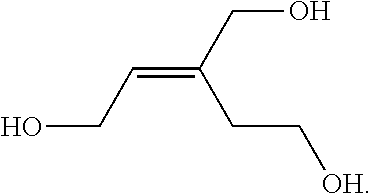
12. The process of claim 8 , wherein the tri-alcohol compound has the following structural formula:

13. A crosslinked polydimethylsiloxane (PDMS) material formed by a process that comprises chemically reacting a functionalized PDMS material with a bio-derived crosslinking material that is derived from a biorenewable aconitic acid molecule, the bio-derived crosslinking material including multiple acrylate groups, acetate groups, or thiol groups.
14. The crosslinked PDMS material of claim 13 , wherein the bio-derived crosslinking material includes multiple acrylate groups, and wherein the functionalized PDMS material includes a hydride-functionalized PDMS material.
15. The crosslinked PDMS material of claim 13 , wherein the bio-derived crosslinking material includes multiple acetate groups, and wherein the functionalized PDMS material includes a hydroxy-functionalized PDMS material.
16. The crosslinked PDMS material of claim 13 , wherein the bio-derived crosslinking material includes multiple thiol groups, and wherein the functionalized PDMS material includes a vinyl-functionalized PDMS material.
Priority Applications (3)
| Application Number | Priority Date | Filing Date | Title |
|---|---|---|---|
| US15/470,279 US10160838B2 (en) | 2017-03-27 | 2017-03-27 | Crosslinking materials from biorenewable aconitic acid |
| US15/815,266 US10233293B2 (en) | 2017-03-27 | 2017-11-16 | Crosslinking materials from biorenewable aconitic acid |
| US16/124,546 US10711108B2 (en) | 2017-03-27 | 2018-09-07 | Crosslinking materials from biorenewable aconitic acid |
Applications Claiming Priority (1)
| Application Number | Priority Date | Filing Date | Title |
|---|---|---|---|
| US15/470,279 US10160838B2 (en) | 2017-03-27 | 2017-03-27 | Crosslinking materials from biorenewable aconitic acid |
Related Child Applications (2)
| Application Number | Title | Priority Date | Filing Date |
|---|---|---|---|
| US15/815,266 Continuation US10233293B2 (en) | 2017-03-27 | 2017-11-16 | Crosslinking materials from biorenewable aconitic acid |
| US16/124,546 Continuation US10711108B2 (en) | 2017-03-27 | 2018-09-07 | Crosslinking materials from biorenewable aconitic acid |
Publications (2)
| Publication Number | Publication Date |
|---|---|
| US20180273704A1 US20180273704A1 (en) | 2018-09-27 |
| US10160838B2 true US10160838B2 (en) | 2018-12-25 |
Family
ID=63581645
Family Applications (3)
| Application Number | Title | Priority Date | Filing Date |
|---|---|---|---|
| US15/470,279 Active 2037-04-29 US10160838B2 (en) | 2017-03-27 | 2017-03-27 | Crosslinking materials from biorenewable aconitic acid |
| US15/815,266 Active US10233293B2 (en) | 2017-03-27 | 2017-11-16 | Crosslinking materials from biorenewable aconitic acid |
| US16/124,546 Expired - Fee Related US10711108B2 (en) | 2017-03-27 | 2018-09-07 | Crosslinking materials from biorenewable aconitic acid |
Family Applications After (2)
| Application Number | Title | Priority Date | Filing Date |
|---|---|---|---|
| US15/815,266 Active US10233293B2 (en) | 2017-03-27 | 2017-11-16 | Crosslinking materials from biorenewable aconitic acid |
| US16/124,546 Expired - Fee Related US10711108B2 (en) | 2017-03-27 | 2018-09-07 | Crosslinking materials from biorenewable aconitic acid |
Country Status (1)
| Country | Link |
|---|---|
| US (3) | US10160838B2 (en) |
Cited By (1)
| Publication number | Priority date | Publication date | Assignee | Title |
|---|---|---|---|---|
| US10711108B2 (en) | 2017-03-27 | 2020-07-14 | International Business Machines Corporation | Crosslinking materials from biorenewable aconitic acid |
Families Citing this family (4)
| Publication number | Priority date | Publication date | Assignee | Title |
|---|---|---|---|---|
| US9920170B1 (en) | 2017-01-19 | 2018-03-20 | International Business Machines Corporation | Bio-derived cross-linkers |
| US9920171B1 (en) | 2017-01-27 | 2018-03-20 | International Business Machines Corporation | Crosslinkers from biorenewable resveratrol |
| US11639432B2 (en) | 2021-01-13 | 2023-05-02 | International Business Machines Corporation | Hydroxycinnamic acid-derived crosslinking dimers |
| US11732136B2 (en) | 2021-01-13 | 2023-08-22 | International Business Machines Corporation | Hydroxycinnamic acid-derived crosslinkers |
Citations (37)
| Publication number | Priority date | Publication date | Assignee | Title |
|---|---|---|---|---|
| US2587295A (en) | 1952-02-26 | Alkyd-polysiloxane resins | ||
| US2716638A (en) * | 1952-11-22 | 1955-08-30 | Gen Electric | Divinyltetramethyldisiloxane and polymers therefrom |
| US2717900A (en) | 1950-04-03 | 1955-09-13 | Allied Chem & Dye Corp | Preparation of organosilicon compounds |
| US2813117A (en) * | 1955-01-03 | 1957-11-12 | Earl J Roberts | Process of esterifying alkaline earth aconitates |
| US3206415A (en) | 1959-12-31 | 1965-09-14 | Bayer Ag | Preparation of a polyurethane foam using an organosiloxymethyl alkane as a foam stabilizer |
| US4045602A (en) | 1975-05-26 | 1977-08-30 | Wacker-Chemie Gmbh | Adhesion of organopolysiloxane elastomers to substrates |
| US4301268A (en) | 1977-01-12 | 1981-11-17 | Th. Goldschmidt Ag | Process for the preparation of organopolysiloxanes modified with methacrylic esters |
| US4474933A (en) | 1982-06-03 | 1984-10-02 | Dynamit Nobel Ag | Crosslinking resin mixtures |
| US4781973A (en) | 1987-10-22 | 1988-11-01 | General Electric Company | Fabric coating |
| US4895830A (en) | 1987-12-28 | 1990-01-23 | Diafoil Company, Ltd. | Sublimation type thermal ink transfer printing material |
| US5861467A (en) | 1993-05-18 | 1999-01-19 | Dow Corning Corporation | Radiation curable siloxane compositions containing vinyl ether functionality and methods for their preparation |
| US6203923B1 (en) | 1998-09-29 | 2001-03-20 | Cryovac, Inc. | Regio-regular functionalized polymeric packaging material |
| US6239204B1 (en) | 1996-05-08 | 2001-05-29 | Baiso Co., Ltd. | Cross-linked solid polyelectrolyte and use thereof |
| US6572882B1 (en) | 1997-07-15 | 2003-06-03 | Caudalie | Compositions based on resveratrol |
| US20030149124A1 (en) | 2001-11-27 | 2003-08-07 | Thommes Glen A. | Radiation curable resin composition for making colored three dimensional objects |
| US6605691B1 (en) | 1999-05-10 | 2003-08-12 | 3M Innovative Properties Company | Compositions for making ene-thiol elastomers |
| US6809231B2 (en) | 2001-11-21 | 2004-10-26 | The United States Of America As Represented By The Secretary Of Agriculture | Flexible and absorbent alginate wound dressing |
| WO2005052019A1 (en) | 2003-11-28 | 2005-06-09 | Commonwealth Scientific And Industrial Research Organisation | Polyurethanes |
| US7670686B2 (en) | 2005-05-20 | 2010-03-02 | National Cheng Kung University | Long-term hydrophilic modification of PDMS substrate and method for manufacturing the same |
| US20110217750A1 (en) | 2008-03-20 | 2011-09-08 | National University Of Ireland, Galway | Dendrimers and Dendrimer Applications |
| US20120184682A1 (en) | 2009-09-30 | 2012-07-19 | Innovotech, Llc | Biocompatible and biodegradable polymers from renewable natural polyphenols |
| US20120220749A1 (en) | 2011-02-28 | 2012-08-30 | Innovotech, Llc | Combinatiorial polymeric compositions for drug delivery |
| US20120295353A1 (en) | 2011-05-20 | 2012-11-22 | Yulong Hong | Methods of making and using polymers and compositions |
| US20130272755A1 (en) | 2011-01-19 | 2013-10-17 | Shin-Etsu Polymer Co., Ltd. | Developing Roller, Development Apparatus, and Image-Forming Device |
| US20140004251A1 (en) | 2008-03-20 | 2014-01-02 | National University Of Ireland, Galway (Nuig) | Hollow biodegradable nanospheres and nanoshells for delivery of therapeutic and/or imaging molecules |
| US20140037772A1 (en) | 2011-02-09 | 2014-02-06 | Wendy Lien | Cosmetic or Pharmaceutical Formulation |
| US20140107350A1 (en) | 2011-04-21 | 2014-04-17 | Asahi Kasei Chemicals Corporation | Process for Preparing Episulfide Compounds |
| US20140296425A1 (en) | 2013-02-26 | 2014-10-02 | University Of Massachusetts | Telechelic based networks from novel macromonomers, compositions, preparation and uses thereof |
| US20140329958A1 (en) | 2011-10-14 | 2014-11-06 | Avery Dennison Corporation | Controlled Architecture Polymers |
| US20140355173A1 (en) | 2013-05-31 | 2014-12-04 | Sabic Global Technologies Bv | Capacitor films, methods of manufacture, and articles manufactured therefrom |
| US20150005247A1 (en) | 2013-07-01 | 2015-01-01 | L'oreal | Compositions containing at least two phenolic compounds, a lipid-soluble antioxidant and at least one hydrotrope for cosmetic use |
| US20150179357A1 (en) | 2012-08-21 | 2015-06-25 | Dainichiseika Color & Chemicals Mfg. Co., Ltd. | Aqueous liquid composition, aqueous coating liquid, functional coating film and composite material |
| CN105287320A (en) | 2015-12-08 | 2016-02-03 | 广州市花安堂生物科技有限公司 | Mild lifting and repairing eye cream and preparation method thereof |
| US20160032043A1 (en) | 2013-03-14 | 2016-02-04 | Case Western Reserve University | Bisphenol polymer precursor replacements |
| US20160194574A1 (en) | 2014-03-14 | 2016-07-07 | Hrl Laboratories, Llc | Segmented copolymer compositions and coatings incorporating these compositions |
| US20160284905A1 (en) | 2013-11-12 | 2016-09-29 | Covestro Deutschland Ag | Sealant composition, solar cell module sealant prepared by hardening the same, and method for producing solar cell module using the same |
| US20170121469A1 (en) | 2015-11-02 | 2017-05-04 | International Business Machines Corporation | Polydimethylsiloxane cross-linking materials |
Family Cites Families (19)
| Publication number | Priority date | Publication date | Assignee | Title |
|---|---|---|---|---|
| US2375563A (en) * | 1942-04-02 | 1945-05-08 | American Cyanamid Co | Preparation of esters of aconitic acid |
| US2816910A (en) * | 1952-04-10 | 1957-12-17 | Schering Ag | Esters of carbamic acid and a method of making same |
| US2782228A (en) * | 1953-05-21 | 1957-02-19 | Monsanto Chemicals | Preparation of adducts of liquid, linear polybutadiene and esters of itaconic and aconitic acids |
| US3533930A (en) * | 1966-11-21 | 1970-10-13 | Gen Electric | Modified crosslinked polyoxymethylenes and their preparation |
| US3542815A (en) * | 1968-09-10 | 1970-11-24 | Fmc Corp | Polymerization of aconitic anhydride |
| US4123459A (en) * | 1975-12-22 | 1978-10-31 | Lever Brothers Company | Preparation of aconitic acid |
| US4056567A (en) * | 1976-03-08 | 1977-11-01 | Lever Brothers Company | Chemical processes for preparing citric acid |
| US4282156A (en) * | 1978-12-18 | 1981-08-04 | Lever Brothers Company | Method for the production of novel anhydride polycarboxylates |
| US5190997A (en) * | 1985-07-10 | 1993-03-02 | Sequa Chemicals, Inc. | Adhesive composition |
| US6228496B1 (en) * | 1999-05-26 | 2001-05-08 | Ppg Industries Ohio, Inc. | Sizing composition for glass fibers |
| KR100734496B1 (en) * | 2000-07-25 | 2007-07-03 | 미쓰이 가가쿠 가부시키가이샤 | Curable Compositions and Their Uses |
| US20080228268A1 (en) * | 2007-03-15 | 2008-09-18 | Uluru, Inc. | Method of Formation of Viscous, Shape Conforming Gels and Their Uses as Medical Prosthesis |
| WO2009061787A1 (en) | 2007-11-05 | 2009-05-14 | Nanocopoeia, Inc. | Coated devices and method of making coated devices that reduce smooth muscle cell proliferation and platelet activity |
| DE102009052044B3 (en) | 2009-11-05 | 2011-05-12 | Equrex Films Gmbh & Col. Kg | One-sided matted films and their use |
| US20130323519A1 (en) * | 2011-01-31 | 2013-12-05 | 3M Innovative Properties Company | Coatings for barrier films and methods of making and using the same |
| KR101722395B1 (en) * | 2014-09-23 | 2017-04-04 | 한국과학기술연구원 | Mercapto-based polysilsesquioxane and method for preparing functional polysilsesquioxane using the same |
| US9920170B1 (en) | 2017-01-19 | 2018-03-20 | International Business Machines Corporation | Bio-derived cross-linkers |
| US9920171B1 (en) | 2017-01-27 | 2018-03-20 | International Business Machines Corporation | Crosslinkers from biorenewable resveratrol |
| US10160838B2 (en) | 2017-03-27 | 2018-12-25 | International Business Machines Corporation | Crosslinking materials from biorenewable aconitic acid |
-
2017
- 2017-03-27 US US15/470,279 patent/US10160838B2/en active Active
- 2017-11-16 US US15/815,266 patent/US10233293B2/en active Active
-
2018
- 2018-09-07 US US16/124,546 patent/US10711108B2/en not_active Expired - Fee Related
Patent Citations (38)
| Publication number | Priority date | Publication date | Assignee | Title |
|---|---|---|---|---|
| US2587295A (en) | 1952-02-26 | Alkyd-polysiloxane resins | ||
| US2717900A (en) | 1950-04-03 | 1955-09-13 | Allied Chem & Dye Corp | Preparation of organosilicon compounds |
| US2716638A (en) * | 1952-11-22 | 1955-08-30 | Gen Electric | Divinyltetramethyldisiloxane and polymers therefrom |
| US2813117A (en) * | 1955-01-03 | 1957-11-12 | Earl J Roberts | Process of esterifying alkaline earth aconitates |
| US3206415A (en) | 1959-12-31 | 1965-09-14 | Bayer Ag | Preparation of a polyurethane foam using an organosiloxymethyl alkane as a foam stabilizer |
| US4045602A (en) | 1975-05-26 | 1977-08-30 | Wacker-Chemie Gmbh | Adhesion of organopolysiloxane elastomers to substrates |
| US4301268A (en) | 1977-01-12 | 1981-11-17 | Th. Goldschmidt Ag | Process for the preparation of organopolysiloxanes modified with methacrylic esters |
| US4474933A (en) | 1982-06-03 | 1984-10-02 | Dynamit Nobel Ag | Crosslinking resin mixtures |
| US4781973A (en) | 1987-10-22 | 1988-11-01 | General Electric Company | Fabric coating |
| US4895830A (en) | 1987-12-28 | 1990-01-23 | Diafoil Company, Ltd. | Sublimation type thermal ink transfer printing material |
| US5861467A (en) | 1993-05-18 | 1999-01-19 | Dow Corning Corporation | Radiation curable siloxane compositions containing vinyl ether functionality and methods for their preparation |
| US6239204B1 (en) | 1996-05-08 | 2001-05-29 | Baiso Co., Ltd. | Cross-linked solid polyelectrolyte and use thereof |
| US6572882B1 (en) | 1997-07-15 | 2003-06-03 | Caudalie | Compositions based on resveratrol |
| US6203923B1 (en) | 1998-09-29 | 2001-03-20 | Cryovac, Inc. | Regio-regular functionalized polymeric packaging material |
| US6605691B1 (en) | 1999-05-10 | 2003-08-12 | 3M Innovative Properties Company | Compositions for making ene-thiol elastomers |
| US6809231B2 (en) | 2001-11-21 | 2004-10-26 | The United States Of America As Represented By The Secretary Of Agriculture | Flexible and absorbent alginate wound dressing |
| US20030149124A1 (en) | 2001-11-27 | 2003-08-07 | Thommes Glen A. | Radiation curable resin composition for making colored three dimensional objects |
| WO2005052019A1 (en) | 2003-11-28 | 2005-06-09 | Commonwealth Scientific And Industrial Research Organisation | Polyurethanes |
| US7670686B2 (en) | 2005-05-20 | 2010-03-02 | National Cheng Kung University | Long-term hydrophilic modification of PDMS substrate and method for manufacturing the same |
| US20140004251A1 (en) | 2008-03-20 | 2014-01-02 | National University Of Ireland, Galway (Nuig) | Hollow biodegradable nanospheres and nanoshells for delivery of therapeutic and/or imaging molecules |
| US20110217750A1 (en) | 2008-03-20 | 2011-09-08 | National University Of Ireland, Galway | Dendrimers and Dendrimer Applications |
| US20120184682A1 (en) | 2009-09-30 | 2012-07-19 | Innovotech, Llc | Biocompatible and biodegradable polymers from renewable natural polyphenols |
| US20130272755A1 (en) | 2011-01-19 | 2013-10-17 | Shin-Etsu Polymer Co., Ltd. | Developing Roller, Development Apparatus, and Image-Forming Device |
| US20140037772A1 (en) | 2011-02-09 | 2014-02-06 | Wendy Lien | Cosmetic or Pharmaceutical Formulation |
| US20120220749A1 (en) | 2011-02-28 | 2012-08-30 | Innovotech, Llc | Combinatiorial polymeric compositions for drug delivery |
| US20140107350A1 (en) | 2011-04-21 | 2014-04-17 | Asahi Kasei Chemicals Corporation | Process for Preparing Episulfide Compounds |
| US20120295353A1 (en) | 2011-05-20 | 2012-11-22 | Yulong Hong | Methods of making and using polymers and compositions |
| US20140329958A1 (en) | 2011-10-14 | 2014-11-06 | Avery Dennison Corporation | Controlled Architecture Polymers |
| US20150179357A1 (en) | 2012-08-21 | 2015-06-25 | Dainichiseika Color & Chemicals Mfg. Co., Ltd. | Aqueous liquid composition, aqueous coating liquid, functional coating film and composite material |
| US20140296425A1 (en) | 2013-02-26 | 2014-10-02 | University Of Massachusetts | Telechelic based networks from novel macromonomers, compositions, preparation and uses thereof |
| US20160032043A1 (en) | 2013-03-14 | 2016-02-04 | Case Western Reserve University | Bisphenol polymer precursor replacements |
| US20140355173A1 (en) | 2013-05-31 | 2014-12-04 | Sabic Global Technologies Bv | Capacitor films, methods of manufacture, and articles manufactured therefrom |
| US20150005247A1 (en) | 2013-07-01 | 2015-01-01 | L'oreal | Compositions containing at least two phenolic compounds, a lipid-soluble antioxidant and at least one hydrotrope for cosmetic use |
| CN105473126A (en) | 2013-07-01 | 2016-04-06 | 莱雅公司 | Compositions containing two phenolic compounds for cosmetic use |
| US20160284905A1 (en) | 2013-11-12 | 2016-09-29 | Covestro Deutschland Ag | Sealant composition, solar cell module sealant prepared by hardening the same, and method for producing solar cell module using the same |
| US20160194574A1 (en) | 2014-03-14 | 2016-07-07 | Hrl Laboratories, Llc | Segmented copolymer compositions and coatings incorporating these compositions |
| US20170121469A1 (en) | 2015-11-02 | 2017-05-04 | International Business Machines Corporation | Polydimethylsiloxane cross-linking materials |
| CN105287320A (en) | 2015-12-08 | 2016-02-03 | 广州市花安堂生物科技有限公司 | Mild lifting and repairing eye cream and preparation method thereof |
Non-Patent Citations (34)
| Title |
|---|
| Agarwal et al., Use of electrospinning technique for biomedical application, Elsevier, Polymer, vol. 49, Issue 26, < http://www.sciencedirect.com/science/article/pii/S0032386108007994>, dated Dec. 8, 2008, 19 pages. |
| Anonymous, Cross-Linked Bio-Plasticized Polymer Compositions, An IP.com Prior Art Database Technical Disclosure, IP.com (online), Oct. 17, 2011, 3 pp., URL: ip.com/IPCOM000211763. |
| AUS920170128US1, Appendix P; List of IBM Patent or Applications Treated as Related, Jun. 14, 2017, 2 pages. |
| AUS920170128US1, Appendix P; List of IBM Patents or Applications Treated as Related, Feb. 20, 2018, 2 pages. |
| Bailey et al. "Pyrolysis of Esters. III. Synthesis of 2-Vinylbutadiene" J. Am. Chem. Soc. 77, 1955, 1133-1136. (Year: 1955). * |
| Bender Analytical Holding B.V. et al.; Cross-Linked Polymers and Implants Derived from Electrophilically Activated Polyoxazoline, An IP.com Prior Art Database Technical Disclosure, IP.com (online), Mar. 19, 2012, 42 URL: ip.com/IPCOM/000216010. |
| Chemical Processing, Bio-based Route for Allyl Alcohols Beckons, ChemicalProcessing.com (online), Jul. 2009, 5 pages, URL: www.chemicalprocessing.com/articles/2009/150/. |
| Czaplewski et al., Bio-Derived Cross-Linkers, U.S. Appl. No. 15/410,025, International Business Machines, filed Jan. 19, 2017, 22 pages. |
| Czaplewski et al., Bio-Derived Cross-Linkers, U.S. Appl. No. 15/862,315, International Business Machines, filed Jan. 4, 2018, 22 pages. |
| Czaplewski et al., Crosslinking Materials From Biorenewable Aconitic Acid, U.S. Appl. No. 15/815,266, International Business Machines, filed Nov. 16, 2017, 37 pages. |
| Dlamini et al., Effect of Cross-Linking Agent Chemistry and Coating Conditions on Physical, Chemical, and Separation Properties of PVA-Psf Composite Membranes, Separation of Science and Technology, vol. 49, Issue 1, Jan. 2014, pp. 22-29, Taylor & Francis Online (tandfonline.com), URL: www.tandfonline.com/doi/full/10.1080/01496395.2013.813040?scroll=top&needAccess=true. |
| European Coatings, Renewable Pentaerythritol to Cut Carbon Footprint, European-Coatings.com (online), Jun. 15, 2010, 1 pp., URL: www.european-coatings.com/Raw-materials-technologies/Raw-materials/Coatings. |
| Fawcett et al., Phototunable Cross-Linked Polysiloxanes, Macromolecules, vol. 48, No. 18, Sep. 2015, pp. 6499-6507, American Chemical Society (ACS) Publications, Washington, DC. |
| Gelest, Functional Silicone Reactivity Guide, Product Brochure, Reactive Silicones: Forging New Polymer Links gelest.com (online), [accessed Nov. 17, 2016], p. 2, URL: www.gelest.com/wp-content/uploads/Goods-PDF-brochures-reactivesilicones.pdf. |
| Gokmen et al., Porous polymer particles-A comprehensive guide to synthesis, characterization, functionalization, and applications, Elsevier, Science Direct, Progress in Polymer Science, vol. 37, Issue 3, < https://webcache.googleusercontent.com/search?q=cache:hbxd4uQY3WAJ:https://pdfs.semanticscholar.org/ed87/e2fd4e12c9c586c31de29d125f3ac5907b72.pdf+&cd=2&hl=en&ct=clnk&gl=us>, Available online Jul. 23, 2011, 41 pages. |
| Gokmen et al., Porous polymer particles—A comprehensive guide to synthesis, characterization, functionalization, and applications, Elsevier, Science Direct, Progress in Polymer Science, vol. 37, Issue 3, < https://webcache.googleusercontent.com/search?q=cache:hbxd4uQY3WAJ:https://pdfs.semanticscholar.org/ed87/e2fd4e12c9c586c31de29d125f3ac5907b72.pdf+&cd=2&hl=en&ct=clnk&gl=us>, Available online Jul. 23, 2011, 41 pages. |
| Haimov, Preparation, Characterization and Catalysis by Polyoxometalate-Synthetic Protein and Polyoxometalate-Protein Hybrid Assemblies, Thesis, Sep. 2007, 93 pages, Weizmann Institute of Science, Rehovot, Israel, URL: https://lib-phds1.weizmann.ac.il/Dissertations/Haimov_Adina.pdf. |
| Holladay et al., Biorenewable Processes to Acrylic Acid, Abstract, Pacific Northwest National Laboratory (pnnl.gov) online, [accessed Mar. 9, 2017], 1 page, URL: iic.pnnl.gov/abstracts/nacs/o_109.pdf. |
| IBM, IBM Academy of Technology Top 10 Technical Themes 2016, IBM.com (online), accessed Jan. 16, 2017, 2 pages, URL: http://www-03.ibm.com/ibm/academy/tech/tech.shtml. |
| Innocentive, Cost-effective, Large-scale Production of Natural Leaf Alcohol (cis-3-hexenol), Product Challenge No. 9933857, innocentive.com (online), [accessed Nov. 17, 2016], 3 pages, URL: www.innocentive.com/ar/challenge/9933857. |
| Kim et al., Fabrication of PDMS Microlenses With Various Curvatures Using a Water-Based Molding Method, Twelfth International Conference on Miniaturized Systems for Chemistry and Life Sciences, Oct. 2008, pp. 994-996, Royal Society of Chemistry (rsc.org) online, URL: www.rsc.org/binaries/LOC/2008/PDFs/Papers/335_1030.pdf. |
| King et al., Crosslinkers From Biorenewable Resveratrol, U.S. Appl. No. 15/417,465, International Business Machines, filed Jan. 27, 2017, 21 pages. |
| King et al., Crosslinkers From Biorenewable Resveratrol, U.S. Appl. No. 15/808,981, International Business Machines, filed Nov. 10, 2017, 21 pages. |
| Lee et al., Polymer Nanodo-Hybridized Alkyl Silicon Oxide Nanostructures for Organic Memory Transistors with Outstanding High-Temperature Operation Stability, Scientific Reports, 6:33863, DOI: 10.1038/srep33863, <https://www.ncbi.nlm.nih.gov/pmc/articles/PMC5050446/>, Published Oct. 5, 2016, 10 pages. |
| Myriant, Broad Pipeline, Diverse Applications, Product Pipeline, myrinat.com (online), [accessed Mar. 9, 2017], 1 page, URL: www.myriant.com/products/product-pipeline.cfm. |
| Schwarz et al., Preparation of molecularly imprinted polymers for the selective recognition of the bioactive polyphenol, (E)-resveratrol, Elsevier, Journal of Chromatography A, vol. 1218, Issue 16, Available Online Feb. 23, 2011, 7 pages. |
| Sekab, Chemistry for the Future, sekab.com (online), [accessed Mar. 9, 2017], 1 page, URL: www.sekab.com/chemistry/. |
| SGA Polymers, Bio-Based Acrylic Acid Technology, sgapolymers.com (online), [accessed Mar. 9, 2017], 1 page, URL: www.sgapolymers.com. |
| Tang et al., Whiteness improvement of citric acid crosslinked cotton fabrics: H2O2 bleaching under alkaline condition, Carbohydrate Polymers, vol. 147, Aug. 2016, pp. 139-145, PubMed.gov (online), National Center for Biotechnology Information, U.S. National Library of Medicine, Bethesda MD. |
| Wikipedia, Resveratrol, wikipedia.org (online), accessed Jan. 17, 2017, 18 pages, URL: en.wikipedia.org/wiki/Resveratrol. |
| William F. Bruce, "Aconitic Acid" Organic Syntheses, Coll. vol. 2. p. 12 (1943); vol. 17, p. 1 (1937). (Year: 1943). * |
| Xiameter, An Overview of Polydimethylsiloxane (PDMS) Fluids in the Environment, Product Information, xiameter.com (online), [accessed Nov. 17, 2016], URL: www.xiameter.com/en/ExploreSilicones/Documents/95-725-01%20Overview%20of%20Polydimethylsiloxane%20Fluids.pdf. |
| Zhang et al., Study on the preparation of genipin crosslinked chitosan microspheres of resveratrol and in vitro release, Journal of Polymer Research, (2013) 20:175, Springer Science+Business Media Dordecht 2013, published online Jun. 10, 2013, 10 pages. |
| Zhao et al., Organic Acids Can Crosslink Poly(ionic liquid)s into Mesoporous Polyelectrolyte Complex, Electronic Supplementary Material (ESI) for Polymer Chemistry, Issue 4, Feb. 2013, pp. 2432-2435, Royal Society of Chemistry, London, UK. |
Cited By (1)
| Publication number | Priority date | Publication date | Assignee | Title |
|---|---|---|---|---|
| US10711108B2 (en) | 2017-03-27 | 2020-07-14 | International Business Machines Corporation | Crosslinking materials from biorenewable aconitic acid |
Also Published As
| Publication number | Publication date |
|---|---|
| US20190002651A1 (en) | 2019-01-03 |
| US10233293B2 (en) | 2019-03-19 |
| US10711108B2 (en) | 2020-07-14 |
| US20180273706A1 (en) | 2018-09-27 |
| US20180273704A1 (en) | 2018-09-27 |
Similar Documents
| Publication | Publication Date | Title |
|---|---|---|
| US10711108B2 (en) | Crosslinking materials from biorenewable aconitic acid | |
| US9920171B1 (en) | Crosslinkers from biorenewable resveratrol | |
| US10233290B2 (en) | Bio-derived cross-linkers | |
| CN109666119B (en) | Water-based anti-fog resin and water-based anti-fog coating composition and preparation method thereof | |
| JP6164392B1 (en) | Polyester polyol and polyurethane resin and method for producing them | |
| US20170121469A1 (en) | Polydimethylsiloxane cross-linking materials | |
| JP6217208B2 (en) | Active energy ray-curable composition | |
| JP2009256662A (en) | Silsesquioxane derivative and method for producing the same | |
| WO2008072766A1 (en) | Fluorine-containing polymer and resin composition | |
| Narute et al. | Study of the performance of polyurethane coatings derived from cottonseed oil polyol | |
| JP6356042B2 (en) | Polysiloxane group-containing polymer and thermosetting film | |
| Mantala et al. | Waterborne polyurethane transparent coatings for self-healing at room temperature | |
| CN109337034A (en) | A kind of polyaminoester emulsion and its synthetic method of composite multiple cross-linking system | |
| CN106554294A (en) | Photo-curing material of fluorine-containing and tertiary amine structure and preparation method thereof | |
| CN102639491B (en) | N-allyl carbamate compound and special purposes in radiation curable coating thereof | |
| KR20170128090A (en) | Organic siloxane graft polyvinyl alcohol-based polymer and method for producing the same | |
| WO2023013593A1 (en) | Aqueous resin composition, coating film, and article with coating film | |
| JP7062888B2 (en) | Curable resin compositions, coating agents, and articles. | |
| KR101669835B1 (en) | One-component type paint composition comprising silane acrylic resin as main resin component | |
| CN104817698B (en) | A kind of preparation method of the organic siliconresin with alternating structure | |
| CN110172110B (en) | Radical-curable organosiloxane-grafted polyvinyl alcohol polymer and method for producing same | |
| CN102796014A (en) | Preparation method of perfluorohexyl-containing tribasic alcohol | |
| KR20250080974A (en) | Silicone modified acrylate compound and UV/moisture dual cure silicone coating composition | |
| JP5114964B2 (en) | Fluorine-containing (meth) acrylic acid ester, method for producing the same, and antifouling paint | |
| KR101649573B1 (en) | One component low bake paint composition and acrylic polyol resin composition |
Legal Events
| Date | Code | Title | Description |
|---|---|---|---|
| AS | Assignment |
Owner name: INTERNATIONAL BUSINESS MACHINES CORPORATION, NEW Y Free format text: ASSIGNMENT OF ASSIGNORS INTEREST;ASSIGNORS:CZAPLEWSKI, SARAH K.;KUCZYNSKI, JOSEPH;WERTZ, JASON T.;AND OTHERS;SIGNING DATES FROM 20170325 TO 20170327;REEL/FRAME:041754/0026 |
|
| STCF | Information on status: patent grant |
Free format text: PATENTED CASE |
|
| MAFP | Maintenance fee payment |
Free format text: PAYMENT OF MAINTENANCE FEE, 4TH YEAR, LARGE ENTITY (ORIGINAL EVENT CODE: M1551); ENTITY STATUS OF PATENT OWNER: LARGE ENTITY Year of fee payment: 4 |