US10158749B2 - Method by which portable device displays information through wearable device, and device therefor - Google Patents
Method by which portable device displays information through wearable device, and device therefor Download PDFInfo
- Publication number
- US10158749B2 US10158749B2 US15/030,141 US201415030141A US10158749B2 US 10158749 B2 US10158749 B2 US 10158749B2 US 201415030141 A US201415030141 A US 201415030141A US 10158749 B2 US10158749 B2 US 10158749B2
- Authority
- US
- United States
- Prior art keywords
- information
- mobile apparatus
- wearable apparatus
- call
- wearable
- Prior art date
- Legal status (The legal status is an assumption and is not a legal conclusion. Google has not performed a legal analysis and makes no representation as to the accuracy of the status listed.)
- Active
Links
Images


Classifications
-
- H—ELECTRICITY
- H04—ELECTRIC COMMUNICATION TECHNIQUE
- H04M—TELEPHONIC COMMUNICATION
- H04M1/00—Substation equipment, e.g. for use by subscribers
- H04M1/72—Mobile telephones; Cordless telephones, i.e. devices for establishing wireless links to base stations without route selection
- H04M1/724—User interfaces specially adapted for cordless or mobile telephones
- H04M1/72403—User interfaces specially adapted for cordless or mobile telephones with means for local support of applications that increase the functionality
- H04M1/72409—User interfaces specially adapted for cordless or mobile telephones with means for local support of applications that increase the functionality by interfacing with external accessories
- H04M1/72412—User interfaces specially adapted for cordless or mobile telephones with means for local support of applications that increase the functionality by interfacing with external accessories using two-way short-range wireless interfaces
-
- H04M1/7253—
-
- H—ELECTRICITY
- H04—ELECTRIC COMMUNICATION TECHNIQUE
- H04M—TELEPHONIC COMMUNICATION
- H04M1/00—Substation equipment, e.g. for use by subscribers
- H04M1/57—Arrangements for indicating or recording the number of the calling subscriber at the called subscriber's set
- H04M1/575—Means for retrieving and displaying personal data about calling party
-
- H—ELECTRICITY
- H04—ELECTRIC COMMUNICATION TECHNIQUE
- H04W—WIRELESS COMMUNICATION NETWORKS
- H04W4/00—Services specially adapted for wireless communication networks; Facilities therefor
- H04W4/18—Information format or content conversion, e.g. adaptation by the network of the transmitted or received information for the purpose of wireless delivery to users or terminals
-
- H—ELECTRICITY
- H04—ELECTRIC COMMUNICATION TECHNIQUE
- H04W—WIRELESS COMMUNICATION NETWORKS
- H04W4/00—Services specially adapted for wireless communication networks; Facilities therefor
- H04W4/80—Services using short range communication, e.g. near-field communication [NFC], radio-frequency identification [RFID] or low energy communication
-
- H—ELECTRICITY
- H04—ELECTRIC COMMUNICATION TECHNIQUE
- H04W—WIRELESS COMMUNICATION NETWORKS
- H04W76/00—Connection management
- H04W76/10—Connection setup
- H04W76/14—Direct-mode setup
-
- H—ELECTRICITY
- H04—ELECTRIC COMMUNICATION TECHNIQUE
- H04M—TELEPHONIC COMMUNICATION
- H04M2250/00—Details of telephonic subscriber devices
- H04M2250/74—Details of telephonic subscriber devices with voice recognition means
Definitions
- the present disclosure relates to a method for a mobile apparatus to display relevant information via a wearable apparatus, the mobile apparatus, and the wearable apparatus.
- a user wants to see relevant information related to the caller, through the screen of the portable device, the user needs to equip hands-free device, such as earphones.
- a mobile apparatus includes a controller configured to detect a call connection state of the mobile apparatus, and obtain relevant information related to another party of a call connection as the call connection state is detected; and a communication interface configured to transmit the relevant information to a wearable apparatus.
- a mobile apparatus provides user convenience by controlling relevant information related to another party of a call connection to be displayed on the wearable apparatus.
- FIG. 1 is a block diagram illustrating an example structure of a mobile apparatus
- FIG. 2 is a block diagram illustrating an example structure of a wearable apparatus
- FIG. 3 illustrates an example mobile apparatus setting relevant information
- FIG. 4 illustrates an example mobile apparatus setting relevant information
- FIGS. 5A through 5C illustrate an example mobile apparatus setting a display parameter with respect to relevant information
- FIG. 6 illustrates an example in which a wearable apparatus displays relevant information
- FIG. 7 illustrates an example in which a communication link is established between a mobile apparatus and a wearable apparatus
- FIG. 8 is a flowchart illustrating an example method of transmitting relevant information to a wearable apparatus, via a mobile apparatus
- FIG. 9 is a flowchart illustrating an example method of displaying relevant information via a wearable apparatus
- FIG. 10 illustrates an example feature of a wearable apparatus
- FIG. 11 is a flowchart illustrating an example method of displaying information via a wearable apparatus
- FIGS. 13 and 14 illustrate examples in which a wearable apparatus displays relevant information
- FIG. 15 is a flowchart illustrating an example method of displaying hidden information via a wearable apparatus
- FIG. 16 illustrates an example in which a wearable apparatus displays hidden information
- FIG. 17 is a block diagram illustrating an example structure of a mobile apparatus.
- a mobile apparatus includes: a controller configured to detect a call connection state of the mobile apparatus, and obtain relevant information related to another party of a call connection as the call connection state is detected; and a communication interface configured to transmit the relevant information to a wearable apparatus.
- the relevant information may include at least one of memo information, schedule information, address book information, image information, and information uploaded on a social network service (SNS) that are related to the other party of the call connection, and information obtained during the call connection.
- SNS social network service
- the controller may set a display parameter with respect to the relevant information, and the communication interface may transmit the display parameter to the wearable apparatus.
- the display parameter may include at least one of whether to display the relevant information on the wearable apparatus or the mobile apparatus, types of the relevant information, an order in which the relevant information is displayed, and the number of pieces of the relevant information.
- the controller may generate a user interface and store the relevant information based on a user input via the user interface.
- the controller may obtain a voice command from a user of the mobile apparatus as the call connection is detected, and the relevant information may include information based on the voice command.
- the controller may obtain information which had been displayed on the mobile apparatus before the call was connected, as the call connection is detected.
- the communication interface may transmit, to the wearable apparatus, first relevant information from among the relevant information and receives, from the wearable apparatus, a request to transmit second relevant information that is based on the first relevant information.
- the controller may control the communication interface to establish a communication link between the mobile apparatus and the wearable apparatus so that the call is connected to the wearable apparatus, and may control the relevant information displayed on the mobile apparatus.
- the controller may obtain the relevant information related to the other party of the call connection from an external server.
- a wearable apparatus includes: a communication interface configured to receive relevant information related to another party of a call connection, as a call connection state is detected via a mobile apparatus; a display configured to display the relevant information; a user input unit configured to receive a user input from a user of the wearable apparatus; and a controller configured to change the relevant information based on the user input.
- the relevant information may include information obtained from an external server as the call connection state is detected via the mobile apparatus.
- the communication interface may receive a display parameter with respect to the relevant information, and the display may display the relevant information based on the display parameter.
- the communication interface may receive first relevant information from among the relevant information, and the controller may request a transmission of second relevant information that is based on the first relevant information, based on the user input.
- a method of transmitting relevant information via a mobile apparatus includes: detecting a call connection state of the mobile apparatus; obtaining relevant information related to another party of a call connection, as the call connection state is detected; and transmitting the relevant information to a wearable apparatus.
- the transmitting of the relevant information to the wearable apparatus may include: setting a display parameter with respect to the relevant information, and transmitting the display parameter to the wearable apparatus.
- the transmitting of the relevant information to the wearable apparatus may include: generating a user interface, and storing the relevant information based on a user input via the user interface.
- the transmitting of the relevant information to the wearable apparatus may include transmitting first relevant information from among the relevant information to the wearable apparatus, and the method may further include receiving a request to transmit second relevant information that is based on the first relevant information, from the wearable apparatus.
- a method of displaying relevant information via a wearable apparatus includes: receiving relevant information related to another party of a call connection, as a call connection state is detected via a mobile apparatus; displaying the relevant information; receiving a user input from a user of the wearable apparatus; and changing the relevant information based on the user input.
- the receiving of the relevant information related to the other party of the call connection may include receiving first relevant information from among the relevant information, and the changing of the relevant information based on the user input may include requesting a transmission of second relevant information that is based on the first relevant information, based on the user input.
- the terms, such as “including” or “having,” are intended to indicate the existence of the features, numbers, steps, actions, components, parts, or combinations thereof disclosed in the specification, and are not intended to preclude the possibility that one or more other features, numbers, steps, actions, components, parts, or combinations thereof may exist or may be added.
- the terms, such as “unit” or “module,” should be understood as a unit that processes at least one function or operation and that may be embodied in a hardware manner, a software manner, or a combination of the hardware manner and the software manner.
- a “partner” may denote an external device which may communicate with a mobile apparatus, or a user of the external device. Also, the partner may be identified based on at least one piece of identification information (for example, a name, a telephone number, etc. of the partner) stored in the mobile apparatus.
- a “touch input” may denote a gesture of a user on a touch screen using a finger or a touch device (for example, an electronic pen) for controlling a wearable apparatus.
- a “motion input” may denote a motion that a user performs on a wearable apparatus to control the wearable apparatus.
- a wearable apparatus may denote an apparatus that is wearable to a human body of a user and may exchange data with a mobile apparatus.
- the wearable apparatus may be formed as various types, and may include a network communication function.
- FIG. 1 is a block diagram illustrating an example structure of a mobile apparatus 100 .
- the mobile apparatus 100 may include at least one of a controller 110 and a communication interface 120 .
- the controller 110 may control a general operation of the mobile apparatus 100 .
- the controller 110 may detect a call connection state of the mobile apparatus 100 . Also, the controller 110 may detect a distance between the mobile apparatus 100 and a user of the mobile apparatus 100 .
- the controller 110 may receive a control signal indicating that a voice call is connected from the communication interface 120 . Also, the controller 110 may receive distance information between the mobile apparatus 100 and the user of the mobile apparatus 100 , from a proximity sensor provided in the mobile apparatus 100 .
- the controller 110 may obtain relevant information related to a partner of the call connection.
- the relevant information may include memo information, schedule information, image information, information uploaded by the partner on a social network service (SNS), for example, Facebook, Weibo, etc., web chatting information, advertisement information, information obtained during the call connection, etc., which are pre-set in the mobile apparatus as being related to the partner of the call connection.
- SNS social network service
- the memo information may be information that is set by a user through a memo application
- the schedule information may be information that is set by a user through a schedule management application.
- the controller 110 may obtain the relevant information stored in the mobile apparatus 100 . Also, the controller 110 may obtain the relevant information from an external server.
- the controller 110 may obtain SNS account information of the partner of the call connection. Also, based on the obtained SNS account information, the controller 110 may obtain, from an external server, information that is uploaded by the partner, as the relevant information.
- the controller 110 may automatically obtain address book information corresponding to the partner of the call connection.
- the controller 110 may automatically obtain an email, a text message, chatting information, etc. including identification information (for example, a name, a telephone number, etc.) of the partner of the call connection.
- identification information for example, a name, a telephone number, etc.
- the controller 110 may obtain a voice command of a user during the call connection.
- the voice command may include a name, an address, a telephone number, weather, etc.
- the controller 110 may identify voice information of the user of the mobile apparatus 100 . Also, the controller 110 may determine whether the identified voice information includes a voice command. Also, when the voice command is obtained, the controller 110 may obtain information corresponding to the voice command as the relevant information.
- the controller 110 may obtain information that had been displayed on a screen of the mobile apparatus 100 before the call was connected, as the relevant information.
- the controller 110 may package the obtained relevant information into various types.
- the controller 110 may set at least one piece of relevant information related to a partner of the call connection.
- the partner may denote an external device that may communicate (for example, perform a voice call) with the mobile apparatus 100 or a user of the external device.
- the controller 110 may identify the partner based on at least one piece of identification information (for example, a name, a telephone number, etc. of the partner) which is stored in the mobile apparatus 100 .
- the controller 110 may generate a user interface.
- the controller 110 may set certain information as the at least one piece of relevant information related to the partner, based on a user input via the user interface.
- the controller 110 may generate the user interface in an execution window of a memo application. Also, the controller 110 may set the entire or part of information displayed in the execution window of the memo application as the at least one piece of relevant information related to the partner, in response to the user input via the user interface. A method of setting at least one piece of relevant information related to the partner in the mobile apparatus will be described later with reference to FIGS. 3 and 4 .
- controller 110 may store the relevant information that is set in a memory.
- the controller 110 may set a display parameter with respect to the relevant information.
- the display parameter may include whether to display the relevant information on a wearable apparatus or the mobile apparatus 100 , types of the relevant information, an order in which the relevant information is displayed, the number of pieces of the relevant information, etc.
- types of the relevant information may include information, such as a text format (for example, UTF-8, UTF-16, etc.), an image format (for example, JPG, GIF, etc.), etc.
- a text format for example, UTF-8, UTF-16, etc.
- an image format for example, JPG, GIF, etc.
- the controller 110 may generate a configuration window for setting the display parameter.
- the configuration window and a method of setting the display parameter with respect to the relevant information will be described later with reference to FIG. 5 .
- controller 110 may establish a communication link between the mobile apparatus 100 and the wearable apparatus.
- the controller 110 may establish the communication link between the mobile apparatus 100 and the wearable apparatus, based on a user input received during the call connection.
- the controller 110 may stop transmitting the relevant information to the wearable apparatus. Instead, the controller 110 may control the mobile apparatus 100 to display the relevant information. Via the communication link, the user may communicate with the partner via the wearable apparatus and may receive the relevant information related to the partner of the call connection via the mobile apparatus 100 .
- the communication interface 120 may perform communication between the mobile apparatus 100 and the wearable apparatus or between the mobile apparatus 100 and an external device.
- the communication interface 120 may transmit a control signal to the controller 110 , when the call connection with the partner is detected.
- the communication interface 120 may obtain the relevant information related to the partner of the call connection from an external server.
- the communication interface 120 may transmit the relevant information to the wearable apparatus. Also, the communication interface 120 may transmit the display parameter with respect to the relevant information to the wearable apparatus.
- the communication interface 120 may transmit the relevant information and the display parameter to the wearable apparatus, according to a synchronous transmission method or an asynchronous transmission method.
- the communication interface 120 may push the relevant information to the wearable apparatus.
- the communication interface 120 may transmit first relevant information from among the relevant information to the wearable apparatus. In this case, the communication interface 120 may transmit second relevant information, when a request of transmitting the second relevant information is received.
- the communication interface 120 may transmit the first relevant information and the second relevant information. Also, when the request of transmitting the second relevant information includes a request of specific information, the communication interface 120 may transmit the specific information.
- the communication interface 120 may perform communication via Bluetooth communication, Bluetooth low energy communication, near field communication, WLAN (Wi-Fi) communication, Zigbee communication, infrared data association (IrDA) communication, Wi-Fi direct (WFD) communication, ultra wideband (UWB) communication, Ant+ communication, etc., but it is not limited thereto.
- the communication interface 120 may exchange a wireless signal with at least one of a base station in a mobile communication network, an external terminal, and a server.
- the wireless signal may include data of various formats.
- the mobile apparatus 100 of FIG. 1 may be included in a mobile apparatus 100 a of FIG. 17 , which will be described later, or may be realized as a separate device.
- the controller 110 of the mobile apparatus 100 may be included in a controller 1710 of the mobile apparatus 100 a of FIG. 17
- the communication interface 120 of the mobile apparatus 100 may be included in a communication interface 1740 of the mobile apparatus 100 a of FIG. 17 .
- FIG. 2 is a block diagram illustrating an example structure of a wearable apparatus 200 a .
- the wearable apparatus 200 a may include a device that is wearable to a human body.
- the wearable apparatus 200 a may be implemented as various forms.
- the wearable apparatus 200 a may be implemented as a smart watch, a smart band, a head mounted display (HMD) device, clothing, etc., but it is not limited thereto.
- HMD head mounted display
- the wearable apparatus 200 a may include at least one of a communication interface 210 , a controller 230 , an output unit 240 , and a user input unit 220 .
- the communication interface 210 may perform communication between the mobile apparatus 100 and other external devices.
- the communication interface 210 may perform communication with the mobile apparatus 100 via near field communication networks (for example, Bluetooth communication, near field communication, etc.).
- the communication interface 210 may receive relevant information related to a partner of a call connection in the mobile apparatus 100 , from the mobile apparatus 100 or an external device.
- the communication interface 210 may receive a display parameter with respect to the relevant information from the mobile apparatus 100 or an external device.
- the relevant information may include schedule information, memo information, image information, text message information, and information uploaded on an SNS, etc. that are related to the partner of the call connection in the mobile apparatus 100 .
- the relevant information may include information that had been displayed on a screen of the mobile apparatus 100 before the call was connected in the mobile apparatus 100 .
- the relevant information may include information corresponding to a voice command obtained during the call connection from a user of the mobile apparatus 100 .
- the relevant information is not limited thereto.
- the display parameter may include whether to display the relevant information on the mobile apparatus 100 or the wearable apparatus 200 a , types of the relevant information, an order in which the relevant information is displayed, and the number of pieces of the displayed relevant information, etc.
- the user input unit 220 may receive a user input.
- the user input unit 220 may receive, from a user, a motion input that corresponds to shaking the wearable apparatus 200 a .
- the user input unit 220 may receive a touch input that corresponds to touching a screen on which the relevant information is displayed.
- the user input unit 220 may include an acceleration sensor, a tilt sensor, a gyro sensor, a 2-axis magnetic sensor, etc., in order to receive a motion input or a touch input.
- the controller 230 may control a general operation of the wearable apparatus 200 a .
- the controller 230 may generally control the communication interface 210 , the user input unit 220 , and the output unit 240 .
- the controller 230 may control the output unit 240 to display the relevant information based on the received display parameter with respect to the relevant information.
- the controller 230 may control the output unit 240 to display the relevant information according to the order in which the relevant information is displayed.
- controller 230 may change the displayed relevant information, based on the received motion input.
- the controller 230 may receive a plurality of pieces of relevant information related to the partner of the call connection in the mobile apparatus 100 .
- the controller 230 may display first relevant information from among the plurality of pieces of relevant information.
- the controller 230 may change the displayed relevant information to second relevant information, as the motion input of the user is received.
- the controller 230 may receive only the first relevant information from among the plurality of pieces of relevant information, from the mobile apparatus 100 . In this case, the controller 230 may request the mobile apparatus 100 to transmit second relevant information.
- the controller 230 may receive a touch input on a screen on which the first relevant information from among the plurality of pieces of relevant information is displayed. In this case, the controller 230 may request the mobile apparatus 100 to transmit specific information corresponding to the touch input.
- the user may touch a certain word (for example, a name, a telephone number, etc.) included in the displayed first relevant information.
- the controller 230 may request the mobile apparatus 100 to transmit information related to the word.
- the output unit 240 may receive a control signal from the controller 230 . Also, the output unit 240 may display the relevant information based on the received control signal.
- the wearable apparatus 200 a may include a memory to store the relevant information received from the mobile apparatus 100 .
- the wearable apparatus 200 a may include a network communication function, and may include an earphone and a microphone (for example, a Bluetooth earphone and a Bluetooth microphone, etc.).
- the controller 230 may automatically change the earphone and the microphone included in the wearable apparatus 200 a to an available state.
- the controller 230 may output audio data received via the communication link via the earphone, and transmit audio data input via the microphone of the wearable apparatus 200 a to the mobile apparatus 100 .
- the user may make a phone call with the partner of the call connection, via the wearable apparatus 200 a.
- the communication interface 210 may stop receiving the relevant information.
- the controller 230 may automatically change the earphone and the microphone to an unavailable state. Also, the communication interface 210 may re-start receiving the relevant information.
- the wearable apparatus 200 a may further include a universal serial bus (USB) port, to which a USB connector may be connected, various external input ports, such as a headset, a mouse, etc., to which various external terminals may be connected, speaker, various sensors, etc.
- USB universal serial bus
- FIG. 3 illustrates an example mobile apparatus 100 setting the relevant information.
- the mobile apparatus 100 may generate a user interface. Also, the mobile apparatus 100 may set some of application information as the relevant information, based on a user input via the user interface.
- the mobile apparatus 100 may generate a user interface (a “contact” button) 310 in an execution window of a memo application (S 300 - 1 ).
- the mobile apparatus 100 may receive a user input via the user interface 310 .
- the mobile apparatus 100 may obtain the entire or part of information of the memo application.
- the mobile apparatus 100 may display a partner list including identification information of a user of a partner device which may communicate with the mobile apparatus 100 (S 300 - 2 ).
- the mobile apparatus 100 may obtain the partner list from an address book application, etc.
- the mobile apparatus 100 may set the relevant information related to Smith, by mapping the obtained memo application information and the identification information, Smith, selected from the partner list.
- the mobile apparatus 100 may display the set relevant information (S 300 - 3 ).
- the set relevant information may be stored in the mobile apparatus 100 or an external server.
- the mobile apparatus 100 may transmit memo information related to the identification information Smith, to the wearable apparatus 200 a.
- FIG. 4 illustrates an example mobile apparatus 100 setting the relevant information.
- the mobile apparatus 100 may generate a user interface in an execution window of an address book application on the mobile apparatus 100 (S 400 - 1 ).
- the mobile apparatus 100 may receive a user input via the user interface. Also, the mobile apparatus 100 may display a window for setting an SNS account of a partner, based on the user input (S 400 - 2 ).
- the mobile apparatus 100 may set a Facebook account corresponding to the partner's identification information (e.g. “Smith”) that is stored in the address book application.
- the account information may be stored in the mobile apparatus 100 (S 400 - 3 ).
- the mobile apparatus 100 may transmit information uploaded on the Facebook by the partner to the wearable apparatus 200 a as the relevant information, based on the Facebook account information corresponding to Smith.
- FIGS. 5A through 5C illustrate examples in which the mobile apparatus 100 sets a display parameter with respect to the relevant information.
- the mobile apparatus 100 may generate a configuration window for setting the display parameter.
- the configuration window may include a plurality of pages for setting the display parameter.
- the page may indicate data which may be displayed on one screen of the mobile apparatus 100 .
- FIGS. 5A through 5C may be one page.
- the mobile apparatus 100 may select a partner, for whom the relevant information is displayed, based on a user input received in the configuration window.
- the mobile apparatus 100 may display a partner list including identification information (for example, Smith, John, George, etc.) of users of partner devices which may communicate with the mobile apparatus 100 .
- identification information for example, Smith, John, George, etc.
- the mobile apparatus 100 may select at least one piece of identification information of the partner, Smith, based on the user input received in the configuration window.
- the mobile apparatus 100 may transmit the relevant information to the wearable apparatus 200 a . If the call is connected with John, who is not selected, the mobile apparatus 100 may not transmit the relevant information to the wearable apparatus 200 a.
- the mobile apparatus 100 may select types of the relevant information that is displayed on the mobile apparatus 100 or the wearable apparatus 200 a , based on the user input received via the configuration window.
- the mobile apparatus 100 may change the order of display of the relevant information, based on the user input received via the configuration window.
- the mobile apparatus 100 may select the number of pieces of relevant information that is displayed on the mobile apparatus 100 or the wearable apparatus 200 a , based on the user input received via the configuration window. However, it is not limited thereto.
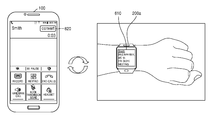
- FIG. 6 illustrates an example in which the wearable apparatus 200 a displays the relevant information.
- the mobile apparatus 100 may obtain the relevant information related to the partner of the call connection, e.g. Smith, from the mobile apparatus 100 or an external server.
- the relevant information related to the partner of the call connection e.g. Smith
- the mobile apparatus 100 may transmit the obtained relevant information to the wearable apparatus 200 a.
- the wearable apparatus 200 a may display schedule information 610 related to the partner, e.g. Smith, while the user makes a phone call with Smith via the mobile apparatus 100 .
- the wearable apparatus 200 a may change the displayed relevant information, in response to a user input shaking the wearable apparatus 200 a.
- the wearable apparatus 200 a may change the schedule information 610 to information uploaded by the partner, e.g. Smith, on the SNS and display the uploaded information, according to a user input.
- the partner e.g. Smith
- the mobile apparatus 100 may generate a link button 620 for establishing a communication link between the mobile apparatus 100 and the wearable apparatus 200 a.
- the mobile apparatus 100 may establish the communication link between the mobile apparatus 100 and the wearable apparatus 200 a.
- the mobile apparatus 100 may stop transmitting the relevant information to the wearable apparatus 200 a and may display the relevant information related to Smith on the mobile apparatus 100 .
- FIG. 7 illustrates an example in which a communication link is established between the mobile apparatus 100 and the wearable apparatus 200 a.
- the communication link may be established between the mobile apparatus 100 and the wearable apparatus 200 a.
- the wearable apparatus 200 a may perform a voice call with the partner of the call connection in the mobile apparatus 100 , via the established communication link. Also, when the communication link is established, the wearable apparatus 200 a may activate a speaker included in the wearable apparatus 200 a.
- the mobile apparatus 100 may display the relevant information related to the partner.
- the mobile apparatus 100 may display information 710 that is uploaded on the SNS by the partner.
- FIG. 8 is a flowchart illustrating an example method of transmitting the relevant information to the wearable apparatus 200 a via the mobile apparatus 100 .
- the mobile apparatus 100 may detect a call connection state of the mobile apparatus 100 in operation S 110 . Also, the mobile apparatus 100 may detect a distance between the mobile apparatus 100 and a user.
- the mobile apparatus 100 may obtain the relevant information related to a partner of the call connection.
- the relevant information may include memo information, schedule information, image information, information uploaded by the partner on a social network service (SNS), for example, Facebook, Weibo, etc., web chatting information, advertisement information, information obtained during the call connection, etc., which are pre-set in the mobile apparatus 100 as being related to the partner of the call connection.
- SNS social network service
- the mobile apparatus 100 may obtain SNS account information of the partner of the call connection. Also, based on the obtained SNS account, the mobile apparatus 100 may obtain information uploaded by the partner from an external server.
- the mobile apparatus 100 may automatically obtain address book information of the partner of the call connection.
- the mobile apparatus 100 may automatically obtain an email, text message data, etc. including a name, a telephone number, etc. of the partner of the call connection. However, it is not limited thereto.
- the mobile apparatus 100 may obtain a voice command of the user. For example, the mobile apparatus 100 may identify voice information of the user of the mobile apparatus 100 . Also, the mobile apparatus 100 may determine whether the identified voice information includes the voice command.
- the voice command may include a name, an address, a telephone number, etc. of a specific partner.
- the mobile apparatus 100 may obtain information corresponding to the voice command as the relevant information.
- the mobile apparatus 100 may obtain information that had been displayed on a screen of the mobile apparatus 100 before the call was connected, as the relevant information.
- the mobile apparatus 100 may package the obtained relevant information according to various formats.
- the mobile apparatus 100 obtains the relevant information related to a partner of the call connection, when a call is connected.
- the mobile apparatus 100 may obtain the relevant information related to the partner of the call connection, when the mobile apparatus 100 detects that a call is connected and that a distance between the mobile apparatus 100 and the user is within a predetermined range.
- the mobile apparatus 100 may transmit the obtained relevant information to the wearable apparatus 200 a in operation S 130 .
- the mobile apparatus 100 may transmit a display parameter with respect to the relevant information to the wearable apparatus 200 a.
- the display parameter with respect to the relevant information may include whether to display the relevant information on the wearable apparatus 200 a or the mobile apparatus 100 , types of the relevant information, an order of display of the relevant information, the number of pieces of the relevant information, etc.
- the mobile apparatus 100 may transmit the relevant information and the display parameter to the wearable apparatus 200 a , according to a synchronous transmission method or an asynchronous transmission method. For example, the mobile apparatus 100 may push the relevant information and the display parameter to the wearable apparatus 200 a.
- the obtained relevant information may include a plurality of pieces of information.
- the mobile apparatus 100 may transmit first relevant information from among the obtained relevant information to the wearable apparatus 200 a .
- the mobile apparatus 100 may receive a request of transmitting second relevant information from the wearable apparatus 200 a.
- the mobile apparatus 100 may transmit the second relevant information to the wearable apparatus 200 a.
- the mobile apparatus 100 may transmit the second relevant information after the first relevant information, according to the order of display of the relevant information.
- the mobile apparatus 100 may transmit the specific information.
- the mobile apparatus 100 may establish a communication link between the mobile apparatus 100 and the wearable apparatus 200 a.
- the mobile apparatus 100 may transmit sound data and image data received from the partner of the call connection to the wearable apparatus 200 a . Also, the mobile apparatus 100 may transmit the sound data and the image data received from the wearable apparatus 200 a to a partner device.
- the mobile apparatus 100 may stop transmitting the relevant information to the wearable apparatus 200 a and may display the relevant information on the mobile apparatus 100 .
- the user may make a phone call with the partner via the wearable apparatus 200 a , and may receive the relevant information related to the partner via the mobile apparatus 100 .
- FIG. 9 is a flowchart illustrating an example method of displaying the relevant information via the wearable apparatus 200 a.
- the wearable apparatus 200 a may receive the relevant information.
- the wearable apparatus 200 a may receive the relevant information from the mobile apparatus 100 or an external server.
- the relevant information may include memo information, schedule information, image information, information uploaded by the partner on a social network service (SNS), for example, Facebook, Weibo, etc., web chatting information, advertisement information, information obtained during the call connection, etc., which are pre-set in the mobile apparatus 100 as being related to the partner of the call connection.
- SNS social network service
- the relevant information may include information that had been displayed on a screen of the mobile apparatus 100 before the call was connected in the mobile apparatus 100 .
- the relevant information may include information corresponding to a voice command obtained during the call connection from the user of the mobile apparatus 100 .
- the wearable apparatus 200 a may receive a display parameter with respect to the relevant information.
- the display parameter with respect to the relevant information may include whether to display the relevant information on the wearable apparatus 200 a , types of the relevant information, an order of display of the relevant information, the number of pieces of the relevant information, etc.
- the wearable apparatus 200 a may store the received relevant information and display parameter with respect to the relevant information.
- the wearable apparatus 200 a may communicate with the mobile apparatus 100 via near field wireless communication.
- the wearable apparatus 200 a may display the received relevant information. In some embodiments, the wearable apparatus 200 a may display the received relevant information based on the received display parameter.
- the wearable apparatus 200 a may receive a user input.
- the wearable apparatus 200 a may receive a user's motion input shaking the wearable apparatus 200 a.
- the wearable apparatus 200 a may receive a user input touching a screen on which the relevant information is displayed.
- the wearable apparatus 200 a may change the displayed relevant information based on the user input.
- the wearable apparatus 200 a may change first relevant information to second relevant information according to the display parameter and may display the second relevant information.
- the wearable apparatus 200 a may determine the second relevant information that is to be displayed after the first relevant information, according to the number of pieces of the relevant information and the order of display of the relevant information, which are set in the display parameter.
- the wearable apparatus 200 a may request the mobile apparatus 100 to transmit the second relevant information.
- the wearable apparatus 200 a may receive a touch input of the user on the screen on which the first relevant information is displayed. Also, the wearable apparatus 200 a may request the mobile apparatus 100 to transmit specific information that is related to the information displayed on the area on which the touch input is received.
- the wearable apparatus 200 a may receive a user's touch input on an area on which a telephone number is displayed. In this case, the wearable apparatus 200 a may request the mobile apparatus 100 to transmit specific information related to the telephone number.
- the mobile apparatus 100 may transmit address book information, etc., corresponding to the telephone number to the wearable apparatus 200 a.
- the user of the mobile apparatus 100 and the wearable apparatus 200 a may receive useful information via the wearable apparatus 200 a , during the call connection in the mobile apparatus 100 .
- FIG. 10 illustrates an example feature of a wearable apparatus 200 b.
- the wearable apparatus 200 b may include at least one of the communication interface 210 , the controller 230 , the output unit 240 , the user input unit 220 , at least one distance measurement sensor 1020 which may measure a distance between the mobile apparatus 100 and the wearable apparatus 200 b , and a camera 1030 .
- the distance measurement sensor may include at least one of a proximity sensor, an infrared sensor, a position sensor, an illuminance sensor, a magnetic sensor, and a gyro sensor, or a combination thereof.
- the distance measurement sensor 1020 and the camera 1030 may be arranged in a band 1010 of the wearable apparatus 200 b.
- the wearable apparatus 200 b may a smart watch including a proximity sensor and the camera 1030 arranged in the band 1010 .
- the communication interface 210 of the wearable apparatus 200 b may receive content from the mobile apparatus 100 .
- the content may include information displayed on some areas of a screen of the mobile apparatus 100 .
- the camera 1030 may photograph the mobile apparatus 100 .
- the controller 230 may obtain the content based on the photographed image.
- the controller 230 may receive a distance value or a sensing value measured by at least one of the at least one distance measurement sensor and the camera 1030 .
- the controller 230 may control the output unit 240 to display the content on the screen, based on the received distance value or sensing value. In some embodiments, the controller 230 may change a format of at least one piece of content and display the content.
- the communication interface 210 may receive hidden information from the mobile apparatus 100 .
- the hidden information may correspond to target information displayed on the mobile apparatus 100 , and may be information displayed only on the wearable apparatus 200 b if a certain condition is met.
- the controller 230 may control the output unit 240 to display the hidden information on the screen based on tag information included in the hidden information.
- FIG. 11 is a flowchart illustrating an example method of displaying information via the wearable apparatus 200 b.
- the wearable apparatus 200 b may measure a distance between the wearable apparatus 200 b and the mobile apparatus 100 .
- the wearable apparatus 200 b may measure a distance from the mobile apparatus 100 by using a camera, a proximity sensor, etc.
- the wearable apparatus 200 b may obtain some of information displayed on the screen of the mobile apparatus 100 .
- the wearable apparatus 200 b may obtain information displayed on the overlapped portion 1210 of the screen.
- the wearable apparatus 200 b may request the mobile apparatus 100 to transmit the information displayed on the portion 1210 of the screen of the mobile apparatus 100 .
- the mobile apparatus 100 may obtain coordinate data of the portion 1210 of the screen of the mobile apparatus 100 , by using the camera or the position sensor included in the mobile apparatus 100 . Also, the mobile apparatus 100 may transmit the information displayed in the obtained coordinate data to the wearable apparatus 200 b.
- the wearable apparatus 200 b may photograph the mobile apparatus 100 by using the camera.
- the wearable apparatus 200 b may photograph the screen of the mobile apparatus 100 located in the critical distance.
- the wearable apparatus 200 b may obtain the information displayed on the portion 1210 of the screen of the mobile apparatus 100 , based on the photographed image.
- the wearable apparatus 200 b may change the format of the obtained information and display the information.
- the format may include a color, a size, and a font of a text message, a size and a color of an image, a color of a background, etc.
- the wearable apparatus 200 b may display a text message or an image included in the obtained information by changing the color of the text message or the image. Also, the wearable apparatus 200 b may display the text message included in the relevant information by changing the size of the text message.
- the wearable apparatus 200 b may change the size of the text message or the image include in the relevant information.
- the wearable apparatus 200 b may display a photographed image by changing the size of the photographed image.
- the wearable apparatus 200 b may display the photographed image by enlarging the size of the image, based on the distance between the wearable apparatus 200 b and the mobile apparatus 100 .
- FIGS. 13 and 14 illustrate examples in which the wearable apparatus 200 b displays information.
- the wearable apparatus 200 b may display information 1310 displayed on an area of the screen of the mobile apparatus 100 on the wearable apparatus 200 b.
- the wearable apparatus 200 b may change the background color and the text message color of information 1310 and display the information 1310 .
- the wearable apparatus 200 b may change the text message size of the information 1310 and display the information 1310 .
- the user may be effectively provided with some information displayed on the screen of the mobile apparatus 100 , via the wearable apparatus 200 b , even from a location apart from the mobile apparatus 100 .
- FIG. 15 is a flowchart illustrating an example method of displaying hidden information via the wearable apparatus 200 b.
- the wearable apparatus 200 b may receive the hidden information from the mobile apparatus 100 , in operation S 410 .
- the hidden information may correspond to target information which is displayed on the mobile apparatus 100 , and may be information displayed only on the wearable apparatus 200 b when a predetermined condition is satisfied.
- the target information may correspond to the hidden information and may be information displayed on the mobile apparatus 100 .
- the hidden information may be a password
- the target information corresponding to the password may be a text message “****” displayed on the screen of the mobile apparatus 100 .
- the hidden information may include tag information.
- the tag information may be the target information, coordinate data in which the target information is displayed on the mobile apparatus 100 , or a share index shared by the target information and the hidden information.
- the target information and the hidden information may be information transmitted to the mobile apparatus 100 from an external device.
- a text message received by the mobile apparatus 100 may include the target information and the hidden information.
- the wearable apparatus 200 b may obtain information displayed on the mobile apparatus 100 .
- the wearable apparatus 200 b may obtain information displayed on the mobile apparatus 100 by using a camera included in the wearable apparatus 200 b.
- the wearable apparatus 200 b may receive the information displayed on the mobile apparatus 100 from the mobile apparatus 100 .
- the wearable apparatus 200 b may determine whether the obtained information includes the target information. For example, the wearable apparatus 200 b may determine whether the obtained information includes the target information, based on the tag information included in the hidden information.
- the wearable apparatus 200 b may receive coordinate data of the screen of the mobile apparatus 100 , at which the wearable apparatus 200 b is located, from the mobile apparatus 100 .
- the wearable apparatus 200 b may determine whether to display the hidden information, based on the received coordinate data and the tag information.
- the wearable apparatus 200 b may display the hidden information in operation S 410 . If the obtained information does not include the target information, the wearable apparatus 200 b may change the format of the obtained information and display the information in operation S 450 .
- the mobile apparatus 100 which is easily accessible by other users may display the target information, and the wearable apparatus 200 b may display the hidden information when a predetermined condition is satisfied.
- the mobile apparatus 100 and the wearable apparatus 200 b may limit the access of other persons to certain information.
- FIG. 16 illustrates an example in which the wearable apparatus 200 b displays hidden information.
- the mobile apparatus 100 may receive a text message 1610 including target information and hidden information, from an external device.
- the wearable apparatus 200 b when the wearable apparatus 200 b apart from the mobile apparatus 100 overlaps a portion of the screen of the mobile apparatus 100 , on which the target information is displayed, the wearable apparatus 200 b may display hidden information 1620 corresponding to the target information.
- FIG. 17 is a block diagram illustrating an example structure of the mobile apparatus 100 a.
- the mobile apparatus 100 a may include a controller 1710 , a user input unit 1720 , an audio/video (A/V) input unit 1730 , a communication interface 1740 , an output unit 1750 , and a memory 1760 .
- a controller 1710 the mobile apparatus 100 a may include a controller 1710 , a user input unit 1720 , an audio/video (A/V) input unit 1730 , a communication interface 1740 , an output unit 1750 , and a memory 1760 .
- A/V audio/video
- More or less components than the components illustrated in FIG. 17 may be used to realize the mobile apparatus 100 a.
- the controller 1710 may control general operations of the mobile apparatus 100 a.
- the controller 1710 may execute programs stored in the memory 1760 to generally control the user input unit 1720 , the A/V input unit 1730 , the output unit 1750 , and the communication interface 1740 .
- the controller 1710 may control communication (for example, voice communication and data communication).
- the controller 1710 may include a decoder (not shown) which may decode audio and video streams.
- controller 1710 may control the mobile apparatus 100 a to decode the received audio and video streams and to output the decoded audio and video streams via the output unit 1750 .
- the controller 1710 may control a display 1751 to display a user interface.
- the user interface may include a keyboard on a screen.
- controller 1710 may correspond to the controller 110 of FIG. 1 .
- the controller 1710 may detect a call connection state. Also, the controller 1710 may detect a distance between the mobile apparatus 100 a and a user of the mobile apparatus 100 a.
- controller 1710 may generate a user interface for setting relevant information. Also, the controller 1710 may store the set relevant information.
- controller 1710 may establish a communication link between the mobile apparatus 100 a and a wearable apparatus, based on a user input received during the call connection.
- the controller 1710 may transmit sound data and video data received from a partner device of the call connection to the wearable apparatus and may transmit sound data and image data received from the wearable apparatus to the partner device.
- controller 1710 may display the relevant information via the display 1751 .
- the AV input unit 1730 is configured to input an audio signal or a video signal and may include a camera 1731 , a microphone 1732 , etc.
- the camera 1731 may include a lens, an imaging sensor (for example, a charge coupled device (CCD) sensor, complementary metal oxide semiconductor (CMOS) sensor, etc.), an analog-to digital (A/D) converter, etc.
- the camera 1731 may obtain an image frame, such as a still image or a video, via the image sensor, in a video call mode or a photographing mode.
- the image captured by the image sensor may be processed by the controller 1710 or an additional image processor (not shown).
- the image frame processed by the camera 1731 may be stored in the memory 1760 or transmitted to the outside via the communication interface 1740 . Also, the camera 1731 may display the processed image frame via the display 1751 . According to a structure of a terminal, two or more cameras 1731 may be included.
- the microphone 1732 may receive an external sound signal and process the sound signal as electrical sound data.
- the microphone 1732 may receive a sound signal from an external device or a speaker.
- the microphone 1732 may use various noise elimination algorithms for removing noise generated in the process of receiving the external sound signal.
- the output unit 1750 is configured to output audio data or video data and may include the display 1751 , a microphone 1752 , a speaker 1753 , etc.
- the display 1751 may display a user interface.
- the display 1751 may display the user interface in an execution window of a memo application.
- the display 1751 may display the relevant information.
- the display 1751 may be used not only as an output device but also as an input device.
- the display 1751 may include at least one of a liquid crystal display, a thin film transistor-liquid crystal display, an organic light-emitting diode, a flexible display, a three dimensional (3D) display, and an electrophoretic display.
- the mobile apparatus 100 a may include two or more display 1751 according to a realization type of the mobile apparatus 100 a.
- the two or more display 1751 may be arranged to face each other by using a hinge.
- the mobile apparatus 100 a may include several input keys.
- the mobile apparatus 100 a may include a power key for power on/off of the mobile apparatus 100 a.
- the speaker 1753 may reproduce audio data exchanged during a voice call, audio data including a message received during the voice call, and audio data included in an audio file stored in the memory 1760 .
- the communication interface 1740 may include one or more components for enabling communication between the mobile apparatus 100 a and a wearable apparatus or between the mobile apparatus 100 a and external devices.
- the communication interface 1740 may include a short-range wireless communication interface 1741 , a mobile communication interface 1742 , and a broadcasting receiver 1743 .
- the mobile apparatus 100 a may communicate with the wearable apparatus via the short-range wireless communication interface 1741 .
- the short-range wireless communication interface 1741 may include a Bluetooth, a Bluetooth low energy (BLE), a near field, a WLAN (Wi-fi), a Zigbee, an infrared data association (IrDA), a Wi-Fi direct (WFD), a ultra wideband (UWB), an Ant+, etc., but it is not limited thereto.
- the mobile communication interface 1742 exchanges wireless signals with at least one of a based station in a mobile communication network, an external terminal, and a server.
- the wireless signal may include a voice call signal, a video telephony call signal, or data of various formats according to an exchange of text/multimedia messages.
- the broadcasting receiver 1743 receives a broadcasting signal and/or broadcasting relevant information from the outside via a broadcasting channel.
- the broadcasting channel may include a satellite channel, a ground-wave channel, etc.
- the mobile apparatus 100 a may not include the broadcasting receiver 1743 .
- the memory 1760 may store programs to be processed and controlled by the controller 1710 and may store data that is input/output (for example, a plurality of menus, a plurality of first hierarchical sub-menus corresponding to the plurality of menus, respectively, a plurality of second hierarchical sub-menus corresponding to the plurality of first hierarchical sub-menus, respectively, etc.).
- the memory 1760 may store the relevant information.
- the memory 1760 may include at least one type of storage medium from among a flash memory type, a hard disk type, a multimedia card micro type, a card-type memory (for example, SD or XD memory), random access memory (RAM), static RAM (SRAM), read-only memory (ROM), electrically erasable programmable ROM (EEPROM), programmable ROM (PROM), magnetic memory, a magnetic disk, and an optical disk. Also, the mobile apparatus 100 a may run a web storage or a cloud server performing a storage function of the memory 1760 on the internet.
- a flash memory type for example, SD or XD memory
- RAM random access memory
- SRAM static RAM
- ROM read-only memory
- EEPROM electrically erasable programmable ROM
- PROM programmable ROM
- magnetic memory a magnetic disk, and an optical disk.
- the mobile apparatus 100 a may run a web storage or a cloud server performing a storage function of the memory 1760 on the internet.
- the method of pushing information via the mobile apparatus and the method of displaying information via the wearable apparatus may be implemented as computer instructions which may be executed by various computer means, and recorded on a computer-readable recording medium.
- the computer-readable recording medium may include program commands, data files, data structures, or a combination thereof.
- the program commands recorded on the computer-readable recording medium may be specially designed and constructed for the inventive concept or may be known to and usable by one of ordinary skill in a field of computer software.
- Examples of the computer-readable medium include storage media such as magnetic media (e.g., hard discs, floppy discs, or magnetic tapes), optical media (e.g., compact disc-read only memories (CD-ROMs), or digital versatile discs (DVDs)), magneto-optical media (e.g., floptical discs), and hardware devices that are specially configured to store and carry out program commands (e.g., ROMs, RAMs, or flash memories). Examples of the program commands include a high-level language code that may be executed by a computer using an interpreter as well as a machine language code made by a complier.
- storage media such as magnetic media (e.g., hard discs, floppy discs, or magnetic tapes), optical media (e.g., compact disc-read only memories (CD-ROMs), or digital versatile discs (DVDs)), magneto-optical media (e.g., floptical discs), and hardware devices that are specially configured to store and carry out program commands (e.g.
Landscapes
- Engineering & Computer Science (AREA)
- Signal Processing (AREA)
- Computer Networks & Wireless Communication (AREA)
- Human Computer Interaction (AREA)
- Telephone Function (AREA)
- User Interface Of Digital Computer (AREA)
- Telephonic Communication Services (AREA)
- Near-Field Transmission Systems (AREA)
Applications Claiming Priority (4)
| Application Number | Priority Date | Filing Date | Title |
|---|---|---|---|
| CN201310486544 | 2013-10-17 | ||
| CN201310486544.9A CN104580663A (zh) | 2013-10-17 | 2013-10-17 | 用于移动终端的信息推送装置、穿戴式设备及其方法 |
| CN201310486544.9 | 2013-10-17 | ||
| PCT/KR2014/009786 WO2015057013A1 (ko) | 2013-10-17 | 2014-10-17 | 휴대용 장치가 웨어러블 장치를 통하여 정보를 표시하는 방법 및 그 장치 |
Publications (2)
| Publication Number | Publication Date |
|---|---|
| US20160277557A1 US20160277557A1 (en) | 2016-09-22 |
| US10158749B2 true US10158749B2 (en) | 2018-12-18 |
Family
ID=52828382
Family Applications (1)
| Application Number | Title | Priority Date | Filing Date |
|---|---|---|---|
| US15/030,141 Active US10158749B2 (en) | 2013-10-17 | 2014-10-17 | Method by which portable device displays information through wearable device, and device therefor |
Country Status (5)
| Country | Link |
|---|---|
| US (1) | US10158749B2 (de) |
| EP (1) | EP3046352B1 (de) |
| KR (1) | KR102345649B1 (de) |
| CN (1) | CN104580663A (de) |
| WO (1) | WO2015057013A1 (de) |
Families Citing this family (10)
| Publication number | Priority date | Publication date | Assignee | Title |
|---|---|---|---|---|
| KR102345651B1 (ko) * | 2014-07-31 | 2021-12-31 | 삼성전자주식회사 | 이동통신 시스템, 이동통신 시스템 상에서 동일한 전화번호를 공유하는 서로 다른 모바일 디바이스들, 및 동일한 전화번호를 공유하는 서로 다른 모바일 디바이스들에서 이동통신 서비스를 제공하는 방법 |
| EP3179705B1 (de) * | 2014-08-29 | 2019-04-03 | Huawei Technologies Co. Ltd. | Verfahren, system sowie zugehörige vorrichtung zur nachrichtenverarbeitung |
| CN105493026B (zh) * | 2015-08-05 | 2019-07-09 | 深圳市元征科技股份有限公司 | 一种智能穿戴设备屏显方法及装置 |
| CN105677490A (zh) * | 2015-12-18 | 2016-06-15 | 联想(北京)有限公司 | 一种处理通知事件的方法及电子设备 |
| US9716795B1 (en) * | 2015-12-30 | 2017-07-25 | Qualcomm Incorporated | Diversion of a call to a wearable device |
| WO2017119522A1 (ko) * | 2016-01-07 | 2017-07-13 | 엘지전자 주식회사 | 이동 단말기 및 와치타입 단말기의 제어방법 |
| CN106131285B (zh) * | 2016-06-29 | 2020-05-05 | 深圳市大而信科技有限公司 | 一种通话方法及终端 |
| CN108881353B (zh) * | 2017-05-16 | 2020-07-31 | 腾讯科技(深圳)有限公司 | 一种内容推送方法、装置及计算机可读存储介质 |
| CN110708427B (zh) * | 2019-10-22 | 2023-07-18 | 北京小米移动软件有限公司 | 信息处理方法、装置及存储介质 |
| JP7501044B2 (ja) * | 2020-03-30 | 2024-06-18 | セイコーエプソン株式会社 | 表示システム、情報処理装置及び表示システムの表示制御方法 |
Citations (20)
| Publication number | Priority date | Publication date | Assignee | Title |
|---|---|---|---|---|
| US20020068600A1 (en) * | 2000-06-21 | 2002-06-06 | Hiroyuki Chihara | Mobile video telephone system |
| US20060045374A1 (en) * | 2004-08-31 | 2006-03-02 | Lg Electronics Inc. | Method and apparatus for processing document image captured by camera |
| CN101115255A (zh) | 2004-07-22 | 2008-01-30 | 华为技术有限公司 | 手机装置及其与外设连接通讯的方法 |
| KR20090002188A (ko) | 2007-06-21 | 2009-01-09 | 삼성전자주식회사 | 휴대 단말기의 통합 연결 기능 수행 방법 및 비즈니스 모델 |
| US20090286514A1 (en) * | 2008-05-19 | 2009-11-19 | Audiopoint Inc. | Interactive voice access and retrieval of information |
| KR20100011129A (ko) | 2008-07-24 | 2010-02-03 | (주)세현 | 표시장치로의 문자입력 방법, 이를 수행하기 위한 이동통신단말기 및 이를 갖는 문자입력 시스템 |
| US20100232586A1 (en) * | 2003-05-20 | 2010-09-16 | Mccullough William | Caller information system |
| US20110130130A1 (en) | 2009-11-30 | 2011-06-02 | Du ya-jun | Method for controlling a portable apparatus used in a telecommunication network, and associated portable apparatus |
| US20110143769A1 (en) * | 2009-12-16 | 2011-06-16 | Microsoft Corporation | Dual display mobile communication device |
| KR20110080347A (ko) | 2010-01-05 | 2011-07-13 | 엘지전자 주식회사 | 휴대 단말기 및 그 동작 제어방법 |
| US20110207447A1 (en) * | 2010-02-22 | 2011-08-25 | Plantronics, Inc. | Headset Call Transition |
| US20120076285A1 (en) * | 2005-07-21 | 2012-03-29 | At&T Intellectual Property I, L.P. | Enhanced caller id with recipient-selected caller information display |
| KR101188978B1 (ko) | 2012-04-19 | 2012-10-09 | 고돈호 | 듀얼 모니터 기능을 지원하기 위한 모바일 단말기 커버 |
| WO2012172970A1 (ja) | 2011-06-13 | 2012-12-20 | Necカシオモバイルコミュニケーションズ株式会社 | 通信システム |
| US20130040610A1 (en) * | 2009-11-25 | 2013-02-14 | Eric B. Migicovsky | System and Method for Alerting a User on an External Device of Notifications or Alerts Originating from a Network-Connected Device |
| US20130262298A1 (en) | 2012-03-28 | 2013-10-03 | Qualcomm Incorporated | Multifunction wristband |
| US20140106677A1 (en) * | 2012-10-15 | 2014-04-17 | Qualcomm Incorporated | Wireless Area Network Enabled Mobile Device Accessory |
| US8781453B1 (en) * | 2013-02-25 | 2014-07-15 | WhitePages, Inc. | Proactive caller-context systems and methods |
| US20140273975A1 (en) * | 2013-03-14 | 2014-09-18 | Motorola Mobility Llc | Notification Handling System and Method |
| US20150022438A1 (en) * | 2013-07-18 | 2015-01-22 | Gyuseog Hong | Watch type mobile terminal and method of controlling the same |
-
2013
- 2013-10-17 CN CN201310486544.9A patent/CN104580663A/zh active Pending
-
2014
- 2014-10-17 EP EP14853349.0A patent/EP3046352B1/de active Active
- 2014-10-17 KR KR1020140141202A patent/KR102345649B1/ko active Active
- 2014-10-17 WO PCT/KR2014/009786 patent/WO2015057013A1/ko not_active Ceased
- 2014-10-17 US US15/030,141 patent/US10158749B2/en active Active
Patent Citations (23)
| Publication number | Priority date | Publication date | Assignee | Title |
|---|---|---|---|---|
| US20020068600A1 (en) * | 2000-06-21 | 2002-06-06 | Hiroyuki Chihara | Mobile video telephone system |
| US20100232586A1 (en) * | 2003-05-20 | 2010-09-16 | Mccullough William | Caller information system |
| CN101115255A (zh) | 2004-07-22 | 2008-01-30 | 华为技术有限公司 | 手机装置及其与外设连接通讯的方法 |
| US20060045374A1 (en) * | 2004-08-31 | 2006-03-02 | Lg Electronics Inc. | Method and apparatus for processing document image captured by camera |
| US20120076285A1 (en) * | 2005-07-21 | 2012-03-29 | At&T Intellectual Property I, L.P. | Enhanced caller id with recipient-selected caller information display |
| KR20090002188A (ko) | 2007-06-21 | 2009-01-09 | 삼성전자주식회사 | 휴대 단말기의 통합 연결 기능 수행 방법 및 비즈니스 모델 |
| US20090286514A1 (en) * | 2008-05-19 | 2009-11-19 | Audiopoint Inc. | Interactive voice access and retrieval of information |
| KR20100011129A (ko) | 2008-07-24 | 2010-02-03 | (주)세현 | 표시장치로의 문자입력 방법, 이를 수행하기 위한 이동통신단말기 및 이를 갖는 문자입력 시스템 |
| US20130040610A1 (en) * | 2009-11-25 | 2013-02-14 | Eric B. Migicovsky | System and Method for Alerting a User on an External Device of Notifications or Alerts Originating from a Network-Connected Device |
| US20110130130A1 (en) | 2009-11-30 | 2011-06-02 | Du ya-jun | Method for controlling a portable apparatus used in a telecommunication network, and associated portable apparatus |
| US20110143769A1 (en) * | 2009-12-16 | 2011-06-16 | Microsoft Corporation | Dual display mobile communication device |
| CN102656808A (zh) | 2009-12-16 | 2012-09-05 | 微软公司 | 双显示器移动通信设备 |
| KR20120102115A (ko) | 2009-12-16 | 2012-09-17 | 마이크로소프트 코포레이션 | 듀얼 디스플레이 이동 통신 장치 |
| KR20110080347A (ko) | 2010-01-05 | 2011-07-13 | 엘지전자 주식회사 | 휴대 단말기 및 그 동작 제어방법 |
| US20110207447A1 (en) * | 2010-02-22 | 2011-08-25 | Plantronics, Inc. | Headset Call Transition |
| WO2012172970A1 (ja) | 2011-06-13 | 2012-12-20 | Necカシオモバイルコミュニケーションズ株式会社 | 通信システム |
| US20140113607A1 (en) | 2011-06-13 | 2014-04-24 | Nec Casio Mobile Communications, Ltd. | Communication system |
| US20130262298A1 (en) | 2012-03-28 | 2013-10-03 | Qualcomm Incorporated | Multifunction wristband |
| KR101188978B1 (ko) | 2012-04-19 | 2012-10-09 | 고돈호 | 듀얼 모니터 기능을 지원하기 위한 모바일 단말기 커버 |
| US20140106677A1 (en) * | 2012-10-15 | 2014-04-17 | Qualcomm Incorporated | Wireless Area Network Enabled Mobile Device Accessory |
| US8781453B1 (en) * | 2013-02-25 | 2014-07-15 | WhitePages, Inc. | Proactive caller-context systems and methods |
| US20140273975A1 (en) * | 2013-03-14 | 2014-09-18 | Motorola Mobility Llc | Notification Handling System and Method |
| US20150022438A1 (en) * | 2013-07-18 | 2015-01-22 | Gyuseog Hong | Watch type mobile terminal and method of controlling the same |
Non-Patent Citations (8)
| Title |
|---|
| Communication dated Dec. 4, 2017, issued by the State Intellectual Property Office of People's Republic of China in counterpart Chinese Patent Application No. 201310486544.9. |
| Communication dated Jun. 1, 2018, issued by the State Intellectual Property Office of People's Republic of China in counterpart Chinese Patent Application No. 201310486544.9. |
| Communication dated May 12, 2017 by the State Intellectual Property Office of P.R. China in counterpart Chinese Patent Application No. 201310486544.9. |
| Communication dated Sep. 13, 2018, issued by the State Intellectual Property Office of P.R. China in counterpart Chinese Application No. 201310486544.9. |
| Communication dated Sep. 19, 2016 issued by the State Intellectual Property Office of P.R. China in counterpart Chinese Patent Application No. 201310486544.9. |
| Communication issued May 17, 2017 by the European Patent Office in counterpart European Patent Application No. 14853349.0. |
| Search Report dated Jan. 19, 2015, issued by the International Searching Authority in counterpart international Patent Application No. PCT/KR2014/009786 (PCT/ISA/210). |
| Written Opinion dated Jan. 19, 2015, issued by the International Searching Authority in counterpart international Patent Application No. PCT/KR2014/009786 (PCT/ISA/237). |
Also Published As
| Publication number | Publication date |
|---|---|
| EP3046352A1 (de) | 2016-07-20 |
| US20160277557A1 (en) | 2016-09-22 |
| CN104580663A (zh) | 2015-04-29 |
| KR102345649B1 (ko) | 2021-12-30 |
| WO2015057013A8 (ko) | 2016-05-06 |
| EP3046352A4 (de) | 2017-06-14 |
| WO2015057013A1 (ko) | 2015-04-23 |
| KR20150044830A (ko) | 2015-04-27 |
| EP3046352B1 (de) | 2021-09-15 |
Similar Documents
| Publication | Publication Date | Title |
|---|---|---|
| US10158749B2 (en) | Method by which portable device displays information through wearable device, and device therefor | |
| US12039144B2 (en) | Display information interaction method and related apparatus | |
| US12147273B2 (en) | Video call display method applied to electronic device and related apparatus | |
| US12032410B2 (en) | Display method for flexible display, and terminal | |
| KR102534354B1 (ko) | 시스템 탐색 바 표시 제어 방법, 그래픽 사용자 인터페이스 및 전자 디바이스 | |
| JP2021157837A (ja) | 通知処理方法、電子デバイス、コンピュータ可読記憶媒体、およびプログラム | |
| CN108021305B (zh) | 应用关联启动的方法、装置及移动终端 | |
| KR102274043B1 (ko) | 연락처를 표시하는 방법 및 이를 구현하는 전자장치 | |
| KR20170137445A (ko) | 파일 공유 방법 및 이를 구현한 전자 장치 | |
| US10013227B2 (en) | Mobile device and method of controlling therefor | |
| CN108762859B (zh) | 壁纸显示方法、装置、移动终端及存储介质 | |
| WO2022161119A1 (zh) | 一种显示方法及电子设备 | |
| US20160219424A1 (en) | Methods, apparatuses and devices for transmitting data | |
| US20180239511A1 (en) | Mobile terminal and control method therefor | |
| CN107835118A (zh) | 信息处理方法、装置、移动终端及计算机可读存储介质 | |
| CN109062634A (zh) | 一种应用启动方法及移动终端 | |
| WO2022134691A1 (zh) | 一种终端设备中啸叫处理方法及装置、终端 | |
| JP6441385B2 (ja) | 情報入力方法、装置、プログラム及び記録媒体 | |
| US12272801B2 (en) | Emoji management for electronic messaging | |
| KR20140003115A (ko) | 이동 단말기 및 이동 단말기의 제어 방법 | |
| CN119718149A (zh) | 一种数据拖拽方法、电子设备及存储介质 | |
| KR20170038275A (ko) | 이동 단말기 및 그 제어 방법 | |
| KR20170047059A (ko) | 정보 표시를 수행하는 이동 단말기 및 그 제어방법 | |
| CN114461325A (zh) | 信息显示方法、装置、系统、设备、介质及计算机程序 | |
| CN115866129A (zh) | 应用场景识别方法、装置、终端及存储介质 |
Legal Events
| Date | Code | Title | Description |
|---|---|---|---|
| AS | Assignment |
Owner name: SAMSUNG ELECTRONICS CO., LTD., KOREA, REPUBLIC OF Free format text: ASSIGNMENT OF ASSIGNORS INTEREST;ASSIGNORS:YANG, FAN;LIU, XIANGHUA;MA, YONGJIAN;SIGNING DATES FROM 20160412 TO 20160418;REEL/FRAME:038304/0659 |
|
| STCF | Information on status: patent grant |
Free format text: PATENTED CASE |
|
| MAFP | Maintenance fee payment |
Free format text: PAYMENT OF MAINTENANCE FEE, 4TH YEAR, LARGE ENTITY (ORIGINAL EVENT CODE: M1551); ENTITY STATUS OF PATENT OWNER: LARGE ENTITY Year of fee payment: 4 |