US10139775B2 - Retaining member and image forming apparatus including same - Google Patents

Retaining member and image forming apparatus including same Download PDF

Info

Publication number
US10139775B2
US10139775B2 US15/695,637 US201715695637A US10139775B2 US 10139775 B2 US10139775 B2 US 10139775B2 US 201715695637 A US201715695637 A US 201715695637A US 10139775 B2 US10139775 B2 US 10139775B2
Authority
US
United States
Prior art keywords
circumferential portion
shaft
inner circumferential
retaining member
linkage
Prior art date
Legal status (The legal status is an assumption and is not a legal conclusion. Google has not performed a legal analysis and makes no representation as to the accuracy of the status listed.)
Active
Application number
US15/695,637
Other versions
US20180088517A1 (en
Inventor
Shinji NEMOTO
Naoto Miyakoshi
Current Assignee (The listed assignees may be inaccurate. Google has not performed a legal analysis and makes no representation or warranty as to the accuracy of the list.)
Kyocera Document Solutions Inc
Original Assignee
Kyocera Document Solutions Inc
Priority date (The priority date is an assumption and is not a legal conclusion. Google has not performed a legal analysis and makes no representation as to the accuracy of the date listed.)
Filing date
Publication date
Application filed by Kyocera Document Solutions Inc filed Critical Kyocera Document Solutions Inc
Assigned to KYOCERA DOCUMENT SOLUTIONS INC. reassignment KYOCERA DOCUMENT SOLUTIONS INC. ASSIGNMENT OF ASSIGNORS INTEREST (SEE DOCUMENT FOR DETAILS). Assignors: MIYAKOSHI, NAOTO, NEMOTO, SHINJI
Publication of US20180088517A1 publication Critical patent/US20180088517A1/en
Application granted granted Critical
Publication of US10139775B2 publication Critical patent/US10139775B2/en
Active legal-status Critical Current
Anticipated expiration legal-status Critical

Links

Images

Classifications

    • GPHYSICS
    • G03PHOTOGRAPHY; CINEMATOGRAPHY; ANALOGOUS TECHNIQUES USING WAVES OTHER THAN OPTICAL WAVES; ELECTROGRAPHY; HOLOGRAPHY
    • G03GELECTROGRAPHY; ELECTROPHOTOGRAPHY; MAGNETOGRAPHY
    • G03G21/00Arrangements not provided for by groups G03G13/00 - G03G19/00, e.g. cleaning, elimination of residual charge
    • G03G21/16Mechanical means for facilitating the maintenance of the apparatus, e.g. modular arrangements
    • G03G21/18Mechanical means for facilitating the maintenance of the apparatus, e.g. modular arrangements using a processing cartridge, whereby the process cartridge comprises at least two image processing means in a single unit
    • G03G21/1839Means for handling the process cartridge in the apparatus body
    • G03G21/1857Means for handling the process cartridge in the apparatus body for transmitting mechanical drive power to the process cartridge, drive mechanisms, gears, couplings, braking mechanisms
    • G03G21/186Axial couplings
    • GPHYSICS
    • G03PHOTOGRAPHY; CINEMATOGRAPHY; ANALOGOUS TECHNIQUES USING WAVES OTHER THAN OPTICAL WAVES; ELECTROGRAPHY; HOLOGRAPHY
    • G03GELECTROGRAPHY; ELECTROPHOTOGRAPHY; MAGNETOGRAPHY
    • G03G21/00Arrangements not provided for by groups G03G13/00 - G03G19/00, e.g. cleaning, elimination of residual charge
    • G03G21/16Mechanical means for facilitating the maintenance of the apparatus, e.g. modular arrangements
    • G03G21/1642Mechanical means for facilitating the maintenance of the apparatus, e.g. modular arrangements for connecting the different parts of the apparatus
    • G03G21/1647Mechanical connection means
    • FMECHANICAL ENGINEERING; LIGHTING; HEATING; WEAPONS; BLASTING
    • F16ENGINEERING ELEMENTS AND UNITS; GENERAL MEASURES FOR PRODUCING AND MAINTAINING EFFECTIVE FUNCTIONING OF MACHINES OR INSTALLATIONS; THERMAL INSULATION IN GENERAL
    • F16BDEVICES FOR FASTENING OR SECURING CONSTRUCTIONAL ELEMENTS OR MACHINE PARTS TOGETHER, e.g. NAILS, BOLTS, CIRCLIPS, CLAMPS, CLIPS OR WEDGES; JOINTS OR JOINTING
    • F16B21/00Means for preventing relative axial movement of a pin, spigot, shaft or the like and a member surrounding it; Stud-and-socket releasable fastenings
    • F16B21/10Means for preventing relative axial movement of a pin, spigot, shaft or the like and a member surrounding it; Stud-and-socket releasable fastenings by separate parts
    • F16B21/16Means for preventing relative axial movement of a pin, spigot, shaft or the like and a member surrounding it; Stud-and-socket releasable fastenings by separate parts with grooves or notches in the pin or shaft
    • F16B21/18Means for preventing relative axial movement of a pin, spigot, shaft or the like and a member surrounding it; Stud-and-socket releasable fastenings by separate parts with grooves or notches in the pin or shaft with circlips or like resilient retaining devices, i.e. resilient in the plane of the ring or the like; Details
    • F16B21/186Means for preventing relative axial movement of a pin, spigot, shaft or the like and a member surrounding it; Stud-and-socket releasable fastenings by separate parts with grooves or notches in the pin or shaft with circlips or like resilient retaining devices, i.e. resilient in the plane of the ring or the like; Details external, i.e. with contracting action
    • FMECHANICAL ENGINEERING; LIGHTING; HEATING; WEAPONS; BLASTING
    • F16ENGINEERING ELEMENTS AND UNITS; GENERAL MEASURES FOR PRODUCING AND MAINTAINING EFFECTIVE FUNCTIONING OF MACHINES OR INSTALLATIONS; THERMAL INSULATION IN GENERAL
    • F16CSHAFTS; FLEXIBLE SHAFTS; ELEMENTS OR CRANKSHAFT MECHANISMS; ROTARY BODIES OTHER THAN GEARING ELEMENTS; BEARINGS
    • F16C35/00Rigid support of bearing units; Housings, e.g. caps, covers
    • F16C35/04Rigid support of bearing units; Housings, e.g. caps, covers in the case of ball or roller bearings
    • F16C35/06Mounting or dismounting of ball or roller bearings; Fixing them onto shaft or in housing
    • F16C35/063Fixing them on the shaft
    • GPHYSICS
    • G03PHOTOGRAPHY; CINEMATOGRAPHY; ANALOGOUS TECHNIQUES USING WAVES OTHER THAN OPTICAL WAVES; ELECTROGRAPHY; HOLOGRAPHY
    • G03GELECTROGRAPHY; ELECTROPHOTOGRAPHY; MAGNETOGRAPHY
    • G03G15/00Apparatus for electrographic processes using a charge pattern
    • G03G15/75Details relating to xerographic drum, band or plate, e.g. replacing, testing
    • G03G15/757Drive mechanisms for photosensitive medium, e.g. gears
    • FMECHANICAL ENGINEERING; LIGHTING; HEATING; WEAPONS; BLASTING
    • F16ENGINEERING ELEMENTS AND UNITS; GENERAL MEASURES FOR PRODUCING AND MAINTAINING EFFECTIVE FUNCTIONING OF MACHINES OR INSTALLATIONS; THERMAL INSULATION IN GENERAL
    • F16CSHAFTS; FLEXIBLE SHAFTS; ELEMENTS OR CRANKSHAFT MECHANISMS; ROTARY BODIES OTHER THAN GEARING ELEMENTS; BEARINGS
    • F16C2226/00Joining parts; Fastening; Assembling or mounting parts
    • F16C2226/10Force connections, e.g. clamping
    • F16C2226/12Force connections, e.g. clamping by press-fit, e.g. plug-in
    • FMECHANICAL ENGINEERING; LIGHTING; HEATING; WEAPONS; BLASTING
    • F16ENGINEERING ELEMENTS AND UNITS; GENERAL MEASURES FOR PRODUCING AND MAINTAINING EFFECTIVE FUNCTIONING OF MACHINES OR INSTALLATIONS; THERMAL INSULATION IN GENERAL
    • F16CSHAFTS; FLEXIBLE SHAFTS; ELEMENTS OR CRANKSHAFT MECHANISMS; ROTARY BODIES OTHER THAN GEARING ELEMENTS; BEARINGS
    • F16C2324/00Apparatus used in printing
    • F16C2324/16Printing machines
    • GPHYSICS
    • G03PHOTOGRAPHY; CINEMATOGRAPHY; ANALOGOUS TECHNIQUES USING WAVES OTHER THAN OPTICAL WAVES; ELECTROGRAPHY; HOLOGRAPHY
    • G03GELECTROGRAPHY; ELECTROPHOTOGRAPHY; MAGNETOGRAPHY
    • G03G2221/00Processes not provided for by group G03G2215/00, e.g. cleaning or residual charge elimination
    • G03G2221/16Mechanical means for facilitating the maintenance of the apparatus, e.g. modular arrangements and complete machine concepts
    • G03G2221/1651Mechanical means for facilitating the maintenance of the apparatus, e.g. modular arrangements and complete machine concepts for connecting the different parts
    • G03G2221/1654Locks and means for positioning or alignment
    • GPHYSICS
    • G03PHOTOGRAPHY; CINEMATOGRAPHY; ANALOGOUS TECHNIQUES USING WAVES OTHER THAN OPTICAL WAVES; ELECTROGRAPHY; HOLOGRAPHY
    • G03GELECTROGRAPHY; ELECTROPHOTOGRAPHY; MAGNETOGRAPHY
    • G03G2221/00Processes not provided for by group G03G2215/00, e.g. cleaning or residual charge elimination
    • G03G2221/16Mechanical means for facilitating the maintenance of the apparatus, e.g. modular arrangements and complete machine concepts
    • G03G2221/1651Mechanical means for facilitating the maintenance of the apparatus, e.g. modular arrangements and complete machine concepts for connecting the different parts
    • G03G2221/1657Mechanical means for facilitating the maintenance of the apparatus, e.g. modular arrangements and complete machine concepts for connecting the different parts transmitting mechanical drive power

Definitions

  • the present disclosure relates to a retaining member for preventing a roller and a shaft constituting a drive unit and a gear mounted around such a roller and a shaft from coming off, and an image forming apparatus, such as a copier, a printer, a facsimile machine, and a multifunction peripheral having functions of these, which is provided with such a retaining member.
  • a drive transmission mechanism composed of a gear, a shaft, and the like for transmitting a rotational driving force of a drive unit is used to transmit the rotational driving force to rotary bodies such as a photosensitive drum, a developing roller, and the like as driven members.
  • a drive transmission mechanism as a method to prevent a roller, a shaft, and a gear mounted around these from coming off, there has been used a method in which a retaining ring such as an E-ring is mounted around a shaft.
  • a gear retaining structure in which a gear is mounted on a fixed shaft standing on a plate-shaped member made of resin, and an elastically deformable claw-shaped projection is provided projecting from the plate-shaped member, such that a hooked portion of the claw-shaped projection engages with a peripheral edge part of the gear mounted on the fixed shaft.
  • a retaining member is integrally formed of an elastically deformable material, is mounted on an end part of a shaft supported by a holding member, and prevents the shaft from coming off from the holding member or prevents a rotary body mounted around the shaft from coming off.
  • the retaining member has an inner circumferential portion, an outer circumferential portion, a linkage portion, a plurality of engagement claws, and a slit.
  • the inner and outer circumferential portions are ring-shaped, and the outer circumferential portion is arranged outside the inner circumferential portion in a radial direction.
  • the linkage portion connects the inner circumferential portion and the outer circumferential portion to each other in the radial direction.
  • the plurality of engagement claws project from a surface of the inner circumferential portion pointing in a direction of the shaft, and engage with an engagement groove formed in an outer peripheral surface of the shaft.
  • the slit is formed on a side opposite from the linkage portion with a center of the inner circumferential portion located between the slit and the linkage portion, and the slit cuts the inner circumferential portion in the radial direction.
  • FIG. 1 is a schematic sectional view showing an overall configuration of a color printer including a retaining member of the present disclosure
  • FIG. 2 is a sectional view of an area around a sheet conveyance path and a reverse sheet conveyance path in the color printer shown in FIG. 1 ;
  • FIG. 3 is an enlarged perspective view of one end side (near side in FIG. 1 ) of a secondary transfer roller;
  • FIG. 4 is a perspective view of a retaining member according to a first embodiment of the present disclosure to be mounted on one end of the secondary transfer roller, as seen from a side where a surface of the retaining member pointing in a direction of a rotation shaft is located;
  • FIG. 5 is a perspective view of the retaining member of the first embodiment, as seen from a side opposite to the side where the surface of the retaining member pointing in the direction of the rotation shaft is located;
  • FIG. 6 is a sectional view cutting the retaining member along its radial direction
  • FIG. 7 is a perspective view showing how the retaining member of the first embodiment is mounted on one end of the rotation shaft of the secondary transfer roller;
  • FIG. 8 is a partial sectional view cutting, along its axial direction, the one end of the rotation shaft on which the retaining member of the first embodiment is mounted;
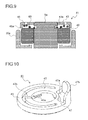
  • FIG. 9 is an enlarged view of an area near a tip end of the rotation shaft shown in FIG. 8 ;
  • FIG. 10 is a perspective view of a retaining member according to a second embodiment of the present disclosure, as seen from a side opposite to a side where a surface of the retaining member pointing in a direction of a rotation shaft is located;
  • FIG. 11 is a perspective view showing a state in which the retaining member of the second embodiment is mounted on the rotation shaft;
  • FIG. 12 is a diagram showing an example in which a retaining member of the present disclosure is used as a retaining mechanism for an idle gear mounted on a fixed shaft which is fixed to a frame.
  • FIG. 1 is a schematic sectional view of an image forming apparatus provided with a retaining member 41 of the present disclosure, and the image forming apparatus shown herein is a tandem-type color printer.
  • a main body of a color printer 100 four image forming portions Pa, Pb, Pc, and Pd are arranged in this order from an upstream side in a sheet conveyance direction (left side in FIG. 1 ).
  • the image forming portions Pa to Pd are provided corresponding to images of four different colors (cyan, magenta, yellow, and black), and sequentially form images of cyan, magenta, yellow, and black through charging, exposure, developing, and transfer processes.
  • image forming portions Pa, Pb, Pc, and Pd are provided with photosensitive drums 1 a , 1 b , 1 c , and 1 d , respectively, which each carry a visible image (toner image) of a corresponding color, and further, an intermediate transfer belt 8 that rotates in a counterclockwise direction in FIG. 1 is provided adjacent to the image forming portions Pa to Pd.
  • image data When image data is inputted from a host device such as a personal computer, first, chargers 2 a to 2 d charge surfaces of the photosensitive drums 1 a to 1 d uniformly. Then, an exposure device 5 irradiates the photosensitive drums 1 a to 1 d with light in accordance with the image data, to thereby form an electrostatic latent image on each of the photosensitive drums 1 a to 1 d in accordance with the image data.
  • a host device such as a personal computer
  • Developing devices 3 a to 3 d are each filled, by toner containers 4 a to 4 d , with a predetermined amount of a two-component developer (which hereinafter may be referred to simply as a developer) containing a toner of a corresponding one of the four colors of cyan, magenta, yellow and black, and toners contained in the developers are supplied by the developing devices 3 a to 3 d , and electrostatically adhere, to the photosensitive drums 1 a to 1 d . Thereby, toner images are formed corresponding to the electrostatic latent images formed by the exposure to the light from the exposure device 5 .
  • a two-component developer which hereinafter may be referred to simply as a developer
  • a transfer sheet P onto which the toner images are to be transferred is accommodated in a paper cassette 16 disposed in a lower part inside the color printer 100 , and is conveyed at a predetermined timing via a sheet feeding roller 12 and a registration roller pair 13 to a nip portion (secondary transfer nip portion) between the intermediate transfer belt 8 and a secondary transfer roller 9 provided adjacent to the intermediate transfer belt 8 .
  • the transfer sheet P onto which the toner images have been transferred is conveyed through a sheet conveyance path 14 to a fixing portion 15 .
  • the transfer sheet P which has been conveyed to the fixing portion 15 is heated and pressurized by a fixing roller pair 15 a , whereby the toner images are fixed on a surface of the transfer sheet P, and thereby a predetermined full-color image is formed.
  • the transfer sheet P, on which the full-color image has been formed is discharged onto a discharge tray 20 by a discharge roller pair 18 as it is (or after being directed by a branching portion 17 into a reverse sheet conveyance path 21 and having an image formed on the other side).
  • FIG. 2 is a sectional view of an area around the sheet conveyance path 14 and the reverse sheet conveyance path 21 in the color printer 100 shown in FIG. 1 .
  • a side cover 33 constitutes a side face 102 of the color printer 100 , and is rotatably supported by a pivot 33 a provided in a lower part of the main body of the color printer 100 .
  • An inner surface of the side cover 33 constitutes one conveyance surface of the reverse sheet conveyance path 21 , and a conveyance unit 35 is disposed inside the side cover 33 .
  • the conveyance unit 35 is supported in the main body of the color printer 100 to be rotatable about a pivot shaft 35 a , and constitutes part of conveyance surfaces of the reverse sheet conveyance path 21 and the sheet conveyance path 14 .
  • the reverse sheet conveyance path 21 extends in an up-down direction along the side face 102 of the color printer 100 between the side cover 33 and the conveyance unit 35 , and is curved into a substantially C-shape to join the sheet conveyance path 14 .
  • a roller 13 b On an inner surface (a left-side surface of the conveyance unit 35 in FIG. 2 ) of the conveyance unit 35 , there are provided a roller 13 b , which is one of rollers constituting the registration roller pair 13 , and the secondary transfer roller 9 arranged in this order from an upstream side in the sheet conveyance direction (lower side in FIG. 2 ).
  • the secondary transfer roller 9 presses a drive roller 11 with the intermediate transfer belt 8 located therebetween.
  • the reverse sheet conveyance path 21 is widely exposed.
  • the conveyance unit 35 is separated from a color-printer- 100 -main-body side and the sheet conveyance path 14 is widely exposed.
  • the conveyance unit 35 comes into abutment with the color-printer- 100 -main-body side, and the secondary transfer roller 9 is pressed against the drive roller 11 with the intermediate transfer belt 8 located therebetween.
  • FIG. 3 is an enlarged perspective view of one end side (near side in FIG. 1 ) of the secondary transfer roller 9 .
  • the secondary transfer roller 9 is composed of a rotation shaft 9 a , which is made of metal, and a roller body 9 b , which is made of rubber on an outer peripheral surface of the rotation shaft 9 a , and one end part of the rotation shaft 9 a is inserted through a bearing member 40 (see FIG. 7 ) disposed in a housing 35 a of the conveyance unit 35 .
  • the bearing member 40 is, for example, a rolling bearing (bearing) having balls or rollers therein.
  • the other end part (far side in FIG. 1 ) of the rotation shaft 9 a is also rotatably supported by a bearing member 40 .
  • a retaining member 41 is mounted on an end surface of the rotation shaft 9 a.
  • FIG. 4 and FIG. 5 are perspective views of a retaining member 41 according to a first embodiment of the present disclosure mounted on one end of the secondary transfer roller 9 , the former being as seen from a side where a surface of the retaining member 41 pointing in a direction of the rotation shaft 9 a is located, and the latter being as seen from a side opposite to the side where the surface pointing in a direction of the rotation shaft 9 a is located.
  • FIG. 6 is a sectional view cutting the retaining member 41 of the first embodiment along the radial direction (along line AA′ in FIG. 4 ).
  • the retaining member 41 is a member which prevents the rotation shaft 9 a from coming off from the housing 35 a , and it is integrally formed of an ABS resin. It should be noted that the material of the retaining member 41 is not limited to an ABS resin, but can also be any elastically deformable material such as other synthetic resins, hard rubber, etc.
  • the retaining member 41 has an inner circumferential portion 43 and an outer circumferential portion 45 , which are both ring-shaped, and a linkage portion, which connects the inner circumferential portion 43 and the outer circumferential portion 45 to each other in the radial direction.
  • engagement claws 43 a are formed on a surface of the inner circumferential portion 43 pointing in a direction of the rotation shaft 9 a .
  • the engagement claws 43 a are formed at three positions equally spaced from each other along a circumferential direction of the inner circumferential portion 43 , leading ends of the engagement claws 43 a projecting inward in the radial direction of the inner circumferential portion 43 .
  • a slit 43 b is formed on a side opposite from the linkage portion 47 with a center of the inner circumferential portion 43 located between the slit 43 b and the linkage portion 47 , the slit 43 b cutting the inner circumferential portion 43 in the radial direction.
  • the engagement claws 43 a may be formed at two positions or at four or more positions along the circumferential direction of the inner circumferential portion 43 , and further, the engagement claws 43 a do not need to be equally spaced from each other.
  • the outer circumferential portion 45 has a diameter that is substantially as large as an outer diameter of the bearing member 40 through which the rotation shaft 9 a is inserted.
  • a rib 45 a projecting in a ring shape from a surface of the outer circumferential portion 45 pointing in a direction of the rotation shaft 9 a .
  • a fan-shaped recessed portion 47 a is formed in a surface opposite to a surface of the linkage portion 47 pointing in a direction of the rotation shaft 9 a.
  • FIG. 7 is a perspective view showing how the retaining member 41 of the first embodiment is mounted on one end of the rotation shaft 9 a of the secondary transfer roller 9
  • FIG. 8 is a partial sectional view cutting, in an axial direction, the one end of the rotation shaft 9 a on which the retaining member 41 of the first embodiment is mounted.
  • a description will be given of how the retaining member 41 is mounted with respect to the rotation shaft 9 a .
  • a diameter of a circle which passes through leading ends of the engagement claws 41 a of the retaining member 41 is smaller than an outer diameter of the rotation shaft 9 a , and thus the engagement claws 43 a come into contact with a peripheral edge part of the tip end of the rotation shaft 9 a when the retaining member 41 is pushed.
  • the contact between the engagement claws 43 a and the rotary shaft 9 a causes a force to act on the inner circumferential portion 43 to externally expand from inside to outside in the radial direction.
  • the inner circumferential portion 43 is elastically deformed to cause the slit 43 b to become wide open, and the engagement claws 43 a are pushed in the axial direction of the rotation shaft 9 a while simultaneously being withdrawn outward in the radial direction.
  • the rotation shaft 9 a has a chamfered portion 50 formed on the peripheral edge part of the surface of its tip end, and thus, the engagement claws 43 a are pushed along a slope of the chamfered portion 50 in the axial direction of the rotation shaft 9 a .
  • FIG. 9 is an enlarged view of an area near the tip end of the rotation shaft 9 a shown in FIG. 8 .
  • the rib 45 a of the outer circumferential portion 45 is in contact with an outer peripheral edge of the bearing member 40 .
  • an end surface of the bearing member 40 is covered by the retaining member 41 , and this makes it possible to reduce leakage of grease (lubricating oil) 60 applied between the bearing member 40 and the rotation shaft 9 a.
  • the retaining member 41 has an arc-shaped gap between the inner circumferential portion 43 and the outer circumferential portion 45 , and that the slit 43 b is formed in the inner circumferential portion 43 .
  • the retaining member 41 does not completely seal a space that includes the end surface of the bearing member 40 .
  • the grease 60 has a relatively high viscosity (gel), and thus it is possible to effectively reduce leakage of the grease 60 by means of the retaining member 41 of the present embodiment.
  • the retaining member 41 can be easily mounted on the rotation shaft 9 a by pushing it in the axial direction of the rotation shaft 9 a , and can be easily removed from the rotation shaft 9 a by pulling it in the axial direction of the rotation shaft 9 a . Accordingly, there is no need of preparing a dedicated space in the radial direction for the detachment/attachment of the retaining member 41 , and thus, it is possible to save space without spoiling the ease of assembly.
  • the end surface of the bearing member 40 is covered by the retaining member 41 in a state where the retaining member 41 is mounted on the rotation shaft 9 a , it is possible to reduce leakage of the grease 60 from the bearing member 40 . Accordingly, even when the user touches a member that he or she can touch in a state where the side cover 33 is open, such as the secondary transfer roller 9 , there is no risk of the user having his or her finger stained due to leakage of the grease 60 .
  • FIG. 10 is a perspective view of a retaining member 41 according to a second embodiment of the present disclosure, as seen from a side opposite to a side where a surface of the retaining member 41 pointing in a direction of the rotation shaft 9 a is located
  • FIG. 11 is a perspective view showing a state in which the retaining member 41 of the second embodiment is mounted on the rotation shaft 9 a .
  • the retaining member 41 of the present embodiment includes a handle portion 47 b , which is formed to project from a peripheral edge part of the linkage portion 47 toward the side opposite to the side where the surface of the retaining member 41 pointing in a direction of the rotation shaft 9 a is located.
  • the configurations of the other portions of the retaining member 41 of the present embodiment are similar to those in the first embodiment.
  • the handle portion 47 b is held to pull the retaining member 41 outward in the radial direction (an arrow B direction in FIG. 11 ).
  • the inner circumferential portion 43 is elastically deformed to cause the slit 43 b to become wide open, and the engagement claws 43 a are withdrawn outward in the radial direction, as a result of which the engagement between the engagement claws 43 a and the engagement groove 51 becomes shallow.
  • the retaining member 41 can be easily removed.
  • operability in removing the retaining member 41 is improved.
  • the present disclosure is not limited to the above embodiments, and various modifications are possible within the scope of the present disclosure.
  • the above embodiments have dealt with cases where the retaining member 41 is mounted on the rotation shaft 9 a of the secondary transfer roller 9 , but the present disclosure is not limited to this, and the retaining member 41 is usable as a retaining member for rotation shafts of other rollers such as the sheet feeding roller 12 , the registration roller pair 13 , etc.
  • the retaining member 41 can be used as a retaining member for the idle gear 73 by forming an engagement groove 51 in the fixed shaft 71 for mounting the retaining member 41 .
  • the present disclosure is usable in image forming apparatuses, such as copiers, printers, facsimile machines, and multifunction peripherals having functions of these.
  • the use of the present disclosure provides a retaining member which can be mounted and dismounted with respect to a rotation shaft with easy operations and which is also capable of achieving space saving, and an image forming apparatus including such a retaining member.

Landscapes

  • Engineering & Computer Science (AREA)
  • Physics & Mathematics (AREA)
  • General Physics & Mathematics (AREA)
  • General Engineering & Computer Science (AREA)
  • Mechanical Engineering (AREA)
  • Computer Vision & Pattern Recognition (AREA)
  • Electrophotography Configuration And Component (AREA)
  • Rolls And Other Rotary Bodies (AREA)
  • Microelectronics & Electronic Packaging (AREA)

Abstract

A retaining member is integrally formed of an elastically deformable material, and has an inner circumferential portion, an outer circumferential portion, a linkage portion, a plurality of engagement claws, and a slit. The inner and outer circumferential portions are ring-shaped, and the outer circumferential portion is disposed outside the inner circumferential portion in a radial direction. The linkage portion connects the inner circumferential portion and the outer circumferential portion to each other in the radial direction. The engagement claws project from a surface of the inner circumferential portion pointing in a direction of the shaft, and engage with an engagement groove formed in an outer peripheral surface of the shaft. The slit is formed on a side opposite from the linkage portion with a center of the inner circumferential portion located between the slit and the linkage portion, and cuts the inner circumferential portion in the radial direction.

Description

INCORPORATION BY REFERENCE
This application is based upon and claims the benefit of priority from the corresponding Japanese Patent Application No. 2016-187944 filed on Sep. 27, 2016, the entire contents of which are incorporated herein by reference.
BACKGROUND
The present disclosure relates to a retaining member for preventing a roller and a shaft constituting a drive unit and a gear mounted around such a roller and a shaft from coming off, and an image forming apparatus, such as a copier, a printer, a facsimile machine, and a multifunction peripheral having functions of these, which is provided with such a retaining member.
In conventional image forming apparatuses, such as copiers and printers, a drive transmission mechanism composed of a gear, a shaft, and the like for transmitting a rotational driving force of a drive unit is used to transmit the rotational driving force to rotary bodies such as a photosensitive drum, a developing roller, and the like as driven members. In such a drive transmission mechanism, as a method to prevent a roller, a shaft, and a gear mounted around these from coming off, there has been used a method in which a retaining ring such as an E-ring is mounted around a shaft.
As for image forming apparatuses, there has been an increasing demand for compactness, and this demand puts a strict restriction on the design of the drive transmission mechanism in terms of space. In the method where the conventional retaining member such as an E-ring is used, it is necessary to mount the retaining member from a radial direction of a roller or a shaft, and this disadvantageously requires a space in the radial direction for the mounting, and makes attaching/detaching operations disadvantageously complicated. Furthermore, end parts of the roller or the shaft are exposed, and this disadvantageously allows bearing grease to leak from the end parts.
There is also known a gear retaining structure in which a gear is mounted on a fixed shaft standing on a plate-shaped member made of resin, and an elastically deformable claw-shaped projection is provided projecting from the plate-shaped member, such that a hooked portion of the claw-shaped projection engages with a peripheral edge part of the gear mounted on the fixed shaft.
SUMMARY
According to one aspect of the present disclosure, a retaining member is integrally formed of an elastically deformable material, is mounted on an end part of a shaft supported by a holding member, and prevents the shaft from coming off from the holding member or prevents a rotary body mounted around the shaft from coming off. The retaining member has an inner circumferential portion, an outer circumferential portion, a linkage portion, a plurality of engagement claws, and a slit. The inner and outer circumferential portions are ring-shaped, and the outer circumferential portion is arranged outside the inner circumferential portion in a radial direction. The linkage portion connects the inner circumferential portion and the outer circumferential portion to each other in the radial direction. The plurality of engagement claws project from a surface of the inner circumferential portion pointing in a direction of the shaft, and engage with an engagement groove formed in an outer peripheral surface of the shaft. The slit is formed on a side opposite from the linkage portion with a center of the inner circumferential portion located between the slit and the linkage portion, and the slit cuts the inner circumferential portion in the radial direction.
Further features and specific advantages of the present disclosure will become apparent from the following descriptions of preferred embodiments.
BRIEF DESCRIPTION OF THE DRAWINGS
FIG. 1 is a schematic sectional view showing an overall configuration of a color printer including a retaining member of the present disclosure;
FIG. 2 is a sectional view of an area around a sheet conveyance path and a reverse sheet conveyance path in the color printer shown in FIG. 1;
FIG. 3 is an enlarged perspective view of one end side (near side in FIG. 1) of a secondary transfer roller;
FIG. 4 is a perspective view of a retaining member according to a first embodiment of the present disclosure to be mounted on one end of the secondary transfer roller, as seen from a side where a surface of the retaining member pointing in a direction of a rotation shaft is located;
FIG. 5 is a perspective view of the retaining member of the first embodiment, as seen from a side opposite to the side where the surface of the retaining member pointing in the direction of the rotation shaft is located;
FIG. 6 is a sectional view cutting the retaining member along its radial direction;
FIG. 7 is a perspective view showing how the retaining member of the first embodiment is mounted on one end of the rotation shaft of the secondary transfer roller;
FIG. 8 is a partial sectional view cutting, along its axial direction, the one end of the rotation shaft on which the retaining member of the first embodiment is mounted;
FIG. 9 is an enlarged view of an area near a tip end of the rotation shaft shown in FIG. 8;
FIG. 10 is a perspective view of a retaining member according to a second embodiment of the present disclosure, as seen from a side opposite to a side where a surface of the retaining member pointing in a direction of a rotation shaft is located;
FIG. 11 is a perspective view showing a state in which the retaining member of the second embodiment is mounted on the rotation shaft;
FIG. 12 is a diagram showing an example in which a retaining member of the present disclosure is used as a retaining mechanism for an idle gear mounted on a fixed shaft which is fixed to a frame.
DETAILED DESCRIPTION
Hereinafter, embodiments of the present disclosure will be described with reference to the drawings. FIG. 1 is a schematic sectional view of an image forming apparatus provided with a retaining member 41 of the present disclosure, and the image forming apparatus shown herein is a tandem-type color printer. In a main body of a color printer 100, four image forming portions Pa, Pb, Pc, and Pd are arranged in this order from an upstream side in a sheet conveyance direction (left side in FIG. 1). The image forming portions Pa to Pd are provided corresponding to images of four different colors (cyan, magenta, yellow, and black), and sequentially form images of cyan, magenta, yellow, and black through charging, exposure, developing, and transfer processes.
These image forming portions Pa, Pb, Pc, and Pd are provided with photosensitive drums 1 a, 1 b, 1 c, and 1 d, respectively, which each carry a visible image (toner image) of a corresponding color, and further, an intermediate transfer belt 8 that rotates in a counterclockwise direction in FIG. 1 is provided adjacent to the image forming portions Pa to Pd.
When image data is inputted from a host device such as a personal computer, first, chargers 2 a to 2 d charge surfaces of the photosensitive drums 1 a to 1 d uniformly. Then, an exposure device 5 irradiates the photosensitive drums 1 a to 1 d with light in accordance with the image data, to thereby form an electrostatic latent image on each of the photosensitive drums 1 a to 1 d in accordance with the image data. Developing devices 3 a to 3 d are each filled, by toner containers 4 a to 4 d, with a predetermined amount of a two-component developer (which hereinafter may be referred to simply as a developer) containing a toner of a corresponding one of the four colors of cyan, magenta, yellow and black, and toners contained in the developers are supplied by the developing devices 3 a to 3 d, and electrostatically adhere, to the photosensitive drums 1 a to 1 d. Thereby, toner images are formed corresponding to the electrostatic latent images formed by the exposure to the light from the exposure device 5.
Then, by primary transfer rollers 6 a to 6 d, an electric field is applied at a predetermined transfer voltage between the primary transfer rollers 6 a to 6 d and the photosensitive drums 1 a to 1 d, and the toner images of cyan, magenta, yellow, and black on the photosensitive drums 1 a to 1 d are primarily transferred onto the intermediate transfer belt 8. After the primary transfer of the toner images, residual toner and the like left on the surface of each of the photosensitive drums 1 a to 1 d is removed by the cleaning devices 7 a to 7 d.
A transfer sheet P onto which the toner images are to be transferred is accommodated in a paper cassette 16 disposed in a lower part inside the color printer 100, and is conveyed at a predetermined timing via a sheet feeding roller 12 and a registration roller pair 13 to a nip portion (secondary transfer nip portion) between the intermediate transfer belt 8 and a secondary transfer roller 9 provided adjacent to the intermediate transfer belt 8. The transfer sheet P onto which the toner images have been transferred is conveyed through a sheet conveyance path 14 to a fixing portion 15.
The transfer sheet P which has been conveyed to the fixing portion 15 is heated and pressurized by a fixing roller pair 15 a, whereby the toner images are fixed on a surface of the transfer sheet P, and thereby a predetermined full-color image is formed. The transfer sheet P, on which the full-color image has been formed, is discharged onto a discharge tray 20 by a discharge roller pair 18 as it is (or after being directed by a branching portion 17 into a reverse sheet conveyance path 21 and having an image formed on the other side).
FIG. 2 is a sectional view of an area around the sheet conveyance path 14 and the reverse sheet conveyance path 21 in the color printer 100 shown in FIG. 1. A side cover 33 constitutes a side face 102 of the color printer 100, and is rotatably supported by a pivot 33 a provided in a lower part of the main body of the color printer 100. An inner surface of the side cover 33 constitutes one conveyance surface of the reverse sheet conveyance path 21, and a conveyance unit 35 is disposed inside the side cover 33. The conveyance unit 35 is supported in the main body of the color printer 100 to be rotatable about a pivot shaft 35 a, and constitutes part of conveyance surfaces of the reverse sheet conveyance path 21 and the sheet conveyance path 14.
The reverse sheet conveyance path 21 extends in an up-down direction along the side face 102 of the color printer 100 between the side cover 33 and the conveyance unit 35, and is curved into a substantially C-shape to join the sheet conveyance path 14. On an inner surface (a left-side surface of the conveyance unit 35 in FIG. 2) of the conveyance unit 35, there are provided a roller 13 b, which is one of rollers constituting the registration roller pair 13, and the secondary transfer roller 9 arranged in this order from an upstream side in the sheet conveyance direction (lower side in FIG. 2). The secondary transfer roller 9 presses a drive roller 11 with the intermediate transfer belt 8 located therebetween.
By rotating the side cover 33 alone in an opening direction with respect to the color printer 100, the reverse sheet conveyance path 21 is widely exposed. By rotating the side cover 33 together with the conveyance unit 35, the conveyance unit 35 is separated from a color-printer-100-main-body side and the sheet conveyance path 14 is widely exposed. On the other hand, by rotating the side cover 33 together with the conveyance unit 35 in a closing direction, the conveyance unit 35 comes into abutment with the color-printer-100-main-body side, and the secondary transfer roller 9 is pressed against the drive roller 11 with the intermediate transfer belt 8 located therebetween.
FIG. 3 is an enlarged perspective view of one end side (near side in FIG. 1) of the secondary transfer roller 9. The secondary transfer roller 9 is composed of a rotation shaft 9 a, which is made of metal, and a roller body 9 b, which is made of rubber on an outer peripheral surface of the rotation shaft 9 a, and one end part of the rotation shaft 9 a is inserted through a bearing member 40 (see FIG. 7) disposed in a housing 35 a of the conveyance unit 35. The bearing member 40 is, for example, a rolling bearing (bearing) having balls or rollers therein. Although not illustrated here, the other end part (far side in FIG. 1) of the rotation shaft 9 a is also rotatably supported by a bearing member 40. Further, a retaining member 41 is mounted on an end surface of the rotation shaft 9 a.
FIG. 4 and FIG. 5 are perspective views of a retaining member 41 according to a first embodiment of the present disclosure mounted on one end of the secondary transfer roller 9, the former being as seen from a side where a surface of the retaining member 41 pointing in a direction of the rotation shaft 9 a is located, and the latter being as seen from a side opposite to the side where the surface pointing in a direction of the rotation shaft 9 a is located. FIG. 6 is a sectional view cutting the retaining member 41 of the first embodiment along the radial direction (along line AA′ in FIG. 4). The retaining member 41 is a member which prevents the rotation shaft 9 a from coming off from the housing 35 a, and it is integrally formed of an ABS resin. It should be noted that the material of the retaining member 41 is not limited to an ABS resin, but can also be any elastically deformable material such as other synthetic resins, hard rubber, etc.
The retaining member 41 has an inner circumferential portion 43 and an outer circumferential portion 45, which are both ring-shaped, and a linkage portion, which connects the inner circumferential portion 43 and the outer circumferential portion 45 to each other in the radial direction. In the inner circumferential portion 43, engagement claws 43 a are formed on a surface of the inner circumferential portion 43 pointing in a direction of the rotation shaft 9 a. The engagement claws 43 a are formed at three positions equally spaced from each other along a circumferential direction of the inner circumferential portion 43, leading ends of the engagement claws 43 a projecting inward in the radial direction of the inner circumferential portion 43. Furthermore, a slit 43 b is formed on a side opposite from the linkage portion 47 with a center of the inner circumferential portion 43 located between the slit 43 b and the linkage portion 47, the slit 43 b cutting the inner circumferential portion 43 in the radial direction. It should be noted that the engagement claws 43 a may be formed at two positions or at four or more positions along the circumferential direction of the inner circumferential portion 43, and further, the engagement claws 43 a do not need to be equally spaced from each other.
The outer circumferential portion 45 has a diameter that is substantially as large as an outer diameter of the bearing member 40 through which the rotation shaft 9 a is inserted. In the outer circumferential portion 45, along an outer peripheral edge of the outer circumferential portion 45, there is formed a rib 45 a projecting in a ring shape from a surface of the outer circumferential portion 45 pointing in a direction of the rotation shaft 9 a. In the linkage portion 47, a fan-shaped recessed portion 47 a is formed in a surface opposite to a surface of the linkage portion 47 pointing in a direction of the rotation shaft 9 a.
FIG. 7 is a perspective view showing how the retaining member 41 of the first embodiment is mounted on one end of the rotation shaft 9 a of the secondary transfer roller 9, and FIG. 8 is a partial sectional view cutting, in an axial direction, the one end of the rotation shaft 9 a on which the retaining member 41 of the first embodiment is mounted. With reference to FIG. 7 and FIG. 8, a description will be given of how the retaining member 41 is mounted with respect to the rotation shaft 9 a. First, the rotation shaft 9 a of the secondary transfer roller 9 is inserted through the bearing member 40 disposed in the housing 35 a. Then, the retaining member 41 is pushed in the axial direction toward a surface of a tip end of the rotation shaft 9 a. Here, in a state where no external force is applied to the inner circumferential portion 43, a diameter of a circle which passes through leading ends of the engagement claws 41 a of the retaining member 41 is smaller than an outer diameter of the rotation shaft 9 a, and thus the engagement claws 43 a come into contact with a peripheral edge part of the tip end of the rotation shaft 9 a when the retaining member 41 is pushed.
The contact between the engagement claws 43 a and the rotary shaft 9 a causes a force to act on the inner circumferential portion 43 to externally expand from inside to outside in the radial direction. As a result, the inner circumferential portion 43 is elastically deformed to cause the slit 43 b to become wide open, and the engagement claws 43 a are pushed in the axial direction of the rotation shaft 9 a while simultaneously being withdrawn outward in the radial direction. Besides, the rotation shaft 9 a has a chamfered portion 50 formed on the peripheral edge part of the surface of its tip end, and thus, the engagement claws 43 a are pushed along a slope of the chamfered portion 50 in the axial direction of the rotation shaft 9 a. Then, when the retaining member 41 is pushed by a predetermined amount and the engagement claws 43 a reach an engagement groove 51, which is formed in the outer peripheral surface of the rotation shaft 9 a, the inner circumferential portion 43 is caused by its recovery force to shrink inward in the radial direction to cause the engagement claws 43 a to engage in the engagement groove 51, and this completes the mounting of the retaining member 41 on the rotation shaft 9 a.
FIG. 9 is an enlarged view of an area near the tip end of the rotation shaft 9 a shown in FIG. 8. As shown in FIG. 9, when the retaining member 41 is mounted on the tip end of the rotation shaft 9 a, the rib 45 a of the outer circumferential portion 45 is in contact with an outer peripheral edge of the bearing member 40. As a result, an end surface of the bearing member 40 is covered by the retaining member 41, and this makes it possible to reduce leakage of grease (lubricating oil) 60 applied between the bearing member 40 and the rotation shaft 9 a.
Note that the retaining member 41 has an arc-shaped gap between the inner circumferential portion 43 and the outer circumferential portion 45, and that the slit 43 b is formed in the inner circumferential portion 43. Hence, the retaining member 41 does not completely seal a space that includes the end surface of the bearing member 40. However, the grease 60 has a relatively high viscosity (gel), and thus it is possible to effectively reduce leakage of the grease 60 by means of the retaining member 41 of the present embodiment.
To remove the retaining member 41 from the rotation shaft 9 a, first, a finger is put in the recessed portion 47 a formed in the linkage portion 47, and the retaining member 41 is pulled outward in the radial direction. As a result, the inner circumferential portion 43 is elastically deformed to cause the slit 43 b to become wide open, and the engagement claws 43 a are withdrawn outward in the radial direction, as a result of which the engagement between the engagement claws 43 a and the engagement groove 51 becomes shallow. Then, by pulling out the retaining member 41 in this state in the axial direction, the retaining member 41 can be easily removed.
According to the configuration of the present embodiment, the retaining member 41 can be easily mounted on the rotation shaft 9 a by pushing it in the axial direction of the rotation shaft 9 a, and can be easily removed from the rotation shaft 9 a by pulling it in the axial direction of the rotation shaft 9 a. Accordingly, there is no need of preparing a dedicated space in the radial direction for the detachment/attachment of the retaining member 41, and thus, it is possible to save space without spoiling the ease of assembly.
Furthermore, since the end surface of the bearing member 40 is covered by the retaining member 41 in a state where the retaining member 41 is mounted on the rotation shaft 9 a, it is possible to reduce leakage of the grease 60 from the bearing member 40. Accordingly, even when the user touches a member that he or she can touch in a state where the side cover 33 is open, such as the secondary transfer roller 9, there is no risk of the user having his or her finger stained due to leakage of the grease 60.
FIG. 10 is a perspective view of a retaining member 41 according to a second embodiment of the present disclosure, as seen from a side opposite to a side where a surface of the retaining member 41 pointing in a direction of the rotation shaft 9 a is located, and FIG. 11 is a perspective view showing a state in which the retaining member 41 of the second embodiment is mounted on the rotation shaft 9 a. The retaining member 41 of the present embodiment includes a handle portion 47 b, which is formed to project from a peripheral edge part of the linkage portion 47 toward the side opposite to the side where the surface of the retaining member 41 pointing in a direction of the rotation shaft 9 a is located. The configurations of the other portions of the retaining member 41 of the present embodiment are similar to those in the first embodiment.
To remove the retaining member 41 of the present embodiment from the rotation shaft 9 a, first, the handle portion 47 b is held to pull the retaining member 41 outward in the radial direction (an arrow B direction in FIG. 11). As a result, the inner circumferential portion 43 is elastically deformed to cause the slit 43 b to become wide open, and the engagement claws 43 a are withdrawn outward in the radial direction, as a result of which the engagement between the engagement claws 43 a and the engagement groove 51 becomes shallow. Then, by pulling out the retaining member 41 in this state in the axial direction (an arrow C direction in FIG. 11), the retaining member 41 can be easily removed. Thus, operability in removing the retaining member 41 is improved.
It should be understood that the present disclosure is not limited to the above embodiments, and various modifications are possible within the scope of the present disclosure. For example, the above embodiments have dealt with cases where the retaining member 41 is mounted on the rotation shaft 9 a of the secondary transfer roller 9, but the present disclosure is not limited to this, and the retaining member 41 is usable as a retaining member for rotation shafts of other rollers such as the sheet feeding roller 12, the registration roller pair 13, etc.
Or, as shown in FIG. 12, in a case where an idle gear 73 is mounted on a fixed shaft 71 fixed on a frame 70, the retaining member 41 can be used as a retaining member for the idle gear 73 by forming an engagement groove 51 in the fixed shaft 71 for mounting the retaining member 41.
The present disclosure is usable in image forming apparatuses, such as copiers, printers, facsimile machines, and multifunction peripherals having functions of these. The use of the present disclosure provides a retaining member which can be mounted and dismounted with respect to a rotation shaft with easy operations and which is also capable of achieving space saving, and an image forming apparatus including such a retaining member.

Claims (10)

What is claimed is:
1. A retaining member which is mounted on an end part of a shaft supported by a holding member, and prevents the shaft from coming off from the holding member or prevents a rotary body mounted around the shaft from coming off, the retaining member comprising:
an inner circumferential portion which is ring-shaped and faces the end part of the shaft supported by the holding member;
an outer circumferential portion which is ring-shaped and disposed outside the inner circumferential portion in a radial direction;
a linkage portion which connects the inner circumferential portion and the outer circumferential portion to each other in the radial direction;
a plurality of engagement claws which project from a surface of the inner circumferential portion pointing in a direction of the shaft, and engage with an engagement groove formed in an outer peripheral surface of the shaft; and
a slit which is formed on a side opposite from the linkage portion with a center of the inner circumferential portion located between the slit and the linkage portion, and cuts the inner circumferential portion in the radial direction,
wherein
the retaining member is mounted onto the end part of the shaft by being pushed toward a surface of a tip end of the shaft in an axial direction of the shaft until the plurality of engagement claws reach a position of the engagement groove while the inner circumferential portion is elastically deformed, and
the retaining member is integrally formed of an elastically deformable resin material.
2. The retaining member of claim 1,
wherein
the plurality of engagement claws are formed on the inner circumferential portion to be equally spaced from each other along a circumferential direction of the inner circumferential portion.
3. The retaining member of claim 1,
wherein
a rib is formed in a ring shape along an outer peripheral edge of the outer circumferential portion to project from a surface of the outer circumferential portion pointing in a direction of the shaft, and
the rib contacts an end surface of the holding member in a state where the engagement claws are engaged in the engagement groove.
4. The retaining member of claim 1,
wherein
a recessed portion is formed in a surface of the linkage portion opposite to a surface of the linkage portion pointing in the direction of the shaft.
5. The retaining member of claim 1,
wherein
the linkage portion includes a handle portion formed to project from a surface of the linkage portion opposite to a surface of the linkage portion pointing in the direction of the shaft.
6. The retaining member of claim 1,
wherein
in a state where no external force is applied to the inner circumferential portion, a diameter of a circle passing through leading ends of the engagement claws is smaller than an outer diameter of the shaft.
7. An image forming apparatus comprising the retaining member of claim 1.
8. A retaining member which is mounted on an end part of a shaft supported by a holding member, and prevents the shaft from coming off from the holding member or prevents a rotary body mounted around the shaft from coming off, the retaining member comprising:
an inner circumferential portion which is ring-shaped and faces the end part of the shaft supported by the holding member;
an outer circumferential portion which is ring-shaped and disposed outside the inner circumferential portion in a radial direction;
a linkage portion which connects the inner circumferential portion and the outer circumferential portion to each other in the radial direction;
a plurality of engagement claws which project from a surface of the inner circumferential portion pointing in a direction of the shaft, and engage with an engagement groove formed in an outer peripheral surface of the shaft; and
a slit which is formed on a side opposite from the linkage portion with a center of the inner circumferential portion located between the slit and the linkage portion, and cuts the inner circumferential portion in the radial direction,
wherein
the retaining member is integrally formed of an elastically deformable resin material,
a rib is formed in a ring shape along an outer peripheral edge of the outer circumferential portion to project from a surface of the outer circumferential portion pointing in a direction of the shaft, and
the rib contacts an end surface of the holding member in a state where the engagement claws are engaged in the engagement groove.
9. A retaining member which is mounted on an end part of a shaft supported by a holding member, and prevents the shaft from coming off from the holding member or prevents a rotary body mounted around the shaft from coming off, the retaining member comprising:
an inner circumferential portion which is ring-shaped and faces the end part of the shaft supported by the holding member;
an outer circumferential portion which is ring-shaped and disposed outside the inner circumferential portion in a radial direction;
a linkage portion which connects the inner circumferential portion and the outer circumferential portion to each other in the radial direction;
a plurality of engagement claws which project from a surface of the inner circumferential portion pointing in a direction of the shaft, and engage with an engagement groove formed in an outer peripheral surface of the shaft; and
a slit which is formed on a side opposite from the linkage portion with a center of the inner circumferential portion located between the slit and the linkage portion, and cuts the inner circumferential portion in the radial direction,
wherein
the retaining member is integrally formed of an elastically deformable resin material, and
a recessed portion is formed in a surface of the linkage portion opposite to a surface of the linkage portion pointing in the direction of the shaft.
10. A retaining member which is mounted on an end part of a shaft supported by a holding member, and prevents the shaft from coming off from the holding member or prevents a rotary body mounted around the shaft from coming off, the retaining member comprising:
an inner circumferential portion which is ring-shaped and faces the end part of the shaft supported by the holding member;
an outer circumferential portion which is ring-shaped and disposed outside the inner circumferential portion in a radial direction;
a linkage portion which connects the inner circumferential portion and the outer circumferential portion to each other in the radial direction;
a plurality of engagement claws which project from a surface of the inner circumferential portion pointing in a direction of the shaft, and engage with an engagement groove formed in an outer peripheral surface of the shaft; and
a slit which is formed on a side opposite from the linkage portion with a center of the inner circumferential portion located between the slit and the linkage portion, and cuts the inner circumferential portion in the radial direction,
wherein
the retaining member is integrally formed of an elastically deformable resin material, and
the linkage portion includes a handle portion formed to project from a surface of the linkage portion opposite to a surface of the linkage portion pointing in the direction of the shaft.
US15/695,637 2016-09-27 2017-09-05 Retaining member and image forming apparatus including same Active US10139775B2 (en)

Applications Claiming Priority (2)

Application Number Priority Date Filing Date Title
JP2016-187944 2016-09-27
JP2016187944A JP6631455B2 (en) 2016-09-27 2016-09-27 Stopping member and image forming apparatus having the same

Publications (2)

Publication Number Publication Date
US20180088517A1 US20180088517A1 (en) 2018-03-29
US10139775B2 true US10139775B2 (en) 2018-11-27

Family

ID=59811153

Family Applications (1)

Application Number Title Priority Date Filing Date
US15/695,637 Active US10139775B2 (en) 2016-09-27 2017-09-05 Retaining member and image forming apparatus including same

Country Status (4)

Country Link
US (1) US10139775B2 (en)
EP (1) EP3299895B1 (en)
JP (1) JP6631455B2 (en)
CN (1) CN107870546B (en)

Cited By (1)

* Cited by examiner, † Cited by third party
Publication number Priority date Publication date Assignee Title
US10635044B2 (en) * 2018-08-27 2020-04-28 Kyocera Document Solutions Inc. Retaining member and image forming apparatus including same

Families Citing this family (1)

* Cited by examiner, † Cited by third party
Publication number Priority date Publication date Assignee Title
US11402793B2 (en) * 2019-01-10 2022-08-02 Ricoh Company, Ltd. Rotating body, member to be inserted with shaft, retaining member, and apparatus

Citations (10)

* Cited by examiner, † Cited by third party
Publication number Priority date Publication date Assignee Title
US4477126A (en) * 1981-02-26 1984-10-16 Dowty Meco Limited Locking devices
US4750878A (en) * 1985-08-09 1988-06-14 Automotive Products Plc Retainer bushing
US6116809A (en) * 1998-08-26 2000-09-12 General Motors Corporation Rotating assembly with internal retaining ring
JP2000321836A (en) 1999-05-10 2000-11-24 Ricoh Co Ltd Drive unit gear retaining structure
US20010014264A1 (en) * 1999-09-01 2001-08-16 Shop Vac Corporation Dual function retainer clip
US6276832B1 (en) * 1999-09-29 2001-08-21 Emerson Electric Co. Collapsible bearing retainer
US6918728B1 (en) * 1999-08-06 2005-07-19 Robert Bosch Gmbh Circlip
US7558518B2 (en) * 2005-10-26 2009-07-07 Kyocera Mita Corporation Fixing device for use in an image forming device
US20110283491A1 (en) * 2010-05-20 2011-11-24 Walter Ernest Ainslie External retainer clip retainer
US20130164052A1 (en) * 2010-08-24 2013-06-27 Sharp Kabushiki Kaisha Roller device, image forming apparatus, and method for manufacturing roller

Family Cites Families (11)

* Cited by examiner, † Cited by third party
Publication number Priority date Publication date Assignee Title
JP3140188B2 (en) * 1992-07-03 2001-03-05 株式会社リコー Shaft mounting parts
US5308207A (en) * 1992-08-24 1994-05-03 Xerox Corporation Retaining ring and shaft for securing a component thereon
EP0625729B1 (en) * 1993-05-20 1998-11-04 Canon Kabushiki Kaisha A process cartridge
JP3315560B2 (en) * 1995-06-13 2002-08-19 キヤノン株式会社 Process cartridge, electrophotographic image forming apparatus, and method of mounting electrophotographic photosensitive drum
JPH0989178A (en) * 1995-09-27 1997-03-31 Kunimori Kagaku:Kk Connecting structure for pipe
JP2000120634A (en) * 1998-10-08 2000-04-25 Nidec Copal Corp Fallout preventing structure for motor shaft
DE102004049710A1 (en) * 2004-10-11 2006-04-13 Springfix-Befestigungstechnik Gmbh Connection between shaft and functional component comprises washer which fits into a peripheral groove in the shaft to hold component in place, washer having central aperture surrounded by two arms, forming horseshoe shape
JP2008145951A (en) * 2006-12-13 2008-06-26 Canon Inc Deflection scanning device and scanning optical device
CN201141403Y (en) * 2007-12-29 2008-10-29 中国重汽集团济南技术中心有限公司 Output double-row bearing assembly of through shaft
JP5306271B2 (en) * 2010-03-26 2013-10-02 京セラドキュメントソリューションズ株式会社 Shaft member holding mechanism, photosensitive drum unit, and image forming apparatus
CA2794690C (en) * 2010-03-31 2015-06-30 Koji Murata Rotation restricting member, mechanical device, and image forming device

Patent Citations (10)

* Cited by examiner, † Cited by third party
Publication number Priority date Publication date Assignee Title
US4477126A (en) * 1981-02-26 1984-10-16 Dowty Meco Limited Locking devices
US4750878A (en) * 1985-08-09 1988-06-14 Automotive Products Plc Retainer bushing
US6116809A (en) * 1998-08-26 2000-09-12 General Motors Corporation Rotating assembly with internal retaining ring
JP2000321836A (en) 1999-05-10 2000-11-24 Ricoh Co Ltd Drive unit gear retaining structure
US6918728B1 (en) * 1999-08-06 2005-07-19 Robert Bosch Gmbh Circlip
US20010014264A1 (en) * 1999-09-01 2001-08-16 Shop Vac Corporation Dual function retainer clip
US6276832B1 (en) * 1999-09-29 2001-08-21 Emerson Electric Co. Collapsible bearing retainer
US7558518B2 (en) * 2005-10-26 2009-07-07 Kyocera Mita Corporation Fixing device for use in an image forming device
US20110283491A1 (en) * 2010-05-20 2011-11-24 Walter Ernest Ainslie External retainer clip retainer
US20130164052A1 (en) * 2010-08-24 2013-06-27 Sharp Kabushiki Kaisha Roller device, image forming apparatus, and method for manufacturing roller

Cited By (1)

* Cited by examiner, † Cited by third party
Publication number Priority date Publication date Assignee Title
US10635044B2 (en) * 2018-08-27 2020-04-28 Kyocera Document Solutions Inc. Retaining member and image forming apparatus including same

Also Published As

Publication number Publication date
EP3299895A1 (en) 2018-03-28
JP6631455B2 (en) 2020-01-15
CN107870546B (en) 2021-06-29
JP2018054722A (en) 2018-04-05
CN107870546A (en) 2018-04-03
US20180088517A1 (en) 2018-03-29
EP3299895B1 (en) 2019-06-19

Similar Documents

Publication Publication Date Title
US9146496B2 (en) Cleaning device, intermediate transfer unit and image forming apparatus
JP5156597B2 (en) Bearing structure, cleaning device including the same, and image forming apparatus
CN101566820B (en) Image forming apparatus
US10139775B2 (en) Retaining member and image forming apparatus including same
US9864320B2 (en) Cleaning device and image forming apparatus therewith
JP3814524B2 (en) Powder container, developing device including the same, and electrophotographic image forming apparatus
US9389535B2 (en) Image forming apparatus with developing device having ribs
JP6141790B2 (en) Powder container and image forming apparatus
JP2001255741A (en) Partition member, seal component, developing device, and process cartridge
US8909092B2 (en) Process cartridge and electrophotographic image forming apparatus to charge a photosensitive drum
US10635044B2 (en) Retaining member and image forming apparatus including same
US9785089B2 (en) Toner case and image forming apparatus including the same
JP4656091B2 (en) Developer and image forming apparatus
US20170364020A1 (en) Image forming apparatus
JP6284005B2 (en) Bearing member, developing device, process cartridge, and image forming apparatus
US10401757B2 (en) Developing device having a bearing supported feeding screw
US10036997B2 (en) Process unit and image forming apparatus provided with the same
JP2017083538A (en) Developer container
JP2015129892A (en) Attaching/detaching mechanism of charging roller, and image forming apparatus including the same
JP2011128429A (en) Shutter mechanism, cleaning device, process unit and image forming apparatus
JP2012088655A (en) Process cartridge and image forming device
US20230418183A1 (en) Toner container, manufacturing method, and image forming apparatus
US9500988B2 (en) Developing apparatus
JP2016090821A (en) Image forming apparatus
JP2001281993A (en) Image forming device

Legal Events

Date Code Title Description
AS Assignment

Owner name: KYOCERA DOCUMENT SOLUTIONS INC., JAPAN

Free format text: ASSIGNMENT OF ASSIGNORS INTEREST;ASSIGNORS:NEMOTO, SHINJI;MIYAKOSHI, NAOTO;REEL/FRAME:043490/0468

Effective date: 20170821

FEPP Fee payment procedure

Free format text: ENTITY STATUS SET TO UNDISCOUNTED (ORIGINAL EVENT CODE: BIG.); ENTITY STATUS OF PATENT OWNER: LARGE ENTITY

STCF Information on status: patent grant

Free format text: PATENTED CASE

MAFP Maintenance fee payment

Free format text: PAYMENT OF MAINTENANCE FEE, 4TH YEAR, LARGE ENTITY (ORIGINAL EVENT CODE: M1551); ENTITY STATUS OF PATENT OWNER: LARGE ENTITY

Year of fee payment: 4