US10138235B2 - Pyrazolopyridine derivatives, preparation process therefor and therapeutic use thereof - Google Patents
Pyrazolopyridine derivatives, preparation process therefor and therapeutic use thereof Download PDFInfo
- Publication number
- US10138235B2 US10138235B2 US15/451,955 US201715451955A US10138235B2 US 10138235 B2 US10138235 B2 US 10138235B2 US 201715451955 A US201715451955 A US 201715451955A US 10138235 B2 US10138235 B2 US 10138235B2
- Authority
- US
- United States
- Prior art keywords
- phenyl
- pyrazolo
- chf
- trifluoromethyl
- pyridin
- Prior art date
- Legal status (The legal status is an assumption and is not a legal conclusion. Google has not performed a legal analysis and makes no representation as to the accuracy of the status listed.)
- Active
Links
- 230000001225 therapeutic effect Effects 0.000 title abstract description 3
- 238000002360 preparation method Methods 0.000 title description 3
- 150000005229 pyrazolopyridines Chemical class 0.000 title 1
- 125000002023 trifluoromethyl group Chemical group FC(F)(F)* 0.000 claims description 201
- 150000001875 compounds Chemical class 0.000 claims description 152
- JNCMHMUGTWEVOZ-UHFFFAOYSA-N F[CH]F Chemical compound F[CH]F JNCMHMUGTWEVOZ-UHFFFAOYSA-N 0.000 claims description 83
- 229910052757 nitrogen Inorganic materials 0.000 claims description 68
- 125000004433 nitrogen atom Chemical group N* 0.000 claims description 46
- 125000003917 carbamoyl group Chemical group [H]N([H])C(*)=O 0.000 claims description 33
- 150000003839 salts Chemical class 0.000 claims description 32
- 125000003178 carboxy group Chemical group [H]OC(*)=O 0.000 claims description 28
- 125000005842 heteroatom Chemical group 0.000 claims description 27
- 125000000217 alkyl group Chemical group 0.000 claims description 25
- 125000004430 oxygen atom Chemical group O* 0.000 claims description 25
- 229920006395 saturated elastomer Polymers 0.000 claims description 22
- 125000004076 pyridyl group Chemical group 0.000 claims description 18
- 125000004435 hydrogen atom Chemical group [H]* 0.000 claims description 17
- 125000006273 (C1-C3) alkyl group Chemical group 0.000 claims description 16
- 125000000623 heterocyclic group Chemical group 0.000 claims description 16
- 125000001424 substituent group Chemical group 0.000 claims description 14
- 125000003118 aryl group Chemical group 0.000 claims description 13
- 125000000592 heterocycloalkyl group Chemical group 0.000 claims description 12
- 239000008194 pharmaceutical composition Substances 0.000 claims description 12
- 125000001997 phenyl group Chemical group [H]C1=C([H])C([H])=C(*)C([H])=C1[H] 0.000 claims description 12
- 239000000546 pharmaceutical excipient Substances 0.000 claims description 9
- 125000001072 heteroaryl group Chemical group 0.000 claims description 8
- 125000002887 hydroxy group Chemical group [H]O* 0.000 claims description 8
- 125000003226 pyrazolyl group Chemical group 0.000 claims description 8
- -1 —CHF2 Chemical group 0.000 claims description 8
- 125000004093 cyano group Chemical group *C#N 0.000 claims description 6
- 239000000843 powder Substances 0.000 claims description 6
- 125000000753 cycloalkyl group Chemical group 0.000 claims description 5
- 229910052731 fluorine Inorganic materials 0.000 claims description 5
- YKUCFSJTTZONAT-UHFFFAOYSA-N n,n-dimethyl-4-[3-phenyl-4-(trifluoromethyl)-2h-pyrazolo[3,4-b]pyridin-6-yl]aniline Chemical compound C1=CC(N(C)C)=CC=C1C1=NC2=NNC(C=3C=CC=CC=3)=C2C(C(F)(F)F)=C1 YKUCFSJTTZONAT-UHFFFAOYSA-N 0.000 claims description 5
- 229910052717 sulfur Inorganic materials 0.000 claims description 5
- 125000001544 thienyl group Chemical group 0.000 claims description 5
- AMDQRIBWSYJGCS-UHFFFAOYSA-N 2-fluoro-5-[3-phenyl-4-(trifluoromethyl)-2h-pyrazolo[3,4-b]pyridin-6-yl]benzoic acid Chemical compound C1=C(F)C(C(=O)O)=CC(C2=NC3=NNC(=C3C(=C2)C(F)(F)F)C=2C=CC=CC=2)=C1 AMDQRIBWSYJGCS-UHFFFAOYSA-N 0.000 claims description 4
- LYBKSSQIMSGFMK-UHFFFAOYSA-N 4-[1-methyl-3-phenyl-4-(trifluoromethyl)pyrazolo[3,4-b]pyridin-6-yl]benzoic acid Chemical compound C12=C(C(F)(F)F)C=C(C=3C=CC(=CC=3)C(O)=O)N=C2N(C)N=C1C1=CC=CC=C1 LYBKSSQIMSGFMK-UHFFFAOYSA-N 0.000 claims description 4
- DOKBQUHMXPRESN-UHFFFAOYSA-N 4-[4-[3-phenyl-4-(trifluoromethyl)-2h-pyrazolo[3,4-b]pyridin-6-yl]phenyl]morpholine Chemical compound C=12C(C(F)(F)F)=CC(C=3C=CC(=CC=3)N3CCOCC3)=NC2=NNC=1C1=CC=CC=C1 DOKBQUHMXPRESN-UHFFFAOYSA-N 0.000 claims description 4
- RAYLYKKLIHHHGU-UHFFFAOYSA-N 6-(4-methoxyphenyl)-3-phenyl-4-(trifluoromethyl)-2h-pyrazolo[3,4-b]pyridine Chemical compound C1=CC(OC)=CC=C1C1=NC2=NNC(C=3C=CC=CC=3)=C2C(C(F)(F)F)=C1 RAYLYKKLIHHHGU-UHFFFAOYSA-N 0.000 claims description 4
- 125000004849 alkoxymethyl group Chemical group 0.000 claims description 4
- 125000002619 bicyclic group Chemical group 0.000 claims description 4
- JVBIVSLEYGCCML-UHFFFAOYSA-N n-[3-[3-phenyl-4-(trifluoromethyl)-2h-pyrazolo[3,4-b]pyridin-6-yl]phenyl]methanesulfonamide Chemical compound CS(=O)(=O)NC1=CC=CC(C2=NC3=NNC(=C3C(=C2)C(F)(F)F)C=2C=CC=CC=2)=C1 JVBIVSLEYGCCML-UHFFFAOYSA-N 0.000 claims description 4
- XEQVQPJLLLSEFU-UHFFFAOYSA-N n-methyl-3-[3-phenyl-4-(trifluoromethyl)-2h-pyrazolo[3,4-b]pyridin-6-yl]benzamide Chemical compound CNC(=O)C1=CC=CC(C2=NC3=NNC(=C3C(=C2)C(F)(F)F)C=2C=CC=CC=2)=C1 XEQVQPJLLLSEFU-UHFFFAOYSA-N 0.000 claims description 4
- DFHSASWXWBUERM-UHFFFAOYSA-N 1-methyl-3-phenyl-6-(6-pyrrolidin-1-ylpyridin-3-yl)-4-(trifluoromethyl)pyrazolo[3,4-b]pyridine Chemical compound C12=C(C(F)(F)F)C=C(C=3C=NC(=CC=3)N3CCCC3)N=C2N(C)N=C1C1=CC=CC=C1 DFHSASWXWBUERM-UHFFFAOYSA-N 0.000 claims description 3
- YAFNWAKOZSULDC-UHFFFAOYSA-N 2-amino-5-[4-(difluoromethyl)-2-methylpyrazolo[3,4-b]pyridin-6-yl]benzonitrile Chemical compound N=1C2=NN(C)C=C2C(C(F)F)=CC=1C1=CC=C(N)C(C#N)=C1 YAFNWAKOZSULDC-UHFFFAOYSA-N 0.000 claims description 3
- JFBYMYUTFVTRGH-UHFFFAOYSA-N 4-[5-[1-methyl-3-phenyl-4-(trifluoromethyl)pyrazolo[3,4-b]pyridin-6-yl]pyridin-2-yl]morpholine Chemical compound C12=C(C(F)(F)F)C=C(C=3C=NC(=CC=3)N3CCOCC3)N=C2N(C)N=C1C1=CC=CC=C1 JFBYMYUTFVTRGH-UHFFFAOYSA-N 0.000 claims description 3
- XDMHMPLVHGTYKS-UHFFFAOYSA-N 5-[1-methyl-3-phenyl-4-(trifluoromethyl)pyrazolo[3,4-b]pyridin-6-yl]-1,3-benzothiazole Chemical compound C12=C(C(F)(F)F)C=C(C=3C=C4N=CSC4=CC=3)N=C2N(C)N=C1C1=CC=CC=C1 XDMHMPLVHGTYKS-UHFFFAOYSA-N 0.000 claims description 3
- DSPWIUQCFYIXHH-UHFFFAOYSA-N 5-[1-methyl-3-phenyl-4-(trifluoromethyl)pyrazolo[3,4-b]pyridin-6-yl]pyridine-3-carbonitrile Chemical compound C12=C(C(F)(F)F)C=C(C=3C=C(C=NC=3)C#N)N=C2N(C)N=C1C1=CC=CC=C1 DSPWIUQCFYIXHH-UHFFFAOYSA-N 0.000 claims description 3
- IZNNHNMWHCIARM-UHFFFAOYSA-N 6-(4-methoxyphenyl)-1-methyl-3-phenyl-4-(trifluoromethyl)pyrazolo[3,4-b]pyridine Chemical compound C1=CC(OC)=CC=C1C1=CC(C(F)(F)F)=C(C(=NN2C)C=3C=CC=CC=3)C2=N1 IZNNHNMWHCIARM-UHFFFAOYSA-N 0.000 claims description 3
- PXGOKWXKJXAPGV-UHFFFAOYSA-N Fluorine Chemical compound FF PXGOKWXKJXAPGV-UHFFFAOYSA-N 0.000 claims description 3
- 125000003785 benzimidazolyl group Chemical group N1=C(NC2=C1C=CC=C2)* 0.000 claims description 3
- 125000001164 benzothiazolyl group Chemical group S1C(=NC2=C1C=CC=C2)* 0.000 claims description 3
- 239000002775 capsule Substances 0.000 claims description 3
- 125000005434 dihydrobenzoxazinyl group Chemical group O1N(CCC2=C1C=CC=C2)* 0.000 claims description 3
- 239000011737 fluorine Substances 0.000 claims description 3
- 125000001041 indolyl group Chemical group 0.000 claims description 3
- ZRLVMLPJLRFIPC-UHFFFAOYSA-N n,n-dimethyl-3-[1-methyl-3-phenyl-4-(trifluoromethyl)pyrazolo[3,4-b]pyridin-6-yl]aniline Chemical compound CN(C)C1=CC=CC(C=2N=C3N(C)N=C(C3=C(C=2)C(F)(F)F)C=2C=CC=CC=2)=C1 ZRLVMLPJLRFIPC-UHFFFAOYSA-N 0.000 claims description 3
- IMVTZQZAEMKICY-UHFFFAOYSA-N n,n-dimethyl-3-[1-methyl-3-phenyl-4-(trifluoromethyl)pyrazolo[3,4-b]pyridin-6-yl]benzamide Chemical compound CN(C)C(=O)C1=CC=CC(C=2N=C3N(C)N=C(C3=C(C=2)C(F)(F)F)C=2C=CC=CC=2)=C1 IMVTZQZAEMKICY-UHFFFAOYSA-N 0.000 claims description 3
- XVGZTBUPQTVEMF-UHFFFAOYSA-N n,n-dimethyl-4-[1-methyl-3-phenyl-4-(trifluoromethyl)pyrazolo[3,4-b]pyridin-6-yl]benzamide Chemical compound C1=CC(C(=O)N(C)C)=CC=C1C1=CC(C(F)(F)F)=C(C(=NN2C)C=3C=CC=CC=3)C2=N1 XVGZTBUPQTVEMF-UHFFFAOYSA-N 0.000 claims description 3
- GMELVMMIEIALBY-UHFFFAOYSA-N n-[3-[1-methyl-3-phenyl-4-(trifluoromethyl)pyrazolo[3,4-b]pyridin-6-yl]phenyl]methanesulfonamide Chemical compound C12=C(C(F)(F)F)C=C(C=3C=C(NS(C)(=O)=O)C=CC=3)N=C2N(C)N=C1C1=CC=CC=C1 GMELVMMIEIALBY-UHFFFAOYSA-N 0.000 claims description 3
- 125000004434 sulfur atom Chemical group 0.000 claims description 3
- RCYIXDDOGWGJPF-UHFFFAOYSA-N 1-methyl-6-(1-methylindol-6-yl)-3-phenyl-4-(trifluoromethyl)pyrazolo[3,4-b]pyridine Chemical compound C1=C2N(C)C=CC2=CC=C1C(N=C1N(C)N=2)=CC(C(F)(F)F)=C1C=2C1=CC=CC=C1 RCYIXDDOGWGJPF-UHFFFAOYSA-N 0.000 claims description 2
- LCLBVTCUCJAIJI-UHFFFAOYSA-N 1-methyl-6-[2-methyl-5-(trifluoromethyl)pyrazol-3-yl]-3-phenyl-4-(trifluoromethyl)pyrazolo[3,4-b]pyridine Chemical compound Cn1nc(cc1-c1cc(c2c(nn(C)c2n1)-c1ccccc1)C(F)(F)F)C(F)(F)F LCLBVTCUCJAIJI-UHFFFAOYSA-N 0.000 claims description 2
- RTTWSBORQZUXRB-UHFFFAOYSA-N 2-fluoro-5-[1-methyl-3-phenyl-4-(trifluoromethyl)pyrazolo[3,4-b]pyridin-6-yl]benzoic acid Chemical compound C12=C(C(F)(F)F)C=C(C=3C=C(C(F)=CC=3)C(O)=O)N=C2N(C)N=C1C1=CC=CC=C1 RTTWSBORQZUXRB-UHFFFAOYSA-N 0.000 claims description 2
- HKLPYEAEXVJOEK-UHFFFAOYSA-N 2-fluoro-5-[3-phenyl-4-(trifluoromethyl)-2h-pyrazolo[3,4-b]pyridin-6-yl]benzonitrile Chemical compound C1=C(C#N)C(F)=CC=C1C1=NC2=NNC(C=3C=CC=CC=3)=C2C(C(F)(F)F)=C1 HKLPYEAEXVJOEK-UHFFFAOYSA-N 0.000 claims description 2
- UPLZQNHIPNYDNG-UHFFFAOYSA-N 2-fluoro-n-methyl-5-[1-methyl-3-phenyl-4-(trifluoromethyl)pyrazolo[3,4-b]pyridin-6-yl]benzamide Chemical compound C1=C(F)C(C(=O)NC)=CC(C=2N=C3N(C)N=C(C3=C(C=2)C(F)(F)F)C=2C=CC=CC=2)=C1 UPLZQNHIPNYDNG-UHFFFAOYSA-N 0.000 claims description 2
- BORSGRHODDBZRA-UHFFFAOYSA-N 2-fluoro-n-methyl-5-[3-phenyl-4-(trifluoromethyl)-2h-pyrazolo[3,4-b]pyridin-6-yl]benzamide Chemical compound C1=C(F)C(C(=O)NC)=CC(C2=NC3=NNC(=C3C(=C2)C(F)(F)F)C=2C=CC=CC=2)=C1 BORSGRHODDBZRA-UHFFFAOYSA-N 0.000 claims description 2
- DMTDJQIWQCVYCO-UHFFFAOYSA-N 3-[1-methyl-3-phenyl-4-(trifluoromethyl)pyrazolo[3,4-b]pyridin-6-yl]benzamide Chemical compound C12=C(C(F)(F)F)C=C(C=3C=C(C=CC=3)C(N)=O)N=C2N(C)N=C1C1=CC=CC=C1 DMTDJQIWQCVYCO-UHFFFAOYSA-N 0.000 claims description 2
- WHZGVJGGAGBLDX-UHFFFAOYSA-N 3-phenyl-6-(3-piperidin-1-ylphenyl)-4-(trifluoromethyl)-2h-pyrazolo[3,4-b]pyridine Chemical compound C=12C(C(F)(F)F)=CC(C=3C=C(C=CC=3)N3CCCCC3)=NC2=NNC=1C1=CC=CC=C1 WHZGVJGGAGBLDX-UHFFFAOYSA-N 0.000 claims description 2
- AKJBKDJBAWCDNX-UHFFFAOYSA-N 4-[3-[3-phenyl-4-(trifluoromethyl)-2h-pyrazolo[3,4-b]pyridin-6-yl]phenyl]morpholine Chemical compound C=12C(C(F)(F)F)=CC(C=3C=C(C=CC=3)N3CCOCC3)=NC2=NNC=1C1=CC=CC=C1 AKJBKDJBAWCDNX-UHFFFAOYSA-N 0.000 claims description 2
- WEHSRMBZPWWCPC-UHFFFAOYSA-N 4-[3-phenyl-4-(trifluoromethyl)-2h-pyrazolo[3,4-b]pyridin-6-yl]aniline Chemical compound C1=CC(N)=CC=C1C1=NC2=NNC(C=3C=CC=CC=3)=C2C(C(F)(F)F)=C1 WEHSRMBZPWWCPC-UHFFFAOYSA-N 0.000 claims description 2
- QAONGDCQCFGXCB-UHFFFAOYSA-N 4-[5-[3-phenyl-4-(trifluoromethyl)-2h-pyrazolo[3,4-b]pyridin-6-yl]pyridin-2-yl]morpholine Chemical compound C=12C(C(F)(F)F)=CC(C=3C=NC(=CC=3)N3CCOCC3)=NC2=NNC=1C1=CC=CC=C1 QAONGDCQCFGXCB-UHFFFAOYSA-N 0.000 claims description 2
- NIHLDEBMCNXTNS-UHFFFAOYSA-N 4-[[3-[1-methyl-3-phenyl-4-(trifluoromethyl)pyrazolo[3,4-b]pyridin-6-yl]phenyl]methyl]morpholine Chemical compound C12=C(C(F)(F)F)C=C(C=3C=C(CN4CCOCC4)C=CC=3)N=C2N(C)N=C1C1=CC=CC=C1 NIHLDEBMCNXTNS-UHFFFAOYSA-N 0.000 claims description 2
- MPIXTUAHXPPNAZ-UHFFFAOYSA-N 4-methyl-7-[1-methyl-3-phenyl-4-(trifluoromethyl)pyrazolo[3,4-b]pyridin-6-yl]-2,3-dihydro-1,4-benzoxazine Chemical compound C=1C=C2N(C)CCOC2=CC=1C(N=C1N(C)N=2)=CC(C(F)(F)F)=C1C=2C1=CC=CC=C1 MPIXTUAHXPPNAZ-UHFFFAOYSA-N 0.000 claims description 2
- UZTLOHRCJCILIW-UHFFFAOYSA-N 5-[3-phenyl-4-(trifluoromethyl)-2h-pyrazolo[3,4-b]pyridin-6-yl]pyridine-3-carbonitrile Chemical compound C=12C(C(F)(F)F)=CC(C=3C=C(C=NC=3)C#N)=NC2=NNC=1C1=CC=CC=C1 UZTLOHRCJCILIW-UHFFFAOYSA-N 0.000 claims description 2
- RAEPKPHYRHSANK-UHFFFAOYSA-N 6-(4-amino-3-cyanophenyl)-3-cyclopropyl-2h-pyrazolo[3,4-b]pyridine-4-carboxylic acid Chemical compound C1=C(C#N)C(N)=CC=C1C1=NC2=NNC(C3CC3)=C2C(C(O)=O)=C1 RAEPKPHYRHSANK-UHFFFAOYSA-N 0.000 claims description 2
- FAULCBMZRYIEPU-UHFFFAOYSA-N 6-(6-methoxypyridin-3-yl)-1-methyl-3-phenyl-4-(trifluoromethyl)pyrazolo[3,4-b]pyridine Chemical compound C1=NC(OC)=CC=C1C1=CC(C(F)(F)F)=C(C(=NN2C)C=3C=CC=CC=3)C2=N1 FAULCBMZRYIEPU-UHFFFAOYSA-N 0.000 claims description 2
- NJXNJOXACXBCLP-UHFFFAOYSA-N 6-(6-methoxypyridin-3-yl)-3-phenyl-4-(trifluoromethyl)-2h-pyrazolo[3,4-b]pyridine Chemical compound C1=NC(OC)=CC=C1C1=NC2=NNC(C=3C=CC=CC=3)=C2C(C(F)(F)F)=C1 NJXNJOXACXBCLP-UHFFFAOYSA-N 0.000 claims description 2
- TVDNVUCQIZUEJH-UHFFFAOYSA-N 6-[4-(3,5-dimethylpyrazol-1-yl)phenyl]-1-methyl-3-phenyl-4-(trifluoromethyl)pyrazolo[3,4-b]pyridine Chemical compound Cc1cc(C)n(n1)-c1ccc(cc1)-c1cc(c2c(nn(C)c2n1)-c1ccccc1)C(F)(F)F TVDNVUCQIZUEJH-UHFFFAOYSA-N 0.000 claims description 2
- 239000008187 granular material Substances 0.000 claims description 2
- HCGNFDSWYAJDHS-UHFFFAOYSA-N n,n-dimethyl-4-[3-phenyl-4-(trifluoromethyl)-2h-pyrazolo[3,4-b]pyridin-6-yl]benzamide Chemical compound C1=CC(C(=O)N(C)C)=CC=C1C1=NC2=NNC(C=3C=CC=CC=3)=C2C(C(F)(F)F)=C1 HCGNFDSWYAJDHS-UHFFFAOYSA-N 0.000 claims description 2
- ACPHNWHANCHRGD-UHFFFAOYSA-N n-[[3-[1-methyl-3-phenyl-4-(trifluoromethyl)pyrazolo[3,4-b]pyridin-6-yl]phenyl]methyl]methanesulfonamide Chemical compound C12=C(C(F)(F)F)C=C(C=3C=C(CNS(C)(=O)=O)C=CC=3)N=C2N(C)N=C1C1=CC=CC=C1 ACPHNWHANCHRGD-UHFFFAOYSA-N 0.000 claims description 2
- ROWANNVQCJZXBD-UHFFFAOYSA-N n-[[4-[1-methyl-3-phenyl-4-(trifluoromethyl)pyrazolo[3,4-b]pyridin-6-yl]phenyl]methyl]methanesulfonamide Chemical compound C12=C(C(F)(F)F)C=C(C=3C=CC(CNS(C)(=O)=O)=CC=3)N=C2N(C)N=C1C1=CC=CC=C1 ROWANNVQCJZXBD-UHFFFAOYSA-N 0.000 claims description 2
- 229910052739 hydrogen Inorganic materials 0.000 claims 8
- 239000001257 hydrogen Substances 0.000 claims 8
- 229910052736 halogen Inorganic materials 0.000 claims 5
- 150000002367 halogens Chemical class 0.000 claims 5
- 150000002431 hydrogen Chemical group 0.000 claims 5
- UFHFLCQGNIYNRP-UHFFFAOYSA-N Hydrogen Chemical compound [H][H] UFHFLCQGNIYNRP-UHFFFAOYSA-N 0.000 claims 2
- GBBSLAVZLWWBNY-UHFFFAOYSA-N 4-(difluoromethyl)-3,6-diphenyl-2H-pyrazolo[3,4-b]pyridine Chemical compound FC(C1=C2C(=NC(=C1)C1=CC=CC=C1)NN=C2C1=CC=CC=C1)F GBBSLAVZLWWBNY-UHFFFAOYSA-N 0.000 claims 1
- ZTHTXNRXEXWMKN-UHFFFAOYSA-N 4-[4-(difluoromethyl)-3-phenyl-2H-pyrazolo[3,4-b]pyridin-6-yl]aniline Chemical compound FC(C1=C2C(=NC(=C1)C1=CC=C(N)C=C1)NN=C2C1=CC=CC=C1)F ZTHTXNRXEXWMKN-UHFFFAOYSA-N 0.000 claims 1
- HNQIVZYLYMDVSB-UHFFFAOYSA-N methanesulfonimidic acid Chemical compound CS(N)(=O)=O HNQIVZYLYMDVSB-UHFFFAOYSA-N 0.000 claims 1
- 238000004519 manufacturing process Methods 0.000 abstract description 9
- 230000002401 inhibitory effect Effects 0.000 abstract description 7
- OGEBRHQLRGFBNV-RZDIXWSQSA-N chembl2036808 Chemical class C12=NC(NCCCC)=NC=C2C(C=2C=CC(F)=CC=2)=NN1C[C@H]1CC[C@H](N)CC1 OGEBRHQLRGFBNV-RZDIXWSQSA-N 0.000 abstract description 2
- YMWUJEATGCHHMB-UHFFFAOYSA-N Dichloromethane Chemical compound ClCCl YMWUJEATGCHHMB-UHFFFAOYSA-N 0.000 description 138
- OZLMBXPYRDASTP-UHFFFAOYSA-N CC1=CC=C(N)C(C#N)=C1 Chemical compound CC1=CC=C(N)C(C#N)=C1 OZLMBXPYRDASTP-UHFFFAOYSA-N 0.000 description 128
- 239000012429 reaction media Substances 0.000 description 69
- 230000002829 reductive effect Effects 0.000 description 68
- 239000000203 mixture Substances 0.000 description 62
- XEKOWRVHYACXOJ-UHFFFAOYSA-N Ethyl acetate Chemical compound CCOC(C)=O XEKOWRVHYACXOJ-UHFFFAOYSA-N 0.000 description 60
- OKKJLVBELUTLKV-UHFFFAOYSA-N Methanol Chemical compound OC OKKJLVBELUTLKV-UHFFFAOYSA-N 0.000 description 51
- 238000011282 treatment Methods 0.000 description 48
- XLYOFNOQVPJJNP-UHFFFAOYSA-N water Substances O XLYOFNOQVPJJNP-UHFFFAOYSA-N 0.000 description 48
- IJGRMHOSHXDMSA-UHFFFAOYSA-N Atomic nitrogen Chemical compound N#N IJGRMHOSHXDMSA-UHFFFAOYSA-N 0.000 description 44
- CJJLEUQMMMLOFI-UHFFFAOYSA-N COC1=CC(C)=CC=C1N Chemical compound COC1=CC(C)=CC=C1N CJJLEUQMMMLOFI-UHFFFAOYSA-N 0.000 description 44
- 239000007787 solid Substances 0.000 description 38
- 230000007170 pathology Effects 0.000 description 36
- CWOMTHDOJCARBY-UHFFFAOYSA-N CC1=CC=CC(N(C)C)=C1 Chemical compound CC1=CC=CC(N(C)C)=C1 CWOMTHDOJCARBY-UHFFFAOYSA-N 0.000 description 35
- 206010028980 Neoplasm Diseases 0.000 description 35
- XKRFYHLGVUSROY-UHFFFAOYSA-N Argon Chemical compound [Ar] XKRFYHLGVUSROY-UHFFFAOYSA-N 0.000 description 34
- IAZDPXIOMUYVGZ-WFGJKAKNSA-N Dimethyl sulfoxide Chemical compound [2H]C([2H])([2H])S(=O)C([2H])([2H])[2H] IAZDPXIOMUYVGZ-WFGJKAKNSA-N 0.000 description 34
- 239000012074 organic phase Substances 0.000 description 34
- 0 [1*]C1=Nc2nnc([3*])c2C([2*])=C1.[4*]C Chemical compound [1*]C1=Nc2nnc([3*])c2C([2*])=C1.[4*]C 0.000 description 33
- 239000000741 silica gel Substances 0.000 description 33
- 229910002027 silica gel Inorganic materials 0.000 description 33
- NFHFRUOZVGFOOS-UHFFFAOYSA-N palladium;triphenylphosphane Chemical compound [Pd].C1=CC=CC=C1P(C=1C=CC=CC=1)C1=CC=CC=C1.C1=CC=CC=C1P(C=1C=CC=CC=1)C1=CC=CC=C1.C1=CC=CC=C1P(C=1C=CC=CC=1)C1=CC=CC=C1.C1=CC=CC=C1P(C=1C=CC=CC=1)C1=CC=CC=C1 NFHFRUOZVGFOOS-UHFFFAOYSA-N 0.000 description 32
- ZMXDDKWLCZADIW-UHFFFAOYSA-N N,N-Dimethylformamide Chemical compound CN(C)C=O ZMXDDKWLCZADIW-UHFFFAOYSA-N 0.000 description 31
- VYPSYNLAJGMNEJ-UHFFFAOYSA-N Silicium dioxide Chemical compound O=[Si]=O VYPSYNLAJGMNEJ-UHFFFAOYSA-N 0.000 description 30
- KKPCPGWGLHHNSW-UHFFFAOYSA-N CC1=CC=CC(CN2CCOCC2)=C1 Chemical compound CC1=CC=CC(CN2CCOCC2)=C1 KKPCPGWGLHHNSW-UHFFFAOYSA-N 0.000 description 29
- PMZURENOXWZQFD-UHFFFAOYSA-L Sodium Sulfate Chemical compound [Na+].[Na+].[O-]S([O-])(=O)=O PMZURENOXWZQFD-UHFFFAOYSA-L 0.000 description 29
- 229910052938 sodium sulfate Inorganic materials 0.000 description 29
- 235000011152 sodium sulphate Nutrition 0.000 description 29
- 238000004440 column chromatography Methods 0.000 description 28
- VEXZGXHMUGYJMC-UHFFFAOYSA-N Hydrochloric acid Chemical compound Cl VEXZGXHMUGYJMC-UHFFFAOYSA-N 0.000 description 26
- 230000033115 angiogenesis Effects 0.000 description 26
- NMILGIZTAZXMTM-UHFFFAOYSA-N CCCN1CCOCC1 Chemical compound CCCN1CCOCC1 NMILGIZTAZXMTM-UHFFFAOYSA-N 0.000 description 25
- 210000004027 cell Anatomy 0.000 description 25
- IXCSERBJSXMMFS-UHFFFAOYSA-N hydrogen chloride Substances Cl.Cl IXCSERBJSXMMFS-UHFFFAOYSA-N 0.000 description 25
- 229910000041 hydrogen chloride Inorganic materials 0.000 description 25
- 238000002844 melting Methods 0.000 description 25
- 230000008018 melting Effects 0.000 description 25
- 239000000243 solution Substances 0.000 description 25
- IMNFDUFMRHMDMM-UHFFFAOYSA-N N-Heptane Chemical compound CCCCCCC IMNFDUFMRHMDMM-UHFFFAOYSA-N 0.000 description 24
- UREMNBHWTNQTMS-UHFFFAOYSA-N CC1=CC=C(F)C(C(=O)O)=C1 Chemical compound CC1=CC=C(F)C(C(=O)O)=C1 UREMNBHWTNQTMS-UHFFFAOYSA-N 0.000 description 22
- WYURNTSHIVDZCO-UHFFFAOYSA-N Tetrahydrofuran Chemical compound C1CCOC1 WYURNTSHIVDZCO-UHFFFAOYSA-N 0.000 description 22
- QTBSBXVTEAMEQO-UHFFFAOYSA-N Acetic acid Chemical compound CC(O)=O QTBSBXVTEAMEQO-UHFFFAOYSA-N 0.000 description 21
- 101150021185 FGF gene Proteins 0.000 description 21
- 230000000694 effects Effects 0.000 description 20
- 238000000034 method Methods 0.000 description 20
- 238000002560 therapeutic procedure Methods 0.000 description 20
- CMAOLVNGLTWICC-UHFFFAOYSA-N CC1=CC=C(F)C(C#N)=C1 Chemical compound CC1=CC=C(F)C(C#N)=C1 CMAOLVNGLTWICC-UHFFFAOYSA-N 0.000 description 19
- 239000002244 precipitate Substances 0.000 description 19
- 230000002265 prevention Effects 0.000 description 19
- DTQVDTLACAAQTR-UHFFFAOYSA-N trifluoroacetic acid Substances OC(=O)C(F)(F)F DTQVDTLACAAQTR-UHFFFAOYSA-N 0.000 description 19
- 108091008794 FGF receptors Proteins 0.000 description 18
- 102000044168 Fibroblast Growth Factor Receptor Human genes 0.000 description 18
- KDLHZDBZIXYQEI-UHFFFAOYSA-N Palladium Chemical compound [Pd] KDLHZDBZIXYQEI-UHFFFAOYSA-N 0.000 description 18
- OFBQJSOFQDEBGM-UHFFFAOYSA-N Pentane Chemical compound CCCCC OFBQJSOFQDEBGM-UHFFFAOYSA-N 0.000 description 18
- 239000005557 antagonist Substances 0.000 description 18
- 239000002585 base Substances 0.000 description 18
- FJDQFPXHSGXQBY-UHFFFAOYSA-L caesium carbonate Chemical compound [Cs+].[Cs+].[O-]C([O-])=O FJDQFPXHSGXQBY-UHFFFAOYSA-L 0.000 description 18
- VDWQWOXVBXURMT-UHFFFAOYSA-N CC1=CN=CC(C#N)=C1 Chemical compound CC1=CN=CC(C#N)=C1 VDWQWOXVBXURMT-UHFFFAOYSA-N 0.000 description 17
- YXFVVABEGXRONW-UHFFFAOYSA-N Toluene Chemical compound CC1=CC=CC=C1 YXFVVABEGXRONW-UHFFFAOYSA-N 0.000 description 17
- 229910052786 argon Inorganic materials 0.000 description 17
- 230000035755 proliferation Effects 0.000 description 17
- 102000005962 receptors Human genes 0.000 description 17
- 108020003175 receptors Proteins 0.000 description 17
- 238000005160 1H NMR spectroscopy Methods 0.000 description 16
- XTHFKEDIFFGKHM-UHFFFAOYSA-N Dimethoxyethane Chemical compound COCCOC XTHFKEDIFFGKHM-UHFFFAOYSA-N 0.000 description 16
- LFQSCWFLJHTTHZ-UHFFFAOYSA-N Ethanol Chemical compound CCO LFQSCWFLJHTTHZ-UHFFFAOYSA-N 0.000 description 16
- WEVYAHXRMPXWCK-UHFFFAOYSA-N Acetonitrile Chemical compound CC#N WEVYAHXRMPXWCK-UHFFFAOYSA-N 0.000 description 15
- VTDIWMPYBAVEDY-UHFFFAOYSA-N CCCN1CCCCC1 Chemical compound CCCN1CCCCC1 VTDIWMPYBAVEDY-UHFFFAOYSA-N 0.000 description 15
- 208000037265 diseases, disorders, signs and symptoms Diseases 0.000 description 15
- ZUHZZVMEUAUWHY-UHFFFAOYSA-N CCCN(C)C Chemical compound CCCN(C)C ZUHZZVMEUAUWHY-UHFFFAOYSA-N 0.000 description 14
- IERBVBGUKBHALB-UHFFFAOYSA-K tripotassium;phosphate;dihydrate Chemical compound O.O.[K+].[K+].[K+].[O-]P([O-])([O-])=O IERBVBGUKBHALB-UHFFFAOYSA-K 0.000 description 14
- 108090000379 Fibroblast growth factor 2 Proteins 0.000 description 13
- 201000010099 disease Diseases 0.000 description 13
- 230000008569 process Effects 0.000 description 13
- 210000001519 tissue Anatomy 0.000 description 13
- CSCPPACGZOOCGX-UHFFFAOYSA-N Acetone Chemical compound CC(C)=O CSCPPACGZOOCGX-UHFFFAOYSA-N 0.000 description 12
- CHLICZRVGGXEOD-UHFFFAOYSA-N COC1=CC=C(C)C=C1 Chemical compound COC1=CC=C(C)C=C1 CHLICZRVGGXEOD-UHFFFAOYSA-N 0.000 description 12
- NFQGQMBFMIIIOR-UHFFFAOYSA-N COC1=NC=C(C)C=C1 Chemical compound COC1=NC=C(C)C=C1 NFQGQMBFMIIIOR-UHFFFAOYSA-N 0.000 description 12
- 238000006243 chemical reaction Methods 0.000 description 12
- 239000003446 ligand Substances 0.000 description 12
- 239000002464 receptor antagonist Substances 0.000 description 12
- 229940044551 receptor antagonist Drugs 0.000 description 12
- IAZDPXIOMUYVGZ-UHFFFAOYSA-N Dimethylsulphoxide Chemical compound CS(C)=O IAZDPXIOMUYVGZ-UHFFFAOYSA-N 0.000 description 11
- 102000003974 Fibroblast growth factor 2 Human genes 0.000 description 11
- 239000008346 aqueous phase Substances 0.000 description 11
- HXITXNWTGFUOAU-UHFFFAOYSA-N phenylboronic acid Chemical class OB(O)C1=CC=CC=C1 HXITXNWTGFUOAU-UHFFFAOYSA-N 0.000 description 11
- JWCNIIZUTIYXTL-UHFFFAOYSA-N 2-amino-5-(4,4,5,5-tetramethyl-1,3,2-dioxaborolan-2-yl)benzonitrile Chemical compound O1C(C)(C)C(C)(C)OB1C1=CC=C(N)C(C#N)=C1 JWCNIIZUTIYXTL-UHFFFAOYSA-N 0.000 description 10
- RZXMPPFPUUCRFN-UHFFFAOYSA-N CC1=CC=C(N)C=C1 Chemical compound CC1=CC=C(N)C=C1 RZXMPPFPUUCRFN-UHFFFAOYSA-N 0.000 description 10
- UIIMBOGNXHQVGW-UHFFFAOYSA-M Sodium bicarbonate Chemical compound [Na+].OC([O-])=O UIIMBOGNXHQVGW-UHFFFAOYSA-M 0.000 description 10
- 238000002512 chemotherapy Methods 0.000 description 10
- PGMFDLQNPMCWIV-UHFFFAOYSA-N CC1=CC=C2CC=NC2=C1 Chemical compound CC1=CC=C2CC=NC2=C1 PGMFDLQNPMCWIV-UHFFFAOYSA-N 0.000 description 9
- HEMHJVSKTPXQMS-UHFFFAOYSA-M Sodium hydroxide Chemical compound [OH-].[Na+] HEMHJVSKTPXQMS-UHFFFAOYSA-M 0.000 description 9
- 238000006069 Suzuki reaction reaction Methods 0.000 description 9
- 208000008919 achondroplasia Diseases 0.000 description 9
- 229910000024 caesium carbonate Inorganic materials 0.000 description 9
- 239000003054 catalyst Substances 0.000 description 9
- 150000002148 esters Chemical class 0.000 description 9
- 206010073071 hepatocellular carcinoma Diseases 0.000 description 9
- 238000001727 in vivo Methods 0.000 description 9
- 230000002757 inflammatory effect Effects 0.000 description 9
- 208000002780 macular degeneration Diseases 0.000 description 9
- 229910052763 palladium Inorganic materials 0.000 description 9
- 206010039073 rheumatoid arthritis Diseases 0.000 description 9
- FWKITFSPALLPLM-UHFFFAOYSA-N CC1=CC=CC(N2CCCCC2)=C1 Chemical compound CC1=CC=CC(N2CCCCC2)=C1 FWKITFSPALLPLM-UHFFFAOYSA-N 0.000 description 8
- OZBSVSLBHOYNLZ-UHFFFAOYSA-N CNC(=O)C1=CC(C)=CC=C1F Chemical compound CNC(=O)C1=CC(C)=CC=C1F OZBSVSLBHOYNLZ-UHFFFAOYSA-N 0.000 description 8
- LQZMLBORDGWNPD-UHFFFAOYSA-N N-iodosuccinimide Chemical compound IN1C(=O)CCC1=O LQZMLBORDGWNPD-UHFFFAOYSA-N 0.000 description 8
- 239000003102 growth factor Substances 0.000 description 8
- 201000010072 hypochondroplasia Diseases 0.000 description 8
- 238000000338 in vitro Methods 0.000 description 8
- INQOMBQAUSQDDS-UHFFFAOYSA-N iodomethane Chemical compound IC INQOMBQAUSQDDS-UHFFFAOYSA-N 0.000 description 8
- 239000012071 phase Substances 0.000 description 8
- BWHMMNNQKKPAPP-UHFFFAOYSA-L potassium carbonate Chemical compound [K+].[K+].[O-]C([O-])=O BWHMMNNQKKPAPP-UHFFFAOYSA-L 0.000 description 8
- 201000003896 thanatophoric dysplasia Diseases 0.000 description 8
- 230000002792 vascular Effects 0.000 description 8
- 206010004446 Benign prostatic hyperplasia Diseases 0.000 description 7
- PGLRFAILADPRIX-UHFFFAOYSA-N CC1=CC=CC(NS(C)(=O)=O)=C1 Chemical compound CC1=CC=CC(NS(C)(=O)=O)=C1 PGLRFAILADPRIX-UHFFFAOYSA-N 0.000 description 7
- 206010029113 Neovascularisation Diseases 0.000 description 7
- 230000003305 autocrine Effects 0.000 description 7
- 230000015572 biosynthetic process Effects 0.000 description 7
- 238000011161 development Methods 0.000 description 7
- 230000018109 developmental process Effects 0.000 description 7
- 239000003814 drug Substances 0.000 description 7
- 210000002889 endothelial cell Anatomy 0.000 description 7
- 201000001441 melanoma Diseases 0.000 description 7
- 230000003076 paracrine Effects 0.000 description 7
- 210000003491 skin Anatomy 0.000 description 7
- JOXIMZWYDAKGHI-UHFFFAOYSA-N toluene-4-sulfonic acid Chemical compound CC1=CC=C(S(O)(=O)=O)C=C1 JOXIMZWYDAKGHI-UHFFFAOYSA-N 0.000 description 7
- QROKOTBWFZITJZ-UHFFFAOYSA-N CC(=O)NC1=NC=CC=C1 Chemical compound CC(=O)NC1=NC=CC=C1 QROKOTBWFZITJZ-UHFFFAOYSA-N 0.000 description 6
- ULKWBVNMJZUEBD-UHFFFAOYSA-N CC1=CC=C(C(=O)N(C)C)C=C1 Chemical compound CC1=CC=C(C(=O)N(C)C)C=C1 ULKWBVNMJZUEBD-UHFFFAOYSA-N 0.000 description 6
- BFCDUCCWAPLDJQ-UHFFFAOYSA-N CC1=CC=C2CC(=O)NC2=C1 Chemical compound CC1=CC=C2CC(=O)NC2=C1 BFCDUCCWAPLDJQ-UHFFFAOYSA-N 0.000 description 6
- HWRPGNXTCRPZGX-UHFFFAOYSA-N CC1=CN=C(N2CCOCC2)C=C1 Chemical compound CC1=CN=C(N2CCOCC2)C=C1 HWRPGNXTCRPZGX-UHFFFAOYSA-N 0.000 description 6
- 206010018338 Glioma Diseases 0.000 description 6
- 208000022559 Inflammatory bowel disease Diseases 0.000 description 6
- 206010027476 Metastases Diseases 0.000 description 6
- FAPWRFPIFSIZLT-UHFFFAOYSA-M Sodium chloride Chemical compound [Na+].[Cl-] FAPWRFPIFSIZLT-UHFFFAOYSA-M 0.000 description 6
- 206010064930 age-related macular degeneration Diseases 0.000 description 6
- 238000005804 alkylation reaction Methods 0.000 description 6
- 201000011510 cancer Diseases 0.000 description 6
- 125000004432 carbon atom Chemical group C* 0.000 description 6
- 210000004185 liver Anatomy 0.000 description 6
- 208000002154 non-small cell lung carcinoma Diseases 0.000 description 6
- XHXFXVLFKHQFAL-UHFFFAOYSA-N phosphoryl trichloride Chemical compound ClP(Cl)(Cl)=O XHXFXVLFKHQFAL-UHFFFAOYSA-N 0.000 description 6
- 239000000047 product Substances 0.000 description 6
- 125000006239 protecting group Chemical group 0.000 description 6
- 208000037803 restenosis Diseases 0.000 description 6
- 210000004881 tumor cell Anatomy 0.000 description 6
- RYHBNJHYFVUHQT-UHFFFAOYSA-N 1,4-Dioxane Chemical compound C1COCCO1 RYHBNJHYFVUHQT-UHFFFAOYSA-N 0.000 description 5
- PWSZRRFDVPMZGM-UHFFFAOYSA-N 5-phenyl-1h-pyrazol-3-amine Chemical compound N1N=C(N)C=C1C1=CC=CC=C1 PWSZRRFDVPMZGM-UHFFFAOYSA-N 0.000 description 5
- RDTXGFRLSAEIJC-UHFFFAOYSA-N 6-bromo-3-phenyl-4-(trifluoromethyl)-2h-pyrazolo[3,4-b]pyridine Chemical compound C=12C(C(F)(F)F)=CC(Br)=NC2=NNC=1C1=CC=CC=C1 RDTXGFRLSAEIJC-UHFFFAOYSA-N 0.000 description 5
- 201000001320 Atherosclerosis Diseases 0.000 description 5
- LGTRXZPAYGKNLP-UHFFFAOYSA-N CC1=CC(C(F)(F)F)=NN1C Chemical compound CC1=CC(C(F)(F)F)=NN1C LGTRXZPAYGKNLP-UHFFFAOYSA-N 0.000 description 5
- TURMKCAQRHOAIM-UHFFFAOYSA-N CC1=CC=C(F)C(C(N)=O)=C1 Chemical compound CC1=CC=C(F)C(C(N)=O)=C1 TURMKCAQRHOAIM-UHFFFAOYSA-N 0.000 description 5
- 108090000385 Fibroblast growth factor 7 Proteins 0.000 description 5
- 102100028071 Fibroblast growth factor 7 Human genes 0.000 description 5
- 206010020880 Hypertrophy Diseases 0.000 description 5
- 241001465754 Metazoa Species 0.000 description 5
- 241000699670 Mus sp. Species 0.000 description 5
- 241000700159 Rattus Species 0.000 description 5
- 239000002870 angiogenesis inducing agent Substances 0.000 description 5
- 238000002399 angioplasty Methods 0.000 description 5
- 210000000481 breast Anatomy 0.000 description 5
- 230000001413 cellular effect Effects 0.000 description 5
- 208000037976 chronic inflammation Diseases 0.000 description 5
- 208000037893 chronic inflammatory disorder Diseases 0.000 description 5
- 230000000875 corresponding effect Effects 0.000 description 5
- 206010012601 diabetes mellitus Diseases 0.000 description 5
- 238000001914 filtration Methods 0.000 description 5
- 230000014509 gene expression Effects 0.000 description 5
- 125000005843 halogen group Chemical group 0.000 description 5
- 210000004072 lung Anatomy 0.000 description 5
- 230000001394 metastastic effect Effects 0.000 description 5
- 206010061289 metastatic neoplasm Diseases 0.000 description 5
- VLKZOEOYAKHREP-UHFFFAOYSA-N n-Hexane Chemical compound CCCCCC VLKZOEOYAKHREP-UHFFFAOYSA-N 0.000 description 5
- 210000000056 organ Anatomy 0.000 description 5
- 238000000746 purification Methods 0.000 description 5
- 238000001959 radiotherapy Methods 0.000 description 5
- 229910000030 sodium bicarbonate Inorganic materials 0.000 description 5
- 235000017557 sodium bicarbonate Nutrition 0.000 description 5
- 239000000126 substance Substances 0.000 description 5
- FPGGTKZVZWFYPV-UHFFFAOYSA-M tetrabutylammonium fluoride Chemical compound [F-].CCCC[N+](CCCC)(CCCC)CCCC FPGGTKZVZWFYPV-UHFFFAOYSA-M 0.000 description 5
- JPVKYLFVOVPWQH-UHFFFAOYSA-N 2-amino-5-[1-methyl-3-phenyl-4-(trifluoromethyl)pyrazolo[3,4-b]pyridin-6-yl]benzonitrile Chemical compound C12=C(C(F)(F)F)C=C(C=3C=C(C(N)=CC=3)C#N)N=C2N(C)N=C1C1=CC=CC=C1 JPVKYLFVOVPWQH-UHFFFAOYSA-N 0.000 description 4
- SNBVFDYOBDIBEK-UHFFFAOYSA-N 6-chloro-4-(difluoromethyl)-1h-pyrazolo[3,4-b]pyridine Chemical compound FC(F)C1=CC(Cl)=NC2=C1C=NN2 SNBVFDYOBDIBEK-UHFFFAOYSA-N 0.000 description 4
- KQZCRXVJXGYIFM-UHFFFAOYSA-N CC(=O)NCC1=CC=CN=C1 Chemical compound CC(=O)NCC1=CC=CN=C1 KQZCRXVJXGYIFM-UHFFFAOYSA-N 0.000 description 4
- QXMOFZGGGOFRPH-UHFFFAOYSA-N CC1=CC=C(C(=O)N2CCCC2)C=C1 Chemical compound CC1=CC=C(C(=O)N2CCCC2)C=C1 QXMOFZGGGOFRPH-UHFFFAOYSA-N 0.000 description 4
- GYVGXEWAOAAJEU-UHFFFAOYSA-N CC1=CC=C(N(C)C)C=C1 Chemical compound CC1=CC=C(N(C)C)C=C1 GYVGXEWAOAAJEU-UHFFFAOYSA-N 0.000 description 4
- NBUUUJWWOARGNW-UHFFFAOYSA-N CC1=CC=C(N)C(C(=O)O)=C1 Chemical compound CC1=CC=C(N)C(C(=O)O)=C1 NBUUUJWWOARGNW-UHFFFAOYSA-N 0.000 description 4
- OLAFVASCPJETBP-UHFFFAOYSA-N CC1=CC=C(N2CCOCC2)C=C1 Chemical compound CC1=CC=C(N2CCOCC2)C=C1 OLAFVASCPJETBP-UHFFFAOYSA-N 0.000 description 4
- PUQFJZIRTBUYPB-UHFFFAOYSA-N CC1=CC=C(N2N=C(C)C=C2C)C=C1 Chemical compound CC1=CC=C(N2N=C(C)C=C2C)C=C1 PUQFJZIRTBUYPB-UHFFFAOYSA-N 0.000 description 4
- YLHSETDFVAXPRB-UHFFFAOYSA-N CC1=CC=C2CC=CC2=C1 Chemical compound CC1=CC=C2CC=CC2=C1 YLHSETDFVAXPRB-UHFFFAOYSA-N 0.000 description 4
- BOHCMQZJWOGWTA-UHFFFAOYSA-N CC1=CC=CC(C#N)=C1 Chemical compound CC1=CC=CC(C#N)=C1 BOHCMQZJWOGWTA-UHFFFAOYSA-N 0.000 description 4
- SWYVHBPXKKDGLL-UHFFFAOYSA-N CC1=CC=CC(C(=O)N(C)C)=C1 Chemical compound CC1=CC=CC(C(=O)N(C)C)=C1 SWYVHBPXKKDGLL-UHFFFAOYSA-N 0.000 description 4
- WGRPQCFFBRDZFV-UHFFFAOYSA-N CC1=CC=CC(C(N)=O)=C1 Chemical compound CC1=CC=CC(C(N)=O)=C1 WGRPQCFFBRDZFV-UHFFFAOYSA-N 0.000 description 4
- XQQBUAPQHNYYRS-UHFFFAOYSA-N CC1=CC=CS1 Chemical compound CC1=CC=CS1 XQQBUAPQHNYYRS-UHFFFAOYSA-N 0.000 description 4
- SZQCPPRPWDXLMM-UHFFFAOYSA-N CC1=CN(C)N=C1 Chemical compound CC1=CN(C)N=C1 SZQCPPRPWDXLMM-UHFFFAOYSA-N 0.000 description 4
- BCCUXBGEPLKSEX-UHFFFAOYSA-N CC1=CN=CC(C(N)=O)=C1 Chemical compound CC1=CN=CC(C(N)=O)=C1 BCCUXBGEPLKSEX-UHFFFAOYSA-N 0.000 description 4
- RIKMMFOAQPJVMX-UHFFFAOYSA-N CC1=CNN=C1 Chemical compound CC1=CNN=C1 RIKMMFOAQPJVMX-UHFFFAOYSA-N 0.000 description 4
- HUVAAOZUPLEYBH-UHFFFAOYSA-N CC1=NNC(C)=C1C Chemical compound CC1=NNC(C)=C1C HUVAAOZUPLEYBH-UHFFFAOYSA-N 0.000 description 4
- WKSODUAHKWBHQZ-UHFFFAOYSA-N CNC(=O)C1=CC(C)=CC=C1 Chemical compound CNC(=O)C1=CC(C)=CC=C1 WKSODUAHKWBHQZ-UHFFFAOYSA-N 0.000 description 4
- OSIGJGFTADMDOB-UHFFFAOYSA-N COC1=CC(C)=CC=C1 Chemical compound COC1=CC(C)=CC=C1 OSIGJGFTADMDOB-UHFFFAOYSA-N 0.000 description 4
- CZKDMJBSPOUACB-UHFFFAOYSA-N COC1=NC=C(C)C=C1C#N Chemical compound COC1=NC=C(C)C=C1C#N CZKDMJBSPOUACB-UHFFFAOYSA-N 0.000 description 4
- 201000009030 Carcinoma Diseases 0.000 description 4
- 206010012689 Diabetic retinopathy Diseases 0.000 description 4
- 102000018233 Fibroblast Growth Factor Human genes 0.000 description 4
- 108050007372 Fibroblast Growth Factor Proteins 0.000 description 4
- 206010018691 Granuloma Diseases 0.000 description 4
- 206010025323 Lymphomas Diseases 0.000 description 4
- 208000008589 Obesity Diseases 0.000 description 4
- 229910019201 POBr3 Inorganic materials 0.000 description 4
- 239000002253 acid Substances 0.000 description 4
- 150000007513 acids Chemical class 0.000 description 4
- 230000001772 anti-angiogenic effect Effects 0.000 description 4
- 210000004204 blood vessel Anatomy 0.000 description 4
- DGQLVPJVXFOQEV-JNVSTXMASA-N carminic acid Chemical compound OC1=C2C(=O)C=3C(C)=C(C(O)=O)C(O)=CC=3C(=O)C2=C(O)C(O)=C1[C@@H]1O[C@H](CO)[C@@H](O)[C@H](O)[C@H]1O DGQLVPJVXFOQEV-JNVSTXMASA-N 0.000 description 4
- 230000006735 deficit Effects 0.000 description 4
- 229940126864 fibroblast growth factor Drugs 0.000 description 4
- 231100000844 hepatocellular carcinoma Toxicity 0.000 description 4
- 230000001939 inductive effect Effects 0.000 description 4
- 238000003780 insertion Methods 0.000 description 4
- 230000037431 insertion Effects 0.000 description 4
- 208000032839 leukemia Diseases 0.000 description 4
- 125000002496 methyl group Chemical group [H]C([H])([H])* 0.000 description 4
- 125000004458 methylaminocarbonyl group Chemical group [H]N(C(*)=O)C([H])([H])[H] 0.000 description 4
- 125000002757 morpholinyl group Chemical group 0.000 description 4
- 230000003472 neutralizing effect Effects 0.000 description 4
- 235000020824 obesity Nutrition 0.000 description 4
- UXCDUFKZSUBXGM-UHFFFAOYSA-N phosphoric tribromide Chemical compound BrP(Br)(Br)=O UXCDUFKZSUBXGM-UHFFFAOYSA-N 0.000 description 4
- 229910000027 potassium carbonate Inorganic materials 0.000 description 4
- 230000001023 pro-angiogenic effect Effects 0.000 description 4
- 210000002307 prostate Anatomy 0.000 description 4
- 108090000623 proteins and genes Proteins 0.000 description 4
- 208000017520 skin disease Diseases 0.000 description 4
- 230000000638 stimulation Effects 0.000 description 4
- 230000004083 survival effect Effects 0.000 description 4
- 230000001173 tumoral effect Effects 0.000 description 4
- 210000004509 vascular smooth muscle cell Anatomy 0.000 description 4
- BGIGGPFBWVZHJH-UHFFFAOYSA-N 2-amino-5-[2-methyl-4-(trifluoromethyl)pyrazolo[3,4-b]pyridin-6-yl]benzonitrile Chemical compound N=1C2=NN(C)C=C2C(C(F)(F)F)=CC=1C1=CC=C(N)C(C#N)=C1 BGIGGPFBWVZHJH-UHFFFAOYSA-N 0.000 description 3
- QPWPGHMKKMZBOQ-UHFFFAOYSA-N 5-[4-(difluoromethyl)-3-phenyl-2h-pyrazolo[3,4-b]pyridin-6-yl]-2-fluorobenzoic acid Chemical compound C1=C(F)C(C(=O)O)=CC(C2=NC3=NNC(=C3C(C(F)F)=C2)C=2C=CC=CC=2)=C1 QPWPGHMKKMZBOQ-UHFFFAOYSA-N 0.000 description 3
- ADUBVKTWFSPYRL-UHFFFAOYSA-N 6-chloro-4-(trifluoromethyl)-1h-pyrazolo[3,4-b]pyridine Chemical compound FC(F)(F)C1=CC(Cl)=NC2=C1C=NN2 ADUBVKTWFSPYRL-UHFFFAOYSA-N 0.000 description 3
- 208000026310 Breast neoplasm Diseases 0.000 description 3
- JVYIBLHBCPSTKF-UHFFFAOYSA-N CC(=O)NC1=CN=CC=C1 Chemical compound CC(=O)NC1=CN=CC=C1 JVYIBLHBCPSTKF-UHFFFAOYSA-N 0.000 description 3
- ACOHAEBNFWGQCL-UHFFFAOYSA-N CC(=O)NCC1=CC=CC=N1 Chemical compound CC(=O)NCC1=CC=CC=N1 ACOHAEBNFWGQCL-UHFFFAOYSA-N 0.000 description 3
- VCPZYLBOSFKSBF-UHFFFAOYSA-N CC1=CC2=C(C=C1)N(C)CCO2 Chemical compound CC1=CC2=C(C=C1)N(C)CCO2 VCPZYLBOSFKSBF-UHFFFAOYSA-N 0.000 description 3
- SEBIXVUYSFOUEL-UHFFFAOYSA-N CC1=CC2=C(C=C1)SC=N2 Chemical compound CC1=CC2=C(C=C1)SC=N2 SEBIXVUYSFOUEL-UHFFFAOYSA-N 0.000 description 3
- LPNBBFKOUUSUDB-UHFFFAOYSA-N CC1=CC=C(C(=O)O)C=C1 Chemical compound CC1=CC=C(C(=O)O)C=C1 LPNBBFKOUUSUDB-UHFFFAOYSA-N 0.000 description 3
- SHVDFMIJUDOASZ-UHFFFAOYSA-N CC1=CC=C(CNS(C)(=O)=O)C=C1 Chemical compound CC1=CC=C(CNS(C)(=O)=O)C=C1 SHVDFMIJUDOASZ-UHFFFAOYSA-N 0.000 description 3
- JBVRAGDTHUAQGB-UHFFFAOYSA-N CC1=CC=C2C=CN(C)C2=C1 Chemical compound CC1=CC=C2C=CN(C)C2=C1 JBVRAGDTHUAQGB-UHFFFAOYSA-N 0.000 description 3
- LTUWAHJBVDUCBO-UHFFFAOYSA-N CC1=CC=CC(C(=O)N2CCCC2)=C1 Chemical compound CC1=CC=CC(C(=O)N2CCCC2)=C1 LTUWAHJBVDUCBO-UHFFFAOYSA-N 0.000 description 3
- WZOUVTHHJWQSGD-UHFFFAOYSA-N CC1=CC=CC(CNS(C)(=O)=O)=C1 Chemical compound CC1=CC=CC(CNS(C)(=O)=O)=C1 WZOUVTHHJWQSGD-UHFFFAOYSA-N 0.000 description 3
- HDMDXJAWWCMBSV-UHFFFAOYSA-N CC1=CC=CC(N2CCOCC2)=C1 Chemical compound CC1=CC=CC(N2CCOCC2)=C1 HDMDXJAWWCMBSV-UHFFFAOYSA-N 0.000 description 3
- 206010007572 Cardiac hypertrophy Diseases 0.000 description 3
- 208000006029 Cardiomegaly Diseases 0.000 description 3
- 208000024172 Cardiovascular disease Diseases 0.000 description 3
- 108010035532 Collagen Proteins 0.000 description 3
- 102000008186 Collagen Human genes 0.000 description 3
- 108090000386 Fibroblast Growth Factor 1 Proteins 0.000 description 3
- 102000003971 Fibroblast Growth Factor 1 Human genes 0.000 description 3
- 206010016654 Fibrosis Diseases 0.000 description 3
- 208000032612 Glial tumor Diseases 0.000 description 3
- 229910019213 POCl3 Inorganic materials 0.000 description 3
- 208000002193 Pain Diseases 0.000 description 3
- RWRDLPDLKQPQOW-UHFFFAOYSA-N Pyrrolidine Chemical compound C1CCNC1 RWRDLPDLKQPQOW-UHFFFAOYSA-N 0.000 description 3
- 206010038389 Renal cancer Diseases 0.000 description 3
- 208000005718 Stomach Neoplasms Diseases 0.000 description 3
- ZMANZCXQSJIPKH-UHFFFAOYSA-N Triethylamine Chemical compound CCN(CC)CC ZMANZCXQSJIPKH-UHFFFAOYSA-N 0.000 description 3
- 230000004913 activation Effects 0.000 description 3
- 230000002491 angiogenic effect Effects 0.000 description 3
- 230000001093 anti-cancer Effects 0.000 description 3
- QVGXLLKOCUKJST-UHFFFAOYSA-N atomic oxygen Chemical compound [O] QVGXLLKOCUKJST-UHFFFAOYSA-N 0.000 description 3
- 210000001185 bone marrow Anatomy 0.000 description 3
- 210000004413 cardiac myocyte Anatomy 0.000 description 3
- 210000003161 choroid Anatomy 0.000 description 3
- 230000001684 chronic effect Effects 0.000 description 3
- 229920001436 collagen Polymers 0.000 description 3
- 230000002596 correlated effect Effects 0.000 description 3
- 125000001559 cyclopropyl group Chemical group [H]C1([H])C([H])([H])C1([H])* 0.000 description 3
- 230000001419 dependent effect Effects 0.000 description 3
- 238000010511 deprotection reaction Methods 0.000 description 3
- 239000000975 dye Substances 0.000 description 3
- 210000002919 epithelial cell Anatomy 0.000 description 3
- 230000007705 epithelial mesenchymal transition Effects 0.000 description 3
- CBDPWKVOPADMJC-UHFFFAOYSA-N ethyl 4,4-difluoro-3-oxobutanoate Chemical compound CCOC(=O)CC(=O)C(F)F CBDPWKVOPADMJC-UHFFFAOYSA-N 0.000 description 3
- 125000001495 ethyl group Chemical group [H]C([H])([H])C([H])([H])* 0.000 description 3
- 238000002474 experimental method Methods 0.000 description 3
- 210000002744 extracellular matrix Anatomy 0.000 description 3
- 206010017758 gastric cancer Diseases 0.000 description 3
- 239000000499 gel Substances 0.000 description 3
- 230000001965 increasing effect Effects 0.000 description 3
- 230000006698 induction Effects 0.000 description 3
- 210000003734 kidney Anatomy 0.000 description 3
- 230000003902 lesion Effects 0.000 description 3
- 108010082117 matrigel Proteins 0.000 description 3
- 230000005012 migration Effects 0.000 description 3
- 238000013508 migration Methods 0.000 description 3
- 230000002018 overexpression Effects 0.000 description 3
- 229910052760 oxygen Inorganic materials 0.000 description 3
- 239000001301 oxygen Substances 0.000 description 3
- 125000000719 pyrrolidinyl group Chemical group 0.000 description 3
- 230000009467 reduction Effects 0.000 description 3
- 201000010174 renal carcinoma Diseases 0.000 description 3
- 230000004044 response Effects 0.000 description 3
- 239000011780 sodium chloride Substances 0.000 description 3
- 239000002904 solvent Substances 0.000 description 3
- 230000004936 stimulating effect Effects 0.000 description 3
- 238000003786 synthesis reaction Methods 0.000 description 3
- 208000019553 vascular disease Diseases 0.000 description 3
- YCXMTPOFCTUKTB-UHFFFAOYSA-N (3-ethoxycarbonyl-4-fluorophenyl)boronic acid Chemical compound CCOC(=O)C1=CC(B(O)O)=CC=C1F YCXMTPOFCTUKTB-UHFFFAOYSA-N 0.000 description 2
- YQOLEILXOBUDMU-KRWDZBQOSA-N (4R)-5-[(6-bromo-3-methyl-2-pyrrolidin-1-ylquinoline-4-carbonyl)amino]-4-(2-chlorophenyl)pentanoic acid Chemical compound CC1=C(C2=C(C=CC(=C2)Br)N=C1N3CCCC3)C(=O)NC[C@H](CCC(=O)O)C4=CC=CC=C4Cl YQOLEILXOBUDMU-KRWDZBQOSA-N 0.000 description 2
- SCYULBFZEHDVBN-UHFFFAOYSA-N 1,1-Dichloroethane Chemical compound CC(Cl)Cl SCYULBFZEHDVBN-UHFFFAOYSA-N 0.000 description 2
- JVVRJMXHNUAPHW-UHFFFAOYSA-N 1h-pyrazol-5-amine Chemical compound NC=1C=CNN=1 JVVRJMXHNUAPHW-UHFFFAOYSA-N 0.000 description 2
- HBCUMIWTFTUOON-UHFFFAOYSA-N 2-[6-chloro-4-(difluoromethyl)-3-iodopyrazolo[3,4-b]pyridin-1-yl]-n,n-dimethylethanamine Chemical compound C1=C(Cl)N=C2N(CCN(C)C)N=C(I)C2=C1C(F)F HBCUMIWTFTUOON-UHFFFAOYSA-N 0.000 description 2
- YWCOQPOOCJULGE-UHFFFAOYSA-N 2-[6-chloro-4-(difluoromethyl)-3-phenylpyrazolo[3,4-b]pyridin-1-yl]-N,N-dimethylethanamine Chemical compound CN(C)CCn1nc(-c2ccccc2)c2c(cc(Cl)nc12)C(F)F YWCOQPOOCJULGE-UHFFFAOYSA-N 0.000 description 2
- CSGPKHRAQBZQJH-UHFFFAOYSA-N 2-amino-5-[1-methyl-4-(trifluoromethyl)pyrazolo[3,4-b]pyridin-6-yl]benzonitrile Chemical compound N1=C2N(C)N=CC2=C(C(F)(F)F)C=C1C1=CC=C(N)C(C#N)=C1 CSGPKHRAQBZQJH-UHFFFAOYSA-N 0.000 description 2
- JQQLVUCJRSJVRY-UHFFFAOYSA-N 2-amino-5-[4-(difluoromethyl)-1-(oxan-2-yl)-3-pyridin-3-ylpyrazolo[3,4-b]pyridin-6-yl]benzonitrile Chemical compound C1=C(C#N)C(N)=CC=C1C1=CC(C(F)F)=C(C(=NN2C3OCCCC3)C=3C=NC=CC=3)C2=N1 JQQLVUCJRSJVRY-UHFFFAOYSA-N 0.000 description 2
- SGJSMZBTGDXOQE-UHFFFAOYSA-N 2-amino-5-[4-(difluoromethyl)-1-(oxan-2-yl)pyrazolo[3,4-b]pyridin-6-yl]benzonitrile Chemical compound C1=C(C#N)C(N)=CC=C1C1=CC(C(F)F)=C(C=NN2C3OCCCC3)C2=N1 SGJSMZBTGDXOQE-UHFFFAOYSA-N 0.000 description 2
- YUVBHWNSSUFVNU-UHFFFAOYSA-N 2-amino-5-[4-(difluoromethyl)-1-methylpyrazolo[3,4-b]pyridin-6-yl]benzonitrile Chemical compound N1=C2N(C)N=CC2=C(C(F)F)C=C1C1=CC=C(N)C(C#N)=C1 YUVBHWNSSUFVNU-UHFFFAOYSA-N 0.000 description 2
- FNPZYDSGVUZXLM-UHFFFAOYSA-N 2-amino-5-[4-(difluoromethyl)-1h-pyrazolo[3,4-b]pyridin-6-yl]benzonitrile Chemical compound C1=C(C#N)C(N)=CC=C1C1=CC(C(F)F)=C(C=NN2)C2=N1 FNPZYDSGVUZXLM-UHFFFAOYSA-N 0.000 description 2
- DWABMVLEQVWTKJ-UHFFFAOYSA-N 2-amino-5-[4-(difluoromethyl)-3-pyridin-3-yl-2h-pyrazolo[3,4-b]pyridin-6-yl]benzonitrile Chemical compound C1=C(C#N)C(N)=CC=C1C1=NC2=NNC(C=3C=NC=CC=3)=C2C(C(F)F)=C1 DWABMVLEQVWTKJ-UHFFFAOYSA-N 0.000 description 2
- LQLJZSJKRYTKTP-UHFFFAOYSA-N 2-dimethylaminoethyl chloride hydrochloride Chemical compound Cl.CN(C)CCCl LQLJZSJKRYTKTP-UHFFFAOYSA-N 0.000 description 2
- FHCZUTUTTZWVGY-UHFFFAOYSA-N 3-[(4-fluorophenyl)methyl]-1-methyl-6-[1-(1-methylpyrazol-4-yl)imidazo[1,5-a]pyridine-3-carbonyl]quinazoline-2,4-dione Chemical compound C1=NN(C)C=C1C1=C2C=CC=CN2C(C(=O)C=2C=C3C(=O)N(CC=4C=CC(F)=CC=4)C(=O)N(C)C3=CC=2)=N1 FHCZUTUTTZWVGY-UHFFFAOYSA-N 0.000 description 2
- ZKPVGQBPLQBQHR-UHFFFAOYSA-N 4-(difluoromethyl)-3-phenyl-1H-indazol-6-ol Chemical compound Oc1cc(C(F)F)c2c(n[nH]c2c1)-c1ccccc1 ZKPVGQBPLQBQHR-UHFFFAOYSA-N 0.000 description 2
- FTZOTEZEJXGMME-UHFFFAOYSA-N 4-[[3-[1-methyl-3-pyridin-3-yl-4-(trifluoromethyl)pyrazolo[3,4-b]pyridin-6-yl]phenyl]methyl]morpholine Chemical compound C12=C(C(F)(F)F)C=C(C=3C=C(CN4CCOCC4)C=CC=3)N=C2N(C)N=C1C1=CC=CN=C1 FTZOTEZEJXGMME-UHFFFAOYSA-N 0.000 description 2
- AUBQNGHWNDGCEQ-UHFFFAOYSA-N 5-(4-carbamoyl-3-phenyl-2h-pyrazolo[3,4-b]pyridin-6-yl)-2-fluorobenzoic acid Chemical compound C=12C(C(=O)N)=CC(C=3C=C(C(F)=CC=3)C(O)=O)=NC2=NNC=1C1=CC=CC=C1 AUBQNGHWNDGCEQ-UHFFFAOYSA-N 0.000 description 2
- AJEVIKZWKGEOMV-UHFFFAOYSA-N 6-(4-amino-3-cyanophenyl)-3-phenyl-2h-pyrazolo[3,4-b]pyridine-4-carboxamide Chemical compound C=12C(C(=O)N)=CC(C=3C=C(C(N)=CC=3)C#N)=NC2=NNC=1C1=CC=CC=C1 AJEVIKZWKGEOMV-UHFFFAOYSA-N 0.000 description 2
- LSXFEXSCCOKTJP-UHFFFAOYSA-N 6-(4-amino-3-methoxyphenyl)-1h-pyrazolo[3,4-b]pyridine-4-carboxylic acid Chemical compound C1=C(N)C(OC)=CC(C=2N=C3NN=CC3=C(C(O)=O)C=2)=C1 LSXFEXSCCOKTJP-UHFFFAOYSA-N 0.000 description 2
- UCMVKCPVVRNFQU-UHFFFAOYSA-N 6-bromo-4-(difluoromethyl)-3-phenyl-2h-pyrazolo[3,4-b]pyridine Chemical compound C=12C(C(F)F)=CC(Br)=NC2=NNC=1C1=CC=CC=C1 UCMVKCPVVRNFQU-UHFFFAOYSA-N 0.000 description 2
- NLEDYWHNEJYJTJ-UHFFFAOYSA-N 6-chloro-1-methyl-3-pyridin-3-yl-4-(trifluoromethyl)pyrazolo[3,4-b]pyridine Chemical compound C12=C(C(F)(F)F)C=C(Cl)N=C2N(C)N=C1C1=CC=CN=C1 NLEDYWHNEJYJTJ-UHFFFAOYSA-N 0.000 description 2
- CBPCGPWVQCCOPQ-UHFFFAOYSA-N 6-chloro-1-methyl-4-(trifluoromethyl)pyrazolo[3,4-b]pyridine Chemical compound C1=C(Cl)N=C2N(C)N=CC2=C1C(F)(F)F CBPCGPWVQCCOPQ-UHFFFAOYSA-N 0.000 description 2
- YOMPXPLEUJBRJA-UHFFFAOYSA-N 6-chloro-3-iodo-1-methyl-4-(trifluoromethyl)pyrazolo[3,4-b]pyridine Chemical compound Cn1nc(I)c2c(cc(Cl)nc12)C(F)(F)F YOMPXPLEUJBRJA-UHFFFAOYSA-N 0.000 description 2
- SUOIFTVNCFSZQS-UHFFFAOYSA-N 6-chloro-4-(difluoromethyl)-1-(oxan-2-yl)-3-pyridin-3-ylpyrazolo[3,4-b]pyridine Chemical compound C1=2C(C(F)F)=CC(Cl)=NC=2N(C2OCCCC2)N=C1C1=CC=CN=C1 SUOIFTVNCFSZQS-UHFFFAOYSA-N 0.000 description 2
- SFUHWAMNPWPDJD-UHFFFAOYSA-N 6-chloro-4-(difluoromethyl)-1-methylpyrazolo[3,4-b]pyridine Chemical compound C1=C(Cl)N=C2N(C)N=CC2=C1C(F)F SFUHWAMNPWPDJD-UHFFFAOYSA-N 0.000 description 2
- OHWOOOXPGCREFJ-UHFFFAOYSA-N 6-chloro-4-(difluoromethyl)-3-iodo-2h-pyrazolo[3,4-b]pyridine Chemical compound FC(F)C1=CC(Cl)=NC2=NNC(I)=C12 OHWOOOXPGCREFJ-UHFFFAOYSA-N 0.000 description 2
- 125000004939 6-pyridyl group Chemical group N1=CC=CC=C1* 0.000 description 2
- QGZKDVFQNNGYKY-UHFFFAOYSA-N Ammonia Chemical compound N QGZKDVFQNNGYKY-UHFFFAOYSA-N 0.000 description 2
- PAYRUJLWNCNPSJ-UHFFFAOYSA-N Aniline Chemical compound NC1=CC=CC=C1 PAYRUJLWNCNPSJ-UHFFFAOYSA-N 0.000 description 2
- 208000026828 Aorta coarctation Diseases 0.000 description 2
- 208000006179 Aortic Coarctation Diseases 0.000 description 2
- 102100021569 Apoptosis regulator Bcl-2 Human genes 0.000 description 2
- 201000004569 Blindness Diseases 0.000 description 2
- BIJAWQUBRNHZGE-UHFFFAOYSA-N CC(=O)NC1=CC=NC=C1 Chemical compound CC(=O)NC1=CC=NC=C1 BIJAWQUBRNHZGE-UHFFFAOYSA-N 0.000 description 2
- PQNUIDJXNXPHGG-UHFFFAOYSA-N CC1=CN=C(N2CCCC2)C=C1 Chemical compound CC1=CN=C(N2CCCC2)C=C1 PQNUIDJXNXPHGG-UHFFFAOYSA-N 0.000 description 2
- 108091016585 CD44 antigen Proteins 0.000 description 2
- 208000010667 Carcinoma of liver and intrahepatic biliary tract Diseases 0.000 description 2
- 206010009807 Coarctation of the aorta Diseases 0.000 description 2
- 206010009900 Colitis ulcerative Diseases 0.000 description 2
- 102000012422 Collagen Type I Human genes 0.000 description 2
- 108010022452 Collagen Type I Proteins 0.000 description 2
- 208000011231 Crohn disease Diseases 0.000 description 2
- 108090000695 Cytokines Proteins 0.000 description 2
- 102000004127 Cytokines Human genes 0.000 description 2
- RTZKZFJDLAIYFH-UHFFFAOYSA-N Diethyl ether Chemical compound CCOCC RTZKZFJDLAIYFH-UHFFFAOYSA-N 0.000 description 2
- BUDQDWGNQVEFAC-UHFFFAOYSA-N Dihydropyran Chemical compound C1COC=CC1 BUDQDWGNQVEFAC-UHFFFAOYSA-N 0.000 description 2
- AOJJSUZBOXZQNB-TZSSRYMLSA-N Doxorubicin Chemical compound O([C@H]1C[C@@](O)(CC=2C(O)=C3C(=O)C=4C=CC=C(C=4C(=O)C3=C(O)C=21)OC)C(=O)CO)[C@H]1C[C@H](N)[C@H](O)[C@H](C)O1 AOJJSUZBOXZQNB-TZSSRYMLSA-N 0.000 description 2
- 102100035290 Fibroblast growth factor 13 Human genes 0.000 description 2
- 108060003393 Granulin Proteins 0.000 description 2
- 102000008055 Heparan Sulfate Proteoglycans Human genes 0.000 description 2
- 229920002971 Heparan sulfate Polymers 0.000 description 2
- 206010073069 Hepatic cancer Diseases 0.000 description 2
- 208000004454 Hyperalgesia Diseases 0.000 description 2
- 239000005411 L01XE02 - Gefitinib Substances 0.000 description 2
- CSNNHWWHGAXBCP-UHFFFAOYSA-L Magnesium sulfate Chemical compound [Mg+2].[O-][S+2]([O-])([O-])[O-] CSNNHWWHGAXBCP-UHFFFAOYSA-L 0.000 description 2
- YNAVUWVOSKDBBP-UHFFFAOYSA-N Morpholine Chemical compound C1COCCN1 YNAVUWVOSKDBBP-UHFFFAOYSA-N 0.000 description 2
- NQRYJNQNLNOLGT-UHFFFAOYSA-N Piperidine Chemical compound C1CCNCC1 NQRYJNQNLNOLGT-UHFFFAOYSA-N 0.000 description 2
- 239000004365 Protease Substances 0.000 description 2
- 201000004681 Psoriasis Diseases 0.000 description 2
- LCTONWCANYUPML-UHFFFAOYSA-N Pyruvic acid Chemical compound CC(=O)C(O)=O LCTONWCANYUPML-UHFFFAOYSA-N 0.000 description 2
- NINIDFKCEFEMDL-UHFFFAOYSA-N Sulfur Chemical compound [S] NINIDFKCEFEMDL-UHFFFAOYSA-N 0.000 description 2
- 108090000054 Syndecan-2 Proteins 0.000 description 2
- 201000006704 Ulcerative Colitis Diseases 0.000 description 2
- HCHKCACWOHOZIP-UHFFFAOYSA-N Zinc Chemical compound [Zn] HCHKCACWOHOZIP-UHFFFAOYSA-N 0.000 description 2
- 230000002159 abnormal effect Effects 0.000 description 2
- 206010059394 acanthoma Diseases 0.000 description 2
- 238000009825 accumulation Methods 0.000 description 2
- 210000000577 adipose tissue Anatomy 0.000 description 2
- 239000002671 adjuvant Substances 0.000 description 2
- 150000001412 amines Chemical class 0.000 description 2
- 238000004458 analytical method Methods 0.000 description 2
- 230000006907 apoptotic process Effects 0.000 description 2
- 125000004429 atom Chemical group 0.000 description 2
- 210000000270 basal cell Anatomy 0.000 description 2
- JFDZBHWFFUWGJE-UHFFFAOYSA-N benzenecarbonitrile Natural products N#CC1=CC=CC=C1 JFDZBHWFFUWGJE-UHFFFAOYSA-N 0.000 description 2
- GDTBXPJZTBHREO-UHFFFAOYSA-N bromine Chemical compound BrBr GDTBXPJZTBHREO-UHFFFAOYSA-N 0.000 description 2
- 230000036755 cellular response Effects 0.000 description 2
- 239000003795 chemical substances by application Substances 0.000 description 2
- 208000032852 chronic lymphocytic leukemia Diseases 0.000 description 2
- 201000010902 chronic myelomonocytic leukemia Diseases 0.000 description 2
- 230000004087 circulation Effects 0.000 description 2
- 201000011539 clear cell acanthoma Diseases 0.000 description 2
- 230000000295 complement effect Effects 0.000 description 2
- 229940125844 compound 46 Drugs 0.000 description 2
- 125000006165 cyclic alkyl group Chemical group 0.000 description 2
- 230000006378 damage Effects 0.000 description 2
- 230000007423 decrease Effects 0.000 description 2
- 230000029087 digestion Effects 0.000 description 2
- 208000035475 disorder Diseases 0.000 description 2
- 230000003511 endothelial effect Effects 0.000 description 2
- OCJKUQIPRNZDTK-UHFFFAOYSA-N ethyl 4,4,4-trifluoro-3-oxobutanoate Chemical compound CCOC(=O)CC(=O)C(F)(F)F OCJKUQIPRNZDTK-UHFFFAOYSA-N 0.000 description 2
- 210000002950 fibroblast Anatomy 0.000 description 2
- 230000004761 fibrosis Effects 0.000 description 2
- 229960000390 fludarabine Drugs 0.000 description 2
- GIUYCYHIANZCFB-FJFJXFQQSA-N fludarabine phosphate Chemical compound C1=NC=2C(N)=NC(F)=NC=2N1[C@@H]1O[C@H](COP(O)(O)=O)[C@@H](O)[C@@H]1O GIUYCYHIANZCFB-FJFJXFQQSA-N 0.000 description 2
- 125000001153 fluoro group Chemical group F* 0.000 description 2
- 208000010749 gastric carcinoma Diseases 0.000 description 2
- 238000003304 gavage Methods 0.000 description 2
- XGALLCVXEZPNRQ-UHFFFAOYSA-N gefitinib Chemical compound C=12C=C(OCCCN3CCOCC3)C(OC)=CC2=NC=NC=1NC1=CC=C(F)C(Cl)=C1 XGALLCVXEZPNRQ-UHFFFAOYSA-N 0.000 description 2
- 229960002584 gefitinib Drugs 0.000 description 2
- 238000010438 heat treatment Methods 0.000 description 2
- 206010020718 hyperplasia Diseases 0.000 description 2
- 230000001969 hypertrophic effect Effects 0.000 description 2
- 230000008595 infiltration Effects 0.000 description 2
- 238000001764 infiltration Methods 0.000 description 2
- 238000002347 injection Methods 0.000 description 2
- 239000007924 injection Substances 0.000 description 2
- 239000000543 intermediate Substances 0.000 description 2
- 238000007918 intramuscular administration Methods 0.000 description 2
- 238000001990 intravenous administration Methods 0.000 description 2
- 201000002250 liver carcinoma Diseases 0.000 description 2
- 208000020816 lung neoplasm Diseases 0.000 description 2
- HQKMJHAJHXVSDF-UHFFFAOYSA-L magnesium stearate Chemical compound [Mg+2].CCCCCCCCCCCCCCCCCC([O-])=O.CCCCCCCCCCCCCCCCCC([O-])=O HQKMJHAJHXVSDF-UHFFFAOYSA-L 0.000 description 2
- 238000004949 mass spectrometry Methods 0.000 description 2
- 239000011159 matrix material Substances 0.000 description 2
- 239000012528 membrane Substances 0.000 description 2
- 230000035772 mutation Effects 0.000 description 2
- 230000014399 negative regulation of angiogenesis Effects 0.000 description 2
- 208000004296 neuralgia Diseases 0.000 description 2
- 208000021722 neuropathic pain Diseases 0.000 description 2
- 230000011164 ossification Effects 0.000 description 2
- 201000008482 osteoarthritis Diseases 0.000 description 2
- 230000001575 pathological effect Effects 0.000 description 2
- 230000037361 pathway Effects 0.000 description 2
- 230000000144 pharmacologic effect Effects 0.000 description 2
- 230000000704 physical effect Effects 0.000 description 2
- 125000005936 piperidyl group Chemical group 0.000 description 2
- NYIGEYYREVRXES-UHFFFAOYSA-N pyrazol-1-amine Chemical compound NN1C=CC=N1 NYIGEYYREVRXES-UHFFFAOYSA-N 0.000 description 2
- ABMYEXAYWZJVOV-UHFFFAOYSA-N pyridin-3-ylboronic acid Chemical compound OB(O)C1=CC=CN=C1 ABMYEXAYWZJVOV-UHFFFAOYSA-N 0.000 description 2
- 150000003254 radicals Chemical class 0.000 description 2
- 238000001953 recrystallisation Methods 0.000 description 2
- 239000001044 red dye Substances 0.000 description 2
- 239000011347 resin Substances 0.000 description 2
- 229920005989 resin Polymers 0.000 description 2
- 201000000498 stomach carcinoma Diseases 0.000 description 2
- 238000007920 subcutaneous administration Methods 0.000 description 2
- 239000011593 sulfur Substances 0.000 description 2
- 239000003826 tablet Substances 0.000 description 2
- 238000012360 testing method Methods 0.000 description 2
- 206010043554 thrombocytopenia Diseases 0.000 description 2
- 230000000699 topical effect Effects 0.000 description 2
- CYPYTURSJDMMMP-WVCUSYJESA-N (1e,4e)-1,5-diphenylpenta-1,4-dien-3-one;palladium Chemical compound [Pd].[Pd].C=1C=CC=CC=1\C=C\C(=O)\C=C\C1=CC=CC=C1.C=1C=CC=CC=1\C=C\C(=O)\C=C\C1=CC=CC=C1.C=1C=CC=CC=1\C=C\C(=O)\C=C\C1=CC=CC=C1 CYPYTURSJDMMMP-WVCUSYJESA-N 0.000 description 1
- MHSLDASSAFCCDO-UHFFFAOYSA-N 1-(5-tert-butyl-2-methylpyrazol-3-yl)-3-(4-pyridin-4-yloxyphenyl)urea Chemical compound CN1N=C(C(C)(C)C)C=C1NC(=O)NC(C=C1)=CC=C1OC1=CC=NC=C1 MHSLDASSAFCCDO-UHFFFAOYSA-N 0.000 description 1
- WUEPMEXUMQVEGN-UHFFFAOYSA-N 2,2,2-trifluoroacetic acid;2,2,2-trifluoro-n-[2-[2-[(2,2,2-trifluoroacetyl)amino]ethylamino]ethyl]acetamide Chemical compound OC(=O)C(F)(F)F.FC(F)(F)C(=O)NCCNCCNC(=O)C(F)(F)F WUEPMEXUMQVEGN-UHFFFAOYSA-N 0.000 description 1
- BPXKZEMBEZGUAH-UHFFFAOYSA-N 2-(chloromethoxy)ethyl-trimethylsilane Chemical compound C[Si](C)(C)CCOCCl BPXKZEMBEZGUAH-UHFFFAOYSA-N 0.000 description 1
- FMKGJQHNYMWDFJ-CVEARBPZSA-N 2-[[4-(2,2-difluoropropoxy)pyrimidin-5-yl]methylamino]-4-[[(1R,4S)-4-hydroxy-3,3-dimethylcyclohexyl]amino]pyrimidine-5-carbonitrile Chemical compound FC(COC1=NC=NC=C1CNC1=NC=C(C(=N1)N[C@H]1CC([C@H](CC1)O)(C)C)C#N)(C)F FMKGJQHNYMWDFJ-CVEARBPZSA-N 0.000 description 1
- HUSZDUMTEAOISE-UHFFFAOYSA-N 2-[[6-bromo-3-phenyl-4-(trifluoromethyl)pyrazolo[3,4-b]pyridin-1-yl]methoxy]ethyl-trimethylsilane Chemical compound C12=C(C(F)(F)F)C=C(Br)N=C2N(COCC[Si](C)(C)C)N=C1C1=CC=CC=C1 HUSZDUMTEAOISE-UHFFFAOYSA-N 0.000 description 1
- MGIVWFCHTYVXBP-UHFFFAOYSA-N 2-amino-3-[2-methyl-3-phenyl-4-(trifluoromethyl)pyrazolo[3,4-b]pyridin-6-yl]benzonitrile Chemical compound NC1=C(C#N)C=CC=C1C=1C=C(C=2C(N=1)=NN(C=2C1=CC=CC=C1)C)C(F)(F)F MGIVWFCHTYVXBP-UHFFFAOYSA-N 0.000 description 1
- XOSOGXBIOFBORT-UHFFFAOYSA-N 2-amino-5-(4-carbamoyl-3-phenyl-2h-pyrazolo[3,4-b]pyridin-6-yl)benzoic acid Chemical compound C=12C(C(=O)N)=CC(C=3C=C(C(N)=CC=3)C(O)=O)=NC2=NNC=1C1=CC=CC=C1 XOSOGXBIOFBORT-UHFFFAOYSA-N 0.000 description 1
- GMKXEDORCMRUFI-UHFFFAOYSA-N 2-amino-5-[1-[2-(dimethylamino)ethyl]-3-phenyl-4-(trifluoromethyl)pyrazolo[3,4-b]pyridin-6-yl]benzonitrile Chemical compound C12=C(C(F)(F)F)C=C(C=3C=C(C(N)=CC=3)C#N)N=C2N(CCN(C)C)N=C1C1=CC=CC=C1 GMKXEDORCMRUFI-UHFFFAOYSA-N 0.000 description 1
- OUFWAMLYVCIKLL-UHFFFAOYSA-N 2-amino-5-[1-methyl-4-(trifluoromethyl)pyrazolo[3,4-b]pyridin-6-yl]benzonitrile 6-chloro-4-(trifluoromethyl)-1H-pyrazolo[3,4-b]pyridine Chemical compound ClC1=CC(=C2C(=N1)NN=C2)C(F)(F)F.NC2=C(C#N)C=C(C=C2)C2=CC(=C1C(=N2)N(N=C1)C)C(F)(F)F OUFWAMLYVCIKLL-UHFFFAOYSA-N 0.000 description 1
- SMJZQFYSNBKWNB-UHFFFAOYSA-N 2-amino-5-[2-(2-morpholin-4-ylethyl)-3-phenyl-4-(trifluoromethyl)pyrazolo[3,4-b]pyridin-6-yl]benzonitrile Chemical compound C1=C(C#N)C(N)=CC=C1C1=NC2=NN(CCN3CCOCC3)C(C=3C=CC=CC=3)=C2C(C(F)(F)F)=C1 SMJZQFYSNBKWNB-UHFFFAOYSA-N 0.000 description 1
- JPTDSMDQPJAMRJ-UHFFFAOYSA-N 2-amino-5-[2-[2-(dimethylamino)ethyl]-3-phenyl-4-(trifluoromethyl)pyrazolo[3,4-b]pyridin-6-yl]benzonitrile Chemical compound CN(C)CCN1N=C2N=C(C=3C=C(C(N)=CC=3)C#N)C=C(C(F)(F)F)C2=C1C1=CC=CC=C1 JPTDSMDQPJAMRJ-UHFFFAOYSA-N 0.000 description 1
- JBSIZWAQPWXKQM-UHFFFAOYSA-N 2-amino-5-[2-methyl-3-phenyl-4-(trifluoromethyl)pyrazolo[3,4-b]pyridin-6-yl]benzonitrile Chemical compound CN1N=C2N=C(C=3C=C(C(N)=CC=3)C#N)C=C(C(F)(F)F)C2=C1C1=CC=CC=C1 JBSIZWAQPWXKQM-UHFFFAOYSA-N 0.000 description 1
- KZQXQZZMWMZODJ-UHFFFAOYSA-N 2-amino-5-[2-methyl-3-phenyl-4-(trifluoromethyl)pyrazolo[3,4-b]pyridin-6-yl]benzonitrile 6-bromo-2-methyl-3-phenyl-4-(trifluoromethyl)pyrazolo[3,4-b]pyridine Chemical compound BrC=1C=C(C=2C(N1)=NN(C2C2=CC=CC=C2)C)C(F)(F)F.NC2=C(C#N)C=C(C=C2)C=2C=C(C=1C(N2)=NN(C1C1=CC=CC=C1)C)C(F)(F)F KZQXQZZMWMZODJ-UHFFFAOYSA-N 0.000 description 1
- NFGYWROCYCJOKS-UHFFFAOYSA-N 2-amino-5-[2-propyl-4-(trifluoromethyl)pyrazolo[3,4-b]pyridin-6-yl]benzonitrile Chemical compound N=1C2=NN(CCC)C=C2C(C(F)(F)F)=CC=1C1=CC=C(N)C(C#N)=C1 NFGYWROCYCJOKS-UHFFFAOYSA-N 0.000 description 1
- LNEHBXOQQBNSLL-UHFFFAOYSA-N 2-amino-5-[3-phenyl-1-(2-piperidin-1-ylethyl)-4-(trifluoromethyl)pyrazolo[3,4-b]pyridin-6-yl]benzonitrile Chemical compound C1=C(C#N)C(N)=CC=C1C1=CC(C(F)(F)F)=C(C(=NN2CCN3CCCCC3)C=3C=CC=CC=3)C2=N1 LNEHBXOQQBNSLL-UHFFFAOYSA-N 0.000 description 1
- KLDVAJKKZWYYRY-UHFFFAOYSA-N 2-amino-5-[4-(difluoromethyl)-1-[2-(dimethylamino)ethyl]-3-phenylpyrazolo[3,4-b]pyridin-6-yl]benzonitrile Chemical compound C12=C(C(F)F)C=C(C=3C=C(C(N)=CC=3)C#N)N=C2N(CCN(C)C)N=C1C1=CC=CC=C1 KLDVAJKKZWYYRY-UHFFFAOYSA-N 0.000 description 1
- JSJOLAKZQKIGKQ-UHFFFAOYSA-N 2-amino-5-[4-(difluoromethyl)-1-[2-(dimethylamino)ethyl]pyrazolo[3,4-b]pyridin-6-yl]benzonitrile Chemical compound NC1=C(C#N)C=C(C=C1)C1=CC(=C2C(=N1)N(N=C2)CCN(C)C)C(F)F JSJOLAKZQKIGKQ-UHFFFAOYSA-N 0.000 description 1
- HHDGPODQTCUIOS-UHFFFAOYSA-N 2-amino-5-[4-(difluoromethyl)-1-methyl-3-phenylpyrazolo[3,4-b]pyridin-6-yl]benzonitrile Chemical compound C12=C(C(F)F)C=C(C=3C=C(C(N)=CC=3)C#N)N=C2N(C)N=C1C1=CC=CC=C1 HHDGPODQTCUIOS-UHFFFAOYSA-N 0.000 description 1
- XXCRAPLGDPCKJJ-UHFFFAOYSA-N 2-amino-5-[4-(difluoromethyl)-2-(2-morpholin-4-ylethyl)pyrazolo[3,4-b]pyridin-6-yl]benzonitrile Chemical compound C1=C(C#N)C(N)=CC=C1C1=NC2=NN(CCN3CCOCC3)C=C2C(C(F)F)=C1 XXCRAPLGDPCKJJ-UHFFFAOYSA-N 0.000 description 1
- MDYSIIMEKMVHHV-UHFFFAOYSA-N 2-amino-5-[4-(difluoromethyl)-2-(2-piperidin-1-ylethyl)pyrazolo[3,4-b]pyridin-6-yl]benzonitrile Chemical compound C1=C(C#N)C(N)=CC=C1C1=NC2=NN(CCN3CCCCC3)C=C2C(C(F)F)=C1 MDYSIIMEKMVHHV-UHFFFAOYSA-N 0.000 description 1
- MEKMQPABXWICTH-UHFFFAOYSA-N 2-amino-5-[4-(difluoromethyl)-2-[2-(dimethylamino)ethyl]pyrazolo[3,4-b]pyridin-6-yl]benzonitrile Chemical compound N=1C2=NN(CCN(C)C)C=C2C(C(F)F)=CC=1C1=CC=C(N)C(C#N)=C1 MEKMQPABXWICTH-UHFFFAOYSA-N 0.000 description 1
- OUENVJQWWTUCNK-UHFFFAOYSA-N 2-amino-5-[4-(difluoromethyl)-2-methylpyrazolo[3,4-b]pyridin-6-yl]benzonitrile 6-chloro-4-(difluoromethyl)-2-methylpyrazolo[3,4-b]pyridine Chemical compound ClC=1C=C(C=2C(N1)=NN(C2)C)C(F)F.NC2=C(C#N)C=C(C=C2)C=2C=C(C=1C(N2)=NN(C1)C)C(F)F OUENVJQWWTUCNK-UHFFFAOYSA-N 0.000 description 1
- ILLSXUWLZFVSJX-UHFFFAOYSA-N 2-amino-5-[4-(difluoromethyl)-2-propylpyrazolo[3,4-b]pyridin-6-yl]benzonitrile Chemical compound N=1C2=NN(CCC)C=C2C(C(F)F)=CC=1C1=CC=C(N)C(C#N)=C1 ILLSXUWLZFVSJX-UHFFFAOYSA-N 0.000 description 1
- LSQBKKRJDRKJBO-UHFFFAOYSA-N 2-amino-5-[4-(difluoromethyl)-3-(3-methoxyphenyl)-2h-pyrazolo[3,4-b]pyridin-6-yl]benzonitrile Chemical compound COC1=CC=CC(C2=C3C(C(F)F)=CC(=NC3=NN2)C=2C=C(C(N)=CC=2)C#N)=C1 LSQBKKRJDRKJBO-UHFFFAOYSA-N 0.000 description 1
- VKWZUFALKQADSU-UHFFFAOYSA-N 2-amino-5-[4-(difluoromethyl)-3-phenyl-2h-pyrazolo[3,4-b]pyridin-6-yl]benzonitrile Chemical compound C1=C(C#N)C(N)=CC=C1C1=NC2=NNC(C=3C=CC=CC=3)=C2C(C(F)F)=C1 VKWZUFALKQADSU-UHFFFAOYSA-N 0.000 description 1
- GLPCZNDTNRZVSL-UHFFFAOYSA-N 2-amino-5-[4-(difluoromethyl)-3-pyridin-4-yl-2h-pyrazolo[3,4-b]pyridin-6-yl]benzonitrile Chemical compound C1=C(C#N)C(N)=CC=C1C1=NC2=NNC(C=3C=CN=CC=3)=C2C(C(F)F)=C1 GLPCZNDTNRZVSL-UHFFFAOYSA-N 0.000 description 1
- QYRDWARBHMCOAG-UHFFFAOYSA-N 2-amino-5-chlorobenzonitrile Chemical compound NC1=CC=C(Cl)C=C1C#N QYRDWARBHMCOAG-UHFFFAOYSA-N 0.000 description 1
- XZUFXXPSLGVLFC-UHFFFAOYSA-N 2-fluoro-5-formylbenzoic acid Chemical compound OC(=O)C1=CC(C=O)=CC=C1F XZUFXXPSLGVLFC-UHFFFAOYSA-N 0.000 description 1
- PTLSCXWKSCTSMK-UHFFFAOYSA-N 2-methoxy-5-[1-methyl-3-phenyl-4-(trifluoromethyl)pyrazolo[3,4-b]pyridin-6-yl]pyridine-3-carbonitrile Chemical compound C1=C(C#N)C(OC)=NC=C1C1=CC(C(F)(F)F)=C(C(=NN2C)C=3C=CC=CC=3)C2=N1 PTLSCXWKSCTSMK-UHFFFAOYSA-N 0.000 description 1
- RJHRGUQTPSYIDU-UHFFFAOYSA-N 3-(3-methoxyphenyl)-6-(4-methoxyphenyl)-1-methyl-4-(trifluoromethyl)pyrazolo[3,4-b]pyridine Chemical compound C1=CC(OC)=CC=C1C1=CC(C(F)(F)F)=C(C(=NN2C)C=3C=C(OC)C=CC=3)C2=N1 RJHRGUQTPSYIDU-UHFFFAOYSA-N 0.000 description 1
- ARZQHEYLWDLTRP-UHFFFAOYSA-N 3-[(4-fluorophenyl)methyl]-1-methyl-6-[1-(2-methylpyrazol-3-yl)imidazo[1,5-a]pyridine-3-carbonyl]quinazoline-2,4-dione Chemical compound CN1N=CC=C1C1=C2C=CC=CN2C(C(=O)C=2C=C3C(=O)N(CC=4C=CC(F)=CC=4)C(=O)N(C)C3=CC=2)=N1 ARZQHEYLWDLTRP-UHFFFAOYSA-N 0.000 description 1
- DSYKXFMYJFZKKA-UHFFFAOYSA-N 3-[(4-fluorophenyl)methyl]-6-[1-(1-methylpyrazol-4-yl)imidazo[1,5-a]pyridine-3-carbonyl]-1-propylquinazoline-2,4-dione Chemical compound O=C1N(CCC)C2=CC=C(C(=O)C=3N4C=CC=CC4=C(C4=CN(C)N=C4)N=3)C=C2C(=O)N1CC1=CC=C(F)C=C1 DSYKXFMYJFZKKA-UHFFFAOYSA-N 0.000 description 1
- XUYVIRDORADGEV-UHFFFAOYSA-N 3-[3-(3-methoxyphenyl)-1-methyl-4-(trifluoromethyl)pyrazolo[3,4-b]pyridin-6-yl]-n,n-dimethylaniline Chemical compound COC1=CC=CC(C=2C3=C(C=C(N=C3N(C)N=2)C=2C=C(C=CC=2)N(C)C)C(F)(F)F)=C1 XUYVIRDORADGEV-UHFFFAOYSA-N 0.000 description 1
- SUCBSOCNXYSNGP-UHFFFAOYSA-N 3-[4-(difluoromethyl)-1-methyl-3-phenylpyrazolo[3,4-b]pyridin-6-yl]-n,n-dimethylaniline Chemical compound CN(C)C1=CC=CC(C=2N=C3N(C)N=C(C3=C(C(F)F)C=2)C=2C=CC=CC=2)=C1 SUCBSOCNXYSNGP-UHFFFAOYSA-N 0.000 description 1
- YMBIBHPILXGLEK-UHFFFAOYSA-N 3-[4-(difluoromethyl)-1-methylpyrazolo[3,4-b]pyridin-6-yl]benzonitrile Chemical compound N1=C2N(C)N=CC2=C(C(F)F)C=C1C1=CC=CC(C#N)=C1 YMBIBHPILXGLEK-UHFFFAOYSA-N 0.000 description 1
- AUBBVPIQUDFRQI-UHFFFAOYSA-N 3-hydroxy-4-nitrobenzaldehyde Chemical compound OC1=CC(C=O)=CC=C1[N+]([O-])=O AUBBVPIQUDFRQI-UHFFFAOYSA-N 0.000 description 1
- WUTIWOZYHHSBBU-UHFFFAOYSA-N 3-methoxy-4-nitrobenzaldehyde Chemical compound COC1=CC(C=O)=CC=C1[N+]([O-])=O WUTIWOZYHHSBBU-UHFFFAOYSA-N 0.000 description 1
- VOEWMTXFZWPBGB-UHFFFAOYSA-N 3-phenyl-4-(trifluoromethyl)-1,2-dihydropyrazolo[3,4-b]pyridin-6-one Chemical compound C=12C(C(F)(F)F)=CC(=O)N=C2NNC=1C1=CC=CC=C1 VOEWMTXFZWPBGB-UHFFFAOYSA-N 0.000 description 1
- LIQBKSIZAXKCPA-UHFFFAOYSA-N 4,4,4-trifluoro-3-oxobutanoic acid Chemical compound OC(=O)CC(=O)C(F)(F)F LIQBKSIZAXKCPA-UHFFFAOYSA-N 0.000 description 1
- HQZSNVHMLLTTRA-UHFFFAOYSA-N 4,4-difluoro-3-oxobutanoic acid Chemical compound OC(=O)CC(=O)C(F)F HQZSNVHMLLTTRA-UHFFFAOYSA-N 0.000 description 1
- CBISMQZMTOJVRV-UHFFFAOYSA-N 4-(4-amino-3-methoxyphenyl)-n-methyl-1h-pyrazolo[3,4-b]pyridine-6-carboxamide Chemical compound C=12C=NNC2=NC(C(=O)NC)=CC=1C1=CC=C(N)C(OC)=C1 CBISMQZMTOJVRV-UHFFFAOYSA-N 0.000 description 1
- UHZBKAJJNHNEFR-UHFFFAOYSA-N 4-(difluoromethyl)-3-phenyl-6-(1h-pyrazol-4-yl)-2h-pyrazolo[3,4-b]pyridine Chemical compound C=12C(C(F)F)=CC(C3=CNN=C3)=NC2=NNC=1C1=CC=CC=C1 UHZBKAJJNHNEFR-UHFFFAOYSA-N 0.000 description 1
- OIXIYWMLMIFHTP-UHFFFAOYSA-N 4-(difluoromethyl)-3-phenyl-6-(3-piperidin-1-ylphenyl)-2h-pyrazolo[3,4-b]pyridine Chemical compound C=12C(C(F)F)=CC(C=3C=C(C=CC=3)N3CCCCC3)=NC2=NNC=1C1=CC=CC=C1 OIXIYWMLMIFHTP-UHFFFAOYSA-N 0.000 description 1
- URBVUBBMVBIZKQ-UHFFFAOYSA-N 4-(difluoromethyl)-6-(1-methylpyrazol-4-yl)-3-phenyl-2h-pyrazolo[3,4-b]pyridine Chemical compound C1=NN(C)C=C1C1=NC2=NNC(C=3C=CC=CC=3)=C2C(C(F)F)=C1 URBVUBBMVBIZKQ-UHFFFAOYSA-N 0.000 description 1
- NPQOKEBRBDVKKB-UHFFFAOYSA-N 4-(difluoromethyl)-6-(3,5-dimethyl-1h-pyrazol-4-yl)-3-phenyl-2h-pyrazolo[3,4-b]pyridine Chemical compound CC1=NNC(C)=C1C1=NC2=NNC(C=3C=CC=CC=3)=C2C(C(F)F)=C1 NPQOKEBRBDVKKB-UHFFFAOYSA-N 0.000 description 1
- QNQNRVJRYSQYPE-UHFFFAOYSA-N 4-(difluoromethyl)-6-(6-methoxypyridin-3-yl)-3-phenyl-2h-pyrazolo[3,4-b]pyridine Chemical compound C1=NC(OC)=CC=C1C1=NC2=NNC(C=3C=CC=CC=3)=C2C(C(F)F)=C1 QNQNRVJRYSQYPE-UHFFFAOYSA-N 0.000 description 1
- HPMYGOVTLTVSLD-UHFFFAOYSA-N 4-(trifluoromethyl)-1,2-dihydropyrazolo[3,4-b]pyridin-6-one Chemical compound FC(F)(F)C1=CC(=O)N=C2NNC=C12 HPMYGOVTLTVSLD-UHFFFAOYSA-N 0.000 description 1
- QDSFJVLFJUXWPU-UHFFFAOYSA-N 4-[4-(difluoromethyl)-1-methyl-3-phenylpyrazolo[3,4-b]pyridin-6-yl]aniline Chemical compound C12=C(C(F)F)C=C(C=3C=CC(N)=CC=3)N=C2N(C)N=C1C1=CC=CC=C1 QDSFJVLFJUXWPU-UHFFFAOYSA-N 0.000 description 1
- JDHJXCNCSTURLR-UHFFFAOYSA-N 4-[4-(difluoromethyl)-1-methylpyrazolo[3,4-b]pyridin-6-yl]aniline Chemical compound N1=C2N(C)N=CC2=C(C(F)F)C=C1C1=CC=C(N)C=C1 JDHJXCNCSTURLR-UHFFFAOYSA-N 0.000 description 1
- RCGRLLZELIIKDH-UHFFFAOYSA-N 4-[[3-(4,4,5,5-tetramethyl-1,3,2-dioxaborolan-2-yl)phenyl]methyl]morpholine Chemical compound O1C(C)(C)C(C)(C)OB1C1=CC=CC(CN2CCOCC2)=C1 RCGRLLZELIIKDH-UHFFFAOYSA-N 0.000 description 1
- NDOVFUKUCQROQH-UHFFFAOYSA-N 4-[[3-[1-methyl-4-(trifluoromethyl)pyrazolo[3,4-b]pyridin-6-yl]phenyl]methyl]morpholine Chemical compound N1=C2N(C)N=CC2=C(C(F)(F)F)C=C1C(C=1)=CC=CC=1CN1CCOCC1 NDOVFUKUCQROQH-UHFFFAOYSA-N 0.000 description 1
- FJSOIRBPNKJNEX-UHFFFAOYSA-N 4-[[3-[1-propyl-4-(trifluoromethyl)pyrazolo[3,4-b]pyridin-6-yl]phenyl]methyl]morpholine Chemical compound N1=C2N(CCC)N=CC2=C(C(F)(F)F)C=C1C(C=1)=CC=CC=1CN1CCOCC1 FJSOIRBPNKJNEX-UHFFFAOYSA-N 0.000 description 1
- CHKXMOLBPXBLNW-UHFFFAOYSA-N 4-[[3-[2-(2-morpholin-4-ylethyl)-4-(trifluoromethyl)pyrazolo[3,4-b]pyridin-6-yl]phenyl]methyl]morpholine Chemical compound C1=C2C(C(F)(F)F)=CC(C=3C=C(CN4CCOCC4)C=CC=3)=NC2=NN1CCN1CCOCC1 CHKXMOLBPXBLNW-UHFFFAOYSA-N 0.000 description 1
- FVPRDJIQOPUWCP-UHFFFAOYSA-N 4-[[3-[2-propyl-4-(trifluoromethyl)pyrazolo[3,4-b]pyridin-6-yl]phenyl]methyl]morpholine Chemical compound N=1C2=NN(CCC)C=C2C(C(F)(F)F)=CC=1C(C=1)=CC=CC=1CN1CCOCC1 FVPRDJIQOPUWCP-UHFFFAOYSA-N 0.000 description 1
- ICMJCOWPWJSTET-UHFFFAOYSA-N 4-[[3-[3-(3-methoxyphenyl)-1-methyl-4-(trifluoromethyl)pyrazolo[3,4-b]pyridin-6-yl]phenyl]methyl]morpholine Chemical compound COc1cccc(c1)-c1nn(C)c2nc(cc(c12)C(F)(F)F)-c1cccc(CN2CCOCC2)c1 ICMJCOWPWJSTET-UHFFFAOYSA-N 0.000 description 1
- BQEHQKZABDJZHG-UHFFFAOYSA-N 5-(4-carbamoyl-1h-pyrazolo[3,4-b]pyridin-6-yl)-2-fluorobenzoic acid Chemical compound N=1C=2NN=CC=2C(C(=O)N)=CC=1C1=CC=C(F)C(C(O)=O)=C1 BQEHQKZABDJZHG-UHFFFAOYSA-N 0.000 description 1
- BCEYKWPFOCQFDP-UHFFFAOYSA-N 5-[1-(2-morpholin-4-ylethyl)-4-(trifluoromethyl)pyrazolo[3,4-b]pyridin-6-yl]pyridine-3-carbonitrile Chemical compound N1=CC=2C(C(F)(F)F)=CC(C=3C=C(C=NC=3)C#N)=NC=2N1CCN1CCOCC1 BCEYKWPFOCQFDP-UHFFFAOYSA-N 0.000 description 1
- XRCQPDKNXPTTAU-UHFFFAOYSA-N 5-[1-(2-morpholin-4-ylethyl)-4-(trifluoromethyl)pyrazolo[3,4-b]pyridin-6-yl]pyridine-3-carboxamide Chemical compound NC(=O)C1=CN=CC(C=2N=C3N(CCN4CCOCC4)N=CC3=C(C=2)C(F)(F)F)=C1 XRCQPDKNXPTTAU-UHFFFAOYSA-N 0.000 description 1
- NVGXFHIWDKITOI-UHFFFAOYSA-N 5-[3-(3-methoxyphenyl)-1-methyl-4-(trifluoromethyl)pyrazolo[3,4-b]pyridin-6-yl]pyridine-3-carbonitrile Chemical compound COC1=CC=CC(C=2C3=C(C=C(N=C3N(C)N=2)C=2C=C(C=NC=2)C#N)C(F)(F)F)=C1 NVGXFHIWDKITOI-UHFFFAOYSA-N 0.000 description 1
- FTWVWJYCEISJLS-UHFFFAOYSA-N 5-[3-phenyl-4-(trifluoromethyl)-2h-pyrazolo[3,4-b]pyridin-6-yl]-1,3-dihydrobenzimidazol-2-one Chemical compound C=12C(C(F)(F)F)=CC(C=3C=C4NC(=O)NC4=CC=3)=NC2=NNC=1C1=CC=CC=C1 FTWVWJYCEISJLS-UHFFFAOYSA-N 0.000 description 1
- XBHSNNUIRRRZAE-UHFFFAOYSA-N 5-[4-(difluoromethyl)-1-methyl-3-pyridin-4-ylpyrazolo[3,4-b]pyridin-6-yl]-2-fluorobenzonitrile Chemical compound C12=C(C(F)F)C=C(C=3C=C(C(F)=CC=3)C#N)N=C2N(C)N=C1C1=CC=NC=C1 XBHSNNUIRRRZAE-UHFFFAOYSA-N 0.000 description 1
- RTEDPWYDVVRFQK-UHFFFAOYSA-N 5-[4-(difluoromethyl)-2-methylpyrazolo[3,4-b]pyridin-6-yl]-2-fluorobenzamide Chemical compound N=1C2=NN(C)C=C2C(C(F)F)=CC=1C1=CC=C(F)C(C(N)=O)=C1 RTEDPWYDVVRFQK-UHFFFAOYSA-N 0.000 description 1
- RUPRPLVGFAPACN-UHFFFAOYSA-N 5-[4-(difluoromethyl)-2-methylpyrazolo[3,4-b]pyridin-6-yl]-2-fluorobenzonitrile Chemical compound N=1C2=NN(C)C=C2C(C(F)F)=CC=1C1=CC=C(F)C(C#N)=C1 RUPRPLVGFAPACN-UHFFFAOYSA-N 0.000 description 1
- QMWOCAFMBLBAOS-UHFFFAOYSA-N 6-(1h-indol-6-yl)-3-phenyl-4-(trifluoromethyl)-2h-pyrazolo[3,4-b]pyridine Chemical compound C=12C(C(F)(F)F)=CC(C=3C=C4NC=CC4=CC=3)=NC2=NNC=1C1=CC=CC=C1 QMWOCAFMBLBAOS-UHFFFAOYSA-N 0.000 description 1
- QNQGLSYIDLDZEQ-UHFFFAOYSA-N 6-(2-oxo-1,3-dihydrobenzimidazol-5-yl)-n-phenyl-1h-pyrazolo[3,4-b]pyridine-4-carboxamide Chemical compound C=1C(C=2C=C3NC(=O)NC3=CC=2)=NC=2NN=CC=2C=1C(=O)NC1=CC=CC=C1 QNQGLSYIDLDZEQ-UHFFFAOYSA-N 0.000 description 1
- ZERLRNJBXYHNJX-UHFFFAOYSA-N 6-(3-carbamoyl-4-fluorophenyl)-3-pyridin-3-yl-2h-pyrazolo[3,4-b]pyridine-4-carboxamide Chemical compound C1=C(F)C(C(=O)N)=CC(C2=NC3=NNC(=C3C(C(N)=O)=C2)C=2C=NC=CC=2)=C1 ZERLRNJBXYHNJX-UHFFFAOYSA-N 0.000 description 1
- NODVMRZKVKEKQU-UHFFFAOYSA-N 6-(3-cyano-4-fluorophenyl)-3-phenyl-2h-pyrazolo[3,4-b]pyridine-4-carboxamide Chemical compound C=12C(C(=O)N)=CC(C=3C=C(C(F)=CC=3)C#N)=NC2=NNC=1C1=CC=CC=C1 NODVMRZKVKEKQU-UHFFFAOYSA-N 0.000 description 1
- NWJNYMIQMBOPEE-UHFFFAOYSA-N 6-(3h-benzimidazol-5-yl)-n-(pyridin-3-ylmethyl)-1h-pyrazolo[3,4-b]pyridine-4-carboxamide Chemical compound C=1C(C=2C=C3NC=NC3=CC=2)=NC=2NN=CC=2C=1C(=O)NCC1=CC=CN=C1 NWJNYMIQMBOPEE-UHFFFAOYSA-N 0.000 description 1
- DTZCLSOMZDMINJ-UHFFFAOYSA-N 6-(3h-benzimidazol-5-yl)-n-phenyl-1h-pyrazolo[3,4-b]pyridine-4-carboxamide Chemical compound C=1C(C=2C=C3NC=NC3=CC=2)=NC=2NN=CC=2C=1C(=O)NC1=CC=CC=C1 DTZCLSOMZDMINJ-UHFFFAOYSA-N 0.000 description 1
- JDDFCSCBXIOLRJ-UHFFFAOYSA-N 6-(3h-benzimidazol-5-yl)-n-pyridin-2-yl-1h-pyrazolo[3,4-b]pyridine-4-carboxamide Chemical compound C=1C(C=2C=C3NC=NC3=CC=2)=NC=2NN=CC=2C=1C(=O)NC1=CC=CC=N1 JDDFCSCBXIOLRJ-UHFFFAOYSA-N 0.000 description 1
- ZRZBRLNCTGKIIH-UHFFFAOYSA-N 6-(4-amino-3-cyanophenyl)-3-thiophen-2-yl-2h-pyrazolo[3,4-b]pyridine-4-carboxamide Chemical compound C=12C(C(=O)N)=CC(C=3C=C(C(N)=CC=3)C#N)=NC2=NNC=1C1=CC=CS1 ZRZBRLNCTGKIIH-UHFFFAOYSA-N 0.000 description 1
- HPZNEDVXDNGKDY-UHFFFAOYSA-N 6-(4-amino-3-cyanophenyl)-n-(pyridin-2-ylmethyl)-1h-pyrazolo[3,4-b]pyridine-4-carboxamide Chemical compound C1=C(C#N)C(N)=CC=C1C1=CC(C(=O)NCC=2N=CC=CC=2)=C(C=NN2)C2=N1 HPZNEDVXDNGKDY-UHFFFAOYSA-N 0.000 description 1
- XSMFKFFGMROIAG-UHFFFAOYSA-N 6-(4-amino-3-cyanophenyl)-n-phenyl-1h-pyrazolo[3,4-b]pyridine-4-carboxamide Chemical compound C1=C(C#N)C(N)=CC=C1C1=CC(C(=O)NC=2C=CC=CC=2)=C(C=NN2)C2=N1 XSMFKFFGMROIAG-UHFFFAOYSA-N 0.000 description 1
- XBMLOFKCBTWGEU-UHFFFAOYSA-N 6-(4-amino-3-cyanophenyl)-n-pyridin-2-yl-1h-pyrazolo[3,4-b]pyridine-4-carboxamide Chemical compound C1=C(C#N)C(N)=CC=C1C1=CC(C(=O)NC=2N=CC=CC=2)=C(C=NN2)C2=N1 XBMLOFKCBTWGEU-UHFFFAOYSA-N 0.000 description 1
- BMWVGKSVTOLCSV-UHFFFAOYSA-N 6-(4-amino-3-cyanophenyl)-n-pyridin-3-yl-1h-pyrazolo[3,4-b]pyridine-4-carboxamide Chemical compound C1=C(C#N)C(N)=CC=C1C1=CC(C(=O)NC=2C=NC=CC=2)=C(C=NN2)C2=N1 BMWVGKSVTOLCSV-UHFFFAOYSA-N 0.000 description 1
- IJWSFWKLLNPMJR-UHFFFAOYSA-N 6-(4-amino-3-cyanophenyl)-n-pyridin-4-yl-1h-pyrazolo[3,4-b]pyridine-4-carboxamide Chemical compound C1=C(C#N)C(N)=CC=C1C1=CC(C(=O)NC=2C=CN=CC=2)=C(C=NN2)C2=N1 IJWSFWKLLNPMJR-UHFFFAOYSA-N 0.000 description 1
- MPXMOFHEXHCFHB-UHFFFAOYSA-N 6-(4-amino-3-methoxyphenyl)-1-methyl-3-phenylpyrazolo[3,4-b]pyridine-4-carboxylic acid Chemical compound C1=C(N)C(OC)=CC(C=2N=C3N(C)N=C(C3=C(C(O)=O)C=2)C=2C=CC=CC=2)=C1 MPXMOFHEXHCFHB-UHFFFAOYSA-N 0.000 description 1
- PWYIYZMOLGHAFV-UHFFFAOYSA-N 6-(4-amino-3-methoxyphenyl)-1-methylpyrazolo[3,4-b]pyridine-4-carboxylic acid Chemical compound C1=C(N)C(OC)=CC(C=2N=C3N(C)N=CC3=C(C(O)=O)C=2)=C1 PWYIYZMOLGHAFV-UHFFFAOYSA-N 0.000 description 1
- TZWBTAQMSSNBHV-UHFFFAOYSA-N 6-(4-amino-3-methoxyphenyl)-1h-pyrazolo[3,4-b]pyridine-4-carboxamide Chemical compound C1=C(N)C(OC)=CC(C=2N=C3NN=CC3=C(C(N)=O)C=2)=C1 TZWBTAQMSSNBHV-UHFFFAOYSA-N 0.000 description 1
- RUJMXARQURFGJN-UHFFFAOYSA-N 6-(4-amino-3-methoxyphenyl)-2-methylpyrazolo[3,4-b]pyridine-4-carboxamide Chemical compound C1=C(N)C(OC)=CC(C2=NC3=NN(C)C=C3C(C(N)=O)=C2)=C1 RUJMXARQURFGJN-UHFFFAOYSA-N 0.000 description 1
- POTJJSBRGGGIBJ-UHFFFAOYSA-N 6-(4-amino-3-methoxyphenyl)-2-methylpyrazolo[3,4-b]pyridine-4-carboxylic acid Chemical compound C1=C(N)C(OC)=CC(C2=NC3=NN(C)C=C3C(C(O)=O)=C2)=C1 POTJJSBRGGGIBJ-UHFFFAOYSA-N 0.000 description 1
- NSMQWNQTBNFSRP-UHFFFAOYSA-N 6-(4-amino-3-methoxyphenyl)-3-phenyl-2h-pyrazolo[3,4-b]pyridine-4-carboxamide Chemical compound C1=C(N)C(OC)=CC(C2=NC3=NNC(=C3C(C(N)=O)=C2)C=2C=CC=CC=2)=C1 NSMQWNQTBNFSRP-UHFFFAOYSA-N 0.000 description 1
- DUZPBFODEBJATL-UHFFFAOYSA-N 6-(4-amino-3-methoxyphenyl)-3-phenyl-2h-pyrazolo[3,4-b]pyridine-4-carboxylic acid Chemical compound C1=C(N)C(OC)=CC(C2=NC3=NNC(=C3C(C(O)=O)=C2)C=2C=CC=CC=2)=C1 DUZPBFODEBJATL-UHFFFAOYSA-N 0.000 description 1
- JDIOXRFOWUOXQH-UHFFFAOYSA-N 6-(4-amino-3-methoxyphenyl)-n-methyl-1h-pyrazolo[3,4-b]pyridine-4-carboxamide Chemical compound N=1C=2NN=CC=2C(C(=O)NC)=CC=1C1=CC=C(N)C(OC)=C1 JDIOXRFOWUOXQH-UHFFFAOYSA-N 0.000 description 1
- NTBLDCJMYXFSTO-UHFFFAOYSA-N 6-(4-amino-3-methoxyphenyl)-n-methyl-3-phenyl-2h-pyrazolo[3,4-b]pyridine-4-carboxamide Chemical compound C=12C(C(=O)NC)=CC(C=3C=C(OC)C(N)=CC=3)=NC2=NNC=1C1=CC=CC=C1 NTBLDCJMYXFSTO-UHFFFAOYSA-N 0.000 description 1
- HRBMFWTXLHZOGR-UHFFFAOYSA-N 6-(4-fluoro-3-methoxycarbonylphenyl)-3-phenyl-2h-pyrazolo[3,4-b]pyridine-4-carboxylic acid Chemical compound C1=C(F)C(C(=O)OC)=CC(C2=NC3=NNC(=C3C(C(O)=O)=C2)C=2C=CC=CC=2)=C1 HRBMFWTXLHZOGR-UHFFFAOYSA-N 0.000 description 1
- KVSBUWUKYXQZDP-UHFFFAOYSA-N 6-(4-methoxyphenyl)-1-propyl-4-(trifluoromethyl)pyrazolo[3,4-b]pyridine Chemical compound N1=C2N(CCC)N=CC2=C(C(F)(F)F)C=C1C1=CC=C(OC)C=C1 KVSBUWUKYXQZDP-UHFFFAOYSA-N 0.000 description 1
- IGKBANHDGHMYLJ-UHFFFAOYSA-N 6-bromo-1-methyl-3-phenyl-4-(trifluoromethyl)pyrazolo[3,4-b]pyridine Chemical compound C12=C(C(F)(F)F)C=C(Br)N=C2N(C)N=C1C1=CC=CC=C1 IGKBANHDGHMYLJ-UHFFFAOYSA-N 0.000 description 1
- MFZXGLWJVOPTFX-UHFFFAOYSA-N 6-bromo-2-methyl-3-phenyl-4-(trifluoromethyl)pyrazolo[3,4-b]pyridine Chemical compound CN1N=C2N=C(Br)C=C(C(F)(F)F)C2=C1C1=CC=CC=C1 MFZXGLWJVOPTFX-UHFFFAOYSA-N 0.000 description 1
- GDUANFXPOZTYKS-UHFFFAOYSA-N 6-bromo-8-[(2,6-difluoro-4-methoxybenzoyl)amino]-4-oxochromene-2-carboxylic acid Chemical compound FC1=CC(OC)=CC(F)=C1C(=O)NC1=CC(Br)=CC2=C1OC(C(O)=O)=CC2=O GDUANFXPOZTYKS-UHFFFAOYSA-N 0.000 description 1
- XQLQKEWMWAZHFO-UHFFFAOYSA-N 6-chloro-2-methyl-4-(trifluoromethyl)pyrazolo[3,4-b]pyridine Chemical compound FC(F)(F)C1=CC(Cl)=NC2=NN(C)C=C21 XQLQKEWMWAZHFO-UHFFFAOYSA-N 0.000 description 1
- DWUGCVVCYVSZSP-UHFFFAOYSA-N 6-chloro-3-iodo-4-(trifluoromethyl)-2h-pyrazolo[3,4-b]pyridine Chemical compound FC(F)(F)C1=CC(Cl)=NC2=NNC(I)=C12 DWUGCVVCYVSZSP-UHFFFAOYSA-N 0.000 description 1
- ULFCFTCTQZTREB-UHFFFAOYSA-N 6-chloro-4-(difluoromethyl)-1-(oxan-2-yl)pyrazolo[3,4-b]pyridine Chemical compound N1=CC=2C(C(F)F)=CC(Cl)=NC=2N1C1CCCCO1 ULFCFTCTQZTREB-UHFFFAOYSA-N 0.000 description 1
- ZGIPSGLHVTYXQR-UHFFFAOYSA-N 6-chloro-4-(difluoromethyl)-2-methylpyrazolo[3,4-b]pyridine Chemical compound FC(F)C1=CC(Cl)=NC2=NN(C)C=C21 ZGIPSGLHVTYXQR-UHFFFAOYSA-N 0.000 description 1
- JARRZFSDLCMVNV-UHFFFAOYSA-N 6-chloro-4-(difluoromethyl)-3-iodo-1-(oxan-2-yl)pyrazolo[3,4-b]pyridine Chemical compound N1=C(I)C=2C(C(F)F)=CC(Cl)=NC=2N1C1CCCCO1 JARRZFSDLCMVNV-UHFFFAOYSA-N 0.000 description 1
- HCCNBKFJYUWLEX-UHFFFAOYSA-N 7-(6-methoxypyridin-3-yl)-1-(2-propoxyethyl)-3-(pyrazin-2-ylmethylamino)pyrido[3,4-b]pyrazin-2-one Chemical compound O=C1N(CCOCCC)C2=CC(C=3C=NC(OC)=CC=3)=NC=C2N=C1NCC1=CN=CC=N1 HCCNBKFJYUWLEX-UHFFFAOYSA-N 0.000 description 1
- ZCYVEMRRCGMTRW-UHFFFAOYSA-N 7553-56-2 Chemical group [I] ZCYVEMRRCGMTRW-UHFFFAOYSA-N 0.000 description 1
- XASOHFCUIQARJT-UHFFFAOYSA-N 8-methoxy-6-[7-(2-morpholin-4-ylethoxy)imidazo[1,2-a]pyridin-3-yl]-2-(2,2,2-trifluoroethyl)-3,4-dihydroisoquinolin-1-one Chemical compound C(N1C(=O)C2=C(OC)C=C(C=3N4C(=NC=3)C=C(C=C4)OCCN3CCOCC3)C=C2CC1)C(F)(F)F XASOHFCUIQARJT-UHFFFAOYSA-N 0.000 description 1
- 208000031261 Acute myeloid leukaemia Diseases 0.000 description 1
- 229940123073 Angiotensin antagonist Drugs 0.000 description 1
- 108010063104 Apoptosis Regulatory Proteins Proteins 0.000 description 1
- 102000010565 Apoptosis Regulatory Proteins Human genes 0.000 description 1
- 206010003571 Astrocytoma Diseases 0.000 description 1
- 108700003785 Baculoviral IAP Repeat-Containing 3 Proteins 0.000 description 1
- 102100021662 Baculoviral IAP repeat-containing protein 3 Human genes 0.000 description 1
- 101150017888 Bcl2 gene Proteins 0.000 description 1
- 101150104237 Birc3 gene Proteins 0.000 description 1
- 206010006187 Breast cancer Diseases 0.000 description 1
- CFRKDKPALXVDDC-UHFFFAOYSA-N C1(=CC=CC=C1)C1=NNC2=NC(=CC(=C21)C(F)(F)F)O.FC2=C(C(=O)O)C=C(C=C2)C2=CC(=C1C(=N2)NN=C1C1=CC=CC=C1)C(F)(F)F Chemical compound C1(=CC=CC=C1)C1=NNC2=NC(=CC(=C21)C(F)(F)F)O.FC2=C(C(=O)O)C=C(C=C2)C2=CC(=C1C(=N2)NN=C1C1=CC=CC=C1)C(F)(F)F CFRKDKPALXVDDC-UHFFFAOYSA-N 0.000 description 1
- JPTSKBYZLSLHDM-UHFFFAOYSA-N CC1=CC=C2CC(=O)=NC2=C1 Chemical compound CC1=CC=C2CC(=O)=NC2=C1 JPTSKBYZLSLHDM-UHFFFAOYSA-N 0.000 description 1
- PFOLETXOIBPWPK-UHFFFAOYSA-N CC1=NC=C(N2CCCC2)C=C1 Chemical compound CC1=NC=C(N2CCCC2)C=C1 PFOLETXOIBPWPK-UHFFFAOYSA-N 0.000 description 1
- GVWISOJSERXQBM-UHFFFAOYSA-N CCCNC Chemical compound CCCNC GVWISOJSERXQBM-UHFFFAOYSA-N 0.000 description 1
- PKMUHQIDVVOXHQ-HXUWFJFHSA-N C[C@H](C1=CC(C2=CC=C(CNC3CCCC3)S2)=CC=C1)NC(C1=C(C)C=CC(NC2CNC2)=C1)=O Chemical compound C[C@H](C1=CC(C2=CC=C(CNC3CCCC3)S2)=CC=C1)NC(C1=C(C)C=CC(NC2CNC2)=C1)=O PKMUHQIDVVOXHQ-HXUWFJFHSA-N 0.000 description 1
- 102000000905 Cadherin Human genes 0.000 description 1
- 108050007957 Cadherin Proteins 0.000 description 1
- OKTJSMMVPCPJKN-UHFFFAOYSA-N Carbon Chemical group [C] OKTJSMMVPCPJKN-UHFFFAOYSA-N 0.000 description 1
- RWXZXCZBMQPOBF-UHFFFAOYSA-N Cc(cc1)cc2c1[nH]cn2 Chemical compound Cc(cc1)cc2c1[nH]cn2 RWXZXCZBMQPOBF-UHFFFAOYSA-N 0.000 description 1
- KZBUYRJDOAKODT-UHFFFAOYSA-N Chlorine Chemical compound ClCl KZBUYRJDOAKODT-UHFFFAOYSA-N 0.000 description 1
- 208000017667 Chronic Disease Diseases 0.000 description 1
- 206010008909 Chronic Hepatitis Diseases 0.000 description 1
- 208000000094 Chronic Pain Diseases 0.000 description 1
- IVZYPJSCCQQSLZ-UHFFFAOYSA-N ClC1=CC(=C2C(=N1)N(N=C2)C2OCCCC2)C(F)F.NC2=C(C#N)C=C(C=C2)C2=CC(=C1C(=N2)NN=C1)C(F)F Chemical compound ClC1=CC(=C2C(=N1)N(N=C2)C2OCCCC2)C(F)F.NC2=C(C#N)C=C(C=C2)C2=CC(=C1C(=N2)NN=C1)C(F)F IVZYPJSCCQQSLZ-UHFFFAOYSA-N 0.000 description 1
- TUZDEXXLPMFLTQ-UHFFFAOYSA-N ClC1=CC(=C2C(=N1)N(N=C2I)C2OCCCC2)C(F)F.NC2=C(C#N)C=C(C=C2)C2=CC(=C1C(=N2)NN=C1C=1C=NC=CC1)C(F)F Chemical compound ClC1=CC(=C2C(=N1)N(N=C2I)C2OCCCC2)C(F)F.NC2=C(C#N)C=C(C=C2)C2=CC(=C1C(=N2)NN=C1C=1C=NC=CC1)C(F)F TUZDEXXLPMFLTQ-UHFFFAOYSA-N 0.000 description 1
- 206010062344 Congenital musculoskeletal anomaly Diseases 0.000 description 1
- 102000002585 Contractile Proteins Human genes 0.000 description 1
- 108010068426 Contractile Proteins Proteins 0.000 description 1
- 229920002261 Corn starch Polymers 0.000 description 1
- XDTMQSROBMDMFD-UHFFFAOYSA-N Cyclohexane Chemical compound C1CCCCC1 XDTMQSROBMDMFD-UHFFFAOYSA-N 0.000 description 1
- UHDGCWIWMRVCDJ-CCXZUQQUSA-N Cytarabine Chemical compound O=C1N=C(N)C=CN1[C@H]1[C@@H](O)[C@H](O)[C@@H](CO)O1 UHDGCWIWMRVCDJ-CCXZUQQUSA-N 0.000 description 1
- FBPFZTCFMRRESA-KVTDHHQDSA-N D-Mannitol Chemical compound OC[C@@H](O)[C@@H](O)[C@H](O)[C@H](O)CO FBPFZTCFMRRESA-KVTDHHQDSA-N 0.000 description 1
- 230000004544 DNA amplification Effects 0.000 description 1
- ZAFNJMIOTHYJRJ-UHFFFAOYSA-N Diisopropyl ether Chemical compound CC(C)OC(C)C ZAFNJMIOTHYJRJ-UHFFFAOYSA-N 0.000 description 1
- 238000001061 Dunnett's test Methods 0.000 description 1
- 206010013883 Dwarfism Diseases 0.000 description 1
- 102100037024 E3 ubiquitin-protein ligase XIAP Human genes 0.000 description 1
- KCXVZYZYPLLWCC-UHFFFAOYSA-N EDTA Chemical compound OC(=O)CN(CC(O)=O)CCN(CC(O)=O)CC(O)=O KCXVZYZYPLLWCC-UHFFFAOYSA-N 0.000 description 1
- 102000001301 EGF receptor Human genes 0.000 description 1
- 108060006698 EGF receptor Proteins 0.000 description 1
- 208000001351 Epiretinal Membrane Diseases 0.000 description 1
- XXRCUYVCPSWGCC-UHFFFAOYSA-N Ethyl pyruvate Chemical compound CCOC(=O)C(C)=O XXRCUYVCPSWGCC-UHFFFAOYSA-N 0.000 description 1
- 108010037362 Extracellular Matrix Proteins Proteins 0.000 description 1
- 102000010834 Extracellular Matrix Proteins Human genes 0.000 description 1
- 108050002074 Fibroblast growth factor 17 Proteins 0.000 description 1
- 102100035308 Fibroblast growth factor 17 Human genes 0.000 description 1
- 108090000382 Fibroblast growth factor 6 Proteins 0.000 description 1
- 102100028075 Fibroblast growth factor 6 Human genes 0.000 description 1
- 108090000368 Fibroblast growth factor 8 Proteins 0.000 description 1
- 102100037680 Fibroblast growth factor 8 Human genes 0.000 description 1
- 108090000367 Fibroblast growth factor 9 Proteins 0.000 description 1
- 102100037665 Fibroblast growth factor 9 Human genes 0.000 description 1
- 101100218425 Gallus gallus BCL2L1 gene Proteins 0.000 description 1
- 201000003741 Gastrointestinal carcinoma Diseases 0.000 description 1
- 108010010803 Gelatin Proteins 0.000 description 1
- 206010019280 Heart failures Diseases 0.000 description 1
- 206010019668 Hepatic fibrosis Diseases 0.000 description 1
- 101000971171 Homo sapiens Apoptosis regulator Bcl-2 Proteins 0.000 description 1
- 206010020772 Hypertension Diseases 0.000 description 1
- DGAQECJNVWCQMB-PUAWFVPOSA-M Ilexoside XXIX Chemical compound C[C@@H]1CC[C@@]2(CC[C@@]3(C(=CC[C@H]4[C@]3(CC[C@@H]5[C@@]4(CC[C@@H](C5(C)C)OS(=O)(=O)[O-])C)C)[C@@H]2[C@]1(C)O)C)C(=O)O[C@H]6[C@@H]([C@H]([C@@H]([C@H](O6)CO)O)O)O.[Na+] DGAQECJNVWCQMB-PUAWFVPOSA-M 0.000 description 1
- 208000026350 Inborn Genetic disease Diseases 0.000 description 1
- 206010022680 Intestinal ischaemia Diseases 0.000 description 1
- 229930195725 Mannitol Natural products 0.000 description 1
- 102000029749 Microtubule Human genes 0.000 description 1
- 108091022875 Microtubule Proteins 0.000 description 1
- 241000699666 Mus <mouse, genus> Species 0.000 description 1
- 241000699660 Mus musculus Species 0.000 description 1
- MASUILKFBUOACZ-UHFFFAOYSA-N NC1=C(C=C(C=C1)C=1C=C(C2=C(N1)NN=C2)C(=O)O)OC.NC2=C(C=C(C=C2)C=2C=C(C1=C(N2)NN=C1)C(=O)O)OC Chemical compound NC1=C(C=C(C=C1)C=1C=C(C2=C(N1)NN=C2)C(=O)O)OC.NC2=C(C=C(C=C2)C=2C=C(C1=C(N2)NN=C1)C(=O)O)OC MASUILKFBUOACZ-UHFFFAOYSA-N 0.000 description 1
- 238000005481 NMR spectroscopy Methods 0.000 description 1
- 238000011795 OF1 mouse Methods 0.000 description 1
- 206010030155 Oesophageal carcinoma Diseases 0.000 description 1
- 108700020796 Oncogene Proteins 0.000 description 1
- 208000008558 Osteophyte Diseases 0.000 description 1
- 108090000526 Papain Proteins 0.000 description 1
- QGMRQYFBGABWDR-UHFFFAOYSA-M Pentobarbital sodium Chemical compound [Na+].CCCC(C)C1(CC)C(=O)NC(=O)[N-]C1=O QGMRQYFBGABWDR-UHFFFAOYSA-M 0.000 description 1
- 108091005804 Peptidases Proteins 0.000 description 1
- 102000035195 Peptidases Human genes 0.000 description 1
- ZLMJMSJWJFRBEC-LZFNBGRKSA-N Potassium-45 Chemical compound [45K] ZLMJMSJWJFRBEC-LZFNBGRKSA-N 0.000 description 1
- 206010060862 Prostate cancer Diseases 0.000 description 1
- 208000000236 Prostatic Neoplasms Diseases 0.000 description 1
- 102000004022 Protein-Tyrosine Kinases Human genes 0.000 description 1
- 108090000412 Protein-Tyrosine Kinases Proteins 0.000 description 1
- WTKZEGDFNFYCGP-UHFFFAOYSA-N Pyrazole Chemical compound C=1C=NNC=1 WTKZEGDFNFYCGP-UHFFFAOYSA-N 0.000 description 1
- JUJWROOIHBZHMG-UHFFFAOYSA-N Pyridine Chemical group C1=CC=NC=C1 JUJWROOIHBZHMG-UHFFFAOYSA-N 0.000 description 1
- 206010038934 Retinopathy proliferative Diseases 0.000 description 1
- 101100379220 Saccharomyces cerevisiae (strain ATCC 204508 / S288c) API2 gene Proteins 0.000 description 1
- 108010084592 Saporins Proteins 0.000 description 1
- VMHLLURERBWHNL-UHFFFAOYSA-M Sodium acetate Chemical compound [Na+].CC([O-])=O VMHLLURERBWHNL-UHFFFAOYSA-M 0.000 description 1
- 108010065917 TOR Serine-Threonine Kinases Proteins 0.000 description 1
- 102000013530 TOR Serine-Threonine Kinases Human genes 0.000 description 1
- 108090001012 Transforming Growth Factor beta Proteins 0.000 description 1
- 102000004887 Transforming Growth Factor beta Human genes 0.000 description 1
- 102000005789 Vascular Endothelial Growth Factors Human genes 0.000 description 1
- 108010019530 Vascular Endothelial Growth Factors Proteins 0.000 description 1
- 206010047139 Vasoconstriction Diseases 0.000 description 1
- 208000027418 Wounds and injury Diseases 0.000 description 1
- 108700031544 X-Linked Inhibitor of Apoptosis Proteins 0.000 description 1
- ILFLOGJBNOAWQK-UHFFFAOYSA-N [3-[4-(difluoromethyl)-3-phenyl-2h-pyrazolo[3,4-b]pyridin-6-yl]phenyl]-pyrrolidin-1-ylmethanone Chemical compound C=12C(C(F)F)=CC(C=3C=C(C=CC=3)C(=O)N3CCCC3)=NC2=NNC=1C1=CC=CC=C1 ILFLOGJBNOAWQK-UHFFFAOYSA-N 0.000 description 1
- RIIPFHVHLXPMHQ-UHFFFAOYSA-N [4-(dimethylamino)phenyl]boronic acid Chemical compound CN(C)C1=CC=C(B(O)O)C=C1 RIIPFHVHLXPMHQ-UHFFFAOYSA-N 0.000 description 1
- PWCZUKCVCXGDAK-UHFFFAOYSA-N [4-[4-(difluoromethyl)-3-phenyl-2h-pyrazolo[3,4-b]pyridin-6-yl]phenyl]-pyrrolidin-1-ylmethanone Chemical compound C=12C(C(F)F)=CC(C=3C=CC(=CC=3)C(=O)N3CCCC3)=NC2=NNC=1C1=CC=CC=C1 PWCZUKCVCXGDAK-UHFFFAOYSA-N 0.000 description 1
- 210000001789 adipocyte Anatomy 0.000 description 1
- 230000011759 adipose tissue development Effects 0.000 description 1
- 125000001931 aliphatic group Chemical group 0.000 description 1
- 125000004183 alkoxy alkyl group Chemical group 0.000 description 1
- 125000003545 alkoxy group Chemical group 0.000 description 1
- 206010053552 allodynia Diseases 0.000 description 1
- 229910021529 ammonia Inorganic materials 0.000 description 1
- 230000003321 amplification Effects 0.000 description 1
- 238000000540 analysis of variance Methods 0.000 description 1
- 238000004873 anchoring Methods 0.000 description 1
- 210000000648 angioblast Anatomy 0.000 description 1
- 239000004037 angiogenesis inhibitor Substances 0.000 description 1
- 239000002369 angiotensin antagonist Substances 0.000 description 1
- 238000010171 animal model Methods 0.000 description 1
- 230000003288 anthiarrhythmic effect Effects 0.000 description 1
- 230000006909 anti-apoptosis Effects 0.000 description 1
- 230000000692 anti-sense effect Effects 0.000 description 1
- 230000002785 anti-thrombosis Effects 0.000 description 1
- 239000003416 antiarrhythmic agent Substances 0.000 description 1
- 239000003146 anticoagulant agent Substances 0.000 description 1
- 210000001367 artery Anatomy 0.000 description 1
- 206010003246 arthritis Diseases 0.000 description 1
- 210000001188 articular cartilage Anatomy 0.000 description 1
- 210000001130 astrocyte Anatomy 0.000 description 1
- KXDAEFPNCMNJSK-UHFFFAOYSA-N benzene carboxamide Natural products NC(=O)C1=CC=CC=C1 KXDAEFPNCMNJSK-UHFFFAOYSA-N 0.000 description 1
- 239000002876 beta blocker Substances 0.000 description 1
- 229940097320 beta blocking agent Drugs 0.000 description 1
- 230000004071 biological effect Effects 0.000 description 1
- 238000001574 biopsy Methods 0.000 description 1
- IPWKHHSGDUIRAH-UHFFFAOYSA-N bis(pinacolato)diboron Chemical compound O1C(C)(C)C(C)(C)OB1B1OC(C)(C)C(C)(C)O1 IPWKHHSGDUIRAH-UHFFFAOYSA-N 0.000 description 1
- 230000017531 blood circulation Effects 0.000 description 1
- 210000002798 bone marrow cell Anatomy 0.000 description 1
- 238000005893 bromination reaction Methods 0.000 description 1
- 229910052794 bromium Inorganic materials 0.000 description 1
- 125000000484 butyl group Chemical group [H]C([*])([H])C([H])([H])C([H])([H])C([H])([H])[H] 0.000 description 1
- 239000011575 calcium Substances 0.000 description 1
- 229910052791 calcium Inorganic materials 0.000 description 1
- 230000005907 cancer growth Effects 0.000 description 1
- 208000035269 cancer or benign tumor Diseases 0.000 description 1
- 229910052799 carbon Inorganic materials 0.000 description 1
- 230000000747 cardiac effect Effects 0.000 description 1
- 210000001715 carotid artery Anatomy 0.000 description 1
- 230000004709 cell invasion Effects 0.000 description 1
- 230000012292 cell migration Effects 0.000 description 1
- 230000009087 cell motility Effects 0.000 description 1
- 230000008614 cellular interaction Effects 0.000 description 1
- 230000007248 cellular mechanism Effects 0.000 description 1
- 230000005754 cellular signaling Effects 0.000 description 1
- 229920002301 cellulose acetate Polymers 0.000 description 1
- 230000008859 change Effects 0.000 description 1
- 239000003153 chemical reaction reagent Substances 0.000 description 1
- 238000005660 chlorination reaction Methods 0.000 description 1
- 239000000460 chlorine Substances 0.000 description 1
- 229910052801 chlorine Inorganic materials 0.000 description 1
- 238000004587 chromatography analysis Methods 0.000 description 1
- 230000007882 cirrhosis Effects 0.000 description 1
- 208000019425 cirrhosis of liver Diseases 0.000 description 1
- DQLATGHUWYMOKM-UHFFFAOYSA-L cisplatin Chemical compound N[Pt](N)(Cl)Cl DQLATGHUWYMOKM-UHFFFAOYSA-L 0.000 description 1
- 229960004316 cisplatin Drugs 0.000 description 1
- 229940096422 collagen type i Drugs 0.000 description 1
- 229940127573 compound 38 Drugs 0.000 description 1
- 229940126545 compound 53 Drugs 0.000 description 1
- 229940127113 compound 57 Drugs 0.000 description 1
- 229940126179 compound 72 Drugs 0.000 description 1
- 238000009833 condensation Methods 0.000 description 1
- 230000005494 condensation Effects 0.000 description 1
- 238000006482 condensation reaction Methods 0.000 description 1
- 238000001816 cooling Methods 0.000 description 1
- 239000008120 corn starch Substances 0.000 description 1
- 239000006071 cream Substances 0.000 description 1
- 229940117173 croton oil Drugs 0.000 description 1
- 239000013078 crystal Substances 0.000 description 1
- 125000001511 cyclopentyl group Chemical group [H]C1([H])C([H])([H])C([H])([H])C([H])(*)C1([H])[H] 0.000 description 1
- 229960000684 cytarabine Drugs 0.000 description 1
- 231100000433 cytotoxic Toxicity 0.000 description 1
- 230000001472 cytotoxic effect Effects 0.000 description 1
- 230000007850 degeneration Effects 0.000 description 1
- 230000008021 deposition Effects 0.000 description 1
- 230000003831 deregulation Effects 0.000 description 1
- 238000001514 detection method Methods 0.000 description 1
- DKOISUJEGWEZRP-UHFFFAOYSA-N dibromophosphanyl hypobromite Chemical compound BrOP(Br)Br DKOISUJEGWEZRP-UHFFFAOYSA-N 0.000 description 1
- 230000004069 differentiation Effects 0.000 description 1
- 230000001079 digestive effect Effects 0.000 description 1
- 230000010339 dilation Effects 0.000 description 1
- 238000006471 dimerization reaction Methods 0.000 description 1
- 230000006806 disease prevention Effects 0.000 description 1
- BNIILDVGGAEEIG-UHFFFAOYSA-L disodium hydrogen phosphate Chemical compound [Na+].[Na+].OP([O-])([O-])=O BNIILDVGGAEEIG-UHFFFAOYSA-L 0.000 description 1
- 229910000397 disodium phosphate Inorganic materials 0.000 description 1
- 238000004090 dissolution Methods 0.000 description 1
- VHJLVAABSRFDPM-QWWZWVQMSA-N dithiothreitol Chemical compound SC[C@@H](O)[C@H](O)CS VHJLVAABSRFDPM-QWWZWVQMSA-N 0.000 description 1
- 239000002934 diuretic Substances 0.000 description 1
- 229940030606 diuretics Drugs 0.000 description 1
- 229960004679 doxorubicin Drugs 0.000 description 1
- 229940079593 drug Drugs 0.000 description 1
- 230000004064 dysfunction Effects 0.000 description 1
- 230000013020 embryo development Effects 0.000 description 1
- 210000005175 epidermal keratinocyte Anatomy 0.000 description 1
- 210000002615 epidermis Anatomy 0.000 description 1
- 239000000262 estrogen Substances 0.000 description 1
- 125000001301 ethoxy group Chemical group [H]C([H])([H])C([H])([H])O* 0.000 description 1
- IIEWJVIFRVWJOD-UHFFFAOYSA-N ethyl cyclohexane Natural products CCC1CCCCC1 IIEWJVIFRVWJOD-UHFFFAOYSA-N 0.000 description 1
- 238000011156 evaluation Methods 0.000 description 1
- 208000021045 exocrine pancreatic carcinoma Diseases 0.000 description 1
- 239000000706 filtrate Substances 0.000 description 1
- 239000012530 fluid Substances 0.000 description 1
- 239000012458 free base Substances 0.000 description 1
- 102000037865 fusion proteins Human genes 0.000 description 1
- 108020001507 fusion proteins Proteins 0.000 description 1
- 239000008273 gelatin Substances 0.000 description 1
- 229920000159 gelatin Polymers 0.000 description 1
- 235000019322 gelatine Nutrition 0.000 description 1
- 235000011852 gelatine desserts Nutrition 0.000 description 1
- 208000016361 genetic disease Diseases 0.000 description 1
- 230000000762 glandular Effects 0.000 description 1
- 208000005017 glioblastoma Diseases 0.000 description 1
- 230000003394 haemopoietic effect Effects 0.000 description 1
- 210000005003 heart tissue Anatomy 0.000 description 1
- 230000002440 hepatic effect Effects 0.000 description 1
- 208000006454 hepatitis Diseases 0.000 description 1
- 238000004128 high performance liquid chromatography Methods 0.000 description 1
- 150000004677 hydrates Chemical class 0.000 description 1
- 239000001866 hydroxypropyl methyl cellulose Substances 0.000 description 1
- 229920003088 hydroxypropyl methyl cellulose Polymers 0.000 description 1
- 235000010979 hydroxypropyl methyl cellulose Nutrition 0.000 description 1
- UFVKGYZPFZQRLF-UHFFFAOYSA-N hydroxypropyl methyl cellulose Chemical compound OC1C(O)C(OC)OC(CO)C1OC1C(O)C(O)C(OC2C(C(O)C(OC3C(C(O)C(O)C(CO)O3)O)C(CO)O2)O)C(CO)O1 UFVKGYZPFZQRLF-UHFFFAOYSA-N 0.000 description 1
- 238000010191 image analysis Methods 0.000 description 1
- 125000002883 imidazolyl group Chemical group 0.000 description 1
- 210000000987 immune system Anatomy 0.000 description 1
- 208000026278 immune system disease Diseases 0.000 description 1
- 239000007943 implant Substances 0.000 description 1
- 230000004054 inflammatory process Effects 0.000 description 1
- 239000003112 inhibitor Substances 0.000 description 1
- 230000005764 inhibitory process Effects 0.000 description 1
- 230000000977 initiatory effect Effects 0.000 description 1
- 208000014674 injury Diseases 0.000 description 1
- 230000030214 innervation Effects 0.000 description 1
- 230000005732 intercellular adhesion Effects 0.000 description 1
- 201000002313 intestinal cancer Diseases 0.000 description 1
- 210000000936 intestine Anatomy 0.000 description 1
- 230000004068 intracellular signaling Effects 0.000 description 1
- 238000006192 iodination reaction Methods 0.000 description 1
- 229910052740 iodine Inorganic materials 0.000 description 1
- 125000000959 isobutyl group Chemical group [H]C([H])([H])C([H])(C([H])([H])[H])C([H])([H])* 0.000 description 1
- TWBYWOBDOCUKOW-UHFFFAOYSA-N isonicotinic acid Natural products OC(=O)C1=CC=NC=C1 TWBYWOBDOCUKOW-UHFFFAOYSA-N 0.000 description 1
- 125000001449 isopropyl group Chemical group [H]C([H])([H])C([H])(*)C([H])([H])[H] 0.000 description 1
- 210000002510 keratinocyte Anatomy 0.000 description 1
- 230000000670 limiting effect Effects 0.000 description 1
- 239000007788 liquid Substances 0.000 description 1
- 201000007270 liver cancer Diseases 0.000 description 1
- 208000014018 liver neoplasm Diseases 0.000 description 1
- 208000018769 loss of vision Diseases 0.000 description 1
- 231100000864 loss of vision Toxicity 0.000 description 1
- 208000020442 loss of weight Diseases 0.000 description 1
- 239000006210 lotion Substances 0.000 description 1
- 231100000053 low toxicity Toxicity 0.000 description 1
- 210000004698 lymphocyte Anatomy 0.000 description 1
- 210000002540 macrophage Anatomy 0.000 description 1
- 235000019359 magnesium stearate Nutrition 0.000 description 1
- 229910052943 magnesium sulfate Inorganic materials 0.000 description 1
- 235000019341 magnesium sulphate Nutrition 0.000 description 1
- 238000012423 maintenance Methods 0.000 description 1
- 230000036210 malignancy Effects 0.000 description 1
- 239000000594 mannitol Substances 0.000 description 1
- 235000010355 mannitol Nutrition 0.000 description 1
- 230000007246 mechanism Effects 0.000 description 1
- AWMNESQAGZDLDU-UHFFFAOYSA-N methyl 2-[6-(1-bromo-2-methylindolizine-3-carbonyl)-2,4-dioxo-1h-quinazolin-3-yl]acetate Chemical compound C1=CC=CN2C(C(=O)C3=CC=C4NC(=O)N(C(C4=C3)=O)CC(=O)OC)=C(C)C(Br)=C21 AWMNESQAGZDLDU-UHFFFAOYSA-N 0.000 description 1
- 229920000609 methyl cellulose Polymers 0.000 description 1
- CWKLZLBVOJRSOM-UHFFFAOYSA-N methyl pyruvate Chemical compound COC(=O)C(C)=O CWKLZLBVOJRSOM-UHFFFAOYSA-N 0.000 description 1
- 239000001923 methylcellulose Substances 0.000 description 1
- 210000004688 microtubule Anatomy 0.000 description 1
- 210000004088 microvessel Anatomy 0.000 description 1
- 238000002156 mixing Methods 0.000 description 1
- 230000004048 modification Effects 0.000 description 1
- 238000012986 modification Methods 0.000 description 1
- 230000000877 morphologic effect Effects 0.000 description 1
- 208000010125 myocardial infarction Diseases 0.000 description 1
- 210000000107 myocyte Anatomy 0.000 description 1
- FHRUIXUXCWXXGD-UHFFFAOYSA-N n,n-dimethyl-3-[1-(2-morpholin-4-ylethyl)-4-(trifluoromethyl)pyrazolo[3,4-b]pyridin-6-yl]aniline Chemical compound CN(C)C1=CC=CC(C=2N=C3N(CCN4CCOCC4)N=CC3=C(C=2)C(F)(F)F)=C1 FHRUIXUXCWXXGD-UHFFFAOYSA-N 0.000 description 1
- QHVBAXULWBHQMP-UHFFFAOYSA-N n,n-dimethyl-3-[1-methyl-4-(trifluoromethyl)pyrazolo[3,4-b]pyridin-6-yl]aniline Chemical compound CN(C)C1=CC=CC(C=2N=C3N(C)N=CC3=C(C=2)C(F)(F)F)=C1 QHVBAXULWBHQMP-UHFFFAOYSA-N 0.000 description 1
- UTDMIQACLJLBEY-UHFFFAOYSA-N n,n-dimethyl-3-[2-propyl-4-(trifluoromethyl)pyrazolo[3,4-b]pyridin-6-yl]aniline Chemical compound N=1C2=NN(CCC)C=C2C(C(F)(F)F)=CC=1C1=CC=CC(N(C)C)=C1 UTDMIQACLJLBEY-UHFFFAOYSA-N 0.000 description 1
- WTVXXHAMKMNLIE-UHFFFAOYSA-N n,n-dimethyl-3-[3-phenyl-1-(2-piperidin-1-ylethyl)-4-(trifluoromethyl)pyrazolo[3,4-b]pyridin-6-yl]aniline Chemical compound CN(C)C1=CC=CC(C=2N=C3N(CCN4CCCCC4)N=C(C3=C(C=2)C(F)(F)F)C=2C=CC=CC=2)=C1 WTVXXHAMKMNLIE-UHFFFAOYSA-N 0.000 description 1
- CFNPSOYSSFBHBM-UHFFFAOYSA-N n,n-dimethyl-3-[3-phenyl-2-propyl-4-(trifluoromethyl)pyrazolo[3,4-b]pyridin-6-yl]aniline Chemical compound CCCN1N=C2N=C(C=3C=C(C=CC=3)N(C)C)C=C(C(F)(F)F)C2=C1C1=CC=CC=C1 CFNPSOYSSFBHBM-UHFFFAOYSA-N 0.000 description 1
- NNKWGPIKLQZNBH-UHFFFAOYSA-N n,n-dimethyl-4-[3-phenyl-4-(trifluoromethyl)-1-(2-trimethylsilylethoxymethyl)pyrazolo[3,4-b]pyridin-6-yl]aniline Chemical compound C1=CC(N(C)C)=CC=C1C1=CC(C(F)(F)F)=C(C(=NN2COCC[Si](C)(C)C)C=3C=CC=CC=3)C2=N1 NNKWGPIKLQZNBH-UHFFFAOYSA-N 0.000 description 1
- PSZYNBSKGUBXEH-UHFFFAOYSA-N naphthalene-1-sulfonic acid Chemical class C1=CC=C2C(S(=O)(=O)O)=CC=CC2=C1 PSZYNBSKGUBXEH-UHFFFAOYSA-N 0.000 description 1
- 230000001613 neoplastic effect Effects 0.000 description 1
- 210000004498 neuroglial cell Anatomy 0.000 description 1
- 230000002981 neuropathic effect Effects 0.000 description 1
- 210000000440 neutrophil Anatomy 0.000 description 1
- QJGQUHMNIGDVPM-UHFFFAOYSA-N nitrogen group Chemical group [N] QJGQUHMNIGDVPM-UHFFFAOYSA-N 0.000 description 1
- 238000003199 nucleic acid amplification method Methods 0.000 description 1
- 235000015097 nutrients Nutrition 0.000 description 1
- 235000016709 nutrition Nutrition 0.000 description 1
- 230000035764 nutrition Effects 0.000 description 1
- PIDFDZJZLOTZTM-KHVQSSSXSA-N ombitasvir Chemical compound COC(=O)N[C@@H](C(C)C)C(=O)N1CCC[C@H]1C(=O)NC1=CC=C([C@H]2N([C@@H](CC2)C=2C=CC(NC(=O)[C@H]3N(CCC3)C(=O)[C@@H](NC(=O)OC)C(C)C)=CC=2)C=2C=CC(=CC=2)C(C)(C)C)C=C1 PIDFDZJZLOTZTM-KHVQSSSXSA-N 0.000 description 1
- 208000008443 pancreatic carcinoma Diseases 0.000 description 1
- 229940055729 papain Drugs 0.000 description 1
- 235000019834 papain Nutrition 0.000 description 1
- 229960002275 pentobarbital sodium Drugs 0.000 description 1
- 125000001147 pentyl group Chemical group C(CCCC)* 0.000 description 1
- 230000010412 perfusion Effects 0.000 description 1
- 239000003208 petroleum Substances 0.000 description 1
- 229940124531 pharmaceutical excipient Drugs 0.000 description 1
- 239000002831 pharmacologic agent Substances 0.000 description 1
- 238000009519 pharmacological trial Methods 0.000 description 1
- 125000004193 piperazinyl group Chemical group 0.000 description 1
- 229920001467 poly(styrenesulfonates) Polymers 0.000 description 1
- 238000006116 polymerization reaction Methods 0.000 description 1
- 229920001184 polypeptide Polymers 0.000 description 1
- 229920000136 polysorbate Polymers 0.000 description 1
- ZLMJMSJWJFRBEC-AKLPVKDBSA-N potassium-42 Chemical compound [42K] ZLMJMSJWJFRBEC-AKLPVKDBSA-N 0.000 description 1
- 230000003389 potentiating effect Effects 0.000 description 1
- 102000004196 processed proteins & peptides Human genes 0.000 description 1
- 108090000765 processed proteins & peptides Proteins 0.000 description 1
- 238000004393 prognosis Methods 0.000 description 1
- 230000000750 progressive effect Effects 0.000 description 1
- 230000009696 proliferative response Effects 0.000 description 1
- 230000001737 promoting effect Effects 0.000 description 1
- 125000001436 propyl group Chemical group [H]C([*])([H])C([H])([H])C([H])([H])[H] 0.000 description 1
- 210000005267 prostate cell Anatomy 0.000 description 1
- 210000001095 prostate stromal cell Anatomy 0.000 description 1
- 102000004169 proteins and genes Human genes 0.000 description 1
- 208000005069 pulmonary fibrosis Diseases 0.000 description 1
- 229940107700 pyruvic acid Drugs 0.000 description 1
- 230000009257 reactivity Effects 0.000 description 1
- 201000002793 renal fibrosis Diseases 0.000 description 1
- 230000003938 response to stress Effects 0.000 description 1
- 239000002151 riboflavin Substances 0.000 description 1
- 238000007127 saponification reaction Methods 0.000 description 1
- 229930195734 saturated hydrocarbon Natural products 0.000 description 1
- 231100000241 scar Toxicity 0.000 description 1
- 238000012216 screening Methods 0.000 description 1
- 230000028327 secretion Effects 0.000 description 1
- 210000002966 serum Anatomy 0.000 description 1
- 239000011734 sodium Substances 0.000 description 1
- 229910052708 sodium Inorganic materials 0.000 description 1
- 239000001632 sodium acetate Substances 0.000 description 1
- 235000017281 sodium acetate Nutrition 0.000 description 1
- 239000012453 solvate Substances 0.000 description 1
- 238000001228 spectrum Methods 0.000 description 1
- 210000000278 spinal cord Anatomy 0.000 description 1
- 239000007858 starting material Substances 0.000 description 1
- 201000011549 stomach cancer Diseases 0.000 description 1
- 210000002536 stromal cell Anatomy 0.000 description 1
- 238000006467 substitution reaction Methods 0.000 description 1
- 239000006228 supernatant Substances 0.000 description 1
- 239000000725 suspension Substances 0.000 description 1
- 230000002459 sustained effect Effects 0.000 description 1
- 208000011580 syndromic disease Diseases 0.000 description 1
- 210000001179 synovial fluid Anatomy 0.000 description 1
- 230000008409 synovial inflammation Effects 0.000 description 1
- 210000005222 synovial tissue Anatomy 0.000 description 1
- 230000002194 synthesizing effect Effects 0.000 description 1
- 230000009897 systematic effect Effects 0.000 description 1
- FQFILJKFZCVHNH-UHFFFAOYSA-N tert-butyl n-[3-[(5-bromo-2-chloropyrimidin-4-yl)amino]propyl]carbamate Chemical compound CC(C)(C)OC(=O)NCCCNC1=NC(Cl)=NC=C1Br FQFILJKFZCVHNH-UHFFFAOYSA-N 0.000 description 1
- YLQBMQCUIZJEEH-UHFFFAOYSA-N tetrahydrofuran Natural products C=1C=COC=1 YLQBMQCUIZJEEH-UHFFFAOYSA-N 0.000 description 1
- 125000001412 tetrahydropyranyl group Chemical group 0.000 description 1
- ZRKFYGHZFMAOKI-QMGMOQQFSA-N tgfbeta Chemical compound C([C@H](NC(=O)[C@H](C(C)C)NC(=O)CNC(=O)[C@H](CCC(O)=O)NC(=O)[C@H](CCCNC(N)=N)NC(=O)[C@H](CC(N)=O)NC(=O)[C@H](CC(C)C)NC(=O)[C@H]([C@@H](C)O)NC(=O)[C@H](CCC(O)=O)NC(=O)[C@H]([C@@H](C)O)NC(=O)[C@H](CC(C)C)NC(=O)CNC(=O)[C@H](C)NC(=O)[C@H](CO)NC(=O)[C@H](CCC(N)=O)NC(=O)[C@@H](NC(=O)[C@H](C)NC(=O)[C@H](C)NC(=O)[C@@H](NC(=O)[C@H](CC(C)C)NC(=O)[C@@H](N)CCSC)C(C)C)[C@@H](C)CC)C(=O)N[C@@H]([C@@H](C)O)C(=O)N[C@@H](C(C)C)C(=O)N[C@@H](CC=1C=CC=CC=1)C(=O)N[C@@H](C)C(=O)N1[C@@H](CCC1)C(=O)N[C@@H]([C@@H](C)O)C(=O)N[C@@H](CC(N)=O)C(=O)N[C@@H](CCC(O)=O)C(=O)N[C@@H](C)C(=O)N[C@@H](CC=1C=CC=CC=1)C(=O)N[C@@H](CCCNC(N)=N)C(=O)N[C@@H](C)C(=O)N[C@@H](CC(C)C)C(=O)N1[C@@H](CCC1)C(=O)N1[C@@H](CCC1)C(=O)N[C@@H](CCCNC(N)=N)C(=O)N[C@@H](CCC(O)=O)C(=O)N[C@@H](CCCNC(N)=N)C(=O)N[C@@H](CO)C(=O)N[C@@H](CCCNC(N)=N)C(=O)N[C@@H](CC(C)C)C(=O)N[C@@H](CC(C)C)C(O)=O)C1=CC=C(O)C=C1 ZRKFYGHZFMAOKI-QMGMOQQFSA-N 0.000 description 1
- 125000000335 thiazolyl group Chemical group 0.000 description 1
- 230000008719 thickening Effects 0.000 description 1
- 238000011200 topical administration Methods 0.000 description 1
- 238000011830 transgenic mouse model Methods 0.000 description 1
- 230000005945 translocation Effects 0.000 description 1
- 125000001425 triazolyl group Chemical group 0.000 description 1
- WLPUWLXVBWGYMZ-UHFFFAOYSA-N tricyclohexylphosphine Chemical compound C1CCCCC1P(C1CCCCC1)C1CCCCC1 WLPUWLXVBWGYMZ-UHFFFAOYSA-N 0.000 description 1
- 210000005239 tubule Anatomy 0.000 description 1
- 208000029729 tumor suppressor gene on chromosome 11 Diseases 0.000 description 1
- 238000004704 ultra performance liquid chromatography Methods 0.000 description 1
- 230000003827 upregulation Effects 0.000 description 1
- 210000003708 urethra Anatomy 0.000 description 1
- 230000025033 vasoconstriction Effects 0.000 description 1
- 210000003462 vein Anatomy 0.000 description 1
- 230000002861 ventricular Effects 0.000 description 1
- 230000004393 visual impairment Effects 0.000 description 1
- 230000002618 waking effect Effects 0.000 description 1
- 239000003643 water by type Substances 0.000 description 1
- 238000005303 weighing Methods 0.000 description 1
Images


Classifications
-
- C—CHEMISTRY; METALLURGY
- C07—ORGANIC CHEMISTRY
- C07D—HETEROCYCLIC COMPOUNDS
- C07D471/00—Heterocyclic compounds containing nitrogen atoms as the only ring hetero atoms in the condensed system, at least one ring being a six-membered ring with one nitrogen atom, not provided for by groups C07D451/00 - C07D463/00
- C07D471/02—Heterocyclic compounds containing nitrogen atoms as the only ring hetero atoms in the condensed system, at least one ring being a six-membered ring with one nitrogen atom, not provided for by groups C07D451/00 - C07D463/00 in which the condensed system contains two hetero rings
- C07D471/04—Ortho-condensed systems
Definitions
- the present invention relates to pyrazolopyrimidine derivatives that inhibit the FGF (fibroblast growth factor) receptors, to a process for preparing them and to the therapeutic use thereof.
- FGF fibroblast growth factor
- FGFs are a family of polypeptides synthesized by a large number of cells during embryonic development and by adult tissue cells under various pathological conditions.
- the present invention relates to compounds corresponding to formula (I):
- the representation of the pyrazole ring indicates that the substituent R 4 may be borne either by the nitrogen alpha to the pyridine ring (I′) or by the nitrogen alpha to the carbon bearing a substituent R 3 (I′′) such that:
- the compounds of formula (I) may exist in the form of bases or salified with acids or bases, especially pharmaceutically acceptable acids or bases. Such addition salts form part of the invention.
- salts are advantageously prepared with pharmaceutically acceptable acids, but salts of other acids that are of use, for example, for purifying or isolating the compounds of formula (I) also form part of the invention.
- halogen atom a fluorine, chlorine, bromine or iodine atom
- an alkyl group a linear or branched saturated hydrocarbon-based aliphatic group, comprising from 1 to 6 carbon atoms. Examples that may be mentioned include methyl, ethyl, propyl, isopropyl, butyl, isobutyl, pentyl, etc. groups;
- a cycloalkyl group a 3- to 8-membered cyclic alkyl group, comprising between 3 and 6 carbon atoms, the said cycloalkyl group being optionally substituted with one or more halogen atoms and/or alkyl groups. Examples that may be mentioned include cyclopropyl and cyclopentyl groups;
- an alkoxy group a radical —O-alkyl in which the alkyl group is as defined previously;
- alkoxyalkyl group a radical of formula alkyl-O-alkyl, in which the identical or different alkyl groups are as defined previously;
- an aryl group a cyclic aromatic group comprising between 5 and 10 carbon atoms, for example a phenyl group;
- a heteroaryl group a cyclic aromatic group comprising between 3 and 10 atoms including one or more heteroatoms, for example between 1 and 4 heteroatoms, such as nitrogen, oxygen or sulfur, this group comprising one or more rings, preferably one or two rings.
- the heteroaryls may comprise several fused rings.
- the heteroaryls are optionally substituted with one or more alkyl groups or an oxygen atom. Examples that may be mentioned include thienyl, pyridyl, pyrazolyl, imidazolyl, thiazolyl and triazolyl groups;
- a heterocycloalkyl a cyclic alkyl group comprising from 4 to 9 atoms forming this ring and of which one or two are heteroatoms, such as oxygen, nitrogen or sulfur. Mention may be made especially of piperidyl, pyrrolidinyl, piperazinyl, tetrahydropyranyl, morpholinyl and homopiperazinyl groups;
- heterocyclic group a heteroaryl group or a heterocycloalkyl group as defined previously.
- the present invention relates particularly to compounds corresponding to formula (I):
- R 1 represents a bicyclic group of formula A below:
- a first group of compounds consists of the compounds corresponding to formula (I) below, with the exception of:
- a subject of the present invention is particularly compounds of formula (I) as defined above in which R 2 represents a group:
- a subject of the present invention is particularly compounds of formula (I) as defined above in which R 1 represents an aryl, pyridyl or pyrazolyl group, advantageously a phenyl group, optionally substituted with one or more substituents chosen from:
- protecting group (P) means a group that can, firstly, protect a reactive function such as a hydroxyl or an amine during a synthesis and, secondly, regenerate the intact reactive function at the end of the synthesis. Examples of protecting groups and also of protection and deprotection methods are given in Protective Groups in Organic Synthesis , Greene et al., 3rd Edition (John Wiley & Sons, Inc., New York).
- the compounds of general formula (I) may be prepared according to the process that follows.
- Scheme 1 presents a route for obtaining compounds of formula (I) in which R 1 is as defined previously, and R 2 represents a group —CF 3 or —CHF 2 .
- the compound of formula (VI) is subjected to a bromination reaction in the presence of POBr 3 in order to obtain the compound of formula (VII).
- the compound of formula (VII) is subjected to an alkylation reaction in the presence of a protecting group P in order to obtain the compound of formula (VIII).
- the compound of formula (VIII) is subjected, in the presence of a palladium catalyst, a ligand and a base, to a reaction with phenylboronic or heteroarylboronic derivatives or phenylboronate esters or heteroarylboronate esters according to a Suzuki coupling, in order to obtain the compound of formula (IX).
- the compound of formula (IX) is subjected to a deprotection reaction in order to obtain the compounds of formula (I) in which R 1 is as defined previously, and R 2 represents a group —CF 3 or —CHF 2 .
- the compound of formula (VII) may optionally be subjected, in the presence of a palladium catalyst, a ligand and a base, to a reaction with phenylboronic or heteroarylboronic derivatives or phenylboronate esters or heteroarylboronate esters according to a Suzuki coupling, in order to obtain the compound of formula (I) in which R 1 is as defined previously, and R 2 represents a group —CF 3 or —CHF 2 .
- Scheme 2 presents a route for obtaining compounds of formula (I) in which R 1 and R 4 are as defined previously with the exception of a hydrogen atom.
- the compound of formula (VII) is subjected to an alkylation reaction in the presence of a base and a halogenated derivative of formula R 4 —X in order to obtain the compounds of formulae (X) and (XI).
- the compounds of formulae (X) and (XI) are subjected separately, in the presence of a palladium catalyst, a ligand and a base, to a reaction with phenylboronic or heteroarylboronic derivatives or phenylboronate esters or heteroarylboronate esters according to a Suzuki coupling, in order to obtain the compounds of formula (I) in which R 1 and R 4 are as defined previously.
- Scheme 3 presents a route for obtaining compounds of formula (I) in which R 2 represents a group —CHF 2 or —CF 3 and R 1 and R 4 are as defined previously, with the exception that R 4 represents a hydrogen atom.
- the compound of formula (XII) is subjected to an alkylation reaction in the presence of a halogenated derivative of formula R 4 —X in order to obtain the compounds of formulae (XIII) and (XIV).
- the compounds of formulae (XIII) and (XIV) are separately subjected, in the presence of a palladium catalyst, a ligand and a base such as caesium carbonate, to a reaction with phenylboronic or heteroarylboronic derivatives or phenylboronate esters or heteroarylboronate esters according to a Suzuki coupling, in order to obtain the compound of formula (I) in which R 2 represents a group —CHF 2 or —CF 3 and R 1 and R 4 are as defined previously.
- Scheme 4 presents a route for obtaining compounds of formula (I) in which R 2 represents a group —CHF 2 or —CF 3 , R 3 and R 4 represent a hydrogen atom and R 1 is as defined previously.
- the compound of formula (XV) is subjected to an alkylation reaction in the presence of a protecting group P in order to obtain the compound of formula (XVI).
- the compound of formula (XVI) is subjected, in the presence of a palladium catalyst, a ligand and a base, to a reaction with phenylboronic or heteroarylboronic derivatives or phenylboronate esters or heteroarylboronate esters according to a Suzuki coupling, in order to obtain the compound of formula (XVII).
- the compound of formula (XVII) is then subjected to a deprotection reaction in order to obtain the compound of formula (I) in which R 2 represents a group —CHF 2 or —CF 3 and R 1 is as defined previously.
- Scheme 5 presents a route for obtaining compounds of formula (I) in which R 2 represents a group —CHF 2 or —CF 3 and R 1 , R 3 and R 4 are as defined previously, with the exception that R 3 and R 4 represent a hydrogen atom.
- the compound of formula (XV) is subjected to an iodination reaction in the presence of N-iodosuccinimide in order to obtain the compound of formula (XVIII).
- the compound of formula (XVIII) is then subjected to an alkylation reaction in the presence of a halogenated derivative of formula R 4 —X in order to obtain the compounds of formulae (XIX) and (XX).
- the compounds of formulae (XIX) and (XX) are subjected, in the presence of a palladium catalyst, a ligand and a base, to a reaction with phenylboronic or heteroarylboronic derivatives or phenylboronate esters or heteroarylboronate esters according to a Suzuki coupling, in order to obtain the compounds of formulae (XXI) and (XXII).
- the compounds of formulae (XXI) and (XXII) are subjected separately, in the presence of a palladium catalyst, a ligand and a base, to a reaction with phenylboronic or heteroarylboronic derivatives or phenylboronate esters or heteroarylboronate esters according to a Suzuki coupling, in order to obtain the compound of formula (I) in which R 2 represents a group —CHF 2 or —CF 3 and R 1 , R 3 and R 4 are as defined previously, with the exception of a hydrogen atom.
- Scheme 6 presents a route for obtaining compounds of formula (I) in which R 2 represents a group —CHF 2 or —CF 3 and R 1 and R 3 are as defined previously, with the exception of a hydrogen atom.
- the compound of formula (XVIII) is subjected to an alkylation reaction in the presence of a protecting group P in order to obtain the compound of formula (XXIII).
- the compound of formula (XXIII) is subjected, in the presence of a palladium catalyst, a ligand and a base, to a reaction with phenylboronic or heteroarylboronic derivatives or phenylboronate esters or heteroarylboronate esters according to a Suzuki coupling, in order to obtain the compound of formula (XXIV).
- the compound of formula (XXIV) is subjected, in the presence of a palladium catalyst, a ligand and a base, to a reaction with phenylboronic or heteroarylboronic derivatives or phenylboronate esters or heteroarylboronate esters according to a Suzuki coupling, in order to obtain the compound of formula (XXV).
- the compound of formula (XXV) is then subjected to a protection reaction in order to obtain the compound of formula (I) in which R 2 represents a group —CHF 2 or —CF 3 and R 1 and R 3 are as defined previously, with the exception that R 3 and R 4 represent a hydrogen atom.
- Scheme 7 presents a route for obtaining compounds of formula (I) in which R 2 is as defined previously, with the exception of a group —CHF 2 or —CF 3 , and R 1 , R 3 and R 4 are as defined previously.
- the compound of formula (XXVI) is subjected to a condensation reaction with the compound of formula (XXVII) and methyl 2-oxopropanoate in order to obtain the compound of formula (XXVIII).
- the compound of formula (XXVIII) is subjected to a saponification reaction or to substitution with an amine in order to obtain the compound of formula (I) in which R 2 is as defined previously, except for a group —CHF 2 or —CF 3 , and R 1 , R 3 and R 4 are as defined previously.
- the starting compounds, the reagents and the intermediates when their preparation method is not described, are commercially available or described in the literature, or alternatively may be prepared according to methods that are described therein or that are known to those skilled in the art.
- a subject of the invention is also the compounds of formulae (II) to (XXVIII) defined above. These compounds are useful as intermediates for synthesizing the compounds of formula (I).
- FIG. 1 in vitro angiogenesis (length of pseudotubules) of HUVEC cells stimulated with FGF-2 in the absence or presence of FGF-R antagonists.
- FIG. 2 Effect of FGF-R antagonists in a model of inflammatory angiogenesis on the dry weight of skin (weight of the granuloma) or on their content of carmine red dye (dye).
- the resin is rinsed several times with DMSO and then with methanol, and finally treated for 30 minutes in a 10% solution of TFA in methanol. After filtration, the organic phase is concentrated under reduced pressure. The residue obtained is taken up in 100 ml of ethanol and 40 ml of acetic acid. 300 mg of zinc powder are added. The reaction medium is stirred at room temperature. 1 g of zinc powder are added after 15 minutes. The reaction medium is filtered and then concentrated under reduced pressure. After purification by column chromatography on C-18 reverse-phase silica gel, eluting with an acetonitrile/H 2 O/0.1% TFA mixture, 23.7 mg of a lyophilizate are obtained.
- the organic phase is separated out by settling of the phases, diluted with THF, washed with saturated aqueous sodium chloride solution and concentrated under reduced pressure. After purification by column chromatography on C-18 reverse-phase silica gel, eluting with an acetonitrile/H 2 O/0.1% TFA mixture, 12.3 mg of a lyophilizate are obtained.
- the organic phase is separated out by settling of the phases, diluted with THF, washed with saturated aqueous sodium chloride solution and concentrated under reduced pressure.
- the residue obtained is purified by column chromatography on C-18 reverse-phase silica gel, eluting with an acetonitrile/H 2 O/0.1% TFA mixture.
- the solid obtained is taken up in a 1/1 DMF/NaOH (1N) mixture and stirred for 1 hour at room temperature.
- 34 mg of a lyophilizate are obtained.
- reaction medium is hydrolysed with water and then extracted with ethyl acetate.
- organic phase is dried over sodium sulfate and then concentrated under reduced pressure.
- residue obtained is purified by column chromatography on silica gel, eluting with a heptane/dichloromethane mixture. 380 mg of a yellow solid are obtained.
- reaction medium is hydrolysed with water and then extracted with ethyl acetate.
- organic phase is dried over sodium sulfate and then concentrated under reduced pressure.
- residue obtained is purified by column chromatography on silica gel, eluting with a heptane/dichloromethane mixture. 170 mg of a white solid are obtained.
- the reaction medium is hydrolysed with water and then extracted with ethyl acetate.
- the organic phase is dried over sodium sulfate and then stirred for 2 hours in the presence of mercaptopropyl silica gel. After filtration, the organic phase is concentrated under reduced pressure. The residue obtained is taken up in methanol. The precipitate obtained is filtered off and then dried under reduced pressure at 50° C. for 18 hours. 196 mg of a yellow solid are obtained.
- the reaction medium is hydrolysed with water and then extracted with dichloromethane.
- the organic phase is dried over sodium sulfate and then concentrated under reduced pressure.
- the residue obtained is taken up in THF.
- the solution obtained is stirred for 2 hours in the presence of mercaptopropyl silica gel (Sigma-Aldrich). After filtration, the medium is concentrated under reduced pressure.
- the residue obtained is taken up in methanol.
- the precipitate obtained is filtered off and then dried under reduced pressure at 50° C. for 18 hours. 216 mg of a yellow solid are obtained.
- the reaction medium is hydrolysed with water and then extracted with dichloromethane.
- the organic phase is dried over sodium sulfate and then concentrated under reduced pressure.
- the residue obtained is purified by column chromatography on silica gel, eluting with a heptane/dichloromethane mixture.
- the solid obtained is taken up in a dichloromethane/pentane mixture.
- the precipitate obtained is filtered off and then dried under reduced pressure at 50° C. for 18 hours. 267 mg of a yellow solid are obtained.
- the reaction medium is hydrolysed with water and then extracted with dichloromethane.
- the organic phase is dried over sodium sulfate and then concentrated under reduced pressure.
- the residue obtained is taken up in THF.
- the solution obtained is stirred for 2 hours in the presence of mercaptopropyl silica gel (Sigma-Aldrich). After filtration, the medium is concentrated under reduced pressure.
- the residue obtained is taken up in methanol.
- the precipitate obtained is filtered off and then dried under reduced pressure at 50° C. for 18 hours. 134 mg of a beige-coloured solid are obtained.
- the reaction medium is hydrolysed with water and then extracted with dichloromethane.
- the organic phase is dried over sodium sulfate and then concentrated under reduced pressure.
- the residue obtained is taken up in THF.
- the solution obtained is stirred for 2 hours in the presence of mercaptopropyl silica gel. After filtration, the medium is concentrated under reduced pressure.
- the residue obtained is taken up in dichloromethane.
- the precipitate obtained is filtered off and then dried under reduced pressure at 50° C. for 18 hours.
- the solid obtained is purified by column chromatography on silica gel, eluting with a toluene/acetone mixture. 0.015 g of a yellow solid is obtained.
- the reaction medium is heated at 150° C. for 15 minutes by microwave.
- the reaction medium is hydrolysed with water and then extracted with dichloromethane.
- the organic phase is dried over sodium sulfate and then concentrated under reduced pressure.
- the residue obtained is purified by column chromatography on silica gel, eluting with a toluene/acetone mixture.
- the residue obtained is taken up in a dichloromethane/heptane mixture.
- the precipitate obtained is filtered off and then dried under reduced pressure at 50° C. for 18 hours.
- the solid obtained is purified by column chromatography on silica gel, eluting with a toluene/acetone mixture. 0.6 g of a white solid is obtained.
- the reaction medium is stirred for 18 hours at room temperature and then hydrolysed with water.
- the aqueous phase is extracted with ethyl acetate.
- the organic phase obtained is washed with water, dried over sodium sulfate and then concentrated under reduced pressure.
- the brown oil obtained is purified by column chromatography on silica gel, eluting with a dichloromethane/methanol mixture. 1.51 g of a beige-coloured solid are obtained.
- the reaction medium is hydrolysed with water and then extracted with dichloromethane.
- the organic phase is dried over sodium sulfate and then concentrated under reduced pressure.
- the residue obtained is purified by column chromatography on silica gel, eluting with a dichloromethane/methanol mixture. 0.07 g of a yellow oil is obtained.
- the reaction medium is heated at 150° C. for 15 minutes by microwave.
- the reaction medium is hydrolysed with water and then extracted with dichloromethane.
- the organic phase is dried over sodium sulfate and then concentrated under reduced pressure.
- the residue obtained is purified by column chromatography on silica gel, eluting with a dichloromethane/methanol mixture.
- the residue obtained is taken up in a dichloromethane/pentane mixture.
- the precipitate obtained is filtered off and then dried under reduced pressure at 50° C. for 18 hours. 0.161 g of a white solid is obtained.
- the organic phase is dried over sodium sulfate and then concentrated under reduced pressure.
- the residue obtained is purified by column chromatography on silica gel, eluting with a dichloromethane/methanol mixture.
- the residue obtained is taken up in a dichloromethane/pentane mixture.
- the precipitate obtained is filtered off and then dried under reduced pressure at 50° C. for 18 hours. 0.298 g of a brown solid is obtained.
- the reaction medium is heated at 150° C. for 15 minutes by microwave.
- the reaction medium is hydrolysed with water and then extracted with dichloromethane.
- the organic phase is dried over sodium sulfate and then concentrated under reduced pressure.
- the residue obtained is purified by column chromatography on silica gel, eluting with a dichloromethane/methanol mixture. After recrystallization from diisopropyl ether, 0.106 g of a white solid is obtained.
- the reaction medium is hydrolysed with water and then extracted with dichloromethane.
- the organic phase is dried over sodium sulfate and then concentrated under reduced pressure.
- the residue obtained is purified by column chromatography on silica gel, eluting with a dichloromethane/methanol mixture.
- the residue obtained is taken up in a dichloromethane/pentane mixture.
- the precipitate obtained is filtered off and then dried under reduced pressure at 50° C. for 18 hours. 0.517 g of a yellow solid is obtained.
- the reaction medium is heated at 150° C. for 15 minutes by microwave.
- the reaction medium is hydrolysed with water and then extracted with dichloromethane.
- the organic phase is dried over sodium sulfate and then concentrated under reduced pressure.
- the residue obtained is purified by column chromatography on silica gel, eluting with a dichloromethane/methanol mixture.
- the residue obtained is taken up in a dichloromethane/pentane mixture.
- the precipitate obtained is filtered off and then dried under reduced pressure at 50° C. for 18 hours. 0.204 g of a yellow solid is obtained.
- the reaction medium is stirred for 24 hours and then hydrolysed with saturated aqueous sodium hydrogen carbonate solution.
- the precipitate obtained is filtered off, rinsed with water and then dried under reduced pressure at 50° C. for 18 hours. 131 mg of a yellow powder are obtained.
- Me and Et represent, respectively, methyl and ethyl groups
- Ph represents a phenyl group
- “m.p.” represents the melting point of the compound, expressed in degrees
- M+H + represents the mass of the compound, obtained by LC-MS (Liquid Chromatography-Mass Spectroscopy).
- LC-MS Liquid Chromatography-Mass Spectroscopy
- the compounds according to the invention underwent pharmacological trials to determine their inhibitory effect on the FGF receptors.
- matrices composed of matrigel (growth factor reduced matrigel, Becton Dickinson 356230) and of collagen (rat tail collagen type I, Becton Dickinson 354236) are deposited in an amount of 160 ⁇ l into each chamberslide well (Biocoat Cellware collagen, Type I, 8-well culturesides: Becton dickinson 354630), or 60 ⁇ l per well of 96-plate wells (Biocoat collagenl cellware, Becton Dickinson 354407).
- the matrix is prepared by mixing 1 ⁇ 3 of matrigel, 1 mg/ml final of collagen, 0.1N NaOH (0.026 ⁇ the volume of collagen in ⁇ l), PBS 1 ⁇ , and the volume is then adjusted with water.
- the gels are kept for 1 hour at 37° C. to allow their polymerization.
- the human venous endothelial cells (HUVEC ref.: C-12200—Promocell) were seeded at 15 ⁇ 10 3 or 6 ⁇ 10 3 cells/well in 400 or 120 ⁇ l (for the 8-well or 96-well plates, respectively) of EBM medium (Clonetics C3121)+2% FBS+hEGF 10 ⁇ g/ml. They are stimulated with 1 or 3 ng/ml of FGF-2 (R&D system, 133-FB-025; Invitrogen, PHG0026) for 24 hours at 37° C. in the presence of 5% CO 2 .
- FGF-2 R&D system, 133-FB-025; Invitrogen, PHG0026
- the length of the network of microtubules formed is measured by means of the computer-assisted image analysis system (Imagenia Biocom, Courtaboeuf, France) and the total length of the pseudotubules in each well is determined.
- the mean total length of the microcapillary network is calculated in ⁇ m for each condition corresponding to the mean on 6 replicates
- FGF-2 Stimulation with FGF-2 allows induction of the formation of new tubules.
- An FGF-R antagonist is considered as being active in this test if it is capable of partially inhibiting this angiogenesis at a dose of less than or equal to 300 nM.
- A active for a concentration ⁇ 1 nM
- B active at a concentration of 1 nM
- C active at a concentration of 3 nM
- D active at a concentration of 10 nM
- E active at a concentration of 30 nM
- F active at a concentration of 300 nM.
- Angiogenesis is required for the development of chronic inflammatory diseases such as rheumatoid arthritis.
- the formation of new blood vessels allows not only the perfusion of the pathological tissues but also the transportation of cytokines which are responsible for establishing the chronic state of the disease.
- the model described by Colville-N H et al. in 1995 makes it possible to study pharmacological agents that are capable of modulating the appearance of angiogenesis in an inflammatory context.
- the model is developed on female OF1 mice (Charles River laboratories) weighing about 25 g, and per group of 12. The animals are anaesthetized intraperitoneally with pentobarbital sodium (60 mg/kg; Sanofi Nutrition Santé Animale). An air pocket is created on the mouse's back by injecting 3 ml of air subcutaneously. After waking up, the animals receive a treatment in general by gavage and receive an injection of 0.5 ml of Freud's adjuvant (Sigma) with 0.1% croton oil (Sigma) into the pocket.
- mice Seven days later, the mice are again anaesthetized and placed on a hotplate at 40° C. 1 ml of carmine red (Aldrich Chemicals, 5% in 10% of gelatin) is injected into the caudal vein. The animals are then placed at 4° C. for 2-3 hours. The skins are then removed and dried for 24 hours in an oven at 56° C. The dry tissues are weighed and placed in 1.8 ml of digestion solution (dithiothreitol 2 mM, Na 2 HPO 4 20 mM, EDTA 1 mM, papain 12 U/ml) for 24 hours. The dye is then dissolved in 0.2 ml of 5M NaOH.
- digestion solution dithiothreitol 2 mM, Na 2 HPO 4 20 mM, EDTA 1 mM, papain 12 U/ml
- the skins are centrifuged at 2000 rpm for 10 minutes at room temperature.
- the supernatants are filtered through 0.2 ⁇ m cellulose acetate membranes.
- the filtrates are read in a spectrophotometer at 492 nm against a calibration range of carmine red.
- Two parameters are studied: the dry weight of the granuloma and the amount of dye after digestion of the tissues. The results are expressed as mean values ( ⁇ sem).
- the differences between the groups are tested with an ANOVA followed by a Dunnett test, in which the reference group is the “solvent control” group.
- the FGF-R antagonists are evaluated between 1 and 50 mg/kg using methylcellulose/Tween (0.6% v/v) as vehicle or any other vehicle that enables dissolution of the active principle.
- the molecules are daily administered orally (once or twice a day) by gavage.
- the antagonists of the present invention are considered as active if they enable either a significant reduction in the mass of the granuloma by measuring the mass of the dried skin, or a significant reduction in the angiogenic parameter by measuring the amount of carmine red dye in the skins of the treated animals.
- Compound 46 (Example 1) at 30 mg/kg, after one week of the treatment, significantly reduces the weight of granuloma (dry weight of the skin; FIG. 2 ).
- FGFs and their receptors are significantly involved, via autocrine, paracrine or juxtacrine secretions, in the phenomena of deregulation of stimulation of the growth of cancer cells. Furthermore, FGFs and the receptors thereof affect tumour angiogenesis, which plays a predominant role both on the growth of tumour and also on the metastatic phenomena.
- Angiogenesis is a process of generation of new capillaries from pre-existing blood vessels or by mobilization and differentiation of bone marrow cells.
- endothelial cells and mobilization of angioblasts from bone marrow are observed in the processes of tumour neovascularization.
- a-FGF and b-FGF interact with the epithelial cells via two classes of receptor, the high-affinity receptors with tyrosine kinase activity (FGF-R) and the low-affinity receptors of heparan sulfate proteoglycan (HSPG) type located at the surface of the cells and in the extracellular matrices. While the paracrine role of these two factors on endothelial cells is widely described, these FGFs might also intervene on these cells by means of an autocrine process. Thus, FGFs and their receptors represent very pertinent targets for therapies directed towards inhibiting angiogenesis processes (Keshet E., Ben-Sasson S. A., J. Clin. Invest , (1999), vol.
- FGFs play an important role in the growth and maintenance of prostate cells. It has been shown both in animal models and in man that an impairment of the cellular response to these factors plays a fundamental role in the progress of prostate cancer. Specifically, in these pathologies, an increase in the production of a-FGF, b-FGF, FGF-6, FGF-8, etc. by the fibroblasts, stromal cells, residual basal cells and endothelial cells present in the tumour and an increase in the expression of the FGF receptors and of the ligands by the tumour cells are recorded. Thus, paracrine stimulation of the cancer cells of the prostate operates, and this process is considered to be a major component of this pathology.
- a compound with FGF receptor antagonist activity such as the compounds of the present invention might represent a therapy of choice in these pathologies (Giri D., Ropiquet F., Clin. Cancer Res ., (1999), vol. 71, pp. 5-1063; Doll J. A., Erasmusr F. K., Crawford S. E., Pins M. R., Campbell S. C., Bouck N. P., Prostate , (2001), vol. 305, pp. 49-293) (Sahadevan et al., 2007) (Kwabi-Addo et al., 2004).
- a compound with FGF-R receptor antagonist activity such as the compounds of formula I, may represent a therapy of choice in these pathologies (Vercoutter-Edouart A-S, Czeszak X, Crupin M, Lemoine J, Boilly B, Le Bourhis X et al., Exp. Cell Res ., (2001), vol. 262, pp. 59-68) (Schwertfeger, 2009).
- Cancerous melanomas are tumours that induce metastases in high frequency and that are highly resistant to the various chemotherapy treatments.
- Angiogenesis processes play a predominant role in the progress of a cancerous melanoma.
- the probability of appearance of metastases increases very greatly as the vascularization of the primary tumour increases.
- Melanoma cells produce and secrete various angiogenic factors including a-FGF and b-FGF.
- inhibition of the cellular effect of these two factors by the soluble FGF-R1 receptor blocks the proliferation and survival of tumoral melanoma cells in vitro and blocks the tumour progress in vivo.
- a compound with FGF receptor antagonist activity may represent a therapy of choice in these pathologies (Rofstad E. K., Halsor E. F., Cancer Res ., (2000); Yayon A., Ma Y-S, Safran M., Klagsbrun M., Halaban R., Oncogene , (1997), vol. 14, pp. 2999-3009).
- Glioma cells produce a-FGF and b-FGF in vitro and in vivo and have various FGF receptors at their surface. This therefore suggests that these two factors via an autocrine and paracrine effect play a pivotal role in the progress of this type of tumour. Furthermore, as for the majority of solid tumours, the progress of gliomas and their capacity to induce metastases is very much dependent on the angiogenesis processes in the primary tumour. It has also been shown that FGF-R1 receptor antisense factors block the proliferation of human astrocytomas. Furthermore, naphthalenesulfonates are described for inhibiting the cellular effects of a-FGF and b-FGF in vitro and the angiogenesis induced by these growth factors in vivo.
- a compound with a-FGF and/or b-FGF and/or FGF receptor antagonist activity may represent a therapy of choice in these pathologies (Yamada S. M., Yamaguchi F., Brown R., Berger M. S., Morrison R. S., Glia , (1999), vol. 76, pp. 28-66; Auguste P., Gürsel D. B., Lemière S., Reimers D., Cuevas P., Carceller F. et al., Cancer Res ., (2001), vol. 26, pp. 61-1717) (Loilome et al., 2008).
- HCC hepatocarcinomas or hepatocellular carcinoma
- the antagonists of the present invention may thus be a treatment of choice for hepatocellular carcinomas or hepatocarcinomas.
- an FGF receptor antagonist such as those of the present invention may represent a therapy of choice for lung cancers of NSCLC type, alone or in combination with EGF receptor inhibitors or chemotherapies.
- the antagonists of the present invention may thus be a treatment of choice for stomach cancers.
- b-FGF has been detected in numerous lymphoblastic and haematopoietic tumoral cell lines. FGF receptors are also present on the majority of these lines, suggesting a possible autocrine cellular effect of a-FGF and b-FGF inducing the proliferation of these cells. Moreover, it has been reported that the angiogenesis of bone marrow via paracrine effects was correlated to the progress of some of these pathologies.
- CLL chronic lymphocytic leukaemia
- Bcl2 anti-apoptotic protein
- the levels of b-FGF measured in these cells are highly correlated with the degree of clinical advancement of the disease and the resistance to chemotherapy applied in this pathology (fludarabine).
- a compound with FGF receptor antagonist activity such as the compounds of the present invention, may represent a therapy of choice alone or in combination with fludarabine or other products that are active in this pathology (Thomas D. A., Giles F.
- FGFs and FGF-Rs participate actively in the resistance of tumoral and/or endothelial cells to chemotherapy or radiotherapy treatments or alternatively to anti-VEGF therapies.
- These resistances involve different cell mechanisms such as protection against apoptosis by a positive regulation of the protein Bcl-xl by FGF-R4 in the case of resistance of breast cancer to doxorubicin (Roidl et al., 2009) or the production of FGF-2 in the case of a resistance to cisplatin of bladder tumours (Miyake et al., 1998), by activation of the Pi3K/AKT pathway by the FGF2/FGF-R1 couple in the case of the resistance to cytarabine of acute myeloid leukaemia cells (Karajannis et al., 2006), by stimulation of the RAS/MAP-K, PI3-K and mTOR pathway by FGF-1 for certain mammary tumours resistant to anti-oest
- the FGFs/FGF-Rs couple is also involved in resistance to anti-VEGF treatments in the context of pancreatic carcinomas (Casanovas et al., 2005) or glioblastomas (Batchelor et al., 2007) or alternatively in radiotherapy resistance phenomena (Gu et al., 2004; Moyal et al., 2009).
- the compounds of the present invention could be combined with the existing therapies to limit the appearance of resistance phenomena.
- tumour innovation which is one of the hallmarks of malignancy, consists of the translocation of tumour cells from the initial neoplastic focus to the surrounding host tissues, enabling the tumour to penetrate into the vascular endothelial in order to circulate and to form metastatic foci remote from the primary tumour.
- EMT epithelial-mesenchymal transition
- FGFs Growth factors such as FGFs participate in this cell process by means of their stimulatory activity on cell migration and invasion, but also, for the FGF receptors, via their capacity to interact with cadherins, thus facilitating the migration of tumour cells (Cowin et al., 2005).
- the FGF-R antagonists described here may be used to prevent these metastatic phases of a large number of cancers.
- vascular smooth muscle cells contributes towards intimal hypertrophy of the arteries and thus plays a predominant role in atherosclerosis and in restenosis after angioplasty and endoarterectomy.
- an anti-FGF2 neutralizing antibody inhibits the proliferation of the vascular smooth muscle cells and thus decreases the intimal hypertrophy.
- FGF2 chimeric protein linked to a molecule such as saporin inhibits the proliferation of vascular smooth muscle cells in vitro and intimal hypertrophy in vivo (Epstein C. E., Siegall C. B., Biro S, Fu Y. M., FitzGerald D., Circulation , (1991), vol. 87, pp. 84-778; Waltenberger J., Circulation , (1997), pp. 96-4083).
- FGF receptor antagonists such as the compounds of the present invention, represent a therapy of choice, either alone or in combination with antagonist compounds of other growth factors involved in these pathologies such as PDGF, in the treatment of pathologies associated with the proliferation of vascular smooth muscle cells, such as atherosclerosis, post-angioplasty restenosis or restenosis following the insertion of endovascular prostheses (stents) or during aorto-coronary bypasses.
- Cardiac hypertrophic arises in response to stress on the ventricular wall induced by an overload in terms of pressure or volume.
- This overload may be the consequence of numerous physiopathological conditions such as hypertension, AC (aortic coarctation), myocardial infarction and various vascular disorders.
- the consequences of this pathology are morphological, molecular and functional changes such as hypertrophy of the cardiac myocytes, the accumulation of matrix proteins and the re-expression of foetal genes.
- b-FGF is involved in this pathology. Specifically, the addition of b-FGF to newborn rat cardiomyocyte cultures modifies the profile of the genes corresponding to the contractile proteins, leading to a gene profile of foetal type.
- a compound with FGF receptor antagonist activity represents a therapy of choice in the treatment of cardiac insufficiency and any other pathology associated with degeneration of cardiac tissue.
- This treatment could be performed alone or in combination with common treatments (beta-blockers, diuretics, angiotensin antagonists, antiarrhythmics, anti-calcium, antithrombotic etc. agents).
- Diabetes-related vascular disorders are characterized by an impairment of vascular reactivity and of the blood flow, hyperpermeability, an exacerbated proliferative response and an increase in matrix protein deposits. More precisely, a-FGF and b-FGF are present in the preretinal membranes of patients with diabetic retinopathy, in membranes of the subjacent capillaries and in the vitreous humour of patients suffering from proliferative retinopathy.
- a soluble FGF receptor that is capable of binding both to a-FGF and b-FGF is developed in diabetes-related vascular disorders (Tilton R. G., Dixon R. A. F., Brock T. A., Exp. Opin. Invest. Drugs , (1997), vol. 84, pp.
- a compound with FGF receptor antagonist activity represents a therapy of choice either alone or in combination with compounds that are antagonists of other growth factors involved in these pathologies, for instance VEGF, such as the anti-VEGF therapy mentioned above.
- Fibrosis is the abnormal formation of scar tissue following a tissue lesion, and leads to chronic and progressive impairment of the affected organ, which may result in serious dysfunction of the affected organ. It may arise in any tissue, but is mainly prevalent in organs exposed to chemical or biological attack, such as the lungs, the skin, the kidneys, the digestive tube, the liver, etc. FGFs participate in this cell process and promote the production and accumulation of extracellular matrices by the fibroblasts, and their proliferation and infiltration into numerous organs such as the kidneys or the lungs (Khalil et al., 2005) (Strutz et al., 2003). Antagonists of the activity of these FGFs, such as the molecules of the present invention, may be used alone or in combination in the treatment of fibrosis.
- RA Rheumatoid arthritis
- RA Rheumatoid arthritis
- Angiogenesis appears to substantially affect the progress of this pathology.
- a-FGF and b-FGF have been detected in synovial tissue and in the articular fluid of patients suffering from RA, indicating that this growth factor intervenes in the initiation and/or progress of this pathology.
- angiogenesis represents a key factor in bone formation (osteophytes), thus contributing towards the progress of the disease.
- the innervation of new blood vessels may also contribute towards the chronic pain associated with this pathology (Walsh D. A., Curr. Opin. Rheumatol. 2004 September; 16(5):609-15)
- the compounds according to the invention represents a therapy of choice in this pathology.
- IBD inflammatory bowel disease
- UC ulcerative colitis
- CD Crohn's disease
- IBD is characterized by an immune dysfunction that is reflected by an inappropriate production of inflammatory cytokines, inducing the establishment of a local microvascular system.
- a consequence of this angiogenesis of inflammatory origin is a vasoconstriction-induced intestinal ischaemia.
- Substantial circulating and local levels of b-FGF have been measured in the case of patients suffering from these pathologies (Kanazawa S, Tsunoda T, Onuma E, Majima T, Kagiyama M, Kkuchi K., American Journal of Gastroenterology , (2001), vol. 28, pp.
- BPH benign prostate hyperplasia
- BPH is an age-related disease which is characterized by hyperplasia of the glandular tissues and of stroma around the urethra up to the point of its obstruction. At the cellular level, this pathology involves hyperplasia of the basal cells, an increase in the stromal mass, an amplified deposition of matrix or a reduction in the elasticity of the tissues (Schgasser et al., 2005).
- FGFs participate in the development of this disease by stimulating the proliferation of the prostate stromal and epithelial cells and especially FGF-7 or KGF, but also FGF-2 or FGF-17 (Wang 2008, Boget 2001, Giri 2001). Furthermore, the FGFs promote the transdifferentiation step by modifying the epithelial cellstromal cell interactions, in combination with TGF- ⁇ (Schgasser 2005). Finally, certain receptors such as FGF-R1 are overexpressed in BPH, promoting induction of the pathology and potentiating the paracrine effects of FGF-2 (Boget 2001). An antagonist of the effect of these FGFs is thus a treatment of choice for benign prostate hyperplasia.
- Psoriasis is a chronic skin disease caused by hyperproliferation of the epidermal keratinocytes
- clear cell acanthoma CCA
- CCA clear cell acanthoma
- KGF or FGF-7 lays an a predominant role in the development of the pathology (Kovacs et al., 2006) (Finch et al., 1997).
- the use of the antagonists of the present invention may make it possible to slow down the development of such skin diseases.
- FGF-R1, -R2 and -R3 are involved in chronogenesis and osteogenesis processes. Mutations leading to the expression of FGF-Rs that are always activated have been linked to a large number of human genetic diseases reflected by skeletal malformations, such as the Pfeiffer, Crouzon, Apert, Jackson-Weiss and Bear-Stevenson cutis gyrata syndromes. Some of these mutations more particularly affecting the FGF-R3 receptor lead especially to achondroplasias (ACH), hypochondroplasias (HCH) and TD (thanatophoric dysplasia); ACH being the most common form of dwarfism.
- ACH achondroplasias
- HH hypochondroplasias
- TD thanatophoric dysplasia
- the sustained activation of these receptors takes place via dimerization of the receptor in the absence of ligand (Chen L., Adar R., Yang X. Monsonego E. O., LI C., Hauschka P. V., Yagon A. and Deng C. X., (1999), The Journ. of Clin. Invest ., vol. 104, No. 11, pp. 1517-1525).
- the compounds of the invention with antagonist activity towards the FGFs or the FGF receptors and which inhibit FGF-R-dependent intracellular signalling represent a therapy of choice in these pathologies.
- adipose tissue is one of the rare tissues that can develop or regress in adults. This tissue is highly vascularized and a very dense network of microvessels surrounds each adipocyte.
- the compounds of the present invention find their use in the treatment and prevention of any carcinoma having a substantial degree of vascularization, such as lung, breast, prostate, oesophageal, pancreatic, liver, bowel or kidney carcinomas or which induce metastases, such as bowel, breast, liver and stomach carcinomas, melanomas, or which are sensitive to a-FGF or to b-FGF in an autocrine manner, or alternatively in pathologies such as glioma, lymphoma and leukaemia, or finally in any therapy-resistance phenomenon.
- carcinoma having a substantial degree of vascularization such as lung, breast, prostate, oesophageal, pancreatic, liver, bowel or kidney carcinomas or which induce metastases, such as bowel, breast, liver and stomach carcinomas, melanomas, or which are sensitive to a-FGF or to b-FGF in an autocrine manner, or alternatively in pathologies such as glioma, lymphoma and leukaemia
- the compounds according to the invention also find their use in the treatment and prevention of cardiovascular diseases such as atherosclerosis, post-angioplasty restenosis, in the treatment of diseases associated with complications arising after the insertion of endovascular prostheses and/or aorto-coronary bypasses or other vascular grafts and cardiac hypertrophy or vascular complications of diabetes such as diabetic retinopathy.
- cardiovascular diseases such as atherosclerosis, post-angioplasty restenosis
- the compounds according to the invention also find their use in the treatment and prevention of chronic inflammatory diseases such as rheumatoid arthritis, IBD or benign prostate hyperplasia.
- the compounds according to the invention may be used in the treatment and prevention of achondroplasias (ACH), hypochondroplasias (
- the products according to the invention also find their use in the treatment and prevention of macular degeneration, especially age-related macular degeneration (AMD).
- AMD age-related macular degeneration
- a major feature of the loss of vision in adults is the consecutive neovascularization and haemorrhaging, which cause major functional disorders in the eye and which are reflected by early-onset blindness.
- Recently, study of the mechanisms involved in ocular neovascularization phenomena have revealed the involvement of pro-angiogenic factors in these pathologies.
- By using a model of laser-induced choroid neoangiogenesis it has been possible to confirm that the products according to the invention also make it possible to modulate the neovascularization of the choroid.
- the products of the invention may be used in the treatment or prevention of thrombopenia caused especially by anticancer chemotherapy. Specifically, it has been demonstrated that the products of the invention can improve the levels of circulating platelets during chemotherapy.
- the products according to the invention find a use in the treatment and prevention of skin diseases such as psoriasis or clear-cell acanthoma, in combating the progress of hepatic, renal or pulmonary fibrosis, and also in the treatment of neuropathic pain.
- skin diseases such as psoriasis or clear-cell acanthoma
- a subject of the invention is medicaments comprising a compound of formula (I), or a pharmaceutically acceptable acid-addition or base-addition salt thereof.
- any carcinoma having a substantial degree of vascularization such as lung, breast, prostate, oesophageal, pancreatic, liver, bowel or kidney carcinomas or which induce metastases, such as bowel, breast, liver and stomach carcinomas, melanomas, or which are sensitive to a-FGF or to b-FGF in an autocrine manner, or alternatively in pathologies such as glioma, lymphoma and leukaemia, or finally in any therapy-resistance phenomenon.
- any carcinoma having a substantial degree of vascularization such as lung, breast, prostate, oesophageal, pancreatic, liver, bowel or kidney carcinomas or which induce metastases, such as bowel, breast, liver and stomach carcinomas, melanomas, or which are sensitive to a-FGF or to b-FGF in an autocrine manner, or alternatively in pathologies such as glioma, lymphoma and leukaemia, or finally in any therapy-resistance phenomenon.
- These medicaments also find their use in the treatment and prevention of cardiovascular diseases such as atherosclerosis, post-angioplasty restenosis, in the treatment of diseases associated with complications arising after the insertion of endovascular prostheses and/or aorto-coronary bypasses or other vascular grafts and cardiac hypertrophy or vascular complications of diabetes such as diabetic retinopathy. They also find their use in the treatment and prevention of chronic inflammatory diseases such as rheumatoid arthritis, IBD or benign prostate hyperplasia. They may be used in the treatment and prevention of achondroplasias (ACH), hypochondroplasias (HCH) and TD (thanatophoric dysplasia), and also in the treatment of obesity.
- ACH achondroplasias
- HSH hypochondroplasias
- TD thanatophoric dysplasia
- the medicaments according to the invention also find their use in the treatment and prevention of macular degeneration, especially age-related macular degeneration (AMD). They also make it possible to modulate neovascularization of the choroid.
- AMD age-related macular degeneration
- the medicaments according to the invention may be used in the treatment or prevention of thrombopenia caused especially by anticancer chemotherapy.
- a subject of the present invention is also the use of a compound of formula (I) as defined above, for its use in the treatment and prevention of diseases necessitating a modulation of the FGFs.
- a subject of the present invention is also the use of a compound of formula (I), as defined above, for its use in the treatment and prevention of cancers, especially carcinomas with a substantial degree of vascularization such as lung, breast, prostate, pancreatic, bowel, kidney and oesophageal carcinomas, cancers that induce metastases, such as bowel cancer, liver cancer and stomach cancer, melanomas, gliomas, lymphomas and leukaemias.
- a compound of formula (I) according to the present invention may be administered alone or in combination with one or more compounds with anti-angiogenic activity or with one or more cytotoxic compounds (chemotherapy), or alternatively in combination with a radiotherapy.
- chemotherapy cytotoxic compounds
- a subject of the present invention is also the use of a compound of formula (I) as defined above in combination with one or more anticancer active principles and/or with a radiotherapy.
- a subject of the present invention is also the use of a compound of formula (I), as defined above, in the treatment and prevention of cardiovascular diseases such as atherosclerosis, post-angioplasty restenosis, in the treatment of diseases associated with complications arising after the insertion of endovascular prostheses and/or aorto-coronary bypasses or other vascular grafts and cardiac hypertrophy, or in the treatment of vascular complications of diabetes such as diabetic retinopathy.
- cardiovascular diseases such as atherosclerosis, post-angioplasty restenosis
- diseases associated with complications arising after the insertion of endovascular prostheses and/or aorto-coronary bypasses or other vascular grafts and cardiac hypertrophy or in the treatment of vascular complications of diabetes such as diabetic retinopathy.
- a subject of the present invention is also the use of a compound of formula (I), as defined above, in the treatment or prevention of chronic inflammatory diseases such as rheumatoid arthritis or IBD.
- a subject of the present invention is also the use of a compound of formula (I), as defined above, in the treatment or prevention of osteoarthritis, achondroplasias (ACH), hypochondroplasias (HCH) and TD (thanatophoric dysplasia).
- a subject of the present invention is also the use of a compound of formula (I), as defined above, in the treatment or prevention of obesity.
- a subject of the present invention is also the use of a compound of formula (I), as defined above, in the treatment or prevention of macular degeneration, such as age-related macular degeneration (AMD).
- macular degeneration such as age-related macular degeneration (AMD).
- the present invention relates to pharmaceutical compositions comprising, as active principle, a compound of formula (I) according to the invention.
- These pharmaceutical compositions contain an effective dose of at least one compound according to the invention, or a pharmaceutically acceptable salt, and also at least one pharmaceutically acceptable excipient.
- the said excipients are chosen, according to the pharmaceutical form and the mode of administration desired, from the usual excipients that are known to those skilled in the art.
- compositions of the present invention for oral, sublingual, subcutaneous, intramuscular, intravenous, topical, local, intratracheal, intranasal, transdermal or rectal administration may be administered in unit administration form, as a mixture with standard pharmaceutical excipients, to man and animals for the treatment of the disorders or diseases mentioned previously.
- the appropriate unit administration forms include oral-route forms such as tablets, soft or hard gel capsules, powders, granules and oral solutions or suspensions, sublingual, buccal, intratracheal, intraocular and intranasal administration forms, inhalation forms, topical, transdermal, subcutaneous, intramuscular or intravenous administration forms, rectal administration forms and implants.
- oral-route forms such as tablets, soft or hard gel capsules, powders, granules and oral solutions or suspensions
- sublingual, buccal, intratracheal intraocular and intranasal administration forms, inhalation forms
- topical administration the compounds according to the invention may be used in creams, gels, pomades or lotions.
- compositions according to the present invention are preferably administered orally.
- a unit administration form of a compound according to the invention in tablet form may comprise the following components:
- the present invention also relates to a pharmaceutical composition as defined above, as a medicament.
- compositions according to the invention, for oral administration contain recommended doses of 0.01 to 700 mg. There may be special cases in which higher or lower dosages are appropriate; such dosages are not outside the scope of the invention. According to the usual practice, the dosage that is appropriate to each patient is determined by the doctor according to the mode of administration, the age, weight and response of the patient, and also according to the degree of progress of the disease.
- the present invention also relates to a method for treating the above pathologies, which comprises the administration, to a patient, of an effective dose of a compound according to the invention, or a pharmaceutically acceptable salt or hydrates or solvates thereof.
Landscapes
- Chemical & Material Sciences (AREA)
- Organic Chemistry (AREA)
- Nitrogen Condensed Heterocyclic Rings (AREA)
- Pharmaceuticals Containing Other Organic And Inorganic Compounds (AREA)
Abstract
The invention relates to FGF-inhibiting pyrazolopyrimidine derivatives of general formula (I)
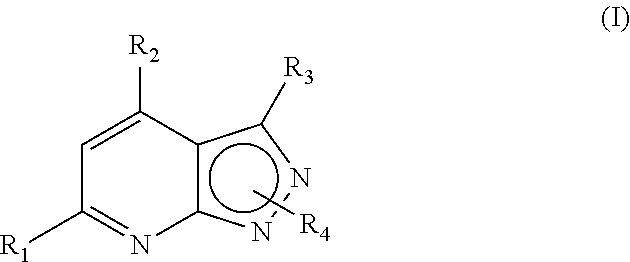
to a process for preparing them and to the therapeutic use thereof.
Description
This application is a continuation-in-part of U.S. application Ser. No. 14/364,420, filed Jun. 11, 2014, which is a national stage application under 35 U.S.C. § 371 of International Application No. PCT/EP2012/075328, filed Dec. 13, 2012, which claims priority to France Application No. 1161589, filed on Dec. 14, 2011, the disclosures of which are explicitly incorporated by reference herein.
The present invention relates to pyrazolopyrimidine derivatives that inhibit the FGF (fibroblast growth factor) receptors, to a process for preparing them and to the therapeutic use thereof.
FGFs are a family of polypeptides synthesized by a large number of cells during embryonic development and by adult tissue cells under various pathological conditions.
The present invention relates to compounds corresponding to formula (I):

in which:
the representation of the pyrazole ring indicates that the substituent R4 may be borne either by the nitrogen alpha to the pyridine ring (I′) or by the nitrogen alpha to the carbon bearing a substituent R3 (I″) such that:

Either

-
- R1 represents an aryl, pyridyl or pyrazolyl group optionally substituted with one or more substituents chosen from:
- a halogen atom,
- a group —CF3,
- a cyano group,
- a group —NR6R6′ in which R6 and R6′ are as defined below,
- a group —NR10R11 such that R10 and R11 form, together with the nitrogen atom to which they are attached, a saturated or unsaturated heterocycle comprising one or more heteroatoms chosen from a nitrogen atom and an oxygen atom so as advantageously to form a pyrazole, morpholine, pyrrolidine or piperidine, optionally substituted with one or more substituents chosen from a halogen atom and a linear or branched alkyl group,
- a group —CH2NR10R11 such that R10 and R11 form, together with the nitrogen atom to which they are attached, a saturated or unsaturated heterocycle comprising one or more heteroatoms chosen from a nitrogen atom and an oxygen atom so as advantageously to form a morpholinyl group,
- a group —COR12 in which R12 represents a hydroxyl group or a group —NR6R6′, in which R6 and R6′ are as defined below,
- a group —CONR7R7′ such that R7 and R7′ form, together with the nitrogen atom to which they are attached, a heterocycloalkyl comprising one or more heteroatoms chosen from a nitrogen atom and an oxygen atom so as advantageously to form a pyrrolidinyl group,
- a group —(CH2)pNHSO2CH3 in which p represents 0 or 1,
- a group —OR13 in which R13 represents a linear group (C1-C3)alkyl,
- a group (C1-C3)alkyl,
- Or R1 represents a bicyclic group of formula A below:
- R1 represents an aryl, pyridyl or pyrazolyl group optionally substituted with one or more substituents chosen from:

-
- in which R8 and R9 form, together with the carbon atoms to which they are attached, a saturated or unsaturated heterocycle comprising one or more heteroatoms chosen from a nitrogen atom, an oxygen atom and a sulfur atom, such that the group (A) advantageously forms a dihydrobenzimidazolonyl, indolyl, dihydrobenzoxazinyl, benzothiazolyl or benzimidazolyl group, optionally substituted with one or more linear alkyl groups,
- R2 represents a group:
- —CF3,
- —CHF2,
- —COOH,
- or
- —CONHR5, in which R5 is as defined below,
- R3 represents:
- a hydrogen atom,
- an aryl group, optionally substituted with an alkoxymethyl group,
- a cycloalkyl group,
- or
- a heteroaryl group chosen from thienyl and pyridyl groups,
- R4 represents:
- a hydrogen atom,
- a linear group (C1-C3)alkyl, optionally substituted with a group —NR6R′6 in which R6 and R′6 are as defined below or a group —NR7R′7 such that R7 and R7′ form, together with the nitrogen atom to which they are attached, a heterocycloalkyl comprising one or more heteroatoms chosen from a nitrogen atom and an oxygen atom,
- R5 represents:
- a hydrogen atom,
- a linear group (C1-C3)alkyl, optionally substituted with a pyridyl group,
- or
- an aromatic group chosen from aryl and pyridyl,
- R6 and R′6, which may be identical or different, represent a hydrogen atom or a linear alkyl group,
- R2 represents a group:
- in the form of the base or of an acid-addition or base-addition salt.
- in which R8 and R9 form, together with the carbon atoms to which they are attached, a saturated or unsaturated heterocycle comprising one or more heteroatoms chosen from a nitrogen atom, an oxygen atom and a sulfur atom, such that the group (A) advantageously forms a dihydrobenzimidazolonyl, indolyl, dihydrobenzoxazinyl, benzothiazolyl or benzimidazolyl group, optionally substituted with one or more linear alkyl groups,
The compounds of formula (I) may exist in the form of bases or salified with acids or bases, especially pharmaceutically acceptable acids or bases. Such addition salts form part of the invention.
These salts are advantageously prepared with pharmaceutically acceptable acids, but salts of other acids that are of use, for example, for purifying or isolating the compounds of formula (I) also form part of the invention.
In the context of the present invention, and unless otherwise mentioned in the text, the following definitions apply:
a halogen atom: a fluorine, chlorine, bromine or iodine atom;
an alkyl group: a linear or branched saturated hydrocarbon-based aliphatic group, comprising from 1 to 6 carbon atoms. Examples that may be mentioned include methyl, ethyl, propyl, isopropyl, butyl, isobutyl, pentyl, etc. groups;
a cycloalkyl group: a 3- to 8-membered cyclic alkyl group, comprising between 3 and 6 carbon atoms, the said cycloalkyl group being optionally substituted with one or more halogen atoms and/or alkyl groups. Examples that may be mentioned include cyclopropyl and cyclopentyl groups;
an alkoxy group: a radical —O-alkyl in which the alkyl group is as defined previously;
an alkoxyalkyl group: a radical of formula alkyl-O-alkyl, in which the identical or different alkyl groups are as defined previously;
an aryl group: a cyclic aromatic group comprising between 5 and 10 carbon atoms, for example a phenyl group;
a heteroaryl group: a cyclic aromatic group comprising between 3 and 10 atoms including one or more heteroatoms, for example between 1 and 4 heteroatoms, such as nitrogen, oxygen or sulfur, this group comprising one or more rings, preferably one or two rings. The heteroaryls may comprise several fused rings. The heteroaryls are optionally substituted with one or more alkyl groups or an oxygen atom. Examples that may be mentioned include thienyl, pyridyl, pyrazolyl, imidazolyl, thiazolyl and triazolyl groups;
a heterocycloalkyl: a cyclic alkyl group comprising from 4 to 9 atoms forming this ring and of which one or two are heteroatoms, such as oxygen, nitrogen or sulfur. Mention may be made especially of piperidyl, pyrrolidinyl, piperazinyl, tetrahydropyranyl, morpholinyl and homopiperazinyl groups;
a heterocyclic group: a heteroaryl group or a heterocycloalkyl group as defined previously.
The present invention relates particularly to compounds corresponding to formula (I):

in which:
-
- R1 represents a phenyl, pyridyl or pyrazolyl group optionally substituted with one or more substituents chosen from:
- a fluorine atom,
- a group —CF3,
- a cyano group,
- a group —NR6R6′ in which R6 and R6′ are as defined below,
- a group —NR10R11 such that R10 and R11 form, together with the nitrogen atom to which they are attached, a saturated or unsaturated heterocycle comprising one or more heteroatoms chosen from a nitrogen atom and an oxygen atom so as advantageously to form a pyrazolyl, morpholinyl, pyrrolidinyl or piperidyl, optionally substituted with one or more linear alkyl groups,
- a group —CH2NR10R11 such that R10 and R11 form, together with the nitrogen atom to which they are attached, a saturated heterocycle comprising one or more heteroatoms chosen from a nitrogen atom and an oxygen atom so as advantageously to form a morpholinyl group,
- a group —COR12 in which R12 represents a hydroxyl group or a group —NR6R6′, in which R6 and R6′ are as defined below,
- a group —CONR7R7′ in which R7 and R7′ form, together with the nitrogen atom to which they are attached, a heterocycloalkyl comprising a nitrogen heteroatom,
- a group —(CH2)NHSO2CH3 in which p represents 0 or 1,
- a group —OR13 in which R13 represents a linear group (C1-C3)alkyl,
- a group (C1-C3)alkyl,
- R1 represents a phenyl, pyridyl or pyrazolyl group optionally substituted with one or more substituents chosen from:
Or R1 represents a bicyclic group of formula A below:

-
- in which R8 and R9 form, together with the carbon atoms to which they are attached, a saturated or unsaturated heterocycle comprising one or more heteroatoms chosen from a nitrogen atom, an oxygen atom and a sulfur atom, such that A represents a dihydrobenzimidazolonyl, indolyl, dihydrobenzoxazinyl, benzothiazolyl or benzimidazolyl group, optionally substituted with one or more linear alkyl groups,
- R2 represents a group:
- —CF3,
- —CHF2,
- —COOH,
- or
- —CONHR5, in which R5 is as defined below,
- R3 represents:
- a hydrogen atom,
- a phenyl group, optionally substituted with an alkoxymethyl group,
- a cycloalkyl group comprising 3 carbon atoms,
- or
- a heteroaryl group chosen from thienyl and pyridyl groups,
- R4 represents:
- a hydrogen atom,
- a linear group (C1-C3)alkyl, optionally substituted with a group —NR6R6′ in which R6 and R6′, which may be identical or different, represent a methyl group or a group —NR7R7′ such that R7 and R7′ form, together with the nitrogen atom to which they are attached, a heterocycloalkyl comprising one or more heteroatoms chosen from a nitrogen atom and an oxygen atom,
- R5 represents:
- a hydrogen atom,
- a linear group (C1-C3)alkyl, optionally substituted with a pyridyl group,
- or
- a phenyl or pyridyl group,
- R6 and R′6, which may be identical or different, represent a hydrogen atom or a linear alkyl group,
- R2 represents a group:
- in which R8 and R9 form, together with the carbon atoms to which they are attached, a saturated or unsaturated heterocycle comprising one or more heteroatoms chosen from a nitrogen atom, an oxygen atom and a sulfur atom, such that A represents a dihydrobenzimidazolonyl, indolyl, dihydrobenzoxazinyl, benzothiazolyl or benzimidazolyl group, optionally substituted with one or more linear alkyl groups,
in the form of the base or of an acid-addition or base-addition salt.
Among the compounds of formula (I) according to the invention, a first group of compounds consists of the compounds corresponding to formula (I) below, with the exception of:
- 3-(4-Fluorobenzyl)-1-methyl-6-[1-(2-methyl-2H-pyrazol-3-yl)-imidazo[1,5-a]pyridine-3-carbonyl]-1H-quinazoline-2,4-dione;
- 3-(4-Fluorobenzyl)-1-methyl-6-[1-(1-methyl-1H-pyrazol-4-yl)-imidazo[1,5-a]pyridine-3-carbonyl]-1H-quinazoline-2,4-dione;
- 3-(4-Fluorobenzyl)-1-methyl-6-[1-(1-methyl-1H-pyrazol-4-yl)-imidazo[1,5-a]pyridine-3-carbonyl]-1H-quinazoline-2,4-dione;
- 3-(4-Fluorobenzyl)-6-[1-(1-methyl-1H-pyrazol-4-yl)-imidazo[1,5-a]pyridine-3-carbonyl]-1-propyl-1H-quinazoline-2,4-dione;
- [6-(1-Bromo-2-methylindolizine-3-carbonyl)-2,4-dioxo-1,4-dihydro-2H-quinazolin-3-yl]acetic acid methyl ester;
- [6-(1-Bromo-2-methylindolizine-3-carbonyl)-2,4-dioxo-1,4-dihydro-2H-quinazolin-3-yl]acid tert-butyl ester;
- 6-(4-Fluoro-3-methoxycarbonylphenyl)-3-phenyl-1H-pyrazolo[3,4-b]pyridine-4-carboxylic acid;
- 2-Fluoro-5-(3-phenyl-4-trifluoromethyl-1H-pyrazolo[3,4-b]pyridin-6-yl)benzoic acid;
- N,N-Dimethyl-3-(1-methyl-3-phenyl-4-trifluoromethyl-1H-pyrazolo[3,4-b]pyridin-6-yl)benzamide;
- N,N-Dimethyl-4-(1-methyl-3-phenyl-4-trifluoromethyl-1H-pyrazolo[3,4-b]pyridin-6-yl)benzamide;
- 5-(1-Methyl-3-phenyl-4-trifluoromethyl-1H-pyrazolo[3,4-b]pyridin-6-yl)nicotinonitrile;
- 6-Benzothiazol-5-yl-1-methyl-3-phenyl-4-trifluoromethyl-1H-pyrazolo[3,4-b]pyridine;
- 1-Methyl-3-phenyl-6-(6-pyrrolidin-1-ylpyridin-3-yl)-4-trifluoromethyl-1H-pyrazolo[3,4-b]pyridine;
- 1-Methyl-6-(6-morpholin-4-ylpyridin-3-yl)-3-phenyl-4-trifluoromethyl-1H-pyrazolo[3,4-b]pyridine;
- 3-(1-Methyl-3-phenyl-4-trifluoromethyl-1H-pyrazolo[3,4-b]pyridin-6-yl)benzamide;
- N-[4-(1-Methyl-3-phenyl-4-trifluoromethyl-1H-pyrazolo[3,4-b]pyridin-6-yl)benzyl]methanesulfonamide;
- 1-Methyl-6-(1-methyl-1H-indol-6-yl)-3-phenyl-4-trifluoromethyl-1H-pyrazolo[3,4-b]pyridine;
- N-[3-(1-Methyl-3-phenyl-4-trifluoromethyl-1H-pyrazolo[3,4-b]pyridin-6-yl)phenyl]methanesulfonamide;
- 4-Methyl-7-(1-methyl-3-phenyl-4-trifluoromethyl-1H-pyrazolo[3,4-b]pyridin-6-yl)-3,4-dihydro-2H-benzo[1,4]oxazine;
- N-[3-(1-Methyl-3-phenyl-4-trifluoromethyl-1H-pyrazolo[3,4-b]pyridin-6-yl)benzyl]methanesulfonamide;
- 6-(4-Methoxyphenyl)-1-methyl-3-phenyl-4-trifluoromethyl-1H-pyrazolo[3,4-b]pyridine;
- 2-Fluoro-N-methyl-5-(1-methyl-3-phenyl-4-trifluoromethyl-1H-pyrazolo[3,4-b]pyridin-6-yl)benzamide;
- Dimethyl[3-(1-methyl-3-phenyl-4-trifluoromethyl-1H-pyrazolo[3,4-b]pyridin-6-yl)phenyl]amine;
- 6-[4-(3,5-Dimethylpyrazol-1-yl)phenyl]-1-methyl-3-phenyl-4-trifluoromethyl-1H-pyrazolo[3,4-b]pyridine;
- 1-Methyl-6-(3-morpholin-4-ylmethylphenyl)-3-phenyl-4-trifluoromethyl-1H-pyrazolo[3,4-b]pyridine;
- 5-(1-Methyl-3-phenyl-4-trifluoromethyl-1H-pyrazolo[3,4-b]pyridin-6-yl)nicotinonitrile;
- 4-(1-Methyl-3-phenyl-4-trifluoromethyl-1H-pyrazolo[3,4-b]pyridin-6-yl)benzoic acid;
- N,N-Dimethyl-4-(1-methyl-3-phenyl-4-trifluoromethyl-1H-pyrazolo[3,4-b]pyridin-6-yl)benzamide;
- N,N-Dimethyl-3-(1-methyl-3-phenyl-4-trifluoromethyl-1H-pyrazolo[3,4-b]pyridin-6-yl)benzamide;
- 1-Methyl-6-(6-morpholin-4-ylpyridin-3-yl)-3-phenyl-4-trifluoromethyl-1H-pyrazolo[3,4-b]pyridine;
- 6-(6-Methoxypyridin-3-yl)-1-methyl-3-phenyl-4-trifluoromethyl-1H-pyrazolo[3,4-b]pyridine;
- 1-Methyl-3-phenyl-6-(6-pyrrolidin-1-ylpyridin-3-yl)-4-trifluoromethyl-1H-pyrazolo[3,4-b]pyridine;
- 1-Methyl-6-(2-methyl-5-trifluoromethyl-2H-pyrazol-3-yl)-3-phenyl-4-trifluoromethyl-1H-pyrazolo[3,4-b]pyridine;
- 6-Benzothiazol-5-yl-1-methyl-3-phenyl-4-trifluoromethyl-1H-pyrazolo[3,4-b]pyridine;
- N,N-Dimethyl-4-(3-phenyl-4-trifluoromethyl-1H-pyrazolo[3,4-b]pyridin-6-yl)benzamide;
- 6-(4-Morpholin-4-ylphenyl)-3-phenyl-4-trifluoromethyl-1H-pyrazolo[3,4-b]pyridine;
- 6-(6-Morpholin-4-ylpyridin-3-yl)-3-phenyl-4-trifluoromethyl-1H-pyrazolo[3,4-b]pyridine;
- 6-(6-Methoxypyridin-3-yl)-3-phenyl-4-trifluoromethyl-1H-pyrazolo[3,4-b]pyridine;
- 6-(3-Morpholin-4-ylphenyl)-3-phenyl-4-trifluoromethyl-1H-pyrazolo[3,4-b]pyridine;
- N-Methyl-3-(3-phenyl-4-trifluoromethyl-1H-pyrazolo[3,4-b]pyridin-6-yl)benzamide;
- N-[3-(3-Phenyl-4-trifluoromethyl-1H-pyrazolo[3,4-b]pyridin-6-yl)phenyl]methanesulfonamide;
- 3-Phenyl-6-(3-piperidin-1-ylphenyl)-4-trifluoromethyl-1H-pyrazolo[3,4-b]pyridine;
- 2-Fluoro-N-methyl-5-(3-phenyl-4-trifluoromethyl-1H-pyrazolo[3,4-b]pyridin-6-yl)benzamide;
- 5-(3-Phenyl-4-trifluoromethyl-1H-pyrazolo[3,4-b]pyridin-6-yl)nicotinonitrile;
- 2-Fluoro-5-(1-methyl-3-phenyl-4-trifluoromethyl-1H-pyrazolo[3,4-b]pyridin-6-yl)benzoic acid;
- 2-Amino-5-(4-difluoromethyl-2-methyl-2H-pyrazolo[3,4-b]pyridin-6-yl)benzonitrile;
- Dimethyl[4-(3-phenyl-4-trifluoromethyl-1H-pyrazolo[3,4-b]pyridin-6-yl)phenyl]amine;
- 4-(3-Phenyl-4-trifluoromethyl-1H-pyrazolo[3,4-b]pyridin-6-yl)phenylamine;
- 6-(4-Methoxyphenyl)-3-phenyl-4-trifluoromethyl-1H-pyrazolo[3,4-b]pyridine;
in the form of the base or of an acid-addition or base-addition salt.
A subject of the present invention is particularly compounds of formula (I) as defined above in which R2 represents a group:
-
- —CHF2, except when R4 located on the nitrogen alpha to R3 represents a methyl group and R3 represents a hydrogen atom, —COOH,
or
-
- —CONHR5, in which R5 is as defined above,
in the form of the base or of an acid-addition or base-addition salt.
- —CONHR5, in which R5 is as defined above,
A subject of the present invention is particularly compounds of formula (I) as defined above in which R1 represents an aryl, pyridyl or pyrazolyl group, advantageously a phenyl group, optionally substituted with one or more substituents chosen from:
-
- a halogen atom, advantageously a fluorine atom;
and
-
- a group —COR12, in which R12 represents a hydroxyl group,
in the form of the base or of an acid-addition or base-addition salt.
- a group —COR12, in which R12 represents a hydroxyl group,
The last two subgroups defined above taken separately or in combination also form part of the invention.
Among the compounds of formula (I) that are subjects of the invention, mention may be made especially of the following compounds:
- 6-(4-Methoxyphenyl)-1-methyl-3-phenyl-4-trifluoromethyl-1H-pyrazolo[3,4-b]pyridine;
- Dimethyl[3-(1-methyl-3-phenyl-4-trifluoromethyl-1H-pyrazolo[3,4-b]pyridin-6-yl)phenyl]amine;
- N-Methy-3-(3-phenyl-4-trifluoromethyl-1H-pyrazolo[3,4-b]pyridin-6-yl)benzamide;
- [4-(4-Difluoromethyl-3-phenyl-1H-pyrazolo[3,4-b]pyridin-6-yl)phenyl]pyrrolidin-1-ylmethanone;
- 4-Difluoromethyl-6-(1-methyl-1H-pyrazol-4-yl)-3-phenyl-1H-pyrazolo[3,4-b]pyridine;
- 4-Difluoromethyl-6-(3,5-dimethyl-1H-pyrazol-4-yl)-3-phenyl-1H-pyrazolo[3,4-b]pyridine;
- 4-Difluoromethyl-3-phenyl-6-(1H-pyrazol-4-yl)-1H-pyrazolo[3,4-b]pyridine;
- 4-Difluoromethyl-6-(6-methoxypyridin-3-yl)-3-phenyl-1H-pyrazolo[3,4-b]pyridine;
- [3-(4-Difluoromethyl-3-phenyl-1H-pyrazolo[3,4-b]pyridin-6-yl)phenyl]pyrrolidin-1-ylmethanone;
- 4-Difluoromethyl-3-phenyl-6-(3-piperidin-1-ylphenyl)-1H-pyrazolo[3,4-b]pyridine;
- 6-(4-Amino-3-methoxyphenyl)-1H-pyrazolo[3,4-b]pyridine-4-carboxylic acid;
- 6-(4-Amino-3-methoxyphenyl)-1H-pyrazolo[3,4-b]pyridine-4-carboxylic acid;
- 6-(4-Amino-3-methoxyphenyl)-3-phenyl-1H-pyrazolo[3,4-b]pyridine-4-carboxylic acid methylamide;
- 6-(4-Amino-3-methoxyphenyl)-3-phenyl-1H-pyrazolo[3,4-b]pyridine-4-carboxylic acid amide; compound with trifluoroacetic acid;
- 6-(4-Amino-3-methoxyphenyl)-1H-pyrazolo[3,4-b]pyridine-4-carboxylic acid methylamide;
- 4-(4-Amino-3-methoxyphenyl)-1H-pyrazolo[3,4-b]pyridine-6-carboxylic acid methylamide;
- 6-(4-Amino-3-methoxyphenyl)-1H-pyrazolo[3,4-b]pyridine-4-carboxylic acid amide;
- 6-(4-Amino-3-methoxyphenyl)-3-phenyl-1H-pyrazolo[3,4-b]pyridine-4-carboxylic acid;
- 6-(4-Amino-3-methoxyphenyl)-2-methyl-2H-pyrazolo[3,4-b]pyridine-4-carboxylic acid;
- 6-(4-Amino-3-methoxyphenyl)-1-methyl-3-phenyl-1H-pyrazolo[3,4-b]pyridine-4-carboxylic acid;
- 6-(4-Amino-3-methoxyphenyl)-1-methyl-1H-pyrazolo[3,4-b]pyridine-4-carboxylic acid;
- 6-(4-Amino-3-methoxyphenyl)-2-methyl-2H-pyrazolo[3,4-b]pyridine-4-carboxylic acid amide;
- 5-(4-Carbamoyl-3-phenyl-1H-pyrazolo[3,4-b]pyridin-6-yl)-2-fluorobenzoic acid;
- 2-Amino-5-(4-carbamoyl-3-phenyl-1H-pyrazolo[3,4-b]pyridin-6-yl)benzoic acid;
- 6-(4-Amino-3-cyanophenyl)-3-phenyl-1H-pyrazolo[3,4-b]pyridine-4-carboxylic acid amide;
- 6-(4-Amino-3-cyanophenyl)-3-phenyl-1H-pyrazolo[3,4-b]pyridine-4-carboxylic acid amide;
- 6-(4-Amino-3-cyanophenyl)-2-methy-2H-pyrazolo[3,4-b]pyridine-4-carboxylic acid;
- 6-(4-Amino-3-cyanophenyl)-3-thiophen-2-yl-1H-pyrazolo[3,4-b]pyridine-4-carboxylic acid amide;
- 6-(4-Amino-3-cyanophenyl)-3-cyclopropyl-1H-pyrazolo[3,4-b]pyridine-4-carboxylic acid;
- 5-(4-Carbamoyl-1H-pyrazolo[3,4-b]pyridin-6-yl)-2-fluorobenzoic acid;
- 6-(3-Cyano-4-fluorophenyl)-3-phenyl-1H-pyrazolo[3,4-b]pyridine-4-carboxylic acid amide;
- 5-(4-Difluoromethyl-3-phenyl-1H-pyrazolo[3,4-b]pyridin-6-yl)-2-fluorobenzoic acid;
- 2-Fluoro-5-(3-phenyl-4-trifluoromethyl-1H-pyrazolo[3,4-b]pyridin-6-yl)benzonitrile;
- 2-Amino-5-(4-difluoromethyl-3-phenyl-1H-pyrazolo[3,4-b]pyridin-6-yl)benzonitrile;
- 2-Fluor-5-(3-phenyl-4-trifluoromethyl-1H-pyrazolo[3,4-b]pyridin-6-yl)benzoic acid;
- 2-Amino-5-(1-methyl-3-phenyl-4-trifluoromethyl-1H-pyrazolo[3,4-b]pyridin-6-yl)benzonitrile;
- 2-Amino-5-(1-methyl-3-phenyl-4-trifluoromethyl-1H-pyrazolo[3,4-b]pyridin-6-yl)benzonitrile;
- 6-(3-Carbamoyl-4-fluorophenyl)-3-pyridin-3-yl-1H-pyrazolo[3,4-b]pyridine-4-carboxylic acid amide;
- 5-(4-Difluoromethyl-2-methyl-2H-pyrazolo[3,4-b]pyridin-6-yl)-2-fluorobenzonitrile;
- 6-(1H-Indol-6-yl)-3-phenyl-4-trifluoromethyl-1H-pyrazolo[3,4-b]pyridine;
- 5-(3-Phenyl-4-trifluoromethyl-1H-pyrazolo[3,4-b]pyridin-6-yl)-1,3-dihydrobenzimidazol-2-one;
- 6-(4-Amino-3-cyanophenyl)-1H-pyrazolo[3,4-b]pyridine-4-carboxylic acid phenylamide;
- 6-(4-Amino-3-cyanophenyl)-1H-pyrazolo[3,4-b]pyridine-4-carboxylic acid (pyridin-2-ylmethyl)amide;
- 6-(4-Amino-3-cyanophenyl)-1H-pyrazolo[3,4-b]pyridine-4-carboxylic acid pyridin-2-ylamide;
- 6-(4-Amino-3-cyanophenyl)-1H-pyrazolo[3,4-b]pyridine-4-carboxylic acid pyridin-3-ylamide;
- 6-(4-Amino-3-cyanophenyl)-1H-pyrazolo[3,4-b]pyridine-4-carboxylic acid pyridin-4-ylamide;
- 5-(4-Difluoromethyl-2-methyl-2H-pyrazolo[3,4-b]pyridin-6-yl)-2-fluorobenzamide;
- 5-(4-Difluoromethyl-1-methyl-3-pyridin-4-yl-1H-pyrazolo[3,4-b]pyridin-6-yl)-2-fluorobenzonitrile;
- 2-Amino(2-methyl-3-phenyl-trifluoromethyl-2H-pyrazolo[3,4-b]pyridin-6-yl)benzonitrile;
- 6-(1H-Benzimidazol-5-yl)-1H-pyrazolo[3,4-b]pyridine-4-carboxylic acid phenylamide;
- 6-(1H-Benzimidazol-5-yl)-1H-pyrazolo[3,4-b]pyridine-4-carboxylic acid pyridin-2-ylamide;
- 6-(1H-Benzimidazol-5-yl)-1H-pyrazolo[3,4-b]pyridine-4-carboxylic acid (pyridin-3-ylmethyl)amide;
- 6-(2-Oxo-2,3-dihydro-1H-benzimidazol-5-yl)-1H-pyrazolo[3,4-b]pyridine-4-carboxylic acid phenylamide;
- 2-Amino-5-(4-difluoromethyl-1-methyl-1H-pyrazolo[3,4-b]pyridin-6-yl)benzonitrile;
- 3-(4-Difluoromethyl-1-methyl-1H-pyrazolo[3,4-b]pyridin-6-yl)benzonitrile;
- 4-(4-Difluoromethyl-1-methyl-1H-pyrazolo[3,4-b]pyridin-6-yl)phenylamine;
- 2-Amino-5-[2-(2-dimethylaminoethyl)-3-phenyl-4-trifluoromethyl-2H-pyrazolo[3,4-b]pyridin-6-yl]benzonitrile;
- 2-Amino-5-(4-difluoromethyl-1H-pyrazolo[3,4-b]pyridin-6-yl)benzonitrile;
- 2-Amino-5-[1-(2-dimethylaminoethyl)-3-phenyl-4-trifluoromethyl-1H-pyrazolo[3,4-b]pyridin-6-yl]benzonitrile;
- 2-Amino-5-[2-(2-morpholin-4-ylethyl)-3-phenyl-4-trifluoromethyl-2H-pyrazolo[3,4-b]pyridin-6-yl]benzonitrile;
- 2-Methoxy-5-(1-methyl-3-phenyl-4-trifluoromethyl-1H-pyrazolo[3,4-b]pyridin-6-yl)nicotinonitrile;
- 2-Amino-5-(4-difluoromethyl-1-methyl-3-phenyl-1H-pyrazolo[3,4-b]pyridin-6-yl)benzonitrile;
- 4-(4-Difluoromethyl-1-methyl-3-phenyl-1H-pyrazolo[3,4-b]pyridin-6-yl)phenylamine;
- [3-(4-Difluoromethyl-1-methyl-3-phenyl-1H-pyrazolo[3,4-b]pyridin-6-yl)phenyl]dimethylamine;
- 2-Amino-5-[3-phenyl-1-(2-piperidin-1-ylethyl)-4-trifluoromethyl-1H-pyrazolo[3,4-b]pyridin-6-yl]benzonitrile;
- Dimethyl{3-[3-phenyl-1-(2-piperidin-1-ylethyl)-4-trifluoromethyl-1H-pyrazolo[3,4-b]pyridin-6-yl]phenyl}amine;
- 2-Amino-5-[4-difluoromethyl-2-(2-dimethylaminoethyl)-2H-pyrazolo[3,4-b]pyridin-6-yl]benzonitrile;
- 2-Amino-5-[4-difluoromethyl-2-(2-morpholin-4-ylethyl)-2H-pyrazolo[3,4-b]pyridin-6-yl]benzonitrile;
- 2-Amino-5-[4-difluoromethyl-1-(2-dimethylaminoethyl)-3-phenyl-1H-pyrazolo[3,4-b]pyridin-6-yl]benzonitrile;
- 2-(2-Morpholin-4-ylethyl)-6-(3-morpholin-4-ylmethylphenyl)-4-trifluoromethyl-2H-pyrazolo[3,4-b]pyridine;
- Dimethyl{3-[1-(2-morpholin-4-ylethyl)-4-trifluoromethyl-1H-pyrazolo[3,4-b]pyridin-6-yl]phenyl}amine;
- 5-[1-(2-Morpholin-4-ylethyl)-4-trifluoromethyl-1H-pyrazolo[3,4-b]pyridin-6-yl]nicotinonitrile;
- 5-[1-(2-Morpholin-4-ylethyl)-4-trifluoromethyl-1H-pyrazolo[3,4-b]pyridin-6-yl]nicotinamide;
- 2-Amino-5-(2-methyl-4-trifluoromethyl-2H-pyrazolo[3,4-b]pyridin-6-yl)benzonitrile;
- 1-Methyl-6-(3-morpholin-4-ylmethylphenyl)-4-trifluoromethyl-1H-pyrazolo[3,4-b]pyridine;
- 2-Amino-5-(1-methyl-4-trifluoromethyl-1H-pyrazolo[3,4-b]pyridin-6-yl)benzonitrile;
- Dimethyl[3-(1-methyl-4-trifluoromethyl-1H-pyrazolo[3,4-b]pyridin-6-yl)phenyl]amine;
- Dimethyl[3-(3-phenyl-2-propyl-4-trifluoromethyl-2H-pyrazolo[3,4-b]pyridin-6-yl)phenyl]amine;
- 2-Amino-5-[4-difluoromethyl-2-(2-piperidin-1-ylethyl)-2H-pyrazolo[3,4-b]pyridin-6-yl]benzonitrile;
- 2-Amino-5-(4-difluoromethyl-3-pyridin-3-yl-1H-pyrazolo[3,4-b]pyridin-6-yl)benzonitrile;
- 2-Amino-5-(4-difluoromethyl-2-propyl-2H-pyrazolo[3,4-b]pyridin-6-yl)benzonitrile;
- 2-Amino-5-(4-difluoromethyl-3-pyridin-4-yl-1H-pyrazolo[3,4-b]pyridin-6-yl)benzonitrile;
- 1-Methyl-6-(3-morpholin-4-ylmethylphenyl)-3-pyridin-3-yl-4-trifluoromethyl-1H-pyrazolo[3,4-b]pyridine;
- 2-Amino-5-[4-difluoromethyl-3-(3-methoxyphenyl)-1H-pyrazolo[3,4-b]pyridin-6-yl]benzonitrile;
- 2-Amino-5-(2-propyl-4-trifluoromethyl-2H-pyrazolo[3,4-b]pyridin-6-yl)benzonitrile;
- 6-(3-Morpholin-4-ylmethylphenyl)-2-propyl-4-trifluoromethyl-2H-pyrazolo[3,4-b]pyridine;
- Dimethyl[3-(2-propyl-4-trifluoromethyl-2H-pyrazolo[3,4-b]pyridin-6-yl)phenyl]amine;
- 6-(3-Morpholin-4-ylmethylphenyl)-1-propyl-4-trifluoromethyl-1H-pyrazolo[3,4-b]pyridine;
- 6-(4-Methoxyphenyl)-1-propyl-4-trifluoromethyl-1H-pyrazolo[3,4-b]pyridine;
- 5-[3-(3-Methoxyphenyl)-1-methyl-4-trifluoromethyl-1H-pyrazolo[3,4-b]pyridin-6-yl]nicotinonitrile;
- 3-(3-Methoxyphenyl)-1-methyl-6-(3-morpholin-4-ylmethylphenyl)-4-trifluoromethyl-1H-pyrazolo[3,4-b]pyridine;
- {3-[3-(3-Methoxyphenyl)-1-methyl-4-trifluoromethyl-1H-pyrazolo[3,4-b]pyridin-6-yl]phenyl}dimethylamine;
- 3-(3-Methoxyphenyl)-6-(4-methoxyphenyl)-1-methyl-4-trifluoromethyl-1H-pyrazolo[3,4-b]pyridine.
It should be noted that the above compounds have been named according to the IUPAC nomenclature, by means of the ACDLABS 10.0 ACD/name software (Advanced Chemistry development) or the AutoNom software (Beilstein Informations system).
In the text hereinbelow, the term “protecting group (P)” means a group that can, firstly, protect a reactive function such as a hydroxyl or an amine during a synthesis and, secondly, regenerate the intact reactive function at the end of the synthesis. Examples of protecting groups and also of protection and deprotection methods are given in Protective Groups in Organic Synthesis, Greene et al., 3rd Edition (John Wiley & Sons, Inc., New York).
In accordance with the invention, the compounds of general formula (I) may be prepared according to the process that follows.
The compound of formula (IV) when R2 represents a group —CF3 is obtained via methods known in the literature from the 2-aminopyrazole (III) and the 4,4,4-trifluoroacetoacetate (II), according to the following reaction scheme described in the Polish Journal of Chemistry, 1983, 57, 789.

The compound of formula (IV) when R2 represents a —CHF2 group is obtained via a method similar to that described previously by condensation of the 2-aminopyrazole (III) and 4,4-difluoroacetoacetate.

The compound of formula (XII) in which R2 represents a group —CHF2 or —CF3 is obtained by chlorination in the presence of POCl3 of the compound of formula (IV) in which R2 represents a group —CHF2 or —CF3.

The compound of formula (VI) in which R2 represents a group —CF3 and R3 is a phenyl is obtained via methods known in the literature from 3-phenyl-1H-pyrazol-5-amine (V) and ethyl 4,4,4-trifluoro-3-oxobutanoate, according to the following reaction scheme described in the Polish Journal of Chemistry, 1983, 57, 789.

The compound of formula (VI) in which R2 represents a —CHF2 group is obtained via a method similar to that described previously from 3-phenyl-1H-pyrazol-5-amine (V) and ethyl 4,4-difluoro-3-oxobutanoate.

The compound of formula (VI) is subjected to a bromination reaction in the presence of POBr3 in order to obtain the compound of formula (VII). The compound of formula (VII) is subjected to an alkylation reaction in the presence of a protecting group P in order to obtain the compound of formula (VIII). The compound of formula (VIII) is subjected, in the presence of a palladium catalyst, a ligand and a base, to a reaction with phenylboronic or heteroarylboronic derivatives or phenylboronate esters or heteroarylboronate esters according to a Suzuki coupling, in order to obtain the compound of formula (IX). The compound of formula (IX) is subjected to a deprotection reaction in order to obtain the compounds of formula (I) in which R1 is as defined previously, and R2 represents a group —CF3 or —CHF2.
The compound of formula (VII) may optionally be subjected, in the presence of a palladium catalyst, a ligand and a base, to a reaction with phenylboronic or heteroarylboronic derivatives or phenylboronate esters or heteroarylboronate esters according to a Suzuki coupling, in order to obtain the compound of formula (I) in which R1 is as defined previously, and R2 represents a group —CF3 or —CHF2.
Scheme 2 presents a route for obtaining compounds of formula (I) in which R1 and R4 are as defined previously with the exception of a hydrogen atom.

The compound of formula (VII) is subjected to an alkylation reaction in the presence of a base and a halogenated derivative of formula R4—X in order to obtain the compounds of formulae (X) and (XI). The compounds of formulae (X) and (XI) are subjected separately, in the presence of a palladium catalyst, a ligand and a base, to a reaction with phenylboronic or heteroarylboronic derivatives or phenylboronate esters or heteroarylboronate esters according to a Suzuki coupling, in order to obtain the compounds of formula (I) in which R1 and R4 are as defined previously.
Scheme 3 presents a route for obtaining compounds of formula (I) in which R2 represents a group —CHF2 or —CF3 and R1 and R4 are as defined previously, with the exception that R4 represents a hydrogen atom.

The compound of formula (XII) is subjected to an alkylation reaction in the presence of a halogenated derivative of formula R4—X in order to obtain the compounds of formulae (XIII) and (XIV). The compounds of formulae (XIII) and (XIV) are separately subjected, in the presence of a palladium catalyst, a ligand and a base such as caesium carbonate, to a reaction with phenylboronic or heteroarylboronic derivatives or phenylboronate esters or heteroarylboronate esters according to a Suzuki coupling, in order to obtain the compound of formula (I) in which R2 represents a group —CHF2 or —CF3 and R1 and R4 are as defined previously.
Scheme 4 presents a route for obtaining compounds of formula (I) in which R2 represents a group —CHF2 or —CF3, R3 and R4 represent a hydrogen atom and R1 is as defined previously.

The compound of formula (XV) is subjected to an alkylation reaction in the presence of a protecting group P in order to obtain the compound of formula (XVI). The compound of formula (XVI) is subjected, in the presence of a palladium catalyst, a ligand and a base, to a reaction with phenylboronic or heteroarylboronic derivatives or phenylboronate esters or heteroarylboronate esters according to a Suzuki coupling, in order to obtain the compound of formula (XVII). The compound of formula (XVII) is then subjected to a deprotection reaction in order to obtain the compound of formula (I) in which R2 represents a group —CHF2 or —CF3 and R1 is as defined previously.
Scheme 5 presents a route for obtaining compounds of formula (I) in which R2 represents a group —CHF2 or —CF3 and R1, R3 and R4 are as defined previously, with the exception that R3 and R4 represent a hydrogen atom.

The compound of formula (XV) is subjected to an iodination reaction in the presence of N-iodosuccinimide in order to obtain the compound of formula (XVIII). The compound of formula (XVIII) is then subjected to an alkylation reaction in the presence of a halogenated derivative of formula R4—X in order to obtain the compounds of formulae (XIX) and (XX). The compounds of formulae (XIX) and (XX) are subjected, in the presence of a palladium catalyst, a ligand and a base, to a reaction with phenylboronic or heteroarylboronic derivatives or phenylboronate esters or heteroarylboronate esters according to a Suzuki coupling, in order to obtain the compounds of formulae (XXI) and (XXII). The compounds of formulae (XXI) and (XXII) are subjected separately, in the presence of a palladium catalyst, a ligand and a base, to a reaction with phenylboronic or heteroarylboronic derivatives or phenylboronate esters or heteroarylboronate esters according to a Suzuki coupling, in order to obtain the compound of formula (I) in which R2 represents a group —CHF2 or —CF3 and R1, R3 and R4 are as defined previously, with the exception of a hydrogen atom.
Scheme 6 presents a route for obtaining compounds of formula (I) in which R2 represents a group —CHF2 or —CF3 and R1 and R3 are as defined previously, with the exception of a hydrogen atom.

The compound of formula (XVIII) is subjected to an alkylation reaction in the presence of a protecting group P in order to obtain the compound of formula (XXIII). The compound of formula (XXIII) is subjected, in the presence of a palladium catalyst, a ligand and a base, to a reaction with phenylboronic or heteroarylboronic derivatives or phenylboronate esters or heteroarylboronate esters according to a Suzuki coupling, in order to obtain the compound of formula (XXIV). The compound of formula (XXIV) is subjected, in the presence of a palladium catalyst, a ligand and a base, to a reaction with phenylboronic or heteroarylboronic derivatives or phenylboronate esters or heteroarylboronate esters according to a Suzuki coupling, in order to obtain the compound of formula (XXV). The compound of formula (XXV) is then subjected to a protection reaction in order to obtain the compound of formula (I) in which R2 represents a group —CHF2 or —CF3 and R1 and R3 are as defined previously, with the exception that R3 and R4 represent a hydrogen atom.
Scheme 7 presents a route for obtaining compounds of formula (I) in which R2 is as defined previously, with the exception of a group —CHF2 or —CF3, and R1, R3 and R4 are as defined previously.

The compound of formula (XXVI) is subjected to a condensation reaction with the compound of formula (XXVII) and methyl 2-oxopropanoate in order to obtain the compound of formula (XXVIII). The compound of formula (XXVIII) is subjected to a saponification reaction or to substitution with an amine in order to obtain the compound of formula (I) in which R2 is as defined previously, except for a group —CHF2 or —CF3, and R1, R3 and R4 are as defined previously.
In the preceding schemes, the starting compounds, the reagents and the intermediates, when their preparation method is not described, are commercially available or described in the literature, or alternatively may be prepared according to methods that are described therein or that are known to those skilled in the art.
According to another of its aspects, a subject of the invention is also the compounds of formulae (II) to (XXVIII) defined above. These compounds are useful as intermediates for synthesizing the compounds of formula (I).
The examples that follow describe the preparation of certain compounds in accordance with the invention. These examples are not limiting and serve merely to illustrate the present invention. The numbers of the compounds exemplified refer to those given in the table below, which illustrates the chemical structures and physical properties of a number of compounds according to the invention.
The present invention is also illustrated below in two figures such that:
The following abbreviations and empirical formulae are used:
AcOH: acetic acid
PTSA: para-toluenesulfonic acid
DME: ethylene glycol dimethyl ether
DMF: N,N-dimethylformamide
DMSO: dimethyl sulfoxide
g: gram
(M)Hz: (mega)Hertz
mL: milliliter
POBr3: dibromophosphanyl hypobromite
TBAF: tetrabutylammonium fluoride
TFA: trifluoroacetic acid
THF: tetrahydrofuran
In the examples that follow:
-
- the NMR analyses were performed on
Brüker Avance 250 MHz, 300 MHz, 400 MHz and 600 MHz machines. The proton magnetic resonance spectrum (1H NMR), as described below, are recorded at 400 MHz or 600 MHz in DMSO-d6, using the DMSO-d6 peak as reference. The chemical shifts □ are expressed in parts per million (ppm). The signals observed are expressed as follows: s=singlet; d=doublet; t=triplet; m=mass or broad singlet; H=proton (for the rotamers, HM and Hm are noted with reference to the major or minor isomers M and m, respectively). - the melting points were measured on a Büchi B-545 machine.
- the mass spectrometry analyses were performed on an Alliance 2695 machine (UV: PDA 996, MS: ZQ (simple Quad) ZQ2), Waters UPLC Acquity (UV: Acquity PDA, MS: SQD (simple Quad) SQW)
- the NMR analyses were performed on
To 5 ml of a 0.3 M solution in ethanol of 3-phenyl-1H-pyrazol-5-amine in a sealed tube are added 5 ml of a 0.3 M solution in ethanol of 2-fluoro-5-formylbenzoic acid and 1.5 mmol of ethyl 2-oxopropanoate at room temperature under an inert atmosphere of nitrogen. The tube is sealed and maintained at a temperature of 75° C. for 18 hours. The capsule is removed and heating is continued for 4 hours at 60° C. The reaction medium is then concentrated under reduced pressure. The residue is taken up in a sealed tube with a 7 N solution of ammonia in methanol. The medium is then heated for 3 days at 80° C. and then concentrated under reduced pressure. After purification by column chromatography on C-18 reverse-phase silica gel, eluting with an acetonitrile/H2O/0.1% TFA mixture, 23.7 mg of a lyophilizate are obtained.
MH+: 377
1H NMR (600 MHz, DMSO-d6): □□□□14.10 (s, 1H), 13.43 (s (broad), 1H), 8.79 (dd, JA=7.2 Hz, JB=2.3 Hz, 1H), 8.50 (m, 1H), 8.14 (s, 1H), 7.87 (s, 1H), 7.80 (s, 1H), 7.70 (dd, JA=7.8 Hz, JB=1.6 Hz, 1H), 7.51 (m, 1H), 7.46 (m, 2H), 7.41 (m, 1H)
To 20 g (0.12 mol) of 3-hydroxy-4-nitrobenzaldehyde in 200 ml of anhydrous DMF are added 42 g (0.13 mol) of caesium carbonate. The solution obtained is ultrasonicated for 5 minutes, and 9.4 ml (0.29 mol) of methyl iodide are then added. The reaction medium is heated at 80° C. for 18 hours and then diluted with ethyl acetate. The organic phase is washed with saturated aqueous sodium chloride solution, dried over magnesium sulfate and then concentrated under reduced pressure. The residue is recrystallized from 300 ml of a hot ½ DMF/ethanol mixture. The crystals formed are filtered off, rinsed with cold ethanol and with hexane, and then dried under reduced pressure. 12.1 g of a solid are obtained.
To 2 g (11 mmol) of 3-methoxy-4-nitrobenzaldehyde in 150 ml of anhydrous ethanol in a sealed tube are added 1.17 g (13.3 mmol) of pyruvic acid and 1.1 g (15.5 mmol) of 1H-pyrazol-5-amine. The reaction medium is heated at 80° C. for 18 hours and then concentrated under reduced pressure. The residue is dissolved in 160 ml of a 3/1 DMSO/methanol mixture, to which are added 80 g of Dowex 1×8-400 resin. The reaction medium is stirred at room temperature for 1 hour and then filtered. The resin is rinsed several times with DMSO and then with methanol, and finally treated for 30 minutes in a 10% solution of TFA in methanol. After filtration, the organic phase is concentrated under reduced pressure. The residue obtained is taken up in 100 ml of ethanol and 40 ml of acetic acid. 300 mg of zinc powder are added. The reaction medium is stirred at room temperature. 1 g of zinc powder are added after 15 minutes. The reaction medium is filtered and then concentrated under reduced pressure. After purification by column chromatography on C-18 reverse-phase silica gel, eluting with an acetonitrile/H2O/0.1% TFA mixture, 23.7 mg of a lyophilizate are obtained.
MH+: 285
1H NMR (600 MHz, DMSO-d6): □ 8.28 (s, 1H), 8.08 (s, 1H), 7.67 (d, J=2.1 Hz, 1H), 7.59 (dd, JA=8.4 Hz, JB=1.9 Hz, 1H), 6.77 (d, J=8.2 Hz, 1H), 3.91 (s, 3H)
To 2.1 g (12.7 mmol) of ethyl 4,4-difluoro-3-oxobutanoate in 16 ml of a 1/1 AcOH/H2O mixture are added 2 g (12.5 mmol) of 3-phenyl-1H-pyrazol-5-amine. The reaction medium is heated at 90° C. for 18 hours. The medium is cooled and the precipitate obtained is filtered off, washed with aqueous 20% acetic acid solution and then dried under reduced pressure. 2.5 g of a solid are obtained.
MH+: 262
To 1 g (3.8 mmol) of 4-(difluoromethyl)-3-phenyl-1H-indazol-6-ol in 20 ml of toluene are added 3.1 g (10.8 mmol) of POBr3. The reaction medium is heated at 90° C. for 18 hours. The reaction medium is concentrated under reduced pressure. The residue obtained is purified by column chromatography on silica gel, eluting with a 4/1 hexane/ethyl acetate mixture. 620 mg of a solid are obtained.
MH+: 324
To 78 mg (0.24 mmol) of 6-bromo-4-(difluoromethyl)-3-phenyl-1H-pyrazolo[3,4-b]pyridine in 4 ml of a 4/1 THF/water mixture are added 92 mg (0.43 mmol) of [3-(ethoxycarbonyl)-4-fluorophenyl]boronic acid, 35 mg (0.03 mmol) of tetrakis(triphenylphosphine)palladium and 261 mg (0.8 mmol) of caesium carbonate, under an inert atmosphere of argon. The reaction medium is heated at 150° C. for 60 minutes by microwave. The organic phase is separated out by settling of the phases, diluted with THF, washed with saturated aqueous sodium chloride solution and concentrated under reduced pressure. After purification by column chromatography on C-18 reverse-phase silica gel, eluting with an acetonitrile/H2O/0.1% TFA mixture, 12.3 mg of a lyophilizate are obtained.
MH+: 384
1H NMR (600 MHz, DMSO-d6): □ 14.31 (s, 1H), 8.76 (dd, JA=7.2 Hz, JB=2.3 Hz, 1H), 8.47 (m, 1H), 8.04 (s, 1H), 7.67 (d, JA=7.9 Hz, 2H), 7.51 (m, 4H), 7.33 (t, JA=54.6 Hz, 1H)
To 2.1 g (11.4 mmol) of ethyl 4,4,4-trifluoro-3-oxobutanoate in 16 ml of a 1/1 AcOH/H2O mixture are added 2 g (12.5 mmol) of 3-phenyl-1H-pyrazol-5-amine. The reaction medium is heated at 90° C. for 18 hours. The medium is cooled and the precipitate obtained is filtered off, washed with aqueous 20% acetic acid solution and then dried under reduced pressure. 2.5 g of a solid are obtained.
MH+: 280
To 1 g (3.8 mmol) of 3-phenyl-4-(trifluoromethyl)-1H-pyrazolo[3,4-b]pyridin-6-ol in 20 ml of toluene are added 3.1 g (10.8 mmol) of POBr3. The reaction medium is heated at 90° C. for 18 hours. The reaction medium is concentrated under reduced pressure and then purified by column chromatography on silica gel, eluting with a 4/1 hexane/ethyl acetate mixture. 338 mg of a solid are obtained.
MH+: 306
To 103 mg (0.33 mmol) of 6-bromo-3-phenyl-4-(trifluoromethyl)-1H-pyrazolo[3,4-b]pyridine in 4 ml of a 4/1 THF/water mixture are added 187 mg (0.88 mmol) of [3-(ethoxycarbonyl)-4-fluorophenyl]boronic acid, 41 mg (0.035 mmol) of tetrakis(triphenylphosphine)palladium and 293 mg (0.9 mmol) of caesium carbonate, under an inert atmosphere of argon. The reaction medium is heated at 150° C. for 60 minutes by microwave. The organic phase is separated out by settling of the phases, diluted with THF, washed with saturated aqueous sodium chloride solution and concentrated under reduced pressure. The residue obtained is purified by column chromatography on C-18 reverse-phase silica gel, eluting with an acetonitrile/H2O/0.1% TFA mixture. The solid obtained is taken up in a 1/1 DMF/NaOH (1N) mixture and stirred for 1 hour at room temperature. After purification by column chromatography on C-18 reverse-phase silica gel, eluting with an acetonitrile/H2O/0.1% TFA mixture, 34 mg of a lyophilizate are obtained.
MH+: 402
1H NMR (600 MHz, DMSO-d6): □ 14.51 (s, 1H), 13.51 (s (broad), 1H), 8.80 (dd, JA=7.1 Hz, JB=2.4 Hz, 1H), 8.51 (m, 1H), 8.17 (s, 1H), 7.51 (m, 6H)
To 10 g (29 mmol) of 6-bromo-3-phenyl-4-(trifluoromethyl)-1H-pyrazolo[3,4-b]pyridine in 100 ml of anhydrous DMF, under an inert atmosphere of nitrogen, are added 7.3 g (43.8 mmol) of [2-(chloromethoxy)ethyl](trimethyl)silane and 6.11 ml (43.8 mmol) of triethylamine, at room temperature. The reaction medium is stirred for 2 hours and then hydrolysed with water. The aqueous phase is extracted with ethyl acetate. The organic phase obtained is washed with water, dried over sodium sulfate and then concentrated under reduced pressure. The colourless oil obtained is purified by column chromatography on silica gel, eluting with a heptane/ethyl acetate mixture. 13.3 g of a colourless oil are obtained.
MH+: 472
To 0.4 g (0.85 mmol) of 6-bromo-3-phenyl-4-(trifluoromethyl)-1-{[2-(trimethylsilyl)ethoxy]methyl}-1H-pyrazolo[3,4-b]pyridine in 4 ml of a 1/1 DME/H2O mixture under an inert atmosphere of argon are added 0.168 g (1.02 mmol) of [4-(dimethylamino)phenyl]boronic acid, 0.63 g (2.54 mmol) of potassium phosphate dihydrate and 19.6 mg (0.02 mmol) of tetrakis(triphenylphosphine)palladium. The reaction medium is heated at 150° C. for 15 minutes by microwave. The reaction medium is hydrolysed with water and then extracted with ethyl acetate. The organic phase is dried over sodium sulfate and then concentrated under reduced pressure. The residue obtained is purified by column chromatography on silica gel, eluting with a heptane/dichloromethane mixture. 380 mg of a yellow solid are obtained.
MH+: 513
Melting point: 98° C.
To 0.38 g (0.74 mmol) of N,N-dimethyl-4-[3-phenyl-4-(trifluoromethyl)-1-{[2-(trimethylsilyl)ethoxy]methyl}-1H-pyrazolo[3,4-b]pyridin-6-yl]aniline are added 3.56 ml (3.56 mmol) of a 1N solution of TBAF in THF at room temperature under an inert atmosphere. The reaction medium is refluxed for 8 hours, a further 1 ml of the 1N solution of TBAF in THF is added, and heating is continued for 8 hours. This step is repeated three times and the reaction medium is then hydrolysed with water and concentrated under reduced pressure. The residue is taken up in an H2O/methanol mixture. The precipitate obtained is filtered off, rinsed with water and dried at 50° C. under reduced pressure for 18 hours. 260 mg of a yellow solid are obtained.
MH+: 383
Melting point: 227° C.
1H NMR (400 MHz, DMSO-d6): □□□14.16 (br. s., 1H) 8.14 (d, J=9.1 Hz, 2H) 7.96 (s, 1H) 7.44-7.54 (m, 5H) 6.85 (d, J=9.1 Hz, 2H) 3.03 (s, 6H)
To 10 g (29 mmol) of 6-bromo-3-phenyl-4-(trifluoromethyl)-1H-pyrazolo[3,4-b]pyridine in 200 ml of anhydrous DMF, under an inert atmosphere of nitrogen, are added 2.18 ml (35 mmol) of methyl iodide and 4.8 g (35.08 mmol) of potassium carbonate, at room temperature. The reaction medium is stirred for 2 hours and then hydrolysed with water. The aqueous phase is extracted with ethyl acetate. The organic phase obtained is washed with water, dried over sodium sulfate and then concentrated under reduced pressure. The colourless oil obtained is purified by column chromatography on silica gel, eluting with a heptane/dichloromethane mixture. 7.03 g of a colourless oil are obtained.
MH+: 356
To 3 g (19.7 mmol) of 2-amino-5-chlorobenzonitrile in 95 ml of dioxane under an inert atmosphere of argon are added 6 g (23.6 mmol) of 4,4,4′,4′,5,5,5′,5′-octamethyl-2,2′-bi-1,3,2-dioxaborolane, 2.4 g (29.5 mmol) of sodium acetate, 540 mg (0.59 mmol) of tris(dibenzylideneacetone)dipalladium and 386 mg (1.38 mmol) of tricyclohexylphosphine. The reaction medium is heated at 90° C. for 30 hours and is then hydrolysed with water and extracted with ethyl acetate. The organic phase is dried over sodium sulfate and then concentrated under reduced pressure. The residue obtained is taken up in petroleum ether. The precipitate obtained is filtered off and then dried under reduced pressure at 50° C. for 18 hours. 2.81 g of a white solid are obtained.
MH+: 245
To 250 mg (0.7 mmol) of 6-bromo-1-methyl-3-phenyl-4-(trifluoromethyl)-1H-pyrazolo[3,4-b]pyridine in 4 ml of DMF under an inert atmosphere of argon are added 0.205 g (0.84 mmol) of 2-amino-5-(4,4,5,5-tetramethyl-1,3,2-dioxaborolan-2-yl)benzonitrile, 0.556 g (2.11 mmol) of potassium phosphate dihydrate and 16 mg (0.01 mmol) of tetrakis(triphenylphosphine)palladium. The reaction medium is heated at 150° C. for 15 minutes by microwave. The reaction medium is hydrolysed with water and then extracted with ethyl acetate. The organic phase is dried over sodium sulfate and then concentrated under reduced pressure. The residue obtained is purified by column chromatography on silica gel, eluting with a heptane/dichloromethane mixture. 170 mg of a white solid are obtained.
MH+: 394
Melting point: 269° C.
1H NMR (400 MHz, DMSO-d6): □□□8.50 (d, J=2.2 Hz, 1H) 8.36 (dd, J=8.9, 2.2 Hz, 1H) 8.10 (s, 1H) 7.45-7.53 (m, 5H) 6.96 (d, J=8.9 Hz, 1H) 6.65 (s, 2H) 4.20 (s, 3H)
To 10 g (29 mmol) of 6-bromo-3-phenyl-4-(trifluoromethyl)-1H-pyrazolo[3,4-b]pyridine in 200 ml of anhydrous DMF, under an inert atmosphere of nitrogen, are added 2.18 ml (35 mmol) of methyl iodide and 4.8 g (35.08 mmol) of potassium carbonate, at room temperature. The reaction medium is stirred for 2 hours and then hydrolysed with water. The aqueous phase is extracted with ethyl acetate. The organic phase obtained is washed with water, dried over sodium sulfate and then concentrated under reduced pressure. The colourless oil obtained is purified by column chromatography on silica gel, eluting with a heptane/dichloromethane mixture. 2.11 g of a colourless oil are obtained.
MH+: 356
To 200 mg (0.56 mmol) of 6-bromo-2-methyl-3-phenyl-4-(trifluoromethyl)-2H-pyrazolo[3,4-b]pyridine in 3 ml of a 1/1 DME/H2O mixture under an inert atmosphere of argon are added 0.164 g (0.67 mmol) of 2-amino-5-(4,4,5,5-tetramethyl-1,3,2-dioxaborolan-2-yl)benzonitrile, 0.418 g (1.68 mmol) of potassium phosphate dihydrate and 13 mg (0.01 mmol) of tetrakis(triphenylphosphine)palladium. The reaction medium is heated at 150° C. for 15 minutes by microwave. The reaction medium is hydrolysed with water and then extracted with ethyl acetate. The organic phase is dried over sodium sulfate and then stirred for 2 hours in the presence of mercaptopropyl silica gel. After filtration, the organic phase is concentrated under reduced pressure. The residue obtained is taken up in methanol. The precipitate obtained is filtered off and then dried under reduced pressure at 50° C. for 18 hours. 196 mg of a yellow solid are obtained.
MH+: 394
Melting point: 295° C.
1H NMR (400 MHz, DMSO-d6): □□□□□8.39 (d, J=2.2 Hz, 1H) 8.29 (dd, J=8.9, 2.2 Hz, 1H) 8.01 (s, 1H) 7.46-7.65 (m, 5H) 6.94 (d, J=8.9 Hz, 1H) 6.59 (s, 2H) 3.92 (s, 3H)
5 g (24.6 mmol) of 4-(trifluoromethyl)-1H-pyrazolo[3,4-b]pyridin-6-ol are dissolved in 50 ml of POCl3 under an inert atmosphere of nitrogen. The reaction medium is heated at 80° C. for 5 hours and then concentrated under reduced pressure. The residue is taken up in ethyl acetate and then hydrolysed with saturated aqueous sodium hydrogen carbonate solution. The reaction medium is extracted with ethyl acetate. The organic phase is washed with water, dried over sodium sulfate and then concentrated under reduced pressure. 5 g of a beige-coloured solid are obtained.
MH+: 222
Melting point: 112° C.
To 2 g (9 mmol) of 6-chloro-4-(trifluoromethyl)-1H-pyrazolo[3,4-b]pyridine in 30 ml of anhydrous DMF, under an inert atmosphere of nitrogen, are added 0.67 ml (10.8 mmol) of methyl iodide and 3.5 g (10.83 mmol) of caesium carbonate, at room temperature. The reaction medium is stirred for 20 hours and then hydrolysed with water. The aqueous phase is extracted with ethyl acetate. The organic phase obtained is washed with water, dried over sodium sulfate and then concentrated under reduced pressure. The colourless oil obtained is purified by column chromatography on silica gel, eluting with a heptane/dichloromethane mixture. 1.42 g of a white solid are obtained.
MH+: 236
Melting point: 123° C.
To 200 mg (0.85 mmol) of 6-chloro-1-methyl-4-(trifluoromethyl)-1H-pyrazolo[3,4-b]pyridine in 3 ml of a 1/1 DME/H2O mixture under an inert atmosphere of argon are added 0.248 g (1.02 mmol) of 2-amino-5-(4,4,5,5-tetramethyl-1,3,2-dioxaborolan-2-yl)benzonitrile, 0.632 g (2.55 mmol) of potassium phosphate dihydrate and 19.6 mg (0.02 mmol) of tetrakis(triphenylphosphine)palladium. The reaction medium is heated at 150° C. for 15 minutes by microwave. The reaction medium is hydrolysed with water and then extracted with dichloromethane. The organic phase is dried over sodium sulfate and then concentrated under reduced pressure. The residue obtained is taken up in THF. The solution obtained is stirred for 2 hours in the presence of mercaptopropyl silica gel (Sigma-Aldrich). After filtration, the medium is concentrated under reduced pressure. The residue obtained is taken up in methanol. The precipitate obtained is filtered off and then dried under reduced pressure at 50° C. for 18 hours. 216 mg of a yellow solid are obtained.
MH+: 318
Melting point: 276° C.
1H NMR (400 MHz, DMSO-d6) □□□□□□8.49 (d, J=2.2 Hz, 1H) 8.34 (dd, J=8.9, 2.2 Hz, 1H) 8.21-8.23 (m, 1H) 8.14 (s, 1H) 6.94 (d, J=9.0 Hz, 1H) 6.64 (s, 2H) 4.16 (s, 3H)
To 2 g (9 mmol) of 6-chloro-4-(trifluoromethyl)-1H-pyrazolo[3,4-b]pyridine in 30 ml of anhydrous DMF, under an inert atmosphere of nitrogen, are added 0.67 ml (10.8 mmol) of methyl iodide and 3.5 g (10.83 mmol) of caesium carbonate, at room temperature. The reaction medium is stirred for 20 hours and then hydrolysed with water. The aqueous phase is extracted with ethyl acetate. The organic phase obtained is washed with water, dried over sodium sulfate and then concentrated under reduced pressure. The colourless oil obtained is purified by column chromatography on silica gel, eluting with a heptane/dichloromethane mixture. 0.425 g of a yellow solid is obtained.
MH+: 236
Melting point: 124° C.
To 425 mg (1.8 mmol) of 6-chloro-2-methyl-4-(trifluoromethyl)-2H-pyrazolo[3,4-b]pyridine in 10 ml of a 1/1 DME/H2O mixture under an inert atmosphere of argon are added 0.528 g (2.16 mmol) of 2-amino-5-(4,4,5,5-tetramethyl-1,3,2-dioxaborolan-2-yl)benzonitrile, 1.34 g (5.41 mmol) of potassium phosphate dihydrate and 42 mg (0.04 mmol) of tetrakis(triphenylphosphine)palladium. The reaction medium is heated at 150° C. for 15 minutes by microwave. The reaction medium is hydrolysed with water and then extracted with dichloromethane. The organic phase is dried over sodium sulfate and then concentrated under reduced pressure. The residue obtained is purified by column chromatography on silica gel, eluting with a heptane/dichloromethane mixture. The solid obtained is taken up in a dichloromethane/pentane mixture. The precipitate obtained is filtered off and then dried under reduced pressure at 50° C. for 18 hours. 267 mg of a yellow solid are obtained.
MH+: 318
Melting point: 249° C.
1H NMR (400 MHz, DMSO-d6) □□□□□8.62 (s, 1H) 8.39 (d, J=2.2 Hz, 1H) 8.27 (dd, J=8.9, 2.2 Hz, 1H) 8.08 (s, 1H) 6.93 (d, J=8.9 Hz, 1H) 6.58 (s, 2H) 4.24 (s, 3H)
To 5 g (60.2 mmol) of 3-aminopyrazole in an acetic acid/H2O mixture are added 10 g (60.2 mmol) of ethyl 4,4-difluoro-3-oxobutanoate. The reaction medium is heated at 85° C. for 8 hours. After cooling to room temperature, the precipitate obtained is filtered off, washed with water and then dried under reduced pressure. 7.2 g of a solid are obtained, and are taken up in 28.7 g (187.1 mmol) of POCl3. The reaction medium is heated at 85° C. for 4 hours and then concentrated under reduced pressure. After purification by chromatography on silica gel, eluting with an ethyl acetate/cyclohexane mixture, 2.56 g of a white solid are obtained.
MH+: 204
To 1 g (4.91 mmol) of 6-chloro-4-(difluoromethyl)-1H-pyrazolo[3,4-b]pyridine in 20 ml of anhydrous DMF, under an inert atmosphere of nitrogen, are added 0.37 ml (5.89 mmol) of methyl iodide and 0.814 g (5.89 mmol) of potassium carbonate, at room temperature. The reaction medium is stirred for 20 hours and then hydrolysed with water. The aqueous phase is extracted with ethyl acetate. The organic phase obtained is washed with water, dried over sodium sulfate and then concentrated under reduced pressure. The colourless oil obtained is purified by column chromatography on silica gel, eluting with a heptane/dichloromethane mixture. 0.715 g of a white solid are obtained.
MH+: 218
Melting point: 105° C.
To 200 mg (0.92 mmol) of 6-chloro-4-(difluoromethyl)-1-methyl-1H-pyrazolo[3,4-b]pyridine in 4 ml of a 1/1 DME/H2O mixture under an inert atmosphere of argon are added 0.269 g (1.10 mmol) of 2-amino-5-(4,4,5,5-tetramethyl-1,3,2-dioxaborolan-2-yl)benzonitrile, 0684 g (2.76 mmol) of potassium phosphate dihydrate and 21 mg (0.02 mmol) of tetrakis(triphenylphosphine)palladium. The reaction medium is heated at 150° C. for 15 minutes by microwave. The reaction medium is hydrolysed with water and then extracted with dichloromethane. The organic phase is dried over sodium sulfate and then concentrated under reduced pressure. The residue obtained is taken up in THF. The solution obtained is stirred for 2 hours in the presence of mercaptopropyl silica gel (Sigma-Aldrich). After filtration, the medium is concentrated under reduced pressure. The residue obtained is taken up in methanol. The precipitate obtained is filtered off and then dried under reduced pressure at 50° C. for 18 hours. 134 mg of a beige-coloured solid are obtained.
MH+: 300
Melting point: 251° C.
1H NMR (400 MHz, DMSO-d6): □□□8.36 (d, J=2.2 Hz, 1H), 8.28 (dd, J=8.9, 2.2 Hz, 1H), 8.16 (t, J=1.1 Hz, 1H), 7.97 (t, J=1.3 Hz, 1H), 7.38 (t, J=54.6 Hz, 1H), 6.94 (d, J=8.9 Hz, 1H), 6.60 (s, 2H), 4.13 (s, 3H)
To 1 g (4.91 mmol) of 6-chloro-4-(difluoromethyl)-1H-pyrazolo[3,4-b]pyridine in 20 ml of anhydrous DMF, under an inert atmosphere of nitrogen, are added 0.37 ml (5.89 mmol) of methyl iodide and 0.814 g (5.89 mmol) of potassium carbonate, at room temperature. The reaction medium is stirred for 20 hours and then hydrolysed with water. The aqueous phase is extracted with ethyl acetate. The organic phase obtained is washed with water, dried over sodium sulfate and then concentrated under reduced pressure. The colourless oil obtained is purified by column chromatography on silica gel, eluting with a heptane/dichloromethane mixture. 0.145 g of a white solid are obtained.
MH+: 218
Melting point: 152° C.
To 145 mg (0.67 mmol) of 6-chloro-4-(difluoromethyl)-2-methyl-2H-pyrazolo[3,4-b]pyridine in 3 ml of a 1/1 DME/H2O mixture under an inert atmosphere of argon are added 0.195 g (0.8 mmol) of 2-amino-5-(4,4,5,5-tetramethyl-1,3,2-dioxaborolan-2-yl)benzonitrile, 0.469 g (2 mmol) of potassium phosphate dihydrate and 15 mg (0.01 mmol) of tetrakis(triphenylphosphine)palladium. The reaction medium is heated at 150° C. for 15 minutes by microwave. The reaction medium is hydrolysed with water and then extracted with dichloromethane. The organic phase is dried over sodium sulfate and then concentrated under reduced pressure. The residue obtained is taken up in THF. The solution obtained is stirred for 2 hours in the presence of mercaptopropyl silica gel. After filtration, the medium is concentrated under reduced pressure. The residue obtained is taken up in dichloromethane. The precipitate obtained is filtered off and then dried under reduced pressure at 50° C. for 18 hours. The solid obtained is purified by column chromatography on silica gel, eluting with a toluene/acetone mixture. 0.015 g of a yellow solid is obtained.
MH+: 300
1H NMR (400 MHz, DMSO-d6) □□□□ 8.51 (s, 1H), 8.26 (d, J=2.2 Hz, 1H), 8.22 (dd, J=8.9, 2.2 Hz, 1H), 7.91 (s, 1H), 7.28 (t, J=54.9 Hz, 1H), 6.93 (d, J=8.9 Hz, 1H), 6.55 (s, 2H), 4.22 (s, 3H)
To 10 g (49.12 mmol) of 6-chloro-4-(difluoromethyl)-1H-pyrazolo[3,4-b]pyridine in 200 ml of anhydrous dichloromethane, under an inert atmosphere of nitrogen, are added 5.38 ml (58.95 mmol) of 3,4-dihydro-2H-pyran and 0.934 g (4.91 mmol) of PTSA, at 0° C. The reaction medium is stirred for 3 hours at room temperature and then hydrolysed with water. The aqueous phase is extracted with dichloromethane. The organic phase obtained is washed with water, dried over sodium sulfate and then concentrated under reduced pressure. The residue obtained is taken up in a dichloromethane/pentane mixture. The precipitate obtained is filtered off, rinsed with pentane and then dried under reduced pressure at 50° C. for 18 hours. 3.3 g of a beige-coloured powder are obtained after recrystallization from dichloromethane.
MH+: 288
Melting point: 93° C.
To 700 mg (2.43 mmol) of 6-chloro-4-(difluoromethyl)-1(tetrahydro-2H-pyran-2-yl)-1H-pyrazolo[3,4-b]pyridine in 12 ml of a 1/1 DME/H2O mixture under an inert atmosphere of argon are added 0.831 g (3.41 mmol) of 2-amino-5-(4,4,5,5-tetramethyl-1,3,2-dioxaborolan-2-yl)benzonitrile, 1.81 g (7.30 mmol) of potassium phosphate dihydrate and 53 mg (0.05 mmol) of tetrakis(triphenylphosphine)palladium. The reaction medium is heated at 150° C. for 15 minutes by microwave. The reaction medium is hydrolysed with water and then extracted with dichloromethane. The organic phase is dried over sodium sulfate and then concentrated under reduced pressure. The residue obtained is purified by column chromatography on silica gel, eluting with a toluene/acetone mixture. The residue obtained is taken up in a dichloromethane/heptane mixture. The precipitate obtained is filtered off and then dried under reduced pressure at 50° C. for 18 hours. The solid obtained is purified by column chromatography on silica gel, eluting with a toluene/acetone mixture. 0.6 g of a white solid is obtained.
MH+: 370
Melting point: 192° C.
To 339 mg (0.92 mmol) of 2-amino-5-[4-(difluoromethyl)-1-(tetrahydro-2H-pyran-2-yl)-1H-pyrazolo[3,4-b]pyridin-6-yl]benzonitrile in 4 ml of methanol is added 0.34 ml of a 4N solution of hydrogen chloride in dioxane at room temperature, under an inert atmosphere of nitrogen. The reaction medium is stirred for 4 hours and then hydrolysed with saturated aqueous sodium hydrogen carbonate solution. The precipitate obtained is filtered off, rinsed with water and then dried under reduced pressure at 50° C. for 18 hours. 196 mg of a yellow powder are obtained.
MH+: 286
Melting point: 263° C.
1H NMR (400 MHz, DMSO-d6) □□□□ 13.90 (br. s., 1H), 8.27 (d, J=2.2 Hz, 1H), 8.16-8.22 (m, 2H), 7.94 (s, 1H), 7.37 (t, J=54.7 Hz, 1H), 6.93 (d, J=9.0 Hz, 1H), 6.58 (s, 2H)
To 10 g (49.12 mmol) of 6-chloro-4-(difluoromethyl)-1H-pyrazolo[3,4-b]pyridine in 200 ml of dichloroethane are added 12.1 g (54.03 mmol) of N-iodosuccinimide at room temperature under an inert atmosphere of nitrogen. The reaction medium is refluxed for 9 hours and then hydrolysed with saturated aqueous sodium hydrogen carbonate solution. The reaction medium is extracted with dichloromethane. The organic phase is washed with water, dried over sodium sulfate and then concentrated under reduced pressure. The solid obtained is taken up in a minimum amount of dichloromethane, filtered off and then dried under reduced pressure at 50° C. for 18 hours.
12.63 g of a beige-coloured solid are obtained.
MH+: 330
Melting point: 175° C.
To 2 g (6.07 mmol) of 6-chloro-4-(difluoromethyl)-3-iodo-1H-pyrazolo[3,4-b]pyridine in 30 ml of anhydrous DMF, under an inert atmosphere of nitrogen, are added 1 g (7.28 mmol) of 2-chloro-N,N-dimethylethanamine hydrochloride and 4.74 g (14.57 mmol) of caesium carbonate, at room temperature. The reaction medium is stirred for 6 hours, followed by addition of 0.5 g of 2-chloro-N,N-dimethylethanamine hydrochloride and 2.4 g of caesium carbonate. The reaction medium is stirred for 18 hours at room temperature and then hydrolysed with water. The aqueous phase is extracted with ethyl acetate. The organic phase obtained is washed with water, dried over sodium sulfate and then concentrated under reduced pressure. The brown oil obtained is purified by column chromatography on silica gel, eluting with a dichloromethane/methanol mixture. 1.51 g of a beige-coloured solid are obtained.
MH+: 401
To 200 mg (0.5 mmol) of 2-[6-chloro-4-(difluoromethyl)-3-iodo-1H-pyrazolo[3,4-b]pyridin-1-yl]-N,N-dimethylethanamine in 3 ml of a 1/1 DME/H2O mixture under an inert atmosphere of argon are added 0.06 g (0.5 mmol) of phenylboronic acid, 0.371 g (1.5 mmol) of potassium phosphate dihydrate and 11 mg (0.01 mmol) of tetrakis(triphenylphosphine)palladium. The reaction medium is heated at 90° C. in a sealed tube for 24 hours. The reaction medium is hydrolysed with water and then extracted with dichloromethane. The organic phase is dried over sodium sulfate and then concentrated under reduced pressure. The residue obtained is purified by column chromatography on silica gel, eluting with a dichloromethane/methanol mixture. 0.07 g of a yellow oil is obtained.
MH+: 351
To 213 mg (0.61 mmol) of 2-[6-chloro-4-(difluoromethyl)-3-phenyl-1H-pyrazolo[3,4-b]pyridin-1-yl]-N,N-dimethylethanamine in 3 ml of a 1/1 DME/H2O mixture under an inert atmosphere of argon are added 0.178 g (0.73 mmol) of 2-amino-5-(4,4,5,5-tetramethyl-1,3,2-dioxaborolan-2-yl)benzonitrile, 0.452 g (1.82 mmol) of potassium phosphate dihydrate and 14 mg (0.01 mmol) of tetrakis(triphenylphosphine)palladium. The reaction medium is heated at 150° C. for 15 minutes by microwave. The reaction medium is hydrolysed with water and then extracted with dichloromethane. The organic phase is dried over sodium sulfate and then concentrated under reduced pressure. The residue obtained is purified by column chromatography on silica gel, eluting with a dichloromethane/methanol mixture. The residue obtained is taken up in a dichloromethane/pentane mixture. The precipitate obtained is filtered off and then dried under reduced pressure at 50° C. for 18 hours. 0.161 g of a white solid is obtained.
MH+: 433
Melting point: 163° C.
1H NMR (400 MHz, DMSO-d6) □□□□ 8.40 (d, J=2.2 Hz, 1H), 8.30 (dd, J=9.0, 2.2 Hz, 1H), 7.96 (s, 1H), 7.65 (dd, J=7.7, 1.7 Hz, 2H), 7.46-7.55 (m, 3H), 7.28 (t, J=54.6 Hz, 1H), 6.96 (d, J=9.0 Hz, 1H), 6.62 (s, 2H), 4.69 (t, J=6.3 Hz, 2H), 2.85 (t, J=6.3 Hz, 2H), 2.21 (s, 6H)
To 3 g (13.54 mmol) of 6-chloro-4-(trifluoromethyl)-1H-pyrazolo[3,4-b]pyridine in 50 ml of dichloroethane are added 3.35 g (14.89 mmol) of N-iodosuccinimide at room temperature under an inert atmosphere of nitrogen. The reaction medium is refluxed for 9 hours, followed by addition of 600 mg of N-iodosuccinimide. The reaction medium is refluxed for 9 hours and then hydrolysed with saturated aqueous sodium hydrogen carbonate solution. The reaction medium is extracted with dichloromethane. The organic phase is washed with water, dried over sodium sulfate and then concentrated under reduced pressure. The solid obtained is taken up in a minimum amount of dichloromethane, filtered off and then dried under reduced pressure at 50° C. for 18 hours. 3.8 g of a beige-coloured solid are obtained.
MH+: 347
Melting point: 204° C.
To 3.8 g (10.94 mmol) of 6-chloro-3-iodo-4-(trifluoromethyl)-1H-pyrazolo[3,4-b]pyridine in 40 ml of anhydrous DMF, under an inert atmosphere of nitrogen, are added 0.82 ml (13.12 mmol) of methyl iodide and 4.27 g (13.12 mmol) of caesium carbonate, at room temperature. The reaction medium is stirred for 6 hours and then hydrolysed with water. The aqueous phase is extracted with ethyl acetate. The organic phase obtained is washed with water, dried over sodium sulfate and then concentrated under reduced pressure. The solid obtained is purified by column chromatography on silica gel, eluting with a heptane/dichloromethane mixture. 2.94 g of a beige-coloured solid are obtained.
MH+: 362
To 1.2 g (3.32 mmol) of 6-chloro-3-iodo-1-methyl-4-(trifluoromethyl)-1H-pyrazolo[3,4-b]pyridine in 16 ml of a 1/1 DME/H2O mixture under an inert atmosphere of argon are added 0.490 g (3.98 mmol) of 3-pyridylboronic acid, 2.47 g (9.96 mmol) of potassium phosphate dihydrate and 77 mg (0.07 mmol) of tetrakis(triphenylphosphine)palladium. The reaction medium is heated at 90° C. in a sealed tube for 24 hours. The reaction medium is hydrolysed with water and then extracted with dichloromethane. The organic phase is dried over sodium sulfate and then concentrated under reduced pressure. The residue obtained is purified by column chromatography on silica gel, eluting with a dichloromethane/methanol mixture. The residue obtained is taken up in a dichloromethane/pentane mixture. The precipitate obtained is filtered off and then dried under reduced pressure at 50° C. for 18 hours. 0.298 g of a brown solid is obtained.
MH+: 313
Melting point: 147° C.
To 149 mg (0.48 mmol) of 6-chloro-1-methyl-3-(3-pyridyl)-4-(trifluoromethyl)-1H-pyrazolo[3,4-b]pyridine in 4.8 ml of a 1/1 DME/H2O mixture under an inert atmosphere of argon are added 0.173 g (0.57 mmol) of 4-[3-(4,4,5,5-tetramethyl-1,3,2-dioxaborolan-2-yl)benzyl]morpholine, 0.355 g (1.43 mmol) of potassium phosphate dihydrate and 11 mg (0.01 mmol) of tetrakis(triphenylphosphine)palladium. The reaction medium is heated at 150° C. for 15 minutes by microwave. The reaction medium is hydrolysed with water and then extracted with dichloromethane. The organic phase is dried over sodium sulfate and then concentrated under reduced pressure. The residue obtained is purified by column chromatography on silica gel, eluting with a dichloromethane/methanol mixture. After recrystallization from diisopropyl ether, 0.106 g of a white solid is obtained.
MH+: 454
Melting point: 155° C.
1H NMR (400 MHz, DMSO-d6) □□□□ 8.68-8.74 (m, 2H), 8.22-8.29 (m, 2H), 8.19 (s, 1H), 7.96 (dt, J=7.9 Hz, 1.7 Hz, 1H), 7.50-7.61 (m, 3H), 4.28 (s, 3H), 3.55-3.69 (m, 6H), 2.43 (m, 4H)
To 11.3 g (34.45 mmol) of 6-chloro-4-(difluoromethyl)-3-iodo-1H-pyrazolo[3,4-b]pyridine in 150 ml of anhydrous dichloromethane, under an inert atmosphere of nitrogen, are added 3.77 ml (41.34 mmol) of dihydropyran and 0.655 g (3.44 mmol) of PTSA, at 0° C. The reaction medium is stirred for 3 hours at room temperature and then hydrolysed with water. The aqueous phase is extracted with dichloromethane. The organic phase obtained is washed with water, dried over sodium sulfate and then concentrated under reduced pressure. The residue obtained is taken up in a dichloromethane/pentane mixture. The precipitate obtained is filtered off, rinsed with pentane and then dried under reduced pressure at 50° C. for 18 hours. 11.93 g of a beige-coloured powder are obtained.
MH+: 413
Melting point: 157° C.
To 0.8 g (1.93 mmol) of 6-chloro-4-(difluoromethyl)-3-iodo-1-(tetrahydro-2H-pyran-2-yl)-1H-pyrazolo[3,4-b]pyridine in 10 ml of a 1/1 DME/H2O mixture under an inert atmosphere of argon are added 0.237 g (1.93 mmol) of 3-pyridylboronic acid, 1.44 g (9.96 mmol) of potassium phosphate dihydrate and 45 mg (0.04 mmol) of tetrakis(triphenylphosphine)palladium. The reaction medium is heated at 90° C. in a sealed tube for 24 hours. The reaction medium is hydrolysed with water and then extracted with dichloromethane. The organic phase is dried over sodium sulfate and then concentrated under reduced pressure. The residue obtained is purified by column chromatography on silica gel, eluting with a dichloromethane/methanol mixture. The residue obtained is taken up in a dichloromethane/pentane mixture. The precipitate obtained is filtered off and then dried under reduced pressure at 50° C. for 18 hours. 0.517 g of a yellow solid is obtained.
MH+: 365
To 200 mg (0.55 mmol) of 6-chloro-4-(difluoromethyl)-3-(pyridin-3-yl)-1-(tetrahydro-2H-pyran-2-yl)-1H-pyrazolo[3,4-b]pyridine in 4 ml of a 1/1 DME/H2O mixture under an inert atmosphere of argon are added 0.160 g (0.66 mmol) of 2-amino-5-(4,4,5,5-tetramethyl-1,3,2-dioxaborolan-2-yl)benzonitrile, 0.408 g (1.64 mmol) of potassium phosphate dihydrate and 13 mg (0.01 mmol) of tetrakis(triphenylphosphine)palladium. The reaction medium is heated at 150° C. for 15 minutes by microwave. The reaction medium is hydrolysed with water and then extracted with dichloromethane. The organic phase is dried over sodium sulfate and then concentrated under reduced pressure. The residue obtained is purified by column chromatography on silica gel, eluting with a dichloromethane/methanol mixture. The residue obtained is taken up in a dichloromethane/pentane mixture. The precipitate obtained is filtered off and then dried under reduced pressure at 50° C. for 18 hours. 0.204 g of a yellow solid is obtained.
MH+: 447
Melting point: 140° C.
To 204 mg (0.46 mmol) of 2-amino-5-[4-(difluoromethyl)-3-(pyridin-3-yl)-1-(tetrahydro-2H-pyran-2-yl)-1H-pyrazolo[3,4-b]pyridin-6-yl]benzonitrile in 5 ml of an 8/2 dioxane/acetone mixture is added 0.57 ml of a 4N solution of hydrogen chloride in dioxane at room temperature, under an inert atmosphere of nitrogen. The reaction medium is stirred for 24 hours, followed by addition of methanol and 0.6 ml of a 4N solution of hydrogen chloride in dioxane. The reaction medium is stirred for 24 hours and then hydrolysed with saturated aqueous sodium hydrogen carbonate solution. The precipitate obtained is filtered off, rinsed with water and then dried under reduced pressure at 50° C. for 18 hours. 131 mg of a yellow powder are obtained.
MH+: 363
Melting point: 296° C.
1H NMR (400 MHz, DMSO-d6): □ 14.26 (br. s., 1H), 8.82 (d, J=1.6 Hz, 1H), 8.68 (dd, J=4.8, 1.6 Hz, 1H), 8.33 (d, J=2.1 Hz, 1H), 8.24 (dd, J=8.9, 2.1 Hz, 1H), 8.05 (dt, J=7.9, 1.8 Hz, 1H), 7.98 (s, 1H), 7.54 (dd, J=7.9, 4.8 Hz, 1H), 7.28 (t, J=54.7 Hz, 1H), 6.95 (d, J=8.9 Hz, 1H), 6.62 (s, 2H)
The table that follows illustrates the chemical structures and physical properties of a number of examples of compounds according to the invention. In this table:
Me and Et represent, respectively, methyl and ethyl groups;
Ph represents a phenyl group;
“m.p.” represents the melting point of the compound, expressed in degrees
Celsius;
“M+H+” represents the mass of the compound, obtained by LC-MS (Liquid Chromatography-Mass Spectroscopy). The high-performance liquid chromatography analytical method used is detailed below:
Column: Kromasil, 50×2.1 mm, 3.5 □m
Solvent A: H2O/ACN/TFA (1000/30/0.5); solvent B: ACN/TFA (1000/0.5); flow rate=0.5 mL/min
Gradient: 100/0 (0 min) to 0/100 (12 min) to 0/100 (15 min)
Detection: 220 nM
Ionization: ESI+
-
- in the “salt” column, “/” represents a compound in free base form, whereas “HCl” represents a compound in hydrochloride form and TFA represents a compound in the form of the trifluoroacetic acid salt.
| TABLE | |||||||
| m.p. | |||||||
| No. | R2 | R3 | R1 | R4 | Salt | (° C.) | M + H+ |
| (I′) |
 |
| 1 | CF3 | Ph |
 |
Me | / | / | 397 |
| 2 | CF3 | Ph |
 |
Me | / | / | 461 |
| 3 | CF3 | Ph |
 |
Me | / | / | 407 |
| 4 | CF3 | Ph |
 |
Me | / | / | 447 |
| 5 | CF3 | Ph |
 |
Me | / | / | 426 |
| 6 | CF3 | Ph |
 |
Me | / | / | 461 |
| 7 | CF3 | Ph |
 |
Me | / | / | 384 |
| 8 | CF3 | Ph |
 |
Me | / | / | 429 |
| 9 | CF3 | Ph |
 |
Me | / | / | 397 |
| 10 | CF3 | Ph |
 |
Me | / | / | 448 |
| 11 | CF3 | Ph |
 |
Me | / | / | 453 |
| 12 | CF3 | Ph |
 |
Me | / | / | 380 |
| 13 | CF3 | Ph |
 |
Me | / | / | 398 |
| 14 | CF3 | Ph |
 |
Me | / | / | 425 |
| 15 | CF3 | Ph |
 |
Me | / | / | 425 |
| 16 | CF3 | Ph |
 |
Me | / | / | 440 |
| 17 | CF3 | Ph |
 |
Me | / | / | 385 |
| 18 | CF3 | Ph |
 |
Me | / | / | 424 |
| 19 | CF3 | Ph |
 |
Me | / | / | 426 |
| 20 | CF3 | Ph |
 |
Me | / | / | 411 |
| 21 | CF3 | Ph |
 |
H | HCl | / | 411 |
| 22 | CF3 | Ph |
 |
H | HCl | / | 425 |
| 23 | CF3 | Ph |
 |
H | HCl | / | 426 |
| 24 | CF3 | Ph |
 |
H | HCl | / | 371 |
| 25 | CF3 | Ph |
 |
H | HCl | / | 425 |
| 26 | CF3 | Ph |
 |
H | HCl | / | 397 |
| 27 | CF3 | Ph |
 |
H | HCl | / | 433 |
| 28 | CF3 | Ph |
 |
H | HCl | / | 423 |
| 29 | CF3 | Ph |
 |
H | HCl | / | 415 |
| 30 | CF3 | Ph |
 |
H | HCl | / | 366 |
| 31 | CHF2 | Ph |
 |
H | HCl | 248 | 455 |
| 32 | CHF2 | Ph |
 |
H | HCl | / | 362 |
| 33 | CHF2 | Ph |
 |
H | HCl | / | 376 |
| 34 | CHF2 | Ph |
 |
H | HCl | / | 348 |
| 35 | CHF2 | Ph |
 |
H | HCl | / | 389 |
| 36 | CHF2 | Ph |
 |
H | HCl | / | 455 |
| 37 | CHF2 | Ph |
 |
H | HCl | / | 441 |
| 38 Ex. 2 | COOH | H |
 |
H | / | / | 285 |
| 39 | CONHMe | Ph |
 |
H | TFA | / | 458 |
| 40 | CONH2 | Ph |
 |
H | TFA | / | 474 |
| 41 | CONHMe | H |
 |
H | TFA | / | 412 |
| 42 | CONH2 | H |
 |
H | TFA | / | 398 |
| 43 | COOH | Ph |
 |
H | / | / | 361 |
| 44 | COOH | Ph |
 |
Me | / | / | 375 |
| 45 | COOH | H |
 |
Me | / | / | 299 |
| 46 Ex. 1 | CONH2 | Ph |
 |
H | TFA | / | 377 |
| 47 | CONH2 | Ph |
 |
H | / | / | 374 |
| 48 | CONH2 | Ph |
 |
H | TFA | / | 355 |
| 49 | CONH2 |
 |
 |
H | / | / | 361 |
| 50 | COOH | cPr |
 |
H | / | / | 320 |
| 51 | CONH2 | H |
 |
H | / | / | 301 |
| 52 | CONH2 | Ph |
 |
H | / | / | 358 |
| 53 Ex. 3 | CHF2 | Ph |
 |
H | / | / | 384 |
| 54 | CF3 | Ph |
 |
H | / | / | 383 |
| 55 | CHF2 | Ph |
 |
H | HCl | 282 | 362 |
| 56 Ex. 4 | CF3 | Ph |
 |
H | / | / | 402 |
| 57 Ex. 6 | CF3 | Ph |
 |
Me | / | 269 | 394 |
| 58 | CF3 | Ph |
 |
Me | / | / | 416 |
| 59 | CF3 | Ph |
 |
H | / | / | 379 |
| 60 | CF3 | Ph |
 |
H | / | 380 | 396 |
| 61 Ex. 5 | CF3 | Ph |
 |
H | / | 227 | 383 |
| 62 | CONHPh | H |
 |
H | HCl | / | 355 |
| 63 |
 |
H |
 |
H | HCl | / | 370 |
| 64 |
 |
H |
 |
H | HCl | / | 356 |
| 65 |
 |
H |
 |
H | HCl | / | 356 |
| 66 |
 |
H |
 |
H | HCl | / | 356 |
| 67 | CHF2 | 4-Py |
 |
Me | / | / | 380 |
| 68 | CONHPh | H |
 |
H | HCl | / | 355 |
| 69 |
 |
H |
 |
H | HCl | / | 356 |
| 70 |
 |
H |
 |
H | HCl | / | 370 |
| 71 | CONHPh | H |
 |
H | / | / | 371 |
| 72 Ex. 10 | CHF2 | H |
 |
Me | / | 251 | 300 |
| 73 | CHF2 | H |
 |
Me | / | 162 | 285 |
| 74 | CHF2 | H |
 |
Me | / | 149 | 275 |
| 75 Ex. 12 | CHF2 | H |
 |
H | / | 263 | 286 |
| 76 | CF3 | Ph |
 |
 |
/ | 183 | 451 |
| 77 | CF3 | Ph |
 |
Me | / | 250 | 410 |
| 78 | CHF2 | Ph |
 |
Me | / | 246 | 376 |
| 79 | CHF2 | Ph |
 |
Me | / | 176 | 351 |
| 80 | CHF2 | Ph |
 |
Me | / | 154 | 379 |
| 81 | CF3 | Ph |
 |
 |
/ | 192 | 491 |
| 82 | CF3 | Ph |
 |
 |
HCl | 227 | 494 |
| 83 Ex. 13 | CHF2 | Ph |
 |
 |
/ | 163 | 433 |
| 84 | CF3 | H |
 |
 |
/ | 110 | 420 |
| 85 | CF3 | H |
 |
 |
/ | / | 403 |
| 86 | CF3 | H |
 |
 |
/ | 238 | 421 |
| 87 | CF3 | H |
 |
Me | / | 105 | 377 |
| 88 Ex. 8 | CF3 | H |
 |
Me | / | 276 | 318 |
| 89 | CF3 | Ph |
 |
Me | / | 181 | 384 |
| 90 | CF3 | H |
 |
Me | / | 91 | 321 |
| 91 Ex. 15 | CHF2 | 3-Py |
 |
H | / | 296 | 363 |
| 92 | CHF2 | 4-Py |
 |
H | / | 325 | 363 |
| 93 Ex. 14 | CF3 | 3-Py |
 |
Me | / | 155 | 454 |
| 94 | CHF2 | 3MeO—Ph |
 |
Me | / | 233 | 392 |
| 95 | CF3 | H |
 |
Pr | HCl | 271 | 405 |
| 96 | CF3 | H |
 |
Pr | / | 72 | 336 |
| 97 | CF3 | 3MeO—Ph |
 |
Me | / | 194 | 410 |
| 98 | CF3 | 3MeO—Ph |
 |
Me | / | 114 | 483 |
| 99 | CF3 | 3MeO—Ph |
 |
Me | / | 138 | 427 |
| 100 | CF3 | 3MeO—Ph |
 |
Me | / | 133 | 414 |
| 101 | CONH2 | 3-Py |
 |
H | / | / | 377 |
| 121 | CHF2 | Ph |
 |
H | / | 216 | 337 |
| 122 | CHF2 | Ph |
 |
H | HCl/ | / | 322 |
| (I″) |
 |
| 102 | COOH | H |
 |
Me | / | / | 299 |
| 103 | CONH2 | H |
 |
Me | TFA | / | 412 |
| 104 | COOH | H |
 |
Me | / | / | 294 |
| 105 | CHF2 | H |
 |
Me | / | / | 303 |
| 106 Ex. 11 | CHF2 | H |
 |
Me | / | / | 300 |
| 107 | CHF2 | H |
 |
Me | / | / | 321 |
| 108 Ex. 7 | CF3 | Ph |
 |
Me | / | 295 | 394 |
| 109 | CF3 | Ph |
 |
 |
/ | 237 | 451 |
| 110 | CF3 | Ph |
 |
 |
/ | 249 | 493 |
| 111 | CHF2 | H |
 |
 |
/ | 182 | 357 |
| 112 | CHF2 | H |
 |
 |
/ | 242 | 399 |
| 113 | CF3 | H |
 |
 |
/ | 101 | 476 |
| 114 Ex. 9 | CF3 | H |
 |
Me | / | 249 | 318 |
| 115 | CF3 | H |
 |
Pr | HCl | 181 | 425 |
| 116 | CHF2 | H |
 |
 |
/ | 230 | 397 |
| 117 | CHF2 | H |
 |
Pr | / | 214 | 328 |
| 118 | CF3 | H |
 |
Pr | / | 239 | 346 |
| 119 | CF3 | H |
 |
Pr | / | 288 | 405 |
| 120 | CF3 | H |
 |
Pr | / | 89 | 349 |
The compounds according to the invention underwent pharmacological trials to determine their inhibitory effect on the FGF receptors.
In order to demonstrate the capacity of the FGF-R antagonists of the present invention to inhibit FGF-induced angiogenesis, in vitro angiogenesis experiments were performed with human endothelial cells of HUVEC type, stimulated with FGF-2 or b-FGF.
To do this, matrices composed of matrigel (growth factor reduced matrigel, Becton Dickinson 356230) and of collagen (rat tail collagen type I, Becton Dickinson 354236) are deposited in an amount of 160 μl into each chamberslide well (Biocoat Cellware collagen, Type I, 8-well culturesides: Becton dickinson 354630), or 60 μl per well of 96-plate wells (Biocoat collagenl cellware, Becton Dickinson 354407). The matrix is prepared by mixing ⅓ of matrigel, 1 mg/ml final of collagen, 0.1N NaOH (0.026× the volume of collagen in μl), PBS 1×, and the volume is then adjusted with water. The gels are kept for 1 hour at 37° C. to allow their polymerization. Next, the human venous endothelial cells (HUVEC ref.: C-12200—Promocell) were seeded at 15×103 or 6×10³ cells/well in 400 or 120 μl (for the 8-well or 96-well plates, respectively) of EBM medium (Clonetics C3121)+2% FBS+hEGF 10 μg/ml. They are stimulated with 1 or 3 ng/ml of FGF-2 (R&D system, 133-FB-025; Invitrogen, PHG0026) for 24 hours at 37° C. in the presence of 5% CO2. After 24 hours, the length of the network of microtubules formed is measured by means of the computer-assisted image analysis system (Imagenia Biocom, Courtaboeuf, France) and the total length of the pseudotubules in each well is determined. The mean total length of the microcapillary network is calculated in μm for each condition corresponding to the mean on 6 replicates
Stimulation with FGF-2 allows induction of the formation of new tubules. An FGF-R antagonist is considered as being active in this test if it is capable of partially inhibiting this angiogenesis at a dose of less than or equal to 300 nM.
Example of Screening of FGF-R Antagonists
In this experiment, the molecules are evaluated from 0.03 nM to 300 nM depending on the molecule with regard to induction of the angiogenesis of human HUVEC cells with FGF-2. Compounds 38 (Example 2), 46 (Example 1), 53 (Example 3), 56 (Example 4), 57 (Example 6), 61 (Example 5), 75 (Example 12), 83 (Example 13), 88 (Example 8), 91 (Example 15), 93 (Example 14), 106 (Example 11), 108 (Example 7) and 114 (Example 9) are active since they have inhibitory activity on the formation of pseudotubules of greater than or equal to 20% at a dose of less than or equal to 300 nM (FIG. 1 ). In the following table, A=active for a concentration<1 nM, B=active at a concentration of 1 nM, C=active at a concentration of 3 nM, D=active at a concentration of 10 nM, E=active at a concentration of 30 nM, and F=active at a concentration of 300 nM.
| No. | R2 | R3 | R1 | R4 | Salt | Activity |
| (I′) |
 |
| 1 | CF3 | Ph |
 |
Me | / | C |
| 7 | CF3 | Ph |
 |
Me | / | |
| 8 | CF3 | Ph |
 |
Me | / | C |
| 9 | CF3 | Ph |
 |
Me | / | C |
| 11 | CF3 | Ph |
 |
Me | / | C |
| 12 | CF3 | Ph |
 |
Me | / | C |
| 15 | CF3 | Ph |
 |
Me | / | C |
| 19 | CF3 | Ph |
 |
Me | / | C |
| 22 | CF3 | Ph |
 |
H | HCl | D |
| 24 | CF3 | Ph |
 |
H | HCl | C |
| 26 | CF3 | Ph |
 |
H | HCl | F |
| 29 | CF3 | Ph |
 |
H | HCl | C |
| 30 | CF3 | Ph |
 |
H | HCl | C |
| 31 | CHF2 | Ph |
 |
H | HCl | E |
| 32 | CHF2 | Ph |
 |
H | HCl | C |
| 33 | CHF2 | Ph |
 |
H | HCl | C |
| 34 | CHF2 | Ph |
 |
H | HCl | E |
| 35 | CHF2 | Ph |
 |
H | HCl | C |
| 37 | CHF2 | Ph |
 |
H | HCl | C |
| 38 Ex. 2 | COOH | H |
 |
H | / | C |
| 39 | CONHMe | Ph |
 |
H | TFA | D |
| 40 | CONH2 | Ph |
 |
H | TFA | C |
| 41 | CONHMe | H |
 |
H | TFA | F |
| 42 | CONH2 | H |
 |
H | TFA | F |
| 43 | COOH | Ph |
 |
H | / | F |
| 44 | COOH | Ph |
 |
Me | / | D |
| 45 | COOH | H |
 |
Me | / | |
| 46 Ex. 1 | CONH2 | Ph |
 |
H | TFA | A |
| 47 | CONH2 | Ph |
 |
H | / | E |
| 48 | CONH2 | Ph |
 |
H | TFA | A |
| 49 | CONH2 |
 |
 |
H | / | B |
| 50 | COOH | cPr |
 |
H | / | A |
| 51 | CONH2 | H |
 |
H | / | C |
| 52 | CONH2 | Ph |
 |
H | / | B |
| 53 Ex. 3 | CHF2 | Ph |
 |
H | / | A |
| 54 | CF3 | Ph |
 |
H | / | A |
| 55 | CHF2 | Ph |
 |
H | HCl | A |
| 56 Ex. 4 | CF3 | Ph |
 |
H | / | A |
| 57 Ex. 6 | CF3 | Ph |
 |
Me | / | C |
| 59 | CF3 | Ph |
 |
H | / | B |
| 60 | CF3 | Ph |
 |
H | / | A |
| 61 Ex. 5 | CF3 | Ph |
 |
H | / | B |
| 72 Ex. 10 | CHF2 | H |
 |
Me | / | D |
| 73 | CHF2 | H |
 |
Me | / | A |
| 75 Ex. 12 | CHF2 | H |
 |
H | / | D |
| 76 | CF3 | Ph |
 |
 |
/ | C |
| 77 | CF3 | Ph |
 |
Me | / | C |
| 78 | CHF2 | Ph |
 |
Me | / | D |
| 79 | CHF2 | Ph |
 |
Me | / | C |
| 80 | CHF2 | Ph |
 |
Me | / | A |
| 81 | CF3 | Ph |
 |
 |
/ | A |
| 82 | CF3 | Ph |
 |
 |
HCl | D |
| 83 Ex. 13 | CHF2 | Ph |
 |
 |
/ | D |
| 84 | CF3 | H |
 |
 |
/ | C |
| 85 | CF3 | H |
 |
 |
/ | C |
| 86 | CF3 | H |
 |
 |
/ | C |
| 87 | CF3 | H |
 |
Me | / | C |
| 88 Ex. 8 | CF3 | H |
 |
Me | / | C |
| 89 | CF3 | Ph |
 |
Me | / | C |
| 90 | CF3 | H |
 |
Me | / | C |
| 91 Ex. 15 | CHF2 | 3-py |
 |
H | / | F |
| 92 | CHF2 | 4-py |
 |
H | / | F |
| 93 Ex. 14 | CF3 | 3-py |
 |
Me | / | F |
| 94 | CHF2 | 3MeO—Ph |
 |
Me | / | F |
| 95 | CF3 | H |
 |
Pr | HCl | F |
| 96 | CF3 | H |
 |
/ | F | |
| 97 | CF3 | 3MeO—Ph |
 |
Me | / | F |
| 98 | CF3 | 3MeO—Ph |
 |
Me | / | E |
| 99 | CF3 | 3MeO—Ph |
 |
Me | / | |
| 100 | CF3 | 3MeO—Ph |
 |
Me | / | E |
| 101 | CONH2 | 3-Py |
 |
H | / | B |
| 121 | CHF2 | Ph |
 |
H | / | |
| 122 | CHF2 | Ph |
 |
H | HCl |
| (I″) |
 |
| 102 | COOH | H |
 |
Me | / | B |
| 103 | CONH2 | H |
 |
Me | TFA | D |
| 104 | COOH | H |
 |
Me | / | B |
| 105 | CHF2 | H |
 |
Me | / | B |
| 106 Ex 11 | CHF2 | H |
 |
Me | / | A |
| 108 Ex. 7 | CF3 | Ph |
 |
Me | / | C |
| 110 | CF3 | Ph |
 |
 |
/ | B |
| 111 | CHF2 | H |
 |
 |
/ | D |
| 112 | CHF2 | H |
 |
 |
/ | B |
| 113 | CF3 | H |
 |
 |
/ | C |
| 114 Ex. 9 | CF3 | H |
 |
Me | / | C |
| 115 | CF3 | H |
 |
Pr | HCl | F |
| 116 | CHF2 | H |
 |
 |
/ | F |
| 117 | CHF2 | H |
 |
Pr | / | F |
| 118 | CF3 | H |
 |
Pr | / | F |
| 119 | CF3 | H |
 |
Pr | / | F |
| 120 | CF3 | H |
 |
Pr | / | F |
Angiogenesis is required for the development of chronic inflammatory diseases such as rheumatoid arthritis. The formation of new blood vessels allows not only the perfusion of the pathological tissues but also the transportation of cytokines which are responsible for establishing the chronic state of the disease.
The model described by Colville-N H et al. in 1995 makes it possible to study pharmacological agents that are capable of modulating the appearance of angiogenesis in an inflammatory context. The model is developed on female OF1 mice (Charles River laboratories) weighing about 25 g, and per group of 12. The animals are anaesthetized intraperitoneally with pentobarbital sodium (60 mg/kg; Sanofi Nutrition Santé Animale). An air pocket is created on the mouse's back by injecting 3 ml of air subcutaneously. After waking up, the animals receive a treatment in general by gavage and receive an injection of 0.5 ml of Freud's adjuvant (Sigma) with 0.1% croton oil (Sigma) into the pocket. Seven days later, the mice are again anaesthetized and placed on a hotplate at 40° C. 1 ml of carmine red (Aldrich Chemicals, 5% in 10% of gelatin) is injected into the caudal vein. The animals are then placed at 4° C. for 2-3 hours. The skins are then removed and dried for 24 hours in an oven at 56° C. The dry tissues are weighed and placed in 1.8 ml of digestion solution (dithiothreitol 2 mM, Na2HPO4 20 mM, EDTA 1 mM, papain 12 U/ml) for 24 hours. The dye is then dissolved in 0.2 ml of 5M NaOH. The skins are centrifuged at 2000 rpm for 10 minutes at room temperature. The supernatants are filtered through 0.2 μm cellulose acetate membranes. The filtrates are read in a spectrophotometer at 492 nm against a calibration range of carmine red. Two parameters are studied: the dry weight of the granuloma and the amount of dye after digestion of the tissues. The results are expressed as mean values (±sem). The differences between the groups are tested with an ANOVA followed by a Dunnett test, in which the reference group is the “solvent control” group.
The FGF-R antagonists are evaluated between 1 and 50 mg/kg using methylcellulose/Tween (0.6% v/v) as vehicle or any other vehicle that enables dissolution of the active principle. The molecules are daily administered orally (once or twice a day) by gavage. The antagonists of the present invention are considered as active if they enable either a significant reduction in the mass of the granuloma by measuring the mass of the dried skin, or a significant reduction in the angiogenic parameter by measuring the amount of carmine red dye in the skins of the treated animals.
Example of evaluation of FGF-R antagonists in the model of inflammatory angiogenesis in mice. Compound 46 (Example 1) at 30 mg/kg, after one week of the treatment, significantly reduces the weight of granuloma (dry weight of the skin; FIG. 2 ).
In general, the FGFs and their receptors are significantly involved, via autocrine, paracrine or juxtacrine secretions, in the phenomena of deregulation of stimulation of the growth of cancer cells. Furthermore, FGFs and the receptors thereof affect tumour angiogenesis, which plays a predominant role both on the growth of tumour and also on the metastatic phenomena.
Angiogenesis is a process of generation of new capillaries from pre-existing blood vessels or by mobilization and differentiation of bone marrow cells. Thus, both uncontrolled proliferation of endothelial cells and mobilization of angioblasts from bone marrow are observed in the processes of tumour neovascularization. It has been shown in vitro and in vivo that several growth factors stimulate endothelial proliferation, and especially FGF-1 or a-FGF and FGF-2 or b-FGF. These two factors induce proliferation, migration and the production of proteases by the endothelial cells in culture and neovascularization in vivo. a-FGF and b-FGF interact with the epithelial cells via two classes of receptor, the high-affinity receptors with tyrosine kinase activity (FGF-R) and the low-affinity receptors of heparan sulfate proteoglycan (HSPG) type located at the surface of the cells and in the extracellular matrices. While the paracrine role of these two factors on endothelial cells is widely described, these FGFs might also intervene on these cells by means of an autocrine process. Thus, FGFs and their receptors represent very pertinent targets for therapies directed towards inhibiting angiogenesis processes (Keshet E., Ben-Sasson S. A., J. Clin. Invest, (1999), vol. 501, pp. 104-1497; Presta M., Rusnati M., Dell'Era P., Tanghetti E., Urbinati C., Giuliani R. et al., New York: Plenum Publishers, (2000), pp. 7-34, Billottet C., Janji B., Thiery J. P., Jouanneau J., Oncogene, (2002) vol. 21, pp. 8128-8139).
Moreover, systematic studies aimed at determining the expression due to FGFs and their receptors (FGF-R) on various tumour cell types reveal that a cellular response to these factors is functional in a large majority of studied human tumour lines. These results support the hypothesis that an FGF receptor antagonist might also inhibit the proliferation of tumour cells (Chandler L. A., Sosnowski B. A., Greenlees L., Aukerman S. L., Baird A., Pierce G. F., Int. J. Cancer, (1999), vol. 58, pp. 81-451).
FGFs play an important role in the growth and maintenance of prostate cells. It has been shown both in animal models and in man that an impairment of the cellular response to these factors plays a fundamental role in the progress of prostate cancer. Specifically, in these pathologies, an increase in the production of a-FGF, b-FGF, FGF-6, FGF-8, etc. by the fibroblasts, stromal cells, residual basal cells and endothelial cells present in the tumour and an increase in the expression of the FGF receptors and of the ligands by the tumour cells are recorded. Thus, paracrine stimulation of the cancer cells of the prostate operates, and this process is considered to be a major component of this pathology. A compound with FGF receptor antagonist activity such as the compounds of the present invention might represent a therapy of choice in these pathologies (Giri D., Ropiquet F., Clin. Cancer Res., (1999), vol. 71, pp. 5-1063; Doll J. A., Reiher F. K., Crawford S. E., Pins M. R., Campbell S. C., Bouck N. P., Prostate, (2001), vol. 305, pp. 49-293) (Sahadevan et al., 2007) (Kwabi-Addo et al., 2004).
Several studies show the presence of FGFs and of their FGF-R receptors both in human mammary tumour lines (especially MCF7) and in tumour biopsies. These factors are thought to be responsible in this pathology for the appearance of a very aggressive phenotype that induces strong metastasization. Thus, a compound with FGF-R receptor antagonist activity, such as the compounds of formula I, may represent a therapy of choice in these pathologies (Vercoutter-Edouart A-S, Czeszak X, Crépin M, Lemoine J, Boilly B, Le Bourhis X et al., Exp. Cell Res., (2001), vol. 262, pp. 59-68) (Schwertfeger, 2009).
Cancerous melanomas are tumours that induce metastases in high frequency and that are highly resistant to the various chemotherapy treatments. Angiogenesis processes play a predominant role in the progress of a cancerous melanoma. Furthermore, it has been shown that the probability of appearance of metastases increases very greatly as the vascularization of the primary tumour increases. Melanoma cells produce and secrete various angiogenic factors including a-FGF and b-FGF. Moreover, it has been shown that inhibition of the cellular effect of these two factors by the soluble FGF-R1 receptor blocks the proliferation and survival of tumoral melanoma cells in vitro and blocks the tumour progress in vivo. Thus, a compound with FGF receptor antagonist activity, such as the compounds of the present invention, may represent a therapy of choice in these pathologies (Rofstad E. K., Halsor E. F., Cancer Res., (2000); Yayon A., Ma Y-S, Safran M., Klagsbrun M., Halaban R., Oncogene, (1997), vol. 14, pp. 2999-3009).
Glioma cells produce a-FGF and b-FGF in vitro and in vivo and have various FGF receptors at their surface. This therefore suggests that these two factors via an autocrine and paracrine effect play a pivotal role in the progress of this type of tumour. Furthermore, as for the majority of solid tumours, the progress of gliomas and their capacity to induce metastases is very much dependent on the angiogenesis processes in the primary tumour. It has also been shown that FGF-R1 receptor antisense factors block the proliferation of human astrocytomas. Furthermore, naphthalenesulfonates are described for inhibiting the cellular effects of a-FGF and b-FGF in vitro and the angiogenesis induced by these growth factors in vivo. Intracerebral injection of these compounds induces a very significant increase in apoptosis and a substantial decrease in angiogenesis, reflected by considerable regression of gliomas in rats. Thus, a compound with a-FGF and/or b-FGF and/or FGF receptor antagonist activity, such as the compounds of the present invention, may represent a therapy of choice in these pathologies (Yamada S. M., Yamaguchi F., Brown R., Berger M. S., Morrison R. S., Glia, (1999), vol. 76, pp. 28-66; Auguste P., Gürsel D. B., Lemière S., Reimers D., Cuevas P., Carceller F. et al., Cancer Res., (2001), vol. 26, pp. 61-1717) (Loilome et al., 2008).
Active angiogenesis is also described for hepatocarcinomas or hepatocellular carcinoma (HCC). in vivo, the tumour progress of HCC necessitates a substantial supply of oxygen and nutrients. Hepatocarcinomas are typically angiogenic tumours, since drastic impairment is observed in the arterial vascularization, and that this leads to the acquisition of an invasive and metastatic potential (Tanaka et al., 2006). FGFs actively participate in the development of tumoral angiogenesis in HCCs and are frequently associated with the inflammatory process. They are also overexpressed in the case of chronic hepatitis and cirrhosis of the liver (Uematsu et al., 2005), and the level of FGF in the serum has been correlated with the clinico-pathological progress of HCCs. Furthermore, the FGF-R4 and FGF-R1 receptors have been described as actively participating in the tumour genesis of HCCs (Huang et al., 2006) (Nicholes et al., 2002). The antagonists of the present invention may thus be a treatment of choice for hepatocellular carcinomas or hepatocarcinomas.
In lung cancers of NSCLC type (non-small-cell lung cancer), recent studies show that b-FGF, FGF-9, FGF-R1 and FGF-R2 are regularly co-expressed in the NSCLC cancer lines and especially in those resistant to the anti-EGFR treatment such as gefitinib. These expressions are in relation with the capacity for proliferation by autocrine cellular signalling and for independent growth of an anchoring of tumours of NSCLC type and mainly that which is insensitive to treatment with gefitinib (Marek et al., 2008). Furthermore, b-FGF has been suggested as playing an important role in the survival of NSCLC cells during chemotherapy treatment by inducing the overexpression of the anti-apoptosis proteins BCL-2, BCL-X, XIAP or BIRC3 (PArdo et al., 2002, 2003 and 2006). Thus, an FGF receptor antagonist such as those of the present invention may represent a therapy of choice for lung cancers of NSCLC type, alone or in combination with EGF receptor inhibitors or chemotherapies.
In about 10% of stomach cancers, a gene amplification of FGF-R2 is observed. This amplification is associated with a poor vital prognosis for cancers of diffuse type. The proliferation of the tumour cells may be independent of the ligand or dependent on paracrine activation with FGF-7 (Turner et al., 2010). The antagonists of the present invention may thus be a treatment of choice for stomach cancers.
More recently, the potential role of pro-angiogenic agents in leukaemias and lymphomas has been documented. Specifically, in general, it has been reported that cellular clones in these pathologies either may be naturally destroyed by the immune system or may transform into an angiogenic phenotype that favours their survival and then their proliferation. This change of phenotype is induced by an overexpression of angiogenic factors especially by the macrophages and/or mobilization of these factors from the extracellular matrix (Thomas D. A., Giles F. J., Cortes J., Albitar M., Kantarjian H. M., Acta Haematol., (2001), vol. 207, pp. 106-190). Among the angiogenic factors, b-FGF has been detected in numerous lymphoblastic and haematopoietic tumoral cell lines. FGF receptors are also present on the majority of these lines, suggesting a possible autocrine cellular effect of a-FGF and b-FGF inducing the proliferation of these cells. Moreover, it has been reported that the angiogenesis of bone marrow via paracrine effects was correlated to the progress of some of these pathologies.
More particularly, it has been shown in CLL (chronic lymphocytic leukaemia) cells that b-FGF induces an increase in the expression of anti-apoptotic protein (Bcl2) leading to an increase in the survival of these cells, and thus participates substantially in their cancerization. Furthermore, the levels of b-FGF measured in these cells are highly correlated with the degree of clinical advancement of the disease and the resistance to chemotherapy applied in this pathology (fludarabine). Thus, a compound with FGF receptor antagonist activity, such as the compounds of the present invention, may represent a therapy of choice alone or in combination with fludarabine or other products that are active in this pathology (Thomas D. A., Giles F. J., Cortes J., Albitar M., Kantarjian H. M., Acta Haematol., (2001), vol. 207, pp. 106-190; Gabrilove J. L., Oncologist, (2001), vol. 6, pp. 4-7).
Furthermore, it has been shown in numerous recent studies that FGFs and FGF-Rs participate actively in the resistance of tumoral and/or endothelial cells to chemotherapy or radiotherapy treatments or alternatively to anti-VEGF therapies. These resistances involve different cell mechanisms such as protection against apoptosis by a positive regulation of the protein Bcl-xl by FGF-R4 in the case of resistance of breast cancer to doxorubicin (Roidl et al., 2009) or the production of FGF-2 in the case of a resistance to cisplatin of bladder tumours (Miyake et al., 1998), by activation of the Pi3K/AKT pathway by the FGF2/FGF-R1 couple in the case of the resistance to cytarabine of acute myeloid leukaemia cells (Karajannis et al., 2006), by stimulation of the RAS/MAP-K, PI3-K and mTOR pathway by FGF-1 for certain mammary tumours resistant to anti-oestrogen treatments (Manuvakhova et al., 2006). The FGFs/FGF-Rs couple is also involved in resistance to anti-VEGF treatments in the context of pancreatic carcinomas (Casanovas et al., 2005) or glioblastomas (Batchelor et al., 2007) or alternatively in radiotherapy resistance phenomena (Gu et al., 2004; Moyal et al., 2009). Thus, the compounds of the present invention could be combined with the existing therapies to limit the appearance of resistance phenomena.
Furthermore, tumour innovation, which is one of the hallmarks of malignancy, consists of the translocation of tumour cells from the initial neoplastic focus to the surrounding host tissues, enabling the tumour to penetrate into the vascular endothelial in order to circulate and to form metastatic foci remote from the primary tumour. An increasing number of recent articles suggest that changes in tissue architecture at the periphery of the tumour are the cause of the epithelial-mesenchymal transition (EMT). EMT is a cell process via which epithelial cells modulate their phenotype and acquire properties of mesenchymal cells by disrupting intercellular adhesion and increasing cell motility, thus playing a crucial role in tumour progress by imparting an invasive and metastatic phenotype to carcinomas. Growth factors such as FGFs participate in this cell process by means of their stimulatory activity on cell migration and invasion, but also, for the FGF receptors, via their capacity to interact with cadherins, thus facilitating the migration of tumour cells (Cowin et al., 2005). The FGF-R antagonists described here may be used to prevent these metastatic phases of a large number of cancers.
There is a correlation between the angiogenesis process of bone marrow and “extramedullar disease” in CML (chronic myelomonocytic leukaemia). Various studies demonstrate that the inhibition of angiogenesis, in particular by a compound with FGF receptor antagonist activity, might represent a therapy of choice in this pathology.
The proliferation and migration of vascular smooth muscle cells contributes towards intimal hypertrophy of the arteries and thus plays a predominant role in atherosclerosis and in restenosis after angioplasty and endoarterectomy.
in vivo studies show, after lesion of the carotid artery by “balloon injury”, a local production of a-FGF and b-FGF. In this same model, an anti-FGF2 neutralizing antibody inhibits the proliferation of the vascular smooth muscle cells and thus decreases the intimal hypertrophy.
An FGF2 chimeric protein linked to a molecule such as saporin inhibits the proliferation of vascular smooth muscle cells in vitro and intimal hypertrophy in vivo (Epstein C. E., Siegall C. B., Biro S, Fu Y. M., FitzGerald D., Circulation, (1991), vol. 87, pp. 84-778; Waltenberger J., Circulation, (1997), pp. 96-4083).
Thus, FGF receptor antagonists, such as the compounds of the present invention, represent a therapy of choice, either alone or in combination with antagonist compounds of other growth factors involved in these pathologies such as PDGF, in the treatment of pathologies associated with the proliferation of vascular smooth muscle cells, such as atherosclerosis, post-angioplasty restenosis or restenosis following the insertion of endovascular prostheses (stents) or during aorto-coronary bypasses.
Cardiac hypertrophic arises in response to stress on the ventricular wall induced by an overload in terms of pressure or volume. This overload may be the consequence of numerous physiopathological conditions such as hypertension, AC (aortic coarctation), myocardial infarction and various vascular disorders. The consequences of this pathology are morphological, molecular and functional changes such as hypertrophy of the cardiac myocytes, the accumulation of matrix proteins and the re-expression of foetal genes. b-FGF is involved in this pathology. Specifically, the addition of b-FGF to newborn rat cardiomyocyte cultures modifies the profile of the genes corresponding to the contractile proteins, leading to a gene profile of foetal type. In a complementary manner, adult rat myocytes show a hypertrophic response under the effect of b-FGF, this response being blocked by anti-b-FGF neutralizing antibodies. Experiments performed in vivo on b-FGF “knockout” transgenic mice show that b-FGF is a major stimulating factor of the hypertrophy of cardiac myocytes in this pathology (Schultz JeJ, Witt S. A., Nieman M. L., Reiser P. J., Engle S. J., Zhou M. et al., J. Clin. Invest., (1999), vol. 19, pp. 104-709). Thus, a compound with FGF receptor antagonist activity, such as the compounds of the present invention, represents a therapy of choice in the treatment of cardiac insufficiency and any other pathology associated with degeneration of cardiac tissue. This treatment could be performed alone or in combination with common treatments (beta-blockers, diuretics, angiotensin antagonists, antiarrhythmics, anti-calcium, antithrombotic etc. agents).
Diabetes-related vascular disorders are characterized by an impairment of vascular reactivity and of the blood flow, hyperpermeability, an exacerbated proliferative response and an increase in matrix protein deposits. More precisely, a-FGF and b-FGF are present in the preretinal membranes of patients with diabetic retinopathy, in membranes of the subjacent capillaries and in the vitreous humour of patients suffering from proliferative retinopathy. A soluble FGF receptor that is capable of binding both to a-FGF and b-FGF is developed in diabetes-related vascular disorders (Tilton R. G., Dixon R. A. F., Brock T. A., Exp. Opin. Invest. Drugs, (1997), vol. 84, pp. 6-1671). Thus, a compound with FGF receptor antagonist activity, such as the compounds of formula I, represents a therapy of choice either alone or in combination with compounds that are antagonists of other growth factors involved in these pathologies, for instance VEGF, such as the anti-VEGF therapy mentioned above.
Fibrosis is the abnormal formation of scar tissue following a tissue lesion, and leads to chronic and progressive impairment of the affected organ, which may result in serious dysfunction of the affected organ. It may arise in any tissue, but is mainly prevalent in organs exposed to chemical or biological attack, such as the lungs, the skin, the kidneys, the digestive tube, the liver, etc. FGFs participate in this cell process and promote the production and accumulation of extracellular matrices by the fibroblasts, and their proliferation and infiltration into numerous organs such as the kidneys or the lungs (Khalil et al., 2005) (Strutz et al., 2003). Antagonists of the activity of these FGFs, such as the molecules of the present invention, may be used alone or in combination in the treatment of fibrosis.
Rheumatoid arthritis (RA) is a chronic disease of unknown aetiology. Although it affects numerous organs, the most severe form of RA is gradual synovial inflammation of the joints, leading to their destruction. Angiogenesis appears to substantially affect the progress of this pathology. Thus, a-FGF and b-FGF have been detected in synovial tissue and in the articular fluid of patients suffering from RA, indicating that this growth factor intervenes in the initiation and/or progress of this pathology. In models of AIA (adjuvant-induced model of arthritis) in rats, it has been shown that the overexpression of b-FGF increases the severity of the disease, whereas an anti-b-FGF neutralizing antibody blocks the progress of RA (Malemud, 2007) (Yamashita A, Yonemitsu Y, Okano S, Nakagawa K, Nakashima Y, Irisa T et al., J. Immunol., (2002), vol. 57, pp. 168-450; Manabe N, Oda H, Nakamura K, Kuga Y, Uchida S, Kawaguchi H, Rheumatol, (1999), vol. 20, pp. 38-714). Thus, the compounds according to the invention represent a therapy of choice in this pathology.
Recent scientific articles document the involvement of b-FGF in neuropathic pain. Specifically, an increase in the production of astroglial b-FGF is observed in astrocytes following lesion of the spinal cord (Madiai et al., 2003). This b-FGF contributes towards the neuropathic contact pain or allodynia. Treatment using an anti-FGF2 neutralizing antibody reduces this mechanical allodynia (Madiai et al., 2005). The antagonists of the present invention are treatments of choice for pain by inhibiting the effect of FGF-2 on these receptors.
It has also been described that the levels of growth factors with pro-angiogenic activity such as FGF-1 and -2 were greatly increased in the synovial fluid of patients suffering from osteoarthritis. In this type of pathology, a substantial modification is recorded in the balance between the pro- and anti-angiogenic factors inducing the formation of new blood vessels, and consequently the vascularization of non-vascularized structures such as articular cartilage or intervertebral discs. Thus, angiogenesis represents a key factor in bone formation (osteophytes), thus contributing towards the progress of the disease. In a complementary manner, the innervation of new blood vessels may also contribute towards the chronic pain associated with this pathology (Walsh D. A., Curr. Opin. Rheumatol. 2004 September; 16(5):609-15) Thus, the compounds according to the invention represents a therapy of choice in this pathology.
IBD (inflammatory bowel disease) comprises two forms of chronic inflammatory disease of the intestine: UC (ulcerative colitis) and Crohn's disease (CD). IBD is characterized by an immune dysfunction that is reflected by an inappropriate production of inflammatory cytokines, inducing the establishment of a local microvascular system. A consequence of this angiogenesis of inflammatory origin is a vasoconstriction-induced intestinal ischaemia. Substantial circulating and local levels of b-FGF have been measured in the case of patients suffering from these pathologies (Kanazawa S, Tsunoda T, Onuma E, Majima T, Kagiyama M, Kkuchi K., American Journal of Gastroenterology, (2001), vol. 28, pp. 96-822; Thorn M, Raab Y, Larsson A, Gerdin B, Hallgren R., Scandinavian Journal of Gastroenterology, (2000), vol. 12, pp. 35-408). The compounds of the invention with substantial anti-angiogenic activity in a model of inflammatory angiogenesis represent a therapy of choice in these pathologies.
Another disease with a substantial inflammatory component and for which a strong involvement of the FGFs and FGF-Rs is described is benign prostate hyperplasia (BPH). BPH is an age-related disease which is characterized by hyperplasia of the glandular tissues and of stroma around the urethra up to the point of its obstruction. At the cellular level, this pathology involves hyperplasia of the basal cells, an increase in the stromal mass, an amplified deposition of matrix or a reduction in the elasticity of the tissues (Untergasser et al., 2005). FGFs participate in the development of this disease by stimulating the proliferation of the prostate stromal and epithelial cells and especially FGF-7 or KGF, but also FGF-2 or FGF-17 (Wang 2008, Boget 2001, Giri 2001). Furthermore, the FGFs promote the transdifferentiation step by modifying the epithelial cellstromal cell interactions, in combination with TGF-β (Untergasser 2005). Finally, certain receptors such as FGF-R1 are overexpressed in BPH, promoting induction of the pathology and potentiating the paracrine effects of FGF-2 (Boget 2001). An antagonist of the effect of these FGFs is thus a treatment of choice for benign prostate hyperplasia.
Psoriasis is a chronic skin disease caused by hyperproliferation of the epidermal keratinocytes, while clear cell acanthoma (CCA) is a benign epidermal neoplasm also involving abnormal keratinocyte proliferation. These two skin diseases have similar histological characteristics despite having different underlying causes: thickening of the epidermis, inflammatory infiltrations of lymphocytes and neutrophils, dilation and tortuosity of the papillary capillaries. In both cases, KGF or FGF-7 μlays an a predominant role in the development of the pathology (Kovacs et al., 2006) (Finch et al., 1997). The use of the antagonists of the present invention may make it possible to slow down the development of such skin diseases.
FGF-R1, -R2 and -R3 are involved in chronogenesis and osteogenesis processes. Mutations leading to the expression of FGF-Rs that are always activated have been linked to a large number of human genetic diseases reflected by skeletal malformations, such as the Pfeiffer, Crouzon, Apert, Jackson-Weiss and Bear-Stevenson cutis gyrata syndromes. Some of these mutations more particularly affecting the FGF-R3 receptor lead especially to achondroplasias (ACH), hypochondroplasias (HCH) and TD (thanatophoric dysplasia); ACH being the most common form of dwarfism. From a biochemical viewpoint, the sustained activation of these receptors takes place via dimerization of the receptor in the absence of ligand (Chen L., Adar R., Yang X. Monsonego E. O., LI C., Hauschka P. V., Yagon A. and Deng C. X., (1999), The Journ. of Clin. Invest., vol. 104, No. 11, pp. 1517-1525). Thus, the compounds of the invention with antagonist activity towards the FGFs or the FGF receptors and which inhibit FGF-R-dependent intracellular signalling represent a therapy of choice in these pathologies.
Moreover, it is known that adipose tissue is one of the rare tissues that can develop or regress in adults. This tissue is highly vascularized and a very dense network of microvessels surrounds each adipocyte. These observations led to testing of the effect of anti-angiogenic agents on the development of adipose tissue in adults. Thus, it appears that in pharmacological models in ob/ob mice, the inhibition of angiogenesis is reflected by a significant loss of weight of the mice (Rupnick M. A. et al, (2002), PNAS, vol. 99, No. 16, pp. 10730-10735). Furthermore, FGFs appear as key regulators of adipogenesis in man (Hutley et al., 2004). Thus, an FGF receptor antagonist compound with powerful anti-angiogenic activity may represent a therapy of choice in obesity-related pathologies.
By virtue of their low toxicity and their pharmacological and biological properties, the compounds of the present invention find their use in the treatment and prevention of any carcinoma having a substantial degree of vascularization, such as lung, breast, prostate, oesophageal, pancreatic, liver, bowel or kidney carcinomas or which induce metastases, such as bowel, breast, liver and stomach carcinomas, melanomas, or which are sensitive to a-FGF or to b-FGF in an autocrine manner, or alternatively in pathologies such as glioma, lymphoma and leukaemia, or finally in any therapy-resistance phenomenon. These compounds represent a therapy of choice either alone or in combination with chemotherapy, radiotherapy or any other suitable treatment. The compounds according to the invention also find their use in the treatment and prevention of cardiovascular diseases such as atherosclerosis, post-angioplasty restenosis, in the treatment of diseases associated with complications arising after the insertion of endovascular prostheses and/or aorto-coronary bypasses or other vascular grafts and cardiac hypertrophy or vascular complications of diabetes such as diabetic retinopathy. The compounds according to the invention also find their use in the treatment and prevention of chronic inflammatory diseases such as rheumatoid arthritis, IBD or benign prostate hyperplasia. Finally, the compounds according to the invention may be used in the treatment and prevention of achondroplasias (ACH), hypochondroplasias (HCH) and TD (thanatophoric dysplasia), and also in the treatment of obesity.
The products according to the invention also find their use in the treatment and prevention of macular degeneration, especially age-related macular degeneration (AMD). A major feature of the loss of vision in adults is the consecutive neovascularization and haemorrhaging, which cause major functional disorders in the eye and which are reflected by early-onset blindness. Recently, study of the mechanisms involved in ocular neovascularization phenomena have revealed the involvement of pro-angiogenic factors in these pathologies. By using a model of laser-induced choroid neoangiogenesis, it has been possible to confirm that the products according to the invention also make it possible to modulate the neovascularization of the choroid.
Moreover, the products of the invention may be used in the treatment or prevention of thrombopenia caused especially by anticancer chemotherapy. Specifically, it has been demonstrated that the products of the invention can improve the levels of circulating platelets during chemotherapy.
Finally, the products according to the invention find a use in the treatment and prevention of skin diseases such as psoriasis or clear-cell acanthoma, in combating the progress of hepatic, renal or pulmonary fibrosis, and also in the treatment of neuropathic pain.
According to another of its aspects, a subject of the invention is medicaments comprising a compound of formula (I), or a pharmaceutically acceptable acid-addition or base-addition salt thereof.
These medicaments find their use in the treatment and prevention of any carcinoma having a substantial degree of vascularization, such as lung, breast, prostate, oesophageal, pancreatic, liver, bowel or kidney carcinomas or which induce metastases, such as bowel, breast, liver and stomach carcinomas, melanomas, or which are sensitive to a-FGF or to b-FGF in an autocrine manner, or alternatively in pathologies such as glioma, lymphoma and leukaemia, or finally in any therapy-resistance phenomenon. These medicaments also find their use in the treatment and prevention of cardiovascular diseases such as atherosclerosis, post-angioplasty restenosis, in the treatment of diseases associated with complications arising after the insertion of endovascular prostheses and/or aorto-coronary bypasses or other vascular grafts and cardiac hypertrophy or vascular complications of diabetes such as diabetic retinopathy. They also find their use in the treatment and prevention of chronic inflammatory diseases such as rheumatoid arthritis, IBD or benign prostate hyperplasia. They may be used in the treatment and prevention of achondroplasias (ACH), hypochondroplasias (HCH) and TD (thanatophoric dysplasia), and also in the treatment of obesity.
The medicaments according to the invention also find their use in the treatment and prevention of macular degeneration, especially age-related macular degeneration (AMD). They also make it possible to modulate neovascularization of the choroid.
Moreover, the medicaments according to the invention may be used in the treatment or prevention of thrombopenia caused especially by anticancer chemotherapy.
A subject of the present invention is also the use of a compound of formula (I) as defined above, for its use in the treatment and prevention of diseases necessitating a modulation of the FGFs.
A subject of the present invention is also the use of a compound of formula (I), as defined above, for its use in the treatment and prevention of cancers, especially carcinomas with a substantial degree of vascularization such as lung, breast, prostate, pancreatic, bowel, kidney and oesophageal carcinomas, cancers that induce metastases, such as bowel cancer, liver cancer and stomach cancer, melanomas, gliomas, lymphomas and leukaemias.
A compound of formula (I) according to the present invention may be administered alone or in combination with one or more compounds with anti-angiogenic activity or with one or more cytotoxic compounds (chemotherapy), or alternatively in combination with a radiotherapy. Thus, a subject of the present invention is also the use of a compound of formula (I) as defined above in combination with one or more anticancer active principles and/or with a radiotherapy.
A subject of the present invention is also the use of a compound of formula (I), as defined above, in the treatment and prevention of cardiovascular diseases such as atherosclerosis, post-angioplasty restenosis, in the treatment of diseases associated with complications arising after the insertion of endovascular prostheses and/or aorto-coronary bypasses or other vascular grafts and cardiac hypertrophy, or in the treatment of vascular complications of diabetes such as diabetic retinopathy.
A subject of the present invention is also the use of a compound of formula (I), as defined above, in the treatment or prevention of chronic inflammatory diseases such as rheumatoid arthritis or IBD.
A subject of the present invention is also the use of a compound of formula (I), as defined above, in the treatment or prevention of osteoarthritis, achondroplasias (ACH), hypochondroplasias (HCH) and TD (thanatophoric dysplasia).
A subject of the present invention is also the use of a compound of formula (I), as defined above, in the treatment or prevention of obesity.
A subject of the present invention is also the use of a compound of formula (I), as defined above, in the treatment or prevention of macular degeneration, such as age-related macular degeneration (AMD).
According to another of its aspects, the present invention relates to pharmaceutical compositions comprising, as active principle, a compound of formula (I) according to the invention. These pharmaceutical compositions contain an effective dose of at least one compound according to the invention, or a pharmaceutically acceptable salt, and also at least one pharmaceutically acceptable excipient. The said excipients are chosen, according to the pharmaceutical form and the mode of administration desired, from the usual excipients that are known to those skilled in the art.
In the pharmaceutical compositions of the present invention for oral, sublingual, subcutaneous, intramuscular, intravenous, topical, local, intratracheal, intranasal, transdermal or rectal administration, the active principle of formula (I) above, or the salt thereof, may be administered in unit administration form, as a mixture with standard pharmaceutical excipients, to man and animals for the treatment of the disorders or diseases mentioned previously.
The appropriate unit administration forms include oral-route forms such as tablets, soft or hard gel capsules, powders, granules and oral solutions or suspensions, sublingual, buccal, intratracheal, intraocular and intranasal administration forms, inhalation forms, topical, transdermal, subcutaneous, intramuscular or intravenous administration forms, rectal administration forms and implants. For topical administration, the compounds according to the invention may be used in creams, gels, pomades or lotions.
The pharmaceutical compositions according to the present invention are preferably administered orally.
By way of example, a unit administration form of a compound according to the invention in tablet form may comprise the following components:
| Compound according to the invention | 50.0 | mg | ||
| Mannitol | 223.75 | mg | ||
| Croscaramellose sodium | 6.0 | mg | ||
| Corn starch | 15.0 | mg | ||
| Hydroxypropylmethylcellulose | 2.25 | mg | ||
| Magnesium stearate | 3.0 | mg | ||
The present invention also relates to a pharmaceutical composition as defined above, as a medicament.
The compositions according to the invention, for oral administration, contain recommended doses of 0.01 to 700 mg. There may be special cases in which higher or lower dosages are appropriate; such dosages are not outside the scope of the invention. According to the usual practice, the dosage that is appropriate to each patient is determined by the doctor according to the mode of administration, the age, weight and response of the patient, and also according to the degree of progress of the disease.
According to another of its aspects, the present invention also relates to a method for treating the above pathologies, which comprises the administration, to a patient, of an effective dose of a compound according to the invention, or a pharmaceutically acceptable salt or hydrates or solvates thereof.
Claims (11)
1. A compound of formula (I′) or (I″):

wherein
R1 is phenyl substituted with one or more substituents chosen from —CF3, cyano, —NR6R6′, —NR10R11 wherein R10 and R11 form, together with the nitrogen atom to which they are attached, a saturated or unsaturated heterocycle comprising one or more heteroatoms chosen from a nitrogen atom and an oxygen atom, optionally substituted with one or more substituents chosen from halogen and linear or branched alkyl, —CH2NR10R11 wherein R10 and R11 form, together with the nitrogen atom to which they are attached, a saturated or unsaturated heterocycle comprising one or more heteroatoms chosen from a nitrogen atom and an oxygen atom, —COR12 wherein R12 is hydroxyl or —NR6R6′, —CONR7R7′ wherein R7 and R7′ form, together with the nitrogen atom to which they are attached, a heterocycloalkyl comprising one or more heteroatoms chosen from a nitrogen atom and an oxygen atom, —(CH2)pNHSO2CH3 wherein p is 0 or 1, —OR13 wherein R13 is linear (C2-C3)alkyl, and (C3)alkyl,
or R1 is pyridyl optionally substituted with one or more substituents chosen from fluorine, —CF3, cyano, —NR6R6′, —NR10R11 wherein R10 and R11 form, together with the nitrogen atom to which they are attached, a saturated or unsaturated heterocycle comprising one or more heteroatoms chosen from a nitrogen atom and an oxygen atom, optionally substituted with one or more substituents chosen from halogen and linear or branched alkyl, —CH2NR10R11 wherein R10 and R11 form, together with the nitrogen atom to which they are attached, a saturated or unsaturated heterocycle comprising one or more heteroatoms chosen from a nitrogen atom and an oxygen atom, —COR12 wherein R12 is hydroxyl or —NR6R6′, —CONR7R7′ wherein R7 and R7′ form, together with the nitrogen atom to which they are attached, a heterocycloalkyl comprising one or more heteroatoms chosen from a nitrogen atom and an oxygen atom, —(CH2)pNHSO2CH3 wherein p is 0 or 1, —OR13 wherein R13 is linear (C1-C3)alkyl, and (C2-C3)alkyl,
or R1 is pyrazolyl optionally substituted with one or more substituents chosen from fluorine, —CF3, cyano, —NR6R6′, —NR10R11 wherein R10 and R11 form, together with the nitrogen atom to which they are attached, a saturated or unsaturated heterocycle comprising one or more heteroatoms chosen from a nitrogen atom and an oxygen atom, optionally substituted with one or more substituents chosen from halogen and linear or branched alkyl, —CH2NR10R11 wherein R10 and R11 form together with the nitrogen atom to which they are attached, a saturated or unsaturated heterocycle comprising one or more heteroatoms chosen from a nitrogen atom and an oxygen atom, —COR12 wherein R12 is hydroxyl or —NR6R6′, —CONR7R7′ wherein R7 and R7′ form, together with the nitrogen atom to which they are attached, a heterocycloalkyl comprising one or more heteroatoms chosen from a nitrogen atom and an oxygen atom, —(CH2)pNHSO2CH3 wherein p is 0 or 1, —OR13 wherein R13 is linear (C1-C3)alkyl, and (C3)alkyl,
or R1 is a bicyclic group of formula A:

wherein R8 and R9 form, together with the phenyl ring to which they are attached, a dihydrobenzimidazolonyl, indolyl, dihydrobenzoxazinyl, benzothiazolyl or benzimidazolyl, optionally substituted with one or more linear alkyl groups;
R2 is —CF3, —CHF2, or —CONHR5;
R3 is hydrogen, aryl optionally substituted with alkoxymethyl, or heteroaryl chosen from thienyl and pyridyl;
R4 is hydrogen, (C1)alkyl, linear (C3)alkyl, or linear (C1-C3)alkyl substituted with —NR6R6′ or —NR7R7′ wherein R7 and R7′ form, together with the nitrogen atom to which they are attached, a heterocycloalkyl comprising one or more heteroatoms chosen from a nitrogen atom and an oxygen atom;
R5 is
hydrogen,
linear (C1-C3)alkyl optionally substituted with pyridyl, or
an aromatic group chosen from aryl and pyridyl; and
R6 and R6′, are independently hydrogen or a linear alkyl group, in the form of the base or of an acid-addition or base-addition salt.
2. A compound that is:
N,N-Dimethyl-4-(1-methyl-3-phenyl-4-trifluoromethyl-1H-pyrazolo[3,4-b]pyridin-6-yl)benzamide;
5-(1-Methyl-3-phenyl-4-trifluoromethyl-1H-pyrazolo[3,4-b]pyridin-6-yl)nicotinonitrile;
6-Benzothiazol-5-yl-1-methyl-3-phenyl-4-trifluoromethyl-1H-pyrazolo[3,4-b]pyridine;
1-Methyl-3-phenyl-6-(6-pyrrolidin-1-ylpyridin-3-yl)-4-trifluoromethyl-1H-pyrazolo[3,4-b]pyridine;
3-(1-Methyl-3-phenyl-4-trifluoromethyl-1H-pyrazolo[3,4-b]pyridin-6-yl)benzamide;
N-[4-(1-Methyl-3-phenyl-4-trifluoromethyl-1H-pyrazolo[3,4-b]pyridin-6-yl)benzyl]methanesulfonamide;
1-Methyl-6-(1-methyl-1H-indol-6-yl)-3-phenyl-4-trifluoromethyl-1H-pyrazolo[3,4-b]pyridine;
N-[3-(1-Methyl-3-phenyl-4-trifluoromethyl-1H-pyrazolo[3,4-b]pyridin-6-yl)phenyl]methanesulfonamide;
4-Methyl-7-(1-methyl-3-phenyl-4-trifluoromethyl-1H-pyrazolo[3,4-b]pyridin-6-yl)-3,4-dihydro-2H-benzo[1,4]oxazine;
N-[3-(1-Methyl-3-phenyl-4-trifluoromethyl-1H-pyrazolo[3,4-b]pyridin-6-yl)benzyl]methanesulfonamide;
6-(4-Methoxyphenyl)-1-methyl-3-phenyl-4-trifluoromethyl-1H-pyrazolo[3,4-b]pyridine;
2-Fluoro-N-methyl-5-(1-methyl-3-phenyl-4-trifluoromethyl-1H-pyrazolo[3,4-b]pyridin-6-yl)benzamide;
Dimethyl[3-(1-methyl-3-phenyl-4-trifluoromethyl-1H-pyrazolo[3,4-b]pyridin-6-yl)phenyl]amine;
6-[4-(3,5-Dimethylpyrazol-1-yl)phenyl]-1-methyl-3-phenyl-4-trifluoromethyl-1H-pyrazolo[3,4-b]pyridine;
1-Methyl-6-(3-morpholin-4-ylmethylphenyl)-3-phenyl-4-trifluoromethyl-1H-pyrazolo[3,4-b]pyridine;
4-(1-Methyl-3-phenyl-4-trifluoromethyl-1H-pyrazolo[3,4-b]pyridin-6-yl)benzoic acid;
N,N-Dimethyl-3-(1-methyl-3-phenyl-4-trifluoromethyl-1H-pyrazolo[3,4-b]pyridin-6-yl)benzamide;
1-Methyl-6-(6-morpholin-4-ylpyridin-3-yl)-3-phenyl-4-trifluoromethyl-1H-pyrazolo[3,4-b]pyridine;
6-(6-Methoxypyridin-3-yl)-1-methyl-3-phenyl-4-trifluoromethyl-1H-pyrazolo[3,4-b]pyridine;
N-Methyl-3-(3-phenyl-4-trifluoromethyl-1H-pyrazolo[3,4-b]pyridin-6-yl)benzamide;
2-Fluoro-5-(1-methyl-3-phenyl-4-trifluoromethyl-1H-pyrazolo[3,4-b]pyridin-6-yl)benzoic acid;
2-Amino-5-(4-difluoromethyl-2-methyl-2H-pyrazolo[3,4-b]pyridin-6-yl)benzonitrile;
N-[3-(3-Phenyl-4-trifluoromethyl-1H-pyrazolo[3,4-b]pyridin-6-yl)phenyl]methanesulfonamide;
6-(4-Amino-3-cyanophenyl)-3-cyclopropyl-1H-pyrazolo[3,4-b]pyridine-4-carboxylic acid;
2-Fluoro-5-(3-phenyl-4-trifluoromethyl-1H-pyrazolo[3,4-b]pyridin-6-yl)benzonitrile;
2-Fluoro-5-(3-phenyl-4-trifluoromethyl-1H-pyrazolo[3,4-b]pyridin-6-yl)benzoic acid;
1-Methyl-6-(2-methyl-5-trifluoromethyl-2H-pyrazol-3-yl)-3-phenyl-4-trifluoromethyl-1H-pyrazolo[3,4-b]pyridine;
N,N-Dimethyl-4-(3-phenyl-4-trifluoromethyl-1H-pyrazolo[3,4-b]pyridin-6-yl)benzamide;
6-(4-Morpholin-4-ylphenyl)-3-phenyl-4-trifluoromethyl-1H-pyrazolo[3,4-b]pyridine;
6-(6-Morpholin-4-ylpyridin-3-yl)-3-phenyl-4-trifluoromethyl-1H-pyrazolo[3,4-b]pyridine;
6-(6-Methoxypyridin-3-yl)-3-phenyl-4-trifluoromethyl-1H-pyrazolo[3,4-b]pyridine;
6-(3-Morpholin-4-ylphenyl)-3-phenyl-4-trifluoromethyl-1H-pyrazolo[3,4-b]pyridine;
3-Phenyl-6-(3-piperidin-1-ylphenyl)-4-trifluoromethyl-1H-pyrazolo[3,4-b]pyridine;
2-Fluoro-N-methyl-5-(3-phenyl-4-trifluoromethyl-1H-pyrazolo[3,4-b]pyridin-6-yl)benzamide;
5-(3-Phenyl-4-trifluoromethyl-1H-pyrazolo[3,4-b]pyridin-6-yl)nicotinonitrile;
Dimethyl[4-(3-phenyl-4-trifluoromethyl-1H-pyrazolo[3,4-b]pyridin-6-yl)phenyl]amine;
4-(3-Phenyl-4-trifluoromethyl-1H-pyrazolo[3,4-b]pyridin-6-yl)phenylamine; or
6-(4-Methoxyphenyl)-3-phenyl-4-trifluoromethyl-1H-pyrazolo[3,4-b]pyridine;
in the form of the base or of an acid-addition or base-addition salt.
3. A compound that is:
N-[3-(3-Phenyl-4-trifluoromethyl-1H-pyrazolo[3,4-b]pyridin-6-yl)-phenyl]-methanesulfonamide;
N-[3-(1-Methyl-3-phenyl-4-trifluoromethyl-1H-pyrazolo[3,4-b]pyridin-6-yl)phenyl]methanesulfonamide];
N-Methyl-3-(3-phenyl-4-trifluoromethyl-1H-pyrazolo[3,4-b]pyridin-6-yl)-benzamide;
6-(4-Methoxy-phenyl)-3-phenyl-4-trifluoromethyl-1H-pyrazolo[3,4-b]pyridine;
Dimethyl-[4-(3-phenyl-4-trifluoromethyl-1H-pyrazolo[3,4-b]pyridin-6-yl)-phenyl]-amine;
4-(1-Methyl-3-phenyl-4-trifluoromethyl-1H-pyrazolo[3,4-b]pyridin-6-yl)-benzoic acid; or
6-(4-Morpholin-4-yl-phenyl)-3-phenyl-4-trifluoromethyl-1H-pyrazolo[3,4-b]pyridine;
in the form of the base or of an acid-addition or base-addition salt.
4. A compound that is:
4-[4-(difluoromethyl)-3-phenyl-1H-pyrazolo[3,4-b]pyridin-6-yl]aniline; or
4-(difluoromethyl)-3,6-diphenyl-1H-pyrazolo[3,4-b]pyridine;
in the form of the base or of an acid-addition or base-addition salt.
5. A pharmaceutical composition comprising a compound of claim 1 , in the form of the base or of an acid-addition or base-addition salt, or a pharmaceutically acceptable salt thereof, and at least one pharmaceutically acceptable excipient.
6. A pharmaceutical composition comprising a compound of claim 3 , in the form of the base or of an acid-addition or base-addition salt, or a pharmaceutically acceptable salt thereof, and at least one pharmaceutically acceptable excipient.
7. A pharmaceutical composition comprising a compound of claim 4 , in the form of the base or of an acid-addition or base-addition salt, or a pharmaceutically acceptable salt thereof, and at least one pharmaceutically acceptable excipient.
8. A pharmaceutical composition comprising a compound selected form the following compounds:

wherein R1, R2, R3 and R4 are defined as follows:


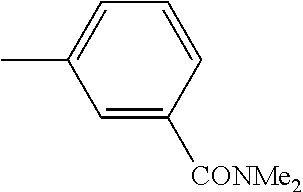


in the form of the base or of an acid-addition or base-addition salt,

wherein R1, R2, R3 and R4 are defined as follows:


in the form of the base or of an acid-addition or base-addition salt,
and also at least one pharmaceutically acceptable excipient.
9. A pharmaceutical composition in the form of a tablet, soft or hard gel capsule, powder or granule, comprising a compound of formula (I′) or (I″):

wherein
R1 is aryl, pyridyl or pyrazolyl, each optionally substituted with one or more substituents chosen from halogen, —CF3, cyano, —NR6R6′, —NR10R11 wherein R10 and R11 form, together with the nitrogen atom to which they are attached, a saturated or unsaturated heterocycle comprising one or more heteroatoms chosen from a nitrogen atom and an oxygen atom, optionally substituted with one or more substituents chosen from halogen and linear or branched alkyl, —CH2NR10R11 wherein R10 and R11 form, together with the nitrogen atom to which they are attached, a saturated or unsaturated heterocycle comprising one or more heteroatoms chosen from a nitrogen atom and an oxygen atom, —COR12 wherein R12 is hydroxyl or —NR6R6′, —CONR7R7′ wherein R7 and R7′ form, together with the nitrogen atom to which they are attached, a heterocycloalkyl comprising one or more heteroatoms chosen from a nitrogen atom and an oxygen atom, —(CH2)pNHSO2CH3 wherein p is 0 or 1, —OR13 wherein R13 linear (C1-C3)alkyl, (C1-C3)alkyl,
or R1 is a bicyclic group of formula A:

wherein R8 and R9 form, together with the phenyl ring to which they are attached, a saturated or unsaturated heterocycle comprising one or more heteroatoms chosen from a nitrogen atom, an oxygen atom and a sulfur atom, optionally substituted with one or more linear alkyl groups;
R2 is —CF3, —CHF2, —COOH, or —CONHR5;
R3 is hydrogen, aryl optionally substituted with alkoxymethyl, cycloalkyl or heteroaryl chosen from thienyl and pyridyl;
R4 is hydrogen, linear (C1-C3)alkyl optionally substituted with —NR6R6′ or —NR7R7′ wherein R7 and R7′ form, together with the nitrogen atom to which they are attached, a heterocycloalkyl comprising one or more heteroatoms chosen from a nitrogen atom and an oxygen atom;
R5 is hydrogen, linear (C1-C3)alkyl optionally substituted with pyridyl, or an aromatic group chosen from aryl and pyridyl;
R6 and R6′, are independently hydrogen or a linear alkyl group,
in the form of the base or of an acid-addition or base-addition salt, or a pharmaceutically acceptable salt thereof,
and at least one pharmaceutically acceptable excipient.
10. The pharmaceutical composition according to claim 9 ,
wherein the compound is of formula (I′):

wherein R1, R2, R3 and R4 are defined as follows:


in the form of the base or of an acid-addition or base-addition salt or of formula (I″):

wherein R1, R2, R3 and R4 are defined as follows:


in the form of the base or of an acid-addition or base-addition salt.
11. The pharmaceutical composition according to claim 9 , wherein the compound is
N-[3-(3-Phenyl-4-trifluoromethyl-1H-pyrazolo[3,4-b]pyridin-6-yl)-phenyl]-methanesulfonamide;
N-Methyl-3-(3-phenyl-4-trifluoromethyl-1H-pyrazolo[3,4-b]pyridin-6-yl)-benzamide;
6-(4-Methoxy-phenyl)-3-phenyl-4-trifluoromethyl-1H-pyrazolo[3,4-b]pyridine;
Dimethyl-[4-(3-phenyl-4-trifluoromethyl-1H-pyrazolo[3,4-b]pyridin-6-yl)-phenyl]-amine;
N-[3-(1-Methyl-3-phenyl-4-trifluoromethyl-1H-pyrazolo[3,4-b]pyridin-6-yl)-phenyl]-methanesulfonamide;
4-(1-Methyl-3-phenyl-4-trifluoromethyl-1H-pyrazolo[3,4-b]pyridin-6-yl)-benzoic acid; or
6-(4-Morpholin-4-yl-phenyl)-3-phenyl-4-trifluoromethyl-1H-pyrazolo[3,4-b]pyridine;
in the form of the base or of an acid-addition or base-addition salt.
Priority Applications (1)
| Application Number | Priority Date | Filing Date | Title |
|---|---|---|---|
| US15/451,955 US10138235B2 (en) | 2011-12-14 | 2017-03-07 | Pyrazolopyridine derivatives, preparation process therefor and therapeutic use thereof |
Applications Claiming Priority (5)
| Application Number | Priority Date | Filing Date | Title |
|---|---|---|---|
| FR1161589 | 2011-12-14 | ||
| FR1161589A FR2984325A1 (en) | 2011-12-14 | 2011-12-14 | PYRAZOLOPYRIDINE DERIVATIVES, PROCESS FOR PREPARING THEM AND THEIR THERAPEUTIC APPLICATION |
| PCT/EP2012/075328 WO2013087744A1 (en) | 2011-12-14 | 2012-12-13 | Pyrazolopyridine derivatives, preparation process therefor and therapeutic use thereof |
| US201414364420A | 2014-06-11 | 2014-06-11 | |
| US15/451,955 US10138235B2 (en) | 2011-12-14 | 2017-03-07 | Pyrazolopyridine derivatives, preparation process therefor and therapeutic use thereof |
Related Parent Applications (2)
| Application Number | Title | Priority Date | Filing Date |
|---|---|---|---|
| PCT/EP2012/075328 Continuation-In-Part WO2013087744A1 (en) | 2011-12-14 | 2012-12-13 | Pyrazolopyridine derivatives, preparation process therefor and therapeutic use thereof |
| US14/364,420 Continuation-In-Part US20140350006A1 (en) | 2011-12-14 | 2012-12-13 | Pyrazolopyridine Derivatives, Preparation Process Therefor And Therapeutic Use Thereof |
Publications (2)
| Publication Number | Publication Date |
|---|---|
| US20170174681A1 US20170174681A1 (en) | 2017-06-22 |
| US10138235B2 true US10138235B2 (en) | 2018-11-27 |
Family
ID=59065888
Family Applications (1)
| Application Number | Title | Priority Date | Filing Date |
|---|---|---|---|
| US15/451,955 Active US10138235B2 (en) | 2011-12-14 | 2017-03-07 | Pyrazolopyridine derivatives, preparation process therefor and therapeutic use thereof |
Country Status (1)
| Country | Link |
|---|---|
| US (1) | US10138235B2 (en) |
Citations (11)
| Publication number | Priority date | Publication date | Assignee | Title |
|---|---|---|---|---|
| WO2006050076A1 (en) | 2004-10-29 | 2006-05-11 | Janssen Pharmaceutica, N.V. | Pyrimidinyl substituted fused-pyrrolyl compounds useful in treating kinase disorders |
| WO2006124863A2 (en) | 2005-05-16 | 2006-11-23 | Irm Llc | Pyrrolopyridine derivatives as protein kinase inhibitors |
| WO2006130673A1 (en) | 2005-05-31 | 2006-12-07 | Janssen Pharmaceutica, N.V. | 3-benzoimidazolyl-pyrazolopyridines useful in treating kinase disorders |
| WO2008028617A1 (en) | 2006-09-06 | 2008-03-13 | F. Hoffmann-La Roche Ag | Heteroaryl derivatives as protein kinase inhibitors |
| US20080182844A1 (en) | 2005-08-04 | 2008-07-31 | Aventis Pharma S.A. | 7-Substituted Aza-Indazoles, Compositions Containing Same, Production Method and Use Thereof |
| US20090030010A1 (en) | 2004-12-14 | 2009-01-29 | Wolfgang Schwede | 3-Amino-pyrazolo[3,4b]pyridines as inhibitors of protein tyrosine kinases, their production and use as pharmaceutical agents |
| WO2009038385A2 (en) | 2007-09-21 | 2009-03-26 | Choongwae Pharma Corporation | Novel compounds having indazole frameworks, methods for preparing the same and pharmaceutical composition comprising the same |
| WO2010078427A1 (en) | 2008-12-30 | 2010-07-08 | Arqule, Inc. | Substituted pyrazolo [3, 4-b] pyridine compounds |
| WO2011045344A1 (en) | 2009-10-13 | 2011-04-21 | Pierre Fabre Medicament | Pyrazolopyridine derivatives as anticancer agent |
| WO2012019954A1 (en) | 2010-08-12 | 2012-02-16 | Evotec (Uk) Ltd. | Pyrazolopyridine compounds as pde10a inhibitors |
| WO2013087744A1 (en) | 2011-12-14 | 2013-06-20 | Sanofi | Pyrazolopyridine derivatives, preparation process therefor and therapeutic use thereof |
-
2017
- 2017-03-07 US US15/451,955 patent/US10138235B2/en active Active
Patent Citations (12)
| Publication number | Priority date | Publication date | Assignee | Title |
|---|---|---|---|---|
| WO2006050076A1 (en) | 2004-10-29 | 2006-05-11 | Janssen Pharmaceutica, N.V. | Pyrimidinyl substituted fused-pyrrolyl compounds useful in treating kinase disorders |
| US20090030010A1 (en) | 2004-12-14 | 2009-01-29 | Wolfgang Schwede | 3-Amino-pyrazolo[3,4b]pyridines as inhibitors of protein tyrosine kinases, their production and use as pharmaceutical agents |
| WO2006124863A2 (en) | 2005-05-16 | 2006-11-23 | Irm Llc | Pyrrolopyridine derivatives as protein kinase inhibitors |
| WO2006130673A1 (en) | 2005-05-31 | 2006-12-07 | Janssen Pharmaceutica, N.V. | 3-benzoimidazolyl-pyrazolopyridines useful in treating kinase disorders |
| US20080182844A1 (en) | 2005-08-04 | 2008-07-31 | Aventis Pharma S.A. | 7-Substituted Aza-Indazoles, Compositions Containing Same, Production Method and Use Thereof |
| WO2008028617A1 (en) | 2006-09-06 | 2008-03-13 | F. Hoffmann-La Roche Ag | Heteroaryl derivatives as protein kinase inhibitors |
| WO2009038385A2 (en) | 2007-09-21 | 2009-03-26 | Choongwae Pharma Corporation | Novel compounds having indazole frameworks, methods for preparing the same and pharmaceutical composition comprising the same |
| WO2010078427A1 (en) | 2008-12-30 | 2010-07-08 | Arqule, Inc. | Substituted pyrazolo [3, 4-b] pyridine compounds |
| WO2011045344A1 (en) | 2009-10-13 | 2011-04-21 | Pierre Fabre Medicament | Pyrazolopyridine derivatives as anticancer agent |
| WO2012019954A1 (en) | 2010-08-12 | 2012-02-16 | Evotec (Uk) Ltd. | Pyrazolopyridine compounds as pde10a inhibitors |
| WO2013087744A1 (en) | 2011-12-14 | 2013-06-20 | Sanofi | Pyrazolopyridine derivatives, preparation process therefor and therapeutic use thereof |
| JP2015500318A (en) | 2011-12-14 | 2015-01-05 | サノフイ | Pyrazolopyrimidine derivatives, methods for their preparation and their therapeutic use |
Non-Patent Citations (125)
| Title |
|---|
| Akihisa Yamashita, Yoshikazu Yonemitsu, Shinji Okano, Kazunori Nakagawa, Yutaka Nakashima, Takahiko Irisa, Yukihide Iwamoto, Yoshiyuki Nagai, Mamoru Hasegawa and Katsuo Sueishi "Fibroblast Growth Factor-2 Determines Severity of Joint Disease in Adjuvant-Induced Arthritis in Rats" J Immunol 2002; 168:450-457. |
| Andreas Roidl,Hans-Jurgen Berger,Sushil Kumar,Johannes Bange, Pjotr Knyazev,and Axel Ullrich "Resistance to Chemotherapy is Associated with Fibroblast Growth Factor Receptor 4 Up-Regulation" Clin Cancer Res 2059 2009;15 (6)Mar. 15, 2009. |
| Anne-Sophie Vercoutter-Edouart, Xavier Czeszak, Michel Crepin, Jerome Lemoine, Benoni Boilly, Xuefen Le Bourhis, Jean-Philippe Peyrat and Hubert Hondermarck "Proteomic Detection of Changes in Protein Synthesis Induced by Fibroblast Growth Factor-2 in MCF-7 Human Breast Cancer Cells" Experimental Cell Research 262, 59-68 (2001). |
| Avner Yayon, Yong-Sheng Ma, Michal Safran, Michael Klagsbrun and Ruth Halaban "Suppression of autocrine cell proliferation and tumorigenesis of human melanoma cells and fibroblast growth factor transformed fibroblasts by a kinase-deficient FGF receptor 1: evidence for the involvement of Src-family kinases" Oncogene (1997) 14, 2999 ± 3009. |
| B. Kwabi-Addo, M. Ozen and M. Ittmann "The role of fibroblast growth factors and their receptors in prostate cancer" Endocrine-Related Cancer (2004) 11 709-724. |
| Balicki, R. "Studies in the Field of Nitrogen Heterocyclic Compounds. Part XI*. Abnormal Cyclocondensation of Ethyl 4,4,4-Trifluoroacetoacetate With Aminopyrazoles" Polish Journal of Chemistry 57, 789 (1983). |
| Charles J. Malemud "Growth hormone, VEGF and FGF: Involvement in rheumatoid arthritis" Clinica Chimica Acta 375 (2007) 10-19 (Jul. 3, 2006). |
| Chebano, V. et al., "Cyclocondensation reactions of 5-aminopyrazoles, pyruvic acids and aldehydes. Multicomponent approaches to pyrazolopyridines and related products" Tetrahedron, 63 (2007) pp. 1229-1242. (Dec. 11, 2006). |
| Chemical Abstracts Registry No. 1000339-59-2, entered into STN on Jan. 20, 2008, at p. 11 of Chemical Abstracts Service (CAS) STN chemical substance search performed Jun. 30, 2015. |
| Chemical Abstracts Registry No. 1011356-11-8, entered into STN on Apr. 1, 2008. |
| Chemical Abstracts Registry No. 1011392-22-5, entered into STN on Apr. 1, 2008. |
| Chemical Abstracts Registry No. 1011399-06-6, entered into STN on Apr. 1, 2008. |
| Chemical Abstracts Registry No. 1011399-78-1, entered into STN on Apr. 1, 2008. |
| Chemical Abstracts Registry No. 12780291-11-3, entered into STN on Apr. 14, 2011, at p. 36 of Chemical Abstracts Service (CAS) STN chemical substance search performed Jun. 30, 2015. |
| Chemical Abstracts Registry No. 1279817-80-9, entered into STN on Apr. 14, 2011, at p. 24 of Chemical Abstracts Service (CAS) STN chemical substance search performed Jun. 30, 2015. |
| Chemical Abstracts Registry No. 1279823-91-4, entered into STN on Apr. 14, 2011, at p. 13 of Chemical Abstracts Service (CAS) STN chemical substance search performed Jun. 30, 2015. |
| Chemical Abstracts Registry No. 1279823-91-4, entered into STN on Apr. 14, 2011, at p. 25 of Chemical Abstracts Service (CAS) STN chemical substance search performed Jun. 30, 2015. |
| Chemical Abstracts Registry No. 1279823-93-6, entered into STN on Apr. 14, 2011, at p. 25 of Chemical Abstracts Service (CAS) STN chemical substance search performed Jun. 30, 2015. |
| Chemical Abstracts Registry No. 1279823-93-6, entered into STN on Apr. 14, 2011, at pp. 25-26 of Chemical Abstracts Service (CAS) STN chemical substance search performed Jun. 30, 2015. |
| Chemical Abstracts Registry No. 1279823-95-8, entered into STN on Apr. 14, 2011, at p. 26 of Chemical Abstracts Service (CAS) STN chemical substance search performed Jun. 30, 2015. |
| Chemical Abstracts Registry No. 1279823-96-9, entered into STN on Apr. 14, 2011, at p. 26 of Chemical Abstracts Service (CAS) STN chemical substance search performed Jun. 30, 2015. |
| Chemical Abstracts Registry No. 1279823-96-9, entered into STN on Apr. 14, 2011, at pp. 26-27 of Chemical Abstracts Service (CAS) STN chemical substance search performed Jun. 30, 2015. |
| Chemical Abstracts Registry No. 1279824-03-1, entered into STN on Apr. 14, 2011, at p. 27 of Chemical Abstracts Service (CAS) STN chemical substance search performed Jun. 30, 2015. |
| Chemical Abstracts Registry No. 1279827-69-8, entered into STN on Apr. 14, 2011. |
| Chemical Abstracts Registry No. 1279827-77-8, entered into STN on Apr. 14, 2011. |
| Chemical Abstracts Registry No. 1279828-12-4, entered into STN on Apr. 14, 2011, at p. 28 of Chemical Abstracts Service (CAS) STN chemical substance search performed Jun. 30, 2015. |
| Chemical Abstracts Registry No. 1279828-12-4, entered into STN on Apr. 14, 2011, at pp. 27-28 of Chemical Abstracts Service (CAS) STN chemical substance search performed Jun. 30, 2015. |
| Chemical Abstracts Registry No. 1279828-31-7, entered into STN on Apr. 14, 2011, at p. 28 of Chemical Abstracts Service (CAS) STN chemical substance search performed Jun. 30, 2015. |
| Chemical Abstracts Registry No. 1279829-79-6, entered into STN on Apr. 14, 2011, at p. 11 of Chemical Abstracts Service (CAS) STN chemical substance search performed Jun. 30, 2015. |
| Chemical Abstracts Registry No. 1279838-18-4, entered into STN on Apr. 14, 2011, at p. 29 of Chemical Abstracts Service (CAS) STN chemical substance search performed Jun. 30, 2015. |
| Chemical Abstracts Registry No. 1279842-22-6, entered into STN on Apr. 14, 2011, at p. 29 of Chemical Abstracts Service (CAS) STN chemical substance search performed Jun. 30, 2015. |
| Chemical Abstracts Registry No. 1279848-90-6, entered into STN on Apr. 14, 2011, at p. 30 of Chemical Abstracts Service (CAS) STN chemical substance search performed Jun. 30, 2015. |
| Chemical Abstracts Registry No. 1279848-93-9, entered into STN on Apr. 14, 2011, at p. 30 of Chemical Abstracts Service (CAS) STN chemical substance search performed Jun. 30, 2015. |
| Chemical Abstracts Registry No. 1279848-93-9, entered into STN on Apr. 14, 2011, at pp. 30-31 of Chemical Abstracts Service (CAS) STN chemical substance search performed Jun. 30, 2015. |
| Chemical Abstracts Registry No. 1279854-63-5, entered into STN on Apr. 14, 2011, at p. 31 of Chemical Abstracts Service (CAS) STN chemical substance search performed Jun. 30, 2015. |
| Chemical Abstracts Registry No. 1279855-51-4, entered into STN on Apr. 14, 2011 at p. 14 of Chemical Abstracts Service (CAS) STN chemical substance search performed Jun. 30, 2015. |
| Chemical Abstracts Registry No. 1279855-51-4, entered into STN on Apr. 14, 2011, at pp. 31-32 of Chemical Abstracts Service (CAS) STN chemical substance search performed Jun. 30, 2015. |
| Chemical Abstracts Registry No. 1279855-77-4, entered into STN on Apr. 14, 2011, at p. 32 of Chemical Abstracts Service (CAS) STN chemical substance search performed Jun. 30, 2015. |
| Chemical Abstracts Registry No. 1279856-20-0, entered into STN on Apr. 14, 2011, at p. 33 of Chemical Abstracts Service (CAS) STN chemical substance search performed Jun. 30, 2015. |
| Chemical Abstracts Registry No. 1279856-25-5, entered into STN on Apr. 14, 2011, at p. 33 of Chemical Abstracts Service (CAS) STN chemical substance search performed Jun. 30, 2015. |
| Chemical Abstracts Registry No. 1279856-62-0, entered into STN on Apr. 14, 2011, at p. 34 of Chemical Abstracts Service (CAS) STN chemical substance search performed Jun. 30, 2015. |
| Chemical Abstracts Registry No. 1279877-23-4, entered into STN on Apr. 14, 2011, at p. 34 of Chemical Abstracts Service (CAS) STN chemical substance search performed Jun. 30, 2015. |
| Chemical Abstracts Registry No. 1279877-39-2, entered into STN on Apr. 14, 2011, at p. 35 of Chemical Abstracts Service (CAS) STN chemical substance search performed Jun. 30, 2015. |
| Chemical Abstracts Registry No. 1279877-50-7, entered into STN on Apr. 14, 2011, at p. 35 of Chemical Abstracts Service (CAS) STN chemical substance search performed Jun. 30, 2015. |
| Chemical Abstracts Registry No. 1280290-06-3, entered into STN on Apr. 14, 2011, at p. 36 of Chemical Abstracts Service (CAS) STN chemical substance search performed Jun. 30, 2015. |
| Chemical Abstracts Registry No. 1280290-46-1, entered into STN on Apr. 14, 2011. |
| Chemical Abstracts Registry No. 1280291-11-3, entered into STN on Apr. 14, 2011, at pp. 36-37 of Chemical Abstracts Service (CAS) STN chemical substance search performed Jun. 30, 2015. |
| Chemical Abstracts Registry No. 1280291-80-6, entered into STN on Apr. 14, 2011, at p. 37 of Chemical Abstracts Service (CAS) STN chemical substance search performed Jun. 30, 2015. |
| Chemical Abstracts Registry No. 1312949-16-8, entered into STN on Jul. 18, 2011, at p. 11 of Chemical Abstracts Service (CAS) STN chemical substance search performed Jun. 30, 2015. |
| Chemical Abstracts Registry No. 1443284-09-0, entered into STN on Jul. 8, 2013, at p. 12 of Chemical Abstracts Service (CAS) STN chemical substance search performed Jun. 30, 2015. |
| Chemical Abstracts Registry No. 834896-02-5, entered into STN on Feb. 21, 2005. |
| Chemical Abstracts Service (CAS) STN chemical substance search performed Jun. 30, 2015, p. 1-41. |
| Clotilde Billottet, Bassam Janji, Jean-Paul Thiery and Jacqueline Jouanneau "Rapid tumor development and potent vascularization are independent events in carcinoma producing FGF-1 or FGF-2" Oncogene (2002) 21, 8128-8139. |
| Daniela Kovacs, Carlo Cota, Giorgia Cardinali, Nicaela Aspite, Giulia Bolasco, Ada Amantea, Maria Rosaria Torrisi and Mauro Picardo "Expression of keratinocyte growth factor and its receptor in clear cell acanthoma" Experimental Dermatology 2006: 15: 762-768. |
| David A. Walsh "Angiogenesis in osteoarthritis and spondylosis: successful repair with undesirable outcomes" Current Opinion in Rheumatology 2004, 16:609-615. |
| Dipak Giri and Michael Ittmann "Interleukin-8 is a Paracrine Inducer of Fibroblast Growth Factor 2, A Stromal and Epithelial Growth Factor in Benign Prostatic Hyperplasia" American Journal of Pathology, vol. 159, No. 1, Jul. 2001. |
| Dipak Giri, Frederic Ropiquet and Michael Ittmann "Alterations in Expression of Basic Fibroblast Growth Factor (FGF) 2 and its Receptor FGFR-1 in Human Prostate Cancer" Clin Cancer Res 1999;5:1063-1071. |
| Duca "Insights from Ab Initio Quantum Chemical Calculations into the Preferred Tautomeric Forms and Binding Affinities to CDK2 of Substituted Pyrazolopyridines" Biopolymers, 2005, 80(2 and 3), 312-318. |
| E. Cohen-Jonathan Moyal "Thérapies antiangiogéniques et radiothérapie : du concept à l'essai clinique [Angiogenic inhibitors and radiotherapy: from the concept to the clinical trial]" Cancer/Radiothérapie 13 (2009) 562-567. |
| Einar K. Rofstad and Ellen F. Halsør "Vascular Endothelial Growth Factor, Interleukin 8, Platelet-derived Endothelial Cell Growth Factor, and Basic Fibroblast Growth Factor Promote Angiogenesis and Metastasis in Human Melanoma Xenografts" Cancer Res 2000;60:4932-4938 (Sep. 1, 2000). |
| Eli Keshet and Shmuel A. Ben-Sasson "Anticancer drug targets: approaching angiogenesis" The Journal of Clinical Investigation, Dec. 1999, vol. 104, No. 11. |
| Francesca Madiai, Virginia M. Goettl, Syed-Rehan Hussain, Alec R. Clairmont, Robert L. Stephens, Jr., and Kevin V. Hackshaw "Anti-Fibroblast Growth Factor-2 Antibodies Attenuate Mechanical Allodynia in a Rat Model of Neuropathic Pain" Journal of Molecular Neuroscience vol. 27, 2005 315-324. |
| Frank Strutz, Eric G. Neilson "New insights into mechanisms of fibrosis in immune renal injury" Springer Semin Immunopathol (2003) 24:459-476. |
| French Search Report for French Patent Application No. FR1161458 dated Mar. 23, 2012. |
| Ganesh A. Thakur, Ritesh Tichkule, Shama Bajaj and Alexandros Makriyannis, "Lat.est Advances in Cannabinoid Receptor Agonists" Expert Opn. Ther. Pat. (2009) 19(12). |
| Gerold Untergassera, Stephan Madersbacherb, Peter Berger "Benign prostatic hyperplasia: age-related tissue-remodeling" Experimental Gerontology 40 (2005) 121-128 (Jan. 22, 2005). |
| Hideaki Miyake, Isao Hara, Kazuo Gohji, Koji Yoshimura, Soichi Arakawa, Sadao Kamidono "Expression of basic fibroblast growth factor is associated with resistance to cisplatin in a human bladder cancer cell line" Cancer Letters 123 (1998) 121-126. |
| International Search Report for International Patent Application No. PCT/EP2012/075119 dated Jan. 28, 2013 (dated Feb. 5, 2013). |
| Janice L. Gabrilove "Angiogenic Growth Factors: Autocrine and Paracrine Regulation of Survival in Hematologic Malignancies" The Oncologist 2001, 6:4-7. |
| Jennifer A. Doll, Frank K. Reiher, Susan E. Crawford, Michael R. Pins, Steven C. Campbell, and Noeel P. Bouck "Thrombospondin-1,Vascular Endothelial Growth Factor and FibroblastGrowth Factor-2 Are Key Functional Regulators of Angiogenesis in the Prostate" The Prostate 49:293-305 (2001). |
| Jo EI J. Schultz, Sandra A. Witt, Michelle L. Nieman, Peter J. Reiser, Sandra J. Engle, Ming Zhou, Sharon A. Pawlowski, John N. Lorenz, Thomas R. Kimball, and Thomas Doetschman "Fibroblast growth factor-2 mediates pressure-induced hypertrophic response" J. Clin. Invest. 104:709-719 (1999) (Sep. 1999). |
| Johannes Waltenberger "Modulation of Growth Factor Action Implications for the Treatment of Cardiovascular Diseases" Circulation 1997; 96: 4083-4094. |
| K Sahadevan, S Darby, HY Leung, ME Mathers, CN Robson and VJ Gnanapragasam "Selective over-expression of fibroblast growth factor receptors 1 and 4 in clinical prostate cancer" J Pathol 2007; 213: 82-90 (Jul. 2, 2007). |
| Kathryn L. Schwertfeger "Fibroblast Growth Factors in Development and Cancer: Insights from the Mammary and Prostate Glands" Current Drug Targets, 2009, 10, 632-644. |
| Katrina Nicholes, Susan Guillet, Elizabeth Tomlinson, Kenneth Hillan, Barbara Wright, Gretchen D. Frantz, Thinh A. Pham, Lisa Dillard-Telm, Siao Ping Tsai, Jean-Philippe Stephan, Jeremy Stinson, Timothy Stewart, and Dorothy M. "French Ectopic Expression of Fibroblast Growth Factor 19 in Skeletal Muscle of Transgenic Mice" American Journal of Pathology, vol. 160, No. 6, Jun. 2002. |
| Lin Chen, Rivka Adar, Xiao Yang, Efrat O. Monsonego, Cuiling Li, Peter V. Hauschka, Avner Yayon, and Chu-Xia Deng "Gly369Cys mutation in mouse FGFR3 causes achondroplasia by affecting both chondrogenesis and osteogenesis" J. Clin. Invest. 104:1517-1525 (1999). |
| Lindsay Marek, Kathryn E. Ware, Alexa Fritzsche, Paula Hercule, Wallace R. Helton, Jennifer E. Smith, Lee A. McDermott, Christopher D. Coldren, Raphael A. Nemenoff, Daniel T. Merrick, Barbara A. Helfrich, Paul A. Bunn, Jr., and Lynn E. Heasley "Fibroblast Growth Factor (FGF) and FGF Receptor-Mediated Autocrine Signaling in Non-Small Cell Lung Cancer Cells" Molecular Pharmacology Fast Forward. Published on Oct. 10, 2008 as doi:10.1124/ mol.108.049544 MOL#49544. |
| Lois A. Chandler, Barbara A. Sosnowski, Lydia Greenlees, Sharon L. Aukerman, Andrew Baird and Glenn F. Pierce "Prevalent Expression of Fibroblast Growth Factor (FGF) Receptors and FGF2 in Human Tumor Cell Lines" Int. J. Cancer: 81, 451-458 (1999). |
| Louise Hutley, Wenda Shurety, Felicity Newell, Ross McGeary, Nicole Pelton, Jennifer Grant, Adrian Herington, Donald Cameron, Jon Whitehead, and Johannes Prins "A Key Regulator of Human Adipogenesis" Diabetes, vol. 53, Dec. 2004 3097-3106. |
| M Manuvakhova, JV Thottassery, S Hays, Z Qu, SS Rentz, L Westbrook and FG Kern "Expression of the SNT-1/FRS2 phosphotyrosine binding domain inhibits activation of MAP kinase and PI3-kinase pathways and antiestrogen resistant growth induced by FGF-1 in human breast carcinoma cells" Oncogene (2006) 25, 6003-6014 (May 8, 2006). |
| M. Thorn, Y. Raab, A. Larsson, B. Gerdin & R. Hallgren "Intestinal Mucosal Secretion of Basic Fibroblast Growth Factor in Patients with Ulcerative Colitis" Scand J Gastroenterol 2000 (4) 408-412. |
| M.A. Karajannis, L. Vincent, R. DiRenzo, S.V. Shmelkov, F. Zhang, E.J. Feldman, P. Bohlen, Z. Zhu, H. Sun, P. Kussie and S. Rafii "Activation of FGFR1b signaling pathway promotes survival, migration and resistance to chemotherapy in acute myeloid leukemia cells" Leukemia (2006) 20, 979-986. |
| Madiai F, Hussain SR, Goettl VM, Burry RW, Stephens RL Jr, Hackshaw KV "Upregulation of FGF-2 in reactive spinal cord astrocytes following unilateral lumbar spinal nerve ligation" Exp Brain Res. Feb. 2003;148(3):366-76. |
| Marco Presta, Marco Rusnati, Patrizia Dell'Era, Elena Tanghetti, Chiara Urbinati, Roberta Giuliani, Darla Leali "Examining New Models for the Study of Autocrine and Paracrine Mechanisms of Angiogenesis Through FGF2-Transfected Endothelial and Tumour Cells" Advances in Experimental Medicine and Biology vol. 476, 2000, pp. 7-34. |
| Maria A. Rupnick, Dipak Panigrahy, Chen-Yu Zhang, Susan M. Dallabrida, Bradford B. Lowell, Robert Langer, and M. Judah Folkman "Adipose tissue mass can be regulated through the vasculature" PNAS Aug. 6, 2002 vol. 99 No. 16, 10730-10735. |
| N. Manabe, H. Oda, K. Nakamura, Y. Kuga, S. Uchida and H. Kawaguchi "Involvement of fibroblast growth factor-2 in joint destruction of rheumatoid arthritis patients" Rheumatology 1999;38:714-720. |
| Nasreen Khalil, Ying Dong Xu, Robert O'Connor and Vincent Duronio "Proliferation of Pulmonary Interstitial Fibroblasts is Mediated by Transforming Growth Factor-b1-induced Release of Extracellular Fibroblast Growth Factor-2 and Phosphorylation of p38 MAPK and JNK" J. Biol. Chem. 2005, 280:43000-43009. |
| Nicholas Turner and Richard Grose "Fibroblast growth factor signalling: from development to cancer" Nature Reviews vol. 10, Feb. 2010, 116-129. |
| Olivier E Pardo, Claudia Wellbrock, Umme K Khanzada, Muriel Aubert, Imanol Arozarena, Sally Davidson, Frances Bowen, Peter J Parker, VV Filonenko, Ivan T Gout, Neil Sebire, Richard Marais, Julian Downward, and Michael J Seckl "FGF-2 protects small cell lung cancer cells from apoptosis through a complex involving PKCe, B-Raf and S6K2" The EMBO Journal (2006) 25, 3078-3088 (Jun. 29, 2006). |
| Olivier E. Pardo, Adeline Lesay, Alexandre Arcaro, Rita Lopes, Bee Ling Ng, Patricia H. Warne, Iain A. McNeish, Teresa D. Tetley, Nicholas R. Lemoine, Huseyin Mehmet, Michael J. Seckl and Julian Downward "Fibroblast Growth Factor 2-Mediated Translational Control of IAPs Blocks Mitochondrial Release of Smac/DIABLO and Apoptosis in Small Cell Lung Cancer Cells" Mol. Cell. Biol. 2003, 23(21):7600. |
| Olivier E. Pardo, Alexandre Arcaro, Giovanni Salerno, Selina Raguz, Julian Downward and Michael J. Seckl "Fibroblast Growth Factor-2 Induces Translational Regulation of Bcl-X L and Bcl-2 via a MEK-dependent Pathway: Correlation With Resistance to Etoposide-Induced Apoptosis" J. Biol. Chem. 2002, 277:12040-12046 (Jan. 28, 2002). |
| Online "http://web.archive.org/web/20031225052253/http://www.specs.net/", dated Dec. 25, 2003, accessed Apr. 1, 2015. |
| Online :"http://web.archive.org/web/20070228030707/http://www.interchim.com/interchim/inter_intro_chem.htm", accessed Feb. 19, 2015. |
| Online: "http ://web.archive. org/web/20070630 171 81 3/http://www. enamine.net/index.php?option=com_content& task=view&id=22&menuid=51&PHPSESSID=64a4f248f69d671a413f487bb62c4d90" dated Jun. 30, 2007, accessed Apr. 1, 2015. |
| Online: :"http://web.archive.org/web/2011 0704180118/http://www.abbypharmatech.com/ordercenter.htm", accessed Apr. 1, 2015. |
| Oriol Casanovas, Daniel J. Hicklin, Gabriele Bergers, and Douglas Hanahan "Drug resistance by evasion of antiangiogenic targeting of VEGF signaling in late-stage pancreatic islet tumors" Cancer Cell, 2005, 8, 299-309 (Oct. 2005). |
| Pamela Cowin, Tracey M Rowlands and Sarah J Hatsell "Cadherins and catenins in breast cancer" Current Opinion in Cell Biology 2005, 17:499-508 (Aug. 16, 2005). |
| Patrick Auguste, Demirkan B. Gursel, Sylvie Lemiere, Diana Reimers, Pedro Cuevas, Fernando Carceller, James P. Di Santo, and Andreas Bikfalvi "Inhibition of Fibroblast Growth Factor/Fibroblast Growth Factor Receptor Activity in Glioma Cells Impedes Tumor Growth by Both Angiogenesis-dependent and -independent Mechanisms" Cancer Research 61, 1717-1726, Feb. 15, 2001. |
| Paul W. Finch, Frank Murphy, Irma Cardinale, and James G. Krueger "Altered Expression of Keratinocyte Growth Factor and Its Receptor in Psoriasis" American Journal of Pathology, vol. 151, No. 6, Dec. 1997. |
| Qingyang Gu, Dewen Wang, Xiaodan Wang, Ruiyun Peng, Jie Liu, Tao Jiang, Zhaohai Wang, Shuiming Wang and Hua Deng "Basic Fibroblast Growth Factor Inhibits Radiation-Induced Apoptosis of HUVECs. I. The PI3KIAKT Pathway and Induction of Phosphorylation of BAD" Radiation Research 161, 692-702 (2004). |
| Qingyang Gu, Dewen Wang, Xiaodan Wang, Ruiyun Peng, Jie Liu, Tao Jiang, Zhaohai Wang, Tao Jiang "Basic Fibroblast Growth Factor Inhibits Radiation-Induced Apoptosis of HUVECs. II. The RAS/MAPK Pathway and Phosphorylation of BAD at Serine 112" Radiation Research 161, 703-711 (2004). |
| RN 1280290-46-1 Registry ED Entered STN: Apr. 14, 2011 CN Methanesulfonamide, N-[3-[3-phenyl-4-(trifluoromethyl)-1H-pyrazolo[3,4-b]pyridin-6-yl]phenyl]- (CA Index Name). * |
| S.E. Epstein, C..B Siegall, S. Biro, Y.M. Fu, D. FitzGerald and I. Pastan "Cytotoxic effects of a recombinant chimeric toxin on rapidly proliferating vascular smooth muscle cells" Circulation 1991, 84:778-787. |
| Shigeo Kanazawa, Tsukasa Tsunoda, Eishi Onuma, Toshimitsu Majima, Mitsuyasu Kagiyama, and Kanako Kikuchi "VEGF, Basic-FGF, and TGF-b in Crohn's Disease and Ulcerative Colitis: A Novel Mechanism of Chronic Intestinal Inflammation" The American Journal of Gastroenterology, vol. 96, No. 3, 2001. |
| Shinji Tanaka, Shigeki Arii "Current status and perspective of antiangiogenic therapy for cancer: hepatocellular carcinoma" Int J Clin Oncol (2006) 11:82-89. |
| Shoko M. Yamada, Fumio Yamaguchi, Robert Brown, Mitchell S. Berger, and Richard S. Morrison "Suppression of Glioblastoma Cell Growth Following Antisense Oligonucleotide-Mediated Inhibition of Fibroblast Growth Factor Receptor Expression" GLIA 28:66-76 (1999). |
| Shuji Uematsu, Toshihiro Higashi, Kazuhiro Nouso, Kazuya Kariyama, Shin-Ichiro Nakamura, Mayumi Suzuki, Harushige Nakatsukasa, Yoshiyuki Kobayashi, Tadashi Hanafusa, Takao Tsuji and Yasushi Shiratori "Altered expression of vascular endothelial growth factor, fibroblast growth factor-2 and endostatin in patients with hepatocellular carcinoma" Journal of Gastroenterology and Hepatology (2005) 20, 583-588. |
| Sophie Boget, Albert Leriche, Andre′ Revol "Basic fibroblast growth factor and keratinocyte growth factor over-expression in benign prostatic hyperplasia" II Farmaco 56 (2001) 467-469. |
| Sophie Boget, Catherine Cereser, Parviz Parvaz, Albert Leriche and Andre Revol "Fibroblast growth factor receptor 1 (FGFR1) is over-expressed in benign prostatic hyperplasia whereas FGFR2-IIIc and FGFR3 are not" European Journal of Endocrinology (2001) 145 303-310. |
| STN-Chemical database reg is try entry # RN 1279827-77-8 for N-(3-(3-phenyl-4-(trifluoromethyl)-1 H-pyrazolo[3,4-b ] pyridin-6-yl)phenyl)methanesulfonamide, Entered STN: Apr. 14, 2011. |
| STN-Chemical database registry #1 011392-22-5, 6-(3,4-dichlorophenyl)-1-methyl-4-(trifluoromethyl)-1 H-Pyrazolo[3,4-b]pyridine, Entered STN: Apr. 1, 2008. |
| STN-Chemical database registry #1 011392-78-1, 6-(2,3-dihydro-1,4-benzodioxin-6-yl)-1-methyl-4-(trifluoromethyl)-1 HPyrazolo[3,4-b]pyridine, Entered STN: Apr. 1, 2008. |
| STN-Chemical database registry #1 011399-06-6, 4-(difluoromethyl)-1-methyl-6-(4-methylphenyl)-1 H-Pyrazolo[3,4-b] pyridine, Entered STN: Apr. 1, 2008. |
| STN-Chemical database registry #834896-02-5, 3-cyclopropyl-6-(4-fluorophenyl)-1-methyl-4-(trifluoromethyl)-1 H-Pyrazolo[3,4-b]pyridine, Entered STN: Feb. 21, 2005. |
| STN-Chemical database registry entry # RN 1279827-69-8 for N-(3-(3-phenyl-4-(trifluoromethyl)-1 H-pyrazolo[3,4-b] pyridin-6-yl)phenyl)methanesulfonamide, Entered STN: Apr. 14, 2011. |
| STN-Chemical database registry# 1 011356-11-8, 6-(4-chlorophenyl)-1-ethyl-4-(trifluoromethyl)-1 H-Pyrazolo[3,4-b] pyridine, Entered STN: Apr. 1, 2008. |
| The United States Department of Justice, "Former Research Chemist at Global Pharmaceutical Company Sentenced to 18 Months in Prison for Theft of Trade Secrets" The United States Attorney's Office, District of New Jersey, http://www.justice.gov/usao/nj/Press/files/Li,%20Yuan%20Sentencing%20News%20Release.html, pp. 1-2 (May 7, 2012). |
| Thomas DA , Giles FJ, Cortes J, Albitar M, Kantarjian HM "Antiangiogenic therapy in leukemia" Acta Haematol. 2001;106(4):190-207. |
| Tilton RG , Dixon RA, Brock TA "Growth factor antagonists for the treatment of diabetic vascular complications" Expert Opin Investig Drugs. Nov. 1997;6(11):1671-84. |
| Tracy T. Batchelor, A. Gregory Sorensen, Emmanuelle di Tomaso, Wei-Ting Zhang, Dan G. Duda, Kenneth S. Cohen, Kevin R. Kozak, Daniel P. Cahill, Poe-Jou Chen, Mingwang Zhu, Marek Ancukiewicz, Maciej M. Mrugala, Scott Plotkin, Jan Drappatz, David N. Louis, Percy Ivy, David T. Scadden, Thomas Benner, Jay S. Loeffler, Patrick Y. Wen, and Rakesh K. Jain "AZD2171, a Pan-VEGF Receptor Tyrosine Kinase Inhibitor, Normalizes Tumor Vasculature and Alleviates Edema in Glioblastoma Patients" Cancer Cell 11, 83-95, Jan. 2007. |
| Volochnyuk, D. M., et al., "Approach to the Library of Fused Pyridine-4-carboxylic Acids by Combes-Type Reaction of Acyl Pyruvates and Electron-Rich Amino Heterocycles" J. Comb. Chern., 2010, 12, Supporitng Information, pp. S1-S77 (May 11, 2010). |
| Volochnyuk, D. M., et at, "Approach to the Library of Fused Pyridine-4-carboxylic Acids by Combes-Type Reaction of Acyl Pyruvates and Electron-Rich Amino Heterocycles" J. Comb. Chern., 2010, 12, 510-517 (May 11, 2010). |
| Watcharin Loilome, Avadhut D. Joshi, Colette M. J. ap Rhys, Sara Piccirillo, Vescovi L. Angelo, Gary L. Gallia, Gregory J. Riggins "Glioblastoma cell growth is suppressed by disruption of fibroblast growth factor pathway signaling" J Neurooncol 2009 (Apr. 2, 2009). |
| Wenbin Wang,Xiaotun Zhang, Gregory J. Mize and Thomas K. Takayama "Protease-Activated Receptor-1Upregulates FibroblastGrowth Factor 7 in Stroma of Benign ProstaticHyperplasia" The Prostate 68:1064-1075 (2008). |
| Xinqiang Huang, Chundong Yu, Chengliu Jin, et al. "Ectopic Activity of Fibroblast Growth Factor Receptor 1 in Hepatocytes Accelerates Hepatocarcinogenesis by Driving Proliferation and Vascular Endothelial Growth Factor-Induced Angiogenesis" Cancer Res 2006;66:1481-1490. |
Also Published As
| Publication number | Publication date |
|---|---|
| US20170174681A1 (en) | 2017-06-22 |
Similar Documents
| Publication | Publication Date | Title |
|---|---|---|
| EP2791137B1 (en) | Pyrazolopyridine derivatives, preparation process therefor and therapeutic use thereof | |
| US9452164B2 (en) | Imidazopyridine derivatives, process for preparation thereof and therapeutic use thereof | |
| US8859544B2 (en) | Indolizine derivatives, process for the preparation thereof and therapeutic use thereof | |
| US20170174681A1 (en) | Pyrazolopyridine Derivatives, Preparation Process Therefor And Therapeutic Use Thereof | |
| OA16296A (en) | Imidazopyridine derivatives, process for the preparation thereof and therapeutic use thereof. | |
| OA16295A (en) | Indolizine derivatives, process for the preparation thereof and therapeutic use thereof. |
Legal Events
| Date | Code | Title | Description |
|---|---|---|---|
| AS | Assignment |
Owner name: SANOFI, FRANCE Free format text: ASSIGNMENT OF ASSIGNORS INTEREST;ASSIGNORS:ALCOUFFE, CHANTAL;BJERGARDE, KIRSTEN;MAUGER, JACQUES;SIGNING DATES FROM 20170807 TO 20171201;REEL/FRAME:044625/0451 |
|
| STCF | Information on status: patent grant |
Free format text: PATENTED CASE |
|
| MAFP | Maintenance fee payment |
Free format text: PAYMENT OF MAINTENANCE FEE, 4TH YEAR, LARGE ENTITY (ORIGINAL EVENT CODE: M1551); ENTITY STATUS OF PATENT OWNER: LARGE ENTITY Year of fee payment: 4 |