US10125780B2 - Battery monitoring system - Google Patents
Battery monitoring system Download PDFInfo
- Publication number
- US10125780B2 US10125780B2 US14/827,399 US201514827399A US10125780B2 US 10125780 B2 US10125780 B2 US 10125780B2 US 201514827399 A US201514827399 A US 201514827399A US 10125780 B2 US10125780 B2 US 10125780B2
- Authority
- US
- United States
- Prior art keywords
- magnetic bearing
- centrifugal compressor
- voltage
- bearing centrifugal
- backup battery
- Prior art date
- Legal status (The legal status is an assumption and is not a legal conclusion. Google has not performed a legal analysis and makes no representation as to the accuracy of the status listed.)
- Active, expires
Links
Images




Classifications
-
- F—MECHANICAL ENGINEERING; LIGHTING; HEATING; WEAPONS; BLASTING
- F04—POSITIVE - DISPLACEMENT MACHINES FOR LIQUIDS; PUMPS FOR LIQUIDS OR ELASTIC FLUIDS
- F04D—NON-POSITIVE-DISPLACEMENT PUMPS
- F04D27/00—Control, e.g. regulation, of pumps, pumping installations or pumping systems specially adapted for elastic fluids
- F04D27/008—Stop safety or alarm devices, e.g. stop-and-go control; Disposition of check-valves
-
- F—MECHANICAL ENGINEERING; LIGHTING; HEATING; WEAPONS; BLASTING
- F04—POSITIVE - DISPLACEMENT MACHINES FOR LIQUIDS; PUMPS FOR LIQUIDS OR ELASTIC FLUIDS
- F04D—NON-POSITIVE-DISPLACEMENT PUMPS
- F04D25/00—Pumping installations or systems
- F04D25/02—Units comprising pumps and their driving means
- F04D25/06—Units comprising pumps and their driving means the pump being electrically driven
- F04D25/0673—Battery powered
-
- F—MECHANICAL ENGINEERING; LIGHTING; HEATING; WEAPONS; BLASTING
- F04—POSITIVE - DISPLACEMENT MACHINES FOR LIQUIDS; PUMPS FOR LIQUIDS OR ELASTIC FLUIDS
- F04D—NON-POSITIVE-DISPLACEMENT PUMPS
- F04D27/00—Control, e.g. regulation, of pumps, pumping installations or pumping systems specially adapted for elastic fluids
- F04D27/02—Surge control
- F04D27/0292—Stop safety or alarm devices, e.g. stop-and-go control; Disposition of check-valves
-
- F—MECHANICAL ENGINEERING; LIGHTING; HEATING; WEAPONS; BLASTING
- F04—POSITIVE - DISPLACEMENT MACHINES FOR LIQUIDS; PUMPS FOR LIQUIDS OR ELASTIC FLUIDS
- F04D—NON-POSITIVE-DISPLACEMENT PUMPS
- F04D29/00—Details, component parts, or accessories
- F04D29/04—Shafts or bearings, or assemblies thereof
- F04D29/046—Bearings
- F04D29/048—Bearings magnetic; electromagnetic
-
- F—MECHANICAL ENGINEERING; LIGHTING; HEATING; WEAPONS; BLASTING
- F04—POSITIVE - DISPLACEMENT MACHINES FOR LIQUIDS; PUMPS FOR LIQUIDS OR ELASTIC FLUIDS
- F04D—NON-POSITIVE-DISPLACEMENT PUMPS
- F04D29/00—Details, component parts, or accessories
- F04D29/05—Shafts or bearings, or assemblies thereof, specially adapted for elastic fluid pumps
- F04D29/056—Bearings
- F04D29/058—Bearings magnetic; electromagnetic
-
- H—ELECTRICITY
- H02—GENERATION; CONVERSION OR DISTRIBUTION OF ELECTRIC POWER
- H02J—ELECTRIC POWER NETWORKS; CIRCUIT ARRANGEMENTS OR SYSTEMS FOR SUPPLYING OR DISTRIBUTING ELECTRIC POWER; SYSTEMS FOR STORING ELECTRIC ENERGY
- H02J9/00—Circuit arrangements for emergency or stand-by power supply, e.g. for emergency lighting
- H02J9/04—Circuit arrangements for emergency or stand-by power supply, e.g. for emergency lighting in which the distribution system is disconnected from the normal source and connected to a standby source
- H02J9/06—Circuit arrangements for emergency or stand-by power supply, e.g. for emergency lighting in which the distribution system is disconnected from the normal source and connected to a standby source with automatic change-over, e.g. UPS systems
Definitions
- the present invention is directed to a system for monitoring a backup battery that supplies power to the magnetic bearing in the event of the failure of an electrical supply voltage.
- the invention is directed to a system of monitoring a backup battery and monitoring system for use with a centrifugal chiller that possesses a magnetic bearing centrifugal compressor.
- a centrifugal compressor for a chiller typically consists of the following components: inlet guide vanes, one or more impellers within a housing surrounded by one or more diffusers with collectors driven by some mechanical shaft means, such as for example, an electric motor.
- the mechanical shaft means is supported by one or more bearings of the rolling element, journal, or magnetic bearing type which accommodate both radial and axial loads.
- the centrifugal compressor is supplied with electrical power through an adjustable speed motor drive which alters the frequency and/or voltage of the power to the motor to modulate the speed of the compressor.
- Rolling element bearings are generally passive devices and, during normal operation, operate without the requirement of active control.
- the chiller control system does not typically provide active control of the rolling element bearings where, in this context, active implies continual adjustment of some bearing feature.
- Chiller control systems for centrifugal chillers which use rolling element bearings in the compressor may monitor the bearing temperature, at periodic intervals, as an indication of whether the machine is operating properly. An elevated temperature is used as an indication of a potential mechanical problem with the bearings. If the measured bearing temperature exceeds a predefined set point, the chiller control system may be programmed to stop the machine and alert the user.
- magnetic bearing centrifugal compressors the compressor rotor is suspended within a magnetic field generated by the magnetic bearings.
- magnetic bearings are electromagnetic devices used for suspending a rotating body in a magnetic field without mechanical contact.
- the bearings can be further classified as active, indicating that some type of active control system is necessary to ensure stable levitation of the rotating body.
- a magnetic bearing centrifugal compressor uses magnetic bearings as the primary means for supporting the rotor structure. There is a clearance gap between the rotating and stationary components of the bearing that is measurable and controllable. For the magnetic bearings to operate properly, electrical power and proper operation of the magnetic bearing control electronics are required.
- magnetic bearings need to be continuously supplied with electrical energy. If the supply voltage of the magnetic bearings fails, for example as a result of an electrical failure of the power supply system, not only will the motor run down, but the functionality of the magnetic bearings will no longer be provided.
- emergency operation conditions may be implemented mechanically.
- emergency operations are only effective for a limited number of failures of the supply voltage of the magnetic bearings without the magnetic bearings, the shaft or other components being damaged. Therefore, applications of magnetic bearings in sites with insufficiently stable electrical power supply systems may be problematic. In such circumstances, the maximum permissible number of emergency operations of the magnetic bearings is quickly reached, with the result that the abovementioned components need to be replaced even after a relatively short period of time. This replacement is generally time-consuming and associated with high costs.
- backup systems such as batteries, are often used for safeguarding the magnetic bearings in the event of failure of the electrical supply voltage.
- Such backup systems maintain the functionality of the magnetic bearing arrangement until the rotating shaft is braked to a sufficient extent such that no damage or wear occurs to the bearings or shaft.
- the battery/batteries provide the necessary backup power during an electrical utility power outage, it is important that the battery/batteries be operative when such power outage occurs. Therefore, the batteries must be periodically tested to insure that a proper charge is maintained during operation.
- An embodiment is directed to a method of monitoring a backup battery for a magnetic bearing centrifugal compressor.
- the method includes: establishing threshold voltage values applicable to the battery level; monitoring the actual voltage of the backup battery; comparing the actual voltage of the backup battery to the threshold voltage; initiating a soft shutdown of the magnetic bearing centrifugal compressor if the magnetic bearing centrifugal compressor is operating and the actual battery voltage is below the threshold voltage for a defined period of time; preventing the magnetic bearing centrifugal compressor from starting if the magnetic bearing centrifugal compressor is not operating and the actual battery voltage is below the threshold voltage; or allowing the magnetic bearing centrifugal compressor to continue operation or begin operation if the actual battery voltage is greater than the threshold voltage.
- An embodiment is directed to a method of monitoring a backup battery for a magnetic bearing centrifugal compressor.
- the method comprising: monitoring voltage amplitude over a period of time at the input to a universal power source of the magnetic bearing centrifugal compressor to determine if the backup battery is connected or disconnected, whereby if the difference between the minimum and maximum voltage is greater than a defined variance, the sample is recorded and saved; displaying a fault if the defined variance is exceeded for a defined amount of consecutive samples indicating a disconnected backup battery; initiating a soft shutdown of the magnetic bearing centrifugal compressor if the magnetic bearing centrifugal compressor is operating and the defined variance is exceeded for a defined amount of consecutive samples indicating a disconnected backup battery; preventing the magnetic bearing centrifugal compressor from starting if the magnetic bearing centrifugal compressor is not operating and the defined variance is exceeded for a defined amount of consecutive samples indicating a disconnected backup battery; or allowing the magnetic bearing centrifugal compressor to continue operation or begin operation if the defined variance is not exceeded for a defined amount
- An embodiment is directed to a method of monitoring a backup battery for a magnetic bearing centrifugal compressor.
- the method comprising: monitoring the number of times bearings drop a shaft of the magnetic bearing centrifugal compressor while the shaft is rotating during a power loss event; counting the number of times bearings drop a shaft of the magnetic bearing centrifugal compressor; comparing the counted number of times bearings drop a shaft of the magnetic bearing centrifugal compressor to a defined threshold number of times bearings drop a shaft of the magnetic bearing centrifugal compressor; displaying a fault if the counted number of times bearings drop a shaft of the magnetic bearing centrifugal compressor is greater than the defined threshold; and preventing the magnetic bearing centrifugal compressor from starting until such fault is cleared.
- FIG. 1 is a diagrammatic view of an illustrative apparatus for supplying electric power to a motor.
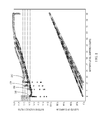
- FIG. 2 is a graph showing the relationship between battery voltage and battery charge level at various temperatures.
- FIG. 3 is a graph showing the relationship between battery voltage threshold and elapsed time at various temperatures.
- FIG. 4 is a graph showing the relationship between battery voltage and battery level.
- FIG. 5 is a graph showing the relationship between battery voltage threshold and ambient temperature.
- FIG. 6 is a graph showing the relationship between UPS output voltage with battery disconnected and elapsed time.
- FIG. 7 is a graph showing the relationship between battery voltage and battery level remaining during a power loss event.
- FIG. 8 is a graph showing the results of testing as the power was cycled from a levitated load to a delevitated load to a no load condition, allowing the battery to charge between load cycles.
- FIG. 9 is a graph showing the timeline during the test of FIG. 8 as the low battery voltage limit is approached.
- FIG. 1 illustrates a diagrammatic representation of an embodiment of an illustrative apparatus 2 for supplying electric power to a motor 4 which has magnetic bearings.
- a magnetic bearing cable 8 and a motor cable 10 are connected the induction motor 4 whose rotor is rotatably levitated and supported by magnetic bearings.
- the magnetic bearing cable 8 and the motor cable 10 are connected through a control console or panel 14 to a three-phase, 200-V commercial AC power supply 12 .
- the control panel 14 has a magnetic bearing controller 16 , connected to the commercial AC power supply, which supplies a magnetic bearing control current through the magnetic bearing cable 8 to control the magnetic bearings 6 which levitate and support the rotor out of contact therewith at a target position.
- the control panel 14 also has a motor driver 18 which comprises a frequency/voltage converter such as a general-purpose inverter or the like that is connected to the commercial AC power supply.
- the motor driver 18 supplies electric power having a predetermined frequency/voltage through the motor cable 10 for operating the motor 4 at a predetermined speed.
- the magnetic bearing controller 16 is backed up by a battery power supply 20 such as, but not limited to, a 48-V, 2.2-Ahr battery. When the commercial AC power supply 12 fails, the battery power supply 20 supplies power to the magnetic bearing controller 16 to enable the magnetic bearing controller 16 to continuously operate the magnetic bearings 6 .
- the magnetic bearings may be continuously operated by the power supplied from the battery power supply 20 or a soft shutdown may be initiated.
- the motor driver 18 is no longer supplied with the AC power from the commercial AC power supply, the rotor of the induction motor 4 rotates in a free-running condition.
- the rotor which is rotatably supported by the magnetic bearings usually rotates at a high speed of at least several thousand rpm. Because the rotor is magnetically kept out of contact with the magnetic bearings, the rotor does not suffer any decelerating friction force. Consequently, it takes a long period of time until the rotor comes to a stop. Alternatively, a braking system may be included to cause the rotor to stop more quickly.
- the invention is, therefore, directed to a system and method to monitor and communicate the state of the battery that is used as a backup for an uninterruptible power supply (UPS) system for the magnetic bearings and control panels, thereby preventing damage to the magnetic bearings when the AC power is lost.
- UPS uninterruptible power supply
- FIG. 2 An illustrative example of the relationship between battery voltage and battery level (Ah) at different temperatures is shown in FIG. 2 .
- the information provided in FIG. 2 is meant to be illustrative, i.e. directed to particular equipment, it is not meant to limit the scope of the invention to the specific relationship shown.
- Line 202 represents a 4 degree temperature change
- line 204 represents a 12 degree temperature change
- line 206 represents a 24 degree temperature change
- line 208 represents a 50 degree temperature change.
- the voltage when properly operating, after the battery is fully charged the voltage will display and hold a trickle charge voltage above the threshold, thereby preventing any warnings and/or faults from occurring.
- the trickle charge voltage is approximately 13.3v ⁇ 0.06v for more than a predetermined time, such as 5 minutes (as shown in FIG. 3 ).
- a predetermined time such as 5 minutes (as shown in FIG. 3 ).
- the battery voltage is below a defined threshold (12.7v for the illustrative embodiment) and remains below the defined threshold for a fixed period of time (12.7v for 5 minutes for the illustrative embodiment), warnings and/or faults will be sent indicating a faulty battery.
- the system will inhibit or prevent the apparatus from starting until the battery voltage is above the threshold.
- the apparatus 2 will be prevented from starting until the battery voltage exceeds the threshold by at least 0.1 volts. (12.8 v for the illustrative embodiment).
- a warning is displayed indicating low battery voltage.
- a low battery voltage fault shall initiate a soft shutdown or shutdown sequence of the apparatus 2 .
- the specific period of time is sixty minutes as shown in the elapsed time of FIG. 3 .
- line 402 represents a 4 degree temperature change
- line 404 represents a 12 degree temperature change
- line 406 represents a 24 degree temperature change
- line 408 represents a 50 degree temperature change.
- line 412 represents a 4 degree temperature change
- line 414 represents a 12 degree temperature change
- line 416 represents a 24 degree temperature change
- line 418 represents a 50 degree temperature change.
- the battery voltage threshold is influenced by the temperature of the battery. However, if no temperature sensor is provided proximate the battery, the control panel 30 temperature can be used. In such instances, it is assumed that when the apparatus is not running the temperature inside of the control panel and the battery will equalize to nearly the same temperature. Therefore, this threshold is used as a start-inhibit monitoring voltage while the unit is not running. However, while running, the battery will charge above the lowest threshold before the control panel temperature has time to drift enough due to internal heat sources to cause nuisance warnings.
- the battery voltage threshold for the expected ambient temperature range is shown.
- a linear interpolation or curve fit is used to determine the threshold at intermediate temperatures between the points shown.
- the battery voltage threshold may be adjustable within the measured voltage range of the battery with service level access to better meet the needs of sites that may experience nuisance issues.
- the monitoring system must be able to detect a battery which is disconnected from the apparatus. Such disconnection may result from, but is not limited to, an open disconnect, blown fuse, disconnected wire, or other battery issues.
- the monitoring system measures the voltage at the input to the control panel. Therefore, in the event that the battery is disconnected from the apparatus, the voltage measured by the monitoring system will be only the charging voltage output by the UPS.
- the charging voltage output from the UPS is noticeably different when the battery is disconnected in comparison to when a battery is connected and is charging. With a battery connected, the charging voltage is steady over time. When disconnected, the voltage bounces up and down several times a minute with a defined or noticeable amplitude. In the illustrative embodiment shown, the amplitude is approximately 1 volt, as shown FIG. 6 .
- the monitoring system monitors or samples the amplitude readings over a defined period of time. In the illustrative embodiment shown, the defined period of time is 10 seconds. During the defined time period, if the difference between the minimum and maximum voltage is greater than a defined variance, the sample is recorded and saved. In the embodiment shown, the defined variance is 0.5 volts. If the defined variance is exceeded for 4 consecutive samples, a fault is displayed indicating a disconnected battery.
- the system will inhibit or prevent the apparatus from starting up until the fault clears or is cleared.
- the fault can be cleared manually with service level access if the charging voltage is stable within the expected range for a defined period of time. In the illustrative embodiment shown, the defined period of time is 60 seconds.
- a warning is displayed indicating a disconnected battery.
- a battery disconnect fault shall initiate a soft shutdown of the apparatus 2 .
- 10 minutes is the designated period of time.
- the fault can be cleared manually with service level access if the charging voltage is stable within the expected range for a defined period of time. In the illustrative embodiment shown, the defined period of time is 60 seconds.
- a voltage peak above typical charging voltage range If the battery voltage goes above a threshold level, i.e. 16 volts for the illustrative embodiment shown, a warning is displayed to check the battery connection. This warning is counted as the first sample toward the 4 consecutive samples that lead to the disconnected battery fault.
- the monitoring system monitors the battery voltage to determine the health of the battery.
- the load on the battery has been determined to be 500-600 W while levitated and around 200 W while delevitated and powering only the control panels, as shown in FIG. 7 , which illustrates the relationship between battery voltage and battery level (% Ah remaining).
- FIG. 7 illustrates cycling between the levitated and delevitated loads without allowing the battery to charge between cycles.
- This test was done first on an apparatus at room temperature and second on a bench test at a minimum specified ambient temperature, i.e. 4 degrees Celsius for the embodiment shown. The results show that the temperature does not have as much influence while the battery is under load as it does while the battery is charging. This supports the use of a low voltage limit that does not change with temperature.
- line 702 represents the apparatus at room temperature and line 704 represents the apparatus at 4 degrees Celsius.
- the low battery voltage limit is set where the battery still has enough charge to withstand a defined number of load cycles, such as, but not limited to, at least 4 load cycles. This ensures that the unit is protected even with variation between batteries and conditions.
- FIG. 9 illustrates a timeline as the low battery voltage limit of FIG. 8 is approached.
- a low battery voltage limit is set, such as, but not limited to 11.0v for the illustrative embodiment shown.
- this limit can be adjustable through administration level access, such as, but not limited to, from 10.5v to 12.0v for the illustrative embodiment shown.
- line 902 represents battery voltage
- line 904 represents battery charge level
- line 906 represents power
- line 908 represents cycle count
- line 910 represents elapsed time.
- the fault can be manually cleared only if the battery voltage is above the threshold, as recited above.
- the fault may be cleared subject to a battery health test being successfully performed.
- a battery health test can be performed to determine if the battery is functional or if the battery should be replaced. This test is a manual procedure initiated through the video graphic control panel to monitor battery voltage while under a known load to ensure that the battery has enough health left to withstand a power failure event. The test is available through the service access level.
- the apparatus In order to initiate this test, the apparatus must not be running and a safety stop switch must be open. The user is directed through the video display to disconnect main power to the apparatus, forcing the battery back-up to power the apparatus as it would during a power failure. The user must manually disconnect the power.
- the control panel Once the control panel detects that power is supplied by the battery, it commands the magnetic bearing compressor to levitate for a defined period, i.e. for the illustrative embodiment shown, 60 seconds.
- the monitoring system monitors the battery voltage in the same manner as the monitoring system monitors the battery voltage during a power failure event to make sure it does not drop below the low battery voltage limit.
- the power loss holdup time must be increased (to 10 minutes for the illustrative embodiment) to allow time for the test to take place.
- test fails and the battery should be replaced or inspected. If a shutdown occurs due to voltage, fuses, disconnect, or any other reason, the test fails and a fault is displayed on the next power up stating that the battery health test has failed. This fault can be cleared by running a successful battery health test.
- control panel displays a message stating the battery passed the test.
- the control panel commands the magnetic bearing compressor to delevitate the shaft for the remainder of the test. Upon completion, the control panel instructs the user to manually reconnect main power to the apparatus. Once power is connected, the control panel can then display the message that the battery health test is complete.
- a warning is displayed indicating that the test failed and needs to be redone. If the power loss holdup timer runs out the control panel displays the same fault that is used for the shutdown, which can be cleared by running a successful battery test. If the battery voltage drops below the low battery voltage limit after delevitating and while waiting for the main power to be reconnected, a warning is displayed indicating that the test failed.
- a fault appears stating that there is a magnetic bearing compressor power panel system failure that requires administration level access to clear.
- the fault should not be allowed to clear if the battery voltage is below charging threshold and if other criteria have been encountered, such as but not limited to, when 3 landings are counted within the last 24 run hours, or 10 landings are counted within the last 3000 run hours.
- This invention is beneficial when the UPS does not monitor or provide battery status to the control panel.
- the present invention provides a reliable and cost effective method of monitoring the status of the backup battery at known loads through determined limits which are specific to the apparatus, thereby communicating flag faults and warnings to the control panel. In so doing, the apparatus is inhibited or prevented from continued operation when there is insufficient backup power to protect the apparatus when a power failure occurs, thereby preventing excess wear to the touchdown bearings and shaft of the apparatus.
Landscapes
- Engineering & Computer Science (AREA)
- Mechanical Engineering (AREA)
- General Engineering & Computer Science (AREA)
- Physics & Mathematics (AREA)
- Electromagnetism (AREA)
- Emergency Management (AREA)
- Business, Economics & Management (AREA)
- Power Engineering (AREA)
- Charge And Discharge Circuits For Batteries Or The Like (AREA)
- Control Of Positive-Displacement Air Blowers (AREA)
- Structures Of Non-Positive Displacement Pumps (AREA)
- Stand-By Power Supply Arrangements (AREA)
- Secondary Cells (AREA)
- Magnetic Bearings And Hydrostatic Bearings (AREA)
Abstract
Description
Claims (19)
Priority Applications (1)
| Application Number | Priority Date | Filing Date | Title |
|---|---|---|---|
| US14/827,399 US10125780B2 (en) | 2014-08-21 | 2015-08-17 | Battery monitoring system |
Applications Claiming Priority (2)
| Application Number | Priority Date | Filing Date | Title |
|---|---|---|---|
| US201462039985P | 2014-08-21 | 2014-08-21 | |
| US14/827,399 US10125780B2 (en) | 2014-08-21 | 2015-08-17 | Battery monitoring system |
Publications (2)
| Publication Number | Publication Date |
|---|---|
| US20160053765A1 US20160053765A1 (en) | 2016-02-25 |
| US10125780B2 true US10125780B2 (en) | 2018-11-13 |
Family
ID=54065455
Family Applications (1)
| Application Number | Title | Priority Date | Filing Date |
|---|---|---|---|
| US14/827,399 Active 2036-10-25 US10125780B2 (en) | 2014-08-21 | 2015-08-17 | Battery monitoring system |
Country Status (7)
| Country | Link |
|---|---|
| US (1) | US10125780B2 (en) |
| EP (1) | EP3183796B1 (en) |
| JP (1) | JP6522741B2 (en) |
| KR (1) | KR101899016B1 (en) |
| CN (1) | CN107076160B (en) |
| TW (1) | TWI657223B (en) |
| WO (1) | WO2016028663A1 (en) |
Families Citing this family (8)
| Publication number | Priority date | Publication date | Assignee | Title |
|---|---|---|---|---|
| DE102015223387A1 (en) * | 2015-11-26 | 2017-06-01 | Robert Bosch Gmbh | Method for detecting a state of a vehicle electrical system |
| JP6898759B2 (en) * | 2017-03-31 | 2021-07-07 | 住友重機械工業株式会社 | Injection molding machines and industrial machinery |
| US10649512B2 (en) * | 2017-07-25 | 2020-05-12 | Quanta Computer Inc. | High efficient battery backup system |
| CN108155695B (en) * | 2018-01-16 | 2021-01-01 | 宁德时代新能源科技股份有限公司 | Parallel charging and discharging system and protection method for single battery cabinet group |
| KR102791007B1 (en) | 2019-09-06 | 2025-04-02 | 주식회사 엘지에너지솔루션 | Apparatus and method for diagnosing isolation resistance measurement circuit |
| KR20230087797A (en) | 2021-12-10 | 2023-06-19 | 강소인 | brain activation portable leaming device |
| EP4358359A1 (en) * | 2022-09-15 | 2024-04-24 | Schneider Electric IT Corporation | Bridge device communication interfaces to be coupled to ups and bms systems |
| CN116006493B (en) * | 2023-01-05 | 2024-12-27 | 珠海格力电器股份有限公司 | Control method, control device, electronic equipment, magnetic suspension compressor and storage medium |
Citations (26)
| Publication number | Priority date | Publication date | Assignee | Title |
|---|---|---|---|---|
| EP0430009A1 (en) | 1989-11-23 | 1991-06-05 | Alcatel Cit | Power supply unit for a vacuum pump with magnetic thrust bearings and with an auxiliary power supply for the thrust bearings in case of a power failure |
| JPH03117339U (en) | 1990-03-13 | 1991-12-04 | ||
| US5130659A (en) | 1990-08-21 | 1992-07-14 | Sloan Jeffrey M | Battery Monitor |
| JPH06147191A (en) | 1992-11-16 | 1994-05-27 | Hitachi Ltd | Magnetic bearing mounted centrifugal compressor and centrifugal fluid machinery |
| US5574345A (en) | 1994-02-28 | 1996-11-12 | Ntn Corporation | Power supply circuit for magnetic bearing system |
| US5757148A (en) | 1996-03-13 | 1998-05-26 | Ebara Corporation | Method of and apparatus for stopping a motor having magnetic bearings |
| US5764034A (en) * | 1996-04-10 | 1998-06-09 | Baxter International Inc. | Battery gauge for a battery operated infusion pump |
| JPH1155872A (en) | 1997-07-30 | 1999-02-26 | Tec Corp | Backup battery charge monitoring device |
| US6037749A (en) * | 1995-06-21 | 2000-03-14 | Batteryguard Limited | Battery monitor |
| US6252377B1 (en) * | 1999-01-26 | 2001-06-26 | Honda Giken Kogyo Kabushiki Kaisha | Apparatus for detecting remaining charge of battery |
| US6313609B1 (en) * | 2000-10-19 | 2001-11-06 | Gregory D. Brink | Determining battery capacity using one or more applications of a constant power load |
| KR20020053342A (en) | 2000-12-27 | 2002-07-05 | 이계안 | Apparatus and method for detecting error of standby power by battery for a vehicle |
| US6463748B1 (en) | 1999-12-06 | 2002-10-15 | Mainstream Engineering Corporation | Apparatus and method for controlling a magnetic bearing centrifugal chiller |
| US7053511B2 (en) | 2000-06-28 | 2006-05-30 | Koyo Seiko Co., Ltd. | Magnetic bearing control device with counter for timed maintenance |
| US7061246B2 (en) * | 2001-12-06 | 2006-06-13 | Johnson Controls Technology Company | Battery monitoring system and method |
| CN1319264C (en) | 2002-11-25 | 2007-05-30 | 特伯考尔公司 | Power circuit of high speed motor |
| US7345859B2 (en) * | 2005-07-15 | 2008-03-18 | Danfoss Compressors Gmbh | Method and a control system for starting a motor |
| US7474228B2 (en) | 2002-06-19 | 2009-01-06 | Tarma, Llc | Battery monitor |
| US20090074406A1 (en) * | 2007-09-17 | 2009-03-19 | Tellabs Petaluma, Inc. | Method for alerting users to conditions affecting network service |
| US20100231170A1 (en) | 2009-03-13 | 2010-09-16 | Lineage Power Corporation, A Nevada Corporation | Adaptive low voltage disconnect controller, method of protecting a battery and a power system manager |
| US7928620B2 (en) | 2006-04-28 | 2011-04-19 | Siemens Aktiengesellschaft | Device for safeguarding an uninterruptible power supply of a magnet bearing in the event of failure of an electrical supply voltage |
| TWM413621U (en) | 2011-03-10 | 2011-10-11 | Trioforce Internat Inc | Power source actuating controller |
| TWM416582U (en) | 2011-03-24 | 2011-11-21 | Formosa Plastics Transp Corp | Intelligence-type over-discharge protection device |
| US20130285441A1 (en) * | 2012-03-21 | 2013-10-31 | Robertshaw Controls Company | Methods and systems for preserving the life of a transport refrigeration system power source |
| US8602746B2 (en) * | 2008-05-27 | 2013-12-10 | TXAM Pumps, LLC | Electrical system for a pump |
| JP2014054141A (en) | 2012-09-10 | 2014-03-20 | Ricoh Co Ltd | Power supply device and power supply system |
Family Cites Families (9)
| Publication number | Priority date | Publication date | Assignee | Title |
|---|---|---|---|---|
| JPH0612154A (en) * | 1992-06-25 | 1994-01-21 | Hitachi Ltd | Battery backup method |
| JPH08272489A (en) * | 1995-03-29 | 1996-10-18 | Hitachi Ltd | Battery backup method |
| JP3677826B2 (en) * | 1995-08-31 | 2005-08-03 | 株式会社島津製作所 | Magnetic bearing device |
| JP2000041345A (en) * | 1998-07-21 | 2000-02-08 | Tamagawa Seiki Co Ltd | How to monitor encoder battery voltage |
| JP2003021141A (en) * | 2001-07-10 | 2003-01-24 | Matsushita Electric Ind Co Ltd | Magnetic bearing device |
| JP3117339U (en) * | 2005-10-04 | 2006-01-05 | 富士技建株式会社 | Outlet mounting body |
| JP2009131101A (en) * | 2007-11-27 | 2009-06-11 | Canon Inc | Power supply device and overdischarge control method in power supply device |
| US8703920B2 (en) * | 2008-11-10 | 2014-04-22 | The Regents Of The University Of California | Fully human antibodies against N-cadherin |
| JP5223688B2 (en) * | 2009-01-13 | 2013-06-26 | 富士電機株式会社 | Uninterruptible power supply management device and management method |
-
2015
- 2015-08-17 US US14/827,399 patent/US10125780B2/en active Active
- 2015-08-17 KR KR1020177006207A patent/KR101899016B1/en active Active
- 2015-08-17 JP JP2017509644A patent/JP6522741B2/en active Active
- 2015-08-17 CN CN201580048689.8A patent/CN107076160B/en active Active
- 2015-08-17 WO PCT/US2015/045461 patent/WO2016028663A1/en not_active Ceased
- 2015-08-17 EP EP15760325.9A patent/EP3183796B1/en active Active
- 2015-08-20 TW TW104127147A patent/TWI657223B/en active
Patent Citations (26)
| Publication number | Priority date | Publication date | Assignee | Title |
|---|---|---|---|---|
| EP0430009A1 (en) | 1989-11-23 | 1991-06-05 | Alcatel Cit | Power supply unit for a vacuum pump with magnetic thrust bearings and with an auxiliary power supply for the thrust bearings in case of a power failure |
| JPH03117339U (en) | 1990-03-13 | 1991-12-04 | ||
| US5130659A (en) | 1990-08-21 | 1992-07-14 | Sloan Jeffrey M | Battery Monitor |
| JPH06147191A (en) | 1992-11-16 | 1994-05-27 | Hitachi Ltd | Magnetic bearing mounted centrifugal compressor and centrifugal fluid machinery |
| US5574345A (en) | 1994-02-28 | 1996-11-12 | Ntn Corporation | Power supply circuit for magnetic bearing system |
| US6037749A (en) * | 1995-06-21 | 2000-03-14 | Batteryguard Limited | Battery monitor |
| US5757148A (en) | 1996-03-13 | 1998-05-26 | Ebara Corporation | Method of and apparatus for stopping a motor having magnetic bearings |
| US5764034A (en) * | 1996-04-10 | 1998-06-09 | Baxter International Inc. | Battery gauge for a battery operated infusion pump |
| JPH1155872A (en) | 1997-07-30 | 1999-02-26 | Tec Corp | Backup battery charge monitoring device |
| US6252377B1 (en) * | 1999-01-26 | 2001-06-26 | Honda Giken Kogyo Kabushiki Kaisha | Apparatus for detecting remaining charge of battery |
| US6463748B1 (en) | 1999-12-06 | 2002-10-15 | Mainstream Engineering Corporation | Apparatus and method for controlling a magnetic bearing centrifugal chiller |
| US7053511B2 (en) | 2000-06-28 | 2006-05-30 | Koyo Seiko Co., Ltd. | Magnetic bearing control device with counter for timed maintenance |
| US6313609B1 (en) * | 2000-10-19 | 2001-11-06 | Gregory D. Brink | Determining battery capacity using one or more applications of a constant power load |
| KR20020053342A (en) | 2000-12-27 | 2002-07-05 | 이계안 | Apparatus and method for detecting error of standby power by battery for a vehicle |
| US7061246B2 (en) * | 2001-12-06 | 2006-06-13 | Johnson Controls Technology Company | Battery monitoring system and method |
| US7474228B2 (en) | 2002-06-19 | 2009-01-06 | Tarma, Llc | Battery monitor |
| CN1319264C (en) | 2002-11-25 | 2007-05-30 | 特伯考尔公司 | Power circuit of high speed motor |
| US7345859B2 (en) * | 2005-07-15 | 2008-03-18 | Danfoss Compressors Gmbh | Method and a control system for starting a motor |
| US7928620B2 (en) | 2006-04-28 | 2011-04-19 | Siemens Aktiengesellschaft | Device for safeguarding an uninterruptible power supply of a magnet bearing in the event of failure of an electrical supply voltage |
| US20090074406A1 (en) * | 2007-09-17 | 2009-03-19 | Tellabs Petaluma, Inc. | Method for alerting users to conditions affecting network service |
| US8602746B2 (en) * | 2008-05-27 | 2013-12-10 | TXAM Pumps, LLC | Electrical system for a pump |
| US20100231170A1 (en) | 2009-03-13 | 2010-09-16 | Lineage Power Corporation, A Nevada Corporation | Adaptive low voltage disconnect controller, method of protecting a battery and a power system manager |
| TWM413621U (en) | 2011-03-10 | 2011-10-11 | Trioforce Internat Inc | Power source actuating controller |
| TWM416582U (en) | 2011-03-24 | 2011-11-21 | Formosa Plastics Transp Corp | Intelligence-type over-discharge protection device |
| US20130285441A1 (en) * | 2012-03-21 | 2013-10-31 | Robertshaw Controls Company | Methods and systems for preserving the life of a transport refrigeration system power source |
| JP2014054141A (en) | 2012-09-10 | 2014-03-20 | Ricoh Co Ltd | Power supply device and power supply system |
Non-Patent Citations (5)
| Title |
|---|
| Chinese Office Action for CN Application No. 201580048689.8 dated Aug. 28, 2018, 7 pgs. |
| Japanese Office Action for JP Application No. 2017-509644 dated Mar. 27, 2018, 12 pgs. |
| Korean Office Action for KR Application No. 10-2017-7006207 dated Jan. 2, 2018, 17 pgs. |
| Machine translation of JP 3-117339, Dec. 4, 1991. * |
| Taiwanese Office Action for TW Application No. 104127147 dated Jun. 27, 2016, 6 pages. |
Also Published As
| Publication number | Publication date |
|---|---|
| WO2016028663A1 (en) | 2016-02-25 |
| JP6522741B2 (en) | 2019-05-29 |
| US20160053765A1 (en) | 2016-02-25 |
| KR101899016B1 (en) | 2018-09-14 |
| JP2017535226A (en) | 2017-11-24 |
| KR20170041812A (en) | 2017-04-17 |
| TW201617574A (en) | 2016-05-16 |
| CN107076160A (en) | 2017-08-18 |
| EP3183796A1 (en) | 2017-06-28 |
| CN107076160B (en) | 2019-12-20 |
| EP3183796B1 (en) | 2019-10-23 |
| TWI657223B (en) | 2019-04-21 |
Similar Documents
| Publication | Publication Date | Title |
|---|---|---|
| EP3183796B1 (en) | Battery monitoring system | |
| US9863852B2 (en) | Failure prediction in a rotating device | |
| US9057378B2 (en) | Intelligent air moving apparatus | |
| US10337781B2 (en) | Variable speed drive control for chiller coast-through | |
| US7038423B2 (en) | Apparatus and method for ride through for AC induction motors | |
| CA2763218A1 (en) | Apparatus and method for determining clearance of mechanical back-up bearings of turbomachinery utilizing electromagnetic bearings | |
| CN102356234A (en) | Drive device for wind turbine | |
| WO2014193238A1 (en) | Fault tolerant power supply for active magnetic bearing | |
| CN105227043B (en) | System for the operation control of in case of emergency frequency converter | |
| US10260991B2 (en) | Abnormality diagnosis system | |
| US10326394B2 (en) | Wound field generator overvoltage prevention | |
| JP3978982B2 (en) | Magnetic bearing control device | |
| CN119652207A (en) | A spontaneous electromagnetic suspension blower system and control method thereof | |
| CN107795504A (en) | Adjustable blower fan system and its adjusting method | |
| Irfan et al. | Analysis of bearing outer race defects in induction motors | |
| US10317469B2 (en) | Bearing fault detection system for an alternator | |
| KR20130002026A (en) | Apparatus for protecting magnetic bearing and motor system having the same | |
| US9528718B2 (en) | HVAC motor load balancing | |
| JP2009050078A (en) | Machine equipment abnormality judgment device and machine equipment abnormality judgment method | |
| JP2024077824A (en) | Anomaly diagnosis system and method for wind power generation equipment | |
| KR20140040775A (en) | Monitoring apparatus for a double-fed asynchronous machine | |
| JP5701563B2 (en) | Gas blower and its internal abnormality detection method | |
| EP4480825A1 (en) | Fault detection and load management in a series hybrid propulsion system | |
| KR20250059190A (en) | Motor monitoring system | |
| JP6939298B2 (en) | Monitoring device and monitoring system |
Legal Events
| Date | Code | Title | Description |
|---|---|---|---|
| AS | Assignment |
Owner name: JOHNSON CONTROLS TECHNOLOGY COMPANY, MICHIGAN Free format text: ASSIGNMENT OF ASSIGNORS INTEREST;ASSIGNORS:SCHREIBER, JEB W.;KANE, AJIT W.;SIGNING DATES FROM 20140902 TO 20141018;REEL/FRAME:036336/0370 |
|
| STCF | Information on status: patent grant |
Free format text: PATENTED CASE |
|
| AS | Assignment |
Owner name: JOHNSON CONTROLS TYCO IP HOLDINGS LLP, WISCONSIN Free format text: NUNC PRO TUNC ASSIGNMENT;ASSIGNOR:JOHNSON CONTROLS TECHNOLOGY COMPANY;REEL/FRAME:058959/0764 Effective date: 20210806 |
|
| MAFP | Maintenance fee payment |
Free format text: PAYMENT OF MAINTENANCE FEE, 4TH YEAR, LARGE ENTITY (ORIGINAL EVENT CODE: M1551); ENTITY STATUS OF PATENT OWNER: LARGE ENTITY Year of fee payment: 4 |
|
| AS | Assignment |
Owner name: TYCO FIRE & SECURITY GMBH, SWITZERLAND Free format text: ASSIGNMENT OF ASSIGNORS INTEREST;ASSIGNOR:JOHNSON CONTROLS TYCO IP HOLDINGS LLP;REEL/FRAME:072286/0850 Effective date: 20240201 |
|
| MAFP | Maintenance fee payment |
Free format text: PAYMENT OF MAINTENANCE FEE, 8TH YEAR, LARGE ENTITY (ORIGINAL EVENT CODE: M1552); ENTITY STATUS OF PATENT OWNER: LARGE ENTITY Year of fee payment: 8 |