US10101199B2 - Inspection apparatus - Google Patents

Inspection apparatus Download PDF

Info

Publication number
US10101199B2
US10101199B2 US15/429,363 US201715429363A US10101199B2 US 10101199 B2 US10101199 B2 US 10101199B2 US 201715429363 A US201715429363 A US 201715429363A US 10101199 B2 US10101199 B2 US 10101199B2
Authority
US
United States
Prior art keywords
light
light receiving
inspection
reflected
lens
Prior art date
Legal status (The legal status is an assumption and is not a legal conclusion. Google has not performed a legal analysis and makes no representation as to the accuracy of the status listed.)
Active, expires
Application number
US15/429,363
Other versions
US20170268925A1 (en
Inventor
Hiroyuki Hotta
Current Assignee (The listed assignees may be inaccurate. Google has not performed a legal analysis and makes no representation or warranty as to the accuracy of the list.)
Fujifilm Business Innovation Corp
Original Assignee
Fuji Xerox Co Ltd
Priority date (The priority date is an assumption and is not a legal conclusion. Google has not performed a legal analysis and makes no representation as to the accuracy of the date listed.)
Filing date
Publication date
Application filed by Fuji Xerox Co Ltd filed Critical Fuji Xerox Co Ltd
Assigned to FUJI XEROX CO., LTD. reassignment FUJI XEROX CO., LTD. ASSIGNMENT OF ASSIGNORS INTEREST (SEE DOCUMENT FOR DETAILS). Assignors: HOTTA, HIROYUKI
Publication of US20170268925A1 publication Critical patent/US20170268925A1/en
Application granted granted Critical
Publication of US10101199B2 publication Critical patent/US10101199B2/en
Assigned to FUJIFILM BUSINESS INNOVATION CORP. reassignment FUJIFILM BUSINESS INNOVATION CORP. CHANGE OF NAME Assignors: FUJI XEROX CO., LTD.
Active legal-status Critical Current
Adjusted expiration legal-status Critical

Links

Images

Classifications

    • GPHYSICS
    • G01MEASURING; TESTING
    • G01JMEASUREMENT OF INTENSITY, VELOCITY, SPECTRAL CONTENT, POLARISATION, PHASE OR PULSE CHARACTERISTICS OF INFRARED, VISIBLE OR ULTRAVIOLET LIGHT; COLORIMETRY; RADIATION PYROMETRY
    • G01J1/00Photometry, e.g. photographic exposure meter
    • G01J1/10Photometry, e.g. photographic exposure meter by comparison with reference light or electric value provisionally void
    • G01J1/16Photometry, e.g. photographic exposure meter by comparison with reference light or electric value provisionally void using electric radiation detectors
    • G01J1/1626Arrangements with two photodetectors, the signals of which are compared
    • GPHYSICS
    • G01MEASURING; TESTING
    • G01JMEASUREMENT OF INTENSITY, VELOCITY, SPECTRAL CONTENT, POLARISATION, PHASE OR PULSE CHARACTERISTICS OF INFRARED, VISIBLE OR ULTRAVIOLET LIGHT; COLORIMETRY; RADIATION PYROMETRY
    • G01J1/00Photometry, e.g. photographic exposure meter
    • G01J1/02Details
    • G01J1/04Optical or mechanical part supplementary adjustable parts
    • G01J1/0407Optical elements not provided otherwise, e.g. manifolds, windows, holograms, gratings
    • G01J1/0411Optical elements not provided otherwise, e.g. manifolds, windows, holograms, gratings using focussing or collimating elements, i.e. lenses or mirrors; Aberration correction
    • GPHYSICS
    • G01MEASURING; TESTING
    • G01JMEASUREMENT OF INTENSITY, VELOCITY, SPECTRAL CONTENT, POLARISATION, PHASE OR PULSE CHARACTERISTICS OF INFRARED, VISIBLE OR ULTRAVIOLET LIGHT; COLORIMETRY; RADIATION PYROMETRY
    • G01J1/00Photometry, e.g. photographic exposure meter
    • G01J1/02Details
    • G01J1/04Optical or mechanical part supplementary adjustable parts
    • G01J1/06Restricting the angle of incident light
    • GPHYSICS
    • G01MEASURING; TESTING
    • G01NINVESTIGATING OR ANALYSING MATERIALS BY DETERMINING THEIR CHEMICAL OR PHYSICAL PROPERTIES
    • G01N21/00Investigating or analysing materials by the use of optical means, i.e. using sub-millimetre waves, infrared, visible or ultraviolet light
    • G01N21/84Systems specially adapted for particular applications
    • G01N21/88Investigating the presence of flaws or contamination
    • G01N21/8806Specially adapted optical and illumination features

Definitions

  • the present invention relates to an inspection apparatus.
  • an inspection apparatus includes a light emitting unit, a first lens, an aperture unit, a second lens, a light receiving unit, and an inspection unit.
  • the light emitting unit emits irradiation light to an object to be inspected.
  • the first lens changes a divergence level of the irradiation light which is emitted from the light emitting unit and is transmitted through the first lens.
  • the aperture unit has an opening which narrows the irradiation light transmitted through the first lens.
  • the second lens condenses the irradiation light passing through the opening, toward the object.
  • the light receiving unit is disposed between the aperture unit and the second lens.
  • the light receiving unit includes plural light receiving elements which receives reflected light obtained by the irradiation light being emitted to the object and then being transmitted through the second lens.
  • the plural light receiving elements are disposed so as not to overlap the opening.
  • the inspection unit inspects respective inspection locations of the object using (i) light receiving results of the light receiving unit for the respective inspection locations of the object and (ii) a reference value.
  • FIG. 1 is a schematic configuration diagram illustrating an inspection apparatus according to one exemplary embodiment of the present invention
  • FIG. 2 is a schematic configuration diagram illustrating reflected light of the inspection apparatus in FIG. 1 ;
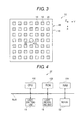
  • FIG. 3 is a top plan view illustrating an example of the arrangement of light receiving elements of a light receiving unit of the inspection apparatus in FIG. 1 ;
  • FIG. 4 is a block diagram of a controller of the inspection apparatus in FIG. 1 ;
  • FIG. 5 is a block diagram of the controller and the light receiving unit of the inspection apparatus in FIG. 1 ;
  • FIGS. 6A to 6C are process diagrams sequentially illustrating a process of inspecting an object to be inspected using the inspection apparatus in FIG. 1 ;
  • FIG. 7A is a side view illustrating an object to be inspected
  • FIG. 7B is a side view illustrating an object having a higher unevenness level than that of the object in FIG. 7A ;
  • FIG. 8A is a graph illustrating an inspection result of the object in FIG. 7A ;
  • FIG. 8B is a graph illustrating an inspection result of the object in FIG. 7B ;
  • FIG. 9 is a top plan view for explaining a location for inspecting the object.
  • FIG. 10 is a top plan view of the light receiving unit, which illustrates an example of the arrangement of the light receiving elements
  • FIG. 11 is a graph for explaining an inspection for Abnormality A in a first inspection
  • FIG. 12 is a top plan view of the light receiving unit, which illustrates an example in which a peak of specularly reflected light is directed toward an opening of the light receiving unit;
  • FIG. 13 is a top plan view of the light receiving unit, which illustrates an example in which a peak of specularly reflected light is directed toward a portion other than the opening of the light receiving unit;
  • FIG. 14 is a graph for explaining an inspection for Abnormality B in the first inspection
  • FIG. 15 is a top plan view illustrating an example in which the light receiving unit receives diffuse reflection light
  • FIG. 16 is a graph for explaining a magnitude of an average value of a light amount of the diffuse reflection light
  • FIG. 17 is a top plan view of the light receiving unit, which illustrates an example in which a peak of specularly reflected light is directed toward a portion other than the opening of the light receiving unit;
  • FIGS. 18A and 18B are explanatory views illustrating an example in which a direction of reflected light is a straight direction
  • FIG. 18C is an explanatory view illustrating an example in which a direction of reflected light is a curved direction
  • FIG. 19 is a top plan view of the light receiving unit, which illustrates a position of a peak of the specularly reflected light in a case where the direction of the reflected light in FIG. 18C is a curved direction;
  • FIG. 20 is an explanatory view illustrating an example of reflected stray light in a case where a lens surface is a flat surface
  • FIG. 21 is an explanatory view illustrating an example of reflected stray light in a case where a lens surface is a curved surface;
  • FIG. 22 is a graph for explaining an inspection for Abnormality C in a second inspection
  • FIG. 23 is a graph for explaining an inspection for Abnormality D in the second inspection.
  • FIG. 24 is a top plan view of the light receiving unit, which illustrates another example of the arrangement of the light receiving elements.
  • an arrow Z illustrates an up and down direction (in the present exemplary embodiment, a vertical direction) of an apparatus
  • an arrow Y indicates a width direction (in the present exemplary embodiment, a horizontal direction) of the apparatus
  • an arrow X indicates a depth direction (in the present exemplary embodiment, a horizontal direction) of the apparatus which is orthogonal to the Y direction and the Z direction.
  • the inspection apparatus 10 illustrated in FIG. 1 is an apparatus for inspecting reflection characteristics of an object OB to be inspected by irradiating the object OB with light beams (light rays) when the object OB is moved in a depth direction (X direction) of the apparatus.
  • the wording “reflection characteristics” means a distribution of intensity of light reflected in a single direction or plural directions due to a roughness level such as a small unevenness or an undulation of a surface of the object OB.
  • the inspection apparatus 10 includes a light emitting unit 14 having plural light emitting elements 12 , a light receiving unit 18 (see FIG. 3 ) having plural light receiving elements 16 , and a controller 20 as an example of an inspection unit.
  • the inspection apparatus 10 is disposed between the light emitting unit 14 and the object OB to be inspected, and has an optical system 30 that guides irradiation light IF, which is emitted from the light emitting element 12 , to the object OB.
  • the light emitting unit 14 is disposed above an inspection region T in an up and down direction of the apparatus, and the object OB, which moves in the depth direction of the apparatus, passes through the inspection region T.
  • the light emitting unit 14 has plural light emitting elements 12 which are mounted on a substrate 14 A, are arranged in the width direction (Y direction) of the apparatus, and emit the light beams downward in the up and down direction ( ⁇ Z direction) of the apparatus.
  • the light emitting elements 12 are arranged in a direction intersecting with (orthogonal to) the movement direction of the object OB (the depth direction (X direction) of the apparatus).
  • the light emitting element 12 which is disposed at one end portion (a right end in the drawing) in the Y-axis direction of the substrate 14 A, is referred to as a light emitting element 12 A
  • the light emitting element 12 which is disposed at the other end portion (a left end in the drawing) in the Y-axis direction of the substrate 14 A, is referred to as a light emitting element 12 B
  • the light emitting element 12 which is disposed at a center of the substrate 14 A, is referred to as a light emitting element 12 C.
  • the light beams are emitted from the respective light emitting elements 12 toward the object OB at a time interval from the light emitting element 12 A disposed at one end portion (the right end in the drawing) in the width direction of the apparatus to the light emitting element 12 B disposed at the other end portion (the left end in the drawing) in the width direction of the apparatus.
  • FIG. 1 illustrates the light beam of irradiation light IF when the light emitting element 12 C emits light
  • FIG. 2 illustrates the light beam of reflected light RF when the irradiation light IF emitted from the light emitting element 12 C is reflected by a surface 200 of the object OB.
  • the optical system 30 illustrated in FIG. 1 constitutes a so-called double-sided telecentric lens which includes a first lens 32 , a second lens 34 , and an aperture unit 40 which is disposed between the first lens 32 and the second lens 34 and narrows the light beam of the irradiation light IF.
  • the optical system 30 is disposed between the light emitting unit 14 and the object OB, and configured to guide the irradiation light IF emitted from the light emitting element 12 to the object OB, and guide the reflected light RF (see FIG. 2 ) reflected by the object OB to the light receiving unit 18 .
  • the light receiving unit 18 is configured to receive at least a part of the reflected light RF (see FIG. 2 and FIGS. 6A to 6C ) generated when the irradiation light IF (see FIG. 1 and FIGS. 6A to 6C ) from the light emitting element 12 , which is emitted from the second lens 34 , is reflected by the object OB, and then transmitted through the second lens 34 again.
  • the first lens 32 and the second lens 34 are disposed such that an optical axis M of the first lens 32 and an optical axis M of the second lens 34 are coaxial with each other, and the optical axes M of the first lens 32 and the second lens 34 are directed in the up and down direction of the apparatus.
  • the light emitting element 12 the light emitting element 12 C disposed at the center in the width direction of the apparatus is disposed on the optical axis M.
  • the first lens 32 and the second lens 34 have the same optical axis M, and the optical axis M passes through a center of the light emitting element 12 C of the light emitting unit 14 and a center of an opening 42 which will be described later.
  • the first lens 32 is a circular convex lens in a plan view, and a dimension of the first lens 32 in the width direction of the apparatus (dimension J in the drawing) is configured to be greater than a dimension in the width direction of the apparatus from the light emitting element 12 A to the light emitting element 12 B (dimension W in the drawing). Therefore, as the light beams emitted from the respective light emitting elements 12 are transmitted through the first lens 32 , a divergence level of the light beams transmitted through the first lens 32 is changed, so that the light beams are directed as parallel light toward the second lens 34 .
  • the second lens 34 is a circular convex lens in a plan view, and a dimension of the second lens 34 in the width direction of the apparatus (dimension G in the drawing) is greater than a dimension of the first lens 32 in the width direction of the apparatus. Further, the second lens 34 is configured to condense the light beams, which is emitted from the first lens 32 and transmitted through the second lens 34 , toward the object OB.
  • the aperture unit 40 is disposed between the first lens 32 and the second lens 34 . Further, the circular opening 42 is formed in the aperture unit 40 to narrow the light beam which is transmitted through the first lens 32 and is incident on the second lens 34 (see FIG. 3 ).
  • the aperture unit 40 has a plate shape in which the plate surface is directed in the up and down direction of the apparatus, an outer edge portion of the opening 42 of the aperture unit 40 is curved toward the second lens 34 and tapered, and a tip portion of the outer edge portion is formed as an opening edge 42 A.
  • a circular shape formed by the opening 42 has the optical axis M as a central axis thereof.
  • a distance F 1 between the opening edge 42 A and the first lens 32 is configured to be equal or substantially equal to a focal length f 1 of the first lens 32 .
  • a distance F 2 between the opening edge 42 A and the second lens 34 is equal or substantially equal to a focal length f 2 of the second lens 34 .
  • the light beams, which are sequentially emitted from the respective light emitting elements 12 are thinly narrowed, regardless of the positions of the light emitting elements 12 , and are also irradiated to the object OB as the irradiation light IF parallel to the optical axis M.
  • the respective light emitting elements 12 are caused to sequentially emit and scan such that the object OB is sequentially irradiated with substantially circular light beams which are thinly narrowed and parallel to each other (see FIGS. 6A to 6C ).
  • the light receiving unit 18 has plural light receiving elements 16 which are disposed between the first lens 32 and the second lens 34 at a back surface side 40 A of the aperture unit 40 (the second lens 34 side, a lower side in the up and down direction of the apparatus), and are mounted on a substrate 18 A.
  • the plural light receiving elements 16 are disposed at intervals in the width direction of the apparatus and in the depth direction of the apparatus, except for the opening 42 of the aperture unit 40 .
  • the light receiving elements 16 are disposed between the first lens 32 and the second lens 34 , and receive at least a part of the reflected light RF which is reflected by the object OB and transmitted through the second lens 34 of the optical system 30 .
  • the light receiving elements 16 are disposed at an optical axis M side (at an inner side) of a line P (cylindrical surface) in the width direction of the apparatus.
  • the line P extends in the up and down direction of the apparatus while passing through an outer diameter end (a virtual contact point between a front surface Rd (radius) and a back surface Rd) of one lens (in the present exemplary embodiment, the second lens 34 ) having a larger outer diameter than the other lens (in the present exemplary embodiment, the first lens 32 ) has. If plural Rds are present in the front surface Rd or the back surface Rd, the outer diameter end is determined using the Rd having the largest value.
  • a height position of a light receiving surface A of each of the light receiving elements 16 is configured to be equal or substantially equal to a height position of the opening edge 42 A.
  • a distance (optical path length: F 2 in the drawing) between a light receiving surface 16 A of each of the light receiving elements 16 and the second lens 34 is configured to be equal or substantially equal to the focal length f 2 of the second lens 34 .
  • a pitch in the light receiving unit 18 between the light receiving element 16 disposed at the left end in the drawing and the light receiving element 16 disposed at the right end in the drawing is greater than a pitch between the other light receiving elements 16 .
  • the light receiving element 16 to be disposed at a central portion of the light receiving unit 18 is omitted (see FIG. 3 ).
  • the controller 20 includes a central processing unit (CPU) 100 , a read only memory (ROM) 102 , a random access memory (RAM) 104 , and the like.
  • CPU central processing unit
  • ROM read only memory
  • RAM random access memory
  • the CPU 100 collectively controls the entire inspection apparatus 10
  • the ROM 102 is a memory that stores in advance a control program or the like for the inspection apparatus 10
  • the RAM 104 is a memory which is used as a work area when a program such as the control program is executed.
  • the CPU 100 , the ROM 102 , and the RAM 104 are connected with each other by a bus.
  • a motor 52 for driving the light emitting unit 14 , the light receiving unit 18 , and the like is connected to the bus, and the light emitting unit 14 , the light receiving unit 18 , and the motor 52 are each controlled by the CPU 100 through the bus.
  • the controller 20 receives a light receiving result of the plural light receiving elements 16 , and inspects the reflection characteristics of the object OB using the light receiving result of the plural light receiving elements 16 .
  • FIGS. 6A to 6C illustrate the light beam of the irradiation light IF, and the light beam of the reflected light RF in which the irradiation light IF is reflected by the surface 200 of the object OB and guided to the light receiving unit 18 , in a case where the light emitting elements 12 A, 12 C, and 12 B of the light emitting unit 14 sequentially emit light.
  • the respective light emitting elements 12 sequentially emit light at time intervals, and the irradiation light IF is sequentially emitted toward the object OB. Further, until a rear end of the object OB exits the inspection region T, a cycle of light emission from the light emitting element 12 A to the light emitting element 12 B is repeated. As described above, the light emission of the light emitting elements 12 is controlled by the controller 20 .
  • a divergence level of the light beam of the irradiation light IF emitted from the respective light emitting elements 12 is changed by the first lens 32 so that the light beam is directed toward the second lens 34 .
  • the light beam of which the divergence level is changed by the first lens 32 is narrowed (restricted) by the opening 42 of the aperture unit 40 .
  • the light beam narrowed by the aperture unit 40 is condensed by the second lens 34 , and emitted to the object OB from the Z-axis direction (the direction parallel to the optical axis M).
  • the surface 200 of the object OB is configured to pass through a portion in the vicinity of a condensing point Q of the irradiation light IF by the second lens 34 .
  • the irradiation light IF emitted to the object OB is reflected by the surface 200 of the object OB, thereby generating the reflected light RF (indicated by a dashed-dotted line with an arrow in FIGS. 6A to 6C ).
  • the direction of the light beam of the reflected light RF is changed by the second lens 34 so that the light beam is directed toward the respective light receiving elements 16 .
  • the reflected light RF transmitted through the second lens 34 is received by the respective light receiving elements 16 .
  • the irradiation light IF is reflected in various directions.
  • the respective light receiving elements 16 output light receiving signals based on the amount of received light.
  • the light receiving signal is read at a predetermined timing by control of the controller 20 .
  • the light receiving signal may be temporarily stored in the memory such as the RAM 104 .
  • the controller 20 inspects the surface 200 of the object OB by using an inspection method which will be described later.
  • the surface 200 A ( FIG. 7A ) has a lower roughness level than that of the surface 200 B ( FIG. 7B ).
  • the vertical axis in the graphs illustrated in FIGS. 8A and 8B indicates the magnitude of the light amount of the reflected light RF received by the respective light receiving elements 16 .
  • the light amount of the specularly reflected light (hereinafter, referred to as “specular reflection component”) is larger than the light amount of the diffuse reflection light (hereinafter, referred to as a “diffuse reflection component”), and as a result, a steep curve is plotted.
  • specular reflection component the light amount of the specularly reflected light
  • diffuse reflection component the diffuse reflection light
  • FIG. 8B in the case of the surface 200 B having a high roughness level as illustrated in FIG. 8B , a difference between the specular reflection component and the diffuse reflection component is reduced in comparison with the surface 200 A, and as a result, a gentle curve is plotted.
  • a distribution c in FIG. 8A indicates the light amount of the light receiving elements 16 in a row c, in a case where a peak P of the specularly reflected light of the reflected light RF is directed toward a position Cc (opening 42 ) as illustrated in FIG. 12 which will be described later.
  • a distribution b indicates the light amount of the light receiving elements 16 in a row b in a case where a peak P of the specularly reflected light of the reflected light RF is directed toward a position Db as illustrated in FIG. 17 which will be described later.
  • the distribution c indicates the light amount of the light receiving elements 16 in the row c
  • the distribution b indicates the light amount of the light receiving elements 16 in the row b.
  • respective inspection conditions e.g., a state of the surface 200 or a position of the peak P of the specularly reflected light which is determined to be normal or abnormal
  • respective inspection conditions are set in advance based on the object OB or the inspection contents, and then stored in the controller 20 .
  • a “median value” refers to a value which is positioned at a center when a limited number of data are arranged in descending order.
  • the median value is an arithmetic average value of two data close to the center.
  • FIG. 9 is a top plan view of the surface 200 of the object OB when viewed in the Z direction.
  • the respective actual inspection locations are minute regions of the surface 200 of the object OB.
  • the inspection locations are indicated by inspection locations K 1 to K 10 illustrated in FIG. 9 .
  • the inspection location may be referred to as an inspection location(s) K.
  • the inspection location K illustrated in FIG. 9 is illustrative, and the present invention is not limited thereto.
  • the light receiving elements 16 of the light receiving unit 18 are arranged as illustrated in FIG. 10 . Further, for example, in a case of indicating a position of an edge portion at an upper right side in FIG. 10 , it is denoted as a position Ea. In addition, the light receiving element 16 disposed at the position Ea is denoted as a light receiving element 16 Ea.
  • the respective light receiving elements 16 output signals proportional to the light amount of the received reflected light RF.
  • a state (see FIGS. 7A and 8A ) where the surface is a mirror surface having a low roughness level and the light amount (specular reflection component) of the specularly reflected light of the reflected light is large as illustrated in FIG. 7A is defined as “Normality”, a state where the surface has scratches or a large unevenness and a direction of the specular reflection is changed is defined as “Abnormality A”, and a state where the surface has a high roughness level and the light amount (diffuse reflection component) of the diffuse reflection light of the reflected light is large is defined as “Abnormality B”. Further, description will be given on the first inspection for inspecting if an inspection location K is “Normality”, “Abnormality A”, or “Abnormality B”.
  • the largest value that is, the maximum value is obtained among output values (output proportional to the light amount of the received reflected light RF) of the plural light receiving elements 16 (see FIG. 10 ) for each inspection location K (see FIG. 9 ) on the surface 200 of the object OB.
  • a median value GS of the maximum values S 1 to S 10 of the plural inspection locations K is obtained, and the median value GS of the maximum values S 1 to S 10 is set to a reference value. Further, whether each inspection location K is “Normality” or “Abnormality A” is inspected using the maximum values S 1 to S 10 of the respective inspection locations K and the reference values (median value) GS.
  • the specularly reflected light of the reflected light RF at the inspection locations K 1 to K 3 and K 6 to K 10 other than the inspection locations K 4 and K 5 is directed toward the opening 42 . Since no light receiving element 16 is provided at the position Cc where the peak P of the light beam is present, the maximum value of the plural light receiving elements 16 is small (see the distribution c in FIG. 8A ).
  • the direction of the specular reflection at the inspection locations K 4 and K 5 is different from that at the inspection locations K 1 to K 3 and K 6 to K 10 .
  • the specularly reflected light of the reflected light RF from the inspection locations K 4 and K 5 is directed toward the position Cb instead of the opening 42 . Therefore, the peak P of the light amount of the light beam is received by the light receiving element Cb, and the maximum value (in this example, an output value of the light receiving element 16 Cb) of the plural light receiving elements 16 is large (see the distribution b in FIG. 8A ).
  • the controller 20 determines whether the inspection location K is “Normality” or “Abnormality A,” using the reference value (median value) GS and the maximum values S 1 to S 10 .
  • the inspection location K is determined as “Abnormality A”.
  • a threshold value GSA is set by performing the four arithmetical operations on the reference value GS with a predetermined value, and the inspection location K having the maximum values S 1 to S 10 which exceed the threshold value GSA is determined as “Abnormality A”.
  • an average value of the output values of the plural light receiving elements 16 is obtained for each inspection location K (see FIG. 9 ) of the surface 200 of the object OB.
  • a median value GH of average values H 1 to H 10 in the plural inspection locations K is obtained, and the median value GH of the average values H 1 to H 10 is set to the reference value. Further, whether each inspection location K is “Normality” or “Abnormality B” is inspected using the average values H 1 to H 10 of the respective inspection locations K and the reference value (median value) GH.
  • the specularly reflected light of the reflected light RF from the inspection locations K 1 to K 6 , K 9 , and K 10 other than the inspection locations K 7 and K 8 is directed toward the opening 42 (position Cc).
  • No light receiving element 16 is provided at the position Cc where the peak P of the light beam is present.
  • the light amount, which is received by the respective light receiving elements 16 disposed at positions other than the position of the opening 42 (position Cc) is small. Therefore, an average value of the output values of the plural light receiving elements 16 is small.
  • the controller 20 determines whether the inspection location K is “Normality” or “Abnormality B,” using the reference value (median value) GH and the average values H 1 to H 10 .
  • the inspection location K is determined as “Abnormality A”.
  • a threshold value GHA is set by performing the four arithmetical operations on the reference value GH with a predetermined value, and the inspection location K having the average values H 1 to H 10 which exceed the threshold value GHA is determined as “Abnormality B”.
  • the roughness level may be determined based on the magnitude of the average value H.
  • each inspection location K is “Normality”, “Abnormality A”, or “Abnormality B” is inspected by the inspection method in the same manner as described above. Also, the roughness level of each inspection location K is inspected by the inspection method in the same manner as described above.
  • each inspection location K is “Normality”, “Abnormality A”, or “Abnormality B” is inspected by the same method as the first inspection method. Also, the roughness level of each inspection location K is inspected by the same method as the first inspection method.
  • output values of all or a part of the light receiving elements 16 Bb, 16 Cb, 16 Db, 16 Dc, 16 Cd, 16 Bd, and 16 Bc around the opening 42 (position Cc), may not be used.
  • the specularly reflected light of the reflected light RF returns in the same direction.
  • the peak P of the specularly reflected light of the reflected light RF has a dot shape.
  • the specularly reflected light of the reflected light RF returns in the same direction even though the surface 200 is curved in the X direction.
  • the peak P of the specularly reflected light of the reflected light RF has a dot shape.
  • the specularly reflected light of the reflected light RF returns in a fan shape manner.
  • the peak P of the specularly reflected light of the reflected light RF has a line shape (accurately, the peaks P are arranged at an interval in the Y direction).
  • each inspection location K is “Normality”, “Abnormality A”, “Abnormality B” is inspected by the same inspection method as described above. Also, the roughness level of each inspection location K is inspected by the same inspection method as described above.
  • the light receiving element 16 may not be installed in advance at the position where the light receiving element 16 is not used.
  • felt or an anti-reflective structure such as coating may be provided at the position where the light receiving element 16 is not installed.
  • a state (see FIGS. 7B and 8B ) where a roughness level is high and the light amount (diffuse reflection component) of the diffuse reflection light of the reflected light is large is defined as “Normality”
  • a state where a roughness level is low, the surface is a mirror surface, and the light amount (specular reflection component) of the specular reflection of the reflected light is large is defined as “Abnormality C”
  • a state where the surface has scratches or an unevenness and the direction of the specular reflection is changed is defined as “Abnormality D”.
  • Normal in the first inspection corresponds to “Abnormality C” in the second inspection
  • Abnormality B” in the first inspection corresponds to “Abnormality D” in the second inspection
  • Abnormality B” in the first inspection corresponds to “Normality” in the second inspection.
  • the average value of the output values of the plural light receiving elements 16 is obtained for each of the inspection locations K (see FIG. 9 ) of the surface 200 of the object OB, and the median value GH of the average values H 1 to H 10 of the plural inspection locations K is obtained.
  • the median value GH of the average values H 1 to H 10 is set to the reference value. Further, whether each inspection location K is “Normality” or “Abnormality B” is inspected using the average values H 1 to H 10 of the respective inspection locations K and the reference value (median value) GH.
  • the specularly reflected light of the reflected light RF from the inspection locations K 7 and K 8 is directed toward the opening 42 .
  • No light receiving element 16 is provided at the position Cc where the peak P of the light beam is present.
  • the light amount, which is received by the respective light receiving elements 16 disposed at positions other than the position of the opening 42 (position Cc) is small. Therefore, the average values H 7 and H 8 of the output values of the plural light receiving elements 16 are small.
  • the controller 20 determines whether the inspection location K is “Normality” or “Abnormality C,” the reference value (median value) GH and the average values H 1 to H 10 .
  • the inspection location K is determined as “Abnormality C”.
  • a threshold value GHA is set by performing the four arithmetical operations on the reference value GH with a predetermined value, and the inspection location K having the average values H 1 to H 10 which are below the threshold value GHA is determined as “Abnormality C”.
  • a largest value that is, a maximum value is obtained among output values of the plural light receiving elements 16 (see FIG. 10 ) for each inspection location K (see FIG. 9 ) of the surface 200 of the object OB.
  • a median value GA of the maximum values S 1 to S 10 of the plural inspection locations K is obtained, and the median value GS of the maximum values S 1 to S 10 is set to a reference value. Further, whether each inspection location K is “Normality” or “Abnormality D” is inspected using the maximum values S 1 to S 10 of the respective inspection locations K and the reference value (median value) GS.
  • the light amount of the peak P of the light amount of the diffuse reflection component of the reflected light RF, which is not directed toward the opening 42 is small.
  • the maximum value of the plural light receiving elements 16 is small.
  • the controller 20 determines whether the inspection location K is “Normality” or “Abnormality D,” using the reference value (median value) GS and the maximum values S 1 to S 10 .
  • the inspection location K is determined as “Abnormality D”.
  • a threshold value GSA is set by performing the four arithmetical operations on the reference value GS with a predetermined value, and the inspection location K having the maximum values S 1 to S 10 which exceed the threshold value GSA is determined as “Abnormality D”.
  • an output values of the light receiving element 16 which is disposed at a position of the peak P of the specularly reflected light from the inspection location K or output values of the light receiving element 16 in interest and the light receiving elements 16 at the periphery thereof are not used.
  • an output value of the corresponding light receiving element 16 or output values of the corresponding light receiving element 16 and the light receiving elements 16 at the peripheral thereof are not used.
  • the controller 20 determines the roughness level (the number of diffuse reflection components) of each inspection location K, using the average value H used for the first inspection. For example, as illustrated in FIG. 16 , the roughness level (the number of diffuse reflection components) is determined using an average value H of each of the inspection locations K without obtaining the median value GS (see FIG. 14 ).
  • the median value (reference value) GS of the maximum values S and the median value (reference value) GH of the average values H are obtained from the output values of the plural light receiving elements 16 of all of the inspection locations K of the surface 200 of the object OB, but the present invention is not limited thereto.
  • a part of all of the inspection locations K may be used.
  • only the inspection location K which is “Normality” may be used, but of the plural normal inspection locations K which is “Normality” may be included (e.g., 80% or more).
  • the median value (reference value) GS of the maximum values S and the median value (reference value) GH of the average values H are obtained using the object OB to be inspected, but the present invention is not limited thereto.
  • the median value (reference value) GS of the maximum values S and the median value (reference value) GH of the average values H may be inspected using another object OB regardless of the object to be inspected, and the values may be stored in advance in the controller 20 .
  • the reflected stray light MK reflected by an upper surface 34 H of the second lens 34 may be incident on the light receiving element 16 in some instances.
  • the reflected stray light MK may be incident on the light receiving element 16 in some instances.
  • the light receiving element 16 on which the reflected stray light MK is incident is specified in advance through experiments or the like, and the light receiving element 16 on which the reflected stray light MK is incident is not used.
  • an output of the light receiving element 16 on which the stray light MK is incident is not used.
  • the light receiving element 16 on which the reflected stray light MK and other stray light are incident may not be installed.
  • felt or an anti-reflective structure such as coating may be provided at the position where the light receiving element 16 is not installed.
  • each inspection location K is in “a state where the light amount (specular reflection component) of the specularly reflected light of the reflected light is large”, “a state where the direction of the specular reflection is changed”, or “a state where the light amount (diffuse reflection component) of the diffuse reflection light of the reflected light is large”, in comparison with a case where the light receiving result (the maximum value and the average value) and the median value are not used.
  • the inspection locations K by inspecting the inspection locations K using the average values of the light receiving unit 18 for the respective inspection locations K 1 to K 10 , it is possible to easily and accurately inspect the magnitude of the light amount (diffuse reflection component) of the diffuse reflection light of the reflected light from the inspection locations K, that is, the roughness levels of the inspection locations K.
  • an output of the light receiving element 16 , in the light receiving unit 18 , provided at a location which the specularly reflected light of the reflected light RF reflected by the object OB reaches is not used or no light receiving element 16 is provide at such a location.
  • an output of the light receiving element 16 , in the light receiving unit 18 , provided at a location which the stray light other than the reflected light RF reflected by the surface 200 of the object OB reaches is not used or no light receiving element 16 is provided at such a location.
  • the present invention is not limited to the exemplary embodiment.
  • the arrangement and the number of light receiving elements 16 in the light receiving unit 18 are illustrative, and the present invention is not limited thereto.
  • eight light receiving elements 16 may be provided.
  • the light receiving elements 16 may not be disposed around the opening 42 , and the opening 42 may be disposed at an end portion.
  • the light receiving elements 16 are disposed at an optical axis M side (at an inner side) of the virtual line P (cylindrical surface) in the width direction of the apparatus.
  • the virtual line P extends in the up and down direction of the apparatus while passing through an outer diameter end (a virtual contact point between a front surface Rd (radius) and a back surface Rd) of one lens (in the present exemplary embodiment, the second lens 34 ) having a larger outer diameter than the other lens (in the present exemplary embodiment, the first lens 32 ) has.
  • the light receiving element 16 may be disposed outside the virtual line P.
  • the “median value” of the maximum values or the average values of the outputs of the respective light receiving elements 16 is set to the reference value, and the threshold value is set based on the reference value (median value).
  • the present invention is not limited thereto.
  • an “average value” of the maximum values or the average values of all of the inspection locations may be set to the reference value.
  • the reference value may be a value other than the “median value” or the “average value”.
  • a value other than the maximum value or the average value of outputs of the light receiving elements 16 may be used.
  • the present invention is not limited to the configurations of the exemplary embodiment and may be implemented in various configurations.
  • the present invention may be carried out in various aspects without departing from the subject matter of the present invention.

Landscapes

  • Physics & Mathematics (AREA)
  • General Physics & Mathematics (AREA)
  • Spectroscopy & Molecular Physics (AREA)
  • Health & Medical Sciences (AREA)
  • Life Sciences & Earth Sciences (AREA)
  • Chemical & Material Sciences (AREA)
  • Analytical Chemistry (AREA)
  • Biochemistry (AREA)
  • General Health & Medical Sciences (AREA)
  • Immunology (AREA)
  • Pathology (AREA)
  • Investigating Materials By The Use Of Optical Means Adapted For Particular Applications (AREA)
  • Investigating Or Analysing Materials By Optical Means (AREA)

Abstract

An inspection apparatus includes a light emitting unit, a first lens, an aperture unit, a second lens, a light receiving unit, and an inspection unit. The light emitting unit emits irradiation light to an object to be inspected. The first lens changes a divergence level of the irradiation light which is emitted from the light emitting unit and is transmitted through the first lens. The aperture unit has an opening which narrows the irradiation light transmitted through the first lens. The second lens condenses the irradiation light passing through the opening, toward the object. The light receiving unit is disposed between the aperture unit and the second lens. The light receiving unit includes plural light receiving elements which receives reflected light obtained by the irradiation light being emitted to the object and then being transmitted through the second lens.

Description

CROSS-REFERENCE TO RELATED APPLICATIONS
This application is based on and claims priority under 35 USC 119 from Japanese Patent Application No. 2016-055649 filed Mar. 18, 2016.
BACKGROUND Technical Field
The present invention relates to an inspection apparatus.
SUMMARY
According to an aspect of the invention, an inspection apparatus includes a light emitting unit, a first lens, an aperture unit, a second lens, a light receiving unit, and an inspection unit. The light emitting unit emits irradiation light to an object to be inspected. The first lens changes a divergence level of the irradiation light which is emitted from the light emitting unit and is transmitted through the first lens. The aperture unit has an opening which narrows the irradiation light transmitted through the first lens. The second lens condenses the irradiation light passing through the opening, toward the object. The light receiving unit is disposed between the aperture unit and the second lens. The light receiving unit includes plural light receiving elements which receives reflected light obtained by the irradiation light being emitted to the object and then being transmitted through the second lens. The plural light receiving elements are disposed so as not to overlap the opening. The inspection unit inspects respective inspection locations of the object using (i) light receiving results of the light receiving unit for the respective inspection locations of the object and (ii) a reference value.
BRIEF DESCRIPTION OF THE DRAWINGS
Exemplary embodiments of the present invention will be described in detail based on the following figures, wherein:
FIG. 1 is a schematic configuration diagram illustrating an inspection apparatus according to one exemplary embodiment of the present invention;
FIG. 2 is a schematic configuration diagram illustrating reflected light of the inspection apparatus in FIG. 1;
FIG. 3 is a top plan view illustrating an example of the arrangement of light receiving elements of a light receiving unit of the inspection apparatus in FIG. 1;
FIG. 4 is a block diagram of a controller of the inspection apparatus in FIG. 1;
FIG. 5 is a block diagram of the controller and the light receiving unit of the inspection apparatus in FIG. 1;
FIGS. 6A to 6C are process diagrams sequentially illustrating a process of inspecting an object to be inspected using the inspection apparatus in FIG. 1;
FIG. 7A is a side view illustrating an object to be inspected;
FIG. 7B is a side view illustrating an object having a higher unevenness level than that of the object in FIG. 7A;
FIG. 8A is a graph illustrating an inspection result of the object in FIG. 7A;
FIG. 8B is a graph illustrating an inspection result of the object in FIG. 7B;
FIG. 9 is a top plan view for explaining a location for inspecting the object;
FIG. 10 is a top plan view of the light receiving unit, which illustrates an example of the arrangement of the light receiving elements;
FIG. 11 is a graph for explaining an inspection for Abnormality A in a first inspection;
FIG. 12 is a top plan view of the light receiving unit, which illustrates an example in which a peak of specularly reflected light is directed toward an opening of the light receiving unit;
FIG. 13 is a top plan view of the light receiving unit, which illustrates an example in which a peak of specularly reflected light is directed toward a portion other than the opening of the light receiving unit;
FIG. 14 is a graph for explaining an inspection for Abnormality B in the first inspection;
FIG. 15 is a top plan view illustrating an example in which the light receiving unit receives diffuse reflection light;
FIG. 16 is a graph for explaining a magnitude of an average value of a light amount of the diffuse reflection light;
FIG. 17 is a top plan view of the light receiving unit, which illustrates an example in which a peak of specularly reflected light is directed toward a portion other than the opening of the light receiving unit;
FIGS. 18A and 18B are explanatory views illustrating an example in which a direction of reflected light is a straight direction;
FIG. 18C is an explanatory view illustrating an example in which a direction of reflected light is a curved direction;
FIG. 19 is a top plan view of the light receiving unit, which illustrates a position of a peak of the specularly reflected light in a case where the direction of the reflected light in FIG. 18C is a curved direction;
FIG. 20 is an explanatory view illustrating an example of reflected stray light in a case where a lens surface is a flat surface;
FIG. 21 is an explanatory view illustrating an example of reflected stray light in a case where a lens surface is a curved surface;
FIG. 22 is a graph for explaining an inspection for Abnormality C in a second inspection;
FIG. 23 is a graph for explaining an inspection for Abnormality D in the second inspection; and
FIG. 24 is a top plan view of the light receiving unit, which illustrates another example of the arrangement of the light receiving elements.
DETAILED DESCRIPTION
An example of an inspection apparatus according to one exemplary embodiment of the present invention will be described with reference to FIGS. 1 to 23. In the drawings, an arrow Z illustrates an up and down direction (in the present exemplary embodiment, a vertical direction) of an apparatus, an arrow Y indicates a width direction (in the present exemplary embodiment, a horizontal direction) of the apparatus, and an arrow X indicates a depth direction (in the present exemplary embodiment, a horizontal direction) of the apparatus which is orthogonal to the Y direction and the Z direction.
<Configuration>
The configuration of an inspection apparatus 10 will be described.
The inspection apparatus 10 illustrated in FIG. 1 is an apparatus for inspecting reflection characteristics of an object OB to be inspected by irradiating the object OB with light beams (light rays) when the object OB is moved in a depth direction (X direction) of the apparatus. In the present exemplary embodiment, the wording “reflection characteristics” means a distribution of intensity of light reflected in a single direction or plural directions due to a roughness level such as a small unevenness or an undulation of a surface of the object OB.
The inspection apparatus 10 includes a light emitting unit 14 having plural light emitting elements 12, a light receiving unit 18 (see FIG. 3) having plural light receiving elements 16, and a controller 20 as an example of an inspection unit. In addition, the inspection apparatus 10 is disposed between the light emitting unit 14 and the object OB to be inspected, and has an optical system 30 that guides irradiation light IF, which is emitted from the light emitting element 12, to the object OB.
[Light Emitting Unit]
As illustrated in FIG. 1, the light emitting unit 14 is disposed above an inspection region T in an up and down direction of the apparatus, and the object OB, which moves in the depth direction of the apparatus, passes through the inspection region T. In addition, the light emitting unit 14 has plural light emitting elements 12 which are mounted on a substrate 14A, are arranged in the width direction (Y direction) of the apparatus, and emit the light beams downward in the up and down direction (−Z direction) of the apparatus. As described above, the light emitting elements 12 are arranged in a direction intersecting with (orthogonal to) the movement direction of the object OB (the depth direction (X direction) of the apparatus).
The light emitting element 12, which is disposed at one end portion (a right end in the drawing) in the Y-axis direction of the substrate 14A, is referred to as a light emitting element 12A, the light emitting element 12, which is disposed at the other end portion (a left end in the drawing) in the Y-axis direction of the substrate 14A, is referred to as a light emitting element 12B, and the light emitting element 12, which is disposed at a center of the substrate 14A, is referred to as a light emitting element 12C.
The light beams are emitted from the respective light emitting elements 12 toward the object OB at a time interval from the light emitting element 12A disposed at one end portion (the right end in the drawing) in the width direction of the apparatus to the light emitting element 12B disposed at the other end portion (the left end in the drawing) in the width direction of the apparatus.
While the object OB moves in the −X direction in the inspection region T, a cycle of light emission from the light emitting element 12A to the light emitting element 12B is repeated several times.
FIG. 1 illustrates the light beam of irradiation light IF when the light emitting element 12C emits light, and FIG. 2 illustrates the light beam of reflected light RF when the irradiation light IF emitted from the light emitting element 12C is reflected by a surface 200 of the object OB.
[Optical System]
The optical system 30 illustrated in FIG. 1 constitutes a so-called double-sided telecentric lens which includes a first lens 32, a second lens 34, and an aperture unit 40 which is disposed between the first lens 32 and the second lens 34 and narrows the light beam of the irradiation light IF.
Further, the optical system 30 is disposed between the light emitting unit 14 and the object OB, and configured to guide the irradiation light IF emitted from the light emitting element 12 to the object OB, and guide the reflected light RF (see FIG. 2) reflected by the object OB to the light receiving unit 18.
That is, as illustrated in FIGS. 1, 2, and 6, the light receiving unit 18 is configured to receive at least a part of the reflected light RF (see FIG. 2 and FIGS. 6A to 6C) generated when the irradiation light IF (see FIG. 1 and FIGS. 6A to 6C) from the light emitting element 12, which is emitted from the second lens 34, is reflected by the object OB, and then transmitted through the second lens 34 again.
As illustrated in FIG. 1, the first lens 32 and the second lens 34 are disposed such that an optical axis M of the first lens 32 and an optical axis M of the second lens 34 are coaxial with each other, and the optical axes M of the first lens 32 and the second lens 34 are directed in the up and down direction of the apparatus. In addition, in the light emitting element 12, the light emitting element 12C disposed at the center in the width direction of the apparatus is disposed on the optical axis M.
From another point of view, the first lens 32 and the second lens 34 have the same optical axis M, and the optical axis M passes through a center of the light emitting element 12C of the light emitting unit 14 and a center of an opening 42 which will be described later.
The first lens 32 is a circular convex lens in a plan view, and a dimension of the first lens 32 in the width direction of the apparatus (dimension J in the drawing) is configured to be greater than a dimension in the width direction of the apparatus from the light emitting element 12A to the light emitting element 12B (dimension W in the drawing). Therefore, as the light beams emitted from the respective light emitting elements 12 are transmitted through the first lens 32, a divergence level of the light beams transmitted through the first lens 32 is changed, so that the light beams are directed as parallel light toward the second lens 34.
The second lens 34 is a circular convex lens in a plan view, and a dimension of the second lens 34 in the width direction of the apparatus (dimension G in the drawing) is greater than a dimension of the first lens 32 in the width direction of the apparatus. Further, the second lens 34 is configured to condense the light beams, which is emitted from the first lens 32 and transmitted through the second lens 34, toward the object OB.
The aperture unit 40 is disposed between the first lens 32 and the second lens 34. Further, the circular opening 42 is formed in the aperture unit 40 to narrow the light beam which is transmitted through the first lens 32 and is incident on the second lens 34 (see FIG. 3).
More specifically, the aperture unit 40 has a plate shape in which the plate surface is directed in the up and down direction of the apparatus, an outer edge portion of the opening 42 of the aperture unit 40 is curved toward the second lens 34 and tapered, and a tip portion of the outer edge portion is formed as an opening edge 42A. In addition, a circular shape formed by the opening 42 has the optical axis M as a central axis thereof. Further, the light beam, which is emitted from the light emitting element 12, is transmitted through the first lens 32, and is incident on the second lens 34, is narrowed by the opening 42.
In the Z-axis direction (optical axis M direction), a distance F1 between the opening edge 42A and the first lens 32 is configured to be equal or substantially equal to a focal length f1 of the first lens 32. In addition, in the Z-axis direction (optical axis M direction), a distance F2 between the opening edge 42A and the second lens 34 is equal or substantially equal to a focal length f2 of the second lens 34.
In the optical system 30 according to the present exemplary embodiment configured as described above, the light beams, which are sequentially emitted from the respective light emitting elements 12, are thinly narrowed, regardless of the positions of the light emitting elements 12, and are also irradiated to the object OB as the irradiation light IF parallel to the optical axis M. In other words, the respective light emitting elements 12 are caused to sequentially emit and scan such that the object OB is sequentially irradiated with substantially circular light beams which are thinly narrowed and parallel to each other (see FIGS. 6A to 6C).
[Light Receiving Unit]
As illustrated in FIG. 1, the light receiving unit 18 has plural light receiving elements 16 which are disposed between the first lens 32 and the second lens 34 at a back surface side 40A of the aperture unit 40 (the second lens 34 side, a lower side in the up and down direction of the apparatus), and are mounted on a substrate 18A.
As illustrated in FIG. 3, the plural light receiving elements 16 are disposed at intervals in the width direction of the apparatus and in the depth direction of the apparatus, except for the opening 42 of the aperture unit 40.
As illustrated in FIG. 2, the light receiving elements 16 are disposed between the first lens 32 and the second lens 34, and receive at least a part of the reflected light RF which is reflected by the object OB and transmitted through the second lens 34 of the optical system 30.
In the present exemplary embodiment, as illustrated in FIG. 1, the light receiving elements 16 are disposed at an optical axis M side (at an inner side) of a line P (cylindrical surface) in the width direction of the apparatus. The line P extends in the up and down direction of the apparatus while passing through an outer diameter end (a virtual contact point between a front surface Rd (radius) and a back surface Rd) of one lens (in the present exemplary embodiment, the second lens 34) having a larger outer diameter than the other lens (in the present exemplary embodiment, the first lens 32) has. If plural Rds are present in the front surface Rd or the back surface Rd, the outer diameter end is determined using the Rd having the largest value.
In the Z-axis direction (optical axis M direction), a height position of a light receiving surface A of each of the light receiving elements 16 is configured to be equal or substantially equal to a height position of the opening edge 42A. In addition, in the Z-axis direction (optical axis M direction), a distance (optical path length: F2 in the drawing) between a light receiving surface 16A of each of the light receiving elements 16 and the second lens 34 is configured to be equal or substantially equal to the focal length f2 of the second lens 34.
Since the light receiving element 16 cannot be disposed at a position of the opening 42, a pitch in the light receiving unit 18 between the light receiving element 16 disposed at the left end in the drawing and the light receiving element 16 disposed at the right end in the drawing is greater than a pitch between the other light receiving elements 16. In other words, the light receiving element 16 to be disposed at a central portion of the light receiving unit 18 is omitted (see FIG. 3).
[Controller]
As illustrated in FIG. 4, the controller 20, as an example of the inspection unit, includes a central processing unit (CPU) 100, a read only memory (ROM) 102, a random access memory (RAM) 104, and the like.
The CPU 100 collectively controls the entire inspection apparatus 10, the ROM 102 is a memory that stores in advance a control program or the like for the inspection apparatus 10, and the RAM 104 is a memory which is used as a work area when a program such as the control program is executed. The CPU 100, the ROM 102, and the RAM 104 are connected with each other by a bus.
A motor 52 for driving the light emitting unit 14, the light receiving unit 18, and the like is connected to the bus, and the light emitting unit 14, the light receiving unit 18, and the motor 52 are each controlled by the CPU 100 through the bus.
As illustrated in FIG. 5, the controller 20 receives a light receiving result of the plural light receiving elements 16, and inspects the reflection characteristics of the object OB using the light receiving result of the plural light receiving elements 16.
(Overview of Inspection Method)
Next, an overview of the method of inspecting the reflection characteristics of the surface 200 of the object OB to be inspected by the controller 20 will be described.
FIGS. 6A to 6C illustrate the light beam of the irradiation light IF, and the light beam of the reflected light RF in which the irradiation light IF is reflected by the surface 200 of the object OB and guided to the light receiving unit 18, in a case where the light emitting elements 12A, 12C, and 12B of the light emitting unit 14 sequentially emit light.
First, when the object OB moves in the −X direction, and a tip of the object OB enters the inspection region T, the respective light emitting elements 12 sequentially emit light at time intervals, and the irradiation light IF is sequentially emitted toward the object OB. Further, until a rear end of the object OB exits the inspection region T, a cycle of light emission from the light emitting element 12A to the light emitting element 12B is repeated. As described above, the light emission of the light emitting elements 12 is controlled by the controller 20.
A divergence level of the light beam of the irradiation light IF emitted from the respective light emitting elements 12 is changed by the first lens 32 so that the light beam is directed toward the second lens 34. The light beam of which the divergence level is changed by the first lens 32 is narrowed (restricted) by the opening 42 of the aperture unit 40. The light beam narrowed by the aperture unit 40 is condensed by the second lens 34, and emitted to the object OB from the Z-axis direction (the direction parallel to the optical axis M). The surface 200 of the object OB is configured to pass through a portion in the vicinity of a condensing point Q of the irradiation light IF by the second lens 34.
The irradiation light IF emitted to the object OB is reflected by the surface 200 of the object OB, thereby generating the reflected light RF (indicated by a dashed-dotted line with an arrow in FIGS. 6A to 6C). The direction of the light beam of the reflected light RF is changed by the second lens 34 so that the light beam is directed toward the respective light receiving elements 16. The reflected light RF transmitted through the second lens 34 is received by the respective light receiving elements 16.
In accordance with the state of the surface 200 of the object OB, the irradiation light IF is reflected in various directions. The respective light receiving elements 16 output light receiving signals based on the amount of received light. The light receiving signal is read at a predetermined timing by control of the controller 20. The light receiving signal may be temporarily stored in the memory such as the RAM 104. The controller 20 inspects the surface 200 of the object OB by using an inspection method which will be described later.
As illustrated in FIG. 2, light LA1 specularly reflected by a central portion of the surface 200 of the object OB in the width direction of the apparatus is transmitted through the second lens 34, and then passes through the opening 42 of the aperture unit 40. As a result, the specularly reflected light LA1 is not received by the light receiving element 16. In other words, the specularly reflected light LA1 from the central portion is not received.
Here, as an example, a method of inspecting, by the controller 20, two types of surfaces 200A and 200B having different roughness levels that have an effect on the reflection characteristics of the surface 200 of the object OB will be described.
As illustrated in FIGS. 7A and 7B, the surface 200A (FIG. 7A) has a lower roughness level than that of the surface 200B (FIG. 7B). In addition, the vertical axis in the graphs illustrated in FIGS. 8A and 8B indicates the magnitude of the light amount of the reflected light RF received by the respective light receiving elements 16.
As illustrated in FIG. 8A, in the case of the surface 200A having a low roughness level as illustrated in FIG. 7A, the light amount of the specularly reflected light (hereinafter, referred to as “specular reflection component”) is larger than the light amount of the diffuse reflection light (hereinafter, referred to as a “diffuse reflection component”), and as a result, a steep curve is plotted. Meanwhile, as illustrated in FIG. 8B, in the case of the surface 200B having a high roughness level as illustrated in FIG. 8B, a difference between the specular reflection component and the diffuse reflection component is reduced in comparison with the surface 200A, and as a result, a gentle curve is plotted.
A distribution c in FIG. 8A indicates the light amount of the light receiving elements 16 in a row c, in a case where a peak P of the specularly reflected light of the reflected light RF is directed toward a position Cc (opening 42) as illustrated in FIG. 12 which will be described later. In addition, a distribution b indicates the light amount of the light receiving elements 16 in a row b in a case where a peak P of the specularly reflected light of the reflected light RF is directed toward a position Db as illustrated in FIG. 17 which will be described later.
In FIG. 8B, the distribution c indicates the light amount of the light receiving elements 16 in the row c, and the distribution b indicates the light amount of the light receiving elements 16 in the row b.
<Detail of Inspection Method>
Next, a method of inspecting states of respective minute inspection locations of the surface 200 of the object OB to be inspected by the controller 20 will be described in detail. Further, respective inspection conditions (e.g., a state of the surface 200 or a position of the peak P of the specularly reflected light which is determined to be normal or abnormal) which will be described later are set in advance based on the object OB or the inspection contents, and then stored in the controller 20.
In the following description, a “median value” refers to a value which is positioned at a center when a limited number of data are arranged in descending order. In addition, in a case where the number of data is even, the median value is an arithmetic average value of two data close to the center.
Further, FIG. 9 is a top plan view of the surface 200 of the object OB when viewed in the Z direction. As described above, the respective actual inspection locations are minute regions of the surface 200 of the object OB. To facilitate understanding, in the description on the present inspection method, it is assumed that the inspection locations are indicated by inspection locations K1 to K10 illustrated in FIG. 9. In a case where it is not necessary to distinguish the inspection locations K1 to K10, the inspection location may be referred to as an inspection location(s) K. In addition, the inspection location K illustrated in FIG. 9 is illustrative, and the present invention is not limited thereto.
In the description on the present inspection method, it is assumed that the light receiving elements 16 of the light receiving unit 18 are arranged as illustrated in FIG. 10. Further, for example, in a case of indicating a position of an edge portion at an upper right side in FIG. 10, it is denoted as a position Ea. In addition, the light receiving element 16 disposed at the position Ea is denoted as a light receiving element 16Ea. The respective light receiving elements 16 output signals proportional to the light amount of the received reflected light RF.
(First Inspection)
In the respective inspection locations K of the surface 200 of the object OB, a state (see FIGS. 7A and 8A) where the surface is a mirror surface having a low roughness level and the light amount (specular reflection component) of the specularly reflected light of the reflected light is large as illustrated in FIG. 7A is defined as “Normality”, a state where the surface has scratches or a large unevenness and a direction of the specular reflection is changed is defined as “Abnormality A”, and a state where the surface has a high roughness level and the light amount (diffuse reflection component) of the diffuse reflection light of the reflected light is large is defined as “Abnormality B”. Further, description will be given on the first inspection for inspecting if an inspection location K is “Normality”, “Abnormality A”, or “Abnormality B”.
First, description will be given on a case where an inspection location K on the surface 200 of the object OB is “Normality” and the specularly reflected light from the inspection location K is directed toward the position Cc (opening 42 (see FIG. 2, FIGS. 6A to 6C, and FIG. 12)).
[Abnormality A]
As illustrated in FIG. 11, the largest value, that is, the maximum value is obtained among output values (output proportional to the light amount of the received reflected light RF) of the plural light receiving elements 16 (see FIG. 10) for each inspection location K (see FIG. 9) on the surface 200 of the object OB. Next, a median value GS of the maximum values S1 to S10 of the plural inspection locations K is obtained, and the median value GS of the maximum values S1 to S10 is set to a reference value. Further, whether each inspection location K is “Normality” or “Abnormality A” is inspected using the maximum values S1 to S10 of the respective inspection locations K and the reference values (median value) GS.
Here, a case where the inspection location K4 and the inspection location K5 are Abnormality A as illustrated in FIG. 11 will be described.
As illustrated in FIG. 12, the specularly reflected light of the reflected light RF at the inspection locations K1 to K3 and K6 to K10 other than the inspection locations K4 and K5 is directed toward the opening 42. Since no light receiving element 16 is provided at the position Cc where the peak P of the light beam is present, the maximum value of the plural light receiving elements 16 is small (see the distribution c in FIG. 8A).
In contrast, the direction of the specular reflection at the inspection locations K4 and K5 is different from that at the inspection locations K1 to K3 and K6 to K10. As illustrated in FIG. 13, the specularly reflected light of the reflected light RF from the inspection locations K4 and K5 is directed toward the position Cb instead of the opening 42. Therefore, the peak P of the light amount of the light beam is received by the light receiving element Cb, and the maximum value (in this example, an output value of the light receiving element 16Cb) of the plural light receiving elements 16 is large (see the distribution b in FIG. 8A).
Therefore, as illustrated in the graph in FIG. 11, the maximum values S4 and S5 in the inspection locations K4 and K5 protrude and increase. Further, the controller 20 determines whether the inspection location K is “Normality” or “Abnormality A,” using the reference value (median value) GS and the maximum values S1 to S10.
For example, in a case where a difference between the reference value (median value) GS and each of the maximum values S1 to S10 is out of a predetermined range, the inspection location K is determined as “Abnormality A”. Alternatively, a threshold value GSA is set by performing the four arithmetical operations on the reference value GS with a predetermined value, and the inspection location K having the maximum values S1 to S10 which exceed the threshold value GSA is determined as “Abnormality A”.
[Abnormality B]
As illustrated in FIG. 14, an average value of the output values of the plural light receiving elements 16 (see FIG. 10) is obtained for each inspection location K (see FIG. 9) of the surface 200 of the object OB. Next, a median value GH of average values H1 to H10 in the plural inspection locations K is obtained, and the median value GH of the average values H1 to H10 is set to the reference value. Further, whether each inspection location K is “Normality” or “Abnormality B” is inspected using the average values H1 to H10 of the respective inspection locations K and the reference value (median value) GH.
Here, a case where the inspection location K7 and the inspection location K8 are Abnormality B as illustrated in FIG. 14 will be described.
As illustrated in FIG. 12, the specularly reflected light of the reflected light RF from the inspection locations K1 to K6, K9, and K10 other than the inspection locations K7 and K8 is directed toward the opening 42 (position Cc). No light receiving element 16 is provided at the position Cc where the peak P of the light beam is present. Further, since a large number of specular reflection components of the reflected light RF are directed toward the opening 42, the light amount, which is received by the respective light receiving elements 16 disposed at positions other than the position of the opening 42 (position Cc), is small. Therefore, an average value of the output values of the plural light receiving elements 16 is small.
In contrast, in the inspection locations K7 and K8, as illustrated in FIG. 15, since a large number of diffuse reflection components of the reflected light RF are not directed toward the opening 42, the light amount, which is received by the respective light receiving elements 16 disposed at the positions other than the opening 42 (position Cc), is large. Therefore, an average value of the plural light receiving elements 16 is large.
Therefore, as illustrated in the graph in FIG. 14, the average values H7 and H8 in the inspection locations K7 and K8 protrude and increase. Further, the controller 20 determines whether the inspection location K is “Normality” or “Abnormality B,” using the reference value (median value) GH and the average values H1 to H10.
For example, in a case where a difference between the reference value (median value) GH and each of the average values H1 to H10 is out of the predetermined range, the inspection location K is determined as “Abnormality A”. Alternatively, a threshold value GHA is set by performing the four arithmetical operations on the reference value GH with a predetermined value, and the inspection location K having the average values H1 to H10 which exceed the threshold value GHA is determined as “Abnormality B”.
Here, it can be said that when the average value H of the respective inspection locations K is large, the number of diffuse reflection components is large, that is, a roughness level is high, but when the average value H is small, the number of diffuse reflection components is small, that is, a roughness level is low. Therefore, in addition to the determination whether the inspection location is “Normality” or “Abnormality B,” the roughness level may be determined based on the magnitude of the average value H.
In FIG. 14, since the average value H8 of the inspection location K8 is greater than the average value H7 of the inspection location K7, the roughness level of the inspection location K8 is higher than the roughness level of the inspection location K7.
Next, a case where the specularly reflected light is directed toward a portion other than the opening 42 when the reflected light RF of the inspection location K of the surface 200 of the object OB is “Normality” will be described.
In this case, an output value of the light receiving element 16 disposed at a position of the peak P of the reflected light RF, or output values of the light receiving element 16 and the peripheral light receiving elements 16 are not used. Further, whether each inspection location K is “Normality”, “Abnormality A”, or “Abnormality B” is inspected by the inspection method in the same manner as described above. Also, the roughness level of each inspection location K is inspected by the inspection method in the same manner as described above.
For example, in a case where the peak P of the reflected light RF appears at a position Db as illustrated in FIG. 17, an output value of the light receiving elements 16Db disposed at the position Db (or the light receiving element 16Db, and all or a part of the peripheral light receiving elements 16Cb, 16Ca, 16Da, 16Ea, 16Fb, 16Ec, and 16Dc) is not used. Further, whether each inspection location K is “Normality”, “Abnormality A”, or “Abnormality B” is inspected by the same method as the first inspection method. Also, the roughness level of each inspection location K is inspected by the same method as the first inspection method.
Even in a case where the reflected light RF is directed toward the opening 42 (position Cc) as described above, output values of all or a part of the light receiving elements 16Bb, 16Cb, 16Db, 16Dc, 16Cd, 16Bd, and 16Bc around the opening 42 (position Cc), may not be used.
Next, a case where the direction of the spectacularly reflected light of the reflected light RF from each of the inspection locations K which are “Normality” has a line shape instead of a dot shape will be described.
In a case where the surface 200 is a flat surface as illustrated in FIG. 18A, the specularly reflected light of the reflected light RF returns in the same direction. As a result, as illustrated in FIGS. 12 and 17, the peak P of the specularly reflected light of the reflected light RF has a dot shape.
Further, as illustrated in FIG. 18B, in a case where the scanning direction of the irradiation light IF (see FIGS. 6A to 6C), that is, the Y direction has a straight line shape, the specularly reflected light of the reflected light RF returns in the same direction even though the surface 200 is curved in the X direction. As a result, as illustrated in FIGS. 12 and 17, the peak P of the specularly reflected light of the reflected light RF has a dot shape.
However, as illustrated in FIG. 18C, in a case where the surface 200 is curved in the scanning direction (see FIGS. 6A to 6C) of the irradiation light IF, that is, in the Y direction, the specularly reflected light of the reflected light RF returns in a fan shape manner. As a result, as illustrated in FIG. 19, the peak P of the specularly reflected light of the reflected light RF has a line shape (accurately, the peaks P are arranged at an interval in the Y direction).
Therefore, in the case illustrated in FIG. 19, output values of the light receiving elements 16Ac, 16Bc, 16Dc, and 16Ec (or including the light receiving elements 16 therearound) are not used. Further, whether each inspection location K is “Normality”, “Abnormality A”, “Abnormality B” is inspected by the same inspection method as described above. Also, the roughness level of each inspection location K is inspected by the same inspection method as described above.
In the case described so far, in a case where an unused light receiving element 16 is known in advance, the light receiving element 16 may not be installed in advance at the position where the light receiving element 16 is not used. In addition, felt or an anti-reflective structure such as coating may be provided at the position where the light receiving element 16 is not installed.
(Second Inspection)
Next, in the respective inspection locations K of the surface 200 of the object OB, a state (see FIGS. 7B and 8B) where a roughness level is high and the light amount (diffuse reflection component) of the diffuse reflection light of the reflected light is large is defined as “Normality”, a state where a roughness level is low, the surface is a mirror surface, and the light amount (specular reflection component) of the specular reflection of the reflected light is large is defined as “Abnormality C”, and a state where the surface has scratches or an unevenness and the direction of the specular reflection is changed is defined as “Abnormality D”. Further, the second inspection for inspecting if an inspection location K is “Normality”, “Abnormality C”, or “Abnormality D” will be described.
“Normality” in the first inspection corresponds to “Abnormality C” in the second inspection, “Abnormality B” in the first inspection corresponds to “Abnormality D” in the second inspection, and “Abnormality B” in the first inspection corresponds to “Normality” in the second inspection.
First, a case where the specularly reflected light of the reflected light from the inspection location K which is on the surface 200 of the object OB and which is “Abnormality C” is directed toward the opening 42 will be described.
[Abnormality C]
Similarly to the inspection for Abnormality B in the first inspection, as illustrated in FIG. 22, the average value of the output values of the plural light receiving elements 16 (see FIG. 10) is obtained for each of the inspection locations K (see FIG. 9) of the surface 200 of the object OB, and the median value GH of the average values H1 to H10 of the plural inspection locations K is obtained. The median value GH of the average values H1 to H10 is set to the reference value. Further, whether each inspection location K is “Normality” or “Abnormality B” is inspected using the average values H1 to H10 of the respective inspection locations K and the reference value (median value) GH.
Here, a case where the inspection location K7 and the inspection location K8 are Abnormality C as illustrated in FIG. 22 will be described.
In the inspection locations K1 to K6, K9, and K10 other than the inspection locations K7 and K8, as illustrated in FIG. 15, a large number of diffuse reflection components of the reflected light RF are not directed toward the opening 42. Thus, the light amount, which is received by the respective light receiving elements 16 disposed at the positions other than the opening 42 (position Cc), is large. Therefore, the average values H1 to H6, H9, and H10 of the plural light receiving elements 16 are large.
In contrast, as illustrated in FIG. 12, the specularly reflected light of the reflected light RF from the inspection locations K7 and K8 is directed toward the opening 42. No light receiving element 16 is provided at the position Cc where the peak P of the light beam is present. Further, since a large amount of specular reflection components of the reflected light RF is directed toward the opening 42, the light amount, which is received by the respective light receiving elements 16 disposed at positions other than the position of the opening 42 (position Cc), is small. Therefore, the average values H7 and H8 of the output values of the plural light receiving elements 16 are small.
Therefore, as illustrated in the graph in FIG. 22, the average values H7 and H8 in the inspection locations K7 and K8 protrude and decrease. Further, the controller 20 determines whether the inspection location K is “Normality” or “Abnormality C,” the reference value (median value) GH and the average values H1 to H10.
For example, in a case where a difference between the reference value (median value) GH and each of the average values H1 to H10 is out of the predetermined range, the inspection location K is determined as “Abnormality C”. Alternatively, a threshold value GHA is set by performing the four arithmetical operations on the reference value GH with a predetermined value, and the inspection location K having the average values H1 to H10 which are below the threshold value GHA is determined as “Abnormality C”.
[Abnormality D]
Similarly to the inspection for Abnormality A in the first inspection, as illustrated in FIG. 23, a largest value, that is, a maximum value is obtained among output values of the plural light receiving elements 16 (see FIG. 10) for each inspection location K (see FIG. 9) of the surface 200 of the object OB. Next, a median value GA of the maximum values S1 to S10 of the plural inspection locations K is obtained, and the median value GS of the maximum values S1 to S10 is set to a reference value. Further, whether each inspection location K is “Normality” or “Abnormality D” is inspected using the maximum values S1 to S10 of the respective inspection locations K and the reference value (median value) GS.
Here, a case where the inspection location K7 and the inspection location K8 are Abnormality D as illustrated in FIG. 23 will be described.
In the inspection locations K1 to K6, K9, and K10 other than the inspection locations K7 and K8, as illustrated in FIG. 15, the light amount of the peak P of the light amount of the diffuse reflection component of the reflected light RF, which is not directed toward the opening 42, is small. Thus, the maximum value of the plural light receiving elements 16 is small.
In contrast, as illustrated in FIG. 13, much of specularly reflected light of the reflected light RF from the inspection locations K7 and K8 is not directed toward the opening 42. As a result, the peak P in the light amount of the light beam is received by the light receiving element Cb. Therefore, the maximum value of the plural light receiving elements 16 (in this example, the output value of the light receiving element 16Cb) is large.
Therefore, as illustrated in the graph in FIG. 23, the maximum values S7 and S8 in the inspection locations K7 and K8 protrude and increase. Further, the controller 20 determines whether the inspection location K is “Normality” or “Abnormality D,” using the reference value (median value) GS and the maximum values S1 to S10.
For example, in a case where a difference between the reference value (median value) GS and each of the maximum values S1 to S10 is out of the predetermined range, the inspection location K is determined as “Abnormality D”. Alternatively, a threshold value GSA is set by performing the four arithmetical operations on the reference value GS with a predetermined value, and the inspection location K having the maximum values S1 to S10 which exceed the threshold value GSA is determined as “Abnormality D”.
Here, similarly to the first inspection, in a case where the specularly reflected light of the reflected light RF from the inspection location K which is “Abnormality D” and which is on the surface 200 of the object OB is directed toward a portion other than the opening 42, an output values of the light receiving element 16 which is disposed at a position of the peak P of the specularly reflected light from the inspection location K or output values of the light receiving element 16 in interest and the light receiving elements 16 at the periphery thereof are not used.
In a case where the direction of the specularly reflected light of the reflected light RF from each of the inspection locations K is a line shape instead of a dot shape, like the first inspection, an output value of the corresponding light receiving element 16 or output values of the corresponding light receiving element 16 and the light receiving elements 16 at the peripheral thereof are not used.
(Third Inspection)
Next, a third inspection for inspecting the reflection characteristics of the respective inspection locations K on the surface 200 of the object OB will be described.
The controller 20 determines the roughness level (the number of diffuse reflection components) of each inspection location K, using the average value H used for the first inspection. For example, as illustrated in FIG. 16, the roughness level (the number of diffuse reflection components) is determined using an average value H of each of the inspection locations K without obtaining the median value GS (see FIG. 14).
[Others]
In the descriptions of the first inspection and the second inspection, the median value (reference value) GS of the maximum values S and the median value (reference value) GH of the average values H are obtained from the output values of the plural light receiving elements 16 of all of the inspection locations K of the surface 200 of the object OB, but the present invention is not limited thereto. A part of all of the inspection locations K may be used. In addition, in a case where a part of all of the inspection locations K is used, only the inspection location K which is “Normality” may be used, but of the plural normal inspection locations K which is “Normality” may be included (e.g., 80% or more).
Further, in the aforementioned description, the median value (reference value) GS of the maximum values S and the median value (reference value) GH of the average values H are obtained using the object OB to be inspected, but the present invention is not limited thereto. The median value (reference value) GS of the maximum values S and the median value (reference value) GH of the average values H may be inspected using another object OB regardless of the object to be inspected, and the values may be stored in advance in the controller 20.
Further, anti-reflective coating is performed on the lens surface, but even in this case, it is impossible to remove reflected stray light reflected by a lens surface, and as a result, it is necessary to consider a countermeasure. For example, as illustrated in FIG. 20, the reflected stray light MK reflected by an upper surface 34H of the second lens 34 may be incident on the light receiving element 16 in some instances. In addition, even in a case where the upper surface 34H of the second lens 34 is a flat surface as illustrated in FIG. 20, and even in a case where the upper surface 34H is a curved surface as illustrated in FIG. 21, the reflected stray light MK may be incident on the light receiving element 16 in some instances.
Therefore, the light receiving element 16 on which the reflected stray light MK is incident is specified in advance through experiments or the like, and the light receiving element 16 on which the reflected stray light MK is incident is not used.
Similarly, in a case where stray light MK other than the reflected stray light MK is present, an output of the light receiving element 16 on which the stray light MK is incident is not used.
The light receiving element 16 on which the reflected stray light MK and other stray light are incident may not be installed. In addition, felt or an anti-reflective structure such as coating may be provided at the position where the light receiving element 16 is not installed.
<Operation>
Next, an operation of the present exemplary embodiment will be described.
By using the light receiving result (the maximum value and the average value) of the light receiving unit 18 for each of the inspection locations K1 to K10, and the median value, it is possible to easily and accurately inspect whether each inspection location K is in “a state where the light amount (specular reflection component) of the specularly reflected light of the reflected light is large”, “a state where the direction of the specular reflection is changed”, or “a state where the light amount (diffuse reflection component) of the diffuse reflection light of the reflected light is large”, in comparison with a case where the light receiving result (the maximum value and the average value) and the median value are not used.
Further, by inspecting the inspection locations K using the average values of the light receiving unit 18 for the respective inspection locations K1 to K10, it is possible to easily and accurately inspect the magnitude of the light amount (diffuse reflection component) of the diffuse reflection light of the reflected light from the inspection locations K, that is, the roughness levels of the inspection locations K.
Further, an output of the light receiving element 16, in the light receiving unit 18, provided at a location which the specularly reflected light of the reflected light RF reflected by the object OB reaches is not used or no light receiving element 16 is provide at such a location. As a result, it is possible to accurately inspect the respective inspection locations K in comparison with a case where the output of the light receiving element 16 provided at such a location is used.
Further, an output of the light receiving element 16, in the light receiving unit 18, provided at a location which the stray light other than the reflected light RF reflected by the surface 200 of the object OB reaches is not used or no light receiving element 16 is provided at such a location. As a result, it is possible to accurately inspect the respective inspection locations K in comparison with a case where the output of the light receiving element 16 provided at the location is used.
[Others]
The present invention is not limited to the exemplary embodiment.
For example, in the exemplary embodiment, the arrangement and the number of light receiving elements 16 in the light receiving unit 18 are illustrative, and the present invention is not limited thereto. For example, as illustrated in FIG. 24, eight light receiving elements 16 may be provided. In addition, the light receiving elements 16 may not be disposed around the opening 42, and the opening 42 may be disposed at an end portion.
Further, in the present exemplary embodiment, as illustrated in FIG. 1, the light receiving elements 16 are disposed at an optical axis M side (at an inner side) of the virtual line P (cylindrical surface) in the width direction of the apparatus. The virtual line P extends in the up and down direction of the apparatus while passing through an outer diameter end (a virtual contact point between a front surface Rd (radius) and a back surface Rd) of one lens (in the present exemplary embodiment, the second lens 34) having a larger outer diameter than the other lens (in the present exemplary embodiment, the first lens 32) has. It should be noted that the present invention is not limited thereto. The light receiving element 16 may be disposed outside the virtual line P.
Further, in the exemplary embodiment, the “median value” of the maximum values or the average values of the outputs of the respective light receiving elements 16 is set to the reference value, and the threshold value is set based on the reference value (median value). However, the present invention is not limited thereto. For example, an “average value” of the maximum values or the average values of all of the inspection locations may be set to the reference value. Alternatively, the reference value may be a value other than the “median value” or the “average value”. In addition, a value other than the maximum value or the average value of outputs of the light receiving elements 16 may be used.
Further, the present invention is not limited to the configurations of the exemplary embodiment and may be implemented in various configurations. In addition, it is evident that the present invention may be carried out in various aspects without departing from the subject matter of the present invention.
The foregoing description of the exemplary embodiments of the present invention has been provided for the purposes of illustration and description. It is not intended to be exhaustive or to limit the invention to the precise forms disclosed. Obviously, many modifications and variations will be apparent to practitioners skilled in the art. The embodiments were chosen and described in order to best explain the principles of the invention and its practical applications, thereby enabling others skilled in the art to understand the invention for various embodiments and with the various modifications as are suited to the particular use contemplated. It is intended that the scope of the invention be defined by the following claims and their equivalents.

Claims (20)

What is claimed is:
1. An inspection apparatus comprising:
a light emitting unit that emits irradiation light to an object to be inspected;
a first lens that changes a divergence level of the irradiation light which is emitted from the light emitting unit and is transmitted through the first lens;
an aperture unit that has an opening which narrows the irradiation light transmitted through the first lens;
a second lens that condenses the irradiation light passing through the opening, toward the object;
a light receiving unit that is disposed between the aperture unit and the second lens, and that includes a plurality of light receiving elements which receives reflected light obtained by the irradiation light being emitted to the object and then being transmitted through the second lens, the plurality of light receiving elements being disposed so as not to overlap the opening; and
an inspection unit that inspects respective inspection locations of the object using (i) light receiving results of the light receiving unit for the respective inspection locations of the object and (ii) a reference value.
2. The inspection apparatus according to claim 1, wherein the reference value is set based on a median value of the light receiving results of the plurality of inspection locations.
3. The inspection apparatus according to claim 1, wherein the light receiving result is a maximum value of output values of the plurality of light receiving elements of the light receiving unit for each inspection location.
4. The inspection apparatus according to claim 2, wherein the light receiving result is a maximum value of output values of the plurality of light receiving elements of the light receiving unit for each inspection location.
5. The inspection apparatus according to claim 1, wherein the light receiving result is an average value of output values of the plurality of light receiving elements of the light receiving unit for each inspection location.
6. The inspection apparatus according to claim 2, wherein the light receiving result is an average value of output values of the plurality of light receiving elements of the light receiving unit for each inspection location.
7. An inspection apparatus comprising:
a light emitting unit that emits irradiation light to an object to be inspected;
a first lens that changes a divergence level of the irradiation light which is emitted from the light emitting unit and is transmitted through the first lens;
an aperture unit that has an opening which narrows the irradiation light transmitted through the first lens;
a second lens that condenses the irradiation light passing through the opening, toward the object;
a light receiving unit that is disposed between the aperture unit and the second lens, and that includes a plurality of light receiving elements which receives reflected light obtained by the irradiation light being emitted to the object and then being transmitted through the second lens, the plurality of light receiving elements being disposed so as not to overlap the opening; and
an inspection unit that inspects reflection characteristics of respective inspection locations of the object using an average value of output values of the light receiving unit for the respective inspection location.
8. The inspection apparatus according to claim 1, wherein a light receiving element provided at a location in the light receiving unit on which specularly reflected light of the reflected light reflected by the object is incident is not used.
9. The inspection apparatus according to claim 2, wherein a light receiving element provided at a location in the light receiving unit on which specularly reflected light of the reflected light reflected by the object is incident is not used.
10. The inspection apparatus according to claim 3, wherein a light receiving element provided at a location in the light receiving unit on which specularly reflected light of the reflected light reflected by the object is incident is not used.
11. The inspection apparatus according to claim 4, wherein a light receiving element provided at a location in the light receiving unit on which specularly reflected light of the reflected light reflected by the object is incident is not used.
12. The inspection apparatus according to claim 5, wherein a light receiving element provided at a location in the light receiving unit on which specularly reflected light of the reflected light reflected by the object is incident is not used.
13. The inspection apparatus according to claim 6, wherein a light receiving element provided at a location in the light receiving unit on which specularly reflected light of the reflected light reflected by the object is incident is not used.
14. The inspection apparatus according to claim 7, wherein a light receiving element provided at a location in the light receiving unit on which specularly reflected light of the reflected light reflected by the object is incident is not used.
15. The inspection apparatus according to claim 1, wherein a light receiving element at a location of the light receiving unit on which stray light other than the reflected light reflected by the object is incident is not used.
16. The inspection apparatus according to claim 2, wherein a light receiving element at a location of the light receiving unit on which stray light other than the reflected light reflected by the object is incident is not used.
17. The inspection apparatus according to claim 3, wherein a light receiving element at a location of the light receiving unit on which stray light other than the reflected light reflected by the object is incident is not used.
18. The inspection apparatus according to claim 5, wherein a light receiving element at a location of the light receiving unit on which stray light other than the reflected light reflected by the object is incident is not used.
19. The inspection apparatus according to claim 7, wherein a light receiving element at a location of the light receiving unit on which stray light other than the reflected light reflected by the object is incident is not used.
20. The inspection apparatus according to claim 8, wherein a light receiving element at a location of the light receiving unit on which stray light other than the reflected light reflected by the object is incident is not used.
US15/429,363 2016-03-18 2017-02-10 Inspection apparatus Active 2037-06-12 US10101199B2 (en)

Applications Claiming Priority (2)

Application Number Priority Date Filing Date Title
JP2016-055649 2016-03-18
JP2016055649A JP2017172981A (en) 2016-03-18 2016-03-18 Inspection device

Publications (2)

Publication Number Publication Date
US20170268925A1 US20170268925A1 (en) 2017-09-21
US10101199B2 true US10101199B2 (en) 2018-10-16

Family

ID=59848356

Family Applications (1)

Application Number Title Priority Date Filing Date
US15/429,363 Active 2037-06-12 US10101199B2 (en) 2016-03-18 2017-02-10 Inspection apparatus

Country Status (2)

Country Link
US (1) US10101199B2 (en)
JP (1) JP2017172981A (en)

Families Citing this family (2)

* Cited by examiner, † Cited by third party
Publication number Priority date Publication date Assignee Title
JP6506458B1 (en) * 2018-10-11 2019-04-24 シグマ株式会社 Internal surface roughness inspection device
JP2023140131A (en) * 2022-03-22 2023-10-04 富士フイルムビジネスイノベーション株式会社 Irradiation device and distance measuring device

Citations (4)

* Cited by examiner, † Cited by third party
Publication number Priority date Publication date Assignee Title
US8203710B1 (en) * 2006-06-12 2012-06-19 Wavefront Research, Inc. Compact wide field fast hyperspectral imager
JP2015081892A (en) 2013-10-24 2015-04-27 株式会社リコー Optical sensor and image forming apparatus including the same
US20150247798A1 (en) 2014-02-28 2015-09-03 Canon Kabushiki Kaisha Optical system and optical quality measuring apparatus
US20170161544A1 (en) * 2015-12-03 2017-06-08 Synaptics Incorporated Optical sensor for integration over a display backplane

Patent Citations (6)

* Cited by examiner, † Cited by third party
Publication number Priority date Publication date Assignee Title
US8203710B1 (en) * 2006-06-12 2012-06-19 Wavefront Research, Inc. Compact wide field fast hyperspectral imager
JP2015081892A (en) 2013-10-24 2015-04-27 株式会社リコー Optical sensor and image forming apparatus including the same
US20150116718A1 (en) 2013-10-24 2015-04-30 Terumichi Ochi Optical sensor and image forming apparatus incorporating same
US20150247798A1 (en) 2014-02-28 2015-09-03 Canon Kabushiki Kaisha Optical system and optical quality measuring apparatus
JP2015161634A (en) 2014-02-28 2015-09-07 キヤノン株式会社 Optical system and gloss meter
US20170161544A1 (en) * 2015-12-03 2017-06-08 Synaptics Incorporated Optical sensor for integration over a display backplane

Also Published As

Publication number Publication date
US20170268925A1 (en) 2017-09-21
JP2017172981A (en) 2017-09-28

Similar Documents

Publication Publication Date Title
US9188532B2 (en) Inspection apparatus
US6039254A (en) Method for imaging bar codes
US20080079935A1 (en) Inspecting lighting head system and method of operation
EP2924709A1 (en) Imaging a sample with multiple beams and multiple detectors
TWI235827B (en) Method for inspecting surface and apparatus inspecting it
KR20150102145A (en) Optical inspection apparatus
US10101199B2 (en) Inspection apparatus
US11415528B2 (en) Method and apparatus for automated in-line inspection of optically transparent materials
JP6038434B2 (en) Defect inspection equipment
JP2015068670A (en) Device and method for inspecting defect of sheet-like matter
JP2011169782A (en) Defect inspection device
US20080204764A1 (en) Lead terminal inspection method and lead terminal inspection apparatus
US20190021170A1 (en) Glass substrate
TWI829958B (en) System and method for inspecting semiconductor devices
US10031088B2 (en) Measurement apparatus
US10948424B2 (en) Defect inspection device, pattern chip, and defect inspection method
US20240094114A1 (en) Optical inspection apparatus, optical inspection system, optical inspection method, and non-transitory storage medium
KR102220759B1 (en) Defect inspection device and pattern chip
JP4572280B2 (en) Inspection apparatus, inspection method, and pattern substrate manufacturing method using the same
US10620136B2 (en) Patterning apparatus and operating method thereof
JP7206736B2 (en) Measuring device and measuring method
JP7082091B2 (en) UV irradiation device and UV flaw detector
KR102239119B1 (en) Device for measuring thickness of thin film
JP5483286B2 (en) Standard wafer for inspection equipment
US20150241369A1 (en) Charged particle beam apparatus, image acquiring method and non-transitory computer-readable recording medium

Legal Events

Date Code Title Description
AS Assignment

Owner name: FUJI XEROX CO., LTD., JAPAN

Free format text: ASSIGNMENT OF ASSIGNORS INTEREST;ASSIGNOR:HOTTA, HIROYUKI;REEL/FRAME:041680/0110

Effective date: 20170125

STCF Information on status: patent grant

Free format text: PATENTED CASE

AS Assignment

Owner name: FUJIFILM BUSINESS INNOVATION CORP., JAPAN

Free format text: CHANGE OF NAME;ASSIGNOR:FUJI XEROX CO., LTD.;REEL/FRAME:058287/0056

Effective date: 20210401

MAFP Maintenance fee payment

Free format text: PAYMENT OF MAINTENANCE FEE, 4TH YEAR, LARGE ENTITY (ORIGINAL EVENT CODE: M1551); ENTITY STATUS OF PATENT OWNER: LARGE ENTITY

Year of fee payment: 4