US10100272B2 - Cleaning composition following CMP and methods related thereto - Google Patents
Cleaning composition following CMP and methods related thereto Download PDFInfo
- Publication number
- US10100272B2 US10100272B2 US15/327,326 US201515327326A US10100272B2 US 10100272 B2 US10100272 B2 US 10100272B2 US 201515327326 A US201515327326 A US 201515327326A US 10100272 B2 US10100272 B2 US 10100272B2
- Authority
- US
- United States
- Prior art keywords
- composition
- hydroxide
- acid
- organic
- bulky protecting
- Prior art date
- Legal status (The legal status is an assumption and is not a legal conclusion. Google has not performed a legal analysis and makes no representation as to the accuracy of the status listed.)
- Active
Links
- 0 [4*]N([1*]O)([2*]O)[3*]O.[OH-] Chemical compound [4*]N([1*]O)([2*]O)[3*]O.[OH-] 0.000 description 6
- NNPGPNRTXOQBSX-UHFFFAOYSA-N CCN(O)CC.NNC(=O)NN.O=C1OC(C(O)CO)C(O)=C1O Chemical compound CCN(O)CC.NNC(=O)NN.O=C1OC(C(O)CO)C(O)=C1O NNPGPNRTXOQBSX-UHFFFAOYSA-N 0.000 description 1
Images


Classifications
-
- C11D11/0047—
-
- C—CHEMISTRY; METALLURGY
- C11—ANIMAL OR VEGETABLE OILS, FATS, FATTY SUBSTANCES OR WAXES; FATTY ACIDS THEREFROM; DETERGENTS; CANDLES
- C11D—DETERGENT COMPOSITIONS; USE OF SINGLE SUBSTANCES AS DETERGENTS; SOAP OR SOAP-MAKING; RESIN SOAPS; RECOVERY OF GLYCEROL
- C11D3/00—Other compounding ingredients of detergent compositions covered in group C11D1/00
- C11D3/0005—Other compounding ingredients characterised by their effect
- C11D3/0073—Anticorrosion compositions
-
- C—CHEMISTRY; METALLURGY
- C11—ANIMAL OR VEGETABLE OILS, FATS, FATTY SUBSTANCES OR WAXES; FATTY ACIDS THEREFROM; DETERGENTS; CANDLES
- C11D—DETERGENT COMPOSITIONS; USE OF SINGLE SUBSTANCES AS DETERGENTS; SOAP OR SOAP-MAKING; RESIN SOAPS; RECOVERY OF GLYCEROL
- C11D3/00—Other compounding ingredients of detergent compositions covered in group C11D1/00
- C11D3/0005—Other compounding ingredients characterised by their effect
- C11D3/0084—Antioxidants; Free-radical scavengers
-
- C—CHEMISTRY; METALLURGY
- C11—ANIMAL OR VEGETABLE OILS, FATS, FATTY SUBSTANCES OR WAXES; FATTY ACIDS THEREFROM; DETERGENTS; CANDLES
- C11D—DETERGENT COMPOSITIONS; USE OF SINGLE SUBSTANCES AS DETERGENTS; SOAP OR SOAP-MAKING; RESIN SOAPS; RECOVERY OF GLYCEROL
- C11D7/00—Compositions of detergents based essentially on non-surface-active compounds
- C11D7/02—Inorganic compounds
- C11D7/04—Water-soluble compounds
- C11D7/10—Salts
-
- C—CHEMISTRY; METALLURGY
- C11—ANIMAL OR VEGETABLE OILS, FATS, FATTY SUBSTANCES OR WAXES; FATTY ACIDS THEREFROM; DETERGENTS; CANDLES
- C11D—DETERGENT COMPOSITIONS; USE OF SINGLE SUBSTANCES AS DETERGENTS; SOAP OR SOAP-MAKING; RESIN SOAPS; RECOVERY OF GLYCEROL
- C11D7/00—Compositions of detergents based essentially on non-surface-active compounds
- C11D7/22—Organic compounds
- C11D7/26—Organic compounds containing oxygen
- C11D7/264—Aldehydes; Ketones; Acetals or ketals
-
- C—CHEMISTRY; METALLURGY
- C11—ANIMAL OR VEGETABLE OILS, FATS, FATTY SUBSTANCES OR WAXES; FATTY ACIDS THEREFROM; DETERGENTS; CANDLES
- C11D—DETERGENT COMPOSITIONS; USE OF SINGLE SUBSTANCES AS DETERGENTS; SOAP OR SOAP-MAKING; RESIN SOAPS; RECOVERY OF GLYCEROL
- C11D7/00—Compositions of detergents based essentially on non-surface-active compounds
- C11D7/22—Organic compounds
- C11D7/26—Organic compounds containing oxygen
- C11D7/265—Carboxylic acids or salts thereof
-
- C—CHEMISTRY; METALLURGY
- C11—ANIMAL OR VEGETABLE OILS, FATS, FATTY SUBSTANCES OR WAXES; FATTY ACIDS THEREFROM; DETERGENTS; CANDLES
- C11D—DETERGENT COMPOSITIONS; USE OF SINGLE SUBSTANCES AS DETERGENTS; SOAP OR SOAP-MAKING; RESIN SOAPS; RECOVERY OF GLYCEROL
- C11D7/00—Compositions of detergents based essentially on non-surface-active compounds
- C11D7/22—Organic compounds
- C11D7/26—Organic compounds containing oxygen
- C11D7/267—Heterocyclic compounds
-
- C—CHEMISTRY; METALLURGY
- C11—ANIMAL OR VEGETABLE OILS, FATS, FATTY SUBSTANCES OR WAXES; FATTY ACIDS THEREFROM; DETERGENTS; CANDLES
- C11D—DETERGENT COMPOSITIONS; USE OF SINGLE SUBSTANCES AS DETERGENTS; SOAP OR SOAP-MAKING; RESIN SOAPS; RECOVERY OF GLYCEROL
- C11D7/00—Compositions of detergents based essentially on non-surface-active compounds
- C11D7/22—Organic compounds
- C11D7/26—Organic compounds containing oxygen
- C11D7/268—Carbohydrates or derivatives thereof
-
- C—CHEMISTRY; METALLURGY
- C11—ANIMAL OR VEGETABLE OILS, FATS, FATTY SUBSTANCES OR WAXES; FATTY ACIDS THEREFROM; DETERGENTS; CANDLES
- C11D—DETERGENT COMPOSITIONS; USE OF SINGLE SUBSTANCES AS DETERGENTS; SOAP OR SOAP-MAKING; RESIN SOAPS; RECOVERY OF GLYCEROL
- C11D7/00—Compositions of detergents based essentially on non-surface-active compounds
- C11D7/22—Organic compounds
- C11D7/32—Organic compounds containing nitrogen
-
- C—CHEMISTRY; METALLURGY
- C11—ANIMAL OR VEGETABLE OILS, FATS, FATTY SUBSTANCES OR WAXES; FATTY ACIDS THEREFROM; DETERGENTS; CANDLES
- C11D—DETERGENT COMPOSITIONS; USE OF SINGLE SUBSTANCES AS DETERGENTS; SOAP OR SOAP-MAKING; RESIN SOAPS; RECOVERY OF GLYCEROL
- C11D7/00—Compositions of detergents based essentially on non-surface-active compounds
- C11D7/22—Organic compounds
- C11D7/32—Organic compounds containing nitrogen
- C11D7/3209—Amines or imines with one to four nitrogen atoms; Quaternized amines
-
- C—CHEMISTRY; METALLURGY
- C11—ANIMAL OR VEGETABLE OILS, FATS, FATTY SUBSTANCES OR WAXES; FATTY ACIDS THEREFROM; DETERGENTS; CANDLES
- C11D—DETERGENT COMPOSITIONS; USE OF SINGLE SUBSTANCES AS DETERGENTS; SOAP OR SOAP-MAKING; RESIN SOAPS; RECOVERY OF GLYCEROL
- C11D7/00—Compositions of detergents based essentially on non-surface-active compounds
- C11D7/22—Organic compounds
- C11D7/32—Organic compounds containing nitrogen
- C11D7/3218—Alkanolamines or alkanolimines
-
- C—CHEMISTRY; METALLURGY
- C11—ANIMAL OR VEGETABLE OILS, FATS, FATTY SUBSTANCES OR WAXES; FATTY ACIDS THEREFROM; DETERGENTS; CANDLES
- C11D—DETERGENT COMPOSITIONS; USE OF SINGLE SUBSTANCES AS DETERGENTS; SOAP OR SOAP-MAKING; RESIN SOAPS; RECOVERY OF GLYCEROL
- C11D7/00—Compositions of detergents based essentially on non-surface-active compounds
- C11D7/22—Organic compounds
- C11D7/32—Organic compounds containing nitrogen
- C11D7/3245—Aminoacids
-
- C—CHEMISTRY; METALLURGY
- C11—ANIMAL OR VEGETABLE OILS, FATS, FATTY SUBSTANCES OR WAXES; FATTY ACIDS THEREFROM; DETERGENTS; CANDLES
- C11D—DETERGENT COMPOSITIONS; USE OF SINGLE SUBSTANCES AS DETERGENTS; SOAP OR SOAP-MAKING; RESIN SOAPS; RECOVERY OF GLYCEROL
- C11D7/00—Compositions of detergents based essentially on non-surface-active compounds
- C11D7/22—Organic compounds
- C11D7/32—Organic compounds containing nitrogen
- C11D7/3272—Urea, guanidine or derivatives thereof
-
- C—CHEMISTRY; METALLURGY
- C11—ANIMAL OR VEGETABLE OILS, FATS, FATTY SUBSTANCES OR WAXES; FATTY ACIDS THEREFROM; DETERGENTS; CANDLES
- C11D—DETERGENT COMPOSITIONS; USE OF SINGLE SUBSTANCES AS DETERGENTS; SOAP OR SOAP-MAKING; RESIN SOAPS; RECOVERY OF GLYCEROL
- C11D7/00—Compositions of detergents based essentially on non-surface-active compounds
- C11D7/22—Organic compounds
- C11D7/36—Organic compounds containing phosphorus
-
- H01L21/02074—
-
- H01L21/3212—
-
- H01L21/7684—
-
- H—ELECTRICITY
- H10—SEMICONDUCTOR DEVICES; ELECTRIC SOLID-STATE DEVICES NOT OTHERWISE PROVIDED FOR
- H10P—GENERIC PROCESSES OR APPARATUS FOR THE MANUFACTURE OR TREATMENT OF DEVICES COVERED BY CLASS H10
- H10P52/00—Grinding, lapping or polishing of wafers, substrates or parts of devices
-
- H—ELECTRICITY
- H10—SEMICONDUCTOR DEVICES; ELECTRIC SOLID-STATE DEVICES NOT OTHERWISE PROVIDED FOR
- H10P—GENERIC PROCESSES OR APPARATUS FOR THE MANUFACTURE OR TREATMENT OF DEVICES COVERED BY CLASS H10
- H10P52/00—Grinding, lapping or polishing of wafers, substrates or parts of devices
- H10P52/40—Chemomechanical polishing [CMP]
- H10P52/403—Chemomechanical polishing [CMP] of conductive or resistive materials
-
- H—ELECTRICITY
- H10—SEMICONDUCTOR DEVICES; ELECTRIC SOLID-STATE DEVICES NOT OTHERWISE PROVIDED FOR
- H10P—GENERIC PROCESSES OR APPARATUS FOR THE MANUFACTURE OR TREATMENT OF DEVICES COVERED BY CLASS H10
- H10P70/00—Cleaning of wafers, substrates or parts of devices
- H10P70/10—Cleaning before device manufacture, i.e. Begin-Of-Line process
- H10P70/15—Cleaning before device manufacture, i.e. Begin-Of-Line process by wet cleaning only
-
- H—ELECTRICITY
- H10—SEMICONDUCTOR DEVICES; ELECTRIC SOLID-STATE DEVICES NOT OTHERWISE PROVIDED FOR
- H10P—GENERIC PROCESSES OR APPARATUS FOR THE MANUFACTURE OR TREATMENT OF DEVICES COVERED BY CLASS H10
- H10P70/00—Cleaning of wafers, substrates or parts of devices
- H10P70/20—Cleaning during device manufacture
- H10P70/27—Cleaning during device manufacture during, before or after processing of conductive materials, e.g. polysilicon or amorphous silicon layers
- H10P70/277—Cleaning during device manufacture during, before or after processing of conductive materials, e.g. polysilicon or amorphous silicon layers the processing being a planarisation of conductive layers
-
- H—ELECTRICITY
- H10—SEMICONDUCTOR DEVICES; ELECTRIC SOLID-STATE DEVICES NOT OTHERWISE PROVIDED FOR
- H10W—GENERIC PACKAGES, INTERCONNECTIONS, CONNECTORS OR OTHER CONSTRUCTIONAL DETAILS OF DEVICES COVERED BY CLASS H10
- H10W20/00—Interconnections in chips, wafers or substrates
- H10W20/01—Manufacture or treatment
- H10W20/031—Manufacture or treatment of conductive parts of the interconnections
- H10W20/062—Manufacture or treatment of conductive parts of the interconnections by smoothing of conductive parts, e.g. by planarisation
-
- C—CHEMISTRY; METALLURGY
- C11—ANIMAL OR VEGETABLE OILS, FATS, FATTY SUBSTANCES OR WAXES; FATTY ACIDS THEREFROM; DETERGENTS; CANDLES
- C11D—DETERGENT COMPOSITIONS; USE OF SINGLE SUBSTANCES AS DETERGENTS; SOAP OR SOAP-MAKING; RESIN SOAPS; RECOVERY OF GLYCEROL
- C11D2111/00—Cleaning compositions characterised by the objects to be cleaned; Cleaning compositions characterised by non-standard cleaning or washing processes
- C11D2111/10—Objects to be cleaned
- C11D2111/14—Hard surfaces
- C11D2111/22—Electronic devices, e.g. PCBs or semiconductors
Definitions
- a semiconductor wafer is typically composed of a substrate, such as a silicon wafer, on which a plurality of transistors have been formed.
- Transistors are chemically and physically connected into a substrate and are interconnected through the use of well known multilevel coplanar interconnects to form functional circuits.
- Typical multilevel interconnects are comprised of stacked thin-films consisting of, for example, one or more of the following: titanium (Ti), titanium nitrate (TiN), copper (Cu), aluminum (Al), tungsten (W), tantalum (Ta), or any combination thereof.
- CMP chemical-mechanical polishing
- CMP processes typically involve a polishing composition (also referred to as a polishing slurry) that contains abrasive particles, such as silica or alumina, in an acidic or basic solution.
- a polishing composition also referred to as a polishing slurry
- abrasive particles such as silica or alumina
- the nonmetal substrate (e.g., silicon dioxide) of the polished wafer is often contaminated with remnants of the polishing composition, such as silica or alumina abrasive particles, and with metal ions from the polishing composition and from the material being polished. Such contaminants can have an adverse effect on semiconductor wafer performance.
- the polishing composition typically is washed from the wafer surface with an aqueous cleaning solution after CMP is completed (see, e.g., U.S. Pat. Nos. 4,051,057; 5,334,332; 5,837,662; 5,981,454; 6,395,693; and 6,541,434 and U.S. Patent Publication 2009/0130849).
- Typical post-CMP cleaning compositions have not been fully satisfactory in cleaning semiconductor wafers. For example, it has been a challenge to obtain a cleaning solution that effects both low corrosion and good cleaning of material being polished. Accordingly, there remains a need in the art for a composition and/or method to effectively clean contaminants originating from the polishing composition, the polishing pad, and the material being polished from a semiconductor surface, while also minimizing corrosion.
- the invention seeks to provide such a semiconductor cleaning composition.
- the invention provides a composition for cleaning contaminants from semiconductor wafers following chemical-mechanical polishing.
- the composition comprises, consists of, or consists essentially of (a) one or more bulky protecting ligands selected from maleic acid, ethylenediaminetetraacetic acid (EDTA), nitriloacetic acid (NTA), hydroxyethane diphosphoric acid (HEDA), ethylenediaminetetramethylene phosphoric acid, amino tris(methylene phosphoric acid) (ATMP), hydroxyethyliminodiacetic acid (HIDA), diethylenetriaminepentaacetic acid (DPTA), cysteine (Cys), ascorbic acid (Asc), choline hydroxide, and quaternary ammonium hydroxide, (b) one or more organic amines, (c) one or more organic inhibitors, and (d) water.
- EDTA ethylenediaminetetraacetic acid
- NDA hydroxyethane diphosphoric acid
- HEDA
- the organic amine is in an amount of from about 0.001 wt. % to about 5 wt. % based on the total weight of the composition, the weight ratio of the bulky protecting ligand(s) to the organic amine(s) is about 1:1 or higher, and the composition has a pH of from about 9 to about 13.
- the invention provides a composition for cleaning contaminants from semiconductor wafers following chemical-mechanical polishing.
- the composition comprises, consists, or consists essentially of (a) one or more bulky protecting ligands selected from maleic acid, EDTA, NTA, HEDA, ethylenediaminetetramethylene phosphoric acid, ATMP, HIDA, DPTA, Cys, Asc, choline hydroxide, and quaternary ammonium hydroxide, (b) one or more organic amines, (c) one or more dual organic inhibitors comprising chelating reducing agent and oxygen scavenger, and (d) water.
- the composition has a pH of from about 9 to about 13.
- the invention provides a cleaning method.
- the method comprises, consists of, or consists essentially of (a) providing a semiconductor wafer having contaminants resulting from chemical-mechanical polishing of the semiconductor wafer and (b) contacting the surface of the semiconductor wafer with a composition, as described herein, for cleaning contaminants from semiconductor wafers following chemical-mechanical polishing to remove at least some of the contaminants from the surface of the semiconductor wafer.
- the invention provides a cleaning method.
- the method comprises, consists of, or consists essentially of (a) providing a semiconductor wafer having contaminants resulting from chemical-mechanical polishing of the semiconductor wafer and (b) contacting the surface of the semiconductor wafer with a composition, as described herein, for cleaning contaminants from semiconductor wafers following chemical-mechanical polishing to remove at least some of the contaminants from the surface of the semiconductor wafer.
- the invention provides a method for polishing and cleaning the surface of a semiconductor wafer.
- the method comprises (a) providing a polishing pad, a chemical-mechanical polishing composition, and a semiconductor wafer; (b) contacting the semiconductor wafer with the polishing pad and the polishing composition; (c) moving the polishing pad relative to a surface of the semiconductor wafer with the polishing composition therebetween to abrade the surface of the semiconductor wafer and thereby polish the surface of the wafer such that the polished surface of the wafer contains contaminants from the chemical-mechanical polishing composition; and (d) contacting the polished surface of the semiconductor wafer that contains contaminants with a cleaning composition, as described herein, to remove at least some of the contaminants from the polished surface of the semiconductor wafer.
- FIG. 1 while not wishing to be bound by any particular theory, is a schematic depiction believed to illustrate a mechanism in accordance with embodiments of the invention in comparison with a conventional cleaning system.
- FIG. 2 is a graph plotting the level of cleaning (y-axis) vs. corrosion rating (x-axis) when five cleaning compositions are used to clean a substrate after chemical-mechanical polishing as set forth in Example 1.
- Embodiments of the invention provide a composition for cleaning contaminants from substrates, such as semiconductor wafers, following chemical-mechanical polishing.
- the cleaning composition of the invention can be used to remove some or all of the contaminants that result from chemical-mechanical polishing (CMP) systems as known in the art.
- CMP chemical-mechanical polishing
- remnants from the polishing composition and process can result in debris that can be in the form of organic compounds, such as benzotriazole (BTA), silica, or other abrasive particles, surfactants, metal ions, polishing pad debris, CMP byproducts (e.g., metal adduct ions with organic ligands), or the like.
- BTA benzotriazole
- Silica silica
- CMP byproducts e.g., metal adduct ions with organic ligands
- the composition comprises, consists of, or consists essentially of (a) one or more bulky protecting ligands, (b) one or more organic amines, (c) one or more organic inhibitors, and (d) water.
- the bulky protecting ligand is selected from maleic acid, ethylenediaminetetraacetic acid (EDTA), nitriloacetic acid (NTA), hydroxyethane diphosphoric acid (HEDA), ethylenediaminetetramethylene phosphoric acid, amino tris(methylene phosphoric acid) (ATMP), hydroxyethyliminodiacetic acid (HIDA), diethylenetriaminepentaacetic acid (DPTA), cysteine (Cys), ascorbic acid (Asc), choline hydroxide, and quaternary ammonium hydroxide.
- the protecting ligand is generally bulky because of its relative volume, generally characterized by steric effects induced by these ligands, is generally labile because it can spontaneously dissociate out of metal ions or be replaced by other liable ligands, such as water molecules, and can protect by reacting with the most active sites on a metal surface.
- the organic amine can serve as an etchant to strip off CMP byproducts and metal oxides formed during the CMP process.
- the organic inhibitor serves to control metal oxidation during the post-CMP cleaning process.
- the weight ratio of the bulky protecting ligand(s) to the organic amine(s) is about 1:1 or higher.
- the organic amine is in an amount from about 0.01 wt. % to about 5 wt. %.
- the composition generally has a pH of from about 9 to about 13 in some embodiments.
- the inventive cleaning composition is effective in cleaning substrates such as semiconductor wafers while also avoiding, reducing, or eliminating roughness and/or corrosion. With respect to corrosiveness, it can be caused by faster oxidation and the subsequent tendency for an etchant to attack the most reactive metal sites, e.g., grain boundaries, which leads to high roughness on the surfaces of metal conductors.
- the cleaning composition of the invention has applicability with respect to a wide variety of semiconductor wafers used in fabrication of integrated circuits and other microdevices.
- the semiconductor wafer includes an insulator and a conducting agent.
- the cleaning composition of the invention can be used to clean substrates containing a variety of such insulators and conducting agents.
- copper can be a suitable conducting agent and silicon oxide (e.g., carbon doped) can be used as an insulator.
- Other layers can be included to include titanium nitride, tantalum nitride, or reactive metal, such as cobalt metal, in order to enhance the interface between copper and, e.g., material having a relatively low dielectric constant relative to silicon dioxide, or other materials.
- the layers can be applied by any suitable method, such as chemical vapor deposition (CVD). Following CMP, the use of the inventive cleaning composition desirably enhances conductivity by removing contaminants that would otherwise interfere with and hamper conductivity.
- CVD chemical vapor deposition
- the semiconductor wafers can be of conventional node configuration in some embodiments, e.g., technology nodes of 65 nm or less, 45 nm or less, 32 nm or less, etc.
- the inventive cleaning composition is particularly suited for advanced node applications (e.g., technology nodes of 28 nm or less, 22 nm or less, 18 nm or less, 16 nm or less, 14 nm or less, etc.). It will be understood that, as node technology becomes more advanced, the absence of roughness and/or corrosion following CMP becomes more important because the effects of roughness and corrosion have an increased negative impact on conductivity as the relative size of features on the wafer gets smaller.
- the inventive cleaning composition represents as compared with conventional cleaning compositions, the level of roughness and/or corrosion is reduced and more advanced node polishing can be achieved with better performance properties.
- use of the inventive cleaning composition can allow enhanced conductivity on the semiconductor wafer in accordance with embodiments of the invention.
- roughness is the distance between the highest point and the lowest point on the surface, usually measured in angstroms ( ⁇ ).
- use of the cleaning composition of the invention can result in a roughness of about 3 ⁇ or less, e.g., about 2 ⁇ or less, about 1 ⁇ or less, etc.
- the cleaning composition of the invention is not limited to use with advanced node wafers and can be used to polish other workpieces as desired.
- a conventional node wafer may be able to tolerate higher roughness values (e.g., 6-7 ⁇ ) and such roughness can be achieved in accordance with some embodiments.
- the cleaning composition of the invention can be used to clean a workpiece, such as a semiconductor wafer, containing a variety of materials, characterized by any suitable dielectric constant relative to silicon dioxide.
- a workpiece such as a semiconductor wafer
- the workpiece can include materials that can exhibit a relatively low dielectric constant relative to silicon dioxide, such as a low dielectric constant of about 3.5 or less (e.g., about 3 or less, about 2.5 or less, about 2 or less, about 1.5 or less, or about 1 or less).
- Such materials can include, for example, organic polymer film as known in the art or nano-porous low-k dielectric films (e.g., various BLACK DIAMONDTM products, commercially available from Applied Materials, Inc., Santa Clara, Calif.).
- the workpiece can include a material that can have a dielectric constant of about 1 or more (e.g., about 1.5 or more, about 2 or more, about 2.5 or more, about 3 or more, or about 3.5 or more), such as nano-porous film or organic polymer film.
- the workpiece can contain material having a dielectric constant bounded by any two of the foregoing endpoints.
- the workpiece can contain a material having a dielectric constant between about 1 and about 3.5 (e.g., between about 2 and about 3, between about 2 and about 3.5, between about 2.5 and about 3, between about 2.5 and about 3.5).
- the cleaning composition of the invention generally has a pH of at least about 9 (e.g., from about 9 to about 13).
- the pH of the cleaning composition is at least about 10, such as from about 10 to about 13.
- high pH's are believed to be desirable to, e.g., facilitate dissolution of organic compounds, such as BTA, and metal-organic compound adducts, such as Cu-BTA adducts.
- High pH's also beneficially can facilitate metal oxidation, such as in the case of copper to form copper I and copper II oxides.
- the high pH imparts a negative charge on the wafer surface (including the conducting agent and insulator) and on abrasive particles, causing them to repel each other.
- a negative surface charge increases the hydrophilicity of the wafer surface thereby preventing reprecipitation of organic-containing (e.g., BTA) by-products on the insulator surface.
- a thin layer of inhibiting copper I oxide is initially desirable in order to protect the conducting wafer from further deeper oxidation (e.g., dendrite formation, pitting etc.) after the post-CMP process. Further oxidation of copper I oxide during post-CMP process at high pH leads to copper II oxide, which is etched out for better cleaning.
- the weight ratio of the bulky protecting ligand, such as a quaternary ammonium hydroxide, to the organic amine, which can act as a small sized etchant in some embodiments contributes to a reduced degree of final roughness and/or corrosion of the CMP processed surface of a semiconductor wafer. While not wishing to be bound by any particular theory, it is believed that the bulky protecting ligand reacts faster with highly reactive sites on the semiconductor wafer, such as those with either high surface or low crystal lattice energies, than the organic amine because of the higher equilibrium concentration of the protecting ligand.
- the equilibrium concentration will be understood to refer to concentration of a product or reactant when the reaction is at chemical equilibrium.
- the higher concentration of the protecting ligand in some embodiments is useful because it forces more ligands to react with a metal surface.
- the cleaning composition comprises a higher concentration of the bulky protecting ligand relative to the organic amine to provide more uniform metal (e.g., copper) removal.
- the size of the protecting ligand as well as its concentration and the lability of its complexes with metal (e.g., copper) ions provide the metal (e.g., copper) removal rate and the uniformity of the etching process.
- Use of the organic amine in smaller doses is believed to be useful to allow the organic amine, which can serve as an etchant, to penetrate between bulky molecules of a protecting ligand on the metal surface.
- the labile nature of the bulky protecting ligand is advantageous in allowing the ligand to be recirculated in the system and also to be removed from the system, e.g., by rinsing.
- the lower amount of organic amine is also advantageous because it has been found to be one of the most corrosive ingredients in the cleaning composition.
- the bulky protecting ligand such as a quaternary ammonium hydroxide
- the organic amine are provided in a desired ratio relative to each other in order to achieve high cleaning efficiency and also low metal (e.g., copper) roughness and/or corrosion.
- the weight ratio of the bulky protecting ligand, such as a quaternary ammonium hydroxide, to the organic amine is at least about 1:1 in some embodiments.
- the invention provides a relatively high concentration of the bulky protecting ligand and a relatively low concentration of the organic amine.
- the inventive cleaning composition does not include a higher amount of the organic amine as compared with the bulkier protecting ligand.
- the weight ratio of the bulky protecting ligand, such as a quaternary ammonium hydroxide, to the organic amine is from about 1:1 to about 20:1, e.g., from about 1:1 to about 15:1, from about 1:1 to about 10:1, from about 1:1 to about 9:1, from about 1:1 to about 8:1, from about 1:1 to about 7:1, from about 1:1 to about 6:1, from about 1:1 to about 5:1, from about 1:1 to about 4:1, from about 1:1 to about 3.5:1, from about 1:1 to about 3:1, from about 1:1 to about 2.5:1, from about 1:1 to about 2.25:1, from about 1:1 to about 2:1, from about 1:1 to about 1.75:1, from about 1:1 to about 1.5:1, from about 1:1 to about 1.25:1, at least about 2:1, from about 2:1 to about 20:1, from about 2:1 to about 15:1, from about 2:1 to about 10:1, from about 2:1 to about 9:1, from about 2:1 to about 8:1, from about 2:1 to about 7:1, from about 2:1 to about 6:1, from about 2:1 to about 5:1, from about 2:1
- Any suitable bulky protecting ligand can be used in preferred embodiments so long as it is able to readily form complexes with metal ions, such as copper ions.
- suitable examples can include, for example, maleic acid, ethylenediaminetetraacetic acid (EDTA), NTA, HEDA, ethylenediaminetetramethylene phosphoric acid, ATMP, HIDA, DPTA, cysteine (Cys), Asc, carbohydrazide (CHZ), choline hydroxide, and/or quaternary ammonium hydroxide.
- any one or more suitable quaternary ammonium hydroxide can be used alone or in combination with other bulky protecting ligands.
- quaternary ammonium hydroxides in accordance with some embodiments desirably generate low final metal surface roughness and/or effectively remove contaminants, including remnants of the polishing composition, such as silica or alumina abrasive particles or the like, metal ions from the polishing composition and from the material being polished, polishing pad debris, CMP-byproducts, surfactants, and other residues, e.g., organic residues such as BTA.
- the quaternary ammonium hydroxide has Formula I below:
- R 1 , R 2 , R 3 , and R 4 is independently an alkyl, which may be substituted or unsubstituted.
- alkyl means a straight-chain or branched alkyl substituent containing from, for example, 1 to about 20 carbon atoms, 1 to about 10 carbon atoms, 1 to about 6 carbon atoms, 1 to about 4 carbon atoms, or 1 to about 2 carbon atoms.
- substituents examples include methyl, ethyl, propyl, isopropyl, n-butyl, sec-butyl, isobutyl, tert-butyl, pentyl, isoamyl, hexyl, and the like.
- alkyl can be unsubstituted or can include substituents that can be substituted in some embodiments with, for example, halo, amino, alkylamino, dialkylamino, alkoxy, aryloxy, or hydroxy.
- the quaternary ammonium hydroxide comprises ammonium hydroxide, tetraalkylammonium hydroxide, hydroxyalkylammonium hydroxide, trihydroxyalkylammonium hydroxide, or any combination thereof.
- the quaternary ammonium hydroxide comprises tetraethylammonium hydroxide (TEAM), tetrabutylammonium hydroxide (TBAH), cetyltrimetylammonium hydroxide, choline hydroxide, trihydroxyethylmethylammonium hydroxide (also known as tris(2-hydroxyethyl)methylammonium hydroxide or THEMAH), or any combination thereof.
- THEMAH is desirable in some embodiments because it is a readily available raw material and has been found to have chelating properties.
- the source of the bulky protecting ligand can be in the form of a cation, such as a bulky ligand cation, e.g., a quaternary ammonium cation (such as THEMA+), in some embodiments, where the cation serves to interact with the most reactive sites of conducting agent. The cation typically stays in solution.
- a counterion, such as hydroxide (—OH) can thus also be present in some embodiments, which can be useful for elevating pH and hydrophilic surface modification.
- the cation can include functional groups, e.g., —OH groups, that can interact to coordinate with, e.g., metal oxides formed on the substrate.
- the bulky protecting ligand such as a quaternary ammonium hydroxide, can be present in any suitable amount.
- the bulky protecting ligand can be present in an amount effective to generate low final metal surface roughness and/or effectively remove contaminants, such as abrasive particles, metal ions, and other residues as discussed herein.
- the bulky protecting ligand can be present in an amount of from about 0.01 wt. % to about 15 wt. %, such as from about 0.2 wt. % to about 12 wt. %, e.g., from about 1 wt. % to about 10 wt. %, from about 2 wt. % to about 7 wt.
- the precise amount of the bulky protecting ligand (and the organic amine for that matter) is tailored to be in keeping with the desired weight ratio of the quaternary ammonium hydroxide to the organic amine as described herein.
- the actual quantity of one or more ingredient in the inventive cleaning composition may vary depending on the degree of desired dilution or concentration.
- the cleaning composition can be packaged in the form of a concentrate where water can be later added to dilute the composition, such as at a point of use (e.g., by an end user), or the composition can be packaged in a diluted form with water already included.
- the concentrated forms of each ingredient and/or the composition as a whole can facilitate ease of shipping, distribution, and sale.
- each ingredient and/or the composition as a whole can be in a diluted form, e.g., to simplify end use.
- the weight ranges as described herein and throughout for the aforementioned ingredients can refer to either the diluted or concentrated ranges.
- each ingredient such as a bulky protecting ligand, e.g., a quaternary ammonium hydroxide
- a bulky protecting ligand e.g., a quaternary ammonium hydroxide
- each ingredient can be present in a diluted form that is suitable for end use or in a form that is concentrated and then diluted (e.g., 2 times, 5 times, 10 times, 25 times, 40 times, 50 times, 60 times, 70 times, 100 times, 125 times, 150 times, 175 times, 200 times, etc. to the diluted form).
- each ingredient will be present in the cleaning composition in an amount within the diluted ranges set forth below for each component.
- the concentrate can contain an appropriate fraction of the water present in the final cleaning composition in order to ensure that the compound or compounds that increases the generation of low final metal surface roughness, corrosion, and/or the effective removal of contaminants, such as abrasive particles, metal ions, and other residues as discussed herein are at least partially or fully dissolved in the concentrate.
- the bulky protecting ligand such as a quaternary ammonium hydroxide
- the bulky protecting ligand is present in the concentrated form in an amount that is at least about 3 wt. % of the weight of the cleaning composition, such as at least about 3.5 wt. %, at least about 4 wt. %, at least about 4.5 wt. %, at least about 5 wt. %, at least about 5.5 wt. %, at least about 6 wt. %, at least about 6.5 wt. %, at least about 7 wt. %, at least about 8 wt. %, at least about 9 wt. %, at least about 10 wt. %, at least about 12 wt.
- Each of the aforementioned endpoints can have an upper limit, e.g., up to about 3.5 wt. %, up to about 4 wt. %, up to about 4.5 wt. %, up to about 5 wt. %, up to about 5.5 wt. %, up to about 6 wt. %, up to about 6.5 wt. %, up to about 7 wt. %, up to about 7.5 wt. %, up to about 8 wt.
- wt. % up to about 8.5 wt. %, up to about 9 wt. %, up to about 9.5 wt. %, up to about 10 wt. %, up to about 11 wt. %, up to about 12 wt. %, up to about 13 wt. %, up to about 14 wt. %, up to about 15 wt. %, or up to about 20 wt. % as numerically appropriate.
- the bulky protecting ligand such as a quaternary ammonium hydroxide
- the bulky protecting ligand is present in a diluted form in an amount of from about 0.01 wt. % to about 0.2 wt. %, e.g., from about 0.01 wt. % to about 0.15 wt. %, from about 0.01 wt. % to about 0.12 wt. %, from about 0.01 wt. % to about 0.1 wt. %, from about 0.01 wt. % to about 0.05 wt. %, from about 0.02 wt. % to about 0.2 wt. %, from about 0.02 wt. % to about 0.15 wt.
- % from about 0.05 wt. % to about 0.15 wt. %, from about 0.05 wt. % to about 0.12 wt. %, from about 0.05 wt. % to about 0.1 wt. %, or from about 0.04 wt. % to about 0.05 wt. %.
- organic amine Any suitable organic amine can be used.
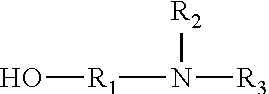
- the organic amine is encompassed by Formula II below:
- R 1 is an unsubstituted or substituted alkyl
- each of R 2 and R 3 is independently H or R—OH, where R is an unsubstituted or substituted alkyl.
- the organic amine comprises alkylamine, dialkylamine, trialkylamine, alkanolamine, or any combination thereof.
- the organic amine comprises methylamine, ethylamine, propylamine, isopropylamine, butylamine, dimethylamine, diethylamine, diisopropylamine, ethylmethylamine, butylmethylamine, propylethylamine trimethylamine, triethylamine, ethyldimethyllamine, tributylamine, monoethanolamine (MEA), diethanolamine (DEA), triethanolamine (TEA), 3-amino-1-propanol, 2-dimethylaminoethanol, tris(hydroxymethyl)aminomethane (Tris), or any combination thereof.
- the organic amine can be present in any suitable amount.
- the organic amine can be present in an amount of from about 0.005 wt. % to about 6 wt. %, such as from about 0.04 wt. % to about 5 wt. %, e.g., from about 0.08 wt. % to about 4 wt. %, from about 0.1 wt. % to about 3.5 wt. %, or from about 0.12 wt. % to about 3 wt. %.
- the precise amount of the organic amine is tailored to be in keeping with the desired weight ratio of the quaternary ammonium hydroxide to the organic amine as described herein.
- the organic amine is present in a concentrate form in an amount of from about 0.25 wt. % to about 6 wt. %, e.g., from about 0.25 wt. % to about 5 wt. %, from about 0.25 wt. % to about 4 wt. %, from about 0.25 wt. % to about 3.5 wt. %, from about 0.25 wt. % to about 3 wt. %, from about 0.25 wt. % to about 2.5 wt. %, from about 0.25 wt. % to about 2 wt. %, from about 0.5 wt. % to about 6 wt.
- % from about 0.5 wt. % to about 5 wt. %, from about 0.5 wt. % to about 4 wt. %, from about 0.5 wt. % to about 3.5 wt. %, from about 0.5 wt. % to about 3 wt. %, from about 0.5 wt. % to about 2.5 wt. %, from about 0.5 wt. % to about 2 wt. %, from about 1 wt. % to about 6 wt. %, from about 1 wt. % to about 5 wt. %, from about 1 wt. % to about 4 wt. %, from about 1 wt.
- % to about 3.5 wt. % from about 1 wt. % to about 3 wt. %, from about 1 wt. % to about 2.5 wt. %, from about 1 wt. % to about 2 wt. %, from about 2 wt. % to about 6 wt. %, from about 2 wt. % to about 5 wt. %, from about 2 wt. % to about 4 wt. %, from about 2 wt. % to about 3.5 wt. %, from about 2 wt. % to about 3 wt. %, or from about 2 wt. % to about 2.5 wt. %.
- the organic amine is present in a diluted form in an amount of from about 0.005 wt. % to about 0.12 wt. %, e.g., from about 0.005 wt. % to about 0.1 wt. %, from about 0.005 wt. % to about 0.08 wt. %, from about 0.005 wt. % to about 0.06 wt. %, from about 0.005 wt. % to about 0.04 wt. %, from about 0.01 wt. % to about 0.12 wt. %, e.g., from about 0.01 wt. % to about 0.1 wt.
- wt. % from about 0.01 wt. % to about 0.08 wt. %, from about 0.01 wt. % to about 0.06 wt. %, from about 0.01 wt. % to about 0.04 wt. %, from about 0.02 wt. % to about 0.12 wt. %, e.g., from about 0.02 wt. % to about 0.1 wt. %, from about 0.02 wt. % to about 0.08 wt. %, from about 0.02 wt. % to about 0.06 wt. %, from about 0.02 wt. % to about 0.04 wt. %, from about 0.03 wt.
- an alkanolamine is preferable with the lowest concentrations of monoalkanolamines and dialkanolamines being more preferable, and concentrations lower or equal to 13.0 mmole/L being particularly preferable to generate low corrosion.
- organic inhibitors in accordance with some embodiments desirably improve anti-corrosiveness and/or scavenge active oxygen from transition metal surfaces.
- the organic inhibitor is, alone or in combination, ascorbic acid (Asc), carbohydrazide (CHZ), or diethylhydroxylamine (DEHA) encompassed below by Formulas III-V, respectively:
- the organic inhibitor comprises catechol, hydroquinone (HQn), hydroquinone monomethyl ether (MEHQ), dimethylglyoxime (DMGO), methylethylketoxime (MEKO), ammonium sulfite, or any combination thereof.
- Dual inhibitors can be advantageous in some embodiments where one component serves as a chelating reducing agent for metal, such as copper, and the other component serves as an oxygen scavenger. Such combination is desirable in some embodiments because it provides higher cleaning performance and longer shelf-life for concentrated solutions.
- the chelating reducing agent comprises CHZ, Asc, DMGO, Dihydroxybenzoic acid (DHBA), gallic acid, polyphenols, tannic acid, or any combination thereof.
- DHBA Dihydroxybenzoic acid
- a combination of CHZ and DEHA is desired because it avoids or reduces the formation of byproducts during prolonged storage.
- Any suitable dual inhibitor that includes a combination of a chelating reducing inhibitor with a non-chelating active oxygen scavenger can be used to improve anti-corrosiveness to, e.g., copper wiring and cobalt liner or the like, and the ability to remove abrasive grains and other residues in some embodiments.
- the dual inhibitor can include, but is not limited to, CHZ/DEHA, Asc/DEHA, DMGO/DEHA, CHZ/MEKO, Asc/MEKO, DMGO/DEHA, CHZ/HQn, Asc/HQn, DMGO/HQn, CHZ/ammonium sulfite, Asc/ammonium sulfite, DMGO/ammonium sulfite, etc.
- the dual inhibitor comprises CHZ and DEHA.
- the organic inhibitor can be present in any suitable amount whether it is a sole inhibitor or in dual inhibitor form. In some embodiments, the organic inhibitor can be present in an amount of from about 0.002 wt. % to about 10 wt. %, such as from about 0.005 to about 5 wt. %, e.g., from about 0.2 wt. % to about 4 wt. %, from about 1 wt. % to about 3.5 wt. %, or from about 2 wt. % to about 3 wt. %. For example, in some embodiments, the organic inhibitor is in an amount of from about 0.002 wt. % to about 0.2 wt. % when in a diluted form. Additionally, in some embodiments, the organic inhibitor is in an amount of from about 0.1 wt. % to about 10 wt. % when in a concentrated form.
- CHZ is present in a diluted form in an amount that is from about 0.002 wt. % to about 0.12 wt. %, e.g., from about 0.002 wt. % to about 0.1 wt. %, from about 0.002 wt. % to about 0.08 wt. %, from about 0.002 wt. % to about 0.06 wt. %, from about 0.002 wt. % to about 0.04 wt. %, from about 0.002 wt. % to about 0.03 wt. %, from about 0.005 wt. % to about 0.12 wt.
- wt. % from about 0.005 wt. % to about 0.1 wt. %, from about 0.005 wt. % to about 0.08 wt. %, from about 0.005 wt. % to about 0.06 wt. %, from about 0.005 wt. % to about 0.04 wt. %, from about 0.005 wt. % to about 0.03 wt. %, from about 0.01 wt. % to about 0.12 wt. %, from about 0.01 wt. % to about 0.1 wt. %, from about 0.01 wt. % to about 0.08 wt. %, from about 0.01 wt.
- DEHA is present in a diluted form in an amount that is from about 0.002 wt. % to about 0.06 wt. %, e.g., from about 0.002 wt. % to about 0.04 wt. %, from about 0.002 wt. % to about 0.03 wt. %, from about 0.002 wt. % to about 0.02 wt. %, from about 0.002 wt.
- the inventive cleaning composition contains water, which can be present in any suitable amount.
- water can be present in the cleaning composition, as used to clean a substrate, in an amount of from about 99.5 wt. % to about 99.981 wt. %, e.g., from about 99.55 wt. % to about 99.981 wt. %, from about 99.6 wt. % to about 99.981 wt. %, from about 99.65 wt. % to about 99.981 wt. %, from about 99.7 wt. % to about 99.981 wt. %, from about 99.75 wt. % to about 99.981 wt.
- some amount of water could be included in some embodiments of the inventive cleaning composition, such as in an amount of from about 45 wt. % to about 99 wt. %, e.g., from about 50 wt. % to about 95 wt. %, from about 60 wt. % to about 90 wt. %, from about 70 wt. % to about 85 wt. %, or from about 75 wt. % to about 80 wt. %.
- Cleaning compositions according to the invention can include wetting agents, such as surfactants, as desired, e.g., nonionic surfactants, anionic surfactants, amino acid based surfactants, etc.
- the wetting agent can be 1,4-butane glycol, propylene glycol, or isopropanol.
- wetting agents include TRITONTM BG-10 (commercially available from available from the Dow Chemical Company, Lisle, Ill.), Sinopol 1110 (commercially available from Sino-Japan Chemical Co., Ltd., Taiwan, ROC), Sinonate 1100HP (commercially available from Sino-Japan Chemical Co., Ltd.) PERLASTANTM C (commercially available from Schill+Seilacher GmbH, Böblingen, Germany), and/or Serdolamine PPG 72 (commercially available from MSC, Jiangsu, ROC).
- Such wetting agents can be included in order to improve wettability on the insulator surface as well as to facilitate organic residue dissolution.
- the cleaning composition is preferably substantially free of some ingredients previously known in cleaning compositions, such as ascorbic acid and/or cysteine, which can be either difficult to remove by cleaning and/or unstable during storage, e.g., in highly basic solutions.
- the cleaning composition can optionally be substantially free of other ingredients, such as citric acid and oxalic acid.
- substantially free of such other ingredients means that the composition contains 0 wt. % based on the weight of the composition, or no such other hydraulic material, or an ineffective or immaterial amount of such other ingredients.
- An example of an ineffective amount is an amount below the threshold amount to achieve the intended purpose of using such ingredients, as one of ordinary skill in the art will appreciate.
- An immaterial amount may be, e.g., about 1 wt. % or less, about 0.5 wt. % or less, about 0.1 wt. % or less, or about 0.05 wt. % or less, based on the weight of the composition, depending on the ingredient, as one of ordinary skill in the art will appreciate.
- FIG. 1 While not wishing to be bound by any particular theory, representations 1-3 along the horizontal scheme are believed to illustrate a mechanism in accordance with embodiments of the invention. For comparison purposes, FIG. 1 also provides representations 1 and 4, along the vertical scheme, to illustrate a mechanism believed to be associated with conventional systems.
- the starting point depicted by the representation 1 illustrates copper as a base metal on a semiconductor wafer.
- Grain boundaries (x), (y), and (z) of the metal are shown schematically in FIG. 1 .
- grain boundaries it will be understood that metals have a polycrystal structure where each crystal is in the form of a grain. It is believed that more pronounced grain boundaries between crystals lead to a higher level of roughness, which is undesirable because conductivity is negatively impacted. It will also be seen that metal oxide (copper oxide in this case) forms by peroxide oxidation during CMP process.
- an inventive cleaning composition is applied to the wafer such that the bulky protecting ligand contacts the surface and is believed to react primarily with the most reactive sites thermodynamically on the substrate.
- grain boundaries where crystallinity is lower, can result in high surface energy due to the roughness associated with the grain boundaries.
- the bulky protecting ligand has desirable reaction kinetics, which allow it to react at rates either equivalent to or faster than those of the etchant.
- the bulky protecting ligand can react at a slower rate than the etchant, but, in such embodiments, to compensate the bulky protecting ligand can be included in higher molar concentration and outnumber an etchant.
- desired bulky protecting ligands contain functional groups (depicted as “F.G.”) that will attract to the high surface energy of the grain boundaries. Desired functional groups are characterized by nucleophilicity, metal, e.g., copper, ion affinity, chelation power, lability, and size (volume).
- Desired nucleophilicity can be characterized, e.g., by the Swain-Scott equation, the Ritchie equation, or the Mayr-Patz equation; metal ion affinity can be characterized, e.g., by the hard and soft (Lewis) acids and bases (HSAB) theory; chelation power can be characterized, e.g., by equilibrium constant for the dissociation reaction of a metal complex with a ligand of interest; and lability can be characterized, e.g., by how easily metal-ligand bonds are broken. Examples thereof can include —OH, —OR, RNH—, R 2 N—, H 2 NCH 2 CH 2 O—, C ⁇ O, carboxylic groups, phosphonic acid groups, morpholine derivatives and/or piperazine derivatives.
- the ligand is protecting because it interacts with metal ions, such as copper, on the conducting agent surface while replacing M-O (e.g., Cu—O) bonds with new M-ligand (e.g., Cu-ligand) bonds at the most reactive sites, such as grain boundaries, characterized by low crystallinity and/or elevated surface energy.
- M-O e.g., Cu—O
- new M-ligand e.g., Cu-ligand bonds at the most reactive sites, such as grain boundaries, characterized by low crystallinity and/or elevated surface energy.
- the protecting ligand serves to prevent preferable attack of an etchant on the most reactive sites (e.g., grain boundaries, scratches etc.), such that the organic amine can then provide improved uniform etching, e.g., substantially uniform.
- Representation 3 illustrates the metal surface after cleaning has taken place.
- the organic amine e.g., MEA
- the small chelating etchant (depicted as “A”), which is preferably included in equal or a lower concentration relative to the protecting ligand, is drawn to the substrate to etch the surface substantially uniformly.
- [O] basic solution refers to possible further oxidation of Cu(0) and copper I by molecular oxygen in high pH basic solution. It is believed that, generally, the number of reactive sites constitutes a very small area compared to the entire surface of the semiconductor wafer.
- the organic amine as the small chelating etchant is able to contact the conducting agent surface between the reactive sites or start displacing the labile ligand, which is believed to form a barrier for the organic amine.
- Undercutting of copper oxide layer is believed to occur by way of interacting with an etchant and dissolution of adducts of amine molecules with copper ions and/or mixed ligand adducts of an amine and protecting ligand molecules with copper ions due to uniform surface etching action without preferable attack of organic amine on the most reactive sites, such as grain boundaries and defects, such as scratches.
- the vertical scheme resulting in representation 4 illustrates a mechanism believed to be associated with conventional systems.
- anisotropic etching refers to non-uniform etching of a conducting agent surface due to preferable attack on the most reactive sites, which leads to much higher surface roughness and poor cleaning performance.
- the mechanism resulting in representation 4 is believed to generate a higher roughness (e.g., 6-8 ⁇ ) which can compromise wafer performance, particularly in advanced node applications.
- the invention also provides a cleaning method.
- the cleaning method comprises, consists of, or consists essentially of (a) providing a semiconductor wafer having contaminants resulting from chemical-mechanical polishing of the semiconductor wafer and (b) contacting the surface of the semiconductor wafer with a cleaning composition to remove at least some of the contaminants from the surface of the semiconductor wafer.
- the contaminants can include, for example, abrasive particles, organic residue, metal ions, pad debris and CMP-byproducts, or any combination thereof.
- the wafer can include a low-k dielectric material and/or metal conductors in various embodiments.
- the invention further provides a method for polishing and cleaning the surface of a semiconductor wafer.
- the method comprises, consists of, or consists essentially of: (a) providing a polishing pad, a chemical-mechanical polishing composition, and a semiconductor wafer; (b) contacting the semiconductor wafer with the polishing pad and the polishing composition; (c) moving the polishing pad relative to a surface of the semiconductor wafer with the polishing composition therebetween to abrade the surface of the semiconductor wafer and thereby polish the surface of the wafer such that the polished surface of the wafer contains contaminants from the chemical-mechanical polishing composition; and (d) contacting the polished surface of the semiconductor wafer that contains contaminants with a cleaning composition as described herein to remove at least some of the contaminants from the polished surface of the semiconductor wafer.
- a chemical-mechanical polishing composition will be utilized in the polishing of a semiconductor wafer with a polishing pad, such that the inventive method of polishing and cleaning a semiconductor wafer further comprises providing a chemical-mechanical polishing composition between the polishing pad and the semiconductor wafer, contacting the semiconductor wafer with the polishing pad with the polishing composition therebetween, and moving the polishing pad relative to the semiconductor wafer with the polishing composition therebetween to abrade the semiconductor wafer and thereby polish the semiconductor wafer.
- the invention is not limited by the polishing composition, which can be any suitable polishing composition as known in the art. Additionally, the invention is not limited by the CMP apparatus and polishing pad used during polishing, which can be any suitable CMP apparatus and polishing pad, many of which are known in the art.
- chemical-mechanical polishing apparatus comprises (a) a platen that rotates; (b) a polishing pad disposed on the platen; and (c) a carrier that holds a semiconductor wafer to be polished by contacting the rotating polishing pad.
- the apparatus further comprises (d) means for delivering a chemical-mechanical polishing composition between the polishing pad and the semiconductor wafer.
- the means for delivering the chemical-mechanical polishing composition can include, for example, a pump and flow metering system.
- This Example illustrates the use of cleaning compositions prepared in accordance with embodiments of the invention after chemical-mechanical polishing (“CMP”) has taken place on a wafer substrate containing copper.
- CMP chemical-mechanical polishing
- blanket wafers (i.e., without any patterns) containing copper were subjected to platen-2 (“P2”) copper polishing as understood in the art using a polishing composition commercially available as C8902 from Cabot Microelectronics (Aurora, Ill.).
- a polishing pad commercially identified as D100/(20WX80P)/WIN (5558) available from Cabot Microelectronics was used after conditioning with a product commercially identified as I-PDA33A-3, Kinik Co., San Jose, Calif.
- P3 platen-3
- B7002-1 platen-3
- BTA benzotriazole
- Polishing was performed on a MIRRATM CMP apparatus (Applied Materials, Inc., Santa Clara, Calif.) with standard polishing parameters.
- compositions 1A-1E Five cleaning compositions, designated Compositions 1A-1E, were prepared with different amounts of tris(2-hydroxyethyl)methylammonium hydroxide (“THEMAH”), monoethanolamine (“MEA”), and carbohydrazide (“CHZ”) as recited in Table 1, along with deionized water.
- THEMAH tris(2-hydroxyethyl)methylammonium hydroxide
- MEA monoethanolamine
- CHZ carbohydrazide
- compositions 1A-1E were used to clean the polished wafer substrates. Cleaning was performed with the help of an ONTRAKTM DSS200 Integra tool commercially available from Applied Materials, Inc. After cleaning, the wafer substrates were evaluated, with the results shown in Table 2 and FIG. 2 .
- the number of defects on copper and BLACK DIAMONDTM (“BD-I”) (commercially available from Applied Materials, Inc.) associated with each composition were determined based on observation of optical laser microscopy, using the Surfscan SP1 DLS wafer inspection system and the KLARITYTM Defect analysis module (both commercially available from KLA Tencor, Milpitas, Calif.). Defects were measured with a threshold of 0.25 ⁇ m for copper and 0.225 ⁇ m for BD-I.
- FIG. 2 reflects the level of cleaning based on the combined total of copper and BD-I defects as represented by the “Total Defects” column in Table 2.
- the corrosion measurements are subjective, based on lab excessive etching test (20 min) with SEM visual rating, using a scale of 1-10, where 1 equals the best (DI water) and 10 equals the worst. Roughness is set forth as the arithmetic mean value (Ra).
- Embodiments of the invention provide benefits with respect to the number of copper and/or BD-I defects; roughness; and/or corrosion rating.
- embodiments of the invention provide good results in at least two of the aforesaid categories. The best results were observed when the cleaning composition contained a lower amount of an organic amine (MEA in this Example) than the amount of the protecting ligand in the form of a quaternary ammonium hydroxide (THEMAH in this Example); however, in some embodiments, equal amounts of both can be suitable.
- MEA organic amine
- TEMAH quaternary ammonium hydroxide
- composition 1A had an undesirably high corrosion rating, high total defects, and high roughness value, while composition 1B, despite having a low roughness value, undesirably generated both high defects and a high corrosion rating.
- composition 1B desirably realized low defects and a low roughness value despite a relatively high corrosion rating.
- composition 1D produced a high defect count, it desirably generated an exceptional corrosion rating and low roughness value.
- Composition 1E generated a high cleaning efficiency (low copper and BD-I defects) as well as low roughness and low corrosion.
- This Example illustrates the benefit of using a cleaning composition prepared in accordance with embodiments of the invention in comparison with two conventional commercially available cleaning compositions after chemical-mechanical polishing (“CMP”) has taken place on a wafer substrate containing copper.
- CMP chemical-mechanical polishing
- blanket wafers containing copper and low dielectric organic film in the form of BD-I were subjected to platen-2 (“P2”) and platen-3 (“P3”) polishing as described in Example 1.
- Polishing was performed on a MIRRATM CMP apparatus with standard polishing parameters.
- Table 3 illustrates the results of the tested cleaning compositions.
- the number of copper defects and low dielectric organic film defects (BD-I) associated with each composition are noted based on observation of optical laser microscopy, using the Surfscan SP1 DLS wafer inspection system and the KLARITYTM Defect analysis module. Defects were measured with a threshold of 0.25 ⁇ m for copper and 0.225 ⁇ m for BD-I.
- the corrosion measurements were subjective, based on lab excessive etching test (20 min) with SEM visual rating, using a scale of 1-10, where 1 equals the best and 10 equals the worst.
- the data for the number of defects in Table 3 is normalized to the number of defects observed for composition 2A, set to be 100.
- composition 1E was prepared in accordance with Example 1.
- Comparative compositions 2A and 2B are commercially available as PLANARCLEANTM and ESC-784TM, respectively, both from ATMI (Danbury, Conn.).
- embodiments of the invention provide benefits with respect to the number of copper and/or low-k defects; roughness; and/or corrosion rating. Preferably, embodiments of the invention provide good results in at least two of the aforesaid categories.
- Composition 2A while demonstrating a low roughness value and a low corrosion rating, undesirably generated high copper and low-k defects.
- composition 2B generated low total defects, it undesirably demonstrated a high roughness value and high corrosion rating.
- composition 1E generated low copper and low-k defects as well as low roughness and low corrosion.
- This Example illustrates the benefit of using a cleaning composition with dual inhibitor prepared in accordance with embodiments of the invention after CMP has been carried out on a wafer substrate containing copper.
- blanket wafers containing copper were subjected to platen-2 (“P2”) and platen-3 (“P3”) polishing as described in Example 1.
- Polishing was performed on a REFLEXION LKTM CMP apparatus (Applied Materials, Inc.) with standard polishing parameters.
- Table 4 illustrates the cleaning compositions prepared in accordance with embodiments of the invention, including the amounts of tris(2-hydroxyethyl)methylammonium hydroxide (“THEMAH”), monoethanolamine (“MEA”), diethylhydroxylamine (“DEHA”), and carbohydrazide (“CHZ”) in the formulations. Each composition was diluted in-line by 50 times.
- Composition 1E was prepared in accordance with Example 1.
- Table 5 illustrates the results of the tested cleaning compositions. Defects were measured by optical laser microscopy, using the Surfscan SP1 DLS wafer inspection system and the KLARITYTM Defect analysis module with a threshold of 0.25 ⁇ m for copper and 0.225 ⁇ m for BD-I.
- the “Standard Deviation” represents the amount of variation that exists from the average; the “Particle” column refers to the number of abrasive particles not removed during the cleaning process; and the “Residue” column refers to the amount of organic material (including chemicals and pad debris) not removed during the cleaning process.
- composition 3D which comprised a “dual inhibitor” (CHZ and DEHA), demonstrated significantly improved control of copper defects over compositions 1E-3B, which comprised no inhibitor, only CHZ, and only DEHA, respectively.
- composition 3A which did not comprise inhibitors, demonstrated considerably high copper defects.
- Composition 3D furthermore, showed a considerable reduction in both the number of abrasive particles and the amount of organic material remaining after post-CMP cleaning.
- Table 6 below illustrates the positive effect of the dual inhibitor concentration CHZ/DEHA on anti-corrosiveness of copper wiring and cobalt liner.
- the corrosion potential (Ecorr) and corrosion current density (Icorr) for copper wiring and cobalt liner were measured by electrochemical analysis performed with SP300 with mercury standard electrode from (Bio-Logic Science Instruments, Claix, France).
Landscapes
- Chemical & Material Sciences (AREA)
- Life Sciences & Earth Sciences (AREA)
- Organic Chemistry (AREA)
- Chemical Kinetics & Catalysis (AREA)
- Oil, Petroleum & Natural Gas (AREA)
- Wood Science & Technology (AREA)
- Engineering & Computer Science (AREA)
- Health & Medical Sciences (AREA)
- Emergency Medicine (AREA)
- Inorganic Chemistry (AREA)
- Molecular Biology (AREA)
- Biochemistry (AREA)
- Cleaning Or Drying Semiconductors (AREA)
- Detergent Compositions (AREA)
- Mechanical Treatment Of Semiconductor (AREA)
Abstract
Description

where each of R1, R2, R3, and R4 is independently an alkyl, which may be substituted or unsubstituted. As used herein throughout, the term “alkyl” means a straight-chain or branched alkyl substituent containing from, for example, 1 to about 20 carbon atoms, 1 to about 10 carbon atoms, 1 to about 6 carbon atoms, 1 to about 4 carbon atoms, or 1 to about 2 carbon atoms. Examples of such substituents include methyl, ethyl, propyl, isopropyl, n-butyl, sec-butyl, isobutyl, tert-butyl, pentyl, isoamyl, hexyl, and the like. As used herein and throughout, it will be understood that the term “alkyl” can be unsubstituted or can include substituents that can be substituted in some embodiments with, for example, halo, amino, alkylamino, dialkylamino, alkoxy, aryloxy, or hydroxy.

wherein R1 is an unsubstituted or substituted alkyl, and each of R2 and R3 is independently H or R—OH, where R is an unsubstituted or substituted alkyl.

| TABLE 1 | |||
| Composition | THEMAH (wt. %) | MEA (wt. %) | CHZ (wt. %) |
| 1A | 3.5 | 6 | 1.5 |
| |
2 | 4 | 1.5 |
| 1C | 5 | 4 | 1.5 |
| |
2 | 2 | 1.5 |
| 1E | 5 | 2 | 1.5 |
| TABLE 2 | |||||
| Copper (Cu) | BD | Total | Roughness | Corrosion | |
| Composition | Defects | Defects | Defects | (Å) | Rating |
| 1A | 239 | 490 | 729 | 3.7 | 8 |
| 1B | 380 | 553 | 933 | 2.8 | 5 |
| 1C | 350 | 241 | 591 | 2.6 | 6 |
| 1D | 728 | 441 | 1169 | 2.8 | 2 |
| 1E | 302 | 171 | 473 | 2.4 | 2-3 |
| TABLE 3 | |||||
| Compo- | Defects | Defects | Corrosion | Roughness | |
| sition | Components | Cu | BD-I | Rating | (Å) |
| 1E | THEMAH, MEA | 37 | 32 | 2 | 1.5-2.5 |
| 2A | TMAH, MEA | 100 | 100 | 1-2 | 2-3 |
| (Compar- | (low con- | ||||
| ative) | centration) | ||||
| 2B | TMAH, MEA | 38 | 30 | 8-9 | 6-7 |
| (Compar- | (high con- | ||||
| ative) | centration) | ||||
| TABLE 4 | ||||
| THEMAH | MEA | DEHA | CHZ | |
| Composition | (wt. %) | (wt. %) | (wt. %) | (wt. %) |
| 1E | 5 | 2 | 0 | 1.5 |
| 3A | 5 | 2 | 0 | 0 |
| 3B | 5 | 2 | 3.0 | 0 |
| 3C | 5 | 2 | 1.5 | 1.5 |
| 3D | 5 | 2 | 0.5 | 1.5 |
| TABLE 5 | |||||
| Defect | |||||
| Type and | Number | ||||
| Amount of | DCO | Standard | |||
| Composition | Inhibitor | 0.25 μm | Deviation | Particle | Residue |
| 1E | 1.5% CHZ only | 877 | 128 | 446 | 375 |
| 3A | None | 1170 | 126 | 654 | 451 |
| 3B | 3.0% DEHA | 908 | 92 | 494 | 276 |
| only | |||||
| 3C | 1.5% CHZ and | 307 | 12 | 144 | 79 |
| 1.5% DEHA | |||||
| 3D | 1.5% CHZ and | 193 | 29 | 97 | 30 |
| 0.5% DEHA | |||||
| TABLE 6 | ||||
| Ecorr | Ecorr | |||
| (mV) | Icorr | (mV) | Icorr | |
| Composition | Co | (μA) Co | Cu | (μA) Cu |
| 1E | −652 | 4.18 | −658 | 9.05 |
| 3A | −593 | 22.13 | −595 | 10.1 |
| 3B | −597 | 16.8 | −631 | 4.66 |
| 3D | −683 | 2.38 | −645 | 6.61 |
Claims (28)


Priority Applications (1)
| Application Number | Priority Date | Filing Date | Title |
|---|---|---|---|
| US15/327,326 US10100272B2 (en) | 2014-07-18 | 2015-07-17 | Cleaning composition following CMP and methods related thereto |
Applications Claiming Priority (3)
| Application Number | Priority Date | Filing Date | Title |
|---|---|---|---|
| US201462026069P | 2014-07-18 | 2014-07-18 | |
| US15/327,326 US10100272B2 (en) | 2014-07-18 | 2015-07-17 | Cleaning composition following CMP and methods related thereto |
| PCT/US2015/040873 WO2016011331A1 (en) | 2014-07-18 | 2015-07-17 | Cleaning composition following cmp and methods related thereto |
Publications (2)
| Publication Number | Publication Date |
|---|---|
| US20170158992A1 US20170158992A1 (en) | 2017-06-08 |
| US10100272B2 true US10100272B2 (en) | 2018-10-16 |
Family
ID=55079078
Family Applications (1)
| Application Number | Title | Priority Date | Filing Date |
|---|---|---|---|
| US15/327,326 Active US10100272B2 (en) | 2014-07-18 | 2015-07-17 | Cleaning composition following CMP and methods related thereto |
Country Status (7)
| Country | Link |
|---|---|
| US (1) | US10100272B2 (en) |
| EP (1) | EP3169765B1 (en) |
| JP (1) | JP6568198B2 (en) |
| KR (1) | KR102399218B1 (en) |
| CN (1) | CN106661518B (en) |
| TW (1) | TWI551681B (en) |
| WO (1) | WO2016011331A1 (en) |
Cited By (1)
| Publication number | Priority date | Publication date | Assignee | Title |
|---|---|---|---|---|
| US12655367B2 (en) | 2022-07-05 | 2026-06-16 | Fujifilm Electronic Materials U.S.A., Inc. | Cleaning compositions |
Families Citing this family (15)
| Publication number | Priority date | Publication date | Assignee | Title |
|---|---|---|---|---|
| WO2018075409A2 (en) * | 2016-10-17 | 2018-04-26 | Cabot Microelectronics Corporation | Cmp compositions selective for oxide and nitride with improved dishing and pattern selectivity |
| KR101789251B1 (en) * | 2017-03-17 | 2017-10-26 | 영창케미칼 주식회사 | Composition for post chemical mechanical polishing cleaning |
| WO2018169016A1 (en) * | 2017-03-17 | 2018-09-20 | 三菱ケミカル株式会社 | Cleaning agent composition for substrate for semiconductor devices, method for cleaning substrate for semiconductor devices, method for producing substrate for semiconductor devices, and substrate for semiconductor devices |
| US10832917B2 (en) | 2017-06-09 | 2020-11-10 | International Business Machines Corporation | Low oxygen cleaning for CMP equipment |
| KR20190094927A (en) * | 2018-02-06 | 2019-08-14 | 동우 화인켐 주식회사 | Etching residue cleaning composition and method of forming conductive pattern using the same |
| KR20240167944A (en) | 2018-07-20 | 2024-11-28 | 엔테그리스, 아이엔씨. | Cleaning composition with corrosion inhibitor |
| JP7759807B2 (en) | 2018-12-21 | 2025-10-24 | インテグリス・インコーポレーテッド | Compositions and methods for post-CMP cleaning of cobalt substrates |
| WO2021054010A1 (en) * | 2019-09-18 | 2021-03-25 | 富士フイルムエレクトロニクスマテリアルズ株式会社 | Cleaning solution and cleaning method |
| WO2021131452A1 (en) * | 2019-12-26 | 2021-07-01 | 富士フイルムエレクトロニクスマテリアルズ株式会社 | Cleaning solution and cleaning method |
| WO2022221497A1 (en) * | 2021-04-16 | 2022-10-20 | Entegris, Inc. | Cleaning composition |
| CN116004332B (en) * | 2022-01-24 | 2024-05-10 | 云南鑫耀半导体材料有限公司 | Method for cleaning adhesive on back of rough polished germanium wafer |
| EP4493664A4 (en) * | 2022-03-15 | 2026-03-11 | Entegris Inc | Microelectronic device cleaning composition |
| JP7290195B1 (en) * | 2022-10-19 | 2023-06-13 | Jsr株式会社 | Semiconductor processing composition and method |
| CN121548628A (en) * | 2023-06-20 | 2026-02-17 | 巴斯夫欧洲公司 | Alkaline compositions for cleaning substrates containing cobalt and copper, their uses and methods |
| US20250277171A1 (en) * | 2024-02-29 | 2025-09-04 | Entegris, Inc. | Composition for post-cmp cleaning |
Citations (10)
| Publication number | Priority date | Publication date | Assignee | Title |
|---|---|---|---|---|
| US5209858A (en) | 1991-02-06 | 1993-05-11 | E. I. Du Pont De Nemours And Company | Stabilization of choline and its derivatives against discoloration |
| WO2001040425A2 (en) | 1999-11-16 | 2001-06-07 | Esc, Inc. | Post chemical-mechanical planarization (cmp) cleaning composition |
| US20080076688A1 (en) | 2006-09-21 | 2008-03-27 | Barnes Jeffrey A | Copper passivating post-chemical mechanical polishing cleaning composition and method of use |
| US20090133716A1 (en) | 2007-10-29 | 2009-05-28 | Wai Mun Lee | Methods of post chemical mechanical polishing and wafer cleaning using amidoxime compositions |
| US20090162537A1 (en) | 2007-12-21 | 2009-06-25 | Artur Kolics | Post-deposition cleaning methods and formulations for substrates with cap layers |
| US20090203566A1 (en) * | 2002-06-06 | 2009-08-13 | Wai Mun Lee | Semi Conductor Process Residue Removal Composition and Process |
| US20090281017A1 (en) | 2008-05-12 | 2009-11-12 | Tomoco Suzuki | Cleaning Composition |
| US20100043823A1 (en) | 2007-10-29 | 2010-02-25 | Wai Mun Lee | Methods of cleaning semiconductor devices at the back end of line using amidoxime comositions |
| US7919446B1 (en) | 2007-12-28 | 2011-04-05 | Intermolecular, Inc. | Post-CMP cleaning compositions and methods of using same |
| US20140076365A1 (en) | 2012-09-17 | 2014-03-20 | Ekc Technology, Inc. | Cleaning composition and method for cleaning a semiconductor device substrate after chemical mechanical polishing |
Family Cites Families (10)
| Publication number | Priority date | Publication date | Assignee | Title |
|---|---|---|---|---|
| US6395693B1 (en) * | 1999-09-27 | 2002-05-28 | Cabot Microelectronics Corporation | Cleaning solution for semiconductor surfaces following chemical-mechanical polishing |
| US6492308B1 (en) * | 1999-11-16 | 2002-12-10 | Esc, Inc. | Post chemical-mechanical planarization (CMP) cleaning composition |
| US6723691B2 (en) * | 1999-11-16 | 2004-04-20 | Advanced Technology Materials, Inc. | Post chemical-mechanical planarization (CMP) cleaning composition |
| US8338087B2 (en) * | 2004-03-03 | 2012-12-25 | Advanced Technology Materials, Inc | Composition and process for post-etch removal of photoresist and/or sacrificial anti-reflective material deposited on a substrate |
| US8361237B2 (en) * | 2008-12-17 | 2013-01-29 | Air Products And Chemicals, Inc. | Wet clean compositions for CoWP and porous dielectrics |
| TWI454561B (en) * | 2008-12-30 | 2014-10-01 | Uwiz Technology Co Ltd | A polishing composition for planarizing the metal layer |
| JP2010174074A (en) * | 2009-01-27 | 2010-08-12 | Sanyo Chem Ind Ltd | Cleaning agent for copper-wired semiconductor |
| KR102237745B1 (en) * | 2013-03-15 | 2021-04-09 | 캐보트 마이크로일렉트로닉스 코포레이션 | Aqueous cleaning composition for post copper chemical mechanical planarization |
| EP3169744A1 (en) * | 2014-07-18 | 2017-05-24 | Cabot Microelectronics Corporation | Stabilization of tris(2-hydroxyethyl( methylammonium hydroxide against decomposition with dialkyhydroxylamine |
| US9828574B2 (en) * | 2015-01-13 | 2017-11-28 | Cabot Microelectronics Corporation | Cleaning composition and method for cleaning semiconductor wafers after CMP |
-
2015
- 2015-07-17 CN CN201580039131.3A patent/CN106661518B/en active Active
- 2015-07-17 TW TW104123295A patent/TWI551681B/en active
- 2015-07-17 EP EP15822685.2A patent/EP3169765B1/en active Active
- 2015-07-17 US US15/327,326 patent/US10100272B2/en active Active
- 2015-07-17 KR KR1020177004145A patent/KR102399218B1/en active Active
- 2015-07-17 WO PCT/US2015/040873 patent/WO2016011331A1/en not_active Ceased
- 2015-07-17 JP JP2017502800A patent/JP6568198B2/en active Active
Patent Citations (12)
| Publication number | Priority date | Publication date | Assignee | Title |
|---|---|---|---|---|
| US5209858A (en) | 1991-02-06 | 1993-05-11 | E. I. Du Pont De Nemours And Company | Stabilization of choline and its derivatives against discoloration |
| WO2001040425A2 (en) | 1999-11-16 | 2001-06-07 | Esc, Inc. | Post chemical-mechanical planarization (cmp) cleaning composition |
| US20090203566A1 (en) * | 2002-06-06 | 2009-08-13 | Wai Mun Lee | Semi Conductor Process Residue Removal Composition and Process |
| US20080076688A1 (en) | 2006-09-21 | 2008-03-27 | Barnes Jeffrey A | Copper passivating post-chemical mechanical polishing cleaning composition and method of use |
| US20090133716A1 (en) | 2007-10-29 | 2009-05-28 | Wai Mun Lee | Methods of post chemical mechanical polishing and wafer cleaning using amidoxime compositions |
| US20100043823A1 (en) | 2007-10-29 | 2010-02-25 | Wai Mun Lee | Methods of cleaning semiconductor devices at the back end of line using amidoxime comositions |
| US20090162537A1 (en) | 2007-12-21 | 2009-06-25 | Artur Kolics | Post-deposition cleaning methods and formulations for substrates with cap layers |
| US20130323410A1 (en) * | 2007-12-21 | 2013-12-05 | Lam Research Corporation | Post-deposition cleaning methods and formulations for substrates with cap layers |
| US7919446B1 (en) | 2007-12-28 | 2011-04-05 | Intermolecular, Inc. | Post-CMP cleaning compositions and methods of using same |
| US20090281017A1 (en) | 2008-05-12 | 2009-11-12 | Tomoco Suzuki | Cleaning Composition |
| US7825079B2 (en) | 2008-05-12 | 2010-11-02 | Ekc Technology, Inc. | Cleaning composition comprising a chelant and quaternary ammonium hydroxide mixture |
| US20140076365A1 (en) | 2012-09-17 | 2014-03-20 | Ekc Technology, Inc. | Cleaning composition and method for cleaning a semiconductor device substrate after chemical mechanical polishing |
Non-Patent Citations (3)
| Title |
|---|
| European Patent Office, Supplementary European Search Report issued in connection with Patent Application No. 15822685 dated Feb. 23, 2018. |
| Korean Intellectual Property Office, International Search Report issued in connection with Application No. PCT/US2015/040871 dated Oct. 22, 2015. |
| Korean Intellectual Property Office, International Search Report issued in connection with Application No. PCT/US2015/040873 dated Nov. 30, 2015. |
Cited By (1)
| Publication number | Priority date | Publication date | Assignee | Title |
|---|---|---|---|---|
| US12655367B2 (en) | 2022-07-05 | 2026-06-16 | Fujifilm Electronic Materials U.S.A., Inc. | Cleaning compositions |
Also Published As
| Publication number | Publication date |
|---|---|
| EP3169765A4 (en) | 2018-03-28 |
| JP6568198B2 (en) | 2019-08-28 |
| EP3169765A1 (en) | 2017-05-24 |
| EP3169765B1 (en) | 2020-08-19 |
| US20170158992A1 (en) | 2017-06-08 |
| KR20170032397A (en) | 2017-03-22 |
| CN106661518A (en) | 2017-05-10 |
| JP2017524249A (en) | 2017-08-24 |
| CN106661518B (en) | 2020-01-14 |
| TW201612305A (en) | 2016-04-01 |
| TWI551681B (en) | 2016-10-01 |
| KR102399218B1 (en) | 2022-05-19 |
| WO2016011331A1 (en) | 2016-01-21 |
Similar Documents
| Publication | Publication Date | Title |
|---|---|---|
| EP3169765B1 (en) | Cleaning composition following cmp and methods related thereto | |
| EP3245668B1 (en) | Cleaning composition and method for cleaning semiconductor wafers after cmp | |
| TWI726859B (en) | Post chemical mechanical polishing formulations and method of use | |
| TWI718742B (en) | Post cmp cleaning composition | |
| US12588450B2 (en) | Post-CMP cleaning liquid comprising a substituted benzene anticorrosive agent, chelant, and amine compound | |
| EP1577934A1 (en) | Alkaline post-chemical mechanical planarization cleaning compositions | |
| US20080076688A1 (en) | Copper passivating post-chemical mechanical polishing cleaning composition and method of use | |
| US20090130849A1 (en) | Chemical mechanical polishing and wafer cleaning composition comprising amidoxime compounds and associated method for use | |
| CN114945649B (en) | Polishing composition and method of using the same | |
| US11066627B2 (en) | Cleaning agent composition for semiconductor device substrate, method of cleaning semiconductor device substrate, method of manufacturing semiconductor device substrate, and semiconductor device substrate | |
| JP7340614B2 (en) | cleaning method | |
| WO2023182142A1 (en) | Composition, semiconductor-element manufacturing method, and semiconductor-substrate washing method | |
| CN116368263A (en) | Polishing compositions and methods of use thereof | |
| KR102605200B1 (en) | Composition, manufacturing method of semiconductor device | |
| US6673757B1 (en) | Process for removing contaminant from a surface and composition useful therefor | |
| US20170158993A1 (en) | Stabilization of tris(2 hydroxyethyl)methylammonium hydroxide against decomposition with dialkyhydroxylamine | |
| WO2020255581A1 (en) | Polishing fluid and chemical mechanical polishing method | |
| WO2020255602A1 (en) | Polishing solution and chemical-mechanical polishing method | |
| KR20250100639A (en) | Cleaning solution and method for cleaning substrates | |
| US20250257286A1 (en) | Cleaning compositions and methods of use thereof | |
| EP2687589A2 (en) | Copper passivating post-chemical mechanical polishing cleaning composition and method of use | |
| KR102230869B1 (en) | Cleaner composition | |
| WO2021186241A1 (en) | Cleaning composition for post chemical mechanical planarization and method of using the same |
Legal Events
| Date | Code | Title | Description |
|---|---|---|---|
| AS | Assignment |
Owner name: CABOT MICROELECTRONICS CORPORATION, ILLINOIS Free format text: ASSIGNMENT OF ASSIGNORS INTEREST;ASSIGNORS:IVANOV, ROMAN;KO, CHENG-YUAN;SUN, FRED;SIGNING DATES FROM 20150202 TO 20150203;REEL/FRAME:043067/0053 |
|
| STCF | Information on status: patent grant |
Free format text: PATENTED CASE |
|
| AS | Assignment |
Owner name: JPMORGAN CHASE BANK, N.A., ILLINOIS Free format text: SECURITY AGREEMENT;ASSIGNORS:CABOT MICROELECTRONICS CORPORATION;QED TECHNOLOGIES INTERNATIONAL, INC.;FLOWCHEM LLC;AND OTHERS;REEL/FRAME:047588/0263 Effective date: 20181115 |
|
| AS | Assignment |
Owner name: CMC MATERIALS, INC., ILLINOIS Free format text: CHANGE OF NAME;ASSIGNOR:CABOT MICROELECTRONICS CORPORATION;REEL/FRAME:054980/0681 Effective date: 20201001 |
|
| MAFP | Maintenance fee payment |
Free format text: PAYMENT OF MAINTENANCE FEE, 4TH YEAR, LARGE ENTITY (ORIGINAL EVENT CODE: M1551); ENTITY STATUS OF PATENT OWNER: LARGE ENTITY Year of fee payment: 4 |
|
| AS | Assignment |
Owner name: CMC MATERIALS, INC., ILLINOIS Free format text: RELEASE BY SECURED PARTY;ASSIGNOR:JPMORGAN CHASE BANK, N.A.;REEL/FRAME:060592/0260 Effective date: 20220706 Owner name: INTERNATIONAL TEST SOLUTIONS, LLC, ILLINOIS Free format text: RELEASE BY SECURED PARTY;ASSIGNOR:JPMORGAN CHASE BANK, N.A.;REEL/FRAME:060592/0260 Effective date: 20220706 Owner name: SEALWELD (USA), INC., TEXAS Free format text: RELEASE BY SECURED PARTY;ASSIGNOR:JPMORGAN CHASE BANK, N.A.;REEL/FRAME:060592/0260 Effective date: 20220706 Owner name: MPOWER SPECIALTY CHEMICALS LLC, TEXAS Free format text: RELEASE BY SECURED PARTY;ASSIGNOR:JPMORGAN CHASE BANK, N.A.;REEL/FRAME:060592/0260 Effective date: 20220706 Owner name: KMG-BERNUTH, INC., TEXAS Free format text: RELEASE BY SECURED PARTY;ASSIGNOR:JPMORGAN CHASE BANK, N.A.;REEL/FRAME:060592/0260 Effective date: 20220706 Owner name: KMG ELECTRONIC CHEMICALS, INC., TEXAS Free format text: RELEASE BY SECURED PARTY;ASSIGNOR:JPMORGAN CHASE BANK, N.A.;REEL/FRAME:060592/0260 Effective date: 20220706 Owner name: FLOWCHEM LLC, TEXAS Free format text: RELEASE BY SECURED PARTY;ASSIGNOR:JPMORGAN CHASE BANK, N.A.;REEL/FRAME:060592/0260 Effective date: 20220706 Owner name: QED TECHNOLOGIES INTERNATIONAL, INC., NEW YORK Free format text: RELEASE BY SECURED PARTY;ASSIGNOR:JPMORGAN CHASE BANK, N.A.;REEL/FRAME:060592/0260 Effective date: 20220706 Owner name: CABOT MICROELECTRONICS CORPORATION, ILLINOIS Free format text: RELEASE BY SECURED PARTY;ASSIGNOR:JPMORGAN CHASE BANK, N.A.;REEL/FRAME:060592/0260 Effective date: 20220706 Owner name: CABOT MICROELECTRONICS CORPORATION, ILLINOIS Free format text: RELEASE OF SECURITY INTEREST;ASSIGNOR:JPMORGAN CHASE BANK, N.A.;REEL/FRAME:060592/0260 Effective date: 20220706 Owner name: QED TECHNOLOGIES INTERNATIONAL, INC., NEW YORK Free format text: RELEASE OF SECURITY INTEREST;ASSIGNOR:JPMORGAN CHASE BANK, N.A.;REEL/FRAME:060592/0260 Effective date: 20220706 Owner name: FLOWCHEM LLC, TEXAS Free format text: RELEASE OF SECURITY INTEREST;ASSIGNOR:JPMORGAN CHASE BANK, N.A.;REEL/FRAME:060592/0260 Effective date: 20220706 Owner name: KMG ELECTRONIC CHEMICALS, INC., TEXAS Free format text: RELEASE OF SECURITY INTEREST;ASSIGNOR:JPMORGAN CHASE BANK, N.A.;REEL/FRAME:060592/0260 Effective date: 20220706 Owner name: KMG-BERNUTH, INC., TEXAS Free format text: RELEASE OF SECURITY INTEREST;ASSIGNOR:JPMORGAN CHASE BANK, N.A.;REEL/FRAME:060592/0260 Effective date: 20220706 Owner name: MPOWER SPECIALTY CHEMICALS LLC, TEXAS Free format text: RELEASE OF SECURITY INTEREST;ASSIGNOR:JPMORGAN CHASE BANK, N.A.;REEL/FRAME:060592/0260 Effective date: 20220706 Owner name: SEALWELD (USA), INC., TEXAS Free format text: RELEASE OF SECURITY INTEREST;ASSIGNOR:JPMORGAN CHASE BANK, N.A.;REEL/FRAME:060592/0260 Effective date: 20220706 Owner name: INTERNATIONAL TEST SOLUTIONS, LLC, ILLINOIS Free format text: RELEASE OF SECURITY INTEREST;ASSIGNOR:JPMORGAN CHASE BANK, N.A.;REEL/FRAME:060592/0260 Effective date: 20220706 Owner name: CMC MATERIALS, INC., ILLINOIS Free format text: RELEASE OF SECURITY INTEREST;ASSIGNOR:JPMORGAN CHASE BANK, N.A.;REEL/FRAME:060592/0260 Effective date: 20220706 |
|
| AS | Assignment |
Owner name: MORGAN STANLEY SENIOR FUNDING, INC., AS COLLATERAL AGENT, MARYLAND Free format text: SECURITY INTEREST;ASSIGNORS:CMC MATERIALS, INC.;INTERNATIONAL TEST SOLUTIONS, LLC;QED TECHNOLOGIES INTERNATIONAL, INC.;REEL/FRAME:060615/0001 Effective date: 20220706 Owner name: TRUIST BANK, AS NOTES COLLATERAL AGENT, NORTH CAROLINA Free format text: SECURITY INTEREST;ASSIGNORS:ENTEGRIS, INC.;ENTEGRIS GP, INC.;POCO GRAPHITE, INC.;AND OTHERS;REEL/FRAME:060613/0072 Effective date: 20220706 |
|
| AS | Assignment |
Owner name: CMC MATERIALS LLC, DELAWARE Free format text: CHANGE OF NAME;ASSIGNOR:CMC MATERIALS, INC.;REEL/FRAME:065517/0783 Effective date: 20230227 |
|
| AS | Assignment |
Owner name: CMC MATERIALS LLC, DELAWARE Free format text: CHANGE OF NAME;ASSIGNOR:CMC MATERIALS, INC.;REEL/FRAME:065663/0466 Effective date: 20230227 |
|
| MAFP | Maintenance fee payment |
Free format text: PAYMENT OF MAINTENANCE FEE, 8TH YEAR, LARGE ENTITY (ORIGINAL EVENT CODE: M1552); ENTITY STATUS OF PATENT OWNER: LARGE ENTITY Year of fee payment: 8 |