US10096782B2 - Organic light emitting display device - Google Patents

Organic light emitting display device Download PDF

Info

Publication number
US10096782B2
US10096782B2 US14/805,941 US201514805941A US10096782B2 US 10096782 B2 US10096782 B2 US 10096782B2 US 201514805941 A US201514805941 A US 201514805941A US 10096782 B2 US10096782 B2 US 10096782B2
Authority
US
United States
Prior art keywords
light emitting
layer
charge generation
generation layer
compound
Prior art date
Legal status (The legal status is an assumption and is not a legal conclusion. Google has not performed a legal analysis and makes no representation as to the accuracy of the status listed.)
Active, expires
Application number
US14/805,941
Other versions
US20160043327A1 (en
Inventor
Seonkeun YOO
Sunghoon Joo
Jeongdae Seo
Hyoseok Kim
Hyeseung KANG
Min Yun
SeungHee YOON
Current Assignee (The listed assignees may be inaccurate. Google has not performed a legal analysis and makes no representation or warranty as to the accuracy of the list.)
LG Display Co Ltd
Original Assignee
LG Display Co Ltd
Priority date (The priority date is an assumption and is not a legal conclusion. Google has not performed a legal analysis and makes no representation as to the accuracy of the date listed.)
Filing date
Publication date
Priority claimed from KR1020140141054A external-priority patent/KR102275535B1/en
Priority claimed from KR1020150056702A external-priority patent/KR102297602B1/en
Application filed by LG Display Co Ltd filed Critical LG Display Co Ltd
Assigned to LG DISPLAY CO., LTD. reassignment LG DISPLAY CO., LTD. ASSIGNMENT OF ASSIGNORS INTEREST (SEE DOCUMENT FOR DETAILS). Assignors: JOO, SUNGHOON, KANG, HYESEUNG, KIM, HYOSEOK, SEO, JEONGDAE, YOO, SEONKEUN, YOON, SeungHee, YUN, MIN
Publication of US20160043327A1 publication Critical patent/US20160043327A1/en
Application granted granted Critical
Publication of US10096782B2 publication Critical patent/US10096782B2/en
Active legal-status Critical Current
Adjusted expiration legal-status Critical

Links

Images

Classifications

    • H01L51/0072
    • HELECTRICITY
    • H10SEMICONDUCTOR DEVICES; ELECTRIC SOLID-STATE DEVICES NOT OTHERWISE PROVIDED FOR
    • H10KORGANIC ELECTRIC SOLID-STATE DEVICES
    • H10K85/00Organic materials used in the body or electrodes of devices covered by this subclass
    • H10K85/60Organic compounds having low molecular weight
    • H10K85/615Polycyclic condensed aromatic hydrocarbons, e.g. anthracene
    • H01L51/0052
    • H01L51/0054
    • H01L51/0058
    • H01L51/0067
    • H01L51/0068
    • H01L51/0073
    • H01L51/0074
    • H01L51/504
    • HELECTRICITY
    • H10SEMICONDUCTOR DEVICES; ELECTRIC SOLID-STATE DEVICES NOT OTHERWISE PROVIDED FOR
    • H10KORGANIC ELECTRIC SOLID-STATE DEVICES
    • H10K50/00Organic light-emitting devices
    • H10K50/10OLEDs or polymer light-emitting diodes [PLED]
    • H10K50/11OLEDs or polymer light-emitting diodes [PLED] characterised by the electroluminescent [EL] layers
    • H10K50/125OLEDs or polymer light-emitting diodes [PLED] characterised by the electroluminescent [EL] layers specially adapted for multicolour light emission, e.g. for emitting white light
    • H10K50/13OLEDs or polymer light-emitting diodes [PLED] characterised by the electroluminescent [EL] layers specially adapted for multicolour light emission, e.g. for emitting white light comprising stacked EL layers within one EL unit
    • HELECTRICITY
    • H10SEMICONDUCTOR DEVICES; ELECTRIC SOLID-STATE DEVICES NOT OTHERWISE PROVIDED FOR
    • H10KORGANIC ELECTRIC SOLID-STATE DEVICES
    • H10K85/00Organic materials used in the body or electrodes of devices covered by this subclass
    • H10K85/60Organic compounds having low molecular weight
    • H10K85/615Polycyclic condensed aromatic hydrocarbons, e.g. anthracene
    • H10K85/622Polycyclic condensed aromatic hydrocarbons, e.g. anthracene containing four rings, e.g. pyrene
    • HELECTRICITY
    • H10SEMICONDUCTOR DEVICES; ELECTRIC SOLID-STATE DEVICES NOT OTHERWISE PROVIDED FOR
    • H10KORGANIC ELECTRIC SOLID-STATE DEVICES
    • H10K85/00Organic materials used in the body or electrodes of devices covered by this subclass
    • H10K85/60Organic compounds having low molecular weight
    • H10K85/615Polycyclic condensed aromatic hydrocarbons, e.g. anthracene
    • H10K85/626Polycyclic condensed aromatic hydrocarbons, e.g. anthracene containing more than one polycyclic condensed aromatic rings, e.g. bis-anthracene
    • HELECTRICITY
    • H10SEMICONDUCTOR DEVICES; ELECTRIC SOLID-STATE DEVICES NOT OTHERWISE PROVIDED FOR
    • H10KORGANIC ELECTRIC SOLID-STATE DEVICES
    • H10K85/00Organic materials used in the body or electrodes of devices covered by this subclass
    • H10K85/60Organic compounds having low molecular weight
    • H10K85/649Aromatic compounds comprising a hetero atom
    • H10K85/654Aromatic compounds comprising a hetero atom comprising only nitrogen as heteroatom
    • HELECTRICITY
    • H10SEMICONDUCTOR DEVICES; ELECTRIC SOLID-STATE DEVICES NOT OTHERWISE PROVIDED FOR
    • H10KORGANIC ELECTRIC SOLID-STATE DEVICES
    • H10K85/00Organic materials used in the body or electrodes of devices covered by this subclass
    • H10K85/60Organic compounds having low molecular weight
    • H10K85/649Aromatic compounds comprising a hetero atom
    • H10K85/655Aromatic compounds comprising a hetero atom comprising only sulfur as heteroatom
    • HELECTRICITY
    • H10SEMICONDUCTOR DEVICES; ELECTRIC SOLID-STATE DEVICES NOT OTHERWISE PROVIDED FOR
    • H10KORGANIC ELECTRIC SOLID-STATE DEVICES
    • H10K85/00Organic materials used in the body or electrodes of devices covered by this subclass
    • H10K85/60Organic compounds having low molecular weight
    • H10K85/649Aromatic compounds comprising a hetero atom
    • H10K85/657Polycyclic condensed heteroaromatic hydrocarbons
    • H10K85/6572Polycyclic condensed heteroaromatic hydrocarbons comprising only nitrogen in the heteroaromatic polycondensed ring system, e.g. phenanthroline or carbazole
    • HELECTRICITY
    • H10SEMICONDUCTOR DEVICES; ELECTRIC SOLID-STATE DEVICES NOT OTHERWISE PROVIDED FOR
    • H10KORGANIC ELECTRIC SOLID-STATE DEVICES
    • H10K85/00Organic materials used in the body or electrodes of devices covered by this subclass
    • H10K85/60Organic compounds having low molecular weight
    • H10K85/649Aromatic compounds comprising a hetero atom
    • H10K85/657Polycyclic condensed heteroaromatic hydrocarbons
    • H10K85/6574Polycyclic condensed heteroaromatic hydrocarbons comprising only oxygen in the heteroaromatic polycondensed ring system, e.g. cumarine dyes
    • HELECTRICITY
    • H10SEMICONDUCTOR DEVICES; ELECTRIC SOLID-STATE DEVICES NOT OTHERWISE PROVIDED FOR
    • H10KORGANIC ELECTRIC SOLID-STATE DEVICES
    • H10K85/00Organic materials used in the body or electrodes of devices covered by this subclass
    • H10K85/60Organic compounds having low molecular weight
    • H10K85/649Aromatic compounds comprising a hetero atom
    • H10K85/657Polycyclic condensed heteroaromatic hydrocarbons
    • H10K85/6576Polycyclic condensed heteroaromatic hydrocarbons comprising only sulfur in the heteroaromatic polycondensed ring system, e.g. benzothiophene
    • H01L51/5072
    • H01L51/5088
    • H01L51/5092
    • H01L51/5278
    • HELECTRICITY
    • H10SEMICONDUCTOR DEVICES; ELECTRIC SOLID-STATE DEVICES NOT OTHERWISE PROVIDED FOR
    • H10KORGANIC ELECTRIC SOLID-STATE DEVICES
    • H10K50/00Organic light-emitting devices
    • H10K50/10OLEDs or polymer light-emitting diodes [PLED]
    • H10K50/14Carrier transporting layers
    • H10K50/16Electron transporting layers
    • HELECTRICITY
    • H10SEMICONDUCTOR DEVICES; ELECTRIC SOLID-STATE DEVICES NOT OTHERWISE PROVIDED FOR
    • H10KORGANIC ELECTRIC SOLID-STATE DEVICES
    • H10K50/00Organic light-emitting devices
    • H10K50/10OLEDs or polymer light-emitting diodes [PLED]
    • H10K50/17Carrier injection layers
    • HELECTRICITY
    • H10SEMICONDUCTOR DEVICES; ELECTRIC SOLID-STATE DEVICES NOT OTHERWISE PROVIDED FOR
    • H10KORGANIC ELECTRIC SOLID-STATE DEVICES
    • H10K50/00Organic light-emitting devices
    • H10K50/10OLEDs or polymer light-emitting diodes [PLED]
    • H10K50/17Carrier injection layers
    • H10K50/171Electron injection layers
    • HELECTRICITY
    • H10SEMICONDUCTOR DEVICES; ELECTRIC SOLID-STATE DEVICES NOT OTHERWISE PROVIDED FOR
    • H10KORGANIC ELECTRIC SOLID-STATE DEVICES
    • H10K50/00Organic light-emitting devices
    • H10K50/10OLEDs or polymer light-emitting diodes [PLED]
    • H10K50/19Tandem OLEDs

Definitions

  • the present invention relates to an organic light emitting display device, and more particularly, to an organic light emitting display device with reduced operating voltage, improved current efficiency, and improved lifetime characteristics.
  • Image display devices used for displaying a variety of information on the screen are one of the core technologies of the information and communication era. Such image display devices have been developed to be thinner, lighter, and more portable, and furthermore to have high performance. With the development of the information society, various demands for display devices are increasing. To meet these demands, research on flat panel displays such as liquid crystal displays (LCD), plasma display panels (PDP), electroluminescent displays (ELD), field emission displays (FED), organic light emitting diodes (OLED), etc is actively under way.
  • LCD liquid crystal displays
  • PDP plasma display panels
  • ELD electroluminescent displays
  • FED field emission displays
  • OLED organic light emitting diodes
  • the OLED devices are a type of devices that emit light as electrons and holes are paired and extinguished, when a charge is injected into an organic light emitting layer between an anode and a cathode.
  • the OLED devices are advantageous in that they may be formed on a flexible transparent substrate such as plastic, and are operable at relatively low voltage as compared to plasma display panels or inorganic EL displays, less power consumption, and represent excellent color sensitivity.
  • white OLED devices are used for various purposes in lighting, thin light sources, backlights for liquid crystal displays, or full-color displays employing color filters.
  • White OLED device structures may be roughly classified into a single-layer emitting structure and a multilayer emitting structure. Of these structures, the multilayer emitting structure having a blue fluorescent emitting layer and a yellow phosphorescent emitting layer stacked in tandem is mainly employed to realize white OLED devices with long lifetime.
  • a phosphorescent emitting structure which is a lamination of a first light emitting part using a blue fluorescent diode as a light emitting layer and a second light emitting part using a yellow-green phosphorescent diode as a light emitting layer.
  • a white OLED device produces white light by mixing blue light emitted from the blue fluorescent diode and yellow light emitted from the yellow-green phosphorescent diode.
  • a charge generation layer is formed between the first light emitting part and the second light emitting part to double the current efficiency generated in the light emitting layers and facilitate charge distribution.
  • the charge generation layer is a layer that generates a charge, i.e., electrons and holes, in it, which can prevent a rise in operating voltage because it doubles the current efficiency generated in the light emitting layers and facilitates charge distribution.
  • the overall operating voltage of a device having the aforementioned multilayer emitting structure may be higher than the sum of the operating voltages of individual light emitting parts, or the multilayer emitting device may suffer a decrease in efficiency compared to a single-layer emitting structure.
  • the charge generation layer includes an N-type charge generation layer and a P-type charge generation layer. Especially, if the N-type charge generation layer is doped with an alkali metal or alkali earth metal, the alkali metal or alkali earth metal may be diffused into the P-type charge generation layer, causing a decrease in device lifetime.
  • the difference in LUMO (lowest unoccupied molecular orbital) energy level between the P-type charge generation layer and the N-type charge generation layer deteriorates the feature of injecting electrons generated at the interface between the P-type charge generation layer and the hole transport layer into the N-type charge generation layer.
  • the difference in LUMO energy level between the electron transport layer and the N-type charge generation layer causes a rise in operating voltage when the electrons injected into the N-type charge generation layer move to the electron transport layer.
  • the present invention is directed to an organic light emitting display device that substantially obviates one or more of the problems due to limitations and disadvantages of the related art.
  • An object of the present invention is to provide an on organic light emitting display device which is capable of reducing operating voltage and improving efficiency and lifetime characteristics.
  • an organic light emitting display device comprises at least two light emitting parts each having a light emitting layer and an electron transport layers, and at least one charge generation layer between the light emitting parts, wherein at least one among the charge generation layer or the electron transport layer includes a compound having nitrogen atoms and a substituent for enhancing electron mobility.
  • an organic light emitting display device comprises at least two light emitting parts each having a light emitting layer and an electron transport layer, and at least one charge generation layer between the light emitting parts, wherein at least one among the charge generation layer or the electron transport layer includes a compound including a core having nitrogen-atom and a substituent for adjusting carrier mobility or a substituent having hole characteristics or electron characteristics.
  • FIG. 1 is a cross-sectional view showing an organic light emitting display device according to first and second example embodiments of the present invention
  • FIG. 2 is a cross-sectional view showing an organic light emitting display device according to third and fourth example embodiments of the present invention
  • FIG. 3 is a view showing an organic light emitting display device according to a fifth example embodiment of the present invention.
  • FIG. 4 is a view showing an organic light emitting display device according to a sixth example embodiment of the present invention.
  • FIG. 5 is an energy band diagram of organic light emitting display devices according to the present invention.
  • FIG. 6 is a graph showing the glass transition temperature of compound NC09
  • FIG. 7 is a graph showing the glass transition temperature of compound NC12
  • FIG. 8 is a graph showing the melting point of compound NC12
  • FIG. 9 is a graph showing the glass transition temperature of compound NC17.
  • FIG. 10 is a graph showing the melting point of compound NC17
  • FIG. 11 is a graph showing the glass transition temperature of compound NC34
  • FIG. 12 is a graph showing the glass transition temperature of compound NC42
  • FIG. 13 is a graph showing the melting point of compound NC42
  • FIG. 14 is a graph showing the glass transition temperature of compound NC43
  • FIG. 15 is a graph showing the melting point of compound NC43
  • FIG. 16 is a graph of the current density vs. operating voltage of organic light emitting display devices manufactured according to Comparative Example and Embodiments 1 to 6 of the present invention.
  • FIG. 17 is a graph of the emission spectrum of organic light emitting display devices according to Comparative Example and Embodiments 1 to 6 of the present invention.
  • FIG. 18 is a graph of the ratio of decrease in luminance over time of organic light emitting display devices according to Comparative Example and Embodiments 1 to 6 of the present invention.
  • FIG. 19 is a graph of the current density vs. operating voltage of organic light emitting display devices according to Comparative Example and Embodiments 7 to 10 of the present invention.
  • FIG. 20 is a graph of the emission spectrum of organic light emitting display devices according to Comparative Example and Embodiments 7 to 10 of the present invention.
  • FIG. 21 is a graph of the ratio of decrease in luminance over time of organic light emitting display devices according to Comparative Example and Embodiments 7 to 10 of the present invention.
  • FIG. 22 is a graph of the current density vs. operating voltage of organic light emitting display devices according to Comparative Example and Embodiments 11 to 14 of the present invention.
  • FIG. 23 is a graph of the emission spectrum of organic light emitting display devices according to Comparative Example and Embodiments 11 to 14 of the present invention.
  • FIG. 24 is a graph of the ratio of decrease in luminance over time of organic light emitting display devices according to Comparative Example and Embodiments 11 to 14 of the present invention.
  • FIG. 25 is a graph of the current density vs. operating voltage of organic light emitting display devices according to Comparative Example and Embodiments 15 to 17 of the present invention.
  • FIG. 26 is a graph of the emission spectrum of organic light emitting display devices according to Comparative Example and Embodiments 15 to 17 of the present invention.
  • FIG. 27 is a graph of the ratio of decrease in luminance over time of organic light emitting display devices according to Comparative Example and Embodiments 15 to 17 of the present invention.
  • FIG. 28 is a graph of the current density vs. operating voltage of organic light emitting display devices according to Comparative Example and Embodiments 18 and 19 of the present invention.
  • FIG. 29 is a graph of the emission spectrum of organic light emitting display devices according to Comparative Example and Embodiments 18 and 19 of the present invention.
  • FIG. 30 is a graph of the ratio of decrease in luminance over time of organic light emitting display devices according to Comparative Example and Embodiments 18 and 19 of the present invention.
  • FIG. 31 is a graph of the current density vs. operating voltage of organic light emitting display devices according to Comparative Example and Embodiments 20 and 21 of the present invention.
  • FIG. 32 is a graph of the emission spectrum of organic light emitting display devices according to Comparative Example and Embodiments 20 and 21 of the present invention.
  • FIG. 33 is a graph of the ratio of decrease in luminance over time of organic light emitting display devices according to Comparative Example and Embodiments 20 and 21 of the present invention.
  • the elements may be interpreted to include an error margin even if not explicitly stated.
  • position relation between two parts is described using the terms ‘on’, ‘over’, ‘under’, ‘next to’ and the like, one or more parts may be positioned between the two parts as long as the term ‘immediately’ or ‘directly’ is not used.
  • FIG. 1 is a cross-sectional view showing an organic light emitting display device according to first and second example embodiments of the present invention.
  • an organic light emitting display device 100 comprises light emitting parts ST 1 and ST 2 between an anode 110 and a cathode 220 , and a charge generation layer 160 between the light emitting parts ST 1 and ST 2 .
  • the anode 110 is a hole injection electrode, and may be formed of one among ITO (indium tin oxide), IZO (indium zinc oxide), or ZnO (zinc oxide) having a high work function. Also, if the anode 110 is a reflective electrode, the anode 110 may further comprise a reflective layer formed of one among aluminum (Al), silver (Ag), or nickel (Ni) under a layer formed of one among ITO, IZO, or ZnO.
  • the first light emitting part ST 1 is a single light emitting diode unit, and comprises a first light emitting layer 140 .
  • the first light emitting layer 140 may emit light at least one among red, green, or blue: for example, it may be a blue light emitting layer in this example embodiment.
  • the blue light emitting layer comprises at least one among a blue light emitting layer, a dark blue light emitting layer, or a sky blue light emitting layer.
  • the first light emitting layer 140 may be composed of a blue light emitting layer and a red light emitting layer, or may be composed of a blue light emitting layer and a yellow-green light emitting layer, or may be composed of a blue light emitting layer and a green light emitting layer.
  • the first light emitting part ST 1 comprises a hole injection layer 120 and a first hole transport layer 130 between the anode 110 and the first light emitting layer 140 , and a first electron transport layer 150 over the first light emitting layer 140 .
  • the hole injection layer 120 may function to facilitate injection of holes from the anode 110 to the first light emitting layer 140 , and may be formed of, but are not limited to, one among CuPc (copper phthalocyanine), PEDOT (poly(3,4)-ethylenedioxythiophene), and PANI (polyaniline).
  • the hole injection layer 120 may be 1 to 150 nm thickness. If the hole injection layer 120 is 1 nm thickness or greater, the hole injection characteristics may be improved, or if the hole injection layer 120 is 150 nm thickness or less, an increase in the thickness of the hole injection layer 120 may be prevented and a rise in operating voltage may be therefore prevented.
  • the hole injection layer 120 may not be included in the composition of the organic light emitting display device, depending on the structure or characteristics of the organic light emitting display device.
  • the first hole transport layer 130 may function to facilitate transport of holes, and may be formed of, but are not limited to, one among NPD(N,N′-bis(naphthalene-1-yl)-N,N′-bis(phenyl)-2,2′-dimethylbenzidine), TPD(N,N′-bis-(3-methylphenyl)-N,N′-bis(phenyl)-benzidine), spiro-TAD(2,2′7,7′-tetrakis(N,N-diphenylamino)-9,9′-spirofluorene), and MTDATA(4,4′,4′′-Tris(N-3-methylphenyl-N-phenylamino)-triphenylamine).
  • the first hole transport layer 130 may be 1 to 150 nm thickness. If the first hole transport layer 130 is 1 nm thickness or greater, the hole transport characteristics may be improved, or if the first hole transport layer 130 is 150 nm thickness or less, an increase in the thickness of the first hole transport layer 130 may be prevented and a rise in operating voltage may be therefore prevented.
  • the first light emitting layer 140 may emit light of red (R), green (G), blue (B), or yellow (Y), and may be formed of a phosphorescent or fluorescent material.
  • the first light emitting layer 140 is a red light emitting layer, it may be formed of, but are not limited to, a phosphorescent material having a host material such as CBP(4,4′-bis(carbazole-9-yl)biphenyl) and a dopant having one among PIQIr (acac)(bis(1-phenylisoquinoline)acetylacetonate iridium), PQIr(acac)(bis(1-phenylquinoline)acetylacetonate iridium), PQIr(tris(1-phenylquinoline)iridium), and PtOEP(octaethylporphyrin platinum).
  • a phosphorescent material having a host material such as CBP(4,4′-bis(carbazole-9-yl)biphenyl
  • a dopant having one among PIQIr (acac)(bis(1-phenylisoquinoline)ace
  • the first light emitting layer 140 may be formed of, but are not limited to, a fluorescent material having PBD:Eu(DBM) 3 (Phen) or perylene. Also, if the first light emitting layer 140 is a red light emitting layer, the light emission area may be in the range of 600 to 650 nm.
  • the first light emitting layer 140 is a green light emitting layer, it may be formed of, but are not limited to, a phosphorescent material having a host material such as CBP(4,4′-bis(carbazole-9-yl)biphenyl) and a dopant material having an iridium-based material.
  • the first light emitting layer 140 may be formed of, but are not limited to, a fluorescent material having Alq 3 (tris(8-hydroxyquinolinato)aluminum).
  • the first light emitting layer 140 is a green light emitting layer, the light emission area may be in the range of 510 to 570 nm.
  • the first light emitting layer 140 is a blue light emitting layer, it may be formed of, but are not limited to, a phosphorescent material having a host material such as CBP(4,4′-bis(carbazole-9-yl)biphenyl) and a dopant material having an iridium-based material.
  • the first light emitting layer 140 may be formed of, but are not limited to, a fluorescent material having any one among spiro-DPVBi, spiro-CBP, distyrylbenzene (DSB), distyrylarylene (DSA), a PFO polymer, and a PPV polymer.
  • the first light emitting layer 140 may comprise a sky blue light emitting layer or a deep blue light emitting layer, as well as the blue light emitting layer. Accordingly, the light emission area of the first light emitting layer 140 may be in the range of 440 to 480 nm.
  • the first light emitting part ST 1 may be composed of two light emitting layers: a blue light emitting layer and a red light emitting layer, in order to improve the red light emission efficiency of the organic light emitting display device. If the first light emitting part ST 1 is composed of a blue light emitting layer and a red light emitting layer, the light emission area may be in the range of 440 to 650 nm.
  • the first light emitting layer 140 is a yellow light emitting layer, it may have a single layer structure of a yellow-green light emitting layer or a green light emitting layer, or a multilayer structure composed of a yellow-green light emitting layer and a green light emitting layer.
  • the yellow light emitting layer comprises a yellow-green light emitting layer, a green light emitting layer, or a multilayer structure composed of a yellow-green light emitting layer and a green light emitting layer. This example embodiment will be described by taking as an example a single layer structure of a yellow light emitting layer that emits yellow-green light.
  • the yellow light emitting layer may include at least one host of CBP 4,4′-bis(carbazol-9-yl)biphenyl) and BAlq(Bis(2-methyl-8-quinolinolate)-4-(phenylphenolato)aluminum) and a phosphorescent yellow-green dopant that emits yellow-green light.
  • the light emission area of the yellow-green light emitting layer may be in the range of 510 to 590 nm.
  • the first light emitting part ST 1 may be composed of two light emitting layers: a yellow-green light emitting layer and a red light emitting layer, in order to improve the red light emission efficiency of the organic light emitting display device. If the first light emitting part ST 1 is composed of a yellow-green light emitting layer and a red light emitting layer, the light emission area may be in the range of 510 to 650 nm.
  • the first electron transport layer 150 functions to facilitate transport of electrons, and may be formed of, but are not limited to, Alq 3 (tris(8-hydroxy-quinolinato)aluminum), PBD(2-(4-biphenyl)-5-(4-tert-butylphenyl)-1,3,4-oxadiazole), TAZ(3-(4-biphenyl)-4-pheynyl-5-tert-butylphenyl-1,2,4-triazole), or BAlq(Bis(2-methyl-8-quinolinolate)-4-(phenylphenolato)aluminum).
  • the first electron transport layer 150 may be 1 to 150 nm thickness.
  • the electron transport characteristics may be improved, or if the first electron transport layer 150 is 150 nm thickness or less, an increase in the thickness of the first electron transport layer 150 may be prevented and a rise in operating voltage may be therefore prevented.
  • the first light emitting part ST 1 comprises a hole injection layer 120 and a first hole transport layer 130 between the anode 110 and the first light emitting layer 140 , and a first electron transport layer 150 over the first light emitting layer 140 . Accordingly, the first light emitting part ST 1 having the hole injection layer 120 , the first hole transport layer 130 , the first light emitting layer 140 , and the first electron transport layer 150 is over the anode 110 .
  • the hole injection layer 120 may not be included in the composition of the first light emitting part ST 1 , depending on the structure or characteristics of the device.
  • the charge generation layer (CGL) 160 is between the first light emitting part ST 1 and the second light emitting part ST 2 .
  • the first light emitting part ST 1 and the second light emitting part ST 2 are connected by the charge generation layer 160 .
  • the charge generation layer 160 may be a PN-junction charge generation layer formed by joining an N-type charge generation layer 160 N and a P-type charge generation layer 160 P.
  • the PN junction charge generation layer 160 generates a charge, or injects the charge, i.e., electrons and holes, separately into the light emitting layers. That is, the N-type charge generation layer 160 N transfers electrons to the first electron transport layer 150 , and the first electron transport layer 150 supplies the electrons to the first light emitting layer 140 adjacent to the anode.
  • the P-type charge generation layer 160 P transfers holes to a second hole transport layer 180 , and the second hole transport layer 180 supplies the holes to a second light emitting layer 190 of the second light emitting part ST 2 .
  • the organic light emitting display device with a plurality of emitting layers may achieve much higher emission efficiency and reduce operating voltage. Accordingly, the charge generation layer 160 has a major effect on the organic light emitting display device's characteristics, i.e., emission efficiency and operating voltage.
  • the present inventors conducted several tests or experiments to improve the electron injection characteristics of the N-type charge generation layer. By these tests or experiments, they noticed that, due to the difference in LUMO energy level between the electron transport layer and the N-type charge generation layer, the operating voltage rose when the electrons injected into the N-type charge generation layer moved to the electron transport layer. After performing several tests or experiments to choose materials for the electron transport layer and N-type charge generation layer which can reduce operating voltage and improve efficiency, compounds of the present invention were chosen for the N-type charge generation layer.
  • a compound having a nitrogen-atom according to the present invention makes it easy to transport electrons because it has high electron mobility by having two nitrogen (N) atoms having electron-rich.
  • a compound of the present invention includes nitrogen (N) of sp 2 hybrid orbital which is relatively electron-rich, and the nitrogen is bound to an alkali metal or alkali earth metal, a dopant for the N-type charge generation layer, thereby forming a gap state.
  • This gap state may facilitate transfer of electrons from the N-type charge generation layer to the electron transport layer.
  • nitrogen since nitrogen is bound to the alkali metal or alkali earth metal in the N-type charge generation layer, the alkali metal or alkali earth metal is not diffused into the P-type charge generation layer, thus increasing lifetime.
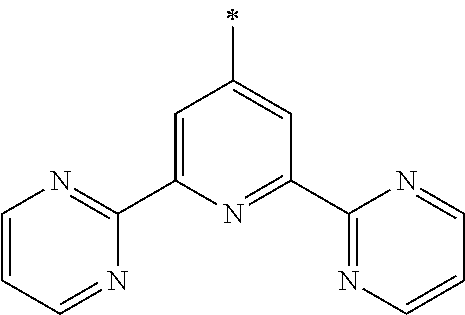
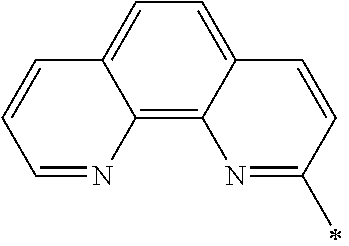
  • Ar 1 is phenanthrolinyl or phenanthrolinylene
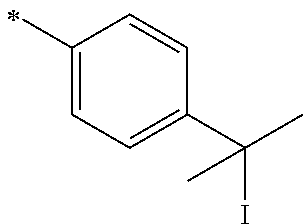
  • Ar 2 and Ar 3 are independently one among hydrogen, a substituted or unsubstituted aryl group having 6 to 60 carbon atoms, a substituted or unsubstituted hetero aryl group having 3 to 60 carbon atoms, and an alkyl group having 1 to 20 carbon atoms.
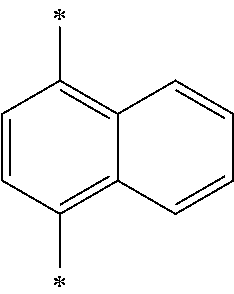
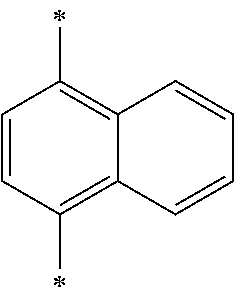
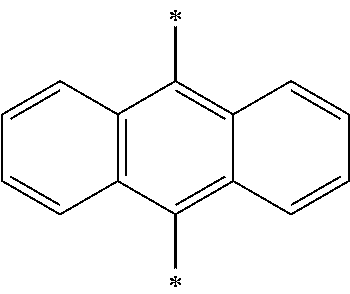
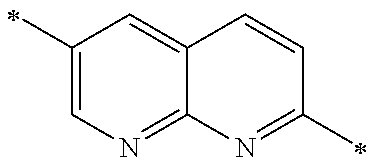
  • L 1 and L 3 are independently one among a single bond, a substituted or unsubstituted aryl group having 6 to 60 carbon atoms, a substituted or unsubstituted hetero aryl group having 3 to 60 carbon atoms, and an alkyl group having 1 to 20 carbon atoms, and L 2 is one among a single bond, a substituted or unsubstituted anthracenylene, and a substituted or unsubstituted pyrenylene.
  • Ar 2 and Ar 3 are independently one among nitrogen, a substituted or unsubstituted phenyl, alkylphenyl, biphenyl, alkylbiphenyl, halophenyl, alkoxyphenyl, haloalkoxyphenyl, cyanophenyl, silylphenyl, naphthyl, alkylnaphthyl, halonaphthyl, cyanonaphthyl, silylnaphthyl, pyridyl, alkylpyridyl, halopyridhyl, cyanopyridyl, alkoxypyridyl, silylpyridyl, pyrimidyl, halopyrimidyl, cyanopyrimidyl, alkoxylpyrimidyl, quinolinyl, isoquinolinyl, quinoxalinyl, pyrazinyl, quinazol
  • L 1 and L 3 are independently one among a single bond, a substituted or unsubstituted phenylene, alkylphenylene, halophenylene, cyanophenylene, naphtylene, alkylnaphthylene, biphenylene, alkylbiphenylene, pyridylene, pyrimidylene, quinolinylene, isoquinolinylene, quinoxalinylene, pyrazinylene, quinazolinylene, naphthyridinylene, thiophenylene, furanylene, benzothiophenylene, benzofuranylene, dibenzothiophenylene, dibenzofuranylene, fluorenylene, carbazoylene, imidazolylene, triphenylenylene, fluoranthenylene, and diazafluorenyl.
  • Phenanthroline Ar 1 of Chemical Formula 1, is the core and exhibits the characteristics of the N-type charge generation layer by being bound to an alkali metal doped on the N-type charge generation layer. More specifically, the phenanthroline core includes nitrogen (N) of sp 2 hybrid orbital which is relatively electron-rich, and this nitrogen is bound to an alkali metal or alkali earth metal, a dopant for the N-type charge generation layer, thereby forming a gap state. This gap state may facilitate transfer of electrons from the N-type charge generation layer to the electron transport layer. Also, since nitrogen is bound to the alkali metal or alkali earth metal in the N-type charge generation layer, the alkali metal or alkali earth metal is not diffused into the P-type charge generation layer, thus increasing lifetime.
  • the linkers, L 1 and L 2 of Chemical Formula 1, adjust carrier mobility.
  • L 1 serves as a path that allows abundant electrons in L 2 to reach Ar 1 by controlling conjugation, and controls HOMO (highest occupied molecular orbitals) and LUMO (lowest unoccupied molecular orbitals).
  • L 2 serves to improve pi( ⁇ )-electron density by using aromatic macrocycles and form a main framework of HOMO and LUMO. Accordingly, the carrier mobility of the N-type charge generation layer can be enhanced, thereby facilitating transfer of electrons from the N-type charge generation layer to the electron transport layer.
  • the pendants, L 3 -Ar 2 and Ar 3 of Chemical Formula 1 serve to add up charge characteristics, and control HOMO and LUMO.
  • compounds represented by the following Chemical Formula 2 have hole characteristics
  • compounds represented by the following Chemical Formula 3 have electron characteristics.
  • the pendants with electron characteristics can facilitate transfer of electrons from the N-type charge generation layer to the electron transport layer by improving the electron characteristics of the N-type charge generation layer.
  • the aforementioned linkers and pendants act as a substituent on the core, and serve to enhance the electron mobility of the compound. Accordingly, the electron mobility of the N-type charge generation layer having the compound can be improved, thereby facilitating transfer of electrons from the N-type charge generation layer to the electron transport layer.
  • the N-type charge generation layer 160 N may be formed of compounds represented by the following Chemical Formulas 4 and 5, among the compounds represented by the above Chemical Formula 1:
  • R is one among hydrogen, a substituted or unsubstituted aryl group having 6 to 60 carbon atoms, a substituted or unsubstituted hetero aryl group having 3 to 60 carbon atoms, or an alkyl group having 1 to 20 carbon atoms.
  • the compounds represented by Chemical Formulas 4 and 5 may be one among the following compounds:
  • naphthalene is at the 2 position of phenanthroline, and the 1 or 2 position is substituted by naphthalene.
  • the difference in energy level between the N-type charge generation layer and the electron transport layer can be reduced, thereby maximizing the tunneling effect of electrons. Accordingly, the present invention can improve electron injection through tunneling effect by using this compound for the N-type charge generation layer.
  • the P-type charge generation layer 160 P may be formed of a metal or a P-doped organic material.
  • the metal may be one or more alloys among Al, Cu, Fe, Pb, Zn, Au, Pt, W, In, Mo, Ni, and Ti.
  • a P-type dopant and host for the P-doped organic material may be commonly-used materials.
  • the P-type dopant may be a material among F 4 -TCNQ(2,3,5,6-tetrafluoro-7,7,8,8,-tetracyanoquinodemethane), a derivative of tetracyanoquinodemethane, iodine, FeCl 3 , FeF 3 , and SbCl 5 .
  • the host may be a material among NPB(N,N′-bis(naphthalene-1-yl)-N,N′-bis(phenyl)-benzidine), TPD (N,N′-bis-(3-methylphenyl)-N,N′-bis(phenyl)-benzidine), and TNB(N,N,N′N′-tetranaphthalenyl-benzidine).
  • the second light emitting part ST 2 having the second hole transport layer 180 , the second light emitting layer 190 , a second electron transport layer 200 , and an electron injection layer 210 is over the first light emitting part ST 1 .
  • the second hole transport layer 180 and the second electron transport layer 200 may have the same composition as the first hole transport layer 130 and first electron transport layer 150 of the above-described first light emitting part ST 1 , respectively, or have a different composition from those of the first hole transport layer 130 and first electron transport layer 150 .
  • the electron injection layer 210 may be omitted depending on the structure or characteristic of the device.
  • the second light emitting layer 190 may emit light of one among red, green, or blue, and it may be a yellow-green light emitting layer in this example embodiment.
  • the yellow-green light emitting layer may have a single-layer structure of a yellow-green light emitting layer or a green light emitting layer, or a multilayer structure composed of a yellow-green light emitting layer and a green light emitting layer.
  • the second light emitting layer 190 may comprise a yellow-green light emitting layer, a green light emitting layer, a multilayer structure composed of a yellow-green light emitting layer and a green light emitting layer, a multilayer structure composed of a yellow-green light emitting layer and a red light emitting layer, or a multilayer structure composed of a green light emitting layer and a red light emitting layer.
  • This example embodiment will be described by taking as an example a single layer structure of a second light emitting layer that emits yellow-green light.
  • the second light emitting layer 190 may contain, but are not limited to, at least one host of CBP 4,4′-bis(carbazol-9-yl)biphenyl) and BAlq(Bis(2-methyl-8-quinolinolate)-4-(phenylphenolato)aluminum) and a phosphorescent yellow-green dopant that emits yellow-green light.
  • the electron injection layer 210 functions to facilitate injection of electrons, and may be formed of, but are not limited to, one or more among Alq 3 (tris(8-hydroxyquinolinato)aluminum), PBD(2-4-biphenyl)-5-(4-tert-butylphenyl)-1,3,4-oxadiazole), TAZ(3-(4-biphenyl)-4-pheynyl-5-tert-butylphenyl-1,2,4-triazole), and BAlq(Bis(2-methyl-8-quinolinolate)-4-(phenylphenolato)aluminum).
  • Alq 3 tris(8-hydroxyquinolinato)aluminum
  • PBD 2-4-biphenyl)-5-(4-tert-butylphenyl)-1,3,4-oxadiazole
  • the electron injection layer 210 may be formed of a metal compound, and the metal compound may be, for example, but are not limited to, one or more among LiQ, LiF, NaF, KF, RbF, CsF, FrF, BeF 2 , MgF 2 , CaF 2 , SrF 2 , BaF 2 , and RaF 2 .
  • the electron injection layer 210 may be 1 to 50 nm thickness. If the electron injection layer 210 is 1 nm thickness or greater, the electron injection characteristics may be improved, or if the electron injection layer 210 is 50 nm thickness or less, an increase in the thickness of the electron injection layer 210 may be prevented and a rise in operating voltage may be therefore prevented.
  • the second light emitting part ST 2 comprises the second hole transport layer 180 , the second light emitting layer 190 , and the second electron transport layer 200 and electron injection layer 210 over the second light emitting layer 190 . Accordingly, the second light emitting part ST 2 having the second hole transport layer 180 , the second light emitting layer 190 , the second electron transport layer 200 , and the electron injection layer 210 is over the first light emitting part ST 1 .
  • the cathode 220 is over the second light emitting part ST 2 , constituting the organic light emitting display device according to the first example embodiment of the present invention.
  • the cathode 220 is an electron injection electrode, and may be formed of magnesium (Mg), calcium (Ca), aluminum (Al), silver (Ag), or an alloy thereof, having a low work function. If the organic light emitting display device is a top-emission type or a dual-emission type, the cathode 220 may be formed thin enough to pass light therethrough. If the organic light emitting display device is a bottom-emission type, the cathode 220 may be formed thick enough to reflect light.
  • a compound of the present invention has a structure in which linkers and pendants are combined with a phenanthroline core. Accordingly, the nitrogen in the core of the compound is bound to a dopant to form a gap state, the linkers induce enhancement of electron mobility, and the pendants give electron characteristics. Hence, transfer of electrons from the N-type charge generation layer to the electron transport layer can be facilitated by improving the electron characteristics of the N-type charge generation layer.
  • naphthalene is at the 2 position of phenanthroline, and the 1 or 2 position is substituted by naphthalene.
  • the difference in energy level between the N-type charge generation layer and the electron transport layer can be reduced, thereby maximizing the tunneling effect of electrons. Accordingly, the present invention can improve electron injection capability through tunneling effect by using this compound for the N-type charge generation layer.
  • the present invention allows for efficient transfer of electrons from the N-type charge generation layer to the electron transport layer and therefore improves device efficiency and device performance, by using a compound having a nitrogen-atom for the N-type charge generation layer.
  • the facilitated transfer of electrons from the N-type charge generation layer to the electron transport layer helps reduce the low lifetime problem caused by poor electron injection.
  • it can also reduce the problem of operating voltage rise caused by the difference in LUMO energy level between the electron transport layer and the N-type charge generation layer when the electrons injected into the N-type charge generation layer move to the electron transport layer.
  • the organic light emitting display device according to the second example embodiment of the present invention has the same structure as in FIG. 1 , so a description of it will be given with reference to FIG. 1 and redundancies from the first example embodiment will be explained briefly.
  • an organic light emitting display device 100 comprises light emitting parts ST 1 and ST 2 between an anode 110 and a cathode 220 , and a charge generation layer 160 between the light emitting parts ST 1 and ST 2 .
  • the first light emitting part ST 1 comprises a hole injection layer 120 and a first hole transport layer 130 between the anode 110 and the first light emitting layer 140 , and a first electron transport layer 150 over the first light emitting layer 140 .
  • the charge generation layer 160 is over the first light emitting part ST 1 .
  • the charge generation layer 160 may be a PN-junction charge generation layer formed by joining an N-type charge generation layer 160 N and a P-type charge generation layer 160 P.
  • the PN junction charge generation layer 160 generates a charge, or injects the charge, i.e., electrons and holes, separately into the light emitting layers.
  • the N-type charge generation layer 160 N of the charge generation layer 160 of the present invention may be formed of the same compound as the N-type charge generation layer of the foregoing first example embodiment. That is, the N-type charge generation layer 160 N according to the second example embodiment of the present invention may be formed of compounds represented by Chemical Formulas 4 and 5, among the compounds represented by Chemical Formula 1.
  • a compound of the present invention has a structure in which linkers and pendants are combined with a phenanthroline core. Accordingly, the nitrogen in the core of the compound is bound to a dopant to form a gap state, the linkers induce enhancement of electron mobility, and the pendants give electron characteristics. Hence, transfer of electrons from the N-type charge generation layer to the electron transport layer can be facilitated by improving the electron characteristics of the N-type charge generation layer.
  • naphthalene is at the 2 position of phenathroline, and the 1 or 2 position is substituted by naphthalene.
  • the present invention can improve electron injection through tunneling effect by using this compound for the N-type charge generation layer.
  • the N-type charge generation layer 160 N of the present invention may be formed of a metal or an N-doped organic material.
  • the metal may be one among Li, Na, K, Rb, Cs, Mg, Ca, Sr, Ba, La, Ce, Sm, Eu, Tb, Dy, and Yb.
  • An N-type dopant and host for the N-doped organic material may be commonly-used materials.
  • the N-type dopant may be an alkali metal, an alkali metal compound, an alkali earth metal, or an alkali earth metal compound.
  • the N-type dopant may be one among Li, Cs, K, Rb, Mg, Na, Ca, Sr, Eu, and Yb.
  • the percentage of the dopant to be mixed is between 1 and 8% relative to 100% for the host.
  • the dopant may have a work function of 2.5 eV or higher.
  • the host material may be an organic material that has a hetero ring having nitrogen atom and includes 20 to 60 carbon atoms, for example, one material of tris(8-hydroxyquinoline)aluminum, triazine, a hydroxyquinoline derivative, a benzazole derivative, and a silole derivative.
  • the second light emitting part ST 2 having a second hole transport layer 180 , a second light emitting layer 190 , a second electron transport layer 200 , and an electron injection layer 210 is over the first light emitting part ST 1 .
  • the second electron transport layer 200 of the present invention serves to facilitate electron transport. If electron transfer to the second light emitting layer 190 is not smooth, this affects the lifetime or efficiency of the organic light emitting display device.
  • the present inventors conducted several tests or experiments to improve the electron injection characteristics of the electron transport layer. Through a number of tests which were performed on materials that do not affect the lifetime or efficiency of the organic light emitting display device and cause no rise in operating voltage, a compound having a nitrogen-atom was chosen as an electron transport compound for the electron transport layer.
  • the compound may comprise a phenanthroline compound.
  • a compound of the present invention is rich in electrons by having two nitrogen atoms, which results in high electron mobility, making electron transport easy.
  • the second electron transport layer 200 includes a compound represented by the above Chemical Formula 1.
  • the compound represented by Chemical Formula 1 may have the following composition. This compound may perform different functions, in part, for the N-type charge generation layer of the first example embodiment of the present invention and the second electron transport layer of the second example embodiment of the present invention.
  • Phenanthroline, Ar 1 of Chemical Formula 1 is the core and rich in electrons by having two nitrogen atoms, which results in high electron mobility, making electron transport easy.
  • the linkers, L 1 and L 2 of Chemical Formula 1, adjust carrier mobility.
  • L 1 serves as a path that allows abundant electrons in L 2 to reach A r1 by controlling conjugation, and controls HOMO (highest occupied molecular orbitals) and LUMO (lowest unoccupied molecular orbitals).
  • L 2 serves to improve pi( ⁇ )-electron density by using aromatic macrocycles and form a basis set of HOMO and LUMO. Accordingly, the electron mobility of the first electron transport layer can be enhanced, thereby facilitating transfer of electrons from the first electron transport layer to the first light emitting layer.
  • the pendants, L 3 -Ar 2 and Ar 3 of Chemical Formula 1 serve to give charge characteristics, and control HOMO and LUMO.
  • compounds represented by the following Chemical Formula 2 have hole characteristics
  • compounds represented by the following Chemical Formula 3 have electron characteristics.
  • the pendants with electron characteristics can facilitate transfer of electrons from the N-type charge generation layer to the electron transport layer by improving the electron characteristics of the N-type charge generation layer.
  • the aforementioned linkers and pendants act as a substituent on the core, and serve to enhance the electron mobility of the compound. Accordingly, the electron mobility of the N-type charge generation layer having the compound can be improved, thereby facilitating transfer of electrons from the N-type charge generation layer to the electron transport layer.
  • a compound represented by Chemical Formula 1 that can be used for the second electron transport layer 200 of the present invention may be one among the compounds shown in the following Table 1:
  • the aforementioned compound of the present invention is included in the second light emitting part ST 2 having a yellow-green light emitting layer.
  • the yellow-green light emitting layer is a phosphorescent light emitting layer, and requires an organic layer with high electron mobility.
  • the compound of the present invention is suitable for the phosphorescent light emitting layer because it has high electron mobility and low triplet energy. Accordingly, if the compound of the present invention is included in the second light emitting part ST 2 , the electron mobility of the second light emitting part ST 2 is increased.
  • the compound of the present invention is preferably positioned in the second light emitting part ST 2 that emits phosphorescent yellow-green light.
  • the compound of the present invention may be positioned in the first light emitting part ST 1 or the third light emitting part ST 3 .
  • the second electron transport layer 200 according to the second example embodiment of the present invention makes it easy to transport electrons because it has high electron mobility by the compound of the present invention, and facilitates transport of electrons from the electron transport layer to the light emitting layer. Accordingly, the organic light emitting display device according to the second example embodiment of the present invention comprises the first light emitting part ST 1 , charge generation layer 160 , and second light emitting part ST 2 between the anode 110 and the cathode 220 .
  • the present invention is not limited to this example and at least one among the following—the first electron transport layer 150 , the second electron transport layer 200 , and the N-type charge generation layer 160 N of the charge generation layer 160 —may be formed of the compound of the present invention.
  • a compound having a nitrogen-atom of the present invention is rich in electrons by having two nitrogen atoms, which results in high electron mobility, making electron transport easy. Accordingly, the organic light emitting display device of the present invention allows for efficient transfer of electrons from the N-type charge generation layer to the light emitting layer, by using this compound for at least one among the electron transport layers in the light emitting parts.
  • the compound having the nitrogen-atom of the present invention includes nitrogen (N) of sp2 hybrid orbital which is relatively electron-rich, and the nitrogen is bound to an alkali metal or alkali earth metal, a dopant for the N-type charge generation layer, thereby forming a gap state.
  • This gap state may facilitate transfer of electrons from the N-type charge generation layer to the electron transport layer.
  • the organic light emitting display device of the present invention facilitates transfer of electrons from the N-type charge generation layer to the electron transport layer, by using this compound of the present invention for the N-type charge generation layer.
  • the compound having a nitrogen-atom is bound to the alkali metal or alkali earth metal in the N-type charge generation layer, the alkali metal or alkali earth metal is not diffused into the P-type charge generation layer, thus increasing lifetime.
  • the organic light emitting display device of the present invention allows for efficient transfer of electrons from the N-type charge generation layer to the light emitting layer and therefore improves device efficiency and device performance, by using the compound having the nitrogen-atom for at least one among the following—the electron transport layers and N-type charge generation layers in the light emitting parts.
  • the facilitated transfer of electrons from the N-type charge generation layer to the electron transport layer helps reduce the low lifetime problem caused by poor electron injection.
  • it can also reduce the problem of operating voltage rise caused by the difference in LUMO energy level between the electron transport layer and the N-type charge generation layer when the electrons injected into the N-type charge generation layer move to the electron transport layer.
  • FIG. 2 is a view showing an organic light emitting display device according to third and fourth example embodiments of the present invention.
  • the same elements as the first and second example embodiments are denoted by the same reference numerals, so descriptions of these elements will be omitted.
  • an organic light emitting display device 100 of the present invention comprises a plurality of light emitting parts ST 1 , ST 2 , and ST 3 between an anode 110 and a cathode 220 , and a first charge generation layer 160 and a second charge generation layer 230 between the light emitting parts ST 1 , ST 2 , and ST 3 .
  • this example embodiment has been illustrated and described with an example where three light emitting parts are between the anode 110 and the cathode 220 , the present invention is not limited to this example and four or more light emitting parts may be between the anode 110 and the cathode 220 .
  • the first light emitting part ST 1 is a single light emitting diode unit, and comprises a first light emitting layer 140 .
  • the first light emitting layer 140 may emit light of one among red, green, or blue: for example, it may be a blue light emitting layer in this example embodiment.
  • the blue light emitting layer comprises one among a blue light emitting layer, a dark blue light emitting layer, or a sky blue light emitting layer.
  • the light emission area of the blue light emitting layer, dark blue light emitting layer, or sky blue light emitting layer may be in the range of 440 to 480 nm.
  • the first light emitting layer 140 may be composed of a blue light emitting layer and a red light emitting layer, or may be composed of a blue light emitting layer and a yellow-green light emitting layer, or may be composed of a blue light emitting layer and a green light emitting layer.
  • the light emission area of the blue light emitting layer and the red light emitting layer may be in the range of 440 to 650 nm.
  • the light emission area of the blue light emitting layer and the yellow-green light emitting layer may be in the range of 440 to 590 nm.
  • the light emission area of the blue light emitting layer and the green light emitting layer may be in the range of 440 to 570 nm.
  • the first light emitting part ST 1 comprises a hole injection layer 120 and a first hole transport layer 130 between the anode 110 and the first light emitting layer 140 , and a first electron transport layer 150 over the first light emitting layer 140 . Accordingly, the first light emitting part ST 1 having the hole injection layer 120 , the first hole transport layer 130 , the first light emitting layer 140 , and the first electron transport layer 150 is formed over the anode 110 .
  • the hole injection layer 120 may not be included in the composition of the first light emitting part ST 1 , depending on the structure or characteristics of the device.
  • the first charge generation layer 160 is between the first light emitting part ST 1 and the second light emitting part ST 2 .
  • the first charge generation layer 160 is a PN-junction charge generation layer formed by joining an N-type charge generation layer 160 N and a P-type charge generation layer 160 P.
  • the PN junction charge generation layer 160 generates a charge, or injects the charge, i.e., electrons and holes, separately into the light emitting layers.
  • the N-type charge generation layer 160 N of the first charge generation layer 160 of the present invention may include the same compound as the N-type charge generation layer of the first example embodiment and the N-type charge generation layer of the second example embodiment. That is, the N-type charge generation layer 160 N according to the third example embodiment of the present invention may be formed of compounds represented by Chemical Formulas 4 and 5, among the compounds represented by Chemical Formula 1.
  • a compound of the present invention has a structure in which linkers and pendants are combined with a phenanthroline core. Accordingly, the nitrogen in the core of the compound is bound to a dopant to form a gap state, the linkers induce enhancement of electron mobility, and the pendants give electron characteristics. Hence, transfer of electrons from the N-type charge generation layer to the electron transport layer can be facilitated by improving the electron characteristics of the N-type charge generation layer.
  • naphthalene is at the 2 position of phenathroline, and the 1 or 2 position is substituted by naphthalene.
  • the present invention can improve electron injection through tunneling effect by using this compound for the N-type charge generation layer.
  • the second light emitting part ST 2 having a second light emitting layer 190 is over the first charge generation layer 160 .
  • the second light emitting layer 190 may emit light of one among red, green, or blue, and it may be a yellow-green light emitting layer, for example, in this example embodiment.
  • the yellow-green light emitting layer may comprise a yellow light emitting layer, a green light emitting layer, a multilayer structure composed of a yellow-green light emitting layer and a green light emitting layer, a multilayer structure composed of a yellow light emitting layer and a red light emitting layer, a multilayer structure composed of a green light emitting layer and a red light emitting layer, or a multilayer structure composed of a yellow-green light emitting layer and a red light emitting layer.
  • the light emission area of the yellow-green light emitting layer may be in the range of 510 to 590 nm.
  • the second light emitting layer 190 is composed of two light emitting layers: a yellow-green light emitting layer and a red light emitting layer, in order to improve red light emission efficiency, the light emission area of the yellow-green light emitting layer and the red light emitting layer may be in the range of 510 to 650 nm.
  • the second light emitting part ST 2 comprises a second hole transport layer 180 , the second light emitting layer 190 , and a second electron transport layer 200 over the second light emitting layer 190 . Accordingly, the second light emitting part ST 2 having the second hole transport layer 180 , the second light emitting layer 190 , and the second electron transport layer 200 is over the first charge generation layer 160 .
  • the second charge generation layer 230 is between the second light emitting part ST 2 and the third light emitting part ST 3 .
  • the second charge generation layer 230 is a PN-junction charge generation layer formed by joining an N-type charge generation layer 230 N and a P-type charge generation layer 230 P.
  • the PN junction charge generation layer 230 generates a charge, or injects the charge, i.e., electrons and holes, separately into the light emitting layers.
  • the N-type charge generation layer 230 N of the second charge generation layer 230 of the present invention is also formed of a compound represented by Chemical Formula 1, like the N-type charge generation layer 160 N of the first charge generation layer 160 .
  • the third light emitting part ST 3 having a third light emitting layer 250 is over the second light emitting part ST 3 .
  • the third light emitting layer 250 may emit light of one among red, green, or blue: for example, it may be a blue light emitting layer in this example embodiment.
  • the blue light emitting layer comprises one among a blue light emitting layer, a dark blue light emitting layer, or a sky blue light emitting layer.
  • the light emission area of the blue light emitting layer, dark blue light emitting layer, or sky blue light emitting layer may be in the range of 440 to 480 nm.
  • the third light emitting layer 250 may be composed of a blue light emitting layer and a red light emitting layer, or a blue light emitting layer and a yellow-green light emitting layer, or a blue light emitting layer and a green light emitting layer.
  • the light emission area of the blue light emitting layer and the red light emitting layer may be in the range of 440 to 650 nm.
  • the light emission area of the blue light emitting layer and the yellow-green light emitting layer may be in the range of 440 to 590 nm.
  • the light emission area of the blue light emitting layer and the green light emitting layer may be in the range of 440 to 570 nm.
  • the third light emitting part ST 3 comprises a third hole transport layer 240 , the third light emitting layer 250 , and a third electron transport layer 260 and a hole injection layer 210 that are over the third light emitting layer 250 . Accordingly, the third light emitting part ST 3 having the third hole transport layer 240 , the third light emitting layer 250 , the third electron transport layer 260 , and the electron injection layer 210 is over the second charge generation layer 230 .
  • a cathode 220 is over the third light emitting part ST 3 to constitute the organic light emitting display device according to the third example embodiment of the present invention.
  • the present invention is not limited to this example and at least one among the following—the N-type charge generation layer 160 N of the first charge generation layer 160 and the N-type charge generation layer 230 N of the second charge generation layer 230 —may include the compound of the present invention.
  • a compound of the present invention has a structure in which linkers and pendants are attached to a phenanthroline core. Accordingly, the nitrogen in the core of the compound is bound to a dopant to form a gap state, the linkers induce enhancement of electron mobility, and the pendants give electron characteristics. Hence, transfer of electrons from the N-type charge generation layer to the electron transport layer can be facilitated by improving the electron characteristics of the N-type charge generation layer.
  • naphthalene is at the 2 position of phenathroline, and the 1 or 2 position is substituted by naphthalene.
  • the difference in energy level between the N-type charge generation layer and the electron transport layer can be reduced, thereby maximizing the tunneling effect of electrons. Accordingly, the present invention can improve electron injection through tunneling effect by using this compound for the N-type charge generation layer.
  • the present invention allows for efficient transfer of electrons from the N-type charge generation layer to the electron transport layer and therefore improves device efficiency and device performance, by using a compound having a nitrogen-atom for the N-type charge generation layer.
  • the facilitated transfer of electrons from the N-type charge generation layer to the electron transport layer helps reduce the low lifetime problem caused by poor electron injection.
  • it can also reduce the problem of operating voltage rise caused by the difference in LUMO energy level between the electron transport layer and the N-type charge generation layer when the electrons injected into the N-type charge generation layer move to the electron transport layer.
  • the organic light emitting display device according to the fourth example embodiment of the present invention has the same structure as in FIG. 2 , so a description of it will be given with reference to FIG. 2 and redundancies from the first to third example embodiments will be explained briefly.
  • an organic light emitting display device 100 comprises a plurality of light emitting parts ST 1 , ST 2 , and ST 3 between an anode 110 and a cathode 220 , and a first charge generation layer 160 and a second charge generation layer 230 between the light emitting parts ST 1 , ST 2 , and ST 3 .
  • this example embodiment has been illustrated and described with an example where three light emitting parts are between the anode 110 and the cathode 220 , the present invention is not limited to this example and four or more light emitting parts may be between the anode 110 and the cathode 220 .
  • the first light emitting part ST 1 is a single light emitting diode unit, and comprises a first light emitting layer 140 .
  • the first light emitting layer 140 may emit light of one among red, green, or blue: for example, it may be a blue light emitting layer in this example embodiment.
  • the blue light emitting layer comprises one among a blue light emitting layer, a dark blue light emitting layer, or a sky blue light emitting layer.
  • the light emission area of the blue light emitting layer, dark blue light emitting layer, or sky blue light emitting layer may be in the range of 440 to 480 nm.
  • the first light emitting layer 140 may be composed of a blue light emitting layer and a red light emitting layer, or may be composed of a blue light emitting layer and a yellow-green light emitting layer, or may be composed of a blue light emitting layer and a green light emitting layer.
  • the light emission area of the blue light emitting layer and the red light emitting layer may be in the range of 440 to 650 nm.
  • the light emission area of the blue light emitting layer and the yellow-green light emitting layer may be in the range of 440 to 590 nm.
  • the light emission area of the blue light emitting layer and the green light emitting layer may be in the range of 440 to 570 nm.
  • the first light emitting part ST 1 comprises a hole injection layer 120 and a first hole transport layer 130 between the anode 110 and the first light emitting layer 140 , and a first electron transport layer 150 over the first light emitting layer 140 . Accordingly, the first light emitting part ST 1 having the hole injection layer 120 , the first hole transport layer 130 , the first light emitting layer 140 , and the first electron transport layer 150 is over the anode 110 .
  • the hole injection layer 120 may not be included in the composition of the first light emitting part ST 1 , depending on the structure or characteristics of the device.
  • the first charge generation layer 160 is between the first light emitting part ST 1 and the second light emitting part ST 2 .
  • the first charge generation layer 160 is a PN-junction charge generation layer formed by joining an N-type charge generation layer 160 N and a P-type charge generation layer 160 P.
  • the PN junction charge generation layer 160 generates a charge, or injects the charge, i.e., electrons and holes, separately into the light emitting layers.
  • the N-type charge generation layer 160 N of the first charge generation layer 160 of the present invention includes a compound represented by Chemical Formula 1, like the first to third example embodiments.
  • the compound represented by Chemical Formula 1 according to the present invention has a structure in which linkers and pendants are attached to a phenanthroline core. Accordingly, the nitrogen in the core of the compound is bound to an alkali metal or alkali earth metal in the N-type charge generation layer to form a gap state, the linkers induce enhancement of electron mobility, and the pendants give electron characteristics. Hence, transfer of electrons from the N-type charge generation layer to the electron transport layer can be facilitated by improving the electron characteristics of the N-type charge generation layer. Also, since nitrogen is bound to the alkali metal or alkali earth metal in the N-type charge generation layer, the alkali metal or alkali earth metal is not diffused into the P-type charge generation layer, thus increasing lifetime.
  • the second light emitting part ST 2 having a second light emitting layer 190 is over the first charge generation layer 160 .
  • the second light emitting layer 190 may emit light of one among red, green, or blue, and it may be a yellow-green light emitting layer, for example, in this example embodiment.
  • the yellow-green light emitting layer may comprise a yellow-green light emitting layer, a green light emitting layer, a multilayer structure composed of a yellow-green light emitting layer and a green light emitting layer, a multilayer structure composed of a yellow light emitting layer and a red light emitting layer, a multilayer structure composed of a green light emitting layer and a red light emitting layer, or a multilayer structure composed of a yellow-green light emitting layer and a red light emitting layer.
  • the light emission area of the yellow-green light emitting layer may be in the range of 510 to 590 nm.
  • the second light emitting layer 190 is composed of two light emitting layers: a yellow-green light emitting layer and a red light emitting layer, in order to improve red light emission efficiency, the light emission area of the yellow-green light emitting layer and the red light emitting layer may be in the range of 510 to 650 nm.
  • the second light emitting part ST 2 further comprises a second hole transport layer 180 , and a second electron transport layer 200 over the second light emitting layer 190 . Accordingly, the second light emitting part ST 2 having the second hole transport layer 180 , the second light emitting layer 190 , and the second electron transport layer 200 is over the first light emitting part ST 1 .
  • the second electron transport layer 200 of the present invention includes a compound represented by Chemical Formula 1, like the second example embodiment.
  • the compound represented by Chemical Formula 1 according to the present invention has a structure in which linkers and pendants are attached to a phenanthroline core. Accordingly, the second electron transport layer 200 according to the fourth example embodiment of the present invention has high electron mobility, making electron transport easy.
  • the second charge generation layer 230 is between the second light emitting part ST 2 and the third light emitting part ST 3 .
  • the second charge generation layer 230 is a PN-junction charge generation layer formed by joining an N-type charge generation layer 230 N and a P-type charge generation layer 230 P.
  • the PN junction charge generation layer 230 generates a charge, or injects the charge, i.e., electrons and holes, separately into the light emitting layers.
  • the N-type charge generation layer 230 N of the second charge generation layer 230 of the present invention includes a compound represented by Chemical Formula 1, like the N-type charge generation layer 160 N of the first charge generation layer 160 .
  • the compound represented by Chemical Formula 1 according to the present invention has a structure in which linkers and pendants are attached to a phenanthroline core. Accordingly, the nitrogen in the core of the compound is bound to a dopant to form a gap state, the linkers induce enhancement of electron mobility, and the pendants give electron characteristics. Hence, transfer of electrons from the N-type charge generation layer to the electron transport layer can be facilitated by improving the electron characteristics of the N-type charge generation layer.
  • the third light emitting part ST 3 having a third light emitting layer 250 is over the second light emitting part ST 2 .
  • the third light emitting layer 250 may emit light of one among red, green, or blue: for example, it may be a blue light emitting layer in this example embodiment.
  • the blue light emitting layer comprises one among a blue light emitting layer, a dark blue light emitting layer, or a sky blue light emitting layer.
  • the third light emitting layer 250 may be composed of a blue light emitting layer and a red light emitting layer, or may be composed of a blue light emitting layer and a yellow-green light emitting layer, or may be composed of a blue light emitting layer and a green light emitting layer.
  • the third light emitting part ST 3 comprises a third hole transport layer 240 , and a third electron transport layer 260 and a hole injection layer 210 that are over the third light emitting layer 250 . Accordingly, the third light emitting part ST 3 having the third hole transport layer 240 , the third light emitting layer 250 , the third electron transport layer 260 , and the electron injection layer 210 is over the second light emitting part ST 2 .
  • a cathode 220 is over the third light emitting part ST 3 to constitute the organic light emitting display device according to the fourth example embodiment of the present invention.
  • the present invention is not limited to this example and at least one among the following—the first electron transport layer 150 , the N-type charge generation layer 160 N of the first charge generation layer 160 , the N-type charge generation layer 230 N of the second charge generation layer 230 , and the third electron transport layer 260 —may include the compound of the present invention.
  • a compound having a nitrogen atom of the present invention is rich in electrons by having two nitrogen atoms, which results in high electron mobility, making electron transport easy. Accordingly, the organic light emitting display device of the present invention allows for efficient transfer of electrons from the N-type charge generation layer to the light emitting layer, by using this compound for at least one among the electron transport layers in the light emitting parts.
  • the compound having the nitrogen-atom of the present invention includes nitrogen (N) of sp 2 hybrid orbital which is relatively electron-rich, and the nitrogen is bound to an alkali metal or alkali earth metal, a dopant for the N-type charge generation layer, thereby forming a gap state.
  • This gap state may facilitate transfer of electrons from the N-type charge generation layer to the electron transport layer.
  • the organic light emitting display device of the present invention facilitates transfer of electrons from the N-type charge generation layer to the electron transport layer, by using this compound of the present invention for the N-type charge generation layer.
  • nitrogen since nitrogen is bound to the alkali metal or alkali earth metal in the N-type charge generation layer, the alkali metal or alkali earth metal is not diffused into the P-type charge generation layer, thus increasing lifetime.
  • the organic light emitting display device of the present invention allows for efficient transfer of electrons from the N-type charge generation layer to the light emitting layer and therefore improves device efficiency and device performance, by using the compound having the nitrogen-atom for at least one among the following—the electron transport layers and N-type charge generation layers in the light emitting parts.
  • the facilitated transfer of electrons from the N-type charge generation layer to the electron transport layer helps reduce the low lifetime problem caused by poor electron injection.
  • it can also reduce the problem of operating voltage rise caused by the difference in LUMO energy level between the electron transport layer and the N-type charge generation layer when the electrons injected into the N-type charge generation layer move to the electron transport layer.
  • FIG. 3 is a view showing an organic light emitting display device according to a fifth example embodiment of the present invention.
  • the same elements as the first to fourth example embodiments are denoted by the same reference numerals, so descriptions of these elements will be given briefly.
  • an organic light emitting display device 100 of the present invention comprises light emitting parts ST 1 and ST 2 between an anode 110 and a cathode 220 , and a charge generation layer 160 between the light emitting parts ST 1 and ST 2 .
  • the first light emitting part ST 1 comprises a first hole injection layer 120 , a first hole transport layer 130 , a blue light emitting layer, and a first electron transport layer 150 .
  • the first electron transport layer 200 serves to facilitate electron transport, and may affect the lifetime or efficiency of the organic light emitting display device.
  • the present inventors conducted several tests or experiments to improve the electron injection characteristics of the electron transport layer. Through a number of tests using a combination of the electron transport layer and the charge generation layer which were performed on materials that do not affect the lifetime, efficiency, or operating voltage of the organic light emitting device, a phenanthroline compound was chosen for the electron transport layer.
  • the phenanthroline compound comprises a p-terphenyl derivative.
  • the phenanthroline compound makes charge transport easy through an aromatic ring in the molecule.
  • the phenanthroline compound has a phenanthroline ring having electron-rich nitrogen (N), which facilitates transport of electrons to the light emitting layers.
  • N electron-rich nitrogen
  • a triphenyl derivative is linked to a phenanthroline derivative, facilitating the movement of electrons from an adjacent N-type charge generation layer to the light emitting layer.
  • the first electron transport layer 150 includes a compound represented by Chemical Formula 1.
  • the compound represented by Chemical Formula 1 is an electron transport compound represented by any one among the following Chemical Formulas 6 to 13.
  • the electron transport compound includes a phenanthroline derivative and a triphenyl derivative.
  • R 21 and R 33 are independently one among hydrogen, a substituted or unsubstituted aryl group having 6 to 60 carbon atoms, a substituted or unsubstituted hetero aryl group having 4 to 60 carbon atoms, an alkyl group having 1 to 10 carbon atoms, or an alkoxy group having 1 to 10 carbon atoms, at least one among the pairs R 21 and R 22 , R 23 and R 24 , R 25 and R 26 , R 27 and R 28 , R 29 and R 30 , and R 31 and R 32 may bond together to form a ring, and X 10 to X 22 are independently C or N.
  • R 21 and R 33 are independently one among hydrogen, a substituted or unsubstituted aryl group having 6 to 60 carbon atoms, a substituted or unsubstituted hetero aryl group having 4 to 60 carbon atoms, an alkyl group having 1 to 10 carbon atoms, or an alkoxy group having 1 to 10 carbon atoms, at least one among the pairs R 21 and R 22 , R 23 and R 24 , R 25 and R 26 , R 28 and R 29 , R 27 and R 31 , R 29 and R 30 , R 31 and R 32 , R 32 and R 33 , and R 30 and R 33 may bond together to form a ring, and X 10 to X 22 are independently C or N.
  • electron transport compounds represented by Chemical Formulas 6 to 9 have a molecular weight of 400 or greater, and may be one among the compounds represented by the following Chemical Formulas 16 to 19:
  • R 21 and R 33 are independently one among hydrogen, a substituted or unsubstituted aryl group having 6 to 60 carbon atoms, a substituted or unsubstituted hetero aryl group having 4 to 60 carbon atoms, an alkyl group having 1 to 10 carbon atoms, or an alkoxy group having 1 to 10 carbon atoms, and at least one among the pairs R 21 and R 22 , R 23 and R 24 , R 25 and R 26 , R 27 and R 28 , R 29 and R 30 , and R 31 and R 32 may bond together to form a ring.
  • electron transport compounds represented by Chemical Formulas 10 to 13 may be one among the compounds represented by the following Chemical Formulas 20 to 23:
  • R 21 and R 33 are independently one among hydrogen, a substituted or unsubstituted aryl group having 6 to 60 carbon atoms, a substituted or unsubstituted hetero aryl group having 4 to 60 carbon atoms, an alkyl group having 1 to 10 carbon atoms, or an alkoxy group having 1 to 10 carbon atoms, and at least one among the pairs R 21 and R 22 , R 23 and R 24 , R 25 and R 26 , R 28 and R 29 , R 27 and R 31 , R 29 and R 30 , R 31 and R 32 , R 32 and R 33 , and R 30 and R 33 may bond together to form a ring.
  • the above electron transport compounds may be one among the following compounds:
  • the charge generation layer (CGL) 160 is over the first light emitting part ST 1 .
  • the first light emitting part ST 1 and the second light emitting part ST 2 are connected by the charge generation layer 160 .
  • the charge generation layer 160 may be a PN-junction charge generation layer formed by joining an N-type charge generation layer 160 N and a P-type charge generation layer 160 P.
  • the PN junction charge generation layer 160 generates a charge, or injects the charge, i.e., electrons and holes, separately into the light emitting layers. That is, the N-type charge generation layer 160 N supplies electrons to the first electron transport layer 150 adjacent to the anode, and the P-type charge generation layer 160 P supplies holes to the light emitting layer of the second light emitting part ST 2 .
  • the organic light emitting display device with a plurality of emitting layers may achieve much higher emission efficiency and reduce operating voltage. Accordingly, the charge generation layer 160 has a major effect on the organic light emitting display device's characteristics, i.e., emission efficiency and operating voltage.
  • an anthracene compound and a pyrene compound were chosen as a host in the charge generation layer.
  • the anthracene compound and the pyrene compound each comprises a carboline derivative.
  • the pyrene compound and the anthracene compound includes nitrogen (N) of sp 2 hybrid orbital in the carboline derivative which is relatively electron-rich, and the nitrogen is bound to an alkali metal or alkali earth metal, a dopant for the N-type charge generation layer, thereby forming a gap state. This gap state may facilitate transfer of electrons from the P-type charge generation layer to the N-type charge generation layer.
  • the N-type charge generation layer 160 N includes a host and a dopant, and the host may be formed of charge generation compounds represented by the following Chemical Formulas 14 and 15:
  • L is one among a single bond, a substituted or unsubstituted arylene group having 6 to 20 carbon atoms, and a substituted or unsubstituted hetero arylene group having 4 to 20 carbon atoms.
  • R 2 to R 9 in Chemical Formula 14 are independently one among hydrogen, a substituted or unsubstituted aryl group having 6 to 60 carbon atoms, a substituted or unsubstituted hetero aryl group having 6 to 60 carbon atoms, an alkyl group having 1 to 10 carbon atoms, or an alkoxy group having 1 to 10 carbon atoms
  • R 10 to R 18 in Chemical Formula 15 are independently one among hydrogen, a substituted or unsubstituted aryl group having 6 to 60 carbon atoms, a substituted or unsubstituted hetero aryl group having 6 to 60 carbon atoms, an alkyl group having 1 to 10 carbon atoms, or an alkoxy group having 1 to 10 carbon atoms.
  • the charge generation compounds represented by Chemical Formulas 14 and 15 may be represented by the following Chemical Formulas 24 and 25.
  • L is one among a single bond, a substituted or unsubstituted arylene group having 6 to 20 carbon atoms, and a substituted or unsubstituted hetero arylene group having 4 to 20 carbon atoms.
  • R 19 in Chemical Formula 24 is independently one among hydrogen, a substituted or unsubstituted aryl group having 6 to 60 carbon atoms, a substituted or unsubstituted hetero aryl group having 4 to 60 carbon atoms, an alkyl group having 1 to 10 carbon atoms, or an alkoxy group having 1 to 10 carbon atoms
  • R 20 in Chemical Formula 25 is independently one among hydrogen, a substituted or unsubstituted aryl group including 6 to 60 carbon atoms, a substituted or unsubstituted hetero aryl group including 4 to 60 carbon atoms, an alkyl group including 1 to 10 carbon atoms, or an alkoxy group including 1 to 10 carbon atoms.
  • a charge generation compound for the N-type charge generation layer 160 N may be one among the following compounds.
  • the N-type charge generation layer 160 N includes a dopant.
  • the dopant may be an alkali metal, an alkali metal compound, an alkali earth metal, or an alkali earth metal compound.
  • the N-type dopant may be one or more among Li, Cs, K, Rb, Mg, Na, Ca, Sr, Eu, and Yb.
  • the percentage of the dopant to be mixed is between 1 and 8% relative to 100% for the host.
  • the dopant may have a work function of 2.5 eV or higher.
  • the second light emitting part ST 2 having the second hole injection layer 170 , the second hole transport layer 180 , the yellow light emitting layer 190 , the second electron transport layer 200 , and the electron injection layer 210 over the charge generation layer 160 .
  • the second hole injection layer 170 , the second hole transport layer 180 , and the second electron transport layer 200 may have the same composition as the first hole injection layer 120 , first hole transport layer 130 , and first electron transport layer 150 of the first light emitting part ST 1 , respectively, or have a different composition from those of the first hole injection layer 120 , first hole transport layer 130 , and first electron transport layer 150 .
  • the second electron transport layer 200 may have the same composition as the first electron transport layer 150 or have a different composition from that of the first electron transport layer 150 . If the second electron transport layer 200 has a different composition from that of the first electron transport layer 150 , the second electron transport layer 200 may be formed of, but are not limited to, one or more among Alq 3 (tris(8-hydroxyquinolinato)aluminum), PBD(2-(4-biphenyl)-5-(4-tert-butylphenyl)-1,3,4-oxadiazole), TAZ(3-(4-biphenyl)-4-pheynyl-5-tert-butylphenyl-1,2,4-triazole), and BAlq(Bis(2-methyl-8-quinolinolate)-4-(phenylphenolato)aluminum).
  • Alq 3 tris(8-hydroxyquinolinato)aluminum
  • PBD 2-(4-biphenyl)-5-(4-tert-buty
  • the second electron transport layer 200 may be 1 to 150 nm thickness. If the second electron transport layer 200 is 1 nm thickness or greater, the electron transport characteristics may be improved, or if the first electron transport layer 200 is 150 nm thickness or less, an increase in the thickness of the first electron transport layer 200 may be prevented and a rise in operating voltage may be therefore prevented.
  • the present invention facilitates transfer of electrons from the N-type charge generation layer to the electron transport layer and the light emitting layer by using a phenanthroline compound for at least one among the electron transport layers included in the light emitting parts and an anthracene or pyrene compound for the N-type charge generation layer.
  • the electron transport layer includes a phenanthroline compound, and the phenanthroline compound has a phenanthroline ring having nitrogen, which facilitates transport of electrons to the light emitting layers.
  • a triphenyl derivative is linked to a phenanthroline derivative, facilitating the movement of electrons from the N-type charge generation layer to the light emitting layer.
  • N nitrogen (N) of sp 2 hybrid orbital in the carboline derivative which is relatively electron-rich is bound to an alkali metal or alkali earth metal in the N-type charge generation layer, thereby forming a gap state.
  • This gap state may facilitate transfer of electrons from the P-type charge generation layer to the N-type charge generation layer.
  • FIG. 4 is a view showing organic light emitting display devices according to a sixth example embodiment of the present invention.
  • the same elements as the first to fifth example embodiments are denoted by the same reference numerals, so descriptions of these elements will be omitted.
  • an organic light emitting display device 100 of the present invention comprises a plurality of light emitting parts ST 1 , ST 2 , and ST 3 between an anode 110 and a cathode 220 , and a first charge generation layer 160 and a second charge generation layer 230 between the light emitting parts ST 1 , ST 2 , and ST 3 .
  • this example embodiment has been illustrated and described with an example where three light emitting parts are between the anode 110 and the cathode 220 , the present invention is not limited to this example and four or more light emitting parts may be between the anode 110 and the cathode 220 .
  • the first light emitting part ST 1 comprises a first hole injection layer 120 , a first hole transport layer 130 , a first light emitting layer 140 , and a first electron transport layer 150 .
  • the first light emitting layer 140 may be a blue light emitting layer.
  • the first hole injection layer 120 and the first hole transport layer 130 may not be included in the composition of the first light emitting part ST 1 , depending on the structure or characteristics of the device.
  • the first electron transport layer 150 includes a phenanthroline compound, like in the fifth example embodiment, and the phenanthroline compound makes charge transport easy through an aromatic ring in the molecule.
  • the phenanthroline compound has a phenanthroline ring having electron-rich nitrogen (N), which facilitates transport of electrons to the light emitting layers.
  • N electron-rich nitrogen
  • a triphenyl derivative is linked to a phenanthroline derivative, facilitating the movement of electrons from the N-type charge generation layer to the light emitting layer.
  • the first charge generation layer 160 having an N-type charge generation layer 160 N and a P-type charge generation layer 160 P is over the first light emitting part ST 1 .
  • the N-type charge generation layer 160 N includes a pyrene compound or an anthracene compound.
  • nitrogen (N) of sp 2 hybrid orbital in the carboline derivative which is relatively electron-rich is bound to an alkali metal or alkali earth metal in the N-type charge generation layer, thereby forming a gap state.
  • This gap state may facilitate transfer of electrons from the P-type charge generation layer to the N-type charge generation layer. Accordingly, electrons can be moved fast to the first light emitting layer 140 , thus improving electron injection and reducing operating voltage.
  • the P-type charge generation layer 160 P has the same composition as the fifth example embodiment.
  • the second light emitting part ST 2 having the second light emitting part 190 is over the first charge generation layer 160 .
  • the second light emitting part ST 2 comprises a second hole injection layer 170 , a second hole transport layer 180 , a second light emitting layer 190 , and a second electron transport layer 200 .
  • the second electron transport layer 200 has the same composition as the first electron transport layer 150 , so its description will be omitted.
  • the second charge generation layer 230 having an N-type charge generation layer 230 N and a P-type charge generation layer 230 P is over the second light emitting part ST 2 .
  • the N-type charge generation layer 230 N has the same composition as the N-type charge generation layer 160 N of the first charge generation layer 160 , so its description will be omitted.
  • the P-type charge generation layer 230 P has the same composition as the P-type charge generation layer 160 P of the first charge generation layer 160 .
  • the third light emitting part ST 3 having a third light emitting layer 250 is over the second charge generation layer 230 .
  • the third light emitting part ST 3 comprises a third hole transport layer 240 , a third light emitting layer 250 , a third electron transport layer 260 , and an electron injection layer 210 .
  • the third electron transport layer 260 has the same composition as the first electron transport layer 150 and the second electron transport layer 200 , so its description will be omitted.
  • the cathode 220 is formed over the third light emitting part ST 3 to constitute the organic light emitting display device according to the sixth example embodiment of the present invention.
  • the present invention is not limited to this example and at least one among the first, second, and third electron transport layer 150 , 200 , and 260 includes a phenanthroline compound.
  • the phenanthroline compound makes charge transport easy through an aromatic ring in the molecule.
  • the phenanthroline compound has a phenanthroline ring having electron-rich nitrogen (N), which facilitates transport of electrons to the light emitting layers.
  • N electron-rich nitrogen
  • a triphenyl derivative is linked to a phenanthroline derivative, facilitating the movement of electrons from an adjacent N-type charge generation layer to the light emitting layer.
  • the present invention is not limited to this example and at least one among the N-type charge generation layer 160 N of the first charge generation layer 160 or the N-type charge generation layer 230 N of the second charge generation layer 230 includes an anthracene compound or pyrene compound having a carboline derivative.
  • the pyrene compound and the anthracene compound includes nitrogen (N) of sp 2 hybrid orbital in the carboline derivative which is relatively electron-rich, and the nitrogen is bound to an alkali metal or alkali earth metal, a dopant for the N-type charge generation layer, thereby forming a gap state.
  • This gap state may facilitate transfer of electrons from the P-type charge generation layer to the N-type charge generation layer.
  • FIG. 5 is an energy band diagram of the organic light emitting display devices according to the fifth and sixth example embodiments of the present invention.
  • an organic light emitting display device of the present invention comprises a hole transport layer HTL, a P-type charge generation layer P-CGL, an N-type charge generation layer N-CGL, and an electron transport layer ETL.
  • the N-type charge generation layer N-CGL supplies electrons to the electron transport layer ETL adjacent to it, and the P-type charge generation layer P-CGL supplies holes to the hole transport layer HTL adjacent to it.
  • the N-type charge generation layer N-CGL includes nitrogen (N) of sp 2 hybrid orbital in the carboline derivative which is relatively electron-rich, and the nitrogen is bound to an alkali metal or alkali earth metal, a dopant for the N-type charge generation layer, thereby forming a gap state.
  • the electron transport layer ETL comprises a phenanthroline compound that makes charge transport easy through an aromatic ring in the molecule.
  • the phenanthroline compound has a phenanthroline ring having electron-rich nitrogen (N), which facilitates transport of electrons to the light emitting layers.
  • N electron-rich nitrogen
  • a triphenyl derivative is linked to a phenanthroline derivative, facilitating the movement of electrons from the N-type charge generation layer to the electron transport layer. Accordingly, the electron injection capability of the device is improved, thereby reducing the operating voltage of the device and improving emission efficiency.
  • the glass transition temperatures Tg and melting points Tm of compounds NC09, NC12, NC17, NC34, NC42, and NC43 were measured and shown in FIGS. 6 to 15 , and listed in the following Table 2.
  • the glass transition temperature Tg and melting point Tm were measured by DSC (differential scanning calorimetry). DSC measures thermal energy changes with temperature and is used for examining polymeric materials.
  • FIG. 7 is a graph showing the glass transition temperature of compound NC12.
  • FIG. 8 is a graph showing the melting point of compound NC12.
  • FIG. 9 is a graph showing the glass transition temperature of compound NC17.
  • FIG. 10 is a graph showing the melting point of compound NC17.
  • FIG. 11 is a graph showing the glass transition temperature of compound NC34.
  • FIG. 12 is a graph showing the glass transition temperature of compound NC42.
  • FIG. 13 is a graph showing the melting point of compound NC42.
  • FIG. 14 is a graph showing the glass transition temperature of compound NC43.
  • FIG. 15 is a graph showing the melting point of compound NC43. (For reference, the melting points of NC09 and NC34 were not measured).
  • the horizontal axis indicates temperature
  • the vertical axis indicates heat flow.
  • FIG. 6 is a graph showing the glass transition temperature of compound NC09. As shown in FIG. 6 , the heat flow along the vertical axis undergoes a change at a certain temperature. The glass transition temperature is determined by the middle value between a temperature at which the heat flow starts to change and a temperature at which the heat flow stops changing. Accordingly, it can be concluded that the glass transition temperature Tg of NC09 is 101.05° C. The melting point of NC09 was not measured.
  • FIG. 7 is a graph showing the melting point of compound NC12.
  • the melting point Tm refers to an endothermic peak temperature that is observed after a glass transition temperature when the temperature is raised to a certain temperature. Accordingly, it can be concluded that the melting point Tm of NC12 is 347.44° C.
  • the compounds of the present invention prepared in the synthesis examples showed a glass transition temperature of about 100° C. or higher and a melting point of 250° C. or higher. Thus, it can be concluded that the compounds of the present invention have thermal stability when applied to an organic light emitting display device.
  • a substrate was patterned to have a light emission area of 2 mm ⁇ 2 mm and then cleaned in UV ozone.
  • the substrate was mounted on a vacuum chamber and set to a base pressure of 5 to 7 ⁇ 10 ⁇ 8 torr, and then the following layers were deposited in the following order by evaporation from heated boats.
  • NPD as a hole injection layer was doped with 10% F4-TCNQ to a thickness of 100 ⁇ .
  • NPD as a hole transport layer was formed to a thickness of 1200 ⁇ .
  • An anthracene host as a blue light emitting layer was doped with a 4% pyrene dopant to a thickness of 200 ⁇ .
  • TmPyPB as a first electron transport layer was formed to a thickness of 100 ⁇ .
  • BPhen as an N-type charge generation layer was doped with 2% Li to a thickness of 100 ⁇ .
  • NPD as a P-type charge generation layer was doped with 10% F4-TCNQ to a thickness of 200 ⁇ .
  • NPD as a hole transport layer was formed to a thickness of 200 ⁇ .
  • a CBP host as a yellow light emitting layer was doped with a 10% Ir compound to a thickness of 200 ⁇ .
  • Al as a cathode was formed to a thickness of 2,000 ⁇ .
  • the N-type charge generation layer had the same composition as Comparative Example 1, and was formed of compound NC09.
  • the N-type charge generation layer had the same composition as Comparative Example 1, and was formed of compound NC12.
  • the N-type charge generation layer had the same composition as Comparative Example 1, and was formed of compound NC17.
  • the N-type charge generation layer had the same composition as Comparative Example 1, and was formed of compound NC34.
  • the N-type charge generation layer had the same composition as Comparative Example 1, and was formed of compound NC42.
  • the N-type charge generation layer had the same composition as Comparative Example 1, and was formed of compound NC43.
  • the operating voltage, current efficiency, and lifetime of the organic light emitting display devices according to Comparative Example 1 and Embodiments 1 to 6 were measured and shown in the following Table 3. Also, the current density vs operating voltage was measured and shown in FIG. 16 , the emission spectrum were measured and shown in FIG. 17 , and the ratio of decrease in luminance over time was measured and shown in FIG. 18 .
  • the following Table 3 shows the percentages of results of Embodiments relative to 100% for results of Comparative Example 1. Also, the lifetime T95 describes the time it takes to reach 95% of the initial luminance of Comparative Example 1.
  • Embodiment 1 using compound NC09 as the N-type charge generation layer showed a 6% decrease in operating voltage, a 4% increase in current efficiency, and a 19% increase in lifetime, compared to Comparative Example 1 using BPhen as the N-type charge generation layer in a stack structure.
  • Embodiment 2 using compound NC12 as the N-type charge generation layer showed a 3% increase in operating voltage, a 5% increase in current efficiency, and a 24% increase in lifetime, compared to Comparative Example 1.
  • Embodiment 3 using compound NC17 as the N-type charge generation layer showed a 6% decrease in operating voltage, a 1% increase in current efficiency, and a 15% increase in lifetime, compared to Comparative Example 1.
  • Embodiment 4 using compound NC34 as the N-type charge generation layer showed a 7% decrease in operating voltage, a 2% increase in current efficiency, and a 28% increase in lifetime, compared to Comparative Example 1.
  • Embodiment 5 using compound NC42 as the N-type charge generation layer showed a 9% decrease in operating voltage, a 2% increase in current efficiency, and an 8% increase in lifetime, compared to Comparative Example 1.
  • Embodiment 6 using compound NC43 as the N-type charge generation layer showed a 5% increase in operating voltage, a 2% increase in current efficiency, and a 143% increase in lifetime, compared to Comparative Example 1, which means a remarkable improvement in lifetime.
  • 1-(1-bromonaphthalene-4-yl)ethanone (14.5 g, 0.058 mol), 8-aminoquinoline-7-carbaldehyde (10 g, 0.058 mol), 800 ml of ABS ethanol, and 13 g of KOH were put into a round-bottom flask. The mixture was refluxed at an elevated temperature and stirred for 15 hours. The reaction solution was cooled at room temperature, and an organic layer was collected by extracting with dichloromethane/water. The organic layer was vacuum concentrated, and then dichloromethane was developed with aluminum oxide (Al 2 O 3 ) for column separation, thereby yielding 10.5 g of intermediate C.
  • Al 2 O 3 aluminum oxide
  • 1-(3-bromophenyl)ethanone (15 g, 0.075 mol), 8-aminoquinoline-7-carbaldehyde (13 g, 0.075 mol), 800 ml of ABS ethanol, and 15 g of KOH were put into a round-bottom flask. The mixture was refluxed at an elevated temperature and stirred for 15 hours. The reaction solution was cooled at room temperature, and an organic layer was collected by extracting with dichloromethane/water. The organic layer was vacuum-concentrated, and then dichloromethane was developed with aluminum oxide (Al 2 O 3 ) for column separation, thereby yielding 13.7 g of intermediate D.
  • Al 2 O 3 aluminum oxide
  • NC119 (2-(1-(10-(naphthalene-2-yl)anthracene-9-yl)naphthalen-4-yl)-1,10-phenanthroline)
  • NC124 (2-(3-(10-phenylanthracene-9-yl)phenyl)-1,10-phenanthroline)
  • NC126 (2-(1-(10-(4-(trimethylsilyl)phenyl)anthracene-9-yl)naphthalen-4-yl)-1,10-phenanthroline)
  • NC132 (2-(1-(10-(4-(pyrimidin-2-yl)phenyl)anthracene-9-yl)naphthalen-4-yl)-1,10-phenanthroline)
  • NC175 (2-(1-(10-(dibenzofuran-2-yl)anthracene-9-yl)naphthalen-4-yl)-1,10-phenanthroline)
  • NC151 (2-(4-(10-phenylanthracene-9-yl)dibenzothiophene-6-yl)-1,10-phenanthroline)
  • the N-type charge generation layer has the same composition as Comparative Example 1 of Test 1, and was formed of compound NC119.
  • the N-type charge generation layer has the same composition as Comparative Example 1 of Test 1, and was formed of compound NC124.
  • the N-type charge generation layer has the same composition as Comparative Example 1 of Test 1, and was formed of compound NC126.
  • the N-type charge generation layer has the same composition as Comparative Example 1 of Test 1, and was formed of compound NC132.
  • the N-type charge generation layer has the same composition as Comparative Example 1 of Test 1, and was formed of compound NC151.
  • the N-type charge generation layer has the same composition as Comparative Example 1 of Test 1, and was formed of compound NC175.
  • the N-type charge generation layer had the same composition as Comparative Example 1 of Test 1, and was formed of compound NC195.
  • the N-type charge generation layer had the same composition as Comparative Example 1 of Test 1, and was formed of compound NC197.
  • the N-type charge generation layer had the same composition as Comparative Example 1 of Test 1, and was formed of compound NC223.
  • the N-type charge generation layer had the same composition as Comparative Example 1 of Test 1, and was formed of compound NC231.
  • the organic light emitting display device had the same composition as Comparative Example 1 of the foregoing Test 1, and the N-type charge generation layer includes compound NC232.
  • the operating voltage, current efficiency, and lifetime of the organic light emitting display devices according to Comparative Example 1 and Embodiments 7 to 17 were measured and shown in the following Table 4. Also, the following Table 4 shows the percentages of results of Embodiments relative to 100% for results of Comparative Example 1. Also, the lifetime T95 describes the time it takes to reach 95% of the initial luminance of Comparative Example 1.
  • the current density vs operating voltage of the organic light emitting display devices manufactured according to Comparative Example 1 and Embodiments 7 to 10 was measured and shown in FIG. 19 , the quantum efficiency vs luminance was measured and shown in FIG. 20 , and the decrease in luminance over time was measured and shown in FIG. 21 . Also, the current density vs operating voltage of the organic light emitting display devices manufactured according to Comparative Example 1 and Embodiments 11 to 14 was measured and shown in FIG. 22 , the quantum efficiency vs luminance was measured and shown in FIG. 23 , and the ratio of decrease in luminance over time was measured and shown in FIG. 24 .
  • the current density vs operating voltage of the organic light emitting display devices manufactured according to Comparative Example 1 and Embodiments 15 to 17 was measured and shown in FIG. 25
  • the quantum efficiency vs luminance was measured and shown in FIG. 26
  • the ratio of decrease in luminance over time was measured and shown in FIG. 27 .
  • Embodiment 7 using compound NC119 as the N-type charge generation layer showed a 3.9% decrease in current efficiency, a 4.1% decrease in quantum efficiency, a 5.6% decrease in operating voltage, and a 5% increase in lifetime, compared to Comparative Example 1 using BPhen as the N-type charge generation layer in a stack structure.
  • Embodiment 8 using compound NC124 as the N-type charge generation layer showed a 1% decrease in current efficiency, a 0.5% decrease in quantum efficiency, a 7.3% decrease in operating voltage, and a 5% increase in lifetime, compared to Comparative Example 1.
  • Embodiment 9 using compound NC126 as the N-type charge generation layer showed a 1.4% decrease in current efficiency, a 0.6% decrease in quantum efficiency, an 8.6% decrease in operating voltage, and a 31.4% decrease in lifetime, compared to Comparative Example 1.
  • Embodiment 10 using compound NC132 as the N-type charge generation layer showed a 1.3% increase in current efficiency, a 0.4% increase in quantum efficiency, a 5.7% decrease in operating voltage, and a 109% increase in lifetime, compared to Comparative Example 1.
  • Embodiment 11 using compound NC151 as the N-type charge generation layer showed a 6.5% decrease in current efficiency, a 6.8% decrease in quantum efficiency, no change in operating voltage, and a 10.6% increase in lifetime, compared to Comparative Example 1.
  • Embodiment 12 using compound NC175 as the N-type charge generation layer showed a 0.7% decrease in current efficiency, a 0.3% decrease in quantum efficiency, an 8.1% decrease in operating voltage, and a 16.1% increase in lifetime, compared to Comparative Example 1.
  • Embodiment 13 using compound NC195 as the N-type charge generation layer showed a 0.1% decrease in current efficiency, a 0.7% decrease in quantum efficiency, a 4.1% decrease in operating voltage, and a 21.2% decrease in lifetime, compared to Comparative Example 1.
  • Embodiment 14 using compound NC197 as the N-type charge generation layer showed a 4.6% decrease in current efficiency, a 4.4% decrease in quantum efficiency, a 1.5% decrease in operating voltage, and an 8.8% decrease in lifetime, compared to Comparative Example 1.
  • Embodiment 15 using compound NC223 as the N-type charge generation layer showed a 0.6% increase in current efficiency, a 0.5% decrease in quantum efficiency, a 14.2% decrease in operating voltage, and a 34.9% increase in lifetime, compared to Comparative Example 1.
  • Embodiment 16 using compound NC231 as the N-type charge generation layer showed a 3.5% decrease in current efficiency, a 3.9% decrease in quantum efficiency, a 3% decrease in operating voltage, and a 3.5% decrease in lifetime, compared to Comparative Example 1.
  • Embodiment 17 using compound NC232 as the N-type charge generation layer showed a 3.1% decrease in current efficiency, a 3.4% decrease in quantum efficiency, a 0.9% decrease in operating voltage, and a 20.3% decrease in lifetime, compared to Comparative Example 1.
  • an N-type charge generation layer having a compound of the present invention brings about a decrease in the operating voltage of the device and an overall increase in lifetime.
  • the second electron transport layer had the same composition as Comparative Example 1 of Test 1, and was formed of compound NC119.
  • the second electron transport layer had the same composition as Comparative Example 1 of Test 1, and was formed of compound NC124.
  • the second electron transport layer had the same composition as Comparative Example 1 of Test 1, and was formed of compound NC197.
  • the second electron transport layer had the same composition as Comparative Example 1 of Test 1, and was formed of compound NC209.
  • the operating voltage, current efficiency, and lifetime of the organic light emitting display devices according to Comparative Example 1 and Embodiments 18 to 21 were measured and shown in the following Table 5.
  • the current density vs operating voltage of the organic light emitting display devices manufactured according to Comparative Example 1 and Embodiments 18 and 19 was shown in FIG. 28
  • the emission spectra of the organic light emitting display devices manufactured according to Comparative Example 1 and Embodiments 18 and 19 were shown in FIG. 29
  • the decrease in luminance over time of the organic light emitting devices manufactured according to Comparative Example 1 and Embodiments 18 and 19 was shown in FIG. 30 .
  • the current density vs operating voltage of the organic light emitting display devices manufactured according to Comparative Example 1 and Embodiments 20 and 21 was shown in FIG.
  • Embodiment 18 using compound NC119 as the electron transport layer showed a 0.7% decrease in current efficiency, a 0.3% decrease in quantum efficiency, an 8.1% decrease in operating voltage, and a 14% increase in lifetime, compared to Comparative Example 1 using Alq3 as the electron transport layer in a stack structure.
  • Embodiment 19 using compound NC124 as the electron transport layer showed a 2.8% decrease in current efficiency, a 2.8% decrease in quantum efficiency, a 5.5% decrease in operating voltage, and a 2.8% decrease in lifetime, compared to Comparative Example 1.
  • Embodiment 20 using compound NC197 as the electron transport layer showed a 1.6% decrease in current efficiency, a 1.5% decrease in quantum efficiency, a 4.4% decrease in operating voltage, and 10.6% increase in lifetime, compared to Comparative Example 1.
  • Embodiment 21 using compound NC209 as the electron transport layer showed a 5.9% decrease in current efficiency, a 6% decrease in quantum efficiency, a 10% decrease in operating voltage, and a 20.3% decrease in lifetime, compared to Comparative Example 1.
  • an electron transport layer having a compound of the present invention brings about a decrease in the operating voltage of the device and an increase in lifetime.
  • An organic light emitting display device was manufactured by forming, on a substrate, a first light emitting part having a blue light emitting layer and a first electron transport layer, a second light emitting part having an N-type charge generation layer, a P-type charge generation layer, a yellow light emitting layer, and a second electron transport layer, and a cathode.
  • the first electron transport layer was formed of the following compound ETL_R1
  • the N-type charge generation layer was formed of the following compound NCGL_R.
  • An organic light emitting display device was manufactured by comprising a first electron transport layer having the same composition as Comparative Example 2 and formed of compound ETL_A and an N-type charge generation layer having the same composition as Comparative Example and formed of compound NCGL_R.
  • An organic light emitting display device was manufactured by comprising a first electron transport layer having the same composition as Comparative Example 2 and formed of compound ETL_R1 and an N-type charge generation layer having the same composition as Comparative Example 2 and formed of compound NCGL_B.
  • An organic light emitting display device was manufactured by comprising a first electron transport layer having the same composition as Comparative Example 2 and formed of compound ETL_R2 and an N-type charge generation layer having the same composition as Comparative Example 2 and formed of compound NCGL_C.
  • An organic light emitting display device was manufactured by comprising a first electron transport layer having the same composition as Comparative Example 2 and formed of compound ETL_A and an N-type charge generation layer having the same composition as Comparative Example 2 and formed of compound NCGL_B.
  • An organic light emitting display device was manufactured by comprising a first electron transport layer having the same composition as Comparative Example 2 and formed of compound ETL B and an N-type charge generation layer having the same composition as Comparative Example 2 and formed of compound NCGL_A.
  • An organic light emitting display device was manufactured by comprising a first electron transport layer having the same composition as Comparative Example 2 and formed of compound ETL_C and an N-type charge generation layer having the same composition as Comparative Example 2 and formed of compound NCGL_C.
  • the materials of the first electron transport layer and the N-type charge generation layer or the compositions of the light emitting layers used in the above comparative examples and embodiments do not limit the scope of the present invention.
  • the operating voltage and current efficiency of the organic light emitting display devices according to Comparative Examples 2 to 5 and Embodiments 22 to 24 were measured and shown in the following Table 6.
  • the following Table 6 shows the percentages of results of Comparative Examples 3 to 5 and Embodiments 22 to 24 relative to 100% for results of Comparative Example 2 where the device was driven at a current density of 10 mA/cm 2 .
  • the electron transport layer was formed of ETL_R1
  • the N-type charge generation layer was formed of NCGL_R.
  • ETL_R1 is a benzoimidazole-substituted anthracene compound
  • NCGL_R is a phenanthroline compound (Bphen).
  • ETL_A is a phenanthroline-substituted anthracene compound.
  • the electron transport layer was formed of ETL_R1
  • the N-type charge generation layer was formed of NCGL_B.
  • NCGL_B is a carboline-substituted pyrene compound.
  • the electron transport layer was formed of ETL_R2, and the N-type charge generation layer was formed of NCGL_C.
  • ETL_R2 is a pyridine-substituted fluorine compound
  • NCGL_C is a carboline-substituted anthracene compound.
  • the electron transport layer was formed of ETL_A
  • the N-type charge generation layer was formed of NCGL_B.
  • ETL_A is a phenanthroline-substituted anthracene compound
  • NCGL_B is a carboline-substituted pyrene compound.
  • the electron transport layer was formed of ETL B, and the N-type charge generation layer was formed of NCGL_A.
  • ETL B is a phenanthroline-substituted anthracene compound
  • NCGL_A is a carboline-substituted anthracene compound.
  • the electron transport layer was formed of ETL_C
  • the N-type charge generation layer was formed of NCGL_C.
  • ETL_C is a phenanthroline-substituted anthracene compound
  • NCGL_C is a carboline-substituted anthracene compound.
  • Embodiment 22 using a phenanthroline derivative for the electron transport layer and a carboline derivative for the N-type charge generation layer achieved a 12 to 16% decrease in operating voltage and a 13 to 24% increase in emission efficiency, compared to Comparative Examples 2 to 5 using a phenanthroline derivative or carboline derivative for one among the electron transport layer or the N-type charge generation layer.
  • Embodiment 23 using a phenanthroline derivative for the electron transport layer and a carboline derivative for the N-type charge generation layer achieved a 10 to 14% decrease in operating voltage and an 8 to 19% increase in emission efficiency, compared to Comparative Examples 2 to 5 using a phenanthroline derivative or carboline derivative for one among the electron transport layer or the N-type charge generation layer.
  • Embodiment 24 using a phenanthroline derivative for the electron transport layer and a carboline derivative for the N-type charge generation layer achieved an 8 to 12% decrease in operating voltage and a 10 to 21% increase in emission efficiency, compared to Comparative Examples 2 to 5 using a phenanthroline derivative or carboline derivative for one among the electron transport layer or the N-type charge generation layer.
  • the organic light emitting display devices according to the first to fourth example embodiments and seventh to twenty-first example embodiments of the present invention have the following advantages.
  • a compound having nitrogen atom of the present invention is rich in electrons by two nitrogen atoms, which results in high electron mobility, making electron transport easy. Accordingly, the organic light emitting display device of the present invention allows for efficient transfer of electrons from the N-type charge generation layer to the light emitting layer, by using this compound for at least one among the electron transport layers in the light emitting parts.
  • the compound having the nitrogen atom of the present invention includes nitrogen (N) of sp 2 hybrid orbital which is relatively electron-rich, and the nitrogen is bound to an alkali metal or alkali earth metal, a dopant for the N-type charge generation layer, thereby forming a gap state.
  • This gap state may facilitate transfer of electrons from the N-type charge generation layer to the electron transport layer.
  • the organic light emitting display device of the present invention facilitates transfer of electrons from the N-type charge generation layer to the electron transport layer, by using this compound of the present invention for the N-type charge generation layer.
  • the compound having the nitrogen atom is bound to the alkali metal or alkali earth metal in the N-type charge generation layer, the alkali metal or alkali earth metal is not diffused into the P-type charge generation layer, thus increasing lifetime.
  • the organic light emitting display device of the present invention allows for efficient transfer of electrons from the N-type charge generation layer to the light emitting layer and therefore improves device efficiency and device performance, by using the compound having the nitrogen-atom for at least one among the following—the electron transport layers and N-type charge generation layers in the light emitting parts.
  • the facilitated transfer of electrons from the N-type charge generation layer to the electron transport layer helps reduce the low lifetime problem caused by poor electron injection.
  • it can also reduce the problem of operating voltage rise caused by the difference in LUMO energy level between the electron transport layer and the N-type charge generation layer when the electrons injected into the N-type charge generation layer move to the electron transport layer.
  • organic light emitting display devices according to the fifth, sixth, twenty-second, twenty-third, and twenty-fourth example embodiments of the present invention have the following advantages.
  • the present invention facilitates transfer of electrons from the N-type charge generation layer to the electron transport layer or the light emitting layer by using a phenanthroline derivative for at least one among the electron transport layers in the light emitting parts and an anthracene compound or pyrene compound having a carboline derivative for the N-type charge generation layer.
  • the electron transport layer includes a phenanthroline compound and the phenanthroline ring having a nitrogen, which facilitates transport of electrons to the light emitting layers.
  • a triphenyl derivative is linked to the phenanthroline derivative, facilitating the movement of electrons from the N-type charge generation layer to the light emitting layer.
  • N nitrogen (N) of sp 2 hybrid orbital in the carboline derivative which is relatively electron-rich is bound to an alkali metal or alkali earth metal in the N-type charge generation layer, thereby forming a gap state.
  • This gap state may facilitate transfer of electrons from the P-type charge generation layer to the N-type charge generation layer.

Landscapes

  • Physics & Mathematics (AREA)
  • Spectroscopy & Molecular Physics (AREA)
  • Chemical & Material Sciences (AREA)
  • Engineering & Computer Science (AREA)
  • Materials Engineering (AREA)
  • Optics & Photonics (AREA)
  • Electroluminescent Light Sources (AREA)

Abstract

An organic light emitting display device is disclosed. The organic light emitting display device includes at least two light emitting parts each including a light emitting layer and an electron transport layers, and at least one charge generation layer between the light emitting parts, wherein at least one among the charge generation layer or the electron transport layer includes a compound having nitrogen atoms and a substituent for enhancing electron mobility.

Description

This application claims the priority benefit of Korean Patent Application No. 10-2014-0099044 filed on Aug. 1, 2014, No. 10-2014-0141054 filed on Oct. 17, 2014, No. 10-2015-0056702 filed on Apr. 22, 2015, all of which are incorporated herein by reference for all purposes as if fully set forth herein.
BACKGROUND
Field of the Invention
The present invention relates to an organic light emitting display device, and more particularly, to an organic light emitting display device with reduced operating voltage, improved current efficiency, and improved lifetime characteristics.
Discussion of the Related Art
Image display devices used for displaying a variety of information on the screen are one of the core technologies of the information and communication era. Such image display devices have been developed to be thinner, lighter, and more portable, and furthermore to have high performance. With the development of the information society, various demands for display devices are increasing. To meet these demands, research on flat panel displays such as liquid crystal displays (LCD), plasma display panels (PDP), electroluminescent displays (ELD), field emission displays (FED), organic light emitting diodes (OLED), etc is actively under way.
Among the panel displays, the OLED devices are a type of devices that emit light as electrons and holes are paired and extinguished, when a charge is injected into an organic light emitting layer between an anode and a cathode. The OLED devices are advantageous in that they may be formed on a flexible transparent substrate such as plastic, and are operable at relatively low voltage as compared to plasma display panels or inorganic EL displays, less power consumption, and represent excellent color sensitivity. Especially, white OLED devices are used for various purposes in lighting, thin light sources, backlights for liquid crystal displays, or full-color displays employing color filters.
In the development of white OLED devices, high efficiency, long lifetime, color purity, color stability against current and voltage variations, ease of manufacture, etc are important, so research and development are being done depending on which of these features should be taken into account. White OLED device structures may be roughly classified into a single-layer emitting structure and a multilayer emitting structure. Of these structures, the multilayer emitting structure having a blue fluorescent emitting layer and a yellow phosphorescent emitting layer stacked in tandem is mainly employed to realize white OLED devices with long lifetime.
Specifically, a phosphorescent emitting structure is used, which is a lamination of a first light emitting part using a blue fluorescent diode as a light emitting layer and a second light emitting part using a yellow-green phosphorescent diode as a light emitting layer. Such a white OLED device produces white light by mixing blue light emitted from the blue fluorescent diode and yellow light emitted from the yellow-green phosphorescent diode. In this case, a charge generation layer is formed between the first light emitting part and the second light emitting part to double the current efficiency generated in the light emitting layers and facilitate charge distribution. The charge generation layer is a layer that generates a charge, i.e., electrons and holes, in it, which can prevent a rise in operating voltage because it doubles the current efficiency generated in the light emitting layers and facilitates charge distribution.
However, the overall operating voltage of a device having the aforementioned multilayer emitting structure may be higher than the sum of the operating voltages of individual light emitting parts, or the multilayer emitting device may suffer a decrease in efficiency compared to a single-layer emitting structure. The charge generation layer includes an N-type charge generation layer and a P-type charge generation layer. Especially, if the N-type charge generation layer is doped with an alkali metal or alkali earth metal, the alkali metal or alkali earth metal may be diffused into the P-type charge generation layer, causing a decrease in device lifetime. Also, the difference in LUMO (lowest unoccupied molecular orbital) energy level between the P-type charge generation layer and the N-type charge generation layer deteriorates the feature of injecting electrons generated at the interface between the P-type charge generation layer and the hole transport layer into the N-type charge generation layer. Moreover, the difference in LUMO energy level between the electron transport layer and the N-type charge generation layer causes a rise in operating voltage when the electrons injected into the N-type charge generation layer move to the electron transport layer.
SUMMARY
Accordingly, the present invention is directed to an organic light emitting display device that substantially obviates one or more of the problems due to limitations and disadvantages of the related art.
An object of the present invention is to provide an on organic light emitting display device which is capable of reducing operating voltage and improving efficiency and lifetime characteristics.
Additional features and advantages of the invention will be set forth in the description which follows, and in part will be apparent from the description, or may be learned by practice of the invention. The objectives and other advantages of the invention will be realized and attained by the structures particularly pointed out in the written description and claims whereof as well as the appended drawings.
To achieve these and other advantages and in accordance with the purpose of the present invention, as embodied and broadly described, an organic light emitting display device comprises at least two light emitting parts each having a light emitting layer and an electron transport layers, and at least one charge generation layer between the light emitting parts, wherein at least one among the charge generation layer or the electron transport layer includes a compound having nitrogen atoms and a substituent for enhancing electron mobility.
In another aspect, an organic light emitting display device comprises at least two light emitting parts each having a light emitting layer and an electron transport layer, and at least one charge generation layer between the light emitting parts, wherein at least one among the charge generation layer or the electron transport layer includes a compound including a core having nitrogen-atom and a substituent for adjusting carrier mobility or a substituent having hole characteristics or electron characteristics.
It is to be understood that both the foregoing general description and the following detailed description are exemplary and explanatory and are intended to provide further explanation of the invention as claimed.
BRIEF DESCRIPTION OF THE DRAWINGS
The accompanying drawings, which are included to provide a further understanding of the invention and are incorporated in and constitute a part of this specification, illustrate embodiments of the invention and together with the description serve to explain the principles of the invention. In the drawings:
FIG. 1 is a cross-sectional view showing an organic light emitting display device according to first and second example embodiments of the present invention;
FIG. 2 is a cross-sectional view showing an organic light emitting display device according to third and fourth example embodiments of the present invention;
FIG. 3 is a view showing an organic light emitting display device according to a fifth example embodiment of the present invention;
FIG. 4 is a view showing an organic light emitting display device according to a sixth example embodiment of the present invention;
FIG. 5 is an energy band diagram of organic light emitting display devices according to the present invention;
FIG. 6 is a graph showing the glass transition temperature of compound NC09;
FIG. 7 is a graph showing the glass transition temperature of compound NC12;
FIG. 8 is a graph showing the melting point of compound NC12;
FIG. 9 is a graph showing the glass transition temperature of compound NC17;
FIG. 10 is a graph showing the melting point of compound NC17;
FIG. 11 is a graph showing the glass transition temperature of compound NC34;
FIG. 12 is a graph showing the glass transition temperature of compound NC42;
FIG. 13 is a graph showing the melting point of compound NC42;
FIG. 14 is a graph showing the glass transition temperature of compound NC43;
FIG. 15 is a graph showing the melting point of compound NC43;
FIG. 16 is a graph of the current density vs. operating voltage of organic light emitting display devices manufactured according to Comparative Example and Embodiments 1 to 6 of the present invention;
FIG. 17 is a graph of the emission spectrum of organic light emitting display devices according to Comparative Example and Embodiments 1 to 6 of the present invention;
FIG. 18 is a graph of the ratio of decrease in luminance over time of organic light emitting display devices according to Comparative Example and Embodiments 1 to 6 of the present invention;
FIG. 19 is a graph of the current density vs. operating voltage of organic light emitting display devices according to Comparative Example and Embodiments 7 to 10 of the present invention;
FIG. 20 is a graph of the emission spectrum of organic light emitting display devices according to Comparative Example and Embodiments 7 to 10 of the present invention;
FIG. 21 is a graph of the ratio of decrease in luminance over time of organic light emitting display devices according to Comparative Example and Embodiments 7 to 10 of the present invention;
FIG. 22 is a graph of the current density vs. operating voltage of organic light emitting display devices according to Comparative Example and Embodiments 11 to 14 of the present invention;
FIG. 23 is a graph of the emission spectrum of organic light emitting display devices according to Comparative Example and Embodiments 11 to 14 of the present invention;
FIG. 24 is a graph of the ratio of decrease in luminance over time of organic light emitting display devices according to Comparative Example and Embodiments 11 to 14 of the present invention;
FIG. 25 is a graph of the current density vs. operating voltage of organic light emitting display devices according to Comparative Example and Embodiments 15 to 17 of the present invention;
FIG. 26 is a graph of the emission spectrum of organic light emitting display devices according to Comparative Example and Embodiments 15 to 17 of the present invention;
FIG. 27 is a graph of the ratio of decrease in luminance over time of organic light emitting display devices according to Comparative Example and Embodiments 15 to 17 of the present invention;
FIG. 28 is a graph of the current density vs. operating voltage of organic light emitting display devices according to Comparative Example and Embodiments 18 and 19 of the present invention;
FIG. 29 is a graph of the emission spectrum of organic light emitting display devices according to Comparative Example and Embodiments 18 and 19 of the present invention;
FIG. 30 is a graph of the ratio of decrease in luminance over time of organic light emitting display devices according to Comparative Example and Embodiments 18 and 19 of the present invention;
FIG. 31 is a graph of the current density vs. operating voltage of organic light emitting display devices according to Comparative Example and Embodiments 20 and 21 of the present invention;
FIG. 32 is a graph of the emission spectrum of organic light emitting display devices according to Comparative Example and Embodiments 20 and 21 of the present invention; and
FIG. 33 is a graph of the ratio of decrease in luminance over time of organic light emitting display devices according to Comparative Example and Embodiments 20 and 21 of the present invention.
DETAILED DESCRIPTION
The various aspects and features of the present invention and methods of accomplishing the same may be understood more readily by reference to the following detailed descriptions of exemplary embodiments and the accompanying drawings. The present invention may, however, be embodied in many different forms and should not be construed as being limited to the example embodiments set forth herein. Rather, these example embodiments are provided so that this disclosure will be thorough and complete and will fully convey the concept of the present invention to those skilled in the art, and the present invention is defined by the appended claims
The shapes, sizes, percentages, angles, numbers, etc shown in the figures to describe the example embodiments of the present invention are merely examples and not limited to those shown in the figures. Like reference numerals denote like elements throughout the specification. In describing the present invention, detailed descriptions of related well-known technologies will be omitted to avoid unnecessary obscuring the present invention.
When the terms ‘comprise’, ‘have’, ‘consist of’ and the like are used, other parts may be added as long as the term ‘only’ is not used. The singular forms may be interpreted as the plural forms unless explicitly stated.
The elements may be interpreted to include an error margin even if not explicitly stated. When the position relation between two parts is described using the terms ‘on’, ‘over’, ‘under’, ‘next to’ and the like, one or more parts may be positioned between the two parts as long as the term ‘immediately’ or ‘directly’ is not used.
When the temporal relationship between two events is described using the terms ‘after’, ‘following’, ‘next’, ‘before’ and the like, the two events may not occur in succession as long as the term ‘immediately’ or ‘directly’ is not used.
It will be understood that, although the terms first, second, etc., may be used to describe various elements, these elements should not be limited by these terms. These terms are only used to distinguish one element from another element. Thus, a first element discussed below could be termed a second element without departing from the technical spirit of the present invention.
The features of various example embodiments of the present invention may be combined with one another one of partly or wholly, and may technically interact or work together in various ways. The example embodiments may be carried out independently or in combination with one another.
Hereinafter, various exemplary embodiments of the present invention will be described in detail with reference to the accompanying drawings.
FIG. 1 is a cross-sectional view showing an organic light emitting display device according to first and second example embodiments of the present invention.
With reference to FIG. 1, an organic light emitting display device 100 according to the first example embodiment of the present invention comprises light emitting parts ST1 and ST2 between an anode 110 and a cathode 220, and a charge generation layer 160 between the light emitting parts ST1 and ST2.
The anode 110 is a hole injection electrode, and may be formed of one among ITO (indium tin oxide), IZO (indium zinc oxide), or ZnO (zinc oxide) having a high work function. Also, if the anode 110 is a reflective electrode, the anode 110 may further comprise a reflective layer formed of one among aluminum (Al), silver (Ag), or nickel (Ni) under a layer formed of one among ITO, IZO, or ZnO.
The first light emitting part ST1 is a single light emitting diode unit, and comprises a first light emitting layer 140. The first light emitting layer 140 may emit light at least one among red, green, or blue: for example, it may be a blue light emitting layer in this example embodiment. The blue light emitting layer comprises at least one among a blue light emitting layer, a dark blue light emitting layer, or a sky blue light emitting layer. Alternatively, the first light emitting layer 140 may be composed of a blue light emitting layer and a red light emitting layer, or may be composed of a blue light emitting layer and a yellow-green light emitting layer, or may be composed of a blue light emitting layer and a green light emitting layer.
The first light emitting part ST1 comprises a hole injection layer 120 and a first hole transport layer 130 between the anode 110 and the first light emitting layer 140, and a first electron transport layer 150 over the first light emitting layer 140.
The hole injection layer 120 may function to facilitate injection of holes from the anode 110 to the first light emitting layer 140, and may be formed of, but are not limited to, one among CuPc (copper phthalocyanine), PEDOT (poly(3,4)-ethylenedioxythiophene), and PANI (polyaniline). The hole injection layer 120 may be 1 to 150 nm thickness. If the hole injection layer 120 is 1 nm thickness or greater, the hole injection characteristics may be improved, or if the hole injection layer 120 is 150 nm thickness or less, an increase in the thickness of the hole injection layer 120 may be prevented and a rise in operating voltage may be therefore prevented. The hole injection layer 120 may not be included in the composition of the organic light emitting display device, depending on the structure or characteristics of the organic light emitting display device.
The first hole transport layer 130 may function to facilitate transport of holes, and may be formed of, but are not limited to, one among NPD(N,N′-bis(naphthalene-1-yl)-N,N′-bis(phenyl)-2,2′-dimethylbenzidine), TPD(N,N′-bis-(3-methylphenyl)-N,N′-bis(phenyl)-benzidine), spiro-TAD(2,2′7,7′-tetrakis(N,N-diphenylamino)-9,9′-spirofluorene), and MTDATA(4,4′,4″-Tris(N-3-methylphenyl-N-phenylamino)-triphenylamine). The first hole transport layer 130 may be 1 to 150 nm thickness. If the first hole transport layer 130 is 1 nm thickness or greater, the hole transport characteristics may be improved, or if the first hole transport layer 130 is 150 nm thickness or less, an increase in the thickness of the first hole transport layer 130 may be prevented and a rise in operating voltage may be therefore prevented.
The first light emitting layer 140 may emit light of red (R), green (G), blue (B), or yellow (Y), and may be formed of a phosphorescent or fluorescent material.
If the first light emitting layer 140 is a red light emitting layer, it may be formed of, but are not limited to, a phosphorescent material having a host material such as CBP(4,4′-bis(carbazole-9-yl)biphenyl) and a dopant having one among PIQIr (acac)(bis(1-phenylisoquinoline)acetylacetonate iridium), PQIr(acac)(bis(1-phenylquinoline)acetylacetonate iridium), PQIr(tris(1-phenylquinoline)iridium), and PtOEP(octaethylporphyrin platinum). Alternatively, the first light emitting layer 140 may be formed of, but are not limited to, a fluorescent material having PBD:Eu(DBM)3(Phen) or perylene. Also, if the first light emitting layer 140 is a red light emitting layer, the light emission area may be in the range of 600 to 650 nm.
If the first light emitting layer 140 is a green light emitting layer, it may be formed of, but are not limited to, a phosphorescent material having a host material such as CBP(4,4′-bis(carbazole-9-yl)biphenyl) and a dopant material having an iridium-based material. Alternatively, the first light emitting layer 140 may be formed of, but are not limited to, a fluorescent material having Alq3(tris(8-hydroxyquinolinato)aluminum). Also, if the first light emitting layer 140 is a green light emitting layer, the light emission area may be in the range of 510 to 570 nm.
If the first light emitting layer 140 is a blue light emitting layer, it may be formed of, but are not limited to, a phosphorescent material having a host material such as CBP(4,4′-bis(carbazole-9-yl)biphenyl) and a dopant material having an iridium-based material. Alternatively, the first light emitting layer 140 may be formed of, but are not limited to, a fluorescent material having any one among spiro-DPVBi, spiro-CBP, distyrylbenzene (DSB), distyrylarylene (DSA), a PFO polymer, and a PPV polymer. Also, the first light emitting layer 140 may comprise a sky blue light emitting layer or a deep blue light emitting layer, as well as the blue light emitting layer. Accordingly, the light emission area of the first light emitting layer 140 may be in the range of 440 to 480 nm. Alternatively, the first light emitting part ST1 may be composed of two light emitting layers: a blue light emitting layer and a red light emitting layer, in order to improve the red light emission efficiency of the organic light emitting display device. If the first light emitting part ST1 is composed of a blue light emitting layer and a red light emitting layer, the light emission area may be in the range of 440 to 650 nm.
If the first light emitting layer 140 is a yellow light emitting layer, it may have a single layer structure of a yellow-green light emitting layer or a green light emitting layer, or a multilayer structure composed of a yellow-green light emitting layer and a green light emitting layer. As used herein, the yellow light emitting layer comprises a yellow-green light emitting layer, a green light emitting layer, or a multilayer structure composed of a yellow-green light emitting layer and a green light emitting layer. This example embodiment will be described by taking as an example a single layer structure of a yellow light emitting layer that emits yellow-green light. The yellow light emitting layer may include at least one host of CBP 4,4′-bis(carbazol-9-yl)biphenyl) and BAlq(Bis(2-methyl-8-quinolinolate)-4-(phenylphenolato)aluminum) and a phosphorescent yellow-green dopant that emits yellow-green light. The light emission area of the yellow-green light emitting layer may be in the range of 510 to 590 nm. The first light emitting part ST1 may be composed of two light emitting layers: a yellow-green light emitting layer and a red light emitting layer, in order to improve the red light emission efficiency of the organic light emitting display device. If the first light emitting part ST1 is composed of a yellow-green light emitting layer and a red light emitting layer, the light emission area may be in the range of 510 to 650 nm.
The first electron transport layer 150 functions to facilitate transport of electrons, and may be formed of, but are not limited to, Alq3(tris(8-hydroxy-quinolinato)aluminum), PBD(2-(4-biphenyl)-5-(4-tert-butylphenyl)-1,3,4-oxadiazole), TAZ(3-(4-biphenyl)-4-pheynyl-5-tert-butylphenyl-1,2,4-triazole), or BAlq(Bis(2-methyl-8-quinolinolate)-4-(phenylphenolato)aluminum). The first electron transport layer 150 may be 1 to 150 nm thickness. If the first electron transport layer 150 is 1 nm thickness or greater, the electron transport characteristics may be improved, or if the first electron transport layer 150 is 150 nm thickness or less, an increase in the thickness of the first electron transport layer 150 may be prevented and a rise in operating voltage may be therefore prevented.
The first light emitting part ST1 comprises a hole injection layer 120 and a first hole transport layer 130 between the anode 110 and the first light emitting layer 140, and a first electron transport layer 150 over the first light emitting layer 140. Accordingly, the first light emitting part ST1 having the hole injection layer 120, the first hole transport layer 130, the first light emitting layer 140, and the first electron transport layer 150 is over the anode 110. The hole injection layer 120 may not be included in the composition of the first light emitting part ST1, depending on the structure or characteristics of the device.
The charge generation layer (CGL) 160 is between the first light emitting part ST1 and the second light emitting part ST2. The first light emitting part ST1 and the second light emitting part ST2 are connected by the charge generation layer 160. The charge generation layer 160 may be a PN-junction charge generation layer formed by joining an N-type charge generation layer 160N and a P-type charge generation layer 160P. The PN junction charge generation layer 160 generates a charge, or injects the charge, i.e., electrons and holes, separately into the light emitting layers. That is, the N-type charge generation layer 160N transfers electrons to the first electron transport layer 150, and the first electron transport layer 150 supplies the electrons to the first light emitting layer 140 adjacent to the anode. The P-type charge generation layer 160P transfers holes to a second hole transport layer 180, and the second hole transport layer 180 supplies the holes to a second light emitting layer 190 of the second light emitting part ST2. As such, the organic light emitting display device with a plurality of emitting layers may achieve much higher emission efficiency and reduce operating voltage. Accordingly, the charge generation layer 160 has a major effect on the organic light emitting display device's characteristics, i.e., emission efficiency and operating voltage.
Thus, the present inventors conducted several tests or experiments to improve the electron injection characteristics of the N-type charge generation layer. By these tests or experiments, they noticed that, due to the difference in LUMO energy level between the electron transport layer and the N-type charge generation layer, the operating voltage rose when the electrons injected into the N-type charge generation layer moved to the electron transport layer. After performing several tests or experiments to choose materials for the electron transport layer and N-type charge generation layer which can reduce operating voltage and improve efficiency, compounds of the present invention were chosen for the N-type charge generation layer. A compound having a nitrogen-atom according to the present invention makes it easy to transport electrons because it has high electron mobility by having two nitrogen (N) atoms having electron-rich. Moreover, a compound of the present invention includes nitrogen (N) of sp2 hybrid orbital which is relatively electron-rich, and the nitrogen is bound to an alkali metal or alkali earth metal, a dopant for the N-type charge generation layer, thereby forming a gap state. This gap state may facilitate transfer of electrons from the N-type charge generation layer to the electron transport layer. Also, since nitrogen is bound to the alkali metal or alkali earth metal in the N-type charge generation layer, the alkali metal or alkali earth metal is not diffused into the P-type charge generation layer, thus increasing lifetime.
Compounds for the N-type charge generation layer 160N according to an example embodiment of the present invention are represented by the following Chemical Formula 1:
Figure US10096782-20181009-C00001
where Ar1 is phenanthrolinyl or phenanthrolinylene, and Ar2 and Ar3 are independently one among hydrogen, a substituted or unsubstituted aryl group having 6 to 60 carbon atoms, a substituted or unsubstituted hetero aryl group having 3 to 60 carbon atoms, and an alkyl group having 1 to 20 carbon atoms. L1 and L3 are independently one among a single bond, a substituted or unsubstituted aryl group having 6 to 60 carbon atoms, a substituted or unsubstituted hetero aryl group having 3 to 60 carbon atoms, and an alkyl group having 1 to 20 carbon atoms, and L2 is one among a single bond, a substituted or unsubstituted anthracenylene, and a substituted or unsubstituted pyrenylene.
More specifically, Ar2 and Ar3 are independently one among nitrogen, a substituted or unsubstituted phenyl, alkylphenyl, biphenyl, alkylbiphenyl, halophenyl, alkoxyphenyl, haloalkoxyphenyl, cyanophenyl, silylphenyl, naphthyl, alkylnaphthyl, halonaphthyl, cyanonaphthyl, silylnaphthyl, pyridyl, alkylpyridyl, halopyridhyl, cyanopyridyl, alkoxypyridyl, silylpyridyl, pyrimidyl, halopyrimidyl, cyanopyrimidyl, alkoxylpyrimidyl, quinolinyl, isoquinolinyl, quinoxalinyl, pyrazinyl, quinazolinyl, naphthyridinyl, benzothiophenyl, benzofuranyl, dibenzothiophenyl, arylthiazolyl, dibenzofuranyl, fluorenyl, carbazoyl, imidazolyl, carbolinyl, phenanthrenyl, terphenyl, terpyridinyl, triphenylenyl, fluoranthenyl, and diazafluorenyl.
L1 and L3 are independently one among a single bond, a substituted or unsubstituted phenylene, alkylphenylene, halophenylene, cyanophenylene, naphtylene, alkylnaphthylene, biphenylene, alkylbiphenylene, pyridylene, pyrimidylene, quinolinylene, isoquinolinylene, quinoxalinylene, pyrazinylene, quinazolinylene, naphthyridinylene, thiophenylene, furanylene, benzothiophenylene, benzofuranylene, dibenzothiophenylene, dibenzofuranylene, fluorenylene, carbazoylene, imidazolylene, triphenylenylene, fluoranthenylene, and diazafluorenyl.
The compounds represented by the above Chemical Formula 1 can be illustrated below.
Figure US10096782-20181009-C00002
Phenanthroline, Ar1 of Chemical Formula 1, is the core and exhibits the characteristics of the N-type charge generation layer by being bound to an alkali metal doped on the N-type charge generation layer. More specifically, the phenanthroline core includes nitrogen (N) of sp2 hybrid orbital which is relatively electron-rich, and this nitrogen is bound to an alkali metal or alkali earth metal, a dopant for the N-type charge generation layer, thereby forming a gap state. This gap state may facilitate transfer of electrons from the N-type charge generation layer to the electron transport layer. Also, since nitrogen is bound to the alkali metal or alkali earth metal in the N-type charge generation layer, the alkali metal or alkali earth metal is not diffused into the P-type charge generation layer, thus increasing lifetime.
The linkers, L1 and L2 of Chemical Formula 1, adjust carrier mobility. L1 serves as a path that allows abundant electrons in L2 to reach Ar1 by controlling conjugation, and controls HOMO (highest occupied molecular orbitals) and LUMO (lowest unoccupied molecular orbitals). L2 serves to improve pi(π)-electron density by using aromatic macrocycles and form a main framework of HOMO and LUMO. Accordingly, the carrier mobility of the N-type charge generation layer can be enhanced, thereby facilitating transfer of electrons from the N-type charge generation layer to the electron transport layer.
The pendants, L3-Ar2 and Ar3 of Chemical Formula 1, serve to add up charge characteristics, and control HOMO and LUMO. For example, compounds represented by the following Chemical Formula 2 have hole characteristics, and compounds represented by the following Chemical Formula 3 have electron characteristics. The pendants with electron characteristics can facilitate transfer of electrons from the N-type charge generation layer to the electron transport layer by improving the electron characteristics of the N-type charge generation layer.
Figure US10096782-20181009-C00003
where Ar is aryl.
Figure US10096782-20181009-C00004
The aforementioned linkers and pendants act as a substituent on the core, and serve to enhance the electron mobility of the compound. Accordingly, the electron mobility of the N-type charge generation layer having the compound can be improved, thereby facilitating transfer of electrons from the N-type charge generation layer to the electron transport layer.
The N-type charge generation layer 160N according to the first example embodiment of the present invention may be formed of compounds represented by the following Chemical Formulas 4 and 5, among the compounds represented by the above Chemical Formula 1:
Figure US10096782-20181009-C00005
where R is one among hydrogen, a substituted or unsubstituted aryl group having 6 to 60 carbon atoms, a substituted or unsubstituted hetero aryl group having 3 to 60 carbon atoms, or an alkyl group having 1 to 20 carbon atoms.
The compounds represented by Chemical Formulas 4 and 5 may be one among the following compounds:
Figure US10096782-20181009-C00006
Figure US10096782-20181009-C00007
Figure US10096782-20181009-C00008
Figure US10096782-20181009-C00009
Figure US10096782-20181009-C00010
Figure US10096782-20181009-C00011
In a compound represented by the above Chemical Formula 4 or 5 according to the present invention, naphthalene is at the 2 position of phenanthroline, and the 1 or 2 position is substituted by naphthalene. As naphthalene is attached to the 2 position of phenanthroline, the difference in energy level between the N-type charge generation layer and the electron transport layer can be reduced, thereby maximizing the tunneling effect of electrons. Accordingly, the present invention can improve electron injection through tunneling effect by using this compound for the N-type charge generation layer.
The P-type charge generation layer 160P may be formed of a metal or a P-doped organic material. The metal may be one or more alloys among Al, Cu, Fe, Pb, Zn, Au, Pt, W, In, Mo, Ni, and Ti. A P-type dopant and host for the P-doped organic material may be commonly-used materials. For example, the P-type dopant may be a material among F4-TCNQ(2,3,5,6-tetrafluoro-7,7,8,8,-tetracyanoquinodemethane), a derivative of tetracyanoquinodemethane, iodine, FeCl3, FeF3, and SbCl5. The host may be a material among NPB(N,N′-bis(naphthalene-1-yl)-N,N′-bis(phenyl)-benzidine), TPD (N,N′-bis-(3-methylphenyl)-N,N′-bis(phenyl)-benzidine), and TNB(N,N,N′N′-tetranaphthalenyl-benzidine).
The second light emitting part ST2 having the second hole transport layer 180, the second light emitting layer 190, a second electron transport layer 200, and an electron injection layer 210 is over the first light emitting part ST1. The second hole transport layer 180 and the second electron transport layer 200 may have the same composition as the first hole transport layer 130 and first electron transport layer 150 of the above-described first light emitting part ST1, respectively, or have a different composition from those of the first hole transport layer 130 and first electron transport layer 150. The electron injection layer 210 may be omitted depending on the structure or characteristic of the device.
The second light emitting layer 190 may emit light of one among red, green, or blue, and it may be a yellow-green light emitting layer in this example embodiment. The yellow-green light emitting layer may have a single-layer structure of a yellow-green light emitting layer or a green light emitting layer, or a multilayer structure composed of a yellow-green light emitting layer and a green light emitting layer. As used herein, the second light emitting layer 190 may comprise a yellow-green light emitting layer, a green light emitting layer, a multilayer structure composed of a yellow-green light emitting layer and a green light emitting layer, a multilayer structure composed of a yellow-green light emitting layer and a red light emitting layer, or a multilayer structure composed of a green light emitting layer and a red light emitting layer. This example embodiment will be described by taking as an example a single layer structure of a second light emitting layer that emits yellow-green light. The second light emitting layer 190 may contain, but are not limited to, at least one host of CBP 4,4′-bis(carbazol-9-yl)biphenyl) and BAlq(Bis(2-methyl-8-quinolinolate)-4-(phenylphenolato)aluminum) and a phosphorescent yellow-green dopant that emits yellow-green light.
The electron injection layer 210 functions to facilitate injection of electrons, and may be formed of, but are not limited to, one or more among Alq3 (tris(8-hydroxyquinolinato)aluminum), PBD(2-4-biphenyl)-5-(4-tert-butylphenyl)-1,3,4-oxadiazole), TAZ(3-(4-biphenyl)-4-pheynyl-5-tert-butylphenyl-1,2,4-triazole), and BAlq(Bis(2-methyl-8-quinolinolate)-4-(phenylphenolato)aluminum). On the other hand, the electron injection layer 210 may be formed of a metal compound, and the metal compound may be, for example, but are not limited to, one or more among LiQ, LiF, NaF, KF, RbF, CsF, FrF, BeF2, MgF2, CaF2, SrF2, BaF2, and RaF2. The electron injection layer 210 may be 1 to 50 nm thickness. If the electron injection layer 210 is 1 nm thickness or greater, the electron injection characteristics may be improved, or if the electron injection layer 210 is 50 nm thickness or less, an increase in the thickness of the electron injection layer 210 may be prevented and a rise in operating voltage may be therefore prevented.
The second light emitting part ST2 comprises the second hole transport layer 180, the second light emitting layer 190, and the second electron transport layer 200 and electron injection layer 210 over the second light emitting layer 190. Accordingly, the second light emitting part ST2 having the second hole transport layer 180, the second light emitting layer 190, the second electron transport layer 200, and the electron injection layer 210 is over the first light emitting part ST1.
The cathode 220 is over the second light emitting part ST2, constituting the organic light emitting display device according to the first example embodiment of the present invention. The cathode 220 is an electron injection electrode, and may be formed of magnesium (Mg), calcium (Ca), aluminum (Al), silver (Ag), or an alloy thereof, having a low work function. If the organic light emitting display device is a top-emission type or a dual-emission type, the cathode 220 may be formed thin enough to pass light therethrough. If the organic light emitting display device is a bottom-emission type, the cathode 220 may be formed thick enough to reflect light.
As discussed above, a compound of the present invention has a structure in which linkers and pendants are combined with a phenanthroline core. Accordingly, the nitrogen in the core of the compound is bound to a dopant to form a gap state, the linkers induce enhancement of electron mobility, and the pendants give electron characteristics. Hence, transfer of electrons from the N-type charge generation layer to the electron transport layer can be facilitated by improving the electron characteristics of the N-type charge generation layer.
In a compound of the present invention, naphthalene is at the 2 position of phenanthroline, and the 1 or 2 position is substituted by naphthalene. As naphthalene is attached to the 2 position of phenanthroline, the difference in energy level between the N-type charge generation layer and the electron transport layer can be reduced, thereby maximizing the tunneling effect of electrons. Accordingly, the present invention can improve electron injection capability through tunneling effect by using this compound for the N-type charge generation layer.
Accordingly, the present invention allows for efficient transfer of electrons from the N-type charge generation layer to the electron transport layer and therefore improves device efficiency and device performance, by using a compound having a nitrogen-atom for the N-type charge generation layer. Also, the facilitated transfer of electrons from the N-type charge generation layer to the electron transport layer helps reduce the low lifetime problem caused by poor electron injection. Moreover, it can also reduce the problem of operating voltage rise caused by the difference in LUMO energy level between the electron transport layer and the N-type charge generation layer when the electrons injected into the N-type charge generation layer move to the electron transport layer.
An organic light emitting display device according to the second example embodiment of the present invention will be described below. The organic light emitting display device according to the second example embodiment of the present invention has the same structure as in FIG. 1, so a description of it will be given with reference to FIG. 1 and redundancies from the first example embodiment will be explained briefly.
With reference to FIG. 1, an organic light emitting display device 100 according to the second example embodiment of the present invention comprises light emitting parts ST1 and ST2 between an anode 110 and a cathode 220, and a charge generation layer 160 between the light emitting parts ST1 and ST2. The first light emitting part ST1 comprises a hole injection layer 120 and a first hole transport layer 130 between the anode 110 and the first light emitting layer 140, and a first electron transport layer 150 over the first light emitting layer 140.
The charge generation layer 160 is over the first light emitting part ST1. The charge generation layer 160 may be a PN-junction charge generation layer formed by joining an N-type charge generation layer 160N and a P-type charge generation layer 160P. The PN junction charge generation layer 160 generates a charge, or injects the charge, i.e., electrons and holes, separately into the light emitting layers.
The N-type charge generation layer 160N of the charge generation layer 160 of the present invention may be formed of the same compound as the N-type charge generation layer of the foregoing first example embodiment. That is, the N-type charge generation layer 160N according to the second example embodiment of the present invention may be formed of compounds represented by Chemical Formulas 4 and 5, among the compounds represented by Chemical Formula 1.
A compound of the present invention has a structure in which linkers and pendants are combined with a phenanthroline core. Accordingly, the nitrogen in the core of the compound is bound to a dopant to form a gap state, the linkers induce enhancement of electron mobility, and the pendants give electron characteristics. Hence, transfer of electrons from the N-type charge generation layer to the electron transport layer can be facilitated by improving the electron characteristics of the N-type charge generation layer. In a compound of the present invention, naphthalene is at the 2 position of phenathroline, and the 1 or 2 position is substituted by naphthalene. As naphthalene is attached to the 2 position of phenanthroline, the difference in energy level between the N-type charge generation layer and the electron transport layer can be reduced, thereby maximizing the tunneling effect of electrons. Accordingly, the present invention can improve electron injection through tunneling effect by using this compound for the N-type charge generation layer.
On the other hand, if the N-type charge generation layer 160N of the present invention is not formed of the aforementioned compounds, it may be formed of a metal or an N-doped organic material. The metal may be one among Li, Na, K, Rb, Cs, Mg, Ca, Sr, Ba, La, Ce, Sm, Eu, Tb, Dy, and Yb. An N-type dopant and host for the N-doped organic material may be commonly-used materials. For example, the N-type dopant may be an alkali metal, an alkali metal compound, an alkali earth metal, or an alkali earth metal compound. Specifically, the N-type dopant may be one among Li, Cs, K, Rb, Mg, Na, Ca, Sr, Eu, and Yb. The percentage of the dopant to be mixed is between 1 and 8% relative to 100% for the host. The dopant may have a work function of 2.5 eV or higher. The host material may be an organic material that has a hetero ring having nitrogen atom and includes 20 to 60 carbon atoms, for example, one material of tris(8-hydroxyquinoline)aluminum, triazine, a hydroxyquinoline derivative, a benzazole derivative, and a silole derivative.
The second light emitting part ST2 having a second hole transport layer 180, a second light emitting layer 190, a second electron transport layer 200, and an electron injection layer 210 is over the first light emitting part ST1. The second electron transport layer 200 of the present invention serves to facilitate electron transport. If electron transfer to the second light emitting layer 190 is not smooth, this affects the lifetime or efficiency of the organic light emitting display device. Thus, the present inventors conducted several tests or experiments to improve the electron injection characteristics of the electron transport layer. Through a number of tests which were performed on materials that do not affect the lifetime or efficiency of the organic light emitting display device and cause no rise in operating voltage, a compound having a nitrogen-atom was chosen as an electron transport compound for the electron transport layer. The compound may comprise a phenanthroline compound. A compound of the present invention is rich in electrons by having two nitrogen atoms, which results in high electron mobility, making electron transport easy.
Accordingly, the second electron transport layer 200 includes a compound represented by the above Chemical Formula 1. The compound represented by Chemical Formula 1 may have the following composition. This compound may perform different functions, in part, for the N-type charge generation layer of the first example embodiment of the present invention and the second electron transport layer of the second example embodiment of the present invention.
Figure US10096782-20181009-C00012
Phenanthroline, Ar1 of Chemical Formula 1, is the core and rich in electrons by having two nitrogen atoms, which results in high electron mobility, making electron transport easy.
The linkers, L1 and L2 of Chemical Formula 1, adjust carrier mobility. L1 serves as a path that allows abundant electrons in L2 to reach Ar1 by controlling conjugation, and controls HOMO (highest occupied molecular orbitals) and LUMO (lowest unoccupied molecular orbitals). L2 serves to improve pi(π)-electron density by using aromatic macrocycles and form a basis set of HOMO and LUMO. Accordingly, the electron mobility of the first electron transport layer can be enhanced, thereby facilitating transfer of electrons from the first electron transport layer to the first light emitting layer.
The pendants, L3-Ar2 and Ar3 of Chemical Formula 1, serve to give charge characteristics, and control HOMO and LUMO. For example, compounds represented by the following Chemical Formula 2 have hole characteristics, and compounds represented by the following Chemical Formula 3 have electron characteristics. The pendants with electron characteristics can facilitate transfer of electrons from the N-type charge generation layer to the electron transport layer by improving the electron characteristics of the N-type charge generation layer.
Figure US10096782-20181009-C00013
where Ar is aryl.
Figure US10096782-20181009-C00014
The aforementioned linkers and pendants act as a substituent on the core, and serve to enhance the electron mobility of the compound. Accordingly, the electron mobility of the N-type charge generation layer having the compound can be improved, thereby facilitating transfer of electrons from the N-type charge generation layer to the electron transport layer.
A compound represented by Chemical Formula 1 that can be used for the second electron transport layer 200 of the present invention may be one among the compounds shown in the following Table 1:
TABLE 1
Ar1 Ar3 L1 L2 L3 Ar2
NC101
Figure US10096782-20181009-C00015
Figure US10096782-20181009-C00016
Figure US10096782-20181009-C00017
Figure US10096782-20181009-C00018
NC102
Figure US10096782-20181009-C00019
Figure US10096782-20181009-C00020
Figure US10096782-20181009-C00021
Figure US10096782-20181009-C00022
NC103
Figure US10096782-20181009-C00023
Figure US10096782-20181009-C00024
Figure US10096782-20181009-C00025
Figure US10096782-20181009-C00026
NC104
Figure US10096782-20181009-C00027
Figure US10096782-20181009-C00028
Figure US10096782-20181009-C00029
Figure US10096782-20181009-C00030
NC105
Figure US10096782-20181009-C00031
Figure US10096782-20181009-C00032
Figure US10096782-20181009-C00033
Figure US10096782-20181009-C00034
NC106
Figure US10096782-20181009-C00035
Figure US10096782-20181009-C00036
Figure US10096782-20181009-C00037
Figure US10096782-20181009-C00038
Figure US10096782-20181009-C00039
NC107
Figure US10096782-20181009-C00040
Figure US10096782-20181009-C00041
Figure US10096782-20181009-C00042
Figure US10096782-20181009-C00043
NC108
Figure US10096782-20181009-C00044
Figure US10096782-20181009-C00045
Figure US10096782-20181009-C00046
NC109
Figure US10096782-20181009-C00047
Figure US10096782-20181009-C00048
Figure US10096782-20181009-C00049
Figure US10096782-20181009-C00050
NC110
Figure US10096782-20181009-C00051
Figure US10096782-20181009-C00052
Figure US10096782-20181009-C00053
Figure US10096782-20181009-C00054
NC111
Figure US10096782-20181009-C00055
Figure US10096782-20181009-C00056
Figure US10096782-20181009-C00057
Figure US10096782-20181009-C00058
NC112
Figure US10096782-20181009-C00059
Figure US10096782-20181009-C00060
Figure US10096782-20181009-C00061
Figure US10096782-20181009-C00062
Figure US10096782-20181009-C00063
NC113
Figure US10096782-20181009-C00064
Figure US10096782-20181009-C00065
Figure US10096782-20181009-C00066
NC114
Figure US10096782-20181009-C00067
Figure US10096782-20181009-C00068
Figure US10096782-20181009-C00069
NC115
Figure US10096782-20181009-C00070
Figure US10096782-20181009-C00071
Figure US10096782-20181009-C00072
Figure US10096782-20181009-C00073
NC116
Figure US10096782-20181009-C00074
Figure US10096782-20181009-C00075
Figure US10096782-20181009-C00076
Figure US10096782-20181009-C00077
NC117
Figure US10096782-20181009-C00078
Figure US10096782-20181009-C00079
Figure US10096782-20181009-C00080
Figure US10096782-20181009-C00081
NC118
Figure US10096782-20181009-C00082
Figure US10096782-20181009-C00083
Figure US10096782-20181009-C00084
Figure US10096782-20181009-C00085
Figure US10096782-20181009-C00086
NC119
Figure US10096782-20181009-C00087
Figure US10096782-20181009-C00088
Figure US10096782-20181009-C00089
Figure US10096782-20181009-C00090
NC120
Figure US10096782-20181009-C00091
Figure US10096782-20181009-C00092
Figure US10096782-20181009-C00093
Figure US10096782-20181009-C00094
Figure US10096782-20181009-C00095
NC121
Figure US10096782-20181009-C00096
Figure US10096782-20181009-C00097
Figure US10096782-20181009-C00098
Figure US10096782-20181009-C00099
NC122
Figure US10096782-20181009-C00100
Figure US10096782-20181009-C00101
Figure US10096782-20181009-C00102
Figure US10096782-20181009-C00103
Figure US10096782-20181009-C00104
NC123
Figure US10096782-20181009-C00105
Figure US10096782-20181009-C00106
Figure US10096782-20181009-C00107
NC124
Figure US10096782-20181009-C00108
Figure US10096782-20181009-C00109
Figure US10096782-20181009-C00110
Figure US10096782-20181009-C00111
NC125
Figure US10096782-20181009-C00112
Figure US10096782-20181009-C00113
Figure US10096782-20181009-C00114
Figure US10096782-20181009-C00115
NC126
Figure US10096782-20181009-C00116
Figure US10096782-20181009-C00117
Figure US10096782-20181009-C00118
Figure US10096782-20181009-C00119
NC127
Figure US10096782-20181009-C00120
Figure US10096782-20181009-C00121
Figure US10096782-20181009-C00122
Figure US10096782-20181009-C00123
Figure US10096782-20181009-C00124
NC128
Figure US10096782-20181009-C00125
Figure US10096782-20181009-C00126
Figure US10096782-20181009-C00127
Figure US10096782-20181009-C00128
Figure US10096782-20181009-C00129
NC129
Figure US10096782-20181009-C00130
Figure US10096782-20181009-C00131
Figure US10096782-20181009-C00132
Figure US10096782-20181009-C00133
NC130
Figure US10096782-20181009-C00134
Figure US10096782-20181009-C00135
Figure US10096782-20181009-C00136
Figure US10096782-20181009-C00137
NC131
Figure US10096782-20181009-C00138
Figure US10096782-20181009-C00139
Figure US10096782-20181009-C00140
Figure US10096782-20181009-C00141
Figure US10096782-20181009-C00142
NC132
Figure US10096782-20181009-C00143
Figure US10096782-20181009-C00144
Figure US10096782-20181009-C00145
Figure US10096782-20181009-C00146
Figure US10096782-20181009-C00147
NC133
Figure US10096782-20181009-C00148
Figure US10096782-20181009-C00149
Figure US10096782-20181009-C00150
Figure US10096782-20181009-C00151
Figure US10096782-20181009-C00152
NC134
Figure US10096782-20181009-C00153
Figure US10096782-20181009-C00154
Figure US10096782-20181009-C00155
Figure US10096782-20181009-C00156
NC135
Figure US10096782-20181009-C00157
Figure US10096782-20181009-C00158
Figure US10096782-20181009-C00159
Figure US10096782-20181009-C00160
Figure US10096782-20181009-C00161
NC136
Figure US10096782-20181009-C00162
Figure US10096782-20181009-C00163
Figure US10096782-20181009-C00164
Figure US10096782-20181009-C00165
Figure US10096782-20181009-C00166
NC137
Figure US10096782-20181009-C00167
Figure US10096782-20181009-C00168
Figure US10096782-20181009-C00169
Figure US10096782-20181009-C00170
Figure US10096782-20181009-C00171
NC138
Figure US10096782-20181009-C00172
Figure US10096782-20181009-C00173
Figure US10096782-20181009-C00174
Figure US10096782-20181009-C00175
NC139
Figure US10096782-20181009-C00176
Figure US10096782-20181009-C00177
Figure US10096782-20181009-C00178
Figure US10096782-20181009-C00179
Figure US10096782-20181009-C00180
NC140
Figure US10096782-20181009-C00181
Figure US10096782-20181009-C00182
Figure US10096782-20181009-C00183
NC141
Figure US10096782-20181009-C00184
Figure US10096782-20181009-C00185
Figure US10096782-20181009-C00186
Figure US10096782-20181009-C00187
Figure US10096782-20181009-C00188
NC142
Figure US10096782-20181009-C00189
Figure US10096782-20181009-C00190
Figure US10096782-20181009-C00191
Figure US10096782-20181009-C00192
Figure US10096782-20181009-C00193
Figure US10096782-20181009-C00194
NC143
Figure US10096782-20181009-C00195
Figure US10096782-20181009-C00196
Figure US10096782-20181009-C00197
Figure US10096782-20181009-C00198
Figure US10096782-20181009-C00199
NC144
Figure US10096782-20181009-C00200
Figure US10096782-20181009-C00201
Figure US10096782-20181009-C00202
Figure US10096782-20181009-C00203
NC145
Figure US10096782-20181009-C00204
Figure US10096782-20181009-C00205
Figure US10096782-20181009-C00206
NC146
Figure US10096782-20181009-C00207
Figure US10096782-20181009-C00208
Figure US10096782-20181009-C00209
NC147
Figure US10096782-20181009-C00210
Figure US10096782-20181009-C00211
Figure US10096782-20181009-C00212
NC148
Figure US10096782-20181009-C00213
Figure US10096782-20181009-C00214
Figure US10096782-20181009-C00215
Figure US10096782-20181009-C00216
Figure US10096782-20181009-C00217
NC149
Figure US10096782-20181009-C00218
Figure US10096782-20181009-C00219
Figure US10096782-20181009-C00220
Figure US10096782-20181009-C00221
Figure US10096782-20181009-C00222
NC150
Figure US10096782-20181009-C00223
Figure US10096782-20181009-C00224
Figure US10096782-20181009-C00225
Figure US10096782-20181009-C00226
NC151
Figure US10096782-20181009-C00227
Figure US10096782-20181009-C00228
Figure US10096782-20181009-C00229
Figure US10096782-20181009-C00230
NC152
Figure US10096782-20181009-C00231
Figure US10096782-20181009-C00232
Figure US10096782-20181009-C00233
Figure US10096782-20181009-C00234
Figure US10096782-20181009-C00235
NC153
Figure US10096782-20181009-C00236
Figure US10096782-20181009-C00237
Figure US10096782-20181009-C00238
Figure US10096782-20181009-C00239
NC154
Figure US10096782-20181009-C00240
Figure US10096782-20181009-C00241
Figure US10096782-20181009-C00242
Figure US10096782-20181009-C00243
NC155
Figure US10096782-20181009-C00244
Figure US10096782-20181009-C00245
Figure US10096782-20181009-C00246
Figure US10096782-20181009-C00247
Figure US10096782-20181009-C00248
NC156
Figure US10096782-20181009-C00249
Figure US10096782-20181009-C00250
Figure US10096782-20181009-C00251
Figure US10096782-20181009-C00252
NC157
Figure US10096782-20181009-C00253
Figure US10096782-20181009-C00254
Figure US10096782-20181009-C00255
Figure US10096782-20181009-C00256
NC158
Figure US10096782-20181009-C00257
Figure US10096782-20181009-C00258
Figure US10096782-20181009-C00259
Figure US10096782-20181009-C00260
NC159
Figure US10096782-20181009-C00261
Figure US10096782-20181009-C00262
Figure US10096782-20181009-C00263
Figure US10096782-20181009-C00264
NC160
Figure US10096782-20181009-C00265
Figure US10096782-20181009-C00266
Figure US10096782-20181009-C00267
Figure US10096782-20181009-C00268
Figure US10096782-20181009-C00269
Figure US10096782-20181009-C00270
NC161
Figure US10096782-20181009-C00271
Figure US10096782-20181009-C00272
Figure US10096782-20181009-C00273
NC162
Figure US10096782-20181009-C00274
Figure US10096782-20181009-C00275
Figure US10096782-20181009-C00276
Figure US10096782-20181009-C00277
NC163
Figure US10096782-20181009-C00278
Figure US10096782-20181009-C00279
Figure US10096782-20181009-C00280
NC164
Figure US10096782-20181009-C00281
Figure US10096782-20181009-C00282
Figure US10096782-20181009-C00283
Figure US10096782-20181009-C00284
Figure US10096782-20181009-C00285
NC165
Figure US10096782-20181009-C00286
Figure US10096782-20181009-C00287
Figure US10096782-20181009-C00288
Figure US10096782-20181009-C00289
Figure US10096782-20181009-C00290
NC166
Figure US10096782-20181009-C00291
Figure US10096782-20181009-C00292
Figure US10096782-20181009-C00293
Figure US10096782-20181009-C00294
Figure US10096782-20181009-C00295
NC167
Figure US10096782-20181009-C00296
Figure US10096782-20181009-C00297
Figure US10096782-20181009-C00298
Figure US10096782-20181009-C00299
NC168
Figure US10096782-20181009-C00300
Figure US10096782-20181009-C00301
Figure US10096782-20181009-C00302
Figure US10096782-20181009-C00303
NC169
Figure US10096782-20181009-C00304
Figure US10096782-20181009-C00305
Figure US10096782-20181009-C00306
Figure US10096782-20181009-C00307
Figure US10096782-20181009-C00308
Figure US10096782-20181009-C00309
NC170
Figure US10096782-20181009-C00310
Figure US10096782-20181009-C00311
Figure US10096782-20181009-C00312
Figure US10096782-20181009-C00313
NC171
Figure US10096782-20181009-C00314
Figure US10096782-20181009-C00315
Figure US10096782-20181009-C00316
NC172
Figure US10096782-20181009-C00317
Figure US10096782-20181009-C00318
Figure US10096782-20181009-C00319
Figure US10096782-20181009-C00320
Figure US10096782-20181009-C00321
NC173
Figure US10096782-20181009-C00322
Figure US10096782-20181009-C00323
Figure US10096782-20181009-C00324
NC174
Figure US10096782-20181009-C00325
Figure US10096782-20181009-C00326
Figure US10096782-20181009-C00327
Figure US10096782-20181009-C00328
Figure US10096782-20181009-C00329
NC175
Figure US10096782-20181009-C00330
Figure US10096782-20181009-C00331
Figure US10096782-20181009-C00332
Figure US10096782-20181009-C00333
NC176
Figure US10096782-20181009-C00334
Figure US10096782-20181009-C00335
Figure US10096782-20181009-C00336
NC177
Figure US10096782-20181009-C00337
Figure US10096782-20181009-C00338
Figure US10096782-20181009-C00339
Figure US10096782-20181009-C00340
NC178
Figure US10096782-20181009-C00341
Figure US10096782-20181009-C00342
Figure US10096782-20181009-C00343
Figure US10096782-20181009-C00344
NC179
Figure US10096782-20181009-C00345
Figure US10096782-20181009-C00346
Figure US10096782-20181009-C00347
Figure US10096782-20181009-C00348
NC180
Figure US10096782-20181009-C00349
Figure US10096782-20181009-C00350
Figure US10096782-20181009-C00351
Figure US10096782-20181009-C00352
NC181
Figure US10096782-20181009-C00353
Figure US10096782-20181009-C00354
Figure US10096782-20181009-C00355
Figure US10096782-20181009-C00356
NC182
Figure US10096782-20181009-C00357
Figure US10096782-20181009-C00358
Figure US10096782-20181009-C00359
Figure US10096782-20181009-C00360
NC183
Figure US10096782-20181009-C00361
Figure US10096782-20181009-C00362
Figure US10096782-20181009-C00363
Figure US10096782-20181009-C00364
NC184
Figure US10096782-20181009-C00365
Figure US10096782-20181009-C00366
Figure US10096782-20181009-C00367
Figure US10096782-20181009-C00368
Figure US10096782-20181009-C00369
NC185
Figure US10096782-20181009-C00370
Figure US10096782-20181009-C00371
Figure US10096782-20181009-C00372
Figure US10096782-20181009-C00373
Figure US10096782-20181009-C00374
NC186
Figure US10096782-20181009-C00375
Figure US10096782-20181009-C00376
Figure US10096782-20181009-C00377
Figure US10096782-20181009-C00378
NC187
Figure US10096782-20181009-C00379
Figure US10096782-20181009-C00380
Figure US10096782-20181009-C00381
Figure US10096782-20181009-C00382
NC188
Figure US10096782-20181009-C00383
Figure US10096782-20181009-C00384
Figure US10096782-20181009-C00385
Figure US10096782-20181009-C00386
Figure US10096782-20181009-C00387
NC189
Figure US10096782-20181009-C00388
Figure US10096782-20181009-C00389
Figure US10096782-20181009-C00390
Figure US10096782-20181009-C00391
NC190
Figure US10096782-20181009-C00392
Figure US10096782-20181009-C00393
Figure US10096782-20181009-C00394
Figure US10096782-20181009-C00395
Figure US10096782-20181009-C00396
NC191
Figure US10096782-20181009-C00397
Figure US10096782-20181009-C00398
Figure US10096782-20181009-C00399
Figure US10096782-20181009-C00400
NC192
Figure US10096782-20181009-C00401
Figure US10096782-20181009-C00402
Figure US10096782-20181009-C00403
Figure US10096782-20181009-C00404
NC193
Figure US10096782-20181009-C00405
Figure US10096782-20181009-C00406
Figure US10096782-20181009-C00407
Figure US10096782-20181009-C00408
NC194
Figure US10096782-20181009-C00409
Figure US10096782-20181009-C00410
Figure US10096782-20181009-C00411
Figure US10096782-20181009-C00412
NC195
Figure US10096782-20181009-C00413
Figure US10096782-20181009-C00414
Figure US10096782-20181009-C00415
NC196
Figure US10096782-20181009-C00416
Figure US10096782-20181009-C00417
Figure US10096782-20181009-C00418
Figure US10096782-20181009-C00419
NC197
Figure US10096782-20181009-C00420
Figure US10096782-20181009-C00421
Figure US10096782-20181009-C00422
Figure US10096782-20181009-C00423
NC198
Figure US10096782-20181009-C00424
Figure US10096782-20181009-C00425
Figure US10096782-20181009-C00426
NC199
Figure US10096782-20181009-C00427
Figure US10096782-20181009-C00428
Figure US10096782-20181009-C00429
Figure US10096782-20181009-C00430
NC200
Figure US10096782-20181009-C00431
Figure US10096782-20181009-C00432
Figure US10096782-20181009-C00433
Figure US10096782-20181009-C00434
NC201
Figure US10096782-20181009-C00435
Figure US10096782-20181009-C00436
Figure US10096782-20181009-C00437
Figure US10096782-20181009-C00438
NC202
Figure US10096782-20181009-C00439
Figure US10096782-20181009-C00440
Figure US10096782-20181009-C00441
Figure US10096782-20181009-C00442
NC203
Figure US10096782-20181009-C00443
Figure US10096782-20181009-C00444
Figure US10096782-20181009-C00445
Figure US10096782-20181009-C00446
Figure US10096782-20181009-C00447
NC204
Figure US10096782-20181009-C00448
Figure US10096782-20181009-C00449
Figure US10096782-20181009-C00450
Figure US10096782-20181009-C00451
Figure US10096782-20181009-C00452
NC205
Figure US10096782-20181009-C00453
Figure US10096782-20181009-C00454
Figure US10096782-20181009-C00455
Figure US10096782-20181009-C00456
Figure US10096782-20181009-C00457
NC206
Figure US10096782-20181009-C00458
Figure US10096782-20181009-C00459
Figure US10096782-20181009-C00460
Figure US10096782-20181009-C00461
Figure US10096782-20181009-C00462
NC207
Figure US10096782-20181009-C00463
Figure US10096782-20181009-C00464
Figure US10096782-20181009-C00465
Figure US10096782-20181009-C00466
NC208
Figure US10096782-20181009-C00467
Figure US10096782-20181009-C00468
Figure US10096782-20181009-C00469
Figure US10096782-20181009-C00470
NC209
Figure US10096782-20181009-C00471
Figure US10096782-20181009-C00472
Figure US10096782-20181009-C00473
Figure US10096782-20181009-C00474
NC210
Figure US10096782-20181009-C00475
Figure US10096782-20181009-C00476
Figure US10096782-20181009-C00477
Figure US10096782-20181009-C00478
NC211
Figure US10096782-20181009-C00479
Figure US10096782-20181009-C00480
Figure US10096782-20181009-C00481
Figure US10096782-20181009-C00482
NC212
Figure US10096782-20181009-C00483
Figure US10096782-20181009-C00484
Figure US10096782-20181009-C00485
Figure US10096782-20181009-C00486
NC213
Figure US10096782-20181009-C00487
Figure US10096782-20181009-C00488
Figure US10096782-20181009-C00489
NC214
Figure US10096782-20181009-C00490
Figure US10096782-20181009-C00491
Figure US10096782-20181009-C00492
NC215
Figure US10096782-20181009-C00493
Figure US10096782-20181009-C00494
Figure US10096782-20181009-C00495
NC216
Figure US10096782-20181009-C00496
Figure US10096782-20181009-C00497
Figure US10096782-20181009-C00498
NC217
Figure US10096782-20181009-C00499
Figure US10096782-20181009-C00500
Figure US10096782-20181009-C00501
NC218
Figure US10096782-20181009-C00502
Figure US10096782-20181009-C00503
Figure US10096782-20181009-C00504
Figure US10096782-20181009-C00505
Figure US10096782-20181009-C00506
NC219
Figure US10096782-20181009-C00507
Figure US10096782-20181009-C00508
Figure US10096782-20181009-C00509
Figure US10096782-20181009-C00510
Figure US10096782-20181009-C00511
NC220
Figure US10096782-20181009-C00512
Figure US10096782-20181009-C00513
Figure US10096782-20181009-C00514
Figure US10096782-20181009-C00515
NC221
Figure US10096782-20181009-C00516
Figure US10096782-20181009-C00517
Figure US10096782-20181009-C00518
Figure US10096782-20181009-C00519
NC222
Figure US10096782-20181009-C00520
Figure US10096782-20181009-C00521
Figure US10096782-20181009-C00522
Figure US10096782-20181009-C00523
NC223
Figure US10096782-20181009-C00524
Figure US10096782-20181009-C00525
Figure US10096782-20181009-C00526
NC224
Figure US10096782-20181009-C00527
Figure US10096782-20181009-C00528
Figure US10096782-20181009-C00529
NC225
Figure US10096782-20181009-C00530
Figure US10096782-20181009-C00531
Figure US10096782-20181009-C00532
Figure US10096782-20181009-C00533
NC226
Figure US10096782-20181009-C00534
Figure US10096782-20181009-C00535
Figure US10096782-20181009-C00536
Figure US10096782-20181009-C00537
NC227
Figure US10096782-20181009-C00538
Figure US10096782-20181009-C00539
Figure US10096782-20181009-C00540
Figure US10096782-20181009-C00541
NC228
Figure US10096782-20181009-C00542
Figure US10096782-20181009-C00543
Figure US10096782-20181009-C00544
Figure US10096782-20181009-C00545
NC229
Figure US10096782-20181009-C00546
Figure US10096782-20181009-C00547
Figure US10096782-20181009-C00548
Figure US10096782-20181009-C00549
NC230
Figure US10096782-20181009-C00550
Figure US10096782-20181009-C00551
Figure US10096782-20181009-C00552
NC231
Figure US10096782-20181009-C00553
Figure US10096782-20181009-C00554
Figure US10096782-20181009-C00555
NC232
Figure US10096782-20181009-C00556
Figure US10096782-20181009-C00557
Figure US10096782-20181009-C00558
Figure US10096782-20181009-C00559
The aforementioned compound of the present invention is included in the second light emitting part ST2 having a yellow-green light emitting layer. The yellow-green light emitting layer is a phosphorescent light emitting layer, and requires an organic layer with high electron mobility. The compound of the present invention is suitable for the phosphorescent light emitting layer because it has high electron mobility and low triplet energy. Accordingly, if the compound of the present invention is included in the second light emitting part ST2, the electron mobility of the second light emitting part ST2 is increased. Thus, the compound of the present invention is preferably positioned in the second light emitting part ST2 that emits phosphorescent yellow-green light. On the other hand, if the phosphorescent light emitting layer is positioned in the first light emitting part ST1 or a third light emitting part ST3, the compound of the present invention may be positioned in the first light emitting part ST1 or the third light emitting part ST3.
The second electron transport layer 200 according to the second example embodiment of the present invention makes it easy to transport electrons because it has high electron mobility by the compound of the present invention, and facilitates transport of electrons from the electron transport layer to the light emitting layer. Accordingly, the organic light emitting display device according to the second example embodiment of the present invention comprises the first light emitting part ST1, charge generation layer 160, and second light emitting part ST2 between the anode 110 and the cathode 220.
Although the second example embodiment of the present invention has been described with an example where the N-type charge generation layer 160N of the charge generation layer 160 and the second electron transport layer 200 are formed of a compound of the present invention, the present invention is not limited to this example and at least one among the following—the first electron transport layer 150, the second electron transport layer 200, and the N-type charge generation layer 160N of the charge generation layer 160—may be formed of the compound of the present invention.
As discussed above, a compound having a nitrogen-atom of the present invention is rich in electrons by having two nitrogen atoms, which results in high electron mobility, making electron transport easy. Accordingly, the organic light emitting display device of the present invention allows for efficient transfer of electrons from the N-type charge generation layer to the light emitting layer, by using this compound for at least one among the electron transport layers in the light emitting parts.
Moreover, the compound having the nitrogen-atom of the present invention includes nitrogen (N) of sp2 hybrid orbital which is relatively electron-rich, and the nitrogen is bound to an alkali metal or alkali earth metal, a dopant for the N-type charge generation layer, thereby forming a gap state. This gap state may facilitate transfer of electrons from the N-type charge generation layer to the electron transport layer. Accordingly, the organic light emitting display device of the present invention facilitates transfer of electrons from the N-type charge generation layer to the electron transport layer, by using this compound of the present invention for the N-type charge generation layer. Also, since the compound having a nitrogen-atom is bound to the alkali metal or alkali earth metal in the N-type charge generation layer, the alkali metal or alkali earth metal is not diffused into the P-type charge generation layer, thus increasing lifetime.
Accordingly, the organic light emitting display device of the present invention allows for efficient transfer of electrons from the N-type charge generation layer to the light emitting layer and therefore improves device efficiency and device performance, by using the compound having the nitrogen-atom for at least one among the following—the electron transport layers and N-type charge generation layers in the light emitting parts. Also, the facilitated transfer of electrons from the N-type charge generation layer to the electron transport layer helps reduce the low lifetime problem caused by poor electron injection. Moreover, it can also reduce the problem of operating voltage rise caused by the difference in LUMO energy level between the electron transport layer and the N-type charge generation layer when the electrons injected into the N-type charge generation layer move to the electron transport layer.
FIG. 2 is a view showing an organic light emitting display device according to third and fourth example embodiments of the present invention. The same elements as the first and second example embodiments are denoted by the same reference numerals, so descriptions of these elements will be omitted.
With reference to FIG. 2, an organic light emitting display device 100 of the present invention comprises a plurality of light emitting parts ST1, ST2, and ST3 between an anode 110 and a cathode 220, and a first charge generation layer 160 and a second charge generation layer 230 between the light emitting parts ST1, ST2, and ST3. Although this example embodiment has been illustrated and described with an example where three light emitting parts are between the anode 110 and the cathode 220, the present invention is not limited to this example and four or more light emitting parts may be between the anode 110 and the cathode 220.
More specifically, the first light emitting part ST1 is a single light emitting diode unit, and comprises a first light emitting layer 140. The first light emitting layer 140 may emit light of one among red, green, or blue: for example, it may be a blue light emitting layer in this example embodiment. The blue light emitting layer comprises one among a blue light emitting layer, a dark blue light emitting layer, or a sky blue light emitting layer. In this case, the light emission area of the blue light emitting layer, dark blue light emitting layer, or sky blue light emitting layer may be in the range of 440 to 480 nm. Alternatively, the first light emitting layer 140 may be composed of a blue light emitting layer and a red light emitting layer, or may be composed of a blue light emitting layer and a yellow-green light emitting layer, or may be composed of a blue light emitting layer and a green light emitting layer. The light emission area of the blue light emitting layer and the red light emitting layer may be in the range of 440 to 650 nm. The light emission area of the blue light emitting layer and the yellow-green light emitting layer may be in the range of 440 to 590 nm. The light emission area of the blue light emitting layer and the green light emitting layer may be in the range of 440 to 570 nm.
The first light emitting part ST1 comprises a hole injection layer 120 and a first hole transport layer 130 between the anode 110 and the first light emitting layer 140, and a first electron transport layer 150 over the first light emitting layer 140. Accordingly, the first light emitting part ST1 having the hole injection layer 120, the first hole transport layer 130, the first light emitting layer 140, and the first electron transport layer 150 is formed over the anode 110. The hole injection layer 120 may not be included in the composition of the first light emitting part ST1, depending on the structure or characteristics of the device.
The first charge generation layer 160 is between the first light emitting part ST1 and the second light emitting part ST2. The first charge generation layer 160 is a PN-junction charge generation layer formed by joining an N-type charge generation layer 160N and a P-type charge generation layer 160P. The PN junction charge generation layer 160 generates a charge, or injects the charge, i.e., electrons and holes, separately into the light emitting layers.
The N-type charge generation layer 160N of the first charge generation layer 160 of the present invention may include the same compound as the N-type charge generation layer of the first example embodiment and the N-type charge generation layer of the second example embodiment. That is, the N-type charge generation layer 160N according to the third example embodiment of the present invention may be formed of compounds represented by Chemical Formulas 4 and 5, among the compounds represented by Chemical Formula 1.
As discussed above, a compound of the present invention has a structure in which linkers and pendants are combined with a phenanthroline core. Accordingly, the nitrogen in the core of the compound is bound to a dopant to form a gap state, the linkers induce enhancement of electron mobility, and the pendants give electron characteristics. Hence, transfer of electrons from the N-type charge generation layer to the electron transport layer can be facilitated by improving the electron characteristics of the N-type charge generation layer. In a compound of the present invention, naphthalene is at the 2 position of phenathroline, and the 1 or 2 position is substituted by naphthalene. As naphthalene is attached to the 2 position of phenanthroline, the difference in energy level between the N-type charge generation layer and the electron transport layer can be reduced, thereby maximizing the tunneling effect of electrons. Accordingly, the present invention can improve electron injection through tunneling effect by using this compound for the N-type charge generation layer.
The second light emitting part ST2 having a second light emitting layer 190 is over the first charge generation layer 160. The second light emitting layer 190 may emit light of one among red, green, or blue, and it may be a yellow-green light emitting layer, for example, in this example embodiment. The yellow-green light emitting layer may comprise a yellow light emitting layer, a green light emitting layer, a multilayer structure composed of a yellow-green light emitting layer and a green light emitting layer, a multilayer structure composed of a yellow light emitting layer and a red light emitting layer, a multilayer structure composed of a green light emitting layer and a red light emitting layer, or a multilayer structure composed of a yellow-green light emitting layer and a red light emitting layer. The light emission area of the yellow-green light emitting layer may be in the range of 510 to 590 nm. If the second light emitting layer 190 is composed of two light emitting layers: a yellow-green light emitting layer and a red light emitting layer, in order to improve red light emission efficiency, the light emission area of the yellow-green light emitting layer and the red light emitting layer may be in the range of 510 to 650 nm.
The second light emitting part ST2 comprises a second hole transport layer 180, the second light emitting layer 190, and a second electron transport layer 200 over the second light emitting layer 190. Accordingly, the second light emitting part ST2 having the second hole transport layer 180, the second light emitting layer 190, and the second electron transport layer 200 is over the first charge generation layer 160.
The second charge generation layer 230 is between the second light emitting part ST2 and the third light emitting part ST3. The second charge generation layer 230 is a PN-junction charge generation layer formed by joining an N-type charge generation layer 230N and a P-type charge generation layer 230P. The PN junction charge generation layer 230 generates a charge, or injects the charge, i.e., electrons and holes, separately into the light emitting layers. The N-type charge generation layer 230N of the second charge generation layer 230 of the present invention is also formed of a compound represented by Chemical Formula 1, like the N-type charge generation layer 160N of the first charge generation layer 160.
The third light emitting part ST3 having a third light emitting layer 250 is over the second light emitting part ST3. The third light emitting layer 250 may emit light of one among red, green, or blue: for example, it may be a blue light emitting layer in this example embodiment. The blue light emitting layer comprises one among a blue light emitting layer, a dark blue light emitting layer, or a sky blue light emitting layer. In this case, the light emission area of the blue light emitting layer, dark blue light emitting layer, or sky blue light emitting layer may be in the range of 440 to 480 nm. Alternatively, the third light emitting layer 250 may be composed of a blue light emitting layer and a red light emitting layer, or a blue light emitting layer and a yellow-green light emitting layer, or a blue light emitting layer and a green light emitting layer. The light emission area of the blue light emitting layer and the red light emitting layer may be in the range of 440 to 650 nm. The light emission area of the blue light emitting layer and the yellow-green light emitting layer may be in the range of 440 to 590 nm. The light emission area of the blue light emitting layer and the green light emitting layer may be in the range of 440 to 570 nm.
The third light emitting part ST3 comprises a third hole transport layer 240, the third light emitting layer 250, and a third electron transport layer 260 and a hole injection layer 210 that are over the third light emitting layer 250. Accordingly, the third light emitting part ST3 having the third hole transport layer 240, the third light emitting layer 250, the third electron transport layer 260, and the electron injection layer 210 is over the second charge generation layer 230. A cathode 220 is over the third light emitting part ST3 to constitute the organic light emitting display device according to the third example embodiment of the present invention.
Although the third example embodiment of the present invention has been described with an example where the N-type charge generation layer 160N of the first charge generation layer 160 and the N-type charge generation layer 230N of the second charge generation layer 230 include a compound of the present invention, the present invention is not limited to this example and at least one among the following—the N-type charge generation layer 160N of the first charge generation layer 160 and the N-type charge generation layer 230N of the second charge generation layer 230—may include the compound of the present invention.
As discussed above, a compound of the present invention has a structure in which linkers and pendants are attached to a phenanthroline core. Accordingly, the nitrogen in the core of the compound is bound to a dopant to form a gap state, the linkers induce enhancement of electron mobility, and the pendants give electron characteristics. Hence, transfer of electrons from the N-type charge generation layer to the electron transport layer can be facilitated by improving the electron characteristics of the N-type charge generation layer.
In a compound of the present invention, naphthalene is at the 2 position of phenathroline, and the 1 or 2 position is substituted by naphthalene. As naphthalene is attached to the 2 position of phenanthroline, the difference in energy level between the N-type charge generation layer and the electron transport layer can be reduced, thereby maximizing the tunneling effect of electrons. Accordingly, the present invention can improve electron injection through tunneling effect by using this compound for the N-type charge generation layer.
Accordingly, the present invention allows for efficient transfer of electrons from the N-type charge generation layer to the electron transport layer and therefore improves device efficiency and device performance, by using a compound having a nitrogen-atom for the N-type charge generation layer. Also, the facilitated transfer of electrons from the N-type charge generation layer to the electron transport layer helps reduce the low lifetime problem caused by poor electron injection. Moreover, it can also reduce the problem of operating voltage rise caused by the difference in LUMO energy level between the electron transport layer and the N-type charge generation layer when the electrons injected into the N-type charge generation layer move to the electron transport layer.
An organic light emitting display device according to the fourth example embodiment of the present invention will be described below. The organic light emitting display device according to the fourth example embodiment of the present invention has the same structure as in FIG. 2, so a description of it will be given with reference to FIG. 2 and redundancies from the first to third example embodiments will be explained briefly.
With reference to FIG. 2, an organic light emitting display device 100 according to the fourth example embodiment of the present invention comprises a plurality of light emitting parts ST1, ST2, and ST3 between an anode 110 and a cathode 220, and a first charge generation layer 160 and a second charge generation layer 230 between the light emitting parts ST1, ST2, and ST3. Although this example embodiment has been illustrated and described with an example where three light emitting parts are between the anode 110 and the cathode 220, the present invention is not limited to this example and four or more light emitting parts may be between the anode 110 and the cathode 220.
More specifically, the first light emitting part ST1 is a single light emitting diode unit, and comprises a first light emitting layer 140. The first light emitting layer 140 may emit light of one among red, green, or blue: for example, it may be a blue light emitting layer in this example embodiment. The blue light emitting layer comprises one among a blue light emitting layer, a dark blue light emitting layer, or a sky blue light emitting layer. In this case, the light emission area of the blue light emitting layer, dark blue light emitting layer, or sky blue light emitting layer may be in the range of 440 to 480 nm. Alternatively, the first light emitting layer 140 may be composed of a blue light emitting layer and a red light emitting layer, or may be composed of a blue light emitting layer and a yellow-green light emitting layer, or may be composed of a blue light emitting layer and a green light emitting layer. The light emission area of the blue light emitting layer and the red light emitting layer may be in the range of 440 to 650 nm. The light emission area of the blue light emitting layer and the yellow-green light emitting layer may be in the range of 440 to 590 nm. The light emission area of the blue light emitting layer and the green light emitting layer may be in the range of 440 to 570 nm.
The first light emitting part ST1 comprises a hole injection layer 120 and a first hole transport layer 130 between the anode 110 and the first light emitting layer 140, and a first electron transport layer 150 over the first light emitting layer 140. Accordingly, the first light emitting part ST1 having the hole injection layer 120, the first hole transport layer 130, the first light emitting layer 140, and the first electron transport layer 150 is over the anode 110. The hole injection layer 120 may not be included in the composition of the first light emitting part ST1, depending on the structure or characteristics of the device.
The first charge generation layer 160 is between the first light emitting part ST1 and the second light emitting part ST2. The first charge generation layer 160 is a PN-junction charge generation layer formed by joining an N-type charge generation layer 160N and a P-type charge generation layer 160P. The PN junction charge generation layer 160 generates a charge, or injects the charge, i.e., electrons and holes, separately into the light emitting layers.
The N-type charge generation layer 160N of the first charge generation layer 160 of the present invention includes a compound represented by Chemical Formula 1, like the first to third example embodiments. The compound represented by Chemical Formula 1 according to the present invention has a structure in which linkers and pendants are attached to a phenanthroline core. Accordingly, the nitrogen in the core of the compound is bound to an alkali metal or alkali earth metal in the N-type charge generation layer to form a gap state, the linkers induce enhancement of electron mobility, and the pendants give electron characteristics. Hence, transfer of electrons from the N-type charge generation layer to the electron transport layer can be facilitated by improving the electron characteristics of the N-type charge generation layer. Also, since nitrogen is bound to the alkali metal or alkali earth metal in the N-type charge generation layer, the alkali metal or alkali earth metal is not diffused into the P-type charge generation layer, thus increasing lifetime.
The second light emitting part ST2 having a second light emitting layer 190 is over the first charge generation layer 160. The second light emitting layer 190 may emit light of one among red, green, or blue, and it may be a yellow-green light emitting layer, for example, in this example embodiment. The yellow-green light emitting layer may comprise a yellow-green light emitting layer, a green light emitting layer, a multilayer structure composed of a yellow-green light emitting layer and a green light emitting layer, a multilayer structure composed of a yellow light emitting layer and a red light emitting layer, a multilayer structure composed of a green light emitting layer and a red light emitting layer, or a multilayer structure composed of a yellow-green light emitting layer and a red light emitting layer. The light emission area of the yellow-green light emitting layer may be in the range of 510 to 590 nm. If the second light emitting layer 190 is composed of two light emitting layers: a yellow-green light emitting layer and a red light emitting layer, in order to improve red light emission efficiency, the light emission area of the yellow-green light emitting layer and the red light emitting layer may be in the range of 510 to 650 nm.
The second light emitting part ST2 further comprises a second hole transport layer 180, and a second electron transport layer 200 over the second light emitting layer 190. Accordingly, the second light emitting part ST2 having the second hole transport layer 180, the second light emitting layer 190, and the second electron transport layer 200 is over the first light emitting part ST1.
The second electron transport layer 200 of the present invention includes a compound represented by Chemical Formula 1, like the second example embodiment. The compound represented by Chemical Formula 1 according to the present invention has a structure in which linkers and pendants are attached to a phenanthroline core. Accordingly, the second electron transport layer 200 according to the fourth example embodiment of the present invention has high electron mobility, making electron transport easy.
The second charge generation layer 230 is between the second light emitting part ST2 and the third light emitting part ST3. The second charge generation layer 230 is a PN-junction charge generation layer formed by joining an N-type charge generation layer 230N and a P-type charge generation layer 230P. The PN junction charge generation layer 230 generates a charge, or injects the charge, i.e., electrons and holes, separately into the light emitting layers.
The N-type charge generation layer 230N of the second charge generation layer 230 of the present invention includes a compound represented by Chemical Formula 1, like the N-type charge generation layer 160N of the first charge generation layer 160. The compound represented by Chemical Formula 1 according to the present invention has a structure in which linkers and pendants are attached to a phenanthroline core. Accordingly, the nitrogen in the core of the compound is bound to a dopant to form a gap state, the linkers induce enhancement of electron mobility, and the pendants give electron characteristics. Hence, transfer of electrons from the N-type charge generation layer to the electron transport layer can be facilitated by improving the electron characteristics of the N-type charge generation layer.
The third light emitting part ST3 having a third light emitting layer 250 is over the second light emitting part ST2. The third light emitting layer 250 may emit light of one among red, green, or blue: for example, it may be a blue light emitting layer in this example embodiment. The blue light emitting layer comprises one among a blue light emitting layer, a dark blue light emitting layer, or a sky blue light emitting layer. Alternatively, the third light emitting layer 250 may be composed of a blue light emitting layer and a red light emitting layer, or may be composed of a blue light emitting layer and a yellow-green light emitting layer, or may be composed of a blue light emitting layer and a green light emitting layer.
The third light emitting part ST3 comprises a third hole transport layer 240, and a third electron transport layer 260 and a hole injection layer 210 that are over the third light emitting layer 250. Accordingly, the third light emitting part ST3 having the third hole transport layer 240, the third light emitting layer 250, the third electron transport layer 260, and the electron injection layer 210 is over the second light emitting part ST2. A cathode 220 is over the third light emitting part ST3 to constitute the organic light emitting display device according to the fourth example embodiment of the present invention.
Although the fourth example embodiment of the present invention has been described with an example where the N-type charge generation layer 160N of the first charge generation layer 160 and the N-type charge generation layer 230N of the second charge generation layer 230 are formed of a compound of the present invention, the present invention is not limited to this example and at least one among the following—the first electron transport layer 150, the N-type charge generation layer 160N of the first charge generation layer 160, the N-type charge generation layer 230N of the second charge generation layer 230, and the third electron transport layer 260—may include the compound of the present invention.
As discussed above, a compound having a nitrogen atom of the present invention is rich in electrons by having two nitrogen atoms, which results in high electron mobility, making electron transport easy. Accordingly, the organic light emitting display device of the present invention allows for efficient transfer of electrons from the N-type charge generation layer to the light emitting layer, by using this compound for at least one among the electron transport layers in the light emitting parts.
Moreover, the compound having the nitrogen-atom of the present invention includes nitrogen (N) of sp2 hybrid orbital which is relatively electron-rich, and the nitrogen is bound to an alkali metal or alkali earth metal, a dopant for the N-type charge generation layer, thereby forming a gap state. This gap state may facilitate transfer of electrons from the N-type charge generation layer to the electron transport layer. Accordingly, the organic light emitting display device of the present invention facilitates transfer of electrons from the N-type charge generation layer to the electron transport layer, by using this compound of the present invention for the N-type charge generation layer. Also, since nitrogen is bound to the alkali metal or alkali earth metal in the N-type charge generation layer, the alkali metal or alkali earth metal is not diffused into the P-type charge generation layer, thus increasing lifetime.
Accordingly, the organic light emitting display device of the present invention allows for efficient transfer of electrons from the N-type charge generation layer to the light emitting layer and therefore improves device efficiency and device performance, by using the compound having the nitrogen-atom for at least one among the following—the electron transport layers and N-type charge generation layers in the light emitting parts. Also, the facilitated transfer of electrons from the N-type charge generation layer to the electron transport layer helps reduce the low lifetime problem caused by poor electron injection. Moreover, it can also reduce the problem of operating voltage rise caused by the difference in LUMO energy level between the electron transport layer and the N-type charge generation layer when the electrons injected into the N-type charge generation layer move to the electron transport layer.
FIG. 3 is a view showing an organic light emitting display device according to a fifth example embodiment of the present invention. The same elements as the first to fourth example embodiments are denoted by the same reference numerals, so descriptions of these elements will be given briefly.
With reference to FIG. 3, an organic light emitting display device 100 of the present invention comprises light emitting parts ST1 and ST2 between an anode 110 and a cathode 220, and a charge generation layer 160 between the light emitting parts ST1 and ST2.
The first light emitting part ST1 comprises a first hole injection layer 120, a first hole transport layer 130, a blue light emitting layer, and a first electron transport layer 150.
The first electron transport layer 200 serves to facilitate electron transport, and may affect the lifetime or efficiency of the organic light emitting display device. Thus, the present inventors conducted several tests or experiments to improve the electron injection characteristics of the electron transport layer. Through a number of tests using a combination of the electron transport layer and the charge generation layer which were performed on materials that do not affect the lifetime, efficiency, or operating voltage of the organic light emitting device, a phenanthroline compound was chosen for the electron transport layer. The phenanthroline compound comprises a p-terphenyl derivative. The phenanthroline compound makes charge transport easy through an aromatic ring in the molecule. Especially, the phenanthroline compound has a phenanthroline ring having electron-rich nitrogen (N), which facilitates transport of electrons to the light emitting layers. Also, a triphenyl derivative is linked to a phenanthroline derivative, facilitating the movement of electrons from an adjacent N-type charge generation layer to the light emitting layer.
Accordingly, the first electron transport layer 150 includes a compound represented by Chemical Formula 1. The compound represented by Chemical Formula 1 is an electron transport compound represented by any one among the following Chemical Formulas 6 to 13. The electron transport compound includes a phenanthroline derivative and a triphenyl derivative.
Figure US10096782-20181009-C00560
where R21 and R33 are independently one among hydrogen, a substituted or unsubstituted aryl group having 6 to 60 carbon atoms, a substituted or unsubstituted hetero aryl group having 4 to 60 carbon atoms, an alkyl group having 1 to 10 carbon atoms, or an alkoxy group having 1 to 10 carbon atoms, at least one among the pairs R21 and R22, R23 and R24, R25 and R26, R27 and R28, R29 and R30, and R31 and R32 may bond together to form a ring, and X10 to X22 are independently C or N.
Figure US10096782-20181009-C00561
where R21 and R33 are independently one among hydrogen, a substituted or unsubstituted aryl group having 6 to 60 carbon atoms, a substituted or unsubstituted hetero aryl group having 4 to 60 carbon atoms, an alkyl group having 1 to 10 carbon atoms, or an alkoxy group having 1 to 10 carbon atoms, at least one among the pairs R21 and R22, R23 and R24, R25 and R26, R28 and R29, R27 and R31, R29 and R30, R31 and R32, R32 and R33, and R30 and R33 may bond together to form a ring, and X10 to X22 are independently C or N.
More specifically, electron transport compounds represented by Chemical Formulas 6 to 9 have a molecular weight of 400 or greater, and may be one among the compounds represented by the following Chemical Formulas 16 to 19:
Figure US10096782-20181009-C00562
where R21 and R33 are independently one among hydrogen, a substituted or unsubstituted aryl group having 6 to 60 carbon atoms, a substituted or unsubstituted hetero aryl group having 4 to 60 carbon atoms, an alkyl group having 1 to 10 carbon atoms, or an alkoxy group having 1 to 10 carbon atoms, and at least one among the pairs R21 and R22, R23 and R24, R25 and R26, R27 and R28, R29 and R30, and R31 and R32 may bond together to form a ring.
Also, electron transport compounds represented by Chemical Formulas 10 to 13 may be one among the compounds represented by the following Chemical Formulas 20 to 23:
Figure US10096782-20181009-C00563
where R21 and R33 are independently one among hydrogen, a substituted or unsubstituted aryl group having 6 to 60 carbon atoms, a substituted or unsubstituted hetero aryl group having 4 to 60 carbon atoms, an alkyl group having 1 to 10 carbon atoms, or an alkoxy group having 1 to 10 carbon atoms, and at least one among the pairs R21 and R22, R23 and R24, R25 and R26, R28 and R29, R27 and R31, R29 and R30, R31 and R32, R32 and R33, and R30 and R33 may bond together to form a ring.
The above electron transport compounds may be one among the following compounds:
Figure US10096782-20181009-C00564
Figure US10096782-20181009-C00565
Figure US10096782-20181009-C00566
Figure US10096782-20181009-C00567
The charge generation layer (CGL) 160 is over the first light emitting part ST1. The first light emitting part ST1 and the second light emitting part ST2 are connected by the charge generation layer 160. The charge generation layer 160 may be a PN-junction charge generation layer formed by joining an N-type charge generation layer 160N and a P-type charge generation layer 160P. The PN junction charge generation layer 160 generates a charge, or injects the charge, i.e., electrons and holes, separately into the light emitting layers. That is, the N-type charge generation layer 160N supplies electrons to the first electron transport layer 150 adjacent to the anode, and the P-type charge generation layer 160P supplies holes to the light emitting layer of the second light emitting part ST2. As such, the organic light emitting display device with a plurality of emitting layers may achieve much higher emission efficiency and reduce operating voltage. Accordingly, the charge generation layer 160 has a major effect on the organic light emitting display device's characteristics, i.e., emission efficiency and operating voltage.
Thus, the present inventors conducted several tests to improve the electron injection characteristics of the charge generation layer. Through a number of tests, an anthracene compound and a pyrene compound were chosen as a host in the charge generation layer. The anthracene compound and the pyrene compound each comprises a carboline derivative. The pyrene compound and the anthracene compound includes nitrogen (N) of sp2 hybrid orbital in the carboline derivative which is relatively electron-rich, and the nitrogen is bound to an alkali metal or alkali earth metal, a dopant for the N-type charge generation layer, thereby forming a gap state. This gap state may facilitate transfer of electrons from the P-type charge generation layer to the N-type charge generation layer.
Accordingly, the N-type charge generation layer 160N includes a host and a dopant, and the host may be formed of charge generation compounds represented by the following Chemical Formulas 14 and 15:
Figure US10096782-20181009-C00568
where at least one among X1 to X4 and at least one among X5 to X9 comprises at least one among S, O, N, and Si, L is one among a single bond, a substituted or unsubstituted arylene group having 6 to 20 carbon atoms, and a substituted or unsubstituted hetero arylene group having 4 to 20 carbon atoms. R2 to R9 in Chemical Formula 14 are independently one among hydrogen, a substituted or unsubstituted aryl group having 6 to 60 carbon atoms, a substituted or unsubstituted hetero aryl group having 6 to 60 carbon atoms, an alkyl group having 1 to 10 carbon atoms, or an alkoxy group having 1 to 10 carbon atoms, and R10 to R18 in Chemical Formula 15 are independently one among hydrogen, a substituted or unsubstituted aryl group having 6 to 60 carbon atoms, a substituted or unsubstituted hetero aryl group having 6 to 60 carbon atoms, an alkyl group having 1 to 10 carbon atoms, or an alkoxy group having 1 to 10 carbon atoms.
The charge generation compounds represented by Chemical Formulas 14 and 15 may be represented by the following Chemical Formulas 24 and 25.
Figure US10096782-20181009-C00569
where at least one among X1 to X4 and at least one among X5 to X9 comprises at least one among S, O, N, and Si, L is one among a single bond, a substituted or unsubstituted arylene group having 6 to 20 carbon atoms, and a substituted or unsubstituted hetero arylene group having 4 to 20 carbon atoms. R19 in Chemical Formula 24 is independently one among hydrogen, a substituted or unsubstituted aryl group having 6 to 60 carbon atoms, a substituted or unsubstituted hetero aryl group having 4 to 60 carbon atoms, an alkyl group having 1 to 10 carbon atoms, or an alkoxy group having 1 to 10 carbon atoms, and R20 in Chemical Formula 25 is independently one among hydrogen, a substituted or unsubstituted aryl group including 6 to 60 carbon atoms, a substituted or unsubstituted hetero aryl group including 4 to 60 carbon atoms, an alkyl group including 1 to 10 carbon atoms, or an alkoxy group including 1 to 10 carbon atoms.
A charge generation compound for the N-type charge generation layer 160N may be one among the following compounds.
Figure US10096782-20181009-C00570
Figure US10096782-20181009-C00571
Figure US10096782-20181009-C00572
Figure US10096782-20181009-C00573
Figure US10096782-20181009-C00574
Figure US10096782-20181009-C00575
Figure US10096782-20181009-C00576
Figure US10096782-20181009-C00577
Figure US10096782-20181009-C00578
The N-type charge generation layer 160N includes a dopant. The dopant may be an alkali metal, an alkali metal compound, an alkali earth metal, or an alkali earth metal compound. Specifically, the N-type dopant may be one or more among Li, Cs, K, Rb, Mg, Na, Ca, Sr, Eu, and Yb. The percentage of the dopant to be mixed is between 1 and 8% relative to 100% for the host. The dopant may have a work function of 2.5 eV or higher.
The second light emitting part ST2 having the second hole injection layer 170, the second hole transport layer 180, the yellow light emitting layer 190, the second electron transport layer 200, and the electron injection layer 210 over the charge generation layer 160. The second hole injection layer 170, the second hole transport layer 180, and the second electron transport layer 200 may have the same composition as the first hole injection layer 120, first hole transport layer 130, and first electron transport layer 150 of the first light emitting part ST1, respectively, or have a different composition from those of the first hole injection layer 120, first hole transport layer 130, and first electron transport layer 150.
The second electron transport layer 200 may have the same composition as the first electron transport layer 150 or have a different composition from that of the first electron transport layer 150. If the second electron transport layer 200 has a different composition from that of the first electron transport layer 150, the second electron transport layer 200 may be formed of, but are not limited to, one or more among Alq3(tris(8-hydroxyquinolinato)aluminum), PBD(2-(4-biphenyl)-5-(4-tert-butylphenyl)-1,3,4-oxadiazole), TAZ(3-(4-biphenyl)-4-pheynyl-5-tert-butylphenyl-1,2,4-triazole), and BAlq(Bis(2-methyl-8-quinolinolate)-4-(phenylphenolato)aluminum). The second electron transport layer 200 may be 1 to 150 nm thickness. If the second electron transport layer 200 is 1 nm thickness or greater, the electron transport characteristics may be improved, or if the first electron transport layer 200 is 150 nm thickness or less, an increase in the thickness of the first electron transport layer 200 may be prevented and a rise in operating voltage may be therefore prevented.
As discussed above, the present invention facilitates transfer of electrons from the N-type charge generation layer to the electron transport layer and the light emitting layer by using a phenanthroline compound for at least one among the electron transport layers included in the light emitting parts and an anthracene or pyrene compound for the N-type charge generation layer.
Moreover, the electron transport layer includes a phenanthroline compound, and the phenanthroline compound has a phenanthroline ring having nitrogen, which facilitates transport of electrons to the light emitting layers. Also, a triphenyl derivative is linked to a phenanthroline derivative, facilitating the movement of electrons from the N-type charge generation layer to the light emitting layer.
In addition, by using a pyrene compound or anthracene compound having a carboline derivative for the N-type charge generation layer, nitrogen (N) of sp2 hybrid orbital in the carboline derivative which is relatively electron-rich is bound to an alkali metal or alkali earth metal in the N-type charge generation layer, thereby forming a gap state. This gap state may facilitate transfer of electrons from the P-type charge generation layer to the N-type charge generation layer.
FIG. 4 is a view showing organic light emitting display devices according to a sixth example embodiment of the present invention. The same elements as the first to fifth example embodiments are denoted by the same reference numerals, so descriptions of these elements will be omitted.
With reference to FIG. 4, an organic light emitting display device 100 of the present invention comprises a plurality of light emitting parts ST1, ST2, and ST3 between an anode 110 and a cathode 220, and a first charge generation layer 160 and a second charge generation layer 230 between the light emitting parts ST1, ST2, and ST3. Although this example embodiment has been illustrated and described with an example where three light emitting parts are between the anode 110 and the cathode 220, the present invention is not limited to this example and four or more light emitting parts may be between the anode 110 and the cathode 220.
More specifically, the first light emitting part ST1 comprises a first hole injection layer 120, a first hole transport layer 130, a first light emitting layer 140, and a first electron transport layer 150. The first light emitting layer 140 may be a blue light emitting layer. The first hole injection layer 120 and the first hole transport layer 130 may not be included in the composition of the first light emitting part ST1, depending on the structure or characteristics of the device.
The first electron transport layer 150 includes a phenanthroline compound, like in the fifth example embodiment, and the phenanthroline compound makes charge transport easy through an aromatic ring in the molecule. Especially, the phenanthroline compound has a phenanthroline ring having electron-rich nitrogen (N), which facilitates transport of electrons to the light emitting layers. Also, a triphenyl derivative is linked to a phenanthroline derivative, facilitating the movement of electrons from the N-type charge generation layer to the light emitting layer.
The first charge generation layer 160 having an N-type charge generation layer 160N and a P-type charge generation layer 160P is over the first light emitting part ST1. The N-type charge generation layer 160N includes a pyrene compound or an anthracene compound. By using a pyrene compound or anthracene compound having a carboline derivative for the N-type charge generation layer 160N, nitrogen (N) of sp2 hybrid orbital in the carboline derivative which is relatively electron-rich is bound to an alkali metal or alkali earth metal in the N-type charge generation layer, thereby forming a gap state. This gap state may facilitate transfer of electrons from the P-type charge generation layer to the N-type charge generation layer. Accordingly, electrons can be moved fast to the first light emitting layer 140, thus improving electron injection and reducing operating voltage. The P-type charge generation layer 160P has the same composition as the fifth example embodiment.
The second light emitting part ST2 having the second light emitting part 190 is over the first charge generation layer 160. The second light emitting part ST2 comprises a second hole injection layer 170, a second hole transport layer 180, a second light emitting layer 190, and a second electron transport layer 200. The second electron transport layer 200 has the same composition as the first electron transport layer 150, so its description will be omitted.
The second charge generation layer 230 having an N-type charge generation layer 230N and a P-type charge generation layer 230P is over the second light emitting part ST2. The N-type charge generation layer 230N has the same composition as the N-type charge generation layer 160N of the first charge generation layer 160, so its description will be omitted. Also, the P-type charge generation layer 230P has the same composition as the P-type charge generation layer 160P of the first charge generation layer 160.
The third light emitting part ST3 having a third light emitting layer 250 is over the second charge generation layer 230. The third light emitting part ST3 comprises a third hole transport layer 240, a third light emitting layer 250, a third electron transport layer 260, and an electron injection layer 210. The third electron transport layer 260 has the same composition as the first electron transport layer 150 and the second electron transport layer 200, so its description will be omitted. The cathode 220 is formed over the third light emitting part ST3 to constitute the organic light emitting display device according to the sixth example embodiment of the present invention.
Although the sixth example embodiment of the present invention has been described with an example where the first electron transport layer 150, the second electron transport layer 200, and the third electron transport layer 260 all have the same composition, the present invention is not limited to this example and at least one among the first, second, and third electron transport layer 150, 200, and 260 includes a phenanthroline compound. The phenanthroline compound makes charge transport easy through an aromatic ring in the molecule. Especially, the phenanthroline compound has a phenanthroline ring having electron-rich nitrogen (N), which facilitates transport of electrons to the light emitting layers. Also, a triphenyl derivative is linked to a phenanthroline derivative, facilitating the movement of electrons from an adjacent N-type charge generation layer to the light emitting layer.
Although the sixth example embodiment of the present invention has been described with an example where the N-type charge generation layer 160N of the first charge generation layer 160 and the N-type charge generation layer 230N of the second charge generation layer 230 both have the same composition, the present invention is not limited to this example and at least one among the N-type charge generation layer 160N of the first charge generation layer 160 or the N-type charge generation layer 230N of the second charge generation layer 230 includes an anthracene compound or pyrene compound having a carboline derivative. The pyrene compound and the anthracene compound includes nitrogen (N) of sp2 hybrid orbital in the carboline derivative which is relatively electron-rich, and the nitrogen is bound to an alkali metal or alkali earth metal, a dopant for the N-type charge generation layer, thereby forming a gap state. This gap state may facilitate transfer of electrons from the P-type charge generation layer to the N-type charge generation layer.
FIG. 5 is an energy band diagram of the organic light emitting display devices according to the fifth and sixth example embodiments of the present invention.
With reference to FIG. 5, an organic light emitting display device of the present invention comprises a hole transport layer HTL, a P-type charge generation layer P-CGL, an N-type charge generation layer N-CGL, and an electron transport layer ETL. The N-type charge generation layer N-CGL supplies electrons to the electron transport layer ETL adjacent to it, and the P-type charge generation layer P-CGL supplies holes to the hole transport layer HTL adjacent to it. The N-type charge generation layer N-CGL includes nitrogen (N) of sp2 hybrid orbital in the carboline derivative which is relatively electron-rich, and the nitrogen is bound to an alkali metal or alkali earth metal, a dopant for the N-type charge generation layer, thereby forming a gap state. This gap state may facilitate transfer of electrons from the P-type charge generation layer P-CGL to the N-type charge generation layer N-CGL. Also, the electron transport layer ETL comprises a phenanthroline compound that makes charge transport easy through an aromatic ring in the molecule. Especially, the phenanthroline compound has a phenanthroline ring having electron-rich nitrogen (N), which facilitates transport of electrons to the light emitting layers. Also, a triphenyl derivative is linked to a phenanthroline derivative, facilitating the movement of electrons from the N-type charge generation layer to the electron transport layer. Accordingly, the electron injection capability of the device is improved, thereby reducing the operating voltage of the device and improving emission efficiency.
Hereinafter, synthesis examples of compounds of the present invention will be described in detail. However, it should be noted that the following synthesis examples are only for illustration, and the present invention is not limited thereto.
<Test 1>
SYNTHESIS EXAMPLE 1) Synthesis of Intermediate A
Figure US10096782-20181009-C00579
1-(1-bromonaphthalene-4-yl)ethanone (14.5 g, 0.058 mol), 8-aminoquinoline-7-carbaldehyde (10 g, 0.058 mol), 800 ml of ABS ethanol (absolute EtOH), and 13 g of KOH were put into a round-bottom flask. The mixture was refluxed at an elevated temperature and stirred for 15 hours. The reaction solution was cooled at room temperature, and an organic layer was collected by extracting with dichloromethane (CH2Cl2, MC)/water. The organic layer was vacuum-concentrated, and then dichloromethane was developed with aluminum oxide (Al2O3) for column separation, thereby yielding 10.5 g of intermediate A.
2) Synthesis of Compound NC09 (2-4, biphenyl-3-yl-naphthalene-1-yl-1,10-phenanthroline)
Figure US10096782-20181009-C00580
2-bromo-1,10-phenanthroline (3 g, 0.012 mol), 4-biphenyl-3-yl-naphthalene-1-boronic acid (4.5 g, 0.014 mol), Tetrakis(triphenylphosphine) palladium(0) (0.5 g, 0.5 mmol), 60 ml of toluene, 15 ml of ethanol, and 12 ml of 2M potassium carbonate (K2CO3) were put into a round-bottom flask. The mixture was refluxed and stirred for 12 hours. After completion of the reaction, an organic layer was collected by extraction and vacuum-concentrated to remove the solvent, and then silica gel column separation (MC->MC:Acetone=10:1) was performed. By vacuum concentration, 3.2 g of compound NC09 was obtained.
3) Synthesis of Compound NC12 (2-(1-(10-phenylanthracene-9-yl)naphthalen-4-yl)-1,10-phenanthroline)
Figure US10096782-20181009-C00581
Intermediate A (3 g, 8 mmol), 9-phenylanthracene-10-boronic acid) (2.8 g, 9 mmol), Tetrakis(triphenylphosphine) palladium(0) (0.4 g, 0.3 mmol), 60 ml of toluene, 15 ml of ethanol, and 8 ml of 2M potassium carbonate were put into a round-bottom flask, and refluxed and stirred for 12 hours. After completion of the reaction, the reaction solution was filtered to obtain a crude product. The filtered crude product was dissolved in chloroform (CHCl3) by heating, vacuum-filtered through aluminum oxide (Al2O3), and then concentrated and recrystallized to yield 2 g of compound NC12.
4) Synthesis of Compound NC17 (2-(1-(quinolin-2-yl)naphthalene-4-yl)-1,10-phenanthroline)
Figure US10096782-20181009-C00582
Intermediate A (3 g, 8 mmol), 9-phenylanthracene-10-boronic acid) (1.6 g, 9 mmol), Tetrakis(triphenylphosphine) palladium(0) (0.4 g, 0.3 mmol), 60 ml of toluene, 15 ml of ethanol, and 8 ml of 2M potassium carbonate (K2CO3) were put into a round-bottom flask, and refluxed and stirred for 12 hours. After completion of the reaction, an organic layer was collected by extraction and vacuum-concentrated to remove the solvent, and then silica gel column separation (MC->MC:Acetone=10:1) was performed using aluminum oxide (Al2O3). By vacuum concentration, 2.4 g of compound NC17 was obtained.
5) Synthesis of Intermediate B (2-(2-bromonaphthalene-6-yl)-1,10-phenanthroline)
Figure US10096782-20181009-C00583
1-(2-bromonaphthalene-4-yl)ethanone (7.3 g, 0.029 mol), 8-aminoquinoline-7-carbaldehyde (5 g, 0.029 mol), 400 ml of ABS, and 6.5 g of KOH were put into a round-bottom flask. The mixture was refluxed at an elevated temperature and stirred for 15 hours. The reaction solution was cooled at room temperature, and an organic layer was collected by extracting with dichloromethane/water. The organic layer was vacuum-concentrated, and then dichloromethane was developed with aluminum oxide (Al2O3) for column separation, thereby yielding 4.6 g of intermediate B.
6) Synthesis of Compound NC34 (2-(2-(pyren-1-yl)naphthalene-6-yl)-1,10-phenanthroline)
Figure US10096782-20181009-C00584
Intermediate B (3 g, 8 mmol), pyrene-1-boronic acid (2.3 g, 9 mmol), Tetrakis(triphenylphosphine) palladium(0) (0.4 g, 0.3 mmol), 60 ml of toluene, 15 ml of ethanol, 8 ml of 2M potassium carbonate (K2CO3) were put into a round-bottom flask and refluxed and stirred for 12 hours. After completion of the reaction, the reaction solution was filtered to obtain a crude product. The filtered crude product was dissolved in chloroform (CHCl3) by heating, vacuum-filtered through aluminum oxide (Al2O3), and then concentrated and recrystallized to yield 1.6 g of compound NC34.
7) Synthesis of Compound NC42 (2-(1-(10-(4-tert-butylphenyl)anthracene-9-yl)naphthalen-4-yl)-1,10-phenanthroline)
Figure US10096782-20181009-C00585
Intermediate A (3 g, 8 mmol), 9-(4-tert-butylphenyl)anthracene-10-yl-10-boronic acid (3.3 g, 9 mmol), Tetrakis(triphenylphosphine) palladium(0) (0.4 g, 0.3 mmol), 60 ml of toluene, 15 ml of ethanol, 8 ml of 2M potassium carbonate (K2CO3) were put into a round-bottom flask and refluxed and stirred for 12 hours. After completion of the reaction, the reaction solution was filtered to obtain a crude product. The filtered crude product was dissolved in chloroform (CHCl3) by heating, vacuum-filtered through aluminum oxide (Al2O3), and then concentrated and recrystallized to yield 2.4 g of compound NC42.
8) Synthesis of NC43 (2-(1-(3-(10-(4-tert-butylphenyl)anthracene-9-yl)phenyl)naphthalene-4-yl)-1,10-phenanthroline)
Figure US10096782-20181009-C00586
Intermediate A (3 g, 8 mmol), 9-phenylanthracene-10-boronic acid (4 g, 9 mmol), Tetrakis(triphenylphosphine) palladium(0) (0.4 g, 0.3 mmol), 60 ml of toluene, 15 ml of ethanol, 8 ml of 2M potassium carbonate (K2CO3) were put into a round-bottom flask and refluxed and stirred for 12 hours. After completion of the reaction, an organic layer was collected by extraction and vacuum-concentrated to remove the solvent, and then silica gel column separation (MC->MC:Acetone=10:1) was performed using aluminum oxide (Al2O3). By vacuum concentration, 2.4 g of compound NC43 was obtained.
To investigate the thermal stability of the above prepared compounds, the glass transition temperatures Tg and melting points Tm of compounds NC09, NC12, NC17, NC34, NC42, and NC43 were measured and shown in FIGS. 6 to 15, and listed in the following Table 2. The glass transition temperature Tg and melting point Tm were measured by DSC (differential scanning calorimetry). DSC measures thermal energy changes with temperature and is used for examining polymeric materials. FIG. 7 is a graph showing the glass transition temperature of compound NC12. FIG. 8 is a graph showing the melting point of compound NC12. FIG. 9 is a graph showing the glass transition temperature of compound NC17. FIG. 10 is a graph showing the melting point of compound NC17. FIG. 11 is a graph showing the glass transition temperature of compound NC34. FIG. 12 is a graph showing the glass transition temperature of compound NC42. FIG. 13 is a graph showing the melting point of compound NC42. FIG. 14 is a graph showing the glass transition temperature of compound NC43. FIG. 15 is a graph showing the melting point of compound NC43. (For reference, the melting points of NC09 and NC34 were not measured). In FIGS. 6 to 15, the horizontal axis indicates temperature, and the vertical axis indicates heat flow.
TABLE 2
Glass transition Melting
Compound temperature (Tg, ° C.) point (Tm, ° C.)
NC09 101.05
NC12 185.39 347.44
NC17 114.25 251.00
NC34 156.84
NC42 199.64 375.46
NC43 167.31 352.35
FIG. 6 is a graph showing the glass transition temperature of compound NC09. As shown in FIG. 6, the heat flow along the vertical axis undergoes a change at a certain temperature. The glass transition temperature is determined by the middle value between a temperature at which the heat flow starts to change and a temperature at which the heat flow stops changing. Accordingly, it can be concluded that the glass transition temperature Tg of NC09 is 101.05° C. The melting point of NC09 was not measured.
FIG. 7 is a graph showing the melting point of compound NC12. The melting point Tm refers to an endothermic peak temperature that is observed after a glass transition temperature when the temperature is raised to a certain temperature. Accordingly, it can be concluded that the melting point Tm of NC12 is 347.44° C.
With reference to FIGS. 6 to 15 and Table 2, the compounds of the present invention prepared in the synthesis examples showed a glass transition temperature of about 100° C. or higher and a melting point of 250° C. or higher. Thus, it can be concluded that the compounds of the present invention have thermal stability when applied to an organic light emitting display device.
Hereinafter, embodiments for manufacturing an organic light emitting display device using the aforementioned compounds as an N-type charge generation layer will be disclosed. It should be noted that the thicknesses or formation conditions of the following organic layers do not limit the scope of the present invention.
COMPARATIVE EXAMPLE 1
A substrate was patterned to have a light emission area of 2 mm×2 mm and then cleaned in UV ozone. The substrate was mounted on a vacuum chamber and set to a base pressure of 5 to 7×10⁻⁸ torr, and then the following layers were deposited in the following order by evaporation from heated boats.
(1) NPD as a hole injection layer was doped with 10% F4-TCNQ to a thickness of 100 Å.
(2) NPD as a hole transport layer was formed to a thickness of 1200 Å.
(3) An anthracene host as a blue light emitting layer was doped with a 4% pyrene dopant to a thickness of 200 Å.
(4) TmPyPB as a first electron transport layer was formed to a thickness of 100 Å.
(5) BPhen as an N-type charge generation layer was doped with 2% Li to a thickness of 100 Å.
(6) NPD as a P-type charge generation layer was doped with 10% F4-TCNQ to a thickness of 200 Å.
(7) NPD as a hole transport layer was formed to a thickness of 200 Å.
(8) A CBP host as a yellow light emitting layer was doped with a 10% Ir compound to a thickness of 200 Å.
(9) Alqa as a second electron transport layer was formed to a thickness of 100 Å.
(10) LiF as an electron injection layer was formed to a thickness of 5 Å.
(11) Al as a cathode was formed to a thickness of 2,000 Å.
After depositing these layers, they were transferred from the vacuum chamber to a dry box for forming film, followed by encapsulation using UV hardening epoxy resin and a moisture getter, thereby manufacturing an organic light emitting display device.
Embodiment 1
The N-type charge generation layer had the same composition as Comparative Example 1, and was formed of compound NC09.
Embodiment 2
The N-type charge generation layer had the same composition as Comparative Example 1, and was formed of compound NC12.
Embodiment 3
The N-type charge generation layer had the same composition as Comparative Example 1, and was formed of compound NC17.
Embodiment 4
The N-type charge generation layer had the same composition as Comparative Example 1, and was formed of compound NC34.
Embodiment 5
The N-type charge generation layer had the same composition as Comparative Example 1, and was formed of compound NC42.
Embodiment 6
The N-type charge generation layer had the same composition as Comparative Example 1, and was formed of compound NC43.
The materials of the N-type charge generation layer used in the above comparative example 1 and embodiments do not limit the scope of the present invention.
The operating voltage, current efficiency, and lifetime of the organic light emitting display devices according to Comparative Example 1 and Embodiments 1 to 6 were measured and shown in the following Table 3. Also, the current density vs operating voltage was measured and shown in FIG. 16, the emission spectrum were measured and shown in FIG. 17, and the ratio of decrease in luminance over time was measured and shown in FIG. 18. The following Table 3 shows the percentages of results of Embodiments relative to 100% for results of Comparative Example 1. Also, the lifetime T95 describes the time it takes to reach 95% of the initial luminance of Comparative Example 1.
TABLE 3
Operating Current Lifetime
voltage (%) efficiency (%) (T95) (%)
Comparative 100 100 100
Example 1
Embodiment 1 94 104 119
Embodiment 2 103 105 124
Embodiment 3 94 101 85
Embodiment 4 93 102 128
Embodiment 5 91 102 108
Embodiment 6 105 102 243
With reference to FIGS. 16 to 18 and Table 3, Embodiment 1 using compound NC09 as the N-type charge generation layer showed a 6% decrease in operating voltage, a 4% increase in current efficiency, and a 19% increase in lifetime, compared to Comparative Example 1 using BPhen as the N-type charge generation layer in a stack structure. Also, Embodiment 2 using compound NC12 as the N-type charge generation layer showed a 3% increase in operating voltage, a 5% increase in current efficiency, and a 24% increase in lifetime, compared to Comparative Example 1. Also, Embodiment 3 using compound NC17 as the N-type charge generation layer showed a 6% decrease in operating voltage, a 1% increase in current efficiency, and a 15% increase in lifetime, compared to Comparative Example 1. Also, Embodiment 4 using compound NC34 as the N-type charge generation layer showed a 7% decrease in operating voltage, a 2% increase in current efficiency, and a 28% increase in lifetime, compared to Comparative Example 1. Also, Embodiment 5 using compound NC42 as the N-type charge generation layer showed a 9% decrease in operating voltage, a 2% increase in current efficiency, and an 8% increase in lifetime, compared to Comparative Example 1. Also, Embodiment 6 using compound NC43 as the N-type charge generation layer showed a 5% increase in operating voltage, a 2% increase in current efficiency, and a 143% increase in lifetime, compared to Comparative Example 1, which means a remarkable improvement in lifetime.
<Test 2>
SYNTHESIS EXAMPLE 1) Synthesis of Intermediate C (2-(1-bromonaphthalene-4-yl)-1,10-phenanthroline)
Figure US10096782-20181009-C00587
1-(1-bromonaphthalene-4-yl)ethanone (14.5 g, 0.058 mol), 8-aminoquinoline-7-carbaldehyde (10 g, 0.058 mol), 800 ml of ABS ethanol, and 13 g of KOH were put into a round-bottom flask. The mixture was refluxed at an elevated temperature and stirred for 15 hours. The reaction solution was cooled at room temperature, and an organic layer was collected by extracting with dichloromethane/water. The organic layer was vacuum concentrated, and then dichloromethane was developed with aluminum oxide (Al2O3) for column separation, thereby yielding 10.5 g of intermediate C.
2) Synthesis of Intermediate D (2-(3-bromophenyl)-1,10-phenanthroline)
Figure US10096782-20181009-C00588
1-(3-bromophenyl)ethanone (15 g, 0.075 mol), 8-aminoquinoline-7-carbaldehyde (13 g, 0.075 mol), 800 ml of ABS ethanol, and 15 g of KOH were put into a round-bottom flask. The mixture was refluxed at an elevated temperature and stirred for 15 hours. The reaction solution was cooled at room temperature, and an organic layer was collected by extracting with dichloromethane/water. The organic layer was vacuum-concentrated, and then dichloromethane was developed with aluminum oxide (Al2O3) for column separation, thereby yielding 13.7 g of intermediate D.
7) Synthesis of NC119 (2-(1-(10-(naphthalene-2-yl)anthracene-9-yl)naphthalen-4-yl)-1,10-phenanthroline)
Figure US10096782-20181009-C00589
Intermediate C (5 g, 0.013 mol), 9-(naphthalen-2-yl)anthracene-10-boronic acid (5.4 g, 0.016 mol), Tetrakis(triphenylphosphine) palladium(0) (0.6 g, 0.5 mmol), 100 ml of toluene, 10 ml of ethanol, and 8 ml of 2M potassium carbonate were put into a round-bottom flask and refluxed and stirred for 12 hours. After completion of the reaction, the reaction solution was filtered to obtain a crude product. The filtered crude product was dissolved in chloroform (CHCl3) by heating, vacuum-filtered through silica gel, and then concentrated and recrystallized to yield 4.2 g of compound NC119.
4) Synthesis of NC124 (2-(3-(10-phenylanthracene-9-yl)phenyl)-1,10-phenanthroline)
Figure US10096782-20181009-C00590
Intermediate 2 (5 g, 0.015 mol), 9-phenylanthracene-10-boronic acid (5.3 g, 0.018 mol), Tetrakis(triphenylphosphine) palladium(0) (0.7 g, 0.6 mmol), 100 ml of toluene, 10 ml of ethanol, and 8 ml of 2M potassium carbonate were put into a round-bottom flask and refluxed and stirred for 12 hours. After completion of the reaction, the reaction solution was filtered to obtain a crude product. The filtered crude product was dissolved in chloroform (CHCl3) by heating, vacuum-filtered through silica gel, and then concentrated and recrystallized to yield 3.6 g of compound NC124.
5) Synthesis of NC126 (2-(1-(10-(4-(trimethylsilyl)phenyl)anthracene-9-yl)naphthalen-4-yl)-1,10-phenanthroline)
Figure US10096782-20181009-C00591
Intermediate C (5 g, 0.013 mol), 9-(4-(trimethylsilyl)phenyl)anthracene-10-yl-10-boronic acid (5.8 g, 0.016 mol), Tetrakis(triphenylphosphine) palladium(0) (0.6 g, 0.5 mmol), 100 ml of toluene, 10 ml of ethanol, and 8 ml of 2M potassium carbonate were put into a round-bottom flask and refluxed and stirred for 12 hours. After completion of the reaction, the reaction solution was filtered to obtain a crude product. The filtered crude product was dissolved in chloroform (CHCl3) by heating, vacuum-filtered through silica gel, and then concentrated and recrystallized to yield 3.7 g of compound NC126.
6) Synthesis of NC132 (2-(1-(10-(4-(pyrimidin-2-yl)phenyl)anthracene-9-yl)naphthalen-4-yl)-1,10-phenanthroline)
Figure US10096782-20181009-C00592
Intermediate C (5 g, 0.013 mol), 9-(4-(pyrimidin-2-yl)phenyl)anthracene-10-yl-10-boronic acid (5.9 g, 0.016 mol), Tetrakis(triphenylphosphine) palladium(0) (0.6 g, 0.5 mmol), 100 ml of toluene, 10 ml of ethanol, and 8 ml of 2M potassium carbonate were put into a round-bottom flask and refluxed and stirred for 12 hours. After completion of the reaction, the reaction solution was filtered to obtain a crude product. The filtered crude product dissolved in chloroform (CHCl3) by heating, vacuum-filtered through silica gel, and then concentrated and recrystallized to yield 3 g of compound NC132.
7) Synthesis of NC175 (2-(1-(10-(dibenzofuran-2-yl)anthracene-9-yl)naphthalen-4-yl)-1,10-phenanthroline)
Figure US10096782-20181009-C00593
Intermediate C (5 g, 0.013 mol), 9-(dibenzofuran-2-yl)anthracene-10-boronic acid (6 g, 0.016 mol), Tetrakis(triphenylphosphine) palladium(0) (0.6 g, 0.5 mmol), 100 ml of toluene, 10 ml of ethanol, and 8 ml of 2M potassium carbonate were put into a round-bottom flask and refluxed and stirred for 12 hours. After completion of the reaction, the reaction solution was filtered to obtain a crude product. The filtered crude product was dissolved in chloroform (CHCl3) by heating, vacuum-filtered through silica gel, and then concentrated and recrystallized to yield 4 g of compound NC175.
8) Synthesis of Intermediate E (9-(4-bromodibenzothiophene-6-yl)-10-phenylanthracene)
Figure US10096782-20181009-C00594
4,6-dibromodibenzothiophene (10 g, 0.029 mol), 9-phenylanthracene-10-boronic acid (8.7 g, 0.029 mol), Tetrakis(triphenylphosphine) palladium(0) (1.4 g, 1.2 mmol), 250 ml of toluene, 30 ml of ethanol, and 15 ml of 2M potassium carbonate were put into a round-bottom flask and refluxed and stirred for 24 hours at 60° C. After completion of the reaction, the reaction solution was filtered to obtain a crude product. The filtered crude product was dissolved in chloroform (CHCl3) by heating, vacuum-filtered through silica gel, and then concentrated and recrystallized to yield 8.2 g of intermediate E.
9) Synthesis of Intermediate F (4,4,5,5-tetramethyl-2-(6-(10-phenylanthracene-9-yl)-(dibenzothiophene-4-yl))-1,3,2-dioxaborolane)
Figure US10096782-20181009-C00595
Intermediate E (8 g, 0.016 mol), bis(pinacolato)diboron) (5.9 g, 0.023 mol), 1,1-Bis(diphenylphosphino)ferrocene dichloropalladium( ) (0.5 g, 0.6 mmol), 150 ml of 1,4-dioxane, and potassium acetate (6.1 g, 0.062 mol) were put into a round-bottom flask and refluxed and stirred for 24 hours. After completion of the reaction, the reaction solution was filtered to obtain a crude product. The filtered crude product was dissolved in chloroform (CHCl3) by heating, vacuum-filtered through silica gel, and then concentrated and recrystallized to yield 7.8 g of intermediate F.
10) Synthesis of NC151 (2-(4-(10-phenylanthracene-9-yl)dibenzothiophene-6-yl)-1,10-phenanthroline)
Figure US10096782-20181009-C00596
2-bromo-1,10-phenanthroline (3 g, 0.012 mol), intermediate F (7.8 g, 0.014 mol), Tetrakis(triphenylphosphine) palladium(0) (0.5 g, 0.5 mmol), 200 ml of toluene, 10 ml of ethanol, 50 ml of tetrahydrofuran (THF), and 8 ml of 2M potassium carbonate were put into a round-bottom flask and refluxed and stirred for 12 hours. After completion of the reaction, the reaction solution was filtered to obtain a crude product. The filtered crude product was dissolved in chloroform (CHCl3) by heating, vacuum-filtered through silica gel, and then concentrated and recrystallized to yield 3.3 g of compound NC151.
11) Synthesis of NC195 (2-(10-(fluoranthen-3-yl)anthracene-9-yl)-1,10-phenanthroline)
Figure US10096782-20181009-C00597
2-bromo-1,10-phenanthroline (5 g, 0.019 mol), 9-(fluoranthen-3-yl)anthracene-10-yl-10-boronic acid (9.8 g, 0.023 mol), Tetrakis(triphenylphosphine) palladium(0) (0.9 g, 0.8 mmol), 100 ml of toluene, 10 ml of ethanol, and 10 ml of 2M potassium carbonate were put into a round-bottom flask and refluxed and stirred for 12 hours. After completion of the reaction, the reaction solution was filtered to obtain a crude product. The filtered crude product was dissolved in chloroform (CHCl3) by heating, vacuum-filtered through silica gel, and then concentrated and recrystallized to yield 7.2 g of compound NC195.
12) Synthesis of NC197 (2-(1-(1-phenylpyrene-6-yl)naphthalen-4-yl)-1,10-phenanthroline)
Figure US10096782-20181009-C00598
Intermediate C (5 g, 0.013 mol), 6-phenylpyrene-1-yl-1-boronic acid (5 g, 0.016 mol), Tetrakis(triphenylphosphine) palladium(0) (0.6 g, 0.5 mmol), 100 ml of toluene, 10 ml of ethanol, and 8 ml of 2M potassium carbonate were put into a round-bottom flask and refluxed and stirred for 12 hours. After completion of the reaction, the reaction solution was filtered to obtain a crude product. The filtered crude product was dissolved in chloroform (CHCl3) by heating, vacuum-filtered through silica gel, and then concentrated and recrystallized to yield 4.1 g of compound NC197.
13) Synthesis of Intermediate G (8-amino-5-phenylquinoline-7-carbaldehyde)
Figure US10096782-20181009-C00599
8-amino-5-bromoquinoline-7-carbaldehyde (15 g, 0.06 mol), phenylboronic acid (7.3 g, 0.06 mol), Tetrakis(triphenylphosphine) palladium(0) (2.8 g, 2 mmol), 300 ml of toluene, 30 ml of ethanol, 30 ml of 2M potassium carbonate were put into a round-bottom flask and refluxed and stirred for 12 hours. After completion of the reaction, the reaction solution was filtered through silica gel, and the silica gel was washed with dichloromethane. The filtrate was vacuum-concentrated, and the product was dissolved in dichloromethane and then Hexane was added to it to obtain a powder by precipitation. The powder was washed, yielding 12 g of intermediate G.
14) Synthesis of NC209 (6-phenyl-2-(4-(pyren-8-yl)phenyl)-1,10-phenanthroline)
Figure US10096782-20181009-C00600
Intermediate G (5 g, 0.028 mol), 1-(4-(pyren-3-yl)phenyl)ethanone) (6.4 g, 0.028 mol), 600 ml of ABS ethanol, and 8 g of KOH were put into a round-bottom flask and refluxed and stirred for 15 hours. The reaction solution was cooled at room temperature and then filtered. The filtrate was washed with water and then dichloromethane, thereby yielding 6.5 g of compound NC209.
15) Synthesis of NC223 (2-(1-(phenanthren-9-yl)naphthalen-4-yl)-1,10-phenanthroline)
Figure US10096782-20181009-C00601
Intermediate C (5 g, 0.013 mol), phenanthrene-9-boronic acid (3.5 g, 0.016 mol), Tetrakis(triphenylphosphine) palladium(0) (0.6 g, 0.5 mmol), 100 ml of toluene, 10 ml of ethanol, and 8 ml of 2M potassium carbonate were put into a round-bottom flask and refluxed and stirred for 12 hours. After completion of the reaction, the reaction solution was filtered to obtain a crude product. The filtered crude product was dissolved in chloroform (CHCl3) by heating, vacuum-filtered through silica gel, and then concentrated and recrystallized to yield 4.8 g of compound NC223.
16) Synthesis of C231 (2-(1-(fluoranthen-3-yl)naphthalen-4-yl)-1,10-phenanthroline)
Figure US10096782-20181009-C00602
Intermediate C (5 g, 0.013 mol), fluoranthene-3-boronic acid (3.8 g, 0.016 mol), Tetrakis(triphenylphosphine) palladium(0) (0.6 g, 0.5 mmol), 100 ml of toluene, 10 ml of ethanol, and 8 ml of 2M potassium carbonate were put into a round-bottom flask and refluxed and stirred for 12 hours. After completion of the reaction, the reaction solution was filtered to obtain a crude product. The filtered crude product was dissolved in chloroform (CHCl3) by heating, vacuum-filtered through silica gel, and then concentrated and recrystallized to yield 4.5 g of compound NC231.
17) Synthesis of NC232 (2-(1-(3-(fluoranthen-3-yl)phenyl)naphthalen-4-yl)-1,10-phenanthroline)
Figure US10096782-20181009-C00603
Intermediate C (5 g, 0.013 mol), 3-(fluoranthen-3-yl)phenylboronic acid (5 g, 0.016 mol), Tetrakis(triphenylphosphine) palladium(0) (0.6 g, 0.5 mmol), 100 ml of toluene, 10 ml of ethanol, and 8 ml of 2M potassium carbonate were put into a round-bottom flask and refluxed and stirred for 12 hours. After completion of the reaction, the reaction solution was filtered to obtain a crude product. The filtered crude product was dissolved in chloroform (CHCl3) by heating, vacuum-filtered through silica gel, and then concentrated and recrystallized to yield 5.1 g of compound NC232.
Hereinafter, embodiments for manufacturing an organic light emitting display device using the compounds prepared according to the above-described synthesis examples as an N-type charge generation layer will be disclosed. It should be noted that the thicknesses or formation conditions of the following organic layers do not limit the scope of the present invention.
Embodiment 7
The N-type charge generation layer has the same composition as Comparative Example 1 of Test 1, and was formed of compound NC119.
Embodiment 8
The N-type charge generation layer has the same composition as Comparative Example 1 of Test 1, and was formed of compound NC124.
Embodiment 9
The N-type charge generation layer has the same composition as Comparative Example 1 of Test 1, and was formed of compound NC126.
Embodiment 10
The N-type charge generation layer has the same composition as Comparative Example 1 of Test 1, and was formed of compound NC132.
Embodiment 11
The N-type charge generation layer has the same composition as Comparative Example 1 of Test 1, and was formed of compound NC151.
Embodiment 12
The N-type charge generation layer has the same composition as Comparative Example 1 of Test 1, and was formed of compound NC175.
Embodiment 13
The N-type charge generation layer had the same composition as Comparative Example 1 of Test 1, and was formed of compound NC195.
Embodiment 14
The N-type charge generation layer had the same composition as Comparative Example 1 of Test 1, and was formed of compound NC197.
Embodiment 15
The N-type charge generation layer had the same composition as Comparative Example 1 of Test 1, and was formed of compound NC223.
Embodiment 16
The N-type charge generation layer had the same composition as Comparative Example 1 of Test 1, and was formed of compound NC231.
Embodiment 17
The organic light emitting display device had the same composition as Comparative Example 1 of the foregoing Test 1, and the N-type charge generation layer includes compound NC232.
The operating voltage, current efficiency, and lifetime of the organic light emitting display devices according to Comparative Example 1 and Embodiments 7 to 17 were measured and shown in the following Table 4. Also, the following Table 4 shows the percentages of results of Embodiments relative to 100% for results of Comparative Example 1. Also, the lifetime T95 describes the time it takes to reach 95% of the initial luminance of Comparative Example 1.
The current density vs operating voltage of the organic light emitting display devices manufactured according to Comparative Example 1 and Embodiments 7 to 10 was measured and shown in FIG. 19, the quantum efficiency vs luminance was measured and shown in FIG. 20, and the decrease in luminance over time was measured and shown in FIG. 21. Also, the current density vs operating voltage of the organic light emitting display devices manufactured according to Comparative Example 1 and Embodiments 11 to 14 was measured and shown in FIG. 22, the quantum efficiency vs luminance was measured and shown in FIG. 23, and the ratio of decrease in luminance over time was measured and shown in FIG. 24. Also, the current density vs operating voltage of the organic light emitting display devices manufactured according to Comparative Example 1 and Embodiments 15 to 17 was measured and shown in FIG. 25, the quantum efficiency vs luminance was measured and shown in FIG. 26, and the ratio of decrease in luminance over time was measured and shown in FIG. 27.
TABLE 4
Operating Current Quantum
voltage efficiency efficiency Lilfetime
(%) (%) (%) (%)
Comparative 100.0 100.0 100.0 100.0
Example 1
Embodiment 7 94.4 96.1 95.9 105.0
Embodiment 8 92.7 99.0 99.5 114.0
Embodiment 9 91.4 98.6 99.4 68.6
Embodiment 10 94.3 101.3 100.4 209.0
Embodiment 11 100.0 93.5 93.2 110.6
Embodiment 12 91.9 99.3 99.7 116.1
Embodiment 13 95.9 99.9 99.3 78.8
Embodiment 14 98.5 95.4 95.6 91.2
Embodiment 15 85.8 100.6 99.5 134.9
Embodiment 16 97.0 96.5 96.1 96.5
Embodiment 17 99.1 96.9 96.6 79.7
With reference to FIGS. 19 to 27 and Table 4, Embodiment 7 using compound NC119 as the N-type charge generation layer showed a 3.9% decrease in current efficiency, a 4.1% decrease in quantum efficiency, a 5.6% decrease in operating voltage, and a 5% increase in lifetime, compared to Comparative Example 1 using BPhen as the N-type charge generation layer in a stack structure. Also, Embodiment 8 using compound NC124 as the N-type charge generation layer showed a 1% decrease in current efficiency, a 0.5% decrease in quantum efficiency, a 7.3% decrease in operating voltage, and a 5% increase in lifetime, compared to Comparative Example 1. Also, Embodiment 9 using compound NC126 as the N-type charge generation layer showed a 1.4% decrease in current efficiency, a 0.6% decrease in quantum efficiency, an 8.6% decrease in operating voltage, and a 31.4% decrease in lifetime, compared to Comparative Example 1. Also, Embodiment 10 using compound NC132 as the N-type charge generation layer showed a 1.3% increase in current efficiency, a 0.4% increase in quantum efficiency, a 5.7% decrease in operating voltage, and a 109% increase in lifetime, compared to Comparative Example 1. Also, Embodiment 11 using compound NC151 as the N-type charge generation layer showed a 6.5% decrease in current efficiency, a 6.8% decrease in quantum efficiency, no change in operating voltage, and a 10.6% increase in lifetime, compared to Comparative Example 1. Also, Embodiment 12 using compound NC175 as the N-type charge generation layer showed a 0.7% decrease in current efficiency, a 0.3% decrease in quantum efficiency, an 8.1% decrease in operating voltage, and a 16.1% increase in lifetime, compared to Comparative Example 1. Also, Embodiment 13 using compound NC195 as the N-type charge generation layer showed a 0.1% decrease in current efficiency, a 0.7% decrease in quantum efficiency, a 4.1% decrease in operating voltage, and a 21.2% decrease in lifetime, compared to Comparative Example 1. Also, Embodiment 14 using compound NC197 as the N-type charge generation layer showed a 4.6% decrease in current efficiency, a 4.4% decrease in quantum efficiency, a 1.5% decrease in operating voltage, and an 8.8% decrease in lifetime, compared to Comparative Example 1. Also, Embodiment 15 using compound NC223 as the N-type charge generation layer showed a 0.6% increase in current efficiency, a 0.5% decrease in quantum efficiency, a 14.2% decrease in operating voltage, and a 34.9% increase in lifetime, compared to Comparative Example 1. Also, Embodiment 16 using compound NC231 as the N-type charge generation layer showed a 3.5% decrease in current efficiency, a 3.9% decrease in quantum efficiency, a 3% decrease in operating voltage, and a 3.5% decrease in lifetime, compared to Comparative Example 1. Also, Embodiment 17 using compound NC232 as the N-type charge generation layer showed a 3.1% decrease in current efficiency, a 3.4% decrease in quantum efficiency, a 0.9% decrease in operating voltage, and a 20.3% decrease in lifetime, compared to Comparative Example 1.
From these results, it can be found out that an N-type charge generation layer having a compound of the present invention brings about a decrease in the operating voltage of the device and an overall increase in lifetime.
Hereinafter, embodiments for manufacturing an organic light emitting display device using the compounds prepared according to the above-described synthesis examples as an electron transport layer will be disclosed.
Embodiment 18
The second electron transport layer had the same composition as Comparative Example 1 of Test 1, and was formed of compound NC119.
Embodiment 19
The second electron transport layer had the same composition as Comparative Example 1 of Test 1, and was formed of compound NC124.
Embodiment 20
The second electron transport layer had the same composition as Comparative Example 1 of Test 1, and was formed of compound NC197.
Embodiment 21
The second electron transport layer had the same composition as Comparative Example 1 of Test 1, and was formed of compound NC209.
The operating voltage, current efficiency, and lifetime of the organic light emitting display devices according to Comparative Example 1 and Embodiments 18 to 21 were measured and shown in the following Table 5. The current density vs operating voltage of the organic light emitting display devices manufactured according to Comparative Example 1 and Embodiments 18 and 19 was shown in FIG. 28, the emission spectra of the organic light emitting display devices manufactured according to Comparative Example 1 and Embodiments 18 and 19 were shown in FIG. 29, and the decrease in luminance over time of the organic light emitting devices manufactured according to Comparative Example 1 and Embodiments 18 and 19 was shown in FIG. 30. Also, the current density vs operating voltage of the organic light emitting display devices manufactured according to Comparative Example 1 and Embodiments 20 and 21 was shown in FIG. 31, the emission spectra of the organic light emitting display devices manufactured according to Comparative Example 1 and Embodiments 20 and 21 were shown in FIG. 32, and the decrease in luminance over time of the organic light emitting display devices manufactured according to Comparative Example 1 and Embodiments 20 and 21 was shown in FIG. 33.
TABLE 5
Operating Current Quantum
voltage efficiency efficiency Lifetime
(%) (%) (%) (%)
Comparative 100.0 100.0 100.0 100.0
Example 1
Embodiment 18 91.9 99.3 99.7 114.0
Embodiment 19 94.5 97.2 97.2 91.2
Embodiment 20 95.6 98.4 98.5 110.6
Embodiment 21 90.0 94.1 94.0 79.7
With reference to FIGS. 28 to 33 and Table 5, Embodiment 18 using compound NC119 as the electron transport layer showed a 0.7% decrease in current efficiency, a 0.3% decrease in quantum efficiency, an 8.1% decrease in operating voltage, and a 14% increase in lifetime, compared to Comparative Example 1 using Alq3 as the electron transport layer in a stack structure. Also, Embodiment 19 using compound NC124 as the electron transport layer showed a 2.8% decrease in current efficiency, a 2.8% decrease in quantum efficiency, a 5.5% decrease in operating voltage, and a 2.8% decrease in lifetime, compared to Comparative Example 1. Also, Embodiment 20 using compound NC197 as the electron transport layer showed a 1.6% decrease in current efficiency, a 1.5% decrease in quantum efficiency, a 4.4% decrease in operating voltage, and 10.6% increase in lifetime, compared to Comparative Example 1. Also, Embodiment 21 using compound NC209 as the electron transport layer showed a 5.9% decrease in current efficiency, a 6% decrease in quantum efficiency, a 10% decrease in operating voltage, and a 20.3% decrease in lifetime, compared to Comparative Example 1.
From these results, it can be found out that an electron transport layer having a compound of the present invention brings about a decrease in the operating voltage of the device and an increase in lifetime.
<Test 3>
COMPARATIVE EXAMPLE 2
An organic light emitting display device was manufactured by forming, on a substrate, a first light emitting part having a blue light emitting layer and a first electron transport layer, a second light emitting part having an N-type charge generation layer, a P-type charge generation layer, a yellow light emitting layer, and a second electron transport layer, and a cathode. The first electron transport layer was formed of the following compound ETL_R1, and the N-type charge generation layer was formed of the following compound NCGL_R.
Figure US10096782-20181009-C00604
COMPARATIVE EXAMPLE 3
An organic light emitting display device was manufactured by comprising a first electron transport layer having the same composition as Comparative Example 2 and formed of compound ETL_A and an N-type charge generation layer having the same composition as Comparative Example and formed of compound NCGL_R.
Figure US10096782-20181009-C00605
COMPARATIVE EXAMPLE 4
An organic light emitting display device was manufactured by comprising a first electron transport layer having the same composition as Comparative Example 2 and formed of compound ETL_R1 and an N-type charge generation layer having the same composition as Comparative Example 2 and formed of compound NCGL_B.
Figure US10096782-20181009-C00606
COMPARATIVE EXAMPLE 5
An organic light emitting display device was manufactured by comprising a first electron transport layer having the same composition as Comparative Example 2 and formed of compound ETL_R2 and an N-type charge generation layer having the same composition as Comparative Example 2 and formed of compound NCGL_C.
Figure US10096782-20181009-C00607
Embodiment 22
An organic light emitting display device was manufactured by comprising a first electron transport layer having the same composition as Comparative Example 2 and formed of compound ETL_A and an N-type charge generation layer having the same composition as Comparative Example 2 and formed of compound NCGL_B.
Embodiment 23
An organic light emitting display device was manufactured by comprising a first electron transport layer having the same composition as Comparative Example 2 and formed of compound ETL B and an N-type charge generation layer having the same composition as Comparative Example 2 and formed of compound NCGL_A.
Figure US10096782-20181009-C00608
Embodiment 24
An organic light emitting display device was manufactured by comprising a first electron transport layer having the same composition as Comparative Example 2 and formed of compound ETL_C and an N-type charge generation layer having the same composition as Comparative Example 2 and formed of compound NCGL_C.
Figure US10096782-20181009-C00609
The materials of the first electron transport layer and the N-type charge generation layer or the compositions of the light emitting layers used in the above comparative examples and embodiments do not limit the scope of the present invention.
The operating voltage and current efficiency of the organic light emitting display devices according to Comparative Examples 2 to 5 and Embodiments 22 to 24 were measured and shown in the following Table 6. The following Table 6 shows the percentages of results of Comparative Examples 3 to 5 and Embodiments 22 to 24 relative to 100% for results of Comparative Example 2 where the device was driven at a current density of 10 mA/cm2.
TABLE 6
Current density (10 mA/cm2)
Operating Emission
voltage efficiency
(V) (Cd/A)
Comparative 100%  100%
Example 2
Comparative 97% 103%
Example 3
Comparative 98% 104%
Example 4
Comparative 102%   93%
Example 5
Embodiment 22 86% 117%
Embodiment 23 88% 112%
Embodiment 24 90% 114%
In Comparative Example 2, the electron transport layer was formed of ETL_R1, and the N-type charge generation layer was formed of NCGL_R. ETL_R1 is a benzoimidazole-substituted anthracene compound, and NCGL_R is a phenanthroline compound (Bphen).
In Comparative Example 3, the electron transport layer was formed of ETL_A, and the N-type charge generation layer was formed of NCGL_R. ETL_A is a phenanthroline-substituted anthracene compound.
In Comparative Example 4, the electron transport layer was formed of ETL_R1, and the N-type charge generation layer was formed of NCGL_B. NCGL_B is a carboline-substituted pyrene compound.
In Comparative Example 5, the electron transport layer was formed of ETL_R2, and the N-type charge generation layer was formed of NCGL_C. ETL_R2 is a pyridine-substituted fluorine compound, and NCGL_C is a carboline-substituted anthracene compound.
In Embodiment 22, the electron transport layer was formed of ETL_A, and the N-type charge generation layer was formed of NCGL_B. ETL_A is a phenanthroline-substituted anthracene compound, and NCGL_B is a carboline-substituted pyrene compound.
In Embodiment 23, the electron transport layer was formed of ETL B, and the N-type charge generation layer was formed of NCGL_A. ETL B is a phenanthroline-substituted anthracene compound, and NCGL_A is a carboline-substituted anthracene compound.
In Embodiment 24, the electron transport layer was formed of ETL_C, and the N-type charge generation layer was formed of NCGL_C. ETL_C is a phenanthroline-substituted anthracene compound, and NCGL_C is a carboline-substituted anthracene compound.
With reference to Table 6, it can be found out that Embodiment 22 using a phenanthroline derivative for the electron transport layer and a carboline derivative for the N-type charge generation layer achieved a 12 to 16% decrease in operating voltage and a 13 to 24% increase in emission efficiency, compared to Comparative Examples 2 to 5 using a phenanthroline derivative or carboline derivative for one among the electron transport layer or the N-type charge generation layer.
It can be found out that Embodiment 23 using a phenanthroline derivative for the electron transport layer and a carboline derivative for the N-type charge generation layer achieved a 10 to 14% decrease in operating voltage and an 8 to 19% increase in emission efficiency, compared to Comparative Examples 2 to 5 using a phenanthroline derivative or carboline derivative for one among the electron transport layer or the N-type charge generation layer.
It can be found out that Embodiment 24 using a phenanthroline derivative for the electron transport layer and a carboline derivative for the N-type charge generation layer achieved an 8 to 12% decrease in operating voltage and a 10 to 21% increase in emission efficiency, compared to Comparative Examples 2 to 5 using a phenanthroline derivative or carboline derivative for one among the electron transport layer or the N-type charge generation layer.
As discussed above, the organic light emitting display devices according to the first to fourth example embodiments and seventh to twenty-first example embodiments of the present invention have the following advantages.
A compound having nitrogen atom of the present invention is rich in electrons by two nitrogen atoms, which results in high electron mobility, making electron transport easy. Accordingly, the organic light emitting display device of the present invention allows for efficient transfer of electrons from the N-type charge generation layer to the light emitting layer, by using this compound for at least one among the electron transport layers in the light emitting parts.
Moreover, the compound having the nitrogen atom of the present invention includes nitrogen (N) of sp2 hybrid orbital which is relatively electron-rich, and the nitrogen is bound to an alkali metal or alkali earth metal, a dopant for the N-type charge generation layer, thereby forming a gap state. This gap state may facilitate transfer of electrons from the N-type charge generation layer to the electron transport layer. Accordingly, the organic light emitting display device of the present invention facilitates transfer of electrons from the N-type charge generation layer to the electron transport layer, by using this compound of the present invention for the N-type charge generation layer. Also, since the compound having the nitrogen atom is bound to the alkali metal or alkali earth metal in the N-type charge generation layer, the alkali metal or alkali earth metal is not diffused into the P-type charge generation layer, thus increasing lifetime.
Accordingly, the organic light emitting display device of the present invention allows for efficient transfer of electrons from the N-type charge generation layer to the light emitting layer and therefore improves device efficiency and device performance, by using the compound having the nitrogen-atom for at least one among the following—the electron transport layers and N-type charge generation layers in the light emitting parts. Also, the facilitated transfer of electrons from the N-type charge generation layer to the electron transport layer helps reduce the low lifetime problem caused by poor electron injection. Moreover, it can also reduce the problem of operating voltage rise caused by the difference in LUMO energy level between the electron transport layer and the N-type charge generation layer when the electrons injected into the N-type charge generation layer move to the electron transport layer.
Also, the organic light emitting display devices according to the fifth, sixth, twenty-second, twenty-third, and twenty-fourth example embodiments of the present invention have the following advantages.
The present invention facilitates transfer of electrons from the N-type charge generation layer to the electron transport layer or the light emitting layer by using a phenanthroline derivative for at least one among the electron transport layers in the light emitting parts and an anthracene compound or pyrene compound having a carboline derivative for the N-type charge generation layer.
Moreover, the electron transport layer includes a phenanthroline compound and the phenanthroline ring having a nitrogen, which facilitates transport of electrons to the light emitting layers. Also, a triphenyl derivative is linked to the phenanthroline derivative, facilitating the movement of electrons from the N-type charge generation layer to the light emitting layer.
In addition, by using a pyrene compound or anthracene compound having a carboline derivative for the N-type charge generation layer, nitrogen (N) of sp2 hybrid orbital in the carboline derivative which is relatively electron-rich is bound to an alkali metal or alkali earth metal in the N-type charge generation layer, thereby forming a gap state. This gap state may facilitate transfer of electrons from the P-type charge generation layer to the N-type charge generation layer.
It will be apparent to those skilled in the art that various modifications and variations can be made in the organic light emitting display device of the present invention without departing from the spirit or scope of the invention. Thus, it is intended that the present invention cover the modifications and variations of the present invention provided they come within the scope of the appended claims and their equivalents.

Claims (11)

What is claimed is:
1. An organic light emitting display device, comprising:
at least two light emitting parts, each having a light emitting layer, a hole transport layer and an electron transport layer, where the light emitting layers may be the same or different, the hole transport layers may be the same or different and the electron transport layers may be the same or different; and
a charge generation layer between the light emitting parts, where the charge generation layer comprises a N-type charge generation layer and a P-type charge generation layer,
wherein at least one among the charge generation layer and the electron transport layer includes a compound of Formula 1
Figure US10096782-20181009-C00610
where Ar1 is
Figure US10096782-20181009-C00611
Ar3 is
Figure US10096782-20181009-C00612
or a bond;
L1 is
Figure US10096782-20181009-C00613
or a bond;
L2 is
Figure US10096782-20181009-C00614
or a bond;
L3 is
Figure US10096782-20181009-C00615
or a bond;
and Ar2 is
Figure US10096782-20181009-C00616
Figure US10096782-20181009-C00617
Figure US10096782-20181009-C00618
Figure US10096782-20181009-C00619
or a bond,
wherein at least two of Ar2, Ar3, L1, L2 and L3 are not a bond.
2. The organic light emitting display device of claim 1, wherein one of the at least two light emitting parts includes a blue light emitting part, and the other includes a yellow-green light emitting part.
3. The organic light emitting display device of claim 2, wherein the yellow-green light emitting part includes the electron transport layer.
4. The organic light emitting display device of claim 1, wherein the compound represented by Formula 1 includes any one of the compounds shown in the following table:
Ar1 Ar3 L1 L2 L3 Ar2 NC101
Figure US10096782-20181009-C00620
Figure US10096782-20181009-C00621
Figure US10096782-20181009-C00622
Figure US10096782-20181009-C00623
NC102
Figure US10096782-20181009-C00624
Figure US10096782-20181009-C00625
Figure US10096782-20181009-C00626
Figure US10096782-20181009-C00627
NC103
Figure US10096782-20181009-C00628
Figure US10096782-20181009-C00629
Figure US10096782-20181009-C00630
Figure US10096782-20181009-C00631
NC104
Figure US10096782-20181009-C00632
Figure US10096782-20181009-C00633
Figure US10096782-20181009-C00634
Figure US10096782-20181009-C00635
NC105
Figure US10096782-20181009-C00636
Figure US10096782-20181009-C00637
Figure US10096782-20181009-C00638
Figure US10096782-20181009-C00639
NC106
Figure US10096782-20181009-C00640
Figure US10096782-20181009-C00641
Figure US10096782-20181009-C00642
Figure US10096782-20181009-C00643
Figure US10096782-20181009-C00644
NC107
Figure US10096782-20181009-C00645
Figure US10096782-20181009-C00646
Figure US10096782-20181009-C00647
Figure US10096782-20181009-C00648
NC108
Figure US10096782-20181009-C00649
Figure US10096782-20181009-C00650
Figure US10096782-20181009-C00651
NC109
Figure US10096782-20181009-C00652
Figure US10096782-20181009-C00653
Figure US10096782-20181009-C00654
Figure US10096782-20181009-C00655
NC110
Figure US10096782-20181009-C00656
Figure US10096782-20181009-C00657
Figure US10096782-20181009-C00658
Figure US10096782-20181009-C00659
NC111
Figure US10096782-20181009-C00660
Figure US10096782-20181009-C00661
Figure US10096782-20181009-C00662
Figure US10096782-20181009-C00663
NC112
Figure US10096782-20181009-C00664
Figure US10096782-20181009-C00665
Figure US10096782-20181009-C00666
Figure US10096782-20181009-C00667
Figure US10096782-20181009-C00668
NC113
Figure US10096782-20181009-C00669
Figure US10096782-20181009-C00670
Figure US10096782-20181009-C00671
NC114
Figure US10096782-20181009-C00672
Figure US10096782-20181009-C00673
Figure US10096782-20181009-C00674
NC115
Figure US10096782-20181009-C00675
Figure US10096782-20181009-C00676
Figure US10096782-20181009-C00677
Figure US10096782-20181009-C00678
NC116
Figure US10096782-20181009-C00679
Figure US10096782-20181009-C00680
Figure US10096782-20181009-C00681
Figure US10096782-20181009-C00682
NC117
Figure US10096782-20181009-C00683
Figure US10096782-20181009-C00684
Figure US10096782-20181009-C00685
Figure US10096782-20181009-C00686
NC118
Figure US10096782-20181009-C00687
Figure US10096782-20181009-C00688
Figure US10096782-20181009-C00689
Figure US10096782-20181009-C00690
Figure US10096782-20181009-C00691
NC119
Figure US10096782-20181009-C00692
Figure US10096782-20181009-C00693
Figure US10096782-20181009-C00694
Figure US10096782-20181009-C00695
NC120
Figure US10096782-20181009-C00696
Figure US10096782-20181009-C00697
Figure US10096782-20181009-C00698
Figure US10096782-20181009-C00699
Figure US10096782-20181009-C00700
NC121
Figure US10096782-20181009-C00701
Figure US10096782-20181009-C00702
Figure US10096782-20181009-C00703
Figure US10096782-20181009-C00704
NC122
Figure US10096782-20181009-C00705
Figure US10096782-20181009-C00706
Figure US10096782-20181009-C00707
Figure US10096782-20181009-C00708
Figure US10096782-20181009-C00709
NC123
Figure US10096782-20181009-C00710
Figure US10096782-20181009-C00711
Figure US10096782-20181009-C00712
NC124
Figure US10096782-20181009-C00713
Figure US10096782-20181009-C00714
Figure US10096782-20181009-C00715
Figure US10096782-20181009-C00716
NC125
Figure US10096782-20181009-C00717
Figure US10096782-20181009-C00718
Figure US10096782-20181009-C00719
Figure US10096782-20181009-C00720
NC126
Figure US10096782-20181009-C00721
Figure US10096782-20181009-C00722
Figure US10096782-20181009-C00723
Figure US10096782-20181009-C00724
NC127
Figure US10096782-20181009-C00725
Figure US10096782-20181009-C00726
Figure US10096782-20181009-C00727
Figure US10096782-20181009-C00728
Figure US10096782-20181009-C00729
NC128
Figure US10096782-20181009-C00730
Figure US10096782-20181009-C00731
Figure US10096782-20181009-C00732
Figure US10096782-20181009-C00733
Figure US10096782-20181009-C00734
NC129
Figure US10096782-20181009-C00735
Figure US10096782-20181009-C00736
Figure US10096782-20181009-C00737
Figure US10096782-20181009-C00738
NC130
Figure US10096782-20181009-C00739
Figure US10096782-20181009-C00740
Figure US10096782-20181009-C00741
Figure US10096782-20181009-C00742
NC131
Figure US10096782-20181009-C00743
Figure US10096782-20181009-C00744
Figure US10096782-20181009-C00745
Figure US10096782-20181009-C00746
Figure US10096782-20181009-C00747
NC132
Figure US10096782-20181009-C00748
Figure US10096782-20181009-C00749
Figure US10096782-20181009-C00750
Figure US10096782-20181009-C00751
Figure US10096782-20181009-C00752
NC133
Figure US10096782-20181009-C00753
Figure US10096782-20181009-C00754
Figure US10096782-20181009-C00755
Figure US10096782-20181009-C00756
Figure US10096782-20181009-C00757
NC134
Figure US10096782-20181009-C00758
Figure US10096782-20181009-C00759
Figure US10096782-20181009-C00760
Figure US10096782-20181009-C00761
NC135
Figure US10096782-20181009-C00762
Figure US10096782-20181009-C00763
Figure US10096782-20181009-C00764
Figure US10096782-20181009-C00765
Figure US10096782-20181009-C00766
NC136
Figure US10096782-20181009-C00767
Figure US10096782-20181009-C00768
Figure US10096782-20181009-C00769
Figure US10096782-20181009-C00770
Figure US10096782-20181009-C00771
NC137
Figure US10096782-20181009-C00772
Figure US10096782-20181009-C00773
Figure US10096782-20181009-C00774
Figure US10096782-20181009-C00775
Figure US10096782-20181009-C00776
NC138
Figure US10096782-20181009-C00777
Figure US10096782-20181009-C00778
Figure US10096782-20181009-C00779
Figure US10096782-20181009-C00780
NC139
Figure US10096782-20181009-C00781
Figure US10096782-20181009-C00782
Figure US10096782-20181009-C00783
Figure US10096782-20181009-C00784
Figure US10096782-20181009-C00785
NC140
Figure US10096782-20181009-C00786
Figure US10096782-20181009-C00787
Figure US10096782-20181009-C00788
NC141
Figure US10096782-20181009-C00789
Figure US10096782-20181009-C00790
Figure US10096782-20181009-C00791
Figure US10096782-20181009-C00792
Figure US10096782-20181009-C00793
NC142
Figure US10096782-20181009-C00794
Figure US10096782-20181009-C00795
Figure US10096782-20181009-C00796
Figure US10096782-20181009-C00797
Figure US10096782-20181009-C00798
Figure US10096782-20181009-C00799
NC143
Figure US10096782-20181009-C00800
Figure US10096782-20181009-C00801
Figure US10096782-20181009-C00802
Figure US10096782-20181009-C00803
Figure US10096782-20181009-C00804
NC144
Figure US10096782-20181009-C00805
Figure US10096782-20181009-C00806
Figure US10096782-20181009-C00807
Figure US10096782-20181009-C00808
NC145
Figure US10096782-20181009-C00809
Figure US10096782-20181009-C00810
Figure US10096782-20181009-C00811
NC146
Figure US10096782-20181009-C00812
Figure US10096782-20181009-C00813
Figure US10096782-20181009-C00814
NC147
Figure US10096782-20181009-C00815
Figure US10096782-20181009-C00816
Figure US10096782-20181009-C00817
NC148
Figure US10096782-20181009-C00818
Figure US10096782-20181009-C00819
Figure US10096782-20181009-C00820
Figure US10096782-20181009-C00821
Figure US10096782-20181009-C00822
NC149
Figure US10096782-20181009-C00823
Figure US10096782-20181009-C00824
Figure US10096782-20181009-C00825
Figure US10096782-20181009-C00826
Figure US10096782-20181009-C00827
NC150
Figure US10096782-20181009-C00828
Figure US10096782-20181009-C00829
Figure US10096782-20181009-C00830
Figure US10096782-20181009-C00831
NC151
Figure US10096782-20181009-C00832
Figure US10096782-20181009-C00833
Figure US10096782-20181009-C00834
Figure US10096782-20181009-C00835
NC152
Figure US10096782-20181009-C00836
Figure US10096782-20181009-C00837
Figure US10096782-20181009-C00838
Figure US10096782-20181009-C00839
Figure US10096782-20181009-C00840
NC153
Figure US10096782-20181009-C00841
Figure US10096782-20181009-C00842
Figure US10096782-20181009-C00843
Figure US10096782-20181009-C00844
NC154
Figure US10096782-20181009-C00845
Figure US10096782-20181009-C00846
Figure US10096782-20181009-C00847
Figure US10096782-20181009-C00848
NC155
Figure US10096782-20181009-C00849
Figure US10096782-20181009-C00850
Figure US10096782-20181009-C00851
Figure US10096782-20181009-C00852
Figure US10096782-20181009-C00853
NC156
Figure US10096782-20181009-C00854
Figure US10096782-20181009-C00855
Figure US10096782-20181009-C00856
Figure US10096782-20181009-C00857
NC157
Figure US10096782-20181009-C00858
Figure US10096782-20181009-C00859
Figure US10096782-20181009-C00860
Figure US10096782-20181009-C00861
NC158
Figure US10096782-20181009-C00862
Figure US10096782-20181009-C00863
Figure US10096782-20181009-C00864
Figure US10096782-20181009-C00865
NC159
Figure US10096782-20181009-C00866
Figure US10096782-20181009-C00867
Figure US10096782-20181009-C00868
Figure US10096782-20181009-C00869
NC160
Figure US10096782-20181009-C00870
Figure US10096782-20181009-C00871
Figure US10096782-20181009-C00872
Figure US10096782-20181009-C00873
Figure US10096782-20181009-C00874
Figure US10096782-20181009-C00875
NC161
Figure US10096782-20181009-C00876
Figure US10096782-20181009-C00877
Figure US10096782-20181009-C00878
NC162
Figure US10096782-20181009-C00879
Figure US10096782-20181009-C00880
Figure US10096782-20181009-C00881
Figure US10096782-20181009-C00882
NC163
Figure US10096782-20181009-C00883
Figure US10096782-20181009-C00884
Figure US10096782-20181009-C00885
NC164
Figure US10096782-20181009-C00886
Figure US10096782-20181009-C00887
Figure US10096782-20181009-C00888
Figure US10096782-20181009-C00889
Figure US10096782-20181009-C00890
NC165
Figure US10096782-20181009-C00891
Figure US10096782-20181009-C00892
Figure US10096782-20181009-C00893
Figure US10096782-20181009-C00894
Figure US10096782-20181009-C00895
NC166
Figure US10096782-20181009-C00896
Figure US10096782-20181009-C00897
Figure US10096782-20181009-C00898
Figure US10096782-20181009-C00899
Figure US10096782-20181009-C00900
NC167
Figure US10096782-20181009-C00901
Figure US10096782-20181009-C00902
Figure US10096782-20181009-C00903
Figure US10096782-20181009-C00904
NC168
Figure US10096782-20181009-C00905
Figure US10096782-20181009-C00906
Figure US10096782-20181009-C00907
Figure US10096782-20181009-C00908
NC169
Figure US10096782-20181009-C00909
Figure US10096782-20181009-C00910
Figure US10096782-20181009-C00911
Figure US10096782-20181009-C00912
Figure US10096782-20181009-C00913
Figure US10096782-20181009-C00914
NC170
Figure US10096782-20181009-C00915
Figure US10096782-20181009-C00916
Figure US10096782-20181009-C00917
Figure US10096782-20181009-C00918
NC171
Figure US10096782-20181009-C00919
Figure US10096782-20181009-C00920
Figure US10096782-20181009-C00921
NC172
Figure US10096782-20181009-C00922
Figure US10096782-20181009-C00923
Figure US10096782-20181009-C00924
Figure US10096782-20181009-C00925
Figure US10096782-20181009-C00926
NC173
Figure US10096782-20181009-C00927
Figure US10096782-20181009-C00928
Figure US10096782-20181009-C00929
NC174
Figure US10096782-20181009-C00930
Figure US10096782-20181009-C00931
Figure US10096782-20181009-C00932
Figure US10096782-20181009-C00933
Figure US10096782-20181009-C00934
NC175
Figure US10096782-20181009-C00935
Figure US10096782-20181009-C00936
Figure US10096782-20181009-C00937
Figure US10096782-20181009-C00938
NC176
Figure US10096782-20181009-C00939
Figure US10096782-20181009-C00940
Figure US10096782-20181009-C00941
NC177
Figure US10096782-20181009-C00942
Figure US10096782-20181009-C00943
Figure US10096782-20181009-C00944
Figure US10096782-20181009-C00945
NC178
Figure US10096782-20181009-C00946
Figure US10096782-20181009-C00947
Figure US10096782-20181009-C00948
Figure US10096782-20181009-C00949
NC179
Figure US10096782-20181009-C00950
Figure US10096782-20181009-C00951
Figure US10096782-20181009-C00952
Figure US10096782-20181009-C00953
NC180
Figure US10096782-20181009-C00954
Figure US10096782-20181009-C00955
Figure US10096782-20181009-C00956
Figure US10096782-20181009-C00957
NC181
Figure US10096782-20181009-C00958
Figure US10096782-20181009-C00959
Figure US10096782-20181009-C00960
Figure US10096782-20181009-C00961
NC182
Figure US10096782-20181009-C00962
Figure US10096782-20181009-C00963
Figure US10096782-20181009-C00964
Figure US10096782-20181009-C00965
NC183
Figure US10096782-20181009-C00966
Figure US10096782-20181009-C00967
Figure US10096782-20181009-C00968
Figure US10096782-20181009-C00969
NC184
Figure US10096782-20181009-C00970
Figure US10096782-20181009-C00971
Figure US10096782-20181009-C00972
Figure US10096782-20181009-C00973
Figure US10096782-20181009-C00974
NC185
Figure US10096782-20181009-C00975
Figure US10096782-20181009-C00976
Figure US10096782-20181009-C00977
Figure US10096782-20181009-C00978
Figure US10096782-20181009-C00979
NC186
Figure US10096782-20181009-C00980
Figure US10096782-20181009-C00981
Figure US10096782-20181009-C00982
Figure US10096782-20181009-C00983
NC187
Figure US10096782-20181009-C00984
Figure US10096782-20181009-C00985
Figure US10096782-20181009-C00986
Figure US10096782-20181009-C00987
NC188
Figure US10096782-20181009-C00988
Figure US10096782-20181009-C00989
Figure US10096782-20181009-C00990
Figure US10096782-20181009-C00991
Figure US10096782-20181009-C00992
NC189
Figure US10096782-20181009-C00993
Figure US10096782-20181009-C00994
Figure US10096782-20181009-C00995
Figure US10096782-20181009-C00996
NC190
Figure US10096782-20181009-C00997
Figure US10096782-20181009-C00998
Figure US10096782-20181009-C00999
Figure US10096782-20181009-C01000
Figure US10096782-20181009-C01001
NC191
Figure US10096782-20181009-C01002
Figure US10096782-20181009-C01003
Figure US10096782-20181009-C01004
Figure US10096782-20181009-C01005
NC192
Figure US10096782-20181009-C01006
Figure US10096782-20181009-C01007
Figure US10096782-20181009-C01008
Figure US10096782-20181009-C01009
NC193
Figure US10096782-20181009-C01010
Figure US10096782-20181009-C01011
Figure US10096782-20181009-C01012
Figure US10096782-20181009-C01013
NC194
Figure US10096782-20181009-C01014
Figure US10096782-20181009-C01015
Figure US10096782-20181009-C01016
Figure US10096782-20181009-C01017
NC195
Figure US10096782-20181009-C01018
Figure US10096782-20181009-C01019
Figure US10096782-20181009-C01020
NC196
Figure US10096782-20181009-C01021
Figure US10096782-20181009-C01022
Figure US10096782-20181009-C01023
Figure US10096782-20181009-C01024
NC197
Figure US10096782-20181009-C01025
Figure US10096782-20181009-C01026
Figure US10096782-20181009-C01027
Figure US10096782-20181009-C01028
NC198
Figure US10096782-20181009-C01029
Figure US10096782-20181009-C01030
Figure US10096782-20181009-C01031
NC199
Figure US10096782-20181009-C01032
Figure US10096782-20181009-C01033
Figure US10096782-20181009-C01034
Figure US10096782-20181009-C01035
NC200
Figure US10096782-20181009-C01036
Figure US10096782-20181009-C01037
Figure US10096782-20181009-C01038
Figure US10096782-20181009-C01039
NC201
Figure US10096782-20181009-C01040
Figure US10096782-20181009-C01041
Figure US10096782-20181009-C01042
Figure US10096782-20181009-C01043
NC202
Figure US10096782-20181009-C01044
Figure US10096782-20181009-C01045
Figure US10096782-20181009-C01046
Figure US10096782-20181009-C01047
NC203
Figure US10096782-20181009-C01048
Figure US10096782-20181009-C01049
Figure US10096782-20181009-C01050
Figure US10096782-20181009-C01051
Figure US10096782-20181009-C01052
NC204
Figure US10096782-20181009-C01053
Figure US10096782-20181009-C01054
Figure US10096782-20181009-C01055
Figure US10096782-20181009-C01056
Figure US10096782-20181009-C01057
NC205
Figure US10096782-20181009-C01058
Figure US10096782-20181009-C01059
Figure US10096782-20181009-C01060
Figure US10096782-20181009-C01061
Figure US10096782-20181009-C01062
NC206
Figure US10096782-20181009-C01063
Figure US10096782-20181009-C01064
Figure US10096782-20181009-C01065
Figure US10096782-20181009-C01066
Figure US10096782-20181009-C01067
NC207
Figure US10096782-20181009-C01068
Figure US10096782-20181009-C01069
Figure US10096782-20181009-C01070
Figure US10096782-20181009-C01071
NC208
Figure US10096782-20181009-C01072
Figure US10096782-20181009-C01073
Figure US10096782-20181009-C01074
Figure US10096782-20181009-C01075
NC209
Figure US10096782-20181009-C01076
Figure US10096782-20181009-C01077
Figure US10096782-20181009-C01078
Figure US10096782-20181009-C01079
NC210
Figure US10096782-20181009-C01080
Figure US10096782-20181009-C01081
Figure US10096782-20181009-C01082
Figure US10096782-20181009-C01083
NC211
Figure US10096782-20181009-C01084
Figure US10096782-20181009-C01085
Figure US10096782-20181009-C01086
Figure US10096782-20181009-C01087
NC212
Figure US10096782-20181009-C01088
Figure US10096782-20181009-C01089
Figure US10096782-20181009-C01090
Figure US10096782-20181009-C01091
NC213
Figure US10096782-20181009-C01092
Figure US10096782-20181009-C01093
Figure US10096782-20181009-C01094
NC214
Figure US10096782-20181009-C01095
Figure US10096782-20181009-C01096
Figure US10096782-20181009-C01097
NC215
Figure US10096782-20181009-C01098
Figure US10096782-20181009-C01099
Figure US10096782-20181009-C01100
NC216
Figure US10096782-20181009-C01101
Figure US10096782-20181009-C01102
Figure US10096782-20181009-C01103
NC217
Figure US10096782-20181009-C01104
Figure US10096782-20181009-C01105
Figure US10096782-20181009-C01106
NC218
Figure US10096782-20181009-C01107
Figure US10096782-20181009-C01108
Figure US10096782-20181009-C01109
Figure US10096782-20181009-C01110
Figure US10096782-20181009-C01111
NC219
Figure US10096782-20181009-C01112
Figure US10096782-20181009-C01113
Figure US10096782-20181009-C01114
Figure US10096782-20181009-C01115
Figure US10096782-20181009-C01116
NC220
Figure US10096782-20181009-C01117
Figure US10096782-20181009-C01118
Figure US10096782-20181009-C01119
Figure US10096782-20181009-C01120
NC221
Figure US10096782-20181009-C01121
Figure US10096782-20181009-C01122
Figure US10096782-20181009-C01123
Figure US10096782-20181009-C01124
NC222
Figure US10096782-20181009-C01125
Figure US10096782-20181009-C01126
Figure US10096782-20181009-C01127
Figure US10096782-20181009-C01128
NC223
Figure US10096782-20181009-C01129
Figure US10096782-20181009-C01130
Figure US10096782-20181009-C01131
NC224
Figure US10096782-20181009-C01132
Figure US10096782-20181009-C01133
Figure US10096782-20181009-C01134
NC225
Figure US10096782-20181009-C01135
Figure US10096782-20181009-C01136
Figure US10096782-20181009-C01137
Figure US10096782-20181009-C01138
NC226
Figure US10096782-20181009-C01139
Figure US10096782-20181009-C01140
Figure US10096782-20181009-C01141
Figure US10096782-20181009-C01142
NC227
Figure US10096782-20181009-C01143
Figure US10096782-20181009-C01144
Figure US10096782-20181009-C01145
Figure US10096782-20181009-C01146
NC228
Figure US10096782-20181009-C01147
Figure US10096782-20181009-C01148
Figure US10096782-20181009-C01149
Figure US10096782-20181009-C01150
NC229
Figure US10096782-20181009-C01151
Figure US10096782-20181009-C01152
Figure US10096782-20181009-C01153
Figure US10096782-20181009-C01154
NC230
Figure US10096782-20181009-C01155
Figure US10096782-20181009-C01156
Figure US10096782-20181009-C01157
NC231
Figure US10096782-20181009-C01158
Figure US10096782-20181009-C01159
Figure US10096782-20181009-C01160
NC232
Figure US10096782-20181009-C01161
Figure US10096782-20181009-C01162
Figure US10096782-20181009-C01163
Figure US10096782-20181009-C01164
5. The organic light emitting display device of claim 1, wherein the compound represented by Formula 1 is one of the following compounds:
Figure US10096782-20181009-C01165
Figure US10096782-20181009-C01166
Figure US10096782-20181009-C01167
Figure US10096782-20181009-C01168
Figure US10096782-20181009-C01169
Figure US10096782-20181009-C01170
Figure US10096782-20181009-C01171
Figure US10096782-20181009-C01172
Figure US10096782-20181009-C01173
Figure US10096782-20181009-C01174
Figure US10096782-20181009-C01175
6. The organic light emitting display device of claim 1 wherein the electron transport layer includes one of the following compounds:
Figure US10096782-20181009-C01176
Figure US10096782-20181009-C01177
Figure US10096782-20181009-C01178
Figure US10096782-20181009-C01179
Figure US10096782-20181009-C01180
7. The organic light emitting display device of claim 1, wherein the charge generation layer includes one of the following compounds:
Figure US10096782-20181009-C01181
Figure US10096782-20181009-C01182
Figure US10096782-20181009-C01183
Figure US10096782-20181009-C01184
Figure US10096782-20181009-C01185
Figure US10096782-20181009-C01186
Figure US10096782-20181009-C01187
Figure US10096782-20181009-C01188
Figure US10096782-20181009-C01189
Figure US10096782-20181009-C01190
8. The organic light emitting display device of claim 1, wherein the N-type charge generation layer includes the compound.
9. The organic light emitting display device of claim 1, further comprising:
a third light emitting part on the at least two light emitting parts, the third light emitting part having a third light emitting layer and a third electron transport layer; and
a second charge generation layer between the at least two light emitting parts and the third light emitting part,
wherein at least one among the charge generation layer, the electron transport layer, the third electron transport layer, and the second charge generation layer includes the compound.
10. The organic light emitting display device of claim 9, wherein the second charge generation layer includes a second N-type charge generation layer and a second P-type generation layer, and the N-type generation layer includes the compound.
11. The organic light emitting display device of claim 9, wherein the third light emitting part includes a blue light emitting part.
US14/805,941 2014-08-01 2015-07-22 Organic light emitting display device Active 2036-09-24 US10096782B2 (en)

Applications Claiming Priority (6)

Application Number Priority Date Filing Date Title
KR10-2014-0099044 2014-08-01
KR20140099044 2014-08-01
KR1020140141054A KR102275535B1 (en) 2014-10-17 2014-10-17 Organic light emitting device
KR10-2014-0141054 2014-10-17
KR10-2015-0056702 2015-04-22
KR1020150056702A KR102297602B1 (en) 2014-08-01 2015-04-22 Organic light emitting diode device

Publications (2)

Publication Number Publication Date
US20160043327A1 US20160043327A1 (en) 2016-02-11
US10096782B2 true US10096782B2 (en) 2018-10-09

Family

ID=53761246

Family Applications (1)

Application Number Title Priority Date Filing Date
US14/805,941 Active 2036-09-24 US10096782B2 (en) 2014-08-01 2015-07-22 Organic light emitting display device

Country Status (3)

Country Link
US (1) US10096782B2 (en)
EP (1) EP2983227B1 (en)
CN (1) CN105321984B (en)

Cited By (4)

* Cited by examiner, † Cited by third party
Publication number Priority date Publication date Assignee Title
US11302875B2 (en) 2018-10-01 2022-04-12 Lg Display Co., Ltd. Organic electroluminescence device
US11522139B2 (en) 2017-12-28 2022-12-06 Lg Display Co., Ltd. Organic light emitting diode
US12250877B2 (en) 2020-05-12 2025-03-11 Samsung Display Co., Ltd. Organic light-emitting device and apparatus including the same
US12295253B2 (en) 2020-06-23 2025-05-06 Samsung Display Co., Ltd. Light-emitting device and electronic apparatus including same

Families Citing this family (45)

* Cited by examiner, † Cited by third party
Publication number Priority date Publication date Assignee Title
KR102192001B1 (en) * 2014-03-31 2020-12-16 엘지디스플레이 주식회사 Carbazole compound and organic light emitting diode including the same
CN110838555B (en) * 2015-04-24 2022-03-08 株式会社Lg化学 Organic Light Emitting Devices
KR102523099B1 (en) * 2015-06-18 2023-04-18 엘지디스플레이 주식회사 Organic light emitting device
CN105272979B (en) * 2015-06-29 2017-07-14 北京拓彩光电科技有限公司 Nitogen-contained heterocycle derivant and the organic light emitting diode device using the derivative
KR102504145B1 (en) * 2015-08-21 2023-02-27 엘지디스플레이 주식회사 Organic light emitting display device
KR102420453B1 (en) * 2015-09-09 2022-07-13 엘지디스플레이 주식회사 Organic light emitting display device and lighting apparatus for vehicles using the same
KR102491790B1 (en) * 2015-09-25 2023-01-26 엘지디스플레이 주식회사 Organic Light Emitting Diode Device
CN106554352B (en) * 2015-09-30 2020-12-08 北京鼎材科技有限公司 A kind of fused ring aromatic hydrocarbon derivative containing naphthyridine group and application thereof
KR102774157B1 (en) * 2016-05-12 2025-02-28 삼성디스플레이 주식회사 Organic light emitting device
KR101872961B1 (en) 2016-05-27 2018-06-29 엘지디스플레이 주식회사 Organic compounds and light emitting diode and organic light emitting diode display device using the compounds
KR101914652B1 (en) * 2016-06-30 2018-11-02 엘지디스플레이 주식회사 Organic compound and Organic light emitting diode and organic emitting display device including the same
KR102611206B1 (en) * 2016-07-13 2023-12-08 삼성디스플레이 주식회사 Organic light emitting device
US10388900B2 (en) * 2016-07-28 2019-08-20 Semiconductor Energy Laboratory Co., Ltd. Light-emitting element, light-emitting device, electronic device, and lighting device
CN106565433B (en) * 2016-10-26 2020-01-10 北京绿人科技有限责任公司 Organic compound and application thereof in electroluminescent device
CN106565705B (en) * 2016-10-26 2019-06-25 北京绿人科技有限责任公司 A kind of organic compound and its application in electroluminescent device
KR101891168B1 (en) * 2016-10-31 2018-08-23 엘지디스플레이 주식회사 Organic compound and organic light emitting diode and organic light emittid display device having the compound
KR102716205B1 (en) 2016-11-21 2024-10-14 솔루스첨단소재 주식회사 Organic light-emitting compound and organic electroluminescent device using the same
CN108264487A (en) * 2016-12-30 2018-07-10 吉林奥来德光电材料股份有限公司 A kind of novel glyoxaline compound and its application
JP6740560B2 (en) 2017-03-09 2020-08-19 エルジー・ケム・リミテッド Organic light emitting device
KR102016081B1 (en) * 2017-04-27 2019-08-29 주식회사 엘지화학 Novel compound and organic light emitting device comprising the same
WO2018199466A1 (en) * 2017-04-27 2018-11-01 주식회사 엘지화학 Novel compound and organic light-emitting element including same
KR102536248B1 (en) 2017-06-21 2023-05-25 삼성디스플레이 주식회사 Heterocyclic compound and organic light emitting device comprising the same
CN107915732B (en) * 2017-12-08 2019-06-21 北京鼎材科技有限公司 Naphthyridine Substituted Anthracene Derivatives and Organic Electroluminescent Devices
KR102415376B1 (en) 2017-08-04 2022-07-01 삼성디스플레이 주식회사 Condensed-cyclic compound and organic light emitting device comprising the same
KR102414108B1 (en) 2017-08-08 2022-06-29 삼성디스플레이 주식회사 Heterocyclic compound and organic light-emitting device comprising the same
KR102206995B1 (en) * 2017-12-13 2021-01-22 엘지디스플레이 주식회사 Organic compounds and organic light emitting diode and organic light emittind display device having the same
EP4234539A1 (en) * 2018-02-07 2023-08-30 Novaled GmbH Organic material for an electronic optoelectronic device and electronic device comprising the organic material
KR102536246B1 (en) 2018-03-23 2023-05-25 삼성디스플레이 주식회사 Heterocyclic compound and organic light emitting device comprising the same
JP2021166212A (en) * 2018-07-09 2021-10-14 コニカミノルタ株式会社 Organic electroluminescent element
KR20210031711A (en) * 2018-07-09 2021-03-22 메르크 파텐트 게엠베하 Materials for electronic devices
KR102529109B1 (en) * 2018-08-07 2023-05-03 엘지디스플레이 주식회사 Light emitting diode and electroluminescent display device including the same
CN109503576B (en) * 2018-12-24 2020-11-24 武汉天马微电子有限公司 Organic compound, display panel, and display device
DE112019006653T5 (en) * 2019-01-15 2021-12-09 Sony Semiconductor Solutions Corporation DISPLAY DEVICE, METHOD OF MANUFACTURING A DISPLAY DEVICE, AND ELECTRONIC DEVICE
KR102822445B1 (en) * 2019-12-31 2025-06-19 엘지디스플레이 주식회사 Organic electronic element, display panel comprising the same and display device comprising the same
KR20210086221A (en) * 2019-12-31 2021-07-08 엘지디스플레이 주식회사 Organic electronic element, display panel comprising the same and display device comprising the same
CN111253393B (en) * 2020-02-05 2022-01-25 北京大学 Long-life triplet exciton confinement material and application thereof in OLED (organic light emitting diode) device
US20230143961A1 (en) * 2020-04-09 2023-05-11 Sfc Co., Ltd. Novel anthracene compound and organic light-emitting device comprising same
KR20220076881A (en) * 2020-12-01 2022-06-08 엘지디스플레이 주식회사 Organic compound, and Organic light emitting diode and Organic light emitting device including the same
KR20220081021A (en) * 2020-12-08 2022-06-15 엘지디스플레이 주식회사 Organic compound, organic light emitting diode and organic light emitting device having the compound
KR20220081022A (en) * 2020-12-08 2022-06-15 엘지디스플레이 주식회사 Organic compound, and Organic light emitting diode and Organic light emitting device including the same
JP7231108B2 (en) * 2021-02-24 2023-03-01 東レ株式会社 Materials for organic EL elements, organic EL elements, display devices and lighting devices
CN115403572A (en) * 2021-05-26 2022-11-29 彩丰精技股份有限公司 Compound and organic electronic device thereof
WO2023125541A1 (en) * 2021-12-27 2023-07-06 浙江光昊光电科技有限公司 Organic electronic device
KR20230101296A (en) * 2021-12-29 2023-07-06 엘지디스플레이 주식회사 Organic light emitting diode and organic light emitting display device including the same
KR20250051654A (en) * 2022-08-22 2025-04-17 도레이 카부시키가이샤 Organic EL devices, display devices and lighting devices

Citations (9)

* Cited by examiner, † Cited by third party
Publication number Priority date Publication date Assignee Title
US20130087773A1 (en) 2011-10-11 2013-04-11 Semiconductor Energy Laboratory Co., Ltd. Light-Emitting Element, Light-Emitting Device, Electronic Device, Lighting Device, and Pyrene-Based Compound
WO2013145666A1 (en) * 2012-03-29 2013-10-03 ソニー株式会社 Organic electroluminescent element
WO2014083786A1 (en) 2012-11-30 2014-06-05 パナソニック株式会社 Organic electroluminescence element and illumination device
EP2752907A1 (en) 2012-05-31 2014-07-09 LG Chem, Ltd. Organic light emitting diode
US20150097167A1 (en) * 2013-10-04 2015-04-09 Lg Display Co., Ltd. Organic light emitting device and organic light emitting display having the same
EP2927978A1 (en) 2014-03-31 2015-10-07 LG Display Co., Ltd. Organic light-emitting diode
US20170054084A1 (en) * 2015-08-21 2017-02-23 Lg Display Co., Ltd. Organic light emitting display device
US20170346037A1 (en) * 2016-05-30 2017-11-30 Novaled Gmbh Organic Light Emitting Diode Comprising an Organic Semiconductor Layer
US20170346023A1 (en) * 2016-05-30 2017-11-30 Novaled Gmbh Organic Light Emitting Diode Comprising an Organic Semiconductor Layer

Patent Citations (13)

* Cited by examiner, † Cited by third party
Publication number Priority date Publication date Assignee Title
US20130087773A1 (en) 2011-10-11 2013-04-11 Semiconductor Energy Laboratory Co., Ltd. Light-Emitting Element, Light-Emitting Device, Electronic Device, Lighting Device, and Pyrene-Based Compound
EP2833700A1 (en) * 2012-03-29 2015-02-04 Sony Corporation Organic electroluminescent element
WO2013145666A1 (en) * 2012-03-29 2013-10-03 ソニー株式会社 Organic electroluminescent element
US20150303380A1 (en) * 2012-03-29 2015-10-22 Sony Corporation Organic electroluminescent device
US20150144897A1 (en) * 2012-05-31 2015-05-28 Lg Chem, Ltd. Organic light emitting diode
EP2752907A1 (en) 2012-05-31 2014-07-09 LG Chem, Ltd. Organic light emitting diode
WO2014083786A1 (en) 2012-11-30 2014-06-05 パナソニック株式会社 Organic electroluminescence element and illumination device
US20150311453A1 (en) * 2012-11-30 2015-10-29 Panasonic Intellectual Property Management Co., Ltd. Organic electroluminescence element and illumination device
US20150097167A1 (en) * 2013-10-04 2015-04-09 Lg Display Co., Ltd. Organic light emitting device and organic light emitting display having the same
EP2927978A1 (en) 2014-03-31 2015-10-07 LG Display Co., Ltd. Organic light-emitting diode
US20170054084A1 (en) * 2015-08-21 2017-02-23 Lg Display Co., Ltd. Organic light emitting display device
US20170346037A1 (en) * 2016-05-30 2017-11-30 Novaled Gmbh Organic Light Emitting Diode Comprising an Organic Semiconductor Layer
US20170346023A1 (en) * 2016-05-30 2017-11-30 Novaled Gmbh Organic Light Emitting Diode Comprising an Organic Semiconductor Layer

Non-Patent Citations (2)

* Cited by examiner, † Cited by third party
Title
CAS, reg. No. 1877378-14-7, Mar. 1, 2016. (Year: 2016). *
Extended European Search Report dated Jan. 12, 2016 by the European Patent Office in corresponding European Patent Application No. 15178787.6.

Cited By (4)

* Cited by examiner, † Cited by third party
Publication number Priority date Publication date Assignee Title
US11522139B2 (en) 2017-12-28 2022-12-06 Lg Display Co., Ltd. Organic light emitting diode
US11302875B2 (en) 2018-10-01 2022-04-12 Lg Display Co., Ltd. Organic electroluminescence device
US12250877B2 (en) 2020-05-12 2025-03-11 Samsung Display Co., Ltd. Organic light-emitting device and apparatus including the same
US12295253B2 (en) 2020-06-23 2025-05-06 Samsung Display Co., Ltd. Light-emitting device and electronic apparatus including same

Also Published As

Publication number Publication date
US20160043327A1 (en) 2016-02-11
CN105321984B (en) 2018-08-24
EP2983227A1 (en) 2016-02-10
EP2983227B1 (en) 2020-01-22
CN105321984A (en) 2016-02-10

Similar Documents

Publication Publication Date Title
US10096782B2 (en) Organic light emitting display device
US20230276705A1 (en) Organic compound, and organic light emitting diode and organic light emitting display device including the same
US11063220B2 (en) Organic light-emitting device
US12378207B2 (en) Heterocyclic compound and organic electroluminescent device comprising same
US8815418B2 (en) Compound including fluorenyl group for organic photoelectric device and organic photoelectric device including the same
KR102297602B1 (en) Organic light emitting diode device
CN110970570B (en) organic electroluminescent device
US11258019B2 (en) Organic compound, organic light emitting diode including the same, and organic light emitting display
CN111081888B (en) Organic light emitting diode and organic light emitting device having the same
US20120104941A1 (en) Compound for an organic photoelectric device and organic photoelectric device including the same
US20210217963A1 (en) Organic light-emitting device
US20130334517A1 (en) Novel compound and organic light-emitting device comprising same
US20170148995A1 (en) Organic light emitting display device
US8920946B2 (en) Organic light-emitting compound and organic light-emitting device including the same
US20220020929A1 (en) Organic light emitting diode and organic light emitting device having thereof
US20150280141A1 (en) Organic light-emitting diode
US12284907B2 (en) Organic light emitting diode and organic light emitting device having thereof
US11655219B2 (en) Organic compound, organic light emitting diode and organic light emitting device including the compound
US9276218B2 (en) Arylamine compound and organic light-emitting device comprising same
US20170279053A1 (en) Organic compound and organic optoelectric device and display device
US20140319473A1 (en) Heterocyclic compound and organic light emitting device comprising the same
US11678573B2 (en) Organic compound, organic light-emitting diode and organic light-emitting device containing the compound
US9634257B2 (en) Heterocyclic compound and organic light-emitting device including the same
US20210384439A1 (en) Organic light emitting device
US20220158100A1 (en) Organic Compound, Light-Emitting Device, Light-Emitting Apparatus, Electronic Device, and Lighting Device

Legal Events

Date Code Title Description
AS Assignment

Owner name: LG DISPLAY CO., LTD., KOREA, REPUBLIC OF

Free format text: ASSIGNMENT OF ASSIGNORS INTEREST;ASSIGNORS:YOO, SEONKEUN;JOO, SUNGHOON;SEO, JEONGDAE;AND OTHERS;REEL/FRAME:036154/0401

Effective date: 20150721

STCF Information on status: patent grant

Free format text: PATENTED CASE

MAFP Maintenance fee payment

Free format text: PAYMENT OF MAINTENANCE FEE, 4TH YEAR, LARGE ENTITY (ORIGINAL EVENT CODE: M1551); ENTITY STATUS OF PATENT OWNER: LARGE ENTITY

Year of fee payment: 4