US10093859B2 - Alignment film, preparation method and liquid crystal display panel - Google Patents
Alignment film, preparation method and liquid crystal display panel Download PDFInfo
- Publication number
- US10093859B2 US10093859B2 US14/894,930 US201514894930A US10093859B2 US 10093859 B2 US10093859 B2 US 10093859B2 US 201514894930 A US201514894930 A US 201514894930A US 10093859 B2 US10093859 B2 US 10093859B2
- Authority
- US
- United States
- Prior art keywords
- branched chain
- alignment film
- group
- liquid crystal
- formula
- Prior art date
- Legal status (The legal status is an assumption and is not a legal conclusion. Google has not performed a legal analysis and makes no representation as to the accuracy of the status listed.)
- Active, expires
Links
- 239000004973 liquid crystal related substance Substances 0.000 title claims abstract description 48
- 238000002360 preparation method Methods 0.000 title claims description 5
- 125000004152 benzoquinonyl group Chemical group C1(C(=CC(C=C1)=O)*)=O 0.000 claims abstract description 12
- UJHSIDUUJPTLDY-UHFFFAOYSA-N (2-nitrophenyl)-phenylmethanone Chemical compound [O-][N+](=O)C1=CC=CC=C1C(=O)C1=CC=CC=C1 UJHSIDUUJPTLDY-UHFFFAOYSA-N 0.000 claims abstract description 11
- 239000004642 Polyimide Substances 0.000 claims abstract description 7
- 229920001721 polyimide Polymers 0.000 claims abstract description 7
- 125000004432 carbon atom Chemical group C* 0.000 claims description 31
- 238000006116 polymerization reaction Methods 0.000 claims description 31
- 239000000178 monomer Substances 0.000 claims description 24
- 239000000758 substrate Substances 0.000 claims description 19
- 125000003118 aryl group Chemical group 0.000 claims description 12
- 125000000753 cycloalkyl group Chemical group 0.000 claims description 10
- 125000004435 hydrogen atom Chemical group [H]* 0.000 claims description 10
- YMWUJEATGCHHMB-UHFFFAOYSA-N Dichloromethane Chemical compound ClCCl YMWUJEATGCHHMB-UHFFFAOYSA-N 0.000 claims description 9
- 229910052799 carbon Inorganic materials 0.000 claims description 9
- 239000002243 precursor Substances 0.000 claims description 7
- 125000003545 alkoxy group Chemical group 0.000 claims description 6
- 150000004985 diamines Chemical class 0.000 claims description 6
- 125000004185 ester group Chemical group 0.000 claims description 6
- JBFHTYHTHYHCDJ-UHFFFAOYSA-N gamma-caprolactone Chemical compound CCC1CCC(=O)O1 JBFHTYHTHYHCDJ-UHFFFAOYSA-N 0.000 claims description 6
- 125000005843 halogen group Chemical group 0.000 claims description 6
- SECXISVLQFMRJM-UHFFFAOYSA-N N-Methylpyrrolidone Chemical compound CN1CCCC1=O SECXISVLQFMRJM-UHFFFAOYSA-N 0.000 claims description 5
- 239000003960 organic solvent Substances 0.000 claims description 5
- 125000001997 phenyl group Chemical group [H]C1=C([H])C([H])=C(*)C([H])=C1[H] 0.000 claims description 5
- GTDPSWPPOUPBNX-UHFFFAOYSA-N ac1mqpva Chemical compound CC12C(=O)OC(=O)C1(C)C1(C)C2(C)C(=O)OC1=O GTDPSWPPOUPBNX-UHFFFAOYSA-N 0.000 claims description 4
- 125000000876 trifluoromethoxy group Chemical group FC(F)(F)O* 0.000 claims description 4
- ONQBOTKLCMXPOF-UHFFFAOYSA-N 1-ethylpyrrolidine Chemical compound CCN1CCCC1 ONQBOTKLCMXPOF-UHFFFAOYSA-N 0.000 claims description 3
- IAZDPXIOMUYVGZ-UHFFFAOYSA-N Dimethylsulphoxide Chemical compound CS(C)=O IAZDPXIOMUYVGZ-UHFFFAOYSA-N 0.000 claims description 3
- 229960001760 dimethyl sulfoxide Drugs 0.000 claims description 3
- 239000011248 coating agent Substances 0.000 claims description 2
- 238000000576 coating method Methods 0.000 claims description 2
- 238000003756 stirring Methods 0.000 claims description 2
- 238000005516 engineering process Methods 0.000 abstract description 10
- RGOVYLWUIBMPGK-UHFFFAOYSA-N nonivamide Chemical compound CCCCCCCCC(=O)NCC1=CC=C(O)C(OC)=C1 RGOVYLWUIBMPGK-UHFFFAOYSA-N 0.000 abstract 1
- 0 *C.*C.*CN1C(=O)C2CC3C(=O)N(CN4C(=O)C5CC6C(=O)N(*)C(=O)C6CC5C4=O)C(=O)C3CC2C1=O Chemical compound *C.*C.*CN1C(=O)C2CC3C(=O)N(CN4C(=O)C5CC6C(=O)N(*)C(=O)C6CC5C4=O)C(=O)C3CC2C1=O 0.000 description 21
- AZQWKYJCGOJGHM-UHFFFAOYSA-N 1,4-benzoquinone Chemical compound O=C1C=CC(=O)C=C1 AZQWKYJCGOJGHM-UHFFFAOYSA-N 0.000 description 10
- 239000003112 inhibitor Substances 0.000 description 8
- 230000005764 inhibitory process Effects 0.000 description 8
- 239000000126 substance Substances 0.000 description 7
- -1 alkyl radical Chemical class 0.000 description 6
- 238000006243 chemical reaction Methods 0.000 description 4
- 229920000642 polymer Polymers 0.000 description 4
- 229940005561 1,4-benzoquinone Drugs 0.000 description 3
- 150000005840 aryl radicals Chemical class 0.000 description 3
- 125000005575 polycyclic aromatic hydrocarbon group Chemical group 0.000 description 3
- 239000011521 glass Substances 0.000 description 2
- 238000000034 method Methods 0.000 description 2
- LQNUZADURLCDLV-UHFFFAOYSA-N nitrobenzene Chemical compound [O-][N+](=O)C1=CC=CC=C1 LQNUZADURLCDLV-UHFFFAOYSA-N 0.000 description 2
- 150000003254 radicals Chemical class 0.000 description 2
- 239000002904 solvent Substances 0.000 description 2
- 229930185605 Bisphenol Natural products 0.000 description 1
- 239000004215 Carbon black (E152) Substances 0.000 description 1
- DCQFADYFBIVQNH-UHFFFAOYSA-N O=C1C=CC(=O)C=C1.O=[N+]([O-])C1=CC([N+](=O)[O-])=CC([N+](=O)[O-])=C1.O=[N+]([O-])C1=CC=CC=C1 Chemical compound O=C1C=CC(=O)C=C1.O=[N+]([O-])C1=CC([N+](=O)[O-])=CC([N+](=O)[O-])=C1.O=[N+]([O-])C1=CC=CC=C1 DCQFADYFBIVQNH-UHFFFAOYSA-N 0.000 description 1
- FJISEJZCAIUHHM-UHFFFAOYSA-N O=[N+]([O-])C1=CC([N+](=O)[O-])=CC([N+](=O)[O-])=C1.O=[N+]([O-])C1=CC=CC=C1 Chemical compound O=[N+]([O-])C1=CC([N+](=O)[O-])=CC([N+](=O)[O-])=C1.O=[N+]([O-])C1=CC=CC=C1 FJISEJZCAIUHHM-UHFFFAOYSA-N 0.000 description 1
- 239000004952 Polyamide Substances 0.000 description 1
- UATJOMSPNYCXIX-UHFFFAOYSA-N Trinitrobenzene Chemical compound [O-][N+](=O)C1=CC([N+]([O-])=O)=CC([N+]([O-])=O)=C1 UATJOMSPNYCXIX-UHFFFAOYSA-N 0.000 description 1
- 239000002253 acid Substances 0.000 description 1
- 230000002411 adverse Effects 0.000 description 1
- 125000000217 alkyl group Chemical group 0.000 description 1
- 150000004054 benzoquinones Chemical class 0.000 description 1
- IISBACLAFKSPIT-UHFFFAOYSA-N bisphenol A Chemical compound C=1C=C(O)C=CC=1C(C)(C)C1=CC=C(O)C=C1 IISBACLAFKSPIT-UHFFFAOYSA-N 0.000 description 1
- 230000003247 decreasing effect Effects 0.000 description 1
- 230000000694 effects Effects 0.000 description 1
- 239000012634 fragment Substances 0.000 description 1
- 229930195733 hydrocarbon Natural products 0.000 description 1
- 150000002430 hydrocarbons Chemical class 0.000 description 1
- 239000000463 material Substances 0.000 description 1
- 230000003287 optical effect Effects 0.000 description 1
- 150000002989 phenols Chemical group 0.000 description 1
- 230000029264 phototaxis Effects 0.000 description 1
- 229920002647 polyamide Polymers 0.000 description 1
- 150000004053 quinones Chemical group 0.000 description 1
- 230000005855 radiation Effects 0.000 description 1
- 238000010526 radical polymerization reaction Methods 0.000 description 1
- 230000006641 stabilisation Effects 0.000 description 1
- 238000011105 stabilization Methods 0.000 description 1
- 238000002834 transmittance Methods 0.000 description 1
Images


Classifications
-
- C—CHEMISTRY; METALLURGY
- C09—DYES; PAINTS; POLISHES; NATURAL RESINS; ADHESIVES; COMPOSITIONS NOT OTHERWISE PROVIDED FOR; APPLICATIONS OF MATERIALS NOT OTHERWISE PROVIDED FOR
- C09K—MATERIALS FOR MISCELLANEOUS APPLICATIONS, NOT PROVIDED FOR ELSEWHERE
- C09K19/00—Liquid crystal materials
- C09K19/52—Liquid crystal materials characterised by components which are not liquid crystals, e.g. additives with special physical aspect: solvents, solid particles
- C09K19/54—Additives having no specific mesophase characterised by their chemical composition
- C09K19/542—Macromolecular compounds
-
- G—PHYSICS
- G02—OPTICS
- G02F—OPTICAL DEVICES OR ARRANGEMENTS FOR THE CONTROL OF LIGHT BY MODIFICATION OF THE OPTICAL PROPERTIES OF THE MEDIA OF THE ELEMENTS INVOLVED THEREIN; NON-LINEAR OPTICS; FREQUENCY-CHANGING OF LIGHT; OPTICAL LOGIC ELEMENTS; OPTICAL ANALOGUE/DIGITAL CONVERTERS
- G02F1/00—Devices or arrangements for the control of the intensity, colour, phase, polarisation or direction of light arriving from an independent light source, e.g. switching, gating or modulating; Non-linear optics
- G02F1/01—Devices or arrangements for the control of the intensity, colour, phase, polarisation or direction of light arriving from an independent light source, e.g. switching, gating or modulating; Non-linear optics for the control of the intensity, phase, polarisation or colour
- G02F1/13—Devices or arrangements for the control of the intensity, colour, phase, polarisation or direction of light arriving from an independent light source, e.g. switching, gating or modulating; Non-linear optics for the control of the intensity, phase, polarisation or colour based on liquid crystals, e.g. single liquid crystal display cells
- G02F1/133—Constructional arrangements; Operation of liquid crystal cells; Circuit arrangements
- G02F1/1333—Constructional arrangements; Manufacturing methods
- G02F1/1337—Surface-induced orientation of the liquid crystal molecules, e.g. by alignment layers
-
- C—CHEMISTRY; METALLURGY
- C09—DYES; PAINTS; POLISHES; NATURAL RESINS; ADHESIVES; COMPOSITIONS NOT OTHERWISE PROVIDED FOR; APPLICATIONS OF MATERIALS NOT OTHERWISE PROVIDED FOR
- C09K—MATERIALS FOR MISCELLANEOUS APPLICATIONS, NOT PROVIDED FOR ELSEWHERE
- C09K19/00—Liquid crystal materials
- C09K19/52—Liquid crystal materials characterised by components which are not liquid crystals, e.g. additives with special physical aspect: solvents, solid particles
- C09K19/54—Additives having no specific mesophase characterised by their chemical composition
- C09K19/56—Aligning agents
-
- C—CHEMISTRY; METALLURGY
- C09—DYES; PAINTS; POLISHES; NATURAL RESINS; ADHESIVES; COMPOSITIONS NOT OTHERWISE PROVIDED FOR; APPLICATIONS OF MATERIALS NOT OTHERWISE PROVIDED FOR
- C09K—MATERIALS FOR MISCELLANEOUS APPLICATIONS, NOT PROVIDED FOR ELSEWHERE
- C09K2323/00—Functional layers of liquid crystal optical display excluding electroactive liquid crystal layer characterised by chemical composition
-
- C—CHEMISTRY; METALLURGY
- C09—DYES; PAINTS; POLISHES; NATURAL RESINS; ADHESIVES; COMPOSITIONS NOT OTHERWISE PROVIDED FOR; APPLICATIONS OF MATERIALS NOT OTHERWISE PROVIDED FOR
- C09K—MATERIALS FOR MISCELLANEOUS APPLICATIONS, NOT PROVIDED FOR ELSEWHERE
- C09K2323/00—Functional layers of liquid crystal optical display excluding electroactive liquid crystal layer characterised by chemical composition
- C09K2323/02—Alignment layer characterised by chemical composition
-
- C—CHEMISTRY; METALLURGY
- C09—DYES; PAINTS; POLISHES; NATURAL RESINS; ADHESIVES; COMPOSITIONS NOT OTHERWISE PROVIDED FOR; APPLICATIONS OF MATERIALS NOT OTHERWISE PROVIDED FOR
- C09K—MATERIALS FOR MISCELLANEOUS APPLICATIONS, NOT PROVIDED FOR ELSEWHERE
- C09K2323/00—Functional layers of liquid crystal optical display excluding electroactive liquid crystal layer characterised by chemical composition
- C09K2323/02—Alignment layer characterised by chemical composition
- C09K2323/027—Polyimide
-
- G—PHYSICS
- G02—OPTICS
- G02F—OPTICAL DEVICES OR ARRANGEMENTS FOR THE CONTROL OF LIGHT BY MODIFICATION OF THE OPTICAL PROPERTIES OF THE MEDIA OF THE ELEMENTS INVOLVED THEREIN; NON-LINEAR OPTICS; FREQUENCY-CHANGING OF LIGHT; OPTICAL LOGIC ELEMENTS; OPTICAL ANALOGUE/DIGITAL CONVERTERS
- G02F1/00—Devices or arrangements for the control of the intensity, colour, phase, polarisation or direction of light arriving from an independent light source, e.g. switching, gating or modulating; Non-linear optics
- G02F1/01—Devices or arrangements for the control of the intensity, colour, phase, polarisation or direction of light arriving from an independent light source, e.g. switching, gating or modulating; Non-linear optics for the control of the intensity, phase, polarisation or colour
- G02F1/13—Devices or arrangements for the control of the intensity, colour, phase, polarisation or direction of light arriving from an independent light source, e.g. switching, gating or modulating; Non-linear optics for the control of the intensity, phase, polarisation or colour based on liquid crystals, e.g. single liquid crystal display cells
- G02F1/133—Constructional arrangements; Operation of liquid crystal cells; Circuit arrangements
- G02F1/1333—Constructional arrangements; Manufacturing methods
- G02F1/1337—Surface-induced orientation of the liquid crystal molecules, e.g. by alignment layers
- G02F1/133711—Surface-induced orientation of the liquid crystal molecules, e.g. by alignment layers by organic films, e.g. polymeric films
-
- G—PHYSICS
- G02—OPTICS
- G02F—OPTICAL DEVICES OR ARRANGEMENTS FOR THE CONTROL OF LIGHT BY MODIFICATION OF THE OPTICAL PROPERTIES OF THE MEDIA OF THE ELEMENTS INVOLVED THEREIN; NON-LINEAR OPTICS; FREQUENCY-CHANGING OF LIGHT; OPTICAL LOGIC ELEMENTS; OPTICAL ANALOGUE/DIGITAL CONVERTERS
- G02F1/00—Devices or arrangements for the control of the intensity, colour, phase, polarisation or direction of light arriving from an independent light source, e.g. switching, gating or modulating; Non-linear optics
- G02F1/01—Devices or arrangements for the control of the intensity, colour, phase, polarisation or direction of light arriving from an independent light source, e.g. switching, gating or modulating; Non-linear optics for the control of the intensity, phase, polarisation or colour
- G02F1/13—Devices or arrangements for the control of the intensity, colour, phase, polarisation or direction of light arriving from an independent light source, e.g. switching, gating or modulating; Non-linear optics for the control of the intensity, phase, polarisation or colour based on liquid crystals, e.g. single liquid crystal display cells
- G02F1/133—Constructional arrangements; Operation of liquid crystal cells; Circuit arrangements
- G02F1/1333—Constructional arrangements; Manufacturing methods
- G02F1/1337—Surface-induced orientation of the liquid crystal molecules, e.g. by alignment layers
- G02F1/133738—Surface-induced orientation of the liquid crystal molecules, e.g. by alignment layers for homogeneous alignment
-
- G—PHYSICS
- G02—OPTICS
- G02F—OPTICAL DEVICES OR ARRANGEMENTS FOR THE CONTROL OF LIGHT BY MODIFICATION OF THE OPTICAL PROPERTIES OF THE MEDIA OF THE ELEMENTS INVOLVED THEREIN; NON-LINEAR OPTICS; FREQUENCY-CHANGING OF LIGHT; OPTICAL LOGIC ELEMENTS; OPTICAL ANALOGUE/DIGITAL CONVERTERS
- G02F1/00—Devices or arrangements for the control of the intensity, colour, phase, polarisation or direction of light arriving from an independent light source, e.g. switching, gating or modulating; Non-linear optics
- G02F1/01—Devices or arrangements for the control of the intensity, colour, phase, polarisation or direction of light arriving from an independent light source, e.g. switching, gating or modulating; Non-linear optics for the control of the intensity, phase, polarisation or colour
- G02F1/13—Devices or arrangements for the control of the intensity, colour, phase, polarisation or direction of light arriving from an independent light source, e.g. switching, gating or modulating; Non-linear optics for the control of the intensity, phase, polarisation or colour based on liquid crystals, e.g. single liquid crystal display cells
- G02F1/133—Constructional arrangements; Operation of liquid crystal cells; Circuit arrangements
- G02F1/1333—Constructional arrangements; Manufacturing methods
- G02F1/1337—Surface-induced orientation of the liquid crystal molecules, e.g. by alignment layers
- G02F1/133753—Surface-induced orientation of the liquid crystal molecules, e.g. by alignment layers with different alignment orientations or pretilt angles on a same surface, e.g. for grey scale or improved viewing angle
- G02F1/133761—Surface-induced orientation of the liquid crystal molecules, e.g. by alignment layers with different alignment orientations or pretilt angles on a same surface, e.g. for grey scale or improved viewing angle with different pretilt angles
-
- Y10T428/10—
-
- Y10T428/1005—
-
- Y10T428/1023—
Definitions
- the invention relates to the field of liquid crystal display technology, and more particularly to an improved structure of a liquid crystal display panel.
- VA vertical alignment
- MCA multi-domain vertical alignment
- PVA patterned vertical alignment
- CPA continuous pinwheel alignment
- protrusions or slits should be disposed on color filter (CF) side, which would increase cost and decrease transmittance of display screen.
- CF color filter
- PSVA polymer stabilization vertical alignment
- PSVA liquid crystal panels each include two oppositely disposed substrates, the substrates can include an outer layer of glass plate G and a circuit board ITO attached on an inner side of the glass plate.
- a liquid crystal (LC) with reactive mesogen (RM) is disposed between the two substrates.
- the RM is a phototaxis monomer containing double bonds.
- tilt directions of liquid crystal molecules vary according to different domains.
- RM polymerizes to be a polymer network structure RM′ under a particular UV light irradiation, which can attract surface liquid crystal molecules and make them form specific pre-tilt angles (as shown in FIG. 1( c ) ); after the UV radiation, the applied voltage is withdrawn, the liquid crystal (LC) molecules still can be kept with pre-tilt angles with certain degrees (shown in FIG. 1( d ) ).
- the polymerization inhibitor can be two kinds in the following, one is phenols, the other is quinones, principles of polymerization inhibition are as follows:
- the alignment film includes a first branched chain M and a second branched chain Q bonded on a main chain of polyimide and has a structure as shown in formula 1:
- the first branched chain M is a group applied to deflect the liquid crystal molecules under a power distribution state, i.e., voltage-applied state
- the second branched chain Q is a group containing a nitrobenzophenone or a benzoquinonyl
- the x and y represent degrees of polymerization of the first branched chain M and the second branched chain Q respectively.
- the structural unit A represents: a naphthenic hydrocarbonthe, an aryl radical or a polycyclic aromatic hydrocarbon with the number of carbon atom no more than 12; or represents a cycloalkyl, an aromatic base or a polycyclic aromatic base with the number of carbon atom no more than 12, and one or more H atoms of the cycloalkyl, the aromatic base or the polycyclic aromatic base are substituted by halogen atoms, alkoxy groups or ester groups.
- a mole ratio of amount of substance of the first branched chain M to amount of substance of the second branched chain Q is 1:(0.1 ⁇ 1); number of moles of a monomer before being polymerized to the main chain is no less than a sum of number of moles of monomers before being polymerized to the first branched chain M and the second branched chain Q.
- a structure of the second branched chain Q is as shown in formula 2:
- the R1 represents an alkyl radical containing 2 ⁇ 10 carbon atoms, or a group containing —O(CO)— and 2 ⁇ 10 carbon atoms, or a group containing —N(CO)— and 2 ⁇ 10 carbon atoms; the group B represents benzoquinonyl or nitrobenzophenone.
- a structure of the group B is as shown in formula 4, 5, or 6:
- a structure of the first branched chain M is as shown in formula 3:
- R 2 represents an alkyl radical containing 2 ⁇ 10 carbon atoms, or a group containing —O(CO)— and 2 ⁇ 10 carbon atoms, or a group containing —N(CO)— and 2 ⁇ 10 carbon atoms
- the group E represents a group containing 2 ⁇ 5 five-membered rings and/or six-membered rings and/or benzene rings and/or condensed rings connected in sequence
- R3 represents an alkyl radical containing 1 ⁇ 12 carbon atoms, or a group containing 1 ⁇ 12 carbon atoms and one or more of —F, —Cl, —CF3, —CN, —NCS, —OCF3 substituting for H atom.
- the invention also provides a liquid crystal display panel including two oppositely disposed substrates, a liquid crystal containing a reactive mesogen is disposed between the two substrates, and a side of each the substrate adjacent to the liquid crystal is disposed with the alignment film according to any one of the above embodiments.
- the invention also provides a preparation method of an alignment film applied in a PSVA liquid crystal display panel, including the following steps:
- the first branched chain M is a group applied to deflect the liquid crystal molecules under a power distribution state
- the second branched chain Q is a group containing a nitrobenzophenone or a benzoquinonyl
- the x and y represent degrees of polymerization of the first branched chain M and the second branched chain Q respectively.
- the structural unit A represents: a naphthenic hydrocarbonthe, an aryl radical or a polycyclic aromatic hydrocarbon with the number of carbon atom no more than 12; or represents a cycloalkyl, an aromatic base or a polycyclic aromatic base with the number of carbon atom no more than 12 and one or more H atoms of the cycloalkyl, the aromatic base or the polycyclic aromatic base are substituted by halogen atoms, alkoxy groups or ester groups.
- the organic solvent is one or more of N-methyl pyrrolidone, N-ethyl pyrrolidine, ⁇ -caprolactone, dimethyl sulphoxide and dichloromethane.
- the invention points out that groups with polymerization inhibition characteristic are connected in form of short side chain onto an alignment film (PI), on one hand, the groups with polymerization inhibition characteristic can extend into LC to contact with RM, and therefore can slow down speed of RM polymerization, increase distribution uniformity of bumps and improve broken bright point issue of panel; on the other hand, as the short side chain is fixed in the alignment film, there is no need of directly adding a polymerization inhibitor into LC, which can limit the influence of structural change of the polymerization inhibitor after being irradiated onto LC physical parameters and therefore enhance quality of panel.
- PI alignment film
- FIG. 1 is a workflow chart of a conventional PSVA liquid crystal display panel
- FIG. 2 is a schematic structural view of an alignment film according to the invention.
- the invention provides a new alignment film material with polymerization inhibition characteristic, a structure of the alignment film is as in FIG. 1 , including a first branched chain M and a second branched chain Q:
- molecular weight of the formed alignment film is generally 5 ⁇ 10 3 ⁇ 5 ⁇ 10 5 ; ranges of x and y can be adjusted according to molecular weights of side chains so as to guarantee the molecular weight of the alignment film is in an appropriate scale.
- the structural unit A represents: a naphthenic hydrocarbon the, an aryl radical or a polycyclic aromatic hydrocarbon with the number of carbon atom no more than 12; or represents a cycloalkyl, an aromatic base or a polycyclic aromatic base with the number of carbon atom no more than 12, and one or more H atoms of the cycloalkyl, the aromatic base or the polycyclic aromatic base are substituted by halogen atoms, alkoxy groups or ester groups.
- a mole ratio of amount of substance of the first branched chain M to amount of substance of the second branched chain Q is 1:(0.1 ⁇ 1); number of moles of a monomer before being polymerized to the main chain is no less than a sum of number of moles of monomers before being polymerized to the first branched chain M and the second branched chain Q.
- the first branched chain M is a side chain with rigid group like a benzene ring and long chain alkyl, which can make LC be perpendicularly aligned/orientated in an initial state, a structure of the first branched chain M is as shown in formula 3:
- R 2 represents an alkyl radical containing 2 ⁇ 10 carbon atoms, or a group containing —O(CO)— and 2 ⁇ 10 carbon atoms, or a group containing —N(CO)— and 2 ⁇ 10 carbon atoms
- the group E represents a group containing 2 ⁇ 5 five-membered rings and/or six-membered rings and/or benzene rings and/or condensed rings connected in sequence
- R3 represents an alkyl radical containing 1 ⁇ 12 carbon atoms, or a group containing 1 ⁇ 12 carbon atoms and one or more of —F, —Cl, —CF3, —CN, —NCS, —OCF3 substituting for H atom.
- the second branched chain Q is a side chain with polymerization inhibition characteristic, including a group of nitrobenzophenone or benzoquinonyl.
- a structure of the second branched chain Q is as shown in formula 2:
- the R 1 represents an alkyl radical containing 2 ⁇ 10 carbon atoms, or a group containing —O(CO)— and 2 ⁇ 10 carbon atoms, or a group containing —N(CO)— and 2 ⁇ 10 carbon atoms;
- the group B represents a group with polymerization inhibition characteristic such as benzoquinonyl or nitrobenzophenone.
- benzoquinones like 1,4-benzoquinone, is shown in formula 4:
- Nitrobenzol as shown in formula 5
- 2,4,6-trinitrobenzene as shown in formula 6
- a benzoquinonyl or a nitrobenzol is connected to the end of the second branched chain Q to make it contact with RM to the highest extent, slow down the speed of RM reaction, decrease size of bump and improve distribution uniformity of bump.
- FIG. 2 A schematic structural view of an alignment film of the invention is as shown in FIG. 2 , during practical process, the longer first branched chain M maintains stable orientation direction to LC; the shorter second branched chain Q offers polymerization inhibition function.
- the second branched chain Q can extend into LC to contact with RM on one hand, which can slow down speed of RM polymerization and increase distribution uniformity of bump; on the other hand, as the second branched chain is fixed in the alignment film, there is no need of directly adding the polymerization inhibitor into LC, which can limit residual concentration of polymerization inhibitor in LC after being irradiated and thereby guarantee subsequent quality of LC.
- a dianhydride monomer p (a monomer molecule before being polymerized to be a main chain of the exemplary embodiment, such as shown in formula 7(b)), a monomer molecule n of the first branched chain M before polymerization (a diamine monomer, such as shown in formula 7(b)), and a monomer molecule m of the second branched chain Q before polymerization (a diamine monomer, such as shown in formula 7(c)) are provided.
- the monomer molecules of the first branched chain M and the second branched chain Q are dissolved in an organic solvent N-methyl pyrrolidone (NMP) to form a solution, mess percentage of NMP in the alignment film solution is 90 ⁇ 95% (the solvent can be one or more of N-ethyl pyrrolidine, ⁇ -caprolactone, dimethyl sulphoxide and dichloromethane instead), and then is stirred at room temperature for 24 hours to obtain an alignment film precursor of polyamide acid (PAA, as shown in formula 7(d)); then the PAA is coated on a substrate, then the coated substrate is toasted at 180 ⁇ 230° C. for 30 min, the solvent can fully evaporate while the PAA dehydrates to be a ring for forming a PI film.
- NMP organic solvent N-methyl pyrrolidone
- a PSVA liquid crystal display panel using the alignment film includes two oppositely disposed substrates and a liquid crystal containing a reactive mesogen disposed between the two substrates. A side of each the substrate adjacent to the liquid crystal is disposed with the alignment film.
- the alignment film includes the first branched chain M and the second branched chain Q bonded on a main chain of polyimide, which makes the alignment film have the structure as shown in formula 1 as well as its function.
Landscapes
- Chemical & Material Sciences (AREA)
- Physics & Mathematics (AREA)
- Crystallography & Structural Chemistry (AREA)
- Nonlinear Science (AREA)
- Materials Engineering (AREA)
- Engineering & Computer Science (AREA)
- Organic Chemistry (AREA)
- Mathematical Physics (AREA)
- General Physics & Mathematics (AREA)
- Optics & Photonics (AREA)
- Spectroscopy & Molecular Physics (AREA)
- Liquid Crystal (AREA)
- Macromolecular Compounds Obtained By Forming Nitrogen-Containing Linkages In General (AREA)
Abstract
The invention relates to the field of liquid crystal technology, and more particularly to an alignment film being applied in a PSVA liquid crystal display panel and including a first branched chain M and a second branched chain Q bonded on polyimide as a main chain and thus having a structure as shown in the following formula:

The first branched chain M is a group applied to deflect the liquid crystal in a distribution state; the second branched chain Q is a group containing nitrobenzophenone or benzoquinonyl. The invention also provides a liquid crystal display panel using the alignment film. The invention can effectively suppress the broken bright point issue of panel and thereby improve panel quality.
Description
1. Field of the Invention
The invention relates to the field of liquid crystal display technology, and more particularly to an improved structure of a liquid crystal display panel.
2. Description of the Related Art
In conventional TFT-LCD, vertical alignment (VA) display is a common mode because of advantages like wide viewing angles, high contrast and without the need of rubbing alignment. VA technologies are mainly divided into multi-domain vertical alignment (MVA) technology, patterned vertical alignment (PVA) technology and continuous pinwheel alignment (CPA) technology. In all of the VA technologies, protrusions or slits should be disposed on color filter (CF) side, which would increase cost and decrease transmittance of display screen. In order to solve the problem of the CF side being driven by point-control or line-control to area-control, a new VA display technology named as polymer stabilization vertical alignment (PSVA) technology has been proposed.
The most distinguishing characteristic of the PSVA technology is that a polymer layer for making VA liquid crystal to form a pre-tilt angle is formed on an alignment film. As shown in FIG. 1(a) , conventional PSVA liquid crystal panels each include two oppositely disposed substrates, the substrates can include an outer layer of glass plate G and a circuit board ITO attached on an inner side of the glass plate. A liquid crystal (LC) with reactive mesogen (RM) is disposed between the two substrates. The RM is a phototaxis monomer containing double bonds. Before being irradiated by UV light, a voltage is applied between the two substrates to make the liquid crystal (LC) form pre-tilt angles, as shown in FIG. 1(b) , tilt directions of liquid crystal molecules vary according to different domains. After forming the pre-tilt angles by utilizing the externally applied voltage, RM polymerizes to be a polymer network structure RM′ under a particular UV light irradiation, which can attract surface liquid crystal molecules and make them form specific pre-tilt angles (as shown in FIG. 1(c) ); after the UV radiation, the applied voltage is withdrawn, the liquid crystal (LC) molecules still can be kept with pre-tilt angles with certain degrees (shown in FIG. 1(d) ).
However, when RM is irradiated by UV light, free radical polymerization will react, if the illuminance of the UV light is too high, a concentration of primary free radical will be high during initial stage of reaction, which would lead to excessively fast reacting of RM and excessively large size of bump on surface (bump formed by polymerization of RM), orientation directions of LC will be adverse and broken bright point will occur.
At present, in order to solve the problem, the most commonly used method is adding a specific dose of polymerization inhibitor (between 0.1%-1%) in LC, the polymerization inhibitor can be two kinds in the following, one is phenols, the other is quinones, principles of polymerization inhibition are as follows:
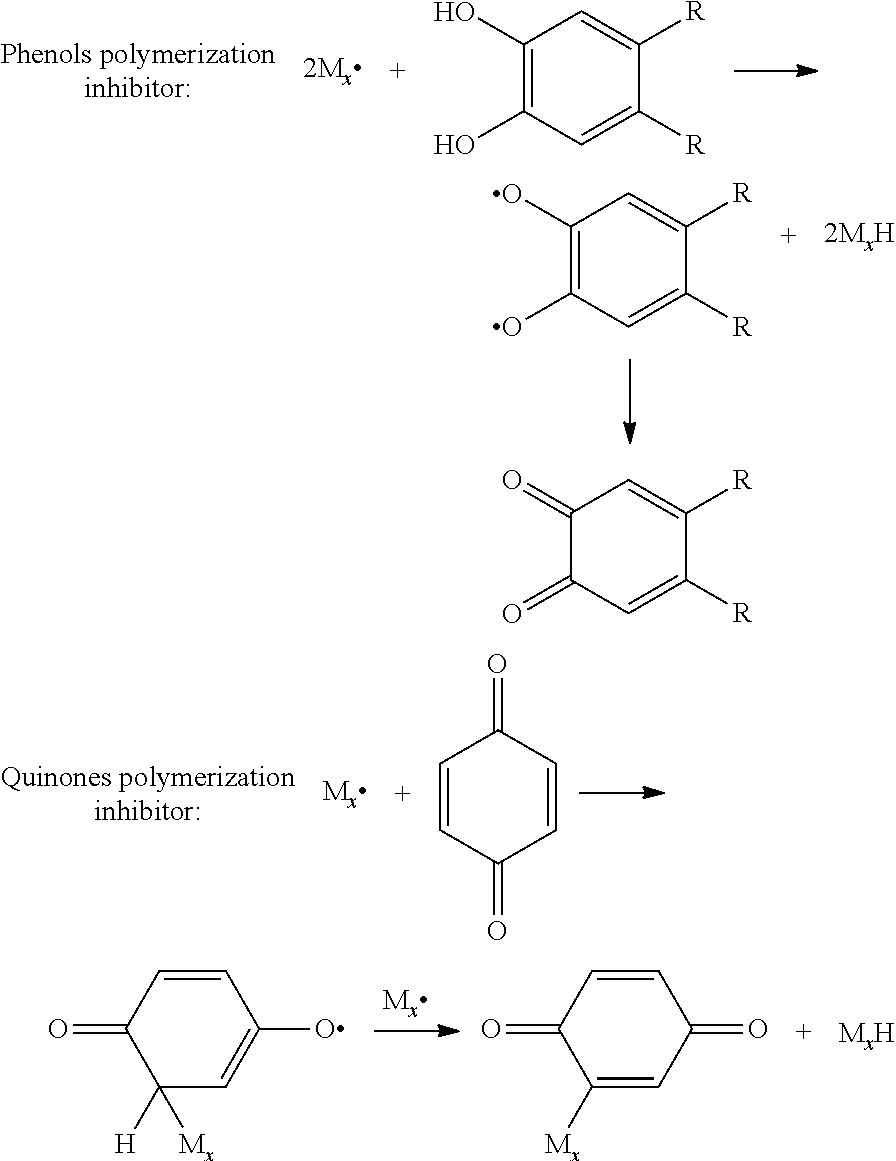
Essence of the two polymerization inhibitors is decreasing the concentration of free radicals of RM during initial stage of reaction and slowing down speed of RM reaction so as to reduce the size of the bumps and improve distribution uniformity of the bumps. But for the two types of polymerization inhibitors, any type polymerization would change the structure itself, bisphenol would be transformed into diquinone, 1,4-benzoquinone would be transformed into 1,4-benzoquinone containing active group fragments. The structural change would cause variation of physical characteristic parameters like Δn, Δε, etc., and thereby influence optical properties of LC and deteriorate panel quality.
In order to overcome the shortcomings of prior art, the invention provides an alignment film applied in a PSVA liquid crystal display panel. The alignment film includes a first branched chain M and a second branched chain Q bonded on a main chain of polyimide and has a structure as shown in formula 1:

where the first branched chain M is a group applied to deflect the liquid crystal molecules under a power distribution state, i.e., voltage-applied state; the second branched chain Q is a group containing a nitrobenzophenone or a benzoquinonyl; the x and y represent degrees of polymerization of the first branched chain M and the second branched chain Q respectively. The structural unit A represents: a naphthenic hydrocarbonthe, an aryl radical or a polycyclic aromatic hydrocarbon with the number of carbon atom no more than 12; or represents a cycloalkyl, an aromatic base or a polycyclic aromatic base with the number of carbon atom no more than 12, and one or more H atoms of the cycloalkyl, the aromatic base or the polycyclic aromatic base are substituted by halogen atoms, alkoxy groups or ester groups.
In one embodiment, a mole ratio of amount of substance of the first branched chain M to amount of substance of the second branched chain Q is 1:(0.1˜1); number of moles of a monomer before being polymerized to the main chain is no less than a sum of number of moles of monomers before being polymerized to the first branched chain M and the second branched chain Q.
In one embodiment, a structure of the second branched chain Q is as shown in formula 2:

The R1 represents an alkyl radical containing 2˜10 carbon atoms, or a group containing —O(CO)— and 2˜10 carbon atoms, or a group containing —N(CO)— and 2˜10 carbon atoms; the group B represents benzoquinonyl or nitrobenzophenone.
In one embodiment, a structure of the group B is as shown in formula 4, 5, or 6:

In one embodiment, a structure of the first branched chain M is as shown in formula 3:

where the R2 represents an alkyl radical containing 2˜10 carbon atoms, or a group containing —O(CO)— and 2˜10 carbon atoms, or a group containing —N(CO)— and 2˜10 carbon atoms; the group E represents a group containing 2˜5 five-membered rings and/or six-membered rings and/or benzene rings and/or condensed rings connected in sequence; R3 represents an alkyl radical containing 1˜12 carbon atoms, or a group containing 1˜12 carbon atoms and one or more of —F, —Cl, —CF3, —CN, —NCS, —OCF3 substituting for H atom.
The invention also provides a liquid crystal display panel including two oppositely disposed substrates, a liquid crystal containing a reactive mesogen is disposed between the two substrates, and a side of each the substrate adjacent to the liquid crystal is disposed with the alignment film according to any one of the above embodiments.
The invention also provides a preparation method of an alignment film applied in a PSVA liquid crystal display panel, including the following steps:
I. adding a dianhydride monomer p, a diamine monomer n containing a first branched chain and a diamine monomer m containing a second branched chain into an organic solvent and stirring for more than 24 h to obtain a precursor of alignment film; wherein a mole ratio of n:m=1: (0.1˜1), and number of moles of p≥n+m;
II. coating the precursor of alignment film on a substrate; toasting the coated substrate at 180˜230° C. for more than 30 minutes to dehydrate and polymerize the precursor of alignment film to be a polymer so as to form an alignment film; a structure of the alignment film containing a first branched chain M and a second branched chain Q bonded on a main chain of polyimide is shown in formula 1:

Wherein the first branched chain M is a group applied to deflect the liquid crystal molecules under a power distribution state; the second branched chain Q is a group containing a nitrobenzophenone or a benzoquinonyl; the x and y represent degrees of polymerization of the first branched chain M and the second branched chain Q respectively. The structural unit A represents: a naphthenic hydrocarbonthe, an aryl radical or a polycyclic aromatic hydrocarbon with the number of carbon atom no more than 12; or represents a cycloalkyl, an aromatic base or a polycyclic aromatic base with the number of carbon atom no more than 12 and one or more H atoms of the cycloalkyl, the aromatic base or the polycyclic aromatic base are substituted by halogen atoms, alkoxy groups or ester groups.
In one embodiment, the organic solvent is one or more of N-methyl pyrrolidone, N-ethyl pyrrolidine, γ-caprolactone, dimethyl sulphoxide and dichloromethane.
Benefits:
The invention points out that groups with polymerization inhibition characteristic are connected in form of short side chain onto an alignment film (PI), on one hand, the groups with polymerization inhibition characteristic can extend into LC to contact with RM, and therefore can slow down speed of RM polymerization, increase distribution uniformity of bumps and improve broken bright point issue of panel; on the other hand, as the short side chain is fixed in the alignment film, there is no need of directly adding a polymerization inhibitor into LC, which can limit the influence of structural change of the polymerization inhibitor after being irradiated onto LC physical parameters and therefore enhance quality of panel.
With the following reference to accompanying drawings, concrete embodiments of the invention will be described in detail.
The invention provides a new alignment film material with polymerization inhibition characteristic, a structure of the alignment film is as in FIG. 1 , including a first branched chain M and a second branched chain Q:

where the x and y represent degrees of polymerization of the first branched chain M and the second branched chain Q respectively, molecular weight of the formed alignment film is generally 5×10³˜5×10⁵; ranges of x and y can be adjusted according to molecular weights of side chains so as to guarantee the molecular weight of the alignment film is in an appropriate scale.
The structural unit A represents: a naphthenic hydrocarbon the, an aryl radical or a polycyclic aromatic hydrocarbon with the number of carbon atom no more than 12; or represents a cycloalkyl, an aromatic base or a polycyclic aromatic base with the number of carbon atom no more than 12, and one or more H atoms of the cycloalkyl, the aromatic base or the polycyclic aromatic base are substituted by halogen atoms, alkoxy groups or ester groups.
A mole ratio of amount of substance of the first branched chain M to amount of substance of the second branched chain Q is 1:(0.1˜1); number of moles of a monomer before being polymerized to the main chain is no less than a sum of number of moles of monomers before being polymerized to the first branched chain M and the second branched chain Q.
The first branched chain M is a side chain with rigid group like a benzene ring and long chain alkyl, which can make LC be perpendicularly aligned/orientated in an initial state, a structure of the first branched chain M is as shown in formula 3:

where the R2 represents an alkyl radical containing 2˜10 carbon atoms, or a group containing —O(CO)— and 2˜10 carbon atoms, or a group containing —N(CO)— and 2˜10 carbon atoms; the group E represents a group containing 2˜5 five-membered rings and/or six-membered rings and/or benzene rings and/or condensed rings connected in sequence; R3 represents an alkyl radical containing 1˜12 carbon atoms, or a group containing 1˜12 carbon atoms and one or more of —F, —Cl, —CF3, —CN, —NCS, —OCF3 substituting for H atom.
The second branched chain Q is a side chain with polymerization inhibition characteristic, including a group of nitrobenzophenone or benzoquinonyl. A structure of the second branched chain Q is as shown in formula 2:

The R1 represents an alkyl radical containing 2˜10 carbon atoms, or a group containing —O(CO)— and 2˜10 carbon atoms, or a group containing —N(CO)— and 2˜10 carbon atoms; the group B represents a group with polymerization inhibition characteristic such as benzoquinonyl or nitrobenzophenone.
For example, benzoquinones like 1,4-benzoquinone, is shown in formula 4:

Nitrobenzol (as shown in formula 5) or 2,4,6-trinitrobenzene (as shown in formula 6), like:

To maximize the effect of polymerization inhibition, a benzoquinonyl or a nitrobenzol is connected to the end of the second branched chain Q to make it contact with RM to the highest extent, slow down the speed of RM reaction, decrease size of bump and improve distribution uniformity of bump.
A schematic structural view of an alignment film of the invention is as shown in FIG. 2 , during practical process, the longer first branched chain M maintains stable orientation direction to LC; the shorter second branched chain Q offers polymerization inhibition function. The second branched chain Q can extend into LC to contact with RM on one hand, which can slow down speed of RM polymerization and increase distribution uniformity of bump; on the other hand, as the second branched chain is fixed in the alignment film, there is no need of directly adding the polymerization inhibitor into LC, which can limit residual concentration of polymerization inhibitor in LC after being irradiated and thereby guarantee subsequent quality of LC.
In the following, a preparation method of an alignment film of the invention will be introduced.
A dianhydride monomer p (a monomer molecule before being polymerized to be a main chain of the exemplary embodiment, such as shown in formula 7(b)), a monomer molecule n of the first branched chain M before polymerization (a diamine monomer, such as shown in formula 7(b)), and a monomer molecule m of the second branched chain Q before polymerization (a diamine monomer, such as shown in formula 7(c)) are provided. A mole ratio of amount of substance of the monomer molecule of the first branched chain M to amount of substance of the monomer molecule of the second branched chain Q is n:m=1:(0.1˜1), and number of moles of substance of dianhydride monomer is no less than sum of n and m in the exemplary embodiment.
The monomer molecules of the first branched chain M and the second branched chain Q are dissolved in an organic solvent N-methyl pyrrolidone (NMP) to form a solution, mess percentage of NMP in the alignment film solution is 90˜95% (the solvent can be one or more of N-ethyl pyrrolidine, γ-caprolactone, dimethyl sulphoxide and dichloromethane instead), and then is stirred at room temperature for 24 hours to obtain an alignment film precursor of polyamide acid (PAA, as shown in formula 7(d)); then the PAA is coated on a substrate, then the coated substrate is toasted at 180˜230° C. for 30 min, the solvent can fully evaporate while the PAA dehydrates to be a ring for forming a PI film.


A PSVA liquid crystal display panel using the alignment film includes two oppositely disposed substrates and a liquid crystal containing a reactive mesogen disposed between the two substrates. A side of each the substrate adjacent to the liquid crystal is disposed with the alignment film. The alignment film includes the first branched chain M and the second branched chain Q bonded on a main chain of polyimide, which makes the alignment film have the structure as shown in formula 1 as well as its function.
Claims (10)
1. An alignment film applied in a liquid crystal display panel, wherein a structure of the alignment film containing a first branched chain M and a second branched chain Q bonded on a main chain of polyimide is as shown in formula 1 that:

wherein the first branched chain M is a group applied to deflect liquid crystal molecules under a power distribution state; the second branched chain Q is a group containing a nitrobenzophenone or a benzoquinonyl; the x and y represent degrees of polymerization of the first branched chain M and the second branched chain Q respectively;
the structural unit A represents:
a cycloalky or an aryl with a number of carbon atom no more than 12, wherein one or more H atoms of the cycloalkyl or the aryl may be substituted by a halogen atom, an alkoxy group or an ester group.
2. The alignment film according to claim 1 , wherein a mole ratio of the first branched chain M to the second branched chain Q is 1:0.1˜1; and number of moles of a monomer of the main chain before polymerization is no less than a sum of number of moles of a monomer of the first branched chain M before polymerization and number of moles of a monomer of the second branched chain Q before polymerization.
3. The alignment film according to claim 1 , wherein a structure of the second branched chain Q is as shown in formula 2:

the R1 represents a group containing —O(CO)— or —N(CO)— and 2˜10 carbon atoms; the group B represents benzoquinonyl or nitrobenzophenone.
4. The alignment film according to claim 2 , wherein a structure of the second branched chain Q is as shown in formula 2:

the R1 represents a group containing —O(CO)— or —N(CO)— and 2˜10 carbon atoms; the group B represents benzoquinonyl or nitrobenzophenone.
5. The alignment film according to claim 4 , wherein a structure of the group B is as shown in formula 4:

6. The alignment film according to claim 1 , wherein a structure of the first branched chain M is as shown in formula 3:

where the R2 represents a group containing —O(CO)— or —N(CO)— and 2˜10 carbon atoms; the group E represents a group containing at least 2˜5 five-membered rings, six-membered rings, benzene rings, and condensed rings connected in sequence; R3 represents a group containing 1˜12 carbon atoms and one or more of —F, —Cl, —CF3, —CN, —NCS, —OCF3 substituting for H atom.
7. The alignment film according to claim 2 , wherein a structure of the first branched chain M is as shown in formula 3:

where the R2 represents a group containing —O(CO)— or —N(CO)— and 2˜10 carbon atoms; the group E represents a group containing at least 2˜5 five-membered rings, six-membered rings, benzene rings, and condensed rings connected in sequence; R3 represents a group containing 1˜12 carbon atoms and one or more of —F, —Cl, —CF3, —CN, —NCS, —OCF3 substituting for H atom.
8. A liquid crystal display panel, comprising two oppositely disposed substrates and a liquid crystal containing a reactive mesogen disposed between the two substrates, a side of each of the substrates adjacent to the liquid crystal being disposed with an alignment film; wherein a structure of the alignment film containing a first branched chain M and a second branched chain Q bonded on a main chain of polyimide is shown in formula 1:

where the first branched chain M is a group applied to deflect the liquid crystal molecules under a power distribution state; the second branched chain Q is a group containing a nitrobenzophenone or a benzoquinonyl; the x and y represent degrees of polymerization of the first branched chain M and the second branched chain Q respectively;
the structural unit A represents:
a cycloaky or an aryl with a number of carbon atom no more than 12; wherein one or more H atoms of the cycloalkyl or the aryl may be substituted by a halogen atoms, an alkoxy groups or an ester group.
9. A preparation method of an alignment film applied in a liquid crystal display panel, comprising following steps:
I. adding a dianhydride monomer p, a diamine monomer n containing a first branched chain and a diamine monomer m containing a second branched chain into an organic solvent and stirring for more than 24 h to obtain a precursor of alignment film;
wherein a mole ratio of n:m=1:0.1˜1, and number of moles of p≥n+m;
II. coating the precursor of alignment film on a substrate, toasting the coated substrate at 180˜230° C. for more than 30 minutes to dehydrate and polymerize the precursor to form an alignment film containing a first branched chain M and a second branched chain Q bonded on a main chain of a polyimide as shown in formula 1:

where the first branched chain M is a group applied to deflect the liquid crystal molecules under a power distribution state; the second branched chain Q is a group containing a nitrobenzophenone or a benzoquinonyl; the x and y represent degrees of polymerization of the first branched chain M and the second branched chain Q respectively;
the structural unit A represents:
a cycloalkyl or an aryl with a number of carbon atom no more than 12, wherein on or more H atoms of the cycloalkyl or the aryl may be substituted by a halogen atom, an alkoxy group or an ester group.
10. The preparation method of an alignment film according to claim 9 , wherein the organic solvent is one or more of N-methyl pyrrolidone, N-ethyl pyrrolidine, γ-caprolactone, dimethyl sulphoxide and dichloromethane.
Applications Claiming Priority (4)
| Application Number | Priority Date | Filing Date | Title |
|---|---|---|---|
| CN201510633573 | 2015-09-29 | ||
| CN201510633573.2A CN105199748B (en) | 2015-09-29 | 2015-09-29 | A kind of alignment film, preparation method and its liquid crystal panel |
| CN201510633573.2 | 2015-09-29 | ||
| PCT/CN2015/093099 WO2017054274A1 (en) | 2015-09-29 | 2015-10-28 | Alignment film, manufacturing method and liquid crystal panel thereof |
Publications (2)
| Publication Number | Publication Date |
|---|---|
| US20170190973A1 US20170190973A1 (en) | 2017-07-06 |
| US10093859B2 true US10093859B2 (en) | 2018-10-09 |
Family
ID=54947713
Family Applications (1)
| Application Number | Title | Priority Date | Filing Date |
|---|---|---|---|
| US14/894,930 Active 2036-07-17 US10093859B2 (en) | 2015-09-29 | 2015-10-28 | Alignment film, preparation method and liquid crystal display panel |
Country Status (3)
| Country | Link |
|---|---|
| US (1) | US10093859B2 (en) |
| CN (1) | CN105199748B (en) |
| WO (1) | WO2017054274A1 (en) |
Families Citing this family (5)
| Publication number | Priority date | Publication date | Assignee | Title |
|---|---|---|---|---|
| CN106188540B (en) * | 2016-07-12 | 2019-01-22 | 深圳市华星光电技术有限公司 | Alignment film material and the production method of alignment film, liquid crystal display panel and preparation method thereof |
| US20190250436A1 (en) * | 2018-02-11 | 2019-08-15 | Shenzhen China Star Optoelectronics Semiconductor Display Technology Co., Ltd. | Display assembly and manufacturing method thereof |
| CN108319083A (en) * | 2018-02-11 | 2018-07-24 | 深圳市华星光电半导体显示技术有限公司 | A kind of display module and manufacturing method |
| CN111117666A (en) * | 2019-12-18 | 2020-05-08 | Tcl华星光电技术有限公司 | Alignment film and preparation method thereof, and display panel |
| JP2023131109A (en) * | 2022-03-08 | 2023-09-21 | Jsr株式会社 | Liquid crystal alignment agents, liquid crystal alignment films, liquid crystal elements, polymers and compounds |
Citations (2)
| Publication number | Priority date | Publication date | Assignee | Title |
|---|---|---|---|---|
| CN101717647A (en) | 2009-11-26 | 2010-06-02 | 石家庄开发区永生华清液晶有限公司 | Polymer dispersed liquid crystal material and method for preparing liquid crystal films from same |
| CN104903786A (en) | 2012-11-06 | 2015-09-09 | 日产化学工业株式会社 | Liquid crystal aligning agent, liquid crystal alignment film and liquid crystal display element |
Family Cites Families (11)
| Publication number | Priority date | Publication date | Assignee | Title |
|---|---|---|---|---|
| JP2006091276A (en) * | 2004-09-22 | 2006-04-06 | Fuji Photo Film Co Ltd | Anti-reflection film, polarizer, image display device, and method of manufacturing anti-reflection film |
| CN102819121B (en) * | 2005-10-18 | 2015-05-13 | 旭硝子株式会社 | Liquid crystal optical modulation element and optical head device |
| KR100851787B1 (en) * | 2007-04-11 | 2008-08-13 | 제일모직주식회사 | 3,4-dicarboxy-1,2,3,4-tetrahydro-6-tert-butyl-1-naphthalenesuccinic dianhydride and a liquid crystal aligning agent comprising a polyimide polymer prepared using the same |
| CN101130502A (en) * | 2007-09-11 | 2008-02-27 | 东华大学 | Preparation method of 2,2-bis[3-amino-4-(4-nitrophenoxy)phenyl]-1,1,1,3,3,3-hexafluoropropane |
| TWI325992B (en) * | 2008-09-15 | 2010-06-11 | Au Optronics Corp | Liquid crystal panel and mixture of liquid crystal |
| KR101734600B1 (en) * | 2009-11-09 | 2017-05-11 | 제이엔씨 주식회사 | Liquid crystal display element, liquid crystal composition, aligning agent, and method for producing liquid crystal display element |
| WO2011115080A1 (en) * | 2010-03-15 | 2011-09-22 | 日産化学工業株式会社 | Polyamic acid ester liquid crystal alignment agent, and liquid crystal alignment film using same |
| JP5896197B2 (en) * | 2010-05-24 | 2016-03-30 | Dic株式会社 | Polymerizable liquid crystal composition, cholesteric reflective film and reflective polarizing plate using the same |
| CN102346338A (en) * | 2011-10-20 | 2012-02-08 | 深圳市华星光电技术有限公司 | Liquid crystal panel and alignment film thereof |
| CN103305235B (en) * | 2013-06-25 | 2015-11-25 | 深圳市华星光电技术有限公司 | The making method of a kind of liquid crystal panel and alignment film thereof, alignment film |
| TWI468441B (en) * | 2013-07-23 | 2015-01-11 | 奇美實業股份有限公司 | Liquid crystal alignment agent, liquid crystal alignment film, and liquid crystal display element including the same |
-
2015
- 2015-09-29 CN CN201510633573.2A patent/CN105199748B/en active Active
- 2015-10-28 US US14/894,930 patent/US10093859B2/en active Active
- 2015-10-28 WO PCT/CN2015/093099 patent/WO2017054274A1/en not_active Ceased
Patent Citations (2)
| Publication number | Priority date | Publication date | Assignee | Title |
|---|---|---|---|---|
| CN101717647A (en) | 2009-11-26 | 2010-06-02 | 石家庄开发区永生华清液晶有限公司 | Polymer dispersed liquid crystal material and method for preparing liquid crystal films from same |
| CN104903786A (en) | 2012-11-06 | 2015-09-09 | 日产化学工业株式会社 | Liquid crystal aligning agent, liquid crystal alignment film and liquid crystal display element |
Also Published As
| Publication number | Publication date |
|---|---|
| WO2017054274A1 (en) | 2017-04-06 |
| CN105199748B (en) | 2017-10-17 |
| CN105199748A (en) | 2015-12-30 |
| US20170190973A1 (en) | 2017-07-06 |
Similar Documents
| Publication | Publication Date | Title |
|---|---|---|
| US9499649B2 (en) | Functionalized photoreactive compounds | |
| KR100882586B1 (en) | Liquid crystal photo-alignment agent, liquid crystal photo-alignment layer comprising the same, and liquid crystal display device comprising the same | |
| US10093859B2 (en) | Alignment film, preparation method and liquid crystal display panel | |
| US9097938B2 (en) | Photoaligning material | |
| KR102336487B1 (en) | Liquid-crystal display element and method for manufacturing liquid-crystal display element | |
| US9034567B2 (en) | Method for manufacturing liquid crystal display device, and liquid crystal display device | |
| CN104718491B (en) | Aligning agent for liquid crystal, liquid crystal orientation film and liquid crystal display cells | |
| KR20100110343A (en) | Photoalignment composition | |
| WO2014185412A1 (en) | Method for producing substrate having liquid crystal orientation film for in-plane-switching liquid-crystal display element | |
| WO2005083504A1 (en) | Liquid crystal aligning agent for photoalignment and liquid crystal display device utilizing the same | |
| US20120316317A1 (en) | Photoaligning material with lateral substitution | |
| TW201604237A (en) | Liquid crystal alignment agent containing polyamic acid ester-polyamic acid compolymer, and liquid crystal alignment film using same | |
| WO2013159400A1 (en) | Liquid crystal medium composition, liquid crystal display device using same, and manufacturing method therefor | |
| KR101613753B1 (en) | Liquid crystal aligning agent and liquid crystal display element using same | |
| TW201333604A (en) | Method for manufacturing liquid-crystal display element for use with in-plane switching | |
| CN113939764B (en) | Liquid crystal alignment agent, liquid crystal alignment film, liquid crystal element, polymer and compound | |
| JP7409325B2 (en) | Liquid crystal aligning agent and method for manufacturing liquid crystal elements | |
| JP6676932B2 (en) | Liquid crystal alignment agent, liquid crystal alignment film and liquid crystal display device | |
| WO2017135130A1 (en) | Liquid crystal alignment agent, liquid crystal alignment film, and liquid crystal display element | |
| TWI791731B (en) | Liquid crystal alignment agent, liquid crystal alignment film, liquid crystal element and manufacturing method thereof | |
| JP7768017B2 (en) | Liquid crystal alignment agent, liquid crystal alignment film and its manufacturing method, liquid crystal element, liquid crystal display device, and polymer | |
| KR102597729B1 (en) | Liquid crystal orientation agent, liquid crystal oriented film, and liquid crystal display element | |
| US11112654B2 (en) | Liquid crystal display device | |
| JP5939157B2 (en) | Liquid crystal aligning agent, liquid crystal alignment film, and liquid crystal display element using the same | |
| KR101387737B1 (en) | Liquid crystal alignment agent, liquid crystal alignment film manufactured using the same, and liquid crystal display device including the liquid crystal alignment film |
Legal Events
| Date | Code | Title | Description |
|---|---|---|---|
| AS | Assignment |
Owner name: SHENZHEN CHINA STAR OPTOELECTRONICS TECHNOLOGY CO. Free format text: ASSIGNMENT OF ASSIGNORS INTEREST;ASSIGNOR:LAN, SONG;REEL/FRAME:037170/0234 Effective date: 20151127 |
|
| STCF | Information on status: patent grant |
Free format text: PATENTED CASE |
|
| MAFP | Maintenance fee payment |
Free format text: PAYMENT OF MAINTENANCE FEE, 4TH YEAR, LARGE ENTITY (ORIGINAL EVENT CODE: M1551); ENTITY STATUS OF PATENT OWNER: LARGE ENTITY Year of fee payment: 4 |