US10086085B2 - Bifunctional cytotoxic agents - Google Patents
Bifunctional cytotoxic agents Download PDFInfo
- Publication number
- US10086085B2 US10086085B2 US14/605,697 US201514605697A US10086085B2 US 10086085 B2 US10086085 B2 US 10086085B2 US 201514605697 A US201514605697 A US 201514605697A US 10086085 B2 US10086085 B2 US 10086085B2
- Authority
- US
- United States
- Prior art keywords
- alkyl
- mmol
- independently
- antibody
- ring system
- Prior art date
- Legal status (The legal status is an assumption and is not a legal conclusion. Google has not performed a legal analysis and makes no representation as to the accuracy of the status listed.)
- Active
Links
- 0 CC(CCOCCOCCOCCOCCOCCOCC*(C(CC1N*)=O)C1=O)=O Chemical compound CC(CCOCCOCCOCCOCCOCCOCC*(C(CC1N*)=O)C1=O)=O 0.000 description 36
- SWWHCQCMVCPLEQ-UHFFFAOYSA-N CC(C)OS(C)(=O)=O Chemical compound CC(C)OS(C)(=O)=O SWWHCQCMVCPLEQ-UHFFFAOYSA-N 0.000 description 5
- VKVZLWIDNJYIII-PNDHYWHASA-N C.C.C.C.C.C.C.C.CC.CC.CC.CC(C)(C)C.CC(C)(C)C.CC(C)(C)C.CC(C)(C)C.CC(C)(C)C.CC(C)(C)C.CC(C)(C)C(=O)/C=C/C1=CC=CC=C1.CC(C)(C)C(=O)C1=CC2=C(C=CC=C2)C1.CC(C)(C)C(=O)C1=CC2=C(C=CC=C2)C1.CC(C)(C)C(=O)C1=CC=CC=C1.CC(C)(C)C(=O)C1=CC=CC=N1.CC(C)(C)C(=O)C1=NC2=C(C=CC=C2)C=C1.CC(C)C.CN1C(C(=O)C(C)(C)C)=CC2=C1C=CC=C2.COC1=C(O)C(C(C)(C)C)=CC2=C1NC(C(=O)C(C)(C)C)=C2.COC1=C(O)C2=C(C3=C1NC(C(=O)C(C)(C)C)=C3)C(C)C(C(C)(C)C)N2C Chemical compound C.C.C.C.C.C.C.C.CC.CC.CC.CC(C)(C)C.CC(C)(C)C.CC(C)(C)C.CC(C)(C)C.CC(C)(C)C.CC(C)(C)C.CC(C)(C)C(=O)/C=C/C1=CC=CC=C1.CC(C)(C)C(=O)C1=CC2=C(C=CC=C2)C1.CC(C)(C)C(=O)C1=CC2=C(C=CC=C2)C1.CC(C)(C)C(=O)C1=CC=CC=C1.CC(C)(C)C(=O)C1=CC=CC=N1.CC(C)(C)C(=O)C1=NC2=C(C=CC=C2)C=C1.CC(C)C.CN1C(C(=O)C(C)(C)C)=CC2=C1C=CC=C2.COC1=C(O)C(C(C)(C)C)=CC2=C1NC(C(=O)C(C)(C)C)=C2.COC1=C(O)C2=C(C3=C1NC(C(=O)C(C)(C)C)=C3)C(C)C(C(C)(C)C)N2C VKVZLWIDNJYIII-PNDHYWHASA-N 0.000 description 4
- PEBOIEFFGVJNHO-UHFFFAOYSA-N C.C.C.C.C.CC.CC.CC.CC.CC.CC.CC.CC.CC(C)(C)C.CC(C)(C)C(=O)C1=CC=C2/N=C\C=C/C2=C1.CC(C)(C)C(=O)C1=CC=C2C/C(C(C)(C)C)=C\C2=C1.CC(C)(C)C(=O)C1=CC=C2CC(C(C)(C)C)=CC2=C1.CC(C)(C)C(=O)C1=CC=C2CC(C(C)(C)C)=CC2=C1.CC(C)C.CN1C=CC=C1C(=O)C(C)(C)C Chemical compound C.C.C.C.C.CC.CC.CC.CC.CC.CC.CC.CC.CC(C)(C)C.CC(C)(C)C(=O)C1=CC=C2/N=C\C=C/C2=C1.CC(C)(C)C(=O)C1=CC=C2C/C(C(C)(C)C)=C\C2=C1.CC(C)(C)C(=O)C1=CC=C2CC(C(C)(C)C)=CC2=C1.CC(C)(C)C(=O)C1=CC=C2CC(C(C)(C)C)=CC2=C1.CC(C)C.CN1C=CC=C1C(=O)C(C)(C)C PEBOIEFFGVJNHO-UHFFFAOYSA-N 0.000 description 4
- VHUNDNKYLHWZKK-CHVCDZFKSA-N CC(=O)OC1=CC2=C(C3=C1NC=C3C)[C@H](CCl)CN2C(=O)CC12CC(C(=O)N3C[C@@H](CCl)C4=C3C=C(OC(C)=O)C3=C4C(C)=CN3)(C1)C2 Chemical compound CC(=O)OC1=CC2=C(C3=C1NC=C3C)[C@H](CCl)CN2C(=O)CC12CC(C(=O)N3C[C@@H](CCl)C4=C3C=C(OC(C)=O)C3=C4C(C)=CN3)(C1)C2 VHUNDNKYLHWZKK-CHVCDZFKSA-N 0.000 description 2
- YLWOIYGOELQIHP-WOJBJXKFSA-N CC(=O)OC1=CC2=C(C3=CC=CC=C13)[C@H](CCl)CN2C(=O)C1=CC=C(C(=O)N2C[C@@H](CCl)C3=C2C=C(O)C2=CC=CC=C23)S1 Chemical compound CC(=O)OC1=CC2=C(C3=CC=CC=C13)[C@H](CCl)CN2C(=O)C1=CC=C(C(=O)N2C[C@@H](CCl)C3=C2C=C(O)C2=CC=CC=C23)S1 YLWOIYGOELQIHP-WOJBJXKFSA-N 0.000 description 2
- NJLOTDSWLPTPQZ-UHFFFAOYSA-N CC(C)(C)C12CC(C(C)(C)C)(C1)C2.CC(C)(C)C12CC3CC4C(C1)C1CC2CC3CC41C(C)(C)C Chemical compound CC(C)(C)C12CC(C(C)(C)C)(C1)C2.CC(C)(C)C12CC3CC4C(C1)C1CC2CC3CC41C(C)(C)C NJLOTDSWLPTPQZ-UHFFFAOYSA-N 0.000 description 2
- HDQRSWCEBGOREB-UHFFFAOYSA-N CC(CC(=O)NC(C)(C)C)C(=O)O.CC(CC(=O)O)C(=O)NC(C)(C)C.CC1CC(=O)N(C(C)(C)C)C1=O Chemical compound CC(CC(=O)NC(C)(C)C)C(=O)O.CC(CC(=O)O)C(=O)NC(C)(C)C.CC1CC(=O)N(C(C)(C)C)C1=O HDQRSWCEBGOREB-UHFFFAOYSA-N 0.000 description 2
- QUKFCRXRYNCCOG-JWQCQUIFSA-N CC1=CNC2=C(O)C=C3C(=C12)[C@H](CCl)CN3C(=O)CN(CC(=O)N1C[C@@H](CCl)C2=C3C(C)=CNC3=C(O)C=C21)C(=O)OCC1C2=C(C=CC=C2)C2=C1C=CC=C2 Chemical compound CC1=CNC2=C(O)C=C3C(=C12)[C@H](CCl)CN3C(=O)CN(CC(=O)N1C[C@@H](CCl)C2=C3C(C)=CNC3=C(O)C=C21)C(=O)OCC1C2=C(C=CC=C2)C2=C1C=CC=C2 QUKFCRXRYNCCOG-JWQCQUIFSA-N 0.000 description 2
- IYXZQHCXOBBNBP-RSMLWXBISA-N CC1=CNC2=C1C1=C(C=C2O)N(C(=O)C23CC(C(=O)N4C[C@@H](CCl)C5=C6C=CC=CC6=C(N)C=C54)(C2)C3)C[C@H]1CCl Chemical compound CC1=CNC2=C1C1=C(C=C2O)N(C(=O)C23CC(C(=O)N4C[C@@H](CCl)C5=C6C=CC=CC6=C(N)C=C54)(C2)C3)C[C@H]1CCl IYXZQHCXOBBNBP-RSMLWXBISA-N 0.000 description 2
- DVWMCWOWCGJFAW-KUXHTWIDSA-N C.CC(=O)C[C@@H](CCCCNC(=O)OC(C)(C)C)C(=O)N[C@H](C(=O)C[C@@H](CCCNC(N)=O)C(=O)NC1=CC=C(CO)C=C1)C(C)C.CC(=O)C[C@@H](CCCCNC(=O)OC(C)(C)C)C(=O)N[C@H](C(=O)C[C@@H](CCCNC(N)=O)C(=O)NC1=CC=C(COC(=O)OC2=CC=C([N+](=O)[O-])C=C2)C=C1)C(C)C.CC(=O)C[C@@H](CCCCNC(=O)OC(C)(C)C)C(=O)O.CC(=O)OCC1C2=C(C=CC=C2)C2=C1/C=C\C=C/2.CNCCN(C)C(=O)OC(C)(C)C.CNCCN(C)C(=O)OCC1C2=C(C=CC=C2)C2=C1C=CC=C2.Cl.O=C(OC1=CC=C([N+](=O)[O-])C=C1)OC1=CC=C([N+](=O)[O-])C=C1 Chemical compound C.CC(=O)C[C@@H](CCCCNC(=O)OC(C)(C)C)C(=O)N[C@H](C(=O)C[C@@H](CCCNC(N)=O)C(=O)NC1=CC=C(CO)C=C1)C(C)C.CC(=O)C[C@@H](CCCCNC(=O)OC(C)(C)C)C(=O)N[C@H](C(=O)C[C@@H](CCCNC(N)=O)C(=O)NC1=CC=C(COC(=O)OC2=CC=C([N+](=O)[O-])C=C2)C=C1)C(C)C.CC(=O)C[C@@H](CCCCNC(=O)OC(C)(C)C)C(=O)O.CC(=O)OCC1C2=C(C=CC=C2)C2=C1/C=C\C=C/2.CNCCN(C)C(=O)OC(C)(C)C.CNCCN(C)C(=O)OCC1C2=C(C=CC=C2)C2=C1C=CC=C2.Cl.O=C(OC1=CC=C([N+](=O)[O-])C=C1)OC1=CC=C([N+](=O)[O-])C=C1 DVWMCWOWCGJFAW-KUXHTWIDSA-N 0.000 description 1
- SZNGKJQINOVWHY-NXUAWWPISA-N C.CC(C)(C)OC(=O)N1C[C@@H](CCl)C2=C1C=C(O)C1=C2C=CC=C1.CC(C)(C)OC(=O)N1C[C@@H](CCl)C2=C1C=C(OC(=O)OC1=CC=C([N+](=O)[O-])C=C1)C1=C2C=CC=C1.CN(C)CCN.CN(C)CCNC(=O)OC1=CC2=C(C3=C1C=CC=C3)[C@H](CCl)CN2.CN(C)CCNC(=O)OC1=CC2=C(C3=C1C=CC=C3)[C@H](CCl)CN2C(=O)C1=CC=C(C(=O)N2C[C@@H](CCl)C3=C2C=C(O)C2=CC=CC=C23)S1.CN(C)CCNC(=O)OC1=CC2=C(C3=C1C=CC=C3)[C@H](CCl)CN2C(=O)OC(C)(C)C.O=C(Cl)OC1=CC=C([N+](=O)[O-])C=C1.O=C(O)C1=CC=C(C(=O)N2C[C@@H](CCl)C3=C2C=C(O)C2=CC=CC=C23)S1 Chemical compound C.CC(C)(C)OC(=O)N1C[C@@H](CCl)C2=C1C=C(O)C1=C2C=CC=C1.CC(C)(C)OC(=O)N1C[C@@H](CCl)C2=C1C=C(OC(=O)OC1=CC=C([N+](=O)[O-])C=C1)C1=C2C=CC=C1.CN(C)CCN.CN(C)CCNC(=O)OC1=CC2=C(C3=C1C=CC=C3)[C@H](CCl)CN2.CN(C)CCNC(=O)OC1=CC2=C(C3=C1C=CC=C3)[C@H](CCl)CN2C(=O)C1=CC=C(C(=O)N2C[C@@H](CCl)C3=C2C=C(O)C2=CC=CC=C23)S1.CN(C)CCNC(=O)OC1=CC2=C(C3=C1C=CC=C3)[C@H](CCl)CN2C(=O)OC(C)(C)C.O=C(Cl)OC1=CC=C([N+](=O)[O-])C=C1.O=C(O)C1=CC=C(C(=O)N2C[C@@H](CCl)C3=C2C=C(O)C2=CC=CC=C23)S1 SZNGKJQINOVWHY-NXUAWWPISA-N 0.000 description 1
- FSTPFGHCVPLACX-OSSKAEOZSA-N C.CC(C)(C)OC(=O)N1C[C@@H](CCl)C2=C1C=C(OC(=O)OC1=CC=C([N+](=O)[O-])C=C1)C1=C2C=CC=C1.CCCCN(C)C.CN(C)CCN(C)C(=O)OC1=CC2=C(C3=C1C=CC=C3)[C@H](CCl)CN2.CN(C)CCN(C)C(=O)OC1=CC2=C(C3=C1C=CC=C3)[C@H](CCl)CN2C(=O)OC(C)(C)C.O=C(O)C1=CC=C(C(=O)N2C[C@@H](CCl)C3=C2C=C(O)C2=CC=CC=C23)S1 Chemical compound C.CC(C)(C)OC(=O)N1C[C@@H](CCl)C2=C1C=C(OC(=O)OC1=CC=C([N+](=O)[O-])C=C1)C1=C2C=CC=C1.CCCCN(C)C.CN(C)CCN(C)C(=O)OC1=CC2=C(C3=C1C=CC=C3)[C@H](CCl)CN2.CN(C)CCN(C)C(=O)OC1=CC2=C(C3=C1C=CC=C3)[C@H](CCl)CN2C(=O)OC(C)(C)C.O=C(O)C1=CC=C(C(=O)N2C[C@@H](CCl)C3=C2C=C(O)C2=CC=CC=C23)S1 FSTPFGHCVPLACX-OSSKAEOZSA-N 0.000 description 1
- HKLGSFRUZVPJNG-UHFFFAOYSA-N C.CC.CC(C)C(=O)OC1=CC=CC=C1 Chemical compound C.CC.CC(C)C(=O)OC1=CC=CC=C1 HKLGSFRUZVPJNG-UHFFFAOYSA-N 0.000 description 1
- CBHRWBPFUFYWHI-YBAJETOJSA-N C.CC1=CNC2=C(O)C=C3C(=C12)[C@H](CCl)CN3C(=O)C12CC(C(=O)N3C[C@H]4CC45C3=CC(=O)C3=C5C(C)=CN3)(C1)C2.CC1=CNC2=C1[C@@]13CC1CN(C(=O)C14CC(C(=O)N5C[C@H]6C[C@@]67C5=CC(=O)C5=C7C(C)=CN5)(C1)C4)C3=CC2=O Chemical compound C.CC1=CNC2=C(O)C=C3C(=C12)[C@H](CCl)CN3C(=O)C12CC(C(=O)N3C[C@H]4CC45C3=CC(=O)C3=C5C(C)=CN3)(C1)C2.CC1=CNC2=C1[C@@]13CC1CN(C(=O)C14CC(C(=O)N5C[C@H]6C[C@@]67C5=CC(=O)C5=C7C(C)=CN5)(C1)C4)C3=CC2=O CBHRWBPFUFYWHI-YBAJETOJSA-N 0.000 description 1
- MCBNXMICZANMBQ-ABWXFFQSSA-N C.O=C(O)C1O[C@@H](O/C2=C/C3=C(\C4=C2C=CC=C4)[C@H](CCl)CN3C(=O)C2=CC=C(C(=O)N3C[C@@H](CCl)C4=C3C=C(O)C3=CC=CC=C34)S2)[C@@H](O)C(O)[C@@H]1O Chemical compound C.O=C(O)C1O[C@@H](O/C2=C/C3=C(\C4=C2C=CC=C4)[C@H](CCl)CN3C(=O)C2=CC=C(C(=O)N3C[C@@H](CCl)C4=C3C=C(O)C3=CC=CC=C34)S2)[C@@H](O)C(O)[C@@H]1O MCBNXMICZANMBQ-ABWXFFQSSA-N 0.000 description 1
- POAXUDOVIJKIHK-UHFFFAOYSA-N C=C1/C=C2/N(C(C)(C)C)C(C)C3C(C)C23C2=C1NC(C)=C2C.CC1=C(C)C2=C(N1)/C(C[Y])=C\C1=C2C(C(C)C)C(C)N1C(C)(C)C Chemical compound C=C1/C=C2/N(C(C)(C)C)C(C)C3C(C)C23C2=C1NC(C)=C2C.CC1=C(C)C2=C(N1)/C(C[Y])=C\C1=C2C(C(C)C)C(C)N1C(C)(C)C POAXUDOVIJKIHK-UHFFFAOYSA-N 0.000 description 1
- VTMSUEMQTVZHFG-GXQYBNRCSA-N CC(=O)CC1=CC=C2C(=C1)C1=C(/C=C\2OC(C)=O)N(C(=O)C23CC(C(=O)N4C[C@@H](CCl)/C5=C4/C=C(/OC(C)=O)C4=CC=CC=C45)(C2)C3)C[C@@H]1CCl.CC(=O)CC1=CC=C2C(OC(C)=O)=CC3=C(C2=C1)[C@@H](CCl)CN3.CC(=O)O/C1=C/C2=C(\C3=CC=CC=C31)[C@H](CCl)CN2C(=O)C12CC(C(=O)Cl)(C1)C2.Cl Chemical compound CC(=O)CC1=CC=C2C(=C1)C1=C(/C=C\2OC(C)=O)N(C(=O)C23CC(C(=O)N4C[C@@H](CCl)/C5=C4/C=C(/OC(C)=O)C4=CC=CC=C45)(C2)C3)C[C@@H]1CCl.CC(=O)CC1=CC=C2C(OC(C)=O)=CC3=C(C2=C1)[C@@H](CCl)CN3.CC(=O)O/C1=C/C2=C(\C3=CC=CC=C31)[C@H](CCl)CN2C(=O)C12CC(C(=O)Cl)(C1)C2.Cl VTMSUEMQTVZHFG-GXQYBNRCSA-N 0.000 description 1
- VTMSUEMQTVZHFG-DTHHUBNISA-N CC(=O)CC1=CC=C2C(=C1)C1=C(/C=C\2OC(C)=O)N(C(=O)C23CC(C(=O)N4C[C@@H](CCl)/C5=C4/C=C(/OC(C)=O)C4=CC=CC=C45)(C2)C3)C[C@H]1CCl.CC(=O)CC1=CC=C2C(OC(C)=O)=CC3=C(C2=C1)[C@H](CCl)CN3.CC(=O)O/C1=C/C2=C(\C3=CC=CC=C31)[C@H](CCl)CN2C(=O)C12CC(C(=O)Cl)(C1)C2.Cl Chemical compound CC(=O)CC1=CC=C2C(=C1)C1=C(/C=C\2OC(C)=O)N(C(=O)C23CC(C(=O)N4C[C@@H](CCl)/C5=C4/C=C(/OC(C)=O)C4=CC=CC=C45)(C2)C3)C[C@H]1CCl.CC(=O)CC1=CC=C2C(OC(C)=O)=CC3=C(C2=C1)[C@H](CCl)CN3.CC(=O)O/C1=C/C2=C(\C3=CC=CC=C31)[C@H](CCl)CN2C(=O)C12CC(C(=O)Cl)(C1)C2.Cl VTMSUEMQTVZHFG-DTHHUBNISA-N 0.000 description 1
- AXJOLYWPDHEAGS-AMABGYFJSA-N CC(=O)CC1=CC=C2C(OC(C)=O)=CC3=C(C2=C1)[C@@H](CCl)CN3.CC(=O)CC1=CC=C2C(OC(C)=O)=CC3=C(C2=C1)[C@@H](CCl)CN3C(=O)OC(C)(C)C.CC(C)(C)OC(=O)N1C[C@H](CCl)C2=C1C=C(OCC1=CC=CC=C1)C1=CC=C(N)C=C12.Cl Chemical compound CC(=O)CC1=CC=C2C(OC(C)=O)=CC3=C(C2=C1)[C@@H](CCl)CN3.CC(=O)CC1=CC=C2C(OC(C)=O)=CC3=C(C2=C1)[C@@H](CCl)CN3C(=O)OC(C)(C)C.CC(C)(C)OC(=O)N1C[C@H](CCl)C2=C1C=C(OCC1=CC=CC=C1)C1=CC=C(N)C=C12.Cl AXJOLYWPDHEAGS-AMABGYFJSA-N 0.000 description 1
- AXJOLYWPDHEAGS-FOSQENNKSA-N CC(=O)CC1=CC=C2C(OC(C)=O)=CC3=C(C2=C1)[C@H](CCl)CN3.CC(=O)CC1=CC=C2C(OC(C)=O)=CC3=C(C2=C1)[C@H](CCl)CN3C(=O)OC(C)(C)C.CC(C)(C)OC(=O)N1C[C@@H](CCl)C2=C1C=C(OCC1=CC=CC=C1)C1=CC=C(N)C=C12.Cl Chemical compound CC(=O)CC1=CC=C2C(OC(C)=O)=CC3=C(C2=C1)[C@H](CCl)CN3.CC(=O)CC1=CC=C2C(OC(C)=O)=CC3=C(C2=C1)[C@H](CCl)CN3C(=O)OC(C)(C)C.CC(C)(C)OC(=O)N1C[C@@H](CCl)C2=C1C=C(OCC1=CC=CC=C1)C1=CC=C(N)C=C12.Cl AXJOLYWPDHEAGS-FOSQENNKSA-N 0.000 description 1
- JPWJEIDXOGYZJK-CHMIDYFRSA-N CC(=O)CCCCCN1C(=O)C=CC1=O.CC1=CNC2=C1C1=C(C=C2OP(=O)(O)O)N(C(=O)C23CC(C(=O)N4C[C@@H](CCl)C5=C4C=C(NC(=O)[C@H](C)NC(=O)[C@@H](N)C(C)C)C4=C5C=CC=C4)(C2)C3)C[C@H]1CCl.CC1=CNC2=C1C1=C(C=C2OP(=O)(O)O)N(C(=O)C23CC(C(=O)N4C[C@@H](CCl)C5=C4C=C(NC(=O)[C@H](C)NC(=O)[C@@H](NC(=O)CCCCCN4C(=O)C=CC4=O)C(C)C)C4=C5C=CC=C4)(C2)C3)C[C@H]1CCl.CC1=CNC2=C1C1=C(C=C2OP(=O)(OCC2=CC=CC=C2)OCC2=CC=CC=C2)N(C(=O)C23CC(C(=O)N4C[C@@H](CCl)C5=C4C=C(NC(=O)[C@H](C)NC(=O)[C@@H](NC(=O)OCC4C6=C(C=CC=C6)C6=C4C=CC=C6)C(C)C)C4=C5C=CC=C4)(C2)C3)C[C@H]1CCl Chemical compound CC(=O)CCCCCN1C(=O)C=CC1=O.CC1=CNC2=C1C1=C(C=C2OP(=O)(O)O)N(C(=O)C23CC(C(=O)N4C[C@@H](CCl)C5=C4C=C(NC(=O)[C@H](C)NC(=O)[C@@H](N)C(C)C)C4=C5C=CC=C4)(C2)C3)C[C@H]1CCl.CC1=CNC2=C1C1=C(C=C2OP(=O)(O)O)N(C(=O)C23CC(C(=O)N4C[C@@H](CCl)C5=C4C=C(NC(=O)[C@H](C)NC(=O)[C@@H](NC(=O)CCCCCN4C(=O)C=CC4=O)C(C)C)C4=C5C=CC=C4)(C2)C3)C[C@H]1CCl.CC1=CNC2=C1C1=C(C=C2OP(=O)(OCC2=CC=CC=C2)OCC2=CC=CC=C2)N(C(=O)C23CC(C(=O)N4C[C@@H](CCl)C5=C4C=C(NC(=O)[C@H](C)NC(=O)[C@@H](NC(=O)OCC4C6=C(C=CC=C6)C6=C4C=CC=C6)C(C)C)C4=C5C=CC=C4)(C2)C3)C[C@H]1CCl JPWJEIDXOGYZJK-CHMIDYFRSA-N 0.000 description 1
- JGUHHSZGLIUIKL-OQQYWOLUSA-N CC(=O)C[C@@H](CCCCN)C(=O)N[C@H](C(=O)C[C@@H](CCCNC(N)=O)C(=O)NC1=CC=C(COC(=O)N(C)CCN(C)C(=O)OC2=C3C=CC=CC3=C3C(=C2)N(C(=O)C24C5C6C2C2C4C5C62C(=O)N2C[C@@H](CCl)C4=C5C=CC=CC5=C(OP(=O)(O)O)C=C42)C[C@H]3CCl)C=C1)C(C)C Chemical compound CC(=O)C[C@@H](CCCCN)C(=O)N[C@H](C(=O)C[C@@H](CCCNC(N)=O)C(=O)NC1=CC=C(COC(=O)N(C)CCN(C)C(=O)OC2=C3C=CC=CC3=C3C(=C2)N(C(=O)C24C5C6C2C2C4C5C62C(=O)N2C[C@@H](CCl)C4=C5C=CC=CC5=C(OP(=O)(O)O)C=C42)C[C@H]3CCl)C=C1)C(C)C JGUHHSZGLIUIKL-OQQYWOLUSA-N 0.000 description 1
- MQMQDIHGKIQQKK-HJKACCLUSA-N CC(=O)C[C@@H](CCCCN)C(=O)N[C@H](C(=O)C[C@@H](CCCNC(N)=O)C(=O)NC1=CC=C(COC(=O)N(C)CCN(C)C(=O)OC2=CC3=C(C4=CC=CC=C24)[C@H](CCl)CN3C(=O)C2=CC=C(C(=O)N3C[C@@H](CCl)C4=C3C=C(OP(=O)(O)O)C3=CC=CC=C34)S2)C=C1)C(C)C Chemical compound CC(=O)C[C@@H](CCCCN)C(=O)N[C@H](C(=O)C[C@@H](CCCNC(N)=O)C(=O)NC1=CC=C(COC(=O)N(C)CCN(C)C(=O)OC2=CC3=C(C4=CC=CC=C24)[C@H](CCl)CN3C(=O)C2=CC=C(C(=O)N3C[C@@H](CCl)C4=C3C=C(OP(=O)(O)O)C3=CC=CC=C34)S2)C=C1)C(C)C MQMQDIHGKIQQKK-HJKACCLUSA-N 0.000 description 1
- NGNQWKQHZCPMSN-OZWMYWNMSA-N CC(=O)C[C@@H](CCCCN)C(=O)N[C@H](C(=O)C[C@@H](CCCNC(N)=O)C(=O)NC1=CC=C(COC(=O)N(C)CCN(C)C(=O)OC2=CC3=C(C4=CC=CC=C24)[C@H](CCl)CN3C(=O)C2=CC=C(C(=O)N3C[C@@H](CCl)C4=C3C=C(O[C@@H]3OC(CO)[C@H](O)C(O)[C@@H]3O)C3=C4C=CC=C3)S2)C=C1)C(C)C Chemical compound CC(=O)C[C@@H](CCCCN)C(=O)N[C@H](C(=O)C[C@@H](CCCNC(N)=O)C(=O)NC1=CC=C(COC(=O)N(C)CCN(C)C(=O)OC2=CC3=C(C4=CC=CC=C24)[C@H](CCl)CN3C(=O)C2=CC=C(C(=O)N3C[C@@H](CCl)C4=C3C=C(O[C@@H]3OC(CO)[C@H](O)C(O)[C@@H]3O)C3=C4C=CC=C3)S2)C=C1)C(C)C NGNQWKQHZCPMSN-OZWMYWNMSA-N 0.000 description 1
- GIBLDQISZKPJFH-AOVVXLQZSA-N CC(=O)C[C@@H](CCCCN)C(=O)N[C@H](C(=O)C[C@@H](CCCNC(N)=O)C(=O)NC1=CC=C(COC(=O)N(C)CCN(C)C(=S)OC2=C3NC=C(C)C3=C3C(=C2)N(C(=O)C24CC(C(=O)N5C[C@@H](CCl)C6=C7C(C)=CNC7=C(OP(=O)(O)O)C=C65)(C2)C4)C[C@H]3CCl)C=C1)C(C)C Chemical compound CC(=O)C[C@@H](CCCCN)C(=O)N[C@H](C(=O)C[C@@H](CCCNC(N)=O)C(=O)NC1=CC=C(COC(=O)N(C)CCN(C)C(=S)OC2=C3NC=C(C)C3=C3C(=C2)N(C(=O)C24CC(C(=O)N5C[C@@H](CCl)C6=C7C(C)=CNC7=C(OP(=O)(O)O)C=C65)(C2)C4)C[C@H]3CCl)C=C1)C(C)C GIBLDQISZKPJFH-AOVVXLQZSA-N 0.000 description 1
- URSPUEHOZOKKAP-AOVVXLQZSA-N CC(=O)C[C@@H](CCCCN)C(=O)N[C@H](C(=O)C[C@@H](CCCNC(N)=O)C(=O)NC1=CC=C(COC(=S)N(C)CCN(C)C(=O)OC2=C3NC=C(C)C3=C3C(=C2)N(C(=O)C24CC(C(=O)N5C[C@@H](CCl)C6=C7C(C)=CNC7=C(OP(=O)(O)O)C=C65)(C2)C4)C[C@H]3CCl)C=C1)C(C)C Chemical compound CC(=O)C[C@@H](CCCCN)C(=O)N[C@H](C(=O)C[C@@H](CCCNC(N)=O)C(=O)NC1=CC=C(COC(=S)N(C)CCN(C)C(=O)OC2=C3NC=C(C)C3=C3C(=C2)N(C(=O)C24CC(C(=O)N5C[C@@H](CCl)C6=C7C(C)=CNC7=C(OP(=O)(O)O)C=C65)(C2)C4)C[C@H]3CCl)C=C1)C(C)C URSPUEHOZOKKAP-AOVVXLQZSA-N 0.000 description 1
- BUEMLFYLBUFPHC-AOVVXLQZSA-N CC(=O)C[C@@H](CCCCN)C(=O)N[C@H](C(=O)C[C@@H](CCCNC(N)=O)C(=O)NC1=CC=C(COC(=S)N(C)CCN(C)C(=S)OC2=C3NC=C(C)C3=C3C(=C2)N(C(=O)C24CC(C(=O)N5C[C@@H](CCl)C6=C7C(C)=CNC7=C(OP(=O)(O)O)C=C65)(C2)C4)C[C@H]3CCl)C=C1)C(C)C Chemical compound CC(=O)C[C@@H](CCCCN)C(=O)N[C@H](C(=O)C[C@@H](CCCNC(N)=O)C(=O)NC1=CC=C(COC(=S)N(C)CCN(C)C(=S)OC2=C3NC=C(C)C3=C3C(=C2)N(C(=O)C24CC(C(=O)N5C[C@@H](CCl)C6=C7C(C)=CNC7=C(OP(=O)(O)O)C=C65)(C2)C4)C[C@H]3CCl)C=C1)C(C)C BUEMLFYLBUFPHC-AOVVXLQZSA-N 0.000 description 1
- HWKZYWGYHQTVBI-PNMCRWDOSA-N CC(=O)C[C@@H](CCCCNC(C)=O)C(=O)N[C@H](C(=O)C[C@@H](CCCNC(N)=O)C(=O)NC1=CC=C(COC(=O)N(C)CCN(C)C(=O)OC2=C3NC=C(C)C3=C3C(=C2)N(C(=O)C24CC(C(=O)N5C[C@@H](CCl)C6=C7C(C)=CNC7=C(OP(=O)(O)O)C=C65)(C2)C4)C[C@H]3CCl)C=C1)C(C)C Chemical compound CC(=O)C[C@@H](CCCCNC(C)=O)C(=O)N[C@H](C(=O)C[C@@H](CCCNC(N)=O)C(=O)NC1=CC=C(COC(=O)N(C)CCN(C)C(=O)OC2=C3NC=C(C)C3=C3C(=C2)N(C(=O)C24CC(C(=O)N5C[C@@H](CCl)C6=C7C(C)=CNC7=C(OP(=O)(O)O)C=C65)(C2)C4)C[C@H]3CCl)C=C1)C(C)C HWKZYWGYHQTVBI-PNMCRWDOSA-N 0.000 description 1
- OLTCYQGCURTVPE-PNMCRWDOSA-N CC(=O)C[C@@H](CCCCNC(C)=O)C(=O)N[C@H](C(=O)C[C@@H](CCCNC(N)=O)C(=O)NC1=CC=C(COC(=O)N(C)CCN(C)C(=S)OC2=C3NC=C(C)C3=C3C(=C2)N(C(=O)C24CC(C(=O)N5C[C@@H](CCl)C6=C7C(C)=CNC7=C(OP(=O)(O)O)C=C65)(C2)C4)C[C@H]3CCl)C=C1)C(C)C Chemical compound CC(=O)C[C@@H](CCCCNC(C)=O)C(=O)N[C@H](C(=O)C[C@@H](CCCNC(N)=O)C(=O)NC1=CC=C(COC(=O)N(C)CCN(C)C(=S)OC2=C3NC=C(C)C3=C3C(=C2)N(C(=O)C24CC(C(=O)N5C[C@@H](CCl)C6=C7C(C)=CNC7=C(OP(=O)(O)O)C=C65)(C2)C4)C[C@H]3CCl)C=C1)C(C)C OLTCYQGCURTVPE-PNMCRWDOSA-N 0.000 description 1
- NCPJGBDKZANFLD-PNMCRWDOSA-N CC(=O)C[C@@H](CCCCNC(C)=O)C(=O)N[C@H](C(=O)C[C@@H](CCCNC(N)=O)C(=O)NC1=CC=C(COC(=S)N(C)CCN(C)C(=O)OC2=C3NC=C(C)C3=C3C(=C2)N(C(=O)C24CC(C(=O)N5C[C@@H](CCl)C6=C7C(C)=CNC7=C(OP(=O)(O)O)C=C65)(C2)C4)C[C@H]3CCl)C=C1)C(C)C Chemical compound CC(=O)C[C@@H](CCCCNC(C)=O)C(=O)N[C@H](C(=O)C[C@@H](CCCNC(N)=O)C(=O)NC1=CC=C(COC(=S)N(C)CCN(C)C(=O)OC2=C3NC=C(C)C3=C3C(=C2)N(C(=O)C24CC(C(=O)N5C[C@@H](CCl)C6=C7C(C)=CNC7=C(OP(=O)(O)O)C=C65)(C2)C4)C[C@H]3CCl)C=C1)C(C)C NCPJGBDKZANFLD-PNMCRWDOSA-N 0.000 description 1
- AAKAXGSRHFALST-PNMCRWDOSA-N CC(=O)C[C@@H](CCCCNC(C)=O)C(=O)N[C@H](C(=O)C[C@@H](CCCNC(N)=O)C(=O)NC1=CC=C(COC(=S)N(C)CCN(C)C(=S)OC2=C3NC=C(C)C3=C3C(=C2)N(C(=O)C24CC(C(=O)N5C[C@@H](CCl)C6=C7C(C)=CNC7=C(OP(=O)(O)O)C=C65)(C2)C4)C[C@H]3CCl)C=C1)C(C)C Chemical compound CC(=O)C[C@@H](CCCCNC(C)=O)C(=O)N[C@H](C(=O)C[C@@H](CCCNC(N)=O)C(=O)NC1=CC=C(COC(=S)N(C)CCN(C)C(=S)OC2=C3NC=C(C)C3=C3C(=C2)N(C(=O)C24CC(C(=O)N5C[C@@H](CCl)C6=C7C(C)=CNC7=C(OP(=O)(O)O)C=C65)(C2)C4)C[C@H]3CCl)C=C1)C(C)C AAKAXGSRHFALST-PNMCRWDOSA-N 0.000 description 1
- VVRXHZURFXDKSP-JOJMAMBASA-N CC(=O)N[C@@H](CCCCN)C(=O)C[C@H](C(=O)N[C@@H](CCCNC(N)=O)C(=O)CC1=CC=C(COC(=O)N(C)CCN(C)C(=O)OC2=CC3=C(C4=C2C=CC=C4)C(CCl)CN3C(=O)C2=CC=C(C(=O)N3C[C@@H](CCl)C4=C3C=C(O[C@@H]3O[C@H](C(=O)O)[C@@H](O)[C@H](O)[C@H]3O)C3=CC=CC=C34)S2)C=C1)C(C)C.CC(=O)N[C@@H](CCCCNC(=O)OC(C)(C)C)C(=O)C[C@H](C(=O)N[C@@H](CCCNC(N)=O)C(=O)CC1=CC=C(COC(=O)OC2=CC=C([N+](=O)[O-])C=C2)C=C1)C(C)C.CN(CCN(C)C(=O)OC(C)(C)C)C(=O)OC1=CC2=C(C3=C1C=CC=C3)[C@H](CCl)CN2C(=O)C1=CC=C(C(=O)N2C[C@@H](CCl)C3=C2C=C(O[C@@H]2O[C@H](C(=O)O)[C@@H](O)[C@H](O)[C@H]2O)C2=CC=CC=C23)S1 Chemical compound CC(=O)N[C@@H](CCCCN)C(=O)C[C@H](C(=O)N[C@@H](CCCNC(N)=O)C(=O)CC1=CC=C(COC(=O)N(C)CCN(C)C(=O)OC2=CC3=C(C4=C2C=CC=C4)C(CCl)CN3C(=O)C2=CC=C(C(=O)N3C[C@@H](CCl)C4=C3C=C(O[C@@H]3O[C@H](C(=O)O)[C@@H](O)[C@H](O)[C@H]3O)C3=CC=CC=C34)S2)C=C1)C(C)C.CC(=O)N[C@@H](CCCCNC(=O)OC(C)(C)C)C(=O)C[C@H](C(=O)N[C@@H](CCCNC(N)=O)C(=O)CC1=CC=C(COC(=O)OC2=CC=C([N+](=O)[O-])C=C2)C=C1)C(C)C.CN(CCN(C)C(=O)OC(C)(C)C)C(=O)OC1=CC2=C(C3=C1C=CC=C3)[C@H](CCl)CN2C(=O)C1=CC=C(C(=O)N2C[C@@H](CCl)C3=C2C=C(O[C@@H]2O[C@H](C(=O)O)[C@@H](O)[C@H](O)[C@H]2O)C2=CC=CC=C23)S1 VVRXHZURFXDKSP-JOJMAMBASA-N 0.000 description 1
- PSJRPCFIZUSSCT-GPEUCZJLSA-N CC(=O)N[C@@H](CCCCN)C(=O)C[C@H](C(=O)N[C@@H](CCCNC(N)=O)C(=O)CC1=CC=C(COC(=O)N(C)CCN(C)C(=O)OC2=CC3=C(C4=C2C=CC=C4)[C@H](CCl)CN3C(=O)C23CC(C(=O)N4C[C@@H](CCl)C5=C4C=C(O[C@@H]4O[C@H](C(=O)O)[C@@H](O)[C@H](O)[C@H]4O)C4=CC=CC=C45)(C2)C3)C=C1)C(C)C Chemical compound CC(=O)N[C@@H](CCCCN)C(=O)C[C@H](C(=O)N[C@@H](CCCNC(N)=O)C(=O)CC1=CC=C(COC(=O)N(C)CCN(C)C(=O)OC2=CC3=C(C4=C2C=CC=C4)[C@H](CCl)CN3C(=O)C23CC(C(=O)N4C[C@@H](CCl)C5=C4C=C(O[C@@H]4O[C@H](C(=O)O)[C@@H](O)[C@H](O)[C@H]4O)C4=CC=CC=C45)(C2)C3)C=C1)C(C)C PSJRPCFIZUSSCT-GPEUCZJLSA-N 0.000 description 1
- FZSPTTUEJSNQRV-KYCINBLVSA-N CC(=O)O/C1=C/C2=C(C3=CC=CC=C31)[C@H](CCl)CN2C(=O)C1=NN(C)C(C(=O)N2C[C@@H](CCl)/C3=C2/C=C(/OC(C)=O)C2=CC=CC=C23)=C1.CC(=O)OC1=CC2=C(C3=CC=CC=C13)[C@H](CCl)CN2.CN1N=C(C(=O)Cl)C=C1C(=O)Cl.CN1N=C(C(=O)O)C=C1C(=O)O Chemical compound CC(=O)O/C1=C/C2=C(C3=CC=CC=C31)[C@H](CCl)CN2C(=O)C1=NN(C)C(C(=O)N2C[C@@H](CCl)/C3=C2/C=C(/OC(C)=O)C2=CC=CC=C23)=C1.CC(=O)OC1=CC2=C(C3=CC=CC=C13)[C@H](CCl)CN2.CN1N=C(C(=O)Cl)C=C1C(=O)Cl.CN1N=C(C(=O)O)C=C1C(=O)O FZSPTTUEJSNQRV-KYCINBLVSA-N 0.000 description 1
- CEDMMDIWZJYPGJ-CRBNNXNKSA-N CC(=O)O/C1=C/C2=C(\C3=C1C=CC=C3)[C@H](CCl)CN2C(=O)C1=CC=C(C(=O)O)S1.CC1=CNC2=C(O)C=C3C(=C12)[C@H](CCl)CN3C(=O)C1=CC=C(C(=O)N2C[C@@H](CCl)/C3=C2/C=C(/O)C2=C3C=CC=C2)S1.CC1=CNC2=C(O)C=C3C(=C12)[C@H](CCl)CN3C(=O)OC(C)(C)C Chemical compound CC(=O)O/C1=C/C2=C(\C3=C1C=CC=C3)[C@H](CCl)CN2C(=O)C1=CC=C(C(=O)O)S1.CC1=CNC2=C(O)C=C3C(=C12)[C@H](CCl)CN3C(=O)C1=CC=C(C(=O)N2C[C@@H](CCl)/C3=C2/C=C(/O)C2=C3C=CC=C2)S1.CC1=CNC2=C(O)C=C3C(=C12)[C@H](CCl)CN3C(=O)OC(C)(C)C CEDMMDIWZJYPGJ-CRBNNXNKSA-N 0.000 description 1
- PXNDXOOWBMILIY-UEIVBUMDSA-N CC(=O)O/C1=C/C2=C(\C3=CC=CC=C31)[C@H](CCl)CN2C(=O)C12CC(C(=O)Cl)(C1)C2.CC(=O)OC1=CC2=C(C3=CC=CC=C13)[C@H](CCl)CN2.CC(C)(C)OC(=O)C12CC(C(=O)Cl)(C1)C2.CC(C)(C)OC(=O)C12CC(C(=O)O)(C1)C2.Cl Chemical compound CC(=O)O/C1=C/C2=C(\C3=CC=CC=C31)[C@H](CCl)CN2C(=O)C12CC(C(=O)Cl)(C1)C2.CC(=O)OC1=CC2=C(C3=CC=CC=C13)[C@H](CCl)CN2.CC(C)(C)OC(=O)C12CC(C(=O)Cl)(C1)C2.CC(C)(C)OC(=O)C12CC(C(=O)O)(C1)C2.Cl PXNDXOOWBMILIY-UEIVBUMDSA-N 0.000 description 1
- KHKCDZBVUASFJW-MJDZZMTCSA-N CC(=O)O/C1=C/C2=C(\C3=CC=CC=C31)[C@H](CCl)CN2C(=O)C12CCC(C(=O)N3C[C@@H](CCl)/C4=C3/C=C(/O)C3=CC=CC=C34)(CC1)C2.COC(=O)C12CCC(C(=O)Cl)(CC1)C2.COC(=O)C12CCC(C(=O)O)(CC1)C2.ClC[C@@H]1CNC2=C1C1=CC=CC=C1C(OCC1=CC=CC=C1)=C2.O=C(Cl)C12CCC(C(=O)N3C[C@@H](CCl)/C4=C3/C=C(/OCC3=CC=CC=C3)C3=CC=CC=C34)(CC1)C2 Chemical compound CC(=O)O/C1=C/C2=C(\C3=CC=CC=C31)[C@H](CCl)CN2C(=O)C12CCC(C(=O)N3C[C@@H](CCl)/C4=C3/C=C(/O)C3=CC=CC=C34)(CC1)C2.COC(=O)C12CCC(C(=O)Cl)(CC1)C2.COC(=O)C12CCC(C(=O)O)(CC1)C2.ClC[C@@H]1CNC2=C1C1=CC=CC=C1C(OCC1=CC=CC=C1)=C2.O=C(Cl)C12CCC(C(=O)N3C[C@@H](CCl)/C4=C3/C=C(/OCC3=CC=CC=C3)C3=CC=CC=C34)(CC1)C2 KHKCDZBVUASFJW-MJDZZMTCSA-N 0.000 description 1
- LJOARVGFEHNBNY-NYDITETGSA-N CC(=O)O/C1=C/C2=C(\C3=CC=CC=C31)[C@H](CCl)CN2C(=O)C1=CC=C(C(=O)N2C[C@@H](CCl)/C3=C2/C=C(/N)C2=CC=CC=C23)S1.CC(=O)O/C1=C/C2=C(\C3=CC=CC=C31)[C@H](CCl)CN2C(=O)C1=CC=C(C(=O)N2C[C@@H](CCl)/C3=C2/C=C(/[N+](=O)[O-])C2=CC=CC=C23)S1.CC(=O)OC1=CC2=C(C3=CC=CC=C13)[C@H](CCl)CN2.CC(C)(C)OC(=O)C1=CC=C(C(=O)N2C[C@@H](CCl)C3=C2C=C([N+](=O)[O-])C2=CC=CC=C23)S1.O=C(Cl)C1=CC=C(C(=O)N2C[C@@H](CCl)C3=C2C=C([N+](=O)[O-])C2=CC=CC=C23)S1.O=C(O)C1=CC=C(C(=O)N2C[C@@H](CCl)C3=C2C=C([N+](=O)[O-])C2=CC=CC=C23)S1.O=[N+]([O-])C1=CC2=C(C3=CC=CC=C31)[C@H](CCl)CN2 Chemical compound CC(=O)O/C1=C/C2=C(\C3=CC=CC=C31)[C@H](CCl)CN2C(=O)C1=CC=C(C(=O)N2C[C@@H](CCl)/C3=C2/C=C(/N)C2=CC=CC=C23)S1.CC(=O)O/C1=C/C2=C(\C3=CC=CC=C31)[C@H](CCl)CN2C(=O)C1=CC=C(C(=O)N2C[C@@H](CCl)/C3=C2/C=C(/[N+](=O)[O-])C2=CC=CC=C23)S1.CC(=O)OC1=CC2=C(C3=CC=CC=C13)[C@H](CCl)CN2.CC(C)(C)OC(=O)C1=CC=C(C(=O)N2C[C@@H](CCl)C3=C2C=C([N+](=O)[O-])C2=CC=CC=C23)S1.O=C(Cl)C1=CC=C(C(=O)N2C[C@@H](CCl)C3=C2C=C([N+](=O)[O-])C2=CC=CC=C23)S1.O=C(O)C1=CC=C(C(=O)N2C[C@@H](CCl)C3=C2C=C([N+](=O)[O-])C2=CC=CC=C23)S1.O=[N+]([O-])C1=CC2=C(C3=CC=CC=C31)[C@H](CCl)CN2 LJOARVGFEHNBNY-NYDITETGSA-N 0.000 description 1
- LOGFGYULZXCTQB-DEGGWYHKSA-N CC(=O)O/C1=C/C2=C(\C3=CC=CC=C31)[C@H](CCl)CN2C(=O)C1=CC=C(C(=O)N2C[C@@H](CCl)/C3=C2/C=C(/OP(=O)(OCC2=CC=CC=C2)OCC2=CC=CC=C2)C2=CC=CC=C23)S1.O=C(OC1=CC=C([N+](=O)[O-])C=C1)O/C1=C/C2=C(\C3=CC=CC=C31)[C@H](CCl)CN2C(=O)C1=CC=C(C(=O)N2C[C@@H](CCl)/C3=C2/C=C(/OP(=O)(O)O)C2=CC=CC=C23)S1 Chemical compound CC(=O)O/C1=C/C2=C(\C3=CC=CC=C31)[C@H](CCl)CN2C(=O)C1=CC=C(C(=O)N2C[C@@H](CCl)/C3=C2/C=C(/OP(=O)(OCC2=CC=CC=C2)OCC2=CC=CC=C2)C2=CC=CC=C23)S1.O=C(OC1=CC=C([N+](=O)[O-])C=C1)O/C1=C/C2=C(\C3=CC=CC=C31)[C@H](CCl)CN2C(=O)C1=CC=C(C(=O)N2C[C@@H](CCl)/C3=C2/C=C(/OP(=O)(O)O)C2=CC=CC=C23)S1 LOGFGYULZXCTQB-DEGGWYHKSA-N 0.000 description 1
- BCUJUDCLAFOZIA-WLXMYNDUSA-N CC(=O)O/C1=C/C2=C(\C3=CC=CC=C31)[C@H](CCl)CN2C(=O)C1=CC=C(C(=O)N2C[C@@H](CCl)C3=C2C=CC2=C(OC(=O)N(C)CCN(C)C(=O)OCC4=CC=C(NC(=O)[C@H](CCCNC(N)=O)CC(=O)[C@@H](NC(=O)CCCCCN5C(=O)C=CC5=O)C(C)C)C=C4)C=CC=C23)S1.CC(C)[C@H](NC(=O)CCCCCN1C(=O)C=CC1=O)C(=O)C[C@@H](CCCNC(N)=O)C(=O)NC1=CC=C(COC(=O)N(C)CCN(C)C(=O)OC(C)(C)C)C=C1.CC(C)[C@H](NC(=O)CCCCCN1C(=O)C=CC1=O)C(=O)C[C@@H](CCCNC(N)=O)C(=O)NC1=CC=C(COC(=O)OC2=CC=C([N+](=O)[O-])C=C2)C=C1.CNCCN(C)C(=O)OC(C)(C)C Chemical compound CC(=O)O/C1=C/C2=C(\C3=CC=CC=C31)[C@H](CCl)CN2C(=O)C1=CC=C(C(=O)N2C[C@@H](CCl)C3=C2C=CC2=C(OC(=O)N(C)CCN(C)C(=O)OCC4=CC=C(NC(=O)[C@H](CCCNC(N)=O)CC(=O)[C@@H](NC(=O)CCCCCN5C(=O)C=CC5=O)C(C)C)C=C4)C=CC=C23)S1.CC(C)[C@H](NC(=O)CCCCCN1C(=O)C=CC1=O)C(=O)C[C@@H](CCCNC(N)=O)C(=O)NC1=CC=C(COC(=O)N(C)CCN(C)C(=O)OC(C)(C)C)C=C1.CC(C)[C@H](NC(=O)CCCCCN1C(=O)C=CC1=O)C(=O)C[C@@H](CCCNC(N)=O)C(=O)NC1=CC=C(COC(=O)OC2=CC=C([N+](=O)[O-])C=C2)C=C1.CNCCN(C)C(=O)OC(C)(C)C BCUJUDCLAFOZIA-WLXMYNDUSA-N 0.000 description 1
- UVOQOLFJWVFAMK-UBAVSOPXSA-N CC(=O)OC1=C2C=CC=CC2=C2C(=C1)N(C(=O)C13C4C5C1C1C3C4C51C(=O)N1C[C@@H](CCl)C3=C4C=CC=CC4=C(OC(C)=O)C=C31)C[C@H]2CCl Chemical compound CC(=O)OC1=C2C=CC=CC2=C2C(=C1)N(C(=O)C13C4C5C1C1C3C4C51C(=O)N1C[C@@H](CCl)C3=C4C=CC=CC4=C(OC(C)=O)C=C31)C[C@H]2CCl UVOQOLFJWVFAMK-UBAVSOPXSA-N 0.000 description 1
- SFGXHJAMKISPQG-TUHCCAIRSA-N CC(=O)OC1=C2NC=C(C)C2=C2C(=C1)N(C(=O)C13CC(C(=O)N4C[C@@H](CCl)C5=C6C(C)=CNC6=C(OC(C)=O)C=C54)(C1)C3)C[C@H]2CCl.CC(=O)OC1=CC2=C(C3=C1NC=C3C)[C@H](CCl)CN2.Cl.O=C(Cl)C12CC(C(=O)Cl)(C1)C2.O=C(O)C(F)(F)F.O=C(O)C12CC(C(=O)O)(C1)C2 Chemical compound CC(=O)OC1=C2NC=C(C)C2=C2C(=C1)N(C(=O)C13CC(C(=O)N4C[C@@H](CCl)C5=C6C(C)=CNC6=C(OC(C)=O)C=C54)(C1)C3)C[C@H]2CCl.CC(=O)OC1=CC2=C(C3=C1NC=C3C)[C@H](CCl)CN2.Cl.O=C(Cl)C12CC(C(=O)Cl)(C1)C2.O=C(O)C(F)(F)F.O=C(O)C12CC(C(=O)O)(C1)C2 SFGXHJAMKISPQG-TUHCCAIRSA-N 0.000 description 1
- XMNKXLAQTUVBLQ-QAOGVXDRSA-N CC(=O)OC1=C2NC=C(C)C2=C2C(=C1)N(C(=O)C13CC(C(=O)N4C[C@@H](CCl)C5=C6C(C)=CNC6=C(OP(=O)(OCC6=CC=CC=C6)OCC6=CC=CC=C6)C=C54)(C1)C3)C[C@H]2CCl.CC(=O)OC1=C2NC=C(C)C2=C2C(=C1)NC[C@H]2CCl.CC1=CNC2=C(OC(=O)OC3=CC=C([N+](=O)[O-])C=C3)C=C3C(=C12)[C@H](CCl)CN3C(=O)C12CC(C(=O)N3C[C@@H](CCl)C4=C5C(C)=CNC5=C(OP(=O)(O)O)C=C43)(C1)C2.O=C(O)C(F)(F)F Chemical compound CC(=O)OC1=C2NC=C(C)C2=C2C(=C1)N(C(=O)C13CC(C(=O)N4C[C@@H](CCl)C5=C6C(C)=CNC6=C(OP(=O)(OCC6=CC=CC=C6)OCC6=CC=CC=C6)C=C54)(C1)C3)C[C@H]2CCl.CC(=O)OC1=C2NC=C(C)C2=C2C(=C1)NC[C@H]2CCl.CC1=CNC2=C(OC(=O)OC3=CC=C([N+](=O)[O-])C=C3)C=C3C(=C12)[C@H](CCl)CN3C(=O)C12CC(C(=O)N3C[C@@H](CCl)C4=C5C(C)=CNC5=C(OP(=O)(O)O)C=C43)(C1)C2.O=C(O)C(F)(F)F XMNKXLAQTUVBLQ-QAOGVXDRSA-N 0.000 description 1
- ADJQECRGUNOTSV-UHFFFAOYSA-N CC(=O)OC1=C2NC=C(C)C2=C2C(=C1)N(C(=O)C13CC4(C(=O)N5CC(CCl)C6=C7C(C)=CNC7=C(OC(C)=O)C=C65)CC14C3)CC2CCl.CC(=O)OC1=C2NC=C(C)C2=C2C(=C1)N(C(=O)C13CCC(C(=O)N4CC(CCl)C5=C6C(C)=CNC6=C(OC(C)=O)C=C54)(CC1)C3)CC2CCl.CC(=O)OC1=CC2=C(C3=C1NC=C3C)C(CCl)CN2C(=O)CC12CC3(C(=O)N4CC(CCl)C5=C4C=C(OC(C)=O)C4=C5C(C)=CN4)CC13C2.CC1=CCC2=C1C13CC1CN(C(=O)C14CC5(C(=O)N6CC7CC78C6=CC(=O)C6=C8/C(C)=C\N6)CC15C4)C3=CC2=O.CC1=CCC2=C1C1=C(C=C2O)N(C(=O)C23CC4(C(=O)N5CC(CCl)C6=C7C=CC=CC7=C(N)C=C65)CC42C3)CC1CCl.CNCCN(C)C(=O)OC1=C2NC=C(C)C2=C2C(=C1)N(C(=O)C13CC4(C(=O)N5CC(CCl)C6=C7C(C)=CNC7=C(OP(=O)(O)O)C=C65)CC14C3)CC2CCl Chemical compound CC(=O)OC1=C2NC=C(C)C2=C2C(=C1)N(C(=O)C13CC4(C(=O)N5CC(CCl)C6=C7C(C)=CNC7=C(OC(C)=O)C=C65)CC14C3)CC2CCl.CC(=O)OC1=C2NC=C(C)C2=C2C(=C1)N(C(=O)C13CCC(C(=O)N4CC(CCl)C5=C6C(C)=CNC6=C(OC(C)=O)C=C54)(CC1)C3)CC2CCl.CC(=O)OC1=CC2=C(C3=C1NC=C3C)C(CCl)CN2C(=O)CC12CC3(C(=O)N4CC(CCl)C5=C4C=C(OC(C)=O)C4=C5C(C)=CN4)CC13C2.CC1=CCC2=C1C13CC1CN(C(=O)C14CC5(C(=O)N6CC7CC78C6=CC(=O)C6=C8/C(C)=C\N6)CC15C4)C3=CC2=O.CC1=CCC2=C1C1=C(C=C2O)N(C(=O)C23CC4(C(=O)N5CC(CCl)C6=C7C=CC=CC7=C(N)C=C65)CC42C3)CC1CCl.CNCCN(C)C(=O)OC1=C2NC=C(C)C2=C2C(=C1)N(C(=O)C13CC4(C(=O)N5CC(CCl)C6=C7C(C)=CNC7=C(OP(=O)(O)O)C=C65)CC14C3)CC2CCl ADJQECRGUNOTSV-UHFFFAOYSA-N 0.000 description 1
- DWTXBFSNVAUMDV-MAJYPEROSA-N CC(=O)OC1=C2NC=C(C)C2=C2C(=C1)N(C(=O)C13CC4(C(=O)N5C[C@@H](CCl)C6=C7C(C)=CNC7=C(OC(C)=O)C=C65)CC14C3)C[C@H]2CCl.NC1=C2C=CC=CC2=C2C(=C1)N(C(=O)C13CC4(C(=O)N5C[C@@H](CCl)C6=C5C=C(O)C5=C6C=CC5)CC14C3)C[C@H]2CCl Chemical compound CC(=O)OC1=C2NC=C(C)C2=C2C(=C1)N(C(=O)C13CC4(C(=O)N5C[C@@H](CCl)C6=C7C(C)=CNC7=C(OC(C)=O)C=C65)CC14C3)C[C@H]2CCl.NC1=C2C=CC=CC2=C2C(=C1)N(C(=O)C13CC4(C(=O)N5C[C@@H](CCl)C6=C5C=C(O)C5=C6C=CC5)CC14C3)C[C@H]2CCl DWTXBFSNVAUMDV-MAJYPEROSA-N 0.000 description 1
- LUAXJBCFAHWTSJ-UHFFFAOYSA-N CC(=O)OC1=C2NC=C(C)C2=C2C(=C1)N(C(=O)C13CCC(C(=O)N4CC(CCl)C5=C6C(C)=CNC6=C(OC(C)=O)C=C54)(CC1)CC3)CC2CO.CC1=CNC2=C(O)C=C3C(=C12)C(CCl)CN3C(=O)C12CC3(C(=O)N4CC(CCl)C5=C4C=C(O)C4=CC=CC=C45)CC13C2.CC1=CNC2=C(O)C=C3C(=C12)C(CCl)CN3C(=O)C12CC3(C(=O)N4CC(CCl)C5=C6C(C)=CNC6=C(O)C=C54)CC13C2.CCC1CN(C(=O)CCCC(=O)N2CC(CCl)C3=C4C(C)=CNC4=C(O)C=C32)C2=CC(O)=C3NC=C(C)C3=C21.CCC1CN(C(=O)CN(CC(=O)N2CC(CCl)C3=C4C(C)=CNC4=C(O)C=C32)C(=O)OCC2C3=C(C=CC=C3)C3=C2C=CC=C3)C2=CC(O)=C3NC=C(C)C3=C21 Chemical compound CC(=O)OC1=C2NC=C(C)C2=C2C(=C1)N(C(=O)C13CCC(C(=O)N4CC(CCl)C5=C6C(C)=CNC6=C(OC(C)=O)C=C54)(CC1)CC3)CC2CO.CC1=CNC2=C(O)C=C3C(=C12)C(CCl)CN3C(=O)C12CC3(C(=O)N4CC(CCl)C5=C4C=C(O)C4=CC=CC=C45)CC13C2.CC1=CNC2=C(O)C=C3C(=C12)C(CCl)CN3C(=O)C12CC3(C(=O)N4CC(CCl)C5=C6C(C)=CNC6=C(O)C=C54)CC13C2.CCC1CN(C(=O)CCCC(=O)N2CC(CCl)C3=C4C(C)=CNC4=C(O)C=C32)C2=CC(O)=C3NC=C(C)C3=C21.CCC1CN(C(=O)CN(CC(=O)N2CC(CCl)C3=C4C(C)=CNC4=C(O)C=C32)C(=O)OCC2C3=C(C=CC=C3)C3=C2C=CC=C3)C2=CC(O)=C3NC=C(C)C3=C21 LUAXJBCFAHWTSJ-UHFFFAOYSA-N 0.000 description 1
- LUKJKNQNPIKPOM-BQNFWMHVSA-N CC(=O)OC1=C2NC=C(C)C2=C2C(=C1)N(C(=O)C13CCC(C(=O)N4C[C@@H](CCl)C5=C6C(C)=CNC6=C(OC(C)=O)C=C54)(CC1)C3)C[C@H]2CCl.CC(=O)OC1=C2NC=C(C)C2=C2C(=C1)N(C(=O)C13CCC(C(=O)N4C[C@@H](CCl)C5=C6C(C)=CNC6=C(OC(C)=O)C=C54)(CC1)CC3)C[C@H]2CCl.CC1=CNC2=C(O)C=C3C(=C12)[C@H](CCl)CN3C(=O)C12CC3(C(=O)N4C[C@@H](CCl)C5=C4C=C(O)C4=CC=CC=C45)CC13C2.CC1=CNC2=C(O)C=C3C(=C12)[C@H](CCl)CN3C(=O)C12CC3(C(=O)N4C[C@@H](CCl)C5=C6C(C)=CNC6=C(O)C=C54)CC13C2.CC[C@@H]1CN(C(=O)CCCC(=O)N2C[C@@H](CCl)C3=C4C(=C(O)C=C32)N/C=C\4C)C2=CC(O)=C3NC=C(C)C3=C21.CC[C@@H]1CN(C(=O)CN(CC(=O)N2C[C@@H](CCl)C3=C4C(=C(O)C=C32)N/C=C\4C)C(=O)OCC2C3=C(C=CC=C3)C3=C2C=CC=C3)C2=CC(O)=C3NC=C(C)C3=C21 Chemical compound CC(=O)OC1=C2NC=C(C)C2=C2C(=C1)N(C(=O)C13CCC(C(=O)N4C[C@@H](CCl)C5=C6C(C)=CNC6=C(OC(C)=O)C=C54)(CC1)C3)C[C@H]2CCl.CC(=O)OC1=C2NC=C(C)C2=C2C(=C1)N(C(=O)C13CCC(C(=O)N4C[C@@H](CCl)C5=C6C(C)=CNC6=C(OC(C)=O)C=C54)(CC1)CC3)C[C@H]2CCl.CC1=CNC2=C(O)C=C3C(=C12)[C@H](CCl)CN3C(=O)C12CC3(C(=O)N4C[C@@H](CCl)C5=C4C=C(O)C4=CC=CC=C45)CC13C2.CC1=CNC2=C(O)C=C3C(=C12)[C@H](CCl)CN3C(=O)C12CC3(C(=O)N4C[C@@H](CCl)C5=C6C(C)=CNC6=C(O)C=C54)CC13C2.CC[C@@H]1CN(C(=O)CCCC(=O)N2C[C@@H](CCl)C3=C4C(=C(O)C=C32)N/C=C\4C)C2=CC(O)=C3NC=C(C)C3=C21.CC[C@@H]1CN(C(=O)CN(CC(=O)N2C[C@@H](CCl)C3=C4C(=C(O)C=C32)N/C=C\4C)C(=O)OCC2C3=C(C=CC=C3)C3=C2C=CC=C3)C2=CC(O)=C3NC=C(C)C3=C21 LUKJKNQNPIKPOM-BQNFWMHVSA-N 0.000 description 1
- RLKMIBVGNKINJO-YPWBQCFOSA-N CC(=O)OC1=C2NC=C(C)C2=C2C(=C1)N(C(=O)C13CCC(C(=O)N4C[C@@H](CCl)C5=C6C(C)=CNC6=C(OC(C)=O)C=C54)(CC1)C3)C[C@H]2CCl.CC(=O)OC1=CC2=C(C3=C1NC=C3C)[C@H](CCl)CN2.Cl.O=C(Cl)C12CCC(C(=O)Cl)(CC1)C2.O=C(O)C12CCC(C(=O)O)(CC1)C2 Chemical compound CC(=O)OC1=C2NC=C(C)C2=C2C(=C1)N(C(=O)C13CCC(C(=O)N4C[C@@H](CCl)C5=C6C(C)=CNC6=C(OC(C)=O)C=C54)(CC1)C3)C[C@H]2CCl.CC(=O)OC1=CC2=C(C3=C1NC=C3C)[C@H](CCl)CN2.Cl.O=C(Cl)C12CCC(C(=O)Cl)(CC1)C2.O=C(O)C12CCC(C(=O)O)(CC1)C2 RLKMIBVGNKINJO-YPWBQCFOSA-N 0.000 description 1
- FEOVMMAEEXGZOJ-OZAIVBOKSA-N CC(=O)OC1=C2NC=C(C)C2=C2C(=C1)N(C(=O)C13CCC(C(=O)N4C[C@@H](CCl)C5=C6C(C)=CNC6=C(OC(C)=O)C=C54)(CC1)CC3)C[C@H]2CCl.CC(=O)OC1=CC2=C(C3=C1NC=C3C)[C@H](CCl)CN2.Cl.O=C(Cl)C12CCC(C(=O)Cl)(CC1)CC2.O=C(O)C(F)(F)F.O=C(O)C12CCC(C(=O)O)(CC1)CC2 Chemical compound CC(=O)OC1=C2NC=C(C)C2=C2C(=C1)N(C(=O)C13CCC(C(=O)N4C[C@@H](CCl)C5=C6C(C)=CNC6=C(OC(C)=O)C=C54)(CC1)CC3)C[C@H]2CCl.CC(=O)OC1=CC2=C(C3=C1NC=C3C)[C@H](CCl)CN2.Cl.O=C(Cl)C12CCC(C(=O)Cl)(CC1)CC2.O=C(O)C(F)(F)F.O=C(O)C12CCC(C(=O)O)(CC1)CC2 FEOVMMAEEXGZOJ-OZAIVBOKSA-N 0.000 description 1
- DADWQCUEDJVSCZ-YQSSGGRESA-N CC(=O)OC1=C2NC=C(C)C2=C2C(=C1)N(C(=O)OC(C)(C)C)C[C@H]2CCl.CC(=O)OC1=C2NC=C(C)C2=C2C(=C1)NC[C@H]2CCl.CC1=CNC2=C(O)C=C3C(=C12)[C@H](CCl)CN3C(=O)OC(C)(C)C.Cl Chemical compound CC(=O)OC1=C2NC=C(C)C2=C2C(=C1)N(C(=O)OC(C)(C)C)C[C@H]2CCl.CC(=O)OC1=C2NC=C(C)C2=C2C(=C1)NC[C@H]2CCl.CC1=CNC2=C(O)C=C3C(=C12)[C@H](CCl)CN3C(=O)OC(C)(C)C.Cl DADWQCUEDJVSCZ-YQSSGGRESA-N 0.000 description 1
- FTBRKHXQHXTGDA-ZZFYBICVSA-N CC(=O)OC1=CC2=C(C3=C1C=CC=C3)[C@H](CCl)CN2.CC(=O)OC1=CC2=C(C3=C1C=CC=C3)[C@H](CCl)CN2C(=O)OC(C)(C)C.CC(C)(C)OC(=O)N1C[C@@H](CCl)C2=C1C=C(O)C1=C2C=CC=C1 Chemical compound CC(=O)OC1=CC2=C(C3=C1C=CC=C3)[C@H](CCl)CN2.CC(=O)OC1=CC2=C(C3=C1C=CC=C3)[C@H](CCl)CN2C(=O)OC(C)(C)C.CC(C)(C)OC(=O)N1C[C@@H](CCl)C2=C1C=C(O)C1=C2C=CC=C1 FTBRKHXQHXTGDA-ZZFYBICVSA-N 0.000 description 1
- HOUFDGWWHSXJPQ-KKLWWLSJSA-N CC(=O)OC1=CC2=C(C3=C1C=CC=C3)[C@H](CCl)CN2C(=O)C1=CC2=CC(CC(=O)CC3=CC4=C(C=C3)NC(C(=O)N3C[C@@H](CCl)C5=C3C=C(OC(C)=O)C3=C5C=CC=C3)=C4)=CC=C2N1 Chemical compound CC(=O)OC1=CC2=C(C3=C1C=CC=C3)[C@H](CCl)CN2C(=O)C1=CC2=CC(CC(=O)CC3=CC4=C(C=C3)NC(C(=O)N3C[C@@H](CCl)C5=C3C=C(OC(C)=O)C3=C5C=CC=C3)=C4)=CC=C2N1 HOUFDGWWHSXJPQ-KKLWWLSJSA-N 0.000 description 1
- XDGAFCHGIFKBCO-KAYWLYCHSA-N CC(=O)OC1=CC2=C(C3=C1C=CC=C3)[C@H](CCl)CN2C(=O)CC1=CC(CC(=O)N2C[C@@H](CCl)C3=C2C=C(OC(C)=O)C2=C3C=CC=C2)=CC([N+](=O)O)=C1 Chemical compound CC(=O)OC1=CC2=C(C3=C1C=CC=C3)[C@H](CCl)CN2C(=O)CC1=CC(CC(=O)N2C[C@@H](CCl)C3=C2C=C(OC(C)=O)C2=C3C=CC=C2)=CC([N+](=O)O)=C1 XDGAFCHGIFKBCO-KAYWLYCHSA-N 0.000 description 1
- BPYACZJFQNBCEV-VSGBNLITSA-N CC(=O)OC1=CC2=C(C3=C1C=CC=C3)[C@H](CCl)CN2C(=O)CC1=CC=CC(CC(=O)N2C[C@@H](CCl)C3=C2C=C(OC(C)=O)C2=C3C=CC=C2)=C1 Chemical compound CC(=O)OC1=CC2=C(C3=C1C=CC=C3)[C@H](CCl)CN2C(=O)CC1=CC=CC(CC(=O)N2C[C@@H](CCl)C3=C2C=C(OC(C)=O)C2=C3C=CC=C2)=C1 BPYACZJFQNBCEV-VSGBNLITSA-N 0.000 description 1
- OEOCHRHLMOTUTR-SDCAKGKVSA-N CC(=O)OC1=CC2=C(C3=C1NC=C3C)[C@H](CCl)CN2.CC(=O)OC1=CC2=C(C3=C1NC=C3C)[C@H](CCl)CN2.CC(=O)OC1=CC2=C(C3=C1NC=C3C)[C@H](CCl)CN2C(=O)CC12CC(C(=O)Cl)(C1)C2.CC(=O)OC1=CC2=C(C3=C1NC=C3C)[C@H](CCl)CN2C(=O)CC12CC(C(=O)O)(C1)C2.CC(=O)OC1=CC2=C(C3=C1NC=C3C)[C@H](CCl)CN2C(=O)CC12CC(C(=O)OC(C)(C)C)(C1)C2.CC(C)(C)OC(=O)C12CC(CC(=O)Cl)(C1)C2.CC(C)(C)OC(=O)C12CC(CC(=O)O)(C1)C2.Cl.Cl Chemical compound CC(=O)OC1=CC2=C(C3=C1NC=C3C)[C@H](CCl)CN2.CC(=O)OC1=CC2=C(C3=C1NC=C3C)[C@H](CCl)CN2.CC(=O)OC1=CC2=C(C3=C1NC=C3C)[C@H](CCl)CN2C(=O)CC12CC(C(=O)Cl)(C1)C2.CC(=O)OC1=CC2=C(C3=C1NC=C3C)[C@H](CCl)CN2C(=O)CC12CC(C(=O)O)(C1)C2.CC(=O)OC1=CC2=C(C3=C1NC=C3C)[C@H](CCl)CN2C(=O)CC12CC(C(=O)OC(C)(C)C)(C1)C2.CC(C)(C)OC(=O)C12CC(CC(=O)Cl)(C1)C2.CC(C)(C)OC(=O)C12CC(CC(=O)O)(C1)C2.Cl.Cl OEOCHRHLMOTUTR-SDCAKGKVSA-N 0.000 description 1
- IXTFGLWMACSNJG-INFIHXHZSA-N CC(=O)OC1=CC2=C(C3=C1NC=C3C)[C@H](CCl)CN2C(=O)C12CC3(C(=O)N4C[C@@H](CCl)C5=C4C=C(OC(C)=O)C4NC=C(C)C54)CC13C2.CC1=CCC2=C1C13C[C@@H]1CN(C(=O)C14CC5(C(=O)N6C[C@H]7CC78C6=CC(=O)C6=C8C(C)=CN6)CC15C4)C3=CC2=O.CC1=CNC2=C(OP(=O)(O)O)C=C3C(=C12)[C@H](CCl)CN3C(=O)C12CC3(C(=O)N4C[C@H]5CC56C4=CC(=O)C4=C6C(C)=CN4)CC13C2.CNCCN(C)C(=O)OC1=C2NC=C(C)C2=C2C(=C1)N(C(=O)C13CC4(C(=O)N5C[C@@H](CCl)C6=C7C(C)=CNC7=C(O)C=C65)CC41C3)C[C@H]2CCl.CNCCN(C)C(=O)OC1=C2NC=C(C)C2=C2C(=C1)N(C(=O)C13CC4(C(=O)N5C[C@@H](CCl)C6=C7C(C)=CNC7=C(OP(=O)(O)O)C=C65)CC14C3)C[C@H]2CCl Chemical compound CC(=O)OC1=CC2=C(C3=C1NC=C3C)[C@H](CCl)CN2C(=O)C12CC3(C(=O)N4C[C@@H](CCl)C5=C4C=C(OC(C)=O)C4NC=C(C)C54)CC13C2.CC1=CCC2=C1C13C[C@@H]1CN(C(=O)C14CC5(C(=O)N6C[C@H]7CC78C6=CC(=O)C6=C8C(C)=CN6)CC15C4)C3=CC2=O.CC1=CNC2=C(OP(=O)(O)O)C=C3C(=C12)[C@H](CCl)CN3C(=O)C12CC3(C(=O)N4C[C@H]5CC56C4=CC(=O)C4=C6C(C)=CN4)CC13C2.CNCCN(C)C(=O)OC1=C2NC=C(C)C2=C2C(=C1)N(C(=O)C13CC4(C(=O)N5C[C@@H](CCl)C6=C7C(C)=CNC7=C(O)C=C65)CC41C3)C[C@H]2CCl.CNCCN(C)C(=O)OC1=C2NC=C(C)C2=C2C(=C1)N(C(=O)C13CC4(C(=O)N5C[C@@H](CCl)C6=C7C(C)=CNC7=C(OP(=O)(O)O)C=C65)CC14C3)C[C@H]2CCl IXTFGLWMACSNJG-INFIHXHZSA-N 0.000 description 1
- ZKUZKRIBSSFUBZ-NDILJBBBSA-N CC(=O)OC1=CC2=C(C3=CC=CC=C13)[C@H](CCl)CN2.CC(=O)OC1=CC2=C(C3=CC=CC=C13)[C@H](CCl)CN2C(=O)C12CCC(C(=O)N3C[C@@H](CCl)/C4=C3/C=C(/OC(C)=O)C3=CC=CC=C34)(CC1)N2C(=O)OCC1C2=C(C=CC=C2)C2=C1C=CC=C2.CC(=O)OC1=CC2=C(C3=CC=CC=C13)[C@H](CCl)CN2C(=O)C12CCC(C(=O)N3C[C@@H](CCl)/C4=C3/C=C(/OC(C)=O)C3=CC=CC=C34)(CC1)N2C(=O)OCC1C2=C(C=CC=C2)C2=C1C=CC=C2.CC(=O)OCC1C2=C(C=CC=C2)C2=C1/C=C\C=C/2.COC(=O)C12CCC(C(=O)OC)(CC1)N2C(=O)OCC1=CC=CC=C1.Cl.O=C(O)C(F)(F)F.O=C(OCC1C2=C(C=CC=C2)C2=C1C=CC=C2)N1C2(C(=O)Cl)CCC1(C(=O)Cl)CC2.O=C(OCC1C2=C(C=CC=C2)C2=C1C=CC=C2)N1C2(C(=O)O)CCC1(C(=O)O)CC2 Chemical compound CC(=O)OC1=CC2=C(C3=CC=CC=C13)[C@H](CCl)CN2.CC(=O)OC1=CC2=C(C3=CC=CC=C13)[C@H](CCl)CN2C(=O)C12CCC(C(=O)N3C[C@@H](CCl)/C4=C3/C=C(/OC(C)=O)C3=CC=CC=C34)(CC1)N2C(=O)OCC1C2=C(C=CC=C2)C2=C1C=CC=C2.CC(=O)OC1=CC2=C(C3=CC=CC=C13)[C@H](CCl)CN2C(=O)C12CCC(C(=O)N3C[C@@H](CCl)/C4=C3/C=C(/OC(C)=O)C3=CC=CC=C34)(CC1)N2C(=O)OCC1C2=C(C=CC=C2)C2=C1C=CC=C2.CC(=O)OCC1C2=C(C=CC=C2)C2=C1/C=C\C=C/2.COC(=O)C12CCC(C(=O)OC)(CC1)N2C(=O)OCC1=CC=CC=C1.Cl.O=C(O)C(F)(F)F.O=C(OCC1C2=C(C=CC=C2)C2=C1C=CC=C2)N1C2(C(=O)Cl)CCC1(C(=O)Cl)CC2.O=C(OCC1C2=C(C=CC=C2)C2=C1C=CC=C2)N1C2(C(=O)O)CCC1(C(=O)O)CC2 ZKUZKRIBSSFUBZ-NDILJBBBSA-N 0.000 description 1
- ZZQWKGLYUKYZQQ-DJSDWHFVSA-N CC(=O)OC1=CC2=C(C3=CC=CC=C13)[C@H](CCl)CN2.CC(=O)OC1=CC2=C(C3=CC=CC=C13)[C@H](CCl)CN2C(=O)C12CCC(C(=O)N3C[C@@H](CCl)C4=C3/C=C(/OC(C)=O)C3=CC=CC=C34)(C1)C2.Cl.O=C(Cl)C12CCC(C(=O)Cl)(C1)C2.O=C(O)C12CCC(C(=O)O)(C1)C2 Chemical compound CC(=O)OC1=CC2=C(C3=CC=CC=C13)[C@H](CCl)CN2.CC(=O)OC1=CC2=C(C3=CC=CC=C13)[C@H](CCl)CN2C(=O)C12CCC(C(=O)N3C[C@@H](CCl)C4=C3/C=C(/OC(C)=O)C3=CC=CC=C34)(C1)C2.Cl.O=C(Cl)C12CCC(C(=O)Cl)(C1)C2.O=C(O)C12CCC(C(=O)O)(C1)C2 ZZQWKGLYUKYZQQ-DJSDWHFVSA-N 0.000 description 1
- ADEZVEFYDRCJNT-KYCINBLVSA-N CC(=O)OC1=CC2=C(C3=CC=CC=C13)[C@H](CCl)CN2.CC(=O)OC1=CC2=C(C3=CC=CC=C13)[C@H](CCl)CN2C(=O)C1=CC=C(C(=O)N2C[C@@H](CCl)/C3=C2/C=C(/OC(C)=O)C2=C3C=CC=C2)N1.O=C(Cl)C1=CC=C(C(=O)Cl)N1.O=C(O)C1=CC=C(C(=O)O)N1 Chemical compound CC(=O)OC1=CC2=C(C3=CC=CC=C13)[C@H](CCl)CN2.CC(=O)OC1=CC2=C(C3=CC=CC=C13)[C@H](CCl)CN2C(=O)C1=CC=C(C(=O)N2C[C@@H](CCl)/C3=C2/C=C(/OC(C)=O)C2=C3C=CC=C2)N1.O=C(Cl)C1=CC=C(C(=O)Cl)N1.O=C(O)C1=CC=C(C(=O)O)N1 ADEZVEFYDRCJNT-KYCINBLVSA-N 0.000 description 1
- QJYQCMJAFYFBQI-RVDQYDGASA-N CC(=O)OC1=CC2=C(C3=CC=CC=C13)[C@H](CCl)CN2.CC(=O)OC1=CC2=C(C3=CC=CC=C13)[C@H](CCl)CN2C(=O)C1=CN=C(C(=O)N2C[C@@H](CCl)/C3=C2/C=C(/OC(C)=O)C2=C3C=CC=C2)S1.CCOC(=O)C1=CN=C(C(=O)OCC)S1.O=C(Cl)C1=CN=C(C(=O)Cl)S1 Chemical compound CC(=O)OC1=CC2=C(C3=CC=CC=C13)[C@H](CCl)CN2.CC(=O)OC1=CC2=C(C3=CC=CC=C13)[C@H](CCl)CN2C(=O)C1=CN=C(C(=O)N2C[C@@H](CCl)/C3=C2/C=C(/OC(C)=O)C2=C3C=CC=C2)S1.CCOC(=O)C1=CN=C(C(=O)OCC)S1.O=C(Cl)C1=CN=C(C(=O)Cl)S1 QJYQCMJAFYFBQI-RVDQYDGASA-N 0.000 description 1
- RORJZHHSWJTKHO-IOAWJKOTSA-N CC(=O)OC1=CC2=C(C3=CC=CC=C13)[C@H](CCl)CN2C(=O)C12CC(C(=O)N3C[C@@H](CCl)C4=C3C=C(OC(C)=O)C3=CC=CC=C34)(C1)C2 Chemical compound CC(=O)OC1=CC2=C(C3=CC=CC=C13)[C@H](CCl)CN2C(=O)C12CC(C(=O)N3C[C@@H](CCl)C4=C3C=C(OC(C)=O)C3=CC=CC=C34)(C1)C2 RORJZHHSWJTKHO-IOAWJKOTSA-N 0.000 description 1
- RHSHCAMXGVIPGX-CHVCDZFKSA-N CC(=O)OC1=CC2=C(C3=CC=CC=C13)[C@H](CCl)CN2C(=O)C12CC(CC(=O)N3C[C@@H](CCl)C4=C3C=C(O)C3=CC=CC=C34)(C1)C2 Chemical compound CC(=O)OC1=CC2=C(C3=CC=CC=C13)[C@H](CCl)CN2C(=O)C12CC(CC(=O)N3C[C@@H](CCl)C4=C3C=C(O)C3=CC=CC=C34)(C1)C2 RHSHCAMXGVIPGX-CHVCDZFKSA-N 0.000 description 1
- CFLNGJZKZVVPTH-XFQIONGESA-N CC(=O)OC1=CC2=C(C3=CC=CC=C13)[C@H](CCl)CN2C(=O)C12CCC(C(=O)N3C[C@@H](CCl)C4=C3C=C(OC(C)=O)C3=CC=CC=C34)(CC1)CC2 Chemical compound CC(=O)OC1=CC2=C(C3=CC=CC=C13)[C@H](CCl)CN2C(=O)C12CCC(C(=O)N3C[C@@H](CCl)C4=C3C=C(OC(C)=O)C3=CC=CC=C34)(CC1)CC2 CFLNGJZKZVVPTH-XFQIONGESA-N 0.000 description 1
- LROZJBFUOWBLMI-DHIUTWEWSA-N CC(=O)OC1=CC2=C(C3=CC=CC=C13)[C@H](CCl)CN2C(=O)C1=C2OCCCOC2=C(C(=O)N2C[C@@H](CCl)C3=C2C=C(OC(C)=O)C2=CC=CC=C23)S1 Chemical compound CC(=O)OC1=CC2=C(C3=CC=CC=C13)[C@H](CCl)CN2C(=O)C1=C2OCCCOC2=C(C(=O)N2C[C@@H](CCl)C3=C2C=C(OC(C)=O)C2=CC=CC=C23)S1 LROZJBFUOWBLMI-DHIUTWEWSA-N 0.000 description 1
- YESAJXVXQIFTHE-XHGRQVDESA-N CC(=O)OC1=CC2=C(C3=CC=CC=C13)[C@H](CCl)CN2C(=O)C1=CC=C(C(=O)Cl)S1.CC(=O)OC1=CC2=C(C3=CC=CC=C13)[C@H](CCl)CN2C(=O)C1=CC=C(C(=O)N2C[C@@H](CCl)/C3=C2/C=C(/O)C2=CC=CC=C23)S1.CC(=O)OC1=CC2=C(C3=CC=CC=C13)[C@H](CCl)CN2C(=O)C1=CC=C(C(=O)N2C[C@@H](CCl)/C3=C2/C=C(/OC(=O)OC2=CC=C([N+](=O)[O-])C=C2)C2=CC=CC=C23)S1.CC(=O)OC1=CC2=C(C3=CC=CC=C13)[C@H](CCl)CN2C(=O)C1=CC=C(C(=O)N2C[C@@H](CCl)/C3=C2/C=C(/OCC2=CC=CC=C2)C2=CC=CC=C23)S1 Chemical compound CC(=O)OC1=CC2=C(C3=CC=CC=C13)[C@H](CCl)CN2C(=O)C1=CC=C(C(=O)Cl)S1.CC(=O)OC1=CC2=C(C3=CC=CC=C13)[C@H](CCl)CN2C(=O)C1=CC=C(C(=O)N2C[C@@H](CCl)/C3=C2/C=C(/O)C2=CC=CC=C23)S1.CC(=O)OC1=CC2=C(C3=CC=CC=C13)[C@H](CCl)CN2C(=O)C1=CC=C(C(=O)N2C[C@@H](CCl)/C3=C2/C=C(/OC(=O)OC2=CC=C([N+](=O)[O-])C=C2)C2=CC=CC=C23)S1.CC(=O)OC1=CC2=C(C3=CC=CC=C13)[C@H](CCl)CN2C(=O)C1=CC=C(C(=O)N2C[C@@H](CCl)/C3=C2/C=C(/OCC2=CC=CC=C2)C2=CC=CC=C23)S1 YESAJXVXQIFTHE-XHGRQVDESA-N 0.000 description 1
- RQCWQURHVFMLOG-ZTHWMNFCSA-N CC(=O)OC1=CC2=C(C3=CC=CC=C13)[C@H](CCl)CN2C(=O)C1=CC=C(C(=O)Cl)S1.CC(=O)OC1=CC2=C(C3=CC=CC=C13)[C@H](CCl)CN2C(=O)C1=CC=C(C(=O)N2C[C@@H](CCl)C3=C2C=C(OP(=O)(O)OCC2=CC=CC=C2)C2=C3C=CC=C2)S1.CC(=O)OC1=CC2=C(C3=CC=CC=C13)[C@H](CCl)CN2C(=O)C1=CC=C(C(=O)N2C[C@@H](CCl)C3=C2C=C(OP(=O)(OCC2=CC=CC=C2)OCC2=CC=CC=C2)C2=C3C=CC=C2)S1.O=P(OCC1=CC=CC=C1)(OCC1=CC=CC=C1)OC1=CC2=C(C3=C1C=CC=C3)[C@H](CCl)CN2 Chemical compound CC(=O)OC1=CC2=C(C3=CC=CC=C13)[C@H](CCl)CN2C(=O)C1=CC=C(C(=O)Cl)S1.CC(=O)OC1=CC2=C(C3=CC=CC=C13)[C@H](CCl)CN2C(=O)C1=CC=C(C(=O)N2C[C@@H](CCl)C3=C2C=C(OP(=O)(O)OCC2=CC=CC=C2)C2=C3C=CC=C2)S1.CC(=O)OC1=CC2=C(C3=CC=CC=C13)[C@H](CCl)CN2C(=O)C1=CC=C(C(=O)N2C[C@@H](CCl)C3=C2C=C(OP(=O)(OCC2=CC=CC=C2)OCC2=CC=CC=C2)C2=C3C=CC=C2)S1.O=P(OCC1=CC=CC=C1)(OCC1=CC=CC=C1)OC1=CC2=C(C3=C1C=CC=C3)[C@H](CCl)CN2 RQCWQURHVFMLOG-ZTHWMNFCSA-N 0.000 description 1
- RUGBROVVAWKTIR-JZBYZBIVSA-N CC(=O)OC1=CC2=C(C3=CC=CC=C13)[C@H](CCl)CN2C(=O)C1=CC=C(C(=O)Cl)S1.CC(=O)OC1=CC2=C(C3=CC=CC=C13)[C@H](CCl)CN2C(=O)C1=CC=C(C(=O)O)S1.CC(=O)OC1=CC2=C(C3=CC=CC=C13)[C@H](CCl)CN2C(=O)C1=CC=C(C(=O)OC(C)(C)C)S1.CC(C)(C)OC(=O)C1=CC=C(C(=O)Cl)S1.CC(C)(C)OC(=O)C1=CC=C(C(=O)O)S1 Chemical compound CC(=O)OC1=CC2=C(C3=CC=CC=C13)[C@H](CCl)CN2C(=O)C1=CC=C(C(=O)Cl)S1.CC(=O)OC1=CC2=C(C3=CC=CC=C13)[C@H](CCl)CN2C(=O)C1=CC=C(C(=O)O)S1.CC(=O)OC1=CC2=C(C3=CC=CC=C13)[C@H](CCl)CN2C(=O)C1=CC=C(C(=O)OC(C)(C)C)S1.CC(C)(C)OC(=O)C1=CC=C(C(=O)Cl)S1.CC(C)(C)OC(=O)C1=CC=C(C(=O)O)S1 RUGBROVVAWKTIR-JZBYZBIVSA-N 0.000 description 1
- RNBFFWCUJMGGKQ-FGZHOGPDSA-N CC(=O)OC1=CC2=C(C3=CC=CC=C13)[C@H](CCl)CN2C(=O)C1=CC=C(C(=O)N2C[C@@H](CCl)/C3=C2/C=C(/OC(C)=O)C2=C3C=CC=C2)S1 Chemical compound CC(=O)OC1=CC2=C(C3=CC=CC=C13)[C@H](CCl)CN2C(=O)C1=CC=C(C(=O)N2C[C@@H](CCl)/C3=C2/C=C(/OC(C)=O)C2=C3C=CC=C2)S1 RNBFFWCUJMGGKQ-FGZHOGPDSA-N 0.000 description 1
- FALBBXMFICPJHC-RPVGYXPESA-N CC(=O)OC1=CC2=C(C3=CC=CC=C13)[C@H](CCl)CN2C(=O)C1=CC=C(C(=O)N2C[C@@H](CCl)C3=C2/C=C(/OC(=O)N(C)CCN(C)C(=O)OCC2=CC=C(NC(=O)[C@H](CCCNC(N)=O)CC(=O)[C@@H](NC(=O)CCOCCOCCOCCOCCOCCOCCN4C(=O)C=CC4=O)C(C)C)C=C2)C2=CC=CC=C23)S1.CC(=O)OC1=CC2=C(C3=CC=CC=C13)[C@H](CCl)CN2C(=O)C1=CC=C(C(=O)N2C[C@@H](CCl)C3=C2C=C(OC(=O)OC2=CC=C([N+](=O)[O-])C=C2)C2=CC=CC=C23)S1.CNCCN(C)C(=O)OCC1=CC=C(NC(=O)[C@H](CCCNC(N)=O)CC(=O)[C@@H](NC(=O)CCOCCOCCOCCOCCOCCOCCN2C(=O)C=CC2=O)C(C)C)C=C1 Chemical compound CC(=O)OC1=CC2=C(C3=CC=CC=C13)[C@H](CCl)CN2C(=O)C1=CC=C(C(=O)N2C[C@@H](CCl)C3=C2/C=C(/OC(=O)N(C)CCN(C)C(=O)OCC2=CC=C(NC(=O)[C@H](CCCNC(N)=O)CC(=O)[C@@H](NC(=O)CCOCCOCCOCCOCCOCCOCCN4C(=O)C=CC4=O)C(C)C)C=C2)C2=CC=CC=C23)S1.CC(=O)OC1=CC2=C(C3=CC=CC=C13)[C@H](CCl)CN2C(=O)C1=CC=C(C(=O)N2C[C@@H](CCl)C3=C2C=C(OC(=O)OC2=CC=C([N+](=O)[O-])C=C2)C2=CC=CC=C23)S1.CNCCN(C)C(=O)OCC1=CC=C(NC(=O)[C@H](CCCNC(N)=O)CC(=O)[C@@H](NC(=O)CCOCCOCCOCCOCCOCCOCCN2C(=O)C=CC2=O)C(C)C)C=C1 FALBBXMFICPJHC-RPVGYXPESA-N 0.000 description 1
- BLEFLJWYOHKQGB-CLJLJLNGSA-N CC(=O)OC1=CC2=C(C3=CC=CC=C13)[C@H](CCl)CN2C(=O)C1=CC=C(C(=O)N2C[C@@H](CCl)C3=C2/C=C(/OC(C)=O)C2=CC=CC=C23)C=C1 Chemical compound CC(=O)OC1=CC2=C(C3=CC=CC=C13)[C@H](CCl)CN2C(=O)C1=CC=C(C(=O)N2C[C@@H](CCl)C3=C2/C=C(/OC(C)=O)C2=CC=CC=C23)C=C1 BLEFLJWYOHKQGB-CLJLJLNGSA-N 0.000 description 1
- NXZMLFZLNWHXKX-KKLWWLSJSA-N CC(=O)OC1=CC2=C(C3=CC=CC=C13)[C@H](CCl)CN2C(=O)C1=CC=C(C(=O)N2C[C@@H](CCl)C3=C2C=C(OC(=O)N(C)CCN(C)C(=O)CCOCCOCCOCCN2C(=O)C=CC2=O)C2=CC=CC=C23)S1 Chemical compound CC(=O)OC1=CC2=C(C3=CC=CC=C13)[C@H](CCl)CN2C(=O)C1=CC=C(C(=O)N2C[C@@H](CCl)C3=C2C=C(OC(=O)N(C)CCN(C)C(=O)CCOCCOCCOCCN2C(=O)C=CC2=O)C2=CC=CC=C23)S1 NXZMLFZLNWHXKX-KKLWWLSJSA-N 0.000 description 1
- BYCBHPFKYKVSKW-VSGBNLITSA-N CC(=O)OC1=CC2=C(C3=CC=CC=C13)[C@H](CCl)CN2C(=O)C1=CC=C(C(=O)N2C[C@@H](CCl)C3=C2C=C(OC(=O)NCCOCCOCCN2C(=O)C=CC2=O)C2=CC=CC=C23)S1 Chemical compound CC(=O)OC1=CC2=C(C3=CC=CC=C13)[C@H](CCl)CN2C(=O)C1=CC=C(C(=O)N2C[C@@H](CCl)C3=C2C=C(OC(=O)NCCOCCOCCN2C(=O)C=CC2=O)C2=CC=CC=C23)S1 BYCBHPFKYKVSKW-VSGBNLITSA-N 0.000 description 1
- LTIAANVGLFRELB-WOJBJXKFSA-N CC(=O)OC1=CC2=C(C3=CC=CC=C13)[C@H](CCl)CN2C(=O)C1=NN=C(C(=O)N2C[C@@H](CCl)/C3=C2/C=C(/OC(C)=O)C2=CC=CC=C23)S1 Chemical compound CC(=O)OC1=CC2=C(C3=CC=CC=C13)[C@H](CCl)CN2C(=O)C1=NN=C(C(=O)N2C[C@@H](CCl)/C3=C2/C=C(/OC(C)=O)C2=CC=CC=C23)S1 LTIAANVGLFRELB-WOJBJXKFSA-N 0.000 description 1
- NMSYKUSLDFLBAH-JWQCQUIFSA-N CC(=O)OC1=CC2=C(C3=CC=CC=C13)[C@H](CCl)CN2C(=O)CC1(CC(=O)N2C[C@@H](CCl)/C3=C2/C=C(/OC(C)=O)C2=CC=CC=C23)CCC1 Chemical compound CC(=O)OC1=CC2=C(C3=CC=CC=C13)[C@H](CCl)CN2C(=O)CC1(CC(=O)N2C[C@@H](CCl)/C3=C2/C=C(/OC(C)=O)C2=CC=CC=C23)CCC1 NMSYKUSLDFLBAH-JWQCQUIFSA-N 0.000 description 1
- ZKKHWXDNGUWFAM-CLJLJLNGSA-N CC(=O)OC1=CC2=C(C3=CC=CC=C13)[C@H](CCl)CN2C(=O)CC1(CC(=O)N2C[C@@H](CCl)/C3=C2/C=C(/OC(C)=O)C2=CC=CC=C23)CCCC1 Chemical compound CC(=O)OC1=CC2=C(C3=CC=CC=C13)[C@H](CCl)CN2C(=O)CC1(CC(=O)N2C[C@@H](CCl)/C3=C2/C=C(/OC(C)=O)C2=CC=CC=C23)CCCC1 ZKKHWXDNGUWFAM-CLJLJLNGSA-N 0.000 description 1
- XTLMBXYIMDIAHL-YAANOASESA-N CC(=O)OC1=CC2=C(C3=CC=CC=C13)[C@H](CCl)CN2C(=O)CC12CC(CC(=O)N3C[C@@H](CCl)C4=C3C=C(OC(C)=O)C3=CC=CC=C34)(C1)C2 Chemical compound CC(=O)OC1=CC2=C(C3=CC=CC=C13)[C@H](CCl)CN2C(=O)CC12CC(CC(=O)N3C[C@@H](CCl)C4=C3C=C(OC(C)=O)C3=CC=CC=C34)(C1)C2 XTLMBXYIMDIAHL-YAANOASESA-N 0.000 description 1
- UULIZCBQUYGUOU-DNQXCXABSA-N CC(=O)OC1=CC2=C(C3=CC=CC=C13)[C@H](CCl)CN2C(=O)CC1=CC=C(CC(=O)N2C[C@@H](CCl)C3=C4/C=CC=C/C4=C(OC(C)=O)/C=C\32)S1 Chemical compound CC(=O)OC1=CC2=C(C3=CC=CC=C13)[C@H](CCl)CN2C(=O)CC1=CC=C(CC(=O)N2C[C@@H](CCl)C3=C4/C=CC=C/C4=C(OC(C)=O)/C=C\32)S1 UULIZCBQUYGUOU-DNQXCXABSA-N 0.000 description 1
- HPNVRPCGGCUKPY-HGEXDQNOSA-N CC(=O)OC1=CC2=C(C3=CC=CC=C13)[C@H](CCl)CN2C(=O)CN(CC(=O)N1C[C@@H](CCl)/C2=C1/C=C(/OC(C)=O)C1=CC=CC=C12)C(=O)OCC1C2=C(C=CC=C2)C2=C1C=CC=C2.CC(=O)OC1=CC2=C(C3=CC=CC=C13)[C@H](CCl)CN2C(=O)CNCC(=O)N1C[C@@H](CCl)/C2=C1/C=C(/OC(C)=O)C1=CC=CC=C12.ClC[C@@H]1CNC2=C1C1=CC=CC=C1C(OCC1=CC=CC=C1)=C2.O=C(Cl)CN(CC(=O)Cl)C(=O)OCC1C2=C(C=CC=C2)C2=C1C=CC=C2.O=C(O)CN(CC(=O)O)C(=O)OCC1C2=C(C=CC=C2)C2=C1C=CC=C2.O=C(OCC1C2=C(C=CC=C2)C2=C1C=CC=C2)N(CC(=O)N1C[C@@H](CCl)C2=C1C=C(OCC1=CC=CC=C1)C1=CC=CC=C12)CC(=O)N1C[C@@H](CCl)/C2=C1/C=C(/OCC1=CC=CC=C1)C1=CC=CC=C12 Chemical compound CC(=O)OC1=CC2=C(C3=CC=CC=C13)[C@H](CCl)CN2C(=O)CN(CC(=O)N1C[C@@H](CCl)/C2=C1/C=C(/OC(C)=O)C1=CC=CC=C12)C(=O)OCC1C2=C(C=CC=C2)C2=C1C=CC=C2.CC(=O)OC1=CC2=C(C3=CC=CC=C13)[C@H](CCl)CN2C(=O)CNCC(=O)N1C[C@@H](CCl)/C2=C1/C=C(/OC(C)=O)C1=CC=CC=C12.ClC[C@@H]1CNC2=C1C1=CC=CC=C1C(OCC1=CC=CC=C1)=C2.O=C(Cl)CN(CC(=O)Cl)C(=O)OCC1C2=C(C=CC=C2)C2=C1C=CC=C2.O=C(O)CN(CC(=O)O)C(=O)OCC1C2=C(C=CC=C2)C2=C1C=CC=C2.O=C(OCC1C2=C(C=CC=C2)C2=C1C=CC=C2)N(CC(=O)N1C[C@@H](CCl)C2=C1C=C(OCC1=CC=CC=C1)C1=CC=CC=C12)CC(=O)N1C[C@@H](CCl)/C2=C1/C=C(/OCC1=CC=CC=C1)C1=CC=CC=C12 HPNVRPCGGCUKPY-HGEXDQNOSA-N 0.000 description 1
- AHDUEXFVXNKDLH-UEQSERJNSA-N CC(=O)OC1=CC2=C(C3=CC=CC=C13)[C@H](CCl)CN2C(=O)[C@H]1C[C@@H](C(=O)N2C[C@@H](CCl)/C3=C2/C=C(/OC(C)=O)C2=CC=CC=C23)C1 Chemical compound CC(=O)OC1=CC2=C(C3=CC=CC=C13)[C@H](CCl)CN2C(=O)[C@H]1C[C@@H](C(=O)N2C[C@@H](CCl)/C3=C2/C=C(/OC(C)=O)C2=CC=CC=C23)C1 AHDUEXFVXNKDLH-UEQSERJNSA-N 0.000 description 1
- DQBOPKXEQMKJAX-XRAASTPQSA-N CC(=O)OC1=CC2=C(C3=CC=CC=C13)[C@H](CCl)CN2C(=O)[C@]12CCC[C@](C(=O)N3C[C@@H](CCl)C4=C3C=C(O)C3=CC=CC=C34)(C1)C2 Chemical compound CC(=O)OC1=CC2=C(C3=CC=CC=C13)[C@H](CCl)CN2C(=O)[C@]12CCC[C@](C(=O)N3C[C@@H](CCl)C4=C3C=C(O)C3=CC=CC=C34)(C1)C2 DQBOPKXEQMKJAX-XRAASTPQSA-N 0.000 description 1
- HQBUCQMIBODLAY-XKDXCKJGSA-N CC(=O)OCC1O[C@@H](OC(C)(C)C)C(OC(C)=O)[C@@H](OC(C)=O)[C@H]1OC(C)=O.CC(C)(C)O[C@@H]1OC(C(=O)O)[C@@H](O)[C@H](O)C1O.COC(=O)C1O[C@@H](OC(C)(C)C)C(OC(C)=O)[C@@H](OC(C)=O)[C@@H]1OC(C)=O.O=C=O.[H]C1O[C@@H](OC(C)(C)C)C(O)[C@@H](O)[C@@H]1O Chemical compound CC(=O)OCC1O[C@@H](OC(C)(C)C)C(OC(C)=O)[C@@H](OC(C)=O)[C@H]1OC(C)=O.CC(C)(C)O[C@@H]1OC(C(=O)O)[C@@H](O)[C@H](O)C1O.COC(=O)C1O[C@@H](OC(C)(C)C)C(OC(C)=O)[C@@H](OC(C)=O)[C@@H]1OC(C)=O.O=C=O.[H]C1O[C@@H](OC(C)(C)C)C(O)[C@@H](O)[C@@H]1O HQBUCQMIBODLAY-XKDXCKJGSA-N 0.000 description 1
- QRCWRQVQPMGDAC-QQKNEGRRSA-N CC(=O)OCC1O[C@@H](OC2=CC3=C(C4=CC=CC=C24)[C@H](CCl)CN3C(=O)C2=CC=C(C(=O)N3C[C@@H](CCl)C4=C3C=C(O)C3=C4C=CC=C3)S2)[C@@H](OC(C)=O)C(OC(C)=O)[C@H]1OC(C)=O Chemical compound CC(=O)OCC1O[C@@H](OC2=CC3=C(C4=CC=CC=C24)[C@H](CCl)CN3C(=O)C2=CC=C(C(=O)N3C[C@@H](CCl)C4=C3C=C(O)C3=C4C=CC=C3)S2)[C@@H](OC(C)=O)C(OC(C)=O)[C@H]1OC(C)=O QRCWRQVQPMGDAC-QQKNEGRRSA-N 0.000 description 1
- LNYDNHHEUOLHPM-STTNTGQXSA-N CC(C)(C)C12C3[C@H]4C1[C@@H]1[C@H]2[C@@H]3C41C(C)(C)C.[1*].[2*].[2*].[3*].[CH2+][CH2-].[CH2+][CH2-].[CH2+][CH2-].[CH2+][CH2-] Chemical compound CC(C)(C)C12C3[C@H]4C1[C@@H]1[C@H]2[C@@H]3C41C(C)(C)C.[1*].[2*].[2*].[3*].[CH2+][CH2-].[CH2+][CH2-].[CH2+][CH2-].[CH2+][CH2-] LNYDNHHEUOLHPM-STTNTGQXSA-N 0.000 description 1
- YEKDUBMGZZTUDY-UHFFFAOYSA-N CC(C)(C)N1C(=O)C=CC1=O Chemical compound CC(C)(C)N1C(=O)C=CC1=O YEKDUBMGZZTUDY-UHFFFAOYSA-N 0.000 description 1
- BWADFHDSZDSYDH-UHFFFAOYSA-N CC(C)(C)N1C(=O)C=CC1=O.CC(C)(C)OC1=C(F)C(F)=C(F)C(F)=C1F.CC(C)(C)ON1C(=O)CCC1=O.CC(C)(C)ON1N=NC2=C1N=CC=C2 Chemical compound CC(C)(C)N1C(=O)C=CC1=O.CC(C)(C)OC1=C(F)C(F)=C(F)C(F)=C1F.CC(C)(C)ON1C(=O)CCC1=O.CC(C)(C)ON1N=NC2=C1N=CC=C2 BWADFHDSZDSYDH-UHFFFAOYSA-N 0.000 description 1
- LENBEXLSROFDID-UHFFFAOYSA-N CC(C)(C)N1C(=O)C=CC1=O.CC(C)(C)ON1C(=O)CCC1=O.CC(C)(C)ON1N=NC2=C1N=CC=C2.CC1=C(F)C(OC(C)(C)C)=C(F)C(F)=C1F Chemical compound CC(C)(C)N1C(=O)C=CC1=O.CC(C)(C)ON1C(=O)CCC1=O.CC(C)(C)ON1N=NC2=C1N=CC=C2.CC1=C(F)C(OC(C)(C)C)=C(F)C(F)=C1F LENBEXLSROFDID-UHFFFAOYSA-N 0.000 description 1
- ISWSMWKQHIPVCR-AXDIKTSASA-N CC(C)(C)OC(=O)C12CC(C(=O)N3C[C@@H](CCl)C4=C3C=C(N)C3=C4C=CC=C3)(C1)C2.CC(C)(C)OC(=O)C12CC(C(=O)N3C[C@@H](CCl)C4=C3C=C([N+](=O)[O-])C3=C4C=CC=C3)(C1)C2.CC(C)[C@H](NC(=O)OCC1C2=C(C=CC=C2)C2=C1C=CC=C2)C(=O)N[C@@H](C)C(=O)NC1=CC2=C(C3=C1C=CC=C3)[C@H](CCl)CN2C(=O)C12CC(C(=O)OC(C)(C)C)(C1)C2.C[C@H](NC(=O)OCC1C2=C(C=CC=C2)C2=C1C=CC=C2)C(=O)NC1=CC2=C(C3=C1C=CC=C3)[C@H](CCl)CN2C(=O)C12CC(C(=O)OC(C)(C)C)(C1)C2 Chemical compound CC(C)(C)OC(=O)C12CC(C(=O)N3C[C@@H](CCl)C4=C3C=C(N)C3=C4C=CC=C3)(C1)C2.CC(C)(C)OC(=O)C12CC(C(=O)N3C[C@@H](CCl)C4=C3C=C([N+](=O)[O-])C3=C4C=CC=C3)(C1)C2.CC(C)[C@H](NC(=O)OCC1C2=C(C=CC=C2)C2=C1C=CC=C2)C(=O)N[C@@H](C)C(=O)NC1=CC2=C(C3=C1C=CC=C3)[C@H](CCl)CN2C(=O)C12CC(C(=O)OC(C)(C)C)(C1)C2.C[C@H](NC(=O)OCC1C2=C(C=CC=C2)C2=C1C=CC=C2)C(=O)NC1=CC2=C(C3=C1C=CC=C3)[C@H](CCl)CN2C(=O)C12CC(C(=O)OC(C)(C)C)(C1)C2 ISWSMWKQHIPVCR-AXDIKTSASA-N 0.000 description 1
- MFUHJHFPICDCOV-QEXTZLFISA-N CC(C)(C)OC(=O)C12CC(C(=O)O)(C1)C2.CC(C)(C)OC(=O)N1C[C@@H](CCl)C2=C1C=C(O)C1=CC=CC=C12.CC(C)(C)OC(=O)N1C[C@@H](CCl)C2=C1C=C(O)C1=CC=CC=C12.COC(=O)[C@H]1O[C@@H](O/C2=C/C3=C(C4=C2C=CC=C4)[C@H](CCl)CN3)[C@H](OC(C)=O)[C@@H](OC(C)=O)[C@@H]1C.COC(=O)[C@H]1O[C@@H](O/C2=C/C3=C(\C4=CC=CC=C42)[C@H](CCl)CN3C(=O)C23CC(C(=O)N4C[C@@H](CCl)C5=C4C=C(O)C4=C5C=CC=C4)(C2)C3)[C@H](OC(C)=O)[C@@H](OC(C)=O)[C@@H]1C.COC(=O)[C@H]1O[C@@H](O/C2=C/C3=C(\C4=CC=CC=C42)[C@H](CCl)CN3C(=O)C23CC(C(=O)OC(C)(C)C)(C2)C3)[C@H](OC(C)=O)[C@@H](OC(C)=O)[C@@H]1C.COC(=O)[C@H]1O[C@@H](OC(=N)C(Cl)(Cl)Cl)[C@H](OC(C)=O)[C@@H](OC(C)=O)[C@@H]1C Chemical compound CC(C)(C)OC(=O)C12CC(C(=O)O)(C1)C2.CC(C)(C)OC(=O)N1C[C@@H](CCl)C2=C1C=C(O)C1=CC=CC=C12.CC(C)(C)OC(=O)N1C[C@@H](CCl)C2=C1C=C(O)C1=CC=CC=C12.COC(=O)[C@H]1O[C@@H](O/C2=C/C3=C(C4=C2C=CC=C4)[C@H](CCl)CN3)[C@H](OC(C)=O)[C@@H](OC(C)=O)[C@@H]1C.COC(=O)[C@H]1O[C@@H](O/C2=C/C3=C(\C4=CC=CC=C42)[C@H](CCl)CN3C(=O)C23CC(C(=O)N4C[C@@H](CCl)C5=C4C=C(O)C4=C5C=CC=C4)(C2)C3)[C@H](OC(C)=O)[C@@H](OC(C)=O)[C@@H]1C.COC(=O)[C@H]1O[C@@H](O/C2=C/C3=C(\C4=CC=CC=C42)[C@H](CCl)CN3C(=O)C23CC(C(=O)OC(C)(C)C)(C2)C3)[C@H](OC(C)=O)[C@@H](OC(C)=O)[C@@H]1C.COC(=O)[C@H]1O[C@@H](OC(=N)C(Cl)(Cl)Cl)[C@H](OC(C)=O)[C@@H](OC(C)=O)[C@@H]1C MFUHJHFPICDCOV-QEXTZLFISA-N 0.000 description 1
- UCQSYMYNZITIJM-IXCJOJADSA-N CC(C)(C)OC(=O)C1=CC=C(C(=O)O)S1.CC(C)(C)OC(=O)N1C[C@@H](CCl)C2=C1C=C(O)C1=CC=CC=C12.CC(C)(C)OC(=O)N1C[C@@H](CCl)C2=C1C=C(O)C1=CC=CC=C12.CCN.COC(=O)C1O[C@@H](OC2=CC3=C(C4=C2C=CC=C4)[C@H](CCl)CN3C(=O)C2=CC=C(C(=O)N3C[C@@H](CCl)C4=C3C=C(O)C3=CC=CC=C34)S2)[C@H](C)[C@@H](OC(C)=O)[C@@H]1OC(C)=O.COC(=O)[C@H]1O[C@@H](OC(=N)C(Cl)(Cl)Cl)[C@H](OC(C)=O)[C@@H](OC(C)=O)[C@@H]1C.COC(=O)[C@H]1O[C@@H](OC2=CC3=C(C4=C2C=CC=C4)[C@H](CCl)CN3)[C@H](OC(C)=O)[C@@H](OC(C)=O)[C@@H]1C.COC(=O)[C@H]1O[C@@H](OC2=CC3=C(C4=C2C=CC=C4)[C@H](CCl)CN3C(=O)C2=CC=C(C(=O)OC(C)(C)C)S2)[C@H](OC(C)=O)[C@@H](OC(C)=O)[C@@H]1C Chemical compound CC(C)(C)OC(=O)C1=CC=C(C(=O)O)S1.CC(C)(C)OC(=O)N1C[C@@H](CCl)C2=C1C=C(O)C1=CC=CC=C12.CC(C)(C)OC(=O)N1C[C@@H](CCl)C2=C1C=C(O)C1=CC=CC=C12.CCN.COC(=O)C1O[C@@H](OC2=CC3=C(C4=C2C=CC=C4)[C@H](CCl)CN3C(=O)C2=CC=C(C(=O)N3C[C@@H](CCl)C4=C3C=C(O)C3=CC=CC=C34)S2)[C@H](C)[C@@H](OC(C)=O)[C@@H]1OC(C)=O.COC(=O)[C@H]1O[C@@H](OC(=N)C(Cl)(Cl)Cl)[C@H](OC(C)=O)[C@@H](OC(C)=O)[C@@H]1C.COC(=O)[C@H]1O[C@@H](OC2=CC3=C(C4=C2C=CC=C4)[C@H](CCl)CN3)[C@H](OC(C)=O)[C@@H](OC(C)=O)[C@@H]1C.COC(=O)[C@H]1O[C@@H](OC2=CC3=C(C4=C2C=CC=C4)[C@H](CCl)CN3C(=O)C2=CC=C(C(=O)OC(C)(C)C)S2)[C@H](OC(C)=O)[C@@H](OC(C)=O)[C@@H]1C UCQSYMYNZITIJM-IXCJOJADSA-N 0.000 description 1
- NIUDODFGLPPFEA-KHAKFNPESA-N CC(C)(C)OC(=O)C1=CC=C(C(=O)O)S1.CC(C)(C)OC(=O)N1C[C@@H](CCl)C2=C1C=C(O)C1=CC=CC=C12.CC(C)(C)OC(=O)N1C[C@@H](CCl)C2=C1C=C(O)C1=CC=CC=C12.CC[C@H]1O[C@@H](OC2=CC3=C(C4=C2C=CC=C4)[C@H](CCl)CN3C(=O)C2=CC=C(C(=O)N3C[C@@H](CCl)C4=C3C=C(O)C3=CC=CC=C34)S2)[C@H](OC(C)=O)[C@@H](OC(C)=O)[C@H]1C.CC[C@H]1O[C@@H](OC2=CC3=C(C4=C2C=CC=C4)[C@H](CCl)CN3C(=O)C2=CC=C(C(=O)OC(C)(C)C)S2)[C@H](OC(C)=O)[C@@H](OC(C)=O)[C@H]1C.CC[C@H]1O[C@@H](OC2=CC3=C(C4=C2C=CC=C4)[C@H](CCl)CN3C(=O)OC(C)(C)C)[C@H](OC(C)=O)[C@@H](OC(C)=O)[C@H]1C.CC[C@H]1O[C@H](OC(=N)C(Cl)(Cl)Cl)[C@H](OC(C)=O)[C@@H](OC(C)=O)[C@H]1C Chemical compound CC(C)(C)OC(=O)C1=CC=C(C(=O)O)S1.CC(C)(C)OC(=O)N1C[C@@H](CCl)C2=C1C=C(O)C1=CC=CC=C12.CC(C)(C)OC(=O)N1C[C@@H](CCl)C2=C1C=C(O)C1=CC=CC=C12.CC[C@H]1O[C@@H](OC2=CC3=C(C4=C2C=CC=C4)[C@H](CCl)CN3C(=O)C2=CC=C(C(=O)N3C[C@@H](CCl)C4=C3C=C(O)C3=CC=CC=C34)S2)[C@H](OC(C)=O)[C@@H](OC(C)=O)[C@H]1C.CC[C@H]1O[C@@H](OC2=CC3=C(C4=C2C=CC=C4)[C@H](CCl)CN3C(=O)C2=CC=C(C(=O)OC(C)(C)C)S2)[C@H](OC(C)=O)[C@@H](OC(C)=O)[C@H]1C.CC[C@H]1O[C@@H](OC2=CC3=C(C4=C2C=CC=C4)[C@H](CCl)CN3C(=O)OC(C)(C)C)[C@H](OC(C)=O)[C@@H](OC(C)=O)[C@H]1C.CC[C@H]1O[C@H](OC(=N)C(Cl)(Cl)Cl)[C@H](OC(C)=O)[C@@H](OC(C)=O)[C@H]1C NIUDODFGLPPFEA-KHAKFNPESA-N 0.000 description 1
- VVPJBNQIJQXWGZ-PUTKXPNSSA-N CC(C)(C)OC(=O)N1CC(CCl)C2=C1C=C(OCC1=CC=CC=C1)C1=CC=C(N)C=C12.CC(C)(C)OC(=O)N1C[C@@H](CCl)C2=C1C=C(OCC1=CC=CC=C1)C1=CC=C(N)C=C12.CC(C)(C)OC(=O)N1C[C@H](CCl)C2=C1C=C(OCC1=CC=CC=C1)C1=CC=C(N)C=C12 Chemical compound CC(C)(C)OC(=O)N1CC(CCl)C2=C1C=C(OCC1=CC=CC=C1)C1=CC=C(N)C=C12.CC(C)(C)OC(=O)N1C[C@@H](CCl)C2=C1C=C(OCC1=CC=CC=C1)C1=CC=C(N)C=C12.CC(C)(C)OC(=O)N1C[C@H](CCl)C2=C1C=C(OCC1=CC=CC=C1)C1=CC=C(N)C=C12 VVPJBNQIJQXWGZ-PUTKXPNSSA-N 0.000 description 1
- HCRHDXOVFYPYMP-WQJRXJFMSA-N CC(C)(C)OC(=O)N1C[C@@H](CCl)C2=C1C=C(N)C1=C2C=CC=C1.CC(C)(C)OC(=O)N1C[C@@H](CCl)C2=C1C=C(NC(=O)OCC1C3=C(C=CC=C3)C3=C1C=CC=C3)C1=C2C=CC=C1.NC1=CC2=C(C3=C1C=CC=C3)[C@H](CCl)CN2C(=O)C12CC(C(=O)N3C[C@@H](CCl)C4=C3C=C(N)C3=C4C=CC=C3)(C1)C2.O=C(Cl)C12CC(C(=O)Cl)(C1)C2.O=C(NC1=CC2=C(C3=C1C=CC=C3)[C@H](CCl)CN2C(=O)C12CC(C(=O)N3C[C@@H](CCl)C4=C3C=C(NC(=O)OCC3C5=C(C=CC=C5)C5=C3C=CC=C5)C3=C4C=CC=C3)(C1)C2)OCC1C2=C(C=CC=C2)C2=C1C=CC=C2 Chemical compound CC(C)(C)OC(=O)N1C[C@@H](CCl)C2=C1C=C(N)C1=C2C=CC=C1.CC(C)(C)OC(=O)N1C[C@@H](CCl)C2=C1C=C(NC(=O)OCC1C3=C(C=CC=C3)C3=C1C=CC=C3)C1=C2C=CC=C1.NC1=CC2=C(C3=C1C=CC=C3)[C@H](CCl)CN2C(=O)C12CC(C(=O)N3C[C@@H](CCl)C4=C3C=C(N)C3=C4C=CC=C3)(C1)C2.O=C(Cl)C12CC(C(=O)Cl)(C1)C2.O=C(NC1=CC2=C(C3=C1C=CC=C3)[C@H](CCl)CN2C(=O)C12CC(C(=O)N3C[C@@H](CCl)C4=C3C=C(NC(=O)OCC3C5=C(C=CC=C5)C5=C3C=CC=C5)C3=C4C=CC=C3)(C1)C2)OCC1C2=C(C=CC=C2)C2=C1C=CC=C2 HCRHDXOVFYPYMP-WQJRXJFMSA-N 0.000 description 1
- QFFLHBXLLBXKGA-JWOAXWONSA-N CC(C)(C)OC(=O)N1C[C@@H](CCl)C2=C1C=C(O)C1=C2C=CC=C1.CC(C)(C)OC(=O)N1C[C@@H](CCl)C2=C1C=C(OCC1=CC=CC=C1)C1=C2C=CC=C1.OC1=CC2=C(C3=C1C=CC=C3)[C@H](CCl)CN2 Chemical compound CC(C)(C)OC(=O)N1C[C@@H](CCl)C2=C1C=C(O)C1=C2C=CC=C1.CC(C)(C)OC(=O)N1C[C@@H](CCl)C2=C1C=C(OCC1=CC=CC=C1)C1=C2C=CC=C1.OC1=CC2=C(C3=C1C=CC=C3)[C@H](CCl)CN2 QFFLHBXLLBXKGA-JWOAXWONSA-N 0.000 description 1
- GIEWPVYQWIBENN-VSYIOYEQSA-N CC(C)(C)OC(=O)N1C[C@@H](CCl)C2=C1C=C(O)C1=CC=CC=C12.CC(C)(C)OC(=O)N1C[C@@H](CCl)C2=C1C=C(OP(=O)(OCC1=CC=CC=C1)OCC1=CC=CC=C1)C1=CC=CC=C12.O=P(OCC1=CC=CC=C1)(OCC1=CC=CC=C1)OC1=CC2=C(C3=C1C=CC=C3)[C@H](CCl)CN2 Chemical compound CC(C)(C)OC(=O)N1C[C@@H](CCl)C2=C1C=C(O)C1=CC=CC=C12.CC(C)(C)OC(=O)N1C[C@@H](CCl)C2=C1C=C(OP(=O)(OCC1=CC=CC=C1)OCC1=CC=CC=C1)C1=CC=CC=C12.O=P(OCC1=CC=CC=C1)(OCC1=CC=CC=C1)OC1=CC2=C(C3=C1C=CC=C3)[C@H](CCl)CN2 GIEWPVYQWIBENN-VSYIOYEQSA-N 0.000 description 1
- GTGXXIOWXASBKF-GNPGSHRGSA-N CC(C)(C)OC(=O)N1C[C@@H](CCl)C2=C1C=C(OCC1=CC=CC=C1)C1=CC=CC=C12.ClC[C@@H]1CNC2=C1C1=CC=CC=C1C(OCC1=CC=CC=C1)=C2 Chemical compound CC(C)(C)OC(=O)N1C[C@@H](CCl)C2=C1C=C(OCC1=CC=CC=C1)C1=CC=CC=C12.ClC[C@@H]1CNC2=C1C1=CC=CC=C1C(OCC1=CC=CC=C1)=C2 GTGXXIOWXASBKF-GNPGSHRGSA-N 0.000 description 1
- KAMCEZJGWDQEME-SNVBAGLBSA-N CC(C)(C)OC(N(C[C@H]1CCl)c(cc2O)c1c1c2[nH]cc1C)=O Chemical compound CC(C)(C)OC(N(C[C@H]1CCl)c(cc2O)c1c1c2[nH]cc1C)=O KAMCEZJGWDQEME-SNVBAGLBSA-N 0.000 description 1
- DGPQGWRHSMFTSW-LLVKDONJSA-N CC(C)(C)OC(N(C[C@H]1CCl)c2c1c(cccc1)c1c(O)c2)=O Chemical compound CC(C)(C)OC(N(C[C@H]1CCl)c2c1c(cccc1)c1c(O)c2)=O DGPQGWRHSMFTSW-LLVKDONJSA-N 0.000 description 1
- LNIZXNHKSPBXQZ-OAHLLOKOSA-N CC(C)(C)OC(N(C[C@H]1CCl)c2c1c(cccc1)c1c(OC(NCCN(C)C)=O)c2)=O Chemical compound CC(C)(C)OC(N(C[C@H]1CCl)c2c1c(cccc1)c1c(OC(NCCN(C)C)=O)c2)=O LNIZXNHKSPBXQZ-OAHLLOKOSA-N 0.000 description 1
- ZLWGPDSADYYRIN-OAHLLOKOSA-N CC(C)(C)OC(N(C[C@H]1CCl)c2c1c(cccc1)c1c(OC(Oc(cc1)ccc1[N+]([O-])=O)=O)c2)=O Chemical compound CC(C)(C)OC(N(C[C@H]1CCl)c2c1c(cccc1)c1c(OC(Oc(cc1)ccc1[N+]([O-])=O)=O)c2)=O ZLWGPDSADYYRIN-OAHLLOKOSA-N 0.000 description 1
- CZTNOVDJLZJTSA-UHFFFAOYSA-N CC(C)(C)SC1=CC=CC=N1 Chemical compound CC(C)(C)SC1=CC=CC=N1 CZTNOVDJLZJTSA-UHFFFAOYSA-N 0.000 description 1
- UJVRKALWKXUFIG-KBGNWCSTSA-N CC(C)[C@@H](C(N[C@@H](CCCNC(N)=O)C(Nc1ccc(COC(N(C)CCN(C)C(Oc2c(cccc3)c3c([C@H](CCl)CN3C(C(C4)(C5)CC45C(N4c5cc(O[C@@H]([C@@H]([C@H]([C@@H]6O)O)O)O[C@@H]6C(O)=O)c(cccc6)c6c5[C@H](CCl)C4)=O)=O)c3c2)=O)=O)cc1)=O)=O)NC([C@H](CCCCN)NC(C)=O)=O Chemical compound CC(C)[C@@H](C(N[C@@H](CCCNC(N)=O)C(Nc1ccc(COC(N(C)CCN(C)C(Oc2c(cccc3)c3c([C@H](CCl)CN3C(C(C4)(C5)CC45C(N4c5cc(O[C@@H]([C@@H]([C@H]([C@@H]6O)O)O)O[C@@H]6C(O)=O)c(cccc6)c6c5[C@H](CCl)C4)=O)=O)c3c2)=O)=O)cc1)=O)=O)NC([C@H](CCCCN)NC(C)=O)=O UJVRKALWKXUFIG-KBGNWCSTSA-N 0.000 description 1
- WNTZPAQLHMRZDP-IPGDYXRNSA-N CC(C)[C@@H](C(N[C@@H](CCCNC(N)=O)C(Nc1ccc(COC(N(C)CCN(C)C(Oc2c(cccc3)c3c([C@H](CCl)CN3C(c4ccc(C(N5c6cc(OP(O)(O)=O)c(cccc7)c7c6[C@H](CCl)C5)=O)[s]4)=O)c3c2)=O)=O)cc1)=O)=O)NC([C@H](CCCCN)NC(C)=O)=O Chemical compound CC(C)[C@@H](C(N[C@@H](CCCNC(N)=O)C(Nc1ccc(COC(N(C)CCN(C)C(Oc2c(cccc3)c3c([C@H](CCl)CN3C(c4ccc(C(N5c6cc(OP(O)(O)=O)c(cccc7)c7c6[C@H](CCl)C5)=O)[s]4)=O)c3c2)=O)=O)cc1)=O)=O)NC([C@H](CCCCN)NC(C)=O)=O WNTZPAQLHMRZDP-IPGDYXRNSA-N 0.000 description 1
- WYECPHNYUUEQMY-IADVDFILSA-N CC(C)[C@@H](C(N[C@@H](CCCNC(N)=O)C(Nc1ccc(COC(N(CCN(CCOC)C(Oc2c(cccc3)c3c([C@H](CCl)CN3C(c4ccc(C(N5c6cc(OP(O)(O)=O)c(cccc7)c7c6[C@H](CCl)C5)=O)[s]4)=O)c3c2)=O)CCOC)=O)cc1)=O)=O)NC(CCOCCOCCOCCOCCOCCOCCN)=O Chemical compound CC(C)[C@@H](C(N[C@@H](CCCNC(N)=O)C(Nc1ccc(COC(N(CCN(CCOC)C(Oc2c(cccc3)c3c([C@H](CCl)CN3C(c4ccc(C(N5c6cc(OP(O)(O)=O)c(cccc7)c7c6[C@H](CCl)C5)=O)[s]4)=O)c3c2)=O)CCOC)=O)cc1)=O)=O)NC(CCOCCOCCOCCOCCOCCOCCN)=O WYECPHNYUUEQMY-IADVDFILSA-N 0.000 description 1
- XPNJNHGFUZJXNP-IPVXCSAOSA-N CC(C)[C@@H]1OC(CO)[C@@H](O)[C@H](O)C1O Chemical compound CC(C)[C@@H]1OC(CO)[C@@H](O)[C@H](O)C1O XPNJNHGFUZJXNP-IPVXCSAOSA-N 0.000 description 1
- QCLNWJMYGRZRPG-JBKJCMBWSA-N CC(C)[C@H](CC(=O)CCOCCOCCOCCOCCOCCOCCN)C(=O)N[C@@H](CCCNC(N)=O)C(=O)CC1=CC=C(COC(=O)N(C)CCN(C)C(=O)OC2=CC3=C(C4=C2C=CC=C4)[C@H](CCl)CN3C(=O)C23CC(C(=O)N4C[C@@H](CCl)C5=C4C=C(O[C@@H]4O[C@H](C(=O)O)[C@@H](O)[C@H](O)[C@H]4O)C4=CC=CC=C45)(C2)C3)C=C1 Chemical compound CC(C)[C@H](CC(=O)CCOCCOCCOCCOCCOCCOCCN)C(=O)N[C@@H](CCCNC(N)=O)C(=O)CC1=CC=C(COC(=O)N(C)CCN(C)C(=O)OC2=CC3=C(C4=C2C=CC=C4)[C@H](CCl)CN3C(=O)C23CC(C(=O)N4C[C@@H](CCl)C5=C4C=C(O[C@@H]4O[C@H](C(=O)O)[C@@H](O)[C@H](O)[C@H]4O)C4=CC=CC=C45)(C2)C3)C=C1 QCLNWJMYGRZRPG-JBKJCMBWSA-N 0.000 description 1
- ODCKLOGUGWLWJW-DINODOFTSA-N CC(C)[C@H](CC(=O)CCOCCOCCOCCOCCOCCOCCN1C(=O)C=CC1=O)C(=O)N[C@@H](CCCNC(N)=O)C(=O)CC1=CC=C(COC(=O)N(C)CCN(C)C(=O)OC2=CC3=C(C4=CC=CC=C24)[C@H](CCl)CN3C(=O)C2=CC=C(C(=O)N3C[C@@H](CCl)C4=C3C=C(O[C@@H]3O[C@H](CO)[C@H](O)[C@H](O)[C@H]3O)C3=C4C=CC=C3)S2)C=C1.CCCCN(C)C(=O)OC(C)(C)C.CC[C@H]1O[C@@H](OC2=CC3=C(C4=C2C=CC=C4)[C@H](CCl)CN3C(=O)C2=CC=C(C(=O)N3C[C@@H](CCl)C4=C3C=C(OC(=O)N(C)CCN(C)C(=O)OC(C)(C)C)C3=CC=CC=C34)S2)[C@H](OC(C)=O)[C@@H](OC(C)=O)[C@H]1C.CC[C@H]1O[C@@H](OC2=CC3=C(C4=C2C=CC=C4)[C@H](CCl)CN3C(=O)C2=CC=C(C(=O)N3C[C@@H](CCl)C4=C3C=C(OC(=O)OC3=CC=C([N+](=O)[O-])C=C3)C3=CC=CC=C34)S2)[C@H](OC(C)=O)[C@@H](OC(C)=O)[C@H]1C.CNCCN(C)C(=O)OC1=CC2=C(C3=CC=CC=C13)[C@H](CCl)CN2C(=O)C1=CC=C(C(=O)N2C[C@@H](CCl)C3=C2C=C(O[C@@H]2O[C@H](CO)[C@H](O)[C@H](O)[C@H]2O)C2=C3C=CC=C2)S1 Chemical compound CC(C)[C@H](CC(=O)CCOCCOCCOCCOCCOCCOCCN1C(=O)C=CC1=O)C(=O)N[C@@H](CCCNC(N)=O)C(=O)CC1=CC=C(COC(=O)N(C)CCN(C)C(=O)OC2=CC3=C(C4=CC=CC=C24)[C@H](CCl)CN3C(=O)C2=CC=C(C(=O)N3C[C@@H](CCl)C4=C3C=C(O[C@@H]3O[C@H](CO)[C@H](O)[C@H](O)[C@H]3O)C3=C4C=CC=C3)S2)C=C1.CCCCN(C)C(=O)OC(C)(C)C.CC[C@H]1O[C@@H](OC2=CC3=C(C4=C2C=CC=C4)[C@H](CCl)CN3C(=O)C2=CC=C(C(=O)N3C[C@@H](CCl)C4=C3C=C(OC(=O)N(C)CCN(C)C(=O)OC(C)(C)C)C3=CC=CC=C34)S2)[C@H](OC(C)=O)[C@@H](OC(C)=O)[C@H]1C.CC[C@H]1O[C@@H](OC2=CC3=C(C4=C2C=CC=C4)[C@H](CCl)CN3C(=O)C2=CC=C(C(=O)N3C[C@@H](CCl)C4=C3C=C(OC(=O)OC3=CC=C([N+](=O)[O-])C=C3)C3=CC=CC=C34)S2)[C@H](OC(C)=O)[C@@H](OC(C)=O)[C@H]1C.CNCCN(C)C(=O)OC1=CC2=C(C3=CC=CC=C13)[C@H](CCl)CN2C(=O)C1=CC=C(C(=O)N2C[C@@H](CCl)C3=C2C=C(O[C@@H]2O[C@H](CO)[C@H](O)[C@H](O)[C@H]2O)C2=C3C=CC=C2)S1 ODCKLOGUGWLWJW-DINODOFTSA-N 0.000 description 1
- NYJPSPBKHILLRD-BERJEFLUSA-N CC(C)[C@H](N)C(=O)C[C@@H](CCCNC(N)=O)C(=O)NC1=CC=C(CO)C=C1.CC(C)[C@H](NC(=O)CCOCCOCCOCCOCCOCCOCCN1C(=O)C=CC1=O)C(=O)C[C@@H](CCCNC(N)=O)C(=O)NC1=CC=C(CO)C=C1.CC(C)[C@H](NC(=O)CCOCCOCCOCCOCCOCCOCCN1C(=O)C=CC1=O)C(=O)C[C@@H](CCCNC(N)=O)C(=O)NC1=CC=C(COC(=O)N(C)CCN(C)C(=O)OC(C)(C)C)C=C1.CC(C)[C@H](NC(=O)CCOCCOCCOCCOCCOCCOCCN1C(=O)C=CC1=O)C(=O)C[C@@H](CCCNC(N)=O)C(=O)NC1=CC=C(COC(=O)OC2=CC=C([N+](=O)[O-])C=C2)C=C1.CNCCN(C)C(=O)OC(C)(C)C.CNCCN(C)C(=O)OCC1=CC=C(NC(=O)[C@H](CCCNC(N)=O)CC(=O)[C@@H](NC(=O)CCOCCOCCOCCOCCOCCOCCN2C(=O)C=CC2=O)C(C)C)C=C1.O=C(O)C(F)(F)F.O=C(O)CCOCCOCCOCCOCCOCCOCCN1C(=O)C=CC1=O Chemical compound CC(C)[C@H](N)C(=O)C[C@@H](CCCNC(N)=O)C(=O)NC1=CC=C(CO)C=C1.CC(C)[C@H](NC(=O)CCOCCOCCOCCOCCOCCOCCN1C(=O)C=CC1=O)C(=O)C[C@@H](CCCNC(N)=O)C(=O)NC1=CC=C(CO)C=C1.CC(C)[C@H](NC(=O)CCOCCOCCOCCOCCOCCOCCN1C(=O)C=CC1=O)C(=O)C[C@@H](CCCNC(N)=O)C(=O)NC1=CC=C(COC(=O)N(C)CCN(C)C(=O)OC(C)(C)C)C=C1.CC(C)[C@H](NC(=O)CCOCCOCCOCCOCCOCCOCCN1C(=O)C=CC1=O)C(=O)C[C@@H](CCCNC(N)=O)C(=O)NC1=CC=C(COC(=O)OC2=CC=C([N+](=O)[O-])C=C2)C=C1.CNCCN(C)C(=O)OC(C)(C)C.CNCCN(C)C(=O)OCC1=CC=C(NC(=O)[C@H](CCCNC(N)=O)CC(=O)[C@@H](NC(=O)CCOCCOCCOCCOCCOCCOCCN2C(=O)C=CC2=O)C(C)C)C=C1.O=C(O)C(F)(F)F.O=C(O)CCOCCOCCOCCOCCOCCOCCN1C(=O)C=CC1=O NYJPSPBKHILLRD-BERJEFLUSA-N 0.000 description 1
- DTYIRHVAPMUUBG-JRTHQIPQSA-N CC(C)[C@H](N)C(=O)N[C@@H](C)C(=O)NC1=CC2=C(C3=C1C=CC=C3)[C@H](CCl)CN2C(=O)C12CC(C(=O)N3C[C@@H](CCl)C4=C3C=C(OP(=O)(O)O)C3=C4C=CC=C3)(C1)C2.CC(C)[C@H](NC(=O)OCC1C2=C(C=CC=C2)C2=C1C=CC=C2)C(=O)N[C@@H](C)C(=O)NC1=CC2=C(C3=C1C=CC=C3)[C@H](CCl)CN2C(=O)C12CC(C(=O)N3C[C@@H](CCl)C4=C3C=C(OP(=O)(OCC3=CC=CC=C3)OCC3=CC=CC=C3)C3=C4C=CC=C3)(C1)C2.CC(C)[C@H](NC(=O)OCC1C2=C(C=CC=C2)C2=C1C=CC=C2)C(=O)N[C@@H](C)C(=O)NC1=CC2=C(C3=C1C=CC=C3)[C@H](CCl)CN2C(=O)C12CC(C(=O)O)(C1)C2.O=P(OCC1=CC=CC=C1)(OCC1=CC=CC=C1)OC1=CC2=C(C3=C1/C=C\C=C/3)[C@H](CCl)CN2 Chemical compound CC(C)[C@H](N)C(=O)N[C@@H](C)C(=O)NC1=CC2=C(C3=C1C=CC=C3)[C@H](CCl)CN2C(=O)C12CC(C(=O)N3C[C@@H](CCl)C4=C3C=C(OP(=O)(O)O)C3=C4C=CC=C3)(C1)C2.CC(C)[C@H](NC(=O)OCC1C2=C(C=CC=C2)C2=C1C=CC=C2)C(=O)N[C@@H](C)C(=O)NC1=CC2=C(C3=C1C=CC=C3)[C@H](CCl)CN2C(=O)C12CC(C(=O)N3C[C@@H](CCl)C4=C3C=C(OP(=O)(OCC3=CC=CC=C3)OCC3=CC=CC=C3)C3=C4C=CC=C3)(C1)C2.CC(C)[C@H](NC(=O)OCC1C2=C(C=CC=C2)C2=C1C=CC=C2)C(=O)N[C@@H](C)C(=O)NC1=CC2=C(C3=C1C=CC=C3)[C@H](CCl)CN2C(=O)C12CC(C(=O)O)(C1)C2.O=P(OCC1=CC=CC=C1)(OCC1=CC=CC=C1)OC1=CC2=C(C3=C1/C=C\C=C/3)[C@H](CCl)CN2 DTYIRHVAPMUUBG-JRTHQIPQSA-N 0.000 description 1
- IUNFOLFNRMVBDI-ULYAVQEASA-N CC(C)[C@H](NC(=O)CCCCCN1C(=O)C=CC1=O)C(=O)N[C@@H](C)C(=O)NC1=CC2=C(C3=C1C=CC=C3)[C@H](CCl)CN2C(=O)C12CC(C(=O)N3C[C@@H](CCl)C4=C3C=C(OP(=O)(O)O)C3=C4C=CC=C3)(C1)C2 Chemical compound CC(C)[C@H](NC(=O)CCCCCN1C(=O)C=CC1=O)C(=O)N[C@@H](C)C(=O)NC1=CC2=C(C3=C1C=CC=C3)[C@H](CCl)CN2C(=O)C12CC(C(=O)N3C[C@@H](CCl)C4=C3C=C(OP(=O)(O)O)C3=C4C=CC=C3)(C1)C2 IUNFOLFNRMVBDI-ULYAVQEASA-N 0.000 description 1
- RKTQALOPPLUXQV-RLEWIDJLSA-M CC(C)[C@H](NC(=O)CCCCCN1C(=O)CC(S[Y])C1=O)C(=O)N[C@@H](C)C(=O)NC1=C2C=CC=CC2=C2C(=C1)N(C(=O)C13CC(C(=O)N4C[C@@H](CCl)C5=C4C=C(OP(=O)(O)O)C4=C5C=CC=C4)(C1)C3)C[C@H]2CCl Chemical compound CC(C)[C@H](NC(=O)CCCCCN1C(=O)CC(S[Y])C1=O)C(=O)N[C@@H](C)C(=O)NC1=C2C=CC=CC2=C2C(=C1)N(C(=O)C13CC(C(=O)N4C[C@@H](CCl)C5=C4C=C(OP(=O)(O)O)C4=C5C=CC=C4)(C1)C3)C[C@H]2CCl RKTQALOPPLUXQV-RLEWIDJLSA-M 0.000 description 1
- DVHPVEASBMBBAH-STDGIVMMSA-M CC(C)[C@H](NC(=O)CCOCCOCCN1C(=O)CC(S[Y])C1=O)C(=O)C[C@@H](CCCNC(N)=O)C(=O)NC1=CC=C(COC(=O)N(C)CCN(C)C(=O)OC2=CC3=C(C4=CC=CC=C24)[C@H](CCl)CN3C(=O)C2=CC=C(C(=O)N3C[C@@H](CCl)C4=C3C=C(O[C@@H]3OC(C(=O)O)[C@@H](O)C(O)[C@@H]3O)C3=C4C=CC=C3)S2)C=C1 Chemical compound CC(C)[C@H](NC(=O)CCOCCOCCN1C(=O)CC(S[Y])C1=O)C(=O)C[C@@H](CCCNC(N)=O)C(=O)NC1=CC=C(COC(=O)N(C)CCN(C)C(=O)OC2=CC3=C(C4=CC=CC=C24)[C@H](CCl)CN3C(=O)C2=CC=C(C(=O)N3C[C@@H](CCl)C4=C3C=C(O[C@@H]3OC(C(=O)O)[C@@H](O)C(O)[C@@H]3O)C3=C4C=CC=C3)S2)C=C1 DVHPVEASBMBBAH-STDGIVMMSA-M 0.000 description 1
- DJGQCIVGWTVMAR-LQQYZWPDSA-M CC(C)[C@H](NC(=O)CCOCCOCCNC(=O)CS[Y])C(=O)C[C@@H](CCCNC(N)=O)C(=O)NC1=CC=C(COC(=O)N(C)CCN(C)C(=O)O/C2=C/C3=C(\C4=CC=CC=C42)[C@H](CCl)CN3C(=O)C2=CC=C(C(=O)N3C[C@@H](CCl)/C4=C3/C=C(/OP(=O)(O)O)C3=CC=CC=C34)S2)C=C1 Chemical compound CC(C)[C@H](NC(=O)CCOCCOCCNC(=O)CS[Y])C(=O)C[C@@H](CCCNC(N)=O)C(=O)NC1=CC=C(COC(=O)N(C)CCN(C)C(=O)O/C2=C/C3=C(\C4=CC=CC=C42)[C@H](CCl)CN3C(=O)C2=CC=C(C(=O)N3C[C@@H](CCl)/C4=C3/C=C(/OP(=O)(O)O)C3=CC=CC=C34)S2)C=C1 DJGQCIVGWTVMAR-LQQYZWPDSA-M 0.000 description 1
- CAVYHSKHKGTDTH-NFPVRHLPSA-N CC(C)[C@H](NC(=O)CCOCCOCCOCCOCCOCCOCCN)C(=O)C[C@@H](CCCNC(N)=O)C(=O)NC1=CC=C(CCC(C)N(C)CCN(C)C(=O)OC2=CC3=C(C4=CC=CC=C24)[C@H](CCl)CN3C(=O)C2=CC=C(C(=O)N3C[C@@H](CCl)C4=C3C=C(O[C@@H]3O[C@H](CO)[C@H](O)[C@H](O)[C@H]3O)C3=C4C=CC=C3)S2)C=C1 Chemical compound CC(C)[C@H](NC(=O)CCOCCOCCOCCOCCOCCOCCN)C(=O)C[C@@H](CCCNC(N)=O)C(=O)NC1=CC=C(CCC(C)N(C)CCN(C)C(=O)OC2=CC3=C(C4=CC=CC=C24)[C@H](CCl)CN3C(=O)C2=CC=C(C(=O)N3C[C@@H](CCl)C4=C3C=C(O[C@@H]3O[C@H](CO)[C@H](O)[C@H](O)[C@H]3O)C3=C4C=CC=C3)S2)C=C1 CAVYHSKHKGTDTH-NFPVRHLPSA-N 0.000 description 1
- BVVNXIHHGRTBLA-WIOZSVBBSA-N CC(C)[C@H](NC(=O)CCOCCOCCOCCOCCOCCOCCN)C(=O)C[C@@H](CCCNC(N)=O)C(=O)NC1=CC=C(COC(=O)N(C)CCN(C)C(=O)OC2=CC3=C(C4=CC=CC=C24)[C@H](CCl)CN3C(=O)C2=CC=C(C(=O)N3C[C@@H](CCl)C4=C3C=C(O[C@@H]3OC(C(=O)O)[C@@H](O)C(O)[C@@H]3O)C3=C4C=CC=C3)S2)C=C1 Chemical compound CC(C)[C@H](NC(=O)CCOCCOCCOCCOCCOCCOCCN)C(=O)C[C@@H](CCCNC(N)=O)C(=O)NC1=CC=C(COC(=O)N(C)CCN(C)C(=O)OC2=CC3=C(C4=CC=CC=C24)[C@H](CCl)CN3C(=O)C2=CC=C(C(=O)N3C[C@@H](CCl)C4=C3C=C(O[C@@H]3OC(C(=O)O)[C@@H](O)C(O)[C@@H]3O)C3=C4C=CC=C3)S2)C=C1 BVVNXIHHGRTBLA-WIOZSVBBSA-N 0.000 description 1
- DFSBXDMPCAMMPL-NWPLQQRGSA-N CC(C)[C@H](NC(=O)CCOCCOCCOCCOCCOCCOCCN1C(=O)C=CC1=O)C(=O)C[C@@H](CCCNC(N)=O)C(=O)NC1=CC=C(COC(=O)N(C)CCN(C)C(=O)O/C2=C/C3=C(C4=CC=CC=C42)[C@H](CCl)CN3C(=O)C2=CC=C(C(=O)N3C[C@@H](CCl)/C4=C3/C=C(/OP(=O)(O)O)C3=CC=CC=C34)S2)C=C1.O=C(OC1=CC=C([N+](=O)[O-])C=C1)OC1=CC2=C(C3=CC=CC=C13)[C@H](CCl)CN2C(=O)C1=CC=C(C(=O)N2C[C@@H](CCl)/C3=C2/C=C(/OP(=O)(O)O)C2=CC=CC=C23)S1 Chemical compound CC(C)[C@H](NC(=O)CCOCCOCCOCCOCCOCCOCCN1C(=O)C=CC1=O)C(=O)C[C@@H](CCCNC(N)=O)C(=O)NC1=CC=C(COC(=O)N(C)CCN(C)C(=O)O/C2=C/C3=C(C4=CC=CC=C42)[C@H](CCl)CN3C(=O)C2=CC=C(C(=O)N3C[C@@H](CCl)/C4=C3/C=C(/OP(=O)(O)O)C3=CC=CC=C34)S2)C=C1.O=C(OC1=CC=C([N+](=O)[O-])C=C1)OC1=CC2=C(C3=CC=CC=C13)[C@H](CCl)CN2C(=O)C1=CC=C(C(=O)N2C[C@@H](CCl)/C3=C2/C=C(/OP(=O)(O)O)C2=CC=CC=C23)S1 DFSBXDMPCAMMPL-NWPLQQRGSA-N 0.000 description 1
- ZZZOOKXKCROHFT-UZFJJYDUSA-N CC(C)[C@H](NC(=O)CCOCCOCCOCCOCCOCCOCCN1C(=O)C=CC1=O)C(=O)C[C@@H](CCCNC(N)=O)C(=O)NC1=CC=C(COC(=O)N(C)CCN(C)C(=O)OC2=C3C=CC=CC3=C3C(=C2)N(C(=O)C24C5C6C2C2C4C5C62C(=O)N2C[C@@H](CCl)C4=C5C=CC=CC5=C(OP(=O)(O)O)C=C42)C[C@H]3CCl)C=C1 Chemical compound CC(C)[C@H](NC(=O)CCOCCOCCOCCOCCOCCOCCN1C(=O)C=CC1=O)C(=O)C[C@@H](CCCNC(N)=O)C(=O)NC1=CC=C(COC(=O)N(C)CCN(C)C(=O)OC2=C3C=CC=CC3=C3C(=C2)N(C(=O)C24C5C6C2C2C4C5C62C(=O)N2C[C@@H](CCl)C4=C5C=CC=CC5=C(OP(=O)(O)O)C=C42)C[C@H]3CCl)C=C1 ZZZOOKXKCROHFT-UZFJJYDUSA-N 0.000 description 1
- DLOCFFXFRQWSAT-LRUJNWFQSA-N CC(C)[C@H](NC(=O)CCOCCOCCOCCOCCOCCOCCN1C(=O)C=CC1=O)C(=O)C[C@@H](CCCNC(N)=O)C(=O)NC1=CC=C(COC(=O)N(C)CCN(C)C(=O)OC2=CC3=C(C4=CC=CC=C24)[C@H](CCl)CN3C(=O)C23CC(C(=O)N4C[C@@H](CCl)C5=C4C=C(OP(=O)(O)O)C4=CC=CC=C45)(C2)C3)C=C1 Chemical compound CC(C)[C@H](NC(=O)CCOCCOCCOCCOCCOCCOCCN1C(=O)C=CC1=O)C(=O)C[C@@H](CCCNC(N)=O)C(=O)NC1=CC=C(COC(=O)N(C)CCN(C)C(=O)OC2=CC3=C(C4=CC=CC=C24)[C@H](CCl)CN3C(=O)C23CC(C(=O)N4C[C@@H](CCl)C5=C4C=C(OP(=O)(O)O)C4=CC=CC=C45)(C2)C3)C=C1 DLOCFFXFRQWSAT-LRUJNWFQSA-N 0.000 description 1
- JBPXSTMLFXAODK-HGHQYRRSSA-N CC(C)[C@H](NC(=O)CCOCCOCCOCCOCCOCCOCCN1C(=O)C=CC1=O)C(=O)C[C@@H](CCCNC(N)=O)C(=O)NC1=CC=C(COC(=O)N(C)CCN(C)C(=O)OC2=CC3=C(C4=CC=CC=C24)[C@H](CCl)CN3C(=O)C2=CC=C(C(=O)N3C[C@@H](CCl)C4=C3C=C(O[C@@H]3O[C@H](C(=O)O)[C@@H](O)[C@H](O)[C@H]3O)C3=C4C=CC=C3)S2)C=C1.CC(C)[C@H](NC(=O)CCOCCOCCOCCOCCOCCOCCN1C(=O)C=CC1=O)C(=O)C[C@@H](CCCNC(N)=O)C(=O)NC1=CC=C(COC(=O)OC2=CC=C([N+](=O)[O-])C=C2)C=C1.CN(CCN(C)C(=O)OC(C)(C)C)C(=O)OC1=CC2=C(C3=CC=CC=C13)[C@H](CCl)CN2C(=O)C1=CC=C(C(=O)N2C[C@@H](CCl)C3=C2C=C(O[C@@H]2OC(C(=O)O)[C@@H](O)[C@H](O)[C@H]2O)C2=C3C=CC=C2)S1.COC(=O)C1O[C@@H](OC2=CC3=C(C4=C2C=CC=C4)[C@H](CCl)CN3C(=O)C2=CC=C(C(=O)N3C[C@@H](CCl)C4=C3C=C(OC(=O)N(C)CCN(C)C(=O)OC(C)(C)C)C3=CC=CC=C34)S2)[C@H](C)[C@@H](OC(C)=O)[C@@H]1OC(C)=O Chemical compound CC(C)[C@H](NC(=O)CCOCCOCCOCCOCCOCCOCCN1C(=O)C=CC1=O)C(=O)C[C@@H](CCCNC(N)=O)C(=O)NC1=CC=C(COC(=O)N(C)CCN(C)C(=O)OC2=CC3=C(C4=CC=CC=C24)[C@H](CCl)CN3C(=O)C2=CC=C(C(=O)N3C[C@@H](CCl)C4=C3C=C(O[C@@H]3O[C@H](C(=O)O)[C@@H](O)[C@H](O)[C@H]3O)C3=C4C=CC=C3)S2)C=C1.CC(C)[C@H](NC(=O)CCOCCOCCOCCOCCOCCOCCN1C(=O)C=CC1=O)C(=O)C[C@@H](CCCNC(N)=O)C(=O)NC1=CC=C(COC(=O)OC2=CC=C([N+](=O)[O-])C=C2)C=C1.CN(CCN(C)C(=O)OC(C)(C)C)C(=O)OC1=CC2=C(C3=CC=CC=C13)[C@H](CCl)CN2C(=O)C1=CC=C(C(=O)N2C[C@@H](CCl)C3=C2C=C(O[C@@H]2OC(C(=O)O)[C@@H](O)[C@H](O)[C@H]2O)C2=C3C=CC=C2)S1.COC(=O)C1O[C@@H](OC2=CC3=C(C4=C2C=CC=C4)[C@H](CCl)CN3C(=O)C2=CC=C(C(=O)N3C[C@@H](CCl)C4=C3C=C(OC(=O)N(C)CCN(C)C(=O)OC(C)(C)C)C3=CC=CC=C34)S2)[C@H](C)[C@@H](OC(C)=O)[C@@H]1OC(C)=O JBPXSTMLFXAODK-HGHQYRRSSA-N 0.000 description 1
- OXPZNUJJURCMAO-ABJBTDNISA-N CC(C)[C@H](NC(=O)CCOCCOCCOCCOCCOCCOCCN1C(=O)C=CC1=O)C(=O)C[C@@H](CCCNC(N)=O)C(=O)NC1=CC=C(COC(=O)N(CC(=O)N2C[C@@H](CCl)C3=C2C=C(OP(=O)(O)O)C2=CC=CC=C23)CC(=O)N2C[C@@H](CCl)/C3=C2/C=C(/OP(=O)(O)O)C2=CC=CC=C23)C=C1.CC(C)[C@H](NC(=O)CCOCCOCCOCCOCCOCCOCCN1C(=O)C=CC1=O)C(=O)C[C@@H](CCCNC(N)=O)C(=O)NC1=CC=C(COC(=O)OC2=CC=C([N+](=O)[O-])C=C2)C=C1 Chemical compound CC(C)[C@H](NC(=O)CCOCCOCCOCCOCCOCCOCCN1C(=O)C=CC1=O)C(=O)C[C@@H](CCCNC(N)=O)C(=O)NC1=CC=C(COC(=O)N(CC(=O)N2C[C@@H](CCl)C3=C2C=C(OP(=O)(O)O)C2=CC=CC=C23)CC(=O)N2C[C@@H](CCl)/C3=C2/C=C(/OP(=O)(O)O)C2=CC=CC=C23)C=C1.CC(C)[C@H](NC(=O)CCOCCOCCOCCOCCOCCOCCN1C(=O)C=CC1=O)C(=O)C[C@@H](CCCNC(N)=O)C(=O)NC1=CC=C(COC(=O)OC2=CC=C([N+](=O)[O-])C=C2)C=C1 OXPZNUJJURCMAO-ABJBTDNISA-N 0.000 description 1
- HJZRTELAZJUMFO-LRUJNWFQSA-N CC(C)[C@H](NC(=O)CCOCCOCCOCCOCCOCCOCCN1C(=O)C=CC1=O)C(=O)C[C@@H](CCCNC(N)=O)C(=O)NC1=CC=C(COC(=O)N2CCN(C(=O)OC3=CC4=C(C5=C3C=CC=C5)[C@H](CCl)CN4C(=O)C34CC(C(=O)N5C[C@@H](CCl)C6=C5C=C(OP(=O)(O)O)C5=C6C=CC=C5)(C3)C4)CC2)C=C1 Chemical compound CC(C)[C@H](NC(=O)CCOCCOCCOCCOCCOCCOCCN1C(=O)C=CC1=O)C(=O)C[C@@H](CCCNC(N)=O)C(=O)NC1=CC=C(COC(=O)N2CCN(C(=O)OC3=CC4=C(C5=C3C=CC=C5)[C@H](CCl)CN4C(=O)C34CC(C(=O)N5C[C@@H](CCl)C6=C5C=C(OP(=O)(O)O)C5=C6C=CC=C5)(C3)C4)CC2)C=C1 HJZRTELAZJUMFO-LRUJNWFQSA-N 0.000 description 1
- BRQHNOHUWWJXIK-HYJZVUPPSA-N CC(C)[C@H](NC(=O)CCOCCOCCOCCOCCOCCOCCNC(=O)CBr)C(=O)C[C@@H](CCCNC(N)=O)C(=O)NC1=CC=C(COC(=O)N(C)CCN(C)C(=O)O/C2=C/C3=C(\C4=CC=CC=C42)[C@H](CCl)CN3C(=O)C2=CC=C(C(=O)N3C[C@@H](CCl)/C4=C3/C=C(/OP(=O)(O)O)C3=CC=CC=C34)S2)C=C1 Chemical compound CC(C)[C@H](NC(=O)CCOCCOCCOCCOCCOCCOCCNC(=O)CBr)C(=O)C[C@@H](CCCNC(N)=O)C(=O)NC1=CC=C(COC(=O)N(C)CCN(C)C(=O)O/C2=C/C3=C(\C4=CC=CC=C42)[C@H](CCl)CN3C(=O)C2=CC=C(C(=O)N3C[C@@H](CCl)/C4=C3/C=C(/OP(=O)(O)O)C3=CC=CC=C34)S2)C=C1 BRQHNOHUWWJXIK-HYJZVUPPSA-N 0.000 description 1
- AHOUZUPWBHUCLR-SEHSDFMCSA-N CC(C)[C@H](NC(=O)OC(C)(C)C)C(=O)C[C@@H](CCCNC(N)=O)C(=O)NC1=CC=C(CCC(=O)N(C)CCN(C)C(=O)OC2=CC3=C(C4=CC=CC=C24)[C@H](CCl)CN3C(=O)C2=CC=C(C(=O)N3C[C@@H](CCl)C4=C3C=C(O[C@@H]3O[C@H](CO)[C@H](O)[C@H](O)[C@H]3O)C3=C4C=CC=C3)S2)C=C1.CC(C)[C@H](NC(=O)OC(C)(C)C)C(=O)C[C@@H](CCCNC(N)=O)C(=O)NC1=CC=C(COC(=O)OC2=CC=C([N+](=O)[O-])C=C2)C=C1.CNCCN(C)C(=O)OC1=CC2=C(C3=CC=CC=C13)[C@H](CCl)CN2C(=O)C1=CC=C(C(=O)N2C[C@@H](CCl)C3=C2C=C(O[C@@H]2O[C@H](CO)[C@H](O)[C@H](O)[C@H]2O)C2=C3C=CC=C2)S1.O=C(CCOCCOCCOCCOCCOCCOCCNC(=O)OCC1C2=C(C=CC=C2)C2=C1C=CC=C2)OC1=C(F)C(F)=C(F)C(F)=C1F Chemical compound CC(C)[C@H](NC(=O)OC(C)(C)C)C(=O)C[C@@H](CCCNC(N)=O)C(=O)NC1=CC=C(CCC(=O)N(C)CCN(C)C(=O)OC2=CC3=C(C4=CC=CC=C24)[C@H](CCl)CN3C(=O)C2=CC=C(C(=O)N3C[C@@H](CCl)C4=C3C=C(O[C@@H]3O[C@H](CO)[C@H](O)[C@H](O)[C@H]3O)C3=C4C=CC=C3)S2)C=C1.CC(C)[C@H](NC(=O)OC(C)(C)C)C(=O)C[C@@H](CCCNC(N)=O)C(=O)NC1=CC=C(COC(=O)OC2=CC=C([N+](=O)[O-])C=C2)C=C1.CNCCN(C)C(=O)OC1=CC2=C(C3=CC=CC=C13)[C@H](CCl)CN2C(=O)C1=CC=C(C(=O)N2C[C@@H](CCl)C3=C2C=C(O[C@@H]2O[C@H](CO)[C@H](O)[C@H](O)[C@H]2O)C2=C3C=CC=C2)S1.O=C(CCOCCOCCOCCOCCOCCOCCNC(=O)OCC1C2=C(C=CC=C2)C2=C1C=CC=C2)OC1=C(F)C(F)=C(F)C(F)=C1F AHOUZUPWBHUCLR-SEHSDFMCSA-N 0.000 description 1
- MMUJTLCTYWZOHF-SAGJCOLXSA-N CC(C)[C@H](NC(=O)OCC1C2=C(C=CC=C2)C2=C1C=CC=C2)C(=O)C[C@@H](CCCNC(N)=O)C(=O)NC1=CC=C(CO)C=C1.CC(C)[C@H](NC(=O)OCC1C2=C(C=CC=C2)C2=C1C=CC=C2)C(=O)C[C@@H](CCCNC(N)=O)C(=O)NC1=CC=C(COC(=O)N(C)CCN(C)C(=O)OC(C)(C)C)C=C1.CCCCN(C)C(=O)OCC1=CC=C(NC(=O)[C@H](CCCNC(N)=O)CC(=O)[C@@H](NC(=O)OCC2C3=C(C=CC=C3)C3=C2C=CC=C3)C(C)C)C=C1.O=C(O)C(F)(F)F Chemical compound CC(C)[C@H](NC(=O)OCC1C2=C(C=CC=C2)C2=C1C=CC=C2)C(=O)C[C@@H](CCCNC(N)=O)C(=O)NC1=CC=C(CO)C=C1.CC(C)[C@H](NC(=O)OCC1C2=C(C=CC=C2)C2=C1C=CC=C2)C(=O)C[C@@H](CCCNC(N)=O)C(=O)NC1=CC=C(COC(=O)N(C)CCN(C)C(=O)OC(C)(C)C)C=C1.CCCCN(C)C(=O)OCC1=CC=C(NC(=O)[C@H](CCCNC(N)=O)CC(=O)[C@@H](NC(=O)OCC2C3=C(C=CC=C3)C3=C2C=CC=C3)C(C)C)C=C1.O=C(O)C(F)(F)F MMUJTLCTYWZOHF-SAGJCOLXSA-N 0.000 description 1
- WJAKAWPZQDJWMC-ILPIWFPKSA-N CC(C)[C@H](NC(=O)OCC1C2=C(C=CC=C2)C2=C1C=CC=C2)C(=O)N[C@@H](C)C(=O)NC1=CC2=C(C3=C1C=CC=C3)[C@H](CCl)CN2C(=O)C12CC(C(=O)O)(C1)C2 Chemical compound CC(C)[C@H](NC(=O)OCC1C2=C(C=CC=C2)C2=C1C=CC=C2)C(=O)N[C@@H](C)C(=O)NC1=CC2=C(C3=C1C=CC=C3)[C@H](CCl)CN2C(=O)C12CC(C(=O)O)(C1)C2 WJAKAWPZQDJWMC-ILPIWFPKSA-N 0.000 description 1
- NHWIJODBJYKYKJ-TZXSVYEWSA-N CC(C)[C@H](NC(=O)[C@H](CS(=O)(=O)OCC(C)(C)C)NC(=O)CCCCCN1C(=O)C=CC1=O)C(=O)C[C@@H](CCCNC(N)=O)C(=O)NC1=CC=C(COC(=O)N(C)CCN(C)C(=O)O/C2=C/C3=C(\C4=CC=CC=C42)[C@H](CCl)CN3C(=O)C2=CC=C(C(=O)N3C[C@@H](CCl)/C4=C3/C=C(/OP(=O)(O)O)C3=CC=CC=C34)S2)C=C1 Chemical compound CC(C)[C@H](NC(=O)[C@H](CS(=O)(=O)OCC(C)(C)C)NC(=O)CCCCCN1C(=O)C=CC1=O)C(=O)C[C@@H](CCCNC(N)=O)C(=O)NC1=CC=C(COC(=O)N(C)CCN(C)C(=O)O/C2=C/C3=C(\C4=CC=CC=C42)[C@H](CCl)CN3C(=O)C2=CC=C(C(=O)N3C[C@@H](CCl)/C4=C3/C=C(/OP(=O)(O)O)C3=CC=CC=C34)S2)C=C1 NHWIJODBJYKYKJ-TZXSVYEWSA-N 0.000 description 1
- KLUQJPVSNAPZJY-UHFFFAOYSA-N CC(CC(=O)O)C(=O)NC(C)(C)C.CC1CC(=O)N(C(C)(C)C)C1=O Chemical compound CC(CC(=O)O)C(=O)NC(C)(C)C.CC1CC(=O)N(C(C)(C)C)C1=O KLUQJPVSNAPZJY-UHFFFAOYSA-N 0.000 description 1
- AOOWFODZYFFZFV-GFCCVEGCSA-N CC(Oc1c(cccc2)c2c([C@H](CCl)CN2C(c3ccc(C(O)=O)[s]3)=O)c2c1)=O Chemical compound CC(Oc1c(cccc2)c2c([C@H](CCl)CN2C(c3ccc(C(O)=O)[s]3)=O)c2c1)=O AOOWFODZYFFZFV-GFCCVEGCSA-N 0.000 description 1
- CEIWNRFPMPHDEX-AVYFPZTFSA-N CC.CC.CC.CC(C)(C)C.CC(C)(C)C.CC(C)(C)C.CC(C)(C)C.CC(C)(C)C.CC(C)(C)C(=O)/C=C/C1=CC=CC=C1.CC(C)(C)C(=O)C1=CC2=C(C=CC=C2)C1.CC(C)(C)C(=O)C1=CC2=C(C=CC=C2)C1.CC(C)(C)C(=O)C1=CC=CC=C1.CC(C)(C)C(=O)C1=CC=CC=N1.CC(C)C.CN1C(C(=O)C(C)(C)C)=CC2=C1C=CC=C2.COC1=C(O)C(C(C)(C)C)=CC2=C1NC(C(=O)C(C)(C)C)=C2.COC1=C(O)C2=C(C3=C1NC(C(=O)C(C)(C)C)=C3)C(C)C(C(C)(C)C)N2C Chemical compound CC.CC.CC.CC(C)(C)C.CC(C)(C)C.CC(C)(C)C.CC(C)(C)C.CC(C)(C)C.CC(C)(C)C(=O)/C=C/C1=CC=CC=C1.CC(C)(C)C(=O)C1=CC2=C(C=CC=C2)C1.CC(C)(C)C(=O)C1=CC2=C(C=CC=C2)C1.CC(C)(C)C(=O)C1=CC=CC=C1.CC(C)(C)C(=O)C1=CC=CC=N1.CC(C)C.CN1C(C(=O)C(C)(C)C)=CC2=C1C=CC=C2.COC1=C(O)C(C(C)(C)C)=CC2=C1NC(C(=O)C(C)(C)C)=C2.COC1=C(O)C2=C(C3=C1NC(C(=O)C(C)(C)C)=C3)C(C)C(C(C)(C)C)N2C CEIWNRFPMPHDEX-AVYFPZTFSA-N 0.000 description 1
- SBYOJGXKHWUTHB-UHFFFAOYSA-N CC.CC.CC.CC.CC.CC.CC.CC.CC(C)(C)C.CC(C)(C)C.CC(C)(C)C.CC(C)(C)C(=O)C1=CC=C2CC(C(C)(C)C)=CC2=C1.CC(C)(C)C(=O)C1=CC=C2CC(C(C)(C)C)=CC2=C1.CC(C)(C)C(=O)C1=CC=C2CC(C(C)(C)C)=CC2=C1.CC(C)(C)C(=O)C1=CC=C2N=CC=CC2=C1.CC(C)(C)C(=O)C1=NC2=C(C=CC=C2)C=C1.CN1C=CC=C1C(=O)C(C)(C)C Chemical compound CC.CC.CC.CC.CC.CC.CC.CC.CC(C)(C)C.CC(C)(C)C.CC(C)(C)C.CC(C)(C)C(=O)C1=CC=C2CC(C(C)(C)C)=CC2=C1.CC(C)(C)C(=O)C1=CC=C2CC(C(C)(C)C)=CC2=C1.CC(C)(C)C(=O)C1=CC=C2CC(C(C)(C)C)=CC2=C1.CC(C)(C)C(=O)C1=CC=C2N=CC=CC2=C1.CC(C)(C)C(=O)C1=NC2=C(C=CC=C2)C=C1.CN1C=CC=C1C(=O)C(C)(C)C SBYOJGXKHWUTHB-UHFFFAOYSA-N 0.000 description 1
- MTHBTFYZVFTIIU-RAOXEOFLSA-N CC.O=C(CCCC(=O)N1C[C@@H](CCl)/C2=C1/C=C(/O)C1=CC=CC=C12)N1C[C@@H](CCl)C2=C1C=C(O)C1=CC=CC=C12.O=C1C=C2N(C(=O)CCCC(=O)N3C[C@H]4CC45C4=C(C=CC=C4)C(=O)/C=C/35)C[C@H]3CC23C2=C1C=CC=C2 Chemical compound CC.O=C(CCCC(=O)N1C[C@@H](CCl)/C2=C1/C=C(/O)C1=CC=CC=C12)N1C[C@@H](CCl)C2=C1C=C(O)C1=CC=CC=C12.O=C1C=C2N(C(=O)CCCC(=O)N3C[C@H]4CC45C4=C(C=CC=C4)C(=O)/C=C/35)C[C@H]3CC23C2=C1C=CC=C2 MTHBTFYZVFTIIU-RAOXEOFLSA-N 0.000 description 1
- CKTUFGOCCURTHY-CVPOHBCUSA-N CC1=CC=C(C(=O)N2C[C@@H](CCl)C3=C2C=C(OC(=O)(O)O)C2=C3C=CC=C2)S1.COCCN(CCN(C)C(=O)OCC1=CC=C(NC(=O)[C@H](CCCNC(N)=O)CC(=O)[C@@H](N)C(C)C)C=C1)C(=O)OC1=CC2=C(C3=CC=CC=C13)[C@H](CCl)CN2C(=O)C1=CC=C(C(=O)N2C[C@@H](CCl)C3=C2C=C(OP(=O)(O)O)C2=C3C=CC=C2)S1.COCCN(CCN(C)C(=O)OCC1=CC=C(NC(=O)[C@H](CCCNC(N)=O)CC(=O)[C@@H](NC(=O)CCOCCOCCOCCOCCOCCOCCNC(=O)CBr)C(C)C)C=C1)C(=O)OC1=CC2=C(C3=CC=CC=C13)[C@H](CCl)CN2C(C)=O.O=C(CBr)NCCOCCOCCOCCOCCOCCOCCC(=O)OC1=C(F)C(F)=C(F)C(F)=C1F Chemical compound CC1=CC=C(C(=O)N2C[C@@H](CCl)C3=C2C=C(OC(=O)(O)O)C2=C3C=CC=C2)S1.COCCN(CCN(C)C(=O)OCC1=CC=C(NC(=O)[C@H](CCCNC(N)=O)CC(=O)[C@@H](N)C(C)C)C=C1)C(=O)OC1=CC2=C(C3=CC=CC=C13)[C@H](CCl)CN2C(=O)C1=CC=C(C(=O)N2C[C@@H](CCl)C3=C2C=C(OP(=O)(O)O)C2=C3C=CC=C2)S1.COCCN(CCN(C)C(=O)OCC1=CC=C(NC(=O)[C@H](CCCNC(N)=O)CC(=O)[C@@H](NC(=O)CCOCCOCCOCCOCCOCCOCCNC(=O)CBr)C(C)C)C=C1)C(=O)OC1=CC2=C(C3=CC=CC=C13)[C@H](CCl)CN2C(C)=O.O=C(CBr)NCCOCCOCCOCCOCCOCCOCCC(=O)OC1=C(F)C(F)=C(F)C(F)=C1F CKTUFGOCCURTHY-CVPOHBCUSA-N 0.000 description 1
- IYLVWPDVFGHNIR-UHFFFAOYSA-N CC1=CNC2=C(O)C=C3C(=C12)C(CCl)CN3C(=O)C12CC3(C(=O)N4CC(CCl)C5=C6C(C)=CNC6=C(OP(=O)(O)O)C=C54)CC13C2.CC1=CNC2=C(O)C=C3C(=C12)C(CCl)CN3C(=O)C12CC3(C(=O)N4CC5CC56C4=CC(O)C4=C6C(C)=CN4)CC13C2.CC1=CNC2=C(OP(=O)(O)O)C=C3C(=C12)C(CCl)CN3C(=O)C12CC3(C(=O)N4CC5CC56C4=CC(=O)C4=C6C(C)=CN4)CC13C2.CNCCN(C)C(=O)OC1=C2NC=C(C)C2=C2C(=C1)N(C(=O)C13CC4(C(=O)N5CC(CCl)C6=C7C(C)=CNC7=C(O)C=C65)CC41C3)CC2CCl.CNCCN(C)C(=O)OC1=C2NC=C(C)C2=C2C(=C1)N(C(=O)C13CC4(C(=O)N5CC6CC67C5=CC(=O)C5=C7C(C)=CN5)CC14C3)CC2CCl Chemical compound CC1=CNC2=C(O)C=C3C(=C12)C(CCl)CN3C(=O)C12CC3(C(=O)N4CC(CCl)C5=C6C(C)=CNC6=C(OP(=O)(O)O)C=C54)CC13C2.CC1=CNC2=C(O)C=C3C(=C12)C(CCl)CN3C(=O)C12CC3(C(=O)N4CC5CC56C4=CC(O)C4=C6C(C)=CN4)CC13C2.CC1=CNC2=C(OP(=O)(O)O)C=C3C(=C12)C(CCl)CN3C(=O)C12CC3(C(=O)N4CC5CC56C4=CC(=O)C4=C6C(C)=CN4)CC13C2.CNCCN(C)C(=O)OC1=C2NC=C(C)C2=C2C(=C1)N(C(=O)C13CC4(C(=O)N5CC(CCl)C6=C7C(C)=CNC7=C(O)C=C65)CC41C3)CC2CCl.CNCCN(C)C(=O)OC1=C2NC=C(C)C2=C2C(=C1)N(C(=O)C13CC4(C(=O)N5CC6CC67C5=CC(=O)C5=C7C(C)=CN5)CC14C3)CC2CCl IYLVWPDVFGHNIR-UHFFFAOYSA-N 0.000 description 1
- VXEWFXSAVABRQL-RSMLWXBISA-N CC1=CNC2=C(O)C=C3C(=C12)[C@H](CCl)CN3C(=O)C12CC(C(=O)N3C[C@@H](CCl)C4=C3C=C(O)C3=CC=CC=C34)(C1)C2 Chemical compound CC1=CNC2=C(O)C=C3C(=C12)[C@H](CCl)CN3C(=O)C12CC(C(=O)N3C[C@@H](CCl)C4=C3C=C(O)C3=CC=CC=C34)(C1)C2 VXEWFXSAVABRQL-RSMLWXBISA-N 0.000 description 1
- CGYDDHDVVLXJAI-PASXMTPDSA-N CC1=CNC2=C(O)C=C3C(=C12)[C@H](CCl)CN3C(=O)C12CC(C(=O)N3C[C@@H](CCl)C4=C5C(C)=CNC5=C(O)C=C43)(C1)C2 Chemical compound CC1=CNC2=C(O)C=C3C(=C12)[C@H](CCl)CN3C(=O)C12CC(C(=O)N3C[C@@H](CCl)C4=C5C(C)=CNC5=C(O)C=C43)(C1)C2 CGYDDHDVVLXJAI-PASXMTPDSA-N 0.000 description 1
- XWKLKWQUIFZVRS-GWVBYHDFSA-N CC1=CNC2=C(O)C=C3C(=C12)[C@H](CCl)CN3C(=O)C12CC(C(=O)N3C[C@@H](CCl)C4=C5C(C)=CNC5=C(O)C=C43)(C1)C2.CC1=CNC2=C1[C@@]13C[C@@H]1CN(C(=O)C14CC(C(=O)N5C[C@H]6C[C@@]67C5=CC(=O)C5=C7C(C)=CN5)(C1)C4)C3=CC2=O Chemical compound CC1=CNC2=C(O)C=C3C(=C12)[C@H](CCl)CN3C(=O)C12CC(C(=O)N3C[C@@H](CCl)C4=C5C(C)=CNC5=C(O)C=C43)(C1)C2.CC1=CNC2=C1[C@@]13C[C@@H]1CN(C(=O)C14CC(C(=O)N5C[C@H]6C[C@@]67C5=CC(=O)C5=C7C(C)=CN5)(C1)C4)C3=CC2=O XWKLKWQUIFZVRS-GWVBYHDFSA-N 0.000 description 1
- MLGJEXJETYKQPD-UILKEKEOSA-N CC1=CNC2=C(O)C=C3C(=C12)[C@H](CCl)CN3C(=O)C12CC3(C(=O)N4C[C@@H](CCl)C5=C6C(C)=CNC6=C(=OP(=O)(O)O)C=C54)CC13C2.CC1=CNC2=C(O)C=C3C(=C12)[C@H](CCl)CN3C(=O)C12CC3(C(=O)N4C[C@H]5CC56C4=CC(=O)C4=C6C(C)=CN4)CC13C2.CC1=CNC2=C1C13C[C@@H]1CN(C(=O)C14CC5(C(=O)N6C[C@H]7CC78C6=CC(=O)C6=C8C(C)=CN6)CC15C4)C3=CC2=O.CNCCN(C)C(=O)OC1=C2NC=C(C)C2=C2C(=C1)N(C(=O)C13CC4(C(=O)N5C[C@H]6CC67C5=CC(=O)C5=C7C(C)=CN5)CC14C3)C[C@H]2CCl Chemical compound CC1=CNC2=C(O)C=C3C(=C12)[C@H](CCl)CN3C(=O)C12CC3(C(=O)N4C[C@@H](CCl)C5=C6C(C)=CNC6=C(=OP(=O)(O)O)C=C54)CC13C2.CC1=CNC2=C(O)C=C3C(=C12)[C@H](CCl)CN3C(=O)C12CC3(C(=O)N4C[C@H]5CC56C4=CC(=O)C4=C6C(C)=CN4)CC13C2.CC1=CNC2=C1C13C[C@@H]1CN(C(=O)C14CC5(C(=O)N6C[C@H]7CC78C6=CC(=O)C6=C8C(C)=CN6)CC15C4)C3=CC2=O.CNCCN(C)C(=O)OC1=C2NC=C(C)C2=C2C(=C1)N(C(=O)C13CC4(C(=O)N5C[C@H]6CC67C5=CC(=O)C5=C7C(C)=CN5)CC14C3)C[C@H]2CCl MLGJEXJETYKQPD-UILKEKEOSA-N 0.000 description 1
- OGALMKXCRFGZQM-IAGOWNOFSA-N CC1=CNC2=C(O)C=C3C(=C12)[C@H](CCl)CN3C(=O)CCCC(=O)N1C[C@@H](CCl)C2=C3C(C)=CNC3=C(O)C=C21 Chemical compound CC1=CNC2=C(O)C=C3C(=C12)[C@H](CCl)CN3C(=O)CCCC(=O)N1C[C@@H](CCl)C2=C3C(C)=CNC3=C(O)C=C21 OGALMKXCRFGZQM-IAGOWNOFSA-N 0.000 description 1
- DGKLBGJEEVPSFM-AWTPIUQLSA-N CC1=CNC2=C(O)C=C3C(=C12)[C@H](CCl)CN3C(=O)OC(C)(C)C.CC1=CNC2=C(O)C=C3NC[C@@H](CCl)C3=C12.CC1=CNC2=C(OCC3=CC=CC=C3)C=C3C(=C12)[C@H](CCl)CN3C(=O)OC(C)(C)C.Cl Chemical compound CC1=CNC2=C(O)C=C3C(=C12)[C@H](CCl)CN3C(=O)OC(C)(C)C.CC1=CNC2=C(O)C=C3NC[C@@H](CCl)C3=C12.CC1=CNC2=C(OCC3=CC=CC=C3)C=C3C(=C12)[C@H](CCl)CN3C(=O)OC(C)(C)C.Cl DGKLBGJEEVPSFM-AWTPIUQLSA-N 0.000 description 1
- OWSBCAQAVOAZID-DYAIUMMBSA-N CC1=CNC2=C(O)C=C3C(=C12)[C@H](CCl)CN3C(=O)OC(C)(C)C.CC1=CNC2=C(OP(=O)(OCC3=CC=CC=C3)OCC3=CC=CC=C3)C=C3C(=C12)[C@H](CCl)CN3C(=O)C12CC(C(=O)Cl)(C1)C2.CC1=CNC2=C(OP(=O)(OCC3=CC=CC=C3)OCC3=CC=CC=C3)C=C3C(=C12)[C@H](CCl)CN3C(=O)OC(C)(C)C.COC(=O)C12CC(C(=O)N3C[C@@H](CCl)C4=C5C(C)=CNC5=C(OP(=O)(OCC5=CC=CC=C5)OCC5=CC=CC=C5)C=C43)(C1)C2 Chemical compound CC1=CNC2=C(O)C=C3C(=C12)[C@H](CCl)CN3C(=O)OC(C)(C)C.CC1=CNC2=C(OP(=O)(OCC3=CC=CC=C3)OCC3=CC=CC=C3)C=C3C(=C12)[C@H](CCl)CN3C(=O)C12CC(C(=O)Cl)(C1)C2.CC1=CNC2=C(OP(=O)(OCC3=CC=CC=C3)OCC3=CC=CC=C3)C=C3C(=C12)[C@H](CCl)CN3C(=O)OC(C)(C)C.COC(=O)C12CC(C(=O)N3C[C@@H](CCl)C4=C5C(C)=CNC5=C(OP(=O)(OCC5=CC=CC=C5)OCC5=CC=CC=C5)C=C43)(C1)C2 OWSBCAQAVOAZID-DYAIUMMBSA-N 0.000 description 1
- OCYCVVMJRGXMEM-WLNRXZJWSA-N CC1=CNC2=C(OC(=O)N(C)CCN(C)C(=O)OCC3=CC=C(NC(=O)[C@H](CCCNC(N)=O)CC(=O)[C@@H](N)C(C)C)C=C3)C=C3C(=C12)[C@H](CCl)CN3C(=O)C12CC3(C(=O)N4C[C@@H](CCl)C5=C6C(C)=CNC6=C(OP(=O)(O)O)C=C54)CC13C2.CC1=CNC2=C(OC(=O)N(C)CCN(C)C(=O)OCC3=CC=C(NC(=O)[C@H](CCCNC(N)=O)CC(=O)[C@@H](NC(=O)CCCCCN4C(=O)C=CC4=O)C(C)C)C=C3)C=C3C(=C12)[C@H](CCl)CN3C(=O)C12CC3(C(=O)N4C[C@@H](CCl)C5=C6C(C)=CNC6=C(OP(=O)(O)O)C=C54)CC13C2.O=C(CCCCCN1C(=O)C=CC1=O)OC1=C(F)C(F)=C(F)C(F)=C1F.O=C(O)C(F)(F)F.O=C(O)C(F)(F)F Chemical compound CC1=CNC2=C(OC(=O)N(C)CCN(C)C(=O)OCC3=CC=C(NC(=O)[C@H](CCCNC(N)=O)CC(=O)[C@@H](N)C(C)C)C=C3)C=C3C(=C12)[C@H](CCl)CN3C(=O)C12CC3(C(=O)N4C[C@@H](CCl)C5=C6C(C)=CNC6=C(OP(=O)(O)O)C=C54)CC13C2.CC1=CNC2=C(OC(=O)N(C)CCN(C)C(=O)OCC3=CC=C(NC(=O)[C@H](CCCNC(N)=O)CC(=O)[C@@H](NC(=O)CCCCCN4C(=O)C=CC4=O)C(C)C)C=C3)C=C3C(=C12)[C@H](CCl)CN3C(=O)C12CC3(C(=O)N4C[C@@H](CCl)C5=C6C(C)=CNC6=C(OP(=O)(O)O)C=C54)CC13C2.O=C(CCCCCN1C(=O)C=CC1=O)OC1=C(F)C(F)=C(F)C(F)=C1F.O=C(O)C(F)(F)F.O=C(O)C(F)(F)F OCYCVVMJRGXMEM-WLNRXZJWSA-N 0.000 description 1
- HLHLTIHFTGJMCX-WRXPHLRASA-N CC1=CNC2=C(OC(=O)N(C)CCN(C)C(=O)OCC3=CC=C(NC(=O)[C@H](CCCNC(N)=O)CC(=O)[C@@H](NC(=O)CCOCCOCCOCCOCCOCCOCCN4C(=O)C=CC4=O)C(C)C)C=C3)C=C3C(=C12)[C@H](CCl)CN3C(=O)C12CC(C(=O)N3C[C@@H](CCl)C4=C5C(C)=CNC5=C(OP(=O)(O)O)C=C43)(C1)C2.O=C(O)C(F)(F)F Chemical compound CC1=CNC2=C(OC(=O)N(C)CCN(C)C(=O)OCC3=CC=C(NC(=O)[C@H](CCCNC(N)=O)CC(=O)[C@@H](NC(=O)CCOCCOCCOCCOCCOCCOCCN4C(=O)C=CC4=O)C(C)C)C=C3)C=C3C(=C12)[C@H](CCl)CN3C(=O)C12CC(C(=O)N3C[C@@H](CCl)C4=C5C(C)=CNC5=C(OP(=O)(O)O)C=C43)(C1)C2.O=C(O)C(F)(F)F HLHLTIHFTGJMCX-WRXPHLRASA-N 0.000 description 1
- CMIFUXHGMUQTHV-MOLKLSRSSA-M CC1=CNC2=C(OC(=O)N(C)CCN(C)C(=O)OCC3=CC=C(NC(=O)[C@H](CCCNC(N)=O)CC(=O)[C@@H](NC(=O)CCOCCOCCOCCOCCOCCOCCN4C(=O)CC(S[Y])C4=O)C(C)C)C=C3)C=C3C(=C12)[C@H](CCl)CN3C(=O)C12CC(C(=O)N3C[C@@H](CCl)C4=C5C(C)=CNC5=C(OP(=O)(O)O)C=C43)(C1)C2 Chemical compound CC1=CNC2=C(OC(=O)N(C)CCN(C)C(=O)OCC3=CC=C(NC(=O)[C@H](CCCNC(N)=O)CC(=O)[C@@H](NC(=O)CCOCCOCCOCCOCCOCCOCCN4C(=O)CC(S[Y])C4=O)C(C)C)C=C3)C=C3C(=C12)[C@H](CCl)CN3C(=O)C12CC(C(=O)N3C[C@@H](CCl)C4=C5C(C)=CNC5=C(OP(=O)(O)O)C=C43)(C1)C2 CMIFUXHGMUQTHV-MOLKLSRSSA-M 0.000 description 1
- NNOOGDAHPOVVJH-OTOIGDPBSA-N CC1=CNC2=C(OC(=O)N(C)CCN(C)C(=O)OCC3=CC=C(NC(=O)[C@H](CCCNC(N)=O)CC(=O)[C@@H](NC(=O)CCOCCOCCOCCOCCOCCOCCNC(=O)CBr)C(C)C)C=C3)C=C3C(=C12)[C@H](CCl)CN3C(=O)C12CC3(C(=O)N4C[C@@H](CCl)C5=C6C(C)=CNC6=C(OP(=O)(O)O)C=C54)CC13C2.O=C(CBr)NCCOCCOCCOCCOCCOCCOCCC(=O)OC1=C(F)C(F)=C(F)C(F)=C1F.O=C(O)C(F)(F)F Chemical compound CC1=CNC2=C(OC(=O)N(C)CCN(C)C(=O)OCC3=CC=C(NC(=O)[C@H](CCCNC(N)=O)CC(=O)[C@@H](NC(=O)CCOCCOCCOCCOCCOCCOCCNC(=O)CBr)C(C)C)C=C3)C=C3C(=C12)[C@H](CCl)CN3C(=O)C12CC3(C(=O)N4C[C@@H](CCl)C5=C6C(C)=CNC6=C(OP(=O)(O)O)C=C54)CC13C2.O=C(CBr)NCCOCCOCCOCCOCCOCCOCCC(=O)OC1=C(F)C(F)=C(F)C(F)=C1F.O=C(O)C(F)(F)F NNOOGDAHPOVVJH-OTOIGDPBSA-N 0.000 description 1
- UNXCKNDNKASTCD-PLNSGUIBSA-N CC1=CNC2=C(OC(=O)N(C)CCN(C)C(=S)OCC3=CC=C(NC(=O)[C@H](CCCNC(N)=O)NC(=O)[C@@H](NC(=O)CCOCCOCCOCCOCCOCCOCCN4C(=O)C=CC4=O)C(C)C)C=C3)C=C3C(=C12)[C@H](CCl)CN3C(=O)C12CC(C(=O)N3C[C@@H](CCl)C4=C5C(C)=CNC5=C(OP(=O)(O)O)C=C43)(C1)C2 Chemical compound CC1=CNC2=C(OC(=O)N(C)CCN(C)C(=S)OCC3=CC=C(NC(=O)[C@H](CCCNC(N)=O)NC(=O)[C@@H](NC(=O)CCOCCOCCOCCOCCOCCOCCN4C(=O)C=CC4=O)C(C)C)C=C3)C=C3C(=C12)[C@H](CCl)CN3C(=O)C12CC(C(=O)N3C[C@@H](CCl)C4=C5C(C)=CNC5=C(OP(=O)(O)O)C=C43)(C1)C2 UNXCKNDNKASTCD-PLNSGUIBSA-N 0.000 description 1
- GOGASWROQXFKLE-PLNSGUIBSA-N CC1=CNC2=C(OC(=S)N(C)CCN(C)C(=O)OCC3=CC=C(NC(=O)[C@H](CCCNC(N)=O)NC(=O)[C@@H](NC(=O)CCOCCOCCOCCOCCOCCOCCN4C(=O)C=CC4=O)C(C)C)C=C3)C=C3C(=C12)[C@H](CCl)CN3C(=O)C12CC(C(=O)N3C[C@@H](CCl)C4=C5C(C)=CNC5=C(OP(=O)(O)O)C=C43)(C1)C2 Chemical compound CC1=CNC2=C(OC(=S)N(C)CCN(C)C(=O)OCC3=CC=C(NC(=O)[C@H](CCCNC(N)=O)NC(=O)[C@@H](NC(=O)CCOCCOCCOCCOCCOCCOCCN4C(=O)C=CC4=O)C(C)C)C=C3)C=C3C(=C12)[C@H](CCl)CN3C(=O)C12CC(C(=O)N3C[C@@H](CCl)C4=C5C(C)=CNC5=C(OP(=O)(O)O)C=C43)(C1)C2 GOGASWROQXFKLE-PLNSGUIBSA-N 0.000 description 1
- YEKHNSZNUSJAFV-WRXPHLRASA-N CC1=CNC2=C(OC(=S)N(C)CCN(C)C(=S)OCC3=CC=C(NC(=O)[C@H](CCCNC(N)=O)CC(=O)[C@@H](NC(=O)CCOCCOCCOCCOCCOCCOCCN4C(=O)C=CC4=O)C(C)C)C=C3)C=C3C(=C12)[C@H](CCl)CN3C(=O)C12CC(C(=O)N3C[C@@H](CCl)C4=C5C(C)=CNC5=C(OP(=O)(O)O)C=C43)(C1)C2 Chemical compound CC1=CNC2=C(OC(=S)N(C)CCN(C)C(=S)OCC3=CC=C(NC(=O)[C@H](CCCNC(N)=O)CC(=O)[C@@H](NC(=O)CCOCCOCCOCCOCCOCCOCCN4C(=O)C=CC4=O)C(C)C)C=C3)C=C3C(=C12)[C@H](CCl)CN3C(=O)C12CC(C(=O)N3C[C@@H](CCl)C4=C5C(C)=CNC5=C(OP(=O)(O)O)C=C43)(C1)C2 YEKHNSZNUSJAFV-WRXPHLRASA-N 0.000 description 1
- PSKLMLWKBZZFIX-UHFFFAOYSA-N CC1=CNC2=C1C13CC1CN(C(=O)C14CC5(C(=O)N6CC7CC78C6=CC(=O)C6=C8C(C)=CN6)CC15C4)C3=CC2=O Chemical compound CC1=CNC2=C1C13CC1CN(C(=O)C14CC5(C(=O)N6CC7CC78C6=CC(=O)C6=C8C(C)=CN6)CC15C4)C3=CC2=O PSKLMLWKBZZFIX-UHFFFAOYSA-N 0.000 description 1
- PKZSMTBHCFMDDB-SIXJXESTSA-M CC1=CNC2=C1C1=C(C=C2OP(=O)(O)O)N(C(=O)C23CC(C(=O)N4C[C@@H](CCl)C5=C4C=C(NC(=O)[C@H](C)NC(=O)[C@@H](NC(=O)CCCCCN4C(=O)CC(S[Y])C4=O)C(C)C)C4=C5C=CC=C4)(C2)C3)C[C@H]1CCl Chemical compound CC1=CNC2=C1C1=C(C=C2OP(=O)(O)O)N(C(=O)C23CC(C(=O)N4C[C@@H](CCl)C5=C4C=C(NC(=O)[C@H](C)NC(=O)[C@@H](NC(=O)CCCCCN4C(=O)CC(S[Y])C4=O)C(C)C)C4=C5C=CC=C4)(C2)C3)C[C@H]1CCl PKZSMTBHCFMDDB-SIXJXESTSA-M 0.000 description 1
- JTSPFTWQPMNONK-ZBYWXGDJSA-N CCC1(C(=O)N2C[C@@H](CCl)C3=C4C(C)=CNC4=C(OP(=O)(O)O)C=C32)CC2(C(=O)N3C[C@@H](CCl)C4=C5C(C)=CNC5=C(OC(=O)N(C)CCN(C)C(=O)OCC5=CC=C(NC[C@H](CCCNC(N)=O)CC(=O)[C@@H](NC(=O)[C@H](CCCCN)CC(C)=O)C(C)C)C=C5)C=C43)CC21.O=C(O)C(F)(F)F Chemical compound CCC1(C(=O)N2C[C@@H](CCl)C3=C4C(C)=CNC4=C(OP(=O)(O)O)C=C32)CC2(C(=O)N3C[C@@H](CCl)C4=C5C(C)=CNC5=C(OC(=O)N(C)CCN(C)C(=O)OCC5=CC=C(NC[C@H](CCCNC(N)=O)CC(=O)[C@@H](NC(=O)[C@H](CCCCN)CC(C)=O)C(C)C)C=C5)C=C43)CC21.O=C(O)C(F)(F)F JTSPFTWQPMNONK-ZBYWXGDJSA-N 0.000 description 1
- LNYLWZOSMZHIMV-LQTYBJGUSA-N CCC1(C(=O)N2C[C@@H](CCl)C3=C4C=CC=CC4=C(OP(=O)(O)O)C=C32)CC2(C(=O)N3C[C@@H](CCl)C4=C5C=CC=CC5=C(OC(=O)N(C)CCN(C)C(=O)OCC5=C(SSC[C@H](N)C(=O)O)C=CC=C5)C=C43)CC21.CCC1(C(=O)N2C[C@@H](CCl)C3=C4C=CC=CC4=C(OP(=O)(O)O)C=C32)CC2(C(=O)N3C[C@@H](CCl)C4=C5C=CC=CC5=C(OC(=O)N(C)CCN(C)C(=O)OCC5=C(SSC[C@H](NC(=O)CCCCCN6C(=O)C=CC6=O)C(=O)O)C=CC=C5)C=C43)CC21.CCC1(C(=O)N2C[C@@H](CCl)C3=C4C=CC=CC4=C(OP(=O)(O)O)C=C32)CC2(C(=O)N3C[C@@H](CCl)C4=C5C=CC=CC5=C(OC(=O)NC5=CC=C([N+](=O)[O-])C=C5)C=C43)CC21.CCCCN(C)C(=O)OCC1=C(SSC[C@H](NC(=O)OCC2C3=C(C=CC=C3)C3=C2C=CC=C3)C(=O)O)C=CC=C1.CN(CCN(C)C(=O)OC(C)(C)C)C(=O)OCC1=C(SSC[C@H](NC(=O)OCC2C3=C(C=CC=C3)C3=C2C=CC=C3)C(=O)O)C=CC=C1.O=C(CCCCCN1C(=O)C=CC1=O)OC1=C(F)C(F)=C(F)C(F)=C1F.O=C(N[C@@H](CS)C(=O)O)OCC1C2=C(C=CC=C2)C2=C1C=CC=C2.O=C(O)C(F)(F)F.O=C(O)C(F)(F)F.OCC1=C(SSC2=NC=CC=C2)C=CC=C1 Chemical compound CCC1(C(=O)N2C[C@@H](CCl)C3=C4C=CC=CC4=C(OP(=O)(O)O)C=C32)CC2(C(=O)N3C[C@@H](CCl)C4=C5C=CC=CC5=C(OC(=O)N(C)CCN(C)C(=O)OCC5=C(SSC[C@H](N)C(=O)O)C=CC=C5)C=C43)CC21.CCC1(C(=O)N2C[C@@H](CCl)C3=C4C=CC=CC4=C(OP(=O)(O)O)C=C32)CC2(C(=O)N3C[C@@H](CCl)C4=C5C=CC=CC5=C(OC(=O)N(C)CCN(C)C(=O)OCC5=C(SSC[C@H](NC(=O)CCCCCN6C(=O)C=CC6=O)C(=O)O)C=CC=C5)C=C43)CC21.CCC1(C(=O)N2C[C@@H](CCl)C3=C4C=CC=CC4=C(OP(=O)(O)O)C=C32)CC2(C(=O)N3C[C@@H](CCl)C4=C5C=CC=CC5=C(OC(=O)NC5=CC=C([N+](=O)[O-])C=C5)C=C43)CC21.CCCCN(C)C(=O)OCC1=C(SSC[C@H](NC(=O)OCC2C3=C(C=CC=C3)C3=C2C=CC=C3)C(=O)O)C=CC=C1.CN(CCN(C)C(=O)OC(C)(C)C)C(=O)OCC1=C(SSC[C@H](NC(=O)OCC2C3=C(C=CC=C3)C3=C2C=CC=C3)C(=O)O)C=CC=C1.O=C(CCCCCN1C(=O)C=CC1=O)OC1=C(F)C(F)=C(F)C(F)=C1F.O=C(N[C@@H](CS)C(=O)O)OCC1C2=C(C=CC=C2)C2=C1C=CC=C2.O=C(O)C(F)(F)F.O=C(O)C(F)(F)F.OCC1=C(SSC2=NC=CC=C2)C=CC=C1 LNYLWZOSMZHIMV-LQTYBJGUSA-N 0.000 description 1
- ULUNENIHOSEJCG-NWQATRCVSA-N CCC1(C(=O)N2C[C@@H](CCl)C3=C4C=CC=CC4=C(OP(=O)(O)O)C=C32)CC2(C(=O)N3C[C@@H](CCl)C4=C5C=CC=CC5=C(OC(=O)N(C)CCN(C)C(=O)OCC5=CC=C(SSC[C@H](NC(=O)CCCCCN6C(=O)C=CC6=O)C(=O)O)C=C5)C=C43)CC21 Chemical compound CCC1(C(=O)N2C[C@@H](CCl)C3=C4C=CC=CC4=C(OP(=O)(O)O)C=C32)CC2(C(=O)N3C[C@@H](CCl)C4=C5C=CC=CC5=C(OC(=O)N(C)CCN(C)C(=O)OCC5=CC=C(SSC[C@H](NC(=O)CCCCCN6C(=O)C=CC6=O)C(=O)O)C=C5)C=C43)CC21 ULUNENIHOSEJCG-NWQATRCVSA-N 0.000 description 1
- RCEFHTSCFSMFHS-OUTVKHLKSA-N CCCCN(C)C(=O)OCC1=CC=C(SSC[C@H](NC(=O)CCCCCN2C(=O)C=CC2=O)C(=O)O)C=C1.CN(CCN(C)C(=O)OC(C)(C)C)C(=O)OCC1=CC=C(SSC[C@H](N)C(=O)O)C=C1.CN(CCN(C)C(=O)OC(C)(C)C)C(=O)OCC1=CC=C(SSC[C@H](NC(=O)CCCCCN2C(=O)C=CC2=O)C(=O)O)C=C1.CN(CCN(C)C(=O)OC(C)(C)C)C(=O)OCC1=CC=C(SSC[C@H](NC(=O)OCC2C3=C(C=CC=C3)C3=C2C=CC=C3)C(=O)O)C=C1.O=C(CCCCCN1C(=O)C=CC1=O)OC1=C(F)C(F)=C(F)C(F)=C1F.O=C(N[C@@H](CS)C(=O)O)OCC1C2=C(C=CC=C2)C2=C1C=CC=C2.O=C(O)C(F)(F)F.O=C(O)C(F)(F)F.OCC1=CC=C(SSC2=CC=CC=N2)C=C1 Chemical compound CCCCN(C)C(=O)OCC1=CC=C(SSC[C@H](NC(=O)CCCCCN2C(=O)C=CC2=O)C(=O)O)C=C1.CN(CCN(C)C(=O)OC(C)(C)C)C(=O)OCC1=CC=C(SSC[C@H](N)C(=O)O)C=C1.CN(CCN(C)C(=O)OC(C)(C)C)C(=O)OCC1=CC=C(SSC[C@H](NC(=O)CCCCCN2C(=O)C=CC2=O)C(=O)O)C=C1.CN(CCN(C)C(=O)OC(C)(C)C)C(=O)OCC1=CC=C(SSC[C@H](NC(=O)OCC2C3=C(C=CC=C3)C3=C2C=CC=C3)C(=O)O)C=C1.O=C(CCCCCN1C(=O)C=CC1=O)OC1=C(F)C(F)=C(F)C(F)=C1F.O=C(N[C@@H](CS)C(=O)O)OCC1C2=C(C=CC=C2)C2=C1C=CC=C2.O=C(O)C(F)(F)F.O=C(O)C(F)(F)F.OCC1=CC=C(SSC2=CC=CC=N2)C=C1 RCEFHTSCFSMFHS-OUTVKHLKSA-N 0.000 description 1
- LSWJZVINNXAOLZ-QCPJVWDUSA-N CCN(CCN(CC)C(=O)O/C1=C/C2=C(\C3=CC=CC=C31)[C@H](CCl)CN2C(=O)C1=CC=C(C(=O)N2C[C@@H](CCl)/C3=C2/C=C(/OP(=O)(O)O)C2=CC=CC=C23)S1)C(=O)OCC1=CC=C(NC(=O)[C@H](CCCNC(N)=O)CC(=O)[C@@H](NC(=O)CCOCCOCCOCCOCCOCCOCCN2C(=O)C=CC2=O)C(C)C)C=C1 Chemical compound CCN(CCN(CC)C(=O)O/C1=C/C2=C(\C3=CC=CC=C31)[C@H](CCl)CN2C(=O)C1=CC=C(C(=O)N2C[C@@H](CCl)/C3=C2/C=C(/OP(=O)(O)O)C2=CC=CC=C23)S1)C(=O)OCC1=CC=C(NC(=O)[C@H](CCCNC(N)=O)CC(=O)[C@@H](NC(=O)CCOCCOCCOCCOCCOCCOCCN2C(=O)C=CC2=O)C(C)C)C=C1 LSWJZVINNXAOLZ-QCPJVWDUSA-N 0.000 description 1
- VSZMTILJURVWAU-QCPJVWDUSA-N CCN(CCN(CC)C(=O)OC1=CC2=C(C3=CC=CC=C13)[C@H](CCl)CN2C(=O)C1=CC=C(C(=O)N2C[C@@H](CCl)C3=C2C=C(OP(=O)(O)O)C2=CC=CC=C23)O1)C(=O)OCC1=CC=C(NC(=O)[C@H](CCCNC(N)=O)CC(=O)[C@@H](NC(=O)CCOCCOCCOCCOCCOCCOCCN2C(=O)C=CC2=O)C(C)C)C=C1 Chemical compound CCN(CCN(CC)C(=O)OC1=CC2=C(C3=CC=CC=C13)[C@H](CCl)CN2C(=O)C1=CC=C(C(=O)N2C[C@@H](CCl)C3=C2C=C(OP(=O)(O)O)C2=CC=CC=C23)O1)C(=O)OCC1=CC=C(NC(=O)[C@H](CCCNC(N)=O)CC(=O)[C@@H](NC(=O)CCOCCOCCOCCOCCOCCOCCN2C(=O)C=CC2=O)C(C)C)C=C1 VSZMTILJURVWAU-QCPJVWDUSA-N 0.000 description 1
- MCBCXOAPLXQAAW-BKJAIKSHSA-N CCN(CCN(CC)C(=O)OC1=CC2=C(C3=CC=CC=C13)[C@H](CCl)CN2C(=O)C1=CC=C(C(=O)N2C[C@@H](CCl)C3=C2C=C(OP(=O)(O)O)C2=CC=CC=C23)O1)C(=O)OCC1=CC=C(NC(=O)[C@H](CCCNC(N)=O)CC(=O)[C@@H](NC(=O)CCOCCOCCOCCOCCOCCOCCN2C(=O)CC(SC)C2=O)C(C)C)C=C1 Chemical compound CCN(CCN(CC)C(=O)OC1=CC2=C(C3=CC=CC=C13)[C@H](CCl)CN2C(=O)C1=CC=C(C(=O)N2C[C@@H](CCl)C3=C2C=C(OP(=O)(O)O)C2=CC=CC=C23)O1)C(=O)OCC1=CC=C(NC(=O)[C@H](CCCNC(N)=O)CC(=O)[C@@H](NC(=O)CCOCCOCCOCCOCCOCCOCCN2C(=O)CC(SC)C2=O)C(C)C)C=C1 MCBCXOAPLXQAAW-BKJAIKSHSA-N 0.000 description 1
- BDXZEHNGZAIVFW-DHIUTWEWSA-N CN(C)CCN(C)C(=O)OC1=CC2=C(C3=C1C=CC=C3)[C@H](CCl)CN2C(=O)C1=CC=C(C(=O)N2C[C@@H](CCl)C3=C2C=C(O)C2=CC=CC=C23)S1 Chemical compound CN(C)CCN(C)C(=O)OC1=CC2=C(C3=C1C=CC=C3)[C@H](CCl)CN2C(=O)C1=CC=C(C(=O)N2C[C@@H](CCl)C3=C2C=C(O)C2=CC=CC=C23)S1 BDXZEHNGZAIVFW-DHIUTWEWSA-N 0.000 description 1
- KQFDBYCQGCNNKO-GFCCVEGCSA-N CN(C)CCNC(Oc1cc(NC[C@H]2CCl)c2c2c1cccc2)=O Chemical compound CN(C)CCNC(Oc1cc(NC[C@H]2CCl)c2c2c1cccc2)=O KQFDBYCQGCNNKO-GFCCVEGCSA-N 0.000 description 1
- YIRKAHAXGORTBK-CKDCCAOHSA-N CN(CCN(C)C(=O)OC1=CC2=C(C3=CC=CC=C13)[C@H](CCl)CN2C(=O)C12CC(C(=O)N3C[C@@H](CCl)C4=C3C=C(OP(=O)(O)O)C3=CC=CC=C34)(C1)C2)C(=O)OCCSSC(C)(C)[C@H](NC(=O)CCCCCN1C(=O)C=CC1=O)C(=O)O Chemical compound CN(CCN(C)C(=O)OC1=CC2=C(C3=CC=CC=C13)[C@H](CCl)CN2C(=O)C12CC(C(=O)N3C[C@@H](CCl)C4=C3C=C(OP(=O)(O)O)C3=CC=CC=C34)(C1)C2)C(=O)OCCSSC(C)(C)[C@H](NC(=O)CCCCCN1C(=O)C=CC1=O)C(=O)O YIRKAHAXGORTBK-CKDCCAOHSA-N 0.000 description 1
- ZJELUAAKOFPOIE-SITWQAJMSA-N CN(CCN(C)C(=O)OC1=CC2=C(C3=CC=CC=C13)[C@H](CCl)CN2C(=O)C12CC(C(=O)N3C[C@@H](CCl)C4=C3C=C(OP(=O)(O)O)C3=CC=CC=C34)(C1)C2)C(=O)OCCSSC[C@H](NC(=O)CCCCCN1C(=O)C=CC1=O)C(=O)O Chemical compound CN(CCN(C)C(=O)OC1=CC2=C(C3=CC=CC=C13)[C@H](CCl)CN2C(=O)C12CC(C(=O)N3C[C@@H](CCl)C4=C3C=C(OP(=O)(O)O)C3=CC=CC=C34)(C1)C2)C(=O)OCCSSC[C@H](NC(=O)CCCCCN1C(=O)C=CC1=O)C(=O)O ZJELUAAKOFPOIE-SITWQAJMSA-N 0.000 description 1
- GTVUJVFUCKTCES-COVFJPNQSA-N CN(CCSSC1=CC=CC=N1)C(=O)OC1=CC2=C(C3=CC=CC=C13)[C@H](CCl)CN2C(=O)C12CC(C(=O)N3C[C@@H](CCl)C4=C3C=C(OP(=O)(O)O)C3=CC=CC=C34)(C1)C2 Chemical compound CN(CCSSC1=CC=CC=N1)C(=O)OC1=CC2=C(C3=CC=CC=C13)[C@H](CCl)CN2C(=O)C12CC(C(=O)N3C[C@@H](CCl)C4=C3C=C(OP(=O)(O)O)C3=CC=CC=C34)(C1)C2 GTVUJVFUCKTCES-COVFJPNQSA-N 0.000 description 1
- XJSSHHYNEDVCIF-CEZGMVKSSA-N CN1C(C(=O)Cl)=CC=C1C(=O)Cl.CN1C(C(=O)N2C[C@@H](CCl)/C3=C2/C=C(/O)C2=CC=CC=C23)=CC=C1C(=O)N1C[C@@H](CCl)/C2=C1/C=C(/O)C1=C2C=CC=C1.CN1C(C(=O)O)=CC=C1C(=O)O.OC1=CC2=C(C3=CC=CC=C13)[C@H](CCl)CN2 Chemical compound CN1C(C(=O)Cl)=CC=C1C(=O)Cl.CN1C(C(=O)N2C[C@@H](CCl)/C3=C2/C=C(/O)C2=CC=CC=C23)=CC=C1C(=O)N1C[C@@H](CCl)/C2=C1/C=C(/O)C1=C2C=CC=C1.CN1C(C(=O)O)=CC=C1C(=O)O.OC1=CC2=C(C3=CC=CC=C13)[C@H](CCl)CN2 XJSSHHYNEDVCIF-CEZGMVKSSA-N 0.000 description 1
- SMWPHHJIWSQVPV-WRYJVGTISA-N CNCCN(C)C(=O)OC1=CC2=C(C3=C1C=CC=C3)[C@H](CCl)CN2C(=O)C1=CC=C(C(=O)N2C[C@@H](CCl)C3=C2C=C(O[C@@H]2OC(C(=O)O)[C@@H](O)C(O)[C@@H]2O)C2=CC=CC=C23)S1 Chemical compound CNCCN(C)C(=O)OC1=CC2=C(C3=C1C=CC=C3)[C@H](CCl)CN2C(=O)C1=CC=C(C(=O)N2C[C@@H](CCl)C3=C2C=C(O[C@@H]2OC(C(=O)O)[C@@H](O)C(O)[C@@H]2O)C2=CC=CC=C23)S1 SMWPHHJIWSQVPV-WRYJVGTISA-N 0.000 description 1
- TVMUEKMIMMOBTE-PUCLRWMGSA-N CNCCN(C)C(=O)OCC1=CC=C(NC(=O)[C@H](CCCNC(N)=O)CC(=O)[C@@H](NC(=O)[C@H](CCCCNC(=O)OC(C)(C)C)CC(C)=O)C(C)C)C=C1.O=C(O)C(F)(F)F Chemical compound CNCCN(C)C(=O)OCC1=CC=C(NC(=O)[C@H](CCCNC(N)=O)CC(=O)[C@@H](NC(=O)[C@H](CCCCNC(=O)OC(C)(C)C)CC(C)=O)C(C)C)C=C1.O=C(O)C(F)(F)F TVMUEKMIMMOBTE-PUCLRWMGSA-N 0.000 description 1
- XCFMDXSMZWMFSH-AQSCBZQLSA-N CO.COC(=O)OC1=CC2=C(C3=C1C=CC=C3)[C@H](CCl)CN2C(=O)C1=CC=C(C(=O)N2C[C@@H](CCl)C3=C2C=C(O)C2=CC=CC=C23)S1.O=C(C1=CC=C(C(=O)N2C[C@@H](CCl)C3=C2C=C(O)C2=C3C=CC=C2)S1)N1C[C@@H](CCl)C2=C1C=C(O)C1=CC=CC=C12.O=C(Cl)OC1=CC=C([N+](=O)[O-])C=C1.O=C(OC1=CC=C([N+](=O)[O-])C=C1)OC1=CC2=C(C3=C1C=CC=C3)[C@H](CCl)CN2C(=O)C1=CC=C(C(=O)N2C[C@@H](CCl)C3=C2C=C(O)C2=CC=CC=C23)S1 Chemical compound CO.COC(=O)OC1=CC2=C(C3=C1C=CC=C3)[C@H](CCl)CN2C(=O)C1=CC=C(C(=O)N2C[C@@H](CCl)C3=C2C=C(O)C2=CC=CC=C23)S1.O=C(C1=CC=C(C(=O)N2C[C@@H](CCl)C3=C2C=C(O)C2=C3C=CC=C2)S1)N1C[C@@H](CCl)C2=C1C=C(O)C1=CC=CC=C12.O=C(Cl)OC1=CC=C([N+](=O)[O-])C=C1.O=C(OC1=CC=C([N+](=O)[O-])C=C1)OC1=CC2=C(C3=C1C=CC=C3)[C@H](CCl)CN2C(=O)C1=CC=C(C(=O)N2C[C@@H](CCl)C3=C2C=C(O)C2=CC=CC=C23)S1 XCFMDXSMZWMFSH-AQSCBZQLSA-N 0.000 description 1
- RBMJDTYHRMZKAT-UHFFFAOYSA-N COC(=O)C12CC(C(=O)Cl)(C1)C2.COC(=O)C12CC(C(=O)O)(C1)C2 Chemical compound COC(=O)C12CC(C(=O)Cl)(C1)C2.COC(=O)C12CC(C(=O)O)(C1)C2 RBMJDTYHRMZKAT-UHFFFAOYSA-N 0.000 description 1
- GFSLQILFTBDJHW-YFOPANDHSA-N COC(=O)C1O[C@@H](OC2=CC3=C(C4=CC=CC=C24)[C@H](CCl)CN3C(=O)C2=CC=C(C(=O)N3C[C@@H](CCl)C4=C3C=C(O)C3=C4C=CC=C3)S2)[C@@H](OC(C)=O)C(OC(C)=O)[C@@H]1OC(C)=O Chemical compound COC(=O)C1O[C@@H](OC2=CC3=C(C4=CC=CC=C24)[C@H](CCl)CN3C(=O)C2=CC=C(C(=O)N3C[C@@H](CCl)C4=C3C=C(O)C3=C4C=CC=C3)S2)[C@@H](OC(C)=O)C(OC(C)=O)[C@@H]1OC(C)=O GFSLQILFTBDJHW-YFOPANDHSA-N 0.000 description 1
- VUNZGQXJFSPJLM-OTRXFQCGSA-N COC(=O)CCCC(=O)N1C[C@@H](CCl)C2=C1C=C(OCC1=CC=CC=C1)C1=CC=CC=C12.COC(=O)CCN=O.ClC[C@@H]1CNC2=C1C1=CC=CC=C1C(OCC1=CC=CC=C1)=C2.O=C(CCCC(=O)N1C[C@@H](CCl)/C2=C1/C=C(/O)C1=CC=CC=C12)N1C[C@@H](CCl)C2=C1C=C(O)C1=CC=CC=C12.O=C(CCCC(=O)N1C[C@@H](CCl)/C2=C1/C=C(/OCC1=CC=CC=C1)C1=CC=CC=C12)N1C[C@@H](CCl)C2=C1C=C(OCC1=CC=CC=C1)C1=CC=CC=C12.O=C(O)CCCC(=O)N1C[C@@H](CCl)C2=C1C=C(OCC1=CC=CC=C1)C1=CC=CC=C12 Chemical compound COC(=O)CCCC(=O)N1C[C@@H](CCl)C2=C1C=C(OCC1=CC=CC=C1)C1=CC=CC=C12.COC(=O)CCN=O.ClC[C@@H]1CNC2=C1C1=CC=CC=C1C(OCC1=CC=CC=C1)=C2.O=C(CCCC(=O)N1C[C@@H](CCl)/C2=C1/C=C(/O)C1=CC=CC=C12)N1C[C@@H](CCl)C2=C1C=C(O)C1=CC=CC=C12.O=C(CCCC(=O)N1C[C@@H](CCl)/C2=C1/C=C(/OCC1=CC=CC=C1)C1=CC=CC=C12)N1C[C@@H](CCl)C2=C1C=C(OCC1=CC=CC=C1)C1=CC=CC=C12.O=C(O)CCCC(=O)N1C[C@@H](CCl)C2=C1C=C(OCC1=CC=CC=C1)C1=CC=CC=C12 VUNZGQXJFSPJLM-OTRXFQCGSA-N 0.000 description 1
- IDJJLWROESKFGT-FGZHOGPDSA-N COC1=C(C(=O)N2C[C@@H](CCl)C3=C2C=C(OC(C)=O)C2=CC=CC=C23)SC(C(=O)N2C[C@@H](CCl)C3=C2C=C(OC(C)=O)C2=CC=CC=C23)=C1OC Chemical compound COC1=C(C(=O)N2C[C@@H](CCl)C3=C2C=C(OC(C)=O)C2=CC=CC=C23)SC(C(=O)N2C[C@@H](CCl)C3=C2C=C(OC(C)=O)C2=CC=CC=C23)=C1OC IDJJLWROESKFGT-FGZHOGPDSA-N 0.000 description 1
- BZEUWIHENZDKBO-IGZXWXCFSA-N COCCCCCN(C)C(=O)OCC1=CC=C(NC(=O)[C@H](CCCNC(N)=O)CC(=O)[C@@H](NC(=O)OC(C)(C)C)C(C)C)C=C1.COCCN(CCN(C)C(=O)OCC1=CC=C(NC(=O)[C@H](CCCNC(N)=O)CC(=O)[C@@H](NC(=O)OC(C)(C)C)C(C)C)C=C1)C(=O)OC1=CC2=C(C3=CC=CC=C13)[C@H](CCl)CN2C(=O)C1=CC=C(C(=O)N2C[C@@H](CCl)C3=C2C=C(OP(=O)(O)O)C2=C3C=CC=C2)S1.O=C(OC1=CC=C([N+](=O)[O-])C=C1)OC1=CC2=C(C3=CC=CC=C13)[C@H](CCl)CN2C(=O)C1=CC=C(C(=O)N2C[C@@H](CCl)C3=C2C=C(OP(=O)(O)O)C2=C3C=CC=C2)S1 Chemical compound COCCCCCN(C)C(=O)OCC1=CC=C(NC(=O)[C@H](CCCNC(N)=O)CC(=O)[C@@H](NC(=O)OC(C)(C)C)C(C)C)C=C1.COCCN(CCN(C)C(=O)OCC1=CC=C(NC(=O)[C@H](CCCNC(N)=O)CC(=O)[C@@H](NC(=O)OC(C)(C)C)C(C)C)C=C1)C(=O)OC1=CC2=C(C3=CC=CC=C13)[C@H](CCl)CN2C(=O)C1=CC=C(C(=O)N2C[C@@H](CCl)C3=C2C=C(OP(=O)(O)O)C2=C3C=CC=C2)S1.O=C(OC1=CC=C([N+](=O)[O-])C=C1)OC1=CC2=C(C3=CC=CC=C13)[C@H](CCl)CN2C(=O)C1=CC=C(C(=O)N2C[C@@H](CCl)C3=C2C=C(OP(=O)(O)O)C2=C3C=CC=C2)S1 BZEUWIHENZDKBO-IGZXWXCFSA-N 0.000 description 1
- XWNWNBZNSHAWFC-MZWLDZLGSA-N COCCN(CCN(C)C(=O)OCC1=CC=C(NC(=O)[C@H](CCCNC(N)=O)CC(=O)[C@@H](N)C(C)C)C=C1)C(=O)O/C1=C/C2=C(C3=CC=CC=C31)[C@H](CCl)CN2C(=O)C1=CC=C(C(=O)N2C[C@@H](CCl)C3=C2C=C(OP(=O)(O)O)C2=C3C=CC=C2)S1.COCCN(CCN(C)C(=O)OCC1=CC=C(NC(=O)[C@H](CCCNC(N)=O)CC(=O)[C@@H](NC(=O)CCOCCOCCOCCOCCOCCOCCN)C(C)C)C=C1)C(=O)O/C1=C/C2=C(C3=CC=CC=C31)[C@H](CCl)CN2C(=O)C1=CC=C(C(=O)N2C[C@@H](CCl)C3=C2C=C(OP(=O)(O)O)C2=C3C=CC=C2)S1.COCCN(CCN(C)C(=O)OCC1=CC=C(NC(=O)[C@H](CCCNC(N)=O)CC(=O)[C@@H](NC(=O)CCOCCOCCOCCOCCOCCOCCNC(=O)OCC2C3=C(C=CC=C3)C3=C2C=CC=C3)C(C)C)C=C1)C(=O)O/C1=C/C2=C(C3=CC=CC=C31)[C@H](CCl)CN2C(=O)C1=CC=C(C(=O)N2C[C@@H](CCl)C3=C2C=C(OP(=O)(O)O)C2=C3C=CC=C2)S1.COPPF.O=C(CCOCCOCCOCCOCCOCCOCCNC(=O)OCC1C2=C(C=CC=C2)C2=C1C=CC=C2)OC1=C(F)C(F)=C(F)C(F)=C1F.O=C(O)CCOCCOCCOCCOCCOCCOCCNC(=O)OCC1C2=C(C=CC=C2)C2=C1C=CC=C2 Chemical compound COCCN(CCN(C)C(=O)OCC1=CC=C(NC(=O)[C@H](CCCNC(N)=O)CC(=O)[C@@H](N)C(C)C)C=C1)C(=O)O/C1=C/C2=C(C3=CC=CC=C31)[C@H](CCl)CN2C(=O)C1=CC=C(C(=O)N2C[C@@H](CCl)C3=C2C=C(OP(=O)(O)O)C2=C3C=CC=C2)S1.COCCN(CCN(C)C(=O)OCC1=CC=C(NC(=O)[C@H](CCCNC(N)=O)CC(=O)[C@@H](NC(=O)CCOCCOCCOCCOCCOCCOCCN)C(C)C)C=C1)C(=O)O/C1=C/C2=C(C3=CC=CC=C31)[C@H](CCl)CN2C(=O)C1=CC=C(C(=O)N2C[C@@H](CCl)C3=C2C=C(OP(=O)(O)O)C2=C3C=CC=C2)S1.COCCN(CCN(C)C(=O)OCC1=CC=C(NC(=O)[C@H](CCCNC(N)=O)CC(=O)[C@@H](NC(=O)CCOCCOCCOCCOCCOCCOCCNC(=O)OCC2C3=C(C=CC=C3)C3=C2C=CC=C3)C(C)C)C=C1)C(=O)O/C1=C/C2=C(C3=CC=CC=C31)[C@H](CCl)CN2C(=O)C1=CC=C(C(=O)N2C[C@@H](CCl)C3=C2C=C(OP(=O)(O)O)C2=C3C=CC=C2)S1.COPPF.O=C(CCOCCOCCOCCOCCOCCOCCNC(=O)OCC1C2=C(C=CC=C2)C2=C1C=CC=C2)OC1=C(F)C(F)=C(F)C(F)=C1F.O=C(O)CCOCCOCCOCCOCCOCCOCCNC(=O)OCC1C2=C(C=CC=C2)C2=C1C=CC=C2 XWNWNBZNSHAWFC-MZWLDZLGSA-N 0.000 description 1
- SQGYPMPILMZJOE-PODCNICRSA-N COCCN(CCN(C)C(=O)OCC1=CC=C(NC(=O)[C@H](CCCNC(N)=O)CC(=O)[C@@H](N)C(C)C)C=C1)C(=O)O/C1=C/C2=C(C3=CC=CC=C31)[C@H](CCl)CN2C(=O)C1=CC=C(C(=O)N2C[C@@H](CCl)C3=C2C=C(OP(=O)(O)O)C2=C3C=CC=C2)S1.COCCN(CCN(C)C(=O)OCC1=CC=C(NC(=O)[C@H](CCCNC(N)=O)CC(=O)[C@@H](NC(=O)CCOCCOCCOCCOCCOCCOCCN2C(=O)C=CC2=O)C(C)C)C=C1)C(=O)O/C1=C/C2=C(C3=CC=CC=C31)[C@H](CCl)CN2C(=O)C1=CC=C(C(=O)N2C[C@@H](CCl)C3=C2C=C(OP(=O)(O)O)C2=C3C=CC=C2)S1.O=C(CCOCCOCCOCCOCCOCCOCCN1C(=O)C=CC1=O)OC1=C(F)C(F)=C(F)C(F)=C1F.O=C(O)CCOCCOCCOCCOCCOCCOCCN1C(=O)C=CC1=O.O=C(OPPF)C(F)(F)F Chemical compound COCCN(CCN(C)C(=O)OCC1=CC=C(NC(=O)[C@H](CCCNC(N)=O)CC(=O)[C@@H](N)C(C)C)C=C1)C(=O)O/C1=C/C2=C(C3=CC=CC=C31)[C@H](CCl)CN2C(=O)C1=CC=C(C(=O)N2C[C@@H](CCl)C3=C2C=C(OP(=O)(O)O)C2=C3C=CC=C2)S1.COCCN(CCN(C)C(=O)OCC1=CC=C(NC(=O)[C@H](CCCNC(N)=O)CC(=O)[C@@H](NC(=O)CCOCCOCCOCCOCCOCCOCCN2C(=O)C=CC2=O)C(C)C)C=C1)C(=O)O/C1=C/C2=C(C3=CC=CC=C31)[C@H](CCl)CN2C(=O)C1=CC=C(C(=O)N2C[C@@H](CCl)C3=C2C=C(OP(=O)(O)O)C2=C3C=CC=C2)S1.O=C(CCOCCOCCOCCOCCOCCOCCN1C(=O)C=CC1=O)OC1=C(F)C(F)=C(F)C(F)=C1F.O=C(O)CCOCCOCCOCCOCCOCCOCCN1C(=O)C=CC1=O.O=C(OPPF)C(F)(F)F SQGYPMPILMZJOE-PODCNICRSA-N 0.000 description 1
- HAPZSRCNUCWZLC-CZAQCAMTSA-N COCCN(CCN(CCOC)C(=O)O/C1=C/C2=C(\C3=CC=CC=C31)[C@H](CCl)CN2C(=O)C1=CC=C(C(=O)N2C[C@@H](CCl)/C3=C2/C=C(/OP(=O)(O)O)C2=CC=CC=C23)S1)C(=O)OCC1=CC=C(NC(=O)[C@H](CCCNC(N)=O)CC(=O)[C@@H](NC(=O)CCOCCOCCOCCOCCOCCOCCN2C(=O)C=CC2=O)C(C)C)C=C1 Chemical compound COCCN(CCN(CCOC)C(=O)O/C1=C/C2=C(\C3=CC=CC=C31)[C@H](CCl)CN2C(=O)C1=CC=C(C(=O)N2C[C@@H](CCl)/C3=C2/C=C(/OP(=O)(O)O)C2=CC=CC=C23)S1)C(=O)OCC1=CC=C(NC(=O)[C@H](CCCNC(N)=O)CC(=O)[C@@H](NC(=O)CCOCCOCCOCCOCCOCCOCCN2C(=O)C=CC2=O)C(C)C)C=C1 HAPZSRCNUCWZLC-CZAQCAMTSA-N 0.000 description 1
- ZVVIUZBEWMHCKY-OTGWSOERSA-N COCCN(CCN(CCOC)C(=O)O/C1=C/C2=C(\C3=CC=CC=C31)[C@H](CCl)CN2C(=O)C1=CC=C(C(=O)N2C[C@@H](CCl)/C3=C2/C=C(/OP(=O)(O)O)C2=CC=CC=C23)S1)C(=O)OCC1=CC=C(NC(=O)[C@H](CCCNC(N)=O)CC(=O)[C@@H](NC(=O)CCOCCOCCOCCOCCOCCOCCN2C(=O)CC(SC)C2=O)C(C)C)C=C1 Chemical compound COCCN(CCN(CCOC)C(=O)O/C1=C/C2=C(\C3=CC=CC=C31)[C@H](CCl)CN2C(=O)C1=CC=C(C(=O)N2C[C@@H](CCl)/C3=C2/C=C(/OP(=O)(O)O)C2=CC=CC=C23)S1)C(=O)OCC1=CC=C(NC(=O)[C@H](CCCNC(N)=O)CC(=O)[C@@H](NC(=O)CCOCCOCCOCCOCCOCCOCCN2C(=O)CC(SC)C2=O)C(C)C)C=C1 ZVVIUZBEWMHCKY-OTGWSOERSA-N 0.000 description 1
- FYULVKHZACBDKH-QOFVETDVSA-N COCCN(CCN(CCOC)C(=O)OC1=CC2=C(C3=CC=CC=C13)[C@H](CCl)CN2C(=O)C1=CC=C(C(=O)N2C[C@@H](CCl)C3=C2C=C(OP(=O)(O)O)C2=CC=CC=C23)S1)C(=O)OCC1=CC=C(NC(=O)[C@H](C)CC(=O)[C@@H](NC(=O)CCOCCOCCOCCOCCOCCOCCN)C(C)C)C=C1 Chemical compound COCCN(CCN(CCOC)C(=O)OC1=CC2=C(C3=CC=CC=C13)[C@H](CCl)CN2C(=O)C1=CC=C(C(=O)N2C[C@@H](CCl)C3=C2C=C(OP(=O)(O)O)C2=CC=CC=C23)S1)C(=O)OCC1=CC=C(NC(=O)[C@H](C)CC(=O)[C@@H](NC(=O)CCOCCOCCOCCOCCOCCOCCN)C(C)C)C=C1 FYULVKHZACBDKH-QOFVETDVSA-N 0.000 description 1
- ICWBGFGDWYHDPB-JBFJWSDNSA-N COCCN(CCN(CCOC)C(=O)OC1=CC2=C(C3=CC=CC=C13)[C@H](CCl)CN2C(=O)C1=CC=C(C(=O)N2C[C@@H](CCl)C3=C2C=C(OP(=O)(O)O)C2=CC=CC=C23)S1)C(=O)OCC1=CC=C(NC(=O)[C@H](C)CC(=O)[C@@H](NC(=O)CCOCCOCCOCCOCCOCCOCCN2C(=O)C=CC2=O)C(C)C)C=C1 Chemical compound COCCN(CCN(CCOC)C(=O)OC1=CC2=C(C3=CC=CC=C13)[C@H](CCl)CN2C(=O)C1=CC=C(C(=O)N2C[C@@H](CCl)C3=C2C=C(OP(=O)(O)O)C2=CC=CC=C23)S1)C(=O)OCC1=CC=C(NC(=O)[C@H](C)CC(=O)[C@@H](NC(=O)CCOCCOCCOCCOCCOCCOCCN2C(=O)C=CC2=O)C(C)C)C=C1 ICWBGFGDWYHDPB-JBFJWSDNSA-N 0.000 description 1
- HZSZGZKWXBENQR-SHXSDBQGSA-N COCCN(CCN(CCOC)C(=O)OC1=CC2=C(C3=CC=CC=C13)[C@H](CCl)CN2C(=O)C1=CC=C(C(=O)N2C[C@@H](CCl)C3=C2C=C(OP(=O)(O)O)C2=CC=CC=C23)S1)C(=O)OCC1=CC=C(NC(=O)[C@H](C)CC(=O)[C@@H](NC(=O)CCOCCOCCOCCOCCOCCOCCN2C(=O)CC(SC)C2=O)C(C)C)C=C1 Chemical compound COCCN(CCN(CCOC)C(=O)OC1=CC2=C(C3=CC=CC=C13)[C@H](CCl)CN2C(=O)C1=CC=C(C(=O)N2C[C@@H](CCl)C3=C2C=C(OP(=O)(O)O)C2=CC=CC=C23)S1)C(=O)OCC1=CC=C(NC(=O)[C@H](C)CC(=O)[C@@H](NC(=O)CCOCCOCCOCCOCCOCCOCCN2C(=O)CC(SC)C2=O)C(C)C)C=C1 HZSZGZKWXBENQR-SHXSDBQGSA-N 0.000 description 1
- GSBLPXBYSGLLCB-CRNZWTSKSA-N COCCN(CCN(CCOC)C(=O)OC1=CC2=C(C3=CC=CC=C13)[C@H](CCl)CN2C(=O)C1=CC=C(C(=O)N2C[C@@H](CCl)C3=C2C=C(OP(=O)(O)O)C2=CC=CC=C23)S1)C(=O)OCC1=CC=C(NC(=O)[C@H](CCCNC(N)=O)CC(=O)[C@@H](NC(=O)CCOCCOCCOCCOCCOCCOCCN)C(C)C)C=C1 Chemical compound COCCN(CCN(CCOC)C(=O)OC1=CC2=C(C3=CC=CC=C13)[C@H](CCl)CN2C(=O)C1=CC=C(C(=O)N2C[C@@H](CCl)C3=C2C=C(OP(=O)(O)O)C2=CC=CC=C23)S1)C(=O)OCC1=CC=C(NC(=O)[C@H](CCCNC(N)=O)CC(=O)[C@@H](NC(=O)CCOCCOCCOCCOCCOCCOCCN)C(C)C)C=C1 GSBLPXBYSGLLCB-CRNZWTSKSA-N 0.000 description 1
- PGRJREYJRJOATP-BFZDMWSNSA-N CSC1CC(=O)N(CCCCCC(=O)N[C@H](C(=O)N[C@@H](C)C(=O)NC2=C3C=CC=CC3=C3C(=C2)N(C(=O)C24CC(C(=O)N5C[C@@H](CCl)C6=C5C=C(OP(=O)(O)O)C5=C6C=CC=C5)(C2)C4)C[C@H]3CCl)C(C)C)C1=O Chemical compound CSC1CC(=O)N(CCCCCC(=O)N[C@H](C(=O)N[C@@H](C)C(=O)NC2=C3C=CC=CC3=C3C(=C2)N(C(=O)C24CC(C(=O)N5C[C@@H](CCl)C6=C5C=C(OP(=O)(O)O)C5=C6C=CC=C5)(C2)C4)C[C@H]3CCl)C(C)C)C1=O PGRJREYJRJOATP-BFZDMWSNSA-N 0.000 description 1
- ZSTCTACSARPNLF-LJFYLMQESA-N CSC1CC(=O)N(CCCCCC(=O)N[C@H](C(=O)N[C@@H](C)C(=O)NC2=CC3=C(C4=C2C=CC=C4)[C@H](CCl)CN3C(=O)C23CC(C(=O)N4C[C@@H](CCl)C5=C4C=C(OP(=O)(O)O)C4=C5C(C)=CN4)(C2)C3)C(C)C)C1=O Chemical compound CSC1CC(=O)N(CCCCCC(=O)N[C@H](C(=O)N[C@@H](C)C(=O)NC2=CC3=C(C4=C2C=CC=C4)[C@H](CCl)CN3C(=O)C23CC(C(=O)N4C[C@@H](CCl)C5=C4C=C(OP(=O)(O)O)C4=C5C(C)=CN4)(C2)C3)C(C)C)C1=O ZSTCTACSARPNLF-LJFYLMQESA-N 0.000 description 1
- FAYBAKWMKBXFSZ-SJMGUYKRSA-N CSC1CC(=O)N(CCOCCOCCOCCOCCOCCOCCC(=O)N[C@H](C(=O)C[C@@H](CCCNC(N)=O)C(=O)NC2=CC=C(COC(=O)N(C)CCN(C)C(=O)O/C3=C/C4=C(\C5=CC=CC=C53)[C@H](CCl)CN4C(=O)C3=CC=C(C(=O)N4C[C@@H](CCl)/C5=C4/C=C(/OP(=O)(O)O)C4=CC=CC=C45)S3)C=C2)C(C)C)C1=O Chemical compound CSC1CC(=O)N(CCOCCOCCOCCOCCOCCOCCC(=O)N[C@H](C(=O)C[C@@H](CCCNC(N)=O)C(=O)NC2=CC=C(COC(=O)N(C)CCN(C)C(=O)O/C3=C/C4=C(\C5=CC=CC=C53)[C@H](CCl)CN4C(=O)C3=CC=C(C(=O)N4C[C@@H](CCl)/C5=C4/C=C(/OP(=O)(O)O)C4=CC=CC=C45)S3)C=C2)C(C)C)C1=O FAYBAKWMKBXFSZ-SJMGUYKRSA-N 0.000 description 1
- MXTCBBCXOJRGKB-PWWWEVLISA-N CSC1CC(=O)N(CCOCCOCCOCCOCCOCCOCCC(=O)N[C@H](C(=O)C[C@@H](CCCNC(N)=O)C(=O)NC2=CC=C(COC(=O)N(C)CCN(C)C(=O)OC3=C4NC=C(C)C4=C4C(=C3)N(C(=O)C35CC(C(=O)N6C[C@@H](CCl)C7=C8C(C)=CNC8=C(OP(=O)(O)O)C=C76)(C3)C5)C[C@H]4CCl)C=C2)C(C)C)C1=O Chemical compound CSC1CC(=O)N(CCOCCOCCOCCOCCOCCOCCC(=O)N[C@H](C(=O)C[C@@H](CCCNC(N)=O)C(=O)NC2=CC=C(COC(=O)N(C)CCN(C)C(=O)OC3=C4NC=C(C)C4=C4C(=C3)N(C(=O)C35CC(C(=O)N6C[C@@H](CCl)C7=C8C(C)=CNC8=C(OP(=O)(O)O)C=C76)(C3)C5)C[C@H]4CCl)C=C2)C(C)C)C1=O MXTCBBCXOJRGKB-PWWWEVLISA-N 0.000 description 1
- FTMKRGTYVCMZJK-LUOVUKOJSA-N CSC1CC(=O)N(CCOCCOCCOCCOCCOCCOCCC(=O)N[C@H](C(=O)C[C@@H](CCCNC(N)=O)C(=O)NC2=CC=C(COC(=O)N(C)CCN(C)C(=O)OC3=CC4=C(C5=CC=CC=C35)[C@H](CCl)CN4C(=O)C3=CC=C(C(=O)N4C[C@@H](CCl)C5=C4C=C(O[C@@H]4OC(C(=O)O)[C@@H](O)C(O)[C@@H]4O)C4=C5C=CC=C4)S3)C=C2)C(C)C)C1=O Chemical compound CSC1CC(=O)N(CCOCCOCCOCCOCCOCCOCCC(=O)N[C@H](C(=O)C[C@@H](CCCNC(N)=O)C(=O)NC2=CC=C(COC(=O)N(C)CCN(C)C(=O)OC3=CC4=C(C5=CC=CC=C35)[C@H](CCl)CN4C(=O)C3=CC=C(C(=O)N4C[C@@H](CCl)C5=C4C=C(O[C@@H]4OC(C(=O)O)[C@@H](O)C(O)[C@@H]4O)C4=C5C=CC=C4)S3)C=C2)C(C)C)C1=O FTMKRGTYVCMZJK-LUOVUKOJSA-N 0.000 description 1
- HQGDHXCULCOIOS-PWWWEVLISA-N CSC1CC(=O)N(CCOCCOCCOCCOCCOCCOCCC(=O)N[C@H](C(=O)C[C@@H](CCCNC(N)=O)C(=O)NC2=CC=C(COC(=O)N(C)CCN(C)C(=S)OC3=C4NC=C(C)C4=C4C(=C3)N(C(=O)C35CC(C(=O)N6C[C@@H](CCl)C7=C8C(C)=CNC8=C(OP(=O)(O)O)C=C76)(C3)C5)C[C@H]4CCl)C=C2)C(C)C)C1=O Chemical compound CSC1CC(=O)N(CCOCCOCCOCCOCCOCCOCCC(=O)N[C@H](C(=O)C[C@@H](CCCNC(N)=O)C(=O)NC2=CC=C(COC(=O)N(C)CCN(C)C(=S)OC3=C4NC=C(C)C4=C4C(=C3)N(C(=O)C35CC(C(=O)N6C[C@@H](CCl)C7=C8C(C)=CNC8=C(OP(=O)(O)O)C=C76)(C3)C5)C[C@H]4CCl)C=C2)C(C)C)C1=O HQGDHXCULCOIOS-PWWWEVLISA-N 0.000 description 1
- FPTNGUDYNDASGF-CTWUQSMHSA-N CSC1CC(=O)N(CCOCCOCCOCCOCCOCCOCCC(=O)N[C@H](C(=O)C[C@@H](CCCNC(N)=O)C(=O)NC2=CC=C(COC(=O)N(CC(=O)N3C[C@@H](CCl)C4=C3C=C(OP(=O)(O)O)C3=CC=CC=C34)CC(=O)N3C[C@@H](CCl)C4=C3C=C(OP(=O)(O)O)C3=CC=CC=C34)C=C2)C(C)C)C1=O Chemical compound CSC1CC(=O)N(CCOCCOCCOCCOCCOCCOCCC(=O)N[C@H](C(=O)C[C@@H](CCCNC(N)=O)C(=O)NC2=CC=C(COC(=O)N(CC(=O)N3C[C@@H](CCl)C4=C3C=C(OP(=O)(O)O)C3=CC=CC=C34)CC(=O)N3C[C@@H](CCl)C4=C3C=C(OP(=O)(O)O)C3=CC=CC=C34)C=C2)C(C)C)C1=O FPTNGUDYNDASGF-CTWUQSMHSA-N 0.000 description 1
- RODAQTKHVUVEPK-PWWWEVLISA-N CSC1CC(=O)N(CCOCCOCCOCCOCCOCCOCCC(=O)N[C@H](C(=O)C[C@@H](CCCNC(N)=O)C(=O)NC2=CC=C(COC(=S)N(C)CCN(C)C(=O)OC3=C4NC=C(C)C4=C4C(=C3)N(C(=O)C35CC(C(=O)N6C[C@@H](CCl)C7=C8C(C)=CNC8=C(OP(=O)(O)O)C=C76)(C3)C5)C[C@H]4CCl)C=C2)C(C)C)C1=O Chemical compound CSC1CC(=O)N(CCOCCOCCOCCOCCOCCOCCC(=O)N[C@H](C(=O)C[C@@H](CCCNC(N)=O)C(=O)NC2=CC=C(COC(=S)N(C)CCN(C)C(=O)OC3=C4NC=C(C)C4=C4C(=C3)N(C(=O)C35CC(C(=O)N6C[C@@H](CCl)C7=C8C(C)=CNC8=C(OP(=O)(O)O)C=C76)(C3)C5)C[C@H]4CCl)C=C2)C(C)C)C1=O RODAQTKHVUVEPK-PWWWEVLISA-N 0.000 description 1
- HXAIWNQVNNXTJA-PWWWEVLISA-N CSC1CC(=O)N(CCOCCOCCOCCOCCOCCOCCC(=O)N[C@H](C(=O)C[C@@H](CCCNC(N)=O)C(=O)NC2=CC=C(COC(=S)N(C)CCN(C)C(=S)OC3=C4NC=C(C)C4=C4C(=C3)N(C(=O)C35CC(C(=O)N6C[C@@H](CCl)C7=C8C(C)=CNC8=C(OP(=O)(O)O)C=C76)(C3)C5)C[C@H]4CCl)C=C2)C(C)C)C1=O Chemical compound CSC1CC(=O)N(CCOCCOCCOCCOCCOCCOCCC(=O)N[C@H](C(=O)C[C@@H](CCCNC(N)=O)C(=O)NC2=CC=C(COC(=S)N(C)CCN(C)C(=S)OC3=C4NC=C(C)C4=C4C(=C3)N(C(=O)C35CC(C(=O)N6C[C@@H](CCl)C7=C8C(C)=CNC8=C(OP(=O)(O)O)C=C76)(C3)C5)C[C@H]4CCl)C=C2)C(C)C)C1=O HXAIWNQVNNXTJA-PWWWEVLISA-N 0.000 description 1
- OGQQGTHNWKAHGY-VFNPLBFCSA-N C[C@H](COC(=O)N(C)CCN(C)C(=O)OC1=CC2=C(C3=CC=CC=C13)[C@H](CCl)CN2C(=O)C12CC(C(=O)N3C[C@@H](CCl)C4=C3C=C(OP(=O)(O)O)C3=CC=CC=C34)(C1)C2)SSC1=NC=CC=C1 Chemical compound C[C@H](COC(=O)N(C)CCN(C)C(=O)OC1=CC2=C(C3=CC=CC=C13)[C@H](CCl)CN2C(=O)C12CC(C(=O)N3C[C@@H](CCl)C4=C3C=C(OP(=O)(O)O)C3=CC=CC=C34)(C1)C2)SSC1=NC=CC=C1 OGQQGTHNWKAHGY-VFNPLBFCSA-N 0.000 description 1
- BJHRVSQQDGTYPY-ABGGJPKWSA-N C[C@H](COC(=O)N(C)CCN(C)C(=O)OC1=CC2=C(C3=CC=CC=C13)[C@H](CCl)CN2C(=O)C12CC(C(=O)N3C[C@@H](CCl)C4=C3C=C(OP(=O)(O)O)C3=CC=CC=C34)(C1)C2)SSC[C@H](NC(=O)CCCCCN1C(=O)C=CC1=O)C(=O)O Chemical compound C[C@H](COC(=O)N(C)CCN(C)C(=O)OC1=CC2=C(C3=CC=CC=C13)[C@H](CCl)CN2C(=O)C12CC(C(=O)N3C[C@@H](CCl)C4=C3C=C(OP(=O)(O)O)C3=CC=CC=C34)(C1)C2)SSC[C@H](NC(=O)CCCCCN1C(=O)C=CC1=O)C(=O)O BJHRVSQQDGTYPY-ABGGJPKWSA-N 0.000 description 1
- ZALRIORFRUPVJZ-IAGOWNOFSA-N Cc(c1c([C@H](CCl)CN2C(c3ccc(C(N4c5cc(O)c(cccc6)c6c5[C@H](CCl)C4)=O)[s]3)=O)c2c2)c[nH]c1c2O Chemical compound Cc(c1c([C@H](CCl)CN2C(c3ccc(C(N4c5cc(O)c(cccc6)c6c5[C@H](CCl)C4)=O)[s]3)=O)c2c2)c[nH]c1c2O ZALRIORFRUPVJZ-IAGOWNOFSA-N 0.000 description 1
- HUDIVYGHSPEFLK-MVRMADCWSA-N ClC[C@@H]1CNC2=C1C1=CC=CC=C1C(OCC1=CC=CC=C1)=C2.NC(CC(=O)N1C[C@@H](CCl)C2=C1C=C(O)C1=CC=CC=C12)CC(=O)N1C[C@@H](CCl)C2=C1C=C(O)C1=CC=CC=C12.O=C(Cl)CC(CC(=O)Cl)NC(=O)OCC1C2=C(C=CC=C2)C2=C1C=CC=C2.O=C(NC(CC(=O)N1C[C@@H](CCl)C2=C1C=C(OCC1=CC=CC=C1)C1=CC=CC=C12)CC(=O)N1C[C@@H](CCl)C2=C1C=C(OCC1=CC=CC=C1)C1=CC=CC=C12)OCC1C2=C(C=CC=C2)C2=C1C=CC=C2.O=C(O)CC(CC(=O)O)NC(=O)OCC1C2=C(C=CC=C2)C2=C1C=CC=C2 Chemical compound ClC[C@@H]1CNC2=C1C1=CC=CC=C1C(OCC1=CC=CC=C1)=C2.NC(CC(=O)N1C[C@@H](CCl)C2=C1C=C(O)C1=CC=CC=C12)CC(=O)N1C[C@@H](CCl)C2=C1C=C(O)C1=CC=CC=C12.O=C(Cl)CC(CC(=O)Cl)NC(=O)OCC1C2=C(C=CC=C2)C2=C1C=CC=C2.O=C(NC(CC(=O)N1C[C@@H](CCl)C2=C1C=C(OCC1=CC=CC=C1)C1=CC=CC=C12)CC(=O)N1C[C@@H](CCl)C2=C1C=C(OCC1=CC=CC=C1)C1=CC=CC=C12)OCC1C2=C(C=CC=C2)C2=C1C=CC=C2.O=C(O)CC(CC(=O)O)NC(=O)OCC1C2=C(C=CC=C2)C2=C1C=CC=C2 HUDIVYGHSPEFLK-MVRMADCWSA-N 0.000 description 1
- SAWNGWJFWHEVCV-UJAFFYTOSA-N ClC[C@@H]1CNC2=C1C1=CC=CC=C1C(OCC1=CC=CC=C1)=C2.NC1=CC(C(CC(=O)N2C[C@@H](CCl)C3=C2C=C(O)C2=CC=CC=C23)CC(=O)N2C[C@@H](CCl)C3=C2C=C(O)C2=CC=CC=C23)=CC=C1.O=C(CC(CC(=O)N1C[C@@H](CCl)C2=C1C=C(OCC1=CC=CC=C1)C1=CC=CC=C12)C1=CC=CC([N+](=O)[O-])=C1)N1C[C@@H](CCl)C2=C1C=C(OCC1=CC=CC=C1)C1=CC=CC=C12.O=C(Cl)CC(CC(=O)Cl)C1=CC=CC([N+](=O)[O-])=C1.O=C(O)CC(CC(=O)O)C1=CC=CC([N+](=O)[O-])=C1 Chemical compound ClC[C@@H]1CNC2=C1C1=CC=CC=C1C(OCC1=CC=CC=C1)=C2.NC1=CC(C(CC(=O)N2C[C@@H](CCl)C3=C2C=C(O)C2=CC=CC=C23)CC(=O)N2C[C@@H](CCl)C3=C2C=C(O)C2=CC=CC=C23)=CC=C1.O=C(CC(CC(=O)N1C[C@@H](CCl)C2=C1C=C(OCC1=CC=CC=C1)C1=CC=CC=C12)C1=CC=CC([N+](=O)[O-])=C1)N1C[C@@H](CCl)C2=C1C=C(OCC1=CC=CC=C1)C1=CC=CC=C12.O=C(Cl)CC(CC(=O)Cl)C1=CC=CC([N+](=O)[O-])=C1.O=C(O)CC(CC(=O)O)C1=CC=CC([N+](=O)[O-])=C1 SAWNGWJFWHEVCV-UJAFFYTOSA-N 0.000 description 1
- KJMFUBCLZZLDHQ-UJAFFYTOSA-N ClC[C@@H]1CNC2=C1C1=CC=CC=C1C(OCC1=CC=CC=C1)=C2.NC1=CC=C(C(CC(=O)N2C[C@@H](CCl)C3=C2C=C(O)C2=CC=CC=C23)CC(=O)N2C[C@@H](CCl)C3=C2C=C(O)C2=CC=CC=C23)C=C1.O=C(CC(CC(=O)N1C[C@@H](CCl)C2=C1C=C(OCC1=CC=CC=C1)C1=CC=CC=C12)C1=CC=C([N+](=O)[O-])C=C1)N1C[C@@H](CCl)C2=C1C=C(OCC1=CC=CC=C1)C1=CC=CC=C12.O=C(Cl)CC(CC(=O)Cl)C1=CC=C([N+](=O)[O-])C=C1.O=C(O)CC(CC(=O)O)C1=CC=C([N+](=O)[O-])C=C1 Chemical compound ClC[C@@H]1CNC2=C1C1=CC=CC=C1C(OCC1=CC=CC=C1)=C2.NC1=CC=C(C(CC(=O)N2C[C@@H](CCl)C3=C2C=C(O)C2=CC=CC=C23)CC(=O)N2C[C@@H](CCl)C3=C2C=C(O)C2=CC=CC=C23)C=C1.O=C(CC(CC(=O)N1C[C@@H](CCl)C2=C1C=C(OCC1=CC=CC=C1)C1=CC=CC=C12)C1=CC=C([N+](=O)[O-])C=C1)N1C[C@@H](CCl)C2=C1C=C(OCC1=CC=CC=C1)C1=CC=CC=C12.O=C(Cl)CC(CC(=O)Cl)C1=CC=C([N+](=O)[O-])C=C1.O=C(O)CC(CC(=O)O)C1=CC=C([N+](=O)[O-])C=C1 KJMFUBCLZZLDHQ-UJAFFYTOSA-N 0.000 description 1
- BYGAZYXKVKNBNX-NDFNQXLESA-N ClC[C@@H]1CNC2=C1C1=CC=CC=C1C(OCC1=CC=CC=C1)=C2.N[C@@H](CCC(=O)Cl)C(=O)Cl.N[C@@H](CCC(=O)O)C(=O)O.O=C(N[C@@H](CCC(=O)N1C[C@@H](CCl)C2=C1C=C(O)C1=CC=CC=C12)C(=O)N1C[C@@H](CCl)/C2=C1/C=C(/O)C1=CC=CC=C12)OCC1C2=C(C=CC=C2)C2=C1C=CC=C2.O=C(N[C@@H](CCC(=O)N1C[C@@H](CCl)C2=C1C=C(OCC1=CC=CC=C1)C1=CC=CC=C12)C(=O)N1C[C@@H](CCl)/C2=C1/C=C(/OCC1=CC=CC=C1)C1=CC=CC=C12)OCC1C2=C(C=CC=C2)C2=C1C=CC=C2 Chemical compound ClC[C@@H]1CNC2=C1C1=CC=CC=C1C(OCC1=CC=CC=C1)=C2.N[C@@H](CCC(=O)Cl)C(=O)Cl.N[C@@H](CCC(=O)O)C(=O)O.O=C(N[C@@H](CCC(=O)N1C[C@@H](CCl)C2=C1C=C(O)C1=CC=CC=C12)C(=O)N1C[C@@H](CCl)/C2=C1/C=C(/O)C1=CC=CC=C12)OCC1C2=C(C=CC=C2)C2=C1C=CC=C2.O=C(N[C@@H](CCC(=O)N1C[C@@H](CCl)C2=C1C=C(OCC1=CC=CC=C1)C1=CC=CC=C12)C(=O)N1C[C@@H](CCl)/C2=C1/C=C(/OCC1=CC=CC=C1)C1=CC=CC=C12)OCC1C2=C(C=CC=C2)C2=C1C=CC=C2 BYGAZYXKVKNBNX-NDFNQXLESA-N 0.000 description 1
- DPJFOQHODZSSDB-UPWILPAQSA-N NC(CC(=O)N1C[C@H]2C[C@]23C2=CC=CC=C2C(=O)C=C13)CC(=O)N1C[C@H]2C[C@]23C2=CC=CC=C2C(=O)C=C13 Chemical compound NC(CC(=O)N1C[C@H]2C[C@]23C2=CC=CC=C2C(=O)C=C13)CC(=O)N1C[C@H]2C[C@]23C2=CC=CC=C2C(=O)C=C13 DPJFOQHODZSSDB-UPWILPAQSA-N 0.000 description 1
- HXISMLQTLBOGLE-AHSMVKGLSA-N NC1=C2C=CC=CC2=C2C(=C1)N(C(=O)C13CC(C(=O)N4C[C@@H](CCl)C5=C6C=CC=CC6=C(OP(=O)(O)O)C=C54)(C1)C3)C[C@H]2CCl Chemical compound NC1=C2C=CC=CC2=C2C(=C1)N(C(=O)C13CC(C(=O)N4C[C@@H](CCl)C5=C6C=CC=CC6=C(OP(=O)(O)O)C=C54)(C1)C3)C[C@H]2CCl HXISMLQTLBOGLE-AHSMVKGLSA-N 0.000 description 1
- KPUACPUBFTZGIA-KHDAEWPJSA-N NC1=CC=C(CCC(=O)N(CC(=O)N2C[C@@H](CCl)C3=C2C=C(O)C2=CC=CC=C23)CC(=O)N2C[C@@H](CCl)/C3=C2/C=C(/O)C2=CC=CC=C23)C=C1.O=C(CNCC(=O)N1C[C@@H](CCl)/C2=C1/C=C(/OCC1=CC=CC=C1)C1=CC=CC=C12)N1C[C@@H](CCl)C2=C1C=C(OCC1=CC=CC=C1)C1=CC=CC=C12.O=C(NC1=CC=C(CCC(=O)N(CC(=O)N2C[C@@H](CCl)C3=C2C=C(OCC2=CC=CC=C2)C2=CC=CC=C23)CC(=O)N2C[C@@H](CCl)/C3=C2/C=C(/OCC2=CC=CC=C2)C2=CC=CC=C23)C=C1)OCC1C2=C(C=CC=C2)C2=C1C=CC=C2.O=C(OCC1C2=C(C=CC=C2)C2=C1C=CC=C2)N(CC(=O)N1C[C@@H](CCl)C2=C1C=C(OCC1=CC=CC=C1)C1=CC=CC=C12)CC(=O)N1C[C@@H](CCl)/C2=C1/C=C(/OCC1=CC=CC=C1)C1=CC=CC=C12 Chemical compound NC1=CC=C(CCC(=O)N(CC(=O)N2C[C@@H](CCl)C3=C2C=C(O)C2=CC=CC=C23)CC(=O)N2C[C@@H](CCl)/C3=C2/C=C(/O)C2=CC=CC=C23)C=C1.O=C(CNCC(=O)N1C[C@@H](CCl)/C2=C1/C=C(/OCC1=CC=CC=C1)C1=CC=CC=C12)N1C[C@@H](CCl)C2=C1C=C(OCC1=CC=CC=C1)C1=CC=CC=C12.O=C(NC1=CC=C(CCC(=O)N(CC(=O)N2C[C@@H](CCl)C3=C2C=C(OCC2=CC=CC=C2)C2=CC=CC=C23)CC(=O)N2C[C@@H](CCl)/C3=C2/C=C(/OCC2=CC=CC=C2)C2=CC=CC=C23)C=C1)OCC1C2=C(C=CC=C2)C2=C1C=CC=C2.O=C(OCC1C2=C(C=CC=C2)C2=C1C=CC=C2)N(CC(=O)N1C[C@@H](CCl)C2=C1C=C(OCC1=CC=CC=C1)C1=CC=CC=C12)CC(=O)N1C[C@@H](CCl)/C2=C1/C=C(/OCC1=CC=CC=C1)C1=CC=CC=C12 KPUACPUBFTZGIA-KHDAEWPJSA-N 0.000 description 1
- VKNRJRFVABIAFC-ADCCJSGESA-N N[C@@H](CCC(=O)N1C[C@H]2C[C@]23C2=CC=CC=C2C(=O)C=C13)C(=O)N1C[C@H]2C[C@]23C2=CC=CC=C2C(=O)C=C13 Chemical compound N[C@@H](CCC(=O)N1C[C@H]2C[C@]23C2=CC=CC=C2C(=O)C=C13)C(=O)N1C[C@H]2C[C@]23C2=CC=CC=C2C(=O)C=C13 VKNRJRFVABIAFC-ADCCJSGESA-N 0.000 description 1
- VIVWGNPYTKBKLR-OQFMGIFVSA-N O=C(C1=CC(C(=O)N2C[C@@H](CCl)/C3=C2/C=C(/O)C2=C3C=CC=C2)=CN=C1)N1C[C@@H](CCl)/C2=C1/C=C(/O)C1=CC=CC=C12.O=C(Cl)C1=CN=CC(C(=O)Cl)=C1.O=C(O)C1=CN=CC(C(=O)O)=C1.OC1=CC2=C(C3=CC=CC=C13)[C@H](CCl)CN2 Chemical compound O=C(C1=CC(C(=O)N2C[C@@H](CCl)/C3=C2/C=C(/O)C2=C3C=CC=C2)=CN=C1)N1C[C@@H](CCl)/C2=C1/C=C(/O)C1=CC=CC=C12.O=C(Cl)C1=CN=CC(C(=O)Cl)=C1.O=C(O)C1=CN=CC(C(=O)O)=C1.OC1=CC2=C(C3=CC=CC=C13)[C@H](CCl)CN2 VIVWGNPYTKBKLR-OQFMGIFVSA-N 0.000 description 1
- RTFCHSVLPFGESH-PQMIDHMLSA-N O=C(C1=CC(C(=O)N2C[C@@H](CCl)C3=C2C=C(O)C2=C3C=CC=C2)=CC=C1)N1C[C@@H](CCl)C2=C1C=C(O)C1=CC=CC=C12.O=C(Cl)C1=CC=CC(C(=O)Cl)=C1.OC1=CC2=C(C3=CC=CC=C13)[C@H](CCl)CN2 Chemical compound O=C(C1=CC(C(=O)N2C[C@@H](CCl)C3=C2C=C(O)C2=C3C=CC=C2)=CC=C1)N1C[C@@H](CCl)C2=C1C=C(O)C1=CC=CC=C12.O=C(Cl)C1=CC=CC(C(=O)Cl)=C1.OC1=CC2=C(C3=CC=CC=C13)[C@H](CCl)CN2 RTFCHSVLPFGESH-PQMIDHMLSA-N 0.000 description 1
- ZXFRFGZVICNPOJ-XZERKTPESA-N O=C(C1=CC=C(C(=O)N2C[C@@H](CCl)/C3=C2/C=C(/O)C2=C3C=CC=C2)N1)N1C[C@@H](CCl)/C2=C1/C=C(/O)C1=CC=CC=C12.O=C(O)C1=CC=C(C(=O)O)N1.OC1=CC2=C(C3=CC=CC=C13)[C@H](CCl)CN2 Chemical compound O=C(C1=CC=C(C(=O)N2C[C@@H](CCl)/C3=C2/C=C(/O)C2=C3C=CC=C2)N1)N1C[C@@H](CCl)/C2=C1/C=C(/O)C1=CC=CC=C12.O=C(O)C1=CC=C(C(=O)O)N1.OC1=CC2=C(C3=CC=CC=C13)[C@H](CCl)CN2 ZXFRFGZVICNPOJ-XZERKTPESA-N 0.000 description 1
- RFQWYGLHWAPTFN-XZERKTPESA-N O=C(C1=CC=C(C(=O)N2C[C@@H](CCl)/C3=C2/C=C(/O)C2=C3C=CC=C2)O1)N1C[C@@H](CCl)C2=C1C=C(O)C1=CC=CC=C12.O=C(Cl)C1=CC=C(C(=O)Cl)O1.OC1=CC2=C(C3=CC=CC=C13)[C@H](CCl)CN2 Chemical compound O=C(C1=CC=C(C(=O)N2C[C@@H](CCl)/C3=C2/C=C(/O)C2=C3C=CC=C2)O1)N1C[C@@H](CCl)C2=C1C=C(O)C1=CC=CC=C12.O=C(Cl)C1=CC=C(C(=O)Cl)O1.OC1=CC2=C(C3=CC=CC=C13)[C@H](CCl)CN2 RFQWYGLHWAPTFN-XZERKTPESA-N 0.000 description 1
- LDWXIYVICLNDPV-OWQMGNPISA-N O=C(C1=CC=C(C(=O)N2C[C@@H](CCl)/C3=C2/C=C(/O)C2=C3C=CC=C2)S1)N1C[C@@H](CCl)/C2=C1/C=C(/O)C1=CC=CC=C12.O=C(Cl)C1=CC=C(C(=O)Cl)S1.O=C(O)C1=CC=C(C(=O)N2C[C@@H](CCl)/C3=C2/C=C(/O)C2=CC=CC=C23)S1.OC1=CC2=C(C3=CC=CC=C13)[C@H](CCl)CN2 Chemical compound O=C(C1=CC=C(C(=O)N2C[C@@H](CCl)/C3=C2/C=C(/O)C2=C3C=CC=C2)S1)N1C[C@@H](CCl)/C2=C1/C=C(/O)C1=CC=CC=C12.O=C(Cl)C1=CC=C(C(=O)Cl)S1.O=C(O)C1=CC=C(C(=O)N2C[C@@H](CCl)/C3=C2/C=C(/O)C2=CC=CC=C23)S1.OC1=CC2=C(C3=CC=CC=C13)[C@H](CCl)CN2 LDWXIYVICLNDPV-OWQMGNPISA-N 0.000 description 1
- YEFJYWQIHNXXTP-QZTJIDSGSA-N O=C(C1=CC=C(C(=O)N2C[C@@H](CCl)/C3=C2/C=C(/OP(=O)(O)O)C2=CC=CC=C23)S1)N1C[C@@H](CCl)/C2=C1/C=C(/O)C1=CC=CC=C12 Chemical compound O=C(C1=CC=C(C(=O)N2C[C@@H](CCl)/C3=C2/C=C(/OP(=O)(O)O)C2=CC=CC=C23)S1)N1C[C@@H](CCl)/C2=C1/C=C(/O)C1=CC=CC=C12 YEFJYWQIHNXXTP-QZTJIDSGSA-N 0.000 description 1
- NCWQPPVQHMTRDG-ZPTXIWOKSA-N O=C(C1=CC=C(C(=O)N2C[C@@H](CCl)/C3=C2/C=C(/O[C@@H]2OC(CO)[C@H](O)C(O)[C@@H]2O)C2=C3C=CC=C2)S1)N1C[C@@H](CCl)C2=C1C=C(O)C1=CC=CC=C12 Chemical compound O=C(C1=CC=C(C(=O)N2C[C@@H](CCl)/C3=C2/C=C(/O[C@@H]2OC(CO)[C@H](O)C(O)[C@@H]2O)C2=C3C=CC=C2)S1)N1C[C@@H](CCl)C2=C1C=C(O)C1=CC=CC=C12 NCWQPPVQHMTRDG-ZPTXIWOKSA-N 0.000 description 1
- HMGHTROWOXJDSC-ABJAXBJZSA-N O=C(C1=CC=C(C(=O)N2C[C@@H](CCl)C3=C2C=C(O)C2=CC=CC=C23)S1)N1C[C@@H](CCl)C2=C1C=C(O)C1=CC=CC=C12.O=C1C=C2N(C(=O)C3=CC=C(C(=O)N4C[C@H]5C[C@@]56C4=CC(=O)C4=C6C=CC=C4)S3)C[C@H]3C[C@@]23C2=C1C=CC=C2 Chemical compound O=C(C1=CC=C(C(=O)N2C[C@@H](CCl)C3=C2C=C(O)C2=CC=CC=C23)S1)N1C[C@@H](CCl)C2=C1C=C(O)C1=CC=CC=C12.O=C1C=C2N(C(=O)C3=CC=C(C(=O)N4C[C@H]5C[C@@]56C4=CC(=O)C4=C6C=CC=C4)S3)C[C@H]3C[C@@]23C2=C1C=CC=C2 HMGHTROWOXJDSC-ABJAXBJZSA-N 0.000 description 1
- PEEGWFVZMWEEEH-CEZGMVKSSA-N O=C(C1=CSC(C(=O)N2C[C@@H](CCl)/C3=C2/C=C(/O)C2=C3C=CC=C2)=C1)N1C[C@@H](CCl)C2=C1C=C(O)C1=CC=CC=C12.O=C(Cl)C1=CSC(C(=O)Cl)=C1.O=C(O)C1=CSC(C(=O)O)=C1.OC1=CC2=C(C3=CC=CC=C13)[C@H](CCl)CN2 Chemical compound O=C(C1=CSC(C(=O)N2C[C@@H](CCl)/C3=C2/C=C(/O)C2=C3C=CC=C2)=C1)N1C[C@@H](CCl)C2=C1C=C(O)C1=CC=CC=C12.O=C(Cl)C1=CSC(C(=O)Cl)=C1.O=C(O)C1=CSC(C(=O)O)=C1.OC1=CC2=C(C3=CC=CC=C13)[C@H](CCl)CN2 PEEGWFVZMWEEEH-CEZGMVKSSA-N 0.000 description 1
- WNBFBFBBGZQKBX-JNMWJSHMSA-N O=C(C1=NC(C(=O)N2C[C@@H](CCl)C3=C2C=C(O)C2=C3C=CC=C2)=CC=C1)N1C[C@@H](CCl)C2=C1C=C(O)C1=CC=CC=C12.O=C(Cl)C1=CC=CC(C(=O)Cl)=N1.OC1=CC2=C(C3=CC=CC=C13)[C@H](CCl)CN2 Chemical compound O=C(C1=NC(C(=O)N2C[C@@H](CCl)C3=C2C=C(O)C2=C3C=CC=C2)=CC=C1)N1C[C@@H](CCl)C2=C1C=C(O)C1=CC=CC=C12.O=C(Cl)C1=CC=CC(C(=O)Cl)=N1.OC1=CC2=C(C3=CC=CC=C13)[C@H](CCl)CN2 WNBFBFBBGZQKBX-JNMWJSHMSA-N 0.000 description 1
- ONWGFKWLLAXCDM-FGZHOGPDSA-N O=C(CCC1=CC=C(CCC(=O)N2C[C@@H](CCl)C3=C2C=C(O)C2=C3C=CC=C2)S1)N1C[C@@H](CCl)C2=C1C=C(O)C1=C2C=CC=C1 Chemical compound O=C(CCC1=CC=C(CCC(=O)N2C[C@@H](CCl)C3=C2C=C(O)C2=C3C=CC=C2)S1)N1C[C@@H](CCl)C2=C1C=C(O)C1=C2C=CC=C1 ONWGFKWLLAXCDM-FGZHOGPDSA-N 0.000 description 1
- DOZBDQNGYSDIAZ-KLJPTUMDSA-N O=C(CCSCCC(=O)N1C[C@@H](CCl)/C2=C1/C=C(/O)C1=C2C=CC=C1)N1C[C@@H](CCl)/C2=C1/C=C(/O)C1=CC=CC=C12.O=C(Cl)CCSCCC(=O)Cl.O=C(O)CCSCCC(=O)O.OC1=CC2=C(C3=CC=CC=C13)[C@H](CCl)CN2 Chemical compound O=C(CCSCCC(=O)N1C[C@@H](CCl)/C2=C1/C=C(/O)C1=C2C=CC=C1)N1C[C@@H](CCl)/C2=C1/C=C(/O)C1=CC=CC=C12.O=C(Cl)CCSCCC(=O)Cl.O=C(O)CCSCCC(=O)O.OC1=CC2=C(C3=CC=CC=C13)[C@H](CCl)CN2 DOZBDQNGYSDIAZ-KLJPTUMDSA-N 0.000 description 1
- NIUGRVPRVQXMSW-BZUAPAOTSA-N O=C(CNCC(=O)N1C[C@@H](CCl)/C2=C1/C=C(/OP(=O)(O)O)C1=CC=CC=C12)N1C[C@@H](CCl)C2=C1C=C(OP(=O)(O)O)C1=CC=CC=C12.O=C(OCC1C2=C(C=CC=C2)C2=C1C=CC=C2)N(CC(=O)N1C[C@@H](CCl)C2=C1C=C(O)C1=CC=CC=C12)CC(=O)N1C[C@@H](CCl)/C2=C1/C=C(/O)C1=CC=CC=C12.O=C(OCC1C2=C(C=CC=C2)C2=C1C=CC=C2)N(CC(=O)N1C[C@@H](CCl)C2=C1C=C(OCC1=CC=CC=C1)C1=CC=CC=C12)CC(=O)N1C[C@@H](CCl)/C2=C1/C=C(/OCC1=CC=CC=C1)C1=CC=CC=C12.O=C(OCC1C2=C(C=CC=C2)C2=C1C=CC=C2)N(CC(=O)N1C[C@@H](CCl)C2=C1C=C(OP(=O)(OCC1=CC=CC=C1)OCC1=CC=CC=C1)C1=CC=CC=C12)CC(=O)N1C[C@@H](CCl)/C2=C1/C=C(/OP(=O)(OCC1=CC=CC=C1)OCC1=CC=CC=C1)C1=CC=CC=C12 Chemical compound O=C(CNCC(=O)N1C[C@@H](CCl)/C2=C1/C=C(/OP(=O)(O)O)C1=CC=CC=C12)N1C[C@@H](CCl)C2=C1C=C(OP(=O)(O)O)C1=CC=CC=C12.O=C(OCC1C2=C(C=CC=C2)C2=C1C=CC=C2)N(CC(=O)N1C[C@@H](CCl)C2=C1C=C(O)C1=CC=CC=C12)CC(=O)N1C[C@@H](CCl)/C2=C1/C=C(/O)C1=CC=CC=C12.O=C(OCC1C2=C(C=CC=C2)C2=C1C=CC=C2)N(CC(=O)N1C[C@@H](CCl)C2=C1C=C(OCC1=CC=CC=C1)C1=CC=CC=C12)CC(=O)N1C[C@@H](CCl)/C2=C1/C=C(/OCC1=CC=CC=C1)C1=CC=CC=C12.O=C(OCC1C2=C(C=CC=C2)C2=C1C=CC=C2)N(CC(=O)N1C[C@@H](CCl)C2=C1C=C(OP(=O)(OCC1=CC=CC=C1)OCC1=CC=CC=C1)C1=CC=CC=C12)CC(=O)N1C[C@@H](CCl)/C2=C1/C=C(/OP(=O)(OCC1=CC=CC=C1)OCC1=CC=CC=C1)C1=CC=CC=C12 NIUGRVPRVQXMSW-BZUAPAOTSA-N 0.000 description 1
- FJLJTWWDTHMFMY-QZTJIDSGSA-N O=C(CNCC(=O)N1C[C@@H](CCl)C2=C1C=C(OP(=O)(O)O)C1=CC=CC=C12)N1C[C@@H](CCl)C2=C1C=C(OP(=O)(O)O)C1=CC=CC=C12 Chemical compound O=C(CNCC(=O)N1C[C@@H](CCl)C2=C1C=C(OP(=O)(O)O)C1=CC=CC=C12)N1C[C@@H](CCl)C2=C1C=C(OP(=O)(O)O)C1=CC=CC=C12 FJLJTWWDTHMFMY-QZTJIDSGSA-N 0.000 description 1
- LBYOBLOQOZOFHH-BOHMFAEBSA-N O=C(Cl)[C@H]1CCC[C@@H](C(=O)Cl)C1.O=C(O)[C@H]1CCC[C@@H](C(=O)O)C1.O=C([C@H]1CCC[C@@H](C(=O)N2C[C@@H](CCl)/C3=C2/C=C(/O)C2=C3C=CC=C2)C1)N1C[C@@H](CCl)/C2=C1/C=C(/O)C1=CC=CC=C12.OC1=CC2=C(C3=CC=CC=C13)[C@H](CCl)CN2 Chemical compound O=C(Cl)[C@H]1CCC[C@@H](C(=O)Cl)C1.O=C(O)[C@H]1CCC[C@@H](C(=O)O)C1.O=C([C@H]1CCC[C@@H](C(=O)N2C[C@@H](CCl)/C3=C2/C=C(/O)C2=C3C=CC=C2)C1)N1C[C@@H](CCl)/C2=C1/C=C(/O)C1=CC=CC=C12.OC1=CC2=C(C3=CC=CC=C13)[C@H](CCl)CN2 LBYOBLOQOZOFHH-BOHMFAEBSA-N 0.000 description 1
- METBOZLGLWKCHI-AHSMVKGLSA-N O=C(N1C[C@@H](CCl)C2=C1C=C(O)C1=CC=CC=C12)C12CC(C(=O)N3C[C@@H](CCl)C4=C3C=C(OP(=O)(O)O)C3=CC=CC=C34)(C1)C2 Chemical compound O=C(N1C[C@@H](CCl)C2=C1C=C(O)C1=CC=CC=C12)C12CC(C(=O)N3C[C@@H](CCl)C4=C3C=C(OP(=O)(O)O)C3=CC=CC=C34)(C1)C2 METBOZLGLWKCHI-AHSMVKGLSA-N 0.000 description 1
- UEAZSGCFLXANIY-AVZZQXPCSA-N O=C(NCCCCCCN1C(=O)C=CC1=O)OC1=CC2=C(C3=CC=CC=C13)[C@H](CCl)CN2C(=O)C12CC(C(=O)N3C[C@@H](CCl)C4=C3C=C(OP(=O)(O)O)C3=CC=CC=C34)(C1)C2 Chemical compound O=C(NCCCCCCN1C(=O)C=CC1=O)OC1=CC2=C(C3=CC=CC=C13)[C@H](CCl)CN2C(=O)C12CC(C(=O)N3C[C@@H](CCl)C4=C3C=C(OP(=O)(O)O)C3=CC=CC=C34)(C1)C2 UEAZSGCFLXANIY-AVZZQXPCSA-N 0.000 description 1
- JXANPQLERBTNPC-XXZZSWELSA-N O=C(NCCSSC1=CC=CC=N1)OC1=CC2=C(C3=CC=CC=C13)[C@H](CCl)CN2C(=O)C12CC(C(=O)N3C[C@@H](CCl)C4=C3C=C(OP(=O)(O)O)C3=CC=CC=C34)(C1)C2 Chemical compound O=C(NCCSSC1=CC=CC=N1)OC1=CC2=C(C3=CC=CC=C13)[C@H](CCl)CN2C(=O)C12CC(C(=O)N3C[C@@H](CCl)C4=C3C=C(OP(=O)(O)O)C3=CC=CC=C34)(C1)C2 JXANPQLERBTNPC-XXZZSWELSA-N 0.000 description 1
- SMTDGASHCMKTAP-DNQXCXABSA-N O=C(NCCSSC1=NC=CC=C1)OC1=CC2=C(C3=C1C=CC=C3)[C@H](CCl)CN2C(=O)C1=CC=C(C(=O)N2C[C@@H](CCl)C3=C2C=C(OP(=O)(O)O)C2=C3C=CC=C2)S1 Chemical compound O=C(NCCSSC1=NC=CC=C1)OC1=CC2=C(C3=C1C=CC=C3)[C@H](CCl)CN2C(=O)C1=CC=C(C(=O)N2C[C@@H](CCl)C3=C2C=C(OP(=O)(O)O)C2=C3C=CC=C2)S1 SMTDGASHCMKTAP-DNQXCXABSA-N 0.000 description 1
- IIZBDTMOUPZGLA-UCNLQFCSSA-N O=C(O)[C@H]1O[C@@H](OC2=CC3=C(C4=C2C=CC=C4)[C@H](CCl)CN3C(=O)CC23CC(C(=O)N4C[C@@H](CCl)C5=C4C=C(O)C4=C5C=CC=C4)(C2)C3)[C@H](O)[C@@H](O)[C@@H]1O Chemical compound O=C(O)[C@H]1O[C@@H](OC2=CC3=C(C4=C2C=CC=C4)[C@H](CCl)CN3C(=O)CC23CC(C(=O)N4C[C@@H](CCl)C5=C4C=C(O)C4=C5C=CC=C4)(C2)C3)[C@H](O)[C@@H](O)[C@@H]1O IIZBDTMOUPZGLA-UCNLQFCSSA-N 0.000 description 1
- AUOPNIZCOMXQOE-KAYWLYCHSA-N O=C(OCC1C2=C(C=CC=C2)C2=C1C=CC=C2)N(CC(=O)N1C[C@@H](CCl)C2=C1C=C(O)C1=CC=CC=C12)CC(=O)N1C[C@@H](CCl)C2=C1C=C(O)C1=CC=CC=C12 Chemical compound O=C(OCC1C2=C(C=CC=C2)C2=C1C=CC=C2)N(CC(=O)N1C[C@@H](CCl)C2=C1C=C(O)C1=CC=CC=C12)CC(=O)N1C[C@@H](CCl)C2=C1C=C(O)C1=CC=CC=C12 AUOPNIZCOMXQOE-KAYWLYCHSA-N 0.000 description 1
- DOXQVDUGOWAOFR-CIAFKFPVSA-N O=C([C@H]1CCC[C@@H](C(=O)N2C[C@@H](CCl)C3=C2C=C(O)C2=CC=CC=C23)C1)N1C[C@@H](CCl)C2=C1C=C(O)C1=CC=CC=C12 Chemical compound O=C([C@H]1CCC[C@@H](C(=O)N2C[C@@H](CCl)C3=C2C=C(O)C2=CC=CC=C23)C1)N1C[C@@H](CCl)C2=C1C=C(O)C1=CC=CC=C12 DOXQVDUGOWAOFR-CIAFKFPVSA-N 0.000 description 1
- GWHOGODUVLQCEB-UHFFFAOYSA-N O=C(c1nc(C(Cl)=O)ccc1)Cl Chemical compound O=C(c1nc(C(Cl)=O)ccc1)Cl GWHOGODUVLQCEB-UHFFFAOYSA-N 0.000 description 1
- VEALBBZWRDRGKI-SNVBAGLBSA-N OC(c1ccc(C(N(C[C@H]2CCl)c3c2c2ccccc2c(O)c3)=O)[s]1)=O Chemical compound OC(c1ccc(C(N(C[C@H]2CCl)c3c2c2ccccc2c(O)c3)=O)[s]1)=O VEALBBZWRDRGKI-SNVBAGLBSA-N 0.000 description 1
- JKLDTADDQXECMN-RTBURBONSA-N Oc1c(cccc2)c2c([C@H](CCl)CN2C(c3cccc(C(N(C[C@H]4CCl)c5c4c4ccccc4c(O)c5)=O)n3)=O)c2c1 Chemical compound Oc1c(cccc2)c2c([C@H](CCl)CN2C(c3cccc(C(N(C[C@H]4CCl)c5c4c4ccccc4c(O)c5)=O)n3)=O)c2c1 JKLDTADDQXECMN-RTBURBONSA-N 0.000 description 1
- GHSXIZYVEWSKER-MRVPVSSYSA-N Oc1cc(NC[C@H]2CCl)c2c2ccccc12 Chemical compound Oc1cc(NC[C@H]2CCl)c2c2ccccc12 GHSXIZYVEWSKER-MRVPVSSYSA-N 0.000 description 1
- NXLNNXIXOYSCMB-UHFFFAOYSA-N [O-][N+](c(cc1)ccc1OC(Cl)=O)=O Chemical compound [O-][N+](c(cc1)ccc1OC(Cl)=O)=O NXLNNXIXOYSCMB-UHFFFAOYSA-N 0.000 description 1
Classifications
-
- A61K47/48384—
-
- A—HUMAN NECESSITIES
- A61—MEDICAL OR VETERINARY SCIENCE; HYGIENE
- A61K—PREPARATIONS FOR MEDICAL, DENTAL OR TOILETRY PURPOSES
- A61K31/00—Medicinal preparations containing organic active ingredients
- A61K31/33—Heterocyclic compounds
- A61K31/395—Heterocyclic compounds having nitrogen as a ring hetero atom, e.g. guanethidine or rifamycins
- A61K31/40—Heterocyclic compounds having nitrogen as a ring hetero atom, e.g. guanethidine or rifamycins having five-membered rings with one nitrogen as the only ring hetero atom, e.g. sulpiride, succinimide, tolmetin, buflomedil
- A61K31/403—Heterocyclic compounds having nitrogen as a ring hetero atom, e.g. guanethidine or rifamycins having five-membered rings with one nitrogen as the only ring hetero atom, e.g. sulpiride, succinimide, tolmetin, buflomedil condensed with carbocyclic rings, e.g. carbazole
- A61K31/404—Indoles, e.g. pindolol
-
- A—HUMAN NECESSITIES
- A61—MEDICAL OR VETERINARY SCIENCE; HYGIENE
- A61K—PREPARATIONS FOR MEDICAL, DENTAL OR TOILETRY PURPOSES
- A61K31/00—Medicinal preparations containing organic active ingredients
- A61K31/33—Heterocyclic compounds
- A61K31/395—Heterocyclic compounds having nitrogen as a ring hetero atom, e.g. guanethidine or rifamycins
- A61K31/40—Heterocyclic compounds having nitrogen as a ring hetero atom, e.g. guanethidine or rifamycins having five-membered rings with one nitrogen as the only ring hetero atom, e.g. sulpiride, succinimide, tolmetin, buflomedil
- A61K31/407—Heterocyclic compounds having nitrogen as a ring hetero atom, e.g. guanethidine or rifamycins having five-membered rings with one nitrogen as the only ring hetero atom, e.g. sulpiride, succinimide, tolmetin, buflomedil condensed with other heterocyclic ring systems, e.g. ketorolac, physostigmine
-
- A—HUMAN NECESSITIES
- A61—MEDICAL OR VETERINARY SCIENCE; HYGIENE
- A61K—PREPARATIONS FOR MEDICAL, DENTAL OR TOILETRY PURPOSES
- A61K31/00—Medicinal preparations containing organic active ingredients
- A61K31/33—Heterocyclic compounds
- A61K31/395—Heterocyclic compounds having nitrogen as a ring hetero atom, e.g. guanethidine or rifamycins
- A61K31/41—Heterocyclic compounds having nitrogen as a ring hetero atom, e.g. guanethidine or rifamycins having five-membered rings with two or more ring hetero atoms, at least one of which being nitrogen, e.g. tetrazole
- A61K31/433—Thidiazoles
-
- A—HUMAN NECESSITIES
- A61—MEDICAL OR VETERINARY SCIENCE; HYGIENE
- A61K—PREPARATIONS FOR MEDICAL, DENTAL OR TOILETRY PURPOSES
- A61K31/00—Medicinal preparations containing organic active ingredients
- A61K31/33—Heterocyclic compounds
- A61K31/395—Heterocyclic compounds having nitrogen as a ring hetero atom, e.g. guanethidine or rifamycins
- A61K31/435—Heterocyclic compounds having nitrogen as a ring hetero atom, e.g. guanethidine or rifamycins having six-membered rings with one nitrogen as the only ring hetero atom
- A61K31/44—Non condensed pyridines; Hydrogenated derivatives thereof
- A61K31/4427—Non condensed pyridines; Hydrogenated derivatives thereof containing further heterocyclic ring systems
- A61K31/4439—Non condensed pyridines; Hydrogenated derivatives thereof containing further heterocyclic ring systems containing a five-membered ring with nitrogen as a ring hetero atom, e.g. omeprazole
-
- A—HUMAN NECESSITIES
- A61—MEDICAL OR VETERINARY SCIENCE; HYGIENE
- A61K—PREPARATIONS FOR MEDICAL, DENTAL OR TOILETRY PURPOSES
- A61K31/00—Medicinal preparations containing organic active ingredients
- A61K31/33—Heterocyclic compounds
- A61K31/395—Heterocyclic compounds having nitrogen as a ring hetero atom, e.g. guanethidine or rifamycins
- A61K31/435—Heterocyclic compounds having nitrogen as a ring hetero atom, e.g. guanethidine or rifamycins having six-membered rings with one nitrogen as the only ring hetero atom
- A61K31/44—Non condensed pyridines; Hydrogenated derivatives thereof
- A61K31/445—Non condensed piperidines, e.g. piperocaine
- A61K31/4523—Non condensed piperidines, e.g. piperocaine containing further heterocyclic ring systems
- A61K31/454—Non condensed piperidines, e.g. piperocaine containing further heterocyclic ring systems containing a five-membered ring with nitrogen as a ring hetero atom, e.g. pimozide, domperidone
-
- A—HUMAN NECESSITIES
- A61—MEDICAL OR VETERINARY SCIENCE; HYGIENE
- A61K—PREPARATIONS FOR MEDICAL, DENTAL OR TOILETRY PURPOSES
- A61K31/00—Medicinal preparations containing organic active ingredients
- A61K31/66—Phosphorus compounds
- A61K31/675—Phosphorus compounds having nitrogen as a ring hetero atom, e.g. pyridoxal phosphate
-
- A—HUMAN NECESSITIES
- A61—MEDICAL OR VETERINARY SCIENCE; HYGIENE
- A61K—PREPARATIONS FOR MEDICAL, DENTAL OR TOILETRY PURPOSES
- A61K31/00—Medicinal preparations containing organic active ingredients
- A61K31/70—Carbohydrates; Sugars; Derivatives thereof
- A61K31/7042—Compounds having saccharide radicals and heterocyclic rings
- A61K31/7052—Compounds having saccharide radicals and heterocyclic rings having nitrogen as a ring hetero atom, e.g. nucleosides, nucleotides
- A61K31/7056—Compounds having saccharide radicals and heterocyclic rings having nitrogen as a ring hetero atom, e.g. nucleosides, nucleotides containing five-membered rings with nitrogen as a ring hetero atom
-
- A—HUMAN NECESSITIES
- A61—MEDICAL OR VETERINARY SCIENCE; HYGIENE
- A61K—PREPARATIONS FOR MEDICAL, DENTAL OR TOILETRY PURPOSES
- A61K38/00—Medicinal preparations containing peptides
- A61K38/04—Peptides having up to 20 amino acids in a fully defined sequence; Derivatives thereof
- A61K38/05—Dipeptides
-
- A—HUMAN NECESSITIES
- A61—MEDICAL OR VETERINARY SCIENCE; HYGIENE
- A61K—PREPARATIONS FOR MEDICAL, DENTAL OR TOILETRY PURPOSES
- A61K38/00—Medicinal preparations containing peptides
- A61K38/04—Peptides having up to 20 amino acids in a fully defined sequence; Derivatives thereof
- A61K38/06—Tripeptides
-
- A—HUMAN NECESSITIES
- A61—MEDICAL OR VETERINARY SCIENCE; HYGIENE
- A61K—PREPARATIONS FOR MEDICAL, DENTAL OR TOILETRY PURPOSES
- A61K47/00—Medicinal preparations characterised by the non-active ingredients used, e.g. carriers or inert additives; Targeting or modifying agents chemically bound to the active ingredient
- A61K47/50—Medicinal preparations characterised by the non-active ingredients used, e.g. carriers or inert additives; Targeting or modifying agents chemically bound to the active ingredient the non-active ingredient being chemically bound to the active ingredient, e.g. polymer-drug conjugates
-
- A—HUMAN NECESSITIES
- A61—MEDICAL OR VETERINARY SCIENCE; HYGIENE
- A61K—PREPARATIONS FOR MEDICAL, DENTAL OR TOILETRY PURPOSES
- A61K47/00—Medicinal preparations characterised by the non-active ingredients used, e.g. carriers or inert additives; Targeting or modifying agents chemically bound to the active ingredient
- A61K47/50—Medicinal preparations characterised by the non-active ingredients used, e.g. carriers or inert additives; Targeting or modifying agents chemically bound to the active ingredient the non-active ingredient being chemically bound to the active ingredient, e.g. polymer-drug conjugates
- A61K47/51—Medicinal preparations characterised by the non-active ingredients used, e.g. carriers or inert additives; Targeting or modifying agents chemically bound to the active ingredient the non-active ingredient being chemically bound to the active ingredient, e.g. polymer-drug conjugates the non-active ingredient being a modifying agent
- A61K47/68—Medicinal preparations characterised by the non-active ingredients used, e.g. carriers or inert additives; Targeting or modifying agents chemically bound to the active ingredient the non-active ingredient being chemically bound to the active ingredient, e.g. polymer-drug conjugates the non-active ingredient being a modifying agent the modifying agent being an antibody, an immunoglobulin or a fragment thereof, e.g. an Fc-fragment
- A61K47/6801—Drug-antibody or immunoglobulin conjugates defined by the pharmacologically or therapeutically active agent
- A61K47/6803—Drugs conjugated to an antibody or immunoglobulin, e.g. cisplatin-antibody conjugates
-
- A—HUMAN NECESSITIES
- A61—MEDICAL OR VETERINARY SCIENCE; HYGIENE
- A61K—PREPARATIONS FOR MEDICAL, DENTAL OR TOILETRY PURPOSES
- A61K47/00—Medicinal preparations characterised by the non-active ingredients used, e.g. carriers or inert additives; Targeting or modifying agents chemically bound to the active ingredient
- A61K47/50—Medicinal preparations characterised by the non-active ingredients used, e.g. carriers or inert additives; Targeting or modifying agents chemically bound to the active ingredient the non-active ingredient being chemically bound to the active ingredient, e.g. polymer-drug conjugates
- A61K47/51—Medicinal preparations characterised by the non-active ingredients used, e.g. carriers or inert additives; Targeting or modifying agents chemically bound to the active ingredient the non-active ingredient being chemically bound to the active ingredient, e.g. polymer-drug conjugates the non-active ingredient being a modifying agent
- A61K47/68—Medicinal preparations characterised by the non-active ingredients used, e.g. carriers or inert additives; Targeting or modifying agents chemically bound to the active ingredient the non-active ingredient being chemically bound to the active ingredient, e.g. polymer-drug conjugates the non-active ingredient being a modifying agent the modifying agent being an antibody, an immunoglobulin or a fragment thereof, e.g. an Fc-fragment
- A61K47/6801—Drug-antibody or immunoglobulin conjugates defined by the pharmacologically or therapeutically active agent
- A61K47/6803—Drugs conjugated to an antibody or immunoglobulin, e.g. cisplatin-antibody conjugates
- A61K47/68031—Drugs conjugated to an antibody or immunoglobulin, e.g. cisplatin-antibody conjugates the drug being an auristatin
-
- A—HUMAN NECESSITIES
- A61—MEDICAL OR VETERINARY SCIENCE; HYGIENE
- A61K—PREPARATIONS FOR MEDICAL, DENTAL OR TOILETRY PURPOSES
- A61K47/00—Medicinal preparations characterised by the non-active ingredients used, e.g. carriers or inert additives; Targeting or modifying agents chemically bound to the active ingredient
- A61K47/50—Medicinal preparations characterised by the non-active ingredients used, e.g. carriers or inert additives; Targeting or modifying agents chemically bound to the active ingredient the non-active ingredient being chemically bound to the active ingredient, e.g. polymer-drug conjugates
- A61K47/51—Medicinal preparations characterised by the non-active ingredients used, e.g. carriers or inert additives; Targeting or modifying agents chemically bound to the active ingredient the non-active ingredient being chemically bound to the active ingredient, e.g. polymer-drug conjugates the non-active ingredient being a modifying agent
- A61K47/68—Medicinal preparations characterised by the non-active ingredients used, e.g. carriers or inert additives; Targeting or modifying agents chemically bound to the active ingredient the non-active ingredient being chemically bound to the active ingredient, e.g. polymer-drug conjugates the non-active ingredient being a modifying agent the modifying agent being an antibody, an immunoglobulin or a fragment thereof, e.g. an Fc-fragment
- A61K47/6801—Drug-antibody or immunoglobulin conjugates defined by the pharmacologically or therapeutically active agent
- A61K47/6803—Drugs conjugated to an antibody or immunoglobulin, e.g. cisplatin-antibody conjugates
- A61K47/68033—Drugs conjugated to an antibody or immunoglobulin, e.g. cisplatin-antibody conjugates the drug being a maytansine
-
- A—HUMAN NECESSITIES
- A61—MEDICAL OR VETERINARY SCIENCE; HYGIENE
- A61K—PREPARATIONS FOR MEDICAL, DENTAL OR TOILETRY PURPOSES
- A61K47/00—Medicinal preparations characterised by the non-active ingredients used, e.g. carriers or inert additives; Targeting or modifying agents chemically bound to the active ingredient
- A61K47/50—Medicinal preparations characterised by the non-active ingredients used, e.g. carriers or inert additives; Targeting or modifying agents chemically bound to the active ingredient the non-active ingredient being chemically bound to the active ingredient, e.g. polymer-drug conjugates
- A61K47/51—Medicinal preparations characterised by the non-active ingredients used, e.g. carriers or inert additives; Targeting or modifying agents chemically bound to the active ingredient the non-active ingredient being chemically bound to the active ingredient, e.g. polymer-drug conjugates the non-active ingredient being a modifying agent
- A61K47/68—Medicinal preparations characterised by the non-active ingredients used, e.g. carriers or inert additives; Targeting or modifying agents chemically bound to the active ingredient the non-active ingredient being chemically bound to the active ingredient, e.g. polymer-drug conjugates the non-active ingredient being a modifying agent the modifying agent being an antibody, an immunoglobulin or a fragment thereof, e.g. an Fc-fragment
- A61K47/6801—Drug-antibody or immunoglobulin conjugates defined by the pharmacologically or therapeutically active agent
- A61K47/6803—Drugs conjugated to an antibody or immunoglobulin, e.g. cisplatin-antibody conjugates
- A61K47/68037—Drugs conjugated to an antibody or immunoglobulin, e.g. cisplatin-antibody conjugates the drug being a camptothecin [CPT] or derivatives
-
- A—HUMAN NECESSITIES
- A61—MEDICAL OR VETERINARY SCIENCE; HYGIENE
- A61K—PREPARATIONS FOR MEDICAL, DENTAL OR TOILETRY PURPOSES
- A61K47/00—Medicinal preparations characterised by the non-active ingredients used, e.g. carriers or inert additives; Targeting or modifying agents chemically bound to the active ingredient
- A61K47/50—Medicinal preparations characterised by the non-active ingredients used, e.g. carriers or inert additives; Targeting or modifying agents chemically bound to the active ingredient the non-active ingredient being chemically bound to the active ingredient, e.g. polymer-drug conjugates
- A61K47/51—Medicinal preparations characterised by the non-active ingredients used, e.g. carriers or inert additives; Targeting or modifying agents chemically bound to the active ingredient the non-active ingredient being chemically bound to the active ingredient, e.g. polymer-drug conjugates the non-active ingredient being a modifying agent
- A61K47/68—Medicinal preparations characterised by the non-active ingredients used, e.g. carriers or inert additives; Targeting or modifying agents chemically bound to the active ingredient the non-active ingredient being chemically bound to the active ingredient, e.g. polymer-drug conjugates the non-active ingredient being a modifying agent the modifying agent being an antibody, an immunoglobulin or a fragment thereof, e.g. an Fc-fragment
- A61K47/6801—Drug-antibody or immunoglobulin conjugates defined by the pharmacologically or therapeutically active agent
- A61K47/6803—Drugs conjugated to an antibody or immunoglobulin, e.g. cisplatin-antibody conjugates
- A61K47/6807—Drugs conjugated to an antibody or immunoglobulin, e.g. cisplatin-antibody conjugates the drug or compound being a sugar, nucleoside, nucleotide, nucleic acid, e.g. RNA antisense
-
- A—HUMAN NECESSITIES
- A61—MEDICAL OR VETERINARY SCIENCE; HYGIENE
- A61K—PREPARATIONS FOR MEDICAL, DENTAL OR TOILETRY PURPOSES
- A61K47/00—Medicinal preparations characterised by the non-active ingredients used, e.g. carriers or inert additives; Targeting or modifying agents chemically bound to the active ingredient
- A61K47/50—Medicinal preparations characterised by the non-active ingredients used, e.g. carriers or inert additives; Targeting or modifying agents chemically bound to the active ingredient the non-active ingredient being chemically bound to the active ingredient, e.g. polymer-drug conjugates
- A61K47/51—Medicinal preparations characterised by the non-active ingredients used, e.g. carriers or inert additives; Targeting or modifying agents chemically bound to the active ingredient the non-active ingredient being chemically bound to the active ingredient, e.g. polymer-drug conjugates the non-active ingredient being a modifying agent
- A61K47/68—Medicinal preparations characterised by the non-active ingredients used, e.g. carriers or inert additives; Targeting or modifying agents chemically bound to the active ingredient the non-active ingredient being chemically bound to the active ingredient, e.g. polymer-drug conjugates the non-active ingredient being a modifying agent the modifying agent being an antibody, an immunoglobulin or a fragment thereof, e.g. an Fc-fragment
- A61K47/6801—Drug-antibody or immunoglobulin conjugates defined by the pharmacologically or therapeutically active agent
- A61K47/6803—Drugs conjugated to an antibody or immunoglobulin, e.g. cisplatin-antibody conjugates
- A61K47/6811—Drugs conjugated to an antibody or immunoglobulin, e.g. cisplatin-antibody conjugates the drug being a protein or peptide, e.g. transferrin or bleomycin
-
- A—HUMAN NECESSITIES
- A61—MEDICAL OR VETERINARY SCIENCE; HYGIENE
- A61K—PREPARATIONS FOR MEDICAL, DENTAL OR TOILETRY PURPOSES
- A61K47/00—Medicinal preparations characterised by the non-active ingredients used, e.g. carriers or inert additives; Targeting or modifying agents chemically bound to the active ingredient
- A61K47/50—Medicinal preparations characterised by the non-active ingredients used, e.g. carriers or inert additives; Targeting or modifying agents chemically bound to the active ingredient the non-active ingredient being chemically bound to the active ingredient, e.g. polymer-drug conjugates
- A61K47/51—Medicinal preparations characterised by the non-active ingredients used, e.g. carriers or inert additives; Targeting or modifying agents chemically bound to the active ingredient the non-active ingredient being chemically bound to the active ingredient, e.g. polymer-drug conjugates the non-active ingredient being a modifying agent
- A61K47/68—Medicinal preparations characterised by the non-active ingredients used, e.g. carriers or inert additives; Targeting or modifying agents chemically bound to the active ingredient the non-active ingredient being chemically bound to the active ingredient, e.g. polymer-drug conjugates the non-active ingredient being a modifying agent the modifying agent being an antibody, an immunoglobulin or a fragment thereof, e.g. an Fc-fragment
- A61K47/6835—Medicinal preparations characterised by the non-active ingredients used, e.g. carriers or inert additives; Targeting or modifying agents chemically bound to the active ingredient the non-active ingredient being chemically bound to the active ingredient, e.g. polymer-drug conjugates the non-active ingredient being a modifying agent the modifying agent being an antibody, an immunoglobulin or a fragment thereof, e.g. an Fc-fragment the modifying agent being an antibody or an immunoglobulin bearing at least one antigen-binding site
- A61K47/6851—Medicinal preparations characterised by the non-active ingredients used, e.g. carriers or inert additives; Targeting or modifying agents chemically bound to the active ingredient the non-active ingredient being chemically bound to the active ingredient, e.g. polymer-drug conjugates the non-active ingredient being a modifying agent the modifying agent being an antibody, an immunoglobulin or a fragment thereof, e.g. an Fc-fragment the modifying agent being an antibody or an immunoglobulin bearing at least one antigen-binding site the antibody targeting a determinant of a tumour cell
-
- A—HUMAN NECESSITIES
- A61—MEDICAL OR VETERINARY SCIENCE; HYGIENE
- A61P—SPECIFIC THERAPEUTIC ACTIVITY OF CHEMICAL COMPOUNDS OR MEDICINAL PREPARATIONS
- A61P1/00—Drugs for disorders of the alimentary tract or the digestive system
- A61P1/04—Drugs for disorders of the alimentary tract or the digestive system for ulcers, gastritis or reflux esophagitis, e.g. antacids, inhibitors of acid secretion, mucosal protectants
-
- A—HUMAN NECESSITIES
- A61—MEDICAL OR VETERINARY SCIENCE; HYGIENE
- A61P—SPECIFIC THERAPEUTIC ACTIVITY OF CHEMICAL COMPOUNDS OR MEDICINAL PREPARATIONS
- A61P1/00—Drugs for disorders of the alimentary tract or the digestive system
- A61P1/18—Drugs for disorders of the alimentary tract or the digestive system for pancreatic disorders, e.g. pancreatic enzymes
-
- A—HUMAN NECESSITIES
- A61—MEDICAL OR VETERINARY SCIENCE; HYGIENE
- A61P—SPECIFIC THERAPEUTIC ACTIVITY OF CHEMICAL COMPOUNDS OR MEDICINAL PREPARATIONS
- A61P11/00—Drugs for disorders of the respiratory system
-
- A—HUMAN NECESSITIES
- A61—MEDICAL OR VETERINARY SCIENCE; HYGIENE
- A61P—SPECIFIC THERAPEUTIC ACTIVITY OF CHEMICAL COMPOUNDS OR MEDICINAL PREPARATIONS
- A61P13/00—Drugs for disorders of the urinary system
- A61P13/08—Drugs for disorders of the urinary system of the prostate
-
- A—HUMAN NECESSITIES
- A61—MEDICAL OR VETERINARY SCIENCE; HYGIENE
- A61P—SPECIFIC THERAPEUTIC ACTIVITY OF CHEMICAL COMPOUNDS OR MEDICINAL PREPARATIONS
- A61P13/00—Drugs for disorders of the urinary system
- A61P13/10—Drugs for disorders of the urinary system of the bladder
-
- A—HUMAN NECESSITIES
- A61—MEDICAL OR VETERINARY SCIENCE; HYGIENE
- A61P—SPECIFIC THERAPEUTIC ACTIVITY OF CHEMICAL COMPOUNDS OR MEDICINAL PREPARATIONS
- A61P13/00—Drugs for disorders of the urinary system
- A61P13/12—Drugs for disorders of the urinary system of the kidneys
-
- A—HUMAN NECESSITIES
- A61—MEDICAL OR VETERINARY SCIENCE; HYGIENE
- A61P—SPECIFIC THERAPEUTIC ACTIVITY OF CHEMICAL COMPOUNDS OR MEDICINAL PREPARATIONS
- A61P15/00—Drugs for genital or sexual disorders; Contraceptives
-
- A—HUMAN NECESSITIES
- A61—MEDICAL OR VETERINARY SCIENCE; HYGIENE
- A61P—SPECIFIC THERAPEUTIC ACTIVITY OF CHEMICAL COMPOUNDS OR MEDICINAL PREPARATIONS
- A61P17/00—Drugs for dermatological disorders
-
- A—HUMAN NECESSITIES
- A61—MEDICAL OR VETERINARY SCIENCE; HYGIENE
- A61P—SPECIFIC THERAPEUTIC ACTIVITY OF CHEMICAL COMPOUNDS OR MEDICINAL PREPARATIONS
- A61P35/00—Antineoplastic agents
-
- A—HUMAN NECESSITIES
- A61—MEDICAL OR VETERINARY SCIENCE; HYGIENE
- A61P—SPECIFIC THERAPEUTIC ACTIVITY OF CHEMICAL COMPOUNDS OR MEDICINAL PREPARATIONS
- A61P35/00—Antineoplastic agents
- A61P35/02—Antineoplastic agents specific for leukemia
-
- A—HUMAN NECESSITIES
- A61—MEDICAL OR VETERINARY SCIENCE; HYGIENE
- A61P—SPECIFIC THERAPEUTIC ACTIVITY OF CHEMICAL COMPOUNDS OR MEDICINAL PREPARATIONS
- A61P35/00—Antineoplastic agents
- A61P35/04—Antineoplastic agents specific for metastasis
-
- C—CHEMISTRY; METALLURGY
- C07—ORGANIC CHEMISTRY
- C07D—HETEROCYCLIC COMPOUNDS
- C07D401/00—Heterocyclic compounds containing two or more hetero rings, having nitrogen atoms as the only ring hetero atoms, at least one ring being a six-membered ring with only one nitrogen atom
- C07D401/14—Heterocyclic compounds containing two or more hetero rings, having nitrogen atoms as the only ring hetero atoms, at least one ring being a six-membered ring with only one nitrogen atom containing three or more hetero rings
-
- C—CHEMISTRY; METALLURGY
- C07—ORGANIC CHEMISTRY
- C07D—HETEROCYCLIC COMPOUNDS
- C07D405/00—Heterocyclic compounds containing both one or more hetero rings having oxygen atoms as the only ring hetero atoms, and one or more rings having nitrogen as the only ring hetero atom
- C07D405/14—Heterocyclic compounds containing both one or more hetero rings having oxygen atoms as the only ring hetero atoms, and one or more rings having nitrogen as the only ring hetero atom containing three or more hetero rings
-
- C—CHEMISTRY; METALLURGY
- C07—ORGANIC CHEMISTRY
- C07D—HETEROCYCLIC COMPOUNDS
- C07D409/00—Heterocyclic compounds containing two or more hetero rings, at least one ring having sulfur atoms as the only ring hetero atoms
- C07D409/14—Heterocyclic compounds containing two or more hetero rings, at least one ring having sulfur atoms as the only ring hetero atoms containing three or more hetero rings
-
- C—CHEMISTRY; METALLURGY
- C07—ORGANIC CHEMISTRY
- C07D—HETEROCYCLIC COMPOUNDS
- C07D417/00—Heterocyclic compounds containing two or more hetero rings, at least one ring having nitrogen and sulfur atoms as the only ring hetero atoms, not provided for by group C07D415/00
- C07D417/14—Heterocyclic compounds containing two or more hetero rings, at least one ring having nitrogen and sulfur atoms as the only ring hetero atoms, not provided for by group C07D415/00 containing three or more hetero rings
-
- C—CHEMISTRY; METALLURGY
- C07—ORGANIC CHEMISTRY
- C07D—HETEROCYCLIC COMPOUNDS
- C07D487/00—Heterocyclic compounds containing nitrogen atoms as the only ring hetero atoms in the condensed system, not provided for by groups C07D451/00 - C07D477/00
- C07D487/02—Heterocyclic compounds containing nitrogen atoms as the only ring hetero atoms in the condensed system, not provided for by groups C07D451/00 - C07D477/00 in which the condensed system contains two hetero rings
- C07D487/04—Ortho-condensed systems
-
- C—CHEMISTRY; METALLURGY
- C07—ORGANIC CHEMISTRY
- C07F—ACYCLIC, CARBOCYCLIC OR HETEROCYCLIC COMPOUNDS CONTAINING ELEMENTS OTHER THAN CARBON, HYDROGEN, HALOGEN, OXYGEN, NITROGEN, SULFUR, SELENIUM OR TELLURIUM
- C07F9/00—Compounds containing elements of Groups 5 or 15 of the Periodic Table
- C07F9/02—Phosphorus compounds
- C07F9/547—Heterocyclic compounds, e.g. containing phosphorus as a ring hetero atom
- C07F9/6561—Heterocyclic compounds, e.g. containing phosphorus as a ring hetero atom containing systems of two or more relevant hetero rings condensed among themselves or condensed with a common carbocyclic ring or ring system, with or without other non-condensed hetero rings
-
- C—CHEMISTRY; METALLURGY
- C07—ORGANIC CHEMISTRY
- C07H—SUGARS; DERIVATIVES THEREOF; NUCLEOSIDES; NUCLEOTIDES; NUCLEIC ACIDS
- C07H17/00—Compounds containing heterocyclic radicals directly attached to hetero atoms of saccharide radicals
- C07H17/02—Heterocyclic radicals containing only nitrogen as ring hetero atoms
-
- C—CHEMISTRY; METALLURGY
- C07—ORGANIC CHEMISTRY
- C07K—PEPTIDES
- C07K5/00—Peptides containing up to four amino acids in a fully defined sequence; Derivatives thereof
- C07K5/04—Peptides containing up to four amino acids in a fully defined sequence; Derivatives thereof containing only normal peptide links
- C07K5/06—Dipeptides
-
- C—CHEMISTRY; METALLURGY
- C07—ORGANIC CHEMISTRY
- C07K—PEPTIDES
- C07K5/00—Peptides containing up to four amino acids in a fully defined sequence; Derivatives thereof
- C07K5/04—Peptides containing up to four amino acids in a fully defined sequence; Derivatives thereof containing only normal peptide links
- C07K5/08—Tripeptides
-
- C—CHEMISTRY; METALLURGY
- C07—ORGANIC CHEMISTRY
- C07K—PEPTIDES
- C07K9/00—Peptides having up to 20 amino acids, containing saccharide radicals and having a fully defined sequence; Derivatives thereof
- C07K9/001—Peptides having up to 20 amino acids, containing saccharide radicals and having a fully defined sequence; Derivatives thereof the peptide sequence having less than 12 amino acids and not being part of a ring structure
- C07K9/003—Peptides being substituted by heterocyclic radicals, e.g. bleomycin, phleomycin
-
- A—HUMAN NECESSITIES
- A61—MEDICAL OR VETERINARY SCIENCE; HYGIENE
- A61K—PREPARATIONS FOR MEDICAL, DENTAL OR TOILETRY PURPOSES
- A61K2121/00—Preparations for use in therapy
-
- A—HUMAN NECESSITIES
- A61—MEDICAL OR VETERINARY SCIENCE; HYGIENE
- A61K—PREPARATIONS FOR MEDICAL, DENTAL OR TOILETRY PURPOSES
- A61K2300/00—Mixtures or combinations of active ingredients, wherein at least one active ingredient is fully defined in groups A61K31/00 - A61K41/00
Definitions
- the present invention is directed to novel bifunctional CBI and CPI dimers useful for the treatment for proliferative diseases.
- the dimers can function as stand-alone drugs, payloads in antibody-drug-conjugates (ADCs), and linker-payload compounds useful in connection with the production or administration of such ADCs.
- ADCs antibody-drug-conjugates
- the present invention further relates to compositions including the aforementioned dimers, linker-payloads and ADCs, and methods for using these dimers, linker-payloads and ADCs, to treat pathological conditions including cancer.
- CPI-based monomers have been the subject of recent publications.
- the compounds (+)-CC-1065 and the duocarmycins are natural products isolated from the culture broth of Streptomyces species, which have been shown to exert ultrapotent activity against cultured cancer cells and in experimental animals.
- (+)-Yatakemycin has been isolated from Streptomyces sp. and represents the most potent member of this class of natural products.
- the biological activity of these natural products is believed to be related to a characteristic sequence-selective DNA alkylation of adenine N3 in AT-rich sites by the least substituted carbon of the activated cyclopropane.
- the CPI prodrug form converts to the active drug species in the biological medium by an intramolecular cyclization reaction.
- CPI is derived from the chemical name: 1,2,8,8a-tetrahydrocyclopropa[c]pyrrolo[3,2-e]indol-4(5H)-one.
- the CPI prodrug thus converts to an active drug species by an intramolecular cyclization reaction.
- the phenol synthetic precursors possess indistinguishable biological properties (DNA alkylation efficiency and selectivity, in vitro cytotoxic activity, in vivo antitumor activity) in comparison to the cyclopropane derivatives themselves (active form) (“Design, Synthesis, and Evaluation of Duocarmycin O-Amino Phenol Prodrugs Subject to Tunable Reductive Activation”, J. Med. Chem. 2010, 53, 7731-7738). In other words, it does not matter whether the CPI warhead is in its active cyclopropanated form or in its prodrug form. Important to note is that in these compounds only one CPI motif is present, hence these compounds act as DNA mono-alkylators.
- a separate but related class of compounds are bifunctional analogs that contain two active DNA alkylation motifs (i.e. a CPI). These compounds are different to the conventional duoacrmyins in that they lack the moiety within duocarmycins, which functions as the DNA recognition motifs. Instead, these bifunctional compounds simply contain two alkylation (i.e. two CPI motifs) fused together. Due to the presence of two reactive alkylation motifs these compounds are active DNA cross linkers, whereas compounds with only one alkylation motif (all duocarmycins) are only DNA mono-alkylators.
- CPI active DNA alkylation motifs
- the active DNA alkylation motif can in principle exist in either a prodrug form that converts to the active drug in the biological medium, or in its active state which does not require further conversion.
- the prodrug-to-active drug conversion for the bifunctional cross linkers is exemplified with the CBI dimer shown below:
- a phosphate pro-drug strategy for monomeric seco-CBI containing cytotoxins has been described by Zhao et al. (“Synthesis and biological evaluation of antibody conjugates of phosphate prodrugs of cytotoxic DNA alkylators for the targeted treatment of cancer”, J. Med. Chem. 2012, 55, 766-782) and Zhang et al. (“Immunoconjugates containing phosphate-prodrugged DNA minor groove binding agents, compositions containing them, and methods of making them and their use for treating cancer”, WO 2012/162482).
- Conjugation of drugs to antibodies involves a consideration of a variety of factors, including the identity and location of the chemical group for conjugation of the drug, the mechanism of drug release, the structural elements providing drug release, and the structural modification to the released free drug.
- the mechanism of drug release must be consonant with the intracellular trafficking of the conjugate.
- auristatins derivatives of the natural product dolastatin 10.
- Representative auristatins include (N-methylvaline-valine-dolaisoleuine-dolaproine-norephedrine) and (N-methylvaline-valine-dolaisoleuine-dolaproine-phenylalanine).
- tubulin binding agents include the maytansines (for instance see “Cell-binding agent-maytansinoid conjugates linked via a noncleavable linker, preparation methods, and methods using them for targeting specific cell populations” published as WO 2005/037992).
- Other cytotoxic drugs that have been employed in linkage with antibodies include DNA-binding drugs such as calicheamicin that causes sequence-specific double-stranded DNA cleavage.
- Another class of DNA binding cytotoxic drugs employed in ADCs includes dimeric pyrrolobenzodiazepines (for instance see “Preparation of unsymmetrical pyrrolobenzodiazepines dimers for inclusion in targeted conjugates” published as WO2013/041606).
- DNA binding alkylating agents such as the duocarmycin analog CC-1065 (see “Preparation of CC-1065 analogs and their conjugates for treatment of cancer” published as WO2010/062171) and related compounds (see “Antibody-drug peptide conjugates for use as cytotoxins in cancer treatment” published as WO 2007/038658, and “Immunoconjugates containing phosphate-prodrugged DNA minor groove binding agents, compositions containing them, and methods of making them and their use for treating cancer” published as WO2012/162482).
- these drugs all have limitations relating to disease indications and treatment profile, and thus there remains a need for additional drugs with improved properties deliverable via antibody conjugation. Accordingly, the present invention provides novel ADCs with dimers as payloads.
- the invention describes new structural dimer analogs that contain novel linker elements. These new spacer motifs lead to compounds with different biological properties, for example improved activities in tumor cell proliferation assays and plasma stabilities. This invention also describes new spacer elements for the corresponding CPI dimers and CBI-CPI mixed structures. Moreover, the invention provides
- the present invention is the first to disclose such these compounds in connection with an ADC a modality, and incorporating these compounds within a targeted ADC is a significant advance.
- the present invention is directed to cytotoxic dimers comprising CBI-based and/or CPI-based (including seco forms of CBI and/or CPI, as detailed herein) sub-units, to antibody drug conjugates comprising such dimers, and to methods for using the same to treat cancer.
- CBI and CPI structures can be represented by their seco form and can be substituted and derivatized as detailed herein.
- the present invention relates to compounds and pharmaceutical compositions containing them, to their preparation, and to uses for the compounds, primarily but not exclusively anti-cancer agents.
- the present invention relates to “payload” compound of Formula I: F 1 -L 1 -T-L 2 -F 2 (Formula I) or a pharmaceutically acceptable salt or solvate thereof, wherein: F 1 and F 2 are each independently selected from ring systems A, B, C and D:
- each R is independently selected from the group consisting of H, —C 1 -C 20 alkyl, —C 2 -C 6 alkenyl, —C 2 -C 6 alkynyl, halo, hydroxyl, alkoxy, —NH 2 , —NH(C 1 -C 8 alkyl), —N(C 1 -C 8 alkyl) 2 , —NO 2 , —C 6 -C 14 aryl and —C 6 -C 14 heteroaryl, wherein two or more R optionally join to form a ring or rings, and wherein said —C 6 -C 14 aryl and —C 6 -C 14 heteroaryl are optionally substituted with 1 to 5 substituents independently selected from —C 1 -C 10 alkyl, —C 1 -C 10 alkoxy, -halo, —C 1 -C 10 alkylthio, -trifluoromethyl, —NH 2 , —NH(C 1
- each Y is independently selected from the group consisting of H, —C 1 -C 6 alkyl-R A , —C(O)R A , —C(S)R A , —C(O)OR A , —S(O) 2 OR A , —C(O)N(R A ) 2 , —C(S)N(R A ) 2 , glycosyl, —NO 2 and —PO(OR A ) 2 , for each ring system in which Y appears, wherein each R A is independently selected from the group consisting of H, —C 1 -C 20 alkyl, —C 1 -C 8 heteroalkyl, —C 6 -C 14 aryl, aralkyl, —C 1 -C 10 heterocyclyl, —C 3 -C 8 carbocyclyl and —C 1 -C 20 alkylN(R) 2 , wherein said —C 1 -C 6 alkyl-R A
- U 1 is selected from H, —CH 3 , —OH, —OCH 3 , —NO 2 , —NH 2 , —NHNHAc, —NHNHC(O)CH 3 , —NHC(O)phenyl or -halo
- U 2 is H, —OH or —OCH 3
- U 3 is H, —CH 3 or —C 2 H 5
- U 4 is H or CH 3 S—
- U 5 and U 6 are each independently selected from H, -halo, —C 1 -C 4 alkyl, —C 1 -C 3 alkoxy, —C 1 -C 6 dialkylamino, —NO 2 , —NHC(O)C 1 -C 10 alkyl, —OH, —NH 2 , —NHC(O)NH 2 , —NHC(O)CH 3 or —NHC(O)phenyl
- Q 1 is —O—, —S—, or —
- each X 1 is independently a bond, —NR E —, —O— or —S—, wherein A 1 and B 1 are each independently ⁇ O or ⁇ S, wherein R 1 , R 2 , R 3 , and R 4 are each independently R E or R 1 and R 2 form a ring system, or R 3 and R 4 form a ring system, or both R 1 and R 2 , and R 3 and R 4 , each independently form ring systems, or R 1 and R 3 form a ring system, or R 2 and R 4 form a ring system, or both R 1 and R 3 , and R 2 and R 4 , each independently form ring systems,
- ring systems are independently selected from —C 1 -C 10 heterocyclyl or —C 3 -C 8 carbocyclycl, or R 1 , R 2 , R 3 and R 4 are each bonds to different carbons on D, wherein g and j are each independently an integer from 0 to 50 and m is an integer from 1 to 50, and wherein D is a bond or is selected from the group consisting of —S—, —C 1 -C 8 alkylene-, —C 6 -C 14 arylene-, —C 6 -C 14 heteroarylene-, —C 1 -C 8 heteroalkylene-, -aralkylene, —C 1 -C 10 heterocyclo and —C 3 -C 8 carbocyclo, where said —C 1 -C 8 alkylene-, —C 6 -C 14 arylene-, —C 6 -C 14 heteroarylene-, —C 1 -C 8 heteroalkylene-, -aral
- G 1 and G 2 are each independently —S(O)X′— or —S(O) 2 X 1 —.
- variable n is 0 to 50, preferably 0 to 25, preferably 0 to 10, and preferably 1-5.
- variable n may be 0, 1, 2, 3, 4 or 5.
- variable —Y— is C(O)N(R A ) 2 or C(S)N(R A ) 2 where one R A is hydrogen or —C 1 -C 20 alkyl and the other R A is —C 1 -C 20 alkyl-N(R) 2 , such that the structure:
- A is oxygen or sulphur
- embodiments of the present invention includes those where R 1 , R 2 , R 3 and R 4 are each bonds to different carbons on D.
- D is a 6-membered carbocyclic ring (bold, below), this embodiment may take the form of a cubane:
- cubanes for instance substituted forms as outlined herein
- non-cubanes are also possible and included within the invention.
- a “linker-payload” compound of Formula IIA L-P (Formula IIA) or a pharmaceutically acceptable salt or solvate thereof, wherein: P is: F 1 -L 1 -T-L 2 -F 2 wherein: F 1 and F 2 are each independently selected from ring systems A, B, C and D:
- each R is independently selected from the group consisting of H, —C 1 -C 20 alkyl, —C 2 -C 6 alkenyl, —C 2 -C 6 alkynyl, halo, hydroxyl, alkoxy, —NH 2 , —NH(C 1 -C 8 alkyl), —N(C 1 -C 8 alkyl) 2 , —NO 2 , —C 6 -C 14 aryl and —C 6 -C 14 heteroaryl, wherein two or more R optionally join to form a ring or rings, and wherein said —C 6 -C 14 aryl and —C 6 -C 14 heteroaryl are optionally substituted with 1 to 5 substituents independently selected from —C 1 -C 10 alkyl, —C 1 -C 10 alkoxy, -halo, —C 1 -C 10 alkylthio, -trifluoromethyl, —NH 2 , —NH(C 1
- each Y is independently selected from a bond, H, —C(O)R A , —C(S)R A , —C(O)OR A , —S(O) 2 OR A , —C(O)N(R A ) 2 , —C(S)N(R A ) 2 , glycosyl, —NO 2 and —P(O)(OR A ) 2 for each ring system in which Y appears, wherein each R A is independently selected from H, —C 1 -C 20 alkyl, —C 1 -C 8 heteroalkyl, —C 6 -C 14 aryl, aralkyl, —C 1 -C 10 heterocyclyl, —C 3 -C 8 carbocyclyl, —C 1 -C 20 alkylN(R) 2 , —C 1 -C 20 alkylene, —C 1 -C 8 heteroalkylene, —C
- U 1 is selected from H, —CH 3 , —OH, —OCH 3 , —NO 2 , —NH 2 , —NHNHAc, —NHNHC(O)CH 3 , —NHC(O)phenyl or -halo
- U 2 is H, —OH or —OCH 3
- U 3 is H, —CH 3 or —C 2 H 5
- U 4 is H or CH 3 S—
- U 5 and U 6 are each independently selected from H, -halo, —C 1 -C 4 alkyl, —C 1 -C 3 alkoxy, —C 1 -C 6 dialkylamino, —NO 2 , —NHC(O)C 1 -C 10 alkyl, —OH, —NH 2 , —NHC(O)NH 2 , —NHC(O)CH 3 or —NHC(O)phenyl
- Q 1 is —O—, —S— or —NH
- each X 1 is independently a bond, —NR E —, —O— or —S—, wherein A 1 and B 1 are each independently ⁇ O or ⁇ S, wherein R 1 , R 2 , R 3 , and R 4 are each independently R E or R 1 and R 2 form a ring system, or R 3 and R 4 form a ring system, or both R 1 and R 2 , and R 3 and R 4 , each independently form ring systems, or R 1 and R 3 form a ring system, or R 2 and R 4 form a ring system, or both R 1 and R 3 , and R 2 and R 4 , each independently form ring systems, where said ring systems are independently selected from —C 1 -C 10 heterocyclyl or —C 3 -C 8 carbocyclycl, or R 1 , R 2 , R 3 and R 4 are each bonds to different carbons on D, wherein g and j are each independently an integer from 0 to 50 and m is an integer from 1
- L B is L B1 -L B2 -L B3 wherein L B1 is absent or is one or more components selected from the group consisting of —C(O)—, —C(S)—, —C(O)NR—, —C(O)C 1 -C 6 alkyl-, —C(O)NRC 1 -C 6 alkyl-, —C 1 -C 6 alkyl(OCH 2 CH 2 ) 1-6 —, —C(O)C 1 -C 6 alkylNRC(O)—, —C(O)C 1 -C 6 alkyl(OCH 2 CH 2 ) 1-6 —, —C 1 -C 6 alkyl(OCH 2 CH 2 ) 1-6 —C(O)—, —C 1 -C 6 alkyl-S—S—C 1 -C 6 alkylNRC(O)CH 2 —, —C 1 -C 6 alkyl(OCH 2 CH 2 )
- X A is CR or N
- X B is CH, CR(C(R) 2 ) 1-3 NR, CR(C(R) 2 ) 1-3 O, CR(C(R) 2 ) 1-3 C(O)NR, CR—(C(R) 2 ) 1-3 C(O)NRNR, CR(C(R) 2 ) 1-3 SO 2 NR, CR(C(R) 2 ) 1-3 NRNR, CR(C(R) 2 ) 1-3 NRC(O) or N
- each X C is R
- each X F is —(CH 2 ) 1-5 —, or is absent
- X E is O, S, C(R) 2 , C(R)(C(R) 2 ) 1-3 —NR 2 or NR and each X F is (C(R) 2 ) 1-3 —NR or C(R) 2 —(C(R) 2 ) 1-3 —O.
- variable —Y— is C(O)N(R A ) 2 or C(S)N(R A ) 2 where one R A is hydrogen or —C 1 -C 20 alkyl and the other R A is —C 1 -C 20 alkyl-N(R)—, such that the structure:
- each A is independently oxygen or sulphur.
- an antibody drug conjugate compound of Formula IIIA AB-(L-P) 1-20 (Formula IIIA) or a pharmaceutically acceptable salt or solvate thereof, wherein: AB is an antibody; P is: F 1 -L 1 -T-L 2 -F 2 wherein: F 1 and F 2 are each independently selected from ring systems A, B, C and D:
- each R is independently selected from the group consisting of H, —C 1 -C 20 alkyl, —C 2 -C 6 alkenyl, —C 2 -C 6 alkynyl, halo, hydroxyl, alkoxy, —NH 2 , —NH(C 1 -C 8 alkyl), —N(C 1 -C 8 alkyl) 2 , —NO 2 , —C 6 -C 14 aryl and —C 6 -C 14 heteroaryl, wherein two or more R optionally join to form a ring or rings, and wherein said —C 6 -C 14 aryl and —C 6 -C 14 heteroaryl are optionally substituted with 1 to 5 substituents independently selected from —C 1 -C 10 alkyl, —C 1 -C 10 alkoxy, -halo, —C 1 -C 10 alkylthio, -trifluoromethyl, —NH 2 , —NH(C 1
- each Y is independently selected from a bond, H, —C(O)R A , —C(S)R A , —C(O)OR A , —S(O) 2 OR A , —C(O)N(R A ) 2 , —C(S)N(R A ) 2 , glycosyl, —NO 2 and —P(O)(OR A ) 2 for each ring system in which Y appears, wherein each R A is independently selected from H, —C 1 -C 20 alkyl, —C 1 -C 8 heteroalkyl, —C 6 -C 14 aryl, aralkyl, —C 1 -C 10 heterocyclyl, —C 3 -C 8 carbocyclyl, —C 1 -C 20 alkylN(R) 2 , —C 1 -C 20 alkylene, —C 1 -C 8 heteroalkylene, —C
- U 1 is selected from H, —CH 3 , —OH, —OCH 3 , —NO 2 , —NH 2 , —NHNHAc, —NHNHC(O)CH 3 , —NHC(O)phenyl or -halo
- U 2 is H, —OH or —OCH 3
- U 3 is H, —CH 3 or —C 2 H 5
- U 4 is H or CH 3 S—
- U 5 and U 6 are each independently selected from H, -halo, —C 1 -C 4 alkyl, —C 1 -C 3 alkoxy, —C 1 -C 6 dialkylamino, —NO 2 , —NHC(O)C 1 -C 10 alkyl, —OH, —NH 2 , —NHC(O)NH 2 , —NHC(O)CH 3 or —NHC(O)phenyl
- Q 1 is —O—, —S— or —NH
- each X 1 is independently a bond, —NR E —, —O— or —S—, wherein A 1 and B 1 are each independently ⁇ O or ⁇ S, wherein R 1 , R 2 , R 3 , and R 4 are each independently R E or R 1 and R 2 form a ring system, or R 3 and R 4 form a ring system, or both R 1 and R 2 , and R 3 and R 4 , each independently form ring systems, or R 1 and R 3 form a ring system, or R 2 and R 4 form a ring system, or both R 1 and R 3 , and R 2 and R 4 , each independently form ring systems, where said ring systems are independently selected from —C 1 -C 10 heterocyclyl or —C 3 -C 8 carbocyclycl, or R 1 , R 2 , R 3 and R 4 are each bonds to different carbons on D, wherein g and j are each independently an integer from 0 to 50 and m is an integer from 1
- L B is L B1 -L B2 -L B3 wherein L B1 is absent or is one or more components selected from the group consisting of —C(O)—, —C(S)—, —C(O)NR—, —C(O)C 1 -C 6 alkyl-, —C(O)NRC 1 -C 6 alkyl-, —C 1 -C 6 alkyl(OCH 2 CH 2 ) 1-6 —, —C(O)C 1 -C 6 alkylNRC(O)—, —C(O)C 1 -C 6 alkyl(OCH 2 CH 2 ) 1-6 —, —C 1 -C 6 alkyl(OCH 2 CH 2 ) 1-6 —C(O)—, —C 1 -C 6 alkyl-S—S—C 1 -C 6 alkylNRC(O)CH 2 —, —C 1 -C 6 alkyl(OCH 2 CH 2 )
- X A is CR or N
- X B is CH, CR(C(R) 2 ) 1-3 NR, CR(C(R) 2 ) 1-3 O, CR(C(R) 2 ) 1-3 C(O)NR, CR—(C(R) 2 ) 1-3 C(O)NRNR, CR(C(R) 2 ) 1-3 SO 2 NR, CR(C(R) 2 ) 1-3 NRNR, CR(C(R) 2 ) 1-3 NRC(O) or N
- X E is O, S, C(R) 2 , C(R)(C(R) 2 ) 1-3 —NR 2 or NR, and each X F is (C(R) 2 ) 1-3 —NR or C(R) 2 —(C(R) 2 ) 1-3 —O.
- F 1 and F 2 are each independently selected from ring systems A, B, C and D:
- each R is independently selected from the group consisting of H, —C 1 -C 20 alkyl, —C 2 -C 6 alkenyl, —C 2 -C 6 alkynyl, halo, hydroxyl, alkoxy, —NH 2 , —NH(C 1 -C 8 alkyl), —N(C 1 -C 8 alkyl) 2 , —NO 2 , —C 6 -C 14 aryl and —C 6 -C 14 heteroaryl, wherein two or more R optionally join to form a ring or rings, and wherein said —C 6 -C 14 aryl and —C 6 -C 14 heteroaryl are optionally substituted with 1 to 5 substituents independently selected from —C 1 -C 10 alkyl, —C 1 -C 10 alkoxy, -halo, —C 1 -C 10 alkylthio, -trifluoromethyl, —NH 2 , —NH(C 1
- each Y is independently selected from the group consisting of H, —C 1 -C 6 alkyl-R A —C(O)R A , —C(S)R A , —C(O)OR A , —S(O) 2 OR A , —C(O)N(R A ) 2 , —C(S)N(R A ) 2 , glycosyl, —NO 2 and —PO(OR A ) 2 , for each ring system in which Y appears, wherein each R A is independently selected from the group consisting of H, —C 1 -C 20 alkyl, —C 1 -C 8 heteroalkyl, —C 6 -C 14 aryl, aralkyl, —C 1 -C 10 heterocyclyl, —C 3 -C 8 carbocyclyl and —C 1 -C 20 alkylN(R) 2 , wherein said —C 1 -
- U 1 is selected from H, —CH 3 , —OH, —OCH 3 , —NO 2 , —NH 2 , —NHNHAc, —NHNHC(O)CH 3 , —NH—C(O)phenyl or -halo
- U 2 is H, —OH or —OCH 3
- U 3 is H, —CH 3 or —C 2 H 5
- U 4 is H or CH 3 S—
- U 5 and U 6 are each independently selected from H, -halo, —C 1 -C 4 alkyl, —C 1 -C 3 alkoxy, —C 1 -C 6 dialkylamino, —NO 2 , —NHC(O)C 1 -C 10 alkyl, —OH, —NH 2 , —NHC(O)NH 2 , —NHC(O)CH 3 or —NHC(O)phenyl
- Q 1 is —O—, —S— or —
- each X 1 is independently a bond, —NR E —, —O— or —S—, wherein A 1 and B 1 are each independently ⁇ O or ⁇ S, wherein R 1 , R 2 , R 3 , and R 4 are each independently R E , or R 1 and R 2 form a ring system, or R 3 and R 4 form a ring system, or both R 1 and R 2 , and R 3 and R 4 each independently form ring systems, or R 1 and R 3 form a ring system, or R 2 and R 4 form a ring system, or both R 1 and R 3 , and R 2 and R 4 each independently form ring systems, where the ring systems are independently selected from —C 1 -C 10 heterocyclyl or —C 3 -C 8 carbocyclycl, or R 1 , R 2 , R 3 and R 4 are each bonds to different carbons on D, wherein g and j are each independently an integer from 0 to 50 and m is an integer from 1 to 50
- L B is L B1 -L B2 -L B3 wherein L B1 is absent or is one or more components selected from the group consisting of —C(O)—, —C(S)—, —C(O)NR—, —C(O)C 1 -C 6 alkyl-, —C(O)NRC 1 -C 6 alkyl-, —C 1 -C 6 alkyl(OCH 2 CH 2 ) 1-6 —, —C(O)C 1 -C 6 alkylNRC(O)—, —C(O)C 1 -C 6 alkyl(OCH 2 CH 2 ) 1-6 —, —C 1 -C 6 alkyl(OCH 2 CH 2 ) 1-6 —C(O)—, —C 1 -C 6 alkyl-S—S—C 1 -C 6 alkylNRC(O)CH 2 —, —C 1 -C 6 alkyl(OCH 2 CH 2 )
- X A is CR or N
- X B is CH, CR(C(R) 2 ) 1-3 NR, CR(C(R) 2 ) 1-3 O, CR(C(R) 2 ) 1-3 C(O)NR, CR—(C(R) 2 ) 1-3 C(O)NRNR, CR(C(R) 2 ) 1-3 SO 2 NR, CR(C(R) 2 ) 1-3 NRNR, CR(C(R) 2 ) 1-3 NRC(O) or N; each X C is R; each X C is —(CH 2 ) 1-5 —, or is absent; X E is O, S, C(R) 2 , C(R)(C(R) 2 ) 1-3 —NR 2 or NR, and each X F is (C(R) 2 ) 1-3 —NR or C(R) 2 —(C(R) 2 ) 1-3 —O.
- an antibody drug conjugate compound of Formula IIIB is provided.
- AB is an antibody
- F 1 and F 2 are each independently selected from ring systems A, B, C and D:
- each R is independently selected from the group consisting of H, —C 1 -C 20 alkyl, —C 2 -C 6 alkenyl, —C 2 -C 6 alkynyl, halo, hydroxyl, alkoxy, —NH 2 , —NH(C 1 -C 8 alkyl), —N(C 1 -C 8 alkyl) 2 , —NO 2 , —C 6 -C 14 aryl and —C 6 -C 14 heteroaryl, wherein two or more R optionally join to form a ring or rings, and wherein said —C 6 -C 14 aryl and —C 6 -C 14 heteroaryl are optionally substituted with 1 to 5 substituents independently selected from —C 1 -C 10 alkyl, —C 1 -C 10 alkoxy, -halo, —C 1 -C 10 alkylthio, -trifluoromethyl, —NH 2 , —NH(C 1
- each Y is independently selected from the group consisting of H, —C 1 -C 6 alkyl-R A —C(O)R A , —C(S)R A , —C(O)OR A , —S(O) 2 OR A , —C(O)N(R A ) 2 , —C(S)N(R A ) 2 , glycosyl, —NO 2 and —PO(OR A ) 2 , for each ring system in which Y appears, wherein each R A is independently selected from the group consisting of H, —C 1 -C 20 alkyl, —C 1 -C 8 heteroalkyl, —C 6 -C 14 aryl, aralkyl, —C 1 -C 10 heterocyclyl, —C 3 -C 8 carbocyclyl and —C 1 -C 20 alkylN(R) 2 , wherein said —C 1 -
- U 1 is selected from H, —CH 3 , —OH, —OCH 3 , —NO 2 , —NH 2 , —NHNHAc, —NHNHC(O)CH 3 , —NH—C(O)phenyl or -halo
- U 2 is H, —OH or —OCH 3
- U 3 is H, —CH 3 or —C 2 H 5
- U 4 is H or CH 3 S—
- U 5 and U 6 are each independently selected from H, -halo, —C 1 -C 4 alkyl, —C 1 -C 3 alkoxy, —C 1 -C 6 dialkylamino, —NO 2 , —NHC(O)C 1 -C 10 alkyl, —OH, —NH 2 , —NHC(O)NH 2 , —NHC(O)CH 3 or —NHC(O)phenyl
- Q 1 is —O—, —S— or —
- each X 1 is independently a bond, —NR E —, —O— or —S—, wherein A 1 and B 1 are each independently ⁇ O or ⁇ S, wherein R 1 , R 2 , R 3 , and R 4 are each independently R E , or R 1 and R 2 form a ring system, or R 3 and R 4 form a ring system, or both R 1 and R 2 , and R 3 and R 4 each independently form ring systems, or R 1 and R 3 form a ring system, or R 2 and R 4 form a ring system, or both R 1 and R 3 , and R 2 and R 4 each independently form ring systems, where the ring systems are independently selected from —C 1 -C 10 heterocyclyl or —C 3 -C 8 carbocyclycl, or R 1 , R 2 , R 3 and R 4 are each bonds to different carbons on D, wherein g and j are each independently an integer from 0 to 50 and m is an integer from 1 to 50
- L B is L B1 -L B2 -L B3 wherein L B1 is absent or is one or more components selected from the group consisting of —C(O)—, —C(S)—, —C(O)NR—, —C(O)C 1 -C 8 alkyl-, —C(O)NRC 1 -C 8 alkyl-, —C 1 -C 8 alkyl(OCH 2 CH 2 ) 1-8 —, —C(O)C 1 -C 6 alkylNRC(O)—, —C(O)C 1 -C 6 alkyl(OCH 2 CH 2 ) 1-8 —, —C 1 -C 8 alkyl(OCH 2 CH 2 ) 1-8 —C(O)—, —C 1 -C 8 alkyl-S—S—C 1 -C 8 alkylNRC(O)CH 2 —, —C 1 -C 8 alkyl(OCH 2 CH 2 )
- X A is CR or N
- X B is CH, CR(C(R) 2 ) 1-3 NR, CR(C(R) 2 ) 1-3 O, CR(C(R) 2 ) 1-3 C(O)NR, CR—(C(R) 2 ) 1-3 C(O)NRNR, CR(C(R) 2 ) 1-3 SO 2 NR, CR(C(R) 2 ) 1-3 NRNR, CR(C(R) 2 ) 1-3 NRC(O) or N; each X C is R; each X C is —(CH 2 ) 1-5 —, or is absent; X E is O, S, C(R) 2 , C(R)(C(R) 2 ) 1-3 —NR 2 or NR, and each X F is (C(R) 2 ) 1-3 —NR or C(R) 2 —(C(R) 2 ) 1-3 —O.
- each R is independently selected from the group consisting of H, —C 1 -C 20 alkyl and —NH 2 ;
- each V 1 is independently O or N(R) for each ring system in which V 1 appears;
- each V 2 is independently O or N(R) for each ring system in which V 2 appears;
- W 1 and W 2 are each independently H, —C 1 -C 5 alkyl, —C(O)OR, or —C(O)NR 2 for each ring system in which W 1 and W 2 appear;
- each X is independently halo, for each ring system in which X appears;
- each Y is independently selected from the group consisting of H, —C(O)R A , —C(O)N(R A ) 2 , glycosyl, —NO 2 and —PO(OR A ) 2 , for each ring system in which Y appears, wherein each R A is independently selected from the group consisting of H, —C 1 -C 20 alkyl, —C 1 -C 8 heteroalkyl, —C 3 -C 8 carbocyclyl and —C 1 -C 20 alkylN(R) 2 , wherein said —C 1 -C 20 alkyl, —C 1 -C 8 heteroalkyl, —C 3 -C 8 carbocyclyl and —C 1 -C 20 alkylN(R) 2 are optionally substituted with 1 to 3 substituents independently selected from R; L 1 and L 2 are each independently selected from a direct bond and carbonyl; and T is selected from: —NR B -T 1 -
- each X 1 is a bond, wherein A 1 and B 1 are each independently ⁇ O, wherein R 1 , R 2 , R 3 , and R 4 are each independently H or R 1 and R 2 form a ring system, or R 3 and R 4 form a ring system, or both R 1 and R 2 , and R 3 and R 4 , each independently form ring systems, or R 1 and R 3 form a ring system, or R 2 and R 4 form a ring system, or both R 1 and R 3 , and R 2 and R 4 , each independently form ring systems, where said ring systems are independently selected from —C 1 -C 10 heterocyclyl or —C 3 -C 8 carbocyclycl, and wherein D is a bond or is selected from the group consisting of —S—, —C 1 -C 8 alkylene-, —C 6 -C 14 arylene-, —C 6 -C 14 heteroarylene-, —C 1 -C 10 heterocyclo
- Additional aspects of the invention include compounds such as those mentioned herein where two or more R optionally join to form a ring or rings.
- each R is independently selected from the group consisting of H, —C 1 -C 20 alkyl and —NH 2 ;
- each V 1 is independently O or N(R) for each ring system in which V 1 appears;
- each V 2 is independently O or N(R) for each ring system in which V 2 appears;
- W 1 and W 2 are each independently H, —C 1 -C 5 alkyl, —C(O)OR, or —C(O)NR 2 for each ring system in which W 1 and W 2 appear;
- each X is independently halo, for each ring system in which X appears;
- each Y is independently selected from a bond, H, —C(O)R A , —C(S)R A , —C(O)OR A , —S(O) 2 OR A , —C(O)N(R A ) 2 , —C(S)N(R A ) 2 , glycosyl, —NO 2 and —P(O)(OR A ) 2 for each ring system in which Y appears, wherein each R A is independently selected from H, —C 1 -C 20 alkyl, —C 1 -C 8 heteroalkyl, —C 6 -C 14 aryl, aralkyl, —C 1 -C 10 heterocyclyl, —C 3 -C 8 carbocyclyl, —C 1 -C 20 alkylN(R) 2 , —C 1 -C 20 alkylene, —C 1 -C 8 heteroalkylene, —C 6 -C 14 arylene,
- each X 1 is a bond, wherein A 1 and B 1 are each independently ⁇ O, wherein R 1 , R 2 , R 3 , and R 4 are each independently H or R 1 and R 2 form a ring system, or R 3 and R 4 form a ring system, or both R 1 and R 2 , and R 3 and R 4 , each independently form ring systems, or R 1 and R 3 form a ring system, or R 2 and R 4 form a ring system, or both R 1 and R 3 , and R 2 and R 4 , each independently form ring systems, where said ring systems are independently selected from —C 1 -C 10 heterocyclyl or —C 3 -C 8 carbocyclycl, and wherein D is a bond or is selected from the group consisting of —S—, —C 1 -C 8 alkylene-, —C 6 -C 14 arylene-, —C 6 -C 14 heteroarylene-, —C 1 -C 10 heterocyclo
- each R is independently selected from the group consisting of H, —C 1 -C 20 alkyl and —NH 2 ;
- each V 1 is independently O or N(R) for each ring system in which V 1 appears;
- each V 2 is independently O or N(R) for each ring system in which V 2 appears;
- W 1 and W 2 are each independently H, —C 1 -C 5 alkyl, —C(O)OR, or —C(O)NR 2 for each ring system in which W 1 and W 2 appear;
- each X is independently halo, for each ring system in which X appears;
- each Y is independently selected from the group consisting of H, —C(O)R A , —C(O)N(R A ) 2 , glycosyl, —NO 2 and —PO(OR A ) 2 , for each ring system in which Y appears, wherein each R A is independently selected from the group consisting of H, —C 1 -C 20 alkyl, —C 1 -C 8 heteroalkyl, —C 3 -C 8 carbocyclyl and —C 1 -C 20 alkylN(R) 2 , wherein said —C 1 -C 20 alkyl, —C 1 -C 8 heteroalkyl, —C 3 -C 8 carbocyclyl and —C 1 -C 20 alkylN(R) 2 are optionally substituted with 1 to 3 substituents independently selected from R; L 1 and L 2 are each independently selected from a direct bond and carbonyl; and T is —C(A 1 )X 1 -T
- each X 1 is a bond, wherein A 1 and B 1 are each independently ⁇ O, wherein R 1 , R 2 , R 3 , and R 4 are each independently H or R 1 and R 2 form a ring system, or R 3 and R 4 form a ring system, or both R 1 and R 2 , and R 3 and R 4 , each independently form ring systems, or R 1 and R 3 form a ring system, or R 2 and R 4 form a ring system, or both R 1 and R 3 , and R 2 and R 4 , each independently form ring systems, where said ring systems are independently selected from —C 1 -C 10 heterocyclyl or —C 3 -C 8 carbocyclycl, and wherein D is a bond or is selected from the group consisting of —S—, —C 1 -C 8 alkylene-, —C 6 -C 14 arylene-, —C 6 -C 14 heteroarylene-, —C 1 -C 10 heterocyclo
- L A is selected from the group consisting of -halo, —N(R) 2 , —CON(R) 2 , —S-aryl optionally substituted with —NO 2 or —CON(R) 2 , —S-heteroaryl optionally substituted with —NO 2 , alkyl-SO 2 -heteroaryl, arylSO 2 -heteroaryl-, and
- L B is L B1 -L B2 -L B3 wherein L B1 is absent or is one or more components selected from the group consisting of —C(O)—, —C(S)—, —C(O)NR—, —C(O)C 1 -C 6 alkyl-, —C(O)NRC 1 -C 6 alkyl-, —C 1 -C 6 alkyl(OCH 2 CH 2 ) 1-6 —, —C(O)C 1 -C 6 alkylNRC(O)—, —C(O)C 1 -C 6 alkyl(OCH 2 CH 2 ) 1-6 —, —C 1 -C 6 alkyl(OCH 2 CH 2 ) 1-6 —C(O)—, —C 1 -C 6 alkyl-S—S—C 1 -C 6 alkylNRC(O)CH 2 —, —C 1 -C 6 alkyl(OCH 2 CH 2 )
- L A is selected from: a bond to AB, —NR-(bond to AB), alkyl-SO 2 -heteroaryl, arylSO 2 -heteroaryl-,
- L B is L B1 -L B2 -L B3 wherein L B1 is absent or is one or more components selected from the group consisting of —C(O)—, —C(S)—, —C(O)NR—, —C(O)C 1 -C 6 alkyl-, —C(O)NRC 1 -C 6 alkyl-, —C 1 -C 6 alkyl(OCH 2 CH 2 ) 1-6 —, —C(O)C 1 -C 6 alkylNRC(O)—, —C(O)C 1 -C 6 alkyl(OCH 2 CH 2 ) 1-6 —, —C 1 -C 6 alkyl(OCH 2 CH 2 ) 1-6 —C(O)—, —C 1 -C 6 alkyl-S—S—C 1 -C 6 alkylNRC(O)CH 2 —, —C 1 -C 6 alkyl(OCH 2 CH 2 )
- R E is selected from:
- q is 1-10, and each b is independently CR D , N, NR D , O or S.
- Additional aspects of the invention include compounds such as those mentioned herein where one or more W is C 1 -C 3 alkyl.
- Additional aspects of the invention include compounds such as those mentioned herein where X is chloro.
- Additional aspects of the invention include compounds such as those mentioned herein where one Y is H or —C(O)C 1 -C 10 alkyl.
- Additional aspects of the invention include compounds such as those mentioned herein where one or more Z is H.
- T is selected from an amide, or amino-tether-amino of the formula —NH—C(O)—NH— or —NH—C(O)-het-C(O)—NH—.
- Additional aspects of the invention include compounds such as those mentioned herein where the amide is —C(O)NH— or —NHC(O)—.
- Additional aspects of the invention include compounds such as those mentioned herein where het is a heteroaryl selected from pyrrol-2-,5-diyl-, fur-2,5-diyl-, indol-2,5-diyl, benzofuran-2,5-diyl, and 3,6-dihydrobenzo[1,2-b:4,3-b]dipyrrol-2,7-diyl.
- L 1 and L 2 are selected from carbonyl, 2-carbonylindole-5-yl, 2-carbonyl-6-hydroxy-7-methoxyindol-5-yl, 2-carbonyl-1,2,3,6-tetrahydrobenzo[1,2-b:4,3-b]dipyrrol-7-yl, 2-carbonyl-4-hydroxy-5-methoxy-1,2,3,6-tetrahydrobenzo[1,2-b:4,3-b′]dipyrrol-7-yl, and 2-carbonyl-4-hydroxy-5-methoxy-1,2,3,6-tetrahydrobenzo[1,2-b:4,3-b′]dipyrrol-7-yl.
- W is methyl;
- X is a halogen;
- Y is hydrogen or —COR where R is C 1 -C 10 alkyl; and
- Z is hydrogen.
- the invention also includes compound as described herein where T is selected from an amide (i.e., —C(O)NH— or —NHC(O)—); or an amino-tether-amino of the formula —NH-T′-NH where T′ is carbonyl or —C—(O)-het-C(O)—.
- T is selected from an amide (i.e., —C(O)NH— or —NHC(O)—); or an amino-tether-amino of the formula —NH-T′-NH where T′ is carbonyl or —C—(O)-het-C(O)—.
- T′ may be carbonyl (i.e., —C—(O)—) or —C(O)-het-C(O)— where het is a heteroaryl selected from pyrrol-2-, 5-diyl-; fur-2,5-diyl-; indol-2,5-diyl; benzofuran-2,5-diyl; or 3,6-dihydrobenzo[1,2-b:4,3-b]dipyrrol-2,7-diyl.
- L 1 and L 2 are selected from 2-carbonylindole-5-yl; 2-carbonyl-6-hydroxy-7-methoxyindol-5-yl; 2-carbonyl-1,2,3,6-tetrahydrobenzo[1,2-b:4,3-b]dipyrrol-7-yl; 2-carbonyl-4-hydroxy-5-methoxy-1,2,3,6-tetrahydrobenzo[1,2-b:4,3-b′]dipyrrol-7-yl; and 2-carbonyl-4-hydroxy-5-methoxy-1,2,3,6-tetrahydrobenzo[1,2-b:4,3-b′ ]dipyrrol-7-yl.
- Another aspect of the invention includes compounds as described herein where L A is
- the invention includes, as well, linker-payloads or an antibody-drug-conjugates comprising a radical of the payload compounds described herein.
- the invention includes pharmaceutical compositions of the compounds, and any pharmaceutically acceptable salts or solvates thereof, described herein, where the pharmaceutical composition includes a pharmaceutically acceptable excipient.
- the invention further relates to methods of treating cancer comprising administering to a patient in need thereof a therapeutically effective amount of a one or more of compound described herein, or a pharmaceutical composition or compositions comprising one or more of these compounds.
- Some compounds, including payloads, linker-payloads and ADCs depicted herein, are shown in a specific stereoisomeric form.
- the invention is meant to include all stereoisomeric forms of these compounds.
- a compound with two stereoisomeric centers may be depicted as the R, S form of the compound, but the invention conveys all stereoisomeric forms, e.g., R,R; R,S; S,R and S,S.
- the present invention is directed to cytotoxic bifunctional compounds, to antibody drug conjugates (ADCs) comprising said cytotoxic bifunctional compounds, and to methods for using the same to treat cancer and other pathological conditions.
- ADCs antibody drug conjugates
- the invention also relates to methods of using such compounds and/or conjugates in vitro, in situ, and in vivo for the detection, diagnosis or treatment of mammalian cells, or associated pathological conditions.
- trade name includes the product formulation, the generic drug, and the active pharmaceutical ingredient(s) of the trade name product, unless otherwise indicated by context.
- antibody herein is used in the broadest sense and specifically covers intact monoclonal antibodies, polyclonal antibodies, monospecific antibodies, multispecific antibodies (e.g., bispecific antibodies), and antibody fragments that exhibit the desired biological activity.
- An intact antibody has primarily two regions: a variable region and a constant region.
- the variable region binds to and interacts with a target antigen.
- the variable region includes a complementary determining region (CDR) that recognizes and binds to a specific binding site on a particular antigen.
- CDR complementary determining region
- the constant region may be recognized by and interact with the immune system (see, e.g., Janeway et al., 2001, Immuno. Biology, 5th Ed., Garland Publishing, New York).
- An antibody can be of any type or class (e.g., IgG, IgE, IgM, IgD, and IgA) or subclass (e.g., IgG1, IgG2, IgG3, IgG4, IgA1 and IgA2).
- the antibody can be derived from any suitable species.
- the antibody is of human or murine origin.
- An antibody can be, for example, human, humanized or chimeric.
- the terms “specifically binds” and “specific binding” refer to antibody binding to a predetermined antigen.
- the antibody binds with an affinity of at least about 1 ⁇ 10 7 M ⁇ 1 , and binds to the predetermined antigen with an affinity that is at least two-fold greater than its affinity for binding to a non-specific antigen (e.g., BSA, casein) other than the predetermined antigen or a closely-related antigen.
- a non-specific antigen e.g., BSA, casein
- the term “monoclonal antibody” as used herein refers to an antibody obtained from a population of substantially homogeneous antibodies, i.e., the individual antibodies comprising the population are identical except for possible naturally-occurring mutations that may be present in minor amounts. Monoclonal antibodies are highly specific, being directed against a single antigenic site. The modifier “monoclonal” indicates the character of the antibody as being obtained from a substantially homogeneous population of antibodies, and is not to be construed as requiring production of the antibody by any particular method.
- monoclonal antibodies specifically includes “chimeric” antibodies in which a portion of the heavy and/or light chain is identical to or homologous with the corresponding sequence of antibodies derived from a particular species or belonging to a particular antibody class or subclass, while the remainder of the chain(s) is identical to or homologous with the corresponding sequences of antibodies derived from another species or belonging to another antibody class or subclass, as well as fragments of such antibodies, so long as they exhibit the desired biological activity.
- H(C)— refers to trastuzumab (trade name HERCEPTIN®) which is a monoclonal antibody that interferes with the HER2/neu receptor, bound through one of its' cystine to compound of the invention.
- H(K)— refers to trastuzumab which is a monoclonal antibody that interferes with the HER2/neu receptor, bound through one of its' lysines to compound of the invention.
- an “intact antibody” is one which comprises an antigen-binding variable region as well as a light chain constant domain (C L ) and heavy chain constant domains, C H1 , C H2 , C H3 and C H4 , as appropriate for the antibody class.
- the constant domains may be native sequence constant domains (e.g., human native sequence constant domains) or amino acid sequence variants thereof.
- an intact antibody may have one or more “effector functions”, which refers to those biological activities attributable to the Fc region (e.g., a native sequence Fc region or amino acid sequence variant Fc region) of an antibody.
- effector functions include complement dependent cytotoxicity, antibody-dependent cell-mediated cytotoxicity (ADCC) and antibody-dependent cell-mediated phagocytosis.
- antibody fragment comprises a portion of an intact antibody, preferably comprising the antigen-binding or variable region thereof.
- antibody fragments include Fab, Fab′, F(ab′) 2 , and Fv fragments, diabodies, triabodies, tetrabodies, linear antibodies, single-chain antibody molecules, scFv, scFv-Fc, multispecific antibody fragments formed from antibody fragment(s), a fragment(s) produced by a Fab expression library, or an epitope-binding fragments of any of the above which immuno specifically bind to a target antigen (e.g., a cancer cell antigen, a viral antigen or a microbial antigen).
- a target antigen e.g., a cancer cell antigen, a viral antigen or a microbial antigen.
- variable in the context of an antibody refers to certain portions of the variable domains of the antibody that differ extensively in sequence and are used in the binding and specificity of each particular antibody for its particular antigen. This variability is concentrated in three segments called “hypervariable regions” in the light chain and the heavy chain variable domains. The more highly conserved portions of variable domains are called the framework regions (FRs).
- FRs framework regions
- the variable domains of native heavy and light chains each comprise four FRs connected by three hypervariable regions.
- hypervariable region when used herein refers to the amino acid residues of an antibody which are responsible for antigen-binding.
- the hypervariable region generally comprises amino acid residues from a “complementarity determining region” or “CDR” (e.g., residues 24-34 (L1), 50-56 (L2) and 89-97 (L3) in the light chain variable domain and 31-35 (H1), 50-65 (H2) and 95-102 (L3) in the heavy chain variable domain; Kabat et al. (Sequences of Proteins of Immunological Interest, 5th Ed. Public Health Service, National Institutes of Health, Bethesda, Md.
- FR residues are those variable domain residues other than the hypervariable region residues as herein defined.
- a “single-chain Fv” or “scFv” antibody fragment comprises the V.sub.H and V.sub.L domains of an antibody, wherein these domains are present in a single polypeptide chain.
- the Fv polypeptide further comprises a polypeptide linker between the V.sub.H and V.sub.L domains which enables the scFv to form the desired structure for antigen binding.
- diabody refers to small antibody fragments with two antigen-binding sites, which fragments comprise a variable heavy domain (V H ) connected to a variable light domain (V L ) in the same polypeptide chain.
- V H variable heavy domain
- V L variable light domain
- “Humanized” forms of non-human (e.g., rodent) antibodies are chimeric antibodies that contain minimal sequence derived from non-human immunoglobulin.
- humanized antibodies are human immunoglobulins (recipient antibody) in which residues from a hypervariable region of the recipient are replaced by residues from a hypervariable region of a non-human species (donor antibody) such as mouse, rat, rabbit or nonhuman primate having the desired specificity, affinity, and capacity.
- donor antibody such as mouse, rat, rabbit or nonhuman primate having the desired specificity, affinity, and capacity.
- framework region (FR) residues of the human immunoglobulin are replaced by corresponding non-human residues.
- humanized antibodies may comprise residues that are not found in the recipient antibody or in the donor antibody. These modifications are made to further refine antibody performance.
- the humanized antibody will comprise substantially all of at least one, and typically two, variable domains, in which all or substantially all of the hypervariable loops correspond to those of a non-human immunoglobulin and all or substantially all of the FRs are those of a human immunoglobulin sequence.
- the humanized antibody optionally also will comprise at least a portion of an immunoglobulin constant region (Fc), typically that of a human immunoglobulin.
- Fc immunoglobulin constant region
- isolated means separated from other components of (a) a natural source, such as a plant or animal cell or cell culture, or (b) a synthetic organic chemical reaction mixture.
- purified means that when isolated, the isolate contains at least 95%, and in another aspect at least 98%, of a compound (e.g., a conjugate) by weight of the isolate.
- an “isolated” antibody is one which has been identified and separated and/or recovered from a component of its natural environment. Contaminant components of its natural environment are materials which would interfere with diagnostic or therapeutic uses for the antibody, and may include enzymes, hormones, and other proteinaceous or nonproteinaceous solutes.
- the antibody will be purified (1) to greater than 95% by weight of antibody as determined by the Lowry method, and most preferably more than 99% by weight, (2) to a degree sufficient to obtain at least 15 residues of N-terminal or internal amino acid sequence by use of a spinning cup sequenator, or (3) to homogeneity by SDS-PAGE under reducing or nonreducing conditions using Coomassie blue or, preferably, silver stain.
- Isolated antibody includes the antibody in situ within recombinant cells since at least one component of the antibody's natural environment will not be present. Ordinarily, however, isolated antibody will be prepared by at least one purification step.
- An antibody which “induces apoptosis” is one which induces programmed cell death as determined by binding of annexin V, fragmentation of DNA, cell shrinkage, dilation of endoplasmic reticulum, cell fragmentation, and/or formation of membrane vesicles (called apoptotic bodies).
- the cell is a tumor cell, e.g., a breast, ovarian, stomach, endometrial, salivary gland, lung, kidney, colon, thyroid, pancreatic or bladder cell.
- phosphatidyl serine (PS) translocation can be measured by annexin binding; DNA fragmentation can be evaluated through DNA laddering; and nuclear/chromatin condensation along with DNA fragmentation can be evaluated by any increase in hypodiploid cells.
- PS phosphatidyl serine
- the term “therapeutically effective amount” refers to an amount of a drug effective to treat a disease or disorder in a mammal.
- the therapeutically effective amount of the drug may reduce the number of cancer cells; reduce the tumor size; inhibit (i.e., slow to some extent and preferably stop) cancer cell infiltration into peripheral organs; inhibit (i.e., slow to some extent and preferably stop) tumor metastasis; inhibit, to some extent, tumor growth; and/or relieve to some extent one or more of the symptoms associated with the cancer.
- the drug may inhibit the growth of and/or kill existing cancer cells, it may be cytostatic and/or cytotoxic.
- efficacy can, for example, be measured by assessing the time to disease progression (TTP) and/or determining the response rate (RR).
- substantially amount refers to a majority, i.e. greater than 50% of a population, of a mixture or a sample.
- Intracellular metabolite refers to a compound resulting from a metabolic process or reaction inside a cell on an antibody-drug conjugate (ADC).
- the metabolic process or reaction may be an enzymatic process such as proteolytic cleavage of a peptide linker of the ADC.
- Intracellular metabolites include, but are not limited to, antibodies and free drug which have undergone intracellular cleavage after entry, diffusion, uptake or transport into a cell.
- intracellularly cleaved and “intracellular cleavage” refer to a metabolic process or reaction inside a cell on an ADC or the like, whereby the covalent attachment, e.g., the linker, between the drug moiety and the antibody is broken, resulting in the free drug, or other metabolite of the conjugate dissociated from the antibody inside the cell.
- the cleaved moieties of the ADC are thus intracellular metabolites.
- bioavailability refers to the systemic availability (i.e., blood/plasma levels) of a given amount of a drug administered to a patient. Bioavailability is an absolute term that indicates measurement of both the time (rate) and total amount (extent) of drug that reaches the general circulation from an administered dosage form.
- cytotoxic activity refers to a cell-killing, a cytostatic or an anti-proliferative effect of a ADC or an intracellular metabolite of said ADC. Cytotoxic activity may be expressed as the IC 50 value, which is the concentration (molar or mass) per unit volume at which half the cells survive.
- a “disorder” is any condition that would benefit from treatment with a drug or antibody-drug conjugate. This includes chronic and acute disorders or diseases including those pathological conditions which predispose a mammal to the disorder in question.
- disorders to be treated herein include benign and malignant cancers; leukemia and lymphoid malignancies, neuronal, glial, astrocytal, hypothalamic and other glandular, macrophagal, epithelial, stromal and blastocoelic disorders; and inflammatory, angiogenic and immunologic disorders.
- cancer and “cancerous” refer to or describe the physiological condition or disorder in mammals that is typically characterized by unregulated cell growth.
- a “tumor” comprises one or more cancerous cells.
- Examples of a “patient” include, but are not limited to, a human, rat, mouse, guinea pig, monkey, pig, goat, cow, horse, dog, cat, bird and fowl.
- the patient is a human.
- beneficial or desired clinical results include, but are not limited to, alleviation of symptoms, diminishment of extent of disease, stabilized (i.e., not worsening) state of disease, delay or slowing of disease progression, amelioration or palliation of the disease state, and remission (whether partial or total), whether detectable or undetectable.
- Treatment can also mean prolonging survival as compared to expected survival if not receiving treatment. Those in need of treatment include those already having the condition or disorder as well as those prone to have the condition or disorder.
- treating includes any or all of inhibiting growth of tumor cells, cancer cells, or of a tumor; inhibiting replication of tumor cells or cancer cells, lessening of overall tumor burden or decreasing the number of cancerous cells, and ameliorating one or more symptoms associated with the disease.
- treating includes any or all of inhibiting replication of cells associated with an autoimmune disease state including, but not limited to, cells that produce an autoimmune antibody, lessening the autoimmune-antibody burden and ameliorating one or more symptoms of an autoimmune disease.
- treating includes any or all of: inhibiting the growth, multiplication or replication of the pathogen that causes the infectious disease and ameliorating one or more symptoms of an infectious disease.
- package insert is used to refer to instructions customarily included in commercial packages of therapeutic products, that contain information about the indication(s), usage, dosage, administration, contraindications and/or warnings concerning the use of such therapeutic products.
- the terms “cell,” “cell line,” and “cell culture” are used interchangeably and all such designations include progeny.
- the words “transformants” and “transformed cells” include the primary subject cell and cultures or progeny derived therefrom without regard for the number of transfers. It is also understood that all progeny may not be precisely identical in DNA content, due to deliberate or inadvertent mutations. Mutant progeny that have the same function or biological activity as screened for in the originally transformed cell are included. Where distinct designations are intended, it will be clear from the context.
- CBI refers to 1,2,9,9a-tetrahydro-4H-benzo[e]cyclopropa[c]indol-4-one, or a substituted or derivatized form thereof.
- CBI can also refer to the seco form of CBI, or seco-CBI, which is also know as 1-(chloromethyl)-2,3-dihydro-1H-benzo[e]indol-5-ol, or a substituted or derivatized form (or forms) thereof.
- CPI refers to 1,2,8,8a-tetrahydrocyclopropa[c]pyrrolo[3,2-e]indol-4(5H)-one or a substituted or derivatized form thereof.
- CPI can also refer to the seco form of CPI, or seco-CPI, which is also know as 8-(chloromethyl)-1-methyl-3,6,7,8-tetrahydropyrrolo[3,2-e]indol-4-ol, or a substituted or derivatized form (or forms) thereof.
- alkyl by itself or as part of another term refers to a straight chain or branched, saturated hydrocarbon having the indicated number of carbon atoms (e.g., “C 1 -C 8 ” alkyl refer to an alkyl group having from 1 to 8 carbon atoms).
- Alkyl groups typically comprise from 1 to 20 carbon atoms, preferably from 1 to 8 carbon atoms, and more preferably from 1 to 4 carbon atoms. When the number of carbon atoms is not indicated, the alkyl group has from 1 to 8 carbon atoms.
- Representative straight chain C 1 -C 8 alkyls include, but are not limited to, methyl, ethyl, n-propyl, n-butyl, n-pentyl, n-hexyl, n-heptyl and n-octyl; while branched C 1 -C 8 alkyls include, but are not limited to, -isopropyl, -sec-butyl, -isobutyl, -tent-butyl, -isopentyl, and -2-methylbutyl; unsaturated C 2 -C 8 alkyls include, but are not limited to, vinyl, allyl, 1-butenyl, 2-butenyl, isobutylenyl, 1-pentenyl, 2-pentenyl, 3-methyl-1-butenyl, 2-methyl-2-butenyl, 2,3-dimethyl-2-butenyl, 1-hexyl, 2-hexyl, 3-hex
- alkylene refers to a saturated, branched or straight chain or cyclic hydrocarbon radical of the stated number of carbon atoms, typically 1-18 carbon atoms, and having two monovalent radical centers derived by the removal of two hydrogen atoms from the same or two different carbon atoms of a parent alkane.
- Alkylene groups typically comprise from 1 to 18 carbon atoms, preferably from 1 to 10 carbon atoms, more preferably from 1 to 8 carbon atoms, and most preferably from 1 to 4 carbon atoms.
- Typical alkylene radicals include, but are not limited to: methylene (—CH 2 —), 1,2-ethylene —CH 2 CH 2 —), 1,3-propylene (—CH 2 CH 2 CH 2 —), 1,4-butylene (—CH 2 CH 2 CH 2 CH 2 —), and the like.
- a “C 1 -C 10 ” straight chain alkylene is a straight chain, saturated hydrocarbon group of the formula —(CH 2 ) 1-10 —. Examples of a C 1 -C 10 alkylene include methylene, ethylene, propylene, butylene, pentylene, hexylene, heptylene, ocytylene, nonylene and decalene.
- Reference to “alkylene” herein refers to unsubstituted and substituted moieties as described above.
- heteroalkyl by itself or in combination with another term, means, unless otherwise stated, a stable straight or branched chain hydrocarbon, or combinations thereof, fully saturated or containing from 1 to 3 degrees of unsaturation, consisting of the stated number of carbon atoms and from one to three heteroatoms selected from the group consisting of O, N, Si and S, and wherein the nitrogen and sulfur atoms may optionally be oxidized and the nitrogen heteroatom may optionally be quaternized.
- the heteroatom(s) O, N and S may be placed at any interior position of the heteroalkyl group.
- the heteroatom Si may be placed at any position of the heteroalkyl group, including the position at which the alkyl group is attached to the remainder of the molecule.
- Heteroalkyl groups typically comprise from 1 to 15 carbon atoms, preferably from 1 to 12 carbon atoms, more preferably from 1 to 8 carbon atoms, and most preferably from 1 to 4 carbon atoms.
- Reference to “heteroalkyl” herein refers to unsubstituted and substituted moieties as described above.
- heteroalkylene by itself or as part of another substituent means a divalent group derived from heteroalkyl (as discussed above).
- heteroatoms can also occupy either or both of the chain termini.
- Reference to “heteroalkylene” herein refers to unsubstituted and substituted moieties as described above.
- aryl by itself or an part of another term, means a substituted or unsubstituted monovalent carbocyclic aromatic hydrocarbon radical of 5-20, preferably 5-14 or 6-14, carbon atoms derived by the removal of one hydrogen atom from a single carbon atom of a parent aromatic ring system.
- Typical aryl groups include, but are not limited to, radicals derived from benzene, substituted benzene, naphthalene, anthracene, biphenyl, and the like.
- a substituted carbocyclic aromatic group (e.g., an aryl group) can be substituted with one or more, preferably 1 to 5, of the following groups: C 1 -C 8 alkyl, —O—(C 1 -C 8 alkyl), —C(O)R 9 , —OC(O)R 9 , —C(O)OR 9 , —C(O)NH 2 , —C(O)NHR′, —C(O)N(R 1 ) 2 , —NHC(O)R′, —S(O) 2 R′, —S(O)R′, —OH, halogen, —N 3 , —NH 2 , —NH(R 9 ), —N(R 9 ) 2 and —CN; wherein each R 9 is independently selected from —H, C 1 -C 8 alkyl and unsubstituted aryl.
- a substituted carbocyclic aromatic group can further include one or more of: —NHC( ⁇ NH)NH 2 , —NHCONH 2 , —S( ⁇ O) 2 R 9 and —SR 9 .
- “Arylene” is the corresponding divalent moiety.
- Substituted alkyl (or “substituted alkylene”, “substituted heteroalkyl”, or “substituted heteroalkylene”) means an the relevant alkyl alkyl-containing group or radical as discussed above in which one or more hydrogen atoms are each independently replaced with a substituent.
- Typical substituents include, but are not limited to, —X, —R 10 , —O—, —OR 10 , —SR 10 , —S—, —NR 10 2 , —NR 10 3 , ⁇ NR 10 , —CX 3 , —CN, —OCN, —SCN, —N ⁇ C ⁇ O, —NCS, —NO, —NO 2 , ⁇ N 2 , —N 3 , —NR 10 C( ⁇ O)R 10 R 10 , —C( ⁇ O)NR 10 2 , —SO 3 ⁇ , —SO 3 H, —S( ⁇ O) 2 R 10 , —OS( ⁇ O) 2 OR 10 , —S( ⁇ O) 2 NR 10 , —S( ⁇ O)R 10 , —OP( ⁇ O)(OR 10 2 , —P( ⁇ O)(OR 10 2 , —PO 3 2 ⁇ , PO 3 H 2 , —As
- aralkyl by itself or part of another term, means an alkyl group, as defined above, substituted with an aryl group, as defined above.
- C 3 -C 10 heterocyclyl by itself or as part of another term, refers to a monovalent substituted or unsubstituted aromatic or non-aromatic monocyclic, bicyclic or tricyclic ring system having from 2 to 10, 2 to 14, or 2-20 carbon atoms, preferably 3 to 8, carbon atoms (also referred to as ring members) and one to four heteroatom ring members independently selected from N, O, P or S, and derived by removal of one hydrogen atom from a ring atom of a parent ring system.
- One or more N, C or S atoms in the heterocyclyl can be oxidized.
- the ring that includes the heteroatom can be aromatic or nonaromatic.
- Aromatic heterocycles are sometimes refered to herein as heteroaryls. Unless otherwise noted, the heterocyclyl is attached to its pendant group at any heteroatom or carbon atom that results in a stable structure.
- Representative examples of a C 2 -C 10 heterocyclyl include, but are not limited to, tetrahyrofuranyl, oxetanyl, pyranyl, pyrrolidinyl, piperidinyl, piperazinyl, benzofuranyl, benzothiophene, benzothiazolyl, indolyl, benzopyrazolyl, pyrrolyl, thiophenyl (thiopene), furanyl, thiazolyl, imidazolyl, pyrazolyl, triazolyl, quinolinyl including moieties such as 1,2,3,4-tetrshyhro-quinolinyl, pyrimidinyl, pyridinyl, pyridonyl, pyr
- a C 2 -C 10 heterocyclyl can be substituted with up to seven groups including, but not limited to, C 1 -C 8 alkyl, C 1 -C 8 heteroalkyl, —OR 11 , aryl, —C(O)R 11 , —OC(O)R 11 , —C(O)OR 11 , —C(O)NH 2 , —C(O)NHR 11 , —C(O)N(R 11 ) 2 , —NHC(O)R 11 , —S( ⁇ O) 2 R 11 , —S(O)R 11 , halogen, —N 3 , —NH 2 , —NH(R 11 ), —N(R 11 ) 2 and —CN; wherein each R 11 is independently selected from —H, C 1 -C 8 alkyl, C 1 -C 8 heteroalkyl and aryl.
- a substituted heterocyclyl can also include one or more of: —NHC( ⁇ NH)NH 2 , —NHCONH 2 , —S( ⁇ O) 2 R 11 and —SR 11 .
- Heterocyclo or C 2 -C 10 heterocyclo is the corresponding divalent moiety. Divalent aromatic heterocycles are sometimes referred to herein as heteroarylene or C 2 -C 10 heteroarylene.
- heteroaryls are sometimes refered to herein as heteroaryls, and preferably contain 5-14, 6-14, or 6-20 carbon atons in addition to heteroatoms.
- Heteroaryls may be monocyclic, bicyclic, or tricyclic ring systems.
- heteroaryls include but are not limited to triazolyl, tetrazolyl, oxadiazolyl, pyridyl, furyl, benzofuranyl, thiophenyl, benzothiophenyl, quinolinyl, pyrrolyl, indolyl, oxazolyl, benzoxazolyl, imidazolyl, benzimidazolyl, thiazolyl, benzothiazolyl, isoxazolyl, pyrazolyl, isothiazolyl, pyridazinyl, pyrimidinyl, pyrazinyl, triazinyl, cinnolinyl, phthalazinyl, quinazolinyl, pyrimidyl, azepinyl, oxepinyl, and quinoxalinyl.
- Heteroaryls are optionally substituted.
- Typical substituents include, but are not limited to, —X, —R h , —O—, —OR h , —SR h , —S ⁇ , —NR 2 , —NR 3 , ⁇ NR h , —CX 3 , —CN, —OCN, —SCN, —N ⁇ C ⁇ O, —NCS, —NO, —NO 2 , ⁇ N 2 , —N 3 , —NR h C( ⁇ O)R h , —C( ⁇ O)NR h 2 , —SO 3 ⁇ , —SO 3 H, —S( ⁇ O) 2 R h , —OS( ⁇ O) 2 OR h , —S( ⁇ O) 2 NR h , —S( ⁇ O)R h , —OP( ⁇ O)(OR h ) 2 , —P( ⁇
- heteroarylkyl by itself or part of another term, means an alkyl group, as defined above, substituted with an aromatic heterocyclyl group, as defined above.
- Heteroaralklo is the corresponding divalent moiety.
- C 3 -C 8 carbocyclyl by itself or as part of another term, is a 3-, 4-, 5-, 6-, 7- or 8-membered monovalent, substituted or unsubstituted, saturated or unsaturated non-aromatic monocyclic or bicyclic carbocyclic ring derived by the removal of one hydrogen atom from a ring atom of a parent ring system.
- Representative C 3 -C 8 carbocyclyl include, but are not limited to, cyclopropyl, cyclobutyl, cyclopentyl, cyclopentadienyl, cyclohexyl, cyclohexenyl, 1,3-cyclohexadienyl, 1,4-cyclohexadienyl, cycloheptyl, 1,3-cycloheptadienyl, 1,3,5-cycloheptatrienyl, cyclooctyl, cyclooctadienyl, bicyclo(1.1.1.)pentane, and bicyclo(2.2.2.)octane.
- a C 3 -C 8 carbocyclyl group can be unsubstituted or substituted with up to seven groups including, but not limited to, C 1 -C 8 alkyl, C 1 -C 8 heteroalkyl, —OR 11 , aryl, —C(O)R 11 , —OC(O)R 11 , —C(O)OR 11 , —C(O)NH 2 , —C(O)NHR 11 , —C(O)N(R 11 ) 2 , —NHC(O)R 11 , —S( ⁇ O) 2 R 11 , —S( ⁇ O)R 11 , —OH, -halogen, —N 3 , —NH 2 , —NH(R 11 ), —N(R 11 ) 2 and —CN; where each R 11 is independently selected from —H, C 1 -C 8 alkyl, C 1 -C 8 heteroalkyl and aryl. “C 3 -C 8
- an azido substituent refers to —N ⁇ N ⁇ N; a cyanate substituent refers to —O—CN; a thiocyanate substituent refers to —S—CN; an isocyanate substituent refers to —N ⁇ C ⁇ O; and a thioisocyanate substituent refers to —S—N ⁇ C ⁇ O.
- chiral refers to molecules which have the property of non-superimposability of the mirror image partner, while the term “achiral” refers to molecules which are superimposable on their mirror image partner.
- stereoisomers refers to compounds which have identical chemical constitution, but differ with regard to the arrangement of the atoms or groups in space.
- Diastereomer refers to a stereoisomer with two or more centers of chirality and whose molecules are not mirror images of one another. Diastereomers have different physical properties, e.g., melting points, boiling points, spectral properties, and reactivities. Mixtures of diastereomers may separate under high resolution analytical procedures such as electrophoresis and chromatography.
- d and l or (+) and ( ⁇ ) are employed to designate the sign of rotation of plane-polarized light by the compound, with ( ⁇ ) or 1 meaning that the compound is levorotatory.
- a compound prefixed with (+) or d is dextrorotatory.
- these stereoisomers are identical except that they are mirror images of one another.
- a specific stereoisomer may also be referred to as an enantiomer, and a mixture of such isomers is often called an enantiomeric mixture.
- a 50:50 mixture of enantiomers is referred to as a racemic mixture or a racemate, which may occur where there has been no stereoselection or stereospecificity in a chemical reaction or process.
- the terms “racemic mixture” and “racemate” refer to an equimolar mixture of two enantiomeric species, devoid of optical activity.
- -PABA- or “PABA” refers to the p-aminobenzoic acid and moieties derived therefrom, for instance the structure:
- -PABC- or “PABC” refers to p-aminobenzyloxycarbonyl and moieties derived therefrom, for instance the structure:
- amino acid “derivative” includes an amino acid having substitutions or modifications by covalent attachment of a parent amino acid, such as, e.g., by alkylation, glycosylation, acetylation, phosphorylation, and the like. Further included within the definition of “derivative” is, for example, one or more analogs of an amino acid with substituted linkages, as well as other modifications known in the art.
- a “natural amino acid” refers to arginine, glutamine, phenylalanine, tyrosine, tryptophan, lysine, glycine, alanine, histidine, serine, proline, glutamic acid, aspartic acid, threonine, cysteine, methionine, leucine, asparagine, isoleucine, and valine, unless otherwise indicated by context.
- Protecting group refers to a moiety that when attached to a reactive group in a molecule masks, reduces or prevents that reactivity. Examples of protecting groups can be found in T. W. Greene and P. G. M. Wuts, Protective Groups in Organic Synthesis, 3rd edition, John Wiley & Sons, New York, 1999, and Harrison and Harrison et al., Compendium of Synthetic Organic Methods, Vols. 1-8 (John Wiley and Sons, 1971-1996), which are incorporated herein by reference in their entirety.
- Representative hydroxy protecting groups include acyl groups, benzyl and trityl ethers, tetrahydropyranyl ethers, trialkylsilyl ethers and allyl ethers.
- Representative amino protecting groups include, formyl, acetyl, trifluoroacetyl, benzyl, benzyloxycarbonyl (CBZ), tert-butoxycarbonyl (Boc), trimethyl silyl (TMS), 2-trimethylsilyl-ethanesulfonyl (SES), trityl and substituted trityl groups, allyloxycarbonyl, 9-fluorenylmethyloxycarbonyl (FMOC), nitro-veratryloxycarbonyl (NVOC), and the like.
- hydroxyl protecting group examples include, but are not limited to, methoxymethyl ether, 2-methoxyethoxymethyl ether, tetrahydropyranyl ether, benzyl ether, p-methoxybenzyl ether, trimethylsilyl ether, triethylsilyl ether, triisopropyl silyl ether, t-butyldimethyl silyl ether, triphenylmethyl silyl ether, acetate ester, substituted acetate esters, pivaloate, benzoate, methanesulfonate and p-toluenesulfonate.
- leaving group refers to a functional group that can be substituted by another functional group. Such leaving groups are well known in the art, and examples include, but are not limited to, a halide (e.g., chloride, bromide, iodide), methanesulfonyl (mesyl), p-toluenesulfonyl (tosyl), trifluoromethylsulfonyl (triflate), and trifluoromethylsulfonate.
- a halide e.g., chloride, bromide, iodide
- methanesulfonyl methanesulfonyl
- p-toluenesulfonyl tosyl
- triflate trifluoromethylsulfonate
- phrases “pharmaceutically acceptable salt,” as used herein, refers to pharmaceutically acceptable organic or inorganic salts of a compound.
- the compound typically contains at least one amino group, and accordingly acid addition salts can be formed with this amino group.
- Exemplary salts include, but are not limited to, sulfate, citrate, acetate, oxalate, chloride, bromide, iodide, nitrate, bisulfate, phosphate, acid phosphate, isonicotinate, lactate, salicylate, acid citrate, tartrate, oleate, tannate, pantothenate, bitartrate, ascorbate, succinate, maleate, malate, gentisinate, fumarate, gluconate, glucuronate, saccharate, formate, benzoate, glutamate, methanesulfonate, ethanesulfonate, benzenesulfonate, p-toluenesulfon
- a pharmaceutically acceptable salt may involve the inclusion of another molecule such as an acetate ion, a succinate ion or other counterion.
- the counterion may be any organic or inorganic moiety that stabilizes the charge on the parent compound.
- a pharmaceutically acceptable salt may have more than one charged atom in its structure. Instances where multiple charged atoms are part of the pharmaceutically acceptable salt can have multiple counter ions. Hence, a pharmaceutically acceptable salt can have one or more charged atoms and/or one or more counterion.
- “Pharmaceutically acceptable solvate” or “solvate” refer to an association of one or more solvent molecules and a compound or conjugate of the invention.
- solvents that form pharmaceutically acceptable solvates include, but are not limited to, water, isopropanol, ethanol, methanol, DMSO, ethyl acetate, acetic acid, and ethanolamine.
- loading or “drug loading” or “payload loading” represent or refer to the average number of payloads (“payload” and “payloads” are used interchangeable herein with “drug” and “drugs”) per antibody in an ADC molecule.
- Drug loading may range from I to 20 drugs per antibody. This is sometimes referred to as the DAR, or drug to antibody ratio.
- Compositions of the ADCs described herein typically have DAR's of from 1-20, and in certain embodiments from 1-8, from 2-8, from 2-6, from 2-5 and from 2-4. Typical DAR values are 2, 4, 6 and 8.
- the average number of drugs per antibody, or DAR value may be characterized by conventional means such as UV/visible spectroscopy, mass spectrometry, ELISA assay, and HPLC.
- the quantitative DAR value may also be determined.
- separation, purification, and characterization of homogeneous ADCs having a particular DAR value may be achieved by means such as reverse phase HPLC or electrophoresis.
- DAR may be limited by the number of attachment sites on the antibody. For example, where the attachment is a cysteine thiol, an antibody may have only one or several cysteine thiol groups, or may have only one or several sufficiently reactive thiol groups through which a Linker unit may be attached.
- the cysteine thiol is a thiol group of a cysteine residue that forms an interchain disulfide bond. In some embodiments, the cysteine thiol is a thiol group of a cysteine residue that does not form an interchain disulfide bond.
- an antibody may contain, for example, many lysine residues that do not react with a linker or linker intermediate. Only the most reactive lysine groups may react with a reactive linker reagent.
- antibodies do not contain many, if any, free and reactive cysteine thiol groups which may be linked to a drug via a linker.
- Most cysteine thiol residues in the antibodies exist as disulfide bridges and must be reduced with a reducing agent such as dithiothreitol (DTT).
- DTT dithiothreitol
- the antibody may be subjected to denaturing conditions to reveal reactive nucleophilic groups such as lysine or cysteine.
- the loading (drug/antibody ratio) of an ADC may be controlled in several different manners, including: (i) limiting the molar excess of drug-linker relative to the antibody, (ii) limiting the conjugation reaction time or temperature, and (iii) partial or limiting reductive conditions for cysteine thiol modification. Where more than one nucleophilic group reacts with a drug-linker then the resulting product is a mixture of ADCs with a distribution of one or more drugs moieties per antibody. The average number of drugs per antibody may be calculated from the mixture by, for example, dual ELISA antibody assay, specific for antibody and specific for the drug. Individual ADCs may be identified in the mixture by mass spectroscopy, and separated by HPLC, e. g, hydrophobic interaction chromatography.
- DMSO refers to dimethyl sulfoxide
- HRMS refers to high resolution mass spectrometry
- DAD refers to diode array detection
- TFA refers to 2,2,2-trifluoroacetic acid or trifluoroacetic acid
- TFF refers to tangential flow filtration
- EtOH refers to ethanol
- MW refers to molecular weight
- HPLC refers to high performance liquid chromatography
- prep HPLC refer to preparative high performance liquid chromatography
- trityl refers 1,1′,1′′-ethane-1,1,1-triyltribenzene
- THF refers to tetrahydrofuran
- NHS refers to 1-Hydroxy-2,5-pyrrolidinedione
- Cbz refers to carboxybenzyl
- eq. refers to equivalent
- n-BuLi refers to n-butyllithium
- OAc refer to acetate
- MeOH refer to methanol
- i-Pr refer to isopropyl or propan-2-yl
- NMM refers to 4-methylmorpholine
- “-” in a table refers to no data available at this time).
- Divalent moieties and substituents used herein are meant to refer to said moieties or substituents bound or linked in either direction or both directions.
- the moiety —C(O)NR— (in the definition of L B1 , and elsewhere) is meant to convey —C(O)NR— as well as —NRC(O)—
- the moiety —C(O)C 1 -C 6 alkyl- is meant to convey —C(O)C 1 -C 6 alkyl- as well as —C 1 -C 6 alkylC(O)—, and so on.
- a description of a non-symmetrical divalent moiety linked on its “left” and “right” sides is meant to convey both the moiety as presented (left side of the moiety linked on left side as written, right side of the moiety linked on the right side as written) and the reverse of the moiety as presented (left side of the moiety linked on right side as written, right side of the moiety linked on the left side as written).
- bonds and abent are both used herein to describe a variable which does not include an atom or atoms.
- a divalent variable that is “absent” is understood to mean that the adjacent moieties are bound to one another.
- L B2 is absent it is understood that L B1 maybe bound to L B3 ; or if L B1 and L B2 are both absent it is understood that L A may be bound to L B3 .
- a divalent variable is defined as being a “bond” this is understood to mean that there are no atoms present and the adjacent moieties are bound to one another.
- variable “D” is defined as being a bond it is appreciated that the carbons adjacent D (in the structure defining T 2 ) are bound to one another.
- An absent monovalent variable is understood to be a hydrogen or an electron pair capable of further covalent bonding.
- the Antibody Unit (A, Ab or AB)
- antibody As noted above, the term “antibody” (or “A”, “Ab” or “AB”) herein is used in the broadest sense and specifically covers intact monoclonal antibodies, polyclonal antibodies, monospecific antibodies, multispecific antibodies (e.g., bispecific antibodies), and antibody fragments that exhibit the desired biological activity.
- antibody drug conjugates it is further envisioned that the antibody portion of the conjugate might be replaced with anything that specifically binds or reactively associates or complexes with a receptor, antigen or other receptive moiety associated with a given target-cell population.
- a conjugates of the invention could contain a targeting molecule that binds to, complexes with, or reacts with a receptor, antigen or other receptive moiety of a cell population sought to be therapeutically or otherwise biologically modified.
- a targeting molecule that binds to, complexes with, or reacts with a receptor, antigen or other receptive moiety of a cell population sought to be therapeutically or otherwise biologically modified.
- targeting molecules include smaller molecular weight proteins, polypeptide or peptides, lectins, glycoproteins, non-peptides, vitamins, nutrient-transport molecules (such as, but not limited to, transferrin), or any other cell binding molecule or substances.
- the antibody or other such targeting molecule acts to deliver a drug to the particular target cell population with which the antibody or other targeting molecule interacts.
- the present invention relates to an antibody drug conjugate compound of Formulae IIIA or IIIB wherein the antibody AB is selected from: trastuzumab, trastuzumab mutants (for instance the trastuzumab mutants disclosed herein or in international patent application PCT/IB2012/056234), oregovomab, edrecolomab, cetuximab, a humanized monoclonal antibody to the vitronectin receptor ( ⁇ v ⁇ 3 ), alemtuzumab, anti-HLA-DR antibodies including a humanized anti-HLA-DR antibody for the treatment of non-Hodgkin's lymphoma, 131I Lym-1, anti-HLA-Dr10 antibodies including a murine anti-HLA-Dr10 antibody for the treatment of non-Hodgkin's lymphoma, anti-cd33 antibodies, anti-cd22 antibodies including a humanized anti-CD22 mAb for the treatment of Hodgkin's Disease or non-
- Heteroatoms that may be present on an antibody unit include sulfur (in one embodiment, from a sulfhydryl group of an antibody), oxygen (in one embodiment, from a carbonyl, carboxyl or hydroxyl group of an antibody) and nitrogen (in one embodiment, from a primary or secondary amino group of an antibody). These hetero atoms can be present on the antibody in the antibody's natural state, for example a naturally-occurring antibody, or can be introduced into the antibody via chemical modification.
- an antibody unit has a sulfhydryl group and the antibody unit bonds via the sulfhydryl group's sulfur atom.
- the antibody has lysine residues that can react with activated esters (such esters include, but are not limited to, N-hydroxysuccinimde, pentafluorophenyl, and p-nitrophenyl esters) and thus form an amide bond consisting of the nitrogen atom of the antibody unit and a carbonyl.
- activated esters include, but are not limited to, N-hydroxysuccinimde, pentafluorophenyl, and p-nitrophenyl esters
- the antibody unit has one or more lysine residues that can be chemically modified to introduce one or more sulfhydryl groups.
- the reagents that can be used to modify lysines include, but are not limited to, N-succinimidyl S-acetylthioacetate (SATA) and 2-Iminothiolane hydrochloride (Traut's Reagent).
- the antibody unit can have one or more carbohydrate groups that can be chemically modified to have one or more sulfhydryl groups.
- the antibody unit can have one or more carbohydrate groups that can be oxidized to provide an aldehyde group (see, e.g., Laguzza, et al., 1989, J. Med. Chem. 32(3):548-55).
- the corresponding aldehyde can form a bond with a reactive site such as, for example, hydrazine and hydroxylamine.
- a reactive site such as, for example, hydrazine and hydroxylamine.
- useful non-immunoreactive protein, polypeptide, or peptide units include, but are not limited to, transferrin, epidermal growth factors (“EGF”), bombesin, gastrin, gastrin-releasing peptide, platelet-derived growth factor, IL-2, IL-6, transforming growth factors (“TOP”), such as TGF- ⁇ and TGF- ⁇ , vaccinia growth factor (“VGF”), insulin and insulin-like growth factors I and II, somatostatin, lectins and apoprotein from low density lipoprotein.
- EGF epidermal growth factors
- TOP transforming growth factors
- VGF vaccinia growth factor
- I and II insulin and insulin-like growth factors I and II
- somatostatin lectins and apoprotein from low density lipoprotein.
- Useful polyclonal antibodies are heterogeneous populations of antibody molecules derived from the sera of immunized animals.
- Useful monoclonal antibodies are homogeneous populations of antibodies to a particular antigenic determinant (e.g., a cancer cell antigen, a viral antigen, a microbial antigen, a protein, a peptide, a carbohydrate, a chemical, nucleic acid, or fragments thereof).
- a monoclonal antibody (mAb) to an antigen-of-interest can be prepared by using any technique known in the art which provides for the production of antibody molecules by continuous cell lines in culture.
- Useful monoclonal antibodies include, but are not limited to, human monoclonal antibodies, humanized monoclonal antibodies, antibody fragments, or chimeric monoclonal antibodies.
- Human monoclonal antibodies may be made by any of numerous techniques known in the art (e.g., Teng et al., 1983, Proc. Natl. Acad. Sci. USA. 80:7308-7312; Kozbor et al., 1983, Immunology Today 4:72-79; and Olsson et al., 1982, Meth. Enzymol. 92:3-16).
- the antibody can also be a bispecific antibody.
- Methods for making bispecific antibodies are known in the art and are discussed infra.
- the antibody can be a functionally active fragment, derivative or analog of an antibody that immunospecifically binds to target cells (e.g., cancer cell antigens, viral antigens, or microbial antigens) or other antibodies that bind to tumor cells or matrix.
- target cells e.g., cancer cell antigens, viral antigens, or microbial antigens
- “functionally active” means that the fragment, derivative or analog is able to elicit anti-anti-idiotype antibodies that recognize the same antigen that the antibody from which the fragment, derivative or analog is derived recognized.
- the antigenicity of the idiotype of the immunoglobulin molecule can be enhanced by deletion of framework and CDR sequences that are C-terminal to the CDR sequence that specifically recognizes the antigen.
- synthetic peptides containing the CDR sequences can be used in binding assays with the antigen by any binding assay method known in the art (e.g., the BIA core assay) (for location of the CDR sequences, see, e.g., Kabat et al., 1991, Sequences of Proteins of Immunological Interest, Fifth Edition, National Institute of Health, Bethesda, Md.; Kabat E et al., 1980, J. Immunology 125(3):961-969).
- antibodies include fragments of antibodies such as, but not limited to, F(ab′) 2 fragments, Fab fragments, Fvs, single chain antibodies, diabodies, triabodies, tetrabodies, scFv, scFv-FV, or any other molecule with the same specificity as the antibody.
- recombinant antibodies such as chimeric and humanized monoclonal antibodies, comprising both human and non-human portions, which can be made using standard recombinant DNA techniques, are useful antibodies.
- a chimeric antibody is a molecule in which different portions are derived from different animal species, such as for example, those having a variable region derived from a murine monoclonal and human immunoglobulin constant regions. (See, e.g., U.S. Pat. No. 4,816,567; and U.S. Pat. No.
- Humanized antibodies are antibody molecules from non-human species having one or more complementarity determining regions (CDRs) from the non-human species and a framework region from a human immunoglobulin molecule.
- CDRs complementarity determining regions
- Such chimeric and humanized monoclonal antibodies can be produced by recombinant DNA techniques known in the art, for example using methods described in International Publication No. WO 87/02671; European Patent Publication No. 0 184 187; European Patent Publication No. 0 171 496; European Patent Publication No.
- transgenic mice that are incapable of expressing endogenous immunoglobulin heavy and light chains genes, but which can express human heavy and light chain genes.
- the transgenic mice are immunized in the normal fashion with a selected antigen, e.g., all or a portion of a polypeptide of the invention.
- Monoclonal antibodies directed against the antigen can be obtained using conventional hybridoma technology.
- the human immunoglobulin transgenes harbored by the transgenic mice rearrange during B cell differentiation, and subsequently undergo class switching and somatic mutation. Thus, using such a technique, it is possible to produce therapeutically useful IgG, IgA, IgM and IgE antibodies.
- Completely human antibodies that recognize a selected epitope can be generated using a technique referred to as “guided selection.”
- a selected non-human monoclonal antibody e.g., a mouse antibody
- Human antibodies can also be produced using various techniques known in the art, including phage display libraries (see, e.g., Hoogenboom and Winter, 1991, J. Mol. Biol. 227:381; Marks et al., 1991, J. Mol. Biol.
- the antibody is a fusion protein of an antibody, or a functionally active fragment thereof, for example in which the antibody is fused via a covalent bond (e.g., a peptide bond), at either the N-terminus or the C-terminus to an amino acid sequence of another protein (or portion thereof, preferably at least 10, 20 or 50 amino acid portion of the protein) that is not from an antibody.
- a covalent bond e.g., a peptide bond
- the antibody or fragment thereof is covalently linked to the other protein at the N-terminus of the constant domain.
- Antibodies include analogs and derivatives that are either modified, i.e., by the covalent attachment of any type of molecule as long as such covalent attachment permits the antibody to retain its antigen binding immunospecificity.
- derivatives and analogs of the antibodies include those that have been further modified, e.g., by glycosylation, acetylation, pegylation, phosphorylation, amidation, derivatization by known protecting/blocking groups, proteolytic cleavage, linkage to a cellular antibody unit or other protein, etc. Any of numerous chemical modifications can be carried out by known techniques including, but not limited to, specific chemical cleavage, acetylation, formylation, metabolic synthesis in the presence of tunicamycin, etc. Additionally, the analog or derivative can contain one or more unnatural amino acids.
- Antibodies can have modifications (e.g., substitutions, deletions or additions) in amino acid residues that interact with Fc receptors.
- antibodies can have modifications in amino acid residues identified as involved in the interaction between the anti-Fc domain and the FcRn receptor (see, e.g., International Publication No. WO 97/34631, which is incorporated herein by reference in its entirety).
- Antibodies immunospecific for a cancer cell antigen can be obtained commercially or produced by any method known to one of skill in the art such as, e.g., chemical synthesis or recombinant expression techniques.
- the nucleotide sequence encoding antibodies immunospecific for a cancer cell antigen can be obtained, e.g., from the GenBank database or a database like it, literature publications, or by routine cloning and sequencing.
- antibodies for the treatment of cancer can be used.
- Antibodies immunospecific for a cancer cell antigen can be obtained commercially or produced by any method known to one of skill in the art such as, e.g., recombinant expression techniques.
- the nucleotide sequence encoding antibodies immunospecific for a cancer cell antigen can be obtained, e.g., from the GenBank database or a database like it, the literature publications, or by routine cloning and sequencing.
- antibodies available for the treatment of cancer include, but are not limited to, OVAREX which is a murine antibody for the treatment of ovarian cancer; PANOREX (Glaxo Wellcome, NC) which is a murine IgG 2a antibody for the treatment of colorectal cancer; Cetuximab ERBITUX (Imclone Systems Inc., NY) which is an anti-EGFR IgG chimeric antibody for the treatment of epidermal growth factor positive cancers, such as head and neck cancer; Vitaxin (Medlmmune, Inc., MD) which is a humanized antibody for the treatment of sarcoma; CAMPATH I/H (Leukosite, MA) which is a humanized IgG 1 antibody for the treatment of chronic lymphocytic leukemia (CLL); SMART ID10 (Protein Design Labs, Inc., CA) which is a humanized anti-HLA-DR antibody for the treatment of non-Hodgkin's lymphoma; ONCOLYM
- tumor-associated polypeptides that are specifically expressed on the surface of one or more particular type(s) of cancer cell as compared to on one or more normal non-cancerous cell(s). Often, such tumor-associated polypeptides are more abundantly expressed on the surface of the cancer cells as compared to on the surface of the non-cancerous cells. The identification of such tumor-associated cell surface antigen polypeptides has given rise to the ability to specifically target cancer cells for destruction via antibody-based therapies.
- the Linker Unit (L) The Linker Unit (L)
- a linker (sometimes referred to as “[linker]” herein) is a bifunctional compound which can be used to link a drug and an antibody to form an antibody drug conjugate (ADC).
- ADC antibody drug conjugate
- conjugates are useful, for example, in the formation of immunoconjugates directed against tumor associated antigens.
- conjugates allow the selective delivery of cytotoxic drugs to tumor cells.
- the linker serves to attach the payload to the antibody.
- a second section of the linker unit which has a second reactive site e.g., an electrophilic group that is reactive to a nucleophilic group present on an antibody unit (e.g., an antibody).
- a second reactive site e.g., an electrophilic group that is reactive to a nucleophilic group present on an antibody unit (e.g., an antibody).
- Useful nucleophilic groups on an antibody include but are not limited to, sulfhydryl, hydroxyl and amino groups.
- the heteroatom of the nucleophilic group of an antibody is reactive to an electrophilic group on a linker unit and forms a covalent bond to a linker unit.
- Useful electrophilic groups include, but are not limited to, maleimide and haloacetamide groups. The electrophilic group provides a convenient site for antibody attachment.
- a linker unit has a reactive site which has a nucleophilic group that is reactive to an electrophilic group present on an antibody.
- Useful electrophilic groups on an antibody include, but are not limited to, aldehyde and ketone carbonyl groups.
- the heteroatom of a nucleophilic group of a linker unit can react with an electrophilic group on an antibody and form a covalent bond to the antibody.
- Useful nucleophilic groups on a linker unit include, but are not limited to, hydrazide, oxime, amino, hydrazine, thiosemicarbazone, hydrazine carboxylate, and arylhydrazide.
- the electrophilic group on an antibody provides a convenient site for attachment to a linker unit.
- Amino functional groups are also useful reactive sites for a linker unit because they can react with carboxylic acid, or activated esters of a compound to form an amide linkage.
- the peptide-based compounds of the invention can be prepared by forming a peptide bond between two or more amino acids and/or peptide fragments.
- Such peptide bonds can be prepared, for example, according to the liquid phase synthesis method (see, e.g., Schroder and Lubke, “The Peptides”, volume 1, pp 76-136, 1965, Academic Press) that is well known in the field of peptide chemistry.
- L 3 may be —C 1-6 alkyl-, —NR— or the other individually listed components, but also —C 1-6 alkyl-NR—, or any other combination of 2 or more listed components.
- a linker unit has a reactive site that can react with antibody nucleophiles, such as cysteins.
- the reactive site is comprised of a heterocycle that is substituted with a sulfone.
- the sulfone is then replaced by the antibody nucleophile (i.e. cysteine) and the newly formed bond between the antibody and the heterocycle connects the antibody to the linker. See, WO 2014/144878.
- the compounds and conjugates of the invention can be made using the synthetic procedures outlined below in the Exemplification. As described in more detail below, the compounds and conjugates of the invention can be prepared using a section of a linker unit having a reactive site for binding to the compound. In one aspect, a second section of the linker unit is introduced which has a second reactive site e.g., an electrophilic group that is reactive to a nucleophilic group present on an antibody unit (e.g., an antibody).
- a second reactive site e.g., an electrophilic group that is reactive to a nucleophilic group present on an antibody unit (e.g., an antibody).
- an antibody unit e.g., an antibody
- Useful nucleophilic groups on an antibody include but are not limited to, sulfhydryl, hydroxyl and amino groups.
- the heteroatom of the nucleophilic group of an antibody is reactive to an electrophilic group on a linker unit and forms a covalent bond to a linker unit.
- Useful electrophilic groups include, but are not limited to, maleimide and haloacetamide groups.
- the electrophilic group provides a convenient site for antibody attachment.
- a linker unit has a reactive site which has a nucleophilic group that is reactive to an electrophilic group present on an antibody.
- Useful electrophilic groups on an antibody include, but are not limited to, aldehyde and ketone carbonyl groups.
- the heteroatom of a nucleophilic group of a linker unit can react with an electrophilic group on an antibody and form a covalent bond to the antibody.
- Useful nucleophilic groups on a linker unit include, but are not limited to, hydrazide, oxime, amino, hydrazine, thiosemicarbazone, hydrazine carboxylate, and arylhydrazide.
- the electrophilic group on an antibody provides a convenient site for attachment to a linker unit.
- Amino functional groups are also useful reactive sites for a linker unit because they can react with carboxylic acid, or activated esters of a compound to form an amide linkage.
- the peptide-based compounds of the invention can be prepared by forming a peptide bond between two or more amino acids and/or peptide fragments.
- Such peptide bonds can be prepared, for example, according to the liquid phase synthesis method (see, e.g., Schroder and Lubke, “The Peptides”, volume 1, pp 76-136, 1965, Academic Press) that is well known in the field of peptide chemistry.
- the conjugates can be prepared using a section of the linker having a reactive site for binding to a compound of the invention and introducing another section of the linker unit having a reactive site for an antibody.
- a linker unit has a reactive site which has an electrophilic group that is reactive with a nucleophilic group present on an antibody unit, such as an antibody.
- the electrophilic group provides a convenient site for antibody attachment.
- Useful nucleophilic groups on an antibody include but are not limited to, sulfhydryl, hydroxyl and amino groups.
- the heteroatom of the nucleophilic group of an antibody is reactive to an electrophilic group on a linker unit and forms a covalent bond to a linker unit.
- Useful electrophilic groups include, but are not limited to, maleimide and haloacetamide groups.
- a linker unit has a reactive site which has a nucleophilic group that is reactive with an electrophilic group present on an antibody unit.
- the electrophilic group on an antibody provides a convenient site for attachment to a linker unit.
- Useful electrophilic groups on an antibody include, but are not limited to, aldehyde and ketone carbonyl groups.
- the heteroatom of a nucleophilic group of a linker unit can react with an electrophilic group on an antibody and form a covalent bond to the antibody.
- nucleophilic groups on a linker unit include, but are not limited to, hydrazide, oxime, amino, hydrazine, thiosemicarbazone, hydrazine carboxylate, and arylhydrazide.
- a compound of the invention may be covalently crosslinked to an Fc-containing or Fab-containing polypeptide engineered with an acyl donor glutamine-containing tag (e.g., Gln-containing peptide tags or Q-tags) or an endogenous glutamine made reactive (i.e., the ability to form a covalent bond as an acyl donor in the presence of an amine and a transglutaminase) by polypeptide engineering (e.g., via amino acid deletion, insertion, substitution, mutation, or any combination thereof on the polypeptide), in the presence of transglutaminase, provided that the compound of the invention comprises an amine donor agent (e.g., small molecule comprising or attached to a reactive amine), thereby forming a stable and homogenous population of an engineered Fc-containing polypeptide conjugate with the amine donor agent being site-specifically conjugated to the Fc-containing or Fab-containing polypeptide through the acyl donor glutamine-containing tag or
- compounds of the invention may be conjugated as described in International Patent Application Serial No. PCT/IB2011/054899, whose entire contents are incorporated herein by reference.
- Z is NH 2 .
- a compound of the invention may be covalently attached to the side chain of K 188 of the human light chain kappa domain constant region (CL ⁇ ) (full light chain numbering according to Kabat).
- CL ⁇ human light chain kappa domain constant region
- compounds of the invention may be conjugated as described in U.S. patent application Ser. No. 13/180,204, whose entire contents are incorporated herein by reference.
- Z is
- R 7 is independently selected for each occurrence from the group consisting of F, Cl, I, Br, NO 2 , CN and CF 3 ; and h is 1, 2, 3, 4 or 5.
- the invention provides for a composition comprising a compound of the invention covalently conjugated to an antibody (or antigen binding portion thereof), wherein at least about 50%, or at least about 60%, or at least about 70%, or at least about 80%, or at least about 90% of the compound of the invention in the composition is conjugated to the antibody or antigen binding portion thereof at K 188 CL ⁇ .
- the compounds of the invention may be conjugated to the combining site of a catalytic antibody, such as aldolase antibodies, or antigen binding portion thereof.
- a catalytic antibody such as aldolase antibodies
- Aldolase antibodies contain combining site portions that, when unencumbered (for example by conjugation), catalyze an aldol addition reaction between an aliphatic ketone donor and an aldehyde acceptor.
- the contents of US Patent Application Publication No. US 2006/205670 are incorporated herein by reference, in particular pages 78-118 describing linkers, and paragraphs [0153]-[0233] describing antibodies, useful fragments, variants and modifications thereof, h38C2, combining sites and complimentary determining regions (CDRs), and related antibody technology.
- the term “combining site” includes the CDRs and the adjacent framework residues that are involved in antigen binding.
- compositions including an effective amount of a compound of the invention and/or antibody drug conjugate thereof and a pharmaceutically acceptable carrier or vehicle.
- the compositions are suitable for veterinary or human administration.
- compositions can be in any form that allows for the composition to be administered to a patient.
- the composition can be in the form of a solid or liquid.
- Typical routes of administration include, without limitation, parenteral, ocular and intra-tumor.
- Parenteral administration includes subcutaneous injections, intravenous, intramuscular or intrasternal injection or infusion techniques.
- the compositions are administered parenterally.
- the compositions are administered intravenously.
- compositions can be formulated so as to allow a compound of the invention and/or antibody drug conjugate thereof to be bioavailable upon administration of the composition to a patient.
- Compositions can take the form of one or more dosage units, where for example, a tablet can be a single dosage unit, and a container of a compound of the invention and/or antibody drug conjugate thereof in liquid form can hold a plurality of dosage units.
- compositions can be non-toxic in the amounts used. It will be evident to those of ordinary skill in the art that the optimal dosage of the active ingredient(s) in the pharmaceutical composition will depend on a variety of factors.
- Relevant factors include, without limitation, the type of animal (e.g., human), the particular form of the a compound of the invention and/or antibody drug conjugate thereof, the manner of administration, and the composition employed.
- the pharmaceutically acceptable carrier or vehicle can be solid or particulate, so that the compositions are, for example, in tablet or powder form.
- the carrier(s) can be liquid.
- the carrier(s) can be particulate.
- the composition can be in the form of a liquid, e.g., a solution, emulsion or suspension.
- a surfactant e.g., a surfactant, preservative, wetting agent, dispersing agent, suspending agent, buffer, stabilizer and isotonic agent can also be included.
- the liquid compositions can also include one or more of the following: sterile diluents such as water for injection, saline solution, preferably physiological saline, Ringer's solution, isotonic sodium chloride, fixed oils such as synthetic mono or digylcerides which can serve as the solvent or suspending medium, polyethylene glycols, glycerin, cyclodextrin, propylene glycol or other solvents; antibacterial agents such as benzyl alcohol or methyl paraben; antioxidants such as ascorbic acid or sodium bisulfite; chelating agents such as ethylenediaminetetraacetic acid; buffers such as acetates, citrates, phosphates or amino acids and agents for the adjustment of tonicity such as sodium chloride or dextrose.
- sterile diluents such as water for injection, saline solution, preferably physiological saline, Ringer's solution, isotonic sodium chloride
- fixed oils such as synthetic mono or dig
- a parenteral composition can be enclosed in ampoule, a disposable syringe or a multiple-dose vial made of glass, plastic or other material.
- Physiological saline is an exemplary adjuvant.
- An injectable composition is preferably sterile.
- the amount of a compound of the invention and/or antibody drug conjugate thereof that is effective in the treatment of a particular disorder or condition will depend on the nature of the disorder or condition, and can be determined by standard clinical techniques. In addition, in vitro or in vivo assays can optionally be employed to help identify optimal dosage ranges. The precise dose to be employed in the compositions will also depend on the route of administration, and the seriousness of the disease or disorder, and should be decided according to the judgment of the practitioner and each patient's circumstances.
- compositions comprise an effective amount of a compound of the invention and/or antibody drug conjugate thereof such that a suitable dosage will be obtained. Typically, this amount is at least about 0.01% of a compound of the invention and/or antibody drug conjugate thereof by weight of the composition.
- pharmaceutical compositions are prepared so that a parenteral dosage unit contains from about 0.01% to about 2% by weight of the amount of a compound of the invention and/or antibody drug conjugate thereof.
- the composition can comprise from about 0.01 to about 100 mg of a compound of the invention and/or antibody drug conjugate thereof per kg of the patient's body weight. In one aspect, the composition can include from about 1 to about 100 mg of a compound of the invention and/or antibody drug conjugate thereof per kg of the patient's body weight. In another aspect, the amount administered will be in the range from about 0.1 to about 25 mg/kg of body weight of a compound of the invention and/or antibody drug conjugate thereof.
- the dosage of a compound of the invention and/or antibody drug conjugate thereof administered to a patient is typically about 0.01 mg/kg to about 20 mg/kg of the patient's body weight. In one aspect, the dosage administered to a patient is between about 0.01 mg/kg to about 10 mg/kg of the patient's body weight. In another aspect, the dosage administered to a patient is between about 0.1 mg/kg and about 10 mg/kg of the patient's body weight. In yet another aspect, the dosage administered to a patient is between about 0.1 mg/kg and about 5 mg/kg of the patient's body weight. In yet another aspect the dosage administered is between about 0.1 mg/kg to about 3 mg/kg of the patient's body weight. In yet another aspect, the dosage administered is between about 1 mg/kg to about 3 mg/kg of the patient's body weight.
- a compound of the invention and/or antibody drug conjugate thereof can be administered by any convenient route, for example by infusion or bolus injection. Administration can be systemic or local. Various delivery systems are known, e.g., encapsulation in liposomes, microparticles, microcapsules, capsules, etc., and can be used to administer a compound of the invention and/or antibody drug conjugate thereof. In certain embodiments, more than one compound of the invention and/or antibody drug conjugate thereof is administered to a patient.
- administration can be by direct injection at the site (or former site) of a cancer, tumor or neoplastic or pre-neoplastic tissue. In another embodiment, administration can be by direct injection at the site (or former site) of a manifestation of an autoimmune disease.
- the compound of the invention and/or antibody drug conjugate thereof can be delivered in a controlled release system, such as but not limited to, a pump or various polymeric materials can be used.
- a controlled-release system can be placed in proximity of the target of the compound of the invention and/or antibody drug conjugate thereof, e.g., the liver, thus requiring only a fraction of the systemic dose (see, e.g., Goodson, in Medical Applications of Controlled Release, supra, vol. 2, pp. 115-138 (1984)).
- Other controlled-release systems discussed in the review by Langer (Science 249:1527-1533 (1990)) can be used.
- carrier refers to a diluent, adjuvant or excipient, with which a compound or antibody drug conjugate thereof is administered.
- Such pharmaceutical carriers can be liquids, such as water and oils, including those of petroleum, animal, vegetable or synthetic origin.
- the carriers can be saline, and the like.
- auxiliary, stabilizing and other agents can be used.
- the compound or conjugate and pharmaceutically acceptable carriers when administered to a patient, are sterile. Water is an exemplary carrier when the compound or conjugate are administered intravenously.
- Saline solutions and aqueous dextrose and glycerol solutions can also be employed as liquid carriers, particularly for injectable solutions.
- the present compositions if desired, can also contain minor amounts of wetting or emulsifying agents, or pH buffering agents.
- compositions can take the form of solutions, pellets, powders, sustained-release formulations, or any other form suitable for use.
- suitable pharmaceutical carriers are described in “Remington's Pharmaceutical Sciences” by E. W. Martin.
- the compound of the invention and/or antibody drug conjugate thereof are formulated in accordance with routine procedures as a pharmaceutical composition adapted for intravenous administration to animals, particularly human beings.
- the carriers or vehicles for intravenous administration are sterile isotonic aqueous buffer solutions.
- the compositions can also include a solubilizing agent.
- Compositions for intravenous administration can optionally comprise a local anesthetic such as lignocaine to ease pain at the site of the injection.
- the ingredients are supplied either separately or mixed together in unit dosage form, for example, as a dry lyophilized powder or water free concentrate in a hermetically sealed container such as an ampoule or sachette indicating the quantity of active agent.
- a compound of the invention and/or antibody drug conjugate thereof is to be administered by infusion, it can be dispensed, for example, with an infusion bottle containing sterile pharmaceutical grade water or saline.
- an ampoule of sterile water for injection or saline can be provided so that the ingredients can be mixed prior to administration.
- the composition can include various materials that modify the physical form of a solid or liquid dosage unit.
- the composition can include materials that form a coating shell around the active ingredients.
- the materials that form the coating shell are typically inert, and can be selected from, for example, sugar, shellac, and other enteric coating agents.
- the active ingredients can be encased in a gelatin capsule.
- the present compositions can include a pharmacological agent used in the treatment of cancer.
- Another aspect of the invention relates to a method of using the compounds of the invention and antibody drug conjugates thereof for treating cancer.
- the compounds of the invention and/or antibody drug conjugates thereof are useful for inhibiting the multiplication of a tumor cell or cancer cell, causing apoptosis in a tumor or cancer cell, or for treating cancer in a patient.
- the compounds of the invention and/or antibody drug conjugates thereof can be used accordingly in a variety of settings for the treatment of animal cancers.
- Said conjugates can be used to deliver a compound of the invention to a tumor cell or cancer cell.
- the antibody of the conjugate binds to or associates with a cancer-cell or a tumor-cell-associated antigen, and the conjugate can be taken up (internalized) inside a tumor cell or cancer cell through receptor-mediated endocytosis or other internalization mechanism.
- the antigen can be attached to a tumor cell or cancer cell or can be an extracellular matrix protein associated with the tumor cell or cancer cell.
- one or more specific peptide sequences are enzymatically or hydrolytically cleaved by one or more tumor cell or cancer cell-associated proteases, resulting in release of a compound of the invention from the conjugate.
- the released compound of the invention is then free to migrate within the cell and induce cytotoxic or cytostatic activities.
- the conjugate also can be cleaved by an intracellular protease to release a compound of the invention.
- the compound of the invention is cleaved from conjugate outside the tumor cell or cancer cell, and the compound of the invention subsequently penetrates the cell.
- the conjugates provide conjugation-specific tumor or cancer drug targeting, thus reducing general toxicity of the compounds of the invention.
- the antibody unit binds to the tumor cell or cancer cell.
- the antibody unit binds to a tumor cell or cancer cell antigen which is on the surface of the tumor cell or cancer cell.
- the antibody unit binds to a tumor cell or cancer cell antigen which is an extracellular matrix protein associated with the tumor cell or cancer cell.
- the specificity of the antibody unit for a particular tumor cell or cancer cell can be important for determining those tumors or cancers that are most effectively treated.
- cancers that can be treated with a compound of the invention and/or antibody drug conjugate thereof, include but are not limited to, carcinomas of the bladder, breast, cervix, colon, endometrium, kidney, lung, esophagus, ovary, prostate, pancreas, skin, stomach, and testes; and blood born cancers including but not limited to leukemias and lymphomas.
- Cancers including, but not limited to, a tumor, metastasis, or other disease or disorder characterized by uncontrolled cell growth, can be treated or inhibited by administration of a compound of the invention and/or antibody drug conjugate thereof.
- methods for treating cancer including administering to a patient in need thereof an effective amount of a compound of the invention and/or antibody drug conjugate thereof and a chemotherapeutic agent.
- the chemotherapeutic agent is that with which treatment of the cancer has not been found to be refractory.
- the chemotherapeutic agent is that with which the treatment of cancer has been found to be refractory.
- a compound of the invention and/or antibody drug conjugate thereof can be administered to a patient that has also undergone surgery as treatment for the cancer.
- the patient also receives an additional treatment, such as radiation therapy.
- an additional treatment such as radiation therapy.
- the compound of the invention and/or antibody drug conjugate thereof is administered concurrently with the chemotherapeutic agent or with radiation therapy.
- the chemotherapeutic agent or radiation therapy is administered prior or subsequent to administration of a compound of the invention and/or antibody drug conjugate thereof.
- a chemotherapeutic agent can be administered over a series of sessions. Any one or a combination of the chemotherapeutic agents, such a standard of care chemotherapeutic agent(s), can be administered.
- methods of treatment of cancer with a compound of the invention and/or antibody drug conjugate thereof are provided as an alternative to chemotherapy or radiation therapy where the chemotherapy or the radiation therapy has proven or can prove too toxic, e.g., results in unacceptable or unbearable side effects, for the subject being treated.
- the patient being treated can, optionally, be treated with another cancer treatment such as surgery, radiation therapy or chemotherapy, depending on which treatment is found to be acceptable or bearable.
- the compounds of the invention and/or antibody drug conjugates thereof can also be used in an in vitro or ex vivo fashion, such as for the treatment of certain cancers, including, but not limited to leukemias and lymphomas, such treatment involving autologous stem cell transplants.
- This can involve a multi-step process in which the animal's autologous hematopoietic stein cells are harvested and purged of all cancer cells, the animal's remaining bone-marrow cell population is then eradicated via the administration of a high dose of a compound of the invention and/or antibody drug conjugate thereof with or without accompanying high dose radiation therapy, and the stem cell graft is infused back into the animal. Supportive care is then provided while bone marrow function is restored and the patient recovers.
- Compound 2 is a commercially known compound see PCT Int. Appl., 2005112919, 1 Dec. 2005
- Cis-cyclohexane-1,3-dicarboxylic acid 14, 10 mg, 0.058 mmol was dissolved in THF (2 mL), added oxalyl chloride (2M in CH 2 Cl 2 , 0.09 mL, 0.17 mmol) and DMF (2 drops) at 0° C. The mixture was stirred at 0° C. for 5 min, then at room temperature for 1 h. Concentrated in vacuo to give the corresponding acid chloride 15 as off-white solid, which was used in next step without further purification.
- 3,3′-thiodipropanoic acid (21, 8 mg, 0.04 mmol) was dissolved in THF (2 mL), added oxalyl chloride (2M in CH 2 Cl 2 , 0.4 mL, 0.2 mmol) and DMF (2 drops) at 0° C. The mixture was stirred at 0° C. for 5 min, then at room temperature for 1 h. Concentrated in vacuo to give the corresponding acid chloride 22 that was used in next step without further purification.
- 2,4-Thiophenedicarboxylic acid (33, 100 mg, 0.58 mmol) was dissolved in THF (5 mL), cooled to 0° C. with ice bath. Oxalyl chloride (0.75 mL, 2M in CH 2 Cl 2 , 1.5 mmol) was added, followed by 2 drops of DMF. The resulting mixture was allowed to warm to room temperature, and stirred for 1 h. Some white precipitates can be observed during this period. The mixture was concentrated in vacuo to give thiophene-2,4-dicarbonyl dichloride (34) as off-white solid (122 mg, 100%).
- N,N-dimethylethylenediamine 35 mg, 0.4 mmol was added to a solution of the above PNP carbonate 120 (100 mg, 0.2 mmol) in DMA (3 mL), followed by lutidine (0.07 mL, 0.6 mmol) and HOAt (14 mg, 0.1 mmol). The mixture was stirred at room temperature for 4 h.
- the reaction was allowed to stir at room temperature for ⁇ 20 minutes. The reaction was reduced down and then placed underneath high vacuum. To a stirring mixture of crude material in 10 mL of dichloromethane, a solution of TFA (5 mL, 70 mmol) in 10 mL of dichloromethane was added followed by thiophenol (0.107 mL, 1.04 mmol). The reaction was allowed to stir at room temperature for ⁇ 6-7 hours. The reaction was concentrated to a smaller volume, diluted with a few mLs of DMSO and then injected onto a 25 g C18 pre-column (which was previously equilibrated with acetonitrile and then water, with 0.02% TFA in each phase).
- Residue was purified by medium pressure reverse phase C18 chromatography (Gradient: 5% to 80% acetonitrile in water with 0.02% TFA in each phase) with the appropriate test tubes concentrated using a genevac producing 210 (206 mg, 44%) as a yellow solid.
- Residue was purified by medium pressure reverse phase C18 chromatography (Gradient: 5% to 85% acetonitrile in water with 0.02% TFA in each phase) with the appropriate test tubes concentrated using a genevac producing 211 (240 mg, 98%) as a yellow solid.
- the reaction was allowed to stir at room temperature for 2 minutes before the addition of L-valyl-N ⁇ 5 ⁇ -carbamoyl-N-[4-(hydroxymethyl)phenyl]-L-ornithinamide, 217 (500 mg, 1.32 mmol).
- the reaction was allowed to stir at room temperature for ⁇ 90 minutes before being quenched through the addition of TFA.
- the reaction was concentrated to a smaller volume, diluted with a few mLs of DMSO and then injected onto a 25 g C18 pre-column (which was previously equilibrated with acetonitrile and then water, with 0.02% TFA in each phase).
- the reaction mixture was allowed to warm to room temperature and then stir at room temperature for 40 minutes.
- the reaction mixture was diluted with ethyl acetate (200 mL), washed with 1 M HCl (30 mL, ⁇ 2), and brine.
- the organics where dried over sodium sulfate and concentrated in vacuo to give the crude product (3.6 g) as yellow oil.
- the crude product was purified by silica gel chromatography (Gradient: 0% to 4% methanol in dichloromethane) to give the product (2.35 g) as a yellow gum.
- the product was then purified by preparative HPLC using (method M, using gradient 50% B to 80% B over 30 minutes, then 95% over 5 minutes).
- the crude product was purified by silica gel chromatography (Gradient: 0% to 4% methanol in dichloromethane) to give the product (4.0 g) as a yellow gum.
- the product was then purified by (method M, using gradient 50% B to 80% B over 30 minutes, then 95% over 5 minutes).
- the mixture was concentrated in vacuo and extracted with ethyl acetate (100 mL, ⁇ 3).
- the organic layers were combined, washed with brine, dried over sodium and concentrated in vacuo to give 246 (3.0 g, 13%, 3 steps) as a white solid.
- N-[(9H-fluoren-9-ylmethoxy)carbonyl]-L-valyl-N ⁇ 5 ⁇ -carbamoyl-N-[4-(hydroxymethyl)phenyl]-L-ornithinamide 251 (725 mg, 1.2 mmol) was dissolved in 6 mL of DMF followed by sonication for ⁇ 10 minutes. A stir bar was then added and this solution was allowed to stir at room temperature.
- Bis(4-nitrophenyl)carbonate (403 mg, 1.33 mmol) was then added followed by Hunig's base (0.44 mL, 2.5 mmol). The reaction was allowed to stir at room temperature for ⁇ 5 hours.
- the reaction was concentrated by vacuum. The residue was taken up in DCM and added to a round bottom flask containing deprotected 226 in 15 mL of DCM and TEA (0.144 mL). The reaction was stirred at room temperature for 2 hours. The crude reaction mixture was concentrated by vacuum and taken up in 25 mL of DCM and transferred to a separatory funnel. Washed organic layer with 1M HCl (3 ⁇ ), Water (3 ⁇ ), and Brine (2 ⁇ ). Dried organic layer over N ⁇ 2 SO 4 filtered and concentrated the filtrate to a crude solid.
- BocValCitPABC 287 (30.9 mg, 0.048 mmol) was added to a solution of 286 (32 mg, 0.032 mmol) in DMF (2 mL), followed by lutidine (0.015 mL), DIPEA (0.022 mL) and HOAt (4.4 mg). The mixture was stirred at rt for 5 h. The crude was subjected to Gilson HPLC separation (0.02% TFA) to give the product as yellow solid 288 (32 mg, 72%).
- the invention further provides the compounds described in Tables 5A and 5B.
- Protocol A General Procedure for Conjugation of Antibody with Linker-Payload Via Internal Disulfides
- IL13R ⁇ 2-AB08-v1.0/1.0-human IgG1 antibody [Pfizer, 12-13 mg/mL solution in Dulbecco's Phosphate Buffered Saline (DPBS, Lonza, pH 7.4)] or VEGFR-1121 B-human IgG1 antibody [Pfizer, 19.3 mg/mL solution in Dulbecco's Phosphate Buffered Saline (DPBS, Lonza, pH 7.4)] was reduced with addition of 2.9-3 equivalents of tris(2-carboxyethyl)phosphine hydrochloride (TCEP, 5 mM solution in DPBS). The reaction was incubated at 37° C. for 1-1.25 h and then allowed to cool to ambient temperature.
- TCEP tris(2-carboxyethyl)phosphine hydrochloride
- Linker-payload [10 mM solution in N,N-dimethylacetamide (DMA)]. Additional DMA was added to reaction mixture to achieve 10-15% (v/v) total organic solvent component in final reaction mixture. The reaction was incubated for 1 h at ambient temperature. For ADCs 1-5, after 1 h at ambient temperature, excess linker-payload was quenched via addition of 10 equivalents of cysteine (20 mM solution in DPBS). The quenched reaction mixture was aged at ambient temperature for 15 minutes, and then stored at 4° C. until purified.
- DMA N,N-dimethylacetamide
- reaction mixture was desalted via GE Sephadex gel desalting columns and DPBS (pH7.4) eluent, and then stored at 4° C. until purified.
- Crude material was purified by size exclusion chromatography (SEC) using GE AKTA Explorer system with GE Superdex 200 (10/300 GL) column and DPBS (pH7.4) eluent.
- AcLys-vc-MMAD was added in either a 5-fold (C16-HC) or 10-fold (C16-LC) molar excess over antibody and the enzymatic reaction initiated by addition of 1% (w/v) (C16-HC) or 2% (w/v) (C16-LC) bacterial transglutaminase (Ajinomoto Activa TI, Japan). Following incubation with gentle shaking at 22° C. (C16-HC) or 37° C. (C16-LC) for 16 hours, the ADC was purified using MabSelect SuRe (GE Healthcare, Inc) using standard procedures.
- the invention further provides the compounds described in Tables 6A and 6B.
- X and Y indicates an antibody.
- the exemplified ADCs were conjugated to an IL13 antibody (IL13R ⁇ 2-AB08-v1.0/1.0-human IgG1 antibody) as denoted by X and VEGF antibody VEGFR-1121B-hG1 as denoted by Y.
- X and Y indicates an antibody.
- the exemplified ADCs are conjugated to an IL13 antibody (IL13R ⁇ 2-AB08-v1.0/1.0-human IgG1 antibody) as denoted by X and VEGF antibody VEGFR-1121B-hG1 as denoted by Y.
Landscapes
- Health & Medical Sciences (AREA)
- Chemical & Material Sciences (AREA)
- Organic Chemistry (AREA)
- Life Sciences & Earth Sciences (AREA)
- Engineering & Computer Science (AREA)
- Bioinformatics & Cheminformatics (AREA)
- General Health & Medical Sciences (AREA)
- Medicinal Chemistry (AREA)
- Pharmacology & Pharmacy (AREA)
- Animal Behavior & Ethology (AREA)
- Public Health (AREA)
- Veterinary Medicine (AREA)
- Epidemiology (AREA)
- Immunology (AREA)
- Molecular Biology (AREA)
- Nuclear Medicine, Radiotherapy & Molecular Imaging (AREA)
- General Chemical & Material Sciences (AREA)
- Chemical Kinetics & Catalysis (AREA)
- Biochemistry (AREA)
- Proteomics, Peptides & Aminoacids (AREA)
- Genetics & Genomics (AREA)
- Gastroenterology & Hepatology (AREA)
- Biophysics (AREA)
- Urology & Nephrology (AREA)
- Biotechnology (AREA)
- Oncology (AREA)
- Cell Biology (AREA)
- Endocrinology (AREA)
- Dermatology (AREA)
- Pulmonology (AREA)
- Reproductive Health (AREA)
- Hematology (AREA)
- Pharmaceuticals Containing Other Organic And Inorganic Compounds (AREA)
- Medicines Containing Antibodies Or Antigens For Use As Internal Diagnostic Agents (AREA)
- Medicines That Contain Protein Lipid Enzymes And Other Medicines (AREA)
- Nitrogen Condensed Heterocyclic Rings (AREA)
- Plural Heterocyclic Compounds (AREA)
- Medicinal Preparation (AREA)
- Indole Compounds (AREA)
- Nitrogen And Oxygen Or Sulfur-Condensed Heterocyclic Ring Systems (AREA)
Abstract
Description


F1-L1-T-L2-F2 (Formula I)
or a pharmaceutically acceptable salt or solvate thereof, wherein:
F1 and F2 are each independently selected from ring systems A, B, C and D:

each R is independently selected from the group consisting of H, —C1-C20 alkyl, —C2-C6 alkenyl, —C2-C6 alkynyl, halo, hydroxyl, alkoxy, —NH2, —NH(C1-C8 alkyl), —N(C1-C8 alkyl)2, —NO2, —C6-C14 aryl and —C6-C14 heteroaryl, wherein two or more R optionally join to form a ring or rings, and wherein said —C6-C14 aryl and —C6-C14 heteroaryl are optionally substituted with 1 to 5 substituents independently selected from —C1-C10 alkyl, —C1-C10 alkoxy, -halo, —C1-C10 alkylthio, -trifluoromethyl, —NH2, —NH(C1-C8 alkyl), —N(C1-C8 alkyl)2, —C1-C10 alkyl-N(C1-C8 alkyl)2, —C1-C3 alkylthio, —NO2 or —C1-C10 heterocyclyl, for each ring system in which R appears;
each V1 is independently a bond, O, N(R) or S, for each ring system in which V1 appears;
each V2 is independently O, N(R) or S, for each ring system in which V2 appears;
W1 and W2 are each independently H, —C1-C5 alkyl, -phenyl, —C(O)OR, —C(O)SR, —C(O)NHN(R)2 or —C(O)N(R)2 for each ring system in which W1 and W2 appear;
each X is independently —OH, —O-acyl, azido, halo, cyanate, thiocyanate, isocyanate, thioisocyanate, or

for each ring system in which X appears;
each Y is independently selected from the group consisting of H, —C1-C6 alkyl-RA, —C(O)RA, —C(S)RA, —C(O)ORA, —S(O)2ORA, —C(O)N(RA)2, —C(S)N(RA)2, glycosyl, —NO2 and —PO(ORA)2, for each ring system in which Y appears, wherein each RA is independently selected from the group consisting of H, —C1-C20 alkyl, —C1-C8 heteroalkyl, —C6-C14 aryl, aralkyl, —C1-C10 heterocyclyl, —C3-C8 carbocyclyl and —C1-C20 alkylN(R)2, wherein said —C1-C20 alkyl, —C1-C8 heteroalkyl, —C6-C14 aryl, aralkyl, —C1-C10 heterocyclyl, —C3-C8 carbocyclyl and —C1-C20 alkylN(R)2 are optionally substituted with 1 to 3 substitutents independently selected from R;
each Z is independently selected from the group consisting of H, —C1-C8 alkyl, —C1-C8 heteroalkyl, —C6-C14 aryl, -aralkyl, —C1-C10 heterocyclyl, —C3-C8 carbocyclyl, —C(O)OC1-C8 alkyl, —C(O)N(C1-C8 alkyl)2, —C(O)OH, —C(O)NHNH2, and —C(O)-halo, and wherein said C1-C8 alkyl, —C1-C8 heteroalkyl, —C6-C14 aryl, -aralkyl, —C1-C10 heterocyclyl, —C3-C8 carbocyclyl, —C(O)OC1-C8 alkyl, —C(O)N(C1-C8 alkyl)2, —C(O)OH, —C(O)NHNH2 and —C(O)-halo are each optionally substituted with 1 to 3 substituents independently selected from R, for each ring system in which Z appears;
L1 and L2 are each independently selected from a direct bond, carbonyl, or a carbonyl acyl group bonded to F1 or F2 at the acyl moiety, where the carbonyl acyl group is selected from the group consisting of:

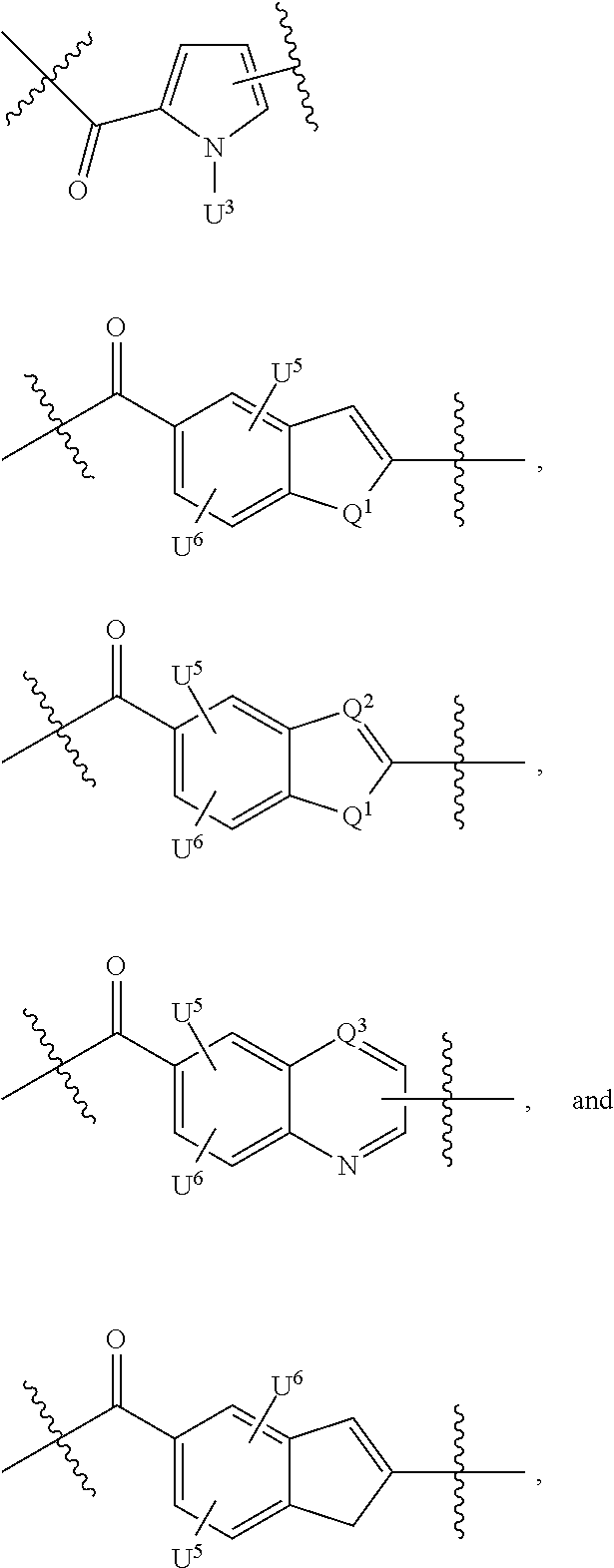
wherein
U1 is selected from H, —CH3, —OH, —OCH3, —NO2, —NH2, —NHNHAc, —NHNHC(O)CH3, —NHC(O)phenyl or -halo,
U2 is H, —OH or —OCH3,
U3 is H, —CH3 or —C2H5,
U4 is H or CH3S—,
U5 and U6 are each independently selected from H, -halo, —C1-C4 alkyl, —C1-C3 alkoxy, —C1-C6 dialkylamino, —NO2, —NHC(O)C1-C10 alkyl, —OH, —NH2, —NHC(O)NH2, —NHC(O)CH3 or —NHC(O)phenyl,
Q1 is —O—, —S—, or —NH—, and
Q2 and Q3 are each independently —CH— or —N—;
T is selected from:
—NHC(O)—,
—C(O)NH—,
—C(O)O—,
—OC(O)—,
—NRB-T1-NRC— where RB and RC are each independently H or —C1-C8 alkyl, or together RB and RC join T1 is to form a ring and together are (CH2)2-3, where T1 is selected from —C(O)—, —C(O)(CH2)nC(O)— where n is an integer from 0 to 50, —C(O)PhC(O)— where Ph is 1,3- or 1,4-phenylene,
—C(O)hetC(O)— wherein het is a mono-, bi-, or tricyclic heteroaryl of 5 to 12 members, containing one, two, or three heteroatoms independently selected from O, N, S, P and B, wherein het is optionally substituted with 1 to 8 substituents each independently selected from the group consisting of —C1-C8 alkyl, —C1-C8 heteroalkyl, —C6-C14 aryl, aralkyl, —C1-C10 heterocyclyl, —C3-C8 carbocyclycl, —NH2, —NHRD and —NO2, and said optional substituents on het are optionally substituted with RE, where at least one of F1 and F2 is selected from the group consisting of Ring System C and Ring System D when T is —C(O)hetC(O)—,
wherein each RD is independently selected from the group consisting of H, —C1-C8 alkyl, —C(O)—C1-C8 alkyl, —C1-C8 heteroalkyl, —C6-C14 aryl, -aralkyl, —C1-C10 heterocyclyl, —C3-C8 carbocyclyl, —C(O)OC1-C8 alkyl, —C(O)N(C1-C8 alkyl)2, and —C(O)-halo, optionally substituted with RE,
wherein each RE is independently selected from the group consisting of H, —C1-C8 alkyl, —C1-C8 heteroalkyl, —C6-C14 aryl, -aralkyl, —C1-C10 heterocyclyl, —C3-C8 carbocyclyl, —C(O)OC1-C8 alkyl, —C(O)N(C1-C8 alkyl)2, and —C(O)-halo, and wherein each RE is optionally substituted with 1 to 3 substituents independently selected from R,
—C(A1)X1-T2-X1C(B1)—, where T2 is:

wherein each X1 is independently a bond, —NRE—, —O— or —S—, wherein A1 and B1 are each independently ═O or ═S, wherein R1, R2, R3, and R4 are each independently RE or R1 and R2 form a ring system, or R3 and R4 form a ring system, or both R1 and R2, and R3 and R4, each independently form ring systems, or R1 and R3 form a ring system, or R2 and R4 form a ring system, or both R1 and R3, and R2 and R4, each independently form ring systems,
-
- Connection to rest of payload

is formed, where A is oxygen or sulphur.

Other forms of cubanes (for instance substituted forms as outlined herein) and non-cubanes are also possible and included within the invention.
L-P (Formula IIA)
or a pharmaceutically acceptable salt or solvate thereof, wherein:
P is:
F1-L1-T-L2-F2
wherein:
F1 and F2 are each independently selected from ring systems A, B, C and D:

each R is independently selected from the group consisting of H, —C1-C20 alkyl, —C2-C6 alkenyl, —C2-C6 alkynyl, halo, hydroxyl, alkoxy, —NH2, —NH(C1-C8 alkyl), —N(C1-C8 alkyl)2, —NO2, —C6-C14 aryl and —C6-C14 heteroaryl, wherein two or more R optionally join to form a ring or rings, and wherein said —C6-C14 aryl and —C6-C14 heteroaryl are optionally substituted with 1 to 5 substituents independently selected from —C1-C10 alkyl, —C1-C10 alkoxy, -halo, —C1-C10 alkylthio, -trifluoromethyl, —NH2, —NH(C1-C8 alkyl), —N(C1-C8 alkyl)2, —C1-C10 alkyl-N(C1-C8 alkyl)2, —C1-C3 alkylthio, —NO2 or —C1-C10 heterocyclyl, for each ring system in which R appears;
each V1 is independently a bond, O, N(R) or S, for each ring system in which V1 appears;
each V2 is independently O, N(R) or S, for each ring system in which V2 appears;
W1 and W2 are each independently H, —C1-C5 alkyl, -phenyl, —C(O)OR, —C(O)SR, —C(O)NHN(R)2 or —C(O)N(R)2 for each ring system in which W1 and W2 appear;
each X is independently selected from —OH, —O-acyl, azido, halo, cyanate, thiocyanate, isocyanate, thioisocyanate, or

for each ring system in which X appears;
each Y is independently selected from a bond, H, —C(O)RA, —C(S)RA, —C(O)ORA, —S(O)2ORA, —C(O)N(RA)2, —C(S)N(RA)2, glycosyl, —NO2 and —P(O)(ORA)2 for each ring system in which Y appears, wherein each RA is independently selected from H, —C1-C20 alkyl, —C1-C8 heteroalkyl, —C6-C14 aryl, aralkyl, —C1-C10 heterocyclyl, —C3-C8 carbocyclyl, —C1-C20 alkylN(R)2, —C1-C20 alkylene, —C1-C8 heteroalkylene, —C6-C14 arylene, aralkylene, —C1-C10 heterocyclo, —C3-C8 carbocyclo and —C1-C20 alkylN(R)—, and RF where said RA is optionally substituted with 1 to 3 substituents independently selected from R, and wherein one Y is divalent and is bonded to L,
RF is —N(R6)QN(R5)C(O)— and is bonded to L at the carbonyl adjacent N(R5), wherein R5 and R6 are each independently selected from the group consisting of H, —C1-C8 alkyl, —C1-C8 heteroalkyl, —C6-C14 aryl, -aralkyl, —C1-C10 heterocyclyl and —C3-C8 carbocyclyl, or R5 or R6 joins with a substituted carbon on Q to form a —C1-C10 heterocyclic or —C6-C14 heteroaryl ring, or R5 and R6 join together to form a —C1-C10 heterocyclic or —C6-C14 heteroaryl ring system, and where Q is —C1-C8 alkylene-, —C1-C8 heteroalkylene-, —C6-C14 arylene-, -aralkylene-, —C1-C10 heterocyclo- or —C3-C8 carbocyclo-, wherein Q, R5 and R6 are each independently optionally substituted with 1 to 3 substituents independently selected from R;
each Z is independently selected from the group consisting of H, —C1-C8 alkyl, —C1-C8 heteroalkyl, —C6-C14 aryl, -aralkyl, —C1-C10 heterocyclyl, —C3-C8 carbocyclyl, —C(O)OC1-C8 alkyl, —C(O)N(C1-C8 alkyl)2, —C(O)OH, —C(O)NHNH2 and —C(O)-halo, and wherein said C1-C8 alkyl, —C1-C8 heteroalkyl, —C6-C14 aryl, -aralkyl, —C1-C10 heterocyclyl, —C3-C8 carbocyclyl, —C(O)OC1-C8 alkyl, —C(O)N(C1-C8 alkyl)2, —C(O)OH, —C(O)NHNH2 and —C(O)-halo are each optionally substituted with 1 to 3 substituents independently selected from R, for each ring system in which Z appears;
L1 and L2 are each independently selected from a direct bond, carbonyl, or a carbonyl acyl group bonded to F1 or F2 at the acyl moiety, where the carbonyl acyl group is selected from the group consisting of:


wherein
U1 is selected from H, —CH3, —OH, —OCH3, —NO2, —NH2, —NHNHAc, —NHNHC(O)CH3, —NHC(O)phenyl or -halo,
U2 is H, —OH or —OCH3,
U3 is H, —CH3 or —C2H5,
U4 is H or CH3S—,
U5 and U6 are each independently selected from H, -halo, —C1-C4 alkyl, —C1-C3 alkoxy, —C1-C6 dialkylamino, —NO2, —NHC(O)C1-C10 alkyl, —OH, —NH2, —NHC(O)NH2, —NHC(O)CH3 or —NHC(O)phenyl,
Q1 is —O—, —S— or —NH—, and
Q2 and Q3 are each independently —CH— or —N—;
T is selected from:
—NHC(O)—,
—C(O)NH—,
—C(O)O—,
—OC(O)—,
—NRB-T1-NRC— where RB and RC are each independently H or —C1-C8 alkyl, or together RB and RC join T1 is to form a ring and together are (CH2)2-3, where T1 is selected from —C(O)—, —C(O)(CH2)nC(O)— where n is an integer from 0 to 50, —C(O)PhC(O)— where Ph is 1,3- or 1,4-phenylene,
—C(O)hetC(O)— wherein het is a mono-, bi-, or tricyclic heteroaryl of 5 to 12 members, containing one, two, or three heteroatoms independently selected from O, N, S, P and B, where het is optionally substituted with 1 to 8 substituents each independently selected from the group consisting of —C1-C8 alkyl, —C1-C8 heteroalkyl, —C6-C14 aryl, aralkyl, —C1-C10 heterocyclyl, —C3-C8 carbocyclycl, —NH2, —NHRD and —NO2, and said optional substituents on het are optionally substituted with RE, where at least one of F1 and F2 is selected from the group consisting of Ring System C and Ring System D when T is —C(O)hetC(O)—,
wherein each RD is independently selected from the group consisting of H, —C1-C8 alkyl, —C(O)—C1-C8 alkyl, —C1-C8 heteroalkyl, —C6-C14 aryl, -aralkyl, —C1-C10 heterocyclyl, —C3-C8 carbocyclyl, —C(O)OC1-C8 alkyl, —C(O)N(C1-C8 alkyl)2, and —C(O)-halo, optionally substituted with RE,
wherein each RE is independently selected from the group consisting of H, —C1-C8 alkyl, —C1-C8 heteroalkyl, -aryl, -aralkyl, —C1-C10 heterocyclyl, —C3-C8 carbocyclyl, —C(O)OC1-C8 alkyl, —C(O)N(C1-C8 alkyl)2, and —C(O)-halo, and wherein each RE is optionally substituted with 1 to 3 substituents independently selected from R,
—C(A1)X1-T2-X1C(B1)—, where T2 is:

wherein each X1 is independently a bond, —NRE—, —O— or —S—, wherein A1 and B1 are each independently ═O or ═S, wherein R1, R2, R3, and R4 are each independently RE or R1 and R2 form a ring system, or R3 and R4 form a ring system, or both R1 and R2, and R3 and R4, each independently form ring systems, or R1 and R3 form a ring system, or R2 and R4 form a ring system, or both R1 and R3, and R2 and R4, each independently form ring systems, where said ring systems are independently selected from —C1-C10 heterocyclyl or —C3-C8 carbocyclycl, or R1, R2, R3 and R4 are each bonds to different carbons on D, wherein g and j are each independently an integer from 0 to 50 and m is an integer from 1 to 50, and wherein D is a bond or is selected from the group consisting of —S—, —C1-C8 alkylene-, —C6-C14 arylene-, —C6-C14 heteroarylene-, —C1-C8 heteroalkylene-, -aralkylene, —C1-C10 heterocyclo and —C3-C8 carbocyclo, where said —C1-C8 alkylene-, —C6-C14 arylene-, —C6-C14 heteroarylene-, —C1-C8 heteroalkylene-, -aralkylene, —C1-C10 heterocyclo and —C3-C8 carbocyclo are optionally substituted with —RE, —C(O)RE, —C(O)ORE, —N(RE)2, —N(R)C(O)RE or —N(R)C(O)ORE, and D is additionally optionally substituted by 1 to 2 R, and
-G1-T2-G2-, where G1 and G2 are each independently —S(O)X1— or —S(O)2X1—;
L is LA-LB-(LC)1-3, wherein LA is selected from the group consisting of -halo, —N(R)2, —CON(R)2, —S-aryl optionally substituted with —NO2 or —CON(R)2, —S-heteroaryl optionally substituted with —NO2, alkyl-SO2-heteroaryl, arylSO2-heteroaryl-,

LB is LB1-LB2-LB3 wherein LB1 is absent or is one or more components selected from the group consisting of —C(O)—, —C(S)—, —C(O)NR—, —C(O)C1-C6alkyl-, —C(O)NRC1-C6alkyl-, —C1-C6alkyl(OCH2CH2)1-6—, —C(O)C1-C6alkylNRC(O)—, —C(O)C1-C6alkyl(OCH2CH2)1-6—, —C1-C6alkyl(OCH2CH2)1-6—C(O)—, —C1-C6alkyl-S—S—C1-C6alkylNRC(O)CH2—, —C1-C6alkyl(OCH2CH2)1-6NRC(O)CH2—, —C(O)C1-C6alkyl-NRC(O)C1-6alkyl-, —N═CR-phenyl-O—C1-C6alkyl-, —N═CR-phenyl-O—C1-C6alkyl-C(O)—, —C(O)—C1-C6alkyl(OCH2CH2)1-6NRC(O)—, —C(O)C1-C6alkyl-phenyl(NR—C(O)C1-C6alkyl)1-4-, —C(O)C1-C6alkyl(OCH2CH2)1-6—NRC(O)C1-C6alkyl-, —C1-C6alkyl-, —S—, —C(O)—CH(NR—C(O)C1-C6alkyl)-C1-C6alkyl- and (—CH2—CH2—O—)1-20,
wherein LB2 is AA0-12, wherein AA is a natural amino acid, a non-natural amino acid or —(CR15)o—S—S—(CR15)p where o and p are each independently an integer from 1 to 20,
LB3 is -PABA-, -PABC- or absent;
LC is absent or independently selected from the group consisting of —C1-C6alkylene-, —NRC3-C8-heterocyclylNR—, —NRC3-C8-carbocyclylNR—, —NRC1-C6alkylNR—, —NRC1-C6alkylene-, —S—, —NR—, —NRNR—, —O(CR2)1-4S—S(CR2)1-4N(R)—, —NRC1-C6-alkylenephenyleneNR—, —NRC1-C6alkylenephenyleneSO2NR—, —OC1-C6alkylS—SC1-C6alkylC(COOR)NR—, —NRC(COOR)C1-C6alkylS—SC1-C6alkylO—,

wherein
XA is CR or N,
XB is CH, CR(C(R)2)1-3NR, CR(C(R)2)1-3O, CR(C(R)2)1-3C(O)NR, CR—(C(R)2)1-3C(O)NRNR, CR(C(R)2)1-3SO2NR, CR(C(R)2)1-3NRNR, CR(C(R)2)1-3NRC(O) or N,
each XC is R,
each XF is —(CH2)1-5—, or is absent;
XE is O, S, C(R)2, C(R)(C(R)2)1-3—NR2 or NR and
each XF is (C(R)2)1-3—NR or C(R)2—(C(R)2)1-3—O.

is formed, where each A is independently oxygen or sulphur.
AB-(L-P)1-20 (Formula IIIA)
or a pharmaceutically acceptable salt or solvate thereof, wherein:
AB is an antibody;
P is:
F1-L1-T-L2-F2
wherein:
F1 and F2 are each independently selected from ring systems A, B, C and D:

each R is independently selected from the group consisting of H, —C1-C20 alkyl, —C2-C6 alkenyl, —C2-C6 alkynyl, halo, hydroxyl, alkoxy, —NH2, —NH(C1-C8 alkyl), —N(C1-C8 alkyl)2, —NO2, —C6-C14 aryl and —C6-C14 heteroaryl, wherein two or more R optionally join to form a ring or rings, and wherein said —C6-C14 aryl and —C6-C14 heteroaryl are optionally substituted with 1 to 5 substituents independently selected from —C1-C10 alkyl, —C1-C10 alkoxy, -halo, —C1-C10 alkylthio, -trifluoromethyl, —NH2, —NH(C1-C8 alkyl), —N(C1-C8 alkyl)2, —C1-C10 alkyl-N(C1-C8 alkyl)2, —C1-C3 alkylthio, —NO2 or —C1-C10 heterocyclyl, for each ring system in which R appears;
each V1 is independently a bond, O, N(R) or S, for each ring system in which V1 appears;
each V2 is independently O, N(R) or S, for each ring system in which V2 appears;
W1 and W2 are each independently H, —C1-C5 alkyl, -phenyl, —C(O)OR, —C(O)SR, —C(O)NHN(R)2 or —C(O)N(R)2 for each ring system in which W1 and W2 appear;
each X is independently selected from —OH, —O-acyl, azido, halo, cyanate, thiocyanate, isocyanate, thioisocyanate, or

for each ring system in which X appears;
each Y is independently selected from a bond, H, —C(O)RA, —C(S)RA, —C(O)ORA, —S(O)2ORA, —C(O)N(RA)2, —C(S)N(RA)2, glycosyl, —NO2 and —P(O)(ORA)2 for each ring system in which Y appears, wherein each RA is independently selected from H, —C1-C20 alkyl, —C1-C8 heteroalkyl, —C6-C14 aryl, aralkyl, —C1-C10 heterocyclyl, —C3-C8 carbocyclyl, —C1-C20 alkylN(R)2, —C1-C20 alkylene, —C1-C8 heteroalkylene, —C6-C14 arylene, aralkylene, —C1-C10 heterocyclo, —C3-C8 carbocyclo and —C1-C20 alkylN(R)—, and RF where said RA is optionally substituted with 1 to 3 substituents independently selected from R, and wherein one Y is divalent and is bonded to L,
RF is —N(R6)QN(R5)C(O)— and is bonded to L at the carbonyl adjacent N(R5), wherein R5 and R6 are each independently selected from the group consisting of H, —C1-C8 alkyl, —C1-C8 heteroalkyl, —C6-C14 aryl, -aralkyl, —C1-C10 heterocyclyl and —C3-C8 carbocyclyl, or R5 or R6 joins with a substituted carbon on Q to form a —C1-C10 heterocyclic or —C6-C14 heteroaryl ring, or R5 and R6 join together to form a —C1-C10 heterocyclic or —C6-C14 heteroaryl ring system, and where Q is —C1-C8 alkylene-, —C1-C8 heteroalkylene-, —C6-C14 arylene-, -aralkylene-, —C1-C10 heterocyclo- or —C3-C8 carbocyclo-, wherein Q, R5 and R6 are each independently optionally substituted with 1 to 3 substituents independently selected from R;
each Z is independently selected from the group consisting of H, —C1-C8 alkyl, —C1-C8 heteroalkyl, —C6-C14 aryl, -aralkyl, —C1-C10 heterocyclyl, —C3-C8 carbocyclyl, —C(O)OC1-C8 alkyl, —C(O)N(C1-C8 alkyl)2, —C(O)OH, —C(O)NHNH2 and —C(O)-halo, and wherein said C1-C8 alkyl, —C1-C8 heteroalkyl, —C6-C14 aryl, -aralkyl, —C1-C10 heterocyclyl, —C3-C8 carbocyclyl, —C(O)OC1-C8 alkyl, —C(O)N(C1-C8 alkyl)2, —C(O)OH, —C(O)NHNH2 and —C(O)-halo are each optionally substituted with 1 to 3 substituents independently selected from R, for each ring system in which Z appears;
L1 and L2 are each independently selected from a direct bond, carbonyl, or a carbonyl acyl group bonded to F1 or F2 at the acyl moiety, where the carbonyl acyl group is selected from the group consisting of:


wherein
U1 is selected from H, —CH3, —OH, —OCH3, —NO2, —NH2, —NHNHAc, —NHNHC(O)CH3, —NHC(O)phenyl or -halo,
U2 is H, —OH or —OCH3,
U3 is H, —CH3 or —C2H5,
U4 is H or CH3S—,
U5 and U6 are each independently selected from H, -halo, —C1-C4 alkyl, —C1-C3 alkoxy, —C1-C6 dialkylamino, —NO2, —NHC(O)C1-C10 alkyl, —OH, —NH2, —NHC(O)NH2, —NHC(O)CH3 or —NHC(O)phenyl,
Q1 is —O—, —S— or —NH—,
Q2 and Q3 are each independently —CH— or —N—;
T is selected from:
—NHC(O)—,
—C(O)NH—,
—C(O)O—,
—OC(O)—,
—NRB-T1-NRC— where RB and RC are each independently H or —C1-C8 alkyl, or together RB and RC join to form a ring and together are (CH2)2-3, where T1 is selected from —C(O)—, —C(O)(CH2)—C(O)— where n is an integer from 0 to 50, —C(O)PhC(O)— where Ph is 1,3- or 1,4-phenylene,
—C(O)hetC(O)— wherein het is a mono-, bi-, or tricyclic heteroaryl of 5 to 12 members, containing one, two, or three heteroatoms independently selected from O, N, S, P and B, where het is optionally substituted with 1 to 8 substituents each independently selected from the group consisting of —C1-C8 alkyl, —C1-C8 heteroalkyl, —C6-C14 aryl, aralkyl, —C1-C10 heterocyclyl, —C3-C8 carbocyclycl, —NH2, —NHRD and —NO2, and said optional substituents on het are optionally substituted with RE, where at least one of F1 and F2 is selected from the group consisting of Ring System C and Ring System D when T is —C(O)hetC(O)—,
wherein each RD is independently selected from the group consisting of H or —C1-C8 alkyl, —C(O)—C1-C8 alkyl, —C1-C8 heteroalkyl, —C6-C14 aryl, -aralkyl, —C1-C10 heterocyclyl, —C3-C8 carbocyclyl, —C(O)OC1-C8 alkyl, —C(O)N(C1-C8 alkyl)2, and —C(O)-halo, optionally substituted with RE,
wherein each RE is independently selected from the group consisting of H, —C1-C8 alkyl, —C1-C8 heteroalkyl, -aryl, -aralkyl, —C1-C10 heterocyclyl, —C3-C8 carbocyclyl, —C(O)OC1-C8 alkyl, —C(O)N(C1-C8 alkyl)2, and —C(O)-halo, and wherein each RE is optionally substituted with 1 to 3 substituents independently selected from R,
—C(A1)X1-T2-X1C(B1)—, where T2 is:

wherein each X1 is independently a bond, —NRE—, —O— or —S—, wherein A1 and B1 are each independently ═O or ═S, wherein R1, R2, R3, and R4 are each independently RE or R1 and R2 form a ring system, or R3 and R4 form a ring system, or both R1 and R2, and R3 and R4, each independently form ring systems, or R1 and R3 form a ring system, or R2 and R4 form a ring system, or both R1 and R3, and R2 and R4, each independently form ring systems, where said ring systems are independently selected from —C1-C10 heterocyclyl or —C3-C8 carbocyclycl, or R1, R2, R3 and R4 are each bonds to different carbons on D, wherein g and j are each independently an integer from 0 to 50 and m is an integer from 1 to 50, and wherein D is a bond or is selected from the group consisting of —S—, —C1-C8 alkylene-, —C6-C14 arylene-, —C6-C14 heteroarylene-, —C1-C8 heteroalkylene-, -aralkylene, —C1-C10 heterocyclo and —C3-C8 carbocyclo, where said —C1-C8 alkylene-, —C6-C14 arylene-, —C6-C14 heteroarylene-, —C1-C8 heteroalkylene-, -aralkylene, —C1-C10 heterocyclo and —C3-C8 carbocyclo are optionally substituted with —RE, —C(O)RE, —C(O)ORE, —N(RE)2, —N(R)C(O)RE or —N(R)C(O)ORE, and D is additionally optionally substituted by 1 to 2 R, and
-G1-T2-G2-, where G1 and G2 are each independently —S(O)X′— or —S(O)2X1—;
L is LA-LB-(LC)1-3;
LA is selected from: a bond to AB, —NR-(bond to AB), alkyl-SO2-heteroaryl, arylSO2-heteroaryl-,

LB is LB1-LB2-LB3
wherein LB1 is absent or is one or more components selected from the group consisting of —C(O)—, —C(S)—, —C(O)NR—, —C(O)C1-C6alkyl-, —C(O)NRC1-C6alkyl-, —C1-C6alkyl(OCH2CH2)1-6—, —C(O)C1-C6alkylNRC(O)—, —C(O)C1-C6alkyl(OCH2CH2)1-6—, —C1-C6alkyl(OCH2CH2)1-6—C(O)—, —C1-C6alkyl-S—S—C1-C6alkylNRC(O)CH2—, —C1-C6alkyl(OCH2CH2)1-6NRC(O)CH2—, —C(O)C1-C6alkyl-NRC(O)C1-6alkyl-, —N═CR-phenyl-O—C1-C6alkyl-, —N═CR-phenyl-O—C1-C6alkyl-C(O)—, —C(O)—C1-C6alkyl(OCH2CH2)1-6NRC(O)—, —C(O)C1-C6alkyl-phenyl(NR—C(O)C1-C6alkyl)1-4-, —C(O)C1-C6alkyl(OCH2CH2)1-6—NRC(O)C1-C6alkyl-, —C1-C6alkyl-, —S—, —C(O)—CH(NR—C(O)C1-C6alkyl)-C1-C6alkyl- and (—CH2—CH2—O—)1-20;
LB2 is AA0-12, wherein AA is a natural amino acid, a non-natural amino acid or —(CR15)o—S—S—(CR15)p where o and p are each independently an integer from 1 to 20,
LB3 is -PABA-, -PABC- or is absent,
LC is absent or is independently selected from the group consisting of —C1-C6alkylene-, —NRC3-C8-heterocyclylNR—, —NRC3-C8-carbocyclylNR—, —NRC1-C6alkylNR—, —NRC1-C6alkylene-, —S—, —NR—, —NRNR—, —O(CR2)1-4S—S(CR2)1-4N(R)—, —NRC1-C8-alkylenephenyleneNR—, —NRC1-C8alkylenephenyleneSO2NR—, —OC1-C6alkylS—SC1-C6alkylC(COOR)NR—, —NRC(COOR)C1-C6alkylS—SC1-C6alkylO—,

wherein
XA is CR or N,
XB is CH, CR(C(R)2)1-3NR, CR(C(R)2)1-3O, CR(C(R)2)1-3C(O)NR, CR—(C(R)2)1-3C(O)NRNR, CR(C(R)2)1-3SO2NR, CR(C(R)2)1-3NRNR, CR(C(R)2)1-3NRC(O) or N,
each XC is R;
each XC is —(CH2)1-5—, or is absent;
XE is O, S, C(R)2, C(R)(C(R)2)1-3—NR2 or NR, and
each XF is (C(R)2)1-3—NR or C(R)2—(C(R)2)1-3—O.

or a pharmaceutically acceptable salt or solvate thereof, wherein:
F1 and F2 are each independently selected from ring systems A, B, C and D:

each R is independently selected from the group consisting of H, —C1-C20 alkyl, —C2-C6 alkenyl, —C2-C6 alkynyl, halo, hydroxyl, alkoxy, —NH2, —NH(C1-C8 alkyl), —N(C1-C8 alkyl)2, —NO2, —C6-C14 aryl and —C6-C14 heteroaryl, wherein two or more R optionally join to form a ring or rings, and wherein said —C6-C14 aryl and —C6-C14 heteroaryl are optionally substituted with 1 to 5 substituents independently selected from —C1-C10 alkyl, —C1-C10 alkoxy, -halo, —C1-C10 alkylthio, -trifluoromethyl, —NH2, —NH(C1-C8 alkyl), —N(C1-C8 alkyl)2, —C1-C10 alkyl-N(C1-C8 alkyl)2, —C1-C3 alkylthio, —NO2 or —C1-C10 heterocyclyl, for each ring system in which R appears;
each V1 is independently a bond, O, N(R) or S, for each ring system in which V1 appears;
each V2 is independently O, N(R) or S, for each ring system in which V2 appears;
W1 and W2 are each independently H, —C1-C5 alkyl, -phenyl, —C(O)OR, —C(O)SR, —C(O)NHN(R)2 or —C(O)N(R)2 for each ring system in which W1 and W2 appear;
each X is independently —OH, —O-acyl, azido, halo, cyanate, thiocyanate, isocyanate, thioisocyanate, or

for each ring system in which X appears;
each Y is independently selected from the group consisting of H, —C1-C6 alkyl-RA—C(O)RA, —C(S)RA, —C(O)ORA, —S(O)2ORA, —C(O)N(RA)2, —C(S)N(RA)2, glycosyl, —NO2 and —PO(ORA)2, for each ring system in which Y appears, wherein each RA is independently selected from the group consisting of H, —C1-C20 alkyl, —C1-C8 heteroalkyl, —C6-C14 aryl, aralkyl, —C1-C10 heterocyclyl, —C3-C8 carbocyclyl and —C1-C20 alkylN(R)2, wherein said —C1-C20 alkyl, —C1-C8 heteroalkyl, —C6-C14 aryl, aralkyl, —C1-C10 heterocyclyl, —C3-C8 carbocyclyl and —C1-C20 alkylN(R)2 are optionally substituted with 1 to 3 substituents independently selected from R;
each Z is independently selected from the group consisting of H, —C1-C8 alkyl, —C1-C8 heteroalkyl, —C6-C14 aryl, -aralkyl, —C1-C10 heterocyclyl, —C3-C8 carbocyclyl, —C(O)OC1-C8 alkyl, —C(O)N(C1-C8 alkyl)2, —C(O)OH, —C(O)NHNH2 and —C(O)-halo, and wherein said C1-C8 alkyl, —C1-C8 heteroalkyl, —C6-C14 aryl, -aralkyl, —C1-C10 heterocyclyl, —C3-C8 carbocyclyl, —C(O)OC1-C8 alkyl, —C(O)N(C1-C8 alkyl)2, —C(O)OH, —C(O)NHNH2 and —C(O)-halo are each optionally substituted with 1 to 3 substituents independently selected from R, for each ring system in which Z appears;
L1 and L2 are each independently selected from a direct bond, carbonyl, or a carbonyl acyl group bonded to F1 or F2 at the acyl moiety, where the carbonyl acyl group is selected from the group consisting of:


wherein
U1 is selected from H, —CH3, —OH, —OCH3, —NO2, —NH2, —NHNHAc, —NHNHC(O)CH3, —NH—C(O)phenyl or -halo,
U2 is H, —OH or —OCH3,
U3 is H, —CH3 or —C2H5,
U4 is H or CH3S—,
U5 and U6 are each independently selected from H, -halo, —C1-C4 alkyl, —C1-C3 alkoxy, —C1-C6 dialkylamino, —NO2, —NHC(O)C1-C10 alkyl, —OH, —NH2, —NHC(O)NH2, —NHC(O)CH3 or —NHC(O)phenyl,
Q1 is —O—, —S— or —NH—, and
Q2 and Q3 are each independently —CH— or —N—;
T is selected from:
—C(A1)X1-T2-X1C(B1)—, where T2 is:

wherein each X1 is independently a bond, —NRE—, —O— or —S—, wherein A1 and B1 are each independently ═O or ═S, wherein R1, R2, R3, and R4 are each independently RE, or R1 and R2 form a ring system, or R3 and R4 form a ring system, or both R1 and R2, and R3 and R4 each independently form ring systems, or R1 and R3 form a ring system, or R2 and R4 form a ring system, or both R1 and R3, and R2 and R4 each independently form ring systems, where the ring systems are independently selected from —C1-C10 heterocyclyl or —C3-C8 carbocyclycl, or R1, R2, R3 and R4 are each bonds to different carbons on D, wherein g and j are each independently an integer from 0 to 50 and m is an integer from 1 to 50, and wherein D is selected from the group consisting of —C1-C8 alkylene-, —C6-C14 arylene-, —C6-C14 heteroarylene-, —C1-C8 heteroalkylene-, -aralkylene, —C1-C10 heterocyclo and —C3-C8 carbocyclo, where said —C1-C8 alkylene-, —C6-C14 arylene-, —C6-C14 heteroarylene-, —C1-C8 heteroalkylene-, -aralkylene, —C1-C10 heterocyclo and —C3-C8 carbocyclo are substituted with one member of the group selected from N(RE)C(O)— where the carbonyl is bonded to L, and —C(O)— where the carbonyl is bonded to L, and additionally optionally substituted by 1 to 2 R;
where each RE is independently selected from the group consisting of H, —C1-C8 alkyl, —C1-C8 heteroalkyl, -aryl, -aralkyl, —C1-C10 heterocyclyl, —C3-C8 carbocyclyl, —C(O)OC1-C8 alkyl, —C(O)N(C1-C8 alkyl)2, and —C(O)-halo, and wherein each RE is optionally substituted with 1 to 3 substituents independently selected from R;
L is LA-LB-(LC)1-3;
LA is selected from -halo, —N(R)2, —CON(R)2, —S-aryl optionally substituted with —NO2 or —CONR2, —S-heteroaryl optionally substituted with —NO2, alkyl-SO2-heteroaryl, arylSO2-heteroaryl-,

LB is LB1-LB2-LB3
wherein LB1 is absent or is one or more components selected from the group consisting of —C(O)—, —C(S)—, —C(O)NR—, —C(O)C1-C6alkyl-, —C(O)NRC1-C6alkyl-, —C1-C6alkyl(OCH2CH2)1-6—, —C(O)C1-C6alkylNRC(O)—, —C(O)C1-C6alkyl(OCH2CH2)1-6—, —C1-C6alkyl(OCH2CH2)1-6—C(O)—, —C1-C6alkyl-S—S—C1-C6alkylNRC(O)CH2—, —C1-C6alkyl(OCH2CH2)1-6NRC(O)CH2—, —C(O)C1-C6alkyl-NRC(O)C1-6alkyl-, —N═CR-phenyl-O—C1-C6alkyl-, —N═CR-phenyl-O—C1-C6alkyl-C(O)—, —C(O)—C1-C6alkyl(OCH2CH2)1-6NRC(O)—, —C(O)C1-C6alkyl-phenyl(NR—C(O)C1-C6alkyl)1-4-, —C(O)C1-C6alkyl(OCH2CH2)1-6—NRC(O)C1-C6alkyl-, —C1-C6alkyl-, —S—, —C(O)—CH(NR—C(O)C1-C6alkyl)-C1-C6alkyl- and (—CH2—CH2—O—)1-20;
LB2 is AA0-12, wherein AA is a natural amino acid, a non-natural amino acid or —(CR15)o—S—S—(CR15)p where o and p are each independently an integer from 1 to 20,
LB3 is -PABA-, -PABC- or is absent;
LC is absent or is independently selected from the group consisting of —C1-C6alkylene-, —NRC3-C8-heterocyclylNR—, —NRC3-C8-carbocyclylNR—, —NRC1-C6alkylNR—, —NRC1-C6alkylene-, —S—, —NR—, —NRNR—, —O—(CR2)1-4S—S(CR2)1-4N(R)—, —NRC1-C6-alkylenephenyleneNR—, —NRC1-C6alkylenephenyleneSO2NR—, —OC1-C6alkylS—SC1-C6alkylC(COOR)NR—, —NRC(COOR)C1-C6alkylS—SC1-C6alkylO—,

wherein
XA is CR or N,
XB is CH, CR(C(R)2)1-3NR, CR(C(R)2)1-3O, CR(C(R)2)1-3C(O)NR, CR—(C(R)2)1-3C(O)NRNR, CR(C(R)2)1-3SO2NR, CR(C(R)2)1-3NRNR, CR(C(R)2)1-3NRC(O) or N;
each XC is R;
each XC is —(CH2)1-5—, or is absent;
XE is O, S, C(R)2, C(R)(C(R)2)1-3—NR2 or NR, and
each XF is (C(R)2)1-3—NR or C(R)2—(C(R)2)1-3—O.

or a pharmaceutically acceptable salt or solvate thereof, wherein:
AB is an antibody;
F1 and F2 are each independently selected from ring systems A, B, C and D:

each R is independently selected from the group consisting of H, —C1-C20 alkyl, —C2-C6 alkenyl, —C2-C6 alkynyl, halo, hydroxyl, alkoxy, —NH2, —NH(C1-C8 alkyl), —N(C1-C8 alkyl)2, —NO2, —C6-C14 aryl and —C6-C14 heteroaryl, wherein two or more R optionally join to form a ring or rings, and wherein said —C6-C14 aryl and —C6-C14 heteroaryl are optionally substituted with 1 to 5 substituents independently selected from —C1-C10 alkyl, —C1-C10 alkoxy, -halo, —C1-C10 alkylthio, -trifluoromethyl, —NH2, —NH(C1-C8 alkyl), —N(C1-C8 alkyl)2, —C1-C10 alkyl-N(C1-C8 alkyl)2, —C1-C3 alkylthio, —NO2 or —C1-C10 heterocyclyl, for each ring system in which R appears;
each V1 is independently a bond, O, N(R) or S, for each ring system in which V1 appears;
each V2 is independently O, N(R) or S, for each ring system in which V2 appears;
W1 and W2 are each independently H, —C1-C5 alkyl, -phenyl, —C(O)OR, —C(O)SR, —C(O)NHN(R)2 or —C(O)N(R)2 for each ring system in which W1 and W2 appear;
each X is independently —OH, —O-acyl, azido, halo, cyanate, thiocyanate, isocyanate, thioisocyanate, or

for each ring system in which X appears;
each Y is independently selected from the group consisting of H, —C1-C6 alkyl-RA—C(O)RA, —C(S)RA, —C(O)ORA, —S(O)2ORA, —C(O)N(RA)2, —C(S)N(RA)2, glycosyl, —NO2 and —PO(ORA)2, for each ring system in which Y appears, wherein each RA is independently selected from the group consisting of H, —C1-C20 alkyl, —C1-C8 heteroalkyl, —C6-C14 aryl, aralkyl, —C1-C10 heterocyclyl, —C3-C8 carbocyclyl and —C1-C20 alkylN(R)2, wherein said —C1-C20 alkyl, —C1-C8 heteroalkyl, —C6-C14 aryl, aralkyl, —C1-C10 heterocyclyl, —C3-C8 carbocyclyl and —C1-C20 alkylN(R)2 are optionally substituted with 1 to 3 substituents independently selected from R;
each Z is independently selected from the group consisting of H, —C1-C8 alkyl, —C1-C8 heteroalkyl, —C6-C14 aryl, -aralkyl, —C1-C10 heterocyclyl, —C3-C8 carbocyclyl, —C(O)OC1-C8 alkyl, —C(O)N(C1-C8 alkyl)2, —C(O)OH, —C(O)NHNH2 and —C(O)-halo, and wherein said C1-C8 alkyl, —C1-C8 heteroalkyl, —C6-C14 aryl, -aralkyl, —C1-C10 heterocyclyl, —C3-C8 carbocyclyl, —C(O)OC1-C8 alkyl, —C(O)N(C1-C8 alkyl)2, —C(O)OH, —C(O)NHNH2 and —C(O)-halo are each optionally substituted with 1 to 3 substituents independently selected from R, for each ring system in which Z appears;
L1 and L2 are each independently selected from a direct bond, carbonyl, or a carbonyl acyl group bonded to F1 or F2 at the acyl moiety, where the carbonyl acyl group is selected from the group consisting of:


wherein
U1 is selected from H, —CH3, —OH, —OCH3, —NO2, —NH2, —NHNHAc, —NHNHC(O)CH3, —NH—C(O)phenyl or -halo,
U2 is H, —OH or —OCH3,
U3 is H, —CH3 or —C2H5,
U4 is H or CH3S—,
U5 and U6 are each independently selected from H, -halo, —C1-C4 alkyl, —C1-C3 alkoxy, —C1-C6 dialkylamino, —NO2, —NHC(O)C1-C10 alkyl, —OH, —NH2, —NHC(O)NH2, —NHC(O)CH3 or —NHC(O)phenyl,
Q1 is —O—, —S— or —NH—, and
Q2 and Q3 are each independently —CH— or —N—;
T is selected from:
—C(A1)X1-T2-X1C(B1)—, where T2 is:

wherein each X1 is independently a bond, —NRE—, —O— or —S—, wherein A1 and B1 are each independently ═O or ═S, wherein R1, R2, R3, and R4 are each independently RE, or R1 and R2 form a ring system, or R3 and R4 form a ring system, or both R1 and R2, and R3 and R4 each independently form ring systems, or R1 and R3 form a ring system, or R2 and R4 form a ring system, or both R1 and R3, and R2 and R4 each independently form ring systems, where the ring systems are independently selected from —C1-C10 heterocyclyl or —C3-C8 carbocyclycl, or R1, R2, R3 and R4 are each bonds to different carbons on D, wherein g and j are each independently an integer from 0 to 50 and m is an integer from 1 to 50, and wherein D is selected from the group consisting of —C1-C8 alkylene-, —C6-C14 arylene-, —C6-C14 heteroarylene-, —C1-C8 heteroalkylene-, -aralkylene, —C1-C10 heterocyclo and —C3-C8 carbocyclo, where said —C1-C8 alkylene-, —C6-C14 arylene-, —C6-C14 heteroarylene-, —C1-C8 heteroalkylene-, -aralkylene, —C1-C10 heterocyclo and —C3-C8 carbocyclo are substituted with one member of the group selected from N(RE)C(O)— where the carbonyl is bonded to L, and —C(O)— where the carbonyl is bonded to L, and additionally optionally substituted by 1 to 2 R;
where each RE is independently selected from the group consisting of H, —C1-C8 alkyl, —C1-C8 heteroalkyl, -aryl, -aralkyl, —C1-C10 heterocyclyl, —C3-C8 carbocyclyl, —C(O)OC1-C8 alkyl, —C(O)N(C1-C8 alkyl)2, and —C(O)-halo, and wherein each RE is optionally substituted with 1 to 3 substituents independently selected from R;
L is LA-LB-(LC)1-3;
LA is selected from: a bond to AB, —NR-(bond to AB), alkyl-SO2-heteroaryl, arylSO2-heteroaryl-,

LB is LB1-LB2-LB3
wherein LB1 is absent or is one or more components selected from the group consisting of —C(O)—, —C(S)—, —C(O)NR—, —C(O)C1-C8alkyl-, —C(O)NRC1-C8alkyl-, —C1-C8alkyl(OCH2CH2)1-8—, —C(O)C1-C6alkylNRC(O)—, —C(O)C1-C6alkyl(OCH2CH2)1-8—, —C1-C8alkyl(OCH2CH2)1-8—C(O)—, —C1-C8alkyl-S—S—C1-C8alkylNRC(O)CH2—, —C1-C8alkyl(OCH2CH2)1-6NRC(O)CH2—, —C(O)C1-C8alkyl-NRC(O)C1-8alkyl-, —N═CR-phenyl-O—C1-C8alkyl-, —N═CR-phenyl-O—C1-C8alkyl-C(O)—, —C(O)—C1-C8alkyl(OCH2CH2)1-6NRC(O)—, —C(O)C1-C8alkyl-phenyl(NR—C(O)C1-C8alkyl)1-4-, —C(O)C1-C8alkyl(OCH2CH2)1-8—NRC(O)C1-C8alkyl-, —C1-C8alkyl-, —S—, —C(O)—CH(NR—C(O)C1-C8alkyl)-C1-C6alkyl- and (—CH2—CH2—O—)1-20;
LB2 is AA0-12, wherein AA is a natural amino acid, a non-natural amino acid or —(CR15)o—S—S—(CR15)p where o and p are each independently an integer from 1 to 20,
LB3 is -PABA-, -PABC- or is absent;
LC is absent or is independently selected from the group consisting of —C1-C6alkylene-, —NRC3-C8-heterocyclylNR—, —NRC3-C8-carbocyclylNR—, —NRC1-C6alkylNR—, —NRC1-C6alkylene-, —S—, —NR—, —NRNR—, —O(CR2)1-4S—S(CR2)1-4N(R)—, —NRC1-C8-alkylenephenyleneNR—, —NRC1-C8alkylenephenyleneSO2NR—, —OC1-C8alkylS—SC1-C8alkylC(COOR)NR—, —NRC(COOR)C1-C8alkylS—SC1-C8alkylO—,

wherein
XA is CR or N,
XB is CH, CR(C(R)2)1-3NR, CR(C(R)2)1-3O, CR(C(R)2)1-3C(O)NR, CR—(C(R)2)1-3C(O)NRNR, CR(C(R)2)1-3SO2NR, CR(C(R)2)1-3NRNR, CR(C(R)2)1-3NRC(O) or N;
each XC is R;
each XC is —(CH2)1-5—, or is absent;
XE is O, S, C(R)2, C(R)(C(R)2)1-3—NR2 or NR, and
each XF is (C(R)2)1-3—NR or C(R)2—(C(R)2)1-3—O.
L1 and L2 are each independently selected from a direct bond and carbonyl; and
T is selected from:
—NRB-T1-NRC— where RB and RC are each independently H or —C1-C8 alkyl,
—C(O)hetC(O)— wherein het is a monocyclic heteroaryl of 5 to 12 members, containing one or two heteroatoms independently selected from O, N and S, wherein het is optionally substituted with 1 to 8 substituents each independently selected from the group consisting of —C1-C8 alkyl, —NH2, and —NH2, and said optional substituents on het are optionally substituted with —C1-C8 alkyl, where at least one of F1 and F2 is selected from the group consisting of Ring System C and Ring System D when T is —C(O)hetC(O)—, and
—C(A1)X1-T2-X1C(B1)—, where T2 is:

wherein each X1 is a bond, wherein A1 and B1 are each independently ═O, wherein R1, R2, R3, and R4 are each independently H or R1 and R2 form a ring system, or R3 and R4 form a ring system, or both R1 and R2, and R3 and R4, each independently form ring systems, or R1 and R3 form a ring system, or R2 and R4 form a ring system, or both R1 and R3, and R2 and R4, each independently form ring systems, where said ring systems are independently selected from —C1-C10 heterocyclyl or —C3-C8 carbocyclycl, and wherein D is a bond or is selected from the group consisting of —S—, —C1-C8 alkylene-, —C6-C14 arylene-, —C6-C14 heteroarylene-, —C1-C10 heterocyclo and —C3-C8 carbocyclo, where said —C1-C8 alkylene-, —C6-C14 arylene-, —C6-C14 heteroarylene-, —C1-C10 heterocyclo and —C3-C8 carbocyclo are optionally substituted with —NH2, —N(R)C(O)H or —N(R)C(O)OH.
RF is —N(R6)QN(R5)C(O)— and is bonded to L at the carbonyl adjacent N(R5), wherein R5 and R6 are each independently selected from the group consisting of H, —C1-C8 alkyl, and —C1-C8 heteroalkyl, or R5 or R6 joins with a substituted carbon on Q to form a —C1-C10 heterocyclic or —C6-C14 heteroaryl ring, or R5 and R6 join together to form a —C1-C10 heterocyclic or —C6-C14 heteroaryl ring system, and where Q is —C1-C8 alkylene-, —C6-C14 arylene-, or —C3-C8 carbocyclo-, wherein Q, R5 and R6 are each independently optionally substituted with 1 to 3 substituents independently selected from R;
L1 L1 and L2 are each independently selected from a direct bond and carbonyl; and
T is selected from:
—NRB-T1-NRC— where RB and RC are each independently H or —C1-C8 alkyl,
—C(O)hetC(O)— wherein het is a monocyclic heteroaryl of 5 to 12 members, containing one or two heteroatoms independently selected from O, N and S, wherein het is optionally substituted with 1 to 8 substituents each independently selected from the group consisting of —C1-C8 alkyl, —NH2, and —NH2, and said optional substituents on het are optionally substituted with —C1-C8 alkyl, where at least one of F1 and F2 is selected from the group consisting of Ring System C and Ring System D when T is —C(O)hetC(O)—, and
—C(A1)X1-T2-X1C(B1)—, where T2 is:

wherein each X1 is a bond, wherein A1 and B1 are each independently ═O, wherein R1, R2, R3, and R4 are each independently H or R1 and R2 form a ring system, or R3 and R4 form a ring system, or both R1 and R2, and R3 and R4, each independently form ring systems, or R1 and R3 form a ring system, or R2 and R4 form a ring system, or both R1 and R3, and R2 and R4, each independently form ring systems, where said ring systems are independently selected from —C1-C10 heterocyclyl or —C3-C8 carbocyclycl, and wherein D is a bond or is selected from the group consisting of —S—, —C1-C8 alkylene-, —C6-C14 arylene-, —C6-C14 heteroarylene-, —C1-C10 heterocyclo and —C3-C8 carbocyclo, where said —C1-C8 alkylene-, —C6-C14 arylene-, —C6-C14 heteroarylene-, —C1-C10 heterocyclo and —C3-C8 carbocyclo are optionally substituted with —NH2, —N(R)C(O)H or —N(R)C(O)OH.
L1 and L2 are each independently selected from a direct bond and carbonyl; and
T is —C(A1)X1-T2-X1C(B1)—, where T2 is:

wherein each X1 is a bond, wherein A1 and B1 are each independently ═O, wherein R1, R2, R3, and R4 are each independently H or R1 and R2 form a ring system, or R3 and R4 form a ring system, or both R1 and R2, and R3 and R4, each independently form ring systems, or R1 and R3 form a ring system, or R2 and R4 form a ring system, or both R1 and R3, and R2 and R4, each independently form ring systems, where said ring systems are independently selected from —C1-C10 heterocyclyl or —C3-C8 carbocyclycl, and wherein D is a bond or is selected from the group consisting of —S—, —C1-C8 alkylene-, —C6-C14 arylene-, —C6-C14 heteroarylene-, —C1-C10 heterocyclo and —C3-C8 carbocyclo, where said —C1-C8 alkylene-, —C6-C14 arylene-, —C6-C14 heteroarylene-, —C1-C10 heterocyclo and —C3-C8 carbocyclo are optionally substituted with —NH2, —N(R)C(O)H or —N(R)C(O)OH.

LB is LB1-LB2-LB3 wherein LB1 is absent or is one or more components selected from the group consisting of —C(O)—, —C(S)—, —C(O)NR—, —C(O)C1-C6alkyl-, —C(O)NRC1-C6alkyl-, —C1-C6alkyl(OCH2CH2)1-6—, —C(O)C1-C6alkylNRC(O)—, —C(O)C1-C6alkyl(OCH2CH2)1-6—, —C1-C6alkyl(OCH2CH2)1-6—C(O)—, —C1-C6alkyl-S—S—C1-C6alkylNRC(O)CH2—, —C1-C6alkyl(OCH2CH2)1-6NRC(O)CH2—, —C(O)C1-C6alkyl-NRC(O)C1-6alkyl-, —C(O)—C1-C6alkyl(OCH2CH2)1-6NRC(O)—, —C(O)C1-C6alkyl-phenyl(NR—C(O)C1-C6alkyl)1-4-, —C(O)C1-C6alkyl(OCH2CH2)1-6—NRC(O)C1-C6alkyl-, —C1-C6alkyl-, —S—, —C(O)—CH(NR—C(O)C1-C6alkyl)-C1-C6alkyl- and (—CH2—CH2—O—)1-20, wherein LB2 is AA0-12, wherein AA is a natural amino acid, a non-natural amino acid or —(CR15)o—S—S—(CR15)p where o and p are each independently an integer from 1 to 20, and LB3 is -PABA-, -PABC- or is absent; and
LC is absent.

LB is LB1-LB2-LB3 wherein LB1 is absent or is one or more components selected from the group consisting of —C(O)—, —C(S)—, —C(O)NR—, —C(O)C1-C6alkyl-, —C(O)NRC1-C6alkyl-, —C1-C6alkyl(OCH2CH2)1-6—, —C(O)C1-C6alkylNRC(O)—, —C(O)C1-C6alkyl(OCH2CH2)1-6—, —C1-C6alkyl(OCH2CH2)1-6—C(O)—, —C1-C6alkyl-S—S—C1-C6alkylNRC(O)CH2—, —C1-C6alkyl(OCH2CH2)1-6NRC(O)CH2—, —C(O)C1-C6alkyl-NRC(O)C1-6alkyl-, —C(O)—C1-C6alkyl(OCH2CH2)1-6NRC(O)—, —C(O)C1-C6alkyl-phenyl(NR—C(O)C1-C6alkyl)1-4-, —C(O)C1-C6alkyl(OCH2CH2)1-6—NRC(O)C1-C6alkyl-, —C1-C6alkyl-, —S—, —C(O)—CH(NR—C(O)C1-C6alkyl)-C1-C6alkyl- and (—CH2—CH2—O—)1-20, wherein LB2 is AA0-12, wherein AA is a natural amino acid, a non-natural amino acid or —(CR15)o—S—S—(CR15)p where o and p are each independently an integer from 1 to 20, and LB3 is -PABA-, -PABC- or absent; and
LC is absent.

wherein q is 1-10, and each b is independently CRD, N, NRD, O or S.


or substituted forms of same, for instance including the references structure substituted to form structures such as:

and many others.

or variants thereof.

or variants thereof.

R7 is independently selected for each occurrence from the group consisting of F, Cl, I, Br, NO2, CN and CF3; and h is 1, 2, 3, 4 or 5.

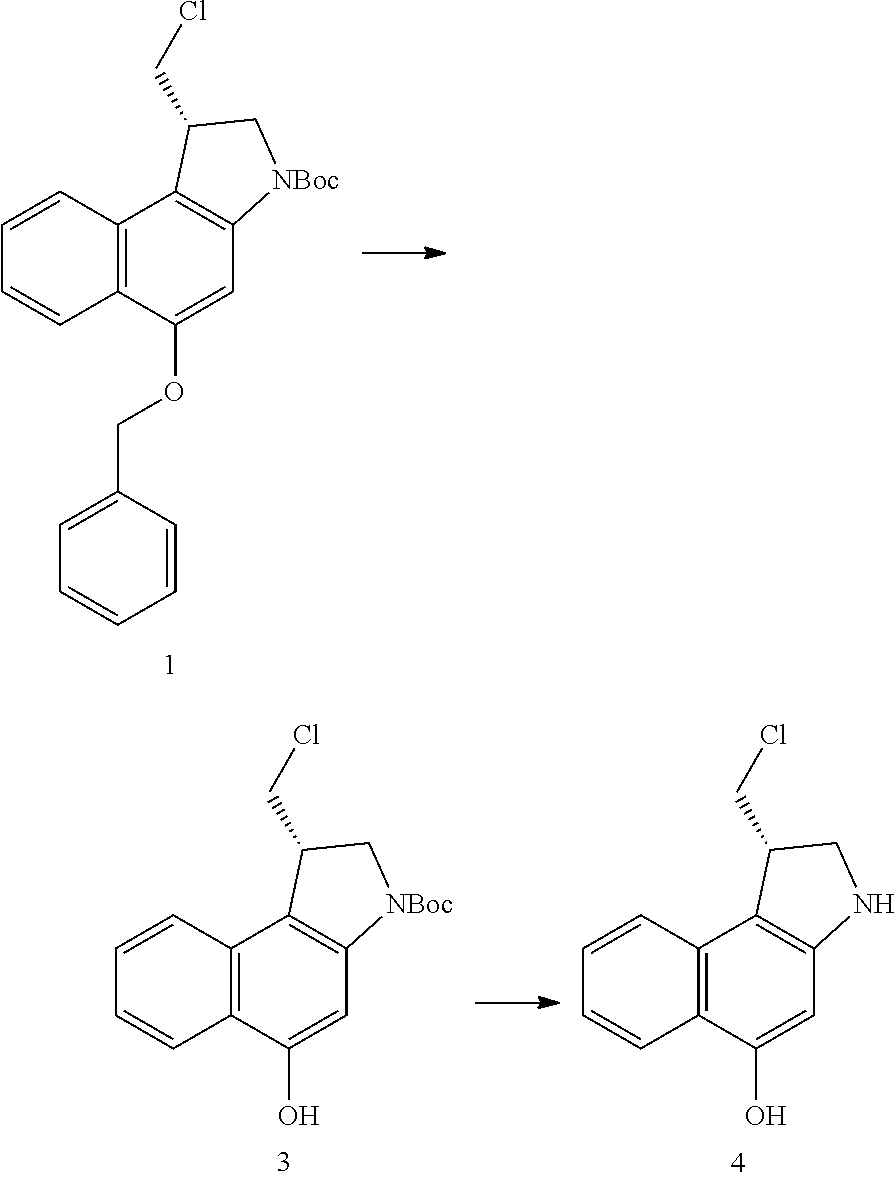


| TABLE 1 |
| Additional Payloads |
| Method of | |||
| ID | Structure | synthesis | M/S |
| 142 |
 |
68 | 759.5 [M + H]+ |
| 143 |
 |
68 | 747.4 [M + H]+ |
| 144 |
 |
68 | 689.4 [M + H]+ |
| 145 |
 |
141 | 765.1 [M + H]+ |
| 146 |
 |
60 | 659.2 [M + H]+ |
| 147 |
 |
60 | 593.2 [M + H]+ |
| 148 |
 |
141 | 893.2 [M + H]+ |
| 149 |
 |
68 | 893.2 [M + H]+ |
| 151 |
 |
141 | 919.2 [M + H]+ |
| 152 |
 |
68 | 671.2 [M + H]+ |
| 153 |
 |
141 | 933.2 [M + H]+ |
| 154 |
 |
60 | 590.2 [M + H]+ |
| 155 |
 |
68 | 687.1 [M + H]+ |
| 156 |
 |
68 | 687.2 [M + H]+ |
| 157 |
 |
68 | 701.2 [M + H]+ |
| 158 |
 |
68 | 700.6 [M + H]+ |
| 159 |
 |
68 | 713.2 [M + H]+ |
| 160 |
 |
68 | 715.1 [M + H]+ |
| 161 |
 |
65 | 666.1 [M + H]+ |
| 162 |
 |
134 | 643.2 [M + H]+ |
| 163 |
 |
65 | 667.1 [M + H]+ |
| 164 |
 |
141 | 779.1 [M + H]+ |
| 165 |
 |
60 | 570.2 [M + H]+ |
| 166 |
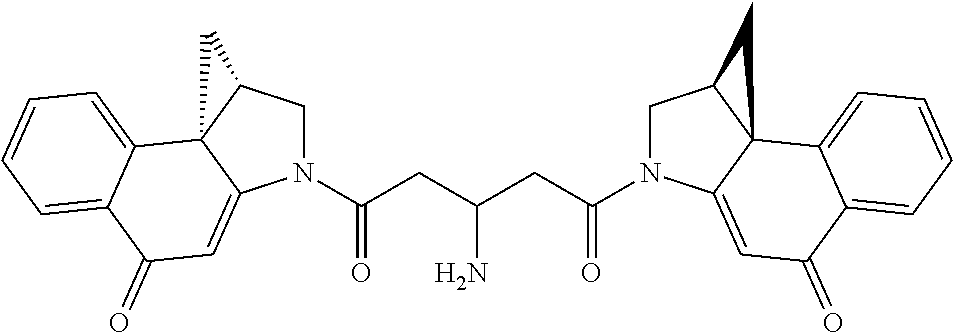 |
135 | 506.2 [M + H]+ |
| 167 |
 |
135 | 506.2 [M + H]+ |
| 168 |
 |
68 | 659.2 [M + H]+ |
| 169 |
 |
60 | 792.2 [M + H]+ |
| 170 |
 |
134 | 645.0 [M + H]+ |
| 171 |
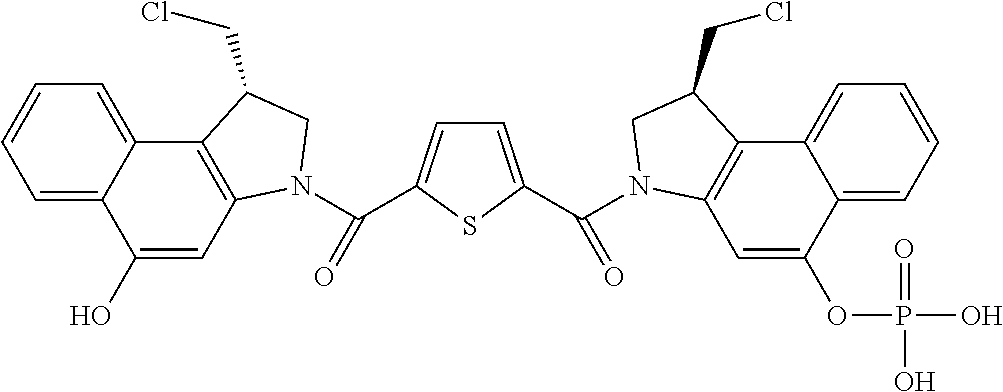 |
196 | 683.1 [M + H]+ |
| 172 |
 |
60 | 786.4 [M + H]+ |
| 173 |
 |
184 | 724.3 [M + H]+ |
| 174 |
 |
60 | 604.4 [M + H]+ |
| 175 |
 |
134 | 657.2 [M + H]+ |
| 176 |
 |
68 | 681.2 [M + H]+ |
| 177 |
 |
68 | 709.2 [M + H]+ |
| 178 |
 |
68 | 754.4 [M + H]+ |
| 179 |
 |
141 | 777.3 [M + H]+ |
| 180 |
 |
68 | 590.5 [M + H]+ |
| 181 |
 |
68 | 707.3 [M + H]+ |
| TABLE 2 |
| Additional Payloads, IUPAC names |
| 142 | 3,4-dihydro-2H-thieno[3,4-b][1,4]dioxepine-6,8-diylbis[carbonyl(1S)- |
| 1-(chloromethyl)-1,2-dihydro-3H-benzo[e]indole-3,5-diyl] diacetate | |
| 143 | (3,4-dimethoxythiene-2,5-diyl)bis[carbonyl(1S)-1-(chloromethyl)-1,2- |
| dihydro-3H-benzo[e]indole-3,5-diyl] diacetate | |
| 144 | 1,3,4-thiadiazole-2,5-diylbis[carbonyl(1S)-1-(chloromethyl)-1,2- |
| dihydro-3H-benzo[e]indole-3,5-diyl] diacetate | |
| 145 | ((S)-1-(chloromethyl)-5-(((2S,3R,4S,5R,6R)-3,4,5-trihydroxy-6- |
| (hydroxymethyl)tetrahydro-2H-pyran-2-yl)oxy)-1,2-dihydro-3H- | |
| benzo[e]indol-3-yl)(5-((S)-1-(chloromethyl)-5-hydroxy-2,3-dihydro- | |
| 1H-benzo[e]indole-3-carbonyl)thiophen-2-yl)methanone | |
| 146 | 3,3′-thiene-2,5-diylbis{1-[(1S)-1-(chloromethyl)-5-hydroxy-1,2- |
| dihydro-3H-benzo[e]indol-3-yl]propan-1-one} | |
| 147 | bicyclo[1.1.1]pentane-1,3-diylbis{[(1S)-1-(chloromethyl)-5-hydroxy- |
| 8-methyl-1,6-dihydropyrrolo[3,2-e]indol-3(2H)-yl]methanone} | |
| 148 | (2S,3S,4S,5R,6S)-6-(((S)-1-(chloromethyl)-3-(5-((S)-1-(chloromethyl)- |
| 5-((methyl(2-(methylamino)ethyl)carbamoyl)oxy)-2,3-dihydro-1H- | |
| benzo[e]indole-3-carbonyl)thiophene-2-carbonyl)-2,3-dihydro-1H- | |
| benzo[e]indol-5-yl)oxy)-3,4,5-trihydroxytetrahydro-2H-pyran-2- | |
| carboxylic acid | |
| 149 | (1S)-3-[(5-{[(2-{[(1S)-5-(acetyloxy)-1-(chloromethyl)-1,2-dihydro-3H- |
| benzo[e]indol-3-yl]carbonyl}-1H-indol-5-yl)carbamoyl]amino}-1H- | |
| indol-2-yl)carbonyl]-1-(chloromethyl)-1,2-dihydro-3H-benzo[e]indol- | |
| 5-yl acetate | |
| 150 | thiene-2,5-diylbis{[(1S)-1-(chloromethyl)-5-hydroxy-8-methyl-1,6- |
| dihydropyrrolo[3,2-e]indol-3(2H)-yl]methanone} | |
| 151 | (2S,3R,4S,5S,6S)-2-(((S)-1-(chloromethyl)-3-(5-((S)-1-(chloromethyl)- |
| 5-hydroxy-2,3-dihydro-1H-benzo[e]indole-3-carbonyl)thiophene-2- | |
| carbonyl)-2,3-dihydro-1H-benzo[e]indol-5-yl)oxy)-6- | |
| (methoxycarbonyl)tetrahydro-2H-pyran-3,4,5-triyl triacetate | |
| 152 | bicyclo[1.1.1]pentane-1,3-diylbis[carbonyl(1S)-1-(chloromethyl)-1,2- |
| dihydro-3H-benzo[e]indole-3,5-diyl] diacetate | |
| 153 | (2R,3S,4S,5R,6S)-2-(acetoxymethyl)-6-(((S)-1-(chloromethyl)-3-(5- |
| ((S)-1-(chloromethyl)-5-hydroxy-2,3-dihydro-1H-benzo[e]indole-3- | |
| carbonyl)thiophene-2-carbonyl)-2,3-dihydro-1H-benzo[e]indol-5- | |
| yl)oxy)tetrahydro-2H-pyran-3,4,5-triyl triacetate | |
| 154 | [(1S)-1-(chloromethyl)-5-hydroxy-1,2-dihydro-3H-benzo[e]indol-3-yl] |
| (3-{[(1S)-1-(chloromethyl)-5-hydroxy-8-methyl-1,6-dihydropyrrolo | |
| [3,2-e]indol-3(2H)-yl]carbonyl}bicyclo[1.1.1]pent-1-yl)methanone | |
| 155 | thiene-2,5-diylbis[carbonyl(1S)-1-(chloromethyl)-1,2-dihydro-3H- |
| benzo[e]indole-3,5-diyl] diacetate | |
| 156 | cyclobutane-1,1-diylbis[(1-oxoethane-2,1-diyl)(1S)-1-(chloromethyl)- |
| 1,2-dihydro-3H-benzo[e]indole-3,5-diyl] diacetate | |
| 157 | cyclopentane-1,1-diylbis[(1-oxoethane-2,1-diyl)(1S)-1-(chloromethyl)- |
| 1,2-dihydro-3H-benzo[e]indole-3,5-diyl] diacetate | |
| 158 | bicyclo[1.1.1]pentane-1,3-diylbis[(1-oxoethane-2,1-diyl)(1S)-1- |
| (chloromethyl)-1,2-dihydro-3H-benzo[e]indole-3,5-diyl] diacetate | |
| 159 | bicyclo[2.2.2]octane-1,4-diylbis[carbonyl(1S)-1-(chloromethyl)-1,2- |
| dihydro-3H-benzo[e]indole-3,5-diyl] diacetate | |
| 160 | thiene-2,5-diylbis[(1-oxoethane-2,1-diyl)(1S)-1-(chloromethyl)-1,2- |
| dihydro-3H-benzo[e]indole-3,5-diyl] diacetate | |
| 161 | (1S)-3-[(3-{[(1S)-5-amino-1-(chloromethyl)-1,2-dihydro-3H- |
| benzo[e]indol-3-yl]carbonyl}bicyclo[1.1.1]pent-1-yl)carbonyl]-1- | |
| (chloromethyl)-2,3-dihydro-1H-benzo[e]indol-5-yl dihydrogen | |
| phosphate | |
| 162 | (1S)-1-(chloromethyl)-3-[(3-{2-[(1S)-1-(chloromethyl)-5-hydroxy-1,2- |
| dihydro-3H-benzo[e]indol-3-yl]-2-oxoethyl}bicyclo[1.1.1]pent-1- | |
| yl)carbonyl]-2,3-dihydro-1H-benzo[e]indol-5-yl acetate | |
| 163 | (1S)-1-(chloromethyl)-3-[(3-{[(1S)-1-(chloromethyl)-5-hydroxy-1,2- |
| dihydro-3H-benzo[e]indol-3-yl]carbonyl}bicyclo[1.1.1]pent-1- | |
| yl)carbonyl]-2,3-dihydro-1H-benzo[e]indol-5-yl dihydrogen phosphate | |
| 164 | (2S,3S,4S,5R,6S)-6-(((S)-1-(chloromethyl)-3-(5-((S)-1-(chloromethyl)- |
| 5-hydroxy-2,3-dihydro-1H-benzo[e]indole-3-carbonyl)thiophene-2- | |
| carbonyl)-2,3-dihydro-1H-benzo[e]indol-5-yl)oxy)-3,4,5- | |
| trihydroxytetrahydro-2H-pyran-2-carboxylic acid | |
| 165 | 2,2′-iminobis{1-[(1S)-1-(chloromethyl)-5-hydroxy-8-methyl-1,6- |
| dihydropyrrolo[3,2-e]indol-3(2H)-yl]ethanone} | |
| 166 | 3-amino-1,5-bis[(1aS,9bR)-5-oxo-1a,2-dihydro-1H- |
| benzo[e]cyclopropa[c]indol-3(5H)-yl]pentane-1,5-dione | |
| 167 | (2S)-2-amino-1,5-bis[(1aS,9bR)-5-oxo-1a,2-dihydro-1H- |
| benzo[e]cyclopropa[c]indol-3(5H)-yl]pentane-1,5-dione | |
| 168 | cis-cyclobutane-1,3-diylbis[carbonyl(1S)-1-(chloromethyl)-1,2-dihydro- |
| 3H-benzo[e]indole-3,5-diyl] diacetate | |
| 169 | 9H-fluoren-9-ylmethyl bis{2-[(1S)-1-(chloromethyl)-5-hydroxy-8- |
| methyl-1,6-dihydropyrrolo[3,2-e]indol-3(2H)-yl]-2-oxoethyl}carbamate | |
| 170 | (1S)-1-(chloromethyl)-3-[(5-{[(1S)-1-(chloromethyl)-5-hydroxy-1,2- |
| dihydro-3H-benzo[e]indol-3-yl]carbonyl}thiophen-2-yl)carbonyl]-2,3- | |
| dihydro-1H-benzo[e]indol-5-yl acetate | |
| 171 | (1S)-1-(chloromethyl)-3-[(5-{[(1S)-1-(chloromethyl)-5-hydroxy-1,2- |
| dihydro-3H-benzo[e]indol-3-yl]carbonyl}thiophen-2-yl)carbonyl]-2,3- | |
| dihydro-1H-benzo[e]indol-5-yl dihydrogen phosphate | |
| 172 | 9H-fluoren-9-ylmethyl bis{2-[(1S)-1-(chloromethyl)-5-hydroxy-1,2- |
| dihydro-3H-benzo[e]indol-3-yl]-2-oxoethyl}carbamate | |
| 173 | iminobis[(1-oxoethane-2,1-diyl)(1S)-1-(chloromethyl)-1,2-dihydro- |
| 3H-benzo[e]indole-3,5-diyl] bis[dihydrogen (phosphate)] | |
| 174 | (3R,5S)-piperidine-3,5-diylbis{[(1S)-1-(chloromethyl)-5-hydroxy-1,2- |
| dihydro-3H-benzo[e]indol-3-yl]methanone} | |
| 175 | (1S)-1-(chloromethyl)-3-{[(1S,5S)-5-{[(1S)-1-(chloromethyl)-5- |
| hydroxy-1,2-dihydro-3H-benzo[e]indol-3-yl]carbonyl}bicyclo[3.1.1] | |
| hept-1-yl]carbonyl}-2,3-dihydro-1H-benzo[e]indol-5-yl acetate | |
| 176 | benzene-1,4-diylbis[carbonyl(1S)-1-(chloromethyl)-1,2-dihydro-3H- |
| benzo[e]indole-3,5-diyl] diacetate | |
| 177 | benzene-1,3-diylbis[(1-oxoethane-2,1-diyl)(1S)-1-(chloromethyl)-1,2- |
| dihydro-3H-benzo[e]indole-3,5-diyl] diacetate | |
| 178 | (5-nitrobenzene-1,3-diyl)bis[(1-oxoethane-2,1-diyl)(1S)-1- |
| (chloromethyl)-1,2-dihydro-3H-benzo[e]indole-3,5-diyl] diacetate | |
| 179 | (1S)-1-(chloromethyl)-3-[(3-{[(1S)-1-(chloromethyl)-5-hydroxy-1,2- |
| dihydro-3H-benzo[e]indol-3-yl]carbonyl}bicyclo[1.1.1]pent- | |
| 1-yl)acetyl]-2,3-dihydro-1H-benzo[e]indol-5-yl beta-D- | |
| glucopyranosiduronic acid | |
| 180 | [(1S)-5-amino-1-(chloromethyl)-1,2-dihydro-3H-benzo[e]indol-3-yl] |
| (3-{[(1S)-1-(chloromethyl)-5-hydroxy-8-methyl-1,6-dihydropyrrolo | |
| [3,2-e]indol-3(2H)-yl]carbonyl}bicyclo[1.1.1]pent-1-yl)methanone | |
| 181 | pentacyclo[4.2.0.0~2,5~.0~3,8~.0~4,7~]octane-1,4-diylbis |
| [carbonyl(1S)-1-(chloromethyl)-1,2-dihydro-3H-benzo[e]indole- | |
| 3,5-diyl] diacetate | |


| TABLE 3 |
| Additional Linker Payloads |
| Prepared | |||
| Using | |||
| Method | |||
| Similar | |||
| to Com- | |||
| pound | |||
| ID | Structure | ID | MS: m/z |
| 292 |
 |
198 | 1042.2 [M + H]+ |
| 293 |
 |
198 | 921.1 [M + Na] |
| 294 |
 |
198 | 1659.70 [M + 3H]+ |
| 295 |
 |
198 | 1647.1 [M + 3H]+ |
| 296 |
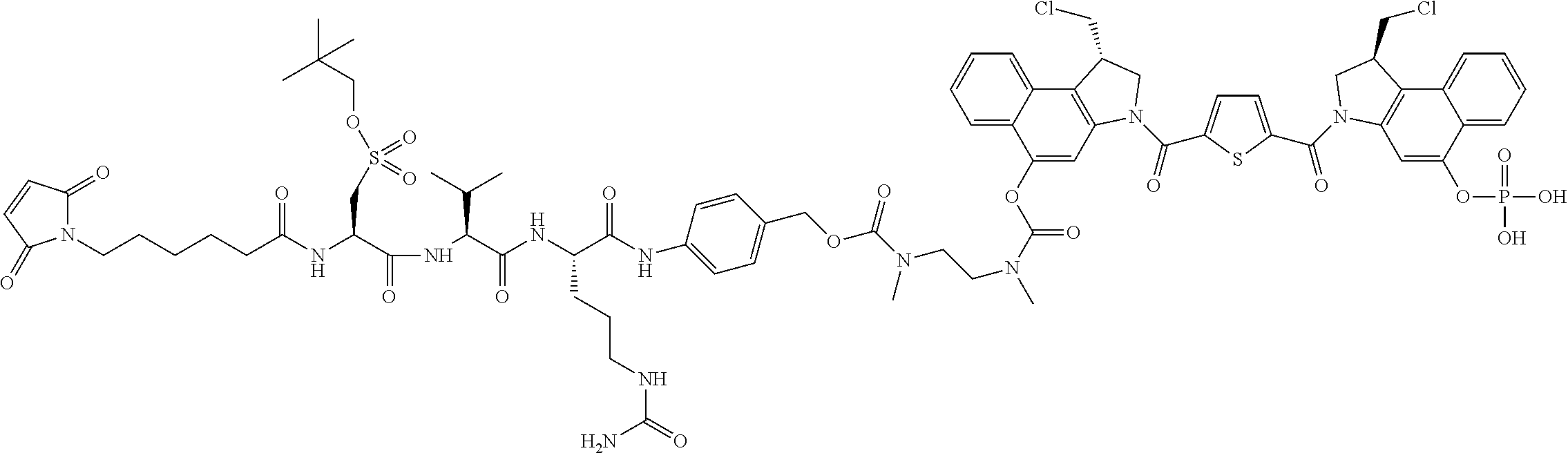 |
198 | 1614.6 [M − H] |
| 297 |
 |
1041 | 1454.5 [M + H]+ |
| 298 |
 |
198 | 1629.6 [M + H]+ |
| 299 |
 |
198 | 1705.6 [M + H]+ |
| 300 |
 |
198 | 1372.4 [M + H]+ |
| 301 |
 |
198 | 1599.6 [M + H]+ |
| 302 |
 |
198 | 1625.6 [M + H]+ |
| 303 |
 |
198 | 1619.5 [M + H]+ |
| 304 |
 |
198 | 1539.5 [M + H]+ |
| 305 |
 |
291 | 1633.6 [M + H]+ |
| 306 |
 |
250 | 1199.3 [M + H]+ |
| 307 |
 |
250 | 1227.1 [M + H]+ |
| 308 |
 |
267 | 895.7 [M + H]+ |
| 309 |
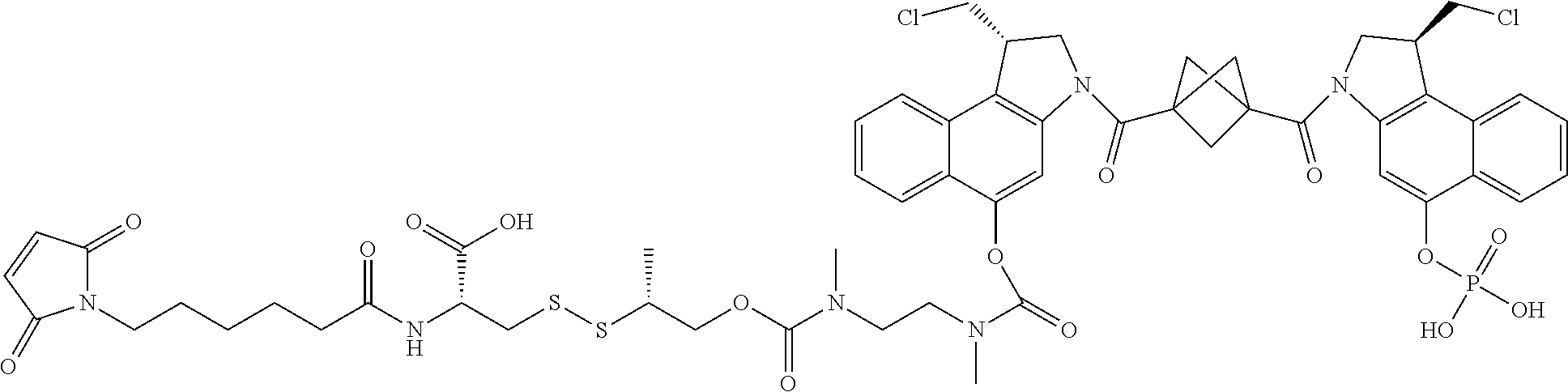 |
250 | 1213.1 [M + H]+ |
| 310 |
 |
250 | 1009.9 [M + H]+ |
| 311 |
 |
267 | 892.9 [M + H]+ |
| 312 |
 |
267 | 889.2 [M + H]+ |
| 313 |
 |
267 | 880.9 [M + H]+ |
| 314 |
 |
291 | 1618.6 [M + H]+ |
| 315 |
 |
280 | 1453.9 [M + H]+ |
| 316 |
 |
204 | 1604.2 [M + H]+ |
| TABLE 4 |
| Additional Linker-Payloads, IUPAC names |
| ID | Chemical Name |
| 292 | (1S)-1-(chloromethyl)-3-[(5-{[(1S)-1-(chloromethyl)-5-({[1-(2,5-dioxo-2,5-dihydro-1H-pyrrol-1- |
| yl)-13-methyl-12-oxo-3,6,9-trioxa-13-azapentadecan-15-yl](methyl)carbamoyl}oxy)-1,2- | |
| dihydro-3H-benzo[e]indol-3-yl}carbonyl}thiophen-2-yl)carbonyl]-2,3-dihydro-1H- | |
| benzo[e]indol-5-yl acetate | |
| 293 | (1S)-1-(chloromethyl)-3-[(5-{[(1S)-1-(chloromethyl)-5-{[(2-{2-[2-(2,5-dioxo-2,5-dihydro-1H- |
| pyrrol-1-yl)ethoxy]ethoxy}ethyl)carbamoyl]oxy}-1,2-dihydro-3H-benzo[e]indol-3- | |
| yl]carbonyl}thiophen-2-yl)carbonyl]-2,3-dihydro-1H-benzo[e]indol-5-yl acetate | |
| 294 | N-(24-bromo-23-oxo-4,7,10,13,16,19-hexaoxa-22-azatetracosan-1-oyl)-L-valyl-N~5~- |
| carbamoyl-N-[4-({[(2-{[({(1S)-1-(chloromethyl)-3-[(5-{[(1S)-1-(chloromethyl)-5-(phosphonooxy)- | |
| 1,2-dihydro-3H-benzo[e]indol-3-yl]carbonyl}thiophen-2-yl)carbonyl]-2,3-dihydro-1H- | |
| benzo[e]indol-5-yl}oxy)carbonyl](methyl)amino}ethyl)(methyl)carbamoyl]oxy}methyl)phenyl]- | |
| L-ornithinamide | |
| 295 | N-[1-(2,5-dioxo-2,5-dihydro-1H-pyrrol-1-yl)-21-oxo-3,6,9,12,15,18-hexaoxahenicosan-21-yl]-L- |
| valyl-N~5~-carbamoyl-N-[4-({[(2-{[({(1S)-1-(chloromethyl)-3-[(5-{[(1S)-1-(chloromethyl)-5- | |
| (phosphonooxy)-1,2-dihydro-3H-benzo[e]indol-3-yl]carbonyl}thiophen-2-yl)carbonyl]-2,3- | |
| dihydro-1H-benzo[e]indol-5- | |
| yl}oxy)carbonyl](ethyl)amino}ethyl)(ethyl)carbamoyl]oxy}methyl)phenyl]-L-ornithinamide | |
| 296 | 3-[(2,2-dimethylpropoxy)sulfonyl]-N-[6-(2,5-dioxo-2,5-dihydro-1H-pyrrol-1-yl)hexanoyl]-L- |
| alanyl-L-valyl-N~5~-carbamoyl-N-[4-({[(2-{[({(1S)-1-(chloromethyl)-3-[(5-{[(1S)-1- | |
| (chloromethyl)-5-(phosphonooxy)-1,2-dihydro-3H-benzo[e]indol-3-yl]carbonyl}thiophen-2- | |
| yl)carbonyl]-2,3-dihydro-1H-benzo[e]indol-5- | |
| yl}oxy)carbonyl](methyl)amino}ethyl)(methyl)carbamoyl]oxy}methyl)phenyl]-L-ornithinamide | |
| 297 | 4-((S)-2-((S)-2-((S)-2-acetamido-6-aminohexanamido)-3-methylbutanamido)-5- |
| ureidopentanamido)benzyl ((S)-1-(chloromethyl)-3-(5-((S)-1-(chloromethyl)-5- | |
| (((2S,3R,4S,5R,6R)-3,4,5-trihydroxy-6-(hydroxymethyl)tetrahydro-2H-pyran-2-yl)oxy)-2,3- | |
| dihydro-1H-benzo[e]indole-3-carbonyl)thiophene-2-carbonyl)-2,3-dihydro-1H-benzo[e]indol-5- | |
| yl) ethane-1,2-diylbis(methylcarbamate) | |
| 298 | N-[1-(2,5-dioxo-2,5-dihydro-1H-pyrrol-1-yl)-21-oxo-3,6,9,12,15,18-hexaoxahenicosan-21-yl]-L- |
| valyl-N~5~-carbamoyl-N-[4-({[(2-{[({(1S)-1-(chloromethyl)-3-[(5-{[(1S)-1-(chloromethyl)-5- | |
| (phosphonooxy)-1,2-dihydro-3H-benzo[e]indol-3-yl]carbonyl}furan-2-yl)carbonyl]-2,3-dihydro- | |
| 1H-benzo[e]indol-5-yl}oxy)carbonyl](ethyl)amino}ethyl)(ethyl)carbamoyl]oxy}methyl)phenyl]-L- | |
| ornithinamide | |
| 299 | N-[1-(2,5-dioxo-2,5-dihydro-1H-pyrrol-1-yl)-21-oxo-3,6,9,12,15,18-hexaoxahenicosan-21-yl]-L- |
| valyl-N~5~-carbamoyl-N-(4-{7-[({(1S)-1-(chloromethyl)-3-[(5-{[(1S)-1-(chloromethyl)-5- | |
| (phosphonooxy)-1,2-dihydro-3H-benzo[e]indol-3-yl]carbonyl}thiophen-2-yl)carbonyl]-2,3- | |
| dihydro-1H-benzo[e]indol-5-yl}oxy)carbonyl]-4-(2-methoxyethyl)-3-oxo-2,10-dioxa-4,7- | |
| diazaundec-1-yl}phenyl)-L-ornithinamide | |
| 300 | N~2~-acetyl-L-lysyl-L-valyl-N~5~-carbamoyl-N-[4-({[(2-{[({(1S)-1-(chloromethyl)-3-[(5-{[(1S)-1- |
| (chloromethyl)-5-(phosphonooxy)-1,2-dihydro-3H-benzo[e]indol-3-yl]carbonyl}thiophen-2- | |
| yl)carbonyl]-2,3-dihydro-1H-benzo[e]indol-5- | |
| yl}oxy)carbonyl](methyl)amino}ethyl)(methyl)carbamoyl]oxy}methyl)phenyl]-L-ornithinamide | |
| 301 | N-[1-(2,5-dioxo-2,5-dihydro-1H-pyrrol-1-yl)-21-oxo-3,6,9,12,15,18-hexaoxahenicosan-21-yl]-L- |
| valyl-N~5~-carbamoyl-N-(4-{[({4-[({(1S)-1-(chloromethyl)-3-[(3-{[(1S)-1-(chloromethyl)-5- | |
| (phosphonooxy)-1,2-dihydro-3H-benzo[e]indol-3-yl]carbonyl}bicyclo[1.1.1]pent-1-yl)carbonyl]- | |
| 2,3-dihydro-1H-benzo[e]indol-5-yl}oxy)carbonyl]piperazin-1-yl}carbonyl)oxy]methyl}phenyl)-L- | |
| ornithinamide | |
| 302 | N-(21-amino-4,7,10,13,16,19-hexaoxahenicosan-1-oyl)-L-valyl-N~5~-carbamoyl-N-(4-{7-[({(1S)- |
| 1-(chloromethyl)-3-[(5-{[(1S)-1-(chloromethyl)-5-(phosphonooxy)-1,2-dihydro-3H- | |
| benzo[e]indol-3-yl]carbonyl}thiophen-2-yl)carbonyl]-2,3-dihydro-1H-benzo[e]indol-5- | |
| yl}oxy)carbonyl]-4-(2-methoxyethyl)-3-oxo-2,10-dioxa-4,7-diazaundec-1-yl}phenyl)-L- | |
| ornithinamide | |
| 303 | N-[1-(2,5-dioxo-2,5-dihydro-1H-pyrrol-1-yl)-21-oxo-3,6,9,12,15,18-hexaoxahenicosan-21-yl]-L- |
| valyl-N-(4-{7-[({(1S)-1-(chloromethyl)-3-[(5-{[(1S)-1-(chloromethyl)-5-(phosphonooxy)-1,2- | |
| dihydro-3H-benzo[e]indol-3-yl]carbonyl}thiophen-2-yl)carbonyl]-2,3-dihydro-1H- | |
| benzo[e]indol-5-yl}oxy)carbonyl]-4-(2-methoxyethyl)-3-oxo-2,10-dioxa-4,7-diazaundec-1- | |
| yl}phenyl)-L-alaninamide | |
| 304 | N-(21-amino-4,7,10,13,16,19-hexaoxahenicosan-1-oyl)-L-valyl-N-(4-{7-[({(1S)-1-(chloromethyl)- |
| 3-[(5-{[(1S)-1-(chloromethyl)-5-(phosphonooxy)-1,2-dihydro-3H-benzo[e]indol-3- | |
| yl]carbonyl}thiophen-2-yl)carbonyl]-2,3-dihydro-1H-benzo[e]indol-5-yl}oxy)carbonyl]-4-(2- | |
| methoxyethyl)-3-oxo-2,10-dioxa-4,7-diazaundec-1-yl}phenyl)-L-alaninamide | |
| 305 | (2S,3S,4S,5R,6S)-6-(((S)-3-(5-((S)-5-(((2-((((4-((23S,26S)-1-amino-23-isopropyl-21,24-dioxo-26- |
| (3-ureidopropyl)-3,6,9,12,15,18-hexaoxa-22,25-diazaheptacosan-27- | |
| amido)benzyl)oxy)carbonyl)(methyl)amino)ethyl)(methyl)carbamoyl)oxy)-1-(chloromethyl)-2,3- | |
| dihydro-1H-benzo[e]indole-3-carbonyl)thiophene-2-carbonyl)-1-(chloromethyl)-2,3-dihydro- | |
| 1H-benzo[e]indol-5-yl)oxy)-3,4,5-trihydroxytetrahydro-2H-pyran-2-carboxylic acid | |
| 306 | 3-[(2-{[(2-{[({(1S)-1-(chloromethyl)-3-[(3-{[(1S)-1-(chloromethyl)-5-(phosphonooxy)-1,2-dihydro-3H- |
| benzo[e]indol-3-yl]carbonyl}bicyclo[1.1.1]pent-1-yl)carbonyl]-2,3-dihydro-1H-benzo[e]indol-5-yl}oxy) | |
| carbonyl](methyl)amino}ethyl)(methyl)carbamoyl]oxy}ethyl)disulfanyl]-N-[6-(2,5-dioxo-2,5-dihydro- | |
| 1H-pyrrol-1-yl)hexanoyl]-L-alanine | |
| 307 | 3-[(2-{[(2-{[({(1S)-1-(chloromethyl)-3-[(3-{[(1S)-1-(chloromethyl)-5-(phosphonooxy)-1,2- |
| dihydro-3H-benzo[e]indol-3-yl]carbonyl}bicyclo[1.1.1]pent-1-yl)carbonyl]-2,3-dihydro-1H- | |
| benzo[e]indol-5-yl}oxy)carbonyl](methyl)amino}ethyl)(methyl)carbamoyl]oxy}ethyl)disulfanyl]- | |
| N-[6-(2,5-dioxo-2,5-dihydro-1H-pyrrol-1-yl)hexanoyl]-L-valine | |
| 308 | (1S)-1-(chloromethyl)-3-[(5-{[(1S)-1-(chloromethyl)-5-(phosphonooxy)-1,2-dihydro-3H- |
| benzo[e]indol-3-yl]carbonyl}thiophen-2-yl)carbonyl]-2,3-dihydro-1H-benzo[e]indol-5-yl [2- | |
| (pyridin-2-yldisulfanyl)ethyl]carbamate | |
| 309 | 3-{[(2R)-1-{[(2-{[({(1S)-1-(chloromethyl)-3-[(3-{[(1S)-1-(chloromethyl)-5-(phosphonooxy)-1,2- |
| dihydro-3H-benzo[e]indol-3-yl]carbonyl}bicyclo[1.1.1]pent-1-yl)carbonyl]-2,3-dihydro-1H- | |
| benzo[e]indol-5-yl} oxy)carbonyl](methyl)amino}ethyl)(methyl)carbamoyl]oxy}propan-2- | |
| yl]disulfanyl}-N-[6-(2,5-dioxo-2,5-dihydro-1H-pyrrol-1-yl)hexanoyl]-L-alanine | |
| 310 | (1S)-1-(chloromethyl)-3-[(3-{[(1S)-1-(chloromethyl)-5-(phosphonooxy)-1,2-dihydro-3H- |
| benzo[e]indol-3-yl]carbonyl}bicyclo[1.1.1]pent-1-yl)carbonyl]-2,3-dihydro-1H-benzo[e]indol-5- | |
| yl (2R)-2-(pyridin-2-yl disulfanyl)propyl ethane-1,2-diylbis(methylcarbamate) | |
| 311 | (1S)-1-(chloromethyl)-3-[(3-{[(1S)-1-(chloromethyl)-5-(phosphonooxy)-1,2-dihydro-3H- |
| benzo[e]indol-3-yl]carbonyl}bicyclo[1.1.1]pent-1-yl)carbonyl]-2,3-dihydro-1H-benzo[e]indol-5- | |
| yl methyl[2-(pyridin-2-yldisulfanyl)ethyl]carbamate | |
| 312 | (1S)-1-(chloromethyl)-3-[(3-{[(1S)-1-(chloromethyl)-5-(phosphonooxy)-1,2-dihydro-3H- |
| benzo[e]indol-3-yl]carbonyl}bicyclo[1.1.1]pent-1-yl)carbonyl]-2,3-dihydro-1H-benzo[e]indol-5- | |
| yl [6-(2,5-dioxo-2,5-dihydro-1H-pyrrol-1-yl)hexyl]carbamate | |
| 313 | (1S)-1-(chloromethyl)-3-[(3-{[(1S)-1-(chloromethyl)-5-(phosphonooxy)-1,2-dihydro-3H- |
| benzo[e]indol-3-yl]carbonyl}bicyclo[1.1.1]pent-1-yl)carbonyl]-2,3-dihydro-1H-benzo[e]indol-5- | |
| yl [2-(pyridin-2-yldisulfanyl)ethyl]carbamate | |
| 314 | N-(21-amino-4,7,10,13,16,19-hexaoxahenicosan-1-oyl)-L-valyl-N~5~-carbamoyl-N-[4-({[(2- |
| {[({(1S)-1-(chloromethyl)-3-[(3-{[(1S)-1-(chloromethyl)-5-(beta-D-glucopyranuronosyloxy)-1,2- | |
| dihydro-3H-benzo[e]indol-3-yl]carbonyl}bicyclo[1.1.1]pent-1-yl)carbonyl]-2,3-dihydro-1H- | |
| benzo[e]indol-5-yl}oxy)carbonyl](methyl)amino}ethyl)(methyl)carbamoyl]oxy}methyl)phenyl]- | |
| L-ornithinamide | |
| 315 | N~2~-acetyl-L-lysyl-L-valyl-N~5~-carbamoyl-N-[4-({[(2-{[({(1S)-1-(chloromethyl)-3-[(3-{[(1S)-1- |
| (chloromethyl)-5-(beta-D-glucopyranuronosyloxy)-1,2-dihydro-3H-benzo[e]indol-3- | |
| yl]carbonyl]bicyclo[1.1.1] pent-1-yl)carbonyl]-2,3-dihydro-1H-benzo[e]indol-5- | |
| yl}oxy)carbonyl](methyl)amino}ethyl)(methyl)carbamoyl]oxy}methyl)phenyl]-L-ornithinamide | |
| 316 | N-[1-(2,5-dioxo-2,5-dihydro-1H-pyrrol-1-yl)-21-oxo-3,6,9,12,15,18-hexaoxahenicosan-21-yl]-L- |
| valyl-N~5~-carbamoyl-N-[4-({[[(2-{[({(1S)-1-(chloromethyl)-3-[(3-{[(1S)-1-(chloromethyl)-5- | |
| (phosphonooxy)-1,2-dihydro-3H-benzo[e]indol-3-yl]carbonyl}bicyclo[1.1.1]pent-1-yl)carbonyl]- | |
| 2,3-dihydro-1H-benzo[e]indol-5- | |
| yl}oxy)carbonyl](methyl)amino}ethyl)(methyl)carbamoyl]oxy}methyl)phenyl]-L-ornithinamide | |
| TABLE 5A |
| Representative Thiocarbamate Linker Payoads |
| Suggested | M/S | ||
| method of | (pre- | ||
| ID | Structure | synthesis | dicted) |
| 317 |
 |
231 | 1622.57 |
| 4-((23S,26S)-1-(2,5-dioxo-2,5-dihydro-1H-pyrrol-1-yl)-23- | |||
| isopropyl-21,24-dioxo-26-(3-ureidopropyl)-3,6,9,12,15,18- | |||
| hexaoxa-22,25-diazaheptacosan-27-amido)benzyl (2-(((((S)-8- | |||
| (chloromethyl)-6-(3-((S)-1-(chloromethyl)-8-methyl-5- | |||
| (phosphonooxy)-1,2,3,6-tetrahydropyrrolo[3,2-e]indole-3- | |||
| carbonyl)bicyclo[1.1.1]pentane-1-carbonyl)-1-methyl-3,6,7,8- | |||
| tetrahydropyrrolo[3,2-e]indol-4- | |||
| yl)oxy)carbonothioyl)(methyl)amino)ethyl)(methyl)carbamate | |||
| 318 |
 |
231 | 1622.57 |
| (S)-8-(chloromethyl)-6-(3-((S)-1-(chloromethyl)-8-methyl-5- | |||
| (phosphonooxy)-1,2,3,6-tetrahydropyrrolo[3,2-e]indole-3- | |||
| carbonyl)bicyclo[1.1.1]pentane-1-carbonyl)-1-methyl-3,6,7,8- | |||
| tetrahydropyrrolo[3,2-e]indol-4-yl (2-((((4-((23S,26S)-1-(2,5- | |||
| dioxo-2,5-dihydro-1H-pyrrol-1-yl)-23-isopropyl-21,24-dioxo-26- | |||
| (3-ureidopropyl)-3,6,9,12,15,18-hexaoxa-22,25- | |||
| diazaheptacosan-27- | |||
| amido)benzyl)oxy)carbonothioyl)(methyl)amino)ethyl)(methyl) | |||
| carbamate | |||
| 319 |
 |
231 | 1641.65 |
| O′-((S)-8-(chloromethyl)-6-(3-((S)-1-(chloromethyl)-8-methyl-5- | |||
| (phosphonooxy)-1,2,3,6-tetrahydropyrrolo[3,2-e]indole-3- | |||
| carbonyl)bicyclo[1.1.1]pentane-1-carbonyl)-1-methyl-3,6,7,8- | |||
| tetrahydropyrrolo[3,2-e]indol-4-yl) O-(4-((23S,26S)-1-(2,5- | |||
| dioxo-2,5-dihydro-1H-pyrrol-1-yl)-23-isopropyl-21,24-dioxo-26- | |||
| (3-ureidopropyl)-3,6,9,12,15,18-hexaoxa-22,25- | |||
| diazaheptacosan-27-amido)benzyl) ethane-1,2- | |||
| diylbis(methylcarbamothioate) | |||
| 320 |
 |
237 | 1377.49 |
| 4-((S)-2-((S)-2-((S)-2-acetamido-6-aminohexanamido)-3- | |||
| methylbutanamido)-5-ureidopentanamido)benzyl (2-(((((S)-8- | |||
| (chloromethyl)-6-(3-((S)-1-(chloromethyl)-8-methyl-5- | |||
| (phosphonooxy)-1,2,3,6-tetrahydropyrrolo[3,2-e]indole-3- | |||
| carbonyl)bicyclo[1.1.1]pentane-1-carbonyl)-1-methyl-3,6,7,8- | |||
| tetrahydropyrrolo[3,2-e]indol-4- | |||
| yl)oxy)carbonothioyl)(methyl)amino)ethyl)(methyl)carbamate | |||
| 321 |
 |
237 | 1377.49 |
| (S)-8-(chloromethyl)-6-(3-((S)-1-(chloromethyl)-8-methyl-5- | |||
| (phosphonooxy)-1,2,3,6-tetrahydropyrrolo[3,2-e]indole-3- | |||
| carbonyl)bicyclo[1.1.1]pentane-1-carbonyl)-1-methyl-3,6,7,8- | |||
| tetrahydropyrrolo[3,2-e]indol-4-yl (2-((((4-((S)-2-((S)-2-((S)-2- | |||
| acetamido-6-aminohexanamido)-3-methylbutanamido)-5- | |||
| ureidopentanamido)benzyl)oxy)carbonothioyl)(methyl)amino) | |||
| ethyl)(methyl)carbamate | |||
| 322 |
 |
237 | 1393.47 |
| O-(4-((S)-2-((S)-2-((S)-2-acetamido-6-aminohexanamido)-3- | |||
| methylbutanamido)-5-ureidopentanamido)benzyl) O′-((S)-8- | |||
| (chloromethyl)-6-(3-((S)-1-(chloromethyl)-8-methyl-5- | |||
| (phosphonooxy)-1,2,3,6-tetrahydropyrrolo[3,2-e]indole-3- | |||
| carbonyl)bicyclo[1.1.1]pentane-1-carbonyl)-1-methyl-3,6,7,8- | |||
| tetrahydropyrrolo[3,2-e]indol-4-yl) ethane-1,2- | |||
| diylbis(methylcarbamothioate) | |||
| TABLE 5B |
| Representative Cubane Linker Payoads |
| Method | M/S | ||
| of | (pre- | ||
| ID | Structure | synthesis | dicted) |
| 323 |  | 237 | 1392.5 [M + H]+ |
| 324 |  | 237 | 1636.1 [M + H]+ |
HPLC and LC-MS Conditions Used for Analysis
| TABLE 6A |
| Antibody Drug Conjugates |
| ID | Structure |
| ADC1 |
 |
| ADC2 |
 |
| ADC3 |
 |
| ADC4 |
 |
| ADC5 |
 |
| ADC6 |
 |
| ADC7 |
 |
| ADC8 |
 |
| ADC9 |
 |
| ADC10 |
 |
| ADC11 |
 |
| ADC12 |
 |
| ADC13 |
 |
| ADC14 |
 |
| TABLE 6B |
| Additional Antibody Drug Conjugates |
 |
 |
 |
 |
 |
 |
 |
| TABLE 7 |
| ADC Analytical Data |
| Mass Spectra: | ||||
| Theoretical Δ | SEC-HPLC | |||
| mass or | retention time and | Loading or | ||
| Linker/ | linker-payload | HPLC Δ mass for | Drug per | |
| Payload | molecular | the Light Chain | Antibody | |
| ADC ID | ID | weight | (LC) portion | Ratio (DAR) |
| ADC1 | 223 | 1618 | SEC (Protocol C): | 4.0 |
| 6.352 minutes; | ||||
| HPLC (Protocol B): | ||||
| LC Δ mass = 1619 | ||||
| ADC2 | 189 | 1545 | SEC (Protocol C): | 2.7 |
| 6.388 minutes; | ||||
| HPLC (Protocol B): | ||||
| LC Δ mass = 1545 | ||||
| ADC3 | 298 | 1630 | SEC (Protocol C): | 5.2 |
| 6.276 minutes; | ||||
| HPLC (Protocol B): | ||||
| LC Δ mass = 1631 | ||||
| ADC4 | 299 | 1706 | SEC (Protocol C): | 3.5 |
| 6.331 minutes; | ||||
| HPLC (Protocol B): | ||||
| LC Δ mass = 1707 | ||||
| ADC5 | 303 | 1620 | SEC (Protocol C): | 3.3 |
| 6.323 minutes; | ||||
| HPLC (Protocol B): | ||||
| LC Δ mass = 1621 | ||||
| ADC6 | 231 | 1607 | SEC (Protocol C): | 3.2 |
| 6.606 minutes; | ||||
| HPLC (Protocol B): | ||||
| LC Δ mass = 1609 | ||||
| ADC7 | 266 | 1032 | SEC (Protocol C): | 3.9 |
| 6.637 minutes; | ||||
| HPLC (Protocol B): | ||||
| LC Δ mass = 1032 | ||||
| ADC8 | 279 | 1029 | SEC (Protocol C): | 4.1 |
| 6.639 minutes; | ||||
| HPLC (Protocol B): | ||||
| LC Δ mass = 1030 | ||||
| ADC9 | 278 | 1713 | SEC (Protocol C): | 5.1 |
| 5.779 minutes; | ||||
| HPLC (Protocol B): | ||||
| LC Δ mass = 1716 | ||||
| ADC10 | 231 | 1607 | SEC (Protocol C): | 3.3 |
| 6.567 minutes; | ||||
| HPLC (Protocol B): | ||||
| LC Δ mass = 1609 | ||||
| ADC11 | 266 | 1032 | SEC (Protocol C): | 4.6 |
| 6.590 minutes; | ||||
| HPLC (Protocol B): | ||||
| LC Δ mass = 1032 | ||||
| ADC12 | 279 | 1029 | SEC (Protocol C): | 4.5 |
| 6.582 minutes; | ||||
| HPLC (Protocol B): | ||||
| LC Δ mass = 1030 | ||||
| ADC13 | 278 | 1713 | SEC (Protocol C): | 4 |
| 5.577 minutes; | ||||
| HPLC (Protocol B): | ||||
| LC Δ mass = 1718 | ||||
| ADC14 | 294 | 1578 | SEC (Protocol C): | 3.1 |
| 6.491 minutes; | ||||
| HPLC (Protocol B): | ||||
| LC Δ mass = 1578 | ||||
| TABLE 8 |
| Payload IC50 Data |
| compound | N87 | HL-60 |
| Number | IC50 (nM) | IC50 (nM) |
| 13 | 0.138 | 0.014 |
| 16 | 1.761 | 0.163 |
| 18 | 173.740 | 2.188 |
| 20 | 296.612 | 1.624 |
| 23 | 0.252 | 0.072 |
| 26 | 10.000 | — |
| 29 | 0.009 | <0.001 |
| 32 | 0.052 | 0.005 |
| 35 | 1.210 | — |
| 38 | 10.000 | — |
| 40 | 1.882 | 0.177 |
| 44 | 10.000 | 5.292 |
| 48 | 12.163 | 1.754 |
| 53 | — | 0.012 |
| 56 | 100.000 | 6.934 |
| 60 | 10.000 | — |
| 65 | 0.554 | 0.004 |
| 68 | 0.033 | — |
| 71 | 0.085 | — |
| 74 | 76.494 | 7.488 |
| 79 | 7.962 | 0.496 |
| 82 | 3.242 | 0.359 |
| 85 | 0.053 | 0.005 |
| 88 | 0.502 | 0.022 |
| 91 | 0.057 | 0.004 |
| 97 | 0.222 | 0.009 |
| 108 | 3.981 | 0.431 |
| 109 | 2.296 | 0.095 |
| 115 | 1.439 | 0.015 |
| 117 | 0.004 | — |
| 119 | 0.004 | — |
| 123 | 0.003 | — |
| 126 | 0.004 | — |
| 130 | 1.804 | 0.227 |
| 134 | — | 0.099 |
| 135 | 0.019 | 0.005 |
| 136 | 0.003 | 0.005 |
| 141 | 12.689 | 0.361 |
| 142 | 100.000 | 10.000 |
| 143 | 100.000 | 10.000 |
| 144 | >10.000 | 3.004 |
| 145 | 0.130 | 0.051 |
| 146 | 3.102 | — |
| 147 | 0.017 | 0.003 |
| 149 | 0.132 | 0.007 |
| 152 | 0.278 | 0.008 |
| 153 | 4.474 | |
| 154 | 0.026 | 0.003 |
| 156 | 10.000 | 61.079 |
| 157 | 10.000 | 77.406 |
| 158 | 14.334 | 4.911 |
| 159 | 2.389 | 0.045 |
| 160 | 12.692 | — |
| 161 | 10.000 | 27.250 |
| 162 | 0.749 | 0.020 |
| 163 | 6.895 | 0.179 |
| 164 | — | 0.057 |
| 165 | 8.259 | 0.107 |
| 166 | 5.689 | 0.659 |
| 167 | 10.000 | 1.451 |
| 168 | — | 0.097 |
| 169 | 9.821 | 0.388 |
| 170 | 0.005 | — |
| 171 | 1.554 | 0.131 |
| 172 | 13.800 | 0.474 |
| 173 | 13.097 | 0.169 |
| 174 | 87.918 | 1.971 |
| 175 | — | 11.843 |
| 176 | 26.413 | 0.199 |
| 177 | 2.125 | 0.196 |
| 178 | 0.484 | 0.036 |
| 179 | 172.553 | 14.322 |
| 180 | 0.425 | 0.048 |
| 181 | 0.005 | — |
| TABLE 9 |
| ADC IC50 Data |
| A375 | HUVEC | |||
| ID | IC50 ng/ml | IC50 ng/ml | ||
| ADC1 | 0.15 | — | ||
| ADC2 | 6.36 | — | ||
| ADC3 | 2.64 | — | ||
| ADC4 | 0.14 | — | ||
| ADC5 | 0.14 | — | ||
| ADC6 | 0.8 | — | ||
| ADC7 | 2.0 | — | ||
| ADC8 | 1.8 | — | ||
| ADC9 | 0.2 | — | ||
| ADC10 | — | 9.4 | ||
| ADC11 | — | 137 | ||
| ADC12 | — | 7655 | ||
| ADC13 | — | 5.92 | ||
| ADC14 | — | 0.88 | ||


Claims (13)
F1-L1-T-L2-F2 (I)


Priority Applications (2)
| Application Number | Priority Date | Filing Date | Title |
|---|---|---|---|
| US14/605,697 US10086085B2 (en) | 2014-01-27 | 2015-01-26 | Bifunctional cytotoxic agents |
| US16/053,344 US10391182B2 (en) | 2014-01-27 | 2018-08-02 | Bifunctional cytotoxic agents |
Applications Claiming Priority (3)
| Application Number | Priority Date | Filing Date | Title |
|---|---|---|---|
| US201461932118P | 2014-01-27 | 2014-01-27 | |
| US201462046685P | 2014-09-05 | 2014-09-05 | |
| US14/605,697 US10086085B2 (en) | 2014-01-27 | 2015-01-26 | Bifunctional cytotoxic agents |
Related Child Applications (1)
| Application Number | Title | Priority Date | Filing Date |
|---|---|---|---|
| US16/053,344 Continuation US10391182B2 (en) | 2014-01-27 | 2018-08-02 | Bifunctional cytotoxic agents |
Publications (2)
| Publication Number | Publication Date |
|---|---|
| US20150209445A1 US20150209445A1 (en) | 2015-07-30 |
| US10086085B2 true US10086085B2 (en) | 2018-10-02 |
Family
ID=52629620
Family Applications (2)
| Application Number | Title | Priority Date | Filing Date |
|---|---|---|---|
| US14/605,697 Active US10086085B2 (en) | 2014-01-27 | 2015-01-26 | Bifunctional cytotoxic agents |
| US16/053,344 Active US10391182B2 (en) | 2014-01-27 | 2018-08-02 | Bifunctional cytotoxic agents |
Family Applications After (1)
| Application Number | Title | Priority Date | Filing Date |
|---|---|---|---|
| US16/053,344 Active US10391182B2 (en) | 2014-01-27 | 2018-08-02 | Bifunctional cytotoxic agents |
Country Status (26)
| Country | Link |
|---|---|
| US (2) | US10086085B2 (en) |
| EP (2) | EP3521292A1 (en) |
| JP (2) | JP6236540B2 (en) |
| KR (1) | KR101871088B1 (en) |
| CN (1) | CN106459055B (en) |
| AU (1) | AU2015208814B2 (en) |
| BR (1) | BR112016016490B1 (en) |
| CA (1) | CA2937731C (en) |
| DK (1) | DK3099692T5 (en) |
| ES (1) | ES2722103T3 (en) |
| HU (1) | HUE043427T2 (en) |
| IL (1) | IL246739B (en) |
| MX (1) | MX371147B (en) |
| MY (1) | MY180257A (en) |
| NZ (1) | NZ722020A (en) |
| PE (1) | PE20161031A1 (en) |
| PH (1) | PH12016501411A1 (en) |
| PL (1) | PL3099692T3 (en) |
| PT (1) | PT3099692T (en) |
| RU (1) | RU2669807C2 (en) |
| SA (1) | SA516371557B1 (en) |
| SG (1) | SG11201605437YA (en) |
| SI (1) | SI3099692T1 (en) |
| TW (1) | TWI654998B (en) |
| WO (1) | WO2015110935A1 (en) |
| ZA (1) | ZA201604824B (en) |
Cited By (2)
| Publication number | Priority date | Publication date | Assignee | Title |
|---|---|---|---|---|
| US11147852B2 (en) | 2011-12-23 | 2021-10-19 | Pfizer Inc. | Engineered antibody constant regions for site-specific conjugation and methods and uses therefor |
| US11364303B2 (en) | 2017-09-29 | 2022-06-21 | Pfizer Inc. | Cysteine engineered antibody drug conjugates |
Families Citing this family (33)
| Publication number | Priority date | Publication date | Assignee | Title |
|---|---|---|---|---|
| SG185428A1 (en) | 2010-06-08 | 2012-12-28 | Genentech Inc | Cysteine engineered antibodies and conjugates |
| CA2937731C (en) * | 2014-01-27 | 2019-09-24 | Pfizer Inc. | Bifunctional cytotoxic agents |
| EP3160513B1 (en) * | 2014-06-30 | 2020-02-12 | Glykos Finland Oy | Saccharide derivative of a toxic payload and antibody conjugates thereof |
| KR102051503B1 (en) | 2014-08-28 | 2019-12-03 | 화이자 인코포레이티드 | Stability-modulating linkers for use with antibody drug conjugates |
| TW201625688A (en) | 2014-09-12 | 2016-07-16 | 建南德克公司 | Cysteine engineered antibodies and conjugates |
| US11566082B2 (en) | 2014-11-17 | 2023-01-31 | Cytiva Bioprocess R&D Ab | Mutated immunoglobulin-binding polypeptides |
| WO2016151432A1 (en) * | 2015-03-20 | 2016-09-29 | Pfizer Inc. | Bifunctional cytotoxic agents containing the cti pharmacophore |
| MX383558B (en) | 2015-08-12 | 2025-03-14 | Pfizer | Capped and uncapped antibody cysteines, and their use in antibody-drug conjugation |
| WO2017064675A1 (en) | 2015-10-16 | 2017-04-20 | Genentech, Inc. | Hindered disulfide drug conjugates |
| DE102016105449A1 (en) * | 2015-10-29 | 2017-05-04 | Georg-August-Universität Göttingen Stiftung Öffentlichen Rechts | Bifunctional prodrugs |
| US10689458B2 (en) | 2015-11-30 | 2020-06-23 | Pfizer Inc. | Site specific HER2 antibody drug conjugates |
| ES2916099T3 (en) * | 2016-03-14 | 2022-06-28 | Spirochem Ag | Preparation method of substituted bicyclo[1.1.1]pentanes |
| US10703774B2 (en) | 2016-09-30 | 2020-07-07 | Ge Healthcare Bioprocess R&D Ab | Separation method |
| US10654887B2 (en) | 2016-05-11 | 2020-05-19 | Ge Healthcare Bio-Process R&D Ab | Separation matrix |
| ES2909833T3 (en) | 2016-05-11 | 2022-05-10 | Cytiva Bioprocess R & D Ab | Cleaning and/or disinfection method of a separation matrix |
| US10889615B2 (en) | 2016-05-11 | 2021-01-12 | Cytiva Bioprocess R&D Ab | Mutated immunoglobulin-binding polypeptides |
| JP7106187B2 (en) | 2016-05-11 | 2022-07-26 | サイティバ・バイオプロセス・アールアンドディ・アクチボラグ | How to save the separation matrix |
| US10730908B2 (en) | 2016-05-11 | 2020-08-04 | Ge Healthcare Bioprocess R&D Ab | Separation method |
| ES2874974T3 (en) | 2016-05-11 | 2021-11-05 | Cytiva Bioprocess R & D Ab | Separation matrix |
| JP7031934B2 (en) | 2016-05-11 | 2022-03-08 | サイティバ・バイオプロセス・アールアンドディ・アクチボラグ | Separation matrix |
| EP3493853A1 (en) | 2016-08-03 | 2019-06-12 | Pfizer Inc | Heteroaryl sulfone-based conjugation handles, methods for their preparation, and their use in synthesizing antibody drug conjugates |
| US12448411B2 (en) | 2016-09-30 | 2025-10-21 | Cytiva Bioprocess R&D Ab | Separation method |
| EP3525826B1 (en) | 2016-10-11 | 2020-07-22 | Byondis B.V | Non-linear self-immolative linkers and conjugates thereof |
| EP3525828B1 (en) | 2016-10-17 | 2024-12-25 | Pfizer Inc. | Anti-edb antibodies and antibody-drug conjugates |
| SG10202110184XA (en) * | 2017-03-15 | 2021-10-28 | Silverback Therapeutics Inc | Benzazepine compounds, conjugates, and uses thereof |
| MX2020004381A (en) * | 2017-10-27 | 2020-08-20 | Pfizer | ANTIBODIES AND ANTIBODY-DRUG CONJUGATES SPECIFIC TO CD123 AND USES THEREOF. |
| WO2019113227A1 (en) * | 2017-12-06 | 2019-06-13 | Yale University | Prodrugs activated by reduction in the cytosol |
| SG11202105175WA (en) * | 2018-11-20 | 2021-06-29 | Regeneron Pharma | Bis-octahydrophenanthrene carboxamide derivatives and protein conjugates thereof for use as lxr agonists |
| CN112986575B (en) * | 2020-12-29 | 2023-03-17 | 上海药明康德新药开发有限公司 | Method for verifying DNA coding Miao compound modified antibody in tandem manner |
| GB202306325D0 (en) * | 2023-04-28 | 2023-06-14 | Iksuda Therapeutics Ltd | Antibody-drug conjugate compounds, and methods of use and treatment |
| EP4494656A1 (en) * | 2023-07-21 | 2025-01-22 | Simris Biologics GmbH | Organic cytotoxin oligomers and uses thereof as a payload in antibody-drug conjugates |
| GB202415789D0 (en) * | 2024-10-25 | 2024-12-11 | Iksuda Therapeutics Ltd | Antibody-drug conjugate compounds, and methods of use and treatment |
| WO2026093752A1 (en) * | 2024-10-30 | 2026-05-07 | Iksuda Therapeutics Limited | Antibody conjugates targeting b7-h3 |
Citations (31)
| Publication number | Priority date | Publication date | Assignee | Title |
|---|---|---|---|---|
| EP0012023A1 (en) | 1978-12-05 | 1980-06-11 | Claude Peter Windsor-Smith | Change speed gear |
| EP0171496A2 (en) | 1984-08-15 | 1986-02-19 | Research Development Corporation of Japan | Process for the production of a chimera monoclonal antibody |
| EP0173494A2 (en) | 1984-08-27 | 1986-03-05 | The Board Of Trustees Of The Leland Stanford Junior University | Chimeric receptors by DNA splicing and expression |
| WO1986001533A1 (en) | 1984-09-03 | 1986-03-13 | Celltech Limited | Production of chimeric antibodies |
| EP0184187A2 (en) | 1984-12-04 | 1986-06-11 | Teijin Limited | Mouse-human chimaeric immunoglobulin heavy chain, and chimaeric DNA encoding it |
| WO1987002671A1 (en) | 1985-11-01 | 1987-05-07 | International Genetic Engineering, Inc. | Modular assembly of antibody genes, antibodies prepared thereby and use |
| US4816397A (en) | 1983-03-25 | 1989-03-28 | Celltech, Limited | Multichain polypeptides or proteins and processes for their production |
| US4816567A (en) | 1983-04-08 | 1989-03-28 | Genentech, Inc. | Recombinant immunoglobin preparations |
| EP0359454A1 (en) * | 1988-09-12 | 1990-03-21 | The Upjohn Company | Novel CC-1065 analogs having two CPI subunits |
| EP0404097A2 (en) | 1989-06-22 | 1990-12-27 | BEHRINGWERKE Aktiengesellschaft | Bispecific and oligospecific, mono- and oligovalent receptors, production and applications thereof |
| WO1993011161A1 (en) | 1991-11-25 | 1993-06-10 | Enzon, Inc. | Multivalent antigen-binding proteins |
| US5225539A (en) | 1986-03-27 | 1993-07-06 | Medical Research Council | Recombinant altered antibodies and methods of making altered antibodies |
| US5545806A (en) | 1990-08-29 | 1996-08-13 | Genpharm International, Inc. | Ransgenic non-human animals for producing heterologous antibodies |
| US5569825A (en) | 1990-08-29 | 1996-10-29 | Genpharm International | Transgenic non-human animals capable of producing heterologous antibodies of various isotypes |
| US5585089A (en) | 1988-12-28 | 1996-12-17 | Protein Design Labs, Inc. | Humanized immunoglobulins |
| US5625126A (en) | 1990-08-29 | 1997-04-29 | Genpharm International, Inc. | Transgenic non-human animals for producing heterologous antibodies |
| US5633425A (en) | 1990-08-29 | 1997-05-27 | Genpharm International, Inc. | Transgenic non-human animals capable of producing heterologous antibodies |
| US5661016A (en) | 1990-08-29 | 1997-08-26 | Genpharm International Inc. | Transgenic non-human animals capable of producing heterologous antibodies of various isotypes |
| WO1997034631A1 (en) | 1996-03-18 | 1997-09-25 | Board Of Regents, The University Of Texas System | Immunoglobin-like domains with increased half lives |
| WO2005037992A2 (en) | 2003-10-10 | 2005-04-28 | Immunogen, Inc. | Method of targeting specific cell populations using cell-binding agent maytansinoid conjugates linked via a non-cleavable linker, said conjugates, and methods of making said conjugates |
| WO2005112919A2 (en) | 2004-05-19 | 2005-12-01 | Medarex, Inc. | Self-immolative linkers and drug conjugates |
| US20060205670A1 (en) | 2005-03-03 | 2006-09-14 | Bradshaw Curt W | Anti-angiogenic compounds |
| WO2007038658A2 (en) | 2005-09-26 | 2007-04-05 | Medarex, Inc. | Antibody-drug conjugates and methods of use |
| US20090118349A1 (en) | 2007-08-16 | 2009-05-07 | Onco-Pharmakon Incorporated | Bis-alkylating agents and their use in cancer therapy |
| WO2010062171A2 (en) | 2008-11-03 | 2010-06-03 | Syntarga B.V. | Novel cc-1065 analogs and their conjugates |
| DE102009051799A1 (en) | 2009-11-03 | 2011-05-05 | Georg-August-Universität Göttingen Stiftung Öffentlichen Rechts | Bifunctional prodrugs and drugs |
| WO2012059882A2 (en) | 2010-11-05 | 2012-05-10 | Rinat Neuroscience Corporation | Engineered polypeptide conjugates and methods for making thereof using transglutaminase |
| WO2012162482A1 (en) | 2011-05-26 | 2012-11-29 | Bristol-Myers Squibb Company | Immunoconjugates, compositions containing them, and methods of making and use |
| WO2013041606A1 (en) | 2011-09-20 | 2013-03-28 | Spirogen Sàrl | Pyrrolobenzodiazepines as unsymmetrical dimeric pbd compounds for inclusion in targeted conjugates |
| WO2013068946A2 (en) | 2011-11-11 | 2013-05-16 | Rinat Neuroscience Corp. | Antibodies specific for trop-2 and their uses |
| WO2014144878A2 (en) | 2013-03-15 | 2014-09-18 | The Scripps Research Institute | Novel thiol & amino modifying reagents for protein chemistry and methods of use thereof |
Family Cites Families (5)
| Publication number | Priority date | Publication date | Assignee | Title |
|---|---|---|---|---|
| JP3380237B2 (en) * | 1988-09-12 | 2003-02-24 | ファルマシア・アンド・アップジョン・カンパニー | Novel CC-1065 analogs with two CPI subunits |
| CN101010106A (en) * | 2004-06-30 | 2007-08-01 | 诺瓦提斯公司 | Conjugates of antibody and Duocarmycin derivatives as antitumor agents |
| ES2656298T3 (en) | 2012-11-05 | 2018-02-26 | Pfizer Inc. | Ayustoestatin analogues |
| JP6993084B2 (en) * | 2013-08-12 | 2022-02-03 | ジェネンテック, インコーポレイテッド | 1- (Chloromethyl) -2,3-dihydro-1H-benzo [E] indole dimer antibody-drug conjugate compound, and method of use and treatment |
| CA2937731C (en) * | 2014-01-27 | 2019-09-24 | Pfizer Inc. | Bifunctional cytotoxic agents |
-
2015
- 2015-01-14 CA CA2937731A patent/CA2937731C/en active Active
- 2015-01-14 KR KR1020167023190A patent/KR101871088B1/en active Active
- 2015-01-14 RU RU2016127553A patent/RU2669807C2/en active
- 2015-01-14 MX MX2016009717A patent/MX371147B/en active IP Right Grant
- 2015-01-14 BR BR112016016490-3A patent/BR112016016490B1/en active IP Right Grant
- 2015-01-14 CN CN201580005981.1A patent/CN106459055B/en active Active
- 2015-01-14 MY MYPI2016702611A patent/MY180257A/en unknown
- 2015-01-14 AU AU2015208814A patent/AU2015208814B2/en active Active
- 2015-01-14 PE PE2016001287A patent/PE20161031A1/en unknown
- 2015-01-14 PL PL15708273T patent/PL3099692T3/en unknown
- 2015-01-14 EP EP19153691.1A patent/EP3521292A1/en not_active Withdrawn
- 2015-01-14 NZ NZ722020A patent/NZ722020A/en unknown
- 2015-01-14 PT PT15708273T patent/PT3099692T/en unknown
- 2015-01-14 DK DK15708273.6T patent/DK3099692T5/en active
- 2015-01-14 SG SG11201605437YA patent/SG11201605437YA/en unknown
- 2015-01-14 JP JP2016548217A patent/JP6236540B2/en active Active
- 2015-01-14 ES ES15708273T patent/ES2722103T3/en active Active
- 2015-01-14 EP EP15708273.6A patent/EP3099692B9/en active Active
- 2015-01-14 SI SI201530744T patent/SI3099692T1/en unknown
- 2015-01-14 WO PCT/IB2015/050280 patent/WO2015110935A1/en not_active Ceased
- 2015-01-14 HU HUE15708273A patent/HUE043427T2/en unknown
- 2015-01-23 TW TW104102313A patent/TWI654998B/en active
- 2015-01-26 US US14/605,697 patent/US10086085B2/en active Active
-
2016
- 2016-07-12 IL IL246739A patent/IL246739B/en active IP Right Grant
- 2016-07-13 ZA ZA2016/04824A patent/ZA201604824B/en unknown
- 2016-07-15 PH PH12016501411A patent/PH12016501411A1/en unknown
- 2016-07-26 SA SA516371557A patent/SA516371557B1/en unknown
-
2017
- 2017-10-30 JP JP2017209528A patent/JP2018076307A/en not_active Withdrawn
-
2018
- 2018-08-02 US US16/053,344 patent/US10391182B2/en active Active
Patent Citations (32)
| Publication number | Priority date | Publication date | Assignee | Title |
|---|---|---|---|---|
| EP0012023A1 (en) | 1978-12-05 | 1980-06-11 | Claude Peter Windsor-Smith | Change speed gear |
| US4816397A (en) | 1983-03-25 | 1989-03-28 | Celltech, Limited | Multichain polypeptides or proteins and processes for their production |
| US4816567A (en) | 1983-04-08 | 1989-03-28 | Genentech, Inc. | Recombinant immunoglobin preparations |
| EP0171496A2 (en) | 1984-08-15 | 1986-02-19 | Research Development Corporation of Japan | Process for the production of a chimera monoclonal antibody |
| EP0173494A2 (en) | 1984-08-27 | 1986-03-05 | The Board Of Trustees Of The Leland Stanford Junior University | Chimeric receptors by DNA splicing and expression |
| WO1986001533A1 (en) | 1984-09-03 | 1986-03-13 | Celltech Limited | Production of chimeric antibodies |
| EP0184187A2 (en) | 1984-12-04 | 1986-06-11 | Teijin Limited | Mouse-human chimaeric immunoglobulin heavy chain, and chimaeric DNA encoding it |
| WO1987002671A1 (en) | 1985-11-01 | 1987-05-07 | International Genetic Engineering, Inc. | Modular assembly of antibody genes, antibodies prepared thereby and use |
| US5225539A (en) | 1986-03-27 | 1993-07-06 | Medical Research Council | Recombinant altered antibodies and methods of making altered antibodies |
| EP0359454A1 (en) * | 1988-09-12 | 1990-03-21 | The Upjohn Company | Novel CC-1065 analogs having two CPI subunits |
| US5585089A (en) | 1988-12-28 | 1996-12-17 | Protein Design Labs, Inc. | Humanized immunoglobulins |
| EP0404097A2 (en) | 1989-06-22 | 1990-12-27 | BEHRINGWERKE Aktiengesellschaft | Bispecific and oligospecific, mono- and oligovalent receptors, production and applications thereof |
| US5633425A (en) | 1990-08-29 | 1997-05-27 | Genpharm International, Inc. | Transgenic non-human animals capable of producing heterologous antibodies |
| US5569825A (en) | 1990-08-29 | 1996-10-29 | Genpharm International | Transgenic non-human animals capable of producing heterologous antibodies of various isotypes |
| US5545806A (en) | 1990-08-29 | 1996-08-13 | Genpharm International, Inc. | Ransgenic non-human animals for producing heterologous antibodies |
| US5625126A (en) | 1990-08-29 | 1997-04-29 | Genpharm International, Inc. | Transgenic non-human animals for producing heterologous antibodies |
| US5661016A (en) | 1990-08-29 | 1997-08-26 | Genpharm International Inc. | Transgenic non-human animals capable of producing heterologous antibodies of various isotypes |
| WO1993011161A1 (en) | 1991-11-25 | 1993-06-10 | Enzon, Inc. | Multivalent antigen-binding proteins |
| WO1997034631A1 (en) | 1996-03-18 | 1997-09-25 | Board Of Regents, The University Of Texas System | Immunoglobin-like domains with increased half lives |
| WO2005037992A2 (en) | 2003-10-10 | 2005-04-28 | Immunogen, Inc. | Method of targeting specific cell populations using cell-binding agent maytansinoid conjugates linked via a non-cleavable linker, said conjugates, and methods of making said conjugates |
| WO2005112919A2 (en) | 2004-05-19 | 2005-12-01 | Medarex, Inc. | Self-immolative linkers and drug conjugates |
| US20060205670A1 (en) | 2005-03-03 | 2006-09-14 | Bradshaw Curt W | Anti-angiogenic compounds |
| WO2007038658A2 (en) | 2005-09-26 | 2007-04-05 | Medarex, Inc. | Antibody-drug conjugates and methods of use |
| US20090118349A1 (en) | 2007-08-16 | 2009-05-07 | Onco-Pharmakon Incorporated | Bis-alkylating agents and their use in cancer therapy |
| WO2010062171A2 (en) | 2008-11-03 | 2010-06-03 | Syntarga B.V. | Novel cc-1065 analogs and their conjugates |
| DE102009051799A1 (en) | 2009-11-03 | 2011-05-05 | Georg-August-Universität Göttingen Stiftung Öffentlichen Rechts | Bifunctional prodrugs and drugs |
| WO2011054837A2 (en) | 2009-11-03 | 2011-05-12 | Georg-August-Universität Göttingen Stiftung Öffenlichen Rechts | Bifunctional prodrugs and drugs |
| WO2012059882A2 (en) | 2010-11-05 | 2012-05-10 | Rinat Neuroscience Corporation | Engineered polypeptide conjugates and methods for making thereof using transglutaminase |
| WO2012162482A1 (en) | 2011-05-26 | 2012-11-29 | Bristol-Myers Squibb Company | Immunoconjugates, compositions containing them, and methods of making and use |
| WO2013041606A1 (en) | 2011-09-20 | 2013-03-28 | Spirogen Sàrl | Pyrrolobenzodiazepines as unsymmetrical dimeric pbd compounds for inclusion in targeted conjugates |
| WO2013068946A2 (en) | 2011-11-11 | 2013-05-16 | Rinat Neuroscience Corp. | Antibodies specific for trop-2 and their uses |
| WO2014144878A2 (en) | 2013-03-15 | 2014-09-18 | The Scripps Research Institute | Novel thiol & amino modifying reagents for protein chemistry and methods of use thereof |
Non-Patent Citations (65)
Cited By (2)
| Publication number | Priority date | Publication date | Assignee | Title |
|---|---|---|---|---|
| US11147852B2 (en) | 2011-12-23 | 2021-10-19 | Pfizer Inc. | Engineered antibody constant regions for site-specific conjugation and methods and uses therefor |
| US11364303B2 (en) | 2017-09-29 | 2022-06-21 | Pfizer Inc. | Cysteine engineered antibody drug conjugates |
Also Published As
Similar Documents
| Publication | Publication Date | Title |
|---|---|---|
| US10391182B2 (en) | Bifunctional cytotoxic agents | |
| US11365263B2 (en) | Bifunctional cytotoxic agents containing the CTI pharmacophore | |
| JP7555998B2 (en) | Heteroaryl sulfone-based conjugation handles, methods for their preparation, and their use in the synthesis of antibody drug conjugates - Patents.com | |
| US10723727B2 (en) | Tubulysin analogs and methods for their preparation | |
| EP3271365B1 (en) | Bifunctional cytotoxic agents containing the cti pharmacophore | |
| HK1233252A1 (en) | Bifunctional cytotoxic agents | |
| HK1233252B (en) | Bifunctional cytotoxic agents |
Legal Events
| Date | Code | Title | Description |
|---|---|---|---|
| STCF | Information on status: patent grant |
Free format text: PATENTED CASE |
|
| MAFP | Maintenance fee payment |
Free format text: PAYMENT OF MAINTENANCE FEE, 4TH YEAR, LARGE ENTITY (ORIGINAL EVENT CODE: M1551); ENTITY STATUS OF PATENT OWNER: LARGE ENTITY Year of fee payment: 4 |
|
| AS | Assignment |
Owner name: PFIZER INC., NEW YORK Free format text: ASSIGNEE ADDRESS CORRECTION;ASSIGNOR:PFIZER INC.;REEL/FRAME:063119/0087 Effective date: 20230307 |
|
| MAFP | Maintenance fee payment |
Free format text: PAYMENT OF MAINTENANCE FEE, 8TH YEAR, LARGE ENTITY (ORIGINAL EVENT CODE: M1552); ENTITY STATUS OF PATENT OWNER: LARGE ENTITY Year of fee payment: 8 |