US10081596B2 - Bis-indolylmethanes, a process for their preparation and uses thereof - Google Patents
Bis-indolylmethanes, a process for their preparation and uses thereof Download PDFInfo
- Publication number
- US10081596B2 US10081596B2 US15/284,670 US201615284670A US10081596B2 US 10081596 B2 US10081596 B2 US 10081596B2 US 201615284670 A US201615284670 A US 201615284670A US 10081596 B2 US10081596 B2 US 10081596B2
- Authority
- US
- United States
- Prior art keywords
- group
- compound
- hydrogen
- fabrics
- bromine
- Prior art date
- Legal status (The legal status is an assumption and is not a legal conclusion. Google has not performed a legal analysis and makes no representation as to the accuracy of the status listed.)
- Active, expires
Links
- 238000000034 method Methods 0.000 title claims abstract description 30
- 238000002360 preparation method Methods 0.000 title claims abstract description 10
- TWJAXIHBWPVMIR-UHFFFAOYSA-N 2-(1h-indol-2-ylmethyl)-1h-indole Chemical class C1=CC=C2NC(CC=3NC4=CC=CC=C4C=3)=CC2=C1 TWJAXIHBWPVMIR-UHFFFAOYSA-N 0.000 title abstract description 3
- 230000002924 anti-infective effect Effects 0.000 claims abstract description 9
- 230000001681 protective effect Effects 0.000 claims abstract description 7
- 150000001875 compounds Chemical class 0.000 claims description 68
- 239000004744 fabric Substances 0.000 claims description 33
- 125000002496 methyl group Chemical group [H]C([H])([H])* 0.000 claims description 27
- 239000001257 hydrogen Substances 0.000 claims description 21
- 229910052739 hydrogen Inorganic materials 0.000 claims description 21
- GDTBXPJZTBHREO-UHFFFAOYSA-N bromine Substances BrBr GDTBXPJZTBHREO-UHFFFAOYSA-N 0.000 claims description 18
- 229910052794 bromium Inorganic materials 0.000 claims description 18
- 239000004372 Polyvinyl alcohol Substances 0.000 claims description 17
- 235000019422 polyvinyl alcohol Nutrition 0.000 claims description 17
- 229920002451 polyvinyl alcohol Polymers 0.000 claims description 17
- 125000002015 acyclic group Chemical group 0.000 claims description 16
- 229920006395 saturated elastomer Polymers 0.000 claims description 16
- 229920000642 polymer Polymers 0.000 claims description 11
- 239000002904 solvent Substances 0.000 claims description 11
- WKBOTKDWSSQWDR-UHFFFAOYSA-N Bromine atom Chemical compound [Br] WKBOTKDWSSQWDR-UHFFFAOYSA-N 0.000 claims description 10
- 125000004435 hydrogen atom Chemical group [H]* 0.000 claims description 10
- 125000005843 halogen group Chemical group 0.000 claims description 9
- 125000000027 (C1-C10) alkoxy group Chemical group 0.000 claims description 8
- 125000000008 (C1-C10) alkyl group Chemical group 0.000 claims description 8
- 125000001246 bromo group Chemical group Br* 0.000 claims description 8
- 125000000956 methoxy group Chemical group [H]C([H])([H])O* 0.000 claims description 8
- ZAMOUSCENKQFHK-UHFFFAOYSA-N Chlorine atom Chemical compound [Cl] ZAMOUSCENKQFHK-UHFFFAOYSA-N 0.000 claims description 7
- 125000003545 alkoxy group Chemical group 0.000 claims description 7
- 125000000217 alkyl group Chemical group 0.000 claims description 7
- 239000000460 chlorine Substances 0.000 claims description 7
- 229910052801 chlorine Inorganic materials 0.000 claims description 7
- 229910052736 halogen Inorganic materials 0.000 claims description 7
- 150000002367 halogens Chemical class 0.000 claims description 7
- 239000011737 fluorine Substances 0.000 claims description 6
- 229910052731 fluorine Inorganic materials 0.000 claims description 6
- 150000002431 hydrogen Chemical group 0.000 claims description 6
- UFHFLCQGNIYNRP-UHFFFAOYSA-N Hydrogen Chemical compound [H][H] UFHFLCQGNIYNRP-UHFFFAOYSA-N 0.000 claims description 5
- HUMNYLRZRPPJDN-UHFFFAOYSA-N benzaldehyde Chemical compound O=CC1=CC=CC=C1 HUMNYLRZRPPJDN-UHFFFAOYSA-N 0.000 claims description 4
- 125000001153 fluoro group Chemical group F* 0.000 claims description 4
- 229920000742 Cotton Polymers 0.000 claims description 3
- 230000003197 catalytic effect Effects 0.000 claims description 3
- VRLDVERQJMEPIF-UHFFFAOYSA-N dbdmh Chemical compound CC1(C)N(Br)C(=O)N(Br)C1=O VRLDVERQJMEPIF-UHFFFAOYSA-N 0.000 claims description 3
- 230000007062 hydrolysis Effects 0.000 claims description 3
- 238000006460 hydrolysis reaction Methods 0.000 claims description 3
- QNGNSVIICDLXHT-UHFFFAOYSA-N para-ethylbenzaldehyde Natural products CCC1=CC=C(C=O)C=C1 QNGNSVIICDLXHT-UHFFFAOYSA-N 0.000 claims description 2
- 239000000376 reactant Substances 0.000 claims 1
- 239000004753 textile Substances 0.000 abstract description 11
- 125000003118 aryl group Chemical group 0.000 description 31
- ZMXDDKWLCZADIW-UHFFFAOYSA-N N,N-Dimethylformamide Chemical compound CN(C)C=O ZMXDDKWLCZADIW-UHFFFAOYSA-N 0.000 description 18
- YMWUJEATGCHHMB-UHFFFAOYSA-N Dichloromethane Chemical compound ClCCl YMWUJEATGCHHMB-UHFFFAOYSA-N 0.000 description 16
- XEKOWRVHYACXOJ-UHFFFAOYSA-N Ethyl acetate Chemical compound CCOC(C)=O XEKOWRVHYACXOJ-UHFFFAOYSA-N 0.000 description 15
- 238000006243 chemical reaction Methods 0.000 description 13
- 125000001931 aliphatic group Chemical group 0.000 description 12
- 238000012360 testing method Methods 0.000 description 11
- HEDRZPFGACZZDS-MICDWDOJSA-N Trichloro(2H)methane Chemical compound [2H]C(Cl)(Cl)Cl HEDRZPFGACZZDS-MICDWDOJSA-N 0.000 description 10
- 230000005764 inhibitory process Effects 0.000 description 10
- VLKZOEOYAKHREP-UHFFFAOYSA-N n-Hexane Chemical compound CCCCCC VLKZOEOYAKHREP-UHFFFAOYSA-N 0.000 description 10
- 241000894006 Bacteria Species 0.000 description 8
- IAZDPXIOMUYVGZ-WFGJKAKNSA-N Dimethyl sulfoxide Chemical compound [2H]C([2H])([2H])S(=O)C([2H])([2H])[2H] IAZDPXIOMUYVGZ-WFGJKAKNSA-N 0.000 description 8
- 230000005855 radiation Effects 0.000 description 8
- 238000005406 washing Methods 0.000 description 8
- 238000005033 Fourier transform infrared spectroscopy Methods 0.000 description 7
- 238000005160 1H NMR spectroscopy Methods 0.000 description 6
- 230000006750 UV protection Effects 0.000 description 6
- 230000001580 bacterial effect Effects 0.000 description 6
- 230000000694 effects Effects 0.000 description 6
- 238000011534 incubation Methods 0.000 description 6
- 0 C.[1*]C1=C([2*])C=C(C(C2=CN(C[5*])C3=C2C=C([4*])C=C3)C2=CN(C[6*])C3=C2C=C([4*])C=C3)C([3*])=C1 Chemical compound C.[1*]C1=C([2*])C=C(C(C2=CN(C[5*])C3=C2C=C([4*])C=C3)C2=CN(C[6*])C3=C2C=C([4*])C=C3)C([3*])=C1 0.000 description 5
- 238000005452 bending Methods 0.000 description 5
- 230000003595 spectral effect Effects 0.000 description 5
- XKRFYHLGVUSROY-UHFFFAOYSA-N Argon Chemical compound [Ar] XKRFYHLGVUSROY-UHFFFAOYSA-N 0.000 description 4
- IJGRMHOSHXDMSA-UHFFFAOYSA-N Atomic nitrogen Chemical compound N#N IJGRMHOSHXDMSA-UHFFFAOYSA-N 0.000 description 4
- 230000000844 anti-bacterial effect Effects 0.000 description 4
- 239000000203 mixture Substances 0.000 description 4
- 239000011541 reaction mixture Substances 0.000 description 4
- 239000002759 woven fabric Substances 0.000 description 4
- 238000001644 13C nuclear magnetic resonance spectroscopy Methods 0.000 description 3
- YSFBEAASFUWWHU-UHFFFAOYSA-N 2,4-dichlorobenzaldehyde Chemical compound ClC1=CC=C(C=O)C(Cl)=C1 YSFBEAASFUWWHU-UHFFFAOYSA-N 0.000 description 3
- IAZDPXIOMUYVGZ-UHFFFAOYSA-N Dimethylsulphoxide Chemical compound CS(C)=O IAZDPXIOMUYVGZ-UHFFFAOYSA-N 0.000 description 3
- HEMHJVSKTPXQMS-UHFFFAOYSA-M Sodium hydroxide Chemical compound [OH-].[Na+] HEMHJVSKTPXQMS-UHFFFAOYSA-M 0.000 description 3
- 241000191967 Staphylococcus aureus Species 0.000 description 3
- 230000004888 barrier function Effects 0.000 description 3
- 239000013078 crystal Substances 0.000 description 3
- 238000004519 manufacturing process Methods 0.000 description 3
- 244000005700 microbiome Species 0.000 description 3
- BWHMMNNQKKPAPP-UHFFFAOYSA-L potassium carbonate Chemical compound [K+].[K+].[O-]C([O-])=O BWHMMNNQKKPAPP-UHFFFAOYSA-L 0.000 description 3
- 238000010992 reflux Methods 0.000 description 3
- 238000004809 thin layer chromatography Methods 0.000 description 3
- ULTHEAFYOOPTTB-UHFFFAOYSA-N 1,4-dibromobutane Chemical compound BrCCCCBr ULTHEAFYOOPTTB-UHFFFAOYSA-N 0.000 description 2
- ZWEHNKRNPOVVGH-UHFFFAOYSA-N 2-Butanone Chemical compound CCC(C)=O ZWEHNKRNPOVVGH-UHFFFAOYSA-N 0.000 description 2
- YPKBCLZFIYBSHK-UHFFFAOYSA-N 5-methylindole Chemical compound CC1=CC=C2NC=CC2=C1 YPKBCLZFIYBSHK-UHFFFAOYSA-N 0.000 description 2
- ONYNOPPOVKYGRS-UHFFFAOYSA-N 6-methylindole Natural products CC1=CC=C2C=CNC2=C1 ONYNOPPOVKYGRS-UHFFFAOYSA-N 0.000 description 2
- YWMYWVYYHUGWOB-UHFFFAOYSA-N COC1=CC=C(OC)C(C(C2=CN(CCCCBr)C3=CC=C(C)C=C23)C2=CN(CCCCBr)C3=C2C=C(C)C=C3)=C1 Chemical compound COC1=CC=C(OC)C(C(C2=CN(CCCCBr)C3=CC=C(C)C=C23)C2=CN(CCCCBr)C3=C2C=C(C)C=C3)=C1 YWMYWVYYHUGWOB-UHFFFAOYSA-N 0.000 description 2
- PXGOKWXKJXAPGV-UHFFFAOYSA-N Fluorine Chemical compound FF PXGOKWXKJXAPGV-UHFFFAOYSA-N 0.000 description 2
- 241000233866 Fungi Species 0.000 description 2
- VYPSYNLAJGMNEJ-UHFFFAOYSA-N Silicium dioxide Chemical compound O=[Si]=O VYPSYNLAJGMNEJ-UHFFFAOYSA-N 0.000 description 2
- 241000700605 Viruses Species 0.000 description 2
- 238000001720 action spectrum Methods 0.000 description 2
- 230000000845 anti-microbial effect Effects 0.000 description 2
- 229910052786 argon Inorganic materials 0.000 description 2
- 244000052616 bacterial pathogen Species 0.000 description 2
- 230000000903 blocking effect Effects 0.000 description 2
- 239000011248 coating agent Substances 0.000 description 2
- 238000000576 coating method Methods 0.000 description 2
- 238000004440 column chromatography Methods 0.000 description 2
- 230000018109 developmental process Effects 0.000 description 2
- 239000003480 eluent Substances 0.000 description 2
- 238000001914 filtration Methods 0.000 description 2
- 208000015181 infectious disease Diseases 0.000 description 2
- 229910052757 nitrogen Inorganic materials 0.000 description 2
- 239000000741 silica gel Substances 0.000 description 2
- 229910002027 silica gel Inorganic materials 0.000 description 2
- 239000007790 solid phase Substances 0.000 description 2
- 238000001228 spectrum Methods 0.000 description 2
- 238000002834 transmittance Methods 0.000 description 2
- 125000004178 (C1-C4) alkyl group Chemical group 0.000 description 1
- 125000000229 (C1-C4)alkoxy group Chemical group 0.000 description 1
- BUXHYMZMVMNDMG-UHFFFAOYSA-N 2,5-dichlorobenzaldehyde Chemical compound ClC1=CC=C(Cl)C(C=O)=C1 BUXHYMZMVMNDMG-UHFFFAOYSA-N 0.000 description 1
- UOQXIWFBQSVDPP-UHFFFAOYSA-N 4-fluorobenzaldehyde Chemical compound FC1=CC=C(C=O)C=C1 UOQXIWFBQSVDPP-UHFFFAOYSA-N 0.000 description 1
- ZCYVEMRRCGMTRW-UHFFFAOYSA-N 7553-56-2 Chemical compound [I] ZCYVEMRRCGMTRW-UHFFFAOYSA-N 0.000 description 1
- XFSWUJXVHXILFL-UHFFFAOYSA-N CC1=CC=C2C(=C1)/C(C(C1=CC=C(Cl)C=C1Cl)C1=CN(CCCCBr)C3=C1C=C(C)C=C3)=C\N2CCCCBr Chemical compound CC1=CC=C2C(=C1)/C(C(C1=CC=C(Cl)C=C1Cl)C1=CN(CCCCBr)C3=C1C=C(C)C=C3)=C\N2CCCCBr XFSWUJXVHXILFL-UHFFFAOYSA-N 0.000 description 1
- HZQMDRKQDATLLK-UHFFFAOYSA-N CC1=CC=C2C(=C1)/C(C(C1=CC=C(F)C=C1)C1=CN(CCCCBr)C3=C1C=C(C)C=C3)=C\N2CCCCBr Chemical compound CC1=CC=C2C(=C1)/C(C(C1=CC=C(F)C=C1)C1=CN(CCCCBr)C3=C1C=C(C)C=C3)=C\N2CCCCBr HZQMDRKQDATLLK-UHFFFAOYSA-N 0.000 description 1
- KTPZGAASRKQAQW-UHFFFAOYSA-N CC1=CC=C2C(=C1)C=CN2CCCCBr Chemical compound CC1=CC=C2C(=C1)C=CN2CCCCBr KTPZGAASRKQAQW-UHFFFAOYSA-N 0.000 description 1
- APUXXXNQNMCAHM-UHFFFAOYSA-N CCC(C)OCCCCN1C=C(C(C2=CC(OC)=CC=C2OC)C2=CN(CCCCBr)C3=C2C=C(C)C=C3)C2=C1C=CC(C)=C2 Chemical compound CCC(C)OCCCCN1C=C(C(C2=CC(OC)=CC=C2OC)C2=CN(CCCCBr)C3=C2C=C(C)C=C3)C2=C1C=CC(C)=C2 APUXXXNQNMCAHM-UHFFFAOYSA-N 0.000 description 1
- PNCBSVHVKISLTF-UHFFFAOYSA-N CCC(C)OCCCCN1C=C(C(C2=CC=C(Cl)C=C2Cl)C2=CN(CCCCBr)C3=C2C=C(C)C=C3)C2=C1C=CC(C)=C2 Chemical compound CCC(C)OCCCCN1C=C(C(C2=CC=C(Cl)C=C2Cl)C2=CN(CCCCBr)C3=C2C=C(C)C=C3)C2=C1C=CC(C)=C2 PNCBSVHVKISLTF-UHFFFAOYSA-N 0.000 description 1
- OTTWASWPTOGLJL-UHFFFAOYSA-N CCC(C)OCCCCN1C=C(C(C2=CC=C(F)C=C2)C2=CN(CCCCBr)C3=C2C=C(C)C=C3)C2=C1C=CC(C)=C2 Chemical compound CCC(C)OCCCCN1C=C(C(C2=CC=C(F)C=C2)C2=CN(CCCCBr)C3=C2C=C(C)C=C3)C2=C1C=CC(C)=C2 OTTWASWPTOGLJL-UHFFFAOYSA-N 0.000 description 1
- 239000004971 Cross linker Substances 0.000 description 1
- 208000000453 Skin Neoplasms Diseases 0.000 description 1
- 206010042496 Sunburn Diseases 0.000 description 1
- NIXOWILDQLNWCW-UHFFFAOYSA-N acrylic acid group Chemical group C(C=C)(=O)O NIXOWILDQLNWCW-UHFFFAOYSA-N 0.000 description 1
- 230000032683 aging Effects 0.000 description 1
- 150000008044 alkali metal hydroxides Chemical class 0.000 description 1
- 230000003377 anti-microbal effect Effects 0.000 description 1
- 239000012298 atmosphere Substances 0.000 description 1
- 230000005540 biological transmission Effects 0.000 description 1
- 238000004587 chromatography analysis Methods 0.000 description 1
- 230000003750 conditioning effect Effects 0.000 description 1
- 238000007796 conventional method Methods 0.000 description 1
- 238000001035 drying Methods 0.000 description 1
- 231100000040 eye damage Toxicity 0.000 description 1
- 238000002290 gas chromatography-mass spectrometry Methods 0.000 description 1
- 244000000013 helminth Species 0.000 description 1
- XLYOFNOQVPJJNP-UHFFFAOYSA-M hydroxide Chemical compound [OH-] XLYOFNOQVPJJNP-UHFFFAOYSA-M 0.000 description 1
- 239000011630 iodine Substances 0.000 description 1
- 229910052740 iodine Inorganic materials 0.000 description 1
- 239000012299 nitrogen atmosphere Substances 0.000 description 1
- 239000004745 nonwoven fabric Substances 0.000 description 1
- 239000003960 organic solvent Substances 0.000 description 1
- 125000004430 oxygen atom Chemical group O* 0.000 description 1
- 239000002952 polymeric resin Substances 0.000 description 1
- 229910000027 potassium carbonate Inorganic materials 0.000 description 1
- 230000004224 protection Effects 0.000 description 1
- 201000000849 skin cancer Diseases 0.000 description 1
- 230000000475 sunscreen effect Effects 0.000 description 1
- 239000000516 sunscreening agent Substances 0.000 description 1
- 229920003002 synthetic resin Polymers 0.000 description 1
Images


Classifications
-
- C—CHEMISTRY; METALLURGY
- C08—ORGANIC MACROMOLECULAR COMPOUNDS; THEIR PREPARATION OR CHEMICAL WORKING-UP; COMPOSITIONS BASED THEREON
- C08F—MACROMOLECULAR COMPOUNDS OBTAINED BY REACTIONS ONLY INVOLVING CARBON-TO-CARBON UNSATURATED BONDS
- C08F8/00—Chemical modification by after-treatment
- C08F8/30—Introducing nitrogen atoms or nitrogen-containing groups
-
- C—CHEMISTRY; METALLURGY
- C07—ORGANIC CHEMISTRY
- C07D—HETEROCYCLIC COMPOUNDS
- C07D209/00—Heterocyclic compounds containing five-membered rings, condensed with other rings, with one nitrogen atom as the only ring hetero atom
- C07D209/02—Heterocyclic compounds containing five-membered rings, condensed with other rings, with one nitrogen atom as the only ring hetero atom condensed with one carbocyclic ring
- C07D209/04—Indoles; Hydrogenated indoles
- C07D209/10—Indoles; Hydrogenated indoles with substituted hydrocarbon radicals attached to carbon atoms of the hetero ring
- C07D209/12—Radicals substituted by oxygen atoms
-
- C—CHEMISTRY; METALLURGY
- C07—ORGANIC CHEMISTRY
- C07D—HETEROCYCLIC COMPOUNDS
- C07D209/00—Heterocyclic compounds containing five-membered rings, condensed with other rings, with one nitrogen atom as the only ring hetero atom
- C07D209/02—Heterocyclic compounds containing five-membered rings, condensed with other rings, with one nitrogen atom as the only ring hetero atom condensed with one carbocyclic ring
- C07D209/04—Indoles; Hydrogenated indoles
- C07D209/10—Indoles; Hydrogenated indoles with substituted hydrocarbon radicals attached to carbon atoms of the hetero ring
-
- C—CHEMISTRY; METALLURGY
- C07—ORGANIC CHEMISTRY
- C07D—HETEROCYCLIC COMPOUNDS
- C07D209/00—Heterocyclic compounds containing five-membered rings, condensed with other rings, with one nitrogen atom as the only ring hetero atom
- C07D209/02—Heterocyclic compounds containing five-membered rings, condensed with other rings, with one nitrogen atom as the only ring hetero atom condensed with one carbocyclic ring
- C07D209/04—Indoles; Hydrogenated indoles
- C07D209/10—Indoles; Hydrogenated indoles with substituted hydrocarbon radicals attached to carbon atoms of the hetero ring
- C07D209/14—Radicals substituted by nitrogen atoms, not forming part of a nitro radical
-
- D—TEXTILES; PAPER
- D06—TREATMENT OF TEXTILES OR THE LIKE; LAUNDERING; FLEXIBLE MATERIALS NOT OTHERWISE PROVIDED FOR
- D06M—TREATMENT, NOT PROVIDED FOR ELSEWHERE IN CLASS D06, OF FIBRES, THREADS, YARNS, FABRICS, FEATHERS OR FIBROUS GOODS MADE FROM SUCH MATERIALS
- D06M13/00—Treating fibres, threads, yarns, fabrics or fibrous goods made from such materials, with non-macromolecular organic compounds; Such treatment combined with mechanical treatment
- D06M13/322—Treating fibres, threads, yarns, fabrics or fibrous goods made from such materials, with non-macromolecular organic compounds; Such treatment combined with mechanical treatment with compounds containing nitrogen
- D06M13/325—Amines
-
- D—TEXTILES; PAPER
- D06—TREATMENT OF TEXTILES OR THE LIKE; LAUNDERING; FLEXIBLE MATERIALS NOT OTHERWISE PROVIDED FOR
- D06M—TREATMENT, NOT PROVIDED FOR ELSEWHERE IN CLASS D06, OF FIBRES, THREADS, YARNS, FABRICS, FEATHERS OR FIBROUS GOODS MADE FROM SUCH MATERIALS
- D06M15/00—Treating fibres, threads, yarns, fabrics, or fibrous goods made from such materials, with macromolecular compounds; Such treatment combined with mechanical treatment
- D06M15/19—Treating fibres, threads, yarns, fabrics, or fibrous goods made from such materials, with macromolecular compounds; Such treatment combined with mechanical treatment with synthetic macromolecular compounds
- D06M15/21—Macromolecular compounds obtained by reactions only involving carbon-to-carbon unsaturated bonds
- D06M15/327—Macromolecular compounds obtained by reactions only involving carbon-to-carbon unsaturated bonds of unsaturated alcohols or esters thereof
- D06M15/333—Macromolecular compounds obtained by reactions only involving carbon-to-carbon unsaturated bonds of unsaturated alcohols or esters thereof of vinyl acetate; Polyvinylalcohol
-
- D—TEXTILES; PAPER
- D06—TREATMENT OF TEXTILES OR THE LIKE; LAUNDERING; FLEXIBLE MATERIALS NOT OTHERWISE PROVIDED FOR
- D06M—TREATMENT, NOT PROVIDED FOR ELSEWHERE IN CLASS D06, OF FIBRES, THREADS, YARNS, FABRICS, FEATHERS OR FIBROUS GOODS MADE FROM SUCH MATERIALS
- D06M16/00—Biochemical treatment of fibres, threads, yarns, fabrics, or fibrous goods made from such materials, e.g. enzymatic
-
- A—HUMAN NECESSITIES
- A41—WEARING APPAREL
- A41D—OUTERWEAR; PROTECTIVE GARMENTS; ACCESSORIES
- A41D2400/00—Functions or special features of garments
- A41D2400/26—UV light protection
-
- A41D2400/34—
-
- A41D31/0011—
-
- A41D31/0077—
-
- A—HUMAN NECESSITIES
- A41—WEARING APPAREL
- A41D—OUTERWEAR; PROTECTIVE GARMENTS; ACCESSORIES
- A41D31/00—Materials specially adapted for outerwear
- A41D31/04—Materials specially adapted for outerwear characterised by special function or use
- A41D31/30—Antimicrobial, e.g. antibacterial
-
- D—TEXTILES; PAPER
- D06—TREATMENT OF TEXTILES OR THE LIKE; LAUNDERING; FLEXIBLE MATERIALS NOT OTHERWISE PROVIDED FOR
- D06M—TREATMENT, NOT PROVIDED FOR ELSEWHERE IN CLASS D06, OF FIBRES, THREADS, YARNS, FABRICS, FEATHERS OR FIBROUS GOODS MADE FROM SUCH MATERIALS
- D06M2101/00—Chemical constitution of the fibres, threads, yarns, fabrics or fibrous goods made from such materials, to be treated
- D06M2101/02—Natural fibres, other than mineral fibres
- D06M2101/04—Vegetal fibres
- D06M2101/06—Vegetal fibres cellulosic
-
- D—TEXTILES; PAPER
- D06—TREATMENT OF TEXTILES OR THE LIKE; LAUNDERING; FLEXIBLE MATERIALS NOT OTHERWISE PROVIDED FOR
- D06M—TREATMENT, NOT PROVIDED FOR ELSEWHERE IN CLASS D06, OF FIBRES, THREADS, YARNS, FABRICS, FEATHERS OR FIBROUS GOODS MADE FROM SUCH MATERIALS
- D06M2200/00—Functionality of the treatment composition and/or properties imparted to the textile material
-
- D—TEXTILES; PAPER
- D06—TREATMENT OF TEXTILES OR THE LIKE; LAUNDERING; FLEXIBLE MATERIALS NOT OTHERWISE PROVIDED FOR
- D06M—TREATMENT, NOT PROVIDED FOR ELSEWHERE IN CLASS D06, OF FIBRES, THREADS, YARNS, FABRICS, FEATHERS OR FIBROUS GOODS MADE FROM SUCH MATERIALS
- D06M2200/00—Functionality of the treatment composition and/or properties imparted to the textile material
- D06M2200/25—Resistance to light or sun, i.e. protection of the textile itself as well as UV shielding materials or treatment compositions therefor; Anti-yellowing treatments
Definitions
- the present invention relates to novel bis-indolylmethanes, a process for their preparation and their use in the preparation of technical textiles and PPE's (Personal Protective Equipments), namely in the preparation of UV-protective and anti-infective textiles and garments.
- PPE's Personal Protective Equipments
- UVA and UVB Ultraviolet radiation
- PPEs Personal Protective Equipments
- PPEs Personal Protective Equipments
- PPEs are also able to protect the body from infections, creating a barrier between the wearer and germs and are especially useful for health-care or biological laboratory workers.
- PPEs are designed to reduce the exposure to hazards, either being them caused by sun or other UV source exposure or by bacteria, fungi, virus and the like.
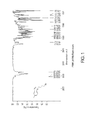
- FIGS. 1 to 24 show the analytical data of the compounds of the examples.
- FIGS. 25 to 28 show the results of the UPF test on a non-treated and treated fabrics.
- the present invention relates to new compounds of formula (I)
- R 1 is selected from hydrogen, a halogen atom, a non-substituted, saturated or unsaturated, linear or branched, acyclic C1-C10 alkyl group; and a non-substituted, saturated or unsaturated, linear or branched, acyclic C1-C10 alkoxy group; when R2 and R3 are H;
- R 2 is selected from hydrogen, a non-substituted, saturated or unsaturated, linear or branched, acyclic C1-C10 alkyl group, and a non-substituted, saturated or unsaturated, linear or branched, acyclic C1-C10 alkoxy group; when R1 is H and R3 are alkyl or alkoxy groups as above defined;
- R 3 is selected from hydrogen, a halogen atom, a non-substituted, saturated or unsaturated, linear or branched, acyclic C1-C10 alkyl group, and a non-substituted, saturated or unsaturated, linear or branched, acyclic C1-C10 alkoxy group; when R1 is H and R3 are halogen, alkyl or alkoxy as above defined;
- R 4 is selected from a non-substituted, saturated or unsaturated, linear or branched, acyclic C1-C10 alkyl group and a non-substituted, saturated or unsaturated, linear or branched, acyclic C1-C10 alkoxy group;
- R 5 is selected from a halogen atom, polyvinylalcohol; polyvinylamine and a cellulose-polymer;
- R 6 is selected from a halogen atom; polyvinylalcohol; polyvinylamine and a cellulose-polymer;
- n is from 3 to 5.
- the alkyl group is a linear C1-C4 alkyl group. According to a preferred embodiment, the alkyl group is a methyl group.
- the alkoxy group is a linear C1-C4 alkoxy group. According to a preferred embodiment, the alkoxy group is a methoxy group.
- halogen here represents chlorine, bromine, iodine and fluorine. Chlorine and bromine are preferred.
- Polyvinylalcohol herein defines a residue of a polyvinylalcohol, which is bound to the alkyl chain by an oxygen atom.
- a preferred PVA molecular weight is approx. 100,000-130,000 g/mol with a Pw: 2,700 (polymerisation degree) and hydrolysis ratio: 86-88%. PVA as above is commercially available.
- R 2 is hydrogen and R 1 and R 3 are both halogen, advantageously both chlorine;
- R 1 is hydrogen and R 2 and R 3 are both alkoxy groups advantageously both a methoxy group
- R 2 and R 3 are both hydrogen and R 1 is halogen, advantageously fluorine;
- R 4 are a methyl group
- R 5 and R 6 are both halogen, advantageously bromine
- R 5 is bromine and R 6 is polyvinylalcohol
- R 2 is hydrogen; R 1 and R 3 are both chlorine; R 4 and R 5 are both methyl groups;
- R 5 and R 6 are both bromine; m is 4;
- R 1 is hydrogen; R 2 and R 3 are both a methoxy group; R 4 is a methyl group; R 5 and R 6 are both bromine; m is 4;
- R 1 is fluorine;
- R 2 and R 3 are both hydrogen;
- R 4 is a methyl group;
- R 5 and R 6 are both bromine;
- m is 4;
- R 2 is hydrogen; R 1 and R 3 are both chlorine; R 4 is methyl groups; R 5 is bromine and R 6 is polyvinylalcol; m is 4;
- R 1 is hydrogen; R 2 and R 3 are both a methoxy group; R 4 is a methyl group; R 5 is bromine and R 6 is polyvinylalcol; m is 4;
- R 1 is fluorine; R 2 and R 3 are both hydrogen; R 4 is a methyl group; R 5 is bromine and R 6 is polyvinylalcol; m is 4;
- the compounds of the invention may be prepared by a process according to the following Scheme
- a compound of formula (II) is reacted with the dihalo-alkylene (III) in an appropriate solvent, in the presence of a strong base.
- the solvent is selected from an alkanone, such as 2-butanone.
- organic solvents with similar polarity may also be used.
- the base is a hydroxide, such as an alkali-metal hydroxide, for instance KOH or NaOH.
- the molar ratio compound (II)/compound (III)/base is approx. 1/4/2.
- the temperature of the reaction is comprised between room temperature and the reflux temperature of the reaction mixture, preferably between 40 and 80° C., advantageously approx. 50-60° C.
- reaction is complete in few hours, about 1 to 6 hours.
- the skilled in the art is however able to follow the development of the reaction flow and finishing time, which can be determined, for instance, by using TLC (Thin Layer Chromatography) technique.
- Compound of formula (IV) is isolated and, if necessary or desired, purified before being reacted with benzaldehyde of formula (V), preferably in a molar ratio of at least 2/1, in the presence of catalytic amounts of 1,3-dibromo-5,5-dimethylhidantoin (DBDMH).
- DBDMH 1,3-dibromo-5,5-dimethylhidantoin
- the temperature of the reaction is comprised between room temperature and the reflux temperature of the reaction mixture, preferably between 40 and 80° C., advantageously approx. 50-60° C.
- the reaction is complete in few hours, about 1 to 6 hours.
- the skilled in the art is however able to follow the development of the reaction by using conventional methods, such as chromatographic techniques.
- Compound of formula (VI) is isolated and, if necessary or desired, purified according to the known techniques.
- Compound (VI) corresponds to compound (I) when R 6 is halogen.
- polyvinylalcohol PVA
- polyvinylamine polyvinylamine or a cellulose-polymer
- a suitable solvent such as dimethylformamide (DMF)
- a base such as potassium carbonate (K 2 CO 3 )
- K 2 CO 3 potassium carbonate
- compound (VI) is added and the reaction is stirred under chromatographic control, such as TLC, for a few hours, such as 2-4 hours.
- the solvent is evaporated and the desired compound (I) is isolated by filtration.
- the mixture centrifuged before filtering.
- Compounds of formula (I) may be used to impart sun-protective and anti-infective effect to textiles.
- the expression “sun-protective effect” means that the textile and the garments made therewith are able to protect the wearer from UV radiation.
- the expression “anti-infective effect” means that the textile and the garments are able to protect the body from infections, creating a barrier between the wearer and germs, such as bacteria, especially Gram (+) bacteria and/or fungi and/or virus and/or protozoa and/or helminths.
- These fabrics may be obtained by dissolving the compounds of the invention in a suitable solvent, such as for instance dichloromethane and the solution may be added in to a conventional printing paste and then applied to the fabrics.
- a suitable solvent such as for instance dichloromethane
- the terms “treat” or “treating” mean that fabrics or clothing or the like are coated of soaked with the compound of the invention.
- These fabrics may be obtained by dissolving the compounds of the invention in a suitable solvent, i.e in a solvent which is able to dissolve compounds of formula (I), such as for instance dichloromethane, and the solution may be added in to a conventional printing paste and then applied to the fabrics.
- a suitable solvent i.e in a solvent which is able to dissolve compounds of formula (I), such as for instance dichloromethane
- the flat bed screen method for printing application may be carried out, wherein acrylic and modified polymeric resins, as well as conventional cross-linkers may be used for printing paste.
- the fabrics may then preferably be cured, for instance at 130° C. for 3-5 minutes.
- any kind of fabrics can be coated with the compounds of the invention, including woven, knotted and non-woven fabrics.
- the fabrics are cotton fabrics, advantageously a 100% cotton fabrics.
- the fabrics may also be denim.
- washing Standart BS EN ISO 6330 5A and Antibacterial Test Standart: AATCC 147:2011 were followed. Details of the method are given in the experimental section of the description.
- the intermediate compound (IV) is purified by column chromatography using silica gel as solid phase and 1/10: ethyl acetate/n-hexane as the eluent system.
- the purified intermediate is reacted with 2,4-dichlorobenzaldehyde (2/1 molar ratio) in the presence of catalytic amounts of 1,3-dibromo-5,5-dimetilhidantoin (DBDMH), at 55° C., under N 2 atmosphere for 2 hours to obtain the intermediate compound (VI) with 67% yield.
- DBDMH 1,3-dibromo-5,5-dimetilhidantoin
- the intermediate is purified by column chromatography using silica gel as solid phase and 1/15: ethyl acetate/n-hexane as the eluent system.
- PVA molecular weight is approx.
- FTIR (ATR): ⁇ 3032 and 3011 (aromatic, ⁇ CH streching), 2918 ve 2851 (aliphatic, CH streching), 1673 (C ⁇ C streching), 1488, 1445 ve 1355 (aliphatic, intraplanar CH bending) cm ⁇ 1.
- FTIR (ATR): ⁇ 3081 and 3012 (aromatic, ⁇ CH streching), 2927, 2874 and 2856 (aliphatic, CH streching), 1585 (C ⁇ C streching), 1463 ve 1359 (aliphatic intraplanar, CH bending), 1100 (C—N swing) cm ⁇ 1 .
- FTIR (ATR): ⁇ 3348 (OH streching), 3026 (aromatic, ⁇ CH streching), 2930 ve 2874 (aliphatic CH streching), 1557 ve 1486 (C ⁇ C streching), 1367 (aliphatic, intramolecular CH bending), 1165 (C—O streching), 1049 (C—N swing) cm ⁇ 1.
- FTIR (ATR): 3022 and 3000 (aromatic, ⁇ CH streching), 2939, 2862 and 2831 (aliphatic, CH streching), 1616, 1588 and 1545 (C ⁇ C streching), 1489, 1450 and 1363 (aliphatic, intraplanar CH bending), 1024 (C—N swing) cm ⁇ 1.
- FTIR (ATR): 3372 (OH streching), 3019 (aromatic, ⁇ CH streching), 2933 and 2871 (aliphatic, CH streching), 1661, 1589 ve 1547 (C ⁇ C streching), 1460 and 1366 (aliphatic intraplanar CH bending), 1211 (C—O streching), 1094 (C—N swing) cm ⁇ 1.
- FTIR (ATR): 3028 ve 3009 (aromatic ⁇ CH streching), 2957, 2920 and 2854 (aliphatik, CH streching), 1602, 1549 and 1504 (C ⁇ C streching), 1485, 1453 and 1359 (aliphatick intraplanar CH streching), 1012 (C—N swing) cm ⁇ 1.
- FTIR (ATR): 3340 (OH streching), 3043 (aromatic, ⁇ CH streching), 2932 and 2855 (aliphatic, CH streching), 1661, 1600 and 1504 (C ⁇ C streching), 1485 and 1363 (aliphatic intraplanar CH streching), 1217 (C—O streching), 1091 (C—N swing) cm ⁇ 1.
- UV-R ultraviolet radiation
- UPF ultraviolet protection factor
- the erythemally weighted UV-R irradiance at the detector with no specimen present is equal to the summation between wavelength intervals of the measured spectral irradiance times the relative spectral effectiveness for the relevant erythemal action spectra times the UV-R weighting function of the appropriate solar radiation spectrum times the appropriate wavelength interval.
- the erythemally weighted UV-R irradiance at the detector with a specimen present is equal to the summation between wavelength intervals of the measured spectral irradiance times the relative spectral effectiveness for the relevant erythemal action spectrum times the spectral transmittance for the specimen times the wavelength interval.
- the percent blocking of UVA and UVB radiation is also calculated as disclosed in AATCC 183-2004.
- FIG. 25 shows the results on a sample of a non treated ecru woven fabric.
- FIG. 26 shows the results on a sample of a light pink woven swatch treated with the compound of Example 1;
- FIG. 27 shows the results on a sample of a light pink woven swatch treated with the compound of Example 2;
- FIG. 28 shows the results on a sample of a pink woven swatch treated with the compound of Example 3.
- Antibacterial tests were carried out using Washing Standart: BS EN ISO 6330 5A, and Antibacterial Test Standart: AATCC 147:2011.
- Inhibition zone mm mean value Bacteria Growth Assessment >1 None Good effect 0-1 0 0 Slight Limit of Efficacy 0 Moderate heavy Insufficient effect 0
- Inhibition Zone mm (1) Bacteria Growth (2) 0 (-) (-) no bacterial colonies directly under the treated sample in the contact area were observed. Inhibition zone exists—Good Effect (1) Width of clear zone of inhibition in mm (2) (-) no bacterial colonies directly under the treated sample
- Inhibition Zone mm (1) Bacteria Growth (2) 0 (-) (-) no bacterial colonies directly under the treated sample in the contact area were observed. Inhibition zone exists—Good Effect (3) Width of clear zone of inhibition in mm (4) (-) no bacterial colonies directly under the treated sample
- Inhibition Zone mm (1) Bacteria Growth (2) 0 (-) (-) no bacterial colonies directly under the treated sample in the contact area were observed. Inhibition zone exists—Good Effect (5) Width of clear zone of inhibition in mm (6) (-) no bacterial colonies directly under the treated sample
Landscapes
- Chemical & Material Sciences (AREA)
- Organic Chemistry (AREA)
- Engineering & Computer Science (AREA)
- Textile Engineering (AREA)
- Chemical Kinetics & Catalysis (AREA)
- General Chemical & Material Sciences (AREA)
- Biochemistry (AREA)
- Medicinal Chemistry (AREA)
- Polymers & Plastics (AREA)
- Life Sciences & Earth Sciences (AREA)
- Health & Medical Sciences (AREA)
- Microbiology (AREA)
- Organic Low-Molecular-Weight Compounds And Preparation Thereof (AREA)
- Agricultural Chemicals And Associated Chemicals (AREA)
- Polysaccharides And Polysaccharide Derivatives (AREA)
- Indole Compounds (AREA)
- Low-Molecular Organic Synthesis Reactions Using Catalysts (AREA)
- Addition Polymer Or Copolymer, Post-Treatments, Or Chemical Modifications (AREA)
- Treatments For Attaching Organic Compounds To Fibrous Goods (AREA)
- Pharmaceuticals Containing Other Organic And Inorganic Compounds (AREA)
- Cosmetics (AREA)
Abstract
The present invention relates to novel bis-indolylmethanes, a process for their preparation and their use in the preparation of technical textiles and PPE's (Personal Protective Equipments), namely in the preparation of UV-protective and anti-infective textiles and garments.
Description
This application is related to and claims priority to European application No. EP 15188403.8 filed Oct. 5, 2015, the contents of which are hereby incorporated by reference as if set forth in their entirety.
The present invention relates to novel bis-indolylmethanes, a process for their preparation and their use in the preparation of technical textiles and PPE's (Personal Protective Equipments), namely in the preparation of UV-protective and anti-infective textiles and garments.
Ultraviolet radiation (both UVA and UVB) contribute to sunburn, skin ageing, eye damage and skin cancer. It is therefore commonly acknowledged the importance to avoid excessive exposure to the sun and to protect by applying sunscreens to the skin.
Recently sun-protecting clothing is becoming popular, said clothing being called PPEs (Personal Protective Equipments). In some cases, PPEs are also able to protect the body from infections, creating a barrier between the wearer and germs and are especially useful for health-care or biological laboratory workers. Indeed, PPEs are designed to reduce the exposure to hazards, either being them caused by sun or other UV source exposure or by bacteria, fungi, virus and the like.
There is a need to develop improved fabrics for the manufacture of PPEs which provide a more effective barrier between the wearer and the environment.
It is a scope of the invention to provide new compounds bearing bis-indolyl moiety. It is a further scope of the invention to provide new compounds which are able to impart a textile sun-protective and anti-infective effect. It is a further scope of the invention to provide garments and PPEs which are endowed with sun-protective and anti-infective effect and which are made from the new compounds of the invention. It is another scope of the invention to provide a process for the preparation of the new compounds of the invention.
These and further scopes will be achieved by the subject-matter of the invention, as it will be herein disclosed.
According to one of its aspects, the present invention relates to new compounds of formula (I)

wherein
R1 is selected from hydrogen, a halogen atom, a non-substituted, saturated or unsaturated, linear or branched, acyclic C1-C10 alkyl group; and a non-substituted, saturated or unsaturated, linear or branched, acyclic C1-C10 alkoxy group; when R2 and R3 are H;
R2 is selected from hydrogen, a non-substituted, saturated or unsaturated, linear or branched, acyclic C1-C10 alkyl group, and a non-substituted, saturated or unsaturated, linear or branched, acyclic C1-C10 alkoxy group; when R1 is H and R3 are alkyl or alkoxy groups as above defined;
R3 is selected from hydrogen, a halogen atom, a non-substituted, saturated or unsaturated, linear or branched, acyclic C1-C10 alkyl group, and a non-substituted, saturated or unsaturated, linear or branched, acyclic C1-C10 alkoxy group; when R1 is H and R3 are halogen, alkyl or alkoxy as above defined;
R4 is selected from a non-substituted, saturated or unsaturated, linear or branched, acyclic C1-C10 alkyl group and a non-substituted, saturated or unsaturated, linear or branched, acyclic C1-C10 alkoxy group;
R5 is selected from a halogen atom, polyvinylalcohol; polyvinylamine and a cellulose-polymer;
R6 is selected from a halogen atom; polyvinylalcohol; polyvinylamine and a cellulose-polymer;
m is from 3 to 5.
Preferably the alkyl group is a linear C1-C4 alkyl group. According to a preferred embodiment, the alkyl group is a methyl group. Preferably the alkoxy group is a linear C1-C4 alkoxy group. According to a preferred embodiment, the alkoxy group is a methoxy group.
The term “halogen” here represents chlorine, bromine, iodine and fluorine. Chlorine and bromine are preferred. Polyvinylalcohol herein defines a residue of a polyvinylalcohol, which is bound to the alkyl chain by an oxygen atom. A preferred PVA molecular weight is approx. 100,000-130,000 g/mol with a Pw: 2,700 (polymerisation degree) and hydrolysis ratio: 86-88%. PVA as above is commercially available.
Embodiments include the following:
R2 is hydrogen and R1 and R3 are both halogen, advantageously both chlorine;
R1 is hydrogen and R2 and R3 are both alkoxy groups advantageously both a methoxy group;
R2 and R3 are both hydrogen and R1 is halogen, advantageously fluorine;
R4 are a methyl group;
R5 and R6 are both halogen, advantageously bromine;
R5 is bromine and R6 is polyvinylalcohol;
m is 4.
Particularly preferred are compounds of formula (I) wherein
R2 is hydrogen; R1 and R3 are both chlorine; R4 and R5 are both methyl groups;
R5 and R6 are both bromine; m is 4;
R1 is hydrogen; R2 and R3 are both a methoxy group; R4 is a methyl group; R5 and R6 are both bromine; m is 4;
R1 is fluorine; R2 and R3 are both hydrogen; R4 is a methyl group; R5 and R6 are both bromine; m is 4;
R2 is hydrogen; R1 and R3 are both chlorine; R4 is methyl groups; R5 is bromine and R6 is polyvinylalcol; m is 4;
R1 is hydrogen; R2 and R3 are both a methoxy group; R4 is a methyl group; R5 is bromine and R6 is polyvinylalcol; m is 4;
R1 is fluorine; R2 and R3 are both hydrogen; R4 is a methyl group; R5 is bromine and R6 is polyvinylalcol; m is 4;
The compounds of the invention may be prepared by a process according to the following Scheme

-
- wherein R1, R2, R3, R4, R5, R6 and m are as above defined, Hal is a halogen atom, and m is from 1 to 3.
The above depicted process represents another subject-matter of the invention. Compounds of formula (II) and (III) are known in the art or can be prepared by known methods.
In the process of the invention, a compound of formula (II) is reacted with the dihalo-alkylene (III) in an appropriate solvent, in the presence of a strong base. Preferably, the solvent is selected from an alkanone, such as 2-butanone. However, organic solvents with similar polarity may also be used.
Preferably, the base is a hydroxide, such as an alkali-metal hydroxide, for instance KOH or NaOH. Preferably the molar ratio compound (II)/compound (III)/base is approx. 1/4/2.
It is advantageous to perform the reaction in an inert environment, such as under nitrogen or argon. The temperature of the reaction is comprised between room temperature and the reflux temperature of the reaction mixture, preferably between 40 and 80° C., advantageously approx. 50-60° C.
The reaction is complete in few hours, about 1 to 6 hours. The skilled in the art is however able to follow the development of the reaction flow and finishing time, which can be determined, for instance, by using TLC (Thin Layer Chromatography) technique.
Compound of formula (IV) is isolated and, if necessary or desired, purified before being reacted with benzaldehyde of formula (V), preferably in a molar ratio of at least 2/1, in the presence of catalytic amounts of 1,3-dibromo-5,5-dimethylhidantoin (DBDMH). The reaction is preferably carried out without any solvent.
It is advantageous to perform the reaction in an inert environment, such as under nitrogen or argon. The temperature of the reaction is comprised between room temperature and the reflux temperature of the reaction mixture, preferably between 40 and 80° C., advantageously approx. 50-60° C. The reaction is complete in few hours, about 1 to 6 hours. The skilled in the art is however able to follow the development of the reaction by using conventional methods, such as chromatographic techniques.
Compound of formula (VI) is isolated and, if necessary or desired, purified according to the known techniques. Compound (VI) corresponds to compound (I) when R6 is halogen.
To prepare compound (I) wherein R6 is selected from polyvinylalcohol; polyvinylamine and a cellulose-polymer, the following reaction may be carried out.
To a solution of polyvinylalcohol (PVA) or polyvinylamine or a cellulose-polymer, in a suitable solvent, such as dimethylformamide (DMF), in an inert atmosphere and heated at least 100°-120° C., a base, such as potassium carbonate (K2CO3), is added and the mixture is stirred for a few hours, such as 1 or 2 hours. To that mixture, compound (VI) is added and the reaction is stirred under chromatographic control, such as TLC, for a few hours, such as 2-4 hours. The solvent is evaporated and the desired compound (I) is isolated by filtration. Preferably, the mixture centrifuged before filtering.
Detailed examples of the above reaction are provided in the experimental section of the present description.
Compounds of formula (I) may be used to impart sun-protective and anti-infective effect to textiles. The expression “sun-protective effect” means that the textile and the garments made therewith are able to protect the wearer from UV radiation. The expression “anti-infective effect” means that the textile and the garments are able to protect the body from infections, creating a barrier between the wearer and germs, such as bacteria, especially Gram (+) bacteria and/or fungi and/or virus and/or protozoa and/or helminths.
Indeed, it was found out that coating fabrics with the compounds of the invention increases the UPF (Ultraviolet Protection Factor) label values and, also, confers to the fabric anti-microbial effects, especially anti-bacterial effects, particularly Gram (+) bacteria. This is a valuable technical outcome that allows the treated fabrics to be used in the manufacture of, i.e. PPEs.
The use of compounds of formula (I) in the textile field, in the preparation of sun-protective and anti-infective fabrics and in the manufacture of PPEs is also a subject-matter of the invention, as well as fabrics, clothing and PPEs treated, especially coated, with the compounds of formula (I).
It is another subject-matter of the invention a method to make fabrics sun-protective and anti-infective fabrics which comprises treating, especially coating, said fabrics with the compounds of formula (I).
These fabrics may be obtained by dissolving the compounds of the invention in a suitable solvent, such as for instance dichloromethane and the solution may be added in to a conventional printing paste and then applied to the fabrics. The terms “treat” or “treating” mean that fabrics or clothing or the like are coated of soaked with the compound of the invention.
These fabrics may be obtained by dissolving the compounds of the invention in a suitable solvent, i.e in a solvent which is able to dissolve compounds of formula (I), such as for instance dichloromethane, and the solution may be added in to a conventional printing paste and then applied to the fabrics.
The flat bed screen method for printing application may be carried out, wherein acrylic and modified polymeric resins, as well as conventional cross-linkers may be used for printing paste. The fabrics may then preferably be cured, for instance at 130° C. for 3-5 minutes.
Any kind of fabrics can be coated with the compounds of the invention, including woven, knotted and non-woven fabrics. Preferably, the fabrics are cotton fabrics, advantageously a 100% cotton fabrics. The fabrics may also be denim.
In order to determine if the UV radiation blocked or transmitted by textile fabrics, the known method AATCC 183 was followed. Details of the method are given in the experimental section of the description.
As it can be seen in the experimental section, fabrics treated with the compounds of the invention showed surprisingly high UPFs, all of them being well above the UPF value limit to be included in the “Excellent UV-protection category”, i.e. UPF 40.
In order to determine if the antimicrobic activity of the textile fabrics, Washing Standart: BS EN ISO 6330 5A and Antibacterial Test Standart: AATCC 147:2011 were followed. Details of the method are given in the experimental section of the description.
Analytical Spectra of the synthesized compounds are given in the figures enclosed.

5-methylindole and 1,4-dibromobutane are reacted in 2-butanone in the presence of KOH (molar ratio 5-methylindole/1,4-dibromobutane/KOH=1/4/2) at 55° C., under N2, for 3 hours. The intermediate compound (IV) is purified by column chromatography using silica gel as solid phase and 1/10: ethyl acetate/n-hexane as the eluent system. The purified intermediate is reacted with 2,4-dichlorobenzaldehyde (2/1 molar ratio) in the presence of catalytic amounts of 1,3-dibromo-5,5-dimetilhidantoin (DBDMH), at 55° C., under N2 atmosphere for 2 hours to obtain the intermediate compound (VI) with 67% yield. The intermediate is purified by column chromatography using silica gel as solid phase and 1/15: ethyl acetate/n-hexane as the eluent system. PVA (molecular weight is approx. 100,000-130,000 g/mol with a Pw: 2,700, hydrolysis ratio: 86-88%) is dissolved in dimethylformamide (DMF)(60 mg/3 mL) at 120° C., under N2 at the reflux temperature. After the addition of 70 mg K2CO3, the reaction mixture stirred up for 1 hour. Then, the intermediate compound (V) (100 mg/2 mL DMF) is added to the mixture. The reaction ended, with TLC control, in 3 hours. DMF is removed, the reaction mixture is centrifugated and sedimented polymers filtered and dried in a drying oven at 45° C., to yield 47% of the title compound.
Analytical Data
Intermediate Compound

FTIR (ATR): ν=3032 and 3011 (aromatic, ═CH streching), 2918 ve 2851 (aliphatic, CH streching), 1673 (C═C streching), 1488, 1445 ve 1355 (aliphatic, intraplanar CH bending) cm−1.
1H NMR (CDCl3, 500 MHz): δ=1.72 (p, J=6.62 Hz, 2H, CH2), 1.88 (p, J=6.9 Hz, 2H, CH2), 2.36 (s, 3H, CH3), 3.25 (t, J=6.62 Hz, 2H, CH2), 4.02 (t, J=6.62 Hz, 2H, CH2), 6.32 (d, J=3.15 Hz, 1H, aromatic), 6.94 (d, J=3.15 Hz, 2H, aromatic), 7.13 (d, J=8.51 Hz, 1H, aromatic), 7.33 (s, 1H, aromatic) ppm. GC-MS (EI, 70 eV): m/z=265 (M+).
Compound

White crystals; m.p.=141−142° C.; Rf=0.32 (1:5, ethyl acetate/n-hexane); efficiency: %55
FTIR (ATR): ν=3081 and 3012 (aromatic, ═CH streching), 2927, 2874 and 2856 (aliphatic, CH streching), 1585 (C═C streching), 1463 ve 1359 (aliphatic intraplanar, CH bending), 1100 (C—N swing) cm−1.
1H NMR (DMSO-d6, 500 MHz): δ=1.64-1.80 (m, 8H, CH2), 2.27 (s, 6H, CH3), 3.47 (t, J=6.62 Hz, 4H, CH2), 4.10 (t, J=6.62 Hz, 4H, CH2), 6.05 (s, 1H, CH), 6.70 (s, 2H, Haromatic), 6.94 (d, J=8.19 Hz, 2H, aromatic), 7.00 (s, 2H, Haromatic), 7.15 (d, J=8.51 Hz, 1H, aromatic), 7.31 (dd, J=2.20; 8.51 Hz, 1H, Haromatic), 7.35 (d, J=8.19 Hz, 2H, Haromatic), 7.63 (s, 1H, Haromatic) ppm.
13C NMR (CDCl3, 125 MHz): δ=21.14 (2×CH3), 28.42 (2×CH2), 34.52 (2×CH2), 35.68 (CH), 44.41 (CH2), 109.77 (═CH), 114.75 (Cq), 118.39 (2×CAr), 122.89 (2×CAr), 126.97 (Cq), 127.15 (Cq), 127.25 (CAr), 128.73 (CAr), 131.13 (CAr), 133.60 (Cq), 134.79 (Cq), 140.80 (Cq) ppm.
UV (λmax, CH2Cl2):295 nm (c=3.5×10⁻⁴, A=1.52, ε=4×10⁻³).
Compound of Example 1
Orange polymer, efficiency: %47
FTIR (ATR): ν=3348 (OH streching), 3026 (aromatic, ═CH streching), 2930 ve 2874 (aliphatic CH streching), 1557 ve 1486 (C═C streching), 1367 (aliphatic, intramolecular CH bending), 1165 (C—O streching), 1049 (C—N swing) cm−1.
1H NMR (CDCl3, 500 MHz): 1H NMR (DMSO-d6, 500 MHz): δ=1.41-1.47 (p, 4H, CH2), 1.78-1.84 (p, 4H, CH2), 1.93 (d, J=18.91 Hz, 2H, CH2), 2.32 (s, 6H, CH3), 3.50 (t, J=6.30 Hz, 4H, CH2), 3.97 (t, J=6.62 Hz, 1H, CH), 4.07 (t, J=6.93 Hz, 4H, CH2), 6.15 (s, 1H, CH), 6.53 (s, 2H, aromatic), 6.98 (d, J=8.19 Hz, 2H, aromatic), 7.03 (s, 2H, aromatic), 7.17 (d, J=4.72 Hz, 1H, aromatic), 7.27 (d, J=8.51 Hz, 1H, aromatic), 7.35 (d, J=1.57 Hz, 2H, aromatic) ppm.
UV (λmax, CH2Cl2): 295 nm
See FIGS. 1 to 10

By operating as in Example 1 but using 2,5-dichlorobenzaldehyde instead of 2,4-dichlorobenzaldehyde, the title compound is obtained (yield 49%).
Analytical Data
Compound

White crystals; m.p.=102° C.; Rf=0.12 (1:15, ethyl acetate/n-hexane); efficiency % 42.
FTIR (ATR):=3022 and 3000 (aromatic, ═CH streching), 2939, 2862 and 2831 (aliphatic, CH streching), 1616, 1588 and 1545 (C═C streching), 1489, 1450 and 1363 (aliphatic, intraplanar CH bending), 1024 (C—N swing) cm−1.
1H NMR (DMSO-d6, 500 MHz): δ=1.72-1.76 (p, 4H, CH2), 1.80-1.85 (p, 4H, CH2), 2.32 (s, 6H, CH3), 3.53 (t, J=6.62 Hz, 4H, CH2), 3.62 (s, 3H, OCH3), 3.79 (s, 3H, OCH3), 4.15 (t, J=6.62 Hz, 4H, CH2), 6.13 (s, 1H, CH), 6.66 (d, J=2.83 Hz, 1H, aromatic), 6.76 (s, 2H, aromatic), 6.80 (dd, J=3.15; 8.82 Hz, 1H, aromatic), 6.97 (d, J=8.51 Hz, 2H, aromatic), 7.01 (d, J=8.82 Hz, 1H, aromatic), 7.07 (s, 2H, aromatic), 7.37 (d, J=8.51 Hz, 2H, aromatic), ppm.
13C NMR (CDCl3, 125 MHz): δ=21.5 (2×CH3), 28.8 (2×CH2), 30.0 (2×CH2), 32.1 (CH), 33.1 (2×CH2), 45.3 (2×CH2), 55.5 (CH3), 56.6 (CH3), 108.8 (CAr), 110.6 (CAr), 111.8 (CAr), 116.5 CAr), 117.6 (Cq), 119.9 (CAr), 122.9 (CAr), 127.2 (CAr), 127.7 (Cq), 128.0 (Cq), 134.3 (Cq), 135.0 (Cq), 151.4 (Cq), 153.4 (Cq) ppm.
UV (λmax, CH2Cl2): 285 nm (c=2.4×10⁻⁴, A=1.77, ε=7.2×10³).
Compound of Example 2
Orange polymer; efficiency % 47
FTIR (ATR): =3372 (OH streching), 3019 (aromatic, ═CH streching), 2933 and 2871 (aliphatic, CH streching), 1661, 1589 ve 1547 (C═C streching), 1460 and 1366 (aliphatic intraplanar CH bending), 1211 (C—O streching), 1094 (C—N swing) cm−1.
UV (λmax, CH2Cl2): 295 nm.
See FIGS. 11 to 17

By operating as in Example 1 but using 4-fluorobenzaldehyde instead of 2,4-dichlorobenzaldehyde, the title compound is obtained (yield 45%).
Analytical Data
Compound

White crystals; m.p.=118-119 o C; Rf=0.22 (1:15, ethyl acetate/n-hexane); efficiency % 67.
FTIR (ATR): =3028 ve 3009 (aromatic ═CH streching), 2957, 2920 and 2854 (aliphatik, CH streching), 1602, 1549 and 1504 (C═C streching), 1485, 1453 and 1359 (aliphatick intraplanar CH streching), 1012 (C—N swing) cm−1.
1H NMR (DMSO-d6, 500 MHz): δ=1.67-1.71 (p, 4H, CH2), 1.75-1.80 (p, 4H, CH2), 2.27 (s, 6H, CH3), 3.48 (t, J=6.62 Hz, 4H, CH2), 4.10 (t, J=6.62 Hz, 4H, CH2), 5.78 (s, 1H, CH), 6.75 (s, 2H, aromatic), 6.92 (d, J=8.19 Hz, 2H, aromatic), 7.06 (s, 2H, aromatic), 7.10 (d, J=8.82 Hz, 2H, aromatic), 7.31-7.34 (m, 4H, aromatic) ppm.
13C NMR (CDCl3, 125 MHz): δ=21.5 (2×CH3), 28.8 (2×CH2), 30.0 (2×CH2), 32.1 (CH), 33.1 (2×CH2), 45.3 (2×CH2), 55.5 (CH3), 56.6 (CH3), 108.8 (CAr), 110.6 (CAr), 111.8 (CAr), 116.5 CAr), 117.6 (Cq), 119.9 (CAr), 122.9 (CAr), 127.2 (CAr), 127.7 (Cq), 128.0 (Cq), 134.3 (Cq), 135.0 (Cq), 151.4 (Cq), 153.4 (Cq) ppm.
UV (λmax, CH2Cl2): 300 nm (c=2.2×10⁻⁴, A=1.42, ε=6.4×10³).
Compound of Example 3
Brown polymer; efficiency % 52
FTIR (ATR): =3340 (OH streching), 3043 (aromatic, ═CH streching), 2932 and 2855 (aliphatic, CH streching), 1661, 1600 and 1504 (C═C streching), 1485 and 1363 (aliphatic intraplanar CH streching), 1217 (C—O streching), 1091 (C—N swing) cm−1.
UV (λmax, DMSO): 295 nm.
See FIGS. 18 to 24
UPF Test
AATCC 183-2004 Method
The transmission of ultraviolet radiation (UV-R) through a specimen is measured on a spectrophotometer at known wavelength intervals. The ultraviolet protection factor (UPF) is computed as the ratio of the erythemally weighted ultraviolet radiation (UV-R) irradiance at the detector with no specimen to the erythemally weighted UV-R irradiance at the detector with a specimen present.
The erythemally weighted UV-R irradiance at the detector with no specimen present is equal to the summation between wavelength intervals of the measured spectral irradiance times the relative spectral effectiveness for the relevant erythemal action spectra times the UV-R weighting function of the appropriate solar radiation spectrum times the appropriate wavelength interval.
The erythemally weighted UV-R irradiance at the detector with a specimen present is equal to the summation between wavelength intervals of the measured spectral irradiance times the relative spectral effectiveness for the relevant erythemal action spectrum times the spectral transmittance for the specimen times the wavelength interval.
The percent blocking of UVA and UVB radiation is also calculated as disclosed in AATCC 183-2004.
Results
Transmittance or Blocking of Erythemally Weighted Ultraviolet Radiation through Fabrics AATCC 183:2014
Conditioning
Prior to testing: 21±1° C. temperature and 65±2% relative humidity
At time of testing: 21° C. temperature and 66% relative humidity
Ultraviolet protection value for label (According to ASTM D 6603-Unprepared Specimen): 1324
Protection Classification: Excellent UV-protection category to UPF Value 40 or greater.
The results are reported in the Figures, wherein
As it can be seen from the data reported in the enclosed Figures, the treated samples showed excellent UV-protection, while the non-treated sample did not.
Antimicrobial Test
Antibacterial tests were carried out using Washing Standart: BS EN ISO 6330 5A, and Antibacterial Test Standart: AATCC 147:2011.
The results are reported herein below.
| Inhibition zone mm | ||
| mean value | Bacteria Growth | Assessment |
| >1 | None | Good effect |
| 0-1 | ||
| 0 | ||
| 0 | Slight | Limit of |
| 0 | Moderate heavy | |
| 0 | ||
Test on a Sample of a Yellow Printed Woven Fabric Treated with the Compound of Example 1
| Inhibition Zone mm (1) | Bacteria Growth (2) | ||
| 0 | (-) | ||
| (-) no bacterial colonies directly under the treated sample in the contact area were observed. Inhibition zone exists—Good Effect | |||
| (1) Width of clear zone of inhibition in mm | |||
| (2) (-) no bacterial colonies directly under the treated sample | |||
| Staphylococcus aureus | |||
| Microorganism | ATCC 6538 Gram (+) | ||
| Size of |
25 × 50 | mm |
| Incubation Temperature | 37° C.±2° C. |
| Incubation time | 18-24 | hrs |
| Number of washing | — | ||
| Washing method | — | ||
Test on a Sample of a Pink Woven Fabric Treated with the Compound of Example 2
| Inhibition Zone mm (1) | Bacteria Growth (2) | ||
| 0 | (-) | ||
| (-) no bacterial colonies directly under the treated sample in the contact area were observed. Inhibition zone exists—Good Effect | |||
| (3) Width of clear zone of inhibition in mm | |||
| (4) (-) no bacterial colonies directly under the treated sample | |||
| Staphylococcus aureus | |||
| Microorganism | ATCC 6538 Gram (+) | ||
| Size of |
25 × 50 | mm |
| Incubation Temperature | 37° C.±2° C. |
| Incubation time | 18-24 | hrs |
| Number of washing | — | ||
| Washing method | — | ||
Test on a Sample of a Pink Woven Fabric Treated with the Compound of Example 3
| Inhibition Zone mm (1) | Bacteria Growth (2) | ||
| 0 | (-) | ||
| (-) no bacterial colonies directly under the treated sample in the contact area were observed. Inhibition zone exists—Good Effect | |||
| (5) Width of clear zone of inhibition in mm | |||
| (6) (-) no bacterial colonies directly under the treated sample | |||
| Staphylococcus aureus | |||
| Microorganism | ATCC 6538 Gram (+) | ||
| Size of |
25 × 50 | mm |
| Incubation Temperature | 37° C.±2° C. |
| Incubation time | 18-24 | hrs |
| Number of washing | — | ||
| Washing method | — | ||
Although the invention has been described in terms of exemplary embodiments, it is not limited thereto. Rather, the appended claims should be construed broadly, to include other variants and embodiments of the invention, which may be made by those skilled in the art without departing from the scope and range of equivalents of the invention.
Claims (18)
1. A compound of formula (I)

wherein:
R1 is selected from the group consisting of hydrogen, a halogen atom, a non-substituted, saturated or unsaturated, linear or branched, acyclic C1-C10 alkyl group; and a non-substituted, saturated or unsaturated, linear or branched, acyclic C1-C10 alkoxy group; when R2 and R3 are H;
R2 is selected from the group consisting of hydrogen, a non-substituted, saturated or unsaturated, linear or branched, acyclic C1-C10 alkyl group, and a non-substituted, saturated or unsaturated, linear or branched, acyclic C1-C10 alkoxy group; when R1 is H and R3 are alkyl or alkoxy groups as above defined;
R3 is selected from the group consisting of hydrogen, a halogen atom, a non-substituted, saturated or unsaturated, linear or branched, acyclic C1-C10 alkyl group, and a non-substituted, saturated or unsaturated, linear or branched, acyclic C1-C10 alkoxy group; when R1 is H and R3 are halogen, alkyl or alkoxy as above defined;
R4 is selected from the group consisting of a non-substituted, saturated or unsaturated, linear or branched, acyclic C1-C10 alkyl group, and a non-substituted, saturated or unsaturated, linear or branched, acyclic C1-C10 alkoxy group;
R5 is selected from a halogen atom; polyvinylalcohol; polyvinylamine and a cellulose-polymer;
R6 is selected from the group consisting of a halogen atom; polyvinylalcohol;
polyvinylamine and a cellulose-polymer; and
m is from 3 to 5.
2. The compound according to claim 1 , wherein said R2 is hydrogen; said R1 and said R3 are both chlorine; said R4 and said R5 are both methyl groups; said R5 and said R6 are both bromine and m is 4.
3. The compound according to claim 1 , wherein said R1 is hydrogen; said R2 and said R3 are both a methoxy group; each said R4 is a methyl group; said R5 and said R6 are both bromine and m is 4.
4. The compound according to claim 1 , wherein said R1 is fluorine; said R2 and said R3 are both hydrogen; each said R4 is a methyl group; said R5 and said R6 are both bromine and m is 4.
5. The compound according to claim 1 , wherein said R2 is hydrogen; said R1 and said R1 are both chlorine; said R4s are methyl groups; said R5 is bromine and said R6 is polyvinylalcol and m is 4.
6. The compound according to claim 1 , wherein said R1 is hydrogen; said R2 and said R3 are both a methoxy group; each said R4 is a methyl group; said R5 is bromine and said R6 is polyvinylalcol and m is 4.
7. The compound according to claim 1 , wherein said R1 is fluorine; said R2 and said R3 are both hydrogen; each said R4 is a methyl group; said R5 is bromine and said R6 is polyvinylalcol and m is 4.
8. The compound according to claim 1 , wherein said PVA molecular weight is approx. 100,000-130,000 g/mol with a Pw: 2,700 (polymerisation degree) and hydrolysis ratio: 86-88%.
9. A method to make fabrics that are sun-protective and anti-infective fabrics, said method comprising treating said fabrics with at least a compound according to claim 1 .
10. A fabric comprising clothing or a Personal Protective Equipment (PPE) treated with at least one compound according to claim 1 .
11. A process for the preparation of a compound according to claim 1 , the process comprising reacting compounds of formula (II) and (Ill) according to the following scheme

12. The process of claim 11 , wherein, in said step a, a compound of formula (II) is reacted with a compound of formula (III) in an appropriate solvent, in the presence of a strong base, the molar ratio compound (II)/compound (III)/base being about 1/4/2.
13. The process of claim 11 , wherein, in step b, a compound of formula (IV) is reacted with benzaldehyde of formula (V), in a molar ratio of at least 2/1, in the presence of catalytic amounts of 1,3-dibromo-5,5-dimethylhidantoin (DBDMH), without the presence of any solvent.
14. The process of claim 11 , wherein, in step c, a compound (VI) is reacted with a reactant selected from the group consisting of polyvinylalcohol; polyvinylamine and a cellulose-polymer, in a suitable solvent and in the presence of a base.
15. The process of claim 11 , wherein said Hal is bromine, and said R4 is methyl.
16. The process of claim 11 , wherein said R5 is bromine and said R6 is polyvinylalcohol (PVA).
17. The method according to claim 9 , wherein said fabrics are cotton fabrics.
18. The method according to claim 9 , wherein said fabrics are denim fabrics.
Applications Claiming Priority (3)
| Application Number | Priority Date | Filing Date | Title |
|---|---|---|---|
| EP15188403.8 | 2015-10-05 | ||
| EP15188403.8A EP3153505B1 (en) | 2015-10-05 | 2015-10-05 | Novel bis-indolylmethanes, a process for their preparation and uses thereof |
| EP15188403 | 2015-10-05 |
Publications (2)
| Publication Number | Publication Date |
|---|---|
| US20170096393A1 US20170096393A1 (en) | 2017-04-06 |
| US10081596B2 true US10081596B2 (en) | 2018-09-25 |
Family
ID=54324804
Family Applications (1)
| Application Number | Title | Priority Date | Filing Date |
|---|---|---|---|
| US15/284,670 Active 2037-05-16 US10081596B2 (en) | 2015-10-05 | 2016-10-04 | Bis-indolylmethanes, a process for their preparation and uses thereof |
Country Status (9)
| Country | Link |
|---|---|
| US (1) | US10081596B2 (en) |
| EP (1) | EP3153505B1 (en) |
| JP (1) | JP6823989B2 (en) |
| CN (1) | CN106560476B (en) |
| BR (1) | BR102016023124B1 (en) |
| DK (1) | DK3153505T3 (en) |
| ES (1) | ES2676453T3 (en) |
| PL (1) | PL3153505T3 (en) |
| PT (1) | PT3153505T (en) |
Families Citing this family (1)
| Publication number | Priority date | Publication date | Assignee | Title |
|---|---|---|---|---|
| ES2948010T3 (en) * | 2019-08-05 | 2023-08-25 | Sanko Tekstil Isletmeleri San Ve Tic As | pH-sensitive dyes for textile materials, a process for their preparation and uses thereof |
Family Cites Families (4)
| Publication number | Priority date | Publication date | Assignee | Title |
|---|---|---|---|---|
| US5461070A (en) * | 1994-08-29 | 1995-10-24 | The Regents Of The University Of California | Anti-flammatory method using indole alkaloids |
| CN1186339C (en) * | 2000-04-27 | 2005-01-26 | 巴斯利尔药物股份公司 | Pyrimidinyl methyl indole derivatives with antibacterial activity |
| JP5245137B2 (en) * | 2008-03-06 | 2013-07-24 | 和歌山県 | Aromatic compounds and UV absorbers |
| CN104592085B (en) * | 2015-01-26 | 2017-09-19 | 中国科学院西北高原生物研究所 | A kind of antimicrobial compound and its salt |
-
2015
- 2015-10-05 PT PT151884038T patent/PT3153505T/en unknown
- 2015-10-05 DK DK15188403.8T patent/DK3153505T3/en active
- 2015-10-05 PL PL15188403T patent/PL3153505T3/en unknown
- 2015-10-05 ES ES15188403.8T patent/ES2676453T3/en active Active
- 2015-10-05 EP EP15188403.8A patent/EP3153505B1/en active Active
-
2016
- 2016-09-30 JP JP2016193284A patent/JP6823989B2/en not_active Expired - Fee Related
- 2016-10-04 US US15/284,670 patent/US10081596B2/en active Active
- 2016-10-04 BR BR102016023124-8A patent/BR102016023124B1/en not_active IP Right Cessation
- 2016-10-08 CN CN201610878922.1A patent/CN106560476B/en not_active Expired - Fee Related
Non-Patent Citations (3)
| Title |
|---|
| Damodiran M et Al:"Regioselective synthesis and biological evaluation of bis(indolyl)methane . . . ", Biorganic & Medicinal Chemistry Letters,Pergamon,vol. 19,No. 13 Jul. 1, 2009. |
| European Search Report of EP priority application No. 15188403.8 dated Jan. 15, 2016. |
| Sharma D.K. et al:"A new class of bacterial agents against S. aureus, MRSA and VRE derived . . . ", Medicinal Chemistry Research,vol. 23,No. 4,Sep. 4, 2013,pp. 1643-1653. |
Also Published As
| Publication number | Publication date |
|---|---|
| ES2676453T3 (en) | 2018-07-19 |
| PT3153505T (en) | 2018-07-20 |
| DK3153505T3 (en) | 2018-07-23 |
| JP2017081903A (en) | 2017-05-18 |
| CN106560476A (en) | 2017-04-12 |
| JP6823989B2 (en) | 2021-02-03 |
| US20170096393A1 (en) | 2017-04-06 |
| BR102016023124A2 (en) | 2017-04-25 |
| BR102016023124B1 (en) | 2021-04-06 |
| EP3153505B1 (en) | 2018-04-18 |
| EP3153505A1 (en) | 2017-04-12 |
| PL3153505T3 (en) | 2018-10-31 |
| CN106560476B (en) | 2020-06-19 |
Similar Documents
| Publication | Publication Date | Title |
|---|---|---|
| US8496920B2 (en) | N-halamine acrylamide monomers and copolymers thereof for biocidal coatings | |
| CN113646301B (en) | Antimicrobial compounds and methods of use thereof | |
| CA3145594A1 (en) | Antimicrobial dyes for facemasks | |
| US10081596B2 (en) | Bis-indolylmethanes, a process for their preparation and uses thereof | |
| Arendt-Pindel et al. | Design and functionalization of bioactive benzoxazines. An unexpected ortho-substitution effect | |
| Bhat et al. | Discovery of potent, novel antibacterial hybrid conjugates from 4-aminoquinoline and 1, 3, 5-triazine: design, synthesis and antibacterial evaluation | |
| US9834524B2 (en) | Isoxazoles, a process for their preparation and uses thereof | |
| HK1234059B (en) | Novel bis-indolylmethanes, a process for their preparation and uses thereof | |
| HK1234059A1 (en) | Novel bis-indolylmethanes, a process for their preparation and uses thereof | |
| HK1234059A (en) | Novel bis-indolylmethanes, a process for their preparation and uses thereof | |
| AT500507A1 (en) | TRISRESORCINYLTRIAZINE | |
| EP3308646B1 (en) | Photoactivable biocide and/or bactericidal materials and process for manufacturing such materials | |
| HK1234031B (en) | Isoxazoles, a process for their preparation and uses thereof | |
| HK1234031A1 (en) | Isoxazoles, a process for their preparation and uses thereof | |
| CN110003448B (en) | Conjugated polymer with aggregation-induced emission property and preparation method and application thereof | |
| Liu et al. | Synthesis and performance of new bifunctional stabilizers | |
| US9193872B2 (en) | Photo-crosslinkable antifouling compositions, films obtained from said compositions, and corresponding uses | |
| WO2024200549A1 (en) | Dibenzoylmethane compounds as photochemical precursors of ultraviolet absorbers | |
| JPH11130786A (en) | Ultraviolet ray absorbing compound | |
| WO2008030925A2 (en) | Antimicrobial colorants |
Legal Events
| Date | Code | Title | Description |
|---|---|---|---|
| AS | Assignment |
Owner name: SANKO TEKSTIL ISLETMELERI SAN VE TIC. A.S., TURKEY Free format text: ASSIGNMENT OF ASSIGNORS INTEREST;ASSIGNORS:AKER, ACELYA;OCAL, NUKET;ERGINDEMIR, HIKMET NIL;AND OTHERS;REEL/FRAME:040739/0526 Effective date: 20161116 |
|
| STCF | Information on status: patent grant |
Free format text: PATENTED CASE |
|
| MAFP | Maintenance fee payment |
Free format text: PAYMENT OF MAINTENANCE FEE, 4TH YEAR, LARGE ENTITY (ORIGINAL EVENT CODE: M1551); ENTITY STATUS OF PATENT OWNER: LARGE ENTITY Year of fee payment: 4 |