US10079346B2 - Heteroaromatic compounds for organic electronics - Google Patents
Heteroaromatic compounds for organic electronics Download PDFInfo
- Publication number
- US10079346B2 US10079346B2 US15/537,522 US201515537522A US10079346B2 US 10079346 B2 US10079346 B2 US 10079346B2 US 201515537522 A US201515537522 A US 201515537522A US 10079346 B2 US10079346 B2 US 10079346B2
- Authority
- US
- United States
- Prior art keywords
- substituted
- alkyl
- cycloalkyl
- alkenyl
- group
- Prior art date
- Legal status (The legal status is an assumption and is not a legal conclusion. Google has not performed a legal analysis and makes no representation as to the accuracy of the status listed.)
- Active
Links
- 0 [1*]OC(=O)N1C2=NC3=C(CC2=C2CC4=C(/N=C\21)C([9*])=C([8*])C([7*])=C4[6*])C([5*])=C([4*])C([3*])=C3[2*] Chemical compound [1*]OC(=O)N1C2=NC3=C(CC2=C2CC4=C(/N=C\21)C([9*])=C([8*])C([7*])=C4[6*])C([5*])=C([4*])C([3*])=C3[2*] 0.000 description 28
- NSGRRQBFSUWFSJ-UHFFFAOYSA-N CCCCCC1CCC(C2=CC3=C(C=C2)SC2=C4SC5=C(C=C(C6CCC(CCCCC)CC6)C=C5)N=C4N(C(=O)OC(C)(C)C)C2=N3)CC1 Chemical compound CCCCCC1CCC(C2=CC3=C(C=C2)SC2=C4SC5=C(C=C(C6CCC(CCCCC)CC6)C=C5)N=C4N(C(=O)OC(C)(C)C)C2=N3)CC1 NSGRRQBFSUWFSJ-UHFFFAOYSA-N 0.000 description 2
- UXTLGCXQMJBRPL-UHFFFAOYSA-N [H]N1C2=NC3=C(C=CC=C3)SC2=C2SC3=C(C=CC=C3)/N=C\21 Chemical compound [H]N1C2=NC3=C(C=CC=C3)SC2=C2SC3=C(C=CC=C3)/N=C\21 UXTLGCXQMJBRPL-UHFFFAOYSA-N 0.000 description 2
- TZADCIYLNPPGFM-UHFFFAOYSA-N C1=CC2=C(C=C1)C=CC=C2.C1=CC2=C(C=C1)C=CC=C2.C1=CC=CC=C1 Chemical compound C1=CC2=C(C=C1)C=CC=C2.C1=CC2=C(C=C1)C=CC=C2.C1=CC=CC=C1 TZADCIYLNPPGFM-UHFFFAOYSA-N 0.000 description 1
- UHOVQNZJYSORNB-UHFFFAOYSA-N C1=CC=CC=C1 Chemical compound C1=CC=CC=C1 UHOVQNZJYSORNB-UHFFFAOYSA-N 0.000 description 1
- MDPNHGRDJBIKAM-UHFFFAOYSA-N C=CC(C)(C)OC(=O)N1C2=NC3=C(C=CC(CCCCC)=C3)SC2=C2SC3=C(C=C(CCCCC)C=C3)N=C21 Chemical compound C=CC(C)(C)OC(=O)N1C2=NC3=C(C=CC(CCCCC)=C3)SC2=C2SC3=C(C=C(CCCCC)C=C3)N=C21 MDPNHGRDJBIKAM-UHFFFAOYSA-N 0.000 description 1
- XDFGVRZAQJHJGD-UHFFFAOYSA-N CC(C)(C)OC(=O)N1C2=NC3=C(C=CC=C3)SC2=C2SC3=C(C=CC=C3)/N=C\21.NC1=C(S)C=CC=C1.[H]N1C2=NC3=C(C=CC=C3)SC2=C2SC3=C(C=CC=C3)/N=C\21 Chemical compound CC(C)(C)OC(=O)N1C2=NC3=C(C=CC=C3)SC2=C2SC3=C(C=CC=C3)/N=C\21.NC1=C(S)C=CC=C1.[H]N1C2=NC3=C(C=CC=C3)SC2=C2SC3=C(C=CC=C3)/N=C\21 XDFGVRZAQJHJGD-UHFFFAOYSA-N 0.000 description 1
- MZTVUNJTGZJFRP-UHFFFAOYSA-N CC(C)C1=C/C2=C(\C=C/1)C1=C(C=CC=C1)C=C2.CC(C)C1=C2C=CC=CC2=CC2=C1C=CC=C2.CC(C)C1=CC2=C(C=C1)C=CC1=C2/C=C\C=C/1.CC(C)C1=CC2=CC3=C(C=CC=C3)C=C2C=C1.CC(C)C1=CC=CC2=CC3=C(C=CC=C3)C=C21 Chemical compound CC(C)C1=C/C2=C(\C=C/1)C1=C(C=CC=C1)C=C2.CC(C)C1=C2C=CC=CC2=CC2=C1C=CC=C2.CC(C)C1=CC2=C(C=C1)C=CC1=C2/C=C\C=C/1.CC(C)C1=CC2=CC3=C(C=CC=C3)C=C2C=C1.CC(C)C1=CC=CC2=CC3=C(C=CC=C3)C=C21 MZTVUNJTGZJFRP-UHFFFAOYSA-N 0.000 description 1
- FLFNDRUMCWGTEO-UHFFFAOYSA-N CC(C)C1=CC2=C(C=CC=C2)C=C1.CC(C)C1=CC=CC2=C1C=CC=C2.CC(C)C1=CC=CC=C1 Chemical compound CC(C)C1=CC2=C(C=CC=C2)C=C1.CC(C)C1=CC=CC2=C1C=CC=C2.CC(C)C1=CC=CC=C1 FLFNDRUMCWGTEO-UHFFFAOYSA-N 0.000 description 1
- VKPRUWGPKUJDCJ-UHFFFAOYSA-N CC(C)[N+]1=CC=C(N(C)C)C=C1 Chemical compound CC(C)[N+]1=CC=C(N(C)C)C=C1 VKPRUWGPKUJDCJ-UHFFFAOYSA-N 0.000 description 1
- OHTKOHFWEBRHFB-UHFFFAOYSA-N CCCCCC1=CC2=C(C=C1)SC1=C3SC4=C(C=C(CCCCC)C=C4)N=C3N(C(=O)OC(C)(C)CC)C1=N2 Chemical compound CCCCCC1=CC2=C(C=C1)SC1=C3SC4=C(C=C(CCCCC)C=C4)N=C3N(C(=O)OC(C)(C)CC)C1=N2 OHTKOHFWEBRHFB-UHFFFAOYSA-N 0.000 description 1
- QUZYTBZOLXSMPW-UHFFFAOYSA-N CCCCCC1=CC2=C(C=C1)SC1=C3SC4=C(C=C(CCCCC)C=C4)N=C3N(C(=O)OC(C)(CC)CCCC(C)C)C1=N2 Chemical compound CCCCCC1=CC2=C(C=C1)SC1=C3SC4=C(C=C(CCCCC)C=C4)N=C3N(C(=O)OC(C)(CC)CCCC(C)C)C1=N2 QUZYTBZOLXSMPW-UHFFFAOYSA-N 0.000 description 1
- KGHFUJIOKUJAQU-UHFFFAOYSA-N CCCCCC1=CC2=C(C=C1)SC1=C3SC4=C(C=C(CCCCC)C=C4)N=C3N(C(=O)OC3(C(C)C)CC=C(C)CC3)C1=N2 Chemical compound CCCCCC1=CC2=C(C=C1)SC1=C3SC4=C(C=C(CCCCC)C=C4)N=C3N(C(=O)OC3(C(C)C)CC=C(C)CC3)C1=N2 KGHFUJIOKUJAQU-UHFFFAOYSA-N 0.000 description 1
- IGWAZUILAGWYBG-UHFFFAOYSA-N CCCCCC1=CC2=C(C=C1)SC1=C3SC4=C(C=C(CCCCC)C=C4)N=C3N(C(=O)OC3(C)CCCCC3)C1=N2 Chemical compound CCCCCC1=CC2=C(C=C1)SC1=C3SC4=C(C=C(CCCCC)C=C4)N=C3N(C(=O)OC3(C)CCCCC3)C1=N2 IGWAZUILAGWYBG-UHFFFAOYSA-N 0.000 description 1
- UCHUUUWGHBPNGZ-UHFFFAOYSA-N CCCCCCCC1=CC2=C(C=C1)SC1=C3SC4=C(C=C(CCCCCCC)C=C4)/N=C\3N(C(=O)OC(C)(C)C)C1=N2 Chemical compound CCCCCCCC1=CC2=C(C=C1)SC1=C3SC4=C(C=C(CCCCCCC)C=C4)/N=C\3N(C(=O)OC(C)(C)C)C1=N2 UCHUUUWGHBPNGZ-UHFFFAOYSA-N 0.000 description 1
- VZWADDNSHCCZDE-UHFFFAOYSA-N CCCCCCCCCCCCC1=CC2=C(C=C1)SC1=C3SC4=C(C=C(C5=CC=CC=C5)C=C4)N=C3N(C(=O)OC(C)(C)C)C1=N2 Chemical compound CCCCCCCCCCCCC1=CC2=C(C=C1)SC1=C3SC4=C(C=C(C5=CC=CC=C5)C=C4)N=C3N(C(=O)OC(C)(C)C)C1=N2 VZWADDNSHCCZDE-UHFFFAOYSA-N 0.000 description 1
- JKETUDGTUJYYHY-UHFFFAOYSA-N CCCCCCCCCCCCC1=CC2=C(C=C1)SC1=C3SC4=C(C=C(CCCCCCCCCCCC)C=C4)N=C3N(C(=O)OC(C)(C)C)C1=N2 Chemical compound CCCCCCCCCCCCC1=CC2=C(C=C1)SC1=C3SC4=C(C=C(CCCCCCCCCCCC)C=C4)N=C3N(C(=O)OC(C)(C)C)C1=N2 JKETUDGTUJYYHY-UHFFFAOYSA-N 0.000 description 1
- KZOKOVBOBZJBEM-UHFFFAOYSA-N CCCCCCCCCCCCCCC1=CC2=C(C=C1)SC1=C3SC4=C(C=C(CCCCCCCCCCCCCC)C=C4)N=C3N(C(=O)OC(C)(C)C)C1=N2 Chemical compound CCCCCCCCCCCCCCC1=CC2=C(C=C1)SC1=C3SC4=C(C=C(CCCCCCCCCCCCCC)C=C4)N=C3N(C(=O)OC(C)(C)C)C1=N2 KZOKOVBOBZJBEM-UHFFFAOYSA-N 0.000 description 1
- ZGLOPFCPOJSTJJ-UHFFFAOYSA-N CCCCCCCCCCCCCCCCCCCCCCC1=CC2=C(C=C1)SC1=C3SC4=C(C=C(CCCCCCCCCCCCCCCCCCCCCC)C=C4)N=C3N(C(=O)OC(C)(C)C)C1=N2 Chemical compound CCCCCCCCCCCCCCCCCCCCCCC1=CC2=C(C=C1)SC1=C3SC4=C(C=C(CCCCCCCCCCCCCCCCCCCCCC)C=C4)N=C3N(C(=O)OC(C)(C)C)C1=N2 ZGLOPFCPOJSTJJ-UHFFFAOYSA-N 0.000 description 1
Images




Classifications
-
- H01L51/0071—
-
- C—CHEMISTRY; METALLURGY
- C07—ORGANIC CHEMISTRY
- C07D—HETEROCYCLIC COMPOUNDS
- C07D487/00—Heterocyclic compounds containing nitrogen atoms as the only ring hetero atoms in the condensed system, not provided for by groups C07D451/00 - C07D477/00
- C07D487/12—Heterocyclic compounds containing nitrogen atoms as the only ring hetero atoms in the condensed system, not provided for by groups C07D451/00 - C07D477/00 in which the condensed system contains three hetero rings
- C07D487/14—Ortho-condensed systems
-
- C—CHEMISTRY; METALLURGY
- C07—ORGANIC CHEMISTRY
- C07D—HETEROCYCLIC COMPOUNDS
- C07D498/00—Heterocyclic compounds containing in the condensed system at least one hetero ring having nitrogen and oxygen atoms as the only ring hetero atoms
- C07D498/12—Heterocyclic compounds containing in the condensed system at least one hetero ring having nitrogen and oxygen atoms as the only ring hetero atoms in which the condensed system contains three hetero rings
- C07D498/14—Ortho-condensed systems
-
- C—CHEMISTRY; METALLURGY
- C07—ORGANIC CHEMISTRY
- C07D—HETEROCYCLIC COMPOUNDS
- C07D513/00—Heterocyclic compounds containing in the condensed system at least one hetero ring having nitrogen and sulfur atoms as the only ring hetero atoms, not provided for in groups C07D463/00, C07D477/00 or C07D499/00 - C07D507/00
- C07D513/12—Heterocyclic compounds containing in the condensed system at least one hetero ring having nitrogen and sulfur atoms as the only ring hetero atoms, not provided for in groups C07D463/00, C07D477/00 or C07D499/00 - C07D507/00 in which the condensed system contains three hetero rings
- C07D513/14—Ortho-condensed systems
-
- H—ELECTRICITY
- H10—SEMICONDUCTOR DEVICES; ELECTRIC SOLID-STATE DEVICES NOT OTHERWISE PROVIDED FOR
- H10D—INORGANIC ELECTRIC SEMICONDUCTOR DEVICES
- H10D30/00—Field-effect transistors [FET]
-
- H—ELECTRICITY
- H10—SEMICONDUCTOR DEVICES; ELECTRIC SOLID-STATE DEVICES NOT OTHERWISE PROVIDED FOR
- H10K—ORGANIC ELECTRIC SOLID-STATE DEVICES
- H10K10/00—Organic devices specially adapted for rectifying, amplifying, oscillating or switching; Organic capacitors or resistors having potential barriers
-
- H—ELECTRICITY
- H10—SEMICONDUCTOR DEVICES; ELECTRIC SOLID-STATE DEVICES NOT OTHERWISE PROVIDED FOR
- H10K—ORGANIC ELECTRIC SOLID-STATE DEVICES
- H10K10/00—Organic devices specially adapted for rectifying, amplifying, oscillating or switching; Organic capacitors or resistors having potential barriers
- H10K10/40—Organic transistors
- H10K10/46—Field-effect transistors, e.g. organic thin-film transistors [OTFT]
-
- H—ELECTRICITY
- H10—SEMICONDUCTOR DEVICES; ELECTRIC SOLID-STATE DEVICES NOT OTHERWISE PROVIDED FOR
- H10K—ORGANIC ELECTRIC SOLID-STATE DEVICES
- H10K85/00—Organic materials used in the body or electrodes of devices covered by this subclass
- H10K85/60—Organic compounds having low molecular weight
- H10K85/649—Aromatic compounds comprising a hetero atom
- H10K85/656—Aromatic compounds comprising a hetero atom comprising two or more different heteroatoms per ring
-
- H—ELECTRICITY
- H10—SEMICONDUCTOR DEVICES; ELECTRIC SOLID-STATE DEVICES NOT OTHERWISE PROVIDED FOR
- H10K—ORGANIC ELECTRIC SOLID-STATE DEVICES
- H10K85/00—Organic materials used in the body or electrodes of devices covered by this subclass
- H10K85/60—Organic compounds having low molecular weight
- H10K85/649—Aromatic compounds comprising a hetero atom
- H10K85/657—Polycyclic condensed heteroaromatic hydrocarbons
-
- H01L51/0562—
-
- H—ELECTRICITY
- H10—SEMICONDUCTOR DEVICES; ELECTRIC SOLID-STATE DEVICES NOT OTHERWISE PROVIDED FOR
- H10K—ORGANIC ELECTRIC SOLID-STATE DEVICES
- H10K10/00—Organic devices specially adapted for rectifying, amplifying, oscillating or switching; Organic capacitors or resistors having potential barriers
- H10K10/40—Organic transistors
- H10K10/46—Field-effect transistors, e.g. organic thin-film transistors [OTFT]
- H10K10/462—Insulated gate field-effect transistors [IGFETs]
- H10K10/484—Insulated gate field-effect transistors [IGFETs] characterised by the channel regions
- H10K10/486—Insulated gate field-effect transistors [IGFETs] characterised by the channel regions the channel region comprising two or more active layers, e.g. forming pn heterojunctions
-
- Y—GENERAL TAGGING OF NEW TECHNOLOGICAL DEVELOPMENTS; GENERAL TAGGING OF CROSS-SECTIONAL TECHNOLOGIES SPANNING OVER SEVERAL SECTIONS OF THE IPC; TECHNICAL SUBJECTS COVERED BY FORMER USPC CROSS-REFERENCE ART COLLECTIONS [XRACs] AND DIGESTS
- Y02—TECHNOLOGIES OR APPLICATIONS FOR MITIGATION OR ADAPTATION AGAINST CLIMATE CHANGE
- Y02E—REDUCTION OF GREENHOUSE GAS [GHG] EMISSIONS, RELATED TO ENERGY GENERATION, TRANSMISSION OR DISTRIBUTION
- Y02E10/00—Energy generation through renewable energy sources
- Y02E10/50—Photovoltaic [PV] energy
- Y02E10/549—Organic PV cells
Definitions
- Organic semiconducting materials can be used in electronic devices such as organic photovoltaic devices (OPVs), organic field-effect transistors (OFETs), organic light emitting diodes (OLEDs), and organic electrochromic devices (ECDs).
- OLEDs organic photovoltaic devices
- OFETs organic field-effect transistors
- OLEDs organic light emitting diodes
- ECDs organic electrochromic devices
- the organic semiconducting material-based devices show high charge carrier mobility as well as high stability, in particular towards oxidation by air.
- the organic semiconducting materials are compatible with liquid processing techniques such as spin coating as liquid processing techniques are convenient from the point of processability, and thus allow the production of low cost organic semiconducting material-based electronic devices.
- liquid processing techniques are also compatible with plastic substrates, and thus allow the production of light weight and mechanically flexible organic semiconducting material-based electronic devices.
- An organic field effect transistor comprising compound of formula 1 as semiconducting material shows a mobility of 0.34 cm 2 V ⁇ 1 s ⁇ 1 (when deposited by vacuum deposition at 60° C. substrate temperature), but compound 1 was found to be only slightly soluble in THF, hot DMF and DMSO.
- An organic field effect transistor comprising compound of formula 2 as semiconducting material shows a mobility of only 1.77 ⁇ 10 ⁇ 4 cm 2 V ⁇ 1 s ⁇ 1 (when deposited by vacuum deposition at 60° C. substrate temperature), however compound 2 was found to very soluble in CH 2 Cl 2 .
- An organic field effect transistor comprising compound of formula 3 as semiconducting material shows a mobility of only 3.01 ⁇ 10-3 cm 2 V ⁇ 1 s ⁇ 1 (when deposited by vacuum deposition at 60° C. substrate temperature), however compound 3 was found to very soluble in CH 2 Cl 2 .
- the disadvantage of the compound 1 is the low solubility in organic solvents.
- the disadvantages of compounds 2 and 3 is that organic field effect transistors comprising compounds 2 and 3 as semiconducting materials show low mobilities.
- organic semiconducting materials of the present invention are compounds of formula
- X is O, S or NR 10
- C 5-6 -cycloalkyl examples are cyclopentyl and cyclohexyl.
- Examples of C 5-8 -cycloalkyl are C 5-6 -cycloalkyl and cycloheptyl and cyclooctyl.
- Examples of C 5-6 -cycloalkenyl are cyclopentenyl and cyclohenexyl.
- Examples of C 5-8 -cycloalkenyl are C 5-6 -cycloalkenyl and cycloheptenyl and cyclooctenyl.
- C 6-14 -aryl examples are C 6-10 -aryl and
- R 100 is H or C 1-20 -alkyl.
- Examples of 5 to 12 membered heteroaryl are 5 to 9 membered heteroaryl and
- R 100 is H or C 1-20 -alkyl.
- Examples of 5 to 15 membered heteroaryl are 5 to 12 membered heteroaryl and
- R 100 is H or C 1-20 -alkyl.
- halogen examples include F, Cl, Br and I.
- a 6 membered aromatic ring system is
- C-atoms marked with * are the C-atoms, to which R 2 and R 3 , R 3 and R 4 , R 4 and R 5 , R 6 and R 7 , R 7 and R 8 , respectively, R 8 and R are connected.
- C-atoms marked with * are the C-atoms, to which R 2 and R 3 , R 3 and R 4 , R 4 and R 5 , R 6 and R 7 , R 7 and R 8 , respectively, R 8 and R are connected.
- R 100 is H or C 1-20 -alkyl, wherein the C-atoms marked with * are the C-atoms, to which R 2 and R 3 , R 3 and R 4 , R 4 and R 5 , R 6 and R 7 , R 7 and R 8 , respectively, R 8 and R are connected.
- Examples of 5 to 12 membered heteroaromatic ring system are 5 to 9 membered heteroaromatic ring systems and
- R 100 is H or C 1-20 -alkyl, and wherein the C-atoms marked with * are the C-atoms, to which R 2 and R 3 , R 3 and R 4 , R 4 and R 5 , R 6 and R 7 , R 7 and R 8 , respectively, R 8 and R are connected.
- X is O, S or NR 10 ,
- X is O, S or NR 10 ,
- X is O, S or NR 10 ,
- R 1 is selected from the group consisting of C 1-30 -alkyl, substituted C 1-30 -alkyl, C 2-30 -alkenyl, substituted C 2-30 -alkenyl, C 5-8 -cycloalkyl, substituted C 5-8 -cycloalkyl, C 5-8 -cycloalkenyl and substituted C 5-8 -cycloalkenyl,
- R 2 , R 3 , R 4 , R 5 , R 6 , R 7 , R 8 and R 9 are independently from each other selected from the group consisting of H, C 1-30 -alkyl, substituted C 1-30 -alkyl, C 5-8 -cycloalkyl, substituted C 5-8 -cycloalkyl, C 6 -10-aryl, substituted C 6-10 -aryl, 5 to 12 membered heteroaryl, and substituted 5 to 12 membered heteroaryl; or R 2 and R 3 , R 3 and R 4 , R 4 and R 5 , R 6 and R 7 , R 7 and R 8 , or, R 8 and R 9 together with the C-atoms, to which they are connected, form a 6 membered aromatic ring system, substituted 6 membered aromatic ring system, 5 to 9 membered heteroaromatic ring system or a substituted 5 to 9 membered heteroaromatic ring system,
- R 1 is selected from the group consisting of C 1-30 -alkyl, substituted C 1-30 -alkyl, C 2-30 -alkenyl, substituted C 2-30 -alkenyl, C 5-8 -cycloalkyl, substituted C 5-8 -cycloalkyl, C 5-8 -cycloalkenyl and substituted C 5-8 -cycloalkenyl,
- R 2 , R 3 , R 4 , R 5 , R 6 , R 7 , R 8 and R 9 are independently from each other selected from the group consisting of H, C 1-30 -alkyl, substituted C 1-30 -alkyl, C 5-8 -cycloalkyl, and substituted C 5-8 -cycloalkyl,
- R 1 is selected from the group consisting of C 1-30 -alkyl, substituted C 1-30 -alkyl, C 2-30 -alkenyl, substituted C 2-30 -alkenyl, C 5-8 -cycloalkyl, substituted C 5-8 -cycloalkyl, C 5-8 -cycloalkenyl and substituted C 5-8 -cycloalkenyl,
- R 2 , R 4 , R 5 , R 6 , R 7 and R 9 are H, and R 3 and R 8 are independently from each other selected from the group consisting of H, C 1-30 -alkyl, substituted C 1-30 -alkyl, C 5-8 -cycloalkyl and substituted C 5-8 -cycloalkyl,
- Also part of the present invention is a process for the preparation of the compounds of formula
- X is O, S or NR 10 ,
- the leaving group LG can be —O—C(O)—OR 1 , wherein R 1 has the meaning as indicated for the compound of formula (1), or
- the reaction is usually performed at ambient temperatures.
- the reaction is usually performed in a suitable organic solvent such as THF.
- reaction can be prepared by treating o-aminothiophenol with dichloromaleimide.
- the reaction is usually performed at elevated temperatures, such as at a temperature in the range of 80 to 150° C., and in the presence of acetic acid.
- R 2 , R 3 , R 4 , R 5 , R 6 , R 7 , R 8 and R 9 have the meaning as indicated for the compound of formula (2), and can be prepared by treating a compound of formula
- R 2 , R 3 , R 4 , R 5 , R 6 , R 7 , R 8 and R 9 have the meaning as indicated for the compound of formula (2), with dichloromaleimide.
- the reaction is usually performed at elevated temperatures, such as at a temperature in the range of 80 to 180° C., and in the presence of acetic acid.
- R 2 , R 3 , R 4 and R 5 have the meaning as indicated for the compound of formula (2), and can be prepared by treating a compound of
- R 2 , R 3 , R 4 and R 5 have the meaning as indicated for the compound of formula (2) with zinc.
- the reaction is usually performed at elevated temperatures, such as at a temperature in the range of 40 to 80° C., and in the presence of an acid such as HCl or acetic acid.
- R 2 , R 3 , R 4 and R 5 have the meaning as indicated for the compound of formula (2), can be prepared by heating a compound of formula
- reaction is usually performed at elevated temperatures, such as at a temperature in the range of 160 to 260° C.
- R 2 , R 3 , R 4 and R 5 have the meaning as indicated for the compound of formula (2), can be prepared by treating a compound of formula
- the reaction is usually performed in the presence of a base.
- a base is 1,4-diazabicyclo[2.2.2]octane (DABCO).
- DABCO 1,4-diazabicyclo[2.2.2]octane
- the reaction is usually performed at elevated temperatures, such as at a temperature in the range of 50 to 120° C.
- the reaction is usually performed in a suitable organic solvent such as DMF.
- R 2 , R 3 , R 4 and R 5 have the meaning as indicated for the compound of formula (2), nitric acid.
- the reaction is usually performed at a temperature in the range of 10 to 20° C.
- the reaction is usually performed in the presence of an acid such as acetic acid.
- Also part of the invention is an electronic device comprising the compounds of the present invention.
- the electronic device can be an organic photovoltaic device (OPVs), an organic field-effect transistor (OFETs), an organic light emitting diode (OLEDs) or an organic photodiode (OPDs).
- OLEDs organic photovoltaic device
- OPDs organic photodiode
- the electronic device is an organic photovoltaic device (OPVs), an organic field-effect transistor (OFETs) or an organic photodiode (OPDs).
- OCVs organic photovoltaic device
- OFETs organic field-effect transistor
- OPDs organic photodiode
- the electronic device is an organic field effect transistor (OFET).
- OFET organic field effect transistor
- an organic field effect transistor comprises a dielectric layer, a semiconducting layer and a substrate.
- an organic field effect transistor usually comprises a gate electrode and source/drain electrodes.
- the semiconducting layer comprises the compounds of the present invention.
- the semiconducting layer can have a thickness of 5 to 500 nm, preferably of 10 to 100 nm, more preferably of 20 to 50 nm.
- the dielectric layer comprises a dielectric material.
- the dielectric material can be silicon dioxide or aluminium oxide, or, an organic polymer such as polystyrene (PS), poly(methylmethacrylate) (PMMA), poly(4-vinylphenol) (PVP), poly(vinyl alcohol) (PVA), benzocyclobutene (BCB), or polyimide (PI).
- PS polystyrene
- PMMA poly(methylmethacrylate)
- PVP poly(4-vinylphenol)
- PVA poly(vinyl alcohol)
- BCB benzocyclobutene
- PI polyimide
- the dielectric layer can have a thickness of 10 to 2000 nm, preferably of 50 to 1000 nm, more preferably of 100 to 800 nm.
- the dielectric layer can in addition to the dielectric material comprise a self-assembled monolayer of organic silane derivates or organic phosphoric acid derivatives.
- organic silane derivative is octyltrichlorosilane.
- organic phosphoric acid derivative is decylphosphoric acid.
- the self-assembled monolayer comprised in the dielectric layer is usually in contact with the semiconducting layer.
- the source/drain electrodes can be made from any suitable organic or inorganic source/drain material.
- inorganic source/drain materials are gold (Au), silver (Ag) or copper (Cu), as well as alloys comprising at least one of these metals.
- the source/drain electrodes can have a thickness of 1 to 100 nm, preferably from 20 to 70 nm.
- the gate electrode can be made from any suitable gate material such as highly doped silicon, aluminium (Al), tungsten (W), indium tin oxide or gold (Au), or alloys comprising at least one of these metals.
- the gate electrode can have a thickness of 1 to 200 nm, preferably from 5 to 100 nm.
- the substrate can be any suitable substrate such as glass, or a plastic substrate such as polyethersulfone, polycarbonate, polysulfone, polyethylene terephthalate (PET) and polyethylene naphthalate (PEN).
- a plastic substrate such as polyethersulfone, polycarbonate, polysulfone, polyethylene terephthalate (PET) and polyethylene naphthalate (PEN).
- PET polyethylene terephthalate
- PEN polyethylene naphthalate
- the gate electrode for example highly doped silicon can also function as substrate.
- the organic field effect transistor can be prepared by methods known in the art.
- a bottom-gate top-contact organic field effect transistor can be prepared as follows:
- the dielectric material for example Al 2 O 3 or silicon dioxide, can be applied as a layer on a gate electrode such as highly doped silicon wafer, which also functions as substrate, by a suitable deposition method such as atom layer deposition (ALD) or thermal evaporation.
- a self-assembled monolayer of an organic phosphoric acid derivative or an organic silane derivative can be applied to the layer of the dielectric material.
- the organic phosphoric acid derivative or the organic silane derivative can be applied from solution using solution-deposition techniques.
- the semiconducting layer can be formed by either solution deposition or thermal evaporation in vacuo of the compounds of the present invention on the self-assembled monolayer of the organic phosphoric acid derivative or the organic silane derivative.
- Source/drain electrodes can be formed by deposition of a suitable source/drain material, for example tantalum (Ta) and/or gold (Au), on the semiconducting layer through a shadow masks.
- a suitable source/drain material for example tantalum (Ta) and/or gold (Au)
- the channel width (W) is typically 500 ⁇ m and the channel length (L) is typically 100 ⁇ m.
- a top-gate bottom-contact organic field effect transistor can be prepared as follows: Source/drain electrodes can be formed by evaporating a suitable source/drain material, for example gold (Au), on photo-lithographically defined electrodes on a suitable substrate, for example a glass substrate.
- the semiconducting layer can be formed by depositing a solution of the compounds of the present invention, for example by spin-coating, on the source/drain electrodes, followed by annealing the layer at elevated temperatures such as at a temperature in the range of 80 to 360° C.
- a dielectric layer can be formed by applying, for example, by spin-coating, a solution of a suitable dielectric material such as poly(methylmethacrylate), on the semiconducting layer.
- a suitable dielectric material such as poly(methylmethacrylate)
- the gate electrode of a suitable source/drain material for example gold (Au)
- Au gold
- Also part of the invention is the use of the compounds of the present invention as semiconducting material.
- the compounds of the present invention show high solubility in organic solvents, such as toluene, DMF, THF, chlorobenzene and CHCl 3 , and are thus compatible with liquid processing techniques.
- organic solvents such as toluene, DMF, THF, chlorobenzene and CHCl 3
- the compounds of the present invention when applied as a layer in an organic electronic device, yield organic electronic devices showing good performance such as high charge carrier mobilities, preferably of above 5.0 ⁇ 10 ⁇ 3 cm 2 V ⁇ 1 s ⁇ 1 .
- the compounds of the present invention also show high stability towards oxidation by air.
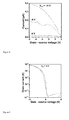
- FIG. 1 shows the drain-source current I ds in relation to the drain-source voltage V DS (output curve) for the field effect transistor of example 14 comprising compound 1a as semiconducting material at a gate voltage V GS of ⁇ 11 V, ⁇ 10 V, ⁇ 9 V and ⁇ 8 V.
- FIG. 2 shows the drain-source current I DS in relation to the gate-source voltage V GS (transfer curve) for field effect transistor of example 14 comprising compound 1a as semiconducting material at a drain-source voltage V DS of ⁇ 5 V.
- FIG. 3 shows the drain-source current I ds in relation to the drain-source voltage V DS (output curve) for the field effect transistor of example 14 comprising compound 1b as semiconducting material at a gate voltage V GS of ⁇ 11 V, ⁇ 10 V, ⁇ 9 V and ⁇ 7 V.
- FIG. 4 shows the drain-source current I DS in relation to the gate-source voltage V GS (transfer curve) for field effect transistor of example 14 comprising compound 1b as semiconducting material at a drain-source voltage V DS of ⁇ 5 V.
- FIG. 5 shows the drain-source current I ds in relation to the drain-source voltage V DS (output curve) for the field effect transistor of example 14 comprising compound 1e as semiconducting material at a gate voltage V GS of ⁇ 10 V, ⁇ 8 V and ⁇ 6 V.
- FIG. 6 shows the drain-source current I DS in relation to the gate-source voltage V GS (transfer curve) for field effect transistor of example 14 comprising compound 1e as semiconducting material at a drain-source voltage V DS of ⁇ 5 V.
- FIG. 7 shows the drain-source current I ds in relation to the drain-source voltage V DS (output curve) for the field effect transistor of example 14 comprising compound 1g as semiconducting material at a gate voltage V GS of ⁇ 10 V, ⁇ 9 V and ⁇ 8 V.
- FIG. 8 shows the drain-source current I DS in relation to the gate-source voltage V GS (transfer curve) for field effect transistor of example 14 comprising compound 1g as semiconducting material at a drain-source voltage V DS of ⁇ 5 V.
- FIG. 9 shows the drain-source current I DS in relation to the drain-source voltage V DS (output curve) for the field effect transistor of example 16 comprising compound 1b as semiconducting material at a gate voltage V GS of ⁇ 80 V, ⁇ 60 V, ⁇ 40 V, ⁇ 20 V and 0 V.
- FIG. 10 shows the drain-source current I DS in relation to the gate-source voltage V GS (transfer curve) for field effect transistor of example 16 comprising compound 1b as semiconducting material at a drain-source voltage V DS of ⁇ 80 V.
- Compound 1c is prepared in analogy to compound 1b in example 2, starting from 4-heptylphenol instead of from 4-pentylphenol, and is obtained as an orange solid.
- 1 H-NMR spectrum (CDCl 3 ) ⁇ [ppm]: 0.88 (t, 6H), 1.20-1.38 (m, 16H), 1.55-1.63 (m, 4H), 1.71 (s, 9H), 2.59 (t, 4H), 6.98 (d, 2H), 7.12 (d, 2H), 7.33 (s, 2H).
- Compound 1d is prepared in analogy to compound 1b in example 2, starting from 4-dodecylphenol instead of from 4-pentylphenol, and is obtained as an orange solid.
- 1 H-NMR spectrum (CDCl 3 ) d [ppm]: 0.88 (t, 6H), 1.21-1.36 (m, 36H), 1.53-1.63 (m, 4H), 1.72 (s, 9H), 2.58 (t, 4H), 6.98 (d, 2H), 7.11 (d, 2H), 7.32 (s, 2H).
- Compound 1e is prepared in analogy to compound 1b in example 2, starting from 4-tetradecylphenol instead of from 4-pentylphenol, and is obtained as an orange solid.
- 1 H-NMR spectrum (CDCl 3 ) d [ppm]: 0.87 (t, 6H), 1.20-1.33 (m, 44H), 1.60-1.70 (m, 4H), 1.72 (s, 9H), 2.59 (t, 4H), 6.98 (d, 2H), 7.12 (d, 2H), 7.33 (s, 2H).
- Compound 1g is prepared in analogy to compound 1b in example 2, starting from 4-[4-pentylcyclohexyl)-phenol instead of from 4-pentylphenol, and is obtained as an orange solid.
- 1 H-NMR spectrum (CDCl 3 ) d [ppm]: 0.89 (t, 6H), 0.98-1.10 (m, 4H), 1.18-1.38 (m, 18H), 1.38-1.52 (m, 4H), 1.72 (s, 9H), 1.83-1.92 (m, 8H), 2.40-2.49 (m, 2H), 7.02 (d, 2H), 7.12 (d, 2H), 7.35 (s, 2H).
- Compound 1i is prepared in analogy to compound 1b in example 2, using di-(2-methyl-sec-butyl) dicarbonate instead of di-tert-butyl dicarbonate, and is obtained as an orange solid.
- 1 H-NMR spectrum (CDCl 3 ) d [ppm]: 0.89 (t, 6H), 1.12 (t, 3H), 1.25-1.38 (m, 8H), 1.55-1.64 (m, 4H), 1.70 (s, 6H), 1.99 (q, 2H), 2.59 (t, 4H), 6.98 (d, 2H), 7.11 (d, 2H), 7.33 (s, 2H).
- Compound 1j is prepared in analogy to compound 1b in example 2, using di-(1-methylcyclohexyl) dicarbonate instead of di-tert-butyl dicarbonate, and is obtained as an orange solid.
- 1 H-NMR spectrum (CDCl 3 ) d [ppm]: 0.80-0.95 (m, 6H), 1.10-1.65 (m, 21H), 1.95-2.08 (m, 2H), 2.40-2.49 (m, 2H), 2.58 (t, 4H), 6.98 (d, 2H), 7.12 (d, 2H), 7.34 (s, 2H).
- Compound 1k is prepared in analogy to compound 1b in example 2, using di-(1-ethyl-1,5-dimethyl-hexyl) dicarbonate instead of di-tert-butyl dicarbonate, and is obtained as an orange solid.
- 1 H-NMR spectrum (CDCl 3 ) d [ppm]: 0.86-0.91 (m, 12H), 1.07 (t, 3H), 1.20-1.37 (m, 12H), 1.47-1.67 (m, 8H), 1.85-2.13 (m, 4H), 2.58 (t, 4H), 6.97 (d, 2H), 7.11 (d, 2H), 7.32 (s, 2H).
- Compound 1l is prepared in analogy to compound 1b in example 2, using di-(1-isopropyl-4-methyl-cyclohex-3-en-1-yl) dicarbonate instead of di-tert-butyl dicarbonate, and is obtained as an orange solid.
- Compound 1m is prepared in analogy to compound 1b in example 2, using di-(1,1-dimethylallyl) dicarbonate instead of di-tert-butyl dicarbonate, and is obtained as an orange solid.
- 1 H-NMR spectrum (CDCl 3 ) d [ppm]: 0.82-0.95 (m, 6H), 1.20-1.40 (m, 12H), 1.52-1.67 (m, 4H), 1.79 (s, 6H), 2.59 (t, 4H), 5.23 (d, 1H), 5.51 (d, 1H), 6.28 (dd, 1H), 6.98 (d, 2H), 7.11 (d, 2H), 7.33 (s, 2H).
- FIG. 1 the drain-source current I ds in relation to the drain-source voltage V DS (output curve) for the field effect transistor of example 14 comprising compound 1a as semiconducting material at a gate voltage V GS Of ⁇ 11 V, ⁇ 10 V, ⁇ 9 V and ⁇ 8 V is shown.
- FIG. 2 the drain-source current I DS in relation to the gate-source voltage V GS (transfer curve) for field effect transistor of example 14 comprising compound 1a as semiconducting material at a drain-source voltage V DS of ⁇ 5 V is shown.
- drain-source current I ds in relation to the drain-source voltage V DS (output curve) for the field effect transistor of example 14 comprising compound 1b as semiconducting material at a gate voltage V GS Of ⁇ 11 V, ⁇ 10 V, ⁇ 9 V and ⁇ 7 V is shown.
- drain-source current I DS in relation to the gate-source voltage V GS (transfer curve) for field effect transistor of example 14 comprising compound 1b as semiconducting material at a drain-source voltage V DS of ⁇ 5 V is shown.
- drain-source current I ds in relation to the drain-source voltage V DS (output curve) for the field effect transistor of example 14 comprising compound 1e as semiconducting material at a gate voltage V GS of ⁇ 10 V, ⁇ 8 V and ⁇ 6 V is shown.
- drain-source current I DS in relation to the gate-source voltage V GS (transfer curve) for field effect transistor of example 14 comprising compound 1e as semiconducting material at a drain-source voltage V DS of ⁇ 5 V is shown.
- drain-source current I ds in relation to the drain-source voltage V DS (output curve) for the field effect transistor of example 14 comprising compound 1g as semiconducting material at a gate voltage V GS of ⁇ 10 V, ⁇ 9 V and ⁇ 8 V is shown.
- FIG. 8 the drain-source current I DS in relation to the gate-source voltage V GS (transfer curve) for field effect transistor of example 14 comprising compound 1g as semiconducting material at a drain-source voltage V DS of ⁇ 5 V is shown.
- the field effect transistors comprising 1a, 1b, 1e, respectively, 1g showed typical p-type characteristics.
- V th The threshold voltage (V th ) was extracted from the intersection of the linear extrapolation of the I DS 1/2 versus V GS plot with the V GS axis.
- SiO 2 /Si substrates were thoroughly cleaned with piranha solution, ultrapure water, followed by isopropanol, and the substrates were functionalized with octadecyltrichlorosilane (OTS) from solution.
- OTS octadecyltrichlorosilane
- a thin film of compound 1b was formed on the OTS-treated SiO 2 /Si substrate by spin coating a 5 mg/ml solution of compound 1b in CHCl 3 at 4000 rpm for 30 sec, and annealed at 200° C. for 10 min on a hot-plate.
- Au layer was deposited through a shadow mask as source and drain electrodes to give top contact OFET devices.
- the channel width (W) was 3 mm and channel length (L) was 50 ⁇ m.
- drain-source current I DS in relation to the drain-source voltage V DS (output curve) for the field effect transistor of example 16 comprising compound 1b as semiconducting material at a gate voltage V GS of ⁇ 80 V, ⁇ 60 V, ⁇ 40 V, ⁇ 20 V and 0 V is shown.
- drain-source current I DS in relation to the gate-source voltage V GS (transfer curve) for field effect transistor of example 16 comprising compound 1b as semiconducting material at a drain-source voltage V DS of ⁇ 80 V is shown.
- the field effect transistors comprising 1b showed typical p-type characteristics.
- V DS drain-source voltage
- ⁇ charge-carrier mobility
- V th The threshold voltage (V th ) was extracted from the intersection of the linear extrapolation of the I DS 1/2 versus V GS plot with the V GS axis.
Landscapes
- Chemical & Material Sciences (AREA)
- Organic Chemistry (AREA)
- Physics & Mathematics (AREA)
- Spectroscopy & Molecular Physics (AREA)
- Engineering & Computer Science (AREA)
- Materials Engineering (AREA)
- Pharmaceuticals Containing Other Organic And Inorganic Compounds (AREA)
- Thin Film Transistor (AREA)
- Photovoltaic Devices (AREA)
- Nitrogen And Oxygen Or Sulfur-Condensed Heterocyclic Ring Systems (AREA)
- Electroluminescent Light Sources (AREA)
- Organic Low-Molecular-Weight Compounds And Preparation Thereof (AREA)
- Plural Heterocyclic Compounds (AREA)
- Nitrogen Condensed Heterocyclic Rings (AREA)
Abstract

Description

which are air-stable and promising n-type semiconducting materials for use in organic electronics.

and field effect transistors comprising these compounds as p-type semiconducting compounds.

and field effect transistors comprising these compounds as p-type semiconducting compounds.

wherein
X is O, S or NR10
-
- wherein R10 is H, C1-30-alkyl, substituted C1-30-alkyl, C2-30-alkenyl, substituted C2-30-alkenyl, C2-30-alkynyl, substituted C2-30-alkynyl or C(O)—OR11,
R1 and R11 are independently from each other selected from the group consisting of C1-30-alkyl, substituted C1-30-alkyl, C2-30-alkenyl, substituted C2-30-alkenyl, C2-30-alkynyl, substituted C2-30-alkynyl, C5-8-cycloalkyl, substituted C5-8-cycloalkyl, C5-8-cycloalkenyl, and substituted C5-8-cycloalkenyl,
R2, R3, R4, R5, R6, R7, R8 and R9 are independently from each other selected from the group consisting of H, C1-30-alkyl, substituted C1-30-alkyl, C2-30-alkenyl, substituted C2-30-alkenyl, C2-30-alkynyl, substituted C2-30-alkynyl, C5-8-cycloalkyl, substituted C5-8-cycloalkyl, C5-8-cycloalkenyl, substituted C5-8-cycloalkenyl, O—C1-30-alkyl, substituted O—C1-30-alkyl, S—C1-30-alkyl, substituted S—C1-30-alkyl, C6-14-aryl, substituted C6-14-aryl, 5 to 15 membered heteroaryl, substituted 5 to 15 membered heteroaryl and halogen; or R2 and R3, R3 and R4, R4 and R5, R6 and R7, R7 and R8, or, R8 and R9 together with the C-atoms, to which they are connected, form a 6 to 10 membered aromatic ring system, substituted 6 to 10 membered aromatic ring system, 5 to 12 membered heteroaromatic ring system or a substituted 5 to 12 membered heteroaromatic ring system, - wherein
- substituted C1-30-alkyl, substituted C2-30-alkenyl, substituted C2-30-alkynyl, substituted O—C1-30-alkyl and substituted S—C1-30-alkyl, at each occurrence, are C1-30-alkyl, C2-30-alkenyl, C2-30-alkynyl, O—C1-30-alkyl, respectively, S—C1-30-alkyl, which are substituted with at least one substituent independently selected from the group consisting of C5-6-cycloalkyl, C6-10-aryl, 5 to 12 membered heteroaryl, ORa, OC(O)—Ra, OC(O)—ORa, OC(O)—NRaRb, C(O)—Ra, C(O)—ORa, C(O)—NRaRb, C(O)—NRa—NRbRc, C(O)—NRa—ORb, C(O)—NRa—C(O)—Rb, C(O)—NRa—C(O)—ORb, C(O)—SRa, NRaRb, NRa—NRbRc, NRa—C(O)Rb, NRa—C(O)—ORb, NRa—C(O)—NRbRc, SRa, S—C(O)—Ra, halogen, CN, and NO2;
substituted C5-8-cycloalkyl, and substituted C5-8-cycloalkenyl, at each occurrence, are C5-8-cycloalkyl, respectively, C5-8-cycloalkenyl, which are substituted with at least one substituent independently selected from the group consisting of C1-20-alkyl, C2-20-alkenyl, C2-20-alkynyl, C5-6-cycloalkyl, C6-10-aryl, 5 to 12 membered heteroaryl, ORa, OC(O)—Ra, OC(O)—ORa, OC(O)—NRaRb, C(O)—Ra, C(O)—ORa, C(O)—NRaRb, C(O)—NRa—NRbRc, C(O)—NRa—ORb, C(O)—NRa—C(O)—Rb, C(O)—NRa—C(O)—ORb, C(O)—SRa, NRaRb, NRa—NRbRc, NRa—C(O)Rb, NRa—C(O)—ORb, NRa—C(O)—NRbRc, SRa, S—C(O)—Ra, halogen, CN, and NO2;
substituted C6-14-aryl, substituted 5 to 15 membered heteroaryl, substituted 6 to 10 membered aromatic ring system, and substituted 5 to 12 membered heteroaromatic ring system, at each occurrence, are C6-14-aryl, 5 to 15 membered heteroaryl, 6 to 10 membered aromatic ring system, respectively, 5 to 12 membered heteroaromatic ring system, which are substituted with at least one substituent independently selected from the group consisting of C1-20-alkyl, C2-20-alkenyl, C2-20-alkynyl, C5-6-cycloalkyl, C5-6-cycloalkenyl, C6-10-aryl, 5 to 12 membered heteroaryl, ORa, OC(O)—Ra, OC(O)—ORa, OC(O)—NRaRb, C(O)—Ra, C(O)—ORa, C(O)—NRaRb, C(O)—NRa—NRbRc, C(O)—NRa—ORb, C(O)—NRa—C(O)—Rb, C(O)—NRa—C(O)—ORb, C(O)—SRa, NRaRb, NRa—NRbRc, NRa—C(O)Rb, NRa—C(O)—ORb, NRaC(O)—NRbRc, SRa, S—C(O)—Ra, halogen, CN, and NO2,
wherein at least one CH2-group, but not adjacent CH2-groups, of C1-30-alkyl, substituted C1-30-alkyl, C2-30-alkenyl, substituted C2-30-alkenyl, C2-30-alkynyl, substituted C2-30-alkynyl, C5-8-cycloalkyl, substituted C5-8-cycloalkyl, C5-8-cycloalkenyl, substituted C5-8-cycloalkenyl, O—C1-30-alkyl, substituted O—C1-30-alkyl, S—C1-30-alkyl and substituted S—C1-30-alkyl, can be replaced by a linking group selected from the group consisting of O, S, NR12, CO, O—C(O), C(O)—O, O—C(O)—O, S—C(O), C(O)—S, NR12—C(O), C(O)—NR12, OC(O)—NR12 and NR12—C(O)—O, - wherein
- R12 is H, C1-30-alkyl, substituted C1-30-alkyl, C2-30-alkenyl, substituted C2-30-alkenyl, C2-30-alkynyl, substituted C2-30-alkynyl or C(O)—ORd, Ra, Rb, Rc and Rd are independently from each other and at each occurrence selected from the group consisting of H, C1-20-alkyl, C2-20-alkenyl, C2-20-alkynyl, C5-6-cycloalkyl, C5-6-cycloalkenyl, C6-10-aryl, and 5 to 12 membered heteroaryl.
C1-20-alkyl and C1-30-alkyl can be branched or unbranched. Examples of C1-20-alkyl are methyl, ethyl, n-propyl, isopropyl, n-butyl, sec-butyl, isobutyl, tert-butyl, n-pentyl, neopentyl, isopentyl, n-(1-ethyl)propyl, n-hexyl. n-heptyl, n-octyl, n-(2-ethyl)hexyl, n-nonyl, n-decyl, n-undecyl, n-dodecyl, n-undecyl, n-dodecyl, n-tridecyl, n-tetradecyl, n-pentadecyl, n-hexadecyl, n-heptadecyl, n-octadecyl, n-nonadecyl and n-icosyl (C20). Examples of C1-30-alkyl are C1-20-alkyl and n-docosyl (C22), n-tetracosyl (C24), n-hexacosyl (C26), n-octacosyl (C28) and n-triacontyl (C30).
C2-20-alkenyl and C2-30-alkenyl can be branched or unbranched. Examples of C2-20-alkenyl are vinyl, propenyl, cis-2-butenyl, trans-2-butenyl, 3-butenyl, cis-2-pentenyl, trans-2-pentenyl, cis-3-pentenyl, trans-3-pentenyl, 4-pentenyl, 2-methyl-3-butenyl, hexenyl, heptenyl, octenyl, nonenyl, docenyl, linoleyl (C18), linolenyl (C18), oleyl (C18), and arachidonyl (C20). Examples of C2-30-alkenyl are C2-20-alkenyl and erucyl (C22).
C2-20-alkynyl and C2-30-alkynyl can be branched or unbranched. Examples of C2-20-alkynyl and C2-30-alkynyl are ethynyl, 2-propynyl, 2-butynyl, 3-butynyl, pentynyl, hexynyl, heptynyl, octynyl, nonynyl, decynyl, undecynyl, dodecynyl, undecynyl, dodecynyl, tridecynyl, tetradecynyl, pentadecynyl, hexadecynyl, heptadecynyl, octadecynyl, nonadecynyl and icosynyl (C20).
- wherein R10 is H, C1-30-alkyl, substituted C1-30-alkyl, C2-30-alkenyl, substituted C2-30-alkenyl, C2-30-alkynyl, substituted C2-30-alkynyl or C(O)—OR11,


wherein R100 is H or C1-20-alkyl.

wherein R100 is H or C1-20-alkyl.

wherein R100 is H or C1-20-alkyl.

wherein the C-atoms marked with * are the C-atoms, to which R2 and R3, R3 and R4, R4 and R5, R6 and R7, R7 and R8, respectively, R8 and R are connected.

wherein the C-atoms marked with * are the C-atoms, to which R2 and R3, R3 and R4, R4 and R5, R6 and R7, R7 and R8, respectively, R8 and R are connected.

wherein R100 is H or C1-20-alkyl,
wherein the C-atoms marked with * are the C-atoms, to which R2 and R3, R3 and R4, R4 and R5, R6 and R7, R7 and R8, respectively, R8 and R are connected.

wherein R100 is H or C1-20-alkyl, and
wherein the C-atoms marked with * are the C-atoms, to which R2 and R3, R3 and R4, R4 and R5, R6 and R7, R7 and R8, respectively, R8 and R are connected.
-
- wherein R10 is H, C1-30-alkyl, substituted C1-30-alkyl, C2-30-alkenyl, substituted C2-30-alkenyl or C(O)—OR11,
R1 and R11 are independently from each other selected from the group consisting of C1-30-alkyl, substituted C1-30-alkyl, C2-30-alkenyl, substituted C2-30-alkenyl, C5-8-cycloalkyl, substituted C5-8-cycloalkyl, C5-8-cycloalkenyl and substituted C5-8-cycloalkenyl,
R2, R3, R4, R5, R6, R7, R8 and R9 are independently from each other selected from the group consisting of H, C1-30-alkyl, substituted C1-30-alkyl, C2-30-alkenyl, substituted C2-30-alkenyl, C5-8-cycloalkyl, substituted C5-8-cycloalkyl, C5-8-cycloalkenyl and substituted C5-8-cycloalkenyl, O—C1-30-alkyl, substituted O—C1-30-alkyl, S—C1-30-alkyl, substituted S—C1-30-alkyl, C6-14-aryl, substituted C6-14-aryl, 5 to 15 membered heteroaryl, substituted 5 to 15 membered heteroaryl and halogen; or R2 and R3, R3 and R4, R4 and R5, R6 and R7, R7 and R8, or, R8 and R9 together with the C-atoms, to which they are connected, form a 6 to 10 membered aromatic ring system, substituted 6 to 10 membered aromatic ring system, 5 to 12 membered heteroaromatic ring system or a substituted 5 to 12 membered heteroaromatic ring system, - wherein
- substituted C1-30-alkyl, substituted C2-30-alkenyl, substituted O—C1-30-alkyl and substituted S—C1-30-alkyl, at each occurrence, are C1-30-alkyl, C2-30-alkenyl, O—C1-30-alkyl, respectively, S—C1-30-alkyl, which are substituted with at least one substituent independently selected from the group consisting of C5-6-cycloalkyl, C6-10-aryl, 5 to 12 membered heteroaryl, ORa, OC(O)—Ra, OC(O)—ORa, OC(O)—NRaRb, C(O)—Ra, C(O)—ORa, C(O)—NRaRb, C(O)—NRaNRbRc, C(O)—NRa—ORb, C(O)—NRa—C(O)—Rb, C(O)—NRa—C(O)—ORb, C(O)—SRa, NRaRb, NRaNRbRc, NRa—C(O)Rb, NRa—C(O)—ORb, NRa—C(O)—NRbRc, SRa, S—C(O)—Ra, halogen, CN, and NO2;
substituted C5-8-cycloalkyl and substituted C5-8-cycloalkenyl, at each occurrence, are C5-8-cycloalkyl, respectively, C5-8-cycloalkenyl, which are substituted with at least one substituent independently selected from the group consisting of C1-20-alkyl, C5-6-cycloalkyl, C6-10-aryl, 5 to 12 membered heteroaryl, ORa, OC(O)—Ra, OC(O)—ORa, OC(O)—NRaRb, C(O)—Ra, C(O)—ORa, C(O)—NRaRb, C(O)—NRa—NRbRc, C(O)—NRa—ORb, C(O)—NRa—C(O)—Rb, C(O)—NRa—C(O)—ORb, C(O)—SRa, NRaRb, NRa—NRbRc, NRa—C(O)Rb, NRa—C(O)—ORb, NRaC(O)—NRbRc, SRa, S—C(O)—Ra, halogen, CN, and NO2;
substituted C6-14-aryl, substituted 5 to 15 membered heteroaryl, substituted 6 to 10 membered aromatic ring system and substituted 5 to 12 membered heteroaromatic ring system, at each occurrence, are C6-14-aryl, 5 to 15 membered heteroaryl, 6 to 10 membered aromatic ring system, respectively, 5 to 12 membered heteroaromatic ring system, which are substituted with at least one substituent independently selected from the group consisting of C1-20-alkyl, C5-6-cycloalkyl, C6-10-aryl, 5 to 12 membered heteroaryl, ORa, OC(O)—Ra, OC(O)—ORa, OC(O)—NRaRb, C(O)—Ra, C(O)—ORa, C(O)—NRaRb, C(O)—NRa—NRbRc, C(O)NRa—ORb, C(O)—NRa—C(O)—Rb, C(O)—NRa—C(O)—ORb, C(O)—SRa, NRaRb, NRa—NRbRc, NRaC(O)—Rb, NRa—C(O)—ORb, NRa—C(O)—NRbRc, SRa, S—C(O)—Ra, halogen, CN, and NO2,
wherein at least one CH2-group, but not adjacent CH2-groups, of C1-30-alkyl, substituted C1-30-alkyl, C2-30-alkenyl, substituted C2-30-alkenyl, C5-8-cycloalkyl, substituted C5-8-cycloalkyl, C5-8-cycloalkenyl and substituted C5-8-cycloalkenyl, O—C1-30-alkyl, substituted O—C1-30-alkyl, S—C1-30-alkyl and substituted S—C1-30-alkyl, can be replaced by a linking group selected from the group consisting of O, S, NR12, CO, O—C(O), C(O)—O, O—C(O)—O, S—C(O), C(O)—S, NR12—C(O), C(O)—NR12, OC(O)—NR12 and NR12—C(O)—O, - wherein
- R12 is H, C1-30-alkyl, substituted C1-30-alkyl, or C(O)—ORd,
- Ra, Rb, Rc and Rd are independently from each other and at each occurrence selected from the group consisting of H, C1-20-alkyl, C5-6-cycloalkyl, C6-10-aryl, and 5 to 12 membered heteroaryl.
- wherein R10 is H, C1-30-alkyl, substituted C1-30-alkyl, C2-30-alkenyl, substituted C2-30-alkenyl or C(O)—OR11,
-
- wherein R10 is H, C1-30-alkyl, substituted C1-30-alkyl or C(O)—OR11,
R1 and R11 are independently from each other selected from the group consisting of C1-30-alkyl, substituted C1-30-alkyl, C2-30-alkenyl, substituted C2-30-alkenyl, C5-8-cycloalkyl, substituted C5-8-cycloalkyl, C5-8-cycloalkenyl and substituted C5-8-cycloalkenyl,
R2, R3, R4, R5, R6, R7, R8 and R9 are independently from each other selected from the group consisting of H, C1-30-alkyl, substituted C1-30-alkyl, C5-8-cycloalkyl, substituted C5-8-cycloalkyl, C6-14-aryl, substituted C6-14-aryl, 5 to 15 membered heteroaryl and substituted 5 to 15 membered heteroaryl; or R2 and R3, R3 and R4, R4 and R5, R6 and R7, R7 and R8, or, R8 and R9 together with the C-atoms, to which they are connected, form a 6 to 10 membered aromatic ring system, substituted 6 to 10 membered aromatic ring system, 5 to 12 membered heteroaromatic ring system or a substituted 5 to 12 membered heteroaromatic ring system, - wherein
- substituted C1-30-alkyl and substituted C2-30-alkenyl, at each occurrence, are C1-30-alkyl, respectively, C2-30-alkenyl, which are substituted with at least one substituent independently selected from the group consisting of C5-6-cycloalkyl, C6-10-aryl, 5 to 12 membered heteroaryl, ORa, OC(O)—Ra, OC(O)—ORa, OC(O)—NRaRb, C(O)—Ra, C(O)—ORa, C(O)—NRaRb, C(O)—NRa—NRbRc, C(O)—NRa—ORb, C(O)—NRa—C(O)—Rb, C(O)—NRa—C(O)—ORb, C(O)—SRa, NRaRb, NRa—NRbRc, NRa—C(O)Rb, NRa—C(O)—ORb, NRa—C(O)—NRbRc, SRa, S—C(O)—Ra, halogen, CN, and NO2;
- substituted C5-8-cycloalkyl and substituted C5-8-cycloalkenyl, at each occurrence, are C5-8-cycloalkyl, respectively, C5-8-cycloalkenyl, which are substituted with at least one substituent independently selected from the group consisting of C1-20-alkyl, C5-6-cycloalkyl, C6-10-aryl, 5 to 12 membered heteroaryl, ORa, OC(O)—Ra, OC(O)—ORa, OC(O)—NRaRb, C(O)—Ra, C(O)—ORa, C(O)—NRaRb, C(O)—NRa—NRbRc, C(O)—NRa—ORb, C(O)—NRa—C(O)—Rb, C(O)—NRa—C(O)—ORb, C(O)—SRa, NRaRb, NRa—NRbRc, NRa—C(O)Rb, NRa—C(O)—ORb, NRaC(O)—NRbRc, SRa, S—C(O)—Ra, halogen, CN, and NO2;
- substituted C6-14-aryl, substituted 5 to 15 membered heteroaryl, substituted 6 to 10 membered aromatic ring system, and substituted 5 to 12 membered heteroaromatic ring system, at each occurrence, are C6-14-aryl, 5 to 15 membered heteroaryl, 6 to 10 membered aromatic ring system, respectively, 5 to 12 membered heteroaromatic ring system, which are substituted with at least one substituent independently selected from the group consisting of C1-20-alkyl, C5-6-cycloalkyl, C6-10-aryl, 5 to 12 membered heteroaryl, ORa, OC(O)—Ra, OC(O)—ORa, OC(O)—NRaRb, C(O)—Ra, C(O)—ORa, C(O)—NRaRb, C(O)—NRa—NRbRc, C(O)NRa—ORb, C(O)—NRa—C(O)—Rb, C(O)—NRa—C(O)—ORb, C(O)—SRa, NRaRb, NRa—NRbRc, NRaC(O)—Rb, NRa—C(O)—ORb, NRa—C(O)—NRbRc, SRa, S—C(O)—Ra, halogen, CN, and NO2,
- wherein at least one CH2-group, but not adjacent CH2-groups, of C1-30-alkyl, substituted C1-30-alkyl, C2-30-alkenyl, substituted C2-30-alkenyl, C5-8-cycloalkyl, substituted C5-8-cycloalkyl C5-8-cycloalkenyl and substituted C5-8-cycloalkenyl can be replaced by a linking group selected from the group consisting of O, S, NR12, CO, O—C(O), C(O)—O, O—C(O)—O, S—C(O), C(O)—S, NR12—C(O), C(O)—NR12, OC(O)—NR12 and NR12—C(O)—O,
- wherein
- R12 is H, C1-30-alkyl, substituted C1-30-alkyl or C(O)—ORd,
- Ra, Rb, Rc and Rd are independently from each other and at each occurrence selected from the group consisting of H, C1-20-alkyl, C5-6-cycloalkyl, C6-10-aryl, and 5 to 12 membered heteroaryl.
- wherein R10 is H, C1-30-alkyl, substituted C1-30-alkyl or C(O)—OR11,
-
- wherein R10 is H, C1-30-alkyl, substituted C1-30-alkyl or C(O)—OR11,
R1 and R11 are independently from each other selected from the group consisting of C1-30-alkyl, substituted C1-30-alkyl, C2-30-alkenyl, substituted C2-30-alkenyl, C5-8-cycloalkyl, substituted C5-8-cycloalkyl, C5-8-cycloalkenyl and substituted C5-8-cycloalkenyl,
R2, R3, R4, R5, R6, R7, R8 and R9 are independently from each other selected from the group consisting of H, C1-30-alkyl, substituted C1-30-alkyl, C5-8-cycloalkyl, substituted C5-8-cycloalkyl, C6-14-aryl, substituted C6-14-aryl, 5 to 15 membered heteroaryl and substituted 5 to 15 membered heteroaryl; or R2 and R3, R3 and R4, R4 and R5, R6 and R7, R7 and R8, or, R8 and R9 together with the C-atoms, to which they are connected, form a 6 to 10 membered aromatic ring system, substituted 6 to 10 membered aromatic ring system, 5 to 12 membered heteroaromatic ring system or a substituted 5 to 12 membered heteroaromatic ring system, - wherein
- substituted C1-30-alkyl and substituted C2-30-alkenyl, at each occurrence, are C1-30-alkyl, respectively, C2-30-alkenyl, which are substituted with at least one substituent independently selected from the group consisting of C5-6-cycloalkyl, C6-10-aryl, and 5 to 12 membered heteroaryl,
- substituted C5-8-cycloalkyl and substituted C5-8-cycloalkenyl, at each occurrence, are C5-8-cycloalkyl, respectively, C5-8-cycloalkenyl, which are substituted with at least one substituent independently selected from the group consisting of C1-20-alkyl, C5-6-cycloalkyl, C6-10-aryl, and 5 to 12 membered heteroaryl;
- substituted C6-14-aryl, substituted 5 to 15 membered heteroaryl, substituted 6 to 10 membered aromatic ring system, and substituted 5 to 12 membered heteroaromatic ring system, at each occurrence, are C6-14-aryl, 5 to 15 membered heteroaryl, 6 to 10 membered aromatic ring system, respectively, 5 to 12 membered heteroaromatic ring system, which are substituted with at least one substituent independently selected from the group consisting of C1-20-alkyl, C5-6-cycloalkyl, C6-10-aryl, 5 to 12 membered heteroaryl;
wherein at least one CH2-group, but not adjacent CH2-groups, of C1-30-alkyl, substituted C1-30-alkyl, C2-30-alkenyl, substituted C2-30-alkenyl, C5-8-cycloalkyl, substituted C5-8-cycloalkyl, C5-8-cycloalkenyl and substituted C5-8-cycloalkenyl can be replaced by a linking group selected from the group consisting of O, S, and NR12, - wherein
- R12 is H, C1-30-alkyl, substituted C1-30-alkyl or C(O)—ORd,
- Rd is at each occurrence selected from the group consisting of H, C1-20-alkyl, C2-20-alkenyl, C2-20-alkynyl, C5-6-cycloalkyl, C5-6-cycloalkenyl, C6-10-aryl, and 5 to 12 membered heteroaryl.
- wherein R10 is H, C1-30-alkyl, substituted C1-30-alkyl or C(O)—OR11,
-
- wherein
- substituted C1-30-alkyl and substituted C2-30-alkenyl, at each occurrence, are C1-30-alkyl, respectively, C2-30-alkenyl, which are substituted with at least one substituent independently selected from the group consisting of C5-6-cycloalkyl, phenyl and 5 to 9 membered heteroaryl,
- substituted C5-8-cycloalkyl and substituted C5-8-cycloalkenyl, at each occurrence, are C5-8-cycloalkyl, respectively, C5-8-cycloalkenyl, which are substituted with at least one substituent independently selected from the group consisting of C1-20-alkyl, C5-6-cycloalkyl, phenyl and 5 to 9 membered heteroaryl,
- substituted C6-10-aryl, substituted 5 to 12 membered heteroaryl, substituted 6 membered aromatic ring system, and substituted 5 to 9 membered heteroaromatic ring system, at each occurrence, are C6-10-aryl, 5 to 12 membered heteroaryl, 6 membered aromatic ring system, respectively, 5 to 9 membered heteroaromatic ring system, which are substituted with at least one substituent independently selected from the group consisting of C1-20-alkyl, C5-6-cycloalkyl, phenyl, 5 to 9 membered heteroaryl,
- wherein at least one CH2-group, but not adjacent CH2-groups, of C1-30-alkyl, substituted C1-30-alkyl, C5-8-cycloalkyl and substituted C5-8-cycloalkyl, can be replaced by the linking group O.
-
- wherein
- substituted C1-30-alkyl and substituted C2-30-alkenyl, at each occurrence, are C1-30-alkyl, respectively, C2-30-alkenyl, which are substituted with at least one substituent independently selected from the group consisting of C5-6-cycloalkyl, phenyl and 5 to 9 membered heteroaryl,
- substituted C5-8-cycloalkyl and substituted C5-8-cycloalkenyl, at each occurrence, are C5-8-cycloalkyl, respectively, C5-8-cycloalkenyl, which are substituted with at least one substituent independently selected from the group consisting of C1-20-alkyl, C5-6-cycloalkyl, phenyl and 5 to 9 membered heteroaryl.
-
- wherein
- substituted C1-30-alkyl and substituted C2-30-alkenyl, at each occurrence, are C1-30-alkyl, respectively, C2-30-alkenyl, which are substituted with at least one substituent independently selected from the group consisting of C5-6-cycloalkyl and phenyl,
- substituted C5-8-cycloalkyl and substituted C5-8-cycloalkenyl, at each occurrence, are C5-8-cycloalkyl, respectively, C5-8-cycloalkenyl, which are substituted with at least one substituent independently selected from the group consisting of C1-20-alkyl, C5-6-cycloalkyl and phenyl.

wherein
X is O, S or NR10,
-
- wherein R10 is H, C1-30-alkyl, substituted C1-30-alkyl, C2-30-alkenyl, substituted C2-30-alkenyl, C2-30-alkynyl, substituted C2-30-alkynyl or C(O)—OR11,
R1 and R11 are independently from each other selected from the group consisting of C1-30-alkyl, substituted C1-30-alkyl, C2-30-alkenyl, substituted C2-30-alkenyl, C2-30-alkynyl, substituted C2-30-alkynyl, C5-8-cycloalkyl, substituted C5-8-cycloalkyl, C5-8-cycloalkenyl, and substituted C5-8-cycloalkenyl,
R2, R3, R4, R5, R6, R7, R8 and R9 are independently from each other selected from the group consisting of H, C1-30-alkyl, substituted C1-30-alkyl, C2-30-alkenyl, substituted C2-30-alkenyl, C2-30-alkynyl, substituted C2-30-alkynyl, C5-8-cycloalkyl, substituted C5-8-cycloalkyl, C5-8-cycloalkenyl, substituted C5-8-cycloalkenyl, O—C1-30-alkyl, substituted O—C1-30-alkyl, S—C1-30-alkyl, substituted S—C1-30-alkyl, C6-14-aryl, substituted C6-14-aryl, 5 to 15 membered heteroaryl, substituted 5 to 15 membered heteroaryl and halogen; or R2 and R3, R3 and R4, R4 and R5, R6 and R7, R7 and R8, or, R8 and R9 together with the C-atoms, to which they are connected, form a 6 to 10 membered aromatic ring system, substituted 6 to 10 membered aromatic ring system, 5 to 12 membered heteroaromatic ring system or a substituted 5 to 12 membered heteroaromatic ring system, - wherein
- substituted C1-30-alkyl, substituted C2-30-alkenyl, substituted C2-30-alkynyl, substituted O—C1-30-alkyl and substituted S—C1-30-alkyl, at each occurrence, are C1-30-alkyl, C2-30-alkenyl, C2-30-alkynyl, O—C1-30-alkyl, respectively, S—C1-30-alkyl, which are substituted with at least one substituent independently selected from the group consisting of C5-6-cycloalkyl, C6-10-aryl, 5 to 12 membered heteroaryl, ORa, OC(O)—Ra, OC(O)—ORa, OC(O)—NRaRb, C(O)—Ra, C(O)—ORa, C(O)—NRaRb, C(O)—NRa—NRbRc, C(O)—NRa—ORb, C(O)—NRa—C(O)—Rb, C(O)—NRa—C(O)—ORb, C(O)—SRa, NRaRb, NRa—NRbRc, NRa—C(O)Rb, NRa—C(O)—ORb, NRa—C(O)—NRbRc, SRa, S—C(O)—Ra, halogen, CN, and NO2;
- substituted C5-8-cycloalkyl, and substituted C5-8-cycloalkenyl, at each occurrence, are C5-8-cycloalkyl, respectively, C5-8-cycloalkenyl, which are substituted with at least one substituent independently selected from the group consisting of C1-20-alkyl, C2-20-alkenyl, C2-20-alkynyl, C5-6-cycloalkyl, C6-10-aryl, 5 to 12 membered heteroaryl, ORa, OC(O)—Ra, OC(O)—ORa, OC(O)—NRaRb, C(O)—Ra, C(O)—ORa, C(O)—NRaRb, C(O)—NRa—NRbRc, C(O)—NRa—ORb, C(O)—NRa—C(O)—Rb, C(O)—NRa—C(O)—ORb, C(O)—SRa, NRaRb, NRa—NRbRc, NRa—C(O)Rb, NRa—C(O)—ORb, NRa—C(O)—NRbRc, SRa, S—C(O)—Ra, halogen, CN, and NO2;
- substituted C6-14-aryl, substituted 5 to 15 membered heteroaryl, substituted 6 to 10 membered aromatic ring system, and substituted 5 to 12 membered heteroaromatic ring system, at each occurrence, are C6-14-aryl, 5 to 15 membered heteroaryl, 6 to 10 membered aromatic ring system, respectively, 5 to 12 membered heteroaromatic ring system, which are substituted with at least one substituent independently selected from the group consisting of C1-20-alkyl, C2-20-alkenyl, C2-20-alkynyl, C5-6-cycloalkyl, C5-6-cycloalkenyl, C6-10-aryl, 5 to 12 membered heteroaryl, ORa, OC(O)—Ra, OC(O)—ORa, OC(O)—NRaRb, C(O)—Ra, C(O)—ORa, C(O)—NRaRb, C(O)—NRa—NRbRc, C(O)—NRa—ORb, C(O)—NRa—C(O)—Rb, C(O)—NRa—C(O)—ORb, C(O)—SRa, NRaRb, NRa—NRbRc, NRa—C(O)Rb, NRa—C(O)—ORb, NRaC(O)—NRbRc, SRa, S—C(O)—Ra, halogen, CN, and NO2,
wherein at least one CH2-group, but not adjacent CH2-groups, of C1-30-alkyl, substituted C1-30-alkyl, C2-30-alkenyl, substituted C2-30-alkenyl, C2-30-alkynyl, substituted C2-30-alkynyl, C5-8-cycloalkyl, substituted C5-8-cycloalkyl, C5-8-cycloalkenyl, substituted C5-8-cycloalkenyl, O—C1-30-alkyl, substituted O—C1-30-alkyl, S—C1-30-alkyl and substituted S—C1-30-alkyl, can be replaced by a linking group selected from the group consisting of O, S, NR12, CO, O—C(O), C(O)—O, O—C(O)—O, S—C(O), C(O)—S, NR12—C(O), C(O)—NR12, OC(O)—NR12 and NR12—C(O)—O, - wherein
- R12 is H, C1-30-alkyl, substituted C1-30-alkyl, C2-30-alkenyl, substituted C2-30-alkenyl, C2-30-alkynyl, substituted C2-30-alkynyl or C(O)—ORd,
- Ra, Rb, Rc and Rd are independently from each other and at each occurrence selected from the group consisting of H, C1-20-alkyl, C2-20-alkenyl, C2-20-alkynyl, C5-6-cycloalkyl, C5-6-cycloalkenyl, C6-10-aryl, and 5 to 12 membered heteroaryl,
which process comprises the step of treating a compound of formula
- wherein R10 is H, C1-30-alkyl, substituted C1-30-alkyl, C2-30-alkenyl, substituted C2-30-alkenyl, C2-30-alkynyl, substituted C2-30-alkynyl or C(O)—OR11,

wherein X, R2, R3, R4, R5, R6, R7, R8 and R9 have the meaning as indicated for the compound of formula (1)
with
R1O—C(O)-LG
wherein R1 has the meaning as indicated for the compound of formula (1), and LG is a leaving group
in order to obtain a compound of formula (1).


and can be prepared by treating o-aminothiophenol with dichloromaleimide. The reaction is usually performed at elevated temperatures, such as at a temperature in the range of 80 to 150° C., and in the presence of acetic acid.

wherein
R2, R3, R4, R5, R6, R7, R8 and R9 have the meaning as indicated for the compound of formula (2),
and can be prepared by treating a compound of formula

wherein R2, R3, R4, R5, R6, R7, R8 and R9 have the meaning as indicated for the compound of formula (2),
with dichloromaleimide.

wherein R2, R3, R4 and R5 have the meaning as indicated for the compound of formula (2), and can be prepared by treating a compound of

wherein R2, R3, R4 and R5 have the meaning as indicated for the compound of formula (2) with zinc.

wherein R2, R3, R4 and R5 have the meaning as indicated for the compound of formula (2), can be prepared by heating a compound of formula

wherein R2, R3, R4 and R5 have the meaning as indicated for the compound of formula (2), The reaction is usually performed at elevated temperatures, such as at a temperature in the range of 160 to 260° C.

wherein R2, R3, R4 and R5 have the meaning as indicated for the compound of formula (2), can be prepared by treating a compound of formula

with N,N-dimethylthiocarbamoyl chloride.

can be prepared by treating a compound of formula

wherein R2, R3, R4 and R5 have the meaning as indicated for the compound of formula (2), nitric acid.

Preparation of Compound 2a

Preparation of Compound 6a


| TABLE 1 | |||||
| Compound | Vth [V] | μ [cm2/Vs] | Ion/off | ||
| 1a | −6.9 | 0.13 | 1E4 | ||
| 1b | −4.5 | 0.68 | 7E4 | ||
| 1e | −3.9 | 0.23 | 2E6 | ||
| 1g | −6.5 | 0.008 | 4E4 | ||

| TABLE 2 | ||||
| Compound | DMF | THF | clorobenzene | CHCl3 |
| 2a (comparative) | <1 | mg/mL | <1 | mg/mL | <1 | mg/mL | <1 | mg/ |
| 1a | ||||||||
| 1 to 5 | mg/ |
1 to 5 | mg/ |
5 to 10 | mg/ |
5 to 10 | mg/mL | |
| 1b | <1 | mg/mL | >10 | mg/mL | >10 | mg/mL | >10 | mg/mL |
| 1c | <1 | mg/mL | >10 | mg/mL | >10 | mg/mL | >10 | mg/mL |
| 1d | >10 | mg/mL | >10 | mg/mL | >10 | mg/mL | >10 | mg/mL |
| TABLE 3 | |||||
| Compound | Vth/V | μ/cm2/Vs | Ion/off | ||
| Compound 1b | −9.0 | 0.022 | 3E5 | ||
Claims (11)


R1O—C(O)-LG

Applications Claiming Priority (4)
| Application Number | Priority Date | Filing Date | Title |
|---|---|---|---|
| EP14199287 | 2014-12-19 | ||
| EP14199287.5 | 2014-12-19 | ||
| EP14199287 | 2014-12-19 | ||
| PCT/EP2015/079966 WO2016096967A1 (en) | 2014-12-19 | 2015-12-16 | 6h-pyrrolo[3,2-b:4,5-b']bis[1,4]benzothiazine-6-carboxylic acid esters as organic semiconductor materials for use in electronic devices |
Publications (2)
| Publication Number | Publication Date |
|---|---|
| US20170365791A1 US20170365791A1 (en) | 2017-12-21 |
| US10079346B2 true US10079346B2 (en) | 2018-09-18 |
Family
ID=52231917
Family Applications (1)
| Application Number | Title | Priority Date | Filing Date |
|---|---|---|---|
| US15/537,522 Active US10079346B2 (en) | 2014-12-19 | 2015-12-16 | Heteroaromatic compounds for organic electronics |
Country Status (7)
| Country | Link |
|---|---|
| US (1) | US10079346B2 (en) |
| EP (1) | EP3233868B1 (en) |
| JP (1) | JP6590932B2 (en) |
| KR (1) | KR102484452B1 (en) |
| CN (1) | CN107001388B (en) |
| TW (1) | TWI694079B (en) |
| WO (1) | WO2016096967A1 (en) |
Family Cites Families (6)
| Publication number | Priority date | Publication date | Assignee | Title |
|---|---|---|---|---|
| AT303884B (en) * | 1970-05-22 | 1972-12-11 | Norma Messtechnik Gmbh | Circuit for testing and adjusting current dividers |
| RU2011142634A (en) * | 2009-03-23 | 2013-04-27 | Басф Се | DIKETOPYRROLOPYROL POLYMERS FOR APPLICATION IN ORGANIC SEMICONDUCTOR DEVICES |
| US9067942B2 (en) * | 2009-04-08 | 2015-06-30 | Basf Se | Pyrrolopyrrole derivatives, their manufacture and use as semiconductors |
| DE102010030500A1 (en) * | 2010-06-24 | 2011-12-29 | Heliatek Gmbh | Evaporatable organic semiconducting material and its use in an optoelectronic device |
| EP2702086B1 (en) * | 2011-04-28 | 2015-03-18 | Basf Se | Semiconductor materials based on diketopiperidinopiperidine copolymers |
| JP2014181189A (en) * | 2013-03-18 | 2014-09-29 | Nagoya City | Indoloquinoxaline compound, method for manufacturing the same, and electronic element using the indoloquinoxaline compound |
-
2015
- 2015-12-16 EP EP15810633.6A patent/EP3233868B1/en not_active Not-in-force
- 2015-12-16 KR KR1020177019583A patent/KR102484452B1/en active Active
- 2015-12-16 WO PCT/EP2015/079966 patent/WO2016096967A1/en not_active Ceased
- 2015-12-16 CN CN201580068347.2A patent/CN107001388B/en not_active Expired - Fee Related
- 2015-12-16 US US15/537,522 patent/US10079346B2/en active Active
- 2015-12-16 JP JP2017533246A patent/JP6590932B2/en not_active Expired - Fee Related
- 2015-12-18 TW TW104142839A patent/TWI694079B/en not_active IP Right Cessation
Non-Patent Citations (7)
| Title |
|---|
| Extended European Search Report dated Mar. 26, 2015 in Patent Application No. 14199287.5. |
| International Preliminary Report on Patentability and Written Opinion dated Jun. 29, 2017 in PCT/EP2015/079966. |
| International Search Report and Written Opinion dated Feb. 9, 2016 in PCT/EP2015/079966. |
| Wei Hong et al., "6H-Pyrrolo[3,2-b:4,5-b']bis[1,4]benzothiazines: Facilely Synthesized Semiconductors for Organic Field-Effect Transistors", Journal of Materials Chemistry, 2008, pp. 4814-4820. |
| Wei Hong et al., "Synthesis and Properties of Heteroacenes Containing Pyrrole and Thiazine Rings as Promising n-Type Organic Semiconductor Candidates", Chinese Journal of Chemistry, 2009, pp. 846-849. |
| WEI Z, HONG W, GENG H, WANG C, LIU Y, LI R, XU W, SHUAI Z, HU W, WANG Q, ZHU D.: "Organic Single Crystal Field-effect Transistors Based on 6H-pyrrolo[3,2–b:4,5–b´]bis[1,4]benzothiazine and its Derivatives", ADVANCED MATERIALS, WILEY - V C H VERLAG GMBH & CO. KGAA, DE, vol. 22, no. 22, 11 June 2010 (2010-06-11), DE, pages 2458 - 2462, XP002737232, ISSN: 0935-9648, DOI: 10.1002/adma.201000088 |
| Zhongming Wei et al., "Organic Single Crystal Field-Effect Transistors Based on 6H-pyrrolo[3,2-b:4,5-b']bis[1,4]benzothiazine and its Derivatives", Advanced Materials, vol. 22, No. 22, XP002737232, 2010, pp. 2458-2468. |
Also Published As
| Publication number | Publication date |
|---|---|
| KR102484452B1 (en) | 2023-01-04 |
| CN107001388A (en) | 2017-08-01 |
| EP3233868B1 (en) | 2018-11-07 |
| JP2018504385A (en) | 2018-02-15 |
| JP6590932B2 (en) | 2019-10-16 |
| KR20170095343A (en) | 2017-08-22 |
| TWI694079B (en) | 2020-05-21 |
| TW201630919A (en) | 2016-09-01 |
| US20170365791A1 (en) | 2017-12-21 |
| WO2016096967A1 (en) | 2016-06-23 |
| EP3233868A1 (en) | 2017-10-25 |
| CN107001388B (en) | 2019-10-11 |
Similar Documents
| Publication | Publication Date | Title |
|---|---|---|
| US20180175305A1 (en) | Azaazene analogues and their use as semiconductor | |
| US9444058B2 (en) | Preparation of pi-extended naphthalene diimides and their use as semiconductor | |
| EP2702086B1 (en) | Semiconductor materials based on diketopiperidinopiperidine copolymers | |
| US8471020B2 (en) | Perylene-based semiconducting materials | |
| US11355715B2 (en) | Substituted benzonaphthathiophene compounds for organic electronics | |
| US10793668B2 (en) | Naphthoindacenodithiophenes and polymers | |
| US9716237B2 (en) | Heteroacenes for organic electronics | |
| US10403822B2 (en) | Thienothiophene-isoindigo | |
| US11152578B2 (en) | Sulfonium salts of DNTT and related compounds as soluble photocleavable precursors for organic semiconductors for use in organic field-effect transistors | |
| WO2012152598A1 (en) | Halogenated perylene-based semiconducting materials | |
| US20170365791A1 (en) | Heteroaromatic compounds for organic electronics | |
| US8436127B2 (en) | Semiconductor materials based on diketopiperidinopiperidine copolymers | |
| US11778893B2 (en) | Indaceno derivatives as organic semiconductors | |
| US20120289703A1 (en) | Halogenated perylene-based semiconducting materials |
Legal Events
| Date | Code | Title | Description |
|---|---|---|---|
| AS | Assignment |
Owner name: BASF SE, GERMANY Free format text: ASSIGNMENT OF ASSIGNORS INTEREST;ASSIGNORS:WU, CHAO;WEITZ, THOMAS;EUSTACHI, MICHAEL;AND OTHERS;SIGNING DATES FROM 20160129 TO 20160318;REEL/FRAME:042745/0240 Owner name: BASF JAPAN LTD., JAPAN Free format text: ASSIGNMENT OF ASSIGNORS INTEREST;ASSIGNORS:YAMATO, HITOSHI;TSUDA, TAKUYA;SIGNING DATES FROM 20170509 TO 20170515;REEL/FRAME:042745/0229 |
|
| AS | Assignment |
Owner name: BASF SE, GERMANY Free format text: ASSIGNMENT OF ASSIGNORS INTEREST;ASSIGNOR:BASF JAPAN LTD.;REEL/FRAME:043968/0203 Effective date: 20171013 |
|
| STCF | Information on status: patent grant |
Free format text: PATENTED CASE |
|
| CC | Certificate of correction | ||
| AS | Assignment |
Owner name: CLAP CO., LTD., KOREA, REPUBLIC OF Free format text: ASSIGNMENT OF ASSIGNORS INTEREST;ASSIGNOR:BASF SE;REEL/FRAME:052459/0201 Effective date: 20200121 |
|
| FEPP | Fee payment procedure |
Free format text: ENTITY STATUS SET TO SMALL (ORIGINAL EVENT CODE: SMAL); ENTITY STATUS OF PATENT OWNER: SMALL ENTITY |
|
| MAFP | Maintenance fee payment |
Free format text: PAYMENT OF MAINTENANCE FEE, 4TH YR, SMALL ENTITY (ORIGINAL EVENT CODE: M2551); ENTITY STATUS OF PATENT OWNER: SMALL ENTITY Year of fee payment: 4 |
|
| FEPP | Fee payment procedure |
Free format text: MAINTENANCE FEE REMINDER MAILED (ORIGINAL EVENT CODE: REM.); ENTITY STATUS OF PATENT OWNER: SMALL ENTITY |