US10077262B2 - Thienothiadiazole compounds and related semiconductor devices - Google Patents
Thienothiadiazole compounds and related semiconductor devices Download PDFInfo
- Publication number
- US10077262B2 US10077262B2 US15/348,971 US201615348971A US10077262B2 US 10077262 B2 US10077262 B2 US 10077262B2 US 201615348971 A US201615348971 A US 201615348971A US 10077262 B2 US10077262 B2 US 10077262B2
- Authority
- US
- United States
- Prior art keywords
- group
- compound
- independently
- formula
- conjugated
- Prior art date
- Legal status (The legal status is an assumption and is not a legal conclusion. Google has not performed a legal analysis and makes no representation as to the accuracy of the status listed.)
- Active
Links
- 0 CC1=CC=C(C2=C3CN=NC3=C(C3=CC=C(C)S3)S2)S1.[1*]C.[1*]C Chemical compound CC1=CC=C(C2=C3CN=NC3=C(C3=CC=C(C)S3)S2)S1.[1*]C.[1*]C 0.000 description 62
- ZTHYJPQDLJXKQN-UHFFFAOYSA-N C.C.C.C.C.C.C.C.C.C.C.C.C.C.C.C.C.C.C.C.C.C.C.C.C.C.CC.CC.CC.CC.CC.CC.CCC.CCC.CCC.CCC.CCC.CCC.CC[Ar]C.CC[Ar]C.CC[Ar]CC.C[Ar]C.C[Ar]C.C[Ar]C.C[Ar]C.C[Ar]C.C[Ar]C[Ar]C Chemical compound C.C.C.C.C.C.C.C.C.C.C.C.C.C.C.C.C.C.C.C.C.C.C.C.C.C.CC.CC.CC.CC.CC.CC.CCC.CCC.CCC.CCC.CCC.CCC.CC[Ar]C.CC[Ar]C.CC[Ar]CC.C[Ar]C.C[Ar]C.C[Ar]C.C[Ar]C.C[Ar]C.C[Ar]C[Ar]C ZTHYJPQDLJXKQN-UHFFFAOYSA-N 0.000 description 6
- RGCQOQNHBVFQGJ-UHFFFAOYSA-N CC(C)(C)C1=NC2=C(N=C(C(C)(C)C)S2)S1.CC1=C(C(C)(C)C)SC2=C1C(C)=C(C(C)(C)C)S2.CC1=C(C(C)(C)C)SC2=C1SC(C(C)(C)C)=C2C.CC1=C(C(C)(C)C)SC2=C1SC1=C2S/C(C(C)(C)C)=C\1C.CC1=C(C(C)(C)C)SC2=C1SC1=C2SC2=C1S/C(C(C)(C)C)=C\2C.CC1=C(C(C)(C)C)SC2=C1SC1=C2SC2=C1SC1=C2SC(C(C)(C)C)=C1C.CC1=C(C)C(C(C)(C)C)=C(C)C2=C1SC1=C2SC2=C1C(C)=C(C(C)(C)C)C(C)=C2C.CC1=C2N=C(C(C)(C)C)SC2=C(C)C2=C1SC(C(C)(C)C)=N2 Chemical compound CC(C)(C)C1=NC2=C(N=C(C(C)(C)C)S2)S1.CC1=C(C(C)(C)C)SC2=C1C(C)=C(C(C)(C)C)S2.CC1=C(C(C)(C)C)SC2=C1SC(C(C)(C)C)=C2C.CC1=C(C(C)(C)C)SC2=C1SC1=C2S/C(C(C)(C)C)=C\1C.CC1=C(C(C)(C)C)SC2=C1SC1=C2SC2=C1S/C(C(C)(C)C)=C\2C.CC1=C(C(C)(C)C)SC2=C1SC1=C2SC2=C1SC1=C2SC(C(C)(C)C)=C1C.CC1=C(C)C(C(C)(C)C)=C(C)C2=C1SC1=C2SC2=C1C(C)=C(C(C)(C)C)C(C)=C2C.CC1=C2N=C(C(C)(C)C)SC2=C(C)C2=C1SC(C(C)(C)C)=N2 RGCQOQNHBVFQGJ-UHFFFAOYSA-N 0.000 description 6
- RFAICXIGLVTEFA-UHFFFAOYSA-N CC1=C2CN=NC2=C(C)S1 Chemical compound CC1=C2CN=NC2=C(C)S1 RFAICXIGLVTEFA-UHFFFAOYSA-N 0.000 description 5
- VLAYXTLWMARIPZ-UHFFFAOYSA-N C.C.C.C.C.C.C.C.C.C.C.C.C.C.C.C.C.C.C.C.CC(C)(C)C1=C2N=S=NC2=C(C(C)(C)C)C2=NSN=C21.CC1=C(C(C)(C)C)C2=N/O/N=C\2C(C(C)(C)C)=C1C.CC1=C(C(C)(C)C)C2=N/S/N=C\2C(C(C)(C)C)=C1C.CC1=C(C(C)(C)C)C2=N/S/N=C\2C(C(C)(C)C)=N1.CC1=C(C)C2=C(S1)C(C(C)(C)C)=C1C(=C2C(C)(C)C)S/C(C)=C\1C.CC1=CC2=C(C(C)(C)C)C3=N/S/N=C\3C(C(C)(C)C)=C2C=C1C.CC1=NC2=C(C(C)(C)C)C3=N/S/N=C\3C(C(C)(C)C)=C2N=C1C Chemical compound C.C.C.C.C.C.C.C.C.C.C.C.C.C.C.C.C.C.C.C.CC(C)(C)C1=C2N=S=NC2=C(C(C)(C)C)C2=NSN=C21.CC1=C(C(C)(C)C)C2=N/O/N=C\2C(C(C)(C)C)=C1C.CC1=C(C(C)(C)C)C2=N/S/N=C\2C(C(C)(C)C)=C1C.CC1=C(C(C)(C)C)C2=N/S/N=C\2C(C(C)(C)C)=N1.CC1=C(C)C2=C(S1)C(C(C)(C)C)=C1C(=C2C(C)(C)C)S/C(C)=C\1C.CC1=CC2=C(C(C)(C)C)C3=N/S/N=C\3C(C(C)(C)C)=C2C=C1C.CC1=NC2=C(C(C)(C)C)C3=N/S/N=C\3C(C(C)(C)C)=C2N=C1C VLAYXTLWMARIPZ-UHFFFAOYSA-N 0.000 description 4
- WWTWFWCTLBKMEN-UHFFFAOYSA-N C.C.C.C.C.C.C.C.C.C.C.C/[N+]1=N/C2=C(C(C)(C)C)C3=NSN=C3C(C(C)(C)C)=C2[N-]1.CC(C)(C)C1=CC2=C(S1)C1=C(C=C(C(C)(C)C)S1)C1=NSN=C12.CC1=C(C(C)(C)C)C2=NSN=C2C2=C1C1=NSN=C1/C(C(C)(C)C)=C\2C.CC1=C(C)C2=C(C(C)(C)C)SC(C(C)(C)C)=C2S1.CC1=CC2=C(C=C1C)C1=C(SC(C(C)(C)C)=C1)C1=C2C=C(C(C)(C)C)S1.CC1OC2=C(C(C)(C)C)SC(C(C)(C)C)=C2OC1C.CCC.CN1C(=O)C2=C(SC(C(C)(C)C)=C2)C2=C(/C=C\S2)C1=O Chemical compound C.C.C.C.C.C.C.C.C.C.C.C/[N+]1=N/C2=C(C(C)(C)C)C3=NSN=C3C(C(C)(C)C)=C2[N-]1.CC(C)(C)C1=CC2=C(S1)C1=C(C=C(C(C)(C)C)S1)C1=NSN=C12.CC1=C(C(C)(C)C)C2=NSN=C2C2=C1C1=NSN=C1/C(C(C)(C)C)=C\2C.CC1=C(C)C2=C(C(C)(C)C)SC(C(C)(C)C)=C2S1.CC1=CC2=C(C=C1C)C1=C(SC(C(C)(C)C)=C1)C1=C2C=C(C(C)(C)C)S1.CC1OC2=C(C(C)(C)C)SC(C(C)(C)C)=C2OC1C.CCC.CN1C(=O)C2=C(SC(C(C)(C)C)=C2)C2=C(/C=C\S2)C1=O WWTWFWCTLBKMEN-UHFFFAOYSA-N 0.000 description 4
- NMENKVXKOMCJRV-UHFFFAOYSA-N C.C.C.C.C.C.C.C.C.CC(C)C1=C2C(=O)N(C)C(=O)C2=C(C(C)C)C2=C1C(=O)N(C)C2=O.CC1=C(C(C)(C)C)C2=C(C(=O)N(C)C2=O)C(C(C)(C)C)=C1C.CC1=CC2=C3C4=C1C1=C5C6=C(C=C1C(C)(C)C)C(=O)N(C)C(=O)/C6=C/C(C(C)(C)C)=C5/C4=C(C)/C=C\3C(=O)N(C)C2=O.CN1C(=O)C(C(C)(C)C)=C2C1=C(C(C)(C)C)C(=O)N2C.CN1C(=O)C2=C(C(C)(C)C)N(C)C(=O)C2=C1C(C)(C)C.CN1C(=O)C2=C(C(C)(C)C)SC(C(C)(C)C)=C2C1=O.CN1C2=C(SC(C(C)(C)C)=C2)C2=C1/C=C(/C(C)(C)C)S2 Chemical compound C.C.C.C.C.C.C.C.C.CC(C)C1=C2C(=O)N(C)C(=O)C2=C(C(C)C)C2=C1C(=O)N(C)C2=O.CC1=C(C(C)(C)C)C2=C(C(=O)N(C)C2=O)C(C(C)(C)C)=C1C.CC1=CC2=C3C4=C1C1=C5C6=C(C=C1C(C)(C)C)C(=O)N(C)C(=O)/C6=C/C(C(C)(C)C)=C5/C4=C(C)/C=C\3C(=O)N(C)C2=O.CN1C(=O)C(C(C)(C)C)=C2C1=C(C(C)(C)C)C(=O)N2C.CN1C(=O)C2=C(C(C)(C)C)N(C)C(=O)C2=C1C(C)(C)C.CN1C(=O)C2=C(C(C)(C)C)SC(C(C)(C)C)=C2C1=O.CN1C2=C(SC(C(C)(C)C)=C2)C2=C1/C=C(/C(C)(C)C)S2 NMENKVXKOMCJRV-UHFFFAOYSA-N 0.000 description 4
- HFEOXCQDILHOJY-UHFFFAOYSA-N CC(C)(C)C1=CC2=C(C=C1)C1=C/C3=C(\C=C/1C2(C)C)C1=C(/C=C(C(C)(C)C)\C=C/1)C3(C)C.CC(C)(C)C1=CC2=C(S1)C1=CC3=C(C=C1C2(C)C)C1=C(/C=C(/C(C)(C)C)S1)C3(C)C.CC(C)(C)C1=CC2=C(S1)C1=CC3=C(C=C1[Si]2(C)C)C1=C(/C=C(/C(C)(C)C)S1)[Si]3(C)C.CC1=C(C(C)(C)C)C2=C3C4=C1C(=O)N(C)C(=O)/C4=C(C(C)(C)C)/C(C)=C\3C(=O)N(C)C2=O.CC1=C2SC(C(C)(C)C)=C(C)C2=C(C)C2=C1C(C)=C(C(C)(C)C)S2.CC1=CC2=C3C4=C1C1=C5C6=C(C=C1C(C)(C)C)C(=O)N(C)C(=O)C6=CC(C)=C5/C4=C(C(C)(C)C)/C=C\3C(=O)N(C)C2=O Chemical compound CC(C)(C)C1=CC2=C(C=C1)C1=C/C3=C(\C=C/1C2(C)C)C1=C(/C=C(C(C)(C)C)\C=C/1)C3(C)C.CC(C)(C)C1=CC2=C(S1)C1=CC3=C(C=C1C2(C)C)C1=C(/C=C(/C(C)(C)C)S1)C3(C)C.CC(C)(C)C1=CC2=C(S1)C1=CC3=C(C=C1[Si]2(C)C)C1=C(/C=C(/C(C)(C)C)S1)[Si]3(C)C.CC1=C(C(C)(C)C)C2=C3C4=C1C(=O)N(C)C(=O)/C4=C(C(C)(C)C)/C(C)=C\3C(=O)N(C)C2=O.CC1=C2SC(C(C)(C)C)=C(C)C2=C(C)C2=C1C(C)=C(C(C)(C)C)S2.CC1=CC2=C3C4=C1C1=C5C6=C(C=C1C(C)(C)C)C(=O)N(C)C(=O)C6=CC(C)=C5/C4=C(C(C)(C)C)/C=C\3C(=O)N(C)C2=O HFEOXCQDILHOJY-UHFFFAOYSA-N 0.000 description 4
- FCZPQJDVGAGPPJ-UHFFFAOYSA-N CC1=NC2=C(N=C1C)C(C(C)(C)C)=CC=C2C(C)(C)C.CC1=NC2=C(\C(C)(C)C)S/C(C(C)(C)C)=C\2N=C1C Chemical compound CC1=NC2=C(N=C1C)C(C(C)(C)C)=CC=C2C(C)(C)C.CC1=NC2=C(\C(C)(C)C)S/C(C(C)(C)C)=C\2N=C1C FCZPQJDVGAGPPJ-UHFFFAOYSA-N 0.000 description 4
- HEVVNSBSUBYFRC-UHFFFAOYSA-N CC(C)(C)/C1=C2\C=CC=C\C2=C(/C(C)(C)C)C2=CC=CC=C21.CC(C)(C)C1=CC2=C(C=C1)C1=C(/C=C(C(C)(C)C)\C=C/1)C2(C)C.CC(C)(C)C1=CC2=C(C=C1)C1=C(/C=C(C(C)(C)C)\C=C/1)[Si]2(C)C.CC(C)(C)C1=CC2=C(S1)C1=C(C=C(C(C)(C)C)S1)[Si]2(C)C.CC(C)(C)C1=CC=C2C=C3C=C(C(C)(C)C)C=CC3=CC2=C1.CC1=C(C(C)(C)C)SC2=C1/C(C)=C(C)\C1=C2/C(C)=C(C)\C2=C/1S\C(C(C)(C)C)=C/2C.CC1=C(C)C2=C(SC(C(C)(C)C)=C2)C2=C1C=C(C(C)(C)C)S2.CN1C2=C(C=CC(C(C)(C)C)=C2)C2=C1/C=C(C(C)(C)C)\C=C/2.CN1C2=CC3=C(C=C2C2=C1C=C(C(C)(C)C)C=C2)N(C)C1=C3/C=C\C(C(C)(C)C)=C/1 Chemical compound CC(C)(C)/C1=C2\C=CC=C\C2=C(/C(C)(C)C)C2=CC=CC=C21.CC(C)(C)C1=CC2=C(C=C1)C1=C(/C=C(C(C)(C)C)\C=C/1)C2(C)C.CC(C)(C)C1=CC2=C(C=C1)C1=C(/C=C(C(C)(C)C)\C=C/1)[Si]2(C)C.CC(C)(C)C1=CC2=C(S1)C1=C(C=C(C(C)(C)C)S1)[Si]2(C)C.CC(C)(C)C1=CC=C2C=C3C=C(C(C)(C)C)C=CC3=CC2=C1.CC1=C(C(C)(C)C)SC2=C1/C(C)=C(C)\C1=C2/C(C)=C(C)\C2=C/1S\C(C(C)(C)C)=C/2C.CC1=C(C)C2=C(SC(C(C)(C)C)=C2)C2=C1C=C(C(C)(C)C)S2.CN1C2=C(C=CC(C(C)(C)C)=C2)C2=C1/C=C(C(C)(C)C)\C=C/2.CN1C2=CC3=C(C=C2C2=C1C=C(C(C)(C)C)C=C2)N(C)C1=C3/C=C\C(C(C)(C)C)=C/1 HEVVNSBSUBYFRC-UHFFFAOYSA-N 0.000 description 3
- QUONGXFJWYVLBQ-UHFFFAOYSA-N CC(C)(C)/C1=C2\C=CC=C\C2=C(/C(C)(C)C)C2=CC=CC=C21.CC(C)(C)C1=CC2=C(C=C1)C1=C(/C=C(C(C)(C)C)\C=C/1)C2(C)C.CC(C)(C)C1=CC2=C(S1)C1=C(C=C(C(C)(C)C)S1)[Si]2(C)C.CC(C)(C)C1=CC=C2/C=C3/C=C(C(C)(C)C)\C=C/C3=C/C2=C1.CC1=C(C)C2=C(C(C)=C(C)C3=C2SC(C(C)(C)C)=C3C)C2=C1C(C)=C(C(C)(C)C)S2.CC1=C(C)C2=C(S/C(C(C)(C)C)=C\2)C2=C1C=C(C(C)(C)C)S2.CN1C2=C(C=CC(C(C)(C)C)=C2)C2=C1/C=C(C(C)(C)C)\C=C/2.CN1C2=CC3=C(C=C2C2=C1C=C(C(C)(C)C)C=C2)N(C)C1=C3/C=C\C(C(C)(C)C)=C/1 Chemical compound CC(C)(C)/C1=C2\C=CC=C\C2=C(/C(C)(C)C)C2=CC=CC=C21.CC(C)(C)C1=CC2=C(C=C1)C1=C(/C=C(C(C)(C)C)\C=C/1)C2(C)C.CC(C)(C)C1=CC2=C(S1)C1=C(C=C(C(C)(C)C)S1)[Si]2(C)C.CC(C)(C)C1=CC=C2/C=C3/C=C(C(C)(C)C)\C=C/C3=C/C2=C1.CC1=C(C)C2=C(C(C)=C(C)C3=C2SC(C(C)(C)C)=C3C)C2=C1C(C)=C(C(C)(C)C)S2.CC1=C(C)C2=C(S/C(C(C)(C)C)=C\2)C2=C1C=C(C(C)(C)C)S2.CN1C2=C(C=CC(C(C)(C)C)=C2)C2=C1/C=C(C(C)(C)C)\C=C/2.CN1C2=CC3=C(C=C2C2=C1C=C(C(C)(C)C)C=C2)N(C)C1=C3/C=C\C(C(C)(C)C)=C/1 QUONGXFJWYVLBQ-UHFFFAOYSA-N 0.000 description 2
- XSPUNXCAMOGEQY-UHFFFAOYSA-N CC(C)(C)C1=C2N=S=NC2=C(C(C)(C)C)C2=NSN=C21.CC1=C(C(C)(C)C)C2=NSN=C2C(C(C)(C)C)=C1C.CC1=C(C)C2=C(S1)C(C(C)(C)C)=C1C(C)=C(C)SC1=C2C(C)(C)C.CC1=CC2=C(C(C)(C)C)C3=NSN=C3C(C(C)(C)C)=C2C=C1C.CC1=NC2=C(C(C)(C)C)C3=NSN=C3C(C(C)(C)C)=C2N=C1C.C[N+]1=NC2=C(C(C)(C)C)C3=NSN=C3C(C(C)(C)C)=C2[N-]1 Chemical compound CC(C)(C)C1=C2N=S=NC2=C(C(C)(C)C)C2=NSN=C21.CC1=C(C(C)(C)C)C2=NSN=C2C(C(C)(C)C)=C1C.CC1=C(C)C2=C(S1)C(C(C)(C)C)=C1C(C)=C(C)SC1=C2C(C)(C)C.CC1=CC2=C(C(C)(C)C)C3=NSN=C3C(C(C)(C)C)=C2C=C1C.CC1=NC2=C(C(C)(C)C)C3=NSN=C3C(C(C)(C)C)=C2N=C1C.C[N+]1=NC2=C(C(C)(C)C)C3=NSN=C3C(C(C)(C)C)=C2[N-]1 XSPUNXCAMOGEQY-UHFFFAOYSA-N 0.000 description 2
- AOZFZPWIXALAPB-UHFFFAOYSA-N CC(C)(C)C1=CC2=C(C=C1)C1=C(/C=C(C(C)(C)C)\C=C/1)[Si]2(C)C.CC(C)(C)C1=CC2=C(C=C1)C1=CC3=C(C=C1C2(C)C)C1=C(/C=C(C(C)(C)C)\C=C/1)C3(C)C.CC(C)(C)C1=CC2=C(S1)C1=CC3=C(C=C1C2(C)C)C1=C(C=C(C(C)(C)C)S1)C3(C)C.CC(C)(C)C1=CC2=C(S1)C1=CC3=C(C=C1[Si]2(C)C)C1=C(C=C(C(C)(C)C)S1)[Si]3(C)C.CC1=C(C(C)(C)C)C2=C3C4=C1C(=O)N(C)C(=O)/C4=C(C(C)(C)C)/C(C)=C\3C(=O)N(C)C2=O.CC1=C2SC(C(C)(C)C)=C(C)C2=C(C)C2=C1C(C)=C(C(C)(C)C)S2 Chemical compound CC(C)(C)C1=CC2=C(C=C1)C1=C(/C=C(C(C)(C)C)\C=C/1)[Si]2(C)C.CC(C)(C)C1=CC2=C(C=C1)C1=CC3=C(C=C1C2(C)C)C1=C(/C=C(C(C)(C)C)\C=C/1)C3(C)C.CC(C)(C)C1=CC2=C(S1)C1=CC3=C(C=C1C2(C)C)C1=C(C=C(C(C)(C)C)S1)C3(C)C.CC(C)(C)C1=CC2=C(S1)C1=CC3=C(C=C1[Si]2(C)C)C1=C(C=C(C(C)(C)C)S1)[Si]3(C)C.CC1=C(C(C)(C)C)C2=C3C4=C1C(=O)N(C)C(=O)/C4=C(C(C)(C)C)/C(C)=C\3C(=O)N(C)C2=O.CC1=C2SC(C(C)(C)C)=C(C)C2=C(C)C2=C1C(C)=C(C(C)(C)C)S2 AOZFZPWIXALAPB-UHFFFAOYSA-N 0.000 description 2
- YNPNEGVTJDDBLJ-UHFFFAOYSA-N CC(C)(C)C1=CC2=C(S1)C1=C(C=C(C(C)(C)C)S1)C1=NSN=C12.CC1=C(C(C)(C)C)C2=NSN=C2C2=C1C1=NSN=C1C(C(C)(C)C)=C2C.CC1=C(C)C2=C(C(C)(C)C)SC(C(C)(C)C)=C2S1.CC1=CC2=C(C=C1C)C1=C(SC(C(C)(C)C)=C1)C1=C2C=C(C(C)(C)C)S1.CC1OC2=C(C(C)(C)C)SC(C(C)(C)C)=C2OC1C.CCC.CN1C(=O)C2=C(SC(C(C)(C)C)=C2)C2=C(/C=C\S2)C1=O Chemical compound CC(C)(C)C1=CC2=C(S1)C1=C(C=C(C(C)(C)C)S1)C1=NSN=C12.CC1=C(C(C)(C)C)C2=NSN=C2C2=C1C1=NSN=C1C(C(C)(C)C)=C2C.CC1=C(C)C2=C(C(C)(C)C)SC(C(C)(C)C)=C2S1.CC1=CC2=C(C=C1C)C1=C(SC(C(C)(C)C)=C1)C1=C2C=C(C(C)(C)C)S1.CC1OC2=C(C(C)(C)C)SC(C(C)(C)C)=C2OC1C.CCC.CN1C(=O)C2=C(SC(C(C)(C)C)=C2)C2=C(/C=C\S2)C1=O YNPNEGVTJDDBLJ-UHFFFAOYSA-N 0.000 description 2
- UJNCRWJRSVUEQO-UHFFFAOYSA-N CC(C)C1=C2C(=O)N(C)C(=O)C2=C(C(C)C)C2=C1C(=O)N(C)C2=O.CC1=C(C(C)(C)C)C2=C(C(=O)N(C)C2=O)C(C(C)(C)C)=C1C.CC1=CC2=C3C4=C1C1=C5C6=C(C=C1C(C)(C)C)C(=O)N(C)C(=O)/C6=C/C(C(C)(C)C)=C5/C4=C(C)/C=C\3C(=O)N(C)C2=O.CC1=CC2=C3C4=C1C1=C5C6=C(C=C1C(C)(C)C)C(=O)N(C)C(=O)/C6=C/C(C)=C5/C4=C(C(C)(C)C)/C=C\3C(=O)N(C)C2=O.CN1C(=O)C(C(C)(C)C)=C2C1=C(C(C)(C)C)C(=O)N2C.CN1C(=O)C2=C(C(C)(C)C)N(C)C(=O)C2=C1C(C)(C)C.CN1C(=O)C2=C(C(C)(C)C)SC(C(C)(C)C)=C2C1=O.CN1C2=C(SC(C(C)(C)C)=C2)C2=C1C=C(C(C)(C)C)S2 Chemical compound CC(C)C1=C2C(=O)N(C)C(=O)C2=C(C(C)C)C2=C1C(=O)N(C)C2=O.CC1=C(C(C)(C)C)C2=C(C(=O)N(C)C2=O)C(C(C)(C)C)=C1C.CC1=CC2=C3C4=C1C1=C5C6=C(C=C1C(C)(C)C)C(=O)N(C)C(=O)/C6=C/C(C(C)(C)C)=C5/C4=C(C)/C=C\3C(=O)N(C)C2=O.CC1=CC2=C3C4=C1C1=C5C6=C(C=C1C(C)(C)C)C(=O)N(C)C(=O)/C6=C/C(C)=C5/C4=C(C(C)(C)C)/C=C\3C(=O)N(C)C2=O.CN1C(=O)C(C(C)(C)C)=C2C1=C(C(C)(C)C)C(=O)N2C.CN1C(=O)C2=C(C(C)(C)C)N(C)C(=O)C2=C1C(C)(C)C.CN1C(=O)C2=C(C(C)(C)C)SC(C(C)(C)C)=C2C1=O.CN1C2=C(SC(C(C)(C)C)=C2)C2=C1C=C(C(C)(C)C)S2 UJNCRWJRSVUEQO-UHFFFAOYSA-N 0.000 description 2
- JZOMBDOHFWFRNY-UHFFFAOYSA-N CC1=C(C(C)(C)C)C2=NON=C2C(C(C)(C)C)=C1C.CC1=C(C(C)(C)C)C2=NSN=C2C(C(C)(C)C)=N1.CC1=NC2=C(C(C)(C)C)SC(C(C)(C)C)=C2N=C1C.CC1=NC2=C(N=C1C)C(C(C)(C)C)=CC=C2C(C)(C)C Chemical compound CC1=C(C(C)(C)C)C2=NON=C2C(C(C)(C)C)=C1C.CC1=C(C(C)(C)C)C2=NSN=C2C(C(C)(C)C)=N1.CC1=NC2=C(C(C)(C)C)SC(C(C)(C)C)=C2N=C1C.CC1=NC2=C(N=C1C)C(C(C)(C)C)=CC=C2C(C)(C)C JZOMBDOHFWFRNY-UHFFFAOYSA-N 0.000 description 2
- PHWSRUQWGDLHQU-UHFFFAOYSA-N CC1=[W][W]=C(C)S1.CC1=[W][W]=C(C)[Se]1 Chemical compound CC1=[W][W]=C(C)S1.CC1=[W][W]=C(C)[Se]1 PHWSRUQWGDLHQU-UHFFFAOYSA-N 0.000 description 2
- NEFDXZOVYUFPLV-UHFFFAOYSA-N B=NS.BrBr.BrBrBr.BrC1=C2N=NSC2=C(Br)S1.BrC1=C2N=NSC2=C(Br)S1.BrC1=C2N=NSC2=C(Br)S1.C1=C2N=NSC2=CS1 Chemical compound B=NS.BrBr.BrBrBr.BrC1=C2N=NSC2=C(Br)S1.BrC1=C2N=NSC2=C(Br)S1.BrC1=C2N=NSC2=C(Br)S1.C1=C2N=NSC2=CS1 NEFDXZOVYUFPLV-UHFFFAOYSA-N 0.000 description 1
- HQAJJKBLRNYHPC-UHFFFAOYSA-N B=NS.BrBr.BrC1=C2N=NSC2=C(Br)S1.C1CCOC1.C1CCOC1.CC(=O)NC1=CSC=C1Br.CC(=S)NC1=CSC=C1Br.CC1=NC2=C(Br)SC(Br)=C2S1.CC1=NC2=CSC=C2S1.COC(=O)C1=C(N)C(Br)=CS1.COC(=O)C1=C(N)C=CS1.NC1=C(Br)SC(Br)=C1S.NN.O Chemical compound B=NS.BrBr.BrC1=C2N=NSC2=C(Br)S1.C1CCOC1.C1CCOC1.CC(=O)NC1=CSC=C1Br.CC(=S)NC1=CSC=C1Br.CC1=NC2=C(Br)SC(Br)=C2S1.CC1=NC2=CSC=C2S1.COC(=O)C1=C(N)C(Br)=CS1.COC(=O)C1=C(N)C=CS1.NC1=C(Br)SC(Br)=C1S.NN.O HQAJJKBLRNYHPC-UHFFFAOYSA-N 0.000 description 1
- FOVPJIBOQDEUNI-UHFFFAOYSA-N B=NS.BrBr.C1CCOC1.C1CCOC1.CC(=O)NC1=CSC=C1Br.CC(=S)NC1=CSC=C1Br.CC1=NC2=C(Br)SC(Br)=C2S1.CC1=NC2=CSC=C2S1.CCCCCCCCCCCCC(CCCCCCCCCC)CC1=CSC(C2=C3N=C(C)SC3=C(C3=CC(CC(CCCCCCCCCC)CCCCCCCCCCCC)=CS3)S2)=C1.CCCCCCCCCCCCC(CCCCCCCCCC)CC1=CSC([Sn](C)(C)C)=C1.COC(=O)C1=C(N)C(Br)=CS1.COC(=O)C1=C(N)C=CS1.NN.O Chemical compound B=NS.BrBr.C1CCOC1.C1CCOC1.CC(=O)NC1=CSC=C1Br.CC(=S)NC1=CSC=C1Br.CC1=NC2=C(Br)SC(Br)=C2S1.CC1=NC2=CSC=C2S1.CCCCCCCCCCCCC(CCCCCCCCCC)CC1=CSC(C2=C3N=C(C)SC3=C(C3=CC(CC(CCCCCCCCCC)CCCCCCCCCCCC)=CS3)S2)=C1.CCCCCCCCCCCCC(CCCCCCCCCC)CC1=CSC([Sn](C)(C)C)=C1.COC(=O)C1=C(N)C(Br)=CS1.COC(=O)C1=C(N)C=CS1.NN.O FOVPJIBOQDEUNI-UHFFFAOYSA-N 0.000 description 1
- QACWMSGASOPXTP-UHFFFAOYSA-N B=NS.BrC1=C2N=NSC2=C(Br)S1.BrC1=C2N=NSC2=C(Br)S1.BrC1=CC=C(Br)S1.CCCCCCCCCCCCC(CCCCCCCCCC)CC1=CSC(C2=C3N=NSC3=C(C3=CC(CC(CCCCCCCCCC)CCCCCCCCCCCC)=CS3)S2)=C1.CCCCCCCCCCCCC(CCCCCCCCCC)CC1=CSC([Sn](C)(C)C)=C1.NC1=C(Br)SC(Br)=C1S.O=S(=O)(Cl)C1=C(Br)SC(Br)=C1.O=[N+]([O-])C1=C(Br)SC(Br)=C1S.O=[N+]([O-])C1=C(Br)SC(Br)=C1S(=O)(=O)Cl Chemical compound B=NS.BrC1=C2N=NSC2=C(Br)S1.BrC1=C2N=NSC2=C(Br)S1.BrC1=CC=C(Br)S1.CCCCCCCCCCCCC(CCCCCCCCCC)CC1=CSC(C2=C3N=NSC3=C(C3=CC(CC(CCCCCCCCCC)CCCCCCCCCCCC)=CS3)S2)=C1.CCCCCCCCCCCCC(CCCCCCCCCC)CC1=CSC([Sn](C)(C)C)=C1.NC1=C(Br)SC(Br)=C1S.O=S(=O)(Cl)C1=C(Br)SC(Br)=C1.O=[N+]([O-])C1=C(Br)SC(Br)=C1S.O=[N+]([O-])C1=C(Br)SC(Br)=C1S(=O)(=O)Cl QACWMSGASOPXTP-UHFFFAOYSA-N 0.000 description 1
- USQNYJVJGVHZIE-UHFFFAOYSA-N B=NS.CCCCCCCCCCCCC(CCCCCCCCCC)CC1=C(Br)SC(C2=C3N=NSC3=C(C3=CC(CC(CCCCCCCCCC)CCCCCCCCCCCC)=C(Br)S3)S2)=C1.CCCCCCCCCCCCC(CCCCCCCCCC)CC1=CSC(C2=C(N)C(S)=C(C3=CC(CC(CCCCCCCCCC)CCCCCCCCCCCC)=CS3)S2)=C1.CCCCCCCCCCCCC(CCCCCCCCCC)CC1=CSC(C2=C3N=NSC3=C(C3=CC(CC(CCCCCCCCCC)CCCCCCCCCCCC)=CS3)S2)=C1 Chemical compound B=NS.CCCCCCCCCCCCC(CCCCCCCCCC)CC1=C(Br)SC(C2=C3N=NSC3=C(C3=CC(CC(CCCCCCCCCC)CCCCCCCCCCCC)=C(Br)S3)S2)=C1.CCCCCCCCCCCCC(CCCCCCCCCC)CC1=CSC(C2=C(N)C(S)=C(C3=CC(CC(CCCCCCCCCC)CCCCCCCCCCCC)=CS3)S2)=C1.CCCCCCCCCCCCC(CCCCCCCCCC)CC1=CSC(C2=C3N=NSC3=C(C3=CC(CC(CCCCCCCCCC)CCCCCCCCCCCC)=CS3)S2)=C1 USQNYJVJGVHZIE-UHFFFAOYSA-N 0.000 description 1
- JBBRTWFOYWLUJX-UHFFFAOYSA-N BrBr.BrC1=C2N=NSC2=C(Br)S1.C1=C2N=NSC2=CS1.CSC1=CSC=C1N Chemical compound BrBr.BrC1=C2N=NSC2=C(Br)S1.C1=C2N=NSC2=CS1.CSC1=CSC=C1N JBBRTWFOYWLUJX-UHFFFAOYSA-N 0.000 description 1
- SCMOTBZJWSESCF-UHFFFAOYSA-N BrBr.BrC1=C2N=NSC2=C(Br)S1.C1=CC=C(P(C2=CC=CC=C2)C2=CC=CC=C2)C=C1.C1=CC=C(P(C2=CC=CC=C2)C2=CC=CC=C2)C=C1.C1=CC=C(P(C2=CC=CC=C2)C2=CC=CC=C2)C=C1.C1=CC=C(P(C2=CC=CC=C2)C2=CC=CC=C2)C=C1.CC.CC.CCCCCCCCCCCCC1=C(Br)SC(C2=C3N=NSC3=C(C3=CC(CCCCCCCCCCCC)=C(Br)S3)S2)=C1.CCCCCCCCCCCCC1=C(Br)SC(C2=C3N=NSC3=C(C3=NC(CCCCCCCCCCCC)=C(Br)S3)S2)=N1.CCCCCCCCCCCCC1=C(C)SC(C2=C3N=NSC3=C(C3=NC(CCCCCCCCCCCC)=C(C)S3)S2)=N1.CCCCCCCCCCCCC1=C(C2=NC(CCCCCCCCCCCC)=C(Br)S2)SC(C2=C3N=NSC3=C(C3=CC(CCCCCCCCCCCC)=C(C4=NC(CCCCCCCCCCCC)=C(Br)S4)S3)S2)=C1.CCCCCCCCCCCCC1=C(C2=NC(CCCCCCCCCCCC)=C(C)S2)SC(C2=C3N=NSC3=C(C3=CC(CCCCCCCCCCCC)=C(C4=NC(CCCCCCCCCCCC)=C(C)S4)S3)S2)=C1.CCCCCCCCCCCCC1=CSC(C)=N1.C[Sn](C)(C)C.C[Sn](C)(C)C.[Pd] Chemical compound BrBr.BrC1=C2N=NSC2=C(Br)S1.C1=CC=C(P(C2=CC=CC=C2)C2=CC=CC=C2)C=C1.C1=CC=C(P(C2=CC=CC=C2)C2=CC=CC=C2)C=C1.C1=CC=C(P(C2=CC=CC=C2)C2=CC=CC=C2)C=C1.C1=CC=C(P(C2=CC=CC=C2)C2=CC=CC=C2)C=C1.CC.CC.CCCCCCCCCCCCC1=C(Br)SC(C2=C3N=NSC3=C(C3=CC(CCCCCCCCCCCC)=C(Br)S3)S2)=C1.CCCCCCCCCCCCC1=C(Br)SC(C2=C3N=NSC3=C(C3=NC(CCCCCCCCCCCC)=C(Br)S3)S2)=N1.CCCCCCCCCCCCC1=C(C)SC(C2=C3N=NSC3=C(C3=NC(CCCCCCCCCCCC)=C(C)S3)S2)=N1.CCCCCCCCCCCCC1=C(C2=NC(CCCCCCCCCCCC)=C(Br)S2)SC(C2=C3N=NSC3=C(C3=CC(CCCCCCCCCCCC)=C(C4=NC(CCCCCCCCCCCC)=C(Br)S4)S3)S2)=C1.CCCCCCCCCCCCC1=C(C2=NC(CCCCCCCCCCCC)=C(C)S2)SC(C2=C3N=NSC3=C(C3=CC(CCCCCCCCCCCC)=C(C4=NC(CCCCCCCCCCCC)=C(C)S4)S3)S2)=C1.CCCCCCCCCCCCC1=CSC(C)=N1.C[Sn](C)(C)C.C[Sn](C)(C)C.[Pd] SCMOTBZJWSESCF-UHFFFAOYSA-N 0.000 description 1
- QXRUUFLLAIGPNV-UHFFFAOYSA-N C.C.C.C.C.C.C.C.C.C.C.CC.CC.C[Ar]C.C[Ar]C.C[Ar]C Chemical compound C.C.C.C.C.C.C.C.C.C.C.CC.CC.C[Ar]C.C[Ar]C.C[Ar]C QXRUUFLLAIGPNV-UHFFFAOYSA-N 0.000 description 1
- NVZCTSDPBDOOQV-UHFFFAOYSA-N C.C.C.C.C.C.C.CC.CC.CCC.C[Ar]C Chemical compound C.C.C.C.C.C.C.CC.CC.CCC.C[Ar]C NVZCTSDPBDOOQV-UHFFFAOYSA-N 0.000 description 1
- ZKVJVOVZFRFHKS-UHFFFAOYSA-N C.C.C.C.C.C.C[Ar]C.C[Ar][V] Chemical compound C.C.C.C.C.C.C[Ar]C.C[Ar][V] ZKVJVOVZFRFHKS-UHFFFAOYSA-N 0.000 description 1
- GTWMDCRNURGYSL-BNWZAPGPSA-N C/C(C#N)=C(/C)C#N.C/C=C(/C)C#N.C/C=C/C.C/N=N/C.CC#CC Chemical compound C/C(C#N)=C(/C)C#N.C/C=C(/C)C#N.C/C=C/C.C/N=N/C.CC#CC GTWMDCRNURGYSL-BNWZAPGPSA-N 0.000 description 1
- JDPSKDFOAGKWRI-UHFFFAOYSA-L C1=C2N=NSC2=CS1.C1=C2N=NSC2=CS1.C1=C2N=NSC2=CS1.Cl.NC1=CSC=C1S.NC1=CSC=C1S.NC1=CSC=C1SSC1=CSC=C1N.O=NO[Na].O=NO[Na].O=S(=O)(O)O Chemical compound C1=C2N=NSC2=CS1.C1=C2N=NSC2=CS1.C1=C2N=NSC2=CS1.Cl.NC1=CSC=C1S.NC1=CSC=C1S.NC1=CSC=C1SSC1=CSC=C1N.O=NO[Na].O=NO[Na].O=S(=O)(O)O JDPSKDFOAGKWRI-UHFFFAOYSA-L 0.000 description 1
- YFBOVOHYXAEPJP-KYLFQLGESA-N C1=CC=NC=C1.C1=CC=NN=C1.C1=CN=CC=N1.C1=CN=CN=C1.C1=CN=NN=C1.C1=NC=NN=C1.[3H]1C=CC2=C1C=CC=C2.[3H]1C=CC2=C1C=CC=N2.[3H]1C=CC2=C1C=CN=C2.[3H]1C=CC2=C1C=NC=C2.[3H]1C=CC2=C1N=CC=C2.[3H]1C=CC=C1.[3H]1C=CC=N1.[3H]1C=CN=C1.[3H]1C=CN=N1.[3H]1C=NC2=C1C=CC=C2.[3H]1C=NC2=C1C=CC=N2.[3H]1C=NC2=C1C=CN=C2.[3H]1C=NC2=C1C=NC=C2.[3H]1C=NC2=C1N=CC=C2.[3H]1C=NC=N1.[3H]1C=NN=C1.[3H]1C=NN=N1.[3H]1N=CC2=C1C=CC=C2.[3H]1N=CC2=C1C=CC=N2.[3H]1N=CC2=C1C=CN=C2.[3H]1N=CC2=C1C=NC=C2.[3H]1N=CC2=C1N=CC=C2.[3H]1N=CC=N1 Chemical compound C1=CC=NC=C1.C1=CC=NN=C1.C1=CN=CC=N1.C1=CN=CN=C1.C1=CN=NN=C1.C1=NC=NN=C1.[3H]1C=CC2=C1C=CC=C2.[3H]1C=CC2=C1C=CC=N2.[3H]1C=CC2=C1C=CN=C2.[3H]1C=CC2=C1C=NC=C2.[3H]1C=CC2=C1N=CC=C2.[3H]1C=CC=C1.[3H]1C=CC=N1.[3H]1C=CN=C1.[3H]1C=CN=N1.[3H]1C=NC2=C1C=CC=C2.[3H]1C=NC2=C1C=CC=N2.[3H]1C=NC2=C1C=CN=C2.[3H]1C=NC2=C1C=NC=C2.[3H]1C=NC2=C1N=CC=C2.[3H]1C=NC=N1.[3H]1C=NN=C1.[3H]1C=NN=N1.[3H]1N=CC2=C1C=CC=C2.[3H]1N=CC2=C1C=CC=N2.[3H]1N=CC2=C1C=CN=C2.[3H]1N=CC2=C1C=NC=C2.[3H]1N=CC2=C1N=CC=C2.[3H]1N=CC=N1 YFBOVOHYXAEPJP-KYLFQLGESA-N 0.000 description 1
- SIQKBCLFAOLTEL-UHFFFAOYSA-N CC(C)(C)C.CC(C)(C)C.CC(C)(C)C.CC(C)(C)C.CC1=C(C)C2=C(C(C)=C(C)C3=C2SC(C(C)(C)C)=C3C)C2=C1C(C)=C(C(C)(C)C)S2.CC1=C2/C=C3/C=CC=C/C3=C(\C)C2=CC2=C1C=CC=C2.CC1=C2C=CC=CC2=C(C)C2=C1C=CC=C2.CC1=C2SC(C(C)(C)C)=C(C)C2=C(C)C2=C1C(C)=C(C(C)(C)C)S2 Chemical compound CC(C)(C)C.CC(C)(C)C.CC(C)(C)C.CC(C)(C)C.CC1=C(C)C2=C(C(C)=C(C)C3=C2SC(C(C)(C)C)=C3C)C2=C1C(C)=C(C(C)(C)C)S2.CC1=C2/C=C3/C=CC=C/C3=C(\C)C2=CC2=C1C=CC=C2.CC1=C2C=CC=CC2=C(C)C2=C1C=CC=C2.CC1=C2SC(C(C)(C)C)=C(C)C2=C(C)C2=C1C(C)=C(C(C)(C)C)S2 SIQKBCLFAOLTEL-UHFFFAOYSA-N 0.000 description 1
- AFAYMOBMCXEVKE-UHFFFAOYSA-N CC(C)(C)c1c2nn[s]c2c(C(C)(C)C)[s]1 Chemical compound CC(C)(C)c1c2nn[s]c2c(C(C)(C)C)[s]1 AFAYMOBMCXEVKE-UHFFFAOYSA-N 0.000 description 1
- KOWXKIHEBFTVRU-UHFFFAOYSA-N CC.CC Chemical compound CC.CC KOWXKIHEBFTVRU-UHFFFAOYSA-N 0.000 description 1
- XYWPINDKCBYDCK-UHFFFAOYSA-N CC.CC.CC.CC.CCC.CCC.CCC.CCC.CCC.CC[Ar]C.CC[Ar]C.CC[Ar]CC.C[Ar]C.C[Ar]C.C[Ar]C[Ar]C Chemical compound CC.CC.CC.CC.CCC.CCC.CCC.CCC.CCC.CC[Ar]C.CC[Ar]C.CC[Ar]CC.C[Ar]C.C[Ar]C.C[Ar]C[Ar]C XYWPINDKCBYDCK-UHFFFAOYSA-N 0.000 description 1
- BIEUMAWBRMDEOA-UHFFFAOYSA-N CC.CC1=C2CN=NC2=C(C)S1.CC1=C2CN=NC2=C(C)S1.CCC1=C2CN=NC2=C(CC)S1.CCC1=C2CN=NC2=C(CC)S1 Chemical compound CC.CC1=C2CN=NC2=C(C)S1.CC1=C2CN=NC2=C(C)S1.CCC1=C2CN=NC2=C(CC)S1.CCC1=C2CN=NC2=C(CC)S1 BIEUMAWBRMDEOA-UHFFFAOYSA-N 0.000 description 1
- WSSWDUVXNVGOCA-UHFFFAOYSA-N CC.CC1=C2CN=NC2=C(C)S1.CCC1=C2CN=NC2=C(CC)S1.CCC1=C2CN=NC2=C(CC)S1 Chemical compound CC.CC1=C2CN=NC2=C(C)S1.CCC1=C2CN=NC2=C(CC)S1.CCC1=C2CN=NC2=C(CC)S1 WSSWDUVXNVGOCA-UHFFFAOYSA-N 0.000 description 1
- CWGDUQSRURQGGR-UHFFFAOYSA-N CC.CC1=C2N=NSC2=C(C)S1.CC1=C2SN=NC2=CS1.CCC1=C2N=NSC2=C(CC)S1.CCC1=C2N=NSC2=C(CC)S1 Chemical compound CC.CC1=C2N=NSC2=C(C)S1.CC1=C2SN=NC2=CS1.CCC1=C2N=NSC2=C(CC)S1.CCC1=C2N=NSC2=C(CC)S1 CWGDUQSRURQGGR-UHFFFAOYSA-N 0.000 description 1
- OQTQQKNBEPUBES-UHFFFAOYSA-N CC.CC1=C2N=NSC2=C(C)S1.CCC1=C2N=NSC2=C(CC)S1.CCC1=C2N=NSC2=C(CC)S1 Chemical compound CC.CC1=C2N=NSC2=C(C)S1.CCC1=C2N=NSC2=C(CC)S1.CCC1=C2N=NSC2=C(CC)S1 OQTQQKNBEPUBES-UHFFFAOYSA-N 0.000 description 1
- NYIZFEYISJWLMO-UHFFFAOYSA-N CC.C[V] Chemical compound CC.C[V] NYIZFEYISJWLMO-UHFFFAOYSA-N 0.000 description 1
- MWHDXYKCHFZSQZ-UHFFFAOYSA-N CC1=C2N=NSC2=C(C)S1 Chemical compound CC1=C2N=NSC2=C(C)S1 MWHDXYKCHFZSQZ-UHFFFAOYSA-N 0.000 description 1
- VSNHHNOHCBSNEN-UHFFFAOYSA-N CCCCCCCCCCCCC(CCCCCCCCCC)CC1=C(Br)SC(C2=C3N=NSC3=C(C3=CC(CC(CCCCCCCCCC)CCCCCCCCCCCC)=C(Br)S3)S2)=C1 Chemical compound CCCCCCCCCCCCC(CCCCCCCCCC)CC1=C(Br)SC(C2=C3N=NSC3=C(C3=CC(CC(CCCCCCCCCC)CCCCCCCCCCCC)=C(Br)S3)S2)=C1 VSNHHNOHCBSNEN-UHFFFAOYSA-N 0.000 description 1
- IBNYUYIULDOLRW-UHFFFAOYSA-N C[Ar]C Chemical compound C[Ar]C IBNYUYIULDOLRW-UHFFFAOYSA-N 0.000 description 1
- YFICHQZMSHPEKC-UHFFFAOYSA-N C[Ar]C.C[Ar]C Chemical compound C[Ar]C.C[Ar]C YFICHQZMSHPEKC-UHFFFAOYSA-N 0.000 description 1
- MZBHNGYHCPLYCI-UHFFFAOYSA-N Cc1ccc(-c2c3nn[s]c3c(-c3ccc(C)[s]3)[s]2)[s]1 Chemical compound Cc1ccc(-c2c3nn[s]c3c(-c3ccc(C)[s]3)[s]2)[s]1 MZBHNGYHCPLYCI-UHFFFAOYSA-N 0.000 description 1
Images


Classifications
-
- C—CHEMISTRY; METALLURGY
- C07—ORGANIC CHEMISTRY
- C07D—HETEROCYCLIC COMPOUNDS
- C07D417/00—Heterocyclic compounds containing two or more hetero rings, at least one ring having nitrogen and sulfur atoms as the only ring hetero atoms, not provided for by group C07D415/00
- C07D417/14—Heterocyclic compounds containing two or more hetero rings, at least one ring having nitrogen and sulfur atoms as the only ring hetero atoms, not provided for by group C07D415/00 containing three or more hetero rings
-
- H01L51/0036—
-
- H—ELECTRICITY
- H10—SEMICONDUCTOR DEVICES; ELECTRIC SOLID-STATE DEVICES NOT OTHERWISE PROVIDED FOR
- H10K—ORGANIC ELECTRIC SOLID-STATE DEVICES
- H10K85/00—Organic materials used in the body or electrodes of devices covered by this subclass
- H10K85/10—Organic polymers or oligomers
- H10K85/111—Organic polymers or oligomers comprising aromatic, heteroaromatic, or aryl chains, e.g. polyaniline, polyphenylene or polyphenylene vinylene
- H10K85/113—Heteroaromatic compounds comprising sulfur or selene, e.g. polythiophene
-
- H01L51/0558—
-
- H01L51/42—
-
- H01L51/5056—
-
- H01L51/5072—
-
- H—ELECTRICITY
- H10—SEMICONDUCTOR DEVICES; ELECTRIC SOLID-STATE DEVICES NOT OTHERWISE PROVIDED FOR
- H10K—ORGANIC ELECTRIC SOLID-STATE DEVICES
- H10K10/00—Organic devices specially adapted for rectifying, amplifying, oscillating or switching; Organic capacitors or resistors having potential barriers
- H10K10/40—Organic transistors
- H10K10/46—Field-effect transistors, e.g. organic thin-film transistors [OTFT]
- H10K10/462—Insulated gate field-effect transistors [IGFETs]
- H10K10/484—Insulated gate field-effect transistors [IGFETs] characterised by the channel regions
-
- H—ELECTRICITY
- H10—SEMICONDUCTOR DEVICES; ELECTRIC SOLID-STATE DEVICES NOT OTHERWISE PROVIDED FOR
- H10K—ORGANIC ELECTRIC SOLID-STATE DEVICES
- H10K30/00—Organic devices sensitive to infrared radiation, light, electromagnetic radiation of shorter wavelength or corpuscular radiation
-
- H—ELECTRICITY
- H10—SEMICONDUCTOR DEVICES; ELECTRIC SOLID-STATE DEVICES NOT OTHERWISE PROVIDED FOR
- H10K—ORGANIC ELECTRIC SOLID-STATE DEVICES
- H10K50/00—Organic light-emitting devices
- H10K50/10—OLEDs or polymer light-emitting diodes [PLED]
- H10K50/14—Carrier transporting layers
- H10K50/15—Hole transporting layers
-
- H—ELECTRICITY
- H10—SEMICONDUCTOR DEVICES; ELECTRIC SOLID-STATE DEVICES NOT OTHERWISE PROVIDED FOR
- H10K—ORGANIC ELECTRIC SOLID-STATE DEVICES
- H10K50/00—Organic light-emitting devices
- H10K50/10—OLEDs or polymer light-emitting diodes [PLED]
- H10K50/14—Carrier transporting layers
- H10K50/16—Electron transporting layers
Definitions
- OFTs organic thin film transistors
- OLETs organic light emitting transistors
- OLEDs organic light emitting diodes
- OCV organic photovoltaic
- electrochemical capacitors electrochemical capacitors
- sensors are built upon organic semiconductors as their active components.
- OFTs organic thin film transistors
- OLETs organic light emitting transistors
- OLEDs organic light emitting diodes
- OCV organic photovoltaic
- electrochemical capacitors electrochemical capacitors
- sensors are built upon organic semiconductors as their active components.
- ⁇ charge carrier mobilities
- ⁇ charge carrier mobilities
- p-type (hole-transporting) and n-type (electron-transporting) organic semiconductor materials are available.
- these organic semiconductor-based devices should exhibit satisfactory stability in ambient conditions and should be processable in a cost-effective manner.
- OTFTs based on acenes and oligothiophenes (p-channel) and perylenes (n-channel) exhibit carrier mobilities ( ⁇ )>0.5 cm 2 /Vs in ambient conditions.
- molecular semiconductors typically are less easily processable via printing methodologies than polymeric semiconductors due to solution viscosity requirements.
- the art desires new molecular and polymeric semiconductors, particularly those having good stability, processing properties, and/or charge transport characteristics in ambient conditions.
- the present teachings provide organic semiconducting compounds that can address various deficiencies and shortcomings of the prior art, including those outlined above.
- Compounds according to the present teachings can exhibit properties such as optimized optical absorption, good charge transport characteristics and chemical stability in ambient conditions, low-temperature processability, large solubility in common solvents, and processing versatility (e.g., via various solution processes).
- optoelectronic devices such as OPV cells that incorporate one or more of the present compounds as a photoactive layer can exhibit high performance in ambient conditions, for example, demonstrating one or more of low band-gap, high fill factor, high open circuit voltage, and high power conversion efficiency; while field effect devices such as thin film transistors that incorporate one or more of the present compounds as the semiconductor layer can demonstrate one or more of large electron mobilities, low threshold voltages, and high current on-off ratios.
- other organic semiconductor-based devices such as OLETs and OLEDs can be fabricated efficiently using the semiconducting compounds described herein.
- the present teachings provide semiconducting compounds that include (a) one or more moieties represented by formula (I):
- the present compounds may include a moiety of formula (I) in combination with two or more monocyclic conjugated moieties, which collectively can be represented by formula (II):
- each R 1 independently can be H or a substituent.
- the present compound can be a polymer having one or more repeating units M 1 each of which includes at least one moiety represented by formula (I).
- the repeating unit M 1 can further include one or more monocyclic conjugated moieties (Ar), one or more polycyclic conjugated moieties (pi-2) other than the moieties represented by formula (I), and/or one or more linear (noncyclic) conjugated moieties (Z).
- the repeating unit M 1 can include a moiety represented by formula (II).
- the present compound can be a molecular semiconductor including one or more moieties represented by formula (I) and one or more monocyclic conjugated moieties (Ar), one or more polycyclic conjugated moieties (pi-2) other than the moieties represented by formula (I), and/or one or more linear (noncyclic) conjugated moieties (Z).
- the present compound can be a molecular semiconductor including one or more moieties represented by formula (II).
- the present teachings also provide methods of preparing such semiconducting compounds and related semiconductor materials, as well as various compositions, composites, and devices that incorporate the semiconducting compounds and semiconductor materials disclosed herein.
- FIG. 1 illustrates four different configurations of thin film transistors: a) bottom-gate top contact, b) bottom-gate bottom-contact, c) top-gate bottom-contact, and d) top-gate top-contact; each of which can be used to incorporate one or more compounds of the present teachings, particularly as the channel (semiconductor) materials.
- FIG. 2 illustrates a representative structure of a bulk-heterojunction organic photovoltaic device (also known as a solar cell), which can incorporate one or more compounds of the present teachings as the donor and/or acceptor materials.
- a bulk-heterojunction organic photovoltaic device also known as a solar cell
- FIG. 3 illustrates a representative structure of an organic light-emitting device which can incorporate one or more compounds of the present teachings as electron-transporting and/or emissive and/or hole-transporting materials.
- FIG. 4 and FIG. 5 provide tables summarizing the chemical structures, frontier molecular orbital energy values, and molecular orbital topology for various thiadiazole units.
- the present teachings provide organic semiconducting compounds and associated compositions, composites, and devices.
- Compounds of the present teachings can exhibit semiconductor behavior such as high carrier mobility and/or good current modulation characteristics in a field-effect device, light absorption/charge separation in a photovoltaic device, and/or charge transport/recombination/light emission in a light-emitting device.
- the present compounds can possess certain processing advantages such as solution-processability and/or good stability (for example, air stability) in ambient conditions.
- the compounds of the present teachings can be used to prepare either p-type or n-type semiconductor materials, which in turn can be used to fabricate various organic electronic articles, structures and devices, including field-effect transistors, unipolar circuitries, complementary circuitries, photovoltaic devices, and light emitting devices.
- the present compounds can include a moiety A represented by formula (I) and one or more moieties B which either by themselves or together with moiety A provide a pi-conjugated system.
- the moieties B can include one or more aromatic or otherwise highly conjugated cyclic (carbocyclic or heterocyclic) moieties, where such cyclic moieties can be optionally substituted or functionalized with one or more electron-withdrawing or electron-donating groups.
- moieties A and B, and any additional functionalization on moieties B can be affected by one or more of the following considerations: 1) the electron-withdrawing capability for semiconductor processing in air and stable charge transport operation; 2) modulation of the majority carrier type depending on the electronic structure of moieties B; 3) for embodiments where the compound is a polymer, the regiochemistry of the polymerization possibly affording regioregular polymers; 4) the core planarity and linearity of the compound; 5) the capability of additional functionalization of the n-conjugated moieties in one or more moieties B; 6) the potential for increased solubility of the compound for solution processing; 7) achieving strong ⁇ - ⁇ interactions/intermolecular electronic coupling; and 8) bandgap modulation via electron donor-acceptor coupling of electron-poor (acceptor) and electron-rich (donor) A-B or B-A moieties.
- the resulting compounds and related methods can be employed to enhance the performance of an associated device (e.g., an
- compositions are described as having, including, or comprising specific components, or where processes are described as having, including, or comprising specific process steps, it is contemplated that compositions of the present teachings also consist essentially of, or consist of, the recited components, and that the processes of the present teachings also consist essentially of, or consist of, the recited process steps.
- a “p-type semiconductor material” or a “donor” material refers to a semiconductor material, for example, an organic semiconductor material, having holes as the majority current or charge carriers.
- a p-type semiconductor material when deposited on a substrate, it can provide a hole mobility in excess of about 10 ⁇ 5 cm 2 Ns.
- a p-type semiconductor In the case of field-effect devices, a p-type semiconductor also can exhibit a current on/off ratio of greater than about 10.
- an “n-type semiconductor material” or an “acceptor” material refers to a semiconductor material, for example, an organic semiconductor material, having electrons as the majority current or charge carriers.
- an n-type semiconductor material when deposited on a substrate, it can provide an electron mobility in excess of about 10 ⁇ 5 cm 2 Ns. In the case of field-effect devices, an n-type semiconductor also can exhibit a current on/off ratio of greater than about 10.
- mobility refers to a measure of the velocity with which charge carriers, for example, holes (or units of positive charge) in the case of a p-type semiconductor material and electrons (or units of negative charge) in the case of an n-type semiconductor material, move through the material under the influence of an electric field.
- charge carriers for example, holes (or units of positive charge) in the case of a p-type semiconductor material and electrons (or units of negative charge) in the case of an n-type semiconductor material. This parameter, which depends on the device architecture, can be measured using a field-effect device or space-charge limited current measurements.
- a compound can be considered “ambient stable” or “stable at ambient conditions” when a transistor incorporating the compound as its semiconducting material exhibits a carrier mobility that is maintained at about its initial measurement when the compound is exposed to ambient conditions, for example, air, ambient temperature, and humidity, over a period of time.
- ambient stable if a transistor incorporating the compound shows a carrier mobility that does not vary more than 20% or more than 10% from its initial value after exposure to ambient conditions, including, air, humidity and temperature, over a 3 day, 5 day, or 10 day period.
- a compound can be considered ambient stable if the optical absorption of the corresponding film does not vary more than 20% (preferably, does not vary more than 10%) from its initial value after exposure to ambient conditions, including air, humidity and temperature, over a 3 day, 5 day, or 10 day period.
- Fill factor is a key parameter in evaluating the performance of solar cells. Commercial solar cells typically have a fill factor of about 60% or greater.
- V oc the open-circuit voltage
- the power conversion efficiency (PCE) of a solar cell is the percentage of power converted from incident light to electrical power.
- the PCE of a solar cell can be calculated by dividing the maximum power point (P m ) by the input light irradiance (E, in W/m 2 ) under standard test conditions (STC) and the surface area of the solar cell (A c in m 2 ).
- STC typically refers to a temperature of 25° C. and an irradiance of 1000 W/m 2 with an air mass 1.5 (AM 1.5) spectrum.
- a component such as a thin film layer
- a component can be considered “photoactive” if it contains one or more compounds that can absorb photons to produce excitons for the generation of a photocurrent.
- solution-processable refers to compounds (e.g., polymers), materials, or compositions that can be used in various solution-phase processes including spin-coating, printing (e.g., inkjet printing, gravure printing, offset printing and the like), spray coating, electrospray coating, drop casting, dip coating, and blade coating.
- polymeric compound refers to a molecule including a plurality of one or more repeating units connected by covalent chemical bonds.
- a polymeric compound can be represented by the general formula:
- M is the repeating unit or monomer.
- the polymeric compound can have only one type of repeating unit as well as two or more types of different repeating units. When a polymeric compound has only one type of repeating unit, it can be referred to as a homopolymer. When a polymeric compound has two or more types of different repeating units, the term “copolymer” or “copolymeric compound” can be used instead. For example, a copolymeric compound can include repeating units
- the assembly of the repeating units in the copolymer can be head-to-tail, head-to-head, or tail-to-tail.
- the copolymer can be a random copolymer, an alternating copolymer, or a block copolymer. For example, the general formula:
- a polymeric compound can be further characterized by its degree of polymerization (n) and molar mass (e.g., number average molecular weight (M n ) and/or weight average molecular weight (M w ) depending on the measuring technique(s)).
- halo or “halogen” refers to fluoro, chloro, bromo, and iodo.
- oxo refers to a double-bonded oxygen (i.e., ⁇ O).
- alkyl refers to a straight-chain or branched saturated hydrocarbon group.
- alkyl groups include methyl (Me), ethyl (Et), propyl (e.g., n-propyl and iso-propyl), butyl (e.g., n-butyl, iso-butyl, sec-butyl, tert-butyl), pentyl groups (e.g., n-pentyl, iso-pentyl, neopentyl), hexyl groups, and the like.
- an alkyl group can have 1 to 40 carbon atoms (i.e., C 1-40 alkyl group), for example, 1-20 carbon atoms (i.e., C 1-20 alkyl group).
- an alkyl group can have 1 to 6 carbon atoms, and can be referred to as a “lower alkyl group.” Examples of lower alkyl groups include methyl, ethyl, propyl (e.g., n-propyl and iso-propyl), and butyl groups (e.g., n-butyl, iso-butyl, sec-butyl, tert-butyl).
- alkyl groups can be substituted as described herein.
- An alkyl group is generally not substituted with another alkyl group, an alkenyl group, or an alkynyl group.
- haloalkyl refers to an alkyl group having one or more halogen substituents.
- a haloalkyl group can have 1 to 40 carbon atoms (i.e., C 1-40 haloalkyl group), for example, 1 to 20 carbon atoms (i.e., C 1-20 haloalkyl group).
- Examples of haloalkyl groups include CF 3 , C 2 F 5 , CHF 2 , CH 2 F, CCl 3 , CHCl 2 , CH 2 Cl, C 2 Cl 5 , and the like.
- Perhaloalkyl groups i.e., alkyl groups where all of the hydrogen atoms are replaced with halogen atoms (e.g., CF 3 and C 2 F 5 ), are included within the definition of “haloalkyl.”
- a C 1-40 haloalkyl group can have the formula —C z H 2z+1 ⁇ t X 0 t, where X 0 , at each occurrence, is F, Cl, Br or I, z is an integer in the range of 1 to 40, and t is an integer in the range of 1 to 81, provided that t is less than or equal to 2z+1.
- Haloalkyl groups that are not perhaloalkyl groups can be substituted as described herein.
- alkoxy refers to —O-alkyl group.
- alkoxy groups include, but are not limited to, methoxy, ethoxy, propoxy (e.g., n-propoxy and isopropoxy), t-butoxy, pentoxyl, hexoxyl groups, and the like.
- the alkyl group in the —O-alkyl group can be substituted as described herein.
- alkylthio refers to an —S-alkyl group.
- alkylthio groups include, but are not limited to, methylthio, ethylthio, propylthio (e.g., n-propylthio and isopropylthio), t-butylthio, pentylthio, hexylthio groups, and the like.
- the alkyl group in the —S-alkyl group can be substituted as described herein.
- alkenyl refers to a straight-chain or branched alkyl group having one or more carbon-carbon double bonds.
- alkenyl groups include ethenyl, propenyl, butenyl, pentenyl, hexenyl, butadienyl, pentadienyl, hexadienyl groups, and the like.
- the one or more carbon-carbon double bonds can be internal (such as in 2-butene) or terminal (such as in 1-butene).
- an alkenyl group can have 2 to 40 carbon atoms (i.e., C 2-40 alkenyl group), for example, 2 to 20 carbon atoms (i.e., C 2-20 alkenyl group).
- alkenyl groups can be substituted as described herein.
- An alkenyl group is generally not substituted with another alkenyl group, an alkyl group, or an alkynyl group.
- alkynyl refers to a straight-chain or branched alkyl group having one or more triple carbon-carbon bonds.
- alkynyl groups include ethynyl, propynyl, butynyl, pentynyl, hexynyl, and the like.
- the one or more triple carbon-carbon bonds can be internal (such as in 2-butyne) or terminal (such as in 1-butyne).
- an alkynyl group can have 2 to 40 carbon atoms (i.e., C 2-40 alkynyl group), for example, 2 to 20 carbon atoms (i.e., C 2-20 alkynyl group).
- alkynyl groups can be substituted as described herein.
- An alkynyl group is generally not substituted with another alkynyl group, an alkyl group, or an alkenyl group.
- heteroatom refers to an atom of any element other than carbon or hydrogen and includes, for example, nitrogen, oxygen, silicon, sulfur, phosphorus, and selenium.
- a “cyclic moiety” can include one or more (e.g., 1-6) carbocyclic or heterocyclic rings.
- the “polycyclic moiety” can include two or more rings fused to each other (i.e., sharing a common bond) and/or connected to each other via a Spiro atom.
- the cyclic moiety can be a cycloalkyl group, a heterocycloalkyl group, an aryl group, or a heteroaryl group (i.e., can include only saturated bonds, or can include one or more unsaturated bonds regardless of aromaticity), and can be optionally substituted as described herein.
- the “monocyclic moiety” can include a 3-20 membered carbocyclic or heterocyclic ring.
- a monocyclic moiety can include a C 0-20 aryl group (e.g., C 6-14 aryl group) or a 5-20 membered heteroaryl group (e.g., 5-14 membered heteroaryl group), each of which can be optionally substituted as described herein.
- cycloalkyl refers to a non-aromatic carbocyclic group including cyclized alkyl, alkenyl, and alkynyl groups.
- a cycloalkyl group can have 3 to 20 carbon atoms, for example, 3 to 14 carbon atoms (i.e., C 3-14 cycloalkyl group).
- a cycloalkyl group can be monocyclic (e.g., cyclohexyl) or polycyclic (e.g., containing fused, bridged, and/or spiro ring systems), where the carbon atoms are located inside or outside of the ring system.
- cycloalkyl groups include cyclopropyl, cyclobutyl, cyclopentyl, cyclohexyl, cycloheptyl, cyclopentenyl, cyclohexenyl, cyclohexadienyl, cycloheptatrienyl, norbornyl, norpinyl, norcaryl, adamantyl, and spiro[4.5]decanyl groups, as well as their homologs, isomers, and the like.
- cycloalkyl groups can be substituted as described herein.
- cycloheteroalkyl refers to a non-aromatic cycloalkyl group that contains at least one ring heteroatom selected from O, S, Se, N, P, and Si (e.g., O, S, and N), and optionally contains one or more double or triple bonds.
- a cycloheteroalkyl group can have 3 to 20 ring atoms, for example, 3 to 14 ring atoms (i.e., 3-14 membered cycloheteroalkyl group).
- N, P, S, or Se atoms in a cycloheteroalkyl ring may be oxidized (e.g., morpholine N-oxide, thiomorpholine S-oxide, thiomorpholine S,S-dioxide).
- nitrogen or phosphorus atoms of cycloheteroalkyl groups can bear a substituent, for example, a hydrogen atom, an alkyl group, or other substituents as described herein.
- Cycloheteroalkyl groups can also contain one or more oxo groups, such as oxopiperidyl, oxooxazolidyl, dioxo-(1H,3H)-pyrimidyl, oxo-2(1H)-pyridyl, and the like.
- oxo groups such as oxopiperidyl, oxooxazolidyl, dioxo-(1H,3H)-pyrimidyl, oxo-2(1H)-pyridyl, and the like.
- cycloheteroalkyl groups include, among others, morpholinyl, thiomorpholinyl, pyranyl, imidazolidinyl, imidazolinyl, oxazolidinyl, pyrazolidinyl, pyrazolinyl, pyrrolidinyl, pyrrolinyl, tetrahydrofuranyl, tetrahydrothiophenyl, piperidinyl, piperazinyl, and the like.
- cycloheteroalkyl groups can be substituted as described herein.
- aryl refers to an aromatic monocyclic hydrocarbon ring system or a polycyclic ring system in which two or more aromatic hydrocarbon rings are fused (i.e., having a bond in common with) together or at least one aromatic monocyclic hydrocarbon ring is fused to one or more cycloalkyl and/or cycloheteroalkyl rings.
- An aryl group can have 6 to 22 carbon atoms in its ring system (e.g., C 6-14 aryl group), which can include multiple fused rings.
- a polycyclic aryl group can have from 8 to 22 carbon atoms. Any suitable ring position of the aryl group can be covalently linked to the defined chemical structure.
- aryl groups having only aromatic carbocyclic ring(s) include phenyl, 1-naphthyl (bicyclic), 2-naphthyl (bicyclic), anthracenyl (tricyclic), phenanthrenyl (tricyclic), pentacenyl (pentacyclic) and like groups.
- polycyclic ring systems in which at least one aromatic carbocyclic ring is fused to one or more cycloalkyl and/or cycloheteroalkyl rings include, among others, benzo derivatives of cyclopentane (i.e., an indanyl group, which is a 5,6-bicyclic cycloalkyl/aromatic ring system), cyclohexane (i.e., a tetrahydronaphthyl group, which is a 6,6-bicyclic cycloalkyl/aromatic ring system), imidazoline (i.e., a benzimidazolinyl group, which is a 5,6-bicyclic cycloheteroalkyl/aromatic ring system), and pyran (i.e., a chromenyl group, which is a 6,6-bicyclic cycloheteroalkyl/aromatic ring system).
- aryl groups include benzodioxanyl, benzodioxolyl, chromanyl, indolinyl groups, and the like.
- aryl groups can be substituted as described herein.
- an aryl group can have one or more halogen substituents, and can be referred to as a “haloaryl” group.
- Perhaloaryl groups i.e., aryl groups where all of the hydrogen atoms are replaced with halogen atoms (e.g., —C 6 F 5 ), are included within the definition of “haloaryl.”
- an aryl group is substituted with another aryl group and can be referred to as a biaryl group.
- Each of the aryl groups in the biaryl group can be substituted as disclosed herein.
- arylalkyl refers to an -alkyl-aryl group, where the arylalkyl group is covalently linked to the defined chemical structure via the alkyl group.
- An arylalkyl group is within the definition of a —Y—C 6-14 aryl group, where Y is as defined herein.
- An example of an arylalkyl group is a benzyl group (—CH 2 —C 6 H 5 ).
- An arylalkyl group can be optionally substituted, i.e., the aryl group and/or the alkyl group, can be substituted as disclosed herein.
- heteroaryl refers to an aromatic monocyclic ring system containing at least one ring heteroatom selected from oxygen (O), nitrogen (N), sulfur (S), silicon (Si), and selenium (Se) or a polycyclic ring system where at least one of the rings present in the ring system is aromatic and contains at least one ring heteroatom.
- Polycyclic heteroaryl groups include two or more heteroaryl rings fused together and monocyclic heteroaryl rings fused to one or more aromatic carbocyclic rings, non-aromatic carbocyclic rings, and/or non-aromatic cycloheteroalkyl rings.
- a heteroaryl group as a whole, can have, for example, 5 to 22 ring atoms and contain 1-5 ring heteroatoms (i.e., 5-20 membered heteroaryl group).
- the heteroaryl group can be attached to the defined chemical structure at any heteroatom or carbon atom that results in a stable structure.
- heteroaryl rings do not contain O—O, S—S, or S—O bonds.
- one or more N or S atoms in a heteroaryl group can be oxidized (e.g., pyridine N-oxide, thiophene S-oxide, thiophene S,S-dioxide).
- heteroaryl groups include, for example, the 5- or 6-membered monocyclic and 5-6 bicyclic ring systems shown below:
- T is O, S, NH, N-alkyl, N-aryl, N-(arylalkyl) (e.g., N-benzyl), SiH 2 , SiH(alkyl), Si(alkyl) 2 , SiH(arylalkyl), Si(arylalkyl) 2 , or Si(alkyl)(arylalkyl).
- N-alkyl N-aryl, N-(arylalkyl) (e.g., N-benzyl)
- SiH 2 SiH(alkyl), Si(alkyl) 2 , SiH(arylalkyl), Si(arylalkyl) 2 , or Si(alkyl)(arylalkyl).
- heteroaryl rings examples include pyrrolyl, furyl, thienyl, pyridyl, pyrimidyl, pyridazinyl, pyrazinyl, triazolyl, tetrazolyl, pyrazolyl, imidazolyl, isothiazolyl, thiazolyl, thiadiazolyl, isoxazolyl, oxazolyl, oxadiazolyl, indolyl, isoindolyl, benzofuryl, benzothienyl, quinolyl, 2-methylquinolyl, isoquinolyl, quinoxalyl, quinazolyl, benzotriazolyl, benzimidazolyl, benzothiazolyl, benzisothiazolyl, benzisoxazolyl, benzoxadiazolyl, benzoxazolyl, cinnolinyl, 1H-indazolyl, 2H-indazolyl
- heteroaryl groups include 4,5,6,7-tetrahydroindolyl, tetrahydroquinolinyl, benzothienopyridinyl, benzofuropyridinyl groups, and the like. In some embodiments, heteroaryl groups can be substituted as described herein.
- compounds of the present teachings can include a “divalent group” defined herein as a linking group capable of forming a covalent bond with two other moieties.
- compounds of the present teachings can include a divalent C 1-20 alkyl group (e.g., a methylene group), a divalent C 2-20 alkenyl group (e.g., a vinylyl group), a divalent C 2-20 alkynyl group (e.g., an ethynylyl group).
- a divalent C 6-14 aryl group e.g., a phenylyl group
- a divalent 3-14 membered cycloheteroalkyl group e.g., a pyrrolidylyl
- a divalent 5-14 membered heteroaryl group e.g., a thienylyl group
- an “electron-withdrawing group” (“EWG”) or an “electron-accepting group” or an “electron-acceptor” refers to a functional group that draws electrons to itself more than a hydrogen atom would if it occupied the same position in a molecule.
- electron-withdrawing groups include, but are not limited to, halogen or halo (e.g., F, Cl, Br, I), —NO 2 , —CN, —NC, —S(R 0 ) 2 + ), —N(R 0 ) 3 + , —SO 3 H, —SO 2 R 0 , —SO 3 R 0 , —SO 2 NHR 0 , —SO 2 N(R 0 ) 2 , —COOH, —COR 0 , —COOR 0 , —CONHR 0 , —CON(R 0 ) 2 , C 1-40 haloalkyl groups, C 6-14 aryl groups, and 5-14 membered electron-poor heteroaryl groups; where R 0 is a C 1-20 alkyl group, a C 2-20 alkenyl group, a C 2-20 alkynyl group, a C 1-20 haloalkyl group, a C 1-20
- each of the C 1-20 alkyl group, the C 2-20 alkenyl group, the C 2-20 alkynyl group, the C 1-20 haloalkyl group, the C 1-20 alkoxy group, the C 6-14 aryl group, the C 3-14 cycloalkyl group, the 3-14 membered cycloheteroalkyl group, and the 5-14 membered heteroaryl group can be optionally substituted with 1-5 small electron-withdrawing groups such as F, Cl, Br, —NO 2 , —CN, —NC, —S(R 0 ) 2 + , —N(R 0 ) 3 + , —SO 3 H, —SO 2 R 0 , —SO 3 R 0 , —SO 2 NHR 0 , —SO 2 N(R 0 ) 2 , —COOH, —COR 0 , —COOR 0 , —CONHR 0 , and —CON(R 0 , and
- an “electron-donating group” can be used synonymously herein with “electron donor”.
- an “electron-donating group” or an “electron-donor” refers to a functional group that donates electrons to a neighboring atom more than a hydrogen atom would if it occupied the same position in a molecule.
- electron-donating groups include —OH, —OR 0 , —NH 2 , —NHR 0 , —N(R 0 ) 2 , and 5-14 membered electron-rich heteroaryl groups, where R 0 is a C 1-20 alkyl group, a C 2-20 alkenyl group, a C 2-20 alkynyl group, a C 6-14 aryl group, or a C 3-14 cycloalkyl group.
- Various unsubstituted heteroaryl groups can be described as electron-rich (or ⁇ -excessive) or electron-poor (or ⁇ -deficient). Such classification is based on the average electron density on each ring atom as compared to that of a carbon atom in benzene.
- electron-rich systems include 5-membered heteroaryl groups having one heteroatom such as furan, pyrrole, and thiophene; and their benzofused counterparts such as benzofuran, benzopyrrole, and benzothiophene.
- Examples of electron-poor systems include 6-membered heteroaryl groups having one or more heteroatoms such as pyridine, pyrazine, pyridazine, and pyrimidine; as well as their benzofused counterparts such as quinoline, isoquinoline, quinoxaline, cinnoline, phthalazine, naphthyridine, quinazoline, phenanthridine, acridine, and purine.
- Mixed heteroaromatic rings can belong to either class depending on the type, number, and position of the one or more heteroatom(s) in the ring. See Katritzky, A. R and Lagowski, J. M., Heterocyclic Chemistry (John Wiley & Sons, New York, 1960).
- C 1-6 alkyl is specifically intended to individually disclose C 1 , C 2 , C 3 , C 4 , C 5 , C 6 , C 1 -C 6 , C 1 -C 5 , C 1 -C 4 , C 1 -C 3 , C 1 -C 2 , C 2 -C 6 , C 2 -C 5 , C 2 -C 4 , C 2 -C 3 , C 3 -C 6 , C 3 -C 5 , C 3 -C 4 , C 4 -C 6 , C 4 -C 5 , and C 5 -C 6 alkyl.
- an integer in the range of 0 to 40 is specifically intended to individually disclose 0, 1, 2, 3, 4, 5, 6, 7, 8, 9, 10, 11, 12, 13, 14, 15, 16, 17, 18, 19, 20, 21, 22, 23, 24, 25, 26, 27, 28, 29, 30, 31, 32, 33, 34, 35, 36, 37, 38, 39, and 40, and an integer in the range of 1 to 20 is specifically intended to individually disclose 1, 2, 3, 4, 5, 6, 7, 8, 9, 10, 11, 12, 13, 14, 15, 16, 17, 18, 19, and 20.
- phrases “optionally substituted with 1-5 substituents” is specifically intended to individually disclose a chemical group that can include 0, 1, 2, 3, 4, 5, 0-5, 0-4, 0-3, 0-2, 0-1, 1-5, 1-4, 1-3, 1-2, 2-5, 2-4, 2-3, 3-5, 3-4, and 4-5 substituents.
- LG refers to a charged or uncharged atom (or group of atoms) that can be displaced as a stable species as a result of, for example, a substitution or elimination reaction.
- leaving groups include, but are not limited to, halogen (e.g., Cl, Br, I), azide (N 3 ), thiocyanate (SCN), nitro (NO 2 ), cyanate (CN), water (H 2 O), ammonia (NH 3 ), and sulfonate groups (e.g., OSO 2 —R, wherein R can be a C 1-10 alkyl group or a C 6-14 aryl group each optionally substituted with 1-4 groups independently selected from a C 1-10 alkyl group and an electron-withdrawing group) such as tosylate (toluenesulfonate, OTs), mesylate (methanesulfonate, OMs), brosylate (p-bro
- semiconducting compounds according to the present teachings generally include (a) one or more moieties represented by formula (I):
- X is a chalcogen; and (b) one or more linear conjugated moieties and/or one or more cyclic conjugated moieties other than the moieties represented by formula (I).
- the present semiconducting compounds can include one or more monocyclic conjugated moieties (Ar), one or more polycyclic conjugated moieties (pi-2) that are different from the moieties represented by formula (I), and/or one or more linear (noncyclic) conjugated moieties (Z).
- the present semiconducting compounds can include at least one moiety represented by formula (I) and at least one monocyclic conjugated moiety.
- the monocyclic conjugated moieties can be an optionally substituted 5- or 6-membered aryl or heteroaryl group.
- compounds according to such embodiments can include one or more moieties represented by formula (II):
- R 1 at each occurrence, independently can be selected from the group consisting of H, halogen, —CN, NO 2 , R 2 , -L-R 3 , OH, OR 2 , OR 3 , NH 2 , NHR 2 , N(R 2 ) 2 , NHR 3 , NR 2 R 3 , N(R 3 ) 2 , SH, SR 2 , SR 3 , S(O) 2 OH, —S(O) 2 OR 2 , —S(O) 2 OR 3 , C(O)H, C(O)R 2 , C(O)R 3 , C(O)OH, C(O)OR 2 , C(O)OR 3 , C(O)NH 2 , C(O)NHR 2 , C(O)N(R 2 ) 2 , C(O)NHR 3 , C(O)NR 2 R 3 , C(O)N(R 3 ) 2 , SiH 3 , SiH(R 2 ,
- R 1 at each occurrence, independently can be selected from the group consisting of H, halogen, —CN, —NO 2 , R 2 , OR 2 , and SR 2 , wherein R 2 , at each occurrence, independently can be selected from the group consisting of a C 1-40 alkyl group, a C 1-40 alkenyl group, and a C 1-40 haloalkyl group.
- R 1 at each occurrence, independently can be selected from H, F, Cl, CN, a C 3-40 alkyl group, a C 3-40 alkoxy group, a C 3-40 haloalkyl group, and a C 3-40 alkenyl group, where each of the C 3-40 alkyl group, the C 3-40 alkoxy group, the C 3-40 haloalkyl group, and the C 3-40 alkenyl group can be linear or branched.
- both R 1 can be H.
- each R 1 independently can be selected from the group consisting of H, F, Cl, —CN, a C 3-20 alkyl group, a C 3-20 alkoxy group, and a C 3-20 haloalkyl group.
- X is a chalcogen and preferably is selected from the group consisting of O, S, or Se. In preferred embodiments, X is S. Accordingly, various compounds according to the present teachings can include one or more moieties represented by formula (III):
- R 1 is as defined herein.
- the present teachings provide polymers having one or more repeating units, where such repeating units can include, in the same or different repeating units, one or more moieties represented by formula (I) and one or more linear conjugated moieties and/or one or more cyclic conjugated moieties that are not moieties represented by formula (I).
- polymers according to the present teachings can include a first repeating unit M 1 selected from the group consisting of:
- pi-2 is an optionally substituted conjugated polycyclic moiety
- Ar at each occurrence, independently is an optionally substituted 5- or 6-membered aryl or heteroaryl group
- Z is a conjugated noncyclic linker
- m and m′ independently are 0, 1, 2, 3, 4, 5 or 6, provided that at least one of m and m′ is not 0
- p and p′ independently are 0 and 1, provided that at least one of p and p′ is 1
- the polymer has a degree of polymerization (n) ranging from 3 to 1,000.
- the above embodiments can include a moiety of formula (I) where X is S.
- Polymers according to such embodiments can include a first repeating unit M 1 selected from the group consisting of:
- polymers according to the present teachings can include a first repeating unit M 1 that includes the moiety of formula (II) and optionally additional linear and/or cyclic conjugated linkers.
- polymers according to such embodiments can have a first repeating unit M 1 selected from the group consisting of:
- R 1 at each occurrence, independently can be selected from the group consisting of H, F, Cl, —CN, —NO 2 , R 2 , OR 2 , and SR 2 , where R 2 is selected from the group consisting of a linear or branched C 1-40 alkyl group, a linear or branched C 2-40 alkenyl group, and a linear or branched C 1-40 haloalkyl group.
- the above embodiments can include the moiety of formula (II) where X is S.
- Polymers according to such embodiments can include a first repeating unit M 1 selected from the group consisting of:
- R 1 at each occurrence, independently can be selected from the group consisting of H, F, Cl, —CN, —NO 2 , R 2 , OR 2 , and SR 2 , where R 2 is selected from the group consisting of a linear or branched C 1-40 alkyl group, a linear or branched C 2-40 alkenyl group, and a linear or branched C 1-40 haloalkyl group.
- the polycyclic conjugated moiety, pi-2 can be an optionally substituted C 8-26 aryl group or 8-26 membered heteroaryl group.
- pi-2 can have a planar and pi-extended conjugated cyclic core which can be optionally substituted as disclosed herein.
- Suitable cyclic cores include naphthalene, anthracene, tetracene, pentacene, perylene, pyrene, coronene, fluorene, indacene, indenofluorene, and tetraphenylene, as well as their analogs in which one or more carbon atoms can be replaced with a heteroatom such as O, S, Si, Se, N, or P.
- pi-2 can be selected from the group consisting of:
- R a is selected from the group consisting of H, F, Cl, —CN, R, —OR, —SR, —C(O)R, —OC(O)R, and —C(O)OR
- R b is selected from the group consisting of H, R, and -L′-R f
- R c is H or R
- R d is selected from the group consisting of H, F, Cl, —CN, R, —OR, —SR, —C(O)R, —OC(O)R, —C(O)OR, and -L′-R f
- R e is selected from the group consisting of H, F, Cl, —CN, R, —OR, —SR, —C(O)R, —OC(O)R, —C(O)OR, and R f
- R f is a C 6-20 aryl group or a 5-20-membered heteroaryl group, each optionally substituted with 1-8
- the monocyclic conjugated moiety, Ar at each occurrence, independently can be an optionally substituted 5- or 6-membered (hetero)aryl group.
- Ar can be selected from the group consisting of a phenyl group, a thienyl group, a thiazolyl group, an isothiazolyl group, a thiadiazolyl group, a furyl group, an oxazolyl group, an isoxazolyl group, an oxadiazolyl group, a pyrrolyl group, a triazolyl group, a tetrazolyl group, a pyrazolyl group, an imidazolyl group, a pyridyl group, a pyrimidyl group, a pyridazinyl group, and a pyrazinyl group, each of which optionally can be substituted with 1-4 R 5 groups independently selected from a halogen, CN, a C 1
- each Ar in (Ar) m or (Ar) m′ that is present i.e., when m and/or m′ is 1, 2, 3, 4, 5 or 6) can be represented by:
- each W independently can be selected from N, CH, and CR 4 , wherein R 4 can be selected from F, Cl, —CN, R 2 , OR 2 , SR 2 , C(O)R 2 , OC(O)R 2 , and C(O)OR 2 , where R 2 is as defined herein.
- R 4 can be selected from F, Cl, —CN, R 2 , OR 2 , SR 2 , C(O)R 2 , OC(O)R 2 , and C(O)OR 2 , where R 2 is as defined herein.
- (Ar) m and (Ar) m′ when present can be independently selected from the group consisting of:
- each R 4 independently is selected from F, Cl, CN, R 2 , OR 2 , and SR 2 , where R 2 is a linear or branched C 1-40 alkyl or haloalkyl group.
- the conjugated noncyclic linker, Z can include one or more double or triple bonds.
- Z can be a divalent ethenyl group (i.e., having one double bond), a divalent ethynyl group (i.e., having one tripe bond), a C 4-40 alkenyl or alkynyl group that includes two or more conjugated double or triple bonds, or some other linear or branched conjugated systems that can include heteroatoms such as Si, N, P, and the like.
- Z can be selected from the group consisting of:
- R 4 is as defined herein.
- Z can be selected from the group consisting of:
- the present polymer can be a homopolymer including only identical repeating units M 1 .
- the polymer can be a copolymer including two or more different repeating units M 1 .
- the polymer can be a copolymer including at least one repeating unit M 1 and at least one other repeating unit M 2 that does not include any moiety of formula (I) or (II).
- Such M 2 units can include one or more noncyclic (Z), monocyclic (Ar), and/or polycyclic (pi-2) conjugated linkers, which together provide a pi-extended conjugated group.
- M 2 can be selected from:
- m′′ is 1, 2, 3, 4, 5 or 6; and pi-2, Ar, Z, m, m′, m′′, p, and p′ are as defined herein.
- M 1 can be selected from the group consisting of:
- M 2 can be selected from the group consisting of:
- each R 4 independently is selected from the group consisting of F, Cl, CN, R 2 , OR 2 , and SR 2 , where R 2 is a linear or branched C 1-40 alkyl or haloalkyl group.
- M 1 can be selected from the group consisting of:
- pi-2 can be selected from the group consisting of:
- R a is selected from the group consisting of H, F, Cl, —CN, R, —OR, —SR, —C(O)R, —OC(O)R, and —C(O)OR
- R b is selected from the group consisting of H, R, and -L′-R f
- R c is H or R
- R d is selected from the group consisting of H, F, Cl, —CN, R, —OR, —SR, —C(O)R, —OC(O)R, —C(O)OR, and -L′-R f
- R e is selected from the group consisting of H, F, Cl, —CN, R, —OR, —SR, —C(O)R, —OC(O)R, —C(O)OR, and R f
- R f is a C 6-20 aryl group or a 5-20-membered heteroaryl group, each optionally substituted with 1-8
- M 1 can be selected from the group consisting of:
- each Ar in (Ar) m and (Ar) m′ independently can be selected from the group consisting of:
- R 4 is as defined herein, and pi-2 is selected from the group consisting of:
- R a is selected from the group consisting of H, F, Cl, —CN, R, —OR, —SR, —C(O)R, —OC(O)R, and —C(O)OR
- R b is selected from the group consisting of H, R, and -L′-R f
- R c is H or R
- R d is selected from the group consisting of H, F, Cl, —CN, R, —OR, —SR, —C(O)R, —OC(O)R, —C(O)OR, and -L′-R f
- R e is selected from the group consisting of H, F, Cl, —CN, R, —OR, —SR, —C(O)R, —OC(O)R, —C(O)OR, and R f
- R f is a C 6-20 aryl group or a 5-20-membered heteroaryl group, each optionally substituted with 1-8
- M 2 can have a formula selected from the group consisting of:
- n, m′ and m′′ independently are 1, 2, 3 or 4; and Ar, pi-2 and Z are as defined herein.
- the present polymers are copolymers of at least one M 1 repeating unit and at least one M 2 repeating unit, where each M 1 repeating unit independently can be:
- each M 2 repeating unit independently can be selected from the group consisting of:
- pi-2, Ar, m, m′, and m′′′ are as defined herein.
- each Ar in (Ar) m and (Ar) m′ independently are selected from the group consisting of:
- R 4 is selected from the group consisting of a C 1-40 alkyl group, a C 1-40 alkoxy group, and a C 1-40 haloalkyl group; and pi-2 is selected from is selected from the group consisting of:
- R a and R d are as defined herein.
- the degree of polymerization (n) can be an integer between 3 and 1,000.
- n can be 4-1,000, 5-1,000, 6-1,000, 7-1,000, 8-1,000, 9-1,000, or 10-1,000.
- n can be 8-500, 8-400, 8-300, or 8-200.
- n can be 8-100.
- the molecular weight of the polymer can be at least 5,000 g/mol, preferably at least 10,000 g/mol.
- Embodiments of the present compounds including M 1 and at least one M 2 can have the two units repeated in a random or alternating manner, and the mole fraction of the two units can be between about 0.05 and about 0.95.
- the respective mole fractions (x and y) of the two units can be between about 0.1 and about 0.9, between about 0.2 and about 0.8, between about 0.3 and about 0.7, between about 0.4 and about 0.6, or between about 0.45 and about 0.55.
- the strong electron-depleted electronic structure enabled by M 1 copolymerized with a strong electron-depleted M 2 repeating unit, together with the regioregular highly ⁇ -conjugated polymeric backbone of the present polymers can make the present polymers ambient-stable n-channel semiconductor materials.
- the present polymers can be provided with a highly ⁇ -conjugated polymeric backbone and by having the M 1 unit copolymerized with an electron-donating M 2 comonomer to enable a push-pull structure.
- the present polymers can have a highly ⁇ -conjugated polymeric backbone comprising a copolymer of M 1 and an electron-neutral or electron-donating (electron-rich) M 2 unit.
- the present teachings can include isolating a particular average molecular weight fractions, and/or enriching and/or isolating a particular stereoisomer of M 1 and/or M 2 that has two or more stereoisomers.
- the homopolymerization of M 1 and the copolymerization of M 1 and M 2 can be achieved via various reactions known to those skilled in the art, including procedures analogous to those described in Yamamoto, J Organomet. Chem., 653: 195-199 (2002); Walton et al., Polymer Chemistry (Fred J. Davis ed. 2004), p. 158-187; and Galbrecht et al., Macromolecular Rapid Communications, 28(4): 387-394 (2007), the entire disclosure of each of which is incorporated by reference herein for all purposes.
- Stille coupling or Suzuki coupling reactions can be used to prepare polymeric compounds according to the present teachings with high molecular weights and in high yields ( ⁇ 75%) and purity, as confirmed by 1 H NMR spectra, elemental analysis, and/or GPC measurements.
- Scheme 1 below outlines several exemplary reactions that can be used to polymerize M 1 by itself or copolymerize M 1 with M 2 .
- the polymerizable groups e.g., SnR 3 , BR 2 , MgX, ZnX, and Br, where X is a halogen and R is an alkyl group
- X is a halogen and R is an alkyl group
- Analogous reactions can be used to couple a moiety of formula (I) or (II) with Ar, pi-2, and/or Z moieties to provide a repeating unit M 1 including such Ar, pi-2, and/or Z moieties in addition to the moiety of formula (I) or (II).
- a polymer of formula (V) or (VI) can be obtained by copolymerizing a precursor of M 1 represented by
- U and V are complementary polymerizing groups.
- U can be selected from the group consisting of SnR 3 , BR 2 , MgX, and ZnX (where X is a halogen and R is an alkyl group), and V can be Br; or vice versa.
- the same polymers can be obtained by copolymerizing a precursor of M 1 represented by
- a polymer according to the present teachings that includes an M 1 unit consists of only a moiety of formula (III) or (IV) and an M 2 unit consists of only a pi-2 moiety can be prepared as described in Scheme 2 below.
- R 1 and R 3 are each a dodecyl group.
- the present compounds can be molecular semiconductors (or semiconducting small molecule compounds) including one or more moieties represented by formula (I) and one or more linear conjugated moieties and/or one or more cyclic conjugated moieties other than the moieties represented by formula (I). More specifically, such molecular semiconductors can include one or more moieties represented by formula (I) and one or more monocyclic conjugated moieties (Ar), one or more polycyclic conjugated moieties (pi-2) other than the moieties represented by formula (I), and/or one or more linear (noncyclic) conjugated moieties (Z).
- a compound according to the present teachings can be a molecular semiconductor including one or more moieties represented by formula (II).
- molecular semiconductors according to the present teachings can be represented by formula (VII) or (VIII):
- Q 1 and Q 2 independently can be selected from the group consisting of:
- R 5 and R 6 independently can be selected from the group consisting of H, R 2 , OR 2 , SR 2 , C(O)R 2 , OC(O)R 2 , and C(O)OR 2 , where R 2 is selected from the group consisting of a C 1-40 alkyl group, a C 2-40 alkenyl group, a C 2-40 alkynyl group, and a C 1-40 haloalkyl group; and R 1 , X, Ar, pi-2, Z, m, m′, m′′, p and p′ are as defined herein.
- R 1 at each occurrence, independently can be selected from the group consisting of H, halogen, —CN, NO 2 , R 2 , -L-R 3 , OH, OR 2 , OR 3 , NH 2 , NHR 2 , N(R 2 ) 2 , NHR 3 , NR 2 R 3 , N(R 3 ) 2 , SH, SR 2 , SR 3 , S(O) 2 OH, —S(O) 20 R 2 , —S(O) 2 OR 3 , C(O)H, C(O)R 2 , C(O)R 3 , C(O)OH, C(O)OR 2 , C(O)OR 3 , C(O)NH 2 , C(O)NHR 2 , C(O)N(R 2 ) 2 , C(O)NHR 3 , C(O)NR 2 R 3 , C(O)N(R 3 , C(O)N(R 3 , C(O)N
- X can be O, S, or Se, and preferably, X is S;
- Ar at each occurrence, independently can be an optionally substituted 5- or 6-membered aryl or heteroaryl group; and preferably, (Ar) m , (Ar) m′ , and (Ar) m′′ independently can be selected from the group consisting of:
- R 4 can be selected from the group consisting of F, Cl, —CN, R 2 , OR 2 , SR 2 , C(O)R 2 , OC(O)R 2 , and C(O)OR 2 , wherein R 2 is selected from the group consisting of a C 1-40 alkyl group, a C 2-40 alkenyl group, a C 2-40 alkynyl group, and a C 1-40 haloalkyl group; pi-2 can be an optionally substituted conjugated polycyclic moiety such as:
- R a is selected from the group consisting of H, F, Cl, —CN, R, —OR, —SR, —C(O)R, —OC(O)R, and —C(O)OR
- R b is selected from the group consisting of H, R, and -L′-R f
- R c is H or R
- R d is selected from the group consisting of H, F, Cl, —CN, R, —OR, —SR, —C(O)R, —OC(O)R, —C(O)OR, and -L′-R f
- R c is selected from the group consisting of H, F, Cl, —CN, R, —OR, —SR, —C(O)R, —OC(O)R, —C(O)OR, and R f
- R f is a C 6-20 aryl group or a 5-20-membered heteroaryl group, each optionally substituted with 1-8
- R 4 can be selected from the group consisting of F, Cl, —CN, R 2 , OR 2 , SR 2 , C(O)R 2 , OC(O)R 2 , and C(O)OR 2 , where R 2 is selected from the group consisting of a C 1-40 alkyl group, a C 2-40 alkenyl group, a C 2-40 alkynyl group, and a C 1-40 haloalkyl group.
- the present compound can be a small molecule represented by formula (IX) or (X):
- Q can be absent or Q can be selected from the group consisting of:
- R 5 and R 6 independently can be selected from the group consisting of H, R 2 , OR 2 , SR 2 , C(O)R 2 , OC(O)R 2 , and C(O)OR 2 , where R 2 is selected from the group consisting of a C 1-40 alkyl group, a C 2-40 alkenyl group, a C 2-40 alkynyl group, and a C 1-40 haloalkyl group; and X, Ar, pi-2, Z, m, m′, m′′, p and p′ are as defined herein.
- Q can be selected from the group consisting of:
- Q can be selected from the group consisting of:
- each R 4 independently can be selected from the group consisting of F, Cl, CN, R 2 , OR 2 , and SR 2 , where R 2 is a linear or branched C 1-40 alkyl or haloalkyl group.
- Q can be selected from the group consisting of:
- R 4 is selected from the group consisting of F, Cl, —CN, R 2 , OR 2 , SR 2 , C(O)R 2 , OC(O)R 2 , and C(O)OR 2
- R 2 is selected from the group consisting of a C 1-40 alkyl group, a C 2-40 alkenyl group, a C 2-40 alkynyl group, and a C 1-40 haloalkyl group.
- Q can be selected from the group consisting of:
- R a is selected from the group consisting of H, F, Cl, —CN, R, —OR, —SR, —C(O)R, —OC(O)R, and —C(O)OR
- R b is selected from the group consisting of H, R, and -L′-R f
- R c is H or R
- R d is selected from the group consisting of H, F, Cl, —CN, R, —OR, —SR, —C(O)R, —OC(O)R, —C(O)OR, and -L′-R f
- R e is selected from the group consisting of H, F, Cl, —CN, R, —OR, —SR, —C(O)R, —OC(O)R, —C(O)OR, and R f
- R f is a C 6-20 aryl group or a 5-20-membered heteroaryl group, each optionally substituted with 1-8
- one of m and m′ can be 0 while the other of m and m′ can be 1, 2, 3, 4, 5 or 6. Accordingly, these compounds can be represented by formula (XI), (XII), (XIII) or (XIV):
- Q can be absent provided at least one of m and m′ is not 0. Accordingly, these compounds can be represented by formula (XV) or (XVI):
- Exemplary molecular semiconductors according to the present teachings can include those represented by the formula:
- Optimum reaction conditions can vary with the particular reactants or solvent used, but such conditions can be determined by one skilled in the art by routine optimization procedures. Those skilled in the art of organic synthesis will recognize that the nature and order of the synthetic steps presented can be varied for the purpose of optimizing the formation of the compounds described herein.
- product formation can be monitored by spectroscopic means, such as nuclear magnetic resonance spectroscopy (NMR, e.g., 1 H or 13 C), infrared spectroscopy (IR), optical absorption/emission spectroscopy (e.g., UV-visible), mass spectrometry (MS), or by chromatography such as high pressure liquid chromatography (HPLC), gas chromatography (GC), gel-permeation chromatography (GPC), or thin layer chromatography (TLC).
- NMR nuclear magnetic resonance spectroscopy
- IR infrared spectroscopy
- IR optical absorption/emission spectroscopy
- MS mass spectrometry
- chromatography such as high pressure liquid chromatography (HPLC), gas chromatography (GC), gel-permeation chromatography (GPC), or thin layer chromatography (TLC).
- HPLC high pressure liquid chromatography
- GC gas chromatography
- GPC gel-permeation chromatography
- TLC thin layer chromatography
- Suitable solvents typically are substantially nonreactive with the reactants, intermediates, and/or products at the temperatures at which the reactions are carried out, i.e., temperatures that can range from the solvent's freezing temperature to the solvent's boiling temperature.
- a given reaction can be carried out in one solvent or a mixture of more than one solvent.
- suitable solvents for a particular reaction step can be selected.
- the moiety represented by formula (III) can be prepared according to one of the reactions shown in Scheme 4 below.
- Example of diazotization procedures can be found in the following reference: Mo, Fanyang et al., Organic & Biomolecular Chemistry (2013), 11(10), 1582-1593.
- Scheme 5 provides possible synthetic routes to a brominated version of the moiety represented by formula (III), which can be used as a precursor for polymerization or coupling with other conjugated moieties, for example, via Suzuki or Stille coupling.
- Example of bromination procedures can be found in the following reference: De Almeida et al., Current Green Chemistry (2014), 1(2), 94-107.
- a moiety represented by formula (IV) can be prepared according to Scheme 6 below.
- the final product can be brominated and used to prepare various compounds according to the present teachings, for example, via Suzuki or Stille coupling.
- Schemes 7-10 provides possible synthetic routes to a brominated version of the moieties represented by formulae (III) and (IV) which, respectively, can be used as precursors for polymerization or coupling with other conjugated moieties, for example, via Suzuki or Stille coupling.
- Schemes 7 and 8 are essentially identical.
- the synthesis of the intermediate thieno[3,4-d]thiazole could be achieved by following the procedures described in (1) Jo, J. W. et al., Org. Electron., 13: 1322 (2012); and (2) Uy, R. et al., Macromolecules, 44: 9146 (2011).
- the ring opening reaction to form 3-amino-4-mercaptothiophene derivatives could be performed by using hydrazine in ethanol according to the procedures described in (1) Adelaere, B. et al., Phosphorus, Sulfur, and Silicon, 69: 173 (1992); and (2) Katner, A. S. et al., Heterocyclic Chem., 27: 563 (1990).
- Scheme 9 provides yet an alternative synthetic route starting from 3-amino-4-(methylthio)thiophene, followed by diazotization, and then bromination.
- the chlorosulfonation of 2,5-dibromothiophene can be realized by using a mixture of chlorosulfonic acid and thionyl chloride.
- the nitration can be carried out in a mixture of HNO 3 and H 2 SO 4 . See Francotte, P. et al., J. Med. Chem., 56: 7838 (2013).
- 3-amino-4-mercapto-2,5-dibromothiophene can be achieved by heating 3-amino-2,5-dibromothiophene-3-sulfonic acid chloride in acetic acid in the presence of 55% hydroiodic acid, followed by reduction of the nitro group by metal tin (or tin (II) chloride) in acid condition.
- metal tin or tin (II) chloride
- Various compounds disclosed herein can be stable in ambient conditions (“ambient stable”) and soluble in common solvents.
- a compound can be considered electrically “ambient stable” or “stable at ambient conditions” when the carrier mobility or the reduction-potential of the compound is maintained at about its initial measurement when the compound is exposed to ambient conditions, for example, air, ambient temperature, and humidity, over a period of time.
- a compound according to the present teachings can be described as ambient stable if its carrier mobility or redox potential does not vary more than 20% or more than 10% from its initial value after exposure to ambient conditions, including, air, humidity and temperature, over a 3 day, 5 day, or 10 day period.
- a compound can be considered ambient stable if the optical absorption of the corresponding film does not vary more than 20% (preferably, does not vary more than 10%) from its initial value after exposure to ambient conditions, including air, humidity and temperature, over a 3 day, 5 day, or 10 day period.
- Organic thin film transistors (OTFTs) based on the present compounds can have long-term operability and continued high-performance in ambient conditions.
- OTFTs based on certain embodiments of the present compounds can maintain satisfactory device performance in highly humid environment.
- Certain embodiments of the present compounds also can exhibit excellent thermal stability over a wide range of annealing temperatures. Photovoltaic devices can maintain satisfactory power conversion efficiencies over an extended period of time.
- a compound can be considered soluble in a solvent when at least 0.1 mg of the compound can be dissolved in 1 mL of the solvent.
- common organic solvents include petroleum ethers; acetonitrile; aromatic hydrocarbons such as benzene, toluene, xylene, and mesitylene; ketones such as acetone, and methyl ethyl ketone; ethers such as tetrahydrofuran, dioxane, bis(2-methoxyethyl) ether, diethyl ether, di-isopropyl ether, and t-butyl methyl ether; alcohols such as methanol, ethanol, butanol, and isopropyl alcohol; aliphatic hydrocarbons such as hexanes; esters such as methyl acetate, ethyl acetate, methyl formate,
- the solvent can be selected from the group consisting of chlorobenzene, dichlorobenzene (o-dichlorobenzene, m-dichlorobenzene, p-orobenzene, or mixtures thereof), trichlorobenzene, benzene, toluene, chloroform, dichloromethane, dichloroethane, xylenes, ⁇ , ⁇ , ⁇ -trichlorotoluene, methyl naphthalene (e.g., 1-methylnaphthalene, 2-methylnaphthalene, or mixtures thereof), chloronaphthalene (e.g., 1-chloronaphthalene, 2-chloronaphthalene, or mixtures thereof), and mixtures thereof.
- chlorobenzene o-dichlorobenzene, m-dichlorobenzene, p-orobenzene, or mixtures thereof
- trichlorobenzene benzene, tolu
- the present compounds can be fabricated into various articles of manufacture using solution processing techniques in addition to other more expensive processes such as vapor deposition.
- Various solution-phase processing techniques have been used with organic electronics.
- Common solution-phase processing techniques include, for example, spin coating, slot coating, doctor blading, drop-casting, zone casting, dip coating, blade coating, or spraying.
- Another example of solution-phase processing technique is printing.
- “printing” includes a noncontact process such as inkjet printing, microdispensing and the like, and a contact process such as screen-printing, gravure printing, offset printing, flexographic printing, lithographic printing, pad printing, microcontact printing and the like.
- semiconductor materials e.g., compositions and composites
- semiconductor materials incorporating one or more compounds of the present teachings can exhibit n-type semiconductor activity, ambipolar activity, light absorption, and light emission.
- the present teachings therefore, further provide methods of preparing a semiconductor material.
- the methods can include preparing a composition that includes one or more compounds disclosed herein dissolved or dispersed in a liquid medium such as a solvent or a mixture of solvents, depositing the composition on a substrate to provide a semiconductor material precursor, and processing (e.g., heating) the semiconductor precursor to provide a semiconductor material (e.g., a thin film semiconductor) that includes a compounds disclosed herein.
- the liquid medium can be an organic solvent, an inorganic solvent such as water, or combinations thereof.
- the composition can further include one or more additives independently selected from viscosity modulators, detergents, dispersants, binding agents, compatibilizing agents, curing agents, initiators, humectants, antifoaming agents, wetting agents, pH modifiers, biocides, and bacteriostats.
- additives independently selected from viscosity modulators, detergents, dispersants, binding agents, compatibilizing agents, curing agents, initiators, humectants, antifoaming agents, wetting agents, pH modifiers, biocides, and bacteriostats.
- surfactants and/or polymers e.g., polystyrene, polyethylene, poly-alpha-methylstyrene, polyisobutene, polypropylene, polymethylmethacrylate, and the like
- dispersant e.g., polystyrene, polyethylene, poly-alpha-methylstyrene, polyisobutene, polypropylene, polymethylmethacrylate,
- the depositing step can be carried out by printing, including inkjet printing and various contact printing techniques (e.g., screen-printing, gravure printing, offset printing, pad printing, lithographic printing, flexographic printing, and microcontact printing).
- the depositing step can be carried out by spin coating, drop-casting, zone casting, dip coating, blade coating, or spraying.
- Various articles of manufacture including electronic devices, optical devices, and optoelectronic devices, such as thin film semiconductors, field effect transistors (e.g., thin film transistors), photovoltaics, photodetectors, organic light emitting devices such as organic light emitting diodes (OLEDs) and organic light emitting transistors (OLETs), complementary metal oxide semiconductors (CMOSs), complementary inverters, diodes, capacitors, sensors, D flip-flops, rectifiers, and ring oscillators, that make use of the compounds disclosed herein are within the scope of the present teachings as are methods of making the same.
- the present compounds can offer processing and operation advantages in the fabrication and/or the use of these devices.
- articles of manufacture such as the various devices described herein can include a composite having a semiconductor material of the present teachings and a substrate component and/or a dielectric component.
- the substrate component can be selected from doped silicon, an indium tin oxide (ITO), ITO-coated glass, ITO-coated polyimide or other plastics, aluminum or other metals alone or coated on a polymer or other substrate, a doped polythiophene, and the like.
- the dielectric component can be prepared from inorganic dielectric materials such as various oxides (e.g., SiO2, Al 2 O 3 , HfO 2 ), organic dielectric materials such as various polymeric materials (e.g., polycarbonate, polyester, polystyrene, polyhaloethylene, polyacrylate), and self-assembled superlattice/self-assembled nanodielectric (SAS/SAND) materials (e.g., described in Yoon, M-H. et al., PNAS, 102 (13): 4678-4682 (2005), the entire disclosure of which is incorporated by reference herein), as well as hybrid organic/inorganic dielectric materials (e.g., described in U.S. patent application Ser. No.
- inorganic dielectric materials such as various oxides (e.g., SiO2, Al 2 O 3 , HfO 2 )
- organic dielectric materials such as various polymeric materials (e.g., polycarbonate, polyester, polystyrene, polyhaloethylene,
- the dielectric component can include the crosslinked polymer blends described in U.S. patent application Ser. Nos. 11/315,076, 60/816,952, and 60/861,308, the entire disclosure of each of which is incorporated by reference herein.
- the composite also can include one or more electrical contacts.
- Suitable materials for the source, drain, and gate electrodes include metals (e.g., Au, Al, Ni, Cu), transparent conducting oxides (e.g., ITO, IZO, ZITO, GZO, GIO, GITO), and conducting polymers (e.g., poly(3,4-ethylenedioxythiophene) poly(styrenesulfonate) (PEDOT:PSS), polyaniline (PANI), polypyrrole (PPy)).
- metals e.g., Au, Al, Ni, Cu
- transparent conducting oxides e.g., ITO, IZO, ZITO, GZO, GIO, GITO
- conducting polymers e.g., poly(3,4-ethylenedioxythiophene) poly(styrenesulfonate) (PEDOT:PSS), polyaniline (PANI), polypyrrole (PPy)).
- One or more of the composites described herein can be embodied within various organic electronic, optical, and optoelectronic devices such as organic thin film transistors (OTFTs), specifically, organic field effect transistors (OFETs), as well as sensors, capacitors, unipolar circuits, complementary circuits (e.g., inverter circuits), and the like.
- OFTs organic thin film transistors
- OFETs organic field effect transistors
- sensors capacitors
- unipolar circuits e.g., unipolar circuits
- complementary circuits e.g., inverter circuits
- FIG. 1 illustrates the four common types of OFET structures: (a) bottom-gate top-contact structure, (b) bottom-gate bottom-contact structure, (c) top-gate bottom-contact structure, and (d) top-gate top-contact structure. As shown in FIG.
- an OFET can include a dielectric layer (e.g., shown as 8 , 8 ′, 8 ′′, and 8 ′′′ in FIGS. 1 a , 1 b , 1 c , and 1 d , respectively), a semiconductor/channel layer (e.g., shown as 6 , 6 ′, 6 ′′, and 6 ′′′ in FIGS. 1 a , 1 b , 1 c , and 1 d , respectively), a gate contact (e.g., shown as 10 , 10 ′, 10 ′′, and 10 ′′′ in FIGS.
- a dielectric layer e.g., shown as 8 , 8 ′, 8 ′′, and 8 ′′′ in FIGS. 1 a , 1 b , 1 c , and 1 d , respectively
- a semiconductor/channel layer e.g., shown as 6 , 6 ′, 6 ′′, and 6 ′′′ in FIGS.
- a substrate e.g., shown as 12 , 12 ′, 12 ′′, and 12 ′′′ in FIGS. 1 a , 1 b , 1 c , and 1 d , respectively
- source and drain contacts e.g., shown as 2 , 2 ′, 2 ′′, 2 ′′′, 4 , 4 ′, 4 ′′, and 4 ′ in FIGS. 1 a , 1 b , 1 c , and 1 d , respectively.
- OTFT devices can be fabricated with the present compounds on doped silicon substrates, using SiO2 as the dielectric, in top-contact geometries.
- the active semiconductor layer which incorporates at least a compound of the present teachings can be deposited at room temperature or at an elevated temperature.
- the active semiconductor layer which incorporates at least one compound of the present teachings can be applied by spin-coating or printing as described herein.
- metallic contacts can be patterned on top of the films using shadow masks.
- OTFT devices can be fabricated with the present compounds on plastic foils, using polymers as the dielectric, in top-gate bottom-contact geometries.
- the active semiconducting layer which incorporates at least a compound of the present teachings can be deposited at room temperature or at an elevated temperature.
- the active semiconducting layer which incorporates at least a compound of the present teachings can be applied by spin-coating or printing as described herein.
- Gate and source/drain contacts can be made of Au, other metals, or conducting polymers and deposited by vapor-deposition and/or printing.
- FIG. 2 illustrates a representative structure of a bulk-heterojunction organic photovoltaic device (also known as solar cell) which can incorporate one or more compounds of the present teachings as the donor and/or acceptor materials.
- a representative solar cell generally includes a substrate 20 (e.g., glass), an anode 22 (e.g., ITO), a cathode 26 (e.g., aluminium or calcium), and an active layer 24 between the anode and the cathode which can incorporate one or more compounds of the present teachings as the electron donor (p-channel) and/or electron acceptor (n-channel) materials.
- FIG. 3 illustrates a representative structure of an OLED which can incorporate one or more compounds of the present teachings as electron-transporting and/or emissive and/or hole-transporting materials.
- an OLED generally includes a substrate 30 (not shown), a transparent anode 32 (e.g., ITO), a cathode 40 (e.g., metal), and one or more organic layers which can incorporate one or more compounds of the present teachings as hole-transporting (n-channel) (layer 34 as shown) and/or emissive (layer 36 as shown) and/or electron-transporting (p-channel) materials (layer 38 as shown).
- n-channel layer 34 as shown
- emissive layer 36 as shown
- p-channel electron-transporting
- Molecular orbital (MO) calculations (B3LYP/6-31G*) (Spartan'08 Wavefunction, Inc. Irvine, Calif.) were carried out to compare vis-à-vis the geometrical parameters, electronic structure, and HOMO/LUMO energy levels of conventional dithienyl, bis(dithienyl), and unsubstituted benzo[1,2,5]thiadiazole and benzo[1,2,3]thiadiazole versus those of the thienothiazole-based systems disclosed here.
- the tables of FIGS. 4 and 5 summarize the chemical structures, frontier molecular orbital energy values, and molecular orbital topology for the indicated thiadiazole units.
Landscapes
- Chemical & Material Sciences (AREA)
- Organic Chemistry (AREA)
- Engineering & Computer Science (AREA)
- Materials Engineering (AREA)
- Thin Film Transistor (AREA)
- Photovoltaic Devices (AREA)
Abstract
Description

where X is a chalcogen; and (b) one or more linear conjugated moieties and/or one or more cyclic conjugated moieties other than the moieties represented by formula (I). For example, the present compounds may include a moiety of formula (I) in combination with two or more monocyclic conjugated moieties, which collectively can be represented by formula (II):

where each R1 independently can be H or a substituent.
FF=(V mp *J mp)/(J sc *V oc)
where Jmp and Vmp represent the current density and voltage at the maximum power point (Pm), respectively, this point being obtained by varying the resistance in the circuit until J*V is at its greatest value; and Jsc and Voc represent the short circuit current and the open circuit voltage, respectively. Fill factor is a key parameter in evaluating the performance of solar cells. Commercial solar cells typically have a fill factor of about 60% or greater.

wherein M is the repeating unit or monomer. The polymeric compound can have only one type of repeating unit as well as two or more types of different repeating units. When a polymeric compound has only one type of repeating unit, it can be referred to as a homopolymer. When a polymeric compound has two or more types of different repeating units, the term “copolymer” or “copolymeric compound” can be used instead. For example, a copolymeric compound can include repeating units

where Ma and Mb represent two different repeating units. Unless specified otherwise, the assembly of the repeating units in the copolymer can be head-to-tail, head-to-head, or tail-to-tail. In addition, unless specified otherwise, the copolymer can be a random copolymer, an alternating copolymer, or a block copolymer. For example, the general formula:

can be used to represent a copolymer of Ma and Mb having x mole fraction of Ma and y mole fraction of Mb in the copolymer, where the manner in which comonomers Ma and Mb is repeated can be alternating, random, regiorandom, regioregular, or in blocks. In addition to its composition, a polymeric compound can be further characterized by its degree of polymerization (n) and molar mass (e.g., number average molecular weight (Mn) and/or weight average molecular weight (Mw) depending on the measuring technique(s)).

where T is O, S, NH, N-alkyl, N-aryl, N-(arylalkyl) (e.g., N-benzyl), SiH2, SiH(alkyl), Si(alkyl)2, SiH(arylalkyl), Si(arylalkyl)2, or Si(alkyl)(arylalkyl). Examples of such heteroaryl rings include pyrrolyl, furyl, thienyl, pyridyl, pyrimidyl, pyridazinyl, pyrazinyl, triazolyl, tetrazolyl, pyrazolyl, imidazolyl, isothiazolyl, thiazolyl, thiadiazolyl, isoxazolyl, oxazolyl, oxadiazolyl, indolyl, isoindolyl, benzofuryl, benzothienyl, quinolyl, 2-methylquinolyl, isoquinolyl, quinoxalyl, quinazolyl, benzotriazolyl, benzimidazolyl, benzothiazolyl, benzisothiazolyl, benzisoxazolyl, benzoxadiazolyl, benzoxazolyl, cinnolinyl, 1H-indazolyl, 2H-indazolyl, indolizinyl, isobenzofuyl, naphthyridinyl, phthalazinyl, pteridinyl, purinyl, oxazolopyridinyl, thiazolopyridinyl, imidazopyridinyl, furopyridinyl, thienopyridinyl, pyridopyrimidinyl, pyridopyrazinyl, pyridopyridazinyl, thienothiazolyl, thienoxazolyl, thienoimidazolyl groups, and the like. Further examples of heteroaryl groups include 4,5,6,7-tetrahydroindolyl, tetrahydroquinolinyl, benzothienopyridinyl, benzofuropyridinyl groups, and the like. In some embodiments, heteroaryl groups can be substituted as described herein.

where X is a chalcogen; and
(b) one or more linear conjugated moieties and/or one or more cyclic conjugated moieties other than the moieties represented by formula (I).

where R1, at each occurrence, independently can be selected from the group consisting of H, halogen, —CN, NO2, R2, -L-R3, OH, OR2, OR3, NH2, NHR2, N(R2)2, NHR3, NR2R3, N(R3)2, SH, SR2, SR3, S(O)2OH, —S(O)2OR2, —S(O)2OR3, C(O)H, C(O)R2, C(O)R3, C(O)OH, C(O)OR2, C(O)OR3, C(O)NH2, C(O)NHR2, C(O)N(R2)2, C(O)NHR3, C(O)NR2R3, C(O)N(R3)2, SiH3, SiH(R2)2, SiH2(R2), and Si(R2)3, wherein L is selected from the group consisting of a divalent C1-40 alkyl group, a divalent C2-40 alkenyl group, a divalent C1-40 haloalkyl group, and a covalent bond; R2 is selected from the group consisting of a C1-40 alkyl group, a C2-40 alkenyl group, a C2-40 group, and a C1-40 haloalkyl group; and R3 is selected from the group consisting of a C3-10 cycloalkyl group, a C6-14 aryl group, a C6-14 haloaryl group, a 3-12 membered cycloheteroalkyl group, and a 5-14 membered heteroaryl group, each of which optionally is substituted with 1-5 substituents selected from the group consisting of a halogen, —CN, NO2, R2, OR2, and SR2.

and one or more linear conjugated moieties and/or one or more cyclic conjugated moieties other than the moieties represented by formula (III). For example, certain compounds according to the present teachings can include at least one moiety represented by formula (III) and at least one cyclic conjugated moiety (such as, an optionally substituted 5- or 6-membered aryl or heteroaryl group). Accordingly, particular compounds according to the present teachings can include one or more moieties represented by formula (IV):

where R1 is as defined herein.

wherein:
pi-2 is an optionally substituted conjugated polycyclic moiety;
Ar, at each occurrence, independently is an optionally substituted 5- or 6-membered aryl or heteroaryl group;
Z is a conjugated noncyclic linker;
m and m′ independently are 0, 1, 2, 3, 4, 5 or 6, provided that at least one of m and m′ is not 0;
p and p′ independently are 0 and 1, provided that at least one of p and p′ is 1; and
the polymer has a degree of polymerization (n) ranging from 3 to 1,000.

where Ar, Z, pi-2, m, m′, p, and p′ are as defined herein.

where Ar, R1, X, Z, pi-2, m, m′, p, and p′ are as defined herein. For example, R1, at each occurrence, independently can be selected from the group consisting of H, F, Cl, —CN, —NO2, R2, OR2, and SR2, where R2 is selected from the group consisting of a linear or branched C1-40 alkyl group, a linear or branched C2-40 alkenyl group, and a linear or branched C1-40 haloalkyl group.

where Ar, R1, Z, pi-2, m, m′, p, and p′ are as defined herein. For example, R1, at each occurrence, independently can be selected from the group consisting of H, F, Cl, —CN, —NO2, R2, OR2, and SR2, where R2 is selected from the group consisting of a linear or branched C1-40 alkyl group, a linear or branched C2-40 alkenyl group, and a linear or branched C1-40 haloalkyl group.


wherein:
Ra is selected from the group consisting of H, F, Cl, —CN, R, —OR, —SR, —C(O)R, —OC(O)R, and —C(O)OR;
Rb is selected from the group consisting of H, R, and -L′-Rf;
Rc is H or R;
Rd is selected from the group consisting of H, F, Cl, —CN, R, —OR, —SR, —C(O)R, —OC(O)R, —C(O)OR, and -L′-Rf;
Re is selected from the group consisting of H, F, Cl, —CN, R, —OR, —SR, —C(O)R, —OC(O)R, —C(O)OR, and Rf;
Rf is a C6-20 aryl group or a 5-20-membered heteroaryl group, each optionally substituted with 1-8 groups independently selected from the group consisting of F, Cl, —CN, R, —OR, and —SR;
L′ is selected from the group consisting of —O—, —S—, —C(O)—, —OC(O)—, —C(O)O—, and a covalent bond; and
R is selected from the group consisting of a C1-40 alkyl group, a C1-40 haloalkyl group, a C2-40 alkenyl group, and a C2-40 alkynyl group.
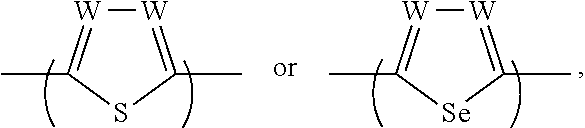
where each W independently can be selected from N, CH, and CR4, wherein R4 can be selected from F, Cl, —CN, R2, OR2, SR2, C(O)R2, OC(O)R2, and C(O)OR2, where R2 is as defined herein. To illustrate further, (Ar)m and (Ar)m′ when present can be independently selected from the group consisting of:


where, for example, each R4 independently is selected from F, Cl, CN, R2, OR2, and SR2, where R2 is a linear or branched C1-40 alkyl or haloalkyl group.

wherein R4 is as defined herein. In particular embodiments, Z can be selected from the group consisting of:
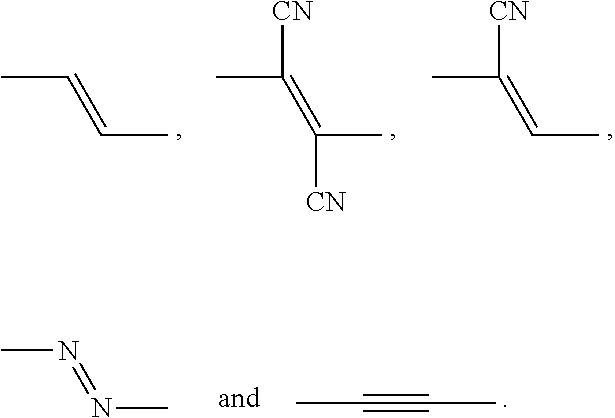

wherein m″ is 1, 2, 3, 4, 5 or 6; and pi-2, Ar, Z, m, m′, m″, p, and p′ are as defined herein.

and
M2 can have the formula:

wherein m″ is 1, 2, 3, or 4; and Ar is as defined herein. For example, M2 can be selected from the group consisting of:


where, for example, each R4 independently is selected from the group consisting of F, Cl, CN, R2, OR2, and SR2, where R2 is a linear or branched C1-40 alkyl or haloalkyl group.

and
M2 can have the formula:

wherein pi-2 can be selected from the group consisting of:


wherein:
Ra is selected from the group consisting of H, F, Cl, —CN, R, —OR, —SR, —C(O)R, —OC(O)R, and —C(O)OR;
Rb is selected from the group consisting of H, R, and -L′-Rf;
Rc is H or R;
Rd is selected from the group consisting of H, F, Cl, —CN, R, —OR, —SR, —C(O)R, —OC(O)R, —C(O)OR, and -L′-Rf;
Re is selected from the group consisting of H, F, Cl, —CN, R, —OR, —SR, —C(O)R, —OC(O)R, —C(O)OR, and Rf;
Rf is a C6-20 aryl group or a 5-20-membered heteroaryl group, each optionally substituted with 1-8 groups independently selected from the group consisting of F, Cl, —CN, R, —OR, and —SR;
L′ is selected from the group consisting of —O—, —S—, —C(O)—, —OC(O)—, —C(O)O—, and a covalent bond; and
R is selected from the group consisting of a C1-40 alkyl group, a C1-40 haloalkyl group, a C2-40 alkenyl group, and a C2-40 alkynyl group.

and
M2 can have the formula:

wherein Ar, pi-2, m and m′ are as defined herein. Preferably, in both M1 and M2, each Ar in (Ar)m and (Ar)m′ independently can be selected from the group consisting of:

where R4 is as defined herein, and pi-2 is selected from the group consisting of:


wherein:
Ra is selected from the group consisting of H, F, Cl, —CN, R, —OR, —SR, —C(O)R, —OC(O)R, and —C(O)OR;
Rb is selected from the group consisting of H, R, and -L′-Rf;
Rc is H or R;
Rd is selected from the group consisting of H, F, Cl, —CN, R, —OR, —SR, —C(O)R, —OC(O)R, —C(O)OR, and -L′-Rf;
Re is selected from the group consisting of H, F, Cl, —CN, R, —OR, —SR, —C(O)R, —OC(O)R, —C(O)OR, and Rf;
Rf is a C6-20 aryl group or a 5-20-membered heteroaryl group, each optionally substituted with 1-8 groups independently selected from the group consisting of F, Cl, —CN, R, —OR, and —SR;
L′ is selected from the group consisting of —O—, —S—, —C(O)—, —OC(O)—, —C(O)O—, and a covalent bond; and
R is selected from the group consisting of a C1-40 alkyl group, a C1-40 haloalkyl group, a C2-40 alkenyl group, and a C2-40 alkynyl group.

wherein m, m′ and m″ independently are 1, 2, 3 or 4; and Ar, pi-2 and Z are as defined herein.

and each M2 repeating unit independently can be selected from the group consisting of:

where pi-2, Ar, m, m′, and m′″ are as defined herein.

where n is an integer ranging from 3 to 1,000. Preferably, each Ar in (Ar)m and (Ar)m′ independently are selected from the group consisting of:

where R4 is selected from the group consisting of a C1-40 alkyl group, a C1-40 alkoxy group, and a C1-40 haloalkyl group; and pi-2 is selected from is selected from the group consisting of:

where Ra and Rd are as defined herein.


with a precursor of M2 represented by

where U and V are complementary polymerizing groups. For example, referring to

with a precursor of M2 represented by


where more specifically, m and m′ are 1 and each Ar is a substituted thiazoly group, the dibromo-monomer below

can be prepared then used in a subsequent polymerization step, e.g., to copolymerize with a repeating unit pi-2 as shown in


wherein:
Q1 and Q2 independently can be selected from the group consisting of:

R5 and R6 independently can be selected from the group consisting of H, R2, OR2, SR2, C(O)R2, OC(O)R2, and C(O)OR2, where R2 is selected from the group consisting of a C1-40 alkyl group, a C2-40 alkenyl group, a C2-40 alkynyl group, and a C1-40 haloalkyl group;
and R1, X, Ar, pi-2, Z, m, m′, m″, p and p′ are as defined herein.


where R4 can be selected from the group consisting of F, Cl, —CN, R2, OR2, SR2, C(O)R2, OC(O)R2, and C(O)OR2, wherein R2 is selected from the group consisting of a C1-40 alkyl group, a C2-40 alkenyl group, a C2-40 alkynyl group, and a C1-40 haloalkyl group;
pi-2 can be an optionally substituted conjugated polycyclic moiety such as:


wherein:
Ra is selected from the group consisting of H, F, Cl, —CN, R, —OR, —SR, —C(O)R, —OC(O)R, and —C(O)OR;
Rb is selected from the group consisting of H, R, and -L′-Rf;
Rc is H or R;
Rd is selected from the group consisting of H, F, Cl, —CN, R, —OR, —SR, —C(O)R, —OC(O)R, —C(O)OR, and -L′-Rf;
Rc is selected from the group consisting of H, F, Cl, —CN, R, —OR, —SR, —C(O)R, —OC(O)R, —C(O)OR, and Rf;
Rf is a C6-20 aryl group or a 5-20-membered heteroaryl group, each optionally substituted with 1-8 groups independently selected from the group consisting of F, Cl, —CN, R, —OR, and —SR;
L′ is selected from the group consisting of —O—, —S—, —C(O)—, —OC(O)—, —C(O)O—, and a covalent bond; and
R is selected from the group consisting of a C1-40 alkyl group, a C1-40 haloalkyl group, a C2-40 alkenyl group, and a C2-40 alkynyl group; and
Z can be a conjugated noncyclic linker optionally selected from the group consisting of:

where R4 can be selected from the group consisting of F, Cl, —CN, R2, OR2, SR2, C(O)R2, OC(O)R2, and C(O)OR2, where R2 is selected from the group consisting of a C1-40 alkyl group, a C2-40 alkenyl group, a C2-40 alkynyl group, and a C1-40 haloalkyl group.

where Q can be absent or Q can be selected from the group consisting of:

R5 and R6 independently can be selected from the group consisting of H, R2, OR2, SR2, C(O)R2, OC(O)R2, and C(O)OR2, where R2 is selected from the group consisting of a C1-40 alkyl group, a C2-40 alkenyl group, a C2-40 alkynyl group, and a C1-40 haloalkyl group; and
X, Ar, pi-2, Z, m, m′, m″, p and p′ are as defined herein.

and X can be S.


wherein each R4 independently can be selected from the group consisting of F, Cl, CN, R2, OR2, and SR2, where R2 is a linear or branched C1-40 alkyl or haloalkyl group.

wherein R4 is selected from the group consisting of F, Cl, —CN, R2, OR2, SR2, C(O)R2, OC(O)R2, and C(O)OR2, and wherein R2 is selected from the group consisting of a C1-40 alkyl group, a C2-40 alkenyl group, a C2-40 alkynyl group, and a C1-40 haloalkyl group.


wherein:
Ra is selected from the group consisting of H, F, Cl, —CN, R, —OR, —SR, —C(O)R, —OC(O)R, and —C(O)OR;
Rb is selected from the group consisting of H, R, and -L′-Rf;
Rc is H or R;
Rd is selected from the group consisting of H, F, Cl, —CN, R, —OR, —SR, —C(O)R, —OC(O)R, —C(O)OR, and -L′-Rf;
Re is selected from the group consisting of H, F, Cl, —CN, R, —OR, —SR, —C(O)R, —OC(O)R, —C(O)OR, and Rf;
Rf is a C6-20 aryl group or a 5-20-membered heteroaryl group, each optionally substituted with 1-8 groups independently selected from the group consisting of F, Cl, —CN, R, —OR, and —SR;
L′ is selected from the group consisting of —O—, —S—, —C(O)—, —OC(O)—, —C(O)O—, and a covalent bond; and
R is selected from the group consisting of a C1-40 alkyl group, a C1-40 haloalkyl group, a C2-40 alkenyl group, and a C2-40 alkynyl group.


Claims (20)


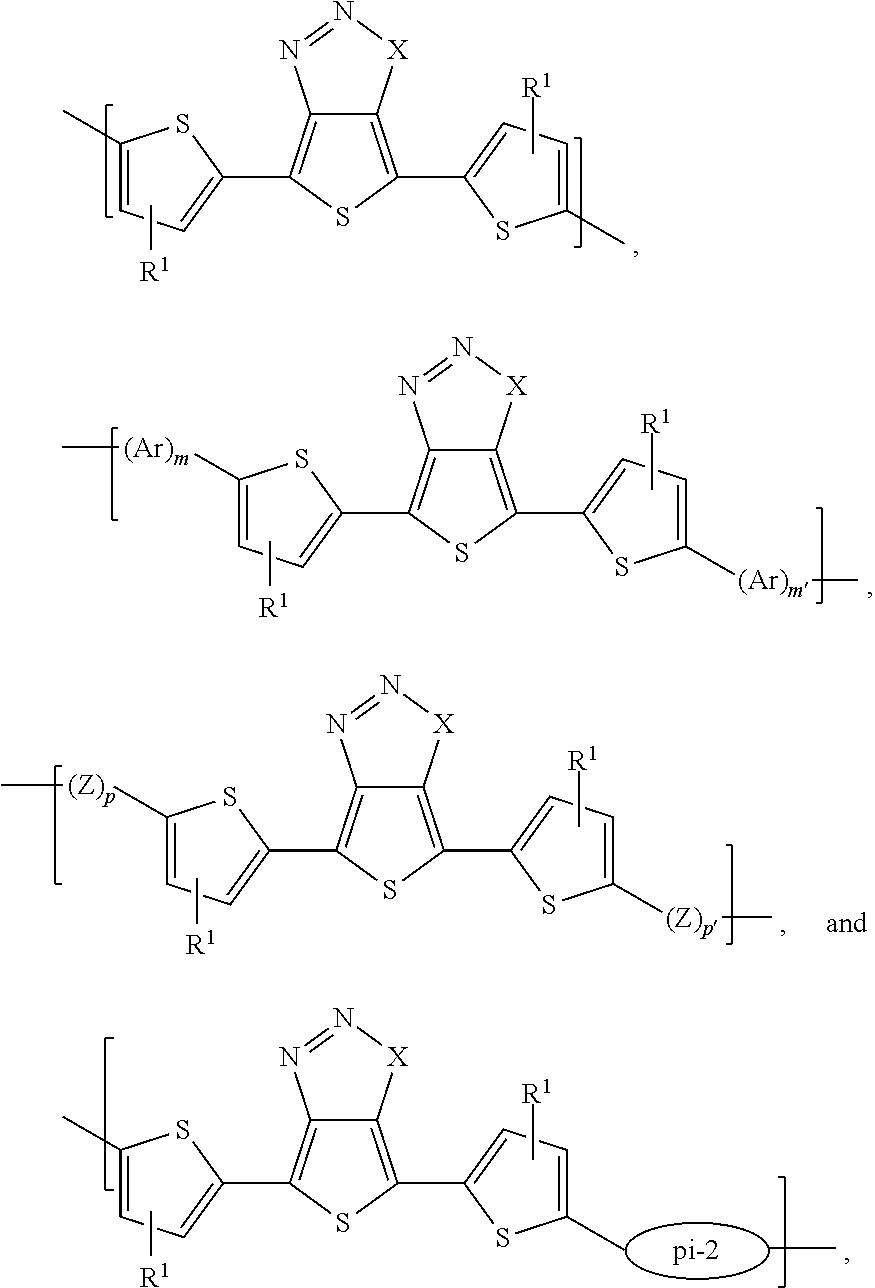


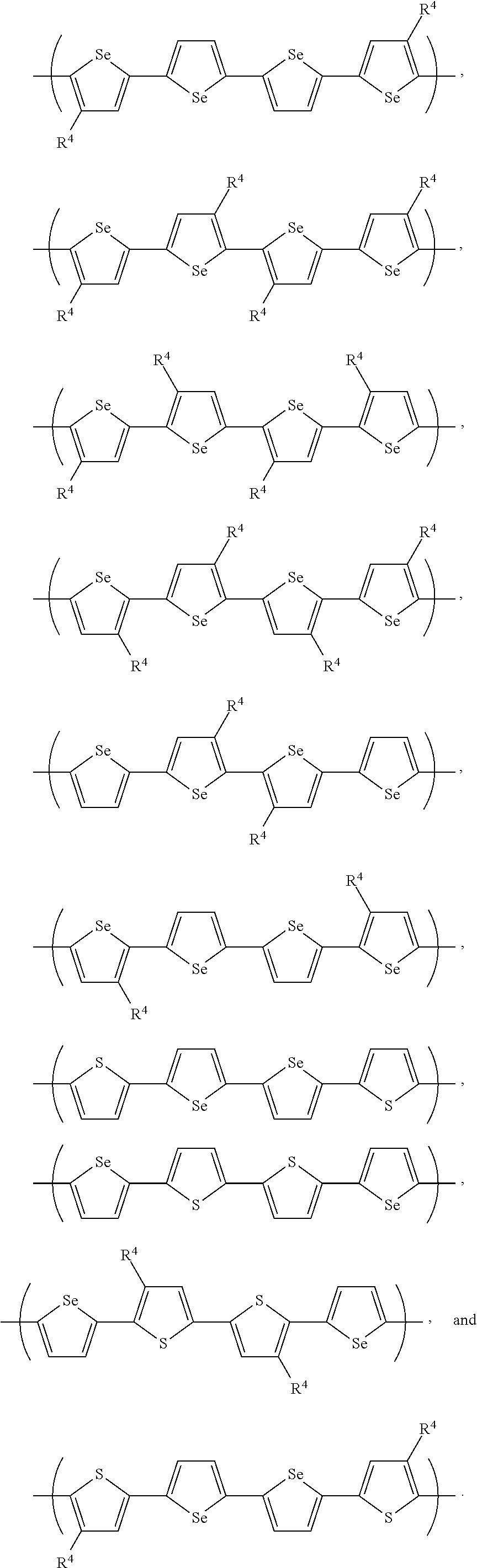


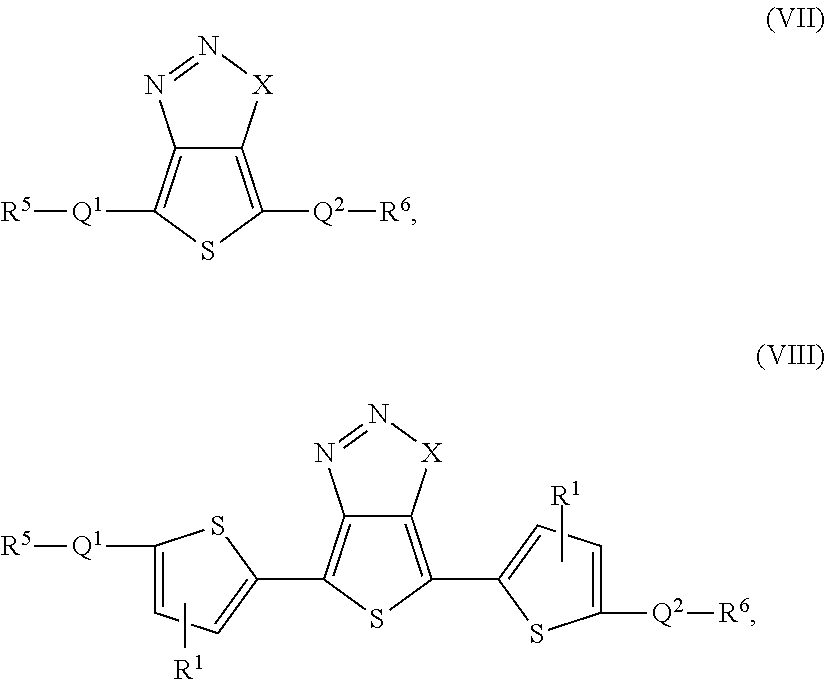


Priority Applications (1)
| Application Number | Priority Date | Filing Date | Title |
|---|---|---|---|
| US15/348,971 US10077262B2 (en) | 2015-11-10 | 2016-11-10 | Thienothiadiazole compounds and related semiconductor devices |
Applications Claiming Priority (2)
| Application Number | Priority Date | Filing Date | Title |
|---|---|---|---|
| US201562253674P | 2015-11-10 | 2015-11-10 | |
| US15/348,971 US10077262B2 (en) | 2015-11-10 | 2016-11-10 | Thienothiadiazole compounds and related semiconductor devices |
Publications (2)
| Publication Number | Publication Date |
|---|---|
| US20170233384A1 US20170233384A1 (en) | 2017-08-17 |
| US10077262B2 true US10077262B2 (en) | 2018-09-18 |
Family
ID=59560136
Family Applications (1)
| Application Number | Title | Priority Date | Filing Date |
|---|---|---|---|
| US15/348,971 Active US10077262B2 (en) | 2015-11-10 | 2016-11-10 | Thienothiadiazole compounds and related semiconductor devices |
Country Status (1)
| Country | Link |
|---|---|
| US (1) | US10077262B2 (en) |
Families Citing this family (4)
| Publication number | Priority date | Publication date | Assignee | Title |
|---|---|---|---|---|
| US10249821B2 (en) * | 2016-07-27 | 2019-04-02 | The Regents Of The University Of California | Formation and structure of lyotropic liquid crystalline mesophases in donor-acceptor semiconducting polymers |
| TWI825907B (en) * | 2021-08-23 | 2023-12-11 | 天光材料科技股份有限公司 | Organic semiconducting compound and organic photoelectric components using the same |
| TWI825908B (en) * | 2021-08-27 | 2023-12-11 | 天光材料科技股份有限公司 | Organic semiconducting compound and organic photoelectric components using the same |
| CN114057774A (en) * | 2021-12-06 | 2022-02-18 | 电子科技大学 | Organic photoelectric molecular material containing thienothiadiazole structure and preparation method and application thereof |
Citations (28)
| Publication number | Priority date | Publication date | Assignee | Title |
|---|---|---|---|---|
| US3457073A (en) | 1965-10-11 | 1969-07-22 | Agfa Gevaert Nv | Photochemical cross-linking of polymers |
| JPS5630264A (en) | 1979-08-22 | 1981-03-26 | Matsushita Electric Ind Co Ltd | Manufacture of active material for positive electrode for battery with nonaqueous electrolyte |
| US4795817A (en) * | 1983-10-18 | 1989-01-03 | E. I. Du Pont De Nemours And Company | 8-substituted pyrazolopentathiepins and related compounds |
| JPH0230070A (en) | 1988-04-20 | 1990-01-31 | Hitachi Maxell Ltd | Organic electrolytic battery and manufacture thereof |
| US5616590A (en) | 1994-06-30 | 1997-04-01 | Ciba-Geigy Corporation | Plant microbicides |
| US6335539B1 (en) | 1999-11-05 | 2002-01-01 | International Business Machines Corporation | Method for improving performance of organic semiconductors in bottom electrode structure |
| US20040058232A1 (en) | 2002-09-23 | 2004-03-25 | Samsung Sdi Co., Ltd. | Negative electrode for lithium battery and lithium battery comprising same |
| US20060289843A1 (en) | 2005-06-28 | 2006-12-28 | Che-Hsiung Hsu | Buffer compositions |
| US20070170401A1 (en) | 2005-12-28 | 2007-07-26 | Che-Hsiung Hsu | Cationic compositions of electrically conducting polymers doped with fully-fluorinated acid polymers |
| US20070202356A1 (en) | 2006-02-28 | 2007-08-30 | Fujifilm Corporation | Organic electroluminescence device |
| US20070298530A1 (en) | 2006-06-05 | 2007-12-27 | Feehery William F | Process for making an organic electronic device |
| US20080061685A1 (en) | 2006-08-24 | 2008-03-13 | Chesterfield Reid J | Organic electronic devices |
| US7354532B2 (en) | 2004-04-13 | 2008-04-08 | E.I. Du Pont De Nemours And Company | Compositions of electrically conductive polymers and non-polymeric fluorinated organic acids |
| US20080191172A1 (en) | 2006-12-29 | 2008-08-14 | Che-Hsiung Hsu | High work-function and high conductivity compositions of electrically conducting polymers |
| WO2010077710A2 (en) | 2008-12-09 | 2010-07-08 | E. I. Du Pont De Nemours And Company | Electrically conductive polymer compositions |
| WO2011098113A2 (en) | 2010-02-15 | 2011-08-18 | Merck Patent Gmbh | Semiconducting polymers |
| US20130026459A1 (en) | 2010-04-28 | 2013-01-31 | Sumitomo Chemical Company, Limited | Polymer compound |
| US8471249B2 (en) | 2011-05-10 | 2013-06-25 | International Business Machines Corporation | Carbon field effect transistors having charged monolayers to reduce parasitic resistance |
| WO2013102035A1 (en) * | 2011-12-30 | 2013-07-04 | University Of Washington | Thienothiadiazole based polymer semiconductors and uses in electronics and optoelectronics |
| US8586766B2 (en) | 2010-02-25 | 2013-11-19 | Mitsubishi Gas Chemical Company, Inc. | Method for producing episulfide compound |
| US8586246B2 (en) | 2008-09-01 | 2013-11-19 | Sony Corporation | Positive electrode active material, positive electrode using the same and non-aqueous electrolyte secondary battery |
| WO2014040572A1 (en) | 2012-09-17 | 2014-03-20 | 华东理工大学 | Insect-resistance inducing effect and use of benzothiadiazole derivative |
| US20140107350A1 (en) | 2011-04-21 | 2014-04-17 | Asahi Kasei Chemicals Corporation | Process for Preparing Episulfide Compounds |
| US20140319509A1 (en) | 2011-11-15 | 2014-10-30 | Konica Minolta, Inc. | Organic photoelectric conversion element, and solar cell and optical sensor array each using same |
| US9045477B2 (en) | 2013-03-15 | 2015-06-02 | Epizyme, Inc. | Substituted 6,5-fused bicyclic heteroaryl compounds |
| WO2016025632A1 (en) | 2014-08-12 | 2016-02-18 | Polyera Corporation | Molecular and polymeric semiconductors and related devices |
| US20170096523A1 (en) | 2015-07-12 | 2017-04-06 | Polyera Corporation | Polymeric Semiconductors and Related Devices |
| US20170110666A1 (en) | 2015-10-19 | 2017-04-20 | Polyera Corporation | Semiconducting Compounds and Related Devices |
-
2016
- 2016-11-10 US US15/348,971 patent/US10077262B2/en active Active
Patent Citations (30)
| Publication number | Priority date | Publication date | Assignee | Title |
|---|---|---|---|---|
| US3457073A (en) | 1965-10-11 | 1969-07-22 | Agfa Gevaert Nv | Photochemical cross-linking of polymers |
| JPS5630264A (en) | 1979-08-22 | 1981-03-26 | Matsushita Electric Ind Co Ltd | Manufacture of active material for positive electrode for battery with nonaqueous electrolyte |
| US4795817A (en) * | 1983-10-18 | 1989-01-03 | E. I. Du Pont De Nemours And Company | 8-substituted pyrazolopentathiepins and related compounds |
| JPH0230070A (en) | 1988-04-20 | 1990-01-31 | Hitachi Maxell Ltd | Organic electrolytic battery and manufacture thereof |
| US5616590A (en) | 1994-06-30 | 1997-04-01 | Ciba-Geigy Corporation | Plant microbicides |
| US6569707B2 (en) | 1999-11-05 | 2003-05-27 | International Business Machines Corporation | Method for improving performance of organic semiconductors in bottom electrode structure |
| US6335539B1 (en) | 1999-11-05 | 2002-01-01 | International Business Machines Corporation | Method for improving performance of organic semiconductors in bottom electrode structure |
| US20040058232A1 (en) | 2002-09-23 | 2004-03-25 | Samsung Sdi Co., Ltd. | Negative electrode for lithium battery and lithium battery comprising same |
| US7354532B2 (en) | 2004-04-13 | 2008-04-08 | E.I. Du Pont De Nemours And Company | Compositions of electrically conductive polymers and non-polymeric fluorinated organic acids |
| US20060289843A1 (en) | 2005-06-28 | 2006-12-28 | Che-Hsiung Hsu | Buffer compositions |
| US20070170401A1 (en) | 2005-12-28 | 2007-07-26 | Che-Hsiung Hsu | Cationic compositions of electrically conducting polymers doped with fully-fluorinated acid polymers |
| US20070202356A1 (en) | 2006-02-28 | 2007-08-30 | Fujifilm Corporation | Organic electroluminescence device |
| US20070298530A1 (en) | 2006-06-05 | 2007-12-27 | Feehery William F | Process for making an organic electronic device |
| US20080061685A1 (en) | 2006-08-24 | 2008-03-13 | Chesterfield Reid J | Organic electronic devices |
| US20080191172A1 (en) | 2006-12-29 | 2008-08-14 | Che-Hsiung Hsu | High work-function and high conductivity compositions of electrically conducting polymers |
| US8586246B2 (en) | 2008-09-01 | 2013-11-19 | Sony Corporation | Positive electrode active material, positive electrode using the same and non-aqueous electrolyte secondary battery |
| WO2010077710A2 (en) | 2008-12-09 | 2010-07-08 | E. I. Du Pont De Nemours And Company | Electrically conductive polymer compositions |
| WO2011098113A2 (en) | 2010-02-15 | 2011-08-18 | Merck Patent Gmbh | Semiconducting polymers |
| US8586766B2 (en) | 2010-02-25 | 2013-11-19 | Mitsubishi Gas Chemical Company, Inc. | Method for producing episulfide compound |
| US20130026459A1 (en) | 2010-04-28 | 2013-01-31 | Sumitomo Chemical Company, Limited | Polymer compound |
| US20140107350A1 (en) | 2011-04-21 | 2014-04-17 | Asahi Kasei Chemicals Corporation | Process for Preparing Episulfide Compounds |
| US8471249B2 (en) | 2011-05-10 | 2013-06-25 | International Business Machines Corporation | Carbon field effect transistors having charged monolayers to reduce parasitic resistance |
| US20140319509A1 (en) | 2011-11-15 | 2014-10-30 | Konica Minolta, Inc. | Organic photoelectric conversion element, and solar cell and optical sensor array each using same |
| WO2013102035A1 (en) * | 2011-12-30 | 2013-07-04 | University Of Washington | Thienothiadiazole based polymer semiconductors and uses in electronics and optoelectronics |
| WO2014040572A1 (en) | 2012-09-17 | 2014-03-20 | 华东理工大学 | Insect-resistance inducing effect and use of benzothiadiazole derivative |
| US9045477B2 (en) | 2013-03-15 | 2015-06-02 | Epizyme, Inc. | Substituted 6,5-fused bicyclic heteroaryl compounds |
| WO2016025632A1 (en) | 2014-08-12 | 2016-02-18 | Polyera Corporation | Molecular and polymeric semiconductors and related devices |
| US20170155053A1 (en) | 2014-08-12 | 2017-06-01 | Flexterra, Inc. | Molecular and Polymeric Semiconductors and Related Devices |
| US20170096523A1 (en) | 2015-07-12 | 2017-04-06 | Polyera Corporation | Polymeric Semiconductors and Related Devices |
| US20170110666A1 (en) | 2015-10-19 | 2017-04-20 | Polyera Corporation | Semiconducting Compounds and Related Devices |
Non-Patent Citations (17)
| Title |
|---|
| Cimrova', et al., Macromol. Symp., 295:65 (Year: 2010). * |
| D. Boudinet et al., "Modification of gold source and drain electrodes by self-assembled monolayer in staggered n- and p-channel organic thin film transistors," Organic Electronics, 11, 227-37 (2010). |
| D. J. Darensbourg et al., "Oxygen/Sulfur Scrambling During the Copolymerization of Cyclopentene Oxide and Carbon Disulfide: Selectivity for Copolymer vs Cylic [Thio]carbonates," Macromolecules, 46, 8202-10 (2013), with supplemental information. |
| G. Maier et al., "Heterocumulenes. 6. C5OS (5-thioxo-1,2,3,4-pentatetraen-1-one) preparation and spectroscopic properties," Chemical Abstracts Service Accession No. 1991:679381 (1991). |
| J. C. Love et al., "Self-Assembled Monolayers of Thiolates on Metals as a Form of Nanotechnology," Chem. Rev., 105, 1103-69 (2005). |
| J.-P. Hong, "Tuning of Ag work functions by self-assembled monolayers of aromatic thiols for an efficient hole injection for solution processed triisopropylsilylethynyl pentacene organic thin film transistors," App. Phys. Letts., 92, 143311 (2008). |
| M. Mirza-Aghayan, "An efficient and improved method for the conversion of oxiranes into thiiranes using graphite oxide," J. Sulfur Chem., 36(1), 30-35 (2014). |
| M.E. Trusova et al., A Green Procedure for the Diazotization-Iodination of Aromatic Amines under Aqueous, Strong-Acid-Free Condition, Synthesis, 2011(13), 2154-58 (2011). |
| M.E. Trusova et al., A Green Procedure for the Diazotization—Iodination of Aromatic Amines under Aqueous, Strong-Acid-Free Condition, Synthesis, 2011(13), 2154-58 (2011). |
| N. Azizi et al., "Odourless Strategy for Deep Eutectic Solvent-Mediated Ring Opening of Epoxides with In Situ Generated S-Alkylisothiournonium Salts," SYNLETT, 2014(25), 2085-88 (2014). |
| N.V. Vereshchagina et al., "Alternative Methods for Production of Alicyclic Epoxides," Petroleum Chemistry (Russia), 54, 207-213 (2014). |
| R. Eisavi et al., "A green protocol for rapid and efficient of converstion of epoxides to thiiranes using alumina immobilized thiourea at solvent-free conditions," Phosphorus, Sulfur, and Silicon, 191(1), 65-69 (2016). |
| R. Eisavi et al., "Magnetically separable nano CuFe2O4: an efficient and reusable heterogeneous catalyst for the green synthesis of thiiranes from epoxides with thiourea," J. Sulfur Chem., 37(5), 537-545 (2016), with supplemental information. |
| U.S. Appl. No. 15/208,303, filed Jul. 12, 2016. |
| U.S. Appl. No. 15/348,949, filed Nov. 10, 2016. |
| U.S. Appl. No. 15/430,535, filed Feb. 12, 2017. |
| X. Chen, "Synthesis of 3-acyl-5,6-dihydro-1,4-oxathiines through ring expansion of thiiranes," Tetrahedron Letters, 58, 1651-54 (2017). |
Also Published As
| Publication number | Publication date |
|---|---|
| US20170233384A1 (en) | 2017-08-17 |
Similar Documents
| Publication | Publication Date | Title |
|---|---|---|
| US8796672B2 (en) | Perylene-imide semiconductor polymers | |
| US8598449B2 (en) | Conjugated polymers and their use in optoelectronic devices | |
| US8772442B2 (en) | Conjugated polymers and their use in optoelectronic devices | |
| US8598448B2 (en) | Pyrrolo[3,2-B]pyrrole semiconducting compounds and devices incorporating same | |
| US8664339B2 (en) | Organic semiconducting polymers | |
| US20120186652A1 (en) | Conjugated Polymers and Their Use in Optoelectronic Devices | |
| US8735536B2 (en) | Naphthobisthiadiazole polymers for use in organic semiconductor devices | |
| US10535822B2 (en) | Molecular and polymeric semiconductors and related devices | |
| US8598305B2 (en) | Conjugated polymers and devices incorporating same | |
| US9029695B2 (en) | Heteroaromatic semiconducting polymers | |
| US20160351815A1 (en) | Phenazine-Based Molecular and Polymeric Semiconductors | |
| US20170233384A1 (en) | Thienothiadiazole Compounds and Related Semiconductor Devices | |
| US9708346B2 (en) | Semiconducting compounds and related devices | |
| US10355213B2 (en) | Dithiophenethiadiazole semiconductors and related devices | |
| US10115902B2 (en) | Azinothiadiazole compounds and related semiconductor devices | |
| US8993711B2 (en) | Semiconducting polymers and optoelectronic devices incorporating same | |
| US10381567B2 (en) | Organic semiconducting compounds and related optoelectronic devices | |
| US9908967B2 (en) | Polymeric semiconductors and related devices | |
| US9666805B2 (en) | Bithiophene sulfonamide-based molecular and polymeric semiconductors |
Legal Events
| Date | Code | Title | Description |
|---|---|---|---|
| AS | Assignment |
Owner name: POLYERA CORPORATION, ILLINOIS Free format text: ASSIGNMENT OF ASSIGNORS INTEREST;ASSIGNORS:FACCHETTI, ANTONIO;CHEN, ZHIHUA;REEL/FRAME:041197/0521 Effective date: 20160717 Owner name: FLEXTERRA, INC., ILLINOIS Free format text: ASSIGNMENT OF ASSIGNORS INTEREST;ASSIGNOR:POLYERA CORPORATION;REEL/FRAME:041197/0650 Effective date: 20161221 |
|
| FEPP | Fee payment procedure |
Free format text: ENTITY STATUS SET TO UNDISCOUNTED (ORIGINAL EVENT CODE: BIG.); ENTITY STATUS OF PATENT OWNER: LARGE ENTITY |
|
| STCF | Information on status: patent grant |
Free format text: PATENTED CASE |
|
| AS | Assignment |
Owner name: SAES GETTERS INTERNATIONAL LUXEMBOURG S.A., IN ITS CAPACITY AS COLLATERAL AGENT, LUXEMBOURG Free format text: SECURITY INTEREST;ASSIGNOR:FLEXTERRA, INC.;REEL/FRAME:058226/0591 Effective date: 20200716 |
|
| MAFP | Maintenance fee payment |
Free format text: PAYMENT OF MAINTENANCE FEE, 4TH YEAR, LARGE ENTITY (ORIGINAL EVENT CODE: M1551); ENTITY STATUS OF PATENT OWNER: LARGE ENTITY Year of fee payment: 4 |
|
| AS | Assignment |
Owner name: SAES GETTERS INTERNATIONAL LUXEMBOURG S.A., IN ITS CAPACITY AS COLLATERAL AGENT, LUXEMBOURG Free format text: SECURITY INTEREST;ASSIGNOR:FLEXTERRA, INC.;REEL/FRAME:069191/0563 Effective date: 20220603 |
|
| AS | Assignment |
Owner name: USINVEST LLC, COLORADO Free format text: ASSIGNMENT OF ASSIGNORS INTEREST;ASSIGNOR:FLEXTERRA, INC.;REEL/FRAME:073464/0376 Effective date: 20251028 |
|
| AS | Assignment |
Owner name: USINVEST, LLC, COLORADO Free format text: ASSET PURCHASE AGREEMENT;ASSIGNORS:FLEXTERRA, INC.;FLEXTERRA TAIWAN CORPORATION LIMITED;REEL/FRAME:073948/0751 Effective date: 20251008 |
|
| MAFP | Maintenance fee payment |
Free format text: PAYMENT OF MAINTENANCE FEE, 8TH YEAR, LARGE ENTITY (ORIGINAL EVENT CODE: M1552); ENTITY STATUS OF PATENT OWNER: LARGE ENTITY Year of fee payment: 8 |