US10074082B2 - Splitting a purchase among multiple parties using an electronic receipt after the transaction - Google Patents
Splitting a purchase among multiple parties using an electronic receipt after the transaction Download PDFInfo
- Publication number
- US10074082B2 US10074082B2 US13/691,665 US201213691665A US10074082B2 US 10074082 B2 US10074082 B2 US 10074082B2 US 201213691665 A US201213691665 A US 201213691665A US 10074082 B2 US10074082 B2 US 10074082B2
- Authority
- US
- United States
- Prior art keywords
- bill
- person
- suggested
- electronic device
- persons
- Prior art date
- Legal status (The legal status is an assumption and is not a legal conclusion. Google has not performed a legal analysis and makes no representation as to the accuracy of the status listed.)
- Active, expires
Links
Images




Classifications
-
- G—PHYSICS
- G06—COMPUTING OR CALCULATING; COUNTING
- G06Q—INFORMATION AND COMMUNICATION TECHNOLOGY [ICT] SPECIALLY ADAPTED FOR ADMINISTRATIVE, COMMERCIAL, FINANCIAL, MANAGERIAL OR SUPERVISORY PURPOSES; SYSTEMS OR METHODS SPECIALLY ADAPTED FOR ADMINISTRATIVE, COMMERCIAL, FINANCIAL, MANAGERIAL OR SUPERVISORY PURPOSES, NOT OTHERWISE PROVIDED FOR
- G06Q20/00—Payment architectures, schemes or protocols
- G06Q20/08—Payment architectures
- G06Q20/10—Payment architectures specially adapted for electronic funds transfer [EFT] systems; specially adapted for home banking systems
- G06Q20/102—Bill distribution or payments
-
- G—PHYSICS
- G06—COMPUTING OR CALCULATING; COUNTING
- G06Q—INFORMATION AND COMMUNICATION TECHNOLOGY [ICT] SPECIALLY ADAPTED FOR ADMINISTRATIVE, COMMERCIAL, FINANCIAL, MANAGERIAL OR SUPERVISORY PURPOSES; SYSTEMS OR METHODS SPECIALLY ADAPTED FOR ADMINISTRATIVE, COMMERCIAL, FINANCIAL, MANAGERIAL OR SUPERVISORY PURPOSES, NOT OTHERWISE PROVIDED FOR
- G06Q20/00—Payment architectures, schemes or protocols
- G06Q20/08—Payment architectures
- G06Q20/20—Point-of-sale [POS] network systems
- G06Q20/209—Specified transaction journal output feature, e.g. printed receipt or voice output
-
- G—PHYSICS
- G06—COMPUTING OR CALCULATING; COUNTING
- G06Q—INFORMATION AND COMMUNICATION TECHNOLOGY [ICT] SPECIALLY ADAPTED FOR ADMINISTRATIVE, COMMERCIAL, FINANCIAL, MANAGERIAL OR SUPERVISORY PURPOSES; SYSTEMS OR METHODS SPECIALLY ADAPTED FOR ADMINISTRATIVE, COMMERCIAL, FINANCIAL, MANAGERIAL OR SUPERVISORY PURPOSES, NOT OTHERWISE PROVIDED FOR
- G06Q20/00—Payment architectures, schemes or protocols
- G06Q20/30—Payment architectures, schemes or protocols characterised by the use of specific devices or networks
- G06Q20/32—Payment architectures, schemes or protocols characterised by the use of specific devices or networks using wireless devices
- G06Q20/322—Aspects of commerce using mobile devices [M-devices]
- G06Q20/3227—Aspects of commerce using mobile devices [M-devices] using secure elements embedded in M-devices
-
- G—PHYSICS
- G06—COMPUTING OR CALCULATING; COUNTING
- G06Q—INFORMATION AND COMMUNICATION TECHNOLOGY [ICT] SPECIALLY ADAPTED FOR ADMINISTRATIVE, COMMERCIAL, FINANCIAL, MANAGERIAL OR SUPERVISORY PURPOSES; SYSTEMS OR METHODS SPECIALLY ADAPTED FOR ADMINISTRATIVE, COMMERCIAL, FINANCIAL, MANAGERIAL OR SUPERVISORY PURPOSES, NOT OTHERWISE PROVIDED FOR
- G06Q20/00—Payment architectures, schemes or protocols
- G06Q20/30—Payment architectures, schemes or protocols characterised by the use of specific devices or networks
- G06Q20/32—Payment architectures, schemes or protocols characterised by the use of specific devices or networks using wireless devices
- G06Q20/327—Short range or proximity payments by means of M-devices
- G06Q20/3274—Short range or proximity payments by means of M-devices using a pictured code, e.g. barcode or QR-code, being displayed on the M-device
-
- G—PHYSICS
- G06—COMPUTING OR CALCULATING; COUNTING
- G06Q—INFORMATION AND COMMUNICATION TECHNOLOGY [ICT] SPECIALLY ADAPTED FOR ADMINISTRATIVE, COMMERCIAL, FINANCIAL, MANAGERIAL OR SUPERVISORY PURPOSES; SYSTEMS OR METHODS SPECIALLY ADAPTED FOR ADMINISTRATIVE, COMMERCIAL, FINANCIAL, MANAGERIAL OR SUPERVISORY PURPOSES, NOT OTHERWISE PROVIDED FOR
- G06Q20/00—Payment architectures, schemes or protocols
- G06Q20/30—Payment architectures, schemes or protocols characterised by the use of specific devices or networks
- G06Q20/32—Payment architectures, schemes or protocols characterised by the use of specific devices or networks using wireless devices
- G06Q20/327—Short range or proximity payments by means of M-devices
- G06Q20/3276—Short range or proximity payments by means of M-devices using a pictured code, e.g. barcode or QR-code, being read by the M-device
-
- G—PHYSICS
- G07—CHECKING-DEVICES
- G07G—REGISTERING THE RECEIPT OF CASH, VALUABLES, OR TOKENS
- G07G1/00—Cash registers
- G07G1/0036—Checkout procedures
- G07G1/0045—Checkout procedures with a code reader for reading of an identifying code of the article to be registered, e.g. barcode reader or radio-frequency identity [RFID] reader
- G07G1/0081—Checkout procedures with a code reader for reading of an identifying code of the article to be registered, e.g. barcode reader or radio-frequency identity [RFID] reader the reader being a portable scanner or data reader
Definitions
- This invention relates to receipts and receipt management systems and more particularly to an approach for allowing a customer to split a receipt, bill, or shopping cart with other people.
- POS point-of-sale
- current POS systems are limited in their ability to handle electronic receipts and to facilitate management of receipts for transactions which generated electronic receipts.
- adoption of electronic receipts is hindered or prevented by the inability to provide the functionality associated with a paper receipts or to adequately manage electronic receipts, and in particular for sharing a bill or the purchase of a cart of items among users of different devices.
- the invention provides such an approach in an elegant manner.
- FIG. 1 is a schematic block diagram of one embodiment of a receipt viewed on a mobile electronic device
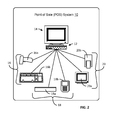
- FIG. 2 is a schematic block diagram of one embodiment of a point-of-sale (POS) system having the capability to allow splitting of receipts, bills, and purchases among customers;
- POS point-of-sale
- FIG. 3 is a schematic block diagram of one embodiment of multiple POS systems operating in the context of an enterprise-wide system
- FIG. 4 is a block diagram illustrating the flow of data within one embodiment
- FIG. 5 is a block diagram of one embodiment of a method for splitting a receipt
- FIG. 6 is a block diagram of one embodiment of a method for splitting a receipt
- FIG. 7 is a schematic block diagram of one embodiment of a receipt viewed on a mobile electronic device
- FIG. 8 is a schematic block diagram of one embodiment of a receipt viewed on a mobile electronic device.
- FIG. 9 is a schematic block diagram of one embodiment of a receipts sharing module.
- the invention has been developed in response to the present state of the art and, in particular, in response to the problems and needs in the art that have not yet been fully solved by currently available apparatus and methods. Accordingly, a novel approach is provided for managing receipts and in particular for sharing or splitting a bill, shopping cart, or purchase with friends and other persons. For simplicity, this will typically be referred to herein simply as splitting a receipt.
- a customer may utilize a mobile electronic device, such as a smart phone or tablet.
- a mobile electronic device such as a smart phone or tablet.
- an electronic receipt 46 may be displayed or managed on a mobile electronic device 68 .
- the device 68 may include receipt management software which allows the customer to receive electronic receipts on and manage receipts with the mobile electronic device 68 .
- the software may allow the customer to interface with the electronic receipt, with a store point of sale (POS) system, and with a back office/supervisory receipts management system.
- the electronic receipt software and/or the receipts management system may allow the customer to share or split a receipt, bill, or shopping cart among other people such as among different users of mobile electronic devices.
- the customer may select a person to split a receipt with, and may split the costs associated with that receipt with this person.
- An electronic receipt 46 may include a list of items 52 which may show the items purchased on that receipt and which may show the cost of those items.
- the receipt may also display the taxes or other surcharges 54 and the after tax total 56 .
- the electronic receipt 46 may be displayed in a manner similar to a paper receipt in this regard.
- the receipt management software may display the electronic receipt 46 with a button 76 to allow the customer to split the receipt among other persons.
- such a receipt 46 is for an event or purpose which is shared among a group of people.
- the receipt may include items for a party, a meal purchase, items for a trip, etc.
- the customer may allocate different items among one or more other persons to split the receipt and determine how much each person should pay. Different allocation methods may be used to divide the receipt/item cost in a manner agreed upon by the various people.
- the receipt management software may send notifications to individuals indicating how much they should pay, and in some cases who they should pay.
- the receipt management software may assist persons with payment of their portion of the receipt.
- a receipts management system may facilitate communication with the customer and others and may allow the customer to split receipts among other persons.
- Various parts of a receipts management system are described to illustrate how these may allow a customer to manage electronic receipts, and more particularly to split receipts among other people.
- a machine-readable code may be used to interact between the customer's mobile electronic device, receipts, a receipts management server, and/or the POS system.
- the machine readable code may comprise a conventional barcode or a two-dimensional barcode (e.g., a Quick Response (QR) Code).
- QR Quick Response
- the data encoded within a machine-readable code may vary between different embodiments and different purposes or goals of the embodiment.
- a machine-readable code may encode a transaction identification (ID) uniquely identifying a particular transaction (e.g., purchase, return, or the like).
- ID transaction identification
- a machine-readable code may encode data regarding the POS terminal and/or the store where the terminal is located.
- a machine readable code may facilitate the installation of electronic receipts software by the customer or other persons known to the customer.
- a machine readable code may be accompanied by an alpha-numeric code.
- a customer may obtain electronic receipts and manage electronic receipts through an account established with a receipt management server. The customer's mobile device telephone number, member number, etc. may be used to identify the customer and to deliver electronic receipts to the customer or otherwise interact with the customer.
- a receipts system In general, the purpose of a receipts system is to facilitate the handling of receipts in a manner which is convenient to the customer and which allows a customer to easily perform desired management tasks related to receipts such as accounting, cost allocation, and splitting receipts.
- desired management tasks related to receipts such as accounting, cost allocation, and splitting receipts.
- the use of electronic receipts may create challenges when a customer needs to perform subsequent receipt management functions such as splitting receipts with friends or other persons.
- Embodiments in accordance with the invention may be embodied as an apparatus, system, device, method, computer program product, or other entity. Accordingly, the invention may take the form of an entirely hardware embodiment, an entirely software embodiment (including firmware, resident software, micro-code, etc.), or an embodiment combining software and hardware aspects that may all generally be referred to herein as a “module” or “system.” Furthermore, the invention may take the form of a computer program product embodied in any tangible medium of expression having computer-usable program code embodied in the medium.
- a computer-readable medium may include one or more of a portable computer diskette, a hard disk, a random access memory (RAM) device, a read-only memory (ROM) device, an erasable programmable read-only memory (EPROM or Flash memory) device, a portable compact disc read-only memory (CDROM), an optical storage device, and a magnetic storage device.
- a computer-readable medium may comprise any non-transitory medium that can contain, store, communicate, propagate, or transport the program for use by or in connection with the instruction execution system, apparatus, or device.
- Computer program code for carrying out operations of embodiments described herein may be written in any combination of one or more programming languages, including an object-oriented programming language such as Java, Smalltalk, C++, or the like and conventional procedural programming languages, such as the “C” programming language or similar programming languages.
- the program code may execute entirely on a computer of a point-of-sale (POS) system, partly on a POS computer, as a stand-alone software package, on a stand-alone hardware unit, partly on a remote computer spaced some distance from the POS computer, or entirely on a remote computer or server.
- POS point-of-sale
- the remote computer may be connected to the POS computer through any type of network, including a local area network (LAN) or a wide area network (WAN), or the connection may be made to an external computer (e.g., through the Internet using an Internet Service Provider).
- LAN local area network
- WAN wide area network
- Embodiments can also be implemented in cloud computing environments.
- cloud computing is defined as a model for enabling ubiquitous, convenient, on-demand network access to a shared pool of configurable computing resources (e.g., networks, servers, storage, applications, and services) that can be rapidly provisioned via virtualization and released with minimal management effort or service provider interaction, and then scaled accordingly.
- configurable computing resources e.g., networks, servers, storage, applications, and services
- a cloud model can be composed of various characteristics (e.g., on-demand self-service, broad network access, resource pooling, rapid elasticity, measured service, etc.), service models (e.g., Software as a Service (“SaaS”), Platform as a Service (“PaaS”), Infrastructure as a Service (“IaaS”), and deployment models (e.g., private cloud, community cloud, public cloud, hybrid cloud, etc.).
- service models e.g., Software as a Service (“SaaS”), Platform as a Service (“PaaS”), Infrastructure as a Service (“IaaS”)
- deployment models e.g., private cloud, community cloud, public cloud, hybrid cloud, etc.
- These computer program instructions may also be stored in a computer-readable medium that can direct a computer or other programmable data processing apparatus to function in a particular manner, such that the instructions stored in the computer-readable medium produce an article of manufacture including instruction means which implement the function/act specified in the flowchart and/or block diagram block or blocks.
- the computer program instructions may also be loaded onto a computer or other programmable data processing apparatus to cause a series of operational steps to be performed on the computer or other programmable apparatus to produce a computer implemented process such that the instructions which execute on the computer or other programmable apparatus provide processes for implementing the functions/acts specified in the flowchart and/or block diagram block or blocks.
- a POS system 10 may be configured to implement one or more methods in accordance with embodiments described herein.
- a POS system 10 may be manufactured, programmed, modified, or upgraded to support providing electronic receipts to customers and to facilitate subsequent management of the receipt.
- a POS system may allow a customer to split a receipt with other persons.
- the system may involve one or more parts of a local POS terminal and associated computers or servers, remote computers or servers, customer devices such as a mobile electronic device, and associated equipment.
- a POS system 10 may include various components.
- a POS system 10 may include a central or primary computer 12 , a monitor 14 (e.g., a cashier-facing monitor 14 ), one or more input devices 16 (e.g., scanners 16 a , keyboards 16 b , scales, or the like), one or more payment devices 18 (e.g., cash drawers 18 a , card readers 18 b ) for receiving or returning payments, one or more output devices 20 (e.g., customer-facing display 20 a or monitor 20 a , receipt printer 20 b ), or the like or combinations or sub-combinations thereof.
- input devices 16 e.g., scanners 16 a , keyboards 16 b , scales, or the like
- payment devices 18 e.g., cash drawers 18 a , card readers 18 b
- output devices 20 e.g., customer-facing display 20 a or monitor 20 a , receipt printer 20 b
- a computer 12 may form the primary processing unit of a POS system 10 .
- Other components 16 , 18 , 20 forming part of a POS system 10 may communicate with the computer 12 .
- Input devices 16 and certain payment devices 18 may feed data and commands to a computer 12 for processing or implementation.
- a scanner 16 a may pass data communicating the identity of one or more items to be purchased, returned, or the like to a computer 12 .
- a card reader 18 b may pass payment information to a computer 12 .
- output devices 20 and certain payment devices 18 may follow or implement commands issued by a computer 12 .
- a cash drawer 18 a may open in accordance with the commands of a computer 12 .
- a customer-facing display 20 a and receipt printer 20 b may display or output data or information as instructed by a computer 12 .
- a POS system 10 may also provide or support certain “back office” functionality.
- a POS system 10 may provide or support inventory control, purchasing, receiving and transferring products, or the like.
- a POS system 10 may also store sales and customer information for reporting purposes, marketing purposes, receivables management, trend analysis, cost analysis, price analysis, profit analysis, or the like.
- a POS system 10 may include an accounting interface to pass certain information to one or more in-house or independent accounting applications.
- a POS system 10 may also communicate with third parties and may transmit receipt information and facilitate customer management of receipts.
- a POS system 10 may operate substantially independently, as a stand-alone unit.
- a POS system 10 may be one of several POS systems 10 forming the front line of a larger system.
- multiple POS systems 10 may operate at a particular location 22 (e.g., within a retail, brick-and-mortar store).
- the various POS systems 10 may be interconnected via a LAN 24 .
- a LAN 24 may also connect the POS systems 10 to a local server 26 .
- a local server 26 may support the operation of the associated POS systems 10 .
- a server 26 may provide a central repository from which certain data needed by the associated POS systems 10 may be stored, indexed, accessed, or the like.
- a server 26 may serve certain software to one or more POS systems 10 .
- a POS system 10 may offload certain tasks, computations, verifications, or the like to a server 26 .
- a server 26 may support certain back office functionality.
- a server 26 may receive and compile (e.g., within one or more associated databases 28 ) data from the various associated POS systems 10 to provide or support inventory control, purchasing, receiving and transferring products, or the like.
- a server 26 may also receive and compile sales and customer information for reporting purposes, marketing purposes, receivables management, trend analysis, cost analysis, price analysis, profit analysis, or the like.
- one or more POS systems 10 or servers 26 corresponding to a particular location 22 may communicate with or access one or more remote computers or resources via one or more network devices 30 .
- a network device 30 may enable a POS system 10 to contact outside resources and verify the payment credentials (e.g., credit card information) provided by a customer.
- a network device 30 may comprise a modem, router, or the like.
- a POS system 10 may operate within an enterprise-wide system 31 comprising multiple locations 22 (e.g., branches 22 or stores 22 ).
- each location 22 may have one or more POS systems 10 , local servers 26 , local databases 28 , network devices 30 , or the like or combinations or sub-combinations thereof connected by a computer network (e.g., a LAN 24 ).
- each such location 22 may be configured to interact with one or more supervisory systems 32 .
- multiple branch locations 22 may report to an associated “headquarters” location or system 32 .
- a supervisory system 32 may comprise one or more supervisory servers 34 , databases 36 , workstations 38 , network devices 40 , or the like or combinations or sub-combinations thereof.
- the various components of a supervisory system 32 may be interconnected via a computer network (e.g., a LAN 42 ).
- a supervisory system 32 may comprise one or more supervisory servers 34 providing a central repository from which certain data needed by the one or more POS systems 10 or local servers 26 may be stored, indexed, accessed, or the like.
- a supervisory server 34 may receive and compile (e.g., within one or more associated databases 36 ) data from the various associated POS systems 10 or local servers 26 to provide or support inventory control, purchasing, receiving and transferring products, or the like.
- a supervisory server 34 may also receive and compile sales and customer information for reporting purposes, marketing purposes, receivables management, trend analysis, cost analysis, price analysis, profit analysis, or the like.
- a supervisory system 32 may be connected to one or more associated locations 22 or branches 22 in via any suitable computer network 44 (e.g., WAN 44 ).
- any suitable computer network 44 e.g., WAN 44
- one or more locations 22 may connect to a supervisor system 32 via the Internet.
- Communication over such a network 44 may follow any suitable protocol or security scheme.
- communication may utilize the File Transfer Protocol (FTP), a virtual private network (VPN), intranet, or the like.
- FTP File Transfer Protocol
- VPN virtual private network
- intranet or the like.
- POS terminals and servers may be implemented in a system contained within a single location or across multiple locations.
- a server or computer such as storing, processing, and transmitting/sending receipt information, may be accomplished by a local computer or a remote computer such as servers 26 and 34 .
- a customer may download or may already have downloaded electronic receipts software to a mobile electronic device 68 A.
- the mobile electronic device 68 A may be a smart phone, tablet PC, etc.
- a customer may have previously received a paper receipt 48 which includes an invitation such as a 2d barcode 50 to use electronic receipts instead of paper receipts and may have installed electronic receipts software on the mobile electronic device 68 A.
- the customer may have an account with the computer server 34 and may transmit information to the server 34 .
- server 34 may be implemented by server 26 , etc.
- the computer server 34 may likewise transmit information to the mobile device 68 A.
- the customer may receive electronic receipts on the mobile device 68 A and the electronic receipts software on the mobile device 68 A may enable them to manage electronic receipts. Additionally, the electronic receipts software may allow the customer to interact with a POS system 10 and with other persons via the mobile electronic device 68 A.
- one or more additional persons associated with the customer may have an electronic device 68 B which has electronic receipts software.
- the receipts management software may allow the customer to manage electronic receipts through interactions with other persons known to them. These other persons may have previously received a paper receipt 48 which includes an invitation to use electronic receipts instead of paper receipts and may have installed electronic receipts software on the mobile electronic device 68 B.
- Both the customer and the additional person(s) may have created an account with the receipts management server.
- the account may include a login such that the account is secure.
- the account and/or account creation process may facilitate verification of the person's identity and/or contact information, such as their email address or phone number.
- the account information may include a verified telephone number for a mobile electronic device.
- the customer may send an invitation to these other persons inviting them to download electronic receipts software, or may send a notification to these other persons that they desire to share a receipt with them and inviting them to download receipts management software and similarly create an account, etc. with the server 34 to allow them to manage electronic receipts in the manner discussed herein.
- the receipts system may allow a customer to easily communicate with other person via mobile electronic devices 68 A, 68 B.
- the customer may create account settings with an account with a receipts management server 34 or personalized settings within receipt management software on their device 68 B. These settings may include contact information for other persons including information such as their name and also information such as a preferred method of delivering messages and the like to that person.
- the preferred method of delivering messages may be a text message and the software may thus store the device telephone number.
- the preferred method of communication may be through email, and the software may store an email address for this person.
- the receipt management software may also include bank account information for the person.
- the software may include account or routing information for a person sufficient to allow that person to send or approve a message to their bank to transfer money to another person as desired. Payments may also be similarly implemented through various other payment businesses and peer to peer payment systems.
- a customer may first make a purchase 92 .
- the customer may then obtain 94 an electronic receipt 46 for that purchase.
- the customer typically has receipt management software on a mobile electronic device 68 A. If the customer determines 96 that the receipt should be split, they may open 98 receipt management software on the device and view the receipt 74 on the electronic device 68 A.
- the customer may then press 100 a button on the device to split the receipt.
- the button may be a digital button or menu command created by the receipt management software.
- the electronic receipt 46 is typically displayed on the mobile electronic device in a manner which shows the items 52 which were purchased.
- the customer may select 102 which items on the receipt 46 need to be split. This may be accomplished in different ways.
- the customer may select all items on the receipt to split together.
- the customer may select a group of items on the receipt to split together.
- the customer may also select individual items on the receipt to split.
- the customer may select items on the receipt 46 in different combinations of the above. By way of example, the customer may select a group of items to be split in one way and select another item of group of items to be split in a different way.
- the customer may then select 104 one or more individuals associated with an item(s).
- one person could be associated to certain items on a receipt. Multiple persons could be associated with other items on a receipt.
- the customer may select 106 how the item(s) are split. It is understood that in the present application, split refers to how the cost of one or more items is allocated among themselves and also among one or more other people. Where a single person is associated with an item or group of items, the software may automatically assign 100% of the cost of that item to that person. Where no person has been assigned to an item, the receipt management software may allocate 100% of the cost of that item to the customer who paid for the purchase associated with the receipt 46 .
- the customer may decide how the item or group of items is allocated among the persons associated with that item.
- the customer may decide that the cost of that item should be allocated equally between the persons associated with that item.
- the customer may also decide that the cost of that item should be allocated in a different manner, and may enter a percentage allocation for the item or group.
- the customer may enter a percentage as a number into the receipt management software for each person; all of the percentages adding up to 100%.
- the software may also provide one or more bars or scales with a slider between 0 and 100 to allocate a portion of that item cost to a person.
- the receipt management software may show 108 the totals of the split receipt, showing the total cost for each person associated with the receipt.
- the receipt management software may also send 110 notifications to the persons associated with the receipt.
- the software or server 34 may have contact information for the different persons saved therein. These contacts may be selected when a customer associates items on the receipts with persons. The customer may press a button or otherwise enter a command to send a message to the other persons. The message may be sent via text or email and may show how much they owe for that purchase. The message could have a link to a website to show the breakdown of cost allocation for the receipt 46 .
- the receipts management server 34 may provide this webpage and provide this information to the persons.
- the message may provide an invitation to get the receipt management software. Additionally, the receipt management system may facilitate 112 providing payment to the customer for the purchase associated with the receipt. Particularly where other persons have receipt management software and have created an account, they may have provided routing information for their bank and may have set up transfer processes to pay money to the customer. The message may include a link or command to pay the designated amount to the customer for the receipt. If they approve of the allocation, the person may initiate a transfer of money to the customer via the message.
- a second process 114 for splitting a purchase is shown. As discussed above, it may be common for a person to make a purchase, receive an electronic receipt, and then allocate costs among different person for that purchase. It may also be common for a customer to allocate costs among different persons before completing a purchase. This may be the case when the customer creates an electronic shopping cart of items on their mobile electronic device 68 A, or where a bill is presented to a customer in receipt format.
- a customer may (typically with the other persons in a group) first receive 116 an unpaid receipt bill.
- the receipt bill refers to a bill which is presented to the customer, often in the format of a receipt.
- the receipt bill may be viewed on the mobile electronic device in a manner similar to the receipt 46 .
- the receipt bill may be from a restaurant, for example, after a customer and group of one or more other persons has eaten at the restaurant.
- the bill may include a 2D barcode such as a QR code.
- the barcode may allow the customer to scan the barcode and thereby obtain an electronic copy of the bill.
- the scanning the barcode may cause the mobile electronic device to obtain the bill from a receipts management server 34 .
- the barcode may include the bill information embedded therein in a format known to the receipt management software such as delineated text or values.
- the customer may capture the barcode with a camera on the mobile electronic device and, from the barcode, the software may have the data necessary to construct a version of the bill electronically and allow the customer to split the bill or otherwise mange the bill.
- the receipt bill may also be in the format of a shopping cart of selected items for purchase.
- the customer may utilize a mobile electronic device 68 A, such as a smart phone or tablet computer, while shopping at a brick and mortar store to create a shopping cart of items for purchase.
- Mobile self-checkout software loaded on the electronic device 68 A may facilitate this.
- the customer may create a shopping cart of items which are selected for purchase by using the mobile electronic device camera to capture a UPC code on each item.
- the mobile self-checkout software may, from the UPC code, obtain and store information regarding the product and may then allow the customer to enter a quantity of the item for purchase and the price for the item if necessary.
- the customer may proceed in this manner while shopping; selecting items for purchase, scanning the UPC code associated with that item, and creating a digital shopping cart on the mobile electronic device 68 which includes a list of items selected for purchase.
- the customer may allocate the item costs among the persons associated with the receipt.
- the customer may allocate the items among different persons before checkout as these items are added to the shopping cart.
- the receipt bill is from a restaurant or the like, the customer may allocate the items after receiving the receipt bill.
- the customer may open 120 receipt management software on the device and view the receipt bill on the electronic device 68 A.
- the customer may then press 122 a button on the device to split the receipt.
- the button may be a digital button or menu command created by the receipt management software.
- the receipt bill may be displayed similar to how an electronic receipt 46 is displayed on the mobile electronic device; i.e. in a manner which shows the items 52 which are selected for purchase.
- the customer may select 124 which items on the receipt 46 need to be split. This may be accomplished in different ways.
- the customer may select all items on the receipt to split together.
- the customer may select a group of items on the receipt to split together.
- the customer may also select individual items on the receipt to split.
- the customer may select items on the receipt 46 in different combinations of the above. By way of example, the customer may select a group of items to be split in one way and select another item of group of items to be split in a different way.
- the customer may then select 126 one or more individuals associated with an item or group of items.
- one person could be associated to certain items on a receipt. Multiple persons could be associated with other items on a receipt.
- the customer may select 128 how the item or group of items are split. It is understood that in the present application, split refers to how the cost of one or more items is allocated among themselves and also among one or more other people. Where a single person is associated with an item or group of items, the software may automatically assign 100% of the cost of that item to that person. Where no person has been assigned to an item, the receipt management software may allocate 100% of the cost of that item to the customer who paid for the purchase associated with the receipt 46 .
- the customer may decide how the item or group of items is allocated among the persons associated with that item.
- the customer may decide that the cost of that item should be allocated equally between the persons associated with that item.
- the customer may also decide that the cost of that item should be allocated in a different manner, and may enter a percentage allocation for the item or group.
- the customer may enter a percentage as a number into the receipt management software for each person; all of the percentages adding up to 100%.
- the software may also provide one or more bars or scales with a slider between 0 and 100 to allocate a portion of that item cost to a person.
- the receipt management software may show 130 the totals of the split receipt, showing the total cost for each person associated with the receipt.
- the receipt management software may suggest a tip amount for each individual and may allow the persons to enter a tip percentage and suggest a tip amount from that percentage.
- Each person may enter a tip amount for their portion of the purchase, and the software may show their total allocated cost including their tip and taxes. If desired, the software may round each person's amount to the nearest one dollar, 5 dollars, etc. as selected by each person.
- a receipt which may be an electronic receipt 46 , may then be issued 134 for the purchase.
- the receipt management server 34 may issue an electronic receipt to the mobile electronic devices 68 A, 68 B. Particularly where multiple persons pay for their allocated portions of the receipt directly, the receipt may be sent to these persons. Their receipt may show the overall purchase and indicate what they paid for from that purchase.
- the receipt management system may also send 136 notifications to the persons associated with the receipt.
- the software or server 34 may have contact information for the different persons saved therein. These contacts may be selected when a customer associates items on the receipts with persons. The customer may press a button or otherwise enter a command to send a message to the other persons. The message may be sent via text or email and may show how much they owe for that purchase. The message could have a link to a website to show the breakdown of cost allocation for the receipt 46 . The receipts management server 34 may provide this webpage and provide this information to the persons.
- the message may provide an invitation to get the receipt management software. Additionally, the receipt management system may facilitate 138 providing payment to the customer for the purchase associated with the receipt. Particularly where other persons have receipt management software and have created an account, they may have provided routing information for their bank and may have set up transfer processes to pay money to the customer. The message may include a link or command to pay the designated amount to the customer for the receipt. If they approve of the allocation, the person may initiate a transfer of money to the customer via the message.
- the customer will typically view the receipt 46 on a mobile electronic device 68 .
- the customer may select an item, group of items, or all items on the receipt and may then press a bottom 76 or other command to split these items.
- This may cause the software to show a menu or window 140 allowing the customer to select persons to split the cost of the selected item(s).
- the menu 140 may show likely persons and may include an option to select a person from known contacts or profile settings.
- the software may provide suggested persons in the menu. These suggested persons may be persons who have already split items on the receipt 46 or persons who commonly split items with the customer.
- the customer may select one or more persons, including themself, to split the cost of an item and these persons may be associated with that item on the receipt 46 .
- a customer may allocate the cost of the item for the associated persons.
- the software may display a menu or window 142 allowing the customer to allocate the item cost among the persons.
- the menu 142 may include an option 146 to share the cost equally among the persons.
- the menu 142 may include an option 148 to enter a percentage for each of the persons, and may autocomplete the percentage of the last person so that the allocation sums to 100%.
- the menu 142 may also provide a slider option 150 where the customer can simply move a slider button between 0 and 100 percent to allocate item cost to a person. If some cost has been allocated to a person, a slider associated with a second person could be reduced to move between 0 and the remaining unallocated percentage of the item cost.
- a customer may wish to allocate cost among different people for many reasons.
- the customer and other persons may be purchasing items together for a trip or party and may wish to split the cost.
- the customer and others may be eating out or at an event together and may wish to split the cost.
- a receipt may contain personal items for one person and shared items for a group event. The customer may allocate the cost of items as needed to accommodate the situation.
- a computer system may include a receipts management module 152 .
- the various functions or modules of a receipts management module 152 may be enacted or implemented by any suitable system or component thereof.
- one or more functions or modules of a receipts management module 152 may be distributed across one or more hardware devices, including a mobile electronic device 68 A, 68 B, a primary computer 12 of a POS system 10 , a local server 26 , a supervisory server 34 , some other onsite resource, some other offsite resource, or the like or combinations or sub-combinations thereof.
- a mobile electronic device 68 A, 68 B may be distributed across one or more hardware devices, including a mobile electronic device 68 A, 68 B, a primary computer 12 of a POS system 10 , a local server 26 , a supervisory server 34 , some other onsite resource, some other offsite resource, or the like or combinations or sub-combinations thereof.
- different embodiments may be adapted to a wide variety of situations, including more rigid
- a receipts management module 152 facilitates the receipts printing process described herein.
- the receipts management module may include any suitable arrangement of sub-components or modules.
- the receipts management module 152 may include an interface module 154 which interfaces with a customer.
- the interface module may include a display on a mobile electronic device 68 A, 68 B.
- the receipts management module 152 may also include a data entry module 156 which may include a keypad or touchscreen on a mobile electronic device 68 A, 68 B and which allows the customer to enter data associated with splitting a receipt.
- the receipts management module 152 may include a network communications module 158 which may facilitate communications between the mobile electronic device 68 A, 68 B, the POS terminal 10 , and the server 26 , 34 , as well as between the customer and other persons.
- the receipts management module 152 may include a receipts processing module 160 which may include a receipts management server 34 and which may facilitate processing receipts and preparing receipts for splitting.
- the receipts management module 152 may include a system communications module 162 which may communicate between a server 26 , 34 , POS terminal 10 and one or more persons associated with splitting a receipt, such as by way of a mobile electronic device 68 B or a computer associated with that person.
- the system communications module may include a communications device and may transmit notification and receipt information from the server to the person.
- the receipts management module 152 may also include other modules 164 as are desirable to implement various embodiments.
- the various modules and parts of the mobile self-checkout module 152 may include hardware, firmware and software components as are desirable for various embodiments and to achieve the various steps, features, and functionality discussed herein.
- each block in the flowchart or block diagrams may represent a module, segment, or portion of code, which comprises one or more executable instructions for implementing the specified logical function(s).
- each block of the block diagrams and/or flowchart illustrations, and combinations of blocks in the block diagrams and/or flowchart illustrations may be implemented by special purpose hardware-based systems that perform the specified functions or acts, or combinations of special purpose hardware and computer instructions.
Landscapes
- Business, Economics & Management (AREA)
- Accounting & Taxation (AREA)
- Engineering & Computer Science (AREA)
- Physics & Mathematics (AREA)
- General Physics & Mathematics (AREA)
- General Business, Economics & Management (AREA)
- Strategic Management (AREA)
- Theoretical Computer Science (AREA)
- Finance (AREA)
- Computer Networks & Wireless Communication (AREA)
- Development Economics (AREA)
- Economics (AREA)
- Cash Registers Or Receiving Machines (AREA)
Abstract
Description
Claims (20)
Priority Applications (1)
| Application Number | Priority Date | Filing Date | Title |
|---|---|---|---|
| US13/691,665 US10074082B2 (en) | 2012-11-30 | 2012-11-30 | Splitting a purchase among multiple parties using an electronic receipt after the transaction |
Applications Claiming Priority (1)
| Application Number | Priority Date | Filing Date | Title |
|---|---|---|---|
| US13/691,665 US10074082B2 (en) | 2012-11-30 | 2012-11-30 | Splitting a purchase among multiple parties using an electronic receipt after the transaction |
Publications (2)
| Publication Number | Publication Date |
|---|---|
| US20140156517A1 US20140156517A1 (en) | 2014-06-05 |
| US10074082B2 true US10074082B2 (en) | 2018-09-11 |
Family
ID=50826437
Family Applications (1)
| Application Number | Title | Priority Date | Filing Date |
|---|---|---|---|
| US13/691,665 Active 2035-01-11 US10074082B2 (en) | 2012-11-30 | 2012-11-30 | Splitting a purchase among multiple parties using an electronic receipt after the transaction |
Country Status (1)
| Country | Link |
|---|---|
| US (1) | US10074082B2 (en) |
Cited By (8)
| Publication number | Priority date | Publication date | Assignee | Title |
|---|---|---|---|---|
| US20160212213A1 (en) * | 2013-08-29 | 2016-07-21 | Seiko Epson Corporation | Transmission System, Transmission Device, and Data Transmission Method |
| US20170185989A1 (en) * | 2015-12-28 | 2017-06-29 | Paypal, Inc. | Split group payments through a sharable uniform resource locator address for a group |
| US20180218346A1 (en) * | 2015-12-31 | 2018-08-02 | Square, Inc. | Intelligent suggesting for ticket splitting |
| US10762484B1 (en) | 2015-09-30 | 2020-09-01 | Square, Inc. | Data structure analytics for real-time recommendations |
| US10990946B2 (en) | 2015-04-14 | 2021-04-27 | Square, Inc. | Open ticket payment handling with offline mode |
| US11151528B2 (en) | 2015-12-31 | 2021-10-19 | Square, Inc. | Customer-based suggesting for ticket splitting |
| US20210374711A1 (en) * | 2020-06-01 | 2021-12-02 | Toyota Jidosha Kabushiki Kaisha | Information processing system, server, and computer readable recording medium |
| US11790342B2 (en) | 2021-06-15 | 2023-10-17 | Capital One Services, Llc | Establishing one-to-many relationships for events in a relational database |
Families Citing this family (62)
| Publication number | Priority date | Publication date | Assignee | Title |
|---|---|---|---|---|
| US9665858B1 (en) | 2012-10-11 | 2017-05-30 | Square, Inc. | Cardless payment transactions with multiple users |
| US20140108235A1 (en) * | 2012-10-16 | 2014-04-17 | American Express Travel Related Services Company, Inc. | Systems and Methods for Payment Settlement |
| US9704146B1 (en) | 2013-03-14 | 2017-07-11 | Square, Inc. | Generating an online storefront |
| US9940616B1 (en) | 2013-03-14 | 2018-04-10 | Square, Inc. | Verifying proximity during payment transactions |
| US10282713B2 (en) * | 2013-03-15 | 2019-05-07 | Brandon Ham | Bill splitting and payment system and method |
| US10438188B1 (en) | 2013-09-27 | 2019-10-08 | Groupon, Inc. | Systems and methods for providing shared promotion redemptions |
| US9836739B1 (en) | 2013-10-22 | 2017-12-05 | Square, Inc. | Changing a financial account after initiating a payment using a proxy card |
| US9922321B2 (en) | 2013-10-22 | 2018-03-20 | Square, Inc. | Proxy for multiple payment mechanisms |
| US10417635B1 (en) | 2013-10-22 | 2019-09-17 | Square, Inc. | Authorizing a purchase transaction using a mobile device |
| US8892462B1 (en) | 2013-10-22 | 2014-11-18 | Square, Inc. | Proxy card payment with digital receipt delivery |
| US9721314B2 (en) * | 2013-10-28 | 2017-08-01 | Square, Inc. | Apportioning shared financial expenses |
| US20150134439A1 (en) | 2013-11-08 | 2015-05-14 | Square, Inc. | Interactive digital receipt |
| US9875469B1 (en) * | 2013-12-24 | 2018-01-23 | Square, Inc. | Bill splitting |
| US10810682B2 (en) | 2013-12-26 | 2020-10-20 | Square, Inc. | Automatic triggering of receipt delivery |
| US10621563B1 (en) * | 2013-12-27 | 2020-04-14 | Square, Inc. | Apportioning a payment card transaction among multiple payers |
| US10198731B1 (en) | 2014-02-18 | 2019-02-05 | Square, Inc. | Performing actions based on the location of mobile device during a card swipe |
| US9224141B1 (en) | 2014-03-05 | 2015-12-29 | Square, Inc. | Encoding a magnetic stripe of a card with data of multiple cards |
| US10692059B1 (en) | 2014-03-13 | 2020-06-23 | Square, Inc. | Selecting a financial account associated with a proxy object based on fund availability |
| US9619792B1 (en) | 2014-03-25 | 2017-04-11 | Square, Inc. | Associating an account with a card based on a photo |
| US9864986B1 (en) | 2014-03-25 | 2018-01-09 | Square, Inc. | Associating a monetary value card with a payment object |
| US9710801B2 (en) | 2014-04-22 | 2017-07-18 | American Express Travel Related Services Company, Inc. | Systems and methods for charge splitting |
| US20150332223A1 (en) | 2014-05-19 | 2015-11-19 | Square, Inc. | Transaction information collection for mobile payment experience |
| US10614445B1 (en) | 2014-06-04 | 2020-04-07 | Square, Inc. | Proximity-based payments |
| US11023928B2 (en) | 2014-09-26 | 2021-06-01 | Square, Inc. | Appointment and payment handling |
| US10152680B1 (en) | 2014-09-26 | 2018-12-11 | Square, Inc. | Appointment and payment handling |
| US9875471B1 (en) | 2014-09-26 | 2018-01-23 | Square, Inc. | Appointment and payment handling |
| US9864982B2 (en) | 2014-10-31 | 2018-01-09 | The Toronto-Dominion Bank | Image recognition-based payment requests |
| US10410188B2 (en) * | 2015-03-11 | 2019-09-10 | Ntn Buzztime, Inc. | Electronic check splitting system, method and apparatus |
| US9990621B1 (en) | 2015-03-20 | 2018-06-05 | Square, Inc. | Merchant application programming interface for splitting bills |
| US11636462B2 (en) * | 2015-03-20 | 2023-04-25 | Block, Inc. | Context-aware peer-to-peer transfers of items |
| US10026062B1 (en) | 2015-06-04 | 2018-07-17 | Square, Inc. | Apparatuses, methods, and systems for generating interactive digital receipts |
| US10997565B2 (en) | 2015-06-10 | 2021-05-04 | Square, Inc. | Consolidation of calendar appointments |
| US10410194B1 (en) | 2015-08-19 | 2019-09-10 | Square, Inc. | Customized tipping flow |
| US10636019B1 (en) | 2016-03-31 | 2020-04-28 | Square, Inc. | Interactive gratuity platform |
| US10943220B1 (en) * | 2016-04-28 | 2021-03-09 | Wells Fargo Bank, N.A. | Automatically processing split payments in POS device |
| US11068899B2 (en) | 2016-06-17 | 2021-07-20 | Visa International Service Association | Token aggregation for multi-party transactions |
| US20170372282A1 (en) * | 2016-06-27 | 2017-12-28 | Paypal, Inc. | Digital image tagging for split transaction processing |
| US10255645B1 (en) * | 2016-12-22 | 2019-04-09 | Worldpay, Llc | Systems and methods for personalized dining checks and individualized payment by associating device with dining session |
| US10915881B2 (en) | 2017-01-27 | 2021-02-09 | American Express Travel Related Services Company, Inc. | Transaction account charge splitting |
| US20180225649A1 (en) | 2017-02-06 | 2018-08-09 | American Express Travel Related Services Company, Inc. | Charge splitting across multiple payment systems |
| JP6817110B2 (en) * | 2017-03-06 | 2021-01-20 | 東芝テック株式会社 | Electronic receipt system |
| JP6949517B2 (en) * | 2017-03-17 | 2021-10-13 | 東芝テック株式会社 | Payment system |
| KR101949526B1 (en) * | 2017-04-12 | 2019-02-18 | 주식회사 하렉스인포텍 | System for dutch pay |
| JP2019040443A (en) * | 2017-08-25 | 2019-03-14 | 東芝テック株式会社 | Product sales data processing apparatus and program |
| US10339931B2 (en) | 2017-10-04 | 2019-07-02 | The Toronto-Dominion Bank | Persona-based conversational interface personalization using social network preferences |
| US10460748B2 (en) | 2017-10-04 | 2019-10-29 | The Toronto-Dominion Bank | Conversational interface determining lexical personality score for response generation with synonym replacement |
| US10797878B2 (en) | 2017-11-29 | 2020-10-06 | International Business Machines Corporation | Multi-node transaction management using one-time tokens |
| US11893581B1 (en) | 2018-02-20 | 2024-02-06 | Block, Inc. | Tokenization for payment devices |
| US10733676B2 (en) * | 2018-05-17 | 2020-08-04 | Coupa Software Incorporated | Automatic generation of expense data using facial recognition in digitally captured photographic images |
| US11074539B2 (en) * | 2018-10-02 | 2021-07-27 | General Motors Llc | Vehicle usage assessment of drivers in a car sharing service |
| US11842331B2 (en) * | 2018-10-24 | 2023-12-12 | Capital One Services, Llc | Network of trust for bill splitting |
| US11210730B1 (en) | 2018-10-31 | 2021-12-28 | Square, Inc. | Computer-implemented methods and system for customized interactive image collection based on customer data |
| US11244382B1 (en) | 2018-10-31 | 2022-02-08 | Square, Inc. | Computer-implemented method and system for auto-generation of multi-merchant interactive image collection |
| US11645613B1 (en) | 2018-11-29 | 2023-05-09 | Block, Inc. | Intelligent image recommendations |
| SE546146C2 (en) * | 2018-12-12 | 2024-06-11 | Pej Ab | Communication system, computerized method and computer programs for order-sharing among a plurality of customers at a commercial venue |
| US20220005045A1 (en) * | 2020-07-01 | 2022-01-06 | Capital One Services, Llc | Participant identification for bill splitting |
| US11631073B2 (en) | 2020-07-01 | 2023-04-18 | Capital One Services, Llc | Recommendation engine for bill splitting |
| US11669820B2 (en) * | 2021-01-08 | 2023-06-06 | The Toronto-Dominion Bank | Initiating split data transfers at a terminal |
| US11854080B2 (en) * | 2021-02-12 | 2023-12-26 | Blackstar Enterprises Group | System and method for matching orders and immutable blockchain ledger for all customer trading activity with settlement into the broker dealer ecosystem |
| US12367467B2 (en) | 2021-12-20 | 2025-07-22 | Block, Inc. | Integrated interactive elements for multi-user transactions |
| US12190306B2 (en) * | 2022-08-10 | 2025-01-07 | Afterpay Pty Ltd | Integration of multi-user interactions using data linkage |
| US20240265435A1 (en) * | 2023-02-03 | 2024-08-08 | Toshiba Global Commerce Solutions, Inc. | Social shopping list message and payment authorization |
Citations (19)
| Publication number | Priority date | Publication date | Assignee | Title |
|---|---|---|---|---|
| US20050108116A1 (en) | 2003-11-13 | 2005-05-19 | International Business Machines Corporation | Method and apparatus for allocating items on a bill |
| US6983261B1 (en) | 1995-05-10 | 2006-01-03 | Taxnet Systems, Inc. | System and method for causing multiple parties to be paid from a single credit card transaction |
| US7370794B2 (en) | 2006-03-15 | 2008-05-13 | Fleming Trane | Device and system for presenting and facilitating payment of a restaurant bill |
| US20080189189A1 (en) | 2007-02-02 | 2008-08-07 | Jared Morgenstern | System and method for collectively giving gifts in a social network environment |
| US20090037286A1 (en) | 2007-08-03 | 2009-02-05 | Fostered Solutions, Inc. | Restaurant patron payment system and method for mobile devices |
| US7577610B2 (en) | 2005-04-08 | 2009-08-18 | Nec Infrontia Corporation | POS terminal for easy split-the-bill settlement |
| US20090234771A1 (en) | 2008-03-13 | 2009-09-17 | Patrick Ledbetter | Method for transferring funds |
| US20100082481A1 (en) | 2008-09-30 | 2010-04-01 | Apple Inc. | Peer-to-peer financial transaction devices and methods |
| US20100125495A1 (en) * | 2008-11-17 | 2010-05-20 | Smith Steven M | System and method of providing a mobile wallet at a mobile telephone |
| US7873572B2 (en) | 2004-02-26 | 2011-01-18 | Reardon David C | Financial transaction system with integrated electronic messaging, control of marketing data, and user defined charges for receiving messages |
| US20120150728A1 (en) | 2010-12-14 | 2012-06-14 | Isaacson Thomas M | System and method for splitting a transaction |
| US20120166332A1 (en) * | 2010-12-22 | 2012-06-28 | Ebay Inc. | Bill splitting system |
| US20120173350A1 (en) | 2011-01-04 | 2012-07-05 | Doug Robson | Mobile application facilitating restaurant activities and methods thereof |
| US8224700B2 (en) | 2002-08-19 | 2012-07-17 | Andrew Silver | System and method for managing restaurant customer data elements |
| US8306860B2 (en) | 2000-10-05 | 2012-11-06 | Toshiba Global Commerce Solutions Holdings Corporation | Pay at the table system |
| US20120290472A1 (en) * | 2011-05-10 | 2012-11-15 | Mullen Jeffrey D | Systems and devices for mobile payment acceptance |
| US20130085931A1 (en) | 2011-09-29 | 2013-04-04 | Ebay, Inc. | Social proximity payments |
| US8498900B1 (en) | 2011-07-25 | 2013-07-30 | Dash Software, LLC | Bar or restaurant check-in and payment systems and methods of their operation |
| US8504433B2 (en) | 2010-09-21 | 2013-08-06 | Ebay Inc. | Transaction split fees |
-
2012
- 2012-11-30 US US13/691,665 patent/US10074082B2/en active Active
Patent Citations (19)
| Publication number | Priority date | Publication date | Assignee | Title |
|---|---|---|---|---|
| US6983261B1 (en) | 1995-05-10 | 2006-01-03 | Taxnet Systems, Inc. | System and method for causing multiple parties to be paid from a single credit card transaction |
| US8306860B2 (en) | 2000-10-05 | 2012-11-06 | Toshiba Global Commerce Solutions Holdings Corporation | Pay at the table system |
| US8224700B2 (en) | 2002-08-19 | 2012-07-17 | Andrew Silver | System and method for managing restaurant customer data elements |
| US20050108116A1 (en) | 2003-11-13 | 2005-05-19 | International Business Machines Corporation | Method and apparatus for allocating items on a bill |
| US7873572B2 (en) | 2004-02-26 | 2011-01-18 | Reardon David C | Financial transaction system with integrated electronic messaging, control of marketing data, and user defined charges for receiving messages |
| US7577610B2 (en) | 2005-04-08 | 2009-08-18 | Nec Infrontia Corporation | POS terminal for easy split-the-bill settlement |
| US7370794B2 (en) | 2006-03-15 | 2008-05-13 | Fleming Trane | Device and system for presenting and facilitating payment of a restaurant bill |
| US20080189189A1 (en) | 2007-02-02 | 2008-08-07 | Jared Morgenstern | System and method for collectively giving gifts in a social network environment |
| US20090037286A1 (en) | 2007-08-03 | 2009-02-05 | Fostered Solutions, Inc. | Restaurant patron payment system and method for mobile devices |
| US20090234771A1 (en) | 2008-03-13 | 2009-09-17 | Patrick Ledbetter | Method for transferring funds |
| US20100082481A1 (en) | 2008-09-30 | 2010-04-01 | Apple Inc. | Peer-to-peer financial transaction devices and methods |
| US20100125495A1 (en) * | 2008-11-17 | 2010-05-20 | Smith Steven M | System and method of providing a mobile wallet at a mobile telephone |
| US8504433B2 (en) | 2010-09-21 | 2013-08-06 | Ebay Inc. | Transaction split fees |
| US20120150728A1 (en) | 2010-12-14 | 2012-06-14 | Isaacson Thomas M | System and method for splitting a transaction |
| US20120166332A1 (en) * | 2010-12-22 | 2012-06-28 | Ebay Inc. | Bill splitting system |
| US20120173350A1 (en) | 2011-01-04 | 2012-07-05 | Doug Robson | Mobile application facilitating restaurant activities and methods thereof |
| US20120290472A1 (en) * | 2011-05-10 | 2012-11-15 | Mullen Jeffrey D | Systems and devices for mobile payment acceptance |
| US8498900B1 (en) | 2011-07-25 | 2013-07-30 | Dash Software, LLC | Bar or restaurant check-in and payment systems and methods of their operation |
| US20130085931A1 (en) | 2011-09-29 | 2013-04-04 | Ebay, Inc. | Social proximity payments |
Non-Patent Citations (1)
| Title |
|---|
| BILLR (http://web.archive.org/web/20120907174753/http://billr.me/) Sep. 7, 2012. |
Cited By (11)
| Publication number | Priority date | Publication date | Assignee | Title |
|---|---|---|---|---|
| US20160212213A1 (en) * | 2013-08-29 | 2016-07-21 | Seiko Epson Corporation | Transmission System, Transmission Device, and Data Transmission Method |
| US10686881B2 (en) * | 2013-08-29 | 2020-06-16 | Seiko Epson Corporation | Transmission system, transmission device, and data transmission method |
| US10990946B2 (en) | 2015-04-14 | 2021-04-27 | Square, Inc. | Open ticket payment handling with offline mode |
| US11836695B2 (en) | 2015-04-14 | 2023-12-05 | Block, Inc. | Open ticket payment handling with offline mode |
| US10762484B1 (en) | 2015-09-30 | 2020-09-01 | Square, Inc. | Data structure analytics for real-time recommendations |
| US11636456B2 (en) | 2015-09-30 | 2023-04-25 | Block, Inc. | Data structure analytics for real-time recommendations |
| US20170185989A1 (en) * | 2015-12-28 | 2017-06-29 | Paypal, Inc. | Split group payments through a sharable uniform resource locator address for a group |
| US20180218346A1 (en) * | 2015-12-31 | 2018-08-02 | Square, Inc. | Intelligent suggesting for ticket splitting |
| US11151528B2 (en) | 2015-12-31 | 2021-10-19 | Square, Inc. | Customer-based suggesting for ticket splitting |
| US20210374711A1 (en) * | 2020-06-01 | 2021-12-02 | Toyota Jidosha Kabushiki Kaisha | Information processing system, server, and computer readable recording medium |
| US11790342B2 (en) | 2021-06-15 | 2023-10-17 | Capital One Services, Llc | Establishing one-to-many relationships for events in a relational database |
Also Published As
| Publication number | Publication date |
|---|---|
| US20140156517A1 (en) | 2014-06-05 |
Similar Documents
| Publication | Publication Date | Title |
|---|---|---|
| US10074082B2 (en) | Splitting a purchase among multiple parties using an electronic receipt after the transaction | |
| US10108951B2 (en) | Splitting a purchase among multiple parties using an electronic receipt after the transaction | |
| US20140122345A1 (en) | Sharing of a receipt among mobile devices | |
| US9171328B2 (en) | Method for transferring shopping cart contents to a register from a mobile electronic device | |
| US9595024B2 (en) | Reprint of a physical receipt and receipt history from an electronic receipt for reducing fraudulent returns | |
| US9875469B1 (en) | Bill splitting | |
| US8676653B2 (en) | Use of optical images to authenticate and enable a return with an electronic receipt | |
| US9373230B2 (en) | Customer reprint of a physical receipt from an electronic receipt | |
| US9576283B2 (en) | Delivering customer specified receipt types at checkout | |
| US20140214564A1 (en) | Method to allow two or more mobile devices to contribute items to the same virtual shopping cart in mobile self checkout software | |
| US9330382B2 (en) | Method to facilitate an in-store audit after issuance of an electronic receipt | |
| US9105017B2 (en) | Customer reprint of a physical receipt from an electronic receipt | |
| US9978099B2 (en) | System and method for providing purchase history to an account holder | |
| US20140180805A1 (en) | Arranging Advertisement Content In Digital Receipts | |
| US10032142B2 (en) | Reprint of a physical receipt and receipt history from an electronic receipt for reducing fraudulent returns | |
| US10217098B2 (en) | Reprinting a paper receipt where an electronic receipt was originally issued | |
| KR20140033364A (en) | Barcode checkout at point of sale | |
| US8700474B2 (en) | Deliverying customer specified receipt types at checkout | |
| JP2011524051A (en) | Payment receipt processing method and system using receipt store | |
| CN105122282A (en) | Performing transactions using qr codes | |
| US20230169478A1 (en) | Optical-scan triggered electronic funds transfer for purchase transaction | |
| US9196003B2 (en) | Pre-purchase feedback apparatus and method | |
| WO2019062704A1 (en) | Method, apparatus, and system for processing transaction data | |
| US9010635B2 (en) | Layaway apparatus and method | |
| US20140032344A1 (en) | Push notification carrying receipt data |
Legal Events
| Date | Code | Title | Description |
|---|---|---|---|
| AS | Assignment |
Owner name: WAL-MART STORES, INC., ARKANSAS Free format text: ASSIGNMENT OF ASSIGNORS INTEREST;ASSIGNORS:ARGUE, STUART;MARCAR, ANTHONY EMILE;REEL/FRAME:029392/0221 Effective date: 20121130 |
|
| AS | Assignment |
Owner name: WAL-MART STORES, INC.,, ARKANSAS Free format text: ASSIGNMENT OF ASSIGNORS INTEREST;ASSIGNORS:ARGUE, STUART;MARCAR, ANTHONY EMILE;REEL/FRAME:029890/0612 Effective date: 20121130 |
|
| AS | Assignment |
Owner name: WALMART APOLLO, LLC, ARKANSAS Free format text: ASSIGNMENT OF ASSIGNORS INTEREST;ASSIGNOR:WAL-MART STORES, INC.;REEL/FRAME:045817/0115 Effective date: 20180131 |
|
| STCF | Information on status: patent grant |
Free format text: PATENTED CASE |
|
| MAFP | Maintenance fee payment |
Free format text: PAYMENT OF MAINTENANCE FEE, 4TH YEAR, LARGE ENTITY (ORIGINAL EVENT CODE: M1551); ENTITY STATUS OF PATENT OWNER: LARGE ENTITY Year of fee payment: 4 |
|
| MAFP | Maintenance fee payment |
Free format text: PAYMENT OF MAINTENANCE FEE, 8TH YEAR, LARGE ENTITY (ORIGINAL EVENT CODE: M1552); ENTITY STATUS OF PATENT OWNER: LARGE ENTITY Year of fee payment: 8 |