US10071958B2 - Method for producing alpha-substituted cysteine or salt thereof or synthetic intermediate of alpha-substituted cysteine - Google Patents
Method for producing alpha-substituted cysteine or salt thereof or synthetic intermediate of alpha-substituted cysteine Download PDFInfo
- Publication number
- US10071958B2 US10071958B2 US14/888,576 US201414888576A US10071958B2 US 10071958 B2 US10071958 B2 US 10071958B2 US 201414888576 A US201414888576 A US 201414888576A US 10071958 B2 US10071958 B2 US 10071958B2
- Authority
- US
- United States
- Prior art keywords
- general formula
- compound represented
- optionally substituted
- tert
- group
- Prior art date
- Legal status (The legal status is an assumption and is not a legal conclusion. Google has not performed a legal analysis and makes no representation as to the accuracy of the status listed.)
- Active, expires
Links
- 0 [2*]C(N)(CS)C(=O)O Chemical compound [2*]C(N)(CS)C(=O)O 0.000 description 103
- FNDJIAJYYPRAFW-UHFFFAOYSA-N CCC(C)(C)C(=O)OC.CCCCOC(=O)C(C)(C)CC.CCCOC(=O)C(C)(C)CC.CCOC(=O)C(C)(C)CC Chemical compound CCC(C)(C)C(=O)OC.CCCCOC(=O)C(C)(C)CC.CCCOC(=O)C(C)(C)CC.CCOC(=O)C(C)(C)CC FNDJIAJYYPRAFW-UHFFFAOYSA-N 0.000 description 2
- PKDGKSGHXXDBFU-UHFFFAOYSA-N CC(C(=O)OC(=O)C1=CC=C([N+](=O)[O-])C=C1)C(=O)C1=CC=C([N+](=O)[O-])C=C1.CC(C(=O)OC(C)(C)C)C(C)(C)C.CC(C(=O)OC1=CC=CC=C1)C1=CC=CC=C1.CC(C)OC(=O)C(C)C(C)C.CC(CC1=CC=CC=C1)C(=O)OCC1=CC=CC=C1.CCC(C(=O)OC(C)C)C(C)C.CCC(C)C(=O)OC.CCC(C)C(=O)OC.CCC(CC)C(=O)OC.CCC(CC1=CC=CC=C1)C(=O)OCC1=CC=CC=C1.CCCC(C)C(=O)OC.CCCC(CC)C(=O)OC.CCCC(CC)C(=O)OCC.CCCCC(C)C(=O)OC.CCCCC(CC)C(=O)OCC.CCCCOC(=O)C(C)CCCC.CCCOC(=O)C(C)CCC.CCCOC(=O)C(CC)CCC.CCOC(=O)C(C)CC.CCOC(=O)C(CC)C(C)(C)C.CCOC(=O)C(CC)C(C)C.CCOC(=O)C(CC)C(C)CC.CCOC(=O)C(CC)CC.CCOC(=O)C(CC)CC(C)C.COC(=O)C(C)C.COC(=O)C(C)C(C)C.O=C=O.O=C=O.O=C=O.O=C=O.O=C=O.O=C=O.O=C=O.O=C=O.O=C=O.O=C=O.O=C=O.O=C=O.O=C=O.O=C=O.O=C=O.O=C=O.O=C=O.O=C=O.O=C=O.O=C=O.O=C=O.O=C=O.O=C=O.O=C=O.O=C=O.O=C=O Chemical compound CC(C(=O)OC(=O)C1=CC=C([N+](=O)[O-])C=C1)C(=O)C1=CC=C([N+](=O)[O-])C=C1.CC(C(=O)OC(C)(C)C)C(C)(C)C.CC(C(=O)OC1=CC=CC=C1)C1=CC=CC=C1.CC(C)OC(=O)C(C)C(C)C.CC(CC1=CC=CC=C1)C(=O)OCC1=CC=CC=C1.CCC(C(=O)OC(C)C)C(C)C.CCC(C)C(=O)OC.CCC(C)C(=O)OC.CCC(CC)C(=O)OC.CCC(CC1=CC=CC=C1)C(=O)OCC1=CC=CC=C1.CCCC(C)C(=O)OC.CCCC(CC)C(=O)OC.CCCC(CC)C(=O)OCC.CCCCC(C)C(=O)OC.CCCCC(CC)C(=O)OCC.CCCCOC(=O)C(C)CCCC.CCCOC(=O)C(C)CCC.CCCOC(=O)C(CC)CCC.CCOC(=O)C(C)CC.CCOC(=O)C(CC)C(C)(C)C.CCOC(=O)C(CC)C(C)C.CCOC(=O)C(CC)C(C)CC.CCOC(=O)C(CC)CC.CCOC(=O)C(CC)CC(C)C.COC(=O)C(C)C.COC(=O)C(C)C(C)C.O=C=O.O=C=O.O=C=O.O=C=O.O=C=O.O=C=O.O=C=O.O=C=O.O=C=O.O=C=O.O=C=O.O=C=O.O=C=O.O=C=O.O=C=O.O=C=O.O=C=O.O=C=O.O=C=O.O=C=O.O=C=O.O=C=O.O=C=O.O=C=O.O=C=O.O=C=O PKDGKSGHXXDBFU-UHFFFAOYSA-N 0.000 description 1
- DGWIXKHHPYURGN-UHFFFAOYSA-N CC(C)(C)C(N)(CS)C(=O)O.CC(C)C(N)(CS)C(=O)O.CC(C)CC(N)(CS)C(=O)O.CC(N)(CS)C(=O)O.CCC(C)C(N)(CS)C(=O)O.CCC(N)(CS)C(=O)O.CCCC(N)(CS)C(=O)O.CCCCC(N)(CS)C(=O)O Chemical compound CC(C)(C)C(N)(CS)C(=O)O.CC(C)C(N)(CS)C(=O)O.CC(C)CC(N)(CS)C(=O)O.CC(N)(CS)C(=O)O.CCC(C)C(N)(CS)C(=O)O.CCC(N)(CS)C(=O)O.CCCC(N)(CS)C(=O)O.CCCCC(N)(CS)C(=O)O DGWIXKHHPYURGN-UHFFFAOYSA-N 0.000 description 1
- JJOMFLKUPXIBDB-UHFFFAOYSA-N CC(C)(C)C1(C(=O)O)CSC(=O)N1.CC(C)C1(C(=O)O)CSC(=O)N1.CC(C)CC1(C(=O)O)CSC(=O)N1.CC1(C(=O)O)CSC(=O)N1.CCC(C)C1(C(=O)O)CSC(=O)N1.CCC1(C(=O)O)CSC(=O)N1.CCCC1(C(=O)O)CSC(=O)N1.CCCCC1(C(=O)O)CSC(=O)N1 Chemical compound CC(C)(C)C1(C(=O)O)CSC(=O)N1.CC(C)C1(C(=O)O)CSC(=O)N1.CC(C)CC1(C(=O)O)CSC(=O)N1.CC1(C(=O)O)CSC(=O)N1.CCC(C)C1(C(=O)O)CSC(=O)N1.CCC1(C(=O)O)CSC(=O)N1.CCCC1(C(=O)O)CSC(=O)N1.CCCCC1(C(=O)O)CSC(=O)N1 JJOMFLKUPXIBDB-UHFFFAOYSA-N 0.000 description 1
- MCAUZFXNTQYYHB-UHFFFAOYSA-N CC(C)(C)OC(=O)C1(C)CSC(=O)N1.CC(C)OC(=O)C1(C)CSC(=O)N1.CC1(C(=O)OC(=O)C2=CC=C([N+](=O)[O-])C=C2)CSC(=O)N1.CC1(C(=O)OC2=CC=CC=C2)CSC(=O)N1.CC1(C(=O)OCC2=CC=CC=C2)CSC(=O)N1.CCC1(C(=O)OC(C)C)CSC(=O)N1.CCC1(C(=O)OC)CSC(=O)N1.CCC1(C(=O)OCC2=CC=CC=C2)CSC(=O)N1.CCCC1(C(=O)OC)CSC(=O)N1.CCCC1(C(=O)OCC)CSC(=O)N1.CCCC1(C(=O)OCC)CSC(=O)N1.CCCCC1(C(=O)OC)CSC(=O)N1.CCCCC1(C(=O)OCC)CSC(=O)N1.CCCCOC(=O)C1(C)CSC(=O)N1.CCCOC(=O)C1(C)CSC(=O)N1.CCCOC(=O)C1(CC)CSC(=O)N1.CCOC(=O)C1(C(C)(C)C)CSC(=O)N1.CCOC(=O)C1(C(C)C)CSC(=O)N1.CCOC(=O)C1(C(C)CC)CSC(=O)N1.CCOC(=O)C1(C)CSC(=O)N1.CCOC(=O)C1(CC)CSC(=O)N1.COC(=O)C1(C(C)C)CSC(=O)N1.COC(=O)C1(C)CSC(=O)N1 Chemical compound CC(C)(C)OC(=O)C1(C)CSC(=O)N1.CC(C)OC(=O)C1(C)CSC(=O)N1.CC1(C(=O)OC(=O)C2=CC=C([N+](=O)[O-])C=C2)CSC(=O)N1.CC1(C(=O)OC2=CC=CC=C2)CSC(=O)N1.CC1(C(=O)OCC2=CC=CC=C2)CSC(=O)N1.CCC1(C(=O)OC(C)C)CSC(=O)N1.CCC1(C(=O)OC)CSC(=O)N1.CCC1(C(=O)OCC2=CC=CC=C2)CSC(=O)N1.CCCC1(C(=O)OC)CSC(=O)N1.CCCC1(C(=O)OCC)CSC(=O)N1.CCCC1(C(=O)OCC)CSC(=O)N1.CCCCC1(C(=O)OC)CSC(=O)N1.CCCCC1(C(=O)OCC)CSC(=O)N1.CCCCOC(=O)C1(C)CSC(=O)N1.CCCOC(=O)C1(C)CSC(=O)N1.CCCOC(=O)C1(CC)CSC(=O)N1.CCOC(=O)C1(C(C)(C)C)CSC(=O)N1.CCOC(=O)C1(C(C)C)CSC(=O)N1.CCOC(=O)C1(C(C)CC)CSC(=O)N1.CCOC(=O)C1(C)CSC(=O)N1.CCOC(=O)C1(CC)CSC(=O)N1.COC(=O)C1(C(C)C)CSC(=O)N1.COC(=O)C1(C)CSC(=O)N1 MCAUZFXNTQYYHB-UHFFFAOYSA-N 0.000 description 1
- YNOUTQXPAOFYOS-VJTGFTDLSA-N CC(C)(C)OC(=O)[C@@]1(C)CSC(=O)N1.CC(C)OC(=O)[C@@]1(C)CSC(=O)N1.CCCCOC(=O)[C@@]1(C)CSC(=O)N1.CCCOC(=O)[C@@]1(C)CSC(=O)N1.CCCOC(=O)[C@@]1(CC)CSC(=O)N1.CCOC(=O)[C@@]1(C)CSC(=O)N1.CCOC(=O)[C@@]1(CC)CSC(=O)N1.CC[C@]1(C(=O)OC)CSC(=O)N1.COC(=O)[C@@]1(C)CSC(=O)N1.C[C@]1(C(=O)OC(=O)C2=CC=C([N+](=O)[O-])C=C2)CSC(=O)N1.C[C@]1(C(=O)OC2=CC=CC=C2)CSC(=O)N1.C[C@]1(C(=O)OCC2=CC=CC=C2)CSC(=O)N1 Chemical compound CC(C)(C)OC(=O)[C@@]1(C)CSC(=O)N1.CC(C)OC(=O)[C@@]1(C)CSC(=O)N1.CCCCOC(=O)[C@@]1(C)CSC(=O)N1.CCCOC(=O)[C@@]1(C)CSC(=O)N1.CCCOC(=O)[C@@]1(CC)CSC(=O)N1.CCOC(=O)[C@@]1(C)CSC(=O)N1.CCOC(=O)[C@@]1(CC)CSC(=O)N1.CC[C@]1(C(=O)OC)CSC(=O)N1.COC(=O)[C@@]1(C)CSC(=O)N1.C[C@]1(C(=O)OC(=O)C2=CC=C([N+](=O)[O-])C=C2)CSC(=O)N1.C[C@]1(C(=O)OC2=CC=CC=C2)CSC(=O)N1.C[C@]1(C(=O)OCC2=CC=CC=C2)CSC(=O)N1 YNOUTQXPAOFYOS-VJTGFTDLSA-N 0.000 description 1
- DGWIXKHHPYURGN-ISNKYIEQSA-N CC(C)(C)[C@@](N)(CS)C(=O)O.CC(C)C[C@@](N)(CS)C(=O)O.CC(C)[C@@](N)(CS)C(=O)O.CCC(C)[C@@](N)(CS)C(=O)O.CCCC[C@@](N)(CS)C(=O)O.CCC[C@@](N)(CS)C(=O)O.CC[C@@](N)(CS)C(=O)O.C[C@@](N)(CS)C(=O)O Chemical compound CC(C)(C)[C@@](N)(CS)C(=O)O.CC(C)C[C@@](N)(CS)C(=O)O.CC(C)[C@@](N)(CS)C(=O)O.CCC(C)[C@@](N)(CS)C(=O)O.CCCC[C@@](N)(CS)C(=O)O.CCC[C@@](N)(CS)C(=O)O.CC[C@@](N)(CS)C(=O)O.C[C@@](N)(CS)C(=O)O DGWIXKHHPYURGN-ISNKYIEQSA-N 0.000 description 1
- ITHDPJGBCCQKMN-MFHLAGDESA-N CC(C)(C)[C@]1(C(=O)O)CSC(=O)N1.CC(C)C[C@]1(C(=O)O)CSC(=O)N1.CC(C)[C@]1(C(=O)O)CSC(=O)N1.CCC(C)[C@]1(C(=O)O)CSC(=O)N1.CCCC[C@]1(C(=O)O)CSC(=O)N1.CCC[C@]1(C(=O)O)CSC(=O)N1.CC[C@]1(C(=O)O)CSC(=O)N1 Chemical compound CC(C)(C)[C@]1(C(=O)O)CSC(=O)N1.CC(C)C[C@]1(C(=O)O)CSC(=O)N1.CC(C)[C@]1(C(=O)O)CSC(=O)N1.CCC(C)[C@]1(C(=O)O)CSC(=O)N1.CCCC[C@]1(C(=O)O)CSC(=O)N1.CCC[C@]1(C(=O)O)CSC(=O)N1.CC[C@]1(C(=O)O)CSC(=O)N1 ITHDPJGBCCQKMN-MFHLAGDESA-N 0.000 description 1
- PGSUMDRRENTLQN-UHFFFAOYSA-N CC(N)(CS)C(=O)O.CCC(N)(CS)C(=O)O Chemical compound CC(N)(CS)C(=O)O.CCC(N)(CS)C(=O)O PGSUMDRRENTLQN-UHFFFAOYSA-N 0.000 description 1
- OZYSNRXXQSDGDX-UHFFFAOYSA-N CC1(C(=O)O)CSC(=O)N1 Chemical compound CC1(C(=O)O)CSC(=O)N1 OZYSNRXXQSDGDX-UHFFFAOYSA-N 0.000 description 1
- LWCIGRAWHWTFJF-UHFFFAOYSA-N CCC(C(=O)OC(=O)C1=CC=C([N+](=O)[O-])C=C1)C(=O)C1=CC=C([N+](=O)[O-])C=C1.CCC(C(=O)OC(C)(C)C)C(C)(C)C.CCC(C(=O)OC(C)C)C(C)C.CCC(C(=O)OC1=CC=CC=C1)C1=CC=CC=C1.CCC(C)C(=O)OC.CCC(CC)C(=O)OC.CCC(CC1=CC=CC=C1)C(=O)OCC1=CC=CC=C1.CCCCOC(=O)C(CC)CCCC.CCCOC(=O)C(CC)CCC.CCOC(=O)C(CC)CC.O=C=O.O=C=O.O=C=O.O=C=O.O=C=O.O=C=O.O=C=O.O=C=O.O=C=O.O=C=O Chemical compound CCC(C(=O)OC(=O)C1=CC=C([N+](=O)[O-])C=C1)C(=O)C1=CC=C([N+](=O)[O-])C=C1.CCC(C(=O)OC(C)(C)C)C(C)(C)C.CCC(C(=O)OC(C)C)C(C)C.CCC(C(=O)OC1=CC=CC=C1)C1=CC=CC=C1.CCC(C)C(=O)OC.CCC(CC)C(=O)OC.CCC(CC1=CC=CC=C1)C(=O)OCC1=CC=CC=C1.CCCCOC(=O)C(CC)CCCC.CCCOC(=O)C(CC)CCC.CCOC(=O)C(CC)CC.O=C=O.O=C=O.O=C=O.O=C=O.O=C=O.O=C=O.O=C=O.O=C=O.O=C=O.O=C=O LWCIGRAWHWTFJF-UHFFFAOYSA-N 0.000 description 1
- XXRIBNOHUUEVAF-UHFFFAOYSA-N CCC(C(=O)OC(C)=O)(C(=O)OC(C)C)C(C)C.CCC(C(=O)OC)(C(=O)OC(C)=O)C(C)C.CCC(C)(C(=O)OC(C)=O)C(=O)OC(C)C.CCC(CC)(C(=O)OC(C)=O)C(=O)OC(C)C.CCC(CC)(C(=O)OC)C(=O)OC(C)=O.CCCC(CC)(C(=O)OC)C(=O)OC(C)=O.CCCC(CC)(C(=O)OCC)C(=O)OC(C)=O.CCCCOC(=O)C(C)(CC)C(=O)OC(C)=O.CCCOC(=O)C(C)(CC)C(=O)OC(C)=O.CCOC(=O)C(C)(CC)C(=O)OC(C)=O.CCOC(=O)C(C)(CC)C(=O)OC(C)=O.CCOC(=O)C(CC)(CC)C(=O)OC(C)=O Chemical compound CCC(C(=O)OC(C)=O)(C(=O)OC(C)C)C(C)C.CCC(C(=O)OC)(C(=O)OC(C)=O)C(C)C.CCC(C)(C(=O)OC(C)=O)C(=O)OC(C)C.CCC(CC)(C(=O)OC(C)=O)C(=O)OC(C)C.CCC(CC)(C(=O)OC)C(=O)OC(C)=O.CCCC(CC)(C(=O)OC)C(=O)OC(C)=O.CCCC(CC)(C(=O)OCC)C(=O)OC(C)=O.CCCCOC(=O)C(C)(CC)C(=O)OC(C)=O.CCCOC(=O)C(C)(CC)C(=O)OC(C)=O.CCOC(=O)C(C)(CC)C(=O)OC(C)=O.CCOC(=O)C(C)(CC)C(=O)OC(C)=O.CCOC(=O)C(CC)(CC)C(=O)OC(C)=O XXRIBNOHUUEVAF-UHFFFAOYSA-N 0.000 description 1
- IZYIUCQLYSQVRK-UHFFFAOYSA-N CCC(C)(C(=O)OC(=O)C1=CC=C([N+](=O)[O-])C=C1)C(=O)C1=CC=C([N+](=O)[O-])C=C1.CCC(C)(C(=O)OC(C)(C)C)C(C)(C)C.CCC(C)(C(=O)OC(C)C)C(C)C.CCC(C)(C(=O)OC)C(C)C.CCC(C)(C(=O)OC1=CC=CC=C1)C1=CC=CC=C1.CCC(C)(C)C(=O)OC.CCC(C)(CC)C(=O)OC.CCC(C)(CC)C(=O)OC.CCC(C)(CC1=CC=CC=C1)C(=O)OC.CCC(C)(CC1=CC=CC=C1)C(=O)OCC1=CC=CC=C1.CCC(CC)(C(=O)OC(C)C)C(C)C.CCC(CC)(CC)C(=O)OC.CCC(CC)(CC1=CC=CC=C1)C(=O)OCC1=CC=CC=C1.CCCC(C)(CC)C(=O)OC.CCCC(CC)(CC)C(=O)OC.CCCC(CC)(CC)C(=O)OCC.CCCCC(C)(CC)C(=O)OC.CCCCC(CC)(CC)C(=O)OCC.CCCCOC(=O)C(C)(CC)CCCC.CCCOC(=O)C(C)(CC)CCC.CCCOC(=O)C(CC)(CC)CCC.CCOC(=O)C(C)(CC)CC.CCOC(=O)C(CC)(CC)C(C)(C)C.CCOC(=O)C(CC)(CC)C(C)C.CCOC(=O)C(CC)(CC)C(C)CC.CCOC(=O)C(CC)(CC)CC.CCOC(=O)C(CC)(CC)CC(C)C.O=C=O.O=C=O.O=C=O.O=C=O.O=C=O.O=C=O.O=C=O.O=C=O.O=C=O.O=C=O.O=C=O.O=C=O.O=C=O.O=C=O.O=C=O.O=C=O.O=C=O.O=C=O.O=C=O.O=C=O.O=C=O.O=C=O.O=C=O.O=C=O.O=C=O.O=C=O.O=C=O Chemical compound CCC(C)(C(=O)OC(=O)C1=CC=C([N+](=O)[O-])C=C1)C(=O)C1=CC=C([N+](=O)[O-])C=C1.CCC(C)(C(=O)OC(C)(C)C)C(C)(C)C.CCC(C)(C(=O)OC(C)C)C(C)C.CCC(C)(C(=O)OC)C(C)C.CCC(C)(C(=O)OC1=CC=CC=C1)C1=CC=CC=C1.CCC(C)(C)C(=O)OC.CCC(C)(CC)C(=O)OC.CCC(C)(CC)C(=O)OC.CCC(C)(CC1=CC=CC=C1)C(=O)OC.CCC(C)(CC1=CC=CC=C1)C(=O)OCC1=CC=CC=C1.CCC(CC)(C(=O)OC(C)C)C(C)C.CCC(CC)(CC)C(=O)OC.CCC(CC)(CC1=CC=CC=C1)C(=O)OCC1=CC=CC=C1.CCCC(C)(CC)C(=O)OC.CCCC(CC)(CC)C(=O)OC.CCCC(CC)(CC)C(=O)OCC.CCCCC(C)(CC)C(=O)OC.CCCCC(CC)(CC)C(=O)OCC.CCCCOC(=O)C(C)(CC)CCCC.CCCOC(=O)C(C)(CC)CCC.CCCOC(=O)C(CC)(CC)CCC.CCOC(=O)C(C)(CC)CC.CCOC(=O)C(CC)(CC)C(C)(C)C.CCOC(=O)C(CC)(CC)C(C)C.CCOC(=O)C(CC)(CC)C(C)CC.CCOC(=O)C(CC)(CC)CC.CCOC(=O)C(CC)(CC)CC(C)C.O=C=O.O=C=O.O=C=O.O=C=O.O=C=O.O=C=O.O=C=O.O=C=O.O=C=O.O=C=O.O=C=O.O=C=O.O=C=O.O=C=O.O=C=O.O=C=O.O=C=O.O=C=O.O=C=O.O=C=O.O=C=O.O=C=O.O=C=O.O=C=O.O=C=O.O=C=O.O=C=O IZYIUCQLYSQVRK-UHFFFAOYSA-N 0.000 description 1
- HPPFREGNRNTWDV-UHFFFAOYSA-N CCC(C)(C(=O)OC)C(=O)OC(C)=O.CCC(C)(C(=O)OC)C(=O)OC(C)=O.CCC(C)(C(=O)OC)C(=O)OC(C)=O.CCC(C)(C(=O)OC)C(=O)OC(C)=O.CCC(C)(C(=O)OC)C(=O)OC(C)=O.CCC(C)(C(=O)OC)C(=O)OC(C)=O.CCC(C)(C(=O)OC)C(=O)OC(C)=O.CCOC(=O)C(C)(CC)C(=O)OC(C)=O.CCOC(=O)C(C)(CC)C(=O)OC(C)=O.CCOC(=O)C(C)(CC)C(=O)OC(C)=O.CCOC(=O)C(C)(CC)C(=O)OC(C)=O.CCOC(=O)C(C)(CC)C(=O)OC(C)=O.CCOC(=O)C(C)(CC)C(=O)OC(C)=O.CCOC(=O)C(C)(CC)C(=O)OC(C)=O Chemical compound CCC(C)(C(=O)OC)C(=O)OC(C)=O.CCC(C)(C(=O)OC)C(=O)OC(C)=O.CCC(C)(C(=O)OC)C(=O)OC(C)=O.CCC(C)(C(=O)OC)C(=O)OC(C)=O.CCC(C)(C(=O)OC)C(=O)OC(C)=O.CCC(C)(C(=O)OC)C(=O)OC(C)=O.CCC(C)(C(=O)OC)C(=O)OC(C)=O.CCOC(=O)C(C)(CC)C(=O)OC(C)=O.CCOC(=O)C(C)(CC)C(=O)OC(C)=O.CCOC(=O)C(C)(CC)C(=O)OC(C)=O.CCOC(=O)C(C)(CC)C(=O)OC(C)=O.CCOC(=O)C(C)(CC)C(=O)OC(C)=O.CCOC(=O)C(C)(CC)C(=O)OC(C)=O.CCOC(=O)C(C)(CC)C(=O)OC(C)=O HPPFREGNRNTWDV-UHFFFAOYSA-N 0.000 description 1
- UOKHOVDEVRZDJG-UHFFFAOYSA-N CCC(C)(C(=O)OC)C(=O)OC(C)=O.CCC(C)(C(=O)OC)C(=O)OC(C)=O.CCC(C)(C(=O)OC)C(=O)OC(C)=O.CCCOC(=O)C(C)(CC)C(=O)OC(C)=O.CCOC(=O)C(C)(CC)C(=O)OC(C)=O.CCOC(=O)C(C)(CC)C(=O)OC(C)=O.CCOC(=O)C(C)(CC)C(=O)OC(C)=O Chemical compound CCC(C)(C(=O)OC)C(=O)OC(C)=O.CCC(C)(C(=O)OC)C(=O)OC(C)=O.CCC(C)(C(=O)OC)C(=O)OC(C)=O.CCCOC(=O)C(C)(CC)C(=O)OC(C)=O.CCOC(=O)C(C)(CC)C(=O)OC(C)=O.CCOC(=O)C(C)(CC)C(=O)OC(C)=O.CCOC(=O)C(C)(CC)C(=O)OC(C)=O UOKHOVDEVRZDJG-UHFFFAOYSA-N 0.000 description 1
- NGKLYXDWHMJUCZ-UHFFFAOYSA-N CCC(C)(C(=O)OC)C(C)C.CCC(C)(C)C(=O)OC.CCC(C)(C)C(=O)OC(=O)C1=CC=C([N+](=O)[O-])C=C1.CCC(C)(C)C(=O)OC(C)(C)C.CCC(C)(C)C(=O)OC(C)C.CCC(C)(C)C(=O)OC1=CC=CC=C1.CCC(C)(C)C(=O)OCC1=CC=CC=C1.CCC(C)(CC)C(=O)OC.CCC(C)(CC)C(=O)OC(C)C.CCC(C)(CC)C(=O)OCC1=CC=CC=C1.CCCC(C)(CC)C(=O)OC.CCCC(C)(CC)C(=O)OCC.CCCCC(C)(CC)C(=O)OC.CCCCC(C)(CC)C(=O)OCC.CCCCOC(=O)C(C)(C)CC.CCCOC(=O)C(C)(C)CC.CCCOC(=O)C(C)(CC)CC.CCOC(=O)C(C)(C)CC.CCOC(=O)C(C)(CC)C(C)(C)C.CCOC(=O)C(C)(CC)C(C)C.CCOC(=O)C(C)(CC)C(C)CC.CCOC(=O)C(C)(CC)CC.CCOC(=O)C(C)(CC)CC(C)C Chemical compound CCC(C)(C(=O)OC)C(C)C.CCC(C)(C)C(=O)OC.CCC(C)(C)C(=O)OC(=O)C1=CC=C([N+](=O)[O-])C=C1.CCC(C)(C)C(=O)OC(C)(C)C.CCC(C)(C)C(=O)OC(C)C.CCC(C)(C)C(=O)OC1=CC=CC=C1.CCC(C)(C)C(=O)OCC1=CC=CC=C1.CCC(C)(CC)C(=O)OC.CCC(C)(CC)C(=O)OC(C)C.CCC(C)(CC)C(=O)OCC1=CC=CC=C1.CCCC(C)(CC)C(=O)OC.CCCC(C)(CC)C(=O)OCC.CCCCC(C)(CC)C(=O)OC.CCCCC(C)(CC)C(=O)OCC.CCCCOC(=O)C(C)(C)CC.CCCOC(=O)C(C)(C)CC.CCCOC(=O)C(C)(CC)CC.CCOC(=O)C(C)(C)CC.CCOC(=O)C(C)(CC)C(C)(C)C.CCOC(=O)C(C)(CC)C(C)C.CCOC(=O)C(C)(CC)C(C)CC.CCOC(=O)C(C)(CC)CC.CCOC(=O)C(C)(CC)CC(C)C NGKLYXDWHMJUCZ-UHFFFAOYSA-N 0.000 description 1
- NGKLYXDWHMJUCZ-RFAMTGRQSA-N CCC(C)(C)C(=O)OC.CCC(C)(C)C(=O)OC(=O)C1=CC=C([N+](=O)[O-])C=C1.CCC(C)(C)C(=O)OC(C)(C)C.CCC(C)(C)C(=O)OC(C)C.CCC(C)(C)C(=O)OC1=CC=CC=C1.CCC(C)(C)C(=O)OCC1=CC=CC=C1.CCC(C)(CC)C(=O)OC.CCC(C)(CC)C(=O)OC(C)C.CCC(C)(CC)C(=O)OCC1=CC=CC=C1.CCCCOC(=O)C(C)(C)CC.CCCC[C@@](C)(CC)C(=O)OC.CCCC[C@@](C)(CC)C(=O)OCC.CCCOC(=O)C(C)(C)CC.CCCOC(=O)C(C)(CC)CC.CCC[C@@](C)(CC)C(=O)OC.CCC[C@@](C)(CC)C(=O)OCC.CCOC(=O)C(C)(C)CC.CCOC(=O)C(C)(CC)CC.CCOC(=O)[C@](C)(CC)C(C)(C)C.CCOC(=O)[C@](C)(CC)C(C)C.CCOC(=O)[C@](C)(CC)C(C)CC.CCOC(=O)[C@](C)(CC)CC(C)C.CC[C@@](C)(C(=O)OC)C(C)C Chemical compound CCC(C)(C)C(=O)OC.CCC(C)(C)C(=O)OC(=O)C1=CC=C([N+](=O)[O-])C=C1.CCC(C)(C)C(=O)OC(C)(C)C.CCC(C)(C)C(=O)OC(C)C.CCC(C)(C)C(=O)OC1=CC=CC=C1.CCC(C)(C)C(=O)OCC1=CC=CC=C1.CCC(C)(CC)C(=O)OC.CCC(C)(CC)C(=O)OC(C)C.CCC(C)(CC)C(=O)OCC1=CC=CC=C1.CCCCOC(=O)C(C)(C)CC.CCCC[C@@](C)(CC)C(=O)OC.CCCC[C@@](C)(CC)C(=O)OCC.CCCOC(=O)C(C)(C)CC.CCCOC(=O)C(C)(CC)CC.CCC[C@@](C)(CC)C(=O)OC.CCC[C@@](C)(CC)C(=O)OCC.CCOC(=O)C(C)(C)CC.CCOC(=O)C(C)(CC)CC.CCOC(=O)[C@](C)(CC)C(C)(C)C.CCOC(=O)[C@](C)(CC)C(C)C.CCOC(=O)[C@](C)(CC)C(C)CC.CCOC(=O)[C@](C)(CC)CC(C)C.CC[C@@](C)(C(=O)OC)C(C)C NGKLYXDWHMJUCZ-RFAMTGRQSA-N 0.000 description 1
- SIAZJWVCSAGVHM-UHFFFAOYSA-N CCC(C)(C)C(=O)OC.CCC(C)(CC)C(=O)OC.CCCCOC(=O)C(C)(CC)CCCC.CCCOC(=O)C(C)(CC)CCC.CCOC(=O)C(C)(CC)CC.O=C=O.O=C=O.O=C=O.O=C=O.O=C=O Chemical compound CCC(C)(C)C(=O)OC.CCC(C)(CC)C(=O)OC.CCCCOC(=O)C(C)(CC)CCCC.CCCOC(=O)C(C)(CC)CCC.CCOC(=O)C(C)(CC)CC.O=C=O.O=C=O.O=C=O.O=C=O.O=C=O SIAZJWVCSAGVHM-UHFFFAOYSA-N 0.000 description 1
- RJAJTLJXLCTDJM-UHFFFAOYSA-N CCC(C)(OC#N)C(=O)OC.CCC(C)(OC#N)C(=O)OC(=O)C1=CC=C([N+](=O)[O-])C=C1.CCC(C)(OC#N)C(=O)OC(C)(C)C.CCC(C)(OC#N)C(=O)OC(C)C.CCC(C)(OC#N)C(=O)OC1=CC=CC=C1.CCC(C)(OC#N)C(=O)OCC1=CC=CC=C1.CCC(CC)(OC#N)C(=O)OC.CCC(CC)(OC#N)C(=O)OC(C)C.CCC(CC)(OC#N)C(=O)OCC1=CC=CC=C1.CCC(OC#N)(C(=O)OC)C(C)C.CCCC(CC)(OC#N)C(=O)OC.CCCC(CC)(OC#N)C(=O)OCC.CCCCC(CC)(OC#N)C(=O)OC.CCCCC(CC)(OC#N)C(=O)OCC.CCCCOC(=O)C(C)(CC)OC#N.CCCOC(=O)C(C)(CC)OC#N.CCCOC(=O)C(CC)(CC)OC#N.CCOC(=O)C(C)(CC)OC#N.CCOC(=O)C(CC)(CC(C)C)OC#N.CCOC(=O)C(CC)(CC)OC#N.CCOC(=O)C(CC)(OC#N)C(C)(C)C.CCOC(=O)C(CC)(OC#N)C(C)C.CCOC(=O)C(CC)(OC#N)C(C)CC Chemical compound CCC(C)(OC#N)C(=O)OC.CCC(C)(OC#N)C(=O)OC(=O)C1=CC=C([N+](=O)[O-])C=C1.CCC(C)(OC#N)C(=O)OC(C)(C)C.CCC(C)(OC#N)C(=O)OC(C)C.CCC(C)(OC#N)C(=O)OC1=CC=CC=C1.CCC(C)(OC#N)C(=O)OCC1=CC=CC=C1.CCC(CC)(OC#N)C(=O)OC.CCC(CC)(OC#N)C(=O)OC(C)C.CCC(CC)(OC#N)C(=O)OCC1=CC=CC=C1.CCC(OC#N)(C(=O)OC)C(C)C.CCCC(CC)(OC#N)C(=O)OC.CCCC(CC)(OC#N)C(=O)OCC.CCCCC(CC)(OC#N)C(=O)OC.CCCCC(CC)(OC#N)C(=O)OCC.CCCCOC(=O)C(C)(CC)OC#N.CCCOC(=O)C(C)(CC)OC#N.CCCOC(=O)C(CC)(CC)OC#N.CCOC(=O)C(C)(CC)OC#N.CCOC(=O)C(CC)(CC(C)C)OC#N.CCOC(=O)C(CC)(CC)OC#N.CCOC(=O)C(CC)(OC#N)C(C)(C)C.CCOC(=O)C(CC)(OC#N)C(C)C.CCOC(=O)C(CC)(OC#N)C(C)CC RJAJTLJXLCTDJM-UHFFFAOYSA-N 0.000 description 1
- NQQVVPIKCPRTHS-UHFFFAOYSA-N CCC(C)(OC#N)C(=O)OC.CCCCOC(=O)C(C)(CC)OC#N.CCCOC(=O)C(C)(CC)OC#N.CCOC(=O)C(C)(CC)OC#N Chemical compound CCC(C)(OC#N)C(=O)OC.CCCCOC(=O)C(C)(CC)OC#N.CCCOC(=O)C(C)(CC)OC#N.CCOC(=O)C(C)(CC)OC#N NQQVVPIKCPRTHS-UHFFFAOYSA-N 0.000 description 1
- CVOGGYDWYGHZEF-UHFFFAOYSA-N CCC(C)C(=O)OC.CCC(CC)C(=O)OC.CCCCOC(=O)C(CC)CCCC.CCCOC(=O)C(CC)CCC.CCOC(=O)C(CC)CC.O=C=O.O=C=O.O=C=O.O=C=O.O=C=O Chemical compound CCC(C)C(=O)OC.CCC(CC)C(=O)OC.CCCCOC(=O)C(CC)CCCC.CCCOC(=O)C(CC)CCC.CCOC(=O)C(CC)CC.O=C=O.O=C=O.O=C=O.O=C=O.O=C=O CVOGGYDWYGHZEF-UHFFFAOYSA-N 0.000 description 1
- RJAWRPAWOPRCDF-UHFFFAOYSA-N CCC(C)C(=O)OC.CCCCOC(=O)C(C)CCCC.CCCOC(=O)C(C)CCC.CCOC(=O)C(C)CC.COC(=O)C(C)C.O=C=O.O=C=O.O=C=O.O=C=O.O=C=O Chemical compound CCC(C)C(=O)OC.CCCCOC(=O)C(C)CCCC.CCCOC(=O)C(C)CCC.CCOC(=O)C(C)CC.COC(=O)C(C)C.O=C=O.O=C=O.O=C=O.O=C=O.O=C=O RJAWRPAWOPRCDF-UHFFFAOYSA-N 0.000 description 1
- XXRIBNOHUUEVAF-DDMDGZKXSA-N CCC(CC)(C(=O)OC(C)=O)C(=O)OC(C)C.CCC(CC)(C(=O)OC)C(=O)OC(C)=O.CCCCOC(=O)[C@@](C)(CC)C(=O)OC(C)=O.CCCOC(=O)[C@@](C)(CC)C(=O)OC(C)=O.CCC[C@@](CC)(C(=O)OC)C(=O)OC(C)=O.CCC[C@@](CC)(C(=O)OCC)C(=O)OC(C)=O.CCOC(=O)C(CC)(CC)C(=O)OC(C)=O.CCOC(=O)[C@@](C)(CC)C(=O)OC(C)=O.CCOC(=O)[C@@](C)(CC)C(=O)OC(C)=O.CC[C@@](C(=O)OC(C)=O)(C(=O)OC(C)C)C(C)C.CC[C@@](C)(C(=O)OC(C)=O)C(=O)OC(C)C.CC[C@](C(=O)OC)(C(=O)OC(C)=O)C(C)C Chemical compound CCC(CC)(C(=O)OC(C)=O)C(=O)OC(C)C.CCC(CC)(C(=O)OC)C(=O)OC(C)=O.CCCCOC(=O)[C@@](C)(CC)C(=O)OC(C)=O.CCCOC(=O)[C@@](C)(CC)C(=O)OC(C)=O.CCC[C@@](CC)(C(=O)OC)C(=O)OC(C)=O.CCC[C@@](CC)(C(=O)OCC)C(=O)OC(C)=O.CCOC(=O)C(CC)(CC)C(=O)OC(C)=O.CCOC(=O)[C@@](C)(CC)C(=O)OC(C)=O.CCOC(=O)[C@@](C)(CC)C(=O)OC(C)=O.CC[C@@](C(=O)OC(C)=O)(C(=O)OC(C)C)C(C)C.CC[C@@](C)(C(=O)OC(C)=O)C(=O)OC(C)C.CC[C@](C(=O)OC)(C(=O)OC(C)=O)C(C)C XXRIBNOHUUEVAF-DDMDGZKXSA-N 0.000 description 1
- RJAJTLJXLCTDJM-MAGBPMJXSA-N CCC(CC)(OC#N)C(=O)OC.CCC(CC)(OC#N)C(=O)OC(C)C.CCC(CC)(OC#N)C(=O)OCC1=CC=CC=C1.CCCCOC(=O)[C@@](C)(CC)OC#N.CCCC[C@](CC)(OC#N)C(=O)OC.CCCC[C@](CC)(OC#N)C(=O)OCC.CCCOC(=O)C(CC)(CC)OC#N.CCCOC(=O)[C@@](C)(CC)OC#N.CCC[C@](CC)(OC#N)C(=O)OC.CCC[C@](CC)(OC#N)C(=O)OCC.CCOC(=O)C(CC)(CC)OC#N.CCOC(=O)[C@@](C)(CC)OC#N.CCOC(=O)[C@@](CC)(OC#N)C(C)(C)C.CCOC(=O)[C@@](CC)(OC#N)C(C)C.CCOC(=O)[C@@](CC)(OC#N)C(C)CC.CCOC(=O)[C@](CC)(CC(C)C)OC#N.CC[C@@](C)(OC#N)C(=O)OC.CC[C@@](C)(OC#N)C(=O)OC(=O)C1=CC=C([N+](=O)[O-])C=C1.CC[C@@](C)(OC#N)C(=O)OC(C)(C)C.CC[C@@](C)(OC#N)C(=O)OC(C)C.CC[C@@](C)(OC#N)C(=O)OC1=CC=CC=C1.CC[C@@](C)(OC#N)C(=O)OCC1=CC=CC=C1.CC[C@@](OC#N)(C(=O)OC)C(C)C Chemical compound CCC(CC)(OC#N)C(=O)OC.CCC(CC)(OC#N)C(=O)OC(C)C.CCC(CC)(OC#N)C(=O)OCC1=CC=CC=C1.CCCCOC(=O)[C@@](C)(CC)OC#N.CCCC[C@](CC)(OC#N)C(=O)OC.CCCC[C@](CC)(OC#N)C(=O)OCC.CCCOC(=O)C(CC)(CC)OC#N.CCCOC(=O)[C@@](C)(CC)OC#N.CCC[C@](CC)(OC#N)C(=O)OC.CCC[C@](CC)(OC#N)C(=O)OCC.CCOC(=O)C(CC)(CC)OC#N.CCOC(=O)[C@@](C)(CC)OC#N.CCOC(=O)[C@@](CC)(OC#N)C(C)(C)C.CCOC(=O)[C@@](CC)(OC#N)C(C)C.CCOC(=O)[C@@](CC)(OC#N)C(C)CC.CCOC(=O)[C@](CC)(CC(C)C)OC#N.CC[C@@](C)(OC#N)C(=O)OC.CC[C@@](C)(OC#N)C(=O)OC(=O)C1=CC=C([N+](=O)[O-])C=C1.CC[C@@](C)(OC#N)C(=O)OC(C)(C)C.CC[C@@](C)(OC#N)C(=O)OC(C)C.CC[C@@](C)(OC#N)C(=O)OC1=CC=CC=C1.CC[C@@](C)(OC#N)C(=O)OCC1=CC=CC=C1.CC[C@@](OC#N)(C(=O)OC)C(C)C RJAJTLJXLCTDJM-MAGBPMJXSA-N 0.000 description 1
- JVMAEGIVZDUDBO-UHFFFAOYSA-N CCCCC(CC)(C(=O)OCC)C(=O)OC(C)=O.CCOC(=O)C(CC)(C(=O)OC(C)=O)C(C)C Chemical compound CCCCC(CC)(C(=O)OCC)C(=O)OC(C)=O.CCOC(=O)C(CC)(C(=O)OC(C)=O)C(C)C JVMAEGIVZDUDBO-UHFFFAOYSA-N 0.000 description 1
- PBMCFJOFXSIWHI-UHFFFAOYSA-N CCCCOC(=O)C1(C)CSC(=O)N1.CCCOC(=O)C1(C)CSC(=O)N1.CCOC(=O)C1(C)CSC(=O)N1.COC(=O)C1(C)CSC(=O)N1 Chemical compound CCCCOC(=O)C1(C)CSC(=O)N1.CCCOC(=O)C1(C)CSC(=O)N1.CCOC(=O)C1(C)CSC(=O)N1.COC(=O)C1(C)CSC(=O)N1 PBMCFJOFXSIWHI-UHFFFAOYSA-N 0.000 description 1
- NQQVVPIKCPRTHS-QZBANXANSA-N CCCCOC(=O)[C@@](C)(CC)OC#N.CCCOC(=O)[C@@](C)(CC)OC#N.CCOC(=O)[C@@](C)(CC)OC#N.CC[C@@](C)(OC#N)C(=O)OC Chemical compound CCCCOC(=O)[C@@](C)(CC)OC#N.CCCOC(=O)[C@@](C)(CC)OC#N.CCOC(=O)[C@@](C)(CC)OC#N.CC[C@@](C)(OC#N)C(=O)OC NQQVVPIKCPRTHS-QZBANXANSA-N 0.000 description 1
- IESHMOQEQRSWHE-IRVIOIJUSA-N CCCCOC(=O)[C@@]1(C)CSC(=O)N1.CCCOC(=O)[C@@]1(C)CSC(=O)N1.CCOC(=O)[C@@]1(C)CSC(=O)N1.COC(=O)[C@@]1(C)CSC(=O)N1.C[C@]1(C(=O)O)CSC(=O)N1 Chemical compound CCCCOC(=O)[C@@]1(C)CSC(=O)N1.CCCOC(=O)[C@@]1(C)CSC(=O)N1.CCOC(=O)[C@@]1(C)CSC(=O)N1.COC(=O)[C@@]1(C)CSC(=O)N1.C[C@]1(C(=O)O)CSC(=O)N1 IESHMOQEQRSWHE-IRVIOIJUSA-N 0.000 description 1
- JVMAEGIVZDUDBO-IMECTCCJSA-N CCCC[C@@](CC)(C(=O)OCC)C(=O)OC(C)=O.CCOC(=O)[C@@](CC)(C(=O)OC(C)=O)C(C)C Chemical compound CCCC[C@@](CC)(C(=O)OCC)C(=O)OC(C)=O.CCOC(=O)[C@@](CC)(C(=O)OC(C)=O)C(C)C JVMAEGIVZDUDBO-IMECTCCJSA-N 0.000 description 1
- AKZQQRPRNNHSSK-QXOGPISESA-N CCCC[C@]1(C(=O)OC)CSC(=O)N1.CCCC[C@]1(C(=O)OCC)CSC(=O)N1.CCC[C@]1(C(=O)OC)CSC(=O)N1.CCC[C@]1(C(=O)OCC)CSC(=O)N1.CCC[C@]1(C(=O)OCC)CSC(=O)N1.CCOC(=O)[C@@]1(C(C)(C)C)CSC(=O)N1.CCOC(=O)[C@@]1(C(C)C)CSC(=O)N1.CCOC(=O)[C@@]1(C(C)CC)CSC(=O)N1.CC[C@]1(C(=O)OC(C)C)CSC(=O)N1.CC[C@]1(C(=O)OCC2=CC=CC=C2)CSC(=O)N1.COC(=O)[C@@]1(C(C)C)CSC(=O)N1.C[C@]1(C(=O)O)CSC(=O)N1 Chemical compound CCCC[C@]1(C(=O)OC)CSC(=O)N1.CCCC[C@]1(C(=O)OCC)CSC(=O)N1.CCC[C@]1(C(=O)OC)CSC(=O)N1.CCC[C@]1(C(=O)OCC)CSC(=O)N1.CCC[C@]1(C(=O)OCC)CSC(=O)N1.CCOC(=O)[C@@]1(C(C)(C)C)CSC(=O)N1.CCOC(=O)[C@@]1(C(C)C)CSC(=O)N1.CCOC(=O)[C@@]1(C(C)CC)CSC(=O)N1.CC[C@]1(C(=O)OC(C)C)CSC(=O)N1.CC[C@]1(C(=O)OCC2=CC=CC=C2)CSC(=O)N1.COC(=O)[C@@]1(C(C)C)CSC(=O)N1.C[C@]1(C(=O)O)CSC(=O)N1 AKZQQRPRNNHSSK-QXOGPISESA-N 0.000 description 1
- HPPFREGNRNTWDV-YIVBAVIKSA-N CCOC(=O)[C@@](C)(CC)C(=O)OC(C)=O.CCOC(=O)[C@@](C)(CC)C(=O)OC(C)=O.CCOC(=O)[C@@](C)(CC)C(=O)OC(C)=O.CCOC(=O)[C@@](C)(CC)C(=O)OC(C)=O.CCOC(=O)[C@@](C)(CC)C(=O)OC(C)=O.CCOC(=O)[C@@](C)(CC)C(=O)OC(C)=O.CCOC(=O)[C@@](C)(CC)C(=O)OC(C)=O.CC[C@](C)(C(=O)OC)C(=O)OC(C)=O.CC[C@](C)(C(=O)OC)C(=O)OC(C)=O.CC[C@](C)(C(=O)OC)C(=O)OC(C)=O.CC[C@](C)(C(=O)OC)C(=O)OC(C)=O.CC[C@](C)(C(=O)OC)C(=O)OC(C)=O.CC[C@](C)(C(=O)OC)C(=O)OC(C)=O.CC[C@](C)(C(=O)OC)C(=O)OC(C)=O Chemical compound CCOC(=O)[C@@](C)(CC)C(=O)OC(C)=O.CCOC(=O)[C@@](C)(CC)C(=O)OC(C)=O.CCOC(=O)[C@@](C)(CC)C(=O)OC(C)=O.CCOC(=O)[C@@](C)(CC)C(=O)OC(C)=O.CCOC(=O)[C@@](C)(CC)C(=O)OC(C)=O.CCOC(=O)[C@@](C)(CC)C(=O)OC(C)=O.CCOC(=O)[C@@](C)(CC)C(=O)OC(C)=O.CC[C@](C)(C(=O)OC)C(=O)OC(C)=O.CC[C@](C)(C(=O)OC)C(=O)OC(C)=O.CC[C@](C)(C(=O)OC)C(=O)OC(C)=O.CC[C@](C)(C(=O)OC)C(=O)OC(C)=O.CC[C@](C)(C(=O)OC)C(=O)OC(C)=O.CC[C@](C)(C(=O)OC)C(=O)OC(C)=O.CC[C@](C)(C(=O)OC)C(=O)OC(C)=O HPPFREGNRNTWDV-YIVBAVIKSA-N 0.000 description 1
- STZJEWWXIKUEDN-QSAKJKPPSA-N CCOC(=O)[C@@](C)(CC)C(=O)OC(C)=O.CCOC(=O)[C@@](C)(CC)C(=O)OC(C)=O.CCOC(=O)[C@@](C)(CC)C(=O)OC(C)=O.CC[C@](C)(C(=O)OC)C(=O)OC(C)=O.CC[C@](C)(C(=O)OC)C(=O)OC(C)=O.CC[C@](C)(C(=O)OC)C(=O)OC(C)=O Chemical compound CCOC(=O)[C@@](C)(CC)C(=O)OC(C)=O.CCOC(=O)[C@@](C)(CC)C(=O)OC(C)=O.CCOC(=O)[C@@](C)(CC)C(=O)OC(C)=O.CC[C@](C)(C(=O)OC)C(=O)OC(C)=O.CC[C@](C)(C(=O)OC)C(=O)OC(C)=O.CC[C@](C)(C(=O)OC)C(=O)OC(C)=O STZJEWWXIKUEDN-QSAKJKPPSA-N 0.000 description 1
- NZBONMFLYFGTAC-SCSAIBSYSA-N C[C@@](N)(CS)C(=O)O Chemical compound C[C@@](N)(CS)C(=O)O NZBONMFLYFGTAC-SCSAIBSYSA-N 0.000 description 1
- FWCGTULIJCWYCD-UHFFFAOYSA-N O=C=O.O=C=O.O=C=O.O=C=O.O=C=O.O=C=O.O=C=O.O=C=O.O=C=O.O=C=O.O=C=O.O=C=O.O=C=O.O=C=O.O=C=O.O=C=O.O=C=O.O=C=O.O=C=O.O=C=O.O=C=O.O=C=O.O=C=O.[H]C(C)(CC)C(=O)OC.[H]C(C)(CC)C(=O)OC(=O)C1=CC=C([N+](=O)[O-])C=C1.[H]C(C)(CC)C(=O)OC(C)(C)C.[H]C(C)(CC)C(=O)OC(C)C.[H]C(C)(CC)C(=O)OC1=CC=CC=C1.[H]C(C)(CC)C(=O)OCC.[H]C(C)(CC)C(=O)OCC1=CC=CC=C1.[H]C(C)(CC)C(=O)OCCC.[H]C(C)(CC)C(=O)OCCCC.[H]C(CC)(C(=O)OC)C(C)C.[H]C(CC)(C(=O)OCC)C(C)(C)C.[H]C(CC)(C(=O)OCC)C(C)C.[H]C(CC)(C(=O)OCC)C(C)CC.[H]C(CC)(CC(C)C)C(=O)OCC.[H]C(CC)(CC)C(=O)OC.[H]C(CC)(CC)C(=O)OC(C)C.[H]C(CC)(CC)C(=O)OCC.[H]C(CC)(CC)C(=O)OCC1=CC=CC=C1.[H]C(CC)(CC)C(=O)OCCC.[H]C(CC)(CCC)C(=O)OC.[H]C(CC)(CCC)C(=O)OCC.[H]C(CC)(CCCC)C(=O)OC.[H]C(CC)(CCCC)C(=O)OCC Chemical compound O=C=O.O=C=O.O=C=O.O=C=O.O=C=O.O=C=O.O=C=O.O=C=O.O=C=O.O=C=O.O=C=O.O=C=O.O=C=O.O=C=O.O=C=O.O=C=O.O=C=O.O=C=O.O=C=O.O=C=O.O=C=O.O=C=O.O=C=O.[H]C(C)(CC)C(=O)OC.[H]C(C)(CC)C(=O)OC(=O)C1=CC=C([N+](=O)[O-])C=C1.[H]C(C)(CC)C(=O)OC(C)(C)C.[H]C(C)(CC)C(=O)OC(C)C.[H]C(C)(CC)C(=O)OC1=CC=CC=C1.[H]C(C)(CC)C(=O)OCC.[H]C(C)(CC)C(=O)OCC1=CC=CC=C1.[H]C(C)(CC)C(=O)OCCC.[H]C(C)(CC)C(=O)OCCCC.[H]C(CC)(C(=O)OC)C(C)C.[H]C(CC)(C(=O)OCC)C(C)(C)C.[H]C(CC)(C(=O)OCC)C(C)C.[H]C(CC)(C(=O)OCC)C(C)CC.[H]C(CC)(CC(C)C)C(=O)OCC.[H]C(CC)(CC)C(=O)OC.[H]C(CC)(CC)C(=O)OC(C)C.[H]C(CC)(CC)C(=O)OCC.[H]C(CC)(CC)C(=O)OCC1=CC=CC=C1.[H]C(CC)(CC)C(=O)OCCC.[H]C(CC)(CCC)C(=O)OC.[H]C(CC)(CCC)C(=O)OCC.[H]C(CC)(CCCC)C(=O)OC.[H]C(CC)(CCCC)C(=O)OCC FWCGTULIJCWYCD-UHFFFAOYSA-N 0.000 description 1
- FWCGTULIJCWYCD-XTSQBGRISA-N O=C=O.O=C=O.O=C=O.O=C=O.O=C=O.O=C=O.O=C=O.O=C=O.O=C=O.O=C=O.O=C=O.O=C=O.O=C=O.O=C=O.O=C=O.O=C=O.O=C=O.O=C=O.O=C=O.O=C=O.O=C=O.O=C=O.O=C=O.[H]C(CC)(CC)C(=O)OC.[H]C(CC)(CC)C(=O)OC(C)C.[H]C(CC)(CC)C(=O)OCC.[H]C(CC)(CC)C(=O)OCC1=CC=CC=C1.[H]C(CC)(CC)C(=O)OCCC.[H][C@@](C)(CC)C(=O)OC.[H][C@@](C)(CC)C(=O)OC(=O)C1=CC=C([N+](=O)[O-])C=C1.[H][C@@](C)(CC)C(=O)OC(C)(C)C.[H][C@@](C)(CC)C(=O)OC(C)C.[H][C@@](C)(CC)C(=O)OC1=CC=CC=C1.[H][C@@](C)(CC)C(=O)OCC.[H][C@@](C)(CC)C(=O)OCC1=CC=CC=C1.[H][C@@](C)(CC)C(=O)OCCC.[H][C@@](C)(CC)C(=O)OCCCC.[H][C@@](CC)(C(=O)OC)C(C)C.[H][C@@](CC)(C(=O)OCC)C(C)(C)C.[H][C@@](CC)(C(=O)OCC)C(C)C.[H][C@@](CC)(C(=O)OCC)C(C)CC.[H][C@](CC)(CC(C)C)C(=O)OCC.[H][C@](CC)(CCC)C(=O)OC.[H][C@](CC)(CCC)C(=O)OCC.[H][C@](CC)(CCCC)C(=O)OC.[H][C@](CC)(CCCC)C(=O)OCC Chemical compound O=C=O.O=C=O.O=C=O.O=C=O.O=C=O.O=C=O.O=C=O.O=C=O.O=C=O.O=C=O.O=C=O.O=C=O.O=C=O.O=C=O.O=C=O.O=C=O.O=C=O.O=C=O.O=C=O.O=C=O.O=C=O.O=C=O.O=C=O.[H]C(CC)(CC)C(=O)OC.[H]C(CC)(CC)C(=O)OC(C)C.[H]C(CC)(CC)C(=O)OCC.[H]C(CC)(CC)C(=O)OCC1=CC=CC=C1.[H]C(CC)(CC)C(=O)OCCC.[H][C@@](C)(CC)C(=O)OC.[H][C@@](C)(CC)C(=O)OC(=O)C1=CC=C([N+](=O)[O-])C=C1.[H][C@@](C)(CC)C(=O)OC(C)(C)C.[H][C@@](C)(CC)C(=O)OC(C)C.[H][C@@](C)(CC)C(=O)OC1=CC=CC=C1.[H][C@@](C)(CC)C(=O)OCC.[H][C@@](C)(CC)C(=O)OCC1=CC=CC=C1.[H][C@@](C)(CC)C(=O)OCCC.[H][C@@](C)(CC)C(=O)OCCCC.[H][C@@](CC)(C(=O)OC)C(C)C.[H][C@@](CC)(C(=O)OCC)C(C)(C)C.[H][C@@](CC)(C(=O)OCC)C(C)C.[H][C@@](CC)(C(=O)OCC)C(C)CC.[H][C@](CC)(CC(C)C)C(=O)OCC.[H][C@](CC)(CCC)C(=O)OC.[H][C@](CC)(CCC)C(=O)OCC.[H][C@](CC)(CCCC)C(=O)OC.[H][C@](CC)(CCCC)C(=O)OCC FWCGTULIJCWYCD-XTSQBGRISA-N 0.000 description 1
- FWCGTULIJCWYCD-RHBJGLHXSA-N O=C=O.O=C=O.O=C=O.O=C=O.O=C=O.O=C=O.O=C=O.O=C=O.O=C=O.O=C=O.O=C=O.O=C=O.O=C=O.O=C=O.O=C=O.O=C=O.O=C=O.O=C=O.O=C=O.O=C=O.O=C=O.O=C=O.O=C=O.[H]C(CC)(CC)C(=O)OC.[H]C(CC)(CC)C(=O)OC(C)C.[H]C(CC)(CC)C(=O)OCC.[H]C(CC)(CC)C(=O)OCC1=CC=CC=C1.[H]C(CC)(CC)C(=O)OCCC.[H][C@@](CC)(CC(C)C)C(=O)OCC.[H][C@@](CC)(CCC)C(=O)OC.[H][C@@](CC)(CCC)C(=O)OCC.[H][C@@](CC)(CCCC)C(=O)OC.[H][C@@](CC)(CCCC)C(=O)OCC.[H][C@](C)(CC)C(=O)OC.[H][C@](C)(CC)C(=O)OC(=O)C1=CC=C([N+](=O)[O-])C=C1.[H][C@](C)(CC)C(=O)OC(C)(C)C.[H][C@](C)(CC)C(=O)OC(C)C.[H][C@](C)(CC)C(=O)OC1=CC=CC=C1.[H][C@](C)(CC)C(=O)OCC.[H][C@](C)(CC)C(=O)OCC1=CC=CC=C1.[H][C@](C)(CC)C(=O)OCCC.[H][C@](C)(CC)C(=O)OCCCC.[H][C@](CC)(C(=O)OC)C(C)C.[H][C@](CC)(C(=O)OCC)C(C)(C)C.[H][C@](CC)(C(=O)OCC)C(C)C.[H][C@](CC)(C(=O)OCC)C(C)CC Chemical compound O=C=O.O=C=O.O=C=O.O=C=O.O=C=O.O=C=O.O=C=O.O=C=O.O=C=O.O=C=O.O=C=O.O=C=O.O=C=O.O=C=O.O=C=O.O=C=O.O=C=O.O=C=O.O=C=O.O=C=O.O=C=O.O=C=O.O=C=O.[H]C(CC)(CC)C(=O)OC.[H]C(CC)(CC)C(=O)OC(C)C.[H]C(CC)(CC)C(=O)OCC.[H]C(CC)(CC)C(=O)OCC1=CC=CC=C1.[H]C(CC)(CC)C(=O)OCCC.[H][C@@](CC)(CC(C)C)C(=O)OCC.[H][C@@](CC)(CCC)C(=O)OC.[H][C@@](CC)(CCC)C(=O)OCC.[H][C@@](CC)(CCCC)C(=O)OC.[H][C@@](CC)(CCCC)C(=O)OCC.[H][C@](C)(CC)C(=O)OC.[H][C@](C)(CC)C(=O)OC(=O)C1=CC=C([N+](=O)[O-])C=C1.[H][C@](C)(CC)C(=O)OC(C)(C)C.[H][C@](C)(CC)C(=O)OC(C)C.[H][C@](C)(CC)C(=O)OC1=CC=CC=C1.[H][C@](C)(CC)C(=O)OCC.[H][C@](C)(CC)C(=O)OCC1=CC=CC=C1.[H][C@](C)(CC)C(=O)OCCC.[H][C@](C)(CC)C(=O)OCCCC.[H][C@](CC)(C(=O)OC)C(C)C.[H][C@](CC)(C(=O)OCC)C(C)(C)C.[H][C@](CC)(C(=O)OCC)C(C)C.[H][C@](CC)(C(=O)OCC)C(C)CC FWCGTULIJCWYCD-RHBJGLHXSA-N 0.000 description 1
- BRHZSXACFXMBOH-UHFFFAOYSA-N O=C=O.O=C=O.O=C=O.O=C=O.[H]C(C)(CC)C(=O)OC.[H]C(C)(CC)C(=O)OCC.[H]C(C)(CC)C(=O)OCCC.[H]C(C)(CC)C(=O)OCCCC Chemical compound O=C=O.O=C=O.O=C=O.O=C=O.[H]C(C)(CC)C(=O)OC.[H]C(C)(CC)C(=O)OCC.[H]C(C)(CC)C(=O)OCCC.[H]C(C)(CC)C(=O)OCCCC BRHZSXACFXMBOH-UHFFFAOYSA-N 0.000 description 1
- BRHZSXACFXMBOH-QEGZSEOQSA-N O=C=O.O=C=O.O=C=O.O=C=O.[H][C@@](C)(CC)C(=O)OC.[H][C@@](C)(CC)C(=O)OCC.[H][C@@](C)(CC)C(=O)OCCC.[H][C@@](C)(CC)C(=O)OCCCC Chemical compound O=C=O.O=C=O.O=C=O.O=C=O.[H][C@@](C)(CC)C(=O)OC.[H][C@@](C)(CC)C(=O)OCC.[H][C@@](C)(CC)C(=O)OCCC.[H][C@@](C)(CC)C(=O)OCCCC BRHZSXACFXMBOH-QEGZSEOQSA-N 0.000 description 1
- BRHZSXACFXMBOH-FPUICKFHSA-N O=C=O.O=C=O.O=C=O.O=C=O.[H][C@](C)(CC)C(=O)OC.[H][C@](C)(CC)C(=O)OCC.[H][C@](C)(CC)C(=O)OCCC.[H][C@](C)(CC)C(=O)OCCCC Chemical compound O=C=O.O=C=O.O=C=O.O=C=O.[H][C@](C)(CC)C(=O)OC.[H][C@](C)(CC)C(=O)OCC.[H][C@](C)(CC)C(=O)OCCC.[H][C@](C)(CC)C(=O)OCCCC BRHZSXACFXMBOH-FPUICKFHSA-N 0.000 description 1
Images

Classifications
-
- C—CHEMISTRY; METALLURGY
- C07—ORGANIC CHEMISTRY
- C07C—ACYCLIC OR CARBOCYCLIC COMPOUNDS
- C07C319/00—Preparation of thiols, sulfides, hydropolysulfides or polysulfides
- C07C319/02—Preparation of thiols, sulfides, hydropolysulfides or polysulfides of thiols
- C07C319/06—Preparation of thiols, sulfides, hydropolysulfides or polysulfides of thiols from sulfides, hydropolysulfides or polysulfides
-
- C—CHEMISTRY; METALLURGY
- C07—ORGANIC CHEMISTRY
- C07C—ACYCLIC OR CARBOCYCLIC COMPOUNDS
- C07C319/00—Preparation of thiols, sulfides, hydropolysulfides or polysulfides
- C07C319/02—Preparation of thiols, sulfides, hydropolysulfides or polysulfides of thiols
-
- C—CHEMISTRY; METALLURGY
- C07—ORGANIC CHEMISTRY
- C07C—ACYCLIC OR CARBOCYCLIC COMPOUNDS
- C07C319/00—Preparation of thiols, sulfides, hydropolysulfides or polysulfides
- C07C319/14—Preparation of thiols, sulfides, hydropolysulfides or polysulfides of sulfides
-
- C—CHEMISTRY; METALLURGY
- C07—ORGANIC CHEMISTRY
- C07C—ACYCLIC OR CARBOCYCLIC COMPOUNDS
- C07C319/00—Preparation of thiols, sulfides, hydropolysulfides or polysulfides
- C07C319/14—Preparation of thiols, sulfides, hydropolysulfides or polysulfides of sulfides
- C07C319/20—Preparation of thiols, sulfides, hydropolysulfides or polysulfides of sulfides by reactions not involving the formation of sulfide groups
-
- C—CHEMISTRY; METALLURGY
- C07—ORGANIC CHEMISTRY
- C07C—ACYCLIC OR CARBOCYCLIC COMPOUNDS
- C07C323/00—Thiols, sulfides, hydropolysulfides or polysulfides substituted by halogen, oxygen or nitrogen atoms, or by sulfur atoms not being part of thio groups
- C07C323/01—Thiols, sulfides, hydropolysulfides or polysulfides substituted by halogen, oxygen or nitrogen atoms, or by sulfur atoms not being part of thio groups containing thio groups and halogen atoms, or nitro or nitroso groups bound to the same carbon skeleton
- C07C323/02—Thiols, sulfides, hydropolysulfides or polysulfides substituted by halogen, oxygen or nitrogen atoms, or by sulfur atoms not being part of thio groups containing thio groups and halogen atoms, or nitro or nitroso groups bound to the same carbon skeleton having sulfur atoms of thio groups bound to acyclic carbon atoms of the carbon skeleton
- C07C323/03—Thiols, sulfides, hydropolysulfides or polysulfides substituted by halogen, oxygen or nitrogen atoms, or by sulfur atoms not being part of thio groups containing thio groups and halogen atoms, or nitro or nitroso groups bound to the same carbon skeleton having sulfur atoms of thio groups bound to acyclic carbon atoms of the carbon skeleton the carbon skeleton being acyclic and saturated
-
- C—CHEMISTRY; METALLURGY
- C07—ORGANIC CHEMISTRY
- C07C—ACYCLIC OR CARBOCYCLIC COMPOUNDS
- C07C323/00—Thiols, sulfides, hydropolysulfides or polysulfides substituted by halogen, oxygen or nitrogen atoms, or by sulfur atoms not being part of thio groups
- C07C323/10—Thiols, sulfides, hydropolysulfides or polysulfides substituted by halogen, oxygen or nitrogen atoms, or by sulfur atoms not being part of thio groups containing thio groups and singly-bound oxygen atoms bound to the same carbon skeleton
- C07C323/11—Thiols, sulfides, hydropolysulfides or polysulfides substituted by halogen, oxygen or nitrogen atoms, or by sulfur atoms not being part of thio groups containing thio groups and singly-bound oxygen atoms bound to the same carbon skeleton having the sulfur atoms of the thio groups bound to acyclic carbon atoms of the carbon skeleton
- C07C323/12—Thiols, sulfides, hydropolysulfides or polysulfides substituted by halogen, oxygen or nitrogen atoms, or by sulfur atoms not being part of thio groups containing thio groups and singly-bound oxygen atoms bound to the same carbon skeleton having the sulfur atoms of the thio groups bound to acyclic carbon atoms of the carbon skeleton the carbon skeleton being acyclic and saturated
-
- C—CHEMISTRY; METALLURGY
- C07—ORGANIC CHEMISTRY
- C07C—ACYCLIC OR CARBOCYCLIC COMPOUNDS
- C07C323/00—Thiols, sulfides, hydropolysulfides or polysulfides substituted by halogen, oxygen or nitrogen atoms, or by sulfur atoms not being part of thio groups
- C07C323/50—Thiols, sulfides, hydropolysulfides or polysulfides substituted by halogen, oxygen or nitrogen atoms, or by sulfur atoms not being part of thio groups containing thio groups and carboxyl groups bound to the same carbon skeleton
- C07C323/51—Thiols, sulfides, hydropolysulfides or polysulfides substituted by halogen, oxygen or nitrogen atoms, or by sulfur atoms not being part of thio groups containing thio groups and carboxyl groups bound to the same carbon skeleton having the sulfur atoms of the thio groups bound to acyclic carbon atoms of the carbon skeleton
- C07C323/52—Thiols, sulfides, hydropolysulfides or polysulfides substituted by halogen, oxygen or nitrogen atoms, or by sulfur atoms not being part of thio groups containing thio groups and carboxyl groups bound to the same carbon skeleton having the sulfur atoms of the thio groups bound to acyclic carbon atoms of the carbon skeleton the carbon skeleton being acyclic and saturated
-
- C—CHEMISTRY; METALLURGY
- C07—ORGANIC CHEMISTRY
- C07C—ACYCLIC OR CARBOCYCLIC COMPOUNDS
- C07C323/00—Thiols, sulfides, hydropolysulfides or polysulfides substituted by halogen, oxygen or nitrogen atoms, or by sulfur atoms not being part of thio groups
- C07C323/50—Thiols, sulfides, hydropolysulfides or polysulfides substituted by halogen, oxygen or nitrogen atoms, or by sulfur atoms not being part of thio groups containing thio groups and carboxyl groups bound to the same carbon skeleton
- C07C323/51—Thiols, sulfides, hydropolysulfides or polysulfides substituted by halogen, oxygen or nitrogen atoms, or by sulfur atoms not being part of thio groups containing thio groups and carboxyl groups bound to the same carbon skeleton having the sulfur atoms of the thio groups bound to acyclic carbon atoms of the carbon skeleton
- C07C323/57—Thiols, sulfides, hydropolysulfides or polysulfides substituted by halogen, oxygen or nitrogen atoms, or by sulfur atoms not being part of thio groups containing thio groups and carboxyl groups bound to the same carbon skeleton having the sulfur atoms of the thio groups bound to acyclic carbon atoms of the carbon skeleton the carbon skeleton being further substituted by nitrogen atoms, not being part of nitro or nitroso groups
- C07C323/58—Thiols, sulfides, hydropolysulfides or polysulfides substituted by halogen, oxygen or nitrogen atoms, or by sulfur atoms not being part of thio groups containing thio groups and carboxyl groups bound to the same carbon skeleton having the sulfur atoms of the thio groups bound to acyclic carbon atoms of the carbon skeleton the carbon skeleton being further substituted by nitrogen atoms, not being part of nitro or nitroso groups with amino groups bound to the carbon skeleton
-
- C—CHEMISTRY; METALLURGY
- C07—ORGANIC CHEMISTRY
- C07C—ACYCLIC OR CARBOCYCLIC COMPOUNDS
- C07C323/00—Thiols, sulfides, hydropolysulfides or polysulfides substituted by halogen, oxygen or nitrogen atoms, or by sulfur atoms not being part of thio groups
- C07C323/50—Thiols, sulfides, hydropolysulfides or polysulfides substituted by halogen, oxygen or nitrogen atoms, or by sulfur atoms not being part of thio groups containing thio groups and carboxyl groups bound to the same carbon skeleton
- C07C323/51—Thiols, sulfides, hydropolysulfides or polysulfides substituted by halogen, oxygen or nitrogen atoms, or by sulfur atoms not being part of thio groups containing thio groups and carboxyl groups bound to the same carbon skeleton having the sulfur atoms of the thio groups bound to acyclic carbon atoms of the carbon skeleton
- C07C323/60—Thiols, sulfides, hydropolysulfides or polysulfides substituted by halogen, oxygen or nitrogen atoms, or by sulfur atoms not being part of thio groups containing thio groups and carboxyl groups bound to the same carbon skeleton having the sulfur atoms of the thio groups bound to acyclic carbon atoms of the carbon skeleton with the carbon atom of at least one of the carboxyl groups bound to nitrogen atoms
-
- C—CHEMISTRY; METALLURGY
- C07—ORGANIC CHEMISTRY
- C07D—HETEROCYCLIC COMPOUNDS
- C07D277/00—Heterocyclic compounds containing 1,3-thiazole or hydrogenated 1,3-thiazole rings
- C07D277/02—Heterocyclic compounds containing 1,3-thiazole or hydrogenated 1,3-thiazole rings not condensed with other rings
- C07D277/08—Heterocyclic compounds containing 1,3-thiazole or hydrogenated 1,3-thiazole rings not condensed with other rings having one double bond between ring members or between a ring member and a non-ring member
- C07D277/12—Heterocyclic compounds containing 1,3-thiazole or hydrogenated 1,3-thiazole rings not condensed with other rings having one double bond between ring members or between a ring member and a non-ring member with hetero atoms or with carbon atoms having three bonds to hetero atoms with at the most one bond to halogen, e.g. ester or nitrile radicals, directly attached to ring carbon atoms
- C07D277/14—Oxygen atoms
-
- C—CHEMISTRY; METALLURGY
- C12—BIOCHEMISTRY; BEER; SPIRITS; WINE; VINEGAR; MICROBIOLOGY; ENZYMOLOGY; MUTATION OR GENETIC ENGINEERING
- C12P—FERMENTATION OR ENZYME-USING PROCESSES TO SYNTHESISE A DESIRED CHEMICAL COMPOUND OR COMPOSITION OR TO SEPARATE OPTICAL ISOMERS FROM A RACEMIC MIXTURE
- C12P13/00—Preparation of nitrogen-containing organic compounds
- C12P13/04—Alpha- or beta- amino acids
- C12P13/12—Methionine; Cysteine; Cystine
Definitions
- the present invention relates to a method for producing an ⁇ -substituted cysteine or a salt thereof, which is useful as an intermediate for pharmaceuticals and the like, or an intermediate for synthesis of an ⁇ -substituted cysteine.
- ⁇ -substituted cysteines optically active ⁇ -substituted cysteines are especially useful as intermediates for pharmaceuticals.
- Various methods are conventionally known as methods for producing ⁇ -substituted cysteines and salts thereof (for example, Patent Document 1).
- Patent Document 2 describes a method for producing ⁇ -methyl-D-cysteine in which racemic N-carbamoyl- ⁇ -methylcysteine is subjected to D-isomer-specific cyclization by hydantoinase to produce D-5-methyl-5-thiomethylhydantoin, followed by hydrolysis, decarbamoylation, and sulfur atom deprotection (elimination of the tert-butyl group) of the D-5-methyl-5-thiomethylhydantoin.
- This ⁇ -methyl-D-cysteine is an optically active ⁇ -substituted cysteine, and useful as an intermediate for a therapeutic agent for hyperferremia.
- Patent Document 3 describes a method for obtaining benzyl-protected ⁇ -methyl-D-cysteine by allowing Bacillus licheniformis protease to act on a diester having benzyl-protected thiol to provide an (S)-monoester, and then converting the isocyanate group generated by Curtius rearrangement to an amino group.
- Non-patent Document 1 discloses a method for obtaining tert-butyl-protected ⁇ -methyl-D-cysteine, wherein a diester protected with a tert-butyl group instead of a benzyl group is subjected to (R)-monoesterification using pig liver esterase, and then to tert-butyl esterification of the carboxyl group and hydrolysis of the methyl ester to obtain an (S)-monoester, followed by converting the isocyanate group generated by Curtius rearrangement to a carbamate-protected amino group, and then deprotecting the carbamate protection.
- Non-patent Document 2 describes a production method in which the tert-butyl-protected diester described in Non-patent Document 1, tert-butylthiochloromethane, and methyl dialkylmalonate are reacted in the presence of a base.
- the document also describes a method for producing tert-butylthiochloromethane, in which tert-butyl mercaptan, paraformaldehyde, and hydrogen chloride are reacted in dichloromethane. It is known that, in this process, contacting of formaldehyde with hydrogen chloride causes generation of bis-chloromethylether (for example, Non-patent Document 3).
- Patent Document 1 WO 2001/072702
- Patent Document 2 WO 2003/106689
- Patent Document 3 WO 2007/106022
- Non-patent Document 1 Journal of Organic Chemistry (2003), 68(13), p. 5403-5406
- Non-patent Document 2 Synlett (2010), (19), p. 2941-2943
- Non-patent Document 3 Chemische Berichte, 88, 1737 (1955)
- the (S)-monoester can be obtained from the diester at a theoretical yield of 100% (that is, the benzyl-protected ⁇ -methyl-D-cysteine can also be obtained from the diester at a theoretical yield of 100%). Therefore, the above-mentioned problem in Patent Document 2 does not occur.
- the benzyl group on the sulfur atom which is a protecting group, needs to be eliminated.
- Birch reduction using liquid ammonia and sodium metal is employed for elimination of a benzyl group.
- Non-patent Document 1 the elimination of the tert-butyl group is achieved by heating in the presence of hydrochloric acid. Therefore, the problem in Patent Document 3 does not occur.
- the operation of conversion of the (R)-monoester to the (S)-monoester is laborious, the method is not suitable for industrial production.
- the optical purity of the (S)-monoester obtained by this method depends on the (R)-monoester, and the optical purity of the (R)-monoester is 91% e.e. Thus, the optical purity is insufficient for providing an intermediate for production of a pharmaceutical.
- the present invention was made in view of the above circumstances, and aims to provide a practical method that enables simpler, quicker, and safer production of an ⁇ -substituted cysteine or a salt thereof which is useful as an intermediate for pharmaceuticals and the like using an easily available and inexpensive material, which method is applicable to stable, industrial-scale production of the ⁇ -substituted cysteine or the salt thereof.
- dialkyl 2-(tert-butylthio)methyl-2-substituted malonate can be safely produced without generating bis-chloromethylether, which is carcinogenic.
- the present inventors discovered that, in production of an ⁇ -substituted-D-cysteine, which is especially useful as an intermediate for a therapeutic agent for hyperferremia, the process of converting a dialkyl 2-[(tert-butylthio)methyl]-2-substituted malonate to an alkyl (S)-2-[(tert-butylthio)methyl]-2-substituted malonate, which has been laborious, can be carried out in one step by enzymatic reaction and the like.
- the present invention relates to the following.
- each R 1 independently represents a C 1 -C 10 alkyl group which is optionally substituted, a C 7 -C 20 aralkyl group which is optionally substituted, or a C 6 -C 12 aryl group which is optionally substituted, and R 2 represents a C 1 -C 4 alkyl group
- R 1 independently represents a C 1 -C 10 alkyl group which is optionally substituted, a C 7 -C 20 aralkyl group which is optionally substituted, or a C 6 -C 12 aryl group which is optionally substituted
- R 2 represents a C 1 -C 4 alkyl group
- R 1 and R 2 have the same meanings as R 1 and R 2 in the General Formula (2);
- X represents —OP(O)(OPh) 2 , —OP(O)(OEt) 2 , —OC(O)OR 3 , or a halogen atom; and
- R 3 represents a C 1 -C 10 alkyl group which is optionally substituted, a C 7 -C 20 aralkyl group which is optionally substituted, or a C 6 -C 12 aryl group which is optionally substituted);
- the ⁇ -substituted cysteine represented by the General Formula (1) is an ⁇ -substituted cysteine represented by the following General Formula (1S) having an (S)-configuration:
- R 1 represents a C 1 -C 10 alkyl group which is optionally substituted, a C 7 -C 20 aralkyl group which is optionally substituted, or a C 6 -C 12 aryl group which is optionally substituted, and R 2 represents a C 1 -C 4 alkyl group
- R 1 represents a C 1 -C 10 alkyl group which is optionally substituted, a C 7 -C 20 aralkyl group which is optionally substituted, or a C 6 -C 12 aryl group which is optionally substituted
- R 2 represents a C 1 -C 4 alkyl group
- (C) a protein comprising the amino acid sequence of SEQ ID NO: 4, 6, 8, 10, 12, 14, 16, or 18 in which one or several amino acids are deleted, substituted, and/or added, and having an activity to hydrolyze the compound represented by the General Formula (2) for conversion into the compound represented by the General Formula (3S) having the (S)-configuration.
- R 1 and R 3 each independently represent a C 1 -C 10 alkyl group which is optionally substituted, a C 7 -C 20 aralkyl group which is optionally substituted, or a C 6 -C 12 aryl group which is optionally substituted, and R 2 represents a C 1 -C 4 alkyl group
- the method comprising the step of:
- R 1 represents a C 1 -C 10 alkyl group which is optionally substituted, a C 7 -C 20 aralkyl group which is optionally substituted, or a C 6 -C 12 aryl group which is optionally substituted
- R 2 represents a C 1 -C 4 alkyl group
- R 1 and R 2 have the same meanings as R 1 and R 2 in the General Formula (5), and R 3 represents a C 1 -C 10 alkyl group which is optionally substituted, a C 7 -C 20 aralkyl group which is optionally substituted, or a C 6 -C 12 aryl group which is optionally substituted).
- R 1 represents a C 1 -C 10 alkyl group which is optionally substituted, a C 7 -C 20 aralkyl group which is optionally substituted, or a C 6 -C 12 aryl group which is optionally substituted
- R 2 represents a C 1 -C 4 alkyl group
- R 1 represents a C 1 -C 10 alkyl group which is optionally substituted, a C 7 -C 20 aralkyl group which is optionally substituted, or a C 6 -C 12 aryl group which is optionally substituted
- R 2 has the same meaning as R 2 in the General Formula (1)
- step (v) comprises the steps of:
- R 1 represents a C 1 -C 10 alkyl group which is optionally substituted, a C 7 -C 20 aralkyl group which is optionally substituted, or a C 6 -C 12 aryl group which is optionally substituted
- R 2 represents a C 1 -C 4 alkyl group
- R 1 represents a C 1 -C 10 alkyl group which is optionally substituted, a C 7 -C 20 aralkyl group which is optionally substituted, or a C 6 -C 12 aryl group which is optionally substituted, and R 2 has the same meaning as R 2 in the General Formula (7-2)) to hydrolyze the ester group.
- R 1 and R 3 each independently represent a C 1 -C 10 alkyl group which is optionally substituted, a C 7 -C 20 aralkyl group which is optionally substituted, or a C 6 -C 12 aryl group which is optionally substituted, and R 2 represents a C 1 -C 4 alkyl group).
- R 1 represents a C 1 -C 10 alkyl group which is optionally substituted, a C 7 -C 20 aralkyl group which is optionally substituted, or a C 6 -C 12 aryl group which is optionally substituted, and R 2 represents a C 1 -C 4 alkyl group).
- R 1 represents a C 1 -C 10 alkyl group which is optionally substituted, a C 7 -C 20 aralkyl group which is optionally substituted, or a C 6 -C 12 aryl group which is optionally substituted, and R 2 represents a C 1 -C 4 alkyl group).
- R 2 represents a C 1 -C 4 alkyl group
- R 5 represents a hydrogen atom, or a C 1 -C 10 alkyl group which is optionally substituted, a C 7 -C 20 aralkyl group which is optionally substituted, or a C 6 -C 12 aryl group which is optionally substituted).
- each R 1 independently represents a C 1 -C 10 alkyl group which is optionally substituted, a C 7 -C 20 aralkyl group which is optionally substituted, or a C 6 -C 12 aryl group which is optionally substituted, and R 2 represents a C 1 -C 4 alkyl group
- the method comprising the step of:
- each R 1 independently represents a C 1 -C 10 alkyl group which is optionally substituted, a C 7 -C 20 aralkyl group which is optionally substituted, or a C 6 -C 12 aryl group which is optionally substituted, and R 2 represents a C 1 -C 4 alkyl group
- the method comprising the steps of:
- an ⁇ -substituted cysteine or a salt thereof can be simply, quickly, and safely produced using an easily available and inexpensive material, and stable, industrial-scale production of the ⁇ -substituted cysteine or the salt thereof can be achieved.
- FIG. 1 is a diagram showing an embodiment of the production method of the present invention.
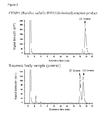
- FIG. 2 shows the result of HPLC analysis of the optical purity of the reaction product obtained by allowing an enzyme derived from the Bacillus subtilis IFO3108 strain to act on diethyl 2-(tert-butylthio)methyl-2-methylmalonate (Example 12).
- the upper panel shows the result of the reaction with the enzyme derived from the Bacillus subtilis IFO3108 strain, and the lower panel shows the result of analysis of the optical purity of a racemic sample which was carried out as a control experiment.
- the method for producing an ⁇ -substituted cysteine represented by the General Formula (1) shown below or a salt thereof of the present invention comprises the step (i) and the subsequent steps (ii), (iii), and (iv).
- the production method of the present invention preferably comprises, before the step (i), the step (xi), or the steps (viii), (xi), and (x).
- the production method of the present invention preferably comprises, after the step (iv), the step (v), especially preferably the steps (vi-1), (vi-2), and (vii).
- step (i) is described below.
- the step (i) is a step of allowing a base or an acid; or an enzyme having an activity to hydrolyze an ester group, a cell having an ability to produce the enzyme, a processed product of the cell, and/or a culture liquid containing the enzyme obtained by culturing the cell (the “enzyme having an activity to hydrolyze an ester group, cell having an ability to produce the enzyme, processed product of the cell, and/or culture liquid containing the enzyme obtained by culturing the cell” may be hereinafter referred to as “enzyme and/or the like of the present invention”); to act on a compound represented by General Formula (2):
- each R 1 independently represents a C 1 -C 10 alkyl group which is optionally substituted, a C 7 -C 20 aralkyl group which is optionally substituted, or a C 6 -C 12 aryl group which is optionally substituted, and R 2 represents a C 1 -C 4 alkyl group
- R 1 independently represents a C 1 -C 10 alkyl group which is optionally substituted, a C 7 -C 20 aralkyl group which is optionally substituted, or a C 6 -C 12 aryl group which is optionally substituted
- R 2 represents a C 1 -C 4 alkyl group
- the compound represented by General Formula (2) can be produced, as described in Non-patent Document 2, by reacting tert-butylthiochloromethane and dialkyl methyl malonate in the presence of a base.
- This document also describes a method for producing tert-butylthiochloromethane, in which tert-butyl mercaptan, paraformaldehyde, and hydrogen chloride are reacted in dichloromethane.
- contacting of formaldehyde with hydrogen chloride may cause generation of bis-chloromethylether, which is highly carcinogenic.
- this production method is unfavorable from the viewpoint of health of the operator.
- the production method for the compound represented by General Formula (2) is preferably a production method comprising the steps (viii)-(x), in which tert-butylthiochloromethane is produced without bringing formaldehyde into contact with hydrogen chloride, or the step (xi), in which tert-butylthiochloromethane is not used.
- the steps (viii)-(xi) are described later.
- examples of the alkyl group of the “C 1 -C 10 alkyl group which is optionally substituted” as R 1 include C 1 -C 10 linear, branched, or cyclic alkyl groups such as methyl, ethyl, isopropyl, n-propyl, n-butyl, isobutyl, sec-butyl, tert-butyl, n-pentyl, isopentyl, tert-pentyl, neopentyl, n-hexyl, cyclopropyl, cyclobutyl, cyclopentyl, and cyclohexyl.
- substituent optionally contained in the alkyl group examples include C 1 -C 6 alkoxy groups such as methoxy and ethoxy; halogen atoms such as a fluorine atom, chlorine atom, bromine atom, and iodine atom; and nitro.
- the number of substituents is not limited, and, in cases where there are two or more substituents in the alkyl group, the substituents may be of the same type or different types.
- examples of the aralkyl group of the “C 7 -C 20 aralkyl group which is optionally substituted” as R 1 include benzyl, 2-phenylethyl, 1-phenylethyl, 1-phenylpropyl, 2-phenylpropyl, and 3-phenylpropyl.
- Examples of the substituent optionally contained in the aralkyl group include C 1 -C 6 alkyl groups such as methyl, ethyl, and isopropyl; C 1 -C 6 alkoxy groups such as methoxy and ethoxy; halogen atoms such as a fluorine atom, chlorine atom, bromine atom, and iodine atom; and nitro.
- the number of substituents is not limited, and, in cases where there are two or more substituents in the aralkyl group, the substituents may be of the same type or different types.
- examples of the aryl group of the “C 6 -C 12 aryl group which is optionally substituted” as R 1 include phenyl, 1-naphthyl, and 2-naphthyl.
- substituent optionally contained in the aryl group include C 1 -C 6 alkyl groups such as methyl, ethyl, and isopropyl; C 1 -C 6 alkoxy groups such as methoxy and ethoxy; halogen atoms such as a fluorine atom, chlorine atom, bromine atom, and iodine atom; and nitro.
- the number of substituents is not limited, and, in cases where there are two or more substituents in the aryl group, the substituents may be of the same type or different types.
- R 1 is preferably a C 1 -C 10 unsubstituted linear or branched alkyl group such as methyl, ethyl, isopropyl, n-propyl, n-butyl, isobutyl, sec-butyl, tert-butyl, n-pentyl, isopentyl, tert-pentyl, neopentyl, or n-hexyl from the viewpoint of their availability, more preferably a C 1 -C 4 unsubstituted linear or branched alkyl group such as methyl, ethyl, isopropyl, n-propyl, n-butyl, isobutyl, sec-butyl, or tert-butyl from the viewpoint of their inexpensiveness, still more preferably a C 1 -C 4 unsubstituted linear alkyl group such as methyl, ethyl, n-prop
- the two R 1 s are not necessarily the same, and may be different from each other.
- two enantiomers, the (R)-isomer and the (S)-isomer are present as the compound represented by the General Formula (2).
- the mixing ratio between these enantiomers is not limited.
- R 2 that is, the C 1 -C 4 alkyl group, needs to be the same as R 2 in the compound of interest represented by General Formula (1).
- R 2 include methyl, ethyl, n-propyl, isopropyl, n-butyl, isobutyl, sec-butyl, and tert-butyl.
- C 1 -C 4 unsubstituted linear alkyl groups such as methyl, ethyl, n-propyl, and n-butyl are more preferred.
- R 2 needs to be methyl in cases where ⁇ -methyl-D-cysteine, which is useful as an intermediate for a therapeutic agent for hyperferremia, is produced among the later-described ⁇ -substituted cysteines represented by General Formula (1) and salts thereof.
- Examples of the compound represented by General Formula (2) include the following compounds.
- a compound represented by General Formula (3) By allowing a base or an acid; or an enzyme having an activity to hydrolyze an ester group, a cell having an ability to produce the enzyme, a processed product of the cell, and/or a culture liquid containing the enzyme obtained by culturing the cell; to act on a compound represented by General Formula (2) to perform hydrolysis, a compound represented by General Formula (3) can be obtained.
- R 1 and R 2 have the same meanings as R 1 and R 2 in the above-mentioned General Formula (2).
- Examples of the compound represented by General Formula (3) include the following compounds.
- the compound represented by General Formula (3) may be a chiral compound which selectively contains either one of the (S)-isomer compound represented by General Formula (3S):
- R 1 and R 2 have the same meanings as R 1 and R 2 in the General Formula (3)
- the compound is preferably an (S)-isomer compound since, by the steps (ii), (iii), and (iv) described later, the (S)-isomer can be converted to an ⁇ -substituted-D-cysteine or a salt thereof, which is useful as an intermediate for pharmaceuticals and the like, among the ⁇ -substituted cysteines represented by General Formula (1) and salts thereof.
- Examples of the compound represented by the General Formula (3S) include the following compounds.
- Examples of the compound represented by the General Formula (3R) include the following compounds.
- a base or an acid, or the enzyme and/or the like of the present invention is/are allowed to act on a compound represented by the General Formula (2).
- the respective cases are described below in detail.
- examples of the base include alkali metal hydroxides such as sodium hydroxide, lithium hydroxide, and potassium hydroxide; and alkali metal carbonates such as lithium carbonate, sodium carbonate, and potassium carbonate. These bases may be used individually, or as a mixture of two or more of these.
- the amount of the base used may be appropriately set within the range of, for example, 0.7 molar equivalent to 10 molar equivalents with respect to the amount of the compound represented by General Formula (2). From the viewpoint of the yield and the cost, the amount is preferably 0.9 molar equivalent to 2 molar equivalents. From the viewpoint of prevention of further hydrolysis of the ester group in the compound represented by General Formula (3), the amount is more preferably 0.9 molar equivalent to 1.2 molar equivalents.
- the reaction temperature may be appropriately selected within the range of, for example, ⁇ 50° C. to 80° C.
- the reaction temperature is preferably within the range of 0° C. to 40° C.
- the reaction time may be appropriately selected within the range of, for example, 0.5 hour to 50 hours.
- the reaction time is preferably within the range of 2 hours to 10 hours.
- the reaction solvent is usually water alone, or a mixed solvent of water and an organic solvent.
- the organic solvent include alcohols such as glycerol, ethylene glycol, methanol, ethanol, 1-propanol, 2-propanol, and t-butanol; ketones such as acetone, 2-butanone, and methylisobutyl ketone; ethers such as diethyl ether, di-n-propyl ether, diisopropyl ether, di-n-butyl ether, methyl isopropyl ether, methyl-t-butyl ether, ethyl-t-butyl ether, cyclopentyl methyl ether, tetrahydrofuran, dioxane, and 1,2-dimethoxyethane; aliphatic hydrocarbons such as n-hexane and n-heptane; esters such as ethyl acetate
- a uniform reaction mixture is preferably provided using water, in which alkali metal hydroxides and alkali metal carbonates are highly soluble, and a water-soluble solvent in which the compound represented by General Formula (2) is highly soluble and which is highly miscible with water.
- water-soluble solvent examples include alcohols such as glycerol, ethylene glycol, methanol, ethanol, 1-propanol, 2-propanol, and t-butanol; ketones such as acetone and 2-butanone; ethers such as tetrahydrofuran, dioxane, and 1,2-dimethoxyethane; nitriles such as acetonitrile and propionitrile; dimethylsulfoxide; and dimethylformamide.
- alcohols such as glycerol, ethylene glycol, methanol, ethanol, 1-propanol, 2-propanol, and t-butanol
- ketones such as acetone and 2-butanone
- ethers such as tetrahydrofuran, dioxane, and 1,2-dimethoxyethane
- nitriles such as acetonitrile and propionitrile
- dimethylsulfoxide and dimethylformamide.
- the reaction is more preferably carried out with a base than with an acid, since a base can suppress the side reaction of hydrolyzing both, rather than one, of the ester groups contained in General Formula (2), and therefore enables production of the compound represented by General Formula (3) with high yield.
- examples of the acid include inorganic acids such as hydrochloric acid, sulfuric acid, phosphoric acid, hydrogen bromide, hydrogen fluoride, and hydrogen iodide; and organic acids such as trifluoroacetic acid, trifluoromethanesulfonic acid, methanesulfonic acid, and p-toluenesulfonic acid (p-toluenesulfonic acid is preferably monohydrate; the same applies hereinafter). These acids may be used individually, or as a mixture of two or more thereof.
- the amount of the acid used may be appropriately set within the range of, for example, 0.1 molar equivalent to 20 molar equivalents with respect to the amount of the compound represented by General Formula (2). From the viewpoint of the yield and the cost, the amount is preferably 1.0 molar equivalent to 10 molar equivalents.
- the reaction temperature may be appropriately selected within the range of, for example, 0° C. to 200° C.
- the reaction temperature is preferably within the range of 30° C. to 100° C.
- the reaction time may be appropriately selected within the range of, for example, 0.5 hour to 50 hours.
- the reaction time is preferably within the range of 2 hours to 20 hours.
- the reaction solvent is usually water alone, or a mixed solvent of water and an organic solvent.
- the organic solvent include ketones such as acetone, 2-butanone, and methylisobutyl ketone; ethers such as diethyl ether, di-n-propyl ether, diisopropyl ether, di-n-butyl ether, methyl isopropyl ether, methyl-t-butyl ether, ethyl-t-butyl ether, cyclopentyl methyl ether, tetrahydrofuran, dioxane, and 1,2-dimethoxyethane; aliphatic hydrocarbons such as n-hexane and n-heptane; esters such as ethyl acetate, isopropyl acetate, and butyl acetate; aromatic hydrocarbons such as benzene, toluene, and xylene; n
- organic solvent examples include aliphatic hydrocarbons such as n-hexane and n-heptane; esters such as ethyl acetate, isopropyl acetate, and butyl acetate; aromatic hydrocarbons such as benzene, toluene, and xylene; nitriles such as acetonitrile and propionitrile; halogenated hydrocarbons such as dichloromethane, chloroform, carbon tetrachloride, and 1,2-dichloroethane; dimethylsulfoxide; and dimethylformamide.
- aliphatic hydrocarbons such as n-hexane and n-heptane
- esters such as ethyl acetate, isopropyl acetate, and butyl acetate
- aromatic hydrocarbons such as benzene, toluene, and xylene
- nitriles such as acetonitrile and propionitrile
- the compound represented by General Formula (3) can also be obtained by allowing the enzyme and/or the like of the present invention, that is, an enzyme having an activity to hydrolyze an ester group, a cell having an ability to produce the enzyme, a processed product of the cell, and/or a culture liquid containing the enzyme obtained by culturing the cell, to act on a compound represented by General Formula (2).
- the enzyme and/or the like of the present invention is preferably allowed to act rather than the above-described acid or base, from the viewpoint of stereoselectivity.
- the enzyme having an activity to hydrolyze an ester group that may be used in the production method of the present invention is not limited as long as the enzyme has the activity, and examples of the enzyme include enzymes comprising the amino acid sequence of (A) SEQ ID NO: 4, 6, 8, 10, 12, 14, 16, or 18. These are carboxyesterase NP derived from Bacillus subtilis.
- homologues having the enzyme activity may also be used.
- examples of the homologues include (B) and (C) described below.
- (C) A protein comprising the amino acid sequence of SEQ ID NO: 4, 6, 8, 10, 12, 14, 16, or 18 in which one or several amino acids are deleted, substituted, and/or added, and having an activity to hydrolyze a compound represented by the General Formula (2) for conversion into a compound represented by General Formula (3S), which is a compound represented by the General Formula (3) and having an (S)-configuration.
- the protein (B) herein may have an identity of not less than 35%, preferably not less than 50%, more preferably not less than 80%, especially preferably not less than 95%, most preferably not less than 98% to the amino acid sequence of SEQ ID NO: 4, 6, 8, 10, 12, 14, 16, or 18, as long as the protein has an activity to hydrolyze an ester group.
- identity search for the protein can be carried out using a program such as FASTA or BLAST (Basic Local Alignment Search Tool) against GenBank or DNA Databank of JAPAN (DDBJ).
- Examples of the protein (C) include proteins comprising the amino acid sequence of SEQ ID NO: 4, 6, 8, 10, 12, 14, 16, or 18 in which one or several amino acids are deleted, substituted, and/or added, as long as the activity to hydrolyze an ester group is not deteriorated. More specifically, the term “several” herein means not more than 20, preferably not more than 10, more preferably not more than 5.
- the enzyme having an activity to hydrolyze an ester group used in the present invention can be obtained by isolating DNA encoding the enzyme from an arbitrary microorganism having the enzyme activity using a probe prepared based on the nucleotide sequence of a gene encoding a part of, or the whole enzyme, and then transforming a host organism such as E. coli with the DNA, followed by allowing the host organism to express the enzyme.
- the enzyme having an activity to hydrolyze an ester group used in the present invention can also be obtained by purification from cells of a microorganism having the enzyme activity, for example, a Bacillus bacterium.
- Bacillus bacterium examples include Bacillus licheniformis, Bacillus subtilis , and Bacillus stearothermophilus . Their strains are available from National Institute of Technology and Evaluation. Alternatively, the strains can be obtained from ATCC (American Type Culture Collection) in cases where they are described in the online catalog (http://www.atcc.org/) by ATCC.
- the enzyme may be allowed to act on a compound represented by General Formula (2).
- a cell having an ability to produce the enzyme instead of the enzyme, or in addition to the enzyme, may be allowed to act on the compound.
- the cell having an ability to produce the enzyme is preferably a cell transformed with DNA encoding the enzyme.
- the cell may be a microorganism (host organism), cultured cell, or the like, and may be either a living cell or a dead cell. For example, a resting microorganism may also be favorably used.
- Examples of the processed product of the cell include treated products of the cell, such as the cell treated with an organic solvent, for example, acetone, dimethylsulfoxide (DMSO), or toluene, the cell treated with a surfactant, the cell treated by freeze drying, and the cell mechanically or enzymatically homogenized; crude purified products or purified products of an enzyme fraction extracted from the cell; and carriers such as polyacrylamide gel and carrageenan gel on which these products are immobilized.
- an organic solvent for example, acetone, dimethylsulfoxide (DMSO), or toluene
- a surfactant the cell treated by freeze drying, and the cell mechanically or enzymatically homogenized
- crude purified products or purified products of an enzyme fraction extracted from the cell and carriers such as polyacrylamide gel and carrageenan gel on which these products are immobilized.
- a culture liquid obtained by culturing the cell a culture liquid obtained by culturing the cell, that is, a culture liquid containing the enzyme, may be directly used.
- a suspension of the cell in a liquid medium may be used, or, in cases where the cell is of a secretory expression type, a supernatant obtained after removal of the cell by centrifugation or the like, or a concentrated product thereof, may be used.
- DNAs encoding the enzyme to be used for the transformation or the like herein include DNAs encoding a protein comprising the amino acid sequence of SEQ ID NO: 4, 6, 8, 10, 12, 14, 16, or 18.
- the DNA may be a DNA encoding a protein comprising an amino acid sequence with a homology of not less than 35%, preferably not less than 50%, more preferably not less than 80%, especially preferably not less than 95%, most preferably not less than 98% to the amino acid sequence of SEQ ID NO: 4, 6, 8, 10, 12, 14, 16, or 18, and having an enzyme activity to convert a compound represented by General Formula (2) to a compound represented by the General Formula (3).
- Examples of the DNA encoding an enzyme comprising the amino acid sequence of SEQ ID NO: 4, 6, 8, 10, 12, 14, 16, or 18 include DNAs comprising the nucleotide sequence of SEQ ID NO: 3, 5, 7, 9, 11, 13, 15, or 17, respectively.
- the DNA may be a homologue of the nucleotide sequence of SEQ ID NO: 3, 5, 7, 9, 11, 13, 15, or 17, as long as the DNA encodes a protein having an activity to hydrolyze an ester group. That is, examples of the DNA encoding the enzyme include the following.
- (D) A DNA comprising the nucleotide sequence of SEQ ID NO: 3, 5, 7, 9, 11, 13, 15, or 17.
- (E) A DNA comprising the nucleotide sequence of SEQ ID NO: 3, 5, 7, 9, 11, 13, 15, or 17 in which one or several bases are substituted, deleted, and/or added, and encoding a polypeptide having an enzyme activity to convert a compound represented by the General Formula (2) to a compound represented by the General Formula (3).
- nucleotide sequences of SEQ ID NOs: 3, 5, 7, 9, 11, 13, 15, and 17 are cDNA sequences.
- the term “several” means not more than 60, preferably not more than 30, more preferably not more than 10, most preferably not more than 5.
- the “DNA which hybridizes under stringent conditions” means a DNA obtained by carrying out colony hybridization, plaque hybridization, Southern blot hybridization, or the like using a probe DNA under stringent conditions.
- stringent conditions include conditions for colony hybridization and plaque hybridization wherein hybridization is carried out in the presence of 0.7 mol/L to 1.0 mol/L sodium chloride at 65° C. using a filter on which colony-derived or plaque-derived DNAs or fragments of the DNAs are immobilized, and the resulting filter is then washed using 0.1 to 2 ⁇ SSC solution (composition of 1 ⁇ SSC: 150 mmol/L sodium chloride and 15 mmol/L sodium citrate) at 65° C.
- the DNA encoding an enzyme having an activity to hydrolyze an ester group can be isolated by, for example, the following method.
- an enzyme having an activity to hydrolyze an ester group is purified from microorganism cells or the like by the above-described method or the like, and the amino acid sequence at the N-terminus of the enzyme is analyzed.
- the analysis of the amino acid sequence at the N-terminus is carried out by cleaving the purified protein with enzymes such as lysyl endopeptidase, V8 protease, and/or the like, purifying the resulting peptide fragments by reversed-phase liquid chromatography and/or the like, and then determining a plurality of amino acid sequences by amino acid sequence analysis using a protein sequencer.
- a part of DNA (DNA fragment) encoding the enzyme can be obtained.
- a restriction enzyme digest of chromosomal DNA of a microorganism strain that produces the enzyme is introduced into a phage, plasmid, or the like, and E. coli is transformed with the resulting phage, plasmid, or the like to obtain a library or a cDNA library.
- colony hybridization, plaque hybridization, or the like against the resulting library or cDNA library using the DNA fragment as a probe a DNA encoding the enzyme having an activity to hydrolyze an ester group can be obtained.
- DNA encoding the enzyme by analyzing the nucleotide sequence of the DNA fragment obtained by the PCR, designing, based on the sequence obtained, a PCR primer for extension of the sequence to the outside of the region whose sequence was determined, digesting chromosomal DNA of a microorganism strain which produces the enzyme with an appropriate restriction enzyme, and then performing inverse PCR (Genetics vol. 120, p 621-623 (1988)) using DNA cyclized by self-cyclization as a template.
- the DNA comprising the sequence of SEQ ID NO: 3, 5, 7, 9, 11, 13, 15, or 17 herein can be obtained by PCR using primers designed based on the nucleotide sequence of SEQ ID NO: 3, 5, 7, 9, 11, 13, 15, or 17, respectively.
- the DNA encoding the enzyme can also be obtained by chemical synthesis of DNA having the nucleotide sequence of SEQ ID NO: 3, 5, 7, 9, 11, 13, 15, or 17.
- Those skilled in the art can obtain the DNA encoding the enzyme having an activity to hydrolyze an ester group which can be used in the production method of the present invention, by introducing, if necessary, a substitution, deletion, insertion, and/or addition mutation(s) to the DNA of SEQ ID NO: 3, 5, 7, 9, 11, 13, 15, or 17 by site-directed mutagenesis (Adv. Biochem. Eng. vol. 43, p 75-102 (1990); Yeast vol., Molecular Cloning 2nd Edt., Cold Spring Harbor Laboratory Press (1989); PCR: A Practical Approach, IRL Press, p 200 (1991)) or the like.
- homology search may be carried out against a database such as GenBank or DDBJ to obtain nucleotide sequence information on a DNA homolog encoding an enzyme having an activity to hydrolyze an ester group.
- a database such as GenBank or DDBJ
- nucleotide sequence information on a DNA homolog encoding an enzyme having an activity to hydrolyze an ester group.
- Those skilled in the art can obtain DNA encoding the enzyme by PCR or the like from a strain based on the nucleotide sequence information.
- the DNA encoding an enzyme having an activity to hydrolyze an ester group can also be obtained by carrying out colony hybridization, plaque hybridization, Southern blot hybridization, or the like using a DNA having the whole or part of the nucleotide sequence of SEQ ID NO: 3, 5, 7, 9, 11, 13, 15, or 17 as a probe under stringent conditions against DNA prepared from an arbitrary microorganism having the enzyme activity, and obtaining a hybridizing DNA.
- the “part” herein means a DNA having a length sufficient for use as a probe. More specifically, the length of the DNA is not less than 15 bp, preferably not less than 50 bp, more preferably not less than 100 bp.
- an expression vector for the enzyme having an activity to hydrolyze an ester group can be provided.
- the enzyme By culturing cells transformed with this expression vector, the enzyme can be obtained from the cells.
- Transformed cells can also be obtained by incorporating the DNA encoding an enzyme having an activity to hydrolyze an ester group into chromosomal DNA of known host cells in a manner which allows expression of the enzyme.
- the preparation of the transformed cells needs to be carried out by incorporating the DNA encoding an enzyme having an activity to hydrolyze an ester group into a plasmid vector or a phage vector capable of being stably present in a microorganism, and introducing the constructed expression vector into the microorganism, or by directly introducing the DNA encoding the enzyme into the genome of a host organism, and allowing transcription and translation of the genetic information.
- a promoter which allows expression in the host microorganism
- an appropriate promoter needs to be incorporated in the 5′-upstream in the DNA strand where the enzyme is encoded.
- a terminator is preferably incorporated in the 3′-downstream.
- the promoter and the terminator are not limited as long as these are a promoter and a terminator which are known to function in the microorganism used as the host.
- Vectors, promoters, and terminators which can be used for the various microorganisms are described in detail in, for example, “Fundamental Microbiology, Vol. 8, Genetic Engineering, Kyoritsu Shuppan Co., Ltd.”; and, especially for cases of yeasts, Adv. Biochem. Eng. vol. 43, p 75-102 (1990); and Yeast vol. 8, p 423-488 (1992).
- the host organism to be transformed for expression of the enzyme having an activity to hydrolyze an ester group of the present invention is not limited as long as the host organism does not adversely affect the reaction.
- Specific examples of the host organism include the following microorganisms.
- the genera Escherichia, Bacillus, Brevibacterium , and Corynebacterium are preferred, and the genera Escherichia and Corynebacterium are especially preferred as the host microorganism.
- the procedure for the preparation of the transformed cells, the construction of the recombinant vector suitable for the host organism, and the method for culturing the host can be carried out according to techniques conventionally used in the fields of molecular biology, bioengineering, and genetic engineering (see, for example, Molecular Cloning 3rd Edt. (Cold Spring Harbor Laboratory Press, 2001)).
- the enzyme having an activity to hydrolyze an ester group include Bacillus licheniformis -derived protease (manufactured by Sigma-Aldrich), Bacillus subtilis -derived carboxyesterase NP (SEQ ID NO: 4, 6, 8, 10, 12, 14, 16, or 18), Bacillus stearothermophilus -derived esterase BS1 (manufactured by Julich Fine Chemicals), Bacillus stearothermophilus -derived esterase BS3 (manufactured by Julich Fine Chemicals), and pig liver-derived esterase (manufactured by Sigma-Aldrich), and these may be appropriately selected depending on the purpose.
- Bacillus licheniformis -derived protease manufactured by Sigma-Aldrich
- Bacillus subtilis -derived carboxyesterase NP SEQ ID NO: 4, 6, 8, 10, 12, 14, 16, or 18
- Bacillus stearothermophilus -derived esterase BS1 manufactured by Julich Fine Chemicals
- optical purity of the compound represented by General Formula (3S) obtained in this case is generally not less than 90.0% e.e., but, since high optical purity is generally required in cases where the compound is produced as a pharmaceutical or an intermediate therefor, the optical purity is preferably not less than 95.0% e.e., more preferably not less than 99.0% e.e., especially preferably not less than 99.5% e.e., most preferably not less than 99.8% e.e.
- Bacillus stearothermophilus -derived esterase BS1 (manufactured by Julich Fine Chemicals), Bacillus stearothermophilus -derived esterase BS3 (manufactured by Julich Fine Chemicals), or pig liver-derived esterase (manufactured by Sigma-Aldrich) is preferably used as the enzyme.
- Bacillus stearothermophilus -derived esterase BS1 (manufactured by Julich Fine Chemicals), Bacillus stearothermophilus -derived esterase BS3 (manufactured by Julich Fine Chemicals), and the like are preferred.
- optical purity of the compound represented by General Formula (3R) obtained in this case is generally not less than 90.0% e.e., but, since high optical purity is generally required in cases where the compound is produced as a pharmaceutical or an intermediate therefor, the optical purity is preferably not less than 95.0% e.e., more preferably not less than 99.0% e.e., especially preferably not less than 99.5% e.e., most preferably not less than 99.8% e.e.
- the hydrolysis is usually carried out in an aqueous solvent.
- the hydrolysis may also be carried out in the presence of at least one organic solvent.
- examples of the organic solvent which may be used include alcohols such as glycerol, ethylene glycol, methanol, ethanol, 1-propanol, and 2-propanol; ketones such as acetone, 2-butanone, and methylisobutyl ketone; ethers such as diethyl ether, di-n-propyl ether, diisopropyl ether, di-n-butyl ether, methyl isopropyl ether, methyl-tert-butyl ether, ethyl-tert-butyl ether, cyclopentyl methyl ether, tetrahydrofuran, dioxane, and 1,2-dimethoxyethane; aliphatic hydrocarbons such as n-pentane, n-hexane, and n-heptane; esters such as ethyl acetate, isopropyl acetate, and butyl
- the reaction temperature may be selected within the range of, for example, 0° C. to 80° C. From the viewpoint of thermal stability of the enzyme, the reaction temperature is preferably 20° C. to 50° C.
- the reaction time may be appropriately selected within the range of, for example, 1 hour to 120 hours.
- the reaction time is preferably 2 hours to 40 hours since, in cases where the reaction time is long, the yield tends to decrease due to hydrolysis of the ester group in the compound represented by General Formula (3).
- a pH suitable for the reaction may be appropriately selected depending on the enzyme used and the like.
- the pH is 2.0 to 12.0.
- the pH is preferably 6.0 to 11.0, more preferably 7.0 to 9.0.
- Such a pH is selected for prevention of hydrolysis in which the enzyme is not involved.
- the ester group in the compound represented by General Formula (3) may undergo hydrolysis after the reaction of interest, leading to a decrease in the yield; or a compound represented by General Formula (3R) may be unexpectedly produced in the reaction to obtain a compound represented by General Formula (3S), or a compound represented by General Formula (3S) may be unexpectedly produced in the reaction to obtain a compound represented by General Formula (3R), leading to a decrease in the purity.
- the reaction is preferably carried out at a pH at which these phenomena can be suppressed.
- an acid or a base may be added in order to adjust the pH within a preferred range.
- post-treatment may be carried out by, for example, inactivation of the microorganism, centrifugation, coagulant treatment, filtration, extraction, concentration, and/or purification on a column.
- an acid may be added to the reaction solution to release the compound of General Formula (3) as a carboxylic acid, and extraction using a water-insoluble organic solvent may be performed.
- the purity of the compound represented by General Formula (3) is sufficiently high even without purification, it is preferred to carry out only filtration, extraction, and concentration without carrying out purification, from the viewpoint of simplicity. More preferably, in cases where extraction is carried out, the extraction is carried out with the reaction solvent used in the subsequent step, and only filtration and the extraction are carried out.
- water-insoluble organic solvent used in the extraction examples include ketones such as 2-butanone, methylisobutyl ketone, and cyclohexanone; aromatic hydrocarbons such as benzene, toluene, xylene, chlorobenzene, and trifluoromethylbenzene; aliphatic hydrocarbons such as n-pentane, n-hexane, n-heptane, and cyclohexane; esters such as methyl acetate, ethyl acetate, isopropyl acetate, and butyl acetate; ethers such as diethyl ether, di-n-propyl ether, diisopropyl ether, di-n-butyl ether, methyl-tert-butyl ether, ethyl-tert-butyl ether, and cyclopentyl methyl ether; and halogenated hydrocarbons such as dichloromethane,
- aromatic hydrocarbons and esters are preferred.
- Use of benzene, toluene, methyl acetate, ethyl acetate, isopropyl acetate, butyl acetate, or a mixed solvent of two or more of these is more preferred.
- Use of toluene is still more preferred since toluene has high tolerance to acidic conditions, and can be reused.
- step (ii) is described below.
- the step (ii) is a step of allowing a condensing agent or an acid halogenating agent to act on a compound represented by General Formula (3):
- R 1 and R 2 have the same meanings as R 1 and R 2 in the General Formula (3);
- X represents —OP(O)(OPh) 2 , —OP(O)(OEt) 2 , —OC(O)OR 3 , or a halogen atom; and
- R 3 represents a C 1 -C 10 alkyl group which is optionally substituted, a C 7 -C 20 aralkyl group which is optionally substituted, or a C 6 -C 12 aryl group which is optionally substituted).
- the compound represented by the General Formula (4) may be either a racemic compound or a chiral compound. Since high optical purity is generally required in cases where the compound is produced as a pharmaceutical or an intermediate therefor, the compound is preferably a chiral compound having high optical purity.
- the optical purity is preferably not less than 95.0% e.e., more preferably not less than 99.0% e.e., especially preferably not less than 99.5% e.e., most preferably not less than 99.8% e.e.
- Examples of X in General Formula (4) include a —OP(O)(OPh) 2 group, —OP(O)(OEt) 2 group, —OC(O)OR 3 group (wherein R 3 represents a C 1 -C 10 alkyl group which is optionally substituted, a C 7 -C 20 aralkyl group which is optionally substituted, or a C 6 -C 12 aryl group which is optionally substituted), and a halogen atom.
- R 3 represents a C 1 -C 10 alkyl group which is optionally substituted, a C 7 -C 20 aralkyl group which is optionally substituted, or a C 6 -C 12 aryl group which is optionally substituted
- Examples of the alkyl group of the “C 1 -C 10 alkyl group which is optionally substituted” as R 3 include C 1 -C 10 linear, branched, or cyclic alkyl groups such as methyl, ethyl, isopropyl, n-propyl, n-butyl, isobutyl, sec-butyl, tert-butyl, n-pentyl, isopentyl, tert-pentyl, neopentyl, n-hexyl, cyclopropyl, cyclobutyl, cyclopentyl, and cyclohexyl.
- substituent optionally contained in the alkyl group examples include C 1 -C 6 alkoxy groups such as methoxy and ethoxy; halogen atoms such as a fluorine atom, chlorine atom, bromine atom, and iodine atom; and nitro.
- the number of substituents is not limited, and, in cases where there are two or more substituents in the alkyl group, the substituents may be of the same type or different types.
- Examples of the aralkyl group of the “C 7 -C 20 aralkyl group which is optionally substituted” as R 3 include benzyl, 2-phenylethyl, 1-phenylethyl, 1-phenylpropyl, 2-phenylpropyl, and 3-phenylpropyl.
- Examples of the substituent optionally contained in the aralkyl group include C 1 -C 6 alkyl groups such as methyl, ethyl, and isopropyl; C 1 -C 6 alkoxy groups such as methoxy and ethoxy; halogen atoms such as a fluorine atom, chlorine atom, bromine atom, and iodine atom; and nitro.
- the number of substituents is not limited, and, in cases where there are two or more substituents in the aralkyl group, the substituents may be of the same type or different types.
- Examples of the aryl group of the “C 6 -C 12 aryl group which is optionally substituted” as R 3 include phenyl, 1-naphthyl, and 2-naphthyl.
- Examples of the substituent optionally contained in the aryl group include C 1 -C 6 alkyl groups such as methyl, ethyl, and isopropyl; C 1 -C 6 alkoxy groups such as methoxy and ethoxy; halogen atoms such as a fluorine atom, chlorine atom, bromine atom, and iodine atom; and nitro.
- the number of substituents is not limited, and, in cases where there are two or more substituents in the aryl group, the substituents may be of the same type or different types.
- diphenylphosphoryl azide may be used as a condensing agent.
- diethylphosphoryl azide may be used as a condensing agent.
- a chloroformic ester represented as ClC(O)OR 3 may be used as a condensing agent or an acid halogenating agent.
- Preferred examples of easily available chloroformic esters include C 1 -C 6 linear or branched chloroformic esters such as methyl chloroformate, ethyl chloroformate, n-propyl chloroformate, isopropyl chloroformate, n-butyl chloroformate, isobutyl chloroformate, and tert-butyl chloroformate; phenyl chloroformate; and benzyl chloroformate.
- R 3 is preferably a C 1 -C 6 linear or branched alkyl group such as methyl, ethyl, n-propyl, isopropyl, n-butyl, isobutyl, or tert-butyl; phenyl; or benzyl; from the viewpoint of availability as the chloroformic ester.
- R 3 also influences the later-described step (iii).
- the compound represented by the General Formula (4-1) has both a carbonyl group derived from a substrate malonic acid derivative and a carbonyl group derived from a condensing agent.
- the reaction in the step (iii) begins by nucleophilic attack by an azide anion. In cases where the nucleophilic attack does not occur selectively to the carbonyl group of interest derived from the malonic acid derivative, the yield of the compound represented by General Formula (5):
- R 1 and R 2 have the same meanings as R 1 and R 2 in the General Formula (4)
- R 1 and R 2 tends to decrease.
- the nucleophilic attack of interest occurs.
- the compound represented by General Formula (4-1) is a disubstituted malonic acid derivative, the extent of steric hindrance in the vicinity of the carbonyl group derived from the malonic acid derivative is large. Therefore, the nucleophilic attack of interest may be unlikely to occur selectively especially in cases where the structure of R 3 in the compound represented by General Formula (4-1) is small.
- R 3 is more preferably ethyl, n-propyl, isopropyl, n-butyl, isobutyl, tert-butyl, phenyl, or benzyl.
- chloroformic ester corresponding thereto, ethyl chloroformate, n-propyl chloroformate, isopropyl chloroformate, n-butyl chloroformate, isobutyl chloroformate, tert-butyl chloroformate, phenyl chloroformate, or benzyl chloroformate is preferred.
- step (iii) the alcohol represented by R 3 OH is produced as a by-product, and the by-produced alcohol needs to be removed by washing with water or concentration.
- R 3 is still more preferably ethyl or isopropyl.
- the chloroformic esters corresponding to these are ethyl chloroformate and isopropyl chloroformate.
- an acid halogenating agent may be used in the step (ii).
- halogen atom examples include a chlorine atom, bromine atom, and iodine atom. From the viewpoint of stability of the compound, a chloride atom is preferred.
- Examples of the acid halogenating agent include thionyl chloride, sulfuryl chloride, thionyl bromide, phosphorous trichloride, phosphorous pentachloride, phosphorous oxytrichloride, phosphorus tribromide, phosphorus pentabromide, phosphorous oxytribromide, oxalyl chloride, oxalyl bromide, phosgene, triphosgene, and cyanuric chloride.
- X is preferably a chlorine atom as described above, thionyl chloride, sulfuryl chloride, phosphorous trichloride, phosphorous pentachloride, phosphorous oxytrichloride, oxalyl chloride, phosgene, triphosgene, and cyanuric chloride are preferred.
- Thionyl chloride, sulfuryl chloride, and oxalyl chloride are more preferred because of their low toxicity.
- the conditions for the reaction with the condensing agent or the acid halogenating agent vary depending on, for example, the type of X in the General Formula (4) and the structure of R 3 , and may therefore be appropriately set.
- the reaction may be carried out under the following reaction conditions.
- the amount of the condensing agent or the acid halogenating agent may be appropriately set within the range of 0.7 molar equivalent to 10 molar equivalents with respect to the amount of the compound represented by General Formula (3).
- the amount is preferably 1.0 molar equivalent to 5.0 molar equivalents. From the viewpoint of reducing the purification load, the amount is more preferably 1.0 molar equivalent to 1.5 molar equivalents.
- a base may be used in the reaction by the condensing agent or the acid halogenating agent.
- the base is not limited as long as the base does not have nucleophilicity, and tertiary amines and pyridines are preferred as the base.
- tertiary amines examples include trimethylamine, triethylamine, triisopropylamine, tripropylamine, triisobutylamine, N,N-dimethylethylamine, N,N-dimethylisopropylamine, N-butyldimethylamine, N,N-diisopropylethylamine, N,N-dimethylcyclohexylamine, and N-methylmorpholine.
- pyridines examples include pyridine, 2-chloropyridine, 3-chloropyridine, 2-methylpyridine, 3-methylpyridine, 2,3-lutidine, 2,4-lutidine, 2,5-lutidine, 2,6-lutidine, 3,4-lutidine, and 3,5-lutidine.
- the tertiary amines are preferred. This is because the salt produced by neutralization of the compound represented by General Formula (4) by the base is easily soluble in organic solvents, and the reaction can be allowed to proceed smoothly as a result. Triethylamine is more preferred among the tertiary amines since it is inexpensive.
- the amount of the base used may be appropriately set within the range of, for example, 0.7 molar equivalent to 10 molar equivalents with respect to the amount of the compound represented by General Formula (3). From the viewpoint of allowing complete disappearance of the material and increasing the yield, the amount is preferably 1.0 molar equivalent to 5.0 molar equivalents. From the viewpoint of reduction of the purification load, the amount is more preferably 1.0 molar equivalent to 1.5 molar equivalents. From the viewpoint of suppression of production of by-products, the base is still more preferably used in the same amount as that of the condensing agent or the acid halogenating agent in terms of molar equivalence.
- reaction solvent used for the reaction by the condensing agent or the acid halogenating agent examples include ketones such as acetone, 2-butanone, methylisobutyl ketone, and cyclohexanone; aromatic hydrocarbons such as benzene, toluene, xylene, chlorobenzene, and trifluoromethylbenzene; aliphatic hydrocarbons such as n-pentane, n-hexane, n-heptane, and cyclohexane; esters such as methyl acetate, ethyl acetate, isopropyl acetate, and butyl acetate; ethers such as diethyl ether, di-n-propyl ether, diisopropyl ether, di-n-butyl ether, methyl isopropyl ether, methyl-tert-butyl ether, ethyl-tert-butyl ether, cyclopen
- acetone, toluene, xylene, ethyl acetate, isopropyl acetate, tetrahydrofuran, dioxane, N,N-dimethylformamide, N,N-dimethylacetamide, acetonitrile, and propionitrile are preferred since the salt produced by neutralization of the compound represented by the General Formula (4) by the base is highly soluble in these solvents, and high reaction efficiency can be achieved.
- Acetone, toluene, xylene, ethyl acetate, isopropyl acetate, and tetrahydrofuran are more preferred from the viewpoints of their inexpensiveness and availability, and of simplification of the process since these do not adversely affect the subsequent step (iii) even without post-treatment.
- a polar solvent such as water or an alcohol
- reaction tends to occur with the condensing agent or the acid halogenating agent, or the compound represented by the General Formula (4), leading to a decrease in the yield.
- the amount of the reaction solvent used may be appropriately set within the range of, for example, 0 volume to 100 volumes with respect to the amount of the compound represented by the General Formula (3).
- the amount of the reaction solvent is preferably 1 volume to 20 volumes from the viewpoint of heat generation control and the volume efficiency, more preferably 4 volumes to 10 volumes from the viewpoint of the stirring efficiency.
- the this step can be carried out by appropriately mixing the compound represented by the General Formula (3), the base, and the condensing agent or the acid halogenating agent together. From the viewpoint of the yield, the compound represented by the General Formula (3) and the base are preferably mixed together in advance.
- the reaction temperature may be appropriately set.
- the reaction temperature may be appropriately set within the range of ⁇ 100° C. to 100° C.
- ultralow temperature conditions are preferably avoided.
- the reaction temperature is preferably ⁇ 50° C. to 50° C., more preferably ⁇ 10° C. to 30° C.
- the reaction time may be appropriately set within the range of, for example, 5 minutes to 10 hours. Since, in general, the reaction becomes complete in a short time after the mixing, the reaction time is preferably 5 minutes to 5 hours, more preferably 15 minutes to 2 hours.
- post-treatment may be carried out after this reaction.
- precipitated salt may be removed by filtration; water and a water-insoluble organic solvent may be added to perform solvent extraction; and/or solvent extraction may be followed by removal of a solvent by concentration.
- purification using a column may be carried out.
- the reaction solution in the step (ii) is preferably used as it is in the step (iii) from the viewpoint of simplifying the process.
- step (iii) is described below.
- the step (iii) is a step in which an azidation agent is allowed to act on a compound represented by General Formula (4):
- R 1 represents a C 1 -C 10 alkyl group which is optionally substituted, a C 7 -C 20 aralkyl group which is optionally substituted, or a C 6 -C 12 aryl group which is optionally substituted
- R 2 represents a C 1 -C 4 alkyl group
- X represents —OP(O)(OPh) 2 , —OP(O)(OEt) 2 , —OC(O)OR 3 , or a halogen atom
- R 3 represents a C 1 -C 10 alkyl group which is optionally substituted, a C 7 -C 20 aralkyl group which is optionally substituted, or a C 6 -C 12 aryl group which is optionally substituted
- R 1 and the R 2 in the compound represented by the General Formula (5) have the same meanings as those in the descriptions for the step (i) and the step (ii).
- the compound represented by the General Formula (5) may be either a racemic compound or a chiral compound. Since high optical purity is generally required in cases where the compound is produced as a pharmaceutical or an intermediate therefor, the compound is preferably a chiral compound having high optical purity.
- the optical purity is preferably not less than 95.0% e.e., more preferably not less than 99.0% e.e., especially preferably not less than 99.5% e.e., most preferably not less than 99.8% e.e.
- the azidation agent examples include metal azides such as sodium azide, potassium azide, and lithium azide; and trialkylsilyl azides such as trimethylsilyl azide. Since trialkylsilyl azides may produce trialkylsilanol as a by-product, and an operation for its separation from the compound represented by General Formula (5) may be necessary, metal azides are preferred. Among the metal azides, sodium azide is more preferred since it is easily available.
- the amount of the azidation agent used may be appropriately set within the range of, for example, 0.7 molar equivalent to 10 molar equivalents with respect to the amount of the compound represented by General Formula (4). From the viewpoint of the yield and the cost, the amount is preferably 1.0 molar equivalent to 5.0 molar equivalents, more preferably 1.0 molar equivalent to 2.0 molar equivalents.
- reaction solvent examples include water; ketones such as acetone, 2-butanone, methylisobutyl ketone, and cyclohexanone; aromatic hydrocarbons such as benzene, toluene, xylene, chlorobenzene, and trifluoromethylbenzene; aliphatic hydrocarbons such as n-pentane, n-hexane, n-heptane, and cyclohexane; esters such as methyl acetate, ethyl acetate, isopropyl acetate, and butyl acetate; ethers such as diethyl ether, di-n-propyl ether, di-n-butyl ether, methyl isopropyl ether, methyl-tert-butyl ether, ethyl-tert-butyl ether, cyclopentyl methyl ether, tetrahydrofuran, dioxane, and 1,2-
- reaction solvent In cases where an alcohol is used as the reaction solvent, reaction with the compound represented by General Formula (4) may occur to decrease the yield.
- reaction solvents described above acetone, toluene, xylene, ethyl acetate, isopropyl acetate, and tetrahydrofuran are preferred from the viewpoints of the cost and availability, and of simplification of the process since the this step can be carried out continuously from the step (ii).
- the compound represented by the General Formula (4) to be used as the material for the reaction is preferably a compound which hardly undergoes degradation due to water.
- the amount of the reaction solvent used may be appropriately set within the range of, for example, 0 volume to 100 volumes with respect to the amount of the compound represented by General Formula (4).
- the amount of the reaction solvent is preferably 1 volume to 20 volumes from the viewpoint of heat generation control and the volume efficiency, more preferably 5 volumes to 10 volumes from the viewpoint of ease of stirring.
- the reaction temperature may be appropriately set within the range of, for example, ⁇ 100° C. to 100° C. Since the temperature can be easily controlled at ⁇ 30° C. to 50° C., ultralow temperature conditions are preferably avoided. Further, since the compound represented by General Formula (5) may cause a side reaction at a high temperature to decrease the yield, the reaction temperature is more preferably ⁇ 10° C. to 20° C.
- the reaction time may be appropriately set within the range of, for example, 5 minutes to 100 hours. Since the shelf stability of the compound represented by General Formula (5) is not high even at a low temperature, the reaction time is preferably 1 hour to 40 hours, more preferably 1 hour to 10 hours.
- post-treatment may be carried out after this reaction.
- precipitated salt may be removed by filtration or washing with water, and/or water and a water-insoluble organic solvent may be added to perform extraction.
- water and a water-insoluble organic solvent may be added to perform extraction.
- washing with water is preferably carried out using water and a water-insoluble solvent.
- the step (iii) is more preferably carried out continuously, without further addition or substitution of a solvent, from the step (ii) which is carried out in a water-insoluble solvent such as toluene or xylene, since, in this case, the washing with water can be carried out without further addition of a water-insoluble solvent, which is advantageous from the economical viewpoint.
- a water-insoluble solvent such as toluene or xylene
- Non-patent Document 1 in the step (ii), triethylamine is used as the base, and diphenylphosphoryl azide is allowed to act as the condensing agent in 1,2-dichloroethane. That is, in Non-patent Document 1, a compound represented by General Formula (5) is obtained through a compound represented by General Formula (4) in which X is —OP(O)(OPh) 2 , and the process of the step (ii) and the step (iii) is carried out in one step. The same applies to use of diethylphosphoryl azide instead of diphenylphosphoryl azide.
- step (iv) is described below.
- the step (iv) is a method for producing a compound represented by General Formula (6):
- R 1 represents a C 1 -C 10 alkyl group which is optionally substituted, a C 7 -C 20 aralkyl group which is optionally substituted, or a C 6 -C 12 aryl group which is optionally substituted
- R 2 represents a C 1 -C 4 alkyl group
- R 1 and R 2 in the General Formulae (5) and (6) are the same as those described in the step (i).
- the compound represented by the General Formula (6) may be either a racemic compound or a chiral compound. Since high optical purity is generally required in cases where the compound is produced as a pharmaceutical or an intermediate therefor, the compound is preferably a chiral compound having high optical purity.
- the optical purity is preferably not less than 95.0% e.e., more preferably not less than 99.0% e.e., especially preferably not less than 99.5% e.e., most preferably not less than 99.8% e.e.
- the Curtius rearrangement is a reaction in which the compound represented by General Formula (5), which is an acid azide compound, is heated to cause its conversion into an isocyanate compound, which is accompanied by elimination of the nitrogen molecule in the azide group.
- the reaction can be allowed to proceed without addition of a reagent.
- organic solvents which may be used in this step include ketones such as acetone, 2-butanone, methylisobutyl ketone, and cyclohexanone; aromatic hydrocarbons such as benzene, toluene, xylene, chlorobenzene, and trifluoromethylbenzene; aliphatic hydrocarbons such as n-pentane, n-hexane, n-heptane, and cyclohexane; esters such as methyl acetate, ethyl acetate, and isopropyl acetate; ethers such as diethyl ether, di-n-propyl ether, di-n-butyl ether, methyl-tert-butyl ether, ethyl-tert-butyl ether, cyclopentyl methyl ether, tetrahydrofuran, dioxane, and 1,2-dimethoxyethane; amides such
- benzene, toluene, xylene, chlorobenzene, and trifluoromethylbenzene are preferred since they have high boiling points, and therefore the reaction rate can be increased by increasing the reaction temperature, so that the processing time can be shortened.
- Toluene and xylene are more preferred since they can be used continuously from the step (iii). That is, in cases where toluene or xylene is used, concentration and solvent replacement of the compound represented by General Formula (5), which is explosive, can be avoided, and moreover, their use is economically advantageous.
- Water and alcohols may react with the compound represented by General Formula (6) to produce, as a by-product, a dimer having a urea structure, or a carbamate, leading to a decrease in the yield.
- the amount of the organic solvent used may be appropriately set within the range of, for example, 0 volume to 100 volumes with respect to the amount of the compound represented by General Formula (5).
- the amount of the organic solvent is preferably 3 volumes to 30 volumes from the viewpoint of heat generation control and the volume efficiency, more preferably 7 volumes to 15 volumes.
- the reaction temperature may be appropriately set within the range of, for example, 0° C. to 300° C. From the viewpoint of reducing the reaction time and preventing degradation of the compound represented by General Formula (6), the reaction temperature is preferably 40° C. to 150° C., more preferably 70° C. to 110° C. In cases where the reaction temperature is higher than the temperature described above, the compound represented by General Formula (6) produced tends to be degraded, resulting in a low yield. On the other hand, in cases where the reaction temperature is lower than the temperature described above, the compound represented by General Formula (5) may accumulate in the reaction system without undergoing Curtius rearrangement, and the subsequent temperature increase may cause the reaction to proceed rapidly, resulting in generation of a large amount of nitrogen in a short time. Thus, from the viewpoint of safety, it is preferred, if necessary, to control the amount of nitrogen generated.
- the temperature is ideally set such that the reaction is completed immediately after the addition of the compound represented by General Formula (5). Practically, however, in order to complete the reaction, heating is preferably continued for 0 hour to 5 hours after the addition of the compound represented by General Formula (5). The heating is more preferably continued for 0 hour to 3 hours.
- post-treatment may be carried out after this reaction.
- salt may be removed by filtration; water may be added to perform solvent extraction; and/or a solvent may be removed by concentration.
- purification using a column may be carried out.
- the compound represented by General Formula (6) easily reacts with water to produce a dimer having a urea structure, post-treatment is preferably avoided.
- Non-patent Document 1 instead of carrying out the step (ii), reaction is performed under heat in 1,2-dichloroethane using triethylamine as the base and diphenylphosphoryl azide as the condensing agent.
- a compound represented by General Formula (5) is obtained, but, practically, since the reaction is carried out under heat, the compound represented by General Formula (5) immediately undergoes Curtius rearrangement, and is converted into a compound represented by General Formula (6). That is, by the method described in Non-patent Document 1, the steps (ii), (iii), and (iv) can be obtained in one step, and the same applies to use of diethylphosphoryl azide instead of diphenylphosphoryl azide.
- Non-patent Document 1 purification is carried out by flash column chromatography. However, this operation is not suitable for industrial-scale production. As an alternative to this purification, washing with water may be possible.
- a dimer having a urea structure is produced as a by-product as described above, and diphenyl phosphate and diethyl phosphate produced as by-products tend to cause side reactions with the compound represented by General Formula (6), resulting in a low yield.
- the steps (ii) to (iv) are preferably carried out in a stepwise manner as described above such that, for example, a chloroformic ester is allowed to act to obtain a compound represented by General Formula (4) in the step (ii); a metal azide is allowed to act to obtain a compound represented by General Formula (5) in the step (iii); and the compound represented by General Formula (5) is converted to a compound represented by General Formula (6) by Curtius rearrangement in the step (iv).
- the compound represented by General Formula (6) can be converted to an ⁇ -substituted cysteine represented by General Formula (1) or a salt thereof.
- the method for this conversion is not limited, and the conversion is preferably carried out by a method comprising the step (v) described below.
- step (v) is described below.
- the step (v) is a step for obtaining an ⁇ -substituted cysteine represented by General Formula (1):
- R 1 represents a C 1 -C 10 alkyl group which is optionally substituted, a C 7 -C 20 aralkyl group which is optionally substituted, or a C 6 -C 12 aryl group which is optionally substituted, and R 2 has the same meaning as in the General Formula (1)) to an amino group;
- the ⁇ -substituted cysteine represented by General Formula (1) may be in the form of a salt.
- the salt of the ⁇ -substituted cysteine include inorganic acid salts such as hydrochloric acid salt, sulfuric acid salt, nitric acid salt, and phosphoric acid salt; carboxylic acid salts such as acetic acid salt, propionic acid salt, oxalic acid salt, malic acid salt, maleic acid salt, citric acid salt, succinic acid salt, tartaric acid salt, and mandelic acid salt; sulfonic acid salts such as methanesulfonic acid salt, p-toluenesulfonic acid salt, and camphorsulfonic acid salt; alkali metal salts such as sodium salt and potassium salt; alkaline earth metal salts such as calcium salt, magnesium salt, and barium salt; and organic amine salts such as ammonium salt, trimethylamine salt, triethylamine salt, phenethylamine salt
- the compound represented by the General Formula (1) may be either a racemic compound or a chiral compound. Since high optical purity is generally required in cases where the compound is produced as a pharmaceutical or an intermediate therefor, the compound is preferably a chiral compound having high optical purity.
- the optical purity is preferably not less than 95.0% e.e., more preferably not less than 99.0% e.e., especially preferably not less than 99.5% e.e., most preferably not less than 99.8% e.e.
- reaction to be carried out in the process of converting the isocyanate group to an amino group a known method may be used, if appropriate. Specific examples of the method include a method in which an acid or a base is allowed to act to cause direct conversion to the amino group, and a method in which an alcohol is allowed to act to cause conversion to a carbamate, followed by its conversion to the amino group using an acid or a base, or by catalytic reduction.
- Examples of the acid or the base to be used in the method by direct conversion to the amino group include inorganic acids such as hydrochloric acid and sulfuric acid; and alkali metal hydroxides such as sodium hydroxide and potassium hydroxide.
- the reaction temperature is usually 0° C. to 200° C., and the reaction time is usually 30 minutes to 50 hours.
- Examples of the method carried out through a carbamate include a method in which benzyl alcohol, p-methoxybenzyl alcohol, or the like is allowed to act to cause conversion to a benzyloxycarbonyl-protected amino group, followed by deprotection of the benzyloxycarbonyl group by catalytic reduction, and a method in which tert-butyl alcohol is allowed to act to cause conversion to a tert-butoxycarbonyl (hereinafter referred to as “Boc”)-protected amino group, followed by allowing an acid to act for deprotection of the Boc group.
- Boc tert-butyl alcohol
- examples of the base include alkali metal hydroxides such as sodium hydroxide, lithium hydroxide, and potassium hydroxide; and alkali metal carbonates such as lithium carbonate, sodium carbonate, and potassium carbonate.
- examples of the acid include inorganic acids such as hydrochloric acid, sulfuric acid, phosphoric acid, hydrogen bromide, hydrogen fluoride, and hydrogen iodide; and organic acids such as trifluoroacetic acid, trifluoromethanesulfonic acid, methanesulfonic acid, and p-toluenesulfonic acid.
- inorganic acids such as hydrochloric acid, sulfuric acid, phosphoric acid, hydrogen bromide, hydrogen fluoride, and hydrogen iodide
- organic acids such as trifluoroacetic acid, trifluoromethanesulfonic acid, methanesulfonic acid, and p-toluenesulfonic acid.
- the reaction temperature is usually 0° C. to 200° C.
- the reaction time is usually 30 minutes to 50 hours.
- the acid to be used is not limited as long as the removal of the tert-butyl group can be achieved therewith, and is preferably a strong acid.
- the acid include inorganic acids such as hydrochloric acid, sulfuric acid, phosphoric acid, hydrogen bromide, hydrogen fluoride, and hydrogen iodide; and organic acids such as trifluoroacetic acid, trifluoromethanesulfonic acid, methanesulfonic acid, and p-toluenesulfonic acid.
- hydrochloric acid and sulfuric acid are preferred since these are inexpensive.
- the reaction temperature is usually 50° C. to 200° C.
- the reaction time is usually 10 hours to 150 hours.
- the step (v) is preferably carried out through the steps (vi-1), (vi-2), and (vii) described below.
- elimination of the tert-butyl group which generally requires a long time, can be allowed to proceed quickly to obtain a compound represented by General Formula (7-1):
- the step (vi-1) is a step of allowing an acid to act on a compound represented by General Formula (6):
- R 1 represents a C 1 -C 10 alkyl group which is optionally substituted, a C 7 -C 20 aralkyl group which is optionally substituted, or a C 6 -C 12 aryl group which is optionally substituted
- R 2 represents a C 1 -C 4 alkyl group
- the compound represented by the General Formula (7-1) may be either a racemic compound or a chiral compound. Since high optical purity is generally required in cases where the compound is produced as a pharmaceutical or an intermediate therefor, the compound is preferably a chiral compound having high optical purity.
- the optical purity is preferably not less than 95.0% e.e., more preferably not less than 99.0% e.e., especially preferably not less than 99.5% e.e., most preferably not less than 99.8% e.e.
- Examples of the acid used in the step (vi-1) include inorganic acids such as hydrochloric acid, sulfuric acid, phosphoric acid, hydrogen bromide, hydrogen fluoride, and hydrogen iodide; and organic acids such as trifluoroacetic acid, trifluoromethanesulfonic acid, methanesulfonic acid, and p-toluenesulfonic acid.
- inorganic acids such as hydrochloric acid, sulfuric acid, phosphoric acid, hydrogen bromide, hydrogen fluoride, and hydrogen iodide
- organic acids such as trifluoroacetic acid, trifluoromethanesulfonic acid, methanesulfonic acid, and p-toluenesulfonic acid.
- hydrochloric acid, sulfuric acid, phosphoric acid, and p-toluenesulfonic acid are more preferred from the viewpoint of the cost.
- the amount of the acid used may be appropriately set within the range of, for example, 0.01 molar equivalent to 50 molar equivalents with respect to the amount of the compound represented by General Formula (6). Considering the cost, and laboriousness of the post-treatment, the amount is preferably 0.1 molar equivalent to 10 molar equivalents, more preferably 0.5 molar equivalent to 3 molar equivalents.
- reaction solvent to be used examples include ketones such as acetone, 2-butanone, and methylisobutyl ketone; aromatic hydrocarbons such as benzene, toluene, xylene, chlorobenzene, and trifluoromethylbenzene; aliphatic hydrocarbons such as n-pentane, n-hexane, n-heptane, and cyclohexane; esters such as methyl acetate, ethyl acetate, and isopropyl acetate; ethers such as diethyl ether, di-n-propyl ether, di-n-butyl ether, methyl isopropyl ether, methyl-tert-butyl ether, ethyl-tert-butyl ether, cyclopentyl methyl ether, tetrahydrofuran, dioxane, and 1,2-dimethoxyethane; amides such as N
- reaction with the compound represented by General Formula (6) tends to occur to produce a dimer having a urea structure or a carbamate as a by-product, leading to a decrease in the yield.
- use of water or an alcohol as a main solvent for the step (vi-1) is not preferred.
- the amount of the water or the alcohol used is preferably minimum.
- aromatic hydrocarbons such as benzene, toluene, xylene, chlorobenzene, and trifluoromethylbenzene
- aliphatic hydrocarbons such as n-pentane, n-hexane, n-heptane, and cyclohexane
- halogenated hydrocarbons such as dichloromethane, chloroform, carbon tetrachloride, and 1,2-dichloroethane
- the reaction temperature may be appropriately set within the range of, for example, ⁇ 30° C. to 100° C.
- the compound represented by General Formula (7-1) produced is converted to the compound represented by General Formula (7-2) in a short time.
- the reaction is carried out preferably within the range of ⁇ 30° C. to 50° C., more preferably within the range of 0° C. to 30° C.
- the reaction time may be appropriately set within the range of, for example, 0.5 hour to 20 hours.
- the compound represented by General Formula (7-1) produced tends to be converted to the compound represented by General Formula (7-2) depending on the temperature setting.
- the reaction time is preferably 0.5 hour to 10 hours, more preferably 0.5 hour to 3 hours.
- post-treatment may be carried out.
- neutralization may be carried out by adding a base; water and a water-insoluble organic solvent may be added to perform extraction; and/or, in cases where the acid is volatile, it may be removed by concentration. From the viewpoint of simplification of the process, it is preferred to proceed to the step (vi-2) described below without carrying out post-treatment.
- the step (vi-2) is a step of allowing an acid or a base to act on a compound represented by General Formula (7-1):
- the compound represented by the General Formula (7-2) may be either a racemic compound or a chiral compound. Since high optical purity is generally required in cases where the compound is produced as a pharmaceutical or an intermediate therefor, the compound is preferably a chiral compound having high optical purity.
- the optical purity is preferably not less than 95.0% e.e., more preferably not less than 99.0% e.e., especially preferably not less than 99.5% e.e., most preferably not less than 99.8% e.e.
- Examples of the acid used in the step (vi-2) include inorganic acids such as hydrochloric acid, sulfuric acid, phosphoric acid, hydrogen bromide, hydrogen fluoride, and hydrogen iodide; and organic acids such as trifluoroacetic acid, trifluoromethanesulfonic acid, methanesulfonic acid, and p-toluenesulfonic acid.
- inorganic acids such as hydrochloric acid, sulfuric acid, phosphoric acid, hydrogen bromide, hydrogen fluoride, and hydrogen iodide
- organic acids such as trifluoroacetic acid, trifluoromethanesulfonic acid, methanesulfonic acid, and p-toluenesulfonic acid.
- hydrochloric acid, sulfuric acid, and phosphoric acid are more preferred from the viewpoint of the cost.
- Hydrochloric acid is still more preferred since it is a volatile acid and can be easily removed by concentration.
- a base may be allowed to act to perform the hydrolysis.
- the base to be used include alkali metal hydroxides such as lithium hydroxide, sodium hydroxide, and potassium hydroxide; and alkali metal carbonates such as sodium carbonate, lithium carbonate, and potassium carbonate.
- the acid used in the step (vi-1) may be allowed to act continuously without replacement, to continuously carry out the step (vi-1) and the step (vi-2).
- an acid may be further added in the step (vi-2).
- the acid may be either the same as, or different from, the acid used in the step (vi-1).
- the amount of the acid used may be appropriately set within the range of 0.01 molar equivalent to 50 molar equivalents with respect to the amount of the compound represented by General Formula (7-1). Considering the cost, and laboriousness of the post-treatment, the amount is preferably 0.1 molar equivalent to 10 molar equivalents, more preferably 0.5 molar equivalent to 2 molar equivalents.
- examples of the reaction solvent include water; ketones such as acetone, 2-butanone, and methylisobutyl ketone; aromatic hydrocarbons such as benzene, toluene, xylene, chlorobenzene, and trifluoromethylbenzene; aliphatic hydrocarbons such as n-pentane, n-hexane, n-heptane, and cyclohexane; esters such as methyl acetate, ethyl acetate, and isopropyl acetate; ethers such as diethyl ether, di-n-propyl ether, di-n-butyl ether, methyl isopropyl ether, methyl-tert-butyl ether, ethyl-tert-butyl ether, cyclopentyl methyl ether, tetrahydrofuran, dioxane, and 1,2-dimethoxyethane
- aromatic hydrocarbons such as benzene, toluene, xylene, chlorobenzene, and trifluoromethylbenzene
- aliphatic hydrocarbons such as n-pentane, n-hexane, n-heptane, and cyclohexane
- halogenated hydrocarbons such as dichloromethane, chloroform, carbon tetrachloride, and 1,2-dichloroethane; are preferred among the reaction solvents described above, from the viewpoint of stability against acids.
- Benzene, toluene, xylene, chlorobenzene, and trifluoromethylbenzene are more preferred since these allow heating at high temperature.
- toluene or xylene is used continuously from the step (vi-1), from the viewpoint of the cost.
- the amount of the solvent used may be appropriately set within the range of, for example, 0 volume to 100 volumes with respect to the amount of the compound represented by General Formula (6). From the viewpoint of the volume efficiency, the amount is preferably 0 volume to 20 volumes, more preferably 0 volume to 5 volumes.
- the reaction temperature may be appropriately set within the range of, for example, ⁇ 30° C. to 200° C. Considering improvement of the degree of conversion and the boiling point of the solvent, the reaction temperature is preferably 20° C. to 120° C. In cases where the temperature is too high, degradation of the compound represented by General Formula (7-2) proceeds, leading to a decrease in the yield. Thus, the reaction temperature is more preferably 50° C. to 90° C.
- the reaction time may be appropriately set within the range of, for example, 0 hour to 100 hours.
- the reaction time is preferably 0 hour to 30 hours. From the viewpoint of improvement of the degree of conversion, the reaction time is more preferably 5 hours to 30 hours.
- examples of the post-treatment after the reaction include a method in which the compound represented by General Formula (7-2) is recovered from the reaction solvent by crystallization taking advantage of the fact that the compound is solid in an acidic solution.
- the solvent may be simply removed by concentration; the reaction solution may be neutralized using an acid or a base, and salt may be separated by adsorption of the product of interest to an ion-exchange resin, followed by recovering the product by crystallization; the acid or the base may be removed by adsorption to an ion-exchange resin, followed by recovering the compound from the eluate by crystallization; or, depending on the purity, purification may be carried out using a column or by recrystallization.
- the compound represented by General Formula (7-2) generally has high crystallinity, and can be recovered with high purity. Therefore, it is preferred to recover the compound from the reaction solvent by performing only crystallization.
- examples of the reaction solvent include, from the viewpoint of stability against the base, water; ketones such as acetone, 2-butanone, and methylisobutyl ketone; alcohols such as methanol, ethanol, n-propyl alcohol, isopropyl alcohol, n-butanol, and tert-butanol; aromatic hydrocarbons such as benzene, toluene, xylene, chlorobenzene, and trifluoromethylbenzene; aliphatic hydrocarbons such as n-pentane, n-hexane, n-heptane, and cyclohexane; esters such as methyl acetate, ethyl acetate, and isopropyl acetate; ethers such as diethyl ether, di-n-propyl ether, di-n-butyl ether, methyl isopropyl ether, methyl-tert-buty
- reaction solvent examples include aromatic hydrocarbons such as benzene, toluene, xylene, chlorobenzene, and trifluoromethylbenzene; aliphatic hydrocarbons such as n-pentane, n-hexane, n-heptane, and cyclohexane; and ethers such as diethyl ether, di-n-propyl ether, di-n-butyl ether, methyl isopropyl ether, methyl-tert-butyl ether, ethyl-tert-butyl ether, cyclopentyl methyl ether, tetrahydrofuran, dioxane, and 1,2-dimethoxyethane.
- aromatic hydrocarbons such as benzene, toluene, xylene, chlorobenzene, and trifluoromethylbenzene
- aliphatic hydrocarbons such as n-pentane, n-hex
- benzene, toluene, xylene, chlorobenzene, and trifluoromethylbenzene are more preferred since these allow heating at high temperature.
- toluene or xylene is used continuously from the step (vi-1) from the viewpoint of the cost.
- the amount of the base may be appropriately set within the range of 0.9 molar equivalent to 20 molar equivalents with respect to the amount of the compound represented by General Formula (7-1). Considering the cost, and laboriousness of the post-treatment, the amount is preferably 0.9 molar equivalent to 5.0 molar equivalents, more preferably 1.0 molar equivalent to 3.0 molar equivalents. In cases where no post-treatment is carried out after the step (vi-1), and the acid used in the step (vi-1) is continuously allowed to act to carry out the this step continuously from the step (vi-1), a base required for neutralization of the acid may be further added.
- the amount of the solvent used may be appropriately set within the range of, for example, 0 volume to 100 volumes with respect to the amount of the compound represented by General Formula (6). From the viewpoint of the volume efficiency, the amount is preferably 0 volume to 20 volumes, more preferably 0 volume to 5 volumes.
- the reaction temperature may be appropriately set within the range of, for example, ⁇ 30° C. to 100° C.
- the reaction temperature is preferably 0° C. to 80° C.
- the reaction temperature is more preferably 0° C. to 50° C.
- the reaction time may be appropriately set within the range of, for example, 0 hour to 100 hours.
- the reaction time is preferably 0 hour to 30 hours. From the viewpoint of improvement of the degree of conversion, the reaction time is more preferably 5 hours to 30 hours.
- this reaction may be followed by a post-treatment in which the compound represented by General Formula (7-2) is recovered from the reaction solvent by crystallization taking advantage of the fact that the compound is solid in an acidic solution.
- the base may be neutralized with an acid, and then an acid may be further added.
- the solvent may be simply removed by concentration; the reaction solution may be neutralized using an acid, and salt may be separated by adsorption of the product of interest to an ion-exchange resin, followed by recovering the product by crystallization; or the base may be removed by adsorption to an ion-exchange resin, followed by recovering the product of interest from the eluate by crystallization.
- purification may be carried out using a column or by recrystallization.
- the compound represented by General Formula (7-2) generally has high crystallinity, and can be recovered with high purity. Therefore, it is preferred to recover the compound from the reaction solvent by performing only crystallization.
- the optical purity of the compound represented by General Formula (7-2) does not reach a desired level after carrying out the post-treatment described above, recrystallization may be repeated to increase the optical purity.
- the optical purity of the compound represented by General Formula (7-2) as a material is preferably preliminarily increased to a desired level by crystallization.
- crystallization solvent for the compound represented by General Formula (7-2) examples include water; alcohols such as methanol, ethanol, n-propyl alcohol, isopropyl alcohol, n-butanol, and tert-butanol; ketones such as acetone, 2-butanone, and methylisobutyl ketone; aromatic hydrocarbons such as benzene, toluene, xylene, chlorobenzene, and trifluoromethylbenzene; aliphatic hydrocarbons such as n-pentane, n-hexane, n-heptane, and cyclohexane; esters such as methyl acetate, ethyl acetate, and isopropyl acetate; ethers such as diethyl ether, di-n-propyl ether, di-n-butyl ether, methyl isopropyl ether, methyl-tert-butyl ether, eth
- crystallization solvent examples include polar solvents, for example, alcohols such as methanol, ethanol, n-propyl alcohol, isopropyl alcohol, n-butanol, and tert-butanol; ketones such as acetone, 2-butanone, and methylisobutyl ketone; esters such as methyl acetate, ethyl acetate, and isopropyl acetate; amides such as N,N-dimethylformamide and N,N-dimethylacetamide; nitriles such as acetonitrile and propionitrile; and dimethylsulfoxide; since these show high solubility and high purification efficiency.
- alcohols such as methanol, ethanol, n-propyl alcohol, isopropyl alcohol, n-butanol, and tert-butanol
- ketones such as acetone, 2-butanone, and methylisobutyl ketone
- esters such
- alcohols such as methanol, ethanol, n-propyl alcohol, isopropyl alcohol, n-butanol, and tert-butanol; ketones such as acetone, 2-butanone, and methylisobutyl ketone; esters such as methyl acetate, ethyl acetate, and isopropyl acetate; and nitriles such as acetonitrile and propionitrile; are more preferred since these have low boiling points, and can be easily removed by vacuum drying.
- low-polarity solvents include aromatic hydrocarbons such as benzene, toluene, xylene, chlorobenzene, and trifluoromethylbenzene; and aliphatic hydrocarbons such as n-pentane, n-hexane, n-heptane, and cyclohexane.
- step (vii) is described below.
- the step (vii) is a step of allowing an acid or a base to act on a compound represented by General Formula (7-2):
- R 2 represents a C 1 -C 4 alkyl group
- Examples of the acid used in the step (vii) include inorganic acids such as hydrochloric acid, sulfuric acid, phosphoric acid, hydrogen bromide, hydrogen fluoride, and hydrogen iodide; and organic acids such as trifluoroacetic acid, trifluoromethanesulfonic acid, methanesulfonic acid, and p-toluenesulfonic acid.
- inorganic acids such as hydrochloric acid, sulfuric acid, phosphoric acid, hydrogen bromide, hydrogen fluoride, and hydrogen iodide
- organic acids such as trifluoroacetic acid, trifluoromethanesulfonic acid, methanesulfonic acid, and p-toluenesulfonic acid.
- the base examples include alkali metal hydroxides such as lithium hydroxide, sodium hydroxide, and potassium hydroxide; and alkali metal carbonates such as sodium carbonate, lithium carbonate, and potassium carbonate.
- strong bases are preferred.
- specific examples of the strong bases include alkali metal hydroxides such as lithium hydroxide, sodium hydroxide, and potassium hydroxide.
- an acid is preferably used from the viewpoint of the yield and the quality.
- volatile acids such as hydrochloric acid, trifluoroacetic acid, hydrogen bromide, hydrogen fluoride, and hydrogen iodide are more preferred since these can be removed by performing only concentration. From the viewpoint of the cost, hydrochloric acid is most preferred.
- the acid or the base used in the step (vi-2) can also be used as at least part of the acid or the base used in the step (vii). That is, by subjecting the reaction solution obtained in the step (vi-2) as it is to the reaction conditions for the later-described step (vii) without carrying out post-treatment after the step (vi-2), an ⁇ -substituted cysteine represented by General Formula (1):
- R 2 represents a C 1 -C 4 alkyl group
- a salt thereof can be obtained.
- the amount of the acid or the base used may be appropriately set within the range of, for example, 0.1 molar equivalent to 200 molar equivalents with respect to the amount of the compound represented by General Formula (7). From the viewpoint of the volume efficiency, the amount is preferably 1 molar equivalent to 30 molar equivalents. In cases where an acid is used, the compound represented by General Formula (7) is preferably completely dissolved in the acid from the viewpoint of reducing the reaction time. Considering the load of the process of removing the acid, the amount of the acid is more preferably 5 molar equivalents to 20 molar equivalents.
- the reaction may be carried out in the presence of a solvent, if necessary.
- a solvent include water; alcohols such as methanol, ethanol, n-propyl alcohol, isopropyl alcohol, and n-butanol; ketones such as acetone, 2-butanone, and methylisobutyl ketone; aromatic hydrocarbons such as benzene, toluene, xylene, chlorobenzene, and trifluoromethylbenzene; aliphatic hydrocarbons such as n-pentane, n-hexane, n-heptane, and cyclohexane; esters such as methyl acetate, ethyl acetate, and isopropyl acetate; ethers such as diethyl ether, di-n-propyl ether, di-n-butyl ether, methyl isopropyl ether, methyl-tert-butyl ether, ethyl
- the solvent is preferably one which does not cause a side reaction with the acid.
- Aromatic hydrocarbons such as benzene, toluene, xylene, chlorobenzene, and trifluoromethylbenzene; and aliphatic hydrocarbons such as n-pentane, n-hexane, n-heptane, and cyclohexane; are preferred.
- aliphatic hydrocarbons such as n-pentane, n-hexane, n-heptane, and cyclohexane.
- the reaction temperature may be appropriately set within the range of, for example, ⁇ 30° C. to 300° C. Considering the boiling point of the solvent, the reaction temperature is preferably 25° C. to 150° C. In particular, in cases where a volatile acid is used, the reaction temperature is more preferably 80° C. to 110° C., since the acid volatilizes and the acid concentration decreases when the reaction temperature exceeds the boiling point, resulting in a decrease in the reaction rate. It is also possible to carry out the reaction using a sealable, pressure-resistant reaction vessel while preventing volatilization of the acid. In such cases, the preferred range of the reaction temperature is not limited to the range described above.
- the reaction time may be appropriately set within the range of, for example, 1 hour to 300 hours. From the viewpoint of the yield, the reaction time is preferably 10 hours to 200 hours. In cases where an acid is used, the reaction time is more preferably 40 hours to 100 hours.
- the post-treatment of the reaction may be appropriately selected depending on whether the ⁇ -substituted cysteine is recovered as a salt or not.
- the solvent may be removed by concentration.
- a base may be added to the reaction solution to the point of neutralization to precipitate the ⁇ -substituted cysteine, followed by recovering the ⁇ -substituted cysteine by filtration.
- reaction solution may be passed through a cation-exchange column to adsorb the ⁇ -substituted cysteine, thereby removing the acid, and the eluate containing the ⁇ -substituted cysteine may then be concentrated to recover the ⁇ -substituted cysteine.
- recrystallization is preferably carried out to increase the purity.
- examples of the crystallization solvent include water; alcohols such as methanol, ethanol, n-propyl alcohol, isopropyl alcohol, n-butanol, and tert-butanol; ketones such as acetone, 2-butanone, and methylisobutyl ketone; aromatic hydrocarbons such as benzene, toluene, xylene, chlorobenzene, and trifluoromethylbenzene; aliphatic hydrocarbons such as n-pentane, n-hexane, n-heptane, and cyclohexane; esters such as methyl acetate, ethyl acetate, and isopropyl acetate; ethers such as diethyl ether, di-n-propyl ether, di-n-butyl ether, methyl isopropyl ether, methyl-tert-butyl ether,
- One of these solvents may be used, or two or more of the solvents may be used as a mixture.
- Alcohols such as methanol, ethanol, n-propyl alcohol, isopropyl alcohol, n-butanol, and tert-butanol; and ketones such as acetone, 2-butanone, and methylisobutyl ketone; are preferred since the purification can be carried out effectively with these.
- nonpolar solvents such as aromatic hydrocarbons including benzene, toluene, xylene, chlorobenzene, and trifluoromethylbenzene; and aliphatic hydrocarbons such as n-pentane, n-hexane, n-heptane, and cyclohexane.
- the combination of one or more of alcohols such as methanol, ethanol, n-propyl alcohol, isopropyl alcohol, n-butanol, and tert-butanol; and one or more of aromatic hydrocarbons such as benzene, toluene, xylene, chlorobenzene, and trifluoromethylbenzene; is more preferred since both effective purification and high recovery can be achieved.
- alcohols such as methanol, ethanol, n-propyl alcohol, isopropyl alcohol, n-butanol, and tert-butanol
- aromatic hydrocarbons such as benzene, toluene, xylene, chlorobenzene, and trifluoromethylbenzene
- R 2 represents a C 1 -C 4 alkyl group
- salts thereof are useful as intermediates for pharmaceuticals and the like.
- ⁇ -methyl-D-cysteine and salts thereof, in which R 2 is methyl are known to be useful as intermediates for hyperferremia, and establishment of a production method which enables their industrial-scale production has been expected.
- ⁇ -substituted cysteine represented by the General Formula (1S) include the following compounds.
- optical purity is required as described above.
- the optical purity is preferably not less than 99.0% e.e., more preferably not less than 99.5% e.e., especially preferably not less than 99.8% e.e.
- R 1 represents a C 1 -C 10 alkyl group which is optionally substituted, a C 7 -C 20 aralkyl group which is optionally substituted, or a C 6 -C 12 aryl group which is optionally substituted; and R 2 has the same meaning as in the General Formula (1S)) produced in the step (i) described above.
- a condensing agent or an acid halogenating agent may be allowed to act on the General Formula (3S), to obtain a compound represented by General Formula (4S):
- R 1 and R 2 have the same meanings as R 1 and R 2 in the General Formula (3S); and X represents —OP(O)(OPh) 2 , —OP(O)(OEt) 2 , —OC(O)OR 3 , or a halogen atom).
- the compound represented by General Formula (4S) may be either an (S)-isomer or an (R)-isomer, depending on the type of X.
- R 1 , R 2 , and R 3 have the same meanings as R 1 , R 2 , and R 3 in the General Formula (4)), in which X is —OC(O)OR 3 .
- an azidation agent may be allowed to act on the compound represented by General Formula (4S), to obtain a compound represented by General Formula (5S):
- the compound represented by the General Formula (5S) may be converted to a compound represented by General Formula (6S):
- the compound of General Formula (1S) is obtained through the processes of: (a) converting the isocyanate group to an amino group; (b) hydrolyzing the ester group to allow its conversion to a carboxyl group; and (c) allowing an acid to act for removal of the tert-butyl group.
- the reaction is preferably allowed to proceed through the steps (vi-1), (vi-2), and (vii) described above.
- R 1 and R 2 have the same meanings as R 1 and R 2 in the General Formula (6S)).
- step (vi-2) an acid or a base is allowed to act on the compound represented by the General Formula (7S-1) to hydrolyze the ester group, thereby allowing conversion to a compound represented by General Formula (7S-2):
- General Formula (7S) includes General Formula (7S-1) and General Formula (7S-2).
- the optical purity of the compound represented by General Formula (7S), which is the precursor is also preferably not less than 99.0% e.e., more preferably not less than 99.5% e.e., especially preferably not less than 99.8% e.e.
- the optical purity of General Formula (7-2) does not reach a desired level after carrying the step (vi-2)
- recrystallization may be repeated to increase the optical purity.
- each R 1 independently represents a C 1 -C 10 alkyl group which is optionally substituted, a C 7 -C 20 aralkyl group which is optionally substituted, or a C 6 -C 12 aryl group which is optionally substituted, and R 2 represents a C 1 -C 4 alkyl group).
- R 1 independently represents a C 1 -C 10 alkyl group which is optionally substituted, a C 7 -C 20 aralkyl group which is optionally substituted, or a C 6 -C 12 aryl group which is optionally substituted
- R 2 represents a C 1 -C 4 alkyl group
- the method for producing the compound represented by General Formula (2) comprises either the steps (viii) to (x) or the step (xi).
- step (viii) is described below.
- the step (viii) is a step of reacting tert-butyl mercaptan with formaldehyde to produce tert-butylthiomethanol.
- tert-butyl mercaptan a commercially available product may be used.
- formaldehyde any of commercially available products in the form of paraformaldehyde, formalin, or 1,3,5-trioxane may be used. From the viewpoint of the cost and ease of handling, formalin is preferred.
- the amount of formaldehyde may be appropriately set within the range of 0.7 molar equivalent to 10 molar equivalents with respect to the amount of tert-butyl mercaptan.
- the amount is preferably 0.9 molar equivalent to 2.0 molar equivalents. From the viewpoint of the cost and ease of post-treatment, the amount is more preferably 0.9 molar equivalent to 1.2 molar equivalents.
- a solvent may be used.
- the reaction proceeds even in cases where the formalin is used as a solvent without using another solvent, it is preferred not to use another solvent, from the viewpoint of the cost.
- the reaction temperature may be appropriately set within the range of, for example, ⁇ 50° C. to 200° C.
- the reaction temperature is preferably ⁇ 20° C. to 100° C.
- the reaction temperature is more preferably 40° C. to 80° C.
- the reaction time may be appropriately set within the range of, for example, 0.5 hour to 100 hours.
- the reaction time is preferably 1 hour to 40 hours, more preferably 5 hours to 20 hours.
- the formaldehyde may react with a substance that generates hydrogen chloride such as a chlorination agent in the step (ix) described below, to cause generation of bischloromethyl ether, which is a carcinogenic substance.
- a step for removing the formaldehyde needs to be included as a post-treatment.
- a method in which water and a water-insoluble organic solvent are added to perform washing with water for removing formaldehyde into the aqueous layer a method in which tert-butylthiomethanol is purified by distillation, a method in which solid paraformaldehyde is removed by filtration, or the like may be employed.
- the method in which water and a water-insoluble organic solvent are added to perform washing with water is preferred since formaldehyde can be efficiently removed by the method.
- the water-insoluble organic solvent to be used for the washing with water include aromatic hydrocarbons such as benzene, toluene, xylene, and chlorobenzene; aliphatic hydrocarbons such as n-pentane, n-hexane, n-heptane, and cyclohexane; esters such as methyl acetate, ethyl acetate, and isopropyl acetate; ethers such as diethyl ether, di-n-propyl ether, di-n-butyl ether, methyl isopropyl ether, and cyclopentyl methyl ether; and halogenated hydrocarbons such as dichloromethane, chloroform, carbon tetrachloride, and 1,2-dichloroethane.
- aromatic hydrocarbons such as benzene, toluene, xylene, and chlorobenzene
- aliphatic hydrocarbons such as n-
- aliphatic hydrocarbons such as n-pentane, n-hexane, n-heptane, and cyclohexane are preferred since these are highly separable from water, can be easily removed by distillation because of their low boiling points, and can be reused.
- water in which an inorganic salt is dissolved is preferably used in order to minimize loss of tert-butylthiomethanol into the aqueous layer during the washing with water.
- saline is more preferably used.
- step (ix) is described below.
- the step (ix) is a step of allowing a chlorination agent to act, in the presence of a base, on the tert-butylthiomethanol obtained in the step (viii), to obtain tert-butylthiochloromethane.
- chlorination agent examples include hydrogen chloride, pivaloyl chloride, acetyl chloride, benzoyl chloride, thionyl chloride, phosphorous trichloride, phosphorous pentachloride, phosphorous oxytrichloride, oxalyl chloride, and sulfuryl chloride.
- thionyl chloride is preferred since it is inexpensive and shows high reaction selectivity.
- the amount of the chlorination agent used may be appropriately set within the range of, for example, 0.7 molar equivalent to 10 molar equivalents with respect to the amount of tert-butylthiomethanol. From the viewpoint of the cost and ease of post-treatment, the amount is more preferably 0.8 molar equivalent to 3 molar equivalents. In order to quantitatively obtain tert-butylthiochloromethane, the amount is more preferably 0.9 molar equivalent to 1.2 molar equivalents.
- the base is not limited as long as the base does not have nucleophilicity, and examples of the base include pyridines such as pyridine, 2-chloropyridine, 3-chloropyridine, 2-methylpyridine, 3-methylpyridine, 2,3-lutidine, 2,4-lutidine, 2,5-lutidine, 2,6-lutidine, 3,4-lutidine, and 3,5-lutidine; and tertiary amines such as triethylamine, triisopropylamine, dimethylisopropylamine, dimethylbutylamine, diethylmethylamine, diisopropylethylamine, and N-methylmorpholine.
- pyridines such as pyridine, 2-chloropyridine, 3-chloropyridine, 2-methylpyridine, 3-methylpyridine, 2,3-lutidine, 2,4-lutidine, 2,5-lutidine, 2,6-lutidine, 3,4-lutidine, and 3,5-lutidine
- pyridine triethylamine, and diisopropylethylamine are preferred.
- Pyridine is more preferred from the viewpoints of the fact that the solubility of the hydrochloric acid salt produced as a by-product in the later-described post-treatment method is advantageously low, and of the yield.
- the amount of the base used may be appropriately set within the range of, for example, 0.7 molar equivalent to 10 molar equivalents with respect to the amount of tert-butylthiomethanol.
- the amount is preferably 0.8 molar equivalent to 5 molar equivalents. From the viewpoint of the cost and ease of post-treatment, the amount is more preferably 0.9 molar equivalent to 1.5 molar equivalents.
- the amount is most preferably 1.0 molar equivalent to 1.1 molar equivalents with respect to the amount of the chlorination agent used.
- a reaction solvent may be used.
- the reaction solvent include ketones such as acetone, 2-butanone, and methylisobutyl ketone; aromatic hydrocarbons such as benzene, toluene, xylene, chlorobenzene, and trifluoromethylbenzene; aliphatic hydrocarbons such as n-pentane, n-hexane, n-heptane, and cyclohexane; esters such as methyl acetate, ethyl acetate, and isopropyl acetate; ethers such as diethyl ether, di-n-propyl ether, di-n-butyl ether, methyl isopropyl ether, methyl-tert-butyl ether, ethyl-tert-butyl ether, cyclopentyl methyl ether, tetrahydrofuran, dioxane, and 1,2-dimeth
- toluene, xylene, chlorobenzene, n-pentane, n-hexane, n-heptane, cyclohexane, dichloromethane, and chloroform are preferred since these are inactive against acids, hardly cause side reactions, and can be reused.
- Aliphatic hydrocarbons such as n-pentane, n-hexane, n-heptane, and cyclohexane are more preferred since these are solvents in which the hydrochloric acid salt of the base produced as a by-product is hardly dissolved and can therefore be easily removed in the later-described post-treatment process.
- the amount of water and alcohols contained is preferably minimum since they easily cause degradation of the chlorination agent.
- the amount of the reaction solvent used may be appropriately set within the range of, for example, 0 volume to 100 volumes with respect to the amount of tert-butylthiomethanol. In cases where the solvent is not used, there is a problem in the safety of the process since a large amount of heat is generated in this step. From this view point, and also from the viewpoint of the volume efficiency, it is preferred to use 1 volume to 20 volumes of the reaction solution with respect to the amount of tert-butylthiomethanol. Considering securing of the stirring efficiency upon precipitation of the hydrochloric acid salt of the base as a by-product, and the volume efficiency, the amount of the reaction solvent is more preferably 5 volumes to 15 volumes.
- the reaction temperature may be appropriately set within the range of, for example, ⁇ 80° C. to 100° C.
- the reaction temperature is preferably ⁇ 50° C. to 50° C. Since tert-butylthiochloromethane is degraded to cause a decrease in the yield in cases where the temperature is too high, the reaction temperature is more preferably ⁇ 15° C. to 25° C.
- the reaction time may be appropriately set within the range of, for example, 0.5 hour to 50 hours.
- the reaction time is preferably 1 hour to 20 hours. Since, in cases where the reaction is carried out for a long time, degradation of tert-butylthiochloromethane occurs, leading to a decrease in the yield, the reaction time is more preferably 1 hour to 8 hours.
- the hydrochloric acid salt of the base precipitated in the reaction solution may be removed by filtration or washing with water.
- the solvent may be simply removed depending on the purity, or purification by distillation may be carried out.
- simple removal of the solvent after filtration is sufficient since the solubility of pyridine hydrochloride in the solvent is low as described above.
- the operation of distillation is preferably carried out in order to obtain highly pure tert-butylthiochloromethane.
- step (x) is described below.
- the step (x) is a step of allowing a compound represented by General Formula (8):
- each R 1 independently represents a C 1 -C 10 alkyl group which is optionally substituted, a C 7 -C 20 aralkyl group which is optionally substituted, or a C 6 -C 12 aryl group which is optionally substituted, and R 2 represents a C 1 -C 4 alkyl group
- R 1 independently represents a C 1 -C 10 alkyl group which is optionally substituted, a C 7 -C 20 aralkyl group which is optionally substituted, or a C 6 -C 12 aryl group which is optionally substituted
- R 2 represents a C 1 -C 4 alkyl group
- the compound represented by General Formula (8) a commercially available product may be used.
- the compound represented by General Formula (8) may be produced according to, for example, the method described in Tetrahedron Letters (2008), 49, (15), 2446-2449, using the combination of a dialkyl malonate, a base, and an alkylating agent
- the R 1 s are not necessarily the same, and may be different from each other. In cases where the R 1 s are different from each other, two enantiomers, the (R)-isomer and the (S)-isomer, are present as the compound represented by the General Formula (8).
- the mixing ratio between these enantiomers is not limited.
- the amount of tert-butylthiochloromethane used may be appropriately set within the range of, for example, 0.7 molar equivalent to 10 molar equivalents with respect to the amount of the compound represented by the General Formula (8).
- the amount is preferably 0.9 molar equivalent to 5 molar equivalents.
- the amount is more preferably 1.0 molar equivalent to 1.5 molar equivalents from the viewpoint of the cost.
- Examples of the base include alkali metal alkoxides and alkali metal hydrides.
- Examples of the alkali metal alkoxides include lithium ethoxide, lithium methoxide, lithium tert-butoxide, sodium ethoxide, sodium methoxide, sodium tert-butoxide, potassium ethoxide, potassium methoxide, and potassium tert-butoxide.
- Examples of the alkali metal hydrides include lithium hydride, sodium hydride, and potassium hydride.
- alkali metal alkoxides such as sodium ethoxide, sodium methoxide, sodium tert-butoxide, potassium ethoxide, potassium methoxide, and potassium tert-butoxide are preferred since they do not generate hydrogen during the reaction and can be safely handled, and the operation of removing mineral oil, which is contained in alkali metal hydrides, is not required.
- Potassium tert-butoxide is more preferred since it is highly soluble in organic solvents and has low nucleophilicity.
- the amount of the base may be appropriately set within the range of, for example, 0.7 molar equivalent to 10 molar equivalents with respect to the amount of the compound represented by General Formula (8).
- the amount is preferably 0.9 molar equivalent to 5 molar equivalents. From the viewpoint of the cost and reduction of side reactions, the amount is more preferably 0.9 molar equivalent to 1.5 molar equivalents.
- a reaction solvent may be used.
- the reaction solvent include aromatic hydrocarbons such as benzene, toluene, xylene, chlorobenzene, and trifluoromethylbenzene; aliphatic hydrocarbons such as n-pentane, n-hexane, n-heptane, and cyclohexane; ethers such as diethyl ether, di-n-propyl ether, di-n-butyl ether, methyl isopropyl ether, methyl-tert-butyl ether, ethyl-tert-butyl ether, cyclopentyl methyl ether, tetrahydrofuran, dioxane, and 1,2-dimethoxyethane; amides such as N,N-dimethylformamide and N,N-dimethylacetamide; halogenated hydrocarbons such as dichloromethane, chloroform, carbon tetrach
- aprotic polar solvents such as tetrahydrofuran, dioxane, 1,2-dimethoxyethane, N,N-dimethylformamide, N,N-dimethylacetamide, and dimethylsulfoxide are preferred since the alkaline metal salt produced by the reaction between the compound represented by General Formula (8) and the base is highly soluble in these solvents, and the solvents therefore have an effect to promote the reaction.
- Tetrahydrofuran is more preferred since it is inexpensive and easily available.
- the amount of the reaction solvent used may be appropriately set within the range of, for example, 0 volume to 100 volumes with respect to the amount of tert-butylthiochloromethane.
- the amount of the reaction solvent is preferably 1 volume to 20 volumes, more preferably 3 volumes to 8 volumes.
- the reaction temperature may be appropriately set within the range of, for example, ⁇ 100° C. to 200° C.
- the reaction temperature is preferably ⁇ 50° C. to 100° C.
- solubility of the alkaline metal salt of the compound represented by General Formula (8) in the solvent decreases, so that the reaction proceeds slowly, while in cases where the temperature is too high, a side reaction may occur, leading to a decrease in the yield.
- the reaction temperature is more preferably ⁇ 10° C. to 50° C.
- the reaction time may be appropriately set within the range of, for example, 0.5 hour to 100 hours.
- the reaction time is preferably 1 hour to 20 hours. In cases where the reaction time is too long, a side reaction may occur, leading to a decrease in the yield. Thus, the reaction time is more preferably 1 hour to 10 hours.
- the inorganic salt precipitated in the reaction solution may be removed by filtration, or water and a water-insoluble solvent may be added to the solution to remove the inorganic salt by washing with water.
- washing water is more preferably included.
- a method in which acidic water is added to the reaction solution at low temperature a method in which an acid is added after the addition of water, to adjust the pH of the aqueous layer to a neutral pH, a method in which the reaction solution is added to an acidic aqueous solution, or the like may be employed. It is preferred to add an acid after the addition of water to adjust the pH of the aqueous layer to a neutral pH. After the removal of the inorganic salt, depending on the purity, the solvent may be simply removed by concentration, or purification on a column may be carried out.
- Examples of the water-insoluble solvent used for the extraction in the post-treatment include ketones such as 2-butanone, methylisobutyl ketone, and cyclohexanone; aromatic hydrocarbons such as benzene, toluene, xylene, chlorobenzene, and trifluoromethylbenzene; aliphatic hydrocarbons such as n-pentane, n-hexane, n-heptane, and cyclohexane; esters such as methyl acetate, ethyl acetate, isopropyl acetate, and butyl acetate; ethers such as diethyl ether, di-n-propyl ether, diisopropyl ether, di-n-butyl ether, methyl isopropyl ether, methyl-tert-butyl ether, ethyl-tert-butyl ether, and cyclopentyl methyl ether; and
- toluene, xylene, diisopropyl ether, di-n-butyl ether, methyl isopropyl ether, and methyl-tert-butyl ether are preferred since the compound represented by General Formula (2) shows high solubility in these solvents. From the viewpoint of the cost, toluene is more preferred.
- the compound represented by General Formula (2) can be produced by a method different from (viii) to (x).
- the step (xi) is a step of allowing an alkylating agent to act on a compound represented by General Formula (9):
- each R 1 independently represents a C 1 -C 10 alkyl group which is optionally substituted, a C 7 -C 20 aralkyl group which is optionally substituted, or a C 6 -C 12 aryl group which is optionally substituted
- each R 1 independently represents a C 1 -C 10 alkyl group which is optionally substituted, a C 7 -C 20 aralkyl group which is optionally substituted, or a C 6 -C 12 aryl group which is optionally substituted
- R 1 has the same meaning as R 1 in the General Formula (9), and R 2 represents a C 1 -C 4 alkyl group).
- the compound represented by General Formula (9) can be obtained by, for example, allowing tert-butyl mercaptan to act on dialkyl methylene malonate synthesized by the method described in WO 2010/129066 or Organic synthesis, 1958, 38, 22.
- the R 1 s are not necessarily the same, and may be different from each other. In cases where the R 1 s are different from each other, two enantiomers, the (R)-isomer and the (S)-isomer, are present as the compound represented by the General Formula (9). The mixing ratio between these enantiomers is not limited.
- alkylating agent examples include R 2 Y and (R 2 O) 2 SO 2 (wherein R 2 has the same meaning as in the General Formula (2); and Y represents a halogen atom, or a C 6 -C 12 arylsulfonyloxy group, C 1 -C 10 alkylsulfonyloxy group, or C 7 -C 20 aralkylsulfonyloxy group, which is optionally substituted).
- Examples of the halogen atom of Y include a chlorine atom, bromine atom, and iodine atom.
- Examples of the C 6 -C 12 arylsulfonyloxy group include benzenesulfonyloxy, 1-naphthalenesulfonyloxy, and 2-naphthalenesulfonyloxy.
- Examples of the C 1 -C 10 alkylsulfonyloxy group include methanesulfonyloxy, ethanesulfonyloxy, and propanesulfonyloxy.
- Examples of the C 7 -C 20 aralkylsulfonyloxy group include benzylsulfonyloxy.
- substituents which may be contained in the arylsulfonyloxy group, alkylsulfonyloxy group, or aralkylsulfonyloxy group include C 1 -C 6 alkyl groups such as methyl and ethyl; C 1 -C 6 alkoxy groups such as methoxy and ethoxy; halogen atoms such as a fluorine atom, chlorine atom, bromine atom, and iodine atom; and nitro.
- the number of substituents is not limited, and, in cases where there are two or more substituents, the substituents may be of the same type or different types.
- R 2 a chlorine atom, bromine atom, iodine atom, methanesulfonyloxy, trifluoromethanesulfonyloxy, or 4-toluenesulfonyloxy is preferred.
- a bromine atom, iodine atom, methanesulfonyloxy, or p-toluenesulfonyloxy is preferred because of their high reactivity.
- a bromine atom is more preferred.
- the amount of the alkylating agent used may be appropriately set within the range of, for example, 0.7 molar equivalent to 10 molar equivalents with respect to the amount of the compound represented by General Formula (9).
- the amount of the agent is preferably slightly excessive.
- the amount is preferably 1.0 molar equivalent to 3.0 molar equivalents.
- the amount of the agent is more preferably 1.1 molar equivalents to 2.0 molar equivalents.
- Examples of the base include alkali metal alkoxides and alkali metal hydrides.
- Examples of the alkali metal alkoxides include lithium ethoxide, lithium methoxide, lithium tert-butoxide, sodium ethoxide, sodium methoxide, sodium tert-butoxide, potassium ethoxide, potassium methoxide, and potassium tert-butoxide.
- Examples of the alkali metal hydrides include lithium hydride, sodium hydride, and potassium hydride.
- the compound represented by General Formula (9) repeats elimination and addition of a tert-butylthio group in the presence of a base. Occurrence of the elimination results in conversion of the General Formula (9) to dialkyl methylene malonate. In cases where a nucleophilic base is present in this process, Michael addition reaction to the dialkyl methylene malonate may occur, leading to a decrease in the yield. On the other hand, bases having no nucleophilicity do not cause such a side reaction.
- the base is preferably an alkali metal hydride such as lithium hydride, sodium hydride, or potassium hydride, which does not have nucleophilicity.
- the base is more preferably sodium hydride from the viewpoint of the cost and safety.
- the amount of the base used may be appropriately set within the range of, for example, 0.7 molar equivalent to 10 molar equivalents with respect to the amount of the compound represented by General Formula (9). Since partial inactivation tends to occur due to water in the solvent or the like, the amount is preferably 0.9 molar equivalent to 4.0 molar equivalents. From the viewpoint of the cost and suppression of side reactions, the amount is more preferably 1.0 molar equivalent to 2.0 molar equivalents.
- reaction solvent examples include aromatic hydrocarbons such as benzene, toluene, xylene, chlorobenzene, and trifluoromethylbenzene; aliphatic hydrocarbons such as n-pentane, n-hexane, n-heptane, and cyclohexane; ethers such as diethyl ether, di-n-propyl ether, di-n-butyl ether, methyl isopropyl ether, methyl-tert-butyl ether, ethyl-tert-butyl ether, cyclopentyl methyl ether, tetrahydrofuran, dioxane, and 1,2-dimethoxyethane; amides such as N,N-dimethylformamide and N,N-dimethylacetamide; halogenated hydrocarbons such as dichloromethane, chloroform, carbon tetrachloride, and 1,2-dichloroethane
- aprotic polar solvents such tetrahydrofuran, dioxane, 1,2-dimethoxyethane, N,N-dimethylformamide, N,N-dimethylacetamide, and dimethylsulfoxide are preferred since the salt produced by the reaction between the compound represented by General Formula (9) and the base is highly soluble in these solvents, and the solvents therefore have an effect to promote the reaction.
- Tetrahydrofuran is more preferred since it has a low boiling point and can be easily removed by concentration.
- the amount of the reaction solvent used may be appropriately set within the range of, for example, 0 volume to 100 volumes with respect to the amount of the compound represented by General Formula (9). Depending on the type of the base, the amount of heat of the reaction is large, and it is risky to carry out the reaction without suspension in a solvent. Because of this, and from the viewpoint of the volume efficiency, the amount of the reaction solvent is preferably 1 volume to 30 volumes, more preferably 8 volumes to 20 volumes.
- the reaction temperature may be appropriately set within the range of, for example, ⁇ 100° C. to 200° C.
- the reaction temperature is preferably ⁇ 50° C. to 100° C.
- the reaction temperature is more preferably ⁇ 10° C. to 50° C.
- the reaction time may be appropriately set within the range of, for example, 0 hour to 30 hours.
- the reaction time is preferably 5 minutes to 5 hours. Since, in case where the reaction time is too long, side reactions may occur, the reaction time is more preferably 15 minutes to 2 hours.
- the inorganic salt precipitated in the reaction solution is preferably removed by filtration or washing with water. Since, depending on the solvent used, the inorganic salt is dissolved in the reaction solvent, washing water is more preferably included.
- water is added to the reaction solution, the aqueous layer becomes basic.
- a method in which acidic water is added to the reaction solution at low temperature a method in which an acid is added after the addition of water, to adjust the pH of the aqueous layer to a neutral pH, a method in which the reaction solution is added to an acidic aqueous solution, or the like may be employed.
- an acid after the addition of water, to adjust the pH of the aqueous layer to a neutral pH.
- the solvent may be simply removed by concentration, or purification on a column may be carried out.
- examples of the water-insoluble solvent which may be used for the extraction include ketones such as 2-butanone, methylisobutyl ketone, and cyclohexanone; aromatic hydrocarbons such as benzene, toluene, xylene, chlorobenzene, and trifluoromethylbenzene; aliphatic hydrocarbons such as n-pentane, n-hexane, n-heptane, and cyclohexane; esters such as methyl acetate, ethyl acetate, isopropyl acetate, and butyl acetate; ethers such as diethyl ether, di-n-propyl ether, diisopropyl ether, di-n-butyl ether, methyl isopropyl ether, methyl-tert-butyl ether, ethyl-tert-butyl ether, and
- n-pentane, n-hexane, n-heptane, cyclohexane, diethyl ether, di-n-propyl ether, diisopropyl ether, di-n-butyl ether, methyl isopropyl ether, methyl-tert-butyl ether, ethyl-tert-butyl ether, and dichloromethane are preferred since these have low boiling points, and show high removal efficiencies.
- Diethyl ether, di-n-propyl ether, diisopropyl ether, di-n-butyl ether, methyl isopropyl ether, methyl-tert-butyl ether, and ethyl-tert-butyl ether are more preferred since they show high extraction efficiencies.
- novel compounds of the present invention can be produced by the production methods of the present invention, and can also be synthesized using ordinary techniques of organic chemistry.
- R 1 , R 2 , and R 3 in the following General Formulae (4-1), (5), (6), and (7S), and specific examples of the compounds represented by General Formulae (4-1), (5), (6), and (7S) are the same as those described in the [Method for Producing ⁇ -Substituted Cysteine Represented by General Formula (1) or Salt Thereof] and the [Method for Producing ⁇ -Substituted Cysteine Represented by General Formula (1S) or Salt Thereof] mentioned above.
- R 1 and R 3 each independently represent a C 1 -C 10 alkyl group which is optionally substituted, a C 7 -C 20 aralkyl group which is optionally substituted, or a C 6 -C 12 aryl group which is optionally substituted, and R 2 represents a C 1 -C 4 alkyl group).
- Carrier gas helium; column flow, 3.93 mL/minute (split ratio, 20:1); inlet pressure, 22.2 kPa; total flow, 85.4 mL/minute (linear velocity, 30 cm/second)
- Injection temperature 220° C.
- Detector FID; hydrogen, 40 mL/minute; air, 400 mL/minute; make-up gas, nitrogen, 30 mL/minute; signal attenuation, ⁇ 2-3
- reaction solution was allowed to cool to room temperature, and 4 mL of toluene was added thereto, followed by washing the organic layer twice with 10 mL of water and once with 10 mL of saturated aqueous sodium chloride solution.
- 1.00 mL (8.88 mmol) of tert-butyl mercaptan and 1.30 mL (9.33 mmol) of triethylamine were added, and the resulting mixture was stirred at 25° C. for 1.5 hours.
- This reaction solution was washed twice with 6 mL of saturated aqueous ammonium chloride solution, and once with 10 mL of saturated aqueous sodium chloride solution.
- the obtained toluene layer was dried over anhydrous sodium sulfate, and sodium sulfate was removed by filtration. After removing toluene by concentrating the filtrate by distillation, the obtained crude diethyl 2-[(tert-butylthio)methyl]malonate was purified by silica gel chromatography, to obtain 1.32 g (5.02 mmol; yield, 26.8%) of diethyl 2-[(tert-butylthio)methyl]malonate. The measurement results obtained were as follows.
- the solution containing ethyl 2-(azidocarbonyl)-2-[(tert-butylthio)methyl]propanoate in toluene, produced in Example 7 was placed in a 300-mL four-necked flask, and the solution was then stirred at an inner temperature within the range of 75° C. to 80° C. for 3 hours, to obtain 23.1 g of a solution of ethyl 2-[(tert-butylthio)methyl]-2-isocyanatopropanoate in toluene.
- Step (vi-1) Production of Ethyl 4-Methyl-2-oxo-1,3-thiazolidine-4-carboxylate
- the oily product containing ethyl 4-methyl-2-oxo-1,3-thiazolidine-4-carboxylate produced in Example 9 was placed in a 50-mL recovery flask, and 9.4 mL (56 mmol) of 6 mol/L hydrochloric acid was added thereto, followed by stirring the resulting mixture at an inner temperature of 100° C. for 10 hours.
- the reaction solution was found to contain 4-methyl-2-oxo-1,3-thiazolidine-4-carboxylic acid.
- this reaction solution was stirred at an inner temperature of 100° C. for additional 30 hours.
- the reaction solution was found to contain ⁇ -methylcysteine hydrochloride.
- the measurement results obtained were as follows.
- cenp SEQ ID NO:1 encoding carboxyesterase NP (CENP, GenBank Accession No. AAC43262, SEQ ID NO:2), which is a hydrolase derived from the Bacillus subtilis Thail-8 strain
- primers for amplifying the entire cenp gene, npfw (SEQ ID NO:19) and npry (SEQ ID NO:20) were designed and synthesized.
- PCR was carried out according to a conventional method using, as a template, chromosomal DNA of each of the Bacillus subtilis NBRC3108 strain, Bacillus subtilis NBRC3215 strain, Bacillus subtilis NBRC3335 strain, Bacillus subtilis NBRC14144 strain, Bacillus subtilis NBRC14191 strain, Bacillus subtilis NBRC14473 strain, Bacillus subtilis NBRC101246 strain, and Bacillus subtilis NBRC101590 strain, and the primers npfw (SEQ ID NO:19) and npry (SEQ ID NO:20).
- npfw SEQ ID NO:19
- npry SEQ ID NO:20
- each of the eight kinds of DNA fragments obtained was digested with EcoRI and XbaI. According to a conventional method, each of the resulting DNA fragments was introduced downstream of the trc promoter of MunI/XbaI-digested pKW32, which is a plasmid described in PCT/JP2011/069680, to obtain plasmids pKCENP1, pKCENP2, pKCENP3, pKCENP4, pKCENP5, pKCENP6, pKCENP7, and pKCENP8.
- the sequence of the hydrolase gene inserted in each of the total of eight kinds of plasmids obtained was identified according to a conventional method.
- the gene sequences were cenp-1 (SEQ ID NO:3), cenp-2 (SEQ ID NO:5), cenp-3 (SEQ ID NO:7), cenp-4 (SEQ ID NO:9), cenp-5 (SEQ ID NO:11), cenp-6 (SEQ ID NO:13), cenp-7 (SEQ ID NO:15), and cenp-8 (SEQ ID NO:17), respectively.
- the amino acid sequences of the hydrolases encoded by the genes were CENP-1 (SEQ ID NO:4), CENP-2 (SEQ ID NO:6), CENP-3 (SEQ ID NO:8), CENP-4 (SEQ ID NO:10), CENP-5 (SEQ ID NO:12), CENP-6 (SEQ ID NO:14), CENP-7 (SEQ ID NO:16), and CENP-8 (SEQ ID NO:18), respectively.
- E. coli JM109 (manufactured by Takara Bio Inc.) was transformed according to a conventional method, to obtain recombinant E. coli JM109/pKCENP1, JM109/pKCENP2, JM109/pKCENP3, JM109/pKCENP4, JM109/pKCENP5, JM109/pKCENP6, JM109/pKCENP7, and JM109/pKCENP8.
- each recombinant E. coli was cultured in liquid LB medium supplemented with kanamycin and a lac promoter inducer at 30° C. The cells were collected after about 20 hours of the culture.
- Bacterial cells of each of commercially available enzymes Bacillus stearothermophilus -derived esterase BS1 (manufactured by Julich Fine Chemicals), Bacillus stearothermophilus -derived esterase BS3 (manufactured by Julich Fine Chemicals), or pig liver-derived esterase (manufactured by Sigma-Aldrich), were allowed to react with 5 g/L diethyl 2-[(tert-butylthio)methyl]-2-methylmalonate in an aqueous solution containing 100 mmol/L potassium phosphate at 30° C. at pH 7 overnight with shaking.
- reaction solution was centrifuged at 8000 rpm, to obtain a reaction solution supernatant. Thereafter, the supernatant was subjected to treatment with a microfiltration membrane having a pore size of 0.2 ⁇ m for removal of the bacterial cells, and further to treatment with an ultrafiltration membrane with a molecular weight cutoff of 10,000.
- the pH of the aqueous layer was lowered to 2.0 using 6 mol/L sulfuric acid, and 160 mL of toluene was added to the solution, followed by sufficiently stirring the resulting mixture, thereby extracting ethyl 2-[(tert-butylthio)methyl]-2-methylmalonate into the toluene layer.
- 160 mL of toluene was added to the remaining aqueous layer, and sufficiently mixing the resulting mixture, residual ethyl 2-[(tert-butylthio)methyl]-2-methylmalonate in the aqueous layer was also extracted into the toluene layer.
- the magnesium sulfate separated by the filtration was washed with 11 mL of toluene, and the washing liquid was mixed with the filtrate.
- the solution in toluene was found to contain ethyl (S)-2-(azidocarbonyl)-2-[(tent-butylthio)methyl]propanoate.
- the measurement results obtained were as follows.
- Step (vi-1) and Step (vi-2) Production of Ethyl (S)-4-Methyl-2-oxo-1,3-thiazolidine-4-carboxylate and (S)-4-Methyl-2-oxo-1,3-thiazolidine-4-carboxylic Acid
- this reaction solution was increased to 60° C. to 70° C., and the reaction solution was then stirred for additional 1hour.
- 22.6 g of water and 2.40 g (23.0 mmol) of 35 wt % hydrochloric acid were added to the solution, and the resulting mixture was stirred at an inner temperature within the range of 70° C. to 90° C. for 4 hours.
- precipitated crystals were collected by filtration. The obtained crystals were washed with 23 mL of toluene and 23 mL of water, to obtain 5.97 g of white crystals.
- Step (vi-1) and Step (vi-2) Production of Ethyl (S)-4-Methyl-2-oxo-1,3-thiazolidine-4-carboxylate and (S)-4-Methyl-2-oxo-1,3-thiazolidine-4-carboxylic Acid.
- an optically active ⁇ -substituted cysteine or a salt thereof which is useful as an intermediate for pharmaceuticals and the like, can be produced more simply, quickly, and safely, using an easily available and inexpensive material.
- the present invention enables stable production of the optically active ⁇ -substituted cysteine or the salt thereof in an industrial scale.
Landscapes
- Chemical & Material Sciences (AREA)
- Organic Chemistry (AREA)
- Wood Science & Technology (AREA)
- Life Sciences & Earth Sciences (AREA)
- Engineering & Computer Science (AREA)
- Chemical Kinetics & Catalysis (AREA)
- Zoology (AREA)
- Biotechnology (AREA)
- Microbiology (AREA)
- General Chemical & Material Sciences (AREA)
- Health & Medical Sciences (AREA)
- Biochemistry (AREA)
- Bioinformatics & Cheminformatics (AREA)
- General Engineering & Computer Science (AREA)
- General Health & Medical Sciences (AREA)
- Genetics & Genomics (AREA)
- Organic Low-Molecular-Weight Compounds And Preparation Thereof (AREA)
- Preparation Of Compounds By Using Micro-Organisms (AREA)
- Thiazole And Isothizaole Compounds (AREA)
Abstract
Description
- [1] A method for producing an α-substituted cysteine represented by General Formula (1):

(wherein R2 represents a C1-C4 alkyl group)
or a salt thereof, the method comprising the steps of:

(wherein each R1 independently represents a C1-C10 alkyl group which is optionally substituted, a C7-C20 aralkyl group which is optionally substituted, or a C6-C12 aryl group which is optionally substituted, and R2 represents a C1-C4 alkyl group),
to obtain a compound represented by General Formula (3):

(wherein R1 and R2 have the same meanings as R1 and R2 in the General Formula (2));

(wherein R1 and R2 have the same meanings as R1 and R2 in the General Formula (2); X represents —OP(O)(OPh)2, —OP(O)(OEt)2, —OC(O)OR3, or a halogen atom; and R3 represents a C1-C10 alkyl group which is optionally substituted, a C7-C20 aralkyl group which is optionally substituted, or a C6-C12 aryl group which is optionally substituted);

(wherein R1 and R2 have the same meanings as R1 and R2 in the General Formula (2));

(wherein R1 and R2 have the same meanings as R1 and R2 in the General Formula (2)); and
- [2] The method for producing an α-substituted cysteine or a salt thereof according to [1], wherein
-
- (A) a protein comprising the amino acid sequence of SEQ ID NO: 4, 6, 8, 10, 12, 14, 16, or 18;
- (B) a protein having an identity of not less than 35% to the amino acid sequence of SEQ ID NO: 4, 6, 8, 10, 12, 14, 16, or 18, and having an activity to hydrolyze the compound represented by the General Formula (2) for conversion into a compound represented by General Formula (3S):

(wherein R1 and R2 have the same meanings as R1 and R2 in the General Formula (3)), which is a compound represented by the General Formula (3) and having an (S)-configuration; or
-
- (C) a protein comprising the amino acid sequence of SEQ ID NO: 4, 6, 8, 10, 12, 14, 16, or 18 in which one or several amino acids are deleted, substituted, and/or added, and having an activity to hydrolyze the compound represented by the General Formula (2) for conversion into a compound represented by General Formula (3S), which is a compound represented by the General Formula (3) and having an (S)-configuration; and

(wherein R2 has the same meaning as R2 in the General Formula (1)).
- [3] A method for producing a compound represented by General Formula (3S):

(wherein R1 represents a C1-C10 alkyl group which is optionally substituted, a C7-C20 aralkyl group which is optionally substituted, or a C6-C12 aryl group which is optionally substituted, and R2 represents a C1-C4 alkyl group),
which is a compound represented by the General Formula (3):

(wherein R1 and R2 have the same meanings as R1 and R2 in the General Formula (3S))
and having an (S)-configuration, the method comprising the step of:

(wherein R1 and R2 have the same meanings as R1 and R2 in the General Formula (3S)).
- [4] The method for producing a compound represented by the General Formula (3S) according to [3], wherein the enzyme is
- [5] A method for producing a compound represented by General Formula (4-1):

(wherein R1 and R3 each independently represent a C1-C10 alkyl group which is optionally substituted, a C7-C20 aralkyl group which is optionally substituted, or a C6-C12 aryl group which is optionally substituted, and R2 represents a C1-C4 alkyl group), the method comprising the step of:

(wherein R1 and R2 have the same meanings as R1 and R2 in the General Formula (4-1)).
- [6] A method for producing a compound represented by General Formula (5):

(wherein R1 represents a C1-C10 alkyl group which is optionally substituted, a C7-C20 aralkyl group which is optionally substituted, or a C6-C12 aryl group which is optionally substituted, and R2 represents a C1-C4 alkyl group),
the method comprising the step of:

(wherein R1 and R2 have the same meanings as R1 and R2 in the General Formula (5), and R3 represents a C1-C10 alkyl group which is optionally substituted, a C7-C20 aralkyl group which is optionally substituted, or a C6-C12 aryl group which is optionally substituted).
- [7] A method for producing a compound represented by General Formula (6):

(wherein R1 represents a C1-C10 alkyl group which is optionally substituted, a C7-C20 aralkyl group which is optionally substituted, or a C6-C12 aryl group which is optionally substituted, and R2 represents a C1-C4 alkyl group),
the method comprising the step of:

(wherein R1 and R2 have the same meanings as R1 and R2 in the General Formula (6)).
- [8] A method for producing an α-substituted cysteine represented by General Formula (1):

(wherein R2 represents a C1-C4 alkyl group)
or a salt thereof, the method comprising the step of:

(wherein R1 represents a C1-C10 alkyl group which is optionally substituted, a C7-C20 aralkyl group which is optionally substituted, or a C6-C12 aryl group which is optionally substituted, and R2 has the same meaning as R2 in the General Formula (1))
to a process of converting the isocyanate group to an amino group, a process of hydrolyzing the ester group, and a process of removing the tert-butyl group by action of an acid.
- [9] The method for producing an α-substituted cysteine represented by General Formula (1):

(wherein R2 represents a C1-C4 alkyl group)
or a salt thereof according to [8], wherein the step (v) comprises the steps of:

(wherein R1 and R2 have the same meanings as R1 and R2 in the General Formula (6)) to construct a thiazolidinone ring, for conversion into a compound represented by General Formula (7-1):

(wherein R1 and R2 have the same meanings as R1 and R2 in the General Formula (6));

(wherein R2 has the same meaning as R2 in the General Formula (7-1)); and
- [10] A method for producing a compound represented by General Formula (7-1):

(wherein R1 represents a C1-C10 alkyl group which is optionally substituted, a C7-C20 aralkyl group which is optionally substituted, or a C6-C12 aryl group which is optionally substituted, and R2 represents a C1-C4 alkyl group),
the method comprising the step of:

(wherein R1 and R2 have the same meanings as R1 and R2 in the General Formula (7-1))
to construct a thiazolidinone ring.
- [11] A method for producing a compound represented by General Formula (7-2):
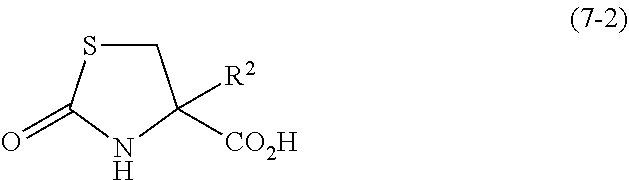
(wherein R2 represents a C1-C4 alkyl group),
the method comprising the step of:

(wherein R1 represents a C1-C10 alkyl group which is optionally substituted, a C7-C20 aralkyl group which is optionally substituted, or a C6-C12 aryl group which is optionally substituted, and R2 has the same meaning as R2 in the General Formula (7-2)) to hydrolyze the ester group.
- [12] A method for producing an α-substituted cysteine represented by General Formula (1):

(wherein R2 represents a C1-C4 alkyl group)
or a salt thereof, the method comprising the steps of:

(wherein R2 has the same meaning as R2 in the General Formula (1)) to open the thiazolidinone ring
- [13] A compound represented by General Formula (4-1):

(wherein R1 and R3 each independently represent a C1-C10 alkyl group which is optionally substituted, a C7-C20 aralkyl group which is optionally substituted, or a C6-C12 aryl group which is optionally substituted, and R2 represents a C1-C4 alkyl group).
- [14] A compound represented by General Formula (5):

(wherein R1 represents a C1-C10 alkyl group which is optionally substituted, a C7-C20 aralkyl group which is optionally substituted, or a C6-C12 aryl group which is optionally substituted, and R2 represents a C1-C4 alkyl group).
- [15] A compound represented by General Formula (6):

(wherein R1 represents a C1-C10 alkyl group which is optionally substituted, a C7-C20 aralkyl group which is optionally substituted, or a C6-C12 aryl group which is optionally substituted, and R2 represents a C1-C4 alkyl group).
- [16] A compound represented by General Formula (7S):

(wherein R2 represents a C1-C4 alkyl group, and R5 represents a hydrogen atom, or a C1-C10 alkyl group which is optionally substituted, a C7-C20 aralkyl group which is optionally substituted, or a C6-C12 aryl group which is optionally substituted).
- [17] A method for producing a compound represented by General Formula (2):

(wherein each R1 independently represents a C1-C10 alkyl group which is optionally substituted, a C7-C20 aralkyl group which is optionally substituted, or a C6-C12 aryl group which is optionally substituted, and R2 represents a C1-C4 alkyl group),
the method comprising the step of:

(wherein R1 has the same meaning as R1 in the General Formula (2)) in the presence of a base.
- [18] A method for producing a compound represented by General Formula (2):

(wherein each R1 independently represents a C1-C10 alkyl group which is optionally substituted, a C7-C20 aralkyl group which is optionally substituted, or a C6-C12 aryl group which is optionally substituted, and R2 represents a C1-C4 alkyl group),
the method comprising the steps of:

(wherein R1 has the same meaning as R1 in the General Formula (2), and R2 represents a C1-C4 alkyl group)
in the presence of a base, to obtain the compound represented by the General Formula (2).

(wherein R2 represents a C1-C4 alkyl group)
<Step (i)>

(wherein each R1 independently represents a C1-C10 alkyl group which is optionally substituted, a C7-C20 aralkyl group which is optionally substituted, or a C6-C12 aryl group which is optionally substituted, and R2 represents a C1-C4 alkyl group), to obtain a compound represented by General Formula (3):

(wherein R1 and R2 have the same meanings as R1 and R2 in the General Formula (2)).


(wherein R1 and R2 have the same meanings as R1 and R2 in the General Formula (3)) or the (R)-isomer compound represented by General Formula (3R):

(wherein R1 and R2 have the same meanings as R1 and R2 in the General Formula (3)), or may be a racemic compound having a weight ratio of 1:1. The compound is preferably an (S)-isomer compound since, by the steps (ii), (iii), and (iv) described later, the (S)-isomer can be converted to an α-substituted-D-cysteine or a salt thereof, which is useful as an intermediate for pharmaceuticals and the like, among the α-substituted cysteines represented by General Formula (1) and salts thereof.


(wherein R1 and R2 have the same meanings as R1 and R2 in the General Formula (3)), which is a compound represented by the General Formula (3) and having an (S)-configuration.

-
- (wherein R1 represents a C1-C10 alkyl group which is optionally substituted, a C7-C20aralkyl group which is optionally substituted, or a C6-C12 aryl group which is optionally substituted, and R2 represents a C1-C4 alkyl group),
- to obtain a compound represented by General Formula (4)

(wherein R1 and R2 have the same meanings as R1 and R2 in the General Formula (3); X represents —OP(O)(OPh)2, —OP(O)(OEt)2, —OC(O)OR3, or a halogen atom; and R3represents a C1-C10 alkyl group which is optionally substituted, a C7-C20 aralkyl group which is optionally substituted, or a C6-C12 aryl group which is optionally substituted).

(wherein R1, R2, and R3 have the same meanings as R1, R2, and R3 in the General Formula (4)),
wherein X represents —OC(O)OR3, are preferred since they are stable against water and can be easily handled in the later-described step (iii).

(wherein R1 and R2 have the same meanings as R1 and R2 in the General Formula (4)) tends to decrease. Normally, considering the electron density of the two carbonyl groups, the nucleophilic attack of interest occurs. However, since the compound represented by General Formula (4-1) is a disubstituted malonic acid derivative, the extent of steric hindrance in the vicinity of the carbonyl group derived from the malonic acid derivative is large. Therefore, the nucleophilic attack of interest may be unlikely to occur selectively especially in cases where the structure of R3 in the compound represented by General Formula (4-1) is small.

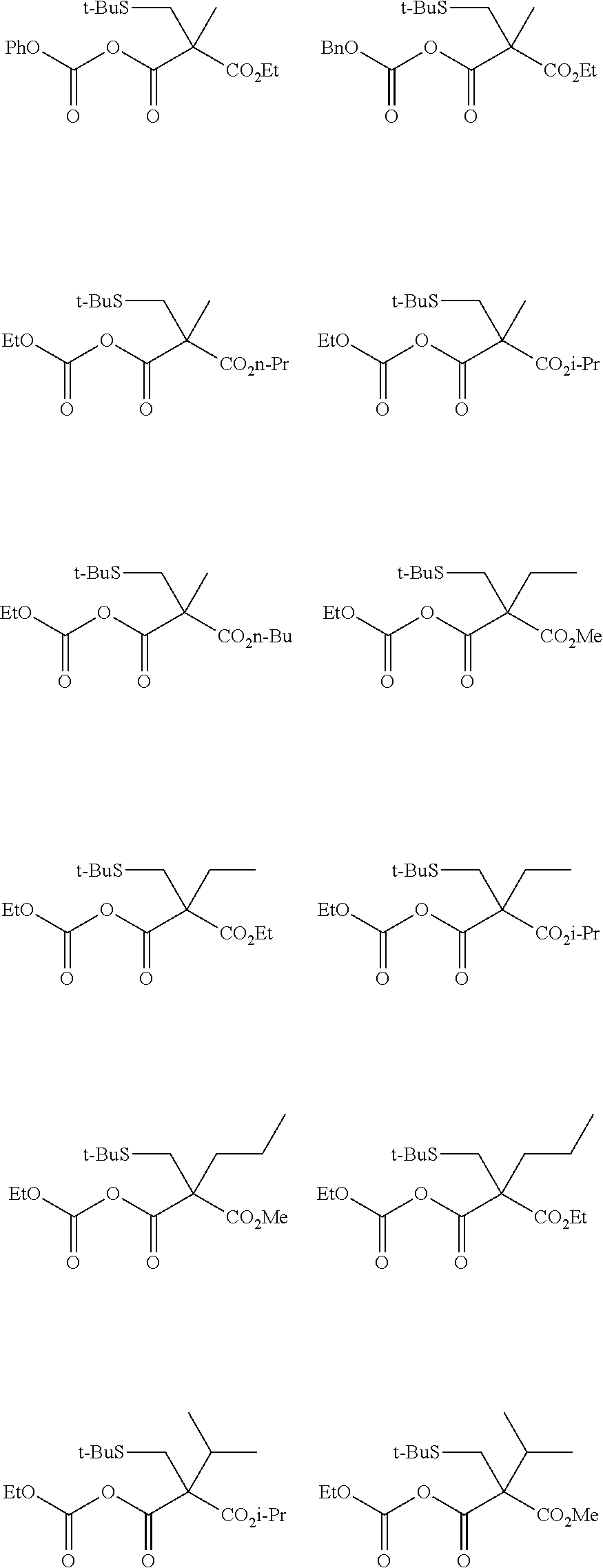


(wherein R1 represents a C1-C10 alkyl group which is optionally substituted, a C7-C20 aralkyl group which is optionally substituted, or a C6-C12 aryl group which is optionally substituted; R2 represents a C1-C4 alkyl group; X represents —OP(O)(OPh)2, —OP(O)(OEt)2, —OC(O)OR3, or a halogen atom; and R3 represents a C1-C10 alkyl group which is optionally substituted, a C7-C20 aralkyl group which is optionally substituted, or a C6-C12 aryl group which is optionally substituted),
to obtain a compound represented by General Formula (5):

(wherein R1 and R2 have the same meanings as R1 and R2 in the General Formula (4)).


(wherein R1 and R2 have the same meanings as R1 and R2 in the General Formula (5) below),
which method comprises converting the azide group of a compound represented by General Formula (5):

(wherein R1 represents a C1-C10 alkyl group which is optionally substituted, a C7-C20 aralkyl group which is optionally substituted, or a C6-C12 aryl group which is optionally substituted, and R2 represents a C1-C4 alkyl group) to an isocyanate group by Curtius rearrangement reaction, to obtain the compound represented by the General Formula (6).


(wherein R2 represents a C1-C4 alkyl group)
or a salt thereof, which step comprises the processes of:
-
- (a) converting the isocyanate group in a compound represented by General Formula (6):

(wherein R1 represents a C1-C10 alkyl group which is optionally substituted, a C7-C20 aralkyl group which is optionally substituted, or a C6-C12 aryl group which is optionally substituted, and R2 has the same meaning as in the General Formula (1)) to an amino group;
-
- (b) hydrolyzing the ester group; and
- (c) removing the tert-butyl group by action of an acid.


(wherein R1 and R2 have the same meanings as R1 and R2 in the General Formula (6)).
Further, by allowing the reaction to proceed through the step (vi-2), a compound represented by General Formula (7-2):

(wherein R2 has the same meaning as R2 in the General Formula (6)) can be obtained. Since the compound represented by the General Formula (7-2) has high crystallinity, and low solubility in water at a pH of not more than the point of neutralization and in nonpolar solvents, both water-soluble impurities including inorganic salts and water-insoluble impurities including reaction intermediates can be easily removed by crystallization. Thus, the α-substituted cysteine represented by General Formula (1) or the salt thereof obtained after the subsequent step (vii) can be obtained with high purity.
<Steps (vi-1) and (vi-2)>

(wherein R1 represents a C1-C10 alkyl group which is optionally substituted, a C7-C20 aralkyl group which is optionally substituted, or a C6-C12 aryl group which is optionally substituted, and R2 represents a C1-C4 alkyl group)
to construct a thiazolidinone ring, thereby obtaining a compound represented by General Formula (7-1):

(wherein R1 and R2 have the same meanings as R1 and R2 in the General Formula (6)).


(wherein R1 and R2 have the same meanings as R1 and R2 in the General Formula (6)) to hydrolyze the ester group, and thereby obtain a compound represented by General Formula (7-2):

(wherein R2 has the same meaning as R2 in the General Formula (6)).


(wherein R2 has the same meaning as R2 in the General Formula (7-2))
and General Formula (7R-2):

(wherein R2 has the same meaning as R2 in the General Formula (7-2)) have higher crystallinity than racemic compounds. Accordingly, improvement of the optical purity by crystallization or the like can be more easily carried out with a chiral compound wherein either one of General Formula (7S-2) or General Formula (7R-2) is selectively contained, compared to a racemic compound.

(wherein R2 represents a C1-C4 alkyl group)
to open the thiazolidinone ring, and thereby obtain an α-substituted cysteine represented by General Formula (1):

(wherein R2 represents a C1-C4 alkyl group)
or the salt thereof.

(wherein R2 represents a C1-C4 alkyl group)
or a salt thereof can be obtained.

(wherein R2 represents a C1-C4 alkyl group),
and salts thereof are useful as intermediates for pharmaceuticals and the like. In particular, α-methyl-D-cysteine and salts thereof, in which R2 is methyl, are known to be useful as intermediates for hyperferremia, and establishment of a production method which enables their industrial-scale production has been expected.


(wherein R1 represents a C1-C10 alkyl group which is optionally substituted, a C7-C20 aralkyl group which is optionally substituted, or a C6-C12 aryl group which is optionally substituted; and R2 has the same meaning as in the General Formula (1S)) produced in the step (i) described above.

(wherein R1 and R2 have the same meanings as R1 and R2 in the General Formula (3S); and X represents —OP(O)(OPh)2, —OP(O)(OEt)2, —OC(O)OR3, or a halogen atom).
The compound represented by General Formula (4S) may be either an (S)-isomer or an (R)-isomer, depending on the type of X.

(wherein R1, R2, and R3 have the same meanings as R1, R2, and R3 in the General Formula (4)), in which X is —OC(O)OR3.


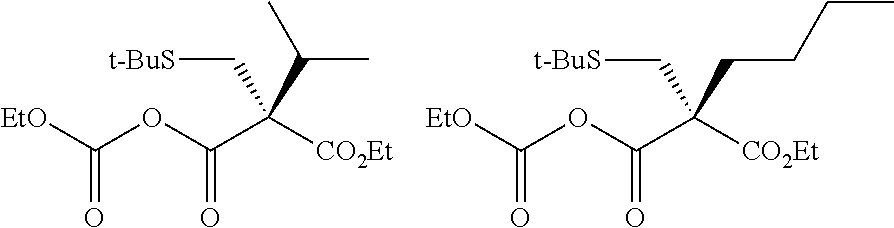


(wherein R1 and R2 have the same meanings as R1 and R2 in the General Formula (4S)).


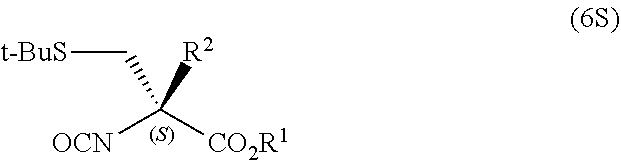
(wherein R1 and R2 have the same meanings as R1 and R2 in the General Formula (5S))
by Curtius rearrangement reaction.


(wherein R1 and R2 have the same meanings as R1 and R2 in the General Formula (6S)).

(wherein R2 has the same meaning as R2 in the General Formula (7S-1)).
Subsequently, in the step (vii), an acid or a base is allowed to act on the General Formula (7S-2) to open the thiazolidinone ring, thereby obtaining the α-substituted-D-cysteine represented by the General Formula (1S) or the salt thereof.

-
- (wherein R2 has the same meaning as in General Formula (6); and R5 represents a hydrogen atom, or has the same meaning as R1 in the General Formula (6S))
- can be said to be an important intermediate for producing a high-quality α-substituted cysteine represented by General Formula (1S) or a salt thereof in a short time.


(wherein each R1 independently represents a C1-C10 alkyl group which is optionally substituted, a C7-C20 aralkyl group which is optionally substituted, or a C6-C12 aryl group which is optionally substituted, and R2 represents a C1-C4 alkyl group). Conventional methods for producing this compound have been industrially unfavorable since bischloromethyl ether, which is a carcinogenic substance, may be generated.

(wherein each R1 independently represents a C1-C10 alkyl group which is optionally substituted, a C7-C20 aralkyl group which is optionally substituted, or a C6-C12 aryl group which is optionally substituted, and R2 represents a C1-C4 alkyl group)
to act, in the presence of a base, on the tert-butylthiochloromethane obtained in the step (ix), to obtain a compound represented by General Formula (2):

(wherein R1 and R2 have the same meanings as R1 and R2 in the General Formula (8)).


(wherein each R1 independently represents a C1-C10 alkyl group which is optionally substituted, a C7-C20 aralkyl group which is optionally substituted, or a C6-C12 aryl group which is optionally substituted)
in the presence of a base, to obtain a compound represented by General Formula (2):

(wherein R1 has the same meaning as R1 in the General Formula (9), and R2 represents a C1-C4 alkyl group).


(wherein R1and R3 each independently represent a C1-C10 alkyl group which is optionally substituted, a C7-C20 aralkyl group which is optionally substituted, or a C6-C12 aryl group which is optionally substituted, and R2 represents a C1-C4 alkyl group).

-
- (wherein R1 represents a C1-C10 alkyl group which is optionally substituted, a C7-C20 aralkyl group which is optionally substituted, or a C6-C12 aryl group which is optionally substituted, and R2 represents a C1-C4 alkyl group).

-
- (wherein R1 represents a C1-C10 alkyl group which is optionally substituted, a C7-C20 aralkyl group which is optionally substituted, or a C6-C12 aryl group which is optionally substituted, and R2 represents a C1-C4 alkyl group).

-
- (wherein R2 represents a C1-C4 alkyl group, and R5 represents a hydrogen atom, or a C1-C10 alkyl group which is optionally substituted, a C7-C20 aralkyl group which is optionally substituted, or a C6-C12 aryl group which is optionally substituted).
| TABLE 1 | ||||
| Amino acid | Homology to Bacillus subtilis | |||
| sequence of | SEQ ID | IFO3108-derived carboxyesterase | ||
| hydrolase | NO | NP (SEQ ID NO: 4) | ||
| CENP-1 | 4 | 100% | ||
| CENP-2 | 6 | 99% | ||
| CENP-3 | 8 | 99% | ||
| CENP-4 | 10 | 99% | ||
| CENP-5 | 12 | 99% | ||
| CENP-6 | 14 | 99% | ||
| CENP-7 | 16 | 99% | ||
| CENP-8 | 18 | 99% | ||
| TABLE 2 | |
| Optical purity of | |
| Name of recombinant E. coli or enzyme | (S)-isomer ee (%) |
| JM109/pKCENP1 | 99.8 |
| JM109/pKCENP2 | 99.7 |
| JM109/pKCENP3 | 99.7 |
| JM109/pKCENP4 | 99.8 |
| JM109/pKCENP5 | 99.8 |
| JM109/pKCENP6 | 99.8 |
| JM109/pKCENP7 | 99.6 |
| JM109/pKCENP8 | 99.8 |
| Bacillus licheniformis-derived protease (commercially | 94.5 |
| available enzyme, manufactured by Sigma-Aldrich) | |
| Bacillus stearothermophilus-derived esterase BS1 | −95.4 |
| (commercially available enzyme, manufactured by | |
| Julich Fine Chemicals) | |
| Bacillus stearothermophilus-derived esterase BS3 | −95.4 |
| (commercially available enzyme, manufactured by | |
| Julich Fine Chemicals) | |
| Pig liver-derived esterase (commercially available | −84.3 |
| enzyme, manufactured by Sigma-Aldrich) | |
Claims (9)


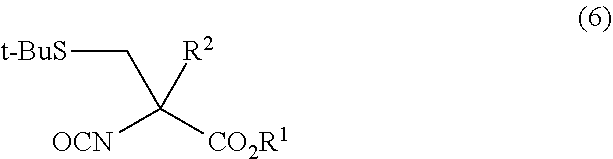


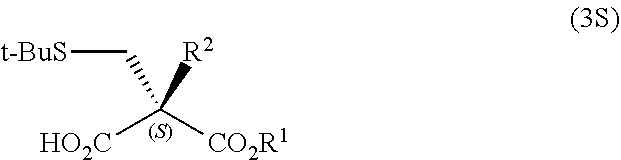


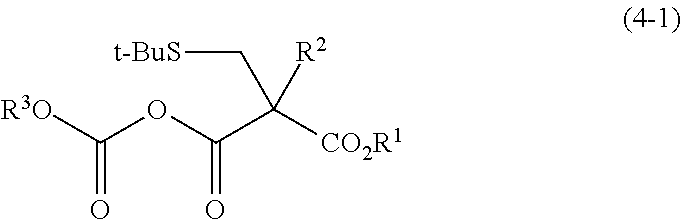


Applications Claiming Priority (3)
| Application Number | Priority Date | Filing Date | Title |
|---|---|---|---|
| JP2013097172 | 2013-05-02 | ||
| JP2013-097172 | 2013-05-02 | ||
| PCT/JP2014/062115 WO2014178433A1 (en) | 2013-05-02 | 2014-05-01 | METHOD FOR PRODUCING α-SUBSTITUTED CYSTEINE OR SALT THEREOF OR INTERMEDIATE FOR SYNTHESIS OF α-SUBSTITUTED CYSTEINE |
Related Parent Applications (1)
| Application Number | Title | Priority Date | Filing Date |
|---|---|---|---|
| PCT/JP2014/062115 A-371-Of-International WO2014178433A1 (en) | 2013-05-02 | 2014-05-01 | METHOD FOR PRODUCING α-SUBSTITUTED CYSTEINE OR SALT THEREOF OR INTERMEDIATE FOR SYNTHESIS OF α-SUBSTITUTED CYSTEINE |
Related Child Applications (1)
| Application Number | Title | Priority Date | Filing Date |
|---|---|---|---|
| US15/978,489 Continuation US20180251424A1 (en) | 2013-05-02 | 2018-05-14 | Method for Producing Alpha-substituted Cysteine or Salt Thereof or Synthetic Intermediate of Alpha-substituted Cysteine |
Publications (2)
| Publication Number | Publication Date |
|---|---|
| US20160083341A1 US20160083341A1 (en) | 2016-03-24 |
| US10071958B2 true US10071958B2 (en) | 2018-09-11 |
Family
ID=51843557
Family Applications (2)
| Application Number | Title | Priority Date | Filing Date |
|---|---|---|---|
| US14/888,576 Active 2034-09-17 US10071958B2 (en) | 2013-05-02 | 2014-05-01 | Method for producing alpha-substituted cysteine or salt thereof or synthetic intermediate of alpha-substituted cysteine |
| US15/978,489 Abandoned US20180251424A1 (en) | 2013-05-02 | 2018-05-14 | Method for Producing Alpha-substituted Cysteine or Salt Thereof or Synthetic Intermediate of Alpha-substituted Cysteine |
Family Applications After (1)
| Application Number | Title | Priority Date | Filing Date |
|---|---|---|---|
| US15/978,489 Abandoned US20180251424A1 (en) | 2013-05-02 | 2018-05-14 | Method for Producing Alpha-substituted Cysteine or Salt Thereof or Synthetic Intermediate of Alpha-substituted Cysteine |
Country Status (4)
| Country | Link |
|---|---|
| US (2) | US10071958B2 (en) |
| JP (1) | JP5953429B2 (en) |
| SG (1) | SG11201509022XA (en) |
| WO (1) | WO2014178433A1 (en) |
Citations (6)
| Publication number | Priority date | Publication date | Assignee | Title |
|---|---|---|---|---|
| US4895952A (en) | 1986-01-07 | 1990-01-23 | Atochem | Polyfluoroalkylthiomethyl compounds, processes for their preparation and use thereof |
| US4994624A (en) | 1988-07-26 | 1991-02-19 | Phillips Petroleum Company | Process for preparing organothioalkanols |
| WO2001072702A2 (en) | 2000-03-24 | 2001-10-04 | Pharmacia Corporation | Amidino compounds useful as nitric oxide synthase inhibitors |
| WO2003106689A1 (en) | 2002-06-05 | 2003-12-24 | 鐘淵化学工業株式会社 | PROCESS FOR PRODUCING OPTICALLY ACTIVE α-METHYLCYSTEINE DERIVATIVE |
| WO2007106022A2 (en) | 2006-03-16 | 2007-09-20 | Astrazeneca Ab | A new crystalline form g of (5s) -5- [4- (5-chloro-pyridin-2- yloxy) -piperidine-1-sulfonylmethyl] - 5 -methyl -imidazolidine - 2,4-dione (i) and intermediates thereof. |
| US8106035B2 (en) * | 2002-12-18 | 2012-01-31 | Cytochroma Inc. | 25-SO2-substituted analogs of 1μ,25-dihydroxyvitamin D3 |
-
2014
- 2014-05-01 US US14/888,576 patent/US10071958B2/en active Active
- 2014-05-01 JP JP2015514876A patent/JP5953429B2/en active Active
- 2014-05-01 WO PCT/JP2014/062115 patent/WO2014178433A1/en not_active Ceased
- 2014-05-01 SG SG11201509022XA patent/SG11201509022XA/en unknown
-
2018
- 2018-05-14 US US15/978,489 patent/US20180251424A1/en not_active Abandoned
Patent Citations (9)
| Publication number | Priority date | Publication date | Assignee | Title |
|---|---|---|---|---|
| US4895952A (en) | 1986-01-07 | 1990-01-23 | Atochem | Polyfluoroalkylthiomethyl compounds, processes for their preparation and use thereof |
| US4994624A (en) | 1988-07-26 | 1991-02-19 | Phillips Petroleum Company | Process for preparing organothioalkanols |
| WO2001072702A2 (en) | 2000-03-24 | 2001-10-04 | Pharmacia Corporation | Amidino compounds useful as nitric oxide synthase inhibitors |
| WO2003106689A1 (en) | 2002-06-05 | 2003-12-24 | 鐘淵化学工業株式会社 | PROCESS FOR PRODUCING OPTICALLY ACTIVE α-METHYLCYSTEINE DERIVATIVE |
| US20060105435A1 (en) | 2002-06-05 | 2006-05-18 | Takahiro Ohishi | Process for producing optically active alpha-methylcysteine derivative |
| US20100197934A1 (en) | 2002-06-05 | 2010-08-05 | Kaneka Corporation | Process for producing optically active alpha-methylcysteine derivative |
| US8993800B2 (en) | 2002-06-05 | 2015-03-31 | Kaneka Corporation | Process for producing optically active α-methylcysteine derivative |
| US8106035B2 (en) * | 2002-12-18 | 2012-01-31 | Cytochroma Inc. | 25-SO2-substituted analogs of 1μ,25-dihydroxyvitamin D3 |
| WO2007106022A2 (en) | 2006-03-16 | 2007-09-20 | Astrazeneca Ab | A new crystalline form g of (5s) -5- [4- (5-chloro-pyridin-2- yloxy) -piperidine-1-sulfonylmethyl] - 5 -methyl -imidazolidine - 2,4-dione (i) and intermediates thereof. |
Non-Patent Citations (15)
| Title |
|---|
| d'Ischia et al. Synthetic Communcations 1987, 17, 1577-1585 (Year: 1987). * |
| Han et al. Chem. Commun. 2006, 1757-1759. * |
| Han et al. Chem. Commun. 2007, 3444-3446 (Year: 2007). * |
| Han et al., "Novel Structural Motifs Consisting of Chiral Thiazolines: Synthesis, Molecular Recognition, and Anticancer Activity", Chem. Eur. J., 2007, vol. 13, No. 11, pp. 3026-3038. |
| Kedrowski, "Synthesis of Orthogonally Protected (R)- and (S)-2-methylcysteine via an Enzymatic Desymmeterization and Curtius Rearrangement", J. Org. Chem, Jun. 27, 2003, vol. 68, No. 13, pp. 5403-5406. |
| Kedrowski, "Synthesis of Orthongonally Protected (R)- and (S)-2-methylcysteine via an Enzymatic Desymmeterization and Curtius Rearrangement", J. Org. Chem, Jun. 27, 2003, vol. 68, No. 13, pp. 5403-5406. |
| Kedrowski, B. J. Org. Chem. 2003, 68, 5403-5406. * |
| Liu et al., "Efficient Production of (S)-naproxen with (R)-substrate Recycling Using an Overexpressed Carboxylesterase BsE-NP01", Appl. Biochem. Biotechnol., Nov. 2010, vol. 162, No. 6, pp. 1574-1584. |
| Masterson et al., "A Divergent Approach to the Preparation of Cysteine and Serine Analogs", J. Pept. Sci., Nov. 2008, vol. 14, No. 11, pp. 1151-1162. |
| Masterson et al., "An Improved Method for the Preparation of Protected (R)-2-Methylcysteine: Solution-Phase Synthesis of a Glutathione Analogue", Synlett, 2010, No. 19, pp. 2941-2943. |
| Nagasawa et al. J. Med. Chem. 1987, 30, 1373-1378 (Year: 1987). * |
| Office Action in JP Application No. 2015-514876 dated Feb. 2, 2016, 9 pages. |
| Ohishi et al. Tetrahedron Letters 2007, 48, 3437-3440 (Year: 2007). * |
| Search Report in International Application No. PCT/JP2014/062115 dated Jul. 29, 2014. |
| Transmittal of International Preliminary Report on Patentability and Written Opinion in International Application No. PCT/JP2014/062115 dated Nov. 12, 2015, 9 pages. |
Also Published As
| Publication number | Publication date |
|---|---|
| JP5953429B2 (en) | 2016-07-20 |
| US20180251424A1 (en) | 2018-09-06 |
| US20160083341A1 (en) | 2016-03-24 |
| SG11201509022XA (en) | 2015-12-30 |
| WO2014178433A1 (en) | 2014-11-06 |
| JPWO2014178433A1 (en) | 2017-02-23 |
Similar Documents
| Publication | Publication Date | Title |
|---|---|---|
| US9061991B2 (en) | Method for producing 1-amino-1-alkoxycarbonyl-2-vinylcyclopropane | |
| CN105018440B (en) | A kind of transaminase and its application in sitagliptin intermediate is synthesized | |
| US8338142B2 (en) | Method for producing optically active 3-aminopiperidine or salt thereof | |
| JP5096435B2 (en) | Process for producing optically active α-methylcysteine derivative | |
| US12258593B2 (en) | Hydrolase and method for producing (1S,2S)-1-alkoxycarbonyl-2-vinylcyclopropane carboxylic acid using same | |
| WO2010053050A1 (en) | O-alkylserine, and process for producing n-benzyl-o-alkylserine | |
| US7335757B2 (en) | Carbonyl reductase, gene encoding the same, and process for producing optically active alcohols using the same | |
| EP2518050A1 (en) | Process for production of optically active 3-substituted glutaric acid monoamide | |
| WO2005075651A1 (en) | Process for producing optically active alcohol and carboxylic acid | |
| US20180251424A1 (en) | Method for Producing Alpha-substituted Cysteine or Salt Thereof or Synthetic Intermediate of Alpha-substituted Cysteine | |
| CN114729374B (en) | Carbonyl reductase, nucleic acid encoding the same, and method for producing optically active compound using the same | |
| WO2011071058A1 (en) | Preparation method for optically active 2-hydroxycycloalkane carboxylic acid ester | |
| US10689675B2 (en) | Enzymatic processes for the preparation of (±)-2-(difluoromethyl)-1-(alkoxycarbonyl)-cyclopropanecarboxylic acid and (±)-2-(vinyl)-1-(alkoxycarbonyl)-cyclopropanecarboxylic acid | |
| WO2008140127A1 (en) | Process for producing optically active 2-alkyl-1,1,3-trialkoxycarbonylpropane | |
| JP4719535B2 (en) | 2,6-dihydroxybenzoate decarboxylase, polynucleotide encoding the enzyme, method for producing the same, and method for producing polyvalent alcohol aromatic compound using the same | |
| JP2008125364A (en) | Process for producing optically active amino acids and N-alkoxycarbonylamino acids | |
| JP4658315B2 (en) | Process for producing optically active carboxylic acid and its enantiomer ester | |
| JP2004350522A (en) | Process for producing optically active ester and / or optically active carboxylic acid | |
| JP2006121983A (en) | Process for producing optically active β-hydroxyamino acid in the presence of additives | |
| JP2015139426A (en) | METHOD FOR PRODUCING NOVEL β-AMINO ACID | |
| JP2013255505A (en) | Production method for optically active amino acid and n-alkoxycarbonylamino acid |
Legal Events
| Date | Code | Title | Description |
|---|---|---|---|
| AS | Assignment |
Owner name: API CORPORATION, JAPAN Free format text: ASSIGNMENT OF ASSIGNORS INTEREST;ASSIGNORS:ASUMA, YUUKI;UEHARA, HISATOSHI;MAEDA, TOMOKO;AND OTHERS;SIGNING DATES FROM 20151023 TO 20151026;REEL/FRAME:040857/0986 |
|
| STCF | Information on status: patent grant |
Free format text: PATENTED CASE |
|
| CC | Certificate of correction | ||
| MAFP | Maintenance fee payment |
Free format text: PAYMENT OF MAINTENANCE FEE, 4TH YEAR, LARGE ENTITY (ORIGINAL EVENT CODE: M1551); ENTITY STATUS OF PATENT OWNER: LARGE ENTITY Year of fee payment: 4 |
|
| AS | Assignment |
Owner name: API CORPORATION, JAPAN Free format text: CHANGE OF ADDRESS;ASSIGNOR:API CORPORATION;REEL/FRAME:072498/0511 Effective date: 20220803 Owner name: UBE CORPORATION, JAPAN Free format text: MERGER;ASSIGNOR:API CORPORATION;REEL/FRAME:072554/0211 Effective date: 20241220 |
|
| MAFP | Maintenance fee payment |
Free format text: PAYMENT OF MAINTENANCE FEE, 8TH YEAR, LARGE ENTITY (ORIGINAL EVENT CODE: M1552); ENTITY STATUS OF PATENT OWNER: LARGE ENTITY Year of fee payment: 8 |