US10065930B2 - Method for producing pyrimidine-1-ol compound, and intermediate thereof - Google Patents
Method for producing pyrimidine-1-ol compound, and intermediate thereof Download PDFInfo
- Publication number
- US10065930B2 US10065930B2 US15/328,166 US201515328166A US10065930B2 US 10065930 B2 US10065930 B2 US 10065930B2 US 201515328166 A US201515328166 A US 201515328166A US 10065930 B2 US10065930 B2 US 10065930B2
- Authority
- US
- United States
- Prior art keywords
- compound
- formula
- salt
- stirred
- producing
- Prior art date
- Legal status (The legal status is an assumption and is not a legal conclusion. Google has not performed a legal analysis and makes no representation as to the accuracy of the status listed.)
- Active
Links
- 0 *C1=CC(NC(=O)[C@@H]2C[C@@]2(COC2=C(*)N=C(*)N=C2*)C2=C(*)C(*)=C(*)C(*)=C2)=C(*)C(*)=C1* Chemical compound *C1=CC(NC(=O)[C@@H]2C[C@@]2(COC2=C(*)N=C(*)N=C2*)C2=C(*)C(*)=C(*)C(*)=C2)=C(*)C(*)=C1* 0.000 description 35
- XTVHGZYQWYFNJW-UHFFFAOYSA-N CC1=NC(C)=C(OC2=CC=C([N+](=O)[O-])C=C2)C=N1 Chemical compound CC1=NC(C)=C(OC2=CC=C([N+](=O)[O-])C=C2)C=N1 XTVHGZYQWYFNJW-UHFFFAOYSA-N 0.000 description 4
- JEUNEPXHZXSTBM-WQLSENKSSA-N CC(=O)/C(=C/N(C)C)OC1=CC=C([N+](=O)[O-])C=C1 Chemical compound CC(=O)/C(=C/N(C)C)OC1=CC=C([N+](=O)[O-])C=C1 JEUNEPXHZXSTBM-WQLSENKSSA-N 0.000 description 3
- BHGSSXAWCBVUPB-HLNNWMFASA-N CC(=O)/C(=C/N(C)C)OC1=CC=C([N+](=O)[O-])C=C1.CC(=O)COC1=CC=C([N+](=O)[O-])C=C1.CC1=NC(C)=C(O)C=N1.CC1=NC(C)=C(OC2=CC=C([N+](=O)[O-])C=C2)C=N1.O=[N+]([O-])C1=CC=C(O)C=C1 Chemical compound CC(=O)/C(=C/N(C)C)OC1=CC=C([N+](=O)[O-])C=C1.CC(=O)COC1=CC=C([N+](=O)[O-])C=C1.CC1=NC(C)=C(O)C=N1.CC1=NC(C)=C(OC2=CC=C([N+](=O)[O-])C=C2)C=N1.O=[N+]([O-])C1=CC=C(O)C=C1 BHGSSXAWCBVUPB-HLNNWMFASA-N 0.000 description 3
- BTPOVNGEGQQHIV-UHFFFAOYSA-N CC(=O)COC1=CC=C([N+](=O)[O-])C=C1 Chemical compound CC(=O)COC1=CC=C([N+](=O)[O-])C=C1 BTPOVNGEGQQHIV-UHFFFAOYSA-N 0.000 description 3
- NJRAXBYJSOFRQV-UHFFFAOYSA-N CC1=NC(C)=C(O)C=N1 Chemical compound CC1=NC(C)=C(O)C=N1 NJRAXBYJSOFRQV-UHFFFAOYSA-N 0.000 description 3
- HJMMPHAWZAIQBX-SZHHRCRFSA-N *.*.*.*.*.*.CC(=O)OC[C@@H]1C[C@@]1(CO)C1=CC(F)=CC=C1.CC(=O)OC[C@@H]1C[C@@]1(COC1=C(C)N=C(C)N=C1)C1=CC(F)=CC=C1.CC1=NC(C)=C(O)C=N1.CC1=NC(C)=C(OC[C@@]2(C3=CC(F)=CC=C3)C[C@H]2C(=O)O)C=N1.CC1=NC(C)=C(OC[C@@]2(C3=CC(F)=CC=C3)C[C@H]2CO)C=N1.NC1=CC=C(F)C=N1.O=C1OC[C@@H]2C[C@]12C1=CC(F)=CC=C1.OC[C@@H]1C[C@@]1(CO)C1=CC(F)=CC=C1 Chemical compound *.*.*.*.*.*.CC(=O)OC[C@@H]1C[C@@]1(CO)C1=CC(F)=CC=C1.CC(=O)OC[C@@H]1C[C@@]1(COC1=C(C)N=C(C)N=C1)C1=CC(F)=CC=C1.CC1=NC(C)=C(O)C=N1.CC1=NC(C)=C(OC[C@@]2(C3=CC(F)=CC=C3)C[C@H]2C(=O)O)C=N1.CC1=NC(C)=C(OC[C@@]2(C3=CC(F)=CC=C3)C[C@H]2CO)C=N1.NC1=CC=C(F)C=N1.O=C1OC[C@@H]2C[C@]12C1=CC(F)=CC=C1.OC[C@@H]1C[C@@]1(CO)C1=CC(F)=CC=C1 HJMMPHAWZAIQBX-SZHHRCRFSA-N 0.000 description 1
- WNQTUAWTUAHIEH-WFYAROANSA-N *.*.CC(=O)OC[C@@H]1C[C@@]1(COC1=C(C)N=C(C)N=C1)C1=CC(F)=CC=C1.CC(=O)OC[C@@H]1C[C@@]1(COS(=O)(=O)C1=CC=C(C)C=C1)C1=CC(F)=CC=C1.CC1=NC(C)=C(O)C=N1.CC1=NC(C)=C(OC[C@@]2(C3=CC(F)=CC=C3)C[C@H]2CO)C=N1 Chemical compound *.*.CC(=O)OC[C@@H]1C[C@@]1(COC1=C(C)N=C(C)N=C1)C1=CC(F)=CC=C1.CC(=O)OC[C@@H]1C[C@@]1(COS(=O)(=O)C1=CC=C(C)C=C1)C1=CC(F)=CC=C1.CC1=NC(C)=C(O)C=N1.CC1=NC(C)=C(OC[C@@]2(C3=CC(F)=CC=C3)C[C@H]2CO)C=N1 WNQTUAWTUAHIEH-WFYAROANSA-N 0.000 description 1
- MUGXRYIUWFITCP-PGRDOPGGSA-N *.CC1=NC(C)=C(OC[C@@]2(C3=CC(F)=CC=C3)C[C@H]2C(=O)NC2=CC=C(F)C=N2)C=N1 Chemical compound *.CC1=NC(C)=C(OC[C@@]2(C3=CC(F)=CC=C3)C[C@H]2C(=O)NC2=CC=C(F)C=N2)C=N1 MUGXRYIUWFITCP-PGRDOPGGSA-N 0.000 description 1
- WMYZZPMJUOWDGO-UHFFFAOYSA-N BrB(Br)Br.CC1=NC(C)=C(O)C=N1.COC1=C(C)N=C(C)N=C1.COC1=C(Cl)N=C(Cl)N=C1 Chemical compound BrB(Br)Br.CC1=NC(C)=C(O)C=N1.COC1=C(C)N=C(C)N=C1.COC1=C(Cl)N=C(Cl)N=C1 WMYZZPMJUOWDGO-UHFFFAOYSA-N 0.000 description 1
- CBHSIPUPUMJJBX-UHFFFAOYSA-N CC1=NC(C)=C(O)C=N1.COC1=C(C)N=C(C)N=C1.COC1=C(Cl)N=C(Cl)N=C1.Cl Chemical compound CC1=NC(C)=C(O)C=N1.COC1=C(C)N=C(C)N=C1.COC1=C(Cl)N=C(Cl)N=C1.Cl CBHSIPUPUMJJBX-UHFFFAOYSA-N 0.000 description 1
- LQNHYWWDJHIKAQ-UHFFFAOYSA-N [O-][N+](c(cc1)ccc1OCC(I)=O)=O Chemical compound [O-][N+](c(cc1)ccc1OCC(I)=O)=O LQNHYWWDJHIKAQ-UHFFFAOYSA-N 0.000 description 1
Classifications
-
- C—CHEMISTRY; METALLURGY
- C07—ORGANIC CHEMISTRY
- C07D—HETEROCYCLIC COMPOUNDS
- C07D239/00—Heterocyclic compounds containing 1,3-diazine or hydrogenated 1,3-diazine rings
- C07D239/02—Heterocyclic compounds containing 1,3-diazine or hydrogenated 1,3-diazine rings not condensed with other rings
- C07D239/24—Heterocyclic compounds containing 1,3-diazine or hydrogenated 1,3-diazine rings not condensed with other rings having three or more double bonds between ring members or between ring members and non-ring members
- C07D239/28—Heterocyclic compounds containing 1,3-diazine or hydrogenated 1,3-diazine rings not condensed with other rings having three or more double bonds between ring members or between ring members and non-ring members with hetero atoms or with carbon atoms having three bonds to hetero atoms with at the most one bond to halogen, directly attached to ring carbon atoms
- C07D239/32—One oxygen, sulfur or nitrogen atom
- C07D239/34—One oxygen atom
-
- A—HUMAN NECESSITIES
- A61—MEDICAL OR VETERINARY SCIENCE; HYGIENE
- A61K—PREPARATIONS FOR MEDICAL, DENTAL OR TOILETRY PURPOSES
- A61K31/00—Medicinal preparations containing organic active ingredients
- A61K31/33—Heterocyclic compounds
- A61K31/395—Heterocyclic compounds having nitrogen as a ring hetero atom, e.g. guanethidine or rifamycins
- A61K31/495—Heterocyclic compounds having nitrogen as a ring hetero atom, e.g. guanethidine or rifamycins having six-membered rings with two or more nitrogen atoms as the only ring heteroatoms, e.g. piperazine or tetrazines
- A61K31/505—Pyrimidines; Hydrogenated pyrimidines, e.g. trimethoprim
-
- C—CHEMISTRY; METALLURGY
- C07—ORGANIC CHEMISTRY
- C07D—HETEROCYCLIC COMPOUNDS
- C07D239/00—Heterocyclic compounds containing 1,3-diazine or hydrogenated 1,3-diazine rings
- C07D239/02—Heterocyclic compounds containing 1,3-diazine or hydrogenated 1,3-diazine rings not condensed with other rings
- C07D239/24—Heterocyclic compounds containing 1,3-diazine or hydrogenated 1,3-diazine rings not condensed with other rings having three or more double bonds between ring members or between ring members and non-ring members
- C07D239/28—Heterocyclic compounds containing 1,3-diazine or hydrogenated 1,3-diazine rings not condensed with other rings having three or more double bonds between ring members or between ring members and non-ring members with hetero atoms or with carbon atoms having three bonds to hetero atoms with at the most one bond to halogen, directly attached to ring carbon atoms
- C07D239/32—One oxygen, sulfur or nitrogen atom
- C07D239/34—One oxygen atom
- C07D239/36—One oxygen atom as doubly bound oxygen atom or as unsubstituted hydroxy radical
Definitions
- the present invention relates to a method for producing 2,4-disubstituted pyrimidine-5-ol which is a key intermediate for producing a compound that has an orexin receptor antagonistic action and is useful as an insomnia treatment agent and an intermediate for production thereof.
- orexin-A a peptide consisting of 33 amino acids
- orexin-B a peptide consisting of 28 amino acids
- endogenous ligands Patent Literature 5 and Non Patent Literature 1
- the orexin receptors include two subtypes, an OX1 receptor (OX1) as a type 1 subtype and an OX2 receptor (OX2) as a type 2 subtype.
- OX1 more selectively binds to OX-A than to OX-B
- OX2 binds to OX-A similarly to OX-B.
- orexins stimulate food consumption in rats and physiological roles as mediators of such peptides in a central feedback mechanism to regulate feeding behaviors have been suggested (Non Patent Literature 1).
- orexins also regulate states of sleep and wakefulness, and therefore orexins are considered to lead to a novel treatment method for narcolepsy as well as insomnia and other sleep disorders (Non Patent Literature 2).
- Non Patent Literature 3 and Non Patent Literature 4 it has been suggested that orexin signals in the ventral tegmental area associated with narcotic addiction and nicotine addiction play important roles in vivo in neuroplasticity.
- Non Patent Literature 5 it has been reported that, when OX2 is selectively inhibited in an experiment using rats, ethanol addiction is alleviated (Non Patent Literature 5).
- the corticotrophin releasing factor (CRF) associated with depression and anxiety disorder in rats induces orexin-induced activity, and there is a possibility of orexins playing important roles in a stress response (Non Patent Literature 6).
- CRF corticotrophin releasing factor
- Patent Literature 7 a compound represented by the following formula or a pharmaceutically acceptable salt thereof is considerably described as a compound that has an orexin receptor antagonistic action and is expected to have an effect in insomnia treatment.
- Q is —CH— or a nitrogen atom
- R 1a and R 1b each independently represent, for example, a C 1-6 alkyl group
- R 1c represents a hydrogen atom
- R 2a , R 2b , R 2c and R 2d each independently represent a hydrogen atom or a halogen atom
- R 3a , R 3b and R 3c each independently represent a hydrogen atom or a halogen atom
- R ad represents a hydrogen atom.
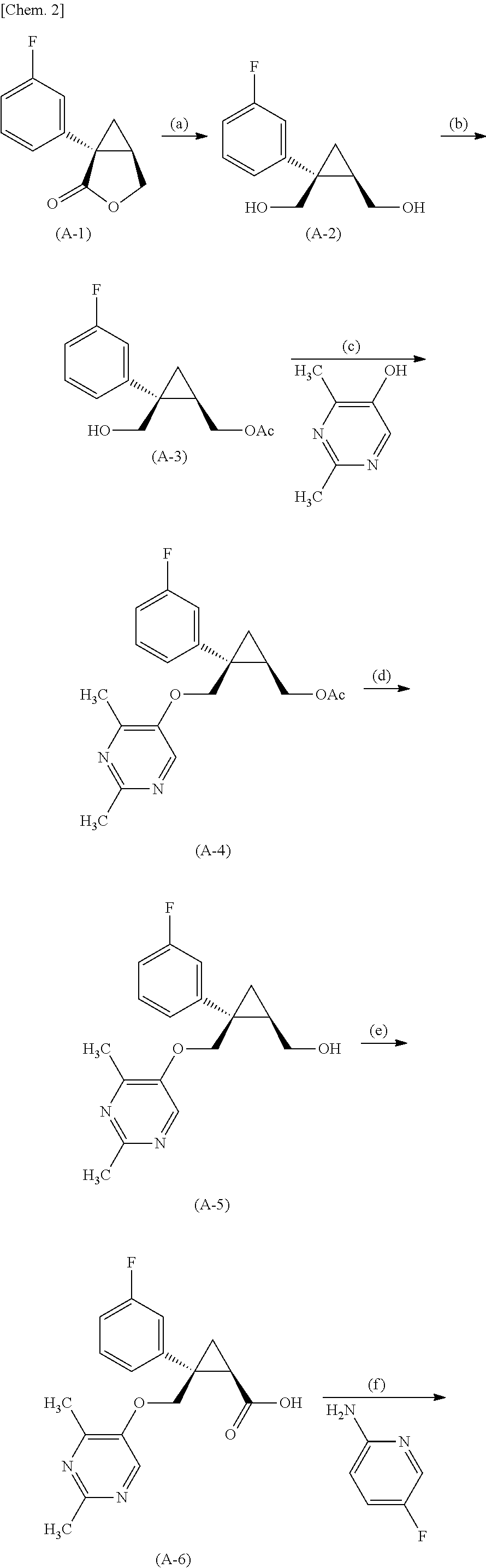
- Patent Literature 8 a compound represented by the following formula (A) that can be produced by the following method is reported in Patent Literature 8.
- (1R,2S)-2- ⁇ [(2,4-dimethylpyrimidin-5-yl)oxy]methyl ⁇ -2-(3-fluorophenyl)cyclopropylmethanol (A-5) produced in the above production method can be produced by reacting ⁇ (1R, 2S)-2-(3-fluorophenyl)-2-[(tosyloxy)methyl]cyclopropyl ⁇ methyl acetate produced from a compound (A-3) with 2,4-dimethylpyrimidine-5-ol (step (g)) and subsequent hydrolysis (step (d)) as shown in the following steps.
- 2,4-dichloro-5-methoxypyrimidine serving as a starting material is expensive
- 2,4-dimethyl-5-methoxypyrimidine obtained as an intermediate is volatile
- trimethyl aluminum used as a reagent causes health problems such as skin corrosiveness and irritation and has a risk of spontaneous ignition
- boron tribromide also causes health problems such as skin corrosiveness and irritation and requires careful handling. Therefore, the production method has problems when used in industrial production.
- the production method also has problems such as expensive 2,4-dichloro-5-methoxypyrimidine is used as a starting material, and 2,4-dimethyl-5-methoxypyrimidine hydrochloride obtained as an intermediate has hygroscopicity. Further, in order for the production method to be used in industrial production, there are problems such as it is difficult to control impurities hydrogenated at the 2- or 4-position in methylation at the 2-position and 4-position of pyrimidine using methyl magnesium chloride.
- an object of the present invention is to provide a method for producing 2,4-disubstituted pyrimidine-5-ol, and particularly, 2,4-dimethylpyrimidine-5-ol, used in industrial production.
- the present invention includes the following aspects.
- R 1 and R 2 represent C 1-6 alkyl groups that are same or different from each other.], comprising a step of hydrolyzing a compound of Formula (V) or a salt thereof.
- R 1 and R 2 represent C 1-6 alkyl groups that are the same or different from each other.
- the production method according to [1], comprising a step of producing a compound of Formula (V) or a salt thereof by reacting a compound of Formula (IV) or a salt thereof with a compound of Formula (VI) or a salt thereof
- R 1 and R 2 represent C 1-6 alkyl groups that are the same or different from each other.
- R 1 represents a C 1-6 alkyl group.
- R 2 represents a C 1-6 alkyl group.
- a step of hydrolyzing the compound of Formula (V) or the salt thereof [3]
- R 1 represents a C 1-6 alkyl group.
- R 1 represents a C 1-6 alkyl group.
- R 1 and R 2 represent C 1-6 alkyl groups that are the same or different from each other.
- R 2 represents a C 1-6 alkyl group.
- a step of hydrolyzing the compound of Formula (V) or the salt thereof [4]
- X represents chlorine or bromine
- R 1 represents a C 1-6 alkyl group.
- R 1 represents a C 1-6 alkyl group.
- R 1 represents a C 1-6 alkyl group.
- R 2 represents a C 1-6 alkyl group.
- R 1 and R 2 represent C 1-6 alkyl groups that are the same or different from each other.]; and a step of hydrolyzing the compound of Formula (V) or the salt thereof.
- [5] The production method according to any one of [1] to [4], wherein R 1 and R 2 are both methyl groups.
- [6] A compound represented by Formula (V) or a salt thereof.
- R 1 and R 2 represent C 1-6 alkyl groups that are the same or different from each other.
- R 1 and R 2 represent C 1-6 alkyl groups that are the same or different from each other.
- the present invention provides a method for producing 2,4-disubstituted pyrimidine-5-ol which is an intermediate for producing a compound that has an orexin receptor antagonistic action and is useful as an insomnia treatment agent, and an intermediate thereof.
- an inexpensive and easily available starting material can be used, regioselectivity of a substituent group is easily controlled and impurities are easily controlled, and 2,4-disubstituted pyrimidine-5-ol can be produced without using reagents and intermediates causing health problems, risks and the like. Therefore, the production method is suitable for industrial production.
- structural formulae of compounds are not limited to formulae described for convenience, and may form salts. Further, crystal polymorphism may be present but it is not limited similarly, and any single crystalline form or a mixture thereof may be provided. A hydrate or a solvate other than an anhydride may be provided and all of them are included in the present invention.
- a salt examples include hydrohalogenic acid salts (for example, hydrofluoride, hydrochloride, hydrobromide, and hydroiodide), and inorganic acid salts (for example, sulfate, nitrate, perchlorate, phosphate, carbonate, and bicarbonate).
- hydrohalogenic acid salts for example, hydrofluoride, hydrochloride, hydrobromide, and hydroiodide
- inorganic acid salts for example, sulfate, nitrate, perchlorate, phosphate, carbonate, and bicarbonate.
- the present invention includes an isotopically labeled compound of the compound described in this specification and a production method using the same.
- the isotopically labeled compound is the same as a compound described in the specification except that one or more atoms are replaced with atoms whose atomic mass and mass number are different from those normally found in nature.
- Isotopes that can be incorporated into the compound according to the present invention are isotopes of hydrogen, carbon, nitrogen, oxygen, and fluorine of the compound, and include 2 H, 3 H, 11 C, 13 C, 14 C, 13 N, 15 O, and 18 F.
- the “C 1-6 alkyl group” in R 1 and R 2 represents a linear or branched alkyl group having 1 to 6 carbon atoms, and includes, for example, linear or branched alkyl groups such as a methyl group, an ethyl group, an n-propyl group, an isopropyl group, an n-butyl group, an isobutyl group, a t-butyl group, an n-pentyl group, an isopentyl group, a neopentyl group, an n-hexyl group, a 1-methylpropyl group, a 1,2-dimethylpropyl group, a 1-ethylpropyl group, a 1-methyl-2-ethylpropyl group, a 1-ethyl-2-methylpropyl group, a 1,1,2-trimethylpropyl group, a 1-methylbutyl group, a 2-methylbutyl group, a 1,1-dimethylbuty
- a method for producing 2,4-disubstituted pyrimidine-5-ol or a salt thereof according to the present invention includes a step of hydrolyzing a compound (V) or a salt thereof (fourth step; Step 4).
- a method for producing 2,4-disubstituted pyrimidine-5-ol according to the present invention includes a step (third step; Step 3) of producing a compound (V) or a salt thereof by reacting a compound (IV) or a salt thereof with an amidine derivative (VI) or a salt thereof in the presence of a base, and the fourth step.
- a method for producing 2,4-disubstituted pyrimidine-5-ol or a salt thereof according to the present invention includes a step (second step; Step 2) of producing a compound (IV) or a salt thereof by a condensation reaction of N, N-dimethylformamide dimethyl acetal and a compound (III), the third step, and the fourth step.
- a method for producing 2,4-disubstituted pyrimidine-5-ol or a salt thereof according to the present invention includes a step (first step; Step 1) of producing a 4-nitrophenyloxymethyl ketone compound (III) by reacting a halomethylketone compound (VII) with 4-nitrophenol (II), the second step, the third step, and the fourth step.
- R 1 and R 2 represent C 1-6 alkyl groups that are the same or different from each other.
- This step is a step of producing a 4-nitrophenyloxymethylketone compound (III) according to an alkylation reaction of a halomethyl ketone compound (VII) and a phenolic hydroxyl group of 4-nitrophenol (II).
- the compound (VII) and the compound (II) are used in equivalent amounts or either thereof is used in a greater amount.
- a mixture thereof is stirred, in general, for 0.1 hour to 5 days, in the presence of a base, in a solvent inert to the reaction, in anywhere from a cooling range to a heating range, but preferably in a heating range.
- Exemplary solvents used here are not particularly limited, and include ketones such as acetone and methylethyl ketone, nitriles such as acetonitrile and propionitrile, aromatic hydrocarbons such as benzene, toluene, and xylene, halogenated hydrocarbons such as dichloromethane, 1,2-dichloro ethane, and chloroform, ethers such as diethyl ether, tetrahydrofuran, dioxane, and dimethoxyethane, aprotic polar solvents such as N,N-dimethylformamide, dimethyl sulfoxide, and N-methylpyrrolidone, and mixtures thereof.
- ketones such as acetone and methylethyl ketone
- nitriles such as acetonitrile and propionitrile
- aromatic hydrocarbons such as benzene, toluene, and xylene
- exemplary bases used here can include inorganic bases such as potassium carbonate, sodium carbonate, cesium carbonate, sodium hydrogen carbonate, sodium hydroxide, and potassium hydroxide, and organic bases such as triethylamine, diisopropylethylamine, and pyridine.
- inorganic bases such as potassium carbonate, sodium carbonate, cesium carbonate, sodium hydrogen carbonate, sodium hydroxide, and potassium hydroxide
- organic bases such as triethylamine, diisopropylethylamine, and pyridine.
- This step is a step of producing a compound (IV) or a salt thereof according to a condensation reaction of a 4-nitrophenyloxy methyl ketone compound (III) and N, N-dimethylformamide dimethyl acetal.
- the compound (III) and N, N-dimethylformamide dimethyl acetal are used in equivalent amounts or either thereof is used in a greater amount.
- a mixture thereof is stirred, in general, for 0.1 hours to 5 days, in a solvent inert to the reaction, in anywhere from a cooling range to a heating range, but preferably in a heating range.
- Exemplary solvents used here are not particularly limited, and include aromatic hydrocarbons, ethers, and mixtures thereof.
- an acid of a catalytic amount may be added.
- This step is a step of producing a 2,4-disubstituted-5-(4-(nitrophenyl)oxy)pyrimidine compound (V) which is a compound of the present invention or a salt thereof according to a pyrimidine ring construction reaction of a compound (IV) or a salt thereof and an amidine derivative (VI) or a salt thereof.
- a compound (IV) or a salt thereof and a compound (VI) or a salt thereof are used in equivalent amounts or either thereof is used in a greater amount.
- a mixture thereof is stirred, in general, for 0.1 hour to 5 days, in the presence of a base, in a solvent inert to the reaction, in anywhere from a cooling range to a heating range, but preferably in a heating range.
- Exemplary solvents used here are not particularly limited, and include ketones, aromatic hydrocarbons, halogenated hydrocarbons, ethers, aprotic polar solvents, nitriles, and mixtures thereof.
- an acid addition salt can be used as the amidine derivative.
- exemplary bases used here can include inorganic bases such as potassium carbonate, sodium carbonate, cesium carbonate, sodium hydrogen carbonate, sodium hydroxide, and potassium hydroxide, and organic bases such as triethylamine, diisopropylethylamine, and pyridine.
- This step is a step of producing 2,4-disubstituted pyrimidine-5-ol or a salt thereof according to a hydrolysis reaction of a 2,4-disubstituted-5-(4-(nitrophenyl)oxy) pyrimidine compound (V) which is a compound of the present invention or a salt thereof.
- the compound (V) or the salt thereof, and equivalent amounts or a greater amount of base are used.
- a mixture thereof is stirred, in general, for 0.1 hours to 5 days, in a solvent inert to the reaction, in anywhere from a cooling range to a heating range, but preferably in a heating range.
- Exemplary solvents used here are not particularly limited, and include aromatic hydrocarbons, ethers, aprotic polar solvents, nitriles, alcohols such as methanol, ethanol, propanol, isopropanol, and butanol, water, and mixtures thereof.
- Exemplary bases used here can include inorganic bases such as potassium carbonate, sodium carbonate, cesium carbonate, sodium hydrogen carbonate, sodium hydroxide, potassium hydroxide, trisodium phosphate, and tripotassium phosphate, and organic bases such as triethylamine, diisopropylethylamine, and pyridine.
- inorganic bases such as potassium carbonate, sodium carbonate, cesium carbonate, sodium hydrogen carbonate, sodium hydroxide, potassium hydroxide, trisodium phosphate, and tripotassium phosphate
- organic bases such as triethylamine, diisopropylethylamine, and pyridine.
- the production method according to the present invention has the following features.
- 2,4-disubstituted pyrimidine-5-ol can be produced without using reagents and intermediates causing health problems such as skin corrosiveness and irritation, and having a risk of spontaneous ignition, volatility, and hygroscopicity and used in the methods disclosed in Patent Literature 7 and Patent Literature 8.
- a 4-nitrophenyl group assists regioselective condensation to provide the compound (IV), and additionally serves as a removable protecting group in relatively mild conditions in the fourth step.
- room temperature indicates, in general, about 10° C. to about 35° C. Unless otherwise specified, % represents a weight percent.
- the reaction mixture was cooled in an ice bath and water (15 ml) and ethyl acetate (30 ml) were then added thereto.
- the obtained reaction mixture was stirred at room temperature, and organic layers were then separated, and washed with a 10% saline solution (6 ml).
- the obtained organic layers were dried using anhydrous sodium sulfate and a solvent was then evaporated under reduced pressure.
- the obtained residues were solidified using ethyl acetate-heptane (4.5 ml:9 ml) and filtered.
- the obtained solid was washed with ethyl acetate-heptane (1 ml:2 ml), and then dried under reduced pressure, and a target compound (2.51 g, 85%) was obtained.
- the obtained reaction mixture was stirred at room temperature, organic layers were then separated, and aqueous layers were reextracted with 2-methyltetrahydrofuran (25 ml). The obtained organic layers were combined and then washed with water (2.5 ml), and a solvent was evaporated under reduced pressure. Toluene (6.25 ml) was added to the obtained residues and suspended and stirred at 50° C. (external temperature). The mixture was stirred four 1.5 hours in an ice bath and then filtered. The obtained solid was washed with toluene (1.25 ml) and then dried under reduced pressure, and a target compound (1.16 g, 91%) was obtained.
- the obtained reaction mixture was stirred at room temperature, organic layers were then separated, and 0.5 mol/l aqueous sodium hydroxide (500 ml), and sodium chloride (50 g) were added thereto.
- the obtained reaction mixture was stirred at room temperature, and organic layers were then separated, and washed with a 10% saline solution (500 ml).
- a solvent was evaporated under reduced pressure, the obtained residues were dissolved with toluene (500 ml) at 60° C. (external temperature), and then cooled to 5° C. (external temperature), and a precipitated solid was filtered.
- the obtained solid was washed with toluene (50 ml) and dried at 40° C. under reduced pressure, and a target compound (109 g, 78%) was then obtained.
- the obtained reaction mixture was stirred at room temperature, organic layers were then separated, and aqueous layers were reextracted with 2-methyltetrahydrofuran (398 ml). The obtained organic layers were combined and then washed with water (39.8 ml), and a solvent was evaporated under reduced pressure. Toluene (99.5 ml) was added to the obtained residues and suspended and stirred at 50° C. (external temperature). The mixture was stirred for 1.5 hours in an ice bath and then filtered. The obtained solid was washed with toluene (19.9 ml) and then dried under reduced pressure, and a target compound (18.8 g, 93%) was obtained.
- the obtained reaction mixture was stirred at room temperature, and organic layers were then separated and washed with a 10% saline solution (50 ml). A solvent was evaporated under reduced pressure, the obtained residues were dissolved with toluene (50 ml) at 60° C. (external temperature), and then cooled in an ice bath, and a precipitated solid was filtered. The obtained solid was washed with toluene (5 ml) and dried under reduced pressure at 50° C., and a target compound (12.1 g, 86%) was then obtained.
- the obtained solid was washed with toluene (12.1 ml), and then dried at room temperature under reduced pressure, and a crude form (7.76 g, 50%) of a target compound was obtained.
- Toluene-methanol (23.3 ml:3.88 ml) was added to the crude form (7.76 g) and suspended and stirred at 80° C. (external temperature), and toluene (15.5 ml) was added at the same temperature and cooled to room temperature. Additionally, the reaction mixture was stirred for 2 hours while cooling in an ice bath, and a precipitated solid was then filtered.
- the obtained solid was washed with toluene (7.76 ml) and then dried at room temperature under reduced pressure, and a target compound (5.90 g, 38%) was obtained.
- the obtained reaction mixture was stirred at room temperature and organic layers were then separated and washed with a 10% saline solution (15 ml). A solvent was evaporated under reduced pressure, the obtained residues were dissolved with methanol (15.0 ml) at 50° C. (external temperature), and then cooled in an ice bath, and water (45.0 ml) was added dropwise. The mixture was stirred for 2 hours in an ice bath, and a precipitated solid was then filtered. The obtained solid was washed with water (6.00 ml), and then dried at room temperature under reduced pressure, and a target compound (2.78 g, 95%) was obtained.
- Toluene (8.95 ml), concentrated hydrochloric acid (7.60 g, 73.0 mmol), and ethyl acetate (8.95 ml) were added to the obtained concentrated solution in an ice bath.
- the obtained reaction mixture was stirred at room temperature, and aqueous layers were then separated and washed with toluene-ethyl acetate (8.95 ml:8.95 ml).
- Ethyl acetate (35.8 ml) was added to the obtained aqueous layers, and 5 mol/l aqueous sodium hydroxide was added in an ice bath to adjust a pH of 6-7.
- the obtained reaction mixture was stirred at room temperature, and organic layers were then separated and aqueous layers were reextracted with ethyl acetate (35.8 ml). The obtained organic layers were combined and then washed with water (1.07 ml), and a solvent was evaporated under reduced pressure. Toluene (8.95 ml) was added to the obtained residues and suspended and stirred at 50° C. (external temperature). The mixture was stirred for 2 hours in an ice bath and then filtered. The obtained solid was washed with toluene (1.79 ml) and then dried at 50° C. under reduced pressure, and a target compound (1.67 g, 92%) was obtained.
- the present invention provides a method for producing 2,4-disubstituted pyrimidine-5-ol which is an intermediate for producing a compound that has an orexin receptor antagonistic action and is useful as an insomnia treatment agent, and an intermediate thereof.
- an inexpensive and easily available starting material can be used, regioselectivity of a substituent group is easily controlled and impurities are easily controlled, and 2,4-disubstituted pyrimidine-5-ol can be produced without using reagents and intermediates causing health problems, risks and the like. Therefore, the production method is suitable for industrial production.
Landscapes
- Chemical & Material Sciences (AREA)
- Organic Chemistry (AREA)
- Health & Medical Sciences (AREA)
- Life Sciences & Earth Sciences (AREA)
- Pharmacology & Pharmacy (AREA)
- Epidemiology (AREA)
- Medicinal Chemistry (AREA)
- Animal Behavior & Ethology (AREA)
- General Health & Medical Sciences (AREA)
- Public Health (AREA)
- Veterinary Medicine (AREA)
- Plural Heterocyclic Compounds (AREA)
- Pharmaceuticals Containing Other Organic And Inorganic Compounds (AREA)
Abstract
Description

[In the formula, Q is —CH— or a nitrogen atom, R1a and R1b each independently represent, for example, a C1-6 alkyl group, R1c represents a hydrogen atom, R2a, R2b, R2c and R2d each independently represent a hydrogen atom or a halogen atom, R3a, R3b and R3c each independently represent a hydrogen atom or a halogen atom, and Rad represents a hydrogen atom.]

[In the formulae, Ac represents an acetyl group.]

[In the formulae, Ac represents an acetyl group and Ts represents a p-toluenesulfonyl group.]
- PCT International Publication No. WO 1996/34877
[Patent Literature 2] - Japanese Unexamined Patent Application, First Publication No. H10-327888
[Patent Literature 3] - Japanese Unexamined Patent Application, First Publication No. H10-327889
[Patent Literature 4] - Japanese Unexamined Patent Application, First Publication No. H11-178588
[Patent Literature 5] - Japanese Unexamined Patent Application, First Publication No. H10-229887
[Patent Literature 6] - PCT International Publication No. WO 2008/069997
[Patent Literature 7] - PCT International Publication No. WO 2012/039371
[Patent Literature 8] - PCT International Publication No. WO 2013/123240
- Sakurai T. et al., Cell, 1998, 92, 573-585
[Non Patent Literature 2] - Chemelli R. M. et al., Cell, 1999, 98, 437-451
[Non Patent Literature 3] - S. L. Borgland et al., Neuron, 2006, 49, 589-601
[Non Patent Literature 4] - C. J. Winrow et al., Neuropharmacology, 2010, 58, 185-194
[Non Patent Literature 5] - J. R. Shoblock et al., Psychopharmacology, 2010, 215:191-203
[Non Patent Literature 6] - T. Ida et al., Biochemical and Biophysical Research Communications, 2000, 270, 318-323


[In the formula, R1 and R2 represent C1-6 alkyl groups that are same or different from each other.], comprising
a step of hydrolyzing a compound of Formula (V) or a salt thereof.

[In the formula, R1 and R2 represent C1-6 alkyl groups that are the same or different from each other.]
[2] The production method according to [1], comprising
a step of producing a compound of Formula (V) or a salt thereof by reacting a compound of Formula (IV) or a salt thereof with a compound of Formula (VI) or a salt thereof

[In the formula, R1 and R2 represent C1-6 alkyl groups that are the same or different from each other.]

[In the formula, R1 represents a C1-6 alkyl group.]

[In the formula, R2 represents a C1-6 alkyl group.]; and
a step of hydrolyzing the compound of Formula (V) or the salt thereof.
[3] The production method according to [1], comprising
a step of producing a compound of Formula (IV) or a salt thereof by reacting a compound of Formula (III) with N, N-dimethylformamide dimethyl acetal

[In the formula, R1 represents a C1-6 alkyl group.]

[In the formula, R1 represents a C1-6 alkyl group.];
a step of producing a compound of Formula (V) or a salt thereof by reacting a compound of Formula (IV) or a salt thereof with a compound of Formula (VI) or a salt thereof

[In the formula, R1 and R2 represent C1-6 alkyl groups that are the same or different from each other.]

[In the formula, R2 represents a C1-6 alkyl group.]; and
a step of hydrolyzing the compound of Formula (V) or the salt thereof.
[4] The production method according to [1], comprising
a step of producing a compound of Formula (III) by reacting 4-nitrophenol with a compound of Formula (VII)

[In the formula, X represents chlorine or bromine, and R1 represents a C1-6 alkyl group.]

[In the formula, R1 represents a C1-6 alkyl group.];
a step of producing a compound of Formula (IV) or a salt thereof by reacting a compound of Formula (III) with N,N-dimethylformamide dimethyl acetal

[In the formula, R1 represents a C1-6 alkyl group.];
a step of producing a compound of Formula (V) or a salt thereof by reacting the compound of Formula (IV) or the salt thereof with a compound of Formula (VI) or a salt thereof.

[In the formula, R2 represents a C1-6 alkyl group.]

[In the formula, R1 and R2 represent C1-6 alkyl groups that are the same or different from each other.]; and
a step of hydrolyzing the compound of Formula (V) or the salt thereof.
[5] The production method according to any one of [1] to [4],
wherein R1 and R2 are both methyl groups.
[6] A compound represented by Formula (V) or a salt thereof.

[In the formula, R1 and R2 represent C1-6 alkyl groups that are the same or different from each other.]
[7] The compound or the salt thereof according to [6],
wherein R1 and R2 are both methyl groups.

[In the formulae, R1 and R2 represent C1-6 alkyl groups that are the same or different from each other.]


Claims (7)


Priority Applications (1)
| Application Number | Priority Date | Filing Date | Title |
|---|---|---|---|
| US15/328,166 US10065930B2 (en) | 2014-08-06 | 2015-08-03 | Method for producing pyrimidine-1-ol compound, and intermediate thereof |
Applications Claiming Priority (3)
| Application Number | Priority Date | Filing Date | Title |
|---|---|---|---|
| US201462033665P | 2014-08-06 | 2014-08-06 | |
| PCT/JP2015/071930 WO2016021539A1 (en) | 2014-08-06 | 2015-08-03 | Method for producing pyrimidin-1-ol compound, and intermediate thereof |
| US15/328,166 US10065930B2 (en) | 2014-08-06 | 2015-08-03 | Method for producing pyrimidine-1-ol compound, and intermediate thereof |
Publications (2)
| Publication Number | Publication Date |
|---|---|
| US20170204068A1 US20170204068A1 (en) | 2017-07-20 |
| US10065930B2 true US10065930B2 (en) | 2018-09-04 |
Family
ID=55263805
Family Applications (1)
| Application Number | Title | Priority Date | Filing Date |
|---|---|---|---|
| US15/328,166 Active US10065930B2 (en) | 2014-08-06 | 2015-08-03 | Method for producing pyrimidine-1-ol compound, and intermediate thereof |
Country Status (12)
| Country | Link |
|---|---|
| US (1) | US10065930B2 (en) |
| EP (1) | EP3178814B1 (en) |
| JP (1) | JP6283748B2 (en) |
| KR (1) | KR102325655B1 (en) |
| CN (1) | CN107074780B (en) |
| ES (1) | ES2731648T3 (en) |
| HU (1) | HUE043849T2 (en) |
| IL (1) | IL250223B (en) |
| MX (1) | MX366754B (en) |
| RU (1) | RU2681937C2 (en) |
| SG (1) | SG11201700603TA (en) |
| WO (1) | WO2016021539A1 (en) |
Cited By (1)
| Publication number | Priority date | Publication date | Assignee | Title |
|---|---|---|---|---|
| US20220194925A1 (en) * | 2019-05-15 | 2022-06-23 | Eisai R&D Management Co., Ltd. | Method and compound useful in preparation of orexin-2 receptor antagonist, and lemborexant having few impurities |
Families Citing this family (2)
| Publication number | Priority date | Publication date | Assignee | Title |
|---|---|---|---|---|
| CN113214164B (en) * | 2021-05-20 | 2022-10-18 | 广西天铭药业有限公司 | A kind of synthetic method of leberoxine intermediate 2,4-dimethylpyrimidine-5-ol |
| ES2933074B2 (en) * | 2021-07-26 | 2023-09-29 | Moehs Iberica Sl | SYNTHESIS PROCEDURE OF 2,4-DIMETHYLPYRIMIDIN-5-OL, NEW INTERMEDIATE OF SUCH PROCEDURE AND USE OF THE PRODUCT IN THE SYNTHESIS OF LEMBOREXANT |
Citations (9)
| Publication number | Priority date | Publication date | Assignee | Title |
|---|---|---|---|---|
| JPS59184167A (en) | 1983-03-30 | 1984-10-19 | バイエル・アクチエンゲゼルシヤフト | Urea derivative |
| JPS6169762A (en) | 1984-08-25 | 1986-04-10 | バイエル・アクチエンゲゼルシヤフト | Substituted phenylurea |
| JPS62292766A (en) | 1986-06-11 | 1987-12-19 | Teikoku Chem Ind Corp Ltd | Alkylthiophenylpyrimidine derivative |
| JPS62292767A (en) | 1986-06-11 | 1987-12-19 | Teikoku Chem Ind Corp Ltd | 2-(p-alkoxycarbonyl)phenylpyrimidine derivative |
| JPH03220133A (en) | 1990-01-25 | 1991-09-27 | Fuji Photo Film Co Ltd | Synthesis of aromatic amines, aromatic alcohols and aromatic thiols by aromatic nucleophilic substitution reaction |
| WO2003016275A1 (en) | 2001-08-10 | 2003-02-27 | Shionogi & Co., Ltd. | Antiviral agent |
| WO2008069997A1 (en) | 2006-12-01 | 2008-06-12 | Merck & Co., Inc. | Substituted diazepan compounds as orexin receptor antagonists |
| WO2012039371A1 (en) | 2010-09-22 | 2012-03-29 | エーザイ・アール・アンド・ディー・マネジメント株式会社 | Cyclopropane compound |
| WO2013123240A1 (en) | 2012-02-17 | 2013-08-22 | Eisai R&D Management Co., Ltd | Methods and compounds useful in the synthesis of orexin-2 receptor antagonists |
Family Cites Families (6)
| Publication number | Priority date | Publication date | Assignee | Title |
|---|---|---|---|---|
| JPS6229266A (en) * | 1985-07-29 | 1987-02-07 | Matsushita Graphic Commun Syst Inc | Automatic gain control circuit |
| SG34208A1 (en) | 1995-03-01 | 1996-12-06 | Guy Andrew Vaz | Blast and fragment resistant polyurethane boot sole for safety footwear |
| EP0828751A4 (en) | 1995-05-05 | 1999-01-20 | Human Genome Sciences Inc | HUMAN NEUROPEPTIDE RECEPTOR |
| US6159605A (en) | 1997-02-18 | 2000-12-12 | Dainichiseika Color & Chemicals Mfg. Co., Ltd. | Ink-jet recording sheet |
| US6166193A (en) | 1997-07-25 | 2000-12-26 | Board Of Regents, University Of Texas System | Polynucleotides encoding MY1 receptor |
| KR100327888B1 (en) | 1999-07-14 | 2002-03-09 | 정숭렬 | Remote control system of accelerated pavement testing facility |
-
2015
- 2015-08-03 ES ES15829152T patent/ES2731648T3/en active Active
- 2015-08-03 RU RU2017102349A patent/RU2681937C2/en active
- 2015-08-03 WO PCT/JP2015/071930 patent/WO2016021539A1/en not_active Ceased
- 2015-08-03 MX MX2017001222A patent/MX366754B/en active IP Right Grant
- 2015-08-03 CN CN201580040172.4A patent/CN107074780B/en active Active
- 2015-08-03 SG SG11201700603TA patent/SG11201700603TA/en unknown
- 2015-08-03 HU HUE15829152A patent/HUE043849T2/en unknown
- 2015-08-03 KR KR1020177002284A patent/KR102325655B1/en active Active
- 2015-08-03 JP JP2016540213A patent/JP6283748B2/en active Active
- 2015-08-03 US US15/328,166 patent/US10065930B2/en active Active
- 2015-08-03 EP EP15829152.6A patent/EP3178814B1/en active Active
-
2017
- 2017-01-22 IL IL250223A patent/IL250223B/en active IP Right Grant
Patent Citations (15)
| Publication number | Priority date | Publication date | Assignee | Title |
|---|---|---|---|---|
| JPS59184167A (en) | 1983-03-30 | 1984-10-19 | バイエル・アクチエンゲゼルシヤフト | Urea derivative |
| US4552900A (en) | 1983-03-30 | 1985-11-12 | Bayer Aktiengesellschaft | 3-(Pyrimidin-5-yl-oxyphenyl)-1-benzoyl-(thio)-urea compounds useful as pesticides |
| JPS6169762A (en) | 1984-08-25 | 1986-04-10 | バイエル・アクチエンゲゼルシヤフト | Substituted phenylurea |
| JPS62292766A (en) | 1986-06-11 | 1987-12-19 | Teikoku Chem Ind Corp Ltd | Alkylthiophenylpyrimidine derivative |
| JPS62292767A (en) | 1986-06-11 | 1987-12-19 | Teikoku Chem Ind Corp Ltd | 2-(p-alkoxycarbonyl)phenylpyrimidine derivative |
| JPH03220133A (en) | 1990-01-25 | 1991-09-27 | Fuji Photo Film Co Ltd | Synthesis of aromatic amines, aromatic alcohols and aromatic thiols by aromatic nucleophilic substitution reaction |
| US5117064A (en) | 1990-01-25 | 1992-05-26 | Fuji Photo Film Co., Ltd. | Method for synthesizing aromatic amines, aromatic alcohols and aromatic thiols by aromatic nucleophilic substitution reaction |
| WO2003016275A1 (en) | 2001-08-10 | 2003-02-27 | Shionogi & Co., Ltd. | Antiviral agent |
| US20040229909A1 (en) | 2001-08-10 | 2004-11-18 | Ryuichi Kiyama | Antiviral agent |
| WO2008069997A1 (en) | 2006-12-01 | 2008-06-12 | Merck & Co., Inc. | Substituted diazepan compounds as orexin receptor antagonists |
| WO2012039371A1 (en) | 2010-09-22 | 2012-03-29 | エーザイ・アール・アンド・ディー・マネジメント株式会社 | Cyclopropane compound |
| US20120095031A1 (en) * | 2010-09-22 | 2012-04-19 | Eisai R&D Management Co., Ltd. | Cyclopropane compound |
| US8268848B2 (en) * | 2010-09-22 | 2012-09-18 | Eisai R&D Management Co., Ltd. | Cyclopropane compound |
| EP2626350A1 (en) | 2010-09-22 | 2013-08-14 | Eisai R&D Management Co., Ltd. | Cyclopropane compound |
| WO2013123240A1 (en) | 2012-02-17 | 2013-08-22 | Eisai R&D Management Co., Ltd | Methods and compounds useful in the synthesis of orexin-2 receptor antagonists |
Non-Patent Citations (12)
| Title |
|---|
| Amendment and Written Appeal filed in JP Application No. 2016-540213, dated Nov. 22, 2017, English translation, 30 pages. |
| Greene, D.W., "Protection for Phenols and Catechols," Protective Groups in Organic Synthesis, Fourth Edition, Wiley, Chap. 3 (2007), pp. 367-430. |
| International Search Report in International Application No. PCT/JP2015/071930, dated Oct. 27, 2015, 4 pages (with English Translation). |
| Lipinski, C.A. et al., "Bronchodilator and antiulcer phenoxypyrimidinones,"Journal of Medicinal Chemistry, 1980; 23:1026-1031 ISSN: 0022-2623. |
| Notice of Allowance issued in Japanese Application No. 2016-540213, dated Jan. 9, 2018, 6 pages, with English translation. |
| Office Action issued in Israeli Application No. 250223, dated Feb. 6, 2018, 4 pages (with English translation). |
| Office Action issued in Japanese Application No. 2016-540213, dated Jun. 20, 2017, 6 pages, (with English translation). |
| Office Action issued in Japanese Application No. 2016-540213, dated Sep. 19, 2017, 6 pages (English Translation). |
| Response to Office Action in Japanese Application No. 2016-540213, dated Aug. 9, 2017, 18 pages (with English Translation). |
| Supplementary European Search Report issued in EP Application No. 15829152.6, dated Mar. 5, 2018, 5 pages. |
| Written Opinion in International Application No. PCT/JP2015/071930, dated Oct. 27, 2015, 4 pages (with English Translation). |
| Wuts, Peter G.M. et al., "Protection for Phenols and Catechols," Greene 's Protective Groups in Organic Synthesis, Fourth Edition, 2007, pp. 367-430. |
Cited By (2)
| Publication number | Priority date | Publication date | Assignee | Title |
|---|---|---|---|---|
| US20220194925A1 (en) * | 2019-05-15 | 2022-06-23 | Eisai R&D Management Co., Ltd. | Method and compound useful in preparation of orexin-2 receptor antagonist, and lemborexant having few impurities |
| US12479819B2 (en) * | 2019-05-15 | 2025-11-25 | Eisai R&D Management Co., Ltd. | Method and compound useful in preparation of orexin-2 receptor antagonist, and lemborexant having few impurities |
Also Published As
| Publication number | Publication date |
|---|---|
| IL250223B (en) | 2019-05-30 |
| US20170204068A1 (en) | 2017-07-20 |
| IL250223A0 (en) | 2017-03-30 |
| KR20170035917A (en) | 2017-03-31 |
| EP3178814A4 (en) | 2018-04-04 |
| WO2016021539A1 (en) | 2016-02-11 |
| MX2017001222A (en) | 2017-05-01 |
| RU2017102349A3 (en) | 2018-10-18 |
| KR102325655B1 (en) | 2021-11-15 |
| RU2017102349A (en) | 2018-09-06 |
| EP3178814B1 (en) | 2019-04-10 |
| ES2731648T3 (en) | 2019-11-18 |
| MX366754B (en) | 2019-07-23 |
| SG11201700603TA (en) | 2017-03-30 |
| JPWO2016021539A1 (en) | 2017-04-27 |
| HUE043849T2 (en) | 2019-09-30 |
| EP3178814A1 (en) | 2017-06-14 |
| CN107074780B (en) | 2020-06-12 |
| CN107074780A (en) | 2017-08-18 |
| RU2681937C2 (en) | 2019-03-14 |
| JP6283748B2 (en) | 2018-02-21 |
Similar Documents
| Publication | Publication Date | Title |
|---|---|---|
| US6258817B1 (en) | Substituted pyrazin-2-yl-sulphonamide (-3-pyridyl) compounds and uses thereof | |
| US9284301B2 (en) | Soluble guanylate cyclase activators | |
| US8946264B2 (en) | Pyridine derivative | |
| US8158640B2 (en) | Tetrahydroquinoline derivatives and a process for preparing the same | |
| US12024523B2 (en) | Pyrazole derivatives useful as 5-lipoxygenase activating protein (FLAP) inhibitors | |
| EP3178814B1 (en) | Method for producing pyrimidin-1-ol compound, and intermediate thereof | |
| US20230121721A1 (en) | Monoacylglycerol lipase inhibitors | |
| US10239869B2 (en) | Sulfonamide compounds as voltage-gated sodium channel modulators | |
| JP2022048391A (en) | 10- (di (phenyl) methyl) -4-hydroxy-8,9,9a, 10-tetrahydro-7H-pyrrolo [1', 2': 4 as an inhibitor of orthomyxovirus replication to treat influenza , 5] Pyrazino [1,2-b] Pyridazine-3,5-dione derivatives and related compounds | |
| US20190330204A1 (en) | Process for the preparation of herbicidal compounds | |
| ES2641469T3 (en) | 2-pyridone compound | |
| US20170050979A1 (en) | Small molecule inhibitors of g protein coupled receptor 6 kinases polypeptides | |
| US20250051315A1 (en) | Compound, angiotensin ii type 1 receptor antagonist and pharmaceutical composition | |
| US20140275556A1 (en) | Preparation of 1,3-(substituted-diaryl)-1,2,4-triazoles and intermediates therefrom | |
| WO2021070957A1 (en) | Benzene condensed ring compound and medical composition containing same | |
| HK1005801B (en) | N-heteroaryl-pyridinesulfonamide derivatives and their use as endothelin antagonists |
Legal Events
| Date | Code | Title | Description |
|---|---|---|---|
| AS | Assignment |
Owner name: EISAI RD MANAGEMENT CO., LTD., JAPAN Free format text: ASSIGNMENT OF ASSIGNORS INTEREST;ASSIGNOR:WATANABE, YUZO;REEL/FRAME:041065/0347 Effective date: 20161228 Owner name: EISAI R&D MANAGEMENT CO., LTD., JAPAN Free format text: ASSIGNMENT OF ASSIGNORS INTEREST;ASSIGNOR:WATANABE, YUZO;REEL/FRAME:041065/0347 Effective date: 20161228 |
|
| STCF | Information on status: patent grant |
Free format text: PATENTED CASE |
|
| CC | Certificate of correction | ||
| MAFP | Maintenance fee payment |
Free format text: PAYMENT OF MAINTENANCE FEE, 4TH YEAR, LARGE ENTITY (ORIGINAL EVENT CODE: M1551); ENTITY STATUS OF PATENT OWNER: LARGE ENTITY Year of fee payment: 4 |
|
| MAFP | Maintenance fee payment |
Free format text: PAYMENT OF MAINTENANCE FEE, 8TH YEAR, LARGE ENTITY (ORIGINAL EVENT CODE: M1552); ENTITY STATUS OF PATENT OWNER: LARGE ENTITY Year of fee payment: 8 |