US10059841B2 - Resin Composition and uses of the same - Google Patents
Resin Composition and uses of the same Download PDFInfo
- Publication number
- US10059841B2 US10059841B2 US14/808,393 US201514808393A US10059841B2 US 10059841 B2 US10059841 B2 US 10059841B2 US 201514808393 A US201514808393 A US 201514808393A US 10059841 B2 US10059841 B2 US 10059841B2
- Authority
- US
- United States
- Prior art keywords
- resin composition
- group
- resin
- combinations
- flame retardant
- Prior art date
- Legal status (The legal status is an assumption and is not a legal conclusion. Google has not performed a legal analysis and makes no representation as to the accuracy of the status listed.)
- Active, expires
Links
- 0 [1*]C1=C(O[Y]C)C([2*])=CC(C2=CC([3*])=C(OCC)C([4*])=C2)=C1 Chemical compound [1*]C1=C(O[Y]C)C([2*])=CC(C2=CC([3*])=C(OCC)C([4*])=C2)=C1 0.000 description 7
- QFDLWBVKYYIXLN-UHFFFAOYSA-N C.CC1=CC=C(C)C(C)=C1.CC1=CC=C(CC2=CC=C(C)C=C2)C=C1.CC1=CC=C(OC2=CC=C(C(C)(C)C3=CC=C(OC4=CC=C(C)C=C4)C=C3)C=C2)C=C1.CC1=CC=CC(C)=C1.CCC1=CC(CC2=CC(CC)=C(C)C(C)=C2)=CC(C)=C1C.CCCC(C)CC(C)(C)CC Chemical compound C.CC1=CC=C(C)C(C)=C1.CC1=CC=C(CC2=CC=C(C)C=C2)C=C1.CC1=CC=C(OC2=CC=C(C(C)(C)C3=CC=C(OC4=CC=C(C)C=C4)C=C3)C=C2)C=C1.CC1=CC=CC(C)=C1.CCC1=CC(CC2=CC(CC)=C(C)C(C)=C2)=CC(C)=C1C.CCCC(C)CC(C)(C)CC QFDLWBVKYYIXLN-UHFFFAOYSA-N 0.000 description 2
- RISMSZNBHOTHON-UHFFFAOYSA-N C=C(C)C.C=CC.CCc1ccccc1 Chemical compound C=C(C)C.C=CC.CCc1ccccc1 RISMSZNBHOTHON-UHFFFAOYSA-N 0.000 description 2
- CSCPPACGZOOCGX-UHFFFAOYSA-N CC(C)=O Chemical compound CC(C)=O CSCPPACGZOOCGX-UHFFFAOYSA-N 0.000 description 2
- ZLMARZJGISXEOG-UHFFFAOYSA-N O=C1C=CC(=O)N1CN1C(=O)C=CC1=O Chemical compound O=C1C=CC(=O)N1CN1C(=O)C=CC1=O ZLMARZJGISXEOG-UHFFFAOYSA-N 0.000 description 2
- HGEFQOPTAPEJBL-UHFFFAOYSA-N C=CC.C=CC.C=CCC1=CC(C2=CC=C(OCC3=CC=C(C4=CC=C(C)C=C4)C=C3)C(CC=C)=C2)=CC=C1OCC1=CC=CC=C1.C=CCC1=CC(C2=CC=C(OCC3=CC=CC=C3)C(CC=C)=C2)=CC=C1OCC.COC1=C(C)C=C(C2=CC(C)=C(OC3=CC=C(C4=CC=C(C)C=C4)C=C3)C(C)=C2)C=C1C Chemical compound C=CC.C=CC.C=CCC1=CC(C2=CC=C(OCC3=CC=C(C4=CC=C(C)C=C4)C=C3)C(CC=C)=C2)=CC=C1OCC1=CC=CC=C1.C=CCC1=CC(C2=CC=C(OCC3=CC=CC=C3)C(CC=C)=C2)=CC=C1OCC.COC1=C(C)C=C(C2=CC(C)=C(OC3=CC=C(C4=CC=C(C)C=C4)C=C3)C(C)=C2)C=C1C HGEFQOPTAPEJBL-UHFFFAOYSA-N 0.000 description 1
- GBFYOWGBCJZTCF-UHFFFAOYSA-N C=CC.C=CC.C=CCC1=CC(C2=CC=C(OCC3=CC=C(C4=CC=C(OC5=C(C)C=C(C6=CC(C)=C(OC7=CC=C(C8=CC=C(COC9=CC=C(C%10=CC=C(OCC%11=CC=CC=C%11)C(CC=C)=C%10)C=C9CC=C)C=C8)C=C7)C(C)=C6)C=C5C)C=C4)C=C3)C(CC=C)=C2)=CC=C1OCC1=CC=CC=C1 Chemical compound C=CC.C=CC.C=CCC1=CC(C2=CC=C(OCC3=CC=C(C4=CC=C(OC5=C(C)C=C(C6=CC(C)=C(OC7=CC=C(C8=CC=C(COC9=CC=C(C%10=CC=C(OCC%11=CC=CC=C%11)C(CC=C)=C%10)C=C9CC=C)C=C8)C=C7)C(C)=C6)C=C5C)C=C4)C=C3)C(CC=C)=C2)=CC=C1OCC1=CC=CC=C1 GBFYOWGBCJZTCF-UHFFFAOYSA-N 0.000 description 1
- UBSQRPCSMCQVAT-UHFFFAOYSA-N C=CC.CCc1ccccc1 Chemical compound C=CC.CCc1ccccc1 UBSQRPCSMCQVAT-UHFFFAOYSA-N 0.000 description 1
- VIVSQCHNGDJLHI-UHFFFAOYSA-N CC1=CC=C(C)C=C1.CC1=CC=C(C2=CC=C(C)C=C2)C=C1.CC1=CC=C(CC(C)C2=CC=C(C)C=C2)C=C1.CC1=CC=C(CC2=CC=C(C)C=C2)C=C1.CC1=CC=C(OC2=CC=C(C)C=C2)C=C1 Chemical compound CC1=CC=C(C)C=C1.CC1=CC=C(C2=CC=C(C)C=C2)C=C1.CC1=CC=C(CC(C)C2=CC=C(C)C=C2)C=C1.CC1=CC=C(CC2=CC=C(C)C=C2)C=C1.CC1=CC=C(OC2=CC=C(C)C=C2)C=C1 VIVSQCHNGDJLHI-UHFFFAOYSA-N 0.000 description 1
- RZTDESRVPFKCBH-UHFFFAOYSA-N CC1=CC=C(C2=CC=C(C)C=C2)C=C1 Chemical compound CC1=CC=C(C2=CC=C(C)C=C2)C=C1 RZTDESRVPFKCBH-UHFFFAOYSA-N 0.000 description 1
- RYRQBADXHDBXCS-UHFFFAOYSA-N CC1=CC=C(CC2=CC=C(C)C=C2)C=C1.CCC1=CC(CC2=CC(CC)=C(C)C(C)=C2)=CC(C)=C1C Chemical compound CC1=CC=C(CC2=CC=C(C)C=C2)C=C1.CCC1=CC(CC2=CC(CC)=C(C)C(C)=C2)=CC(C)=C1C RYRQBADXHDBXCS-UHFFFAOYSA-N 0.000 description 1
- UUORPHDZXIXEAM-UHFFFAOYSA-N CCc1cc(Cc2cc(CC)c(C)c(C)c2-c(cc(C(C)(C)c(cc2)ccc2Oc2ccc(C)cc2)cc2)c2Oc2ccc(C)cc2)cc(C)c1C Chemical compound CCc1cc(Cc2cc(CC)c(C)c(C)c2-c(cc(C(C)(C)c(cc2)ccc2Oc2ccc(C)cc2)cc2)c2Oc2ccc(C)cc2)cc(C)c1C UUORPHDZXIXEAM-UHFFFAOYSA-N 0.000 description 1
- GWHJZXXIDMPWGX-UHFFFAOYSA-N Cc1ccc(C)c(C)c1 Chemical compound Cc1ccc(C)c(C)c1 GWHJZXXIDMPWGX-UHFFFAOYSA-N 0.000 description 1
Classifications
-
- C—CHEMISTRY; METALLURGY
- C08—ORGANIC MACROMOLECULAR COMPOUNDS; THEIR PREPARATION OR CHEMICAL WORKING-UP; COMPOSITIONS BASED THEREON
- C08L—COMPOSITIONS OF MACROMOLECULAR COMPOUNDS
- C08L71/00—Compositions of polyethers obtained by reactions forming an ether link in the main chain; Compositions of derivatives of such polymers
- C08L71/08—Polyethers derived from hydroxy compounds or from their metallic derivatives
- C08L71/10—Polyethers derived from hydroxy compounds or from their metallic derivatives from phenols
- C08L71/12—Polyphenylene oxides
- C08L71/126—Polyphenylene oxides modified by chemical after-treatment
-
- B—PERFORMING OPERATIONS; TRANSPORTING
- B32—LAYERED PRODUCTS
- B32B—LAYERED PRODUCTS, i.e. PRODUCTS BUILT-UP OF STRATA OF FLAT OR NON-FLAT, e.g. CELLULAR OR HONEYCOMB, FORM
- B32B15/00—Layered products comprising a layer of metal
- B32B15/14—Layered products comprising a layer of metal next to a fibrous or filamentary layer
-
- B—PERFORMING OPERATIONS; TRANSPORTING
- B32—LAYERED PRODUCTS
- B32B—LAYERED PRODUCTS, i.e. PRODUCTS BUILT-UP OF STRATA OF FLAT OR NON-FLAT, e.g. CELLULAR OR HONEYCOMB, FORM
- B32B15/00—Layered products comprising a layer of metal
- B32B15/20—Layered products comprising a layer of metal comprising aluminium or copper
-
- B—PERFORMING OPERATIONS; TRANSPORTING
- B32—LAYERED PRODUCTS
- B32B—LAYERED PRODUCTS, i.e. PRODUCTS BUILT-UP OF STRATA OF FLAT OR NON-FLAT, e.g. CELLULAR OR HONEYCOMB, FORM
- B32B27/00—Layered products comprising a layer of synthetic resin
-
- B—PERFORMING OPERATIONS; TRANSPORTING
- B32—LAYERED PRODUCTS
- B32B—LAYERED PRODUCTS, i.e. PRODUCTS BUILT-UP OF STRATA OF FLAT OR NON-FLAT, e.g. CELLULAR OR HONEYCOMB, FORM
- B32B5/00—Layered products characterised by the non- homogeneity or physical structure, i.e. comprising a fibrous, filamentary, particulate or foam layer; Layered products characterised by having a layer differing constitutionally or physically in different parts
-
- B—PERFORMING OPERATIONS; TRANSPORTING
- B32—LAYERED PRODUCTS
- B32B—LAYERED PRODUCTS, i.e. PRODUCTS BUILT-UP OF STRATA OF FLAT OR NON-FLAT, e.g. CELLULAR OR HONEYCOMB, FORM
- B32B5/00—Layered products characterised by the non- homogeneity or physical structure, i.e. comprising a fibrous, filamentary, particulate or foam layer; Layered products characterised by having a layer differing constitutionally or physically in different parts
- B32B5/02—Layered products characterised by the non- homogeneity or physical structure, i.e. comprising a fibrous, filamentary, particulate or foam layer; Layered products characterised by having a layer differing constitutionally or physically in different parts characterised by structural features of a fibrous or filamentary layer
-
- B—PERFORMING OPERATIONS; TRANSPORTING
- B32—LAYERED PRODUCTS
- B32B—LAYERED PRODUCTS, i.e. PRODUCTS BUILT-UP OF STRATA OF FLAT OR NON-FLAT, e.g. CELLULAR OR HONEYCOMB, FORM
- B32B5/00—Layered products characterised by the non- homogeneity or physical structure, i.e. comprising a fibrous, filamentary, particulate or foam layer; Layered products characterised by having a layer differing constitutionally or physically in different parts
- B32B5/22—Layered products characterised by the non- homogeneity or physical structure, i.e. comprising a fibrous, filamentary, particulate or foam layer; Layered products characterised by having a layer differing constitutionally or physically in different parts characterised by the presence of two or more layers which are next to each other and are fibrous, filamentary, formed of particles or foamed
- B32B5/24—Layered products characterised by the non- homogeneity or physical structure, i.e. comprising a fibrous, filamentary, particulate or foam layer; Layered products characterised by having a layer differing constitutionally or physically in different parts characterised by the presence of two or more layers which are next to each other and are fibrous, filamentary, formed of particles or foamed one layer being a fibrous or filamentary layer
- B32B5/26—Layered products characterised by the non- homogeneity or physical structure, i.e. comprising a fibrous, filamentary, particulate or foam layer; Layered products characterised by having a layer differing constitutionally or physically in different parts characterised by the presence of two or more layers which are next to each other and are fibrous, filamentary, formed of particles or foamed one layer being a fibrous or filamentary layer another layer next to it also being fibrous or filamentary
-
- C—CHEMISTRY; METALLURGY
- C08—ORGANIC MACROMOLECULAR COMPOUNDS; THEIR PREPARATION OR CHEMICAL WORKING-UP; COMPOSITIONS BASED THEREON
- C08G—MACROMOLECULAR COMPOUNDS OBTAINED OTHERWISE THAN BY REACTIONS ONLY INVOLVING UNSATURATED CARBON-TO-CARBON BONDS
- C08G65/00—Macromolecular compounds obtained by reactions forming an ether link in the main chain of the macromolecule
- C08G65/34—Macromolecular compounds obtained by reactions forming an ether link in the main chain of the macromolecule from hydroxy compounds or their metallic derivatives
- C08G65/48—Polymers modified by chemical after-treatment
-
- C—CHEMISTRY; METALLURGY
- C08—ORGANIC MACROMOLECULAR COMPOUNDS; THEIR PREPARATION OR CHEMICAL WORKING-UP; COMPOSITIONS BASED THEREON
- C08J—WORKING-UP; GENERAL PROCESSES OF COMPOUNDING; AFTER-TREATMENT NOT COVERED BY SUBCLASSES C08B, C08C, C08F, C08G or C08H
- C08J5/00—Manufacture of articles or shaped materials containing macromolecular substances
- C08J5/24—Impregnating materials with prepolymers which can be polymerised in situ, e.g. manufacture of prepregs
-
- C—CHEMISTRY; METALLURGY
- C08—ORGANIC MACROMOLECULAR COMPOUNDS; THEIR PREPARATION OR CHEMICAL WORKING-UP; COMPOSITIONS BASED THEREON
- C08J—WORKING-UP; GENERAL PROCESSES OF COMPOUNDING; AFTER-TREATMENT NOT COVERED BY SUBCLASSES C08B, C08C, C08F, C08G or C08H
- C08J5/00—Manufacture of articles or shaped materials containing macromolecular substances
- C08J5/24—Impregnating materials with prepolymers which can be polymerised in situ, e.g. manufacture of prepregs
- C08J5/241—Impregnating materials with prepolymers which can be polymerised in situ, e.g. manufacture of prepregs using inorganic fibres
- C08J5/244—Impregnating materials with prepolymers which can be polymerised in situ, e.g. manufacture of prepregs using inorganic fibres using glass fibres
-
- C—CHEMISTRY; METALLURGY
- C08—ORGANIC MACROMOLECULAR COMPOUNDS; THEIR PREPARATION OR CHEMICAL WORKING-UP; COMPOSITIONS BASED THEREON
- C08J—WORKING-UP; GENERAL PROCESSES OF COMPOUNDING; AFTER-TREATMENT NOT COVERED BY SUBCLASSES C08B, C08C, C08F, C08G or C08H
- C08J5/00—Manufacture of articles or shaped materials containing macromolecular substances
- C08J5/24—Impregnating materials with prepolymers which can be polymerised in situ, e.g. manufacture of prepregs
- C08J5/249—Impregnating materials with prepolymers which can be polymerised in situ, e.g. manufacture of prepregs characterised by the additives used in the prepolymer mixture
-
- H—ELECTRICITY
- H05—ELECTRIC TECHNIQUES NOT OTHERWISE PROVIDED FOR
- H05K—PRINTED CIRCUITS; CASINGS OR CONSTRUCTIONAL DETAILS OF ELECTRIC APPARATUS; MANUFACTURE OF ASSEMBLAGES OF ELECTRICAL COMPONENTS
- H05K3/00—Apparatus or processes for manufacturing printed circuits
- H05K3/0011—Working of insulating substrates or insulating layers
-
- B—PERFORMING OPERATIONS; TRANSPORTING
- B32—LAYERED PRODUCTS
- B32B—LAYERED PRODUCTS, i.e. PRODUCTS BUILT-UP OF STRATA OF FLAT OR NON-FLAT, e.g. CELLULAR OR HONEYCOMB, FORM
- B32B2250/00—Layers arrangement
- B32B2250/40—Symmetrical or sandwich layers, e.g. ABA, ABCBA, ABCCBA
-
- B—PERFORMING OPERATIONS; TRANSPORTING
- B32—LAYERED PRODUCTS
- B32B—LAYERED PRODUCTS, i.e. PRODUCTS BUILT-UP OF STRATA OF FLAT OR NON-FLAT, e.g. CELLULAR OR HONEYCOMB, FORM
- B32B2260/00—Layered product comprising an impregnated, embedded, or bonded layer wherein the layer comprises an impregnation, embedding, or binder material
- B32B2260/02—Composition of the impregnated, bonded or embedded layer
- B32B2260/021—Fibrous or filamentary layer
-
- B—PERFORMING OPERATIONS; TRANSPORTING
- B32—LAYERED PRODUCTS
- B32B—LAYERED PRODUCTS, i.e. PRODUCTS BUILT-UP OF STRATA OF FLAT OR NON-FLAT, e.g. CELLULAR OR HONEYCOMB, FORM
- B32B2260/00—Layered product comprising an impregnated, embedded, or bonded layer wherein the layer comprises an impregnation, embedding, or binder material
- B32B2260/04—Impregnation, embedding, or binder material
- B32B2260/046—Synthetic resin
-
- B—PERFORMING OPERATIONS; TRANSPORTING
- B32—LAYERED PRODUCTS
- B32B—LAYERED PRODUCTS, i.e. PRODUCTS BUILT-UP OF STRATA OF FLAT OR NON-FLAT, e.g. CELLULAR OR HONEYCOMB, FORM
- B32B2262/00—Composition or structural features of fibres which form a fibrous or filamentary layer or are present as additives
- B32B2262/10—Inorganic fibres
- B32B2262/101—Glass fibres
-
- B—PERFORMING OPERATIONS; TRANSPORTING
- B32—LAYERED PRODUCTS
- B32B—LAYERED PRODUCTS, i.e. PRODUCTS BUILT-UP OF STRATA OF FLAT OR NON-FLAT, e.g. CELLULAR OR HONEYCOMB, FORM
- B32B2307/00—Properties of the layers or laminate
- B32B2307/20—Properties of the layers or laminate having particular electrical or magnetic properties, e.g. piezoelectric
- B32B2307/204—Di-electric
-
- B—PERFORMING OPERATIONS; TRANSPORTING
- B32—LAYERED PRODUCTS
- B32B—LAYERED PRODUCTS, i.e. PRODUCTS BUILT-UP OF STRATA OF FLAT OR NON-FLAT, e.g. CELLULAR OR HONEYCOMB, FORM
- B32B2307/00—Properties of the layers or laminate
- B32B2307/30—Properties of the layers or laminate having particular thermal properties
- B32B2307/306—Resistant to heat
-
- B—PERFORMING OPERATIONS; TRANSPORTING
- B32—LAYERED PRODUCTS
- B32B—LAYERED PRODUCTS, i.e. PRODUCTS BUILT-UP OF STRATA OF FLAT OR NON-FLAT, e.g. CELLULAR OR HONEYCOMB, FORM
- B32B2307/00—Properties of the layers or laminate
- B32B2307/30—Properties of the layers or laminate having particular thermal properties
- B32B2307/306—Resistant to heat
- B32B2307/3065—Flame resistant or retardant, fire resistant or retardant
-
- B—PERFORMING OPERATIONS; TRANSPORTING
- B32—LAYERED PRODUCTS
- B32B—LAYERED PRODUCTS, i.e. PRODUCTS BUILT-UP OF STRATA OF FLAT OR NON-FLAT, e.g. CELLULAR OR HONEYCOMB, FORM
- B32B2307/00—Properties of the layers or laminate
- B32B2307/50—Properties of the layers or laminate having particular mechanical properties
- B32B2307/542—Shear strength
-
- B—PERFORMING OPERATIONS; TRANSPORTING
- B32—LAYERED PRODUCTS
- B32B—LAYERED PRODUCTS, i.e. PRODUCTS BUILT-UP OF STRATA OF FLAT OR NON-FLAT, e.g. CELLULAR OR HONEYCOMB, FORM
- B32B2307/00—Properties of the layers or laminate
- B32B2307/70—Other properties
- B32B2307/714—Inert, i.e. inert to chemical degradation, corrosion
-
- B—PERFORMING OPERATIONS; TRANSPORTING
- B32—LAYERED PRODUCTS
- B32B—LAYERED PRODUCTS, i.e. PRODUCTS BUILT-UP OF STRATA OF FLAT OR NON-FLAT, e.g. CELLULAR OR HONEYCOMB, FORM
- B32B2307/00—Properties of the layers or laminate
- B32B2307/70—Other properties
- B32B2307/724—Permeability to gases, adsorption
- B32B2307/7242—Non-permeable
- B32B2307/7246—Water vapor barrier
-
- B—PERFORMING OPERATIONS; TRANSPORTING
- B32—LAYERED PRODUCTS
- B32B—LAYERED PRODUCTS, i.e. PRODUCTS BUILT-UP OF STRATA OF FLAT OR NON-FLAT, e.g. CELLULAR OR HONEYCOMB, FORM
- B32B2307/00—Properties of the layers or laminate
- B32B2307/70—Other properties
- B32B2307/726—Permeability to liquids, absorption
-
- B—PERFORMING OPERATIONS; TRANSPORTING
- B32—LAYERED PRODUCTS
- B32B—LAYERED PRODUCTS, i.e. PRODUCTS BUILT-UP OF STRATA OF FLAT OR NON-FLAT, e.g. CELLULAR OR HONEYCOMB, FORM
- B32B2457/00—Electrical equipment
- B32B2457/08—PCBs, i.e. printed circuit boards
-
- C—CHEMISTRY; METALLURGY
- C08—ORGANIC MACROMOLECULAR COMPOUNDS; THEIR PREPARATION OR CHEMICAL WORKING-UP; COMPOSITIONS BASED THEREON
- C08J—WORKING-UP; GENERAL PROCESSES OF COMPOUNDING; AFTER-TREATMENT NOT COVERED BY SUBCLASSES C08B, C08C, C08F, C08G or C08H
- C08J2371/00—Characterised by the use of polyethers obtained by reactions forming an ether link in the main chain; Derivatives of such polymers
- C08J2371/08—Polyethers derived from hydroxy compounds or from their metallic derivatives
- C08J2371/10—Polyethers derived from hydroxy compounds or from their metallic derivatives from phenols
- C08J2371/12—Polyphenylene oxides
-
- C—CHEMISTRY; METALLURGY
- C08—ORGANIC MACROMOLECULAR COMPOUNDS; THEIR PREPARATION OR CHEMICAL WORKING-UP; COMPOSITIONS BASED THEREON
- C08L—COMPOSITIONS OF MACROMOLECULAR COMPOUNDS
- C08L2201/00—Properties
- C08L2201/02—Flame or fire retardant/resistant
-
- C—CHEMISTRY; METALLURGY
- C08—ORGANIC MACROMOLECULAR COMPOUNDS; THEIR PREPARATION OR CHEMICAL WORKING-UP; COMPOSITIONS BASED THEREON
- C08L—COMPOSITIONS OF MACROMOLECULAR COMPOUNDS
- C08L2312/00—Crosslinking
Definitions
- the present invention relates to a resin composition, especially a resin composition comprising a specific polyphenylene ether resin, and prepreg and laminate prepared using the same.
- PCBs are circuit substrates that are used for electronic devices to load other electronic components and to electrically connect the components to provide a stable circuit working environment.
- One kind of conventional printed circuit board is a copper clad laminate (CCL), which is primarily composed of resin(s), reinforcing material(s) and copper foil(s).
- Conventional resins include epoxy resins, phenolic resin, polyamine formaldehyde resins, silicone resins or polytetrafluoroethylene resins; and conventional reinforcing materials include glass fiber cloths, glass fiber mats, insulating papers or linen cloths.
- a printed circuit board can be prepared by using the following method: immersing a reinforcing material, such as a glass fiber fabric into a resin (such as epoxy resin), and curing the immersed glass fiber fabric into a half-hardened state, i.e., B-stage, to obtain a prepreg; superimposing certain layers of the prepregs and superimposing a metal foil on at least one external surface of the superimposed prepregs to provide a superimposed object; hot-pressing the superimposed object, i.e., C-stage, to obtain a metal clad laminate; etching the metal foil on the surface of the metal clad laminate to form a defined circuit pattern; and finally, drilling a plurality of holes on the metal clad laminate and plating these holes with a conductive material to form via holes to accomplish the preparation of the printed circuit board.
- laminates for PCB substrates are mostly prepared by using epoxy resins. It is known that laminates prepared by using epoxy resins may be provided with proper physicochemical properties such as heat resistance, chemical stability, mechanical strength, etc. However, laminates thus prepared are also provided with a high dielectric constant (Dk), a high dissipation factor (Df), and high water absorption rate, which all lead to the deterioration of the signal transmission quality (e.g., a slow signal transmission rate and signal loss). As a result, the laminates prepared by using epoxy resins are gradually failing to meet the requirements for high frequency and high-speed signal transmission for smaller, lighter, and thinner electronic products.
- Dk dielectric constant
- Df dissipation factor
- water absorption rate which all lead to the deterioration of the signal transmission quality (e.g., a slow signal transmission rate and signal loss).
- Polyphenylene ether resin is another resin material for preparing laminates.
- polyphenylene ether resin is poor in heat resistance (high temperature stability) but has excellent electrical properties and good chemical resistances (e.g., corrosion resistance, acid and alkali resistance), and thus, is usually used in combination with epoxy resin to improve electrical properties.
- the compatibility between polyphenylene ether resin and epoxy resin is poor due to the difference in the polarity of their chemical structures. The incompatibility makes it difficult to process the resin composition and thus, limits the usage of the resin composition, and also makes it difficult to produce the advantage of polyphenylene ether resin in the resin composition well.
- the present invention provides a polyphenylene-based resin composition comprising a polyphenylene resin with a specific structure.
- the resin composition of the present invention offers advantages such as low cost and ease of processing, and the laminate prepared by using the resin composition of the present invention is provided with satisfactory physicochemical properties.
- An objective of the present invention is to provide a resin composition, comprising:
- Another objective of the present invention is to provide a prepreg, which is prepared by immersing a substrate into the resin composition described above, and drying the immersed substrate.
- Yet another objective of the present invention is to provide a laminate, comprising a synthetic layer and a metal layer, wherein the synthetic layer is made from the prepreg described above.
- One feature of the present invention lies in using a polyphenylene ether resin with a specific structure as shown in formula (I).
- the polyphenylene ether resin with the specific structure offers advantages such as low cost and ease of processing (easy to apply) when applied in a resin composition.
- the laminate material prepared thereby not only has excellent electrical properties and chemical resistance, but also has excellent heat resistance, making all the physicochemical properties of the laminate satisfactory.
- the resin composition of the present invention comprises (a) a resin of the following formula (I) and (b) a solvent.
- R1, R2, R3 and R4 are independently H or substituted or unsubstituted C1-C5 alkyl, for example, methyl, ethyl, n-propyl, isopropyl, n-butyl and the like;
- A1 and A2 are independently
- X preferably has a structure of the following formula (II) and Y has a structure of the following formula (III):
- R5 and R6 are independently —O—, —SO 2 —, or —C(CH 3 ) 2 —, or absent; and p and q are independently an integer, and 1 ⁇ p+q ⁇ 20, preferably 1 ⁇ p+q ⁇ 10, and more preferably 1 ⁇ p+q ⁇ 3.
- R1, R2, R3 and R4 are —CH 3 , A1 and A2 are
- X has a structure of formula (II)
- Y has a structure of formula (III)
- B1 and B2 are
- R5 and R6 are absent, and 1 ⁇ p+q ⁇ 3.
- the preparation of the above resin (a) of formula (I) is not particularly limited. After persons with ordinary skill in the art review the disclosure of the subject specification, they will be able to prepare the resin (a) without undue experiments in accordance with the disclosed chemical structure by means of using conventional method to prepare polyphenylene ether-based polymer, such as using a condensation reaction of phenol compounds to obtain a polyphenylene ether structure, and performing modification to the polyphenylene ether-based polymer. Since the preparation of the resin (a) is not the main point of the present invention, its detailed description is omitted in the context.
- thermosetting resin such as benzooxazine, polystyrene, other polyphenylene ether resin, and the like
- other thermosetting resin such as benzooxazine, polystyrene, other polyphenylene ether resin, and the like
- the amount of the other thermosetting resins is not particularly limited, as long as the existing advantages of the resin composition according to the present invention will not be adversely affected.
- commercial available polyphenylene ether resin (trade name: SA9000, available from Sabic Company) is further added in an amount of 50 parts by weight per 100 parts by weight of the resin (a).
- solvent (b) can be any inert solvent which can dissolve (or disperse) but not react with resin (a).
- the solvent which can dissolve or disperse the resin (a) include toluene, ⁇ -butyrolactone, methyl ethyl ketone, cyclohexanone, butanone, acetone, xylene, methyl isobutyl ketone, N,N-dimethyl formamide (DMF), N,N-dimethyl acetamide (DMAc), N-methyl-pyrolidone (NMP), and mixtures thereof, but is not limited thereto.
- a mixture of tolune and ⁇ -butyrolactone is used as the solvent (b).
- the amount of solvent (b) is not particularly limited as long as the resin (a) can be evenly dissolved or dispersed therein.
- the amount of the solvent (b) is from 25 parts by weight to 400 parts by weight, preferably from 60 parts by weight to 230 parts by weight, and more preferably from 100 parts by weight to 200 parts by weight.
- the resin composition of the present invention may further add a cross-linking agent capable of forming an interpenetrating polymer network (IPN) to further improve the physicochemical properties and electrical properties of the laminate thus prepared (such as a high Tg, low water absorption, low Dk, and the like).
- IPN structure means a network structure formed from two or more polymers where the molecular chains interpenetrate each other and crosslink with chemical bonds.
- the cross-linking agent includes triallyl isocyanurate (TAIC), bismaleimides having a structure of the following formula (IV) and combinations thereof,
- R′′ is substituted or unsubstituted methylene, 4,4′-diphenylmethane, m-phenylene, bisphenol A diphenyl ether, 3,3′-dimethyl-5,5′-diethyl-4,4′-diphenyl methane, 4-methyl-1,3-phenylene or (2,2,4-trimethyl)hexane.
- R′′ is a group selected from the group consisting of —CH 2 —,
- the weight ratio of the resin (a) to the cross-linking agent is generally from 6:1 to 1:1, preferably 4:1 to 1:1. If the ratio of the resin (a) to the cross-linking agent is too high (too few cross-linking agents), it may be difficult to further provide the desired cross-linking effect. If the amount of the cross-linking agent is too high, it may be difficult to maintain inherent excellent properties of the polyphenylene ether resin (a).
- the resin composition of the present invention may optionally further comprise other additives, such as an elastomer, a catalyst, a hardening promoter, a flame retardant, a filler, a dispersing agent, a flexibilizer and the like, and those additives may be taken alone or in combination.
- An elastomer can be added to further improve the electrical properties and the physicochemical properties of a material.
- a catalyst can be added to promote the reaction involved.
- a filler can be added to improve the processability, heat resistance and/or moisture resistance of a material.
- a flame retardant can be added to increase the flame retardance of the prepared material.
- a hardening promoter can be added to improve the hardening effect.
- the elastomer may be selected from a group consisting of polybutadiene, polyisoprene, a styryl-containing polymer and combinations thereof, but is not limited thereto.
- the filler may be selected from a group consisting of silica, glass powder, talc, kaolin, pryan, mica, inorganic metal oxides (e.g., aluminum oxide, zirconium oxide) and combinations thereof, but is not limited thereto.
- the catalyst may be an organic peroxide selected from a group consisting of dicumyl peroxide (DCP), ⁇ , ⁇ ′-bis(t-butylperoxy)diisopropyl benzene, benzoyl peroxide (BPO) and combinations thereof, but is not limited thereto.
- the flame retardant may be a phosphorus-containing flame retardant or a bromine-containing flame retardant (e.g., decabromobibenzyl ethane, DBDPE), but is not limited thereto.
- the hardening promoter may be a metallic salt compound having a structure of the following formula (V), but is not limited to,
- R7 and R8 are independently C1-C5 alkyl
- M a+ is a metal ion selected from the group consisting of Al 3+ , Zn 2+ , Ca 2+ , Ti 4+ , Mg 2+ , Sr 2+ , Ba 2+ , K + and Cu 2+
- b is an integer from 1 to 4.
- the amount of each of the additives it is not particularly limited and can be adjusted depending on the needs by persons with ordinary skill in the art in accordance with their ordinary skill and disclosure of the present specification.
- the resin composition of the present invention may be prepared into varnish form by evenly mixing the resin (a) and optional additive(s) through a stirrer and dissolving or dispersing the obtained mixture into the solvent (b) for subsequent applications.
- the present invention further provides a prepreg which is obtained by adhering the abovementioned resin composition to a substrate (a reinforcing material) surface completely and drying the adhered substrate.
- a conventional reinforcing material includes a glass fiber cloth (a glass fabric, a glass paper, a glass mat, etc.), a kraft paper, a short fiber cotton paper, a nature fiber cloth, an organic fiber cloth, etc.
- 2116 glass fiber cloths are illustrated as the reinforcing materials, and the reinforcing material are heated and dried at 175° C. for 2 to 15 minutes (B-stage) to provide half-hardened prepregs.
- the abovementioned prepregs can be used for manufacturing laminates.
- the present invention further provides a laminate comprising a synthetic layer and a metal layer, wherein the synthetic layer is made from the above prepregs.
- the laminate may be prepared by the following process: superimposing a plurality of prepregs and superimposing a metal foil (such as a copper foil) on at least one external surface of the superimposed prepregs to provide a superimposed object; performing a hot-pressing operation onto the superimposed object to obtain the laminate.
- a printed circuit board can be obtained by further patterning the metal foil of the laminate.
- PCT pressure cooker test
- the solder resistance test is carried out by immersing the dried laminate in a solder bath at 288° C. for a while and observing whether there is any defect such as delamination and expansion.
- Peeling strength refers to the bonding strength between a metal foil and a laminated prepreg, and which is usually expressed by the force required for vertically peeling the clad copper foil with a width of 1 ⁇ 8 inch from the surface of the laminated prepreg.
- the glass transition temperature (Tg) is measured by using a Differential Scanning calorimeter (DSC), wherein the measuring methods are IPC-TM-650.2.4.25C and 24C testing method of the Institute for Interconnecting and Packaging Electronic Circuits (IPC).
- DSC Differential Scanning calorimeter
- the flame retardance test is carried out according to UL94V (Vertical Burn), which comprises the burning of a laminate, which is held vertically, using a Bunsen burner to compare its self-extinguishing properties and combustion-supporting properties.
- UL94V Vertical Burn
- Dk and Df are measured according to ASTM D150 under an operating frequency of 10 GHz.
- TAIC available from Evonik Company
- BMI bismaleimides
- Example 1 The preparation procedures of Example 1 were repeated to prepare resin composition 2, except that the cross-linking agent and the elastomer were not added and the amounts of other components were adjusted as shown in Table 1.
- Example 1 The preparation procedures of Example 1 were repeated to prepare resin composition 3, except that the elastomer was not added and only TAIC was added as the cross-linking agent, a metallic salt compound (trade name: OP935, available from Clariant Company) was further added as the hardening promoter, and the amounts of other components were adjusted as shown in Table 1.
- a metallic salt compound trade name: OP935, available from Clariant Company
- Example 1 The preparation procedures of Example 1 were repeated to prepare resin composition 4, except that the elastomer was not added and only BMI was added as the cross-linking agent, and the amounts of other components were adjusted as shown in Table 1.
- Example 1 The preparation procedures of Example 1 were repeated to prepare resin composition 5, except that the cross-linking agent and the elastomer were not added, OP935 was further added as the hardening promoter, and the amounts of other components were adjusted as shown in Table 1.
- Example 2 The preparation procedures of Example 2 were repeated to prepare resin composition 6, except that SPB100 (available from Otsuka Chemical Company) was added as the flame retardant, and the amount of the filler was adjusted as shown in Table 1.
- SPB100 available from Otsuka Chemical Company
- the resin (a), commercially available polyphenylene ether resin (aPPE, trade name: SA9000, available from Sabic Company), benzoyl peroxide (available from Fluka Company) as the catalyst, SAYTEX 8010 (trade name: SAYTEX 8010, available from Albemarle Company) as the flame retardant, and silica powder (available from Denka Company) as the filler were mixed under room temperature with a stirrer for about 60 minutes followed by adding toluene and ⁇ -butyrolactone (both available from Fluka Company) thereinto. After stirring the resultant mixture under room temperature for about 120 minutes, resin composition 7 was obtained.
- aPPE commercially available polyphenylene ether resin
- SA9000 commercially available polyphenylene ether resin
- SAYTEX 8010 trade name: SAYTEX 8010, available from Albemarle Company
- silica powder available from Denka Company
- Example 7 resin (a) formula (Ia) 60 60 60 60 60 60 60 40 polyphenylene aPPE 20 ether resin (SA9000) cross-linking TAIC 20 10 agent cross-linking BMI 10 10 agent elastomer homopolymer 30 10 of butadiene catalyst peroxide 0.5 0.1 0.1 0.1 0.1 0.1 hardening metallic salt 0.1 0.2 promoter compound OP935 flame SAYTEX 23 12 14 14 14 12 retardant 8010 SPB100 8 filler silica powder 45 22 24 24 25 21 22
- Laminates 1 to 7 were prepared using the resin compositions 1 to 7, respectively.
- one of the resin compositions was coated on 2116 reinforced glass fiber cloths by a roller.
- the coated 2116 reinforced glass fiber cloths were then placed in an oven and dried at 175° C. for 2 to 15 minutes to produce prepregs in a half-hardened state (resin content: about 63%).
- Four pieces of the prepregs were superimposed and two sheets of copper foil (0.5 oz.) were respectively superimposed on the two external surfaces of the superimposed prepregs to provide a superimposed object.
- a hot-pressing operation was performed on each of the prepared objects to provide the laminates 1 to 7 (corresponding to the resin compositions 1 to 7, respectively).
- the hot-pressing conditions are as follows: raising the temperature to about 200° C. to 220° C. with a heating rate of 2.0 to 3.0° C./min, and hot-pressing for 120 to 180 minutes under the full pressure of 15 kg/cm 2 (initial pressure is 8 kg/cm 2 ) at said temperature.
- the laminates 1 to 7 manufactured by using the resin compositions of the present invention are provided with satisfactory physicochemical properties and electrical properties (such as water absorption, flame retardance, Dk and Df), and outstanding heat resistance (high Tg and excellent solder resistance).
- the resin composition of the present invention can be used more extensively.
- the improvement in the dissipation factor (Df) of laminates 1 to 7 is extremely significant.
- Examples 2 and 6 manifest that outstanding excellent electrical properties can be achieved by using only the resin (a) without the presence of an additional crosslinking agent and elastomer.
- the resin composition of the present invention using the resin (a) is low cost and has a good ease of processing, and is therefore very suitable for the manufacture of laminates. The production cost of laminates can be lowered and the production efficiency can be increased.
Landscapes
- Chemical & Material Sciences (AREA)
- Engineering & Computer Science (AREA)
- Organic Chemistry (AREA)
- Materials Engineering (AREA)
- Health & Medical Sciences (AREA)
- Chemical Kinetics & Catalysis (AREA)
- Medicinal Chemistry (AREA)
- Polymers & Plastics (AREA)
- Manufacturing & Machinery (AREA)
- General Chemical & Material Sciences (AREA)
- Inorganic Chemistry (AREA)
- Microelectronics & Electronic Packaging (AREA)
- Reinforced Plastic Materials (AREA)
- Compositions Of Macromolecular Compounds (AREA)
Abstract
- (a) a resin of formula (I):

and
- (b) a solvent,
- wherein, X, Y, R1 to R4, A1, A2, m and n are as defined in the specification.
Description

-
- wherein,
- X and Y are independently

-
- an alkenyl-containing group or absent, with the proviso that X and Y are not absent at the same time;
- R1, R2, R3 and R4 are independently H or substituted or unsubstituted C1-C5 alkyl;
- A1 and A2 are independently

-
- and
- m and n are independently an integer from 0 to 80, and 1≤(m+n)≤80; and
(b) a solvent.


an alkenyl-containing group or absent, with the proviso that X and Y are not absent at the same time; R1, R2, R3 and R4 are independently H or substituted or unsubstituted C1-C5 alkyl, for example, methyl, ethyl, n-propyl, isopropyl, n-butyl and the like; A1 and A2 are independently
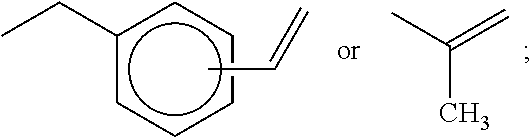
and m and n are independently an integer from 0 to 80, and 1≤(m+n)≤80, 10≤(m+n)≤60 is preferred. X preferably has a structure of the following formula (II) and Y has a structure of the following formula (III):

wherein,
* indicates the end connecting oxygen (—O—) of formula (I);
B1 and B2 are independently

R5 and R6 are independently —O—, —SO2—, or —C(CH3)2—, or absent; and
p and q are independently an integer, and 1≤p+q<20, preferably 1≤p+q<10, and more preferably 1≤p+q<3.

20≤(m+n)≤25, X has a structure of formula (II), Y has a structure of formula (III), and wherein B1 and B2 are

R5 and R6 are absent, and 1≤p+q<3.

wherein R″ is substituted or unsubstituted methylene, 4,4′-diphenylmethane, m-phenylene, bisphenol A diphenyl ether, 3,3′-dimethyl-5,5′-diethyl-4,4′-diphenyl methane, 4-methyl-1,3-phenylene or (2,2,4-trimethyl)hexane. For example, R″ is a group selected from the group consisting of —CH2—,

In some embodiments of the present invention, TAIC and/or BMI resin of formula (IV)

is used as a cross-linking agent. In addition, the weight ratio of the resin (a) to the cross-linking agent is generally from 6:1 to 1:1, preferably 4:1 to 1:1. If the ratio of the resin (a) to the cross-linking agent is too high (too few cross-linking agents), it may be difficult to further provide the desired cross-linking effect. If the amount of the cross-linking agent is too high, it may be difficult to maintain inherent excellent properties of the polyphenylene ether resin (a).

wherein, R7 and R8 are independently C1-C5 alkyl; Ma+ is a metal ion selected from the group consisting of Al3+, Zn2+, Ca2+, Ti4+, Mg2+, Sr2+, Ba2+, K+ and Cu2+; and b is an integer from 1 to 4.

in formula (Ia), 20≤(m+n)≤25 and 1≤p+q<3.
| TABLE 1 | |||||||
| Parts by weight | Example 1 | Example 2 | Example 3 | Example 4 | Example 5 | Example 6 | Example 7 |
| resin (a) | formula (Ia) | 60 | 60 | 60 | 60 | 60 | 60 | 40 |
| polyphenylene | aPPE | 20 | ||||||
| ether resin | (SA9000) | |||||||
| cross-linking | TAIC | 20 | 10 | |||||
| agent | ||||||||
| cross-linking | BMI | 10 | 10 | |||||
| agent | ||||||||
| elastomer | homopolymer | 30 | 10 | |||||
| of butadiene | ||||||||
| catalyst | peroxide | 0.5 | 0.1 | 0.1 | 0.1 | 0.1 | 0.1 | |
| hardening | metallic salt | 0.1 | 0.2 | |||||
| promoter | compound | |||||||
| OP935 | ||||||||
| flame | SAYTEX | 23 | 12 | 14 | 14 | 14 | 12 | |
| retardant | 8010 | |||||||
| SPB100 | 8 | |||||||
| filler | silica powder | 45 | 22 | 24 | 24 | 25 | 21 | 22 |
| TABLE 2 | ||||||||
| unit | laminate 1 | laminate 2 | laminate 3 | laminate 4 | laminate 5 | laminate 6 | laminate 7 | |
| water | % | 0.22 | 0.20 | 0.21 | 0.25 | 0.20 | 0.40 | 0.20 |
| absorption | ||||||||
| solder | minute | >10 | >10 | >10 | >10 | >10 | >10 | >10 |
| resistance | ||||||||
| peeling | pound/inch | 3.85 | 3.82 | 3.70 | 3.75 | 3.90 | 3.60 | 3.84 |
| strength | ||||||||
| Tg | ° C. | 206 | 193 | 188 | 210 | 183 | 182 | 191 |
| flame | UL grade | V0 | V0 | V0 | V0 | V0 | V0 | V0 |
| retardance | ||||||||
| Dk | 10 GHz | 3.82 | 3.86 | 3.85 | 3.88 | 3.84 | 3.89 | 3.84 |
| Df | 10 GHz | 0.0043 | 0.0046 | 0.0045 | 0.0051 | 0.0045 | 0.0049 | 0.0047 |
Claims (12)


Applications Claiming Priority (3)
| Application Number | Priority Date | Filing Date | Title |
|---|---|---|---|
| TW104109961A TWI591123B (en) | 2015-03-27 | 2015-03-27 | Resin composition and uses of the same |
| TW104109961A | 2015-03-27 | ||
| TW104109961 | 2015-03-27 |
Publications (2)
| Publication Number | Publication Date |
|---|---|
| US20160280913A1 US20160280913A1 (en) | 2016-09-29 |
| US10059841B2 true US10059841B2 (en) | 2018-08-28 |
Family
ID=56974563
Family Applications (1)
| Application Number | Title | Priority Date | Filing Date |
|---|---|---|---|
| US14/808,393 Active 2036-07-26 US10059841B2 (en) | 2015-03-27 | 2015-07-24 | Resin Composition and uses of the same |
Country Status (3)
| Country | Link |
|---|---|
| US (1) | US10059841B2 (en) |
| CN (1) | CN106147195B (en) |
| TW (1) | TWI591123B (en) |
Families Citing this family (11)
| Publication number | Priority date | Publication date | Assignee | Title |
|---|---|---|---|---|
| TWI678390B (en) * | 2017-01-20 | 2019-12-01 | 台燿科技股份有限公司 | Resin composition, and prepreg, metal-clad laminate, and printed circuit board using the same |
| TWI690562B (en) * | 2018-06-04 | 2020-04-11 | 台燿科技股份有限公司 | Resin composition, pre-preg, metal-clad laminate, and printed circuit board using the same |
| CN110551257B (en) | 2018-06-04 | 2021-10-08 | 台燿科技股份有限公司 | Resin composition and its prepreg, metal foil laminate and printed circuit board |
| TWI686436B (en) * | 2018-08-28 | 2020-03-01 | 台燿科技股份有限公司 | Halogen-free low dielectric resin composition, and pre-preg, metal-clad laminate, and printed circuit board using the same |
| CN109504062B (en) * | 2018-11-22 | 2021-07-16 | 南亚塑胶工业股份有限公司 | Thermosetting resin composition |
| TWI700332B (en) | 2018-12-06 | 2020-08-01 | 台燿科技股份有限公司 | Halogen-free low dielectric resin composition, and pre-preg, metal-clad laminate, and printed circuit board prepared using the same |
| TWI794445B (en) * | 2019-03-12 | 2023-03-01 | 台燿科技股份有限公司 | Resin composition and uses of the same |
| TWI725851B (en) | 2020-05-15 | 2021-04-21 | 台燿科技股份有限公司 | Resin composition, and pre-preg, metal-clad laminate, and printed circuit board prepared using the same |
| TWI856398B (en) * | 2022-10-19 | 2024-09-21 | 台燿科技股份有限公司 | Prepreg and uses thereof |
| TWI890113B (en) | 2023-08-11 | 2025-07-11 | 台燿科技股份有限公司 | Copper foil laminate and uses of the same |
| TWI860899B (en) | 2023-11-24 | 2024-11-01 | 台燿科技股份有限公司 | Prepreg and uses of the same |
Citations (9)
| Publication number | Priority date | Publication date | Assignee | Title |
|---|---|---|---|---|
| US5218030A (en) * | 1989-02-08 | 1993-06-08 | Asahi Kasei Kogyo Kabushiki Kaisha | Curable polyphenylene ether resin composition and a cured resin composition obtainable therefrom |
| US20060041086A1 (en) * | 2004-08-18 | 2006-02-23 | Joop Birsak | Functionalized poly(arylene ether) composition and method |
| US7495047B2 (en) * | 2005-10-06 | 2009-02-24 | At&T Intellectual Property, I, L.P. | Poly(arylene ether) composition, method, and article |
| US20090203279A1 (en) | 2008-02-12 | 2009-08-13 | Kenichi Mori | Resin composition, prepreg and their uses |
| JP2011001473A (en) | 2009-06-19 | 2011-01-06 | Hitachi Chem Co Ltd | Insulating material for electronic component |
| CN103228703A (en) | 2010-12-16 | 2013-07-31 | 旭化成电子材料株式会社 | Curable resin composition |
| CN103319877A (en) | 2012-03-23 | 2013-09-25 | 台燿科技股份有限公司 | Resin composition and use thereof |
| US20140057086A1 (en) * | 2011-05-17 | 2014-02-27 | Huntsman Advanced Materials Americas Llc | Halogen Free Thermoset Resin System for Low Dielectric Loss at High Frequency Applications |
| CN104031377A (en) | 2013-03-07 | 2014-09-10 | 台燿科技股份有限公司 | Resin composition and use thereof |
-
2015
- 2015-03-27 TW TW104109961A patent/TWI591123B/en active
- 2015-04-07 CN CN201510159730.0A patent/CN106147195B/en active Active
- 2015-07-24 US US14/808,393 patent/US10059841B2/en active Active
Patent Citations (13)
| Publication number | Priority date | Publication date | Assignee | Title |
|---|---|---|---|---|
| US5218030A (en) * | 1989-02-08 | 1993-06-08 | Asahi Kasei Kogyo Kabushiki Kaisha | Curable polyphenylene ether resin composition and a cured resin composition obtainable therefrom |
| US20060041086A1 (en) * | 2004-08-18 | 2006-02-23 | Joop Birsak | Functionalized poly(arylene ether) composition and method |
| US7495047B2 (en) * | 2005-10-06 | 2009-02-24 | At&T Intellectual Property, I, L.P. | Poly(arylene ether) composition, method, and article |
| TWI448509B (en) | 2008-02-12 | 2014-08-11 | Mitsubishi Gas Chemical Co | Resin composition, prepreg and their uses |
| US20090203279A1 (en) | 2008-02-12 | 2009-08-13 | Kenichi Mori | Resin composition, prepreg and their uses |
| JP2011001473A (en) | 2009-06-19 | 2011-01-06 | Hitachi Chem Co Ltd | Insulating material for electronic component |
| CN103228703A (en) | 2010-12-16 | 2013-07-31 | 旭化成电子材料株式会社 | Curable resin composition |
| US20140057086A1 (en) * | 2011-05-17 | 2014-02-27 | Huntsman Advanced Materials Americas Llc | Halogen Free Thermoset Resin System for Low Dielectric Loss at High Frequency Applications |
| CN103319877A (en) | 2012-03-23 | 2013-09-25 | 台燿科技股份有限公司 | Resin composition and use thereof |
| US20130252003A1 (en) | 2012-03-23 | 2013-09-26 | Taiwan Union Technology Corporation | Resin composition and uses of the same |
| TWI468465B (en) | 2012-03-23 | 2015-01-11 | Taiwan Union Technology Corp | Resin composition and uses of the same |
| CN104031377A (en) | 2013-03-07 | 2014-09-10 | 台燿科技股份有限公司 | Resin composition and use thereof |
| US20140255711A1 (en) | 2013-03-07 | 2014-09-11 | Taiwan Union Technology Corporation | Resin composition and uses of the same |
Non-Patent Citations (2)
| Title |
|---|
| SIPO First Office Action corresponding to CN Application No. 201510159730.0; dated Nov. 3, 2017. |
| Taiwanese Office Action for counterpart Application No. TW201124478A dated Nov. 17, 2015. |
Also Published As
| Publication number | Publication date |
|---|---|
| TWI591123B (en) | 2017-07-11 |
| TW201634580A (en) | 2016-10-01 |
| US20160280913A1 (en) | 2016-09-29 |
| CN106147195B (en) | 2018-11-16 |
| CN106147195A (en) | 2016-11-23 |
Similar Documents
| Publication | Publication Date | Title |
|---|---|---|
| US20160280913A1 (en) | Resin composition and uses of the same | |
| US10689512B2 (en) | Resin composition, and prepreg, metal-clad laminate, and printed circuit board using the same | |
| US10322565B2 (en) | Resin composition and uses of the same | |
| US10793716B2 (en) | Resin composition and uses of the same | |
| KR101556658B1 (en) | Thermoplastic resin composition having excellent heat resistance and low permittivity, prepreg and copper clad laminate using the same | |
| CN108047718B (en) | Maleimide resin compositions, prepregs, laminates and printed circuit boards | |
| KR102325101B1 (en) | Maleimide resin composition, prepreg, laminate and printed circuit board | |
| US10994516B2 (en) | Resin composition, and pre-preg, metal-clad laminate and printed circuit board prepared using the same | |
| US11339258B2 (en) | Resin composition, and pre-preg, metal-clad laminate and printed circuit board prepared using the same | |
| US10568211B2 (en) | Resin composition and uses of the same | |
| TWI401269B (en) | Epoxy resin composition, and prepreg and printed wiring board using the same | |
| CN102746616A (en) | A kind of resin composition and its application | |
| US8734950B2 (en) | Resin composition and uses of the same | |
| US8846790B2 (en) | Resin composition, and prepreg and printed circuit board prepared using the same | |
| US20250163269A1 (en) | Resin composition and uses of the same | |
| KR20260025019A (en) | Heat-curable resin composition and use thereof |
Legal Events
| Date | Code | Title | Description |
|---|---|---|---|
| AS | Assignment |
Owner name: TAIWAN UNION TECHNOLOGY CORPORATION, TAIWAN Free format text: ASSIGNMENT OF ASSIGNORS INTEREST;ASSIGNORS:LIU, SHUR-FEN;CHEN, MENG-HUEI;REEL/FRAME:036171/0840 Effective date: 20150717 |
|
| STCF | Information on status: patent grant |
Free format text: PATENTED CASE |
|
| MAFP | Maintenance fee payment |
Free format text: PAYMENT OF MAINTENANCE FEE, 4TH YEAR, LARGE ENTITY (ORIGINAL EVENT CODE: M1551); ENTITY STATUS OF PATENT OWNER: LARGE ENTITY Year of fee payment: 4 |
|
| MAFP | Maintenance fee payment |
Free format text: PAYMENT OF MAINTENANCE FEE, 8TH YEAR, LARGE ENTITY (ORIGINAL EVENT CODE: M1552); ENTITY STATUS OF PATENT OWNER: LARGE ENTITY Year of fee payment: 8 |