US10052690B2 - Conductive paste and glass article - Google Patents

Conductive paste and glass article Download PDF

Info

Publication number
US10052690B2
US10052690B2 US15/364,843 US201615364843A US10052690B2 US 10052690 B2 US10052690 B2 US 10052690B2 US 201615364843 A US201615364843 A US 201615364843A US 10052690 B2 US10052690 B2 US 10052690B2
Authority
US
United States
Prior art keywords
powder
metal powder
conductive paste
conductive
base metal
Prior art date
Legal status (The legal status is an assumption and is not a legal conclusion. Google has not performed a legal analysis and makes no representation as to the accuracy of the status listed.)
Active, expires
Application number
US15/364,843
Other versions
US20170080490A1 (en
Inventor
Shinichi Tsugimoto
Current Assignee (The listed assignees may be inaccurate. Google has not performed a legal analysis and makes no representation or warranty as to the accuracy of the list.)
Murata Manufacturing Co Ltd
Original Assignee
Murata Manufacturing Co Ltd
Priority date (The priority date is an assumption and is not a legal conclusion. Google has not performed a legal analysis and makes no representation as to the accuracy of the date listed.)
Filing date
Publication date
Application filed by Murata Manufacturing Co Ltd filed Critical Murata Manufacturing Co Ltd
Assigned to MURATA MANUFACTURING CO., LTD. reassignment MURATA MANUFACTURING CO., LTD. ASSIGNMENT OF ASSIGNORS INTEREST (SEE DOCUMENT FOR DETAILS). Assignors: TSUGIMOTO, SHINICHI
Publication of US20170080490A1 publication Critical patent/US20170080490A1/en
Application granted granted Critical
Publication of US10052690B2 publication Critical patent/US10052690B2/en
Active legal-status Critical Current
Adjusted expiration legal-status Critical

Links

Images

Classifications

    • B22F1/0014
    • BPERFORMING OPERATIONS; TRANSPORTING
    • B22CASTING; POWDER METALLURGY
    • B22FWORKING METALLIC POWDER; MANUFACTURE OF ARTICLES FROM METALLIC POWDER; MAKING METALLIC POWDER; APPARATUS OR DEVICES SPECIALLY ADAPTED FOR METALLIC POWDER
    • B22F1/00Metallic powder; Treatment of metallic powder, e.g. to facilitate working or to improve properties
    • B22F1/05Metallic powder characterised by the size or surface area of the particles
    • B22F1/052Metallic powder characterised by the size or surface area of the particles characterised by a mixture of particles of different sizes or by the particle size distribution
    • BPERFORMING OPERATIONS; TRANSPORTING
    • B22CASTING; POWDER METALLURGY
    • B22FWORKING METALLIC POWDER; MANUFACTURE OF ARTICLES FROM METALLIC POWDER; MAKING METALLIC POWDER; APPARATUS OR DEVICES SPECIALLY ADAPTED FOR METALLIC POWDER
    • B22F7/00Manufacture of composite layers, workpieces, or articles, comprising metallic powder, by sintering the powder, with or without compacting wherein at least one part is obtained by sintering or compression
    • B22F7/02Manufacture of composite layers, workpieces, or articles, comprising metallic powder, by sintering the powder, with or without compacting wherein at least one part is obtained by sintering or compression of composite layers
    • B22F7/04Manufacture of composite layers, workpieces, or articles, comprising metallic powder, by sintering the powder, with or without compacting wherein at least one part is obtained by sintering or compression of composite layers with one or more layers not made from powder, e.g. made from solid metal
    • CCHEMISTRY; METALLURGY
    • C03GLASS; MINERAL OR SLAG WOOL
    • C03CCHEMICAL COMPOSITION OF GLASSES, GLAZES OR VITREOUS ENAMELS; SURFACE TREATMENT OF GLASS; SURFACE TREATMENT OF FIBRES OR FILAMENTS MADE FROM GLASS, MINERALS OR SLAGS; JOINING GLASS TO GLASS OR OTHER MATERIALS
    • C03C14/00Glass compositions containing a non-glass component, e.g. compositions containing fibres, filaments, whiskers, platelets, or the like, dispersed in a glass matrix
    • C03C14/006Glass compositions containing a non-glass component, e.g. compositions containing fibres, filaments, whiskers, platelets, or the like, dispersed in a glass matrix the non-glass component being in the form of microcrystallites, e.g. of optically or electrically active material
    • CCHEMISTRY; METALLURGY
    • C03GLASS; MINERAL OR SLAG WOOL
    • C03CCHEMICAL COMPOSITION OF GLASSES, GLAZES OR VITREOUS ENAMELS; SURFACE TREATMENT OF GLASS; SURFACE TREATMENT OF FIBRES OR FILAMENTS MADE FROM GLASS, MINERALS OR SLAGS; JOINING GLASS TO GLASS OR OTHER MATERIALS
    • C03C17/00Surface treatment of glass, not in the form of fibres or filaments, by coating
    • C03C17/02Surface treatment of glass, not in the form of fibres or filaments, by coating with glass
    • C03C17/04Surface treatment of glass, not in the form of fibres or filaments, by coating with glass by fritting glass powder
    • CCHEMISTRY; METALLURGY
    • C03GLASS; MINERAL OR SLAG WOOL
    • C03CCHEMICAL COMPOSITION OF GLASSES, GLAZES OR VITREOUS ENAMELS; SURFACE TREATMENT OF GLASS; SURFACE TREATMENT OF FIBRES OR FILAMENTS MADE FROM GLASS, MINERALS OR SLAGS; JOINING GLASS TO GLASS OR OTHER MATERIALS
    • C03C3/00Glass compositions
    • C03C3/04Glass compositions containing silica
    • CCHEMISTRY; METALLURGY
    • C03GLASS; MINERAL OR SLAG WOOL
    • C03CCHEMICAL COMPOSITION OF GLASSES, GLAZES OR VITREOUS ENAMELS; SURFACE TREATMENT OF GLASS; SURFACE TREATMENT OF FIBRES OR FILAMENTS MADE FROM GLASS, MINERALS OR SLAGS; JOINING GLASS TO GLASS OR OTHER MATERIALS
    • C03C4/00Compositions for glass with special properties
    • C03C4/14Compositions for glass with special properties for electro-conductive glass
    • CCHEMISTRY; METALLURGY
    • C03GLASS; MINERAL OR SLAG WOOL
    • C03CCHEMICAL COMPOSITION OF GLASSES, GLAZES OR VITREOUS ENAMELS; SURFACE TREATMENT OF GLASS; SURFACE TREATMENT OF FIBRES OR FILAMENTS MADE FROM GLASS, MINERALS OR SLAGS; JOINING GLASS TO GLASS OR OTHER MATERIALS
    • C03C8/00Enamels; Glazes; Fusion seal compositions being frit compositions having non-frit additions
    • C03C8/02Frit compositions, i.e. in a powdered or comminuted form
    • CCHEMISTRY; METALLURGY
    • C03GLASS; MINERAL OR SLAG WOOL
    • C03CCHEMICAL COMPOSITION OF GLASSES, GLAZES OR VITREOUS ENAMELS; SURFACE TREATMENT OF GLASS; SURFACE TREATMENT OF FIBRES OR FILAMENTS MADE FROM GLASS, MINERALS OR SLAGS; JOINING GLASS TO GLASS OR OTHER MATERIALS
    • C03C8/00Enamels; Glazes; Fusion seal compositions being frit compositions having non-frit additions
    • C03C8/14Glass frit mixtures having non-frit additions, e.g. opacifiers, colorants, mill-additions
    • C03C8/18Glass frit mixtures having non-frit additions, e.g. opacifiers, colorants, mill-additions containing free metals
    • CCHEMISTRY; METALLURGY
    • C09DYES; PAINTS; POLISHES; NATURAL RESINS; ADHESIVES; COMPOSITIONS NOT OTHERWISE PROVIDED FOR; APPLICATIONS OF MATERIALS NOT OTHERWISE PROVIDED FOR
    • C09DCOATING COMPOSITIONS, e.g. PAINTS, VARNISHES OR LACQUERS; FILLING PASTES; CHEMICAL PAINT OR INK REMOVERS; INKS; CORRECTING FLUIDS; WOODSTAINS; PASTES OR SOLIDS FOR COLOURING OR PRINTING; USE OF MATERIALS THEREFOR
    • C09D1/00Coating compositions, e.g. paints, varnishes or lacquers, based on inorganic substances
    • CCHEMISTRY; METALLURGY
    • C09DYES; PAINTS; POLISHES; NATURAL RESINS; ADHESIVES; COMPOSITIONS NOT OTHERWISE PROVIDED FOR; APPLICATIONS OF MATERIALS NOT OTHERWISE PROVIDED FOR
    • C09DCOATING COMPOSITIONS, e.g. PAINTS, VARNISHES OR LACQUERS; FILLING PASTES; CHEMICAL PAINT OR INK REMOVERS; INKS; CORRECTING FLUIDS; WOODSTAINS; PASTES OR SOLIDS FOR COLOURING OR PRINTING; USE OF MATERIALS THEREFOR
    • C09D5/00Coating compositions, e.g. paints, varnishes or lacquers, characterised by their physical nature or the effects produced; Filling pastes
    • C09D5/24Electrically-conducting paints
    • CCHEMISTRY; METALLURGY
    • C22METALLURGY; FERROUS OR NON-FERROUS ALLOYS; TREATMENT OF ALLOYS OR NON-FERROUS METALS
    • C22CALLOYS
    • C22C29/00Alloys based on carbides, oxides, nitrides, borides, or silicides, e.g. cermets, or other metal compounds, e.g. oxynitrides, sulfides
    • HELECTRICITY
    • H01ELECTRIC ELEMENTS
    • H01BCABLES; CONDUCTORS; INSULATORS; SELECTION OF MATERIALS FOR THEIR CONDUCTIVE, INSULATING OR DIELECTRIC PROPERTIES
    • H01B1/00Conductors or conductive bodies characterised by the conductive materials; Selection of materials as conductors
    • HELECTRICITY
    • H01ELECTRIC ELEMENTS
    • H01BCABLES; CONDUCTORS; INSULATORS; SELECTION OF MATERIALS FOR THEIR CONDUCTIVE, INSULATING OR DIELECTRIC PROPERTIES
    • H01B1/00Conductors or conductive bodies characterised by the conductive materials; Selection of materials as conductors
    • H01B1/20Conductive material dispersed in non-conductive organic material
    • H01B1/22Conductive material dispersed in non-conductive organic material the conductive material comprising metals or alloys
    • HELECTRICITY
    • H01ELECTRIC ELEMENTS
    • H01BCABLES; CONDUCTORS; INSULATORS; SELECTION OF MATERIALS FOR THEIR CONDUCTIVE, INSULATING OR DIELECTRIC PROPERTIES
    • H01B5/00Non-insulated conductors or conductive bodies characterised by their form
    • H01B5/14Non-insulated conductors or conductive bodies characterised by their form comprising conductive layers or films on insulating-supports
    • HELECTRICITY
    • H05ELECTRIC TECHNIQUES NOT OTHERWISE PROVIDED FOR
    • H05BELECTRIC HEATING; ELECTRIC LIGHT SOURCES NOT OTHERWISE PROVIDED FOR; CIRCUIT ARRANGEMENTS FOR ELECTRIC LIGHT SOURCES, IN GENERAL
    • H05B3/00Ohmic-resistance heating
    • H05B3/10Heating elements characterised by the composition or nature of the materials or by the arrangement of the conductor
    • H05B3/12Heating elements characterised by the composition or nature of the materials or by the arrangement of the conductor characterised by the composition or nature of the conductive material
    • HELECTRICITY
    • H05ELECTRIC TECHNIQUES NOT OTHERWISE PROVIDED FOR
    • H05BELECTRIC HEATING; ELECTRIC LIGHT SOURCES NOT OTHERWISE PROVIDED FOR; CIRCUIT ARRANGEMENTS FOR ELECTRIC LIGHT SOURCES, IN GENERAL
    • H05B3/00Ohmic-resistance heating
    • H05B3/84Heating arrangements specially adapted for transparent or reflecting areas, e.g. for demisting or de-icing windows, mirrors or vehicle windshields
    • HELECTRICITY
    • H05ELECTRIC TECHNIQUES NOT OTHERWISE PROVIDED FOR
    • H05KPRINTED CIRCUITS; CASINGS OR CONSTRUCTIONAL DETAILS OF ELECTRIC APPARATUS; MANUFACTURE OF ASSEMBLAGES OF ELECTRICAL COMPONENTS
    • H05K1/00Printed circuits
    • H05K1/02Details
    • H05K1/09Use of materials for the conductive, e.g. metallic pattern
    • HELECTRICITY
    • H05ELECTRIC TECHNIQUES NOT OTHERWISE PROVIDED FOR
    • H05KPRINTED CIRCUITS; CASINGS OR CONSTRUCTIONAL DETAILS OF ELECTRIC APPARATUS; MANUFACTURE OF ASSEMBLAGES OF ELECTRICAL COMPONENTS
    • H05K1/00Printed circuits
    • H05K1/02Details
    • H05K1/09Use of materials for the conductive, e.g. metallic pattern
    • H05K1/092Dispersed materials, e.g. conductive pastes or inks
    • BPERFORMING OPERATIONS; TRANSPORTING
    • B22CASTING; POWDER METALLURGY
    • B22FWORKING METALLIC POWDER; MANUFACTURE OF ARTICLES FROM METALLIC POWDER; MAKING METALLIC POWDER; APPARATUS OR DEVICES SPECIALLY ADAPTED FOR METALLIC POWDER
    • B22F7/00Manufacture of composite layers, workpieces, or articles, comprising metallic powder, by sintering the powder, with or without compacting wherein at least one part is obtained by sintering or compression
    • B22F7/02Manufacture of composite layers, workpieces, or articles, comprising metallic powder, by sintering the powder, with or without compacting wherein at least one part is obtained by sintering or compression of composite layers
    • B22F7/04Manufacture of composite layers, workpieces, or articles, comprising metallic powder, by sintering the powder, with or without compacting wherein at least one part is obtained by sintering or compression of composite layers with one or more layers not made from powder, e.g. made from solid metal
    • B22F2007/042Manufacture of composite layers, workpieces, or articles, comprising metallic powder, by sintering the powder, with or without compacting wherein at least one part is obtained by sintering or compression of composite layers with one or more layers not made from powder, e.g. made from solid metal characterised by the layer forming method
    • B22F2007/047Manufacture of composite layers, workpieces, or articles, comprising metallic powder, by sintering the powder, with or without compacting wherein at least one part is obtained by sintering or compression of composite layers with one or more layers not made from powder, e.g. made from solid metal characterised by the layer forming method non-pressurised baking of the paste or slurry containing metal powder
    • BPERFORMING OPERATIONS; TRANSPORTING
    • B22CASTING; POWDER METALLURGY
    • B22FWORKING METALLIC POWDER; MANUFACTURE OF ARTICLES FROM METALLIC POWDER; MAKING METALLIC POWDER; APPARATUS OR DEVICES SPECIALLY ADAPTED FOR METALLIC POWDER
    • B22F2301/00Metallic composition of the powder or its coating
    • B22F2301/10Copper
    • BPERFORMING OPERATIONS; TRANSPORTING
    • B22CASTING; POWDER METALLURGY
    • B22FWORKING METALLIC POWDER; MANUFACTURE OF ARTICLES FROM METALLIC POWDER; MAKING METALLIC POWDER; APPARATUS OR DEVICES SPECIALLY ADAPTED FOR METALLIC POWDER
    • B22F2301/00Metallic composition of the powder or its coating
    • B22F2301/15Nickel or cobalt
    • BPERFORMING OPERATIONS; TRANSPORTING
    • B22CASTING; POWDER METALLURGY
    • B22FWORKING METALLIC POWDER; MANUFACTURE OF ARTICLES FROM METALLIC POWDER; MAKING METALLIC POWDER; APPARATUS OR DEVICES SPECIALLY ADAPTED FOR METALLIC POWDER
    • B22F2301/00Metallic composition of the powder or its coating
    • B22F2301/25Noble metals, i.e. Ag Au, Ir, Os, Pd, Pt, Rh, Ru
    • B22F2301/255Silver or gold
    • BPERFORMING OPERATIONS; TRANSPORTING
    • B22CASTING; POWDER METALLURGY
    • B22FWORKING METALLIC POWDER; MANUFACTURE OF ARTICLES FROM METALLIC POWDER; MAKING METALLIC POWDER; APPARATUS OR DEVICES SPECIALLY ADAPTED FOR METALLIC POWDER
    • B22F2302/00Metal Compound, non-Metallic compound or non-metal composition of the powder or its coating
    • B22F2302/25Oxide
    • B22F2302/253Aluminum oxide (Al2O3)
    • BPERFORMING OPERATIONS; TRANSPORTING
    • B22CASTING; POWDER METALLURGY
    • B22FWORKING METALLIC POWDER; MANUFACTURE OF ARTICLES FROM METALLIC POWDER; MAKING METALLIC POWDER; APPARATUS OR DEVICES SPECIALLY ADAPTED FOR METALLIC POWDER
    • B22F2302/00Metal Compound, non-Metallic compound or non-metal composition of the powder or its coating
    • B22F2302/25Oxide
    • B22F2302/256Silicium oxide (SiO2)
    • BPERFORMING OPERATIONS; TRANSPORTING
    • B22CASTING; POWDER METALLURGY
    • B22FWORKING METALLIC POWDER; MANUFACTURE OF ARTICLES FROM METALLIC POWDER; MAKING METALLIC POWDER; APPARATUS OR DEVICES SPECIALLY ADAPTED FOR METALLIC POWDER
    • B22F2304/00Physical aspects of the powder
    • B22F2304/10Micron size particles, i.e. above 1 micrometer up to 500 micrometer
    • BPERFORMING OPERATIONS; TRANSPORTING
    • B22CASTING; POWDER METALLURGY
    • B22FWORKING METALLIC POWDER; MANUFACTURE OF ARTICLES FROM METALLIC POWDER; MAKING METALLIC POWDER; APPARATUS OR DEVICES SPECIALLY ADAPTED FOR METALLIC POWDER
    • B22F9/00Making metallic powder or suspensions thereof
    • B22F9/02Making metallic powder or suspensions thereof using physical processes
    • B22F9/06Making metallic powder or suspensions thereof using physical processes starting from liquid material
    • B22F9/08Making metallic powder or suspensions thereof using physical processes starting from liquid material by casting, e.g. through sieves or in water, by atomising or spraying
    • B22F9/082Making metallic powder or suspensions thereof using physical processes starting from liquid material by casting, e.g. through sieves or in water, by atomising or spraying atomising using a fluid
    • CCHEMISTRY; METALLURGY
    • C03GLASS; MINERAL OR SLAG WOOL
    • C03CCHEMICAL COMPOSITION OF GLASSES, GLAZES OR VITREOUS ENAMELS; SURFACE TREATMENT OF GLASS; SURFACE TREATMENT OF FIBRES OR FILAMENTS MADE FROM GLASS, MINERALS OR SLAGS; JOINING GLASS TO GLASS OR OTHER MATERIALS
    • C03C2204/00Glasses, glazes or enamels with special properties
    • CCHEMISTRY; METALLURGY
    • C03GLASS; MINERAL OR SLAG WOOL
    • C03CCHEMICAL COMPOSITION OF GLASSES, GLAZES OR VITREOUS ENAMELS; SURFACE TREATMENT OF GLASS; SURFACE TREATMENT OF FIBRES OR FILAMENTS MADE FROM GLASS, MINERALS OR SLAGS; JOINING GLASS TO GLASS OR OTHER MATERIALS
    • C03C2207/00Compositions specially applicable for the manufacture of vitreous enamels
    • CCHEMISTRY; METALLURGY
    • C03GLASS; MINERAL OR SLAG WOOL
    • C03CCHEMICAL COMPOSITION OF GLASSES, GLAZES OR VITREOUS ENAMELS; SURFACE TREATMENT OF GLASS; SURFACE TREATMENT OF FIBRES OR FILAMENTS MADE FROM GLASS, MINERALS OR SLAGS; JOINING GLASS TO GLASS OR OTHER MATERIALS
    • C03C2214/00Nature of the non-vitreous component
    • C03C2214/08Metals
    • CCHEMISTRY; METALLURGY
    • C03GLASS; MINERAL OR SLAG WOOL
    • C03CCHEMICAL COMPOSITION OF GLASSES, GLAZES OR VITREOUS ENAMELS; SURFACE TREATMENT OF GLASS; SURFACE TREATMENT OF FIBRES OR FILAMENTS MADE FROM GLASS, MINERALS OR SLAGS; JOINING GLASS TO GLASS OR OTHER MATERIALS
    • C03C2217/00Coatings on glass
    • C03C2217/40Coatings comprising at least one inhomogeneous layer
    • C03C2217/43Coatings comprising at least one inhomogeneous layer consisting of a dispersed phase in a continuous phase
    • C03C2217/44Coatings comprising at least one inhomogeneous layer consisting of a dispersed phase in a continuous phase characterized by the composition of the continuous phase
    • C03C2217/45Inorganic continuous phases
    • C03C2217/452Glass
    • CCHEMISTRY; METALLURGY
    • C03GLASS; MINERAL OR SLAG WOOL
    • C03CCHEMICAL COMPOSITION OF GLASSES, GLAZES OR VITREOUS ENAMELS; SURFACE TREATMENT OF GLASS; SURFACE TREATMENT OF FIBRES OR FILAMENTS MADE FROM GLASS, MINERALS OR SLAGS; JOINING GLASS TO GLASS OR OTHER MATERIALS
    • C03C2217/00Coatings on glass
    • C03C2217/40Coatings comprising at least one inhomogeneous layer
    • C03C2217/43Coatings comprising at least one inhomogeneous layer consisting of a dispersed phase in a continuous phase
    • C03C2217/46Coatings comprising at least one inhomogeneous layer consisting of a dispersed phase in a continuous phase characterized by the dispersed phase
    • C03C2217/47Coatings comprising at least one inhomogeneous layer consisting of a dispersed phase in a continuous phase characterized by the dispersed phase consisting of a specific material
    • C03C2217/475Inorganic materials
    • C03C2217/479Metals
    • HELECTRICITY
    • H05ELECTRIC TECHNIQUES NOT OTHERWISE PROVIDED FOR
    • H05BELECTRIC HEATING; ELECTRIC LIGHT SOURCES NOT OTHERWISE PROVIDED FOR; CIRCUIT ARRANGEMENTS FOR ELECTRIC LIGHT SOURCES, IN GENERAL
    • H05B2203/00Aspects relating to Ohmic resistive heating covered by group H05B3/00
    • H05B2203/002Heaters using a particular layout for the resistive material or resistive elements
    • H05B2203/005Heaters using a particular layout for the resistive material or resistive elements using multiple resistive elements or resistive zones isolated from each other
    • HELECTRICITY
    • H05ELECTRIC TECHNIQUES NOT OTHERWISE PROVIDED FOR
    • H05BELECTRIC HEATING; ELECTRIC LIGHT SOURCES NOT OTHERWISE PROVIDED FOR; CIRCUIT ARRANGEMENTS FOR ELECTRIC LIGHT SOURCES, IN GENERAL
    • H05B2203/00Aspects relating to Ohmic resistive heating covered by group H05B3/00
    • H05B2203/011Heaters using laterally extending conductive material as connecting means
    • HELECTRICITY
    • H05ELECTRIC TECHNIQUES NOT OTHERWISE PROVIDED FOR
    • H05BELECTRIC HEATING; ELECTRIC LIGHT SOURCES NOT OTHERWISE PROVIDED FOR; CIRCUIT ARRANGEMENTS FOR ELECTRIC LIGHT SOURCES, IN GENERAL
    • H05B2203/00Aspects relating to Ohmic resistive heating covered by group H05B3/00
    • H05B2203/017Manufacturing methods or apparatus for heaters
    • HELECTRICITY
    • H05ELECTRIC TECHNIQUES NOT OTHERWISE PROVIDED FOR
    • H05KPRINTED CIRCUITS; CASINGS OR CONSTRUCTIONAL DETAILS OF ELECTRIC APPARATUS; MANUFACTURE OF ASSEMBLAGES OF ELECTRICAL COMPONENTS
    • H05K1/00Printed circuits
    • H05K1/02Details
    • H05K1/0201Thermal arrangements, e.g. for cooling, heating or preventing overheating
    • H05K1/0212Printed circuits or mounted components having integral heating means
    • HELECTRICITY
    • H05ELECTRIC TECHNIQUES NOT OTHERWISE PROVIDED FOR
    • H05KPRINTED CIRCUITS; CASINGS OR CONSTRUCTIONAL DETAILS OF ELECTRIC APPARATUS; MANUFACTURE OF ASSEMBLAGES OF ELECTRICAL COMPONENTS
    • H05K1/00Printed circuits
    • H05K1/02Details
    • H05K1/03Use of materials for the substrate
    • H05K1/0306Inorganic insulating substrates, e.g. ceramic, glass
    • HELECTRICITY
    • H05ELECTRIC TECHNIQUES NOT OTHERWISE PROVIDED FOR
    • H05KPRINTED CIRCUITS; CASINGS OR CONSTRUCTIONAL DETAILS OF ELECTRIC APPARATUS; MANUFACTURE OF ASSEMBLAGES OF ELECTRICAL COMPONENTS
    • H05K1/00Printed circuits
    • H05K1/16Printed circuits incorporating printed electric components, e.g. printed resistor, capacitor, inductor
    • H05K1/167Printed circuits incorporating printed electric components, e.g. printed resistor, capacitor, inductor incorporating printed resistors
    • HELECTRICITY
    • H05ELECTRIC TECHNIQUES NOT OTHERWISE PROVIDED FOR
    • H05KPRINTED CIRCUITS; CASINGS OR CONSTRUCTIONAL DETAILS OF ELECTRIC APPARATUS; MANUFACTURE OF ASSEMBLAGES OF ELECTRICAL COMPONENTS
    • H05K2201/00Indexing scheme relating to printed circuits covered by H05K1/00
    • H05K2201/02Fillers; Particles; Fibers; Reinforcement materials
    • H05K2201/0203Fillers and particles
    • H05K2201/0263Details about a collection of particles
    • H05K2201/0272Mixed conductive particles, i.e. using different conductive particles, e.g. differing in shape

Definitions

  • the present invention relates to a conductive paste and a glass article, and more particularly, a conductive paste for forming anti-fogging hot wires, antenna patterns, and the like provided on window glass for vehicles such as automobiles, and to a glass article such as anti-fogging glass and a glass antenna, obtained with the use of the conductive paste.
  • anti-fogging glass provided with anti-fogging hot wires, and glass antennas for receiving ratio waves from the outside of vehicles.
  • anti-fogging glass typically has a conductive film formed in a predetermined pattern by applying a conductive paste in the form of lines onto a glass substrate, and then the paste is fired.
  • Various types of paste have been developed and proposed for this purpose.
  • Patent Document 1 proposes a conductive paste for producing conductive coatings on glass, ceramics, or porcelain enamel steel.
  • the conductive paste includes conductive silver particles, conductive particles containing at least one base metal, one or more types of glass frit, and a paste formation medium.
  • the base metal-containing conductive particles are substantially composed of iron, cobalt, nickel, copper, zinc, or an alloy including at least one of the elements.
  • the average particle size D 50 of the base metal-containing conductive particles falls within the range of 0.1 ⁇ m to 15 ⁇ m, the specific surface area thereof falls within the range of 0.5 m 2 /g to 10 m 2 /g, and the base metal-containing conductive particles account for up to 80 weight % of the whole conductive particles.
  • the softening temperature (by heating microscope) of the one or more types of glass frit falls within the range of 350° C. to 600° C., and the hemisphere temperature thereof falls within the range of 450° C. to 700° C.
  • This Patent Document 1 is intended to achieve a conductive paste which has a stable resistivity of approximately 37 to 40 ⁇ cm even when the firing temperature varies in the range of 660 to 680° C.
  • Patent Document 1 Japanese Patent No. 3960921 (claim 1; paragraphs [0009], [0019] to [0021], Table 2, etc.)
  • Patent Document 1 exhibits problems of inferior weather resistance, and high resistivity for the following reasons.
  • the base metal particles consume oxygen in the conductive film through an oxidation reaction during firing, thereby locally decreasing the oxygen partial pressure. Then, when the oxygen partial pressure is decreased, the oxygen adsorbed on the surfaces of noble metal particles will be reduced, thereby decreasing the wettability of the glass frit as an oxide. In this case, slow oxidation of the base metal particles results in a minor decrease in wettability because oxygen is rapidly supplied to the conductive film from the surroundings of the base metal particles, while rapid oxidation of the base metal particles results in a significant decrease in wettability.
  • the ingress of the glass frit into the voids is blocked, thus degrading the weather resistance. More specifically, when the conductive film is exposed to the air with unfilled voids left at the interface between the glass substrate and the conductive film, and comes into contact with an acid, salt water, or the like, there is a possibility of causing erosion due to the ingress of the acid or salt water into the interface between the conductive film and the glass substrate, and thereby causing the interface strength between the glass substrate and the conductive film to be decreased.
  • the decreased wettability of the glass frit interferes with liquid-phase sintering, thus decreasing the sintered density of the conductive film. This creates a possibility of increasing the resistivity, thereby causing a decrease in conductivity.
  • the present invention has been made in view of these circumstances, and an object of the invention is to provide a conductive paste which has favorable weather resistance, and moderately controllable resistivity, and a glass article such as anti-fogging glass and a glass antenna, with the use of the conductive paste.
  • a conductive paste that includes a conductive powder that contains a base metal powder having a predetermined amount of Cu powder and/or Ni powder that is relatively unlikely to be oxidized, and that the base metal powder has a specific surface area of less than 0.5 m 2 /g, slows the oxidation of base metal particles during firing, and thus making it possible to inhibit rapid oxidation.
  • ingress of glass frit into voids between noble metal particles and a glass substrate can occur and create a seal from the external environment, thereby making it possible to achieve favorable weather resistance and control resistivity moderately.
  • a conductive paste according to the present invention is a conductive paste comprising at least a conductive powder, glass frit, and an organic vehicle.
  • the conductive powder contains a noble metal powder and a base metal powder containing at least one of Cu and Ni, and the base metal powder has a specific surface area of less than 0.5 m 2 /g.
  • a content of the base metal powder with respect to a total amount of the conductive powder is, in ratio by weight: 0.1 to 0.3 when the base metal powder contains the Cu as its main constituent; 0.1 to 0.2 when the base metal powder contains the Ni as its main constituent; and 0.1 to 0.25 when the base metal powder contains a mixed powder of the Cu and the Ni as its main constituent.
  • the base metal powder is preferably an atomized powder prepared by an atomization method.
  • the base metal powder is preferably 8 ⁇ m or less in average particle size.
  • the base metal powder is preferably 2.5 ⁇ m or more in average particle size D 50 .
  • the noble metal powder is preferably 0.1 to 3 ⁇ m in average particle size D 50 .
  • a content of the conductive powder is preferably 50 to 90 wt %.
  • an average particle size D 50 of the glass frit is preferably 2 times or less of the average particle size of the noble metal powder.
  • the glass frit preferably has a softening point of 350° C. to 600° C.
  • the noble metal powder preferably contains Ag as its main constituent.
  • a glass article according to the present invention includes a substrate and a conductive film in a predetermined pattern formed on the substrate, wherein the conductive film is obtained by applying the conductive paste according to any of the embodiments of the present invention onto the substrate and sintering the paste sintered.
  • a ceramic layer is also preferably interposed between the glass substrate and the conductive film.
  • the average particle size is referred to as a particle size corresponding to 50% of the cumulative distribution, that is, a median size (hereinafter, an “average particle size D 50 ”) in the present invention.
  • the oxidation of the base metal particles during firing is made slow, thus making it possible to inhibit rapid oxidation, and accordingly, while maintaining the wettability of the glass frit, ingress of the glass frit into voids between the noble metal particles and a glass substrate can create a seal from the external environment.
  • the use of the present conductive paste can achieve various types of glass articles which have favorable weather resistance, and also moderately controllable resistivity.
  • a seal from the external environment can be created as described above, thereby making it possible to achieve glass articles such as anti-fogging glass and glass antennas, which have favorable weather resistance and favorable conductivity with resistivity moderately controllable even when applying voltages of 12 to 48 V, which are common battery voltages of vehicles.
  • FIG. 1 is a front view illustrating an embodiment (first embodiment) of anti-fogging glass as a glass article, prepared with the use of a conductive paste according to the present invention.
  • FIG. 2 is a cross-sectional view of FIG. 1 along the line A-A indicated by arrows.
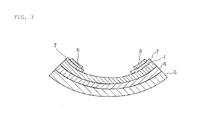
  • FIG. 3 is a cross-sectional view schematically illustrating a glass antenna as a second embodiment of a glass article according to the present invention.
  • FIG. 1 is a front view illustrating an embodiment of anti-fogging glass as a glass article, prepared with the use of a conductive paste according to the present invention
  • FIG. 2 is a cross-sectional view of FIG. 1 along the line A-A indicated by arrows.
  • This anti-fogging glass has, on the surface of a glass substrate 1 , multiple conductive films 2 formed in the form of fine and thin parallel lines at predetermined intervals.
  • bus bar electrodes 3 a , 3 b are formed on both ends of the conductive films 2 , and the bus bar electrodes 3 a , 3 b are connected to feeding terminals, not shown, with solder interposed therebetween.
  • a conductive paste is applied in the form of lines onto the glass substrate 1 , and subjected to a firing treatment, thereby forming the conductive films 2 in a predetermined pattern, and resulting in the conductive films 2 fixed on the glass substrate 1 .
  • Both ends of the conductive films 2 are electrically connected through the bus bar electrodes 3 a , 3 b , and the bus bar electrodes 3 a , 3 b are connected to feeding terminals (not shown) by soldering.
  • the thus formed anti-fogging glass is provided, for example, as front glass and rear glass of vehicles such as automobiles, and power is supplied to the conductive films 2 from the feeding terminals through the bus bar electrodes 3 a , 3 b , and allowed to generate heat, thereby making it possible to achieve anti-fogging performance.
  • the present conductive paste is a conductive paste preferred for forming conductive patterns on glass substrates such as glass for automobiles, which contains at least a conductive powder, glass frit, and an organic vehicle.
  • the conductive powder includes a noble metal powder and a base metal powder including Cu and/or Ni, and the base metal powder has a specific surface area of less than 0.5 m 2 /g.
  • the use of this conductive paste can achieve glass articles such as anti-fogging glass, which have favorable weather resistance and have moderate resistivity.
  • the conductive powder contains therein, as a base metal powder having a predetermined amount of Cu and/or Ni that are less likely to be oxidized as compared with Zn and Fe, along with a noble metal powder, and the base metal powder has a specific surface area of less than 0.5 m 2 /g.
  • Cu and Ni as the base metal powder require lower energy for oxide production as compared with Zn and Fe, and forms a strong passivation film at the surface, thus making the powder less likely to be oxidized.
  • base metal particles are oxidized slowly during firing, rather than being oxidized rapidly, and the glass frit thus achieves ingress into voids between the noble metal powder and the glass substrate 1 while maintaining moderate wettability.
  • the interfaces between the conductive films 2 and the glass substrate 1 can be sealed from the external environment, thereby improving the weather resistance.
  • having the specific surface area of the base metal powder less than 0.5 m 2 /g is desired.
  • the lower limit of the specific surface area of the base metal powder is not particularly limited, but when the specific surface area is less than 0.15 m 2 /g, there is unfavorably a possibility of increasing the maximum size of powder particles, thereby causing mesh to be clogged during screen printing.
  • the base metal powder when the base metal powder is formed from Cu, there is a need to adjust the content of the base metal powder with respect to the total amount of the conductive powder such that the content ratio of the base metal powder to 0.1 to 0.3 in ratio by weight. If the content ratio of Cu is less than 0.1, there is a possibility of extremely decreasing the resistivity, due to the decreased content of Cu in the conductive powder. On the other hand, if the content ratio of Cu exceeds 0.3, the excessive content of Cu in the conductive powder causes the resistivity to be increased by oxidation of Cu during firing, and causes the weather resistance to be degraded.
  • the base metal powder is formed from Ni
  • the base metal powder is formed from a mixed powder of Cu and Ni
  • the content ratio of the base metal powder in the conductive powder has a lower value of 0.1 in each case, while the upper limit varies, which is thought to be mainly because Ni is more likely to be oxidized than Ni, due to the difference in ionization tendency between Cu and Ni.
  • Cu and/or Ni as a base metal powder has a specific surface area of less than 0.5 m 2 /g, and the content ratio of the base metal powder in the conductive powder falls within the predetermined range described above.
  • the conductive paste can keep the wettability of the glass frit in the conductive paste from being decreased, thereby achieving favorable weather resistance.
  • the resistivity can be controlled moderately, and a conductive paste can be thus achieved which is preferred for anti-fogging glass of automobiles and the like.
  • the shape of the base metal powder is not particularly limited, but desirably spherical or substantially spherical in order to avoid the increase in specific surface area, and preferably kept as much as possible from having surface asperity, because there is a need to make the specific surface area less than 0.5 m 2 /g.
  • the base metal powder is preferably prepared by an atomization method as a method for preparing such a base metal powder.
  • typical preparation methods include a wet reduction method and an atomization method.
  • the wet reduction method is a preparation method with the use of a chemical process where an aqueous solution of a metal salt is reduced with a reductant to deposit a metal powder, and thus likely to provide surface asperity.
  • the atomization method causes a flow of molten metal to be sprayed from a nozzle to make droplets, and the droplets are thereafter solidified, thereby preparing a metal powder. Therefore, the method can keep the surface of the particles from being provided with asperity, thereby providing high-quality metal powders.
  • a method for preparing the base metal powder is not particularly limited, but in order to efficiently obtain the base metal powder with a specific surface area of less than 0.5 m 2 /g, the powder is preferably prepared by an atomization method.
  • the average particle size D 50 of the base metal powder is not particularly limited, but the average particle size D 50 in excess of 8 ⁇ m unfavorably has a possibility of causing the mesh to be clogged during screen printing.
  • the average particle size D 50 of the base metal powder is preferably 2.5 ⁇ m or more.
  • the noble metal powder is not particularly limited, as long as the powder is a metal powder with favorable conductivity, but typically, an Ag powder can be preferably used.
  • an Ag powder as a main constituent may contain therein various types of noble metal powders such as Pd and Pt as accessory constituents.
  • the shape of the noble metal powder is also not particularly limited, but may be, for example, spherical, flattened, amorphous, or the powder may be a mixed powder in these shapes.
  • the average particle size D 50 of the noble metal powder is also not particularly limited, but from the perspective of ensuring the mechanical strength and the like, the average particle size D 50 is preferably 0.1 to 3 ⁇ m. If the average particle size D 50 of the noble metal powder is less than 0.1 ⁇ m, the viscosity is increased during the paste preparation, thereby making it difficult to make paste. On the other hand, if the average particle size D 50 of the conductive powder exceeds 3 ⁇ m, there is a possibility that the presence of desired grown crystal grains between particles in the conductive powder will lack during firing, thereby causing the mechanical strength to be decreased.
  • the content of the conductive powder in the conductive paste is not particularly limited, but preferably 50 to 90 wt %. If the content of the conductive powder is less than 50 wt %, the content of the glass frit is relatively increased. Thus, in order to ensure desired conductivity, there is a need to increase the line width or make the conductive film thicker, thereby possibly causing the cost to be increased. On the other hand, if the content of the conductive powder exceeds 90 wt %, the excessive conductive powder has a possibility of making it difficult to make paste. Therefore, while the content of the conductive powder is not particularly limited, it is preferably 50 to 90 wt %.
  • the composition of the glass frit is not particularly limited, but there is a need to melt the glass frit at the firing temperature, thereby causing the glass frit to flow so as to avoid a decrease in sintered density and insufficient sealing at the interfaces of the conductive films 2 .
  • glass frit that has the composition adjusted so that the softening point is approximately 350 to 600° C., because of typical firing at a temperature of approximately 500 to 800° C.
  • constituents of the glass frit are not particularly limited, but can be selected from various types of oxides such as Bi 2 O 3 , PbO, SiO 2 , B 2 O 3 , Al 2 O 3 , BaO, CaO, SrO, ZnO, Na 2 O, K 2 O, Li 2 O, Sb 2 O 3 , FeO, and CuO, in consideration of softening point and chemical durability.
  • oxides such as Bi 2 O 3 , PbO, SiO 2 , B 2 O 3 , Al 2 O 3 , BaO, CaO, SrO, ZnO, Na 2 O, K 2 O, Li 2 O, Sb 2 O 3 , FeO, and CuO
  • the average particle size D 50 of the glass frit is also not particularly limited, but voids between the noble metal powder and the glass substrate 1 are desirably filled uniformly with the glass frit, and from the perspective, the average particle size D 50 of the glass frit is desirably 2 times or less of the average particle size D 50 of the noble metal powder.
  • the organic vehicle is prepared so that a binder resin and an organic solvent are, for example, 1 to 3:7 to 9 in volume ratio.
  • the binder resin is not particularly limited, but for example, an ethyl cellulose resin, a nitrocellulose resin, an acrylic resin, an alkyd resin, or a combination thereof can be used as the binder resin.
  • the organic solvent is also not particularly limited, but ⁇ -terpineol, xylene, toluene, diethylene glycol monobutylether, diethylene glycol monobutylether acetate, diethylene glycol monoethylether, diethylene glycol monoethylether acetate, and the like can be used either alone or in combination.
  • this conductive paste can be easily manufactured by weighing and mixing the noble metal powder, the base metal powder including Cu and/or Ni, the glass frit, and the organic vehicle so as to reach predetermined mixture proportions, and dispersing/kneading the mixture with the use of a 3 roll mill or the like.
  • the conductive paste contains the noble metal powder such as an Ag powder, the base metal powder including Cu and/Ni, the glass frit, and the organic vehicle, where the base metal powder has a specific surface area of less than 0.5 m 2 /g, and the content ratio of the base metal powder to the total amount of the conductive powder falls within a predetermined range.
  • the noble metal powder such as an Ag powder
  • the base metal powder including Cu and/Ni
  • the glass frit the organic vehicle
  • the base metal powder has a specific surface area of less than 0.5 m 2 /g, and the content ratio of the base metal powder to the total amount of the conductive powder falls within a predetermined range.
  • FIG. 3 is a main cross-sectional view illustrating an example of a glass antenna as a second embodiment of a glass article according to the present invention.
  • This glass antenna has a structure in consideration of impact resistance such that, as laminated glass, an intermediate film 6 made of polyvinyl alcohol resin or the like is interposed between multiple glass substrates (first and second glass substrates 4 , 5 ).
  • ceramic layers 7 are formed on the surface of the first glass substrate 4 , and conductive films 8 in predetermined patterns, which have an antenna function, are formed on the surfaces of the ceramic layers 7 .
  • the conductive films 8 are joined to feeding terminal (not shown) by soldering, and as with anti-fogging glass, for example, provided as window glass for vehicles such as automobiles to receive radio waves from the outside for radios and televisions.
  • This glass antenna is prepared in the following way.
  • a ceramic paste containing, as its main constituent, a ceramic material containing glass frit is applied onto the first glass substrate 4 , and dried.
  • the conductive paste according to the present invention is applied so as to provide a predetermined antenna pattern on the ceramic paste, and dried. Thereafter, the ceramic paste and the conductive paste are subjected to co-firing, and thereafter, the intermediate film 6 is attached with an adhesive so as to be sandwiched between the first glass substrate 4 and the second glass substrate 5 , thereby preparing a glass antenna.
  • the formation of the conductive film 8 with the use of the conductive paste according to the present invention can achieve a glass antenna which has favorable weather resistance, and resistivity controlled moderately, as in the first embodiment.
  • the present invention is not limited to the embodiments described above.
  • the base metal powder should contain Cu and/or Ni as its main constituent, and may contain other base metal constituents in minute amounts, to the extent that characteristics are not affected.
  • the powder may contain various types of inorganic constituents, if necessary, to the extent that characteristics are not affected.
  • the powder may contain, for example, Zr, P, V, Ce, Nb, Ta, W, Pd, Ag, Ru, Sn, In, Y, Dy, La, and the like.
  • the contained form is not particularly limited, and can be selected appropriately from oxides, hydroxides, peroxides, halides, carbonates, nitrates, phosphates, sulfates, fluorides, organometallic compounds, and the like.
  • the conductive paste plasticizers such as phthalic acid di 2-ethylhexyl and dibutyl phthalate, or a combination thereof, if necessary. It is also preferable to add a rheology modifier such as a fatty acid amide and a fatty acid, and a thixotropic agent, a thickener, a dispersant, and the like.
  • An Ag powder of 1.3 ⁇ m in average particle size D 50 was prepared as a noble metal powder, nine types (powder samples A to I) of Cu powders or Ni powders with specific surface areas and average particle sizes D 50 as shown in Table 1 were prepared as a base metal powder, and Bi—B—Si—O based glass frit of 2 ⁇ m in average particle size D 50 was further prepared.
  • the specific surface areas were measured by a 1-point BET method, and the average particle sizes D 50 were measured with a laser-diffraction particle size distribution measurement device.
  • the Cu powder for the powder sample E and the Ni powder for the powder sample I were prepared by a wet reduction method, whereas the other Cu powders or Ni powders were all prepared by an atomization method.
  • the powder samples A to C and F to H are all base metal powders within the scope of the preset invention, with specific surface areas of less than 0.50 m 2 /g.
  • the powder samples D, E, and I are base metal powders outside the scope of the preset invention, with specific surface areas of 0.50 m 2 /g or more.
  • an organic vehicle was prepared by the following method. More specifically, an ethyl cellulose resin and terpineol were mixed so that the ethyl cellulose resin was 10 wt % as a binder resin, whereas the terpineol was 90 wt % as an organic solvent, thereby preparing the organic vehicle.
  • the formulation ratio between the Ag powder and the base metal powder (Cu powder, Ni powder) was adjusted such that the content ratio of the base metal powder in the conductive powder was obtained as shown in Table 2 in ratio by weight, and the conductive powder (the noble metal powder and the base metal powder), the glass frit, and the organic vehicle were further formulated such that the total content of the conductive powder was 70 wt %, the content of the glass frit was 8 wt %, and the rest was the organic vehicle, mixed with a planetary mixer, and then dispersed and kneaded with a 3 roll mill, thereby preparing conductive pastes of sample numbers 1 to 18.
  • a glass slide of length: 76 mm, width: 26 mm, and thickness: 1.4 mm was prepared, and subjected to screen printing with the use of the conductive paste mentioned above so as to achieve total line length L: 100 mm and line width W: 0.5 mm, thereby forming a conductive pattern on the glass slide. Then, this glass slide was dried for 10 minutes at a temperature of 150° C., and then subjected to firing for 5 minutes at a maximum temperature of 600° C., thereby providing samples of sample numbers 1 to 18 with conductive films formed on the surfaces.
  • each sample of sample numbers 1 to 18 was immersed in a 10% NaCl solution for 120 hours. Then, this sample was taken out of the NaCl solution, sufficiently washed with water, and dried. Thereafter, a pressure-sensitive adhesive tape was attached to the surface of the conductive film, the pressure-sensitive adhesive tape was peeled off from the sample, and the weather resistance was evaluated from the resistance change rate of the conductive film.
  • Table 2 shows the types of the base metal powders used for sample numbers 1 to 18, the content ratios of the base metal powders in the conductive powders, and the measurement results.
  • the samples of 5.0 to 18.0 ⁇ cm in resistivity were determined to be non-defective products, whereas the other samples were determined to be defective products, thereby evaluating the samples for conductivity. This is because of taking into consideration the fact that the resistivity preferred for battery voltage is 5.0 to 18.0 ⁇ cm in view of mainstream battery voltages of 12 to 24 V now.
  • the samples of less than 5% in the resistance change rate of the conductive film were determined to be non-defective products “ ⁇ ”, whereas the samples in excess of 5% in the resistance change rate were determined to be defective products “x”, thereby evaluating the samples for weather resistance.
  • sample number 4 has, because the Cu powder as the base metal powder has a large specific surface area of 0.50 m 2 /g, a favorable resistivity of 15.2 ⁇ cm, but inferior weather resistance. This is thought to be because, due to the large specific surface area of the Cu powder, the oxidation of the Cu powder during the firing proceeded rapidly, thereby significantly decreasing the wettability of the glass frit.
  • sample number 5 has, because the Cu powder has a large specific surface area of 0.58 m 2 /g, a favorable resistivity of 16.6 ⁇ cm for substantially the same reason as with sample number 1, but inferior weather resistance.
  • Sample number 7 has, because of the low content ratio of the Cu powder, which is 0.05, favorable weather resistance, but a decreased resistivity of 4.2 ⁇ cm.
  • Sample 9 has, because the content ratio of the Cu powder is high, which is 0.40, a resistivity increased, and also weather resistance degraded. This is thought to be because, due to the high content ratio of the Cu powder, the oxidation amount of the Cu powder during the firing increased, thereby significantly decreasing the wettability of the glass frit.
  • sample number 13 has, because the Ni powder as the base metal powder has a large specific surface area of 0.77 m 2 /g, a favorable resistivity of 16.9 ⁇ cm for the same reason as described for sample number 4, but inferior weather resistance.
  • Sample number 15 has, because of the low content ratio of the Ni powder, which is 0.05, favorable weather resistance, but a decreased resistivity of 4.5 ⁇ cm.
  • Sample number 16 has, because the content ratio of the Ni powder is high, which is 0.25, a favorable resistivity of 16.7 ⁇ cm for the same reason as described for sample number 9, but weather resistance degraded.
  • sample numbers 1 to 3, 6, and 8 have favorable resistivities of 5.3 to 16.6 ⁇ cm, and also have favorable weather resistance, because the specific surface areas are 0.15 to 0.48 m 2 /g, which are less than 0.50 m 2 /g, and the conductive pastes contain therein the Cu powders within the scope of the present invention, of which the content ratios are 0.10 to 0.30.
  • sample numbers 10 to 12 and 14 have favorable resistivities of 5.2 to 16.9 ⁇ cm, and also have favorable weather resistance, because the specific surface areas are 0.14 to 0.48 m 2 /g, which are less than 0.50 m 2 /g, and the conductive pastes contain therein the Ni powders within the scope of the present invention, of which the content ratios are 0.10 to 0.20.
  • sample numbers 17 and 18 have favorable resistivities of 5.6 to 13.1 ⁇ cm, and also have favorable weather resistance, because the specific surface areas are 0.25 to 0.27 m 2 /g, which are less than 0.50 m 2 /g, and the conductive pastes contain therein the mixed powders of the Cu powders and Ni powders within the scope of the present invention, of which the content ratios are 0.10 to 0.25.
  • the present conductive paste has favorable weather resistance, and moderate resistivity, and can be used in a preferred manner for glass articles such as anti-fogging glass and glass antennas for vehicles.

Landscapes

  • Chemical & Material Sciences (AREA)
  • Engineering & Computer Science (AREA)
  • Materials Engineering (AREA)
  • Organic Chemistry (AREA)
  • Life Sciences & Earth Sciences (AREA)
  • Chemical Kinetics & Catalysis (AREA)
  • General Chemical & Material Sciences (AREA)
  • Geochemistry & Mineralogy (AREA)
  • Dispersion Chemistry (AREA)
  • Wood Science & Technology (AREA)
  • Mechanical Engineering (AREA)
  • Spectroscopy & Molecular Physics (AREA)
  • Physics & Mathematics (AREA)
  • Inorganic Chemistry (AREA)
  • Composite Materials (AREA)
  • Metallurgy (AREA)
  • Manufacturing & Machinery (AREA)
  • Ceramic Engineering (AREA)
  • Crystallography & Structural Chemistry (AREA)
  • Microelectronics & Electronic Packaging (AREA)
  • Conductive Materials (AREA)
  • Manufacture Of Metal Powder And Suspensions Thereof (AREA)
  • Powder Metallurgy (AREA)
  • Non-Insulated Conductors (AREA)
  • Manufacturing Of Electric Cables (AREA)

Abstract

A conductive paste contains at least a conductive powder, glass frit, and an organic vehicle. The conductive powder contains a noble metal powder such as an Ag powder and a base metal powder containing Cu and/or Ni, and the base metal powder has a specific surface area of less than 0.5 m2/g. The content of the base metal powder with respect to the total amount of the conductive powder is, in ratio by weight, 0.1 to 0.3 when the base metal powder contains Cu as its main constituent, 0.1 to 0.2 when the base metal powder contains Ni as its main constituent, and 0.1 to 0.25 when the base metal powder contains a mixed powder of Cu and Ni as its main constituent.

Description

CROSS REFERENCE TO RELATED APPLICATIONS
The present application is a continuation of International application No. PCT/JP2015/064066, filed May 15, 2015, which claims priority to Japanese Patent Application No. 2014-133933, filed Jun. 30, 2014, the entire contents of each of which are incorporated herein by reference.
FIELD OF THE INVENTION
The present invention relates to a conductive paste and a glass article, and more particularly, a conductive paste for forming anti-fogging hot wires, antenna patterns, and the like provided on window glass for vehicles such as automobiles, and to a glass article such as anti-fogging glass and a glass antenna, obtained with the use of the conductive paste.
BACKGROUND OF THE INVENTION
Conventionally, for window glass of vehicles such as automobiles, glass articles are used such as anti-fogging glass provided with anti-fogging hot wires, and glass antennas for receiving ratio waves from the outside of vehicles. Of these glass articles, for example, anti-fogging glass typically has a conductive film formed in a predetermined pattern by applying a conductive paste in the form of lines onto a glass substrate, and then the paste is fired. Various types of paste have been developed and proposed for this purpose.
For example, Patent Document 1 proposes a conductive paste for producing conductive coatings on glass, ceramics, or porcelain enamel steel. The conductive paste includes conductive silver particles, conductive particles containing at least one base metal, one or more types of glass frit, and a paste formation medium. The base metal-containing conductive particles are substantially composed of iron, cobalt, nickel, copper, zinc, or an alloy including at least one of the elements. The average particle size D50 of the base metal-containing conductive particles falls within the range of 0.1 μm to 15 μm, the specific surface area thereof falls within the range of 0.5 m2/g to 10 m2/g, and the base metal-containing conductive particles account for up to 80 weight % of the whole conductive particles. The softening temperature (by heating microscope) of the one or more types of glass frit falls within the range of 350° C. to 600° C., and the hemisphere temperature thereof falls within the range of 450° C. to 700° C.
This Patent Document 1 is intended to achieve a conductive paste which has a stable resistivity of approximately 37 to 40 μΩ·cm even when the firing temperature varies in the range of 660 to 680° C.
Patent Document 1: Japanese Patent No. 3960921 (claim 1; paragraphs [0009], [0019] to [0021], Table 2, etc.)
SUMMARY OF THE INVENTION
However, Patent Document 1 exhibits problems of inferior weather resistance, and high resistivity for the following reasons.
More specifically, when the conductive paste contains therein base metal particles, the base metal particles consume oxygen in the conductive film through an oxidation reaction during firing, thereby locally decreasing the oxygen partial pressure. Then, when the oxygen partial pressure is decreased, the oxygen adsorbed on the surfaces of noble metal particles will be reduced, thereby decreasing the wettability of the glass frit as an oxide. In this case, slow oxidation of the base metal particles results in a minor decrease in wettability because oxygen is rapidly supplied to the conductive film from the surroundings of the base metal particles, while rapid oxidation of the base metal particles results in a significant decrease in wettability.
However, when the wettability of the glass frit is decreased as described above, the ingress of the glass frit into the voids is blocked, thus degrading the weather resistance. More specifically, when the conductive film is exposed to the air with unfilled voids left at the interface between the glass substrate and the conductive film, and comes into contact with an acid, salt water, or the like, there is a possibility of causing erosion due to the ingress of the acid or salt water into the interface between the conductive film and the glass substrate, and thereby causing the interface strength between the glass substrate and the conductive film to be decreased.
In addition, the decreased wettability of the glass frit interferes with liquid-phase sintering, thus decreasing the sintered density of the conductive film. This creates a possibility of increasing the resistivity, thereby causing a decrease in conductivity.
In order to suppress the increase in resistivity, it is possible to increase the line width of the conductive film or increase the film thickness thereof. However, in this case, due to the increased amount of the conductive paste used, there is a possibility of causing the cost to be increased, which is not preferable for at least the perspective of resource saving. In particular, while the resistivity is generally 20 μΩ·cm or more in Patent Document 1, the control of the resistivity to approximately 18 μΩ·cm or less is thought to be preferable, because mainstream battery voltages of vehicles and the like are 12 to 24 V.
The present invention has been made in view of these circumstances, and an object of the invention is to provide a conductive paste which has favorable weather resistance, and moderately controllable resistivity, and a glass article such as anti-fogging glass and a glass antenna, with the use of the conductive paste.
The inventors have earnestly carried out studies to achieve the above object, and found that a conductive paste that includes a conductive powder that contains a base metal powder having a predetermined amount of Cu powder and/or Ni powder that is relatively unlikely to be oxidized, and that the base metal powder has a specific surface area of less than 0.5 m2/g, slows the oxidation of base metal particles during firing, and thus making it possible to inhibit rapid oxidation. As a result, ingress of glass frit into voids between noble metal particles and a glass substrate can occur and create a seal from the external environment, thereby making it possible to achieve favorable weather resistance and control resistivity moderately.
The present invention has been made based on this finding, and a conductive paste according to the present invention is a conductive paste comprising at least a conductive powder, glass frit, and an organic vehicle. The conductive powder contains a noble metal powder and a base metal powder containing at least one of Cu and Ni, and the base metal powder has a specific surface area of less than 0.5 m2/g. A content of the base metal powder with respect to a total amount of the conductive powder is, in ratio by weight: 0.1 to 0.3 when the base metal powder contains the Cu as its main constituent; 0.1 to 0.2 when the base metal powder contains the Ni as its main constituent; and 0.1 to 0.25 when the base metal powder contains a mixed powder of the Cu and the Ni as its main constituent.
In the conductive paste according to the present invention, the base metal powder is preferably an atomized powder prepared by an atomization method.
In the conductive paste according to the present invention, the base metal powder is preferably 8 μm or less in average particle size.
In the conductive paste according to the present invention, the base metal powder is preferably 2.5 μm or more in average particle size D50.
Furthermore, in the conductive paste according to the present invention, the noble metal powder is preferably 0.1 to 3 μm in average particle size D50.
In addition, in the conductive paste according to the present invention, a content of the conductive powder is preferably 50 to 90 wt %.
In addition, in the conductive paste according to the present invention, an average particle size D50 of the glass frit is preferably 2 times or less of the average particle size of the noble metal powder.
Furthermore, in the conductive paste according to the present invention, the glass frit preferably has a softening point of 350° C. to 600° C.
In addition, in the conductive paste according to the present invention, the noble metal powder preferably contains Ag as its main constituent.
In addition, a glass article according to the present invention includes a substrate and a conductive film in a predetermined pattern formed on the substrate, wherein the conductive film is obtained by applying the conductive paste according to any of the embodiments of the present invention onto the substrate and sintering the paste sintered.
In addition, in the glass article according to the present invention, a ceramic layer is also preferably interposed between the glass substrate and the conductive film.
It is to be noted that the average particle size is referred to as a particle size corresponding to 50% of the cumulative distribution, that is, a median size (hereinafter, an “average particle size D50”) in the present invention.
With the conductive paste according to the present invention, the oxidation of the base metal particles during firing is made slow, thus making it possible to inhibit rapid oxidation, and accordingly, while maintaining the wettability of the glass frit, ingress of the glass frit into voids between the noble metal particles and a glass substrate can create a seal from the external environment.
Therefore, the use of the present conductive paste can achieve various types of glass articles which have favorable weather resistance, and also moderately controllable resistivity.
In addition, when using the conductive paste of the present invention to create a glass article, a seal from the external environment can be created as described above, thereby making it possible to achieve glass articles such as anti-fogging glass and glass antennas, which have favorable weather resistance and favorable conductivity with resistivity moderately controllable even when applying voltages of 12 to 48 V, which are common battery voltages of vehicles.
BRIEF EXPLANATION OF THE DRAWINGS
FIG. 1 is a front view illustrating an embodiment (first embodiment) of anti-fogging glass as a glass article, prepared with the use of a conductive paste according to the present invention.
FIG. 2 is a cross-sectional view of FIG. 1 along the line A-A indicated by arrows.
FIG. 3 is a cross-sectional view schematically illustrating a glass antenna as a second embodiment of a glass article according to the present invention.
DETAILED DESCRIPTION OF EMBODIMENTS OF THE INVENTION
Next, embodiments of the present invention will be described in detail.
FIG. 1 is a front view illustrating an embodiment of anti-fogging glass as a glass article, prepared with the use of a conductive paste according to the present invention, and FIG. 2 is a cross-sectional view of FIG. 1 along the line A-A indicated by arrows.
This anti-fogging glass has, on the surface of a glass substrate 1, multiple conductive films 2 formed in the form of fine and thin parallel lines at predetermined intervals. In addition, bus bar electrodes 3 a, 3 b are formed on both ends of the conductive films 2, and the bus bar electrodes 3 a, 3 b are connected to feeding terminals, not shown, with solder interposed therebetween.
More specifically, for this anti-fogging glass, a conductive paste is applied in the form of lines onto the glass substrate 1, and subjected to a firing treatment, thereby forming the conductive films 2 in a predetermined pattern, and resulting in the conductive films 2 fixed on the glass substrate 1. Both ends of the conductive films 2 are electrically connected through the bus bar electrodes 3 a, 3 b, and the bus bar electrodes 3 a, 3 b are connected to feeding terminals (not shown) by soldering.
The thus formed anti-fogging glass is provided, for example, as front glass and rear glass of vehicles such as automobiles, and power is supplied to the conductive films 2 from the feeding terminals through the bus bar electrodes 3 a, 3 b, and allowed to generate heat, thereby making it possible to achieve anti-fogging performance.
Next, the conductive paste for forming the conductive films 2 described above will be described in detail.
The present conductive paste is a conductive paste preferred for forming conductive patterns on glass substrates such as glass for automobiles, which contains at least a conductive powder, glass frit, and an organic vehicle.
The conductive powder includes a noble metal powder and a base metal powder including Cu and/or Ni, and the base metal powder has a specific surface area of less than 0.5 m2/g. The use of this conductive paste can achieve glass articles such as anti-fogging glass, which have favorable weather resistance and have moderate resistivity.
Therefore, according to the present invention, the conductive powder contains therein, as a base metal powder having a predetermined amount of Cu and/or Ni that are less likely to be oxidized as compared with Zn and Fe, along with a noble metal powder, and the base metal powder has a specific surface area of less than 0.5 m2/g.
More specifically, Cu and Ni as the base metal powder require lower energy for oxide production as compared with Zn and Fe, and forms a strong passivation film at the surface, thus making the powder less likely to be oxidized. Moreover, when the base metal powder is reduced in specific surface area, base metal particles are oxidized slowly during firing, rather than being oxidized rapidly, and the glass frit thus achieves ingress into voids between the noble metal powder and the glass substrate 1 while maintaining moderate wettability. As a result, the interfaces between the conductive films 2 and the glass substrate 1 can be sealed from the external environment, thereby improving the weather resistance. To that end, having the specific surface area of the base metal powder less than 0.5 m2/g is desired.
The lower limit of the specific surface area of the base metal powder is not particularly limited, but when the specific surface area is less than 0.15 m2/g, there is unfavorably a possibility of increasing the maximum size of powder particles, thereby causing mesh to be clogged during screen printing.
In addition, according to the present invention, there is also a need to adjust the content of Cu and/or Ni within the following predetermined range.
More specifically, when the base metal powder is formed from Cu, there is a need to adjust the content of the base metal powder with respect to the total amount of the conductive powder such that the content ratio of the base metal powder to 0.1 to 0.3 in ratio by weight. If the content ratio of Cu is less than 0.1, there is a possibility of extremely decreasing the resistivity, due to the decreased content of Cu in the conductive powder. On the other hand, if the content ratio of Cu exceeds 0.3, the excessive content of Cu in the conductive powder causes the resistivity to be increased by oxidation of Cu during firing, and causes the weather resistance to be degraded.
In addition, when the base metal powder is formed from Ni, there is a need to adjust the content ratio of the base metal powder to the total amount of the conductive powder to 0.1 to 0.2 in ratio by weight. If the content ratio of Ni is less than 0.1, there is a possibility of extremely decreasing the resistivity as in the case of Cu, due to the low content of Ni in the conductive powder. On the other hand, if the content ratio of Ni exceeds 0.2, the excessive content of Ni in the conductive powder has a possibility of causing the weather resistance to be degraded, even though an increase in the resistivity can be avoided due to the difference in sinterability from Cu.
Furthermore, when the base metal powder is formed from a mixed powder of Cu and Ni, there is a need to adjust the content ratio of the base metal powder to the total amount of the conductive powder to 0.1 to 0.25 in ratio by weight. If the content ratio of the mixed powder of Cu and Ni is less than 0.1, there is a possibility of extremely decreasing the resistivity for the same reason as in the case of Cu or Ni. On the other hand, if the content ratio of the mixed powder exceeds 0.25, the excessive content of the mixed powder in the conductive powder has a possibility of causing the weather resistance to be decreased, as in the case of Ni.
In addition, as for the form of the mixed powder of Cu and Ni, similar effects are also achieved with the use of not only a mixed powder of a Cu powder and a Ni powder, but also an alloy powder of Cu and Ni.
It is to be noted that the content ratio of the base metal powder in the conductive powder has a lower value of 0.1 in each case, while the upper limit varies, which is thought to be mainly because Ni is more likely to be oxidized than Ni, due to the difference in ionization tendency between Cu and Ni.
As just described above, Cu and/or Ni as a base metal powder has a specific surface area of less than 0.5 m2/g, and the content ratio of the base metal powder in the conductive powder falls within the predetermined range described above. Thus, the conductive paste can keep the wettability of the glass frit in the conductive paste from being decreased, thereby achieving favorable weather resistance. In addition, the resistivity can be controlled moderately, and a conductive paste can be thus achieved which is preferred for anti-fogging glass of automobiles and the like.
It is to be noted that the shape of the base metal powder is not particularly limited, but desirably spherical or substantially spherical in order to avoid the increase in specific surface area, and preferably kept as much as possible from having surface asperity, because there is a need to make the specific surface area less than 0.5 m2/g. Further, the base metal powder is preferably prepared by an atomization method as a method for preparing such a base metal powder.
More specifically, various methods are known for preparing metal powders of fine particles, and typical preparation methods include a wet reduction method and an atomization method.
However, the wet reduction method is a preparation method with the use of a chemical process where an aqueous solution of a metal salt is reduced with a reductant to deposit a metal powder, and thus likely to provide surface asperity.
In contrast, the atomization method causes a flow of molten metal to be sprayed from a nozzle to make droplets, and the droplets are thereafter solidified, thereby preparing a metal powder. Therefore, the method can keep the surface of the particles from being provided with asperity, thereby providing high-quality metal powders.
Therefore, a method for preparing the base metal powder is not particularly limited, but in order to efficiently obtain the base metal powder with a specific surface area of less than 0.5 m2/g, the powder is preferably prepared by an atomization method.
The average particle size D50 of the base metal powder is not particularly limited, but the average particle size D50 in excess of 8 μm unfavorably has a possibility of causing the mesh to be clogged during screen printing.
In addition, as for the average particle size D50 of the base metal powder, the specific surface area varies depending on the particle shape and the surface condition, and has a tendency to increase as the particles become finer. Therefore, the average particle size D50 of the base metal powder is preferably 2.5 μm or more.
The noble metal powder is not particularly limited, as long as the powder is a metal powder with favorable conductivity, but typically, an Ag powder can be preferably used. In addition, an Ag powder as a main constituent may contain therein various types of noble metal powders such as Pd and Pt as accessory constituents.
In addition, the shape of the noble metal powder is also not particularly limited, but may be, for example, spherical, flattened, amorphous, or the powder may be a mixed powder in these shapes.
The average particle size D50 of the noble metal powder is also not particularly limited, but from the perspective of ensuring the mechanical strength and the like, the average particle size D50 is preferably 0.1 to 3 μm. If the average particle size D50 of the noble metal powder is less than 0.1 μm, the viscosity is increased during the paste preparation, thereby making it difficult to make paste. On the other hand, if the average particle size D50 of the conductive powder exceeds 3 μm, there is a possibility that the presence of desired grown crystal grains between particles in the conductive powder will lack during firing, thereby causing the mechanical strength to be decreased.
In addition, the content of the conductive powder in the conductive paste is not particularly limited, but preferably 50 to 90 wt %. If the content of the conductive powder is less than 50 wt %, the content of the glass frit is relatively increased. Thus, in order to ensure desired conductivity, there is a need to increase the line width or make the conductive film thicker, thereby possibly causing the cost to be increased. On the other hand, if the content of the conductive powder exceeds 90 wt %, the excessive conductive powder has a possibility of making it difficult to make paste. Therefore, while the content of the conductive powder is not particularly limited, it is preferably 50 to 90 wt %.
In addition, the composition of the glass frit is not particularly limited, but there is a need to melt the glass frit at the firing temperature, thereby causing the glass frit to flow so as to avoid a decrease in sintered density and insufficient sealing at the interfaces of the conductive films 2. Further, for glass articles such as anti-fogging glass, it is preferable to use glass frit that has the composition adjusted so that the softening point is approximately 350 to 600° C., because of typical firing at a temperature of approximately 500 to 800° C.
In addition, the constituents of the glass frit are not particularly limited, but can be selected from various types of oxides such as Bi2O3, PbO, SiO2, B2O3, Al2O3, BaO, CaO, SrO, ZnO, Na2O, K2O, Li2O, Sb2O3, FeO, and CuO, in consideration of softening point and chemical durability.
In addition, the average particle size D50 of the glass frit is also not particularly limited, but voids between the noble metal powder and the glass substrate 1 are desirably filled uniformly with the glass frit, and from the perspective, the average particle size D50 of the glass frit is desirably 2 times or less of the average particle size D50 of the noble metal powder.
In addition, the organic vehicle is prepared so that a binder resin and an organic solvent are, for example, 1 to 3:7 to 9 in volume ratio. It is to be noted that the binder resin is not particularly limited, but for example, an ethyl cellulose resin, a nitrocellulose resin, an acrylic resin, an alkyd resin, or a combination thereof can be used as the binder resin. In addition, the organic solvent is also not particularly limited, but α-terpineol, xylene, toluene, diethylene glycol monobutylether, diethylene glycol monobutylether acetate, diethylene glycol monoethylether, diethylene glycol monoethylether acetate, and the like can be used either alone or in combination.
Further, this conductive paste can be easily manufactured by weighing and mixing the noble metal powder, the base metal powder including Cu and/or Ni, the glass frit, and the organic vehicle so as to reach predetermined mixture proportions, and dispersing/kneading the mixture with the use of a 3 roll mill or the like.
As just described above, according to the present embodiment, the conductive paste contains the noble metal powder such as an Ag powder, the base metal powder including Cu and/Ni, the glass frit, and the organic vehicle, where the base metal powder has a specific surface area of less than 0.5 m2/g, and the content ratio of the base metal powder to the total amount of the conductive powder falls within a predetermined range. Thus, a conductive paste suited for forming conductive films of anti-fogging glass and the like can be achieved which has favorable weather resistance, and also has resistivity controlled moderately.
FIG. 3 is a main cross-sectional view illustrating an example of a glass antenna as a second embodiment of a glass article according to the present invention.
This glass antenna has a structure in consideration of impact resistance such that, as laminated glass, an intermediate film 6 made of polyvinyl alcohol resin or the like is interposed between multiple glass substrates (first and second glass substrates 4, 5).
Further, ceramic layers 7 are formed on the surface of the first glass substrate 4, and conductive films 8 in predetermined patterns, which have an antenna function, are formed on the surfaces of the ceramic layers 7. The conductive films 8 are joined to feeding terminal (not shown) by soldering, and as with anti-fogging glass, for example, provided as window glass for vehicles such as automobiles to receive radio waves from the outside for radios and televisions.
This glass antenna is prepared in the following way. A ceramic paste containing, as its main constituent, a ceramic material containing glass frit is applied onto the first glass substrate 4, and dried. Then, the conductive paste according to the present invention is applied so as to provide a predetermined antenna pattern on the ceramic paste, and dried. Thereafter, the ceramic paste and the conductive paste are subjected to co-firing, and thereafter, the intermediate film 6 is attached with an adhesive so as to be sandwiched between the first glass substrate 4 and the second glass substrate 5, thereby preparing a glass antenna.
The formation of the conductive film 8 with the use of the conductive paste according to the present invention can achieve a glass antenna which has favorable weather resistance, and resistivity controlled moderately, as in the first embodiment.
It is to be noted that the present invention is not limited to the embodiments described above. For example, while cases of the base metal powder formed from Cu and/or Ni have been described in the embodiments mentioned above, the base metal powder should contain Cu and/or Ni as its main constituent, and may contain other base metal constituents in minute amounts, to the extent that characteristics are not affected. In addition, the powder may contain various types of inorganic constituents, if necessary, to the extent that characteristics are not affected. The powder may contain, for example, Zr, P, V, Ce, Nb, Ta, W, Pd, Ag, Ru, Sn, In, Y, Dy, La, and the like. In addition, the contained form is not particularly limited, and can be selected appropriately from oxides, hydroxides, peroxides, halides, carbonates, nitrates, phosphates, sulfates, fluorides, organometallic compounds, and the like.
In addition, it is also preferable to add to the conductive paste plasticizers such as phthalic acid di 2-ethylhexyl and dibutyl phthalate, or a combination thereof, if necessary. It is also preferable to add a rheology modifier such as a fatty acid amide and a fatty acid, and a thixotropic agent, a thickener, a dispersant, and the like.
Next, an example of the present invention will be specifically described.
EXAMPLES Preparation of Sample
An Ag powder of 1.3 μm in average particle size D50 was prepared as a noble metal powder, nine types (powder samples A to I) of Cu powders or Ni powders with specific surface areas and average particle sizes D50 as shown in Table 1 were prepared as a base metal powder, and Bi—B—Si—O based glass frit of 2 μm in average particle size D50 was further prepared.
In addition, the specific surface areas were measured by a 1-point BET method, and the average particle sizes D50 were measured with a laser-diffraction particle size distribution measurement device.
It is to be noted that the Cu powder for the powder sample E and the Ni powder for the powder sample I were prepared by a wet reduction method, whereas the other Cu powders or Ni powders were all prepared by an atomization method.
TABLE 1
Specific Average
Surface Particle
Sample Base Metal Area Size D50 Preparation
No. Powder (m2/g) (μm) Method
A Cu 0.15 7.8 Atomization
B 0.25 5.1 Method
C 0.49 3.0
D* 0.50 3.3
E* 0.58 5.0 Wet Reduction
Method
F Ni 0.14 8.0 Atomization
G 0.27 5.5 Method
H 0.48 2.5
I* 0.77 2.8 Wet Reduction
Method
*outside the scope of the present invention
As is clear from Table 1, the powder samples A to C and F to H are all base metal powders within the scope of the preset invention, with specific surface areas of less than 0.50 m2/g. On the other hand, the powder samples D, E, and I are base metal powders outside the scope of the preset invention, with specific surface areas of 0.50 m2/g or more.
In addition, an organic vehicle was prepared by the following method. More specifically, an ethyl cellulose resin and terpineol were mixed so that the ethyl cellulose resin was 10 wt % as a binder resin, whereas the terpineol was 90 wt % as an organic solvent, thereby preparing the organic vehicle.
Next, the formulation ratio between the Ag powder and the base metal powder (Cu powder, Ni powder) was adjusted such that the content ratio of the base metal powder in the conductive powder was obtained as shown in Table 2 in ratio by weight, and the conductive powder (the noble metal powder and the base metal powder), the glass frit, and the organic vehicle were further formulated such that the total content of the conductive powder was 70 wt %, the content of the glass frit was 8 wt %, and the rest was the organic vehicle, mixed with a planetary mixer, and then dispersed and kneaded with a 3 roll mill, thereby preparing conductive pastes of sample numbers 1 to 18.
[Evaluation of Sample]
A glass slide of length: 76 mm, width: 26 mm, and thickness: 1.4 mm was prepared, and subjected to screen printing with the use of the conductive paste mentioned above so as to achieve total line length L: 100 mm and line width W: 0.5 mm, thereby forming a conductive pattern on the glass slide. Then, this glass slide was dried for 10 minutes at a temperature of 150° C., and then subjected to firing for 5 minutes at a maximum temperature of 600° C., thereby providing samples of sample numbers 1 to 18 with conductive films formed on the surfaces.
Next, a voltage was applied to both ends of the conductive film, and the resistance value was measured with a digital resistance meter. Then, a cross-sectional area of the conductive film was measured with a contact-type surface roughness meter, and the resistivity was calculated from the cross-sectional area and the total line length L (=100 mm).
Next, each sample of sample numbers 1 to 18 was immersed in a 10% NaCl solution for 120 hours. Then, this sample was taken out of the NaCl solution, sufficiently washed with water, and dried. Thereafter, a pressure-sensitive adhesive tape was attached to the surface of the conductive film, the pressure-sensitive adhesive tape was peeled off from the sample, and the weather resistance was evaluated from the resistance change rate of the conductive film.
Table 2 shows the types of the base metal powders used for sample numbers 1 to 18, the content ratios of the base metal powders in the conductive powders, and the measurement results.
It is to be noted that the samples of 5.0 to 18.0 μΩ·cm in resistivity were determined to be non-defective products, whereas the other samples were determined to be defective products, thereby evaluating the samples for conductivity. This is because of taking into consideration the fact that the resistivity preferred for battery voltage is 5.0 to 18.0 μΩ·cm in view of mainstream battery voltages of 12 to 24 V now.
In addition, the samples of less than 5% in the resistance change rate of the conductive film were determined to be non-defective products “◯”, whereas the samples in excess of 5% in the resistance change rate were determined to be defective products “x”, thereby evaluating the samples for weather resistance.
TABLE 2
Content
Ratio of
Sample Base Metal Base Metal Resistivity Weather
No. Powder No. Powder (—) (μΩ · cm) Resistance
 1 A 0.20 8.6
 2 B 0.20 9.5
 3 C 0.20 12.1
 4* D 0.20 15.2 X
 5* E 0.20 16.6 X
 6 C 0.10 5.3
 7* C 0.05 4.2
 8 A 0.30 15
 9* A 0.40 26.3 X
10 F 0.20 9.1
11 G 0.20 9.8
12 H 0.20 12.4
13* I 0.20 16.9 X
14 H 0.10 5.2
15* H 0.05 4.5
16* F 0.25 16.7 X
17 B 0.05 5.6
G 0.05
18 B 0.15 13.1
G 0.10
*outside the scope of the present invention
It has been determined that sample number 4 has, because the Cu powder as the base metal powder has a large specific surface area of 0.50 m2/g, a favorable resistivity of 15.2 μΩ·cm, but inferior weather resistance. This is thought to be because, due to the large specific surface area of the Cu powder, the oxidation of the Cu powder during the firing proceeded rapidly, thereby significantly decreasing the wettability of the glass frit.
It has been determined that sample number 5 has, because the Cu powder has a large specific surface area of 0.58 m2/g, a favorable resistivity of 16.6 μΩ·cm for substantially the same reason as with sample number 1, but inferior weather resistance.
Sample number 7 has, because of the low content ratio of the Cu powder, which is 0.05, favorable weather resistance, but a decreased resistivity of 4.2 μΩ·cm.
Sample 9 has, because the content ratio of the Cu powder is high, which is 0.40, a resistivity increased, and also weather resistance degraded. This is thought to be because, due to the high content ratio of the Cu powder, the oxidation amount of the Cu powder during the firing increased, thereby significantly decreasing the wettability of the glass frit.
It has been determined that sample number 13 has, because the Ni powder as the base metal powder has a large specific surface area of 0.77 m2/g, a favorable resistivity of 16.9 μΩ·cm for the same reason as described for sample number 4, but inferior weather resistance.
Sample number 15 has, because of the low content ratio of the Ni powder, which is 0.05, favorable weather resistance, but a decreased resistivity of 4.5 μΩ·cm.
Sample number 16 has, because the content ratio of the Ni powder is high, which is 0.25, a favorable resistivity of 16.7 μΩ·cm for the same reason as described for sample number 9, but weather resistance degraded.
In contrast, sample numbers 1 to 3, 6, and 8 have favorable resistivities of 5.3 to 16.6 μΩ·cm, and also have favorable weather resistance, because the specific surface areas are 0.15 to 0.48 m2/g, which are less than 0.50 m2/g, and the conductive pastes contain therein the Cu powders within the scope of the present invention, of which the content ratios are 0.10 to 0.30.
In addition, sample numbers 10 to 12 and 14 have favorable resistivities of 5.2 to 16.9 μΩ·cm, and also have favorable weather resistance, because the specific surface areas are 0.14 to 0.48 m2/g, which are less than 0.50 m2/g, and the conductive pastes contain therein the Ni powders within the scope of the present invention, of which the content ratios are 0.10 to 0.20.
In addition, sample numbers 17 and 18 have favorable resistivities of 5.6 to 13.1 μΩ·cm, and also have favorable weather resistance, because the specific surface areas are 0.25 to 0.27 m2/g, which are less than 0.50 m2/g, and the conductive pastes contain therein the mixed powders of the Cu powders and Ni powders within the scope of the present invention, of which the content ratios are 0.10 to 0.25.
The present conductive paste has favorable weather resistance, and moderate resistivity, and can be used in a preferred manner for glass articles such as anti-fogging glass and glass antennas for vehicles.
DESCRIPTION OF REFERENCE SYMBOLS
    • 1: glass substrate
    • 2: conductive film
    • 4: first glass substrate (glass substrate)
    • 7: ceramic layer
    • 8: conductive film

Claims (20)

The invention claimed is:
1. A conductive paste comprising:
a conductive powder;
glass frit; and
an organic vehicle,
wherein
the conductive powder contains a noble metal powder and a base metal powder containing at least one of Cu and Ni as a main constituent thereof,
the base metal powder has a specific surface area of less than 0.5 m2/g, and
a content of the base metal powder with respect to a total amount of the conductive powder is, in ratio by weight:
0.1 to 0.3 when the base metal powder contains the Cu as the main constituent thereof;
0.1 to 0.2 when the base metal powder contains the Ni as the main constituent thereof; and
0.1 to 0.25 when the base metal powder contains a mixture of the Cu and the Ni as the main constituent thereof.
2. The conductive paste according to claim 1, wherein specific surface area of the base metal powder is 0.15 to 0.5 m2/g.
3. The conductive paste according to claim 1, wherein the base metal powder is an atomized powder.
4. The conductive paste according to claim 1, wherein the base metal powder is 8 μm or less in average particle size.
5. The conductive paste according to claim 1, wherein the base metal powder is 2.5 to 8.0 μm in average particle size.
6. The conductive paste according to claim 1, wherein the noble metal powder is 0.1 to 3 μm in average particle size.
7. The conductive paste according to claim 1, wherein a content of the conductive powder is 50 to 90 wt % of the conductive paste.
8. The conductive paste according to claim 1, wherein an average particle size of the glass frit is 2 times or less of an average particle size of the noble metal powder.
9. The conductive paste according to claim 1, wherein the glass frit has a softening point of 350° C. to 600° C.
10. The conductive paste according to claim 1, wherein the noble metal powder contains Ag as a main constituent thereof.
11. A glass article comprising:
a glass substrate; and
a conductive film in a predetermined pattern on the glass substrate, wherein
the conductive film is formed from the conductive paste according to claim 1.
12. The glass article according to claim 11, further comprising a ceramic layer interposed between the glass substrate and the conductive film.
13. The glass article according to claim 11, wherein specific surface area of the base metal powder in the conductive paste is 0.15 to 0.5 m2/g.
14. The glass article according to claim 11, wherein the base metal powder in the conductive paste is an atomized powder.
15. The glass article according to claim 11, wherein the base metal powder in the conductive paste is 2.5 to 8.0 μm in average particle size.
16. The glass article according to claim 11, wherein the noble metal powder in the conductive paste is 0.1 to 3 μm in average particle size.
17. The glass article according to claim 11, wherein a content of the conductive powder in the conductive paste is 50 to 90 wt % of the conductive paste.
18. The glass article according to claim 11, wherein an average particle size of the glass frit in the conductive paste is 2 times or less of an average particle size of the noble metal powder in the conductive paste.
19. The glass article according to claim 11, wherein the glass frit in the conductive paste has a softening point of 350° C. to 600° C.
20. The glass article according to claim 11, wherein the noble metal powder in the conductive paste contains Ag as a main constituent thereof.
US15/364,843 2014-06-30 2016-11-30 Conductive paste and glass article Active 2035-08-01 US10052690B2 (en)

Applications Claiming Priority (3)

Application Number Priority Date Filing Date Title
JP2014133993 2014-06-30
JP2014-133993 2014-06-30
PCT/JP2015/064066 WO2016002362A1 (en) 2014-06-30 2015-05-15 Conductive paste and glass article

Related Parent Applications (1)

Application Number Title Priority Date Filing Date
PCT/JP2015/064066 Continuation WO2016002362A1 (en) 2014-06-30 2015-05-15 Conductive paste and glass article

Publications (2)

Publication Number Publication Date
US20170080490A1 US20170080490A1 (en) 2017-03-23
US10052690B2 true US10052690B2 (en) 2018-08-21

Family

ID=55018917

Family Applications (1)

Application Number Title Priority Date Filing Date
US15/364,843 Active 2035-08-01 US10052690B2 (en) 2014-06-30 2016-11-30 Conductive paste and glass article

Country Status (4)

Country Link
US (1) US10052690B2 (en)
JP (1) JP6098858B2 (en)
CN (1) CN106463202A (en)
WO (1) WO2016002362A1 (en)

Families Citing this family (6)

* Cited by examiner, † Cited by third party
Publication number Priority date Publication date Assignee Title
CN105825913B (en) * 2016-05-16 2017-11-24 南通天盛新能源股份有限公司 A kind of ageing-resistant crystal silicon solar energy battery back silver paste and preparation method thereof
GB201719994D0 (en) * 2017-11-30 2018-01-17 Pilkington Group Ltd Conductive pattern sheet, glazing having the same, vehicle having the glazing, method of manufacturing the sheet and method of manufacturing the glazing
KR102583759B1 (en) * 2018-04-23 2023-10-04 엘지이노텍 주식회사 Heater core, heating module and device including thereof
JP7148812B2 (en) * 2020-06-08 2022-10-06 ダイキン工業株式会社 At least one method for producing tetrafluoroethylene and hexafluoropropylene
CN114898911B (en) * 2022-06-01 2025-05-16 浙江光达电子科技有限公司 Electrode slurry and preparation method thereof, photovoltaic cell
WO2025054037A1 (en) * 2023-09-06 2025-03-13 Celanese Mercury Holdings Inc. Conductive paste

Citations (13)

* Cited by examiner, † Cited by third party
Publication number Priority date Publication date Assignee Title
JPH06309921A (en) 1993-04-27 1994-11-04 Mitsubishi Materials Corp Electronductive paste for chip type electronic component
US5470643A (en) * 1992-09-15 1995-11-28 E. I. Du Pont De Nemours And Company Polymer thick film resistor compositions
JPH0935530A (en) 1995-07-18 1997-02-07 Hitachi Chem Co Ltd Manufacture of conductive paste and electric circuit forming substrate
JP3960921B2 (en) 2001-04-04 2007-08-15 フェロ ゲーエムベーハー Conductive paste, article having conductive coating on glass, ceramics or enameled steel produced using the same, and method for producing the same
CN101770829A (en) 2010-03-16 2010-07-07 彩虹集团公司 Special silver electrode paste for touch screen and preparation method thereof
CN102474002A (en) 2009-07-09 2012-05-23 旭硝子株式会社 Windowpane for vehicle and antenna
JP2012238443A (en) 2011-05-11 2012-12-06 Fukuda Metal Foil & Powder Co Ltd Conductive composition
CN102855959A (en) 2012-09-13 2013-01-02 上海交通大学 A kind of surface silver paste for SrTiO3 piezoresistor and preparation method thereof
US20140018482A1 (en) * 2012-03-26 2014-01-16 E I Du Pont De Nemours And Company Polymer thick film solder alloy/metal conductor compositions
US20140026953A1 (en) 2011-01-18 2014-01-30 Heraeus Precious Metals North America Conshohocken Llc Electroconductive Paste Compositions and Solar Cell Electrodes and Contacts Made Therefrom
US20140063684A1 (en) * 2012-09-03 2014-03-06 Samsung Electro-Mechanics Co., Ltd. Conductive paste composition for external electrode, multilayered ceramic component including the same and manufacturing method thereof
WO2014081765A1 (en) 2012-11-20 2014-05-30 The Procter & Gamble Company Method of molding thermoplastic polymer compositions comprising hydroxylated lipids
US20150299477A1 (en) 2012-10-19 2015-10-22 Namics Corporation Conductive paste

Family Cites Families (4)

* Cited by examiner, † Cited by third party
Publication number Priority date Publication date Assignee Title
JP5633285B2 (en) * 2010-01-25 2014-12-03 日立化成株式会社 Electrode paste composition and solar cell
KR101177084B1 (en) * 2010-03-19 2012-08-27 (주)창성 Conductive ink composite for forming build-up bump for multilayered PCB
US8419981B2 (en) * 2010-11-15 2013-04-16 Cheil Industries, Inc. Conductive paste composition and electrode prepared using the same
CN103106952B (en) * 2013-03-06 2015-12-02 江苏欧耐尔新型材料有限公司 Silver-colored bag base metal slurry of rear surface of solar cell electrode tin and preparation method thereof

Patent Citations (15)

* Cited by examiner, † Cited by third party
Publication number Priority date Publication date Assignee Title
US5470643A (en) * 1992-09-15 1995-11-28 E. I. Du Pont De Nemours And Company Polymer thick film resistor compositions
JPH06309921A (en) 1993-04-27 1994-11-04 Mitsubishi Materials Corp Electronductive paste for chip type electronic component
JPH0935530A (en) 1995-07-18 1997-02-07 Hitachi Chem Co Ltd Manufacture of conductive paste and electric circuit forming substrate
JP3960921B2 (en) 2001-04-04 2007-08-15 フェロ ゲーエムベーハー Conductive paste, article having conductive coating on glass, ceramics or enameled steel produced using the same, and method for producing the same
US20120154229A1 (en) 2009-07-09 2012-06-21 Asahi Glass Company, Limited Windowpane for vehicle and antenna
CN102474002A (en) 2009-07-09 2012-05-23 旭硝子株式会社 Windowpane for vehicle and antenna
CN101770829A (en) 2010-03-16 2010-07-07 彩虹集团公司 Special silver electrode paste for touch screen and preparation method thereof
US20140026953A1 (en) 2011-01-18 2014-01-30 Heraeus Precious Metals North America Conshohocken Llc Electroconductive Paste Compositions and Solar Cell Electrodes and Contacts Made Therefrom
JP2014510990A (en) 2011-01-18 2014-05-01 ヘレウス プレシャス メタルズ ノース アメリカ コンショホーケン エルエルシー Conductive paste composition and solar cell electrodes and contacts formed therefrom
JP2012238443A (en) 2011-05-11 2012-12-06 Fukuda Metal Foil & Powder Co Ltd Conductive composition
US20140018482A1 (en) * 2012-03-26 2014-01-16 E I Du Pont De Nemours And Company Polymer thick film solder alloy/metal conductor compositions
US20140063684A1 (en) * 2012-09-03 2014-03-06 Samsung Electro-Mechanics Co., Ltd. Conductive paste composition for external electrode, multilayered ceramic component including the same and manufacturing method thereof
CN102855959A (en) 2012-09-13 2013-01-02 上海交通大学 A kind of surface silver paste for SrTiO3 piezoresistor and preparation method thereof
US20150299477A1 (en) 2012-10-19 2015-10-22 Namics Corporation Conductive paste
WO2014081765A1 (en) 2012-11-20 2014-05-30 The Procter & Gamble Company Method of molding thermoplastic polymer compositions comprising hydroxylated lipids

Non-Patent Citations (2)

* Cited by examiner, † Cited by third party
Title
International Search Report issued for PCT/JP2015/064066, dated Jul. 7, 2015.
Written Opinion of the International Searching Authority issued for PCT/JP2015/064066, dated Jul. 7, 2015.

Also Published As

Publication number Publication date
WO2016002362A1 (en) 2016-01-07
US20170080490A1 (en) 2017-03-23
JP6098858B2 (en) 2017-03-22
CN106463202A (en) 2017-02-22
JPWO2016002362A1 (en) 2017-04-27

Similar Documents

Publication Publication Date Title
US10052690B2 (en) Conductive paste and glass article
EP2911160B1 (en) Electroconductive paste
JP6184731B2 (en) Silver-bismuth powder, conductive paste and conductive film
EP2650263A1 (en) Low silver content paste composition and method of making a conductive film therefrom
CN106104711B (en) Thick film resistor and manufacturing method thereof
EP1506944B1 (en) Thick-film conductor paste for automotive glass
JP6885188B2 (en) Method for manufacturing conductive composition and terminal electrode
CN106104712B (en) Resistance composition
JP6260882B2 (en) Conductive paste and glass article
CN115019998A (en) Silver paste and application thereof
CN111161905B (en) Dielectric filter and method for manufacturing the same
CN109994246B (en) Powder composition for forming thick-film conductor and slurry for forming thick-film conductor
WO2017159055A1 (en) Conductive paste, method for forming conductive pattern, and glass article
US10029542B2 (en) Conductive paste and glass article
TW201814727A (en) Lead-free thick film resistor composition, lead-free thick film resistor and production method thereof
US12562292B2 (en) Conductive paste and glass article
WO2017006714A1 (en) Electroconductive paste, and glass article
US20240096518A1 (en) Conductive paste and glass article
WO2019073637A1 (en) Conductive paste, glass article, and method for manufacturing glass article
WO2019064738A1 (en) Conductive paste, glass article, and method for producing glass article
KR102851511B1 (en) Thick film resistor paste, thick film resistor, and electronic components
JP3926142B2 (en) Conductor paste
WO2016017240A1 (en) Electrically conductive paste, and glass article
JP2016012492A (en) Conductive paste and method for forming pattern
JP2022089460A (en) Thick film conductor, composition for formation thereof and thick film conductor paste containing the composition for formation thereof

Legal Events

Date Code Title Description
AS Assignment

Owner name: MURATA MANUFACTURING CO., LTD., JAPAN

Free format text: ASSIGNMENT OF ASSIGNORS INTEREST;ASSIGNOR:TSUGIMOTO, SHINICHI;REEL/FRAME:040467/0653

Effective date: 20161123

STCF Information on status: patent grant

Free format text: PATENTED CASE

MAFP Maintenance fee payment

Free format text: PAYMENT OF MAINTENANCE FEE, 4TH YEAR, LARGE ENTITY (ORIGINAL EVENT CODE: M1551); ENTITY STATUS OF PATENT OWNER: LARGE ENTITY

Year of fee payment: 4

MAFP Maintenance fee payment

Free format text: PAYMENT OF MAINTENANCE FEE, 8TH YEAR, LARGE ENTITY (ORIGINAL EVENT CODE: M1552); ENTITY STATUS OF PATENT OWNER: LARGE ENTITY

Year of fee payment: 8