US10037687B2 - Wearable device and detecting method thereof - Google Patents
Wearable device and detecting method thereof Download PDFInfo
- Publication number
- US10037687B2 US10037687B2 US15/080,817 US201615080817A US10037687B2 US 10037687 B2 US10037687 B2 US 10037687B2 US 201615080817 A US201615080817 A US 201615080817A US 10037687 B2 US10037687 B2 US 10037687B2
- Authority
- US
- United States
- Prior art keywords
- sensing value
- processor
- wearable
- wearable device
- sensor
- Prior art date
- Legal status (The legal status is an assumption and is not a legal conclusion. Google has not performed a legal analysis and makes no representation as to the accuracy of the status listed.)
- Active
Links
Images


Classifications
-
- G—PHYSICS
- G08—SIGNALLING
- G08C—TRANSMISSION SYSTEMS FOR MEASURED VALUES, CONTROL OR SIMILAR SIGNALS
- G08C17/00—Arrangements for transmitting signals characterised by the use of a wireless electrical link
- G08C17/02—Arrangements for transmitting signals characterised by the use of a wireless electrical link using a radio link
-
- G—PHYSICS
- G06—COMPUTING OR CALCULATING; COUNTING
- G06F—ELECTRIC DIGITAL DATA PROCESSING
- G06F1/00—Details not covered by groups G06F3/00 - G06F13/00 and G06F21/00
- G06F1/16—Constructional details or arrangements
- G06F1/1613—Constructional details or arrangements for portable computers
- G06F1/163—Wearable computers, e.g. on a belt
-
- G—PHYSICS
- G08—SIGNALLING
- G08C—TRANSMISSION SYSTEMS FOR MEASURED VALUES, CONTROL OR SIMILAR SIGNALS
- G08C2201/00—Transmission systems of control signals via wireless link
- G08C2201/30—User interface
- G08C2201/32—Remote control based on movements, attitude of remote control device
Definitions
- the present invention relates to a wearable device and detecting method thereof, more particularly relates to the wearable device and detecting method thereof which having the function of ensuring the wearable state.
- the wearable device has the function of detecting the physical function of the body by using the related hardware and application.
- the wearable device not correctly worn by user leads to an incorrect detecting result and a assessing error.
- some consistently operated applications bring about the extra power consumption.
- one object of the present invention is to provide a wearable device and detecting method thereof which having the function of ensuring the wearable mode and saving the energy.
- the wearable device includes a case, a processor, a storage unit, a sensor, and a power supply.
- the processor is disposed in the case.
- the storage unit is disposed in the case, and the storage unit is electrically connected with the processor, a default value is saved in the storage unit.
- the sensor is disposed in the case, and the sensor is electrically connected with the processor, the sensor is configured to output a sensing value, and the sensing value is saved in the storage unit.
- the power supply is disposed in the case, and the power supply is electrically connected with the processor, the storage unit, and the sensor.
- the processor executes a wearable mode or a non-wearable mode after the default value is compared with the sensing value.
- the wearable mode is configured to launch a first application
- the non-wearable mode is configured to launch a second application
- a warning message is sent from the processor before the wearable mode or the non-wearable mode is executed.
- the senor is a temperature sensor
- the default value is 35° C.-37° C.
- the wearable mode is executed if the sensing value is equal to the default value
- the non-wearable mode is executed if the sensing value is not equal to the default value.
- the senor is the temperature sensor
- the default value is the reference environment temperature
- the non-wearable mode is executed if the sensing value is equal to the default value
- the wearable mode is executed if the sensing value is not equal to the default value.
- the senor is a pressure sensor, a capacitive sensor, a humidity sensor, an ultrasonic sensor, an infrared sensor or an illuminant sensor.
- a detecting method of the wearable device includes the following steps.
- a wearable device is provided, and the wearable device includes a processor, a storage unit, a sensor, and a power supply.
- a default value is set in the storage unit.
- the sensor is executed so as to output a sensing value, and the sensing value is saved in the storage unit.
- the processor executes a wearable mode or a non-wearable mode after the default value is compared and the sensing value.
- the wearable mode is configured to launch a first application
- the non-wearable mode is configured to launch a second application
- a warning message is sent from the processor before the wearable mode or the non-wearable mode is executed.
- the senor is the temperature sensor
- the default value is 35° C.-37° C.
- the wearable mode executed if the sensing value is equal to the default value
- the non-wearable mode is executed if the sensing value is not equal to the default value.
- the senor is the temperature sensor
- the default value is the reference environment temperature
- the non-wearable mode is executed if the sensing value is equal to the default value
- the wearable mode is executed if the sensing value is not equal to the default value.
- the senor is a pressure sensor, a capacitive sensor, a humidity sensor, an ultrasonic sensor, an infrared sensor, or an illuminant sensor.
- the wearable device includes a case, a processor, a storage unit, a first sensor, a second sensor, and a power supply.
- the processor is disposed in the case.
- the storage unit is disposed in the case, and the storage unit is electrically connected with the processor.
- the first sensor is disposed on a first surface of the case, and the first sensor is electrically connected with the processor, the first sensor is configured to output a first sensing value, and the first sensing value is saved in the storage unit.
- the second sensor is disposed on a second surface of the case, and the second sensor is electrically connected with the processor, the second sensor is configured to output a second sensing value, and the second sensing value is saved in the storage unit.
- the power supply is disposed in the case, and the power supply is electrically connected with the processor, the storage unit, and the sensor.
- the processor executes a wearable mode or a non-wearable mode after the first sensing value is compared with the second sensing value.
- the wearable mode is configured to launch a first application and the non-wearable mode is configured to launch a second application.
- a warning message is sent from the processor before the wearable mode or the non-wearable mode is executed.
- the first sensor and the second sensor are both temperature sensors, the non-wearable mode is executed if the first sensing value is equal to the second sensing value; the wearable mode is executed if the first sensing value is not equal to the second sensing value.
- both the first sensor and the second sensor is a pressure sensor, a capacitive sensor, a humidity sensor, an ultrasonic sensor, an infrared sensor, or an illuminant sensor.
- a detecting method of the wearable device includes the following steps.
- a wearable device is provided.
- the wearable device includes a processor, a storage unit, a first sensor, a second sensor, and a power supply.
- a first sensing value is outputted by executing the first sensor, and the first sensing value is saved in the storage unit.
- a second sensing value is outputted by executing the second sensor, and the second sensing value is saved in the storage unit.
- the processor executes a wearable mode or a non-wearable mode after the first sensing value is compared with the second sensing value.
- the wearable mode is configured to launch a first application
- the non-wearable mode is configured to launch a second application
- a warning message is sent from the processor before the wearable mode or the non-wearable mode is executing.
- the first sensor and the second sensor are both temperature sensors
- the non-wearable mode is executed if the first sensing value is equal to the second sensing value
- the wearable mode is executed if the first sensing value is not equal to the second sensing value.
- both the first sensor and the second sensor are pressure sensors, capacitive sensors, humidity sensors, ultrasonic sensors, infrared sensors, or illuminant sensors.
- the sensing value outputted by one sensor is compared with the default value saved in the storage unit by the processor of the wearable device.
- the outputted sensing value of the sensor contacted with human body and that of the sensor exposed to the environment would be compared so as to execute a wearable mode or a non-wearable mode, and determine which application should be consistently operated.
- the extra power consumption can be avoided when the wearable device in not worn.
- the assessing error of the wearable device is sometimes occurred because of incorrect wearing method or position when the wearable device is used.
- a wearing message is produced to remind the user from the wearable device before the wearable state or the non-wearable state is executed, so as to make the user can timely adjust the wearing method or position, so as to get the correct detecting outcome and effective assessing process.
- FIG. 1 illustrates a schematic diagram of a wearable device of a first embodiment of the present invention.
- FIG. 2 illustrates a schematic diagram of the wearable device of FIG. 1 worn on the human body.
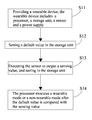
- FIG. 3 illustrates a process diagram of a detecting method of a wearable device shown in FIG. 1 .
- FIG. 4 illustrates a schematic diagram of a wearable device of a second embodiment of the present invention.
- FIG. 5 illustrates a schematic diagram of a wearable device of FIG. 4 worn on the human body.
- FIG. 6 illustrates a process diagram of a detecting method of a wearable device shown in FIG. 4 .
- FIG. 1 illustrates a schematic diagram of a wearable device of a first embodiment of the present invention.
- FIG. 2 illustrates a schematic diagram of the wearable device of FIG. 1 worn on the human body.
- the wearable device 10 of the present embodiment includes a case 11 , a processor 12 , a storage unit 13 , a sensor 14 , and a power supply 15 .
- the processor 12 , the storage unit 13 , the sensor 14 , and the power supply 15 are disposed in the case 11 .
- the storage unit 13 is electrically connected to the processor 12 , and a default value is saved in the storage unit 13 .
- the sensor 14 is electrically connected to the processor 12 , and the sensor 14 is configured to output a sensing value, and the sensing value is saved in the storage unit 13 .
- the power supply 15 is electrically connected to the processor 12 , the storage unit 13 , and the sensor 14 .
- the processor 12 executes a wearable mode or a non-wearable mode after the default value is compared with the sensing value.
- the wearable device 10 of the present embodiment is worn at the appropriate position of the human body such as wrist.
- the wearable device 10 is a smart wristband, a smart watch, a smart glass, or other wearable electronic devices.
- the sensor 14 is disposed on the surface of the case 11 faced to the human body.
- the physiological state of the human can be sensed and be outputted as the sensing value because of the sensor 14 touched or contacted with the human body.
- the sensor 14 is a temperature sensor.
- the sensing value and the default value are both temperature value.
- the range of the default value is between 35° C.-37° C. which is as same as the normal temperature of the human body.
- the sensor 14 can detect the radiation heat of the human body.
- the sensing value outputted by the sensor 14 is between 35° C.-37° C.
- the sensing value of the sensor 14 is outputted and saved in the storage unit 13 by the processor 12 , and the sensing value is compared with the default value saved in the storage unit 13 by the processor 12 . If the sensing value is equal to the default value, it means the wearable device 10 is worn and the processor 12 would execute the wearable mode. On the contrary, if the sensing value is not equal to the default value, it means the wearable device 10 is not worn and the processor 12 would execute the non-wearable mode.
- the default value can be set as reference environment temperature.
- the wearable device 10 can obtain the reference environment temperature via wireless internet or other method, and by this the processor 12 set the indoor temperature such as 25° C.-30° C. If the user stays at the outside, the processor 12 can set the outdoor temperature such as 28° C.-35° C. Then, the sensing value of the sensor 14 is outputted and saved in the storage unit 13 by the processor 12 . The sensing value would be compared with the default value saved in the storage unit 13 by the processor 12 . If the sensing value is equal to the default value, it means the wearable device 10 is worn, so the processor 12 would execute the wearable mode. On the contrary, if the sensing value is not equal to the default value, it means the wearable device 10 is not worn, so the processor 12 would execute the non-wearable mode.
- the reference environment temperature can be set as higher than the temperature of the human body such as above 38° C. If the sensing value is lower than the default value, it means the wearable device 10 is worn and the wearable mode is executed.
- the wearable mode of the present embodiment is configured to launch a first application which is configured to trigger at least a related application such as a physiological monitoring application).
- a related application such as a physiological monitoring application
- the wearable device 10 is the smart glasses
- the first application is connected to a virtual reality application, an augmented application, or other related applications.
- the non-wearable mode is configured to launch a second application.
- the second application is connected to a screen saver application, a power supply management application, or other related applications.
- the processor 12 When the default value and the sensing value are comparing, the processor 12 still consistently receives the power from the power supply 15 .
- the processor 12 executes the non-wearable mode, some unnecessary operations of the hardware would be closed by the second application, For example, the screen is closed directly, or the power management application is triggered by the second application, so as to make the power supply 15 execute the power saving process.
- the wearable device 10 of the present embodiment can avoid the wasting of the power when the wearable device 10 is not worn.
- the first application is configured to launch a certain application program
- the second application is configured to stop the same application programs or different application programs.
- the first application triggers a pedometer application program to calculate the step counts of the user.
- the second application stops the pedometer application program to calculate the step counts of the user.
- the second application can also connect to other application programs.
- the wearable device 10 When the user uses the wearable device 10 , the mistake in assessing the wearable device 10 is caused because of incorrect wearing method or position. Therefore, the related warning message is produced to remind the user of the wearable device 10 before the wearable mode or the non-wearable mode is executed, so as to make the user can timely adjust the wearing method or position. Thus, the correct detecting outcome and effective assessing operation is obtained. Beside, the user can also be reminded that the wearable mode of the wearable device 10 is executed.
- the above wearing message is such as an audio message, a light message, a text message, a vibration message, or other reminding message.
- the senor 14 is a pressure sensor, and the default value is 101325 pascals (i.e. one atmospheric pressure). Therefore, when the sensing value outputted by the sensor 14 is 101325 pascals (atmospheric pressure), the non-wearable mode is executed by the processor 12 when the sensing value is equal to the default value.
- the processor 12 determines the wearable device 10 is not worn via comparing the default value with the sensing value.
- the processor 12 determines the wearable device 10 is worn.
- the sensor 14 would sense the sum of the atmospheric pressure and the pressure pressed on the wearable device 10 by the human body.
- the sensing value sensed by the sensor 14 is larger than the atmospheric pressure (the default values), and the processor 12 determines the wearable device 10 is worn because the sensing value and the default value are not equal.
- FIG. 3 illustrates a process diagram of a detecting method of a wearable device shown in FIG. 1 .
- a detecting method of the wearable device includes the following steps. First, at the step S 11 , a wearable device is provided, the wearable device includes a processor, a storage unit, a sensor, and a power supply. Then, at the step S 12 , a default value is saved in the storage unit. Next, at the step S 13 , a sensor is executed and outputs a sensing value, and the sensing value is saved in the storage unit.
- a wearable mode or a non-wearable mode is executed after default value is compared with the sensing value by the processor.
- a wearing message is produced to remind the user before the non-wearable mode is executed.
- the mistake in the estimation of the wearable device is caused because of incorrect wearing method or position, so as to make the user can timely adjust the wearing method or position.
- the correct detecting outcome and effective estimating process of the wearable devices can be obtained
- the senor of the first embodiment is the temperature sensor.
- the temperature of case would be closed to the temperature of human body because of the radiant heat of human body.
- the wearable device 10 is worn on the human body or not is determined via the detecting method of a wearable device of the present invention. Therefore, the incorrect detecting result due to the wrong wearing can be solved. It also make user to correctly wear the wearable device 10 and achieve energy saving effect.
- FIG. 4 illustrates a schematic diagram of a wearable device of a second embodiment of the present invention.
- FIG. 5 illustrates a schematic diagram of a wearable device of FIG. 4 worn on the human body.
- a wearable device 20 includes a case 21 , a processor 22 , a storage unit 23 , a first sensor 24 A, a second sensor 24 B, and a power supply 25 .
- the processor 22 , the storage unit 23 , the first sensor 24 A, the second sensor 24 B, and the power supply 25 are disposed in the case 21 .
- the first sensor 24 A is disposed in a first surface 21 A of the case 21
- the second sensor 24 B is disposed in a second surface 21 B of the case 21 .
- the storage unit 23 is electrically connected to the processor 22 .
- the first sensor 24 A and the second sensor 24 B are electrically connected to the processor 22 .
- the first sensor 24 A is configured to output a first sensing value, and the first sensing value is saved in the storage unit 23 .
- the second sensor 24 B is configured to output a second sensing value, and the second sensing value is saved in the storage unit 23 .
- the power supply 25 is electrically connected to the processor 22 , the storage unit 23 , the first sensor 24 A, and the second sensor 24 B.
- the processor 22 executes a wearable mode or a non-wearable mode after the first sensing value is compared with the second sensing value.
- the wearable device 10 of the first embodiment is similar to the wearable device 20 of the second embodiment.
- the wearable device 20 of the second embodiment has the first sensor 24 A and the second sensor 24 B, and the first sensor 24 A and the second sensor 24 B are configured to output the first sensing value and the second sensing value.
- the first sensing value and the second sensing value are saved in the storage unit 23 .
- the first sensor 24 A is disposed in the face of case 21 faced the human body ( 21 A), so as to sense the physiological state and output a sensing value via touching human body.
- the second sensor 24 B is disposed in the face ( 21 B) of case 21 which is not touched with the human body, so as to sense the environment and output the second sensing value.
- the first sensor 24 A and the second sensor 24 B are both temperature sensors, and the first sensing value and the second sensing value are temperature value. Therefore, when the user wears the wearable device 20 , the first sensing value outputted by the first sensor 24 A is the human body temperature, the second sensing value outputted by the second sensor 24 B is the reference ambient temperature. As a result, after the processor 22 compares the first sensing value with the second sensing value, the processor 22 would determine whether the wearable device 20 is worn or not. If the first sensing value is not equal to the second sensing value, it is mean the wearable device 20 is worn. Thus, the processor 22 would execute the wearable mode and the first application.
- the processor 22 compares the first sensing value with the second sensing value. If the first sensing value is equal to the second sensing value, it means the wearable device 20 is not worn. Thus, the processor 22 would execute the non-wearable mode and the second application.
- the wearable mode of the present embodiment is configured to launch a first application, and the first application is configured to connect to trigger related application such as physiological monitoring program.
- the wearable device 20 is a smart glasses
- the first application is configured to trigger a virtual reality application and an augmented reality application, or other related applications.
- the non-wearable mode is configured to launch the second application, and the second application is configured to close some hardware operation or application such as closing the screen, or the application connected or related with the second application (e.g. screen saver application, power supply management application, or other related applications) can be triggered.
- the wearable mode is executed after the processor 22 compares the first sensing value with the second sensing value, the first application is launched.
- a second application is launched if the non-wearable mode is executed by the processor 22 .
- the wearable device 20 of the second embodiment executes the non-wearable mode, the second application would launch the power supply management application, so as to make the power supply 25 execute the process of saving.
- the wearable device 20 of the present embodiment can avoid the extra power consumption when the wearable device 20 is not worn.
- the wearing message is produced to remind the user from the wearable device 20 before the wearable mode or the non-wearable mode is executed, so as to make the user can timely adjust the wearing method or position. Therefore, the correct detecting outcome and effective assessing operation of the wearable devices are obtained, and reminding the user that the wearable device 20 is executing power-saving mode.
- the wearing message is such as an audio message, a light message, a text message, a vibration message, or other reminding message.
- the first sensor 24 A and the second sensor 24 B also can be a pressure sensor. Therefore, when the user wears the wearable device 20 of the present embodiment, the first sensing value outputted by the first sensor 24 A is a sum of the atmospheric pressure and the pressure pressed on the wearable device 20 by the human body. Therefore, the first sensing value sensed by the first sensor 24 A is larger than the second sensing value sensed by the second sensor 24 B (the atmospheric pressure value). It means according to the comparing result of the first sensing value not equaling to the second value the wearable device 20 is determined as being worn by the user.
- the first sensing value sensed by the first sensor 24 A and the second sensing value sensed by the second sensor 24 B are the atmospheric pressure value, so the first sensing value sensed by the first sensor 24 A is equal to the second sensing value sensed by the second sensor 24 B (both are the atmospheric pressure value). It means according to the comparing result of the first sensing value equaling to the second value the wearable device 20 is determined as not being worn by the user.
- FIG. 6 illustrates a process diagram of a detecting method of a wearable device shown in FIG. 4 .
- a detecting method of the wearable device is provided, and the detecting method of the wearable device includes the following steps.
- a wearable device is provided, and the wearable device includes a processor, a storage unit, a first sensor, a second sensor, and a power supply.
- the first sensor is executed to output a first sensing value, and the first sensing value is saved in the storage unit.
- the second sensor is executed to output a second sensing value, and the second sensing value is saved in the storage unit.
- the processor compares the first sensing value with the second sensing value, and executes the wearable mode or non-wearable mode.
- a warning message is produced to remind the user before the non-wearable mode is executed.
- the warning message can make the user immediately adjust the wearing method or position. Then, the correct detecting outcome and effective estimating process of the wearable devices can be obtained.
- the senor is the temperature sensor.
- the first sensing value outputted by the first sensing sensor is equal to the human body temperature
- the second sensing value outputted by the second sensing sensor is equal to the the reference environment temperature. Therefore, compared with the wearable device of the first embodiment, the wearable device of the second embodiment can more precisely determine whether the wearable device is worn or not. As a result, the present invention can solve the problem or mistake produced by the incorrect wearing method or position. It also make user to correctly wear the wearable device 10 and achieve energy saving effect.
- the sensor of the present invention can be a capacitive sensor, a humidity sensor, an ultrasonic sensor, an infrared sensor, or an illuminant sensor based on the designer's or manufacturer's choice.
- the capacitive sensor is used by sensing the capacitance value difference.
- the humidity sensor senses the humidity from the human body.
- the ultrasonic sensor senses the distance by receiving the echo from the nearest object.
- the infrared sensor is used by sensing the electromagnetic wave.
- the illuminant sensor is used by sensing the illumination.
- the sensing value outputted by one sensor is compared with the default value saved in the storage unit by the processor of the wearable device.
- the outputted sensing value of the sensor touched with human body and that of the sensor exposed to the environment would be compared so as to execute a wearable mode or a non-wearable mode. Furthermore, it can trigger the first application or second application. As a result, the extra power consumption can be avoided when the wearable device in not worn.
- the detecting method of the wearable device of the present invention is used to detect the physiological characteristics of the user, so as to help the users to understand their physiological state.
- a sleep detecting application installed in a traditional wearable device which has an accelerometer for assessing the sleeping quality of the user.
- the wearable device of the present invention can assess whether the wearable device is worn correctly.
- the warning message is produced to remind the user before the wearable mode and the non-wearable mode are executed by the wearable device, so as to make the user timely adjust the wearing method or position, and obtain the correct detecting outcome and effective assessing operation.
Landscapes
- Engineering & Computer Science (AREA)
- Computer Hardware Design (AREA)
- Theoretical Computer Science (AREA)
- Physics & Mathematics (AREA)
- General Physics & Mathematics (AREA)
- Human Computer Interaction (AREA)
- General Engineering & Computer Science (AREA)
- Computer Networks & Wireless Communication (AREA)
- Measuring And Recording Apparatus For Diagnosis (AREA)
- User Interface Of Digital Computer (AREA)
- Electric Clocks (AREA)
- Testing Or Calibration Of Command Recording Devices (AREA)
Abstract
Description
Claims (11)
Applications Claiming Priority (2)
| Application Number | Priority Date | Filing Date | Title |
|---|---|---|---|
| TW104109480A TWI615706B (en) | 2015-03-25 | 2015-03-25 | Wearable device and detection method thereof |
| TW104109480 | 2015-03-25 |
Publications (2)
| Publication Number | Publication Date |
|---|---|
| US20160284210A1 US20160284210A1 (en) | 2016-09-29 |
| US10037687B2 true US10037687B2 (en) | 2018-07-31 |
Family
ID=56974749
Family Applications (1)
| Application Number | Title | Priority Date | Filing Date |
|---|---|---|---|
| US15/080,817 Active US10037687B2 (en) | 2015-03-25 | 2016-03-25 | Wearable device and detecting method thereof |
Country Status (4)
| Country | Link |
|---|---|
| US (1) | US10037687B2 (en) |
| JP (1) | JP6355208B2 (en) |
| CN (1) | CN105996980B (en) |
| TW (1) | TWI615706B (en) |
Cited By (1)
| Publication number | Priority date | Publication date | Assignee | Title |
|---|---|---|---|---|
| US20240065631A1 (en) * | 2022-08-25 | 2024-02-29 | Qualcomm Incorporated | Pressure adjustment for biometric measurement |
Families Citing this family (10)
| Publication number | Priority date | Publication date | Assignee | Title |
|---|---|---|---|---|
| JP6458296B2 (en) * | 2014-02-24 | 2019-01-30 | ソニー株式会社 | Smart wearable device and method for acquiring sensor information from a wearable device and operating functions of other devices |
| WO2017219257A1 (en) * | 2016-06-21 | 2017-12-28 | 华为技术有限公司 | Electronic apparatus having flexible display, and processing method thereof |
| CN106524408B (en) * | 2016-10-28 | 2019-07-19 | 美的集团武汉制冷设备有限公司 | The wearing state detection method and detection device of intelligent wearable device, air conditioner |
| TWI725097B (en) | 2016-12-27 | 2021-04-21 | 原相科技股份有限公司 | Wearable device for detecting bio-signal |
| CN108742578A (en) * | 2018-03-30 | 2018-11-06 | 常州信息职业技术学院 | A kind of method of emergency relief |
| CH714934A2 (en) * | 2018-04-26 | 2019-10-31 | Service A La Personne Tech Active Sarl | Safety device with airbag triggering in the event of a fall of a carrier. |
| CN109101098A (en) * | 2018-07-06 | 2018-12-28 | 北京奇宝科技有限公司 | A kind of method and apparatus for the wearing state detecting wearable device |
| JP7729623B2 (en) * | 2020-03-31 | 2025-08-26 | トリニティ株式会社 | Wearable device wearing determination method and wearable device |
| CN113892920B (en) * | 2020-07-06 | 2023-06-27 | 华为技术有限公司 | Wearing detection method and device of wearable equipment and electronic equipment |
| CN112462593B (en) * | 2020-11-27 | 2022-02-08 | 维沃移动通信有限公司 | Intelligent watch |
Citations (16)
| Publication number | Priority date | Publication date | Assignee | Title |
|---|---|---|---|---|
| TW200517935A (en) | 2003-08-27 | 2005-06-01 | Sony Corp | Electronic equipment and authentication |
| US20060011729A1 (en) | 2004-07-06 | 2006-01-19 | Antti Sarela | Safety device system |
| US20080216171A1 (en) * | 2007-02-14 | 2008-09-04 | Sony Corporation | Wearable device, authentication method, and recording medium |
| TW200847069A (en) | 2007-05-16 | 2008-12-01 | Chang-Ming Yang | Personal security system |
| US20130072765A1 (en) * | 2011-09-19 | 2013-03-21 | Philippe Kahn | Body-Worn Monitor |
| US20140225730A1 (en) * | 2013-09-11 | 2014-08-14 | Christopher DePascale | Wearable Personal Locator Device with Removal Indicator |
| US20140278229A1 (en) * | 2012-06-22 | 2014-09-18 | Fitbit, Inc. | Use of gyroscopes in personal fitness tracking devices |
| US8854925B1 (en) * | 2013-04-22 | 2014-10-07 | Lg Electronics Inc. | Smart watch and control method for the same |
| CN104146690A (en) | 2014-08-22 | 2014-11-19 | 广东宝莱特医用科技股份有限公司 | Method, device and system for detecting contact between temperature probes and life body |
| US20140378113A1 (en) * | 2013-06-24 | 2014-12-25 | Lg Electronics Inc. | Electronic device and method of controlling the same |
| TW201508550A (en) | 2013-08-30 | 2015-03-01 | Hung-Yao Yeh | Wearable ring shaped electronic device and the controlling method thereof |
| US20150142141A1 (en) * | 2013-03-25 | 2015-05-21 | Kabushiki Kaisha Toshiba | Electronic device and remote control method |
| US20150342527A1 (en) * | 2014-05-30 | 2015-12-03 | Microsoft Corporation | Optical pressure sensor |
| US20160026212A1 (en) * | 2014-07-25 | 2016-01-28 | Salutron, Inc. | User-wearable devices with power conserving features |
| US20160051191A1 (en) * | 2014-08-24 | 2016-02-25 | Halo Wearables, Llc | Swappable wearable device |
| US20160249174A1 (en) * | 2015-02-20 | 2016-08-25 | Mc10, Inc. | Automated detection and configuration of wearable devices based on on-body status, location, and/or orientation |
Family Cites Families (10)
| Publication number | Priority date | Publication date | Assignee | Title |
|---|---|---|---|---|
| JPS5187076A (en) * | 1975-01-27 | 1976-07-30 | Suwa Seikosha Kk | |
| JP3125077B2 (en) * | 1993-03-17 | 2001-01-15 | 日本光電工業株式会社 | Telemeter device for biological signals |
| JP3033725B2 (en) * | 1997-10-29 | 2000-04-17 | 埼玉日本電気株式会社 | Mobile phone with vibrator |
| JP2000162349A (en) * | 1998-11-30 | 2000-06-16 | Casio Comput Co Ltd | Image display control device and image display control method |
| JP2000182310A (en) * | 1998-12-14 | 2000-06-30 | Kobe Steel Ltd | Body-worn output device and information reproducer |
| JP2008011865A (en) * | 2004-10-27 | 2008-01-24 | Sharp Corp | Health management device and program for functioning the same |
| JP2006194697A (en) * | 2005-01-12 | 2006-07-27 | Seiko Epson Corp | Portable electronic device having position information signal receiving means |
| JP2007279020A (en) * | 2006-03-13 | 2007-10-25 | Citizen Holdings Co Ltd | Wearable electronic device and biometric apparatus using wearable electronic device |
| JP6004152B2 (en) * | 2011-07-28 | 2016-10-05 | セイコーエプソン株式会社 | Vital sign measurement device, vital sign measurement program, and recording medium |
| CN104006495B (en) * | 2014-05-22 | 2017-06-27 | 美的集团股份有限公司 | Air-conditioner and air-conditioner control method |
-
2015
- 2015-03-25 TW TW104109480A patent/TWI615706B/en not_active IP Right Cessation
- 2015-08-19 CN CN201510509310.0A patent/CN105996980B/en active Active
- 2015-11-06 JP JP2015218577A patent/JP6355208B2/en active Active
-
2016
- 2016-03-25 US US15/080,817 patent/US10037687B2/en active Active
Patent Citations (16)
| Publication number | Priority date | Publication date | Assignee | Title |
|---|---|---|---|---|
| TW200517935A (en) | 2003-08-27 | 2005-06-01 | Sony Corp | Electronic equipment and authentication |
| US20060011729A1 (en) | 2004-07-06 | 2006-01-19 | Antti Sarela | Safety device system |
| US20080216171A1 (en) * | 2007-02-14 | 2008-09-04 | Sony Corporation | Wearable device, authentication method, and recording medium |
| TW200847069A (en) | 2007-05-16 | 2008-12-01 | Chang-Ming Yang | Personal security system |
| US20130072765A1 (en) * | 2011-09-19 | 2013-03-21 | Philippe Kahn | Body-Worn Monitor |
| US20140278229A1 (en) * | 2012-06-22 | 2014-09-18 | Fitbit, Inc. | Use of gyroscopes in personal fitness tracking devices |
| US20150142141A1 (en) * | 2013-03-25 | 2015-05-21 | Kabushiki Kaisha Toshiba | Electronic device and remote control method |
| US8854925B1 (en) * | 2013-04-22 | 2014-10-07 | Lg Electronics Inc. | Smart watch and control method for the same |
| US20140378113A1 (en) * | 2013-06-24 | 2014-12-25 | Lg Electronics Inc. | Electronic device and method of controlling the same |
| TW201508550A (en) | 2013-08-30 | 2015-03-01 | Hung-Yao Yeh | Wearable ring shaped electronic device and the controlling method thereof |
| US20140225730A1 (en) * | 2013-09-11 | 2014-08-14 | Christopher DePascale | Wearable Personal Locator Device with Removal Indicator |
| US20150342527A1 (en) * | 2014-05-30 | 2015-12-03 | Microsoft Corporation | Optical pressure sensor |
| US20160026212A1 (en) * | 2014-07-25 | 2016-01-28 | Salutron, Inc. | User-wearable devices with power conserving features |
| CN104146690A (en) | 2014-08-22 | 2014-11-19 | 广东宝莱特医用科技股份有限公司 | Method, device and system for detecting contact between temperature probes and life body |
| US20160051191A1 (en) * | 2014-08-24 | 2016-02-25 | Halo Wearables, Llc | Swappable wearable device |
| US20160249174A1 (en) * | 2015-02-20 | 2016-08-25 | Mc10, Inc. | Automated detection and configuration of wearable devices based on on-body status, location, and/or orientation |
Cited By (1)
| Publication number | Priority date | Publication date | Assignee | Title |
|---|---|---|---|---|
| US20240065631A1 (en) * | 2022-08-25 | 2024-02-29 | Qualcomm Incorporated | Pressure adjustment for biometric measurement |
Also Published As
| Publication number | Publication date |
|---|---|
| JP6355208B2 (en) | 2018-07-11 |
| CN105996980A (en) | 2016-10-12 |
| TWI615706B (en) | 2018-02-21 |
| JP2016183955A (en) | 2016-10-20 |
| CN105996980B (en) | 2019-05-24 |
| TW201635087A (en) | 2016-10-01 |
| US20160284210A1 (en) | 2016-09-29 |
Similar Documents
| Publication | Publication Date | Title |
|---|---|---|
| US10037687B2 (en) | Wearable device and detecting method thereof | |
| EP3270297B1 (en) | Electronic device supporting usb interface and control method for usb interface | |
| EP3168721B1 (en) | Electronic device and method of determining touch in electronic device | |
| KR102413108B1 (en) | Method and electronic device for recognizing touch | |
| CN106445065B (en) | Method and electronic device for state-dependent control | |
| EP3506052A1 (en) | Method of detecting whether smart device is being worn, and smart device | |
| KR102325327B1 (en) | Electronic device including input apparatus | |
| US20160253041A1 (en) | Touch module, electronic device including the same, and operation method thereof | |
| US10664088B2 (en) | Method for controlling touch screen and electronic device supporting thereof | |
| EP3213170B1 (en) | Method for controlling operation of electronic device and electronic device using the same | |
| CN108696608A (en) | Support construction including conductive path and the electronic equipment with the support construction | |
| CN105380596A (en) | electronic device and sleep monitoring method in electronic device | |
| US10809135B2 (en) | Device for detecting temperature and electronic device having the same | |
| EP3079046B1 (en) | Method and apparatus for operating sensor of electronic device | |
| CN104317394B (en) | Control method, device and the wrist belt-type wearable device of wrist belt-type wearable device | |
| KR20170022192A (en) | Electronic device having the touch sensor | |
| CN114878027A (en) | Method, device and equipment for obtaining environmental temperature and storage medium | |
| CN110050279A (en) | Electronic device and method for sensing fingerprints | |
| JP2017518597A (en) | Control method, apparatus, electronic device, and computer recording medium | |
| JP2017517084A (en) | Wearable touch device and wearable touch method | |
| US20170339231A1 (en) | Digital device and method for controlling same | |
| KR20180014575A (en) | Electronic apparatus and method for controlling of the electronic apparatus | |
| KR20180109330A (en) | Electronic device and method for acquiring output value of pressure sensor corrected based on state of electronic device | |
| JPWO2012014593A1 (en) | Existence determination device, presence determination method, and program | |
| WO2017079981A1 (en) | Wearable device band |
Legal Events
| Date | Code | Title | Description |
|---|---|---|---|
| AS | Assignment |
Owner name: CYWEE MOTION INC., TAIWAN Free format text: ASSIGNMENT OF ASSIGNORS INTEREST;ASSIGNOR:WANG, WEICHIEN;REEL/FRAME:038300/0014 Effective date: 20160315 |
|
| AS | Assignment |
Owner name: CM HK LIMITED, HONG KONG Free format text: ASSIGNMENT OF ASSIGNORS INTEREST;ASSIGNOR:CYWEE MOTION INC.;REEL/FRAME:042035/0272 Effective date: 20170417 |
|
| STCF | Information on status: patent grant |
Free format text: PATENTED CASE |
|
| MAFP | Maintenance fee payment |
Free format text: PAYMENT OF MAINTENANCE FEE, 4TH YR, SMALL ENTITY (ORIGINAL EVENT CODE: M2551); ENTITY STATUS OF PATENT OWNER: SMALL ENTITY Year of fee payment: 4 |
|
| AS | Assignment |
Owner name: CM HK LIMITED, HONG KONG Free format text: ASSIGNMENT OF ASSIGNORS INTEREST;ASSIGNOR:CYWEEMOTION HK LIMITED;REEL/FRAME:068696/0689 Effective date: 20240925 Owner name: CM HK LIMITED, HONG KONG Free format text: ASSIGNMENT OF ASSIGNOR'S INTEREST;ASSIGNOR:CYWEEMOTION HK LIMITED;REEL/FRAME:068696/0689 Effective date: 20240925 |
|
| AS | Assignment |
Owner name: CM HK LIMITED, HONG KONG Free format text: ASSIGNMENT OF ASSIGNORS INTEREST;ASSIGNOR:CYWEE GROUP LTD.;REEL/FRAME:068704/0272 Effective date: 20240925 Owner name: CM HK LIMITED, HONG KONG Free format text: ASSIGNMENT OF ASSIGNOR'S INTEREST;ASSIGNOR:CYWEE GROUP LTD.;REEL/FRAME:068704/0272 Effective date: 20240925 |