US10036671B2 - Method of predicting an ambient temperature around a mobile device, computer program product and mobile device - Google Patents
Method of predicting an ambient temperature around a mobile device, computer program product and mobile device Download PDFInfo
- Publication number
- US10036671B2 US10036671B2 US14/824,757 US201514824757A US10036671B2 US 10036671 B2 US10036671 B2 US 10036671B2 US 201514824757 A US201514824757 A US 201514824757A US 10036671 B2 US10036671 B2 US 10036671B2
- Authority
- US
- United States
- Prior art keywords
- prediction
- mobile device
- temperature
- temperature sensor
- processing unit
- Prior art date
- Legal status (The legal status is an assumption and is not a legal conclusion. Google has not performed a legal analysis and makes no representation as to the accuracy of the status listed.)
- Expired - Fee Related, expires
Links
Images




Classifications
-
- G—PHYSICS
- G01—MEASURING; TESTING
- G01K—MEASURING TEMPERATURE; MEASURING QUANTITY OF HEAT; THERMALLY-SENSITIVE ELEMENTS NOT OTHERWISE PROVIDED FOR
- G01K7/00—Measuring temperature based on the use of electric or magnetic elements directly sensitive to heat ; Power supply therefor, e.g. using thermoelectric elements
- G01K7/42—Circuits effecting compensation of thermal inertia; Circuits for predicting the stationary value of a temperature
-
- H—ELECTRICITY
- H04—ELECTRIC COMMUNICATION TECHNIQUE
- H04M—TELEPHONIC COMMUNICATION
- H04M1/00—Substation equipment, e.g. for use by subscribers
- H04M1/02—Constructional features of telephone sets
- H04M1/0202—Portable telephone sets, e.g. cordless phones, mobile phones or bar type handsets
-
- H—ELECTRICITY
- H04—ELECTRIC COMMUNICATION TECHNIQUE
- H04M—TELEPHONIC COMMUNICATION
- H04M2250/00—Details of telephonic subscriber devices
- H04M2250/12—Details of telephonic subscriber devices including a sensor for measuring a physical value, e.g. temperature or motion
Definitions
- the present disclosure relates to a method of predicting an ambient temperature around a mobile device. Furthermore, the present disclosure relates to a corresponding computer program product and to a corresponding mobile device.
- Modern mobile devices such as smart phones and tablets, often contain temperature sensors which are used to measure the ambient temperature around said devices.
- the temperature sensors within such mobile devices should ideally be placed as close as possible to the medium whose temperature should be measured, i.e. the ambient air, in order to yield reliable measurement results.
- temperature sensors can only be housed within the body of a mobile phone, for cosmetic and functional reasons.
- temperature sensors placed within a casing or enclosure exhibit a relatively large response time. That is to say, it takes a relatively large amount of time, for example 15 to 40 minutes, before an embedded temperature sensor accurately measures the ambient air temperature. It may be desirable to reduce this response time. Therefore, attempts have been made to predict the ambient temperature around mobile devices. However, there may still be a need to increase the accuracy of such ambient temperature predictions.
- a method of predicting an ambient temperature around a mobile device wherein: a primary temperature sensor comprised in said mobile device measures a first temperature value; at least one secondary temperature sensor comprised in said mobile device measures a second temperature value; a processing unit comprised in said mobile device calculates a first prediction of an ambient temperature around the mobile device in dependence on the first temperature value and at least one parameter which is indicative of a thermal influence of one or more mobile device components on the measurements; the processing unit calculates a second prediction of said ambient temperature in dependence on the second temperature value and said parameter; the processing unit compares the first prediction with the second prediction and adjusts said parameter if the difference between the first prediction and the second prediction exceeds a predefined maximum.
- the processing unit repeatedly recalculates the first prediction and the second prediction, compares the first prediction with the second prediction and adjusts said parameter until the difference between the first prediction and the second prediction is equal to or lower than the predefined maximum.
- the processing unit concludes that the ambient temperature is equal to the first prediction, to the second prediction or to a value between the first prediction and the second prediction.
- said parameter is at least indicative of a thermal resistance of a casing of the mobile device.
- the primary temperature sensor and the secondary temperature sensor are located at different positions in the mobile device, such that the thermal resistance between the primary temperature sensor and the ambient air is different from the thermal resistance between the secondary temperature sensor and the ambient air.
- the primary temperature sensor is located closer to the edge of the mobile device than the secondary temperature sensor.
- a computer program product comprising executable instructions which, when being executed by a processing unit, cause said processing unit to carry out or control steps of a method of the kind set forth.
- a mobile device comprising: a primary temperature sensor being arranged to measure a first temperature value; at least one secondary temperature sensor being arranged to measure a second temperature value; a processing unit being arranged to calculate a first prediction of an ambient temperature around the mobile device in dependence on the first temperature value and at least one parameter which is indicative of a thermal influence of one or more mobile device components on the measurements; the processing unit further being arranged to calculate a second prediction of said ambient temperature in dependence on the second temperature value and said parameter; the processing unit further being arranged to compare the first prediction with the second prediction and to adjust said parameter if the difference between the first prediction and the second prediction exceeds a predefined maximum.
- the processing unit is further arranged to repeatedly recalculate the first prediction and the second prediction, compare the first prediction with the second prediction and adjust said parameter until the difference between the first prediction and the second prediction is equal to or lower than the predefined maximum.
- the processing unit is further arranged to conclude, if the difference between the first prediction and the second prediction is equal to or lower than the predefined maximum, that the ambient temperature is equal to the first prediction, to the second prediction or to a value between the first prediction and the second prediction.
- said parameter is at least indicative of a thermal resistance of a casing of the mobile device.
- the primary temperature sensor and the secondary temperature sensor are located at different positions in the mobile device, such that the thermal resistance between the primary temperature sensor and the ambient air is different from the thermal resistance between the secondary temperature sensor and the ambient air.
- the primary temperature sensor is located closer to the edge of the mobile device than the secondary temperature sensor.
- the processing unit is integrated with the primary temperature sensor in a single chip.
- the mobile device comprises a plurality of secondary temperature sensors
- the processing unit is further arranged to calculate a plurality of second predictions based on second temperature values measured by said secondary temperature sensors and on said parameter, to compare each second prediction with the first prediction, and to adjust the parameter until the difference between each second prediction and the first prediction is equal to or smaller than the predefined maximum.
- FIG. 1A shows an illustrative embodiment of a method of operating a mobile device
- FIG. 1B shows an illustrative embodiment of a mobile device
- FIG. 1C shows a further illustrative embodiment of a mobile device
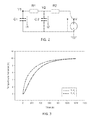
- FIG. 2 shows an electrical model which may represent the thermal properties of a mobile device
- FIG. 3 shows an example of a response to a temperature increase
- FIG. 4 shows a typical result of an ambient temperature prediction
- FIG. 5 shows an example of an ambient temperature prediction.
- the prediction works well when the environmental conditions under which the measurements are performed are substantially the same as the conditions under which the parameters have been calibrated.
- the parameters of a thermal model are predetermined, i.e. their value is determined by experiment or calibration, for example in a laboratory.
- the parameters may need to be changed significantly depending on how the user handles the mobile device while the measurements are being performed. For instance, during the temperature reading, there may be changing wind, or the user may hold the device in his hand instead of putting it on a table, or the user may put the device on a different surface (for example a wooden surface instead of a metal surface).
- the user may decide to put a cover on the phone.
- the thermal resistance between the mobile device and the ambient air will change in unexpected ways, which may make the predefined thermal model invalid and which may lead to a less accurate prediction.
- the parameters may need to be adjusted or readjusted. Therefore, in accordance with the present disclosure, it is proposed to use a plurality of temperature sensors at different locations in a mobile device, in order to provide additional information for determining the correct parameter values during ambient temperature prediction. More specifically, in accordance with the present disclosure, a method of operating a mobile device is conceived as described below.
- FIG. 1A shows an illustrative embodiment of a method 100 of predicting an ambient temperature around a mobile device.
- a primary temperature sensor comprised in said mobile device measures at 102 a first temperature value
- at least one secondary temperature sensor comprised in said mobile device measures, at 104 , a second temperature value.
- a processing unit comprised in said mobile device calculates, at 106 , a first prediction of an ambient temperature around the mobile device in dependence on the first temperature value and at least one parameter which is indicative of a thermal influence of one or more mobile device components on the measurements.
- the processing unit calculates, at 108 , a second prediction of said ambient temperature in dependence on the second temperature value and said parameter.
- the processing unit compares, at 110 , the first prediction with the second prediction and adjusts, at 112 , said parameter if the difference between the first prediction and the second prediction exceeds a predefined maximum.
- the steps of calculating the first prediction and the second prediction, comparing them and adjusting the parameter may be repeated until the difference between the first prediction and the second prediction are equal to or lower than the predefined maximum. In this way, mistuned parameters may be corrected in a step-wise fashion. Furthermore, if the difference between the first prediction and the second prediction is equal to or lower than the predefined maximum, the processing unit may conclude, at 114 , that the ambient temperature is equal to the first prediction, the second prediction or a value between the first prediction and the second prediction.
- FIG. 1B shows an illustrative embodiment of a mobile device 116 .
- the mobile device 116 comprises a plurality of temperature sensors 118 , 120 , 122 , 124 , 126 .
- One temperature sensor 118 may be referred to as a primary sensor.
- the primary sensor 118 is integrated with a processing unit in a single chip.
- the other sensors 120 , 122 , 124 , 126 may be referred to as secondary sensors.
- the sensors 118 , 120 , 122 , 124 , 126 may be connected to each other by means of a data bus 128 , through which data may be transmitted.
- the primary sensor 118 may be mounted as close as possible to the environment surrounding the mobile device, for example near the edge of the mobile device, and preferably at a relatively cool place, i.e. remote from any heat source such as a central processing unit (not shown).
- the secondary sensors 120 , 122 , 124 , 126 may be located deeper inside the body of the mobile device, for example near heat-producing components. Thereby, the sensors are strategically positioned in the mobile device, such that they have a different thermal resistance to the ambient air due to the differences in their exposure to surrounding components.
- the thermal influence of mobile device components on the measurements performed by the different sensors will consequently have a certain degree of variation.
- the variation in the thermal influence of said components may be taken into account, and the parameter indicative of said influence may be better and more reliably adjusted.
- the sensors 118 , 120 , 122 , 124 , 126 may exchange data via any kind of data bus 128 , such as I 2 C, SPI, SLIMBus, and Sensor Hub.
- the secondary sensors 120 , 122 , 124 , 126 may either be separate temperature sensor chips or components that contain several sensors for different modalities.
- the secondary sensors 120 , 122 , 124 , 126 may also be existing temperature sensors in other components such as in a battery or a microprocessor of the mobile device. In this case, data exchange may be done via the operating system of the mobile device.
- the primary sensor chip may include a microprocessor or microcontroller for executing the prediction algorithm.
- the prediction algorithm may be implemented as a computer program stored in the microcontroller's memory, for example.
- the primary sensor 118 may behave as a master while the secondary sensors 120 , 122 , 124 , 126 may behave as slaves in the network. In this way, all measurement data collected by the secondary sensors 120 , 122 , 124 , 126 may easily be copied to the primary sensor 118 for processing and prediction. Furthermore, at least a part of the processing and the prediction algorithm may be executed by the operating system of the mobile device.
- the locations of the primary sensor 118 and the secondary sensors 120 , 122 , 124 , 126 may be reversed. That is to say, one of the secondary sensors 120 , 122 , 124 , 126 may, for example, be located close to the edge of the mobile device, while the primary sensor and other secondary sensors may be located deeper inside the body of the mobile device. It is noted that, although a plurality of sensors has been shown in this embodiment, the mobile device may comprise only a single secondary sensor.
- FIG. 1C shows a further illustrative embodiment of a mobile device 130 .
- the mobile device 130 comprises a separate processing unit 134 for processing the inputs of both the primary sensor 132 and the secondary sensors 120 , 122 , 124 , 126 , and for executing the prediction algorithm.
- the primary sensor 132 may be placed closer to the ambient air and consequently less self-heating corrections may be required.
- a plurality of secondary temperature sensors may be used, which may be positioned strategically in the mobile device as shown in FIGS. 1B and 1C .
- the processing unit may calculate predictions of the ambient temperature in dependence of the temperature values measured by all secondary temperature sensors and the parameter in question—i.e. it may calculate a plurality of second predictions—, compare each second prediction with the first prediction, and adjust the parameter until the difference between each second prediction and the first prediction is equal to or smaller than the predefined maximum, for example. In this way, errors in the predictions may to a certain extent be averaged out, and more accurate results may be generated.
- FIG. 2 shows an electrical model which may represent the thermal properties of a mobile device.
- the presently disclosed method will now be illustrated with reference to an example based on this electrical model.
- the components of the electrical model shown in FIG. 2 may represent parameters which are indicative of thermal influences of mobile device components on temperature sensors within a mobile device.
- the thermal problem of a mobile device may be represented as an RC ladder network having 2 rungs for the sake of simplicity. It is noted that more rungs in the circuit may increase the model's accuracy.
- Capacitor C 1 and resistor R 1 may represent the thermal capacitance and the thermal resistance, respectively, of the inner part of the mobile device.
- Capacitor C 2 and resistor R 2 may represent the thermal capacitance and the thermal resistance, respectively, of the outer part or periphery of the mobile device.
- resistor R 2 may for example represent all thermal resistances from the casing of the mobile device to the infinite ambient air, which acts as a heat sink. Since the casing is not a single point, in principle thermal flux from the interior of the mobile device can find many ways on the entire surface of the casing to escape to the ambient air. In order to represent these escape routes, one could in theory model them as a plurality of thermal resistors. However, in the simplified model described herein all these resistors are lumped together into a single resistor R 2 which represents the escape routes of thermal flux from the mobile device to the ambient air, i.e. it represents all thermal resistances from the casing to the ambient air.
- the voltage at node V 2 may represent the temperature at a certain position close to the ambient air, while the voltage at node V 1 may represent the temperature at a position deeper inside the mobile device.
- subjecting the mobile device to ambient air may be regarded as equivalent to connecting the free end of resistor R 2 to a voltage source V.
- a voltage source V For instance, it may be assumed that, in an initial state, the mobile device is in equilibrium with a cool room environment. In the circuit of FIG. 2 , this state is represented by the free end of resistor R 2 being connected to ground and all capacitors C 1 , C 2 being fully discharged. The ground potential is equivalent to room temperature. If the mobile device is quickly moved to an environment with a significantly higher temperature, then this will be equivalent to the free end of resistor R 2 being switched to the voltage source V. The voltage of the source V will then be equivalent to the temperature difference between the room and the new environment.
- V 1 V (1 ⁇ 11 e ⁇ k 1 t ⁇ 12 e ⁇ k 2 t ) (Equation 1)
- V 2 V (1 ⁇ 21 e ⁇ k 1 t ⁇ 22 e ⁇ k 2 t ) (Equation 2) in which:
- ⁇ 11 1 2 ⁇ ( 1 - C 1 ⁇ R 1 + C 1 ⁇ R 2 + C 2 ⁇ R 2 ⁇ ) ( Equation ⁇ ⁇ 3 )
- ⁇ 12 1 2 ⁇ ( 1 + C 1 ⁇ R 1 + C 1 ⁇ R 2 + C 2 ⁇ R 2 ⁇ ) ( Equation ⁇ ⁇ 4 )
- ⁇ 21 1 2 ⁇ ( 1 - - C 1 ⁇ R 1 + C 1 ⁇ R 2 + C 2 ⁇ R 2 ⁇ ) ( Equation ⁇ ⁇ 5 )
- ⁇ 22 1 2 ⁇ ( 1 + - C 1 ⁇ R 1 + C 1 ⁇ R 2 + C 2 ⁇ R 2 ⁇ ) ( Equation ⁇ ⁇ 6 )
- k 1 1 2 ⁇ ⁇ C 1 ⁇ R 1 + 1 2 ⁇ C 2 ⁇ R 1 + 1 2 ⁇ C 2 ⁇ R 2 + ⁇ 2 ⁇ C 1 ⁇ R 1 ( Equation ⁇ ⁇ 7 )
- V 2 and V 1 may actually represent temperatures T 2 and T 1 at a position close to the outer part of the mobile device and a position deeper inside the body of the mobile device, respectively.
- T 1( t ) T A ⁇ ( T A ⁇ T 0 )( ⁇ 11 e ⁇ k 1 t ⁇ 12 e ⁇ k 2 t ) (Equation 10)
- T 2( t ) T A ⁇ ( T A ⁇ T 0 )( ⁇ 21 e ⁇ k 1 t ⁇ 22 e ⁇ k 2 t ) (Equation 11) in which T A ⁇ T 0 ⁇ V.
- Equations (10) and (11) give the time response of temperatures T 1 and T 2 when the system is subjected to a step function in ambient temperature.
- FIG. 3 shows an example of a response to a temperature increase. It can be seen that the temperature T 1 , i.e. at a position deeper inside the body of the mobile device, responds relatively slowly to a change in ambient temperature, while the temperature T 2 , i.e. at a position close to the outer part of the mobile device, responds faster to the ambient temperature change.
- T A T - T 0 ⁇ [ ⁇ 1 ⁇ e - k 1 ⁇ t + ⁇ 2 ⁇ e - k 2 ⁇ t ] 1 - ⁇ ⁇ 1 ⁇ e - k 1 ⁇ t + ⁇ 2 ⁇ e - k 2 ⁇ t ] ( Equation ⁇ ⁇ 12 )
- the parameters ⁇ 1 , ⁇ 2 , k 1 , k 2 are typically predetermined by experiment or calibration.
- FIG. 4 shows a typical result of an ambient temperature prediction which is based on this formula. While the measured raw temperature shows a slow exponential decay after the system is exposed to a new temperature (at time t 0 ), which may last for nearly an hour, the predicted temperature is relatively close to the actual ambient temperature within 1.5 to 2 minutes.
- the prediction of the ambient temperature is accurate as long as the environmental conditions under which the temperature measurement takes place are substantially the same as the standard conditions, i.e. the conditions under which the parameters have been predetermined by experiment or calibration. However, in reality, the environmental conditions may change from time to time. For instance, when there is wind (possibly with different velocity at different time instants), or when the device is put on different table surfaces or in an extra cover, the parameters may have to be changed in order to provide an accurate prediction.
- a primary sensor may measure temperature T 2 at node V 2
- a secondary sensor may measure temperature T 1 at node V 1 . If the conditions under which, in operation, the measurements are performed are substantially the same as the standard conditions, then the predicted T A values derived—by means of Equation 12—from either T 1 or T 2 are typically also substantially the same. However, if the measurement conditions have changed, then the predictions of T A derived from T 1 and T 2 may deviate from each other. Furthermore, the predictions of T A derived from T 1 and T 2 may both deviate from the optimal prediction of T A . Therefore, the predictions of T A derived from T 1 and T 2 are compared with each other in order to evaluate if the parameter values are still correct. Thus, the following calculations are made:
- T A ⁇ 1 T ⁇ ⁇ 1 - T 0 ⁇ [ ⁇ 11 ⁇ e - k 1 ⁇ t + ⁇ 12 ⁇ e - k 2 ⁇ t ] 1 - [ ⁇ 11 ⁇ e - k 1 ⁇ t + ⁇ 12 ⁇ e - k 2 ⁇ t ] ( Equation ⁇ ⁇ 13 )
- T A ⁇ 2 T ⁇ ⁇ 2 - T 0 ⁇ [ ⁇ 21 ⁇ e - k 1 ⁇ t + ⁇ 22 ⁇ e - k 2 ⁇ t ] 1 - [ ⁇ 21 ⁇ e - k 1 ⁇ t + ⁇ 22 ⁇ e - k 2 ⁇ t ] ( Equation ⁇ ⁇ 14 )
- a mismatch in the T A predictions may indicate that the environmental conditions have changed and that one or more parameters may have to be changed. Therefore, if the difference between T A 1 and T A 2 exceeds a predefined maximum, then the presently disclosed method will adjust at least one parameter in order to decrease said mismatch. Thereby, the predictions of T A may be brought closer to the optimal prediction of T A . If the difference between T A 1 and T A 2 is equal to or lower than the predefined maximum, then either T A 1 or T A 2 may be selected as a correct prediction of T A , because the difference between T A 1 and T A 2 may be regarded as negligible. Also, any value between T A 1 or T A 2 may be selected as a correct prediction of T A .
- the number of parameters which is adjusted may be limited. Preferably, only one parameter is adjusted in order to reduce the computation time and power consumption of the processing unit.
- a suitable parameter to be adjusted is the thermal resistance R 2 from the outer part of the mobile device to the ambient air. If the mobile device is exposed to wind, or when the mobile device is held in a user's hand or inserted into a cover or a sleeve, then this thermal resistance R 2 may change.
- Other adjustable parameters are, for example, the thermal capacitance of said outer part and its thermal time constant, which may be defined as the product of its thermal capacitance and its thermal resistance. Other combinations of the thermal resistance and the thermal capacitance may also form suitable parameters.
- other parameters that may be adjusted are parameters which are not directly related to the physical model, such as the coefficients ⁇ 11 , . . . , ⁇ 22 in the above-given equations.
- FIG. 5 shows an example of an ambient temperature prediction.
- the thermal resistance R 2 is intentionally reduced by half and the ambient temperature.
- T A is calculated using measurement data from the first sensor (T 1 ) and the second sensor (T 2 ), the adjusted thermal resistance R 2 and the other parameters (C 1 , C 2 , R 1 ) which have not been adjusted. It can be seen that the first prediction T A 1 , i.e. the prediction of T A in dependence on T 1 , starts to deviate from the second prediction T A 2 , i.e. the prediction of T A in dependence on T 2 .
- parameter R 2 is tuned by step-wise recalculating T A 1 and T A 2 for different values of R 2 until a close match between T A 1 and T A 2 is found. As a result of this tuning, the difference between the first prediction T A 1 and the second prediction T A 2 becomes smaller.
- the tuning of the parameter may be initiated a few seconds up to a few minutes after a significant change in the ambient temperature, at which the deviation of the predicted T A values may be relatively large.
- Any known method for detecting such a significant change may be used in combination with the presently disclosed method. Such methods include, without limitation, regular sampling of temperature changes, temperature trending detection techniques and edge detection techniques.
- one or more self-heating corrections methods may be used to correct for self-heating effects in the mobile device, in addition to and in combination with the presently disclosed method.
- Such a self-heating correction method may use the same temperature sensors as the presently disclosed method.
- it may be determined if a change in temperature (of T 1 or T 2 ) is caused by internal self-heating or by a change in ambient temperature, which is helpful for the prediction, e.g. to determine whether or not a self-heating correction method is to be deployed.
- the temperature of a sensor closer to environment should change faster than the temperature of a sensor deeper inside the mobile device (T 1 in FIG. 2 ).
- the temperature of the sensor deeper inside the mobile device (thus closer to the heat sources) will change faster than the temperature of the sensor closer to the ambient air.
- any reference sign placed between parentheses shall not be construed as limiting the claim.
- the word “comprise(s)” or “comprising” does not exclude the presence of elements or steps other than those listed in a claim.
- the word “a” or “an” preceding an element does not exclude the presence of a plurality of such elements.
- Measures recited in the claims may be implemented by means of hardware comprising several distinct elements and/or by means of a suitably programmed processor. In a device claim enumerating several means, several of these means may be embodied by one and the same item of hardware. The mere fact that certain measures are recited in mutually different dependent claims does not indicate that a combination of these measures cannot be used to advantage.
Landscapes
- Physics & Mathematics (AREA)
- General Physics & Mathematics (AREA)
- Engineering & Computer Science (AREA)
- Signal Processing (AREA)
- Telephone Function (AREA)
- Control Of Temperature (AREA)
Abstract
Description
V 1 =V(1−α11 e −k
V 2 =V(1−α21 e −k
in which:
T1(t)=T A−(T A −T 0)(α11 e −k
T2(t)=T A−(T A −T 0)(α21 e −k
in which TA−T0≡V.
-
- 100 method of predicting an ambient temperature
- 102 first temperature measurement
- 104 second temperature measurement
- 106 first prediction of ambient temperature
- 108 second prediction of ambient temperature
- 110 compare first prediction with second prediction
- 112 adjust parameter
- 114 conclude ambient temperature
- 116 mobile device
- 118 sensor and processing unit
- 120 sensor
- 122 sensor
- 124 sensor
- 126 sensor
- 128 data bus
- 130 mobile device
- 132 sensor
- 134 processing unit
Claims (13)
Applications Claiming Priority (3)
| Application Number | Priority Date | Filing Date | Title |
|---|---|---|---|
| EP14183811.0 | 2014-09-05 | ||
| EP14183811 | 2014-09-05 | ||
| EP14183811.0A EP2993451B1 (en) | 2014-09-05 | 2014-09-05 | Method of predicting an ambient temperature around a mobile device, computer program product and mobile device |
Publications (2)
| Publication Number | Publication Date |
|---|---|
| US20160069753A1 US20160069753A1 (en) | 2016-03-10 |
| US10036671B2 true US10036671B2 (en) | 2018-07-31 |
Family
ID=51492206
Family Applications (1)
| Application Number | Title | Priority Date | Filing Date |
|---|---|---|---|
| US14/824,757 Expired - Fee Related US10036671B2 (en) | 2014-09-05 | 2015-08-12 | Method of predicting an ambient temperature around a mobile device, computer program product and mobile device |
Country Status (3)
| Country | Link |
|---|---|
| US (1) | US10036671B2 (en) |
| EP (1) | EP2993451B1 (en) |
| CN (1) | CN105403325B (en) |
Cited By (1)
| Publication number | Priority date | Publication date | Assignee | Title |
|---|---|---|---|---|
| US12607771B2 (en) | 2023-05-22 | 2026-04-21 | International Business Machines Corporation | Dynamically forecasting high resolution air temperature in real-time using multiple sources |
Families Citing this family (12)
| Publication number | Priority date | Publication date | Assignee | Title |
|---|---|---|---|---|
| US9909930B2 (en) * | 2015-02-24 | 2018-03-06 | Nxp B.V. | Multi-sensor assembly with tempature sensors having different thermal profiles |
| US9958921B2 (en) * | 2015-03-09 | 2018-05-01 | Advanced Micro Devices, Inc. | Power management to change power limits based on device skin temperature |
| US10097681B2 (en) * | 2016-06-14 | 2018-10-09 | Hand Held Products, Inc. | Managing energy usage in mobile devices |
| US10339026B2 (en) * | 2016-12-29 | 2019-07-02 | Intel Corporation | Technologies for predictive monitoring of a characteristic of a system |
| US10739206B2 (en) | 2017-02-24 | 2020-08-11 | Mediatek Inc. | Method and apparatus for surface and ambient temperature estimation for portable devices |
| CN111903111A (en) * | 2018-03-27 | 2020-11-06 | 华为技术有限公司 | Terminal equipment and method for determining external environment temperature |
| CN110954244B (en) * | 2018-09-27 | 2021-05-11 | 中国科学院微电子研究所 | A temperature measuring device |
| KR102862457B1 (en) * | 2020-08-11 | 2025-09-23 | 삼성전자주식회사 | An electronic device and a method controlling the same |
| US11798501B2 (en) * | 2020-08-25 | 2023-10-24 | Google Llc | Power monitoring for correcting ambient temperature measurement by electronic devices |
| CN113029387A (en) * | 2021-02-09 | 2021-06-25 | 北京小米移动软件有限公司 | Temperature measuring method, temperature measuring device and storage medium |
| JP7574112B2 (en) * | 2021-03-11 | 2024-10-28 | オークマ株式会社 | Apparatus and method for predicting environmental temperature change in machine tool |
| CN121720605B (en) * | 2025-12-03 | 2026-06-05 | 中义(上海)医药科技有限公司 | A method for enhancing the temperature sensitivity of a temperature sensing chip using a thermistor |
Citations (16)
| Publication number | Priority date | Publication date | Assignee | Title |
|---|---|---|---|---|
| US20030064749A1 (en) | 2001-10-02 | 2003-04-03 | Nokia Corporation | Mobile telephone featuring accelerated ambient temperature measurement module |
| US20030129964A1 (en) | 2002-01-09 | 2003-07-10 | Nobuaki Kohinata | Cellular phone |
| US20060209921A1 (en) | 2005-03-16 | 2006-09-21 | Ford Global Technologies, Llc | A method of determining ambient air temperature |
| US20070299322A1 (en) * | 2003-11-18 | 2007-12-27 | Sony Corporation | Input Device, Input Method, And Electronic Device |
| US20090144014A1 (en) | 2007-12-04 | 2009-06-04 | Honeywell International Inc. | System for determining ambient temperature |
| US7809396B2 (en) * | 2004-12-01 | 2010-10-05 | Kyocera Corporation | Mobile telephone, transmission power control method, and program |
| US20110119018A1 (en) * | 2009-11-19 | 2011-05-19 | Sony Ericsson Mobile Communications Ab | Estimation of ambient temperature |
| US20110273378A1 (en) | 2010-05-05 | 2011-11-10 | Rachid Alameh | Mobile device with temperature sensing capability and method of operating same |
| US20130099008A1 (en) | 2007-12-04 | 2013-04-25 | Honeywell International Inc. | System for determining ambient temperature |
| CN103196574A (en) | 2013-03-20 | 2013-07-10 | 北京小米科技有限责任公司 | Method and device for measuring environment temperatures |
| US20130259092A1 (en) | 2012-03-28 | 2013-10-03 | Samsung Electronics Co., Ltd. | System and method for predicting the temperature of a device |
| EP2682715A1 (en) | 2012-07-02 | 2014-01-08 | Sensirion AG | Portable electronic device |
| US20140066124A1 (en) * | 2012-08-31 | 2014-03-06 | Analog Devices, Inc. | Environment detection for mobile devices |
| US20140266404A1 (en) * | 2013-03-14 | 2014-09-18 | Samsung Electronics Co., Ltd. | Method for detecting environmental value in electronic device and electronic device |
| US20140328367A1 (en) * | 2013-05-06 | 2014-11-06 | Sensirion Ag | Portable electronic device |
| US20160003692A1 (en) * | 2014-07-01 | 2016-01-07 | Nxp B.V. | Method of Operating a Mobile Device, Computer Program Product and Mobile Device |
-
2014
- 2014-09-05 EP EP14183811.0A patent/EP2993451B1/en active Active
-
2015
- 2015-08-12 US US14/824,757 patent/US10036671B2/en not_active Expired - Fee Related
- 2015-09-01 CN CN201510552260.4A patent/CN105403325B/en active Active
Patent Citations (17)
| Publication number | Priority date | Publication date | Assignee | Title |
|---|---|---|---|---|
| US20030064749A1 (en) | 2001-10-02 | 2003-04-03 | Nokia Corporation | Mobile telephone featuring accelerated ambient temperature measurement module |
| US20030129964A1 (en) | 2002-01-09 | 2003-07-10 | Nobuaki Kohinata | Cellular phone |
| US20070299322A1 (en) * | 2003-11-18 | 2007-12-27 | Sony Corporation | Input Device, Input Method, And Electronic Device |
| US7809396B2 (en) * | 2004-12-01 | 2010-10-05 | Kyocera Corporation | Mobile telephone, transmission power control method, and program |
| US20060209921A1 (en) | 2005-03-16 | 2006-09-21 | Ford Global Technologies, Llc | A method of determining ambient air temperature |
| US7387437B2 (en) | 2005-03-16 | 2008-06-17 | Ford Global Technologies, Llc | Method of determining ambient air temperature |
| US20130099008A1 (en) | 2007-12-04 | 2013-04-25 | Honeywell International Inc. | System for determining ambient temperature |
| US20090144014A1 (en) | 2007-12-04 | 2009-06-04 | Honeywell International Inc. | System for determining ambient temperature |
| US20110119018A1 (en) * | 2009-11-19 | 2011-05-19 | Sony Ericsson Mobile Communications Ab | Estimation of ambient temperature |
| US20110273378A1 (en) | 2010-05-05 | 2011-11-10 | Rachid Alameh | Mobile device with temperature sensing capability and method of operating same |
| US20130259092A1 (en) | 2012-03-28 | 2013-10-03 | Samsung Electronics Co., Ltd. | System and method for predicting the temperature of a device |
| EP2682715A1 (en) | 2012-07-02 | 2014-01-08 | Sensirion AG | Portable electronic device |
| US20140066124A1 (en) * | 2012-08-31 | 2014-03-06 | Analog Devices, Inc. | Environment detection for mobile devices |
| US20140266404A1 (en) * | 2013-03-14 | 2014-09-18 | Samsung Electronics Co., Ltd. | Method for detecting environmental value in electronic device and electronic device |
| CN103196574A (en) | 2013-03-20 | 2013-07-10 | 北京小米科技有限责任公司 | Method and device for measuring environment temperatures |
| US20140328367A1 (en) * | 2013-05-06 | 2014-11-06 | Sensirion Ag | Portable electronic device |
| US20160003692A1 (en) * | 2014-07-01 | 2016-01-07 | Nxp B.V. | Method of Operating a Mobile Device, Computer Program Product and Mobile Device |
Non-Patent Citations (1)
| Title |
|---|
| Extended European Search Report for Application 14183811.0 (dated Dec. 4, 2014). |
Cited By (1)
| Publication number | Priority date | Publication date | Assignee | Title |
|---|---|---|---|---|
| US12607771B2 (en) | 2023-05-22 | 2026-04-21 | International Business Machines Corporation | Dynamically forecasting high resolution air temperature in real-time using multiple sources |
Also Published As
| Publication number | Publication date |
|---|---|
| CN105403325A (en) | 2016-03-16 |
| CN105403325B (en) | 2018-09-21 |
| EP2993451A1 (en) | 2016-03-09 |
| US20160069753A1 (en) | 2016-03-10 |
| EP2993451B1 (en) | 2017-10-11 |
Similar Documents
| Publication | Publication Date | Title |
|---|---|---|
| EP2993451B1 (en) | Method of predicting an ambient temperature around a mobile device, computer program product and mobile device | |
| CN105245686B (en) | A method of operating a mobile device and mobile device | |
| EP3367209B1 (en) | Method and apparatus for surface and ambient temperature estimation for portable devices | |
| EP2295943B1 (en) | radiation thermometer calibration | |
| CN107449521B (en) | Temperature compensation method, terminal device and computer readable storage medium | |
| JP6406825B2 (en) | System and method for detecting battery capacity | |
| CN105634051B (en) | Battery remaining amount prediction device and battery pack | |
| CN110608809B (en) | Temperature measuring device, module and method based on thermistor | |
| CN114216938A (en) | Gas concentration detection compensation method and device | |
| US20220260431A1 (en) | Temperature Measurement Method and Program | |
| US6446019B1 (en) | Method and apparatus for calibrating analog sensor measurement | |
| US9651969B2 (en) | Adaptive voltage scaling using analytical models for interconnect delay | |
| US20170370997A1 (en) | Method for estimating characteristic physical quantities of an electric battery | |
| JP6188170B2 (en) | Glow plug fault diagnosis method and glow plug fault diagnosis device | |
| CN116773030B (en) | A calibration method for an infrared temperature measuring device, an infrared temperature measuring method and system | |
| CN121659880B (en) | Method and equipment for constructing and simulating MOSFET leakage current simulation model | |
| US20220236117A1 (en) | Thermal Diode Sensor Self-Correction | |
| CN116576904A (en) | Sensor testing method and device, electronic device, and computer-readable storage medium | |
| CN120778820A (en) | Gas concentration detection method and device, electronic device, storage medium and refrigerator | |
| JPS6129446B2 (en) | ||
| US20180231422A1 (en) | Magnetic temperature sensor |
Legal Events
| Date | Code | Title | Description |
|---|---|---|---|
| AS | Assignment |
Owner name: NXP, B.V., NETHERLANDS Free format text: ASSIGNMENT OF ASSIGNORS INTEREST;ASSIGNORS:PHAN LE, KIM;NG, PEI SIN;SIGNING DATES FROM 20141202 TO 20141204;REEL/FRAME:036311/0585 |
|
| STCF | Information on status: patent grant |
Free format text: PATENTED CASE |
|
| MAFP | Maintenance fee payment |
Free format text: PAYMENT OF MAINTENANCE FEE, 4TH YEAR, LARGE ENTITY (ORIGINAL EVENT CODE: M1551); ENTITY STATUS OF PATENT OWNER: LARGE ENTITY Year of fee payment: 4 |
|
| FEPP | Fee payment procedure |
Free format text: MAINTENANCE FEE REMINDER MAILED (ORIGINAL EVENT CODE: REM.); ENTITY STATUS OF PATENT OWNER: LARGE ENTITY |
|
| LAPS | Lapse for failure to pay maintenance fees |
Free format text: PATENT EXPIRED FOR FAILURE TO PAY MAINTENANCE FEES (ORIGINAL EVENT CODE: EXP.); ENTITY STATUS OF PATENT OWNER: LARGE ENTITY |
|
| STCH | Information on status: patent discontinuation |
Free format text: PATENT EXPIRED DUE TO NONPAYMENT OF MAINTENANCE FEES UNDER 37 CFR 1.362 |