US10033040B2 - Stable cycling of lithium sulfide cathodes through strong affinity with multifunctional binders - Google Patents
Stable cycling of lithium sulfide cathodes through strong affinity with multifunctional binders Download PDFInfo
- Publication number
- US10033040B2 US10033040B2 US14/325,598 US201414325598A US10033040B2 US 10033040 B2 US10033040 B2 US 10033040B2 US 201414325598 A US201414325598 A US 201414325598A US 10033040 B2 US10033040 B2 US 10033040B2
- Authority
- US
- United States
- Prior art keywords
- carbon atoms
- term
- refers
- binder
- carbon
- Prior art date
- Legal status (The legal status is an assumption and is not a legal conclusion. Google has not performed a legal analysis and makes no representation as to the accuracy of the status listed.)
- Active, expires
Links
Images


Classifications
-
- H—ELECTRICITY
- H01—ELECTRIC ELEMENTS
- H01M—PROCESSES OR MEANS, e.g. BATTERIES, FOR THE DIRECT CONVERSION OF CHEMICAL ENERGY INTO ELECTRICAL ENERGY
- H01M4/00—Electrodes
- H01M4/02—Electrodes composed of, or comprising, active material
- H01M4/62—Selection of inactive substances as ingredients for active masses, e.g. binders, fillers
- H01M4/621—Binders
- H01M4/622—Binders being polymers
-
- H—ELECTRICITY
- H01—ELECTRIC ELEMENTS
- H01M—PROCESSES OR MEANS, e.g. BATTERIES, FOR THE DIRECT CONVERSION OF CHEMICAL ENERGY INTO ELECTRICAL ENERGY
- H01M10/00—Secondary cells; Manufacture thereof
- H01M10/05—Accumulators with non-aqueous electrolyte
- H01M10/052—Li-accumulators
-
- H—ELECTRICITY
- H01—ELECTRIC ELEMENTS
- H01M—PROCESSES OR MEANS, e.g. BATTERIES, FOR THE DIRECT CONVERSION OF CHEMICAL ENERGY INTO ELECTRICAL ENERGY
- H01M4/00—Electrodes
- H01M4/02—Electrodes composed of, or comprising, active material
- H01M4/04—Processes of manufacture in general
- H01M4/0402—Methods of deposition of the material
- H01M4/0404—Methods of deposition of the material by coating on electrode collectors
-
- H—ELECTRICITY
- H01—ELECTRIC ELEMENTS
- H01M—PROCESSES OR MEANS, e.g. BATTERIES, FOR THE DIRECT CONVERSION OF CHEMICAL ENERGY INTO ELECTRICAL ENERGY
- H01M4/00—Electrodes
- H01M4/02—Electrodes composed of, or comprising, active material
- H01M4/13—Electrodes for accumulators with non-aqueous electrolyte, e.g. for lithium-accumulators; Processes of manufacture thereof
- H01M4/139—Processes of manufacture
- H01M4/1397—Processes of manufacture of electrodes based on inorganic compounds other than oxides or hydroxides, e.g. sulfides, selenides, tellurides, halogenides or LiCoFy
-
- H—ELECTRICITY
- H01—ELECTRIC ELEMENTS
- H01M—PROCESSES OR MEANS, e.g. BATTERIES, FOR THE DIRECT CONVERSION OF CHEMICAL ENERGY INTO ELECTRICAL ENERGY
- H01M2220/00—Batteries for particular applications
- H01M2220/30—Batteries in portable systems, e.g. mobile phone, laptop
-
- Y—GENERAL TAGGING OF NEW TECHNOLOGICAL DEVELOPMENTS; GENERAL TAGGING OF CROSS-SECTIONAL TECHNOLOGIES SPANNING OVER SEVERAL SECTIONS OF THE IPC; TECHNICAL SUBJECTS COVERED BY FORMER USPC CROSS-REFERENCE ART COLLECTIONS [XRACs] AND DIGESTS
- Y02—TECHNOLOGIES OR APPLICATIONS FOR MITIGATION OR ADAPTATION AGAINST CLIMATE CHANGE
- Y02E—REDUCTION OF GREENHOUSE GAS [GHG] EMISSIONS, RELATED TO ENERGY GENERATION, TRANSMISSION OR DISTRIBUTION
- Y02E60/00—Enabling technologies; Technologies with a potential or indirect contribution to GHG emissions mitigation
- Y02E60/10—Energy storage using batteries
Definitions
- This disclosure generally relates to batteries and, more particularly, multifunctional binders for lithium sulfide cathodes.
- substantially fully-lithiated lithium sulfide (Li 2 S) (theoretical capacity of about 1,166 mAh g ⁇ 1 ) represents a more attractive cathode material because it allows pairing with high-capacity lithium metal-free anodes (such as silicon or tin), hence obviating dendrite formation and safety concerns associated with metallic lithium.
- the high melting point of Li 2 S (unlike that of sulfur) imparts greater ease of processing in the synthesis of carbon-based composite cathode materials.
- sulfur expands during lithiation, which can cause a surrounding material to crack and fracture.
- Li 2 S contracts during delithiation, thereby mitigating against challenges resulting from volume expansion.
- current efforts remain lacking in terms of achieving stable and high-performance Li 2 S cathodes. For example, the overall cycling performance and stability of Li 2 S cathodes remain generally poor, with typical cycle life of less than 100 cycles demonstrated in some reports.
- Li 2 S Rechargeable lithium-sulfur batteries have attracted great interest in recent years because of their high theoretical specific energy, which is several times that of current lithium-ion batteries.
- substantially fully-lithiated Li 2 S represents a more attractive cathode material because it allows pairing with safer, lithium metal-free anodes.
- stable and high-performance Li 2 S cathodes are demonstrated by using ab initio simulations to guide a rational selection of a binder which exhibits strong affinity with both Li 2 S and lithium polysulfides.
- a high discharge capacity of about 760 mAh g ⁇ 1 of Li 2 S (about 1,090 mAh g ⁇ 1 of S) was achieved at about 0.2 C with stable cycling over prolonged 500 charge/discharge cycles.
- FIG. 1 (a) Table showing the calculated binding energies of Li 2 S with various functional groups (R) based on the framework of vinyl polymers —(CH 2 —CHR) n —. (b-d) Ab initio simulations showing the most stable configurations and calculated binding energies of Li 2 S with (b) ester, (c) ketone, and (d) amide R groups in vinyl polymers. (e) General schematic representing the Li—O interaction between Li 2 S and >C ⁇ O groups as shown in (b-d).
- FIG. 2 Ab initio simulations showing the most stable configurations and calculated binding energies of Li 2 S with various functional groups (R) based on the framework of vinyl polymers —(CH 2 —CHR) n —.
- FIG. 3 (a) Table showing the calculated binding energies of Li—S species with various functional groups (R) based on the framework of vinyl polymers —(CH 2 —CHR) n —. (b-d) Ab initio simulations showing the most stable configurations and calculated binding energies of Li—S. with (b) ester, (c) amide, and (d) ketone R groups in vinyl polymers. (e) General schematic representing the Li—O interaction between Li—S. and >C ⁇ O groups as shown in (b-d).
- FIG. 4 Ab initio simulations showing the most stable configurations and calculated binding energies of Li—S. species with various functional groups (R) based on the framework of vinyl polymers —(CH 2 —CHR) n —.
- FIG. 5 (a, b) Ab initio simulations showing the most stable configurations and calculated binding energies of Li 2 S and Li—S. species with (a) polyvinylpyrrolidone (PVP) and (b) polyvinylidene fluoride (PVDF) binders. (c, d) Optical microscopy and digital camera images (inset) showing the electrode slurry of (c) Li 2 S/carbon black/PVP binder and (d) Li 2 S/carbon black/PVDF binder in N-methyl-2-pyrrolidinone (about 60:35:5 by weight in both cases).
- PVP polyvinylpyrrolidone
- PVDF polyvinylidene fluoride
- FIG. 6 Spectra from high-resolution X-ray photoelectron spectroscopy of the Li 1 s peak in pure Li 2 S (top), and a mixture of Li 2 S and PVP (bottom), together with their respective fitted peaks.
- FIG. 7 (a) Specific capacity of Li 2 S cathodes using PVP binder cycled over 200 cycles at about 0.2 C, in comparison with PVDF binder. (b) Percentage of sulfur in the electrolyte relative to the total sulfur mass on the electrode after cycling at about 0.2 C using PVP binder in comparison with PVDF binder. (c) Specific capacity and Coulombic efficiency of Li 2 S cathodes using PVP binder upon prolonged cycling over 500 cycles at about 0.2 C. (d) Specific capacity and (e) voltage profiles of Li 2 S cathodes using PVP binder cycled at various C-rates from about 0.2 C to about 2 C. Specific capacity values were calculated based on the mass of Li 2 S or the corresponding mass of S in the samples.
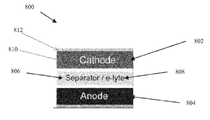
- FIG. 8 Schematic of a battery including a cathode formed of Li 2 S active material along with a multifunctional binder.
- FIG. 9 Schematic showing multiple functions performed by a binder.
- FIG. 10 Scanning Electron Microscope images of (a) commercial and (b) ball-milled Li 2 S particles.
- a set refers to a collection of one or more objects.
- a set of objects can include a single object or multiple objects.
- Objects of a set can also be referred to as members of the set.
- Objects of a set can be the same or different.
- objects of a set can share one or more common characteristics.
- the terms “substantially,” “substantial,” and “about” are used to describe and account for small variations.
- the terms can refer to instances in which the event or circumstance occurs precisely as well as instances in which the event or circumstance occurs to a close approximation.
- the terms can refer to less than or equal to ⁇ 10%, such as less than or equal to ⁇ 5%, less than or equal to ⁇ 4%, less than or equal to ⁇ 3%, less than or equal to ⁇ 2%, less than or equal to ⁇ 1%, less than or equal to ⁇ 0.5%, less than or equal to ⁇ 0.1%, or less than or equal to ⁇ 0.05%.
- the terms “optional” and “optionally” mean that the subsequently described event or circumstance may or may not occur and that the description includes instances where the event or circumstance occurs and instances in which it does not.
- alkane refers to a saturated hydrocarbon molecule.
- an alkane can include from 1 to 100 carbon atoms.
- the term “lower alkane” refers to an alkane that includes from 1 to 20 carbon atoms, such as from 1 to 10, from 2 to 10, from 3 to 10, from 4 to 10, or from 5 to 10 carbon atoms, while the term “upper alkane” refers to an alkane that includes more than 20 carbon atoms, such as from 21 to 100 carbon atoms.
- branched alkane refers to an alkane that includes a set of branches, while the term “unbranched alkane” refers to an alkane that is straight-chained.
- cycloalkane refers to an alkane that includes a set of ring structures, such as a single ring structure or a bicyclo or higher order cyclic structure.
- heteroalkane refers to an alkane that has a set of its carbon atoms replaced by a set of heteroatoms, such as N, Si, S, O, and P.
- substituted alkane refers to an alkane that has a set of its hydrogen atoms replaced by a set of substituent groups, while the term “unsubstituted alkane” refers to an alkane that lacks such replacement.
- Combinations of the above terms can be used to refer to an alkane having a combination of characteristics.
- branched lower alkane can be used to refer to an alkane that includes from 1 to 20 carbon atoms and a set of branches.
- alkyl refers to a monovalent form of an alkane.
- an alkyl can be envisioned as an alkane with one of its hydrogen atoms removed to allow bonding to another group of a molecule.
- the term “lower alkyl” refers to a monovalent form of a lower alkane, while the term “upper alkyl” refers to a monovalent form of an upper alkane.
- the term “branched alkyl” refers to a monovalent form of a branched alkane, while the term “unbranched alkyl” refers to a monovalent form of an unbranched alkane.
- cycloalkyl refers to a monovalent form of a cycloalkane
- heteroalkyl refers to a monovalent form of a heteroalkane
- substituted alkyl refers to a monovalent form of a substituted alkane
- unsubstituted alkyl refers to a monovalent form of an unsubstituted alkane
- alkyls examples include methyl, ethyl, n-propyl, isopropyl, cyclopropyl, n-butyl, s-butyl, isobutyl, t-butyl, cyclobutyl, n-pentyl, 1-adamantyl, 2-pinenyl, and charged, hetero, or substituted forms thereof.
- alkylene refers to a bivalent form of an alkane.
- an alkylene can be envisioned as an alkane with two of its hydrogen atoms removed to allow bonding to one or more additional groups of a molecule.
- the term “lower alkylene” refers to a bivalent form of a lower alkane, while the term “upper alkylene” refers to a bivalent form of an upper alkane.
- the term “branched alkylene” refers to a bivalent form of a branched alkane, while the term “unbranched alkylene” refers to a bivalent form of an unbranched alkane.
- cycloalkylene refers to a bivalent form of a cycloalkane
- heteroalkylene refers to a bivalent form of a heteroalkane
- substituted alkylene refers to a bivalent form of a substituted alkane
- unsubstituted alkylene refers to a bivalent form of an unsubstituted alkane.
- alkylenes include methylene, ethylene, propylene, 2-methylpropylene, and charged, hetero, or substituted forms thereof.
- alkene refers to an unsaturated hydrocarbon molecule that includes a set of carbon-carbon double bonds.
- an alkene can include from 2 to 100 carbon atoms.
- the term “lower alkene” refers to an alkene that includes from 2 to 20 carbon atoms, such as from 2 to 10, from 3 to 10, from 4 to 10, or from 5 to 10 carbon atoms, while the term “upper alkene” refers to an alkene that includes more than 20 carbon atoms, such as from 21 to 100 carbon atoms.
- cycloalkene refers to an alkene that includes a set of ring structures, such as a single ring structure or a bicyclo or higher order cyclic structure.
- heteroalkene refers to an alkene that has a set of its carbon atoms replaced by a set of heteroatoms, such as N, Si, S, O, and P.
- substituted alkene refers to an alkene that has a set of its hydrogen atoms replaced by a set of substituent groups
- unsubstituted alkene refers to an alkene that lacks such replacement.
- Combinations of the above terms can be used to refer to an alkene having a combination of characteristics.
- substituted lower alkene can be used to refer to an alkene that includes from 1 to 20 carbon atoms and a set of substituent groups.
- alkenyl refers to a monovalent form of an alkene.
- an alkenyl can be envisioned as an alkene with one of its hydrogen atoms removed to allow bonding to another group of a molecule.
- the term “lower alkenyl” refers to a monovalent form of a lower alkene, while the term “upper alkenyl” refers to a monovalent form of an upper alkene.
- the term “cycloalkenyl” refers to a monovalent form of a cycloalkene, and the term “heteroalkenyl” refers to a monovalent form of a heteroalkene.
- substituted alkenyl refers to a monovalent form of a substituted alkene
- unsubstituted alkenyl refers to a monovalent form of an unsubstituted alkene.
- alkenyls include ethenyl, 2-propenyl (i.e., allyl), isopropenyl, cyclopropenyl, butenyl, isobutenyl, t-butenyl, cyclobutenyl, and charged, hetero, or substituted forms thereof.
- alkenylene refers to a bivalent form of an alkene.
- an alkenylene can be envisioned as an alkene with two of its hydrogen atoms removed to allow bonding to one or more additional groups of a molecule.
- the term “lower alkenylene” refers to a bivalent form of a lower alkene, while the term “upper alkenylene” refers to a bivalent form of an upper alkene.
- cycloalkenylene refers to a bivalent form of a cycloalkene, and the term “heteroalkenylene” refers to a bivalent form of a heteroalkene.
- substituted alkenylene refers to a bivalent form of a substituted alkene
- unsubstituted alkenylene refers to a bivalent form of an unsubstituted alkene.
- alkenyls include ethenylene, propenylene, 2-methylpropenylene, and charged, hetero, or substituted forms thereof.
- alkyne refers to an unsaturated hydrocarbon molecule that includes a set of carbon-carbon triple bonds. In some instances, an alkyne can also include a set of carbon-carbon double bonds. For certain implementations, an alkyne can include from 2 to 100 carbon atoms.
- the term “lower alkyne” refers to an alkyne that includes from 2 to 20 carbon atoms, such as from 2 to 10, from 3 to 10, from 4 to 10, or from 5 to 10 carbon atoms, while the term “upper alkyne” refers to an alkyne that includes more than 20 carbon atoms, such as from 21 to 100 carbon atoms.
- cycloalkyne refers to an alkyne that includes a set of ring structures, such as a single ring structure or a bicyclo or higher order cyclic structure.
- heteroalkyne refers to an alkyne that has a set of its carbon atoms replaced by a set of heteroatoms, such as N, Si, S, O, and P.
- substituted alkyne refers to an alkyne that has a set of its hydrogen atoms replaced by a set of substituent groups, while the term “unsubstituted alkyne” refers to an alkyne that lacks such replacement.
- substituted lower alkyne can be used to refer to an alkyne that includes from 1 to 20 carbon atoms and a set of substituent groups.
- alkynyl refers to a monovalent form of an alkyne.
- an alkynyl can be envisioned as an alkyne with one of its hydrogen atoms removed to allow bonding to another group of a molecule.
- the term “lower alkynyl” refers to a monovalent form of a lower alkyne, while the term “upper alkynyl” refers to a monovalent form of an upper alkyne.
- cycloalkynyl refers to a monovalent form of a cycloalkyne, and the term “heteroalkynyl” refers to a monovalent form of a heteroalkyne.
- substituted alkynyl refers to a monovalent form of a substituted alkyne
- unsubstituted alkynyl refers to a monovalent form of an unsubstituted alkyne
- alkynyls include ethynyl, propynyl, isopropynyl, butynyl, isobutynyl, t-butynyl, and charged, hetero, or substituted forms thereof.
- alkynylene refers to a bivalent form of an alkyne.
- an alkynylene can be envisioned as an alkyne with two of its hydrogen atoms removed to allow bonding to one or more additional groups of a molecule.
- the term “lower alkynylene” refers to a bivalent form of a lower alkyne, while the term “upper alkynylene” refers to a bivalent form of an upper alkyne.
- cycloalkynylene refers to a bivalent form of a cycloalkyne, and the term “heteroalkynylene” refers to a bivalent form of a heteroalkyne.
- substituted alkynylene refers to a bivalent form of a substituted alkyne
- unsubstituted alkynylene refers to a bivalent form of an unsubstituted alkyne.
- alkynylenes include ethynylene, propynylene, 1-butynylene, 1-buten-3-ynylene, and charged, hetero, or substituted forms thereof.
- an arene refers to an aromatic hydrocarbon molecule.
- an arene can include from 5 to 100 carbon atoms.
- the term “lower arene” refers to an arene that includes from 5 to 20 carbon atoms, such as from 5 to 14 carbon atoms, while the term “upper arene” refers to an arene that includes more than 20 carbon atoms, such as from 21 to 100 carbon atoms.
- the term “monocyclic arene” refers to an arene that includes a single aromatic ring structure, while the term “polycyclic arene” refers to an arene that includes more than one aromatic ring structure, such as two or more aromatic ring structures that are bonded via a carbon-carbon bond or that are fused together.
- the term “heteroarene” refers to an arene that has a set of its carbon atoms replaced by a set of heteroatoms, such as N, Si, S, O, and P.
- substituted arene refers to an arene that has a set of its hydrogen atoms replaced by a set of substituent groups, while the term “unsubstituted arene” refers to an arene that lacks such replacement. Combinations of the above terms can be used to refer to an arene having a combination of characteristics. For example, the term “monocyclic lower alkene” can be used to refer to an arene that includes from 5 to 20 carbon atoms and a single aromatic ring structure.
- aryl refers to a monovalent form of an arene.
- an aryl can be envisioned as an arene with one of its hydrogen atoms removed to allow bonding to another group of a molecule.
- lower aryl refers to a monovalent form of a lower arene
- upper aryl refers to a monovalent form of an upper arene.
- monocyclic aryl refers to a monovalent form of a monocyclic arene
- polycyclic aryl refers to a monovalent form of a polycyclic arene.
- heteroaryl refers to a monovalent form of a heteroarene.
- substituted aryl refers to a monovalent form of a substituted arene
- unsubstituted aryl refers to a monovalent form of an unsubstituted arene.
- aryls include phenyl, biphenylyl, naphthyl, pyridinyl, pyridazinyl, pyrimidinyl, pyrazinyl, quinolyl, isoquinolyl, and charged, hetero, or substituted forms thereof.
- arylene refers to a bivalent form of an arene.
- an arylene can be envisioned as an arene with two of its hydrogen atoms removed to allow bonding to one or more additional groups of a molecule.
- lower arylene refers to a bivalent form of a lower arene
- upper arylene refers to a bivalent form of an upper arene.
- monocyclic arylene refers to a bivalent form of a monocyclic arene
- polycyclic arylene refers to a bivalent form of a polycyclic arene.
- heteroarylene refers to a bivalent form of a heteroarene.
- substituted arylene refers to a bivalent form of a substituted arene, while the term “unsubstituted arylene” refers to a bivalent form of an unsubstituted arene.
- binders can have a profound effect on the structural stability, kinetics, and long-term cycling performance of electrode materials.
- sulfur cathodes the effect of different binders on their electrochemical performance can be understood, with the most commonly-used binder being polyvinylidene fluoride (PVDF).
- PVDF polyvinylidene fluoride
- Developing an effective binder for Li 2 S cathodes (as opposed to sulfur) involves a paradigm shift because Li 2 S is ionic and highly polar, whereas sulfur is covalent and non-polar in nature. Because of this difference in bonding and chemical nature, binder materials that interact strongly with sulfur particles to act as good dispersion agents may not be effective for Li 2 S and vice-versa.
- Li 2 S n , 4 ⁇ n ⁇ 8 lithium polysulfides
- This affinity can reduce or minimize loss of polysulfides into an electrolyte during cycling, which is a major contributor of rapid capacity decay in Li 2 S cathodes.
- advancing the performance of these cathodes involves a more thorough understanding of Li 2 S-binder and Li 2 S n -binder interactions, both of which are relatively unexplored to date.
- Embodiments of this disclosure provide a framework for a rational design of stable and high-performance Li 2 S cathodes by first using ab initio simulations to elucidate the interaction between Li 2 S and lithium polysulfides with various functional groups found in macromolecular binders.
- polyvinylpyrrolidone PVP
- This multifunctional binder is found to exhibit strong affinity with: a) Li 2 S to form a uniform dispersion of active material and carbon in an electrode slurry, and b) lithium polysulfides to reduce or minimize their loss into an electrolyte during cycling.
- an initial specific capacity of about 760 mAh g ⁇ 1 of Li 2 S (about 1,090 mAh g ⁇ 1 of S) is achieved at about 0.2 C, with unprecedented capacity retention of about 94% in the first 100 cycles. Even after prolonged cycling over 500 charge/discharge cycles, cells retain about 69% of their initial capacity, which corresponds to a small capacity decay of about 0.062% per cycle.
- sulfur-containing cathodes and sulfur-containing active cathode materials which can include one or more of elemental sulfur (S), a metal sulfide, a metal polysulfide, or a mixture thereof.
- S elemental sulfur
- a sulfur-containing cathode material can include one or more of elemental sulfur, Li 2 S, Li 2 S 2 , Li 2 S 3 , Li 2 S x with 4 ⁇ x ⁇ 8, or a mixture thereof.
- Li—S. species which can be used to represent the relevant end groups in the general class of lithium polysulfides (Li—S—S n-2 —S—Li; Li 2 S n in short, 4 ⁇ n ⁇ 8).
- the results are summarized in FIG. 3 (see FIG. 4 for additional details). It can be observed that Li—S. species exhibit the strongest binding with >C ⁇ O groups as well, with typical binding energies in the range of about 1.20 to about 1.26 eV (see FIG. 3 a ). This is contrasted with the much lower binding energy of Li—S. with halogenated groups, such as about 0.62 eV in the case of binding with —F groups (see FIG. 3 a ). For the interaction of Li—S. with >C ⁇ O groups, the most stable configuration corresponds to lithium binding directly to the doubly-bonded oxygen atom, forming a strong Li—O interaction as shown in FIG. 3 b - e.
- PVP which is a polymer rich in >C ⁇ O groups
- >C ⁇ O groups in PVP exhibit high binding energies of about 1.14 and about 1.30 eV with Li 2 S and Li—S. species respectively (Li—O interaction; see FIG. 5 a ).
- PVDF binder rich in —F groups
- FIG. 5 b shows that PVDF binder is found to possess weaker interaction with Li 2 S and Li—S. species, with lower binding energies of about 0.64 and about 0.83 eV respectively.
- electrode slurries were prepared by mixing ball-milled Li 2 S particles with conductive carbon black and PVP/PVDF binder (about 60:35:5 by weight) in N-methyl-2-pyrrolidinone.
- PVP as the binder
- a uniform dispersion of Li 2 S and conductive carbon is obtained as evidenced by optical microscopy (see FIG. 5 c ), with no huge aggregates observed at the bottom of the slurry (see FIG. 5 c inset).
- large aggregates are visible in the electrode slurry containing PVDF as the binder (see FIG.
- the good dispersion properties of PVP binder can be attributed to its strong affinity for Li 2 S, which allows strong adsorption of PVP onto the surface of Li 2 S particles to stabilize the dispersion, consistent with ab initio simulation results.
- Li 2 S and PVP This interaction between Li 2 S and PVP is also evidenced by high-resolution X-ray photoelectron spectroscopy (XPS) measurements.
- XPS X-ray photoelectron spectroscopy
- samples are first tightly-sealed in foil/poly bags in an argon-filled glove box before being transferred into the XPS chamber via an argon-filled glove bag.
- the as-obtained Li is XPS spectrum of pure Li 2 S can be fitted with a single peak with a binding energy of about 54.6 eV (see FIG. 6 (top)) corresponding to Li in the Li—S bond.
- a ball-milled mixture of Li 2 S and PVP shows asymmetric broadening of the Li 1 s spectrum towards higher binding energy (see FIG.
- Li 2 S cathodes using PVP binders 2032-type coin cells were assembled.
- An electrode slurry was first prepared by mixing ball-milled Li 2 S particles with conductive carbon black and PVP binder (about 60:35:5 by weight) in N-methyl-2-pyrrolidinone to obtain a uniform dispersion, followed by drop-casting onto carbon fiber paper to form the working electrode.
- Carbon fiber paper was used as the current collector (instead of aluminum foil) because it allows a higher mass loading of Li 2 S (about 2 mg cm ⁇ 2 or more), and also provides a larger surface area for deposition of Li 2 S during cycling.
- 2032-type coin cells were then assembled with lithium foil as the counter electrode.
- the electrolyte used was lithium bis(trifluoromethane sulfonyl)imide in 1:1 v/v 1,2-dimethoxyethane and 1,3-dioxolane, with LiNO 3 (about 1 wt %) as an additive to aid passivation of the surface of the lithium anode and reduce the shuttle effect.
- the Li 2 S cathodes exhibited stable cycling performance with a high initial capacity of about 760 mAh g ⁇ 1 of Li 2 S (about 1,090 mAh g ⁇ 1 of S) at about 0.2 C as shown in FIG. 7 a .
- the capacity retention achieved at the end of 100 cycles was as high as about 94%.
- the average Coulombic efficiency over 100 cycles was calculated to be about 97%.
- the cells retained about 69% of their initial capacity (see FIG. 7 c ), which corresponds to a small capacity decay of about 0.062% per cycle.
- ICP-OES analysis showed a consistently higher percentage loss of sulfur into the electrolyte at various stages of cycling (1, 5, 10, and 20 cycles) for cells using PVDF compared to PVP as the binder (see FIG. 7 b ).
- PVDF binder about 27% of the total sulfur mass on the electrode was found to be dissolved in the electrolyte after 20 cycles, compared to about 13% in the case of PVP binder (see FIG. 7 b ). This indicates the stronger affinity of PVP binder with lithium polysulfides to reduce their loss into the electrolyte, consistent with ab initio simulation results.
- the Li 2 S cathodes with PVP binders are subjected to cycling at various C-rates to evaluate their electrode kinetics and stability (see FIG. 7 d, e ).
- the C-rate is increased from about 0.2 to about 0.5 to about 1 C
- the cells delivered high stabilized capacities of about 695, about 670, and about 645 mAh g ⁇ 1 of Li 2 S (about 997, about 961, and about 925 mAh g ⁇ 1 of S respectively), as shown in FIG. 7 d .
- the respective capacities achieved at about 0.5 C and about 1 C correspond to about 96% and about 93% of the capacity that was attained at about 0.2 C, indicating fast reaction kinetics in the cathodes.
- the sulfur-containing cathodes described herein can be used for a variety of batteries and other electrochemical energy storage devices.
- the Li 2 S cathodes can be substituted in place of, or used in conjunction with, conventional electrodes for lithium-sulfur batteries or other types of batteries.
- FIG. 8 shows a schematic of a battery 800 that includes a cathode 802 , an anode 804 , and a separator 806 that is disposed between the cathode 802 and the anode 804 , according to an embodiment of this disclosure.
- the battery 800 also includes an electrolyte 808 , which is disposed between the cathode 802 and the anode 804 .
- the cathode 802 is a Li 2 S cathode as described herein
- the anode 804 is a lithium metal anode, a graphite anode, a silicon anode, a germanium anode, a tin anode, or another suitable anode.
- the inclusion of the Li 2 S cathode 802 allows pairing with a high-capacity lithium metal-free anode such as graphite, silicon, germanium, or tin, hence obviating dendrite formation and safety concerns associated with metallic lithium.
- a high-capacity lithium metal-free anode such as graphite, silicon, germanium, or tin
- the Li 2 S cathode 802 includes a cathode material 810 , which includes, or is formed from, a mixture of Li 2 S particles, a conductive filler, and a multifunctional binder.
- An amount of the Li 2 S particles in the cathode material 810 can be in the range of about 40 wt % to about 80 wt %, such as from about 45 wt % to about 75 wt %, from about 50 wt % to about 70 wt %, or from about 55 wt % to about 65 wt %.
- An amount of the conductive filler in the cathode material 810 can be in the range of about 15 wt % to about 55 wt %, such as from about 20 wt % to about 50 wt %, from about 25 wt % to about 45 wt %, or from about 30 wt % to about 40 wt %.
- An amount of the multifunctional binder in the cathode material 810 can be in the range of about 20 wt % to about 1 wt %, such as from about 15 wt % to about 1 wt %, from about 10 wt % to about 2 wt %, or from about 8 wt % to about 3 wt %.
- the Li 2 S particles can have sizes in the sub-micron range, namely below 1 nm, to promote uniform dispersion of the Li 2 S particles during formation of the Li 2 S cathode 802 as well as to enhance surface areas available for electrochemical reactions.
- Suitable sizes of the Li 2 S particles can be attained by milling (e.g., ball-milling) or another suitable size reduction technique.
- an average size of the Li 2 S particles can be in the range of about 5 nm to about 999 nm, such as from about 5 nm to about 200 nm, from about 200 nm to about 400 nm, from about 400 nm to about 600 nm, from about 600 nm to about 800 nm, or from about 800 nm to about 999 nm.
- an average size of the Li 2 S particles can be in the range of about 5 nm to about 999 nm, such as from about 100 nm to about 900 nm, from about 200 nm to about 800 nm, from about 200 nm to about 700 nm, from about 200 nm to about 600 nm, from about 200 nm to about 500 nm, or from about 200 nm to about 400 nm.
- a distribution of sizes of the Li 2 S particles can be characterized as generally monodisperse, with a standard deviation that is up to about 40%, up to about 35%, up to about 30%, up to about 25%, up to about 20%, up to about 15%, up to about 10%, or up to about 5% of an average size of the Li 2 S particles.
- Examples of the conductive filler include conductive carbon fillers, such as carbon black, graphite, fullerene, carbon nanoparticles, and carbon nanotubes. Additional examples of the conductive filler include those formed of conductive polymers, metals, and metal alloys.
- the binder performs multiple functions, including: a) exhibiting a strong affinity with the Li 2 S particles to promote uniform dispersion of the Li 2 S particles during formation of the cathode material 810 as well as uniform dispersion of the Li 2 S particles in the resulting cathode material 810 ; b) exhibiting a strong affinity with lithium polysulfides to reduce or minimize their loss into the electrolyte 808 during cycling; and c) exhibiting a strong affinity with the conductive filler to promote electronic transport and improve kinetics of cycling.
- FIG. 9 is a schematic showing the multiple functions performed by the binder of an embodiment of this disclosure, for the case of PVP as the binder and carbon black as the conductive filler.
- PVP can be characterized as being amphiphilic, as it includes both hydrophilic (or polar) groups or moieties (corresponding to 2-pyrrolidinone), which exhibit a strong affinity with Li 2 S as well as lithium polysulfides that are formed during delithiation, and hydrophobic (or non-polar) groups or moieties (corresponding to a hydrophobic backbone or chain), which exhibit a strong affinity with carbon in the conductive filler.
- Suitable polymers for the binder include homopolymers based on vinyl polymers represented as follows: —(CH 2 —CHR) n — (I)
- R is a side group selected from:
- R 1 is selected from, for example, alkyls, alkenyls, alkynyls, and aryls
- L is a linker moiety selected from, for example, alkylenes, alkenylenes, alkynylenes, and arylenes.
- R 1 can include 1 carbon atom or 2 or more carbon atoms
- L if present, can include 1 carbon atom or 2 or more carbon atoms.
- R 2 and R 3 are different from hydrogen.
- R 2 can include 1 carbon atom or 2 or more carbon atoms
- R 3 can include 1 carbon atom or 2 or more carbon atoms
- L if present, can include 1 carbon atom or 2 or more carbon atoms.
- R 4 is selected from, for example, alkyls, alkenyls, alkynyls, and aryls
- L is a linker moiety selected from, for example, alkylenes, alkenylenes, alkynylenes, and arylenes.
- R 4 can include 1 carbon atom or 2 or more carbon atoms
- L if present, can include 1 carbon atom or 2 or more carbon atoms.
- R 5 and R 6 are different from hydrogen.
- R 5 can include 1 carbon atom or 2 or more carbon atoms
- R 6 can include 1 carbon atom or 2 or more carbon atoms
- L if present, can include 1 carbon atom or 2 or more carbon atoms.
- R 7 is selected from, for example, alkyls, alkenyls, alkynyls, and aryls
- L is a linker moiety selected from, for example, alkylenes, alkenylenes, alkynylenes, and arylenes.
- R 7 can include 1 carbon atom or 2 or more carbon atoms
- L if present, can include 1 carbon atom or 2 or more carbon atoms.
- CN nitrile
- L is a linker moiety selected from, for example, alkylenes, alkenylenes, alkynylenes, and arylenes.
- L if present, can include 1 carbon atom or 2 or more carbon atoms.
- suitable polymers for the binder include homopolymers based on vinyl polymers represented as follows: —(CHR—CHR′) n — (II) —(CH 2 —CRR′) n — (III) —(CRH—CR′R′′) n — (IV) —(CRR′—CR′′R′′′) n — (V) where R, R′, R′′, and R′′′ are side groups independently selected from groups 1) through 6) listed above with reference to formula (I).
- suitable polymers for the binder include copolymers based on vinyl polymers represented as follows: —(CH 2 —CHR) m —(CH 2 —CHR′) n — (VI) —(CHR—CH 2 ) m —(CH 2 —CHR′) n — (VII) —(CH 2 —CHR) m —(CHR′—CH 2 ) n — (VIII) where R and R′ are different side groups selected from groups 1) through 6) listed above with reference to formula (I).
- a suitable copolymer can be a statistical copolymer, a random copolymer, an alternating copolymer, a periodic copolymer, a block copolymer, a radial copolymer, or a graft copolymer, and can include two or more different monomeric units, where at least one of, or each of, the monomeric units includes one or more side groups selected from groups 1) through 6) listed above with reference to formula (I).
- suitable polymers for the binder include homopolymers based on polypeptides represented as follows:
- R is a side group selected from hydrogen, alkyls, alkenyls, alkynyls, aryls, and groups 1) through 6) listed above with reference to formula (I).
- R′ and R′′
- R, R′, and R′′ are independently selected from alkyls, alkenyls, alkynyls, aryls, and groups 1) through 6) listed above with reference to formula (I).
- suitable polymers for the binder include those with a relative high molecular weight, which can lead to a higher viscosity to promote binding to other components of the cathode material 810 as well as binding to a current collector 812 .
- a number average molecular weight of a suitable polymer can be at least about 50,000 g/mol, such as at least about 100,000 g/mol, at least about 200,000 g/mol, at least about 300,000 g/mol, at least about 400,000 g/mol, at least about 500,000 g/mol, at least about 600,000 g/mol, at least about 700,000 g/mol, at least about 800,000 g/mol, at least about 900,000 g/mol, at least about 1,000,000 g/mol, at least about 1,100,000 g/mol, at least about 1,200,000 g/mol, or at least about 1,300,000 g/mol, and up to about 1,500,000 g/mol, up to about 1,800,000 g/
- the affinity of the binder towards Li 2 S can be characterized by XPS measurements.
- a Li is XPS spectrum of Li 2 S can be fitted with a single peak centered at a first binding energy (see, for example, FIG. 6 (top)) corresponding to Li in the Li—S. bond.
- a mixture of Li 2 S and the binder can show asymmetric broadening of the Li is spectrum towards higher binding energy (see, for example, FIG. 6 (bottom)), indicating a change in chemical environment experienced by Li.
- This broadened spectrum can be fitted using 2 peaks, one centered at or near the first binding energy, and another centered at a second, higher binding energy.
- the strong affinity of the binder towards Li 2 S can be characterized by a shift in the second binding energy relative to the first binding energy of at least about 0.5 eV, such as at least about 0.6 eV, at least about 0.7 eV, at least about 0.8 eV, at least about 0.9 eV, at least about 1 eV, at least about 1.1 eV, or at least about 1.2 eV, and up to about 1.5 eV, up to about 2 eV, or more.
- a shift in the second binding energy relative to the first binding energy of at least about 0.5 eV, such as at least about 0.6 eV, at least about 0.7 eV, at least about 0.8 eV, at least about 0.9 eV, at least about 1 eV, at least about 1.1 eV, or at least about 1.2 eV, and up to about 1.5 eV, up to about 2 eV, or more.
- the Li 2 S cathode 802 also includes the current collector 812 , and the cathode material 810 is coated on, disposed on, or otherwise affixed to the current collector 812 .
- the current collector 812 includes a fibrous material including, or formed of, carbon, such as in the form of carbon fiber paper or carbon cloth.
- the porous nature of the fibrous carbon material allows a higher mass loading of L 2 S, such as by allowing impregnation of the cathode material 810 into voids or interstices of the current collector 812 , and also provides a larger surface area for deposition of Li 2 S during cycling.
- a hydrophobic backbone of the binder also exhibits strong affinity with carbon in the current collector 812 , thereby promoting binding of the cathode material 810 to the current collector 812 for improved electronic transport and stability.
- the battery 800 exhibits a number of performance improvements.
- the battery 800 can exhibit a maximum discharge capacity at a current rate of 0.2 C (or at 0.5 C, 1 C, 2 C, or another higher or lower reference rate and as evaluated relative to Li/Li + or another counter/reference electrode) that is at least about 400 mAh g ⁇ 1 of Li 2 S, such as at least about 500 mAh g ⁇ 1 , at least about 600 mAh g ⁇ 1 , at least about 700 mAh g ⁇ 1 , at least about 720 mAh g ⁇ 1 , at least about 740 mAh g ⁇ 1 , at least about 760 mAh g ⁇ 1 , or at least about 780 mAh g ⁇ 1 , and up to about 1,000 mAh g ⁇ 1 , or up to about 1,166 mAh g ⁇ 1 .
- the battery 800 can exhibit excellent retention of discharge capacity over several cycles, such that, after 100 cycles at a rate of 0.2 C (or at 0.5 C, 1 C, 2 C, or another higher or lower reference rate), at least about 70%, at least about 75%, at least about 80%, at least about 85%, at least about 90%, at least about 92%, or at least about 94%, and up to about 95%, up to about 97%, or more of an initial or maximum discharge capacity is retained.
- the battery 800 can have an efficiency that is at least about 75%, at least about 80%, at least about 85%, at least about 90%, at least about 95%, or at least about 97%, and up to about 99%, up to about 99.5%, up to about 99.9%, or more.
- the effectiveness of containment of lithium polysulfides can be assessed in terms of a weight percentage of sulfur (e.g., whether in elemental or another form) present in the electrolyte 808 after a certain number of cycles, relative to a total weight of sulfur as initially included in the cathode 802 .
- a weight percentage of sulfur e.g., whether in elemental or another form
- no greater than about 25% of sulfur is present in the electrolyte 808 , such as no greater than about 20%, no greater than about 17%, no greater than about 15%, or no greater than about 13%.
- VASP Vienna Ab Initio Simulation Package
- DFT density functional theory
- PBE Perdew-Burke-Ernzerhof
- 500 eV was chosen as the cut-off energy of the plane-wave basis.
- the vacuum between a polymer and its image exceeds 30 ⁇ , while the distance between the Li—S./Li 2 S cluster and its image is no less than 15 ⁇ along the periodic direction.
- the three-dimensional visualization models were constructed using VESTA 3 software.
- Li 2 S particles (about 99.9%, Alfa Aesar) were first ball-milled in a tightly-sealed vial for about 4 h using a SPEX 8000D miller to achieve particle sizes in the range of about 200 nm to about 700 nm (see FIG. 10 ).
- the ball-milled Li 2 S particles were then ground with carbon black and PVP binder in a weight ratio of about 60:35:5 using a mortar and pestle, followed by dispersion in N-methyl-2-pyrrolidinone (NMP) as a solvent to form a slurry. After overnight stirring, the slurry was then drop-cast onto carbon fiber paper (AvCarb P50) and dried at about 60° C. to form the working electrode. 2032-type coin cells were assembled using lithium foil as the counter electrode and Celgard 2250 as the separator.
- NMP N-methyl-2-pyrrolidinone
- the electrolyte used was a freshly-prepared solution of lithium bis(trifluoromethanesulfonyl)imide (LiTFSI, about 1 M) in 1:1 v/v 1,2-dimethoxyethane (DME) and 1,3-dioxolane (DOL) containing LiNO 3 (about 1 wt %).
- LiTFSI lithium bis(trifluoromethanesulfonyl)imide
- DME 1,2-dimethoxyethane
- DOL 1,3-dioxolane
- LiNO 3 about 1 wt %.
- Galvanostatic cycling was then carried out at the specified C-rate from about 1.8 to about 2.6 V vs. Li + /Li.
- the typical mass loading of Li 2 S was about 2 mg cm ⁇ 2 , and specific capacity values were calculated based on the mass of Li 2 S or the corresponding mass of S in the samples.
- a sulfur-free lithium salt of LiClO 4 (about 1 M) in 1:1 v/v DME/DOL solution with LiNO 3 (about 1 wt %) was used as the electrolyte.
- the cells were discharged to about 1.8 V vs. Li + /Li, and the voltage was maintained for over 20 h, following which they were disassembled and the contents (cathode, anode and electrolyte-soaked separator) were washed with DOL solution.
- This polysulfide-containing solution was then oxidized with concentrated HNO 3 and diluted with deionized water for analysis of sulfur content using ICP-OES (Thermo Scientific ICAP 6300 Duo View Spectrometer).
Landscapes
- Chemical & Material Sciences (AREA)
- Chemical Kinetics & Catalysis (AREA)
- Electrochemistry (AREA)
- General Chemical & Material Sciences (AREA)
- Engineering & Computer Science (AREA)
- Manufacturing & Machinery (AREA)
- Inorganic Chemistry (AREA)
- Materials Engineering (AREA)
- Battery Electrode And Active Subsutance (AREA)
Abstract
Description
—(CH2—CHR)n— (I)
—(CHR—CHR′)n— (II)
—(CH2—CRR′)n— (III)
—(CRH—CR′R″)n— (IV)
—(CRR′—CR″R′″)n— (V)
where R, R′, R″, and R′″ are side groups independently selected from groups 1) through 6) listed above with reference to formula (I).
—(CH2—CHR)m—(CH2—CHR′)n— (VI)
—(CHR—CH2)m—(CH2—CHR′)n— (VII)
—(CH2—CHR)m—(CHR′—CH2)n— (VIII)
where R and R′ are different side groups selected from groups 1) through 6) listed above with reference to formula (I). More generally, a suitable copolymer can be a statistical copolymer, a random copolymer, an alternating copolymer, a periodic copolymer, a block copolymer, a radial copolymer, or a graft copolymer, and can include two or more different monomeric units, where at least one of, or each of, the monomeric units includes one or more side groups selected from groups 1) through 6) listed above with reference to formula (I).

where R is a side group selected from hydrogen, alkyls, alkenyls, alkynyls, aryls, and groups 1) through 6) listed above with reference to formula (I). In formula (IX), either of, or both, hydrogen atoms (which are bonded to carbon and nitrogen) can be replaced by a side group R′ (and R″), where R, R′, and R″ are independently selected from alkyls, alkenyls, alkynyls, aryls, and groups 1) through 6) listed above with reference to formula (I).
Claims (6)
—(CH2—CHR)n—
—(CH2—CHR)n—
—(CH2—CHR)n—
Priority Applications (1)
| Application Number | Priority Date | Filing Date | Title |
|---|---|---|---|
| US14/325,598 US10033040B2 (en) | 2013-07-08 | 2014-07-08 | Stable cycling of lithium sulfide cathodes through strong affinity with multifunctional binders |
Applications Claiming Priority (2)
| Application Number | Priority Date | Filing Date | Title |
|---|---|---|---|
| US201361843792P | 2013-07-08 | 2013-07-08 | |
| US14/325,598 US10033040B2 (en) | 2013-07-08 | 2014-07-08 | Stable cycling of lithium sulfide cathodes through strong affinity with multifunctional binders |
Publications (2)
| Publication Number | Publication Date |
|---|---|
| US20150010817A1 US20150010817A1 (en) | 2015-01-08 |
| US10033040B2 true US10033040B2 (en) | 2018-07-24 |
Family
ID=52133011
Family Applications (1)
| Application Number | Title | Priority Date | Filing Date |
|---|---|---|---|
| US14/325,598 Active 2035-10-08 US10033040B2 (en) | 2013-07-08 | 2014-07-08 | Stable cycling of lithium sulfide cathodes through strong affinity with multifunctional binders |
Country Status (2)
| Country | Link |
|---|---|
| US (1) | US10033040B2 (en) |
| WO (1) | WO2015006279A1 (en) |
Cited By (1)
| Publication number | Priority date | Publication date | Assignee | Title |
|---|---|---|---|---|
| CN112117438A (en) * | 2020-09-27 | 2020-12-22 | 蜂巢能源科技有限公司 | A negative electrode sheet and its preparation method and solid-state battery |
Families Citing this family (8)
| Publication number | Priority date | Publication date | Assignee | Title |
|---|---|---|---|---|
| US11133521B2 (en) * | 2015-04-08 | 2021-09-28 | Solid Power, Inc. | Binder and slurry compositions and solid state batteries made therewith |
| JP6816146B2 (en) * | 2015-12-22 | 2021-01-20 | 宝山鋼鉄股▲ふん▼有限公司Baoshan Iron & Steel Co.,Ltd. | How to prepare the cathode material of a battery |
| KR102183662B1 (en) * | 2017-05-26 | 2020-11-26 | 주식회사 엘지화학 | Electrolyte for lithium-sulfur battery and lithium-sulfur battery comprising thereof |
| FR3071361B1 (en) * | 2017-09-15 | 2019-09-13 | Commissariat A L'energie Atomique Et Aux Energies Alternatives | PROCESS FOR PRODUCING LITHIUM-SULFUR ACCUMULATOR ELECTRODE USING LI2S AS ACTIVE MATERIAL |
| US10868307B2 (en) | 2018-07-12 | 2020-12-15 | GM Global Technology Operations LLC | High-performance electrodes employing semi-crystalline binders |
| US11228037B2 (en) | 2018-07-12 | 2022-01-18 | GM Global Technology Operations LLC | High-performance electrodes with a polymer network having electroactive materials chemically attached thereto |
| KR102707039B1 (en) * | 2023-05-23 | 2024-09-13 | 주식회사 엘지에너지솔루션 | Lithium-sulfur battery |
| CN118851188A (en) * | 2024-06-28 | 2024-10-29 | 深圳市贝特瑞新能源技术研究院有限公司 | Battery, hydrophobic powder material and preparation method thereof |
Citations (17)
| Publication number | Priority date | Publication date | Assignee | Title |
|---|---|---|---|---|
| US5747195A (en) * | 1996-05-06 | 1998-05-05 | Alamgir; Mohammed | Current collectors for high energy density cells |
| US6350542B1 (en) | 1999-01-25 | 2002-02-26 | Wilson Greatbatch Ltd. | Sulfite additives for nonaqueous electrolyte rechargeable cells |
| US20020039680A1 (en) | 2000-08-17 | 2002-04-04 | Samsung Sdi Co., Ltd. | Positive active material composition for lithium-sulfur battery and lithium-sulfur battery fabricated using same |
| US20040043291A1 (en) | 2002-09-04 | 2004-03-04 | Kim Nam In | Cathode containing muticomponent binder mixture and lithium-sulfur battery using the same |
| US20040091776A1 (en) * | 2002-10-28 | 2004-05-13 | Samsung Sdi Co., Ltd. | Positive electrode for lithium sulfur battery and lithium sulfur battery comprising same |
| US7018603B2 (en) | 2000-12-08 | 2006-03-28 | Qinetiq Limited | Synthesis of lithium iron sulphides and their use as cathodes |
| US7029796B2 (en) * | 2002-09-23 | 2006-04-18 | Samsung Sdi Co., Ltd. | Positive active material of a lithium-sulfur battery and method of fabricating same |
| US7291424B2 (en) | 2002-07-10 | 2007-11-06 | Samsung Sdi Co., Ltd. | Positive electrode for lithium-sulfur battery and lithium-sulfur battery fabricated using same |
| US7303837B2 (en) | 2002-09-11 | 2007-12-04 | Samsung Sdi Co., Ltd. | Positive electrode for lithium-sulfur battery and lithium-sulfur battery and article of manufacture including same |
| US20090081553A1 (en) * | 2007-09-25 | 2009-03-26 | Seiko Epson Corporation | Electrochemical device |
| US20090239148A1 (en) * | 2008-03-24 | 2009-09-24 | 3M Innovative Properties Company | High voltage cathode compositions |
| US20100129724A1 (en) | 2008-05-02 | 2010-05-27 | Vladimir Kolosnitsyn | Rechargeable battery with negative lithium electrode |
| US20110165466A1 (en) | 2010-01-04 | 2011-07-07 | Aruna Zhamu | Lithium metal-sulfur and lithium ion-sulfur secondary batteries containing a nano-structured cathode and processes for producing same |
| US20110163274A1 (en) * | 2008-09-02 | 2011-07-07 | Arkema France | Electrode composite, battery electrode formed from said composite, and lithium battery comprising such an electrode |
| US20110200883A1 (en) | 2009-10-29 | 2011-08-18 | Yi Cui | Devices, systems and methods for advanced rechargeable batteries |
| US20120094189A1 (en) | 2009-04-08 | 2012-04-19 | IUCF-HYU (Industry-University Cooperation Foundation Hanyang Univeristy) | Lithium-sulfur battery |
| WO2012171889A1 (en) | 2011-06-14 | 2012-12-20 | Chemetall Gmbh | Method for producing a carbon-coated lithium sulfide and use thereof |
-
2014
- 2014-07-08 US US14/325,598 patent/US10033040B2/en active Active
- 2014-07-08 WO PCT/US2014/045674 patent/WO2015006279A1/en not_active Ceased
Patent Citations (18)
| Publication number | Priority date | Publication date | Assignee | Title |
|---|---|---|---|---|
| US5747195A (en) * | 1996-05-06 | 1998-05-05 | Alamgir; Mohammed | Current collectors for high energy density cells |
| US6350542B1 (en) | 1999-01-25 | 2002-02-26 | Wilson Greatbatch Ltd. | Sulfite additives for nonaqueous electrolyte rechargeable cells |
| US20020039680A1 (en) | 2000-08-17 | 2002-04-04 | Samsung Sdi Co., Ltd. | Positive active material composition for lithium-sulfur battery and lithium-sulfur battery fabricated using same |
| US6919143B2 (en) | 2000-08-17 | 2005-07-19 | Samsung Sdi Co., Ltd. | Positive active material composition for lithium-sulfur battery and lithium-sulfur battery fabricated using same |
| US7018603B2 (en) | 2000-12-08 | 2006-03-28 | Qinetiq Limited | Synthesis of lithium iron sulphides and their use as cathodes |
| US7291424B2 (en) | 2002-07-10 | 2007-11-06 | Samsung Sdi Co., Ltd. | Positive electrode for lithium-sulfur battery and lithium-sulfur battery fabricated using same |
| US20040043291A1 (en) | 2002-09-04 | 2004-03-04 | Kim Nam In | Cathode containing muticomponent binder mixture and lithium-sulfur battery using the same |
| US7303837B2 (en) | 2002-09-11 | 2007-12-04 | Samsung Sdi Co., Ltd. | Positive electrode for lithium-sulfur battery and lithium-sulfur battery and article of manufacture including same |
| US7029796B2 (en) * | 2002-09-23 | 2006-04-18 | Samsung Sdi Co., Ltd. | Positive active material of a lithium-sulfur battery and method of fabricating same |
| US20040091776A1 (en) * | 2002-10-28 | 2004-05-13 | Samsung Sdi Co., Ltd. | Positive electrode for lithium sulfur battery and lithium sulfur battery comprising same |
| US20090081553A1 (en) * | 2007-09-25 | 2009-03-26 | Seiko Epson Corporation | Electrochemical device |
| US20090239148A1 (en) * | 2008-03-24 | 2009-09-24 | 3M Innovative Properties Company | High voltage cathode compositions |
| US20100129724A1 (en) | 2008-05-02 | 2010-05-27 | Vladimir Kolosnitsyn | Rechargeable battery with negative lithium electrode |
| US20110163274A1 (en) * | 2008-09-02 | 2011-07-07 | Arkema France | Electrode composite, battery electrode formed from said composite, and lithium battery comprising such an electrode |
| US20120094189A1 (en) | 2009-04-08 | 2012-04-19 | IUCF-HYU (Industry-University Cooperation Foundation Hanyang Univeristy) | Lithium-sulfur battery |
| US20110200883A1 (en) | 2009-10-29 | 2011-08-18 | Yi Cui | Devices, systems and methods for advanced rechargeable batteries |
| US20110165466A1 (en) | 2010-01-04 | 2011-07-07 | Aruna Zhamu | Lithium metal-sulfur and lithium ion-sulfur secondary batteries containing a nano-structured cathode and processes for producing same |
| WO2012171889A1 (en) | 2011-06-14 | 2012-12-20 | Chemetall Gmbh | Method for producing a carbon-coated lithium sulfide and use thereof |
Non-Patent Citations (18)
| Title |
|---|
| Bruce et al., "Li-O2 and Li-S Batteries with High Energy Storage", Nature Materials, 2012, 22(1), pp. 19-29. |
| Cheon, S.E. et al., Structural Factors of Sulfur Cathodes with Poly(ethylene oxide) Binder for Performance of Rechargeable Lithium Sulfur Batteries, J. Electrochem. Soc. 2002 149(11): A1437-A1441. |
| Cui et al., "Amphiphilic Surface Modification of Hollow Carbon Nanofibers for Improved Cycle Life of Lithium Sulfur Batteries," Nano Lett., (2013), 13(3), pp. 1265-1270. |
| International Preliminary Report on Patentability (IPRP) for International Application No. PCT/US2014/045674, dated Jan. 21, 2016. |
| Ji et al., "Graphene Oxide as a Sulfur Immobilizer in High Performance Lithium/Sulfur Cells," J. Amer. Chem. Soc. 133(46), (2011) pp. 18522-18525. |
| Ji X., et al., "Stabilizing lithium-sulphur cathodes using polysulphide reservoirs," Nat. Commun. 2:325 (2011) pp. 1-7. |
| Ji, et al., "A highly ordered nanostructured carbon-sulphur cathode for lithium-sulphur batteries", Nature Materials, vol. 8, Jun. 2009, 500-506. |
| Rao et al., "Carbon nanofiber-sulfer composite cathode materials with different binders for secondary Li/S cells," Electrochimica Acta, 65 (2012) pp. 228-233. |
| Seh Z. W., et al., "Sulphur-TiO2 yolk-shell nanoarchitecture with internal void space for long-cycle lithium-sulphur batteries," Nat. Commun. 4:1331 (2013). |
| Sigma-aldrich, product specification for polymethacrylate, 2017. * |
| Sigma-Aldrich, Product Specification: "Ethyl methacrylate, analytical standard," retrieved from www.sigmaaldrich.com on Sep. 17, 2017. |
| Sigma-Aldrich, Product Specification: "Methyl acrylate," retrieved from www.sigmaaldrich.com on Sep. 17, 2017. |
| Sigma-Aldrich, Product Specification: "Methyl methacrylate-99%, contains ≤30 ppm monomethyl ether hydroquinone as inhibitor," 1 page, downloaded 2017. |
| Sigma-Aldrich, Product Specification: "Methyl methacrylate—99%, contains ≤30 ppm monomethyl ether hydroquinone as inhibitor," 1 page, downloaded 2017. |
| Su Y.S., et al., "Lithium-sulphur batteries with a microporous carbon paper as a bifunctional interlayer," Nat. Commun. 3:1166 (2012). |
| Sun et al., "Application of gelatin as a binder for the sulfur cathode in lithium-sulfur batteries," Electrochimica Acta, 53:24,(2008) pp. 7084-7088. |
| Xiao, et al., "A Soft Approach to Encapsulate Sulfur: Polyaniline Nanotubes for Lithium-Sulfur Batteries with Long Cycle Life", Advanced Materials, 2012, 24, 1176-1181. |
| Yang, Yuan et al., "Nanostructured Sulfur Cathodes," Chemical Society Reviews, Epub: Jan. 17, 2013, vol. 42, 7, pp. 3018-3032. |
Cited By (1)
| Publication number | Priority date | Publication date | Assignee | Title |
|---|---|---|---|---|
| CN112117438A (en) * | 2020-09-27 | 2020-12-22 | 蜂巢能源科技有限公司 | A negative electrode sheet and its preparation method and solid-state battery |
Also Published As
| Publication number | Publication date |
|---|---|
| WO2015006279A1 (en) | 2015-01-15 |
| US20150010817A1 (en) | 2015-01-08 |
Similar Documents
| Publication | Publication Date | Title |
|---|---|---|
| US10033040B2 (en) | Stable cycling of lithium sulfide cathodes through strong affinity with multifunctional binders | |
| Seh et al. | Stable cycling of lithium sulfide cathodes through strong affinity with a bifunctional binder | |
| Hwang et al. | Designing a high‐performance lithium–sulfur batteries based on layered double hydroxides–carbon nanotubes composite cathode and a dual‐functional graphene–polypropylene–Al2O3 separator | |
| Walter et al. | Pyrite (FeS 2) nanocrystals as inexpensive high-performance lithium-ion cathode and sodium-ion anode materials | |
| Hwang et al. | High performance potassium–sulfur batteries based on a sulfurized polyacrylonitrile cathode and polyacrylic acid binder | |
| Murgia et al. | Insight into the electrochemical behavior of micrometric Bi and Mg 3 Bi 2 as high performance negative electrodes for Mg batteries | |
| Hanyu et al. | Application of quinonic cathode compounds for quasi-solid lithium batteries | |
| NL2010462C2 (en) | Iron-based battery and anode. | |
| CN103918108B (en) | Lithium metal doped electrodes for lithium-ion rechargeable chemistry | |
| JP6333286B2 (en) | Lithium powder anode | |
| US10892489B2 (en) | Composite anode active material, and anode and lithium battery including composite anode active material | |
| CN105378981A (en) | A long-life, high rate lithium/sulfur cell utilizing a holistic approach to enhancing cell performance | |
| US9312540B2 (en) | Conformal coating on nanostructured electrode materials for three-dimensional applications | |
| Prabakar et al. | Graphene-sandwiched LiNi0. 5Mn1. 5O4 cathode composites for enhanced high voltage performance in Li ion batteries | |
| KR102465274B1 (en) | Electrode material and method of making the same | |
| JP5894513B2 (en) | Positive electrode for lithium ion secondary battery and method for producing the same | |
| CN115498264B (en) | Lithium metal battery electrolyte and lithium metal battery | |
| KR20220153207A (en) | MOF gel membrane and method for fabricating the same, MOF gel membrane separator and rechargeable organic battery | |
| Oh et al. | Hierarchical Si hydrogel architecture with conductive polyaniline channels on sulfonated-graphene for high-performance Li ion battery anodes having a robust cycle life | |
| US20200168897A1 (en) | Cathode mixture, all solid state battery, and method for producing cathode mixture | |
| KR20150107928A (en) | Aqueous binder composition for negative electrode of lithium battery comprising lithiumpolyacrylate and conductive polymer | |
| CN104781967B (en) | Active material particles, positive electrode for electricity storage device, electricity storage device, and method for producing active material particles | |
| KR20160002417A (en) | Negative electrode active material and negative electrode for sodium secondary battery using molten salt electrolyte, and sodium secondary battery using molten salt electrolyte | |
| JPWO2013035829A1 (en) | battery | |
| CN117501498A (en) | Composite materials comprising fluorinated amides and their use in electrochemical cells |
Legal Events
| Date | Code | Title | Description |
|---|---|---|---|
| AS | Assignment |
Owner name: BOARD OF TRUSTEES OF THE LELAND STANFORD JUNIOR UN Free format text: ASSIGNMENT OF ASSIGNORS INTEREST;ASSIGNORS:CUI, YI;SEH, ZHI WEI;ZHENG, GUANGYUAN;REEL/FRAME:033498/0382 Effective date: 20140630 |
|
| AS | Assignment |
Owner name: U.S. DEPARTMENT OF ENERGY, DISTRICT OF COLUMBIA Free format text: CONFIRMATORY LICENSE;ASSIGNOR:THE BOARD OF TRUSTES OF THE LELAND STANFORD JUNIOR UNIVERSITY;REEL/FRAME:033845/0982 Effective date: 20140714 |
|
| AS | Assignment |
Owner name: THE BOARD OF TRUSTEES OF THE LELAND STANFORD JUNIO Free format text: CORRECTIVE ASSIGNMENT TO CORRECT THE ASSIGNEE NAME AND ADDRESS PREVIOUSLY RECORDED AT REEL: 033498 FRAME: 0382. ASSIGNOR(S) HEREBY CONFIRMS THE ASSIGNMENT;ASSIGNORS:CUI, YI;SEH, ZHI WEI;ZHENG, GUANGYUAN;REEL/FRAME:046406/0632 Effective date: 20140630 |
|
| STCF | Information on status: patent grant |
Free format text: PATENTED CASE |
|
| AS | Assignment |
Owner name: UNITED STATES DEPARTMENT OF ENERGY, DISTRICT OF COLUMBIA Free format text: CONFIRMATORY LICENSE;ASSIGNOR:STANFORD UNIVERSITY;REEL/FRAME:058220/0265 Effective date: 20140714 |
|
| MAFP | Maintenance fee payment |
Free format text: PAYMENT OF MAINTENANCE FEE, 4TH YR, SMALL ENTITY (ORIGINAL EVENT CODE: M2551); ENTITY STATUS OF PATENT OWNER: SMALL ENTITY Year of fee payment: 4 |
|
| FEPP | Fee payment procedure |
Free format text: MAINTENANCE FEE REMINDER MAILED (ORIGINAL EVENT CODE: REM.); ENTITY STATUS OF PATENT OWNER: SMALL ENTITY |