US10026778B2 - Light-emitting structure - Google Patents

Light-emitting structure Download PDF

Info

Publication number
US10026778B2
US10026778B2 US15/727,276 US201715727276A US10026778B2 US 10026778 B2 US10026778 B2 US 10026778B2 US 201715727276 A US201715727276 A US 201715727276A US 10026778 B2 US10026778 B2 US 10026778B2
Authority
US
United States
Prior art keywords
layer
light
conductive
emitting structure
disposed under
Prior art date
Legal status (The legal status is an assumption and is not a legal conclusion. Google has not performed a legal analysis and makes no representation as to the accuracy of the status listed.)
Active
Application number
US15/727,276
Other versions
US20180033824A1 (en
Inventor
Li-Ping Jou
Yu-Chen Yang
Jui-Hung Yeh
Current Assignee (The listed assignees may be inaccurate. Google has not performed a legal analysis and makes no representation or warranty as to the accuracy of the list.)
Epistar Corp
Original Assignee
Epistar Corp
Priority date (The priority date is an assumption and is not a legal conclusion. Google has not performed a legal analysis and makes no representation as to the accuracy of the date listed.)
Filing date
Publication date
Application filed by Epistar Corp filed Critical Epistar Corp
Priority to US15/727,276 priority Critical patent/US10026778B2/en
Assigned to EPISTAR CORPORATION reassignment EPISTAR CORPORATION ASSIGNMENT OF ASSIGNORS INTEREST (SEE DOCUMENT FOR DETAILS). Assignors: YEH, JUI-HUNG, JOU, LI-PING, YANG, YU-CHEN
Publication of US20180033824A1 publication Critical patent/US20180033824A1/en
Application granted granted Critical
Publication of US10026778B2 publication Critical patent/US10026778B2/en
Active legal-status Critical Current
Anticipated expiration legal-status Critical

Links

Images

Classifications

    • HELECTRICITY
    • H10SEMICONDUCTOR DEVICES; ELECTRIC SOLID-STATE DEVICES NOT OTHERWISE PROVIDED FOR
    • H10HINORGANIC LIGHT-EMITTING SEMICONDUCTOR DEVICES HAVING POTENTIAL BARRIERS
    • H10H29/00Integrated devices, or assemblies of multiple devices, comprising at least one light-emitting semiconductor element covered by group H10H20/00
    • H10H29/10Integrated devices comprising at least one light-emitting semiconductor component covered by group H10H20/00
    • H10H29/14Integrated devices comprising at least one light-emitting semiconductor component covered by group H10H20/00 comprising multiple light-emitting semiconductor components
    • H10H29/142Two-dimensional arrangements, e.g. asymmetric LED layout
    • H01L27/156
    • H01L33/382
    • H01L33/62
    • HELECTRICITY
    • H10SEMICONDUCTOR DEVICES; ELECTRIC SOLID-STATE DEVICES NOT OTHERWISE PROVIDED FOR
    • H10HINORGANIC LIGHT-EMITTING SEMICONDUCTOR DEVICES HAVING POTENTIAL BARRIERS
    • H10H20/00Individual inorganic light-emitting semiconductor devices having potential barriers, e.g. light-emitting diodes [LED]
    • H10H20/80Constructional details
    • H10H20/81Bodies
    • H10H20/813Bodies having a plurality of light-emitting regions, e.g. multi-junction LEDs or light-emitting devices having photoluminescent regions within the bodies
    • HELECTRICITY
    • H10SEMICONDUCTOR DEVICES; ELECTRIC SOLID-STATE DEVICES NOT OTHERWISE PROVIDED FOR
    • H10HINORGANIC LIGHT-EMITTING SEMICONDUCTOR DEVICES HAVING POTENTIAL BARRIERS
    • H10H20/00Individual inorganic light-emitting semiconductor devices having potential barriers, e.g. light-emitting diodes [LED]
    • H10H20/80Constructional details
    • H10H20/83Electrodes
    • HELECTRICITY
    • H10SEMICONDUCTOR DEVICES; ELECTRIC SOLID-STATE DEVICES NOT OTHERWISE PROVIDED FOR
    • H10HINORGANIC LIGHT-EMITTING SEMICONDUCTOR DEVICES HAVING POTENTIAL BARRIERS
    • H10H20/00Individual inorganic light-emitting semiconductor devices having potential barriers, e.g. light-emitting diodes [LED]
    • H10H20/80Constructional details
    • H10H20/83Electrodes
    • H10H20/831Electrodes characterised by their shape
    • H10H20/8312Electrodes characterised by their shape extending at least partially through the bodies
    • HELECTRICITY
    • H10SEMICONDUCTOR DEVICES; ELECTRIC SOLID-STATE DEVICES NOT OTHERWISE PROVIDED FOR
    • H10HINORGANIC LIGHT-EMITTING SEMICONDUCTOR DEVICES HAVING POTENTIAL BARRIERS
    • H10H20/00Individual inorganic light-emitting semiconductor devices having potential barriers, e.g. light-emitting diodes [LED]
    • H10H20/80Constructional details
    • H10H20/85Packages
    • H10H20/857Interconnections, e.g. lead-frames, bond wires or solder balls
    • HELECTRICITY
    • H10SEMICONDUCTOR DEVICES; ELECTRIC SOLID-STATE DEVICES NOT OTHERWISE PROVIDED FOR
    • H10HINORGANIC LIGHT-EMITTING SEMICONDUCTOR DEVICES HAVING POTENTIAL BARRIERS
    • H10H29/00Integrated devices, or assemblies of multiple devices, comprising at least one light-emitting semiconductor element covered by group H10H20/00
    • H10H29/10Integrated devices comprising at least one light-emitting semiconductor component covered by group H10H20/00
    • H10H29/14Integrated devices comprising at least one light-emitting semiconductor component covered by group H10H20/00 comprising multiple light-emitting semiconductor components
    • H01L2933/0016
    • HELECTRICITY
    • H10SEMICONDUCTOR DEVICES; ELECTRIC SOLID-STATE DEVICES NOT OTHERWISE PROVIDED FOR
    • H10HINORGANIC LIGHT-EMITTING SEMICONDUCTOR DEVICES HAVING POTENTIAL BARRIERS
    • H10H20/00Individual inorganic light-emitting semiconductor devices having potential barriers, e.g. light-emitting diodes [LED]
    • H10H20/01Manufacture or treatment
    • H10H20/032Manufacture or treatment of electrodes

Definitions

  • the application relates to a light-emitting structure, and more particularly to a light-emitting structure having protrusion portion.
  • the light-emitting diode(LED) becomes one of the potential solid-state lighting (SSL) source. Due to the limitation of physics mechanism, LEDs can only be driven by DC power source. Thus the regulator circuit, buck circuit, and other electronic devices are necessary for every lighting device using LED as lighting source to convert AC power source into DC power source to drive LED. However, the addition of the regulator circuit, buck circuit, and other electronic device raises the cost of lighting device using LED as lighting source and causes the low AC/DC conversion efficiency and the huge lighting device package also affect the reliability and shorten the lifetime of LED in daily use.
  • the present application discloses a light-emitting structure including: an epitaxial structure including a plurality of trenches; a conductive connecting layer, disposed under the epitaxial structure; a first isolation layer; a crossover metal layer, disposed under the first isolation layer and including a plurality of protruding portions protruding into the epitaxial structure through the plurality of trenches; a second isolation layer, disposed under the crossover metal layer; a bonding layer disposed under the second isolation layer; a substrate, disposed under the bonding layer; and an electrode, electrically connected to the conductive connecting layer and disposed adjacent to the epitaxial structure in a cross-sectional view.
  • the present application discloses a light-emitting structure including a first epitaxial unit; a second epitaxial unit disposed next to the first epitaxial unit; a crossover metal layer including a first protruding portion laterally overlapping the first epitaxial unit and the second epitaxial unit wherein the first protruding portion is electrically connected with the first epitaxial unit and the second epitaxial unit; a conductive connecting layer disposed below the first epitaxial unit and the second epitaxial unit and surrounding the first protruding portion; and an electrode arranged on the conductive connecting layer.
  • the present application discloses a light-emitting structure including a light-emitting unit; a crossover metal layer including a protruding portion laterally overlapping the light-emitting unit, wherein the protruding portion is electrically connected with the light-emitting unit; a conductive connecting layer disposed below the light-emitting and surrounding the protruding portion; and an electrode arranged on the conductive connecting layer; wherein a top surface of the protruding portion contacts a surface of the light-emitting unit or the protruding portion is devoid of passing through the first epitaxial unit.
  • the present application discloses an LED array including a permanent substrate, a bonding layer on the permanent substrate, a second conductive layer on the bonding layer, a second isolation layer on the second conductive layer, a crossover metal layer on the second isolation layer, a first isolation layer on the crossover metal layer, a conductive connecting layer on the first isolation layer, an epitaxial structure on the conductive connecting layer, and a first electrode layer on the epitaxial structure.
  • the present application further discloses an LED array including a permanent substrate, a bonding layer on the permanent substrate, a first conductive layer on the bonding layer, a second isolation layer on the first conductive layer, a crossover metal layer on the second isolation layer, a first isolation layer on the crossover metal layer, a conductive connecting layer on the first isolation layer, and an epitaxial structure on the conductive connecting layer.
  • the present application further discloses an Led array having N light-emitting diode units (N ⁇ 3) and the light-emitting diode units are electrically connected with each other by the crossover metal layer.
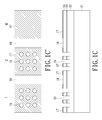
  • FIGS. 1A-1I are the cross sectional views of the LED array in accordance of the first embodiment of present application.
  • FIGS. 1A ′- 1 G′ are the top views of the first embodiment of LED array disclosed by present application.
  • FIGS. 2A-2I are the cross sectional views of the second embodiment of LED array disclosed by present application.
  • FIGS. 2A ′- 2 G′ are the top views of the second embodiment of LED array disclosed by present application.
  • the present application discloses an LED array having N light-emitting diode units (N ⁇ 3) comprising a first light-emitting diode unit, a second light-emitting diode unit in sequence to the (N ⁇ 1) th light-emitting diode unit and an N th light-emitting diode unit.
  • the LED array further comprises a first area (I), the second area (II), and the third area (III).
  • the first area (I) comprises the first light-emitting diode unit
  • the third area (III) comprises the N th light-emitting diode unit
  • the second area (II) locates between the first area (I) and the third area (III) and comprises the second light-emitting diode unit in sequence to the (N ⁇ 1) th diode units.
  • the first embodiment discloses a first LED array 1 having three light-emitting diode units.
  • FIGS. 1A to 1I illustrate the cross sectional views and the FIGS. 1A ′ to 1 G′ illustrate the top views of the first embodiment of the first LED array 1 .
  • the method for manufacturing the first LED array 1 comprises steps of:
  • the second embodiment discloses a second LED array 2 having three light-emitting diode units.
  • FIGS. 2A to 2I illustrate the cross sectional views and the FIGS. 2A ′ to 2 G′ illustrate the top views of the second embodiment of LED array 2 .
  • the method for manufacturing the second LED array 2 comprises steps of:
  • the temporary substrate 11 described in the above first and second embodiments is made of, for example, gallium arsenide (GaAs), gallium phosphide (GaP), sapphire, silicon carbide (SiC), gallium nitride (GaN), or aluminum nitride.
  • the epitaxial structure is made of an III-V group semiconductor material which is the series of aluminum gallium indium phosphide (AlGaInP) or the series of aluminum gallium indium nitride (AlGaInN).
  • the conductive connecting layer 17 comprises indium tin oxide, cadmium tin oxide, antimony tin oxide, indium zinc oxide, aluminum zinc oxide, and zinc tin oxide.
  • the first isolation layer 19 and the second isolation layer 22 can be made of an insulating material comprises silicon dioxide, titanium monoxide, titanium dioxide, trititanium pentoxide, titanium sesquioxide, cerium dioxide, zinc sulfide, and alumina.
  • the first conductive layer 26 and the second conductive layer 23 can be made of silver or aluminum.
  • the bonding layer 24 is an electrically conductive material made of metal or its alloys such as AuSn, PbSn, AuGe, AuBe, AuSi, Sn, In, Au, or PdIn.
  • the permanent substrate 25 is a conductive material such as carbides, metals, metal alloys, metal oxides, metal composites, etc.
  • the crossover metal layer 21 comprises metal, metal alloys, and metal oxides.

Landscapes

  • Led Devices (AREA)

Abstract

A light-emitting structure includes an epitaxial structure including a plurality of trenches; a conductive connecting layer, disposed under the epitaxial structure; a first isolation layer; a crossover metal layer, disposed under the first isolation layer and including a plurality of protruding portions protruding into the epitaxial structure through the plurality of trenches; a second isolation layer, disposed under the crossover metal layer; a bonding layer disposed under the second isolation layer; a substrate, disposed under the bonding layer; and an electrode, electrically connected to the conductive connecting layer and disposed adjacent to the epitaxial structure in a cross-sectional view.

Description

REFERENCE TO RELATED APPLICATION
This application is a continuation application of U.S. Ser. No. 15/401,850 entitled “LIGHT-EMITTING STRUCTURE”, filed on Jan. 9, 2017, now U.S. Pat. No. 9,825,090, which is a continuation application of U.S. Ser. No. 14/954,708 entitled “LED ARRAY”, filed on Nov. 30, 2015, now U.S. Pat. No. 9,553,127, which is a divisional application of U.S. Ser. No. 14/330,914, entitled “LED ARRAY”, filed on Jul. 14, 2014, now U.S. Pat. No. 9,202,981, which is a division of U.S. patent application Ser. No. 14/065,330, entitled “LED ARRAY”, filed on Oct. 28, 2013, now U.S. Pat. No. 8,779,449, which is a division of U.S. patent application Ser. No. 13/428,974, entitled “LED ARRAY”, filed on Mar. 23, 2012, now U.S. Pat. No. 8,569,775, which claims the right of priority based on Taiwan patent application Ser. No. 100110029, filed on Mar. 23, 2011, now Pat. No. TW I488331, the entireties of which are incorporated by reference herein.
TECHNICAL FIELD
The application relates to a light-emitting structure, and more particularly to a light-emitting structure having protrusion portion.
DESCRIPTION OF BACKGROUND ART
Recently, based on the progress of epitaxy process technology, the light-emitting diode(LED) becomes one of the potential solid-state lighting (SSL) source. Due to the limitation of physics mechanism, LEDs can only be driven by DC power source. Thus the regulator circuit, buck circuit, and other electronic devices are necessary for every lighting device using LED as lighting source to convert AC power source into DC power source to drive LED. However, the addition of the regulator circuit, buck circuit, and other electronic device raises the cost of lighting device using LED as lighting source and causes the low AC/DC conversion efficiency and the huge lighting device package also affect the reliability and shorten the lifetime of LED in daily use.
SUMMARY OF THE DISCLOSURE
The present application discloses a light-emitting structure including: an epitaxial structure including a plurality of trenches; a conductive connecting layer, disposed under the epitaxial structure; a first isolation layer; a crossover metal layer, disposed under the first isolation layer and including a plurality of protruding portions protruding into the epitaxial structure through the plurality of trenches; a second isolation layer, disposed under the crossover metal layer; a bonding layer disposed under the second isolation layer; a substrate, disposed under the bonding layer; and an electrode, electrically connected to the conductive connecting layer and disposed adjacent to the epitaxial structure in a cross-sectional view.
The present application discloses a light-emitting structure including a first epitaxial unit; a second epitaxial unit disposed next to the first epitaxial unit; a crossover metal layer including a first protruding portion laterally overlapping the first epitaxial unit and the second epitaxial unit wherein the first protruding portion is electrically connected with the first epitaxial unit and the second epitaxial unit; a conductive connecting layer disposed below the first epitaxial unit and the second epitaxial unit and surrounding the first protruding portion; and an electrode arranged on the conductive connecting layer.
The present application discloses a light-emitting structure including a light-emitting unit; a crossover metal layer including a protruding portion laterally overlapping the light-emitting unit, wherein the protruding portion is electrically connected with the light-emitting unit; a conductive connecting layer disposed below the light-emitting and surrounding the protruding portion; and an electrode arranged on the conductive connecting layer; wherein a top surface of the protruding portion contacts a surface of the light-emitting unit or the protruding portion is devoid of passing through the first epitaxial unit.
The present application discloses an LED array including a permanent substrate, a bonding layer on the permanent substrate, a second conductive layer on the bonding layer, a second isolation layer on the second conductive layer, a crossover metal layer on the second isolation layer, a first isolation layer on the crossover metal layer, a conductive connecting layer on the first isolation layer, an epitaxial structure on the conductive connecting layer, and a first electrode layer on the epitaxial structure.
The present application further discloses an LED array including a permanent substrate, a bonding layer on the permanent substrate, a first conductive layer on the bonding layer, a second isolation layer on the first conductive layer, a crossover metal layer on the second isolation layer, a first isolation layer on the crossover metal layer, a conductive connecting layer on the first isolation layer, and an epitaxial structure on the conductive connecting layer.
The present application further discloses an Led array having N light-emitting diode units (N≥3) and the light-emitting diode units are electrically connected with each other by the crossover metal layer.
BRIEF DESCRIPTION OF THE DRAWINGS
FIGS. 1A-1I are the cross sectional views of the LED array in accordance of the first embodiment of present application.
FIGS. 1A′-1G′ are the top views of the first embodiment of LED array disclosed by present application.
FIGS. 2A-2I are the cross sectional views of the second embodiment of LED array disclosed by present application.
FIGS. 2A′-2G′ are the top views of the second embodiment of LED array disclosed by present application.
DETAILED DESCRIPTION OF PREFERRED EMBODIMENTS
The present application discloses an LED array having N light-emitting diode units (N≥3) comprising a first light-emitting diode unit, a second light-emitting diode unit in sequence to the (N−1)th light-emitting diode unit and an Nth light-emitting diode unit. The LED array further comprises a first area (I), the second area (II), and the third area (III). The first area (I) comprises the first light-emitting diode unit, the third area (III) comprises the Nth light-emitting diode unit, and the second area (II) locates between the first area (I) and the third area (III) and comprises the second light-emitting diode unit in sequence to the (N−1)th diode units.
The first embodiment discloses a first LED array 1 having three light-emitting diode units. FIGS. 1A to 1I illustrate the cross sectional views and the FIGS. 1A′ to 1G′ illustrate the top views of the first embodiment of the first LED array 1. The method for manufacturing the first LED array 1 comprises steps of:
    • 1. Providing a temporary substrate 11, and forming an epitaxial structure thereon. The epitaxial structure comprises a first conductive semiconductor layer 12, an active layer 13, and a second conductive semiconductor layer 14 as illustrated in FIGS. 1A and 1A′.
    • 2. Next, forming multiple trenches 15 by partially etching the epitaxial structure in the first area (I) and the second area (II), and the epitaxial structure not etched forms multiple flat planes 16, and the epitaxial structure of the third area (III) is not etched as illustrated in FIGS. 1B and 1B′.
    • 3. Forming a conductive connecting layer 17 on partial regions of the flat planes 16, and the area of the flat planes 16 uncovered by the conductive connecting layer 17 forms multiple pathways 18 as illustrated in FIGS. 1C and 1C′.
    • 4. Forming a first isolation layer 19 on part of the conductive connecting layer 17, the multiple pathways 18, and the side wall of the multiple trenches 15, while the conductive connecting layer 17 in the third area (III) and part of the conductive connecting layer 17 in the first area (I) are not covered by the first isolation layer 19. The conductive connecting layer 17 not covered by the first isolation layer 19 in the second area (II) is defined as a conductive region 20 as illustrated in FIGS. 1D and 1D′.
    • 5. Forming a crossover metal layer 21 on the first isolation layer 19, the conductive region 20, in multiple trenches 15, and on the conductive connecting layer 17 in the third area (III). A part of the conductive connecting layer 17 in the first area (I) is not covered by the crossover metal layer 21 in order to electrically connect the second conductive layer 23 with the second conductive semiconductor layer 14 in the following steps. The region which is not covered by the crossover metal layer 21 in the second area (II) nearby the conductive region 20 is used for electrical isolation as illustrated in the FIGS. 1E and 1E′. Part of the crossover metal layer 21 in the first area (I) extends to multiple trenches 15 and electrically connects to the first conductive semiconductor layer 12. The crossover metal layer 21 on multiple flat planes 16 and the pathways 18 in the first area (I) is electrically isolated from the second conductive semiconductor layer 14 by the first isolation layer 19. The crossover metal layer 21 on the conductive region 20 in the second area (II) electrically connects with the second conductive semiconductor layer 14 by the conductive connecting layer 17. Part of the crossover metal layer 21 in the second area (II) extends to multiple trenches 15 and electrically connects to the first conductive semiconductor layer 12. The crossover metal layer 21 on multiple flat planes 16 and the pathways 18 in the second area (II) is electrically isolated from the second conductive semiconductor layer 14 by the first isolation layer 19. The crossover metal layer 21 in the third area (III) is electrically connected with the second conductive semiconductor layer 14 by the conductive connecting layer 17.
    • 6. Forming a second isolation layer 22 on the crossover metal layer 21 and the region a in the second area (II). But part of the conductive connecting layer 17 in the first area (I) is not covered by the second isolation layer 22 as illustrated in the FIGS. 1F and 1F′.
    • 7. Forming the second conductive layer 23 on the second isolation layer 22 and part of the conductive connecting layer 17 as illustrated in the as illustrated in the FIGS. 1G and 1G′.
    • 8. Forming a bonding layer 24 on the second conductive layer 23 which is bonded with a permanent substrate 25 by the bonding layer 24 as illustrated in the FIG. 1H.
    • 9. Removing the temporary substrate 11 to expose the first conductive semiconductor layer 12 and roughening the surface of the first conductive semiconductor layer 12. Next, etching multiple pathways 18 from the first conductive semiconductor layer 12 until the first isolation layer 19 is revealed in order to form N light-emitting diode units. Among the N light-emitting diode units, the first light-emitting diode unit locates in the first area (I), the second to the (N−1)th light-emitting diode units locate in the second area (II), and the Nth light-emitting diode unit locates in the third area (III). At last, forming a first electrode layer 27 on the roughed surface of the first conductive semiconductor layer 12 in the Nth light-emitting diode unit. Thus an LED array 1 having N light-emitting diode units electrically connected in serial by the crossover metal layer 21 is formed as illustrated in FIG. 1I.
The second embodiment discloses a second LED array 2 having three light-emitting diode units. FIGS. 2A to 2I illustrate the cross sectional views and the FIGS. 2A′ to 2G′ illustrate the top views of the second embodiment of LED array 2. The method for manufacturing the second LED array 2 comprises steps of:
    • 1. Providing a temporary substrate 11, and forming an epitaxial structure thereon. The epitaxial structure comprises a first conductive semiconductor layer 12, an active layer 13, and a second conductive semiconductor layer 14 as illustrated in FIGS. 2A and 2A′.
    • 2. Next, forming multiple trenches 15 by partially etching the epitaxial structure in the first area (I), the second area (II), and the third area (III), and the epitaxial structure not etched forms multiple flat planes 16 as illustrated in FIGS. 2B and 2B′.
    • 3. Forming a conductive connecting layer 17 on partial regions of the flat planes 16, and the area of the flat planes 16 uncovered by the conductive connecting layer 17 forms multiple pathways 18 as illustrated in FIGS. 2C and 2C′.
    • 4. Forming a first isolation layer 19 on part of the conductive connecting layer 17, the multiple pathways 18, and the side wall of the multiple trenches 15. The conductive connecting layer 17 in the second area (II) and the third area (III) which is not covered by the first isolation layer 19 are defined as a conductive region 20 as illustrated in FIGS. 2D and 2D′.
    • 5. Forming a crossover metal layer 21 on the first isolation layer 19, the conductive region 20, and in the multiple trenches 15 except those in the third area (III). A part of the first isolation layer 19 in the first area (I) is not covered by the crossover metal layer 21 in order to electrically isolate the first conductive layer 26 from the second conductive semiconductor layer 14 in the following steps. The first isolation layer 19 in multiple trenches 15 and flat planes 16 is not covered by the crossover metal layer 21 in order to electrically isolate the first conductive layer 26 from the second conductive semiconductor layer 14 in the following steps as illustrated in the FIGS. 2E and 2E′. A part of the crossover metal layer 21 in the first area (I) extends to multiple trenches 15 and electrically connects to the first conductive semiconductor layer 12. The crossover metal layer 21 on multiple flat planes 16 and the pathways 18 in the first area (I) is electrically isolated from the second conductive semiconductor layer 14 by the first isolation layer 19. The crossover metal layer 21 on the conductive region 20 in the second area (II) electrically connects with the second conductive semiconductor layer 14 by the conductive connecting layer 17. A part of the crossover metal layer 21 in the second area (II) extends into the multiple trenches 15 and electrically connects to the first conductive semiconductor layer 12. The crossover metal layer 21 on multiple flat planes 16 and the pathways 18 in the second area (II) is electrically isolated from the second conductive semiconductor layer 14 by the first isolation layer 19. The crossover metal layer 21 on the conductive region 20 in the third area (III) electrically connects with the second conductive semiconductor layer 14 by the conductive connecting layer 17. Besides, the region b in the second area (II) and the third area (III) adjacent to the conductive region 20 is not fully covered by the crossover metal layer 21 which is used for electrical isolation.
    • 6. Forming a second isolation layer 22 on the crossover metal layer 21, the part of the first isolation layer 19 in the first area (I), and on the region b which is not fully covered by the crossover metal layer 21 in the second area (II). The second isolation layer 22 does not cover the inner side of the trenches 15 in the third area (III), the first isolation layer 19 of the multiple flat planes 16, and the region b which is not fully covered by the crossover metal layer 21 in the third area (III) as illustrated in the FIGS. 2F and 2F′.
    • 7. Forming the first conductive layer 26 on the second isolation layer 22, in the multiple trenches 15 in the third area (III), on the first isolation layer 19 of the flat planes 16, and the region b which is not fully covered by the crossover metal layer 21 in the third area (III) as illustrated in the FIGS. 2G and 2G′.
    • 8. Forming a bonding layer 24 on the first conductive layer 26 which is bonded with a permanent substrate 25 by the bonding layer 24 as illustrated in the FIG. 2H.
    • 9. Removing the temporary substrate 11 to expose the first conductive semiconductor layer 12 and roughs the surface of the first conductive semiconductor layer 12. Next, etching multiple pathways 18 form the first conductive semiconductor layer 12 until the first isolation layer 19 is revealed in order to form N light-emitting diode units. Among the N light-emitting diode units, the first light-emitting diode unit locates in the first area (I), the second to the (N−1)th light-emitting diode units locate in the second area (II), and the Nth light-emitting diode unit locates in the third area (III). Next, etching the first conductive semiconductor layer 12 in the first area (I) without the crossover metal layer 21 until the conductive connecting layer 17 is revealed, and forming a second electrode layer 28 on the conductive connecting layer 17. Thus an LED array 2 having N light-emitting diode units electrically connected in series by the crossover metal layer 21 is formed as illustrated in FIG. 2I.
The temporary substrate 11 described in the above first and second embodiments is made of, for example, gallium arsenide (GaAs), gallium phosphide (GaP), sapphire, silicon carbide (SiC), gallium nitride (GaN), or aluminum nitride. The epitaxial structure is made of an III-V group semiconductor material which is the series of aluminum gallium indium phosphide (AlGaInP) or the series of aluminum gallium indium nitride (AlGaInN). The conductive connecting layer 17 comprises indium tin oxide, cadmium tin oxide, antimony tin oxide, indium zinc oxide, aluminum zinc oxide, and zinc tin oxide. The first isolation layer 19 and the second isolation layer 22 can be made of an insulating material comprises silicon dioxide, titanium monoxide, titanium dioxide, trititanium pentoxide, titanium sesquioxide, cerium dioxide, zinc sulfide, and alumina. The first conductive layer 26 and the second conductive layer 23 can be made of silver or aluminum. The bonding layer 24 is an electrically conductive material made of metal or its alloys such as AuSn, PbSn, AuGe, AuBe, AuSi, Sn, In, Au, or PdIn. The permanent substrate 25 is a conductive material such as carbides, metals, metal alloys, metal oxides, metal composites, etc. The crossover metal layer 21 comprises metal, metal alloys, and metal oxides.
Although the present application has been explained above, it is not the limitation of the range, the sequence in practice, the material in practice, or the method in practice. Any modification or decoration for present application is not detached from the spirit and the range of such.

Claims (15)

What is claimed is:
1. A light-emitting structure comprising:
an epitaxial structure comprising a plurality of trenches;
a conductive connecting layer, disposed under the epitaxial structure;
a first isolation layer;
a crossover metal layer, disposed under the first isolation layer and comprising a plurality of protruding portions protruding into the epitaxial structure through the plurality of trenches;
a second isolation layer, disposed under the crossover metal layer;
a bonding layer disposed under the second isolation layer;
a substrate, disposed under the bonding layer; and
an electrode, electrically connected to the conductive connecting layer and disposed adjacent to the epitaxial structure in a cross-sectional view.
2. The light-emitting structure of claim 1, wherein the epitaxial structure comprises:
a first conductive semiconductor layer;
an active layer, disposed under the first conductive semiconductor layer, and
a second conductive semiconductor layer, disposed under the active layer.
3. The light-emitting structure of claim 2, wherein the plurality of trenches extends from the second conductive semiconductor layer to the first conductive semiconductor layer and is devoid of passing through the epitaxial structure.
4. The light-emitting structure of claim 3, wherein the plurality of protruding portions contacts the first conductive semiconductor layer through the plurality of trenches.
5. The light-emitting structure of claim 1, wherein the first isolation layer comprises a portion disposed on a side wall of each of the plurality of trenches.
6. The light-emitting structure of claim 5, wherein the first isolation layer comprises another portion disposed under the conductive connecting layer.
7. The light-emitting structure of claim 1, wherein the electrode is not covered by the epitaxial structure.
8. The light-emitting structure of claim 1, wherein the conductive connecting layer surrounds the plurality of protruding portions.
9. The light-emitting structure of claim 1, wherein a top surface of the epitaxial structure is roughened.
10. The light-emitting structure of claim 1, wherein a width of the conductive connecting layer is substantially equal to that of the light-emitting structure in a top view.
11. The light-emitting structure of claim 1, wherein in a top view, the conductive connecting layer comprising a plurality of openings substantially corresponding to the plurality of trenches.
12. The light-emitting structure of claim 1, wherein the epitaxial structure comprises a plurality of epitaxial units electrically connecting each other in a cross-sectional view.
13. The light-emitting structure of claim 1, further comprising a conductive layer formed between the epitaxial structure and the substrate.
14. The light-emitting structure of claim 13, wherein a material of the conductive layer comprises silver or aluminum.
15. The light-emitting structure of claim 1, wherein a material of the conductive connecting layer comprises indium tin oxide, cadmium tin oxide, antimony tin oxide, indium zinc oxide, aluminum zinc oxide, or zinc tin oxide.
US15/727,276 2011-03-23 2017-10-06 Light-emitting structure Active US10026778B2 (en)

Priority Applications (1)

Application Number Priority Date Filing Date Title
US15/727,276 US10026778B2 (en) 2011-03-23 2017-10-06 Light-emitting structure

Applications Claiming Priority (9)

Application Number Priority Date Filing Date Title
TW100110029A TWI488331B (en) 2011-03-23 2011-03-23 Light-emitting diode array
TW100110029A 2011-03-23
TW100110029 2011-03-23
US13/428,974 US8569775B2 (en) 2011-03-23 2012-03-23 Light-emitting diode (LED) array
US14/065,330 US8779449B2 (en) 2011-03-23 2013-10-28 Light-emitting diode (LED) array
US14/330,914 US9202981B2 (en) 2011-03-23 2014-07-14 LED array
US14/954,708 US9553127B2 (en) 2011-03-23 2015-11-30 LED array
US15/401,850 US9825090B2 (en) 2011-03-23 2017-01-09 Light-emitting structure
US15/727,276 US10026778B2 (en) 2011-03-23 2017-10-06 Light-emitting structure

Related Parent Applications (1)

Application Number Title Priority Date Filing Date
US15/401,850 Continuation US9825090B2 (en) 2011-03-23 2017-01-09 Light-emitting structure

Publications (2)

Publication Number Publication Date
US20180033824A1 US20180033824A1 (en) 2018-02-01
US10026778B2 true US10026778B2 (en) 2018-07-17

Family

ID=46876578

Family Applications (6)

Application Number Title Priority Date Filing Date
US13/428,974 Active US8569775B2 (en) 2011-03-23 2012-03-23 Light-emitting diode (LED) array
US14/065,330 Active US8779449B2 (en) 2011-03-23 2013-10-28 Light-emitting diode (LED) array
US14/330,914 Active US9202981B2 (en) 2011-03-23 2014-07-14 LED array
US14/954,708 Active US9553127B2 (en) 2011-03-23 2015-11-30 LED array
US15/401,850 Active US9825090B2 (en) 2011-03-23 2017-01-09 Light-emitting structure
US15/727,276 Active US10026778B2 (en) 2011-03-23 2017-10-06 Light-emitting structure

Family Applications Before (5)

Application Number Title Priority Date Filing Date
US13/428,974 Active US8569775B2 (en) 2011-03-23 2012-03-23 Light-emitting diode (LED) array
US14/065,330 Active US8779449B2 (en) 2011-03-23 2013-10-28 Light-emitting diode (LED) array
US14/330,914 Active US9202981B2 (en) 2011-03-23 2014-07-14 LED array
US14/954,708 Active US9553127B2 (en) 2011-03-23 2015-11-30 LED array
US15/401,850 Active US9825090B2 (en) 2011-03-23 2017-01-09 Light-emitting structure

Country Status (2)

Country Link
US (6) US8569775B2 (en)
TW (1) TWI488331B (en)

Cited By (1)

* Cited by examiner, † Cited by third party
Publication number Priority date Publication date Assignee Title
US20160247971A1 (en) * 2014-09-26 2016-08-25 Seoul Viosys Co., Ltd. Light emitting diode

Families Citing this family (6)

* Cited by examiner, † Cited by third party
Publication number Priority date Publication date Assignee Title
TWI488331B (en) * 2011-03-23 2015-06-11 Epistar Corp Light-emitting diode array
WO2015084258A1 (en) * 2013-12-02 2015-06-11 Nanyang Technological University Light-emitting device and method of forming the same
JP6692155B2 (en) * 2015-12-15 2020-05-13 スタンレー電気株式会社 Semiconductor light emitting element array and vehicle lamp
TWI676303B (en) 2018-07-10 2019-11-01 聯勝光電股份有限公司 Light emittig chip and fabrication method thereof
WO2020073295A1 (en) * 2018-10-11 2020-04-16 厦门市三安光电科技有限公司 Light-emitting diode element and manufacturing method therefor
DE102019105402A1 (en) * 2019-03-04 2020-09-10 OSRAM Opto Semiconductors Gesellschaft mit beschränkter Haftung RADIATION-EMITTING SEMICONDUCTOR CHIP, RADIATION-EMITTING SEMICONDUCTOR COMPONENT AND HEADLAMP

Citations (6)

* Cited by examiner, † Cited by third party
Publication number Priority date Publication date Assignee Title
US20020005523A1 (en) 1999-03-18 2002-01-17 Sony Corporation Semiconductor light emitting device and manufacturing method thereof
WO2009106063A1 (en) 2008-02-29 2009-09-03 Osram Opto Semiconductors Gmbh Monolithic, optoelectronic semi-conductor body and method for the production thereof
US20110233587A1 (en) 2010-03-24 2011-09-29 Hitachi Cable, Ltd. Light emitting diode
US20120007044A1 (en) 2009-12-31 2012-01-12 Seoul Opto Device Co., Ltd. Light emitting device and method of fabricating the same
US8969897B2 (en) * 2011-11-07 2015-03-03 Lg Innotek Co., Ltd. Light emitting device
US9553127B2 (en) 2011-03-23 2017-01-24 Epistar Corporation LED array

Patent Citations (6)

* Cited by examiner, † Cited by third party
Publication number Priority date Publication date Assignee Title
US20020005523A1 (en) 1999-03-18 2002-01-17 Sony Corporation Semiconductor light emitting device and manufacturing method thereof
WO2009106063A1 (en) 2008-02-29 2009-09-03 Osram Opto Semiconductors Gmbh Monolithic, optoelectronic semi-conductor body and method for the production thereof
US20120007044A1 (en) 2009-12-31 2012-01-12 Seoul Opto Device Co., Ltd. Light emitting device and method of fabricating the same
US20110233587A1 (en) 2010-03-24 2011-09-29 Hitachi Cable, Ltd. Light emitting diode
US9553127B2 (en) 2011-03-23 2017-01-24 Epistar Corporation LED array
US8969897B2 (en) * 2011-11-07 2015-03-03 Lg Innotek Co., Ltd. Light emitting device

Cited By (2)

* Cited by examiner, † Cited by third party
Publication number Priority date Publication date Assignee Title
US20160247971A1 (en) * 2014-09-26 2016-08-25 Seoul Viosys Co., Ltd. Light emitting diode
US11264540B2 (en) * 2014-09-26 2022-03-01 Seoul Viosys Co., Ltd. Light emitting diode with high luminous efficiency

Also Published As

Publication number Publication date
US20170117321A1 (en) 2017-04-27
TWI488331B (en) 2015-06-11
US9202981B2 (en) 2015-12-01
US8779449B2 (en) 2014-07-15
US20140054631A1 (en) 2014-02-27
TW201240135A (en) 2012-10-01
US20120241783A1 (en) 2012-09-27
US20180033824A1 (en) 2018-02-01
US8569775B2 (en) 2013-10-29
US9553127B2 (en) 2017-01-24
US9825090B2 (en) 2017-11-21
US20160104744A1 (en) 2016-04-14
US20140319574A1 (en) 2014-10-30

Similar Documents

Publication Publication Date Title
US10026778B2 (en) Light-emitting structure
US20110018013A1 (en) Thin-film flip-chip series connected leds
US12155026B2 (en) High-voltage solid-state transducers and associated systems and methods
US9391234B2 (en) Series connected segmented LED
TWI524556B (en) Solid state light emitting device with touchable electrode and manufacturing method
KR20140006485A (en) Semiconductor light emitting device having a multi-cell array and method for manufacturing the same
US20120168715A1 (en) Semiconductor light emitting device and method for manufacturing the same
US20120001202A1 (en) Semiconductor Light Emitting Device and Method for Manufacturing the Same
CN102130241B (en) Light emitting diode array structure and manufacturing method thereof
US8558247B2 (en) GaN LEDs with improved area and method for making the same
US8426226B2 (en) Method for fabricating integrated alternating-current light-emitting-diode module
TWI525852B (en) Led array
CN102280551B (en) Light-emitting diode and manufacture method thereof
CN105762166B (en) light emitting diode array
CN102760745B (en) LED array
CN103474446A (en) Light emitting diode array structure and manufacturing method thereof
CN104701433A (en) light emitting device
TW201830731A (en) Light-emitting device

Legal Events

Date Code Title Description
FEPP Fee payment procedure

Free format text: ENTITY STATUS SET TO UNDISCOUNTED (ORIGINAL EVENT CODE: BIG.); ENTITY STATUS OF PATENT OWNER: LARGE ENTITY

AS Assignment

Owner name: EPISTAR CORPORATION, TAIWAN

Free format text: ASSIGNMENT OF ASSIGNORS INTEREST;ASSIGNORS:JOU, LI-PING;YANG, YU-CHEN;YEH, JUI-HUNG;SIGNING DATES FROM 20160118 TO 20160127;REEL/FRAME:043827/0422

STCF Information on status: patent grant

Free format text: PATENTED CASE

MAFP Maintenance fee payment

Free format text: PAYMENT OF MAINTENANCE FEE, 4TH YEAR, LARGE ENTITY (ORIGINAL EVENT CODE: M1551); ENTITY STATUS OF PATENT OWNER: LARGE ENTITY

Year of fee payment: 4

MAFP Maintenance fee payment

Free format text: PAYMENT OF MAINTENANCE FEE, 8TH YEAR, LARGE ENTITY (ORIGINAL EVENT CODE: M1552); ENTITY STATUS OF PATENT OWNER: LARGE ENTITY

Year of fee payment: 8