US10022261B1 - Incontinence device with atmospheric equilibrium valve assembly - Google Patents

Incontinence device with atmospheric equilibrium valve assembly Download PDF

Info

Publication number
US10022261B1
US10022261B1 US15/680,335 US201715680335A US10022261B1 US 10022261 B1 US10022261 B1 US 10022261B1 US 201715680335 A US201715680335 A US 201715680335A US 10022261 B1 US10022261 B1 US 10022261B1
Authority
US
United States
Prior art keywords
pair
opposing
reflux
assembly
walls
Prior art date
Legal status (The legal status is an assumption and is not a legal conclusion. Google has not performed a legal analysis and makes no representation as to the accuracy of the status listed.)
Active
Application number
US15/680,335
Inventor
James Alan Harders
Current Assignee (The listed assignees may be inaccurate. Google has not performed a legal analysis and makes no representation or warranty as to the accuracy of the list.)
Bioderm Inc
Original Assignee
Bioderm Inc
Priority date (The priority date is an assumption and is not a legal conclusion. Google has not performed a legal analysis and makes no representation as to the accuracy of the date listed.)
Filing date
Publication date
Application filed by Bioderm Inc filed Critical Bioderm Inc
Assigned to BIODERM, INC. reassignment BIODERM, INC. ASSIGNMENT OF ASSIGNORS INTEREST (SEE DOCUMENT FOR DETAILS). Assignors: HARDERS, JAMES ALAN, PHD
Priority to US15/680,335 priority Critical patent/US10022261B1/en
Priority to DK18809836.2T priority patent/DK3576688T3/en
Priority to SI201830390T priority patent/SI3576688T1/en
Priority to EP18809836.2A priority patent/EP3576688B1/en
Priority to HRP20211384TT priority patent/HRP20211384T1/en
Priority to ES18809836T priority patent/ES2888628T3/en
Priority to PCT/US2018/035202 priority patent/WO2018222763A1/en
Priority to PT188098362T priority patent/PT3576688T/en
Priority to LTEPPCT/US2018/035202T priority patent/LT3576688T/en
Priority to PL18809836T priority patent/PL3576688T3/en
Priority to SM20210505T priority patent/SMT202100505T1/en
Priority to RS20211089A priority patent/RS62298B1/en
Priority to HUE18809836A priority patent/HUE056318T2/en
Priority to CA3058756A priority patent/CA3058756C/en
Publication of US10022261B1 publication Critical patent/US10022261B1/en
Application granted granted Critical
Assigned to ABACUS FINANCE GROUP, LLC, AS ADMINISTRATIVE AGENT reassignment ABACUS FINANCE GROUP, LLC, AS ADMINISTRATIVE AGENT SECURITY INTEREST (SEE DOCUMENT FOR DETAILS). Assignors: BIODERM, INC.
Priority to CY20211100772T priority patent/CY1124463T1/en
Assigned to OXFORD FINANCE LLC, AS AGENT reassignment OXFORD FINANCE LLC, AS AGENT SECURITY INTEREST (SEE DOCUMENT FOR DETAILS). Assignors: ARGENTUM MEDICAL, LLC, BIODERM, INC.
Assigned to BIODERM, INC. reassignment BIODERM, INC. RELEASE BY SECURED PARTY (SEE DOCUMENT FOR DETAILS). Assignors: ABACUS FINANCE GROUP, LLC, AS ADMINISTRATIVE AGENT
Active legal-status Critical Current
Anticipated expiration legal-status Critical

Links

Images

Classifications

    • AHUMAN NECESSITIES
    • A61MEDICAL OR VETERINARY SCIENCE; HYGIENE
    • A61FFILTERS IMPLANTABLE INTO BLOOD VESSELS; PROSTHESES; DEVICES PROVIDING PATENCY TO, OR PREVENTING COLLAPSING OF, TUBULAR STRUCTURES OF THE BODY, e.g. STENTS; ORTHOPAEDIC, NURSING OR CONTRACEPTIVE DEVICES; FOMENTATION; TREATMENT OR PROTECTION OF EYES OR EARS; BANDAGES, DRESSINGS OR ABSORBENT PADS; FIRST-AID KITS
    • A61F5/00Orthopaedic methods or devices for non-surgical treatment of bones or joints; Nursing devices ; Anti-rape devices
    • A61F5/44Devices worn by the patient for reception of urine, faeces, catamenial or other discharge; Colostomy devices
    • A61F5/4404Details or parts
    • A61F5/4405Valves or valve arrangements specially adapted therefor ; Fluid inlets or outlets
    • AHUMAN NECESSITIES
    • A61MEDICAL OR VETERINARY SCIENCE; HYGIENE
    • A61FFILTERS IMPLANTABLE INTO BLOOD VESSELS; PROSTHESES; DEVICES PROVIDING PATENCY TO, OR PREVENTING COLLAPSING OF, TUBULAR STRUCTURES OF THE BODY, e.g. STENTS; ORTHOPAEDIC, NURSING OR CONTRACEPTIVE DEVICES; FOMENTATION; TREATMENT OR PROTECTION OF EYES OR EARS; BANDAGES, DRESSINGS OR ABSORBENT PADS; FIRST-AID KITS
    • A61F5/00Orthopaedic methods or devices for non-surgical treatment of bones or joints; Nursing devices ; Anti-rape devices
    • A61F5/44Devices worn by the patient for reception of urine, faeces, catamenial or other discharge; Colostomy devices
    • A61F5/443Devices worn by the patient for reception of urine, faeces, catamenial or other discharge; Colostomy devices having adhesive seals for securing to the body, e.g. of hydrocolloid type seals, e.g. gels, starches, karaya gums
    • AHUMAN NECESSITIES
    • A61MEDICAL OR VETERINARY SCIENCE; HYGIENE
    • A61FFILTERS IMPLANTABLE INTO BLOOD VESSELS; PROSTHESES; DEVICES PROVIDING PATENCY TO, OR PREVENTING COLLAPSING OF, TUBULAR STRUCTURES OF THE BODY, e.g. STENTS; ORTHOPAEDIC, NURSING OR CONTRACEPTIVE DEVICES; FOMENTATION; TREATMENT OR PROTECTION OF EYES OR EARS; BANDAGES, DRESSINGS OR ABSORBENT PADS; FIRST-AID KITS
    • A61F5/00Orthopaedic methods or devices for non-surgical treatment of bones or joints; Nursing devices ; Anti-rape devices
    • A61F5/44Devices worn by the patient for reception of urine, faeces, catamenial or other discharge; Colostomy devices
    • A61F5/451Genital or anal receptacles
    • A61F5/453Genital or anal receptacles for collecting urine or other discharge from male member
    • YGENERAL TAGGING OF NEW TECHNOLOGICAL DEVELOPMENTS; GENERAL TAGGING OF CROSS-SECTIONAL TECHNOLOGIES SPANNING OVER SEVERAL SECTIONS OF THE IPC; TECHNICAL SUBJECTS COVERED BY FORMER USPC CROSS-REFERENCE ART COLLECTIONS [XRACs] AND DIGESTS
    • Y10TECHNICAL SUBJECTS COVERED BY FORMER USPC
    • Y10TTECHNICAL SUBJECTS COVERED BY FORMER US CLASSIFICATION
    • Y10T137/00Fluid handling
    • Y10T137/3149Back flow prevention by vacuum breaking [e.g., anti-siphon devices]
    • Y10T137/3185Air vent in liquid flow line
    • Y10T137/3294Valved
    • Y10T137/3331With co-acting valve in liquid flow path
    • YGENERAL TAGGING OF NEW TECHNOLOGICAL DEVELOPMENTS; GENERAL TAGGING OF CROSS-SECTIONAL TECHNOLOGIES SPANNING OVER SEVERAL SECTIONS OF THE IPC; TECHNICAL SUBJECTS COVERED BY FORMER USPC CROSS-REFERENCE ART COLLECTIONS [XRACs] AND DIGESTS
    • Y10TECHNICAL SUBJECTS COVERED BY FORMER USPC
    • Y10TTECHNICAL SUBJECTS COVERED BY FORMER US CLASSIFICATION
    • Y10T137/00Fluid handling
    • Y10T137/7722Line condition change responsive valves
    • Y10T137/7837Direct response valves [i.e., check valve type]
    • Y10T137/7879Resilient material valve
    • Y10T137/788Having expansible port
    • YGENERAL TAGGING OF NEW TECHNOLOGICAL DEVELOPMENTS; GENERAL TAGGING OF CROSS-SECTIONAL TECHNOLOGIES SPANNING OVER SEVERAL SECTIONS OF THE IPC; TECHNICAL SUBJECTS COVERED BY FORMER USPC CROSS-REFERENCE ART COLLECTIONS [XRACs] AND DIGESTS
    • Y10TECHNICAL SUBJECTS COVERED BY FORMER USPC
    • Y10TTECHNICAL SUBJECTS COVERED BY FORMER US CLASSIFICATION
    • Y10T137/00Fluid handling
    • Y10T137/7722Line condition change responsive valves
    • Y10T137/7837Direct response valves [i.e., check valve type]
    • Y10T137/7879Resilient material valve
    • Y10T137/788Having expansible port
    • Y10T137/7882Having exit lip
    • Y10T137/7884Side vent
    • YGENERAL TAGGING OF NEW TECHNOLOGICAL DEVELOPMENTS; GENERAL TAGGING OF CROSS-SECTIONAL TECHNOLOGIES SPANNING OVER SEVERAL SECTIONS OF THE IPC; TECHNICAL SUBJECTS COVERED BY FORMER USPC CROSS-REFERENCE ART COLLECTIONS [XRACs] AND DIGESTS
    • Y10TECHNICAL SUBJECTS COVERED BY FORMER USPC
    • Y10TTECHNICAL SUBJECTS COVERED BY FORMER US CLASSIFICATION
    • Y10T137/00Fluid handling
    • Y10T137/7722Line condition change responsive valves
    • Y10T137/7837Direct response valves [i.e., check valve type]
    • Y10T137/7879Resilient material valve
    • Y10T137/788Having expansible port
    • Y10T137/7882Having exit lip
    • Y10T137/7885Multiple slit
    • YGENERAL TAGGING OF NEW TECHNOLOGICAL DEVELOPMENTS; GENERAL TAGGING OF CROSS-SECTIONAL TECHNOLOGIES SPANNING OVER SEVERAL SECTIONS OF THE IPC; TECHNICAL SUBJECTS COVERED BY FORMER USPC CROSS-REFERENCE ART COLLECTIONS [XRACs] AND DIGESTS
    • Y10TECHNICAL SUBJECTS COVERED BY FORMER USPC
    • Y10TTECHNICAL SUBJECTS COVERED BY FORMER US CLASSIFICATION
    • Y10T137/00Fluid handling
    • Y10T137/7722Line condition change responsive valves
    • Y10T137/7837Direct response valves [i.e., check valve type]
    • Y10T137/7879Resilient material valve
    • Y10T137/7888With valve member flexing about securement

Definitions

  • the device disclosed herein relates generally to the field of incontinence devices, and more particularly to an external incontinence device adapted for attachment between the waist and knee of the user.
  • Urinary incontinence is a common medical problem in older males, and it sometimes occurs in juveniles in the form of nocturnal enuresis. Those experiencing these maladies can benefit from the use of an external catheter that can be worn on the body and thus be transported with the user throughout normal activities. Such devices also can be worn during normal sleep patterns.
  • urinary tract infections are proximally caused by the constant contact of exposed penis tissue to the urine collected in a tube, reservoir, or pad.
  • Incontinence pads or diapers also have been known to contribute to infections because the excreted urine in these devices is conducive to bacterial growth.
  • An additional problem related to backflow of urine is generated when the urine collection chamber is positioned adjacent to the abdominal area.
  • a user wearing an external urine collection device may experience backflow of urine from the abdominal urine collection chamber and from the chamber's proximal urinary drainage tubing into the external device due to the effects of gravity and periodic variations of intra-abdominal and bladder pressure.
  • siphon effect refers to a barometric phenomenon whereby negative pressure accumulates in the urinary drainage tubing and urine collection chamber of a conventional urine collection assembly.
  • the siphon effect phenomenon occurs as urine descends through the relatively long lengths of urinary drainage tubing present in known urine collection assemblies that directs urine from the urine collection device to the urine collection chamber.
  • urine collection chamber As urine descends through the urinary drainage tubing and drops into the urine collection chamber, which can be up to 42 inches (106.68 cm) in length, below the user's penis.
  • negative intra-luminal pressure accumulates behind the column of urine causes a partial vacuum within the tube lumen.
  • long drainage tubing is employed in an external catheter system, the vacuum created is most prevalent.
  • an external incontinence device which is not invasive, does not promote harm such as initiating urinary tract infections, does not retain urine or other fluids in close proximity to the genital skin surface, is discreet when worn, may be used by males of all ages, promotes the user compliance and thus promotes an increase in the quality of life of the user.
  • the incontinence device comprises a drainage tube assembly having a drainage tube with an atmospheric equilibrium valve assembly.
  • the integrated atmospheric equalization valve assembly mitigates the siphoning effect by allowing air into the drainage tube assembly, thereby increasing the positive air in the system overcoming the negative pressure that may be present in the drainage tube assembly.
  • the atmospheric equilibrium valve comprises an airway conduit disposed in fluid communication with the drainage tube, and a lower portion having an air inlet chamber. A one-way air valve is disposed in the airway conduit above the air inlet chamber.
  • the one-way air valve comprises a first pair of opposing walls disposed at a first set of opposing angles such that the first pair of opposing walls abut each other at an apex.
  • the apex comprises a self-sealing slit.
  • the one-way air valve further comprises a second pair of opposing walls disposed at a second set of opposing angles. Each wall of the second pair of opposing walls spans between the first pair of opposing walls.
  • the drainage tube assembly further comprises a proximal chamber in fluid communication with a drainage tube.
  • the airway conduit is placed in fluid communication with the proximal chamber.
  • the atmospheric equilibrium valve comprises amorphous material that is about 65 Shore A durometer material. It is preferred, but not required, that the thickness each of the walls of the atmospheric equalization valve is about 0.010 inch to about 0.020 inch.
  • the drainage tube assembly described herein is intended for attachment to an external incontinence device having a top para-meatal/stomal flexible hydrocolloid adhesive seal which is designed with a leaf pattern intended for attachment to the glans of the penis.
  • Exemplary external incontinence devices suitable for use with the present drainage tube assembly are disclosed in U.S. Pat. No. 7,896,857 and U.S. Pat. No. 8,551,062.
  • the top para-meatal/stomal flexible hydrocolloid adhesive seal is attached via a flexible UV curable adhesive to a housing or flexible polymer tube.
  • a second flexible hydrocolloid seal that is attached to the side of the flexible polymer tubing to be at a fixed position relative to the first seal, and having a length to extend around the top para-meatal/stomal flexible hydrocolloid adhesive seal after the leaves are secured to the glans of the penis.
  • the top para-meatal/stomal flexible hydrocolloid adhesive seal is designed with an aperture shaped to match the male penis meatus. This unique aperture may accommodate those end users/patients that have what is known as mild hypospadias.
  • Hypospadias is normally a birth defect (congenital condition) in which the opening of the urethra is located inferior to the top of the glans. Additionally the top para-meatal/stomal flexible hydrocolloid adhesive seal accommodates physiological anomalies such as meatal erosion due to indwelling catheter wear.
  • the top para-meatal/stomal flexible hydrocolloid adhesive seal is a highly elastic hydrocolloid wafer which has a unique leaf feature that is so designed as to eliminate or minimize the chance occurrence of a phenomenon called tenting of the overlapping leaves when attached to the glans of the penis. It also may accommodate a plethora of shapes and sizes of the penis glans, which aids in a positive seal around the glans so as to eliminate or minimize the chance occurrence of urine leakage during time of micturition by the patient.
  • the top para-meatal/stomal flexible hydrocolloid adhesive seal wafer is designed with an anatomically friendly aperture to accommodate an end user/patient that may have the condition known as meatal erosion or a condition known as hypospadias.
  • the soft and flexible nature of the hydrocolloid wafer offer additional comfort to the end user/patient during use.
  • the second wafer is also a flexible highly elastic hydrocolloid material which will allow for attachment to the glans of the penis. This highly elastic hydrocolloid material will maintain its adhesion properties through all flaccid or erectile phases of the penis.
  • the flexibly hydrocolloid wafer will form to the penis glans and not lose adhesion properties. Because of flexible nature and position of the device on the glans, this mitigates potential ischemia of the penis tissue.
  • the drainage tube assembly disclosed herein further comprises a main flexible polymer drainage tube that is designed with a self-sealing, anti-reflux valve, which is integrated at the end of the tubing, thus eliminating extra components used in the construction of earlier urine collection assemblies.
  • This main anti-reflux valve is designed to be reactive to very small pressure changes.
  • the material chosen for this design is subject to modulus of elasticity changes, in that small increases in temperature changes will have a significant effect on the flexibility of the valve walls such that the modulus of elasticity of a polymer can change by as much as a factor of 1,000 when the temperature is increased.
  • the main purpose of the self-sealing, anti-reflux valve integrated into the main collection tube is configured to prevent urine from backing up out of the collection chamber and onto the end user and coming in contact with the users' urethra and possible ingress into the bladder of an end user.
  • a small amount of pressure is exerted on the reservoir collection bag, this will conversely collapse the walls of the self-sealing, anti-reflux valve, thus closing the valve and eliminating or minimizing the chance occurrence of urine regurgitating back toward the end user.
  • FIG. 1 shows one embodiment of a typical external incontinence device for which the present drainage tube assembly is intended for use.
  • FIG. 2 is a cross sectional view of one embodiment of the present drainage tube assembly.
  • FIG. 3 is a cross sectional view of one embodiment of a one-way air valve, showing the first pair of opposing sidewalls in cross section.
  • FIG. 4 is a cross sectional view of one embodiment of a one-way air valve, showing the second pair of opposing sidewalls in cross section.
  • FIG. 5 is an isometric view of one embodiment of the drainage tube assembly position for placement against the parameatal barrier body of a typical external incontinence device.
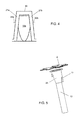
  • FIG. 6 is a partial cross sectional view of one embodiment of the atmospheric equilibrium valve assembly, where the drainage tube assembly comprises a proximal chamber.
  • FIG. 7 is an enlarged cross sectional view of the atmospheric equilibrium valve assembly shown in FIG. 6 .
  • FIG. 8 is an enlarged cross sectional view of the atmospheric equilibrium valve assembly shown in FIG. 7 , the view of FIG. 8 being in an orientation perpendicular to the view shown in FIG. 7 .
  • FIG. 9 is an isometric view of one embodiment of the drainage tube assembly having a proximal chamber and an anti-reflux valve.
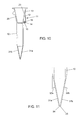
  • FIG. 10 is a cross section view of the drainage tube assembly shown in FIG. 9 .
  • FIG. 11 is an enlarged cross section of the anti-reflux valve shown in FIG. 10 .
  • FIG. 12 is an isometric view of the drainage tube assembly shown in FIG. 9 where the drainage tube assembly is position for placement against the parameatal barrier body.
  • FIG. 13 is an enlarged cross section of the anti-reflux valve shown in FIG. 11 , further showing the enlargement of the first pair of anti-reflux walls in a position forming a bellows.
  • the drainage tube assembly 5 disclosed herein is primarily intended for use with an external incontinence device having a drainage bag 1 a parameatal barrier body 2 , and an independent second seal 3 .
  • the parameatal barrier body 2 and an independent second seal 3 are attached to the user's body, and the present drainage tube assembly 5 provides drainage of urine into the drainage bag 1 .
  • the drainage tube assembly 5 comprises a drainage tube 10 with an atmospheric equilibrium valve assembly 11 disposed exterior to the drainage tube 10 .
  • the atmospheric equilibrium valve assembly 11 comprises an airway conduit 12 having an upper portion 13 and a lower portion 14 , the upper portion 13 disposed in fluid communication with the drainage tube 10 , and a lower portion 14 having an air inlet chamber 15 that is disposed in direct fluid communication with the ambient air external to the drainage tube assembly 5 .
  • the airway conduit 12 is disposed parallel, or substantially parallel, to the drainage tube 10 .
  • a one-way air valve 16 is disposed in the airway conduit 12 above the air inlet chamber 15 .
  • the one-way air valve 16 comprises a first pair of opposing walls 17 a , 17 b disposed at a first set of opposing angles 18 a , 18 b such that the first pair of opposing walls 17 a , 17 b abut each other at an apex 19 .
  • the first set of opposing angles 18 a , 18 b comprise two angles 18 a , 18 b that are approximately equal in degrees (or radians), and opposite in direction so that the respective walls 17 a , 17 b lean toward each other.
  • the apex 19 comprises a self-sealing slit 20 defined by the top edge of each wall of the first pair of opposing walls 17 a , 17 b placed in abutting contact. It is preferred, but not required, that each angle 18 a , 18 b of the first set of opposing angles 18 a , 18 b is in the range of about 23° to about 25° when measured in a plane approximately perpendicular to the self-sealing slit 20 .
  • the one-way air valve 16 further comprises a second pair of opposing walls 21 a , 21 b disposed at a second set of opposing angles 22 a , 22 b .
  • Each wall of the second pair of opposing walls 21 a , 21 b spans between the first pair of opposing walls 17 a , 17 b .
  • each angle in the second set of opposing angles 22 a , 22 b is in the range of about 11° to about 13° as measured in a plane approximately parallel to the self-sealing slit 20 .
  • the drainage tube assembly 5 further comprises a proximal chamber 25 in fluid communication with a drainage tube 10 , the proximal chamber 25 having a frustoconical shape (see, e.g., FIGS. 5 and 6 ).
  • the upper portion 13 of the atmospheric equilibrium valve assembly 11 which is disposed on the exterior of the proximal chamber 25 , is placed in fluid communication with the proximal chamber 25 .
  • the airway conduit 12 is disposed in fluid communication with the proximal chamber 25 via an interface 26 having a beveled orientation in relation to the airway conduit 12 .
  • the airway conduit 12 is disposed parallel, or substantially parallel, to the drainage tube 10 .
  • the atmospheric equilibrium valve assembly 11 comprises the same elements and embodiments as those disclosed in relation to the drainage tube assembly 5 discussed above.
  • the atmospheric equilibrium valve assembly 11 and specifically the one-way air valve 16 , comprises material that is about 65 Shore A durometer material.
  • Materials suitable for the one-way air valve 16 are a variety of amorphous materials, which often involve sheared material interfaces having behavior described by more complicated constitutive equations than simple fluids or crystalline solids. Amorphous materials flow like a fluid under large stress or creep, or remain stationary under smaller stresses. These materials have complex, history-dependent behavior. Amorphous materials may be subject to changes of their modulus of elasticity, E, by as much as 1,000 times when subjected to small temperature changes that come in direct contact with the material.
  • Amorphous solids are isotropic in nature, which means that in all the directions their physical properties will remain same. Viscoelasticity of the amorphous material allows the material to exhibit both viscous and elastic characteristics when undergoing deformation.
  • Suitable materials for the present atmospheric equilibrium valve assembly 11 will exhibit properties such as high wear resistance, damage tolerance, a Glass Transition (T g ) of about +28, moulded tensile strength of about 40 to about 60 N/m 2 , and a moulded elongation at break of about 425%.
  • T g Glass Transition
  • One such suitable material is non-phthalate amorphous PVC.
  • each of the walls of the one-way air valve 16 is about 0.010 inch to about 0.020 inch. In other words, this is the preferred thickness range for each of the walls of the first pair of opposing walls 17 a , 17 b and the second pair of opposing sidewalls 21 a , 21 b.
  • the minimum pressure to open the one-way air valve 16 is about 761 to about 770 mm Hg (about 14.715 to about 14.889 psi).
  • a small increase in the atmospheric pressure exerting on the inside of the one-way air valve 16 will cause the self-sealing slit 20 to separate, thereby enabling the pressure differential that may be present inside the air inlet chamber 15 to equalize.
  • This equalization will force urine accumulated in the drainage tube 10 through the drainage tube 10 while minimizing or eliminating the siphoning effect.
  • the minimum of pressure to close the one-way air valve 16 is roughly the same as the pressure to open the one-way air valve 16 .
  • the viscoelasticity memory properties of the amorphous material assist in the closure of the one-way air valve 16 .
  • the one-way air valve 16 operates and functions on the principle of a pressure differential that may exist in the drainage tube 10 , and especially in the proximal chamber 25 , and the normal outside atmospheric pressure. For example, as the pressure decreases in the proximal chamber 25 (vacuum created), this will enable air from the outside to open the one-way air valve 16 , thereby allowing the proximal chamber 25 to equalize and break any vacuum that may exist in the proximal chamber 25 .
  • the angled orientation of the first pair of opposing walls 17 a , 17 b enables the hydrostatic back pressure against the walls to properly close the self-sealing slit 20 , thereby closing the one-way air valve 16 .
  • the one-way action of the valve 16 enables the inflow of air to promote pressure equilibrium, while preventing the backflow of liquid, which would otherwise result in urine leakage from the drainage tube assembly 5 .
  • the drainage tube assembly 5 further comprises a self-sealing, anti-reflux valve 30 , which preferably comprises the same material as that used for the atmospheric equalization valve assembly 11 .
  • the anti-reflux valve 30 comprises a one-way duckbill valve having a first pair of anti-reflux walls 31 a , 31 b disposed at a third set of opposing angles 32 a , 32 b to form an anti-reflux apex 33 having a self-sealing anti-reflux slit 34 .
  • the anti-reflux valve 30 further comprise a second pair of anti-reflux walls 35 a , 35 b , which are analogous to the second pair of opposing walls of the one-way air valve 16 .
  • the walls in the second pair of anti-reflux walls 35 a , 35 b are disposed at a fourth set of opposing angles.
  • each of the walls in the anti-reflux valve 30 has a thickness in the range of about 0.015 inch to about 0.025 inch.
  • a thinner wall thickness does not provide sufficient stiffness to force urine through the anti-reflux slit 34 , while a thicker wall thickness will not allow anti-reflux valve 30 to form a bellows 40 (see FIG. 13 )—the walls 31 a , 31 b , 35 a , 35 b would be too stiff and thus may hinder the self-sealing properties of the amorphous polymer material.
  • each angle in the third set of opposing angles 32 a , 32 b is in the range of about 21 degrees to about 23 degrees as measured in a first plane that is approximately perpendicular to the orientation of the anti-reflux slit 34 .
  • each angle in the fourth set of opposing angles is in the range of about 3 degrees to about 5 degrees in a second plane that is approximately perpendicular to the first plane, as measured to vertical.
  • Each angle in the third set of opposing angles 32 a , 32 b and the fourth set of opposing angles can be adjusted to increase the surface area that can be affected by the pressure against the walls 31 a , 31 b , 35 a , 35 b , which would increase urine contact and thus the bellows 40 would be larger.
  • the larger surface area would be advantageous to allow back pressure against the flat surfaces of the walls 31 a , 31 b , 35 a , 35 b thus increasing the self-sealing properties of the anti-reflux valve 30 , thereby ensuring the anti-regurgitation feature of the valve 30 is enhanced.
  • the smaller surface area would have the reverse effect.
  • the minimum pressure to open the anti-reflux valve 30 with urine passing through the drainage tube 10 and contacting the walls 31 a , 31 b , 35 a , 35 b is about 14.65 psi (about 758 mm Hg). This pressure could theoretically be smaller as the temperature of the urine will assist in the opening of the anti-reflux valve 30 .
  • the minimum of pressure to close the anti-reflux valve 30 is roughly the same as the pressure to open the valve 30 , which is about 14.65 psi (about 758 mm Hg). It is preferable, but not required, that the anti-reflux valve comprises the same amorphous material with a 65 Shore A durometer.

Landscapes

  • Health & Medical Sciences (AREA)
  • Heart & Thoracic Surgery (AREA)
  • Life Sciences & Earth Sciences (AREA)
  • Epidemiology (AREA)
  • Nursing (AREA)
  • Orthopedic Medicine & Surgery (AREA)
  • Engineering & Computer Science (AREA)
  • Veterinary Medicine (AREA)
  • Biomedical Technology (AREA)
  • Vascular Medicine (AREA)
  • Public Health (AREA)
  • Animal Behavior & Ethology (AREA)
  • General Health & Medical Sciences (AREA)
  • Reproductive Health (AREA)
  • Chemical & Material Sciences (AREA)
  • Dispersion Chemistry (AREA)
  • Orthopedics, Nursing, And Contraception (AREA)

Abstract

A male external incontinence device comprising a drainage tube assembly having a proximal chamber in fluid communication with a drainage tube, the proximal chamber comprising an atmospheric equilibrium valve assembly. The atmospheric equilibrium valve assembly has an airway conduit with a upper portion in fluid communication with the proximal chamber, and a lower portion having an air inlet chamber. A one-way air valve disposed in the airway conduit above the air inlet chamber, the one-way air valve comprising a first pair of opposing walls disposed at a first set of opposing angles such that the first pair of opposing walls abut each other at an apex, the apex having a self-sealing slit.

Description

CROSS-REFERENCE TO RELATED APPLICATION
Pursuant to 35 U.S.C. § 119(e), this application claims the benefit of U.S. Provisional Patent Application Ser. No. 62/513,367, filed on May 31, 2017, the entire contents of which are incorporated herein by this reference.
BACKGROUND (1) Field of Endeavor
The device disclosed herein relates generally to the field of incontinence devices, and more particularly to an external incontinence device adapted for attachment between the waist and knee of the user.
(2) Description of Related Art
Urinary incontinence is a common medical problem in older males, and it sometimes occurs in juveniles in the form of nocturnal enuresis. Those experiencing these maladies can benefit from the use of an external catheter that can be worn on the body and thus be transported with the user throughout normal activities. Such devices also can be worn during normal sleep patterns.
Many such devices carry the risk of unwanted side effects, such as skin maceration, skin irritation, or microbial skin infiltration including associated infections with these skin related traumas. Also common are urinary tract infections associated with conventional urinary catheters and other incontinence devices, such as condom catheters and adult or juvenile absorbent pads.
There are several other adverse side effects common with current treatment for urinary incontinence, most prominent of which is a high incidence of infections associated with indwelling catheters. In many instances, urinary tract infections are proximally caused by the constant contact of exposed penis tissue to the urine collected in a tube, reservoir, or pad. Incontinence pads or diapers also have been known to contribute to infections because the excreted urine in these devices is conducive to bacterial growth.
Other issues like skin maceration or the presence of granuloma occurs not only when the skin is exposed to water from external sources, but also when moisture is trapped against the skin surface. This is the case with condom catheters and diapers urinary incontinence products. Granuloma appears when sloughed skin is trapped in the lining of the diaper in the sheath of the condom and then collects on the diaper pad or in the sheath of the condom. This granuloma may then migrate to other sensitive areas of the body thus initiating a nosocomial secondary or tertiary infection that will require a treatment regimen not associated with the primary reason for the hospital visit.
In addition to the medical related issues associated with the previous art, there are other problems associated with devices that incorporate a urine collection chamber, if the chamber is disposed distant from the urine collection device. One such problem, defined herein as the urine backup phenomenon, which occurs when urine backs up or fails to drain from the urinary drainage tubing. As a consequence, urine reflux can occur, and this urine can return through the urinary drainage tubing, or catheter, and into contact with the user. Users with indwelling catheters can incur bladder infections as previously stated.
An additional problem related to backflow of urine is generated when the urine collection chamber is positioned adjacent to the abdominal area. In this regard a user wearing an external urine collection device may experience backflow of urine from the abdominal urine collection chamber and from the chamber's proximal urinary drainage tubing into the external device due to the effects of gravity and periodic variations of intra-abdominal and bladder pressure.
Another issue, sometimes called a siphon effect, refers to a barometric phenomenon whereby negative pressure accumulates in the urinary drainage tubing and urine collection chamber of a conventional urine collection assembly. The siphon effect phenomenon occurs as urine descends through the relatively long lengths of urinary drainage tubing present in known urine collection assemblies that directs urine from the urine collection device to the urine collection chamber. As urine descends through the urinary drainage tubing and drops into the urine collection chamber, which can be up to 42 inches (106.68 cm) in length, below the user's penis. In this configuration, negative intra-luminal pressure accumulates behind the column of urine causes a partial vacuum within the tube lumen. When long drainage tubing is employed in an external catheter system, the vacuum created is most prevalent. Even a small vacuum pressure can cause discomfort to the user by drawing the tip of the glans into the main drainage tubing to which the long drainage tube is attached. This siphoning effect not rally occurs only when a user fully evacuates into the integral collection chamber assembly, or main drainage tubing, that is attached to long drainage tubing.
Thus there is a need in the medical art for an external incontinence device which is not invasive, does not promote harm such as initiating urinary tract infections, does not retain urine or other fluids in close proximity to the genital skin surface, is discreet when worn, may be used by males of all ages, promotes the user compliance and thus promotes an increase in the quality of life of the user.
SUMMARY
In one embodiment, the incontinence device comprises a drainage tube assembly having a drainage tube with an atmospheric equilibrium valve assembly. The integrated atmospheric equalization valve assembly mitigates the siphoning effect by allowing air into the drainage tube assembly, thereby increasing the positive air in the system overcoming the negative pressure that may be present in the drainage tube assembly. The atmospheric equilibrium valve comprises an airway conduit disposed in fluid communication with the drainage tube, and a lower portion having an air inlet chamber. A one-way air valve is disposed in the airway conduit above the air inlet chamber.
The one-way air valve comprises a first pair of opposing walls disposed at a first set of opposing angles such that the first pair of opposing walls abut each other at an apex. The apex comprises a self-sealing slit.
It is preferred, but not required, that the one-way air valve further comprises a second pair of opposing walls disposed at a second set of opposing angles. Each wall of the second pair of opposing walls spans between the first pair of opposing walls.
In another embodiment, the drainage tube assembly further comprises a proximal chamber in fluid communication with a drainage tube. The airway conduit is placed in fluid communication with the proximal chamber.
In any of the foregoing embodiments of the drainage tube assembly, the atmospheric equilibrium valve comprises amorphous material that is about 65 Shore A durometer material. It is preferred, but not required, that the thickness each of the walls of the atmospheric equalization valve is about 0.010 inch to about 0.020 inch.
The drainage tube assembly described herein is intended for attachment to an external incontinence device having a top para-meatal/stomal flexible hydrocolloid adhesive seal which is designed with a leaf pattern intended for attachment to the glans of the penis. Exemplary external incontinence devices suitable for use with the present drainage tube assembly are disclosed in U.S. Pat. No. 7,896,857 and U.S. Pat. No. 8,551,062.
More particularly, in one embodiment of a suitable external incontinence device, the top para-meatal/stomal flexible hydrocolloid adhesive seal is attached via a flexible UV curable adhesive to a housing or flexible polymer tube. Next there is a second flexible hydrocolloid seal that is attached to the side of the flexible polymer tubing to be at a fixed position relative to the first seal, and having a length to extend around the top para-meatal/stomal flexible hydrocolloid adhesive seal after the leaves are secured to the glans of the penis. The top para-meatal/stomal flexible hydrocolloid adhesive seal is designed with an aperture shaped to match the male penis meatus. This unique aperture may accommodate those end users/patients that have what is known as mild hypospadias. Hypospadias is normally a birth defect (congenital condition) in which the opening of the urethra is located inferior to the top of the glans. Additionally the top para-meatal/stomal flexible hydrocolloid adhesive seal accommodates physiological anomalies such as meatal erosion due to indwelling catheter wear.
In one embodiment, the top para-meatal/stomal flexible hydrocolloid adhesive seal is a highly elastic hydrocolloid wafer which has a unique leaf feature that is so designed as to eliminate or minimize the chance occurrence of a phenomenon called tenting of the overlapping leaves when attached to the glans of the penis. It also may accommodate a plethora of shapes and sizes of the penis glans, which aids in a positive seal around the glans so as to eliminate or minimize the chance occurrence of urine leakage during time of micturition by the patient. The top para-meatal/stomal flexible hydrocolloid adhesive seal wafer is designed with an anatomically friendly aperture to accommodate an end user/patient that may have the condition known as meatal erosion or a condition known as hypospadias. The soft and flexible nature of the hydrocolloid wafer offer additional comfort to the end user/patient during use. The second wafer is also a flexible highly elastic hydrocolloid material which will allow for attachment to the glans of the penis. This highly elastic hydrocolloid material will maintain its adhesion properties through all flaccid or erectile phases of the penis. The flexibly hydrocolloid wafer will form to the penis glans and not lose adhesion properties. Because of flexible nature and position of the device on the glans, this mitigates potential ischemia of the penis tissue.
In one embodiment, the drainage tube assembly disclosed herein further comprises a main flexible polymer drainage tube that is designed with a self-sealing, anti-reflux valve, which is integrated at the end of the tubing, thus eliminating extra components used in the construction of earlier urine collection assemblies. This main anti-reflux valve is designed to be reactive to very small pressure changes. The material chosen for this design is subject to modulus of elasticity changes, in that small increases in temperature changes will have a significant effect on the flexibility of the valve walls such that the modulus of elasticity of a polymer can change by as much as a factor of 1,000 when the temperature is increased. In this case, when normal body temperature urine comes in contact with the valve walls of the self-sealing, anti-reflux valve, the walls will distend (bellows effect) such that mimicking the meatus of the penis occurs, and thus allowing a free flow of urine from the main flexible polymer tube and into the urine reservoir.
As cited earlier in this application, the main purpose of the self-sealing, anti-reflux valve integrated into the main collection tube is configured to prevent urine from backing up out of the collection chamber and onto the end user and coming in contact with the users' urethra and possible ingress into the bladder of an end user. When a small amount of pressure is exerted on the reservoir collection bag, this will conversely collapse the walls of the self-sealing, anti-reflux valve, thus closing the valve and eliminating or minimizing the chance occurrence of urine regurgitating back toward the end user. This reduces the possibly of urine colleting in the main flexible polymer tubing, which reduces the possibility of contact between urine to the meatus or glans of the penis during the use of this device.
BRIEF DESCRIPTION OF THE DRAWINGS
FIG. 1 shows one embodiment of a typical external incontinence device for which the present drainage tube assembly is intended for use.
FIG. 2 is a cross sectional view of one embodiment of the present drainage tube assembly.
FIG. 3 is a cross sectional view of one embodiment of a one-way air valve, showing the first pair of opposing sidewalls in cross section.
FIG. 4 is a cross sectional view of one embodiment of a one-way air valve, showing the second pair of opposing sidewalls in cross section.
FIG. 5 is an isometric view of one embodiment of the drainage tube assembly position for placement against the parameatal barrier body of a typical external incontinence device.
FIG. 6 is a partial cross sectional view of one embodiment of the atmospheric equilibrium valve assembly, where the drainage tube assembly comprises a proximal chamber.
FIG. 7 is an enlarged cross sectional view of the atmospheric equilibrium valve assembly shown in FIG. 6.
FIG. 8 is an enlarged cross sectional view of the atmospheric equilibrium valve assembly shown in FIG. 7, the view of FIG. 8 being in an orientation perpendicular to the view shown in FIG. 7.
FIG. 9 is an isometric view of one embodiment of the drainage tube assembly having a proximal chamber and an anti-reflux valve.
FIG. 10 is a cross section view of the drainage tube assembly shown in FIG. 9.
FIG. 11 is an enlarged cross section of the anti-reflux valve shown in FIG. 10.
FIG. 12 is an isometric view of the drainage tube assembly shown in FIG. 9 where the drainage tube assembly is position for placement against the parameatal barrier body.
FIG. 13 is an enlarged cross section of the anti-reflux valve shown in FIG. 11, further showing the enlargement of the first pair of anti-reflux walls in a position forming a bellows.
DESCRIPTION OF THE PREFERRED EMBODIMENTS
With reference to the drawings, the incontinence device will now be described with regard for the best mode and the preferred embodiments. The embodiments disclosed herein are meant for illustration and not limitation of the invention. An ordinary practitioner will appreciate that it is possible to create many variations of the following embodiments without undue experimentation.
In one embodiment, referring to FIG. 1, the drainage tube assembly 5 disclosed herein is primarily intended for use with an external incontinence device having a drainage bag 1 a parameatal barrier body 2, and an independent second seal 3. The parameatal barrier body 2 and an independent second seal 3 are attached to the user's body, and the present drainage tube assembly 5 provides drainage of urine into the drainage bag 1.
Referring to FIGS. 2-4, the drainage tube assembly 5 comprises a drainage tube 10 with an atmospheric equilibrium valve assembly 11 disposed exterior to the drainage tube 10. The atmospheric equilibrium valve assembly 11 comprises an airway conduit 12 having an upper portion 13 and a lower portion 14, the upper portion 13 disposed in fluid communication with the drainage tube 10, and a lower portion 14 having an air inlet chamber 15 that is disposed in direct fluid communication with the ambient air external to the drainage tube assembly 5. In the embodiment shown in FIG. 2, the airway conduit 12 is disposed parallel, or substantially parallel, to the drainage tube 10. Generally referring again to FIGS. 1-4, a one-way air valve 16 is disposed in the airway conduit 12 above the air inlet chamber 15. The one-way air valve 16 comprises a first pair of opposing walls 17 a, 17 b disposed at a first set of opposing angles 18 a, 18 b such that the first pair of opposing walls 17 a, 17 b abut each other at an apex 19. The first set of opposing angles 18 a, 18 b comprise two angles 18 a, 18 b that are approximately equal in degrees (or radians), and opposite in direction so that the respective walls 17 a, 17 b lean toward each other.
The apex 19 comprises a self-sealing slit 20 defined by the top edge of each wall of the first pair of opposing walls 17 a, 17 b placed in abutting contact. It is preferred, but not required, that each angle 18 a, 18 b of the first set of opposing angles 18 a, 18 b is in the range of about 23° to about 25° when measured in a plane approximately perpendicular to the self-sealing slit 20.
It is preferred, but not required, that the one-way air valve 16 further comprises a second pair of opposing walls 21 a, 21 b disposed at a second set of opposing angles 22 a, 22 b. Each wall of the second pair of opposing walls 21 a, 21 b spans between the first pair of opposing walls 17 a, 17 b. It is preferred, but not required, that each angle in the second set of opposing angles 22 a, 22 b is in the range of about 11° to about 13° as measured in a plane approximately parallel to the self-sealing slit 20.
In another embodiment, shown in FIGS. 5-8, the drainage tube assembly 5 further comprises a proximal chamber 25 in fluid communication with a drainage tube 10, the proximal chamber 25 having a frustoconical shape (see, e.g., FIGS. 5 and 6). In this embodiment, the upper portion 13 of the atmospheric equilibrium valve assembly 11, which is disposed on the exterior of the proximal chamber 25, is placed in fluid communication with the proximal chamber 25. More specifically, the airway conduit 12 is disposed in fluid communication with the proximal chamber 25 via an interface 26 having a beveled orientation in relation to the airway conduit 12. The airway conduit 12 is disposed parallel, or substantially parallel, to the drainage tube 10. In this embodiment, the atmospheric equilibrium valve assembly 11 comprises the same elements and embodiments as those disclosed in relation to the drainage tube assembly 5 discussed above.
In any of the foregoing embodiments of the drainage tube assembly 5, it is preferred, but not required, that the atmospheric equilibrium valve assembly 11, and specifically the one-way air valve 16, comprises material that is about 65 Shore A durometer material. Materials suitable for the one-way air valve 16 are a variety of amorphous materials, which often involve sheared material interfaces having behavior described by more complicated constitutive equations than simple fluids or crystalline solids. Amorphous materials flow like a fluid under large stress or creep, or remain stationary under smaller stresses. These materials have complex, history-dependent behavior. Amorphous materials may be subject to changes of their modulus of elasticity, E, by as much as 1,000 times when subjected to small temperature changes that come in direct contact with the material. Amorphous solids are isotropic in nature, which means that in all the directions their physical properties will remain same. Viscoelasticity of the amorphous material allows the material to exhibit both viscous and elastic characteristics when undergoing deformation. Suitable materials for the present atmospheric equilibrium valve assembly 11 will exhibit properties such as high wear resistance, damage tolerance, a Glass Transition (Tg) of about +28, moulded tensile strength of about 40 to about 60 N/m2, and a moulded elongation at break of about 425%. One such suitable material is non-phthalate amorphous PVC.
It is preferred, but not required, that the thickness each of the walls of the one-way air valve 16 is about 0.010 inch to about 0.020 inch. In other words, this is the preferred thickness range for each of the walls of the first pair of opposing walls 17 a, 17 b and the second pair of opposing sidewalls 21 a, 21 b.
The minimum pressure to open the one-way air valve 16 is about 761 to about 770 mm Hg (about 14.715 to about 14.889 psi). Thus, a small increase in the atmospheric pressure exerting on the inside of the one-way air valve 16 will cause the self-sealing slit 20 to separate, thereby enabling the pressure differential that may be present inside the air inlet chamber 15 to equalize. This equalization will force urine accumulated in the drainage tube 10 through the drainage tube 10 while minimizing or eliminating the siphoning effect. The minimum of pressure to close the one-way air valve 16 is roughly the same as the pressure to open the one-way air valve 16. The viscoelasticity memory properties of the amorphous material assist in the closure of the one-way air valve 16.
The one-way air valve 16 operates and functions on the principle of a pressure differential that may exist in the drainage tube 10, and especially in the proximal chamber 25, and the normal outside atmospheric pressure. For example, as the pressure decreases in the proximal chamber 25 (vacuum created), this will enable air from the outside to open the one-way air valve 16, thereby allowing the proximal chamber 25 to equalize and break any vacuum that may exist in the proximal chamber 25. Applying the barometric formula for this feature would lead to, dP/dH=−mg/kT·P, where m=mass of one molecule, h=height of column, g=force of gravity, k=Boltzmann's constant, T=temperature, and P=pressure.
In the unlikely event that liquid enters the airway conduit 12, the angled orientation of the first pair of opposing walls 17 a, 17 b enables the hydrostatic back pressure against the walls to properly close the self-sealing slit 20, thereby closing the one-way air valve 16. Thus, the one-way action of the valve 16 enables the inflow of air to promote pressure equilibrium, while preventing the backflow of liquid, which would otherwise result in urine leakage from the drainage tube assembly 5.
In another embodiment, shown in FIGS. 9-13, the drainage tube assembly 5 further comprises a self-sealing, anti-reflux valve 30, which preferably comprises the same material as that used for the atmospheric equalization valve assembly 11. Similarly to the one-way air valve 16, the anti-reflux valve 30 comprises a one-way duckbill valve having a first pair of anti-reflux walls 31 a, 31 b disposed at a third set of opposing angles 32 a, 32 b to form an anti-reflux apex 33 having a self-sealing anti-reflux slit 34. It is preferable that the anti-reflux valve 30 further comprise a second pair of anti-reflux walls 35 a, 35 b, which are analogous to the second pair of opposing walls of the one-way air valve 16. The walls in the second pair of anti-reflux walls 35 a, 35 b are disposed at a fourth set of opposing angles.
It is preferable, but not required, that each of the walls in the anti-reflux valve 30 has a thickness in the range of about 0.015 inch to about 0.025 inch. A thinner wall thickness does not provide sufficient stiffness to force urine through the anti-reflux slit 34, while a thicker wall thickness will not allow anti-reflux valve 30 to form a bellows 40 (see FIG. 13)—the walls 31 a, 31 b, 35 a, 35 b would be too stiff and thus may hinder the self-sealing properties of the amorphous polymer material.
Preferably, each angle in the third set of opposing angles 32 a, 32 b is in the range of about 21 degrees to about 23 degrees as measured in a first plane that is approximately perpendicular to the orientation of the anti-reflux slit 34. Preferably, each angle in the fourth set of opposing angles is in the range of about 3 degrees to about 5 degrees in a second plane that is approximately perpendicular to the first plane, as measured to vertical. Each angle in the third set of opposing angles 32 a, 32 b and the fourth set of opposing angles can be adjusted to increase the surface area that can be affected by the pressure against the walls 31 a, 31 b, 35 a, 35 b, which would increase urine contact and thus the bellows 40 would be larger. This may assist in the complete draining of the drainage tube assembly 5 of fluid. Additionally the larger surface area would be advantageous to allow back pressure against the flat surfaces of the walls 31 a, 31 b, 35 a, 35 b thus increasing the self-sealing properties of the anti-reflux valve 30, thereby ensuring the anti-regurgitation feature of the valve 30 is enhanced. The smaller surface area would have the reverse effect.
The minimum pressure to open the anti-reflux valve 30 with urine passing through the drainage tube 10 and contacting the walls 31 a, 31 b, 35 a, 35 b is about 14.65 psi (about 758 mm Hg). This pressure could theoretically be smaller as the temperature of the urine will assist in the opening of the anti-reflux valve 30. The minimum of pressure to close the anti-reflux valve 30 is roughly the same as the pressure to open the valve 30, which is about 14.65 psi (about 758 mm Hg). It is preferable, but not required, that the anti-reflux valve comprises the same amorphous material with a 65 Shore A durometer.
The foregoing embodiments are merely representative of the external incontinence device and not meant for limitation of the invention. For example, persons skilled in the art would readily appreciate that there are several embodiments and configurations of the first pair of opposing walls, second pair of opposing walls, and other components of the drainage tube assembly that will not substantially alter the nature of the present external incontinence device. Likewise, elements and features of the disclosed embodiments could be substituted or interchanged with elements and features of other embodiments, as will be appreciated by an ordinary practitioner. Consequently, it is understood that equivalents and substitutions for certain elements and components set forth above are part of the invention described herein, and the true scope of the invention is set forth in the claims below.

Claims (20)

The invention claimed is:
1. A drainage tube assembly for an external incontinence device, the drainage tube assembly comprising:
a drainage tube with an atmospheric equilibrium valve assembly disposed exterior to the drainage tube, the atmospheric equilibrium valve assembly comprising:
an airway conduit disposed substantially parallel to the drainage tube, the airway conduit having an upper portion in fluid communication with the drainage tube, and a lower portion having an air inlet chamber disposed in direct fluid communication with air external to the drainage tube assembly; and
a one-way air valve disposed in the airway conduit above the air inlet chamber, the one-way air valve comprising a first pair of opposing walls disposed at a first set of opposing angles such that the first pair of opposing walls abut each other at a first apex, the first apex having a self-sealing slit.
2. The assembly of claim 1, wherein the first pair of opposing walls comprise material having a durometer of about 65 Shore A, and each wall of the first pair of opposing walls has a thickness that ranges from about 0.010 inches to about 0.020 inches.
3. The assembly of claim 2, wherein each angle of the first set of opposing angles is in the range of about 23° to about 25° in a plane approximately perpendicular to the self-sealing slit.
4. The assembly of claim 3, further comprising a second pair of opposing walls, the second pair of opposing walls disposed at a second set of opposing angles, each angle of the second set of opposing angles being in the range of about 11° to about 13° in a plane approximately parallel to the self-sealing slit.
5. The assembly of claim 3, further comprising an anti-reflux valve disposed at the bottom of the drainage tube, the anti-reflux valve comprising a first pair of anti-reflux walls disposed at a third set of opposing angles, each angle of the third set of opposing angles being in the range of about 21° to about 23°, such that the first pair of anti-reflux walls abut each other at a second apex, the second apex having a self-sealing anti-reflux slit.
6. The assembly of claim 1, wherein each angle of the first set of opposing angles is in the range of about 23° to about 25° in a plane approximately perpendicular to the self-sealing slit.
7. The assembly of claim 6, further comprising a second pair of opposing walls, the second pair of opposing walls disposed at a second set of opposing angles, each angle of the second set of opposing angles being in the range of about 11° to about 13° in a plane approximately parallel to the self-sealing slit.
8. The assembly of claim 7, further comprising an anti-reflux valve disposed at the bottom of the drainage tube, the anti-reflux valve comprising a first pair of anti-reflux walls disposed at a third set of opposing angles, each angle of the third set of opposing angles being in the range of about 21° to about 23°, such that the first pair of anti-reflux walls abut each other at a second apex, the second apex having a self-sealing anti-reflux slit.
9. The assembly of claim 1, further comprising a second pair of opposing walls, the second pair of opposing walls disposed at a second set of opposing angles, each angle of the second set of opposing angles being in the range of about 11° to about 13° in a plane approximately parallel to the self-sealing slit.
10. The assembly of claim 1, further comprising an anti-reflux valve disposed at the bottom of the drainage tube, the anti-reflux valve comprising a first pair of anti-reflux walls disposed at a third set of opposing angles, each angle of the third set of opposing angles being in the range of about 21° to about 23°, such that the first pair of anti-reflux walls abut each other at a second apex, the second apex having a self-sealing anti-reflux slit.
11. A drainage tube assembly for an external incontinence device, the drainage tube assembly comprising:
a proximal chamber in fluid communication with a drainage tube, the proximal chamber having a frustoconical shape and comprising an atmospheric equilibrium valve assembly disposed exterior to the proximal chamber, the atmospheric equilibrium valve assembly comprising:
an airway conduit disposed substantially parallel to the drainage tube, the airway conduit having an upper portion in fluid communication with the proximal chamber via an interface having a beveled orientation in relation to the airway conduit, and a lower portion having an air inlet chamber disposed in direct fluid communication with air external to the drainage tube assembly; and
a one-way air valve disposed in the airway conduit above the air inlet chamber, the one-way air valve comprising a first pair of opposing walls disposed at a first set of opposing angles such that the first pair of opposing walls abut each other at a first apex, the first apex having a self-sealing slit.
12. The assembly of claim 11, wherein the first pair of opposing walls comprise material having a durometer of about 65 Shore A, and each wall of the first pair of opposing walls has a thickness that ranges from about 0.010 inches to about 0.020 inches.
13. The assembly of claim 12, wherein each angle of the first set of opposing angles is in the range of about 23° to about 25° in a plane approximately perpendicular to the self-sealing slit.
14. The assembly of claim 13, further comprising a second pair of opposing walls, the second pair of opposing walls disposed at a second set of opposing angles, each angle of the second set of opposing angles being in the range of about 11° to about 13° in a plane approximately parallel to the self-sealing slit.
15. The assembly of claim 13, further comprising an anti-reflux valve disposed at the bottom of the drainage tube, the anti-reflux valve comprising a first pair of anti-reflux walls disposed at a third set of opposing angles, each angle of the third set of opposing angles being in the range of about 21° to about 23°, such that the first pair of anti-reflux walls abut each other at a second apex, the second apex having a self-sealing anti-reflux slit.
16. The assembly of claim 11, wherein each angle of the first set of opposing angles is in the range of about 23° to about 25° in a plane approximately perpendicular to the self-sealing slit.
17. The assembly of claim 16, further comprising a second pair of opposing walls, the second pair of opposing walls disposed at a second set of opposing angles, each angle of the second set of opposing angles being in the range of about 11° to about 13° in a plane approximately parallel to the self-sealing slit.
18. The assembly of claim 17, further comprising an anti-reflux valve disposed at the bottom of the drainage tube, the anti-reflux valve comprising a first pair of anti-reflux walls disposed at a third set of opposing angles, each angle of the third set of opposing angles being in the range of about 21° to about 23°, such that the first pair of anti-reflux walls abut each other at a second apex, the second apex having a self-sealing anti-reflux slit.
19. The assembly of claim 11, further comprising a second pair of opposing walls, the second pair of opposing walls disposed at a second set of opposing angles, each angle of the second set of opposing angles being in the range of about 11° to about 13° in a plane approximately parallel to the self-sealing slit.
20. The assembly of claim 11, further comprising an anti-reflux valve disposed at the bottom of the drainage tube, the anti-reflux valve comprising a first pair of anti-reflux walls disposed at a third set of opposing angles, each angle of the third set of opposing angles being in the range of about 21° to about 23°, such that the first pair of anti-reflux walls abut each other at a second apex, the second apex having a self-sealing anti-reflux slit.
US15/680,335 2017-05-31 2017-08-18 Incontinence device with atmospheric equilibrium valve assembly Active US10022261B1 (en)

Priority Applications (15)

Application Number Priority Date Filing Date Title
US15/680,335 US10022261B1 (en) 2017-05-31 2017-08-18 Incontinence device with atmospheric equilibrium valve assembly
SM20210505T SMT202100505T1 (en) 2017-05-31 2018-05-30 Incontinence device with atmospheric equilibrium valve assembly
HUE18809836A HUE056318T2 (en) 2017-05-31 2018-05-30 Incontinence device with atmospheric balance valve unit
EP18809836.2A EP3576688B1 (en) 2017-05-31 2018-05-30 Incontinence device with atmospheric equilibrium valve assembly
HRP20211384TT HRP20211384T1 (en) 2017-05-31 2018-05-30 Incontinence device with atmospheric equilibrium valve assembly
ES18809836T ES2888628T3 (en) 2017-05-31 2018-05-30 Incontinence device with atmospheric balance valve assembly
PCT/US2018/035202 WO2018222763A1 (en) 2017-05-31 2018-05-30 Incontinence device with atmospheric equilibrium valve assembly
PT188098362T PT3576688T (en) 2017-05-31 2018-05-30 INCONTINENCE DEVICE WITH ATMOSPHERIC BALANCE VALVE ASSEMBLY
LTEPPCT/US2018/035202T LT3576688T (en) 2017-05-31 2018-05-30 URINARY ANTI-DEVICE WITH ATMOSPHERIC VALVE ASSEMBLY
PL18809836T PL3576688T3 (en) 2017-05-31 2018-05-30 Incontinence device with atmospheric equilibrium valve assembly
DK18809836.2T DK3576688T3 (en) 2017-05-31 2018-05-30 INCONTINENCE DEVICE WITH ATMOSPHERIC EQUILIBRIUM VALVE UNIT
RS20211089A RS62298B1 (en) 2017-05-31 2018-05-30 Incontinence device with atmospheric equilibrium valve assembly
SI201830390T SI3576688T1 (en) 2017-05-31 2018-05-30 Incontinence device with atmospheric equilibrium valve assembly
CA3058756A CA3058756C (en) 2017-05-31 2018-05-30 Incontinence device with atmospheric equilibrium valve assembly
CY20211100772T CY1124463T1 (en) 2017-05-31 2021-08-31 INCONTINENCE DEVICE WITH ATMOSPHERIC BALANCE VALVE ARRANGEMENT

Applications Claiming Priority (2)

Application Number Priority Date Filing Date Title
US201762513367P 2017-05-31 2017-05-31
US15/680,335 US10022261B1 (en) 2017-05-31 2017-08-18 Incontinence device with atmospheric equilibrium valve assembly

Publications (1)

Publication Number Publication Date
US10022261B1 true US10022261B1 (en) 2018-07-17

Family

ID=62837422

Family Applications (1)

Application Number Title Priority Date Filing Date
US15/680,335 Active US10022261B1 (en) 2017-05-31 2017-08-18 Incontinence device with atmospheric equilibrium valve assembly

Country Status (15)

Country Link
US (1) US10022261B1 (en)
EP (1) EP3576688B1 (en)
CA (1) CA3058756C (en)
CY (1) CY1124463T1 (en)
DK (1) DK3576688T3 (en)
ES (1) ES2888628T3 (en)
HR (1) HRP20211384T1 (en)
HU (1) HUE056318T2 (en)
LT (1) LT3576688T (en)
PL (1) PL3576688T3 (en)
PT (1) PT3576688T (en)
RS (1) RS62298B1 (en)
SI (1) SI3576688T1 (en)
SM (1) SMT202100505T1 (en)
WO (1) WO2018222763A1 (en)

Cited By (2)

* Cited by examiner, † Cited by third party
Publication number Priority date Publication date Assignee Title
US11389320B2 (en) * 2019-08-06 2022-07-19 Brian Mavrinac Male external catheter
WO2024009085A1 (en) * 2022-07-05 2024-01-11 Clinisupplies Limited A catheter bag and connections and accessories therefor

Citations (66)

* Cited by examiner, † Cited by third party
Publication number Priority date Publication date Assignee Title
US2371449A (en) * 1942-12-12 1945-03-13 Jesse D Langdon Valve
US2875758A (en) 1957-05-29 1959-03-03 George T Fuzak Fingertip bandage
US2883985A (en) * 1956-08-31 1959-04-28 Sterilon Corp Medical appliance
US3155107A (en) * 1960-02-03 1964-11-03 Joseph C Woodford Vacuum breaker
US3298370A (en) 1963-09-13 1967-01-17 David L Beatty Urinal valve
US3312221A (en) * 1963-10-25 1967-04-04 Alfred P H Overment Urinary drainage apparatus
US3598124A (en) 1968-02-01 1971-08-10 Andersen Prod H W Drainage control
US3788324A (en) 1972-05-05 1974-01-29 P Lim External catheter device
US3835857A (en) 1973-02-12 1974-09-17 Rogers Ind Inc Male urinal device
US3861394A (en) 1973-03-05 1975-01-21 Kendall & Co Clearing means for a liquid drainage system
US3967645A (en) 1974-01-25 1976-07-06 Urocare Products, Inc. Check valve for urine collection device
US3968925A (en) * 1975-05-12 1976-07-13 Plastronics, Inc. Anti-reflux valve
US4013077A (en) 1974-09-23 1977-03-22 M.E.D.S. Corporation Collecting device
US4197848A (en) 1978-01-06 1980-04-15 Baxter Travenol Laboratories, Inc. Closed urinary irrigation site
US4419097A (en) 1981-07-31 1983-12-06 Rexar Industries, Inc. Attachment for catheter tube
US4449971A (en) 1982-05-24 1984-05-22 Cawood Charles David Urine collection method
US4563183A (en) 1983-04-06 1986-01-07 Barrodale Patricia M Female external catheter
US4581763A (en) * 1983-05-27 1986-04-08 Coloplast A/S Container for the collection of urine and/or faeces
US4626250A (en) 1981-06-05 1986-12-02 Hollister Incorporated Male urinary collection system and external catheter therefor
US4737148A (en) 1986-05-14 1988-04-12 Allergan Surgical Filtered T coupling
GB2197849A (en) 1986-11-28 1988-06-02 Craig Med Prod Ltd Manufacture of bags
US4776848A (en) 1987-07-20 1988-10-11 Anthony Solazzo Urethral fluid application device and system
US4795449A (en) 1986-08-04 1989-01-03 Hollister Incorporated Female urinary incontinence device
US4932938A (en) 1989-05-05 1990-06-12 Medical Engineering Corporation Urethral indwelling catheter with incontinence control
US5078707A (en) 1991-02-08 1992-01-07 Sierra Laboratories, Inc. External urine collection device
US5087252A (en) 1990-07-18 1992-02-11 Ruthie Denard Urinary catheter for human males
US5207652A (en) 1991-10-23 1993-05-04 Bioderm Medical apparatus fixation and infection control device
US5263946A (en) 1991-05-06 1993-11-23 Sierra Laboratories, Inc. Latex urine container having odor impermeable treatment and provided with integral strap holders
US5263947A (en) 1991-08-20 1993-11-23 Bioderm, Inc. External incontinence device
US5267989A (en) 1992-09-23 1993-12-07 Moyet Ortiz Francisco Urine collection device
US5380312A (en) 1993-02-23 1995-01-10 Goulter; Victor H. One-piece male urinary incontinence condom, with a skin shield, non-return valve, urine collecting compartment, and drain valve
US5409474A (en) 1990-06-29 1995-04-25 Fleeman-Hardwick; Harry Valved bag and method of making same
US5417664A (en) 1993-10-25 1995-05-23 C. R. Bard, Inc. Reflux containment device for nasogastric tubes
US5618277A (en) 1995-10-19 1997-04-08 Goulter; Victor H. Condom catheter with improved valve and retaining means
US5643235A (en) 1995-11-03 1997-07-01 Figuerido; Kim A. Tubular device for the penis of an incontinent male
US5683354A (en) 1993-07-06 1997-11-04 Levy; Raymond H. Adhesive bandage for a digit of a human hand or foot
US5713880A (en) 1996-04-02 1998-02-03 Medpoint Corporation External male catheter
US5741240A (en) 1996-10-17 1998-04-21 Olsen; Mark B. Float tube urinal
US5797890A (en) 1996-02-06 1998-08-25 Goulter Medical Corporation Support devices for retaining a male urinary incontinence condom catheter onto a penis
US5827247A (en) 1991-08-20 1998-10-27 Bioderm External incontinence device and vapor-absorptive adhesive compositions
WO1999036009A1 (en) 1998-01-15 1999-07-22 Bioderm, Inc. Two-piece external incontinence device
US5935091A (en) 1997-12-18 1999-08-10 Friedman; Jack Haemostatic circumcision bandage
US6045542A (en) * 1999-01-13 2000-04-04 Cawood Family Limited Partnership Urine collection device
US6113582A (en) 1999-03-04 2000-09-05 Dwork; Paul Male urinary incontinence device
US6179818B1 (en) 1994-11-14 2001-01-30 Bristol-Myers Squibb Company Ostomy bags and vessels for biological materials
US6223751B1 (en) 2000-01-03 2001-05-01 Douglas K Park Incontinence device
US20010005782A1 (en) 1999-11-12 2001-06-28 Allan Tanghoj External urinary catheter assembly
US6296627B1 (en) 1998-11-06 2001-10-02 Richard L. Edwards Urine collection system
US20020026163A1 (en) 2000-03-14 2002-02-28 Reinhold Grundke Male incontinence device, application tool, and methods of assembly
US20030149408A1 (en) 2000-03-30 2003-08-07 Orde Levinson Urination apparatus
US6632204B2 (en) 2001-01-03 2003-10-14 Coloplast A/S External urinary catheter device for the relief of male urinary incontinence
US6679867B2 (en) 2000-07-10 2004-01-20 Arcus Medical, Llc Male incontinence device
US20040034335A1 (en) 2002-02-28 2004-02-19 Dolan Donald L. External urinary catheter
US6793651B1 (en) * 2000-02-23 2004-09-21 Icu Medical, Inc. Urinary catheter system with a releasable connector
US20060079854A1 (en) 2004-10-12 2006-04-13 Bioderm Inc. Urine collection assembly
US20060122568A1 (en) 2003-11-10 2006-06-08 Leading Edge Innovations, Inc. Male urinary incontinence sheath having gel adhesive and elastic securement tape
US7147625B2 (en) 2003-07-01 2006-12-12 Icet, Inc. Leg bag accessory
US20070117880A1 (en) 2003-11-10 2007-05-24 Leading Edge Innovations, Inc. Fluid impervious gel barrier
US20070161949A1 (en) 2006-01-06 2007-07-12 Knox Susan J Catheter system for minimizing retrograde bacterial transmission from a catheter tubing
US20080183157A1 (en) 2007-01-20 2008-07-31 Walters Debra A D. A. W. (Non-Invasive) Catheters
US7608067B2 (en) 2002-11-06 2009-10-27 Aram Bonni Patient-adjustable incontinence device (AID)
US20100286667A1 (en) 2007-07-16 2010-11-11 Med-I-Dynamix Fluid Monitoring Ltd. Systems and methods for removal of urine
US8485398B2 (en) * 2009-10-07 2013-07-16 Gaplast Gmbh One-way valve
US20130213415A1 (en) 2012-02-22 2013-08-22 Dennis M. Kay Para-meatal/stomal Adhesive Sealing Device
US8551062B2 (en) * 2009-09-02 2013-10-08 Bioderm, Inc. Male external incontinence device
US20140214008A1 (en) 2013-01-28 2014-07-31 Steven J. Babb Precision Venting Arrangement for Pressure Equilibration to Enhance Drainage of Medical Tubing

Family Cites Families (3)

* Cited by examiner, † Cited by third party
Publication number Priority date Publication date Assignee Title
US3419009A (en) * 1966-05-09 1968-12-31 Kendall & Co Vented surgical drainage tube with flushing protective valve
US3730209A (en) * 1971-06-02 1973-05-01 Kendall & Co Vent for liquid drainage system
US3830241A (en) * 1972-08-07 1974-08-20 Kendall & Co Vented adapter

Patent Citations (69)

* Cited by examiner, † Cited by third party
Publication number Priority date Publication date Assignee Title
US2371449A (en) * 1942-12-12 1945-03-13 Jesse D Langdon Valve
US2883985A (en) * 1956-08-31 1959-04-28 Sterilon Corp Medical appliance
US2875758A (en) 1957-05-29 1959-03-03 George T Fuzak Fingertip bandage
US3155107A (en) * 1960-02-03 1964-11-03 Joseph C Woodford Vacuum breaker
US3298370A (en) 1963-09-13 1967-01-17 David L Beatty Urinal valve
US3312221A (en) * 1963-10-25 1967-04-04 Alfred P H Overment Urinary drainage apparatus
US3598124A (en) 1968-02-01 1971-08-10 Andersen Prod H W Drainage control
US3788324A (en) 1972-05-05 1974-01-29 P Lim External catheter device
US3835857A (en) 1973-02-12 1974-09-17 Rogers Ind Inc Male urinal device
US3861394A (en) 1973-03-05 1975-01-21 Kendall & Co Clearing means for a liquid drainage system
US3967645A (en) 1974-01-25 1976-07-06 Urocare Products, Inc. Check valve for urine collection device
US4013077A (en) 1974-09-23 1977-03-22 M.E.D.S. Corporation Collecting device
US3968925A (en) * 1975-05-12 1976-07-13 Plastronics, Inc. Anti-reflux valve
US4197848A (en) 1978-01-06 1980-04-15 Baxter Travenol Laboratories, Inc. Closed urinary irrigation site
US4626250A (en) 1981-06-05 1986-12-02 Hollister Incorporated Male urinary collection system and external catheter therefor
US4419097A (en) 1981-07-31 1983-12-06 Rexar Industries, Inc. Attachment for catheter tube
US4449971A (en) 1982-05-24 1984-05-22 Cawood Charles David Urine collection method
US4563183A (en) 1983-04-06 1986-01-07 Barrodale Patricia M Female external catheter
US4581763A (en) * 1983-05-27 1986-04-08 Coloplast A/S Container for the collection of urine and/or faeces
US4737148A (en) 1986-05-14 1988-04-12 Allergan Surgical Filtered T coupling
US4795449A (en) 1986-08-04 1989-01-03 Hollister Incorporated Female urinary incontinence device
GB2197849A (en) 1986-11-28 1988-06-02 Craig Med Prod Ltd Manufacture of bags
US4776848A (en) 1987-07-20 1988-10-11 Anthony Solazzo Urethral fluid application device and system
US4932938A (en) 1989-05-05 1990-06-12 Medical Engineering Corporation Urethral indwelling catheter with incontinence control
US5409474A (en) 1990-06-29 1995-04-25 Fleeman-Hardwick; Harry Valved bag and method of making same
US5087252A (en) 1990-07-18 1992-02-11 Ruthie Denard Urinary catheter for human males
US5078707A (en) 1991-02-08 1992-01-07 Sierra Laboratories, Inc. External urine collection device
US5263946A (en) 1991-05-06 1993-11-23 Sierra Laboratories, Inc. Latex urine container having odor impermeable treatment and provided with integral strap holders
US5263947A (en) 1991-08-20 1993-11-23 Bioderm, Inc. External incontinence device
US5827247A (en) 1991-08-20 1998-10-27 Bioderm External incontinence device and vapor-absorptive adhesive compositions
US5830932A (en) 1991-08-20 1998-11-03 Bioderm, Inc. External incontinence device and vapor-absorptive adhesive compositions
US5207652A (en) 1991-10-23 1993-05-04 Bioderm Medical apparatus fixation and infection control device
US5267989A (en) 1992-09-23 1993-12-07 Moyet Ortiz Francisco Urine collection device
US5380312A (en) 1993-02-23 1995-01-10 Goulter; Victor H. One-piece male urinary incontinence condom, with a skin shield, non-return valve, urine collecting compartment, and drain valve
US5683354A (en) 1993-07-06 1997-11-04 Levy; Raymond H. Adhesive bandage for a digit of a human hand or foot
US5417664A (en) 1993-10-25 1995-05-23 C. R. Bard, Inc. Reflux containment device for nasogastric tubes
US6179818B1 (en) 1994-11-14 2001-01-30 Bristol-Myers Squibb Company Ostomy bags and vessels for biological materials
US5618277A (en) 1995-10-19 1997-04-08 Goulter; Victor H. Condom catheter with improved valve and retaining means
US5643235A (en) 1995-11-03 1997-07-01 Figuerido; Kim A. Tubular device for the penis of an incontinent male
US5797890A (en) 1996-02-06 1998-08-25 Goulter Medical Corporation Support devices for retaining a male urinary incontinence condom catheter onto a penis
US5713880A (en) 1996-04-02 1998-02-03 Medpoint Corporation External male catheter
US5741240A (en) 1996-10-17 1998-04-21 Olsen; Mark B. Float tube urinal
US5935091A (en) 1997-12-18 1999-08-10 Friedman; Jack Haemostatic circumcision bandage
WO1999036009A1 (en) 1998-01-15 1999-07-22 Bioderm, Inc. Two-piece external incontinence device
US6296627B1 (en) 1998-11-06 2001-10-02 Richard L. Edwards Urine collection system
US6045542A (en) * 1999-01-13 2000-04-04 Cawood Family Limited Partnership Urine collection device
US6113582A (en) 1999-03-04 2000-09-05 Dwork; Paul Male urinary incontinence device
US20010005782A1 (en) 1999-11-12 2001-06-28 Allan Tanghoj External urinary catheter assembly
US6223751B1 (en) 2000-01-03 2001-05-01 Douglas K Park Incontinence device
US6793651B1 (en) * 2000-02-23 2004-09-21 Icu Medical, Inc. Urinary catheter system with a releasable connector
US20020026163A1 (en) 2000-03-14 2002-02-28 Reinhold Grundke Male incontinence device, application tool, and methods of assembly
US20030149408A1 (en) 2000-03-30 2003-08-07 Orde Levinson Urination apparatus
US6679867B2 (en) 2000-07-10 2004-01-20 Arcus Medical, Llc Male incontinence device
US6632204B2 (en) 2001-01-03 2003-10-14 Coloplast A/S External urinary catheter device for the relief of male urinary incontinence
US20040034335A1 (en) 2002-02-28 2004-02-19 Dolan Donald L. External urinary catheter
US7608067B2 (en) 2002-11-06 2009-10-27 Aram Bonni Patient-adjustable incontinence device (AID)
US7147625B2 (en) 2003-07-01 2006-12-12 Icet, Inc. Leg bag accessory
US20060122568A1 (en) 2003-11-10 2006-06-08 Leading Edge Innovations, Inc. Male urinary incontinence sheath having gel adhesive and elastic securement tape
US20070117880A1 (en) 2003-11-10 2007-05-24 Leading Edge Innovations, Inc. Fluid impervious gel barrier
US7896857B2 (en) * 2004-10-12 2011-03-01 Bioderm, Inc. Urine collection assembly
US20060079854A1 (en) 2004-10-12 2006-04-13 Bioderm Inc. Urine collection assembly
WO2006044249A2 (en) 2004-10-12 2006-04-27 Bioderm, Inc. Urine collection assembly
US20070161949A1 (en) 2006-01-06 2007-07-12 Knox Susan J Catheter system for minimizing retrograde bacterial transmission from a catheter tubing
US20080183157A1 (en) 2007-01-20 2008-07-31 Walters Debra A D. A. W. (Non-Invasive) Catheters
US20100286667A1 (en) 2007-07-16 2010-11-11 Med-I-Dynamix Fluid Monitoring Ltd. Systems and methods for removal of urine
US8551062B2 (en) * 2009-09-02 2013-10-08 Bioderm, Inc. Male external incontinence device
US8485398B2 (en) * 2009-10-07 2013-07-16 Gaplast Gmbh One-way valve
US20130213415A1 (en) 2012-02-22 2013-08-22 Dennis M. Kay Para-meatal/stomal Adhesive Sealing Device
US20140214008A1 (en) 2013-01-28 2014-07-31 Steven J. Babb Precision Venting Arrangement for Pressure Equilibration to Enhance Drainage of Medical Tubing

Non-Patent Citations (2)

* Cited by examiner, † Cited by third party
Title
Cook, Inc., Non-Adhesive Silicone Condom Catheter, Product Catalog, Jan. 2012, pp. 2-4, Bloomington, Indiana, U.S.A.
Cook, Inc., VPI Non-Adhesive Silicone Condom Catheter, Technical Drawing, Aug. 30, 1996, Bloomington, Indiana, U.S.A.

Cited By (2)

* Cited by examiner, † Cited by third party
Publication number Priority date Publication date Assignee Title
US11389320B2 (en) * 2019-08-06 2022-07-19 Brian Mavrinac Male external catheter
WO2024009085A1 (en) * 2022-07-05 2024-01-11 Clinisupplies Limited A catheter bag and connections and accessories therefor

Also Published As

Publication number Publication date
HUE056318T2 (en) 2022-02-28
EP3576688B1 (en) 2021-06-30
RS62298B1 (en) 2021-09-30
EP3576688A4 (en) 2020-05-27
SMT202100505T1 (en) 2021-11-12
HRP20211384T1 (en) 2021-12-10
DK3576688T3 (en) 2021-09-06
EP3576688A1 (en) 2019-12-11
SI3576688T1 (en) 2021-11-30
CY1124463T1 (en) 2022-07-22
PT3576688T (en) 2021-09-06
LT3576688T (en) 2021-10-25
CA3058756C (en) 2020-04-14
PL3576688T3 (en) 2021-11-29
ES2888628T3 (en) 2022-01-05
WO2018222763A1 (en) 2018-12-06
CA3058756A1 (en) 2018-12-06

Similar Documents

Publication Publication Date Title
US20240225888A1 (en) External Catheter
JP4939422B2 (en) Urine collection assembly
US20110028922A1 (en) Female External Incontinence Device
JP2001276107A (en) Urination receiver for male
US20080243097A1 (en) Male incontinency device
WO2008078117A1 (en) Incontinence aid
CA3058756C (en) Incontinence device with atmospheric equilibrium valve assembly
US20120004645A1 (en) Capsular urinary catheter
US9999536B2 (en) Ostomy barrier seal
CN212140701U (en) A urinary catheter for urology
US20240293254A1 (en) Surgical Infant Diaper
US11980567B2 (en) Surgical infant diaper
CN1481767A (en) shorts with urine receiving storage
US11399974B2 (en) Urine collection apparatuses
US20170266061A1 (en) Male sanitary shield
US12011385B2 (en) Collecting implement
CN221655299U (en) Drainage device
CN221411480U (en) Anti-reflux and anti-infection abdominal wall urine collection device
CN218045535U (en) Prevent peritoneal surgery of self-conductance of seepage liquid overflow and make mouthful bag
CN213941097U (en) A belt for controlling parastomal hernia and prolapse
CN209827180U (en) A protective cover for an ostomy bag
KR20200001608U (en) Urine bag
CN111053641B (en) Urine collecting assembly, urine guiding collector and short tube guide for the collector
US20220142810A1 (en) Female Urinary Catheter System
CN107440828A (en) A kind of women urine diaper underpant

Legal Events

Date Code Title Description
STCF Information on status: patent grant

Free format text: PATENTED CASE

FEPP Fee payment procedure

Free format text: ENTITY STATUS SET TO UNDISCOUNTED (ORIGINAL EVENT CODE: BIG.); ENTITY STATUS OF PATENT OWNER: LARGE ENTITY

FEPP Fee payment procedure

Free format text: PETITION RELATED TO MAINTENANCE FEES GRANTED (ORIGINAL EVENT CODE: PTGR); ENTITY STATUS OF PATENT OWNER: LARGE ENTITY

FEPP Fee payment procedure

Free format text: PETITION RELATED TO MAINTENANCE FEES GRANTED (ORIGINAL EVENT CODE: PTGR); ENTITY STATUS OF PATENT OWNER: LARGE ENTITY

MAFP Maintenance fee payment

Free format text: PAYMENT OF MAINTENANCE FEE, 4TH YEAR, LARGE ENTITY (ORIGINAL EVENT CODE: M1551); ENTITY STATUS OF PATENT OWNER: LARGE ENTITY

Year of fee payment: 4

MAFP Maintenance fee payment

Free format text: PAYMENT OF MAINTENANCE FEE, 8TH YEAR, LARGE ENTITY (ORIGINAL EVENT CODE: M1552); ENTITY STATUS OF PATENT OWNER: LARGE ENTITY

Year of fee payment: 8