US10017580B2 - Humanized anti-Tn-MUC1 antibodies and their conjugates - Google Patents
Humanized anti-Tn-MUC1 antibodies and their conjugates Download PDFInfo
- Publication number
- US10017580B2 US10017580B2 US15/304,089 US201515304089A US10017580B2 US 10017580 B2 US10017580 B2 US 10017580B2 US 201515304089 A US201515304089 A US 201515304089A US 10017580 B2 US10017580 B2 US 10017580B2
- Authority
- US
- United States
- Prior art keywords
- seq
- amino acid
- acid sequence
- chain variable
- variable region
- Prior art date
- Legal status (The legal status is an assumption and is not a legal conclusion. Google has not performed a legal analysis and makes no representation as to the accuracy of the status listed.)
- Expired - Fee Related, expires
Links
- 0 *.B.C.[H][C@@]12cccN1C(=O)C1=CC=CC=C1nc2 Chemical compound *.B.C.[H][C@@]12cccN1C(=O)C1=CC=CC=C1nc2 0.000 description 62
- LATJHIVJXVYPML-UHFFFAOYSA-N CC(C)C1=CCN(C)CC1.CC(C)N1CCN(C)CC1 Chemical compound CC(C)C1=CCN(C)CC1.CC(C)N1CCN(C)CC1 LATJHIVJXVYPML-UHFFFAOYSA-N 0.000 description 5
- AJUSWCSYEOKKEG-LVVQERISSA-N C#CC.C/C=C/C.C/C=C/C1=CC=CC=C1.CC.CC(C)C1=CC=C(N2CCN(C)CC2)C=C1.CC(C)C1=CC=C2OCOC2=C1.CC1=CC=C(C)C=C1.CC1CC1 Chemical compound C#CC.C/C=C/C.C/C=C/C1=CC=CC=C1.CC.CC(C)C1=CC=C(N2CCN(C)CC2)C=C1.CC(C)C1=CC=C2OCOC2=C1.CC1=CC=C(C)C=C1.CC1CC1 AJUSWCSYEOKKEG-LVVQERISSA-N 0.000 description 3
- FCZMPSIXJOCEGI-MDZDMXLPSA-N C/C(=C(/C)C(C)C)C(C)C Chemical compound C/C(=C(/C)C(C)C)C(C)C FCZMPSIXJOCEGI-MDZDMXLPSA-N 0.000 description 3
- POBOUPFSQKXZFZ-UHFFFAOYSA-N CCC#CC(C)C Chemical compound CCC#CC(C)C POBOUPFSQKXZFZ-UHFFFAOYSA-N 0.000 description 3
- VXAHXNAEHVGWDJ-YFEJJIMFSA-N C.C.C.C.C.C.[H][C@]12C=NC3=CC(OCCCCCOC4=C(OC)C=C5C(=O)N6C=C(C)C[C@@]6([H])[C@H](O)N(C(=O)OCC6=CC=C(CC(=O)[C@H](C)NC(=O)[C@@H](CC(=O)CCOCCOCCOCCOCCOCCOCCOCCOCCNC(=O)CCN7C(=O)CC(C)C7=O)C(C)C)C=C6)C5=C4)=C(OC)C=C3C(=O)N1C=C(C)C2.[H][C@]12C=NC3=CC(OCCCCCOC4=CC5=C(C=C4C)C(=O)N4/C=C(/C6=CC=C(NC(=O)[C@H](C)CC(=O)[C@@H](NC(=O)CCOCCOCCOCCOCCOCCOCCOCCOCCNC(=O)CCN7C(=O)CC(C)C7=O)C(C)C)C=C6)C[C@@]4([H])/C=N\5)=C(OC)C=C3C(=O)N1C=C(C1=CC=C(N3CCN(C)CC3)C=C1)C2.[H][C@]12C=NC3=CC(OCCCOC4=CC5=C(C=C4C)C(=O)N4/C=C(/C6=CC=C(NC(=O)[C@H](C)CC(=O)[C@@H](NC(=O)CCOCCOCCOCCOCCOCCOCCOCCOCCNC(=O)CCN7C(=O)CC(C)C7=O)C(C)C)C=C6)C[C@@]4([H])/C=N\5)=C(OC)C=C3C(=O)N1C=C(C1=CC=C(N3CCN(C)CC3)C=C1)C2 Chemical compound C.C.C.C.C.C.[H][C@]12C=NC3=CC(OCCCCCOC4=C(OC)C=C5C(=O)N6C=C(C)C[C@@]6([H])[C@H](O)N(C(=O)OCC6=CC=C(CC(=O)[C@H](C)NC(=O)[C@@H](CC(=O)CCOCCOCCOCCOCCOCCOCCOCCOCCNC(=O)CCN7C(=O)CC(C)C7=O)C(C)C)C=C6)C5=C4)=C(OC)C=C3C(=O)N1C=C(C)C2.[H][C@]12C=NC3=CC(OCCCCCOC4=CC5=C(C=C4C)C(=O)N4/C=C(/C6=CC=C(NC(=O)[C@H](C)CC(=O)[C@@H](NC(=O)CCOCCOCCOCCOCCOCCOCCOCCOCCNC(=O)CCN7C(=O)CC(C)C7=O)C(C)C)C=C6)C[C@@]4([H])/C=N\5)=C(OC)C=C3C(=O)N1C=C(C1=CC=C(N3CCN(C)CC3)C=C1)C2.[H][C@]12C=NC3=CC(OCCCOC4=CC5=C(C=C4C)C(=O)N4/C=C(/C6=CC=C(NC(=O)[C@H](C)CC(=O)[C@@H](NC(=O)CCOCCOCCOCCOCCOCCOCCOCCOCCNC(=O)CCN7C(=O)CC(C)C7=O)C(C)C)C=C6)C[C@@]4([H])/C=N\5)=C(OC)C=C3C(=O)N1C=C(C1=CC=C(N3CCN(C)CC3)C=C1)C2 VXAHXNAEHVGWDJ-YFEJJIMFSA-N 0.000 description 2
- STLQHSUBRLNMPE-NBNQGLDDSA-N C.C.[H][C@@]12CC(C)=CN1C(=O)C1=CC(OC)=C(OCCCCCOC3=C(OC)C=C4C(=O)N5C=C(C)C[C@@]5([H])[C@H](O)N(C(=O)OCC5=CC=C(CC(=O)[C@H](C)NC(=O)[C@@H](CC(=O)CCOCCOCCOCCOCCOCCOCCOCCOCCNC(=O)CCN6C(=O)CC(C)C6=O)C(C)C)C=C5)C4=C3)C=C1N(C(=O)OCC1=CC=C(CC(=O)[C@H](C)NC(=O)[C@@H](CC(=O)CCOCCOC)C(C)C)C=C1)[C@H]2O Chemical compound C.C.[H][C@@]12CC(C)=CN1C(=O)C1=CC(OC)=C(OCCCCCOC3=C(OC)C=C4C(=O)N5C=C(C)C[C@@]5([H])[C@H](O)N(C(=O)OCC5=CC=C(CC(=O)[C@H](C)NC(=O)[C@@H](CC(=O)CCOCCOCCOCCOCCOCCOCCOCCOCCNC(=O)CCN6C(=O)CC(C)C6=O)C(C)C)C=C5)C4=C3)C=C1N(C(=O)OCC1=CC=C(CC(=O)[C@H](C)NC(=O)[C@@H](CC(=O)CCOCCOC)C(C)C)C=C1)[C@H]2O STLQHSUBRLNMPE-NBNQGLDDSA-N 0.000 description 2
- PFLNNHWRHYRKDP-LRVPOXEZSA-N [H][C@@]12CC(C)=CN1C(=O)C1=CC(OC)=C(OCCCOC3=CC4=C(C=C3C)C(=O)N3C=C(C5=CC=C(NC(=O)[C@H](C)CC(=O)[C@@H](NC(=O)OCC6C7=C(C=CC=C7)C7=C6C=CC=C7)C(C)C)C=C5)C[C@@]3([H])C(=O)N4COCC[Si](C)(C)C)C=C1N(COCC[Si](C)(C)C)C2=O.[H][C@@]12CC(C3=CC=C(N4CCN(C)CC4)C=C3)=CN1C(=O)C1=CC(OC)=C(OCCCOC3=CC4=C(C=C3C)C(=O)N3C=C(C5=CC=C(NC(=O)[C@H](C)CC(=O)[C@@H](NC(=O)OCC6C7=C(C=CC=C7)C7=C6C=CC=C7)C(C)C)C=C5)C[C@@]3([H])C(=O)N4COCC[Si](C)(C)C)C=C1N(COCC[Si](C)(C)C)C2=O Chemical compound [H][C@@]12CC(C)=CN1C(=O)C1=CC(OC)=C(OCCCOC3=CC4=C(C=C3C)C(=O)N3C=C(C5=CC=C(NC(=O)[C@H](C)CC(=O)[C@@H](NC(=O)OCC6C7=C(C=CC=C7)C7=C6C=CC=C7)C(C)C)C=C5)C[C@@]3([H])C(=O)N4COCC[Si](C)(C)C)C=C1N(COCC[Si](C)(C)C)C2=O.[H][C@@]12CC(C3=CC=C(N4CCN(C)CC4)C=C3)=CN1C(=O)C1=CC(OC)=C(OCCCOC3=CC4=C(C=C3C)C(=O)N3C=C(C5=CC=C(NC(=O)[C@H](C)CC(=O)[C@@H](NC(=O)OCC6C7=C(C=CC=C7)C7=C6C=CC=C7)C(C)C)C=C5)C[C@@]3([H])C(=O)N4COCC[Si](C)(C)C)C=C1N(COCC[Si](C)(C)C)C2=O PFLNNHWRHYRKDP-LRVPOXEZSA-N 0.000 description 2
- WXZQBEWXEWNGBQ-NSOVKSMOSA-N [H][C@]12C=NC3=CC(OCCCOC4=CC5=C(C=C4OC)C(=O)N4C=C(C6CC6)C[C@@]4([H])C=N5)=C(OC)C=C3C(=O)N1C=C(C1=CC=C(N)C=C1)C2 Chemical compound [H][C@]12C=NC3=CC(OCCCOC4=CC5=C(C=C4OC)C(=O)N4C=C(C6CC6)C[C@@]4([H])C=N5)=C(OC)C=C3C(=O)N1C=C(C1=CC=C(N)C=C1)C2 WXZQBEWXEWNGBQ-NSOVKSMOSA-N 0.000 description 2
- DIYIJQZXBLFKSJ-VXKWHMMOSA-N [H][C@]12C=NC3=CC(OCCCOC4=CC5=C(C=C4OC)C(=O)N4CC(=C)C[C@@]4([H])C=N5)=C(C)C=C3C(=O)N1CC(=C)C2 Chemical compound [H][C@]12C=NC3=CC(OCCCOC4=CC5=C(C=C4OC)C(=O)N4CC(=C)C[C@@]4([H])C=N5)=C(C)C=C3C(=O)N1CC(=C)C2 DIYIJQZXBLFKSJ-VXKWHMMOSA-N 0.000 description 2
- WZLUHAWPBYITPF-NEPALACVSA-N C.C#CC.C/C=C/C.C/C=C/C1=CC=CC=C1.CC.CC(C)C1=CC=C(N2CCN(C)CC2)C=C1.CC(C)C1=CC=C2OCOC2=C1.CC1=CC=C(C)C=C1.CC1CC1 Chemical compound C.C#CC.C/C=C/C.C/C=C/C1=CC=CC=C1.CC.CC(C)C1=CC=C(N2CCN(C)CC2)C=C1.CC(C)C1=CC=C2OCOC2=C1.CC1=CC=C(C)C=C1.CC1CC1 WZLUHAWPBYITPF-NEPALACVSA-N 0.000 description 1
- WHNBLIUQKUMZAE-UHFFFAOYSA-N C.C.C.C.C.C.CC(C)CC1=C2C=CC=CC2=CC=C1.CC(C)CC1=CC=C(C2=CC=CC=C2)C=C1.CC(C)CC1=CC=C2C=CC=CC2=C1.CC(C)CC1=CN=CN1.CC(C)CC1=CNC2=C1C=CC=C2.CC(C)CC1CCCCC1.CC(C)CCC1=CC=C(C2=CC=CC=C2)C=C1.CC(C)CCC1=CC=CC=C1.CC1=CC=C(CCC(C)C)C=C1 Chemical compound C.C.C.C.C.C.CC(C)CC1=C2C=CC=CC2=CC=C1.CC(C)CC1=CC=C(C2=CC=CC=C2)C=C1.CC(C)CC1=CC=C2C=CC=CC2=C1.CC(C)CC1=CN=CN1.CC(C)CC1=CNC2=C1C=CC=C2.CC(C)CC1CCCCC1.CC(C)CCC1=CC=C(C2=CC=CC=C2)C=C1.CC(C)CCC1=CC=CC=C1.CC1=CC=C(CCC(C)C)C=C1 WHNBLIUQKUMZAE-UHFFFAOYSA-N 0.000 description 1
- DXFWQCWTVPBRRB-SQGOMMQJSA-N C.C.C.C.C.[H]N(C(=O)[C@H](C)CC(=O)C(NC(=O)CCCCCN1C(=O)CC(C)C1=O)C(C)C)C1=CC=C(/C2=C/N3C(=O)C4=C(C=C(OCCCOC5=C(OC)C=C6C(=O)N7C=C(C8=CC=C(N9CCN(C)CC9)C=C8)C[C@@]7([H])C=CC6=C5)C(OC)=C4)/N=C\[C@]3([H])C2)C=C1.[H]N(C(=O)[C@H](C)CC(=O)C(NC(=O)CCOCCOCCOCCOCCOCCOCCOCCOCCNC(=O)CCN1C(=O)CC(C)C1=O)C(C)C)C1=CC=C(/C2=C/N3C(=O)C4=C(C=C(OCCCOC5=C(OC)C=C6C(=O)N7C=C(C8=CC=C9OCOC9=C8)C[C@@]7([H])C=NC6=C5)C(OC)=C4)/N=C\[C@]3([H])C2)C=C1.[H]N(C(=O)[C@H](C)CC(=O)C(NC(=O)CCOCCOCCOCCOCCOCCOCCOCCOCCNC(=O)CCN1C(=O)CC(C)C1=O)C(C)C)C1=CC=C(/C2=C/N3C(=O)C4=C(C=C(OCCCOC5=C(OC)C=C6C(=O)N7C=C(C8CC8)C[C@@]7([H])C=NC6=C5)C(OC)=C4)/N=C\[C@]3([H])C2)C=C1.[H][C@]12C=NC3=CC(OCCCOC4=C(OC)C=C5C(=O)N6C=C(/C=C/C)C[C@@]6([H])[C@H](O)N(C(=O)OCC6=CC=C(CC(=O)[C@H](C)NC(=O)[C@@H](CC(=O)CCOCCOCCOCCOCCCC(=O)CC)C(C)C)C=C6)C5=C4)=C(OC)C=C3C(=O)N1C=C(/C=C/C)C2 Chemical compound C.C.C.C.C.[H]N(C(=O)[C@H](C)CC(=O)C(NC(=O)CCCCCN1C(=O)CC(C)C1=O)C(C)C)C1=CC=C(/C2=C/N3C(=O)C4=C(C=C(OCCCOC5=C(OC)C=C6C(=O)N7C=C(C8=CC=C(N9CCN(C)CC9)C=C8)C[C@@]7([H])C=CC6=C5)C(OC)=C4)/N=C\[C@]3([H])C2)C=C1.[H]N(C(=O)[C@H](C)CC(=O)C(NC(=O)CCOCCOCCOCCOCCOCCOCCOCCOCCNC(=O)CCN1C(=O)CC(C)C1=O)C(C)C)C1=CC=C(/C2=C/N3C(=O)C4=C(C=C(OCCCOC5=C(OC)C=C6C(=O)N7C=C(C8=CC=C9OCOC9=C8)C[C@@]7([H])C=NC6=C5)C(OC)=C4)/N=C\[C@]3([H])C2)C=C1.[H]N(C(=O)[C@H](C)CC(=O)C(NC(=O)CCOCCOCCOCCOCCOCCOCCOCCOCCNC(=O)CCN1C(=O)CC(C)C1=O)C(C)C)C1=CC=C(/C2=C/N3C(=O)C4=C(C=C(OCCCOC5=C(OC)C=C6C(=O)N7C=C(C8CC8)C[C@@]7([H])C=NC6=C5)C(OC)=C4)/N=C\[C@]3([H])C2)C=C1.[H][C@]12C=NC3=CC(OCCCOC4=C(OC)C=C5C(=O)N6C=C(/C=C/C)C[C@@]6([H])[C@H](O)N(C(=O)OCC6=CC=C(CC(=O)[C@H](C)NC(=O)[C@@H](CC(=O)CCOCCOCCOCCOCCCC(=O)CC)C(C)C)C=C6)C5=C4)=C(OC)C=C3C(=O)N1C=C(/C=C/C)C2 DXFWQCWTVPBRRB-SQGOMMQJSA-N 0.000 description 1
- JFYROOFHOXBLGQ-FFPREEFKSA-N C.C.C.C.C.[H]N(C(=O)[C@H](C)CC(=O)C(NC(=O)CCCCCN1C(=O)CC(C)C1=O)C(C)C)C1=CC=C(/C2=C/N3C(=O)C4=C(C=C(OCCCOC5=C(OC)C=C6C(=O)N7C=C(C8=CC=C(N9CCN(C)CC9)C=C8)C[C@@]7([H])C=NC6=C5)C(OC)=C4)/N=C\[C@]3([H])C2)C=C1.[H]N(C(=O)[C@H](C)CC(=O)C(NC(=O)CCCCCOCCOCCOCCOCCOCCOCCOCCNC(=O)CCN1C(=O)CC(C)C1=O)C(C)C)C1=CC=C(/C2=C/N3C(=O)C4=C(C=C(OCCCOC5=C(OC)C=C6C(=O)N7C=C(C8=CC=C9OCOC9=C8)C[C@@]7([H])C=NC6=C5)C(OC)=C4)/N=C\[C@]3([H])C2)C=C1.[H]N(C(=O)[C@H](C)CC(=O)C(NC(=O)CCCCCOCCOCCOCCOCCOCCOCCOCCNC(=O)CCN1C(=O)CC(C)C1=O)C(C)C)C1=CC=C(/C2=C/N3C(=O)C4=C(C=C(OCCCOC5=C(OC)C=C6C(=O)N7C=C(C8CC8)C[C@@]7([H])C=NC6=C5)C(OC)=C4)/N=C\[C@]3([H])C2)C=C1.[H][C@]12C=NC3=CC(OCCCOC4=C(OC)C=C5C(=O)N6C=C(/C=C/C)C[C@@]6([H])[C@H](O)N(C(=O)OCC6=CC=C(CC(=O)[C@H](C)NC(=O)[C@@H](CC(=O)CCOCCOCCOCCOCCCC(=O)CC)C(C)C)C=C6)C5=C4)=C(OC)C=C3C(=O)N1C=C(/C=C/C)C2 Chemical compound C.C.C.C.C.[H]N(C(=O)[C@H](C)CC(=O)C(NC(=O)CCCCCN1C(=O)CC(C)C1=O)C(C)C)C1=CC=C(/C2=C/N3C(=O)C4=C(C=C(OCCCOC5=C(OC)C=C6C(=O)N7C=C(C8=CC=C(N9CCN(C)CC9)C=C8)C[C@@]7([H])C=NC6=C5)C(OC)=C4)/N=C\[C@]3([H])C2)C=C1.[H]N(C(=O)[C@H](C)CC(=O)C(NC(=O)CCCCCOCCOCCOCCOCCOCCOCCOCCNC(=O)CCN1C(=O)CC(C)C1=O)C(C)C)C1=CC=C(/C2=C/N3C(=O)C4=C(C=C(OCCCOC5=C(OC)C=C6C(=O)N7C=C(C8=CC=C9OCOC9=C8)C[C@@]7([H])C=NC6=C5)C(OC)=C4)/N=C\[C@]3([H])C2)C=C1.[H]N(C(=O)[C@H](C)CC(=O)C(NC(=O)CCCCCOCCOCCOCCOCCOCCOCCOCCNC(=O)CCN1C(=O)CC(C)C1=O)C(C)C)C1=CC=C(/C2=C/N3C(=O)C4=C(C=C(OCCCOC5=C(OC)C=C6C(=O)N7C=C(C8CC8)C[C@@]7([H])C=NC6=C5)C(OC)=C4)/N=C\[C@]3([H])C2)C=C1.[H][C@]12C=NC3=CC(OCCCOC4=C(OC)C=C5C(=O)N6C=C(/C=C/C)C[C@@]6([H])[C@H](O)N(C(=O)OCC6=CC=C(CC(=O)[C@H](C)NC(=O)[C@@H](CC(=O)CCOCCOCCOCCOCCCC(=O)CC)C(C)C)C=C6)C5=C4)=C(OC)C=C3C(=O)N1C=C(/C=C/C)C2 JFYROOFHOXBLGQ-FFPREEFKSA-N 0.000 description 1
- BATWJPCPKPJFIY-BCCQNGQMSA-N C.C.C.C.F.[F].[H][C@]12C=NC3=CC(OCCCCCOC4=C(OC)C=C5C(=O)N6C=C(C)C[C@@]6([H])[C@H](O)N(C(=O)OCC6=CC=C(CC(=O)[C@H](C)NC(=O)[C@@H](CC(=O)CCOCCOCCOCCOCCOCCOCCOCCOCCNC(=O)CCN7C(=O)C=CC7=O)C(C)C)C=C6)C5=C4)=C(OC)C=C3C(=O)N1C=C(C)C2.[H][C@]12C=NC3=CC(OCCCCCOC4=CC5=C(C=C4C)C(=O)N4/C=C(/C6=CC=C(NC(=O)[C@H](C)CC(=O)[C@@H](NC(=O)CCOCCOCCOCCOCCOCCOCCOCCOCCNC(=O)CCN7C(=O)C=CC7=O)C(C)C)C=C6)C[C@@]4([H])/C=N\5)=C(OC)C=C3C(=O)N1C=C(C1=CC=C(N3CCN(C)CC3)C=C1)C2.[H][C@]12C=NC3=CC(OCCCOC4=CC5=C(C=C4C)C(=O)N4/C=C(/C6=CC=C(NC(=O)[C@H](C)CC(=O)[C@@H](NC(=O)CCOCCOCCOCCOCCOCCOCCOCCOCCNC(=O)CCN7C(=O)C=CC7=O)C(C)C)C=C6)C[C@@]4([H])/C=N\5)=C(OC)C=C3C(=O)N1C=C(C1=CC=C(N3CCN(C)CC3)C=C1)C2 Chemical compound C.C.C.C.F.[F].[H][C@]12C=NC3=CC(OCCCCCOC4=C(OC)C=C5C(=O)N6C=C(C)C[C@@]6([H])[C@H](O)N(C(=O)OCC6=CC=C(CC(=O)[C@H](C)NC(=O)[C@@H](CC(=O)CCOCCOCCOCCOCCOCCOCCOCCOCCNC(=O)CCN7C(=O)C=CC7=O)C(C)C)C=C6)C5=C4)=C(OC)C=C3C(=O)N1C=C(C)C2.[H][C@]12C=NC3=CC(OCCCCCOC4=CC5=C(C=C4C)C(=O)N4/C=C(/C6=CC=C(NC(=O)[C@H](C)CC(=O)[C@@H](NC(=O)CCOCCOCCOCCOCCOCCOCCOCCOCCNC(=O)CCN7C(=O)C=CC7=O)C(C)C)C=C6)C[C@@]4([H])/C=N\5)=C(OC)C=C3C(=O)N1C=C(C1=CC=C(N3CCN(C)CC3)C=C1)C2.[H][C@]12C=NC3=CC(OCCCOC4=CC5=C(C=C4C)C(=O)N4/C=C(/C6=CC=C(NC(=O)[C@H](C)CC(=O)[C@@H](NC(=O)CCOCCOCCOCCOCCOCCOCCOCCOCCNC(=O)CCN7C(=O)C=CC7=O)C(C)C)C=C6)C[C@@]4([H])/C=N\5)=C(OC)C=C3C(=O)N1C=C(C1=CC=C(N3CCN(C)CC3)C=C1)C2 BATWJPCPKPJFIY-BCCQNGQMSA-N 0.000 description 1
- AGNIJSOIWMHYTC-YZTWUDCQSA-N C.C=CCOC(=O)N[C@H](C(=O)C[C@@H](C)C(=O)O)C(C)C.[H]N(C(=O)[C@H](C)CC(=O)C(NC(=O)CCOCCOCCOCCOCCOCCOCCOCCOCCNC(=O)CCN1C(=O)C=CC1=O)C(C)C)C1=CC=C(C2=CN3C(=O)C4=C(C=C(OCCCOC5=C(OC)C=C6C(=O)N7C=C(C8CC8)C[C@@]7([H])C=NC6=C5)C(OC)=C4)N=C[C@]3([H])C2)C=C1.[H][C@@]12CC(C)=CN1C(=O)C1=CC(OC)=C(OCCCOC3=CC4=C(C=C3C)C(=O)N3C=C(C5=CC=C(N)C=C5)C[C@@]3([H])C(=O)N4COCC[Si](C)(C)C)C=C1N(COCC[Si](C)(C)C)C2=O.[H][C@@]12CC(C)=CN1C(=O)C1=CC(OC)=C(OCCCOC3=CC4=C(C=C3C)C(=O)N3C=C(OS(=O)(=O)C(F)(F)F)C[C@@]3([H])C(=O)N4COCC[Si](C)(C)C)C=C1N(COCC[Si](C)(C)C)C2=O.[H][C@@]12CC(C3CC3)=CN1C(=O)C1=CC(OC)=C(OCCCOC3=CC4=C(C=C3C)C(=O)N3C=C(C5=CC=C(N)C=C5)C[C@@]3([H])C(=O)=N4)C=C1N=C2=O.[H][C@@]12CC(C3CC3)=CN1C(=O)C1=CC(OC)=C(OCCCOC3=CC4=C(C=C3C)C(=O)N3C=C(C5=CC=C(N)C=C5)C[C@@]3([H])C(=O)N4COCC[Si](C)(C)C)C=C1N(COCC[Si](C)(C)C)C2=O.[H][C@]12C=NC3=CC(OCCCOC4=CC5=C(C=C4C)C(=O)N4C=C(C6=CC=C(NC(=O)[C@H](C)CC(=O)[C@@H](N)C(C)C)C=C6)C[C@@]4([H])C=N5)=C(OC)C=C3C(=O)N1C=C(C1CC1)C2.[H][C@]12C=NC3=CC(OCCCOC4=CC5=C(C=C4C)C(=O)N4C=C(C6=CC=C(NC(=O)[C@H](C)CC(=O)[C@@H](NC(=O)OCC=C)C(C)C)C=C6)C[C@@]4([H])C=N5)=C(OC)C=C3C(=O)N1C=C(C1CC1)C2 Chemical compound C.C=CCOC(=O)N[C@H](C(=O)C[C@@H](C)C(=O)O)C(C)C.[H]N(C(=O)[C@H](C)CC(=O)C(NC(=O)CCOCCOCCOCCOCCOCCOCCOCCOCCNC(=O)CCN1C(=O)C=CC1=O)C(C)C)C1=CC=C(C2=CN3C(=O)C4=C(C=C(OCCCOC5=C(OC)C=C6C(=O)N7C=C(C8CC8)C[C@@]7([H])C=NC6=C5)C(OC)=C4)N=C[C@]3([H])C2)C=C1.[H][C@@]12CC(C)=CN1C(=O)C1=CC(OC)=C(OCCCOC3=CC4=C(C=C3C)C(=O)N3C=C(C5=CC=C(N)C=C5)C[C@@]3([H])C(=O)N4COCC[Si](C)(C)C)C=C1N(COCC[Si](C)(C)C)C2=O.[H][C@@]12CC(C)=CN1C(=O)C1=CC(OC)=C(OCCCOC3=CC4=C(C=C3C)C(=O)N3C=C(OS(=O)(=O)C(F)(F)F)C[C@@]3([H])C(=O)N4COCC[Si](C)(C)C)C=C1N(COCC[Si](C)(C)C)C2=O.[H][C@@]12CC(C3CC3)=CN1C(=O)C1=CC(OC)=C(OCCCOC3=CC4=C(C=C3C)C(=O)N3C=C(C5=CC=C(N)C=C5)C[C@@]3([H])C(=O)=N4)C=C1N=C2=O.[H][C@@]12CC(C3CC3)=CN1C(=O)C1=CC(OC)=C(OCCCOC3=CC4=C(C=C3C)C(=O)N3C=C(C5=CC=C(N)C=C5)C[C@@]3([H])C(=O)N4COCC[Si](C)(C)C)C=C1N(COCC[Si](C)(C)C)C2=O.[H][C@]12C=NC3=CC(OCCCOC4=CC5=C(C=C4C)C(=O)N4C=C(C6=CC=C(NC(=O)[C@H](C)CC(=O)[C@@H](N)C(C)C)C=C6)C[C@@]4([H])C=N5)=C(OC)C=C3C(=O)N1C=C(C1CC1)C2.[H][C@]12C=NC3=CC(OCCCOC4=CC5=C(C=C4C)C(=O)N4C=C(C6=CC=C(NC(=O)[C@H](C)CC(=O)[C@@H](NC(=O)OCC=C)C(C)C)C=C6)C[C@@]4([H])C=N5)=C(OC)C=C3C(=O)N1C=C(C1CC1)C2 AGNIJSOIWMHYTC-YZTWUDCQSA-N 0.000 description 1
- DCLYRBKPOFUMDD-XHTXCGCESA-N C.CC(C)[C@H](N)C(=O)C[C@@H](C)C(=O)O.CC(C)[C@H](NC(=O)OCC1C2=C(C=CC=C2)C2=C1C=CC=C2)C(=O)C[C@@H](C)C(=O)NC1=CC=C(B2OC(C)(C)C(C)(C)O2)C=C1.CC(C)[C@H](NC(=O)OCC1C2=C(C=CC=C2)C2=C1C=CC=C2)C(=O)C[C@@H](C)C(=O)O.[H][C@@]12CC(C)=CN1C(=O)C1=CC(OC)=C(OCCCOC3=CC4=C(C=C3C)C(=O)N3C=C(C5=CC=C(NC(=O)[C@H](C)CC(=O)[C@@H](NC(=O)OCC6C7=C(C=CC=C7)C7=C6C=CC=C7)C(C)C)C=C5)C[C@@]3([H])C(=O)N4COCC[Si](C)(C)C)C=C1N(COCC[Si](C)(C)C)C2=O.[H][C@@]12CC(C)=CN1C(=O)C1=CC(OC)=C(OCCCOC3=CC4=C(C=C3C)C(=O)N3C=C(OS(=O)(=O)C(F)(F)F)C[C@@]3([H])C(=O)N4COCC[Si](C)(C)C)C=C1N(COCC[Si](C)(C)C)C2=O.[H][C@@]12CC(C3CC3)=CN1C(=O)C1=CC(OC)=C(OCCCOC3=CC4=C(C=C3C)C(=O)N3C=C(C5=CC=C(NC(=O)[C@H](C)CC(=O)[C@@H](NC(=O)OCC6C7=C(C=CC=C7)C7=C6C=CC=C7)C(C)C)C=C5)C[C@@]3([H])C(=O)N4COCC[Si](C)(C)C)C=C1N(COCC[Si](C)(C)C)C2=O Chemical compound C.CC(C)[C@H](N)C(=O)C[C@@H](C)C(=O)O.CC(C)[C@H](NC(=O)OCC1C2=C(C=CC=C2)C2=C1C=CC=C2)C(=O)C[C@@H](C)C(=O)NC1=CC=C(B2OC(C)(C)C(C)(C)O2)C=C1.CC(C)[C@H](NC(=O)OCC1C2=C(C=CC=C2)C2=C1C=CC=C2)C(=O)C[C@@H](C)C(=O)O.[H][C@@]12CC(C)=CN1C(=O)C1=CC(OC)=C(OCCCOC3=CC4=C(C=C3C)C(=O)N3C=C(C5=CC=C(NC(=O)[C@H](C)CC(=O)[C@@H](NC(=O)OCC6C7=C(C=CC=C7)C7=C6C=CC=C7)C(C)C)C=C5)C[C@@]3([H])C(=O)N4COCC[Si](C)(C)C)C=C1N(COCC[Si](C)(C)C)C2=O.[H][C@@]12CC(C)=CN1C(=O)C1=CC(OC)=C(OCCCOC3=CC4=C(C=C3C)C(=O)N3C=C(OS(=O)(=O)C(F)(F)F)C[C@@]3([H])C(=O)N4COCC[Si](C)(C)C)C=C1N(COCC[Si](C)(C)C)C2=O.[H][C@@]12CC(C3CC3)=CN1C(=O)C1=CC(OC)=C(OCCCOC3=CC4=C(C=C3C)C(=O)N3C=C(C5=CC=C(NC(=O)[C@H](C)CC(=O)[C@@H](NC(=O)OCC6C7=C(C=CC=C7)C7=C6C=CC=C7)C(C)C)C=C5)C[C@@]3([H])C(=O)N4COCC[Si](C)(C)C)C=C1N(COCC[Si](C)(C)C)C2=O DCLYRBKPOFUMDD-XHTXCGCESA-N 0.000 description 1
- OEUKHBGPVMVUMA-JQRKWBRBSA-N C.CC(C)[C@H](NC(=O)OCC1C2=C(C=CC=C2)C2=C1C=CC=C2)C(=O)C[C@@H](C)C(=O)NC1=CC=C(B2OC(C)(C)C(C)(C)O2)C=C1.[H][C@@]12CC(C)=CN1C(=O)C1=CC(OC)=C(OCCCCCOC3=CC4=C(C=C3C)C(=O)N3C=C(OS(=O)(=O)C(F)(F)F)C[C@@]3([H])C(=O)N4COCC[Si](C)(C)C)C=C1N(COCC[Si](C)(C)C)C2=O.[H][C@@]12CC(C3=CC=C(N4CCN(C)CC4)C=C3)=CN1C(=O)C1=CC(OC)=C(OCCCCCOC3=CC4=C(C=C3C)C(=O)N3C=C(C5=CC=C(NC(=O)[C@H](C)CC(=O)[C@@H](NC(=O)OCC6C7=C(C=CC=C7)C7=C6C=CC=C7)C(C)C)C=C5)C[C@@]3([H])C(=O)N4COCC[Si](C)(C)C)C=C1N(COCC[Si](C)(C)C)C2=O.[H][C@@]12CC(C3=CC=C(N4CCN(C)CC4)C=C3)=CN1C(=O)C1=CC(OC)=C(OCCCCCOC3=CC4=C(C=C3C)C(=O)N3C=C(OS(=O)(=O)C(F)(F)F)C[C@@]3([H])C(=O)N4COCC[Si](C)(C)C)C=C1N(COCC[Si](C)(C)C)C2=O.[H][C@]12C=NC3=CC(OCCCCCOC4=CC5=C(C=C4C)C(=O)N4C=C(C6=CC=C(NC(=O)[C@H](C)CC(=O)[C@@H](NC(=O)CCOCCOCCOCCOCCOCCOCCOCCOCCNC(=O)CCN7C(=O)C=CC7=O)C(C)C)C=C6)C[C@@]4([H])C=N5)=C(OC)C=C3C(=O)N1C=C(C1=CC=C(N3CCN(C)CC3)C=C1)C2.[H][C@]12C=NC3=CC(OCCCCCOC4=CC5=C(C=C4C)C(=O)N4C=C(C6=CC=C(NC(=O)[C@H](C)CC(=O)[C@@H](NC(=O)OCC7C8=C(C=CC=C8)C8=C7C=CC=C8)C(C)C)C=C6)C[C@@]4([H])C=N5)=C(OC)C=C3C(=O)N1C=C(C1=CC=C(N3CCN(C)CC3)C=C1)C2 Chemical compound C.CC(C)[C@H](NC(=O)OCC1C2=C(C=CC=C2)C2=C1C=CC=C2)C(=O)C[C@@H](C)C(=O)NC1=CC=C(B2OC(C)(C)C(C)(C)O2)C=C1.[H][C@@]12CC(C)=CN1C(=O)C1=CC(OC)=C(OCCCCCOC3=CC4=C(C=C3C)C(=O)N3C=C(OS(=O)(=O)C(F)(F)F)C[C@@]3([H])C(=O)N4COCC[Si](C)(C)C)C=C1N(COCC[Si](C)(C)C)C2=O.[H][C@@]12CC(C3=CC=C(N4CCN(C)CC4)C=C3)=CN1C(=O)C1=CC(OC)=C(OCCCCCOC3=CC4=C(C=C3C)C(=O)N3C=C(C5=CC=C(NC(=O)[C@H](C)CC(=O)[C@@H](NC(=O)OCC6C7=C(C=CC=C7)C7=C6C=CC=C7)C(C)C)C=C5)C[C@@]3([H])C(=O)N4COCC[Si](C)(C)C)C=C1N(COCC[Si](C)(C)C)C2=O.[H][C@@]12CC(C3=CC=C(N4CCN(C)CC4)C=C3)=CN1C(=O)C1=CC(OC)=C(OCCCCCOC3=CC4=C(C=C3C)C(=O)N3C=C(OS(=O)(=O)C(F)(F)F)C[C@@]3([H])C(=O)N4COCC[Si](C)(C)C)C=C1N(COCC[Si](C)(C)C)C2=O.[H][C@]12C=NC3=CC(OCCCCCOC4=CC5=C(C=C4C)C(=O)N4C=C(C6=CC=C(NC(=O)[C@H](C)CC(=O)[C@@H](NC(=O)CCOCCOCCOCCOCCOCCOCCOCCOCCNC(=O)CCN7C(=O)C=CC7=O)C(C)C)C=C6)C[C@@]4([H])C=N5)=C(OC)C=C3C(=O)N1C=C(C1=CC=C(N3CCN(C)CC3)C=C1)C2.[H][C@]12C=NC3=CC(OCCCCCOC4=CC5=C(C=C4C)C(=O)N4C=C(C6=CC=C(NC(=O)[C@H](C)CC(=O)[C@@H](NC(=O)OCC7C8=C(C=CC=C8)C8=C7C=CC=C8)C(C)C)C=C6)C[C@@]4([H])C=N5)=C(OC)C=C3C(=O)N1C=C(C1=CC=C(N3CCN(C)CC3)C=C1)C2 OEUKHBGPVMVUMA-JQRKWBRBSA-N 0.000 description 1
- DEZHGBMRUXPEIH-BUVTVDGXSA-N C.CC(C)[C@H](NC(=O)OCC1C2=C(C=CC=C2)C2=C1C=CC=C2)C(=O)C[C@@H](C)C(=O)NC1=CC=C(B2OC(C)(C)C(C)(C)O2)C=C1.[H][C@@]12CC(C)=CN1C(=O)C1=CC(OC)=C(OCCCOC3=CC4=C(C=C3C)C(=O)N3C=C(OS(=O)(=O)C(F)(F)F)C[C@@]3([H])C(=O)N4COCC[Si](C)(C)C)C=C1N(COCC[Si](C)(C)C)C2=O.[H][C@@]12CC(C3=CC=C(N4CCN(C)CC4)C=C3)=CN1C(=O)C1=CC(OC)=C(OCCCOC3=CC4=C(C=C3C)C(=O)N3C=C(C5=CC=C(NC(=O)[C@H](C)CC(=O)[C@@H](NC(=O)OCC6C7=C(C=CC=C7)C7=C6C=CC=C7)C(C)C)C=C5)C[C@@]3([H])C(=O)N4COCC[Si](C)(C)C)C=C1N(COCC[Si](C)(C)C)C2=O.[H][C@@]12CC(C3=CC=C(N4CCN(C)CC4)C=C3)=CN1C(=O)C1=CC(OC)=C(OCCCOC3=CC4=C(C=C3C)C(=O)N3C=C(OS(=O)(=O)C(F)(F)F)C[C@@]3([H])C(=O)N4COCC[Si](C)(C)C)C=C1N(COCC[Si](C)(C)C)C2=O.[H][C@]12C=NC3=CC(OCCCOC4=CC5=C(C=C4C)C(=O)N4C=C(C6=CC=C(NC(=O)[C@H](C)CC(=O)[C@@H](N)C(C)C)C=C6)C[C@@]4([H])C=N5)=C(OC)C=C3C(=O)N1C=C(C1=CC=C(N3CCN(C)CC3)C=C1)C2.[H][C@]12C=NC3=CC(OCCCOC4=CC5=C(C=C4C)C(=O)N4C=C(C6=CC=C(NC(=O)[C@H](C)CC(=O)[C@@H](NC(=O)CCOCCOCCOCCOCCOCCOCCOCCOCCNC(=O)CCN7C(=O)C=CC7=O)C(C)C)C=C6)C[C@@]4([H])C=N5)=C(OC)C=C3C(=O)N1C=C(C1=CC=C(N3CCN(C)CC3)C=C1)C2.[H][C@]12C=NC3=CC(OCCCOC4=CC5=C(C=C4C)C(=O)N4C=C(C6=CC=C(NC(=O)[C@H](C)CC(=O)[C@@H](NC(=O)OCC7C8=C(C=CC=C8)C8=C7C=CC=C8)C(C)C)C=C6)C[C@@]4([H])C=N5)=C(OC)C=C3C(=O)N1C=C(C1=CC=C(N3CCN(C)CC3)C=C1)C2 Chemical compound C.CC(C)[C@H](NC(=O)OCC1C2=C(C=CC=C2)C2=C1C=CC=C2)C(=O)C[C@@H](C)C(=O)NC1=CC=C(B2OC(C)(C)C(C)(C)O2)C=C1.[H][C@@]12CC(C)=CN1C(=O)C1=CC(OC)=C(OCCCOC3=CC4=C(C=C3C)C(=O)N3C=C(OS(=O)(=O)C(F)(F)F)C[C@@]3([H])C(=O)N4COCC[Si](C)(C)C)C=C1N(COCC[Si](C)(C)C)C2=O.[H][C@@]12CC(C3=CC=C(N4CCN(C)CC4)C=C3)=CN1C(=O)C1=CC(OC)=C(OCCCOC3=CC4=C(C=C3C)C(=O)N3C=C(C5=CC=C(NC(=O)[C@H](C)CC(=O)[C@@H](NC(=O)OCC6C7=C(C=CC=C7)C7=C6C=CC=C7)C(C)C)C=C5)C[C@@]3([H])C(=O)N4COCC[Si](C)(C)C)C=C1N(COCC[Si](C)(C)C)C2=O.[H][C@@]12CC(C3=CC=C(N4CCN(C)CC4)C=C3)=CN1C(=O)C1=CC(OC)=C(OCCCOC3=CC4=C(C=C3C)C(=O)N3C=C(OS(=O)(=O)C(F)(F)F)C[C@@]3([H])C(=O)N4COCC[Si](C)(C)C)C=C1N(COCC[Si](C)(C)C)C2=O.[H][C@]12C=NC3=CC(OCCCOC4=CC5=C(C=C4C)C(=O)N4C=C(C6=CC=C(NC(=O)[C@H](C)CC(=O)[C@@H](N)C(C)C)C=C6)C[C@@]4([H])C=N5)=C(OC)C=C3C(=O)N1C=C(C1=CC=C(N3CCN(C)CC3)C=C1)C2.[H][C@]12C=NC3=CC(OCCCOC4=CC5=C(C=C4C)C(=O)N4C=C(C6=CC=C(NC(=O)[C@H](C)CC(=O)[C@@H](NC(=O)CCOCCOCCOCCOCCOCCOCCOCCOCCNC(=O)CCN7C(=O)C=CC7=O)C(C)C)C=C6)C[C@@]4([H])C=N5)=C(OC)C=C3C(=O)N1C=C(C1=CC=C(N3CCN(C)CC3)C=C1)C2.[H][C@]12C=NC3=CC(OCCCOC4=CC5=C(C=C4C)C(=O)N4C=C(C6=CC=C(NC(=O)[C@H](C)CC(=O)[C@@H](NC(=O)OCC7C8=C(C=CC=C8)C8=C7C=CC=C8)C(C)C)C=C6)C[C@@]4([H])C=N5)=C(OC)C=C3C(=O)N1C=C(C1=CC=C(N3CCN(C)CC3)C=C1)C2 DEZHGBMRUXPEIH-BUVTVDGXSA-N 0.000 description 1
- BFAIICARBQJADK-LOJYFJEBSA-N C.CC(C)[C@H](NC(=O)OCC1C2=C(C=CC=C2)C2=C1C=CC=C2)C(=O)C[C@@H](C)C(=O)NC1=CC=C(B2OC(C)(C)C(C)(C)O2)C=C1.[H][C@@]12CC(C)=CN1C(=O)C1=CC(OC)=C(OCCCOC3=CC4=C(C=C3C)C(=O)N3C=C(OS(=O)(=O)C(F)(F)F)C[C@@]3([H])C(=O)N4COCC[Si](C)(C)C)C=C1N(COCC[Si](C)(C)C)C2=O.[H][C@@]12CC(C3=CC=C(N4CCN(C)CC4)C=C3)=CN1C(=O)C1=CC(OC)=C(OCCCOC3=CC4=C(C=C3C)C(=O)N3C=C(C5=CC=C(NC(=O)[C@H](C)CC(=O)[C@@H](NC(=O)OCC6C7=C(C=CC=C7)C7=C6C=CC=C7)C(C)C)C=C5)C[C@@]3([H])C(=O)N4COCC[Si](C)(C)C)C=C1N(COCC[Si](C)(C)C)C2=O.[H][C@@]12CC(C3=CC=C(N4CCN(C)CC4)C=C3)=CN1C(=O)C1=CC(OC)=C(OCCCOC3=CC4=C(C=C3C)C(=O)N3C=C(OS(=O)(=O)C(F)(F)F)C[C@@]3([H])C(=O)N4COCC[Si](C)(C)C)C=C1N(COCC[Si](C)(C)C)C2=O.[H][C@]12C=NC3=CC(OCCCOC4=CC5=C(C=C4C)C(=O)N4C=C(C6=CC=C(NC(=O)[C@H](C)CC(=O)[C@@H](NC(=O)OCC7C8=C(C=CC=C8)C8=C7C=CC=C8)C(C)C)C=C6)C[C@@]4([H])C=N5)=C(OC)C=C3C(=O)N1C=C(C1=CC=C(N3CCN(C)CC3)C=C1)C2 Chemical compound C.CC(C)[C@H](NC(=O)OCC1C2=C(C=CC=C2)C2=C1C=CC=C2)C(=O)C[C@@H](C)C(=O)NC1=CC=C(B2OC(C)(C)C(C)(C)O2)C=C1.[H][C@@]12CC(C)=CN1C(=O)C1=CC(OC)=C(OCCCOC3=CC4=C(C=C3C)C(=O)N3C=C(OS(=O)(=O)C(F)(F)F)C[C@@]3([H])C(=O)N4COCC[Si](C)(C)C)C=C1N(COCC[Si](C)(C)C)C2=O.[H][C@@]12CC(C3=CC=C(N4CCN(C)CC4)C=C3)=CN1C(=O)C1=CC(OC)=C(OCCCOC3=CC4=C(C=C3C)C(=O)N3C=C(C5=CC=C(NC(=O)[C@H](C)CC(=O)[C@@H](NC(=O)OCC6C7=C(C=CC=C7)C7=C6C=CC=C7)C(C)C)C=C5)C[C@@]3([H])C(=O)N4COCC[Si](C)(C)C)C=C1N(COCC[Si](C)(C)C)C2=O.[H][C@@]12CC(C3=CC=C(N4CCN(C)CC4)C=C3)=CN1C(=O)C1=CC(OC)=C(OCCCOC3=CC4=C(C=C3C)C(=O)N3C=C(OS(=O)(=O)C(F)(F)F)C[C@@]3([H])C(=O)N4COCC[Si](C)(C)C)C=C1N(COCC[Si](C)(C)C)C2=O.[H][C@]12C=NC3=CC(OCCCOC4=CC5=C(C=C4C)C(=O)N4C=C(C6=CC=C(NC(=O)[C@H](C)CC(=O)[C@@H](NC(=O)OCC7C8=C(C=CC=C8)C8=C7C=CC=C8)C(C)C)C=C6)C[C@@]4([H])C=N5)=C(OC)C=C3C(=O)N1C=C(C1=CC=C(N3CCN(C)CC3)C=C1)C2 BFAIICARBQJADK-LOJYFJEBSA-N 0.000 description 1
- VNXDITSKQDITLP-DAOSBDMNSA-N C.[HH].[H][C@@]12CC(C)=CN1C(=O)C1=CC(C)=C(O)C=C1N(C(=O)OCC1=CC=C(C)C=C1)[C@H]2O[Si](C)(C)C(C)(C)C.[H][C@@]12CC(C)=CN1C(=O)C1=CC(C)=C(OCCCCCI)C=C1N(C(=O)OCC=C)[C@H]2O[Si](C)(C)C(C)(C)C.[H][C@@]12CC(C)=CN1C(=O)C1=CC(C)=C(OCCCCCOC3=C(OC)C=C4C(=O)N5C=C(C)C[C@@]5([H])[C@H](O)N(C(=O)OCC5=CC=C(C)C=C5)C4=C3)C=C1N(C(=O)OCC=C)[C@H]2O.[H][C@@]12CC(C)=CN1C(=O)C1=CC(OC)=C(OCCCCCOC3=C(C)C=C4C(=O)N5C=C(C)C[C@@]5([H])[C@H](O[Si](C)(C)C(C)(C)C)N(C(=O)OCC=C)C4=C3)C=C1N(C(=O)OCC1=CC=C(C)C=C1)[C@H]2C.[H][C@]12C=NC3=CC(OCCCCCOC4=C(OC)C=C5C(=O)N6C=C(C)C[C@@]6([H])[C@H](O)N(C(=O)OCC6=CC=C(C)C=C6)C5=C4)=C(C)C=C3C(=O)N1C=C(C)C2.[H][C@]12C=NC3=CC(OCCCCCOC4=C(OC)C=C5C(=O)N6C=C(C)C[C@@]6([H])[C@H](O)N(C(=O)OCC6=CC=C(NNC(C)C(=O)N[C@H](C(=O)NC(=O)CNC(=O)CCN7C(=O)C=CC7=O)C(C)C)C=C6)C5=C4)=C(C)C=C3C(=O)N1C=C(C)C2 Chemical compound C.[HH].[H][C@@]12CC(C)=CN1C(=O)C1=CC(C)=C(O)C=C1N(C(=O)OCC1=CC=C(C)C=C1)[C@H]2O[Si](C)(C)C(C)(C)C.[H][C@@]12CC(C)=CN1C(=O)C1=CC(C)=C(OCCCCCI)C=C1N(C(=O)OCC=C)[C@H]2O[Si](C)(C)C(C)(C)C.[H][C@@]12CC(C)=CN1C(=O)C1=CC(C)=C(OCCCCCOC3=C(OC)C=C4C(=O)N5C=C(C)C[C@@]5([H])[C@H](O)N(C(=O)OCC5=CC=C(C)C=C5)C4=C3)C=C1N(C(=O)OCC=C)[C@H]2O.[H][C@@]12CC(C)=CN1C(=O)C1=CC(OC)=C(OCCCCCOC3=C(C)C=C4C(=O)N5C=C(C)C[C@@]5([H])[C@H](O[Si](C)(C)C(C)(C)C)N(C(=O)OCC=C)C4=C3)C=C1N(C(=O)OCC1=CC=C(C)C=C1)[C@H]2C.[H][C@]12C=NC3=CC(OCCCCCOC4=C(OC)C=C5C(=O)N6C=C(C)C[C@@]6([H])[C@H](O)N(C(=O)OCC6=CC=C(C)C=C6)C5=C4)=C(C)C=C3C(=O)N1C=C(C)C2.[H][C@]12C=NC3=CC(OCCCCCOC4=C(OC)C=C5C(=O)N6C=C(C)C[C@@]6([H])[C@H](O)N(C(=O)OCC6=CC=C(NNC(C)C(=O)N[C@H](C(=O)NC(=O)CNC(=O)CCN7C(=O)C=CC7=O)C(C)C)C=C6)C5=C4)=C(C)C=C3C(=O)N1C=C(C)C2 VNXDITSKQDITLP-DAOSBDMNSA-N 0.000 description 1
- DJCOZIQTCTUIQH-IXHUUZDNSA-N C.[H][C@@]12CC(/C=C/C)=CN1C(=O)C1=CC(C)=C(OCCCI)C=C1N(C(=O)OCC=C)[C@H]2O[Si](C)(C)C(C)(C)C.[H][C@@]12CC(/C=C/C)=CN1C(=O)C1=CC(C)=C(OCCCOC3=C(OC)C=C4C(=O)N5C=C(/C=C/C)C[C@@]5([H])[C@H](O)N(C(=O)OCC5=CC=C(C)C=C5)C4=C3)C=C1N(C(=O)OCC=C)[C@H]2O.[H][C@@]12CC(/C=C/C)=CN1C(=O)C1=CC(OC)=C(O)C=C1N(C(=O)OCC1=CC=C(CC(=O)[C@@H](C)NC(=O)[C@H](CC)C(C)C)C=C1)[C@H]2C.[H][C@@]12CC(/C=C/C)=CN1C(=O)C1=CC(OC)=C(OCCCOC3=C(C)C=C4C(=O)N5C=C(/C=C/C)C[C@@]5([H])[C@H](O[Si](C)(C)C(C)(C)C)N(C(=O)OCC=C)C4=C3)C=C1N(C(=O)OCC1=CC=C(C)C=C1)[C@H]2C.[H][C@]12C=NC3=CC(OCCCOC4=C(OC)C=C5C(=O)N6C=C(/C=C/C)C[C@@]6([H])[C@H](O)N(C(=O)OCC6=CC=C(C)C=C6)C5=C4)=C(C)C=C3C(=O)N1C=C(/C=C/C)C2 Chemical compound C.[H][C@@]12CC(/C=C/C)=CN1C(=O)C1=CC(C)=C(OCCCI)C=C1N(C(=O)OCC=C)[C@H]2O[Si](C)(C)C(C)(C)C.[H][C@@]12CC(/C=C/C)=CN1C(=O)C1=CC(C)=C(OCCCOC3=C(OC)C=C4C(=O)N5C=C(/C=C/C)C[C@@]5([H])[C@H](O)N(C(=O)OCC5=CC=C(C)C=C5)C4=C3)C=C1N(C(=O)OCC=C)[C@H]2O.[H][C@@]12CC(/C=C/C)=CN1C(=O)C1=CC(OC)=C(O)C=C1N(C(=O)OCC1=CC=C(CC(=O)[C@@H](C)NC(=O)[C@H](CC)C(C)C)C=C1)[C@H]2C.[H][C@@]12CC(/C=C/C)=CN1C(=O)C1=CC(OC)=C(OCCCOC3=C(C)C=C4C(=O)N5C=C(/C=C/C)C[C@@]5([H])[C@H](O[Si](C)(C)C(C)(C)C)N(C(=O)OCC=C)C4=C3)C=C1N(C(=O)OCC1=CC=C(C)C=C1)[C@H]2C.[H][C@]12C=NC3=CC(OCCCOC4=C(OC)C=C5C(=O)N6C=C(/C=C/C)C[C@@]6([H])[C@H](O)N(C(=O)OCC6=CC=C(C)C=C6)C5=C4)=C(C)C=C3C(=O)N1C=C(/C=C/C)C2 DJCOZIQTCTUIQH-IXHUUZDNSA-N 0.000 description 1
- LGAQJENWWYGFSN-SNAWJCMRSA-N C/C=C/C(C)C Chemical compound C/C=C/C(C)C LGAQJENWWYGFSN-SNAWJCMRSA-N 0.000 description 1
- QROGIFZRVHSFLM-QHHAFSJGSA-N C/C=C/C1=CC=CC=C1 Chemical compound C/C=C/C1=CC=CC=C1 QROGIFZRVHSFLM-QHHAFSJGSA-N 0.000 description 1
- LNAMDTCNGLEJHC-HFQCWEOVSA-N C/C=C/C1=CN(C(=O)C2=CC(C)=C(C)C=C2N)[C@H](CO[Si](C)(C)C(C)(C)C)C1.C/C=C/C1=CN(C(=O)C2=CC(C)=C(C)C=C2NC(=O)OCC2=CC=C(CC(=O)[C@H](C)NC(=O)[C@@H](CC)C(C)C)C=C2)[C@H](CO)C1.C/C=C/C1=CN(C(=O)C2=CC(C)=C(C)C=C2NC(=O)OCC2=CC=C(CC(=O)[C@H](C)NC(=O)[C@@H](CC)C(C)C)C=C2)[C@H](CO[Si](C)(C)C(C)(C)C)C1.CC[C@H](C(=O)N[C@@H](C)C(=O)CC1=CC=C(CO)C=C1)C(C)C.I[IH]I(I)I.[H][C@@]12CC(/C=C/C)=CN1C(=O)C1=CC(C)=C(C)C=C1N(C(=O)OCC1=CC=C(CC(=O)[C@H](C)NC(=O)[C@@H](CC)C(C)C)C=C1)[C@H]2O Chemical compound C/C=C/C1=CN(C(=O)C2=CC(C)=C(C)C=C2N)[C@H](CO[Si](C)(C)C(C)(C)C)C1.C/C=C/C1=CN(C(=O)C2=CC(C)=C(C)C=C2NC(=O)OCC2=CC=C(CC(=O)[C@H](C)NC(=O)[C@@H](CC)C(C)C)C=C2)[C@H](CO)C1.C/C=C/C1=CN(C(=O)C2=CC(C)=C(C)C=C2NC(=O)OCC2=CC=C(CC(=O)[C@H](C)NC(=O)[C@@H](CC)C(C)C)C=C2)[C@H](CO[Si](C)(C)C(C)(C)C)C1.CC[C@H](C(=O)N[C@@H](C)C(=O)CC1=CC=C(CO)C=C1)C(C)C.I[IH]I(I)I.[H][C@@]12CC(/C=C/C)=CN1C(=O)C1=CC(C)=C(C)C=C1N(C(=O)OCC1=CC=C(CC(=O)[C@H](C)NC(=O)[C@@H](CC)C(C)C)C=C1)[C@H]2O LNAMDTCNGLEJHC-HFQCWEOVSA-N 0.000 description 1
- VCLLAIXNOZNFQK-KGXGZDMWSA-N C/C=C/C1=CN(C(=O)C2=CC(OC)=C(C)C=C2N)[C@H](CO[Si](C)(C)C(C)(C)C)C1.C/C=C/C1=CN(C(=O)C2=CC(OC)=C(C)C=C2[N+](=O)[O-])[C@H](CO[Si](C)(C)C(C)(C)C)C1.C=CCOC(=O)NC1=CC(C)=C(C)C=C1C(=O)N1C=C(/C=C/C)C[C@H]1CO.C=CCOC(=O)NC1=CC(C)=C(C)C=C1C(=O)N1C=C(/C=C/C)C[C@H]1CO[Si](C)(C)C(C)(C)C.COC1=C(C)C=C([N+](=O)[O-])C(C(=O)N2C=C(OS(=O)(=O)C(F)(F)F)C[C@H]2CO[Si](C)(C)C(C)(C)C)=C1.COC1=C(C)C=C([N+](=O)[O-])C(C(=O)N2CC(=O)C[C@H]2CO[Si](C)(C)C(C)(C)C)=C1.[H][C@@]12CC(/C=C/C)=CN1C(=O)C1=CC(C)=C(C)C=C1N(C(=O)OCC=C)[C@H]2O Chemical compound C/C=C/C1=CN(C(=O)C2=CC(OC)=C(C)C=C2N)[C@H](CO[Si](C)(C)C(C)(C)C)C1.C/C=C/C1=CN(C(=O)C2=CC(OC)=C(C)C=C2[N+](=O)[O-])[C@H](CO[Si](C)(C)C(C)(C)C)C1.C=CCOC(=O)NC1=CC(C)=C(C)C=C1C(=O)N1C=C(/C=C/C)C[C@H]1CO.C=CCOC(=O)NC1=CC(C)=C(C)C=C1C(=O)N1C=C(/C=C/C)C[C@H]1CO[Si](C)(C)C(C)(C)C.COC1=C(C)C=C([N+](=O)[O-])C(C(=O)N2C=C(OS(=O)(=O)C(F)(F)F)C[C@H]2CO[Si](C)(C)C(C)(C)C)=C1.COC1=C(C)C=C([N+](=O)[O-])C(C(=O)N2CC(=O)C[C@H]2CO[Si](C)(C)C(C)(C)C)=C1.[H][C@@]12CC(/C=C/C)=CN1C(=O)C1=CC(C)=C(C)C=C1N(C(=O)OCC=C)[C@H]2O VCLLAIXNOZNFQK-KGXGZDMWSA-N 0.000 description 1
- NRNFFDZCBYOZJY-UHFFFAOYSA-N C=C(C=C1)C=CC1=C Chemical compound C=C(C=C1)C=CC1=C NRNFFDZCBYOZJY-UHFFFAOYSA-N 0.000 description 1
- ULKRHMDRHNCZIW-ZDZCKQMSSA-N C=CCOC(=O)C[C@H](C(=O)N[C@@H](C)C(=O)CC1=CC=C(CO)C=C1)C(C)C.C=CCOC(=O)C[C@H](C(=O)N[C@@H](C)C(=O)O)C(C)C.C=CCOC(=O)C[C@H](C(=O)O)C(C)C.C=CCOC(=O)C[C@H](C(=O)ON1C(=O)CCC1=O)C(C)C.CC(C)[C@H](N)C(=O)O.I.II.II(I)I.I[IH]I.I[IH]I(I)I Chemical compound C=CCOC(=O)C[C@H](C(=O)N[C@@H](C)C(=O)CC1=CC=C(CO)C=C1)C(C)C.C=CCOC(=O)C[C@H](C(=O)N[C@@H](C)C(=O)O)C(C)C.C=CCOC(=O)C[C@H](C(=O)O)C(C)C.C=CCOC(=O)C[C@H](C(=O)ON1C(=O)CCC1=O)C(C)C.CC(C)[C@H](N)C(=O)O.I.II.II(I)I.I[IH]I.I[IH]I(I)I ULKRHMDRHNCZIW-ZDZCKQMSSA-N 0.000 description 1
- OOVCFSWSPUPWKL-OCOHDYGZSA-N C=CCOC(=O)NC1=CC(C)=C(C)C=C1C(=O)N1C=C(C)C[C@H]1CO.C=CCOC(=O)NC1=CC(C)=C(C)C=C1C(=O)N1C=C(C)C[C@H]1CO[Si](C)(C)C(C)(C)C.COC1=C(C)C=C(N)C(C(=O)N2C=C(C)C[C@H]2CO[Si](C)(C)C(C)(C)C)=C1.[H][C@@]12CC(C)=CN1C(=O)C1=CC(C)=C(C)C=C1N(C(=O)OCC=C)[C@H]2O.[H][C@@]12CC(C)=CN1C(=O)C1=CC(C)=C(C)C=C1N(C(=O)OCC=C)[C@H]2O[Si](C)(C)C(C)(C)C Chemical compound C=CCOC(=O)NC1=CC(C)=C(C)C=C1C(=O)N1C=C(C)C[C@H]1CO.C=CCOC(=O)NC1=CC(C)=C(C)C=C1C(=O)N1C=C(C)C[C@H]1CO[Si](C)(C)C(C)(C)C.COC1=C(C)C=C(N)C(C(=O)N2C=C(C)C[C@H]2CO[Si](C)(C)C(C)(C)C)=C1.[H][C@@]12CC(C)=CN1C(=O)C1=CC(C)=C(C)C=C1N(C(=O)OCC=C)[C@H]2O.[H][C@@]12CC(C)=CN1C(=O)C1=CC(C)=C(C)C=C1N(C(=O)OCC=C)[C@H]2O[Si](C)(C)C(C)(C)C OOVCFSWSPUPWKL-OCOHDYGZSA-N 0.000 description 1
- PFGLLOZYKWMILD-QKBGIRLJSA-N C=CCOC(=O)N[C@@H](C(=O)N[C@H](C)C(=O)CC1=CC=C(COC(=O)NC2=CC(OCCCCCOC3=C(C)C=C(C(=O)N4C=C(C)C[C@H]4CO)C(NC(=O)OCC4=CC=C(CC(=O)[C@@H](C)NC(=O)[C@H](CC(=O)CCOCCOC)C(C)C)C=C4)=C3)=C(OC)C=C2C(=O)N2C=C(C)C[C@H]2CO)C=C1)C(C)C.C=CCOC(=O)N[C@@H](C(=O)N[C@H](C)C(=O)CC1=CC=C(COC(=O)NC2=CC(OCCCCCOC3=C(C)C=C(C(=O)N4C=C(C)C[C@H]4CO[Si](C)(C)C(C)(C)C)C(NC(=O)OCC4=CC=C(CC(=O)[C@@H](C)NC(=O)[C@H](CC(=O)CCOCCOC)C(C)C)C=C4)=C3)=C(OC)C=C2C(=O)N2C=C(C)C[C@H]2CC)C=C1)C(C)C.CC[C@@H]1CC(C)=CN1C(=O)C1=CC(OC)=C(OCCCCCOC2=C(C)C=C(C(=O)N3C=C(C)C[C@H]3CO[Si](C)(C)C(C)(C)C)C(N)=C2)C=C1N.CC[C@@H]1CC(C)=CN1C(=O)C1=CC(OC)=C(OCCCCCOC2=C(C)C=C(C(=O)N3C=C(C)C[C@H]3CO[Si](C)(C)C(C)(C)C)C(N)=C2)C=C1NC.CC[C@@H]1CC(C)=CN1C(=O)C1=CC(OC)=C(OCCCCCOC2=C(C)C=C(C(=O)N3C=C(C)C[C@H]3CO[Si](C)(C)C(C)(C)C)C(NC(=O)OCC3=CC=C(CC(=O)[C@H](C)NC(=O)[C@@H](CC(=O)CCOCCOC)C(C)C)C=C3)=C2)C=C1N.CC[C@@H]1CC(C)=CN1C(=O)C1=CC(OC)=C(OCCCCCOC2=C(C)C=C(C(=O)N3C=C(C)C[C@H]3CO[Si](C)(C)C(C)(C)C)C(NC(=O)OCC3=CC=C(CC(=O)[C@H](C)NC(=O)[C@@H](CC(=O)CCOCCOC)C(C)C)C=C3)=C2)C=C1NC Chemical compound C=CCOC(=O)N[C@@H](C(=O)N[C@H](C)C(=O)CC1=CC=C(COC(=O)NC2=CC(OCCCCCOC3=C(C)C=C(C(=O)N4C=C(C)C[C@H]4CO)C(NC(=O)OCC4=CC=C(CC(=O)[C@@H](C)NC(=O)[C@H](CC(=O)CCOCCOC)C(C)C)C=C4)=C3)=C(OC)C=C2C(=O)N2C=C(C)C[C@H]2CO)C=C1)C(C)C.C=CCOC(=O)N[C@@H](C(=O)N[C@H](C)C(=O)CC1=CC=C(COC(=O)NC2=CC(OCCCCCOC3=C(C)C=C(C(=O)N4C=C(C)C[C@H]4CO[Si](C)(C)C(C)(C)C)C(NC(=O)OCC4=CC=C(CC(=O)[C@@H](C)NC(=O)[C@H](CC(=O)CCOCCOC)C(C)C)C=C4)=C3)=C(OC)C=C2C(=O)N2C=C(C)C[C@H]2CC)C=C1)C(C)C.CC[C@@H]1CC(C)=CN1C(=O)C1=CC(OC)=C(OCCCCCOC2=C(C)C=C(C(=O)N3C=C(C)C[C@H]3CO[Si](C)(C)C(C)(C)C)C(N)=C2)C=C1N.CC[C@@H]1CC(C)=CN1C(=O)C1=CC(OC)=C(OCCCCCOC2=C(C)C=C(C(=O)N3C=C(C)C[C@H]3CO[Si](C)(C)C(C)(C)C)C(N)=C2)C=C1NC.CC[C@@H]1CC(C)=CN1C(=O)C1=CC(OC)=C(OCCCCCOC2=C(C)C=C(C(=O)N3C=C(C)C[C@H]3CO[Si](C)(C)C(C)(C)C)C(NC(=O)OCC3=CC=C(CC(=O)[C@H](C)NC(=O)[C@@H](CC(=O)CCOCCOC)C(C)C)C=C3)=C2)C=C1N.CC[C@@H]1CC(C)=CN1C(=O)C1=CC(OC)=C(OCCCCCOC2=C(C)C=C(C(=O)N3C=C(C)C[C@H]3CO[Si](C)(C)C(C)(C)C)C(NC(=O)OCC3=CC=C(CC(=O)[C@H](C)NC(=O)[C@@H](CC(=O)CCOCCOC)C(C)C)C=C3)=C2)C=C1NC PFGLLOZYKWMILD-QKBGIRLJSA-N 0.000 description 1
- LPTPZJMZGZPPTQ-VQAPQOIKSA-N C=CCOC(=O)N[C@@H](C(=O)N[C@H](C)C(=O)CC1=CC=C(COC(=O)NC2=CC(OCCCCCOC3=C(C)C=C(C(=O)N4C=C(C)C[C@H]4CO)C(NC(=O)OCC4=CC=C(CC(=O)[C@@H](C)NC(=O)[C@H](CC(=O)CCOCCOC)C(C)C)C=C4)=C3)=C(OC)C=C2C(=O)N2C=C(C)C[C@H]2CO)C=C1)C(C)C.[H][C@@]12CC(C)=CN1C(=O)C1=CC(C)=C(OCCCCCOC3=C(OC)C=C4C(=O)N5C=C(C)C[C@@]5([H])[C@H](O)N(C(=O)OCC5=CC=C(CC(=O)[C@@H](C)NC(=O)[C@H](CC(=O)CCOCCOCCOCCOCCOCCOCCOCCOCCCC(=O)CCN6C(=O)C=CC6=O)C(C)C)C=C5)C4=C3)C=C1N(C(=O)OCC1=CC=C(CC(=O)[C@@H](C)NC(=O)[C@H](CC(=O)CCOCCOC)C(C)C)C=C1)[C@H]2O.[H][C@@]12CC(C)=CN1C(=O)C1=CC(C)=C(OCCCCCOC3=C(OC)C=C4C(=O)N5C=C(C)C[C@@]5([H])[C@H](O)N(C(=O)OCC5=CC=C(CC(=O)[C@@H](C)NC(=O)[C@H](N)C(C)C)C=C5)C4=C3)C=C1N(C(=O)OCC1=CC=C(CC(=O)[C@@H](C)NC(=O)[C@H](CC(=O)CCOCCOC)C(C)C)C=C1)[C@H]2O.[H][C@@]12CC(C)=CN1C(=O)C1=CC(C)=C(OCCCCCOC3=C(OC)C=C4C(=O)N5C=C(C)C[C@@]5([H])[C@H](O)N(C(=O)OCC5=CC=C(CC(=O)[C@@H](C)NC(=O)[C@H](NC(=O)OCC=C)C(C)C)C=C5)C4=C3)C=C1N(C(=O)OCC1=CC=C(CC(=O)[C@@H](C)NC(=O)[C@H](CC(=O)CCOCCOC)C(C)C)C=C1)[C@H]2O Chemical compound C=CCOC(=O)N[C@@H](C(=O)N[C@H](C)C(=O)CC1=CC=C(COC(=O)NC2=CC(OCCCCCOC3=C(C)C=C(C(=O)N4C=C(C)C[C@H]4CO)C(NC(=O)OCC4=CC=C(CC(=O)[C@@H](C)NC(=O)[C@H](CC(=O)CCOCCOC)C(C)C)C=C4)=C3)=C(OC)C=C2C(=O)N2C=C(C)C[C@H]2CO)C=C1)C(C)C.[H][C@@]12CC(C)=CN1C(=O)C1=CC(C)=C(OCCCCCOC3=C(OC)C=C4C(=O)N5C=C(C)C[C@@]5([H])[C@H](O)N(C(=O)OCC5=CC=C(CC(=O)[C@@H](C)NC(=O)[C@H](CC(=O)CCOCCOCCOCCOCCOCCOCCOCCOCCCC(=O)CCN6C(=O)C=CC6=O)C(C)C)C=C5)C4=C3)C=C1N(C(=O)OCC1=CC=C(CC(=O)[C@@H](C)NC(=O)[C@H](CC(=O)CCOCCOC)C(C)C)C=C1)[C@H]2O.[H][C@@]12CC(C)=CN1C(=O)C1=CC(C)=C(OCCCCCOC3=C(OC)C=C4C(=O)N5C=C(C)C[C@@]5([H])[C@H](O)N(C(=O)OCC5=CC=C(CC(=O)[C@@H](C)NC(=O)[C@H](N)C(C)C)C=C5)C4=C3)C=C1N(C(=O)OCC1=CC=C(CC(=O)[C@@H](C)NC(=O)[C@H](CC(=O)CCOCCOC)C(C)C)C=C1)[C@H]2O.[H][C@@]12CC(C)=CN1C(=O)C1=CC(C)=C(OCCCCCOC3=C(OC)C=C4C(=O)N5C=C(C)C[C@@]5([H])[C@H](O)N(C(=O)OCC5=CC=C(CC(=O)[C@@H](C)NC(=O)[C@H](NC(=O)OCC=C)C(C)C)C=C5)C4=C3)C=C1N(C(=O)OCC1=CC=C(CC(=O)[C@@H](C)NC(=O)[C@H](CC(=O)CCOCCOC)C(C)C)C=C1)[C@H]2O LPTPZJMZGZPPTQ-VQAPQOIKSA-N 0.000 description 1
- LKSYQRFNHXTKKI-UHFFFAOYSA-N CC(=O)CCNC(C)C Chemical compound CC(=O)CCNC(C)C LKSYQRFNHXTKKI-UHFFFAOYSA-N 0.000 description 1
- FHVGOGGHHZGKOT-UHFFFAOYSA-N CC(=O)CN1C(=O)CC(C(C)C)C1=O Chemical compound CC(=O)CN1C(=O)CC(C(C)C)C1=O FHVGOGGHHZGKOT-UHFFFAOYSA-N 0.000 description 1
- RECVLZBENVKVTD-UHFFFAOYSA-N CC(=O)COCCOCCNC(=O)CCN1C(=O)CC(C(C)C)C1=O Chemical compound CC(=O)COCCOCCNC(=O)CCN1C(=O)CC(C(C)C)C1=O RECVLZBENVKVTD-UHFFFAOYSA-N 0.000 description 1
- ROZRSJBZRVVZCZ-RMZRELHQSA-N CC(=O)OC/C=C/C1=CC=C([Y]C(C)C)C=C1 Chemical compound CC(=O)OC/C=C/C1=CC=C([Y]C(C)C)C=C1 ROZRSJBZRVVZCZ-RMZRELHQSA-N 0.000 description 1
- WTUKEBOZLCXHGI-WOLISCNHSA-N CC(=O)OCC1=CC=C(NC(=O)[C@H](C)CC(=O)[C@@H](NC(C)C)C(C)C)C=C1.CC(=O)OCC1=CC=C(NC(=O)[C@H](CCCCN)CC(=O)[C@H](CC2=CC=CC=C2)NC(C)C)C=C1 Chemical compound CC(=O)OCC1=CC=C(NC(=O)[C@H](C)CC(=O)[C@@H](NC(C)C)C(C)C)C=C1.CC(=O)OCC1=CC=C(NC(=O)[C@H](CCCCN)CC(=O)[C@H](CC2=CC=CC=C2)NC(C)C)C=C1 WTUKEBOZLCXHGI-WOLISCNHSA-N 0.000 description 1
- CNBWCOITDJJJAB-VPYCRFHBSA-N CC(C)(C)[Si](C)(C)OC[C@@H]1C[C@@H](O)CN1.CC1=C(C)C=C([N+](=O)[O-])C(C(=O)O)=C1.COC1=C(C)C=C([N+](=O)[O-])C(C(=O)N2C=C(C)C[C@H]2CO[Si](C)(C)C(C)(C)C)=C1.COC1=C(C)C=C([N+](=O)[O-])C(C(=O)N2C=C(OS(=O)(=O)C(F)(F)F)C[C@H]2CO[Si](C)(C)C(C)(C)C)=C1.COC1=C(C)C=C([N+](=O)[O-])C(C(=O)N2CC(=O)C[C@H]2CO[Si](C)(C)C(C)(C)C)=C1.COC1=C(C)C=C([N+](=O)[O-])C(C(=O)N2C[C@H](O)C[C@H]2CO[Si](C)(C)C(C)(C)C)=C1.[H]C(=O)C1=CC(C)=C(C)C=C1[N+](=O)[O-].[H]C(=O)C1=CC(C)=C(O)C=C1[N+](=O)[O-] Chemical compound CC(C)(C)[Si](C)(C)OC[C@@H]1C[C@@H](O)CN1.CC1=C(C)C=C([N+](=O)[O-])C(C(=O)O)=C1.COC1=C(C)C=C([N+](=O)[O-])C(C(=O)N2C=C(C)C[C@H]2CO[Si](C)(C)C(C)(C)C)=C1.COC1=C(C)C=C([N+](=O)[O-])C(C(=O)N2C=C(OS(=O)(=O)C(F)(F)F)C[C@H]2CO[Si](C)(C)C(C)(C)C)=C1.COC1=C(C)C=C([N+](=O)[O-])C(C(=O)N2CC(=O)C[C@H]2CO[Si](C)(C)C(C)(C)C)=C1.COC1=C(C)C=C([N+](=O)[O-])C(C(=O)N2C[C@H](O)C[C@H]2CO[Si](C)(C)C(C)(C)C)=C1.[H]C(=O)C1=CC(C)=C(C)C=C1[N+](=O)[O-].[H]C(=O)C1=CC(C)=C(O)C=C1[N+](=O)[O-] CNBWCOITDJJJAB-VPYCRFHBSA-N 0.000 description 1
- RHINTXLQECGAJH-MGFKXEQTSA-N CC(C)(C)[Si](C)(C)OC[C@@H]1C[C@@H](O)CN1.CC[C@@H]1CC(=O)CN1C(=O)C1=CC(OC)=C(OCCCCCOC2=C(C)C=C(C(=O)N3CC(=O)C[C@H]3CO[Si](C)(C)C(C)(C)C)C([N+](=O)[O-])=C2)C=C1[N+](=O)[O-].CC[C@@H]1CC(C)=CN1C(=O)C1=CC(OC)=C(OCCCCCOC2=C(C)C=C(C(=O)N3C=C(C)C[C@H]3CO[Si](C)(C)C(C)(C)C)C(N)=C2)C=C1N.CC[C@@H]1CC(C)=CN1C(=O)C1=CC(OC)=C(OCCCCCOC2=C(C)C=C(C(=O)N3C=C(C)C[C@H]3CO[Si](C)(C)C(C)(C)C)C([N+](=O)[O-])=C2)C=C1[N+](=O)[O-].CC[C@@H]1CC(C)=CN1C(=O)C1=CC(OC)=C(OCCCCCOC2=C(C)C=C(C(=O)N3C=C(OS(=O)(=O)C(F)(F)F)C[C@H]3CO[Si](C)(C)C(C)(C)C)C([N+](=O)[O-])=C2)C=C1[N+](=O)[O-].CC[C@H](CCO)NC(=O)C1=CC(OC)=C(OCCCCCOC2=C(C)C=C(C(=O)N3C[C@H](O)C[C@H]3CO[Si](C)(C)C(C)(C)C)C([N+](=O)[O-])=C2)C=C1[N+](=O)[O-].O=C=O.[H]C1=C([N+](=O)[O-])C=C(OCCCCCOC2=CC([N+](=O)[O-])=C(C(=O)O)C=C2C)C(OC)=C1 Chemical compound CC(C)(C)[Si](C)(C)OC[C@@H]1C[C@@H](O)CN1.CC[C@@H]1CC(=O)CN1C(=O)C1=CC(OC)=C(OCCCCCOC2=C(C)C=C(C(=O)N3CC(=O)C[C@H]3CO[Si](C)(C)C(C)(C)C)C([N+](=O)[O-])=C2)C=C1[N+](=O)[O-].CC[C@@H]1CC(C)=CN1C(=O)C1=CC(OC)=C(OCCCCCOC2=C(C)C=C(C(=O)N3C=C(C)C[C@H]3CO[Si](C)(C)C(C)(C)C)C(N)=C2)C=C1N.CC[C@@H]1CC(C)=CN1C(=O)C1=CC(OC)=C(OCCCCCOC2=C(C)C=C(C(=O)N3C=C(C)C[C@H]3CO[Si](C)(C)C(C)(C)C)C([N+](=O)[O-])=C2)C=C1[N+](=O)[O-].CC[C@@H]1CC(C)=CN1C(=O)C1=CC(OC)=C(OCCCCCOC2=C(C)C=C(C(=O)N3C=C(OS(=O)(=O)C(F)(F)F)C[C@H]3CO[Si](C)(C)C(C)(C)C)C([N+](=O)[O-])=C2)C=C1[N+](=O)[O-].CC[C@H](CCO)NC(=O)C1=CC(OC)=C(OCCCCCOC2=C(C)C=C(C(=O)N3C[C@H](O)C[C@H]3CO[Si](C)(C)C(C)(C)C)C([N+](=O)[O-])=C2)C=C1[N+](=O)[O-].O=C=O.[H]C1=C([N+](=O)[O-])C=C(OCCCCCOC2=CC([N+](=O)[O-])=C(C(=O)O)C=C2C)C(OC)=C1 RHINTXLQECGAJH-MGFKXEQTSA-N 0.000 description 1
- PRCUDJXDCWUEDT-UHFFFAOYSA-O CC(C)=C(C)O.CC(C)=C(C)[O-].[H+].[H+].[H]C(C)(C)C(C)=O Chemical compound CC(C)=C(C)O.CC(C)=C(C)[O-].[H+].[H+].[H]C(C)(C)C(C)=O PRCUDJXDCWUEDT-UHFFFAOYSA-O 0.000 description 1
- WLYHBHBBLFFAJO-HOTGVXAUSA-N CC(C)N[C@@H](Cc1ccccc1)C(N[C@@H](CCCCN)C(N(I)I)=O)=O Chemical compound CC(C)N[C@@H](Cc1ccccc1)C(N[C@@H](CCCCN)C(N(I)I)=O)=O WLYHBHBBLFFAJO-HOTGVXAUSA-N 0.000 description 1
- FKQGHDPVOLPWCW-WIGUCBFTSA-N CC.CC(C)[C@H](NC(=O)OCC1C2=C(C=CC=C2)C2=C1C=CC=C2)C(=O)C[C@@H](CCCNC(N)=O)C(=O)NC1=CC=C(COC(=O)OC2=CC=C([N+](=O)[O-])C=C2)C=C1 Chemical compound CC.CC(C)[C@H](NC(=O)OCC1C2=C(C=CC=C2)C2=C1C=CC=C2)C(=O)C[C@@H](CCCNC(N)=O)C(=O)NC1=CC=C(COC(=O)OC2=CC=C([N+](=O)[O-])C=C2)C=C1 FKQGHDPVOLPWCW-WIGUCBFTSA-N 0.000 description 1
- JTXQFUCBJIOCKT-KKWHCOSTSA-N CC.CNCCCC[C@H](CC(=O)[C@H](CC1=CC=CC=C1)NC(=O)OCC1C2=C(C=CC=C2)C2=C1C=CC=C2)C(=O)NC1=CC=C(CO)C=C1 Chemical compound CC.CNCCCC[C@H](CC(=O)[C@H](CC1=CC=CC=C1)NC(=O)OCC1C2=C(C=CC=C2)C2=C1C=CC=C2)C(=O)NC1=CC=C(CO)C=C1 JTXQFUCBJIOCKT-KKWHCOSTSA-N 0.000 description 1
- AHEPWXNOWDDSTO-GOXGLGGOSA-N CC1=CC(COC(N)=O)=CC(C)=C1NC(=O)[C@H](CCCNC(N)=O)CC(=O)[C@@H](NC(=O)OCC1C2=C(C=CC=C2)C2=C1C=CC=C2)C(C)C Chemical compound CC1=CC(COC(N)=O)=CC(C)=C1NC(=O)[C@H](CCCNC(N)=O)CC(=O)[C@@H](NC(=O)OCC1C2=C(C=CC=C2)C2=C1C=CC=C2)C(C)C AHEPWXNOWDDSTO-GOXGLGGOSA-N 0.000 description 1
- VKGIYALARHHZST-PCIHVWNKSA-N CC1=CN(C(=O)C2=CC(C)=C(C)C=C2N)[C@H](CO[Si](C)(C)C(C)(C)C)C1.CC[C@H](C(=O)N[C@@H](C)C(=O)CC1=CC=C(COC(=O)NC2=CC(C)=C(C)C=C2C(=O)N2C=C(C)C[C@H]2CO)C=C1)C(C)C.CC[C@H](C(=O)N[C@@H](C)C(=O)CC1=CC=C(COC(=O)NC2=CC(C)=C(C)C=C2C(=O)N2C=C(C)C[C@H]2CO[Si](C)(C)C(C)(C)C)C=C1)C(C)C.[H][C@@]12CC(C)=CN1C(=O)C1=CC(C)=C(C)C=C1N(C(=O)OCC1=CC=C(CC(=O)[C@H](C)NC(=O)[C@@H](CC)C(C)C)C=C1)[C@H]2O Chemical compound CC1=CN(C(=O)C2=CC(C)=C(C)C=C2N)[C@H](CO[Si](C)(C)C(C)(C)C)C1.CC[C@H](C(=O)N[C@@H](C)C(=O)CC1=CC=C(COC(=O)NC2=CC(C)=C(C)C=C2C(=O)N2C=C(C)C[C@H]2CO)C=C1)C(C)C.CC[C@H](C(=O)N[C@@H](C)C(=O)CC1=CC=C(COC(=O)NC2=CC(C)=C(C)C=C2C(=O)N2C=C(C)C[C@H]2CO[Si](C)(C)C(C)(C)C)C=C1)C(C)C.[H][C@@]12CC(C)=CN1C(=O)C1=CC(C)=C(C)C=C1N(C(=O)OCC1=CC=C(CC(=O)[C@H](C)NC(=O)[C@@H](CC)C(C)C)C=C1)[C@H]2O VKGIYALARHHZST-PCIHVWNKSA-N 0.000 description 1
- ONQOJDTXLDAYDR-UHFFFAOYSA-N CC1=NN=NC1 Chemical compound CC1=NN=NC1 ONQOJDTXLDAYDR-UHFFFAOYSA-N 0.000 description 1
- YKYONYBAUNKHLG-UHFFFAOYSA-N CCCOC(C)=O Chemical compound CCCOC(C)=O YKYONYBAUNKHLG-UHFFFAOYSA-N 0.000 description 1
- IHMZQQVGQIKENS-UHFFFAOYSA-N CN1C(=O)C2=CC=CC=C2C1=O.CN1C(=O)C=CC1=O.CN1C(=O)CCC1=O Chemical compound CN1C(=O)C2=CC=CC=C2C1=O.CN1C(=O)C=CC1=O.CN1C(=O)CCC1=O IHMZQQVGQIKENS-UHFFFAOYSA-N 0.000 description 1
- PIYCOIPHCVRCMP-FXYUFLOISA-N COC(=O)C1=C([N+](=O)[O-])C=C(OCCCOC2=C(OC)C=C(C)C([N+](=O)[O-])=C2)C(C)=C1.COC(=O)C1=CC=C(O)C(C)=C1.COC(=O)C1=CC=C(OCCCOC2=C(OC)C=C(C)C=C2)C(C)=C1.COC(=O)[C@@H]1C[C@@H](O)CN1CC1=C([N+](=O)[O-])C=C(OCCCOC2=C(OC)C=C(CN3C[C@H](C(C)=O)[C@@H](O)C3)C([N+](=O)[O-])=C2)C(C)=C1.O=C=O.O=C=O.O=C=O.[H]C1=CC(OC)=C(OCCCOC2=CC([N+](=O)[O-])=C(C(=O)O)C=C2C)C=C1[N+](=O)[O-].[H][C@@]12CC(=O)CN1C(=O)C1=CC(OC)=C(OCCCOC3=CC4=C(C=C3C)C(=O)N3CC(=O)C[C@@]3([H])C(=O)N4COCC[Si](C)(C)C)C=C1N(COCC[Si](C)(C)C)C2=O.[H][C@@]12CC(C)=CN1C(=O)C1=CC(OC)=C(OCCCOC3=CC4=C(C=C3C)C(=O)N3CC(OS(=O)(=O)C(F)(F)F)C[C@@]3([H])C(=O)N4COCC[Si](C)(C)C)C=C1N(COCC[Si](C)(C)C)C2=O.[H][C@@]12C[C@@H](C)CN1C(=O)C1=CC(OC)=C(OCCCOC3=CC4=C(C=C3C)C(=O)N3C[C@H](O[Si](C)(C)C(C)(C)C)C[C@@]3([H])C(=O)C4)C=C1CC2=O.[H][C@@]12C[C@@H](C)CN1C(=O)C1=CC(OC)=C(OCCCOC3=CC4=C(C=C3C)C(=O)N3C[C@H](O[Si](C)(C)C(C)(C)C)C[C@@]3([H])C(=O)N4COCC[Si](C)(C)C)C=C1N(COCC[Si](C)(C)C)C2=O.[H][C@@]12C[C@@H](O)CN1C(=O)C1=CC(OC)=C(OCCCOC3=CC4=C(C=C3C)C(=O)N3C[C@H](O)C[C@@]3([H])C(=O)C4)C=C1CC2=O.[H][C@@]12C[C@@H](O)CN1C(=O)C1=CC(OC)=C(OCCCOC3=CC4=C(C=C3C)C(=O)N3C[C@H](O)C[C@@]3([H])C(=O)N4COCC[Si](C)(C)C)C=C1N(COCC[Si](C)(C)C)C2=O Chemical compound COC(=O)C1=C([N+](=O)[O-])C=C(OCCCOC2=C(OC)C=C(C)C([N+](=O)[O-])=C2)C(C)=C1.COC(=O)C1=CC=C(O)C(C)=C1.COC(=O)C1=CC=C(OCCCOC2=C(OC)C=C(C)C=C2)C(C)=C1.COC(=O)[C@@H]1C[C@@H](O)CN1CC1=C([N+](=O)[O-])C=C(OCCCOC2=C(OC)C=C(CN3C[C@H](C(C)=O)[C@@H](O)C3)C([N+](=O)[O-])=C2)C(C)=C1.O=C=O.O=C=O.O=C=O.[H]C1=CC(OC)=C(OCCCOC2=CC([N+](=O)[O-])=C(C(=O)O)C=C2C)C=C1[N+](=O)[O-].[H][C@@]12CC(=O)CN1C(=O)C1=CC(OC)=C(OCCCOC3=CC4=C(C=C3C)C(=O)N3CC(=O)C[C@@]3([H])C(=O)N4COCC[Si](C)(C)C)C=C1N(COCC[Si](C)(C)C)C2=O.[H][C@@]12CC(C)=CN1C(=O)C1=CC(OC)=C(OCCCOC3=CC4=C(C=C3C)C(=O)N3CC(OS(=O)(=O)C(F)(F)F)C[C@@]3([H])C(=O)N4COCC[Si](C)(C)C)C=C1N(COCC[Si](C)(C)C)C2=O.[H][C@@]12C[C@@H](C)CN1C(=O)C1=CC(OC)=C(OCCCOC3=CC4=C(C=C3C)C(=O)N3C[C@H](O[Si](C)(C)C(C)(C)C)C[C@@]3([H])C(=O)C4)C=C1CC2=O.[H][C@@]12C[C@@H](C)CN1C(=O)C1=CC(OC)=C(OCCCOC3=CC4=C(C=C3C)C(=O)N3C[C@H](O[Si](C)(C)C(C)(C)C)C[C@@]3([H])C(=O)N4COCC[Si](C)(C)C)C=C1N(COCC[Si](C)(C)C)C2=O.[H][C@@]12C[C@@H](O)CN1C(=O)C1=CC(OC)=C(OCCCOC3=CC4=C(C=C3C)C(=O)N3C[C@H](O)C[C@@]3([H])C(=O)C4)C=C1CC2=O.[H][C@@]12C[C@@H](O)CN1C(=O)C1=CC(OC)=C(OCCCOC3=CC4=C(C=C3C)C(=O)N3C[C@H](O)C[C@@]3([H])C(=O)N4COCC[Si](C)(C)C)C=C1N(COCC[Si](C)(C)C)C2=O PIYCOIPHCVRCMP-FXYUFLOISA-N 0.000 description 1
- PBGJJZRYVYLQNZ-INIZCTEOSA-N COC1=C(C)C=C(N)C(C(=O)N2C=C(C)C[C@H]2CO[Si](C)(C)C(C)(C)C)=C1 Chemical compound COC1=C(C)C=C(N)C(C(=O)N2C=C(C)C[C@H]2CO[Si](C)(C)C(C)(C)C)=C1 PBGJJZRYVYLQNZ-INIZCTEOSA-N 0.000 description 1
- YVCXXYLILMZDJK-UHFFFAOYSA-N II(I)I(I)I.I[IH]I(I)I(I)I.NCCOCCOCCOCCOCCC(=O)O.O=C(O)CCOCCOCCOCCOCCCC(=O)CI Chemical compound II(I)I(I)I.I[IH]I(I)I(I)I.NCCOCCOCCOCCOCCC(=O)O.O=C(O)CCOCCOCCOCCOCCCC(=O)CI YVCXXYLILMZDJK-UHFFFAOYSA-N 0.000 description 1
- DKUZHSDZSMQOGQ-UHFFFAOYSA-N NCCOCCOCCOCCOCCC(O)=O Chemical compound NCCOCCOCCOCCOCCC(O)=O DKUZHSDZSMQOGQ-UHFFFAOYSA-N 0.000 description 1
- WRFPPWPUOIQEBM-UHFFFAOYSA-N O=C1C=CC(=O)N1CCOCCOCCN1C(=O)C=CC1=O.O=C1C=CC(=O)N1CCOCCOCCOCCN1C(=O)C=CC1=O Chemical compound O=C1C=CC(=O)N1CCOCCOCCN1C(=O)C=CC1=O.O=C1C=CC(=O)N1CCOCCOCCOCCN1C(=O)C=CC1=O WRFPPWPUOIQEBM-UHFFFAOYSA-N 0.000 description 1
- LMSIAKZRGHDSDS-UHFFFAOYSA-N OC(CCOCCOCCOCCOCCNC(CI)=O)=O Chemical compound OC(CCOCCOCCOCCOCCNC(CI)=O)=O LMSIAKZRGHDSDS-UHFFFAOYSA-N 0.000 description 1
- GMKNLXDNTZSUBG-ZKCZVHQASA-N [HH].[H].[H][C@@]12CC(C)=CN1C(=O)C1=CC(OC)=C(OCCCCCOC3=C(OC)C=C4C(=O)N5C=C(C)C[C@@]5([H])[C@H](O)N(C(=O)OCC5=CC=C(CC(=O)[C@H](C)NC(=O)[C@@H](CC(=O)CCOCCOCCOCCOCCOCCOCCOCCOCCNC(=O)CCN6C(=O)C=CC6=O)C(C)C)C=C5)C4=C3)C=C1N(C(=O)OCC1=CC=C(CC(=O)[C@H](C)NC(=O)[C@@H](CC(=O)CCOCCOC)C(C)C)C=C1)[C@H]2O Chemical compound [HH].[H].[H][C@@]12CC(C)=CN1C(=O)C1=CC(OC)=C(OCCCCCOC3=C(OC)C=C4C(=O)N5C=C(C)C[C@@]5([H])[C@H](O)N(C(=O)OCC5=CC=C(CC(=O)[C@H](C)NC(=O)[C@@H](CC(=O)CCOCCOCCOCCOCCOCCOCCOCCOCCNC(=O)CCN6C(=O)C=CC6=O)C(C)C)C=C5)C4=C3)C=C1N(C(=O)OCC1=CC=C(CC(=O)[C@H](C)NC(=O)[C@@H](CC(=O)CCOCCOC)C(C)C)C=C1)[C@H]2O GMKNLXDNTZSUBG-ZKCZVHQASA-N 0.000 description 1
- KBYXIIXKGDZIIT-ZDCPSHNHSA-N [HH].[H][C@]12C=NC3=CC(OCCCOC4=C(OC)C=C5C(=O)N6C=C(/C=C/C)C[C@@]6([H])[C@H](O)N(C(=O)OCC6=CC=C(NNC(C)C(=O)N[C@H](C(=O)NC(=O)CNC(=O)CI)C(C)C)C=C6)C5=C4)=C(C)C=C3C(=O)N1C=C(/C=C/C)C2 Chemical compound [HH].[H][C@]12C=NC3=CC(OCCCOC4=C(OC)C=C5C(=O)N6C=C(/C=C/C)C[C@@]6([H])[C@H](O)N(C(=O)OCC6=CC=C(NNC(C)C(=O)N[C@H](C(=O)NC(=O)CNC(=O)CI)C(C)C)C=C6)C5=C4)=C(C)C=C3C(=O)N1C=C(/C=C/C)C2 KBYXIIXKGDZIIT-ZDCPSHNHSA-N 0.000 description 1
- HWOCCGXSZNPUSF-JBSRNOTBSA-N [H]N(C(=O)[C@H](C)CC(=O)C(NC(=O)CCOCCOCCOCCOCCNC(=O)CCN1C(=O)C=CC1=O)C(C)C)C1=CC=C(C2=CN3C(=O)C4=C(C=C(OCCCOC5=C(OC)C=C6C(=O)N7C=C(C8=CC=C(C)C=C8)C[C@@]7([H])C=NC6=C5)C(OC)=C4)N=C[C@]3([H])C2)C=C1 Chemical compound [H]N(C(=O)[C@H](C)CC(=O)C(NC(=O)CCOCCOCCOCCOCCNC(=O)CCN1C(=O)C=CC1=O)C(C)C)C1=CC=C(C2=CN3C(=O)C4=C(C=C(OCCCOC5=C(OC)C=C6C(=O)N7C=C(C8=CC=C(C)C=C8)C[C@@]7([H])C=NC6=C5)C(OC)=C4)N=C[C@]3([H])C2)C=C1 HWOCCGXSZNPUSF-JBSRNOTBSA-N 0.000 description 1
- AQLLNUWFWNXZRK-NOQKXPKISA-N [H]N(C(=O)[C@H](C)CC(=O)C(NC(=O)CCOCCOCCOCCOCCOCCOCCOCCOCCNC(=O)CCN1C(=O)C=CC1=O)C(C)C)C1=CC=C(C2=CN3C(=O)C4=C(C=C(OCCCOC5=C(OC)C=C6C(=O)N7C=C(C8=CC=C9OCOC9=C8)C[C@@]7([H])C=NC6=C5)C(OC)=C4)N=C[C@]3([H])C2)C=C1.[H][C@@]12CC(C)=CN1C(=O)C1=CC(OC)=C(OCCCOC3=CC4=C(C=C3C)C(=O)N3C=C(C5=CC=C(N)C=C5)C[C@@]3([H])C(=O)N4COCC[Si](C)(C)C)C=C1N(COCC[Si](C)(C)C)C2=O.[H][C@@]12CC(C3=CC=C4OCOC4=C3)=CN1C(=O)C1=CC(OC)=C(OCCCOC3=CC4=C(C=C3C)C(=O)N3C=C(C5=CC=C(N)C=C5)C[C@@]3([H])C(=O)N4COCC[Si](C)(C)C)C=C1N(COCC[Si](C)(C)C)C2=O.[H][C@]12C=NC3=CC(OCCCOC4=CC5=C(C=C4C)C(=O)N4C=C(C6=CC=C(N)C=C6)C[C@@]4([H])C=N5)=C(OC)C=C3C(=O)N1C=C(C1=CC=C3OCOC3=C1)C2.[H][C@]12C=NC3=CC(OCCCOC4=CC5=C(C=C4C)C(=O)N4C=C(C6=CC=C(NC(=O)[C@H](C)CC(=O)[C@@H](N)C(C)C)C=C6)C[C@@]4([H])C=N5)=C(OC)C=C3C(=O)N1C=C(C1=CC=C3OCOC3=C1)C2.[H][C@]12C=NC3=CC(OCCCOC4=CC5=C(C=C4C)C(=O)N4C=C(C6=CC=C(NC(=O)[C@H](C)CC(=O)[C@@H](NC(=O)OCC=C)C(C)C)C=C6)C[C@@]4([H])C=N5)=C(OC)C=C3C(=O)N1C=C(C1=CC=C3OCOC3=C1)C2 Chemical compound [H]N(C(=O)[C@H](C)CC(=O)C(NC(=O)CCOCCOCCOCCOCCOCCOCCOCCOCCNC(=O)CCN1C(=O)C=CC1=O)C(C)C)C1=CC=C(C2=CN3C(=O)C4=C(C=C(OCCCOC5=C(OC)C=C6C(=O)N7C=C(C8=CC=C9OCOC9=C8)C[C@@]7([H])C=NC6=C5)C(OC)=C4)N=C[C@]3([H])C2)C=C1.[H][C@@]12CC(C)=CN1C(=O)C1=CC(OC)=C(OCCCOC3=CC4=C(C=C3C)C(=O)N3C=C(C5=CC=C(N)C=C5)C[C@@]3([H])C(=O)N4COCC[Si](C)(C)C)C=C1N(COCC[Si](C)(C)C)C2=O.[H][C@@]12CC(C3=CC=C4OCOC4=C3)=CN1C(=O)C1=CC(OC)=C(OCCCOC3=CC4=C(C=C3C)C(=O)N3C=C(C5=CC=C(N)C=C5)C[C@@]3([H])C(=O)N4COCC[Si](C)(C)C)C=C1N(COCC[Si](C)(C)C)C2=O.[H][C@]12C=NC3=CC(OCCCOC4=CC5=C(C=C4C)C(=O)N4C=C(C6=CC=C(N)C=C6)C[C@@]4([H])C=N5)=C(OC)C=C3C(=O)N1C=C(C1=CC=C3OCOC3=C1)C2.[H][C@]12C=NC3=CC(OCCCOC4=CC5=C(C=C4C)C(=O)N4C=C(C6=CC=C(NC(=O)[C@H](C)CC(=O)[C@@H](N)C(C)C)C=C6)C[C@@]4([H])C=N5)=C(OC)C=C3C(=O)N1C=C(C1=CC=C3OCOC3=C1)C2.[H][C@]12C=NC3=CC(OCCCOC4=CC5=C(C=C4C)C(=O)N4C=C(C6=CC=C(NC(=O)[C@H](C)CC(=O)[C@@H](NC(=O)OCC=C)C(C)C)C=C6)C[C@@]4([H])C=N5)=C(OC)C=C3C(=O)N1C=C(C1=CC=C3OCOC3=C1)C2 AQLLNUWFWNXZRK-NOQKXPKISA-N 0.000 description 1
- CRKWXQYOQVFHEO-TYGICDEQSA-N [H]N(C(=O)[C@H](C)CC(=O)C(NC(=O)CCOCCOCCOCCOCCOCCOCCOCCOCCNC(=O)CCN1C(=O)C=CC1=O)C(C)C)C1=CC=C(C2=CN3C(=O)C4=C(C=C(OCCCOC5=C(OC)C=C6C(=O)N7C=C(C8CC8)C[C@@]7([H])C=NC6=C5)C(OC)=C4)N=C[C@]3([H])C2)C=C1.[H][C@]12C=NC3=CC(OCCCOC4=CC5=C(C=C4C)C(=O)N4C=C(C6=CC=C(NC(=O)[C@H](C)CC(=O)[C@@H](N)C(C)C)C=C6)C[C@@]4([H])C=N5)=C(OC)C=C3C(=O)N1C=C(C1CC1)C2.[H][C@]12C=NC3=CC(OCCCOC4=CC5=C(C=C4C)C(=O)N4C=C(C6=CC=C(NC(=O)[C@H](C)CC(=O)[C@@H](NC(=O)OCC7C8=C(C=CC=C8)C8=C7C=CC=C8)C(C)C)C=C6)C[C@@]4([H])C=N5)=C(OC)C=C3C(=O)N1C=C(C1CC1)C2 Chemical compound [H]N(C(=O)[C@H](C)CC(=O)C(NC(=O)CCOCCOCCOCCOCCOCCOCCOCCOCCNC(=O)CCN1C(=O)C=CC1=O)C(C)C)C1=CC=C(C2=CN3C(=O)C4=C(C=C(OCCCOC5=C(OC)C=C6C(=O)N7C=C(C8CC8)C[C@@]7([H])C=NC6=C5)C(OC)=C4)N=C[C@]3([H])C2)C=C1.[H][C@]12C=NC3=CC(OCCCOC4=CC5=C(C=C4C)C(=O)N4C=C(C6=CC=C(NC(=O)[C@H](C)CC(=O)[C@@H](N)C(C)C)C=C6)C[C@@]4([H])C=N5)=C(OC)C=C3C(=O)N1C=C(C1CC1)C2.[H][C@]12C=NC3=CC(OCCCOC4=CC5=C(C=C4C)C(=O)N4C=C(C6=CC=C(NC(=O)[C@H](C)CC(=O)[C@@H](NC(=O)OCC7C8=C(C=CC=C8)C8=C7C=CC=C8)C(C)C)C=C6)C[C@@]4([H])C=N5)=C(OC)C=C3C(=O)N1C=C(C1CC1)C2 CRKWXQYOQVFHEO-TYGICDEQSA-N 0.000 description 1
- QXLOZQLFDYZGRD-NKTXCDQISA-N [H][C@@]12CC(/C=C/C)=CN1C(=O)C1=CC(C)=C(C)C=C1N(C(=O)OCC1=CC=C(CC(=O)[C@H](C)NC(=O)[C@@H](CC)C(C)C)C=C1)[C@H]2O[Si](C)(C)C(C)(C)C.[H][C@@]12CC(/C=C/C)=CN1C(=O)C1=CC(C)=C(O)C=C1N(C(=O)OCC1=CC=C(CC(=O)[C@H](C)NC(=O)[C@@H](CC)C(C)C)C=C1)[C@H]2O[Si](C)(C)C(C)(C)C Chemical compound [H][C@@]12CC(/C=C/C)=CN1C(=O)C1=CC(C)=C(C)C=C1N(C(=O)OCC1=CC=C(CC(=O)[C@H](C)NC(=O)[C@@H](CC)C(C)C)C=C1)[C@H]2O[Si](C)(C)C(C)(C)C.[H][C@@]12CC(/C=C/C)=CN1C(=O)C1=CC(C)=C(O)C=C1N(C(=O)OCC1=CC=C(CC(=O)[C@H](C)NC(=O)[C@@H](CC)C(C)C)C=C1)[C@H]2O[Si](C)(C)C(C)(C)C QXLOZQLFDYZGRD-NKTXCDQISA-N 0.000 description 1
- QRNJYKFNEKLKCM-XXUSNTMRSA-N [H][C@@]12CC(/C=C/C)=CN1C(=O)C1=CC(C)=C(C)C=C1N(C(=O)OCC=C)[C@H]2O[Si](C)(C)C(C)(C)C.[H][C@@]12CC(/C=C/C)=CN1C(=O)C1=CC(C)=C(O)C=C1N(C(=O)OCC=C)[C@H]2O[Si](C)(C)C(C)(C)C.[H][C@@]12CC(/C=C/C)=CN1C(=O)C1=CC(C)=C(OCCCI)C=C1N(C(=O)OCC=C)[C@H]2O[Si](C)(C)C(C)(C)C Chemical compound [H][C@@]12CC(/C=C/C)=CN1C(=O)C1=CC(C)=C(C)C=C1N(C(=O)OCC=C)[C@H]2O[Si](C)(C)C(C)(C)C.[H][C@@]12CC(/C=C/C)=CN1C(=O)C1=CC(C)=C(O)C=C1N(C(=O)OCC=C)[C@H]2O[Si](C)(C)C(C)(C)C.[H][C@@]12CC(/C=C/C)=CN1C(=O)C1=CC(C)=C(OCCCI)C=C1N(C(=O)OCC=C)[C@H]2O[Si](C)(C)C(C)(C)C QRNJYKFNEKLKCM-XXUSNTMRSA-N 0.000 description 1
- WYYUQWAWQRUJJC-SRDXRORTSA-N [H][C@@]12CC(C)=CN1C(=O)C1=CC(C)=C(C)C=C1N(C(=O)OCC1=CC=C(CC(=O)[C@H](C)NC(=O)[C@@H](CC)C(C)C)C=C1)[C@H]2O[Si](C)(C)C(C)(C)C.[H][C@@]12CC(C)=CN1C(=O)C1=CC(C)=C(O)C=C1N(C(=O)OCC1=CC=C(CC(=O)[C@H](C)NC(=O)[C@@H](CC)C(C)C)C=C1)[C@H]2O[Si](C)(C)C(C)(C)C Chemical compound [H][C@@]12CC(C)=CN1C(=O)C1=CC(C)=C(C)C=C1N(C(=O)OCC1=CC=C(CC(=O)[C@H](C)NC(=O)[C@@H](CC)C(C)C)C=C1)[C@H]2O[Si](C)(C)C(C)(C)C.[H][C@@]12CC(C)=CN1C(=O)C1=CC(C)=C(O)C=C1N(C(=O)OCC1=CC=C(CC(=O)[C@H](C)NC(=O)[C@@H](CC)C(C)C)C=C1)[C@H]2O[Si](C)(C)C(C)(C)C WYYUQWAWQRUJJC-SRDXRORTSA-N 0.000 description 1
- WPLRQJQWTRZANV-RLSNUXBUSA-N [H][C@@]12CC(C)=CN1C(=O)C1=CC(C)=C(O)C=C1N(C(=O)OCC=C)[C@H]2O[Si](C)(C)C(C)(C)C.[H][C@@]12CC(C)=CN1C(=O)C1=CC(C)=C(OCCCCCI)C=C1N(C(=O)OCC=C)[C@H]2O[Si](C)(C)C(C)(C)C Chemical compound [H][C@@]12CC(C)=CN1C(=O)C1=CC(C)=C(O)C=C1N(C(=O)OCC=C)[C@H]2O[Si](C)(C)C(C)(C)C.[H][C@@]12CC(C)=CN1C(=O)C1=CC(C)=C(OCCCCCI)C=C1N(C(=O)OCC=C)[C@H]2O[Si](C)(C)C(C)(C)C WPLRQJQWTRZANV-RLSNUXBUSA-N 0.000 description 1
- IGSULNDMIAMECE-DUGBMSKYSA-N [H][C@@]12CC(C)=CN1C(=O)C1=CC(OC)=C(OCCCOC3=CC4=C(C=C3C)C(=O)N3C=C(C5=CC=C(NC(=O)[C@H](C)CC(=O)[C@@H](NC(=O)OCC6C7=C(C=CC=C7)C7=C6C=CC=C7)C(C)C)C=C5)C[C@@]3([H])C(=O)N4COCC[Si](C)(C)C)C=C1N(COCC[Si](C)(C)C)C2=O.[H][C@@]12CC(C3=CC=C4OCOC4=C3)=CN1C(=O)C1=CC(OC)=C(OCCCOC3=CC4=C(C=C3C)C(=O)N3C=C(C5=CC=C(NC(=O)[C@H](C)CC(=O)[C@@H](NC(=O)OCC6C7=C(C=CC=C7)C7=C6C=CC=C7)C(C)C)C=C5)C[C@@]3([H])C(=O)N4COCC[Si](C)(C)C)C=C1N(COCC[Si](C)(C)C)C2=O.[H][C@]12C=NC3=CC(OCCCOC4=CC5=C(C=C4C)C(=O)N4C=C(C6=CC=C(NC(=O)[C@H](C)CC(=O)[C@@H](N)C(C)C)C=C6)C[C@@]4([H])C=N5)=C(OC)C=C3C(=O)N1C=C(C1=CC=C3OCOC3=C1)C2.[H][C@]12C=NC3=CC(OCCCOC4=CC5=C(C=C4C)C(=O)N4C=C(C6=CC=C(NC(=O)[C@H](C)CC(=O)[C@@H](NC(=O)OCC7C8=C(C=CC=C8)C8=C7C=CC=C8)C(C)C)C=C6)C[C@@]4([H])C=N5)=C(OC)C=C3C(=O)N1C=C(C1=CC=C3OCOC3=C1)C2 Chemical compound [H][C@@]12CC(C)=CN1C(=O)C1=CC(OC)=C(OCCCOC3=CC4=C(C=C3C)C(=O)N3C=C(C5=CC=C(NC(=O)[C@H](C)CC(=O)[C@@H](NC(=O)OCC6C7=C(C=CC=C7)C7=C6C=CC=C7)C(C)C)C=C5)C[C@@]3([H])C(=O)N4COCC[Si](C)(C)C)C=C1N(COCC[Si](C)(C)C)C2=O.[H][C@@]12CC(C3=CC=C4OCOC4=C3)=CN1C(=O)C1=CC(OC)=C(OCCCOC3=CC4=C(C=C3C)C(=O)N3C=C(C5=CC=C(NC(=O)[C@H](C)CC(=O)[C@@H](NC(=O)OCC6C7=C(C=CC=C7)C7=C6C=CC=C7)C(C)C)C=C5)C[C@@]3([H])C(=O)N4COCC[Si](C)(C)C)C=C1N(COCC[Si](C)(C)C)C2=O.[H][C@]12C=NC3=CC(OCCCOC4=CC5=C(C=C4C)C(=O)N4C=C(C6=CC=C(NC(=O)[C@H](C)CC(=O)[C@@H](N)C(C)C)C=C6)C[C@@]4([H])C=N5)=C(OC)C=C3C(=O)N1C=C(C1=CC=C3OCOC3=C1)C2.[H][C@]12C=NC3=CC(OCCCOC4=CC5=C(C=C4C)C(=O)N4C=C(C6=CC=C(NC(=O)[C@H](C)CC(=O)[C@@H](NC(=O)OCC7C8=C(C=CC=C8)C8=C7C=CC=C8)C(C)C)C=C6)C[C@@]4([H])C=N5)=C(OC)C=C3C(=O)N1C=C(C1=CC=C3OCOC3=C1)C2 IGSULNDMIAMECE-DUGBMSKYSA-N 0.000 description 1
- RWGLGLBYZXKYNV-FFBZFLJASA-N [H][C@]12/C=N\C3=CC(OCCCOC4=C(OC)/C=C5\C(=O)N6C=C(/C=C/C)C[C@@]6([H])[C@H](O)N(C(=O)OCC6=CC=C(CC(=O)[C@H](C)NC(=O)[C@@H](CC(=O)CCOCCOCCOCCOCCCC(=O)CI)C(C)C)C=C6)\C5=C\4)=C(OC)C=C3C(=O)N1C=C(/C=C/C)C2.[H][C@]12/C=N\C3=CC(OCCCOC4=C(OC)/C=C5\C(=O)N6C=C(/C=C/C)C[C@@]6([H])[C@H](O)N(C(=O)OCC6=CC=C(CC(=O)[C@H](C)NC(=O)[C@@H](N)C(C)C)C=C6)\C5=C\4)=C(OC)C=C3C(=O)N1C=C(/C=C/C)C2 Chemical compound [H][C@]12/C=N\C3=CC(OCCCOC4=C(OC)/C=C5\C(=O)N6C=C(/C=C/C)C[C@@]6([H])[C@H](O)N(C(=O)OCC6=CC=C(CC(=O)[C@H](C)NC(=O)[C@@H](CC(=O)CCOCCOCCOCCOCCCC(=O)CI)C(C)C)C=C6)\C5=C\4)=C(OC)C=C3C(=O)N1C=C(/C=C/C)C2.[H][C@]12/C=N\C3=CC(OCCCOC4=C(OC)/C=C5\C(=O)N6C=C(/C=C/C)C[C@@]6([H])[C@H](O)N(C(=O)OCC6=CC=C(CC(=O)[C@H](C)NC(=O)[C@@H](N)C(C)C)C=C6)\C5=C\4)=C(OC)C=C3C(=O)N1C=C(/C=C/C)C2 RWGLGLBYZXKYNV-FFBZFLJASA-N 0.000 description 1
- SGQUKZYRUCLDOC-YDAXCOIMSA-N [H][C@]12C=NC3=CC(OCCCCCOC4=CC5=C(C=C4C)C(=O)N4C=C(C6=CC=C(N)C=C6)C[C@@]4([H])C=N5)=C(OC)C=C3C(=O)N1C=C(C1=CC=C(N3CCN(C)CC3)C=C1)C2 Chemical compound [H][C@]12C=NC3=CC(OCCCCCOC4=CC5=C(C=C4C)C(=O)N4C=C(C6=CC=C(N)C=C6)C[C@@]4([H])C=N5)=C(OC)C=C3C(=O)N1C=C(C1=CC=C(N3CCN(C)CC3)C=C1)C2 SGQUKZYRUCLDOC-YDAXCOIMSA-N 0.000 description 1
- DTGQLTTWZHTMKC-REDKNGDOSA-N [H][C@]12C=NC3=CC(OCCCCCOC4=CC5=C(C=C4OC)C(=O)N4C=C(C6=CC=CC(CC(=O)[C@H](C)NC(=O)[C@@H](CC(=O)CCCCCN7C(=O)C=CC7=O)C(C)C)=C6)C[C@@]4([H])C=N5)=C(OC)C=C3C(=O)N1C=C(C1=CC=C(N3CCN(C)CC3)C=C1)C2 Chemical compound [H][C@]12C=NC3=CC(OCCCCCOC4=CC5=C(C=C4OC)C(=O)N4C=C(C6=CC=CC(CC(=O)[C@H](C)NC(=O)[C@@H](CC(=O)CCCCCN7C(=O)C=CC7=O)C(C)C)=C6)C[C@@]4([H])C=N5)=C(OC)C=C3C(=O)N1C=C(C1=CC=C(N3CCN(C)CC3)C=C1)C2 DTGQLTTWZHTMKC-REDKNGDOSA-N 0.000 description 1
- GTWUIHNGUAVXRQ-UWXQCODUSA-N [H][C@]12C=NC3=CC(OCCCCCOC4=CC5=C(C=C4OC)C(=O)N4C=C(C6=CC=CC(N)=C6)C[C@@]4([H])C=N5)=C(OC)C=C3C(=O)N1C=C(C1=CC=C(N3CCN(C)CC3)C=C1)C2 Chemical compound [H][C@]12C=NC3=CC(OCCCCCOC4=CC5=C(C=C4OC)C(=O)N4C=C(C6=CC=CC(N)=C6)C[C@@]4([H])C=N5)=C(OC)C=C3C(=O)N1C=C(C1=CC=C(N3CCN(C)CC3)C=C1)C2 GTWUIHNGUAVXRQ-UWXQCODUSA-N 0.000 description 1
- NFONWZNNBBUPNU-AYKKPSFASA-N [H][C@]12C=NC3=CC(OCCCOC4=C(OC)C=C5C(=O)N6C=C(/C=C/C)C[C@@]6([H])C=NC5=C4)=C(OC)C=C3C(=O)N1C=C(/C=C/C)C2 Chemical compound [H][C@]12C=NC3=CC(OCCCOC4=C(OC)C=C5C(=O)N6C=C(/C=C/C)C[C@@]6([H])C=NC5=C4)=C(OC)C=C3C(=O)N1C=C(/C=C/C)C2 NFONWZNNBBUPNU-AYKKPSFASA-N 0.000 description 1
- SZMDNYUOWIIQFE-JCSRXAQJSA-N [H][C@]12C=NC3=CC(OCCCOC4=C(OC)C=C5C(=O)N6C=C(/C=C/C)C[C@@]6([H])[C@H](O)N(C(=O)OCC6=CC=C(CC(=O)[C@H](C)NC(=O)[C@H](CC(=O)CCOCCOCCOCCOCCCC(=O)CCN7C(=O)C=CC7=O)C(C)C)C=C6)C5=C4)=C(OC)C=C3C(=O)N1C=C(/C=C/C)C2 Chemical compound [H][C@]12C=NC3=CC(OCCCOC4=C(OC)C=C5C(=O)N6C=C(/C=C/C)C[C@@]6([H])[C@H](O)N(C(=O)OCC6=CC=C(CC(=O)[C@H](C)NC(=O)[C@H](CC(=O)CCOCCOCCOCCOCCCC(=O)CCN7C(=O)C=CC7=O)C(C)C)C=C6)C5=C4)=C(OC)C=C3C(=O)N1C=C(/C=C/C)C2 SZMDNYUOWIIQFE-JCSRXAQJSA-N 0.000 description 1
- PCKSMZLAAVRTGS-SFTDATJTSA-N [H][C@]12C=NC3=CC(OCCCOC4=C(OC)C=C5C(=O)N6C=C(C)C[C@@]6([H])C=NC5=C4)=C(OC)C=C3C(=O)N1C=C(C)C2 Chemical compound [H][C@]12C=NC3=CC(OCCCOC4=C(OC)C=C5C(=O)N6C=C(C)C[C@@]6([H])C=NC5=C4)=C(OC)C=C3C(=O)N1C=C(C)C2 PCKSMZLAAVRTGS-SFTDATJTSA-N 0.000 description 1
- CFZSLMCFSZWJIQ-YZCIPKAWSA-N [H][C@]12C=NC3=CC(OCCCOC4=CC5=C(C=C4C)C(=O)N4C=C(C6=CC=C(NC(=O)[C@H](C)CC(=O)[C@@H](N)C(C)C)C=C6)C[C@@]4([H])C=N5)=C(OC)C=C3C(=O)N1C=C(C1=CC=C(N3CCN(C)CC3)C=C1)C2.[H][C@]12C=NC3=CC(OCCCOC4=CC5=C(C=C4C)C(=O)N4C=C(C6=CC=C(NC(=O)[C@H](C)CC(=O)[C@@H](NC(=O)CCCCCN7C(=O)C=CC7=O)C(C)C)C=C6)C[C@@]4([H])C=N5)=C(OC)C=C3C(=O)N1C=C(C1=CC=C(N3CCN(C)CC3)C=C1)C2 Chemical compound [H][C@]12C=NC3=CC(OCCCOC4=CC5=C(C=C4C)C(=O)N4C=C(C6=CC=C(NC(=O)[C@H](C)CC(=O)[C@@H](N)C(C)C)C=C6)C[C@@]4([H])C=N5)=C(OC)C=C3C(=O)N1C=C(C1=CC=C(N3CCN(C)CC3)C=C1)C2.[H][C@]12C=NC3=CC(OCCCOC4=CC5=C(C=C4C)C(=O)N4C=C(C6=CC=C(NC(=O)[C@H](C)CC(=O)[C@@H](NC(=O)CCCCCN7C(=O)C=CC7=O)C(C)C)C=C6)C[C@@]4([H])C=N5)=C(OC)C=C3C(=O)N1C=C(C1=CC=C(N3CCN(C)CC3)C=C1)C2 CFZSLMCFSZWJIQ-YZCIPKAWSA-N 0.000 description 1
- DUINNYBEAWAIMI-ZPGRZCPFSA-N [H][C@]12C=NC3=CC(OCCCOC4=CC5=C(C=C4OC)C(=O)N4C=C(C6=CC=C(N)C=C6)C[C@@]4([H])C=N5)=C(OC)C=C3C(=O)N1C=C(C1=CC=C(N3CCN(C)CC3)C=C1)C2 Chemical compound [H][C@]12C=NC3=CC(OCCCOC4=CC5=C(C=C4OC)C(=O)N4C=C(C6=CC=C(N)C=C6)C[C@@]4([H])C=N5)=C(OC)C=C3C(=O)N1C=C(C1=CC=C(N3CCN(C)CC3)C=C1)C2 DUINNYBEAWAIMI-ZPGRZCPFSA-N 0.000 description 1
- NPFYDKDVYHBGOW-KYJUHHDHSA-N [H][C@]12C=NC3=CC(OCCCOC4=CC5=C(C=C4OC)C(=O)N4C=C(C6=CC=C7OCOC7=C6)C[C@@]4([H])C=N5)=C(OC)C=C3C(=O)N1C=C(C1=CC=C(N)C=C1)C2 Chemical compound [H][C@]12C=NC3=CC(OCCCOC4=CC5=C(C=C4OC)C(=O)N4C=C(C6=CC=C7OCOC7=C6)C[C@@]4([H])C=N5)=C(OC)C=C3C(=O)N1C=C(C1=CC=C(N)C=C1)C2 NPFYDKDVYHBGOW-KYJUHHDHSA-N 0.000 description 1
Images



Classifications
-
- C—CHEMISTRY; METALLURGY
- C07—ORGANIC CHEMISTRY
- C07K—PEPTIDES
- C07K16/00—Immunoglobulins [IG], e.g. monoclonal or polyclonal antibodies
- C07K16/18—Immunoglobulins [IG], e.g. monoclonal or polyclonal antibodies against material from animals or humans
- C07K16/28—Immunoglobulins [IG], e.g. monoclonal or polyclonal antibodies against material from animals or humans against receptors, cell surface antigens or cell surface determinants
- C07K16/30—Immunoglobulins [IG], e.g. monoclonal or polyclonal antibodies against material from animals or humans against receptors, cell surface antigens or cell surface determinants from tumour cells
- C07K16/3076—Immunoglobulins [IG], e.g. monoclonal or polyclonal antibodies against material from animals or humans against receptors, cell surface antigens or cell surface determinants from tumour cells against structure-related tumour-associated moieties
- C07K16/3092—Immunoglobulins [IG], e.g. monoclonal or polyclonal antibodies against material from animals or humans against receptors, cell surface antigens or cell surface determinants from tumour cells against structure-related tumour-associated moieties against tumour-associated mucins
-
- A61K47/48569—
-
- A—HUMAN NECESSITIES
- A61—MEDICAL OR VETERINARY SCIENCE; HYGIENE
- A61K—PREPARATIONS FOR MEDICAL, DENTAL OR TOILETRY PURPOSES
- A61K47/00—Medicinal preparations characterised by the non-active ingredients used, e.g. carriers or inert additives; Targeting or modifying agents chemically bound to the active ingredient
- A61K47/50—Medicinal preparations characterised by the non-active ingredients used, e.g. carriers or inert additives; Targeting or modifying agents chemically bound to the active ingredient the non-active ingredient being chemically bound to the active ingredient, e.g. polymer-drug conjugates
- A61K47/51—Medicinal preparations characterised by the non-active ingredients used, e.g. carriers or inert additives; Targeting or modifying agents chemically bound to the active ingredient the non-active ingredient being chemically bound to the active ingredient, e.g. polymer-drug conjugates the non-active ingredient being a modifying agent
- A61K47/68—Medicinal preparations characterised by the non-active ingredients used, e.g. carriers or inert additives; Targeting or modifying agents chemically bound to the active ingredient the non-active ingredient being chemically bound to the active ingredient, e.g. polymer-drug conjugates the non-active ingredient being a modifying agent the modifying agent being an antibody, an immunoglobulin or a fragment thereof, e.g. an Fc-fragment
- A61K47/6801—Drug-antibody or immunoglobulin conjugates defined by the pharmacologically or therapeutically active agent
- A61K47/6803—Drugs conjugated to an antibody or immunoglobulin, e.g. cisplatin-antibody conjugates
- A61K47/68035—Drugs conjugated to an antibody or immunoglobulin, e.g. cisplatin-antibody conjugates the drug being a pyrrolobenzodiazepine
-
- A—HUMAN NECESSITIES
- A61—MEDICAL OR VETERINARY SCIENCE; HYGIENE
- A61K—PREPARATIONS FOR MEDICAL, DENTAL OR TOILETRY PURPOSES
- A61K47/00—Medicinal preparations characterised by the non-active ingredients used, e.g. carriers or inert additives; Targeting or modifying agents chemically bound to the active ingredient
- A61K47/50—Medicinal preparations characterised by the non-active ingredients used, e.g. carriers or inert additives; Targeting or modifying agents chemically bound to the active ingredient the non-active ingredient being chemically bound to the active ingredient, e.g. polymer-drug conjugates
- A61K47/51—Medicinal preparations characterised by the non-active ingredients used, e.g. carriers or inert additives; Targeting or modifying agents chemically bound to the active ingredient the non-active ingredient being chemically bound to the active ingredient, e.g. polymer-drug conjugates the non-active ingredient being a modifying agent
- A61K47/68—Medicinal preparations characterised by the non-active ingredients used, e.g. carriers or inert additives; Targeting or modifying agents chemically bound to the active ingredient the non-active ingredient being chemically bound to the active ingredient, e.g. polymer-drug conjugates the non-active ingredient being a modifying agent the modifying agent being an antibody, an immunoglobulin or a fragment thereof, e.g. an Fc-fragment
- A61K47/6835—Medicinal preparations characterised by the non-active ingredients used, e.g. carriers or inert additives; Targeting or modifying agents chemically bound to the active ingredient the non-active ingredient being chemically bound to the active ingredient, e.g. polymer-drug conjugates the non-active ingredient being a modifying agent the modifying agent being an antibody, an immunoglobulin or a fragment thereof, e.g. an Fc-fragment the modifying agent being an antibody or an immunoglobulin bearing at least one antigen-binding site
- A61K47/6851—Medicinal preparations characterised by the non-active ingredients used, e.g. carriers or inert additives; Targeting or modifying agents chemically bound to the active ingredient the non-active ingredient being chemically bound to the active ingredient, e.g. polymer-drug conjugates the non-active ingredient being a modifying agent the modifying agent being an antibody, an immunoglobulin or a fragment thereof, e.g. an Fc-fragment the modifying agent being an antibody or an immunoglobulin bearing at least one antigen-binding site the antibody targeting a determinant of a tumour cell
-
- A—HUMAN NECESSITIES
- A61—MEDICAL OR VETERINARY SCIENCE; HYGIENE
- A61K—PREPARATIONS FOR MEDICAL, DENTAL OR TOILETRY PURPOSES
- A61K47/00—Medicinal preparations characterised by the non-active ingredients used, e.g. carriers or inert additives; Targeting or modifying agents chemically bound to the active ingredient
- A61K47/50—Medicinal preparations characterised by the non-active ingredients used, e.g. carriers or inert additives; Targeting or modifying agents chemically bound to the active ingredient the non-active ingredient being chemically bound to the active ingredient, e.g. polymer-drug conjugates
- A61K47/51—Medicinal preparations characterised by the non-active ingredients used, e.g. carriers or inert additives; Targeting or modifying agents chemically bound to the active ingredient the non-active ingredient being chemically bound to the active ingredient, e.g. polymer-drug conjugates the non-active ingredient being a modifying agent
- A61K47/68—Medicinal preparations characterised by the non-active ingredients used, e.g. carriers or inert additives; Targeting or modifying agents chemically bound to the active ingredient the non-active ingredient being chemically bound to the active ingredient, e.g. polymer-drug conjugates the non-active ingredient being a modifying agent the modifying agent being an antibody, an immunoglobulin or a fragment thereof, e.g. an Fc-fragment
- A61K47/6835—Medicinal preparations characterised by the non-active ingredients used, e.g. carriers or inert additives; Targeting or modifying agents chemically bound to the active ingredient the non-active ingredient being chemically bound to the active ingredient, e.g. polymer-drug conjugates the non-active ingredient being a modifying agent the modifying agent being an antibody, an immunoglobulin or a fragment thereof, e.g. an Fc-fragment the modifying agent being an antibody or an immunoglobulin bearing at least one antigen-binding site
- A61K47/6851—Medicinal preparations characterised by the non-active ingredients used, e.g. carriers or inert additives; Targeting or modifying agents chemically bound to the active ingredient the non-active ingredient being chemically bound to the active ingredient, e.g. polymer-drug conjugates the non-active ingredient being a modifying agent the modifying agent being an antibody, an immunoglobulin or a fragment thereof, e.g. an Fc-fragment the modifying agent being an antibody or an immunoglobulin bearing at least one antigen-binding site the antibody targeting a determinant of a tumour cell
- A61K47/6855—Medicinal preparations characterised by the non-active ingredients used, e.g. carriers or inert additives; Targeting or modifying agents chemically bound to the active ingredient the non-active ingredient being chemically bound to the active ingredient, e.g. polymer-drug conjugates the non-active ingredient being a modifying agent the modifying agent being an antibody, an immunoglobulin or a fragment thereof, e.g. an Fc-fragment the modifying agent being an antibody or an immunoglobulin bearing at least one antigen-binding site the antibody targeting a determinant of a tumour cell the tumour determinant being from breast cancer cell
-
- C—CHEMISTRY; METALLURGY
- C07—ORGANIC CHEMISTRY
- C07K—PEPTIDES
- C07K16/00—Immunoglobulins [IG], e.g. monoclonal or polyclonal antibodies
- C07K16/18—Immunoglobulins [IG], e.g. monoclonal or polyclonal antibodies against material from animals or humans
- C07K16/28—Immunoglobulins [IG], e.g. monoclonal or polyclonal antibodies against material from animals or humans against receptors, cell surface antigens or cell surface determinants
- C07K16/30—Immunoglobulins [IG], e.g. monoclonal or polyclonal antibodies against material from animals or humans against receptors, cell surface antigens or cell surface determinants from tumour cells
-
- A—HUMAN NECESSITIES
- A61—MEDICAL OR VETERINARY SCIENCE; HYGIENE
- A61K—PREPARATIONS FOR MEDICAL, DENTAL OR TOILETRY PURPOSES
- A61K39/00—Medicinal preparations containing antigens or antibodies
- A61K2039/505—Medicinal preparations containing antigens or antibodies comprising antibodies
-
- C—CHEMISTRY; METALLURGY
- C07—ORGANIC CHEMISTRY
- C07K—PEPTIDES
- C07K2317/00—Immunoglobulins specific features
- C07K2317/20—Immunoglobulins specific features characterized by taxonomic origin
- C07K2317/24—Immunoglobulins specific features characterized by taxonomic origin containing regions, domains or residues from different species, e.g. chimeric, humanized or veneered
-
- C—CHEMISTRY; METALLURGY
- C07—ORGANIC CHEMISTRY
- C07K—PEPTIDES
- C07K2317/00—Immunoglobulins specific features
- C07K2317/50—Immunoglobulins specific features characterized by immunoglobulin fragments
- C07K2317/52—Constant or Fc region; Isotype
-
- C—CHEMISTRY; METALLURGY
- C07—ORGANIC CHEMISTRY
- C07K—PEPTIDES
- C07K2317/00—Immunoglobulins specific features
- C07K2317/50—Immunoglobulins specific features characterized by immunoglobulin fragments
- C07K2317/54—F(ab')2
-
- C—CHEMISTRY; METALLURGY
- C07—ORGANIC CHEMISTRY
- C07K—PEPTIDES
- C07K2317/00—Immunoglobulins specific features
- C07K2317/50—Immunoglobulins specific features characterized by immunoglobulin fragments
- C07K2317/55—Fab or Fab'
-
- C—CHEMISTRY; METALLURGY
- C07—ORGANIC CHEMISTRY
- C07K—PEPTIDES
- C07K2317/00—Immunoglobulins specific features
- C07K2317/50—Immunoglobulins specific features characterized by immunoglobulin fragments
- C07K2317/56—Immunoglobulins specific features characterized by immunoglobulin fragments variable (Fv) region, i.e. VH and/or VL
-
- C—CHEMISTRY; METALLURGY
- C07—ORGANIC CHEMISTRY
- C07K—PEPTIDES
- C07K2317/00—Immunoglobulins specific features
- C07K2317/50—Immunoglobulins specific features characterized by immunoglobulin fragments
- C07K2317/56—Immunoglobulins specific features characterized by immunoglobulin fragments variable (Fv) region, i.e. VH and/or VL
- C07K2317/565—Complementarity determining region [CDR]
-
- C—CHEMISTRY; METALLURGY
- C07—ORGANIC CHEMISTRY
- C07K—PEPTIDES
- C07K2317/00—Immunoglobulins specific features
- C07K2317/60—Immunoglobulins specific features characterized by non-natural combinations of immunoglobulin fragments
- C07K2317/62—Immunoglobulins specific features characterized by non-natural combinations of immunoglobulin fragments comprising only variable region components
- C07K2317/622—Single chain antibody (scFv)
-
- C—CHEMISTRY; METALLURGY
- C07—ORGANIC CHEMISTRY
- C07K—PEPTIDES
- C07K2317/00—Immunoglobulins specific features
- C07K2317/70—Immunoglobulins specific features characterized by effect upon binding to a cell or to an antigen
- C07K2317/72—Increased effector function due to an Fc-modification
-
- C—CHEMISTRY; METALLURGY
- C07—ORGANIC CHEMISTRY
- C07K—PEPTIDES
- C07K2317/00—Immunoglobulins specific features
- C07K2317/70—Immunoglobulins specific features characterized by effect upon binding to a cell or to an antigen
- C07K2317/76—Antagonist effect on antigen, e.g. neutralization or inhibition of binding
-
- C—CHEMISTRY; METALLURGY
- C07—ORGANIC CHEMISTRY
- C07K—PEPTIDES
- C07K2317/00—Immunoglobulins specific features
- C07K2317/90—Immunoglobulins specific features characterized by (pharmaco)kinetic aspects or by stability of the immunoglobulin
- C07K2317/92—Affinity (KD), association rate (Ka), dissociation rate (Kd) or EC50 value
-
- Y—GENERAL TAGGING OF NEW TECHNOLOGICAL DEVELOPMENTS; GENERAL TAGGING OF CROSS-SECTIONAL TECHNOLOGIES SPANNING OVER SEVERAL SECTIONS OF THE IPC; TECHNICAL SUBJECTS COVERED BY FORMER USPC CROSS-REFERENCE ART COLLECTIONS [XRACs] AND DIGESTS
- Y02—TECHNOLOGIES OR APPLICATIONS FOR MITIGATION OR ADAPTATION AGAINST CLIMATE CHANGE
- Y02P—CLIMATE CHANGE MITIGATION TECHNOLOGIES IN THE PRODUCTION OR PROCESSING OF GOODS
- Y02P20/00—Technologies relating to chemical industry
- Y02P20/50—Improvements relating to the production of bulk chemicals
- Y02P20/55—Design of synthesis routes, e.g. reducing the use of auxiliary or protecting groups
Definitions
- sequence listing is filed with the application in electronic and paper formats and is incorporated by reference herein.
- sequence listing text file ASFILED_SequenceListing.txt document number 20953088, was created on May 3, 2017, and is 80,958 bytes in size.
- the present disclosure relates to humanized anti-Tn-MUC1 antibodies and conjugates thereof.
- Conjugates comprising pyrrolobenzodiazepines (PBDs) having a labile protecting group in the form of a linker to the antibody are described.
- PBDs pyrrolobenzodiazepines
- the human mucin MUC1 is a polymorphic transmembrane glycoprotein expressed on the apical surfaces of simple and glandular epithelia. MUC1 is highly overexpressed and aberrantly O-glycosylated in adenocarcinomas. The extracellular domain of the mucin contains variable number of tandem repeats (25-125) of 20 amino acid residues with five potential sites for O-glycosylation.
- MUC1 expressed in normal breast epithelial cells generally carry branched core 2 O-glycans (Gal ⁇ 1-3[GlcNAc ⁇ 1-6]GalNAc ⁇ 1-O-Ser/Thr) with lactosamine extensions.
- the cell membrane bound mucin MUC1 has long been considered a prime target for immunotherapeutic intervention.
- stimulation of an effective cellular or humoral immune response to cancer-associated forms of MUC1 in patients or transgenic animals expressing the human MUC1 gene had not been achieved.
- Family members include abbeymycin (Hochlowski, et al., J. Antibiotics, 40, 145-148 (1987)), chicamycin (Konishi, et al., J. Antibiotics, 37, 200-206 (1984)), DC-81 (Japanese Patent 58-180 487; Thurston, et al., Chem. Brit., 26, 767-772 (1990); Bose, et al., Tetrahedron, 48, 751-758 (1992)), mazethramycin (Kuminoto, et al., J.
- WO 2007/085930 describes the preparation of dimer PBD compounds having linker groups for connection to a cell binding agent, such as an antibody.
- the linker is present in the bridge linking the monomer PBD units of the dimer.
- WO 2007/085930 describes the preparation of dimer PBD compounds having linker groups for connection to a cell binding agent, such as an antibody.
- the linker is present in the bridge linking the monomer PBD units of the dimer.
- WO 2011/130613 and WO 2011/130616 describe dimer PBD compounds having linker groups for connection to a cell binding agent, such as an antibody.
- the linker in these compounds is attached to the PBD core via the C2 position, and are generally cleaved by action of an enzyme on the linker group.
- the linker in these compounds is attached to one of the available N10 positions on the PBD core, and are generally cleaved by action of an enzyme on the linker group.
- ADC antibody-drug conjugates
- cytotoxic or cytostatic agents i.e. drugs to kill or inhibit tumor cells in the treatment of cancer
- cytotoxic or cytostatic agents i.e. drugs to kill or inhibit tumor cells in the treatment of cancer
- systemic administration of these unconjugated drug agents may result in unacceptable levels of toxicity to normal cells
- Efforts to design and refine ADC have focused on the selectivity of monoclonal antibodies (mAbs) as well as drug mechanism of action, drug-linking, drug/antibody ratio (loading), and drug-releasing properties (Junutula, et al., 2008b Nature Biotech., 26(8):925-932; Dornan et al (2009) Blood 114(13):2721-2729; U.S. Pat. No. 7,521,541; U.S. Pat. No. 7,723,485; WO2009/052249; McDonagh (2006) Protein Eng. Design & Sel. 19(7): 299-307; Doronina et al (2006) Bioconj. Chem.
- the present inventors have developed humanised antibodies based on the ‘mouse 5E5’ antibody, along with antibody-drug conjugates comprising the humanised 5E5 antibodies and PBD drug-moieties.
- the present disclosure provides humanized anti-Tn-MUC1 antibodies based on the ‘mouse 5E5’ antibody and conjugates thereof.
- antibody conjugates encompassed by the disclosure include conjugates of a drug, reporter, organic moiety, and/or binding moiety.
- antibody-drug conjugates comprising pyrrolobenzodiazepines (PBDs) having a labile C2 or N10 protecting group in the form of a linker to the humanized anti-Tn-MUC1 antibody.
- the present inventors have generated a number of humanised heavy chain variable regions (SEQ ID NOs:2-29) and humanised light chain variable regions (SEQ ID NOs:31-34) with a view to creating antibodies that have lower immunogenicity in a human individual than the ‘mouse 5E5’ antibody whilst retaining antigen-binding potency.
- the present disclosure comprises an isolated humanized antibody that binds to Tn-MUC1, wherein the isolated humanized antibody comprises;
- the isolated humanized antibody that binds to Tn-MUC1 comprises; a heavy chain variable region having the amino acid sequence of SEQ ID NO: 2, 3, 4, 5, 6, 7, 8, 9, 10, 11, 12, 13, 14, 15, 16, 17, 18, 19, 20, 21, 22, 23, 24, 25, 26, 27, 28, or 29; a light chain variable region having the amino acid sequence of SEQ ID NO: 31, 32, 33, or 34; and, optionally, comprises a constant region derived from one or more human antibodies.
- the isolated humanized antibody that binds to Tn-MUC1 comprises:
- (xlix) a heavy chain variable region having the amino acid sequence of SEQ ID NO: 21 and a light chain variable region having the amino acid sequence of SEQ ID NO: 31;
- (lix) a heavy chain variable region having the amino acid sequence of SEQ ID NO: 2 and a light chain variable region having the amino acid sequence of SEQ ID NO: 32;
- the sequences of the antibody heavy chain variable regions and/or the light chain variable regions disclosed herein may be modified by, for example, insertions, substitutions and/or deletions to the extent that the humanized antibody maintains the ability to bind to human-Tn-MUC1.
- the skilled person can ascertain the maintenance of this activity by performing the functional assays described herein, or known in the art.
- the heavy chain variable region comprises no more than 20 insertions, substitutions and/or deletions, such as no more than 15, no more than 10, no more than 9, no more than 8, no more than 7, no more than 6, no more than 5, no more than 4, no more than 3, no more than 2, or no more than 1 insertion, substitution and/or deletion.
- the light chain variable region comprises no more than 20 insertions, substitutions and/or deletions, such as no more than 15, no more than 10, no more than 9, no more than 8, no more than 7, no more than 6, no more than 5, no more than 4, no more than 3, no more than 2, or no more than 1 insertion, substitution and/or deletion.
- the humanized antibodies of the disclosure include antibodies comprising V H and V L domains with amino acid sequences that are identical to the sequences described herein.
- the humanized antibody binds Tn-MUC1 with a dissociation constant (K D ) of at least 10 ⁇ 6 M, such as at least 5 ⁇ 10 ⁇ 7 M, at least 10 ⁇ 7 M, at least 5 ⁇ 10 ⁇ 8 M, at least 10 ⁇ 9 M, such as at least 5 ⁇ 10 ⁇ 10 M, at least 10 ⁇ 10 M, at least 5 ⁇ 10 ⁇ 11 M, at least 10 ⁇ 11 M, at least 5 ⁇ 10 ⁇ 12 M, at least 10 ⁇ 12 M, at least 5 ⁇ 10 ⁇ 13 M, at least 10 ⁇ 13 M, at least 5 ⁇ 10 ⁇ 14 M, at least 10 ⁇ 14 M, at least 5 ⁇ 10 ⁇ 15 M, or at least 10 ⁇ 15 M.
- K D dissociation constant
- the humanized antibody competitively inhibits the in vivo and/or in vitro binding to Tn-MUC1 of an antibody comprising a heavy chain variable region having the amino acid sequence of SEQ ID NO: 1 and a light chain variable region having the amino acid sequence of SEQ ID NO: 30.
- the humanized antibody competitively inhibits the in vivo and/or in vitro binding to Tn-MUC1 of the ‘mouse 5E5’ antibody.
- an equimolar dose of the humanised antibody competitively inhibits at least 20% of the binding by the ‘mouse 5E5’ antibody, such as at least 30%, at least 40%, at least 50%, at least 60%, at least 70%, at least 80%, or at least 90% of the binding. Percentage binding may be measured by, for example, a competitive ELISA assay where % inhibition of binding is calculated as [(1-absorbance of test sample)/(absorbance of negative control)].
- the humanised antibody binds Tn-MUC1 on ELISA with an EC 50 of no more than 70 ng/ml, such as no more than 65 ng/ml, no more than 60 ng/ml, no more than 55 ng/ml, no more than 50 ng/ml, no more than 45 ng/ml, no more than 40 ng/ml, no more than 35 ng/ml, no more than 30 ng/ml, no more than 25 ng/ml, no more than 20 ng/ml, no more than 15 ng/ml, no more than 10 ng/ml, or no more than 5 ng/ml.
- 70 ng/ml such as no more than 65 ng/ml, no more than 60 ng/ml, no more than 55 ng/ml, no more than 50 ng/ml, no more than 45 ng/ml, no more than 40 ng/ml, no more than 35 ng/ml, no more than 30 ng/m
- the humanised antibody binds to cells expressing Tn-MUC1 e.g. ZR-75-1 cells with an EC 50 of no more than 70 ng/ml, such as no more than 65 ng/ml, no more than 60 ng/ml, no more than 55 ng/ml, no more than 50 ng/ml, no more than 45 ng/ml, no more than 40 ng/ml, no more than 35 ng/ml, no more than 30 ng/ml, no more than 25 ng/ml, no more than 20 ng/ml, no more than 15 ng/ml, no more than 10 ng/ml, or no more than 5 ng/ml.
- 70 ng/ml such as no more than 65 ng/ml, no more than 60 ng/ml, no more than 55 ng/ml, no more than 50 ng/ml, no more than 45 ng/ml, no more than 40 ng/ml, no more than 35 ng/
- the humanized antibody of the disclosure expresses at a level of at least 10 ⁇ g/ml in a static HEK293T transient transfection system, for example, at least 15 ⁇ g/ml, at least 20 ⁇ g/ml, at least 25 ⁇ g/ml, at least 30 ⁇ g/ml.
- the humanized antibody expresses at a level of at least 20 ⁇ g/ml in a shaken HEK293T transient transfection system, for example, at least 25 ⁇ g/ml, at least 30 ⁇ g/ml, at least 35 ⁇ g/ml, at least 40 ⁇ g/ml, at least 45 ⁇ g/ml, at least 50 ⁇ g/ml, at least 55 ⁇ g/ml, or at least 60 ⁇ g/ml.
- the transient transfection is performed as set out in Protocol 2 or Protocol 7 described herein, optionally with IgG quantification as set out in Protocol 3 described herein
- the humanized antibody of the disclosure expresses at a level higher than an antibody or antibody fragment comprising a heavy chain variable region having the amino acid sequence of SEQ ID NO: 1 and a light chain variable region having the amino acid sequence of SEQ ID NO: 30.
- the humanized antibody expresses at a level higher than the ‘mouse 5E5’ antibody, for example an expression level that is at least 20% higher than that of mouse 5E5, such as at least 40% higher, at least 60% higher, at least 80% higher, at least 100% higher, at least 150% higher, or at least 200% higher than that of mouse 5E5.
- the expression levels of the antibodies are compared under conditions which are identical (other than for the identity of the antibodies).
- the antibodies are expressed as set out in Protocol 2 described herein, optionally with IgG quantification as set out in Protocol 3 described herein
- the humanized antibody of the disclosure has a melting temperature (T m ) of at least 60° C., such as at least 62° C., at least 64° C., at least 66° C., at least 68° C., at least 70° C., at least 72° C., at least 74° C., at least 76° C., at least 78° C., or at least 80° C.
- the melting temperature is measured according to protocol 5 defined herein.
- the humanized antibody has a melting temperature (T m ) higher than an otherwise identical antibody or antibody fragment comprising a heavy chain variable region having the amino acid sequence of SEQ ID NO: 1 and a light chain variable region having the amino acid sequence of SEQ ID NO: 30.
- the humanized antibody has a melting temperature (T m ) higher than the ‘mouse 5E5’ antibody, for example a T m that is at least 1° C. higher than that of mouse 5E5, such as at least 2° C. higher, at least 3° C. higher, at least 4° C. higher, at least 5° C. higher, at least 8° C. higher, or at least 10° C. higher than that of mouse 5E5.
- T m melting temperature
- the humanized antibody of the disclosure has reduced immunogenicity in a human subject as compared to a non-humanized antibody of the same specificity (for example, a mouse antibody precursor prior to humanization.
- the humanized antibody has immunogenicity in a human subject lower than an otherwise identical antibody or antibody fragment comprising a heavy chain variable region having the amino acid sequence of SEQ ID NO: 1 and a light chain variable region having the amino acid sequence of SEQ ID NO: 30.
- the humanized antibody has immunogenicity in a human subject lower than the ‘mouse 5E5’ antibody.
- Low or reduced immunogenicity can be characterized by the ability to treat patients for extended periods with measurable alleviation of symptoms and low and/or acceptable toxicity.
- Low or acceptable immunogenicity and/or high affinity, as well as other suitable properties, can contribute to the therapeutic results achieved.
- “Reduced immunogenicity” is defined herein as raising significant HAHA, HACA or HAMA responses in less 90%, such as less than 80%, less than 70%, less than 60%, less than 50%, less than 40%, less than 30%, less than 20%, less than 10% of the proportion of patients who show a significant HAHA, HACA or HAMA response when treated with the mouse 5E5 antibody.
- an antibody-drug conjugate comprising the humanized antibody has an EC 50 of less than 35 ng/ml, such as less than 30 ng/ml, less than 25 ng/ml, less than 20 ng/ml, or less than 15 ng/ml.
- the EC 50 of the antibody-drug conjugate is at least 2 ng/ml lower than an otherwise identical conjugate comprising an antibody comprising a heavy chain variable region having the amino acid sequence of SEQ ID NO: 1 and a light chain variable region having the amino acid sequence of SEQ ID NO: 30, for example at least 5 ng/ml lower, at least 10 ng/ml lower, at least 15 ng/ml lower, at least 20 ng/ml lower, at least 25 ng/ml lower, or at least 30 ng/ml lower.
- the EC 50 of the antibody-drug conjugate is at least 2 ng/ml lower than an otherwise identical conjugate comprising the ‘mouse 5E5’ antibody, for example at least 5 ng/ml lower, at least 10 ng/ml lower, at least 15 ng/ml lower, at least 20 ng/ml lower, at least 25 ng/ml lower, or at least 30 ng/ml lower.
- One aspect of the present disclosure comprises a conjugate of formula L-(D L ) p , where D L is of formula I or II:
- L is an isolated humanized antibody that binds to Tn-MUC1 (Ab) as defined above; when there is a double bond present between C2′ and C3′, R 12 is selected from the group consisting of:
- each of R 21 , R 22 and R 23 are independently selected from H, C 1-3 saturated alkyl, C 2-3 alkenyl, C 2-3 alkynyl and cyclopropyl, where the total number of carbon atoms in the R 12 group is no more than 5;
- R 25a and R 25b are H and the other is selected from: phenyl, which phenyl is optionally substituted by a group selected from halo, methyl, methoxy; pyridyl; and thiophenyl; and
- R 24 is selected from: H; C 1-3 saturated alkyl; C 2-3 alkenyl; C 2-3 alkynyl; cyclopropyl; phenyl, which phenyl is optionally substituted by a group selected from halo, methyl, methoxy; pyridyl; and thiophenyl; when there is a single bond present between C2′ and C3′,
- R 12 is
- R 26a and R 26b are independently selected from H, F, C 1-4 saturated alkyl, C 2-3 alkenyl, which alkyl and alkenyl groups are optionally substituted by a group selected from C 1-4 alkyl amido and C 1-4 alkyl ester; or, when one of R 26a and R 26b is H, the other is selected from nitrile and a C 1-4 alkyl ester;
- R 6 and R 9 are independently selected from H, R, OH, OR, SH, SR, NH 2 , NHR, NRR′, nitro, Me 3 Sn and halo;
- R and R′ are independently selected from optionally substituted C 1-12 alkyl, C 3-20 heterocyclyl and C 5-20 aryl groups;
- R 7 is selected from H, R, OH, OR, SH, SR, NH 2 , NHR, NHRR′, nitro, Me 3 Sn and halo;
- R′′ is a C 3-12 alkylene group, which chain may be interrupted by one or more heteroatoms, e.g. O, S, NR N2 (where R N2 is H or C 1-4 alkyl), and/or aromatic rings, e.g. benzene or pyridine;
- Y and Y′ are selected from O, S, or NH;
- R 6′ , R 7′ , R 9′ are selected from the same groups as R 6 , R 7 and R 9 respectively;
- R L1′ is a linker for connection to the antibody (Ab);
- R 11a is selected from OH, OR A , where R A is C 1-4 alkyl, and SO z M, where z is 2 or 3 and M is a monovalent pharmaceutically acceptable cation;
- R 20 and R 21 either together form a double bond between the nitrogen and carbon atoms to which they are bound or;
- R 20 is selected from H and R C , where R C is a capping group
- R 21 is selected from OH, OR A and SO z M;
- R 2 is selected from the group consisting of:
- each of R 11 , R 12 and R 13 are independently selected from H, C 1-3 saturated alkyl, C 2-3 alkenyl, C 2-3 alkynyl and cyclopropyl, where the total number of carbon atoms in the R 2 group is no more than 5;
- R 15a and R 15b are H and the other is selected from: phenyl, which phenyl is optionally substituted by a group selected from halo, methyl, methoxy; pyridyl; and thiophenyl; and
- R 14 is selected from: H; C 1-3 saturated alkyl; C 2-3 alkenyl; C 2-3 alkynyl; cyclopropyl; phenyl, which phenyl is optionally substituted by a group selected from halo, methyl, methoxy; pyridyl; and thiophenyl;
- R 16a and R 16b are independently selected from H, F, C 1-4 saturated alkyl, C 2-3 alkenyl, which alkyl and alkenyl groups are optionally substituted by a group selected from C 1-4 alkyl amido and C 1-4 alkyl ester; or, when one of R 16a and R 16b is H, the other is selected from nitrile and a C 1-4 alkyl ester;
- R 22 is of formula IIIa, formula IIIb or formula IIIc:
- A is a C 5-7 aryl group
- Q 1 is a single bond
- Q 2 is selected from a single bond and —Z—(CH 2 ) n —, where Z is selected from a single bond, O, S and NH and n is from 1 to 3;
- R C1 , R C2 and R C3 are independently selected from H and unsubstituted C 1-2 alkyl;
- Q is selected from O—R L2′ , S—R L2′ and NR N —R L2′ , and R N is selected from H, methyl and ethyl
- X is selected from the group comprising: O—R L2′ , S—R L2′ , CO 2 —R L2′ , CO—R L2′ , NH—C( ⁇ O)—R L2′ , NHNH—R L2′ , CONHNH—R L2′ ,
- R N is selected from the group comprising H and C 1-4 alkyl
- R L2′ is a linker for connection to the antibody (Ab);
- R 10 and R 11 either together form a double bond between the nitrogen and carbon atoms to which they are bound or;
- R 10 is H and R 11 is selected from OH, OR A and SO z M;
- R 30 and R 31 either together form a double bond between the nitrogen and carbon atoms to which they are bound or;
- R 30 is H and R 31 is selected from OH, OR A and SO z M.
- the disclosure provides a conjugate of formula L-(DL)p, where DL is of formula I or II:
- L is an isolated humanized antibody (Ab) that binds to Tn-MUC1 as defined above, and further comprises an antibody heavy chain constant region, or a portion of an antibody heavy chain constant region (such as an Fc region or a CH3 domain);
- R 12 is selected from the group consisting of:
- each of R 21 , R 22 and R 23 are independently selected from H, C 1-3 saturated alkyl, C 2-3 alkenyl, C 2-3 alkynyl and cyclopropyl, where the total number of carbon atoms in the R 12 group is no more than 5;
- R 25a and R 25b are H and the other is selected from: phenyl, which phenyl is optionally substituted by a group selected from halo, methyl, methoxy; pyridyl; and thiophenyl; and
- R 24 is selected from: H; C 1-3 saturated alkyl; C 2-3 alkenyl; C 2-3 alkynyl; cyclopropyl; phenyl, which phenyl is optionally substituted by a group selected from halo, methyl, methoxy; pyridyl; and thiophenyl;
- R 12 is
- R 26a and R 26b are independently selected from H, F, C 1-4 saturated alkyl, C 2-3 alkenyl, which alkyl and alkenyl groups are optionally substituted by a group selected from C 1-4 alkyl amido and C 1-4 alkyl ester; or, when one of R 26a and R 26b is H, the other is selected from nitrile and a C 1-4 alkyl ester;
- R 6 and R 9 are independently selected from H, R, OH, OR, SH, SR, NH 2 , NHR, NRR′, nitro, Me 3 Sn and halo;
- R and R′ are independently selected from optionally substituted C 1-12 alkyl, C 3-20 heterocyclyl and C 5-20 aryl groups;
- R 7 is selected from H, R, OH, OR, SH, SR, NH 2 , NHR, NHRR′, nitro, Me 3 Sn and halo;
- R′′ is a C 3-12 alkylene group, which chain may be interrupted by one or more heteroatoms, e.g. O, S, NR N2 (where R N2 is H or C 1-4 alkyl), and/or aromatic rings, e.g. benzene or pyridine;
- Y and Y′ are selected from O, S, or NH;
- R 6′ , R 7′ , R 9′ are selected from the same groups as R 6 , R 7 and R 9 respectively;
- R 11a is selected from OH, OR A , where R A is C 1-4 alkyl, and SO z M, where z is 2 or 3 and M is a monovalent pharmaceutically acceptable cation;
- R 20 is selected from H and R C , where R C is a capping group
- R 21 is selected from OH, OR A and SO z M;
- each of R 11 , R 12 and R 13 are independently selected from H, C 1-3 saturated alkyl, C 2-3 alkenyl, C 2-3 alkynyl and cyclopropyl, where the total number of carbon atoms in the R 2 group is no more than 5;
- R 14 is selected from: H; C 1-3 saturated alkyl; C 2-3 alkenyl; C 2-3 alkynyl; cyclopropyl; phenyl, which phenyl is optionally substituted by a group selected from halo, methyl, methoxy; pyridyl; and thiophenyl;
- Q 1 is a single bond
- Q 2 is selected from a single bond and —Z—(CH 2 ) n —, where Z is selected from a single bond, O, S and NH and n is from 1 to 3;
- R C1 , R C2 and R C3 are independently selected from H and unsubstituted C 1-2 alkyl;
- X is selected from the group comprising: O—R L2′ , S—R L2′ , CO 2 —R L2′ , CO—R L2′ , NH—C( ⁇ O)—R L2′ , NHNH—R L2′ , CONHNH—R L2′ ,
- R L2′ is a linker for connection to the antibody (Ab);
- R 10 is H and R 11 is selected from OH, OR A and SO z M;
- R 30 is H and R 31 is selected from OH, OR A and SO z M.
- the antibody heavy chain constant region, or portion thereof comprises a Fc domain having a sequence selected from the group consisting of SEQ ID NOs. 180, 181, 182, 183, 184 and 185, the sequence optionally comprising an amino acid substitution at position 442 to introduce an amino acid residue particularly useful for conjugation, such as cysteine. That is, in some preferred embodiments the antibody heavy chain constant region, or portion thereof, comprises a Fc domain having a sequence selected from the group consisting of SEQ ID NOs. 186, 187, 188, 189, 190 or 191. In some embodiments, the antibody heavy chain domain consists of, or consists essentially of any one of these Fc regions.
- the sequence of the Fc domains disclosed herein may be modified by, for example, insertions, substitutions and/or deletions.
- the Fc domain sequences disclosed herein comprises no more than 1 amino acid substitution, deletion or insertion, for example no more 2, 3, 4, 5, 6, 7, 8, 9, 10, 11, 12, 13, 14, 15, 16, 17, 18, 19, or no more than 20 amino acid substitutions, deletions or insertions.
- the antibody is an intact IgG antibody. That is an antibody comprising two light chains, each having a variable and constant domain, and two heavy chains, each having one variable domain and three constant domains.
- the therapeutic index for a site specific conjugate descried herein is at least 5% higher than an otherwise identical non site-specific conjugate, for example at least 5% higher, at least 7% higher, at least 10% higher, at least 12% higher, at least 15% higher, at least 20% higher, at least 25% higher, at least 30% higher, at least 40% higher, at least 50% higher, at least 70% higher, at least 100% higher, at least 150% higher, or at least 200% higher than an otherwise identical non site-specific conjugate.
- Conjugate stability can be assessed by using hydrophobic interaction chromatograph (HIC) to monitor the drug to antibody (DAR) ratio of a conjugate over the course of an assay.
- HIC hydrophobic interaction chromatograph
- DAR drug to antibody
- Conjugate stability can be assessed by using hydrophobic interaction chromatograph (HIC) to monitor the drug to antibody (DAR) ratio of a conjugate over the course of an assay.
- HIC hydrophobic interaction chromatograph
- DAR drug to antibody
- the DAR of the site-specific conjugates described herein decreases by no more than 0.5 after a 40 hour incubation with a 50 ⁇ molar excess of N-acetyl cysteine at 37° C., for example no more than 0.4, no more, than 0.3, no more than 0.2, or no more than 0.1. In some embodiments the DAR of the site-specific conjugates described herein decreases by no more than 0.5 after a 24 hour incubation with a 50 ⁇ molar excess of N-acetyl cysteine at 37° C., for example no more than 0.4, no more, than 0.3, no more than 0.2, or no more than 0.1. In some embodiments the stability assay is performed in a 25 mM Tris, 1.5 mM EDTA pH 8 buffer and, optionally, the DAR measured by HIC.
- a conjugate as described herein wherein the antibody comprises a VH domain having the sequence SEQ ID NO. 9, a VL domain having the sequence SEQ ID NO. 31, and a C H 3 domain having the sequence SEQ ID NO. 167.
- a conjugate as described herein wherein the antibody comprises a VH domain having the sequence SEQ ID NO. 9, a VL domain having the sequence SEQ ID NO. 31, and a C H 3 domain having the sequence SEQ ID NO. 170.
- a conjugate as described herein wherein the antibody comprises a VH domain having the sequence SEQ ID NO. 9, a VL domain having the sequence SEQ ID NO. 31, and a Fc region having the sequence SEQ ID NO. 186.
- a conjugate as described herein wherein the antibody comprises a VH domain having the sequence SEQ ID NO. 9, a VL domain having the sequence SEQ ID NO. 31, and a Fc region having the sequence SEQ ID NO. 188.
- a conjugate as described herein wherein the antibody comprises a VH domain having the sequence SEQ ID NO. 9, a VL domain having the sequence SEQ ID NO. 31, and a Fc region having the sequence SEQ ID NO. 189.
- a conjugate as described herein wherein the antibody comprises a VH domain having the sequence SEQ ID NO. 9, a VL domain having the sequence SEQ ID NO. 33, and a C H 3 domain having the sequence SEQ ID NO. 166.
- a conjugate as described herein wherein the antibody comprises a VH domain having the sequence SEQ ID NO. 9, a VL domain having the sequence SEQ ID NO. 33, and a C H 3 domain having the sequence SEQ ID NO. 168.
- a conjugate as described herein wherein the antibody comprises a VH domain having the sequence SEQ ID NO. 9, a VL domain having the sequence SEQ ID NO. 33, and a C H 3 domain having the sequence SEQ ID NO. 169.
- a conjugate as described herein wherein the antibody comprises a VH domain having the sequence SEQ ID NO. 9, a VL domain having the sequence SEQ ID NO. 33, and a C H 3 domain having the sequence SEQ ID NO. 170.
- a conjugate as described herein wherein the antibody comprises a VH domain having the sequence SEQ ID NO. 9, a VL domain having the sequence SEQ ID NO. 33, and a Fc region having the sequence SEQ ID NO. 190.
- a conjugate as described herein wherein the antibody comprises a VH domain having the sequence SEQ ID NO. 19, a VL domain having the sequence SEQ ID NO. 31, and a C H 3 domain having the sequence SEQ ID NO. 166.
- a conjugate as described herein wherein the antibody comprises a VH domain having the sequence SEQ ID NO. 19, a VL domain having the sequence SEQ ID NO. 31, and a C H 3 domain having the sequence SEQ ID NO. 167.
- a conjugate as described herein wherein the antibody comprises a VH domain having the sequence SEQ ID NO. 19, a VL domain having the sequence SEQ ID NO. 31, and a C H 3 domain having the sequence SEQ ID NO. 168.
- a conjugate as described herein wherein the antibody comprises a VH domain having the sequence SEQ ID NO. 19, a VL domain having the sequence SEQ ID NO. 31, and a C H 3 domain having the sequence SEQ ID NO. 169.
- a conjugate as described herein wherein the antibody comprises a VH domain having the sequence SEQ ID NO. 19, a VL domain having the sequence SEQ ID NO. 31, and a C H 3 domain having the sequence SEQ ID NO. 171.
- a conjugate as described herein wherein the antibody comprises a VH domain having the sequence SEQ ID NO. 19, a VL domain having the sequence SEQ ID NO. 31, and a Fc region having the sequence SEQ ID NO. 186.
- a conjugate as described herein wherein the antibody comprises a VH domain having the sequence SEQ ID NO. 19, a VL domain having the sequence SEQ ID NO. 31, and a Fc region having the sequence SEQ ID NO. 187.
- a conjugate as described herein wherein the antibody comprises a VH domain having the sequence SEQ ID NO. 19, a VL domain having the sequence SEQ ID NO. 31, and a Fc region having the sequence SEQ ID NO. 189.
- a conjugate as described herein wherein the antibody comprises a VH domain having the sequence SEQ ID NO. 19, a VL domain having the sequence SEQ ID NO. 31, and a Fc region having the sequence SEQ ID NO. 190.
- a conjugate as described herein wherein the antibody comprises a VH domain having the sequence SEQ ID NO. 19, a VL domain having the sequence SEQ ID NO. 31, and a Fc region having the sequence SEQ ID NO. 191.
- a conjugate as described herein wherein the antibody comprises a VH domain having the sequence SEQ ID NO. 28, a VL domain having the sequence SEQ ID NO. 31, and a C H 3 domain having the sequence SEQ ID NO. 166.
- a conjugate as described herein wherein the antibody comprises a VH domain having the sequence SEQ ID NO. 28, a VL domain having the sequence SEQ ID NO. 31, and a C H 3 domain having the sequence SEQ ID NO. 167.
- a conjugate as described herein wherein the antibody comprises a VH domain having the sequence SEQ ID NO. 28, a VL domain having the sequence SEQ ID NO. 31, and a C H 3 domain having the sequence SEQ ID NO. 169.
- a conjugate as described herein wherein the antibody comprises a VH domain having the sequence SEQ ID NO. 28, a VL domain having the sequence SEQ ID NO. 31, and a C H 3 domain having the sequence SEQ ID NO. 170.
- a conjugate as described herein wherein the antibody comprises a VH domain having the sequence SEQ ID NO. 28, a VL domain having the sequence SEQ ID NO. 31, and a C H 3 domain having the sequence SEQ ID NO. 171.
- a conjugate as described herein wherein the antibody comprises a VH domain having the sequence SEQ ID NO. 28, a VL domain having the sequence SEQ ID NO. 31, and a Fc region having the sequence SEQ ID NO. 189.
- a conjugate as described herein wherein the antibody comprises a VH domain having the sequence SEQ ID NO. 28, a VL domain having the sequence SEQ ID NO. 31, and a Fc region having the sequence SEQ ID NO. 190.
- a conjugate as described herein wherein the antibody comprises a VH domain having the sequence SEQ ID NO. 19, a VL domain having the sequence SEQ ID NO. 33, and a C H 3 domain having the sequence SEQ ID NO. 166.
- a conjugate as described herein wherein the antibody comprises a VH domain having the sequence SEQ ID NO. 19, a VL domain having the sequence SEQ ID NO. 33, and a C H 3 domain having the sequence SEQ ID NO. 167.
- a conjugate as described herein wherein the antibody comprises a VH domain having the sequence SEQ ID NO. 19, a VL domain having the sequence SEQ ID NO. 33, and a C H 3 domain having the sequence SEQ ID NO. 168.
- a conjugate as described herein wherein the antibody comprises a VH domain having the sequence SEQ ID NO. 19, a VL domain having the sequence SEQ ID NO. 33, and a C H 3 domain having the sequence SEQ ID NO. 170.
- a conjugate as described herein wherein the antibody comprises a VH domain having the sequence SEQ ID NO. 19, a VL domain having the sequence SEQ ID NO. 33, and a C H 3 domain having the sequence SEQ ID NO. 171.
- a conjugate as described herein wherein the antibody comprises a VH domain having the sequence SEQ ID NO. 19, a VL domain having the sequence SEQ ID NO. 33, and a Fc region having the sequence SEQ ID NO. 186.
- a conjugate as described herein wherein the antibody comprises a VH domain having the sequence SEQ ID NO. 19, a VL domain having the sequence SEQ ID NO. 33, and a Fc region having the sequence SEQ ID NO. 187.
- a conjugate as described herein wherein the antibody comprises a VH domain having the sequence SEQ ID NO. 19, a VL domain having the sequence SEQ ID NO. 33, and a Fc region having the sequence SEQ ID NO. 189.
- a conjugate as described herein wherein the antibody comprises a VH domain having the sequence SEQ ID NO. 19, a VL domain having the sequence SEQ ID NO. 33, and a Fc region having the sequence SEQ ID NO. 190.
- a conjugate as described herein wherein the antibody comprises a VH domain having the sequence SEQ ID NO. 19, a VL domain having the sequence SEQ ID NO. 33, and a Fc region having the sequence SEQ ID NO. 191.
- a conjugate as described herein wherein the antibody comprises a VH domain having the sequence SEQ ID NO. 28, a VL domain having the sequence SEQ ID NO. 33, and a C H 3 domain having the sequence SEQ ID NO. 166.
- a conjugate as described herein wherein the antibody comprises a VH domain having the sequence SEQ ID NO. 28, a VL domain having the sequence SEQ ID NO. 33, and a C H 3 domain having the sequence SEQ ID NO. 167.
- a conjugate as described herein wherein the antibody comprises a VH domain having the sequence SEQ ID NO. 28, a VL domain having the sequence SEQ ID NO. 33, and a C H 3 domain having the sequence SEQ ID NO. 168.
- a conjugate as described herein wherein the antibody comprises a VH domain having the sequence SEQ ID NO. 28, a VL domain having the sequence SEQ ID NO. 33, and a C H 3 domain having the sequence SEQ ID NO. 169.
- a conjugate as described herein wherein the antibody comprises a VH domain having the sequence SEQ ID NO. 28, a VL domain having the sequence SEQ ID NO. 33, and a C H 3 domain having the sequence SEQ ID NO. 170.
- a conjugate as described herein wherein the antibody comprises a VH domain having the sequence SEQ ID NO. 28, a VL domain having the sequence SEQ ID NO. 33, and a C H 3 domain having the sequence SEQ ID NO. 171.
- a conjugate as described herein wherein the antibody comprises a VH domain having the sequence SEQ ID NO. 28, a VL domain having the sequence SEQ ID NO. 33, and a Fc region having the sequence SEQ ID NO. 186.
- a conjugate as described herein wherein the antibody comprises a VH domain having the sequence SEQ ID NO. 28, a VL domain having the sequence SEQ ID NO. 33, and a Fc region having the sequence SEQ ID NO. 188.
- a conjugate as described herein wherein the antibody comprises a VH domain having the sequence SEQ ID NO. 28, a VL domain having the sequence SEQ ID NO. 33, and a Fc region having the sequence SEQ ID NO. 189.
- a conjugate as described herein wherein the antibody comprises a VH domain having the sequence SEQ ID NO. 28, a VL domain having the sequence SEQ ID NO. 33, and a Fc region having the sequence SEQ ID NO. 190.
- a conjugate as described herein wherein the antibody comprises a VH domain having the sequence SEQ ID NO. 28, a VL domain having the sequence SEQ ID NO. 33, and a Fc region having the sequence SEQ ID NO. 191.
- the conjugate is selected from a conjugate of formula ConjA, ConjB, ConjC, ConjD, ConjE, ConjF, ConjG and ConjH:
- the link to the moiety shown is via a free S (active thiol) on the cell binding agent.
- the Conjugates comprise an antibody (Ab) as defined above covalently linked to at least one Drug unit by a Linker unit.
- the Ligand unit described more fully below, is a targeting agent that binds to a target moiety. Accordingly, the present disclosure also provides methods for the treatment of, for example, various cancers and autoimmune disease.
- the drug loading is represented by p, the number of drug molecules per antibody. Drug loading may range from 1 to 20 Drug units (D L ) per antibody.
- D L Drug units
- p represents the average drug loading of the Conjugates in the composition, and p ranges from 1 to 20.
- a further aspect of the disclosure provides a method of making a conjugate according to the first aspect of the disclosure comprising conjugating a compound of formula I L or II L :
- R L1 is a linker suitable for conjugation to the antibody (Ab);
- R 22L is of formula IIIa L , formula IIIb L or formula IIIc L :
- Q L is selected from O—R L2 , S—R L2 and NR N —R L2 , and R N is selected from H, methyl and ethyl
- X L is selected from the group comprising: O—R L2 , S—R L2 , CO 2 —R L2 , CO—R L2 , N ⁇ C ⁇ O—R L2 , NHNH—R L2 , CONHNH—R L2 ,
- R L2 is a linker suitable for conjugation to the antibody (Ab);
- the disclosure provides a method of making a conjugate selected from the group consisting of ConjA, ConjB, ConjC, ConjD, ConjE, ConjF, ConjG and ConjH comprising conjugating a compound which is selected respectively from A:
- WO 2011/130615 discloses compound 26:
- Compound A comprises this PBD with a linker for attachment to a cell binding agent.
- the cell binding agent provides a number of ethylene glycol moieties to provide solubility which is useful in the synthesis of conjugates.
- WO 2010/043380 and WO 2011/130613 disclose compound 30:
- WO 2011/130613 also discloses compound 51:
- Compounds B and F differ from compound 30 by only having a (CH 2 ) 3 tether between the PBD moieties, instead of a (CH 2 ) 5 tether, which reduces the lipophilicity of the released PBD dimer.
- the linking group in compounds B, F and G is attached to the C2-phenyl group in the para rather than meta position.
- WO 2011/130613 discloses compound 93:
- Compound C differs from this in two respects.
- the cell binding agent provides an increased number of ethylene glycol moieties to provide solubility which is useful in the synthesis of conjugates, and the phenyl substituent provide two rather than one oxygen atom, which also aids solubility.
- Compound C's structure may also mean it binds more strongly in the minor groove.
- WO 2011/130598 discloses compound 80:
- Compound D differs from this by comprising an iodoacetamide group for linking to the cell binding agent.
- This group may offer advantages over compound 80 with regards to its stability when bound to a cell binding agent (see below).
- the malemide group in compound 80 can undergo a retro-Michael reaction, becoming unconjugated from the cell binding agent, and thus vulnerable to scavenging by other thiol containing biological molecules, such as albumin and glutathione. Such unconjugation cannot occur with compound A.
- the iodoacetamide group may avoid other unwanted side reactions.
- Compounds E and H differ from previously disclosed PBD dimers with a drug linker having a C2-3 endo-double bond, by having a smaller, less lipophilic C2 substituent, e.g. 4F-phenyl, propylene.
- the conjugates of compound B are less likely to aggregate once synthesised. Such aggregation of conjugates can be measured by Size exclusion chromatography (SEC).
- Compound H has a cleavable protecting group on the second imine group which avoids cross-reactions during its synthesis and in the final product avoids the formation of carbinolamine and carbinolamine methyl ethers. This protection also avoids the presence of an reactive imine group in the molecule.
- Compounds A, B, C, D, E, F, G and H have two sp 2 centres in each C-ring, which may allow for stronger binding in the minor groove of DNA, than for compounds with only one sp 2 centre in each C-ring.
- the drug linkers disclosed in WO 2010/043880, WO 2011/130613, WO 2011/130598 and WO 2011/130616 may be used in the present disclosure, and are incorporated herein by reference.
- the drug linkers described herein may be synthesised as described in these disclosures.
- the present disclosure is suitable for use in providing a PBD compound to a preferred site in a subject.
- the conjugate may allow the release of an active PBD compound that does not retain any part of the linker. In such as case there is no stub present that could affect the reactivity of the PBD compound.
- the specified link between the PBD dimer and the antibody, in the present disclosure is preferably stable extracellularly.
- the antibody-drug conjugate (ADC) is preferably stable and remains intact, i.e. the antibody remains linked to the drug moiety.
- the linkers are stable outside the target cell and may be cleaved at some efficacious rate inside the cell.
- An effective linker will: (i) maintain the specific binding properties of the antibody; (ii) allow specific intracellular delivery of the conjugate or drug moiety; (iii) remain stable and intact, i.e.
- Stability of the ADC may be measured by standard analytical techniques such as mass spectroscopy, HPLC, and the separation/analysis technique LC/MS.
- Delivery of the compounds of formulae RelA, RelB, RelC, RelD, RelE or RelG is achieved at the desired activation site of the conjugates of formulae ConjA, ConjB, ConjC, ConjD, ConjE, ConhF, ConjG or ConjH by the action of an enzyme, such as cathepsin, on the linking group, and in particular on the valine-alanine dipeptide moiety.
- an enzyme such as cathepsin
- the disclosure also provided the means produce the antibodies of the disclosure.
- the disclosure provides nucleic acid molecules encoding the humanised antibodies, along with nucleic acid molecules complementary nucleic acid molecules encoding the humanised antibodies.
- the disclosure provides a vector, such as an expression vector, comprising a nucleic acid of the disclosure.
- the disclosure provides host cells transfected with a vector of the disclosure.
- the host cells may be prokaryotic or eukaryotic.
- the cells may be bacterial, fungal, insect, or mammalian (such as mouse, primate or human).
- the disclosure provides a method of making the antibodies by culturing the host cells of the disclosure.
- the disclosure provides methods relating to the identification of subjects particularly suitable for treatment with the drug-conjugates of the disclosure. Also provided are methods for determining the optimum timing and dosage of administration of the drug-conjugates of the disclosure to a subject.
- the subject has a proliferative disease, such as cancer.
- the subject has an autoimmune disease.
- administration of the treatment inhibits or reduces one or more aspects of the disease, for example reduces tumour volume, or reduces the level of one or more biomarkers of tumour progression, such as MUC1, Tn-MUC1, CA 27.29 (also known as BR 27.29) and CA 15-3 (see Klee G G and Schreiber W E, Arch. Pathol. Lab.
- the level of the biomarker is reduced to no more than 90% of the level immediately before treatment, such as no more than 80%, no more than 70%, no more than 60%, no more than 50%, no more than 40%, no more than 30%, no more than 20%, no more than 10%, or no more than 5% of the level immediately before treatment.
- MUC1 has the sequence as disclosed in UniProtKB entry P15941 (Entry no. 160, sequence 3, 19 Mar. 2014).
- CA15-3 comprises at least one repeat of the sequence APDTRPAPGSTAPPAHGVTS.
- the disclosure provides a method of selecting a subject for treatment with the drug-conjugate or pharmaceutical composition of the disclosure, the method comprising assessing the level of one or more biomarkers associated with disease pathology, wherein subjects having the one or more biomarker, or subjects having a level of the one or more biomarkers which exceeds a threshold level, are selected for treatment.
- the biomarker is Tn-MUC1, CA 27.29, or CA 15-3.
- the threshold is at least 10% higher than the upper boundary of the normal clinical range, such as at least 20% higher, at least 30% higher, at least 40% higher, at least 50% higher, at least 100% higher, or at least 200% higher.
- the disclosure provides a method of timing the administration of treatment of a subject with the drug-conjugate or pharmaceutical composition of the disclosure, the method comprising assessing the level of one or more biomarkers associated with disease pathology, wherein the treatment is administered when the subject has the one or more biomarker, or the subject has a level of one or more biomarkers which exceeds a threshold level.
- the biomarker is Tn-MUC1, CA 2729, or CA 15-3.
- the threshold is at least 10% higher than the upper boundary of the normal clinical range, such as at least 20% higher, at least 30% higher, at least 40% higher, at least 50% higher, at least 100% higher, or at least 200% higher.
- the disclosure provides a method of determining the optimum dosage of the drug-conjugate or pharmaceutical composition of the disclosure for administration to a subject, the method comprising assessing the level of one or more biomarkers associated with disease pathology, wherein subjects having the one or more biomarker, or subjects having a level of the one or more biomarkers which exceeds the threshold level, are selected for a particular dosage level.
- the biomarker is Tn-MUC1, CA 27.29, or CA 15-3.
- the threshold is at least 10% higher than the upper boundary of the normal clinical range, such as at least 20% higher, at least 30% higher, at least 40% higher, at least 50% higher, at least 100% higher, or at least 200% higher.
- the level of one or more biomarkers is assessed in a sample of blood, urine, other body fluid, or tissue.
- Level of one or more biomarkers samples can be assessed by immunoassay, proteomic assay, nucleic acid hybridization or amplification assays, immunohistochemistry, or in situ hybridization assays.
- antibody is intended to encompass antibodies, digestion fragments, specified portions and variants thereof, including antibody mimetics or comprising portions of antibodies that mimic the structure and/or function of an antibody or specified fragment or portion thereof, including single chain antibodies and fragments thereof.
- Functional fragments include antigen-binding fragments that bind to a mammalian Tn-MUC1.
- antibody fragments capable of binding to Tn-MUC1 or portions thereof including, but not limited to monoclonal antibodies (including full-length monoclonal antibodies), polyclonal antibodies, multispecific antibodies formed from at least two different epitope binding fragments (e.g., bispecific antibodies), human antibodies, humanized antibodies, camelised antibodies, chimeric antibodies, single-chain Fvs (scFv), chimeric T-cell antigen receptors, single-chain antibodies, single domain antibodies, domain antibodies, Fab fragments, F(ab′)2 fragments, antibody fragments that exhibit the desired biological activity (e.g.
- antibodies include immunoglobulin molecules and immunologically active fragments of immunoglobulin molecules, i.e., molecules that contain at least one antigen binding site.
- Antibodies may be derived from any mammal, including, but not limited to, humans, monkeys, pigs, horses, rabbits, dogs, cats, mice, etc., or other animals such as birds (e.g. chickens).
- Antibody fragments can be produced by enzymatic cleavage, synthetic or recombinant techniques, as known in the art and/or as described herein. Antibodies can also be produced in a variety of truncated forms using antibody genes in which one or more stop codons have been introduced upstream of the natural stop site. For example, a combination gene encoding a F(ab′) 2 heavy chain portion can be designed to include DNA sequences encoding the CH 1 domain and/or hinge region of the heavy chain. The various portions of antibodies can be joined together chemically by conventional techniques, or can be prepared as a contiguous protein using genetic engineering techniques.
- humanized antibodies include any combination of the herein described Anti-Tn-MUC1 antibodies.
- Humanized antibodies include those wherein the CDR's are derived from one or more of the Anti-Tn-MUC1 antibodies described herein and at least a portion, or the remainder of the antibody is derived from one or more human antibodies.
- the human part of the antibody may include the framework, C L , C H domains (e.g., C H1 , C H2 , C H3 ), hinge, (V L , V H )) regions which are substantially non-immunogenic in humans.
- the regions of the antibody that are derived from human antibodies need not have 100% identity with human antibodies and may have, for example, at least 90% identity with a human antibody, such as at least 91%, at least 92%, at least 93%, at least 94%, at least 95%, at least 96%, at least 97%, at least 98%, at least 99%, or at least 100%.
- a human antibody such as at least 91%, at least 92%, at least 93%, at least 94%, at least 95%, at least 96%, at least 97%, at least 98%, at least 99%, or at least 100%.
- critical human residues may be modified as necessary to support the antigen binding site formed by the CDRs and recapitulate the antigen binding potency of the original mouse antibody.
- Such changes or variations optionally and preferably retain or reduce the immunogenicity in humans or other primate species relative to non-modified antibodies.
- a humanized antibody can be produced by a non-human animal or prokaryotic or eukaryotic cell that is capable of expressing functionally rearranged human immunoglobulin (e.g., heavy chain and/or light chain) genes.
- the antibody when it is a single chain antibody, it can comprise a linker peptide that is not found in native human antibodies.
- an Fv can comprise a linker peptide, such as two to about eight glycine or other amino acid residues, which connects the variable region of the heavy chain and the variable region of the light chain.
- linker peptides are considered to be of human origin.
- Antibody humanization can be performed by, for example, synthesizing a combinatorial library comprising the six CDRs of a non-human target monoclonal antibody fused in frame to a pool of individual human frameworks.
- a human framework library that contains genes representative of all known heavy and light chain human germline genes can be utilized.
- the resulting combinatorial libraries can then be screened for binding to antigens of interest. This approach can allow for the selection of the most favorable combinations of fully human frameworks in terms of maintaining the binding activity to the parental antibody.
- Humanized antibodies can then be further optimized by a variety of techniques.
- the humanised antibody of the disclosure are produced by a method comprising he step of grafting the CDRs of the mouse 5E5 antibody into human FW regions such as AB066839, AY392978.1 and AF455547.1.
- the method of producing the humanised antibodies of the invention further comprises the step of back-mutating mismatches at vernier and 5 ⁇ CDR envelope residues.
- the method of producing the humanised antibodies of the invention further comprises the step of back-mutating mismatched vernier residues only.
- a humanized or engineered antibody has one or more amino acid residues from a source which is non-human, e.g., but not limited to mouse, rat, rabbit, non-human primate or other mammal. These human amino acid residues are often referred to as “import” residues, which are typically taken from an “import” variable, constant or other domain of a known human sequence.
- Such imported sequences can be used to reduce immunogenicity or reduce, enhance or modify binding, affinity, on-rate, off-rate, avidity, specificity, half-life, or any other suitable characteristic, as known in the art.
- Generally part or all of the non-human or human CDR sequences are maintained while the non-human sequences of the variable and constant regions are replaced with human or other amino acids.
- Antibodies can also optionally be humanized with retention of high affinity for the antigen and other favorable biological properties.
- humanized antibodies can be optionally prepared by a process of analysis of the parental sequences and various conceptual humanized products using three-dimensional models of the parental sequences. Three-dimensional immunoglobulin models are commonly available and are familiar to those skilled in the art.
- Humanization or engineering the antibody can be performed using any known method, such as but not limited to those described in, Winter (Jones et al., Nature 321:522 (1986); Riechmann et al., Nature 332:323 (1988); Verhoeyen et al., Science 239:1534 (1988)), Sims et al., J. Immunol. 151: 2296 (1993); Chothia and Lesk, J. Mol. Biol. 196:901 (1987), Carter et al., Proc. Natl. Acad. Sci. U.S.A. 89:4285 (1992); Presta et al., J. Immunol. 151:2623 (1993), U.S. Pat. Nos.
- the human constant region of the humanized antibody can be of any class (IgG, IgA, IgM, IgE, IgD, etc.) or isotype and can comprise a kappa or lambda light chain.
- the human constant region comprises an IgG heavy chain or defined fragment, for example, at least one of isotypes, IgG1, IgG2, IgG3 or IgG4.
- the humanized antibody comprises an IgG1 heavy chain and a IgG1 K light chain.
- the isolated humanized antibodies described herein comprise antibody amino acid sequences disclosed herein encoded by any suitable polynucleotide.
- sequences of the antibody heavy chain variable regions and/or the light chain variable regions disclosed herein may be modified by substitution, insertion or deletion.
- modified humanized antibodies bind Tn MUC1 with an EC50 of less than 35 ng/ml, such as less than 30 ng/ml, less than 25 ng/ml, less than 20 ng/ml, or less than 15 ng/ml, and/or substantially neutralize at least one activity of at the Tn-MUC1 protein.
- the modified humanized antibody competitively inhibits the in vivo and/or in vitro binding to Tn-MUC1 of an antibody comprising a heavy chain variable region having the amino acid sequence of SEQ ID NO: 1 and a light chain variable region having the amino acid sequence of SEQ ID NO: 30. In one embodiment the modified humanized antibody competitively inhibits the in vivo and/or in vitro binding to Tn-MUC1 of the ‘mouse 5E5’ antibody.
- Amino acid sequences that are substantially the same as the sequences described herein include sequences comprising conservative amino acid substitutions, as well as amino acid deletions and/or insertions.
- a conservative amino acid substitution refers to the replacement of a first amino acid by a second amino acid that has chemical and/or physical properties (e.g., charge, structure, polarity, hydrophobicity/hydrophilicity) that are similar to those of the first amino acid.
- Preferred conservative substitutions are those wherein one amino acid is substituted for another within the groups of amino acids indicated herein below:
- Particular preferred conservative amino acids substitution groups are: Val-Leu-Ile, Phe-Tyr, Lys-Arg, Ala-Val, and Asn-Gln.
- Human genes which encode the constant (C) regions of the humanized antibodies, fragments and regions can be derived from a human fetal liver library, by known methods.
- Human C region genes can be derived from any human cell including those which express and produce human immunoglobulins.
- the human C H region can be derived from any of the known classes or isotypes of human H chains, including ⁇ , ⁇ , ⁇ , ⁇ , ⁇ , and subtypes thereof, such as G1, G2, G3 and G4. Since the H chain isotype is responsible for the various effector functions of an antibody, the choice of CH region will be guided by the desired effector functions, such as complement fixation, or activity in antibody-dependent cellular cytotoxicity (ADCC).
- the C H region is derived from gamma 1 (IgG1).
- the human CL region can be derived from either human L chain isotype, kappa or lambda.
- the antibody or fragment comprises an Fc region with an effector function. In some embodiments the antibody comprises an Fc region without an effector function.
- Human immunoglobulin C regions are obtained from human cells by standard cloning techniques (Sambrook, et al. (Molecular Cloning: A Laboratory Manual, 2nd Edition, Cold Spring Harbor Press, Cold Spring Harbor, N.Y. (1989) and Ausubel et al., eds. Current Protocols in Molecular Biology (1987-1993)).
- Human C region genes are readily available from known clones containing genes representing the two classes of L chains, the five classes of H chains and subclasses thereof.
- Chimeric antibody fragments, such as F(ab′)2, F(ab′) and F(ab) can be prepared by designing a chimeric H chain gene which is appropriately truncated.
- a chimeric gene encoding an H chain portion of an F(ab′)2 fragment would include DNA sequences encoding the CH1 domain and hinge region of the H chain, followed by a translational stop codon to yield the truncated molecule.
- Humanized antibodies, fragments and regions can be produced by cloning DNA segments encoding the H and L chain antigen-binding regions of the anti-Tn-MUC1 antibody, and joining these DNA segments to DNA segments including CH and CL regions, respectively, to produce full length immunoglobulin-encoding genes.
- the immunoglobulin cDNAs can be obtained from mRNA of hybridoma cell lines. Antibody heavy and light chains are cloned in a mammalian expression vector system. Assembly is documented with DNA sequence analysis.
- the antibody construct can be expressed in human or other mammalian host cell lines. The construct can be validated by transient transfection assays and immunoassay of the expressed antibody. Stable cell lines with the highest productivity can be isolated and screened using rapid assay methods.
- the humanised antibody of the disclosure may be conjugated to a functional moiety.
- the conjugation may be via, for example, chemical coupling, genetic fusion, non-covalent association or otherwise.
- the antibody and functional moiety are conjugated via covalent attachment.
- Conjugation between the antibody and functional moiety may be direct or indirect (for example, through linker sequences).
- the antibody molecule is engineered to provide a functional group capable of reacting with the functional moiety, or alternatively the antibody molecule is provided with a linker group that is capable of reacting with the functional moiety.
- the functional moiety is a radionucleotide chelated by a macrocyclic chelators such as 1,4,7,10-tetraazacyclododecane-N,N′,N′′,N′′tetraacetic acid (DOTA) which can be attached to the antibody via a linker molecule.
- a macrocyclic chelators such as 1,4,7,10-tetraazacyclododecane-N,N′,N′′,N′′tetraacetic acid (DOTA) which can be attached to the antibody via a linker molecule.
- DOTA 1,4,7,10-tetraazacyclododecane-N,N′,N′′,N′′tetraacetic acid
- An example use of non-covalent association between the humanised antibody of the disclosure and the functional moiety is a so-called ‘pre-targeting’ format.
- a subject is first administered a binding molecule comprising (1) a first portion that specifically binds a target antigen (such as TnMUC1), and (2) a second portion that specifically binds a functional moiety.
- the functional moiety is then subsequently administered to the subject, where it is bound by the in-situ bispecific antibody and, therefore, co-localised with the target antigen.
- the first portion of the binding molecule is an antibody or antibody fragment as described herein.
- the second portion of the binding molecule may also be an antibody or antibody fragment which specifically binds the functional moiety; alternatively, the second portion of the binding molecule may be a non-antibody binding member such as those described herein, for example, biotin or (strep)avidin.
- This pre-targeting’ format finds particular use in radiotherapy, where the second portion of the binding molecule binds a functional moiety comprising a radionucleotide, such as a radionucleotide-chelator complex, a radionucleotide-biotin conjugate or radionucleotide-(strep)avidin conjugate.
- Examples of functional moieties include an amino acid, a peptide, a protein, a polysaccharide, a nucleoside, a nucleotide, an oligonucleotide, a nucleic acid, a drug, a hormone, a lipid, a lipid assembly, a synthetic polymer, a polymeric microparticle, a biological cell, a virus, a reporter (such as a fluorophore, a chromophore, or a dye), a toxin, a hapten, an enzyme, a binding member (such as an antibody, an antibody fragment, or an affinity tag), a radioisotope or radioisotope-chelator complex, solid matrixes, semisolid matrixes and combinations thereof, or an organic moiety.
- the functional moiety is a PBD drug moiety.
- Examples of a drug include a cytotoxic agent, a chemotherapeutic agent, a peptide, a peptidomimetic, a protein scaffold, DNA, RNA, siRNA, microRNA, and a peptidonucleic acid.
- the functional moiety is a PBD drug moiety.
- the humanised antibody is conjugated to a therapeutic agent or drug moiety that modifies a given biological response.
- Therapeutic agents or drug moieties are not to be construed as limited to classical chemical therapeutic agents.
- the drug moiety may be a protein or polypeptide possessing a desired biological activity.
- Such proteins may include, for example, a toxin such as abrin, ricin A, pseudomonas exotoxin, cholera toxin, or diphtheria toxin; a protein such as tumor necrosis factor, a-interferon, P-interferon, nerve growth factor, platelet derived growth factor, tissue plasminogen activator, an apoptotic agent, e.g., TNF- ⁇ , TNF- ⁇ , AIM I (see, International Publication No. WO 97/33899), AIM II (see, International Publication No.
- a toxin such as abrin, ricin A, pseudomonas exotoxin, cholera toxin, or diphtheria toxin
- a protein such as tumor necrosis factor, a-interferon, P-interferon, nerve growth factor, platelet derived growth factor, tissue plasminogen activator, an apoptotic agent, e.g., TNF- ⁇ ,
- a thrombotic agent or an anti-angiogenic agent e.g., angiostatin or endostatin
- a biological response modifier such as, for example, a lymphokine (e.g., interleukin-1 (“IL-I”), interleukin-2 (“IL-2”), interleukin-4 (“IL-4”), interleukin-6 (“IL-6”), interleukin-7 (“IL-7”), interleukin-9 (“IL-9”), interleukin-15 (“IL-15”), interleukin-12 (“IL-12”), granulocyte macrophage colony stimulating factor (“GMCSF”), and granulocyte colony stimulating factor (“G-CSF”)), or a growth factor (e.g., growth hormone (“GH”)).
- IL-I interleukin-1
- IL-2 interleukin-2
- IL-4 interleukin-4
- IL-6 interleukin-6
- IL-7 interleukin-7
- IL-9 interleukin-9
- IL-15 interleuk
- the drug may also be a pro-drug for conversion to active drug at a target site in a patient.
- any of the antibodies disclosed herein can be incorporated into a prodrug system.
- prodrug systems are well known in the art and include ADEPT systems in which an antibody disclosed herein is conjugated or conjugatable or fused to an agent capable of converting a prodrug to a cytotoxic moiety is an enzyme for use in antibody directed enzyme prodrug therapy.
- Examples of a reporter include a fluorophore, a chromophore, a radionuclide, and an enzyme.
- a reporter include a fluorophore, a chromophore, a radionuclide, and an enzyme.
- Such antibody-reporter conjugates can be useful for monitoring or prognosing the development or progression of a disorder (such as, but not limited to cancer) as part of a clinical testing procedure, such as determining the efficacy of a particular therapy.
- Such diagnosis and detection can accomplished by fusing or conjugating the antibody to detectable substances including, but not limited to various enzymes, such as but not limited to horseradish peroxidase, alkaline phosphatase, beta-galactosidase, or acetylcholinesterase; prosthetic groups, such as but not limited to streptavidin/biotin and avidin/biotin; fluorescent materials, such as but not limited to, umbelliferone, fluorescein, fluorescein isothiocynate, rhodamine, dichlorotriazinylamine fluorescein, dansyl chloride or phycoerythrin; luminescent materials, such as but not limited to, bioluminescent materials, such as but not limited to, luciferase, luciferin, and aequorin; radioactive materials (naked or in complex with a suitable chelator), such as but not limited to, bismuth ( 213 Bi), carbon ( 14 C), chrom
- binding member examples include an antibody or antibody fragment, biotin and/or streptavidin, or an affinity tag.
- Affinity tags can be introduced into the antibodies disclosed herein to enable them to be manipulated or detected in one or more subsequent steps.
- affinity tags include members of specific binding pairs, antibodies and antigens, biotin which binds to streptavidin and avidin, polyhistidine (e.g.
- hexa-His or tri-His tags or amino di- or tri-carboxylates which bind to metal ions such as Ni2+ or Co2+, Flag or Glu epitopes which bind to anti-Flag antibodies, S-tags which bind to streptavidin, calmodulin binding peptide which binds to calmodulin in the presence of Ca2+; ribonuclease S which binds to aporibonuclease S; and c-Myc which recognises anti-c-Myc antibody.
- affinity tags that can be used will be apparent to those skilled in the art. Antibodies including these affinity tags can be easily purified and manipulated.
- a toxin, cytotoxin or cytotoxic agent includes any agent that is detrimental to cells.
- toxins include radioisotopes (naked or in compex with a suitable chelator) such as 131 I, a ribosome inactivating protein such as pseudomonas exotoxin (PE38 fragment), plant or bacterial toxins such as ricin, the ⁇ -chain of ricin, saporin, pokeweed antiviral protein, diphtheria toxin, or Pseudomonas exotoxin A (Kreitman and Pastan (1998) Adv. Drug Delivery Rev. 31:53.).
- radioisotopes naked or in compex with a suitable chelator
- PE38 fragment a ribosome inactivating protein
- plant or bacterial toxins such as ricin, the ⁇ -chain of ricin, saporin, pokeweed antiviral protein, diphtheria toxin, or Pseudomonas exotoxin A
- toxins and cytotoxins include, e.g., a cytostatic or cytocidal agent, or a radioactive metal ion, e.g., alpha-emitters.
- examples include paclitaxel, cytochalasin B, gramicidin D, ethidium bromide, emetine, mitomycin, etoposide, tenoposide, vincristine, vinblastine, colchicin, doxorubicin, daunorubicin, dihydroxy anthracin dione, mitoxantrone, mithramycin, actinomycin D, 1-dehydrotestosterone, glucocorticoids, procaine, tetracaine, lidocaine, propranolol, puromycin, epirubicin, and cyclophosphamide and analogs or homo logs thereof, antimetabolites (e.g., methotrexate, 6-mercaptopurine, 6-thioguanine, c
- Chemical toxins can also be taken from the group chosen from duocarmycin (U.S. Pat. Nos. 5,703,080; 4,923,990), methotrexate, doxorubicin, melphalan, chlorambucil, ARA-C, vindesine, mitomycin C, cisplatinum, etoposide, bleomycin and 5-fluorouracil.
- chemotherapeutic agents also include Adriamycin, Doxorubicin, 5-Fluorouracil, Cytosine arabinoside (Ara-C), Cyclophosphamide, Thiotepa, Taxotere (docetaxel), Busulfan, Cytoxin, Taxol, Methotrexate,
- the cytotoxic agent is chosen from an enediyne, a lexitropsin, a duocarmycin, a taxane, a puromycin, a dolastatin, a maytansinoid, and a vinca alkaloid.
- the cytotoxic agent is paclitaxel, docetaxel, CC-I 065, SN-3 8, topotecan, morpholino-doxorubicin, rhizoxin, cyanomorpholino-doxorubicin, dolastatin-10, echinomycin, combretastatin, calicheamicin, maytansine, DM-I, an auristatin or other dolastatin derivatives, such as auristatin E or auristatin F, AEB, AEVB, AEFP, MMAE (monomethylauristatin E), MMAF (monomethylauristatin F), eleutherobin or netropsin.
- auristatin E or auristatin F such as auristatin E or auristatin F, AEB, AEVB, AEFP, MMAE (monomethylauristatin E), MMAF (monomethylauristatin F), eleutherobin or
- the cytoxic agent is Maytansine or Maytansinoids, and derivatives thereof, wherein an antibodies (full length or fragments) of the disclosure are conjugated to one or more maytansinoid molecules.
- Maytansinoids are mitototic inhibitors which act by inhibiting tubulin polymerization.
- the toxin is a small molecule or protein toxins, such as, but not limited to abrin, brucine, cicutoxin, diphtheria toxin, batrachotoxin, botulism toxin, shiga toxin, endotoxin, Pseudomonas exotoxin, Pseudomonas endotoxin, tetanus toxin, pertussis toxin, anthrax toxin, cholera toxin, falcarinol, fumonisin BI, fumonisin B2, aflatoxin, maurotoxin, agitoxin, charybdotoxin, margatoxin, slotoxin, scyllatoxin, hefutoxin, calciseptine, taicatoxin, calcicludine, geldanamycin, gelonin, lotaustralin, ocratoxin A, patulin, ricin
- Enzymatically active toxins and fragments thereof which can be used include diphtheria A chain, non-binding active fragments of diphtheria toxin, exotoxin A chain (from Pseudomonas aeruginosa ), ricin A chain, abrin A chain, modeccin A chain, alpha-sarcin, Aleurites fordii proteins, dianthin proteins, Phytolaca americana proteins (PAPI, P APII, and PAP-S), Momordica charantia inhibitor, curcin, crotin, Sapaonaria officinalis inhibitor, gelonin, mitogellin, restrictocin, phenomycin, enomycin and the tricothecenes.
- diphtheria A chain non-binding active fragments of diphtheria toxin
- exotoxin A chain from Pseudomonas aeruginosa
- ricin A chain abrin A chain
- modeccin A chain al
- the humanized antibody may be modified by conjugation to an organic moiety. Such modification can produce an antibody or antigen-binding fragment with improved pharmacokinetic properties (e.g., increased in vivo serum half-life).
- the organic moiety can be a linear or branched hydrophilic polymeric group, fatty acid group, or fatty acid ester group.
- the hydrophilic polymeric group can have a molecular weight of about 800 to about 120,000 Daltons and can be a polyalkane glycol (e.g., polyethylene glycol (PEG), polypropylene glycol (PPG)), carbohydrate polymer, amino acid polymer or polyvinyl pyrolidone, and the fatty acid or fatty acid ester group can comprise from about eight to about forty carbon atoms.
- the cytotoxic or cytostatic agent is a dolastatin. In more specific embodiments, the dolastatin is of the auristatin class.
- the cytotoxic or cytostatic agent is MMAE.
- the cytotoxic or cytostatic agent is AEFP.
- the cytotoxic or cytostatic agent is MMAF.
- the humanized antibody and antigen-binding fragments can comprise one or more organic moieties that are covalently bonded, directly or indirectly, to the antibody.
- Each organic moiety that is bonded to an antibody or antigen-binding fragment described herein can independently be a hydrophilic polymeric group, a fatty acid group or a fatty acid ester group.
- fatty acid encompasses mono-carboxylic acids and di-carboxylic acids.
- Hydrophilic polymers suitable for modifying antibodies described herein can be linear or branched and include, for example, polyalkane glycols (e.g., PEG, monomethoxy-polyethylene glycol (mPEG), PPG and the like), carbohydrates (e.g., dextran, cellulose, oligosaccharides, polysaccharides and the like), polymers of hydrophilic amino acids (e.g., polylysine, polyarginine, polyaspartate and the like), polyalkane oxides (e.g., polyethylene oxide, polypropylene oxide and the like) and polyvinyl pyrolidone.
- polyalkane glycols e.g., PEG, monomethoxy-polyethylene glycol (mPEG), PPG and the like
- carbohydrates e.g., dextran, cellulose, oligosaccharides, polysaccharides and the like
- polymers of hydrophilic amino acids e.g., polylysine,
- the hydrophilic polymer that modifies the antibody described herein has a molecular weight of about 800 to about 150,000 Daltons as a separate molecular entity.
- a molecular weight of about 800 to about 150,000 Daltons for example PEG5000 and PEG20,000, wherein the numerical component of the name is the average molecular weight of the polymer in Daltons, can be used.
- the hydrophilic polymeric group can be substituted with one to about six alkyl, fatty acid or fatty acid ester groups. Hydrophilic polymers that are substituted with a fatty acid or fatty acid ester group can be prepared by employing suitable methods.
- a polymer comprising an amine group can be coupled to a carboxylate of the fatty acid or fatty acid ester, and an activated carboxylate (e.g., activated with N,N-carbonyl diimidazole) on a fatty acid or fatty acid ester can be coupled to a hydroxyl group on a polymer.
- an activated carboxylate e.g., activated with N,N-carbonyl diimidazole
- organic moieties to antibodies may be done to modify the antibody properties, and in particular their pharmacological properties.
- An example is the conjugation of antibody molecules to poly(alkylene glycol) molecules, in particular polyethylene glycol (PEG) molecules, that may be used to enhance the half-life or other pharmacological properties of polypeptide therapeutics.
- PEGylation is a known strategy for modifying the properties of therapeutic polypeptides, such as peptides, proteins and antibodies.
- the attachment of PEG molecules to polypeptides is used to alter their conformation, electrostatic or hydrophobic properties, and lead to improvements in their biological and pharmacological properties, such as increasing drug solubility, reducing dosage frequency, modulating (especially increasing) circulating half-life, increasing drug stability and increasing resistance to proteolytic degradation PEGylation works by increasing the molecular weight of the therapeutic polypeptide by conjugating the polypeptide to one or more PEG polymer molecules. This is particularly applicable to types of antibody molecules that are fragments of complete antibodies, such as Fab fragments.
- Fatty acids and fatty acid esters suitable for modifying antibodies described herein can be saturated or can contain one or more units of unsaturation.
- Fatty acids that are suitable for modifying antibodies described herein include, for example, n-dodecanoate (C12, laurate), n-tetradecanoate (C14, myristate), n-octadecanoate (C18, stearate), n-eicosanoate (C20, arachidate), n-docosanoate (C22, behenate), n-triacontanoate (C30), n-tetracontanoate (C40), cis- ⁇ 9-octadecanoate (C18, oleate), all cis- ⁇ 5,8,11,14-eicosatetraenoate (C20, arachidonate), octanedioic acid, tetradecanedioic acid, octadecane
- modified human antibodies and antigen-binding fragments can be prepared using suitable methods, such as by reaction with one or more modifying agents.
- An “activating group” is a chemical moiety or functional group that can, under appropriate conditions, react with a second chemical group thereby forming a covalent bond between the modifying agent and the second chemical group.
- amine-reactive activating groups include electrophilic groups such as tosylate, mesylate, halo (chloro, bromo, fluoro, iodo), N-hydroxysuccinimidyl esters (NHS), and the like.
- Activating groups that can react with thiols include, for example, maleimide, iodoacetyl, acrylolyl, pyridyl disulfides, 5-thiol-2-nitrobenzoic acid thiol (TNB-thiol), and the like.
- An aldehyde functional group can be coupled to amine- or hydrazide-containing molecules, and an azide group can react with a trivalent phosphorous group to form phosphoramidate or phosphorimide linkages.
- Suitable methods to introduce activating groups into molecules are known in the art (see for example, Hernanson, G. T., Bioconjugate Techniques, Academic Press: San Diego, Calif. (1996)).
- An activating group can be bonded directly to the organic group (e.g., hydrophilic polymer, fatty acid, fatty acid ester), or through a linker moiety, for example a divalent C1-C12 group wherein one or more carbon atoms can be replaced by a heteroatom such as oxygen, nitrogen or sulfur.
- Suitable linker moieties include, for example, tetraethylene glycol, —(CH2)3-, —NH—(CH2)6-NH—, —(CH2)2-NH— and —CH2-O—CH2-CH2-O—CH2-CH2-O—CH—NH—.
- Modifying agents that comprise a linker moiety can be produced, for example, by reacting a mono-Boc-alkyldiamine (e.g., mono-Boc-ethylenediamine, mono-Boc-diaminohexane) with a fatty acid in the presence of 1-ethyl-3-(3-dimethylaminopropyl) carbodiimide (EDC) to form an amide bond between the free amine and the fatty acid carboxylate.
- a mono-Boc-alkyldiamine e.g., mono-Boc-ethylenediamine, mono-Boc-diaminohexane
- EDC 1-ethyl-3-(3-dimethylaminopropyl) carbodiimide
- the Boc protecting group can be removed from the product by treatment with trifluoroacetic acid (TFA) to expose a primary amine that can be coupled to another carboxylate as described, or can be reacted with maleic anhydride and the resulting product cyclized to produce an activated maleimido derivative of the fatty acid.
- TFA trifluoroacetic acid
- the modified antibodies can be produced by reacting a human antibody or antigen-binding fragment with a modifying agent.
- the organic moieties can be bonded to the antibody in a non-site-specific manner by employing an amine-reactive modifying agent, for example, an NHS ester of PEG.
- Modified human antibodies or antigen-binding fragments can also be prepared by reducing disulfide bonds (e.g., inter-chain disulfide bonds) of an antibody or antigen-binding fragment. The reduced antibody or antigen-binding fragment can then be reacted with a thiol-reactive modifying agent to produce the modified antibody described herein.
- Modified human antibodies and antigen-binding fragments comprising an organic moiety that is bonded to specific sites of an antibody described herein can be prepared using suitable methods, such as reverse proteolysis (Fisch et al., Bioconjugate Chem., 3:147-153 (1992); Werlen et al., Bioconjugate Chem., 5:411-417 (1994); Kumaran et al., Protein Sci. 6(10):2233-2241 (1997); Itoh et al., Bioorg. Chem., 24(1): 59-68 (1996); Capellas et al., Biotechnol. Bioeng., 56(4):456-463 (1997)), and the methods described in Hermanson, G. T., Bioconjugate Techniques, Academic Press: San Diego, Calif. (1996).
- suitable methods such as reverse proteolysis (Fisch et al., Bioconjugate Chem., 3:147-153 (1992); Werlen et al., Bioconjugate Chem., 5:
- the pharmaceutically acceptable cation may be inorganic or organic.
- Examples of pharmaceutically acceptable monovalent inorganic cations include, but are not limited to, alkali metal ions such as Na + and K + .
- Examples of pharmaceutically acceptable divalent inorganic cations include, but are not limited to, alkaline earth cations such as Ca2 + and Mg 2+ .
- Examples of pharmaceutically acceptable organic cations include, but are not limited to, ammonium ion (i.e. NH 4 + ) and substituted ammonium ions (e.g. NH 3 R + , NH 2 R 2 + , NHR 3 + , NR 4 + ).
- Examples of some suitable substituted ammonium ions are those derived from: ethylamine, diethylamine, dicyclohexylamine, triethylamine, butylamine, ethylenediamine, ethanolamine, diethanolamine, piperazine, benzylamine, phenylbenzylamine, choline, meglumine, and tromethamine, as well as amino acids, such as lysine and arginine.
- An example of a common quaternary ammonium ion is N(CH 3 ) 4 + .
- substituted refers to a parent group which bears one or more substituents.
- substituted is used herein in the conventional sense and refers to a chemical moiety which is covalently attached to, or if appropriate, fused to, a parent group.
- substituents are well known, and methods for their formation and introduction into a variety of parent groups are also well known.
- C 1-12 alkyl refers to a monovalent moiety obtained by removing a hydrogen atom from a carbon atom of a hydrocarbon compound having from 1 to 12 carbon atoms, which may be aliphatic or alicyclic, and which may be saturated or unsaturated (e.g. partially unsaturated, fully unsaturated).
- C 1-4 alkyl as used herein, pertains to a monovalent moiety obtained by removing a hydrogen atom from a carbon atom of a hydrocarbon compound having from 1 to 4 carbon atoms, which may be aliphatic or alicyclic, and which may be saturated or unsaturated (e.g. partially unsaturated, fully unsaturated).
- alkyl includes the sub-classes alkenyl, alkynyl, cycloalkyl, etc., discussed below.
- saturated alkyl groups include, but are not limited to, methyl (C 1 ), ethyl (C 2 ), propyl (C 3 ), butyl (C 4 ), pentyl (C 5 ), hexyl (C 6 ) and heptyl (C 7 ).
- saturated linear alkyl groups include, but are not limited to, methyl (C 1 ), ethyl (C 2 ), n-propyl (C 3 ), n-butyl (C 4 ), n-pentyl (amyl) (C5), n-hexyl (C 6 ) and n-heptyl (C 7 ).
- saturated branched alkyl groups include iso-propyl (C 3 ), iso-butyl (C 4 ), sec-butyl (C 4 ), tert-butyl (C 4 ), iso-pentyl (C 5 ), and neo-pentyl (C 5 ).
- C 2-12 Alkenyl The term “C 2-12 alkenyl” as used herein, pertains to an alkyl group having one or more carbon-carbon double bonds.
- unsaturated alkenyl groups include, but are not limited to, ethenyl (vinyl, —CH ⁇ CH 2 ), 1-propenyl (—CH ⁇ CH—CH 3 ), 2-propenyl (allyl, —CH—CH ⁇ CH 2 ), isopropenyl (1-methylvinyl, —C(CH 3 ) ⁇ CH 2 ), butenyl (C 4 ), pentenyl (C5), and hexenyl (C 6 ).
- C 2-12 alkynyl The term “C 2-12 alkynyl” as used herein, pertains to an alkyl group having one or more carbon-carbon triple bonds.
- unsaturated alkynyl groups include, but are not limited to, ethynyl (—C ⁇ CH) and 2-propynyl (propargyl, —CH 2 —C ⁇ CH).
- C 3-12 cycloalkyl refers to an alkyl group which is also a cyclyl group; that is, a monovalent moiety obtained by removing a hydrogen atom from an alicyclic ring atom of a cyclic hydrocarbon (carbocyclic) compound, which moiety has from 3 to 7 carbon atoms, including from 3 to 7 ring atoms.
- cycloalkyl groups include, but are not limited to, those derived from:
- C 3-20 heterocyclyl refers to a monovalent moiety obtained by removing a hydrogen atom from a ring atom of a heterocyclic compound, which moiety has from 3 to 20 ring atoms, of which from 1 to 10 are ring heteroatoms.
- each ring has from 3 to 7 ring atoms, of which from 1 to 4 are ring heteroatoms.
- the prefixes e.g. C 3-20 , C 3-7 , C 5-6 , etc.
- the term “C 5-6 heterocyclyl”, as used herein, pertains to a heterocyclyl group having 5 or 6 ring atoms.
- monocyclic heterocyclyl groups include, but are not limited to, those derived from:
- N 1 aziridine (C 3 ), azetidine (C 4 ), pyrrolidine (tetrahydropyrrole) (C 5 ), pyrroline (e.g., 3-pyrroline, 2,5-dihydropyrrole) (C 5 ), 2H-pyrrole or 3H-pyrrole (isopyrrole, isoazole) (C 5 ), piperidine (C 6 ), dihydropyridine (C 6 ), tetrahydropyridine (C 6 ), azepine (C 7 );
- O 1 oxirane (C 3 ), oxetane (C 4 ), oxolane (tetrahydrofuran) (C 5 ), oxole (dihydrofuran) (C 5 ), oxane (tetrahydropyran) (C 6 ), dihydropyran (C 6 ), pyran (C 6 ), oxepin (C 7 );
- N 2 imidazolidine (C 5 ), pyrazolidine (diazolidine) (C 5 ), imidazoline (C 5 ), pyrazoline (dihydropyrazole) (C 5 ), piperazine (C 6 );
- N 1 O 1 tetrahydrooxazole (C 5 ), dihydrooxazole (C 5 ), tetrahydroisoxazole (C 5 ), dihydroisoxazole (C 5 ), morpholine (C 6 ), tetrahydrooxazine (C 6 ), dihydrooxazine (C 6 ), oxazine (C6);
- N 1 S 1 thiazoline (C 5 ), thiazolidine (C 5 ), thiomorpholine (C 6 );
- O 1 S 1 oxathiole (C 5 ) and oxathiane (thioxane) (C 6 ); and,
- N 1 O 1 S 1 oxathiazine (C 6 ).
- substituted monocyclic heterocyclyl groups include those derived from saccharides, in cyclic form, for example, furanoses (C 5 ), such as arabinofuranose, lyxofuranose, ribofuranose, and xylofuranse, and pyranoses (C 6 ), such as allopyranose, altropyranose, glucopyranose, mannopyranose, gulopyranose, idopyranose, galactopyranose, and talopyranose.
- furanoses C 5
- arabinofuranose such as arabinofuranose, lyxofuranose, ribofuranose, and xylofuranse
- pyranoses C 6
- allopyranose altropyranose
- glucopyranose glucopyranose
- mannopyranose gulopyranose
- idopyranose galactopyranose
- C 5-20 aryl refers to a monovalent moiety obtained by removing a hydrogen atom from an aromatic ring atom of an aromatic compound, which moiety has from 3 to 20 ring atoms.
- C 5-7 aryl pertains to a monovalent moiety obtained by removing a hydrogen atom from an aromatic ring atom of an aromatic compound, which moiety has from 5 to 7 ring atoms and the term “C 5-10 aryl”, as used herein, pertains to a monovalent moiety obtained by removing a hydrogen atom from an aromatic ring atom of an aromatic compound, which moiety has from 5 to 10 ring atoms.
- each ring has from 5 to 7 ring atoms.
- the prefixes e.g. C 3-20 , C 5-7 , C 5-6 , C 5-10 , etc.
- the term “C 5-6 aryl” as used herein, pertains to an aryl group having 5 or 6 ring atoms.
- the ring atoms may be all carbon atoms, as in “carboaryl groups”.
- carboaryl groups include, but are not limited to, those derived from benzene (i.e. phenyl) (C 6 ), naphthalene (C 10 ), azulene (C 10 ), anthracene (C 14 ), phenanthrene (C 14 ), naphthacene (C 18 ), and pyrene (C 16 ).
- benzene i.e. phenyl
- C 10 naphthalene
- azulene C 10
- anthracene C 14
- phenanthrene C 14
- naphthacene C 18
- pyrene C 16
- aryl groups which comprise fused rings include, but are not limited to, groups derived from indane (e.g. 2,3-dihydro-1H-indene) (C 9 ), indene (C 9 ), isoindene (C 9 ), tetraline (1,2,3,4-tetrahydronaphthalene (C 10 ), acenaphthene (C 12 ), fluorene (C 13 ), phenalene (C 13 ), acephenanthrene (Cis), and aceanthrene (C 16 ).
- indane e.g. 2,3-dihydro-1H-indene
- indene C 9
- isoindene C 9
- tetraline (1,2,3,4-tetrahydronaphthalene C 10
- acenaphthene C 12
- fluorene C 13
- phenalene C 13
- acephenanthrene Cis
- aceanthrene C
- the ring atoms may include one or more heteroatoms, as in “heteroaryl groups”.
- heteroaryl groups include, but are not limited to, those derived from:
- N 1 pyrrole (azole) (C 5 ), pyridine (azine) (C 6 );
- N 1 O 1 oxazole (C 5 ), isoxazole (C 5 ), isoxazine (C 6 );
- N 1 S 1 thiazole (C 5 ), isothiazole (C 5 );
- N 2 imidazole (1,3-diazole) (C 5 ), pyrazole (1,2-diazole) (C 5 ), pyridazine (1,2-diazine) (C 6 ), pyrimidine (1,3-diazine) (C 6 ) (e.g., cytosine, thymine, uracil), pyrazine (1,4-diazine) (C 6 );
- heteroaryl which comprise fused rings, include, but are not limited to:
- Halo —F, —Cl, —Br, and —I.
- Ether —OR, wherein R is an ether substituent, for example, a C 1-7 alkyl group (also referred to as a C 1-7 alkoxy group, discussed below), a C 3-20 heterocyclyl group (also referred to as a C 3-20 heterocyclyloxy group), or a C 5-20 aryl group (also referred to as a C 5-20 aryloxy group), preferably a C 1-7 alkyl group.
- R is an ether substituent, for example, a C 1-7 alkyl group (also referred to as a C 1-7 alkoxy group, discussed below), a C 3-20 heterocyclyl group (also referred to as a C 3-20 heterocyclyloxy group), or a C 5-20 aryl group (also referred to as a C 5-20 aryloxy group), preferably a C 1-7 alkyl group.
- Alkoxy —OR, wherein R is an alkyl group, for example, a C 1-7 alkyl group.
- C 1-7 alkoxy groups include, but are not limited to, —OMe (methoxy), —OEt (ethoxy), —O(nPr) (n-propoxy), —O(iPr) (isopropoxy), —O(nBu) (n-butoxy), —O(sBu) (sec-butoxy), —O(iBu) (isobutoxy), and —O(tBu) (tert-butoxy).
- Acetal —CH(OR 1 )(OR 2 ), wherein R 1 and R 2 are independently acetal substituents, for example, a C 1-7 alkyl group, a C 3-20 heterocyclyl group, or a C 5-20 aryl group, preferably a C 1-7 alkyl group, or, in the case of a “cyclic” acetal group, R 1 and R 2 , taken together with the two oxygen atoms to which they are attached, and the carbon atoms to which they are attached, form a heterocyclic ring having from 4 to 8 ring atoms.
- Examples of acetal groups include, but are not limited to, —CH(OMe) 2 , —CH(OEt) 2 , and —CH(OMe)(OEt).
- Hemiacetal —CH(OH)(OR 1 ), wherein R 1 is a hemiacetal substituent, for example, a C 1-7 alkyl group, a C 3-20 heterocyclyl group, or a C 5-20 aryl group, preferably a C 1-7 alkyl group.
- hemiacetal groups include, but are not limited to, —CH(OH)(OMe) and —CH(OH)(OEt).
- Ketal —CR(OR 1 )(OR 2 ), where R 1 and R 2 are as defined for acetals, and R is a ketal substituent other than hydrogen, for example, a C 1-7 alkyl group, a C 3-20 heterocyclyl group, or a C 5-20 aryl group, preferably a C 1-7 alkyl group.
- Examples ketal groups include, but are not limited to, —C(Me)(OMe) 2 , —C(Me)(OEt) 2 , —C(Me)(OMe)(OEt), —C(Et)(OMe) 2 , —C(Et)(OEt) 2 , and —C(Et)(OMe)(OEt).
- Hemiketal —CR(OH)(OR 1 ), where R 1 is as defined for hemiacetals, and R is a hemiketal substituent other than hydrogen, for example, a C 1-7 alkyl group, a C 3-20 heterocyclyl group, or a C 5-20 aryl group, preferably a C 1-7 alkyl group.
- hemiacetal groups include, but are not limited to, —C(Me)(OH)(OMe), —C(Et)(OH)(OMe), —C(Me)(OH)(OEt), and —C(Et)(OH)(OEt).
- Imino (imine): ⁇ NR wherein R is an imino substituent, for example, hydrogen, C 1-7 alkyl group, a C 3-20 heterocyclyl group, or a C 5-20 aryl group, preferably hydrogen or a C 1-7 alkyl group.
- R is an acyl substituent, for example, a C 1-7 alkyl group (also referred to as C 1-7 alkylacyl or C 1-7 alkanoyl), a C 3-20 heterocyclyl group (also referred to as C 3-20 heterocyclylacyl), or a C 5-20 aryl group (also referred to as C 5-20 arylacyl), preferably a C 1-7 alkyl group.
- R is an acyl substituent, for example, a C 1-7 alkyl group (also referred to as C 1-7 alkylacyl or C 1-7 alkanoyl), a C 3-20 heterocyclyl group (also referred to as C 3-20 heterocyclylacyl), or a C 5-20 aryl group (also referred to as C 5-20 arylacyl), preferably a C 1-7 alkyl group.
- acyl groups include, but are not limited to, —C( ⁇ O)CH 3 (acetyl), —C( ⁇ O)CH 2 CH 3 (propionyl), —C( ⁇ O)C(CH 3 ) 3 (t-butyryl), and —C( ⁇ O)Ph (benzoyl, phenone).
- Thiolocarboxy thiolocarboxylic acid: —C( ⁇ O)SH.
- Imidic acid —C( ⁇ NH)OH.
- Ester (carboxylate, carboxylic acid ester, oxycarbonyl): —C( ⁇ O)OR, wherein R is an ester substituent, for example, a C 1-7 alkyl group, a C 3-20 heterocyclyl group, or a C 5-20 aryl group, preferably a C 1-7 alkyl group.
- ester groups include, but are not limited to, —C( ⁇ O)OCH 3 , —C( ⁇ O)OCH 2 CH 3 , —C( ⁇ O)OC(CH 3 ) 3 , and —C( ⁇ O)OPh.
- R is an acyloxy substituent, for example, a C 1-7 alkyl group, a C 3-20 heterocyclyl group, or a C 5-20 aryl group, preferably a C 1-7 alkyl group.
- acyloxy groups include, but are not limited to, —OC( ⁇ O)CH 3 (acetoxy), —OC( ⁇ O)CH 2 CH 3 , —OC( ⁇ O)C(CH 3 ) 3 , —OC( ⁇ O)Ph, and —OC( ⁇ O)CH 2 Ph.
- Oxycarboyloxy —OC( ⁇ O)OR, wherein R is an ester substituent, for example, a C 1-7 alkyl group, a C 3-20 heterocyclyl group, or a C 5-20 aryl group, preferably a C 1-7 alkyl group.
- ester groups include, but are not limited to, —OC( ⁇ O)OCH 3 , —OC( ⁇ O)OCH 2 CH 3 , —OC( ⁇ O)OC(CH 3 ) 3 , and —OC( ⁇ O)OPh.
- R 1 and R 2 are independently amino substituents, for example, hydrogen, a C 1-7 alkyl group (also referred to as C 1-7 alkylamino or di-C 1-7 alkylamino), a C 3-20 heterocyclyl group, or a C 5-20 aryl group, preferably H or a C 1-7 alkyl group, or, in the case of a “cyclic” amino group, R 1 and R 2 , taken together with the nitrogen atom to which they are attached, form a heterocyclic ring having from 4 to 8 ring atoms.
- R 1 and R 2 are independently amino substituents, for example, hydrogen, a C 1-7 alkyl group (also referred to as C 1-7 alkylamino or di-C 1-7 alkylamino), a C 3-20 heterocyclyl group, or a C 5-20 aryl group, preferably H or a C 1-7 alkyl group, or, in the case of a “cyclic” amino group, R 1 and R 2 ,
- Amino groups may be primary (—NH 2 ), secondary (—NHR 1 ), or tertiary (—NHR 1 R 2 ), and in cationic form, may be quaternary (— + NR 1 R 2 R 3 ).
- Examples of amino groups include, but are not limited to, —NH 2 , —NHCH 3 , —NHC(CH 3 ) 2 , —N(CH 3 ) 2 , —N(CH 2 CH 3 ) 2 , and —NHPh.
- Examples of cyclic amino groups include, but are not limited to, aziridino, azetidino, pyrrolidino, piperidino, piperazino, morpholino, and thiomorpholino.
- amido groups include, but are not limited to, —C( ⁇ O)NH 2 , —C( ⁇ O)NHCH 3 , —C( ⁇ O)N(CH 3 ) 2 , —C( ⁇ O)NHCH 2 CH 3 , and —C( ⁇ O)N(CH 2 CH 3 ) 2 , as well as amido groups in which R 1 and R 2 , together with the nitrogen atom to which they are attached, form a heterocyclic structure as in, for example, piperidinocarbonyl, morpholinocarbonyl, thiomorpholinocarbonyl, and piperazinocarbonyl.
- Thioamido (thiocarbamyl) —C( ⁇ S)NR 1 R 2 , wherein R 1 and R 2 are independently amino substituents, as defined for amino groups.
- amido groups include, but are not limited to, —C( ⁇ S)NH 2 , —C( ⁇ S)NHCH 3 , —C( ⁇ S)N(CH 3 ) 2 , and —C( ⁇ S)NHCH 2 CH 3 .
- acylamide groups include, but are not limited to, —NHC( ⁇ O)CH 3 , —NHC( ⁇ O)CH 2 CH 3 , and —NHC( ⁇ O)Ph.
- R 1 and R 2 may together form a cyclic structure, as in, for example, succinimidyl, maleimidyl, and phthalimidyl:
- Aminocarbonyloxy —OC( ⁇ O)NR 1 R 2 , wherein R 1 and R 2 are independently amino substituents, as defined for amino groups.
- Examples of aminocarbonyloxy groups include, but are not limited to, —OC( ⁇ O)NH 2 , —OC( ⁇ O)NHMe, —OC( ⁇ O)NMe 2 , and —OC( ⁇ O)NEt 2 .
- R 2 and R 3 are independently amino substituents, as defined for amino groups, and R 1 is a ureido substituent, for example, hydrogen, a C 1-7 alkyl group, a C 3-20 heterocyclyl group, or a C 5-20 aryl group, preferably hydrogen or a C 1-7 alkyl group.
- ureido groups include, but are not limited to, —NHCONH 2 , —NHCONHMe, —NHCONHEt, —NHCONMe 2 ,—NHCONEt 2 , —NMeCONH 2 , —NMeCONHMe, —NMeCONHEt, —NMeCONMe 2 , and —NMeCONEt 2 .
- Tetrazolyl a five membered aromatic ring having four nitrogen atoms and one carbon atom
- Imino ⁇ NR, wherein R is an imino substituent, for example, for example, hydrogen, a C 1-7 alkyl group, a C 3-20 heterocyclyl group, or a C 5-20 aryl group, preferably H or a C 1-7 alkyl group.
- amidine groups include, but are not limited to, —C( ⁇ NH)NH 2 , —C( ⁇ NH)NMe 2 , and —C( ⁇ NMe)NMe 2 .
- Nitroso —NO.
- C 1-7 alkylthio groups include, but are not limited to, —SCH 3 and —SCH 2 CH 3 .
- Disulfide —SS—R, wherein R is a disulfide substituent, for example, a C 1-7 alkyl group, a C 3-20 heterocyclyl group, or a C 5-20 aryl group, preferably a C 1-7 alkyl group (also referred to herein as C 1-7 alkyl disulfide).
- R is a disulfide substituent, for example, a C 1-7 alkyl group, a C 3-20 heterocyclyl group, or a C 5-20 aryl group, preferably a C 1-7 alkyl group (also referred to herein as C 1-7 alkyl disulfide).
- C 1-7 alkyl disulfide groups include, but are not limited to, —SSCH 3 and —SSCH 2 CH 3 .
- R is a sulfine substituent, for example, a C 1-7 alkyl group, a C 3-20 heterocyclyl group, or a C 5-20 aryl group, preferably a C 1-7 alkyl group.
- sulfine groups include, but are not limited to, —S( ⁇ O)CH 3 and —S( ⁇ O)CH 2 CH 3 .
- sulfone groups include, but are not limited to, —S( ⁇ O) 2 CH 3 (methanesulfonyl, mesyl), —S( ⁇ O) 2 CF 3 (triflyl), —S( ⁇ O) 2 CH 2 CH 3 (esyl), —S( ⁇ O) 2 C 4 F 9 (nonaflyl), —S( ⁇ O) 2 CH 2 CF 3 (tresyl), —S( ⁇ O) 2 CH 2 CH 2 NH 2 (tauryl), —S( ⁇ O) 2 Ph (phenylsulfonyl, besyl), 4-methylphenylsulfonyl (tosyl), 4-chlorophenylsulfonyl (closyl), 4-bromophenylsulfonyl (brosyl), 4-nitrophenyl (nosyl), 2-naphthalenesulfonate (napsyl), and 5-dimethylamino-naphthalen
- Sulfinate (sulfinic acid ester): —S( ⁇ O)OR; wherein R is a sulfinate substituent, for example, a C 1-7 alkyl group, a C 3-20 heterocyclyl group, or a C 5-20 aryl group, preferably a C 1-7 alkyl group.
- R is a sulfinate substituent, for example, a C 1-7 alkyl group, a C 3-20 heterocyclyl group, or a C 5-20 aryl group, preferably a C 1-7 alkyl group.
- sulfinate groups include, but are not limited to, —S( ⁇ O)OCH 3 (methoxysulfinyl; methyl sulfinate) and —S( ⁇ O)OCH 2 CH 3 (ethoxysulfinyl; ethyl sulfinate).
- Sulfonate (sulfonic acid ester): —S( ⁇ O) 2 OR, wherein R is a sulfonate substituent, for example, a C 1-7 alkyl group, a C 3-20 heterocyclyl group, or a C 5-20 aryl group, preferably a C 1-7 alkyl group.
- R is a sulfonate substituent, for example, a C 1-7 alkyl group, a C 3-20 heterocyclyl group, or a C 5-20 aryl group, preferably a C 1-7 alkyl group.
- sulfonate groups include, but are not limited to, —S( ⁇ O) 2 OCH 3 (methoxysulfonyl; methyl sulfonate) and —S( ⁇ O) 2 OCH 2 CH 3 (ethoxysulfonyl; ethyl sulfonate).
- Sulfinyloxy —OS( ⁇ O)R, wherein R is a sulfinyloxy substituent, for example, a C 1-7 alkyl group, a C 3-20 heterocyclyl group, or a C 5-20 aryl group, preferably a C 1-7 alkyl group.
- R is a sulfinyloxy substituent, for example, a C 1-7 alkyl group, a C 3-20 heterocyclyl group, or a C 5-20 aryl group, preferably a C 1-7 alkyl group.
- sulfinyloxy groups include, but are not limited to, —OS( ⁇ O)CH 3 and —OS( ⁇ O)CH 2 CH 3 .
- Sulfonyloxy —OS( ⁇ O) 2 R, wherein R is a sulfonyloxy substituent, for example, a C 1-7 alkyl group, a C 3-20 heterocyclyl group, or a C 5-20 aryl group, preferably a C 1-7 alkyl group.
- R is a sulfonyloxy substituent, for example, a C 1-7 alkyl group, a C 3-20 heterocyclyl group, or a C 5-20 aryl group, preferably a C 1-7 alkyl group.
- sulfonyloxy groups include, but are not limited to, —OS( ⁇ O) 2 CH 3 (mesylate) and —OS( ⁇ O) 2 CH 2 CH 3 (esylate).
- Sulfate —OS( ⁇ O) 2 OR; wherein R is a sulfate substituent, for example, a C 1-7 alkyl group, a C 3-20 heterocyclyl group, or a C 5-20 aryl group, preferably a C 1-7 alkyl group.
- R is a sulfate substituent, for example, a C 1-7 alkyl group, a C 3-20 heterocyclyl group, or a C 5-20 aryl group, preferably a C 1-7 alkyl group.
- sulfate groups include, but are not limited to, —OS( ⁇ O) 2 OCH 3 and —SO( ⁇ O) 2 OCH 2 CH 3 .
- Sulfamyl (sulfamoyl; sulfinic acid amide; sulfinamide): —S( ⁇ O)NR 1 R 2 , wherein R 1 and R 2 are independently amino substituents, as defined for amino groups.
- R 1 and R 2 are independently amino substituents, as defined for amino groups.
- sulfamyl groups include, but are not limited to, —S( ⁇ O)NH 2 , —S( ⁇ O)NH(CH 3 ), —S( ⁇ O)N(CH 3 ) 2 , —S( ⁇ O)NH(CH 2 CH 3 ), —S( ⁇ O)N(CH 2 CH 3 ) 2 , and —S( ⁇ O)NHPh.
- Sulfonamido (sulfinamoyl; sulfonic acid amide; sulfonamide): —S( ⁇ O) 2 NR 1 R 2 , wherein R 1 and R 2 are independently amino substituents, as defined for amino groups.
- sulfonamido groups include, but are not limited to, —S( ⁇ O) 2 NH 2 , —S( ⁇ O) 2 NH(CH 3 ), —S( ⁇ O) 2 N(CH 3 ) 2 , —S( ⁇ O) 2 NH(CH 2 CH 3 ), —S( ⁇ O) 2 N(CH 2 CH 3 ) 2 , and —S( ⁇ O) 2 NHPh.
- Sulfamino —NR 1 S( ⁇ O) 2 OH, wherein R 1 is an amino substituent, as defined for amino groups.
- R 1 is an amino substituent, as defined for amino groups.
- sulfamino groups include, but are not limited to, —NHS( ⁇ O) 2 OH and —N(CH 3 )S( ⁇ O) 2 OH.
- Sulfonamino —NR 1 S( ⁇ O) 2 R, wherein R 1 is an amino substituent, as defined for amino groups, and R is a sulfonamino substituent, for example, a C 1-7 alkyl group, a C 3-20 heterocyclyl group, or a C 5-20 aryl group, preferably a C 1-7 alkyl group.
- R 1 is an amino substituent, as defined for amino groups
- R is a sulfonamino substituent, for example, a C 1-7 alkyl group, a C 3-20 heterocyclyl group, or a C 5-20 aryl group, preferably a C 1-7 alkyl group.
- sulfonamino groups include, but are not limited to, —NHS( ⁇ O) 2 CH 3 and —N(CH 3 )S( ⁇ O) 2 C 6 H 5 .
- Sulfinamino —NR 1 S( ⁇ O)R, wherein R 1 is an amino substituent, as defined for amino groups, and R is a sulfinamino substituent, for example, a C 1-7 alkyl group, a C 3-20 heterocyclyl group, or a C 5-20 aryl group, preferably a C 1-7 alkyl group.
- R 1 is an amino substituent, as defined for amino groups
- R is a sulfinamino substituent, for example, a C 1-7 alkyl group, a C 3-20 heterocyclyl group, or a C 5-20 aryl group, preferably a C 1-7 alkyl group.
- sulfinamino groups include, but are not limited to, —NHS( ⁇ O)CH 3 and —N(CH 3 )S( ⁇ O)C 6 H 5 .
- R is a phosphino substituent, for example, —H, a C 1-7 alkyl group, a C 3-20 heterocyclyl group, or a C 5-20 aryl group, preferably —H, a C 1-7 alkyl group, or a C 5-20 aryl group.
- Examples of phosphino groups include, but are not limited to, —PH 2 , —P(CH 3 ) 2 , —P(CH 2 CH 3 ) 2 , —P(t-Bu) 2 , and —P(Ph) 2 .
- Phospho —P( ⁇ O) 2 .
- Phosphinyl phosphine oxide: —P( ⁇ O)R 2 , wherein R is a phosphinyl substituent, for example, a C 1-7 alkyl group, a C 3-20 heterocyclyl group, or a C 5-20 aryl group, preferably a C 1-7 alkyl group or a C 5-20 aryl group.
- R is a phosphinyl substituent, for example, a C 1-7 alkyl group, a C 3-20 heterocyclyl group, or a C 5-20 aryl group, preferably a C 1-7 alkyl group or a C 5-20 aryl group.
- Examples of phosphinyl groups include, but are not limited to, —P( ⁇ O)(CH 3 ) 2 , —P( ⁇ O)(CH 2 CH 3 ) 2 , —P( ⁇ O)(t-Bu) 2 , and —P( ⁇ O)(Ph) 2 .
- Phosphonic acid (phosphono) —P( ⁇ O)(OH) 2 .
- R is a phosphonate substituent, for example, —H, a C 1-7 alkyl group, a C 3-20 heterocyclyl group, or a C 5-20 aryl group, preferably —H, a C 1-7 alkyl group, or a C 5-20 aryl group.
- Examples of phosphonate groups include, but are not limited to, —P( ⁇ O)(OCH 3 ) 2 , —P( ⁇ O)(OCH 2 CH 3 ) 2 , —P( ⁇ O)(O-t-Bu) 2 , and —P(
- Phosphate (phosphonooxy ester) —OP( ⁇ O)(OR) 2 , where R is a phosphate substituent, for example, —H, a C 1-7 alkyl group, a C 3-20 heterocyclyl group, or a C 5-20 aryl group, preferably —H, a C 1-7 alkyl group, or a C 5-20 aryl group.
- phosphate groups include, but are not limited to, —OP( ⁇ O)(OCH 3 ) 2 , —OP( ⁇ O)(OCH 2 CH 3 ) 2 , —OP( ⁇ O)(O-t-Bu) 2 , and —OP( ⁇ O)(OPh) 2 .
- Phosphorous acid —OP(OH) 2 .
- Phosphite —OP(OR) 2 , where R is a phosphite substituent, for example, —H, a C 1-7 alkyl group, a C 3-20 heterocyclyl group, or a C 5-20 aryl group, preferably —H, a C 1-7 alkyl group, or a C 5-20 aryl group.
- phosphite groups include, but are not limited to, —OP(OCH 3 ) 2 , —OP(OCH 2 CH 3 ) 2 , —OP(O-t-Bu) 2 , and —OP(OPh) 2 .
- Phosphoramidate —OP( ⁇ O)(OR 1 )—NR 22 , where R 1 and R 2 are phosphoramidate substituents, for example, —H, a (optionally substituted) C 1-7 alkyl group, a C 3-20 heterocyclyl group, or a C 5-20 aryl group, preferably —H, a C 1-7 alkyl group, or a C 5-20 aryl group.
- C 3-12 alkylene refers to a bidentate moiety obtained by removing two hydrogen atoms, either both from the same carbon atom, or one from each of two different carbon atoms, of a hydrocarbon compound having from 3 to 12 carbon atoms (unless otherwise specified), which may be aliphatic or alicyclic, and which may be saturated, partially unsaturated, or fully unsaturated.
- alkylene includes the sub-classes alkenylene, alkynylene, cycloalkylene, etc., discussed below.
- linear partially unsaturated C 3-12 alkylene groups include, but are not limited to, —CH ⁇ CH—CH 2 —, —CH 2 —CH ⁇ CH 2 —, —CH ⁇ CH—CH 2 —CH 2 —, —CH ⁇ CH—CH 2 —CH 2 —, —CH ⁇ CH—CH 2 —CH 2 —, —CH ⁇ CH—CH ⁇ CH—, —CH ⁇ CH—CH ⁇ CH—CH 2 —, —CH ⁇ CH—CH ⁇ CH—CH 2 —CH 2 —, —CH ⁇ CH—CH 2 —CH ⁇ CH—, —CH ⁇ CH—CH 2 —CH 2 —CH ⁇ CH—, and —CH 2 —C ⁇ C ⁇ CH 2 —.
- C 3-12 cycloalkylenes examples include, but are not limited to, cyclopentylene (e.g. cyclopent-1,3-ylene), and cyclohexylene (e.g. cyclohex-1,4-ylene).
- Carbamate nitrogen protecting group pertains to a moiety which masks the nitrogen in the imine bond, and these are well known in the art. These groups have the following structure:
- Hemi-aminal nitrogen protecting group pertains to a group having the following structure:
- R′ 10 is R as defined above.
- suitable groups are described on pages 633 to 647 as amide protecting groups of Greene, T. W. and Wuts, G. M., Protective Groups in Organic Synthesis, 3 rd Edition, John Wiley & Sons, Inc., 1999, which is incorporated herein by reference.
- the groups Carbamate nitrogen protecting group and Hemi-aminal nitrogen protecting group may be jointly termed a “nitrogen protecting group for synthesis”.
- the conjugate comprises the antibody connected to a spacer connecting group, the spacer connected to a trigger, the trigger connected to a self-immolative linker, and the self-immolative linker connected to the N10 position of the PBD compound.
- a conjugate is illustrated below:
- the present disclosure is suitable for use in providing a PBD compound to a preferred site in a subject.
- the conjugate allows the release of an active PBD compound that does not retain any part of the linker. There is no stub present that could affect the reactivity of the PBD compound.
- the linker attaches the antibody to the PBD drug moiety D through covalent bond(s).
- the linker is a bifunctional or multifunctional moiety which can be used to link one or more drug moiety (D) and an antibody unit (Ab) to form antibody-drug conjugates (ADC).
- the linker (R L′ ) may be stable outside a cell, i.e. extracellular, or it may be cleavable by enzymatic activity, hydrolysis, or other metabolic conditions.
- Antibody-drug conjugates (ADC) can be conveniently prepared using a linker having reactive functionality for binding to the drug moiety and to the antibody.
- a cysteine thiol, or an amine e.g.
- N-terminus or amino acid side chain such as lysine, of the antibody (Ab) can form a bond with a functional group of a linker or spacer reagent, PBD drug moiety (D) or drug-linker reagent (D L , D-R L ), where R L can be R L1 or R L2 .
- the linkers of the ADC preferably prevent aggregation of ADC molecules and keep the ADC freely soluble in aqueous media and in a monomeric state.
- the linkers of the ADC are preferably stable extracellularly.
- the antibody-drug conjugate (ADC) is preferably stable and remains intact, i.e. the antibody remains linked to the drug moiety.
- the linkers are stable outside the target cell and may be cleaved at some efficacious rate inside the cell.
- An effective linker will: (i) maintain the specific binding properties of the antibody; (ii) allow intracellular delivery of the conjugate or drug moiety; (iii) remain stable and intact, i.e. not cleaved, until the conjugate has been delivered or transported to its targeted site; and (iv) maintain a cytotoxic, cell-killing effect or a cytostatic effect of the PBD drug moiety.
- Stability of the ADC may be measured by standard analytical techniques such as mass spectroscopy, HPLC, and the separation/analysis technique LC/MS.
- bivalent linker reagents which are useful to attach two or more functional or biologically active moieties, such as peptides, nucleic acids, drugs, toxins, antibodies, haptens, and reporter groups are known, and methods have been described their resulting conjugates (Hermanson, G. T. (1996) Bioconjugate Techniques; Academic Press: New York, p 234-242).
- the linker may be substituted with groups which modulate aggregation, solubility or reactivity.
- a sulfonate substituent may increase water solubility of the reagent and facilitate the coupling reaction of the linker reagent with the antibody or the drug moiety, or facilitate the coupling reaction of Ab-L with D L , or D L -L with Ab, depending on the synthetic route employed to prepare the ADC.
- L-R L′ is a group:
- Ab is the antibody (L)
- L 1 is a linker
- A is a connecting group connecting L 1 to the antibody
- L 2 is a covalent bond or together with —OC( ⁇ O)— forms a self-immolative linker
- L 1 or L 2 is a cleavable linker.
- L 1 is preferably the cleavable linker, and may be referred to as a trigger for activation of the linker for cleavage.
- L 1 and L 2 can vary widely. These groups are chosen on the basis of their cleavage characteristics, which may be dictated by the conditions at the site to which the conjugate is delivered. Those linkers that are cleaved by the action of enzymes are preferred, although linkers that are cleavable by changes in pH (e.g. acid or base labile), temperature or upon irradiation (e.g. photolabile) may also be used. Linkers that are cleavable under reducing or oxidising conditions may also find use in the present disclosure.
- pH e.g. acid or base labile
- temperature or upon irradiation e.g. photolabile
- L 1 may comprise a contiguous sequence of amino acids.
- the amino acid sequence may be the target substrate for enzymatic cleavage, thereby allowing release of L-R L′ from the N10 position.
- L 1 is cleavable by the action of an enzyme.
- the enzyme is an esterase or a peptidase.
- L 2 is present and together with —C( ⁇ O)O— forms a self-immolative linker. In one embodiment, L 2 is a substrate for enzymatic activity, thereby allowing release of L-R L′ from the N10 position.
- the enzyme cleaves the bond between L 1 and L 2 .
- L 1 and L 2 where present, may be connected by a bond selected from:
- An amino group of L 1 that connects to L 2 may be the N-terminus of an amino acid or may be derived from an amino group of an amino acid side chain, for example a lysine amino acid side chain.
- a hydroxyl group of L 1 that connects to L 2 may be derived from a hydroxyl group of an amino acid side chain, for example a serine amino acid side chain.
- —C( ⁇ O)O— and L 2 together form the group:
- Y is NH
- n is 0 or 1. Preferably, n is 0.
- the self-immolative linker may be referred to as a p-aminobenzylcarbonyl linker (PABC).
- PABC p-aminobenzylcarbonyl linker
- the group L* is a linker L 1 as described herein, which may include a dipeptide group.
- —C( ⁇ O)O— and L 2 together form a group selected from:
- —C( ⁇ O)O— and L 2 together form a group selected from:
- D is N.
- D is CH.
- E is O or S.
- F is CH.
- the linker is a cathepsin labile linker.
- L 1 comprises a dipeptide
- the dipeptide may be represented as —NH—X 1 —X 2 —CO—, where —NH— and —CO— represent the N- and C-terminals of the amino acid groups X 1 and X 2 respectively.
- the amino acids in the dipeptide may be any combination of natural amino acids.
- the linker is a cathepsin labile linker
- the dipeptide may be the site of action for cathepsin-mediated cleavage.
- CO and NH may represent that side chain functionality.
- the group —X 1 —X 2 — in dipeptide, —NH—X 1 —X 2 —CO— is selected from:
- Cit is citrulline
- the group —X 1 —X 2 — in dipeptide, —NH—X 1 —X 2 —CO— is selected from:
- the group —X 1 —X 2 — in dipeptide, —NH—X, —X 2 —CO—, is -Phe-Lys- or -Val-Ala-.
- dipeptide combinations may be used, including those described by Dubowchik et al., Bioconjugate Chemistry, 2002, 13, 855-869, which is incorporated herein by reference.
- the amino acid side chain is derivatised, where appropriate.
- an amino group or carboxy group of an amino acid side chain may be derivatised.
- an amino group NH 2 of a side chain amino acid, such as lysine is a derivatised form selected from the group consisting of NHR and NRR′.
- a carboxy group COOH of a side chain amino acid is a derivatised form selected from the group consisting of COOR, CONH 2 , CONHR and CONRR′.
- the amino acid side chain is chemically protected, where appropriate.
- the side chain protecting group may be a group as discussed below in relation to the group R L .
- the present inventors have established that protected amino acid sequences are cleavable by enzymes. For example, it has been established that a dipeptide sequence comprising a Boc side chain-protected Lys residue is cleavable by cathepsin.
- the side chain protection is selected to be orthogonal to a group provided as, or as part of, a capping group, where present.
- the removal of the side chain protecting group does not remove the capping group, or any protecting group functionality that is part of the capping group.
- the amino acids selected are those having no reactive side chain functionality.
- the amino acids may be selected from: Ala, Gly, lie, Leu, Met, Phe, Pro, and Val.
- the dipeptide is used in combination with a self-immolative linker.
- the self-immolative linker may be connected to —X 2 —.
- —X 2 — is connected directly to the self-immolative linker.
- the group —X 2 —CO— is connected to Y, where Y is NH, thereby forming the group —X 2 —CO—NH—.
- —NH—X 1 — is connected directly to A.
- A may comprise the functionality —CO— thereby to form an amide link with —X 1 —.
- L 1 and L 2 together with —OC( ⁇ O)— comprise the group NH—X 1 —X 2 —CO-PABC-.
- the PABC group is connected directly to the N10 position.
- the self-immolative linker and the dipeptide together form the group —NH-Phe-Lys-CO—NH-PABC- which is illustrated below:
- the self-immolative linker and the dipeptide together form the group —NH-Val-Ala-CO—NH-PABC-, which is illustrated below:
- the self-immolative linker and the dipeptide together form the group —NH-Val-Cit-CO—NH-PABC-, which is illustrated below:
- A is a covalent bond.
- L 1 and the antibody are directly connected.
- L 1 comprises a contiguous amino acid sequence
- the N-terminus of the sequence may connect directly to the antibody.
- connection between the antibody and L 1 may be selected from:
- An amino group of L 1 that connects to the antibody may be the N-terminus of an amino acid or may be derived from an amino group of an amino acid side chain, for example a lysine amino acid side chain.
- An carboxyl group of L 1 that connects to the antibody may be the C-terminus of an amino acid or may be derived from a carboxyl group of an amino acid side chain, for example a glutamic acid amino acid side chain.
- a hydroxyl group of L 1 that connects to the antibody may be derived from a hydroxyl group of an amino acid side chain, for example a serine amino acid side chain.
- a thiol group of L 1 that connects to the antibody may be derived from a thiol group of an amino acid side chain, for example a serine amino acid side chain.
- L 2 together with —OC( ⁇ O)— represents:
- E is selected such that the group is susceptible to activation, e.g. by light or by the action of an enzyme.
- E may be —NO 2 or glucoronic acid.
- the former may be susceptible to the action of a nitroreductase, the latter to the action of a ⁇ -glucoronidase.
- the group Y may be a covalent bond to L 1 .
- the group Y may be a functional group selected from:
- L 1 is a dipeptide
- Y is —NH— or —C( ⁇ O)—, thereby to form an amide bond between L 1 and Y.
- the dipeptide sequence need not be a substrate for an enzymatic activity.
- A is a spacer group.
- L 1 and the antibody are indirectly connected.
- L 1 and A may be connected by a bond selected from:
- the group A is:
- the group A is:
- the group A is:
- the group A is:
- connection between the antibody and A is through a thiol residue of the antibody and a maleimide group of A.
- connection between the antibody and A is:
- the maleimide-derived group is replaced with the group:
- the maleimide-derived group is replaced with a group, which optionally together with the antibody, is selected from:
- the maleimide-derived group is replaced with a group, which optionally together with the antibody, is selected from:
- L 1 and D may be connected by a bond selected from:
- L 1 and D are preferably connected by a bond selected from:
- L 1 comprises a dipeptide and one end of the dipeptide is linked to D.
- the amino acids in the dipeptide may be any combination of natural amino acids and non-natural amino acids.
- the dipeptide comprises natural amino acids.
- the linker is a cathepsin labile linker
- the dipeptide is the site of action for cathepsin-mediated cleavage. The dipeptide then is a recognition site for cathepsin.
- the group —X 1 —X 2 — in dipeptide, —NH—X 1 —X 2 —CO— is selected from:
- the group —X 1 —X 2 — in dipeptide, —NH—X 1 —X 2 —CO— is selected from:
- the group —X 1 —X 2 — in dipeptide, —NH—X 1 —X 2 —CO—, is -Phe-Lys- or -Val-Ala-.
- dipeptide combinations of interest include:
- dipeptide combinations may be used, including those described above.
- L 1 -D is:
- the dipeptide is valine-alanine and L 1 -D is:
- the dipeptide is phenylalanine-lysine and L 1 -D is:
- the dipeptide is valine-citrulline.
- the groups A-L 1 are:
- the groups A-L 1 are:
- the groups A-L 1 are:
- the groups A-L 1 are:
- the groups A-L 1 are:
- the groups A-L 1 are:
- the groups A-L 1 are:
- the groups A-L 1 is:
- the groups A-L 1 are:
- the group A-L 1 are:
- the groups A 1 -L 1 are:
- the groups A 1 -L 1 are:
- the groups A 1 -L 1 are:
- the groups A 1 -L 1 are:
- the groups A 1 -L 1 are:
- the groups A 1 -L 1 are:
- the group R L′ is derivable from the group R L .
- the group R L may be converted to a group R L′ by connection of an antibody to a functional group of R L .
- Other steps may be taken to convert R L to R L′ . These steps may include the removal of protecting groups, where present, or the installation of an appropriate functional group.
- Linkers can include protease-cleavable peptidic moieties comprising one or more amino acid units.
- Peptide linker reagents may be prepared by solid phase or liquid phase synthesis methods (E. Schröder and K. Lübke, The Peptides , volume 1, pp 76-136 (1965) Academic Press) that are well known in the field of peptide chemistry, including t-BOC chemistry (Geiser et al “Automation of solid-phase peptide synthesis” in Macromolecular Sequencing and Synthesis , Alan R. Liss, Inc., 1988, pp. 199-218) and Fmoc/HBTU chemistry (Fields, G. and Noble, R.
- Exemplary amino acid linkers include a dipeptide, a tripeptide, a tetrapeptide or a pentapeptide.
- Exemplary dipeptides include: valine-citrulline (vc or val-cit), alanine-phenylalanine (af or ala-phe).
- Exemplary tripeptides include: glycine-valine-citrulline (gly-val-cit) and glycine-glycine-glycine (gly-gly-gly).
- Amino acid residues which comprise an amino acid linker component include those occurring naturally, as well as minor amino acids and non-naturally occurring amino acid analogs, such as citrulline.
- Amino acid linker components can be designed and optimized in their selectivity for enzymatic cleavage by a particular enzymes, for example, a tumor-associated protease, cathepsin B, C and D, or a plasmin protease.
- Amino acid side chains include those occurring naturally, as well as minor amino acids and non-naturally occurring amino acid analogs, such as citrulline.
- Amino acid side chains include hydrogen, methyl, isopropyl, isobutyl, sec-butyl, benzyl, p-hydroxybenzyl, —CH 2 OH, —CH(OH)CH 3 , —CH 2 CH 2 SCH 3 , —CH 2 CONH 2 , —CH 2 COOH, —CH 2 CH 2 CONH 2 , —CH 2 CH 2 COOH, —(CH 2 ) 3 NHC( ⁇ NH)NH 2 , —(CH 2 ) 3 NH 2 , —(CH 2 ) 3 NHCOCH 3 , —(CH 2 ) 3 NHCHO, —(CH 2 ) 4 NHC( ⁇ NH)NH 2 , —(CH 2 ) 4 NH 2 , —(CH 2 ) 4 NHCOCH 3 , —(CH 2 )
- the carbon atom to which the amino acid side chain is attached is chiral.
- Each carbon atom to which the amino acid side chain is attached is independently in the (S) or (R) configuration, or a racemic mixture.
- Drug-linker reagents may thus be enantiomerically pure, racemic, or diastereomeric.
- amino acid side chains are selected from those of natural and non-natural amino acids, including alanine, 2-amino-2-cyclohexylacetic acid, 2-amino-2-phenylacetic acid, arginine, asparagine, aspartic acid, cysteine, glutamine, glutamic acid, glycine, histidine, isoleucine, leucine, lysine, methionine, norleucine, phenylalanine, proline, serine, threonine, tryptophan, tyrosine, valine, ⁇ -aminobutyric acid, ⁇ , ⁇ -dimethyl ⁇ -aminobutyric acid, ⁇ , ⁇ -dimethyl ⁇ -aminobutyric acid, ornithine, and citrulline (Cit).
- alanine 2-amino-2-cyclohexylacetic acid
- 2-amino-2-phenylacetic acid arginine, asparagine, aspartic acid
- valine-citrulline (val-cit or vc) dipeptide linker reagent useful for constructing a linker-PBD drug moiety intermediate for conjugation to an antibody, having a para-aminobenzylcarbamoyl (PAB) self-immolative spacer has the structure:
- Q is C 1 -C 8 alkyl, —O—(C 1 -C 8 alkyl), -halogen, —NO 2 or —CN; and m is an integer ranging from 0-4.
- An exemplary phe-lys(Mtr) dipeptide linker reagent having a p-aminobenzyl group can be prepared according to Dubowchik, et al. (1997) Tetrahedron Letters, 38:5257-60, and has the structure:
- Mtr is mono-4-methoxytrityl
- Q is C1-C 8 alkyl, —O—(C 1 -C 8 alkyl), -halogen, —NO 2 or —CN
- m is an integer ranging from 0-4.
- the “self-immolative linker” PAB para-aminobenzyloxycarbonyl
- PAB para-aminobenzyloxycarbonyl
- valine-citrulline dipeptide PAB analog reagent has a 2,6 dimethyl phenyl group and has the structure:
- Linker reagents useful for the antibody drug conjugates of the disclosure include, but are not limited to: BMPEO, BMPS, EMCS, GMBS, HBVS, LC-SMCC, MBS, MPBH, SBAP, SIA, SIAB, SMCC, SMPB, SMPH, sulfo-EMCS, sulfo-GMBS, sulfo-KMUS, sulfo-MBS, sulfo-SIAB, sulfo-SMCC, and sulfo-SMPB, and SVSB (succinimidyl-(4-vinylsulfone)benzoate), and bis-maleimide reagents: DTME, BMB, BMDB, BMH, BMOE, 1,8-bis-maleimidodiethyleneglycol (BM(PEO) 2 ), and 1,11-bis-maleimidotriethyleneglycol (BM(PEO) 3 ), which are commercially available from Pierce Bio
- Bis-maleimide reagents allow the attachment of a free thiol group of a cysteine residue of an antibody to a thiol-containing drug moiety, label, or linker intermediate, in a sequential or concurrent fashion.
- Other functional groups besides maleimide, which are reactive with a thiol group of an antibody, PBD drug moiety, or linker intermediate include iodoacetamide, bromoacetamide, vinyl pyridine, disulfide, pyridyl disulfide, isocyanate, and isothiocyanate.
- linker reagents are: N-succinimidyl-4-(2-pyridylthio)pentanoate (SPP), N-succinimidyl-3-(2-pyridyldithio) propionate (SPDP, Carlsson et al (1978) Biochem. J.
- succinimidyl-4-(N-maleimidomethyl) cyclohexane-1-carboxylate SMCC
- iminothiolane IT
- bifunctional derivatives of imidoesters such as dimethyl adipimidate HCl
- active esters such as disuccinimidyl suberate
- aldehydes such as glutaraldehyde
- bis-azido compounds such as bis (p-azidobenzoyl) hexanediamine
- bis-diazonium derivatives such as bis-(p-diazoniumbenzoyl)-ethylenediamine
- diisocyanates such as toluene 2,6-diisocyanate
- bis-active fluorine compounds such as 1,5-difluoro-2,4-dinitrobenzene
- Useful linker reagents can also be obtained via other commercial sources, such as Molecular Biosciences Inc. (Boulder, Colo.), or synthesized in accordance with procedures described in Toki et al (2002) J. Org. Chem. 67:1866-1872; U.S. Pat. No. 6,214,345; WO 02/088172; US 2003130189; US2003096743; WO 03/026577; WO 03/043583; and WO 04/032828.
- the Linker may be a dendritic type linker for covalent attachment of more than one drug moiety through a branching, multifunctional linker moiety to an antibody (US 2006/116422; US 2005/271615; de Groot et al (2003) Angew. Chem. Int. Ed. 42:4490-4494; Amir et al (2003) Angew. Chem. Int. Ed. 42:4494-4499; Shamis et al (2004) J. Am. Chem. Soc.
- Dendritic linkers can increase the molar ratio of drug to antibody, i.e. loading, which is related to the potency of the ADC.
- an antibody bears only one reactive cysteine thiol group, a multitude of drug moieties may be attached through a dendritic or branched linker.
- the conjugate of the first aspect of the disclosure may have a capping group R C at the N10 position.
- the group R C is removable from the N10 position of the PBD moiety to leave an N10-C11 imine bond, a carbinolamine, a substituted carbinolamine, where QR 11 is OSO 3 M, a bisulfite adduct, a thiocarbinolamine, a substituted thiocarbinolamine, or a substituted carbinalamine.
- R C may be a protecting group that is removable to leave an N10-C11 imine bond, a carbinolamine, a substituted cabinolamine, or, where QR 11 is OSO 3 M, a bisulfite adduct. In one embodiment, R C is a protecting group that is removable to leave an N10-C11 imine bond.
- the group R C is intended to be removable under the same conditions as those required for the removal of the group R 10 , for example to yield an N10-C11 imine bond, a carbinolamine and so on.
- the capping group acts as a protecting group for the intended functionality at the N10 position.
- the capping group is intended not to be reactive towards an antibody.
- R C is not the same as R L .
- Compounds having a capping group may be used as intermediates in the synthesis of dimers having an imine monomer.
- compounds having a capping group may be used as conjugates, where the capping group is removed at the target location to yield an imine, a carbinolamine, a substituted cabinolamine and so on.
- the capping group may be referred to as a therapeutically removable nitrogen protecting group, as defined in the inventors' earlier application WO 00/12507.
- the group R C is removable under the conditions that cleave the linker R L of the group R 10 .
- the capping group is cleavable by the action of an enzyme.
- the capping group is removable prior to the connection of the linker R L to the antibody. In this embodiment, the capping group is removable under conditions that do not cleave the linker R L .
- the capping group is removable prior to the addition or unmasking of G 1 .
- the capping group may be used as part of a protecting group strategy to ensure that only one of the monomer units in a dimer is connected to an antibody.
- the capping group may be used as a mask for a N10-C11 imine bond.
- the capping group may be removed at such time as the imine functionality is required in the compound.
- the capping group is also a mask for a carbinolamine, a substituted cabinolamine, and a bisulfite adduct, as described above.
- R C may be an N10 protecting group, such as those groups described in the inventors' earlier application, WO 00/12507. In one embodiment, R C is a therapeutically removable nitrogen protecting group, as defined in the inventors' earlier application, WO 00/12507.
- R C is a carbamate protecting group.
- the carbamate protecting group is selected from:
- the carbamate protecting group is further selected from Moc.
- R C is a linker group R L lacking the functional group for connection to the antibody.
- R C is a group:
- G 2 and OC( ⁇ O) together form a carbamate protecting group as defined above.
- L 1 is as defined above in relation to R 10
- L 2 is as defined above in relation to R 10
- L 3 is a cleavable linker L 1 , and L 2 , together with OC( ⁇ O), forms a self-immolative linker.
- G 2 is Ac (acetyl) or Moc, or a carbamate protecting group selected from:
- the carbamate protecting group is further selected from Moc.
- G 2 is an acyl group —C( ⁇ O)G 3 , where G 3 is selected from alkyl (including cycloalkyl, alkenyl and alkynyl), heteroalkyl, heterocyclyl and aryl (including heteroaryl and carboaryl). These groups may be optionally substituted.
- the acyl group together with an amino group of L 3 or L 2 may form an amide bond.
- the acyl group together with a hydroxy group of L 3 or L 2 may form an ester bond.
- G 3 is heteroalkyl.
- the heteroalkyl group may comprise polyethylene glycol.
- the heteroalkyl group may have a heteroatom, such as O or N, adjacent to the acyl group, thereby forming a carbamate or carbonate group, where appropriate, with a heteroatom present in the group L 3 or L 2 , where appropriate.
- G 3 is selected from NH 2 , NHR and NRR′.
- G 3 is NRR′.
- G 2 is the group:
- the group G 2 is:
- the group G 2 is:
- the group G 2 is:
- the group G 2 is:
- G 4 may be OH, SH, NH 2 and NHR. These groups are preferably protected.
- OH is protected with Bzl, TBDMS, or TBDPS.
- SH is protected with Acm, Bzl, Bzl-OMe, Bzl-Me, or Trt.
- NH 2 or NHR are protected with Boc, Moc, Z—Cl, Fmoc, Z, or Alloc.
- the group G 2 is present in combination with a group L 3 , which group is a dipeptide.
- the capping group is not intended for connection to the antibody.
- the other monomer present in the dimer serves as the point of connection to the antibody via a linker.
- the functionality present in the capping group is not available for reaction with an antibody.
- reactive functional groups such as OH, SH, NH 2 , COOH are preferably avoided.
- such functionality may be present in the capping group if protected, as described above.
- Embodiments of the present disclosure include ConjA wherein the antibody is as defined above.
- Embodiments of the present disclosure include ConjB wherein the antibody is as defined above.
- Embodiments of the present disclosure include ConjC wherein the antibody is as defined above.
- Embodiments of the present disclosure include ConjD wherein the antibody is as defined above.
- Embodiments of the present disclosure include ConjE wherein the antibody is as defined above.
- Embodiments of the present disclosure include ConjF wherein the antibody is as defined above.
- Embodiments of the present disclosure include ConjG wherein the antibody is as defined above.
- Embodiments of the present disclosure include ConjH wherein the antibody is as defined above.
- the drug loading is the average number of PBD drugs per antibody, e.g. antibody.
- drug loading may range from 1 to 8 drugs (D L ) per antibody, i.e. where 1, 2, 3, 4, 5, 6, 7, and 8 drug moieties are covalently attached to the antibody.
- Compositions of conjugates include collections of antibodies, conjugated with a range of drugs, from 1 to 8.
- drug loading may range from 1 to 80 drugs (D L ) per antibody, although an upper limit of 40, 20, 10 or 8 may be preferred.
- Compositions of conjugates include collections of antibodies, conjugated with a range of drugs, from 1 to 80, 1 to 40, 1 to 20, 1 to 10 or 1 to 8.
- the average number of drugs per antibody in preparations of ADC from conjugation reactions may be characterized by conventional means such as UV, reverse phase HPLC, HIC, mass spectroscopy, ELISA assay, and electrophoresis.
- the quantitative distribution of ADC in terms of p may also be determined.
- ELISA the averaged value of p in a particular preparation of ADC may be determined (Hamblett et al (2004) Clin. Cancer Res. 10:7063-7070; Sanderson et al (2005) Clin. Cancer Res. 11:843-852).
- the distribution of p (drug) values is not discernible by the antibody-antigen binding and detection limitation of ELISA.
- ELISA assay for detection of antibody-drug conjugates does not determine where the drug moieties are attached to the antibody, such as the heavy chain or light chain fragments, or the particular amino acid residues.
- separation, purification, and characterization of homogeneous ADC where p is a certain value from ADC with other drug loadings may be achieved by means such as reverse phase HPLC or electrophoresis. Such techniques are also applicable to other types of conjugates.
- p may be limited by the number of attachment sites on the antibody.
- an antibody may have only one or several cysteine thiol groups, or may have only one or several sufficiently reactive thiol groups through which a linker may be attached.
- Higher drug loading, e.g. p >5, may cause aggregation, insolubility, toxicity, or loss of cellular permeability of certain antibody-drug conjugates.
- an antibody may contain, for example, many lysine residues that do not react with the drug-linker intermediate (D-L) or linker reagent. Only the most reactive lysine groups may react with an amine-reactive linker reagent. Also, only the most reactive cysteine thiol groups may react with a thiol-reactive linker reagent. Generally, antibodies do not contain many, if any, free and reactive cysteine thiol groups which may be linked to a drug moiety.
- cysteine thiol residues in the antibodies of the compounds exist as disulfide bridges and must be reduced with a reducing agent such as dithiothreitol (DTT) or TCEP, under partial or total reducing conditions.
- DTT dithiothreitol
- TCEP TCEP
- the loading (drug/antibody ratio) of an ADC may be controlled in several different manners, including: (i) limiting the molar excess of drug-linker intermediate (D-L) or linker reagent relative to antibody, (ii) limiting the conjugation reaction time or temperature, and (iii) partial or limiting reductive conditions for cysteine thiol modification.
- Certain antibodies have reducible interchain disulfides, i.e. cysteine bridges.
- Antibodies may be made reactive for conjugation with linker reagents by treatment with a reducing agent such as DTT (dithiothreitol).
- a reducing agent such as DTT (dithiothreitol).
- DTT dithiothreitol
- Each cysteine bridge will thus form, theoretically, two reactive thiol nucleophiles.
- Additional nucleophilic groups can be introduced into antibodies through the reaction of lysines with 2-iminothiolane (Traut's reagent) resulting in conversion of an amine into a thiol.
- Reactive thiol groups may be introduced into the antibody (or fragment thereof) by engineering one, two, three, four, or more cysteine residues (e.g., preparing mutant antibodies comprising one or more non-native cysteine amino acid residues).
- U.S. Pat. No. 7,521,541 teaches engineering antibodies by introduction of reactive cysteine amino acids.
- Cysteine amino acids may be engineered at reactive sites in an antibody and which do not form intrachain or intermolecular disulfide linkages (Junutula, et al., 2008b Nature Biotech., 26(8):925-932; Dornan et al (2009) Blood 114(13):2721-2729; U.S. Pat. No. 7,521,541; U.S. Pat. No. 7,723,485; WO2009/052249).
- the engineered cysteine thiols may react with linker reagents or the drug-linker reagents of the present disclosure which have thiol-reactive, electrophilic groups such as maleimide or alpha-halo amides to form ADC with cysteine engineered antibodies and the PBD drug moieties.
- the location of the drug moiety can thus be designed, controlled, and known.
- the drug loading can be controlled since the engineered cysteine thiol groups typically react with thiol-reactive linker reagents or drug-linker reagents in high yield.
- Engineering an IgG antibody to introduce a cysteine amino acid by substitution at a single site on the heavy or light chain gives two new cysteines on the symmetrical antibody.
- a drug loading near 2 can be achieved with near homogeneity of the conjugation product ADC.
- the resulting product is a mixture of ADC compounds with a distribution of drug moieties attached to an antibody, e.g. 1, 2, 3, etc.
- Liquid chromatography methods such as polymeric reverse phase (PLRP) and hydrophobic interaction (HIC) may separate compounds in the mixture by drug loading value.
- Preparations of ADC with a single drug loading value (p) may be isolated, however, these single loading value ADCs may still be heterogeneous mixtures because the drug moieties may be attached, via the linker, at different sites on the antibody.
- antibody-drug conjugate compositions of the disclosure include mixtures of antibody-drug conjugate compounds where the antibody has one or more PBD drug moieties and where the drug moieties may be attached to the antibody at various amino acid residues.
- the average number of dimer pyrrolobenzodiazepine groups per antibody is in the range 1 to 20. In some embodiments the range is selected from 1 to 8, 2 to 8, 2 to 6, 2 to 4, and 4 to 8.
- a reference to carboxylic acid also includes the anionic (carboxylate) form (—COO ⁇ ), a salt or solvate thereof, as well as conventional protected forms.
- a reference to an amino group includes the protonated form (—N + HR 1 R 2 ), a salt or solvate of the amino group, for example, a hydrochloride salt, as well as conventional protected forms of an amino group.
- a reference to a hydroxyl group also includes the anionic form (—O ⁇ ), a salt or solvate thereof, as well as conventional protected forms.
- a corresponding salt of the active compound for example, a pharmaceutically-acceptable salt.
- a pharmaceutically-acceptable salt examples are discussed in Berge, et al., J. Pharm. Sci., 66, 1-19 (1977).
- a salt may be formed with a suitable cation.
- suitable inorganic cations include, but are not limited to, alkali metal ions such as N + and K + , alkaline earth cations such as Ca 2+ and Mg 2+ , and other cations such as Al +3 .
- suitable organic cations include, but are not limited to, ammonium ion (i.e. NH 4 + ) and substituted ammonium ions (e.g. NH 3 R + , NH 2 R 2 + , NHR 3 + , NR 4 + ).
- Examples of some suitable substituted ammonium ions are those derived from: ethylamine, diethylamine, dicyclohexylamine, triethylamine, butylamine, ethylenediamine, ethanolamine, diethanolamine, piperazine, benzylamine, phenylbenzylamine, choline, meglumine, and tromethamine, as well as amino acids, such as lysine and arginine.
- An example of a common quaternary ammonium ion is N(CH 3 ) 4 + .
- a salt may be formed with a suitable anion.
- suitable inorganic anions include, but are not limited to, those derived from the following inorganic acids: hydrochloric, hydrobromic, hydroiodic, sulfuric, sulfurous, nitric, nitrous, phosphoric, and phosphorous.
- Suitable organic anions include, but are not limited to, those derived from the following organic acids: 2-acetyoxybenzoic, acetic, ascorbic, aspartic, benzoic, camphorsulfonic, cinnamic, citric, edetic, ethanedisulfonic, ethanesulfonic, fumaric, glucheptonic, gluconic, glutamic, glycolic, hydroxymaleic, hydroxynaphthalene carboxylic, isethionic, lactic, lactobionic, lauric, maleic, malic, methanesulfonic, mucic, oleic, oxalic, palmitic, pamoic, pantothenic, phenylacetic, phenylsulfonic, propionic, pyruvic, salicylic, stearic, succinic, sulfanilic, tartaric, toluenesulfonic, trifluoroacetic acid and valeric.
- solvate is used herein in the conventional sense to refer to a complex of solute (e.g. active compound, salt of active compound) and solvent. If the solvent is water, the solvate may be conveniently referred to as a hydrate, for example, a mono-hydrate, a di-hydrate, a tri-hydrate, etc.
- the disclosure includes compounds where a solvent adds across the imine bond of the PBD moiety, which is illustrated below where the solvent is water or an alcohol (R A OH, where R A is C 1-4 alkyl):
- carbinolamine and carbinolamine ether forms of the PBD can be called the carbinolamine and carbinolamine ether forms of the PBD (as described in the section relating to R 10 above).
- the balance of these equilibria depend on the conditions in which the compounds are found, as well as the nature of the moiety itself.
- Certain compounds of the disclosure may exist in one or more particular geometric, optical, enantiomeric, diasteriomeric, epimeric, atropic, stereoisomeric, tautomeric, conformational, or anomeric forms, including but not limited to, cis- and trans-forms; E- and Z-forms; c-, t-, and r-forms; endo- and exo-forms; R-, S-, and meso-forms; D- and L-forms; d- and l-forms; (+) and ( ⁇ ) forms; keto-, enol-, and enolate-forms; syn- and anti-forms; synclinal- and anticlinal-forms; ⁇ - and ⁇ -forms; axial and equatorial forms; boat-, chair-, twist-, envelope-, and halfchair-forms; and combinations thereof, hereinafter collectively referred to as “isomers” (or “isomeric forms”).
- chiral refers to molecules which have the property of non-superimposability of the mirror image partner, while the term “achiral” refers to molecules which are superimposable on their mirror image partner.
- stereoisomers refers to compounds which have identical chemical constitution, but differ with regard to the arrangement of the atoms or groups in space.
- Diastereomer refers to a stereoisomer with two or more centers of chirality and whose molecules are not mirror images of one another. Diastereomers have different physical properties, e.g. melting points, boiling points, spectral properties, and reactivities. Mixtures of diastereomers may separate under high resolution analytical procedures such as electrophoresis and chromatography.
- Enantiomers refer to two stereoisomers of a compound which are non-superimposable mirror images of one another.
- the compounds of the disclosure may contain asymmetric or chiral centers, and therefore exist in different stereoisomeric forms. It is intended that all stereoisomeric forms of the compounds of the disclosure, including but not limited to, diastereomers, enantiomers and atropisomers, as well as mixtures thereof such as racemic mixtures, form part of the present disclosure.
- a specific stereoisomer may also be referred to as an enantiomer, and a mixture of such isomers is often called an enantiomeric mixture.
- a 50:50 mixture of enantiomers is referred to as a racemic mixture or a racemate, which may occur where there has been no stereoselection or stereospecificity in a chemical reaction or process.
- the terms “racemic mixture” and “racemate” refer to an equimolar mixture of two enantiomeric species, devoid of optical activity.
- isomers are structural (or constitutional) isomers (i.e. isomers which differ in the connections between atoms rather than merely by the position of atoms in space).
- a reference to a methoxy group, —OCH 3 is not to be construed as a reference to its structural isomer, a hydroxymethyl group, —CH 2 OH.
- a reference to ortho-chlorophenyl is not to be construed as a reference to its structural isomer, meta-chlorophenyl.
- a reference to a class of structures may well include structurally isomeric forms falling within that class (e.g. C 1-7 alkyl includes n-propyl and iso-propyl; butyl includes n-, iso-, sec-, and tert-butyl; methoxyphenyl includes ortho-, meta-, and para-methoxyphenyl).
- C 1-7 alkyl includes n-propyl and iso-propyl
- butyl includes n-, iso-, sec-, and tert-butyl
- methoxyphenyl includes ortho-, meta-, and para-methoxyphenyl
- keto/enol (illustrated below), imine/enamine, amide/imino alcohol, amidine/amidine, nitroso/oxime, thioketone/enethiol, N-nitroso/hyroxyazo, and nitro/aci-nitro.
- tautomer or “tautomeric form” refers to structural isomers of different energies which are interconvertible via a low energy barrier.
- proton tautomers also known as prototropic tautomers
- Valence tautomers include interconversions by reorganization of some of the bonding electrons.
- H may be in any isotopic form, including 1 H, 2 H (D), and 3 H (T); C may be in any isotopic form, including 12 C, 13 C, and 14 C; O may be in any isotopic form, including 16 O and 18 O; and the like.
- isotopes examples include isotopes of hydrogen, carbon, nitrogen, oxygen, phosphorous, fluorine, and chlorine, such as, but not limited to 2 H (deuterium, D), 3 H (tritium), 11 C, 13 C, 14 C 15 N, 18 F, 31 P, 32 P, 35 S, 36 Cl, and 125 I.
- isotopically labeled compounds of the present disclosure for example those into which radioactive isotopes such as 3H, 13C, and 14C are incorporated.
- Such isotopically labelled compounds may be useful in metabolic studies, reaction kinetic studies, detection or imaging techniques, such as positron emission tomography (PET) or single-photon emission computed tomography (SPECT) including drug or substrate tissue distribution assays, or in radioactive treatment of patients.
- Deuterium labelled or substituted therapeutic compounds of the disclosure may have improved DMPK (drug metabolism and pharmacokinetics) properties, relating to distribution, metabolism, and excretion (ADME). Substitution with heavier isotopes such as deuterium may afford certain therapeutic advantages resulting from greater metabolic stability, for example increased in vivo half-life or reduced dosage requirements.
- An 18F labeled compound may be useful for PET or SPECT studies.
- Isotopically labeled compounds of this disclosure and prodrugs thereof can generally be prepared by carrying out the procedures disclosed in the schemes or in the examples and preparations described below by substituting a readily available isotopically labeled reagent for a non-isotopically labeled reagent.
- substitution with heavier isotopes, particularly deuterium may afford certain therapeutic advantages resulting from greater metabolic stability, for example increased in vivo half-life or reduced dosage requirements or an improvement in therapeutic index.
- deuterium in this context is regarded as a substituent.
- the concentration of such a heavier isotope, specifically deuterium may be defined by an isotopic enrichment factor.
- any atom not specifically designated as a particular isotope is meant to represent any stable isotope of that atom.
- a reference to a particular compound includes all such isomeric forms, including (wholly or partially) racemic and other mixtures thereof.
- Methods for the preparation (e.g. asymmetric synthesis) and separation (e.g. fractional crystallisation and chromatographic means) of such isomeric forms are either known in the art or are readily obtained by adapting the methods taught herein, or known methods, in a known manner.
- the cytotoxic or cytostatic activity of an antibody-drug conjugate is measured by: exposing mammalian cells having receptor proteins to the antibody of the ADC in a cell culture medium; culturing the cells for a period from about 6 hours to about 5 to 7 days; and measuring cell viability.
- Cell-based in vitro assays are used to measure viability (proliferation), cytotoxicity, and induction of apoptosis (caspase activation) of an ADC of the disclosure.
- the in vitro potency of antibody-drug conjugates can be measured by a cell proliferation assay.
- the CellTiter-Glo® Luminescent Cell Viability Assay is a commercially available (Promega Corp., Madison, Wis.), homogeneous assay method based on the recombinant expression of Coleoptera luciferase (U.S. Pat. Nos. 5,583,024; 5,674,713 and 5,700,670).
- This cell proliferation assay determines the number of viable cells in culture based on quantitation of the ATP present, an indicator of metabolically active cells (Crouch et al (1993) J. Immunol. Meth. 160:81-88; U.S. Pat. No. 6,602,677).
- the CellTiter-Glo® Assay is conducted in 96 well format, making it amenable to automated high-throughput screening (HTS) (Cree et al (1995) AntiCancer Drugs 6:398-404).
- the homogeneous assay procedure involves adding the single reagent (CellTiter-Glo® Reagent) directly to cells cultured in serum-supplemented medium. Cell washing, removal of medium and multiple pipetting steps are not required.
- the system detects as few as 15 cells/well in a 384-well format in 10 minutes after adding reagent and mixing.
- the cells may be treated continuously with ADC, or they may be treated and separated from ADC. Generally, cells treated briefly, i.e. 3 hours, showed the same potency effects as continuously treated cells.
- the homogeneous “add-mix-measure” format results in cell lysis and generation of a luminescent signal proportional to the amount of ATP present.
- the amount of ATP is directly proportional to the number of cells present in culture.
- the CellTiter-Glo® Assay generates a “glow-type” luminescent signal, produced by the luciferase reaction, which has a half-life generally greater than five hours, depending on cell type and medium used. Viable cells are reflected in relative luminescence units (RLU).
- the substrate, Beetle Luciferin is oxidatively decarboxylated by recombinant firefly luciferase with concomitant conversion of ATP to AMP and generation of photons.
- the in vitro potency of antibody-drug conjugates can also be measured by a cytotoxicity assay.
- Cultured adherent cells are washed with PBS, detached with trypsin, diluted in complete medium, containing 10% FCS, centrifuged, re-suspended in fresh medium and counted with a haemocytometer. Suspension cultures are counted directly. Monodisperse cell suspensions suitable for counting may require agitation of the suspension by repeated aspiration to break up cell clumps.
- the cell suspension is diluted to the desired seeding density and dispensed (100 ⁇ l per well) into black 96 well plates. Plates of adherent cell lines are incubated overnight to allow adherence. Suspension cell cultures can be used on the day of seeding.
- a stock solution (1 ml) of ADC (20 ⁇ g/ml) is made in the appropriate cell culture medium.
- Serial 10-fold dilutions of stock ADC are made in 15 ml centrifuge tubes by serially transferring 100 ⁇ l to 900 ⁇ l of cell culture medium.
- AlamarBlue (Invitrogen) is dispensed over the whole plate (20 ⁇ l per well) and incubated for 4 hours. Alamar blue fluorescence is measured at excitation 570 nm, emission 585 nm on the Varioskan flash plate reader. Percentage cell survival is calculated from the mean fluorescence in the ADC treated wells compared to the mean fluorescence in the control wells.
- the target location is preferably a proliferative cell population.
- the antibody is an antibody for an antigen present on a proliferative cell population.
- the antigen is absent or present at a reduced level in a non-proliferative cell population compared to the amount of antigen present in the proliferative cell population, for example a tumour cell population.
- the linker may be cleaved so as to release a compound RelA, RelB, RelC, RelD, RelE or RelG.
- the conjugate may be used to selectively provide a compound RelA, RelB, RelC, RelD, RelE or RelG to the target location.
- the antibody-drug conjugate (ADC) compounds of the disclosure include those with utility for anticancer activity.
- the compounds include an antibody conjugated, i.e. covalently attached by a linker, to a PBD drug moiety, i.e. toxin.
- a linker i.e. covalently attached by a linker
- the PBD drug When the drug is not conjugated to an antibody, the PBD drug has a cytotoxic effect. The biological activity of the PBD drug moiety is thus modulated by conjugation to an antibody.
- the antibody-drug conjugates (ADC) of the disclosure selectively deliver an effective dose of a cytotoxic agent to tumor tissue whereby greater selectivity, i.e. a lower efficacious dose, may be achieved.
- the present disclosure provides a conjugate compound as described herein for use in therapy.
- conjugate compound as described herein for use in the treatment of a proliferative disease.
- a second aspect of the present disclosure provides the use of a conjugate compound in the manufacture of a medicament for treating a proliferative disease.
- proliferative conditions include, but are not limited to, benign, pre-malignant, and malignant cellular proliferation, including but not limited to, neoplasms and tumours (e.g. histocytoma, glioma, astrocyoma, osteoma), cancers (e.g.
- lung cancer small cell lung cancer, gastrointestinal cancer, bowel cancer, colon cancer, breast carinoma, ovarian carcinoma, prostate cancer, testicular cancer, liver cancer, kidney cancer, bladder cancer, pancreas cancer, brain cancer, sarcoma, osteosarcoma, Kaposi's sarcoma, melanoma), lymphomas, leukemias, psoriasis, bone diseases, fibroproliferative disorders (e.g. of connective tissues), and atherosclerosis.
- Cancers of particular interest include, but are not limited to, leukemias and ovarian cancers.
- Any type of cell may be treated, including but not limited to, lung, gastrointestinal (including, e.g. bowel, colon), breast (mammary), ovarian, prostate, liver (hepatic), kidney (renal), bladder, pancreas, brain, and skin.
- gastrointestinal including, e.g. bowel, colon
- breast mammary
- ovarian prostate
- liver hepatic
- kidney renal
- bladder pancreas
- brain and skin.
- the disease or disorder to be treated is a hyperproliferative disease such as cancer.
- cancer to be treated herein include, but are not limited to, carcinoma, lymphoma, blastoma, sarcoma, and leukemia or lymphoid malignancies. More particular examples of such cancers include squamous cell cancer (e.g.
- lung cancer including small-cell lung cancer, non-small cell lung cancer, adenocarcinoma of the lung and squamous carcinoma of the lung, cancer of the peritoneum, hepatocellular cancer, gastric or stomach cancer including gastrointestinal cancer, pancreatic cancer, glioblastoma, cervical cancer, ovarian cancer, liver cancer, bladder cancer, hepatoma, breast cancer, colon cancer, rectal cancer, colorectal cancer, endometrial or uterine carcinoma, salivary gland carcinoma, kidney or renal cancer, prostate cancer, vulval cancer, thyroid cancer, hepatic carcinoma, anal carcinoma, penile carcinoma, as well as head and neck cancer.
- lung cancer including small-cell lung cancer, non-small cell lung cancer, adenocarcinoma of the lung and squamous carcinoma of the lung, cancer of the peritoneum, hepatocellular cancer, gastric or stomach cancer including gastrointestinal cancer, pancreatic cancer, glioblastoma, cervical cancer, ovarian cancer, liver cancer,
- Autoimmune diseases for which the ADC compounds may be used in treatment include rheumatologic disorders (such as, for example, rheumatoid arthritis, Sjögren's syndrome, scleroderma, lupus such as SLE and lupus nephritis, polymyositis/dermatomyositis, cryoglobulinemia, anti-phospholipid antibody syndrome, and psoriatic arthritis), osteoarthritis, autoimmune gastrointestinal and liver disorders (such as, for example, inflammatory bowel diseases (e.g.
- autoimmune gastritis and pernicious anemia autoimmune hepatitis, primary biliary cirrhosis, primary sclerosing cholangitis, and celiac disease
- vasculitis such as, for example, ANCA-associated vasculitis, including Churg-Strauss vasculitis, Wegener's granulomatosis, and polyarteriitis
- autoimmune neurological disorders such as, for example, multiple sclerosis, opsoclonus myoclonus syndrome, myasthenia gravis, neuromyelitis optica, Parkinson's disease, Alzheimer's disease, and autoimmune polyneuropathies
- renal disorders such as, for example, glomerulonephritis, Goodpasture's syndrome, and Berger's disease
- autoimmune dermatologic disorders such as, for example, psoriasis, urticaria, hives, pemphigus vulgaris, bullous pemphigoid,
- Graves' disease and thyroiditis More preferred such diseases include, for example, rheumatoid arthritis, ulcerative colitis, ANCA-associated vasculitis, lupus, multiple sclerosis, Sjögren's syndrome, Graves' disease, IDDM, pernicious anemia, thyroiditis, and glomerulonephritis.
- the conjugates of the present disclosure may be used in a method of therapy.
- a method of treatment comprising administering to a subject in need of treatment a therapeutically-effective amount of a conjugate compound of the disclosure.
- therapeutically effective amount is an amount sufficient to show benefit to a patient. Such benefit may be at least amelioration of at least one symptom.
- the actual amount administered, and rate and time-course of administration, will depend on the nature and severity of what is being treated. Prescription of treatment, e.g. decisions on dosage, is within the responsibility of general practitioners and other medical doctors.
- a compound of the disclosure may be administered alone or in combination with other treatments, either simultaneously or sequentially dependent upon the condition to be treated.
- treatments and therapies include, but are not limited to, chemotherapy (the administration of active agents, including, e.g. drugs, such as chemotherapeutics); surgery; and radiation therapy.
- a “chemotherapeutic agent” is a chemical compound useful in the treatment of cancer, regardless of mechanism of action.
- Classes of chemotherapeutic agents include, but are not limited to: alkylating agents, antimetabolites, spindle poison plant alkaloids, cytotoxic/antitumor antibiotics, topoisomerase inhibitors, antibodies, photosensitizers, and kinase inhibitors.
- Chemotherapeutic agents include compounds used in “targeted therapy” and conventional chemotherapy.
- chemotherapeutic agents include: erlotinib (TARCEVA®, Genentech/OSI Pharm.), docetaxel (TAXOTERE®, Sanofi-Aventis), 5-FU (fluorouracil, 5-fluorouracil, CAS No. 51-21-8), gemcitabine (GEMZAR®, Lilly), PD-0325901 (CAS No. 391210-10-9, Pfizer), cisplatin (cis-diamine, dichloroplatinum(II), CAS No. 15663-27-1), carboplatin (CAS No.
- paclitaxel TAXOL®, Bristol-Myers Squibb Oncology, Princeton, N.J.
- trastuzumab HERCEPTIN®, Genentech
- temozolomide 4-methyl-5-oxo-2,3,4,6,8-pentazabicyclo [4.3.0] nona-2,7,9-triene-9-carboxamide, CAS No.
- tamoxifen (Z)-2-[4-(1,2-diphenylbut-1-enyl)phenoxy]-N,N-dimethylethanamine, NOLVADEX®, ISTUBAL®, VALODEX®), and doxorubicin (ADRIAMYCIN®), Akti-1/2, HPPD, and rapamycin.
- chemotherapeutic agents include: oxaliplatin (ELOXATIN®, Sanofi), bortezomib (VELCADE®, Millennium Pharm.), sutent (SUNITINIB®, SU11248, Pfizer), letrozole (FEMARA®, Novartis), imatinib mesylate (GLEEVEC®, Novartis), XL-518 (Mek inhibitor, Exelixis, WO 2007/044515), ARRY-886 (Mek inhibitor, AZD6244, Array BioPharma, Astra Zeneca), SF-1126 (PI3K inhibitor, Semafore Pharmaceuticals), BEZ-235 (PI3K inhibitor, Novartis), XL-147 (PI3K inhibitor, Exelixis), PTK787/ZK 222584 (Novartis), fulvestrant (FASLODEX®, AstraZeneca), leucovorin (folinic acid), rapamycin (siroli
- calicheamicin calicheamicin gamma1I, calicheamicin omegal1 ( Angew Chem. Intl. Ed. Engl . (1994) 33:183-186); dynemicin, dynemicin A; bisphosphonates, such as clodronate; an esperamicin; as well as neocarzinostatin chromophore and related chromoprotein enediyne antibiotic chromophores), aclacinomysins, actinomycin, authramycin, azaserine, bleomycins, cactinomycin, carabicin, carminomycin, carzinophilin, chromomycinis, dactinomycin, daunorubicin, detorubicin, 6-diazo-5-oxo-L-norleucine, morpholino-doxorubicin, cyanomorpholino-doxorubicin, 2-pyrrolino-dox
- chemotherapeutic agent include: (i) anti-hormonal agents that act to regulate or inhibit hormone action on tumors such as anti-estrogens and selective estrogen receptor modulators (SERMs), including, for example, tamoxifen (including NOLVADEX®; tamoxifen citrate), raloxifene, droloxifene, 4-hydroxytamoxifen, trioxifene, keoxifene, LY117018, onapristone, and FARESTON® (toremifine citrate); (ii) aromatase inhibitors that inhibit the enzyme aromatase, which regulates estrogen production in the adrenal glands, such as, for example, 4(5)-imidazoles, aminoglutethimide, MEGASE® (megestrol acetate), AROMASIN® (exemestane; Pfizer), formestanie, fadrozole, RIVISOR® (vorozole), FEMARA® (letrozole),
- SERMs
- chemotherapeutic agent therapeutic antibodies such as alemtuzumab (Campath), bevacizumab (AVASTIN®, Genentech); cetuximab (ERBITUX®, Imclone); panitumumab (VECTIBIX®, Amgen), rituximab (RITUXAN®, Genentech/Biogen Idec), ofatumumab (ARZERRA®, GSK), pertuzumab (PERJETATM OMNITARGTM, 2C4, Genentech), trastuzumab (HERCEPTIN®, Genentech), tositumomab (Bexxar, Corixia), and the antibody drug conjugate, gemtuzumab ozogamicin (MYLOTARG®, Wyeth).
- therapeutic antibodies such as alemtuzumab (Campath), bevacizumab (AVASTIN®, Genentech); cetuximab (ERBITUX®, Imclone); panitum
- chemotherapeutic agent agents which modulate specific molecules or classes of molecule that are of particular importance in cancer pathology.
- specific molecules of interest are vEGF and EGFR (HER1, HER2, and/or HER3).
- An examples of a class of molecules of interest are the immune checkpoint modulators such as the anti PDL-1 or CTLA4 immune modulators.
- suitable agents include antibodies, nucleic acids (e.g. ribozymes, siRNAs), and small molecules.
- the agents inhibit the expression and/or activity of the specific molecules.
- the agents activate the expression and/or activity of the specific molecules.
- compositions for oral administration may be in tablet, capsule, powder or liquid form.
- a tablet may comprise a solid carrier or an adjuvant.
- Liquid pharmaceutical compositions generally comprise a liquid carrier such as water, petroleum, animal or vegetable oils, mineral oil or synthetic oil. Physiological saline solution, dextrose or other saccharide solution or glycols such as ethylene glycol, propylene glycol or polyethylene glycol may be included.
- a capsule may comprise a solid carrier such a gelatin.
- the active ingredient will be in the form of a parenterally acceptable aqueous solution which is pyrogen-free and has suitable pH, isotonicity and stability.
- a parenterally acceptable aqueous solution which is pyrogen-free and has suitable pH, isotonicity and stability.
- isotonic vehicles such as Sodium Chloride Injection, Ringer's Injection, Lactated Ringer's Injection.
- Preservatives, stabilisers, buffers, antioxidants and/or other additives may be included, as required.
- conjugate compound While it is possible for the conjugate compound to be used (e.g., administered) alone, it is often preferable to present it as a composition or formulation.
- the composition is a pharmaceutical composition (e.g., formulation, preparation, medicament) comprising a conjugate compound, as described herein, and a pharmaceutically acceptable carrier, diluent, or excipient.
- a pharmaceutical composition e.g., formulation, preparation, medicament
- a pharmaceutically acceptable carrier e.g., diluent, or excipient.
- the composition is a pharmaceutical composition comprising at least one conjugate compound, as described herein, together with one or more other pharmaceutically acceptable ingredients well known to those skilled in the art, including, but not limited to, pharmaceutically acceptable carriers, diluents, excipients, adjuvants, fillers, buffers, preservatives, anti-oxidants, lubricants, stabilisers, solubilisers, surfactants (e.g., wetting agents), masking agents, colouring agents, flavouring agents, and sweetening agents.
- pharmaceutically acceptable carriers diluents, excipients, adjuvants, fillers, buffers, preservatives, anti-oxidants, lubricants, stabilisers, solubilisers, surfactants (e.g., wetting agents), masking agents, colouring agents, flavouring agents, and sweetening agents.
- the composition further comprises other active agents, for example, other therapeutic or prophylactic agents.
- Suitable carriers, diluents, excipients, etc. can be found in standard pharmaceutical texts. See, for example, Handbook of Pharmaceutical Additives, 2nd Edition (eds. M. Ash and I. Ash), 2001 (Synapse Information Resources, Inc., Endicott, N.Y., USA), Remington's Pharmaceutical Sciences, 20th edition, pub. Lippincott, Williams & Wilkins, 2000; and Handbook of Pharmaceutical Excipients, 2nd edition, 1994.
- Another aspect of the present disclosure pertains to methods of making a pharmaceutical composition
- a pharmaceutical composition comprising admixing at least one [ 11 C]-radiolabelled conjugate or conjugate-like compound, as defined herein, together with one or more other pharmaceutically acceptable ingredients well known to those skilled in the art, e.g., carriers, diluents, excipients, etc. If formulated as discrete units (e.g., tablets, etc.), each unit contains a predetermined amount (dosage) of the active compound.
- the formulations may be prepared by any methods well known in the art of pharmacy. Such methods include the step of bringing into association the active compound with a carrier which constitutes one or more accessory ingredients. In general, the formulations are prepared by uniformly and intimately bringing into association the active compound with carriers (e.g., liquid carriers, finely divided solid carrier, etc.), and then shaping the product, if necessary.
- carriers e.g., liquid carriers, finely divided solid carrier, etc.
- the formulation may be prepared to provide for rapid or slow release; immediate, delayed, timed, or sustained release; or a combination thereof.
- Formulations suitable for parenteral administration include aqueous or non-aqueous, isotonic, pyrogen-free, sterile liquids (e.g., solutions, suspensions), in which the active ingredient is dissolved, suspended, or otherwise provided (e.g., in a liposome or other microparticulate).
- Such liquids may additional contain other pharmaceutically acceptable ingredients, such as anti-oxidants, buffers, preservatives, stabilisers, bacteriostats, suspending agents, thickening agents, and solutes which render the formulation isotonic with the blood (or other relevant bodily fluid) of the intended recipient.
- excipients include, for example, water, alcohols, polyols, glycerol, vegetable oils, and the like.
- suitable isotonic carriers for use in such formulations include Sodium Chloride Injection, Ringer's Solution, or Lactated Ringer's Injection.
- concentration of the active ingredient in the liquid is from about 1 ng/ml to about 10 ⁇ g/ml, for example from about 10 ng/ml to about 1 ⁇ g/ml.
- the formulations may be presented in unit-dose or multi-dose sealed containers, for example, ampoules and vials, and may be stored in a freeze-dried (lyophilised) condition requiring only the addition of the sterile liquid carrier, for example water for injections, immediately prior to use.
- sterile liquid carrier for example water for injections, immediately prior to use.
- Extemporaneous injection solutions and suspensions may be prepared from sterile powders, granules, and tablets.
Landscapes
- Health & Medical Sciences (AREA)
- Life Sciences & Earth Sciences (AREA)
- Chemical & Material Sciences (AREA)
- Immunology (AREA)
- Bioinformatics & Cheminformatics (AREA)
- Engineering & Computer Science (AREA)
- General Health & Medical Sciences (AREA)
- Medicinal Chemistry (AREA)
- Cell Biology (AREA)
- Organic Chemistry (AREA)
- Public Health (AREA)
- Epidemiology (AREA)
- Veterinary Medicine (AREA)
- Animal Behavior & Ethology (AREA)
- Pharmacology & Pharmacy (AREA)
- Biochemistry (AREA)
- Biophysics (AREA)
- Genetics & Genomics (AREA)
- Molecular Biology (AREA)
- Proteomics, Peptides & Aminoacids (AREA)
- Oncology (AREA)
- Peptides Or Proteins (AREA)
- Medicines Containing Antibodies Or Antigens For Use As Internal Diagnostic Agents (AREA)
Abstract
Description


-
- a heavy chain variable region having the amino acid sequence of SEQ ID NO: 1, 2, 3, 4, 5, 6, 7, 8, 9, 10, 11, 12, 13, 14, 15, 16, 17, 18, 19, 20, 21, 22, 23, 24, 25, 26, 27, 28, or 29;
- a light chain variable region having the amino acid sequence of SEQ ID NO: 30, 31, 32, 33, or 34; and,
- optionally, comprises a constant region derived from one or more human antibodies.

wherein:

wherein each of R21, R22 and R23 are independently selected from H, C1-3 saturated alkyl, C2-3 alkenyl, C2-3 alkynyl and cyclopropyl, where the total number of carbon atoms in the R12 group is no more than 5;

wherein one of R25a and R25b is H and the other is selected from: phenyl, which phenyl is optionally substituted by a group selected from halo, methyl, methoxy; pyridyl; and thiophenyl; and

where R24 is selected from: H; C1-3 saturated alkyl; C2-3 alkenyl; C2-3 alkynyl; cyclopropyl; phenyl, which phenyl is optionally substituted by a group selected from halo, methyl, methoxy; pyridyl; and thiophenyl;
when there is a single bond present between C2′ and C3′,

where R26a and R26b are independently selected from H, F, C1-4 saturated alkyl, C2-3 alkenyl, which alkyl and alkenyl groups are optionally substituted by a group selected from C1-4 alkyl amido and C1-4 alkyl ester; or, when one of R26a and R26b is H, the other is selected from nitrile and a C1-4 alkyl ester;

wherein each of R11, R12 and R13 are independently selected from H, C1-3 saturated alkyl, C2-3 alkenyl, C2-3 alkynyl and cyclopropyl, where the total number of carbon atoms in the R2 group is no more than 5;

wherein one of R15a and R15b is H and the other is selected from: phenyl, which phenyl is optionally substituted by a group selected from halo, methyl, methoxy; pyridyl; and thiophenyl; and

where R14 is selected from: H; C1-3 saturated alkyl; C2-3 alkenyl; C2-3 alkynyl; cyclopropyl; phenyl, which phenyl is optionally substituted by a group selected from halo, methyl, methoxy; pyridyl; and thiophenyl;

where R16a and R16b are independently selected from H, F, C1-4 saturated alkyl, C2-3 alkenyl, which alkyl and alkenyl groups are optionally substituted by a group selected from C1-4 alkyl amido and C1-4 alkyl ester; or, when one of R16a and R16b is H, the other is selected from nitrile and a C1-4 alkyl ester;
[Formula II]


NRNRL2′, wherein RN is selected from the group comprising H and C1-4 alkyl;

wherein:

wherein each of R21, R22 and R23 are independently selected from H, C1-3 saturated alkyl, C2-3 alkenyl, C2-3 alkynyl and cyclopropyl, where the total number of carbon atoms in the R12 group is no more than 5;

wherein one of R25a and R25b is H and the other is selected from: phenyl, which phenyl is optionally substituted by a group selected from halo, methyl, methoxy; pyridyl; and thiophenyl; and

where R24 is selected from: H; C1-3 saturated alkyl; C2-3 alkenyl; C2-3 alkynyl; cyclopropyl; phenyl, which phenyl is optionally substituted by a group selected from halo, methyl, methoxy; pyridyl; and thiophenyl;

where R26a and R26b are independently selected from H, F, C1-4 saturated alkyl, C2-3 alkenyl, which alkyl and alkenyl groups are optionally substituted by a group selected from C1-4 alkyl amido and C1-4 alkyl ester; or, when one of R26a and R26b is H, the other is selected from nitrile and a C1-4 alkyl ester;

wherein each of R11, R12 and R13 are independently selected from H, C1-3 saturated alkyl, C2-3 alkenyl, C2-3 alkynyl and cyclopropyl, where the total number of carbon atoms in the R2 group is no more than 5;

wherein one of R15a and R15b is H and the other is selected from: phenyl, which phenyl is optionally substituted by a group selected from halo, methyl, methoxy; pyridyl; and thiophenyl; and

where R14 is selected from: H; C1-3 saturated alkyl; C2-3 alkenyl; C2-3 alkynyl; cyclopropyl; phenyl, which phenyl is optionally substituted by a group selected from halo, methyl, methoxy; pyridyl; and thiophenyl;

where R16a and R16b are independently selected from H, F, C1-4 saturated alkyl, C2-3 alkenyl, which alkyl and alkenyl groups are optionally substituted by a group selected from C1-4 alkyl amido and C1-4 alkyl ester; or, when one of R16a and R16b is H, the other is selected from nitrile and a C1-4 alkyl ester;
[Formula II]


where;


NRNRL2′, wherein RN is selected from the group comprising H and C1-4 alkyl;
-
- wherein the conjugation of the drug moiety to the antibody is at amino acid residue 442, as numbered according to the numbering system of the EU index as set forth in Kabat et al. (1991, NIH Publication 91-3242, National Technical Information Service, Springfield, Va., hereinafter “Kabat”; the “EU index as set forth in Kabat” refers to the residue numbering of the
human IgG 1 EU antibody as described in Kabat et al. supra.)
- wherein the conjugation of the drug moiety to the antibody is at amino acid residue 442, as numbered according to the numbering system of the EU index as set forth in Kabat et al. (1991, NIH Publication 91-3242, National Technical Information Service, Springfield, Va., hereinafter “Kabat”; the “EU index as set forth in Kabat” refers to the residue numbering of the

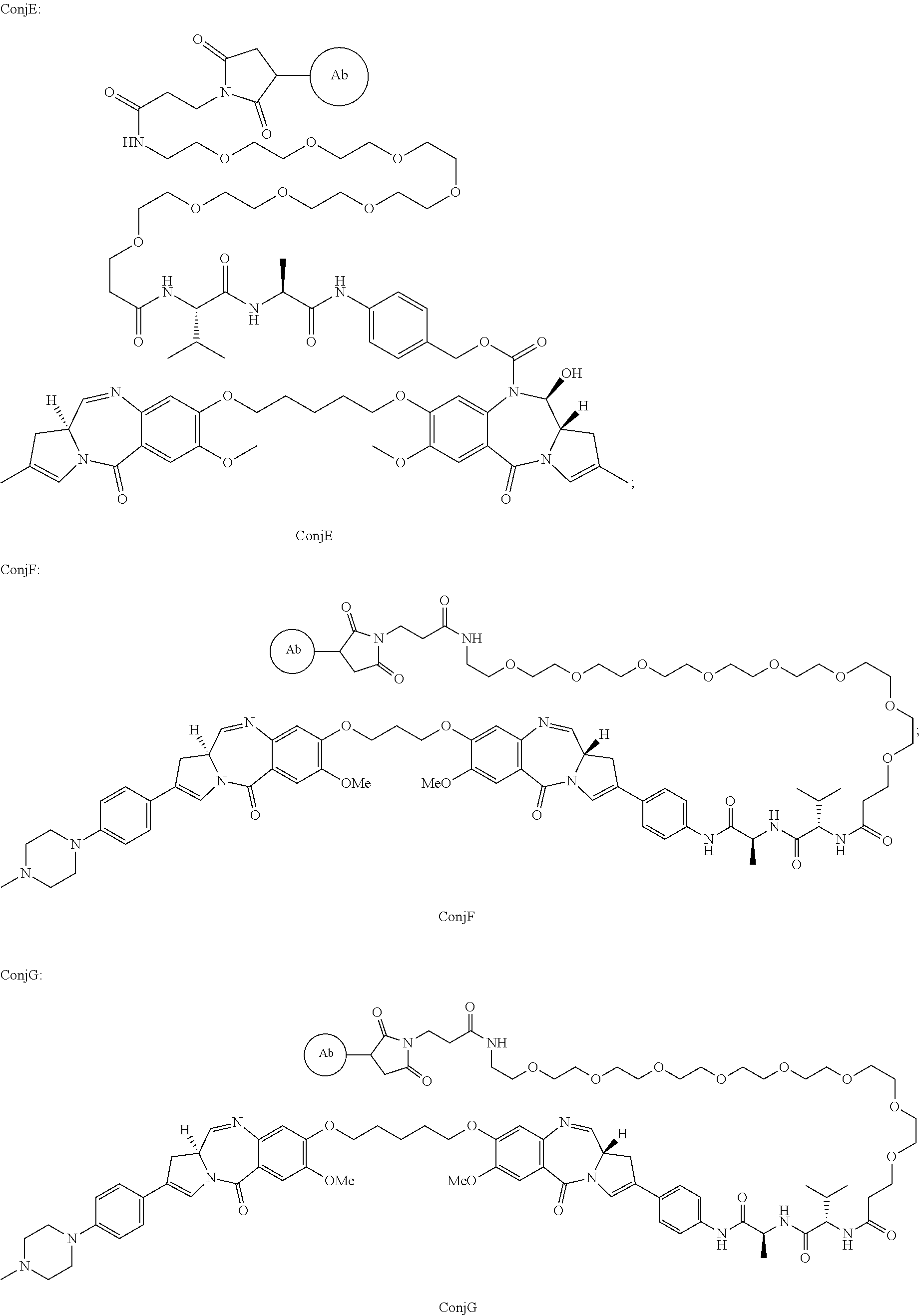


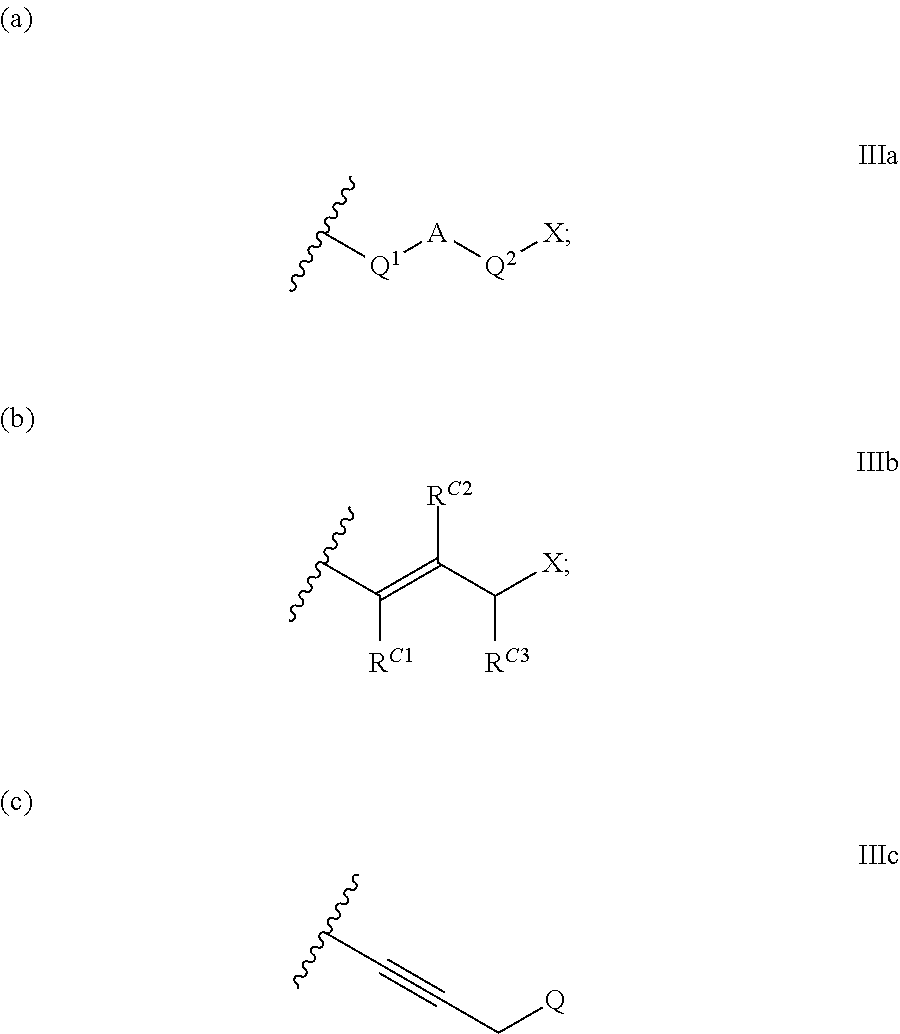

NRNRL, wherein RN is selected from the group comprising H and C1-4 alkyl;


which is the parent compound of A. Compound A comprises this PBD with a linker for attachment to a cell binding agent. The cell binding agent provides a number of ethylene glycol moieties to provide solubility which is useful in the synthesis of conjugates.


-
- Amino acids having polar side chains (Asp, Glu, Lys, Arg, His, Asn, Gin, Ser, Thr, Tyr, and Cys)
- Amino acids having non-polar side chains (Gly, Ala, Val, Leu, Ile, Phe, Trp, Pro, and Met)
- Amino acids having aliphatic side chains (Gly, Ala Val, Leu, Ile)
- Amino acids having cyclic side chains (Phe, Tyr, Trp, His, Pro)
- Amino acids having aromatic side chains (Phe, Tyr, Trp)
- Amino acids having acidic side chains (Asp, Glu)
- Amino acids having basic side chains (Lys, Arg, His)
- Amino acids having amide side chains (Asn, Gin)
- Amino acids having hydroxy side chains (Ser, Thr)
- Amino acids having sulphur-containing side chains (Cys, Met),
- Neutral, weakly hydrophobic amino acids (Pro, Ala, Gly, Ser, Thr)
- Hydrophilic, acidic amino acids (Gin, Asn, Glu, Asp), and
- Hydrophobic amino acids (Leu, Ile, Val)
-
- saturated monocyclic hydrocarbon compounds:
-
- unsaturated monocyclic hydrocarbon compounds:
-
- norcarane (C7), norpinane (C7), norbornane (C7).
-
- C9 (with 2 fused rings) derived from benzofuran (O1), isobenzofuran (O1), indole (N1), isoindole (N1), indolizine (N1), indoline (N1), isoindoline (N1), purine (N4) (e.g., adenine, guanine), benzimidazole (N2), indazole (N2), benzoxazole (N1O1), benzisoxazole (N1O1), benzodioxole (C2), benzofurazan (N2O1), benzotriazole (N3), benzothiofuran (S1), benzothiazole (N1S1), benzothiadiazole (N2S);
- C10 (with 2 fused rings) derived from chromene (O1), isochromene (O1), chroman (O1), isochroman (O1), benzodioxan (C2), quinoline (N1), isoquinoline (N1), quinolizine (N1), benzoxazine (N1O1), benzodiazine (N2), pyridopyridine (N2), quinoxaline (N2), quinazoline (N2), cinnoline (N2), phthalazine (N2), naphthyridine (N2), pteridine (N4);
- C11 (with 2 fused rings) derived from benzodiazepine (N2);
- C13 (with 3 fused rings) derived from carbazole (N1), dibenzofuran (O1), dibenzothiophene (S1), carboline (N2), perimidine (N2), pyridoindole (N2); and,
- C14 (with 3 fused rings) derived from acridine (N1), xanthene (O1), thioxanthene (S1), oxanthrene (C2), phenoxathiin (C1S1), phenazine (N2), phenoxazine (N1O1), phenothiazine (N1S1), thianthrene (S2), phenanthridine (N1), phenanthroline (N2), phenazine (N2).


-
- —C(═O)NH—,
- —C(═O)O—,
- —NHC(═O)—,
- —OC(═O)—,
- —OC(═O)O—,
- —NHC(═O)O—,
- —OC(═O)NH—, and
- —NHC(═O)NH—.

-
- where the asterisk indicates the point of attachment to the N10 position, the wavy line indicates the point of attachment to the linker L1, Y is —N(H)—, —O—, —C(═O)N(H)— or —C(═O)O—, and n is 0 to 3. The phenylene ring is optionally substituted with one, two or three substituents as described herein. In one embodiment, the phenylene group is optionally substituted with halo, NO2, R or OR.

-
- where L* is the activated form of the remaining portion of the linker. These groups have the advantage of separating the site of activation from the compound being protected. As described above, the phenylene group may be optionally substituted.

-
- where the asterisk, the wavy line, Y, and n are as defined above. Each phenylene ring is optionally substituted with one, two or three substituents as described herein. In one embodiment, the phenylene ring having the Y substituent is optionally substituted and the phenylene ring not having the Y substituent is unsubstituted. In one embodiment, the phenylene ring having the Y substituent is unsubstituted and the phenylene ring not having the Y substituent is optionally substituted.

-
- where the asterisk, the wavy line, Y, and n are as defined above, E is O, S or NR, D is N, CH, or CR, and F is N, CH, or CR.
-
- -Phe-Lys-,
- -Val-Ala-,
- -Val-Lys-,
- -Ala-Lys-,
- -Val-Cit-,
- -Phe-Cit-,
- -Leu-Cit-,
- -Ile-Cit-,
- -Phe-Arg-,
- -Trp-Cit-
-
- -Phe-Lys-,
- -Val-Ala-,
- -Val-Lys-,
- -Ala-Lys-,
- -Val-Cit-.
-
- Arg: Z, Mtr, Tos;
- Asn: Trt, Xan;
- Asp: Bzl, t-Bu;
- Cys: Acm, Bzl, Bzl-OMe, Bzl-Me, Trt;
- Glu: Bzl, t-Bu;
- Gin: Trt, Xan;
- His: Boc, Dnp, Tos, Trt;
- Lys: Boc, Z—Cl, Fmoc, Z, Alloc;
- Ser: Bzl, TBDMS, TBDPS;
- Thr: Bz;
- Trp: Boc;
- Tyr: Bzl, Z, Z—Br.

-
- where the asterisk indicates the point of attachment to the N10 position, and the wavy line indicates the point of attachment to the remaining portion of the linker L1 or the point of attachment to A. Preferably, the wavy line indicates the point of attachment to A. The side chain of the Lys amino acid may be protected, for example, with Boc, Fmoc, or Alloc, as described above.

-
- where the asterisk and the wavy line are as defined above.

-
- where the asterisk and the wavy line are as defined above.
-
- —C(═O)NH—,
- —C(═O)O—,
- —NHC(═O)—,
- —OC(═O)—,
- —OC(═O)O—,
- —NHC(═O)O—,
- —OC(═O)NH—,
- —NHC(═O)NH—,
- —C(═O)NHC(═O)—,
- —S—,
- —S—S—,
- —CH2C(═O)—, and
- ═N—NH—.

-
- where the asterisk indicates the point of attachment to the N10 position, the wavy line indicates the point of attachment to L1, n is 0 to 3, Y is a covalent bond or a functional group, and E is an activatable group, for example by enzymatic action or light, thereby to generate a self-immolative unit. The phenylene ring is optionally further substituted with one, two or three substituents as described herein. In one embodiment, the phenylene group is optionally further substituted with halo, NO2, R or OR. Preferably n is 0 or 1, most preferably 0.

-
- where the asterisk indicates the point of attachment to the N10 position, E* is the activated form of E, and Y is as described above. These groups have the advantage of separating the site of activation from the compound being protected. As described above, the phenylene group may be optionally further substituted.
-
- —C(═O)—
- —NH—
- —O—
- —C(═O)NH—,
- —C(═O)O—,
- —NHC(═O)—,
- —OC(═O)—,
- —OC(═O)O—,
- —NHC(═O)O—,
- —OC(═O)NH—,
- —NHC(═O)NH—,
- —NHC(═O)NH,
- —C(═O)NHC(═O)—, and
- —S—.
-
- —C(═O)NH—,
- —C(═O)O—,
- —NHC(═O)—,
- —OC(═O)—,
- —OC(═O)O—,
- —NHC(═O)O—,
- —OC(═O)NH—, and
- —NHC(═O)NH—.

-
- where the asterisk indicates the point of attachment to L1, the wavy line indicates the point of attachment to the antibody, and n is 0 to 6. In one embodiment, n is 5.

-
- where the asterisk indicates the point of attachment to L1, the wavy line indicates the point of attachment to the antibody, and n is 0 to 6. In one embodiment, n is 5.

-
- where the asterisk indicates the point of attachment to L1, the wavy line indicates the point of attachment to the antibody, n is 0 or 1, and m is 0 to 30. In a preferred embodiment, n is 1 and m is 0 to 10, 1 to 8, preferably 4 to 8, and most preferably 4 or 8. In another embodiment, m is 10 to 30, and preferably 20 to 30. Alternatively, m is 0 to 50. In this embodiment, m is preferably 10-40 and n is 1.

-
- where the asterisk indicates the point of attachment to L1, the wavy line indicates the point of attachment to the antibody, n is 0 or 1, and m is 0 to 30. In a preferred embodiment, n is 1 and m is 0 to 10, 1 to 8, preferably 4 to 8, and most preferably 4 or 8. In another embodiment, m is 10 to 30, and preferably 20 to 30. Alternatively, m is 0 to 50. In this embodiment, m is preferably 10-40 and n is 1.

-
- where the asterisk indicates the point of attachment to the remaining portion of A and the wavy line indicates the point of attachment to the remaining portion of the antibody. In this embodiment, the S atom is typically derived from the antibody.

-
- where the wavy line indicates the point of attachment to the antibody as before, and the asterisk indicates the bond to the remaining portion of the A group.

-
- where the wavy line indicates point of attachment to the antibody, and the asterisk indicates the bond to the remaining portion of the A group.
-
- —C(═O)NH—,
- —C(═O)O—,
- —NHC(═O)—,
- —OC(═O)—,
- —OC(═O)O—,
- —NHC(═O)O—,
- —OC(═O)NH—,
- —NHC(═O)NH—,
- —NHC(═O)NH,
- —C(═O)NHC(═O)—,
- —S—,
- —S—S—,
- —CH2C(═O)—
- —C(═O)CH2—,
- ═N—NH—, and
- —NH—N═.

-
- where the wavy line indicates either the point of attachment to the antibody or the bond to the remaining portion of the A group, and the asterisk indicates the other of the point of attachment to the antibody or the bond to the remaining portion of the A group.
-
- —C(═O)N<,
- —C(═O)O—,
- —NHC(═O)—,
- —OC(═O)—,
- —OC(═O)O—,
- —NHC(═O)O—,
- —OC(═O)N<, and
- —NHC(═O)N<,
where N< or O— are part of D.
-
- —C(═O)N<, and
- —NHC(═O)—.
-
- -Phe-Lys-,
- -Val-Ala-,
- -Val-Lys-,
- -Ala-Lys-,
- -Val-Cit-,
- -Phe-Cit-,
- -Leu-Cit-,
- -Ile-Cit-,
- -Phe-Arg-, and
- -Trp-Cit-;
where Cit is citrulline. In such a dipeptide, —NH— is the amino group of X1, and CO is the carbonyl group of X2.
-
- -Phe-Lys-,
- -Val-Ala-,
- -Val-Lys-,
- -Ala-Lys-, and
- -Val-Cit-.
-
- -Gly-Gly-,
- -Pro-Pro-, and
- -Val-Glu-.

-
- where —NH—X1—X2—CO is the dipeptide, —N< is part of the Drug unit, the asterisk indicates the points of attachment to the remainder of the Drug unit, and the wavy line indicates the point of attachment to the remaining portion of L1 or the point of attachment to A. Preferably, the wavy line indicates the point of attachment to A.

-
- where the asterisks, —N< and the wavy line are as defined above.
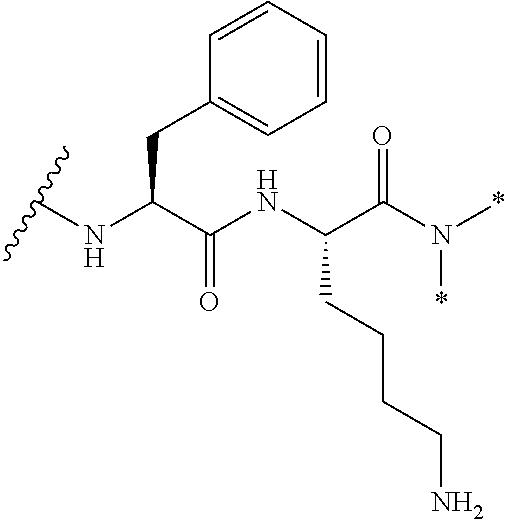
-
- where the asterisks, —N< and the wavy line are as defined above.

-
- where the asterisk indicates the point of attachment to L2 or D, the wavy line indicates the point of attachment to the Ligand unit, and n is 0 to 6. In one embodiment, n is 5.

-
- where the asterisk indicates the point of attachment to L2 or D, the wavy line indicates the point of attachment to the Ligand unit, and n is 0 to 6. In one embodiment, n is 5.

-
- where the asterisk indicates the point of attachment to L2 or D, the wavy line indicates the point of attachment to the Ligand unit, n is 0 or 1, and m is 0 to 30. In a preferred embodiment, n is 1 and m is 0 to 10, 1 to 8, preferably 4 to 8, most preferably 4 or 8.

-
- where the asterisk indicates the point of attachment to L2 or D, the wavy line indicates the point of attachment to the Ligand unit, n is 0 or 1, and m is 0 to 30. In a preferred embodiment, n is 1 and m is 0 to 10, 1 to 7, preferably 3 to 7, most preferably 3 or 7.

-
- where the asterisk indicates the point of attachment to L2 or D, the wavy line indicates the point of attachment to the Ligand unit, and n is 0 to 6. In one embodiment, n is 5.

-
- where the asterisk indicates the point of attachment to L2 or D, the wavy line indicates the point of attachment to the Ligand unit, and n is 0 to 6. In one embodiment, n is 5.

-
- where the asterisk indicates the point of attachment to L2 or D, the wavy line indicates the point of attachment to the Ligand unit, n is 0 or 1, and m is 0 to 30. In a preferred embodiment, n is 1 and m is 0 to 10, 1 to 8, preferably 4 to 8, most preferably 4 or 8.

-
- where the asterisk indicates the point of attachment to L2 or D, the wavy line indicates the point of attachment to the Ligand unit, n is 0 or 1, and m is 0 to 30. In a preferred embodiment, n is 1 and m is 0 to 10, 1 to 8, preferably 4 to 8, most preferably 4 or 8.

-
- where the asterisk indicates the point of attachment to L2 or D, S is a sulfur group of the Ligand unit, the wavy line indicates the point of attachment to the rest of the Ligand unit, and n is 0 to 6. In one embodiment, n is 5.

-
- where the asterisk indicates the point of attachment to L2 or D, S is a sulfur group of the Ligand unit, the wavy line indicates the point of attachment to the remainder of the Ligand unit, and n is 0 to 6. In one embodiment, n is 5.

-
- where the asterisk indicates the point of attachment to L2 or D, S is a sulfur group of the Ligand unit, the wavy line indicates the point of attachment to the remainder of the Ligand unit, n is 0 or 1, and m is 0 to 30. In a preferred embodiment, n is 1 and m is 0 to 10, 1 to 8, preferably 4 to 8, most preferably 4 or 8.

-
- where the asterisk indicates the point of attachment to L2 or D, the wavy line indicates the point of attachment to the Ligand unit, n is 0 or 1, and m is 0 to 30. In a preferred embodiment, n is 1 and m is 0 to 10, 1 to 7, preferably 4 to 8, most preferably 4 or 8.

-
- where the asterisk indicates the point of attachment to L2 or D, the wavy line indicates the point of attachment to the remainder of the Ligand unit, and n is 0 to 6. In one embodiment, n is 5.

-
- where the asterisk indicates the point of attachment to L2 or D, the wavy line indicates the point of attachment to the remainder of the Ligand unit, and n is 0 to 6. In one embodiment, n is 5.

-
- where the asterisk indicates the point of attachment to L2 or D, the wavy line indicates the point of attachment to the remainder of the Ligand unit, n is 0 or 1, and m is 0 to 30. In a preferred embodiment, n is 1 and m is 0 to 10, 1 to 8, preferably 4 to 8, most preferably 4 or 8.

-
- where the asterisk indicates the point of attachment to L2 or D, the wavy line indicates the point of attachment to the remainder of the Ligand unit, n is 0 or 1, and m is 0 to 30. In a preferred embodiment, n is 1 and m is 0 to 10, 1 to 8, preferably 4 to 8, most preferably 4 or 8.


where the asterisk indicate the point of attachment to the N10 position of a PBD moiety.
RC, Capping Group
-
- Alloc, Fmoc, Boc, Troc, Teoc, Psec, Cbz and PNZ.

-
- where the asterisk indicates the point of attachment to the N10 position, G2 is a terminating group, L3 is a covalent bond or a cleavable linker L1, L2 is a covalent bond or together with OC(═O) forms a self-immolative linker.
-
- Alloc, Fmoc, Boc, Troc, Teoc, Psec, Cbz and PNZ.

-
- where the asterisk indicates the point of attachment to L3, n is 0 to 6 and G4 is selected from OH, OR, SH, SR, COOR, CONH2, CONHR, CONRR′, NH2, NHR, NRR′, NO2, and halo. The groups OH, SH, NH2 and NHR are protected. In one embodiment, n is 1 to 6, and preferably n is 5. In one embodiment, G4 is OR, SR, COOR, CONH2, CONHR, CONRR′, and NRR′. In one embodiment, G4 is OR, SR, and NRR′. Preferably G4 is selected from OR and NRR′, most preferably G4 is OR. Most preferably G4 is OMe.

-
- where the asterisk indicates the point of attachment to L3, and n and G4 are as defined above.

-
- where the asterisk indicates the point of attachment to L3, n is 0 or 1, m is 0 to 50, and G4 is selected from OH, OR, SH, SR, COOR, CONH2, CONHR, CONRR′, NH2, NHR, NRR′, NO2, and halo. In a preferred embodiment, n is 1 and m is 0 to 10, 1 to 2, preferably 4 to 8, and most preferably 4 or 8. In another embodiment, n is 1 and m is 10 to 50, preferably 20 to 40. The groups OH, SH, NH2 and NHR are protected. In one embodiment, G4 is OR, SR, COOR, CONH2, CONHR, CONRR′, and NRR′. In one embodiment, G4 is OR, SR, and NRR′. Preferably G4 is selected from OR and NRR′, most preferably G4 is OR. Preferably G4 is OMe.

-
- where the asterisk indicates the point of attachment to L3, and n, m and G4 are as defined above.

-
- where n is 1-20, m is 0-6, and G4 is selected from OH, OR, SH, SR, COOR, CONH2, CONHR, CONRR′, NH2, NHR, NRR′, NO2, and halo. In one embodiment, n is 1-10. In another embodiment, n is 10 to 50, preferably 20 to 40. In one embodiment, n is 1. In one embodiment, m is 1. The groups OH, SH, NH2 and NHR are protected. In one embodiment, G4 is OR, SR, COOR, CONH2, CONHR, CONRR′, and NRR′. In one embodiment, G4 is OR, SR, and NRR′. Preferably G4 is selected from OR and NRR′, most preferably G4 is OR. Preferably G4 is OMe.

-
- where the asterisk indicates the point of attachment to L3, and n, m and G4 are as defined above.


wherein each of R21, R22 and R23 are independently selected from H, C1-3 saturated alkyl, C2-3 alkenyl, C2-3 alkynyl and cyclopropyl, where the total number of carbon atoms in the R12 group is no more than 5;

wherein one of R25a and R25b is H and the other is selected from: phenyl, which phenyl is optionally substituted by a group selected from halo methyl, methoxy; pyridyl; and thiophenyl; and

where R24 is selected from: H; C1-3 saturated alkyl; C2-3 alkenyl; C2-3 alkynyl; cyclopropyl; phenyl, which phenyl is optionally substituted by a group selected from halo methyl, methoxy; pyridyl; and thiophenyl.

each of R21, R22 and R23 are independently selected from H, C13 saturated alkyl, C2-3 alkenyl, C2-3 alkynyl and cyclopropyl, where the total number of carbon atoms in the R12 group is no more than 5. In some embodiments, the total number of carbon atoms in the R12 group is no more than 4 or no more than 3.


one of R25a and R25b is H and the other is selected from: phenyl, which phenyl is optionally substituted by a group selected from halo, methyl, methoxy; pyridyl; and thiophenyl. In some embodiments, the group which is not H is optionally substituted phenyl. If the phenyl optional substituent is halo, it is preferably fluoro. In some embodiment, the phenyl group is unsubstituted.

R24 is selected from: H; C1-3 saturated alkyl; C2-3 alkenyl; C2-3 alkynyl; cyclopropyl; phenyl, which phenyl is optionally substituted by a group selected from halo methyl, methoxy; pyridyl; and thiophenyl. If the phenyl optional substituent is halo, it is preferably fluoro. In some embodiment, the phenyl group is unsubstituted.

where R26a and R26b are independently selected from H, F, C1-4 saturated alkyl, C2-3 alkenyl, which alkyl and alkenyl groups are optionally substituted by a group selected from C1-4 alkyl amido and C1-4 alkyl ester; or, when one of R26a and R26b is H, the other is selected from nitrile and a C1-4 alkyl ester.

NRNRL2′, wherein RN is selected from the group comprising H and C1-4 alkyl. X may preferably be: OH, SH, CO2H, —N═C═O or NHRN, and may more preferably be: O—RL2′, S—RL2′, CO2—RL2′, —NH—C(═O)—RL2′ or NH—RL2′. Particularly preferred groups include: O—RL2′, S—RL2′ and NH—RL2′, with NH—RL2′ being the most preferred group.


Ic:


-
- Restriction enzymes (New England Biolabs): Agel (#R0552); BsiWI (#R0553); EcoRI: (#R0101); NheI: (#R0131)
- QIAprep Spin Miniprep Kit (Qiagen#27104 or 27105)
- QIAquick Gel Extraction (Qiagen#28704)
- Antarctic Phosphatase (NEB#M0289S)
- pFUSE2-CLIg-hk vector (Invivogen #pfuse2-hclk)
- pFUSE-CHIg-hG1 (Invivogen #pfuse-hchg1)
-
Zeocin 100 mg/ml (Invivogen #ant-zn-1) - Blasticidin 10 mg/ml (Invivogen #ant-bl-1)
- 5-alpha Competent E. coli (High Efficiency) (New England Biolabs #C29871)
- LigaFast™ Rapid DNA Ligation System (Promega #M8221)
- Agarose-LE0020 (Life Technologies #AM9040)
- TAE buffer
- Fushk-fwd; CTT TGC CTG ACC CTG CTT GC
- FushG1-bak; TCA CCG GTT CGG GGA AGT AG
- Fushk-bak: TCA GCA GGC ACA CAA CAG AGG
- Pfuse3′bak: TTC CAT ACC ACATTT GTA GAG GT
Method
- 1) 5 μg of each GeneArt construct and each pfuse vector were restriction-digested in 10 μl:
- a) Light chain construct and vector pFUSE2-CHIg-hk were digested with Agel+BsiW1 in
NEB buffer 1, incubating 1 hr at 37 C followed by 1 hr at 55 C. - b) Heavy chain construct and vector pFUSE-CHIg-hG1 were digested with ECoRI+NheI in
NEB buffer 1, incubating 1 hr at 37 C.
- a) Light chain construct and vector pFUSE2-CHIg-hk were digested with Agel+BsiW1 in
- 2) Digested heavy and light chain vectors were dephosphorylated using Antarctic Phosphatase:
- a)
Add 1/10 volume of 10× Antarctic Phosphatase Reaction Buffer. - b) Add 1 μl of Antarctic Phosphatase (NEB, 5,000 units/ml) and mix.
- c) Incubate for 15 minutes at 37° C.
- d) Heat inactivate for 5 minutes at 65° C.
- a)
- 3) Cut vectors were purified by electrophoresis in agarose gel (1.5% w/v in TAE buffer)
- 4) Cut inserts were purified in agarose gel (1.0% w/v in TAE buffer).
- 5) Gel fragments containing DNA were solubilised and the DNA extracted using the QIAquick Gel Extraction kit following manufacturer's instructions.
- 6) Cut insert and complementary cut vector were ligated with T4 DNA Ligase for 1 hr at room temperature, following the manufacturer's instructions and using a 1:2 molar ratio of vector:insert DNA.
- 7) Competent E. coli were transformed with the ligation mix according to the manufacturer's instructions: 42 C heat shock; add
SOC 1 nl and shake 1 hr 37 C, then and spread on warmed selection LB agar plates:- a) For heavy chain constructs,
Zeocin 25 μg/ml - b) For light chain constructs,
Blasticidin 100 μg/ml
- a) For heavy chain constructs,
- 8) Plates were incubated overnight at 37 C, then colonies (3) were picked from each plate and inoculated into 3 ml
LB containing Zeocin 25 μg/ml or Blasticidin 50 μg/ml, and shaken overnight - 9) DNA plasmids were isolated from each culture using the QIAprep Spin Miniprep Kit following the manufacturer's instructions
- 10) Heavy or light chain construct plasmids (10 μl) were restriction digested as before, and electrophoresed on agarose gel (1.5% w/v in TAE buffer).
- 11) Those plasmids producing an approx 450 bp fragment were validated by DNA sequencing using primers Fushk-fwd (for VH and VL); FushG1-bak (for VH); Fushk-bak (for VL)
Protocol 2. Transient Transfection of HEK293T Cells with Expression Constructs
Materials- Cells: HEK293T cells
- Culture medium: DMEM high glucose 4.5 g/L (PAA) with 10% v/v FCS, penicillin and streptomycin
- Fugene HD transfection reagent (Promega # E2311)
- Opti-MEM (Life Technologies #11058-021) or
- FreeStyle 293 Expression Medium (Life Technologies #12338-018)
Method
-
- 1. Trypsinise the cells, wash 1× in DMEM/10% FCS and count the cells.
- 2. Seed cells in a 6 well plate in 2 ml per well containing 2×10⁵ cells.
-
- 1. 1.2 μg of total DNA (0.6 ug of each high and light chain DNA) is needed for each transfection and better results are obtained if the DNA concentration is at or above 90 ng/μl.
- 2. Add 0.6 ug of VH and 0.6 ug VK expression plasmid DNAs into of Fugene HD (4.5 μl) and OptiMEM/Freestyle medium, in a total volume of 60 ul, avoiding touching the sides of the tube with the Fugene HD.
- 3. Mix and leave at RT for 15 minutes.
- 4. Add Fugene mixture drop-wise around the well of HEK293T cells.
- 5. Return the 6-well plate to the CO2-gassed cell culture incubator for 4 days.
- 6. Harvest each conditioned medium, centrifuge, and store at 4° C.
Protocol 3: IgG Quantitation by ELISA
Materials - Nunc-Immuno Plate MaxiSorp (Life Technologies, 43945A)
- Goat Anti-Human IgG(Fc)-AffiniPure: Stratech Scientific, 109-005-098-JIR; 1 mg: 1.3 mg/ml;
- Human IgG1/kappa antibody (Sigma, 1-3889-1 mg: 1 mg/ml)
- Goat anti-human kappa light chain peroxidase conjugate (Sigma, A-7164-1 ml)
- 1-Step Turbo TMB-ELISA, 250 mL (Thermo Scientific: #34022)
- Acid stop=0.6M HCL
- Sample enzyme conjugate (SEC) buffer Tween 20 (0.02% v/v), BSA 0.2% (w/v) in PBS
- Washing buffer: 1×PBS, Tween 20 (0.1% v/v)
Method - 1. Coat each well of a 96-well immunoplate with 100 μl aliquots of goat anti-human IgG antibody, (0.4 μg/ml in PBS: dilute stock ×3000),
- 2. Incubate overnight at 4° C. (Plates may be stored for 1 month at this stage).
- 3. Wash coated
plate 3× with PBS - 4. Block the anti-Ig-coated plate: add 200 ul BSA (3% in PBS):
- 5. Incubate 37
C 1 hr - 6. Prepare 1 ug/ml solution of the human IgG1/kappa antibody in SEC buffer (×1000 diln)
- 7. Into a polypropylene (low binding) plate, dispense 200 μl SEC buffer into all
wells excepting cols 1 & 7—dispense 300 ul SEC buffer. - 8. Into this polypropylene plate,
pipette 50 μl/well of IgG std (1 ug/ml) and 2 ul/well of unknowns into rows A-H, cols 1 & 7 - 9. Serially transfer 100 μl across plate to achieve serial ×3 dilutions.
- 10.
Transfer 100 ul from each well of polypropylene plate to the corresponding well of the blocked anti-IgG-coated plate. - 11. Incubate at 37° C. for 1 hr.
- 12. Wash
plate 3× with washing buffer. - 13. Add 100 μl/well of goat anti-human kappa chain HRP conjugate (×1000 in SEC buffer).
- 14. Incubate at 37° C. for 1 hr.
- 15. Wash
plate 3× with washing buffer - 16. Wash plate 2× with PBS
- 17. Add 100 μl of TMB Turbo substrate to each well,
- 18. Incubate at room temp, 30 min.
- 19. Stop reaction by adding 100 μl of acid stop to each well.
- 20. Read the optical density at 450 nm (colour stable overnight at 4 C if you cannot read immediately).
- 21. Std curve plot in Excel: fit using polynomial to calculate unknowns
Protocol 4:Tn-MUC1 Binding ELISA
Materials - 16TR-MUC1-Tn (Tn-MUC1) was from Guys Hospital and stored in aliquots at −20 C.
- Goat anti-human kappa light chain peroxidase conjugate (Sigma, A-7164-1 ml)
- Nunc-Immuno Plate MaxiSorp (Life Technologies, 43945A)
- Plate washer: Biotek LS405
- 3% BSA:
BSA 3% w/v in PBS - PBS Tween:
Tween 20 0.05% v/v in PBS - PBS/Tween/BSA: BSA 0.5% w/v in PBS/Tween
- 1-Step Turbo TMB-ELISA (Thermo Scientific #3402)
Protocol - 1. Dispense 50 μl/well of 16TR-MUC1-Tn (2 ug/ml in PBS)
- 2. Cover with adhesive plate sealer and incubate at 4 C overnight.
- 3. Block: Dispense 50 μl/well of 3% BSA and incubate for 1 hr 37 C,
- 4. Wash plate with PBS/
Tween 3× - 5. Serially 3-fold dilute 5E5 antibodies (2 ml HEK293T culture supernatants) on non-binding polypropylene plate in PBS/Tween/BSA: serially transfer 50 ul onto 100 ul.
- 6.
Transfer 50 ul from antibody dilution plate onto washed, blocked Tn-MUC1-coated plate - 7. Incubate 37
C 1 hr - 8. Wash plate with PBS/
Tween 3× - 9. Dispense anti-human IgG-HRP conjugate, diluted 1:1000 in PBS/Tween/BSA
- 10. Incubate 37
C 1 hr - 11. Wash plate with PBS/
Tween 3 - 12. Wash plate with
PBS 3× - 13. Dispense 100 ul/well 1-Step Turbo TMB-ELISA substrate solution
- 14.
Incubate 30 min at room temperature (or less if reaction is rapid) - 15. Dispense 100 ul/well 0.6M HCl to stop the substrate reaction
- 16. Measure optical density at 450 nm
Protocol 5: Thermal Denaturation Assay
Materials - Purified antibody or unpurified HEK293T transient transfection conditioned medium containing antibody
- PBS
- 0.5 ml PCR tubes
- PCR machine
- Antigen-binding ELISA protocol and materials
- Antigen-coated ELISA plate
Method - 1. Dispense 0.2 ml of recombinant antibody at or near EC50 i.e. 0.05 ug/ml diluted in HEK293F medium) in 8×PCR tubes
- 2. Take each tube individually and run in its individual 2-step PCR cycle (Table 1 below)—use a PCR machine with the unheated lid option selected
- 3. Hold at 4 C until the ELISA assay, to be run on the same day.
- 4. Apply each sample to 2 wells of a (BSA−) blocked antigen-coated ELISA plate at 50 ul/well
- 5. Run the antigen-binding ELISA
- 6. Plot OD450 nm vs temperature of heating
- 7. Compare the 50% inactivation temperature of each antibody
| PCR heating programs: |
| | 10 minutes at | Hold at |
| 1 | 4 | 4 |
| 2 | 50 | 4 |
| 3 | 55 | 4 |
| 4 | 60 | 4 |
| 5 | 65 | 4 |
| 6 | 70 | 4 |
| 7 | 75 | 4 |
| 8 | 80 | 4 |
Protocol 6: ZR-75-1 Cell Binding Assay by Flow Cytometry
Materials
-
- Wash solution: PBS 0.1% (w/v) sodium azide
- Binding buffer: PBS, 10% normal goat serum, 0.1% (w/v) sodium azide)
- 96 well U-well microplate
Protocol


| ADC | DAR | Concentration [mg/ml] |
| Mouse 5E5-ConjE | 2.76 | 1.78 |
| Ab1-ConjE | 2.32 | 2.57 |
| Ab4-ConjE | 2.77 | 2.70 |
| Ab2-ConjE | 3.45 | 1.68 |
| B12-ConjE | 2.5 | 0.53 |
| TABLE 2 | |||||
| Static | Shaken | ||||
| HEK293T | HEK293F | ||||
| Tn-MUC1 | ZR-75-1 cell | transient | transient | ||
| binding EC50 | binding EC50 | IgG | IgG | ||
| ng/ml | ng/ml | μg/ml | μg/ml | Tm ° C. | |
| Mouse | 31.10 | 28.34 | 4.0 | 18.9 | 69.97 |
| 5E5 | |||||
| Ab1 | 24.57 | 9.86 | 23.1 | 63.2 | 69.37 |
| Ab2 | 34.46 | 16.83 | 24.9 | 27.2 | 68.32 |
| Ab3 | 61.48 | 26.78 | 3.0 | 7.0 | 65.32 |
| Ab4 | 75.49 | 42.29 | 10.9 | 18.9 | 65.23 |
| Ab5 | 26.87 | 18.42 | 3.3 | 17.2 | 62.58 |
| Ab6 | 19.80 | 41.30 | 0.18 | 1.0 | n.d. |
| Group | Animals | Dose level | Dose volume | |
| No | per group | ADC | (mg/kg) | (mg/kg) |
| 1 | 15 | [vehicle only] | — | — |
| 2 | 15 | Mouse 5E5-ConjE | 0.3 Qwkx3 | 10 |
| 3 | 15 | Mouse 5E5-ConjE | 1.0 Qwkx3 | 10 |
| 4 | 15 | Ab1-ConjE | 0.3 Qwkx3 | 10 |
| 5 | 15 | Ab1-ConjE | 1.0 Qwkx3 | 10 |
| 6 | 15 | Ab4-ConjE | 0.3 Qwkx3 | 10 |
| 7 | 15 | Ab4-ConjE | 1.0 Qwkx3 | 10 |
| 8 | 15 | Ab2-ConjE | 0.3 Qwkx3 | 10 |
| 9 | 15 | Ab2-ConjE | 1.0 Qwkx3 | 10 |
| 10 | 15 | isotype control-ConjE | 1.0 | 10 |
Procedures:
- 5E5 VH VH of mouse 5E5 antibody
- 5E5 VK VK of mouse 5E5 antibody
- 5E5RHA1 Humanised versionA1, of 5E5 VH
- 5E5RKA1 Humanised version, A1, of 5E5 VK
- A Adenine
- Å Angstrom
- Ac acetyl
- Acm acetamidomethyl
- Alloc allyloxycarbonyl
- B7 The anti-LPA antibody product of mouse hybridoma clone B7
- Boc di-tert-butyl dicarbonate
- bp base pairs
- Bzl benzyl, where Bzl-OMe is methoxybenzyl and Bzl-Me is methylbenzene
- C Cytosine
- Cbz or Z benzyloxy-carbonyl, where Z—Cl and Z—Br are chloro- and bromobenzyloxy carbonyl respectively
- CDR Complementarity determining region in the immunoglobulin variable regions, defined using the Kabat numbering system
- D-gene Diversity gene
- DMF N,N-dimethylformamide
- DNA Deoxyribonucleic acid
- Dnp dinitrophenyl
- DTT dithiothreitol
- Fmoc 9H-fluoren-9-ylmethoxycarbonyl
- FW Framework region: the immunoglobulin variable regions excluding the CDR regions
- G Guanine
- IgG Immunoglobulin G
- imp N-10 imine protecting group: 3-(2-methoxyethoxy)propanoate-Val-Ala-PAB
- MC-OSu maleimidocaproyl-O—N-succinimide
- J-gene Joining gene
- Kabat an immunoglobulin alignment and numbering system pioneered by Elvin A Kabat
- mAb monoclonal antibody
- Moc methoxycarbonyl
- MP maleimidopropanamide
- Mtr 4-methoxy-2,3,6-trimethtylbenzenesulfonyl
- PAB para-aminobenzyloxycarbonyl
- PEG ethyleneoxy
- PNZ p-nitrobenzyl carbamate
- Psec 2-(phenylsulfonyl)ethoxycarbonyl
- T Thymine
- TBDMS tert-butyldimethylsilyl
- TBDPS tert-butyldiphenylsilyl
- t-Bu tert-butyl
- Teoc 2-(trimethylsilyl)ethoxycarbonyl
- Tos tosyl
- Troc 2,2,2-trichlorethoxycarbonyl chloride
- Trt trityl
- V region The segment of IgG chains which is variable in sequence between different antibodies. It extends to Kabat residue 109 in the light chain and 113 in the heavy chain.
- VCl Framework residue classified as vernier or canonical or VH-VL interface
- V-gene The gene segment that is rearranged, together with a J (and D for VH) gene, to generate a complete VK (or VH)
- VH Immunoglobulin heavy chain variable region
- VK Immunoglobulin kappa light chain variable region
- Xan xanthyl
- [1] C. Chothia, et al., “Domain association in immunoglobulin molecules. The packing of variable domains,” J Mol. Biol. 186(3), 651 (1985).
- [2] J. Foote and G. Winter, “Antibody framework residues affecting the conformation of the hypervariable loops,” J Mol. Biol. 224(2), 487 (1992).
- [3] E. A Kabat, et al., sequences of proteins of immunological interest, 5 ed. (NIH National Technical Information Service, 1991).
- [4] V. Morea, A. M. Lesk, and A. Tramontano, “Antibody modeling: implications for engineering and design,” Methods 20(3), 267 (2000).

-
- when there is a double bond present between C2′ and C3′, R12 is selected from the group consisting of:

wherein each of R21, R22 and R23 are independently selected from H, C1-3 saturated alkyl, C2-3 alkenyl, C2-3 alkynyl and cyclopropyl, where the total number of carbon atoms in the R12 group is no more than 5;

wherein one of R25a and R25b is H and the other is selected from: phenyl, which phenyl is optionally substituted by a group selected from halo, methyl, methoxy; pyridyl; and thiophenyl; and

where R24 is selected from: H; C1-3 saturated alkyl; C2-3 alkenyl; C2-3 alkynyl; cyclopropyl; phenyl, which phenyl is optionally substituted by a group selected from halo, methyl, methoxy; pyridyl; and thiophenyl;
when there is a single bond present between C2′ and C3′,

where R26a and R26b are independently selected from H, F, C1-4 saturated alkyl, C2-3 alkenyl, which alkyl and alkenyl groups are optionally substituted by a group selected from C1-4 alkyl amido and C1-4 alkyl ester; or, when one of R26a and R26b is H, the other is selected from nitrile and a C1-4 alkyl ester;

wherein each of R11, R12 and R13 are independently selected from H, C1-3 saturated alkyl, C2-3 alkenyl, C2-3 alkynyl and cyclopropyl, where the total number of carbon atoms in the R2 group is no more than 5;
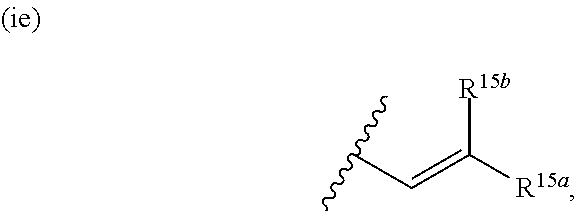
wherein one of R15a and R15b is H and the other is selected from: phenyl, which phenyl is optionally substituted by a group selected from halo, methyl, methoxy; pyridyl; and thiophenyl; and

where R14 is selected from: H; C1-3 saturated alkyl; C2-3 alkenyl; C2-3 alkynyl; cyclopropyl; phenyl, which phenyl is optionally substituted by a group selected from halo, methyl, methoxy; pyridyl; and thiophenyl;

where R116 and R16b are independently selected from H, F, C1-4 saturated alkyl, C2-3 alkenyl, which alkyl and alkenyl groups are optionally substituted by a group selected from C1-4 alkyl amido and C1-4 alkyl ester; or, when one of R16a and R16b is H, the other is selected from nitrile and a C1-4 alkyl ester;
[Formula II]


NRNRL2′, wherein RN is selected from the group comprising H and C1-4 alkyl;


and R26a and R26b are both H.

and R26a and R26b are both methyl.

one of R26a and R26b is H, and the other is selected from C1-4 saturated alkyl, C2-3 alkenyl, which alkyl and alkenyl groups are optionally substituted.
[Formula I]


and R16a and R16b are both H.

and R16a and R16b are both methyl.
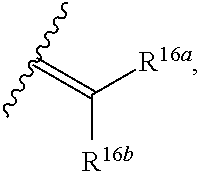
one of R16a and R16b is H, and the other is selected from C1-4 saturated alkyl, C2-3 alkenyl, which alkyl and alkenyl groups are optionally substituted.

-
- where the asterisk indicates the point of attachment to the N10 position, G2 is a terminating group, L3 is a covalent bond or a cleavable linker L1, L2 is a covalent bond or together with OC(═O) forms a self-immolative linker.

-
- where the asterisk indicates the point of attachment to the PBD, Ab is the antibody, L1 is a cleavable linker, A is a connecting group connecting L1 to the antibody, L2 is a covalent bond or together with —OC(═O)— forms a self-immolative linker.
-
- -Phe-Lys-,
- -Val-Ala-,
- -Val-Lys-,
- -Ala-Lys-,
- -Val-Cit-,
- -Phe-Cit-,
- -Leu-Cit-,
- -Ile-Cit-,
- -Phe-Arg-,
- -Trp-Cit-.
-
- -Phe-Lys-,
- -Val-Ala-,
- -Val-Lys-,
- -Ala-Lys-,
- -Val-Cit-.

-
- where the asterisk indicates the point of attachment to the PBD, the wavy line indicates the point of attachment to the linker L1, Y is NH, O, C(═O)NH or C(═O)O, and n is 0 to 3.

-
- where the asterisk indicates the point of attachment to the PBD, and the wavy line indicates the point of attachment to the remaining portion of the linker L1 or the point of attachment to A.

-
- where the asterisk indicates the point of attachment to L1, the wavy line indicates the point of attachment to the antibody, and n is 0 to 6; or

-
- where the asterisk indicates the point of attachment to L1, the wavy line indicates the point of attachment to the antibody, n is 0 or 1, and m is 0 to 30.


-
- wherein individuals having TnMUC1 are selected for treatment.
-
- wherein the treatment is applied if the individual has TnMUC1.
| SEQUENCES |
| SEQ ID NO: 1 [5E5VH] |
| QVQLQQSDAELVKPGSSVKISCKASGYTFTDHAIHWVKQKPEQGLEWIGH |
| FSPGNTDIKYNDKFKGKATLTVDRSSSTAYMQLNSLTSEDSAVYFCKTST |
| FFFDYWGQGTTLTVSS |
| SEQ ID NO: 2 [5E5RHA] |
| QVQLVQSGAEVKKTGSSVKVSCKASGYTFTDHAIHWVRQAPGQALEVVMG |
| HFSPGNTDIKYNDKFKGRVTITRDRSMSTAYMELSSLRSEDTAMYYCATS |
| TFFFDYWGQGTMVTVSS |
| SEQ ID NO: 3 [5E5RHA2] |
| QVQLVQSGAEVKKTGSSVKVSCKASGYTFTDHAIHWVRQAPGQALEWIGH |
| FSPGNTDIKYNDKFKGRATLTVDRSMSTAYMELSSLRSEDTAMYYCKTST |
| FFFDYWGQGTMVTVSS |
| SEQ ID NO: 4 [5E5RHA3] |
| QVQLVQSGAEVKKTGSSVKVSCKASGYTFTDHAIHWVRQAPGQALEVVMG |
| HFSPGNTDIKYNDKFKGRATLTVDRSMSTAYMELSSLRSEDTAMYYCKTS |
| TFFFDYWGQGTMVTVSS |
| SEQ ID NO: 5 [5E5RHA4] |
| QVQLVQSGAEVKKTGSSVKVSCKASGYTFTDHAIHWVRQAPGQALEWIGH |
| FSPGNTDIKYNDKFKGRVTLTVDRSMSTAYMELSSLRSEDTAMYYCKTST |
| FFFDYWGQGTMVTVSS |
| SEQ ID NO: 6 [5E5RHA5] |
| QVQLVQSGAEVKKTGSSVKVSCKASGYTFTDHAIHWVRQAPGQALEWIGH |
| FSPGNTDIKYNDKFKGRATITVDRSMSTAYMELSSLRSEDTAMYYCKTST |
| FFFDYWGQGTMVTVSS |
| SEQ ID NO: 7 [5E5RHA6] |
| QVQLVQSGAEVKKTGSSVKVSCKASGYTFTDHAIHWVRQAPGQALEWIGH |
| FSPGNTDIKYNDKFKGRATLTRDRSMSTAYMELSSLRSEDTAMYYCKTST |
| FFFDYWGQGTMVTVSS |
| SEQ ID NO: 8 [5E5RHA7] |
| QVQLVQSGAEVKKTGSSVKVSCKASGYTFTDHAIHWVRQAPGQALEWIGH |
| FSPGNTDIKYNDKFKGRATLTVDRSMSTAYMELSSLRSEDTAMYYCATST |
| FFFDYWGQGTMVTVSS |
| SEQ ID NO: 9 [5E5RHA8] |
| QVQLVQSGAEVKKTGSSVKVSCKASGYTFTDHAIHWVRQAPGQALEVVMG |
| HFSPGNTDIKYNDKFKGRVTLTVDRSMSTAYMELSSLRSEDTAMYYCKTS |
| TFFFDYWGQGTMVTVSS |
| SEQ ID NO: 10 [5E5RHB] |
| EVQLVQSGAEVKKPGESLKISCKISGYIFTDHAIHWVRQMPGKGLEVVMG |
| HFSPGNTDIKYNDKFKGQVTFSVDRSINTAYLQWSSLKASDTAIYFCARS |
| TFFFDYWGQGTRVTVSS |
| SEQ ID NO: 11 [5E5RHB2] |
| EVQLVQSGAEVKKPGESLKISCKISGYTFTDHAIHWVRQMPGKGLEWIGH |
| FSPGNTDIKYNDKFKGQATLSVDRSINTAYLQWSSLKASDTAIYFCKTST |
| FFFDYWGQGTRVTVSS |
| SEQ ID NO: 12 [5E5RHB3] |
| EVQLVQSGAEVKKPGESLKISCKISGYIFTDHAIHWVRQMPGKGLEWIGH |
| FSPGNTDIKYNDKFKGQATLSVDRSINTAYLQWSSLKASDTAIYFCKTST |
| FFFDYWGQGTRVTVSS |
| SEQ ID NO: 13 [5E5RHB4] |
| EVQLVQSGAEVKKPGESLKISCKISGYTFTDHAIHWVRQMPGKGLEWMGH |
| FSPGNTDIKYNDKFKGQATLSVDRSINTAYLQWSSLKASDTAIYFCKTST |
| FFFDYWGQGTRVTVSS |
| SEQ ID NO: 14 [5E5RHB5] |
| EVQLVQSGAEVKKPGESLKISCKISGYTFTDHAIHWVRQMPGKGLEWIGH |
| FSPGNTDIKYNDKFKGQVTLSVDRSINTAYLQWSSLKASDTAIYFCKTST |
| FFFDYWGQGTRVTVSS |
| SEQ ID NO: 15 [5E5RHB6] |
| EVQLVQSGAEVKKPGESLKISCKISGYTFTDHAIHWVRQMPGKGLEWIGH |
| FSPGNTDIKYNDKFKGQATFSVDRSINTAYLQWSSLKASDTAIYFCKTST |
| FFFDYWGQGTRVTVSS |
| SEQ ID NO: 16 [5E5RHB7] |
| EVQLVQSGAEVKKPGESLKISCKISGYTFTDHAIHWVRQMPGKGLEWIGH |
| FSPGNTDIKYNDKFKGQATLSVDRSINTAYLQWSSLKASDTAIYFCATST |
| FFFDYWGQGTRVTVSS |
| SEQ ID NO: 17 [5E5RHB8] |
| EVQLVQSGAEVKKPGESLKISCKISGYTFTDHAIHWVRQMPGKGLEWIGH |
| FSPGNTDIKYNDKFKGQATLSVDRSINTAYLQWSSLKASDTAIYFCKRST |
| FFFDYWGQGTRVTVSS |
| SEQ ID NO: 18 [5E5RHB9] |
| EVQLVQSGAEVKKPGESLKISCKISGYIFTDHAIHWVRQMPGKGLEVVMG |
| HFSPGNTDIKYNDKFKGQATLSVDRSINTAYLQWSSLKASDTAIYFCKTS |
| TFFFDYWGQGTRVTVSS |
| SEQ ID NO: 19 [5E5RHB10] |
| EVQLVQSGAEVKKPGESLKISCKISGYIFTDHAIHWVRQMPGKGLEVVMG |
| HFSPGNTDIKYNDKFKGQVTLSVDRSINTAYLQWSSLKASDTAIYFCKTS |
| TFFFDYWGQGTRVTVSS |
| SEQ ID NO: 20 [5E5RHC] |
| EVQLVESGAEVKKPGASVEVSCQASGYTFTDHAIHWVRQAPGQGLEWMGH |
| FSPGNTDIKYNDKFKGRVTMTRDTSINTAYMELRRLRSDDTAVYYCATST |
| FFFDYWGQGTMVTVSS |
| SEQ ID NO: 21 [5E5RHC2] |
| EVQLVESGAEVKKPGASVEVSCQASGYTFTDHAIHWVRQAPGQGLEWIGH |
| FSPGNTDIKYNDKFKGRATLTVDRSINTAYMELRRLRSDDTAVYYCKTST |
| FFFDYWGQGTMVTVSS |
| SEQ ID NO: 22 [5E5RHC3] |
| EVQLVESGAEVKKPGASVEVSCQASGYTFTDHAIHWVRQAPGQGLEWMGH |
| FSPGNTDIKYNDKFKGRATLTVDRSINTAYMELRRLRSDDTAVYYCKTST |
| FFFDYWGQGTMVTVSS |
| SEQ ID NO: 23 [5E5RHC4] |
| EVQLVESGAEVKKPGASVEVSCQASGYTFTDHAIHWVRQAPGQGLEWIGH |
| FSPGNTDIKYNDKFKGRVTLTVDRSINTAYMELRRLRSDDTAVYYCKTST |
| FFFDYWGQGTMVTVSS |
| SEQ ID NO: 24 [5E5RHC5] |
| EVQLVESGAEVKKPGASVEVSCQASGYTFTDHAIHWVRQAPGQGLEWIGH |
| FSPGNTDIKYNDKFKGRATMTVDRSINTAYMELRRLRSDDTAVYYCKTST |
| FFFDYWGQGTMVTVSS |
| SEQ ID NO: 25 [5E5RHC6] |
| FSPGNTDIKYEVQLVESGAEVKKPGASVEVSCQASGYTFTDHAIHWVRQA |
| PGQGLEWIGHNDKFKGRATLTRDRSINTAYMELRRLRSDDTAVYYCKTST |
| FFFDYWGQGTMVTVSS |
| SEQ ID NO: 26 [5E5RHC7] |
| EVQLVESGAEVKKPGASVEVSCQASGYTFTDHAIHWVRQAPGQGLEWIGH |
| FSPGNTDIKYNDKFKGRATLTVDTSINTAYMELRRLRSDDTAVYYCKTST |
| FFFDYWGQGTMVTVSS |
| SEQ ID NO: 27 [5E5RHC8] |
| EVQLVESGAEVKKPGASVEVSCQASGYTFTDHAIHWVRQAPGQGLEWIGH |
| FSPGNTDIKYNDKFKGRATLTVDRSINTAYMELRRLRSDDTAVYYCATST |
| FFFDYWGQGTMVTVSS |
| SEQ ID NO: 28 [5E5RHC9] |
| EVQLVESGAEVKKPGASVEVSCQASGYTFTDHAIHWVRQAPGQGLEWMGH |
| FSPGNTDIKYNDKFKGRVTMTVDRSINTAYMELRRLRSDDTAVYYCKTST |
| FFFDYWGQGTMVTVSS |
| SEQ ID NO: 29 [5E5RHC9 + V67A] |
| EVQLVESGAEVKKPGASVEVSCQASGYTFTDHAIHWVRQAPGQGLEWMGH |
| FSPGNTDIKYNDKFKGRATMTVDRSINTAYMELRRLRSDDTAVYYCKTST |
| FFFDYWGQGTMVTVSS |
| SEQ ID NO: 30 [5E5VK] |
| DIVMTQSPSSLTVTAGEKVTMICKSSQSLLNSGDQKNYLTWYQQKPGQPP |
| KLLIFWASTRESGVPDRFTGSGSGTDFTLTISSVQAEDLAVYYCQNDYSY |
| PLTFGAGTKLELK |
| SEQ ID NO: 31 [5E5RKA] |
| DIVMTQSPDSLAVSLGERATINCKSSQSLLNSGDQKNYLTWYQQKPGQPP |
| KLLIYWASTRESGVPDRFSGSGSGTDFTLTISSLQAEDVAVYYCQNDYSY |
| PLTFGQGTKVEIK |
| SEQ ID NO: 32 [5E5RKA1] |
| DIVMTQSPDSLAVSLGERATIICKSSQSLLNSGDQKNYLTWYQQKPGQPP |
| KLLIFWASTRESGVPDRFTGSGSGTDFTLTISSLQAEDVAVYYCQNDYSY |
| PLTFGQGTKVEIK |
| SEQ ID NO: 33 [5E5RKB] |
| DIVMTQSPLSLPVTPGEPASISCKSSQSLLNSGDQKNYLTWYLQKPGQSP |
| QLLIYWASTRESGVPDRFSGSGSGTDFTLKISRVEAEDVGVYYCQNDYSY |
| PLTFGGGTKVEIK |
| SEQ ID NO: 34 [5E5RKB1] |
| DIVMTQSPLSLPVTPGEPASIICKSSQSLLNSGDQKNYLTWYLQKPGQSP |
| QLLIFWASTRESGVPDRFTGSGSGTDFTLKISRVEAEDVGVYYCQNDYSY |
| PLTFGGGTKVEIK |
| SEQ ID NO. 160 (IgG1 CH3): |
| GQPREPQVYTLPPSRDELTKNQVSLTCLVKGFYPSDIAVEWESNGQPENN |
| YKTTPPVLDSDGSFFLYSKLTVDKSRWQQGNVFSCSVMHEALHNHYTQKS |
| LSLSPGK |
| SEQ ID NO. 161 (IgG2 CH3): |
| GQPREPQVYTLPPSREEMTKNQVSLTCLVKGFYPSDISVEWESNGQPENN |
| YKTTPPMLDSDGSFFLYSKLTVDKSRWQQGNVFSCSVMHEALHNHYTQKS |
| LSLSPGK |
| SEQ ID NO. 162 (IgG3 CH3): |
| GQPREPQVYTLPPSREEMTKNQVSLTCLVKGFYPSDIAVEWESSGQPENN |
| YNTTPPMLDSDGSFFLYSKLTVDKSRWQQGNIFSCSVMHEALHNRFTQKS |
| LSLSPGK |
| SEQ ID NO. 163 (IgG4 CH3): |
| GQPREPQVYTLPPSQEEMTKNQVSLTCLVKGFYPSDIAVEWESNGQPENN |
| YKTTPPVLDSDGSFFLYSRLTVDKSRWQEGNVFSCSVMHEALHNHYTQKS |
| LSLSLGK |
| SEQ ID NO. 164 (IgG1m CH3): |
| GQPREPQVYTLPPSRDELTKNQVSLTCLVKGFYPSDIAVEWESNGQPENN |
| YKTTPPVLDSDGSFFLYSKLTVDKSRWQQGNVFSCSVMHEALHNHYTQKS |
| LSLSPGK |
| SEQ ID NO. 165 (IgG1m[non-1] CH3): |
| GQPREPQVYTLPPSREEMTKNQVSLTCLVKGFYPSDIAVEWESNGQPENN |
| YKTTPPVLDSDGSFFLYSKLTVDKSRWQQGNVFSCSVMHEALHNHYTQKS |
| LSLSPGK |
| SEQ ID NO. 166 (IgG1 CH3 S→4C): |
| GQPREPQVYTLPPSRDELTKNQVSLTCLVKGFYPSDIAVEWESNGQPENN |
| YKTTPPVLDSDGSFFLYSKLTVDKSRWQQGNVFSCSVMHEALHNHYTQKS |
| LCLSPGK |
| SEQ ID NO. 167 (IgG2 CH3 S→C): |
| GQPREPQVYTLPPSREEMTKNQVSLTCLVKGFYPSDISVEWESNGQPENN |
| YKTTPPMLDSDGSFFLYSKLTVDKSRWQQGNVFSCSVMHEALHNHYTQKS |
| LCLSPGK |
| SEQ ID NO. 168 (IgG3 CH3 S→C): |
| GQPREPQVYTLPPSREEMTKNQVSLTCLVKGFYPSDIAVEWESSGQPENN |
| YNTTPPMLDSDGSFFLYSKLTVDKSRWQQGNIFSCSVMHEALHNRFTQKS |
| LCLSPGK |
| SEQ ID NO. 169 (IgG4 CH3 S→C): |
| GQPREPQVYTLPPSQEEMTKNQVSLTCLVKGFYPSDIAVEWESNGQPENN |
| YKTTPPVLDSDGSFFLYSRLTVDKSRWQEGNVFSCSVMHEALHNHYTQKS |
| LCLSLGK |
| SEQ ID NO. 170 (IgG1 m CH3 S→C): |
| GQPREPQVYTLPPSRDELTKNQVSLTCLVKGFYPSDIAVEWESNGQPENN |
| YKTTPPVLDSDGSFFLYSKLTVDKSRWQQGNVFSCSVMHEALHNHYTQKS |
| LCLSPGK |
| SEQ ID NO. 171 (IgG1 m[non-1] CH3 S→C): |
| GQPREPQVYTLPPSREEMTKNQVSLTCLVKGFYPSDIAVEWESNGQPENN |
| YKTTPPVLDSDGSFFLYSKLTVDKSRWQQGNVFSCSVMHEALHNHYTQKS |
| LCLSPGK |
| SEQ ID NO. 180 (IgG1 Fc): |
| DKTHTCPPCPAPELLGGPSVFLFPPKPKDTLMISRTPEVTCVVVDVSHED |
| PEVKFNWYVDGVEVHNAKTKPREEQYNSTYRVVSVLTVLHQDWLNGKEYK |
| CKVSNKALPAPIEKTISKAKGQPREPQVYTLPPSRDELTKNQVSLTCLVK |
| GFYPSDIAVEWESNGQPENNYKTTPPVLDSDGSFFLYSKLTVDKSRWQQG |
| NVFSCSVMHEALHNHYTQKSLSLSPGK |
| SEQ ID NO. 181 (IgG2 Fc): |
| KCCVECPPCPAPPVAG-PSVFLFPPKPKDTLMISRTPEVTCVVVDVSHED |
| PEVQFNWYVDGVEVHNAKTKPREEQFNSTFRVVSVLTVVHQDWLNGKEYK |
| CKVSNKGLPAPIEKTISKTKGQPREPQVYTLPPSREEMTKNQVSLTCLVK |
| GFYPSDISVEWESNGQPENNYKTTPPMLDSDGSFFLYSKLTVDKSRWQQG |
| NVFSCSVMHEALHNHYTQKSLSLSPGK |
| SEQ ID NO. 182 (IgG3 Fc): |
| DTPPPCPRCPAPELLGGPSVFLFPPKPKDTLMISRTPEVTCVVVDVSHED |
| PEVQFKWYVDGVEVHNAKTKPREEQYNSTFRVVSVLTVLHQDWLNGKEYK |
| CKVSNKALPAPIEKTISKTKGQPREPQVYTLPPSREEMTKNQVSLTCLVK |
| GFYPSDIAVEWESSGQPENNYNTTPPMLDSDGSFFLYSKLTVDKSRWQQG |
| NIFSCSVMHEALHNRFTQKSLSLSPGK |
| SEQ ID NO. 183 (IgG4 Fc): |
| KYGPPCPSCPAPEFLGGPSVFLFPPKPKDTLMISRTPEVTCVVVDVSQED |
| PEVQFNWYVDGVEVHNAKTKPREEQFNSTYRVVSVLTVLHQDWLNGKEYK |
| CKVSNKGLPSSIEKTISKAKGQPREPQVYTLPPSQEEMTKNQVSLTCLVK |
| GFYPSDIAVEWESNGQPENNYKTTPPVLDSDGSFFLYSRLTVDKSRWQEG |
| NVFSCSVMHEALHNHYTQKSLSLSLGK |
| SEQ ID NO. 184 (IgG1m Fc): |
| DKTHTCPPCPAPELLGGPSVFLFPPKPKDTLMISRTPEVTCVVVDVSHED |
| VPEVKFNWYVDGEVHNAKTKPREEQYNSTYRVVSVLTVLHQDWLNGKEYK |
| CKVSNKALPAPIEKTISKAKGQPREPQVYTLPPSRDELTKNQVSLTCLVK |
| GFYPSDIAVEWESNGQPENNYKTTPPVLDSDGSFFLYSKLTVDKSRWQQG |
| NVFSCSVMHEALHNHYTQKSLSLSPGK |
| SEQ ID NO. 185 (IgG1m[non-1] Fc): |
| DKTHTCPPCPAPELLGGPSVFLFPPKPKDTLMISRTPEVTCVVVDVSHED |
| PEVKFNWYVDGVEVHNAKTKPREEQYNSTYRVVSVLTVLHQDWLNGKEYK |
| CKVSNKALPAPIEKTISKAKGQPREPQVYTLPPSREEMTKNQVSLTCLVK |
| GFYPSDIAVEWESNGQPENNYKTTPPVLDSDGSFFLYSKLTVDKSRWQQG |
| NVFSCSVMHEALHNHYTQKSLSLSPGK |
| SEQ ID NO. 186 (IgG1 Fc S→C): |
| DKTHTCPPCPAPELLGGPSVFLFPPKPKDTLMISRTPEVTCVVVDVSHED |
| PEVKFNWYVDGVEVHNAKTKPREEQYNSTYRVVSVLTVLHQDWLNGKEYK |
| CKVSNKALPAPIEKTISKAKGQPREPQVYTLPPSRDELTKNQVSLTCLVK |
| GFYPSDIAVEWESNGQPENNYKTTPPVLDSDGSFFLYSKLTVDKSRWQQG |
| NVFSCSVMHEALHNHYTQKSLCLSPGK |
| SEQ ID NO. 187 (IgG2 Fc S→C): |
| KCCVECPPCPAPPVAG-PSVFLFPPKPKDTLMISRTPEVTCVVVDVSHED |
| PEVQFNWYVDGVEVHNAKTKPREEQFNSTFRVVSVLTVVHQDWLNGKEYK |
| CKVSNKGLPAPIEKTISKTKGQPREPQVYTLPPSREEMTKNQVSLTCLVK |
| GFYPSDISVEWESNGQPENNYKTTPPMLDSDGSFFLYSKLTVDKSRWQQG |
| NVFSCSVMHEALHNHYTQKSLCLSPGK |
| SEQ ID NO. 188 (IgG3 Fc S→C): |
| DTPPPCPRCPAPELLGGPSVFLFPPKPKDTLMISRTPEVTCVVVDVSHED |
| PEVQFKWYVDGVEVHNAKTKPREEQYNSTFRVVSVLTVLHQDWLNGKEYK |
| CKVSNKALPAPIEKTISKTKGQPREPQVYTLPPSREEMTKNQVSLTCLVK |
| GFYPSDIAVEWESSGQPENNYNTTPPMLDSDGSFFLYSKLTVDKSRWQQG |
| NIFSCSVMHEALHNRFTQKSLCLSPGK |
| SEQ ID NO. 189 (IgG4 Fc S→C): |
| KYGPPCPSCPAPEFLGGPSVFLFPPKPKDTLMISRTPEVTCVVVDVSQED |
| PEVQFNWYVDGVEVHNAKTKPREEQFNSTYRVVSVLTVLHQDWLNGKEYK |
| CKVSNKGLPSSIEKTISKAKGQPREPQVYTLPPSQEEMTKNQVSLTCLVK |
| GFYPSDIAVEWESNGQPENNYKTTPPVLDSDGSFFLYSRLTVDKSRWQEG |
| NVFSCSVMHEALHNHYTQKSLCLSLGK |
| SEQ ID NO. 190 (IgGlm Fc S→C): |
| DKTHTCPPCPAPELLGGPSVFLFPPKPKDTLMISRTPEVTCVVVDVSEDP |
| EVKFNWYVDGVEVHNAKTKPREEQYNSTYRVVSVLTVLHQDWLNGKEYKC |
| KVSNKALPAPIEKTISKAKGQPREPQVYTLPPSRDELTKNQVSLTCLVKG |
| FYPSDIAVEWESNGQPENNYKTTPPVLDSDGSFFLYSKLTVDKSRWQQGN |
| VFSCSVMHEALHNHYTQKSLCLSPGK |
| SEQ ID NO. 191 (IgG1m[non-1] Fc S→C): |
| DKTHTCPPCPAPELLGGPSVFLFPPKPKDTLMISRTPEVTCVVVDVSHED |
| PEVKFNWYVDGVEVHNAKTKPREEQYNSTYRVVSVLTVLHQDWLNGKEYK |
| CKVSNKALPAPIEKTISKAKGQPREPQVYTLPPSREEMTKNQVSLTCLVK |
| GFYPSDIAVEWESNGQPENNYKTTPPVLDSDGSFFLYSKLTVDKSRWQQG |
| NVFSCSVMHEALHNHYTQKSLCLSPGK |
Claims (23)
Applications Claiming Priority (3)
| Application Number | Priority Date | Filing Date | Title |
|---|---|---|---|
| GB1406767.2 | 2014-04-15 | ||
| GBGB1406767.2A GB201406767D0 (en) | 2014-04-15 | 2014-04-15 | Humanized anti-Tn-MUC1 antibodies anf their conjugates |
| PCT/GB2015/051141 WO2015159076A1 (en) | 2014-04-15 | 2015-04-15 | Humanized anti-tn-muc1 antibodies and their conjugates |
Publications (2)
| Publication Number | Publication Date |
|---|---|
| US20170267778A1 US20170267778A1 (en) | 2017-09-21 |
| US10017580B2 true US10017580B2 (en) | 2018-07-10 |
Family
ID=50845035
Family Applications (1)
| Application Number | Title | Priority Date | Filing Date |
|---|---|---|---|
| US15/304,089 Expired - Fee Related US10017580B2 (en) | 2014-04-15 | 2015-04-15 | Humanized anti-Tn-MUC1 antibodies and their conjugates |
Country Status (4)
| Country | Link |
|---|---|
| US (1) | US10017580B2 (en) |
| EP (1) | EP3164418A1 (en) |
| GB (1) | GB201406767D0 (en) |
| WO (1) | WO2015159076A1 (en) |
Cited By (6)
| Publication number | Priority date | Publication date | Assignee | Title |
|---|---|---|---|---|
| US11186832B2 (en) * | 2016-04-01 | 2021-11-30 | Alexion Pharmaceuticals, Inc. | Treating muscle weakness with alkaline phosphatases |
| US11426467B2 (en) | 2017-06-14 | 2022-08-30 | Adc Therapeutics Sa | Dosage regimes for the administration of an anti-CD25 ADC |
| WO2022197933A1 (en) | 2021-03-18 | 2022-09-22 | The Broad Institute, Inc. | Compositions and methods for characterizing lymphoma and related conditions |
| US11596696B2 (en) | 2017-04-20 | 2023-03-07 | Adc Therapeutics Sa | Combination therapy with an anti-CD25 antibody-drug conjugate |
| US11964948B2 (en) | 2022-06-07 | 2024-04-23 | Actinium Pharmaceuticals, Inc. | Bifunctional chelators and conjugates |
| US11976122B2 (en) | 2020-07-31 | 2024-05-07 | Adc Therapeutics Sa | Anti-IL13Rα2 antibodies |
Families Citing this family (51)
| Publication number | Priority date | Publication date | Assignee | Title |
|---|---|---|---|---|
| GB0819095D0 (en) | 2008-10-17 | 2008-11-26 | Spirogen Ltd | Pyrrolobenzodiazepines |
| MX368648B (en) | 2010-04-15 | 2019-10-09 | Seattle Genetics Inc | Pyrrolobenzodiazepines used to treat proliferative diseases. |
| CN103068405A (en) | 2010-04-15 | 2013-04-24 | 西雅图基因公司 | Targeted pyrrolobenzodiazepine conjugates |
| US9399641B2 (en) | 2011-09-20 | 2016-07-26 | Medimmune Limited | Pyrrolobenzodiazepines as unsymmetrical dimeric PBD compounds for inclusion in targeted conjugates |
| CA2850375C (en) | 2011-10-14 | 2019-07-02 | Seattle Genetics, Inc. | Pyrrolobenzodiazepines and targeted conjugates |
| CA2850373C (en) | 2011-10-14 | 2019-07-16 | Seattle Genetics, Inc. | Pyrrolobenzodiazepines and targeted conjugates |
| AU2012322934B2 (en) | 2011-10-14 | 2016-09-08 | Medimmune Limited | Pyrrolobenzodiazepines |
| CA2850264C (en) | 2011-10-14 | 2019-11-05 | Medimmune Limited | Pyrrolobenzodiazepines |
| EP2906249B1 (en) | 2012-10-12 | 2018-06-27 | MedImmune Limited | Synthesis and intermediates of pyrrolobenzodiazepine derivatives for conjugation |
| PT2906248T (en) | 2012-10-12 | 2019-03-04 | Medimmune Ltd | Pyrrolobenzodiazepines and conjugates thereof |
| DK2839860T3 (en) | 2012-10-12 | 2019-06-17 | Medimmune Ltd | Pyrrolobenzodiazepines and their conjugates |
| US9567340B2 (en) | 2012-12-21 | 2017-02-14 | Medimmune Limited | Unsymmetrical pyrrolobenzodiazepines-dimers for use in the treatment of proliferative and autoimmune diseases |
| AU2013366493B2 (en) | 2012-12-21 | 2017-08-24 | Medimmune Limited | Pyrrolobenzodiazepines and conjugates thereof |
| KR102066318B1 (en) | 2013-03-13 | 2020-01-14 | 메디뮨 리미티드 | Pyrrolobenzodiazepines and conjugates thereof |
| MX363787B (en) | 2013-03-13 | 2019-04-03 | Medimmune Ltd | Pyrrolobenzodiazepines and conjugates thereof. |
| GB201317981D0 (en) | 2013-10-11 | 2013-11-27 | Spirogen Sarl | Pyrrolobenzodiazepines and conjugates thereof |
| GB201317982D0 (en) | 2013-10-11 | 2013-11-27 | Spirogen Sarl | Pyrrolobenzodiazepines and conjugates thereof |
| GB201416112D0 (en) | 2014-09-12 | 2014-10-29 | Medimmune Ltd | Pyrrolobenzodiazepines and conjugates thereof |
| MX2017006167A (en) | 2014-11-12 | 2018-03-23 | Siamab Therapeutics Inc | Glycan-interacting compounds and methods of use. |
| CN107148285B (en) | 2014-11-25 | 2022-01-04 | Adc治疗股份有限公司 | Pyrrolobenzodiazepine-antibody conjugates |
| CA3002097A1 (en) | 2015-11-12 | 2017-05-18 | Siamab Therapeutics, Inc. | Glycan-interacting compounds and methods of use |
| GB201601431D0 (en) | 2016-01-26 | 2016-03-09 | Medimmune Ltd | Pyrrolobenzodiazepines |
| GB201602356D0 (en) | 2016-02-10 | 2016-03-23 | Medimmune Ltd | Pyrrolobenzodiazepine Conjugates |
| GB201602359D0 (en) | 2016-02-10 | 2016-03-23 | Medimmune Ltd | Pyrrolobenzodiazepine Conjugates |
| GB201607478D0 (en) | 2016-04-29 | 2016-06-15 | Medimmune Ltd | Pyrrolobenzodiazepine Conjugates |
| WO2017201132A2 (en) | 2016-05-18 | 2017-11-23 | Mersana Therapeutics, Inc. | Pyrrolobenzodiazepines and conjugates thereof |
| US10526294B2 (en) | 2016-06-24 | 2020-01-07 | Mersana Therapeutics, Inc. | Pyrrolobenzodiazepines and conjugates thereof |
| WO2018031662A1 (en) * | 2016-08-11 | 2018-02-15 | Genentech, Inc. | Pyrrolobenzodiazepine prodrugs and antibody conjugates thereof |
| CN109862919A (en) | 2016-10-11 | 2019-06-07 | 免疫医疗有限公司 | Antibody-drug conjugates in combination with immune-mediated therapeutic agents |
| GB201617466D0 (en) * | 2016-10-14 | 2016-11-30 | Medimmune Ltd | Pyrrolobenzodiazepine conjugates |
| WO2018094143A1 (en) | 2016-11-17 | 2018-05-24 | Siamab Therapeutics, Inc. | Glycan-interacting compounds and methods of use |
| CN110352068A (en) | 2016-12-02 | 2019-10-18 | 南加利福尼亚大学 | The immunity receptor and its application method of synthesis |
| RS61795B1 (en) | 2017-02-08 | 2021-06-30 | Adc Therapeutics Sa | Pyrrolobenzodiazepine-antibody conjugates |
| WO2018146199A1 (en) | 2017-02-08 | 2018-08-16 | Adc Therapeutics Sa | Pyrrolobenzodiazepine-antibody conjugates |
| GB201702031D0 (en) | 2017-02-08 | 2017-03-22 | Medlmmune Ltd | Pyrrolobenzodiazepine-antibody conjugates |
| KR20240044544A (en) | 2017-03-03 | 2024-04-04 | 씨젠 인크. | Glycan-interacting compounds and methods of use |
| SMT202200490T1 (en) | 2017-04-18 | 2023-01-13 | Medimmune Ltd | Pyrrolobenzodiazepine conjugates |
| SI3668874T1 (en) | 2017-08-18 | 2022-04-29 | Medimmune Limited | Pyrrolobenzodiazepine conjugates |
| US11638760B2 (en) | 2017-11-27 | 2023-05-02 | Mersana Therapeutics, Inc. | Pyrrolobenzodiazepine antibody conjugates |
| CN111757757A (en) | 2017-12-21 | 2020-10-09 | 梅尔莎纳医疗公司 | Pyrrolobenzodiazepine antibody conjugates |
| GB201803342D0 (en) | 2018-03-01 | 2018-04-18 | Medimmune Ltd | Methods |
| GB201806022D0 (en) | 2018-04-12 | 2018-05-30 | Medimmune Ltd | Pyrrolobenzodiazepines and conjugates thereof |
| EP3794042B1 (en) | 2018-05-18 | 2024-03-27 | Daiichi Sankyo Co., Ltd. | Anti-muc1- exatecan antibody-drug conjugate |
| AU2020206359A1 (en) * | 2019-01-10 | 2021-07-29 | Innovative Cellular Therapeutics Holdings, Ltd. | Modified cell expansion and uses thereof |
| GB201902495D0 (en) * | 2019-02-25 | 2019-04-10 | Medimmune Ltd | Methods of synthesis and intermediates |
| CN113631560B (en) | 2019-03-15 | 2025-02-18 | 麦迪穆有限责任公司 | Azetidine benzodiazepine dimers and conjugates containing them for treating cancer |
| TW202042824A (en) | 2019-03-27 | 2020-12-01 | 賓夕法尼亞大學董事會 | Tn-muc1 chimeric antigen receptor (car) t cell therapy |
| GB201908128D0 (en) | 2019-06-07 | 2019-07-24 | Adc Therapeutics Sa | Pyrrolobenzodiazepine-antibody conjugates |
| WO2021081232A1 (en) | 2019-10-23 | 2021-04-29 | Cue Biopharma, Inc. | Modified cytotoxic t cells and methods of use thereof |
| GB202004371D0 (en) * | 2020-03-26 | 2020-05-13 | Glaxosmithkline Ip Dev Ltd | CAR constructs |
| CN117980327A (en) | 2021-11-03 | 2024-05-03 | 杭州多禧生物科技有限公司 | Specific conjugation of antibodies |
Citations (67)
| Publication number | Priority date | Publication date | Assignee | Title |
|---|---|---|---|---|
| JPS58180487A (en) | 1982-04-16 | 1983-10-21 | Kyowa Hakko Kogyo Co Ltd | Antibiotic dc-81 and its preparation |
| WO1986005803A1 (en) | 1985-03-30 | 1986-10-09 | Marc Ballivet | Method for obtaining dna, rna, peptides, polypeptides or proteins by means of a dna recombinant technique |
| US4816567A (en) | 1983-04-08 | 1989-03-28 | Genentech, Inc. | Recombinant immunoglobin preparations |
| US4923990A (en) | 1986-04-17 | 1990-05-08 | Kyowa Hakko Kogyo Co., Ltd. | Pyrindamycins A and B and duocarmycin A antibiotics derived from certain streptomyces culture |
| WO1990005370A1 (en) | 1988-11-12 | 1990-05-17 | Cambridge Capacitors Limited | Electrical capacitors |
| WO1990014443A1 (en) | 1989-05-16 | 1990-11-29 | Huse William D | Co-expression of heteromeric receptors |
| WO1990014424A1 (en) | 1989-05-16 | 1990-11-29 | Scripps Clinic And Research Foundation | Method for isolating receptors having a preselected specificity |
| WO1990014430A1 (en) | 1989-05-16 | 1990-11-29 | Scripps Clinic And Research Foundation | A new method for tapping the immunological repertoire |
| WO1992001047A1 (en) | 1990-07-10 | 1992-01-23 | Cambridge Antibody Technology Limited | Methods for producing members of specific binding pairs |
| WO1992003461A1 (en) | 1990-08-24 | 1992-03-05 | Ixsys, Inc. | Methods of synthesizing oligonucleotides with random codons |
| WO1992011272A1 (en) | 1990-12-20 | 1992-07-09 | Ixsys, Inc. | Optimization of binding proteins |
| WO1992016221A1 (en) | 1991-03-15 | 1992-10-01 | Synergen, Inc. | Pegylation of polypeptides |
| WO1993006213A1 (en) | 1991-09-23 | 1993-04-01 | Medical Research Council | Production of chimeric antibodies - a combinatorial approach |
| US5225539A (en) | 1986-03-27 | 1993-07-06 | Medical Research Council | Recombinant altered antibodies and methods of making altered antibodies |
| WO1994018219A1 (en) | 1993-02-02 | 1994-08-18 | The Scripps Research Institute | Methods for producing antibody libraries using universal or randomized immunoglobulin light chains |
| US5530101A (en) | 1988-12-28 | 1996-06-25 | Protein Design Labs, Inc. | Humanized immunoglobulins |
| US5583024A (en) | 1985-12-02 | 1996-12-10 | The Regents Of The University Of California | Recombinant expression of Coleoptera luciferase |
| US5621002A (en) | 1993-09-09 | 1997-04-15 | Behringwerke Aktiengesellschaft | Prodrugs for enzyme mediated activation |
| WO1997020032A1 (en) | 1995-11-28 | 1997-06-05 | Ixsys, Incorporated | Methods for the efficient isolation of periplasmic space fractions from multiple samples of bacteria |
| WO1997033899A1 (en) | 1996-03-14 | 1997-09-18 | Human Genome Sciences, Inc. | Apoptosis inducing molecule i |
| WO1997034911A1 (en) | 1996-03-22 | 1997-09-25 | Human Genome Sciences, Inc. | Apoptosis inducing molecule ii |
| US5700670A (en) | 1995-04-13 | 1997-12-23 | Mitsubishi Chemical Corporation | Method for producing optically active ester of γ-substituted-β-hydroxybutyric acid |
| US5703080A (en) | 1994-05-20 | 1997-12-30 | Kyowa Hakko Kogyo Co., Ltd. | Method for stabilizing duocarmycin derivatives |
| US5714352A (en) | 1996-03-20 | 1998-02-03 | Xenotech Incorporated | Directed switch-mediated DNA recombination |
| WO1998013059A1 (en) | 1996-09-27 | 1998-04-02 | Bristol-Myers Squibb Company | Hydrolyzable prodrugs for delivery of anticancer drugs to metastatic cells |
| US5763192A (en) | 1986-11-20 | 1998-06-09 | Ixsys, Incorporated | Process for obtaining DNA, RNA, peptides, polypeptides, or protein, by recombinant DNA technique |
| US5766886A (en) | 1991-12-13 | 1998-06-16 | Xoma Corporation | Modified antibody variable domains |
| WO1999006834A2 (en) | 1997-08-04 | 1999-02-11 | Ixsys, Incorporated | Methods for identifying ligand specific binding molecules |
| US5876716A (en) | 1991-01-24 | 1999-03-02 | Bay Development Corporation Sa | Method of using an antibody to the TN antigen for the inhibition of HIV infection |
| WO1999023105A1 (en) | 1997-11-03 | 1999-05-14 | Human Genome Sciences, Inc. | Vegi, an inhibitor of angiogenesis and tumor growth |
| WO1999034824A2 (en) | 1997-12-30 | 1999-07-15 | Max-Delbrück-Centrum für Molekulare Medizin | Tumour vaccines for muc1-positive carcinomas |
| WO2000012507A2 (en) | 1998-08-27 | 2000-03-09 | Spirogen Limited | Pyrrolobenzodiazepines |
| US6204023B1 (en) | 1985-11-01 | 2001-03-20 | Xoma Ltd. | Modular assembly of antibody genes, antibodies prepared thereby and use |
| US6214345B1 (en) | 1993-05-14 | 2001-04-10 | Bristol-Myers Squibb Co. | Lysosomal enzyme-cleavable antitumor drug conjugates |
| US6218519B1 (en) | 1996-04-12 | 2001-04-17 | Pro-Neuron, Inc. | Compounds and methods for the selective treatment of cancer and bacterial infections |
| US6268488B1 (en) | 1999-05-25 | 2001-07-31 | Barbas, Iii Carlos F. | Prodrug activation using catalytic antibodies |
| WO2001085215A2 (en) | 2000-05-11 | 2001-11-15 | Glycozym Aps | METHODS OF MODULATING FUNCTIONS OF POLYPEPTIDE GalNAc TRANSFERASES AND OF SCREENING SUBSTANCES THEREFOR, PHARMACEUTICAL COMPOSITIONS COMPRISING SUCH AGENTS |
| US6465220B1 (en) | 1998-12-21 | 2002-10-15 | Glycozym Aps | Glycosylation using GalNac-T4 transferase |
| WO2002088172A2 (en) | 2001-04-30 | 2002-11-07 | Seattle Genetics, Inc. | Pentapeptide compounds and uses related thereto |
| WO2003026577A2 (en) | 2001-09-24 | 2003-04-03 | Seattle Genetics, Inc. | P-amidobenzylethers in drug delivery agents |
| US20030096743A1 (en) | 2001-09-24 | 2003-05-22 | Seattle Genetics, Inc. | p-Amidobenzylethers in drug delivery agents |
| WO2003043583A2 (en) | 2001-11-20 | 2003-05-30 | Seattle Genetics, Inc. | Treatment of immunological disorders using anti-cd30 antibodies |
| US6602677B1 (en) | 1997-09-19 | 2003-08-05 | Promega Corporation | Thermostable luciferases and methods of production |
| WO2003089574A2 (en) | 2002-04-15 | 2003-10-30 | Biomira, Inc. | Synthetic glyco-lipo-peptides as vaccines |
| US20040018194A1 (en) | 2000-11-28 | 2004-01-29 | Francisco Joseph A. | Recombinant anti-CD30 antibodies and uses thereof |
| WO2004022590A2 (en) | 2002-09-05 | 2004-03-18 | Cell Center Cologne Gmbh | Immunogenic muc1 glycopeptides |
| US20040052793A1 (en) | 2001-02-22 | 2004-03-18 | Carter Paul J. | Caspase activivated prodrugs therapy |
| WO2004032828A2 (en) | 2002-07-31 | 2004-04-22 | Seattle Genetics, Inc. | Anti-cd20 antibody-drug conjugates for the treatment of cancer and immune disorders |
| WO2004042075A2 (en) | 2002-11-08 | 2004-05-21 | Glycozym Aps | Inactivated ga1 - nac - transferases, methods for inhibitors of such transferases and their use |
| US20040121940A1 (en) | 2001-03-23 | 2004-06-24 | De Groot Franciscus Marinus Hendrikus | Elongated and multiple spacers in activatible produgs |
| US6759509B1 (en) | 1996-11-05 | 2004-07-06 | Bristol-Myers Squibb Company | Branched peptide linkers |
| US6835807B1 (en) | 1998-05-22 | 2004-12-28 | Daiichi Pharmaceuticals Co., Ltd. | Drug complex and drug delivery system |
| WO2005082023A2 (en) | 2004-02-23 | 2005-09-09 | Genentech, Inc. | Heterocyclic self-immolative linkers and conjugates |
| US20050271615A1 (en) | 2002-08-30 | 2005-12-08 | Doron Shabat | Self-immolative dendrimers releasing many active moieties upon a single activating event |
| US20060116422A1 (en) | 2002-11-14 | 2006-06-01 | De Groot Franciscus Marinus H | Prodrugs built as multiple self-elimination-release spacers |
| WO2007044515A1 (en) | 2005-10-07 | 2007-04-19 | Exelixis, Inc. | Azetidines as mek inhibitors for the treatment of proliferative diseases |
| WO2007085930A1 (en) | 2006-01-25 | 2007-08-02 | Sanofi-Aventis | Cytotoxic agents comprising new tomaymycin derivatives and their therapeutic use |
| US7282567B2 (en) | 2002-06-14 | 2007-10-16 | Immunomedics, Inc. | Monoclonal antibody hPAM4 |
| WO2008040362A2 (en) | 2006-10-04 | 2008-04-10 | Københavns Universitet | Generation of a cancer-specific immune response toward muc1 and cancer specific muc1 antibodies |
| US7521541B2 (en) | 2004-09-23 | 2009-04-21 | Genetech Inc. | Cysteine engineered antibodies and conjugates |
| WO2009052249A1 (en) | 2007-10-19 | 2009-04-23 | Genentech, Inc. | Cysteine engineered anti-tenb2 antibodies and antibody drug conjugates |
| WO2010043880A1 (en) | 2008-10-17 | 2010-04-22 | Spirogen Limited | Unsymmetrical pyrrolobenzodiazepine-dimers for treatment of proliferative diseases |
| US7723485B2 (en) | 2007-05-08 | 2010-05-25 | Genentech, Inc. | Cysteine engineered anti-MUC16 antibodies and antibody drug conjugates |
| WO2011130613A1 (en) | 2010-04-15 | 2011-10-20 | Seattle Genetics, Inc. | Targeted pyrrolobenzodiazapine conjugates |
| WO2011130598A1 (en) | 2010-04-15 | 2011-10-20 | Spirogen Limited | Pyrrolobenzodiazepines and conjugates thereof |
| WO2011130615A2 (en) | 2010-04-15 | 2011-10-20 | Dr. Reddy's Laboratories Ltd. | Preparation of lacosamide |
| WO2011130616A1 (en) | 2010-04-15 | 2011-10-20 | Spirogen Limited | Pyrrolobenzodiazepines used to treat proliferative diseases |
-
2014
- 2014-04-15 GB GBGB1406767.2A patent/GB201406767D0/en not_active Ceased
-
2015
- 2015-04-15 US US15/304,089 patent/US10017580B2/en not_active Expired - Fee Related
- 2015-04-15 EP EP15718985.3A patent/EP3164418A1/en not_active Withdrawn
- 2015-04-15 WO PCT/GB2015/051141 patent/WO2015159076A1/en not_active Ceased
Patent Citations (83)
| Publication number | Priority date | Publication date | Assignee | Title |
|---|---|---|---|---|
| JPS58180487A (en) | 1982-04-16 | 1983-10-21 | Kyowa Hakko Kogyo Co Ltd | Antibiotic dc-81 and its preparation |
| US4816567A (en) | 1983-04-08 | 1989-03-28 | Genentech, Inc. | Recombinant immunoglobin preparations |
| US5976862A (en) | 1985-03-30 | 1999-11-02 | Ixsys Corporation | Process for obtaining DNA, RNA, peptides, polypeptides, or proteins, by recombinant DNA technique |
| WO1986005803A1 (en) | 1985-03-30 | 1986-10-09 | Marc Ballivet | Method for obtaining dna, rna, peptides, polypeptides or proteins by means of a dna recombinant technique |
| US5814476A (en) | 1985-03-30 | 1998-09-29 | Stuart Kauffman | Process for the production of stochastically-generated transcription or translation products |
| US5817483A (en) | 1985-03-30 | 1998-10-06 | Stuart Kauffman | Process for the production of stochastically-generated peptides,polypeptides or proteins having a predetermined property |
| US5824514A (en) | 1985-03-30 | 1998-10-20 | Stuart A. Kauffman | Process for the production of expression vectors comprising at least one stochastic sequence of polynucleotides |
| US5723323A (en) | 1985-03-30 | 1998-03-03 | Kauffman; Stuart Alan | Method of identifying a stochastically-generated peptide, polypeptide, or protein having ligand binding property and compositions thereof |
| US6204023B1 (en) | 1985-11-01 | 2001-03-20 | Xoma Ltd. | Modular assembly of antibody genes, antibodies prepared thereby and use |
| US5674713A (en) | 1985-12-02 | 1997-10-07 | The Regents Of The University Of California | DNA sequences encoding coleoptera luciferase activity |
| US5583024A (en) | 1985-12-02 | 1996-12-10 | The Regents Of The University Of California | Recombinant expression of Coleoptera luciferase |
| US5225539A (en) | 1986-03-27 | 1993-07-06 | Medical Research Council | Recombinant altered antibodies and methods of making altered antibodies |
| US4923990A (en) | 1986-04-17 | 1990-05-08 | Kyowa Hakko Kogyo Co., Ltd. | Pyrindamycins A and B and duocarmycin A antibiotics derived from certain streptomyces culture |
| US5763192A (en) | 1986-11-20 | 1998-06-09 | Ixsys, Incorporated | Process for obtaining DNA, RNA, peptides, polypeptides, or protein, by recombinant DNA technique |
| WO1990005370A1 (en) | 1988-11-12 | 1990-05-17 | Cambridge Capacitors Limited | Electrical capacitors |
| US5530101A (en) | 1988-12-28 | 1996-06-25 | Protein Design Labs, Inc. | Humanized immunoglobulins |
| US6180370B1 (en) | 1988-12-28 | 2001-01-30 | Protein Design Labs, Inc. | Humanized immunoglobulins and methods of making the same |
| US5585089A (en) | 1988-12-28 | 1996-12-17 | Protein Design Labs, Inc. | Humanized immunoglobulins |
| US5693762A (en) | 1988-12-28 | 1997-12-02 | Protein Design Labs, Inc. | Humanized immunoglobulins |
| WO1990014430A1 (en) | 1989-05-16 | 1990-11-29 | Scripps Clinic And Research Foundation | A new method for tapping the immunological repertoire |
| WO1990014424A1 (en) | 1989-05-16 | 1990-11-29 | Scripps Clinic And Research Foundation | Method for isolating receptors having a preselected specificity |
| WO1990014443A1 (en) | 1989-05-16 | 1990-11-29 | Huse William D | Co-expression of heteromeric receptors |
| WO1992001047A1 (en) | 1990-07-10 | 1992-01-23 | Cambridge Antibody Technology Limited | Methods for producing members of specific binding pairs |
| WO1992003461A1 (en) | 1990-08-24 | 1992-03-05 | Ixsys, Inc. | Methods of synthesizing oligonucleotides with random codons |
| WO1992011272A1 (en) | 1990-12-20 | 1992-07-09 | Ixsys, Inc. | Optimization of binding proteins |
| US5876716A (en) | 1991-01-24 | 1999-03-02 | Bay Development Corporation Sa | Method of using an antibody to the TN antigen for the inhibition of HIV infection |
| WO1992016221A1 (en) | 1991-03-15 | 1992-10-01 | Synergen, Inc. | Pegylation of polypeptides |
| WO1993006213A1 (en) | 1991-09-23 | 1993-04-01 | Medical Research Council | Production of chimeric antibodies - a combinatorial approach |
| US5766886A (en) | 1991-12-13 | 1998-06-16 | Xoma Corporation | Modified antibody variable domains |
| WO1994018219A1 (en) | 1993-02-02 | 1994-08-18 | The Scripps Research Institute | Methods for producing antibody libraries using universal or randomized immunoglobulin light chains |
| US6214345B1 (en) | 1993-05-14 | 2001-04-10 | Bristol-Myers Squibb Co. | Lysosomal enzyme-cleavable antitumor drug conjugates |
| US5621002A (en) | 1993-09-09 | 1997-04-15 | Behringwerke Aktiengesellschaft | Prodrugs for enzyme mediated activation |
| US5703080A (en) | 1994-05-20 | 1997-12-30 | Kyowa Hakko Kogyo Co., Ltd. | Method for stabilizing duocarmycin derivatives |
| US5700670A (en) | 1995-04-13 | 1997-12-23 | Mitsubishi Chemical Corporation | Method for producing optically active ester of γ-substituted-β-hydroxybutyric acid |
| WO1997020032A1 (en) | 1995-11-28 | 1997-06-05 | Ixsys, Incorporated | Methods for the efficient isolation of periplasmic space fractions from multiple samples of bacteria |
| WO1997033899A1 (en) | 1996-03-14 | 1997-09-18 | Human Genome Sciences, Inc. | Apoptosis inducing molecule i |
| US5714352A (en) | 1996-03-20 | 1998-02-03 | Xenotech Incorporated | Directed switch-mediated DNA recombination |
| WO1997034911A1 (en) | 1996-03-22 | 1997-09-25 | Human Genome Sciences, Inc. | Apoptosis inducing molecule ii |
| US6218519B1 (en) | 1996-04-12 | 2001-04-17 | Pro-Neuron, Inc. | Compounds and methods for the selective treatment of cancer and bacterial infections |
| WO1998013059A1 (en) | 1996-09-27 | 1998-04-02 | Bristol-Myers Squibb Company | Hydrolyzable prodrugs for delivery of anticancer drugs to metastatic cells |
| US6759509B1 (en) | 1996-11-05 | 2004-07-06 | Bristol-Myers Squibb Company | Branched peptide linkers |
| WO1999006834A2 (en) | 1997-08-04 | 1999-02-11 | Ixsys, Incorporated | Methods for identifying ligand specific binding molecules |
| US6602677B1 (en) | 1997-09-19 | 2003-08-05 | Promega Corporation | Thermostable luciferases and methods of production |
| WO1999023105A1 (en) | 1997-11-03 | 1999-05-14 | Human Genome Sciences, Inc. | Vegi, an inhibitor of angiogenesis and tumor growth |
| WO1999034824A2 (en) | 1997-12-30 | 1999-07-15 | Max-Delbrück-Centrum für Molekulare Medizin | Tumour vaccines for muc1-positive carcinomas |
| US6835807B1 (en) | 1998-05-22 | 2004-12-28 | Daiichi Pharmaceuticals Co., Ltd. | Drug complex and drug delivery system |
| WO2000012507A2 (en) | 1998-08-27 | 2000-03-09 | Spirogen Limited | Pyrrolobenzodiazepines |
| US6465220B1 (en) | 1998-12-21 | 2002-10-15 | Glycozym Aps | Glycosylation using GalNac-T4 transferase |
| US6677435B2 (en) | 1999-05-25 | 2004-01-13 | The Scripps Research Institute | Prodrug activation using catalytic antibodies |
| US6268488B1 (en) | 1999-05-25 | 2001-07-31 | Barbas, Iii Carlos F. | Prodrug activation using catalytic antibodies |
| WO2001085215A2 (en) | 2000-05-11 | 2001-11-15 | Glycozym Aps | METHODS OF MODULATING FUNCTIONS OF POLYPEPTIDE GalNAc TRANSFERASES AND OF SCREENING SUBSTANCES THEREFOR, PHARMACEUTICAL COMPOSITIONS COMPRISING SUCH AGENTS |
| US20040018194A1 (en) | 2000-11-28 | 2004-01-29 | Francisco Joseph A. | Recombinant anti-CD30 antibodies and uses thereof |
| US20040052793A1 (en) | 2001-02-22 | 2004-03-18 | Carter Paul J. | Caspase activivated prodrugs therapy |
| US7223837B2 (en) | 2001-03-23 | 2007-05-29 | Syntarga B.V. | Elongated and multiple spacers in activatible prodrugs |
| US20040121940A1 (en) | 2001-03-23 | 2004-06-24 | De Groot Franciscus Marinus Hendrikus | Elongated and multiple spacers in activatible produgs |
| WO2002088172A2 (en) | 2001-04-30 | 2002-11-07 | Seattle Genetics, Inc. | Pentapeptide compounds and uses related thereto |
| US20030096743A1 (en) | 2001-09-24 | 2003-05-22 | Seattle Genetics, Inc. | p-Amidobenzylethers in drug delivery agents |
| US20030130189A1 (en) | 2001-09-24 | 2003-07-10 | Senter Peter D. | P-amidobenzylethers in drug delivery agents |
| WO2003026577A2 (en) | 2001-09-24 | 2003-04-03 | Seattle Genetics, Inc. | P-amidobenzylethers in drug delivery agents |
| WO2003043583A2 (en) | 2001-11-20 | 2003-05-30 | Seattle Genetics, Inc. | Treatment of immunological disorders using anti-cd30 antibodies |
| WO2003089574A2 (en) | 2002-04-15 | 2003-10-30 | Biomira, Inc. | Synthetic glyco-lipo-peptides as vaccines |
| US7282567B2 (en) | 2002-06-14 | 2007-10-16 | Immunomedics, Inc. | Monoclonal antibody hPAM4 |
| WO2004032828A2 (en) | 2002-07-31 | 2004-04-22 | Seattle Genetics, Inc. | Anti-cd20 antibody-drug conjugates for the treatment of cancer and immune disorders |
| US20050271615A1 (en) | 2002-08-30 | 2005-12-08 | Doron Shabat | Self-immolative dendrimers releasing many active moieties upon a single activating event |
| WO2004022590A2 (en) | 2002-09-05 | 2004-03-18 | Cell Center Cologne Gmbh | Immunogenic muc1 glycopeptides |
| WO2004042075A2 (en) | 2002-11-08 | 2004-05-21 | Glycozym Aps | Inactivated ga1 - nac - transferases, methods for inhibitors of such transferases and their use |
| US20060116422A1 (en) | 2002-11-14 | 2006-06-01 | De Groot Franciscus Marinus H | Prodrugs built as multiple self-elimination-release spacers |
| WO2005082023A2 (en) | 2004-02-23 | 2005-09-09 | Genentech, Inc. | Heterocyclic self-immolative linkers and conjugates |
| US7375078B2 (en) | 2004-02-23 | 2008-05-20 | Genentech, Inc. | Heterocyclic self-immolative linkers and conjugates |
| US7521541B2 (en) | 2004-09-23 | 2009-04-21 | Genetech Inc. | Cysteine engineered antibodies and conjugates |
| WO2007044515A1 (en) | 2005-10-07 | 2007-04-19 | Exelixis, Inc. | Azetidines as mek inhibitors for the treatment of proliferative diseases |
| WO2007085930A1 (en) | 2006-01-25 | 2007-08-02 | Sanofi-Aventis | Cytotoxic agents comprising new tomaymycin derivatives and their therapeutic use |
| US8440798B2 (en) | 2006-10-04 | 2013-05-14 | Københavns Universitet | Generation of a cancer-specific immune response toward MUC1 and cancer specific MUC1 antibodies |
| WO2008040362A2 (en) | 2006-10-04 | 2008-04-10 | Københavns Universitet | Generation of a cancer-specific immune response toward muc1 and cancer specific muc1 antibodies |
| US9359436B2 (en) | 2006-10-04 | 2016-06-07 | Københavns Universitet | Generation of a cancer-specific immune response toward MUC1 and cancer specific MUC1 antibodies |
| US8912311B2 (en) | 2006-10-04 | 2014-12-16 | Københavns Universitet | Generation of a cancer-specific immune response toward MUC1 and cancer specific MUC1 antibodies |
| US7723485B2 (en) | 2007-05-08 | 2010-05-25 | Genentech, Inc. | Cysteine engineered anti-MUC16 antibodies and antibody drug conjugates |
| WO2009052249A1 (en) | 2007-10-19 | 2009-04-23 | Genentech, Inc. | Cysteine engineered anti-tenb2 antibodies and antibody drug conjugates |
| WO2010043880A1 (en) | 2008-10-17 | 2010-04-22 | Spirogen Limited | Unsymmetrical pyrrolobenzodiazepine-dimers for treatment of proliferative diseases |
| WO2011130613A1 (en) | 2010-04-15 | 2011-10-20 | Seattle Genetics, Inc. | Targeted pyrrolobenzodiazapine conjugates |
| WO2011130616A1 (en) | 2010-04-15 | 2011-10-20 | Spirogen Limited | Pyrrolobenzodiazepines used to treat proliferative diseases |
| WO2011130615A2 (en) | 2010-04-15 | 2011-10-20 | Dr. Reddy's Laboratories Ltd. | Preparation of lacosamide |
| WO2011130598A1 (en) | 2010-04-15 | 2011-10-20 | Spirogen Limited | Pyrrolobenzodiazepines and conjugates thereof |
Non-Patent Citations (111)
Cited By (7)
| Publication number | Priority date | Publication date | Assignee | Title |
|---|---|---|---|---|
| US11186832B2 (en) * | 2016-04-01 | 2021-11-30 | Alexion Pharmaceuticals, Inc. | Treating muscle weakness with alkaline phosphatases |
| US11596696B2 (en) | 2017-04-20 | 2023-03-07 | Adc Therapeutics Sa | Combination therapy with an anti-CD25 antibody-drug conjugate |
| US11426467B2 (en) | 2017-06-14 | 2022-08-30 | Adc Therapeutics Sa | Dosage regimes for the administration of an anti-CD25 ADC |
| US11976122B2 (en) | 2020-07-31 | 2024-05-07 | Adc Therapeutics Sa | Anti-IL13Rα2 antibodies |
| WO2022197933A1 (en) | 2021-03-18 | 2022-09-22 | The Broad Institute, Inc. | Compositions and methods for characterizing lymphoma and related conditions |
| US11964948B2 (en) | 2022-06-07 | 2024-04-23 | Actinium Pharmaceuticals, Inc. | Bifunctional chelators and conjugates |
| US11975081B2 (en) | 2022-06-07 | 2024-05-07 | Actinium Pharmaceuticals, Inc. | Bifunctional chelators and conjugates |
Also Published As
| Publication number | Publication date |
|---|---|
| US20170267778A1 (en) | 2017-09-21 |
| GB201406767D0 (en) | 2014-05-28 |
| WO2015159076A1 (en) | 2015-10-22 |
| EP3164418A1 (en) | 2017-05-10 |
Similar Documents
| Publication | Publication Date | Title |
|---|---|---|
| US11771775B2 (en) | Pyrrolobenzodiazepine-antibody conjugates | |
| US11779650B2 (en) | Pyrrolobenzodiazepine-antibody conjugates | |
| US11690918B2 (en) | Pyrrolobenzodiazepine-anti-CD22 antibody conjugates | |
| US11702473B2 (en) | Site-specific antibody-drug conjugates | |
| US20170267778A1 (en) | Humanized anti-tn-muc1 antibodies and their conjugates | |
| US20210137940A1 (en) | Pyrrolobenzodiazepine-anti-psma antibody conjugates | |
| US10695433B2 (en) | Pyrrolobenzodiazepine-antibody conjugates | |
| US10751346B2 (en) | Pyrrolobenzodiazepine—anti-PSMA antibody conjugates | |
| US20150273077A1 (en) | Pyrrolobenzodiazepine-anti-her2 antibody conjugates | |
| US20180303953A1 (en) | Site-specific antibody-drug conjugates | |
| US20180127505A1 (en) | Humanized anti-axl antibodies and their conjugates | |
| WO2014057118A1 (en) | Pyrrolobenzodiazepine-anti-cd22 antibody conjugates | |
| US20180099055A1 (en) | Site-specific antibody-drug conjugates | |
| US20180092986A1 (en) | Site-specific antibody-drug conjugates | |
| US20180092985A1 (en) | Site-specific antibody-drug conjugates | |
| DK2906248T3 (en) | Pyrrolobenzodiazepines and their conjugates | |
| US20180117172A1 (en) | Site-specific antibody-drug conjugates |
Legal Events
| Date | Code | Title | Description |
|---|---|---|---|
| AS | Assignment |
Owner name: MEDIMMUNE LIMITED, GREAT BRITAIN Free format text: ASSIGNMENT OF ASSIGNORS INTEREST;ASSIGNOR:HOWARD, PHILIP WILSON;REEL/FRAME:040823/0452 Effective date: 20160721 Owner name: ADC THERAPEUTICS S.A., SWITZERLAND Free format text: ASSIGNMENT OF ASSIGNORS INTEREST;ASSIGNOR:WILLIAMS, DAVID G.;REEL/FRAME:040823/0700 Effective date: 20160810 Owner name: ADC THERAPEUTICS S.A., SWITZERLAND Free format text: ASSIGNMENT OF ASSIGNORS INTEREST;ASSIGNOR:VAN BERKEL, PATRICIUS HENRIKUS CORNELIS;REEL/FRAME:040823/0593 Effective date: 20160831 |
|
| STCF | Information on status: patent grant |
Free format text: PATENTED CASE |
|
| FEPP | Fee payment procedure |
Free format text: MAINTENANCE FEE REMINDER MAILED (ORIGINAL EVENT CODE: REM.); ENTITY STATUS OF PATENT OWNER: LARGE ENTITY |
|
| LAPS | Lapse for failure to pay maintenance fees |
Free format text: PATENT EXPIRED FOR FAILURE TO PAY MAINTENANCE FEES (ORIGINAL EVENT CODE: EXP.); ENTITY STATUS OF PATENT OWNER: LARGE ENTITY |
|
| STCH | Information on status: patent discontinuation |
Free format text: PATENT EXPIRED DUE TO NONPAYMENT OF MAINTENANCE FEES UNDER 37 CFR 1.362 |
|
| FP | Lapsed due to failure to pay maintenance fee |
Effective date: 20220710 |