US10017462B1 - Antimicrobial poly(guanylurea)s - Google Patents
Antimicrobial poly(guanylurea)s Download PDFInfo
- Publication number
- US10017462B1 US10017462B1 US15/911,299 US201815911299A US10017462B1 US 10017462 B1 US10017462 B1 US 10017462B1 US 201815911299 A US201815911299 A US 201815911299A US 10017462 B1 US10017462 B1 US 10017462B1
- Authority
- US
- United States
- Prior art keywords
- acid
- pgu
- alkylene
- linear
- protonated
- Prior art date
- Legal status (The legal status is an assumption and is not a legal conclusion. Google has not performed a legal analysis and makes no representation as to the accuracy of the status listed.)
- Active
Links
- -1 poly(guanylurea) Polymers 0.000 title claims abstract description 23
- 230000000845 anti-microbial effect Effects 0.000 title description 18
- 125000005842 heteroatom Chemical group 0.000 claims abstract description 19
- 125000002947 alkylene group Chemical group 0.000 claims abstract description 18
- 125000005549 heteroarylene group Chemical group 0.000 claims abstract description 13
- 125000000732 arylene group Chemical group 0.000 claims abstract description 11
- 125000002993 cycloalkylene group Chemical group 0.000 claims abstract description 11
- 239000008194 pharmaceutical composition Substances 0.000 claims abstract description 10
- 239000002253 acid Substances 0.000 claims abstract description 8
- 229910001873 dinitrogen Inorganic materials 0.000 claims abstract description 6
- 239000004599 antimicrobial Substances 0.000 claims abstract description 4
- 150000003839 salts Chemical class 0.000 claims description 17
- 239000000178 monomer Substances 0.000 claims description 16
- 239000002904 solvent Substances 0.000 claims description 12
- 238000000034 method Methods 0.000 claims description 11
- 239000002105 nanoparticle Substances 0.000 claims description 10
- QTBSBXVTEAMEQO-UHFFFAOYSA-N Acetic acid Chemical compound CC(O)=O QTBSBXVTEAMEQO-UHFFFAOYSA-N 0.000 claims description 6
- BVKZGUZCCUSVTD-UHFFFAOYSA-L Carbonate Chemical compound [O-]C([O-])=O BVKZGUZCCUSVTD-UHFFFAOYSA-L 0.000 claims description 6
- MUBZPKHOEPUJKR-UHFFFAOYSA-N Oxalic acid Chemical compound OC(=O)C(O)=O MUBZPKHOEPUJKR-UHFFFAOYSA-N 0.000 claims description 6
- OFOBLEOULBTSOW-UHFFFAOYSA-N Propanedioic acid Natural products OC(=O)CC(O)=O OFOBLEOULBTSOW-UHFFFAOYSA-N 0.000 claims description 6
- KRKNYBCHXYNGOX-UHFFFAOYSA-N citric acid Chemical compound OC(=O)CC(O)(C(O)=O)CC(O)=O KRKNYBCHXYNGOX-UHFFFAOYSA-N 0.000 claims description 6
- 229910052760 oxygen Inorganic materials 0.000 claims description 6
- 229910052717 sulfur Inorganic materials 0.000 claims description 6
- XMIIGOLPHOKFCH-UHFFFAOYSA-N 3-phenylpropionic acid Chemical compound OC(=O)CCC1=CC=CC=C1 XMIIGOLPHOKFCH-UHFFFAOYSA-N 0.000 claims description 4
- CIWBSHSKHKDKBQ-JLAZNSOCSA-N Ascorbic acid Chemical compound OC[C@H](O)[C@H]1OC(=O)C(O)=C1O CIWBSHSKHKDKBQ-JLAZNSOCSA-N 0.000 claims description 4
- FERIUCNNQQJTOY-UHFFFAOYSA-N Butyric acid Chemical compound CCCC(O)=O FERIUCNNQQJTOY-UHFFFAOYSA-N 0.000 claims description 4
- RGHNJXZEOKUKBD-SQOUGZDYSA-N D-gluconic acid Chemical compound OC[C@@H](O)[C@@H](O)[C@H](O)[C@@H](O)C(O)=O RGHNJXZEOKUKBD-SQOUGZDYSA-N 0.000 claims description 4
- VZCYOOQTPOCHFL-OWOJBTEDSA-N Fumaric acid Chemical compound OC(=O)\C=C\C(O)=O VZCYOOQTPOCHFL-OWOJBTEDSA-N 0.000 claims description 4
- AEMRFAOFKBGASW-UHFFFAOYSA-N Glycolic acid Chemical compound OCC(O)=O AEMRFAOFKBGASW-UHFFFAOYSA-N 0.000 claims description 4
- VEXZGXHMUGYJMC-UHFFFAOYSA-N Hydrochloric acid Chemical compound Cl VEXZGXHMUGYJMC-UHFFFAOYSA-N 0.000 claims description 4
- AFVFQIVMOAPDHO-UHFFFAOYSA-N Methanesulfonic acid Chemical compound CS(O)(=O)=O AFVFQIVMOAPDHO-UHFFFAOYSA-N 0.000 claims description 4
- PVNIIMVLHYAWGP-UHFFFAOYSA-N Niacin Chemical compound OC(=O)C1=CC=CN=C1 PVNIIMVLHYAWGP-UHFFFAOYSA-N 0.000 claims description 4
- NBIIXXVUZAFLBC-UHFFFAOYSA-N Phosphoric acid Chemical compound OP(O)(O)=O NBIIXXVUZAFLBC-UHFFFAOYSA-N 0.000 claims description 4
- LCTONWCANYUPML-UHFFFAOYSA-N Pyruvic acid Chemical compound CC(=O)C(O)=O LCTONWCANYUPML-UHFFFAOYSA-N 0.000 claims description 4
- QAOWNCQODCNURD-UHFFFAOYSA-N Sulfuric acid Chemical compound OS(O)(=O)=O QAOWNCQODCNURD-UHFFFAOYSA-N 0.000 claims description 4
- WNLRTRBMVRJNCN-UHFFFAOYSA-N adipic acid Chemical compound OC(=O)CCCCC(O)=O WNLRTRBMVRJNCN-UHFFFAOYSA-N 0.000 claims description 4
- WPYMKLBDIGXBTP-UHFFFAOYSA-N benzoic acid Chemical compound OC(=O)C1=CC=CC=C1 WPYMKLBDIGXBTP-UHFFFAOYSA-N 0.000 claims description 4
- XBDQKXXYIPTUBI-UHFFFAOYSA-N dimethylselenoniopropionate Natural products CCC(O)=O XBDQKXXYIPTUBI-UHFFFAOYSA-N 0.000 claims description 4
- SUMDYPCJJOFFON-UHFFFAOYSA-N isethionic acid Chemical compound OCCS(O)(=O)=O SUMDYPCJJOFFON-UHFFFAOYSA-N 0.000 claims description 4
- TWBYWOBDOCUKOW-UHFFFAOYSA-N isonicotinic acid Chemical compound OC(=O)C1=CC=NC=C1 TWBYWOBDOCUKOW-UHFFFAOYSA-N 0.000 claims description 4
- JVTAAEKCZFNVCJ-UHFFFAOYSA-N lactic acid Chemical compound CC(O)C(O)=O JVTAAEKCZFNVCJ-UHFFFAOYSA-N 0.000 claims description 4
- BDAGIHXWWSANSR-UHFFFAOYSA-N methanoic acid Natural products OC=O BDAGIHXWWSANSR-UHFFFAOYSA-N 0.000 claims description 4
- WLJVNTCWHIRURA-UHFFFAOYSA-N pimelic acid Chemical compound OC(=O)CCCCCC(O)=O WLJVNTCWHIRURA-UHFFFAOYSA-N 0.000 claims description 4
- YGSDEFSMJLZEOE-UHFFFAOYSA-N salicylic acid Chemical compound OC(=O)C1=CC=CC=C1O YGSDEFSMJLZEOE-UHFFFAOYSA-N 0.000 claims description 4
- ZMZDMBWJUHKJPS-UHFFFAOYSA-N thiocyanic acid Chemical compound SC#N ZMZDMBWJUHKJPS-UHFFFAOYSA-N 0.000 claims description 4
- JOXIMZWYDAKGHI-UHFFFAOYSA-N toluene-4-sulfonic acid Chemical compound CC1=CC=C(S(O)(=O)=O)C=C1 JOXIMZWYDAKGHI-UHFFFAOYSA-N 0.000 claims description 4
- VZCYOOQTPOCHFL-UHFFFAOYSA-N trans-butenedioic acid Natural products OC(=O)C=CC(O)=O VZCYOOQTPOCHFL-UHFFFAOYSA-N 0.000 claims description 4
- ZDPHROOEEOARMN-UHFFFAOYSA-N undecanoic acid Chemical compound CCCCCCCCCCC(O)=O ZDPHROOEEOARMN-UHFFFAOYSA-N 0.000 claims description 4
- 239000000783 alginic acid Substances 0.000 claims description 3
- 235000010443 alginic acid Nutrition 0.000 claims description 3
- 229920000615 alginic acid Polymers 0.000 claims description 3
- 229960001126 alginic acid Drugs 0.000 claims description 3
- 150000004781 alginic acids Chemical class 0.000 claims description 3
- 125000003118 aryl group Chemical group 0.000 claims description 3
- 238000009826 distribution Methods 0.000 claims description 3
- 125000003107 substituted aryl group Chemical group 0.000 claims description 3
- QBYIENPQHBMVBV-HFEGYEGKSA-N (2R)-2-hydroxy-2-phenylacetic acid Chemical compound O[C@@H](C(O)=O)c1ccccc1.O[C@@H](C(O)=O)c1ccccc1 QBYIENPQHBMVBV-HFEGYEGKSA-N 0.000 claims description 2
- KWMLJOLKUYYJFJ-GASJEMHNSA-N (2xi)-D-gluco-heptonic acid Chemical compound OC[C@@H](O)[C@@H](O)[C@H](O)[C@@H](O)C(O)C(O)=O KWMLJOLKUYYJFJ-GASJEMHNSA-N 0.000 claims description 2
- MIOPJNTWMNEORI-GMSGAONNSA-N (S)-camphorsulfonic acid Chemical compound C1C[C@@]2(CS(O)(=O)=O)C(=O)C[C@@H]1C2(C)C MIOPJNTWMNEORI-GMSGAONNSA-N 0.000 claims description 2
- BJEPYKJPYRNKOW-REOHCLBHSA-N (S)-malic acid Chemical compound OC(=O)[C@@H](O)CC(O)=O BJEPYKJPYRNKOW-REOHCLBHSA-N 0.000 claims description 2
- WBYWAXJHAXSJNI-VOTSOKGWSA-M .beta-Phenylacrylic acid Natural products [O-]C(=O)\C=C\C1=CC=CC=C1 WBYWAXJHAXSJNI-VOTSOKGWSA-M 0.000 claims description 2
- LDMOEFOXLIZJOW-UHFFFAOYSA-N 1-dodecanesulfonic acid Chemical compound CCCCCCCCCCCCS(O)(=O)=O LDMOEFOXLIZJOW-UHFFFAOYSA-N 0.000 claims description 2
- OXQGTIUCKGYOAA-UHFFFAOYSA-N 2-Ethylbutanoic acid Chemical compound CCC(CC)C(O)=O OXQGTIUCKGYOAA-UHFFFAOYSA-N 0.000 claims description 2
- BMYNFMYTOJXKLE-UHFFFAOYSA-N 3-azaniumyl-2-hydroxypropanoate Chemical compound NCC(O)C(O)=O BMYNFMYTOJXKLE-UHFFFAOYSA-N 0.000 claims description 2
- ZRPLANDPDWYOMZ-UHFFFAOYSA-N 3-cyclopentylpropionic acid Chemical compound OC(=O)CCC1CCCC1 ZRPLANDPDWYOMZ-UHFFFAOYSA-N 0.000 claims description 2
- OSWFIVFLDKOXQC-UHFFFAOYSA-N 4-(3-methoxyphenyl)aniline Chemical compound COC1=CC=CC(C=2C=CC(N)=CC=2)=C1 OSWFIVFLDKOXQC-UHFFFAOYSA-N 0.000 claims description 2
- AWQSAIIDOMEEOD-UHFFFAOYSA-N 5,5-Dimethyl-4-(3-oxobutyl)dihydro-2(3H)-furanone Chemical compound CC(=O)CCC1CC(=O)OC1(C)C AWQSAIIDOMEEOD-UHFFFAOYSA-N 0.000 claims description 2
- 239000005711 Benzoic acid Substances 0.000 claims description 2
- LSPHULWDVZXLIL-UHFFFAOYSA-N Camphoric acid Natural products CC1(C)C(C(O)=O)CCC1(C)C(O)=O LSPHULWDVZXLIL-UHFFFAOYSA-N 0.000 claims description 2
- WWZKQHOCKIZLMA-UHFFFAOYSA-N Caprylic acid Natural products CCCCCCCC(O)=O WWZKQHOCKIZLMA-UHFFFAOYSA-N 0.000 claims description 2
- WBYWAXJHAXSJNI-SREVYHEPSA-N Cinnamic acid Chemical compound OC(=O)\C=C/C1=CC=CC=C1 WBYWAXJHAXSJNI-SREVYHEPSA-N 0.000 claims description 2
- RGHNJXZEOKUKBD-UHFFFAOYSA-N D-gluconic acid Natural products OCC(O)C(O)C(O)C(O)C(O)=O RGHNJXZEOKUKBD-UHFFFAOYSA-N 0.000 claims description 2
- FEWJPZIEWOKRBE-JCYAYHJZSA-N Dextrotartaric acid Chemical compound OC(=O)[C@H](O)[C@@H](O)C(O)=O FEWJPZIEWOKRBE-JCYAYHJZSA-N 0.000 claims description 2
- CKLJMWTZIZZHCS-REOHCLBHSA-N L-aspartic acid Chemical compound OC(=O)[C@@H](N)CC(O)=O CKLJMWTZIZZHCS-REOHCLBHSA-N 0.000 claims description 2
- GRYLNZFGIOXLOG-UHFFFAOYSA-N Nitric acid Chemical compound O[N+]([O-])=O GRYLNZFGIOXLOG-UHFFFAOYSA-N 0.000 claims description 2
- IWYDHOAUDWTVEP-UHFFFAOYSA-N R-2-phenyl-2-hydroxyacetic acid Natural products OC(=O)C(O)C1=CC=CC=C1 IWYDHOAUDWTVEP-UHFFFAOYSA-N 0.000 claims description 2
- KDYFGRWQOYBRFD-UHFFFAOYSA-N Succinic acid Natural products OC(=O)CCC(O)=O KDYFGRWQOYBRFD-UHFFFAOYSA-N 0.000 claims description 2
- FEWJPZIEWOKRBE-UHFFFAOYSA-N Tartaric acid Natural products [H+].[H+].[O-]C(=O)C(O)C(O)C([O-])=O FEWJPZIEWOKRBE-UHFFFAOYSA-N 0.000 claims description 2
- 229960000583 acetic acid Drugs 0.000 claims description 2
- 235000011054 acetic acid Nutrition 0.000 claims description 2
- 239000001361 adipic acid Substances 0.000 claims description 2
- 235000011037 adipic acid Nutrition 0.000 claims description 2
- 229960000250 adipic acid Drugs 0.000 claims description 2
- 229910000288 alkali metal carbonate Inorganic materials 0.000 claims description 2
- 150000008041 alkali metal carbonates Chemical class 0.000 claims description 2
- 125000004947 alkyl aryl amino group Chemical group 0.000 claims description 2
- AWUCVROLDVIAJX-UHFFFAOYSA-N alpha-glycerophosphate Natural products OCC(O)COP(O)(O)=O AWUCVROLDVIAJX-UHFFFAOYSA-N 0.000 claims description 2
- BJEPYKJPYRNKOW-UHFFFAOYSA-N alpha-hydroxysuccinic acid Natural products OC(=O)C(O)CC(O)=O BJEPYKJPYRNKOW-UHFFFAOYSA-N 0.000 claims description 2
- 229910000147 aluminium phosphate Inorganic materials 0.000 claims description 2
- 125000001769 aryl amino group Chemical group 0.000 claims description 2
- 125000004104 aryloxy group Chemical group 0.000 claims description 2
- 235000010323 ascorbic acid Nutrition 0.000 claims description 2
- 239000011668 ascorbic acid Substances 0.000 claims description 2
- 229960005070 ascorbic acid Drugs 0.000 claims description 2
- 235000003704 aspartic acid Nutrition 0.000 claims description 2
- 229960005261 aspartic acid Drugs 0.000 claims description 2
- SRSXLGNVWSONIS-UHFFFAOYSA-N benzenesulfonic acid Chemical compound OS(=O)(=O)C1=CC=CC=C1 SRSXLGNVWSONIS-UHFFFAOYSA-N 0.000 claims description 2
- 229940092714 benzenesulfonic acid Drugs 0.000 claims description 2
- 235000010233 benzoic acid Nutrition 0.000 claims description 2
- 229960004365 benzoic acid Drugs 0.000 claims description 2
- GONOPSZTUGRENK-UHFFFAOYSA-N benzyl(trichloro)silane Chemical compound Cl[Si](Cl)(Cl)CC1=CC=CC=C1 GONOPSZTUGRENK-UHFFFAOYSA-N 0.000 claims description 2
- OQFSQFPPLPISGP-UHFFFAOYSA-N beta-carboxyaspartic acid Natural products OC(=O)C(N)C(C(O)=O)C(O)=O OQFSQFPPLPISGP-UHFFFAOYSA-N 0.000 claims description 2
- KDYFGRWQOYBRFD-NUQCWPJISA-N butanedioic acid Chemical compound O[14C](=O)CC[14C](O)=O KDYFGRWQOYBRFD-NUQCWPJISA-N 0.000 claims description 2
- LSPHULWDVZXLIL-QUBYGPBYSA-N camphoric acid Chemical compound CC1(C)[C@H](C(O)=O)CC[C@]1(C)C(O)=O LSPHULWDVZXLIL-QUBYGPBYSA-N 0.000 claims description 2
- 229930016911 cinnamic acid Natural products 0.000 claims description 2
- 235000013985 cinnamic acid Nutrition 0.000 claims description 2
- 150000004985 diamines Chemical class 0.000 claims description 2
- 125000004986 diarylamino group Chemical group 0.000 claims description 2
- CCIVGXIOQKPBKL-UHFFFAOYSA-M ethanesulfonate Chemical compound CCS([O-])(=O)=O CCIVGXIOQKPBKL-UHFFFAOYSA-M 0.000 claims description 2
- 125000001153 fluoro group Chemical group F* 0.000 claims description 2
- 235000019253 formic acid Nutrition 0.000 claims description 2
- 239000001530 fumaric acid Substances 0.000 claims description 2
- 239000000174 gluconic acid Substances 0.000 claims description 2
- 235000012208 gluconic acid Nutrition 0.000 claims description 2
- 125000000623 heterocyclic group Chemical group 0.000 claims description 2
- XMBWDFGMSWQBCA-UHFFFAOYSA-N hydrogen iodide Chemical compound I XMBWDFGMSWQBCA-UHFFFAOYSA-N 0.000 claims description 2
- 125000002887 hydroxy group Chemical group [H]O* 0.000 claims description 2
- 239000012948 isocyanate Substances 0.000 claims description 2
- 150000002513 isocyanates Chemical class 0.000 claims description 2
- 239000004310 lactic acid Substances 0.000 claims description 2
- 235000014655 lactic acid Nutrition 0.000 claims description 2
- VZCYOOQTPOCHFL-UPHRSURJSA-N maleic acid Chemical compound OC(=O)\C=C/C(O)=O VZCYOOQTPOCHFL-UPHRSURJSA-N 0.000 claims description 2
- 239000011976 maleic acid Substances 0.000 claims description 2
- 239000001630 malic acid Substances 0.000 claims description 2
- 235000011090 malic acid Nutrition 0.000 claims description 2
- 229960002510 mandelic acid Drugs 0.000 claims description 2
- 238000004519 manufacturing process Methods 0.000 claims description 2
- 229940098779 methanesulfonic acid Drugs 0.000 claims description 2
- WBYWAXJHAXSJNI-UHFFFAOYSA-N methyl p-hydroxycinnamate Natural products OC(=O)C=CC1=CC=CC=C1 WBYWAXJHAXSJNI-UHFFFAOYSA-N 0.000 claims description 2
- LNOPIUAQISRISI-UHFFFAOYSA-N n'-hydroxy-2-propan-2-ylsulfonylethanimidamide Chemical compound CC(C)S(=O)(=O)CC(N)=NO LNOPIUAQISRISI-UHFFFAOYSA-N 0.000 claims description 2
- FUZZWVXGSFPDMH-UHFFFAOYSA-N n-hexanoic acid Natural products CCCCCC(O)=O FUZZWVXGSFPDMH-UHFFFAOYSA-N 0.000 claims description 2
- YZMHQCWXYHARLS-UHFFFAOYSA-N naphthalene-1,2-disulfonic acid Chemical compound C1=CC=CC2=C(S(O)(=O)=O)C(S(=O)(=O)O)=CC=C21 YZMHQCWXYHARLS-UHFFFAOYSA-N 0.000 claims description 2
- KVBGVZZKJNLNJU-UHFFFAOYSA-N naphthalene-2-sulfonic acid Chemical compound C1=CC=CC2=CC(S(=O)(=O)O)=CC=C21 KVBGVZZKJNLNJU-UHFFFAOYSA-N 0.000 claims description 2
- 239000011664 nicotinic acid Substances 0.000 claims description 2
- 235000001968 nicotinic acid Nutrition 0.000 claims description 2
- 229960003512 nicotinic acid Drugs 0.000 claims description 2
- 229910017604 nitric acid Inorganic materials 0.000 claims description 2
- 235000006408 oxalic acid Nutrition 0.000 claims description 2
- WLJNZVDCPSBLRP-UHFFFAOYSA-N pamoic acid Chemical compound C1=CC=C2C(CC=3C4=CC=CC=C4C=C(C=3O)C(=O)O)=C(O)C(C(O)=O)=CC2=C1 WLJNZVDCPSBLRP-UHFFFAOYSA-N 0.000 claims description 2
- FJKROLUGYXJWQN-UHFFFAOYSA-N papa-hydroxy-benzoic acid Natural products OC(=O)C1=CC=C(O)C=C1 FJKROLUGYXJWQN-UHFFFAOYSA-N 0.000 claims description 2
- 229920003175 pectinic acid Polymers 0.000 claims description 2
- OXNIZHLAWKMVMX-UHFFFAOYSA-N picric acid Chemical compound OC1=C([N+]([O-])=O)C=C([N+]([O-])=O)C=C1[N+]([O-])=O OXNIZHLAWKMVMX-UHFFFAOYSA-N 0.000 claims description 2
- IUGYQRQAERSCNH-UHFFFAOYSA-N pivalic acid Chemical compound CC(C)(C)C(O)=O IUGYQRQAERSCNH-UHFFFAOYSA-N 0.000 claims description 2
- 125000002924 primary amino group Chemical group [H]N([H])* 0.000 claims description 2
- 235000019260 propionic acid Nutrition 0.000 claims description 2
- 229940095574 propionic acid Drugs 0.000 claims description 2
- 125000006239 protecting group Chemical group 0.000 claims description 2
- 229940107700 pyruvic acid Drugs 0.000 claims description 2
- IUVKMZGDUIUOCP-BTNSXGMBSA-N quinbolone Chemical compound O([C@H]1CC[C@H]2[C@H]3[C@@H]([C@]4(C=CC(=O)C=C4CC3)C)CC[C@@]21C)C1=CCCC1 IUVKMZGDUIUOCP-BTNSXGMBSA-N 0.000 claims description 2
- 229960004889 salicylic acid Drugs 0.000 claims description 2
- AWUCVROLDVIAJX-GSVOUGTGSA-N sn-glycerol 3-phosphate Chemical compound OC[C@@H](O)COP(O)(O)=O AWUCVROLDVIAJX-GSVOUGTGSA-N 0.000 claims description 2
- 125000001424 substituent group Chemical group 0.000 claims description 2
- 229940032330 sulfuric acid Drugs 0.000 claims description 2
- 239000011975 tartaric acid Substances 0.000 claims description 2
- 235000002906 tartaric acid Nutrition 0.000 claims description 2
- 125000005931 tert-butyloxycarbonyl group Chemical group [H]C([H])([H])C(OC(*)=O)(C([H])([H])[H])C([H])([H])[H] 0.000 claims description 2
- 238000010438 heat treatment Methods 0.000 claims 1
- SQSPRWMERUQXNE-UHFFFAOYSA-N Guanylurea Chemical group NC(=N)NC(N)=O SQSPRWMERUQXNE-UHFFFAOYSA-N 0.000 abstract description 11
- 231100000053 low toxicity Toxicity 0.000 abstract 1
- 229920000642 polymer Polymers 0.000 description 36
- 239000012528 membrane Substances 0.000 description 27
- 239000000203 mixture Substances 0.000 description 20
- 241000894006 Bacteria Species 0.000 description 18
- YMWUJEATGCHHMB-UHFFFAOYSA-N Dichloromethane Chemical compound ClCCl YMWUJEATGCHHMB-UHFFFAOYSA-N 0.000 description 18
- IAZDPXIOMUYVGZ-UHFFFAOYSA-N Dimethylsulphoxide Chemical compound CS(C)=O IAZDPXIOMUYVGZ-UHFFFAOYSA-N 0.000 description 18
- ZMMJGEGLRURXTF-UHFFFAOYSA-N ethidium bromide Chemical compound [Br-].C12=CC(N)=CC=C2C2=CC=C(N)C=C2[N+](CC)=C1C1=CC=CC=C1 ZMMJGEGLRURXTF-UHFFFAOYSA-N 0.000 description 16
- 229960005542 ethidium bromide Drugs 0.000 description 16
- 241000187480 Mycobacterium smegmatis Species 0.000 description 14
- 210000004027 cell Anatomy 0.000 description 14
- ZMXDDKWLCZADIW-UHFFFAOYSA-N N,N-Dimethylformamide Chemical compound CN(C)C=O ZMXDDKWLCZADIW-UHFFFAOYSA-N 0.000 description 12
- WYURNTSHIVDZCO-UHFFFAOYSA-N Tetrahydrofuran Chemical compound C1CCOC1 WYURNTSHIVDZCO-UHFFFAOYSA-N 0.000 description 12
- 150000001875 compounds Chemical class 0.000 description 12
- 239000000243 solution Substances 0.000 description 12
- 230000001580 bacterial effect Effects 0.000 description 11
- GLUUGHFHXGJENI-UHFFFAOYSA-N Piperazine Chemical compound C1CNCCN1 GLUUGHFHXGJENI-UHFFFAOYSA-N 0.000 description 10
- RTZKZFJDLAIYFH-UHFFFAOYSA-N Diethyl ether Chemical compound CCOCC RTZKZFJDLAIYFH-UHFFFAOYSA-N 0.000 description 9
- XEKOWRVHYACXOJ-UHFFFAOYSA-N Ethyl acetate Chemical compound CCOC(C)=O XEKOWRVHYACXOJ-UHFFFAOYSA-N 0.000 description 9
- 238000003556 assay Methods 0.000 description 9
- 238000009472 formulation Methods 0.000 description 9
- 239000002609 medium Substances 0.000 description 9
- 229920002118 antimicrobial polymer Polymers 0.000 description 8
- 210000003743 erythrocyte Anatomy 0.000 description 8
- 239000000843 powder Substances 0.000 description 8
- 206010018910 Haemolysis Diseases 0.000 description 7
- 230000008588 hemolysis Effects 0.000 description 7
- 230000002949 hemolytic effect Effects 0.000 description 7
- BWHMMNNQKKPAPP-UHFFFAOYSA-L potassium carbonate Chemical compound [K+].[K+].[O-]C([O-])=O BWHMMNNQKKPAPP-UHFFFAOYSA-L 0.000 description 7
- OKKJLVBELUTLKV-UHFFFAOYSA-N Methanol Chemical compound OC OKKJLVBELUTLKV-UHFFFAOYSA-N 0.000 description 6
- HEDRZPFGACZZDS-MICDWDOJSA-N Trichloro(2H)methane Chemical compound [2H]C(Cl)(Cl)Cl HEDRZPFGACZZDS-MICDWDOJSA-N 0.000 description 6
- 230000002209 hydrophobic effect Effects 0.000 description 6
- YLQBMQCUIZJEEH-UHFFFAOYSA-N tetrahydrofuran Natural products C=1C=COC=1 YLQBMQCUIZJEEH-UHFFFAOYSA-N 0.000 description 6
- 238000005160 1H NMR spectroscopy Methods 0.000 description 5
- 238000005033 Fourier transform infrared spectroscopy Methods 0.000 description 5
- 241000607762 Shigella flexneri Species 0.000 description 5
- 0 [1*]N(C)[Y]N([2*])C(=O)CC(=N)CCCC(=N)CC(C)=O Chemical compound [1*]N(C)[Y]N([2*])C(=O)CC(=N)CCCC(=N)CC(C)=O 0.000 description 5
- 230000015572 biosynthetic process Effects 0.000 description 5
- 229920001577 copolymer Polymers 0.000 description 5
- 230000000694 effects Effects 0.000 description 5
- 238000011534 incubation Methods 0.000 description 5
- 238000003786 synthesis reaction Methods 0.000 description 5
- XLYOFNOQVPJJNP-UHFFFAOYSA-N water Substances O XLYOFNOQVPJJNP-UHFFFAOYSA-N 0.000 description 5
- 102000044503 Antimicrobial Peptides Human genes 0.000 description 4
- 108700042778 Antimicrobial Peptides Proteins 0.000 description 4
- IJGRMHOSHXDMSA-UHFFFAOYSA-N Atomic nitrogen Chemical compound N#N IJGRMHOSHXDMSA-UHFFFAOYSA-N 0.000 description 4
- IAZDPXIOMUYVGZ-WFGJKAKNSA-N Dimethyl sulfoxide Chemical compound [2H]C([2H])([2H])S(=O)C([2H])([2H])[2H] IAZDPXIOMUYVGZ-WFGJKAKNSA-N 0.000 description 4
- 241000191967 Staphylococcus aureus Species 0.000 description 4
- MYSWGUAQZAJSOK-UHFFFAOYSA-N ciprofloxacin Chemical compound C12=CC(N3CCNCC3)=C(F)C=C2C(=O)C(C(=O)O)=CN1C1CC1 MYSWGUAQZAJSOK-UHFFFAOYSA-N 0.000 description 4
- 238000010908 decantation Methods 0.000 description 4
- 201000010099 disease Diseases 0.000 description 4
- 208000037265 diseases, disorders, signs and symptoms Diseases 0.000 description 4
- 239000000499 gel Substances 0.000 description 4
- 230000003993 interaction Effects 0.000 description 4
- 230000003834 intracellular effect Effects 0.000 description 4
- 239000007788 liquid Substances 0.000 description 4
- 239000000463 material Substances 0.000 description 4
- 238000005259 measurement Methods 0.000 description 4
- 230000007246 mechanism Effects 0.000 description 4
- 239000013641 positive control Substances 0.000 description 4
- 239000000523 sample Substances 0.000 description 4
- WEVYAHXRMPXWCK-UHFFFAOYSA-N Acetonitrile Chemical compound CC#N WEVYAHXRMPXWCK-UHFFFAOYSA-N 0.000 description 3
- 206010059866 Drug resistance Diseases 0.000 description 3
- PIICEJLVQHRZGT-UHFFFAOYSA-N Ethylenediamine Chemical compound NCCN PIICEJLVQHRZGT-UHFFFAOYSA-N 0.000 description 3
- 231100000002 MTT assay Toxicity 0.000 description 3
- 238000000134 MTT assay Methods 0.000 description 3
- 238000004458 analytical method Methods 0.000 description 3
- 239000000872 buffer Substances 0.000 description 3
- 230000003833 cell viability Effects 0.000 description 3
- 239000002552 dosage form Substances 0.000 description 3
- 239000003814 drug Substances 0.000 description 3
- 238000005227 gel permeation chromatography Methods 0.000 description 3
- 239000007943 implant Substances 0.000 description 3
- 238000009830 intercalation Methods 0.000 description 3
- 230000002687 intercalation Effects 0.000 description 3
- 210000004962 mammalian cell Anatomy 0.000 description 3
- VLKZOEOYAKHREP-UHFFFAOYSA-N n-Hexane Chemical compound CCCCCC VLKZOEOYAKHREP-UHFFFAOYSA-N 0.000 description 3
- 229910052757 nitrogen Inorganic materials 0.000 description 3
- 150000007523 nucleic acids Chemical class 0.000 description 3
- 102000039446 nucleic acids Human genes 0.000 description 3
- 108020004707 nucleic acids Proteins 0.000 description 3
- 150000007524 organic acids Chemical class 0.000 description 3
- 230000035699 permeability Effects 0.000 description 3
- 229910000027 potassium carbonate Inorganic materials 0.000 description 3
- 238000002360 preparation method Methods 0.000 description 3
- 238000013207 serial dilution Methods 0.000 description 3
- 239000007787 solid Substances 0.000 description 3
- 241000894007 species Species 0.000 description 3
- 239000000725 suspension Substances 0.000 description 3
- 229920002261 Corn starch Polymers 0.000 description 2
- ZRALSGWEFCBTJO-UHFFFAOYSA-N Guanidine Chemical compound NC(N)=N ZRALSGWEFCBTJO-UHFFFAOYSA-N 0.000 description 2
- RJQXTJLFIWVMTO-TYNCELHUSA-N Methicillin Chemical compound COC1=CC=CC(OC)=C1C(=O)N[C@@H]1C(=O)N2[C@@H](C(O)=O)C(C)(C)S[C@@H]21 RJQXTJLFIWVMTO-TYNCELHUSA-N 0.000 description 2
- JGFZNNIVVJXRND-UHFFFAOYSA-N N,N-Diisopropylethylamine (DIPEA) Chemical compound CCN(C(C)C)C(C)C JGFZNNIVVJXRND-UHFFFAOYSA-N 0.000 description 2
- PLXBWHJQWKZRKG-UHFFFAOYSA-N Resazurin Chemical compound C1=CC(=O)C=C2OC3=CC(O)=CC=C3[N+]([O-])=C21 PLXBWHJQWKZRKG-UHFFFAOYSA-N 0.000 description 2
- VYPSYNLAJGMNEJ-UHFFFAOYSA-N Silicium dioxide Chemical compound O=[Si]=O VYPSYNLAJGMNEJ-UHFFFAOYSA-N 0.000 description 2
- FAPWRFPIFSIZLT-UHFFFAOYSA-M Sodium chloride Chemical compound [Na+].[Cl-] FAPWRFPIFSIZLT-UHFFFAOYSA-M 0.000 description 2
- 239000013504 Triton X-100 Substances 0.000 description 2
- 229920004890 Triton X-100 Polymers 0.000 description 2
- XSQUKJJJFZCRTK-UHFFFAOYSA-N Urea Chemical compound NC(N)=O XSQUKJJJFZCRTK-UHFFFAOYSA-N 0.000 description 2
- 238000002835 absorbance Methods 0.000 description 2
- 125000000217 alkyl group Chemical group 0.000 description 2
- 150000001502 aryl halides Chemical class 0.000 description 2
- 239000002775 capsule Substances 0.000 description 2
- 239000000969 carrier Substances 0.000 description 2
- 230000008859 change Effects 0.000 description 2
- 238000006243 chemical reaction Methods 0.000 description 2
- 239000003795 chemical substances by application Substances 0.000 description 2
- 229960003405 ciprofloxacin Drugs 0.000 description 2
- 239000008120 corn starch Substances 0.000 description 2
- 230000007123 defense Effects 0.000 description 2
- 238000010511 deprotection reaction Methods 0.000 description 2
- 238000013461 design Methods 0.000 description 2
- 235000014113 dietary fatty acids Nutrition 0.000 description 2
- 239000003937 drug carrier Substances 0.000 description 2
- 238000001035 drying Methods 0.000 description 2
- 239000000194 fatty acid Substances 0.000 description 2
- 229930195729 fatty acid Natural products 0.000 description 2
- 239000000835 fiber Substances 0.000 description 2
- 239000000706 filtrate Substances 0.000 description 2
- 239000011521 glass Substances 0.000 description 2
- 239000001963 growth medium Substances 0.000 description 2
- 239000003112 inhibitor Substances 0.000 description 2
- 230000002401 inhibitory effect Effects 0.000 description 2
- 238000002347 injection Methods 0.000 description 2
- 239000007924 injection Substances 0.000 description 2
- 229910052500 inorganic mineral Inorganic materials 0.000 description 2
- 239000010410 layer Substances 0.000 description 2
- 231100000518 lethal Toxicity 0.000 description 2
- 230000001665 lethal effect Effects 0.000 description 2
- HQKMJHAJHXVSDF-UHFFFAOYSA-L magnesium stearate Chemical compound [Mg+2].CCCCCCCCCCCCCCCCCC([O-])=O.CCCCCCCCCCCCCCCCCC([O-])=O HQKMJHAJHXVSDF-UHFFFAOYSA-L 0.000 description 2
- 229960003085 meticillin Drugs 0.000 description 2
- 239000011707 mineral Substances 0.000 description 2
- 150000007522 mineralic acids Chemical class 0.000 description 2
- 230000004048 modification Effects 0.000 description 2
- 238000012986 modification Methods 0.000 description 2
- 231100000252 nontoxic Toxicity 0.000 description 2
- 230000003000 nontoxic effect Effects 0.000 description 2
- 239000003921 oil Substances 0.000 description 2
- 235000019198 oils Nutrition 0.000 description 2
- 230000003287 optical effect Effects 0.000 description 2
- 239000002245 particle Substances 0.000 description 2
- 239000000546 pharmaceutical excipient Substances 0.000 description 2
- 239000006187 pill Substances 0.000 description 2
- 238000006116 polymerization reaction Methods 0.000 description 2
- 230000008569 process Effects 0.000 description 2
- 239000000047 product Substances 0.000 description 2
- 230000000069 prophylactic effect Effects 0.000 description 2
- 238000000746 purification Methods 0.000 description 2
- 239000011541 reaction mixture Substances 0.000 description 2
- 239000012453 solvate Substances 0.000 description 2
- 239000011550 stock solution Substances 0.000 description 2
- 239000003826 tablet Substances 0.000 description 2
- 230000004797 therapeutic response Effects 0.000 description 2
- 239000002562 thickening agent Substances 0.000 description 2
- 230000000699 topical effect Effects 0.000 description 2
- 231100000419 toxicity Toxicity 0.000 description 2
- 230000001988 toxicity Effects 0.000 description 2
- 239000003981 vehicle Substances 0.000 description 2
- 230000000007 visual effect Effects 0.000 description 2
- 210000002268 wool Anatomy 0.000 description 2
- 238000001644 13C nuclear magnetic resonance spectroscopy Methods 0.000 description 1
- SGTNSNPWRIOYBX-UHFFFAOYSA-N 2-(3,4-dimethoxyphenyl)-5-{[2-(3,4-dimethoxyphenyl)ethyl](methyl)amino}-2-(propan-2-yl)pentanenitrile Chemical compound C1=C(OC)C(OC)=CC=C1CCN(C)CCCC(C#N)(C(C)C)C1=CC=C(OC)C(OC)=C1 SGTNSNPWRIOYBX-UHFFFAOYSA-N 0.000 description 1
- QKNYBSVHEMOAJP-UHFFFAOYSA-N 2-amino-2-(hydroxymethyl)propane-1,3-diol;hydron;chloride Chemical compound Cl.OCC(N)(CO)CO QKNYBSVHEMOAJP-UHFFFAOYSA-N 0.000 description 1
- AZKSAVLVSZKNRD-UHFFFAOYSA-M 3-(4,5-dimethylthiazol-2-yl)-2,5-diphenyltetrazolium bromide Chemical compound [Br-].S1C(C)=C(C)N=C1[N+]1=NC(C=2C=CC=CC=2)=NN1C1=CC=CC=C1 AZKSAVLVSZKNRD-UHFFFAOYSA-M 0.000 description 1
- HBAQYPYDRFILMT-UHFFFAOYSA-N 8-[3-(1-cyclopropylpyrazol-4-yl)-1H-pyrazolo[4,3-d]pyrimidin-5-yl]-3-methyl-3,8-diazabicyclo[3.2.1]octan-2-one Chemical class C1(CC1)N1N=CC(=C1)C1=NNC2=C1N=C(N=C2)N1C2C(N(CC1CC2)C)=O HBAQYPYDRFILMT-UHFFFAOYSA-N 0.000 description 1
- GUBGYTABKSRVRQ-XLOQQCSPSA-N Alpha-Lactose Chemical compound O[C@@H]1[C@@H](O)[C@@H](O)[C@@H](CO)O[C@H]1O[C@@H]1[C@@H](CO)O[C@H](O)[C@H](O)[C@H]1O GUBGYTABKSRVRQ-XLOQQCSPSA-N 0.000 description 1
- 108010011485 Aspartame Proteins 0.000 description 1
- 241000416162 Astragalus gummifer Species 0.000 description 1
- 208000035143 Bacterial infection Diseases 0.000 description 1
- 241000167854 Bourreria succulenta Species 0.000 description 1
- NFNMTWBSJKHFJM-CZSIKGIOSA-M C/C(=N\C(=O)OC(C)(C)C)NCCOCCOC1=C(I)C=C(OCCOCCC/C(=N/C(=O)OC(C)(C)C)NC(=O)OC(C)(C)C)C(I)=C1.C1CNCCN1.C=C(NCCOCCOC1=CC(I)=C(C)C=C1I)NC(=O)N1CCN(C(=O)N/C(=N\C(=O)OC(C)(C)C)NCCOCCOC)CC1.C=C(NCCOCCOC1=CC(I)=C(C)C=C1I)NC(=O)NCCCC(=O)C/C(CCCOCCOC)=N/C(=O)OC(C)(C)C.NCCN.O=COO[K].[KH] Chemical compound C/C(=N\C(=O)OC(C)(C)C)NCCOCCOC1=C(I)C=C(OCCOCCC/C(=N/C(=O)OC(C)(C)C)NC(=O)OC(C)(C)C)C(I)=C1.C1CNCCN1.C=C(NCCOCCOC1=CC(I)=C(C)C=C1I)NC(=O)N1CCN(C(=O)N/C(=N\C(=O)OC(C)(C)C)NCCOCCOC)CC1.C=C(NCCOCCOC1=CC(I)=C(C)C=C1I)NC(=O)NCCCC(=O)C/C(CCCOCCOC)=N/C(=O)OC(C)(C)C.NCCN.O=COO[K].[KH] NFNMTWBSJKHFJM-CZSIKGIOSA-M 0.000 description 1
- ZCFUDDQLCSLQOT-UHFFFAOYSA-N CC(=O)NC(=N)NCCOCCOC1=CC(I)=C(OCCOCCNC(=N)NC(=O)N2CCN(C)CC2)C=C1I Chemical compound CC(=O)NC(=N)NCCOCCOC1=CC(I)=C(OCCOCCNC(=N)NC(=O)N2CCN(C)CC2)C=C1I ZCFUDDQLCSLQOT-UHFFFAOYSA-N 0.000 description 1
- ALFOEPHNOVCIIW-UHFFFAOYSA-N CC[Y]CC(=O)CC(=N)CCCC(=N)CC(C)=O.N=C(N)CCCC(=N)N.O=C=N[Y]N=C=O Chemical compound CC[Y]CC(=O)CC(=N)CCCC(=N)CC(C)=O.N=C(N)CCCC(=N)N.O=C=N[Y]N=C=O ALFOEPHNOVCIIW-UHFFFAOYSA-N 0.000 description 1
- JGPYNOIXMXQJRS-UHFFFAOYSA-N CNCCNC(=O)NC(=N)NCCOCCOC1=C(I)C=C(OCCOCCNC(=N)NC(C)=O)C(I)=C1 Chemical compound CNCCNC(=O)NC(=N)NCCOCCOC1=C(I)C=C(OCCOCCNC(=N)NC(C)=O)C(I)=C1 JGPYNOIXMXQJRS-UHFFFAOYSA-N 0.000 description 1
- 241000283707 Capra Species 0.000 description 1
- OKTJSMMVPCPJKN-UHFFFAOYSA-N Carbon Chemical compound [C] OKTJSMMVPCPJKN-UHFFFAOYSA-N 0.000 description 1
- 235000019739 Dicalciumphosphate Nutrition 0.000 description 1
- IAYPIBMASNFSPL-UHFFFAOYSA-N Ethylene oxide Chemical group C1CO1 IAYPIBMASNFSPL-UHFFFAOYSA-N 0.000 description 1
- 241000282326 Felis catus Species 0.000 description 1
- 229930091371 Fructose Natural products 0.000 description 1
- 239000005715 Fructose Substances 0.000 description 1
- RFSUNEUAIZKAJO-ARQDHWQXSA-N Fructose Chemical compound OC[C@H]1O[C@](O)(CO)[C@@H](O)[C@@H]1O RFSUNEUAIZKAJO-ARQDHWQXSA-N 0.000 description 1
- 241000233866 Fungi Species 0.000 description 1
- 108010010803 Gelatin Proteins 0.000 description 1
- 102000001554 Hemoglobins Human genes 0.000 description 1
- 108010054147 Hemoglobins Proteins 0.000 description 1
- GUBGYTABKSRVRQ-QKKXKWKRSA-N Lactose Natural products OC[C@H]1O[C@@H](O[C@H]2[C@H](O)[C@@H](O)C(O)O[C@@H]2CO)[C@H](O)[C@@H](O)[C@H]1O GUBGYTABKSRVRQ-QKKXKWKRSA-N 0.000 description 1
- 235000010643 Leucaena leucocephala Nutrition 0.000 description 1
- 240000007472 Leucaena leucocephala Species 0.000 description 1
- 244000246386 Mentha pulegium Species 0.000 description 1
- 235000016257 Mentha pulegium Nutrition 0.000 description 1
- 235000004357 Mentha x piperita Nutrition 0.000 description 1
- 241001465754 Metazoa Species 0.000 description 1
- 229920000168 Microcrystalline cellulose Polymers 0.000 description 1
- 241000186359 Mycobacterium Species 0.000 description 1
- CHJJGSNFBQVOTG-UHFFFAOYSA-N N-methyl-guanidine Natural products CNC(N)=N CHJJGSNFBQVOTG-UHFFFAOYSA-N 0.000 description 1
- 101100256007 Neurospora crassa (strain ATCC 24698 / 74-OR23-1A / CBS 708.71 / DSM 1257 / FGSC 987) mic-13 gene Proteins 0.000 description 1
- 241001494479 Pecora Species 0.000 description 1
- 239000002202 Polyethylene glycol Substances 0.000 description 1
- 229930006000 Sucrose Natural products 0.000 description 1
- CZMRCDWAGMRECN-UGDNZRGBSA-N Sucrose Chemical compound O[C@H]1[C@H](O)[C@@H](CO)O[C@@]1(CO)O[C@@H]1[C@H](O)[C@@H](O)[C@H](O)[C@@H](CO)O1 CZMRCDWAGMRECN-UGDNZRGBSA-N 0.000 description 1
- 229920001615 Tragacanth Polymers 0.000 description 1
- 241000700605 Viruses Species 0.000 description 1
- 239000002250 absorbent Substances 0.000 description 1
- 230000002745 absorbent Effects 0.000 description 1
- 238000009825 accumulation Methods 0.000 description 1
- 125000002015 acyclic group Chemical group 0.000 description 1
- 239000002671 adjuvant Substances 0.000 description 1
- 239000000443 aerosol Substances 0.000 description 1
- 125000003158 alcohol group Chemical group 0.000 description 1
- PNEYBMLMFCGWSK-UHFFFAOYSA-N aluminium oxide Inorganic materials [O-2].[O-2].[O-2].[Al+3].[Al+3] PNEYBMLMFCGWSK-UHFFFAOYSA-N 0.000 description 1
- 150000001412 amines Chemical class 0.000 description 1
- 238000010171 animal model Methods 0.000 description 1
- 150000001450 anions Chemical class 0.000 description 1
- 239000003242 anti bacterial agent Substances 0.000 description 1
- 230000000844 anti-bacterial effect Effects 0.000 description 1
- 230000000843 anti-fungal effect Effects 0.000 description 1
- 230000000840 anti-viral effect Effects 0.000 description 1
- 229940088710 antibiotic agent Drugs 0.000 description 1
- 229940121375 antifungal agent Drugs 0.000 description 1
- 238000002802 antimicrobial activity assay Methods 0.000 description 1
- 239000003963 antioxidant agent Substances 0.000 description 1
- 235000006708 antioxidants Nutrition 0.000 description 1
- 238000013459 approach Methods 0.000 description 1
- 238000000149 argon plasma sintering Methods 0.000 description 1
- 125000003288 aryl iodide group Chemical group 0.000 description 1
- 150000001503 aryl iodides Chemical group 0.000 description 1
- IAOZJIPTCAWIRG-QWRGUYRKSA-N aspartame Chemical compound OC(=O)C[C@H](N)C(=O)N[C@H](C(=O)OC)CC1=CC=CC=C1 IAOZJIPTCAWIRG-QWRGUYRKSA-N 0.000 description 1
- 239000000605 aspartame Substances 0.000 description 1
- 229960003438 aspartame Drugs 0.000 description 1
- 235000010357 aspartame Nutrition 0.000 description 1
- 239000013584 assay control Substances 0.000 description 1
- 208000022362 bacterial infectious disease Diseases 0.000 description 1
- 230000009286 beneficial effect Effects 0.000 description 1
- 239000011230 binding agent Substances 0.000 description 1
- 230000003851 biochemical process Effects 0.000 description 1
- 230000003115 biocidal effect Effects 0.000 description 1
- 230000033228 biological regulation Effects 0.000 description 1
- 229920001400 block copolymer Polymers 0.000 description 1
- 210000004369 blood Anatomy 0.000 description 1
- 239000008280 blood Substances 0.000 description 1
- 238000006664 bond formation reaction Methods 0.000 description 1
- 239000012267 brine Substances 0.000 description 1
- 238000002815 broth microdilution Methods 0.000 description 1
- 230000005587 bubbling Effects 0.000 description 1
- 239000006189 buccal tablet Substances 0.000 description 1
- 239000001506 calcium phosphate Substances 0.000 description 1
- 239000004202 carbamide Substances 0.000 description 1
- 229910052799 carbon Inorganic materials 0.000 description 1
- 150000001732 carboxylic acid derivatives Chemical class 0.000 description 1
- 238000005341 cation exchange Methods 0.000 description 1
- 238000004113 cell culture Methods 0.000 description 1
- 230000030833 cell death Effects 0.000 description 1
- 210000000170 cell membrane Anatomy 0.000 description 1
- 239000006285 cell suspension Substances 0.000 description 1
- 238000003570 cell viability assay Methods 0.000 description 1
- 235000010980 cellulose Nutrition 0.000 description 1
- 229920002678 cellulose Polymers 0.000 description 1
- 208000019065 cervical carcinoma Diseases 0.000 description 1
- 235000019693 cherries Nutrition 0.000 description 1
- 235000012000 cholesterol Nutrition 0.000 description 1
- 150000001841 cholesterols Chemical class 0.000 description 1
- 239000004927 clay Substances 0.000 description 1
- 238000004440 column chromatography Methods 0.000 description 1
- 229940125904 compound 1 Drugs 0.000 description 1
- 230000002596 correlated effect Effects 0.000 description 1
- 231100000135 cytotoxicity Toxicity 0.000 description 1
- 230000003013 cytotoxicity Effects 0.000 description 1
- 230000034994 death Effects 0.000 description 1
- 230000007423 decrease Effects 0.000 description 1
- 239000003405 delayed action preparation Substances 0.000 description 1
- 238000001514 detection method Methods 0.000 description 1
- 230000001627 detrimental effect Effects 0.000 description 1
- 238000011161 development Methods 0.000 description 1
- NEFBYIFKOOEVPA-UHFFFAOYSA-K dicalcium phosphate Chemical compound [Ca+2].[Ca+2].[O-]P([O-])([O-])=O NEFBYIFKOOEVPA-UHFFFAOYSA-K 0.000 description 1
- 229940038472 dicalcium phosphate Drugs 0.000 description 1
- 229910000390 dicalcium phosphate Inorganic materials 0.000 description 1
- 238000009792 diffusion process Methods 0.000 description 1
- 239000003085 diluting agent Substances 0.000 description 1
- SWSQBOPZIKWTGO-UHFFFAOYSA-N dimethylaminoamidine Natural products CN(C)C(N)=N SWSQBOPZIKWTGO-UHFFFAOYSA-N 0.000 description 1
- 229940079593 drug Drugs 0.000 description 1
- 150000002148 esters Chemical class 0.000 description 1
- 125000000816 ethylene group Chemical group [H]C([H])([*:1])C([H])([H])[*:2] 0.000 description 1
- 230000001747 exhibiting effect Effects 0.000 description 1
- 238000002474 experimental method Methods 0.000 description 1
- 150000004665 fatty acids Chemical class 0.000 description 1
- 150000002191 fatty alcohols Chemical class 0.000 description 1
- 230000002349 favourable effect Effects 0.000 description 1
- 239000000796 flavoring agent Substances 0.000 description 1
- 235000013355 food flavoring agent Nutrition 0.000 description 1
- 235000003599 food sweetener Nutrition 0.000 description 1
- 239000012458 free base Substances 0.000 description 1
- 229920000159 gelatin Polymers 0.000 description 1
- 239000008273 gelatin Substances 0.000 description 1
- 235000019322 gelatine Nutrition 0.000 description 1
- 235000011852 gelatine desserts Nutrition 0.000 description 1
- 239000008187 granular material Substances 0.000 description 1
- 230000009036 growth inhibition Effects 0.000 description 1
- 239000012456 homogeneous solution Substances 0.000 description 1
- 235000001050 hortel pimenta Nutrition 0.000 description 1
- 150000004677 hydrates Chemical class 0.000 description 1
- 238000001727 in vivo Methods 0.000 description 1
- 238000011065 in-situ storage Methods 0.000 description 1
- 238000010348 incorporation Methods 0.000 description 1
- 239000003701 inert diluent Substances 0.000 description 1
- 230000004941 influx Effects 0.000 description 1
- 239000004615 ingredient Substances 0.000 description 1
- 230000005764 inhibitory process Effects 0.000 description 1
- 238000002955 isolation Methods 0.000 description 1
- 239000008101 lactose Substances 0.000 description 1
- 239000000314 lubricant Substances 0.000 description 1
- 235000019359 magnesium stearate Nutrition 0.000 description 1
- 230000002503 metabolic effect Effects 0.000 description 1
- OSWPMRLSEDHDFF-UHFFFAOYSA-N methyl salicylate Chemical compound COC(=O)C1=CC=CC=C1O OSWPMRLSEDHDFF-UHFFFAOYSA-N 0.000 description 1
- 235000019813 microcrystalline cellulose Nutrition 0.000 description 1
- 239000008108 microcrystalline cellulose Substances 0.000 description 1
- 229940016286 microcrystalline cellulose Drugs 0.000 description 1
- 230000003278 mimic effect Effects 0.000 description 1
- 238000000329 molecular dynamics simulation Methods 0.000 description 1
- SYSQUGFVNFXIIT-UHFFFAOYSA-N n-[4-(1,3-benzoxazol-2-yl)phenyl]-4-nitrobenzenesulfonamide Chemical class C1=CC([N+](=O)[O-])=CC=C1S(=O)(=O)NC1=CC=C(C=2OC3=CC=CC=C3N=2)C=C1 SYSQUGFVNFXIIT-UHFFFAOYSA-N 0.000 description 1
- 239000012299 nitrogen atmosphere Substances 0.000 description 1
- 239000012044 organic layer Substances 0.000 description 1
- 230000000144 pharmacologic effect Effects 0.000 description 1
- WTJKGGKOPKCXLL-RRHRGVEJSA-N phosphatidylcholine Chemical compound CCCCCCCCCCCCCCCC(=O)OC[C@H](COP([O-])(=O)OCC[N+](C)(C)C)OC(=O)CCCCCCCC=CCCCCCCCC WTJKGGKOPKCXLL-RRHRGVEJSA-N 0.000 description 1
- 229920001223 polyethylene glycol Polymers 0.000 description 1
- 230000000379 polymerizing effect Effects 0.000 description 1
- 235000010482 polyoxyethylene sorbitan monooleate Nutrition 0.000 description 1
- 229920000053 polysorbate 80 Polymers 0.000 description 1
- 231100000683 possible toxicity Toxicity 0.000 description 1
- 229920001592 potato starch Polymers 0.000 description 1
- 239000002244 precipitate Substances 0.000 description 1
- 108090000765 processed proteins & peptides Proteins 0.000 description 1
- 102000004196 processed proteins & peptides Human genes 0.000 description 1
- 238000012545 processing Methods 0.000 description 1
- 230000002035 prolonged effect Effects 0.000 description 1
- 230000005588 protonation Effects 0.000 description 1
- 229920005604 random copolymer Polymers 0.000 description 1
- BOLDJAUMGUJJKM-LSDHHAIUSA-N renifolin D Natural products CC(=C)[C@@H]1Cc2c(O)c(O)ccc2[C@H]1CC(=O)c3ccc(O)cc3O BOLDJAUMGUJJKM-LSDHHAIUSA-N 0.000 description 1
- 230000008261 resistance mechanism Effects 0.000 description 1
- 230000004044 response Effects 0.000 description 1
- 239000012488 sample solution Substances 0.000 description 1
- 239000000377 silicon dioxide Substances 0.000 description 1
- 238000004088 simulation Methods 0.000 description 1
- 239000011780 sodium chloride Substances 0.000 description 1
- HPALAKNZSZLMCH-UHFFFAOYSA-M sodium;chloride;hydrate Chemical compound O.[Na+].[Cl-] HPALAKNZSZLMCH-UHFFFAOYSA-M 0.000 description 1
- 239000007921 spray Substances 0.000 description 1
- 238000010561 standard procedure Methods 0.000 description 1
- 238000007619 statistical method Methods 0.000 description 1
- 238000005556 structure-activity relationship Methods 0.000 description 1
- 125000000547 substituted alkyl group Chemical group 0.000 description 1
- 239000005720 sucrose Substances 0.000 description 1
- 239000006228 supernatant Substances 0.000 description 1
- 239000004094 surface-active agent Substances 0.000 description 1
- 239000000375 suspending agent Substances 0.000 description 1
- 239000003765 sweetening agent Substances 0.000 description 1
- 238000010189 synthetic method Methods 0.000 description 1
- 229920001059 synthetic polymer Polymers 0.000 description 1
- 239000006188 syrup Substances 0.000 description 1
- 235000020357 syrup Nutrition 0.000 description 1
- 239000000454 talc Substances 0.000 description 1
- 229910052623 talc Inorganic materials 0.000 description 1
- 238000012360 testing method Methods 0.000 description 1
- 125000003831 tetrazolyl group Chemical group 0.000 description 1
- WROMPOXWARCANT-UHFFFAOYSA-N tfa trifluoroacetic acid Chemical compound OC(=O)C(F)(F)F.OC(=O)C(F)(F)F WROMPOXWARCANT-UHFFFAOYSA-N 0.000 description 1
- 230000001225 therapeutic effect Effects 0.000 description 1
- 231100001274 therapeutic index Toxicity 0.000 description 1
- 231100000331 toxic Toxicity 0.000 description 1
- 230000002588 toxic effect Effects 0.000 description 1
- 230000009466 transformation Effects 0.000 description 1
- 235000015112 vegetable and seed oil Nutrition 0.000 description 1
- 239000008158 vegetable oil Substances 0.000 description 1
- 229960001722 verapamil Drugs 0.000 description 1
- 235000012431 wafers Nutrition 0.000 description 1
- 239000008215 water for injection Substances 0.000 description 1
- 239000009637 wintergreen oil Substances 0.000 description 1
- 239000012224 working solution Substances 0.000 description 1
Images
Classifications
-
- C—CHEMISTRY; METALLURGY
- C07—ORGANIC CHEMISTRY
- C07C—ACYCLIC OR CARBOCYCLIC COMPOUNDS
- C07C279/00—Derivatives of guanidine, i.e. compounds containing the group, the singly-bound nitrogen atoms not being part of nitro or nitroso groups
- C07C279/20—Derivatives of guanidine, i.e. compounds containing the group, the singly-bound nitrogen atoms not being part of nitro or nitroso groups containing any of the groups, X being a hetero atom, Y being any atom, e.g. acylguanidines
- C07C279/24—Y being a hetero atom
-
- A—HUMAN NECESSITIES
- A61—MEDICAL OR VETERINARY SCIENCE; HYGIENE
- A61P—SPECIFIC THERAPEUTIC ACTIVITY OF CHEMICAL COMPOUNDS OR MEDICINAL PREPARATIONS
- A61P31/00—Antiinfectives, i.e. antibiotics, antiseptics, chemotherapeutics
- A61P31/04—Antibacterial agents
-
- C—CHEMISTRY; METALLURGY
- C07—ORGANIC CHEMISTRY
- C07D—HETEROCYCLIC COMPOUNDS
- C07D241/00—Heterocyclic compounds containing 1,4-diazine or hydrogenated 1,4-diazine rings
- C07D241/02—Heterocyclic compounds containing 1,4-diazine or hydrogenated 1,4-diazine rings not condensed with other rings
- C07D241/04—Heterocyclic compounds containing 1,4-diazine or hydrogenated 1,4-diazine rings not condensed with other rings having no double bonds between ring members or between ring members and non-ring members
-
- C—CHEMISTRY; METALLURGY
- C07—ORGANIC CHEMISTRY
- C07D—HETEROCYCLIC COMPOUNDS
- C07D295/00—Heterocyclic compounds containing polymethylene-imine rings with at least five ring members, 3-azabicyclo [3.2.2] nonane, piperazine, morpholine or thiomorpholine rings, having only hydrogen atoms directly attached to the ring carbon atoms
- C07D295/16—Heterocyclic compounds containing polymethylene-imine rings with at least five ring members, 3-azabicyclo [3.2.2] nonane, piperazine, morpholine or thiomorpholine rings, having only hydrogen atoms directly attached to the ring carbon atoms acylated on ring nitrogen atoms
- C07D295/20—Heterocyclic compounds containing polymethylene-imine rings with at least five ring members, 3-azabicyclo [3.2.2] nonane, piperazine, morpholine or thiomorpholine rings, having only hydrogen atoms directly attached to the ring carbon atoms acylated on ring nitrogen atoms by radicals derived from carbonic acid, or sulfur or nitrogen analogues thereof
- C07D295/215—Radicals derived from nitrogen analogues of carbonic acid
-
- C—CHEMISTRY; METALLURGY
- C08—ORGANIC MACROMOLECULAR COMPOUNDS; THEIR PREPARATION OR CHEMICAL WORKING-UP; COMPOSITIONS BASED THEREON
- C08G—MACROMOLECULAR COMPOUNDS OBTAINED OTHERWISE THAN BY REACTIONS ONLY INVOLVING UNSATURATED CARBON-TO-CARBON BONDS
- C08G71/00—Macromolecular compounds obtained by reactions forming a ureide or urethane link, otherwise, than from isocyanate radicals in the main chain of the macromolecule
- C08G71/02—Polyureas
Definitions
- Antimicrobial drug resistance has emerged rapidly and thwarted most treatment options, leading to prolonged illness, disability, and death.
- many bacterial infections remain difficult to treat due to acquired drug resistance.
- antimicrobial polymers target the disruption of membrane integrity, offering a promising strategy to overcome drug resistance.
- Bacteria have little chance of developing a resistance mechanism against the physical disruption, which often leads to cell death.
- antimicrobial polymers The design principle of antimicrobial polymers has been focused primarily on balancing positive charges with the hydrophobicity in the pendant side chains in order to achieve selective disruption of the bacterial membrane over the mammalian cell membranes.
- By polymerizing various monomers containing positively charged hydrophobic side chains many polymers with different functionalities and architectures have been developed and demonstrated for antimicrobial activities against a broad spectrum of bacterial species.
- current synthetic approaches have proven capable of developing highly selective antimicrobial polymers, a simple synthetic method for developing antimicrobial polymers with improved biocompatibility, selectivity, and specificity is needed.
- antimicrobial polymers are attracted by the envelope components, transferred to the bacterial membrane, and adopt amphiphilic conformations necessary for disrupting the membrane.
- Recent molecular dynamic simulations suggest that the randomly distributed and oriented polymer side chains are reorganized into ordered amphiphilic chain architectures upon interacting with the negatively charged bacterial membrane.
- the design and development of polymers that favor the membrane disruption processes by compensating for the thermodynamic entropy loss upon forming ordered structures with enthalpy gains due to ionic, hydrophobic, and hydrogen-bonding (H-bonding) interactions are desired.
- Embodiments of the invention are directed to a poly(guanylurea) (PGU), having the structure:
- the PGU is a polymer where n is 3 to 100.
- Repeating units comprising X are linear or cyclic alkylene, heteroatom interrupted alkylene, cycloalkylene, arylene, heteroarylene, or a combination thereof.
- Repeating units comprising Y are linear or cyclic alkylene, one or more heteroatom interrupted alkylene where the herteroatom is O, S. NH, or a combination thereof, cycloalkylene, arylene, heteroarylene, or a combination thereof.
- Groups R 1 and R 2 are independently, H, substituted or unsubstituted linear, branched, or cyclic alkyl, one or more heteroatom interrupted substituted or unsubstituted linear branched or cyclic alkyl where the herteroatom is O, S. NH or a combination thereof, unsubstituted or substituted aryl, substituted or unsubstituted heteroarylene.
- R 1 and R 2 are combined as an alkylene or heteroatom interrupted alkylene, where R 1 NYNR 2 comprises a dinitrogen heterocycle, and where substituents are C 1 to C 20 alkyl, C 1 to C 20 alkoxy, hydroxyl, C 1 to C 20 acyl, C 1 to C 20 acyloxy, amino, C 1 to C 20 alkyl amino, C 1 to C 20 dialkylamino, C 1 to C 20 acylamino, C 2 to C 20 acylalkylamino, fluoro, chloro, bromo, iodo, mercapto, C 1 to C 20 alkylthio, C 6 to C 18 aryl, C 6 to C 18 aryloxy, C 6 to C 18 arylamino, C 6 to C 32 diarylamino, or C 7 to C 38 alkylarylamino.
- the PGU can include one or more tert-butyloxycarbonyl protecting group (BOC).
- Another embodiment of the invention is directed to a method of making the PGU, described above.
- the method involves combining first monomers with X as a di-terminal Boc-protected guanidine groups terminal to a linear or cyclic alkylene, heteroatom interrupted alkylene, cycloalkylene, arylene, heteroarylene, or a combination thereof, with second monomers with Y that has terminal ends that are an isocyanate or a dinitrogen heterocycle with a carbonate or amines of a diamine capped linear or cyclic alkylene, one or more heteroatom interrupted alkylene where the herteroatom is O, S. NH, or a combination thereof with the carbonate.
- the polymerization mixture is then heated to form the PGU.
- the carbonate can be alkali metal carbonate.
- Another embodiment of the invention is directed to a pharmaceutical composition comprising the PGU.
- the pharmaceutical composition can be use as an antimicrobial agent.
- FIG. 1 shows plots of the rate of membrane permeation and nucleic acids intercalation for control EB (rectangles) and various PGU-treated cells, according to embodiments of the invention, (circles and triangles), which allow high EB internalization caused by the membrane disruption of M. smegmatis as indicated by fluorescence.
- FIG. 2A shows a plot of the hydrodynamic diameter of PGU-P-14K, according to an embodiment of the invention, in 7H9 medium.
- FIG. 2B shows a plot of the hydrodynamic diameter of PGU-P-8K, according to an embodiment of the invention, in 7H9 medium.
- FIG. 2C shows a plot of the hydrodynamic diameter of PGU-P-3K, according to an embodiment of the invention, in 7H9 medium.
- FIG. 2D shows a plot of the hydrodynamic diameter of PGU-E-11K, according to an embodiment of the invention, in 7H9 medium.
- FIG. 2E shows a plot of the hydrodynamic diameter of PGU-E-7K, according to an embodiment of the invention, in 7H19 medium.
- FIG. 3A shows a plot of the HC 50 for PGU-P-14K, according to an embodiment of the invention.
- FIG. 3B shows a plot of the HC 50 for PGU-P-8K, according to an embodiment of the invention.
- FIG. 3C shows a plot of the HC 50 for PGU-E-11K, according to an embodiment of the invention.
- FIG. 3D shows a plot of the HC 50 for PGU-E-7K, according to an embodiment of the invention.
- FIG. 4 shows a bar chart of the cell viability of various PGU, according to an embodiment of the invention, by MTT assay.
- FIG. 5 shows plots of the rate of membrane permeation and nucleic acids intercalation for control EB (rectangles) and various PGU-treated cells, according to embodiments of the invention, (circles and triangles), which allow high EB internalization caused by the membrane disruption of S. aureus as indicated by fluorescence.
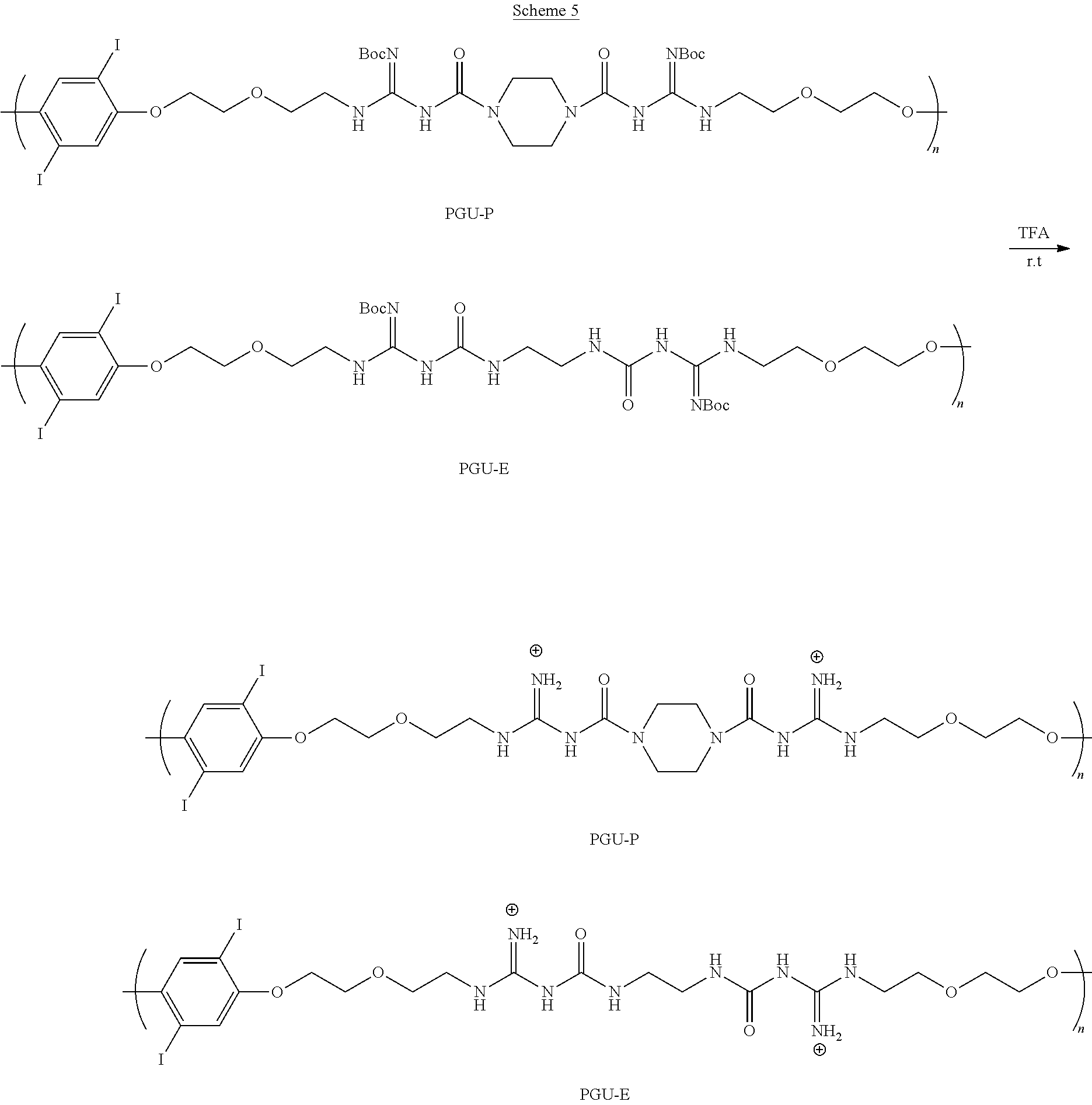
- Embodiments of the invention are directed to a new class of polymers, poly(guanylurea)s (PGUs), containing a guanylurea backbone capable of ionic, hydrophobic, and H-bonding interaction with bacterial cell membranes are illustrated below in an unprotonated and a highly protonated form:
- X is linear or cyclic alkylene, heteroatom interrupted alkylene, cycloalkylene, arylene, heteroarylene, or a combination thereof
- Y is linear or cyclic alkylene, heteroatom interrupted alkylene, cycloalkylene, arylene, heteroarylene, or a combination thereof
- R 1 and R 2 are independently, H, alkyl, substituted alkyl, heteroatom interrupted alkyl, aryl, substituted aryl, heteroarylene, or R 1 and R 2 are combined as an alkylene or heteroatom interrupted alkylene, where R 1 NYNR 2 comprises a heterocycle.
- the PGUs according to embodiments of the invention are more biocompatible than most synthetic antimicrobial polymers, which encounter difficulties in in vivo applications.
- Poly(guanylurea piperazine)s are synthesized by reacting piperazine with a monomer containing t-butyloxycarbonyl (Boc)-protected guanidine groups at the end of a short ethylene oxide side chains, monomer A, as indicted in Scheme 1.
- the monomer's aryliodide group provides hydrophobicity.
- the hydrophobic aryliodide units induce polymer chains to aggregate into nanoparticles (NPs) in bacteria culture medium.
- Piperazine creates rigidity between two guanylurea groups.
- Acyclic ethylenediamine is prepared as a control poly(guanylurea ethylenediamine) (PGU-E) that lacks the rigidity at the charge sites.
- PGU-E poly(guanylurea ethylenediamine)
- Positively charged PGUs are polymerized via guanylurea bond formation.
- Positively charged PGUs are not water soluble, but highly soluble in DMSO.
- PGU dissolved in DMSO placed into a bacterial culture medium [e.g., Mueller-Hinton Broth (MHB) and 7H9] forms NPs with a narrow size distribution.
- the hydrodynamic diameters (HDs) of PGU-P an PGU-E with molecular weights of 8,000 (i.e., PGU-P-8K) and 7,000 g/mol (i.e., PGU-E-7K) in 7H9 medium form nanoparticles of 86 ⁇ 1.9 and 106 ⁇ 5.8 nm, respectively, by nanoparticle tracking analysis in triplicates of three independent samples (Supporting Information).
- Zeta potentials measurements suggest that the NPs formed in MHB (and 7H9) are polymer-protein complexes. While no zeta potentials were obtained from control MHB (i.e., no PGUs), PGUs in both media exhibit zeta potentials in the range of ⁇ 14 to ⁇ 17 mV.
- MTT and hemolysis assay indicate that PGUs with different molecular weights exhibit ignorable cell viability inhibition when human cervical carcinoma cells (HeLa) upon incubation with various amounts of polymers overnight.
- the MTT assay for the metabolic activity of live cells uses color change of a tetrazolium dye [3-(4,5-dimethylthiazol-2-yl)-2,5-diphenyltetrazolium bromide].
- RBCs human red blood cells
- the hemolytic activities of PGUs require polymer concentrations required for 50% of hemolysis (HC 50 ), as determined by measuring the amounts of hemoglobin released from RBCs due to the membrane damage, is provided in Table 1, below.
- PGU-Ps are relatively nontoxic to RBC.
- PGU-Ps exhibit substantially lower hemolytic activity than PGU-Es, indicating that rigidity along the backbone is an important structural factor affecting the hemolytic activity.
- mammalian cell membranes contain hydrophobic cholesterols and phosphatidylcholine, increasing the hydrophobicity in an antimicrobial polymer often increases hemolytic activities.
- PGUs that have the slightly increased hydrophobicity due to incorporation of piperazine rather substantially decreases hemolytic activity, indicating that the reduced cytotoxicity of PGU-Ps is related to the rigidity between charged guanylurea groups.
- Antimicrobial activities of various molecular weight PGUs against Mycobacterium smegmatis (a mycobacterium ), Staphylococcus aureus (a Gram-positive bacterium), methicillin-resistant Staphylococcus aureus (MRSA), and Shigella flexneri (a Gram-negative bacterium) as evaluated by the minimal inhibitory concentrations (MIC) is also shown in Table 1, above.
- the PGU-Ps function well against these bacteria.
- PGU-P-8K exhibits the highest efficiency against M. smegmatis (3.1-6.5 ⁇ g/mL), implying that the mechanism of PGU-Ps is associated with membrane disruption.
- a hallmark of the host defense AMPs and their synthetic mimics is nonspecific antimicrobial activity against a broad spectrum of bacterial species due to the nonspecific membrane disruption mechanism.
- MIC values against Shigella flexneri are higher than other types of bacteria, presumably due to the presence of the additional outer membrane of the Gram-negative bacteria.
- the MIC values of PGU-P-8K and -14K are relatively comparable, low molecular weight (3,000 g/mol) PGU-P-3K exhibits poor antimicrobial activity, presumably due to the greatly reduced electrostatic and H-bonding interactions between the low molecular weight oligomer and the negatively charged membrane.
- Non-fluorescent EB becomes fluorescent upon permeation through the membranes and the subsequent intercalation into intracellular nucleic acids. Due to tight regulation of the membrane permeability and the efflux pumps, fluorescence intensity of normal bacteria cells treated with EB is generally low. However, damaged membranes allow increased intracellular diffusion of EB and/or the efflux pumps are inhibited, i.e., reducing the pump drainage efficiency, as indicated by the increased fluorescence intensity of bacterial cells. Fluorescence intensities of bacteria cells treated with PGUs at MIC values over 2 h show an increased fluorescence intensity of control M.
- the PGUs can be provided separately or in combination as medicaments that antibacterial, antiviral, antifungal, or any combination thereof.
- the medicaments can be formulated according to known methods for preparing pharmaceutically useful compositions. Such pharmaceutical compositions can be adapted for various forms of administration, such as, but not limited to, oral, parenteral, nasal, topical, and transdermal.
- the PGUs can be provided as solutions, amorphous compounds, injectables, pills, inhalants, or in any other form for administration.
- the PGUs can include a pharmaceutically acceptable carrier or diluent. Formulations are described in a number of sources, which are well known and readily available to those skilled in the art.
- Formulations suitable for administration include, for example, aqueous sterile injection solutions, which may contain antioxidants, buffers, bacteriostats, and solutes, which render the formulation isotonic with the blood of the intended recipient; and aqueous and non-aqueous sterile suspensions which may include suspending agents and thickening agents.
- the formulations may be presented in unit-dose or multi-dose containers, for example sealed ampoules and vials, and may be stored in a freeze dried (lyophilized) condition requiring only the condition of the sterile liquid carrier, for example, water for injections, prior to use.
- Extemporaneous injection solutions and suspensions may be prepared from sterile powder, granules, or tablets of the PGU comprising compositions.
- the formulations of the subject invention can include other agents conventional in the art having regard to the type of formulation in question.
- Pharmaceutically acceptable carriers used in PGU formulations include, but are not limited to, inert diluents and vehicles such as: one or more excipients, buccal tablets, troches, capsules, elixirs, suspensions, syrups, wafers, and aerosol sprays.
- Tablets, troches, pills, capsules, and the like may, but do not necessarily, contain binders, such as gum tragacanth, acacia, corn starch or gelatin; excipients, such as dicalcium phosphate; a disintegrating agent, such as corn starch, potato starch, or alginic acid; a lubricant, such as magnesium stearate; a sweetening agent, such as sucrose, fructose, lactose or aspartame; flavoring agent, such as peppermint, oil of wintergreen, or cherry flavoring; a liquid carrier, such as a vegetable oil or a polyethylene glycol; and/or solid carriers; such as finely divided solids such as talc, clay, microcrystalline cellulose, silica, or alumina.
- binders such as gum tragacanth, acacia, corn starch or gelatin
- excipients such as dicalcium phosphate
- a disintegrating agent such as corn starch, potato star
- any material used in preparing the dosage form should be pharmaceutically acceptable and substantially non-toxic in the amounts employed.
- the dosage form may be a sustained-release preparation.
- Other dosage forms can include surfactants or other adjuvants.
- Liquid compositions for topical use can be applied from absorbent pads or be impregnated on bandages and other dressings. Thickeners, such as synthetic polymers, fatty acids, fatty acid salts and esters, fatty alcohols, modified celluloses or modified mineral materials, can be employed with liquid carriers.
- PGUs may be in the free base form or in the form of an acid salt thereof.
- compounds as described herein may be in the form of a pharmaceutically acceptable salt, which are known in the art (Berge S. M. et al., J. Pharm. Sci . (1977) 66(1):1-19).
- Pharmaceutically acceptable salt as used herein includes, for example, salts that have the desired pharmacological activity of the parent compound (salts which retain the biological effectiveness and/or properties of the parent compound and which are not biologically and/or otherwise undesirable).
- the acid salts can be generated with any pharmaceutically acceptable organic or inorganic acid.
- salts may be derived from, for example, and without limitation, acetic acid, adipic acid, alginic acid, aspartic acid, ascorbic acid, benzoic acid, benzenesulfonic acid, butyric acid, cinnamic acid, citric acid, camphoric acid, camphorsulfonic acid, cyclopentanepropionic acid, diethylacetic acid, digluconic acid, dodecylsulfonic acid, ethanesulfonic acid, formic acid, fumaric acid, glucoheptanoic acid, gluconic acid, glycerophosphoric acid, glycolic acid, hemisulfonic acid, heptanoic acid, hexanoic acid, hydrochloric acid, hydrobromic acid, hydriodic acid, 2-hydroxyethanesulfonic acid, isonicotinic acid, lactic acid, malic acid, maleic acid, malonic acid, mandelic acid, me
- Salts as described herein, may be prepared by conventional processes known to a person skilled in the art, for example, and without limitation, by combining the free form with an organic acid or cation exchange from other salts. Those skilled in the art will appreciate that preparation of salts may occur in situ during isolation and purification of the compounds or preparation of salts may occur by separately reacting an isolated and purified compound.
- PGUs may be in the form of a solvate.
- Solvates contain either stoichiometric or non-stoichiometric amounts of a solvent in physical association the compound or salt thereof.
- the solvent may be, for example, and without limitation, a pharmaceutically acceptable solvent.
- hydrates are formed when the solvent is water or alcoholates are formed when the solvent is an alcohol.
- repeating units of the PGUs can be mixtures of isomers such as geometrical isomers, optical isomers based on asymmetric carbon, stereoisomers, tautomers, individual enantiomers, individual diastereomers, racemates, diastereomeric mixtures and combinations thereof, and are not limited by the description of the formula illustrated for the sake of convenience.
- the PGUs can be stereoregular or random polymers.
- the PGUs can be copolymers of various repeating units.
- the copolymers can be block copolymers, random copolymers, dendritic copolymers, or any other form of copolymers.
- PGUs or pharmaceutical compositions for use as described herein may be administered by means of a medical device or appliance such as an implant, graft, prosthesis, stent, etc.
- implants may be devised which are intended to contain and release such compounds or compositions.
- An example would be an implant made of a polymeric material adapted as a vehicle to release the PGUs over a period of time.
- an “effective amount” of a PGU pharmaceutical composition includes a therapeutically effective amount or a prophylactically effective amount.
- a “therapeutically effective amount” refers to an amount effective, at dosages and for periods of time necessary, to achieve the desired therapeutic result.
- a therapeutically effective amount of a PGU formulation may vary according to factors such as the disease state, age, sex, and weight of the subject, and the ability of the compound to elicit a desired response in the subject. Dosage regimens may be adjusted to provide the optimum therapeutic response.
- a therapeutically effective amount is also one in which any toxic or detrimental effects of the compound are outweighed by the therapeutically beneficial effects.
- a “prophylactically effective amount” refers to an amount effective, at dosages and for periods of time necessary, to achieve the desired prophylactic result. Typically, a prophylactic dose is used in subjects prior to the disease, so that a prophylactically effective amount may be less than a therapeutically effective amount.
- Dosage values may vary with the severity of the condition to be alleviated. For any particular subject, specific dosage regimens may be adjusted over time according to the individual need and the professional judgment of the person administering or supervising the administration of the compositions. Dosage ranges suggested herein are exemplary only and do not limit the dosage ranges that may be selected by medical practitioners.
- the amount of PGUs in the composition may vary according to factors such as the disease state, age, sex, and weight of the subject. Dosage regimens may be adjusted to provide the optimum therapeutic response.
- PGUs should be used without causing substantial toxicity. Toxicity of the PGUs can be determined using standard techniques, for example, by testing in cell cultures or experimental animals and determining the therapeutic index, i.e., the ratio between the LD50 (the dose lethal to 50% of the population) and the LD100 (the dose lethal to 100% of the population). In some circumstances however, such as in severe disease conditions, it may be appropriate to administer substantial excesses of the compositions. PGUs may be administered to a subject, where the “subject” may be a human, non-human primate, rat, mouse, cow, horse, pig, sheep, goat, dog, cat, or any other animal.
- a Schleck flask was charged with 20.0 mg (0.02 mmol) of Boc-protected guanidine containing di-iodo monomer A, 1.94 mg (0.02 mmol) of piperazine, and 0.14 mg of potassium carbonate (K 2 CO 3 ) (0.001 mmol). Then, 0.52 mL of anhydrous tetrahydrofuran (THF) was added and the Schleck flask was degassed for 1 min using N 2 bubbling. The reaction mixture was then stirred in a pre-set oil bath at 70° C. for 16 h under nitrogen environment. A viscous polymer solution was filtered through a wool filled glass pipette to remove K 2 CO 3 .
- THF anhydrous tetrahydrofuran
- the filtrate in THF was precipitated in diethyl ether (1 ⁇ ) and the white fibrous solid was collected by decantation of the solvent.
- the precipitates were re-dissolved in minimum amount of dichloromethane (DCM) and re-precipitated in methanol (3 ⁇ ).
- the final polymer was a white gel after drying in high vacuum (12.5 mg, 62% yield).
- a Schlenk flask was charged with 20.0 mg (0.02 mmol) of Boc-protected guanidine containing di-iodo monomer A, 1.35 mg (0.02 mmol) of ethylenediamine, and 0.14 mg of K 2 CO 3 (0.001 mmol). Then, 0.52 mL (by volume) anhydrous THF solvent was added and the Schleck flask was degassed for 1 min using N 2 flow. The reaction was then stirred in a pre-set oil bath at 70° C. for 16 h and equipped with a nitrogen filled balloon. A viscous polymer solution was filtered through a wool filled glass pipette to remove K 2 CO 3 .
- the filtrate in THF was precipitated in diethyl ether (1 ⁇ ) and a white fiber like powder was collected by decantation of the solvent. The powder was then re-dissolved in minimum amount of DCM and re-precipitated in methanol (3 ⁇ ) to have a pure product. The final polymer was a white gel after drying in high vacuum (12.9 mg with 66% yield).
- NTA nanoparticle tracking analysis
- the hemolysis assay was carried out using fresh human RBCs purchased from Zenbio, Inc., without further processing.
- the RBCs were diluted to 2% (v/v) RBCs in TBS (pH 7.4, 0.01 M Tris-HCl, 0.155 M NaCl).
- Stock polymer solutions were prepared in dimethyl sulfoxide (DMSO) at 8 mg/mL and diluted with TBS to give a working solution of 8000 ⁇ g/mL.
- Serial dilutions were made in a 96-well plate (Bio-One, Cellstar, Greiner) so that concentrations were stepwise halved eight times to give a range from 4,000 ⁇ g/mL to 31.25 ⁇ g/mL in 50 ⁇ L TBS.
- OD 414 values were subtracted from both sample OD 414 and positive control OD 414 values.
- OD 414 was normalized to 100% with the lowest OD 414 assigned to 0% hemolysis, and the triton X-100 positive control assigned to 100% hemolysis.
- the data was plotted as OD 414 vs. log 10 of the concentration using the graphing software Graphpad Prism.
- a sigmoidal curve was fitted to the data by the software to yield HC 50 values and 95% confidence intervals.
- the HC 50 values shown in FIGS. 3A-3D are the average values derived from three replicates of hemolysis experiments, and error bars represent the standard error of the mean.
- the cell viability assay was conducted using 3000 Hela cells per well in a complete medium.
- the cells 200 ⁇ L of 15,000 cells/mL
- the antimicrobial polymer samples were prepared by serial dilution of 5 mM stock polymer in DMSO to prepare 0.5, 1.0, 2.0 and 4.0 mM, respectively, in DMSO.
- Polymer solutions were further diluted 10 times in water to make working concentrations of 50, 100, 200 and 400 ⁇ M, respectively.
- Antimicrobial assay antimicrobial activities of the polymers were determined by the minimal inhibitory concentration (MIC) assay.
- MIC minimal inhibitory concentration
- MIC of Mycobacterium smegmatis (ATCC 700084), Shigella flexneri (ATCC 9199), Staphylococcus aureus (ATCC 14775) and methicillin-resistant Staphylococcus aureus (MRSA) (ATCC BAA-44) were determined by the standard broth microdilution method with slight modification. In brief, different bacteria were grown in either Mueller Hinton broth (MHB) or 7H9 broth ( M. smegmatis ) overnight at 37° C.
- the cells were first OD 600 adjusted to 0.1 and then further diluted 1:100 in the respective media and 50 ⁇ L ( ⁇ 10 5 CFU) is added to 96 well-microplate wells containing 50 ⁇ L serial dilutions of the polymers.
- 50 ⁇ L ⁇ 10 5 CFU
- the plates were incubated for 20-44 h at 37° C.
- MIC is defined as the lowest concentration of the polymer that inhibits the visual growth of the bacteria.
- a red-ox dye is added to the wells at a final concentration of 0.02% and incubated for 4-8 h at 37° C.
- MIC was calculated as the lowest concentration of the polymer that prevented the color change and reduced the fluorescence (Ex 540, Em 590 nm) by 90% when compared to the control wells containing no inhibitor. Ciprofloxacin was used as a positive control for bacterial growth inhibition. The MIC assays were repeated at least three times and the most consistent results are shown in FIG. 4 .
- Ethidium bromide accumulation assay was performed according to a modified protocol followed in many other studies.
- log phase cells of M. smegmatis or other bacterial species grown in 7H9 broth or MHB respectively were centrifuged, washed and re-suspended in PBS buffer or PBST (PBS buffer containing 0.05% tween 80, for M. smegmatis ) to an OD 600 of 0.2.
- Aliquots (50 ⁇ L) of the cell suspension was added to black microtiter plate wells each containing 50 ⁇ L of the serially (2 fold) diluted polymers. Highest concentration tested was usually the MIC concentration relevant for the particular bacteria/polymer combination.
- Ethidium bromide (EB) was added to each well at a final concentration of 2.5 ⁇ M. Fluorescence (Ex 540, Em 590) was then measured (every 3 min) in a plate reader for 1-2 h at 37° C. Results for S. flexneri , FIG. 1 , and S. aureus , FIG. 5 are provided. Verapamil, an efflux pump inhibitor was used as an assay control to verify the increase in ethidium bromide fluorescence.
Landscapes
- Chemical & Material Sciences (AREA)
- Organic Chemistry (AREA)
- Health & Medical Sciences (AREA)
- Chemical Kinetics & Catalysis (AREA)
- Medicinal Chemistry (AREA)
- Polymers & Plastics (AREA)
- Life Sciences & Earth Sciences (AREA)
- Nuclear Medicine, Radiotherapy & Molecular Imaging (AREA)
- Communicable Diseases (AREA)
- Pharmacology & Pharmacy (AREA)
- Oncology (AREA)
- Animal Behavior & Ethology (AREA)
- General Health & Medical Sciences (AREA)
- Public Health (AREA)
- Veterinary Medicine (AREA)
- General Chemical & Material Sciences (AREA)
- Pharmaceuticals Containing Other Organic And Inorganic Compounds (AREA)
Abstract
A poly(guanylurea) (PGU), comprising the structure where a multiplicity of repeating units are connected by guanylurea groups. The repeating units comprise: linear or cyclic alkylene, heteroatom interrupted alkylene, cycloalkylene, arylene, or heteroarylene; and a linear or cyclic alkylene, one or more heteroatom interrupted alkylene, cycloalkylene, arylene, heteroarylene, or a dinitrogen heterocycle. The PGU can be used as an antimicrobial agent with low toxicity in a pharmaceutical composition, generally as a protonated PGU upon combining with a pharmaceutically acceptable acid.
Description
This invention was made with government support under DMR1352317 awarded by the National Science Foundation. The government has certain rights in the invention.
Antimicrobial drug resistance has emerged rapidly and thwarted most treatment options, leading to prolonged illness, disability, and death. Despite considerable efforts to develop new antimicrobial drugs, many bacterial infections remain difficult to treat due to acquired drug resistance. Compared to small molecular antibiotics designed to interrupt the bacterial intracellular biochemical processes, antimicrobial polymers target the disruption of membrane integrity, offering a promising strategy to overcome drug resistance. Bacteria have little chance of developing a resistance mechanism against the physical disruption, which often leads to cell death.
The design principle of antimicrobial polymers has been focused primarily on balancing positive charges with the hydrophobicity in the pendant side chains in order to achieve selective disruption of the bacterial membrane over the mammalian cell membranes. By polymerizing various monomers containing positively charged hydrophobic side chains, many polymers with different functionalities and architectures have been developed and demonstrated for antimicrobial activities against a broad spectrum of bacterial species. Although current synthetic approaches have proven capable of developing highly selective antimicrobial polymers, a simple synthetic method for developing antimicrobial polymers with improved biocompatibility, selectivity, and specificity is needed.
Similar to facially structured host defense antimicrobial peptides (AMPs), antimicrobial polymers are attracted by the envelope components, transferred to the bacterial membrane, and adopt amphiphilic conformations necessary for disrupting the membrane. Recent molecular dynamic simulations suggest that the randomly distributed and oriented polymer side chains are reorganized into ordered amphiphilic chain architectures upon interacting with the negatively charged bacterial membrane. To this end, the design and development of polymers that favor the membrane disruption processes by compensating for the thermodynamic entropy loss upon forming ordered structures with enthalpy gains due to ionic, hydrophobic, and hydrogen-bonding (H-bonding) interactions are desired.
Embodiments of the invention are directed to a poly(guanylurea) (PGU), having the structure:
or any protonated or plurally protonated salt thereof. The PGU is a polymer where n is 3 to 100. Repeating units comprising X are linear or cyclic alkylene, heteroatom interrupted alkylene, cycloalkylene, arylene, heteroarylene, or a combination thereof. Repeating units comprising Y are linear or cyclic alkylene, one or more heteroatom interrupted alkylene where the herteroatom is O, S. NH, or a combination thereof, cycloalkylene, arylene, heteroarylene, or a combination thereof. Groups R1 and R2 are independently, H, substituted or unsubstituted linear, branched, or cyclic alkyl, one or more heteroatom interrupted substituted or unsubstituted linear branched or cyclic alkyl where the herteroatom is O, S. NH or a combination thereof, unsubstituted or substituted aryl, substituted or unsubstituted heteroarylene. Alternatively, R1 and R2 are combined as an alkylene or heteroatom interrupted alkylene, where R1NYNR2 comprises a dinitrogen heterocycle, and where substituents are C1 to C20 alkyl, C1 to C20 alkoxy, hydroxyl, C1 to C20 acyl, C1 to C20 acyloxy, amino, C1 to C20 alkyl amino, C1 to C20 dialkylamino, C1 to C20 acylamino, C2 to C20 acylalkylamino, fluoro, chloro, bromo, iodo, mercapto, C1 to C20 alkylthio, C6 to C18 aryl, C6 to C18 aryloxy, C6 to C18 arylamino, C6 to C32 diarylamino, or C7 to C38 alkylarylamino. The PGU can include one or more tert-butyloxycarbonyl protecting group (BOC).
Another embodiment of the invention is directed to a method of making the PGU, described above. The method involves combining first monomers with X as a di-terminal Boc-protected guanidine groups terminal to a linear or cyclic alkylene, heteroatom interrupted alkylene, cycloalkylene, arylene, heteroarylene, or a combination thereof, with second monomers with Y that has terminal ends that are an isocyanate or a dinitrogen heterocycle with a carbonate or amines of a diamine capped linear or cyclic alkylene, one or more heteroatom interrupted alkylene where the herteroatom is O, S. NH, or a combination thereof with the carbonate. The polymerization mixture is then heated to form the PGU. The carbonate can be alkali metal carbonate.
Another embodiment of the invention is directed to a pharmaceutical composition comprising the PGU. The pharmaceutical composition can be use as an antimicrobial agent.
Embodiments of the invention are directed to a new class of polymers, poly(guanylurea)s (PGUs), containing a guanylurea backbone capable of ionic, hydrophobic, and H-bonding interaction with bacterial cell membranes are illustrated below in an unprotonated and a highly protonated form:
where X is linear or cyclic alkylene, heteroatom interrupted alkylene, cycloalkylene, arylene, heteroarylene, or a combination thereof, Y is linear or cyclic alkylene, heteroatom interrupted alkylene, cycloalkylene, arylene, heteroarylene, or a combination thereof, and R1 and R2 are independently, H, alkyl, substituted alkyl, heteroatom interrupted alkyl, aryl, substituted aryl, heteroarylene, or R1 and R2 are combined as an alkylene or heteroatom interrupted alkylene, where R1NYNR2 comprises a heterocycle. It should be understood that the positive charges of the protonated form are balanced by an anion, that may be a where protonation is from a carboxylic acid, a mineral acid, or any pharmaceutically acceptable organic or inorganic acid.
Preparation of the PGUs is shown in Scheme 1 and Scheme 2, below. In contrast to copolymers where high entropy loss due to significant structural transformation from highly randomized side chain and backbone structures to relatively ordered orientations; the new polymers introduce positive charge and hydrophobicity into the polymer backbones. The polymer backbone may be positively charged. With a large positive charge density per repeating unit, various hydrophobic/hydrophilic units can be introduced to balance the amphiphilicity of the polymer. In order to achieve an additional enthalpy gain, a novel guanylurea functional group is an H-bond donor and an H-bond acceptor resides within the positively charged polymer backbone. The guanylurea functional group is a product of guanidine and urea. Although low molecular weight synthetic compounds and naturally occurring peptides that contain guanylurea derivatives show activity against bacteria, fungi, and viruses, the PGUs according to embodiments of the invention, are more biocompatible than most synthetic antimicrobial polymers, which encounter difficulties in in vivo applications.
Poly(guanylurea piperazine)s (PGU-Ps), according to an embodiment of the invention, are synthesized by reacting piperazine with a monomer containing t-butyloxycarbonyl (Boc)-protected guanidine groups at the end of a short ethylene oxide side chains, monomer A, as indicted in Scheme 1. The monomer's aryliodide group provides hydrophobicity. The hydrophobic aryliodide units induce polymer chains to aggregate into nanoparticles (NPs) in bacteria culture medium. Piperazine creates rigidity between two guanylurea groups. The backbone rigidity and planarity is a synthetic mimic of AMPs, and play important roles in antimicrobial activity because of favorable membrane interaction. Acyclic ethylenediamine is prepared as a control poly(guanylurea ethylenediamine) (PGU-E) that lacks the rigidity at the charge sites. Positively charged PGUs are polymerized via guanylurea bond formation. Positively charged PGUs are not water soluble, but highly soluble in DMSO. PGU dissolved in DMSO placed into a bacterial culture medium [e.g., Mueller-Hinton Broth (MHB) and 7H9], forms NPs with a narrow size distribution. For example, the hydrodynamic diameters (HDs) of PGU-P an PGU-E with molecular weights of 8,000 (i.e., PGU-P-8K) and 7,000 g/mol (i.e., PGU-E-7K) in 7H9 medium form nanoparticles of 86±1.9 and 106±5.8 nm, respectively, by nanoparticle tracking analysis in triplicates of three independent samples (Supporting Information). Zeta potentials measurements suggest that the NPs formed in MHB (and 7H9) are polymer-protein complexes. While no zeta potentials were obtained from control MHB (i.e., no PGUs), PGUs in both media exhibit zeta potentials in the range of −14 to −17 mV.
Assays conducted to evaluate potential toxicity toward mammalian cells are MTT and hemolysis assay indicate that PGUs with different molecular weights exhibit ignorable cell viability inhibition when human cervical carcinoma cells (HeLa) upon incubation with various amounts of polymers overnight. The MTT assay for the metabolic activity of live cells uses color change of a tetrazolium dye [3-(4,5-dimethylthiazol-2-yl)-2,5-diphenyltetrazolium bromide]. Using human red blood cells (RBCs), the hemolytic activities of PGUs require polymer concentrations required for 50% of hemolysis (HC50), as determined by measuring the amounts of hemoglobin released from RBCs due to the membrane damage, is provided in Table 1, below. As shown in Table 1, all PGUs are relatively nontoxic to RBC. PGU-Ps exhibit substantially lower hemolytic activity than PGU-Es, indicating that rigidity along the backbone is an important structural factor affecting the hemolytic activity. Because mammalian cell membranes contain hydrophobic cholesterols and phosphatidylcholine, increasing the hydrophobicity in an antimicrobial polymer often increases hemolytic activities. PGUs that have the slightly increased hydrophobicity due to incorporation of piperazine rather substantially decreases hemolytic activity, indicating that the reduced cytotoxicity of PGU-Ps is related to the rigidity between charged guanylurea groups.
| TABLE 1 |
| Antimicrobial and hemolytic activities of poly(guanylurea)s (PGUs). |
| MIC (μg/mL) | Selectivity (HC50/MIC) |
| M. | S. | HC50 | M. | S. | |||||
| PGU | smegmatis | flexneri | MRSA | S. aureus | (μg/mL) | smegmatis | flexneri | MRSA | S. aureus |
| P-14K | 6.5 | 25.5 | 25.5 | 13 | 504 | 77.5 | 19.8 | 19.8 | 38.8 |
| P-8K | 3.1-6.5 | 25.5 | 13 | 13 | 394 | 60.6-126 | 15.4 | 30.3 | 30.3 |
| P-3K | 102 | >203 | >203 | >203 | >2000 | >19.6 | >9.9 | >9.9 | >9.9 |
| E-11K | 25 | 25-50 | 99 | 99 | 232 | 4.6-9.0 | 6.0 | 2.3 | 2.3 |
| E-7K | 50-99 | 198 | 198 | 198 | 257 | 2.6-5.0 | 1.3 | 1.3 | 1.3 |
Antimicrobial activities of various molecular weight PGUs against Mycobacterium smegmatis (a mycobacterium), Staphylococcus aureus (a Gram-positive bacterium), methicillin-resistant Staphylococcus aureus (MRSA), and Shigella flexneri (a Gram-negative bacterium) as evaluated by the minimal inhibitory concentrations (MIC) is also shown in Table 1, above. The PGU-Ps function well against these bacteria. PGU-P-8K exhibits the highest efficiency against M. smegmatis (3.1-6.5 μg/mL), implying that the mechanism of PGU-Ps is associated with membrane disruption. A hallmark of the host defense AMPs and their synthetic mimics is nonspecific antimicrobial activity against a broad spectrum of bacterial species due to the nonspecific membrane disruption mechanism. Among the tested bacteria, MIC values against Shigella flexneri are higher than other types of bacteria, presumably due to the presence of the additional outer membrane of the Gram-negative bacteria. While the MIC values of PGU-P-8K and -14K are relatively comparable, low molecular weight (3,000 g/mol) PGU-P-3K exhibits poor antimicrobial activity, presumably due to the greatly reduced electrostatic and H-bonding interactions between the low molecular weight oligomer and the negatively charged membrane.
The effect of backbone rigidity on antimicrobial activity is apparent from the behavior of PGU-Es with comparable molecular weights (e.g., 11,000 and 7,000 g/mol) to those of PGU-Ps, with their MIC and HC50 measured under identical tested condition. As shown in Table 1, above, MIC values of PGU-Es increase sharply and HC50 values increase about 2-fold when the two guanylurea groups along the backbone were coupled by the ethylene group. This structure-activity relationship suggests that the rigid connection of two positively charged planar guanylurea groups plays an important role in selective disruption of the bacteria over mammalian membranes. In general, PGU-Ps exhibit good selectivity, as defined by the ratios HC50/MIC across the tested bacteria when compared to PGU-Es. Specifically, the effect of rigidity on antimicrobial activity and selectivity were most pronounced on M. smegmatis. The antimicrobial activity and selectivity of PGU-P-8K against M. smegmatis, as indicated in FIG. 1 , are enhanced by about 16- and 14-fold, respectively, when compared to similarly sized PGU-E-7K. PGU-E-11K, which exhibit moderate activity against M. smegmatis and display no activity toward other types of bacteria.
A membrane permeability assay using ethidium bromide (EB) was conducted. Non-fluorescent EB becomes fluorescent upon permeation through the membranes and the subsequent intercalation into intracellular nucleic acids. Due to tight regulation of the membrane permeability and the efflux pumps, fluorescence intensity of normal bacteria cells treated with EB is generally low. However, damaged membranes allow increased intracellular diffusion of EB and/or the efflux pumps are inhibited, i.e., reducing the pump drainage efficiency, as indicated by the increased fluorescence intensity of bacterial cells. Fluorescence intensities of bacteria cells treated with PGUs at MIC values over 2 h show an increased fluorescence intensity of control M. smegmatis over the initial 20 min of EB incubation and then plateaus, as shown in FIG. 1 . This indicates that M. smegmatis tightly controls the amount of intracellular EB by balancing the influx and outflow of EBs. At the MICs, fluorescence intensities of M. smegmatis treated with PGU-P-8K (circles) and PGU-E-11K (triangles), respectively, were substantially increased, supporting the membrane disruption mechanism of PGUs. After two-hour incubation, PGU-P-8K induces higher membrane permeability, probably due to membrane damage, than does PGU-E-11K, judged on their relative fluorescent intensities. Similar fluorescence patterns are observed from Gram-negative Shigella flexneri incubated with PGU-P-8K and PGU-E-11K, although the level of membrane damage determined by the fluorescence intensity within two hours of incubation is lower than that of M. smegmatis. Even though PGU-P-8K exhibiting better antimicrobial efficiency (MIC 13 μg/ml) against MRSA than a widely used antibiotic Ciprofloxacin (MIC 20 μg/ml), the EB assay result obtained within two hours of incubation is not informative, as no similar patterns of fluorescence intensity changes were correlated to the amounts and types of PGUs.
The PGUs, according to embodiments of the invention, can be provided separately or in combination as medicaments that antibacterial, antiviral, antifungal, or any combination thereof. The medicaments can be formulated according to known methods for preparing pharmaceutically useful compositions. Such pharmaceutical compositions can be adapted for various forms of administration, such as, but not limited to, oral, parenteral, nasal, topical, and transdermal. The PGUs can be provided as solutions, amorphous compounds, injectables, pills, inhalants, or in any other form for administration. The PGUs can include a pharmaceutically acceptable carrier or diluent. Formulations are described in a number of sources, which are well known and readily available to those skilled in the art. For example, Remington's Pharmaceutical Science (Martin EW [1995] Easton Pa., Mack Publishing Company, 19th ed.) describes formulations that can be used in connection with embodiments of the invention. Formulations suitable for administration include, for example, aqueous sterile injection solutions, which may contain antioxidants, buffers, bacteriostats, and solutes, which render the formulation isotonic with the blood of the intended recipient; and aqueous and non-aqueous sterile suspensions which may include suspending agents and thickening agents. The formulations may be presented in unit-dose or multi-dose containers, for example sealed ampoules and vials, and may be stored in a freeze dried (lyophilized) condition requiring only the condition of the sterile liquid carrier, for example, water for injections, prior to use. Extemporaneous injection solutions and suspensions may be prepared from sterile powder, granules, or tablets of the PGU comprising compositions. It should be understood that in addition to the ingredients particularly mentioned above, the formulations of the subject invention can include other agents conventional in the art having regard to the type of formulation in question.
Pharmaceutically acceptable carriers used in PGU formulations include, but are not limited to, inert diluents and vehicles such as: one or more excipients, buccal tablets, troches, capsules, elixirs, suspensions, syrups, wafers, and aerosol sprays. Tablets, troches, pills, capsules, and the like may, but do not necessarily, contain binders, such as gum tragacanth, acacia, corn starch or gelatin; excipients, such as dicalcium phosphate; a disintegrating agent, such as corn starch, potato starch, or alginic acid; a lubricant, such as magnesium stearate; a sweetening agent, such as sucrose, fructose, lactose or aspartame; flavoring agent, such as peppermint, oil of wintergreen, or cherry flavoring; a liquid carrier, such as a vegetable oil or a polyethylene glycol; and/or solid carriers; such as finely divided solids such as talc, clay, microcrystalline cellulose, silica, or alumina. Any material used in preparing the dosage form should be pharmaceutically acceptable and substantially non-toxic in the amounts employed. The dosage form may be a sustained-release preparation. Other dosage forms can include surfactants or other adjuvants. Liquid compositions for topical use can be applied from absorbent pads or be impregnated on bandages and other dressings. Thickeners, such as synthetic polymers, fatty acids, fatty acid salts and esters, fatty alcohols, modified celluloses or modified mineral materials, can be employed with liquid carriers.
PGUs may be in the free base form or in the form of an acid salt thereof. In some embodiment, compounds as described herein may be in the form of a pharmaceutically acceptable salt, which are known in the art (Berge S. M. et al., J. Pharm. Sci. (1977) 66(1):1-19). Pharmaceutically acceptable salt as used herein includes, for example, salts that have the desired pharmacological activity of the parent compound (salts which retain the biological effectiveness and/or properties of the parent compound and which are not biologically and/or otherwise undesirable). The acid salts can be generated with any pharmaceutically acceptable organic or inorganic acid. Pharmaceutically acceptable salts may be derived from, for example, and without limitation, acetic acid, adipic acid, alginic acid, aspartic acid, ascorbic acid, benzoic acid, benzenesulfonic acid, butyric acid, cinnamic acid, citric acid, camphoric acid, camphorsulfonic acid, cyclopentanepropionic acid, diethylacetic acid, digluconic acid, dodecylsulfonic acid, ethanesulfonic acid, formic acid, fumaric acid, glucoheptanoic acid, gluconic acid, glycerophosphoric acid, glycolic acid, hemisulfonic acid, heptanoic acid, hexanoic acid, hydrochloric acid, hydrobromic acid, hydriodic acid, 2-hydroxyethanesulfonic acid, isonicotinic acid, lactic acid, malic acid, maleic acid, malonic acid, mandelic acid, methanesulfonic acid, 2-napthalenesulfonic acid, naphthalenedisulphonic acid, p-toluenesulfonic acid, nicotinic acid, nitric acid, oxalic acid, pamoic acid, pectinic acid, 3-phenylpropionic acid, phosphoric acid, picric acid, pimelic acid, pivalic acid, propionic acid, pyruvic acid, salicylic acid, succinic acid, sulfuric acid, sulfamic acid, tartaric acid, thiocyanic acid or undecanoic acid. Salts, as described herein, may be prepared by conventional processes known to a person skilled in the art, for example, and without limitation, by combining the free form with an organic acid or cation exchange from other salts. Those skilled in the art will appreciate that preparation of salts may occur in situ during isolation and purification of the compounds or preparation of salts may occur by separately reacting an isolated and purified compound.
In embodiments of the invention, PGUs may be in the form of a solvate. Solvates contain either stoichiometric or non-stoichiometric amounts of a solvent in physical association the compound or salt thereof. The solvent may be, for example, and without limitation, a pharmaceutically acceptable solvent. For example, hydrates are formed when the solvent is water or alcoholates are formed when the solvent is an alcohol. In some embodiments of the invention, repeating units of the PGUs can be mixtures of isomers such as geometrical isomers, optical isomers based on asymmetric carbon, stereoisomers, tautomers, individual enantiomers, individual diastereomers, racemates, diastereomeric mixtures and combinations thereof, and are not limited by the description of the formula illustrated for the sake of convenience. The PGUs can be stereoregular or random polymers. The PGUs can be copolymers of various repeating units. The copolymers can be block copolymers, random copolymers, dendritic copolymers, or any other form of copolymers.
PGUs or pharmaceutical compositions for use as described herein may be administered by means of a medical device or appliance such as an implant, graft, prosthesis, stent, etc. Also, implants may be devised which are intended to contain and release such compounds or compositions. An example would be an implant made of a polymeric material adapted as a vehicle to release the PGUs over a period of time.
An “effective amount” of a PGU pharmaceutical composition includes a therapeutically effective amount or a prophylactically effective amount. A “therapeutically effective amount” refers to an amount effective, at dosages and for periods of time necessary, to achieve the desired therapeutic result. A therapeutically effective amount of a PGU formulation may vary according to factors such as the disease state, age, sex, and weight of the subject, and the ability of the compound to elicit a desired response in the subject. Dosage regimens may be adjusted to provide the optimum therapeutic response. A therapeutically effective amount is also one in which any toxic or detrimental effects of the compound are outweighed by the therapeutically beneficial effects. A “prophylactically effective amount” refers to an amount effective, at dosages and for periods of time necessary, to achieve the desired prophylactic result. Typically, a prophylactic dose is used in subjects prior to the disease, so that a prophylactically effective amount may be less than a therapeutically effective amount.
Dosage values may vary with the severity of the condition to be alleviated. For any particular subject, specific dosage regimens may be adjusted over time according to the individual need and the professional judgment of the person administering or supervising the administration of the compositions. Dosage ranges suggested herein are exemplary only and do not limit the dosage ranges that may be selected by medical practitioners. The amount of PGUs in the composition may vary according to factors such as the disease state, age, sex, and weight of the subject. Dosage regimens may be adjusted to provide the optimum therapeutic response.
In general, PGUs should be used without causing substantial toxicity. Toxicity of the PGUs can be determined using standard techniques, for example, by testing in cell cultures or experimental animals and determining the therapeutic index, i.e., the ratio between the LD50 (the dose lethal to 50% of the population) and the LD100 (the dose lethal to 100% of the population). In some circumstances however, such as in severe disease conditions, it may be appropriate to administer substantial excesses of the compositions. PGUs may be administered to a subject, where the “subject” may be a human, non-human primate, rat, mouse, cow, horse, pig, sheep, goat, dog, cat, or any other animal.
A 100 mL round bottom flask (RBF) was filled with compound 1 (1.00 g, 1.87 mmol) (synthesized according to literature procedure1) and N,N′-Di-Boc-1H-pyrazole-1-carboxamide (1.16 g, 3.73 mmol) under nitrogen atmosphere. A mixture of di-isopropylethylamine (DIPEA), acetonitrile and DCM (1:3.5:7.5 v/v, 20.0 mL) was degassed with N2 flow for 10 min and transferred into the reaction flask via a cannula. The reaction mixture was stirred at room temperature overnight and was then quenched with water before the two layers were separated. The aqueous layer was extracted with DCM, and the combined organic layers were washed with brine, filtered, and concentrated in vacuo. Column chromatography under 30% of ethyl acetate in hexane yielded monomer A as a white powder (1.53 g, 80% yield). 1H NMR (400 MHz, CDCl3, δ): 11.5 (s, 1H), 8.67 (t, 11H, J=5.3 Hz), 7.22 (s, 1H), 4.10 (t, 2H, J=4.4 Hz), 3.88 (t, 2H, J=5.2 Hz), 3.78 (t, 2H, J=4.6 Hz), 3.67 (t, 2H, J=5.2 Hz), 1.49 (s, 9H), 1.45 (s, 9H). 13C NMR (400 MHz, δ): 163.0, 155.4, 152.5, 152.0, 122.7, 86.8, 82.9, 78.1, 69.7, 68.6, 68.5, 28.0, 27.6. FT-IR (neat): 3329, 2978, 2929, 2851, 1719, 1665, 1639, 1614, 1573, 1516, 1482, 1466, 1406, 1394, 1326, 1276, 1242, 1155, 1125, 1048, 1024 cm−1. HRMS (ESI+, m/z): [M+H+]. Calcd. For C36H58I2N6O12, 1021.2275; found, 1021.2008.
A Schleck flask was charged with 20.0 mg (0.02 mmol) of Boc-protected guanidine containing di-iodo monomer A, 1.94 mg (0.02 mmol) of piperazine, and 0.14 mg of potassium carbonate (K2CO3) (0.001 mmol). Then, 0.52 mL of anhydrous tetrahydrofuran (THF) was added and the Schleck flask was degassed for 1 min using N2 bubbling. The reaction mixture was then stirred in a pre-set oil bath at 70° C. for 16 h under nitrogen environment. A viscous polymer solution was filtered through a wool filled glass pipette to remove K2CO3. The filtrate in THF was precipitated in diethyl ether (1×) and the white fibrous solid was collected by decantation of the solvent. The precipitates were re-dissolved in minimum amount of dichloromethane (DCM) and re-precipitated in methanol (3×). The final polymer was a white gel after drying in high vacuum (12.5 mg, 62% yield). 1H NMR (400 MHz, CDCl3, δ): 12.2 (s, 1H), 8.34 (t, 1H, J=4.8 Hz), 7.22 (s, 1H), 4.10 (t, 2H, J=4.6 Hz), 3.88 (t, 2H, J=4.6 Hz), 3.78 (t, 2H, J=5.1 Hz), 3.73 (br s, 2H), 3.60 (q, 2H, J=5.3 Hz, J=5.1 Hz), 3.53 (br s, 2H), 1.44 (s, 9H). FT-IR (neat): 3280, 2938, 1668, 1535, 1483, 1448, 1346 cm−1. GPC: Mw=27,500 g/mol, Mn=14,500, g/mol. PDI=1.90.
A Schlenk flask was charged with 20.0 mg (0.02 mmol) of Boc-protected guanidine containing di-iodo monomer A, 1.35 mg (0.02 mmol) of ethylenediamine, and 0.14 mg of K2CO3 (0.001 mmol). Then, 0.52 mL (by volume) anhydrous THF solvent was added and the Schleck flask was degassed for 1 min using N2 flow. The reaction was then stirred in a pre-set oil bath at 70° C. for 16 h and equipped with a nitrogen filled balloon. A viscous polymer solution was filtered through a wool filled glass pipette to remove K2CO3. The filtrate in THF was precipitated in diethyl ether (1×) and a white fiber like powder was collected by decantation of the solvent. The powder was then re-dissolved in minimum amount of DCM and re-precipitated in methanol (3×) to have a pure product. The final polymer was a white gel after drying in high vacuum (12.9 mg with 66% yield). 1H NMR (400 MHz, CDCl3, δ): 12.0 (s, 1H), 8.29 (s, 1H), 7.21 (s, 1H), 5.60 (br s, 1H), 4.10 (t, 2H, J=4.1 Hz), 3.96 (t, 2H, J=3.8 Hz), 3.86 (t, 2H, J=4.8 Hz), 3.8 (m, 2H), 3.56 (m, 2H), 3.54 (m, 2H), 3.31 (m, 2H), 1.44 (s, 9H). FT-IR (neat): 3405, 2532, 2159, 2034, 1662, 1437 cm−1. GPC: Mw=21,400 g/mol, Mn=11,200 g/mol, PDI=1.90.
| TABLE 2 |
| Properties of Antimicrobial |
| Poly(guanylurea) PGU-P and PGU-E |
| PGU | na | Mn (g/mol)b | PDIc | Yield (%) | HD (nm)d |
| P-14K | 14 | 14,500 | 1.9 | 62 | 128 ± 0.5 |
| P- | 8 | 8,700 | 1.5 | 60 | 86 ± 1.9 |
| P-3K | 3 | 3,100 | 2.5 | 65 | 102 ± 3.7 |
| E-11K | 11 | 11,200 | 1.9 | 66 | 125 ± 3.6 |
| E-7K | 7 | 7,500 | 1.9 | 65 | 106 ± 5.7 |
| aDegree of polymerization. | |||||
| bDetermined by gel permeation chromatography in THF. | |||||
| cPDI (polydispersity index) = Mw/Mn. | |||||
| dThe average hydrodynamic diameters of three independent samples in 7H9 medium. | |||||
Boc-Deprotection of Antimicrobial Poly(Guanylurea)s
Boc-Deprotection of PGUs
In a vial, a solution of Boc-protected polymer in DCM (1.00 mL) was treated with trifluoroacetic acid (TFA) at room temperature for 24 h. The solvent was removed under reduced pressure and the crude was dissolved in minimum amount of dimethylformamide (DMF) to make a clear homogeneous solution. The polymer in DMF was precipitated in diethyl ether (1×) and the white fiber like powder was collected after decantation of the solvent. The powder was then dissolved in DMF to make a clear solution and re-precipitated in ethyl acetate (EA) (2×) for final purification. The final Boc-deprotected polymer was collected by decantation of the solvent and dried in high vacuum for 24 h.
PGU-P: Using the general procedure described above, the final Boc-deprotected polymer was a white gel like powder (66% yield). 1H NMR (400 MHz, DMSO-d6, δ): 10.4 (s, 1H), 9.13 (s, 1H), 8.61 (s, 1H), 7.38 (s, 1H), 4.11 (s, 2H), 3.80 (s, 2H), 3.71 (s, 2H), 3.53 (s, 4H), 3.50 (s, 2H), 3.40 (br s, 2H), 3.38 (br s, 2H) 7. FT-IR (neat): 3360, 2160, 1737, 1681, 1437, 1317 cm−1
PGU-E: Using the general procedure described above, the final Boc-deprotected polymer was a white gel like powder (62% yield). 1H NMR (400 MHz, DMSO-d6, δ): 10.56 (s, 1H), 9.11 (s, 1H), 8.52 (s, 2H), 7.65 (s, 1H), 7.36 (s, 1H), 4.11 (s, 2H), 3.79 (s, 2H), 3.70 (s, 2H), 3.20 (s, 2H). FT-IR (neat): 3280, 2938, 1668, 1534, 1483, 1448, 1346 cm−1
Measurement of Hydrodynamic Diameter
Single particle light scattering analysis, also known as nanoparticle tracking analysis (NTA) was utilized to measure the hydrodynamic diameter of antimicrobial poly(guanylurea)s, exemplary results of the measurements are shown in FIGS. 2A-2F . Compared to DLS, NTA gives a more accurate representation of the particle with a broad size distribution, because of the direct detection of each nanoparticle. A 50 μM stock solution of polymer in DMSO was prepared. 50 μL of the stock polymers was diluted with 950 μL of PBS (pH 7.4). The final concentration of the polymer solution was 2.5 μM (5% DMSO and 95% PBS). The sample solution was then injected to a sample chamber of NTA for data acquisition for 90 seconds. All measurements were performed in triplicate at 25° C. using a temperature controller and the average value was reported.
Hemolysis Assay
The hemolysis assay was carried out using fresh human RBCs purchased from Zenbio, Inc., without further processing. The RBCs were diluted to 2% (v/v) RBCs in TBS (pH 7.4, 0.01 M Tris-HCl, 0.155 M NaCl). Stock polymer solutions were prepared in dimethyl sulfoxide (DMSO) at 8 mg/mL and diluted with TBS to give a working solution of 8000 μg/mL. Serial dilutions were made in a 96-well plate (Bio-One, Cellstar, Greiner) so that concentrations were stepwise halved eight times to give a range from 4,000 μg/mL to 31.25 μg/mL in 50 μL TBS. Later, 10 μL of 1 mg/mL stock solution of the hemolytic compound triton X-100 was added to 40 μL TBS as a positive control, 50 μL TBS as control (blank), and 100 μL TBS as background control. Finally, 50 μL of the 2% RBC solution was added to each well containing a 50 μL sample or a control. The plate was shaken gently for 1 min then incubated for 1 h at 37° C. Thereafter, the plate was centrifuged at 400 g for 5 min, subsequent to which 50 μL of the supernatant was pipetted into a new 96-well plate, and the optical density (OD) was measured at 414 nm on a UV-Vis plate reader. For statistical analysis, blank OD414 values were subtracted from both sample OD414 and positive control OD414 values. OD414 was normalized to 100% with the lowest OD414 assigned to 0% hemolysis, and the triton X-100 positive control assigned to 100% hemolysis. The data was plotted as OD414 vs. log10 of the concentration using the graphing software Graphpad Prism. A sigmoidal curve was fitted to the data by the software to yield HC50 values and 95% confidence intervals. The HC50 values shown in FIGS. 3A-3D , are the average values derived from three replicates of hemolysis experiments, and error bars represent the standard error of the mean.
MTT Assay
The cell viability assay was conducted using 3000 Hela cells per well in a complete medium. The cells (200 μL of 15,000 cells/mL) were seeded into a 96 well plate and incubated for 16 h to 24 h until reaching 60% confluency in 5% CO2 at 37° C. The antimicrobial polymer samples were prepared by serial dilution of 5 mM stock polymer in DMSO to prepare 0.5, 1.0, 2.0 and 4.0 mM, respectively, in DMSO. Polymer solutions were further diluted 10 times in water to make working concentrations of 50, 100, 200 and 400 μM, respectively. Then, 20 μL of each diluted polymer samples were added to each well with 180 μL complete medium in triplicate and incubated for 24 h. Later, 10 μL of MTT (12 mM) solution was added into each well and further incubated for 4 h according to the manufacturer's protocol. After the existing media was discarded, 50 μL DMSO was added to each of the wells and shaken for 30 min. Absorbance of each well was measured by microplate well reader at 570 nm and cell viability was reflected by the ratio between the absorbance of treated and control cells. Three repeats were conducted for each sample.
Antimicrobial assay antimicrobial activities of the polymers were determined by the minimal inhibitory concentration (MIC) assay. MIC of Mycobacterium smegmatis (ATCC 700084), Shigella flexneri (ATCC 9199), Staphylococcus aureus (ATCC 14775) and methicillin-resistant Staphylococcus aureus (MRSA) (ATCC BAA-44) were determined by the standard broth microdilution method with slight modification. In brief, different bacteria were grown in either Mueller Hinton broth (MHB) or 7H9 broth (M. smegmatis) overnight at 37° C. Next day, the cells were first OD600 adjusted to 0.1 and then further diluted 1:100 in the respective media and 50 μL (˜105 CFU) is added to 96 well-microplate wells containing 50 μL serial dilutions of the polymers. The plates were incubated for 20-44 h at 37° C. MIC is defined as the lowest concentration of the polymer that inhibits the visual growth of the bacteria. To aid in determining the visual growth of bacteria, resazurin, a red-ox dye is added to the wells at a final concentration of 0.02% and incubated for 4-8 h at 37° C. In the presence of viable cells, resazurin (blue) is reduced to resorfurin (pink) along with an increase in fluorescence. MIC was calculated as the lowest concentration of the polymer that prevented the color change and reduced the fluorescence (Ex 540, Em 590 nm) by 90% when compared to the control wells containing no inhibitor. Ciprofloxacin was used as a positive control for bacterial growth inhibition. The MIC assays were repeated at least three times and the most consistent results are shown in FIG. 4 .
Antimicrobial Mechanism Study
Ethidium bromide accumulation assay was performed according to a modified protocol followed in many other studies. In brief, log phase cells of M. smegmatis or other bacterial species grown in 7H9 broth or MHB respectively were centrifuged, washed and re-suspended in PBS buffer or PBST (PBS buffer containing 0.05% tween 80, for M. smegmatis) to an OD600 of 0.2. Aliquots (50 μL) of the cell suspension was added to black microtiter plate wells each containing 50 μL of the serially (2 fold) diluted polymers. Highest concentration tested was usually the MIC concentration relevant for the particular bacteria/polymer combination. Ethidium bromide (EB) was added to each well at a final concentration of 2.5 μM. Fluorescence (Ex 540, Em 590) was then measured (every 3 min) in a plate reader for 1-2 h at 37° C. Results for S. flexneri, FIG. 1 , and S. aureus, FIG. 5 are provided. Verapamil, an efflux pump inhibitor was used as an assay control to verify the increase in ethidium bromide fluorescence.
All publications referred to or cited herein are incorporated by reference in their entirety, including all figures and tables, to the extent they are not inconsistent with the explicit teachings of this specification.
It should be understood that the examples and embodiments described herein are for illustrative purposes only and that various modifications or changes in light thereof will be suggested to persons skilled in the art and are to be included within the spirit and purview of this application.
Claims (13)
1. A poly(guanylurea) (PGU), comprising the structure:
or any protonated or plurally protonated salt thereof
Where: n is 3 to 100; X is linear or cyclic alkylene, heteroatom interrupted alkylene, cycloalkylene, arylene, heteroarylene, or a combination thereof; Y is linear or cyclic alkylene, one or more heteroatom interrupted alkylene where the heteroatom is O, S, NH, or a combination thereof, cycloalkylene, arylene, heteroarylene, or a combination thereof; and R1 and R2 are independently, H, substituted or unsubstituted linear, branched, or cyclic alkyl, one or more heteroatom interrupted substituted or unsubstituted linear branched or cyclic alkyl where the herteroatom is O, S, NH or a combination thereof, unsubstituted or substituted aryl, substituted or unsubstituted heteroarylene; or R1 and R2 are combined as an alkylene or heteroatom interrupted alkylene, where R1NYNR2 comprises a dinitrogen heterocycle, and where substituents are C1 to C20 alkyl, C1 to C20 alkoxy, hydroxyl, C1 to C20 acyl, C1 to C20 acyloxy, amino, C1 to C20 alkyl amino, C1 to C20 dialkylamino, C1 to C20 acylamino, C2 to C20 acylalkylamino, fluoro, chloro, bromo, iodo, mercapto, C1 to C20 alkylthio, C6 to C18 aryl, C6 to C18 aryloxy, C6 to C18 arylamino, C6 to C32 diarylamino, or C7 to C38 alkylarylamino.
4. The PGU according to claim 1 , wherein X comprises an arylene, a cycloalkylene, a heterocycle.
5. The PGU according to claim 1 , further comprising at least one tert-butyloxycarbonyl protecting group (BOC).
6. A method of making a PGU, according to claim 1 , comprising:
providing a first monomer comprising a di-terminal Boc-protected guanidine monomer comprising a linear or cyclic alkylene, heteroatom interrupted alkylene, cycloalkylene, arylene, heteroarylene, or a combination thereof;
providing a second monomer comprising: an isocyanate; or a dinitrogen heterocycle with a carbonate; or a diamine capped linear or cyclic alkylene, one or more heteroatom interrupted alkylene where the herteroatom is O, S, NH, or a combination thereof with the carbonate;
combining the first and second monomer in a solvent as a solution;
heating the solution; and
isolating the PGU.
7. The method according to claim 6 , wherein the second monomer is a dinitrogen heterocycle.
8. The method according to claim 6 , wherein the carbonate is an alkali metal carbonate.
9. A pharmaceutical composition comprising a PGU according to claim 1 , wherein the PGU is the protonated or plurally protonated salt thereof.
10. The pharmaceutical composition according to claim 9 , wherein the protonated or plurally protonated salt is the salt of acetic acid, adipic acid, alginic acid, aspartic acid, ascorbic acid, benzoic acid, benzenesulfonic acid, butyric acid, cinnamic acid, citric acid, camphoric acid, camphorsulfonic acid, cyclopentanepropionic acid, diethylacetic acid, digluconic acid, dodecylsulfonic acid, ethanesulfonic acid, formic acid, fumaric acid, glucoheptanoic acid, gluconic acid, glycerophosphoric acid, glycolic acid, hemisulfonic acid, heptanoic acid, hexanoic acid, hydrochloric acid, hydrobromic acid, hydriodic acid, 2-hydroxyethanesulfonic acid, isonicotinic acid, lactic acid, malic acid, maleic acid, malonic acid, mandelic acid, methanesulfonic acid, 2-napthalenesulfonic acid, naphthalenedisulphonic acid, p-toluenesulfonic acid, nicotinic acid, nitric acid, oxalic acid, pamoic acid, pectinic acid, 3-phenylpropionic acid, phosphoric acid, picric acid, pimelic acid, pivalic acid, propionic acid, pyruvic acid, salicylic acid, succinic acid, sulfuric acid, sulfamic acid, tartaric acid, thiocyanic acid or undecanoic acid.
11. The pharmaceutical composition according to claim 9 , wherein the pharmaceutical composition is an antimicrobial agent.
12. The PGU according to claim 1 , wherein the PGU is in the form of a nanoparticle.
13. The PGU according to claim 12 , wherein the nanoparticle has a narrow size distribution.
Priority Applications (2)
| Application Number | Priority Date | Filing Date | Title |
|---|---|---|---|
| US15/911,299 US10017462B1 (en) | 2018-03-05 | 2018-03-05 | Antimicrobial poly(guanylurea)s |
| PCT/US2019/020656 WO2019173270A1 (en) | 2018-03-05 | 2019-03-05 | Antimicrobial poly(guanylurea)s |
Applications Claiming Priority (1)
| Application Number | Priority Date | Filing Date | Title |
|---|---|---|---|
| US15/911,299 US10017462B1 (en) | 2018-03-05 | 2018-03-05 | Antimicrobial poly(guanylurea)s |
Publications (1)
| Publication Number | Publication Date |
|---|---|
| US10017462B1 true US10017462B1 (en) | 2018-07-10 |
Family
ID=62749493
Family Applications (1)
| Application Number | Title | Priority Date | Filing Date |
|---|---|---|---|
| US15/911,299 Active US10017462B1 (en) | 2018-03-05 | 2018-03-05 | Antimicrobial poly(guanylurea)s |
Country Status (2)
| Country | Link |
|---|---|
| US (1) | US10017462B1 (en) |
| WO (1) | WO2019173270A1 (en) |
Cited By (2)
| Publication number | Priority date | Publication date | Assignee | Title |
|---|---|---|---|---|
| US11123442B2 (en) * | 2019-11-01 | 2021-09-21 | The Florida International University Board Of Trustees | Guanylurea functionalized peptides and proteins for therapeutics |
| US11857521B1 (en) | 2022-06-30 | 2024-01-02 | The Florida International University Board Of Trustees | Anti-mycobacterial drugs |
Families Citing this family (1)
| Publication number | Priority date | Publication date | Assignee | Title |
|---|---|---|---|---|
| CN113336675B (en) * | 2021-04-14 | 2022-09-30 | 湖南大学 | Antibacterial guanidine oligomer with anti-drug resistance and preparation method and use thereof |
Family Cites Families (3)
| Publication number | Priority date | Publication date | Assignee | Title |
|---|---|---|---|---|
| US5424063A (en) * | 1992-01-09 | 1995-06-13 | The Dow Chemical Company | Narrow poly- and mono-dispersed anionic oligomers, and their uses, formulations and process |
| US20030021761A1 (en) * | 2001-01-18 | 2003-01-30 | Geltex Pharmaceuticals, Inc. | Ionene polymers and their use in treating mucositis |
| RU2422137C1 (en) * | 2009-10-08 | 2011-06-27 | Виктор Вениаминович Тец | Method of obtaining biocidal polyguanidine and biocidal polyguanidine |
-
2018
- 2018-03-05 US US15/911,299 patent/US10017462B1/en active Active
-
2019
- 2019-03-05 WO PCT/US2019/020656 patent/WO2019173270A1/en not_active Ceased
Non-Patent Citations (1)
| Title |
|---|
| Bass et al., ChemMedChem, 2017, 12, 288-291. * |
Cited By (5)
| Publication number | Priority date | Publication date | Assignee | Title |
|---|---|---|---|---|
| US11123442B2 (en) * | 2019-11-01 | 2021-09-21 | The Florida International University Board Of Trustees | Guanylurea functionalized peptides and proteins for therapeutics |
| US20220001024A1 (en) * | 2019-11-01 | 2022-01-06 | The Florida International University Board Of Trustees | Guanylurea functionalized peptides and proteins for therapeutics |
| US11975077B2 (en) * | 2019-11-01 | 2024-05-07 | The Florida International University Board Of Trustees | Guanylurea functionalized peptides and proteins for therapeutics |
| US11857521B1 (en) | 2022-06-30 | 2024-01-02 | The Florida International University Board Of Trustees | Anti-mycobacterial drugs |
| US11974972B1 (en) | 2022-06-30 | 2024-05-07 | The Florida International University Board Of Trustees | Anti-mycobacterial drugs |
Also Published As
| Publication number | Publication date |
|---|---|
| WO2019173270A1 (en) | 2019-09-12 |
Similar Documents
| Publication | Publication Date | Title |
|---|---|---|
| US10017462B1 (en) | Antimicrobial poly(guanylurea)s | |
| US6797743B2 (en) | Antimicrobial polymer | |
| US9399044B2 (en) | Antimicrobial cationic polyamines | |
| EP2939695B1 (en) | Polymeric coupling agents and pharmaceutically-active polymers made therefrom | |
| Zhang et al. | Gemini quaternary ammonium salt waterborne biodegradable polyurethanes with antibacterial and biocompatible properties | |
| US10717798B2 (en) | Polymeric composition | |
| US20060024264A1 (en) | Antimicrobial copolymers and uses thereof | |
| CN110092814B (en) | Amphiphilic multi-block antibacterial peptide and preparation method and application thereof | |
| US20180146665A1 (en) | Clickable antimicrobial molecules and polymers | |
| US20170172147A1 (en) | Bio-inspired and antimicrobial polymers containing amino acid-like monomer building blocks | |
| US8507554B2 (en) | Quorum sensing antagonist and method of reducing a bacterial contamination using the quorum sensing antagonist | |
| CN111320749A (en) | Preparation method of photoresponse antibacterial clustered peptide polymer and hydrogel | |
| WO2005110485A1 (en) | Polymeric coupling agents and pharmaceutically-active polymers made therefrom | |
| KR102202112B1 (en) | Antimicrobial polymers with high biocompatibility | |
| Hu et al. | Poly (amino acid-hydroxyethyl methacrylate) s with chiral lysine and/or leucine side moieties and their antibacterial abilities for biomedical applications | |
| US11198761B2 (en) | Biodegradable polyionenes | |
| RU2272045C1 (en) | Polydiallylamines and disinfecting agent comprising thereof | |
| US20170202217A1 (en) | Antibacterial polymer, production method therefor, and usage thereof | |
| US5043463A (en) | Novel compounds for the control of microorganisms | |
| WO2008098220A1 (en) | Biocompatile amino acid anhydride polymers | |
| CN111454395A (en) | Antibacterial polymer and preparation method thereof | |
| Kenawy et al. | Synthesis and antibacterial activity of Schiff base compounds based on poloxamine | |
| Yan et al. | Decoy EPS layers for trapping and killing bacteria | |
| CN1175735C (en) | High-molecular-type chemical slow-release fungicide containing flexible components of bad mold | |
| US20070104678A1 (en) | Ancient defense polymer |
Legal Events
| Date | Code | Title | Description |
|---|---|---|---|
| FEPP | Fee payment procedure |
Free format text: ENTITY STATUS SET TO UNDISCOUNTED (ORIGINAL EVENT CODE: BIG.); ENTITY STATUS OF PATENT OWNER: MICROENTITY |
|
| FEPP | Fee payment procedure |
Free format text: ENTITY STATUS SET TO MICRO (ORIGINAL EVENT CODE: MICR); ENTITY STATUS OF PATENT OWNER: MICROENTITY |
|
| STCF | Information on status: patent grant |
Free format text: PATENTED CASE |
|
| MAFP | Maintenance fee payment |
Free format text: PAYMENT OF MAINTENANCE FEE, 4TH YEAR, MICRO ENTITY (ORIGINAL EVENT CODE: M3551); ENTITY STATUS OF PATENT OWNER: MICROENTITY Year of fee payment: 4 |