US10003435B2 - Method, system and device for error detection in OFDM wireless communication networks without full forward error correction decoding - Google Patents
Method, system and device for error detection in OFDM wireless communication networks without full forward error correction decoding Download PDFInfo
- Publication number
- US10003435B2 US10003435B2 US15/361,160 US201615361160A US10003435B2 US 10003435 B2 US10003435 B2 US 10003435B2 US 201615361160 A US201615361160 A US 201615361160A US 10003435 B2 US10003435 B2 US 10003435B2
- Authority
- US
- United States
- Prior art keywords
- niter
- fec
- iterations
- iter
- llr
- Prior art date
- Legal status (The legal status is an assumption and is not a legal conclusion. Google has not performed a legal analysis and makes no representation as to the accuracy of the status listed.)
- Active, expires
Links
Images



Classifications
-
- H—ELECTRICITY
- H04—ELECTRIC COMMUNICATION TECHNIQUE
- H04L—TRANSMISSION OF DIGITAL INFORMATION, e.g. TELEGRAPHIC COMMUNICATION
- H04L1/00—Arrangements for detecting or preventing errors in the information received
- H04L1/004—Arrangements for detecting or preventing errors in the information received by using forward error control
- H04L1/0041—Arrangements at the transmitter end
- H04L1/0042—Encoding specially adapted to other signal generation operation, e.g. in order to reduce transmit distortions, jitter, or to improve signal shape
-
- H—ELECTRICITY
- H03—ELECTRONIC CIRCUITRY
- H03M—CODING; DECODING; CODE CONVERSION IN GENERAL
- H03M13/00—Coding, decoding or code conversion, for error detection or error correction; Coding theory basic assumptions; Coding bounds; Error probability evaluation methods; Channel models; Simulation or testing of codes
- H03M13/29—Coding, decoding or code conversion, for error detection or error correction; Coding theory basic assumptions; Coding bounds; Error probability evaluation methods; Channel models; Simulation or testing of codes combining two or more codes or code structures, e.g. product codes, generalised product codes, concatenated codes, inner and outer codes
- H03M13/2948—Iterative decoding
-
- H—ELECTRICITY
- H03—ELECTRONIC CIRCUITRY
- H03M—CODING; DECODING; CODE CONVERSION IN GENERAL
- H03M13/00—Coding, decoding or code conversion, for error detection or error correction; Coding theory basic assumptions; Coding bounds; Error probability evaluation methods; Channel models; Simulation or testing of codes
- H03M13/37—Decoding methods or techniques, not specific to the particular type of coding provided for in groups H03M13/03 - H03M13/35
- H03M13/3738—Decoding methods or techniques, not specific to the particular type of coding provided for in groups H03M13/03 - H03M13/35 with judging correct decoding
-
- H—ELECTRICITY
- H03—ELECTRONIC CIRCUITRY
- H03M—CODING; DECODING; CODE CONVERSION IN GENERAL
- H03M13/00—Coding, decoding or code conversion, for error detection or error correction; Coding theory basic assumptions; Coding bounds; Error probability evaluation methods; Channel models; Simulation or testing of codes
- H03M13/37—Decoding methods or techniques, not specific to the particular type of coding provided for in groups H03M13/03 - H03M13/35
- H03M13/3746—Decoding methods or techniques, not specific to the particular type of coding provided for in groups H03M13/03 - H03M13/35 with iterative decoding
- H03M13/3753—Decoding methods or techniques, not specific to the particular type of coding provided for in groups H03M13/03 - H03M13/35 with iterative decoding using iteration stopping criteria
-
- H—ELECTRICITY
- H03—ELECTRONIC CIRCUITRY
- H03M—CODING; DECODING; CODE CONVERSION IN GENERAL
- H03M13/00—Coding, decoding or code conversion, for error detection or error correction; Coding theory basic assumptions; Coding bounds; Error probability evaluation methods; Channel models; Simulation or testing of codes
- H03M13/61—Aspects and characteristics of methods and arrangements for error correction or error detection, not provided for otherwise
- H03M13/612—Aspects specific to channel or signal-to-noise ratio estimation
-
- H—ELECTRICITY
- H04—ELECTRIC COMMUNICATION TECHNIQUE
- H04L—TRANSMISSION OF DIGITAL INFORMATION, e.g. TELEGRAPHIC COMMUNICATION
- H04L1/00—Arrangements for detecting or preventing errors in the information received
- H04L1/004—Arrangements for detecting or preventing errors in the information received by using forward error control
- H04L1/0045—Arrangements at the receiver end
- H04L1/0047—Decoding adapted to other signal detection operation
- H04L1/005—Iterative decoding, including iteration between signal detection and decoding operation
-
- H—ELECTRICITY
- H04—ELECTRIC COMMUNICATION TECHNIQUE
- H04L—TRANSMISSION OF DIGITAL INFORMATION, e.g. TELEGRAPHIC COMMUNICATION
- H04L1/00—Arrangements for detecting or preventing errors in the information received
- H04L1/20—Arrangements for detecting or preventing errors in the information received using signal quality detector
- H04L1/201—Frame classification, e.g. bad, good or erased
-
- H—ELECTRICITY
- H04—ELECTRIC COMMUNICATION TECHNIQUE
- H04L—TRANSMISSION OF DIGITAL INFORMATION, e.g. TELEGRAPHIC COMMUNICATION
- H04L5/00—Arrangements affording multiple use of the transmission path
- H04L5/0001—Arrangements for dividing the transmission path
- H04L5/0003—Two-dimensional division
- H04L5/0005—Time-frequency
- H04L5/0007—Time-frequency the frequencies being orthogonal, e.g. OFDM(A) or DMT
-
- H—ELECTRICITY
- H04—ELECTRIC COMMUNICATION TECHNIQUE
- H04L—TRANSMISSION OF DIGITAL INFORMATION, e.g. TELEGRAPHIC COMMUNICATION
- H04L69/00—Network arrangements, protocols or services independent of the application payload and not provided for in the other groups of this subclass
- H04L69/22—Parsing or analysis of headers
-
- H—ELECTRICITY
- H03—ELECTRONIC CIRCUITRY
- H03M—CODING; DECODING; CODE CONVERSION IN GENERAL
- H03M13/00—Coding, decoding or code conversion, for error detection or error correction; Coding theory basic assumptions; Coding bounds; Error probability evaluation methods; Channel models; Simulation or testing of codes
- H03M13/03—Error detection or forward error correction by redundancy in data representation, i.e. code words containing more digits than the source words
- H03M13/05—Error detection or forward error correction by redundancy in data representation, i.e. code words containing more digits than the source words using block codes, i.e. a predetermined number of check bits joined to a predetermined number of information bits
- H03M13/11—Error detection or forward error correction by redundancy in data representation, i.e. code words containing more digits than the source words using block codes, i.e. a predetermined number of check bits joined to a predetermined number of information bits using multiple parity bits
- H03M13/1102—Codes on graphs and decoding on graphs, e.g. low-density parity check [LDPC] codes
- H03M13/1105—Decoding
- H03M13/1128—Judging correct decoding and iterative stopping criteria other than syndrome check and upper limit for decoding iterations
-
- H—ELECTRICITY
- H03—ELECTRONIC CIRCUITRY
- H03M—CODING; DECODING; CODE CONVERSION IN GENERAL
- H03M13/00—Coding, decoding or code conversion, for error detection or error correction; Coding theory basic assumptions; Coding bounds; Error probability evaluation methods; Channel models; Simulation or testing of codes
- H03M13/29—Coding, decoding or code conversion, for error detection or error correction; Coding theory basic assumptions; Coding bounds; Error probability evaluation methods; Channel models; Simulation or testing of codes combining two or more codes or code structures, e.g. product codes, generalised product codes, concatenated codes, inner and outer codes
- H03M13/2957—Turbo codes and decoding
Definitions
- the present invention has its application within the telecommunication sector, especially, deals with the field of error detection in Orthogonal Frequency-Division Multiple Access (OFDMA) wireless communication systems. More specifically, the present invention proposes a method, a system and a device to detect (predict or estimate) errors in a received block (e.g. a packet) in Orthogonal Frequency-Division Multiplexing (OFDM) networks (e.g., in Long-Term Evolution, LTE, networks) without using error detection codes and without performing full Forward Error Correction decoding of the packet at the receiver.
- OFDM Orthogonal Frequency-Division Multiplexing
- LTE Long Term Evolution
- 3G Third-Generation
- UMTS Universal Mobile Telecommunication System
- GSM Global System for Mobile Communications
- 3GPP Third Generation Partnership Project
- LTE is also expected to improve spectral efficiency in networks, allowing carriers to provide more data and voice services over a given bandwidth.
- LTE uses Orthogonal Frequency-Division Multiple Access (OFDMA) which is a proven access technique, based on Orthogonal Frequency-Division Multiplexing (OFDM), for efficient user and data multiplexing in the frequency domain.
- OFDM Orthogonal Frequency-Division Multiplexing
- Other wireless standards like WiFi (IEEE 802.11) or WiMAX (IEEE 802.16) also employ OFDM techniques.
- OFDM orthogonal frequency division multiple access
- SINR received signal to interference and noise ratio
- FEC Forward Error Correction
- This computational burden introduces significant penalty in the overall latency of the system, which in turn constrains the maximum length of the transport network links, especially in so-called centralized or Cloud radio access networks (CRAN), between remote radio heads and the baseband unit.
- Said transport network commonly known as fronthaul, is mainly constrained by the Hybrid Automatic Repeat Request Round-Trip-Time (HARQ RTT), which in LTE is equal to 8 ms.
- HARQ RTT Hybrid Automatic Repeat Request Round-Trip-Time
- a significant proportion of the time budget for reception is spent on the FEC decoding process, thus imposing a maximum length for the fronthaul links.
- Detecting (or predicting) errors in a received block prior to actually decoding it can be very advantageous for significantly reducing the overall latency at the radio access network.
- Early detection of packet errors can trigger retransmissions without having to perform complete FEC decoding of the packet.
- early triggering of retransmissions at the remote radio head can relax the time budget constraints for the fronthaul network by taking the FEC decoding process out of the critical HARQ loop.
- the present invention solves the aforementioned problems and overcomes previously explained state-of-the-art limitations by determining whether a received block (e.g. a packet) has errors or not in a communication system employing OFDM, without having to perform full FEC decoding of the receiving block.
- the invention exploits the procedure proposed in European Patent Application EP15382344 (by the same inventor and applicant as the present application) for detection of packet errors without error detection coding, with the necessary changes at the receiver, required for early detection of packet errors, according to the principles described in this invention.
- Prior art OFDM transmitters can be used in the present invention without any change.
- the transmitter in OFDM communications systems performs FEC encoding at the intended coding rate after receiving from upper layers an information packet to be sent to the receiver, followed by suitable modulation and mapping onto OFDM physical resources, as well as any other processing steps as required in prior art OFDM communications systems.
- the signal corresponding to the information packet will arrive at the receiver.
- the aim of the present invention is to avoid full FEC decoding of the packet, while still retaining its basic characteristics so as to provide a suitable estimation of the presence of errors in the packet.
- a FEC encoding mechanism will be assumed such that the decoding process comprises a number of successive iterations. Examples of such encoding mechanisms can be turbo encoding and LDPC encoding, among other possibilities.
- the receiver performs a limited number of FEC decoding iterations on the received packet, such number of iterations being lower than the number of iterations ideally required for reliable recovery of the packet at the intended signal to noise and interference ratio (SINR).
- SINR signal to noise and interference ratio
- the actual number of iterations performed in the present invention can be chosen as a trade-off between accuracy in the estimation of packet errors and overall decoding delay.
- LLR Log-Likelihood Ratio
- the receiver can obtain the actual block error probability (BLEP) and the probability density function of the BLEP corresponding to said decoding iteration. Additionally, the block error rate (BLER) that would correspond to full decoding can also be obtained, by means of link-to-system mapping between the post-detection SINR and the actual BLER. With this information, it is possible to obtain a decision variable to check whether the packet is considered to have errors or not, without full FEC decoding.
- BLEP block error probability
- BLER block error rate
- the described procedure ideally involves a lower number of decoding iterations compared to what would be required for full FEC decoding. Avoiding full FEC decoding can be beneficial to relax the time budget allowed for packet processing, which is advantageous in centralized RAN deployments where stringent latency limits have to be met at the radio access part, or when a maximum Hybrid Automatic Repeat Request Round Trip Time (HARQ RTT) is set for HARQ operation.
- HARQ RTT Hybrid Automatic Repeat Request Round Trip Time
- the present invention proposes a method for detecting errors in an information (data) packet ( 13 ), or generally speaking an information block (sent by an OFDM transmitter), received by an OFDM receiver ( 14 ) in an Orthogonal Frequency-Division Multiplexing, OFDM, system, where the information packet is encoded using a Forward Error Correction, FEC, technique, and the received packet contains N FEC bits, said FEC technique involves that the receiver performs an iterative process for decoding, the method characterized by comprising the following steps performed at the receiver ( 14 ):
- the network may be a Long-Term Evolution, LTE, wireless cellular system or an IEEE 802.11, WiFi, system or an IEEE 802.16, WiMAX, system, or any other type of communications network using OFDM.
- the LLR values for the decoded bits after N iter FEC decoding iterations may be obtained as:
- LLR n Niter denotes the a-posteriori log-likelihood ratio of the received n-th bit after N iter iterations
- y denotes the decoded signal after N iter iterations
- x n is the corresponding n-th transmitted bit
- BLEP 0 Niter The block error probability after N iter iterations, BLEP 0 Niter , may be obtained by the expression:
- BLEP Niter may be calculated as a function of the probability density function of the LLR values, LLR n Niter , by using the following transformation:
- the information packet may be received in a communications signal through a communication channel.
- the average block error rate that would correspond to the received packet under full FEC decoding may be estimated following these steps:
- the decision variable may be the probability that the block error probability after N iter iterations is higher than BLEP 0 Niter .
- the first threshold may be the estimated block error rate.
- the decision variable Z may be calculated as:
- the method may further comprise calculating the reliability in said estimation of block errors as a log-likelihood ratio value, LLR z , obtained as the logarithm of the ratio between the decision variable and the block error rate.
- LLR z log-likelihood ratio value
- Statistics of the LLR values (to obtain the pdf) for the decoded bits after N iter FEC decoding iterations may be inferred by obtaining the histogram of LLR values corresponding to the received packet, provided that the channel coherence bandwidth is much larger than the bandwidth occupied by the signal or may be previously stored at the receiver as a function of the received SINR value, in Additive White Gaussian Noise conditions, provided that the channel coherence bandwidth is much larger than the bandwidth occupied by the signal.
- the number of decoding iterations N iter may be selected as a trade-off between latency of the decoding process and accuracy of block error decisions in the operating BLER range.
- an OFDM receiver for implementing the method described above at the receiver side. That is, an n OFDM receiver ( 14 ) for detecting errors in an information packet (block) received through a communication channel ( 12 ) of an OFDM network, where the information packet is encoded using a Forward Error Correction, FEC, technique, said FEC technique involving, for decoding at the receiver, an iterative decoding process, the receiver ( 14 ) comprising:
- a system which comprises an OFDM transmitter and at least one OFDM receiver (as defined before) connected to the OFDM transmitter via a wired or wireless interface (e.g. a LTE network).
- a wired or wireless interface e.g. a LTE network
- a computer program comprising computer program code means adapted to perform the steps of the described method, when said program is run on processing means of a network entity of an OFDMA network, said processing means being for example a computer, a digital signal processor, a field-programmable gate array (FPGA), an application-specific integrated circuit (ASIC), a micro-processor, a micro-controller, or any other form of programmable hardware.
- a computer program comprising instructions, causing a computer executing the program to perform all steps of the described method, when the program is run on a computer.
- a digital data storage medium is also provided for storing a computer program comprising instructions, causing a computer executing the program to perform all steps of the disclosed methods when the program is run on a computer.
- FIG. 1 shows a schematic block diagram of a network scenario for a possible application case according to an embodiment of the invention.
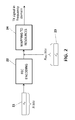
- FIG. 2 shows a schematic block diagram of an OFDM transmitter.
- FIG. 3 shows a schematic block diagram of a receiver according to an embodiment of the invention.
- the proposed invention provides a method, system and device for error determination (inferring whether a block is received with errors) in OFDMA communication systems (or more generically in OFDM communications systems) as for example LTE networks or any other type of OFDM networks.
- the proposed mechanism allows an efficient error prediction in a received data block (e.g. a packet) without having to perform full FEC decoding of the packet in OFDM communication systems.
- FIG. 1 depicts a schematic block diagram of a network scenario for a possible application case according to an embodiment of the invention.
- a transmitter for example, an OFDM transmitter, that is, a transmitter able to transmit signals using an OFDM technique
- a receiver for example, an OFDM receiver, that is, a receiver able to receive signals transmitted using an OFDM technique
- a communication channel 12 , either wireless or wireline, which connects said transmitter with said receiver (that is, the transmitter sends the signals to the receiver through the communication channel).
- the transmitter ( 10 ) sends a FEC-encoded block of information ( 11 ) (information packet) of N FEC bits ( 13 ), which represents the information ( 11 ) to be conveyed to the receiver.
- the block is sent through the channel ( 12 ) which can be either wireless or wireline, and arrives at the receiver ( 14 ).
- the receiver ( 14 ) is faced to the problem of how to detect ( 15 ) whether the packet ( 13 ) is received with errors or not without performing full FEC decoding of the packet, in order to trigger early actions related to the presence of errors (e.g. a MAC-level retransmission) ( 16 ).
- FEC encoding and “FEC decoding” will refer to any suitable forward error correction scheme applied at transmission and reception of the packet, respectively.
- FEC decoding involves an iterative procedure (also called message-passing or belief propagation algorithms).
- FEC schemes are turbo codes and LDPC codes, not precluding other FEC mechanisms following the same decoding approach.
- the present invention comprises changes in OFDM reception of FEC-encoded information packets, as explained in the following subsections, while keeping prior art OFDM transmission and encoding processes unchanged.
- FIG. 2 illustrates at the transmitter side of a FEC-aided OFDM communication system
- an information block of size N bits ( 21 ) is FEC encoded ( 22 ) resulting in an encoded block (packet) of size N FEC bits ( 23 ), which is further mapped to physical resources ( 24 ) (e.g. time, frequency) to yield the transmission signal in the frequency domain.
- N r ⁇ N FEC , where r is the FEC encoding rate.
- the encoded packet after being sent to the receiver, will suffer from channel impairments such as additive noise, fast fading, slow fading (shadowing), and interference, among others.
- the objective of the present invention is to predict (determine) whether the packet is received with errors without having to perform full FEC decoding of the whole packet.
- LLR bit-wise log-likelihood ratio
- Both alternatives give a more accurate result when the channel coherence bandwidth to be much larger than the user's allocated bandwidth, and the channel coherence time also much greater than the duration of the signal. In these conditions the channel experienced by the signal can be considered flat in both time and frequency. If that is not the case, statistics for the first method may not be accurate enough even in large packet systems, as channel variations will induce unpredictable LLR variations because of the non-linear nature of iterative FEC decoding.
- the second alternative involves a-priori knowledge of the LLR distribution after N iter FEC decoding iterations, as a function of SINR. In contrast with systems not using FEC, it is not straightforward how to obtain a direct relationship between SINR and the LLR distribution when SINR is not frequency-flat, because of the non-linear nature of FEC decoding process.
- BLEP 0 Niter is the actual received Block Error Probability (BLEP) value (after N iter iterations)
- p denotes the a posteriori probability
- ⁇ (capital pi) is the multiplication operator
- BLER AWGN represents the BLER that would have been obtained in Additive White Gaussian Noise (AWGN) conditions for a given SINR value (after full FEC decoding)
- ⁇ eff is the effective SINR that results from the application of link to system (L2S) techniques (also called Link Abstraction Models), like Exponential Effective SINR Mapping (EESM), Capacity Effective SINR Mapping (CESM), Logarithmic Effective SINR Mapping (LESM) or Mutual Information Effective SINR Mapping (MIESM), to name a few (as is well known from the prior art; see for example “Link Abstraction Models based on Mutual Information for LTE Downlink”, J. Olmos, S. Ruiz, M. Garcia-Lozano and D.
- L2S Link to system
- Such techniques provide an effective SINR value that yields the same block error rate as the system has in AWGN conditions, through a suitable mapping function as for example:
- ⁇ eff is the effective SINR for the control part
- ⁇ k are the received signal to noise and interference ratios (SINR) values of the k-th channel sample that characterize the frequency response of the received channel
- I is a suitable mapping function for the L2S technique
- K is the number of SINR samples
- ⁇ 1 , ⁇ 2 are design parameters that must be optimized for having minimum squared error between the experimental BLER and the BLER predicted by said L2S technique.
- the effective SINR is equal to the post-detection SINR in flat fading channels, therefore in this case a simple look-up table containing the mapping from SINR to BLER can suffice.
- the probability density function (pdf) for BLEP after N iter iterations denoted as BLEP Niter , can be obtained by means of the following transformation of the LLR values:
- N is the number of bits of the received block.
- the BLER value does not equate to the mean value of BLEP Niter , because the obtained LLR values correspond to only N iter FEC decoding iterations (less iterations that the iterations needed to have full FEC decoding) and are thus only intermediate values.
- a useful relationship can be established between BLER and the above obtained BLEP distribution.
- BLER represents the fraction of possible outcomes (in terms of received blocks) leading to packet errors
- a decision test can be derived so as to predict whether the received block (packet) has errors or not in the following way: checking whether the probability that BLEP is above BLEP 0 is below the average block error rate BLER AWGN ( ⁇ eff ) (calculated for the set of SINR values ⁇ n through the effective SINR ⁇ eff ) and in the affirmative case the block is assumed to have errors, otherwise it is assumed to be correctly received.
- a decision variable Z can be constructed:
- the logarithm of the ratio of the tail area and the expected block error rate is used as an equivalent decision variable which will be compared with zero for error decisions:
- Reliability for block error decisions may be given by the absolute magnitude
- the system may assume that a given received block is in error unless the decision variable Z yields an “OK” with reliability LLR z being above some threshold.
- Other suitable criteria could also be possible depending on the tolerance of the system to detection errors, because unavoidable noise can lead to erroneous decisions when LLR z is close to 0.
- the optimum number of iterations must be chosen as a trade-off between latency of the decoding process and accuracy in block error decisions.
- the usual operating point in wireless cellular systems comprising retransmissions is around 10% in BLER values, although it could vary significantly when RF conditions become challenging.
- the number of iterations should then be optimized for a BLER range of, say, between 1% and 50% to account for different RF conditions, but any other range of interest will be valid for the purpose of the present invention.
- FIG. 3 shows a receiver estructure according to an embodiment of the invention, depicting the general reception process for an encoded packet of size N FEC bits ( 300 ), according to an embodiment of the invention.
- the receiver first performs a resource de-mapping operation ( 301 ), which would be the inverse of block ( 24 ) at the transmit side, in order to get the received information samples (in terms of LLR values prior to decoding).
- Partial FEC decoding with N iter decoding iterations is performed in ( 302 ), thus yielding LLR n Niter values (the LLR values may be obtained for example from soft output metrics of the received bits after constellation symbol detection or by any other known technique). From them, block ( 303 ) can easily obtain the value BLEP 0 Niter .
- Block ( 304 ) calculates the post-detection SINR characterizing the received block, and with the aid of link to system techniques, the BLER is estimated by block ( 305 ).
- the probability density function of LLR n Niter may be also estimated by block ( 306 ) from the post-detection SINR.
- Block ( 307 ) then obtains an estimation of the probability density function of BLEP Niter , and finally block ( 308 ) obtains the error decision variable that will be used to assess whether the block had errors or not, together with the associated reliability in the decision, as explained in the present invention.
- a received information packet (also called information block) is partially FEC-decoded with N iter decoding iterations.
- the SINR is estimated as well as the value of BLER.
- LLR statistics after partial decoding are inferred, as well as BLEP statistics which serve as inputs for the error decision variable that is created to assess the presence of packet errors. Such error decision variable will provide indications for block errors along with the corresponding reliability of the decisions.
- the present invention proposes a method to predict whether a received block has errors in an OFDM communications system, without having to perform full FEC decoding of the packet.
- the method tries to derive suitable metrics for the block error probability statistics of the received packet, based on the ones obtained by FEC decoding with a limited number of iterations. Processing time for partial FEC decoding would be lower than that of full decoding, thereby allowing for fast detection of erroneous packets.
- the present invention can be used in any type of OFDM communication systems, especially in OFDM communication systems such as Long-Term Evolution, LTE, wireless cellular system, an IEEE 802.11, WiFi system, an IEEE 802.16, WiMAX system or any other type of OFDM communications system.
- OFDM communication systems such as Long-Term Evolution, LTE, wireless cellular system, an IEEE 802.11, WiFi system, an IEEE 802.16, WiMAX system or any other type of OFDM communications system.
- the proposed embodiments can be implemented by means of software elements, hardware elements, firmware elements, or any suitable combination of them.
Landscapes
- Engineering & Computer Science (AREA)
- Signal Processing (AREA)
- Physics & Mathematics (AREA)
- Probability & Statistics with Applications (AREA)
- Theoretical Computer Science (AREA)
- Computer Networks & Wireless Communication (AREA)
- Quality & Reliability (AREA)
- Computer Security & Cryptography (AREA)
- Detection And Prevention Of Errors In Transmission (AREA)
- Error Detection And Correction (AREA)
Abstract
Description
- a) performing a number of iterations, Niter, of the Forward Error Correction decoding technique on the received packet (where Niter is lower than the minimum number of iterations required for full FEC decoding at the intended signal to noise and interference ratio, SINR);
- b) obtaining (calculating) a posteriori log-likelihood ratio, LLR, value for each decoded bit after Niter FEC decoding iterations;
- c) obtaining the block error probability for the block of decoded bits after Niter iterations, BLEP0 Niter, and the probability density function of said block error probability, from said a posteriori LLR values;
- d) estimating a block error rate (that would correspond to the received packet under full FEC decoding), based on post-detection Signal to Interference and Noise Ratios, SINR, of the received bits;
- e) obtaining a decision variable value for block error decisions, Z, as a function of the obtained block error probability BLEP0 Niter and the probability density function of said block error probability; and
- f) determining whether the received packet has errors or not, by comparing said decision variable with a first threshold.
where LLRn Niter denotes the a-posteriori log-likelihood ratio of the received n-th bit after Niter iterations, y denotes the decoded signal after Niter iterations, xn is the corresponding n-th transmitted bit, and N is the number of bits of the block before the FEC encoding, that is, N=r·NFEC, where r is the FEC encoding rate of the FEC technique used for encoding the block.
where LLRn Niter is the log-likelihood ratio of the received n-th bit after Niter iterations.
-
- obtaining post-detection Signal to Interference and Noise Ratio, SINR, values characterizing the received signal prior to FEC decoding;
- from said post-detection SINR values, calculating an effective SINR by means of a Link to System technique; and
- calculating the average block error rate that would be obtained if the communication channel would have been an Additive White Gaussian Noise Channel for the effective SINR value calculated.
where fBLEP
-
- A decoder for performing a number of iterations, Niter, of a Forward Error Correction decoding technique on the received packet of length NFEC bits, where Niter is lower than the minimum number of iterations required for full FEC decoding at the intended signal to noise and interference ratio, SINR;
- Means for:
- Obtaining a posteriori log-likelihood ratio, LLR, values for each decoded bit after Niter FEC decoding iterations;
- Obtaining the block error probability for the block of decoded bits after Niter iterations, BLEP0 Niter and the probability density function of said block error probability, from said a posteriori LLR values;
- Estimating a block error rate that would correspond to the received block under full FEC decoding, based on post-detection Signal to Interference and Noise Ratios, SINR, of the received bits;
- Obtaining a decision variable value for block error decisions, Z, as a function of the block error probability BLEP0 Niter and the probability density function of said block error probability; and
- Determining whether the packet that would result after full FEC decoding has bit errors or not, by comparing said decision variable with a first threshold.
-
- 1. Approximately infer the statistics of the LLR values on a per-block basis, by obtaining the histogram of LLR values after Niter FEC decoding iterations corresponding to the received block. This procedure can only be accurate enough if the block being processed involves a large number of physical resources (i.e. time-frequency resources), as happens e.g. in high-throughput systems with large user bandwidths.
- 2. Obtain and store an off-line record of the LLR statistics after Niter iterations as a function of SINR, taking advantage of the flat fading channel assumption that leads to full characterization of the channel by a single SINR. The stored characteristics of the LLR distribution can then be applied for each received SINR value. This procedure may be particularly useful when the underlying distribution is known to be simple, e.g. a mixture of Gaussians, where suitable mean/variance values (perhaps with amplitudes if there are more than two components) suffice to characterize them. In large packet systems, under not too low SINR values, this is usually the case.
where LLRn Niter denotes the log-likelihood ratio of the received n-th bit after Niter iterations, y denotes the decoded signal after Niter iterations, xn is the corresponding n-th transmitted bit, N is the original number of bits of the information block (i.e. the number of bits of the block before FEC encoding), BLEP0 Niter is the actual received Block Error Probability (BLEP) value (after Niter iterations), p denotes the a posteriori probability, Π (capital pi) is the multiplication operator and BLERAWGN represents the BLER that would have been obtained in Additive White Gaussian Noise (AWGN) conditions for a given SINR value (after full FEC decoding), and γeff is the effective SINR that results from the application of link to system (L2S) techniques (also called Link Abstraction Models), like Exponential Effective SINR Mapping (EESM), Capacity Effective SINR Mapping (CESM), Logarithmic Effective SINR Mapping (LESM) or Mutual Information Effective SINR Mapping (MIESM), to name a few (as is well known from the prior art; see for example “Link Abstraction Models based on Mutual Information for LTE Downlink”, J. Olmos, S. Ruiz, M. Garcia-Lozano and D. Martin-Sacristan, COST 2100 TD(10)11052, 2-4 Jun. 2010, Aalborg (Denmark)).
where fBLEP Niter denotes the pdf of BLEPNiter obtained, as stated before, as a transformation of LLRn Niter. Z represents the area under the tail of the probability density function of BLEPNiter above the point BLEP0 Niter.
Claims (15)
Applications Claiming Priority (3)
| Application Number | Priority Date | Filing Date | Title |
|---|---|---|---|
| EP15382587.2 | 2015-11-25 | ||
| EP15382587 | 2015-11-25 | ||
| EP15382587.2A EP3174231B1 (en) | 2015-11-25 | 2015-11-25 | Method, system and device for error detection in ofdm wireless communication networks without full forward error correction decoding |
Publications (2)
| Publication Number | Publication Date |
|---|---|
| US20170149529A1 US20170149529A1 (en) | 2017-05-25 |
| US10003435B2 true US10003435B2 (en) | 2018-06-19 |
Family
ID=54754580
Family Applications (1)
| Application Number | Title | Priority Date | Filing Date |
|---|---|---|---|
| US15/361,160 Active 2037-01-24 US10003435B2 (en) | 2015-11-25 | 2016-11-25 | Method, system and device for error detection in OFDM wireless communication networks without full forward error correction decoding |
Country Status (3)
| Country | Link |
|---|---|
| US (1) | US10003435B2 (en) |
| EP (1) | EP3174231B1 (en) |
| ES (1) | ES2710680T3 (en) |
Cited By (5)
| Publication number | Priority date | Publication date | Assignee | Title |
|---|---|---|---|---|
| US20180367243A1 (en) * | 2017-06-16 | 2018-12-20 | Mediatek Inc. | Devices and method for wirelessly broadcasting media packets |
| US10256945B2 (en) * | 2009-02-27 | 2019-04-09 | Blackberry Limited | Forward error correction decoding avoidance based on predicted code block reliability |
| US20190207719A1 (en) * | 2017-12-29 | 2019-07-04 | Limited Liability Company "Radio Gigabit" | Method of hybrid automatic repeat request implementation for data transmission with multi-level coding |
| US11271685B2 (en) | 2017-12-29 | 2022-03-08 | Limited Liability Company “Radio Gigabit” | Method of hybrid automatic repeat request implementation for data transmission with multilevel coding |
| US20250216915A1 (en) * | 2019-01-23 | 2025-07-03 | Cisco Technology, Inc. | Transmission of pulse power and data over a wire pair |
Families Citing this family (5)
| Publication number | Priority date | Publication date | Assignee | Title |
|---|---|---|---|---|
| US10439641B2 (en) * | 2017-06-02 | 2019-10-08 | Nxp B.V. | Error estimation in signal communications |
| EP3503016B1 (en) * | 2017-12-19 | 2021-12-22 | Nokia Technologies Oy | Apparatus, method and computer program for processing a piecewise-smooth signal |
| GB2576210B8 (en) * | 2018-08-10 | 2020-10-21 | Tcl Communication Ltd | Downlink transmission with two-stage feedback:early prediction-based feedback of Physical Downlink Shared Channel and Hybrid Automatic Repeat Request feedback |
| US10749787B2 (en) * | 2019-01-03 | 2020-08-18 | Citrix Systems, Inc. | Method for optimal path selection for data traffic undergoing high processing or queuing delay |
| WO2021249632A1 (en) * | 2020-06-10 | 2021-12-16 | Huawei Technologies Co., Ltd. | Accumulative iterative code for communication systems |
Citations (1)
| Publication number | Priority date | Publication date | Assignee | Title |
|---|---|---|---|---|
| US20160072657A1 (en) * | 2012-12-03 | 2016-03-10 | Digital PowerRadio, LLC | Systems and methods for advanced iterative decoding and channel estimation of concatenated coding systems |
-
2015
- 2015-11-25 EP EP15382587.2A patent/EP3174231B1/en active Active
- 2015-11-25 ES ES15382587T patent/ES2710680T3/en active Active
-
2016
- 2016-11-25 US US15/361,160 patent/US10003435B2/en active Active
Patent Citations (2)
| Publication number | Priority date | Publication date | Assignee | Title |
|---|---|---|---|---|
| US20160072657A1 (en) * | 2012-12-03 | 2016-03-10 | Digital PowerRadio, LLC | Systems and methods for advanced iterative decoding and channel estimation of concatenated coding systems |
| US20160352463A1 (en) * | 2012-12-03 | 2016-12-01 | Ln2 Db, Llc | Systems and methods for advanced iterative decoding and channel estimation of concatenated coding systems |
Non-Patent Citations (3)
| Title |
|---|
| European Search Report, 7 pgs, Jun. 1, 2016. |
| K. Xie et al., "A New ARQ Method for Turbo Coded MC-CDMA," Communications, 2005, vol. 5, May 16, 2005, pp. 3417-3421. |
| Kai Xie et al., "A new ARQ method for turbo coded MC-CDMA", Communications, 2005. ICC 2005. 2005 IEEE International Conference on Seoul, Korea May 16-20, 2005, Piscataway, NJ, USA, IEEE vol. 5, May 16, 2005, pp. 3417-3421. |
Cited By (6)
| Publication number | Priority date | Publication date | Assignee | Title |
|---|---|---|---|---|
| US10256945B2 (en) * | 2009-02-27 | 2019-04-09 | Blackberry Limited | Forward error correction decoding avoidance based on predicted code block reliability |
| US20180367243A1 (en) * | 2017-06-16 | 2018-12-20 | Mediatek Inc. | Devices and method for wirelessly broadcasting media packets |
| US10756844B2 (en) * | 2017-06-16 | 2020-08-25 | Mediatek Inc. | Devices and method for wirelessly broadcasting media packets |
| US20190207719A1 (en) * | 2017-12-29 | 2019-07-04 | Limited Liability Company "Radio Gigabit" | Method of hybrid automatic repeat request implementation for data transmission with multi-level coding |
| US11271685B2 (en) | 2017-12-29 | 2022-03-08 | Limited Liability Company “Radio Gigabit” | Method of hybrid automatic repeat request implementation for data transmission with multilevel coding |
| US20250216915A1 (en) * | 2019-01-23 | 2025-07-03 | Cisco Technology, Inc. | Transmission of pulse power and data over a wire pair |
Also Published As
| Publication number | Publication date |
|---|---|
| EP3174231B1 (en) | 2018-11-21 |
| US20170149529A1 (en) | 2017-05-25 |
| EP3174231A1 (en) | 2017-05-31 |
| ES2710680T3 (en) | 2019-04-26 |
Similar Documents
| Publication | Publication Date | Title |
|---|---|---|
| EP3174231B1 (en) | Method, system and device for error detection in ofdm wireless communication networks without full forward error correction decoding | |
| CN114365532B (en) | Link-level performance prediction based on neural networks | |
| US8787384B2 (en) | Pre-emptive acknowledgement for data transmission in a communication system | |
| US8331259B2 (en) | Apparatus and method for adaptively generating channel quality indicator in wireless communication system | |
| US10615920B2 (en) | Method and apparatus for reducing HARQ feedback latency | |
| US10237022B2 (en) | Method for a first network node for transmitting or retransmitting data to a second network node and first network node thereof and method for a second network node for receiving data transmitted or retransmitted from a first network node and second network node thereof | |
| JP5470355B2 (en) | Resource allocation method, error-free information transmission method, node, and wireless communication network in wireless communication network | |
| US11196446B2 (en) | Method and apparatus for data processing in a communication system | |
| WO2020030115A1 (en) | Downlink transmission with two-stage feedback: early prediction-based feedback of physical downlink shared channel and hybrid automatic repeat request feedback | |
| US20080214119A1 (en) | Link adaptation telecommunication system | |
| US20210203440A1 (en) | Receiver, transmitter, communication network, data signal and method improving a retransmission process in a communication network | |
| US9647803B2 (en) | Cooperative communication system with adaptive packet retransmission strategy | |
| EP2868022B1 (en) | A method and apparatus for retransmission processing in a communication receiver | |
| US9860020B2 (en) | Method, system and device for error detection in OFDM wireless communication networks | |
| CN109983722B (en) | Hybrid automatic repeat request feedback method and device | |
| JP2020017808A (en) | Wireless relay device and wireless relay method | |
| TW202616673A (en) | Machine learning based adaptive quantization for low density parity check | |
| Woltering et al. | Link level performance assessment of reliability-based HARQ schemes in LTE | |
| US11375486B1 (en) | Method and device for detecting discontinuous transmission (DTX) assisted by noise estimation | |
| US20240313887A1 (en) | Rateless polar codes | |
| US20250096930A1 (en) | Systematic polar codes for rateless wireless communications | |
| Lorca et al. | Early prediction of packet errors in FEC-encoded systems with very few decoding iterations | |
| WO2018103011A1 (en) | Data transmission method and communication device | |
| WO2012171291A1 (en) | Method and device for data retransmission and merging based on harq | |
| Valenti | An information-theoretic approach to accelerated simulation of hybrid-ARQ systems |
Legal Events
| Date | Code | Title | Description |
|---|---|---|---|
| AS | Assignment |
Owner name: TELEFONICA, S.A., SPAIN Free format text: ASSIGNMENT OF ASSIGNORS INTEREST;ASSIGNOR:LORCA HERNANDO, JAVIER;REEL/FRAME:040416/0444 Effective date: 20161019 |
|
| STCF | Information on status: patent grant |
Free format text: PATENTED CASE |
|
| MAFP | Maintenance fee payment |
Free format text: PAYMENT OF MAINTENANCE FEE, 4TH YEAR, LARGE ENTITY (ORIGINAL EVENT CODE: M1551); ENTITY STATUS OF PATENT OWNER: LARGE ENTITY Year of fee payment: 4 |
|
| MAFP | Maintenance fee payment |
Free format text: PAYMENT OF MAINTENANCE FEE, 8TH YEAR, LARGE ENTITY (ORIGINAL EVENT CODE: M1552); ENTITY STATUS OF PATENT OWNER: LARGE ENTITY Year of fee payment: 8 |