US10000515B2 - Hydrosilylation reaction catalyst - Google Patents
Hydrosilylation reaction catalyst Download PDFInfo
- Publication number
- US10000515B2 US10000515B2 US15/503,266 US201515503266A US10000515B2 US 10000515 B2 US10000515 B2 US 10000515B2 US 201515503266 A US201515503266 A US 201515503266A US 10000515 B2 US10000515 B2 US 10000515B2
- Authority
- US
- United States
- Prior art keywords
- mmol
- compound
- group
- catalyst
- hydrosilylation reaction
- Prior art date
- Legal status (The legal status is an assumption and is not a legal conclusion. Google has not performed a legal analysis and makes no representation as to the accuracy of the status listed.)
- Active
Links
- 0 [4*]N1[C]N([5*])C1 Chemical compound [4*]N1[C]N([5*])C1 0.000 description 3
- JRLQJSOURAVKLX-UHFFFAOYSA-N C1=CC2CCC1C2.CC1CC2CCC1C2.[H]C Chemical compound C1=CC2CCC1C2.CC1CC2CCC1C2.[H]C JRLQJSOURAVKLX-UHFFFAOYSA-N 0.000 description 2
- GLEDFEPDWLTICA-UHFFFAOYSA-N C=CCCCCCC.CCCCCCCCC.[H]C Chemical compound C=CCCCCCC.CCCCCCCCC.[H]C GLEDFEPDWLTICA-UHFFFAOYSA-N 0.000 description 2
- HCYATWVZCFFWLI-UHFFFAOYSA-N C=CCCCCCC.CCCCCCCC[Si](C)(C)O[Si](C)(C)C.[H][Si](C)(C)O[Si](C)(C)C Chemical compound C=CCCCCCC.CCCCCCCC[Si](C)(C)O[Si](C)(C)C.[H][Si](C)(C)O[Si](C)(C)C HCYATWVZCFFWLI-UHFFFAOYSA-N 0.000 description 2
- HMBYFENMHDTGBT-UHFFFAOYSA-N C=CCCCCCC.CCCCCCCC[Si](C)(C)O[Si](C)(C)O[Si](C)(C)CCCCCCCC.[H][Si](C)(C)O[Si](C)(C)O[Si]([H])(C)C Chemical compound C=CCCCCCC.CCCCCCCC[Si](C)(C)O[Si](C)(C)O[Si](C)(C)CCCCCCCC.[H][Si](C)(C)O[Si](C)(C)O[Si]([H])(C)C HMBYFENMHDTGBT-UHFFFAOYSA-N 0.000 description 1
- VVLIHAXMORLJLA-UHFFFAOYSA-N CC(C)(C)N1[C]N(C(C)(C)C)C=C1.CC(C)C1=CC=CC(C(C)C)=C1N1[C]N(C2=C(C(C)C)C=CC=C2C(C)C)C=C1.CC(C)C1=CC=CC(C(C)C)=C1N1[C]N(C2=C(C(C)C)C=CC=C2C(C)C)CC1.CC1=CC(C)=C(N2[C]N(C3=C(C)C=C(C)C=C3C)C=C2)C(C)=C1.CC1=CC(C)=C(N2[C]N(C3=C(C)C=C(C)C=C3C)CC2)C(C)=C1.COC1=CC(C(C2=CC=CC=C2)C2=CC=CC=C2)=C(N2[C]N(C3=C(C(C4=CC=CC=C4)C4=CC=CC=C4)C=C(C)C=C3C(C3=CC=CC=C3)C3=CC=CC=C3)C=C2)C(C(C2=CC=CC=C2)C2=CC=CC=C2)=C1.[C]1N(C23CC4CC(CC(C4)C2)C3)C=CN1C12CC3CC(CC(C3)C1)C2 Chemical compound CC(C)(C)N1[C]N(C(C)(C)C)C=C1.CC(C)C1=CC=CC(C(C)C)=C1N1[C]N(C2=C(C(C)C)C=CC=C2C(C)C)C=C1.CC(C)C1=CC=CC(C(C)C)=C1N1[C]N(C2=C(C(C)C)C=CC=C2C(C)C)CC1.CC1=CC(C)=C(N2[C]N(C3=C(C)C=C(C)C=C3C)C=C2)C(C)=C1.CC1=CC(C)=C(N2[C]N(C3=C(C)C=C(C)C=C3C)CC2)C(C)=C1.COC1=CC(C(C2=CC=CC=C2)C2=CC=CC=C2)=C(N2[C]N(C3=C(C(C4=CC=CC=C4)C4=CC=CC=C4)C=C(C)C=C3C(C3=CC=CC=C3)C3=CC=CC=C3)C=C2)C(C(C2=CC=CC=C2)C2=CC=CC=C2)=C1.[C]1N(C23CC4CC(CC(C4)C2)C3)C=CN1C12CC3CC(CC(C3)C1)C2 VVLIHAXMORLJLA-UHFFFAOYSA-N 0.000 description 1
- ARKFDAUMHAVYON-UHFFFAOYSA-O CC(C)C1=CC=CC(C(C)C)=C1[N+]1=CC2(CCCCC2)CC1(C)C.CC1=CC(C)=C([N+]2=CN3C(C)=CC=CC3=C2)C(C)=C1.CC1=CC(C)=C([N+]2=CN3CCCC3=N2)C(C)=C1.ClC1=CC=C(N2C=C[NH+](C3=CC=C(Cl)C=C3)C2)C=C1.[Cl-].[Cl-].[Cl-].[Cl-] Chemical compound CC(C)C1=CC=CC(C(C)C)=C1[N+]1=CC2(CCCCC2)CC1(C)C.CC1=CC(C)=C([N+]2=CN3C(C)=CC=CC3=C2)C(C)=C1.CC1=CC(C)=C([N+]2=CN3CCCC3=N2)C(C)=C1.ClC1=CC=C(N2C=C[NH+](C3=CC=C(Cl)C=C3)C2)C=C1.[Cl-].[Cl-].[Cl-].[Cl-] ARKFDAUMHAVYON-UHFFFAOYSA-O 0.000 description 1
Images


Classifications
-
- B—PERFORMING OPERATIONS; TRANSPORTING
- B01—PHYSICAL OR CHEMICAL PROCESSES OR APPARATUS IN GENERAL
- B01J—CHEMICAL OR PHYSICAL PROCESSES, e.g. CATALYSIS OR COLLOID CHEMISTRY; THEIR RELEVANT APPARATUS
- B01J31/00—Catalysts comprising hydrides, coordination complexes or organic compounds
- B01J31/16—Catalysts comprising hydrides, coordination complexes or organic compounds containing coordination complexes
- B01J31/22—Organic complexes
-
- C—CHEMISTRY; METALLURGY
- C07—ORGANIC CHEMISTRY
- C07F—ACYCLIC, CARBOCYCLIC OR HETEROCYCLIC COMPOUNDS CONTAINING ELEMENTS OTHER THAN CARBON, HYDROGEN, HALOGEN, OXYGEN, NITROGEN, SULFUR, SELENIUM OR TELLURIUM
- C07F7/00—Compounds containing elements of Groups 4 or 14 of the Periodic Table
- C07F7/02—Silicon compounds
- C07F7/08—Compounds having one or more C—Si linkages
- C07F7/0803—Compounds with Si-C or Si-Si linkages
- C07F7/0825—Preparations of compounds not comprising Si-Si or Si-cyano linkages
- C07F7/0827—Syntheses with formation of a Si-C bond
- C07F7/0829—Hydrosilylation reactions
-
- B—PERFORMING OPERATIONS; TRANSPORTING
- B01—PHYSICAL OR CHEMICAL PROCESSES OR APPARATUS IN GENERAL
- B01J—CHEMICAL OR PHYSICAL PROCESSES, e.g. CATALYSIS OR COLLOID CHEMISTRY; THEIR RELEVANT APPARATUS
- B01J31/00—Catalysts comprising hydrides, coordination complexes or organic compounds
- B01J31/16—Catalysts comprising hydrides, coordination complexes or organic compounds containing coordination complexes
- B01J31/22—Organic complexes
- B01J31/2265—Carbenes or carbynes, i.e.(image)
- B01J31/2269—Heterocyclic carbenes
-
- B—PERFORMING OPERATIONS; TRANSPORTING
- B01—PHYSICAL OR CHEMICAL PROCESSES OR APPARATUS IN GENERAL
- B01J—CHEMICAL OR PHYSICAL PROCESSES, e.g. CATALYSIS OR COLLOID CHEMISTRY; THEIR RELEVANT APPARATUS
- B01J31/00—Catalysts comprising hydrides, coordination complexes or organic compounds
- B01J31/16—Catalysts comprising hydrides, coordination complexes or organic compounds containing coordination complexes
- B01J31/22—Organic complexes
- B01J31/2265—Carbenes or carbynes, i.e.(image)
- B01J31/2269—Heterocyclic carbenes
- B01J31/2273—Heterocyclic carbenes with only nitrogen as heteroatomic ring members, e.g. 1,3-diarylimidazoline-2-ylidenes
-
- C—CHEMISTRY; METALLURGY
- C07—ORGANIC CHEMISTRY
- C07F—ACYCLIC, CARBOCYCLIC OR HETEROCYCLIC COMPOUNDS CONTAINING ELEMENTS OTHER THAN CARBON, HYDROGEN, HALOGEN, OXYGEN, NITROGEN, SULFUR, SELENIUM OR TELLURIUM
- C07F15/00—Compounds containing elements of Groups 8, 9, 10 or 18 of the Periodic Table
- C07F15/02—Iron compounds
-
- C—CHEMISTRY; METALLURGY
- C07—ORGANIC CHEMISTRY
- C07F—ACYCLIC, CARBOCYCLIC OR HETEROCYCLIC COMPOUNDS CONTAINING ELEMENTS OTHER THAN CARBON, HYDROGEN, HALOGEN, OXYGEN, NITROGEN, SULFUR, SELENIUM OR TELLURIUM
- C07F15/00—Compounds containing elements of Groups 8, 9, 10 or 18 of the Periodic Table
- C07F15/06—Cobalt compounds
-
- C—CHEMISTRY; METALLURGY
- C07—ORGANIC CHEMISTRY
- C07F—ACYCLIC, CARBOCYCLIC OR HETEROCYCLIC COMPOUNDS CONTAINING ELEMENTS OTHER THAN CARBON, HYDROGEN, HALOGEN, OXYGEN, NITROGEN, SULFUR, SELENIUM OR TELLURIUM
- C07F7/00—Compounds containing elements of Groups 4 or 14 of the Periodic Table
- C07F7/02—Silicon compounds
- C07F7/08—Compounds having one or more C—Si linkages
- C07F7/0803—Compounds with Si-C or Si-Si linkages
- C07F7/0805—Compounds with Si-C or Si-Si linkages comprising only Si, C or H atoms
-
- C—CHEMISTRY; METALLURGY
- C07—ORGANIC CHEMISTRY
- C07F—ACYCLIC, CARBOCYCLIC OR HETEROCYCLIC COMPOUNDS CONTAINING ELEMENTS OTHER THAN CARBON, HYDROGEN, HALOGEN, OXYGEN, NITROGEN, SULFUR, SELENIUM OR TELLURIUM
- C07F7/00—Compounds containing elements of Groups 4 or 14 of the Periodic Table
- C07F7/02—Silicon compounds
- C07F7/08—Compounds having one or more C—Si linkages
- C07F7/0834—Compounds having one or more O-Si linkage
- C07F7/0838—Compounds with one or more Si-O-Si sequences
- C07F7/0872—Preparation and treatment thereof
- C07F7/0876—Reactions involving the formation of bonds to a Si atom of a Si-O-Si sequence other than a bond of the Si-O-Si linkage
- C07F7/0878—Si-C bond
- C07F7/0879—Hydrosilylation reactions
-
- B—PERFORMING OPERATIONS; TRANSPORTING
- B01—PHYSICAL OR CHEMICAL PROCESSES OR APPARATUS IN GENERAL
- B01J—CHEMICAL OR PHYSICAL PROCESSES, e.g. CATALYSIS OR COLLOID CHEMISTRY; THEIR RELEVANT APPARATUS
- B01J2231/00—Catalytic reactions performed with catalysts classified in B01J31/00
- B01J2231/30—Addition reactions at carbon centres, i.e. to either C-C or C-X multiple bonds
- B01J2231/32—Addition reactions to C=C or C-C triple bonds
- B01J2231/323—Hydrometalation, e.g. bor-, alumin-, silyl-, zirconation or analoguous reactions like carbometalation, hydrocarbation
-
- B—PERFORMING OPERATIONS; TRANSPORTING
- B01—PHYSICAL OR CHEMICAL PROCESSES OR APPARATUS IN GENERAL
- B01J—CHEMICAL OR PHYSICAL PROCESSES, e.g. CATALYSIS OR COLLOID CHEMISTRY; THEIR RELEVANT APPARATUS
- B01J2531/00—Additional information regarding catalytic systems classified in B01J31/00
- B01J2531/80—Complexes comprising metals of Group VIII as the central metal
- B01J2531/82—Metals of the platinum group
- B01J2531/821—Ruthenium
-
- B—PERFORMING OPERATIONS; TRANSPORTING
- B01—PHYSICAL OR CHEMICAL PROCESSES OR APPARATUS IN GENERAL
- B01J—CHEMICAL OR PHYSICAL PROCESSES, e.g. CATALYSIS OR COLLOID CHEMISTRY; THEIR RELEVANT APPARATUS
- B01J2531/00—Additional information regarding catalytic systems classified in B01J31/00
- B01J2531/80—Complexes comprising metals of Group VIII as the central metal
- B01J2531/82—Metals of the platinum group
- B01J2531/822—Rhodium
-
- B—PERFORMING OPERATIONS; TRANSPORTING
- B01—PHYSICAL OR CHEMICAL PROCESSES OR APPARATUS IN GENERAL
- B01J—CHEMICAL OR PHYSICAL PROCESSES, e.g. CATALYSIS OR COLLOID CHEMISTRY; THEIR RELEVANT APPARATUS
- B01J2531/00—Additional information regarding catalytic systems classified in B01J31/00
- B01J2531/80—Complexes comprising metals of Group VIII as the central metal
- B01J2531/84—Metals of the iron group
- B01J2531/842—Iron
-
- B—PERFORMING OPERATIONS; TRANSPORTING
- B01—PHYSICAL OR CHEMICAL PROCESSES OR APPARATUS IN GENERAL
- B01J—CHEMICAL OR PHYSICAL PROCESSES, e.g. CATALYSIS OR COLLOID CHEMISTRY; THEIR RELEVANT APPARATUS
- B01J2531/00—Additional information regarding catalytic systems classified in B01J31/00
- B01J2531/80—Complexes comprising metals of Group VIII as the central metal
- B01J2531/84—Metals of the iron group
- B01J2531/845—Cobalt
-
- B—PERFORMING OPERATIONS; TRANSPORTING
- B01—PHYSICAL OR CHEMICAL PROCESSES OR APPARATUS IN GENERAL
- B01J—CHEMICAL OR PHYSICAL PROCESSES, e.g. CATALYSIS OR COLLOID CHEMISTRY; THEIR RELEVANT APPARATUS
- B01J2531/00—Additional information regarding catalytic systems classified in B01J31/00
- B01J2531/80—Complexes comprising metals of Group VIII as the central metal
- B01J2531/84—Metals of the iron group
- B01J2531/847—Nickel
Definitions
- This invention relates to a hydrosilylation catalyst and more particularly, to a hydrosilylation catalyst formed from a metal compound serving as a catalyst precursor and a carbene compound serving as a ligand component.
- Hydrosilylation reaction which is addition reaction of a Si—H functional compound to a compound having a carbon-carbon double bond or triple bond is a useful means for the synthesis of organosilicon compounds and an industrially important synthesis reaction.
- Pt, Pd and Rh compounds are known.
- Pt compounds as typified by Speier catalyst and Karstedt catalyst are most commonly used.
- Another problem is that the selectivity of ⁇ - and ⁇ -adducts is low depending on the type of olefin.
- Non-Patent Document 1 reaction in the presence of iron-carbonyl complexes (Fe(CO) 5 , Fe 3 (CO) 12 ) is known from Non-Patent Document 1, although this reaction requires reaction conditions including as high a temperature as 160° C. or light irradiation (Non-Patent Document 2).
- Non-Patent Document 4 and Patent Document 2 report a reaction of methylvinyldisiloxane and methylhydrogendisiloxane in the presence of an iron-carbonyl complex coordinated with a cyclopentadienyl group. Since dehydrogenation silylation reaction takes place along with the relevant reaction, the selectivity of addition reaction is low.
- Non-Patent Document 5 With respect to reaction in the presence of an iron catalyst having a terpyridine ligand (Non-Patent Document 5), a large excess of a reducing agent (NaBHEt 3 ) is necessary as a reaction co-agent. Although PhSiH 3 and Ph 2 SiH 2 add to olefins, more useful trialkylsilanes, alkoxysilanes and siloxanes have poor addition reactivity to olefins.
- Non-Patent Document 6 reports that from reaction in the presence of an iron catalyst having a terpyridine ligand and a bistrimethylsilylmethyl group, an addition reaction product is obtained in high yields. This method needs some steps until the catalyst is synthesized, including first synthesizing a terpyridine-iron complex as a catalyst precursor and introducing a bistrimethylsilylmethyl group therein at a low temperature, which steps are not easy industrially.
- Non-Patent Documents 7 and 8 report iron complexes having a bisiminopyridine ligand. It is disclosed that they exhibit high reactivity to alkoxysilanes and siloxanes under mild conditions.
- reaction using the complex suffers from several problems including low reactivity with internal olefin, the use of sodium amalgam consisting of water-prohibitive sodium and highly toxic mercury and requiring careful handling (or use of water-prohibitive NaBEt 3 H) for complex synthesis, low stability of the complex compound itself, a need for a special equipment like a glove box for handling, and a need for storage in an inert gas nitrogen atmosphere at low temperature.
- Non-Patent Documents 9 to 14 report examples of reaction in the presence of cobalt-carbonyl complexes (e.g., Co 2 (CO) 8 ), but they are unsatisfactory in reaction yield and reaction molar ratio. No reference is made to addition reactivity to siloxanes.
- cobalt-carbonyl complexes e.g., Co 2 (CO) 8
- Non-Patent Document 15 Also an example of reaction of olefin with trialkylsilane in the presence of a cobalt-carbonyl complex substituted with a trialkylsilyl group is reported in Non-Patent Document 15, but the yield is low and the selectivity is low.
- Non-Patent Document 16 reports reaction of olefin with trialkylsilane in the presence of a cobalt-phosphite complex coordinated with a cyclopentadienyl group
- Non-Patent Document 17 reports reaction of olefin with trihydrophenylsilane in the presence of a cobalt complex coordinated with N-heterocyclocarbene. Because of low stability, these complex compounds require a special equipment like a glove box for handling and an inert gas atmosphere and a low temperature for storage.
- Patent Documents 3 to 6 report iron, cobalt and nickel catalysts having terpyridine, bisiminopyridine and bisiminoquinoline ligands. Like the above-cited Non-Patent Documents 6 to 8, there are problems including industrial difficulty of synthesis of a catalyst precursor or synthesis of the complex catalyst from the precursor, low stability of the complex compound itself, and a need for a special equipment for handling.
- Patent Document 7 discloses a method of conducting reaction in the presence of a complex catalyst having a bisiminoquinoline ligand, using Mg(butadiene).2THF or NaEt 3 BH as the catalyst activator. There are the same problems as above and the yield of the desired product is less than satisfactory.
- Non-Patent Document 18 a catalyst having a phosphine ligand (Non-Patent Document 18) lacks in selectivity and requires careful handling and storage.
- Non-Patent Document 19 With a vinylsiloxane-coordinated catalyst (Non-Patent Document 19), a dehydrogenation silylated product becomes predominant, indicating low selectivity of addition reaction.
- Non-Patent Document 20 With an allylphosphine-coordinated catalyst (Non-Patent Document 20), the yield is low, and trihydrophenylsilane is not a substrate of industrial worth.
- Non-Patent Document 21 A bisamide-bearing catalyst (Non-Patent Document 21) needs careful handling and storage, and dihydrodiphenylsilane is not a substrate of industrial worth.
- Non-Patent Document 22 A catalyst having N-heterocyclocarbene ligand (Non-Patent Document 22) has low selectivity of reaction, and trihydrophenylsilane is not of industrial worth.
- Non-Patent Documents 23, 24 require handling and storage in an inert gas atmosphere because the complex compounds have low stability.
- Non-Patent Document 25 discloses to conduct reaction in the presence of an ionic liquid in order to enhance reactivity. The step of separating the ionic liquid from the reaction product is necessary. Since the catalyst used therein has a COD group and a N-heterocarbene group as the ligand, the same problems as described above are left.
- Non-Patent Document 26 reports an exemplary catalyst which allows for preferential progress of dehydrogenation silylation reaction.
- Non-Patent Document 27 reports an example in which an isocyanide compound is added to a complex catalyst to form a catalyst, which is used in hydrosilylation reaction without isolation.
- a study on reactivity with three types of silanes shows that the order of reactivity is from dimethylphenylsilane, which gives the highest yield (yield 81%), next triethylsilane (yield 66%), to triethoxysilane (yield 40%).
- the reactivity with triethoxysilane which is of the most industrial worth among the three types of silanes is not so high, while the reactivity with siloxanes is reported nowhere.
- the precursor catalyst having a COD group as the ligand requires careful handling and storage.
- Non-Patent Document 28 reports that a rhodium catalyst having an acetylacetonato or acetate group enables addition reaction of triethoxysilane in high yields.
- rhodium is likewise an expensive noble metal element. Its catalytic function must be further increased to a higher activity before it can be used in practice as a platinum replacement.
- the catalysts with their application to organopolysiloxanes being borne in mind include a catalyst having a phosphine ligand (Patent Document 8), a catalyst having an aryl-alkyl-triazenide group (Patent Document 9), a colloidal catalyst (Patent Document 10), a catalyst coordinated with a sulfide group (Patent Document 11), and a catalyst coordinated with an amino, phosphino or sulfide group and an organosiloxane group (Patent Document 12).
- Patent Documents 13 and 14 only well-known platinum catalysts are demonstrated to exert a catalytic effect while the structure which is combined with another metal to exert catalytic activity is indicated nowhere.
- Patent Documents 15 to 17 disclose catalysts coordinated with carbene. Patent Document 15 does not discuss whether or not the catalyst is effective to hydrosilylation reaction.
- Patent Documents 16 and 17 disclose catalysts coordinated with carbene and vinylsiloxane, but describe only platinum catalysts in Examples.
- the metal catalysts coordinated with carbene require careful handling because the complex compounds have low storage stability.
- Patent Documents 27 and 28 disclose only platinum catalysts.
- Patent Document 29 discloses a metal-carbene complex catalyst obtained from reaction of a Ni-carbene complex with a metal precursor.
- the Ni-carbene complex must be separately synthesized.
- the metal precursor to be reacted is a metal compound having a ligand such as phosphine or COD.
- the metal precursor having such a ligand is low in storage stability.
- Patent Documents 30 and 31 disclose complex catalysts obtained by reacting Pd, Pt and Ni complexes having olefinic ligands with carbene.
- the metal complexes having olefinic ligands except well-known Pt catalysts having vinylsiloxane ligands are low in storage stability.
- Patent Document 32 discloses a Co-carbene complex, which is active to hydrosilylation reaction on ketones.
- Patent Documents 33 and 34 disclose the application of a metal-carbene complex to curing reaction of organopolysiloxane. Only Pt is referred to as the metal.
- the synthesis method is reaction of a well-known Pt complex having vinylsiloxane ligand with carbene.
- Patent Documents 18 and 19 disclose ruthenium catalysts coordinated with ⁇ 6 -arene or ⁇ 6 -triene. These catalysts have inferior reactivity to platinum catalysts and require careful handling because the complex compounds have low storage stability.
- Patent Documents 20 to 26 disclose a method of mixing a metal salt with a compound which coordinates to the metal and using the product as a catalyst rather than the use of metal complexes as the catalyst. Although these Patent Documents describe the progress of hydrosilylation with several exemplary combinations, the yield and other data are described nowhere, and the extent to which the reaction takes place is not evident.
- Patent Documents 21 and 22 describe Examples in which compounds corresponding to carbene are added to halides or trimethylsilylamide salts of Co or Fe. These catalysts are regarded as having reactivity to only phenyltrihydrosilane, but not having reactivity to heptamethyltrisiloxane.
- Patent Document 25 discloses exemplary Ni compounds and carbene compounds. Only one example is regarded as having activity to addition reaction of heptamethyltrisiloxane, whereas some other examples have activity to only phenyltrihydrosilane, and many other examples have activity to neither phenyltrihydrosilane nor heptamethyltrisiloxane.
- Patent Documents 23 and 26 disclose exemplary Ir or Ru compounds and carbene compounds. Of these, only metal compounds having a COD or ⁇ 6 -aryl group as an olefinic ligand exhibit reactivity.
- Patent Document 1 WO 2013/081794
- Patent Document 2 WO 2010/016416
- Patent Document 3 JP-A 2012-532885
- Patent Document 4 JP-A 2012-532884
- Patent Document 5 JP-A 2013-544824
- Patent Document 6 JP-A 2014-502271
- Patent Document 7 JP-A 2014-503507
- Patent Document 8 JP-A H06-136126
- Patent Document 9 JP-A H06-263780
- Patent Document 10 JP-A H01-315344
- Patent Document 11 JP 3174616
- Patent Document 12 JP-A H07-149780
- Patent Document 13 JP-A 2001-131231
- Patent Document 14 JP 4007467
- Patent Document 15 JP 3599669
- Patent Document 16 JP 3854151
- Patent Document 17 JP 4249702
- Patent Document 18 JP 4934190
- Patent Document 19 JP 5032561
- Patent Document 20 WO 2013/043846
- Patent Document 21 WO 2013/043783
- Patent Document 22 WO 2013/043912
- Patent Document 23 WO 2014/021908
- Patent Document 24 WO 2013/081794
- Patent Document 25 WO 2013/043785
- Patent Document 26 WO 2013/043787
- Patent Document 27 CN 102516314
- Patent Document 28 US 2011/0160454
- Patent Document 29 CN 102351907
- Patent Document 30 WO 2008/095785
- Patent Document 31 FR 2911876
- Patent Document 32 U.S. Pat. No. 6,737,531
- Patent Document 33 US 2004/0236054
- Patent Document 34 U.S. Pat. No. 7,019,145
- Non-Patent Document 1 A. N. Nesmeyanov et al., Tetrahedron, 1962, 17, 61
- Non-Patent Document 2 M. S. Wrighton et al., J. Organomet. Chem., 1977, 128, 345
- Non-Patent Document 3 F. Kakiuchi et al., J. Organomet. Chem., 1993, 456, 45
- Non-Patent Document 4 H. Nakazawa et al., J. Am. Chem. Soc., 2012, 134, 804
- Non-Patent Document 5 H. Nakazawa et al., Organometallics, 2012, 31, 3825
- Non-Patent Document 6 P. J. Chirik et al., Organometallics, 2012, 31, 4886
- Non-Patent Document 7 P. J. Chirik et al., J. Am. Chem. Soc., 2004, 126, 13794
- Non-Patent Document 8 P. J. Chirik et al., Science, 2012, 335, 567
- Non-Patent Document 9 A. J. Chalk et al., J. Am. Chem. Soc., 1965, 87, 1133
- Non-Patent Document 10 A. J. Chalk et al., J. Am. Chem. Soc., 1967, 89 1640
- Non-Patent Document 11 A. J. Chalk et al., J. Organomet. Chem., 1970, 21, 207
- Non-Patent Document 12 B. A. Izmailov et al., J. Organomet. Chem., 1978, 149, 29
- Non-Patent Document 13 N. Sonoda et al., J. Org. Chem., 1987, 52, 4864
- Non-Patent Document 14 S. Murai et al., Chem. Lett., 2000, 14
- Non-Patent Document 15 M. S. Wrighton et al., Inorg. Chem., 1980, 19, 3858
- Non-Patent Document 16 B. E. Grant et al., J. Am. Chem. Soc., 1993, 115, 2151
- Non-Patent Document 17 L. Deng et al., Angew. Chem. Int. Ed., 2013, 52, 10845
- Non-Patent Document 18 M. Umeno et al., J. Organomet. Chem., 1973, 50, 297
- Non-Patent Document 19 I. Kownacki et al., J. Organomet. Chem., 2000, 597, 175
- Non-Patent Document 20 P. Valerga et al., Dalton Trans., 2007, 3000
- Non-Patent Document 21 T. D. Tilley et al., Chem. Commun., 2012, 48, 7146
- Non-Patent Document 22 P. Valerga et al., Organometallics, 2012, 31, 2175
- Non-Patent Document 23 T. A. Nile et al., J. Organomet. Chem., 1977, 137, 293
- Non-Patent Document 24 M. R. Buchmeiser et al., J. Organomet. Chem., 2005, 690, 4433
- Non-Patent Document 25 X. Li et al., J. Organomet. Chem., 2011, 696, 2116
- Non-Patent Document 26 S. P. Nolan et al., Dalton Trans., 2013, 42, 270
- Non-Patent Document 27 J. M. Walters et al., J. Molecular Catalysis, 1985, 29, 201
- Non-Patent Document 28 M. F. Lappert et al., J. Organomet. Chem., 1979, 172, 153
- An object of the invention which has been made under the above-mentioned circumstances, is to provide a hydrosilylation reaction catalyst which helps hydrosilylation reaction take place under mild conditions and is improved in handling and storage; and a method for preparing an addition compound by hydrosilylation reaction using the same.
- the invention provides a catalyst and a method defined below.
- R 4 and R 5 are each independently a C 1 -C 30 alkyl, aryl or aralkyl group which may be substituted with a halogen atom or alkoxy group, and any one of R 4 and any one of R 5 may bond together to form a divalent organic group so that the compound has a cyclic structure, which may contain a nitrogen atom and/or unsaturated bond.
- R 4 and R 5 are each independently a C 1 -C 30 alkyl, aryl or aralkyl group which may be substituted with a halogen atom or alkoxy group.
- the metal compound from which the hydrosilylation reaction catalyst of the invention is prepared is readily available as a commercial product or synthesized by a well-known method.
- the inventive catalyst is free of such a ligand as carbonyl, ⁇ 4 -diene, ⁇ 5 -cyclopentadienyl, ⁇ 6 -arene or ⁇ 6 -triene group, it is quite easy to handle without a need for storage at a low temperature or in an inert gas atmosphere or for weighing or handling in a glove box, and has the advantage that it maintains high reactivity even after long-term exposure to air.
- the carbene compound serving as the ligand component may also be stored at room temperature and eliminates a need for a special equipment for handling.
- a reducing agent capable of reducing a high valence metal species in a system In order to use a metal compound to generate a reactive species, generally a reducing agent capable of reducing a high valence metal species in a system must be added. According to the invention, the desired addition reaction by hydrosilylation takes place without a need to add a reducing agent because the reactant, hydrosilane itself is utilized as the reducing agent.
- the catalyst prepared from the metal compound and carbene compound may be used after isolation as a metal complex compound or it may be prepared in situ in a hydrosilylation reaction system and used without isolation.
- hydrosilylation reaction between a compound containing an aliphatic unsaturated group and a silane having a Si—H group or polysiloxane is carried out in the presence of the catalyst prepared from the metal compound and carbene compound, addition reaction is possible under such conditions as room temperature to 100° C.
- addition reaction with industrially useful polysiloxanes, trialkoxysilanes and dialkoxysilanes takes place effectively.
- FIG. 1 is a model showing the results of x-ray crystallographic analysis on cobalt complex A obtained in Synthesis Example 5.
- FIG. 2 is a diagram of the 1 H-NMR spectrum of cobalt complex A in Synthesis Example 5.
- FIG. 3 is a model showing the results of x-ray crystallographic analysis on iron complex B obtained in Synthesis Example 6.
- FIG. 4 is a diagram of the 1 H-NMR spectrum of iron complex B in Synthesis Example 6.
- FIG. 5 is a diagram of the FT-IR spectrum of cobalt carboxylate C obtained in Synthesis Example 7.
- FIG. 6 is a diagram of the FT-IR spectrum of cobalt carboxylate D obtained in Synthesis Example 8.
- FIG. 7 is a diagram of the FT-IR spectrum of cobalt carboxylate E obtained in Synthesis Example 9.
- the invention provides a hydrosilylation reaction catalyst which is prepared from a metal compound having the formula (1) serving as a catalyst precursor and a carbene compound having the formula (2) serving as a ligand.
- a hydrosilylation reaction catalyst which is prepared from a metal compound having the formula (1) serving as a catalyst precursor and a carbene compound having the formula (2) serving as a ligand.
- M is a transition metal selected from Groups 8, 9 and 10 in the Periodic Table, exclusive of platinum, preferably Fe, Co, Ni, Ru, Rh, Pd, Os, and Ir. With the availability and cost of the metal salt, catalytic activity and other factors taken into account, Fe, Co, Ni, Ru, Rh, Os, and Ir are more preferred, and Fe, Co, Ru, Ni, and Rh are even more preferred.
- X is a halogen atom, for example, fluorine, chlorine, bromine, and iodine atoms. Chlorine and bromine atoms are preferred, with chlorine atoms being more preferred.
- L is a monovalent organic group to bond with the transition metal M via oxygen, specifically a monovalent organic group of at least one type selected from the formulae (3) to (5), preferably a monovalent organic group of formula (4).
- R 1 is each independently an optionally substituted, C 1 -C 30 monovalent organic group which may be separated by at least one atom selected from oxygen, nitrogen, sulfur and phosphorus, or a monovalent organic group having the formula (6).
- the C 1 -C 30 monovalent organic groups are preferably C 1 -C 30 monovalent hydrocarbon groups, but not limited thereto.
- Suitable monovalent hydrocarbon groups include alkyl, alkenyl, alkynyl, aryl and aralkyl groups.
- the alkyl groups may be straight, branched or cyclic, preferably C 1 -C 20 , more preferably C 1 -C 10 alkyl groups.
- Examples include straight or branched alkyl groups such as methyl, ethyl, n-propyl, isopropyl, n-butyl, isobutyl, s-butyl, t-butyl, n-pentyl, n-hexyl, n-heptyl, n-octyl, n-nonyl, n-decyl, n-undecyl, n-dodecyl, n-tridecyl, n-tetradecyl, n-pentadecyl, n-hexadecyl, n-heptadecyl, n-octadecyl, n-nonadecyl, and n-eico
- the alkenyl groups are preferably C 2 -C 20 alkenyl groups. Examples include ethenyl, n-1-propenyl, n-2-propenyl, 1-methylethenyl, n-1-butenyl, n-2-butenyl, n-3-butenyl, 2-methyl-1-propenyl, 2-methyl-2-propenyl, 1-ethylethenyl, 1-methyl-1-propenyl, 1-methyl-2-propenyl, n-1-pentenyl, n-1-decenyl, and n-1-eicosenyl.
- the alkynyl groups are preferably C 2 -C 20 alkynyl groups. Examples include ethynyl, n-1-propynyl, n-2-propynyl, n-1-butynyl, n-2-butynyl, n-3-butynyl, 1-methyl-2-propynyl, n-1-pentynyl, n-2-pentynyl, n-3-pentynyl, n-4-pentynyl, 1-methyl-n-butynyl, 2-methyl-n-butynyl, 3-methyl-n-butynyl, 1,1-dimethyl-n-propynyl, n-1-hexynyl, n-1-decynyl, n-1-pentadecynyl, and n-1-eicosynyl.
- the aryl groups are preferably C 6 -C 30 , more preferably C 6 -C 20 aryl groups. Examples include phenyl, 1-naphthyl, 2-naphthyl, anthryl, phenanthryl, o-biphenylyl, m-biphenylyl, and p-biphenylyl.
- the aralkyl groups are preferably C 7 -C 30 , more preferably C 7 -C 20 aralkyl groups. Examples include benzyl, phenylethyl, phenylpropyl, naphthylmethyl, naphthylethyl, and naphthylpropyl.
- one or more atoms selected from oxygen, nitrogen, sulfur and phosphorus may intervene as long as the activity of the inventive hydrosilylation reaction catalyst is not impaired.
- the C 1 -C 30 monovalent organic group may have a substituent or a plurality of identical or different substituents at arbitrary positions.
- substituents examples include halogen atoms such as fluorine and chlorine, alkoxy groups such as methoxy, ethoxy and propoxy, and amino groups such as dialkylamino groups.
- the C 1 -C 30 divalent organic groups are preferably C 1 -C 30 divalent hydrocarbon groups, but not limited thereto.
- Suitable divalent hydrocarbon groups include alkylene, arylene and aralkylene groups.
- the alkylene groups may be straight, branched or cyclic, preferably C 1 -C 20 , more preferably C 1 -C 10 alkylene groups.
- Examples include straight or branched alkylene groups such as methylene, ethylene, propylene, trimethylene, n-butylene, isobutylene, s-butylene, n-octylene, 2-ethylhexylene, n-decylene, n-undecylene, n-dodecylene, n-tridecylene, n-tetradecylene, n-pentadecylene, n-hexadecylene, n-heptadecylene, n-octadecylene, n-nonadecylene, and n-eicosanylene; and cycloalkylene groups such as 1,4-cyclohexylene.
- the arylene groups are preferably C 6 -C 30 , more preferably C 6 -C 20 arylene groups. Examples include o-phenylene, m-phenylene, p-phenylene 1,2-naphthylene, 1,8-naphthylene, 2,3-naphthylene, and 4,4′-biphenylene.
- the aralkylene groups are preferably C 7 -C 30 , more preferably C 7 -C 20 aralkylene groups.
- Examples include —(CH 2 ) k —Ar— wherein Ar is a C 6 -C 20 arylene group and k is an integer of 1 to 10, —Ar—(CH 2 ) k — wherein Ar and k are as defined above, and —(CH 2 ) k —Ar—(CH 2 ) k — wherein Ar is as defined above and k is each independently as defined above.
- R 2 is a silyl or polyorganosiloxane group having the formula (7). — ⁇ Si(R 3 ) 2 —R 4 ⁇ s —Si(R 3 ) d ⁇ [(OSi(R 3 ) 2 )] f —R 3 ⁇ e (7)
- R 3 is an optionally substituted, C 1 -C 30 alkyl group, alkoxy group, aryl group or aralkyl group which may be separated by at least one atom selected from oxygen, nitrogen, sulfur and phosphorus, and R 4 is a C 1 -C 10 divalent hydrocarbon group.
- the C 1 -C 30 alkoxy groups are preferably C 1 -C 10 alkoxy groups. Examples include methoxy, ethoxy, n-propoxy, i-propoxy, n-butoxy, i-butoxy, s-butoxy, t-butoxy, n-pentoxy, n-hexoxy, n-heptyloxyl, n-octyloxy, n-nonyloxy, and n-decyloxy.
- Suitable alkyl, aryl and aralkyl groups are as exemplified above for R 1 .
- substituents examples include halogen atoms such as fluorine and chlorine, alkoxy groups such as methoxy, ethoxy and propoxy, and amino groups such as dialkylamino groups.
- Examples of the C 1 -C 10 divalent hydrocarbon group represented by R 4 include alkylene groups such as ethylene and propylene, preferably ethylene.
- s is an integer of 0 or 1
- d is an integer of 0 to 3
- e is an integer of 0 to 3
- satisfying d+e 3
- f is an integer of 1 to 300.
- silyl or polyorganosiloxane group having formula (7) examples include, but are not limited to, trimethylsilyl, triethylsilyl, phenyldimethylsilyl, trimethoxysilyl, triethoxysilyl, pentamethyldisiloxy, bistrimethylsiloxymethylsilyl, tristrimethylsiloxysilyl, polydimethylsiloxy groups of the formula: —Si(Me) 2 ⁇ OSi(Me) 2 ⁇ f ⁇ 1 -OSiMe 3 wherein f is as defined above, and polydimethylsiloxy groups of the formula: —Si(Me) 2 ⁇ OSi(Me) 2 ⁇ f ⁇ 1 -OSiMe 2 nBu wherein f is as defined above.
- R 2 may be a siloxane group of dendrimer type which is highly branched via silethylene groups.
- R 1 is preferably an optionally halo-substituted, C 1 -C 30 monovalent hydrocarbon group, more preferably an optionally halo-substituted, C 1 -C 10 alkyl group, and even more preferably an optionally halo-substituted, C 1 -C 5 alkyl group.
- a is 1 or 2
- b is an integer of 0 to 6
- b is 2 to 4.
- M in formula (1) is Fe, Co or Ni, preferably a is 1, b is 2 or 0, and c is 0, 2 or 3; more preferably a is 1, b is 2, and c is 0.
- M in formula (1) is Rh, preferably a is 2, b is 4, and c is 0.
- M in formula (1) is Ru, preferably a is 2, b is 4, and c is 1.
- the metal compound which may be preferably used herein as the catalyst precursor include, but are not limited to, iron compounds such as iron(II) acetate, iron(II) pivalate, iron(II) trifluoroacetate (tetrahydrofuran complex, referred to as THF hereinafter), and iron-oxygen bond-bearing iron complexes prepared from [Fe(mesityl)( ⁇ -mesityl)] 2 and alcohols, carboxylic acids or siloxane-containing carboxylates; cobalt compounds such as cobalt(II) acetate, cobalt(II) chloride, cobalt(II) bromide, cobalt(II) isopropoxide, cobalt(II) pivalate, and cobalt(II) trifluoroacetate (THF); nickel compounds such as nickel(II) acetate and nickel(II) pivalate; ruthenium compounds such as Ru 2 ( ⁇ -OAc) 4 Cl; and rh
- metal salts may be obtained as commercial products or synthesized by the methods described in the literature (J. Cluster Sci., 2005, 16, 331; Inorganic Chemistry, 2007, 46, 3378; Organometallics, 1993, 12, 2414; Russ. Chem. Bull., 1999, 48, 1751; J. Inorg. Nucl. Chem., 1966, 28, 2285, etc.).
- the ligand of formula (2) is a carbene compound having one or two adjoining nitrogen atoms.
- Y is a carbon, nitrogen or oxygen atom
- g is 3 when Y is carbon
- g is 2 when Y is nitrogen
- g is 1 when Y is oxygen.
- R 4 and R 5 are each independently a C 1 -C 30 alkyl, aryl or aralkyl group which may be substituted with a halogen atom or alkoxy group, and any one of R 4 and any one of R 5 may bond together to form a divalent organic group so that the compound has a cyclic structure, which may contain a nitrogen atom and/or unsaturated bond.
- Examples of the C 1 -C 30 alkyl, aryl and aralkyl groups and alkoxy groups are as exemplified above.
- Z is a C 2 -C 5 divalent organic group which may contain a nitrogen atom and/or unsaturated bond.
- examples include vinylene and prop-1-ene-1,3-diyl (propenylene) in addition to the C 2 -C 5 groups exemplified above for the C 1 -C 30 divalent organic group.
- Suitable cyclic carbene compounds include the following compounds, but are not limited thereto.
- hydrosilylation reaction may be performed while an imidazolium salt as a precursor is reacted with a base such as KOtBu to generate a carbene compound in the system.
- Suitable imidazolium salts as a precursor include the following compounds, but are not limited thereto.
- a well-known two-electron donative ligand may be used in combination with the inventive hydrosilylation reaction catalyst as long as the activity of the catalyst is not impaired.
- the two-electron donative ligand is not particularly limited, ligands other than carbonyl are preferred, for example, ammonia molecules, ether compounds, amine compounds, phosphine compounds, phosphite compounds, and sulfide compounds.
- the amounts of the metal compound and the carbene compound used are not particularly limited.
- the carbene compound is used in an amount of about 0.5 to 10 equivalents, more preferably 1 to 6 equivalents, and even more preferably 2 to 4 equivalents per equivalent of the metal compound.
- the amount of the catalyst used is not particularly limited.
- the catalyst is preferably used in an amount of at least 0.1 mol %, more preferably at least 0.5 mol % of metal compound per mole of the substrate, aliphatic unsaturated bond-containing compound.
- the upper limit is preferably about 10 mol %, more preferably 5 mol % per mole of the substrate, as viewed from the economic standpoint.
- the inventive hydrosilylation reaction catalyst may be used after isolation from a metal complex catalyst prepared from the metal compound and the carbene compound.
- the catalyst may be prepared from the metal compound and the carbene compound in a system where hydrosilylation reaction of a compound having an aliphatic unsaturated bond with a hydrosilane compound having a Si—H group or organohydropolysiloxane compound is carried out.
- the latter embodiment wherein the catalyst is prepared in situ and used without isolation is preferable from the standpoint of convenience of operation.
- the compound having an aliphatic unsaturated bond and the hydrosilane compound having a Si—H group or organohydropolysiloxane compound may be added thereto, or separate sets of some components may be fed, or all components may be fed at a time.
- reaction conditions for the metal compound and the carbene compound are not particularly limited, generally the reaction temperature is about 10 to about 100° C., preferably 30 to 80° C. and the reaction time is about 1 to about 48 hours.
- the invention favors a solventless or neat system.
- the organic solvent may be of any type as long as the reaction is not affected.
- examples include aliphatic hydrocarbons such as pentane, hexane, heptane, octane, and cyclohexane, ethers such as diethyl ether, diisopropyl ether, dibutyl ether, cyclopentyl methyl ether, tetrahydrofuran and 1,4-dioxane; and aromatic hydrocarbons such as benzene, toluene, xylene, and mesitylene.
- aliphatic hydrocarbons such as pentane, hexane, heptane, octane, and cyclohexane
- ethers such as diethyl ether, diisopropyl ether, dibutyl ether, cyclopentyl methyl ether, tetrahydrofuran and 1,4-dioxane
- the hydrosilylation reaction using the inventive hydrosilylation reaction catalyst is applicable to all applications which are industrially implemented using prior art platinum catalysts, including silane coupling agents obtained from an olefin compound having an aliphatic unsaturated bond and a silane compound having a Si—H bond, and modified silicone oils obtained from an olefin compound having an aliphatic unsaturated bond and an organopolysiloxane having a Si—H bond, as well as silicone cured products obtained from an organopolysiloxane compound having an aliphatic unsaturated bond and an organopolysiloxane having a Si—H bond.
- the metal compounds obtained were stored in a nitrogen gas atmosphere at 25° C. before they were used in reaction.
- Hydrosilylation reaction and solvent purification of alkenes were always carried out in an inert gas atmosphere.
- the solvents and other ingredients were purified, dried and deoxygenated by well-known methods before they were used in various reactions.
- OAc stands for an acetate anion
- iPr for isopropyl
- NHC for N-heterocyclic carbene ligand
- a 50 mL two-neck recovery flask equipped with a reflux tube was charged with 0.86 g (15.4 mmol) of reduced iron and 3.50 g (34.3 mmol) of pivalic acid, which were stirred at 160° C. for 12 hours. On this occasion, the reaction solution turned from colorless clear to green. Further 2.50 g (24.5 mmol) of pivalic acid was added to the solution, which was stirred at 160° C. for 19 hours. Thereafter, the reaction solution was filtered, and the filtrate was combined with the recovered supernatant and dried in vacuum at 80° C. The resulting solid was washed with hexane, obtaining a green solid (2.66 g, yield 67%).
- a 100 mL Schlenk flask was charged with 2.63 g (20.7 mmol) of FeCl 2 , 30 mL of THF, and 10 mL of 1,4-dioxane and cooled down to ⁇ 78° C.
- the THF solution of mesitylmagnesium bromide Grignard reagent was slowly added to the flask, followed by stirring at 25° C. for 2 hours. On this occasion, the reaction solution turned from a brown suspension to a red suspension. Thereafter, the precipitated solid was separated by centrifugation and dried in vacuum.
- a 50 mL two-neck recovery flask equipped with a reflux tube was charged with 1.15 g (6.5 mmol) of cobalt acetate, 1.55 g (15.2 mmol) of pivalic acid, and 0.5 mL (2.5 mmol) of pivalic anhydride, which were stirred at 160° C. for 1 hour. On this occasion, the reaction solution turned from thin purple to purple. Thereafter, the reaction solution was vacuum dried at 80° C. The resulting solid was washed with pentane and diethyl ether and dried, obtaining a purple solid (1.15 g, yield 68%).
- a screw-top vial was charged with 8 mg (0.03 mmol) of iron pivalate in Synthesis Example 1 as a catalyst precursor, 18 mg (0.06 mmol) of IMes as a NHC ligand, 254 ⁇ L (1.3 mmol) of 1,1,3,3,3-pentamethyldisiloxane, and 157 ⁇ L (1.0 mmol) of 1-octene.
- the vial was closed, after which the contents were stirred at 80° C. for 24 hours. Thereafter, 1.0 mmol of anisole as an internal standard was added to the reaction solution and stirred.
- an iron precursor having an iron-oxygen bond (Fe(OR) 2 ) was prepared from 9 mg (0.015 mmol) of [Fe(mesityl)( ⁇ -mesityl)] 2 and 16 mg (0.09 mmol) of 1,1,1,3,3,3-hexafluoroisopropanol.
- 18 mg (0.06 mmol) of IMes, 254 ⁇ L (1.3 mmol) of 1,1,3,3,3-pentamethyldisiloxane and 157 ⁇ L (1.0 mmol) of 1-octene were added. The reactor was closed, after which the contents were stirred at 80° C. for 24 hours.
- a screw-top vial with a stirrer was charged with 8 mg (0.03 mmol) of cobalt pivalate in Synthesis Example 3, which was exposed to air (25° C., 60% RH) for one day. Thereafter, 18 mg (0.06 mmol) of IMes, 254 ⁇ L (1.3 mmol) of 1,1,3,3,3-pentamethyldisiloxane and 157 ⁇ L (1.0 mmol) of 1-octene were added.
- the vial was purged with nitrogen, after which the contents were stirred at 80° C. for 24 hours. After cooling, analysis was made by 1 H-NMR spectroscopy to determine the structure and yield of the product.
- a reactor was charged with 8 mg (0.03 mmol) of cobalt pivalate in Synthesis Example 3, 18 mg (0.06 mmol) of IMes, 254 ⁇ L (1.3 mmol) of 1,1,3,3,3-pentamethyldisiloxane, and 133 ⁇ L (1.0 mmol) of allylbenzene, which were stirred at 80° C. for 24 hours. After cooling, analysis was made by the internal standard method to find a substrate conversion of at least 99% and formation of 1,1,1,3,3-pentamethyl-3-(3-phenylpropyl)disiloxane in a yield of 30% and propylbenzene in a yield of 33%.
- a reactor was charged with 8 mg (0.03 mmol) of cobalt pivalate in Synthesis Example 3, 18 mg (0.06 mmol) of IMes, 254 ⁇ L (1.3 mmol) of 1,1,3,3,3-pentamethyldisiloxane, and 145 ⁇ L (1.0 mmol) of vinyltrimethylsilane, which were stirred at 80° C. for 24 hours.
- a reactor was charged with 8 mg (0.03 mmol) of cobalt pivalate in Synthesis Example 3, 18 mg (0.06 mmol) of IMes, 254 ⁇ L (1.3 mmol) of 1,1,3,3,3-pentamethyldisiloxane, and 94 mg (1.0 mmol) of 2-norbornene, which were stirred at 80° C. for 24 hours. After cooling, analysis was made by the internal standard method to find a substrate conversion of at least 99% and formation of 1-(1,1,3,3,3-pentamethyldisiloxanyl)-2-norbornene in a yield of 80%.
- a reactor was charged with 8 mg (0.03 mmol) of cobalt pivalate in Synthesis Example 3, 18 mg (0.06 mmol) of IMes, 254 ⁇ L (1.3 mmol) of 1,1,3,3,3-pentamethyldisiloxane, and 151 ⁇ L (1.0 mmol) of 1,7-octadiene, which were stirred at 80° C. for 24 hours.
- analysis was made by the internal standard method to find a substrate conversion of at least 99% and formation of 1,8-bis(1,1,3,3,3-pentamethyl-disiloxanyl)octane in a yield of 60% and an isomerized compound, octadiene in a yield of 5%.
- a reactor was charged with 8 mg (0.03 mmol) of iron pivalate in Synthesis Example 1, 18 mg (0.06 mmol) of IMes, 254 ⁇ L (1.3 mmol) of 1,1,3,3,3-pentamethyldisiloxane, and 151 ⁇ L (1.0 mmol) of 1,7-octadiene, which were stirred at 80° C. for 24 hours. After cooling, analysis was made by the internal standard method to find a substrate conversion of at least 99% and formation of 1,8-bis(1,1,3,3,3-pentamethyl-disiloxanyl)octane in a yield of 60% and a single end hydrogenated product, octene in a yield of 40%.
- a reactor was charged with 8 mg (0.03 mmol) of cobalt pivalate in Synthesis Example 3, 18 mg (0.06 mmol) of IMes, 254 ⁇ L (1.3 mmol) of 1,1,3,3,3-pentamethyldisiloxane, and 157 ⁇ L (1.0 mmol) of 2-octene, which were stirred at 80° C. for 24 hours. After cooling, analysis was made by the internal standard method to find a substrate conversion of at least 99% and formation of 1,1,1,3,3-pentamethyl-3-octyldisiloxane in a yield of 83%.
- a reactor was charged with 3 mg (0.005 mmol) of cobalt complex A in Synthesis Example 5, 254 ⁇ L (1.3 mmol) of 1,1,3,3,3-pentamethyldisiloxane, and 157 ⁇ L (1.0 mmol) of 1-octene, which were stirred at 80° C. for 24 hours. After cooling, analysis was made by the internal standard method to find a substrate conversion of at least 99% and formation of 1,1,1,3,3-pentamethyl-3-octyldisiloxane in a yield of 65% and an isomerized compound, internal octene in a yield of 10%.
- a reactor was charged with 6 mg (0.01 mmol) of cobalt complex A in Synthesis Example 5, 254 ⁇ L (1.3 mmol) of 1,1,3,3,3-pentamethyldisiloxane, and 94 mg (1.0 mmol) of 2-norbornene, which were stirred at 80° C. for 24 hours. After cooling, analysis was made by the internal standard method to find a substrate conversion of 58% and formation of 1-(bicyclo[2.2.1]hept-2-yl)-1,1,3,3,3-pentamethyldisiloxane in a yield of 26% and norbornane in a yield of 1%.
- a reactor was charged with 6 mg (0.01 mmol) of cobalt complex A in Synthesis Example 5, 4 mg (0.01 mmol) of IPr, 254 ⁇ L (1.3 mmol) of 1,1,3,3,3-pentamethyldisiloxane, and 94 mg (1.0 mmol) of 2-norbornene, which were stirred at 80° C. for 24 hours. After cooling, analysis was made by the internal standard method to find a substrate conversion of 40% and formation of 1-(bicyclo[2.2.1]hept-2-yl)-1,1,3,3,3-pentamethyldisiloxane in a yield of 11% and norbornane in a yield of 1%.
- a reactor was charged with 6 mg (0.01 mmol) of iron complex B in Synthesis Example 6, 254 ⁇ L (1.3 mmol) of 1,1,3,3,3-pentamethyldisiloxane, and 157 ⁇ L (1.0 mmol) of 1-octene, which were stirred at 80° C. for 24 hours. After cooling, analysis was made by the internal standard method to find a substrate conversion of >99% and formation of 1,1,1,3,3-pentamethyl-3-octyldisiloxane in a yield of 5% and an isomerized compound of 1-octene, internal octene in a yield of 84%.
- a reactor was charged with 6 mg (0.01 mmol) of iron complex B in Synthesis Example 6, 4 mg (0.01 mmol) of IPr, 254 ⁇ L (1.3 mmol) of 1,1,3,3,3-pentamethyldisiloxane, and 157 ⁇ L (1.0 mmol) of 1-octene, which were stirred at 80° C. for 24 hours. After cooling, analysis was made by the internal standard method to find a substrate conversion of >99% and formation of 1,1,1,3,3-pentamethyl-3-octyldisiloxane in a yield of 8% and an isomerized compound of 1-octene, internal octene in a yield of 82%.
- reaction solution was distilled, obtaining the desired product: (Me 3 SiO) 2 MeSi(CH 2 ) 3 COOSiMe 3 (Adduct B) (b.p. 97.0-98.5° C./0.3 kPa, amount 253.8 g, yield 68.1%). It had a purity of 98.7% as measured by gas chromatography.
- a screw-top vial was charged with 5 mg (0.03 mmol) of nickel acetate as a catalyst precursor, 23 mg (0.06 mmol) of IPr as a NHC ligand, 254 ⁇ L (1.3 mmol) of 1,1,3,3,3-pentamethyldisiloxane, and 157 ⁇ L (1.0 mmol) of 1-octene. The contents were stirred at 80° C. for 24 hours.
Landscapes
- Chemical & Material Sciences (AREA)
- Organic Chemistry (AREA)
- Chemical Kinetics & Catalysis (AREA)
- Inorganic Chemistry (AREA)
- Engineering & Computer Science (AREA)
- Materials Engineering (AREA)
- Low-Molecular Organic Synthesis Reactions Using Catalysts (AREA)
- Catalysts (AREA)
Abstract
Description
- 1. A hydrosilylation reaction catalyst which is prepared from:
Ma(L)b(X)c (1)
wherein M is a transition metal selected from
—O—R1 (3)
—OCO—R1 (4)
—OSO2—R1 (5)
wherein R1 is each independently an optionally substituted, C1-C30 monovalent organic group which may be separated by at least one atom selected from oxygen, nitrogen, sulfur and phosphorus, or a monovalent organic group having the formula (6):
-(A)p-R2 (6)
wherein A is a C1-C30 divalent organic group which may be substituted with halogen, p is an integer of 0 or 1, satisfying p=0 or 1 when L is a monovalent organic group having formula (3), and p=1 when L is a monovalent organic group having formula (4) or (5), R2 is a group having the formula (7):
—{Si(R3)2—R4}s—Si(R3)d{[(OSi(R3)2)]f—R3}e (7)
wherein R3 is each independently an optionally substituted, C1-C20 alkyl group, C1-C20 alkoxy group, C6-C20 aryl group or C7-C20 aralkyl group which may be separated by at least one atom selected from oxygen, nitrogen, sulfur and phosphorus, R4 is a C1-C10 divalent hydrocarbon group, s is an integer of 0 or 1, d is an integer of 0 to 3, e is an integer of 0 to 3, satisfying d+e=3, and f is an integer of 1 to 300, and
-
- a carbene compound having one or two adjoining nitrogen atoms, represented by the formula (2):

wherein Y is a carbon, nitrogen or oxygen atom, g is 3 when Y is carbon, g is 2 when Y is nitrogen, g is 1 when Y is oxygen, R4 and R5 are each independently a C1-C30 alkyl, aryl or aralkyl group which may be substituted with a halogen atom or alkoxy group, and any one of R4 and any one of R5 may bond together to form a divalent organic group so that the compound has a cyclic structure, which may contain a nitrogen atom and/or unsaturated bond.
- 2. The hydrosilylation reaction catalyst of 1 wherein in formula (7), s is 0.
- 3. The hydrosilylation reaction catalyst of 1 or 2 wherein a is 1 or 2, b is 2 to 4, and c is 0 to 1, b+c=2 when a is 1, and b+c=4 or 5 when a is 2.
- 4. The hydrosilylation reaction catalyst of any one of 1 to 3 which is prepared in a system where hydrosilylation reaction of a compound having an aliphatic unsaturated bond with a hydrosilane compound having a Si—H group or organohydropolysiloxane compound is carried out.
- 5. The hydrosilylation reaction catalyst of any one of 1 to 4 wherein the carbene compound of formula (2) has the formula (8):
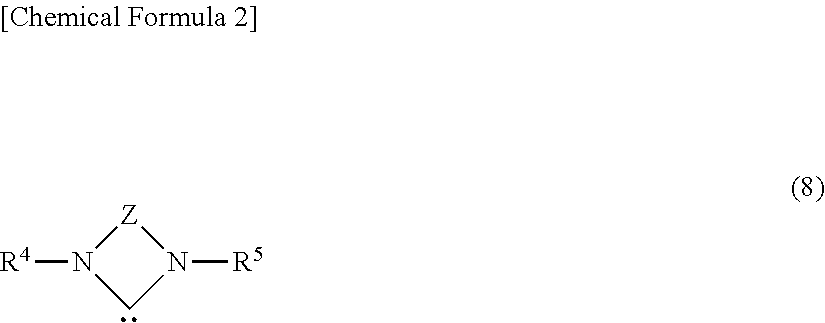
wherein Z is a C2-C5 divalent organic group which may contain a nitrogen atom and/or unsaturated bond, R4 and R5 are each independently a C1-C30 alkyl, aryl or aralkyl group which may be substituted with a halogen atom or alkoxy group.
- 6. The hydrosilylation reaction catalyst of any one of 1 to 5 wherein M is Fe, Co or Ni, a is 1, b is 2, and c is 0.
- 7. The hydrosilylation reaction catalyst of any one of 1 to 5 wherein M is Rh, a is 2, b is 4, and c is 0.
- 8. The hydrosilylation reaction catalyst of any one of 1 to 5 wherein M is Ru, a is 2, b is 4, and c is 1.
- 9. The hydrosilylation reaction catalyst of any one of 1 to 8 wherein L is a monovalent organic group having formula (4).
- 10. A method for preparing an addition compound comprising the step of carrying out hydrosilylation reaction of a compound having an aliphatic unsaturated bond with a hydrosilane compound having a Si—H group or organohydropolysiloxane compound in the presence of the hydrosilylation reaction catalyst of any one of 1 to 9.
- 11. The method for preparing an addition compound of 10 wherein the compound having an aliphatic unsaturated bond is an organopolysiloxane having an alkenyl group.
Ma(L)b(X)c (1)

—O—R1 (3)
—OCO—R1 (4)
—OSO2—R1 (5)
-(A)p-R2 (6)
—{Si(R3)2—R4}s—Si(R3)d{[(OSi(R3)2)]f—R3}e (7)
—Si(R3)d{[(OSi(R3)2)]f—R3}e (7′)


| TABLE 1 | ||||
| Catalyst | NHC ligand | Yield | ||
| (MX2) | (NHC) | (%) | ||
| Example 1 | | 1,3-dimesitylimidazol-2-ylidene | 65 |
| Example 2 | Fe[OCH(CF3)2]2 | 1,3-dimesitylimidazol-2-ylidene | 15 |
| Example 3 | | 1,3-dimesitylimidazol-2-ylidene | 78 |
| Example 4 | | 1,3-bis(2,6- | >99 |
| diisopropylphenyl)imidazol- | |||
| 2-ylidene | |||
| Example 5 | | 1,3-bis(2,6-diisopropylphenyl)- | 58 |
| imidazolidin-2-ylidene | |||
| Example 6 | | 1,3-di-t-butylimidazol-2-ylidene | 19 |
| Example 7 | | 1,3-dimesitylimidazol-2-ylidene | >99 |
| Example 8 | | 1,3-di-t-butylimidazol-2-ylidene | >99 |
| dimer | |||
| Example 9 | | 1,3-dimesitylimidazol-2-ylidene | >99 |
| (1 day storage in | |||
| air) | |||
(2) Hydrosilylation of Various Alkenes with 1,1,3,3,3-pentamethyldisiloxane Using Complex Having Metal-oxygen Bond and NHC Ligand

| TABLE 2 | |||||
| NHC | Conversion | Yield | |||
| ligand | Hydrosilane | (%) | (%) | ||
| Example 21 | | 1,1,3,3,3- | >99 | 87 |
| pentamethyldisiloxane | ||||
| Example 22 | | 1,1,1,3,5,5,5-heptamethyl- | 88 | 78 |
| trisiloxane | ||||
| Example 23 | IPr | trimethoxysilane | 49 | 42 |
(5) Hydrosilylation Reaction of 1-octene with Various Hydrosilanes Using Cobalt Pivalate and NHC Ligand

| TABLE 3 | |||||
| NHC | Conversion | Yield | |||
| ligand | Hydrosilane | (%) | (%) | ||
| Example 24 | | 1,1,1,3,5,5,5-heptamethyl- | >99 | 69 |
| trisiloxane | ||||
| Example 25 | | 1,1,1,3,5,5,5-heptamethyl- | >99 | 34 |
| trisiloxane | ||||
| Example 26 | IMes | ethyldimethylsilane | >99 | 78 |
| Example 27 | IMes | trimethoxysilane | >99 | 40 |
(6) Hydrosilylation Reaction of 2-norbornene with Various Hydrosilanes Using Cobalt Pivalate and NHC Ligand

| TABLE 4 | |||||
| NHC | Conversion | Yield | |||
| ligand | Hydrosilane | (%) | (%) | ||
| Example 28 | |
1,1,3,3,3- | >99 | 83 |
| pentamethyldisiloxane | ||||
| Example 29 | IMes | dimethylphenylsilane | >99 | 77 |
| Example 30 | IPr | dimethylphenylsilane | >99 | 73 |
| Example 31 | IMes | trimethoxysilane | >99 | 54 |
| Example 32 | IPr | trimethoxysilane | >99 | 68 |

| TABLE 5 | |||||
| Conversion | Yield | ||||
| Cobalt salt | Hydrosilane | (%) | (%) | ||
| | cobalt | 1,1,3,3,3- | >99 | 63 | ||
| 33 | carboxylate C | pentamethyl- | ||||
| disiloxane | ||||||
| Example | cobalt | dual end | >99 | 67 | ||
| 34 | carboxylate C | hydrodimethylsiloxy- | ||||
| blocked | ||||||
| polydimethylsiloxane | ||||||
| (DOP 27) | ||||||
(8) Hydrosilylation Reaction of 1-octene with Dual End Hydrosilane-Terminated Polydimethylsiloxane Using Cobalt Pivalate and IMes

| TABLE 6 | ||||
| Conversion | Yield | |||
| Metal salt | (%) | (%) | ||
| Example 35 | cobalt pivalate | >99 | 85 | ||

| TABLE 7 | ||||
| Conversion | Yield | |||
| Cobalt salt | (%) | (%) | ||
| Example 36 | cobalt carboxylate D | >99 | 77 | ||
| Example 37 | cobalt carboxylate E | >99 | 82 | ||
(10) Hydrosilylation of 1-octene with 1,1,3,3,3-pentamethyldisiloxane Using Complex having Nickel-oxygen Bond and NHC Ligand
Claims (7)
Ma(L)b(X)c (1)
—O—R1 (3)
—OCO—R1 (4)
—OSO2—R1 (5)
—(A)p—R2 (6)
—{Si(R3)2—R4}s—Si(R3)d{[(OSI (R3)2)]f—R3}e (7)


Applications Claiming Priority (3)
| Application Number | Priority Date | Filing Date | Title |
|---|---|---|---|
| JP2014164194 | 2014-08-12 | ||
| JP2014-164194 | 2014-08-12 | ||
| PCT/JP2015/072839 WO2016024611A1 (en) | 2014-08-12 | 2015-08-12 | Hydrosilylation reaction catalyst |
Publications (2)
| Publication Number | Publication Date |
|---|---|
| US20170260215A1 US20170260215A1 (en) | 2017-09-14 |
| US10000515B2 true US10000515B2 (en) | 2018-06-19 |
Family
ID=55304238
Family Applications (1)
| Application Number | Title | Priority Date | Filing Date |
|---|---|---|---|
| US15/503,266 Active US10000515B2 (en) | 2014-08-12 | 2015-08-12 | Hydrosilylation reaction catalyst |
Country Status (6)
| Country | Link |
|---|---|
| US (1) | US10000515B2 (en) |
| EP (1) | EP3181226B1 (en) |
| JP (1) | JP6515930B2 (en) |
| KR (1) | KR20170042648A (en) |
| CN (1) | CN106660031A (en) |
| WO (1) | WO2016024611A1 (en) |
Families Citing this family (13)
| Publication number | Priority date | Publication date | Assignee | Title |
|---|---|---|---|---|
| EP3645608B1 (en) * | 2017-06-26 | 2024-06-19 | Dow Silicones Corporation | Method for hydrosilylation of aliphatically unsaturated alkoxys i lan es and hydrogen terminated organosiloxane oligomers to prepare alkoxysilyl terminated polymers useful for functionalizing polyorganosiloxanes using a cobalt catalyst |
| CN108993599A (en) * | 2018-08-07 | 2018-12-14 | 上海师范大学 | A kind of functionalized order mesoporous organosilicon Pd catalyst of N- heterocycle carbine and preparation method thereof |
| JP7656612B2 (en) | 2019-12-18 | 2025-04-03 | ダウ シリコーンズ コーポレーション | Selective preparation of vinyl- and ethyl-functionalized chlorosilanes. |
| US12371446B2 (en) | 2019-12-18 | 2025-07-29 | Dow Silicones Corporation | Catalyst particles and methods for dehydrogenative silylation |
| JP7545689B2 (en) * | 2020-12-17 | 2024-09-05 | 国立大学法人九州大学 | Method for producing organosiloxane compounds |
| FR3126417B1 (en) * | 2021-08-31 | 2024-06-21 | Elkem Silicones France Sas | Hydrosilylation process catalyzed by an iron complex |
| CN114700116B (en) * | 2022-03-18 | 2023-09-22 | 杭州师范大学 | A recyclable resinous hydrosilylation catalyst and its preparation and application |
| CN114591375B (en) * | 2022-03-23 | 2024-09-17 | 国科广化精细化工孵化器(南雄)有限公司 | Imidazoline modified iron metal complex and preparation method and application thereof |
| CN115999610B (en) * | 2022-12-28 | 2024-11-29 | 陕西科技大学 | NC-supported cementite AOP catalyst with unsaturated centers and preparation method thereof |
| CN117299216B (en) * | 2023-09-27 | 2025-08-29 | 南昌大学 | Rice straw oxidized carbon-supported bimetallic complex catalyst, preparation method and use |
| CN117362334A (en) * | 2023-10-09 | 2024-01-09 | 湖北新蓝天新材料股份有限公司 | Preparation method of gamma- (2, 3-glycidoxy) propyl trimethoxy silane |
| CN119613459A (en) * | 2024-12-10 | 2025-03-14 | 浙江大学 | Method for continuously synthesizing silane coupling agent through pipelining and N-heterocyclic carbene complex catalyst used by same |
| CN121732244B (en) * | 2026-02-27 | 2026-05-08 | 江西宏柏新材料股份有限公司 | A catalyst for hydrogenation silylation reaction and its preparation method |
Citations (35)
| Publication number | Priority date | Publication date | Assignee | Title |
|---|---|---|---|---|
| JPH01315344A (en) | 1988-04-05 | 1989-12-20 | General Electric Co <Ge> | Rhodium colloid, and its production and use |
| US4992573A (en) | 1988-04-05 | 1991-02-12 | General Electric Company | Rhodium colloid, method of making, and use |
| JPH06136126A (en) | 1992-06-08 | 1994-05-17 | General Electric Co <Ge> | Regiospecific catalysts for the synthesis of epoxy siloxane monomers and polymers |
| JPH06263780A (en) | 1992-12-16 | 1994-09-20 | Wacker Chemie Gmbh | Catalyst for hydrosilylation reaction, activation thereof, preparation thereof, crosslinkable organopolysiloxane composition, and reaction of organosilicon compound having si-bonded hydrogen atom |
| US5389404A (en) | 1991-04-20 | 1995-02-14 | Dow Corning S.A. | Applying catalyst and coating composition containing same to a substrate |
| JPH07149780A (en) | 1993-07-22 | 1995-06-13 | Wacker Chemie Gmbh | Transition metal-containing organosiloxane, hydrosilylation method, organopolyxyloloxane composition, and method for producing transition metal-containing organosiloxane |
| US6124418A (en) | 1992-06-11 | 2000-09-26 | General Electric Company | Selective catalysts for the synthesis of epoxysilicone monomers and polymers |
| JP2001131231A (en) | 1999-11-09 | 2001-05-15 | Kanegafuchi Chem Ind Co Ltd | Method for producing silylated product using hydrosilylation and said silylated product |
| US6303728B1 (en) | 1997-07-08 | 2001-10-16 | Kaneka Corporation | Hydrosilylation process and polymers produced by the process |
| US6492525B1 (en) | 1998-05-20 | 2002-12-10 | Rhodia Fiber & Resin Intermediates | Organometallic complexes comprising cationic heterocyclic carbenes |
| US20030083454A1 (en) | 1999-12-07 | 2003-05-01 | Istvan Marko | Catalysts for hydrosilylation reactions |
| US6737531B1 (en) | 2002-12-17 | 2004-05-18 | Brookhaven Science Associates, Llc | Catalysts for hydrogenation and hydrosilylation, methods of making and using the same |
| US20040236054A1 (en) | 2001-06-07 | 2004-11-25 | Catherine George | Silicone composition crosslinkable into elastomer by hydrosilylation, in the presence of carbene-based metal catalysts, and catalysts |
| US7019145B2 (en) | 2001-06-07 | 2006-03-28 | Rhodia Chimie | Method for preparing metallic carbene-based catalysts for hydrosilylation of unsaturated compounds and resulting catalysts |
| JP4007467B2 (en) | 1997-07-08 | 2007-11-14 | 株式会社カネカ | Hydrosilylation reaction method and polymer produced by the method |
| FR2911876A1 (en) | 2007-01-29 | 2008-08-01 | Rhodia Recherches & Tech | New stable, mixed organometallic complexes, useful as catalysts for organic reactions, comprise carbene with alkylamino cyclic moiety, unsaturated ligand and zerovalent transition metal |
| JP4249702B2 (en) | 2002-05-23 | 2009-04-08 | ロディア・シミ | Silicone compositions that can be crosslinked to elastomers by hydrosilylation in the presence of carbene-based metal catalysts and catalysts of this type |
| WO2010016416A1 (en) | 2008-08-05 | 2010-02-11 | 公立大学法人大阪市立大学 | Catalyst for hydrosilylation reaction, and process for producing organic silicon compound using the catalyst |
| US7803893B2 (en) | 2006-04-13 | 2010-09-28 | Wacker Chemie Ag | Hydrosilylation process in the presence of ruthenium catalyzers |
| US20110160454A1 (en) | 2009-12-31 | 2011-06-30 | Korea Institute Of Science And Technology | Saturated n-heterocyclic carbene-ligand metal complex derivatives, preparing method thereof, and preparing method of silane compound by hydrosilylation reaction using the same as catalyst |
| CN102351907A (en) | 2011-08-22 | 2012-02-15 | 浙江大学 | Method for synthesizing metal N-heterocyclic carbene complex |
| US8124711B2 (en) | 2006-04-13 | 2012-02-28 | Wacker Chemie Ag | Ru complexes, production and use thereof |
| CN102516314A (en) | 2011-12-08 | 2012-06-27 | 浙江中宙光电股份有限公司 | N-heterocyclic carbene complex catalyst and preparation and application thereof |
| US8236915B2 (en) | 2009-07-10 | 2012-08-07 | Momentive Performance Materials Inc. | Hydrosilylation catalysts |
| JP2012532885A (en) | 2009-07-10 | 2012-12-20 | モメンティブ パフォーマンス マテリアルズ インコーポレイテッド | Hydrosilylation catalyst |
| WO2013043846A1 (en) | 2011-09-20 | 2013-03-28 | Dow Corning Corporation | Metal containing hydrosilylation catalysts and compositions containing the catalysts |
| WO2013043785A2 (en) | 2011-09-20 | 2013-03-28 | Dow Corning Corporation | Nickel containing hydrosilylation catalysts and compositions containing the catalysts |
| WO2013043912A2 (en) | 2011-09-20 | 2013-03-28 | Dow Corning Corporation | Iron containing hydrosilylation catalysts and compositions containing the catalysts |
| WO2013043783A2 (en) | 2011-09-20 | 2013-03-28 | Dow Corning Corporation | Cobalt containing hydrosilylation catalysts and compositions containing the catalysts |
| WO2013043787A2 (en) | 2011-09-20 | 2013-03-28 | Dow Corning Corporation | Ruthenium containing hydrosilylation catalysts and compositions containing the catalysts |
| WO2013081794A1 (en) | 2011-12-01 | 2013-06-06 | Dow Corning Corporation | Hydrosilylation reaction catalysts and curable compositions and methods for their preparation and use |
| JP2013544824A (en) | 2010-11-24 | 2013-12-19 | モメンティブ パフォーマンス マテリアルズ インコーポレイテッド | In-situ activation of metal complexes with tridentate nitrogen ligands used as hydrosilylation catalysts |
| JP2014502271A (en) | 2010-11-24 | 2014-01-30 | モメンティブ パフォーマンス マテリアルズ インコーポレイテッド | Metal-catalyzed monohydrosilylation of polyunsaturated compounds |
| WO2014021908A1 (en) | 2011-09-20 | 2014-02-06 | Dow Corning Corporation | Iridium containing hydrosilylation catalysts and compositions containing the catalysts |
| JP2014503507A (en) | 2010-11-24 | 2014-02-13 | モメンティブ パフォーマンス マテリアルズ インコーポレイテッド | Hydrosilylation catalyst |
Family Cites Families (3)
| Publication number | Priority date | Publication date | Assignee | Title |
|---|---|---|---|---|
| DE4447066A1 (en) * | 1994-12-29 | 1996-07-04 | Hoechst Ag | Metal complex compounds containing heterocyclic carbenes |
| JP5148088B2 (en) * | 2006-08-25 | 2013-02-20 | 東レ・ダウコーニング株式会社 | Curable organopolysiloxane composition and semiconductor device |
| JP6761997B2 (en) * | 2014-08-19 | 2020-09-30 | 国立大学法人九州大学 | Hydrosilylated iron catalyst |
-
2015
- 2015-08-12 WO PCT/JP2015/072839 patent/WO2016024611A1/en not_active Ceased
- 2015-08-12 CN CN201580042954.1A patent/CN106660031A/en active Pending
- 2015-08-12 JP JP2016542601A patent/JP6515930B2/en active Active
- 2015-08-12 EP EP15831284.3A patent/EP3181226B1/en active Active
- 2015-08-12 KR KR1020177006392A patent/KR20170042648A/en not_active Withdrawn
- 2015-08-12 US US15/503,266 patent/US10000515B2/en active Active
Patent Citations (53)
| Publication number | Priority date | Publication date | Assignee | Title |
|---|---|---|---|---|
| JPH01315344A (en) | 1988-04-05 | 1989-12-20 | General Electric Co <Ge> | Rhodium colloid, and its production and use |
| US4992573A (en) | 1988-04-05 | 1991-02-12 | General Electric Company | Rhodium colloid, method of making, and use |
| US5389404A (en) | 1991-04-20 | 1995-02-14 | Dow Corning S.A. | Applying catalyst and coating composition containing same to a substrate |
| JP3174616B2 (en) | 1991-04-20 | 2001-06-11 | ダウ・コーニング・ソシエテ・アノニム | Method for producing hydrosilation catalyst |
| JPH06136126A (en) | 1992-06-08 | 1994-05-17 | General Electric Co <Ge> | Regiospecific catalysts for the synthesis of epoxy siloxane monomers and polymers |
| US6124418A (en) | 1992-06-11 | 2000-09-26 | General Electric Company | Selective catalysts for the synthesis of epoxysilicone monomers and polymers |
| JPH06263780A (en) | 1992-12-16 | 1994-09-20 | Wacker Chemie Gmbh | Catalyst for hydrosilylation reaction, activation thereof, preparation thereof, crosslinkable organopolysiloxane composition, and reaction of organosilicon compound having si-bonded hydrogen atom |
| US5523436A (en) | 1992-12-16 | 1996-06-04 | Wacker-Chemie Gmbh | Catalysts for hydrosilylation reactions |
| JPH07149780A (en) | 1993-07-22 | 1995-06-13 | Wacker Chemie Gmbh | Transition metal-containing organosiloxane, hydrosilylation method, organopolyxyloloxane composition, and method for producing transition metal-containing organosiloxane |
| US5561231A (en) | 1993-07-22 | 1996-10-01 | Wacker-Chemie Gmbh | Homogeneous hydrosilylation catalysts |
| US6303728B1 (en) | 1997-07-08 | 2001-10-16 | Kaneka Corporation | Hydrosilylation process and polymers produced by the process |
| JP4007467B2 (en) | 1997-07-08 | 2007-11-14 | 株式会社カネカ | Hydrosilylation reaction method and polymer produced by the method |
| US6492525B1 (en) | 1998-05-20 | 2002-12-10 | Rhodia Fiber & Resin Intermediates | Organometallic complexes comprising cationic heterocyclic carbenes |
| JP3599669B2 (en) | 1998-05-20 | 2004-12-08 | ロディア・ポリアミド・インターミーディエッツ | Novel organometallic complexes containing cationic heterocyclic carbene and methods for their preparation |
| JP2001131231A (en) | 1999-11-09 | 2001-05-15 | Kanegafuchi Chem Ind Co Ltd | Method for producing silylated product using hydrosilylation and said silylated product |
| JP2003516230A (en) | 1999-12-07 | 2003-05-13 | ロディア・シミ | Catalyst for hydrosilylation reaction |
| US6803440B2 (en) | 1999-12-07 | 2004-10-12 | Rhodia Chimie | Catalysts for hydrosilylation reactions |
| JP3854151B2 (en) | 1999-12-07 | 2006-12-06 | ロディア・シミ | Catalyst for hydrosilylation reaction |
| US20030083454A1 (en) | 1999-12-07 | 2003-05-01 | Istvan Marko | Catalysts for hydrosilylation reactions |
| US20040236054A1 (en) | 2001-06-07 | 2004-11-25 | Catherine George | Silicone composition crosslinkable into elastomer by hydrosilylation, in the presence of carbene-based metal catalysts, and catalysts |
| US7019145B2 (en) | 2001-06-07 | 2006-03-28 | Rhodia Chimie | Method for preparing metallic carbene-based catalysts for hydrosilylation of unsaturated compounds and resulting catalysts |
| JP4249702B2 (en) | 2002-05-23 | 2009-04-08 | ロディア・シミ | Silicone compositions that can be crosslinked to elastomers by hydrosilylation in the presence of carbene-based metal catalysts and catalysts of this type |
| US7563741B2 (en) | 2002-05-23 | 2009-07-21 | Rhodia Chimie | Silicone composition which can be crosslinked into an elastomer by hydrosilylation in the presence of carbene-based metal catalysts, and catalysts of this type |
| US6737531B1 (en) | 2002-12-17 | 2004-05-18 | Brookhaven Science Associates, Llc | Catalysts for hydrogenation and hydrosilylation, methods of making and using the same |
| US7803893B2 (en) | 2006-04-13 | 2010-09-28 | Wacker Chemie Ag | Hydrosilylation process in the presence of ruthenium catalyzers |
| JP5032561B2 (en) | 2006-04-13 | 2012-09-26 | ワッカー ケミー アクチエンゲゼルシャフト | Novel Ru-complex, its production and use |
| JP4934190B2 (en) | 2006-04-13 | 2012-05-16 | ワッカー ケミー アクチエンゲゼルシャフト | Hydrosilylation process in the presence of ruthenium catalyst. |
| US8124711B2 (en) | 2006-04-13 | 2012-02-28 | Wacker Chemie Ag | Ru complexes, production and use thereof |
| EP2114977A1 (en) | 2007-01-29 | 2009-11-11 | Rhodia Opérations | Novel mixed organometallic complexes based on carbenes comprising an alkyl aminocyclic unit |
| FR2911876A1 (en) | 2007-01-29 | 2008-08-01 | Rhodia Recherches & Tech | New stable, mixed organometallic complexes, useful as catalysts for organic reactions, comprise carbene with alkylamino cyclic moiety, unsaturated ligand and zerovalent transition metal |
| WO2008095785A1 (en) | 2007-01-29 | 2008-08-14 | Rhodia Operations | Novel mixed organometallic complexes based on carbenes comprising an alkyl aminocyclic unit |
| WO2010016416A1 (en) | 2008-08-05 | 2010-02-11 | 公立大学法人大阪市立大学 | Catalyst for hydrosilylation reaction, and process for producing organic silicon compound using the catalyst |
| US8236915B2 (en) | 2009-07-10 | 2012-08-07 | Momentive Performance Materials Inc. | Hydrosilylation catalysts |
| US8415443B2 (en) | 2009-07-10 | 2013-04-09 | Momentive Performance Materials Inc. | Hydrosilylation catalysts |
| JP2012532885A (en) | 2009-07-10 | 2012-12-20 | モメンティブ パフォーマンス マテリアルズ インコーポレイテッド | Hydrosilylation catalyst |
| JP2012532884A (en) | 2009-07-10 | 2012-12-20 | モメンティブ パフォーマンス マテリアルズ インコーポレイテッド | Hydrosilylation catalyst |
| US20110160454A1 (en) | 2009-12-31 | 2011-06-30 | Korea Institute Of Science And Technology | Saturated n-heterocyclic carbene-ligand metal complex derivatives, preparing method thereof, and preparing method of silane compound by hydrosilylation reaction using the same as catalyst |
| US8895770B2 (en) | 2010-11-24 | 2014-11-25 | Cornell University | Selective non-precious metal-catalyzed mono-hydrosilylation polyunsaturated compounds |
| JP2014503507A (en) | 2010-11-24 | 2014-02-13 | モメンティブ パフォーマンス マテリアルズ インコーポレイテッド | Hydrosilylation catalyst |
| JP2014502271A (en) | 2010-11-24 | 2014-01-30 | モメンティブ パフォーマンス マテリアルズ インコーポレイテッド | Metal-catalyzed monohydrosilylation of polyunsaturated compounds |
| JP2013544824A (en) | 2010-11-24 | 2013-12-19 | モメンティブ パフォーマンス マテリアルズ インコーポレイテッド | In-situ activation of metal complexes with tridentate nitrogen ligands used as hydrosilylation catalysts |
| CN102351907A (en) | 2011-08-22 | 2012-02-15 | 浙江大学 | Method for synthesizing metal N-heterocyclic carbene complex |
| WO2013043783A2 (en) | 2011-09-20 | 2013-03-28 | Dow Corning Corporation | Cobalt containing hydrosilylation catalysts and compositions containing the catalysts |
| WO2013043787A2 (en) | 2011-09-20 | 2013-03-28 | Dow Corning Corporation | Ruthenium containing hydrosilylation catalysts and compositions containing the catalysts |
| WO2013043912A2 (en) | 2011-09-20 | 2013-03-28 | Dow Corning Corporation | Iron containing hydrosilylation catalysts and compositions containing the catalysts |
| WO2013043785A2 (en) | 2011-09-20 | 2013-03-28 | Dow Corning Corporation | Nickel containing hydrosilylation catalysts and compositions containing the catalysts |
| WO2014021908A1 (en) | 2011-09-20 | 2014-02-06 | Dow Corning Corporation | Iridium containing hydrosilylation catalysts and compositions containing the catalysts |
| WO2013043846A1 (en) | 2011-09-20 | 2013-03-28 | Dow Corning Corporation | Metal containing hydrosilylation catalysts and compositions containing the catalysts |
| US20140249311A1 (en) | 2011-09-20 | 2014-09-04 | Dow Corning Corporation | Iron Containing Hydrosilylation Catalysts and Compositions Containing the Catalysts |
| US9480977B2 (en) | 2011-09-20 | 2016-11-01 | Dow Corning Corporation | Ruthenium containing hydrosilylation catalysts and compositions containing the catalysts |
| WO2013081794A1 (en) | 2011-12-01 | 2013-06-06 | Dow Corning Corporation | Hydrosilylation reaction catalysts and curable compositions and methods for their preparation and use |
| US9073950B2 (en) | 2011-12-01 | 2015-07-07 | Dow Corning Corporation | Hydrosilylation reaction catalysts and curable compositions and methods for their preparation and use |
| CN102516314A (en) | 2011-12-08 | 2012-06-27 | 浙江中宙光电股份有限公司 | N-heterocyclic carbene complex catalyst and preparation and application thereof |
Non-Patent Citations (33)
Also Published As
| Publication number | Publication date |
|---|---|
| JPWO2016024611A1 (en) | 2017-06-01 |
| KR20170042648A (en) | 2017-04-19 |
| WO2016024611A1 (en) | 2016-02-18 |
| JP6515930B2 (en) | 2019-05-22 |
| US20170260215A1 (en) | 2017-09-14 |
| CN106660031A (en) | 2017-05-10 |
| EP3181226A4 (en) | 2018-04-18 |
| EP3181226B1 (en) | 2024-08-07 |
| EP3181226A1 (en) | 2017-06-21 |
Similar Documents
| Publication | Publication Date | Title |
|---|---|---|
| EP3181226B1 (en) | Hydrosilylation reaction catalyst | |
| US10005797B2 (en) | Hydrosilylation reaction catalyst | |
| EP3323505B1 (en) | Hydrosilylation reaction catalyst | |
| US10239896B2 (en) | Hydrosilylation iron catalyst | |
| US10829504B2 (en) | Isocyanide compound and hydrosilylation reaction catalyst | |
| US12296325B2 (en) | Catalyst for hydrosilylation reaction, hydrogenation reaction, and hydrosilane reduction reaction | |
| JP6085892B2 (en) | Mononuclear iron complexes and organic synthesis reactions using them | |
| JP5429745B2 (en) | Catalyst for dehydrogenation silylation reaction, and method for producing organosilicon compound | |
| JP6806299B2 (en) | Method for preparing a hydrosilylated iron catalyst |
Legal Events
| Date | Code | Title | Description |
|---|---|---|---|
| AS | Assignment |
Owner name: SHIN-ETSU CHEMICAL CO., LTD., JAPAN Free format text: ASSIGNMENT OF ASSIGNORS INTEREST;ASSIGNORS:NAGASHIMA, HIDEO;SUNADA, YUSUKE;TAHARA, ATSUSHI;AND OTHERS;SIGNING DATES FROM 20170110 TO 20170116;REEL/FRAME:041240/0548 Owner name: KYUSHU UNIVERSITY, NATIONAL UNIVERSITY CORPORATION Free format text: ASSIGNMENT OF ASSIGNORS INTEREST;ASSIGNORS:NAGASHIMA, HIDEO;SUNADA, YUSUKE;TAHARA, ATSUSHI;AND OTHERS;SIGNING DATES FROM 20170110 TO 20170116;REEL/FRAME:041240/0548 |
|
| STCF | Information on status: patent grant |
Free format text: PATENTED CASE |
|
| MAFP | Maintenance fee payment |
Free format text: PAYMENT OF MAINTENANCE FEE, 4TH YEAR, LARGE ENTITY (ORIGINAL EVENT CODE: M1551); ENTITY STATUS OF PATENT OWNER: LARGE ENTITY Year of fee payment: 4 |
|
| MAFP | Maintenance fee payment |
Free format text: PAYMENT OF MAINTENANCE FEE, 8TH YEAR, LARGE ENTITY (ORIGINAL EVENT CODE: M1552); ENTITY STATUS OF PATENT OWNER: LARGE ENTITY Year of fee payment: 8 |