TW202108564A - Method of making glycerol carbonate (meth)acrylate and curable compositions based thereon - Google Patents
Method of making glycerol carbonate (meth)acrylate and curable compositions based thereon Download PDFInfo
- Publication number
- TW202108564A TW202108564A TW109125796A TW109125796A TW202108564A TW 202108564 A TW202108564 A TW 202108564A TW 109125796 A TW109125796 A TW 109125796A TW 109125796 A TW109125796 A TW 109125796A TW 202108564 A TW202108564 A TW 202108564A
- Authority
- TW
- Taiwan
- Prior art keywords
- meth
- acrylate
- carbonate
- curable composition
- methacrylate
- Prior art date
Links
- 239000000203 mixture Substances 0.000 title claims abstract description 207
- NIXOWILDQLNWCW-UHFFFAOYSA-M Acrylate Chemical compound [O-]C(=O)C=C NIXOWILDQLNWCW-UHFFFAOYSA-M 0.000 title claims description 157
- 238000004519 manufacturing process Methods 0.000 title claims description 19
- JFMGYULNQJPJCY-UHFFFAOYSA-N 4-(hydroxymethyl)-1,3-dioxolan-2-one Chemical compound OCC1COC(=O)O1 JFMGYULNQJPJCY-UHFFFAOYSA-N 0.000 title claims description 8
- UCRGLQHZBIOGPN-UHFFFAOYSA-N 4-(hydroxymethyl)-1,3-dioxolan-2-one;2-methylprop-2-enoic acid Chemical compound CC(=C)C(O)=O.OCC1COC(=O)O1 UCRGLQHZBIOGPN-UHFFFAOYSA-N 0.000 claims abstract description 80
- 230000005855 radiation Effects 0.000 claims abstract description 52
- BVKZGUZCCUSVTD-UHFFFAOYSA-L Carbonate Chemical compound [O-]C([O-])=O BVKZGUZCCUSVTD-UHFFFAOYSA-L 0.000 claims abstract description 43
- 239000003054 catalyst Substances 0.000 claims abstract description 32
- -1 alkali metal alkoxides Chemical class 0.000 claims description 74
- 238000000034 method Methods 0.000 claims description 57
- 238000006243 chemical reaction Methods 0.000 claims description 53
- 239000000178 monomer Substances 0.000 claims description 53
- 150000001875 compounds Chemical class 0.000 claims description 31
- 238000001723 curing Methods 0.000 claims description 22
- CERQOIWHTDAKMF-UHFFFAOYSA-M Methacrylate Chemical compound CC(=C)C([O-])=O CERQOIWHTDAKMF-UHFFFAOYSA-M 0.000 claims description 20
- LFQSCWFLJHTTHZ-UHFFFAOYSA-N Ethanol Chemical compound CCO LFQSCWFLJHTTHZ-UHFFFAOYSA-N 0.000 claims description 17
- 229920000642 polymer Polymers 0.000 claims description 17
- 238000006116 polymerization reaction Methods 0.000 claims description 17
- 239000004721 Polyphenylene oxide Substances 0.000 claims description 16
- 229920000570 polyether Polymers 0.000 claims description 16
- JOYRKODLDBILNP-UHFFFAOYSA-N Ethyl urethane Chemical compound CCOC(N)=O JOYRKODLDBILNP-UHFFFAOYSA-N 0.000 claims description 13
- 239000003112 inhibitor Substances 0.000 claims description 12
- JWTGRKUQJXIWCV-UHFFFAOYSA-N 1,2,3-trihydroxypropyl 2-methylprop-2-enoate Chemical compound CC(=C)C(=O)OC(O)C(O)CO JWTGRKUQJXIWCV-UHFFFAOYSA-N 0.000 claims description 11
- 150000001412 amines Chemical class 0.000 claims description 10
- 229920000728 polyester Polymers 0.000 claims description 9
- 238000003847 radiation curing Methods 0.000 claims description 9
- 229910052783 alkali metal Inorganic materials 0.000 claims description 8
- 239000011159 matrix material Substances 0.000 claims description 8
- OIFBSDVPJOWBCH-UHFFFAOYSA-N Diethyl carbonate Chemical compound CCOC(=O)OCC OIFBSDVPJOWBCH-UHFFFAOYSA-N 0.000 claims description 7
- FHLPGTXWCFQMIU-UHFFFAOYSA-N [4-[2-(4-prop-2-enoyloxyphenyl)propan-2-yl]phenyl] prop-2-enoate Chemical compound C=1C=C(OC(=O)C=C)C=CC=1C(C)(C)C1=CC=C(OC(=O)C=C)C=C1 FHLPGTXWCFQMIU-UHFFFAOYSA-N 0.000 claims description 7
- 150000002148 esters Chemical class 0.000 claims description 7
- 239000004593 Epoxy Substances 0.000 claims description 6
- 125000003277 amino group Chemical group 0.000 claims description 6
- 239000004417 polycarbonate Substances 0.000 claims description 6
- 229920000515 polycarbonate Polymers 0.000 claims description 6
- 229920001651 Cyanoacrylate Polymers 0.000 claims description 5
- MWCLLHOVUTZFKS-UHFFFAOYSA-N Methyl cyanoacrylate Chemical compound COC(=O)C(=C)C#N MWCLLHOVUTZFKS-UHFFFAOYSA-N 0.000 claims description 4
- 150000008044 alkali metal hydroxides Chemical class 0.000 claims description 4
- 125000002947 alkylene group Chemical group 0.000 claims description 4
- 239000002585 base Substances 0.000 claims description 4
- 125000004122 cyclic group Chemical group 0.000 claims description 4
- 239000007791 liquid phase Substances 0.000 claims description 4
- 239000003341 Bronsted base Substances 0.000 claims description 3
- 239000002841 Lewis acid Substances 0.000 claims description 3
- 239000002879 Lewis base Substances 0.000 claims description 3
- 150000007517 lewis acids Chemical group 0.000 claims description 3
- 150000007527 lewis bases Chemical class 0.000 claims description 3
- LVHBHZANLOWSRM-UHFFFAOYSA-N methylenebutanedioic acid Natural products OC(=O)CC(=C)C(O)=O LVHBHZANLOWSRM-UHFFFAOYSA-N 0.000 claims description 3
- RUOJZAUFBMNUDX-UHFFFAOYSA-N propylene carbonate Chemical compound CC1COC(=O)O1 RUOJZAUFBMNUDX-UHFFFAOYSA-N 0.000 claims description 3
- 229920001567 vinyl ester resin Polymers 0.000 claims description 3
- 125000000391 vinyl group Chemical group [H]C([*])=C([H])[H] 0.000 claims description 3
- KMTRUDSVKNLOMY-UHFFFAOYSA-N Ethylene carbonate Chemical compound O=C1OCCO1 KMTRUDSVKNLOMY-UHFFFAOYSA-N 0.000 claims description 2
- IEJIGPNLZYLLBP-UHFFFAOYSA-N dimethyl carbonate Chemical compound COC(=O)OC IEJIGPNLZYLLBP-UHFFFAOYSA-N 0.000 claims description 2
- VUPKGFBOKBGHFZ-UHFFFAOYSA-N dipropyl carbonate Chemical compound CCCOC(=O)OCCC VUPKGFBOKBGHFZ-UHFFFAOYSA-N 0.000 claims description 2
- QRIMLDXJAPZHJE-UHFFFAOYSA-N 2,3-dihydroxypropyl 2-methylprop-2-enoate Chemical compound CC(=C)C(=O)OCC(O)CO QRIMLDXJAPZHJE-UHFFFAOYSA-N 0.000 abstract description 22
- 239000000463 material Substances 0.000 abstract description 8
- 239000000047 product Substances 0.000 description 23
- 239000011541 reaction mixture Substances 0.000 description 21
- 239000000126 substance Substances 0.000 description 21
- 239000003381 stabilizer Substances 0.000 description 19
- 238000010146 3D printing Methods 0.000 description 16
- 239000000758 substrate Substances 0.000 description 15
- 150000002734 metacrylic acid derivatives Chemical class 0.000 description 14
- 229920001223 polyethylene glycol Polymers 0.000 description 14
- CERQOIWHTDAKMF-UHFFFAOYSA-N Methacrylic acid Chemical compound CC(=C)C(O)=O CERQOIWHTDAKMF-UHFFFAOYSA-N 0.000 description 13
- 239000002202 Polyethylene glycol Substances 0.000 description 13
- 150000003254 radicals Chemical class 0.000 description 13
- 239000002904 solvent Substances 0.000 description 13
- NIXOWILDQLNWCW-UHFFFAOYSA-N acrylic acid group Chemical group C(C=C)(=O)O NIXOWILDQLNWCW-UHFFFAOYSA-N 0.000 description 12
- 229920005862 polyol Polymers 0.000 description 12
- 239000011347 resin Substances 0.000 description 12
- 229920005989 resin Polymers 0.000 description 12
- LYCAIKOWRPUZTN-UHFFFAOYSA-N Ethylene glycol Chemical compound OCCO LYCAIKOWRPUZTN-UHFFFAOYSA-N 0.000 description 11
- 150000003077 polyols Chemical class 0.000 description 11
- 150000001252 acrylic acid derivatives Chemical class 0.000 description 10
- IISBACLAFKSPIT-UHFFFAOYSA-N bisphenol A Chemical class C=1C=C(O)C=CC=1C(C)(C)C1=CC=C(O)C=C1 IISBACLAFKSPIT-UHFFFAOYSA-N 0.000 description 10
- 239000000376 reactant Substances 0.000 description 10
- PEDCQBHIVMGVHV-UHFFFAOYSA-N Glycerine Chemical compound OCC(O)CO PEDCQBHIVMGVHV-UHFFFAOYSA-N 0.000 description 9
- 230000015572 biosynthetic process Effects 0.000 description 9
- 125000002887 hydroxy group Chemical group [H]O* 0.000 description 9
- 239000003999 initiator Substances 0.000 description 9
- 238000007639 printing Methods 0.000 description 9
- 125000001931 aliphatic group Chemical group 0.000 description 8
- 238000000576 coating method Methods 0.000 description 8
- 239000000976 ink Substances 0.000 description 8
- 229910052751 metal Inorganic materials 0.000 description 8
- 239000002184 metal Substances 0.000 description 8
- 229920005906 polyester polyol Polymers 0.000 description 8
- 230000000475 sunscreen effect Effects 0.000 description 8
- 239000000516 sunscreening agent Substances 0.000 description 8
- BRLQWZUYTZBJKN-UHFFFAOYSA-N Epichlorohydrin Chemical compound ClCC1CO1 BRLQWZUYTZBJKN-UHFFFAOYSA-N 0.000 description 7
- 125000003118 aryl group Chemical group 0.000 description 7
- QUZSUMLPWDHKCJ-UHFFFAOYSA-N bisphenol A dimethacrylate Chemical compound C1=CC(OC(=O)C(=C)C)=CC=C1C(C)(C)C1=CC=C(OC(=O)C(C)=C)C=C1 QUZSUMLPWDHKCJ-UHFFFAOYSA-N 0.000 description 7
- 239000007795 chemical reaction product Substances 0.000 description 7
- 125000004386 diacrylate group Chemical group 0.000 description 7
- 238000009472 formulation Methods 0.000 description 7
- 125000000524 functional group Chemical group 0.000 description 7
- VOZRXNHHFUQHIL-UHFFFAOYSA-N glycidyl methacrylate Chemical compound CC(=C)C(=O)OCC1CO1 VOZRXNHHFUQHIL-UHFFFAOYSA-N 0.000 description 7
- 239000007788 liquid Substances 0.000 description 7
- HEMHJVSKTPXQMS-UHFFFAOYSA-M Sodium hydroxide Chemical compound [OH-].[Na+] HEMHJVSKTPXQMS-UHFFFAOYSA-M 0.000 description 6
- 239000000654 additive Substances 0.000 description 6
- 229910052784 alkaline earth metal Inorganic materials 0.000 description 6
- 125000000217 alkyl group Chemical group 0.000 description 6
- 150000004649 carbonic acid derivatives Chemical class 0.000 description 6
- MTHSVFCYNBDYFN-UHFFFAOYSA-N diethylene glycol Chemical compound OCCOCCO MTHSVFCYNBDYFN-UHFFFAOYSA-N 0.000 description 6
- 239000007858 starting material Substances 0.000 description 6
- 150000005846 sugar alcohols Polymers 0.000 description 6
- 229940096522 trimethylolpropane triacrylate Drugs 0.000 description 6
- 229930185605 Bisphenol Natural products 0.000 description 5
- 239000004386 Erythritol Substances 0.000 description 5
- UNXHWFMMPAWVPI-UHFFFAOYSA-N Erythritol Natural products OCC(O)C(O)CO UNXHWFMMPAWVPI-UHFFFAOYSA-N 0.000 description 5
- 238000005452 bending Methods 0.000 description 5
- 235000019414 erythritol Nutrition 0.000 description 5
- 229940009714 erythritol Drugs 0.000 description 5
- UHESRSKEBRADOO-UHFFFAOYSA-N ethyl carbamate;prop-2-enoic acid Chemical compound OC(=O)C=C.CCOC(N)=O UHESRSKEBRADOO-UHFFFAOYSA-N 0.000 description 5
- 230000009477 glass transition Effects 0.000 description 5
- 125000005702 oxyalkylene group Chemical group 0.000 description 5
- 230000009257 reactivity Effects 0.000 description 5
- 230000002829 reductive effect Effects 0.000 description 5
- 238000003786 synthesis reaction Methods 0.000 description 5
- DNIAPMSPPWPWGF-GSVOUGTGSA-N (R)-(-)-Propylene glycol Chemical compound C[C@@H](O)CO DNIAPMSPPWPWGF-GSVOUGTGSA-N 0.000 description 4
- MYMOFIZGZYHOMD-UHFFFAOYSA-N Dioxygen Chemical compound O=O MYMOFIZGZYHOMD-UHFFFAOYSA-N 0.000 description 4
- QIGBRXMKCJKVMJ-UHFFFAOYSA-N Hydroquinone Chemical compound OC1=CC=C(O)C=C1 QIGBRXMKCJKVMJ-UHFFFAOYSA-N 0.000 description 4
- DAKWPKUUDNSNPN-UHFFFAOYSA-N Trimethylolpropane triacrylate Chemical compound C=CC(=O)OCC(CC)(COC(=O)C=C)COC(=O)C=C DAKWPKUUDNSNPN-UHFFFAOYSA-N 0.000 description 4
- 239000000853 adhesive Substances 0.000 description 4
- 230000001070 adhesive effect Effects 0.000 description 4
- 150000004703 alkoxides Chemical class 0.000 description 4
- WERYXYBDKMZEQL-UHFFFAOYSA-N butane-1,4-diol Chemical compound OCCCCO WERYXYBDKMZEQL-UHFFFAOYSA-N 0.000 description 4
- 239000002131 composite material Substances 0.000 description 4
- 239000003085 diluting agent Substances 0.000 description 4
- 150000002009 diols Chemical class 0.000 description 4
- 229910001882 dioxygen Inorganic materials 0.000 description 4
- 239000003814 drug Substances 0.000 description 4
- 238000010894 electron beam technology Methods 0.000 description 4
- 238000005516 engineering process Methods 0.000 description 4
- 238000007046 ethoxylation reaction Methods 0.000 description 4
- 235000013305 food Nutrition 0.000 description 4
- 230000006872 improvement Effects 0.000 description 4
- 125000001449 isopropyl group Chemical group [H]C([H])([H])C([H])(*)C([H])([H])[H] 0.000 description 4
- YDKNBNOOCSNPNS-UHFFFAOYSA-N methyl 1,3-benzoxazole-2-carboxylate Chemical compound C1=CC=C2OC(C(=O)OC)=NC2=C1 YDKNBNOOCSNPNS-UHFFFAOYSA-N 0.000 description 4
- 125000002496 methyl group Chemical group [H]C([H])([H])* 0.000 description 4
- 238000002156 mixing Methods 0.000 description 4
- NWVVVBRKAWDGAB-UHFFFAOYSA-N p-methoxyphenol Chemical compound COC1=CC=C(O)C=C1 NWVVVBRKAWDGAB-UHFFFAOYSA-N 0.000 description 4
- 229920002635 polyurethane Polymers 0.000 description 4
- 239000004814 polyurethane Substances 0.000 description 4
- 241000894007 species Species 0.000 description 4
- 150000003512 tertiary amines Chemical group 0.000 description 4
- 150000005208 1,4-dihydroxybenzenes Chemical class 0.000 description 3
- SMZOUWXMTYCWNB-UHFFFAOYSA-N 2-(2-methoxy-5-methylphenyl)ethanamine Chemical compound COC1=CC=C(C)C=C1CCN SMZOUWXMTYCWNB-UHFFFAOYSA-N 0.000 description 3
- WVDDGKGOMKODPV-UHFFFAOYSA-N Benzyl alcohol Chemical compound OCC1=CC=CC=C1 WVDDGKGOMKODPV-UHFFFAOYSA-N 0.000 description 3
- 241001465754 Metazoa Species 0.000 description 3
- VVQNEPGJFQJSBK-UHFFFAOYSA-N Methyl methacrylate Chemical compound COC(=O)C(C)=C VVQNEPGJFQJSBK-UHFFFAOYSA-N 0.000 description 3
- 239000005062 Polybutadiene Substances 0.000 description 3
- GOOHAUXETOMSMM-UHFFFAOYSA-N Propylene oxide Chemical compound CC1CO1 GOOHAUXETOMSMM-UHFFFAOYSA-N 0.000 description 3
- 125000003545 alkoxy group Chemical group 0.000 description 3
- 238000009835 boiling Methods 0.000 description 3
- 125000000484 butyl group Chemical group [H]C([*])([H])C([H])([H])C([H])([H])C([H])([H])[H] 0.000 description 3
- 125000002915 carbonyl group Chemical group [*:2]C([*:1])=O 0.000 description 3
- 239000003795 chemical substances by application Substances 0.000 description 3
- 238000007334 copolymerization reaction Methods 0.000 description 3
- 150000005676 cyclic carbonates Chemical group 0.000 description 3
- 125000005442 diisocyanate group Chemical group 0.000 description 3
- 125000001495 ethyl group Chemical group [H]C([H])([H])C([H])([H])* 0.000 description 3
- 239000012949 free radical photoinitiator Substances 0.000 description 3
- 235000011187 glycerol Nutrition 0.000 description 3
- 238000010438 heat treatment Methods 0.000 description 3
- WGCNASOHLSPBMP-UHFFFAOYSA-N hydroxyacetaldehyde Natural products OCC=O WGCNASOHLSPBMP-UHFFFAOYSA-N 0.000 description 3
- RAXXELZNTBOGNW-UHFFFAOYSA-N imidazole Natural products C1=CNC=N1 RAXXELZNTBOGNW-UHFFFAOYSA-N 0.000 description 3
- 239000000543 intermediate Substances 0.000 description 3
- 239000002608 ionic liquid Substances 0.000 description 3
- DNIAPMSPPWPWGF-UHFFFAOYSA-N monopropylene glycol Natural products CC(O)CO DNIAPMSPPWPWGF-UHFFFAOYSA-N 0.000 description 3
- 238000000465 moulding Methods 0.000 description 3
- 239000000123 paper Substances 0.000 description 3
- 150000002978 peroxides Chemical class 0.000 description 3
- 150000002989 phenols Chemical class 0.000 description 3
- 229920002857 polybutadiene Polymers 0.000 description 3
- 229920001451 polypropylene glycol Polymers 0.000 description 3
- 238000010526 radical polymerization reaction Methods 0.000 description 3
- 238000000926 separation method Methods 0.000 description 3
- 239000011734 sodium Substances 0.000 description 3
- ZIBGPFATKBEMQZ-UHFFFAOYSA-N triethylene glycol Chemical compound OCCOCCOCCO ZIBGPFATKBEMQZ-UHFFFAOYSA-N 0.000 description 3
- XLYOFNOQVPJJNP-UHFFFAOYSA-N water Substances O XLYOFNOQVPJJNP-UHFFFAOYSA-N 0.000 description 3
- PUPZLCDOIYMWBV-UHFFFAOYSA-N (+/-)-1,3-Butanediol Chemical compound CC(O)CCO PUPZLCDOIYMWBV-UHFFFAOYSA-N 0.000 description 2
- 125000000349 (Z)-3-carboxyprop-2-enoyl group Chemical group O=C([*])/C([H])=C([H])\C(O[H])=O 0.000 description 2
- AZQWKYJCGOJGHM-UHFFFAOYSA-N 1,4-benzoquinone Chemical compound O=C1C=CC(=O)C=C1 AZQWKYJCGOJGHM-UHFFFAOYSA-N 0.000 description 2
- PUGOMSLRUSTQGV-UHFFFAOYSA-N 2,3-di(prop-2-enoyloxy)propyl prop-2-enoate Chemical compound C=CC(=O)OCC(OC(=O)C=C)COC(=O)C=C PUGOMSLRUSTQGV-UHFFFAOYSA-N 0.000 description 2
- LEJBBGNFPAFPKQ-UHFFFAOYSA-N 2-(2-prop-2-enoyloxyethoxy)ethyl prop-2-enoate Chemical compound C=CC(=O)OCCOCCOC(=O)C=C LEJBBGNFPAFPKQ-UHFFFAOYSA-N 0.000 description 2
- BXGYYDRIMBPOMN-UHFFFAOYSA-N 2-(hydroxymethoxy)ethoxymethanol Chemical compound OCOCCOCO BXGYYDRIMBPOMN-UHFFFAOYSA-N 0.000 description 2
- WMYINDVYGQKYMI-UHFFFAOYSA-N 2-[2,2-bis(hydroxymethyl)butoxymethyl]-2-ethylpropane-1,3-diol Chemical compound CCC(CO)(CO)COCC(CC)(CO)CO WMYINDVYGQKYMI-UHFFFAOYSA-N 0.000 description 2
- LCZVSXRMYJUNFX-UHFFFAOYSA-N 2-[2-(2-hydroxypropoxy)propoxy]propan-1-ol Chemical compound CC(O)COC(C)COC(C)CO LCZVSXRMYJUNFX-UHFFFAOYSA-N 0.000 description 2
- XFCMNSHQOZQILR-UHFFFAOYSA-N 2-[2-(2-methylprop-2-enoyloxy)ethoxy]ethyl 2-methylprop-2-enoate Chemical compound CC(=C)C(=O)OCCOCCOC(=O)C(C)=C XFCMNSHQOZQILR-UHFFFAOYSA-N 0.000 description 2
- INQDDHNZXOAFFD-UHFFFAOYSA-N 2-[2-(2-prop-2-enoyloxyethoxy)ethoxy]ethyl prop-2-enoate Chemical compound C=CC(=O)OCCOCCOCCOC(=O)C=C INQDDHNZXOAFFD-UHFFFAOYSA-N 0.000 description 2
- HCLJOFJIQIJXHS-UHFFFAOYSA-N 2-[2-[2-(2-prop-2-enoyloxyethoxy)ethoxy]ethoxy]ethyl prop-2-enoate Chemical compound C=CC(=O)OCCOCCOCCOCCOC(=O)C=C HCLJOFJIQIJXHS-UHFFFAOYSA-N 0.000 description 2
- 125000003903 2-propenyl group Chemical group [H]C([*])([H])C([H])=C([H])[H] 0.000 description 2
- HRPVXLWXLXDGHG-UHFFFAOYSA-N Acrylamide Chemical compound NC(=O)C=C HRPVXLWXLXDGHG-UHFFFAOYSA-N 0.000 description 2
- CURLTUGMZLYLDI-UHFFFAOYSA-N Carbon dioxide Chemical compound O=C=O CURLTUGMZLYLDI-UHFFFAOYSA-N 0.000 description 2
- RTZKZFJDLAIYFH-UHFFFAOYSA-N Diethyl ether Chemical compound CCOCC RTZKZFJDLAIYFH-UHFFFAOYSA-N 0.000 description 2
- IAYPIBMASNFSPL-UHFFFAOYSA-N Ethylene oxide Chemical compound C1CO1 IAYPIBMASNFSPL-UHFFFAOYSA-N 0.000 description 2
- 206010073306 Exposure to radiation Diseases 0.000 description 2
- 238000005033 Fourier transform infrared spectroscopy Methods 0.000 description 2
- XEEYBQQBJWHFJM-UHFFFAOYSA-N Iron Chemical compound [Fe] XEEYBQQBJWHFJM-UHFFFAOYSA-N 0.000 description 2
- BAPJBEWLBFYGME-UHFFFAOYSA-N Methyl acrylate Chemical class COC(=O)C=C BAPJBEWLBFYGME-UHFFFAOYSA-N 0.000 description 2
- ISWSIDIOOBJBQZ-UHFFFAOYSA-N Phenol Chemical compound OC1=CC=CC=C1 ISWSIDIOOBJBQZ-UHFFFAOYSA-N 0.000 description 2
- KWYUFKZDYYNOTN-UHFFFAOYSA-M Potassium hydroxide Chemical compound [OH-].[K+] KWYUFKZDYYNOTN-UHFFFAOYSA-M 0.000 description 2
- WQDUMFSSJAZKTM-UHFFFAOYSA-N Sodium methoxide Chemical compound [Na+].[O-]C WQDUMFSSJAZKTM-UHFFFAOYSA-N 0.000 description 2
- PPBRXRYQALVLMV-UHFFFAOYSA-N Styrene Chemical compound C=CC1=CC=CC=C1 PPBRXRYQALVLMV-UHFFFAOYSA-N 0.000 description 2
- WYURNTSHIVDZCO-UHFFFAOYSA-N Tetrahydrofuran Chemical compound C1CCOC1 WYURNTSHIVDZCO-UHFFFAOYSA-N 0.000 description 2
- YTPLMLYBLZKORZ-UHFFFAOYSA-N Thiophene Chemical compound C=1C=CSC=1 YTPLMLYBLZKORZ-UHFFFAOYSA-N 0.000 description 2
- GWEVSGVZZGPLCZ-UHFFFAOYSA-N Titan oxide Chemical compound O=[Ti]=O GWEVSGVZZGPLCZ-UHFFFAOYSA-N 0.000 description 2
- ZJCCRDAZUWHFQH-UHFFFAOYSA-N Trimethylolpropane Chemical compound CCC(CO)(CO)CO ZJCCRDAZUWHFQH-UHFFFAOYSA-N 0.000 description 2
- XSQUKJJJFZCRTK-UHFFFAOYSA-N Urea Chemical compound NC(N)=O XSQUKJJJFZCRTK-UHFFFAOYSA-N 0.000 description 2
- ORLQHILJRHBSAY-UHFFFAOYSA-N [1-(hydroxymethyl)cyclohexyl]methanol Chemical compound OCC1(CO)CCCCC1 ORLQHILJRHBSAY-UHFFFAOYSA-N 0.000 description 2
- 239000006096 absorbing agent Substances 0.000 description 2
- 239000002253 acid Substances 0.000 description 2
- 230000009471 action Effects 0.000 description 2
- 150000001298 alcohols Chemical class 0.000 description 2
- 229920003232 aliphatic polyester Polymers 0.000 description 2
- 239000003513 alkali Substances 0.000 description 2
- 150000001340 alkali metals Chemical class 0.000 description 2
- 150000001342 alkaline earth metals Chemical class 0.000 description 2
- 125000004104 aryloxy group Chemical group 0.000 description 2
- QVGXLLKOCUKJST-UHFFFAOYSA-N atomic oxygen Chemical compound [O] QVGXLLKOCUKJST-UHFFFAOYSA-N 0.000 description 2
- 238000005102 attenuated total reflection Methods 0.000 description 2
- ISAOCJYIOMOJEB-UHFFFAOYSA-N benzoin Chemical compound C=1C=CC=CC=1C(O)C(=O)C1=CC=CC=C1 ISAOCJYIOMOJEB-UHFFFAOYSA-N 0.000 description 2
- 125000001797 benzyl group Chemical group [H]C1=C([H])C([H])=C(C([H])=C1[H])C([H])([H])* 0.000 description 2
- 235000013361 beverage Nutrition 0.000 description 2
- 239000006227 byproduct Substances 0.000 description 2
- 239000004202 carbamide Substances 0.000 description 2
- 239000011203 carbon fibre reinforced carbon Substances 0.000 description 2
- 150000001732 carboxylic acid derivatives Chemical class 0.000 description 2
- 238000010538 cationic polymerization reaction Methods 0.000 description 2
- 230000008859 change Effects 0.000 description 2
- 239000011248 coating agent Substances 0.000 description 2
- 238000011960 computer-aided design Methods 0.000 description 2
- PDXRQENMIVHKPI-UHFFFAOYSA-N cyclohexane-1,1-diol Chemical compound OC1(O)CCCCC1 PDXRQENMIVHKPI-UHFFFAOYSA-N 0.000 description 2
- 238000000354 decomposition reaction Methods 0.000 description 2
- GYZLOYUZLJXAJU-UHFFFAOYSA-N diglycidyl ether Chemical class C1OC1COCC1CO1 GYZLOYUZLJXAJU-UHFFFAOYSA-N 0.000 description 2
- SZXQTJUDPRGNJN-UHFFFAOYSA-N dipropylene glycol Chemical compound OCCCOCCCO SZXQTJUDPRGNJN-UHFFFAOYSA-N 0.000 description 2
- GHLKSLMMWAKNBM-UHFFFAOYSA-N dodecane-1,12-diol Chemical compound OCCCCCCCCCCCCO GHLKSLMMWAKNBM-UHFFFAOYSA-N 0.000 description 2
- 125000003438 dodecyl group Chemical group [H]C([H])([H])C([H])([H])C([H])([H])C([H])([H])C([H])([H])C([H])([H])C([H])([H])C([H])([H])C([H])([H])C([H])([H])C([H])([H])C([H])([H])* 0.000 description 2
- 125000003700 epoxy group Chemical group 0.000 description 2
- 150000002170 ethers Chemical class 0.000 description 2
- 239000007789 gas Substances 0.000 description 2
- 239000011521 glass Substances 0.000 description 2
- 125000001475 halogen functional group Chemical group 0.000 description 2
- 229920001519 homopolymer Polymers 0.000 description 2
- 125000002768 hydroxyalkyl group Chemical group 0.000 description 2
- 150000002576 ketones Chemical class 0.000 description 2
- 230000000670 limiting effect Effects 0.000 description 2
- 231100000053 low toxicity Toxicity 0.000 description 2
- FQPSGWSUVKBHSU-UHFFFAOYSA-N methacrylamide Chemical compound CC(=C)C(N)=O FQPSGWSUVKBHSU-UHFFFAOYSA-N 0.000 description 2
- FTWUXYZHDFCGSV-UHFFFAOYSA-N n,n'-diphenyloxamide Chemical compound C=1C=CC=CC=1NC(=O)C(=O)NC1=CC=CC=C1 FTWUXYZHDFCGSV-UHFFFAOYSA-N 0.000 description 2
- 125000004108 n-butyl group Chemical group [H]C([H])([H])C([H])([H])C([H])([H])C([H])([H])* 0.000 description 2
- 238000006384 oligomerization reaction Methods 0.000 description 2
- 150000002894 organic compounds Chemical class 0.000 description 2
- 125000006353 oxyethylene group Chemical group 0.000 description 2
- 239000001301 oxygen Substances 0.000 description 2
- 229910052760 oxygen Inorganic materials 0.000 description 2
- YNPNZTXNASCQKK-UHFFFAOYSA-N phenanthrene Chemical compound C1=CC=C2C3=CC=CC=C3C=CC2=C1 YNPNZTXNASCQKK-UHFFFAOYSA-N 0.000 description 2
- 239000000049 pigment Substances 0.000 description 2
- 229920003023 plastic Polymers 0.000 description 2
- 239000004033 plastic Substances 0.000 description 2
- 125000002924 primary amino group Chemical group [H]N([H])* 0.000 description 2
- 230000008569 process Effects 0.000 description 2
- 238000012545 processing Methods 0.000 description 2
- ARJOQCYCJMAIFR-UHFFFAOYSA-N prop-2-enoyl prop-2-enoate Chemical compound C=CC(=O)OC(=O)C=C ARJOQCYCJMAIFR-UHFFFAOYSA-N 0.000 description 2
- YPFDHNVEDLHUCE-UHFFFAOYSA-N propane-1,3-diol Chemical compound OCCCO YPFDHNVEDLHUCE-UHFFFAOYSA-N 0.000 description 2
- 235000013772 propylene glycol Nutrition 0.000 description 2
- 238000000746 purification Methods 0.000 description 2
- 150000004053 quinones Chemical class 0.000 description 2
- 239000002994 raw material Substances 0.000 description 2
- 239000000565 sealant Substances 0.000 description 2
- 150000003335 secondary amines Chemical class 0.000 description 2
- 239000007787 solid Substances 0.000 description 2
- 229920001169 thermoplastic Polymers 0.000 description 2
- 239000004416 thermosoftening plastic Substances 0.000 description 2
- 231100000331 toxic Toxicity 0.000 description 2
- 230000002588 toxic effect Effects 0.000 description 2
- 238000012546 transfer Methods 0.000 description 2
- 238000002834 transmittance Methods 0.000 description 2
- 229940124543 ultraviolet light absorber Drugs 0.000 description 2
- MXFQRSUWYYSPOC-UHFFFAOYSA-N (2,2-dimethyl-3-prop-2-enoyloxypropyl) prop-2-enoate Chemical class C=CC(=O)OCC(C)(C)COC(=O)C=C MXFQRSUWYYSPOC-UHFFFAOYSA-N 0.000 description 1
- STXVPXIKQLYEQY-UHFFFAOYSA-N (2-nitrophenyl) n-benzylcarbamate Chemical compound [O-][N+](=O)C1=CC=CC=C1OC(=O)NCC1=CC=CC=C1 STXVPXIKQLYEQY-UHFFFAOYSA-N 0.000 description 1
- PCLLJCFJFOBGDE-UHFFFAOYSA-N (5-bromo-2-chlorophenyl)methanamine Chemical compound NCC1=CC(Br)=CC=C1Cl PCLLJCFJFOBGDE-UHFFFAOYSA-N 0.000 description 1
- 229920002818 (Hydroxyethyl)methacrylate Polymers 0.000 description 1
- XJDDLMJULQGRLU-UHFFFAOYSA-N 1,3-dioxane-4,6-dione Chemical compound O=C1CC(=O)OCO1 XJDDLMJULQGRLU-UHFFFAOYSA-N 0.000 description 1
- ALVZNPYWJMLXKV-UHFFFAOYSA-N 1,9-Nonanediol Chemical compound OCCCCCCCCCO ALVZNPYWJMLXKV-UHFFFAOYSA-N 0.000 description 1
- ZDQNWDNMNKSMHI-UHFFFAOYSA-N 1-[2-(2-prop-2-enoyloxypropoxy)propoxy]propan-2-yl prop-2-enoate Chemical compound C=CC(=O)OC(C)COC(C)COCC(C)OC(=O)C=C ZDQNWDNMNKSMHI-UHFFFAOYSA-N 0.000 description 1
- RHSYWENAMOPTIE-UHFFFAOYSA-N 1-hydroxyhexan-3-yl carbamate Chemical compound CCCC(CCO)OC(N)=O RHSYWENAMOPTIE-UHFFFAOYSA-N 0.000 description 1
- HYQASEVIBPSPMK-UHFFFAOYSA-N 12-(2-methylprop-2-enoyloxy)dodecyl 2-methylprop-2-enoate Chemical compound CC(=C)C(=O)OCCCCCCCCCCCCOC(=O)C(C)=C HYQASEVIBPSPMK-UHFFFAOYSA-N 0.000 description 1
- IPHREVVCPNNUEQ-UHFFFAOYSA-N 2,3-dioxopentanal Chemical group CCC(=O)C(=O)C=O IPHREVVCPNNUEQ-UHFFFAOYSA-N 0.000 description 1
- SBASXUCJHJRPEV-UHFFFAOYSA-N 2-(2-methoxyethoxy)ethanol Chemical compound COCCOCCO SBASXUCJHJRPEV-UHFFFAOYSA-N 0.000 description 1
- YIJYFLXQHDOQGW-UHFFFAOYSA-N 2-[2,4,6-trioxo-3,5-bis(2-prop-2-enoyloxyethyl)-1,3,5-triazinan-1-yl]ethyl prop-2-enoate Chemical compound C=CC(=O)OCCN1C(=O)N(CCOC(=O)C=C)C(=O)N(CCOC(=O)C=C)C1=O YIJYFLXQHDOQGW-UHFFFAOYSA-N 0.000 description 1
- WFSMVVDJSNMRAR-UHFFFAOYSA-N 2-[2-(2-ethoxyethoxy)ethoxy]ethanol Chemical compound CCOCCOCCOCCO WFSMVVDJSNMRAR-UHFFFAOYSA-N 0.000 description 1
- YUJWPEDFYYNHPT-UHFFFAOYSA-N 2-ethyl-2-(hydroxymethyl)propane-1,3-diol;methanol Chemical compound OC.OC.CCC(CO)(CO)CO YUJWPEDFYYNHPT-UHFFFAOYSA-N 0.000 description 1
- GTELLNMUWNJXMQ-UHFFFAOYSA-N 2-ethyl-2-(hydroxymethyl)propane-1,3-diol;prop-2-enoic acid Chemical class OC(=O)C=C.OC(=O)C=C.OC(=O)C=C.CCC(CO)(CO)CO GTELLNMUWNJXMQ-UHFFFAOYSA-N 0.000 description 1
- NLGDWWCZQDIASO-UHFFFAOYSA-N 2-hydroxy-1-(7-oxabicyclo[4.1.0]hepta-1,3,5-trien-2-yl)-2-phenylethanone Chemical compound OC(C(=O)c1cccc2Oc12)c1ccccc1 NLGDWWCZQDIASO-UHFFFAOYSA-N 0.000 description 1
- 125000000954 2-hydroxyethyl group Chemical group [H]C([*])([H])C([H])([H])O[H] 0.000 description 1
- OMIGHNLMNHATMP-UHFFFAOYSA-N 2-hydroxyethyl prop-2-enoate Chemical compound OCCOC(=O)C=C OMIGHNLMNHATMP-UHFFFAOYSA-N 0.000 description 1
- 125000004200 2-methoxyethyl group Chemical group [H]C([H])([H])OC([H])([H])C([H])([H])* 0.000 description 1
- FZSHSWCZYDDOCK-UHFFFAOYSA-N 2-methylprop-2-enoic acid;oxolane Chemical compound C1CCOC1.CC(=C)C(O)=O FZSHSWCZYDDOCK-UHFFFAOYSA-N 0.000 description 1
- OOTZVDDKOVDPSH-UHFFFAOYSA-N 2-methylprop-2-enoic acid;phenol Chemical compound CC(=C)C(O)=O.CC(=C)C(O)=O.OC1=CC=CC=C1.OC1=CC=CC=C1 OOTZVDDKOVDPSH-UHFFFAOYSA-N 0.000 description 1
- IGKORAADMWHJBK-UHFFFAOYSA-N 2-prop-2-enoyloxyhexan-2-yl prop-2-enoate Chemical compound CCCCC(C)(OC(=O)C=C)OC(=O)C=C IGKORAADMWHJBK-UHFFFAOYSA-N 0.000 description 1
- QOXOZONBQWIKDA-UHFFFAOYSA-N 3-hydroxypropyl Chemical group [CH2]CCO QOXOZONBQWIKDA-UHFFFAOYSA-N 0.000 description 1
- XOJWAAUYNWGQAU-UHFFFAOYSA-N 4-(2-methylprop-2-enoyloxy)butyl 2-methylprop-2-enoate Chemical compound CC(=C)C(=O)OCCCCOC(=O)C(C)=C XOJWAAUYNWGQAU-UHFFFAOYSA-N 0.000 description 1
- CHAKPLLOXDKZCE-UHFFFAOYSA-N 4-(hydroxymethyl)-1,3-dioxolan-2-one prop-2-enoic acid Chemical compound C(C=C)(=O)O.OCC1OC(OC1)=O CHAKPLLOXDKZCE-UHFFFAOYSA-N 0.000 description 1
- ZCILGMFPJBRCNO-UHFFFAOYSA-N 4-phenyl-2H-benzotriazol-5-ol Chemical compound OC1=CC=C2NN=NC2=C1C1=CC=CC=C1 ZCILGMFPJBRCNO-UHFFFAOYSA-N 0.000 description 1
- AIXZBGVLNVRQSS-UHFFFAOYSA-N 5-tert-butyl-2-[5-(5-tert-butyl-1,3-benzoxazol-2-yl)thiophen-2-yl]-1,3-benzoxazole Chemical compound CC(C)(C)C1=CC=C2OC(C3=CC=C(S3)C=3OC4=CC=C(C=C4N=3)C(C)(C)C)=NC2=C1 AIXZBGVLNVRQSS-UHFFFAOYSA-N 0.000 description 1
- FIHBHSQYSYVZQE-UHFFFAOYSA-N 6-prop-2-enoyloxyhexyl prop-2-enoate Chemical compound C=CC(=O)OCCCCCCOC(=O)C=C FIHBHSQYSYVZQE-UHFFFAOYSA-N 0.000 description 1
- KWOLFJPFCHCOCG-UHFFFAOYSA-N Acetophenone Chemical compound CC(=O)C1=CC=CC=C1 KWOLFJPFCHCOCG-UHFFFAOYSA-N 0.000 description 1
- QGZKDVFQNNGYKY-UHFFFAOYSA-O Ammonium Chemical compound [NH4+] QGZKDVFQNNGYKY-UHFFFAOYSA-O 0.000 description 1
- BVKZGUZCCUSVTD-UHFFFAOYSA-M Bicarbonate Chemical class OC([O-])=O BVKZGUZCCUSVTD-UHFFFAOYSA-M 0.000 description 1
- 239000004322 Butylated hydroxytoluene Substances 0.000 description 1
- NLZUEZXRPGMBCV-UHFFFAOYSA-N Butylhydroxytoluene Chemical compound CC1=CC(C(C)(C)C)=C(O)C(C(C)(C)C)=C1 NLZUEZXRPGMBCV-UHFFFAOYSA-N 0.000 description 1
- YIWNVEOODMBBEU-UHFFFAOYSA-N C(C=C)(=O)O.CC(C)(CC(C)O)O Chemical compound C(C=C)(=O)O.CC(C)(CC(C)O)O YIWNVEOODMBBEU-UHFFFAOYSA-N 0.000 description 1
- PWIHDOIKSKGJLO-UHFFFAOYSA-N C(C=C)(=O)O.CC(COCCOCCO)(C)O Chemical compound C(C=C)(=O)O.CC(COCCOCCO)(C)O PWIHDOIKSKGJLO-UHFFFAOYSA-N 0.000 description 1
- SHDYLKHNMZKYNZ-UHFFFAOYSA-N C(O)(O)=O.CSSC Chemical class C(O)(O)=O.CSSC SHDYLKHNMZKYNZ-UHFFFAOYSA-N 0.000 description 1
- KXDHJXZQYSOELW-UHFFFAOYSA-M Carbamate Chemical compound NC([O-])=O KXDHJXZQYSOELW-UHFFFAOYSA-M 0.000 description 1
- OKTJSMMVPCPJKN-UHFFFAOYSA-N Carbon Chemical group [C] OKTJSMMVPCPJKN-UHFFFAOYSA-N 0.000 description 1
- VEXZGXHMUGYJMC-UHFFFAOYSA-M Chloride anion Chemical compound [Cl-] VEXZGXHMUGYJMC-UHFFFAOYSA-M 0.000 description 1
- SNRUBQQJIBEYMU-UHFFFAOYSA-N Dodecane Natural products CCCCCCCCCCCC SNRUBQQJIBEYMU-UHFFFAOYSA-N 0.000 description 1
- 238000001157 Fourier transform infrared spectrum Methods 0.000 description 1
- 241000167880 Hirundinidae Species 0.000 description 1
- 241000282412 Homo Species 0.000 description 1
- WOBHKFSMXKNTIM-UHFFFAOYSA-N Hydroxyethyl methacrylate Chemical compound CC(=C)C(=O)OCCO WOBHKFSMXKNTIM-UHFFFAOYSA-N 0.000 description 1
- 206010020751 Hypersensitivity Diseases 0.000 description 1
- 239000004609 Impact Modifier Substances 0.000 description 1
- 206010061218 Inflammation Diseases 0.000 description 1
- IGFHQQFPSIBGKE-UHFFFAOYSA-N Nonylphenol Natural products CCCCCCCCCC1=CC=C(O)C=C1 IGFHQQFPSIBGKE-UHFFFAOYSA-N 0.000 description 1
- 229910019142 PO4 Inorganic materials 0.000 description 1
- ALQSHHUCVQOPAS-UHFFFAOYSA-N Pentane-1,5-diol Chemical compound OCCCCCO ALQSHHUCVQOPAS-UHFFFAOYSA-N 0.000 description 1
- YGYAWVDWMABLBF-UHFFFAOYSA-N Phosgene Chemical compound ClC(Cl)=O YGYAWVDWMABLBF-UHFFFAOYSA-N 0.000 description 1
- 239000004743 Polypropylene Substances 0.000 description 1
- 206010070834 Sensitisation Diseases 0.000 description 1
- 244000028419 Styrax benzoin Species 0.000 description 1
- 235000000126 Styrax benzoin Nutrition 0.000 description 1
- 235000008411 Sumatra benzointree Nutrition 0.000 description 1
- OKKRPWIIYQTPQF-UHFFFAOYSA-N Trimethylolpropane trimethacrylate Chemical compound CC(=C)C(=O)OCC(CC)(COC(=O)C(C)=C)COC(=O)C(C)=C OKKRPWIIYQTPQF-UHFFFAOYSA-N 0.000 description 1
- 239000007983 Tris buffer Substances 0.000 description 1
- XRMBQHTWUBGQDN-UHFFFAOYSA-N [2-[2,2-bis(prop-2-enoyloxymethyl)butoxymethyl]-2-(prop-2-enoyloxymethyl)butyl] prop-2-enoate Chemical compound C=CC(=O)OCC(COC(=O)C=C)(CC)COCC(CC)(COC(=O)C=C)COC(=O)C=C XRMBQHTWUBGQDN-UHFFFAOYSA-N 0.000 description 1
- NKIDFMYWMSBSRA-UHFFFAOYSA-N [4-(2-methylprop-2-enoyloxymethyl)cyclohexyl]methyl 2-methylprop-2-enoate Chemical compound CC(=C)C(=O)OCC1CCC(COC(=O)C(C)=C)CC1 NKIDFMYWMSBSRA-UHFFFAOYSA-N 0.000 description 1
- YIMQCDZDWXUDCA-UHFFFAOYSA-N [4-(hydroxymethyl)cyclohexyl]methanol Chemical compound OCC1CCC(CO)CC1 YIMQCDZDWXUDCA-UHFFFAOYSA-N 0.000 description 1
- RBNOTYQMZAVTTN-UHFFFAOYSA-N [4-(hydroxymethyl)cyclohexyl]methanol;2-methyloxirane Chemical compound CC1CO1.OCC1CCC(CO)CC1 RBNOTYQMZAVTTN-UHFFFAOYSA-N 0.000 description 1
- UCHGOTBQZQAGBC-UHFFFAOYSA-N [4-(hydroxymethyl)cyclohexyl]methanol;oxirane Chemical compound C1CO1.OCC1CCC(CO)CC1 UCHGOTBQZQAGBC-UHFFFAOYSA-N 0.000 description 1
- ZZAGLMPBQOKGGT-UHFFFAOYSA-N [4-[4-(4-prop-2-enoyloxybutoxy)benzoyl]oxyphenyl] 4-(4-prop-2-enoyloxybutoxy)benzoate Chemical class C1=CC(OCCCCOC(=O)C=C)=CC=C1C(=O)OC(C=C1)=CC=C1OC(=O)C1=CC=C(OCCCCOC(=O)C=C)C=C1 ZZAGLMPBQOKGGT-UHFFFAOYSA-N 0.000 description 1
- VEBCLRKUSAGCDF-UHFFFAOYSA-N ac1mi23b Chemical compound C1C2C3C(COC(=O)C=C)CCC3C1C(COC(=O)C=C)C2 VEBCLRKUSAGCDF-UHFFFAOYSA-N 0.000 description 1
- 125000000641 acridinyl group Chemical class C1(=CC=CC2=NC3=CC=CC=C3C=C12)* 0.000 description 1
- 239000004676 acrylonitrile butadiene styrene Substances 0.000 description 1
- 239000003463 adsorbent Substances 0.000 description 1
- 239000003905 agrochemical Substances 0.000 description 1
- 229910000288 alkali metal carbonate Inorganic materials 0.000 description 1
- 150000008041 alkali metal carbonates Chemical class 0.000 description 1
- 229910000272 alkali metal oxide Inorganic materials 0.000 description 1
- 229910052910 alkali metal silicate Inorganic materials 0.000 description 1
- 229910001860 alkaline earth metal hydroxide Inorganic materials 0.000 description 1
- 229910000287 alkaline earth metal oxide Inorganic materials 0.000 description 1
- 229910052915 alkaline earth metal silicate Inorganic materials 0.000 description 1
- 150000001336 alkenes Chemical class 0.000 description 1
- 150000001346 alkyl aryl ethers Chemical class 0.000 description 1
- 125000005907 alkyl ester group Chemical group 0.000 description 1
- 125000004414 alkyl thio group Chemical group 0.000 description 1
- 230000007815 allergy Effects 0.000 description 1
- 150000004645 aluminates Chemical class 0.000 description 1
- 150000001408 amides Chemical class 0.000 description 1
- 238000004458 analytical method Methods 0.000 description 1
- 150000008064 anhydrides Chemical class 0.000 description 1
- PYKYMHQGRFAEBM-UHFFFAOYSA-N anthraquinone Natural products CCC(=O)c1c(O)c2C(=O)C3C(C=CC=C3O)C(=O)c2cc1CC(=O)OC PYKYMHQGRFAEBM-UHFFFAOYSA-N 0.000 description 1
- 150000004056 anthraquinones Chemical class 0.000 description 1
- 239000003963 antioxidant agent Substances 0.000 description 1
- 229940027998 antiseptic and disinfectant acridine derivative Drugs 0.000 description 1
- 230000004888 barrier function Effects 0.000 description 1
- 230000009286 beneficial effect Effects 0.000 description 1
- 230000008901 benefit Effects 0.000 description 1
- 229960002130 benzoin Drugs 0.000 description 1
- RWCCWEUUXYIKHB-UHFFFAOYSA-N benzophenone Chemical compound C=1C=CC=CC=1C(=O)C1=CC=CC=C1 RWCCWEUUXYIKHB-UHFFFAOYSA-N 0.000 description 1
- 150000008366 benzophenones Chemical class 0.000 description 1
- QRUDEWIWKLJBPS-UHFFFAOYSA-N benzotriazole Chemical compound C1=CC=C2N[N][N]C2=C1 QRUDEWIWKLJBPS-UHFFFAOYSA-N 0.000 description 1
- 239000012964 benzotriazole Substances 0.000 description 1
- 125000003354 benzotriazolyl group Chemical group N1N=NC2=C1C=CC=C2* 0.000 description 1
- 235000019445 benzyl alcohol Nutrition 0.000 description 1
- 229960004217 benzyl alcohol Drugs 0.000 description 1
- 229920001400 block copolymer Polymers 0.000 description 1
- 230000005587 bubbling Effects 0.000 description 1
- 239000001273 butane Substances 0.000 description 1
- BMRWNKZVCUKKSR-UHFFFAOYSA-N butane-1,2-diol Chemical compound CCC(O)CO BMRWNKZVCUKKSR-UHFFFAOYSA-N 0.000 description 1
- OWBTYPJTUOEWEK-UHFFFAOYSA-N butane-2,3-diol Chemical compound CC(O)C(C)O OWBTYPJTUOEWEK-UHFFFAOYSA-N 0.000 description 1
- 235000010354 butylated hydroxytoluene Nutrition 0.000 description 1
- 229940095259 butylated hydroxytoluene Drugs 0.000 description 1
- 229910052791 calcium Inorganic materials 0.000 description 1
- 125000004432 carbon atom Chemical group C* 0.000 description 1
- 239000006229 carbon black Substances 0.000 description 1
- 239000001569 carbon dioxide Substances 0.000 description 1
- 229910002092 carbon dioxide Inorganic materials 0.000 description 1
- WENRUBFVASILLJ-UHFFFAOYSA-N carbonic acid;ethane-1,2-diol Chemical compound OCCO.OC(O)=O WENRUBFVASILLJ-UHFFFAOYSA-N 0.000 description 1
- PFKFTWBEEFSNDU-UHFFFAOYSA-N carbonyldiimidazole Chemical compound C1=CN=CN1C(=O)N1C=CN=C1 PFKFTWBEEFSNDU-UHFFFAOYSA-N 0.000 description 1
- 239000011111 cardboard Substances 0.000 description 1
- 238000005266 casting Methods 0.000 description 1
- 230000015556 catabolic process Effects 0.000 description 1
- 230000003197 catalytic effect Effects 0.000 description 1
- 239000012952 cationic photoinitiator Substances 0.000 description 1
- 239000003638 chemical reducing agent Substances 0.000 description 1
- 229910017052 cobalt Inorganic materials 0.000 description 1
- 239000010941 cobalt Substances 0.000 description 1
- GUTLYIVDDKVIGB-UHFFFAOYSA-N cobalt atom Chemical compound [Co] GUTLYIVDDKVIGB-UHFFFAOYSA-N 0.000 description 1
- 239000003086 colorant Substances 0.000 description 1
- 239000012230 colorless oil Substances 0.000 description 1
- 238000002485 combustion reaction Methods 0.000 description 1
- 230000000052 comparative effect Effects 0.000 description 1
- 238000006482 condensation reaction Methods 0.000 description 1
- 238000010276 construction Methods 0.000 description 1
- 229920001577 copolymer Polymers 0.000 description 1
- NLCKLZIHJQEMCU-UHFFFAOYSA-N cyano prop-2-enoate Chemical class C=CC(=O)OC#N NLCKLZIHJQEMCU-UHFFFAOYSA-N 0.000 description 1
- 150000004292 cyclic ethers Chemical class 0.000 description 1
- 125000000113 cyclohexyl group Chemical group [H]C1([H])C([H])([H])C([H])([H])C([H])(*)C([H])([H])C1([H])[H] 0.000 description 1
- 231100000135 cytotoxicity Toxicity 0.000 description 1
- 230000003013 cytotoxicity Effects 0.000 description 1
- 238000004042 decolorization Methods 0.000 description 1
- 238000006731 degradation reaction Methods 0.000 description 1
- 230000008021 deposition Effects 0.000 description 1
- 238000011161 development Methods 0.000 description 1
- 238000010586 diagram Methods 0.000 description 1
- 150000001991 dicarboxylic acids Chemical class 0.000 description 1
- 150000001993 dienes Chemical class 0.000 description 1
- ZBCBWPMODOFKDW-UHFFFAOYSA-N diethanolamine Chemical compound OCCNCCO ZBCBWPMODOFKDW-UHFFFAOYSA-N 0.000 description 1
- 229940028356 diethylene glycol monobutyl ether Drugs 0.000 description 1
- XXJWXESWEXIICW-UHFFFAOYSA-N diethylene glycol monoethyl ether Chemical compound CCOCCOCCO XXJWXESWEXIICW-UHFFFAOYSA-N 0.000 description 1
- 229940075557 diethylene glycol monoethyl ether Drugs 0.000 description 1
- 239000002270 dispersing agent Substances 0.000 description 1
- 238000004821 distillation Methods 0.000 description 1
- 239000003651 drinking water Substances 0.000 description 1
- 235000020188 drinking water Nutrition 0.000 description 1
- 229940079593 drug Drugs 0.000 description 1
- 238000001035 drying Methods 0.000 description 1
- 239000000975 dye Substances 0.000 description 1
- UNXHWFMMPAWVPI-ZXZARUISSA-N erythritol Chemical compound OC[C@H](O)[C@H](O)CO UNXHWFMMPAWVPI-ZXZARUISSA-N 0.000 description 1
- 238000001704 evaporation Methods 0.000 description 1
- 230000008020 evaporation Effects 0.000 description 1
- 239000012632 extractable Substances 0.000 description 1
- 238000000605 extraction Methods 0.000 description 1
- 238000001125 extrusion Methods 0.000 description 1
- 239000000945 filler Substances 0.000 description 1
- 238000011049 filling Methods 0.000 description 1
- 230000004907 flux Effects 0.000 description 1
- 239000006260 foam Substances 0.000 description 1
- LWDCPOMFNRJKLX-UHFFFAOYSA-N formic acid;prop-2-enoic acid Chemical compound OC=O.OC(=O)C=C LWDCPOMFNRJKLX-UHFFFAOYSA-N 0.000 description 1
- 238000005194 fractionation Methods 0.000 description 1
- 230000006870 function Effects 0.000 description 1
- 229920001002 functional polymer Polymers 0.000 description 1
- 125000005456 glyceride group Chemical group 0.000 description 1
- 125000003827 glycol group Chemical group 0.000 description 1
- 150000002334 glycols Chemical class 0.000 description 1
- 235000019382 gum benzoic Nutrition 0.000 description 1
- 230000036541 health Effects 0.000 description 1
- XXMIOPMDWAUFGU-UHFFFAOYSA-N hexane-1,6-diol Chemical compound OCCCCCCO XXMIOPMDWAUFGU-UHFFFAOYSA-N 0.000 description 1
- 150000002432 hydroperoxides Chemical class 0.000 description 1
- 150000004679 hydroxides Chemical class 0.000 description 1
- 238000003384 imaging method Methods 0.000 description 1
- 239000007943 implant Substances 0.000 description 1
- 238000002513 implantation Methods 0.000 description 1
- 238000010348 incorporation Methods 0.000 description 1
- 230000006698 induction Effects 0.000 description 1
- 230000004054 inflammatory process Effects 0.000 description 1
- 239000004615 ingredient Substances 0.000 description 1
- 230000002401 inhibitory effect Effects 0.000 description 1
- 230000005764 inhibitory process Effects 0.000 description 1
- 239000003456 ion exchange resin Substances 0.000 description 1
- 229920003303 ion-exchange polymer Polymers 0.000 description 1
- 229910052742 iron Inorganic materials 0.000 description 1
- 125000000959 isobutyl group Chemical group [H]C([H])([H])C([H])(C([H])([H])[H])C([H])([H])* 0.000 description 1
- 239000010985 leather Substances 0.000 description 1
- 239000004611 light stabiliser Substances 0.000 description 1
- 229910052744 lithium Inorganic materials 0.000 description 1
- 229910052749 magnesium Inorganic materials 0.000 description 1
- WPBNNNQJVZRUHP-UHFFFAOYSA-L manganese(2+);methyl n-[[2-(methoxycarbonylcarbamothioylamino)phenyl]carbamothioyl]carbamate;n-[2-(sulfidocarbothioylamino)ethyl]carbamodithioate Chemical compound [Mn+2].[S-]C(=S)NCCNC([S-])=S.COC(=O)NC(=S)NC1=CC=CC=C1NC(=S)NC(=O)OC WPBNNNQJVZRUHP-UHFFFAOYSA-L 0.000 description 1
- 239000008204 material by function Substances 0.000 description 1
- 230000007246 mechanism Effects 0.000 description 1
- 239000012567 medical material Substances 0.000 description 1
- 150000002739 metals Chemical class 0.000 description 1
- 125000005395 methacrylic acid group Chemical group 0.000 description 1
- VHRYZQNGTZXDNX-UHFFFAOYSA-N methacryloyl chloride Chemical compound CC(=C)C(Cl)=O VHRYZQNGTZXDNX-UHFFFAOYSA-N 0.000 description 1
- 125000000956 methoxy group Chemical group [H]C([H])([H])O* 0.000 description 1
- 125000001570 methylene group Chemical group [H]C([H])([*:1])[*:2] 0.000 description 1
- 238000012986 modification Methods 0.000 description 1
- 230000004048 modification Effects 0.000 description 1
- 125000001280 n-hexyl group Chemical group C(CCCCC)* 0.000 description 1
- 125000004123 n-propyl group Chemical group [H]C([H])([H])C([H])([H])C([H])([H])* 0.000 description 1
- SLCVBVWXLSEKPL-UHFFFAOYSA-N neopentyl glycol Chemical compound OCC(C)(C)CO SLCVBVWXLSEKPL-UHFFFAOYSA-N 0.000 description 1
- 238000006386 neutralization reaction Methods 0.000 description 1
- YCWSUKQGVSGXJO-NTUHNPAUSA-N nifuroxazide Chemical group C1=CC(O)=CC=C1C(=O)N\N=C\C1=CC=C([N+]([O-])=O)O1 YCWSUKQGVSGXJO-NTUHNPAUSA-N 0.000 description 1
- 229910052757 nitrogen Inorganic materials 0.000 description 1
- 125000004433 nitrogen atom Chemical group N* 0.000 description 1
- QJGQUHMNIGDVPM-UHFFFAOYSA-N nitrogen group Chemical group [N] QJGQUHMNIGDVPM-UHFFFAOYSA-N 0.000 description 1
- SNQQPOLDUKLAAF-UHFFFAOYSA-N nonylphenol Chemical compound CCCCCCCCCC1=CC=CC=C1O SNQQPOLDUKLAAF-UHFFFAOYSA-N 0.000 description 1
- OEIJHBUUFURJLI-UHFFFAOYSA-N octane-1,8-diol Chemical compound OCCCCCCCCO OEIJHBUUFURJLI-UHFFFAOYSA-N 0.000 description 1
- ANISOHQJBAQUQP-UHFFFAOYSA-N octyl prop-2-enoate Chemical compound CCCCCCCCOC(=O)C=C ANISOHQJBAQUQP-UHFFFAOYSA-N 0.000 description 1
- JRZJOMJEPLMPRA-UHFFFAOYSA-N olefin Natural products CCCCCCCC=C JRZJOMJEPLMPRA-UHFFFAOYSA-N 0.000 description 1
- 230000003606 oligomerizing effect Effects 0.000 description 1
- 239000003605 opacifier Substances 0.000 description 1
- 230000003287 optical effect Effects 0.000 description 1
- 210000000056 organ Anatomy 0.000 description 1
- 125000000962 organic group Chemical group 0.000 description 1
- MPQXHAGKBWFSNV-UHFFFAOYSA-N oxidophosphanium Chemical class [PH3]=O MPQXHAGKBWFSNV-UHFFFAOYSA-N 0.000 description 1
- RPQRDASANLAFCM-UHFFFAOYSA-N oxiran-2-ylmethyl prop-2-enoate Chemical compound C=CC(=O)OCC1CO1 RPQRDASANLAFCM-UHFFFAOYSA-N 0.000 description 1
- JCGNDDUYTRNOFT-UHFFFAOYSA-N oxolane-2,4-dione Chemical compound O=C1COC(=O)C1 JCGNDDUYTRNOFT-UHFFFAOYSA-N 0.000 description 1
- JRWNODXPDGNUPO-UHFFFAOYSA-N oxolane;prop-2-enoic acid Chemical compound C1CCOC1.OC(=O)C=C JRWNODXPDGNUPO-UHFFFAOYSA-N 0.000 description 1
- 239000005022 packaging material Substances 0.000 description 1
- 238000004806 packaging method and process Methods 0.000 description 1
- 125000000913 palmityl group Chemical group [H]C([*])([H])C([H])([H])C([H])([H])C([H])([H])C([H])([H])C([H])([H])C([H])([H])C([H])([H])C([H])([H])C([H])([H])C([H])([H])C([H])([H])C([H])([H])C([H])([H])C([H])([H])C([H])([H])[H] 0.000 description 1
- 230000037361 pathway Effects 0.000 description 1
- 150000002976 peresters Chemical class 0.000 description 1
- 125000002081 peroxide group Chemical group 0.000 description 1
- 150000004965 peroxy acids Chemical class 0.000 description 1
- 125000000864 peroxy group Chemical group O(O*)* 0.000 description 1
- 239000012071 phase Substances 0.000 description 1
- 125000000951 phenoxy group Chemical group [H]C1=C([H])C([H])=C(O*)C([H])=C1[H] 0.000 description 1
- AHWALFGBDFAJAI-UHFFFAOYSA-N phenyl carbonochloridate Chemical compound ClC(=O)OC1=CC=CC=C1 AHWALFGBDFAJAI-UHFFFAOYSA-N 0.000 description 1
- FAQJJMHZNSSFSM-UHFFFAOYSA-N phenylglyoxylic acid Chemical compound OC(=O)C(=O)C1=CC=CC=C1 FAQJJMHZNSSFSM-UHFFFAOYSA-N 0.000 description 1
- NBIIXXVUZAFLBC-UHFFFAOYSA-K phosphate Chemical compound [O-]P([O-])([O-])=O NBIIXXVUZAFLBC-UHFFFAOYSA-K 0.000 description 1
- 239000010452 phosphate Substances 0.000 description 1
- 238000000016 photochemical curing Methods 0.000 description 1
- FSDNTQSJGHSJBG-UHFFFAOYSA-N piperidine-4-carbonitrile Chemical compound N#CC1CCNCC1 FSDNTQSJGHSJBG-UHFFFAOYSA-N 0.000 description 1
- 229920001748 polybutylene Polymers 0.000 description 1
- 229920001610 polycaprolactone Polymers 0.000 description 1
- 239000004632 polycaprolactone Substances 0.000 description 1
- 238000006068 polycondensation reaction Methods 0.000 description 1
- 230000000379 polymerizing effect Effects 0.000 description 1
- 229920000098 polyolefin Polymers 0.000 description 1
- 229920001296 polysiloxane Polymers 0.000 description 1
- 229910052700 potassium Inorganic materials 0.000 description 1
- RPDAUEIUDPHABB-UHFFFAOYSA-N potassium ethoxide Chemical compound [K+].CC[O-] RPDAUEIUDPHABB-UHFFFAOYSA-N 0.000 description 1
- BDAWXSQJJCIFIK-UHFFFAOYSA-N potassium methoxide Chemical compound [K+].[O-]C BDAWXSQJJCIFIK-UHFFFAOYSA-N 0.000 description 1
- 239000002243 precursor Substances 0.000 description 1
- 238000002360 preparation method Methods 0.000 description 1
- 150000003141 primary amines Chemical class 0.000 description 1
- 125000004368 propenyl group Chemical group C(=CC)* 0.000 description 1
- 125000001436 propyl group Chemical group [H]C([*])([H])C([H])([H])C([H])([H])[H] 0.000 description 1
- QQONPFPTGQHPMA-UHFFFAOYSA-N propylene Natural products CC=C QQONPFPTGQHPMA-UHFFFAOYSA-N 0.000 description 1
- 125000004805 propylene group Chemical group [H]C([H])([H])C([H])([*:1])C([H])([H])[*:2] 0.000 description 1
- 238000010791 quenching Methods 0.000 description 1
- 230000000171 quenching effect Effects 0.000 description 1
- 239000007870 radical polymerization initiator Substances 0.000 description 1
- 238000007348 radical reaction Methods 0.000 description 1
- 229920005604 random copolymer Polymers 0.000 description 1
- 230000035484 reaction time Effects 0.000 description 1
- 238000010992 reflux Methods 0.000 description 1
- 230000001105 regulatory effect Effects 0.000 description 1
- 239000011342 resin composition Substances 0.000 description 1
- 230000004044 response Effects 0.000 description 1
- 238000007151 ring opening polymerisation reaction Methods 0.000 description 1
- 238000007788 roughening Methods 0.000 description 1
- 150000003839 salts Chemical class 0.000 description 1
- 230000035945 sensitivity Effects 0.000 description 1
- 230000008313 sensitization Effects 0.000 description 1
- 150000004760 silicates Chemical class 0.000 description 1
- 239000002002 slurry Substances 0.000 description 1
- 239000002520 smart material Substances 0.000 description 1
- 238000002791 soaking Methods 0.000 description 1
- 229910052708 sodium Inorganic materials 0.000 description 1
- QDRKDTQENPPHOJ-UHFFFAOYSA-N sodium ethoxide Chemical compound [Na+].CC[O-] QDRKDTQENPPHOJ-UHFFFAOYSA-N 0.000 description 1
- 239000000243 solution Substances 0.000 description 1
- 239000007921 spray Substances 0.000 description 1
- 238000005507 spraying Methods 0.000 description 1
- 238000003756 stirring Methods 0.000 description 1
- 238000003860 storage Methods 0.000 description 1
- 125000001424 substituent group Chemical group 0.000 description 1
- 125000000565 sulfonamide group Chemical group 0.000 description 1
- 239000004094 surface-active agent Substances 0.000 description 1
- 238000010189 synthetic method Methods 0.000 description 1
- MUTNCGKQJGXKEM-UHFFFAOYSA-N tamibarotene Chemical compound C=1C=C2C(C)(C)CCC(C)(C)C2=CC=1NC(=O)C1=CC=C(C(O)=O)C=C1 MUTNCGKQJGXKEM-UHFFFAOYSA-N 0.000 description 1
- 238000010345 tape casting Methods 0.000 description 1
- 238000009864 tensile test Methods 0.000 description 1
- 238000012360 testing method Methods 0.000 description 1
- UWHCKJMYHZGTIT-UHFFFAOYSA-N tetraethylene glycol Chemical compound OCCOCCOCCOCCO UWHCKJMYHZGTIT-UHFFFAOYSA-N 0.000 description 1
- YLQBMQCUIZJEEH-UHFFFAOYSA-N tetrahydrofuran Natural products C=1C=COC=1 YLQBMQCUIZJEEH-UHFFFAOYSA-N 0.000 description 1
- 239000004753 textile Substances 0.000 description 1
- 125000000101 thioether group Chemical group 0.000 description 1
- 229930192474 thiophene Natural products 0.000 description 1
- 239000013008 thixotropic agent Substances 0.000 description 1
- 239000004408 titanium dioxide Substances 0.000 description 1
- 229910052723 transition metal Inorganic materials 0.000 description 1
- 150000003624 transition metals Chemical class 0.000 description 1
- 125000002889 tridecyl group Chemical group [H]C([*])([H])C([H])([H])C([H])([H])C([H])([H])C([H])([H])C([H])([H])C([H])([H])C([H])([H])C([H])([H])C([H])([H])C([H])([H])C([H])([H])C([H])([H])[H] 0.000 description 1
- UCPYLLCMEDAXFR-UHFFFAOYSA-N triphosgene Chemical compound ClC(Cl)(Cl)OC(=O)OC(Cl)(Cl)Cl UCPYLLCMEDAXFR-UHFFFAOYSA-N 0.000 description 1
- 239000006097 ultraviolet radiation absorber Substances 0.000 description 1
- 229910052720 vanadium Inorganic materials 0.000 description 1
- GPPXJZIENCGNKB-UHFFFAOYSA-N vanadium Chemical compound [V]#[V] GPPXJZIENCGNKB-UHFFFAOYSA-N 0.000 description 1
- 238000005406 washing Methods 0.000 description 1
- 239000001993 wax Substances 0.000 description 1
- 239000000080 wetting agent Substances 0.000 description 1
- 239000002023 wood Substances 0.000 description 1
- 239000010457 zeolite Substances 0.000 description 1
- PAPBSGBWRJIAAV-UHFFFAOYSA-N ε-Caprolactone Chemical compound O=C1CCCCCO1 PAPBSGBWRJIAAV-UHFFFAOYSA-N 0.000 description 1
Images


Classifications
-
- C—CHEMISTRY; METALLURGY
- C07—ORGANIC CHEMISTRY
- C07D—HETEROCYCLIC COMPOUNDS
- C07D317/00—Heterocyclic compounds containing five-membered rings having two oxygen atoms as the only ring hetero atoms
- C07D317/08—Heterocyclic compounds containing five-membered rings having two oxygen atoms as the only ring hetero atoms having the hetero atoms in positions 1 and 3
- C07D317/10—Heterocyclic compounds containing five-membered rings having two oxygen atoms as the only ring hetero atoms having the hetero atoms in positions 1 and 3 not condensed with other rings
- C07D317/32—Heterocyclic compounds containing five-membered rings having two oxygen atoms as the only ring hetero atoms having the hetero atoms in positions 1 and 3 not condensed with other rings with hetero atoms or with carbon atoms having three bonds to hetero atoms with at the most one bond to halogen, e.g. ester or nitrile radicals, directly attached to ring carbon atoms
- C07D317/34—Oxygen atoms
- C07D317/36—Alkylene carbonates; Substituted alkylene carbonates
-
- C—CHEMISTRY; METALLURGY
- C08—ORGANIC MACROMOLECULAR COMPOUNDS; THEIR PREPARATION OR CHEMICAL WORKING-UP; COMPOSITIONS BASED THEREON
- C08F—MACROMOLECULAR COMPOUNDS OBTAINED BY REACTIONS ONLY INVOLVING CARBON-TO-CARBON UNSATURATED BONDS
- C08F20/00—Homopolymers and copolymers of compounds having one or more unsaturated aliphatic radicals, each having only one carbon-to-carbon double bond, and only one being terminated by only one carboxyl radical or a salt, anhydride, ester, amide, imide or nitrile thereof
- C08F20/02—Monocarboxylic acids having less than ten carbon atoms, Derivatives thereof
- C08F20/10—Esters
- C08F20/26—Esters containing oxygen in addition to the carboxy oxygen
- C08F20/28—Esters containing oxygen in addition to the carboxy oxygen containing no aromatic rings in the alcohol moiety
-
- C—CHEMISTRY; METALLURGY
- C08—ORGANIC MACROMOLECULAR COMPOUNDS; THEIR PREPARATION OR CHEMICAL WORKING-UP; COMPOSITIONS BASED THEREON
- C08F—MACROMOLECULAR COMPOUNDS OBTAINED BY REACTIONS ONLY INVOLVING CARBON-TO-CARBON UNSATURATED BONDS
- C08F220/00—Copolymers of compounds having one or more unsaturated aliphatic radicals, each having only one carbon-to-carbon double bond, and only one being terminated by only one carboxyl radical or a salt, anhydride ester, amide, imide or nitrile thereof
- C08F220/02—Monocarboxylic acids having less than ten carbon atoms; Derivatives thereof
- C08F220/10—Esters
- C08F220/26—Esters containing oxygen in addition to the carboxy oxygen
- C08F220/28—Esters containing oxygen in addition to the carboxy oxygen containing no aromatic rings in the alcohol moiety
- C08F220/283—Esters containing oxygen in addition to the carboxy oxygen containing no aromatic rings in the alcohol moiety and containing one or more carboxylic moiety in the chain, e.g. acetoacetoxyethyl(meth)acrylate
-
- C—CHEMISTRY; METALLURGY
- C08—ORGANIC MACROMOLECULAR COMPOUNDS; THEIR PREPARATION OR CHEMICAL WORKING-UP; COMPOSITIONS BASED THEREON
- C08F—MACROMOLECULAR COMPOUNDS OBTAINED BY REACTIONS ONLY INVOLVING CARBON-TO-CARBON UNSATURATED BONDS
- C08F290/00—Macromolecular compounds obtained by polymerising monomers on to polymers modified by introduction of aliphatic unsaturated end or side groups
- C08F290/02—Macromolecular compounds obtained by polymerising monomers on to polymers modified by introduction of aliphatic unsaturated end or side groups on to polymers modified by introduction of unsaturated end groups
- C08F290/06—Polymers provided for in subclass C08G
-
- C—CHEMISTRY; METALLURGY
- C08—ORGANIC MACROMOLECULAR COMPOUNDS; THEIR PREPARATION OR CHEMICAL WORKING-UP; COMPOSITIONS BASED THEREON
- C08F—MACROMOLECULAR COMPOUNDS OBTAINED BY REACTIONS ONLY INVOLVING CARBON-TO-CARBON UNSATURATED BONDS
- C08F220/00—Copolymers of compounds having one or more unsaturated aliphatic radicals, each having only one carbon-to-carbon double bond, and only one being terminated by only one carboxyl radical or a salt, anhydride ester, amide, imide or nitrile thereof
- C08F220/02—Monocarboxylic acids having less than ten carbon atoms; Derivatives thereof
- C08F220/10—Esters
- C08F220/12—Esters of monohydric alcohols or phenols
- C08F220/14—Methyl esters, e.g. methyl (meth)acrylate
Landscapes
- Chemical & Material Sciences (AREA)
- Organic Chemistry (AREA)
- Health & Medical Sciences (AREA)
- Chemical Kinetics & Catalysis (AREA)
- Medicinal Chemistry (AREA)
- Polymers & Plastics (AREA)
- Organic Low-Molecular-Weight Compounds And Preparation Thereof (AREA)
- Macromonomer-Based Addition Polymer (AREA)
- Addition Polymer Or Copolymer, Post-Treatments, Or Chemical Modifications (AREA)
- Low-Molecular Organic Synthesis Reactions Using Catalysts (AREA)
Abstract
Description
發明領域Invention field
本發明係關於一種製造甘油碳酸酯(甲基)丙烯酸酯之方法和包括甘油碳酸酯(甲基)丙烯酸酯的可固化組成物。The present invention relates to a method for manufacturing glycerol carbonate (meth)acrylate and a curable composition including glycerol carbonate (meth)acrylate.
發明背景Background of the invention
已經認定甘油碳酸酯甲基丙烯酸酯(即,碳酸甘油酯的甲基丙烯酸酯,其亦指為甘油碳酸酯甲基丙烯酸酯)係一種有用的合成中間物及單體,其具有下列結構: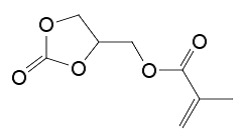
雖然在文獻中已經描述出不同的甘油碳酸酯甲基丙烯酸酯合成途徑,最感興趣的方法包括於合適的觸媒存在下讓甲基丙烯酸縮水甘油酯與二氧化碳反應。此化學係描述例如在美國專利案號4,835,289及日本專利申請案特許公開案號2014-051456中。雖然可使用此方法以好的產率獲得甘油碳酸酯甲基丙烯酸酯,此合成途徑的一個缺點為必需使用甲基丙烯酸縮水甘油酯作為起始材料。甲基丙烯酸縮水甘油酯商業上通常藉由讓表氯醇與甲基丙烯酸反應來製備。所產生的反應產物典型受未反應的表氯醇污染,表氯醇具腐蝕性且已認知具有明顯的健康及安全性擔憂。若未被移除,在該甘油碳酸酯甲基丙烯酸酯中的殘餘表氯醇可干擾將該甘油碳酸酯甲基丙烯酸酯配製成多種可與人類皮膚或其它生物活組織接觸的組成物之能力,諸如塗佈物、油墨、3D列印物件及其類似物。額外地,此等組成物及產物的法規分級可受殘餘的表氯醇之存在影響。此外,對發展出使用不包括含表氯醇起始材料來合成甘油碳酸酯甲基丙烯酸酯之另一種可實行的方法將明顯感到有興趣。Although different synthetic pathways of glycerol carbonate methacrylate have been described in the literature, the most interesting method involves reacting glycidyl methacrylate with carbon dioxide in the presence of a suitable catalyst. This chemical system is described in, for example, US Patent No. 4,835,289 and Japanese Patent Application Patent Publication No. 2014-051456. Although this method can be used to obtain glycerol carbonate methacrylate in good yield, one disadvantage of this synthesis route is that glycidyl methacrylate must be used as a starting material. Glycidyl methacrylate is commonly prepared commercially by reacting epichlorohydrin with methacrylic acid. The resulting reaction product is typically contaminated with unreacted epichlorohydrin, which is corrosive and has been recognized as having obvious health and safety concerns. If not removed, the residual epichlorohydrin in the glycerol carbonate methacrylate can interfere with the preparation of the glycerol carbonate methacrylate into one of a variety of compositions that can come into contact with human skin or other living biological tissues. Capabilities, such as coatings, inks, 3D printed objects and the like. Additionally, the regulatory classification of these compositions and products can be affected by the presence of residual epichlorohydrin. In addition, there will be obvious interest in the development of another feasible method for the synthesis of glycerol carbonate methacrylate that does not include epichlorohydrin-containing starting materials.
包括甘油碳酸酯甲基丙烯酸酯作為組分的可固化組成物至今已受到些微注意。Camara等人的European Polymer Journal 61 (2014) 133-144據說是首先完成的研究,其報導出甘油碳酸酯甲基丙烯酸酯之自由基聚合來合成經環狀碳酸酯官能化的聚合物,包括含有甲基丙烯酸甲酯及其它丙烯酸、甲基丙烯酸及苯乙烯單體的共聚物。美國專利申請案公告案號2017/0260418 A1的實施例9描述出一種油墨,其係使用作為用於3D列印的二部分油墨之部分A及其包括甘油碳酸酯甲基丙烯酸酯、二甲基丙烯酸三甘醇酯及光起始劑。但是,根據所公告的專利申請案,此油墨必需與含胺單體油墨(「部分B」)結合以提供其合適於使用在3D列印中,其中該胺單體包括一或多個一級、二級及/或三級胺基團。Curable compositions including glycerol carbonate methacrylate as a component have received some attention so far. The European Polymer Journal 61 (2014) 133-144 of Camara et al. is said to be the first study to be completed. It reported the free radical polymerization of glycerol carbonate methacrylate to synthesize a polymer functionalized with cyclic carbonate, including Copolymers of methyl methacrylate and other acrylic, methacrylic and styrene monomers. Example 9 of U.S. Patent Application Publication No. 2017/0260418 A1 describes an ink that is used as part A of a two-part ink for 3D printing and includes glycerol carbonate methacrylate, dimethyl Triethylene glycol acrylate and photoinitiator. However, according to the published patent application, this ink must be combined with an amine-containing monomer ink ("Part B") to provide it suitable for use in 3D printing, where the amine monomer includes one or more primary, Secondary and/or tertiary amine groups.
EP 0001088 A1揭示出一種在側鏈中包括1,3-二氧五圜-2-酮基團的聚合物,其係藉由聚合相應的不飽和化合物諸如甘油碳酸酯甲基丙烯酸酯而獲得。亦描述出與其它烯烴不飽和單體共聚合。該聚合物可使用來製造模塑物或模塑化合物、塗佈物、黏著劑及紙及紡織助劑。該公告並無提到藉由光固化來達成此聚合,也無揭示出讓含碳酸酯單體諸如甘油碳酸酯甲基丙烯酸酯與烯烴不飽和寡聚物共聚合。EP 0001088 A1 discloses a polymer including 1,3-dioxopentane-2-one groups in the side chain, which is obtained by polymerizing corresponding unsaturated compounds such as glycerol carbonate methacrylate. Copolymerization with other olefinic unsaturated monomers is also described. The polymer can be used to make moldings or molding compounds, coatings, adhesives, and paper and textile auxiliaries. The announcement does not mention photocuring to achieve this polymerization, nor does it disclose the copolymerization of carbonate-containing monomers such as glycerol carbonate methacrylate and olefin unsaturated oligomers.
美國專利案號5,047,261揭示出一種藉由輻射交聯一具有反應性稀釋劑系統且包括至少一種與特別的式相應之單(甲基)丙烯酸碳酸酯的可輻射交聯組成物來製造塗佈物的方法。在比較例9及21中使用甘油碳酸酯丙烯酸酯作為單體,但是該專利未揭示出包括甘油碳酸酯甲基丙烯酸酯之可輻射交聯的組成物。U.S. Patent No. 5,047,261 discloses a radiation-crosslinkable composition having a reactive diluent system and comprising at least one mono(meth)acrylic acid carbonate corresponding to a specific formula to produce a coating Methods. In Comparative Examples 9 and 21, glycerol carbonate acrylate was used as a monomer, but the patent did not disclose a radiation crosslinkable composition including glycerol carbonate methacrylate.
通常來說,已認知當曝露至光化輻射時,甲基丙烯酸酯化合物(即,包括一或多個甲基丙烯酸酯官能基-OC(=O)C(CH3 )=CH2 的化合物)係比類似的丙烯酸酯化合物(即,包括一或多個丙烯酸酯官能基-OC(=O)CH=CH2 的化合物)更慢反應及固化。Generally speaking, it has been recognized that when exposed to actinic radiation, methacrylate compounds (ie, compounds that include one or more methacrylate functional groups -OC(=O)C(CH 3 )=CH 2 ) It is slower to react and cure than similar acrylate compounds (ie, compounds that include one or more acrylate functional groups -OC(=O)CH=CH 2).
發明概要Summary of the invention
現在,本發明家已發現甘油碳酸酯甲基丙烯酸酯可容易地藉由於觸媒存在下,讓單甲基丙烯酸甘油酯與一選自於由碳酸二烷酯及環狀碳酸伸烷酯所組成之群的碳酸酯反應以高產率進行製備。驚人的是,該甲基丙烯酸酯官能基實質上在此反應後仍然存留,其中該環狀碳酸酯基團係藉由該碳酸酯反應物與該單甲基丙烯酸甘油酯的羥基互換而形成。醇共產物係與甘油碳酸酯甲基丙烯酸酯一起產生,但是其可容易地藉由蒸發或其它此等方法分離。該起始單甲基丙烯酸甘油酯轉換成想要的甘油碳酸酯甲基丙烯酸酯,其可如下圖式地表示出: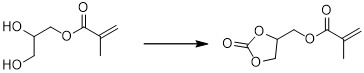
該起始材料單甲基丙烯酸甘油酯(亦已知為甲基丙烯酸2,3-二羥基丙酯)可藉由任何已知的方法製備,諸如以甲基丙烯酸酯來源諸如甲基丙烯酸、甲基丙烯酸酐、甲基丙烯醯基氯或甲基丙烯酸的低級烷基酯來單酯化甘油;或水解在甲基丙烯酸縮水甘油酯中的環氧基。其它方法係描述例如在美國專利案號7,342,054 B2、WO 00/63149及WO 00/63150中。本發明之用來製備甘油碳酸酯甲基丙烯酸酯的方法之一個優點係該起始材料單甲基丙烯酸甘油酯不使用表氯醇來製備。例如,可使用無表氯醇等級的甲基丙烯酸縮水甘油酯作為用於該單甲基丙烯酸甘油酯的前驅物。因此,與使用甲基丙烯酸縮水甘油酯作為起始材料的已知合成途徑比較,製備無表氯醇的甘油碳酸酯甲基丙烯酸酯係可行。The starting material glycerol monomethacrylate (also known as 2,3-dihydroxypropyl methacrylate) can be prepared by any known method, such as using methacrylate sources such as methacrylic acid, methyl methacrylate, and methacrylic acid. Acrylic acid anhydride, methacrylic acid chloride, or lower alkyl ester of methacrylic acid to monoesterify glycerol; or hydrolyze the epoxy group in glycidyl methacrylate. Other methods are described, for example, in U.S. Patent No. 7,342,054 B2, WO 00/63149 and WO 00/63150. One advantage of the method for preparing glycerol carbonate methacrylate of the present invention is that the starting material, glycerol monomethacrylate, is prepared without using epichlorohydrin. For example, glycidyl methacrylate without epichlorohydrin grade can be used as a precursor for the glycerol monomethacrylate. Therefore, in comparison with the known synthesis route using glycidyl methacrylate as a starting material, it is feasible to prepare an epichlorohydrin-free glycerol carbonate methacrylate system.
額外地,本發明家已建立出能容易地藉由曝露至光化輻射來固化而形成有用的聚合產物之組成物,其可使用甘油碳酸酯甲基丙烯酸酯與一或多種可光化輻射固化的寡聚物(特別是,一或多種(甲基)丙烯酸酯官能化的寡聚物)組合,與除了甘油碳酸酯甲基丙烯酸酯外,大概一或多種其它組分諸如光起始劑及/或可光化輻射固化的單體(諸如,(甲基)丙烯酸酯官能化的單體)一起來調配。該甘油碳酸酯甲基丙烯酸酯的性質使得其特別非常適合於使用在此等應用中。甘油碳酸酯甲基丙烯酸酯在周溫下具有低黏度(在25℃下55-65 cps),因此能作用為反應性稀釋劑,因此有效地減低包括高比例之可光化輻射固化的寡聚物的可固化組成物之黏度。當同元聚合時,甘油碳酸酯甲基丙烯酸酯產生一具有高玻璃轉換溫度(>160℃)、高張力強度(>18 MPa)及高張力模數(80 MPa)的同元聚合物。此外,將該甘油碳酸酯甲基丙烯酸酯併入一含可光化輻射固化的寡聚物之可固化組成物中提供明顯改良由彼獲得的固化聚合物基質之物理及機械性質。再者,與亦可使用作為反應性稀釋劑之其它(甲基)丙烯酸酯官能化的化合物比較,甘油碳酸酯甲基丙烯酸酯不具有急毒性。此外,可自根據本發明的可固化組成物來製備一合適於使用在醫療裝置及醫療用途應用的物件,其中此等物件係會和人類患者接觸。Additionally, the inventors have established a composition that can be easily cured by exposure to actinic radiation to form a useful polymer product, which can be cured using glycerol carbonate methacrylate and one or more actinic radiation. The combination of oligomers (especially, one or more (meth)acrylate functionalized oligomers), in addition to glycerol carbonate methacrylate, probably one or more other components such as photoinitiator and /Or monomers curable with actinic radiation (such as (meth)acrylate functional monomers) are formulated together. The properties of the glycerol carbonate methacrylate make it particularly suitable for use in such applications. Glycerol carbonate methacrylate has low viscosity at ambient temperature (55-65 cps at 25℃), so it can act as a reactive diluent, so it can effectively reduce the high proportion of oligomers curable by actinic radiation. The viscosity of the curable composition of the object. When homopolymerized, glycerol carbonate methacrylate produces a homopolymer with high glass transition temperature (>160°C), high tensile strength (>18 MPa) and high tensile modulus (80 MPa). In addition, the incorporation of the glycerol carbonate methacrylate into a curable composition containing actinic radiation curable oligomers provides a significant improvement in the physical and mechanical properties of the cured polymer matrix obtained therefrom. Furthermore, compared with other (meth)acrylate functionalized compounds that can also be used as reactive diluents, glycerol carbonate methacrylate is not acutely toxic. In addition, an object suitable for use in medical devices and medical applications can be prepared from the curable composition according to the present invention, wherein these objects are in contact with human patients.
額外地,甘油碳酸酯甲基丙烯酸酯顯示出非典型的甲基丙烯酸酯官能化的化合物之聚合動力學。丙烯酸酯及甲基丙烯酸酯當使用光化輻射聚合時通常具有不同的反應性,其中甲基丙烯酸酯固化明顯比相應的丙烯酸酯更慢。如將在隨後更詳細地解釋,本發明家已發現可在以甲基丙烯酸酯為基底的調配物中使用甘油碳酸酯甲基丙烯酸酯來增加輻射固化速度及彎曲強度(生坯強度)。Additionally, glycerol carbonate methacrylate showed atypical polymerization kinetics of methacrylate functionalized compounds. Acrylates and methacrylates generally have different reactivity when polymerized using actinic radiation, with methacrylates curing significantly slower than the corresponding acrylates. As will be explained in more detail later, the present inventors have discovered that glycerol carbonate methacrylate can be used in methacrylate-based formulations to increase radiation curing speed and bending strength (green strength).
較佳實施例之詳細說明 自單甲基丙烯酸甘油酯及碳酸酯合成甘油碳酸酯甲基丙烯酸酯Detailed description of the preferred embodiment Synthesis of glycerol carbonate methacrylate from glycerol monomethacrylate and carbonate
用以與單甲基丙烯酸甘油酯反應之合適的碳酸酯包括選自於由碳酸二烷酯及環狀碳酸伸烷酯所組成之群的碳酸酯。雖然可使用此等碳酸酯的混合物,在某些具體實例中,僅使用單一碳酸酯共反應物。合適的碳酸二烷酯特別包括該烷基係低級烷基諸如例如C1 -C6 烷基的碳酸酯,其中該烷基可係直鏈或分枝。例如,該烷基可係甲基、乙基、丙基(包括正丙基及異丙基)及丁基(包括正丁基、二級丁基及三級丁基)。以實施例說明之,合適的環狀碳酸伸烷酯包括碳酸乙二酯及碳酸丙二酯。根據本發明之某些想要的具體實例,該碳酸酯係經選擇使得所產生的醇共產物具有沸點在大氣壓下係200℃或較低、175℃或較低、150℃或較低、125℃或較低或100℃或較低,以促進在該單甲基丙烯酸甘油酯與該碳酸酯反應期間或之後所形成的共產物醇之分離。Suitable carbonates for the reaction with glycerol monomethacrylate include carbonates selected from the group consisting of dialkyl carbonates and cyclic alkylene carbonates. Although mixtures of these carbonates can be used, in some specific examples, only a single carbonate co-reactant is used. Suitable dialkyl carbonate include in particular the lower alkyl group such as alkyl-based C 1 -C 6 alkyl carbonates, wherein the alkyl group may be linear or branched, for example based. For example, the alkyl group may be methyl, ethyl, propyl (including n-propyl and isopropyl), and butyl (including n-butyl, secondary butyl, and tertiary butyl). Illustrated by examples, suitable cyclic alkylene carbonates include ethylene carbonate and propylene carbonate. According to some desired specific examples of the present invention, the carbonate is selected so that the resulting alcohol co-product has a boiling point of 200°C or lower, 175°C or lower, 150°C or lower, 125°C or lower at atmospheric pressure. °C or lower or 100 °C or lower to promote the separation of the co-product alcohol formed during or after the reaction of the glycerol monomethacrylate and the carbonate.
可對該反應使用任何合適有助於甘油碳酸酯甲基丙烯酸酯形成的碳酸酯對單甲基丙烯酸甘油酯莫耳比率。但是,典型使用至少化學計量的碳酸酯相對於單甲基丙烯酸甘油酯程度,且適當的碳酸酯莫耳過量通常較佳。較佳的是,該碳酸酯對單甲基丙烯酸甘油酯之莫耳比率範圍係1:1至3:1。例如,在一個具體實例中,該碳酸酯:單甲基丙烯酸甘油酯莫耳比率係1.1:1至1.2:1。Any suitable molar ratio of carbonate to glycerol monomethacrylate that facilitates the formation of glycerol carbonate methacrylate can be used for this reaction. However, at least a stoichiometric amount of carbonate relative to glycerol monomethacrylate is typically used, and an appropriate molar excess of carbonate is generally preferred. Preferably, the molar ratio of the carbonate to glycerol monomethacrylate ranges from 1:1 to 3:1. For example, in a specific example, the molar ratio of carbonate to glycerol monomethacrylate ranges from 1.1:1 to 1.2:1.
合適的觸媒包括能加速在該單甲基丙烯酸甘油酯與碳酸酯間之反應速率的任何物質,通常包括Lewis酸、Lewis鹼、Bronsted鹼及鹼觸媒(Lewis或Bronsted)。該觸媒可係均相(在反應條件下溶解於該反應混合物中)或非均相(在反應條件下不溶解於該反應混合物中)。該觸媒亦可在該反應條件下部分溶解。可使用二或更多種不同觸媒之混合物。Suitable catalysts include any substance that can accelerate the rate of reaction between the glycerol monomethacrylate and carbonate, and generally include Lewis acid, Lewis base, Bronsted base, and alkaline catalysts (Lewis or Bronsted). The catalyst can be homogeneous (dissolved in the reaction mixture under reaction conditions) or heterogeneous (insoluble in the reaction mixture under reaction conditions). The catalyst can also be partially dissolved under the reaction conditions. Mixtures of two or more different catalysts can be used.
合適的鹼觸媒包括但不限於鹼金屬(例如,Li、Na、K)及鹼土金屬(例如,Ca,Mg)化合物,其在本質上可係有機(即,除了鹼金屬及/或鹼土金屬外尚包括一或多個有機部分)或無機。此等化合物可例如係氫氧化物、烷氧化物、碳酸鹽、碳酸氫鹽、矽酸鹽、鋁酸鹽、氧化物及其類似物。亦可使用鹼性離子交換樹脂或鹼性沸石。根據本發明的某些具體實例,該觸媒係一強鹼,即,具有pKb值至多5的鹼。Suitable alkali catalysts include, but are not limited to, alkali metal (e.g., Li, Na, K) and alkaline earth metal (e.g., Ca, Mg) compounds, which can be organic in nature (ie, in addition to alkali metals and/or alkaline earth metals). The outside includes one or more organic parts) or inorganic. These compounds may be, for example, hydroxides, alkoxides, carbonates, bicarbonates, silicates, aluminates, oxides, and the like. It is also possible to use basic ion exchange resins or basic zeolites. According to some specific examples of the present invention, the catalyst is a strong base, that is, a base having a pKb value of at most 5.
合適的觸媒包括選自於下列的鹼觸媒:鹼金屬碳酸鹽、鹼金屬碳酸氫鹽、鹼金屬氫氧化物、鹼金屬氧化物、鹼金屬烷氧化物、鹼金屬鋁酸鹽、鹼金屬矽酸鹽、鹼土金屬碳酸鹽、鹼土金屬碳酸氫鹽、鹼土金屬氫氧化物、鹼土金屬氧化物、鹼土金屬烷氧化物、鹼土金屬鋁酸鹽、鹼土金屬矽酸鹽及其組合。在較佳的具體實例中,該觸媒係鹼金屬氫氧化物或鹼金屬烷氧化物。於本文中,對「烷氧化物」之參照包括C1 至C6 直鏈或分枝的烷氧化物,例如,C1 至C2 烷氧化物。合適的觸媒之特定實施例包括NaOH、KOH、NaOMe、NaOEt、KOMe、KOEt、Na2 CO3 、NaHCO3 、K2 CO3 、KHCO3 及Na2 SiO3 。亦可使用胺化合物包括三級胺作為合適的觸媒。已知為「離子型液體」的物質亦合適使用作為觸媒,諸如在WO 2017/125759(其全文以參考之方式併入本文用於全部目的)中所描述的那些。用於此目的之範例性離子型液體包括包含銨或鏻陽離子或芳香族雜環陽離子物種的離子型液體。該觸媒可以乾或純淨形式與反應物結合,但是在某些具體實例中,其可以溶液或漿體形式與溶劑組合著提供。Suitable catalysts include alkali catalysts selected from the group consisting of alkali metal carbonates, alkali metal bicarbonates, alkali metal hydroxides, alkali metal oxides, alkali metal alkoxides, alkali metal aluminates, alkali metal Silicates, alkaline earth metal carbonates, alkaline earth metal bicarbonates, alkaline earth metal hydroxides, alkaline earth metal oxides, alkaline earth metal alkoxides, alkaline earth metal aluminates, alkaline earth metal silicates, and combinations thereof. In a preferred embodiment, the catalyst is an alkali metal hydroxide or alkali metal alkoxide. As used herein, reference to "alkoxides" includes C 1 to C 6 linear or branched alkoxides, for example, C 1 to C 2 alkoxides. Specific examples of suitable catalysts include NaOH, KOH, NaOMe, NaOEt, KOMe, KOEt, Na 2 CO 3 , NaHCO 3 , K 2 CO 3 , KHCO 3 and Na 2 SiO 3 . Amine compounds including tertiary amines can also be used as suitable catalysts. Substances known as "ionic liquids" are also suitable for use as catalysts, such as those described in WO 2017/125759 (the entirety of which is incorporated herein by reference for all purposes). Exemplary ionic liquids for this purpose include ionic liquids containing ammonium or phosphonium cations or aromatic heterocyclic cation species. The catalyst can be combined with the reactants in a dry or pure form, but in some specific examples, it can be provided in a solution or slurry form in combination with a solvent.
該觸媒係以有效達成想要的催化效應之量供應至初始形成的反應混合物。在某些具體實例中,該觸媒係以0.05至5重量%之量存在於該反應混合物中,以整體初始形成的反應混合物之重量為基準。The catalyst is supplied to the initially formed reaction mixture in an amount effective to achieve the desired catalytic effect. In some specific examples, the catalyst is present in the reaction mixture in an amount of 0.05 to 5% by weight, based on the weight of the reaction mixture initially formed as a whole.
可於該反應混合物中存在有一或多種聚合抑制劑(特別是,自由基抑制劑)以幫助減低該(甲基)丙烯酸酯官能基之不想要的反應。合適的聚合抑制劑包括例如氫醌聚合抑制劑(例如,氫醌其自身和經取代的氫醌,諸如氫醌單甲基醚)、位阻酚聚合抑制劑(諸如,丁基化的羥基甲苯)及噻𠯤聚合抑制劑(諸如,啡噻𠯤)。在該反應混合物中的聚合抑制劑程度可依所使用的抑制劑型式及其它因素而改變,但是典型可係約5至約10,000 ppm。One or more polymerization inhibitors (especially, free radical inhibitors) may be present in the reaction mixture to help reduce unwanted reactions of the (meth)acrylate functional groups. Suitable polymerization inhibitors include, for example, hydroquinone polymerization inhibitors (for example, hydroquinone itself and substituted hydroquinones such as hydroquinone monomethyl ether), hindered phenol polymerization inhibitors (such as butylated hydroxytoluene) ) And thiophene polymerization inhibitors (such as phenanthrene). The degree of polymerization inhibitor in the reaction mixture can vary depending on the type of inhibitor used and other factors, but typically can range from about 5 to about 10,000 ppm.
該反應混合物之(甲基)丙烯酸酯官能化的組分之聚合亦可藉由於分子氧存在下進行該單(甲基)丙烯酸甘油酯與碳酸酯之反應而被抑制。例如,可對該反應混合物噴灑包含分子氧的氣體(諸如,空氣)。進料至進行該反應的反應容器中之氣體可係例如大氣空氣、富氧空氣或分子氧含量已經自正常(大氣)程度降低以減低燃燒度的勢之空氣。The polymerization of the (meth)acrylate functionalized components of the reaction mixture can also be inhibited by the reaction of the glycerol mono(meth)acrylate and carbonate in the presence of molecular oxygen. For example, a gas containing molecular oxygen (such as air) may be sprayed on the reaction mixture. The gas fed into the reaction vessel for the reaction may be, for example, atmospheric air, oxygen-enriched air, or air whose molecular oxygen content has been reduced from the normal (atmospheric) level to reduce the degree of combustion.
雖然可在本發明的方法中使用一或多種溶劑,此溶劑非需要。因此,在本發明的一個具體實例中,於該單甲基丙烯酸甘油酯與碳酸酯間之反應係在缺乏溶劑下進行。例如,該反應混合物(當初始形成時)可包括少於500 ppm或少於200 ppm的溶劑。Although one or more solvents can be used in the method of the present invention, such solvents are not required. Therefore, in a specific example of the present invention, the reaction between the glycerol monomethacrylate and the carbonate is carried out in the absence of a solvent. For example, the reaction mixture (when initially formed) may include less than 500 ppm or less than 200 ppm of solvent.
可將該反應混合物的組分(單甲基丙烯酸甘油酯、碳酸酯、觸媒、選擇性溶劑及可能其它選擇性組分)一起或相繼地充入至合適的反應容器。例如,可以二或更多個部分將該碳酸酯加入至該反應混合物的其它組分之混合物。該等組分可進行攪拌、機械混合或其它方面攪拌同時進行包括該單甲基丙烯酸甘油酯與碳酸酯之想要的反應。The components of the reaction mixture (glycerol monomethacrylate, carbonate, catalyst, selective solvent, and possibly other optional components) can be charged into a suitable reaction vessel together or one after another. For example, the carbonate can be added to the mixture of other components of the reaction mixture in two or more portions. The components can be stirred, mechanically mixed or otherwise stirred while carrying out the desired reaction including the glycerol monomethacrylate and carbonate.
該單甲基丙烯酸甘油酯與碳酸酯係於觸媒存在下及在有效以標的產率及選擇性來形成想要的甘油碳酸酯甲基丙烯酸酯之溫度及壓力下反應一段時間。通常來說,該溫度係經選擇而係一能以商業可實行的速率進行反應同時避免、最小化或減少反應物分解或形成不想要的副產物及聚合物之溫度或溫度範圍。合適的反應溫度包括例如40℃至160℃。The glycerol monomethacrylate and carbonate are reacted for a period of time in the presence of a catalyst and at a temperature and pressure effective to form the desired glycerol carbonate methacrylate with target yield and selectivity. Generally speaking, the temperature is selected to be a temperature or temperature range that can carry out the reaction at a commercially feasible rate while avoiding, minimizing, or reducing the decomposition of reactants or the formation of undesired by-products and polymers. Suitable reaction temperatures include, for example, 40°C to 160°C.
合適的反應時間可自數分鐘(例如,至少10分鐘)的級數至最高數小時(例如,最高12小時)。Suitable reaction times can range from on the order of several minutes (for example, at least 10 minutes) to up to several hours (for example, up to 12 hours).
為了幫助驅動想要的反應以較接近或更快速地完成形成該甘油碳酸酯單甲基丙烯酸酯,可有益地在該反應期間自該反應混合物分離出所形成的共產物醇。如將由熟練人士察知,用語「分離」意欲指為自該反應混合物物理萃取出醇共產物。結果,可獲得一含醇共產物流。此分離可呈連續基礎或呈階段式進行。例如,該反應可在讓該反應混合物接受分離程序(諸如,驟餾或管柱蒸餾)前、在讓該反應混合物的組分於進一步反應階段中繼續反應前進行一段限定的時間而沒有移除任何共產物醇。所回收的醇共產物可再循環(即,轉換回碳酸酯而再次使用來製備甘油碳酸酯(甲基)丙烯酸酯)或以某些其它角色使用。To help drive the desired reaction to complete the formation of the glycerol carbonate monomethacrylate closer or faster, it may be beneficial to separate the co-product alcohol formed from the reaction mixture during the reaction. As will be appreciated by the skilled person, the term "separate" is intended to mean the physical extraction of the alcohol co-product from the reaction mixture. As a result, an alcohol-containing co-product stream can be obtained. This separation can be carried out on a continuous basis or in stages. For example, the reaction can be carried out for a defined period of time without removing the components of the reaction mixture before subjecting the reaction mixture to a separation procedure (such as quenching or column distillation) and before allowing the components of the reaction mixture to continue the reaction in a further reaction stage. Any co-product alcohol. The recovered alcohol co-product can be recycled (ie, converted back to carbonate and reused to make glycerol carbonate (meth)acrylate) or used in some other role.
當達成該單甲基丙烯酸甘油酯或碳酸酯之一或多種想要的轉換程度時,可中斷該反應,及之後,讓該包含標的甘油碳酸酯甲基丙烯酸酯之反應產物接受合適的後處理或純化程序以獲得呈想要的純度狀態之甘油碳酸酯甲基丙烯酸酯。此純化步驟可包括例如洗滌及/或中和來移除或去活化該觸媒、乾燥、以吸附劑處理、去色及/或分餾。 包括甘油碳酸酯甲基丙烯酸酯與可光化輻射固化的寡聚物之可固化組成物When the desired degree of conversion of one or more of the glycerol monomethacrylate or carbonate is achieved, the reaction can be interrupted, and then the reaction product containing the target glycerol carbonate methacrylate is subjected to appropriate post-treatment Or a purification procedure to obtain glycerol carbonate methacrylate in the desired purity state. This purification step may include, for example, washing and/or neutralization to remove or deactivate the catalyst, drying, treatment with an adsorbent, decolorization, and/or fractionation. Curable composition including glycerol carbonate methacrylate and actinic radiation curable oligomer
本發明的一個態樣提供一種可固化組成物,其包含甘油碳酸酯甲基丙烯酸酯與至少一種可光化輻射固化的寡聚物(諸如,至少一種(甲基)丙烯酸酯官能化的寡聚物)。此等組成物可係可光固化或可輻射固化,即,能藉由曝露至光化輻射而固化,諸如UV光、可見光或電子束輻射。該甘油碳酸酯甲基丙烯酸酯可作用為反應性稀釋劑及減低該至少一種可光化輻射固化的寡聚物之黏度;此寡聚物,特別是若相當高的分子量時,趨向於在周溫(例如,25℃)下具有高黏度或甚至可係呈純淨形式的固體。該甘油碳酸酯甲基丙烯酸酯可提供該可固化組成物足夠低的黏度,甚至沒有溶劑存在,其中該可固化組成物可容易地在合適的施加溫度下施加至基材表面而形成相當薄的均勻層。因此,根據某些具體實例,該至少一種可光化輻射固化的寡聚物可呈純淨形式而具有黏度在25℃下係至少10,000 cPs,及該甘油碳酸酯甲基丙烯酸酯係以有效量存在於該可固化組成物中以提供該可固化組成物在25℃下具有黏度少於10,000 cPs(較佳為少於2500 cPs)。One aspect of the present invention provides a curable composition comprising glycerol carbonate methacrylate and at least one actinic radiation curable oligomer (such as at least one (meth)acrylate functionalized oligomer)物). These compositions can be photocurable or radiation curable, that is, can be cured by exposure to actinic radiation, such as UV light, visible light, or electron beam radiation. The glycerol carbonate methacrylate can act as a reactive diluent and reduce the viscosity of the at least one actinic radiation-curable oligomer; this oligomer, especially if the molecular weight is relatively high, tends to It has a high viscosity at a temperature (for example, 25°C) or can even be a solid in a pure form. The glycerol carbonate methacrylate can provide the curable composition with a sufficiently low viscosity, even without solvent, wherein the curable composition can be easily applied to the surface of the substrate at a suitable application temperature to form a relatively thin Uniform layer. Therefore, according to some specific examples, the at least one actinic radiation-curable oligomer may be in pure form with a viscosity of at least 10,000 cPs at 25°C, and the glycerol carbonate methacrylate may be present in an effective amount In the curable composition, it is provided that the curable composition has a viscosity of less than 10,000 cPs (preferably less than 2500 cPs) at 25°C.
於該可固化組成物中的甘油碳酸酯甲基丙烯酸酯量可依在該可固化組成物與由彼獲得的固化產物二者中想要之性質而如可想要般改變。例如及不限於,該可固化組成物可包含總共至少1%、至少2%、至少5%、至少10%、至少15%、至少20%或至少25重量%的甘油碳酸酯甲基丙烯酸酯,以該可固化組成物的總重量為基準。不需限制該甘油碳酸酯甲基丙烯酸酯的最大量,要記住的是,本發明之可固化組成物額外包括至少某些量之可光化輻射固化的寡聚物及同樣地可能其它組分(例如,光起始劑及/或除了可光化輻射固化的寡聚物及甘油碳酸酯甲基丙烯酸酯外的反應性物質,諸如一或多種可光化輻射固化的單體)。例如,該可固化組成物可包含總共最高95%、最高90%、最高85%、最高80%或最高75重量%的甘油碳酸酯甲基丙烯酸酯,以該可固化組成物的總重量為基準。該甘油碳酸酯甲基丙烯酸酯的含量將依末端用途應用而變化,但是典型將係10至65重量%,以該可固化組成物的總重量為基準。根據某些具體實例,該可固化組成物包含20至30重量%的甘油碳酸酯甲基丙烯酸酯,以該可固化組成物的總重量為基準。 可光化輻射固化的寡聚物The amount of glycerol carbonate methacrylate in the curable composition can be changed as desired depending on the desired properties in both the curable composition and the cured product obtained therefrom. For example and without limitation, the curable composition may comprise a total of at least 1%, at least 2%, at least 5%, at least 10%, at least 15%, at least 20%, or at least 25% by weight of glycerol carbonate methacrylate, Based on the total weight of the curable composition. There is no need to limit the maximum amount of glycerol carbonate methacrylate. It should be remembered that the curable composition of the present invention additionally includes at least some amount of actinic radiation-curable oligomers and likewise possible other components. (Eg, photoinitiators and/or reactive substances other than actinic radiation curable oligomers and glycerin carbonate methacrylate, such as one or more actinic radiation curable monomers). For example, the curable composition may contain a total of up to 95%, up to 90%, up to 85%, up to 80%, or up to 75% by weight of glycerol carbonate methacrylate based on the total weight of the curable composition . The content of the glycerol carbonate methacrylate will vary depending on the end use application, but will typically be 10 to 65% by weight, based on the total weight of the curable composition. According to some specific examples, the curable composition contains 20 to 30% by weight of glycerol carbonate methacrylate based on the total weight of the curable composition. Actinic radiation curable oligomer
該可光化輻射固化的寡聚物(例如,(甲基)丙烯酸酯官能化的寡聚物)之量可依所使用的寡聚物型式和在該可固化組成物及由彼獲得的固化產物二者中想要的性質而如可想要般改變。例如及不限於,該可固化組成物可包含總共至少1%、至少2%、至少5%、至少10%、至少15%、至少20%或至少25重量%之可光化輻射固化的寡聚物(例如,(甲基)丙烯酸酯官能化的寡聚物),以該可固化組成物的總重量為基準。不需限制該可光化輻射固化的寡聚物(例如,(甲基)丙烯酸酯官能化的寡聚物)之最大量,要記住的是,本發明之可固化組成物額外包括至少某些量的甘油碳酸酯甲基丙烯酸酯及同樣地可能的其它組分(例如,光起始劑及/或除了可光化輻射固化的寡聚物及甘油碳酸酯甲基丙烯酸酯外的反應性物質,諸如一或多種可光化輻射固化的單體)。例如,該可固化組成物可包含總共最高95%、最高90%、最高85%、最高80%或最高75重量%之可光化輻射固化的寡聚物(例如,(甲基)丙烯酸酯官能化的寡聚物),以該可固化組成物的總重量為基準。該寡聚物的含量將依末端用途應用而變化,但是典型將係10至65重量%,以該可固化組成物的總重量為基準。根據某些具體實例,該可固化組成物包含20至30重量%的寡聚物,以該可固化組成物的總重量為基準。The amount of the actinic radiation-curable oligomers (for example, (meth)acrylate functionalized oligomers) can depend on the type of oligomer used and in the curable composition and the curing obtained therefrom. The desired properties of the two products are changed as desired. For example and without limitation, the curable composition may comprise a total of at least 1%, at least 2%, at least 5%, at least 10%, at least 15%, at least 20%, or at least 25% by weight of the actinic radiation curable oligomer (For example, (meth)acrylate functionalized oligomer), based on the total weight of the curable composition. There is no need to limit the maximum amount of the actinic radiation-curable oligomer (for example, (meth)acrylate functionalized oligomer). It should be remembered that the curable composition of the present invention additionally includes at least some Some amount of glycerol carbonate methacrylate and other components likewise possible (for example, photoinitiator and/or reactivity other than actinic radiation curable oligomers and glycerol carbonate methacrylate Substances, such as one or more monomers curable with actinic radiation). For example, the curable composition may contain a total of up to 95%, up to 90%, up to 85%, up to 80%, or up to 75% by weight of actinic radiation-curable oligomers (e.g., (meth)acrylate functional Oligomer) based on the total weight of the curable composition. The content of the oligomer will vary depending on the end use application, but will typically be 10 to 65% by weight, based on the total weight of the curable composition. According to some specific examples, the curable composition contains 20 to 30% by weight of oligomers, based on the total weight of the curable composition.
可與甘油碳酸酯甲基丙烯酸酯組合著使用來製造根據本發明的可固化組成物之可光化輻射固化的寡聚物之型式未特別限制及可使用在技藝中已知的此等寡聚物之任何。該可光化輻射固化的寡聚物包括每分子包含至少一個當曝露至光化輻射時能固化(反應)的官能基之任何寡聚性物質。此等可光化輻射固化的官能基包括包含乙烯系不飽和(即,碳-碳雙鍵,C=C)場址之官能基,諸如丙烯酸酯(包括氰基丙烯酸酯)、甲基丙烯酸酯、丙烯醯胺、甲基丙烯醯胺、馬來醯基、烯丙基、丙烯基及乙烯基官能基及其組合。使用(甲基)丙烯酸酯官能化的寡聚物可特別優良。特別合適於此目的者有選自於由下列所組成之群的(甲基)丙烯酸酯官能化的寡聚物:(甲基)丙烯酸酯官能化的胺基甲酸酯寡聚物(有時亦指為「胺基甲酸酯(甲基)丙烯酸酯寡聚物」、「聚胺基甲酸酯(甲基)丙烯酸酯寡聚物」或「胺基甲酸酯(甲基)丙烯酸酯寡聚物」)、(甲基)丙烯酸酯官能化的環氧基寡聚物(有時亦指為「(甲基)丙烯酸環氧酯寡聚物」)、(甲基)丙烯酸酯官能化的聚醚寡聚物(有時亦指為「聚酯(甲基)丙烯酸酯寡聚物」)、(甲基)丙烯酸酯官能化的聚二烯寡聚物(有時亦指為「聚二烯(甲基)丙烯酸酯寡聚物」)、(甲基)丙烯酸酯官能化的聚碳酸酯寡聚物(有時亦指為「聚碳酸酯(甲基)丙烯酸酯寡聚物」)及(甲基)丙烯酸酯官能化的聚酯寡聚物(有時亦指為「聚酯(甲基)丙烯酸酯寡聚物」)。根據某些具體實例,該等寡聚物之至少一種係一甲基丙烯酸酯官能化的寡聚物。在其它具體實例中,存在於該可固化組成物中的寡聚物全部係甲基丙烯酸酯官能化的寡聚物。The type of actinic radiation-curable oligomer that can be used in combination with glycerol carbonate methacrylate to produce the curable composition of the present invention is not particularly limited, and such oligomers known in the art can be used. Anything. The actinic radiation curable oligomer includes any oligomeric substance containing at least one functional group per molecule that can be cured (reacted) when exposed to actinic radiation. These actinic radiation-curable functional groups include functional groups containing ethylenic unsaturation (ie, carbon-carbon double bond, C=C) sites, such as acrylates (including cyanoacrylates), methacrylates , Acrylamide, methacrylamide, maleyl, allyl, propylene and vinyl functional groups and combinations thereof. The use of (meth)acrylate functionalized oligomers can be particularly good. Particularly suitable for this purpose are (meth)acrylate-functionalized oligomers selected from the group consisting of: (meth)acrylate-functionalized urethane oligomers (sometimes Also referred to as "urethane (meth)acrylate oligomer", "urethane (meth)acrylate oligomer" or "urethane (meth)acrylate Oligomers''), (meth)acrylate functionalized epoxy oligomers (sometimes referred to as “(meth)acrylate epoxy ester oligomers”), (meth)acrylate functionalized Polyether oligomers (sometimes referred to as "polyester (meth)acrylate oligomers"), (meth)acrylate functionalized polydiene oligomers (sometimes also referred to as "polyester (meth)acrylate oligomers") Diene (meth)acrylate oligomers''), (meth)acrylate functionalized polycarbonate oligomers (sometimes referred to as "polycarbonate (meth)acrylate oligomers") And (meth)acrylate functionalized polyester oligomer (sometimes referred to as "polyester (meth)acrylate oligomer"). According to some specific examples, at least one of the oligomers is a methacrylate functionalized oligomer. In other specific examples, all oligomers present in the curable composition are methacrylate functionalized oligomers.
根據本發明的某些態樣,該可固化組成物當接受固化以形成聚合物基質時,其不包括任何含胺基化合物(寡聚性或單體),其中如於本文中所使用的「胺基」指為一級、二級或三級胺基團,但是不包括任何其它型式的含氮基團,諸如醯胺、胺基甲酸酯(胺基甲酸酯)、尿素或磺醯胺基團。因此,該可固化組成物可以單一部分系統形式使用,其係曝露至光化輻射及固化而沒有與一具有胺基且會與該甘油碳酸酯甲基丙烯酸酯化學交互作用而作為該固化方法的部分之含胺基化合物結合。According to certain aspects of the present invention, when the curable composition is cured to form a polymer matrix, it does not include any amine group-containing compound (oligomerization or monomer), where as used herein " Amino" refers to a primary, secondary or tertiary amine group, but does not include any other types of nitrogen-containing groups, such as amide, urethane (urethane), urea or sulfonamide Group. Therefore, the curable composition can be used in the form of a single-part system, which is exposed to actinic radiation and cured without chemically interacting with an amine group and chemically interacting with the glycerol carbonate methacrylate as the curing method Part of the amine-containing compound is combined.
(甲基)丙烯酸酯官能化的寡聚物通常可定義為一具寡聚性特徵及每分子包括至少一個丙烯酸酯或甲基丙烯酸酯官能基之有機物質。(Meth)acrylate functionalized oligomer can generally be defined as an organic substance with oligomerization characteristics and including at least one acrylate or methacrylate functional group per molecule.
可在本發明的可固化組成物中使用任何於技藝中知曉之(甲基)丙烯酸酯官能化的寡聚物。根據某些具體實例,此等寡聚物可每分子包括二或更多個(甲基)丙烯酸酯官能基。此等寡聚物的數量平均分子量可寬廣地變化,例如,約500至約50,000道耳吞。此等寡聚物可經選擇及與該甘油碳酸酯甲基丙烯酸酯及選擇性一或多種除了甘油碳酸酯甲基丙烯酸酯外之(甲基)丙烯酸酯官能化的單體組合著使用,以便除了別的特性以外,提高使用本發明的可固化組成物所製備之固化聚合物的可撓性、強度及/或模數。Any (meth)acrylate functionalized oligomer known in the art can be used in the curable composition of the present invention. According to certain specific examples, these oligomers may include two or more (meth)acrylate functional groups per molecule. The number average molecular weight of these oligomers can vary widely, for example, from about 500 to about 50,000 ear swallows. These oligomers can be selected and used in combination with the glycerol carbonate methacrylate and optionally one or more (meth)acrylate functional monomers other than glycerol carbonate methacrylate, so that In addition to other characteristics, the flexibility, strength and/or modulus of the cured polymer prepared by using the curable composition of the present invention are improved.
範例性聚酯(甲基)丙烯酸酯寡聚物包括丙烯酸或甲基丙烯酸或其混合物或合成同等物與羥基終端的聚酯多元醇之反應產物。該反應方法可進行,使得該聚酯多元醇之全部或基本上全部羥基已經(甲基)丙烯酸化,特別在該聚酯多元醇係二官能基的情況中。該聚酯多元醇可藉由多羥基官能性組分(特別是,雙醇)與多元羧酸官能性化合物(特別是,二羧酸及酐)之縮聚反應製得。該多羥基官能性及多元羧酸官能性組分可各者具有線性、分枝、環脂族或芳香族結構及可各別地或以混合物使用。Exemplary polyester (meth)acrylate oligomers include the reaction product of acrylic acid or methacrylic acid or a mixture or synthetic equivalent thereof with a hydroxyl-terminated polyester polyol. The reaction method can be carried out so that all or substantially all of the hydroxyl groups of the polyester polyol have been (meth)acrylated, especially in the case of the polyester polyol-based difunctional group. The polyester polyol can be prepared by the polycondensation reaction of polyhydroxy functional components (especially, diols) and polycarboxylic acid functional compounds (especially, dicarboxylic acids and anhydrides). The polyhydroxy functional and polycarboxylic acid functional components can each have a linear, branched, cycloaliphatic or aromatic structure and can be used individually or in a mixture.
合適的(甲基)丙烯酸環氧酯寡聚物之實施例包括丙烯酸或甲基丙烯酸或其混合物與縮水甘油基醚或酯諸如雙酚化合物及其寡聚物的縮水甘油基醚之反應產物。Examples of suitable epoxy (meth)acrylate oligomers include the reaction products of acrylic acid or methacrylic acid or mixtures thereof with glycidyl ethers or esters such as bisphenol compounds and glycidyl ethers of their oligomers.
合適的聚醚(甲基)丙烯酸酯寡聚物包括但不限於丙烯酸或甲基丙烯酸或其合成同等物或混合物與聚醚醇之縮合反應產物,其中該聚醚醇係聚醚多元醇(諸如,聚乙二醇、聚丙二醇或聚丁二醇)。合適的聚醚醇可係包括醚鍵及終端羥基之線性或分枝的物質。聚醚醇可藉由環狀醚諸如四氫呋喃或環氧烷烴(例如,環氧乙烷及/或環氧丙烷)與起始劑分子之開環聚合來製備。合適的起始劑分子包括水、多羥基官能性材料、聚酯多元醇及胺。Suitable polyether (meth)acrylate oligomers include but are not limited to the condensation reaction product of acrylic acid or methacrylic acid or its synthetic equivalent or mixture with polyether alcohol, wherein the polyether alcohol is a polyether polyol (such as , Polyethylene glycol, polypropylene glycol or polybutylene glycol). Suitable polyether alcohols can be linear or branched substances including ether linkages and terminal hydroxyl groups. Polyether alcohols can be prepared by ring-opening polymerization of cyclic ethers such as tetrahydrofuran or alkylene oxides (for example, ethylene oxide and/or propylene oxide) and initiator molecules. Suitable starter molecules include water, polyhydroxy functional materials, polyester polyols, and amines.
能使用在本發明的可固化組成物中之聚胺基甲酸酯(甲基)丙烯酸酯寡聚物(有時亦指為「胺基甲酸酯(甲基)丙烯酸酯寡聚物」)包括以脂肪族及/或芳香族聚酯多元醇及聚醚多元醇與以(甲基)丙烯酸酯末端基團端蓋之脂肪族及/或芳香族聚酯二異氰酸酯及聚醚二異氰酸酯為基底之胺基甲酸酯。合適的聚胺基甲酸酯(甲基)丙烯酸酯寡聚物包括例如以脂肪族聚酯為基底的胺基甲酸酯二及四丙烯酸酯寡聚物、以脂肪族聚醚為基底的胺基甲酸酯二及四丙烯酸酯寡聚物、和以脂肪族聚酯/聚醚為基底的胺基甲酸酯二及四丙烯酸酯寡聚物。Polyurethane (meth)acrylate oligomers that can be used in the curable composition of the present invention (sometimes referred to as "urethane (meth)acrylate oligomers") Including aliphatic and/or aromatic polyester polyols and polyether polyols and aliphatic and/or aromatic polyester diisocyanates and polyether diisocyanates terminated with (meth)acrylate end groups The urethane. Suitable polyurethane (meth)acrylate oligomers include, for example, aliphatic polyester-based urethane di- and tetraacrylate oligomers, and aliphatic polyether-based amines. Carbamate di- and tetraacrylate oligomers, and urethane di- and tetraacrylate oligomers based on aliphatic polyester/polyether.
在多個具體實例中,該聚胺基甲酸酯(甲基)丙烯酸酯寡聚物可藉由下列製備:讓脂肪族及/或芳香族二異氰酸酯與OH基團終端的聚酯多元醇(包括芳香族、脂肪族及混合的脂肪族/芳香族聚酯多元醇)、聚醚多元醇、聚碳酸酯多元醇、聚己內酯多元醇、聚有機矽氧烷多元醇(例如,聚二甲基矽氧烷多元醇)或聚二烯多元醇(例如,聚丁二烯多元醇)或其組合反應以形成異氰酸酯官能化的寡聚物,然後,讓其與羥基官能化的(甲基)丙烯酸酯諸如丙烯酸羥乙酯或甲基丙烯酸羥乙酯反應來提供終端(甲基)丙烯酸酯基團。例如,該聚胺基甲酸酯(甲基)丙烯酸酯寡聚物可每分子包括二、三、四或更多個(甲基)丙烯酸酯官能基。亦可使用另一種合成方法來製備合適的(甲基)丙烯酸酯官能化的胺基甲酸酯寡聚物,諸如藉由讓前述提及的多元醇之任何與異氰酸酯官能化的(甲基)丙烯酸酯反應(例如,二異氰酸酯與(甲基)丙烯酸羥烷酯之1:1反應產物)。In a number of specific examples, the polyurethane (meth)acrylate oligomer can be prepared by the following: aliphatic and/or aromatic diisocyanate and OH group-terminated polyester polyol ( Including aromatic, aliphatic and mixed aliphatic/aromatic polyester polyols), polyether polyols, polycarbonate polyols, polycaprolactone polyols, polyorganosiloxane polyols (e.g., poly two Methylsiloxane polyol) or polydiene polyol (for example, polybutadiene polyol) or a combination thereof is reacted to form an isocyanate-functionalized oligomer, which is then allowed to react with a hydroxyl-functionalized (methyl ) Acrylates such as hydroxyethyl acrylate or hydroxyethyl methacrylate react to provide terminal (meth)acrylate groups. For example, the polyurethane (meth)acrylate oligomer may include two, three, four, or more (meth)acrylate functional groups per molecule. Another synthetic method can also be used to prepare suitable (meth)acrylate-functionalized urethane oligomers, such as by making any of the aforementioned polyols and isocyanate-functionalized (meth) Acrylate reaction (for example, 1:1 reaction product of diisocyanate and hydroxyalkyl (meth)acrylate).
合適的丙烯酸(甲基)丙烯酸酯寡聚物(有時在技藝中亦指為「丙烯酸寡聚物」)包括可描述為具有寡聚性丙烯酸骨架的物質之寡聚物,其以一或多個(甲基)丙烯酸酯基團官能化(其可在該寡聚物的終端處或懸吊至該丙烯酸骨架)。該丙烯酸骨架可係包含丙烯酸單體重覆單元的同元聚合物、無規共聚物或嵌段共聚物。該丙烯酸單體可係任何單體的(甲基)丙烯酸酯,諸如(甲基)丙烯酸C1 -C6 烷酯;和官能化的(甲基)丙烯酸酯,諸如承載羥基、羧酸及/或環氧基的(甲基)丙烯酸酯。丙烯酸(甲基)丙烯酸酯寡聚物可使用在技藝中已知的任何程序來製備,諸如藉由寡聚化至少一部分係以羥基、羧酸及/或環氧基官能化的單體(例如,(甲基)丙烯酸羥烷酯、(甲基)丙烯酸、(甲基)丙烯酸縮水甘油酯)來獲得官能化的寡聚物中間物,然後,讓其與一或多種含(甲基)丙烯酸酯反應物反應來引進想要的(甲基)丙烯酸酯官能基。 可光化輻射固化的單體Suitable acrylic (meth)acrylate oligomers (sometimes referred to as "acrylic oligomers" in the art) include oligomers that can be described as having an oligomeric acrylic backbone, with one or more A (meth)acrylate group is functionalized (it can be at the end of the oligomer or suspended to the acrylic backbone). The acrylic backbone may be a homopolymer, a random copolymer or a block copolymer containing repeating units of acrylic monomers. The acrylic monomer can be (meth)acrylate of any monomer, such as C 1 -C 6 alkyl (meth)acrylate; and functionalized (meth)acrylate, such as carrying hydroxyl, carboxylic acid and/ Or epoxy (meth)acrylate. Acrylic (meth)acrylate oligomers can be prepared using any procedure known in the art, such as by oligomerizing at least a portion of monomers functionalized with hydroxyl, carboxylic acid and/or epoxy groups (e.g. , (Meth) hydroxyalkyl acrylate, (meth) acrylic acid, (meth) glycidyl acrylate) to obtain functionalized oligomer intermediates, and then, let it and one or more containing (meth) acrylic acid The ester reactant reacts to introduce the desired (meth)acrylate functional group. Actinic radiation curable monomer
除了甘油碳酸酯甲基丙烯酸酯外,該可固化組成物可額外包含至少一種可光化輻射固化的單體(諸如,(甲基)丙烯酸酯官能化的單體)。該可光化輻射固化的單體包括每分子包括至少一個當曝露至光化輻射時能固化(反應)之官能基的任何單體(非寡聚性)物質。此可光化輻射固化的官能基包括包含乙烯系不飽和(即,碳-碳雙鍵,C=C)場址的官能基,諸如丙烯酸酯(包括氰基丙烯酸酯)、甲基丙烯酸酯、丙烯醯胺、甲基丙烯醯胺、馬來醯基、烯丙基、丙烯基及乙烯基官能基及其組合。使用(甲基)丙烯酸酯官能化的單體特別優良。In addition to glycerol carbonate methacrylate, the curable composition may additionally include at least one actinic radiation curable monomer (such as a (meth)acrylate functional monomer). The actinic radiation curable monomer includes any monomer (non-oligomeric) substance that includes at least one functional group per molecule that can be cured (reacted) when exposed to actinic radiation. This actinic radiation-curable functional group includes functional groups containing ethylenic unsaturation (ie, carbon-carbon double bond, C=C) sites, such as acrylate (including cyanoacrylate), methacrylate, Acrylamide, methacrylamide, maleyl, allyl, propenyl and vinyl functional groups and combinations thereof. The use of (meth)acrylate functionalized monomers is particularly good.
例如,根據某些具體實例,除了甘油碳酸酯甲基丙烯酸酯外,該可固化組成物額外包含至少一種甲基丙烯酸酯官能化的單體。但是,在其它具體實例中,該可固化組成物可包含一或多種丙烯酸酯官能化的單體及一或多種甲基丙烯酸酯官能化的單體。For example, according to some specific examples, in addition to glycerol carbonate methacrylate, the curable composition additionally includes at least one methacrylate functionalized monomer. However, in other specific examples, the curable composition may include one or more acrylate-functional monomers and one or more methacrylate-functional monomers.
(甲基)丙烯酸酯官能化的單體通常可定義為具非寡聚性特徵及每分子包括至少一個丙烯酸酯或甲基丙烯酸酯官能基之有機物質。根據本發明的某些態樣,所使用之(甲基)丙烯酸酯官能化的單體之分子量可相當低(例如,數量平均分子量100至1000道耳吞)。(Meth)acrylate functionalized monomers can generally be defined as organic substances that have non-oligomeric properties and include at least one acrylate or methacrylate functional group per molecule. According to certain aspects of the present invention, the molecular weight of the (meth)acrylate-functionalized monomers used may be quite low (for example, the number average molecular weight is 100 to 1000 canals).
本發明的可固化組成物可包含例如至少一種每分子包括二或更多個(甲基)丙烯酸酯官能基之(甲基)丙烯酸酯官能化的單體。有用的每分子包括二或更多個(甲基)丙烯酸酯官能基之(甲基)丙烯酸酯官能化的單體之實施例包括多羥醇(每分子包括二或更多個羥基,例如,2至6個的有機化合物)之丙烯酸酯及甲基丙烯酸酯。合適的多羥醇之特定實施例包括C2-20 伸烷基二醇(具有C2-10 伸烷基的二醇可較佳,其中該碳鏈可係分枝,例如,乙二醇、三伸甲基二醇、1,2-丙二醇、1,2-丁二醇、1,3-丁二醇、2,3-丁二醇、四伸甲基二醇(1,4-丁二醇)、1,5-戊二醇、1,6-己二醇、1,8-辛二醇、1,9-壬二醇、1,12-十二烷二醇、環己烷-1,4-二甲醇、雙酚及氫化的雙酚、和其烷氧基化(例如,乙氧基化及/或丙氧基化)的衍生物)、二甘醇、甘油、烷氧基化的甘油、三甘醇、二丙二醇、三丙二醇、三羥甲基丙烷、烷氧基化的三羥甲基丙烷、雙三羥甲基丙烷、烷氧基化的雙三羥甲基丙烷、新戊四醇、烷氧基化的新戊四醇、二新戊四醇、烷氧基化的二新戊四醇、環已二醇、烷氧基化的環已二醇、環己二甲醇、烷氧基化的環己二甲醇、降𦯉烯二甲醇、烷氧基化的降𦯉烯二甲醇、降𦯉二甲醇、烷氧基化的降𦯉二甲醇、包括芳香環的多元醇、環己烷-1,4-二甲醇環氧乙烷加成物、雙酚環氧乙烷加成物、氫化的雙酚環氧乙烷加成物、雙酚環氧丙烷加成物、氫化的雙酚環氧丙烷加成物、環己烷-1,4-二甲醇環氧丙烷加成物、糖醇及烷氧基化的糖醇。此等多羥醇可完全或部分酯化(以(甲基)丙烯酸、(甲基)丙烯酸酐、(甲基)丙烯醯基氯或其類似物),其限制為它們每分子包括至少二個(甲基)丙烯酸酯官能基。如於本文中所使用,用語「烷氧基化」指為包括一或多個氧基伸烷基部分(例如,氧基伸乙基及/或氧基伸丙基部分)的化合物。該氧基伸烷基部分與通用結構-R-O-相應,其中R係一二價脂肪族部分,諸如-CH2 CH2 -或-CH2 CH(CH3 )-。例如,該烷氧基化的化合物可每分子包括1至25個氧基伸烷基部分。The curable composition of the present invention may include, for example, at least one (meth)acrylate functional monomer including two or more (meth)acrylate functional groups per molecule. Examples of useful (meth)acrylate functional monomers that include two or more (meth)acrylate functional groups per molecule include polyhydric alcohols (including two or more hydroxyl groups per molecule, for example, 2 to 6 organic compounds) acrylate and methacrylate. Specific examples of suitable polyhydric alcohols include C 2-20 alkylene glycols (diols with C 2-10 alkylene glycols are preferred, wherein the carbon chain may be branched, for example, ethylene glycol, Trimethylene glycol, 1,2-propanediol, 1,2-butanediol, 1,3-butanediol, 2,3-butanediol, tetramethylene glycol (1,4-butanediol Alcohol), 1,5-pentanediol, 1,6-hexanediol, 1,8-octanediol, 1,9-nonanediol, 1,12-dodecanediol, cyclohexane-1 , 4-Dimethanol, bisphenol and hydrogenated bisphenol, and its alkoxylated (for example, ethoxylated and/or propoxylated) derivatives), diethylene glycol, glycerol, alkoxylated Glycerol, triethylene glycol, dipropylene glycol, tripropylene glycol, trimethylolpropane, alkoxylated trimethylolpropane, ditrimethylolpropane, alkoxylated ditrimethylolpropane, new Pentyleneerythritol, alkoxylated neopentaerythritol, dineopentyl erythritol, alkoxylated dineopentaerythritol, cyclohexanediol, alkoxylated cyclohexanediol, cyclohexanedimethanol , Alkoxylated cyclohexanedimethanol, norene dimethanol, alkoxylated norene dimethanol, nordimethanol, alkoxylated nordimethanol, polyols including aromatic rings, Cyclohexane-1,4-dimethanol ethylene oxide adduct, bisphenol ethylene oxide adduct, hydrogenated bisphenol ethylene oxide adduct, bisphenol propylene oxide adduct, hydrogenated The bisphenol propylene oxide adduct, cyclohexane-1,4-dimethanol propylene oxide adduct, sugar alcohol and alkoxylated sugar alcohol. These polyhydric alcohols can be fully or partially esterified (with (meth)acrylic acid, (meth)acrylic anhydride, (meth)acrylic acid chloride or the like), and they are limited to include at least two per molecule (Meth)acrylate functional group. As used herein, the term "alkoxylated" refers to a compound that includes one or more oxyalkylene moieties (e.g., oxyethylene and/or oxyalkylene moieties). The oxyalkylene moiety corresponds to the general structure -RO-, where R is a divalent aliphatic moiety, such as -CH 2 CH 2 -or -CH 2 CH(CH 3 )-. For example, the alkoxylated compound may include 1 to 25 oxyalkylene moieties per molecule.
每分子包括二或更多個(甲基)丙烯酸酯官能基之範例性(甲基)丙烯酸酯官能化的單體可包括乙氧基化的二(甲基)丙烯酸雙酚A酯、二(甲基)丙烯酸三甘醇酯、二(甲基)丙烯酸乙二醇酯、二(甲基)丙烯酸四甘醇酯、聚乙二醇二(甲基)丙烯酸酯、二丙烯酸1,4-丁二醇酯、二甲基丙烯酸1,4-丁二醇酯、二丙烯酸二甘醇酯、二甲基丙烯酸二甘醇酯、二丙烯酸1,6-己二醇酯、二甲基丙烯酸1,6-己二醇酯、二丙烯酸新戊二醇酯、二(甲基)丙烯酸新戊二醇酯、聚乙二醇(600)二甲基丙烯酸酯(其中600指為該聚乙二醇部分的大約數量平均分子量)、聚乙二醇(200)二丙烯酸酯、二甲基丙烯酸1,12-十二烷二醇酯、二丙烯酸四甘醇酯、二丙烯酸三甘醇酯、二甲基丙烯酸1,3-丁二醇酯、二丙烯酸三丙二醇酯、聚丁二烯二丙烯酸酯、二丙烯酸甲基戊二醇酯、聚乙二醇(400)二丙烯酸酯、乙氧基化2 的二甲基丙烯酸雙酚A酯、乙氧基化3 的二甲基丙烯酸雙酚A酯、乙氧基化3 的二丙烯酸雙酚A酯、二甲基丙烯酸環己烷二甲醇酯、二丙烯酸環己烷二甲醇酯、乙氧基化10 的二甲基丙烯酸雙酚A酯(其中在「乙氧基化」後之數字係每分子的氧基伸烷基部分之平均數目)、二丙烯酸二丙二醇酯、乙氧基化4 的二甲基丙烯酸雙酚A酯、乙氧基化6 的二甲基丙烯酸雙酚A酯、乙氧基化8 的二甲基丙烯酸雙酚A酯、烷氧基化的二丙烯酸己二醇酯、烷氧基化的二丙烯酸環己烷二甲醇酯、二丙烯酸十二烷酯、乙氧基化4 的二丙烯酸雙酚A酯、乙氧基化10 的二丙烯酸雙酚A酯、聚乙二醇(400)二甲基丙烯酸酯、聚丙二醇(400)二甲基丙烯酸酯、金屬的二丙烯酸鹽、經修改的金屬二丙烯酸鹽、金屬的二甲基丙烯酸鹽、聚乙二醇(1000)二甲基丙烯酸酯、甲基丙烯酸化的聚丁二烯、丙氧基化2 的二丙烯酸新戊二醇酯、乙氧基化30 的二甲基丙烯酸雙酚A酯、乙氧基化30 的二丙烯酸雙酚A酯、烷氧基化的二丙烯酸新戊二醇酯、聚乙二醇二甲基丙烯酸酯類、二丙烯酸1,3-丁二醇酯、乙氧基化2 的二甲基丙烯酸雙酚A酯、二丙烯酸二丙二醇酯、乙氧基化4 的二丙烯酸雙酚A酯、聚乙二醇(600)二丙烯酸酯、聚乙二醇(1000)二甲基丙烯酸酯、二丙烯酸三環癸烷二甲醇酯;丙氧基化的新戊二醇二丙烯酸酯類,諸如丙氧基化2 的二丙烯酸新戊二醇酯;烷氧基化的脂肪族醇之二丙烯酸酯、三甲基丙烯酸三羥甲基丙烷酯、三丙烯酸三羥甲基丙烷酯、三(2-羥乙基)異氰脲酸酯三丙烯酸酯、乙氧基化20 的三丙烯酸三羥甲基丙烷酯、三丙烯酸新戊四醇酯、乙氧基化3 的三丙烯酸三羥甲基丙烷酯、丙氧基化3 的三丙烯酸三羥甲基丙烷酯、乙氧基化6 的三丙烯酸三羥甲基丙烷酯、丙氧基化6 的三丙烯酸三羥甲基丙烷酯、乙氧基化9 的三丙烯酸三羥甲基丙烷酯、烷氧基化的三官能基丙烯酸酯、三官能基甲基丙烯酸酯、三官能基丙烯酸酯、丙氧基化3 的三丙烯酸甘油酯、丙氧基化5.5 的三丙烯酸甘油酯、乙氧基化15 的三丙烯酸三羥甲基丙烷酯、三官能基磷酸酯、三官能基丙烯酸酯、四丙烯酸新戊四醇酯、四丙烯酸雙三羥甲基丙烷酯、乙氧基化4 的四丙烯酸新戊四醇酯、新戊四醇聚四丙烯酸氧基伸乙基酯、五丙烯酸二新戊四醇酯及五丙烯酸酯。Exemplary (meth)acrylate functionalized monomers that include two or more (meth)acrylate functional groups per molecule can include ethoxylated bis(meth)acrylate bisphenol A, di(meth)acrylate Triethylene glycol meth)acrylate, ethylene glycol di(meth)acrylate, tetraethylene glycol di(meth)acrylate, polyethylene glycol di(meth)acrylate, 1,4-butyl diacrylate Glycol ester, 1,4-butanediol dimethacrylate, diethylene glycol diacrylate, diethylene glycol dimethacrylate, 1,6-hexanediol diacrylate, 1,6-dimethacrylate 1, 6-hexanediol ester, neopentyl glycol diacrylate, neopentyl glycol di(meth)acrylate, polyethylene glycol (600) dimethacrylate (wherein 600 refers to the polyethylene glycol part Approximate number average molecular weight), polyethylene glycol (200) diacrylate, 1,12-dodecanediol dimethacrylate, tetraethylene glycol diacrylate, triethylene glycol diacrylate, dimethyl 1,3-Butanediol acrylate, tripropylene glycol diacrylate, polybutadiene diacrylate, methylpentanediol diacrylate, polyethylene glycol (400) diacrylate, ethoxylated 2 Bisphenol A dimethacrylate, bisphenol A dimethacrylate of ethoxylated 3 , bisphenol A diacrylate of ethoxylated 3 , cyclohexanedimethanol dimethacrylate, diacrylic acid Cyclohexane dimethanol ester, bisphenol A dimethacrylate ethoxylated 10 (wherein the number after "ethoxylation" is the average number of oxyalkylene moieties per molecule), diacrylate Propylene glycol ester, ethoxylated 4 bisphenol A dimethacrylate, ethoxylated 6 bisphenol A dimethacrylate, ethoxylated 8 bisphenol A dimethacrylate, alkoxy Alkylated hexanediol diacrylate, alkoxylated cyclohexanedimethanol diacrylate, dodecyl diacrylate, ethoxylated 4 bisphenol A diacrylate, ethoxylated 10 Bisphenol A diacrylate, polyethylene glycol (400) dimethacrylate, polypropylene glycol (400) dimethacrylate, metal diacrylate, modified metal diacrylate, metal dimethyl Acrylate, polyethylene glycol (1000) dimethacrylate, methacrylated polybutadiene, propoxylated 2 neopentyl glycol diacrylate, ethoxylated 30 dimethacrylate Bisphenol A ester, ethoxylated 30 bisphenol A diacrylate, alkoxylated neopentyl glycol diacrylate, polyethylene glycol dimethacrylates, 1,3-butane diacrylate Alcohol esters, ethoxylated 2 bisphenol A dimethacrylate, dipropylene glycol diacrylate, ethoxylated 4 bisphenol A diacrylate, polyethylene glycol (600) diacrylate, polyethylene Glycol (1000) dimethacrylate, tricyclodecane dimethanol diacrylate; propoxylated neopentyl glycol diacrylates, such as propoxylated 2 neopentyl glycol diacrylate; Alkoxylated aliphatic alcohol diacrylate, trimethylolpropane trimethacrylate, trimethylolpropane triacrylate, tris(2-hydroxyethyl) isocyanurate triacrylate, Ethoxylation 2 0 trimethylolpropane triacrylate, neopentyl erythritol triacrylate, trimethylolpropane triacrylate of ethoxylated 3 , trimethylolpropane triacrylate of propoxylated 3 , ethyl alkoxylated trimethylol propane triacrylate ester of 6, propoxylated trimethylol propane triacrylate ester 6, ethoxylated trimethylolpropane triacrylate esters of 9, alkoxylated tri Functional acrylate, trifunctional methacrylate, trifunctional acrylate, propoxylated 3 glycerol triacrylate, propoxylated 5.5 glycerol triacrylate, ethoxylated 15 triacrylate triacrylate Methylol propane ester, trifunctional phosphate, trifunctional acrylate, neopentyl erythritol tetraacrylate, ditrimethylolpropane tetraacrylate, neopentyl erythritol tetraacrylate, ethoxylated 4 Neopentyl erythritol polyoxyethylene tetraacrylate, dineopentaerythritol pentaacrylate and pentaacrylate.
除了甘油碳酸酯甲基丙烯酸酯外,本發明的可固化組成物可包含一或多種每分子包括單一丙烯酸酯或甲基丙烯酸酯官能基之(甲基)丙烯酸酯官能化的單體(於本文中指為「單(甲基)丙烯酸酯官能化的化合物」)。可使用在技藝中已知的此等化合物之任何。In addition to glycerol carbonate methacrylate, the curable composition of the present invention may contain one or more (meth)acrylate functional monomers per molecule including a single acrylate or methacrylate functional group (herein Middle refers to "mono(meth)acrylate functionalized compound"). Any of these compounds known in the art can be used.
合適的單(甲基)丙烯酸酯官能化的單體之實施例包括但不限於脂肪族醇的單(甲基)丙烯酸酯(其中該脂肪族醇可係直鏈、分枝或脂環族及可係單醇、二醇或多元醇,其限制為僅有一個羥基以(甲基)丙烯酸酯化);芳香族醇(諸如酚類,包括烷基化的酚類)之單(甲基)丙烯酸酯;烷基芳基醇(諸如苄醇)之單(甲基)丙烯酸酯;寡聚性及聚合性二醇諸如二甘醇、三甘醇、二丙二醇、三丙二醇、聚乙二醇及聚丙二醇的單(甲基)丙烯酸酯;二醇及寡二醇的單烷基醚之單(甲基)丙烯酸酯;烷氧基化(例如,乙氧基化及/或丙氧基化)的脂肪族醇之單(甲基)丙烯酸酯(其中該脂肪族醇可係直鏈、分枝或脂環族及可係單醇、二醇或多元醇,其限制為該烷氧基化的脂肪族醇僅有一個羥基係以(甲基)丙烯酸酯化);烷氧基化(例如,乙氧基化及/或丙氧基化)的芳香族醇(諸如,烷氧基化的酚)之單(甲基)丙烯酸酯;己內酯單(甲基)丙烯酸酯類;及其類似物。Examples of suitable mono(meth)acrylate functionalized monomers include, but are not limited to, mono(meth)acrylates of aliphatic alcohols (wherein the aliphatic alcohol can be linear, branched or cycloaliphatic and It can be a monoalcohol, a diol or a polyalcohol, and it is limited to only one hydroxyl group is esterified with (meth)acrylate); aromatic alcohols (such as phenols, including alkylated phenols) are mono(methyl) Acrylates; mono(meth)acrylates of alkylaryl alcohols (such as benzyl alcohol); oligomeric and polymerizable glycols such as diethylene glycol, triethylene glycol, dipropylene glycol, tripropylene glycol, polyethylene glycol, and Mono(meth)acrylate of polypropylene glycol; mono(meth)acrylate of monoalkyl ether of glycol and oligoglycol; alkoxylation (for example, ethoxylation and/or propoxylation) Mono(meth)acrylate of aliphatic alcohol (wherein the aliphatic alcohol can be linear, branched or cycloaliphatic and can be monool, diol or polyol, which is limited to the alkoxylated Aliphatic alcohols have only one hydroxyl group (meth)acrylated); alkoxylated (for example, ethoxylated and/or propoxylated) aromatic alcohols (such as alkoxylated phenols) ) Mono(meth)acrylate; caprolactone mono(meth)acrylate; and the like.
下列化合物係合適於使用在本發明的可固化組成物中之單(甲基)丙烯酸酯官能化的單體之特定實施例:(甲基)丙烯酸甲酯、(甲基)丙烯酸乙酯、(甲基)丙烯酸正丙酯、(甲基)丙烯酸正丁酯、(甲基)丙烯酸異丁酯、(甲基)丙烯酸正己酯、(甲基)丙烯酸2-乙基己酯、(甲基)丙烯酸正辛酯、(甲基)丙烯酸異辛酯、(甲基)丙烯酸正癸酯、(甲基)丙烯酸正十二烷酯、(甲基)丙烯酸十三烷酯、(甲基)丙烯酸十四烷酯、(甲基)丙烯酸十六烷酯、(甲基)丙烯酸2-羥乙酯、(甲基)丙烯酸2-及3-羥丙酯、(甲基)丙烯酸2-甲氧基乙酯、(甲基)丙烯酸2-乙氧基乙酯、(甲基)丙烯酸2-及3-乙氧基丙酯、(甲基)丙烯酸四氫糠酯、烷氧基化的(甲基)丙烯酸四氫糠酯、(甲基)丙烯酸異𦯉酯、(甲基)丙烯酸2-(2-乙氧基乙氧基)乙酯、(甲基)丙烯酸環己酯、(甲基)丙烯酸縮水甘油酯、(甲基)丙烯酸異癸酯、(甲基)丙烯酸2-苯氧基乙酯、(甲基)丙烯酸月桂酯、(甲基)丙烯酸2-苯氧基乙酯、烷氧基化的(甲基)丙烯酸酚酯、烷氧基化的(甲基)丙烯酸壬基酚酯、環狀三羥甲基丙烷二甲醇縮甲醛(甲基)丙烯酸酯、(甲基)丙烯酸三甲基環己醇酯、二甘醇單甲基醚(甲基)丙烯酸酯、二甘醇單乙基醚(甲基)丙烯酸酯、二甘醇單丁基醚(甲基)丙烯酸酯、三甘醇單乙基醚(甲基)丙烯酸酯、乙氧基化的(甲基)丙烯酸月桂酯、甲氧基聚乙二醇(甲基)丙烯酸酯、羥基乙基-丁基胺基甲酸酯(甲基)丙烯酸酯、3-(2-羥烷基)㗁唑啶酮(甲基)丙烯酸酯及其組合。The following compounds are specific examples of mono(meth)acrylate functional monomers suitable for use in the curable composition of the present invention: methyl (meth)acrylate, ethyl (meth)acrylate, ( N-propyl meth)acrylate, n-butyl (meth)acrylate, isobutyl (meth)acrylate, n-hexyl (meth)acrylate, 2-ethylhexyl (meth)acrylate, (meth) N-octyl acrylate, isooctyl (meth)acrylate, n-decyl (meth)acrylate, n-dodecyl (meth)acrylate, tridecyl (meth)acrylate, ten (meth)acrylate Tetraalkyl ester, hexadecyl (meth)acrylate, 2-hydroxyethyl (meth)acrylate, 2- and 3-hydroxypropyl (meth)acrylate, 2-methoxyethyl (meth)acrylate Ester, 2-ethoxyethyl (meth)acrylate, 2- and 3-ethoxypropyl (meth)acrylate, tetrahydrofurfuryl (meth)acrylate, alkoxylated (meth) Tetrahydrofurfuryl acrylate, iso-(meth)acrylate, 2-(2-ethoxyethoxy)ethyl (meth)acrylate, cyclohexyl (meth)acrylate, (meth)acrylate shrinkage Glycerides, isodecyl (meth)acrylate, 2-phenoxyethyl (meth)acrylate, lauryl (meth)acrylate, 2-phenoxyethyl (meth)acrylate, alkoxylation Phenol (meth)acrylate, alkoxylated nonylphenol (meth)acrylate, cyclic trimethylolpropane dimethanol formal (meth)acrylate, trimethyl (meth)acrylate Cyclohexanol ester, diethylene glycol monomethyl ether (meth)acrylate, diethylene glycol monoethyl ether (meth)acrylate, diethylene glycol monobutyl ether (meth)acrylate, triethylene glycol Monoethyl ether (meth)acrylate, ethoxylated lauryl (meth)acrylate, methoxy polyethylene glycol (meth)acrylate, hydroxyethyl-butyl carbamate ( Meth)acrylate, 3-(2-hydroxyalkyl)azolidinone (meth)acrylate, and combinations thereof.
可使用在本發明的可固化組成物中之其它型式之可光化輻射固化的單體包括但不限於氰基丙烯酸酯、乙烯基酯、1,1-二酯-1-烯烴、1,1-二酮-1-烯烴、1-酯-1-酮基-1-烯烴及衣康酸酯,包括丙二酸亞甲基酯類及/或亞甲基β-二酮。 穩定劑Other types of actinic radiation curable monomers that can be used in the curable composition of the present invention include, but are not limited to, cyanoacrylate, vinyl ester, 1,1-diester-1-olefin, 1,1 -Diketone-1-alkene, 1-ester-1-keto-1-alkene and itaconate, including methylene malonate and/or methylene β-diketone. stabilizer
通常來說,將想要在本發明的可固化組成物中包括一或多種穩定劑以提供適當的儲存穩定性及閑置壽命。有利的是,在該使用來製備該可固化組成物之方法的每個階段處皆存在有一或多種此等穩定劑,以在該可固化組成物的組分之(甲基)丙烯酸酯官能基的處理期間保護對抗不想要的反應。如於本文中所使用,用語「穩定劑」意謂著一在缺乏光化輻射下減緩或防止存在於組成物中之可光化固化的官能基反應或固化之化合物或物質。但是,將優良的是,該穩定劑的量及型式係經選擇使得該組成物當曝露至光化輻射時仍然能固化(也就是說,該穩定劑不會防止該組成物輻射固化)。典型來說,有效用於本發明的目的之穩定劑將被分類為自由基穩定劑(即,藉由抑制自由基反應而作用的穩定劑)。Generally speaking, it will be desirable to include one or more stabilizers in the curable composition of the present invention to provide proper storage stability and shelf life. Advantageously, at each stage of the method used to prepare the curable composition, there are one or more of these stabilizers to prevent the (meth)acrylate functional groups of the components of the curable composition. The treatment period protects against unwanted reactions. As used herein, the term "stabilizer" means a compound or substance that slows or prevents the reaction or curing of the actinically curable functional groups present in the composition in the absence of actinic radiation. However, it would be advantageous that the amount and type of the stabilizer are selected so that the composition can still be cured when exposed to actinic radiation (that is, the stabilizer will not prevent radiation curing of the composition). Typically, stabilizers that are effective for the purpose of the present invention will be classified as free radical stabilizers (ie, stabilizers that act by inhibiting free radical reactions).
可在本發明中使用任何在技藝中已知相關於(甲基)丙烯酸酯官能化的化合物之穩定劑。醌類代表一種可在本發明的上下文中使用之特別佳的穩定劑型式。如於本文中所使用,用語「醌」包括醌類及氫醌類二者和其醚類,諸如氫醌類之單烷基、單芳基、單芳烷基及雙(羥烷基)醚類。氫醌單甲基醚係可使用的合適穩定劑之實施例。Any stabilizer known in the art related to (meth)acrylate functionalized compounds can be used in the present invention. Quinones represent a particularly good type of stabilizer that can be used in the context of the present invention. As used herein, the term "quinone" includes both quinones and hydroquinones and their ethers, such as monoalkyl, monoaryl, monoaralkyl and bis(hydroxyalkyl) ethers of hydroquinones class. Hydroquinone monomethyl ether is an example of a suitable stabilizer that can be used.
在該可固化組成物中的穩定劑濃度將依經選擇而使用的特別穩定劑或穩定劑組合,及亦依在該可固化組成物中的組分想要的穩定程度及於缺乏穩定劑下朝向降解之敏感性而變化。但是,典型來說,該可固化組成物係調配成包含5至5000 ppm的穩定劑。根據本發明的某些具體實例,在使用來製得該可固化組成物之方法的每個階段期間之反應混合物皆包括至少某些穩定劑,例如,至少10 ppm的穩定劑。 光起始劑The concentration of stabilizer in the curable composition will depend on the particular stabilizer or stabilizer combination used, and also the degree of stability desired by the components in the curable composition and in the absence of stabilizer Changes towards sensitivity to degradation. However, typically, the curable composition system is formulated to contain 5 to 5000 ppm of stabilizer. According to certain embodiments of the present invention, the reaction mixture during each stage of the method used to prepare the curable composition includes at least some stabilizer, for example, at least 10 ppm of stabilizer. Photoinitiator
在本發明的某些具體實例中,於本文中所描述的可固化組成物包括至少一種光起始劑及可以輻射能量進行固化。該光起始劑可考慮為任何型式之會在曝露至輻射(例如,光化輻射)後形成將起始該反應及固化聚合存在於該可固化組成物中的有機物質之物種的物質。合適的光起始劑包括自由基光起始劑和陽離子光起始劑二者及其組合。In some specific examples of the present invention, the curable composition described herein includes at least one photoinitiator and can be cured by radiation energy. The photoinitiator can be considered to be any type of substance that, upon exposure to radiation (for example, actinic radiation), will form a species that will initiate the reaction and cure and polymerize the organic substances present in the curable composition. Suitable photoinitiators include both free radical photoinitiators and cationic photoinitiators and combinations thereof.
自由基聚合起始劑係當照射時形成自由基的物質。使用自由基光起始劑特別佳。合適於使用在本發明的可固化組成物中之非為限制的自由基光起始劑型式包括例如安息香類、安息香醚類、乙醯苯類、苄基、苄基縮酮類、蒽醌類、氧化膦類、α-羥基酮、苯基乙醛酸鹽、α-胺基酮、二苯基酮類、9-氧硫𠮿
除了別的因素以外,該光起始劑的量可依所選擇的光起始劑、存在於該可固化組成物中之可聚合物種的量及型式、所使用的輻射來源及輻射條件而如可適當地改變。但是,典型來說,該光起始劑的量可係0.05%至5%,較佳為0.1%至2重量%,以該可固化組成物的總重量為基準。 其它添加劑In addition to other factors, the amount of the photoinitiator may depend on the selected photoinitiator, the amount and type of polymerizable species present in the curable composition, the radiation source used and the radiation conditions, such as Can be changed appropriately. However, typically, the amount of the photoinitiator can be 0.05% to 5%, preferably 0.1% to 2% by weight, based on the total weight of the curable composition. Other additives
代替或除了上述提及的成份外,本發明之可固化組成物可選擇性包括一或多種添加劑。此等添加劑包括但不限於抗氧化劑/光安定劑、遮光劑/吸光劑、聚合抑制劑、泡沫抑制劑、流動或平整劑、著色劑、顏料、分散劑(潤溼劑、界面活性劑)、滑動添加劑、充填劑、鏈轉移劑、觸變劑、表面粗糙劑、衝擊改質劑、蠟或其它多種添加劑,包括習知使用在塗佈物、密封劑、黏著劑、模型、積層製造(例如,3D列印)或油墨技藝中的任何添加劑。Instead of or in addition to the above-mentioned ingredients, the curable composition of the present invention may optionally include one or more additives. These additives include, but are not limited to, antioxidants/light stabilizers, sunscreen/light absorbers, polymerization inhibitors, foam inhibitors, flow or leveling agents, colorants, pigments, dispersants (wetting agents, surfactants), Sliding additives, fillers, chain transfer agents, thixotropic agents, surface roughening agents, impact modifiers, waxes or other various additives, including conventionally used in coatings, sealants, adhesives, models, laminated manufacturing (such as , 3D printing) or any additives in ink technology.
本發明的可固化組成物可包含一或多種遮光劑(在技藝中有時指為吸光劑),特別是若該可固化組成物係以樹脂使用在包括光固化該可固化組成物之三維列印方法中時。該遮光劑可係在三維列印技藝中已知的任何此等物質,包括例如非反應性顏料及染料。該遮光劑可例如係可見光遮光劑或UV遮光劑。合適的遮光劑之實施例包括但不限於二氧化鈦、碳黑及有機紫外光吸收劑,諸如羥基二苯基酮、羥基苯基苯并三唑、草醯替苯胺(oxanilide)、二苯基酮、9-氧硫𠮿
該遮光劑的量可如特別的應用想要或適當般改變。通常來說,若該可固化組成物包遮光劑時,其存在濃度係0.001至10重量%,以該可固化組成物的重量為基準。The amount of the sunscreen can be changed as desired or appropriate for a particular application. Generally speaking, if the curable composition includes a sunscreen, its concentration is 0.001 to 10% by weight, based on the weight of the curable composition.
有利的是,本發明之可固化組成物可調配成無溶劑,即,無任何非反應性揮發性物質(具有沸點在大氣壓下係150℃或較低的物質)。例如,本發明的可固化組成物可包括些微或無非反應性溶劑,例如,少於10%、或少於5%、或少於1%、或甚至0%的非反應性溶劑,以該可固化組成物的總重量為基準。如於本文中所使用,用語「非反應性溶劑」意謂著當曝露至使用來固化於本文中所描述的可固化組成物之光化輻射時不反應的溶劑。Advantageously, the curable composition of the present invention can be formulated to be solvent-free, that is, without any non-reactive volatile substances (substances having a boiling point of 150° C. or lower under atmospheric pressure). For example, the curable composition of the present invention may include little or no non-reactive solvent, for example, less than 10%, or less than 5%, or less than 1%, or even 0% of non-reactive solvent. The total weight of the cured composition is the basis. As used herein, the term "non-reactive solvent" means a solvent that does not react when exposed to actinic radiation used to cure the curable composition described herein.
根據本發明的其它優良具體實例,該可固化組成物係調配成可以單一組分或單一部分系統使用。也就是說,該可固化組成物係直接固化及在固化前不與另一種組分或第二部分(諸如胺單體,如在美國專利申請案公告案號2017/0260418 A1中所定義)結合。 可固化組成物之用途According to other good specific examples of the present invention, the curable composition is formulated to be used in a single-component or single-part system. That is, the curable composition is directly cured and is not combined with another component or the second part (such as an amine monomer, as defined in US Patent Application Publication No. 2017/0260418 A1) before curing. . Use of curable composition
如先前提到,根據本發明的可固化組成物可包括一或多種光起始劑及可光固化。在本發明的某些其它具體實例中,於本文中所描述的可固化組成物不包括任何起始劑及可以電子束能量固化(至少部分)。在其它具體實例中,於本文中所描述的可固化組成物包括至少一種當加熱時或於加速劑存在下會分解及可化學固化(即,不需將該可固化組成物曝露至輻射)的自由基起始劑。該至少一種當加熱時或於加速劑存在下會分解之自由基起始劑可例如包含過氧化物或偶氮化合物。用於此目的之合適的過氧化物可包括任何化合物,特別是任何包括至少一個過氧基(-O-O-)部分的有機化合物,諸如例如,二烷基、二芳基及芳基/烷基過氧化物、氫過氧化物、過碳酸酯、過酯、過酸、過氧化醯基及其類似物。該至少一種加速劑可包含例如至少一種三級胺及/或一或多種以含金屬鹽為主的其它還原劑(諸如例如,過渡金屬諸如鐵、鈷、錳、釩及其類似金屬及其組合之羧酸鹽)。該加速劑可經選擇以便促進該自由基起始劑在室或周溫下分解而產生活性自由基物種,以便達成固化該可固化組成物而不需加熱或烘烤該可固化組成物。在其它具體實例中,無加速劑存在及將該可固化組成物加熱至有效造成該自由基起始劑分解及產生起始固化存在於該可固化組成物中的可聚合化合物之自由基物種的溫度。As mentioned previously, the curable composition according to the present invention may include one or more photoinitiators and photocurable. In some other specific examples of the present invention, the curable composition described herein does not include any initiator and can be cured (at least partially) with electron beam energy. In other specific examples, the curable composition described herein includes at least one that decomposes when heated or in the presence of an accelerator and is chemically curable (that is, without exposing the curable composition to radiation) Free radical initiator. The at least one free radical initiator that decomposes when heated or in the presence of an accelerator may, for example, comprise a peroxide or an azo compound. Suitable peroxides for this purpose may include any compound, especially any organic compound including at least one peroxy (-OO-) moiety, such as, for example, dialkyl, diaryl, and aryl/alkyl Peroxides, hydroperoxides, percarbonates, peresters, peracids, peroxide groups and the like. The at least one accelerator may include, for example, at least one tertiary amine and/or one or more other reducing agents based on metal salts (such as, for example, transition metals such as iron, cobalt, manganese, vanadium, and similar metals and combinations thereof的carboxylate). The accelerator can be selected so as to promote the decomposition of the free radical initiator at room or ambient temperature to generate active free radical species, so as to achieve curing of the curable composition without heating or baking the curable composition. In other specific examples, no accelerator is present and the curable composition is heated to effectively cause the free radical initiator to decompose and generate radical species that initiate curing of the polymerizable compound present in the curable composition. temperature.
有利地,本發明的可固化組成物可調配成無溶劑,即,無任何非反應性揮發性物質(具有沸點在大氣壓下係150℃或較低的物質)。例如,本發明的可固化組成物可包括些微或無非反應性溶劑,例如,少於10%、或少於5%、或少於1%、或甚至0%的非反應性溶劑,以該可固化組成物的總重量為基準。Advantageously, the curable composition of the present invention can be formulated to be solvent-free, that is, without any non-reactive volatile substances (substances having a boiling point of 150°C or lower at atmospheric pressure). For example, the curable composition of the present invention may include little or no non-reactive solvent, for example, less than 10%, or less than 5%, or less than 1%, or even 0% of non-reactive solvent. The total weight of the cured composition is the basis.
在本發明的較佳具體實例中,該可固化組成物在25℃下係液體。在本發明的多個具體實例中,於本文中所描述的可固化組成物係調配成具有黏度少於10,000 mPa‧s (cP)、或少於5000 mPa‧s (cP)、或少於4000 mPa‧s (cP)、或少於3000 mPa‧s (cP)、或少於2500 mPa‧s (cP)、或少於2000 mPa‧s (cP)、或少於1500 mPa‧s (cP)、或少於1000 mPa‧s (cP)或甚至少於500 mPa‧s (cP),如在25℃下使用型號DV-II的Brookfield回轉式黏度計,使用27轉軸測量(其中該轉軸速度典型依黏度而在20至200 rpm間變化)。在本發明的優良具體實例中,該可固化組成物在25℃下之黏度係200至5000 mPa‧s (cP)、或200至2000 mPa‧s (cP)、或200至1500 mPa‧s (cP)、或200至1000 mPa‧s (cP)。相當高的黏度可在將該可固化組成物加熱至大於25℃之應用中提供令人滿意的性能,諸如在三維列印操作或使用具有加熱的樹脂甕之機器的類似應用中。In a preferred embodiment of the present invention, the curable composition is liquid at 25°C. In many specific examples of the present invention, the curable composition described herein is formulated to have a viscosity of less than 10,000 mPa‧s (cP), or less than 5000 mPa‧s (cP), or less than 4000 mPa‧s (cP), or less than 3000 mPa‧s (cP), or less than 2500 mPa‧s (cP), or less than 2000 mPa‧s (cP), or less than 1500 mPa‧s (cP) , Or less than 1000 mPa‧s (cP) or even less than 500 mPa‧s (cP), such as using Brookfield rotary viscometer of model DV-II at 25℃, using 27 spindles to measure (where the spindle speed is typical It varies from 20 to 200 rpm depending on the viscosity). In a good embodiment of the present invention, the viscosity of the curable composition at 25°C is 200 to 5000 mPa‧s (cP), or 200 to 2000 mPa‧s (cP), or 200 to 1500 mPa‧s ( cP), or 200 to 1000 mPa‧s (cP). The relatively high viscosity can provide satisfactory performance in applications where the curable composition is heated to greater than 25°C, such as in three-dimensional printing operations or similar applications using machines with heated resin urns.
於本文中所描述的可固化組成物可係一接受自由基聚合、陽離子聚合或其它型式聚合而固化的組成物。在特別的具體實例中,該可固化組成物經光固化(即,藉由曝露至光化輻射而固化,諸如光,特別是可見光或UV光)。該可固化組成物的末端用途應用包括但不限於油墨、塗佈物、黏著劑、積層製造樹脂(諸如,3D列印樹脂)、模塑樹脂、密封劑、複合物、抗靜電層、電子應用、可再循環材料、能偵測及因應刺激的智慧型材料、包裝材料、個人護理物件、使用在農業、水或食物加工或動物飼養業的物件、及生理醫學材料。因此,本發明的可固化組成物在生物配伍物件之製造上找到用途。此物件可例如具有高生物配伍性、低細胞毒害性及/或低可萃取物。The curable composition described herein may be a composition that undergoes radical polymerization, cationic polymerization, or other types of polymerization to cure. In a particular embodiment, the curable composition is photocured (ie, cured by exposure to actinic radiation, such as light, particularly visible light or UV light). The end-use applications of the curable composition include but are not limited to inks, coatings, adhesives, build-up resins (such as 3D printing resins), molding resins, sealants, composites, antistatic layers, and electronic applications , Recyclable materials, smart materials that can detect and respond to stimuli, packaging materials, personal care items, items used in agriculture, water or food processing, or animal husbandry, and physiological and medical materials. Therefore, the curable composition of the present invention finds application in the manufacture of biocompatible articles. The object may, for example, have high biocompatibility, low cytotoxicity and/or low extractables.
自如於本文中所描述的可固化組成物所製備之固化組成物可使用例如在三維物件(其中該三維物件可基本上由該固化組成物組成或由其組成)、塗佈物件(其中該基材係以一或多層該固化組成物塗佈,包括該基材係完全由該固化組成物包裝之囊封物件)、積層或黏附物件(其中該物件的第一構件係藉由該固化組成物積層或黏附至第二構件)、複合物件或列印物件(其中圖案或其類似物係使用該固化組成物壓印在基材上,諸如紙、塑膠或含M基材)中。The cured composition prepared from the curable composition described herein can be used, for example, in a three-dimensional object (wherein the three-dimensional object may consist essentially of or consist of the cured composition), a coated object (wherein the base The material is coated with one or more layers of the cured composition, including encapsulated objects in which the substrate is completely packaged by the cured composition, laminated or adhered objects (wherein the first member of the object is formed by the cured composition Laminated or adhered to the second member), composite object or printed object (where the pattern or the like is imprinted on a substrate such as paper, plastic or M-containing substrate using the cured composition).
根據本發明的可固化組成物之固化可藉由任何合適的方法進行,諸如自由基及/或陽離子聚合。可於該可固化組成物中存在有一或多種起始劑,諸如自由基起始劑(例如,光起始劑、過氧化物起始劑)。在固化前,該可固化組成物可以任何已知的習知方式施加至基材表面,例如,藉由噴灑、刮刀塗佈、輥塗、澆鑄、鼓塗、浸泡及其類似方式及其組合。亦可使用一使用轉移方法的間接施加。該基材可係任何商業有關聯的基材,諸如高表面能量基材或低表面能量基材,各別諸如金屬基材或塑膠基材。該基材可包含金屬、紙、硬紙板、玻璃;熱塑性塑膠諸如聚烯烴、聚碳酸酯、丙烯腈丁二烯苯乙烯(ABS)及其摻合物;複合物、木頭、皮革及其組合。當使用作為黏著劑時,該可固化組成物可放置在二片基材間,然後固化,該固化組成物因此將該等基材黏合在一起而提供一黏附物件。根據本發明之可固化組成物亦可以單一部分方式形成或固化(例如,可將該可固化組成物澆鑄進合適的模具中,然後固化)。The curing of the curable composition according to the present invention can be carried out by any suitable method, such as free radical and/or cationic polymerization. One or more initiators may be present in the curable composition, such as free radical initiators (for example, photoinitiators, peroxide initiators). Before curing, the curable composition can be applied to the surface of the substrate in any known conventional manner, for example, by spraying, knife coating, roll coating, casting, drum coating, soaking, and the like and combinations thereof. An indirect application using a transfer method can also be used. The substrate can be any commercially relevant substrate, such as a high surface energy substrate or a low surface energy substrate, such as a metal substrate or a plastic substrate, respectively. The substrate may include metal, paper, cardboard, glass; thermoplastics such as polyolefin, polycarbonate, acrylonitrile butadiene styrene (ABS) and blends thereof; composites, wood, leather, and combinations thereof. When used as an adhesive, the curable composition can be placed between two substrates and then cured. The cured composition thus bonds the substrates together to provide an adhered object. The curable composition according to the present invention can also be formed or cured in a single part (for example, the curable composition can be cast into a suitable mold and then cured).
該固化可藉由將能量供應至該可固化組成物來加速或促進,諸如藉由加熱該可固化組成物及/或藉由將該可固化組成物曝露至輻射來源,諸如可見光或UV光、紅外線輻射及/或電子束輻射。因此,該固化組成物可視作係該可固化組成物藉由固化所形成之反應產物。該可固化組成物可藉由曝露至光化輻射而部分固化,且藉由加熱該部分固化物件達成進一步固化。例如,可在溫度40℃至120℃下加熱自該可固化組成物所形成的物件(例如,3D列印物件)一段時間5分鐘至12小時。The curing may be accelerated or facilitated by supplying energy to the curable composition, such as by heating the curable composition and/or by exposing the curable composition to a source of radiation, such as visible light or UV light, Infrared radiation and/or electron beam radiation. Therefore, the cured composition can be regarded as a reaction product formed by curing the curable composition. The curable composition can be partially cured by exposure to actinic radiation, and further cured by heating the partially cured object. For example, an object (for example, a 3D printed object) formed from the curable composition can be heated at a temperature of 40° C. to 120° C. for a period of 5 minutes to 12 hours.
可對一基材表面施加複數層之根據本發明的可固化組成物;該複數層可同步固化(例如,藉由曝露至單一輻射劑量),或可在施加額外的該可固化組成物層前相繼地固化每層。Multiple layers of the curable composition according to the present invention can be applied to the surface of a substrate; the multiple layers can be cured simultaneously (for example, by exposure to a single radiation dose), or can be applied before additional layers of the curable composition Cure each layer one after the other.
於本文中描述出的可固化組成物可使用作為在三維列印應用中的樹脂。三維(3D)列印(亦指為積層製造)係一種藉由堆積一架構材料來製造3D數位模型之方法。該3D列印物體係使用一物體的電腦輔助設計(CAD)資料,透過相繼地建構與3D物體截面相應的二維(2D)層或薄片而產生。立體光刻(stereolithography)(SL)係一種積層製造型式,其藉由將一液體樹脂選擇性曝露至輻射而固化來形成每層2D層。該輻射可呈電磁波或電子束形式。最通常施加的能量來源係紫外光、可見光或紅外線輻射。The curable composition described herein can be used as a resin in three-dimensional printing applications. Three-dimensional (3D) printing (also referred to as layered manufacturing) is a method of manufacturing a 3D digital model by stacking a frame of material. The 3D printed object system uses computer-aided design (CAD) data of an object, and is generated by successively constructing two-dimensional (2D) layers or sheets corresponding to the cross-section of the 3D object. Stereolithography (SL) is a type of build-up manufacturing in which a liquid resin is selectively exposed to radiation and cured to form each 2D layer. The radiation can be in the form of electromagnetic waves or electron beams. The most commonly applied energy source is ultraviolet light, visible light or infrared radiation.
立體光刻及其它可光固化的3D列印方法典型係施加低強度光源來照射每層的可光固化樹脂以形成想要的物件。結果,若特別的可光固化樹脂當照射時將充分聚合(固化)及具有足夠的工程材料彎曲強度以便通過該3D列印方法時保持其完整性時,該列印物件之可光固化樹脂聚合動力學及彎曲強度(生坯強度)係重要的準則。如先前提到,丙烯酸酯及甲基丙烯酸酯典型具有不同的反應性,此可由甲基丙烯酸酯在雙鍵的α位置中之甲基的立體障礙及電荷誘導解釋,其因此拖累聚合速率。但是,已經報導甘油碳酸酯甲基丙烯酸酯在類似的聚合條件下具有高於甲基丙烯酸甲酯1.7倍及高於甲基丙烯酸縮水甘油酯7倍的反應性速率(Camara等人,European Polymer Journal 61 (2014) 133-144)。Stereolithography and other photocurable 3D printing methods typically apply a low-intensity light source to irradiate each layer of photocurable resin to form the desired object. As a result, if a particular photocurable resin is fully polymerized (cured) when irradiated and has sufficient engineering material bending strength to maintain its integrity through the 3D printing method, the photocurable resin of the printed object polymerizes Dynamics and bending strength (green strength) are important criteria. As mentioned earlier, acrylates and methacrylates typically have different reactivity, which can be explained by the steric barrier and charge induction of the methyl group of the methacrylate in the alpha position of the double bond, which therefore drags down the polymerization rate. However, it has been reported that glycerol carbonate methacrylate has a reactivity rate 1.7 times higher than methyl methacrylate and 7 times higher than glycidyl methacrylate under similar polymerization conditions (Camara et al., European Polymer Journal 61 (2014) 133-144).
在具有某些結構的丙烯酸酯與其相應的甲基丙烯酸酯之共聚合中,輻射固化之動力學通常不會產生一係各別的丙烯酸酯及甲基丙烯酸酯之動力學比率平均的動力學比率,因為甲基丙烯酸酯的動力學典型占支配。但是,已經發現甘油碳酸酯甲基丙烯酸酯在其反應性上係非典型及本發明家已發現甘油碳酸酯甲基丙烯酸酯(GCMA)可有效地使用在以甲基丙烯酸酯官能化的化合物為主之可固化組成物中來增加其由輻射引起的固化速度及改良由彼衍生出的固化產物之彎曲強度,因此使得此經GCMA修改的調配物在3D列印應用中特別有用。也就是說,可在包括一或多種其它甲基丙烯酸酯的3D列印樹脂組成物中使用GCMA來改良於預定的時間週期內所達成之轉換程度,雖然其存在有讓反應變慢的甲基丙烯酸酯。In the copolymerization of acrylates with certain structures and their corresponding methacrylates, the kinetics of radiation curing usually does not produce a series of kinetic ratios that average the kinetic ratios of acrylates and methacrylates. , Because the kinetics of methacrylates typically dominate. However, it has been found that glycerol carbonate methacrylate is atypical in its reactivity and the inventors have found that glycerol carbonate methacrylate (GCMA) can be effectively used in compounds functionalized with methacrylate. The main curable composition is used to increase the curing speed caused by radiation and improve the bending strength of the cured product derived therefrom, thus making this GCMA modified formulation particularly useful in 3D printing applications. In other words, GCMA can be used in 3D printing resin compositions that include one or more other methacrylates to improve the degree of conversion achieved within a predetermined period of time, although there are methyl groups that slow down the reaction. Acrylate.
因此,於本文中所描述之本發明的可固化組成物特別有用作為3D列印樹脂調配物,也就是說,意欲使用在使用3D列印技術來製造三維物件之組成物中。此三維物件可係獨立式/自撐式及可基本上由已經固化之根據本發明的組成物組成或由其組成。該三維物件亦可係一複合物,其包含至少一種實質上由如先前提到的固化組成物組成或由其組成之組分,和至少一種包含一或多種除了此固化組成物外的材料之額外組分(例如,金屬組分或熱塑性組分)。本發明的可固化組成物在數位光列印(DLP)中特別有用,然而亦可在其它型式的三維(3D)列印方法中使用本發明之可固化組成物來實踐(例如,SLA、噴墨、多噴注列印、壓電式列印、光化固化擠出及凝膠沈積列印)。本發明的可固化組成物可與另一種作用為自本發明的可固化組成物形成之物件的骨架或支撐之材料一起使用在三維列印操作中。Therefore, the curable composition of the present invention described herein is particularly useful as a 3D printing resin formulation, that is, it is intended to be used in a composition that uses 3D printing technology to manufacture three-dimensional objects. The three-dimensional object can be free-standing/self-supporting and can consist essentially of or consist of a cured composition according to the invention. The three-dimensional object may also be a composite comprising at least one component substantially consisting of or consisting of the cured composition as mentioned previously, and at least one comprising one or more materials other than the cured composition Additional components (e.g., metal components or thermoplastic components). The curable composition of the present invention is particularly useful in digital light printing (DLP), but it can also be used in other types of three-dimensional (3D) printing methods to practice (for example, SLA, spray Ink, multi-jet printing, piezoelectric printing, actinic curing extrusion and gel deposition printing). The curable composition of the present invention can be used in a three-dimensional printing operation together with another material that functions as the skeleton or support of an object formed from the curable composition of the present invention.
因此,本發明的可固化組成物在多種型式之三維製造或列印技術的實行上有用,包括以階式或逐層方式進行三維物體建構的方法。在此方法中,可藉由該可固化組成物在曝露至輻射諸如可見光、UV或其它光化照射之動作下的固化反應(固化)來進行層形成。例如,可在該生長物體的頂端表面處或在該生長物體的底部表面處形成新層。本發明的可固化組成物亦可有利地使用在藉由積層製造來進行三維物體製造的方法中,其中該方法係連續進行。例如,該物體可自液體界面製造。此型式的合適方法在技藝中有時指為「連續液面(或中間相)產品(或列印)」(「CLIP」)方法。此方法係描述例如在WO 2014/126830、WO 2014/126834、WO 2014/126837及Tumbleston等人的「Continuous Liquid Interface Production of 3D Objects」,Science Vol. 347,Issue 6228,PP. 1349-1352 (2015年3月20日)中,其整體揭示全文係以參考之方式併入本文用於全部目的。Therefore, the curable composition of the present invention is useful in the implementation of various types of three-dimensional manufacturing or printing technologies, including methods of constructing three-dimensional objects in a stepwise or layer-by-layer manner. In this method, the layer formation can be performed by the curing reaction (curing) of the curable composition under the action of exposure to radiation such as visible light, UV or other actinic radiation. For example, a new layer can be formed at the top surface of the growing object or at the bottom surface of the growing object. The curable composition of the present invention can also be advantageously used in a method of manufacturing a three-dimensional object by layered manufacturing, wherein the method is performed continuously. For example, the object can be manufactured from a liquid interface. This type of suitable method is sometimes referred to in the art as the "continuous liquid level (or intermediate phase) product (or printing)" ("CLIP") method. This method is described, for example, in WO 2014/126830, WO 2014/126834, WO 2014/126837 and Tumbleston et al. "Continuous Liquid Interface Production of 3D Objects", Science Vol. 347, Issue 6228, PP. 1349-1352 (2015 March 20), the entire disclosure is incorporated herein by reference for all purposes.
當在透氧性建構窗口上進行立體光刻時,能夠在CLIP程序中使用根據本發明之可固化組成物來製造物件,其係藉由產生一含氧的「無效區域」,此係一該可固化組成物在該窗口與該固化物件當其被製造出時之表面間的薄未固化層。在此方法中,使用一可固化組成物,其固化(聚合)係因分子氧之存在而被抑制,此抑制典型係例如在能藉由自由基機制固化的可固化組成物中觀察到。想要的無效區域厚度可藉由選擇多種控制參數來維持,諸如光子通量及該可固化組成物的光學及固化性質。該CLIP方法係透過在維持呈液體形式的可固化組成物之槽下之具透氧性、光化輻射(例如,UV)透明窗口,連續投射光化輻射(例如,UV)影像(例如,其可藉由數位光處理成像單元產生)之程序來進行。在該發展中(生長中)物件下的液體界面係藉由在該窗口上所產生之無效區域而維持。該固化物件係在該無效區域上連續抽拉出該可固化組成物槽,其中該槽可藉由將額外量的該可固化組成物進料至該槽再裝滿來補償該欲固化及併入該生長物件中之可固化組成物量。When performing stereolithography on an oxygen-permeable construction window, the curable composition according to the present invention can be used in the CLIP process to produce an object by creating an oxygen-containing "ineffective region", which is a A thin uncured layer of a curable composition between the window and the surface of the cured object when it is manufactured. In this method, a curable composition is used whose curing (polymerization) is inhibited by the presence of molecular oxygen. This inhibition is typically observed in curable compositions that can be cured by a free radical mechanism, for example. The desired ineffective area thickness can be maintained by selecting various control parameters, such as photon flux and the optical and curing properties of the curable composition. The CLIP method continuously projects actinic radiation (for example, UV) images (for example, UV) through an oxygen-permeable, actinic radiation (for example, UV) transparent window under a tank that maintains a curable composition in liquid form. It can be performed by a program generated by the digital light processing imaging unit). The liquid interface under the developing (growing) object is maintained by the ineffective area created on the window. The cured object is continuously drawn out of the curable composition tank on the ineffective area, where the tank can be compensated for by feeding an additional amount of the curable composition into the tank and then filling it up. The amount of curable composition that enters the growing object.
考慮到該甘油碳酸酯甲基丙烯酸酯組分相當低的毒性,本發明的可固化組成物在製造意欲用於生理醫學或皮膚接觸應用之物件上特別有用,諸如在牙科醫學、義肢、可植入裝置、外科器具及組織與器官置換之領域上的應用。因此,在某些具體實例中,於上下文中,自該可固化組成物所製備的物件係用於會將該物件放置在與處於毒性效應風險下之有機體(例如,動物或人類)或欲由此有機體消耗的物質(例如,食物、飲用水、藥物、個人護理產品)有直接或緊密接觸之用途,諸如醫療及牙科物件、個人護理物件、玩具;用於食物、飲料及個人護理產品的包裝;及使用在食物、飲料及水處理、農業及動物飼養業領域中的物件。對此末端用途來說,該可固化組成物之其它組分當然亦應該進行選擇以便具有相當低的毒性(包括在有機體諸如人類中些微至無導致過敏、炎性或敏化的趨勢)。 發明態樣 本發明之闡明性、非為限制的具體實例可總整理如下:Considering the relatively low toxicity of the glycerol carbonate methacrylate component, the curable composition of the present invention is particularly useful in the manufacture of articles intended for physiological medicine or skin contact applications, such as dental medicine, prosthetics, implants Applications in the field of implantation devices, surgical instruments, and tissue and organ replacement. Therefore, in some specific examples, in the context, an object prepared from the curable composition is used to place the object in an organism (e.g., animal or human) that is at risk of toxic effects or to be prepared by The substances consumed by this organism (for example, food, drinking water, drugs, personal care products) have direct or close contact purposes, such as medical and dental items, personal care items, toys; used for packaging food, beverages and personal care products ; And objects used in the fields of food, beverage and water treatment, agriculture and animal husbandry. For this end use, other components of the curable composition should of course also be selected so as to have relatively low toxicity (including slight to no tendency to cause allergies, inflammation or sensitization in organisms such as humans). State of Invention Illustrative, non-limiting specific examples of the present invention can be summarized as follows:
態樣1:一種製造甘油碳酸酯(甲基)丙烯酸酯的方法,其中該方法包含於觸媒存在下,讓一單(甲基)丙烯酸甘油酯與一選自於由碳酸二烷酯及環狀碳酸伸烷酯所組成之群的碳酸酯反應。Aspect 1: A method of manufacturing glycerol carbonate (meth)acrylate, wherein the method comprises in the presence of a catalyst, allowing one glycerol mono(meth)acrylate and one selected from the group consisting of dialkyl carbonate and ring The group consisting of alkylene carbonate reacts with carbonate esters.
態樣2:如態樣1之方法,其中該觸媒係選自於Lewis酸或Lewis鹼。Aspect 2: The method as in
態樣3:如態樣1之方法,其中該觸媒係Bronsted鹼觸媒。Aspect 3: The method as in
態樣4:如態樣1至3之任一態樣的方法,其中該觸媒係選自於由鹼金屬氫氧化物及鹼金屬烷氧化物所組成之群。Aspect 4: The method of any one of
態樣5:如態樣1至4之任一態樣的方法,其中該碳酸酯係選自於由下列所組成之群:碳酸二甲酯、碳酸二乙酯、碳酸二丙酯類、碳酸乙二酯及碳酸丙二酯。Aspect 5: The method according to any one of
態樣6:如態樣1至5之任一態樣的方法,其中該單(甲基)丙烯酸甘油酯與碳酸酯係在溫度40至160℃下反應。Aspect 6: The method according to any one of
態樣7:如態樣1至6之任一態樣的方法,其中該單(甲基)丙烯酸甘油酯與碳酸酯之反應係在液相中發生。Aspect 7: The method according to any one of
態樣8:如態樣7之方法,其中在該反應期間形成一共產物醇。Aspect 8: The method as in aspect 7, wherein a co-product alcohol is formed during the reaction.
態樣9:如態樣8之方法,其中該共產物醇係在該反應期間自該液相移除。Aspect 9: The method as in aspect 8, wherein the co-product alcohol is removed from the liquid phase during the reaction.
態樣10:如態樣1至9之任一態樣的方法,其中該碳酸酯與該單(甲基)丙烯酸甘油酯係以碳酸酯:單(甲基)丙烯酸甘油酯呈1:1至3:1之莫耳比率反應。Aspect 10: The method according to any one of
態樣11:如態樣1至10之任一態樣的方法,其中該反應係於聚合抑制劑存在下進行。Aspect 11: The method according to any one of
態樣12:一種可固化組成物,其包含甘油碳酸酯甲基丙烯酸酯與至少一種可光化輻射固化的寡聚物(根據一個態樣,該可固化組成物不包含任何包括胺基之可光化輻射固化的寡聚物)。Aspect 12: A curable composition comprising glycerol carbonate methacrylate and at least one actinic radiation-curable oligomer (according to one aspect, the curable composition does not contain any amine group-containing Actinic radiation-cured oligomers).
態樣13:如態樣12之可固化組成物,其中該至少一種可光化輻射固化的寡聚物包含至少一種選自於由下列所組成之群的(甲基)丙烯酸酯官能化的寡聚物:(甲基)丙烯酸酯官能化的胺基甲酸酯寡聚物、(甲基)丙烯酸酯官能化的環氧基寡聚物、(甲基)丙烯酸酯官能化的聚醚寡聚物、(甲基)丙烯酸酯官能化的聚二烯寡聚物、(甲基)丙烯酸酯官能化的聚碳酸酯寡聚物及(甲基)丙烯酸酯官能化的聚酯寡聚物。Aspect 13: The curable composition of aspect 12, wherein the at least one actinic radiation-curable oligomer comprises at least one (meth)acrylate functionalized oligomer selected from the group consisting of Polymer: (meth)acrylate functionalized urethane oligomer, (meth)acrylate functionalized epoxy oligomer, (meth)acrylate functionalized polyether oligomer Compounds, (meth)acrylate functionalized polydiene oligomers, (meth)acrylate functionalized polycarbonate oligomers, and (meth)acrylate functionalized polyester oligomers.
態樣14:如態樣12或13之可固化組成物,其中該至少一種(甲基)丙烯酸化的寡聚物在純淨形式下具有黏度於25℃下係至少10,000 cps,及該甘油碳酸酯甲基丙烯酸酯係以有效提供該可固化組成物在25℃下具有黏度少於10,000 cps之量呈現。Aspect 14: The curable composition as in aspect 12 or 13, wherein the at least one (meth)acrylated oligomer in its pure form has a viscosity of at least 10,000 cps at 25°C, and the glycerol carbonate The methacrylate is presented in an amount effective to provide the curable composition with a viscosity of less than 10,000 cps at 25°C.
態樣15:如態樣12至14之任一態樣的可固化組成物,其中在固化該可固化組成物後提供一具有比藉由固化一除了以乙氧基化2 的二丙烯酸雙酚A酯單體取代該甘油碳酸酯甲基丙烯酸酯外具有相同組成物之類似的可固化組成物所獲得之固化聚合物基質高的下列二者性質之固化聚合物基質:張力模數,如藉由ASTM D638-14(型式IV)測量;及缺口式Izod抗衝擊性,如藉由ASTM D256-10(2018)測量。Aspect 15: A curable composition as in any one of Aspects 12 to 14, wherein after curing the curable composition, a diacrylic bisphenol having a ratio by curing-except ethoxylation 2 is provided A ester monomer replaces the glycerol carbonate methacrylate with a similar curable composition with the same composition to obtain a cured polymer matrix with high cured polymer matrix of the following two properties: modulus of tension, such as by Measured by ASTM D638-14 (Type IV); and notched Izod impact resistance, such as measured by ASTM D256-10 (2018).
態樣16:如態樣12至15之任一態樣的可固化組成物,其除了甘油碳酸酯甲基丙烯酸酯外額外包含至少一種可光化輻射固化的單體。Aspect 16: A curable composition as in any one of Aspects 12 to 15, which additionally contains at least one actinic radiation-curable monomer in addition to glycerol carbonate methacrylate.
態樣17:如態樣12至16之任一態樣的可固化組成物,其除了甘油碳酸酯甲基丙烯酸酯外額外包含至少一種選自於由下列所組成之群的可光化輻射固化的單體:氰基丙烯酸酯、乙烯基酯、1,1-二酯-1-烯烴、1,1-二酮1-烯烴、1-酯-1-酮基-1-烯烴及衣康酸酯。Aspect 17: A curable composition such as any one of aspects 12 to 16, which in addition to glyceryl carbonate methacrylate additionally contains at least one actinic radiation curable selected from the group consisting of Monomers: cyanoacrylate, vinyl ester, 1,1-diester-1-alkene, 1,1-diketone-1-alkene, 1-ester-1-keto-1-alkene, and itaconic acid ester.
態樣18:如態樣12至17之任一態樣的可固化組成物,其除了甘油碳酸酯甲基丙烯酸酯外額外包含至少一種甲基丙烯酸酯官能化的單體。Aspect 18: The curable composition of any one of aspects 12 to 17, which additionally includes at least one methacrylate functionalized monomer in addition to glycerol carbonate methacrylate.
態樣19:一種積層製造方法,其中該方法包含輻射固化一包含甘油碳酸酯甲基丙烯酸酯與至少一種(甲基)丙烯酸酯官能化的寡聚物但是無含胺基化合物之可固化組成物。Aspect 19: A multilayer manufacturing method, wherein the method comprises radiation curing a curable composition containing glycerol carbonate methacrylate and at least one (meth)acrylate functionalized oligomer but no amine-containing compound .
態樣20:一種積層製造方法,其包含輻射固化一包含甘油碳酸酯甲基丙烯酸酯的單一部分可固化組成物,其中該單一部分可固化組成物不包含任何含胺基化合物及在輻射固化前不與任何含胺基化合物結合。Aspect 20: A multi-layer manufacturing method comprising radiation curing a single-part curable composition containing glycerol carbonate methacrylate, wherein the single-part curable composition does not contain any amine-containing compound and before radiation curing Does not combine with any amine-containing compounds.
在此專利說明書中,已經以一種能夠清楚及簡潔書寫出專利說明書的方式描述出具體實例,但是意欲及將察知的是,該等具體實例可多樣地進行結合或分開而沒有離開本發明。例如,將察知於本文中描述出的全部較佳特徵可應用至於本文中描述出的全部發明態樣。In this patent specification, specific examples have been described in a way that can clearly and concisely write the patent specification, but it is intended and will be understood that these specific examples can be combined or separated in various ways without departing from the present invention. For example, it will be understood that all the preferred features described herein can be applied to all aspects of the invention described herein.
在某些具體實例中,本發明於此可推斷為排除任何不實質上影響本發明的基本及新穎特徵之元素或製程步驟。額外地,在某些具體實例中,本發明可推斷排為除任何未於本文中具體指定的元素或製程步驟。In some specific examples, the present invention can be inferred here to exclude any elements or process steps that do not substantially affect the basic and novel features of the present invention. Additionally, in some specific examples, the present invention can be inferred to exclude any element or process step not specifically specified herein.
雖然本發明於此係伴隨著參照特定具體實例進行闡明及描述,本發明不意欲限制至所顯示出的細節。而是,可在申請專利範圍的同等物之領域及範圍內於細節上製得多種修改而沒有離開本發明。 實施例 實施例1Although the present invention is illustrated and described here with reference to specific specific examples, the present invention is not intended to be limited to the details shown. Rather, various modifications can be made in detail without departing from the present invention within the field and scope of equivalents of the scope of the patent application. Example Example 1
此實施例闡明甘油碳酸酯甲基丙烯酸酯(GCMA)當與其它甲基丙烯酸酯共聚合時能有效增加固化速度及改良生坯(彎曲)強度。This example illustrates that glycerol carbonate methacrylate (GCMA) can effectively increase the curing speed and improve the green (bending) strength when copolymerized with other methacrylates.
下列研究(表1;圖1)顯示出在FTIR光譜的810 公分-1 波峰處之透射率%改變係歸因於(甲基)丙烯酸酯系統之C=O在平面中及出平面的振動動作。全部樣品係以0.5% Irgacure® 819光起始劑來製備。觀察此波峰的變化,當以UV光照射時,丙烯酸異𦯉酯(IBOA/由Sartomer以SR506出售)在5.1秒的進程內產生22.7%標準化的透射率%(TN %),而甲基丙烯酸異𦯉酯(IBOMA/由Sartomer以SR423出售)達成最慢轉換,其在5.1秒處顯示出1.0 TN %。純淨GCMA提供比IBOA慢的轉換比率9.7 TN %,但是其比所評估的全部其它純淨甲基丙烯酸酯快。IBOA與IBOMA之組合在轉換上僅產生超過純淨IBOMA的邊際改良(1.6 TN %)。但是,GCMA與IBOMA結合產生4.5 TN %的轉換比率,其在轉換上超過加入動力學較快的丙烯酸異𦯉酯/甲基丙烯酸異𦯉酯系統幾乎有3倍改良。這些結果顯示出在3D列印應用中於包括甲基丙烯酸酯的系統中使用GCMA有莫大效用能於較慢反應的甲基丙烯酸酯存在下改良轉換程度。The following studies (Table 1; Figure 1) show that the % change in transmittance at the 810 cm-1 peak of the FTIR spectrum is due to the vibrational action of the C=O in and out of the plane of the (meth)acrylate system . All samples were prepared with 0.5% Irgacure® 819 photoinitiator. Observe the change of this peak. When irradiated with UV light, iso-acrylate acrylate (IBOA/sold as SR506 by Sartomer) produces a normalized transmittance% (T N %) of 22.7% in the process of 5.1 seconds, while methacrylic acid The isopropyl ester (IBOMA/sold by Sartomer as SR423) achieved the slowest conversion, which showed 1.0 T N % at 5.1 seconds. Pure GCMA provides a slower conversion ratio of 9.7 T N % than IBOA, but it is faster than all other pure methacrylates evaluated. The combination of IBOA and IBOMA only produces a marginal improvement over pure IBOMA (1.6 T N %) in conversion. However, the combination of GCMA and IBOMA produces a conversion ratio of 4.5 T N %, which is almost a three-fold improvement over the faster addition kinetics of the isomethacrylate/isomethacrylate system. These results show that the use of GCMA in systems that include methacrylates in 3D printing applications has great utility to improve the degree of conversion in the presence of slower-reacting methacrylates.
表1。
進行包括丙烯酸四氫呋喃酯(THFA)、甲基丙烯酸四氫呋喃酯(THFMA)及GCMA的類似研究。所獲得的結果係提出在表2及圖2中。於此,當以UV光照射時,THFA在5.1秒進程內顯示出34.3 TN %的最大轉換,同時THFMA具有減低的轉換0.9 TN %。GCMA再一次顯示出9.7 TN %,其係比THFMA的轉換大一個級數的量。THFA與THFMA之1:1摻合物的動力學聚合比率係由THFMA支配而具有0.8 TN %。THFMA與GCMA之組合產生2.4 TN %,此超過純淨THFMA或THFMA摻合物有3倍改良。如在此平行研究中證明,GCMA促進較慢反應的甲基丙烯酸酯之動力學。Similar studies including tetrahydrofuran acrylate (THFA), tetrahydrofuran methacrylate (THFMA) and GCMA were conducted. The results obtained are presented in Table 2 and Figure 2. Here, when irradiated with UV light, THFA showed a maximum conversion of 34.3 T N % in the course of 5.1 seconds, while THFMA had a reduced conversion of 0.9 T N %. GCMA once again showed 9.7 T N %, which is one order larger than the conversion of THFMA. The kinetic polymerization ratio of the 1:1 blend of THFA and THFMA is dominated by THFMA and has 0.8 T N %. The combination of THFMA and GCMA yields 2.4 T N %, which is a three-fold improvement over pure THFMA or THFMA blends. As demonstrated in this parallel study, GCMA promotes the kinetics of the slower-reacting methacrylates.
表2。
使用Sartomer的SR506、SR423、SR203及SR285產品及甘油碳酸酯甲基丙烯酸酯(GCMA)與0.5% Irgacure® 819 (BASF)及在室溫下混合直到均勻來製備調配物。該調配物係在安裝有Dymax BlueWave LED Prime UVA (Amax =385奈米)的減弱全反射(ATR)配件之Nicolet IS50 FTIR分光光度計上光固化。同時發生初始化光聚合且在固定的0.85秒區間下收集於810公分-1 處的動力學資料。 單體(Sartomer的全部產品): SR506-丙烯酸異𦯉酯(IBOA) SR423-甲基丙烯酸異𦯉酯(IBOMA) SR203-甲基丙烯酸四氫糠酯(THFMA) SR285-丙烯酸四氫糠酯(THFA) 實施例2Use Sartomer's SR506, SR423, SR203 and SR285 products, glycerol carbonate methacrylate (GCMA) and 0.5% Irgacure® 819 (BASF) and mix at room temperature until uniform to prepare the formulation. The formulation was cured on a Nicolet IS50 FTIR spectrophotometer equipped with Dymax BlueWave LED Prime UVA (A max = 385 nm) with attenuated total reflection (ATR) accessory. At the same time, the initial photopolymerization occurred and the kinetic data collected at 810 cm-1 in a fixed interval of 0.85 seconds. Monomers (all Sartomer's products): SR506-isopropyl acrylate (IBOA) SR423-isopropyl methacrylate (IBOMA) SR203-tetrahydrofurfuryl methacrylate (THFMA) SR285-tetrahydrofurfuryl acrylate (THFA) ) Example 2
藉由下列來製備UV可固化調配物:在玻璃樣品廣口瓶中混合樹脂組分與光起始劑,及將該廣口瓶放置在輥上於60℃烘箱中過夜以保證適當的混合。在混合後,將該調配物傾入聚矽氧模具中及藉由讓該模具通過UV光源(例如,395奈米LED,以每分鐘50呎的傳送帶速度)而固化,形成用於張力測試、動態機械分析(DMA)及缺口式Izod抗衝擊性之固體測試樣品。The UV curable formulation was prepared by mixing the resin component and the photoinitiator in a glass sample jar, and placing the jar on a roller in an oven at 60°C overnight to ensure proper mixing. After mixing, the formulation is poured into a silicone mold and cured by passing the mold through a UV light source (e.g., 395 nanometer LED at a conveyor speed of 50 feet per minute) to form a tensile test, Dynamic mechanical analysis (DMA) and notched Izod solid test samples for impact resistance.
使用ASTM D638(型式IV)來獲得張力資料,使用ASTM D256用於缺口式Izod抗衝擊性,及使用TA Q800 DMA用於玻璃轉換溫度(定義為tan-δ波峰)及玻璃轉換開始溫度(定義為G”波峰)。使用溫度控制式錐板式流變計來獲得黏度資料。Use ASTM D638 (Type IV) to obtain tension data, use ASTM D256 for notched Izod impact resistance, and use TA Q800 DMA for glass transition temperature (defined as tan-δ peak) and glass transition start temperature (defined as G" wave crest). Use a temperature-controlled cone-plate rheometer to obtain viscosity data.
圖3比較二種可3D列印組成物的固化樣品之張力及衝擊性質: 50重量%的CN929(由Sartomer出售的胺基甲酸酯丙烯酸酯寡聚物)與50重量%的SR348(由Sartomer出售之乙氧基化2 的二丙烯酸雙酚A酯單體,每莫耳包括約2莫耳氧基伸乙基)之摻合物;及以50%的GCMA置換該乙氧基化的二丙烯酸BPA酯單體之類似組成物。在許多以(甲基)丙烯酸酯為基底的3D列印組成物中,模數增加通常伴隨著抗衝擊性降低。於此情況中,切換成GCMA達成二者性質同步增加。Figure 3 compares the tensile and impact properties of cured samples of two 3D printable compositions: 50% by weight CN929 (urethane acrylate oligomer sold by Sartomer) and 50% by weight SR348 (made by Sartomer) A blend of ethoxylated 2 bisphenol A diacrylate monomers sold, including about 2 moles of oxyethylene) per mole; and replacing the ethoxylated diacrylic acid with 50% GCMA Similar composition of BPA ester monomer. In many (meth)acrylate-based 3D printing compositions, an increase in modulus is usually accompanied by a decrease in impact resistance. In this case, switching to GCMA achieves the simultaneous increase of the two properties.
圖4比較三種包括50重量%的單體與50重量%的CN929(由Sartomer出售之胺基甲酸酯丙烯酸酯寡聚物)之可3D列印組成物的熱性質。典型來說,將二官能基(甲基)丙烯酸酯單體切換成類似的單官能基(甲基)丙烯酸酯單體會伴隨著玻璃轉換溫度降低,諸如在上述實施例中,SR348與CD590(由Sartomer出售之單官能基芳香族丙烯酸酯單體)互換。但是,二官能基SR348與單官能基GCMA互換達成玻璃轉換溫度增加25℃,此讓含GCMA的可3D列印組成物能夠3D列印出組件並貫穿較大的高溫範圍保留其機械性質。Figure 4 compares the thermal properties of three 3D printable compositions comprising 50% by weight of monomer and 50% by weight of CN929 (urethane acrylate oligomer sold by Sartomer). Typically, switching a difunctional (meth)acrylate monomer to a similar monofunctional (meth)acrylate monomer will be accompanied by a decrease in the glass transition temperature. For example, in the above embodiment, SR348 and CD590 ( Monofunctional aromatic acrylate monomers sold by Sartomer) are interchangeable. However, the exchange of the difunctional group SR348 and the monofunctional group GCMA achieves a 25°C increase in the glass transition temperature, which allows 3D printable compositions containing GCMA to print out components in 3D and retain their mechanical properties throughout a large high temperature range.
圖5顯示出CN2881(由Sartomer出售的高分枝多官能基聚酯丙烯酸酯寡聚物)之室溫黏度可如何藉由摻合增加量的GCMA而降低。圖6提供多種(甲基)丙烯酸酯官能化的寡聚物與GCMA之50:50摻合物的黏度對溫度曲線。CN8881係由Sartomer出售的二官能基胺基甲酸酯丙烯酸酯;CN9001係由Sartomer出售的脂肪族胺基甲酸酯丙烯酸酯寡聚物;及CN9030係由Sartomer出售的二官能基脂肪族胺基甲酸酯丙烯酸酯寡聚物。表3及4及圖7及8比較自多種型式之(甲基)丙烯酸酯官能化的單體(包括GCMA)與(甲基)丙烯酸酯官能化的寡聚物(CN8881-由Sartomer出售的二官能基胺基甲酸酯丙烯酸酯)的摻合物所製備之固化樣品的張力強度及張力模數,其顯示出使用不同量的單體所獲得之結果。
單體(Sartomer的全部產品):
SR506-丙烯酸異𦯉酯
SR339-丙烯酸2-苯氧基乙酯
SR217-丙烯酸4-三級丁基環己酯
表3
對裝備有上部攪拌器、添加漏斗、溫度計及空氣噴管的4頸燒瓶加入單甲基丙烯酸甘油酯(200克,1.0當量,1.25莫耳)、4-甲氧基酚(0.3克,500 ppm相關於該定量產物)及氫氧化鈉(0.54克,1500 ppm)。將碳酸二乙酯(162.3克,1.1當量)負載進添加漏斗中及遍及該反應進程透過噴管將大氣空氣連續吹泡進該燒瓶中。在室溫下,自該添加漏斗將24.3克碳酸二乙酯加入至該燒瓶及將該燒瓶加熱至75℃,其中注意放熱將該鍋溫度提高至迴流溫度90℃。在5分鐘的進程內加入額外的碳酸二乙酯(105克)液份前,允許該反應混合物冷卻至85℃。在85℃下額外30分鐘後,加入剩餘的碳酸二乙酯,然後允許攪拌該反應混合物額外30分鐘,或直到轉換藉由GC測定超過80%。將該反應混合物冷卻至60℃及放置在減壓(300托耳)下1小時以移除乙醇副產物及促進轉換成產物。然後,在減壓(<30托耳)下將該粗混合物加熱至90℃以移除殘餘的碳酸二乙酯及產生甘油碳酸酯甲基丙烯酸酯(227克,98% GC),如為無色油。Add glycerol monomethacrylate (200 g, 1.0 equivalent, 1.25 mol), 4-methoxyphenol (0.3 g, 500 ppm) to a 4-necked flask equipped with an upper stirrer, addition funnel, thermometer and air nozzle Related to the quantitative product) and sodium hydroxide (0.54 g, 1500 ppm). Load diethyl carbonate (162.3 g, 1.1 equivalents) into the addition funnel and continuously bubbling atmospheric air into the flask through a nozzle throughout the course of the reaction. At room temperature, 24.3 g of diethyl carbonate was added to the flask from the addition funnel and the flask was heated to 75°C, where the temperature of the pot was raised to the reflux temperature of 90°C due to the exotherm. The reaction mixture was allowed to cool to 85°C before adding additional portions of diethyl carbonate (105 grams) over the course of 5 minutes. After an additional 30 minutes at 85°C, the remaining diethyl carbonate was added, and then the reaction mixture was allowed to stir for an additional 30 minutes, or until the conversion exceeded 80% by GC. The reaction mixture was cooled to 60°C and placed under reduced pressure (300 Torr) for 1 hour to remove ethanol by-products and promote conversion to products. Then, the crude mixture was heated to 90°C under reduced pressure (<30 Torr) to remove residual diethyl carbonate and produce glycerol carbonate methacrylate (227 g, 98% GC), if colorless oil.
圖1-8描出多種型式的實驗資料,如在實施例中解釋。Figures 1-8 depict various types of experimental data, as explained in the examples.
(無)(no)
Claims (20)
Applications Claiming Priority (2)
| Application Number | Priority Date | Filing Date | Title |
|---|---|---|---|
| US201962880864P | 2019-07-31 | 2019-07-31 | |
| US62/880,864 | 2019-07-31 |
Publications (2)
| Publication Number | Publication Date |
|---|---|
| TW202108564A true TW202108564A (en) | 2021-03-01 |
| TWI841767B TWI841767B (en) | 2024-05-11 |
Family
ID=72521660
Family Applications (1)
| Application Number | Title | Priority Date | Filing Date |
|---|---|---|---|
| TW109125796A TWI841767B (en) | 2019-07-31 | 2020-07-30 | Method of making glycerol carbonate (meth)acrylate and curable compositions based thereon |
Country Status (7)
| Country | Link |
|---|---|
| US (1) | US20220298131A1 (en) |
| EP (1) | EP4003971A1 (en) |
| JP (2) | JP7578672B2 (en) |
| KR (1) | KR20220042396A (en) |
| CN (1) | CN114144405A (en) |
| TW (1) | TWI841767B (en) |
| WO (1) | WO2021019305A1 (en) |
Families Citing this family (1)
| Publication number | Priority date | Publication date | Assignee | Title |
|---|---|---|---|---|
| CN118373967B (en) * | 2024-05-20 | 2024-12-31 | 广东三求光固材料股份有限公司 | Glycerol carbonate modified epoxy resin and preparation method and application thereof |
Family Cites Families (21)
| Publication number | Priority date | Publication date | Assignee | Title |
|---|---|---|---|---|
| US2522680A (en) * | 1949-07-20 | 1950-09-19 | American Cyanamid Co | Polymerizable dioxolane compound, products prepared therefrom, and methods of preparation |
| US2979514A (en) * | 1957-07-16 | 1961-04-11 | Rohm & Haas | Process for preparing carbonatoalkyl acrylates and methacrylates |
| EP0001088A1 (en) | 1977-09-05 | 1979-03-21 | BASF Aktiengesellschaft | Polymers containing carbonate groups |
| DE3600602A1 (en) | 1986-01-11 | 1987-07-16 | Hoechst Ag | METHOD FOR PRODUCING 2-OXO-1,3-DIOXOLANES |
| FR2649111B1 (en) | 1989-06-29 | 1991-09-13 | Poudres & Explosifs Ste Nale | METHOD FOR MANUFACTURING RADIORETICULATING COATINGS, NEW RADIORETICULABLE COMPOSITIONS AND NEW CARBONATES |
| FR2733232B1 (en) * | 1995-04-24 | 1997-06-13 | Organisation Nationale Interpr | PROCESS FOR THE MANUFACTURE OF GLYCEROL CARBONATE FROM GLYCEROL AND AN ORGANIC CYCLIC CARBONATE, IN PARTICULAR ETHYLENE OR PROPYLENE CARBONATE |
| GB2348878B (en) | 1999-04-16 | 2004-02-18 | Hydron Ltd | Process |
| GB2348879B (en) | 1999-04-16 | 2004-03-31 | Hydron Ltd | Process |
| JP2002356524A (en) * | 2001-05-30 | 2002-12-13 | Dainippon Ink & Chem Inc | Active energy ray-curable resin composition for cast polymerization |
| US20040152799A1 (en) * | 2003-01-31 | 2004-08-05 | Miller Christopher Wayne | Flexible radiation curable compositions |
| DE10349972A1 (en) | 2003-10-24 | 2005-05-25 | Röhm GmbH & Co. KG | Production of triol mono(meth)acrylate, e.g. glycerol monomethacrylate for use in contact lens production, involves hydrolytic cleavage of an alkylidene-ether derivative with water on an acid ion exchange resin |
| EP1894922A1 (en) * | 2006-06-22 | 2008-03-05 | Cognis GmbH | Process for the preparation of glycerincarbonate esters |
| JP5496750B2 (en) | 2010-04-07 | 2014-05-21 | 株式会社クラレ | Method for producing α, β-unsaturated ester |
| WO2013073364A1 (en) * | 2011-11-17 | 2013-05-23 | 株式会社スリーボンド | Acrylic resin composition |
| JP2014051456A (en) | 2012-09-07 | 2014-03-20 | Nippon Shokubai Co Ltd | Production method of (meth)acrylates having a structure of 2-oxo-1,3-dioxolane |
| ES2667676T3 (en) | 2013-02-12 | 2018-05-14 | Carbon, Inc. | Method and apparatus for three-dimensional manufacturing |
| EP3187938A1 (en) | 2013-02-12 | 2017-07-05 | CARBON3D, Inc. | Method and apparatus for three-dimensional fabrication with feed through carrier |
| JP2015010165A (en) * | 2013-06-28 | 2015-01-19 | 東洋インキScホールディングス株式会社 | Optical three-dimensional modeling resin composition and three-dimensional modeling |
| JP6356042B2 (en) * | 2014-10-28 | 2018-07-11 | 大日精化工業株式会社 | Polysiloxane group-containing polymer and thermosetting film |
| GB2553482A (en) | 2016-01-20 | 2018-03-14 | Univ Belfast | Process for the preperation of glycerol carbonate |
| CN109071981B (en) | 2016-03-08 | 2022-10-11 | 3D系统公司 | Non-isocyanate polyurethane inks for 3D printing |
-
2020
- 2020-07-27 WO PCT/IB2020/000652 patent/WO2021019305A1/en not_active Ceased
- 2020-07-27 JP JP2022506223A patent/JP7578672B2/en active Active
- 2020-07-27 CN CN202080052956.XA patent/CN114144405A/en active Pending
- 2020-07-27 KR KR1020227006141A patent/KR20220042396A/en active Pending
- 2020-07-27 US US17/630,965 patent/US20220298131A1/en active Pending
- 2020-07-27 EP EP20780327.1A patent/EP4003971A1/en active Pending
- 2020-07-30 TW TW109125796A patent/TWI841767B/en active
-
2024
- 2024-10-24 JP JP2024187361A patent/JP2025021475A/en active Pending
Also Published As
| Publication number | Publication date |
|---|---|
| JP2022542989A (en) | 2022-10-07 |
| US20220298131A1 (en) | 2022-09-22 |
| JP2025021475A (en) | 2025-02-13 |
| WO2021019305A1 (en) | 2021-02-04 |
| KR20220042396A (en) | 2022-04-05 |
| CN114144405A (en) | 2022-03-04 |
| JP7578672B2 (en) | 2024-11-06 |
| TWI841767B (en) | 2024-05-11 |
| EP4003971A1 (en) | 2022-06-01 |
Similar Documents
| Publication | Publication Date | Title |
|---|---|---|
| JP6101271B2 (en) | Thiol-ene polymerization with vinyl esters and vinyl carbonate | |
| US11591425B2 (en) | Curable compositions and uses thereof | |
| JP2021523247A (en) | A photopolymerizable composition comprising a polycarbonate diol, an article, and a polyurethane methacrylate polymer prepared using the method. | |
| JP2021518449A (en) | Photopolymerizable Compositions, Articles, and Methods Containing Polypropylene Oxide Components | |
| JP7194176B2 (en) | Composition with excellent curability | |
| CN114292212B (en) | Compounds containing cyclic structural motifs, urethane/ureido linking units and free radically polymerizable functional groups | |
| US12492283B2 (en) | (meth)acrylate-functionalized oligomers and methods of preparing and using such oligomers | |
| CN115210224A (en) | Polymerizable thioxanthones | |
| JP2025021475A (en) | Method for producing glycerol carbonate (meth)acrylate and curable composition based on glycerol carbonate (meth)acrylate | |
| JP2025501280A (en) | Polymeric Cycloaliphatic Epoxides | |
| JP2024539932A (en) | Polyglycerin-based urethane (meth)acrylate | |
| JP2026031575A (en) | Compositions containing benzoylformamide derivatives | |
| JP2026506437A (en) | Phosphine oxide photoinitiators | |
| JPS60108430A (en) | Composition curable at ordinary temperature | |
| JP3272836B2 (en) | Manufacturing method of plastic molded products | |
| EP4721721A1 (en) | Curable composition comprising an alkoxylated isosorbide di(meth)acrylate | |
| TW202031691A (en) | (meth)acrylate-functionalized branched polyalpha-olefins | |
| JPH07330837A (en) | Curable resin composition and gas sustained-release resin molded product | |
| JPH07124963A (en) | Chandelier parts manufacturing method and chandelier |