RU2639503C2 - Regulation of conductivity in process of anaerobic fermentation - Google Patents
Regulation of conductivity in process of anaerobic fermentation Download PDFInfo
- Publication number
- RU2639503C2 RU2639503C2 RU2015151913A RU2015151913A RU2639503C2 RU 2639503 C2 RU2639503 C2 RU 2639503C2 RU 2015151913 A RU2015151913 A RU 2015151913A RU 2015151913 A RU2015151913 A RU 2015151913A RU 2639503 C2 RU2639503 C2 RU 2639503C2
- Authority
- RU
- Russia
- Prior art keywords
- clostridium
- conductivity
- atcc
- dsm
- medium
- Prior art date
Links
Images


Classifications
-
- C—CHEMISTRY; METALLURGY
- C12—BIOCHEMISTRY; BEER; SPIRITS; WINE; VINEGAR; MICROBIOLOGY; ENZYMOLOGY; MUTATION OR GENETIC ENGINEERING
- C12P—FERMENTATION OR ENZYME-USING PROCESSES TO SYNTHESISE A DESIRED CHEMICAL COMPOUND OR COMPOSITION OR TO SEPARATE OPTICAL ISOMERS FROM A RACEMIC MIXTURE
- C12P7/00—Preparation of oxygen-containing organic compounds
- C12P7/02—Preparation of oxygen-containing organic compounds containing a hydroxy group
- C12P7/04—Preparation of oxygen-containing organic compounds containing a hydroxy group acyclic
- C12P7/06—Ethanol, i.e. non-beverage
- C12P7/065—Ethanol, i.e. non-beverage with microorganisms other than yeasts
-
- C—CHEMISTRY; METALLURGY
- C12—BIOCHEMISTRY; BEER; SPIRITS; WINE; VINEGAR; MICROBIOLOGY; ENZYMOLOGY; MUTATION OR GENETIC ENGINEERING
- C12M—APPARATUS FOR ENZYMOLOGY OR MICROBIOLOGY; APPARATUS FOR CULTURING MICROORGANISMS FOR PRODUCING BIOMASS, FOR GROWING CELLS OR FOR OBTAINING FERMENTATION OR METABOLIC PRODUCTS, i.e. BIOREACTORS OR FERMENTERS
- C12M41/00—Means for regulation, monitoring, measurement or control, e.g. flow regulation
-
- C—CHEMISTRY; METALLURGY
- C12—BIOCHEMISTRY; BEER; SPIRITS; WINE; VINEGAR; MICROBIOLOGY; ENZYMOLOGY; MUTATION OR GENETIC ENGINEERING
- C12N—MICROORGANISMS OR ENZYMES; COMPOSITIONS THEREOF; PROPAGATING, PRESERVING, OR MAINTAINING MICROORGANISMS; MUTATION OR GENETIC ENGINEERING; CULTURE MEDIA
- C12N1/00—Microorganisms; Compositions thereof; Processes of propagating, maintaining or preserving microorganisms or compositions thereof; Processes of preparing or isolating a composition containing a microorganism; Culture media therefor
- C12N1/20—Bacteria; Culture media therefor
-
- Y—GENERAL TAGGING OF NEW TECHNOLOGICAL DEVELOPMENTS; GENERAL TAGGING OF CROSS-SECTIONAL TECHNOLOGIES SPANNING OVER SEVERAL SECTIONS OF THE IPC; TECHNICAL SUBJECTS COVERED BY FORMER USPC CROSS-REFERENCE ART COLLECTIONS [XRACs] AND DIGESTS
- Y02—TECHNOLOGIES OR APPLICATIONS FOR MITIGATION OR ADAPTATION AGAINST CLIMATE CHANGE
- Y02E—REDUCTION OF GREENHOUSE GAS [GHG] EMISSIONS, RELATED TO ENERGY GENERATION, TRANSMISSION OR DISTRIBUTION
- Y02E50/00—Technologies for the production of fuel of non-fossil origin
- Y02E50/10—Biofuels, e.g. bio-diesel
Landscapes
- Chemical & Material Sciences (AREA)
- Organic Chemistry (AREA)
- Life Sciences & Earth Sciences (AREA)
- Engineering & Computer Science (AREA)
- Zoology (AREA)
- Wood Science & Technology (AREA)
- Health & Medical Sciences (AREA)
- Bioinformatics & Cheminformatics (AREA)
- Genetics & Genomics (AREA)
- Biotechnology (AREA)
- Microbiology (AREA)
- Biochemistry (AREA)
- General Engineering & Computer Science (AREA)
- General Health & Medical Sciences (AREA)
- Biomedical Technology (AREA)
- Chemical Kinetics & Catalysis (AREA)
- General Chemical & Material Sciences (AREA)
- Tropical Medicine & Parasitology (AREA)
- Analytical Chemistry (AREA)
- Sustainable Development (AREA)
- Virology (AREA)
- Medicinal Chemistry (AREA)
- Micro-Organisms Or Cultivation Processes Thereof (AREA)
- Preparation Of Compounds By Using Micro-Organisms (AREA)
Abstract
Description
Ссылка на родственную заявкуLink to a related application
Согласно настоящей заявке испрашивается приоритет в соответствии с предварительной заявкой на выдачу патента США №61/833,189, которая была подана 10 июня 2013 г. и которая включена в данную заявку полностью посредством отсылки.This application claims priority in accordance with provisional application for the grant of US patent No. 61/833,189, which was filed June 10, 2013 and which is incorporated into this application in full by reference.
Область техникиTechnical field
Предусмотрен способ регулирования проводимости во время ферментации сингаза и поддержания величины STY равной примерно 10 г этанола/(л⋅день) или более. Более конкретно, способы регулирования проводимости включают уравновешивание средней проводимости, удельного поглощения углерода или плотности клеток.A method for controlling conductivity during syngas fermentation and maintaining the STY value of about 10 g ethanol / (l day) or more is provided. More specifically, methods for controlling conductivity include balancing average conductivity, carbon uptake, or cell density.
Уровень техникиState of the art
Анаэробные микроорганизмы могут продуцировать этанол из CO при ферментации газообразных субстратов. В процессе ферментации с использованием микроорганизмов рода Clostridium образуется этанол и другие полезные продукты. Например, в патенте США №5,173,429 описан штамм Clostridium ljungdahlii АТСС No. 49587, анаэробного ацетогенного микроорганизма, который продуцирует этанол и ацетат из синтетического газа. В патенте США №5,807,722 описаны способ и устройство для конверсии газообразных отходов в органические кислоты и спирты с применением штамма Clostridium ljungdahlii АТСС No. 55380. В патенте США №6,136,577 описаны способ и устройство для конверсии газообразных отходов в этанол с применением штамма Clostridium ljungdahlii АТСС No. 55988 и 55989.Anaerobic microorganisms can produce ethanol from CO during the fermentation of gaseous substrates. In the fermentation process using microorganisms of the genus Clostridium, ethanol and other useful products are formed. For example, US Pat. No. 5,173,429 describes a strain of Clostridium ljungdahlii ATCC No. 49587, an anaerobic acetogenic microorganism that produces ethanol and acetate from synthesis gas. US Pat. No. 5,807,722 describes a method and apparatus for converting gaseous wastes into organic acids and alcohols using the Clostridium ljungdahlii ATCC strain No. 55380. US Pat. No. 6,136,577 describes a method and apparatus for converting gaseous waste into ethanol using the Clostridium ljungdahlii ATCC strain No. 55988 and 55989.
Ацетогенные бактерии требуют постоянной подачи питательных веществ для сохранения постоянной продуктивности и образования этанола. Более высокая производительность может требовать применения более концентрированных сред для обеспечения эффективных количеств питательных веществ. Применение более концентрированных сред приводит к образованию ферментационного бульона с более высокой ионной силой. Более высокая ионная сила оказывает вредное воздействие на активность культур.Acetogenic bacteria require a constant supply of nutrients to maintain constant productivity and the formation of ethanol. Higher productivity may require the use of more concentrated media to provide effective amounts of nutrients. The use of more concentrated media leads to the formation of a fermentation broth with higher ionic strength. Higher ionic strength has a detrimental effect on crop activity.
Сущность изобретенияSUMMARY OF THE INVENTION
Настоящее изобретение предусматривает способы, которые являются эффективными для регулирования проводимости среды в процессе ферментации CO-содержащего газообразного субстрата при обеспечении величины STY равной примерно 10 г этанола/(л⋅день) или более. Этот способ включает уравновешивание проводимости среды, удельного поглощения углерода или величины плотности клеток.The present invention provides methods that are effective for controlling the conductivity of a medium during the fermentation of a CO-containing gaseous substrate while providing a STY value of about 10 g ethanol / (day) or more. This method includes balancing the conductivity of the medium, specific carbon uptake, or cell density.
Способ ферментации CO-содержащего газообразного субстрата включает введение CO-содержащего газообразного субстрата в среду для ферментации. Согласно одному из аспектов настоящего изобретения этот способ включает поддержание проводимости до получения величины удельного поглощения углерода (SCU в ммол/мин/грамм сухих клеток) согласно формуле, где SCU = SCUmax - F*проводимость, при этом SCUmax=0-3 и F=0-1. Ферментационная среда имеет проводимость, составляющую примерно 30 мС/см или менее, и способ эффективно способствует поддержанию STY равной примерно 10 этанола/(л⋅день) или более.A method of fermenting a CO-containing gaseous substrate comprises introducing a CO-containing gaseous substrate into the fermentation medium. According to one aspect of the present invention, this method comprises maintaining conductivity until a specific carbon uptake (SCU in mmol / min / gram dry cell) is obtained according to the formula, where SCU = SCU max - F * conductivity, with SCU max = 0-3 and F = 0-1. The fermentation medium has a conductivity of about 30 mS / cm or less, and the method effectively helps to maintain an STY of about 10 ethanol / (day) or more.
Способ ферментации CO-содержащего газообразного субстрата включает введение CO-содержащего газообразного субстрата в среду для ферментации и ферментацию сингаза. Этот способ включает также поддержание отношения проводимости (у) к удельной скорости подачи газа (х) согласно формуле, где у = -6.0327х + 12.901, до достижения целевой плотности клеток, при этом x равен от примерно 0.2 до примерно 0.7 ммол/мин/грамм клеток. Согласно другому аспекту данный способ включает поддержание плотности клеток выше заданной (целевой) величины плотности клеток и поддержание величины проводимости около 30 мС/см или менее. Настоящий способ эффективно поддерживает величину STY, составляющую примерно 10 г этанола/(л⋅день) или более.A method of fermenting a CO-containing gaseous substrate comprises introducing a CO-containing gaseous substrate into the fermentation medium and fermenting the syngas. This method also includes maintaining the ratio of conductivity (y) to specific gas flow rate (x) according to the formula, where y = -6.0327x + 12.901, until the target cell density is reached, while x is from about 0.2 to about 0.7 mmol / min / gram cells. According to another aspect, the method comprises maintaining a cell density above a predetermined (target) value of the cell density and maintaining a conductivity value of about 30 mS / cm or less. The present method effectively maintains an STY value of about 10 g ethanol / (l-day) or more.
Способ ферментации CO-содержащего газообразного субстрата включает введение CO-содержащего газообразного субстрата в реакционный сосуд, который содержит среду для ферментации, и ферментацию CO-содержащего газообразного субстрата Согласие одному из аспектов данного способа по меньшей мере один или более хлорид-ионов в ферментационной среде замещены ионом, выбранным из группы, состоящей из ионов гидроксида, ацетата, карбоната, бикарбоната и их смесей, в количестве, эффективном для обеспечения величины проводимости равной примерно 30 мС/см или менее. Настоящий способ эффективно поддерживает величину STY, составляющую примерно 10 г этанола/(л⋅день) или более.A method of fermenting a CO-containing gaseous substrate comprises introducing a CO-containing gaseous substrate into a reaction vessel that contains a fermentation medium, and fermenting the CO-containing gaseous substrate. In accordance with one aspect of this method, at least one or more chloride ions in the fermentation medium is substituted an ion selected from the group consisting of hydroxide, acetate, carbonate, bicarbonate ions and mixtures thereof, in an amount effective to provide a conductivity of about 30 mS / cm or less. The present method effectively maintains an STY value of about 10 g ethanol / (l-day) or more.
Краткое описание фигурBrief Description of the Figures
Указанные выше и другие аспекты, признаки и преимущества некоторых форм осуществления настоящего способа будут более очевидными после ознакомлениями со следующими Фигурами.The above and other aspects, features and advantages of some forms of implementation of the present method will be more apparent after reading the following Figures.
Фигура 1 иллюстрирует рост штамма Clostridium ljungdahlii на среде для роста 1х и при величине скорости подачи сингаза, равной 25 мл/мин.Figure 1 illustrates the growth of a strain of Clostridium ljungdahlii on growth medium 1x and with a syngas supply rate of 25 ml / min.
Фигура 2 иллюстрирует рост штамма Clostridium ljungdahlii на среде для роста 1х и при величине скорости подачи сингаза, равной 35 мл/мин.Figure 2 illustrates the growth of a strain of Clostridium ljungdahlii on growth medium 1x and with a syngas supply rate of 35 ml / min.
Фигура 3 иллюстрирует рост штамма Clostridium ljungdahlii на среде для роста 1х и при величине скорости подачи сингаза, равной 40 мл/мин.Figure 3 illustrates the growth of a strain of Clostridium ljungdahlii on 1x growth medium and at a syngas flow rate of 40 ml / min.
Фигура 4 иллюстрирует рост штамма Clostridium ljungdahlii на среде для роста 1х и при величине скорости подачи сингаза, равной 45 мл/мин.Figure 4 illustrates the growth of a strain of Clostridium ljungdahlii on growth medium 1x and with a syngas flow rate of 45 ml / min.
Фигура 5 иллюстрирует рост штамма Clostridium ljungdahlii на среде для роста 1x и при величине скорости подачи сингаза, равной 50 мл/мин.Figure 5 illustrates the growth of a strain of Clostridium ljungdahlii on 1x growth medium and at a syngas flow rate of 50 ml / min.
Фигура 6 иллюстрирует рост штамма Clostridium ljungdahlii на среде для роста 1х и при величине скорости подачи сингаза, равной 50 мл/мин, с большим количеством первичного посевного материала (инокулюма).Figure 6 illustrates the growth of the Clostridium ljungdahlii strain on 1x growth medium and at a syngas supply rate of 50 ml / min with a large amount of primary seed (inoculum).
Фигура 7 иллюстрирует рост штамма Clostridium ljungdahlii на среде для роста 1.5х и при величине скорости подачи сингаза, равной 45 мл/мин, с большим количеством первичного посевного материала.Figure 7 illustrates the growth of a strain of Clostridium ljungdahlii on 1.5x growth medium and at a syngas flow rate of 45 ml / min with a large amount of primary seed.
Фигура 8 иллюстрирует рост штамма Clostridium ljungdahlii на среде для роста 1.5х и при величине скорости подачи сингаза, равной 35 мл/мин, с большим количеством первичного посевного материала.Figure 8 illustrates the growth of a strain of Clostridium ljungdahlii on 1.5x growth medium and at a syngas supply rate of 35 ml / min with a large amount of primary seed.
Фигура 9 иллюстрирует рост штамма Clostridium ljungdahlii на среде для роста 1.5х и при величине скорости подачи сингаза, равной 30 мл/мин, с большим количеством первичного посевного материала.Figure 9 illustrates the growth of a strain of Clostridium ljungdahlii on 1.5x growth medium and with a syngas supply rate of 30 ml / min with a large amount of primary seed.
Фигура 10 иллюстрирует рост штамма Clostridium ljungdahlii на среде для роста 1.5х и при величине скорости подачи сингаза, равной 20 мл/мин, с большим количеством первичного посевного материала.Figure 10 illustrates the growth of a strain of Clostridium ljungdahlii on 1.5x growth medium and at a syngas feed rate of 20 ml / min with a large amount of primary seed.
На Фигуре 11 показана величина удельного поглощения углерода Clostridium ljungdahlii, растущей в среде, содержащей хлорид аммония.Figure 11 shows the specific carbon absorption of Clostridium ljungdahlii growing in a medium containing ammonium chloride.
На Фигуре 12 показана величина удельной производительности по этанолу Clostridium ljungdahlii, растущей в среде, содержащей хлорид аммония.Figure 12 shows the magnitude of the specific ethanol productivity of Clostridium ljungdahlii growing in a medium containing ammonium chloride.
На Фигуре 13 показана величина удельного поглощения углерода Clostridium ljungdahlii, растущей в среде, содержащей L-лизин.The Figure 13 shows the specific carbon absorption of Clostridium ljungdahlii growing in a medium containing L-lysine.
На Фигуре 14 показана величина удельной производительности по этанолу Clostridium ljungdahlii, растущей в среде, содержащей L-лизин.Figure 14 shows the specific ethanol productivity of Clostridium ljungdahlii growing in a medium containing L-lysine.
На Фигуре 15 показана величина проводимости Clostridium ljungdahlii, растущей в среде, содержащей L-лизин.Figure 15 shows the conductivity of Clostridium ljungdahlii growing in a medium containing L-lysine.
На Фигуре 16 показана величина удельного поглощения углерода Clostridium ljungdahlii, растущей в среде, содержащей ацетат аммония.The Figure 16 shows the specific carbon absorption of Clostridium ljungdahlii growing in a medium containing ammonium acetate.
На Фигуре 17 показана величина удельной производительности по этанолу Clostridium ljungdahlii, растущей в среде, содержащей ацетат аммония.The Figure 17 shows the value of the specific productivity of ethanol Clostridium ljungdahlii, growing in a medium containing ammonium acetate.
На Фигуре 18 показана величина проводимости Clostridium ljungdahlii, растущей в среде, содержащей ацетат аммония.Figure 18 shows the conductivity of Clostridium ljungdahlii growing in a medium containing ammonium acetate.
На Фигуре 19 показана величина удельного поглощения углерода Clostridium ljungdahlii, растущей в среде, содержащей карбонат аммония.Figure 19 shows the specific carbon absorption of Clostridium ljungdahlii growing in a medium containing ammonium carbonate.
На Фигуре 20 показана величина удельной производительности по этанолу Clostridium ljungdahlii, растущей в среде, содержащей карбонат аммония.Figure 20 shows the specific ethanol productivity of Clostridium ljungdahlii growing in a medium containing ammonium carbonate.
На Фигуре 21 показана величина проводимости Clostridium ljungdahlii, растущей в среде, содержащей карбонат аммония.Figure 21 shows the conductivity of Clostridium ljungdahlii growing in a medium containing ammonium carbonate.
На Фигуре 22 показана величина удельного поглощения углерода Clostridium ljungdahlii, растущей в среде, содержащей карбонат аммония в качестве основы.The Figure 22 shows the specific carbon absorption of Clostridium ljungdahlii growing in a medium containing ammonium carbonate as a base.
На Фигуре 23 показана величина удельной производительности по этанолу Clostridium ljungdahlii, растущей в среде, содержащей карбонат аммония в качестве основы.Figure 23 shows the specific ethanol productivity of Clostridium ljungdahlii growing in a medium containing ammonium carbonate as a base.
На Фигуре 24 показана величина проводимости Clostridium ljungdahlii, растущей в среде, содержащей карбонат аммония в качестве основы.Figure 24 shows the conductivity of Clostridium ljungdahlii growing in a medium containing ammonium carbonate as a base.
Удельное поглощение Clostridium ljungdahlii, растущей в среде, содержащей бикарбонат аммония, показано на Фигуре 25.The specific absorption of Clostridium ljungdahlii growing in a medium containing ammonium bicarbonate is shown in Figure 25.
Удельная производительность по этанолу Clostridium ljungdahlii, растущей в среде, содержащей бикарбонат аммония, показана на Фигуре 26.The specific ethanol productivity of Clostridium ljungdahlii growing in a medium containing ammonium bicarbonate is shown in Figure 26.
Проводимость Clostridium ljungdahli, растущей в среде, содержащей бикарбонат аммония, показана на Фигуре 27.The conductivity of Clostridium ljungdahli growing in a medium containing ammonium bicarbonate is shown in Figure 27.
Фигура 28 иллюстрирует влияние ступенчатого увеличения проводимости среды на активность Clostridium ljungdahlii.Figure 28 illustrates the effect of a stepwise increase in medium conductivity on the activity of Clostridium ljungdahlii.
Фигура 29 иллюстрирует влияние ступенчатого увеличения проводимости среды на активность Clostridium ljungdahlii.Figure 29 illustrates the effect of a stepwise increase in medium conductivity on the activity of Clostridium ljungdahlii.
На Фигуре 30 показано взаимоотношение между удельной скоростью подачи CO и проводимостью в процессе ферментации Clostridium ljungdahlii.Figure 30 shows the relationship between the specific CO feed rate and conductivity during the fermentation of Clostridium ljungdahlii.
На Фигуре 31 показано взаимоотношение между величиной удельного поглощения углерода и проводимостью в процессе ферментации Clostridium ljungdahlii.Figure 31 shows the relationship between the specific carbon uptake and conductivity during the fermentation of Clostridium ljungdahlii.
Соответствующие условные обозначения показывают соответствующие компоненты на всех Фигурах. Специалисту в данной области очевидно, что элементы на Фигурах показаны для простоты и ясности и необязательно показаны в масштабе. Например, размеры некоторых элементов на Фигурах могут быть увеличены относительно других элементов для лучшего понимания различных аспектов данного способа и устройства. Следует также отметить, что общеизвестные хорошо известные элементы, которые полезны или необходимы в промышленном осуществлении, часто не показаны для того, чтобы избежать получения перегруженного изображения различных аспектов изобретения.Corresponding conventions show the corresponding components in all Figures. One skilled in the art will recognize that the elements in the Figures are shown for simplicity and clarity and are not necessarily shown to scale. For example, the dimensions of some elements in the Figures may be increased relative to other elements to better understand the various aspects of this method and device. It should also be noted that well-known well-known elements that are useful or necessary in industrial implementation are often not shown in order to avoid obtaining an overloaded image of various aspects of the invention.
Подробное описание изобретенияDETAILED DESCRIPTION OF THE INVENTION
Следующее ниже описание не следует рассматривать как ограничивающее, оно приведено просто в целях описания общих принципов примерных вариантов. Объем настоящего изобретения определяется приведенной формулой изобретения.The following description should not be construed as limiting; it is provided merely for the purpose of describing the general principles of exemplary options. The scope of the present invention is defined by the claims.
Процессы ферментации сингаза, проводимые в биореакторах со средой и ацетогенными бактериями, как описано в данной заявке, являются эффективными для обеспечения конверсии CO в сингазе в спирты и другие продукты. Регулирование проводимости, проводимости (повтор) и плотности клеток позволяют обеспечить высокую производительность. Согласно одному аспекту производительность по спирту может быть выражена как STY (выход продукта за один проход, выраженный в г этанола/(л⋅день). Согласно этому аспекту данный способ эффективен для достижения величины STY (выхода продукта за один проход) равной по меньшей мере примерно 10 г этанола/(л⋅день). Возможные величины STY включают от примерно 10 г этанола/(л⋅день) до примерно 200 г этанола/(л⋅день), согласно другому аспекту эти величины могут быть равны от примерно 10 г этанола/(л⋅день) до примерно 160 г этанола/(л⋅день), согласно другому аспекту эти величины могут быть равны от примерно 10 г этанола/(л⋅день) до примерно 120 г этанола/(л⋅день), согласно другому аспекту эти величины могут быть равны от примерно 10 г этанола/(л⋅день) до примерно 80 г этанола/(л⋅день), согласно другому аспекту эти величины могут быть равны от примерно 10 г этанола/(л⋅день) до примерно 160 г этанола/(л⋅день), согласно другому аспекту эти величины могут быть равны от примерно 20 г этанола/(л⋅день) до примерно 100 г этанола/(л⋅день), согласно другому аспекту эти величины могут быть равны от примерно 10 г этанола/(л⋅день) до примерно 160 г этанола/(л⋅день), согласно другому аспекту эти величины могут быть равны от примерно 40 г этанола/(л⋅день) до примерно 140 г этанола/(л⋅день), и согласно другому аспекту эти величины могут быть равны от примерно 40 г этанола/(л⋅день) до примерно 100 г этанола/(л⋅день).The syngas fermentation processes carried out in bioreactors with medium and acetogenic bacteria, as described in this application, are effective for the conversion of CO in syngas to alcohols and other products. Regulation of conductivity, conductivity (repetition) and cell density allows for high performance. According to one aspect, the alcohol productivity can be expressed as STY (product yield in one run, expressed in g ethanol / (day). According to this aspect, this method is effective to achieve a STY (product yield in one run) of at least about 10 g of ethanol / (l-day). Possible STY values include from about 10 g of ethanol / (l-day) to about 200 g of ethanol / (l-day), according to another aspect, these values can be from about 10 g ethanol / (l⋅day) to about 160 g ethanol / (l⋅day), according to another aspect these values may be equal to from about 10 g ethanol / (l⋅day) to about 120 g of ethanol / (l⋅day), according to another aspect, these values may be equal to from about 10 g ethanol / (l⋅day) to about 80 g of ethanol / (l-day), according to another aspect, these values can be equal to from about 10 g ethanol / (l-day) to about 160 g of ethanol / (l-day), according to another aspect, these values can be equal to about 20 g of ethanol / (lday) to about 100 g of ethanol / (lday), according to another aspect, these values can be equal to from about 10 g ethanol / (ice b) up to about 160 g ethanol / (l-day), according to another aspect, these values can be equal to from about 40 g ethanol / (l-day) to about 140 g ethanol / (l-day), and according to another aspect, these values can be equal to from about 40 g of ethanol / (l ⋅ day) to about 100 g of ethanol / (l ⋅ day).
ОпределенияDefinitions
Если не указано иное, в данном описании настоящего изобретения использованы следующие термины, которые могут включать или единственное, или множественное число.Unless otherwise specified, the following terms are used in this description of the present invention, which may include either singular or plural.
Термин "примерно", модифицирующий любое количество, относится к вариации этого количества, которая встречается в реальных условиях, например, в лаборатории, на пилотной установке или в промышленности. Например, количество ингредиента или мера, применяемые в смеси, или количество, модифицированное термином "примерно", включает вариацию и степень тщательности, обычно применяемые при измерении в экспериментальных условиях на производственной установке или в лаборатории. Например, количество компонента продукта, модифицированное термином "примерно", включает вариацию между партиями во многих экспериментах на производственной установке или в лаборатории и вариацию, присущую аналитическому методу. Будучи модифицированными или не модифицированными термином "примерно", эти количества включают эквиваленты этих количеств. Любое количество, указанное в данной заявке и модифицированное термином "примерно", может применяться в данном изобретении как количество, не модифицированное термином "примерно".The term "about", modifying any amount, refers to the variation of this amount, which occurs in real conditions, for example, in a laboratory, in a pilot plant or in industry. For example, the amount of ingredient or measure used in the mixture, or the amount modified by the term “about,” includes the variation and degree of thoroughness commonly used in experimental measurements at a manufacturing facility or laboratory. For example, the amount of a product component modified by the term “about” includes variation between batches in many experiments in a production facility or laboratory and variation inherent in the analytical method. Being modified or not modified by the term “about,” these amounts include equivalents of these amounts. Any amount specified in this application and modified by the term “about” can be used in this invention as an amount not modified by the term “about”.
Термины "проводимость" и "средняя проводимость" относятся к способности проводить электричество. Вода проводит электричество потому, что она содержит растворенные твердые вещества, которые несут электрические заряды. Например, хлорид, нитрат и сульфат несут отрицательные заряды, в то время как натрий, магний и кальций несут положительные заряды. Эти растворенные твердые вещества влияют на способность воды проводить электричество. Проводимость измеряется методом зонда, который создает напряжение между двумя электродами. Падение напряжения используется для измерения сопротивления воды, которое затем превращается в проводимость. Величина средней проводимости может быть измерена известными методами. Некоторые примеры измерения средней проводимости содержатся в ASTM D1125, "Standard Test Methods for Electrical Conductivity and Resistivity of Water", и в "Standard Methods for the Examination of Water and Wastewater", 1999, American Public Health Association, American Water Works Association, Water Environment Federation, оба этих документа включены в данную заявку посредством отсылки.The terms "conductivity" and "medium conductivity" refer to the ability to conduct electricity. Water conducts electricity because it contains dissolved solids that carry electrical charges. For example, chloride, nitrate and sulfate carry negative charges, while sodium, magnesium and calcium carry positive charges. These dissolved solids affect the ability of water to conduct electricity. Conductivity is measured by the probe method, which creates a voltage between two electrodes. Voltage drop is used to measure the resistance of water, which then turns into conductivity. The value of the average conductivity can be measured by known methods. Some examples of average conductivity measurements are found in ASTM D1125, "Standard Test Methods for Electrical Conductivity and Resistivity of Water", and in "Standard Methods for the Examination of Water and Wastewater", 1999, American Public Health Association, American Water Works Association, Water Environment Federation, both of these documents are hereby incorporated by reference.
Термин "сингаз" или "синтезгаз" означает синтетический газ, этим термином обозначают газовую смесь, которая содержит различные количества монооксида углерода и водорода. Примеры способов его получения включают паровой риформинг природного газа или углеводородов с получением водорода, газификацию угля в некоторых видах установок для газификации с использованием отходов. Указанное название происходит от его использования в качестве промежуточного продукта при получении синтетического природного газа (SNG) и при получении аммиака или метанола. Сингаз является горючим и часто используется как источник топлива или как промежуточный продукт при получении других химических веществ.The term "syngas" or "synthesis gas" means synthetic gas, this term refers to a gas mixture that contains various amounts of carbon monoxide and hydrogen. Examples of methods for its production include steam reforming of natural gas or hydrocarbons to produce hydrogen, coal gasification in some types of waste gasification plants. This name comes from its use as an intermediate in the production of synthetic natural gas (SNG) and in the production of ammonia or methanol. Syngas is combustible and is often used as a fuel source or as an intermediate in the production of other chemicals.
Термины "ферментация", "процесс ферментации" или "реакция ферментации" и т.п. охватывают как фазу роста, так и фазу биосинтеза продукта. Согласно одному из аспектов термин "ферментация" относится к конверсии CO в спирт.The terms “fermentation”, “fermentation process” or “fermentation reaction” and the like. cover both the growth phase and the biosynthesis phase of the product. In one aspect, the term “fermentation” refers to the conversion of CO to alcohol.
Термин "плотность клеток" означает массу клеток микроорганизмов на единицу объема ферментационного бульона, например, в граммах/литр. В соответствии с этим аспектом данный способ и используемые среды позволяют получить величину плотности клеток, составляющую по меньшей мере примерно 1.0 г/л.The term "cell density" means the mass of cells of microorganisms per unit volume of fermentation broth, for example, in grams / liter. In accordance with this aspect, this method and the media used make it possible to obtain a cell density of at least about 1.0 g / L.
Термин "рецикл клеток" относится к выделению микробных клеток из ферментационного бульона и возврат всех или части этих выделенных микробных клеток назад в ферментер. Обычно для проведения выделения клеток используется фильтрационное устройство.The term "cell recycling" refers to the isolation of microbial cells from a fermentation broth and the return of all or part of these isolated microbial cells back to the fermenter. Typically, a filtration device is used to isolate cells.
Термины " ферментер", "реакционный сосуд" или "биореактор" включают устройство для ферментации, состоящее из одного или более сосудов и/или башен или разводки трубопроводов, которое включает проточный реактор с мешалкой (CSTR), реактор с иммобилизованными клетками (ICR), реактор с орошаемым слоем (TBR), реактор с биопленочным подвижным слоем (MBBR), барботирующий ферментер, газлифтный ферментер, мембранный реактор, такой как половолоконный мембранный биореактор (HFMBR), статический смеситель или другой сосуд или другое устройство, подходящее для контактирования газа с жидкостью.The terms "fermenter", "reaction vessel" or "bioreactor" include a fermentation device consisting of one or more vessels and / or towers or piping, which includes a flow reactor with a stirrer (CSTR), a reactor with immobilized cells (ICR), irrigated bed reactor (TBR), biofilm moving bed reactor (MBBR), bubbling fermenter, gas lift fermenter, membrane reactor such as a hollow fiber membrane bioreactor (HFMBR), a static mixer or other vessel or other device suitable for the circuit tirovanie gas with the liquid.
CO-содержащий субстратCO-containing substrate
CO-содержащий субстрат может включать любой газ, который содержит CO. Согласно этому аспекту CO-содержащий газ может включать сингаз, промышленные газы и их смеси.The CO-containing substrate may include any gas that contains CO. According to this aspect, the CO-containing gas may include syngas, industrial gases, and mixtures thereof.
Сингаз может быть получен из любого известного источника. Согласно одному из аспектов сингаз может быть получен путем газификации углеродсодержащих материалов. Газификация включает частичное сжигание биомассы при ограниченной подаче кислорода. Получаемый газ в основном включает CO и H2. Согласно этому аспекту сингаз содержит по меньшей мере примерно 10 мол. % CO, согласно одному из аспектов по меньшей мере примерно 20 мол. % CO, согласно одному из аспектов по меньшей мере от примерно 10 до примерно 100 мол. % CO, согласно другому аспекту от примерно 20 до примерно 100 мол. % CO, согласно другому аспекту от примерно 30 до примерно 90 мол. % CO, согласно другому аспекту от примерно 40 до примерно 80 мол. % CO, и согласно другому аспекту от примерно 50 до примерно 70 мол. % CO. Некоторые примеры подходящих способов газификации и аппаратура описаны в заявках США на патент №№61/516,667, 61/516,704 и 61/516,646, все из которых были поданы 6 апреля 2011 г., и в заявках США на патент №№13/427,144, 13/427,193 и 13/427,247, все из которых были поданы 22 марта 2012 г., все эти заявки включены в данную заявку посредством отсылки.Syngas can be obtained from any known source. In one aspect, syngas can be obtained by gasification of carbonaceous materials. Gasification involves the partial burning of biomass with a limited supply of oxygen. The resulting gas mainly includes CO and H 2 . According to this aspect, the syngas contains at least about 10 mol. % CO, according to one aspect of at least about 20 mol. % CO, according to one aspect of at least about 10 to about 100 mol. % CO, according to another aspect from about 20 to about 100 mol. % CO, according to another aspect from about 30 to about 90 mol. % CO, according to another aspect from about 40 to about 80 mol. % CO, and according to another aspect from about 50 to about 70 mol. % CO. Some examples of suitable gasification methods and apparatuses are described in US patent applications Nos. 61/516,667, 61 / 516,704 and 61 / 516,646, all of which were filed April 6, 2011, and in US patent applications Nos. 13/427,144, 13 / 427,193 and 13 / 427,247, all of which were submitted on March 22, 2012, all of these applications are hereby incorporated by reference.
Согласно другому аспекту этот способ применяется для получения спирта из газообразных субстратов, таких как промышленные дымовые газы с высоким объемным содержанием CO. Согласно некоторым аспектам газ, который включает CO, получают из отходов, содержащих углерод, например, из промышленных отработанных газов или при газификации других отходов. Как таковые, эти способы являются эффективными процессами для поглощения углерода, который иначе будет выбрасываться в окружающую среду. Примеры промышленных дымовых газов включают газы, полученные в процессе получения продуктов, содержащих закись железа, получения продуктов, содержащих цветные металлы, в процессе очистки нефти, в процессе газификации угля, газификации биомассы, в процессе получения электрической энергии, в процессе получения углеродной сажи, получения аммиака, получения метанола и получения кокса.According to another aspect, this method is used to produce alcohol from gaseous substrates, such as industrial flue gases with a high volume content of CO. According to some aspects, a gas that includes CO is obtained from waste containing carbon, for example, from industrial exhaust gases or from gasification of other waste. As such, these methods are effective processes for absorbing carbon that would otherwise be released into the environment. Examples of industrial flue gases include gases obtained in the process of producing products containing iron oxide, obtaining products containing non-ferrous metals, in the process of refining oil, in the process of gasification of coal, gasification of biomass, in the process of producing electrical energy, in the process of producing carbon black, ammonia, methanol and coke.
В зависимости от состава CO-содержащего субстрата CO-содержащий субстрат может подаваться непосредственно на стадию ферментации или может быть затем модифицирован для достижения соответствующего мольного отношения Н2 к CO. Согласно одному из аспектов CO-содержащий субстрат, подаваемый в ферментер, характеризуется мольным отношением Н2 к CO, составляющим примерно 0.2 или более, согласно другому аспекту примерно 0.25 или более, и согласно еще одному аспекту примерно 0.5 или более. Согласно другому аспекту CO-содержащий субстрат, подаваемый в ферментер, может включать примерно 40 мол. % или более CO плюс H2 и примерно 30 мол. % или менее CO, согласно еще одному аспекту примерно 50 мол. % или более CO плюс Н2 и примерно 35 мол. % или менее CO, и согласно еще одному аспекту примерно 80 мол. % или более CO плюс H2 и примерно 20 мол. % или менее CO.Depending on the composition of the CO-containing substrate, the CO-containing substrate can be fed directly to the fermentation step or can then be modified to achieve an appropriate molar ratio of H 2 to CO. In one aspect, the CO-containing substrate fed to the fermenter has a molar ratio of H 2 to CO of about 0.2 or more, in another aspect of about 0.25 or more, and in another aspect of about 0.5 or more. According to another aspect, the CO-containing substrate fed to the fermenter may include about 40 mol. % or more CO plus H 2 and about 30 mol. % or less CO, according to another aspect of about 50 mol. % or more CO plus H 2 and about 35 mol. % or less CO, and according to another aspect of about 80 mol. % or more CO plus H 2 and about 20 mol. % or less CO.
Согласно одному из аспектов CO-содержащий субстрат в основном включает CO и Н2. Согласно этому аспекту CO-содержащий субстрат будет содержать по меньшей мере примерно 10 мол. % CO, согласно одному из аспектов по меньшей мере примерно 20 мол. % CO, согласно одному из аспектов от примерно 10 до примерно 100 мол. % CO, согласно другому аспекту от примерно 20 до примерно 100 мол. % CO, согласно другому аспекту от примерно 30 до примерно 90 мол. % CO, согласно другому аспекту от примерно 40 до примерно 80 мол. % CO, и согласно другому аспекту от примерно 50 до примерно 70 мол. % CO. CO-содержащий субстрат будет иметь мольное отношение CO/CO2, разное по меньшей мере примерно 0.75, согласно другому аспекту равное по меньшей мере примерно 1.0, и согласно еще одному аспекту равное по меньшей мере примерно 1.5.In one aspect, the CO-containing substrate mainly comprises CO and H 2 . According to this aspect, the CO-containing substrate will contain at least about 10 mol. % CO, according to one aspect of at least about 20 mol. % CO, in one aspect, from about 10 to about 100 mol%. % CO, according to another aspect from about 20 to about 100 mol. % CO, according to another aspect from about 30 to about 90 mol. % CO, according to another aspect from about 40 to about 80 mol. % CO, and according to another aspect from about 50 to about 70 mol. % CO. The CO-containing substrate will have a CO / CO 2 molar ratio of at least about 0.75 different, according to another aspect of at least about 1.0, and according to another aspect of at least about 1.5.
Согласно одному из аспектов газоотделитель имеет такую конфигурацию, чтобы практически выделять по меньшей мере одну часть газового потока, при этом эта часть включает один или более компонентов. Например, газоотделитель может выделять CO2 из газового потока, содержащего следующие компоненты: CO, CO2, Н2, при этом CO2 может подаваться в устройство для удаления CO2 и остальная часть газового потока (содержащая CO и Н2) может вводиться в биореактор. Может быть использован любой газоотделитель, который известен из уровня техники. Согласно этому аспекту сингаз, подаваемый в ферментер, будет содержать примерно 10 мол. % или менее CO2, согласно другому аспекту примерно 1 мол. % или менее CO2, и согласно еще одному аспекту примерно 0.1 мол. % или менее CO2.In one aspect, the gas separator is configured to substantially emit at least one portion of the gas stream, which portion includes one or more components. For example, a gas separator can emit CO 2 from a gas stream containing the following components: CO, CO 2 , H 2 , while CO 2 can be supplied to a CO 2 removal device and the rest of the gas stream (containing CO and H 2 ) can be introduced into bioreactor. Any gas separator that is known in the art may be used. According to this aspect, the syngas fed to the fermenter will contain about 10 mol. % or less CO 2 , according to another aspect of about 1 mol. % or less CO 2 , and according to another aspect of about 0.1 mol. % or less CO 2 .
Потоки некоторых газов могут включать высокую концентрацию CO и низкую концентрацию Н2. Согласно одному из аспектов может быть желательно оптимизировать состав потока субстрата для того, чтобы достичь высокой эффективности при получении спирта и/или полного поглощения углерода. Например, концентрация Н2 в потоке субстрата может быть увеличена перед подачей потока в биореактор.Some gas streams may include a high concentration of CO and a low concentration of H 2 . According to one aspect, it may be desirable to optimize the composition of the substrate stream in order to achieve high efficiency in the production of alcohol and / or complete absorption of carbon. For example, the concentration of H 2 in the substrate stream may be increased before the stream is fed to the bioreactor.
В соответствии с некоторыми аспектами настоящего изобретения потоки из двух или более источников могут быть соединены и/или смешаны для получения желательного и/или оптимизированного потока субстрата. Например, поток, содержащий высокую концентрацию CO, такой как выходящий из конвертера сталелитейного завода газ, может быть соединен с потоком, содержащим высокую концентрацию Н2, таким как газ, выходящий из коксовой печи сталелитейного завода.In accordance with some aspects of the present invention, streams from two or more sources may be combined and / or mixed to produce a desired and / or optimized substrate stream. For example, a stream containing a high concentration of CO, such as a gas leaving a steel mill converter, may be connected to a stream containing a high concentration of H 2 , such as a gas leaving a coke oven of a steel mill.
В зависимости от состава газообразного CO-содержащего субстрата может быть также желательно обрабатывать его для удаления любых нежелательных примесей, таких как частицы пыли, перед введением субстрата на стадию ферментации. Например, газообразный субстрат может быть отфильтрован или промыт в скруббере с использованием известных методов.Depending on the composition of the gaseous CO-containing substrate, it may also be desirable to process it to remove any undesirable impurities, such as dust particles, before introducing the substrate into the fermentation step. For example, the gaseous substrate may be filtered or washed in a scrubber using known methods.
Конструкция и работа биореактораThe design and operation of the bioreactor
Описание конструкции ферментеров можно найти в заявках США на патент №№13/471,827 и 13/471,858, которые обе поданы 15 мая 2012 г., и в заявке США на патент №13/473,167, поданной 16 мая 2012 г., все из которых включены в данную заявку посредством отсылки.A description of the design of the fermenters can be found in US patent applications Nos. 13/471,827 and 13 / 471,858, both filed May 15, 2012, and in US patent application No. 13/473,167, filed May 16, 2012, all of which included in this application by reference.
В соответствии с одним из аспектов процесс ферментации начинается путем добавления среды в реакционный сосуд. Некоторые примеры составов среды описаны в заявках США на патент №№61/650,098 и 61/650,093, поданных 22 мая 2012 г., и в патенте США №7,285,402, поданном 23 июля 2001 г., все эти документы включены в данную заявку посредством отсылки. Такая среда может быть стерилизована для удаления нежелательных микроорганизмов, и реактор затем инокулируют нужными микроорганизмами. Стерилизация среды требуется не всегда.In accordance with one aspect, the fermentation process begins by adding medium to the reaction vessel. Some examples of medium formulations are described in US patent applications Nos. 61/650,098 and 61/650,093, filed May 22, 2012, and in US patent No. 7,285,402, filed July 23, 2001, all of these documents are incorporated into this application by reference . Such a medium can be sterilized to remove unwanted microorganisms, and the reactor is then inoculated with the desired microorganisms. Sterilization of the medium is not always required.
Согласно одному из аспектов используемые микроорганизмы включают ацетогенные бактерии. Примеры подходящих ацетогенных бактерий включают бактерии рода Clostridium, такие как штаммы Clostridium ljungdahlii, включая штаммы, описанные в WO 2000/68407, ЕР 117309, патентах США №№. 5,173,429, 5,593,886 и 6,368,819, WO 1998/00558 и WO 2002/08438, штаммы Clostridium autoethanogenum (DSM 10061 и DSM 19630 DSMZ, Germany), в том числе, описанные в WO 2007/117157 и WO 2009/151342, и Clostridium ragsdalei (P11, АТСС ВАА-622) и Alkalibaculum bacchi (СР11, АТСС ВАА-1772), включая штаммы, описанные, соответственно, в патенте США №7,704,723 и в публикации "Biofuels and Bioproducts from Biomass-Generated Synthesis Gas", Hasan Atiyeh, представленной в Oklahoma EPSCoR Annual State Conference, 29 апреля 2010 г., и штамм Clostridium carboxidivorans (АТСС PTA-7827), описанный в заявке США на патент №2007/0276447. Другие подходящие микроорганизмы включают микроорганизмы рода Moorella, в том числе Moorella sp. HUC22-1, и рода Carboxydothermus. Каждая из указанных публикаций включена в данную заявку посредством отсылки. Могут быть использованы смешанные культуры двух или более микроорганизмов.In one aspect, microorganisms used include acetogenic bacteria. Examples of suitable acetogenic bacteria include bacteria of the genus Clostridium, such as strains of Clostridium ljungdahlii, including the strains described in WO 2000/68407, EP 117309, US Patent Nos. 5,173,429, 5,593,886 and 6,368,819, WO 1998/00558 and WO 2002/08438, strains of Clostridium autoethanogenum (DSM 10061 and DSM 19630 DSMZ, Germany), including those described in WO 2007/117157 and WO 2009/151342, and Clostridium ragsdale P11, ATCC BAA-622) and Alkalibaculum bacchi (CP11, ATCC BAA-1772), including strains described respectively in US Pat. No. 7,704,723 and in the publication "Biofuels and Bioproducts from Biomass-Generated Synthesis Gas", Hasan Atiyeh, presented at Oklahoma EPSCoR Annual State Conference, April 29, 2010, and the Clostridium carboxidivorans strain (ATCC PTA-7827) described in US patent application No. 2007/0276447. Other suitable microorganisms include those of the genus Moorella, including Moorella sp. HUC22-1, and the genus Carboxydothermus. Each of these publications is included in this application by reference. Mixed cultures of two or more microorganisms may be used.
Некоторые примеры подходящих бактерий включают Acetogenium kivui, Acetoanaerobium noterae, Acetobacterium woodii, Alkalibaculum bacchi CP11 (АТСС BAA-1772), Blautia producta, Butyribacterium methylotrophicum, Caldanaerobacter subterraneous, Caldanaerobacter subterraneous pacificus, Carboxydothermus hydrogenoformans, Clostridium aceticum, Clostridium acetobutylicum, Clostridium acetobutylicum P262 (DSM 19630 of DSMZ Germany), Clostridium autoethanogenum (DSM 19630 of DSMZ Germany), Clostridium autoethanogenum (DSM 10061 of DSMZ Germany), Clostridium autoethanogenum (DSM 23693 of DSMZ Germany), Clostridium autoethanogenum (DSM 24138 of DSMZ Germany), Clostridium carboxidivorans P7 (ATCC PTA-7827), Clostridium coskatii (АТСС РТА-10522), Clostridium drakei, Clostridium ljungdahlii ΡETC (ATCC 49587), Clostridium ljungdahlii ERI2 (ATCC 55380), Clostridium ljungdahlii C-01 (ATCC 55988), Clostridium ljungdahlii O-52 (ATCC 55889), Clostridium magnum, Clostridium pasteurianum (DSM 525 of DSMZ Germany), Clostridium ragsdali P11 (ATCC BAA-622), Clostridium scatologenes, Clostridium thermoaceticum, Clostridium ultunense, Desulfotomaculum kuznetsovii, Eubacterium limosum, Geobacter sulfurreducens, Methanosarcina acetivorans, Methanosarcina barkeri, Morrella thermoacetica, Morrella thermoautotrophica, Oxobacter pfennigii, Peptostreptococcus productus, Ruminococcus productus, Thermoanaerobacter kivui, и их смеси.Some examples of suitable bacteria include Acetogenium kivui, Acetoanaerobium noterae, Acetobacterium woodii, Alkalibaculum bacchi CP11 (ATCC BAA-1772), Blautia producta, Butyribacterium methylotrophicum, Caldanaerobacter subterraneous, Caldanaerobacter subterraneous pacificus, Carboxydothermus hydrogenoformans, Clostridium aceticum, Clostridium acetobutylicum, Clostridium acetobutylicum P262 ( DSM 19630 of DSMZ Germany), Clostridium autoethanogenum (DSM 19630 of DSMZ Germany), Clostridium autoethanogenum (DSM 10061 of DSMZ Germany), Clostridium autoethanogenum (DSM 23693 of DSMZ Germany), Clostridium autoethanogenum (DSMZridmoidium carboxydium (ATCC PTA-7827), Clostridium coskatii (ATCC PTA-10522), Clostridium drakei, Clostridium ljungdahlii ΡETC (ATCC 49587), Clostridium ljungdahlii ERI2 (ATCC 55380), Clostridium ljungdjldjldjli djldjli djli djli djli djli djli dji (ATCC 55889), Clostridiu m magnum, Clostridium pasteurianum (DSM 525 of DSMZ Germany), Clostridium ragsdali P11 (ATCC BAA-622), Clostridium scatologenes, Clostridium thermoaceticum, Clostridium ultunense, Desulfotomocericeroma rum metrobenserum morosumum kuznetsovii, Eubacteroceroma biorum limonum kuznetsovii Morrella thermoautotrophica, Oxobacter pfennigii, Peptostreptococcus productus, Ruminococcus productus, Thermoanaerobacter kivui, and mixtures thereof.
Желательно проводить ферментацию в подходящих условиях для осуществления нужного процесса ферментации (например, превращения CO в этанол). Следует принимать во внимание условия реакции, включая давление, температуру, скорость потока газа, скорость потока жидкости, величину рН среды, окислительно-восстановительный потенциал среды, скорость перемешивания (если используется проточный реактор с мешалкой), степень инокуляции, максимальную концентрацию газообразного субстрата, для того, чтобы обеспечить неограничивающее количество CO в жидкой фазе и максимальную концентрацию продукта при предотвращения ингибирования образования продукта.It is desirable to carry out the fermentation under suitable conditions to carry out the desired fermentation process (for example, the conversion of CO to ethanol). The reaction conditions should be taken into account, including pressure, temperature, gas flow rate, fluid flow rate, medium pH, redox potential of the medium, mixing speed (if a flow reactor with a stirrer is used), degree of inoculation, maximum concentration of gaseous substrate, for in order to provide a non-limiting amount of CO in the liquid phase and a maximum concentration of the product while preventing inhibition of product formation.
Способы согласно настоящему изобретению могут быть использованы для поддержания жизнеспособности микробной культуры, при этом микробная культура ограничена по содержанию CO, с тем чтобы скорость передачи CO в раствор была меньше, чем скорость поглощения культурой. Такие ситуации могут возникнуть, когда субстрат, содержащий CO, подается в микробную культуру не непрерывно; скорость массопередачи является низкой; или в потоке субстрата содержится недостаточное количество CO для поддержания жизнеспособности культуры при оптимальной температуре. Согласно таким вариантам в микробной культуре будет быстро исчерпываться CO, растворенный в жидкой питательной среде, и будет ограниченное количество субстрата, так как дальнейшее количество субстрата не может подаваться достаточно быстро.The methods of the present invention can be used to maintain the viability of the microbial culture, with the microbial culture being limited in CO content so that the rate of CO transfer to the solution is lower than the rate of absorption of the culture. Such situations can occur when the substrate containing CO is not continuously fed into the microbial culture; mass transfer rate is low; or the substrate stream contains an insufficient amount of CO to maintain the viability of the culture at the optimum temperature. According to such options, CO dissolved in the liquid nutrient medium will be quickly exhausted in the microbial culture, and there will be a limited amount of substrate, since a further amount of the substrate cannot be supplied quickly enough.
Начало работы (запуск): После инокуляции начальная скорость подачи газа устанавливается такой, чтобы обеспечить эффективную подачу исходной популяции микроорганизмов. Выходящий газ анализируется для определения содержимого этого выходящего газа. Результаты анализа газа используются для регулирования скорости подачи газа. Согласно этому аспекту данный способ может обеспечить рассчитанное отношение концентрации CO к исходной плотности клеток, составляющее от примерно 0.5 до примерно 0.9, согласно другому аспекту от примерно 0.6 до примерно 0.8, согласно еще одному аспекту от примерно 0.5 до примерно 0.7, и согласно еще одному аспекту от примерно 0.5 до примерно 0.6.Start of work (start-up): After inoculation, the initial gas flow rate is set so as to provide an effective supply of the initial population of microorganisms. The exhaust gas is analyzed to determine the contents of this exhaust gas. Gas analysis results are used to control the gas flow rate. According to this aspect, this method can provide a calculated ratio of CO concentration to an initial cell density of from about 0.5 to about 0.9, according to another aspect from about 0.6 to about 0.8, according to another aspect from about 0.5 to about 0.7, and according to another aspect from about 0.5 to about 0.6.
Согласно другому аспекту процесс ферментации включает подачу сингаза в ферментационную среду в количестве, достаточном для обеспечения исходной рассчитанной концентрации CO в ферментационной среде равное от примерно 0.15 мМ до примерно 0.70 мМ, согласно другому аспекту от примерно 0.15 мМ до примерно 0.50 мМ, согласно другому аспекту от примерно 0.15 мМ до примерно 0.35 мМ, согласно другому аспекту от примерно 0.20 мМ до примерно 0.30 мМ, и согласно еще одному аспекту от примерно 0.23 мМ до примерно 0.27 мМ. Этот процесс может обеспечить увеличение плотности клеток по сравнению с исходной плотностью клеток.According to another aspect, the fermentation process comprises supplying syngas to the fermentation medium in an amount sufficient to provide an initial calculated concentration of CO in the fermentation medium of from about 0.15 mm to about 0.70 mm, according to another aspect from about 0.15 mm to about 0.50 mm, according to another aspect from from about 0.15 mm to about 0.35 mm, in another aspect from about 0.20 mm to about 0.30 mm, and according to another aspect from about 0.23 mm to about 0.27 mm. This process can provide an increase in cell density compared to the original cell density.
Согласно одному из аспектов процесс ферментации CO-содержащего газообразного субстрата включает подачу CO-содержащего газообразного субстрата в ферментационную среду и поддержание проводимости для обеспечения удельного поглощения углерода (SCU в ммол/мин/грамм сухих клеток) согласно формуле SCU = SCUmax - F*проводимость, при этом SCUmax = от 0 до 3 и коэффициент F = от 0 до 1. Фигура 31 графически иллюстрирует это уравнение. Согласно этому аспекту ферментационная среда характеризуется проводимостью равной примерно 30 мС/см или менее и согласно другим аспектам может характеризоваться проводимостью, описанной в данной заявке. Согласно другому аспекту коэффициент F (который характеризует наклон линии) может быть равным от 0 до 1, согласно еще одному аспекту от 0.05 до 1, согласно еще одному аспекту от 0.1 до 1, согласно еще одному аспекту от 0.2 до 1, согласно еще одному аспекту от 0.3 до 1, согласно еще одному аспекту от 0.4 до 1 и согласно еще одному аспекту от 0.5 до 1.In one aspect, the process of fermenting a CO-containing gaseous substrate includes feeding the CO-containing gaseous substrate to the fermentation medium and maintaining conductivity to provide specific carbon uptake (SCU in mmol / min / gram dry cell) according to the formula SCU = SCU max - F * conductivity while SCU max = from 0 to 3 and the coefficient F = from 0 to 1. Figure 31 graphically illustrates this equation. According to this aspect, the fermentation medium is characterized by a conductivity of about 30 mS / cm or less, and according to other aspects, it can be characterized by the conductivity described in this application. According to another aspect, the coefficient F (which characterizes the slope of the line) may be from 0 to 1, according to another aspect from 0.05 to 1, according to another aspect from 0.1 to 1, according to another aspect from 0.2 to 1, according to another aspect from 0.3 to 1, according to another aspect from 0.4 to 1, and according to another aspect from 0.5 to 1.
Согласно одному из аспектов данный способ включает регулирование проводимости (у) в зависимости от удельной скорости подачи газа (х) согласно формуле у = -10.109х + 14.2 до достижения заданной плотности клеток. Фигура 30 графически иллюстрирует это уравнение. Согласно этому аспекту ферментационная среда имеет проводимость, составляющую примерно 30 мС/см или менее и в соответствии с другими аспектами может иметь проводимость, указанную в данной заявке. Согласно этому аспекту x равен от примерно 0.2 до примерно 0.7 ммол/мин/грамм клеток. Согласно другому аспекту x равен от примерно 0.3 до примерно 0.6 ммол/мин/грамм клеток и согласно еще одному аспекту x равен от примерно 0.4 до примерно 0.5 ммол/мин/грамм клеток.According to one aspect, this method includes controlling the conductivity (y) depending on the specific gas flow rate (x) according to the formula y = -10.109x + 14.2 until a given cell density is reached. Figure 30 graphically illustrates this equation. According to this aspect, the fermentation medium has a conductivity of about 30 mS / cm or less and, in accordance with other aspects, may have a conductivity indicated in this application. According to this aspect, x is from about 0.2 to about 0.7 mmol / min / gram of cells. According to another aspect, x is from about 0.3 to about 0.6 mmol / min / gram of cells, and according to another aspect, x is from about 0.4 to about 0.5 mmol / min / gram of cells.
Согласно другому аспекту данный способ позволяет обеспечить заданную плотность клеток, составляющую от примерно 3 до примерно 30 г/л, согласно другому аспекту от примерно 4 до примерно 25 г/л, согласно другому аспекту от примерно 5 до примерно 25 г/л, согласно другому аспекту от примерно 7 до примерно 25 г/л, согласно другому аспекту от примерно 10 до примерно 25 г/л, согласно другому аспекту от примерно 12 до примерно 20 г/л, и согласно еще одному аспекту от примерно 15 до примерно 20 г/л.According to another aspect, this method allows for a predetermined cell density of from about 3 to about 30 g / l, according to another aspect from about 4 to about 25 g / l, according to another aspect from about 5 to about 25 g / l, according to another aspect from about 7 to about 25 g / l, according to another aspect from about 10 to about 25 g / l, according to another aspect from about 12 to about 20 g / l, and according to another aspect from about 15 to about 20 g / l
После запуска: После достижения желательных показателей жидкая фаза и клеточный материал выгружаются из реактора и дополняются средой. Настоящий способ позволяет увеличить плотность клеток до примерно 2.0 г/л или более, согласно другому аспекту от примерно 2 до примерно 30 г/л, согласно другому аспекту от примерно 2 до примерно 25 г/л, согласно другому аспекту от примерно 2 до примерно 20 г/л, согласно другому аспекту от примерно 2 до примерно 10 г/л, согласно другому аспекту от примерно 2 до примерно 8 г/л, согласно другому аспекту от примерно 3 до примерно 30 г/л, согласно другому аспекту от примерно 3 до примерно 20 г/л, согласно другому аспекту от примерно 3 до примерно 6 г/л, и согласно еще одному аспекту от примерно 4 до примерно 5 г/л.After start-up: After achieving the desired performance, the liquid phase and the cellular material are discharged from the reactor and supplemented by the medium. The present method allows to increase the cell density to about 2.0 g / l or more, according to another aspect from about 2 to about 30 g / l, according to another aspect from about 2 to about 25 g / l, according to another aspect from about 2 to about 20 g / l, according to another aspect from about 2 to about 10 g / l, according to another aspect from about 2 to about 8 g / l, according to another aspect from about 3 to about 30 g / l, according to another aspect from about 3 to about 20 g / l, in another aspect, from about 3 to about 6 g / l, and according to one aspect, from about 4 to about 5 g / l.
После достижения целевой плотности клеток способ по изобретению позволяет поддерживать плотность клеток. Плотность клеток можно поддерживать при помощи рецикла клеток. Способ по изобретению может использовать рецикл клеток для повышения или снижения концентрации клеток внутри реактора. Согласно этому аспекту жидкость, выходящая из реактора, направляется в отделитель клеток, где эти клетки и фильтрат разделяются. Клетки могут быть возвращены в реактор. Плотность клеток можно регулировать с помощью фильтра для рецикла. Некоторые примеры биореакторов и использования рециклов клеток описаны в заявках США на патент №№61/571.654 и 61/571,565, поданных 30 июня 2011 г., в заявке США на патент №61/573,845, поданной 13 сентября 2011 г., в заявках США на патент №№13/471,827 и 13/471,858, поданных 15 мая 2012 г. и в заявке США на патент №13/473,167, поданной 16 мая 2012 г., все из которых включены в данную заявку посредством отсылки.After reaching the target cell density, the method according to the invention allows maintaining cell density. Cell density can be maintained by cell recycling. The method of the invention may utilize cell recycling to increase or decrease the concentration of cells within the reactor. According to this aspect, the liquid leaving the reactor is sent to a cell separator, where these cells and the filtrate are separated. Cells can be returned to the reactor. Cell density can be adjusted using a recycle filter. Some examples of bioreactors and the use of cell recyclers are described in US patent applications Nos. 61/571.654 and 61 / 571,565, filed June 30, 2011, in US patent application No. 61/573,845, filed September 13, 2011, in US applications Patent Nos. 13 / 471,827 and 13 / 471,858, filed May 15, 2012, and in US Patent Application No. 13 / 473,167, filed May 16, 2012, all of which are incorporated herein by reference.
Согласно одному аспекту способ по изобретению эффективно обеспечивает поддержание степени конверсии Н2 равной примерно 25% или более. Согласно другому аспекту способ по изобретению эффективно обеспечивает поддержание степени конверсии Н2 равной от примерно 25% до примерно 95%, согласно еще одному аспекту от примерно 30% до примерно 90%, согласно еще одному аспекту от примерно 35% до примерно 85%, согласно еще одному аспекту от примерно 40% до примерно 80%, согласно еще одному аспекту от примерно 40% до примерно 70%, согласно еще одному аспекту от примерно 40% до примерно 60%, и согласно еще одному аспекту от примерно 40% до примерно 50%.In one aspect, the method of the invention effectively maintains an H 2 conversion of about 25% or more. According to another aspect, the method according to the invention effectively ensures that the conversion of H 2 is from about 25% to about 95%, according to another aspect from about 30% to about 90%, according to another aspect from about 35% to about 85%, according to another aspect from about 40% to about 80%, according to another aspect from about 40% to about 70%, according to another aspect from about 40% to about 60%, and according to another aspect from about 40% to about 50 %
Согласно одному аспекту способ по изобретению эффективно обеспечивает поддержание степени поглощения CO в пределах от примерно 0.001 до примерно 10 ммол/мин/грамм сухих клеток. Согласно другому аспекту способ по изобретению эффективно обеспечивает поддержание степени поглощения CO в пределах от примерно 0.001 до примерно 5 ммол/мин/грамм сухих клеток, согласно другому аспекту от примерно 0.001 до примерно 4 ммол/мин/грамм сухих клеток, согласно другому аспекту от примерно 0.001 до примерно 3 ммол/мин/грамм сухих клеток, согласно другому аспекту от примерно 0.001 до примерно 2 ммол/мин/грамм сухих клеток, согласно другому аспекту от примерно 0.001 до примерно 1 ммол/мин/грамм сухих клеток, согласно другому аспекту от примерно 0.05 до примерно 9 ммол/мин/грамм сухих клеток, согласно другому аспекту от примерно 0.05 до примерно 5 ммол/мин/грамм сухих клеток, согласно другому аспекту от примерно 0.05 до примерно 4 ммол/мин/грамм сухих клеток, согласно другому аспекту от примерно 0.05 до примерно 3 ммол/мин/грамм сухих клеток, согласно другому аспекту от примерно 0.05 до примерно 2 ммол/мин/грамм сухих клеток, согласно другому аспекту от примерно 0.05 до примерно 1 ммол/мин/грамм сухих клеток, согласно другому аспекту от примерно 1 до примерно 8 ммол/мин/грамм сухих клеток, согласно другому аспекту от примерно 1 до примерно 5 ммол/мин/грамм сухих клеток, согласно другому аспекту от примерно 1 до примерно 4 ммол/мин/грамм сухих клеток, согласно другому аспекту от примерно 1 до примерно 3 ммол/мин/грамм сухих клеток и согласно еще одному аспекту от примерно 1 до примерно 2 ммол/мин/грамм сухих клеток.In one aspect, the method of the invention effectively maintains a degree of CO uptake of from about 0.001 to about 10 mmol / min / gram dry cell. According to another aspect, the method of the invention effectively maintains a CO uptake in the range of about 0.001 to about 5 mmol / min / gram of dry cells, according to another aspect of about 0.001 to about 4 mmol / min / gram of dry cells, according to another aspect of about 0.001 to about 3 mmol / min / gram of dry cells, according to another aspect, from about 0.001 to about 2 mmol / min / gram of dry cells, according to another aspect of about 0.001 to about 1 mmol / min / gram of dry cells, according to another aspect of approximately 0.05 d about 9 mmol / min / gram of dry cells, according to another aspect from about 0.05 to about 5 mmol / min / gram of dry cells, according to another aspect from about 0.05 to about 4 mmol / min / gram of dry cells, according to another aspect from about 0.05 to about 3 mmol / min / gram dry cells, according to another aspect, from about 0.05 to about 2 mmol / min / gram dry cells, according to another aspect, from about 0.05 to about 1 mmol / min / gram dry cells, according to another aspect from about 1 to about 8 mmol / min / gram dry cells, according to another aspect from about 1 to about 5 mmol / min / gram of dry cells, according to another aspect from about 1 to about 4 mmol / min / gram of dry cells, according to another aspect from about 1 to about 3 mmol / min / gram of dry cells and according to another aspect, from about 1 to about 2 mmol / min / gram of dry cells.
Согласно одному аспекту способ по изобретению эффективно обеспечивает поддержание степени поглощения CO от примерно 5 до примерно 99%. Согласно другому аспекту степень конверсии CO равна от примерно 10 до примерно 90%, согласно другому аспекту от примерно 20 до примерно 80%, согласно другому аспекту от примерно 30 до примерно 70%, согласно другому аспекту от примерно 40 до примерно 60%, согласно другому аспекту от примерно 50 до примерно 95%, согласно другому аспекту от примерно 60 до примерно 95%, согласно другому аспекту от примерно 70 до примерно 95% и согласно другому аспекту от примерно 80 до примерно 95%.In one aspect, the method of the invention effectively maintains a CO absorption rate of from about 5 to about 99%. According to another aspect, the CO conversion is from about 10 to about 90%, according to another aspect from about 20 to about 80%, according to another aspect from about 30 to about 70%, according to another aspect from about 40 to about 60%, according to another aspect from about 50 to about 95%, according to another aspect from about 60 to about 95%, according to another aspect from about 70 to about 95%, and according to another aspect from about 80 to about 95%.
Регулирование проводимости средыConductivity control
Использование сред с более низкой проводимостью и/или регулирование проводимости среды путем разбавления эффективны для регулирования проводимости среды. Согласно одному из аспектов способ по изобретению позволяет обеспечить среднюю величину проводимости, составляющую примерно 30 мС/см или менее, согласно другому аспекту равную 25 мС/см или менее, согласно другому аспекту равную 20 мС/см или менее, согласно другому аспекту равную 16 мС/см или менее, согласно другому аспекту равную 12 мС/см или менее, согласно другому аспекту равную 8 мС/см или менее, согласно другому аспекту равную 6.5 мС/см или менее, согласно другому аспекту равную 6.0 мС/см или менее, согласно другому аспекту равную 5.5 мС/см или менее, согласно другому аспекту равную 5.0 мС/см или менее, согласно другому аспекту равную 4.7 мС/см или менее, согласно другому аспекту равную 4.5 мС/см или менее, согласно другому аспекту равную от примерно 4.0 мС/см до примерно 6.5 мС/см, согласно другому аспекту равную от примерно 5.0 мС/см до примерно 6.0 мС/см, и согласно еще одному аспекту от примерно 4.0 мС/см до примерно 5.0 мС/см.The use of media with lower conductivity and / or regulation of the conductivity of the medium by dilution are effective for regulating the conductivity of the medium. In one aspect, the method of the invention provides an average conductivity of about 30 mS / cm or less, in another aspect of 25 mS / cm or less, in another aspect of 20 mS / cm or less, in another aspect of 16 mS / cm or less, according to another aspect equal to 12 mS / cm or less, according to another aspect equal to 8 mS / cm or less, according to another aspect equal to 6.5 mS / cm or less, according to another aspect equal to 6.0 ms / cm or less, according to another aspect of 5.5 mS / cm or less in another aspect of 5.0 mS / cm or less; in another aspect of 4.7 mS / cm or less; in another aspect of 4.5 mS / cm or less; in another aspect of about 4.0 mS / cm to about 6.5 mS / cm , in another aspect, equal to from about 5.0 mS / cm to about 6.0 mS / cm, and according to another aspect from about 4.0 mS / cm to about 5.0 mS / cm.
В соответствии с одним аспектом процесс ферментации начинается с добавления подходящей среды в реакционный сосуд. Жидкость, которая содержится в реакционном сосуде, может включать любой тип подходящей питательной среды или ферментационной среды. Питательная среда включает витамины и минералы, являющиеся эффективными для осуществления роста используемых микроорганизмов. Анаэробные среды, пригодные для ферментации этанола с использованием CO в качестве источника углерода, хорошо известны. Один пример подходящей ферментационной среды описан в патенте США №7,285,402, который включен в данную заявку посредством отсылки. Другие примеры подходящих сред описаны в заявках США на патент №№61/650,098 и 61/650,093, которые обе поданы 22 мая 2012 г., и которые обе включены в данную заявку посредством отсылки. Согласно одному из аспектов используемая среда включает менее примерно 0.01 г/л экстракта дрожжей и менее примерно 0.01 г/л углеводов.In accordance with one aspect, the fermentation process begins by adding a suitable medium to the reaction vessel. The fluid that is contained in the reaction vessel may include any type of suitable culture medium or fermentation medium. Nutrient medium includes vitamins and minerals that are effective for the growth of microorganisms used. Anaerobic media suitable for the fermentation of ethanol using CO as a carbon source are well known. One example of a suitable fermentation medium is described in US Pat. No. 7,285,402, which is incorporated herein by reference. Other examples of suitable media are described in US patent applications Nos. 61/650,098 and 61/650,093, both of which were filed May 22, 2012, and which are both incorporated herein by reference. In one aspect, the medium used includes less than about 0.01 g / L of yeast extract and less than about 0.01 g / L of carbohydrates.
Замещение хлорид-иона: Согласно одному из аспектов способ по изобретению использует среды, имеющие средние величины проводимости менее 30 мс/см, за счет замещения хлорид-ионов в среде ионами не хлоридов. Более конкретно, хлорид аммония может быть заменен источником азота, выбранным из группы, состоящей из гидроксида аммония, ацетата аммония, карбоната аммония, бикарбоната аммония и их смесей.Chloride ion substitution: In one aspect, the method of the invention uses media having average conductivities of less than 30 ms / cm by replacing chloride ions in the medium with non-chloride ions. More specifically, ammonium chloride can be replaced by a nitrogen source selected from the group consisting of ammonium hydroxide, ammonium acetate, ammonium carbonate, ammonium bicarbonate and mixtures thereof.
В соответствии с одним аспектом среда включает по меньшей мере один или более источников азота, по меньшей мере один или более источников фосфора и по меньшей мере один или более источников калия. Такая среда может включать любой один из трех указанных источников, любую их комбинацию и согласно основному аспекту изобретения может включать все три эти источника. Источник фосфора может включать источник фосфора, выбранный из группы, состоящей из фосфорной кислоты, фосфата аммония, фосфата калия и их смесей. Источник калия может включать соединение, выбранное из группы, состоящей из хлорида калия, фосфата калия, нитрата калия, сульфата калия и их смесей.In accordance with one aspect, the medium includes at least one or more sources of nitrogen, at least one or more sources of phosphorus, and at least one or more sources of potassium. Such an environment may include any one of the three indicated sources, any combination thereof, and according to the main aspect of the invention may include all three of these sources. The phosphorus source may include a phosphorus source selected from the group consisting of phosphoric acid, ammonium phosphate, potassium phosphate, and mixtures thereof. The potassium source may include a compound selected from the group consisting of potassium chloride, potassium phosphate, potassium nitrate, potassium sulfate, and mixtures thereof.
В соответствии с одним аспектом такая среда включает один или более элементов из железа, вольфрама, никеля, кобальта, магния, серы, и тиамин. Эта среда может включать любой из этих компонентов, любую их комбинацию и согласно основному аспекту данного изобретения может включать все три этих компонента. Железо может быть выбрано из источника железа, выбранного из группы, состоящей из хлорида железа, сульфата железа и их смесей. Вольфрам может быть выбран из источника, выбранного из группы, состоящей из вольфрамата натрия, вольфрамата кальция, вольфрамата калия и их смесей. Источник никеля может быть выбран из группы, состоящей из хлорида никеля, сульфата никеля, нитрата никеля и их смесей. Источник кобальта может быть выбран из группы, состоящей из хлорида кобальта, фторида кобальта, бромида кобальта, йодида кобальта и их смесей. Источник магния может быть выбран из группы, состоящей из хлорида магния, сульфата магния, фосфата магния и их смесей. Источник серы может включать цистеин, сульфид натрия и их смеси.In accordance with one aspect, such an environment includes one or more elements of iron, tungsten, nickel, cobalt, magnesium, sulfur, and thiamine. This medium may include any of these components, any combination thereof, and according to the main aspect of the present invention may include all three of these components. Iron may be selected from an iron source selected from the group consisting of iron chloride, iron sulfate, and mixtures thereof. Tungsten may be selected from a source selected from the group consisting of sodium tungstate, calcium tungstate, potassium tungstate and mixtures thereof. The nickel source may be selected from the group consisting of nickel chloride, nickel sulfate, nickel nitrate, and mixtures thereof. The cobalt source may be selected from the group consisting of cobalt chloride, cobalt fluoride, cobalt bromide, cobalt iodide and mixtures thereof. The magnesium source may be selected from the group consisting of magnesium chloride, magnesium sulfate, magnesium phosphate and mixtures thereof. The sulfur source may include cysteine, sodium sulfide, and mixtures thereof.
Используются следующие концентрации различных компонентов:The following concentrations of the various components are used:
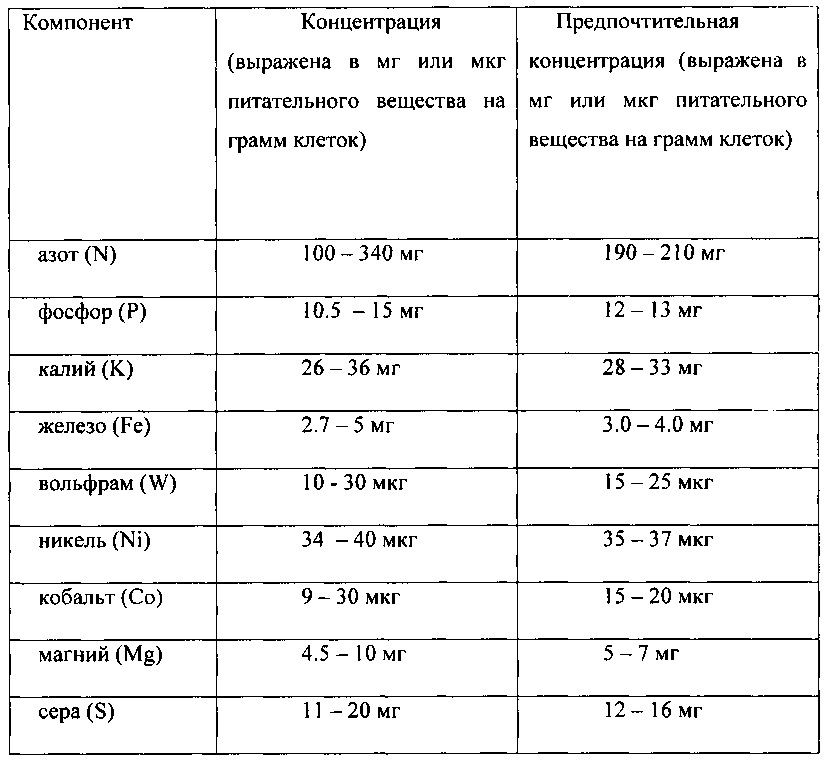

В ходе процесса ферментации поддерживается величина рН, равная от примерно 4.2 до примерно 4.8. Среда включает менее примерно 0.01 г/л экстракта дрожжей и менее примерно 0.01 г/л углеводов.During the fermentation process, a pH of from about 4.2 to about 4.8 is maintained. The medium includes less than about 0.01 g / l of yeast extract and less than about 0.01 g / l of carbohydrates.
Согласно другому аспекту проводимость среды регулируется путем разбавления среды. Согласно этому аспекту, как только проводимость ферментационной среды достигает величины, равной примерно 30 мс/см, при ферментации добавляются вода или среда с низкой проводимостью в количестве, эффективном для снижения проводимости среды.According to another aspect, the conductivity of the medium is controlled by diluting the medium. According to this aspect, as soon as the conductivity of the fermentation medium reaches a value of about 30 ms / cm, fermentation adds water or a medium with low conductivity in an amount effective to reduce the conductivity of the medium.
ПРИМЕРЫEXAMPLES
Пример 1: Влияние величины проводимости на ростExample 1: Effect of conductivity on growth
Clostridium ljungdahlii выращивали в биореакторе (New Brunswick BioFlo I или IIc). Были проведены следующие операции:Clostridium ljungdahlii was grown in a bioreactor (New Brunswick BioFlo I or IIc). The following operations were performed:
Проводимость культуры регулировали путем изменения силы среды для роста, например, концентрация всех компонентов, за исключением витаминов, в среде была увеличена в 1.5 раза для повышения проводимости культуры от примерно 7 мС до примерно 9.5 мС.The conductivity of the culture was regulated by changing the strength of the medium for growth, for example, the concentration of all components, except vitamins, in the medium was increased by 1.5 times to increase the conductivity of the culture from about 7 mS to about 9.5 mS.
Все эксперименты начинали при начальной плотности клеток равной 0.38 (+/-0.02) или 0.48 г/л.All experiments were started at an initial cell density of 0.38 (+/- 0.02) or 0.48 g / L.
Начальная скорость подачи газа в каждом эксперименте была неизменной в течение всего опыта. Параметры работы реактора, когда величины конверсии CO достигли плато (постоянного значения) после удачного запуска процесса, использовали для определения КLa для релевантных условий.The initial gas flow rate in each experiment was unchanged throughout the experiment. The reactor operation parameters, when the CO conversion values reached a plateau (constant value) after a successful start of the process, were used to determine K La for relevant conditions.
Состав сингаза: 30% CO, 15% Н2, 10% CO2 и 45% N2.Syngas composition: 30% CO, 15% H 2 , 10% CO 2 and 45% N 2 .
Опыт #1 в биореакторе: в этом эксперименте применяли питательную среду (среду для роста) 1х и скорость подачи сингаза, равную 25 мл/мин. Как показано на Фигуре 1, после начального лаг-периода, составлявшего примерно 20 ч, бактерии начали размножаться при времени удвоения около 20 ч. В бульоне в реакторе максимальное содержание растворенного CO составляло примерно 0.22 ммол. (D CO: концентрация растворенного CO в бульоне в реакторе, CD: плотность клеток, SCU: удельное поглощение CO.)
Опыт #2 в биореакторе: в этом эксперименте применяли питательную среду (среду для роста) 1х и скорость подачи сингаза, равную 25 мл/мин. Как показано на Фигуре 2, после начального лаг-периода, составлявшего примерно 36 ч, бактерии начали размножаться при времени удвоения около 20 ч. В бульоне в реакторе максимальное содержание растворенного CO составляло примерно 0.22 ммол.
Опыт #3 в биореакторе: в этом эксперименте применяли питательную среду (среду для роста) 1х и скорость подачи сингаза, равную 40 мл/мин. Как показано на Фигуре 4, после начального лаг-периода, составлявшего примерно 45 ч, бактерии начали размножаться при времени удвоения около 20 ч. В бульоне в реакторе максимальное содержание растворенного CO составляло примерно 0.22 ммол.Experiment # 3 in a bioreactor: in this experiment, a nutrient medium (growth medium) 1 × and a syngas feed rate of 40 ml / min were used. As shown in Figure 4, after an initial lag period of approximately 45 hours, the bacteria began to multiply at a doubling time of about 20 hours. In the reactor broth, the maximum dissolved CO content was approximately 0.22 mmol.
Опыт #4 в биореакторе: в этом эксперименте применяли питательную среду (среду для роста) 1х и скорость подачи сингаза, равную 45 мл/мин. Как показано на Фигуре 4, после начального лаг-периода, составлявшего примерно 50 ч, бактерии начали размножаться при времени удвоения около 20 ч. В бульоне в реакторе максимальное содержание растворенного CO составляло примерно 0.17 ммол.Experiment # 4 in a bioreactor: in this experiment, a nutrient medium (growth medium) 1 × and a syngas supply rate of 45 ml / min were used. As shown in Figure 4, after an initial lag period of about 50 hours, the bacteria began to multiply at a doubling time of about 20 hours. In the broth in the reactor, the maximum dissolved CO content was about 0.17 mmol.
Опыт #5 в биореакторе: в этом эксперименте применяли питательную среду (среду для роста) 1х и скорость подачи сингаза, равную 50 мл/мин. Как показано на Фигуре 5, лаг-период продолжался даже через 70 ч после инокуляции. В бульоне в реакторе максимальное содержание растворенного CO составляло примерно 0.23 ммол.
Опыт #6 в биореакторе: в этом эксперименте применяли питательную среду (среду для роста) 1х и скорость подачи сингаза, равную 50 мл/мин. Этот эксперимент начата с инокулюмом с плотностью 4.8 г/л бактерий. Как показано на Фигуре 6, после начального лаг-периода, составлявшего примерно 10 ч, бактерии начали размножаться при времени удвоения около 20 ч. В бульоне в реакторе максимальное содержание растворенного CO составляло примерно 0.12 ммол.Experiment # 6 in a bioreactor: in this experiment, a nutrient medium (growth medium) 1 × and a syngas supply rate of 50 ml / min were used. This experiment was started with an inoculum with a density of 4.8 g / l bacteria. As shown in Figure 6, after an initial lag period of approximately 10 hours, the bacteria began to multiply at a doubling time of about 20 hours. In the reactor broth, the maximum dissolved CO content was approximately 0.12 mmol.
Опыт #7 в биореакторе: в этом эксперименте применяли питательную среду (среду для роста) 1.5х и скорость подачи сингаза, равную 45 мл/мин. Этот эксперимент начали г: инокулюмом 3.8 г/л бактерий. Как показано на Фигуре 7, с течением времени плотность бактериальных клеток уменьшалась. В бульоне в реакторе максимальное содержание растворенного CO составляло примерно 0.25 ммол.Experiment # 7 in a bioreactor: in this experiment, a nutrient medium (growth medium) 1.5 × and a syngas supply rate of 45 ml / min were used. This experiment was started with g: inoculum 3.8 g / l bacteria. As shown in Figure 7, over time, the density of the bacterial cells decreased. In the broth in the reactor, the maximum content of dissolved CO was approximately 0.25 mmol.
Опыт #8 в биореакторе: в этом эксперименте применяли питательную среду (среду для роста) 1.5х и скорость подачи сингаза, равную 35 мл/мин. Этот эксперимент начали с инокулюмом с плотностью 3.8 г/л бактерий. Как показано на Фигуре 8, с течением времени плотность бактериальных клеток уменьшалась. В бульоне в реакторе максимальное содержание растворенного CO составляло примерно 0.22 ммол.
Опыт #9 в биореакторе: в этом эксперименте применяли питательную среду (среду для роста) 1.5х и скорость подачи сингаза, равную 30 мл/мин. Этот эксперимент начали с инокулюмом с плотностью 3.8 г/л бактерий. Как показано на Фигуре 9, с течением времени плотность бактериальных клеток уменьшалась. В бульоне в реакторе максимальное содержание растворенного CO составляло примерно 0.22 ммол.
Опыт #10 в биореакторе: в этом эксперименте применяли питательную среду (среду для роста) 1.5х и скорость подачи сингаза, равную 20 мл/мин. Этот эксперимент начали с инокулюмом с плотностью 3.8 г/л бактерий. Как показано на Фигуре 10, с течением времени плотность бактериальных клеток уменьшалась и достигала времени удвоения равного примерно 20 ч. В бульоне в реакторе максимальное содержание растворенного CO составляло примерно 0.22 ммол.
Пример 2: Рост бактерий на альтернативных источниках азотаExample 2: Growth of bacteria on alternative nitrogen sources
Clostridium ljungdahlii С-01 выращивали в биореакторе (BioFlo/CelliGen 115) в присутствии следующей среды.Clostridium ljungdahlii C-01 was grown in a bioreactor (BioFlo / CelliGen 115) in the presence of the following medium.
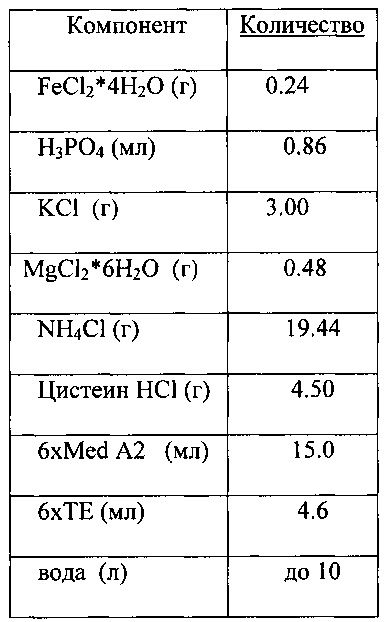
В каждом эксперименте из состава среды исключали NH4Cl и заменяли его мольными эквивалентами одного из азотсодержащих соединений, указанных ниже.In each experiment, NH 4 Cl was excluded from the composition of the medium and replaced with molar equivalents of one of the nitrogen-containing compounds indicated below.
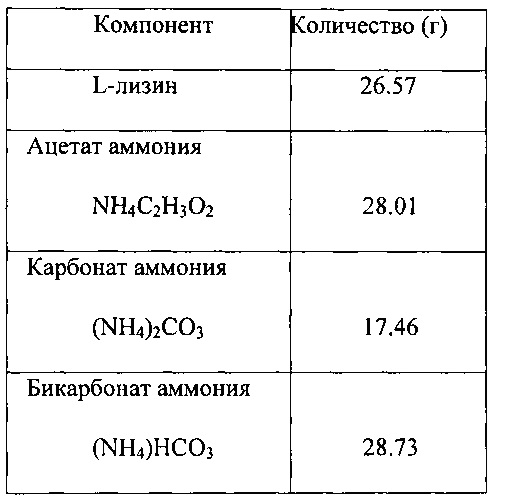
Устанавливали величину рН этих сред, равную ~4.0-4.4. Карбонат аммония также был испытан с концентрациями 0.25М (24.02 г/л) и 0.125М (12.01 г/л) как заменитель 7.7% NaHCO3.The pH of these media was set equal to ~ 4.0-4.4. Ammonium carbonate was also tested with concentrations of 0.25M (24.02 g / l) and 0.125M (12.01 g / l) as a substitute for 7.7% NaHCO 3 .
Величины удельного поглощения углерода Clostridium ljungdahlii, растущих в среде, содержащей хлорид аммония, показаны на Фигуре 11.The specific carbon absorption values of Clostridium ljungdahlii growing in a medium containing ammonium chloride are shown in Figure 11.
Производительность Clostridium ljungdahlii по этанолу в среде, содержащей хлорид аммония, показана на Фигуре 12.Ethanol performance of Clostridium ljungdahlii in a medium containing ammonium chloride is shown in Figure 12.
Величины удельного поглощения углерода Clostridium ljungdahlii, растущих в среде, содержащей L-лизин, показаны на Фигуре 13.The specific carbon absorption values of Clostridium ljungdahlii growing in a medium containing L-lysine are shown in Figure 13.
Производительность Clostridium ljungdahlii по этанолу в среде, содержащей L-лизин, показана на Фигуре 14.Ethanol performance of Clostridium ljungdahlii in a medium containing L-lysine is shown in Figure 14.
Проводимость Clostridium ljungdahlii, растущих в среде, содержащей L-лизин, показана на Фигуре 15.The conductivity of Clostridium ljungdahlii growing in a medium containing L-lysine is shown in Figure 15.
Величины удельного поглощения углерода Clostridium ljungdahlii, растущих в среде, содержащей ацетат аммония, показаны на Фигуре 16.The specific carbon absorption values of Clostridium ljungdahlii growing in a medium containing ammonium acetate are shown in Figure 16.
Производительность Clostridium ljungdahlii по этанолу в среде, содержащей ацетат аммония, показана на Фигуре 17.Ethanol performance of Clostridium ljungdahlii in a medium containing ammonium acetate is shown in Figure 17.
Проводимость Clostridium ljungdahlii, растущих в среде, содержащей ацетат аммония, показана на Фигуре 18.The conductivity of Clostridium ljungdahlii growing in a medium containing ammonium acetate is shown in Figure 18.
Удельное поглощение углерода Clostridium ljungdahlii, растущих в среде, содержащей карбонат аммония, показано на Фигуре 19.The specific carbon uptake of Clostridium ljungdahlii growing in a medium containing ammonium carbonate is shown in Figure 19.
Производительность Clostridium ljungdahlii по этанолу в среде, содержащей карбонат аммония, показана на Фигуре 20.Ethanol performance of Clostridium ljungdahlii in an environment containing ammonium carbonate is shown in Figure 20.
Проводимость Clostridium ljungdahlii, растущих в среде, содержащей карбонат аммония, показана на Фигуре 21.The conductivity of Clostridium ljungdahlii growing in a medium containing ammonium carbonate is shown in Figure 21.
Удельное поглощение углерода Clostridium ljungdahlii, растущих в среде, содержащей карбонат аммония в качестве основы, показано на Фигуре 22.The specific carbon uptake of Clostridium ljungdahlii growing in a medium containing ammonium carbonate as a base is shown in Figure 22.
Удельная производительность Clostridium ljungdahlii по этанолу в среде, содержащей карбонат аммония в качестве основы, показана на Фигуре 23.The specific ethanol productivity of Clostridium ljungdahlii in a medium containing ammonium carbonate as a base is shown in Figure 23.
Проводимость Clostridium ljungdahlii, растущих в среде, содержащей карбонат аммония в качестве основы, показана на Фигуре 24.The conductivity of Clostridium ljungdahlii growing in a medium containing ammonium carbonate as a base is shown in Figure 24.
Удельное поглощение углерода Clostridium ljungdahlii, растущих в среде, содержащей бикарбонат аммония показано на Фигуре 25.The specific carbon uptake of Clostridium ljungdahlii growing in a medium containing ammonium bicarbonate is shown in Figure 25.
Удельная производительность Clostridium ljungdahlii по этанолу в среде, содержащей бикарбонат аммония показана на Фигуре 26.The specific ethanol productivity of Clostridium ljungdahlii in a medium containing ammonium bicarbonate is shown in Figure 26.
Проводимость Clostridium ljungdahlii, растущих в среде, содержащей бикарбонат аммония, показана на Фигуре 27.The conductivity of Clostridium ljungdahlii growing in a medium containing ammonium bicarbonate is shown in Figure 27.
В следующих Таблицах приведены результаты экспериментов.The following tables show the experimental results.
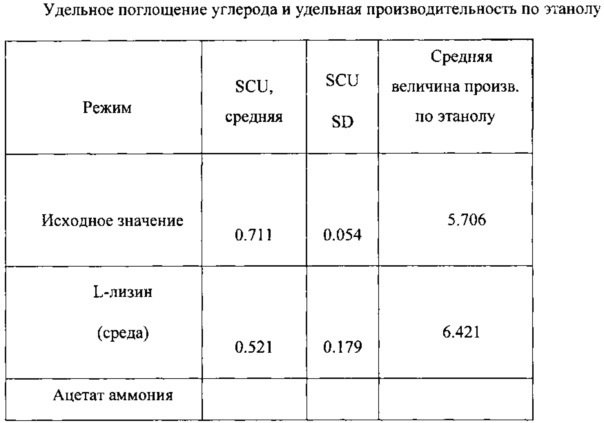
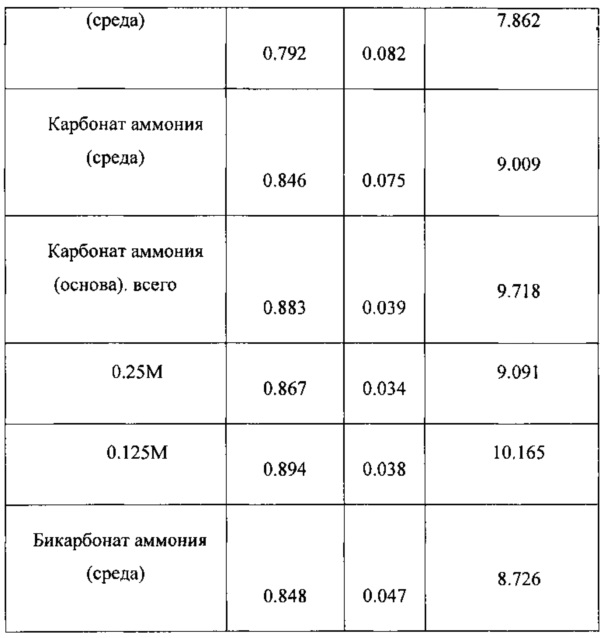
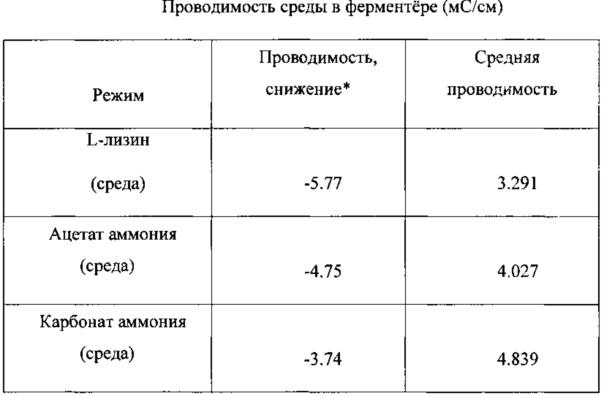
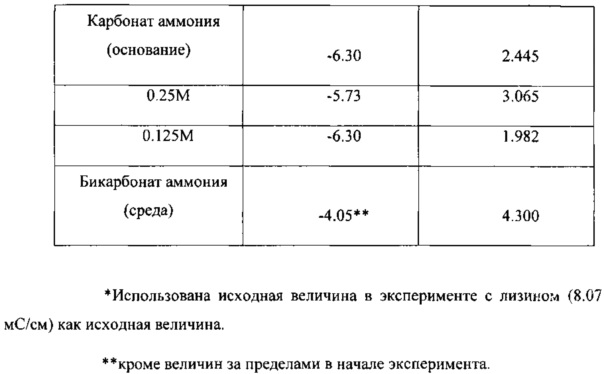
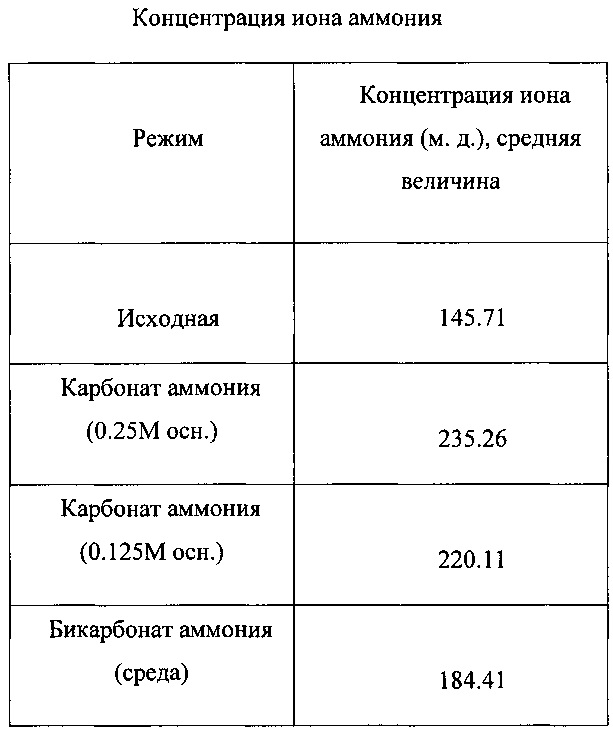
Результаты показывают, что азотсодержащие соединения, особенно те, которые содержат ионы аммония, могут быть использованы в качестве заменителей хлорида аммония. L-лизин, использованный в среде, оказался неудачным в качестве источника азота для достижения высокой производительности. Применение лизина привело вначале к выигрышам как в удельном поглощении углерода (SCU), так и в удельной производительности по этанолу (SEP), но в конечном счете привело к снижению этих обоих параметров. Исходная величина SCU снизилась на 58%, в то время как исходная величина SEP уменьшилась на 47%. Средняя величина SCU снизилась значительно, на 26%. Средняя величина SEP увеличилась на 12, но это увеличение не было статистически значимым из-за очень большого стандартного отклонения. Плотность клеток в течение эксперимента снизилась от 2.03 г/л до 1.02 г/л. Исходная величина проводимости снизилась на 71%, от 8.07 мс/см до 2.30 мс/см, а средняя ее величина во время эксперимента составила 3.291 мс/см. Большую часть времени в этом эксперименте проводимость была меньше 3.0 мс/см.The results show that nitrogen-containing compounds, especially those containing ammonium ions, can be used as substitutes for ammonium chloride. The L-lysine used in the medium was unsuccessful as a nitrogen source to achieve high performance. The use of lysine initially led to gains in both specific carbon absorption (SCU) and specific ethanol productivity (SEP), but ultimately led to a decrease in both of these parameters. The baseline SCU decreased by 58%, while the baseline SEP decreased by 47%. The average SCU value decreased significantly, by 26%. The average SEP increased by 12, but this increase was not statistically significant due to the very large standard deviation. The cell density during the experiment decreased from 2.03 g / l to 1.02 g / l. The initial value of conductivity decreased by 71%, from 8.07 ms / cm to 2.30 ms / cm, and its average value during the experiment was 3.291 ms / cm. Most of the time in this experiment, the conductivity was less than 3.0 ms / cm.
Использование ацетата аммония в качестве источника азота в составе среды привело к небольшому увеличению средней величины SCU, только на 11%, что не является статистически значимым. Однако исходная величина SCU снижалась от начала эксперимента к его концу (от 0.943 до 0.830), то есть на 12%. Наблюдалось значительное увеличение на 37% средней величины SEP по сравнению с исходным средним значением. Исходная величина SEP во время эксперимента увеличивалась от 6.43 до 8.57, то есть увеличение составило 25%. Во время этого эксперимента проводимость уменьшалась на 58%, до 3.32 мС/см (в качестве базисного значения проводимости в среде РР-А1 использовали начальное значение из опыта с лизином, средняя величина этого параметра составила 4.027 мС/см). Во время большей части эксперимента величина проводимости была меньше 4.0.The use of ammonium acetate as a source of nitrogen in the medium resulted in a slight increase in the average SCU, by only 11%, which is not statistically significant. However, the initial SCU value decreased from the beginning of the experiment to its end (from 0.943 to 0.830), i.e., by 12%. There was a significant increase of 37% in the average SEP compared to the original average. The initial value of SEP during the experiment increased from 6.43 to 8.57, that is, the increase was 25%. During this experiment, the conductivity decreased by 58% to 3.32 mS / cm (the initial value from the experiment with lysine was used as the baseline value of conductivity in PP-A1 medium, the average value of this parameter was 4.027 mS / cm). During most of the experiment, the conductivity was less than 4.0.
Когда в среде в качестве источника азота использовали карбонат аммония, наблюдалось значительное увеличение как величины SCU, так и величины SEP. Величина SCU увеличилась на 19% и величина SEP увеличилась на 57%. Исходные величины SCU и SEP во время эксперимента снизились на 15% и 23%, соответственно. Проводимость во время этого эксперимента снизились на 46%, до 4.33 мС/см, средняя ее величина составила 4.839 мС/см.When ammonium carbonate was used as a nitrogen source in the medium, a significant increase in both SCU and SEP was observed. SCU increased by 19% and SEP increased by 57%. The initial values of SCU and SEP during the experiment decreased by 15% and 23%, respectively. The conductivity during this experiment decreased by 46%, to 4.33 mS / cm, its average value was 4.839 mS / cm.
Карбонат аммония также использовали в качестве источника азота при исключении этого соединения из состава среды и вместо этого применяли его в качестве основы раствора. Этот способ введения карбоната аммония привел к значительному повышению SCU (19%) и SEP (41%) по сравнению с исходными значениями. При этом применяли две разных концентрации карбоната аммония, 0.25 M и 0.125 М, полученные результаты слегка отличались друг от друга. Каждая величина концентрации приводила к значительному повышению SCU и SEP по сравнению с исходными значениями в реакторе. Каждая величина исходной концентрации слегка отличалась от другой, но стандартные отклонения от этих величин перекрывали друг друга. Проводимость в двух растворах основы снижалась на 71% (0.25 М) и на 78% (0.125 М), пониженные значения были равны 2.34 мС/см и 1.77 мС/см. Средние величины составляли 3.065 мС/см и 1982 мС/см, соответственно. Концентрацию иона аммония в реакторе измеряли непосредственно перед введением и во время наличия карбоната аммония в качестве основы. Результаты этих измерений показали, что в реактор во время этого эксперимента вводили избыток ионов аммония (50-62%).Ammonium carbonate was also used as a nitrogen source in the exclusion of this compound from the medium, and instead was used as the basis of the solution. This method of introducing ammonium carbonate led to a significant increase in SCU (19%) and SEP (41%) compared with the initial values. In this case, two different concentrations of ammonium carbonate, 0.25 M and 0.125 M, were used; the results obtained were slightly different from each other. Each concentration value led to a significant increase in SCU and SEP compared to the initial values in the reactor. Each value of the initial concentration was slightly different from the other, but the standard deviations from these values overlapped each other. The conductivity in two solutions of the base decreased by 71% (0.25 M) and 78% (0.125 M), lower values were 2.34 mS / cm and 1.77 mS / cm. The mean values were 3.065 mS / cm and 1982 mS / cm, respectively. The concentration of ammonium ion in the reactor was measured immediately before the introduction and during the presence of ammonium carbonate as a base. The results of these measurements showed that an excess of ammonium ions (50-62%) was introduced into the reactor during this experiment.
Бикарбонат аммония также испытывали в качестве добавки к среде. Экспериментальные данные показали, что происходило значительное повышение величин SCU и SEP. По сравнению с исходным уровнем средняя величина SCU увеличилась на 19%, и средняя величина SEP увеличилась на 53%. Проводимость во время этого, эксперимента снизилась на 50%, до 4.02 мс/см, средняя ее величина составляла 4.3 мс/см. Во время этой фазы эксперимента также осуществляли мониторинг концентрации иона аммония. Полученные величины показали, что этот ион был в реакторе в избытке, составляющем 26%.Ammonium bicarbonate was also tested as an additive to the medium. Experimental data showed that there was a significant increase in the values of SCU and SEP. Compared with the baseline, the average SCU increased by 19%, and the average SEP increased by 53%. The conductivity during this experiment decreased by 50%, to 4.02 ms / cm, its average value was 4.3 ms / cm. During this phase of the experiment, the concentration of ammonium ion was also monitored. The obtained values showed that this ion was in excess of 26% in the reactor.
Пример 3: Влияние постепенного увеличения осмолярности на активность культурыExample 3: Effect of a gradual increase in osmolarity on culture activity
Clostridium ljungdahlii С-01 выращивали в биореакторе (BioFlo/CelliGen 115) в следующей среде. Средняя скорость потока среды на грамм клеток составляла 1 мл/г/мин.Clostridium ljungdahlii C-01 was grown in a bioreactor (BioFlo / CelliGen 115) in the following medium. The average flow rate per gram of cells was 1 ml / g / min.
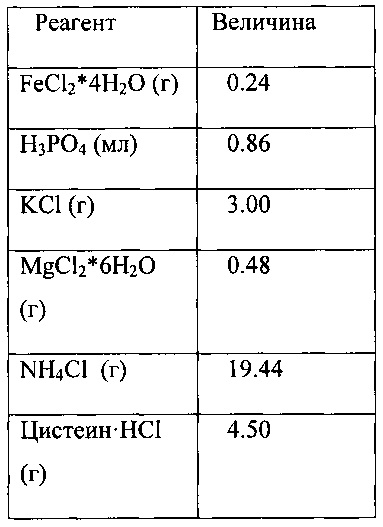
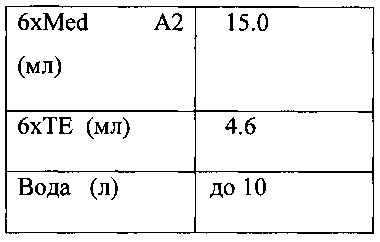
В течение этого эксперимента, длившегося 21 день, проводимость бульона культуры увеличивали при помощи NaCl. Каждое добавление NaCl с данными интервалами привело к результатам, показанным на Фигуре 28.During this experiment, which lasted 21 days, the conductivity of the culture broth was increased with NaCl. Each addition of NaCl at these intervals led to the results shown in Figure 28.
Величины концентрации NaCl после каждого добавления.The concentration of NaCl after each addition.
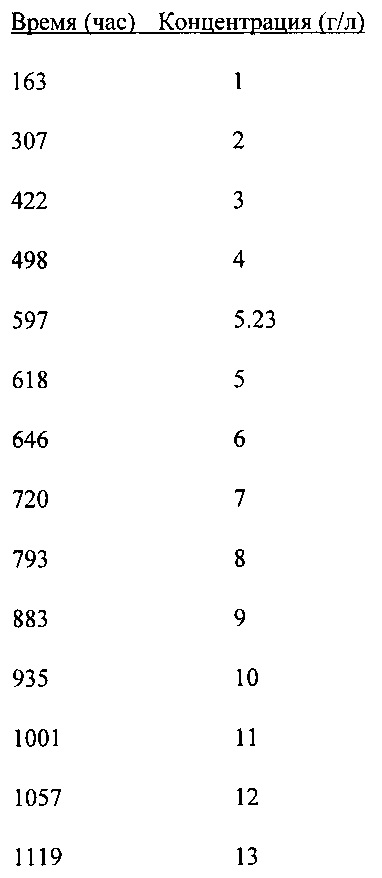
Проводимость культуры увеличивалась с каждым добавлением NaCl. Удельное поглощение углерода, которое является индикатором активности культуры, измеряли в течение этого эксперимента. На Фигуре 28 показано, что с каждым добавлением NaCl величина SCU снижалась в течение некоторого периода времени, но восстанавливалась после короткого периода адаптации.The conductivity of the culture increased with each addition of NaCl. The specific carbon uptake, which is an indicator of culture activity, was measured during this experiment. Figure 28 shows that with each addition of NaCl, the SCU value decreased over a period of time, but recovered after a short period of adaptation.
На Фигуре 28 видны три области, представляющие интерес; 0-500 час (1), 500-1100 час (2) и 1100-1200 час. В области 1, где величина проводимости была меньше 15 мС/см, наблюдается меньшее влияние добавления на величину SCU: происходило небольшое снижение SCU с последующим восстановлением этой величины. В области 2, где величина проводимости была выше 15 мС/см, наблюдается большее влияние добавления на величину SCU: видны большие колебания SCU. В этой области добавление NaCl вызывало большое снижение SCU с последующими большими колебаниями. В последней области, где проводимость увеличилась до примерно 30 мС/см или выше, культура теряла свою активность больше.In Figure 28, three areas of interest are visible; 0-500 hours (1), 500-1100 hours (2) and 1100-1200 hours. In
Пример 4: Влияние быстрого повышения осмолярности на активность культурыExample 4: Effect of a rapid increase in osmolarity on culture activity
Clostridium ljungdahlii С-01 выращивали в биореакторе (BioFlo/CelliGen 115) в той же самой среде, которая описана в Примере 3. Средняя скорость потока среды на грамм клеток составляла 1.1 мл/г/мин.Clostridium ljungdahlii C-01 was grown in a bioreactor (BioFlo / CelliGen 115) in the same medium as described in Example 3. The average flow rate of the medium per gram of cells was 1.1 ml / g / min.
В течение этого эксперимента, длившегося 10 дней, концентрация NaCl в бульоне культуры возрастала вдвое так быстро, как в Примере 3, по следующей схеме.During this experiment, which lasted 10 days, the concentration of NaCl in the culture broth doubled as fast as in Example 3, according to the following scheme.
Величины концентрации NaCl после каждого добавления.The concentration of NaCl after each addition.
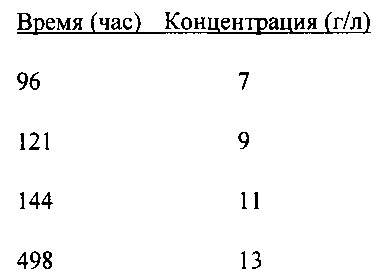
На Фигуре 29 показаны величины SCU культуры при различных проводимостях. Как в Примере 3, культура теряла свою активность в момент достижения проводимости. Составляющей примерно 30 мС/см.Figure 29 shows the SCU values of the culture at various conductivities. As in Example 3, the culture lost its activity at the moment of conduction achievement. A component of approximately 30 mS / cm.
Пример 5: Влияние скорости подачи CO на проводимостьExample 5: Effect of CO feed rate on conductivity
Clostridium ljungdahlii C-01 выращивали в биореакторе (BioFlo/CelliGen 115) в той же самой среде, которая описана в Примере 3. Проводимость культуры регулировали путем изменения силы среды для роста, например, концентрация всех компонентов, за исключением витаминов, в среде для роста повышалась в 1.5 и 2 раза для увеличения проводимости культуры от ~ 7 мС до ~9.5 мС и ~12 мС, соответственно.Clostridium ljungdahlii C-01 was grown in a bioreactor (BioFlo / CelliGen 115) in the same medium as described in Example 3. The culture conductivity was regulated by changing the strength of the growth medium, for example, the concentration of all components except vitamins in the growth medium increased by 1.5 and 2 times to increase the conductivity of the culture from ~ 7 mS to ~ 9.5 mS and ~ 12 mS, respectively.
Эксперименты начинали при начальной плотности клеток равной 0.38 (+/-0.02) или 0.785 г/л. Сингаз содержал 30% CO, 15% Н2, 10% CO2 и 45% N2. Осуществляли несколько запусков при каждой заданной величине проводимости для определения соответствующей (которая может быть практически использована) удельной скорости подачи газа. В этих экспериментах скорость подачи газа определяли для данной проводимости культуры. Как показано на Фигуре 30, соответствующая/рабочая скорость подачи CO зависит от проводимости культуры:The experiments were started at an initial cell density of 0.38 (+/- 0.02) or 0.785 g / L. Syngas contained 30% CO, 15% H 2 , 10% CO 2 and 45% N 2 . Several launches were carried out at each given value of conductivity to determine the corresponding (which can be practically used) specific gas flow rate. In these experiments, the gas feed rate was determined for a given culture conductivity. As shown in Figure 30, the corresponding / working CO supply rate depends on the conductivity of the culture:
у = -6.0327х + 12.901y = -6.0327x + 12.901
Удельная скорость подачи CO = количество CO в молях на грамм клетокSpecific CO supply rate = CO amount in moles per gram of cells
Соответствующая/рабочая скорость подачи CO = скорость подачи CO, при которой С-01 может удвоиться в течение 40 ч.Corresponding / working CO feed rate = CO feed rate at which C-01 can double within 40 hours.
Хотя настоящее изобретение было описано на примере конкретных вариантов, примеров и их применения, многочисленные модификации и вариации могут быть осуществлены специалистами в данной области в рамках объема данного изобретения, определяемого формулой изобретения, приведенной ниже.Although the present invention has been described with specific examples, examples, and their uses, numerous modifications and variations can be made by those skilled in the art within the scope of the invention defined by the claims below.
Claims (13)
Applications Claiming Priority (5)
| Application Number | Priority Date | Filing Date | Title |
|---|---|---|---|
| US201361833189P | 2013-06-10 | 2013-06-10 | |
| US61/833,189 | 2013-06-10 | ||
| US14/293,089 | 2014-06-02 | ||
| US14/293,089 US9850503B2 (en) | 2013-06-10 | 2014-06-02 | Control of conductivity in anaerobic fermentation |
| PCT/US2014/041141 WO2014200817A1 (en) | 2013-06-10 | 2014-06-05 | Control of conductivity in anaerobic fermentation |
Related Child Applications (1)
| Application Number | Title | Priority Date | Filing Date |
|---|---|---|---|
| RU2017141966A Division RU2017141966A (en) | 2013-06-10 | 2014-06-05 | REGULATION OF CONDUCTIVITY DURING ANAEROBIC FERMENTATION |
Publications (2)
| Publication Number | Publication Date |
|---|---|
| RU2015151913A RU2015151913A (en) | 2017-07-14 |
| RU2639503C2 true RU2639503C2 (en) | 2017-12-21 |
Family
ID=52005766
Family Applications (2)
| Application Number | Title | Priority Date | Filing Date |
|---|---|---|---|
| RU2017141966A RU2017141966A (en) | 2013-06-10 | 2014-06-05 | REGULATION OF CONDUCTIVITY DURING ANAEROBIC FERMENTATION |
| RU2015151913A RU2639503C2 (en) | 2013-06-10 | 2014-06-05 | Regulation of conductivity in process of anaerobic fermentation |
Family Applications Before (1)
| Application Number | Title | Priority Date | Filing Date |
|---|---|---|---|
| RU2017141966A RU2017141966A (en) | 2013-06-10 | 2014-06-05 | REGULATION OF CONDUCTIVITY DURING ANAEROBIC FERMENTATION |
Country Status (10)
| Country | Link |
|---|---|
| US (3) | US9850503B2 (en) |
| EP (1) | EP3008165B1 (en) |
| CN (3) | CN117737140A (en) |
| BR (1) | BR112015029440B1 (en) |
| CA (1) | CA2912383C (en) |
| ES (1) | ES2646552T3 (en) |
| PL (1) | PL3008165T3 (en) |
| RU (2) | RU2017141966A (en) |
| TW (3) | TWI729866B (en) |
| WO (1) | WO2014200817A1 (en) |
Families Citing this family (2)
| Publication number | Priority date | Publication date | Assignee | Title |
|---|---|---|---|---|
| FR3051800B1 (en) * | 2016-05-31 | 2018-06-15 | IFP Energies Nouvelles | PROCESS FOR PRODUCING BTX BY CATALYTIC PYROLYSIS FROM NON-RECYCLED BIOMASS OF OXYGEN COMPOUNDS |
| EP4259808A1 (en) * | 2020-12-08 | 2023-10-18 | Jupeng Bio (HK) Limited | Process and composition for controlling ethanol production |
Citations (5)
| Publication number | Priority date | Publication date | Assignee | Title |
|---|---|---|---|---|
| WO2002008438A2 (en) * | 2000-07-25 | 2002-01-31 | Bioengineering Resources, Inc. | Methods for increasing the production of ethanol from microbial fermentation |
| US20100227377A1 (en) * | 2009-03-09 | 2010-09-09 | Adams Stephen S | Method for sustaining Microorganism culture in Syngas fermentation process in decreased concentration or absence of various substrates |
| RU2418070C2 (en) * | 2009-07-06 | 2011-05-10 | Общество с ограниченной ответственностью "Фирма Атлас" | Method of converting gaseous hydrocarbon material into liquid fuel |
| WO2012074543A1 (en) * | 2010-12-03 | 2012-06-07 | Ineos Bio Sa | Fermentation process involving adjusting specific co-uptake |
| WO2012074545A1 (en) * | 2010-12-03 | 2012-06-07 | Ineos Bio Sa | Method of operation of fermentation of gaseous substrate comprising hydrogen |
Family Cites Families (19)
| Publication number | Priority date | Publication date | Assignee | Title |
|---|---|---|---|---|
| US4533211A (en) | 1983-01-31 | 1985-08-06 | International Business Machines Corporation | Frequency multiplexed optical spatial filter based upon photochemical hole burning |
| US5173429A (en) | 1990-11-09 | 1992-12-22 | The Board Of Trustees Of The University Of Arkansas | Clostridiumm ljungdahlii, an anaerobic ethanol and acetate producing microorganism |
| US6136577A (en) | 1992-10-30 | 2000-10-24 | Bioengineering Resources, Inc. | Biological production of ethanol from waste gases with Clostridium ljungdahlii |
| US5807722A (en) | 1992-10-30 | 1998-09-15 | Bioengineering Resources, Inc. | Biological production of acetic acid from waste gases with Clostridium ljungdahlii |
| US5593886A (en) | 1992-10-30 | 1997-01-14 | Gaddy; James L. | Clostridium stain which produces acetic acid from waste gases |
| JPH11341947A (en) * | 1998-06-02 | 1999-12-14 | Yakult Honsha Co Ltd | Fermentation management method |
| UA72220C2 (en) * | 1998-09-08 | 2005-02-15 | Байоенджініерінг Рісорсиз, Інк. | Water-immiscible mixture solvent/cosolvent for extracting acetic acid, a method for producing acetic acid (variants), a method for anaerobic microbial fermentation for obtaining acetic acid (variants), modified solvent and a method for obtaining thereof |
| ATE259881T1 (en) | 1999-05-07 | 2004-03-15 | Emmaus Foundation Inc | CLOSTRIDIUM STRAINS PRODUCED FROM SUBSTRATE GAS MIXTURES ETHANOL |
| NZ546496A (en) | 2006-04-07 | 2008-09-26 | Lanzatech New Zealand Ltd | Gas treatment process |
| US7623909B2 (en) | 2006-05-26 | 2009-11-24 | Cameron Health, Inc. | Implantable medical devices and programmers adapted for sensing vector selection |
| US7704723B2 (en) | 2006-08-31 | 2010-04-27 | The Board Of Regents For Oklahoma State University | Isolation and characterization of novel clostridial species |
| EP2268824A1 (en) * | 2008-03-10 | 2011-01-05 | Ineos USA, LLC | Method for sustaining microorganism culture in syngas fermentation process in decreased concentration or absence of various substrates |
| AU2009258344B2 (en) | 2008-06-09 | 2013-11-07 | Lanzatech Nz, Inc. | Production of butanediol by anaerobic microbial fermentation |
| KR20180042467A (en) * | 2009-06-04 | 2018-04-25 | 게노마티카 인코포레이티드 | Process of separating components of a fermentation broth |
| US8916492B2 (en) * | 2010-03-19 | 2014-12-23 | Haldor Topsoe A/S | Reforming catalyst |
| BR112013003644B1 (en) | 2010-07-28 | 2020-11-17 | Lanzatech New Zealand Limited | biologically pure isolate of a bacterium clostridium autoethanogenum |
| US10100338B2 (en) * | 2012-05-22 | 2018-10-16 | Ineos Bio S.A. | Method of operation of a syngas fermentation process |
| US10100336B2 (en) | 2012-05-22 | 2018-10-16 | Ineos Bio S.A. | Syngas fermentation process and medium |
| US10233478B2 (en) * | 2012-09-19 | 2019-03-19 | Ineos Bio Sa | Process for reducing CO2 emissions and increasing alcohol productivity in syngas fermentation |
-
2014
- 2014-06-02 US US14/293,089 patent/US9850503B2/en active Active - Reinstated
- 2014-06-05 CA CA2912383A patent/CA2912383C/en active Active
- 2014-06-05 BR BR112015029440-5A patent/BR112015029440B1/en active IP Right Grant
- 2014-06-05 EP EP14735047.4A patent/EP3008165B1/en not_active Revoked
- 2014-06-05 ES ES14735047.4T patent/ES2646552T3/en active Active
- 2014-06-05 WO PCT/US2014/041141 patent/WO2014200817A1/en not_active Ceased
- 2014-06-05 CN CN202311512246.2A patent/CN117737140A/en active Pending
- 2014-06-05 CN CN201480032866.9A patent/CN105473705B/en active Active
- 2014-06-05 CN CN201910852558.5A patent/CN110791531B/en active Active
- 2014-06-05 PL PL14735047T patent/PL3008165T3/en unknown
- 2014-06-05 RU RU2017141966A patent/RU2017141966A/en not_active Application Discontinuation
- 2014-06-05 RU RU2015151913A patent/RU2639503C2/en not_active IP Right Cessation
- 2014-06-09 TW TW109121181A patent/TWI729866B/en active
- 2014-06-09 TW TW103119910A patent/TWI641690B/en active
- 2014-06-09 TW TW107134959A patent/TWI698531B/en active
-
2017
- 2017-11-14 US US15/811,933 patent/US10494651B2/en active Active
-
2019
- 2019-10-14 US US16/600,688 patent/US11248242B2/en active Active
Patent Citations (5)
| Publication number | Priority date | Publication date | Assignee | Title |
|---|---|---|---|---|
| WO2002008438A2 (en) * | 2000-07-25 | 2002-01-31 | Bioengineering Resources, Inc. | Methods for increasing the production of ethanol from microbial fermentation |
| US20100227377A1 (en) * | 2009-03-09 | 2010-09-09 | Adams Stephen S | Method for sustaining Microorganism culture in Syngas fermentation process in decreased concentration or absence of various substrates |
| RU2418070C2 (en) * | 2009-07-06 | 2011-05-10 | Общество с ограниченной ответственностью "Фирма Атлас" | Method of converting gaseous hydrocarbon material into liquid fuel |
| WO2012074543A1 (en) * | 2010-12-03 | 2012-06-07 | Ineos Bio Sa | Fermentation process involving adjusting specific co-uptake |
| WO2012074545A1 (en) * | 2010-12-03 | 2012-06-07 | Ineos Bio Sa | Method of operation of fermentation of gaseous substrate comprising hydrogen |
Non-Patent Citations (1)
| Title |
|---|
| COTTER J.L., CHINN M.S. and et al., Influence of process psrsmeters on growth of Clostridium ljungdahlii and Clostridium autoethanogenum on synthesis gas // Enzyme and Microbial Technology, 44, 2009, стр.281-288. * |
Also Published As
| Publication number | Publication date |
|---|---|
| PL3008165T3 (en) | 2018-03-30 |
| US11248242B2 (en) | 2022-02-15 |
| ES2646552T3 (en) | 2017-12-14 |
| CN110791531A (en) | 2020-02-14 |
| EP3008165A1 (en) | 2016-04-20 |
| BR112015029440A2 (en) | 2017-07-25 |
| US9850503B2 (en) | 2017-12-26 |
| CN105473705B (en) | 2019-10-08 |
| US20190225995A1 (en) | 2019-07-25 |
| TWI698531B (en) | 2020-07-11 |
| US20140363866A1 (en) | 2014-12-11 |
| EP3008165B1 (en) | 2017-08-09 |
| TW202041679A (en) | 2020-11-16 |
| CN110791531B (en) | 2024-01-05 |
| TW201534733A (en) | 2015-09-16 |
| CN105473705A (en) | 2016-04-06 |
| TWI729866B (en) | 2021-06-01 |
| CN117737140A (en) | 2024-03-22 |
| BR112015029440A8 (en) | 2021-07-20 |
| RU2015151913A (en) | 2017-07-14 |
| TW201905211A (en) | 2019-02-01 |
| BR112015029440B1 (en) | 2023-10-17 |
| WO2014200817A1 (en) | 2014-12-18 |
| RU2017141966A (en) | 2019-02-14 |
| US10494651B2 (en) | 2019-12-03 |
| CA2912383A1 (en) | 2014-12-18 |
| US20200095612A1 (en) | 2020-03-26 |
| CA2912383C (en) | 2021-07-13 |
| TWI641690B (en) | 2018-11-21 |
Similar Documents
| Publication | Publication Date | Title |
|---|---|---|
| RU2623170C2 (en) | Way to manage the process of synthesis-gas fermentations | |
| US11248242B2 (en) | Control of conductivity in anaerobic fermentation | |
| AU2014278580B2 (en) | A process for fermenting CO-containing gaseous substrates in a low phosphate medium effective for reducing water usage | |
| AU2015302221B2 (en) | A process for controlling fermentation of co-containing substrates |
Legal Events
| Date | Code | Title | Description |
|---|---|---|---|
| MM4A | The patent is invalid due to non-payment of fees |
Effective date: 20200606 |