RU2633373C1 - Blanket of thermonuclear reactor - Google Patents
Blanket of thermonuclear reactor Download PDFInfo
- Publication number
- RU2633373C1 RU2633373C1 RU2016130027A RU2016130027A RU2633373C1 RU 2633373 C1 RU2633373 C1 RU 2633373C1 RU 2016130027 A RU2016130027 A RU 2016130027A RU 2016130027 A RU2016130027 A RU 2016130027A RU 2633373 C1 RU2633373 C1 RU 2633373C1
- Authority
- RU
- Russia
- Prior art keywords
- solution
- module
- raw material
- blanket
- water
- Prior art date
Links
- XLYOFNOQVPJJNP-UHFFFAOYSA-N water Substances O XLYOFNOQVPJJNP-UHFFFAOYSA-N 0.000 claims abstract description 35
- 239000002994 raw material Substances 0.000 claims abstract description 30
- 238000009835 boiling Methods 0.000 claims abstract description 16
- 239000000463 material Substances 0.000 claims abstract description 16
- 229910052751 metal Inorganic materials 0.000 claims abstract description 11
- 239000002184 metal Substances 0.000 claims abstract description 11
- 230000006798 recombination Effects 0.000 claims abstract description 8
- 238000005215 recombination Methods 0.000 claims abstract description 8
- 239000002901 radioactive waste Substances 0.000 claims abstract description 7
- 238000003608 radiolysis reaction Methods 0.000 claims abstract description 7
- 230000008018 melting Effects 0.000 claims abstract description 5
- 238000002844 melting Methods 0.000 claims abstract description 5
- 239000000243 solution Substances 0.000 claims description 81
- WMFOQBRAJBCJND-UHFFFAOYSA-M Lithium hydroxide Chemical compound [Li+].[OH-] WMFOQBRAJBCJND-UHFFFAOYSA-M 0.000 claims description 15
- 239000007864 aqueous solution Substances 0.000 claims description 15
- 229910000384 uranyl sulfate Inorganic materials 0.000 claims description 15
- KWGKDLIKAYFUFQ-UHFFFAOYSA-M lithium chloride Chemical compound [Li+].[Cl-] KWGKDLIKAYFUFQ-UHFFFAOYSA-M 0.000 claims description 12
- JFALSRSLKYAFGM-UHFFFAOYSA-N uranium(0) Chemical compound [U] JFALSRSLKYAFGM-UHFFFAOYSA-N 0.000 claims description 9
- 229910052768 actinide Inorganic materials 0.000 claims description 7
- 150000001255 actinides Chemical class 0.000 claims description 7
- YZCKVEUIGOORGS-NJFSPNSNSA-N Tritium Chemical compound [3H] YZCKVEUIGOORGS-NJFSPNSNSA-N 0.000 claims description 4
- 230000004927 fusion Effects 0.000 claims description 4
- 229910052722 tritium Inorganic materials 0.000 claims description 4
- 229910013553 LiNO Inorganic materials 0.000 claims description 3
- IDBFBDSKYCUNPW-UHFFFAOYSA-N lithium nitride Chemical compound [Li]N([Li])[Li] IDBFBDSKYCUNPW-UHFFFAOYSA-N 0.000 claims description 3
- INHCSSUBVCNVSK-UHFFFAOYSA-L lithium sulfate Inorganic materials [Li+].[Li+].[O-]S([O-])(=O)=O INHCSSUBVCNVSK-UHFFFAOYSA-L 0.000 claims description 3
- RBTVSNLYYIMMKS-UHFFFAOYSA-N tert-butyl 3-aminoazetidine-1-carboxylate;hydrochloride Chemical compound Cl.CC(C)(C)OC(=O)N1CC(N)C1 RBTVSNLYYIMMKS-UHFFFAOYSA-N 0.000 claims description 3
- RUJLHPZAKCVICY-UHFFFAOYSA-J thorium(4+);disulfate Chemical compound [Th+4].[O-]S([O-])(=O)=O.[O-]S([O-])(=O)=O RUJLHPZAKCVICY-UHFFFAOYSA-J 0.000 claims description 3
- 239000000126 substance Substances 0.000 abstract description 5
- 231100000331 toxic Toxicity 0.000 abstract description 4
- 230000002588 toxic effect Effects 0.000 abstract description 4
- 239000003518 caustics Substances 0.000 abstract description 2
- 230000000694 effects Effects 0.000 abstract description 2
- 239000003440 toxic substance Substances 0.000 abstract description 2
- 238000013461 design Methods 0.000 description 21
- 239000000203 mixture Substances 0.000 description 14
- 239000002826 coolant Substances 0.000 description 11
- 239000000047 product Substances 0.000 description 10
- 150000003839 salts Chemical class 0.000 description 7
- 239000002904 solvent Substances 0.000 description 7
- 229910052770 Uranium Inorganic materials 0.000 description 6
- 238000004364 calculation method Methods 0.000 description 6
- 150000004673 fluoride salts Chemical class 0.000 description 6
- 230000004907 flux Effects 0.000 description 5
- 239000000155 melt Substances 0.000 description 5
- 238000009377 nuclear transmutation Methods 0.000 description 5
- 239000003990 capacitor Substances 0.000 description 4
- 230000020169 heat generation Effects 0.000 description 4
- 239000002244 precipitate Substances 0.000 description 4
- 230000015572 biosynthetic process Effects 0.000 description 3
- 238000010586 diagram Methods 0.000 description 3
- 238000005516 engineering process Methods 0.000 description 3
- 238000000605 extraction Methods 0.000 description 3
- 238000004519 manufacturing process Methods 0.000 description 3
- DGAQECJNVWCQMB-PUAWFVPOSA-M Ilexoside XXIX Chemical compound C[C@@H]1CC[C@@]2(CC[C@@]3(C(=CC[C@H]4[C@]3(CC[C@@H]5[C@@]4(CC[C@@H](C5(C)C)OS(=O)(=O)[O-])C)C)[C@@H]2[C@]1(C)O)C)C(=O)O[C@H]6[C@@H]([C@H]([C@@H]([C@H](O6)CO)O)O)O.[Na+] DGAQECJNVWCQMB-PUAWFVPOSA-M 0.000 description 2
- WHXSMMKQMYFTQS-UHFFFAOYSA-N Lithium Chemical compound [Li] WHXSMMKQMYFTQS-UHFFFAOYSA-N 0.000 description 2
- PXHVJJICTQNCMI-UHFFFAOYSA-N Nickel Chemical compound [Ni] PXHVJJICTQNCMI-UHFFFAOYSA-N 0.000 description 2
- 238000001816 cooling Methods 0.000 description 2
- 239000007799 cork Substances 0.000 description 2
- 239000002360 explosive Substances 0.000 description 2
- 238000007667 floating Methods 0.000 description 2
- 229910052731 fluorine Inorganic materials 0.000 description 2
- 239000011737 fluorine Substances 0.000 description 2
- 238000009434 installation Methods 0.000 description 2
- 239000007788 liquid Substances 0.000 description 2
- 229910052744 lithium Inorganic materials 0.000 description 2
- 238000011068 loading method Methods 0.000 description 2
- 239000003758 nuclear fuel Substances 0.000 description 2
- 238000012545 processing Methods 0.000 description 2
- 230000001105 regulatory effect Effects 0.000 description 2
- 238000011160 research Methods 0.000 description 2
- 239000013049 sediment Substances 0.000 description 2
- 229910052708 sodium Inorganic materials 0.000 description 2
- 239000011734 sodium Substances 0.000 description 2
- ZSLUVFAKFWKJRC-IGMARMGPSA-N 232Th Chemical compound [232Th] ZSLUVFAKFWKJRC-IGMARMGPSA-N 0.000 description 1
- 229910000838 Al alloy Inorganic materials 0.000 description 1
- PXGOKWXKJXAPGV-UHFFFAOYSA-N Fluorine Chemical compound FF PXGOKWXKJXAPGV-UHFFFAOYSA-N 0.000 description 1
- 229910000990 Ni alloy Inorganic materials 0.000 description 1
- ZLMJMSJWJFRBEC-UHFFFAOYSA-N Potassium Chemical compound [K] ZLMJMSJWJFRBEC-UHFFFAOYSA-N 0.000 description 1
- 101100509103 Schizosaccharomyces pombe (strain 972 / ATCC 24843) ish1 gene Proteins 0.000 description 1
- 229910052776 Thorium Inorganic materials 0.000 description 1
- ATJFFYVFTNAWJD-UHFFFAOYSA-N Tin Chemical compound [Sn] ATJFFYVFTNAWJD-UHFFFAOYSA-N 0.000 description 1
- QCWXUUIWCKQGHC-UHFFFAOYSA-N Zirconium Chemical compound [Zr] QCWXUUIWCKQGHC-UHFFFAOYSA-N 0.000 description 1
- 229910001093 Zr alloy Inorganic materials 0.000 description 1
- 239000006096 absorbing agent Substances 0.000 description 1
- 238000010521 absorption reaction Methods 0.000 description 1
- 238000009825 accumulation Methods 0.000 description 1
- 229910045601 alloy Inorganic materials 0.000 description 1
- 239000000956 alloy Substances 0.000 description 1
- 229910052729 chemical element Inorganic materials 0.000 description 1
- 238000012824 chemical production Methods 0.000 description 1
- 230000001276 controlling effect Effects 0.000 description 1
- 238000005260 corrosion Methods 0.000 description 1
- 230000007797 corrosion Effects 0.000 description 1
- 238000000354 decomposition reaction Methods 0.000 description 1
- 238000011161 development Methods 0.000 description 1
- 230000018109 developmental process Effects 0.000 description 1
- 230000005611 electricity Effects 0.000 description 1
- 230000008030 elimination Effects 0.000 description 1
- 238000003379 elimination reaction Methods 0.000 description 1
- 238000001704 evaporation Methods 0.000 description 1
- 230000008020 evaporation Effects 0.000 description 1
- 125000001153 fluoro group Chemical group F* 0.000 description 1
- 239000000446 fuel Substances 0.000 description 1
- 239000007789 gas Substances 0.000 description 1
- 238000010438 heat treatment Methods 0.000 description 1
- 238000010884 ion-beam technique Methods 0.000 description 1
- 229910001338 liquidmetal Inorganic materials 0.000 description 1
- 238000011089 mechanical engineering Methods 0.000 description 1
- 229910052759 nickel Inorganic materials 0.000 description 1
- 231100000252 nontoxic Toxicity 0.000 description 1
- 230000003000 nontoxic effect Effects 0.000 description 1
- 238000005025 nuclear technology Methods 0.000 description 1
- 238000010587 phase diagram Methods 0.000 description 1
- 229910052700 potassium Inorganic materials 0.000 description 1
- 239000011591 potassium Substances 0.000 description 1
- 238000001556 precipitation Methods 0.000 description 1
- 230000001902 propagating effect Effects 0.000 description 1
- 230000001681 protective effect Effects 0.000 description 1
- 230000005855 radiation Effects 0.000 description 1
- 230000002285 radioactive effect Effects 0.000 description 1
- 238000005070 sampling Methods 0.000 description 1
- 229920006395 saturated elastomer Polymers 0.000 description 1
- ZSLUVFAKFWKJRC-UHFFFAOYSA-N thorium Chemical compound [Th] ZSLUVFAKFWKJRC-UHFFFAOYSA-N 0.000 description 1
- MZQZQKZKTGRQCG-UHFFFAOYSA-J thorium tetrafluoride Chemical compound F[Th](F)(F)F MZQZQKZKTGRQCG-UHFFFAOYSA-J 0.000 description 1
- -1 uranium peroxide Chemical class 0.000 description 1
- 238000009834 vaporization Methods 0.000 description 1
- 230000008016 vaporization Effects 0.000 description 1
Images
Classifications
-
- G—PHYSICS
- G21—NUCLEAR PHYSICS; NUCLEAR ENGINEERING
- G21B—FUSION REACTORS
- G21B1/00—Thermonuclear fusion reactors
-
- Y—GENERAL TAGGING OF NEW TECHNOLOGICAL DEVELOPMENTS; GENERAL TAGGING OF CROSS-SECTIONAL TECHNOLOGIES SPANNING OVER SEVERAL SECTIONS OF THE IPC; TECHNICAL SUBJECTS COVERED BY FORMER USPC CROSS-REFERENCE ART COLLECTIONS [XRACs] AND DIGESTS
- Y02—TECHNOLOGIES OR APPLICATIONS FOR MITIGATION OR ADAPTATION AGAINST CLIMATE CHANGE
- Y02E—REDUCTION OF GREENHOUSE GAS [GHG] EMISSIONS, RELATED TO ENERGY GENERATION, TRANSMISSION OR DISTRIBUTION
- Y02E30/00—Energy generation of nuclear origin
- Y02E30/10—Nuclear fusion reactors
Landscapes
- Physics & Mathematics (AREA)
- Engineering & Computer Science (AREA)
- Plasma & Fusion (AREA)
- General Engineering & Computer Science (AREA)
- High Energy & Nuclear Physics (AREA)
- Manufacture And Refinement Of Metals (AREA)
Abstract
Description
Изобретение относится к ядерной технике для генерации нейтронов, где в качестве источника нейтронов используется термоядерный реактор, а именно к конструкции бланкета. Бланкет может использоваться как для наработки целевых изотопов (например, делящегося топлива, трития), так и для трансмутации высокоактивных и токсичных радиоактивных отходов (например, минорных актинидов) в менее активные и нетоксичные. Возможно применение бланкета для получения электрической энергии и в исследовательских целях (например, для изучения нейтронных потоков из плазмы).The invention relates to nuclear technology for generating neutrons, where a thermonuclear reactor is used as a neutron source, and in particular, to a blanket design. A blanket can be used both for producing target isotopes (for example, fissile fuel, tritium), and for transmuting highly active and toxic radioactive waste (for example, minor actinides) into less active and non-toxic. It is possible to use a blanket for generating electric energy and for research purposes (for example, for studying neutron fluxes from plasma).
Известна конструкция ядерного реактора (Уникальные разработки и экспериментальная база Курчатовского института. Ред. Н.Н. Пономарев-Степной, М., ИздАт, 2008, с. 82-94), в котором активная зона представляет собой емкость, заполненную водным раствором уранил-сульфата (УС) - UO2SO4. Эти реакторы имеют значительный опыт безопасной и надежной эксплуатации.The design of a nuclear reactor is known (Unique developments and experimental base of the Kurchatov Institute. Edited by NN Ponomarev-Stepnoy, M., Izdat, 2008, pp. 82-94), in which the active zone is a container filled with an aqueous solution of uranyl- sulfate (US) - UO 2 SO 4 . These reactors have significant experience in safe and reliable operation.
Известна ядерная энергетическая установка (Емельянов И.Я., Ефанов А.И. и Константинов Л.В. Научно-технические основы управления ядерными реакторами. М.: Энергоиздат, 1981, с. 146-151), содержащая канальный ядерный реактор РБМК-1000. Активную зону этого реактора можно представить состоящей из 117 идентичных подкритических ячеек, связанных по нейтронному потоку. Ячейки в совокупности образуют активную зону канального реактора в критическом состоянии. В качестве теплоносителя используется кипящая вода. Недостатком этой установки является ее невысокая ядерная безопасность, связанная с возникновением положительной обратной связи по нейтронному потоку между ячейками.Known nuclear power plant (Emelyanov I.Ya., Efanov A.I. and Konstantinov L.V. Scientific and technical fundamentals of controlling nuclear reactors. M: Energoizdat, 1981, p. 146-151), containing a RBMK-channel nuclear reactor 1000. The active zone of this reactor can be represented as consisting of 117 identical subcritical cells connected by a neutron flux. The cells together form the active zone of the channel reactor in a critical state. Boiling water is used as a heat carrier. The disadvantage of this setup is its low nuclear safety associated with the occurrence of positive feedback on the neutron flux between cells.
Известна ядерная энергетическая установка (Патент РФ №2035070, опубликован 10.05.1995), содержащая, по крайней мере, один ускоритель и одну подкритическую и размножающую нейтроны ячейку, выполненную в виде размещенного в защитном боксе цилиндрического подкритичного бланкета, расположенного вокруг мишени, производящей нейтроны и взаимодействующей с пучком ионов от ускорителя, а бланкет разделен на размножающие нейтроны секции, по крайней мере, одним кольцевым нейтронным вентилем, обеспечивающим поглощение потока нейтронов из размножающей секции в соседнюю по направлению к мишени в 10-1000 раз. Сущность изобретения состоит в том, что нейтронный вентиль выполнен в виде расположенных в направлении от мишени сплошных слоев поглотителя тепловых нейтронов и замедлителя быстрых нейтронов. Каждая ячейка связана с входным и выходным коллекторами. Выходной коллектор через теплообменник-парогенератор и главный циркуляционный насос связан с входным коллектором. Теплообменник-парогенератор связан с блоком турбин и генератором электрической энергии. Недостатком этого решения является большая энергонапряженность размножающей нейтроны ячейки, что приводит к снижению надежности и ядерной безопасности установки.A nuclear power plant is known (RF Patent No. 2035070, published 05/10/1995), containing at least one accelerator and one subcritical and neutron multiplying cell made in the form of a cylindrical subcritical blanket placed in a protective box located around a neutron producing target and interacting with the ion beam from the accelerator, and the blanket is divided into neutron-propagating sections by at least one annular neutron valve, which ensures absorption of the neutron flux from the propagating sec uu the neighboring toward the target 10-1000 times. The essence of the invention lies in the fact that the neutron gate is made in the form of continuous layers of a thermal neutron absorber and a fast neutron moderator located in the direction from the target. Each cell is associated with an input and output collector. The output collector is connected to the input collector through a heat exchanger-steam generator and the main circulation pump. A heat exchanger-steam generator is connected to a turbine unit and an electric energy generator. The disadvantage of this solution is the high energy intensity of the neutron-multiplying cell, which leads to a decrease in the reliability and nuclear safety of the installation.
Известен бланкет ТЯР (Патент на ПМ №143978), состоящий из вертикальных металлических модулей, заполненных сырьевым материалом и теплоносителем, устройств для подвода и отвода теплоносителя, при этом модули заполнены сферическими сырьевыми элементами (СЭЛами) с диаметром, значительно меньшим диаметра модуля, причем в верхней части каждого модуля расположено устройство для подвода необлученных СЭЛов и теплоносителя, а в нижней части - устройство для отвода СЭЛов на переработку и теплоносителя. Кроме того, СЭЛы могут быть выполнены гомогенными или гетерогенными, а в качестве теплоносителя используют воду, или органические и фторорганические жидкости, или жидкие металлы, или газы.A known TYR blanket (Patent ПМ No. 143978), consisting of vertical metal modules filled with raw materials and coolant, devices for supplying and removing coolant, the modules are filled with spherical raw elements (SELs) with a diameter much smaller than the diameter of the module, and on the top of each module there is a device for supplying non-irradiated SELFs and coolant, and in the lower part there is a device for removing SELFs for processing and coolant. In addition, SELs can be performed homogeneous or heterogeneous, and water, or organic and fluororganic liquids, or liquid metals, or gases are used as a coolant.
Наиболее близким к предлагаемому устройству - прототипом является бланкет ТЯР (Е.П. Велихов и др. "Концепция "зеленой" ядерной энергетики", Вопросы атомной науки и техники, серия "Термоядерный синтез", 2013, вып. 1, стр. 5), состоящий из вертикальных металлических модулей, соединенных устройствами для подвода и отвода расплава сырьевого материала с контуром естественной циркуляции, и байпасным контуром с устройством для извлечения из расплава целевых изотопов и радиоактивных отходов, где в качестве расплава сырьевого материала используют смесь фтористых солей.Closest to the proposed device, the prototype is the TNR blanket (EP Velikhov et al. "The concept of" green "nuclear energy", Questions of atomic science and technology, series "Thermonuclear fusion", 2013,
В первом контуре осуществляется естественная циркуляция расплава солей флинак (состав фтор, литий, натрий, калий) с добавлением фторида тория. В нем производится наработка U233 из тория. Температура соли на входе в бланкет ~550°С, на выходе из бланкета ~600°С, затем эта соль поступает в теплообменник, где отдает тепло теплоносителю второго контура - соли с содержанием натрия и фтора. Соль второго контура охлаждается в теплообменнике второго контура, где отдает свое тепло воде третьего контура с давлением 1 МПа и температурой на выходе 140°С, которая может использоваться в системе теплофикации. Выделение U233 из первого контура производится путем байпасного отбора части расплава.In the primary circuit, the melt of flinac salts (the composition of fluorine, lithium, sodium, potassium) is naturally circulated with the addition of thorium fluoride. It produces an operating time of U 233 from thorium. The temperature of the salt at the inlet to the blanket is ~ 550 ° C, at the exit from the blanket ~ 600 ° C, then this salt enters the heat exchanger, where it transfers heat to the coolant of the second circuit - salt containing sodium and fluorine. The salt of the second circuit is cooled in a heat exchanger of the second circuit, where it transfers its heat to the water of the third circuit with a pressure of 1 MPa and an outlet temperature of 140 ° C, which can be used in the heating system. The selection of U 233 from the primary circuit is carried out by bypass selection of a part of the melt.
Бланкет с использованием расплава смеси фтористых солей (температура плавления которых превышает 400°С) требует поддержания высокой температуры в контуре циркуляции, превышающей температуру плавления смеси используемых солей. Необходимо устройство для разогрева смеси солей в контуре до соответствующей температуры и поддержания этой температуры тогда, когда плазма в ТЯР отсутствует. Смесь фтористых солей обладает высокой коррозионной активностью, что требует применения в качестве конструкционных материалов сплавов с высоким содержанием никеля, что нежелательно, т.к. они активируются нейтронами.A blanket using a melt of a mixture of fluoride salts (the melting point of which exceeds 400 ° C) requires maintaining a high temperature in the circulation circuit in excess of the melting temperature of the mixture of salts used. A device is needed to heat the mixture of salts in the circuit to the appropriate temperature and maintain this temperature when there is no plasma in the TNR. A mixture of fluoride salts has a high corrosion activity, which requires the use of alloys with a high nickel content as structural materials, which is undesirable since they are activated by neutrons.
Бланкет с расплавом фтористых солей обладает следующими недостатками:A blanket with molten fluoride salts has the following disadvantages:
1. Высокая рабочая температура осложнит работу криогенных сверхпроводящих катушек ТЯР.1. The high operating temperature will complicate the operation of cryogenic superconducting TNR coils.
2. Применение никелевых сплавов нежелательно, т.к. они активируются нейтронами.2. The use of nickel alloys is undesirable, because they are activated by neutrons.
3. Химические элементы, входящие в состав фтористых солей, токсичны.3. The chemical elements that make up the fluoride salts are toxic.
4. Несмотря на большой объем исследовательских работ, использование фтористых солей в качестве теплоносителей остается проблематичным.4. Despite the large amount of research work, the use of fluoride salts as coolants remains problematic.
Задачей предлагаемого технического решения является устранение вышеуказанных недостатков, что приведет к повышению технологичности устройства за счет снижение рабочих температур, исключения токсичных и коррозионно-активных веществ, улучшения нейтронно-физических характеристик за счет использования неактивируемых конструкционных материалов.The objective of the proposed technical solution is to eliminate the above disadvantages, which will lead to an increase in the manufacturability of the device due to lower operating temperatures, elimination of toxic and corrosive substances, and improvement of neutron-physical characteristics through the use of non-activated structural materials.
Технический результат, который может быть получен при использовании предлагаемой конструкции бланкета, заключается в обеспечении:The technical result that can be obtained using the proposed design blanks is to provide:
1. Непрерывной перегрузки сырьевого материала в бланкете.1. Continuous reloading of raw material in the blanket.
2. Возможности регулирования состава сырьевого материала в бланкете путем регулирования скорости отбора на извлечение целевых изотопов.2. The possibility of regulating the composition of the raw material in the blanket by regulating the speed of selection for the extraction of target isotopes.
3. Возможности смены типа сырьевого материала без изменения остальной конструкции бланкета.3. The possibility of changing the type of raw material without changing the rest of the blank design.
4. Подкритичности бланкета.4. The subcriticality of the blank.
5. Возможности при минимальном количестве конструкционных материалов иметь максимальное количество сырьевого материала.5. The possibility of having a minimum amount of structural materials to have the maximum amount of raw material.
6. Возможности эксплуатировать бланкет при сравнительно низкой температуре (около 100 оС, в то время как в прототипе используется соль при температуре около 600 оС).6. Possibilities blanket operate at a relatively low temperature (about 100 ° C, whereas in the prior art is used the salt at a temperature of about 600 ° C).
Для достижения указанного результата предложен бланкет термоядерного реактора, состоящий из, по крайней мере, одного вертикального металлического модуля с раствором сырьевого материал, соединенного патрубками, расположенными в верхней и нижней части, с контуром циркуляции, и байпасным контуром с устройством для извлечения из раствора целевых изотопов и радиоактивных отходов, при этом модуль частично заполнен кипящим водным раствором сырьевого материала, а паровое пространство модуля соединено верхним патрубком с контуром циркуляции, включающим последовательно установленные паровую турбину и конденсатор водяного пара, параллельно которому включен аварийный конденсатор и предохранительный клапан.To achieve this result, a fusion reactor blank is proposed consisting of at least one vertical metal module with a raw material solution connected by pipes located in the upper and lower parts with a circulation circuit and a bypass circuit with a device for extracting target isotopes from the solution and radioactive waste, while the module is partially filled with a boiling aqueous solution of raw material, and the vapor space of the module is connected by a top pipe to the circulation circuit including a steam turbine and a water vapor condenser installed in series, in parallel with which an emergency condenser and a safety valve are connected.
Кроме того:Besides:
- в верхней части модуль соединен с устройством для рекомбинации продуктов радиолиза воды;- in the upper part, the module is connected to a device for recombination of water radiolysis products;
- модуль в нижней части соединен трубопроводом с установленной в нем пробкой из материала с температурой плавления большей, чем рабочая температура раствора сырьевого материала, со сливной емкостью.- the module in the lower part is connected by a pipeline with a plug of material installed in it with a melting temperature higher than the working temperature of the raw material solution, with a drain tank.
- в качестве раствора сырьевого материала используют водный раствор уранил-сульфата UO2SO4 для наработки Pu239 из U238;- as a solution of raw material, an aqueous solution of uranyl sulfate UO 2 SO 4 is used to produce Pu 239 from U 238 ;
- в качестве раствора сырьевого материала используют водный раствор тория-сульфата ThO2SO4 для наработки U233 из Th232;- as a solution of raw material using an aqueous solution of thorium sulfate ThO 2 SO 4 to generate U 233 from Th 232 ;
- в качестве раствора сырьевого материала используют водные растворы гидроксида лития LiOH, или нитрида лития LiNO3, или хлорида лития LiCl, или сульфата лития Li2SO4 для наработки трития;- as a solution of raw material use aqueous solutions of lithium hydroxide LiOH, or lithium nitride LiNO 3 , or lithium chloride LiCl, or lithium sulfate Li 2 SO 4 for the production of tritium;
- в качестве раствора сырьевого материала используют раствор, содержащий минорные актиниды.- as a solution of raw material using a solution containing minor actinides.
Предложенный бланкет состоит по меньшей мере из одного металлического модуля (емкости) с верхним и нижним патрубками, причем нижняя часть внутреннего объема модуля заполнена кипящим водным раствором сырьевого материала (в дальнейшем - просто раствором), а верхняя часть модуля не заполнена раствором, там образуется объем, заполненный парогазовой смесью и который соединен верхним патрубком с паровым контуром циркуляции.The proposed blank consists of at least one metal module (capacity) with upper and lower nozzles, the lower part of the internal volume of the module is filled with a boiling aqueous solution of raw material (hereinafter simply a solution), and the upper part of the module is not filled with a solution, the volume is formed there filled with a gas-vapor mixture and which is connected by the upper pipe to the steam circuit.
Раствор нагревается до температуры кипения внутренним энерговыделением, вызванным нейтронным излучением из плазмы, и энерговыделением при трансмутации изотопов. Температура кипения раствора регулируется поддержанием соответствующего давления в парогазовом объеме.The solution is heated to the boiling point by internal energy release, caused by neutron radiation from the plasma, and energy release during transmutation of isotopes. The boiling point of the solution is controlled by maintaining the appropriate pressure in the gas-vapor volume.
Часть растворителя (воды) из раствора испаряется, отводится через верхний патрубок и проходит последовательно установленные паровую турбину и конденсатор водяного пара, а конденсат затем возвращается в модуль через нижний патрубок, так что общая масса раствора в модуле поддерживается постоянной. Параллельно конденсатору установлен предохранительный клапан, соединенный с аварийным конденсатором.Part of the solvent (water) from the solution evaporates, is discharged through the upper pipe and passes through the steam turbine and water vapor condenser installed in series, and the condensate is then returned to the module through the lower pipe, so that the total mass of the solution in the module is kept constant. A safety valve connected to the emergency capacitor is installed parallel to the capacitor.
Тепло, выделяющееся в растворе, преобразуется в электроэнергию в турбине. В качестве турбины можно использовать паровую турбину МК-6-1 производства Ленинградского металлического завода (С.М. Лосев. Паровые турбины и конденсационные устройства. Теория, конструкции и эксплуатация. Издание десятое, переработанное, М.-Л., Издательство «Энергия», 1965, с. 134-135). Мощность турбины - 6 МВт при 3000 об/мин. Турбина рассчитана на начальные параметры пара - давление 1,2 ата (0,12 МПа) и температура 110°С. Допустимо работать также паром при давлении 1,5 ата и при температуре до 150°С в течение не более двух часов.The heat generated in the solution is converted to electricity in the turbine. As a turbine, you can use the MK-6-1 steam turbine manufactured by the Leningrad Metal Plant (S.M. Losev. Steam turbines and condensing devices. Theory, design and operation. Tenth edition, revised, M.-L., Energia Publishing House , 1965, p. 134-135). The turbine power is 6 MW at 3000 rpm. The turbine is designed for the initial parameters of steam - a pressure of 1.2 atm (0.12 MPa) and a temperature of 110 ° C. It is also permissible to work with steam at a pressure of 1.5 atm and at temperatures up to 150 ° C for no more than two hours.
Для расчета основных параметров - температур, давления и пр., которые зависят от конструктивного выполнения и параметров конкретного бланкета, возможно использовать методики расчета для выпарных аппаратов (Ред. И.И. Чернобыльский. "Машины и аппараты химических производств", М., Машиностроение, 1975).To calculate the main parameters - temperatures, pressure, etc., which depend on the design and the parameters of a particular blanket, it is possible to use calculation methods for evaporators (Ed. II Chernobyl. "Machines and apparatuses of chemical production", M., Mechanical Engineering , 1975).
Непрерывная перегрузка осуществляется путем байпасного отбора части раствора для выделения из него целевых изотопов или продуктов трансмутации радиоактивных отходов (в частности, минорных актинидов). Одновременно происходит подпитка модуля свежим раствором, так что общая масса раствора в модуле и его химический состав поддерживаются постоянными.Continuous overloading is carried out by bypass sampling of a part of the solution to isolate target isotopes or products of transmutation of radioactive waste (in particular, minor actinides) from it. At the same time, the module is replenished with fresh solution, so that the total mass of the solution in the module and its chemical composition are kept constant.
Раствор имеет сравнительно низкую температуру (около 110°С) и низкое давление (около 0,12 МПа), что упрощает конструкцию модуля.The solution has a relatively low temperature (about 110 ° C) and low pressure (about 0.12 MPa), which simplifies the design of the module.
Сущность предлагаемого изобретения (при использовании бланкета в ТЯР) поясняется фигурами.The essence of the invention (when using the blanket in TNR) is illustrated by figures.
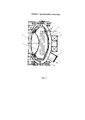
Принципиальная схема бланкета показана на Фиг. 1. Цифрами обозначены:A schematic diagram of the blanket is shown in FIG. 1. The numbers denote:
1 - плазма в разрядной камере; 2 - первая стенка; 3 - модули бланкета;1 - plasma in the discharge chamber; 2 - the first wall; 3 - blanket modules;
4 - отвод пара в турбину и конденсатор; 5 - наружный корпус бланкета;4 - steam removal to the turbine and condenser; 5 - the outer case of the blanket;
6 - катушка магнитной системы; 7 - возврат конденсата в модуль.6 - coil of the magnetic system; 7 - condensate return to the module.
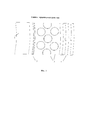
Схема поперечного сечения бланкета показана на Фиг. 2. Цифрами обозначены:A cross-sectional diagram of the blank is shown in FIG. 2. The numbers indicate:
1 - плазма в разрядной камере; 2 - первая стенка; 3 - модули бланкета; 9 - железоводная нейтронная защита.1 - plasma in the discharge chamber; 2 - the first wall; 3 - blanket modules; 9 - iron-water neutron protection.
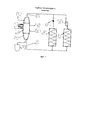
Схема конструкции модуля бланкета показана на Фиг. 3. Цифрами обозначены: 1 - плазма в разрядной камере (источник нейтронов); 3 - модуль бланкета; 4 - отвод пара в турбину; 7 - возврат воды (конденсата) из конденсатора; 8 - кипящий раствор в модуле; 10 - отбор раствора в систему извлечения целевых изотопов; 11 - возврат раствора из системы извлечения целевых изотопов; 12 - устройство для рекомбинации продуктов радиолиза воды; 13 - турбина; 14 - конденсатор; 15 - предохранительный клапан; 16 - аварийный конденсатор; 17 - сбросная емкость.A design diagram of the blanket module is shown in FIG. 3. The numbers denote: 1 - plasma in the discharge chamber (neutron source); 3 - blanket module; 4 - steam removal to the turbine; 7 - return of water (condensate) from the condenser; 8 - boiling solution in the module; 10 - selection of a solution in the system for extracting target isotopes; 11 - return of the solution from the target isotope extraction system; 12 - a device for recombination of products of radiolysis of water; 13 - turbine; 14 - capacitor; 15 - safety valve; 16 - emergency capacitor; 17 - discharge tank.
Принцип работы бланкета следующий.The principle of the blank is as follows.
Раствор 8 в модуле 3 нагревается нейтронами из плазмы 1 до температуры кипения; так же под действием нейтронов происходит трансмутация элементов в растворе. Часть растворителя (воды) испаряется и пар поступает в турбину 13, а затем в конденсатор 14, где конденсируется и возвращается в модуль 3. Продукты радиолиза воды поступают в устройство для их рекомбинации 12, откуда вода - продукт рекомбинации - стекает обратно в модуль 3. Из модуля 3 часть раствора 10 отводится в систему извлечения целевых изотопов. После этого раствор 11 возвращается в модуль 3. В случае повышения давления пара до значения выше допустимого срабатывает предохранительный клапан 15 и пар сбрасывается в аварийный конденсатор 16. При повышении температуры раствора или при выпадении осадка, содержащего делящиеся изотопы, в модуле плавится пробка в его нижней части и раствор через сливной трубопровод поступает в сбросную емкость 17.The
Предлагаемая конструкция, в зависимости от предъявляемых к бланкету требований, может иметь различные варианты конкретного выполнения.The proposed design, depending on the requirements for the form, can have various options for a specific implementation.
В качестве конструкционного материала можно использовать циркониевые или алюминиевые сплавы, хорошо освоенные в ядерной энергетике.As a structural material, zirconium or aluminum alloys well mastered in nuclear energy can be used.
Для приготовления раствора УС можно использовать обедненный, природный и обогащенный уран.To prepare a solution of CSS, you can use depleted, natural and enriched uranium.
Раствор может быть уран-, торий-, литийсодержащим или содержать минорные актиниды (растворы с актинидами получаются при переработке облученного ядерного топлива на радиохимических заводах (Б.В. Громов и др. "Химическая технология облученного ядерного топлива", М., Энергоатомиздат, 1983).The solution can be uranium-, thorium-, lithium-containing or contain minor actinides (solutions with actinides are obtained by processing irradiated nuclear fuel in radiochemical plants (B.V. Gromov et al. "Chemical technology of irradiated nuclear fuel", M., Energoatomizdat, 1983 )
В качестве раствора могут быть использованы следующие жидкости:The following liquids can be used as a solution:
- водный раствор УС для наработки Pu239 из U238;- an aqueous solution of US for the accumulation of Pu 239 from U 238 ;
- водный раствор тория-сульфата ThO2SO4 для наработки U233 из Th232;- an aqueous solution of thorium sulfate ThO 2 SO 4 for the production of U 233 from Th 232 ;
- водные растворы гидроксида лития LiOH, нитрида лития LiNO3, хлорида лития LiCl, сульфата лития Li2SO4 для наработки трития;- aqueous solutions of lithium hydroxide LiOH, lithium nitride LiNO 3 , lithium chloride LiCl, lithium sulfate Li 2 SO 4 for the production of tritium;
- раствор, содержащий минорные актиниды.- a solution containing minor actinides.
Модуль бланкета может иметь не только цилиндрическую, но и иную форму. При подборе соответствующей формы возможна установка одного модуля в одной секции бланкета. В этом случае достигается максимальное отношение объема сырьевого материала к объему конструкций бланкета, т.к. общий объем конструкционных материалов (металла) сравнительно невелик, а другие конструкционные материалы (например, отличный от раствора теплоноситель) и пустоты отсутствуют.The blanket module can have not only a cylindrical, but also a different shape. When selecting the appropriate form, it is possible to install one module in one section of the blank. In this case, the maximum ratio of the volume of raw material to the volume of blanket designs is achieved, since the total volume of structural materials (metal) is relatively small, and other structural materials (for example, a coolant different from the solution) and voids are absent.
При возникновении аварийной ситуации с потерей отвода тепла от раствора и при продолжении его кипения начнется рост давления пара в модуле. Далее возможны несколько вариантов развития событий.In the event of an emergency with loss of heat removal from the solution and with continued boiling, the vapor pressure in the module will begin to increase. Further, several scenarios are possible.
- Повышенное давление пара в модуле вызовет срабатывание предохранительного клапана 15, и пар будет сбрасываться в аварийный конденсатор 16 - аварийная ситуация будет локализована. Аварийный конденсатор обязательно будет присутствовать в ТЯР для локализации аварий, связанных с истечением теплоносителя из первой стенки и дивертора.- The increased vapor pressure in the module will trigger the
- Предохранительный клапан 15 не сработает, и рост давления в модуле продолжится. Это вызовет повышение температуры кипения раствора, и температура раствора будет повышаться. В случае возникновения рассматриваемой аварийной ситуации материал пробки, закрывающий сливной трубопровод, расплавится. Образовавшийся расплав и раствор из модуля стекут в сбросную емкость 17.- The
- Система безопасности сработает также в случае роста температуры раствора, вызванного повышением концентрации в нем радиоактивных изотопов (например, из-за отказа устройства для извлечения из раствора целевых изотопов и радиоактивных отходов) и соответствующего увеличения тепловыделения.- The security system will also work if the temperature of the solution is caused by an increase in the concentration of radioactive isotopes in it (for example, due to a failure of the device to extract target isotopes and radioactive waste from the solution) and a corresponding increase in heat generation.
- Также при применении растворов, содержащих уран, возможно выпадение из раствора осадка - пероксида урана. Благодаря предложенной конструкции модуля осадок в нем будет скапливаться в его нижней, конической части, непосредственно на пробке. Тепловыделение в содержащихся в осадке делящихся элементах и продуктах распада приведет к росту температуры осадка. Пробка расплавится, и раствор из модуля стечет в сбросную емкость. Это гарантирует невозможность образования критической массы в осадке.- Also, when using solutions containing uranium, precipitation of uranium peroxide from the solution is possible. Due to the proposed design of the module, the sediment in it will accumulate in its lower, conical part, directly on the cork. The heat in the fissile elements and decomposition products contained in the precipitate will increase the temperature of the precipitate. The plug will melt and the solution will drain from the module into a discharge tank. This ensures that a critical mass cannot form in the sediment.
Предлагаемая конструкция бланкета будет иметь следующие преимущества:The proposed blanket design will have the following advantages:
- простота конструкции, загрузки и выгрузки сырьевого материала;- simplicity of design, loading and unloading of raw materials;
- низкое давление (около 0,1 МПа) и низкая температура (около 100°С) в модуле;- low pressure (about 0.1 MPa) and low temperature (about 100 ° C) in the module;
- пожаробезопасность;- fire safety;
- невозможность накопления большого количества гремучей смеси, которую обеспечивает устройство для рекомбинации продуктов радиолиза воды;- the impossibility of accumulating a large amount of explosive mixture, which provides a device for the recombination of products of radiolysis of water;
- возможность непрерывной корректировки элементного состава раствора, что, в свою очередь, позволит исключить остановки на перегрузку бланкета и организовать непрерывное выделение из него целевых изотопов или продуктов трансмутации;- the possibility of continuous adjustment of the elemental composition of the solution, which, in turn, will eliminate the stoppage for reloading the blanket and organize the continuous selection of the target isotopes or transmutation products from it;
- отсутствие необходимости циркуляции больших масс раствора и соответствующее отсутствие больших трубопроводов, проходящих через криостат, защиту и т.п.;- the absence of the need for circulation of large masses of the solution and the corresponding absence of large pipelines passing through the cryostat, protection, etc .;
- возможность быстро сменить тип раствора;- the ability to quickly change the type of solution;
- благодаря высокой теплопроводности раствора невозможно образование зон с повышенным тепловыделением;- due to the high thermal conductivity of the solution, the formation of zones with increased heat generation is impossible;
- достигается максимальное отношение объема сырьевого материала к объему конструкций бланкета, т.к. общий объем конструкционных материалов (металла) сравнительно невелик, а другие конструкционные материалы (например, отличный от сырьевого материала теплоноситель) отсутствуют;- the maximum ratio of the volume of raw material to the volume of blanket designs is achieved, because the total volume of structural materials (metal) is relatively small, and other structural materials (for example, a coolant other than raw material) are absent;
- низкие температуры упрощают конструкцию и уменьшают тепловые нагрузки на сверхпроводящие элементы;- low temperatures simplify the design and reduce thermal loads on superconducting elements;
- внутренне присущее свойство саморегулирования. При увеличении тепловой нагрузки на бланкет увеличивается количество испаренного растворителя, а температура и масса раствора остаются неизменными.- intrinsic property of self-regulation. With an increase in the thermal load on the blank, the amount of evaporated solvent increases, and the temperature and mass of the solution remain unchanged.
Дополнительным преимуществом является возможность применения простой и надежной пассивной системы безопасности с плавящейся пробкой.An additional advantage is the possibility of using a simple and reliable passive safety system with a floating plug.
Пример расчетаCalculation Example
Расчет возможности охлаждения бланкета с водным раствором УС с помощью испарения части растворителя (воды) выполнен для конструкции, представленной на Фиг. 1-3 и характеризующейся параметрами, приведенными в Таблице 1.The calculation of the possibility of cooling the blanket with an aqueous solution of CSS by evaporation of a part of the solvent (water) was performed for the structure shown in FIG. 1-3 and characterized by the parameters shown in Table 1.

При исследовании бланкета с водным раствором УС (см., Кутеев Б.В. и др. "Нейтронно-физические исследования термоядерного источника нейтронов для получения максимального потока тепловых нейтронов". Вопросы атомной науки и техники, серия "Термоядерный синтез", 2013, вып. 1, стр. 64) было определено qv - удельное объемное тепловыделение в нем в зависимости от нейтронной нагрузки и расстояния от первой стенки. При нейтронной нагрузке на первую стенку 0,2 МВт/м2, характерной для ТИН, qv~0,2-1 МВт/м3. Объемное тепловыделение будет также в металлоконструкциях модуля, и для них примем qv Me~1-3 МВт/м3.When studying a blanket with an aqueous solution of CSS (see Kuteev B.V. et al. "Neutron-physical studies of a thermonuclear neutron source to obtain the maximum flux of thermal neutrons." Issues of Atomic Science and Technology, Thermonuclear Fusion Series, 2013, no. . 1, p. 64) it was determined q v - specific volumetric heat release in it depending on the neutron load and the distance from the first wall. With a neutron load on the first wall of 0.2 MW / m 2 , typical for TIN, q v ~ 0.2-1 MW / m 3 . Volumetric heat generation will also be in the metal structures of the module, and for them we take q v Me ~ 1-3 MW / m 3 .
Тепловая мощность модуля определяется какThe thermal power of the module is defined as

Теплота парообразования воды при 100°С r=2,26⋅106 Дж/кг. Массу воды, которую необходимо испарять в единицу времени Δt для поддержания постоянной температуры модуля, можно оценить по формулеThe heat of vaporization of water at 100 ° С r = 2.26⋅10 6 J / kg. The mass of water that must be evaporated per unit time Δt to maintain a constant temperature of the module can be estimated by the formula

Массу воды, которую необходимо испарять за секунду, обозначим Mисп1.The mass of water that must be evaporated in a second is denoted by M isp1 .
Исследование фазовой диаграммы системы уранил-сульфат (УС) - вода показало возможность использовать раствор в широком диапазоне концентраций УС и температур раствора. Возможно применение раствора при концентрации УС от 0 до 10 моль/(кг воды) и при его температуре от 0 до 300°С (Петунии Б.В. "Теплоэнергетика ядерных установок". М., Атомиздат, 1960). Здесь же приведены теплофизические свойства раствора.The study of the phase diagram of the uranyl sulfate (US) - water system showed the ability to use the solution in a wide range of US concentrations and solution temperatures. It is possible to use the solution at a concentration of US from 0 to 10 mol / (kg of water) and at its temperature from 0 to 300 ° C (B. Petunii, "Thermal Power of Nuclear Installations." M., Atomizdat, 1960). Thermophysical properties of the solution are also shown here.
Расчеты выполнены для раствора с составом 0,611 (кг УС)/(кг воды), т.е. на 1,611 кг раствора приходится 0,611 кг УС. Масса УС в 1 кг раствораThe calculations were performed for a solution with a composition of 0.611 (kg US) / (kg of water), i.e. per 1.611 kg of solution accounts for 0.611 kg of CSS. Weight in 1 kg of solution
М1УС=0,611/1,611=0,379 кг/кг.M 1US = 0.611 / 1.611 = 0.379 kg / kg.
Массовая концентрация УС КУС=37,9% или 1,03 (моль УС)/(кг раствора).Mass concentration of US To US = 37.9% or 1.03 (mol US) / (kg of solution).
При атомном весе урана AU=238 и молекулярном весе УС- МОЛУС=366 в 1 кг раствора будет содержаться уран в количествеWith an atomic weight of uranium A U = 238 and a molecular weight of US-MOL US = 366 in 1 kg of solution, uranium will be contained in an amount
M1U=(AU/МОЛУС)⋅М1УС=0,246 кг/кг.M 1U = (A U / MOL CSS) ⋅M 1US = 0.246 kg / kg.
Таким образом, массовая концентрация урана в растворе KU=24,6%.Thus, the mass concentration of uranium in the solution K U = 24.6%.
Масса воды 1 кг раствора M1B=1-M1УС=0,621 кг, и ее массовая концентрация в растворе Кводы=62,1%.The mass of
Следует отметить, что температура кипения раствора будет выше температуры кипения растворителя (воды) на величину, называемую температурной депрессией. Для ее определения необходимо экспериментальное исследование свойств раствора. Известно, что величина температурной депрессии больше при растворении веществ с малым молекулярным весом и при высокой концентрации растворенного вещества. В нашем случае МУС=366 сравнительно велик, а его массовая концентрация сравнительно невелика (около 1 моль на кг раствора). В этом случае можно считать, что температура кипения раствора близка к температуре кипения растворителя, т.е. близка к 100°С.It should be noted that the boiling point of the solution will be higher than the boiling point of the solvent (water) by an amount called temperature depression. To determine it, an experimental study of the properties of the solution is necessary. It is known that the magnitude of temperature depression is greater when dissolving substances with a low molecular weight and at a high concentration of dissolved substance. In our case, M US = 366 is relatively large, and its mass concentration is relatively low (about 1 mol per kg of solution). In this case, we can assume that the boiling point of the solution is close to the boiling point of the solvent, i.e. close to 100 ° C.
Плотность раствора УС в водеThe density of the solution in the water

где rводы - плотность воды при давлении насыщенного пара при рабочей температуре, кг/м3.where r of water is the density of water at a saturated vapor pressure at operating temperature, kg / m 3 .
Плотность раствора при температуре его кипения 100°С по (3)The density of the solution at a boiling point of 100 ° C according to (3)
rраст=1423 кг/м3, масса раствора в модуле Мраст=Vвнут⋅rраст=228 кг. stretching r = 1423 kg / m 3, the mass of the solution in the module M = V tensile vnut ⋅r stretch = 228 kg.
Масса воды в модуле Мводы=Мраст⋅Кводы=141 кг.The water mass of water in a module M = M stretching ⋅K water = 141 kg.
В таблице 2 «Тепловые характеристики модуля бланкета при различных величинах удельного тепловыделения в материалах» приведены расчеты тепловых характеристик модуля при различных значениях qv и qv Me, которые охватывают весь возможный диапазон их значений.Table 2 “Thermal characteristics of the blanket module for various values of specific heat in materials” provides calculations of the thermal characteristics of the module for various values of q v and q v Me , which cover the entire possible range of their values.
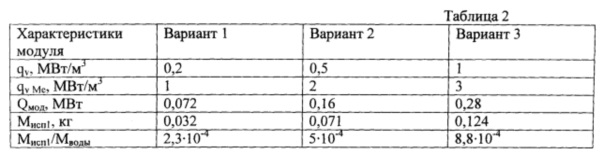
Данные таблицы 2 показывают, что при любой возможной тепловой мощности модуля бланкета для его охлаждения ежесекундно необходимо испарять не более 8,8⋅10-4 от массы воды в нем, что вполне допустимо.The data in Table 2 show that for any possible thermal power of the blanket module, for its cooling, it is necessary to evaporate no more than 8.8 810 -4 from the mass of water in it every second, which is quite acceptable.
Предлагаемая конструкция бланкета будет иметь следующие преимущества:The proposed blanket design will have the following advantages:
- простота конструкции, загрузки и выгрузки сырьевого материала;- simplicity of design, loading and unloading of raw materials;
- низкое давление (около 0,1 МПа) и низкая температура (около 100°С) в модуле;- low pressure (about 0.1 MPa) and low temperature (about 100 ° C) in the module;
- пожаробезопасность;- fire safety;
- невозможность накопления большого количества гремучей смеси, которую обеспечивает устройство для рекомбинации продуктов радиолиза воды;- the impossibility of accumulating a large amount of explosive mixture, which provides a device for the recombination of products of radiolysis of water;
- возможность непрерывной корректировки элементного состава раствора, что, в свою очередь, позволит исключить остановки на перегрузку бланкета и организовать непрерывное выделение из него целевых изотопов или продуктов трансмутации;- the possibility of continuous adjustment of the elemental composition of the solution, which, in turn, will eliminate the stoppage for reloading the blanket and organize the continuous selection of the target isotopes or transmutation products from it;
- отсутствие необходимости циркуляции больших масс раствора и соответствующее отсутствие больших трубопроводов, проходящих через криостат, защиту и т.п.;- the absence of the need for circulation of large masses of the solution and the corresponding absence of large pipelines passing through the cryostat, protection, etc .;
- возможность быстро сменить тип раствора;- the ability to quickly change the type of solution;
- благодаря высокой теплопроводности раствора невозможно образование зон с повышенным тепловыделением;- due to the high thermal conductivity of the solution, the formation of zones with increased heat generation is impossible;
- достигается максимальное отношение объема сырьевого материала к объему конструкций бланкета, т.к. общий объем конструкционных материалов (металла) сравнительно невелик, а другие конструкционные материалы (например, отличный от сырьевого материала теплоноситель) отсутствуют;- the maximum ratio of the volume of raw material to the volume of blanket designs is achieved, because the total volume of structural materials (metal) is relatively small, and other structural materials (for example, a coolant other than raw material) are absent;
- низкие температуры упрощают конструкцию и уменьшают тепловые нагрузки на сверхпроводящие элементы;- low temperatures simplify the design and reduce thermal loads on superconducting elements;
- внутренне присущее свойство саморегулирования. При увеличении тепловой нагрузки на бланкет увеличивается количество испаренного растворителя, а температура и масса раствора остаются неизменными.- intrinsic property of self-regulation. With an increase in the thermal load on the blank, the amount of evaporated solvent increases, and the temperature and mass of the solution remain unchanged.
Дополнительным преимуществом является возможность применения простой и надежной пассивной системы безопасности с плавящейся пробкой.An additional advantage is the possibility of using a simple and reliable passive safety system with a floating plug.
Конструкция сбросной емкости должна исключать возможность образования в ней критической массы.The design of the discharge tank should exclude the possibility of the formation of a critical mass in it.
Расчеты показывают принципиальную возможность создания бланкета подобной конструкции.Calculations show the fundamental possibility of creating a blanket of a similar design.
Claims (7)
Priority Applications (1)
| Application Number | Priority Date | Filing Date | Title |
|---|---|---|---|
| RU2016130027A RU2633373C1 (en) | 2016-07-21 | 2016-07-21 | Blanket of thermonuclear reactor |
Applications Claiming Priority (1)
| Application Number | Priority Date | Filing Date | Title |
|---|---|---|---|
| RU2016130027A RU2633373C1 (en) | 2016-07-21 | 2016-07-21 | Blanket of thermonuclear reactor |
Publications (1)
| Publication Number | Publication Date |
|---|---|
| RU2633373C1 true RU2633373C1 (en) | 2017-10-12 |
Family
ID=60129476
Family Applications (1)
| Application Number | Title | Priority Date | Filing Date |
|---|---|---|---|
| RU2016130027A RU2633373C1 (en) | 2016-07-21 | 2016-07-21 | Blanket of thermonuclear reactor |
Country Status (1)
| Country | Link |
|---|---|
| RU (1) | RU2633373C1 (en) |
Cited By (6)
| Publication number | Priority date | Publication date | Assignee | Title |
|---|---|---|---|---|
| RU2695632C1 (en) * | 2018-12-07 | 2019-07-25 | Федеральное государственное бюджетное учреждение "Национальный исследовательский центр "Курчатовский институт" | Thermonuclear reactor vacuum chamber |
| RU2726940C1 (en) * | 2020-01-31 | 2020-07-17 | Федеральное государственное бюджетное учреждение "Национальный исследовательский центр "Курчатовский институт" | Thermonuclear reactor vacuum chamber |
| RU201966U1 (en) * | 2020-09-30 | 2021-01-25 | Федеральное государственное бюджетное учреждение "Национальный исследовательский центр "Курчатовский институт" | VACUUM CHAMBER OF A THERMONUCLEAR REACTOR WITH OUTER SHELL COOLING |
| RU205721U1 (en) * | 2020-07-09 | 2021-07-30 | Федеральное государственное бюджетное учреждение "Национальный исследовательский центр "Курчатовский институт" | VACUUM CHAMBER OF THERMONUCLEAR REACTOR |
| RU2778245C1 (en) * | 2022-01-10 | 2022-08-16 | Российская Федерация, от имени которой выступает Государственная корпорация по атомной энергии "Росатом" (Госкорпорация "Росатом") | Box for experiments on infrared heating of a cryogenic layer of hydrogen isotopes in a spherical shell |
| US20230352195A1 (en) * | 2020-08-26 | 2023-11-02 | Beam Alpha, Inc. | Mixed Nuclear Power Conversion |
Citations (3)
| Publication number | Priority date | Publication date | Assignee | Title |
|---|---|---|---|---|
| FR2610136A1 (en) * | 1987-01-23 | 1988-07-29 | Novatome | COOLING DEVICE OF A THERMONUCLEAR FUSION REACTOR AND MODULAR PACKING BLOCK FOR PRODUCING A WALL OF SUCH A DEVICE |
| RU2002131068A (en) * | 2002-11-18 | 2004-06-10 | Федеральное государственное унитарное предприятие "Научно-исследовательский и конструкторский институт энерготехники им. Н.А. Доллежаля" | THERMONUCLEAR REACTOR FORM |
| RU143978U1 (en) * | 2014-04-17 | 2014-08-10 | Российская Федерация, от имени которой выступает Государственная корпорация по атомной энергии "Росатом" | THERMONUCLEAR REACTOR FORM |
Family Cites Families (1)
| Publication number | Priority date | Publication date | Assignee | Title |
|---|---|---|---|---|
| RU2231140C1 (en) * | 2002-11-18 | 2004-06-20 | Федеральное государственное унитарное предприятие "Научно-исследовательский и конструкторский институт энерготехники им. Н.А. Доллежаля" | Thermonuclear reactor blanket |
-
2016
- 2016-07-21 RU RU2016130027A patent/RU2633373C1/en active
Patent Citations (4)
| Publication number | Priority date | Publication date | Assignee | Title |
|---|---|---|---|---|
| FR2610136A1 (en) * | 1987-01-23 | 1988-07-29 | Novatome | COOLING DEVICE OF A THERMONUCLEAR FUSION REACTOR AND MODULAR PACKING BLOCK FOR PRODUCING A WALL OF SUCH A DEVICE |
| EP0277892A1 (en) * | 1987-01-23 | 1988-08-10 | Novatome | Thermonuclear fusion reactor cooling system and modular blocks for the construction of a wall for said system |
| RU2002131068A (en) * | 2002-11-18 | 2004-06-10 | Федеральное государственное унитарное предприятие "Научно-исследовательский и конструкторский институт энерготехники им. Н.А. Доллежаля" | THERMONUCLEAR REACTOR FORM |
| RU143978U1 (en) * | 2014-04-17 | 2014-08-10 | Российская Федерация, от имени которой выступает Государственная корпорация по атомной энергии "Росатом" | THERMONUCLEAR REACTOR FORM |
Cited By (7)
| Publication number | Priority date | Publication date | Assignee | Title |
|---|---|---|---|---|
| RU2796933C2 (en) * | 2018-06-27 | 2023-05-29 | Токемек Энерджи Лтд | Double-zero diverters with liquid metal |
| RU2695632C1 (en) * | 2018-12-07 | 2019-07-25 | Федеральное государственное бюджетное учреждение "Национальный исследовательский центр "Курчатовский институт" | Thermonuclear reactor vacuum chamber |
| RU2726940C1 (en) * | 2020-01-31 | 2020-07-17 | Федеральное государственное бюджетное учреждение "Национальный исследовательский центр "Курчатовский институт" | Thermonuclear reactor vacuum chamber |
| RU205721U1 (en) * | 2020-07-09 | 2021-07-30 | Федеральное государственное бюджетное учреждение "Национальный исследовательский центр "Курчатовский институт" | VACUUM CHAMBER OF THERMONUCLEAR REACTOR |
| US20230352195A1 (en) * | 2020-08-26 | 2023-11-02 | Beam Alpha, Inc. | Mixed Nuclear Power Conversion |
| RU201966U1 (en) * | 2020-09-30 | 2021-01-25 | Федеральное государственное бюджетное учреждение "Национальный исследовательский центр "Курчатовский институт" | VACUUM CHAMBER OF A THERMONUCLEAR REACTOR WITH OUTER SHELL COOLING |
| RU2778245C1 (en) * | 2022-01-10 | 2022-08-16 | Российская Федерация, от имени которой выступает Государственная корпорация по атомной энергии "Росатом" (Госкорпорация "Росатом") | Box for experiments on infrared heating of a cryogenic layer of hydrogen isotopes in a spherical shell |
Similar Documents
| Publication | Publication Date | Title |
|---|---|---|
| US8416908B2 (en) | Nuclear reactor control method and apparatus | |
| LeBlanc et al. | Integral molten salt reactor | |
| Shin et al. | Advanced passive design of small modular reactor cooled by heavy liquid metal natural circulation | |
| CN104361914A (en) | Passive safety cooling system | |
| CA2849175A1 (en) | Dual fluid reactor | |
| CN204242601U (en) | Non-passive safety cooling system | |
| Xue et al. | Review of conceptual design and fundamental research related to the passive residual heat removal system in molten salt reactors | |
| Morozov et al. | Effect of boric acid mass transfer on the accumulation thereof in a fuel core under emergency modes at NPPs with WMR | |
| KR101389840B1 (en) | Inherent safety water cooled reactor system for producing electricity | |
| Poullikkas | An overview of future sustainable nuclear power reactors. | |
| Morozov et al. | Effect of mass transfer processes on accumulation and crystallization of boric acid in WWER core in emergency cases | |
| Wider et al. | Renewed interest in lead cooled fast reactors | |
| Liu et al. | SCWR transient safety analysis code SCAC-CSR1000 | |
| Niţă et al. | Overview of tritium activity in the nuclear fission reactors | |
| Baranaev et al. | Supercritical-pressure water nuclear reactors | |
| Haratyk et al. | Preliminary accident analysis of Flexblue® underwater reactor | |
| Yetisir et al. | Reactor core and plant design concepts of the Canadian supercritical water-cooled reactor | |
| RU2633419C1 (en) | Blanket of thermonuclear reactor with natural circulation | |
| Cole et al. | The near boiling reactor: design of a small, inherently safe, nuclear reactor to extend the operational envelope of the Victoria-class submarine | |
| Paramonov et al. | Generation IV concepts: USSR and Russia | |
| Dragunov et al. | Investigation of thermophysical and nuclear properties of prospective coolants for generation-IV nuclear reactors | |
| Morozov et al. | Analysis of Accumulation and Crystallization of Boric Acid in the Reactor Core during WWER Emergency Operation | |
| Schulenberg | Fundamentals of Nuclear Technology | |
| Dong | Technologies of HTR-PM Plant and its economic potential | |
| Carlsson et al. | ESS Target Water Cooling, Purification and Radiolysis Gas Handling |