RU2620373C1 - Multilayer shell for smoking and storage of food products, and smoked food product manufactured therein - Google Patents
Multilayer shell for smoking and storage of food products, and smoked food product manufactured therein Download PDFInfo
- Publication number
- RU2620373C1 RU2620373C1 RU2016103754A RU2016103754A RU2620373C1 RU 2620373 C1 RU2620373 C1 RU 2620373C1 RU 2016103754 A RU2016103754 A RU 2016103754A RU 2016103754 A RU2016103754 A RU 2016103754A RU 2620373 C1 RU2620373 C1 RU 2620373C1
- Authority
- RU
- Russia
- Prior art keywords
- layer
- casing according
- polymers
- polymer
- polyamide
- Prior art date
Links
Classifications
-
- A—HUMAN NECESSITIES
- A22—BUTCHERING; MEAT TREATMENT; PROCESSING POULTRY OR FISH
- A22C—PROCESSING MEAT, POULTRY, OR FISH
- A22C13/00—Sausage casings
- A22C13/0013—Chemical composition of synthetic sausage casings
-
- A—HUMAN NECESSITIES
- A23—FOODS OR FOODSTUFFS; TREATMENT THEREOF, NOT COVERED BY OTHER CLASSES
- A23B—PRESERVATION OF FOODS, FOODSTUFFS OR NON-ALCOHOLIC BEVERAGES; CHEMICAL RIPENING OF FRUIT OR VEGETABLES
- A23B4/00—Preservation of meat, sausages, fish or fish products
- A23B4/044—Smoking; Smoking devices
- A23B4/048—Smoking; Smoking devices with addition of chemicals other than natural smoke
-
- A—HUMAN NECESSITIES
- A23—FOODS OR FOODSTUFFS; TREATMENT THEREOF, NOT COVERED BY OTHER CLASSES
- A23B—PRESERVATION OF FOODS, FOODSTUFFS OR NON-ALCOHOLIC BEVERAGES; CHEMICAL RIPENING OF FRUIT OR VEGETABLES
- A23B4/00—Preservation of meat, sausages, fish or fish products
- A23B4/14—Preserving with chemicals not covered by groups A23B4/02 or A23B4/12
- A23B4/18—Preserving with chemicals not covered by groups A23B4/02 or A23B4/12 in the form of liquids or solids
- A23B4/20—Organic compounds; Microorganisms; Enzymes
-
- A—HUMAN NECESSITIES
- A23—FOODS OR FOODSTUFFS; TREATMENT THEREOF, NOT COVERED BY OTHER CLASSES
- A23L—FOODS, FOODSTUFFS OR NON-ALCOHOLIC BEVERAGES, NOT OTHERWISE PROVIDED FOR; PREPARATION OR TREATMENT THEREOF
- A23L13/00—Meat products; Meat meal; Preparation or treatment thereof
- A23L13/60—Comminuted or emulsified meat products, e.g. sausages; Reformed meat from comminuted meat product
-
- A—HUMAN NECESSITIES
- A23—FOODS OR FOODSTUFFS; TREATMENT THEREOF, NOT COVERED BY OTHER CLASSES
- A23L—FOODS, FOODSTUFFS OR NON-ALCOHOLIC BEVERAGES, NOT OTHERWISE PROVIDED FOR; PREPARATION OR TREATMENT THEREOF
- A23L13/00—Meat products; Meat meal; Preparation or treatment thereof
- A23L13/60—Comminuted or emulsified meat products, e.g. sausages; Reformed meat from comminuted meat product
- A23L13/65—Sausages
-
- B—PERFORMING OPERATIONS; TRANSPORTING
- B32—LAYERED PRODUCTS
- B32B—LAYERED PRODUCTS, i.e. PRODUCTS BUILT-UP OF STRATA OF FLAT OR NON-FLAT, e.g. CELLULAR OR HONEYCOMB, FORM
- B32B1/00—Layered products having a non-planar shape
- B32B1/08—Tubular products
-
- B—PERFORMING OPERATIONS; TRANSPORTING
- B32—LAYERED PRODUCTS
- B32B—LAYERED PRODUCTS, i.e. PRODUCTS BUILT-UP OF STRATA OF FLAT OR NON-FLAT, e.g. CELLULAR OR HONEYCOMB, FORM
- B32B23/00—Layered products comprising a layer of cellulosic plastic substances, i.e. substances obtained by chemical modification of cellulose, e.g. cellulose ethers, cellulose esters, viscose
- B32B23/04—Layered products comprising a layer of cellulosic plastic substances, i.e. substances obtained by chemical modification of cellulose, e.g. cellulose ethers, cellulose esters, viscose comprising such cellulosic plastic substance as the main or only constituent of a layer, which is next to another layer of the same or of a different material
- B32B23/046—Layered products comprising a layer of cellulosic plastic substances, i.e. substances obtained by chemical modification of cellulose, e.g. cellulose ethers, cellulose esters, viscose comprising such cellulosic plastic substance as the main or only constituent of a layer, which is next to another layer of the same or of a different material of natural rubber or synthetic rubber
-
- B—PERFORMING OPERATIONS; TRANSPORTING
- B32—LAYERED PRODUCTS
- B32B—LAYERED PRODUCTS, i.e. PRODUCTS BUILT-UP OF STRATA OF FLAT OR NON-FLAT, e.g. CELLULAR OR HONEYCOMB, FORM
- B32B23/00—Layered products comprising a layer of cellulosic plastic substances, i.e. substances obtained by chemical modification of cellulose, e.g. cellulose ethers, cellulose esters, viscose
- B32B23/04—Layered products comprising a layer of cellulosic plastic substances, i.e. substances obtained by chemical modification of cellulose, e.g. cellulose ethers, cellulose esters, viscose comprising such cellulosic plastic substance as the main or only constituent of a layer, which is next to another layer of the same or of a different material
- B32B23/08—Layered products comprising a layer of cellulosic plastic substances, i.e. substances obtained by chemical modification of cellulose, e.g. cellulose ethers, cellulose esters, viscose comprising such cellulosic plastic substance as the main or only constituent of a layer, which is next to another layer of the same or of a different material of synthetic resin
-
- B—PERFORMING OPERATIONS; TRANSPORTING
- B32—LAYERED PRODUCTS
- B32B—LAYERED PRODUCTS, i.e. PRODUCTS BUILT-UP OF STRATA OF FLAT OR NON-FLAT, e.g. CELLULAR OR HONEYCOMB, FORM
- B32B23/00—Layered products comprising a layer of cellulosic plastic substances, i.e. substances obtained by chemical modification of cellulose, e.g. cellulose ethers, cellulose esters, viscose
- B32B23/14—Layered products comprising a layer of cellulosic plastic substances, i.e. substances obtained by chemical modification of cellulose, e.g. cellulose ethers, cellulose esters, viscose characterised by containing special compounding ingredients
- B32B23/18—Fillers
-
- B—PERFORMING OPERATIONS; TRANSPORTING
- B32—LAYERED PRODUCTS
- B32B—LAYERED PRODUCTS, i.e. PRODUCTS BUILT-UP OF STRATA OF FLAT OR NON-FLAT, e.g. CELLULAR OR HONEYCOMB, FORM
- B32B25/00—Layered products comprising a layer of natural or synthetic rubber
- B32B25/04—Layered products comprising a layer of natural or synthetic rubber comprising rubber as the main or only constituent of a layer, which is next to another layer of the same or of a different material
- B32B25/08—Layered products comprising a layer of natural or synthetic rubber comprising rubber as the main or only constituent of a layer, which is next to another layer of the same or of a different material of synthetic resin
-
- B—PERFORMING OPERATIONS; TRANSPORTING
- B32—LAYERED PRODUCTS
- B32B—LAYERED PRODUCTS, i.e. PRODUCTS BUILT-UP OF STRATA OF FLAT OR NON-FLAT, e.g. CELLULAR OR HONEYCOMB, FORM
- B32B25/00—Layered products comprising a layer of natural or synthetic rubber
- B32B25/12—Layered products comprising a layer of natural or synthetic rubber comprising natural rubber
-
- B—PERFORMING OPERATIONS; TRANSPORTING
- B32—LAYERED PRODUCTS
- B32B—LAYERED PRODUCTS, i.e. PRODUCTS BUILT-UP OF STRATA OF FLAT OR NON-FLAT, e.g. CELLULAR OR HONEYCOMB, FORM
- B32B25/00—Layered products comprising a layer of natural or synthetic rubber
- B32B25/14—Layered products comprising a layer of natural or synthetic rubber comprising synthetic rubber copolymers
-
- B—PERFORMING OPERATIONS; TRANSPORTING
- B32—LAYERED PRODUCTS
- B32B—LAYERED PRODUCTS, i.e. PRODUCTS BUILT-UP OF STRATA OF FLAT OR NON-FLAT, e.g. CELLULAR OR HONEYCOMB, FORM
- B32B25/00—Layered products comprising a layer of natural or synthetic rubber
- B32B25/16—Layered products comprising a layer of natural or synthetic rubber comprising polydienes homopolymers or poly-halodienes homopolymers
-
- B—PERFORMING OPERATIONS; TRANSPORTING
- B32—LAYERED PRODUCTS
- B32B—LAYERED PRODUCTS, i.e. PRODUCTS BUILT-UP OF STRATA OF FLAT OR NON-FLAT, e.g. CELLULAR OR HONEYCOMB, FORM
- B32B27/00—Layered products comprising a layer of synthetic resin
- B32B27/06—Layered products comprising a layer of synthetic resin as the main or only constituent of a layer, which is next to another layer of the same or of a different material
- B32B27/08—Layered products comprising a layer of synthetic resin as the main or only constituent of a layer, which is next to another layer of the same or of a different material of synthetic resin
-
- B—PERFORMING OPERATIONS; TRANSPORTING
- B32—LAYERED PRODUCTS
- B32B—LAYERED PRODUCTS, i.e. PRODUCTS BUILT-UP OF STRATA OF FLAT OR NON-FLAT, e.g. CELLULAR OR HONEYCOMB, FORM
- B32B27/00—Layered products comprising a layer of synthetic resin
- B32B27/18—Layered products comprising a layer of synthetic resin characterised by the use of special additives
- B32B27/20—Layered products comprising a layer of synthetic resin characterised by the use of special additives using fillers, pigments, thixotroping agents
-
- B—PERFORMING OPERATIONS; TRANSPORTING
- B32—LAYERED PRODUCTS
- B32B—LAYERED PRODUCTS, i.e. PRODUCTS BUILT-UP OF STRATA OF FLAT OR NON-FLAT, e.g. CELLULAR OR HONEYCOMB, FORM
- B32B27/00—Layered products comprising a layer of synthetic resin
- B32B27/18—Layered products comprising a layer of synthetic resin characterised by the use of special additives
- B32B27/22—Layered products comprising a layer of synthetic resin characterised by the use of special additives using plasticisers
-
- B—PERFORMING OPERATIONS; TRANSPORTING
- B32—LAYERED PRODUCTS
- B32B—LAYERED PRODUCTS, i.e. PRODUCTS BUILT-UP OF STRATA OF FLAT OR NON-FLAT, e.g. CELLULAR OR HONEYCOMB, FORM
- B32B27/00—Layered products comprising a layer of synthetic resin
- B32B27/28—Layered products comprising a layer of synthetic resin comprising synthetic resins not wholly covered by any one of the sub-groups B32B27/30 - B32B27/42
-
- B—PERFORMING OPERATIONS; TRANSPORTING
- B32—LAYERED PRODUCTS
- B32B—LAYERED PRODUCTS, i.e. PRODUCTS BUILT-UP OF STRATA OF FLAT OR NON-FLAT, e.g. CELLULAR OR HONEYCOMB, FORM
- B32B27/00—Layered products comprising a layer of synthetic resin
- B32B27/28—Layered products comprising a layer of synthetic resin comprising synthetic resins not wholly covered by any one of the sub-groups B32B27/30 - B32B27/42
- B32B27/283—Layered products comprising a layer of synthetic resin comprising synthetic resins not wholly covered by any one of the sub-groups B32B27/30 - B32B27/42 comprising polysiloxanes
-
- B—PERFORMING OPERATIONS; TRANSPORTING
- B32—LAYERED PRODUCTS
- B32B—LAYERED PRODUCTS, i.e. PRODUCTS BUILT-UP OF STRATA OF FLAT OR NON-FLAT, e.g. CELLULAR OR HONEYCOMB, FORM
- B32B27/00—Layered products comprising a layer of synthetic resin
- B32B27/28—Layered products comprising a layer of synthetic resin comprising synthetic resins not wholly covered by any one of the sub-groups B32B27/30 - B32B27/42
- B32B27/285—Layered products comprising a layer of synthetic resin comprising synthetic resins not wholly covered by any one of the sub-groups B32B27/30 - B32B27/42 comprising polyethers
-
- B—PERFORMING OPERATIONS; TRANSPORTING
- B32—LAYERED PRODUCTS
- B32B—LAYERED PRODUCTS, i.e. PRODUCTS BUILT-UP OF STRATA OF FLAT OR NON-FLAT, e.g. CELLULAR OR HONEYCOMB, FORM
- B32B27/00—Layered products comprising a layer of synthetic resin
- B32B27/30—Layered products comprising a layer of synthetic resin comprising vinyl (co)polymers; comprising acrylic (co)polymers
- B32B27/302—Layered products comprising a layer of synthetic resin comprising vinyl (co)polymers; comprising acrylic (co)polymers comprising aromatic vinyl (co)polymers, e.g. styrenic (co)polymers
-
- B—PERFORMING OPERATIONS; TRANSPORTING
- B32—LAYERED PRODUCTS
- B32B—LAYERED PRODUCTS, i.e. PRODUCTS BUILT-UP OF STRATA OF FLAT OR NON-FLAT, e.g. CELLULAR OR HONEYCOMB, FORM
- B32B27/00—Layered products comprising a layer of synthetic resin
- B32B27/30—Layered products comprising a layer of synthetic resin comprising vinyl (co)polymers; comprising acrylic (co)polymers
- B32B27/306—Layered products comprising a layer of synthetic resin comprising vinyl (co)polymers; comprising acrylic (co)polymers comprising vinyl acetate or vinyl alcohol (co)polymers
-
- B—PERFORMING OPERATIONS; TRANSPORTING
- B32—LAYERED PRODUCTS
- B32B—LAYERED PRODUCTS, i.e. PRODUCTS BUILT-UP OF STRATA OF FLAT OR NON-FLAT, e.g. CELLULAR OR HONEYCOMB, FORM
- B32B27/00—Layered products comprising a layer of synthetic resin
- B32B27/32—Layered products comprising a layer of synthetic resin comprising polyolefins
-
- B—PERFORMING OPERATIONS; TRANSPORTING
- B32—LAYERED PRODUCTS
- B32B—LAYERED PRODUCTS, i.e. PRODUCTS BUILT-UP OF STRATA OF FLAT OR NON-FLAT, e.g. CELLULAR OR HONEYCOMB, FORM
- B32B27/00—Layered products comprising a layer of synthetic resin
- B32B27/34—Layered products comprising a layer of synthetic resin comprising polyamides
-
- B—PERFORMING OPERATIONS; TRANSPORTING
- B32—LAYERED PRODUCTS
- B32B—LAYERED PRODUCTS, i.e. PRODUCTS BUILT-UP OF STRATA OF FLAT OR NON-FLAT, e.g. CELLULAR OR HONEYCOMB, FORM
- B32B27/00—Layered products comprising a layer of synthetic resin
- B32B27/36—Layered products comprising a layer of synthetic resin comprising polyesters
-
- B—PERFORMING OPERATIONS; TRANSPORTING
- B32—LAYERED PRODUCTS
- B32B—LAYERED PRODUCTS, i.e. PRODUCTS BUILT-UP OF STRATA OF FLAT OR NON-FLAT, e.g. CELLULAR OR HONEYCOMB, FORM
- B32B27/00—Layered products comprising a layer of synthetic resin
- B32B27/40—Layered products comprising a layer of synthetic resin comprising polyurethanes
-
- B—PERFORMING OPERATIONS; TRANSPORTING
- B32—LAYERED PRODUCTS
- B32B—LAYERED PRODUCTS, i.e. PRODUCTS BUILT-UP OF STRATA OF FLAT OR NON-FLAT, e.g. CELLULAR OR HONEYCOMB, FORM
- B32B7/00—Layered products characterised by the relation between layers; Layered products characterised by the relative orientation of features between layers, or by the relative values of a measurable parameter between layers, i.e. products comprising layers having different physical, chemical or physicochemical properties; Layered products characterised by the interconnection of layers
- B32B7/02—Physical, chemical or physicochemical properties
-
- B—PERFORMING OPERATIONS; TRANSPORTING
- B32—LAYERED PRODUCTS
- B32B—LAYERED PRODUCTS, i.e. PRODUCTS BUILT-UP OF STRATA OF FLAT OR NON-FLAT, e.g. CELLULAR OR HONEYCOMB, FORM
- B32B7/00—Layered products characterised by the relation between layers; Layered products characterised by the relative orientation of features between layers, or by the relative values of a measurable parameter between layers, i.e. products comprising layers having different physical, chemical or physicochemical properties; Layered products characterised by the interconnection of layers
- B32B7/04—Interconnection of layers
- B32B7/12—Interconnection of layers using interposed adhesives or interposed materials with bonding properties
-
- C—CHEMISTRY; METALLURGY
- C09—DYES; PAINTS; POLISHES; NATURAL RESINS; ADHESIVES; COMPOSITIONS NOT OTHERWISE PROVIDED FOR; APPLICATIONS OF MATERIALS NOT OTHERWISE PROVIDED FOR
- C09D—COATING COMPOSITIONS, e.g. PAINTS, VARNISHES OR LACQUERS; FILLING PASTES; CHEMICAL PAINT OR INK REMOVERS; INKS; CORRECTING FLUIDS; WOODSTAINS; PASTES OR SOLIDS FOR COLOURING OR PRINTING; USE OF MATERIALS THEREFOR
- C09D177/00—Coating compositions based on polyamides obtained by reactions forming a carboxylic amide link in the main chain; Coating compositions based on derivatives of such polymers
- C09D177/02—Polyamides derived from omega-amino carboxylic acids or from lactams thereof
-
- A—HUMAN NECESSITIES
- A22—BUTCHERING; MEAT TREATMENT; PROCESSING POULTRY OR FISH
- A22C—PROCESSING MEAT, POULTRY, OR FISH
- A22C13/00—Sausage casings
-
- A—HUMAN NECESSITIES
- A22—BUTCHERING; MEAT TREATMENT; PROCESSING POULTRY OR FISH
- A22C—PROCESSING MEAT, POULTRY, OR FISH
- A22C13/00—Sausage casings
- A22C2013/0053—Sausage casings multilayer casings
-
- A—HUMAN NECESSITIES
- A22—BUTCHERING; MEAT TREATMENT; PROCESSING POULTRY OR FISH
- A22C—PROCESSING MEAT, POULTRY, OR FISH
- A22C13/00—Sausage casings
- A22C2013/0059—Sausage casings thermoplastic casings, casings with at least one layer of thermoplastic material
-
- A—HUMAN NECESSITIES
- A22—BUTCHERING; MEAT TREATMENT; PROCESSING POULTRY OR FISH
- A22C—PROCESSING MEAT, POULTRY, OR FISH
- A22C13/00—Sausage casings
- A22C2013/0063—Sausage casings containing polyamide, e.g. nylon, aramide
-
- A—HUMAN NECESSITIES
- A22—BUTCHERING; MEAT TREATMENT; PROCESSING POULTRY OR FISH
- A22C—PROCESSING MEAT, POULTRY, OR FISH
- A22C13/00—Sausage casings
- A22C2013/0089—Sausage casings smokable casings, e.g. permeable to liquid smoke or phenol
-
- B—PERFORMING OPERATIONS; TRANSPORTING
- B32—LAYERED PRODUCTS
- B32B—LAYERED PRODUCTS, i.e. PRODUCTS BUILT-UP OF STRATA OF FLAT OR NON-FLAT, e.g. CELLULAR OR HONEYCOMB, FORM
- B32B2250/00—Layers arrangement
- B32B2250/02—2 layers
-
- B—PERFORMING OPERATIONS; TRANSPORTING
- B32—LAYERED PRODUCTS
- B32B—LAYERED PRODUCTS, i.e. PRODUCTS BUILT-UP OF STRATA OF FLAT OR NON-FLAT, e.g. CELLULAR OR HONEYCOMB, FORM
- B32B2250/00—Layers arrangement
- B32B2250/03—3 layers
-
- B—PERFORMING OPERATIONS; TRANSPORTING
- B32—LAYERED PRODUCTS
- B32B—LAYERED PRODUCTS, i.e. PRODUCTS BUILT-UP OF STRATA OF FLAT OR NON-FLAT, e.g. CELLULAR OR HONEYCOMB, FORM
- B32B2250/00—Layers arrangement
- B32B2250/04—4 layers
-
- B—PERFORMING OPERATIONS; TRANSPORTING
- B32—LAYERED PRODUCTS
- B32B—LAYERED PRODUCTS, i.e. PRODUCTS BUILT-UP OF STRATA OF FLAT OR NON-FLAT, e.g. CELLULAR OR HONEYCOMB, FORM
- B32B2250/00—Layers arrangement
- B32B2250/05—5 or more layers
-
- B—PERFORMING OPERATIONS; TRANSPORTING
- B32—LAYERED PRODUCTS
- B32B—LAYERED PRODUCTS, i.e. PRODUCTS BUILT-UP OF STRATA OF FLAT OR NON-FLAT, e.g. CELLULAR OR HONEYCOMB, FORM
- B32B2250/00—Layers arrangement
- B32B2250/24—All layers being polymeric
-
- B—PERFORMING OPERATIONS; TRANSPORTING
- B32—LAYERED PRODUCTS
- B32B—LAYERED PRODUCTS, i.e. PRODUCTS BUILT-UP OF STRATA OF FLAT OR NON-FLAT, e.g. CELLULAR OR HONEYCOMB, FORM
- B32B2255/00—Coating on the layer surface
- B32B2255/10—Coating on the layer surface on synthetic resin layer or on natural or synthetic rubber layer
-
- B—PERFORMING OPERATIONS; TRANSPORTING
- B32—LAYERED PRODUCTS
- B32B—LAYERED PRODUCTS, i.e. PRODUCTS BUILT-UP OF STRATA OF FLAT OR NON-FLAT, e.g. CELLULAR OR HONEYCOMB, FORM
- B32B2255/00—Coating on the layer surface
- B32B2255/26—Polymeric coating
-
- B—PERFORMING OPERATIONS; TRANSPORTING
- B32—LAYERED PRODUCTS
- B32B—LAYERED PRODUCTS, i.e. PRODUCTS BUILT-UP OF STRATA OF FLAT OR NON-FLAT, e.g. CELLULAR OR HONEYCOMB, FORM
- B32B2270/00—Resin or rubber layer containing a blend of at least two different polymers
-
- B—PERFORMING OPERATIONS; TRANSPORTING
- B32—LAYERED PRODUCTS
- B32B—LAYERED PRODUCTS, i.e. PRODUCTS BUILT-UP OF STRATA OF FLAT OR NON-FLAT, e.g. CELLULAR OR HONEYCOMB, FORM
- B32B2274/00—Thermoplastic elastomer material
-
- B—PERFORMING OPERATIONS; TRANSPORTING
- B32—LAYERED PRODUCTS
- B32B—LAYERED PRODUCTS, i.e. PRODUCTS BUILT-UP OF STRATA OF FLAT OR NON-FLAT, e.g. CELLULAR OR HONEYCOMB, FORM
- B32B2307/00—Properties of the layers or laminate
- B32B2307/40—Properties of the layers or laminate having particular optical properties
- B32B2307/402—Coloured
-
- B—PERFORMING OPERATIONS; TRANSPORTING
- B32—LAYERED PRODUCTS
- B32B—LAYERED PRODUCTS, i.e. PRODUCTS BUILT-UP OF STRATA OF FLAT OR NON-FLAT, e.g. CELLULAR OR HONEYCOMB, FORM
- B32B2307/00—Properties of the layers or laminate
- B32B2307/50—Properties of the layers or laminate having particular mechanical properties
- B32B2307/514—Oriented
- B32B2307/516—Oriented mono-axially
-
- B—PERFORMING OPERATIONS; TRANSPORTING
- B32—LAYERED PRODUCTS
- B32B—LAYERED PRODUCTS, i.e. PRODUCTS BUILT-UP OF STRATA OF FLAT OR NON-FLAT, e.g. CELLULAR OR HONEYCOMB, FORM
- B32B2307/00—Properties of the layers or laminate
- B32B2307/50—Properties of the layers or laminate having particular mechanical properties
- B32B2307/514—Oriented
- B32B2307/518—Oriented bi-axially
-
- B—PERFORMING OPERATIONS; TRANSPORTING
- B32—LAYERED PRODUCTS
- B32B—LAYERED PRODUCTS, i.e. PRODUCTS BUILT-UP OF STRATA OF FLAT OR NON-FLAT, e.g. CELLULAR OR HONEYCOMB, FORM
- B32B2307/00—Properties of the layers or laminate
- B32B2307/70—Other properties
- B32B2307/702—Amorphous
-
- B—PERFORMING OPERATIONS; TRANSPORTING
- B32—LAYERED PRODUCTS
- B32B—LAYERED PRODUCTS, i.e. PRODUCTS BUILT-UP OF STRATA OF FLAT OR NON-FLAT, e.g. CELLULAR OR HONEYCOMB, FORM
- B32B2307/00—Properties of the layers or laminate
- B32B2307/70—Other properties
- B32B2307/704—Crystalline
-
- B—PERFORMING OPERATIONS; TRANSPORTING
- B32—LAYERED PRODUCTS
- B32B—LAYERED PRODUCTS, i.e. PRODUCTS BUILT-UP OF STRATA OF FLAT OR NON-FLAT, e.g. CELLULAR OR HONEYCOMB, FORM
- B32B2307/00—Properties of the layers or laminate
- B32B2307/70—Other properties
- B32B2307/724—Permeability to gases, adsorption
- B32B2307/7242—Non-permeable
- B32B2307/7244—Oxygen barrier
-
- B—PERFORMING OPERATIONS; TRANSPORTING
- B32—LAYERED PRODUCTS
- B32B—LAYERED PRODUCTS, i.e. PRODUCTS BUILT-UP OF STRATA OF FLAT OR NON-FLAT, e.g. CELLULAR OR HONEYCOMB, FORM
- B32B2307/00—Properties of the layers or laminate
- B32B2307/70—Other properties
- B32B2307/724—Permeability to gases, adsorption
- B32B2307/7242—Non-permeable
- B32B2307/7246—Water vapor barrier
-
- B—PERFORMING OPERATIONS; TRANSPORTING
- B32—LAYERED PRODUCTS
- B32B—LAYERED PRODUCTS, i.e. PRODUCTS BUILT-UP OF STRATA OF FLAT OR NON-FLAT, e.g. CELLULAR OR HONEYCOMB, FORM
- B32B2307/00—Properties of the layers or laminate
- B32B2307/70—Other properties
- B32B2307/732—Dimensional properties
-
- B—PERFORMING OPERATIONS; TRANSPORTING
- B32—LAYERED PRODUCTS
- B32B—LAYERED PRODUCTS, i.e. PRODUCTS BUILT-UP OF STRATA OF FLAT OR NON-FLAT, e.g. CELLULAR OR HONEYCOMB, FORM
- B32B2307/00—Properties of the layers or laminate
- B32B2307/70—Other properties
- B32B2307/746—Slipping, anti-blocking, low friction
-
- B—PERFORMING OPERATIONS; TRANSPORTING
- B32—LAYERED PRODUCTS
- B32B—LAYERED PRODUCTS, i.e. PRODUCTS BUILT-UP OF STRATA OF FLAT OR NON-FLAT, e.g. CELLULAR OR HONEYCOMB, FORM
- B32B2439/00—Containers; Receptacles
- B32B2439/70—Food packaging
Landscapes
- Life Sciences & Earth Sciences (AREA)
- Engineering & Computer Science (AREA)
- Chemical & Material Sciences (AREA)
- Food Science & Technology (AREA)
- Wood Science & Technology (AREA)
- Polymers & Plastics (AREA)
- Zoology (AREA)
- Chemical Kinetics & Catalysis (AREA)
- Nutrition Science (AREA)
- Health & Medical Sciences (AREA)
- General Chemical & Material Sciences (AREA)
- Mechanical Engineering (AREA)
- Microbiology (AREA)
- Materials Engineering (AREA)
- Organic Chemistry (AREA)
- Laminated Bodies (AREA)
- Food Preservation Except Freezing, Refrigeration, And Drying (AREA)
Abstract
Description
Область техникиTechnical field
Настоящее изобретение относится к многослойной оболочке, которая позволяет коптить методом горячего копчения находящиеся в ней пищевые продукты, достигая органолептических характеристик копченых изделий, полученных в традиционных оболочках для копчения, и хранить их в этой же оболочке, обеспечивая при этом низкие массопотери и эффективное удержание аромата копчения. В определенных воплощениях изобретенная оболочка гарантирует минимальное окисление содержимого кислородом воздуха. Это оболочка особенно подходит для получения и хранения копченых продуктов, предполагающих длительное хранение, таких как колбасы, ветчины, сосиски, плавленые сыры.The present invention relates to a multilayer shell, which allows you to smoke by hot smoking the food products contained in it, achieving the organoleptic characteristics of smoked products obtained in traditional shells for smoking, and store them in the same shell, while ensuring low weight loss and effective retention of the aroma of smoking . In certain embodiments, the invented shell guarantees minimal oxidation of the contents by atmospheric oxygen. This shell is particularly suitable for the production and storage of smoked products that require long-term storage, such as sausages, ham, sausages, processed cheeses.
Уровень техникиState of the art
Для получения копченых продуктов традиционно используются паро- и дымопроницаемые оболочки на основе кишок домашнего скота (натуральные оболочки), коллагенового спилка из шкур крупного рогатого скота или неармированной или армированной вискозы. Они позволяют достичь в процессе копчения привычных для потребителя органолептических характеристик упакованных в них продуктов, в том числе характерной для них плотной окрашенной в темный цвет собственной корочки копчения, возникающей, в частности, благодаря удалению части воды из поверхностных слоев продукта.To obtain smoked products, steam- and smoke-permeable casings based on livestock guts (natural casings), a collagen split from cattle hides or unreinforced or reinforced viscose are traditionally used. They allow you to achieve in the process of smoking the consumer's organoleptic characteristics of the products packaged in them, including their own dense dark-colored smoked crust, which occurs, in particular, due to the removal of part of the water from the surface layers of the product.
Между тем процессы изготовления таких оболочек обычно низкопроизводительны, требуют большего количества воды и экологически небезупречны, т.к. предполагают применение таких токсичных веществ, как формальдегид, сероуглерод и т.п. Поэтому в последние несколько десятилетий активно разрабатываются коптящиеся оболочки на основе термопластичных синтетических полимеров.Meanwhile, the manufacturing processes of such shells are usually low productivity, require more water and environmentally faulty, because suggest the use of toxic substances such as formaldehyde, carbon disulfide, etc. Therefore, in the past few decades, smoked casings based on thermoplastic synthetic polymers have been actively developed.
В европейском патенте №0139888 (В1), опубл. 25.11.1987, описывается способ получения копченых продуктов в оболочках из чистого полиамида (ПА 6 и ПА 66), включающий дымовую обработку колбасного изделия в условиях высокой влажности. Оболочки из полиамида пропускают ароматные и красящие компоненты дыма лучше, чем пленки из поливинилиденхлорида (ПВДХ) и полиэтилентерефлата (ПЭТФ). Однако эффект копчения колбас, достигаемый даже при более жестких (по времени и температуре) условиях дымовой и термической обработки в этих оболочках, все же гораздо слабее, чем в оболочках, традиционно используемых для этих целей, таких как, например, коллагеновые. Так, окраска поверхности копченого продукта под полиамидными оболочками гораздо бледнее (золотисто-желтая), а собственная корочка гораздо менее выражена, чем в случае коллагеновых оболочек. Это связано с тем, что полиамидные оболочки в условиях копчения пропускают пары воды гораздо хуже, чем традиционные коптящиеся оболочки. Из описания примеров по ЕР №0139888 следует, что по сравнению с коллагеновой оболочкой полиамидные оболочки обеспечивают массопотери за счет испарения воды при термообработке (более длительной и при более высокой температуре) примерно в 4 или более раз ниже. С другой стороны, оболочки из чистого полиамида или смесей полиамидов не проявляют хороших влагобарьерных свойств в условиях хранения, и продукты, запакованные в такие оболочки, также довольно быстро теряют влагу и специфический аромат копчения.In European patent No. 0139888 (B1), publ. 11/25/1987, describes a method for producing smoked products in shells of pure polyamide (PA 6 and PA 66), including smoke treatment of sausage products in high humidity conditions. Polyamide casings allow perfume and coloring smoke components to pass better than polyvinylidene chloride (PVDC) and polyethylene terephlate (PET) films. However, the effect of smoked sausages, achieved even under more stringent (in terms of time and temperature) conditions of smoke and heat treatment in these casings, is still much weaker than in casings traditionally used for these purposes, such as, for example, collagen ones. Thus, the surface color of the smoked product under the polyamide shells is much paler (golden yellow), and its own crust is much less pronounced than in the case of collagen shells. This is due to the fact that polyamide casings, under smoking conditions, let water vapor pass much worse than traditional smoked casings. From the description of the examples according to EP No. 0139888, it follows that, compared with the collagen shell, polyamide shells provide mass losses due to the evaporation of water during heat treatment (longer and at a higher temperature) about 4 or more times lower. On the other hand, casings made of pure polyamide or mixtures of polyamides do not exhibit good moisture barrier properties under storage conditions, and products packaged in such casings also quickly lose moisture and a specific smoking aroma.
Тем не менее, относительно недавно на рынке упаковочных материалов появились экструдируемые из расплава пленки на основе тех же полиамидов, существенно более проницаемые для водяного пара и используемые в качестве оболочек для копченых колбас и сосисок.Nevertheless, relatively recently, melt-extruded films based on the same polyamides appeared on the market of packaging materials, they are much more permeable to water vapor and are used as casings for smoked sausages and sausages.
В российском патенте №2182107, опубл. 10.05.2002, раскрыты дымо- и паропроницаемые пленки (колбасные оболочки), содержащие полиамид и до 50% гидрофильного соединения, образующего в полиамиде высокодисперсную фазу. В качестве гидрофильных соединений могут, в частности, использоваться водорастворимые полимеры, такие как гомополимеры и/или сополимеры винилпирролидона, винилового спирта, алкилоксазолина, алкиленгликолей, акриламида, алкиленоксидов, акриловой, метакриловой кислот, малеинового ангидрида, простых эфиров винилового спирта, сложных эфиров винилового спирта, а также простых эфиров целлюлозы. Оболочки из смеси ПА 6/66 и поливинилового спирта (далее - ПВС) в условиях термообработки пропускают влагу гораздо лучше, чем полиамидные пленки (по величине массопотерь они примерно в 2-2,5 раза превосходят ПА 6/66 - наиболее проницаемый из промышленных полиамидов). Кроме того, такая пленка обладает повышенными, даже по сравнению с полиамидной оболочкой, газобарьерными свойствами в сухом состоянии.In Russian patent No. 2182107, publ. 05/10/2002, smoke and vapor-permeable films (sausage casings) containing polyamide and up to 50% hydrophilic compound forming a highly dispersed phase in polyamide are disclosed. As hydrophilic compounds, in particular, water-soluble polymers, such as homopolymers and / or copolymers of vinyl pyrrolidone, vinyl alcohol, alkyloxazoline, alkylene glycols, acrylamide, alkylene oxides, acrylic, methacrylic acids, maleic anhydride, vinyl esters, vinyl alcohol esters, can be used. as well as cellulose ethers. Shells made from a mixture of PA 6/66 and polyvinyl alcohol (hereinafter referred to as PVA) under heat treatment allow moisture to pass through much better than polyamide films (they are about 2-2.5 times larger in mass loss than PA 6/66, the most permeable of industrial polyamides ) In addition, such a film has increased, even compared to the polyamide shell, gas-barrier properties in the dry state.
В патенте США №8012552, опубл. 06.09.2011, раскрыта коптящая колбасная оболочка, содержащая 15-85% ПА 6 и/или ПА 6/66 и 15-85% одного или нескольких гидрофильных полимеров, содержащих блоки ПА 6 и полиэтиленгликоля (ПЭГ). Эта оболочка характеризуется толщиной 15-45 мкм и величиной скорости пропускания водяных паров, измеренной согласно стандарту ASTM Е96 метод BW (измерение при перевернутой на испытуемую пленку кювете с водой при 23°C), составляющей не ниже 400 г/м2 сутки.In US patent No. 8012552, publ. 09/06/2011, a smoked sausage casing is disclosed containing 15-85% PA 6 and / or PA 6/66 and 15-85% one or more hydrophilic polymers containing blocks of PA 6 and polyethylene glycol (PEG). This shell is characterized by a thickness of 15-45 μm and a water vapor transmission rate measured according to ASTM E96 standard BW method (measurement with a cell with water turned upside down on the test film at 23 ° C), which is at least 400 g / m 2 day.
Наконец, в патенте Германии №10323417, опубл. 16.09.2004, раскрыта плоская или рукавная пленка или оболочка для колбас и других мясных продуктов, содержащая 40-80% полиамида, 5-40% ПВС и 20-30% блок-сополимер полиамида и простого алифатического полиэфира. Такая оболочка может быть одно или многослойной, однако в последнем случае все ее слои отвечают вышеприведенному составу. Ее проницаемость по отношению к парам воды составляет не ниже 1000 г/м2 сутки и приближается по этому показателю к целлюлозным оболочкам.Finally, in German patent No. 10323417, publ. 09/16/2004, a flat or sleeve film or shell for sausages and other meat products is disclosed containing 40-80% polyamide, 5-40% PVA and 20-30% block copolymer of polyamide and aliphatic polyester. Such a shell may be single or multilayer, however, in the latter case, all its layers correspond to the above composition. Its permeability with respect to water vapor is not lower than 1000 g / m 2 day and approaches in this indicator to cellulose membranes.
Однако все известные ныне коптящиеся оболочки хорошо пропускают газы, пары воды и ароматы и не только в условиях копчения, но и при хранении упакованных в них продуктов. В результате эти продукты, если их дополнительно не переупаковать в соответствующую барьерную упаковку, при хранении быстро пересыхают, теряют характерный запах копчения, а присутствующие в них жиры желтеют и прогоркают из-за проникновения сквозь оболочку атмосферного кислорода. Наихудшими барьерными свойствами обладают оболочки, традиционно используемые для копчения, однако пленки и оболочки на основе термопластичных полимеров также не могут обеспечить достаточно низкую скорость высыхания упакованных в них готовых пищевых изделий, например копченых колбас, в условиях их хранения.However, all currently smoked shells pass gas, water vapor and aromas well, not only under smoking conditions, but also during storage of products packaged in them. As a result, these products, if they are not additionally repackaged in the appropriate barrier packaging, quickly dry out during storage, lose the characteristic smell of smoking, and the fats present in them turn yellow and rancid due to penetration of atmospheric oxygen through the shell. The shells traditionally used for smoking possess the worst barrier properties, but films and shells based on thermoplastic polymers also cannot provide a sufficiently low drying rate of the finished food products packed in them, for example, smoked sausages, in the conditions of their storage.
Между тем для эффективного удержания влаги внутри содержимого, в частности, колбас и сыров, и его предохранения от окислительной порчи уже давно широко используются многослойные оболочки из термопластичных синтетических полимеров, главным образом, полиамидов и полиолефинов, которые к тому же обладают прекрасными механическими свойствами.Meanwhile, multilayer shells made of thermoplastic synthetic polymers, mainly polyamides and polyolefins, which also have excellent mechanical properties, have long been widely used to effectively retain moisture inside the contents, in particular, sausages and cheeses, and to protect it from oxidative damage.
Многослойный рукавный упаковочный материал, применяемый предпочтительно как колбасная оболочка для некопченых колбас и обладающий улучшенными барьерными свойствами, в частности, в отношении паров воды и кислорода, раскрыт в патенте США №4243074, опубл. 06.01.1981. Этот упаковочный материал обязательно имеет, по меньшей мере, два слоя, причем первый из них в основном содержит линейный полиамид или смесь полиамида и полиэтилена, а второй - состоит из смеси линейного полиамида и от 2 до 40% гидрофильного вещества, например, поливинилового спирта. Кроме того, он может иметь дополнительный внутренний слой рукава из термосвариваемого материала, например, полиэтилена. Однако этот упаковочный материал не имеет ни одного слоя, содержащего функционализированный (со)полимер и обеспечивающего адгезию с полиамидсодержащими слоями. В воплощениях, когда упаковочный материал имеет термосвариваемый (полиэтиленовый) слой, его связывание со слоем из смеси линейного полиамида и гидрофильного вещества, достигается за счет расположенного между ними слоя из смеси примерно равных долей полиамида и полиэтилена.A multilayer sleeve packaging material, preferably used as a sausage casing for non-smoked sausages and having improved barrier properties, in particular with respect to water vapor and oxygen, is disclosed in US Pat. No. 4,243,074, publ. 01/06/1981. This packaging material necessarily has at least two layers, the first of which mainly contains linear polyamide or a mixture of polyamide and polyethylene, and the second consists of a mixture of linear polyamide and from 2 to 40% hydrophilic substance, for example, polyvinyl alcohol. In addition, it may have an additional inner layer of the sleeve of heat-sealable material, for example, polyethylene. However, this packaging material does not have a single layer containing a functionalized (co) polymer and providing adhesion to polyamide-containing layers. In embodiments, when the packaging material has a heat-sealable (polyethylene) layer, its bonding to the layer of a mixture of linear polyamide and a hydrophilic substance is achieved due to the layer between them of a mixture of approximately equal proportions of polyamide and polyethylene.
Необходимо отметить, что в тех воплощениях этого упаковочного материала, где отсутствует внутренний слой рукава из термосвариваемого материала, не обеспечиваются необходимые для колбасной оболочки влагобарьерные свойства, поскольку ни полиамид, ни его смесь с полиэтиленом не обладают достаточно низкой паропроницаемостью. Если же этот слой присутствует, материал также малопригоден в качестве колбасной оболочки, т.к. полиолефины не имеют необходимой адгезии к мясному фаршу, которая требуется, чтобы избежать развития т.н. «бульонных отеков», т.е. появления жидкости или геля между оболочкой и фаршем.It should be noted that in those embodiments of this packaging material, where the inner layer of the sleeve is not made of heat-sealable material, the moisture-barrier properties necessary for the sausage casing are not provided, since neither polyamide, nor its mixture with polyethylene have a sufficiently low vapor permeability. If this layer is present, the material is also of little use as a sausage casing, because polyolefins do not have the necessary adhesion to minced meat, which is required to avoid the development of so-called "Broth edema", i.e. the appearance of a liquid or gel between the shell and the stuffing.
Отмеченные недостатки были устранены в оболочках и пленках для варочных пакетов, имеющих внутренний слой рукава из полиамида или модифицированного, в частности, функционализированного полиолефина, и сердцевинные влагобарьерные слои на основе функционализированного и/или не функционализированного полиолефина, раскрытые соответственно, например, в патентах США №5185189, опубл. 09.02.1993, и №5837358, опубл. 07.11.1998. Эти пленки содержат сердцевинный слой или слои из чистого или смешанного с полиолефином функционализированного полиолефина, имеющего адгезию, в частности, к полиамиду, который, обеспечивает связывание между слоями различной природы или самостоятельно выполняет влагобарьерную функцию, находясь между слоями из полярных полимеров. Такие пленки обладают выраженными влаго- и кислородобарьерными свойствами и, разумеется, не могут обеспечить копчения помещенных в них продуктов.The noted drawbacks were eliminated in shells and films for cooking bags having an inner layer of a sleeve made of polyamide or a modified, in particular, functionalized polyolefin, and core moisture barrier layers based on a functionalized and / or non-functionalized polyolefin, respectively disclosed, for example, in US Pat. 5185189, publ. 02/09/1993, and No. 5837358, publ. 11/07/1998. These films contain a core layer or layers of pure or mixed with a polyolefin functionalized polyolefin having adhesion, in particular to a polyamide, which provides bonding between layers of different nature or independently performs a moisture barrier function, being between layers of polar polymers. Such films have pronounced moisture and oxygen barrier properties and, of course, cannot ensure the smoking of products placed in them.
Таким образом, существующие в настоящее время пищевые оболочки и упаковочные пленки способны обеспечивать не более одной из перечисленных функций, т.е. они бывают либо барьерными, либо коптящимися, либо одновременно низкобарьерными и плохо коптящимися. К последним относятся, например, вышеупомянутые оболочки, состоящие из одного слоя полиамида по патентам ЕР №0139888 и двухслойные пленки по US №4243074.Thus, currently existing food casings and packaging films are capable of providing no more than one of the listed functions, i.e. they are either barrier or smoked, or at the same time low-barrier and poorly smoked. The latter include, for example, the aforementioned shells, consisting of one layer of polyamide according to the patents EP No. 0139888 and two-layer films according to US No. 4243074.
Традиционно для увеличения сроков годности копченых колбасных изделий или сыров, полученных в проницаемых оболочках, как традиционных, так и синтетических, используется вторичная упаковка. Однако если использовать в качестве вторичной упаковки влагобарьерные, но пропускающие кислород, дешевые полиолефиновые пленки, из-за невозможности удаления влаги даже кислородобарьерные оболочки на основе полиамида увлажняются по всей толщине и теряют способность удерживать кислород, поэтому упаковка в целом становится газопроницаемой. С другой стороны, использование для этой цели дорогих многослойных пленок, сочетающих влаго- и кислородобарьерные свойства, приводит к значительному удорожанию упаковки в целом.Traditionally, to increase the shelf life of smoked sausages or cheeses obtained in permeable casings, both traditional and synthetic, secondary packaging is used. However, if moisture-barrier, but oxygen-permeable, cheap polyolefin films are used as secondary packaging, due to the impossibility of removing moisture, even polyamide-based oxygen barrier membranes are moistened throughout their thickness and lose their ability to retain oxygen, so the package as a whole becomes gas permeable. On the other hand, the use of expensive multilayer films for this purpose, combining moisture and oxygen barrier properties, leads to a significant increase in the cost of the package as a whole.
Попытки создать оболочку для копчения и последующего хранения в ней же белковых продуктов предпринимались и ранее.Attempts to create a shell for smoking and subsequent storage of protein products in it were made earlier.
Оболочка, наиболее близкая к настоящему изобретению, раскрыта в европейском патенте №0797918, опубл. 01.10.1997, и представляет собой термоусадочную рукавную многослойную пленку, содержащую, по меньшей мере, один слой из полиамида и, по меньшей мере, один слой, толщиной 1-25 мкм, из модифицированного полиолефина, имеющего адгезию к этому полиамиду. Модифицированный полиолефин представляет собой продукт прививки функциональным мономером, типа малеинового ангидрида, немодифицированного полиолефина, выбранного из списка, включающего полиэтилены высокой и низкой плотности, полипропилен, полибутен и т.п. Кроме связанных между собой слоев из полиамида и модифицированного полиолефина, оболочка может содержать присоединенный к последнему слой из немодифицированного полиолефина, также выбранного из вышеприведенного списка. Раскрытые варианты воплощения этого изобретения характеризуются низкими значениями скорости пропускания паров воды (далее СПВП) при температурах близких к комнатной (40°C) и низкими массопотерями при хранении в течение 10 дней при 18°C, что очень выгодно с точки зрения сохранности готовых пищевых продуктов при их транспортировке и хранении.The shell closest to the present invention is disclosed in European patent No. 0797918, publ. 10/01/1997, and is a shrink sleeve multilayer film containing at least one layer of polyamide and at least one layer, 1-25 microns thick, of a modified polyolefin having adhesion to this polyamide. A modified polyolefin is a grafting product with a functional monomer, such as maleic anhydride, an unmodified polyolefin selected from a list including high and low density polyethylenes, polypropylene, polybutene, and the like. In addition to interconnected layers of polyamide and modified polyolefin, the shell may contain attached to the last layer of unmodified polyolefin, also selected from the above list. The disclosed embodiments of this invention are characterized by low values of the rate of transmission of water vapor (hereinafter SPVP) at temperatures close to room temperature (40 ° C) and low mass loss during storage for 10 days at 18 ° C, which is very advantageous from the point of view of the safety of finished foods during their transportation and storage.
Однако паропроницаемость оболочек по этому патенту и при температурах копчения и сушки остается чрезвычайно низкой, что проявляется в низких значениях массопотерь колбас в такой оболочке в процессе их изготовления, которые в 60-100 раз ниже, чем в случае использования целлюлозной оболочки. При таких условиях формирование собственной корочки копчения на поверхности копченой колбасы или сыра за сколько-нибудь разумное время термообработки (копчения) практически невозможно. Что касается других эффектов копчения, таких как специфический аромат, вкус и цвет, то, согласно приведенным примерам в лучших воплощениях изобретения, они обеспечиваются лишь на уровне полиамидной оболочки, но имеющей значительно большую толщину. Между тем, придание фаршу аромата, вкуса и цвета копчения такой же или более высокой интенсивности легко достигается непосредственным введением в фарш коммерческих ароматизаторов, выделенных из натурального коптильного дыма и темных пищевых красителей. Что касается высокого уровня сохранности изделий при транспортировке и при хранении, он вполне может быть обеспечен коммерческими многослойными оболочками с более выраженными барьерными свойствами.However, the vapor permeability of the shells according to this patent and at smoking and drying temperatures remains extremely low, which is manifested in low values of mass loss of sausages in such a shell during their manufacture, which are 60-100 times lower than when using a cellulose shell. Under these conditions, the formation of their own smoked crust on the surface of smoked sausage or cheese for any reasonable time of heat treatment (smoking) is almost impossible. As for the other effects of smoking, such as a specific aroma, taste and color, according to the examples given in the best embodiments of the invention, they are provided only at the level of the polyamide casing, but having a significantly greater thickness. Meanwhile, giving the meat the flavor, taste and color of smoking of the same or higher intensity is easily achieved by directly introducing into the meat the commercial flavorings extracted from natural smoke and dark food colors. As for the high level of product safety during transportation and storage, it can very well be provided with commercial multilayer shells with more pronounced barrier properties.
С точки зрения потребителя все-таки предпочтительнее, чтобы пищевое изделие в оболочке имело все характерные признаки копченого мясного продукта или сыра, включая характерную корочку на его поверхности, и сохраняло при транспортировке и хранении свою массу лучше, чем, если бы оно было упаковано в оболочку из чистого (со)полиамида. Это гарантировало бы скорость высыхания пищевого продукта при хранении более чем 16 раз ниже, чем в целлюлозно-армированной оболочке. Такое соотношение скоростей высыхания в целлюлозно-армированной и полиамидной оболочке раскрыто в патенте ЕР №0797918.From the point of view of the consumer, it is still preferable that the food product in the shell has all the characteristic features of a smoked meat product or cheese, including a characteristic crust on its surface, and retains its mass during transportation and storage better than if it were packed in a shell from pure (co) polyamide. This would guarantee the drying rate of the food product during storage more than 16 times lower than in a cellulose-reinforced casing. This ratio of drying rates in the cellulose-reinforced and polyamide shell is disclosed in EP patent No. 0797918.
Таким образом, в настоящее время сохраняется потребность в многослойных оболочках для пищевых продуктов, подвергающихся копчению, способных эффективно пропускать не только компоненты дыма, но и пары воды в условиях процесса копчения, и хорошо противостоять испарению через нее воды и летучих ароматов упакованных в нее продуктов при их транспортировке и хранении. То есть, требуется, чтобы такая оболочка обладала паро- и дымопроницаемостью с более сильной температурной зависимостью, чем известные до сих пор оболочки.Thus, at present, there remains a need for multilayer shells for smoked food products, capable of effectively passing not only smoke components, but also water vapor under the conditions of the smoking process, and is good at resisting the evaporation of water and volatile aromas of products packed into it when their transportation and storage. That is, it is required that such a shell have vapor and smoke permeability with a stronger temperature dependence than previously known shells.
Кроме того, весьма желательно, чтобы такая оболочка в условиях хранения обладала кислородобарьерными свойствами.In addition, it is highly desirable that such a shell under conditions of storage possess oxygen barrier properties.
Поэтому, задачей настоящего изобретения, в первом его аспекте, является создание оболочки для пищевых продуктов, подвергающихся копчению, способной эффективно пропускать не только компоненты дыма, но и пары воды в условиях процесса копчения и хорошо противостоять испарению через нее воды при транспортировке и хранении в ней этих пищевых продуктов.Therefore, the objective of the present invention, in its first aspect, is the creation of a shell for food products subjected to smoking, able to effectively pass not only smoke components but also water vapor under the conditions of the smoking process and well resist the evaporation of water through it during transportation and storage in it these foods.
Второй задачей настоящего изобретения является создание оболочки для эффективного копчения и хранения пищевых продуктов, изготавливаемой из коммерчески доступных и дешевых материалов.A second object of the present invention is to provide a casing for efficiently smoking and storing food products made from commercially available and cheap materials.
Еще одной задачей в другом аспекте настоящего изобретения является создание копченого пищевого продукта в изобретенной оболочке причем, этот копченый пищевой продукт представляет собой колбасу, сосиску, ветчину или плавленый сыр.Another objective in another aspect of the present invention is the creation of a smoked food product in the inventive shell and, this smoked food product is a sausage, sausage, ham or processed cheese.
Раскрытие изобретенияDisclosure of invention
Термины и обозначенияTerms and Notation
Здесь и в дальнейшем описании, включая формулу изобретения, если не оговорено иное, при описании состава знак «%» означает массовую процентную долю, взятую от общей массы композиции или смеси.Here and in the further description, including the claims, unless otherwise specified, in the description of the composition, the sign "%" means the mass percentage taken from the total weight of the composition or mixture.
Также, в дальнейшем слова, содержащие приставку в круглых скобках, используются для обозначения понятий, одновременно включающих понятия, обозначаемые этим словом с этой приставкой и без нее. Например слово (со)полимер означает одновременно полимер (гомополимер) и сополимер. Кроме того, термин «сополимер», а также родственные термины, например, «сополиамид» и «сополиолефин» здесь и далее подразумевает продукт сополимеризации двух и более мономеров. С другой стороны, краткое обозначение «ПА» может относиться как к гомополиамиду, так и к сополиамиду, например, ПА 6 и ПА 6/66.Also, in the future, the words containing the prefix in parentheses are used to denote concepts that simultaneously include the concepts denoted by this word with this prefix and without it. For example, the word (co) polymer means both a polymer (homopolymer) and a copolymer. In addition, the term "copolymer", as well as related terms, for example, "copolyamide" and "copolyolefin" hereinafter refers to the product of the copolymerization of two or more monomers. On the other hand, the short designation "PA" can refer to both homopolyamide and copolyamide, for example, PA 6 and PA 6/66.
В зависимости от контекста термины «полимер» и «полимерный» могут недвусмысленно употребляться и в узком смысле, как относящиеся к гомополимерам, и в широком - как относящиеся к высокомолекулярным веществам вообще, а также к фрагментам их молекул (например, в контексте «полимерная цепь» или «полимерный сегмент»).Depending on the context, the terms “polymer” and “polymer” can be used unambiguously in the narrow sense, as referring to homopolymers, and in the broad sense, as referring to high molecular weight substances in general, as well as to fragments of their molecules (for example, in the context of “polymer chain” "Or" polymer segment ").
Здесь и в дальнейшем описании, под термином «полимерный материал» понимается как либо «чистый» (т.е. не содержащий добавок) (со)полимер, либо композиция, содержащая данный (со)полимер в преобладающих количествах.Here and in the further description, the term “polymeric material” is understood to mean either “pure” (ie, free of additives) (co) polymer, or a composition containing this (co) polymer in predominant amounts.
Под термином «функционализированный полимер» подразумевается неполярный (со)полимер, имеющий в своей макромолекуле функциональные группы, способные реагировать, по меньшей мере, с одной из групп, таких как -NH2, -СООН и -ОН, обеспечивая тем самым химическое связывание между этим полимером и полярными полимерами, содержащими перечисленные группы (например, ПА, ПВС и т.п.). Находясь в отдельном слое или в смеси с неполярными полимерами, такой полимер обеспечивает адгезию со слоями из полярных полимеров, которая не возникает у соответствующих полимеров без реакционно способных групп. Кроме того, такой полимер, как правило, имеет адгезию к другим неполярным полимерам, предпочтительно, со сходной основной цепью, благодаря чему слой из такого полимера может связывать слои из полярных и неполярных полимеров.By the term “functionalized polymer” is meant a non-polar (co) polymer having functional groups in its macromolecule capable of reacting with at least one of the groups, such as —NH 2 , —COOH and —OH, thereby providing chemical bonding between this polymer and polar polymers containing the above groups (for example, PA, PVA, etc.). Being in a separate layer or in a mixture with non-polar polymers, such a polymer provides adhesion to layers of polar polymers, which does not occur in the corresponding polymers without reactive groups. In addition, such a polymer generally adheres to other non-polar polymers, preferably with a similar backbone, whereby a layer of such a polymer can bind layers of polar and non-polar polymers.
Под термином «преимущественно углеводородный (со)полимер» понимается (со)полимер, содержащий в преобладающей суммарной молярной доле единицы мономеров, представляющих собой ненасыщенные углеводороды, такие как α-олефины, включая этилен, пропилен и т.д., а также диены, стирол и т.п. В дальнейшем такой полимер кратко обозначается «УП», а если он функционализирован - «ФУП».By the term “predominantly hydrocarbon (co) polymer” is meant a (co) polymer containing, in the predominant total molar fraction, units of monomers representing unsaturated hydrocarbons such as α-olefins, including ethylene, propylene, etc., as well as dienes, styrene and the like In the future, such a polymer is briefly referred to as "UP", and if it is functionalized - "FUP".
Под термином «растворимый» подразумевается продукт (в частности, полимер), по меньшей мере, 95% от общей массы которого переходит в истинный или лиофильный коллоидный раствор в 50-кратном избытке указанного растворителя и при указанных условиях.By the term “soluble” is meant a product (in particular a polymer), at least 95% of the total mass of which passes into a true or lyophilic colloidal solution in a 50-fold excess of the specified solvent and under the indicated conditions.
Термины «водорастворимый» и «водонерастворимый» относятся к поведению полимеров в отношении воды при 20°C.The terms “water soluble” and “water insoluble” refer to the behavior of polymers with respect to water at 20 ° C.
Под термином «высокопроницаемый к парам воды (со)полимер» понимается (со)полимер, характеризующийся коэффициентом проницаемости в отношении водяного пара, измеренным по ASTM F-1770 при 37,8°C и относительной влажности (ОВ) 100%, составляющим не менее 3×10⁻⁶ г/м сутки Па (для 20-микронной пленки из такого полимера СПВП≥995 г/м2 сутки). Таким минимальным значением коэффициента паропроницаемости обладает, например, ацетат пропионат целлюлозы, из которого получена коптящаяся пленка, описанная в европейском патенте №0920808, опубл. 09.06.1999. К высокопроницаемым к парам воды (со)полимерам в силу своей очень высокой влагоабсорбционной способности также относятся и водорастворимые полимеры.The term "highly vapor permeable (co) polymer" refers to a (co) polymer having a water vapor permeability coefficient measured according to ASTM F-1770 at 37.8 ° C and 100% relative humidity (RH) of at least 3 × 10 -6 g / m day Pa (for a 20-micron film of such a polymer SPVP≥995 g / m 2 day). This minimum value of the coefficient of vapor permeability has, for example, cellulose acetate propionate, from which the smoked film is described, described in European patent No. 0920808, publ. 06/09/1999. Due to their very high moisture absorption capacity, water-soluble polymers are also highly permeable to water vapor (co) polymers.
Слой оболочки, выполненный из высокопроницаемого к парам воды полимера или полимерной смеси, его содержащей, также обозначается как «высокопроницаемый к парам воды».A shell layer made of a polymer that is highly permeable to water vapor or a polymer mixture containing it is also referred to as “highly vapor permeable to water”.
Обозначения слоев оболочки «периферийный» или «граничный» и «сердцевинный» или «центральный» относятся соответственно к слоям, имеющим поверхность, граничащую с окружающей средой, и к слоям, граничащим только с другими слоями оболочки. Обозначения слоев «наружный» или «внешний» и «внутренний» относятся к периферийным слоям рукавной оболочки, выходящим на соответствующую поверхность рукава.The designations of the layers of the shell “peripheral” or “boundary” and “core” or “central” refer respectively to layers having a surface bordering on the environment, and to layers bordering only other layers of the shell. The designations of the layers “outer” or “outer” and “inner” refer to the peripheral layers of the tubular sheath overlooking the corresponding surface of the sleeve.
Описание изобретения.Description of the invention.
В результате тщательных и продолжительных исследований нами неожиданно было обнаружено, что в одном из аспектов изобретения его задачи решаются оболочкой для копчения и хранения пищевых продуктов, представляющей собой многослойную пленку, имеющуюAs a result of careful and lengthy research, we unexpectedly found that in one aspect of the invention its objectives are solved by a casing for smoking and storing food products, which is a multilayer film having
(i) по меньшей мере, один термопластичный полиамидсодержащий слой и,(i) at least one thermoplastic polyamide-containing layer and,
(ii) по меньшей мере, один адгезивный слой, содержащий функционализированный преимущественно углеводородный (со)полимер,(ii) at least one adhesive layer containing a functionalized predominantly hydrocarbon (co) polymer,
причем каждый из полиамидсодержащих слоев выполнен из состава, содержащего а) от 5 до 95%, по меньшей мере, одного (со)полиамида и b) от 95 до 5%, по меньшей мере, одного полимера, выбранного из списка, включающего водонерастворимые высокопроницаемые к парам воды термопластичные (со)полимеры и водорастворимые (со)полимеры.moreover, each of the polyamide-containing layers is made of a composition containing a) from 5 to 95% of at least one (co) polyamide and b) from 95 to 5% of at least one polymer selected from the list including water-insoluble highly permeable thermoplastic (co) polymers and water-soluble (co) polymers for water vapor.
В другом аспекте настоящего изобретения задача решается копченым пищевым продуктом, изготовленным и хранящимся в изобретенной оболочке, причем этот копченый пищевой продукт представляет собой колбасу, сосиску, ветчину или плавленый сыр.In another aspect of the present invention, the problem is solved by a smoked food product made and stored in an inventive shell, the smoked food product being sausage, sausage, ham or processed cheese.
Коптящаяся оболочка по настоящему изобретению отличается способностью удерживать внутри себя влагу при относительно низких температурах. Этой способностью оболочка обязательно обладает при температуре холодильной камеры (обычно 6°C и ниже), в большинстве случаев она обладает ею при комнатной температуре или даже выше, однако при температуре термообработки (сушки и/или копчения) колбасного или сырного изделия такая способность обязательно отсутствует.The smoked casing of the present invention is characterized by its ability to retain moisture within itself at relatively low temperatures. The casing necessarily possesses this ability at the temperature of the refrigerator (usually 6 ° C and lower), in most cases it has it at room temperature or even higher, however, at the temperature of heat treatment (drying and / or smoking) of the sausage or cheese product, this ability is necessarily absent .
Способность удерживать влагу при комнатной температуре можно оценить по величине СПВП, измеренной каким-либо стандартизированным методом при соответствующих условиях, например, по DIN 53122 при 23°C и ОВ 85%. Удовлетворительное значение СПВП для изобретенной оболочки при этих условиях составляет не более 100 г/м2 сутки.The ability to retain moisture at room temperature can be estimated by the value of the SPVP measured by any standardized method under appropriate conditions, for example, according to DIN 53122 at 23 ° C and 85% RH. The satisfactory value of SPVP for the invented shell under these conditions is not more than 100 g / m 2 day.
С другой стороны, оболочка по настоящему изобретению способна хорошо пропускать влагу в условиях горячего копчения, например, при 80°C. Для оценки такой способности стандартизированных методов не существует. Поэтому для моделирования поведения изобретенной оболочки в процессе копчения используют метод, аналогичный методу «с осушителем» (Desiccant Method) по ASTM Е96, но осуществляемый при условиях, моделирующих условия термообработки (сушки и/или копчения) колбасных изделий. Метод состоит в том, что взвешенная ячейка с известной площадью отверстия, в которую помещен осушитель CaCl2, обеспечивающий практически нулевую влажность, герметично изолируется от окружающей среды испытуемой пленкой и помещается в климатическую камеру с ОВ 50% и температурой 38°C. Через определенное время ячейка извлекается из камеры и повторно взвешивается. Исходя из изменения массы ячейки, площади отверстия, закрытого пленкой, и времени испытания, вычисляется величина СПВП. Модификация метода состоит в том, что климатическая камера поддерживает ОВ 100% (атмосфера в равновесии с дистиллированной водой) и температуру 80°C. Предпочтительно, чтобы величина СПВП изобретенной оболочки, измеренная в этих условиях, составляла не менее 4000 г/м2 сутки, что, как будет показано ниже, явно превышает, измеренную в тех же условиях паропроницаемость пленок из обычных коммерческих (со)полиамидов, таких как ПА 6 или ПА 6/66.On the other hand, the casing of the present invention is able to pass moisture well under hot smoking conditions, for example, at 80 ° C. There are no standardized methods to evaluate this ability. Therefore, to simulate the behavior of the invented casing in the process of smoking, a method similar to the "Desiccant Method" according to ASTM E96, but carried out under conditions simulating the conditions of heat treatment (drying and / or smoking) of sausages, is used. The method consists in the fact that a weighed cell with a known hole area in which a CaCl 2 desiccant is placed, providing almost zero humidity, is hermetically isolated from the environment by the test film and placed in a climatic chamber with an OV of 50% and a temperature of 38 ° C. After a certain time, the cell is removed from the camera and re-weighed. Based on the change in the cell mass, the area of the hole covered by the film, and the test time, the value of the SPT is calculated. The modification of the method consists in the fact that the climatic chamber maintains 100% OM (the atmosphere is in equilibrium with distilled water) and a temperature of 80 ° C. It is preferable that the SPVP value of the invented shell, measured under these conditions, be at least 4000 g / m 2 day, which, as will be shown below, clearly exceeds the vapor permeability measured under the same conditions of films from ordinary commercial (co) polyamides, such as PA 6 or PA 6/66.
Желательно, чтобы отношение W80/W6, где W80 - массопотери колбасного изделия в этой оболочке при термообработке, включающей сушку при 80°C в течение 40 минут, a W6 - массопотери колбасного изделия в той же оболочке при хранении при температуре 6°C в течение 10 дней, составляло не менее 0,6, предпочтительно не менее 0,7 и наиболее предпочтительно не менее 0,8. В отличие от каждого из членов отношения, само оно не зависит от геометрических параметров колбасного изделия и может служить характеристикой оболочки. Из нижеприведенных примеров видно, что по этому показателю изобретенная оболочка превосходит все оболочки, ранее известные из достигнутого уровня техники.It is desirable that the ratio W 80 / W 6 , where W 80 is the mass loss of the sausage product in this shell during heat treatment, including drying at 80 ° C for 40 minutes, and W 6 is the mass loss of the sausage product in the same shell when stored at 6 ° C for 10 days was not less than 0.6, preferably not less than 0.7, and most preferably not less than 0.8. Unlike each of the members of the relationship, it itself does not depend on the geometric parameters of the sausage product and can serve as a characteristic of the shell. From the examples below, it can be seen that according to this indicator, the invented shell is superior to all shells previously known from the prior art.
Оболочка по настоящему изобретению обычно содержит от 2 до 7 слоев и имеет общую толщину от 15 до 50 мкм. При этом желательно, чтобы толщина адгезивного слоя составляла 0,5-20 мкм.The shell of the present invention typically contains from 2 to 7 layers and has a total thickness of from 15 to 50 microns. In this case, it is desirable that the thickness of the adhesive layer is 0.5-20 microns.
Предпочтительные (со)полиамиды полиамидсодержащего слоя представляют собой ПА 46, ПА 6, ПА 66, ПА 9, ПА 12, ПА 4/6, ПА 46/6, ПА 6/66, ПА 6/66/12, а также их смеси. Кроме того, могут быть использованы (со)полиамиды, преимущественно содержащие в своих макромолекулах остатки тех же алифатических мономеров, из которых состоят вышеперечисленные(со)полиамиды, но дополнительно имеющие в своем составе, в количестве не более 15% по массе, остатки хотя бы одного из таких алициклических и/или ароматических мономеров, как изофорондиамин, изофталевая кислота, терефталевая кислота, метаксилилендиамин и пара-ксилилендиамин. (Со)полиамиды промышленно производятся целым рядом компаний, например, ПА 46 выпускается компанией DSM (Нидерланды) под общей торговой маркой Stanyl®. ПА 6, ПА 66, ПА 6/66 выпускается компаниями BASF, UBE (Германия), DSM (Нидерланды) под торговыми марками Ultramid®, Nylon® и Akulon® соответственно. Сополиамид (точнее терполиамид) 6/66/12 выпускается компанией UBE (Германия) под торговой маркой Terpalex®. Сополиамид преимущественно синтезированный из мономера ПА6 (капро-лактам) и хотя бы одного из вышеперечисленных мономеров производится, например, компаниями Lanxess и EMS-Chemie под маркой Durethane®.Preferred (co) polyamides of the polyamide-containing layer are PA 46, PA 6, PA 66, PA 9, PA 12, PA 4/6, PA 46/6, PA 6/66, PA 6/66/12, as well as mixtures thereof . In addition, (co) polyamides can be used, predominantly containing in their macromolecules residues of the same aliphatic monomers that make up the above (co) polyamides, but additionally having in their composition, no more than 15% by weight, at least residues one of alicyclic and / or aromatic monomers such as isophorondiamine, isophthalic acid, terephthalic acid, methaxylylenediamine and para-xylylenediamine. (Co) polyamides are industrially produced by a number of companies, for example, PA 46 is manufactured by DSM (Netherlands) under the common brand name Stanyl®. PA 6, PA 66, PA 6/66 are manufactured by BASF, UBE (Germany), DSM (Netherlands) under the trademarks Ultramid®, Nylon® and Akulon®, respectively. Copolyamide (more precisely terpolyamide) 6/66/12 is manufactured by UBE (Germany) under the brand name Terpalex®. The copolyamide is mainly synthesized from monomer PA6 (capro-lactam) and at least one of the above monomers is produced, for example, by Lanxess and EMS-Chemie under the brand name Durethane®.
Высокопроницаемые к парам воды термопластичные (со)полимеры могут представлять собой термопластичные сложные эфиры целлюлозы, блок-сополимеры полиамида и простого алифатического (со)полиэфира, блок-сополимеры сложного алифатического (со)полиэфира и простого алифатического (со)полиэфира, блок-сополимеры полиуретана и простого алифатического (со)полиэфира, причем повторяющиеся структурные единицы блока простого алифатического (со)полиэфира содержат от 2 до 4 атомов углерода, а также их смеси.Highly permeable to water vapor, thermoplastic (co) polymers can be thermoplastic cellulose esters, block copolymers of polyamide and simple aliphatic (co) polyester, block copolymers of complex aliphatic (co) polyester and simple aliphatic (co) polyester, block copolymers of polyurethane and an aliphatic (co) polyester, the repeating structural units of a block of an aliphatic (co) polyester containing from 2 to 4 carbon atoms, as well as mixtures thereof.
Блок-сополимеры полиамида и простого алифатического полиэфира (также сокращенно обозначаемые ПЭБА) выпускаются в промышленном масштабе, например, компанией Arkema Inc. под общей торговой маркой Pebax®.Block copolymers of polyamide and aliphatic polyester (also abbreviated as PEBA) are commercially available from, for example, Arkema Inc. under the common brand name Pebax®.
Блок-сополимеры сложного и простого алифатического полиэфира промышленно выпускаются компанией DuPont de Nemours под маркой Hytrel® и компанией DSM Engineering под маркой Arnitel®.Aliphatic polyester block copolymers are commercially available from DuPont de Nemours under the Hytrel® brand and DSM Engineering under the Arnitel® brand.
Термопластичные полиуретаны (ТПУ) с блоками простого алифатического (со)полиэфира (главным образом политетрагидрофурана - далее ПТГФ) промышленно выпускаются, например, компанией Lubrizol Corp.под маркой Estane®.Thermoplastic polyurethanes (TPU) with blocks of simple aliphatic (co) polyester (mainly polytetrahydrofuran - hereinafter referred to as PTHF) are commercially available, for example, by Lubrizol Corp. under the brand name Estane®.
Термопластичные сложные эфиры целлюлозы, в том числе, использованный в европейском патенте №0920808 ацетат пропионат целлюлозы, промышленно выпускаются, например, компанией Eastman под марками Eastman® СА, Eastman® САР и Eastman® CAB.Thermoplastic cellulose esters, including cellulose acetate propionate used in European patent No. 0920808, are commercially available, for example, from Eastman under the brands Eastman® CA, Eastman® CAP and Eastman® CAB.
Водорастворимые (со)полимеры могут представлять собой поливиниловый спирт, поливинилпирролидон, полиоксазолин, простой эфир целлюлозы, крахмал, модифицированный крахмал, декстрин, а также их смеси.Water-soluble (co) polymers can be polyvinyl alcohol, polyvinylpyrrolidone, polyoxazoline, cellulose ether, starch, modified starch, dextrin, and mixtures thereof.
Водорастворимые полимерные материалы, в частности, выбираются в соответствии с требованиями патента РФ №2182107, т.е. такие, которые образуют высокодисперсную фазу в полиамиде.Water-soluble polymeric materials, in particular, are selected in accordance with the requirements of RF patent No. 2182107, i.e. those that form a highly dispersed phase in polyamide.
С точки зрения механических свойств оболочки предпочтительно, чтобы хотя бы в одном полиамидсодержащем слое водорастворимые (со)полимеры присутствовали в количестве не превышающем 50%.From the point of view of the mechanical properties of the shell, it is preferable that in at least one polyamide-containing layer, water-soluble (co) polymers are present in an amount not exceeding 50%.
Под поливиниловым спиртом понимаются водорастворимые продукты полного или неполного омыления поливинилацетата. ПВС производится, например, компанией Kuraray, Nippon Gohsei (Япония) и ChangChun Group (Тайвань) под марками Mowiol®, Gohsenol® и PVA соответственно. ПВС может использоваться для экструзии как в форме поставки, так и после его модификации, как это раскрыто, например, в патенте РФ №2469541, опубл. 20.12.2012.Polyvinyl alcohol refers to water-soluble products of complete or incomplete saponification of polyvinyl acetate. PVA is produced, for example, by Kuraray, Nippon Gohsei (Japan) and ChangChun Group (Taiwan) under the brands Mowiol®, Gohsenol® and PVA, respectively. PVA can be used for extrusion both in the form of delivery and after its modification, as disclosed, for example, in RF patent No. 2469541, publ. 12/20/2012.
Поливинилпирролидон и водорастворимые сополимеры винилпирролидона (например, с винилацетатом) производятся, например, компанией BASF (Германия) под маркой Kollidon®.Polyvinylpyrrolidone and water-soluble copolymers of vinylpyrrolidone (for example, vinyl acetate) are manufactured, for example, by BASF (Germany) under the brand name Kollidon®.
Полиоксазолины различной молекулярной массы производятся компанией Polymer Chemistry Innovations Inc. (США) под маркой Aquazol®.Polyoxazolines of varying molecular weights are manufactured by Polymer Chemistry Innovations Inc. (USA) under the brand name Aquazol®.
В качестве простого эфира целлюлозы можно использовать, например, термопластичную метилцеллюлозу, производимую компанией Dow Chemical Со. (США) под маркой Methoce®.As the cellulose ether, for example, thermoplastic methyl cellulose manufactured by Dow Chemical Co. can be used. (USA) under the brand name Methoce®.
Крахмалы, модифицированные крахмалы и декстрины промышленно выпускаются огромным количеством предприятий.Starches, modified starches and dextrins are industrially produced by a huge number of enterprises.
Полиамидсодержащие слои, обладающие высокой дымо- и паропроницаемостью во всем диапазоне температур: от температуры хранения в холодильной камере до температуры сушки или копчения пищевого продукта в оболочке, могут быть, в частности, выполнены в примерном соответствии с составами однослойных пленок, раскрытыми в вышеупомянутых патентах РФ №2182107, патенте США №8012552 и немецком патенте №10323417. Эти слои могут также преимущественно состоять из смеси полиамида и сложного эфира целлюлозы, как это раскрыто в европейском патенте №0920808. Кроме того, если полиамидсодержащий слой обращен к внешней поверхности рукава, он может дополнительно содержать добавки (грубодисперсные наполнители), обеспечивающие шероховатость и натуральный внешний вид оболочки в соответствии с немецким патентом №10320327, опубл. 02.12.2004.Polyamide-containing layers having high smoke and vapor permeability over the entire temperature range: from the storage temperature in the refrigerator to the drying or smoking temperature of the food product in the shell, can, in particular, be made in approximate accordance with the compositions of single-layer films disclosed in the aforementioned patents of the Russian Federation No. 2182107, US patent No. 8012552 and German patent No. 10323417. These layers can also mainly consist of a mixture of polyamide and cellulose ester, as disclosed in European patent No. 0920808. In addition, if the polyamide-containing layer is facing the outer surface of the sleeve, it may additionally contain additives (coarse-grained fillers), providing a roughness and natural appearance of the shell in accordance with German patent No. 10320327, publ. 12/02/2004.
Суммарная толщина полиамидсодержащих слоев, как правило, составляет от 40 до 98,5% от общей толщины изобретенной оболочки.The total thickness of the polyamide-containing layers, as a rule, is from 40 to 98.5% of the total thickness of the invented shell.
Функционализированный полимер (ФУП), содержащийся в адгезивном слое изобретенной пленки, может быть, в частности, получен модификацией, как правило, путем прививки УП одним или несколькими ненасыщенными функциональными мономерами, такими как ненасыщенные карбоновые кислоты, амиды ненасыщенных карбоновых кислот, глицидиловые эфиры ненасыщенных карбоновых кислот, ангидриды ненасыщенных карбоновых кислот. Эти УП могут представлять собой полиолефины, такие как полиэтилен высокого давления, полиэтилен низкого давления, линейные сополимеры этилена с α-олефинами, содержащими от 3 до 12 атомов углерода, с преобладающим содержанием этиленового мономера, сополимеры этилена с преобладающим содержанием этиленового мономера с, по меньшей мере, одним ненасыщенным мономером, выбранным из списка, включающего винилацетат, (мет)акриловую кислоту, (мет)акрилаты (эфиры), а также, стереорегулярный полипропилен, сополимеры пропилена с, по меньшей мере, одним олефином и, кроме того, частично олефиновые или неолефиновые углеводородные (со)полимеры, такие как термопластичные эластомеры, например, стирол-бутадиен-стирольные блок-сополимеры (СБС), стирол-изопрен-стирольные блок-сополимеры (СИС), стирол-этилен/бутен-стирольные блок-сополимеры (СЭБС); каучуки, включая природные или синтетические цис-полиизопрены, синтетические полибутадиены с различной долей транс- и цис-мономерных единиц, бутадиен/стирольные случайные сополимеры, аморфные этилен/пропиленовые случайные сополимеры, аморфные этилен/пропилен/диеновые случайные сополимеры; а также транс-полиизопрены в виде природной или синтетической гуттаперчи.The functionalized polymer (PCF) contained in the adhesive layer of the invented film can be obtained in particular by modification, as a rule, by grafting UP with one or more unsaturated functional monomers, such as unsaturated carboxylic acids, amides of unsaturated carboxylic acids, glycidyl ethers of unsaturated carboxylic acids acids, anhydrides of unsaturated carboxylic acids. These UEs can be polyolefins, such as high-pressure polyethylene, low-pressure polyethylene, linear copolymers of ethylene with α-olefins containing from 3 to 12 carbon atoms, with a predominant ethylene monomer content, ethylene copolymers with a predominant ethylene monomer content of at least at least one unsaturated monomer selected from the list comprising vinyl acetate, (meth) acrylic acid, (meth) acrylates (esters), as well as stereoregular polypropylene, propylene copolymers with at least one o lefin and, in addition, partially olefin or neolefin hydrocarbon (co) polymers, such as thermoplastic elastomers, for example styrene-butadiene-styrene block copolymers (SBS), styrene-isoprene-styrene block copolymers (SIS), styrene-ethylene / butene-styrene block copolymers (SEBS); rubbers, including natural or synthetic cis-polyisoprene, synthetic polybutadiene with varying proportions of trans- and cis-monomer units, butadiene / styrene random copolymers, amorphous ethylene / propylene random copolymers, amorphous ethylene / propylene / diene random copolymers; as well as trans-polyisoprene in the form of natural or synthetic gutta-percha.
Кроме того, функционализированный полимер может представлять собой продукты сополимеризации олефинов и/или других ненасыщенных углеводородов с одним или несколькими ненасыщенными функциональными мономерами, такими как ненасыщенные карбоновые кислоты, глицидиловые эфиры ненасыщенных карбоновых кислот, ангидриды ненасыщенных карбоновых кислот, а также, при необходимости, с такими мономерами как виниловые сложные эфиры, эфиры ненасыщенных карбоновых кислот, амиды ненасыщенных карбоновых кислот.In addition, the functionalized polymer may be copolymerization products of olefins and / or other unsaturated hydrocarbons with one or more unsaturated functional monomers, such as unsaturated carboxylic acids, glycidyl esters of unsaturated carboxylic acids, anhydrides of unsaturated carboxylic acids, and, if necessary, with such monomers like vinyl esters, esters of unsaturated carboxylic acids, amides of unsaturated carboxylic acids.
Оболочка по настоящему изобретению предпочтительно содержит в своем адгезивном слое не менее 15% вышеупомянутого функционализированного преимущественно углеводородного (со)полимера или смеси нескольких таких (со)полимеров.The shell of the present invention preferably contains in its adhesive layer at least 15% of the aforementioned functionalized predominantly hydrocarbon (co) polymer or a mixture of several such (co) polymers.
В частности, адгезивный слой может быть изготовлен из чистого функционализированного преимущественно углеводородного полимера и вовсе не содержать иных компонентов.In particular, the adhesive layer can be made of a pure functionalized predominantly hydrocarbon polymer and not contain other components at all.
В другом варианте воплощения помимо функционализированных преимущественно углеводородных (со)полимеров этот слой содержит один или несколько других термопластичных нефункционализированных (со)полимеров и/или одно или несколько низкомолекулярных органических веществ (в дальнейшем - НВ) с молекулярной массой ниже 10 кДа. В зависимости от содержания остатков функциональных мономеров в ФУП возможно введение различных количеств этих компонентов при общем содержании не превышающем 85%, без существенной потери адгезивных свойств этого слоя.In another embodiment, in addition to functionalized predominantly hydrocarbon (co) polymers, this layer contains one or more other thermoplastic non-functionalized (co) polymers and / or one or more low molecular weight organic substances (hereinafter - HB) with a molecular weight below 10 kDa. Depending on the content of functional monomer residues in the PCF, it is possible to introduce various amounts of these components with a total content not exceeding 85%, without a significant loss of adhesive properties of this layer.
В качестве нефункционализированных термопластичных полимеров в этом слое могут быть использованы, например, УП, перечисленные выше среди тех, которые подвергаются модификации прививкой с получением ФУП, кроме тех, которые содержат мономерные остатки (мет)акриловой кислоты и/или глицидил(мет)акрилаты. Частичная замена ФУП на УП экономически целесообразна, поскольку УП, как правило, гораздо дешевле своих функционализированных аналогов.As non-functionalized thermoplastic polymers in this layer, for example, UEs listed above among those that undergo grafting modifications to obtain FUP can be used, except those that contain monomeric residues of (meth) acrylic acid and / or glycidyl (meth) acrylates. Partial replacement of FUP by UP is economically feasible, since UP is, as a rule, much cheaper than its functionalized analogues.
Кроме того, могут использоваться термопластичные гетероцепные (со)полимеры с общей молекулярной массой более 10 кДа, содержащие поли/олигомерные гомополимерные цепи хотя бы одного полимера, такого как, гомополимер этиленоксида или полиэтиленоксид (в промышленности принято эти продукты обозначать как «полиэтиленгликоль» или ПЭГ, если их ММ<60 кДа и как «полиэтиленоксид» или ПЭО, если ММ>60 кДа), политетрагидрофуран (также обозначаемый, как ПТГФ, поли-1,4-бутиленгликоль, поли-1,4-бутандиол, политетраметиленгликоль, ПТМГ), поли/олиго-ε-капролактон (ПКЛ).In addition, thermoplastic hetero-chain (co) polymers with a total molecular weight of more than 10 kDa containing poly / oligomeric homopolymer chains of at least one polymer, such as an ethylene oxide homopolymer or polyethylene oxide (in industry, these products are usually referred to as "polyethylene glycol" or PEG) can be used. if their MM is <60 kDa and as “polyethylene oxide” or PEO, if MM> 60 kDa), polytetrahydrofuran (also referred to as PTGF, poly-1,4-butylene glycol, poly-1,4-butanediol, polytetramethylene glycol, PTMG) , poly / oligo-ε-caprolactone (PKL).
Такие гетероцепные (со)полимеры могут принадлежать либо к гомополимерам этиленоксида, тетрагидрофурана (тетраметиленгликоля) или ε-капролактона, либо к блок-сополимерам, содержащим блоки хотя бы двух из трех перечисленных гомополимеров, либо к блок-сополимерам, дополнительно содержащим блоки полиамидов, сложных полиэфиров или полиуретанов, таких как, например, те, что описаны выше как высокопроницаемые к парам воды термопластичные блок-сополимеры в составе полиамидсодержащего слоя, но во всех случаях их молекулярная масса должна быть более 10 кДа.Such hetero-chain (co) polymers can belong either to homopolymers of ethylene oxide, tetrahydrofuran (tetramethylene glycol) or ε-caprolactone, or to block copolymers containing blocks of at least two of the three listed homopolymers, or to block copolymers additionally containing blocks of polyamides, complex polyesters or polyurethanes, such as, for example, those described above as thermoplastic block copolymers that are highly permeable to water vapor in the composition of the polyamide-containing layer, but in all cases their molecular weight should be more than 10 kDa.
НВ в составе адгезивного слоя может представлять собой гидрофобное нерастворимое в воде индивидуальное органическое соединение с молекулярной массой примерно 100-10000 Да или смесь таких соединений. Желательно, чтобы такие соединения имели в составе своих молекул, по меньшей мере, одну линейную углеводородную цепь длиной не менее 7 атомов углерода. Также желательно, чтобы такие соединения имели температуру кипения при нормальном давлении выше 230°CThe HB in the adhesive layer can be a hydrophobic water-insoluble individual organic compound with a molecular weight of about 100-10000 Da or a mixture of such compounds. It is desirable that such compounds have in their molecules at least one linear hydrocarbon chain with a length of at least 7 carbon atoms. It is also desirable that such compounds have a boiling point at normal pressure above 230 ° C.
Такие НВ включают нормальные или разветвленные углеводороды (алканы) с числом атомов углерода не менее 15, нефтяные или озокеритовые парафины, природные воски, синтетические воски, алифатические спирты с числом атомов углерода не менее 11, линейные жирные кислоты с числом атомов углерода не менее 8, синтетические эфиры жирных кислот, синтетические амиды жирных кислот, моноглицериды жирных кислот, диглицериды жирных кислот, триглицериды жирных кислот, в том числе, растительные масла, животные жиры, а также любые смеси этих компонентов.Such HBs include straight or branched hydrocarbons (alkanes) with at least 15 carbon atoms, oil or ozocerite paraffins, natural waxes, synthetic waxes, aliphatic alcohols with at least 11 carbon atoms, linear fatty acids with at least 8 carbon atoms, synthetic fatty acid esters, synthetic fatty acid amides, fatty acid monoglycerides, fatty acid diglycerides, fatty acid triglycerides, including vegetable oils, animal fats, as well as any mixtures of these components.
Кроме того, НВ может быть выбрано из линейных или слабо разветвленных (со)олигомеров с молекулярной массой менее 10 кДа, предпочтительно из линейных гомоолигомеров ПЭГ, ПТГФ или ПКЛ, а также из относительно низкомолекулярных блок-(со)олигомеров типа ПТГФ-ПКЛ, либо ПТГФ-ПЭГ, либо ПКЛ-ПЭГ с молекулярной массой менее 10 кДа. Такие НВ могут использоваться индивидуально, в смеси друг с другом и/или с вышеперечисленными гидрофобными НВ.In addition, HB can be selected from linear or weakly branched (co) oligomers with a molecular weight of less than 10 kDa, preferably from linear homo-oligomers of PEG, PTHF or PCL, as well as from relatively low molecular weight block (co) oligomers of the type PTHF-PCL, or PTHF-PEG or PCL-PEG with a molecular weight of less than 10 kDa. Such HB can be used individually, in a mixture with each other and / or with the above hydrophobic HB.
При конкретном выборе компонентов адгезивного слоя желательно учитывать нижеприведенные соображения.In the specific selection of the components of the adhesive layer, it is desirable to consider the following considerations.
Известно, что температурная зависимость коэффициента паропроницаемости Р описывается законом АррениусаIt is known that the temperature dependence of the vapor permeability coefficient P is described by the Arrhenius law
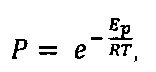
где R - универсальная газовая постоянная, Т - абсолютная температура, Ер - энергия активации проницаемости, причем Ер=Ed+ΔHs, где Ed и ΔHs соответственно энергия активации диффузии и энтальпия абсорбции.where R is the universal gas constant, T is the absolute temperature, E p is the activation energy of permeability, and E p = E d + ΔH s , where E d and ΔH s are respectively the diffusion activation energy and the enthalpy of absorption.
Величина Ed связана с преодолением молекулы диффундирующего вещества энергетических барьеров при прохождении сквозь материал и всегда положительна и особенно велика для стеклообразных полимеров с «замороженными» цепями, тогда как величина ΔHs представляет собой, по сути, энергетический выигрыш той же молекулы при переходе из газа в конденсированную фазу и всегда отрицательна. Поскольку абсорбция паров воды гидрофобными полимерами дает гораздо меньший энергетический выигрыш, чем гидрофильными, величина Ер для них существенно выше, и, следовательно, величина Р для них характеризуется более быстрым ростом с увеличением температуры.The value of E d is associated with the energy barriers passing through the material passing through the material through the material and is always positive and especially large for glassy polymers with “frozen” chains, while the value of ΔH s is, in fact, the energy gain of the same molecule upon transition from the gas into the condensed phase and is always negative. Since the absorption of water vapor by hydrophobic polymers gives a much lower energy gain than hydrophilic ones, the E p value for them is much higher, and therefore, the P value for them is characterized by a more rapid increase with increasing temperature.
Поэтому, в изобретенной пленке, в общем случае, адгезивный слой при подходящей толщине может преимущественно состоять из любого гидрофобного полимера. Тем не менее, для достижения наилучших результатов в соответствии задачами настоящего изобретения предпочтительно, чтобы температурная зависимость паропроницаемости пленки в диапазоне от 6 до 80°C была более сильной, чем это предполагает закон Аррениуса. При этом, предпочтительно, чтобы материал адгезивного слоя характеризовался, по меньшей мере, частичным плавлением, по меньшей мере, одной из присутствующих в нем кристаллических фаз, в диапазоне от 6 до 80°C, причем, желательно, чтобы общее содержание его кристаллических фаз при 80°C составляло не более 20% от их содержания при 6°C. Известно, что кристаллы практически не участвуют в процессах диффузии и абсорбции. По этой причине чисто кристаллические материалы, типа металлов или керамики, при тех же температурах характеризуются гораздо меньшими значениями проницаемости, чем полимеры, имеющие непрерывную аморфную фазу и вкрапления кристаллитов. Также это означает, что превращение кристаллической фазы в аморфную, которое происходит при плавлении, должно сопровождаться резким снижением величины Ed и скачком проницаемости.Therefore, in the invented film, in general, the adhesive layer at a suitable thickness can advantageously consist of any hydrophobic polymer. However, to achieve the best results in accordance with the objectives of the present invention, it is preferable that the temperature dependence of the vapor permeability of the film in the range from 6 to 80 ° C be stronger than the Arrhenius law suggests. Moreover, it is preferable that the material of the adhesive layer is characterized by at least partial melting of at least one of the crystalline phases present in it, in the range from 6 to 80 ° C, and it is desirable that the total content of its crystalline phases at 80 ° C was not more than 20% of their content at 6 ° C. It is known that crystals practically do not participate in diffusion and absorption processes. For this reason, pure crystalline materials, such as metals or ceramics, at the same temperatures are characterized by much lower permeability values than polymers having a continuous amorphous phase and interspersed crystallites. This also means that the transformation of the crystalline phase into an amorphous phase, which occurs during melting, should be accompanied by a sharp decrease in the value of E d and a jump in permeability.
Кристаллические фазы, плавящиеся в указанном диапазоне, могут быть образованы одним или несколькими из вышеперечисленных компонентов адгезивного слоя, т.е. ФУП, УП, гетероцепным полимером или НВ.Crystalline phases melting in the indicated range can be formed by one or more of the above components of the adhesive layer, i.e. FUP, UP, heterochain polymer or HB.
Необходимо иметь в виду, что наиболее распространенные УП - сополимеры олефинов, например этилена, в отличие от гомополимеров могут плавиться в диапазоне температур от 6 до 80°C, но обладают пониженной, по сравнению с этими гомополимерами, степенью кристалличности, что обуславливает менее выраженные скачки проницаемости при их плавлении. Поэтому целесообразно введение в состав этого слоя таких гидрофобных органических низкомолекулярных веществ, которые кристаллизуются практически полностью ниже температуры термообработки пищевого изделия в оболочке и практически не содержат обязательной для полимеров аморфной фазы в условиях его хранения. Присутствие таких гидрофобных НВ еще более целесообразно, если полимерная основа адгезивного слоя преимущественно состоит из не-кристаллизующихся полимеров, например, каучуков или их блок-сополимеров, таких как, например, СБС. Бутадиеновые каучуки и СБС-эластомеры, в зависимости от содержания в цепи полибутадиенового блока транс-изомерных остатков, в указанном диапазоне температур могут быть полукристаллическими, с температурами плавления, характерными для каучуков (до 80°C) и для СБС (45-60°C), либо практически аморфными. В любом случае полезно, а в последнем - весьма целесообразно введение в состав такого слоя гидрофобного НВ. Известно, что подобные вещества, например парафины, будучи введенными в качестве добавки в термопластичные эластомеры типа СБС (Патент США №5106677, опубл. 21.04.1992) и полиолефины (Патент США №5155160, опубл. 13.10.1992), способны существенно снизить СПВП соответствующих пленок при комнатной или более низких температурах.It must be borne in mind that the most common UP - copolymers of olefins, for example ethylene, unlike homopolymers can melt in the temperature range from 6 to 80 ° C, but have a lower crystallinity compared to these homopolymers, which leads to less pronounced jumps permeability during melting. Therefore, it is advisable to introduce into the composition of this layer such hydrophobic organic low molecular weight substances that crystallize almost completely below the heat treatment temperature of the food product in the shell and practically do not contain the amorphous phase required for polymers under storage conditions. The presence of such hydrophobic HBs is even more appropriate if the polymer base of the adhesive layer mainly consists of non-crystallizable polymers, for example rubbers or their block copolymers, such as, for example, SBS. Butadiene rubbers and SBS elastomers, depending on the content of trans-isomeric residues in the polybutadiene block chain, in the indicated temperature range can be semi-crystalline, with melting temperatures characteristic of rubbers (up to 80 ° C) and for SBS (45-60 ° C ), or almost amorphous. In any case, it is useful, and in the latter it is very advisable to introduce a hydrophobic HB into the composition of such a layer. It is known that such substances, for example paraffins, when introduced as additives in thermoplastic elastomers of the SBS type (US Patent No. 5106677, publ. 04/21/1992) and polyolefins (US Patent No. 5155160, publ. 10/13/1992), can significantly reduce SPVP appropriate films at room or lower temperatures.
Добавка НВ целесообразна даже в тех случаях, когда содержащиеся в адгезивном слое полимеры имеют относительно высокую степень кристалличности, и образуют кристаллы, плавящиеся в нужном диапазоне температур. К таким полимерам относится, например, природная или синтетическая гуттаперча, которая в отличие от своего цис-изомера - изопренового каучука, представляет собой кристаллизующийся полимер с температурой плавления 64-74°C и степенью кристалличности до 60% и, поэтому, является особенно полезным компонентом оболочки по настоящему изобретению.HB addition is advisable even in those cases when the polymers contained in the adhesive layer have a relatively high degree of crystallinity and form crystals melting in the desired temperature range. Such polymers include, for example, natural or synthetic gutta-percha, which, unlike its cis isomer, isoprene rubber, is a crystallizable polymer with a melting point of 64-74 ° C and a degree of crystallinity of up to 60% and, therefore, is a particularly useful component shells of the present invention.
Гидрофобные НВ также предпочтительно выбираются так, чтобы они плавились в упомянутом диапазоне температур, например среди н-алканов с числом атомов углерода 15-40 или насыщенных линейных жирных кислот с числом атомов углерода 8-24 или линейных жирных спиртов с числом атомов углерода 11-31.Hydrophobic HBs are also preferably selected so that they melt in the aforementioned temperature range, for example, among n-alkanes with the number of carbon atoms 15-40 or saturated linear fatty acids with the number of carbon atoms 8-24 or linear fatty alcohols with the number of carbon atoms 11-31 .
Если адгезивный слой получен в процессе соэкструзии, желательно, чтобы присутствующие в нем НВ имели содержание от 3 до 30%, предпочтительно от 5 до 25%. Если этот слой наносится на готовую оболочку в виде покрытия, присутствующие в нем НВ могут находиться в количестве от 30 до 90%.If the adhesive layer is obtained by coextrusion, it is desirable that the HBs present in it have a content of from 3 to 30%, preferably from 5 to 25%. If this layer is applied to the finished shell in the form of a coating, the HBs present in it can be in an amount of 30 to 90%.
В предпочтительном воплощении настоящего изобретения адгезивный слой содержит полимеры, состоящие из линейных или слаборазветвленных (типа ПЭВД) макромолекул, и эти полимеры представляют собой обычные коммерческие продукты. Когда такие полимеры плавятся в указанном диапазоне температур, толщина адгезивного слоя может варьироваться от 0,5 до 20 мкм.In a preferred embodiment of the present invention, the adhesive layer comprises polymers consisting of linear or weakly branched (like LDPE) macromolecules, and these polymers are conventional commercial products. When such polymers melt in the indicated temperature range, the thickness of the adhesive layer can vary from 0.5 to 20 microns.
Если же составляющий адгезивный слой полимерный материал в основном плавится при температурах выше 80°C, то чтобы обеспечить необходимый уровень проницаемости в условиях копчения, его следует делать как можно более тонким, предпочтительно толщиной в 0,5-1,5 мкм.If the polymer material constituting the adhesive layer melts mainly at temperatures above 80 ° C, then in order to ensure the required level of permeability under smoking conditions, it should be made as thin as possible, preferably 0.5-1.5 microns thick.
Диапазон плавления присутствующих в этом адгезивном слое или любых других слоях кристаллических фаз, может быть определен методом дифференциальной сканирующей калориметрии (ДСК). Необходимо иметь в виду, что из-за возможной совместимости компонентов и вызванных этим эффектов температурной депрессии, вся область существования кристаллической фазы может быть заметно уже, чем это следует из простого наложения диапазонов плавления компонентов.The melting range present in this adhesive layer or any other layers of crystalline phases can be determined by differential scanning calorimetry (DSC). It must be borne in mind that due to the possible compatibility of the components and the effects of temperature depression caused by this, the entire region of existence of the crystalline phase may be noticeably narrower than this follows from a simple superposition of the melting ranges of the components.
Желательно, чтобы определенная методом ДСК пиковая температура плавления полимерных компонентов этого слоя была не выше 80°C, при этом небольшая часть кристаллов полимера может оставаться нерасплавленной. Пиковая температура плавления одного из полимерных компонентов может превышать 80°C, однако, в этом случае предпочтительно, чтобы содержание такого компонента не превышало 20%.It is desirable that the peak melting temperature determined by the DSC method is not higher than 80 ° C for the polymer components of this layer, while a small fraction of the polymer crystals may remain unmelted. The peak melting temperature of one of the polymer components may exceed 80 ° C, however, in this case, it is preferable that the content of such a component does not exceed 20%.
Полимерные компоненты, как правило, содержат аморфную фазу и имеют различную степень кристалличности в зависимости от состава и структуры полимера и температурно-механической предыстории. Кроме того, степень кристалличности меняется в зависимости от температуры в довольно широком температурном диапазоне (диапазоне плавления). Диапазон плавления полимеров, кроме того, как правило, смещается в область более низких температур в присутствии совместимых с ними низкомолекулярных веществ. Менее выраженная температурная депрессия наблюдается при добавлении совместимых полимеров. С другой стороны, введение даже значительных количеств совместимых полимеров слабо влияет на температуру плавления низкомолекулярных веществ. В любом случае желательно подобрать состав адгезивного слоя так, чтобы остаточное суммарное содержание кристаллической фазы в его материале при 80°C составляло не более 20% от содержания при 6°C. При этом предпочтительно, чтобы адгезивный слой при 6°C содержал от 10 до 80% кристаллической фазы, а при 80°C - 0%.Polymeric components, as a rule, contain an amorphous phase and have a different degree of crystallinity, depending on the composition and structure of the polymer and the temperature-mechanical background. In addition, the degree of crystallinity varies with temperature over a fairly wide temperature range (melting range). The melting range of polymers, in addition, as a rule, shifts to lower temperatures in the presence of compatible low molecular weight substances. Less severe temperature depression is observed when compatible polymers are added. On the other hand, the introduction of even significant amounts of compatible polymers has little effect on the melting point of low molecular weight substances. In any case, it is desirable to select the composition of the adhesive layer so that the residual total content of the crystalline phase in its material at 80 ° C is no more than 20% of the content at 6 ° C. Moreover, it is preferable that the adhesive layer at 6 ° C contains from 10 to 80% of the crystalline phase, and at 80 ° C - 0%.
Низкомолекулярные составляющие материала адгезивного слоя, если они там присутствуют, преимущественно плавятся до 80°C. Если такие вещества характеризуются высокой чистотой, они плавятся в очень узком диапазоне температур. Если эти вещества представляют собой смеси, диапазон их плавления может быть широким. В таком случае небольшая фракция этих смесей, преимущественно не более 10%, а предпочтительно не более 5%, может плавиться ниже 6°C.The low molecular weight components of the adhesive layer material, if present, predominantly melt to 80 ° C. If such substances are characterized by high purity, they melt in a very narrow temperature range. If these substances are mixtures, their melting range can be wide. In this case, a small fraction of these mixtures, preferably not more than 10%, and preferably not more than 5%, can melt below 6 ° C.
(Со)полимеры алкиленоксидов и поли-ε-капролактоны, а также, их блок-сополимеры в составе адгезивного слоя предпочтительно тоже выбираются так, чтобы они претерпевали фазовый переход плавления в диапазоне температур от 6 до 80°C. Этому условию удовлетворяют, например, гомополимеры этиленгликоля (полиэтиле-ноксида) с молекулярной массой не менее 0,6 кДа (Тпл от 20 до 60°C), тетраметиленгликоля с молекулярной массой не менее 0,6 кДа (Тпл от 17 до 60°C), высокомолекулярный изотактический полипропиленгликоль (Тпл до 75°C) и поли-ε-капролактон с молекулярной массой не ниже 0,55 кДа (Тпл от 18 до 60°C). Нужно иметь в виду, что кристаллические фазы, образованные цепями этих же полимеров в составе блок-сополимеров, имеют более низкие температуры плавления, чем соответствующие свободные продукты такой же молекулярной массы.The (Co) alkylene oxide polymers and poly-ε-caprolactones, as well as their block copolymers in the adhesive layer are also preferably selected so that they undergo a melting phase transition in the temperature range from 6 to 80 ° C. This condition is satisfied, for example, homopolymers of ethylene glycol (polyethylene oxide) with a molecular weight of at least 0.6 kDa (T PL from 20 to 60 ° C), tetramethylene glycol with a molecular weight of at least 0.6 kD (T PL from 17 to 60 ° C), high molecular weight isotactic polypropylene glycol (T pl up to 75 ° C) and poly-ε-caprolactone with a molecular weight of at least 0.55 kDa (T pl from 18 to 60 ° C). It must be borne in mind that the crystalline phases formed by the chains of the same polymers as part of block copolymers have lower melting points than the corresponding free products of the same molecular weight.
В блок-сополимерах «плавление» в упомянутом диапазоне не сопровождается переходом полимера в целом в жидкое состояние, поскольку при таких невысоких температурах оно может быть обусловлено распадом кристаллов только более легкоплавких блоков (со)полиалкиленоксидов или ПКЛ при сохранении кристаллической или стеклообразной фазы «жестких» блоков.In block copolymers, “melting” in the mentioned range is not accompanied by the transition of the polymer as a whole to a liquid state, since at such low temperatures it can be caused by the decomposition of crystals of only the more fusible blocks of (co) polyalkylene oxides or PCLs while maintaining the crystalline or glassy phase of the “hard” blocks.
НВ и полимеры, имеющие хотя бы одну концевую группу ОН, NHR (где R - углеводородный радикал) или NH2, могут образовывать при смешивании с ФУП привитые или частично сшитые структуры, которые обеспечивают хорошую совместимость с ФУП и УП при смешивании.HB and polymers having at least one OH, NHR end group (where R is a hydrocarbon radical) or NH 2 can form grafted or partially crosslinked structures when mixed with PCF, which provide good compatibility with PCF and UP when mixed.
Все подходящие компоненты адгезивного слоя можно найти среди коммерчески доступных и относительно дешевых продуктов.All suitable components of the adhesive layer can be found among commercially available and relatively cheap products.
Привитые малеиновым ангидридом линейные сополимеры этилена с α-олефинами и сополимеры этилена с винилацетатом промышленно производятся целым рядом компаний, например, DuPont de Nemours под торговыми маркам Bynel® и Fusabond® (концентрат с высокой степенью прививки), Arkema Inc. под маркой Orevac®, Dow Chemical Со. под маркой Amplify® (концентрат) и т.п.Maleic anhydride grafted linear ethylene-α-olefin copolymers and ethylene-vinyl acetate copolymers are industrially produced by a number of companies, for example DuPont de Nemours under the trademarks Bynel® and Fusabond® (highly grafted concentrate), Arkema Inc. under the brand name Orevac®, Dow Chemical Co. under the brand name Amplify® (concentrate), etc.
Продукты прививки малеиновым ангидридом стирол-этилен-бутадиен-стирольного термопластичного эластомера промышленно производятся, например, компанией Kraton Polymers U.S. LLC (США) под маркой Kraton® FG.Styrene-ethylene-butadiene-styrene-thermoplastic elastomer maleic anhydride grafting products are industrially produced, for example, by Kraton Polymers U.S. LLC (USA) under the brand name Kraton® FG.
Сополимеры этилена и (мет)акриловой кислоты промышленно производятся, например, компанией DuPont de Nemours под маркой Nucrel®, сополимеры (терполимеры) этилена, винилацетата и малеинового ангидрида компанией Arkema Inc. под маркой Orevac ®. Сополимер (терполимер) этилена, метилакрилата и глицидилового эфира акриловой кислоты (глицидилакрилата), также имеющий хорошую адгезию к полиамидам, производится, например, компанией Arkema Inc. под марками Lotader® АХ8900, АХ8920 и АХ8940, а терполимер этилена, этилакрилата и малеинового ангидрида производится ею же под марками Lotader® 7500, 5500, 4700 и 4720.Copolymers of ethylene and (meth) acrylic acid are industrially produced, for example, by DuPont de Nemours under the Nucrel® brand, copolymers (terpolymers) of ethylene, vinyl acetate and maleic anhydride by Arkema Inc. under the brand name Orevac ®. A copolymer (terpolymer) of ethylene, methyl acrylate and glycidyl ether of acrylic acid (glycidyl acrylate), also having good adhesion to polyamides, is produced, for example, by Arkema Inc. under the brands Lotader® AH8900, AH8920 and AH8940, and terpolymer of ethylene, ethyl acrylate and maleic anhydride is produced by it under the brands Lotader® 7500, 5500, 4700 and 4720.
Например, адгезивный слой может быть целиком выполнен из адгезивного термопластичного материала, предпочтительно, отвечающего требованию относительно диапазона его плавления, такого как, например, Amplify® TY1052H (Тпл около 63°C), Orevac® 18211 (Тпл около 75°C), Bynel® Е418 (Тпл около 74°C) или Fusabond® С190 (Тпл около 71°С).For example, the adhesive layer may be entirely made of an adhesive thermoplastic material, preferably meeting the requirement for its melting range, such as, for example, Amplify® TY1052H (T PL about 63 ° C), Orevac® 18211 (T PL about 75 ° C) , Bynel® E418 ( mp 74 ° C) or Fusabond® C190 ( mp 71 ° C).
Среди марок промышленных термопластичных УП можно легко найти такие, которые также плавятся ниже 80°C предпочтительно в диапазоне от 40 до 75°C.Это, например, сополимеры этилена и винилацетата, такие как продукты компаний Arkema - Evatane® 28-05 (Тпл около 72°C) или DuPont - Elvax® 3182 (Тпл около 73°C) и Elvax® СМ 3326 (Тпл около 60°C), сополимеры этилена и α-олефинов (пластомеры) Affinity® EG 8150G (Тпл около 55°C) и др. от Dow Elastomers или Exact® Plastomer 5062 (Тпл около 43°C) от Exxon Mobile.Among industrial thermoplastic UP grades one can easily find those that also melt below 80 ° C, preferably in the range from 40 to 75 ° C. These are, for example, ethylene vinyl acetate copolymers, such as Arkema - Evatane® 28-05 (Т pl approx. 72 ° C) or DuPont - Elvax® 3182 ( mp 73 ° C) and Elvax® CM 3326 ( mp 60 ° C), copolymers of ethylene and α-olefins (plastomers) Affinity® EG 8150G ( mp approx. 55 ° C) et al. From Dow Elastomers or Exact® Plastomer 5062 ( mp approx. 43 ° C) from Exxon Mobile.
Транс-1,4-полиизопрен (синтетическая гуттаперча) доступен, например, под маркой ТР-301 (Тпл около 67°C), производства компании Kuraray Со.Trans-1,4-polyisoprene (synthetic gutta-percha) is available, for example, under the brand name TR-301 (T pl about 67 ° C), manufactured by Kuraray Co.
Немодифицированные, преимущественно аморфные, частично олефиновые или неолефиновые углеводородные (со)полимеры такие, как СБС, СИС, СЭБС и некоторые синтетические каучуки доступны, например, под общей маркой Kraton® от компании Kraton Polymers US LLC.Unmodified, predominantly amorphous, partially olefin or neolefin hydrocarbon (co) polymers such as SBS, SIS, SEBS and some synthetic rubbers are available, for example, under the common name Kraton® from Kraton Polymers US LLC.
Водорастворимые полиэтиленгликоли с молекулярной массой примерно 0,2-35 кДа, имеющие концевые гидроксильные группы, производятся, например, компанией Clariant AG (Швейцария) под общим названием PEG®. Компания Dow Chemical Co. также производит полиэтиленгликоли под маркой Carbowax® и полиэтиленоксиды -полимеры того же строения, но с молекулярной массой 100 кДа и выше, под маркой Polyox®. (Со)полимеры алкиленоксидов (преимущественно этиленоксида и пропиленоксида) с одной или двумя концевыми аминогруппами производятся Huntsman Corporation под общей маркой Jeffamine®. Политетраметиленгликоли с молекулярной массой до 2 кДа (также называемые политертагидрофуранами) производятся, например компанией BASF (Германия) под маркой PolyTHF®. Компания Perstorp под общей маркой Сара® промышленно выпускает поли-ε-капролактоны как олигомерные с молекулярной массой от 0,4 до 8 кДа, так и термопластичные с молекулярной массой от 10 до 80 кДа. Она же продает и блок-сополимеры типа ПТГФ-ПКЛ под маркой Сара® 7201А. Компания Lubrizol Corp. промышленно выпускает ТПУ с блоками поли-ε-капролактона под маркой Pearlthane®.Water-soluble polyethylene glycols with a molecular weight of about 0.2-35 kDa having terminal hydroxyl groups are produced, for example, by Clariant AG (Switzerland) under the general name PEG®. Dow Chemical Co. also produces polyethylene glycols under the Carbowax® brand and polyethylene oxides - polymers of the same structure, but with a molecular weight of 100 kDa and higher, under the Polyox® brand. (Co) polymers of alkylene oxides (primarily ethylene oxide and propylene oxide) with one or two amino terminal groups are manufactured by Huntsman Corporation under the common name Jeffamine®. Polytetramethylene glycols with a molecular weight of up to 2 kDa (also called polytertahydrofurans) are produced, for example, by BASF (Germany) under the brand name PolyTHF®. Perstorp, under the common brand name Sara®, industrially produces poly-ε-caprolactones, both oligomeric with a molecular weight of from 0.4 to 8 kDa, and thermoplastic with a molecular weight of from 10 to 80 kDa. She also sells block copolymers of the PTGF-PKL type under the brand name Sara® 7201A. Company Lubrizol Corp. industrialized TPU with poly-ε-caprolactone blocks under the brand name Pearlthane®.
Гидрофобные НВ такие, как парафины, воски и липиды, производятся огромным количеством компаний.Hydrophobic HBs such as paraffins, waxes and lipids are produced by a huge number of companies.
Кроме вышеперечисленных обязательных слоев изобретенная оболочка может иметь хотя бы один дополнительный полимерный слой (ДС), не содержащий ФУП и (со)полиамиды.In addition to the abovementioned required layers, the invented shell may have at least one additional polymer layer (DS) that does not contain PCF and (co) polyamides.
Материалы для дополнительного слоя или слоев предпочтительно подбираются так, чтобы он либо обладал высокой паропроницаемостью, нарастающей с ростом температуры по закону Аррениуса во всем диапазоне температур от 6° до 80°C, либо, в предпочтительном варианте, претерпевал скачек паропроницаемости в этом же диапазоне за счет плавления присутствующих в нем кристаллических фаз. В последнем случае, такой слой может усилить или даже преимущественно обеспечить желаемый эффект изменения паропроницаемости, обусловленный, кроме того, фазовыми переходами плавления в адгезивном слое. При этом, все предпочтительные варианты, упомянутые при описании адгезивного слоя, и касающиеся содержания кристаллической фазы при 6 и 80°C, также относятся и к этому дополнительному слою.The materials for the additional layer or layers are preferably selected so that it either has high vapor permeability, increasing with increasing temperature according to Arrhenius law over the entire temperature range from 6 ° to 80 ° C, or, in the preferred embodiment, undergoes a vapor permeability jump in the same range for due to the melting of the crystalline phases present in it. In the latter case, such a layer can enhance or even advantageously provide the desired effect of the change in vapor permeability, due, in addition, to phase transitions of melting in the adhesive layer. In this case, all the preferred options mentioned in the description of the adhesive layer, and relating to the content of the crystalline phase at 6 and 80 ° C, also apply to this additional layer.
В соответствии с настоящим изобретением дополнительный слой может быть выполнен в двух различных вариантах.In accordance with the present invention, the additional layer can be made in two different ways.
Дополнительный слой первого типа (далее ДС1) соэкструдирован из одного или нескольких вышеописанных нефункционализированных УП и предпочтительно граничит хотя бы с одним адгезивным слоем. Такой слой также может содержать вышеописанные гидрофобные НВ, используемые в адгезивном слое, например, такие как парафины, воски и т.п. УП также предпочтительно должны выбираться с точки зрения наличия у них фазового перехода в упомянутом диапазоне температур, с тем, чтобы выполненные из них дополнительные слои претерпевали требуемый скачок паропроницаемости. Предпочтительно, чтобы толщина этого слоя (или слоев) составляла не более 10% от общей толщины изобретенной оболочки.An additional layer of the first type (hereinafter referred to as DS 1 ) is coextruded from one or more of the above-described non-functionalized UEs and preferably borders on at least one adhesive layer. Such a layer may also contain the hydrophobic HBs described above used in the adhesive layer, for example, such as paraffins, waxes, and the like. UEs should also preferably be selected from the point of view of the presence of a phase transition in the mentioned temperature range, so that additional layers made of them undergo the required vapor permeability jump. Preferably, the thickness of this layer (or layers) is not more than 10% of the total thickness of the invented shell.
Дополнительный слой второго типа (далее ДС2) предпочтительно выполнен из хотя бы одного из таких компонентов, как сложные эфиры целлюлозы, термопластичный поли-ε-капролактон, водорастворимые (со)полимеры, включая поливиниловый спирт, поливинилпирролидон, полиэтиленоксид, простые эфиры целлюлозы, а также блок-сополимеры, имеющие жесткие блоки из полиамидов, сложных полиэфиров или полиуретанов, и гибкие блоки из простых алифатических полиэфиров (в частности, из полиэтиленоксида с молекулярной массой более 10 кДа), поли-ε-капролактондиола или полисилоксанов, или любой смеси перечисленных компонентов. Предпочтительно, чтобы толщина этого слоя (или слоев) составляла не более 40% от общей толщины изобретенной оболочки, т.к. его компоненты не обладают достаточно хорошими прочностными характеристиками. Поскольку перечисленные компоненты обычно имеют приемлемую адгезию к полиамидам, такой дополнительный слой или слои могут располагаться в любом положении последовательности слоев, образующих оболочку. Кроме того, дополнительный слой может быть выполнен из неармированной или армированной волокном вискозы. В этом случае, в силу невозможности применения метода соэкструзии, такой дополнительный слой всегда располагается на периферии слоевой структуры оболочки.An additional layer of the second type (hereinafter DS 2 ) is preferably made of at least one of such components as cellulose esters, thermoplastic poly-ε-caprolactone, water-soluble (co) polymers, including polyvinyl alcohol, polyvinylpyrrolidone, polyethylene oxide, cellulose ethers, and also block copolymers having rigid blocks of polyamides, polyesters or polyurethanes, and flexible blocks of aliphatic polyesters (in particular polyethylene oxide with a molecular weight of more than 10 kDa), poly-ε-caprolactondiol and whether polysiloxanes, or any mixture of these components. Preferably, the thickness of this layer (or layers) is not more than 40% of the total thickness of the invented shell, because its components do not have sufficiently good strength characteristics. Since the listed components usually have acceptable adhesion to polyamides, such an additional layer or layers can be located at any position in the sequence of layers forming the shell. In addition, the additional layer may be made of unreinforced or fiber-reinforced viscose. In this case, due to the impossibility of using the coextrusion method, such an additional layer is always located on the periphery of the layer structure of the shell.
Перманентно высокая паропроницаемость с относительно слабой Аррениусовской температурной зависимостью типична для целлюлозы, сложных эфиров целлюлозы, ПВС, а также для перечисленных блок-сополимеров, если содержащиеся в них гибкие блоки не способны кристаллизоваться в принципе, как, например, цепи атактического полипропиленгликоля или полисилоксана, или, хотя бы, не способны кристаллизоваться в упомянутом температурном диапазоне, как слишком короткие цепи ПЭО, ПТГФ или ПКЛ.Permanently high vapor permeability with a relatively weak Arrhenius temperature dependence is typical for cellulose, cellulose esters, PVA, and also for the listed block copolymers if the flexible blocks contained in them are not able to crystallize in principle, such as, for example, chains of atactic polypropylene glycol or polysiloxane, or , at least, they are not able to crystallize in the mentioned temperature range, like too short chains of PEO, PTHF or PCL.
Скачек проницаемости в нужном диапазоне, связанный с плавлением кристаллической фазы, образованной гибкими блоками, характерен для блок-сополимеров тех же типов при достаточной длине тех же блоков ПЭО, ПТГФ или ПКЛ.The permeability jump in the desired range, associated with the melting of the crystalline phase formed by flexible blocks, is typical for block copolymers of the same types with a sufficient length of the same blocks of PEO, PTGF or PCL.
Перечисленные водорастворимые полимеры, а также гомополимерный ПКЛ предпочтительно используются в смеси с вышеперечисленными высокопроницаемыми к парам воды полимерами, при преобладающей массовой доле последних, и вводятся для увеличения паропроницаемости слоя.The listed water-soluble polymers, as well as the homopolymer PCL, are preferably used in a mixture with the above-mentioned polymers highly permeable to water vapor, with a predominant mass fraction of the latter, and introduced to increase the vapor permeability of the layer.
Температурное поведение ПЭО, ПТГФ и ПКЛ и их кристаллизующихся блоков также обсуждалось выше.The temperature behavior of PEO, PTGF, and PCL and their crystallizing blocks was also discussed above.
Необходимо отметить, что соображения относительно паропроницаемости дополнительного слоя могут также относиться и к полиамидсодержащему слою. Хотя обычно такой слой (или слои) характеризуется перманентно высокой паропроницаемостью, возможны варианты воплощения, когда паропроницаемость слоя из-за плавления присутствующих в нем материалов претерпевает скачек в упомянутом диапазоне температур. Такое происходит, например, когда в таком слое содержится большая доля вышеупомянутых блок-сополимеров с плавящимися блоками ПЭО или ПТГФ, таких как, например, ПЭБА (торговая марка Pebax® и т.п.). Таким образом, полиамидсодержащий слой также может вносить вклад в желаемый эффект изменения паропроницаемости, обусловленный фазовыми переходами плавления в адгезивном и/или дополнительном слое.It should be noted that considerations regarding the vapor permeability of the additional layer may also apply to the polyamide-containing layer. Although usually such a layer (or layers) is characterized by permanently high vapor permeability, embodiments are possible when the vapor permeability of a layer, due to the melting of the materials present in it, undergoes a jump in the mentioned temperature range. This happens, for example, when such a layer contains a large proportion of the aforementioned block copolymers with melting blocks of PEO or PTHF, such as, for example, PEBA (trademark Pebax®, etc.). Thus, the polyamide-containing layer can also contribute to the desired vapor permeability change effect due to phase transitions of the melting in the adhesive and / or additional layer.
Кроме того, любой из слоев изобретенной оболочка может содержать в общем количестве, не превышающем 15%, такие добавки как сшивающие агенты, антиоксиданты, пластификаторы, пигменты, красители, армирующие добавки, матирующие добавки, агенты скольжения, высокодисперсные и грубодисперсные наполнители, антиблокирующие агенты и т.п.In addition, any of the layers of the invented shell may contain, in a total amount not exceeding 15%, such additives as crosslinking agents, antioxidants, plasticizers, pigments, dyes, reinforcing agents, matting agents, glidants, highly dispersed and coarse fillers, anti-blocking agents and etc.
Что касается структуры изобретенной оболочки, т.е. последовательности ее слоев и выбора их конкретного состава, то она может варьироваться в зависимости от ее предполагаемого предназначения.Regarding the structure of the invented shell, i.e. sequence of its layers and the choice of their specific composition, then it may vary depending on its intended purpose.
Слой любого из вышеописанных типов может периферийным, т.е. быть обращенным к содержимому оболочки или к окружающей среде, или сердцевинным, т.е. быть окруженным другими слоями.A layer of any of the above types may be peripheral, i.e. facing the contents of the shell or the environment, or core, i.e. be surrounded by other layers.
Например, если требуется надежная защита упакованного продукта от порчи в результате окислительных процессов, оболочка должна обладать, помимо вышеописанного комплекса свойств, хорошими кислородобарьерными характеристиками, по меньшей мере, в условиях хранения. В этом случае предпочтительно, чтобы в качестве внешнего, обращенного к атмосфере слоя рукава, использовался ПАС из смеси типа ПА/ПВС или ПА/ПВП.For example, if reliable protection of the packaged product from damage as a result of oxidative processes is required, the shell should have, in addition to the above set of properties, good oxygen-barrier characteristics, at least in storage conditions. In this case, it is preferable that PAS from a mixture of the type PA / PVA or PA / PVP be used as the outer layer of the sleeve facing the atmosphere.
При этом предпочтительно, чтобы этот ПАС имел максимальную толщину. Благодаря тому, что в такой оболочке влагобарьерные в условиях хранения слои типа АС и/или ДС1 расположены ближе к влажному фаршу, они не позволяют молекулам воды из влажного содержимого попадать в наружный ПАС (обращенный к относительно сухому воздуху), который содержит вышеупомянутые водорастворимые полимеры, обладающие замечательными кислородобарьерными свойствами именно в сухом виде и придающие эти свойства слою в целом. Таким образом, данное воплощение изобретенной оболочки в условиях надлежащего хранения (т.е. при низкой ОВ), обладает при одинаковой толщине лучшими кислородобарьерными свойствами по сравнению с однослойными коптящимися оболочками, описанными в патенте РФ №2182107, и по сравнению с многослойными оболочками с полиамидным слоем в качестве кислородного барьера, раскрытыми, например, в патенте Германии №4017046, опубл. 28.11.91.Moreover, it is preferable that this PAS has a maximum thickness. Due to the fact that, in such a shell, the moisture barrier layers under storage conditions such as АС and / or ДС 1 are located closer to wet mincemeat, they do not allow water molecules from the moist contents to enter the external PAS (facing relatively dry air), which contains the aforementioned water-soluble polymers possessing remarkable oxygen-barrier properties in the dry form and imparting these properties to the layer as a whole. Thus, this embodiment of the invented casing under proper storage conditions (i.e., at low RH), has the same thickness with better oxygen barrier properties compared to the single-layer smoked casings described in RF patent No. 2182107, and compared to multilayer casings with polyamide a layer as an oxygen barrier, disclosed, for example, in German patent No. 4017046, publ. 11/28/91.
Если кислородный барьер не столь важен, например, предполагается упаковка продукта, не содержащего легко прогоркающий жир или содержащего достаточное количество антиоксиданта, в качестве внешнего, обращенного к атмосфере, слоя рукава может использоваться АС или ДС1.If the oxygen barrier is not so important, for example, it is intended to pack a product that does not contain easily rancid fat or contains a sufficient amount of antioxidant, AS or DS 1 can be used as an outer layer facing the atmosphere.
Материал внутреннего слоя, контактирующего с пищевым содержимым, выбирается, главным образом, исходя из требуемых адгезивных свойств оболочки по отношению к содержимому. Например, если требуется слабая адгезия оболочки к колбасному фаршу или сыру, в качестве внутреннего слоя может быть выбран ПАС слой из смеси тип а ПА/ПВС или ДС1.The material of the inner layer in contact with the food content is selected mainly on the basis of the required adhesive properties of the shell relative to the content. For example, if poor adhesion of the casing to sausage meat or cheese is required, a PAS layer from a type PA / PVA or DS 1 mixture can be selected as the inner layer.
Если требуется умеренная адгезия оболочки к содержимому, в качестве внутреннего слоя может быть использован АС.If moderate coating adhesion to the contents is required, AS can be used as the inner layer.
Если требуется сильная адгезия оболочки к содержимому, в качестве материала внутреннего слоя можно использовать смесь типа ПА/ПВП или смесь с любым вышеописанным высокопроницаемым к парам воды блок-сополимером, либо с термопластичным сложным эфиром целлюлозы, либо любой слой типа ДС2, не содержащий ПВС, либо слой на основе вискозы.If strong adhesion of the shell to the content is required, a PA / PVP mixture or a mixture with any block copolymer highly permeable to water vapor or with a thermoplastic cellulose ester or any DS 2 layer without PVA can be used as the material of the inner layer or a layer based on viscose.
В случае, если оболочка имеет три и более слоев, то один из сердцевинных слоев может быть адгезивным слоем. При этом в качестве периферийных слоев могут использоваться как полиамидсодержащие слои, так и дополнительные слои: оба слоя полиамидсодержащие, один слой полиамидсодержащий, а второй дополнительный, а если число слоев более трех - оба слоя могут быть дополнительными (при этом полиамидсодержащий слой - сердцевинный). Кроме того, хотя бы один из периферийных слоев может быть адгезивным слоем.If the shell has three or more layers, then one of the core layers may be an adhesive layer. At the same time, both polyamide-containing layers and additional layers can be used as peripheral layers: both layers are polyamide-containing, one layer is polyamide-containing, and the second is additional, and if the number of layers is more than three, both layers can be additional (in this case, the polyamide-containing layer is core). In addition, at least one of the peripheral layers may be an adhesive layer.
Изобретенная оболочка может целиком изготавливаться методом соэкструзии из расплава с использованием коммерческих продуктов в виде гранул компонентов. При этом некоторые компоненты слоев, такие как смеси полимеров с НВ, могут быть заранее получены перемешиванием в подходящем устройстве для смешивания полимерных композиций, например, в двухшнековом экструдере с последующей грануляцией. Оболочка может быть выполнена в виде рукавной или плоской пленки, быть неориентированной, одноосно-ориентированной или двуосно-ориентированной, и при необходимости, термофиксированной. Предпочтительно, эта оболочка изготавливается в виде рукавной пленки либо методом экструзионного раздувного формования, либо по технологии «тройного пузыря», включающей в качестве основных стадий соэкструзию из расплава т.н. первичного рукава (первый пузырь), его последующую ориентационную вытяжку раздувом (второй пузырь) и термофиксацию в виде раздутого рукава (третий пузырь) с одновременной частичной релаксацией пленки в одном или обоих направлениях.The invented sheath can be entirely made by melt co-extrusion using commercial products in the form of component granules. However, some of the components of the layers, such as a mixture of polymers with HB, can be obtained in advance by mixing in a suitable device for mixing polymer compositions, for example, in a twin-screw extruder, followed by granulation. The shell can be made in the form of a sleeve or a flat film, be non-oriented, uniaxially oriented or biaxially oriented, and, if necessary, thermofixed. Preferably, this shell is made in the form of a sleeve film either by extrusion blow molding or by the “triple bubble” technology, which includes so-called melt coextrusion as the main stages. primary sleeve (first bubble), its subsequent orientation stretch blowing (second bubble) and heat setting in the form of a swollen sleeve (third bubble) with simultaneous partial relaxation of the film in one or both directions.
Кроме того, возможно получение изобретенной пленки таким способом, когда на оболочку, содержащую один или несколько соэкструдированных слоев, наносят АС, ПАС или ДС слой(и) в виде покрытия. В этом случае композиция АС слоя может иметь высокое (и даже преобладающее) содержание НВ, температуру плавления, лишь ненамного превышающую комнатную (35-50°C), и сравнительно невысокую вязкость в расплаве. Композиция АС слоя может иметь температуру плавления даже ниже комнатной (но выше 6°C), если она, непосредственно после нанесения, подвергается химической сшивке под воздействием ультрафиолетового (при введении в композицию УФ-инициаторов) или рентгеновского или γ-излучения или пучков быстрых электронов. Кроме того, эта композиция может включать добавки, способные быстро химически сшивать полимерные компоненты при нагревании, которое следует за нанесением, например серы, вулканизирующей каучуки и гуттаперчу, или эпоксид-содержащих добавок, таких как эпоксидированное растительное масло или эпоксидная смола Э-40, реагирующих при нагревании с малеинезированными полимерами, давая сшитую структуру.In addition, it is possible to obtain the invented film in such a way that an AC, PAS or DS layer (s) is applied to a shell containing one or more coextruded layers. In this case, the composition of the AS layer can have a high (and even predominant) HB content, a melting point that is only slightly higher than room temperature (35-50 ° C), and a relatively low melt viscosity. The composition of the AC layer can have a melting temperature even lower than room temperature (but above 6 ° C) if it is chemically crosslinked immediately after application under the influence of ultraviolet (when UV initiators are introduced into the composition) or X-ray or γ-radiation or fast electron beams . In addition, this composition may include additives capable of rapidly chemically crosslinking the polymer components upon heating, followed by application of, for example, sulfur, vulcanizing rubbers and gutta-percha, or epoxy-containing additives such as epoxidized vegetable oil or E-40 epoxy resin, reactive when heated with maleized polymers, giving a crosslinked structure.
АС с более высокой температурой плавления может быть нанесен на каждую из сторон плоско сложенной рукавной оболочки, например, методом экструзионного покрытия, а с более низкой (ниже комнатной) - например, одним из методов глубокой ротационной печати. В последнем случае можно подобрать состав слоя так, чтобы он отверждался при нагревании или при УФ-облучении. Кроме того, отвержденный или неотвержденный АС слой может быть перекрыт слоем из механически более прочного, но высокопроницаемого к парам воды материала, нанесенного из раствора в подходящем растворителе также методом глубокой ротационной печати или любым другим методом.AS with a higher melting temperature can be applied to each side of a flat folded tubular sheath, for example, by extrusion coating, and with a lower (lower than room) one, for example, one of the methods of intaglio printing. In the latter case, the composition of the layer can be selected so that it cures upon heating or under UV irradiation. In addition, the cured or uncured AC layer can be covered with a layer of a mechanically stronger, but highly vapor permeable material, deposited from a solution in a suitable solvent also by intaglio printing or any other method.
АС слой, полученный в виде покрытия на (со)экструдированной оболочке, может оказаться внутренним слоем рукава, обращенным к содержимому оболочки, если оболочку с покрытием подвергнуть гофрации, а затем вывернуть наизнанку полученную гофрокуклу.The AC layer obtained as a coating on the (co) extruded shell may turn out to be the inner layer of the sleeve facing the contents of the shell if the coated shell is corrugated and then the corrugated doll turned inside out.
Далее, независимо от того, находится ли этот слой снаружи или внутри рукава, если он не был отвержден, в оболочку может быть добавлен еще один высокопроницаемый к парам воды слой, способом, описанным в патенте США №8226457, опубл. 24.07.2012, который раскрывает технологию несоэкструзионного соединения рукавных слоев из различных материалов. Для этого используются две готовые рукавные оболочки, одна из которых берется в виде рулона, а другая - в виде гофрокуклы, которые соединяются между собой в результате введения одной (рулонной) в другую (гофрированную) оболочку и раздува внутренней оболочки воздухом, после чего полученная композиционная оболочка гофрируется. Дополнительный высокопроницаемый к парам воды слой такой композиционной оболочки по настоящему изобретению предпочтительно выполняется из вискозы неармированной или армированной волокнами целлюлозы. Если вискозный слой желательно поместить снаружи рукава, можно использовать коммерческую вискозную оболочку в виде гофрокуклы, а изобретенную оболочку с наружным покрытием в виде рулона, если внутри, то наоборот - вискозную оболочку в виде рулона, а изобретенную оболочку в виде гофрокуклы с внутренним покрытием. В обоих случаях АС слой может обеспечить адгезию между соединенными оболочками. Использование вискозы в качестве материала внутреннего или внешнего слоя изобретенной оболочки позволяет эффективно удерживать на той или иной поверхности пленки ароматные и красящие компоненты, что весьма полезно, если для копчения применяется технология предварительной обработки оболочки жидким дымом. В частности, оболочка на основе вискозы может быть сразу экструдирована из смеси вискозы и жидкого дыма, как это раскрыто в патенте США №6299917, опубл. 09. 10.2001, и предпочтительно использована в качестве внутреннего слоя композиционной оболочки по настоящему изобретению.Further, regardless of whether this layer is on the outside or inside the sleeve, if it has not been cured, another layer highly permeable to water vapor can be added to the shell, in the manner described in US Pat. No. 8,226,457, publ. 07/24/2012, which reveals the technology of non-extrusion connection of sleeve layers of various materials. For this, two ready-made sleeve shells are used, one of which is taken in the form of a roll, and the other in the form of a corrugated doll, which are interconnected as a result of introducing one (rolled) into the other (corrugated) shell and blowing the inner shell with air, after which the resulting composite the shell is corrugated. The additional highly vapor permeable layer of such a composite shell of the present invention is preferably made of viscose unreinforced or fiber reinforced cellulose. If it is desirable to place the viscose layer on the outside of the sleeve, you can use a commercial viscose shell in the form of a corrugated doll, and the invented shell with an outer coating in the form of a roll, if inside, then on the contrary, a viscose shell in the form of a roll, and the invented shell in the form of a corrugated doll with an inner coating. In both cases, the AC layer can provide adhesion between the connected shells. The use of viscose as a material of the inner or outer layer of the invented shell allows you to effectively hold aromatic and coloring components on one or another film surface, which is very useful if the pre-treatment of the shell with liquid smoke is used for smoking. In particular, a viscose-based shell can be directly extruded from a mixture of viscose and liquid smoke, as disclosed in US Pat. No. 6,299,917, publ. 09. 10.2001, and preferably used as the inner layer of the composite shell of the present invention.
В случае, если (со)экструдированные слои оболочки имеют вид плоской пленки, слой из вискозы может быть присоединен к этой пленке методами обычного ламинирования, причем для склеивания пленок предпочтительно используется адгезивный слой по настоящему изобретению, который был соэкструдирован или предварительно нанесен в виде покрытия.If the (co) extruded shell layers are in the form of a flat film, the rayon layer can be bonded to this film by conventional lamination, with the adhesive layer of the present invention preferably coextruded or precoated to adhere the films.
В своих предпочтительных воплощениях изобретения оболочка представляет собой рукавную пленку, однако она также может изготавливаться в виде смотанного в рулон плоского протяженного листа для использования в качестве упаковочного материала в упаковочных машинах вертикального или горизонтального типа. В этом случае предпочтительно, чтобы периферийные слои оболочки были выполнены преимущественно из термосвариваемых материалов таких, как, например ПЭБА или блок-сополимеров сложных и простых эфиров. Получение таких плоских листов может осуществляться, например, путем разрезания предварительно полученной рукавной оболочки в продольном направлении или путем плоскощелевой экструзии, при необходимости, с последующей вытяжкой в одном или двух направлениях.In its preferred embodiments of the invention, the casing is a sleeve film, however, it can also be made in the form of a rolled up flat sheet for use as packaging material in vertical or horizontal packaging machines. In this case, it is preferable that the peripheral layers of the shell be made predominantly of heat sealable materials, such as, for example, PEBA or block copolymers of esters and ethers. Obtaining such flat sheets can be carried out, for example, by cutting a previously obtained tubular sheath in the longitudinal direction or by plane-slot extrusion, if necessary, followed by drawing in one or two directions.
В нижеследующих примерах, приведенных исключительно в качестве иллюстрации настоящего изобретения, но никоим образом не огранивающих объем притязаний, определяемых формулой этого изобретения, раскрыты предпочтительные варианты его воплощений.In the following examples, given solely as an illustration of the present invention, but in no way limiting the scope of the claims defined by the claims of this invention, preferred embodiments are disclosed.
ПримерыExamples
Применяемые материалы и обозначения, применяемые в примерах.Applied materials and designations used in the examples.
ПолиамидыPolyamides
ПА - Полукристаллический полиамид 6 с температурой плавления 220°C и плотностью около 1,14 г/см3 - марка Ultramid® В3 (производство компании BASF).PA - Semi-crystalline polyamide 6 with a melting point of 220 ° C and a density of about 1.14 g / cm 3 - brand Ultramid® B3 (manufactured by BASF).
соПА1 - Полукристаллический сополиамид 6/66 (содержание мономера ПА 66 около 15%) с температурой плавления 195°C и плотностью около 1,13 г/см3 - марка Ultramid® С33 (производство компании BASF).sOPA1 - Semi-crystalline copolyamide 6/66 (PA 66 monomer content of about 15%) with a melting point of 195 ° C and a density of about 1.13 g / cm 3 - Ultramid® C33 grade (manufactured by BASF).
соПА2 - Полукристаллический спирторастворимый сополиамид 6/66 по ОСТ 6-05-438-93 (содержание мономера ПА 66 около 40%) с температурой плавления 160°C и плотностью около 1,12 г/см3, - марка ПА 6/66-3 (производство компании «ООО Анид», Екатеринбург, Россия).sOPA2 - Semi-crystalline alcohol-soluble copolyamide 6/66 according to OST 6-05-438-93 (content of PA 66 monomer is about 40%) with a melting point of 160 ° C and a density of about 1.12 g / cm 3 , - grade PA 6 / 66- 3 (manufactured by Anid LLC, Yekaterinburg, Russia).
Гидрофильные полимерыHydrophilic polymers
ПВС - Поливиниловый спирт со степенью гидролиза около 74% и вязкостью 2%-ого водного раствора около 5 сП - марка ВС-05 (производство компании ChangChun Group).PVA - Polyvinyl alcohol with a degree of hydrolysis of about 74% and a viscosity of 2% aqueous solution of about 5 cP - grade BC-05 (manufactured by ChangChun Group).
ПЭБА1 и ПЭБА2 - Блок-сополимер полиамида и полигликоля - марка Pebax® MV3000 и Pebax® МН1657 (производство компании Arkema) соответственно.PEBA1 and PEBA2 - Block copolymer of polyamide and polyglycol - Pebax® MV3000 and Pebax® МН1657 (manufactured by Arkema), respectively.
Полимерные адгезивыPolymer adhesives
Ма-СЭВА - Модифицированный малеиновым ангидридом сополимер этилена и винилацетата с температурой плавления около 75°C - марка Orevac® 18211 (производство компании Arkema).Ma-SEVA - Maleic anhydride-modified ethylene vinyl acetate copolymer with a melting point of about 75 ° C - Orevac® 18211 (manufactured by Arkema).
Ма-ЛПЭНП1 - Малеинезированный линейный полиэтилен низкий плотности, полимерный концентрированный адгезив с температурой плавления около 62°C - марка Amplify® TY 1052 Н (производство компании Dow Chemicals).Ma-LLDPE1 - Maleinized linear low density polyethylene, polymer concentrated adhesive with a melting point of about 62 ° C - Amplify® TY 1052 N (manufactured by Dow Chemicals).
Ма-ЛПЭНП2 - Малеинезированный линейный полиэтилен низкий плотности с температурой плавления 119°C - марка Modic® М603Е (производство компании Mitsubishi Chemical Europe GmbH).Ma-LLDPE2 - Low density linear low density polyethylene with a melting point of 119 ° C - Modic® M603E grade (manufactured by Mitsubishi Chemical Europe GmbH).
Ма-СЭБС - Малеинезированный аморфный триблок-сополимер типа СЭБС (полистирол-случайный сополимер этилена и бутена-полистирол) - марка Kraton® FG1924X (производство компании Kraton Polymers US LLC).MA-SEBS - Maleinized amorphous triblock copolymer of the SEBS type (polystyrene-random copolymer of ethylene and butene-polystyrene) - brand Kraton® FG1924X (manufactured by Kraton Polymers US LLC).
Нефункционализированные углеводородные (со)полимерыNon-functionalized hydrocarbon (co) polymers
ПОП - Полиолефиновый пластомер (сополимер этилена и α-олефина) с температурой плавления около 55°C - марка Affinity® EG 8100G (производство компании Dow Chemicals).POP - Polyolefin plastomer (copolymer of ethylene and α-olefin) with a melting point of about 55 ° C - Affinity® EG 8100G (manufactured by Dow Chemicals).
ПЭВД - Полиэтилен высокого давления с плотностью 0,921 и температурой плавления 107°C - марка ПВД 10803-020 по ГОСТ 16337-77 (производства компании ООО «Томскнефтехим», РФ).LDPE - High-pressure polyethylene with a density of 0.921 and a melting point of 107 ° C - PVD grade 10803-020 according to GOST 16337-77 (manufactured by Tomskneftekhim LLC, Russian Federation).
СЭВА - Сополимер этилена и винилацетата (около 28% ВА) с температурой плавления около 72°C - марка Evatane® 28-05 (производство компании Arkema).SEVA - A copolymer of ethylene and vinyl acetate (about 28% VA) with a melting point of about 72 ° C - Evatane® 28-05 (manufactured by Arkema).
ТПИ - Транс-1,4-полиизопрен (синтетическая гуттаперча) с температурой плавления около 67°C - марка ТР®-301 (производство компании Kuraray Co.).TPI - Trans-1,4-polyisoprene (synthetic gutta-percha) with a melting point of about 67 ° C - TP®-301 grade (manufactured by Kuraray Co.).
Низкомолекулярные гидрофобные веществаLow molecular weight hydrophobic substances
П60 - Парафин с температурой плавления около 60°C (поставщик - компания Merck).P60 - Paraffin with a melting point of about 60 ° C (supplier - Merck).
ЛК - Лауриновая кислота с температурой плавления около 44°C (поставщик - компания Merck).LC - Lauric acid with a melting point of about 44 ° C (supplier - Merck).
Добавки и вспомогательные вещества.Additives and excipients.
ЭСМ - Эпоксидированное соевое масло марки СТ с эпоксидным числом (массовый процент оксиранового кислорода) 7,5 (производство компании «Химальянс», Россия), сшивающий агент для малеинезированных продуктов.ESM - Epoxidized soybean oil ST brand with an epoxy number (mass percentage of oxirane oxygen) 7.5 (manufactured by Himalliance, Russia), a crosslinking agent for low-grade products.
Изготовление гранулированной полимерной смеси, в дальнейшем обозначаемой как ПСМ.The manufacture of a granular polymer mixture, hereinafter referred to as PSM.
В бункеры для порошковых и гранулированных материалов двухшнекового экструдера загружают порошок ПВС1 и гранулы ПЭБА2 соответственно. Подачу сырья из бункеров осуществляют с соотношением производительностей по массе 3:1. Полимерное сырье расплавляют, перемешивают в экструдере, затем экструдируют в виде тонкого прута, который охлаждают воздухом и рассекают на стандартные гранулы. Полученные гранулы полимерной смеси дальнейшем обозначаются как ПСМ.In the bins for powder and granular materials of a twin-screw extruder, PVA1 powder and PEBA2 granules are loaded, respectively. The supply of raw materials from the bunkers is carried out with a ratio of productivity by weight 3: 1. The polymer feed is melted, mixed in an extruder, then extruded in the form of a thin rod, which is cooled by air and cut into standard granules. The resulting granules of the polymer mixture are hereinafter referred to as PSM.
Пример 1.Example 1
В бункеры трех экструдеров, работающих с разной производительностью, трехслойной экструзионной установки загружают три композиции, указанные в Табл. 1, где они расплавляются и перемешиваются. После этого расплавы поступают в трехслойную головку, где формируется расплавленный трехслойный экструдат, в котором внутренним слоем является слой А, наружным - слой С. Затем его экструдируют через кольцевую фильеру в виде первичного рукава, который резко охлаждают холодной водой до температуры 13-15°C. Затвердевший первичный рукав имеет средний диаметр 25 мм и среднюю толщину 192 мкм. Далее первичный рукав при помощи системы пар активных зажимных валов подают в трубчатый инфракрасный нагреватель, где нагревают до температуры 80°C, и далее подвергают ориентационной вытяжке с коэффициентами продольной и поперечной вытяжки 2,5 и 3,7 соответственно. Последующую термофиксацию полученной ориентированной рукавной пленки производят в виде надутого воздухом третичного рукава в трубчатых ИК-нагревателях при температуре 135-140°C в течение 3-5 секунд. В процессе термофиксации при помощи соответствующей регулировки скоростей вращения впускающей и выпускающей зажимной пары активных валов, ограничивающих третичный пузырь, происходит усаживание оболочки в продольном направлении с коэффициентом 1,10 при поддержании калибра пузыря на уровне 82-84 мм. После термофиксации сложенную оболочку пропускают через охлаждающий вал, доводят ее температуру до 25°C и сматывают в рулон. Готовая оболочка имеет средний калибр около 80 мм и толщину около 25-27 мкм.In the bunkers of three extruders operating with different capacities of a three-layer extrusion installation, three compositions are listed, shown in Table. 1, where they melt and mix. After that, the melts enter a three-layer head, where a molten three-layer extrudate is formed, in which the inner layer is layer A, the outer layer is layer C. Then it is extruded through an annular die in the form of a primary sleeve, which is sharply cooled with cold water to a temperature of 13-15 ° C . The hardened primary sleeve has an average diameter of 25 mm and an average thickness of 192 microns. Next, the primary sleeve is fed into a tubular infrared heater using a system of pairs of active clamping shafts, where it is heated to a temperature of 80 ° C, and then subjected to orientational drawing with coefficients of longitudinal and transverse drawing of 2.5 and 3.7, respectively. Subsequent heat setting of the obtained oriented sleeve film is carried out in the form of an air tertiary sleeve in tubular infrared heaters at a temperature of 135-140 ° C for 3-5 seconds. In the process of thermal fixation with the help of appropriate adjustment of the rotational speeds of the inlet and outlet clamping pairs of active shafts that limit the tertiary bubble, the shell shrinks in the longitudinal direction with a coefficient of 1.10 while maintaining the bubble caliber at 82-84 mm. After thermofixing, the folded shell is passed through a cooling shaft, its temperature is brought to 25 ° C and wound into a roll. The finished shell has an average caliber of about 80 mm and a thickness of about 25-27 microns.
Затем из рулона отбирали образцы для лабораторных тестов, после чего оболочку гофрировали в гофрокуклы, которые отправляли на мясокомбинат для набивки при помощи шприца-клипсатора колбасным фаршем и проведения натурных испытаний в процессе изготовления колбас и хранения. Термообработка колбас в этой оболочке состояла в паровой варке в течение 60 минут при температуре 78°C, сушке в течение 40 минут при 80°C и ОВ 20% и копчении в течение 40 минут при 80°C и ОВ 90-95%. После охлаждения душированием колбасы помещают в холодильную камеру с температурой 6°C на хранение.Then, samples for laboratory tests were taken from the roll, after which the casing was corrugated into corrugated dolls, which were sent to a meat processing plant for stuffing with sausage forceps using a clipper and conducting full-scale tests during the manufacturing of sausages and storage. The heat treatment of sausages in this shell consisted of steam cooking for 60 minutes at a temperature of 78 ° C, drying for 40 minutes at 80 ° C and 20% RH and smoking for 40 minutes at 80 ° C and 90-95% RH. After cooling by showering, the sausages are placed in a refrigerator with a temperature of 6 ° C for storage.
Колбасы взвешивают сразу после набивки, после душирования и через 10 дней хранения в холодильнике.Sausages are weighed immediately after stuffing, after being choked and after 10 days of storage in the refrigerator.
Свойства оболочки приведены в таблице 1.The properties of the shell are shown in table 1.
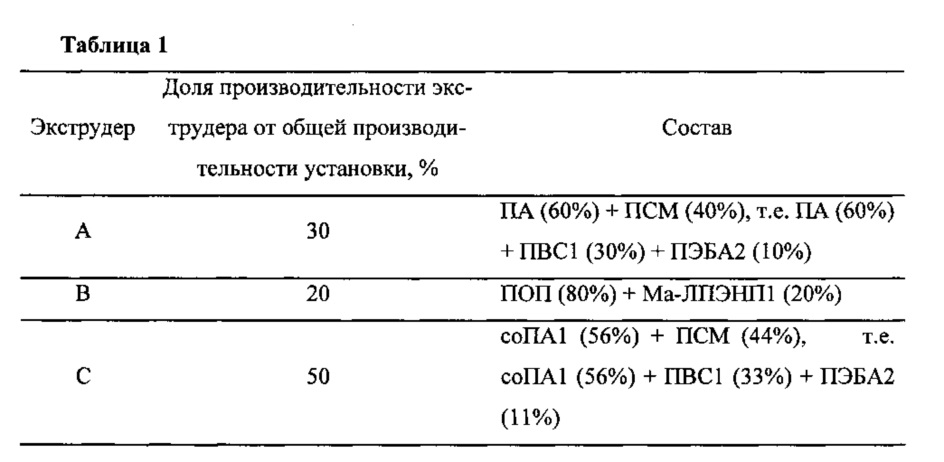
Сравнительный пример 1а.Comparative Example 1a
Рукавную оболочку изготавливают при помощи однослойной экструзионной установки, в бункер которой загружают гранулят соПА1. Последующие операции производят согласно примеру 1 с получением однослойной оболочки из соПА1 - наиболее проницаемого из массово производящихся полиамидов.The sleeve casing is made using a single-layer extrusion installation, into the hopper of which granulate coPA1 is loaded. Subsequent operations are carried out according to example 1 to obtain a single-layer shell of coPA1 - the most permeable of mass-produced polyamides.
Сравнительный пример 1б.Comparative example 1b.
Трехслойную рукавную оболочку изготавливают по технологии, описанной в примере 1, но при этом при экструзии слоев используют следующие составы: слой В: ангидрид-привитой ЛПЭНП марки Admer® 518 производства компании Mitsui Chemicals Europe GmbH с температурой плавления около 125°C, слои А и С: соПА1.The three-layer sleeve sheath is made according to the technology described in example 1, but the following compositions are used for layer extrusion: layer B: Admer® 518 grafted LLDPE manufactured by Mitsui Chemicals Europe GmbH with a melting point of about 125 ° C, layers A and C: coPA1.
Сравнительный пример 1в.Comparative example 1c.
Рукавную оболочку изготавливают по технологии, описанной в примере 1, но при этом используют двухслойную экструзионную установку. Полученная пленка содержит два слоя, идентичные по составу слоям А и С. Толщина пленки составляет 95% толщины оболочки по примеру 1.The sleeve casing is made according to the technology described in example 1, but using a two-layer extrusion installation. The resulting film contains two layers, identical in composition to layers A and C. The film thickness is 95% of the shell thickness according to example 1.
Сравнительный пример 1г.Comparative example 1d.
Рукавную оболочку изготавливают согласно примеру 1, за исключением того, что: слой (А) получен из смеси ПА и ПЭВД в соотношении 60:40 по массе и имеет толщину, составляющую 50% от общей толщины оболочки,The sleeve shell is made according to example 1, except that: layer (A) is obtained from a mixture of PA and LDPE in a ratio of 60:40 by weight and has a thickness of 50% of the total thickness of the shell,
слой (В) идентичен по составу слою (А) примера 1 и имеет толщину, составляющую 19% от общей толщины,layer (B) is identical in composition to layer (A) of example 1 and has a thickness of 19% of the total thickness,
слой (С) идентичен по составу слою (С) примера 1 и имеет толщину, составляющую 31% от общей толщины,the layer (C) is identical in composition to the layer (C) of example 1 and has a thickness of 31% of the total thickness,
причем общая толщина оболочки такая же, как в примере 1.*moreover, the total shell thickness is the same as in example 1. *
*Попытки получить оболочку с содержанием ПЭВД в слое (А) с 45% и выше приводили к ее расслоению на стадии термофиксации из-за слабой межслойной адгезии.* Attempts to obtain a shell with the content of LDPE in layer (A) with 45% and higher led to its separation at the stage of thermal fixation due to weak interlayer adhesion.
Пример 2.Example 2
Трехслойную рукавную оболочку изготавливают по технологии, описанной в примере 1, с использованием композиций и относительной производительностью экструдеров, указанных в таблице 2. Композицию для слоя В предварительно изготавливают перемешиванием составляющих ее компонентов в двухшнековом экструдере с последующим гранулированием.The three-layer sleeve casing is made according to the technology described in example 1, using the compositions and the relative performance of the extruders shown in table 2. The composition for layer B is preliminarily made by mixing its constituent components in a twin-screw extruder, followed by granulation.
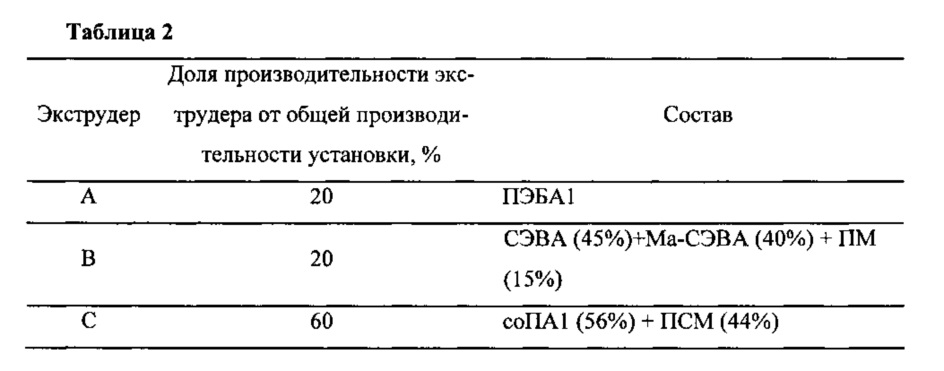
Пример 3.Example 3
Трехслойную рукавную оболочку изготавливают согласно примеру 1, за исключением того, что слой В имеет состав: ТПИ (60%)+Ма-СЭБС (20%)+П60 (20%). Композицию для слоя В предварительно изготавливают перемешиванием составляющих ее компонентов в двухшнековом экструдере с последующим гранулированием.A three-layer sleeve shell is made according to example 1, except that layer B has the composition: TPI (60%) + Ma-SEBS (20%) + P60 (20%). The composition for layer B is preliminarily made by mixing its constituent components in a twin-screw extruder, followed by granulation.
Пример 4.Example 4
Трехслойную рукавную оболочку изготавливают согласно примеру 2, за исключением того, что экструдер слоя В заполнен чистым Ма-ЛПЭНП2 и имеет производительность, составляющую 4% от общей производительности установки, а экструдер слоя С имеет производительность в 76% от общей производительности установки, при этом общая производительность установки на 27% ниже, чем в примере 2. Получают пленку толщиной 18-19 мкм, толщина адгезивного слоя которой составляет 0,7-0,8 мкм. Последующие операции отличаются только тем, что колбасный фарш набивают в оболочку, помещенную в сетку, обеспечивающую достаточную механическую прочность и жесткость упаковки при низкой толщине пленки.The three-layer sleeve shell is made according to example 2, except that the extruder of layer B is filled with pure Ma-LLDPE2 and has a capacity of 4% of the total productivity of the installation, and the extruder of the layer C has a productivity of 76% of the total productivity of the installation, the productivity of the installation is 27% lower than in example 2. Get a film with a thickness of 18-19 microns, the thickness of the adhesive layer of which is 0.7-0.8 microns. Subsequent operations differ only in that the sausage stuffing is stuffed into a shell placed in a mesh, providing sufficient mechanical strength and rigidity of the package with a low film thickness.
Пример 5.Example 5
На обе стороны плоско-сложенной однослойной коммерческой рукавной оболочки на основе ПА 6,66, содержащей 25% ПВС, с диаметром 21 мм и толщиной около 20 мкм, при помощи флексографической печатной машины марки DR6 (производства компании KUKO GmbH, Германия) последовательно, с промежуточными сушками при 60°C, наносят 7 слоев покрытия, образующих:On both sides of a flat-folded single-layered commercial 6.66 PA-based tubular sheath containing 25% PVA, with a diameter of 21 mm and a thickness of about 20 microns, using a DR6 flexographic printing machine (manufactured by KUKO GmbH, Germany) sequentially, with intermediate dryers at 60 ° C, apply 7 layers of coating, forming:
- регулирующий слой, состоящий из трех слоев покрытия, причем первый и третий сформированы из раствора, содержащего 2,5% Ма-СЭБС, 2% ТПИ и 0,5% П60 в толуоле, а второй сформирован из раствора, содержащего 3% Ма-СЭБС, 3% ТПИ, 4% П60 и 0,04% ЭСМ в толуоле, а затем- a control layer consisting of three coating layers, the first and third are formed from a solution containing 2.5% Ma-SEBS, 2% TPI and 0.5% P60 in toluene, and the second is formed from a solution containing 3% Ma- SEBS, 3% TPI, 4% P60 and 0.04% ESM in toluene, and then
- полиамидсодержащий слой, состоящий из четырех слоев покрытия, сформированных из раствора, содержащего 2,5% ПЭБА2 и 2,5% соПА2 в водно-спиртовом растворе (этанол/вода - 7/3). После окончательной сушки при тех же условиях оболочку со слоями покрытия сматывают в рулон. Средняя общая толщина покрытия составляет около 2 мкм, т.е. с учетом примерно одинаковой вязкости и содержания нелетучих компонентов обоих растворов - примерно по 1,0 мкм на каждый слой.- a polyamide-containing layer consisting of four coating layers formed from a solution containing 2.5% PEBA2 and 2.5% coPA2 in a water-alcohol solution (ethanol / water - 7/3). After final drying under the same conditions, the shell with the coating layers is wound onto a roll. The average total coating thickness is about 2 microns, i.e. taking into account approximately the same viscosity and the content of non-volatile components of both solutions, approximately 1.0 μm per layer.
Далее все делают как в примере 1, за исключение того, что изготавливают сосиски в гирляндах и время копчения составляет 20 минут.Further, everything is done as in example 1, except that sausages are made in garlands and the smoking time is 20 minutes.
Сравнительный пример 5а.Comparative Example 5a
В качестве образца сравнения используют ту же коммерческую оболочку, что и в примере 5, но без покрытия. Далее все делают как в примере 5.As a reference sample, the same commercial shell is used as in Example 5, but without coating. Then everything is done as in example 5.
В табл. 3 показаны свойства оболочек, полученных как по примерам воплощения настоящего изобретения, так и по сравнительным примерам.In the table. 3 shows the properties of the shells obtained by both the embodiments of the present invention and the comparative examples.
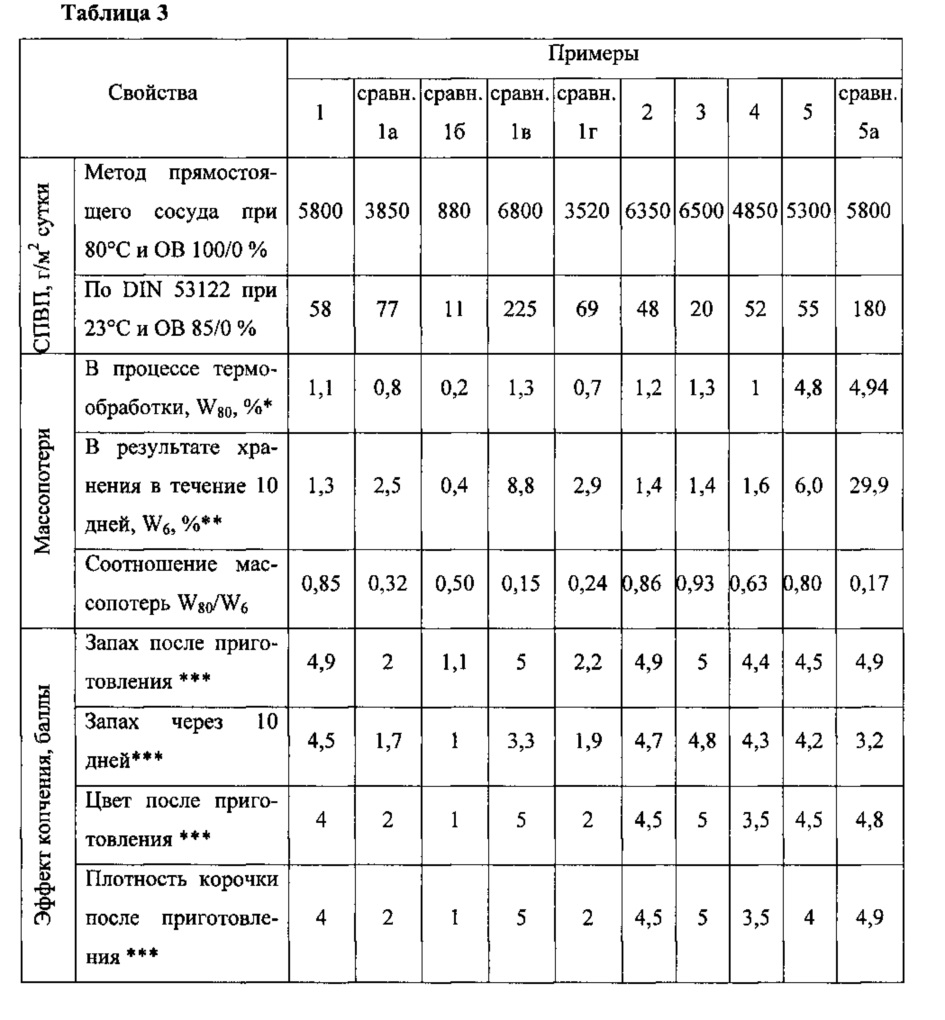
*Массопотери в процессе термообработки W80 вычисляют как отношение убыли массы колбасы сразу после ее термообработки, душирования и механического удаления воды с его поверхности к массе исходного батона сразу после набивки фаршем, выраженное в %.* Mass loss in the process of heat treatment W 80 is calculated as the ratio of the mass loss of the sausage immediately after heat treatment, scenting and mechanical removal of water from its surface to the mass of the original loaf immediately after stuffing, expressed in%.
**Массопотери в результате хранения W6 вычисляют как отношение убыли массы колбасы в результате ее хранения в течение 10 дней в холодильнике при 6°C, ОВ около 50%, к массе готового батона сразу после его термообработки, душирования и механического удаления воды с его поверхности, выраженное в %.** Mass loss as a result of storage of W 6 is calculated as the ratio of the loss of mass of sausage as a result of its storage for 10 days in a refrigerator at 6 ° C, RH about 50%, to the mass of the finished loaf immediately after heat treatment, scenting and mechanical removal of water from it surface expressed in%.
***Показатели оцениваются группой из 10 экспертов по 5-бальной шкале, принимая характеристики продукта сразу после приготовления в оболочке по сравнительному примеру 1а за 2 балла, а в оболочке по примеру 1в за 5 баллов.*** The indicators are evaluated by a group of 10 experts on a 5-point scale, taking the product characteristics immediately after preparation in the shell according to comparative example 1a for 2 points, and in the shell according to example 1c for 5 points.
Приведенные в таблице данные наглядно подтверждают, что данная оболочка обладает высокой паропроницаемостью в условиях копчения, что позволяет эффективно коптить упакованное в оболочку пищевое изделие и создавать характерную корочку на его поверхности.The data presented in the table clearly confirm that this casing has high vapor permeability under smoking conditions, which makes it possible to efficiently smoke a food product packed in a casing and create a characteristic crust on its surface.
Анализ экспертной оценки цвета пищевого продукта и плотности корочки на его поверхности после приготовления, а также запаха продукта, после его приготовления и хранения в изобретенной оболочке, и аналогичных эффектов копчения для продуктов, изготовленных в сравниваемых оболочках, подтверждает более высокую эффективность созданной оболочки и возможность хранения в ней с превосходным сохранением потребительских свойств.An analysis of the expert assessment of the color of the food product and the density of the crust on its surface after preparation, as well as the smell of the product, after its preparation and storage in the invented shell, and similar smoking effects for products made in compared shells, confirms the higher efficiency of the created shell and the possibility of storage in it with excellent preservation of consumer properties.
Таким образом, по совокупности приведенных свойств изобретенная оболочка превосходит известные из уровня техники оболочки.Thus, in terms of the combination of the above properties, the invented shell is superior to the shell known from the prior art.
Claims (37)
Priority Applications (6)
| Application Number | Priority Date | Filing Date | Title |
|---|---|---|---|
| RU2016103754A RU2620373C1 (en) | 2016-02-04 | 2016-02-04 | Multilayer shell for smoking and storage of food products, and smoked food product manufactured therein |
| EP17747859.1A EP3410862B1 (en) | 2016-02-04 | 2017-02-02 | Multilayer casing for smoking and storage of food products, and smoked food product made therein |
| PL17747859T PL3410862T3 (en) | 2016-02-04 | 2017-02-02 | Multilayer casing for smoking and storage of food products, and smoked food product made therein |
| EA201800447A EA037400B1 (en) | 2016-02-04 | 2017-02-02 | Multilayer casing for smoking and storage of food products, and smoked food product made therein |
| PCT/RU2017/000052 WO2017135847A1 (en) | 2016-02-04 | 2017-02-02 | Multilayer casing for smoking and storage of food products, and smoked food product made therein |
| UAA201808939A UA123447C2 (en) | 2016-02-04 | 2017-02-02 | Multilayer casing for smoking and storage of food products, and smoked food product made therein |
Applications Claiming Priority (1)
| Application Number | Priority Date | Filing Date | Title |
|---|---|---|---|
| RU2016103754A RU2620373C1 (en) | 2016-02-04 | 2016-02-04 | Multilayer shell for smoking and storage of food products, and smoked food product manufactured therein |
Publications (1)
| Publication Number | Publication Date |
|---|---|
| RU2620373C1 true RU2620373C1 (en) | 2017-05-25 |
Family
ID=58882671
Family Applications (1)
| Application Number | Title | Priority Date | Filing Date |
|---|---|---|---|
| RU2016103754A RU2620373C1 (en) | 2016-02-04 | 2016-02-04 | Multilayer shell for smoking and storage of food products, and smoked food product manufactured therein |
Country Status (6)
| Country | Link |
|---|---|
| EP (1) | EP3410862B1 (en) |
| EA (1) | EA037400B1 (en) |
| PL (1) | PL3410862T3 (en) |
| RU (1) | RU2620373C1 (en) |
| UA (1) | UA123447C2 (en) |
| WO (1) | WO2017135847A1 (en) |
Cited By (2)
| Publication number | Priority date | Publication date | Assignee | Title |
|---|---|---|---|---|
| RU2719972C1 (en) * | 2018-08-06 | 2020-04-23 | Вискофан, С.А. | Textured nonporous barrier transfer shell |
| RU2776128C2 (en) * | 2018-01-26 | 2022-07-13 | Калле Гмбх | Smoke- and vapor-permeable food shell with optimized adhesion properties |
Families Citing this family (3)
| Publication number | Priority date | Publication date | Assignee | Title |
|---|---|---|---|---|
| DE102018201241B4 (en) | 2018-01-26 | 2025-09-11 | Kalle Gmbh | Smoke and water vapor permeable food casing with optimized adhesive properties, process for its production and its use |
| EP4353780A1 (en) | 2022-10-14 | 2024-04-17 | UBE Corporation Europe, S.A.U. | Polyamide - thermoplastic starch (tps) alloys |
| CN115946274A (en) * | 2022-12-27 | 2023-04-11 | 晋江恒起包装材料有限公司 | Preparation method of pinhole-free PVDC casing film |
Citations (5)
| Publication number | Priority date | Publication date | Assignee | Title |
|---|---|---|---|---|
| EP0797918A1 (en) * | 1996-03-29 | 1997-10-01 | Gunze Kobunshi Corporation | Casing for smoking and storage of foodstuffs |
| RU70747U1 (en) * | 2007-09-27 | 2008-02-20 | Общество с ограниченной ответственностью "Научно-производственное объединение "СЛАВА" | FOOD SHELL |
| RU2345104C2 (en) * | 2003-01-24 | 2009-01-27 | Калле Гмбх | Smoke-proof polyamide- and water-soluble-polymer-based enclosure for foodstuffs |
| RU135232U1 (en) * | 2012-12-28 | 2013-12-10 | Общество С Ограниченной Ответственностью "Производственно-Коммерческая Фирма "Атлантис-Пак" | MULTI-LAYER FOOD SHELL PERMEABLE TO WATER AND SMOKE VAPORS |
| RU2529727C2 (en) * | 2012-12-28 | 2014-09-27 | Общество С Ограниченной Ответственностью "Производственно-Коммерческая Фирма "Атлантис-Пак" | Glossy multilayered casing for food products, permeable to water vapours and smoke |
Family Cites Families (6)
| Publication number | Priority date | Publication date | Assignee | Title |
|---|---|---|---|---|
| JPH11164648A (en) | 1997-12-05 | 1999-06-22 | Gunze Kobunshi Corp | Casing film for smoked food |
| RU2182107C1 (en) | 2001-03-30 | 2002-05-10 | Общество С Ограниченной Ответственностью Производственно-Коммерческая Фирма "Атлантис-Пак" | Polymer film for packing foodstuff and package made from such film |
| DE10208858A1 (en) * | 2002-03-01 | 2003-09-11 | Kalle Gmbh & Co Kg | Smoke and water vapor permeable food casing made of a thermoplastic mixture |
| DE10320327A1 (en) | 2003-05-06 | 2004-12-02 | Kalle Gmbh & Co. Kg | Smoke and water vapor permeable food casing made of a thermoplastic mixture with a natural appearance |
| US20120003361A1 (en) | 2009-03-17 | 2012-01-05 | Ube Industries, Ltd. | Polyamide resin composition, film comprising the same and polyamide-based laminate film |
| US20110300273A1 (en) | 2010-06-03 | 2011-12-08 | E.I. Du Pont De Nemours And Company | Non-Porous Moisture and Gas Permeable Films |
-
2016
- 2016-02-04 RU RU2016103754A patent/RU2620373C1/en active
-
2017
- 2017-02-02 EA EA201800447A patent/EA037400B1/en unknown
- 2017-02-02 UA UAA201808939A patent/UA123447C2/en unknown
- 2017-02-02 EP EP17747859.1A patent/EP3410862B1/en active Active
- 2017-02-02 WO PCT/RU2017/000052 patent/WO2017135847A1/en not_active Ceased
- 2017-02-02 PL PL17747859T patent/PL3410862T3/en unknown
Patent Citations (5)
| Publication number | Priority date | Publication date | Assignee | Title |
|---|---|---|---|---|
| EP0797918A1 (en) * | 1996-03-29 | 1997-10-01 | Gunze Kobunshi Corporation | Casing for smoking and storage of foodstuffs |
| RU2345104C2 (en) * | 2003-01-24 | 2009-01-27 | Калле Гмбх | Smoke-proof polyamide- and water-soluble-polymer-based enclosure for foodstuffs |
| RU70747U1 (en) * | 2007-09-27 | 2008-02-20 | Общество с ограниченной ответственностью "Научно-производственное объединение "СЛАВА" | FOOD SHELL |
| RU135232U1 (en) * | 2012-12-28 | 2013-12-10 | Общество С Ограниченной Ответственностью "Производственно-Коммерческая Фирма "Атлантис-Пак" | MULTI-LAYER FOOD SHELL PERMEABLE TO WATER AND SMOKE VAPORS |
| RU2529727C2 (en) * | 2012-12-28 | 2014-09-27 | Общество С Ограниченной Ответственностью "Производственно-Коммерческая Фирма "Атлантис-Пак" | Glossy multilayered casing for food products, permeable to water vapours and smoke |
Cited By (2)
| Publication number | Priority date | Publication date | Assignee | Title |
|---|---|---|---|---|
| RU2776128C2 (en) * | 2018-01-26 | 2022-07-13 | Калле Гмбх | Smoke- and vapor-permeable food shell with optimized adhesion properties |
| RU2719972C1 (en) * | 2018-08-06 | 2020-04-23 | Вискофан, С.А. | Textured nonporous barrier transfer shell |
Also Published As
| Publication number | Publication date |
|---|---|
| PL3410862T3 (en) | 2022-01-24 |
| EA201800447A1 (en) | 2018-12-28 |
| UA123447C2 (en) | 2021-04-07 |
| WO2017135847A1 (en) | 2017-08-10 |
| EP3410862B1 (en) | 2021-08-25 |
| EP3410862A1 (en) | 2018-12-12 |
| EA037400B1 (en) | 2021-03-24 |
| EP3410862A4 (en) | 2019-09-11 |
Similar Documents
| Publication | Publication Date | Title |
|---|---|---|
| RU2201684C2 (en) | Multi-layer sleeve-like membrane of biaxial stretching for food products and method for its embodiment | |
| EP0473091B1 (en) | Transferable modifier containing film | |
| CN1461189A (en) | Polymer film for food products | |
| US6541087B1 (en) | Multilayer, biaxially stretched, high-barrier plastic skin | |
| CN100542408C (en) | Laminated film, product including the same, and method of manufacturing the same | |
| EP3410862B1 (en) | Multilayer casing for smoking and storage of food products, and smoked food product made therein | |
| CN106794683A (en) | Multilayer food product casing or food-film | |
| CN1711027B (en) | Moisture and gas permeable nonporous ionomer membranes | |
| EP0967073B1 (en) | Biaxially stretched multilayer film | |
| RU2529727C2 (en) | Glossy multilayered casing for food products, permeable to water vapours and smoke | |
| EP2260713B1 (en) | Smokeable polymeric casing | |
| EP2513222B1 (en) | Non-porous moisture and gas permeable films | |
| US5985386A (en) | Multi-layer, coextruded, biaxially oriented tubular sausage casing with improved oxygen barrier properties | |
| AU782722B2 (en) | Gas-barrier resin composition, gas-barrier coating material, and gas-barrier molding | |
| US20070031620A1 (en) | Smoke-permeable polyamide based food casing | |
| WO2005072962A1 (en) | Layered polyamide film | |
| US5506297A (en) | Resin composition and melt-extruded article formed therefrom | |
| EP2575481B1 (en) | Non-porous, moisture and gas permeable films | |
| WO2011149386A2 (en) | Polyamide-based synthetic sausage casing able to be filled without stretching and method of production thereof | |
| RU2245058C2 (en) | Multylayered oriented tubular film for food packing | |
| CZ192799A3 (en) | Bidirectional, manually refillable tubular film for packaging and filling food products | |
| CZ20013221A3 (en) | Multilayer tubular sheet based on polyamide, process of its preparation and use | |
| JP4868659B2 (en) | Resin composition and laminate | |
| RU135232U1 (en) | MULTI-LAYER FOOD SHELL PERMEABLE TO WATER AND SMOKE VAPORS | |
| Yemenicioğlu | Developments in Antimicrobial Food Packaging from Zein Incorporating Natural Active Agents |