RU2516632C1 - Method to produce diamond-like coatings by combined laser action - Google Patents
Method to produce diamond-like coatings by combined laser action Download PDFInfo
- Publication number
- RU2516632C1 RU2516632C1 RU2012158032/05A RU2012158032A RU2516632C1 RU 2516632 C1 RU2516632 C1 RU 2516632C1 RU 2012158032/05 A RU2012158032/05 A RU 2012158032/05A RU 2012158032 A RU2012158032 A RU 2012158032A RU 2516632 C1 RU2516632 C1 RU 2516632C1
- Authority
- RU
- Russia
- Prior art keywords
- laser
- gas
- wave
- laser radiation
- plasma
- Prior art date
Links
- 238000000576 coating method Methods 0.000 title claims abstract description 20
- 238000000034 method Methods 0.000 title claims description 19
- 230000005855 radiation Effects 0.000 claims abstract description 32
- OKTJSMMVPCPJKN-UHFFFAOYSA-N Carbon Chemical compound [C] OKTJSMMVPCPJKN-UHFFFAOYSA-N 0.000 claims abstract description 15
- 239000011248 coating agent Substances 0.000 claims abstract description 13
- 229910003460 diamond Inorganic materials 0.000 claims abstract description 11
- 239000010432 diamond Substances 0.000 claims abstract description 11
- 229910002804 graphite Inorganic materials 0.000 claims abstract description 10
- 239000010439 graphite Substances 0.000 claims abstract description 10
- 239000013077 target material Substances 0.000 claims abstract description 10
- 239000000758 substrate Substances 0.000 claims abstract description 9
- 238000002679 ablation Methods 0.000 claims abstract description 8
- 238000005507 spraying Methods 0.000 claims abstract description 3
- 230000015572 biosynthetic process Effects 0.000 claims description 5
- 239000000835 fiber Substances 0.000 claims description 2
- 238000001228 spectrum Methods 0.000 abstract description 8
- 230000000694 effects Effects 0.000 abstract description 3
- 238000005272 metallurgy Methods 0.000 abstract 1
- 239000000126 substance Substances 0.000 abstract 1
- 229910052799 carbon Inorganic materials 0.000 description 5
- 239000007789 gas Substances 0.000 description 5
- 238000004519 manufacturing process Methods 0.000 description 5
- 238000000608 laser ablation Methods 0.000 description 2
- 230000001681 protective effect Effects 0.000 description 2
- 238000005086 pumping Methods 0.000 description 2
- XMWRBQBLMFGWIX-UHFFFAOYSA-N C60 fullerene Chemical compound C12=C3C(C4=C56)=C7C8=C5C5=C9C%10=C6C6=C4C1=C1C4=C6C6=C%10C%10=C9C9=C%11C5=C8C5=C8C7=C3C3=C7C2=C1C1=C2C4=C6C4=C%10C6=C9C9=C%11C5=C5C8=C3C3=C7C1=C1C2=C4C6=C2C9=C5C3=C12 XMWRBQBLMFGWIX-UHFFFAOYSA-N 0.000 description 1
- 125000004432 carbon atom Chemical group C* 0.000 description 1
- 239000002800 charge carrier Substances 0.000 description 1
- 238000009833 condensation Methods 0.000 description 1
- 230000005494 condensation Effects 0.000 description 1
- 238000005520 cutting process Methods 0.000 description 1
- 230000007423 decrease Effects 0.000 description 1
- 230000003247 decreasing effect Effects 0.000 description 1
- 238000010586 diagram Methods 0.000 description 1
- 230000008030 elimination Effects 0.000 description 1
- 238000003379 elimination reaction Methods 0.000 description 1
- 238000005516 engineering process Methods 0.000 description 1
- 229910003472 fullerene Inorganic materials 0.000 description 1
- 238000010438 heat treatment Methods 0.000 description 1
- 231100000086 high toxicity Toxicity 0.000 description 1
- 230000003993 interaction Effects 0.000 description 1
- 239000000463 material Substances 0.000 description 1
- 239000002184 metal Substances 0.000 description 1
- 239000002071 nanotube Substances 0.000 description 1
- 230000003287 optical effect Effects 0.000 description 1
- 239000002245 particle Substances 0.000 description 1
- 238000002360 preparation method Methods 0.000 description 1
- 238000003908 quality control method Methods 0.000 description 1
- 238000005215 recombination Methods 0.000 description 1
- 230000006798 recombination Effects 0.000 description 1
- 238000004544 sputter deposition Methods 0.000 description 1
- 239000002341 toxic gas Substances 0.000 description 1
- 230000007704 transition Effects 0.000 description 1
- 230000008016 vaporization Effects 0.000 description 1
Images
Landscapes
- Physical Vapour Deposition (AREA)
- Laser Beam Processing (AREA)
- Crystals, And After-Treatments Of Crystals (AREA)
Abstract
Description
Область техникиTechnical field
Изобретение относится к технологиям повышения износостойких, прочностных и антифрикционных свойств изделий и нанотехнологиям. Например, металлорежущего инструмента, внешних поверхностей обшивки авиационных и космических летательных аппаратов, оптических приборов и т.п.The invention relates to technologies for increasing wear-resistant, strength and antifriction properties of products and nanotechnology. For example, metal cutting tools, the outer skin of the skin of aircraft and spacecraft, optical instruments, etc.
Уровень техникиState of the art
Известно большое количество способов получения алмазоподобных покрытий (англоязычная аббревиатура DLC) способом электрического разряда. В частности, «Способ получения алмазоподобных фаз углерода» (патент РФ №2038294, опубл. 27.06.1995), «Способ получения алмазоподобной пленки» (патент РФ №2254397, опубл. 10.02.2005), «Способ получения алмазоподобного покрытия» (патент РФ №2094528, опубл. 27.10.1997) и др.There are a large number of methods for producing diamond-like coatings (English abbreviation DLC) by the method of electric discharge. In particular, “A method for producing diamond-like carbon phases” (RF patent No. 2038294, publ. 06/27/1995), “A method for producing diamond-like film” (RF patent No. 2254397, publ. 02/10/2005), “A method for producing a diamond-like coating" (patent RF №2094528, publ. 10/27/1997), etc.
Недостатками использования электроразрядного способа являются низкий процент выхода алмазной фазы, высокая токсичность процесса и сложное технологическое исполнение ввиду необходимости размещения в высоковакуумной камере электроразрядного оборудования для реализации способа.The disadvantages of using the electric-discharge method are the low percentage of the output of the diamond phase, high toxicity of the process and complex technological design due to the need to place electric-discharge equipment in the high-vacuum chamber for implementing the method.
Известен способ лазерного распыления в вакууме материала мишени импульсным лазером с целью получения алмазоподобных покрытий «Способ получения алмазоподобных пленок» (патент РФ №1610949, опубл. 15.10.1994). Данное изобретение можно считать наиболее близким аналогом.A known method of laser spraying in vacuum of a target material with a pulsed laser to obtain diamond-like coatings "Method for producing diamond-like films" (RF patent No. 1610949, publ. 15.10.1994). This invention can be considered the closest analogue.
Недостатками способа являются низкое содержание алмазной фазы в получаемом покрытии и затухание энергетического спектра плазмы на стадии ее разлета.The disadvantages of the method are the low content of the diamond phase in the resulting coating and the attenuation of the energy spectrum of the plasma at the stage of its expansion.
Раскрытие изобретенияDisclosure of invention
Задачами изобретения являются увеличение алмазной фазы в получаемом покрытии и увеличение энергетического спектра плазмы на стадии ее разлета.The objectives of the invention are to increase the diamond phase in the resulting coating and increase the energy spectrum of the plasma at the stage of its expansion.
Поставленные задачи решаются тем, что в предлагаемом способе получение алмазоподобных покрытий в вакууме происходит путем распыления материала мишени импульсным лазером. Причем на материал мишени, выполненной из графита высокой степени чистоты (>99.9%), воздействуют комбинированным лазерным излучением. При этом абляция и образование газоплазменной фазы материала мишени происходит с использованием коротковолнового (<300 нм) импульсного излучения. В качестве источника коротковолнового импульсного лазерного излучения используют, например, KrF-лазер с длиной волны 248 нм и удельной энергией 5·107 Вт/см2. Последующее воздействие на газоплазменное облако во время разлета облака от мишени к подложке осуществляют длинноволновым (>1 мкм) лазерным излучением. В качестве источника длинноволнового лазерного излучения используют газовый С2O-лазер или твердотельный волоконный лазерный излучатель. Для дополнительного увеличения процентного содержания алмазной фазы в получаемом покрытии используют прием отклонения лазерного излучения длинноволнового лазера при помощи сканатора (не показан) таким образом, что фокус излучения находится внутри газоплазменного облака продуктов абляции, при этом воздействие лазерного излучения на разлетающееся газоплазменное облако происходит на всем пути разлета.The tasks are solved in that in the proposed method, the preparation of diamond-like coatings in vacuum occurs by sputtering the target material with a pulsed laser. Moreover, the target material made of high purity graphite (> 99.9%) is affected by combined laser radiation. In this case, ablation and the formation of a gas-plasma phase of the target material occurs using short-wave (<300 nm) pulsed radiation. As a source of short-wave pulsed laser radiation, for example, a KrF laser with a wavelength of 248 nm and a specific energy of 5 · 10 7 W / cm 2 is used . Subsequent exposure to the gas-plasma cloud during the expansion of the cloud from the target to the substrate is carried out by long-wave (> 1 μm) laser radiation. As a source of long-wavelength laser radiation, a gas C 2 O laser or a solid-state fiber laser emitter is used. To further increase the percentage of the diamond phase in the resulting coating, a laser deflection of the long-wave laser is used using a scanner (not shown) so that the radiation focus is inside the gas-plasma cloud of ablation products, and the laser radiation affects the expanding gas-plasma cloud all the way expansion.
Перечень фигурList of figures
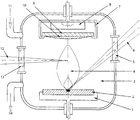
На фиг.1 изображена схема процесса получения алмазоподобных пленок комбинированным лазерным воздействием.Figure 1 shows a diagram of a process for producing diamond-like films by combined laser exposure.
Осуществление изобретенияThe implementation of the invention
Известно, что качество алмазоподобного покрытия повышается с увеличением плотности мощности и уменьшением длины волны лазерного излучения, испаряющего мишень из графита (см. Pulsedlaserdepositionofthinfilms: applications-ledgrowthoffunctionalmaterials, RobertEason, N.J., Wiley, 2007, pp.335-337). В связи с этим абляцию источника графита целесообразно проводить лазером с наименьшей длиной волны излучения.The quality of a diamond-like coating is known to increase with increasing power density and decreasing wavelength of laser radiation vaporizing a graphite target (see Pulsedlaserdepositionofthinfilms: applications-ledgrowthoffunctionalmaterials, Robert Eason, N.J., Wiley, 2007, pp.335-337). In this regard, it is advisable to ablate the graphite source with a laser with the smallest radiation wavelength.
Принципиальным недостатком лазерного способа в сравнении с традиционным электроразрядным является затухание энергетического спектра плазмы на стадии ее разлета. Устранению этого недостатка служит использование дополнительного лазера, сфокусированного на газоплазменный продукт абляции углерода с целью увеличения энергетического спектра образованной плазмы. Эффект заключается в следующем. Известно, что наличие линейных sp1, тригональных sp2 и тетраэдрических sp3 связей у атомов углерода позволяет углероду формировать фазы алмаза, графита, фуллерена, нанотрубок, алмазоподобные и др. (Kroto, H.W., Heath, J. R., О' Brien, S. С, Curl, R.F, andSmalley, R.E. (1985) Nature 318, 162-163). Способы получения алмазоподобных структур заключаются в нарушении sp2 связей графита, используемого в качестве источника углерода и последующем образовании sp3 связей, характерных для алмазной фазы при конденсации испаренного объема графита на упрочняемую поверхность. Способ электрического разряда разрывает связи и поддерживает высокую степень ионизации частиц продуктов разлета на всем промежутке разлета от источника углерода к поверхности подложки. Способ лазерной абляции разрывает sp2 связи с образованием плазменного состояния только в момент взаимодействия лазерного излучения с поверхностью мишени. На стадии разлета энергетический спектр плазменного облака падает ввиду естественной рекомбинации носителей зарядов, снижая качество алмазоподобного покрытия. Воздействие дополнительным источником лазерного излучения на облако плазмы в момент его разлета делает возможным поддержание и увеличение энергетического спектра плазменного облака. Таким образом обеспечивают высокое содержание алмазной фазы получаемого покрытия без использования токсичных газов и высокомощного лазерного оборудования, а также повышают контроль качества параметров получаемого покрытия. Воздействие лазерных излучений последовательно: сначала используют коротковолновое с целью абляции материала, потом длинноволновое для разогрева плазмы. Переход от одного вида воздействия к другому осуществляется с задержкой порядка 1 мкс, необходимой для образования газоплазменных продуктов абляции у поверхности мишени.The principal disadvantage of the laser method in comparison with the traditional electric-discharge method is the attenuation of the plasma energy spectrum at the stage of its expansion. The elimination of this drawback is the use of an additional laser focused on the gas-plasma product of carbon ablation in order to increase the energy spectrum of the formed plasma. The effect is as follows. It is known that the presence of linear sp 1 , trigonal sp 2 and tetrahedral sp 3 bonds at carbon atoms allows carbon to form phases of diamond, graphite, fullerene, nanotubes, diamond-like, etc. (Kroto, HW, Heath, JR, O 'Brien, S. C, Curl, RF, andSmalley, RE (1985) Nature 318, 162-163). The methods for producing diamond-like structures are the violation of sp 2 bonds of graphite used as a carbon source and the subsequent formation of sp 3 bonds characteristic of the diamond phase during the condensation of the evaporated volume of graphite on a hardened surface. The electric discharge method breaks the bonds and maintains a high degree of ionization of the particles of the expansion products over the entire expansion interval from the carbon source to the surface of the substrate. The laser ablation method breaks sp 2 bonds with the formation of a plasma state only at the moment of interaction of laser radiation with the target surface. At the stage of expansion, the energy spectrum of the plasma cloud decreases due to the natural recombination of charge carriers, reducing the quality of the diamond-like coating. The impact of an additional source of laser radiation on the plasma cloud at the time of its expansion makes it possible to maintain and increase the energy spectrum of the plasma cloud. Thus, they provide a high diamond phase content of the resulting coating without the use of toxic gases and high-power laser equipment, and also increase the quality control of the parameters of the resulting coating. The effect of laser radiation is sequential: first use the short-wavelength to ablate the material, then the long-wavelength for heating the plasma. The transition from one type of action to another is carried out with a delay of the order of 1 μs, which is necessary for the formation of gas-plasma ablation products at the target surface.
На фиг.1 вакуумная камера 3 содержит патрубки подачи защитных газов в камеру 11 и откачки камеры 14, подложкодержатель 1 с мишенью из графита 2, подложкодержатель 7 с нагревателем 8 для закрепления подложки 9, входное окно эксимерного лазера 5, входное окно дополнительного длинноволнового лазерного излучения 13, включает излучение 6 эксимерного KrF-лазера (не показан), излучение 12 дополнительного лазера (не показан), газоплазменное облако 4 и осажденный слой алмазоподобного покрытия 10.In Fig. 1, the
Предлагаемый способ получения алмазоподобных покрытий комбинированным лазерным воздействием осуществляют следующим образом.The proposed method for producing diamond-like coatings by combined laser exposure is as follows.
В вакуумной камере 3 после откачки воздуха через патрубок 14 и подачи защитных газов через патрубок 11, мишень из графита 2 высокой чистоты (не хуже 99.9%) закрепляют на подложкодержателе 1. Затем импульсное излучение 6 KrF-лазера с длиной волны 248 нм и удельной энергией 5·107 Вт/см2 направляют через входное окно 5 на мишень 2, где способом лазерной абляции образуют газоплазменное облако 4, которое осаждается алмазоподобным покрытием 10 на подложку 9. Воздействие через входное окно 13 вспомогательным лазерным излучением 12 от дополнительного длинноволнового лазерного источника, например газового СO2 лазера с длиной волны 10.6 мкм, на облако плазмы в момент его разлета позволяет поддержать и увеличить энергетический спектр газоплазменного облака 4, что приводит к высокому содержанию алмазной фазы в получаемом покрытии 10 и улучшению его качества. Для дополнительного увеличения процентного содержания алмазной фазы в получаемом покрытии используют прием отклонения лазерного излучения длинноволнового лазера при помощи сканатора таким образом, что фокус излучения находится внутри газоплазменного облака продуктов абляции, при этом воздействие лазерного излучения на разлетающееся газоплазменное облако происходит на всем пути разлета.In the
Claims (3)
Priority Applications (1)
| Application Number | Priority Date | Filing Date | Title |
|---|---|---|---|
| RU2012158032/05A RU2516632C1 (en) | 2012-12-28 | 2012-12-28 | Method to produce diamond-like coatings by combined laser action |
Applications Claiming Priority (1)
| Application Number | Priority Date | Filing Date | Title |
|---|---|---|---|
| RU2012158032/05A RU2516632C1 (en) | 2012-12-28 | 2012-12-28 | Method to produce diamond-like coatings by combined laser action |
Publications (1)
| Publication Number | Publication Date |
|---|---|
| RU2516632C1 true RU2516632C1 (en) | 2014-05-20 |
Family
ID=50779024
Family Applications (1)
| Application Number | Title | Priority Date | Filing Date |
|---|---|---|---|
| RU2012158032/05A RU2516632C1 (en) | 2012-12-28 | 2012-12-28 | Method to produce diamond-like coatings by combined laser action |
Country Status (1)
| Country | Link |
|---|---|
| RU (1) | RU2516632C1 (en) |
Cited By (3)
| Publication number | Priority date | Publication date | Assignee | Title |
|---|---|---|---|---|
| RU2614330C1 (en) * | 2015-11-09 | 2017-03-24 | Федеральное государственное бюджетное образовательное учреждение высшего профессионального образования "Алтайский государственный университет" | Method for producing thin nanodiamond film on glass substrate |
| RU2685665C1 (en) * | 2017-11-17 | 2019-04-22 | федеральное государственное бюджетное образовательное учреждение высшего образования "Алтайский государственный университет" | Method for producing thin diamond films |
| RU2754338C1 (en) * | 2020-12-29 | 2021-09-01 | федеральное государственное бюджетное образовательное учреждение высшего образования "Московский государственный технический университет имени Н.Э. Баумана (национальный исследовательский университет)" (МГТУ им. Н.Э. Баумана) | Method for modifying surfaces of plates of a brazed plate heat exchanger |
Citations (2)
| Publication number | Priority date | Publication date | Assignee | Title |
|---|---|---|---|---|
| RU1610949C (en) * | 1988-05-20 | 1994-10-15 | Институт теплофизики СО РАН | Method of diamond-like films preparing |
| WO1995020253A2 (en) * | 1994-01-18 | 1995-07-27 | Qqc, Inc. | Using lasers to fabricate coatings on substrates |
-
2012
- 2012-12-28 RU RU2012158032/05A patent/RU2516632C1/en active
Patent Citations (2)
| Publication number | Priority date | Publication date | Assignee | Title |
|---|---|---|---|---|
| RU1610949C (en) * | 1988-05-20 | 1994-10-15 | Институт теплофизики СО РАН | Method of diamond-like films preparing |
| WO1995020253A2 (en) * | 1994-01-18 | 1995-07-27 | Qqc, Inc. | Using lasers to fabricate coatings on substrates |
Non-Patent Citations (1)
| Title |
|---|
| O. OLEA-CARDOSO et al, a-C thin film deposition by laser ablation, "Thin Solid Films", 2003, 433, 27-33 * |
Cited By (3)
| Publication number | Priority date | Publication date | Assignee | Title |
|---|---|---|---|---|
| RU2614330C1 (en) * | 2015-11-09 | 2017-03-24 | Федеральное государственное бюджетное образовательное учреждение высшего профессионального образования "Алтайский государственный университет" | Method for producing thin nanodiamond film on glass substrate |
| RU2685665C1 (en) * | 2017-11-17 | 2019-04-22 | федеральное государственное бюджетное образовательное учреждение высшего образования "Алтайский государственный университет" | Method for producing thin diamond films |
| RU2754338C1 (en) * | 2020-12-29 | 2021-09-01 | федеральное государственное бюджетное образовательное учреждение высшего образования "Московский государственный технический университет имени Н.Э. Баумана (национальный исследовательский университет)" (МГТУ им. Н.Э. Баумана) | Method for modifying surfaces of plates of a brazed plate heat exchanger |
Similar Documents
| Publication | Publication Date | Title |
|---|---|---|
| Ter-Avetisyan et al. | Quasimonoenergetic deuteron bursts produced by ultraintense laser pulses | |
| Ganeev et al. | High-order harmonic generation in graphite plasma plumes using ultrashort laser pulses: a systematic analysis of harmonic radiation and plasma conditions | |
| US12312676B2 (en) | Processing method and apparatus for ultrafast laser deposition of multilayer film including diamond-like carbon film, anti-reflection film and anti-fingerprint film | |
| Yehia-Alexe et al. | Considerations on hydrogen isotopes release from thin films by laser induced ablation and laser induced desorption techniques | |
| Torrisi et al. | Characterization of laser-generated silicon plasma | |
| Rafique et al. | Angular distribution and forward peaking of laser produced plasma ions | |
| Gurlui et al. | Dynamic space charge structures in high fluence laser ablation plumes | |
| George et al. | Fast imaging of the laser-blow-off plume driven shock wave: Dependence on the mass and density of the ambient gas | |
| NL2024748A (en) | Radiation System | |
| Samad et al. | Development and optical characterization of supersonic gas targets for high-intensity laser plasma studies | |
| Pashchina | On the reasons of spatial heterogeneity of the plasma chemical composition in ablation controlled discharges | |
| Martin et al. | The effect of low frequency pulse-shaped substrate bias on the remote plasma deposition of a-Si: H thin films | |
| GB2527291A (en) | Apparatus and methods relating to reduced photoelectron yield and/or secondary electron yield | |
| Ganeev et al. | Graphene-containing plasma: a medium for the coherent extreme ultraviolet light generation | |
| Ganeev et al. | Third harmonic generation in plasma plumes using picosecond and femtosecond laser pulses | |
| Sahu | Surface evaporation of metal substrates by a high power strip electron beam source: laser spectroscopy based characterisation and monitoring | |
| Boutu et al. | Scaling of the generation of high-order harmonics in large gas media with focal length | |
| Wang et al. | Study on the effect of focal position change on the expansion velocity and propagation mechanism of plasma generated by millisecond pulsed laser-induced fused silica | |
| US10364489B2 (en) | Apparatus and methods for deposition of materials on interior surfaces of hollow components | |
| Maurya et al. | Study of various material particles by third harmonic generation method based on laser pulse induced plasma | |
| Zaidi et al. | Femtosecond laser ablation of solid methane | |
| Dojčinović et al. | Diagnostics of silicon submicron cylindrical structures obtained by plasma flow action | |
| Takahashi et al. | Comparative study on EUV and debris emission from CO2 and Nd: YAG laser-produced tin plasmas | |
| Suizu et al. | High-velocity carbon plume generated by Nd: YAG laser for thin carbon film deposition | |
| Nistor et al. | Fast imaging of ablation plasma produced by a pulsed electron beam |