RU2503543C2 - Fireproof glazing - Google Patents
Fireproof glazing Download PDFInfo
- Publication number
- RU2503543C2 RU2503543C2 RU2010147858/05A RU2010147858A RU2503543C2 RU 2503543 C2 RU2503543 C2 RU 2503543C2 RU 2010147858/05 A RU2010147858/05 A RU 2010147858/05A RU 2010147858 A RU2010147858 A RU 2010147858A RU 2503543 C2 RU2503543 C2 RU 2503543C2
- Authority
- RU
- Russia
- Prior art keywords
- glazing
- sheets
- intumescent
- glass
- layers
- Prior art date
Links
Images
Classifications
-
- B—PERFORMING OPERATIONS; TRANSPORTING
- B32—LAYERED PRODUCTS
- B32B—LAYERED PRODUCTS, i.e. PRODUCTS BUILT-UP OF STRATA OF FLAT OR NON-FLAT, e.g. CELLULAR OR HONEYCOMB, FORM
- B32B17/00—Layered products essentially comprising sheet glass, or glass, slag, or like fibres
- B32B17/06—Layered products essentially comprising sheet glass, or glass, slag, or like fibres comprising glass as the main or only constituent of a layer, next to another layer of a specific material
- B32B17/10—Layered products essentially comprising sheet glass, or glass, slag, or like fibres comprising glass as the main or only constituent of a layer, next to another layer of a specific material of synthetic resin
- B32B17/10005—Layered products essentially comprising sheet glass, or glass, slag, or like fibres comprising glass as the main or only constituent of a layer, next to another layer of a specific material of synthetic resin laminated safety glass or glazing
- B32B17/10165—Functional features of the laminated safety glass or glazing
- B32B17/10311—Intumescent layers for fire protection
-
- B—PERFORMING OPERATIONS; TRANSPORTING
- B32—LAYERED PRODUCTS
- B32B—LAYERED PRODUCTS, i.e. PRODUCTS BUILT-UP OF STRATA OF FLAT OR NON-FLAT, e.g. CELLULAR OR HONEYCOMB, FORM
- B32B17/00—Layered products essentially comprising sheet glass, or glass, slag, or like fibres
- B32B17/06—Layered products essentially comprising sheet glass, or glass, slag, or like fibres comprising glass as the main or only constituent of a layer, next to another layer of a specific material
- B32B17/10—Layered products essentially comprising sheet glass, or glass, slag, or like fibres comprising glass as the main or only constituent of a layer, next to another layer of a specific material of synthetic resin
- B32B17/10005—Layered products essentially comprising sheet glass, or glass, slag, or like fibres comprising glass as the main or only constituent of a layer, next to another layer of a specific material of synthetic resin laminated safety glass or glazing
- B32B17/10009—Layered products essentially comprising sheet glass, or glass, slag, or like fibres comprising glass as the main or only constituent of a layer, next to another layer of a specific material of synthetic resin laminated safety glass or glazing characterized by the number, the constitution or treatment of glass sheets
- B32B17/10036—Layered products essentially comprising sheet glass, or glass, slag, or like fibres comprising glass as the main or only constituent of a layer, next to another layer of a specific material of synthetic resin laminated safety glass or glazing characterized by the number, the constitution or treatment of glass sheets comprising two outer glass sheets
- B32B17/10045—Layered products essentially comprising sheet glass, or glass, slag, or like fibres comprising glass as the main or only constituent of a layer, next to another layer of a specific material of synthetic resin laminated safety glass or glazing characterized by the number, the constitution or treatment of glass sheets comprising two outer glass sheets with at least one intermediate layer consisting of a glass sheet
-
- B—PERFORMING OPERATIONS; TRANSPORTING
- B32—LAYERED PRODUCTS
- B32B—LAYERED PRODUCTS, i.e. PRODUCTS BUILT-UP OF STRATA OF FLAT OR NON-FLAT, e.g. CELLULAR OR HONEYCOMB, FORM
- B32B17/00—Layered products essentially comprising sheet glass, or glass, slag, or like fibres
- B32B17/06—Layered products essentially comprising sheet glass, or glass, slag, or like fibres comprising glass as the main or only constituent of a layer, next to another layer of a specific material
- B32B17/10—Layered products essentially comprising sheet glass, or glass, slag, or like fibres comprising glass as the main or only constituent of a layer, next to another layer of a specific material of synthetic resin
- B32B17/10005—Layered products essentially comprising sheet glass, or glass, slag, or like fibres comprising glass as the main or only constituent of a layer, next to another layer of a specific material of synthetic resin laminated safety glass or glazing
- B32B17/1055—Layered products essentially comprising sheet glass, or glass, slag, or like fibres comprising glass as the main or only constituent of a layer, next to another layer of a specific material of synthetic resin laminated safety glass or glazing characterized by the resin layer, i.e. interlayer
- B32B17/10761—Layered products essentially comprising sheet glass, or glass, slag, or like fibres comprising glass as the main or only constituent of a layer, next to another layer of a specific material of synthetic resin laminated safety glass or glazing characterized by the resin layer, i.e. interlayer containing vinyl acetal
-
- B—PERFORMING OPERATIONS; TRANSPORTING
- B32—LAYERED PRODUCTS
- B32B—LAYERED PRODUCTS, i.e. PRODUCTS BUILT-UP OF STRATA OF FLAT OR NON-FLAT, e.g. CELLULAR OR HONEYCOMB, FORM
- B32B17/00—Layered products essentially comprising sheet glass, or glass, slag, or like fibres
- B32B17/06—Layered products essentially comprising sheet glass, or glass, slag, or like fibres comprising glass as the main or only constituent of a layer, next to another layer of a specific material
- B32B17/10—Layered products essentially comprising sheet glass, or glass, slag, or like fibres comprising glass as the main or only constituent of a layer, next to another layer of a specific material of synthetic resin
- B32B17/10005—Layered products essentially comprising sheet glass, or glass, slag, or like fibres comprising glass as the main or only constituent of a layer, next to another layer of a specific material of synthetic resin laminated safety glass or glazing
- B32B17/10807—Making laminated safety glass or glazing; Apparatus therefor
- B32B17/10899—Making laminated safety glass or glazing; Apparatus therefor by introducing interlayers of synthetic resin
- B32B17/10908—Making laminated safety glass or glazing; Apparatus therefor by introducing interlayers of synthetic resin in liquid form
- B32B17/10917—Making laminated safety glass or glazing; Apparatus therefor by introducing interlayers of synthetic resin in liquid form between two pre-positioned glass layers
-
- C—CHEMISTRY; METALLURGY
- C09—DYES; PAINTS; POLISHES; NATURAL RESINS; ADHESIVES; COMPOSITIONS NOT OTHERWISE PROVIDED FOR; APPLICATIONS OF MATERIALS NOT OTHERWISE PROVIDED FOR
- C09K—MATERIALS FOR MISCELLANEOUS APPLICATIONS, NOT PROVIDED FOR ELSEWHERE
- C09K21/00—Fireproofing materials
- C09K21/02—Inorganic materials
Landscapes
- Chemical & Material Sciences (AREA)
- Inorganic Chemistry (AREA)
- Engineering & Computer Science (AREA)
- Materials Engineering (AREA)
- Organic Chemistry (AREA)
- Laminated Bodies (AREA)
- Surface Treatment Of Glass (AREA)
- Joining Of Glass To Other Materials (AREA)
Abstract
Description
Настоящее изобретение относится к прозрачным остеклениям с качествами огнестойкости.The present invention relates to transparent glazing with fire resistance properties.
Остекления по изобретению, в особенности, относятся к тем, которые, на основании их качества, удовлетворяют характеристикам остеклений, классифицированных как EI 60. Эти остекления имеют специфическую особенность представления, в испытаниях модельного очага пожара EN 1364-1, огнестойкости и дымостойкости, и термоизоляцию такую, что температура позади этого остекления в ходе испытания не повышается выше 140°C в среднем и не более 180°C локально, в течение не менее 60 минут.The glazings according to the invention, in particular, relate to those which, on the basis of their quality, satisfy the characteristics of glazings classified as EI 60. These glazings have a specific presentation characteristic in tests of the model fire center EN 1364-1, fire resistance and smoke resistance, and thermal insulation such that the temperature behind this glazing during the test does not rise above 140 ° C on average and no more than 180 ° C locally, for at least 60 minutes.
Остекления, демонстрирующие эту устойчивость, имеются в продаже. Они имеют различные структуры. Они имеют, в общем, сочетание некоторого числа листов стекла с вспучивающимися слоями на основе гидратированных силикатов щелочного металла. Они отличаются друг от друга их конструкцией и некоторыми из их свойств, в особенности, их механическими свойствами. Некоторые формируют с закаленными листами стекла, чтобы увеличить как их механическую прочность, так и их устойчивость к тепловому удару. Эта прочность или устойчивость позволяют, где подходит, применение вспучивающихся слоев, которые не обязательно имеют хорошее механическое поведение в испытании на огнестойкость. Недостаток применения закаленного стекла состоит в том, что рассматриваемые остекления должны быть сформированы непосредственно в конечных размерах их использования. Их невозможно разрезать после их механического упрочения.Glazing demonstrating this resistance is commercially available. They have different structures. They have, in general, a combination of a number of sheets of glass with intumescent layers based on hydrated alkali metal silicates. They differ from each other in their construction and some of their properties, in particular, their mechanical properties. Some form with tempered sheets of glass to increase both their mechanical strength and their resistance to thermal shock. This strength or stability allows, where appropriate, the use of intumescent layers that do not necessarily have good mechanical behavior in a fire test. The disadvantage of using tempered glass is that the glazings in question must be formed directly in the final dimensions of their use. They cannot be cut after their mechanical hardening.
Для других остеклений, для того чтобы достичь механических качеств при сохранении возможности резания остекления, начиная с больших размеров, делают выбор применять стекла, которые просто отожжены. Выбор отожженных стекол обычно включает использование более сложных структур.For other glazing, in order to achieve mechanical qualities while maintaining the possibility of cutting glazing, starting with large sizes, make the choice to use glass that is simply annealed. Choosing annealed glasses typically involves the use of more complex structures.
Это вопрос, например, замены монолитных листов стекла, или, по меньшей мере, некоторых из них, ламинированными листами стекла. Использование ламинированных листов, включая, например, традиционный лист поливинилбутираля (ПВБ), по существу, улучшает механическую прочность в условиях комнатной температуры. Однако использование органических составных частей приводит к недостаткам, обнаруживаемым в испытании на огнестойкость, так как эти составные части разлагаются при температурах, которые являются не очень высокими. Присутствие, по меньшей мере, двух ламинированных листов делает возможным гарантировать, что, по меньшей мере, тот, который прямо не подвергается действию огня, и который защищен вспучивающимся слоем, придает конструкции необходимую стабильность в этих испытаниях.This is a matter of, for example, replacing monolithic sheets of glass, or at least some of them, with laminated glass sheets. The use of laminated sheets, including, for example, the traditional sheet of polyvinyl butyral (PVB), essentially improves the mechanical strength at room temperature. However, the use of organic constituents leads to the disadvantages found in the fire test, as these constituents decompose at temperatures that are not very high. The presence of at least two laminated sheets makes it possible to ensure that at least one which is not directly exposed to fire and which is protected by an intumescent layer gives the structure the necessary stability in these tests.
Другой путь конструирования остеклений, предоставляющий все требуемые качества и позволяющий использование отожженных стекол, состоит в использовании вспучивающихся слоев такой природы, что в ходе испытания на огнестойкость эти слои не подвергаются никакому риску деформации ползучести, даже когда они более не заключены между листами стекла, в отличие от структур, рассмотренных ранее.Another way of constructing glazing, providing all the required qualities and allowing the use of annealed glasses, is to use intumescent layers of such a nature that during the fire test these layers are not at any risk of creep deformation, even when they are no longer enclosed between sheets of glass, unlike from the structures discussed earlier.
Различные критерии начинают действовать при выборе типа вспучивающегося материала, в особенности, критерий содержания воды в применяемых силикатах. Это содержание воды связано со способом получения.Various criteria come into effect when choosing the type of intumescent material, in particular, the criterion of water content in the silicates used. This water content is related to the production method.
Таким образом, для предотвращения деформации ползучести вспучивающегося материала при высокой температуре, содержание воды должно быть относительно низким. Получение силикатов с низким содержанием воды, в свою очередь, до настоящего времени включало формирование вспучивающихся слоев, содержащее стадию более или менее жесткой сушки, исходя из жидкой композиции.Thus, in order to prevent creep deformation of the intumescent material at high temperature, the water content should be relatively low. The preparation of silicates with a low water content, in turn, to date has included the formation of intumescent layers containing a stage of more or less rigid drying, based on the liquid composition.
Предыдущие разработки в этой области показали, что, хотя эта сушка предоставляет некоторые преимущества, она протекает относительно долго и, таким образом, является дорогостоящим процессом. Существует пропорциональность, чем длиннее сушка, тем она более жесткая и тем толще производимый слой.Previous developments in this field have shown that although this drying provides some advantages, it takes a relatively long time and is thus an expensive process. There is proportionality, the longer the drying, the stiffer it is and the thicker the layer produced.
По этим причинам, в особенности, когда производят вспучивающиеся слои с пониженным содержанием воды с применением сушки, их толщина, на практике, оказывается относительно умеренной. Следовательно, вновь, по причине этой низкой толщины, для того чтобы гарантировать желательные качества огнестойкости, необходимо увеличивать число вспучивающихся слоев и число листов стекла, которые разделяют их. Еще раз, это приводит к относительно сложным структурам.For these reasons, especially when intumescent layers with a reduced water content are produced using drying, their thickness, in practice, is relatively moderate. Therefore, again, due to this low thickness, in order to guarantee the desired fire resistance, it is necessary to increase the number of intumescent layers and the number of sheets of glass that separate them. Once again, this leads to relatively complex structures.
Как указано, выбор природы вспучивающихся слоев также представляет собой определяющий фактор для состава этих остеклений. Выбор, дающий возможность избежать операций сушки, ранее приводил к продуктам с высоким содержанием воды, чей умеренный характер горения делал необходимым применение листов стекла, которые были либо закаленными, либо заламинированными. Другое решение, состоящее в применении слоев с низким содержанием воды, делает возможным преодолевать некоторые ограничения относительно выбора листов стекла, но, с другой стороны, требует сушки вспучивающихся слоев и увеличения числа этих слоев.As indicated, the choice of the nature of the intumescent layers is also a determining factor for the composition of these glazing. The choice to avoid drying operations previously led to products with a high water content, whose moderate burning nature made it necessary to use sheets of glass that were either tempered or laminated. Another solution, using low water layers, makes it possible to overcome some limitations regarding the choice of glass sheets, but, on the other hand, requires drying of the intumescent layers and increasing the number of these layers.
Ограничения, связанные с конструкцией и/или получением, для ранее полученных остеклений особенно остры, когда эти остекления должны удовлетворять определенным качественным характеристикам. Это особенно актуально для тех остеклений, которым требуется достичь характера горения в терминах изоляции, по меньшей мере, 60 минут, так что решения, принятые прежде, приводят к относительно толстым и, таким образом, тяжелым структурам. Эта также применимо к остеклениям, которые обладают еще более высокой характеристикой огнестойкости. Для класса EI 30 огнестойких остеклений, преимущества в отношении толщины менее остры, начиная с остеклений, которые, во всех случаях, имеют относительно низкую толщину.The limitations associated with the design and / or preparation of glazings previously obtained are particularly acute when these glazings must satisfy certain qualitative characteristics. This is especially true for those glazings that need to achieve a burning pattern in terms of insulation of at least 60 minutes, so that the decisions made earlier lead to relatively thick and, thus, heavy structures. This also applies to glazings that have an even higher fire resistance. For class EI 30 fire-resistant glazing, the advantages in terms of thickness are less acute, starting with glazing, which, in all cases, have a relatively low thickness.
Авторы изобретения показали, что возможно получать огнестойкие остекления, которые частично объединяют, по меньшей мере, преимущества, связанные с предыдущими остеклениями, без накопления недостатков, свойственных этим остеклениям.The inventors have shown that it is possible to obtain fire-resistant glazing, which partially combine at least the advantages associated with previous glazing, without accumulating the disadvantages inherent in these glazing.
По существу, прозрачные огнестойкие остекления по изобретению формируют из листов стекла и слоев гидратированных силикатов щелочного металла между этими листами стекла. Состав гидратированных силикатов щелочного металла является таким, что их можно наносить без сушки, причем отверждение до твердого состояния происходит самопроизвольно после смешивания составных частей. Эти силикаты имеют содержание воды, которое составляет не более 44 мас.%, и мольное отношение SiO2/M2O, по меньшей мере, равное 3,5, причем выбор параметров содержания воды и мольного отношения таков, что отношение минимальной огнестойкости, выраженной продолжительностью в минутах "EI" класса, к толщине остекления е, выраженной в миллиметрах равно, по меньшей мере, 3.The substantially transparent fire-resistant glazings of the invention are formed from sheets of glass and layers of hydrated alkali metal silicates between these sheets of glass. The composition of hydrated alkali metal silicates is such that they can be applied without drying, and solidification cures spontaneously after mixing the components. These silicates have a water content of not more than 44 wt.%, And a molar ratio of SiO 2 / M 2 O of at least 3.5, and the choice of water content and molar ratio is such that the ratio of minimum fire resistance, expressed the duration in minutes of the "EI" class, to the glazing thickness e, expressed in millimeters, is at least 3.
Обычные классы огнестойкости EI определяют для интервалов времени устойчивости 30, 60, 90 и 120 минут. Исходя из этих времен, по изобретению, принимая во внимание отношение EI/e, указанное выше, самые большие толщины, соответствующие каждому из этих классов, следовательно, соответствуют:Conventional fire resistance classes EI are defined for resistance time intervals of 30, 60, 90 and 120 minutes. Based on these times, according to the invention, taking into account the EI / e ratio indicated above, the largest thicknesses corresponding to each of these classes, therefore, correspond to:
- 30/3, то есть 10 мм для EI 30- 30/3, i.e. 10 mm for EI 30
- 60/3, то есть 20 мм для EI 60- 60/3, i.e. 20 mm for EI 60
- 90/3, то есть 30 мм для EI 90- 90/3, i.e. 30 mm for EI 90
- 120/3, то есть 40 мм для EI 120.- 120/3, i.e. 40 mm for the EI 120.
Преимущественно, остекления по изобретению являются такими, что 3,2≤EI/e.Advantageously, the glazings of the invention are such that 3.2 E EI / e.
Вспучивающиеся композиции, соответствующие установленным условиям и способу их получения, описаны в неопубликованной европейской патентной заявке №07108971, поданной 25 мая 2007.Intumescent compositions corresponding to the established conditions and the method for their preparation are described in unpublished European patent application No. 07108971, filed May 25, 2007.
Одна трудность получения связана с желанием избежать сушки растворов силиката и в то же самое время сохранить достаточно высокое мольное отношение. Причина этого состоит в том, что известно, когда содержание воды ограничено, растворы силиката неустойчивы, другими словами, они не имеют тенденции спонтанно формировать гель, если мольное отношение является очень низким. Эти условия не соответствуют тем, которые необходимы для создания слоев, которые удовлетворяют условиям изобретения.One difficulty in obtaining is associated with the desire to avoid drying the silicate solutions and at the same time to maintain a sufficiently high molar ratio. The reason for this is that it is known that when the water content is limited, silicate solutions are unstable, in other words, they do not tend to spontaneously form a gel if the molar ratio is very low. These conditions do not correspond to those necessary to create layers that satisfy the conditions of the invention.
Для того чтобы достичь адекватных составов, авторы изобретения предварительно показали, что получение силикатных композиций должно происходить в соответствии с довольно специфическим процессом, в частности, включающим добавление коллоидной двуокиси кремния. О способах, касающихся адекватных композиций, и относящихся к ним методиках получения упоминается далее.In order to achieve adequate compositions, the inventors previously showed that the preparation of silicate compositions should occur in accordance with a rather specific process, in particular, including the addition of colloidal silicon dioxide. About the methods relating to adequate compositions, and related methods of obtaining mentioned below.
Обычная методика получения вспучивающихся слоев, с сушкой или без нее, включает применение промышленных растворов силикатов щелочного металла в качестве основного соединения. Эти растворы имеют такие характеристики, которые ограничивают возможности их применения. В частности, они имеют относительно высокие содержания воды, и эти содержания пропорционально тем выше, чем выше мольное отношение SiO2/M2O.A common technique for producing intumescent layers, with or without drying, involves the use of industrial solutions of alkali metal silicates as the main compound. These solutions have characteristics that limit their applicability. In particular, they have relatively high water contents, and these proportions are proportionally higher, the higher the molar ratio of SiO 2 / M 2 O.
В качестве ведущего критерия, содержание воды в коммерческих растворах силиката щелочного металла составляет около 65 мас.% для мольного отношения 3,3 и около 45% для мольного отношения 2. Эти промышленные растворы регулируют таким образом, чтобы поддерживать вязкость, которая является адекватной для их применений. При величинах, указанных выше, вязкость составляет около 100 мПа×с.As a leading criterion, the water content in commercial alkali metal silicate solutions is about 65 wt.% For a molar ratio of 3.3 and about 45% for a molar ratio of 2. These industrial solutions are adjusted to maintain a viscosity that is adequate for their applications. At the values indicated above, the viscosity is about 100 mPa × s.
Для огнестойких остеклений предпочтительны более высокие мольные отношения, чтобы улучшать огнеупорную природу. Таким образом, оказывается, что коммерческие силикаты щелочного металла непригодны или не полезны как таковые для получения вспучивающихся композиций, в особенности, когда это продукты, чьей сушки желательно избежать, так как содержание воды в них является слишком высоким.For fire-resistant glazing, higher molar ratios are preferred in order to improve the refractory nature. Thus, it turns out that commercial alkali metal silicates are unsuitable or not useful as such for the production of intumescent compositions, especially when these are products whose drying it is desirable to avoid, since their water content is too high.
Практически, вспучивающиеся слои, произведенные и использованные в огнестойких остеклениях, преимущественно, имеют мольное отношение SiO2/M2O между 3 и 8, предпочтительно, между 3,5 и 6, и особенно предпочтительно, между 3,5 и 5, и содержание воды в них лежит номинально между 30% и 48%, предпочтительно, между 33% и 43%, и особенно предпочтительно, составляет от 35% до 40 мас.%.In practice, the intumescent layers produced and used in fire-resistant glazing predominantly have a SiO 2 / M 2 O molar ratio of between 3 and 8, preferably between 3.5 and 6, and particularly preferably between 3.5 and 5, and the content the water in them lies nominally between 30% and 48%, preferably between 33% and 43%, and particularly preferably ranges from 35% to 40 wt.%.
По способу применения, приводящему к остеклениям, а именно либо литью между двумя листами, составляющими своего рода емкость для жидкой композиции, причем отверждение происходит между этими листами, либо нанесению раствора на горизонтальный лист, а второй лист стекла затем наносят на вспучивающийся слой, когда отверждение началось или даже закончилось, содержание воды может быть более или менее высоким.According to the method of application, leading to glazing, namely, either by casting between two sheets, which form a kind of container for a liquid composition, moreover, curing takes place between these sheets, or by applying a solution on a horizontal sheet, and the second glass sheet is then applied to the intumescent layer when curing started or even ended, the water content can be more or less high.
Во всех случаях коммерческие растворы силикатов щелочного металла не могут применяться как таковые. Исходя из больших различий, существующих между этими композициями, и теми, которые используют для формирования слоев по изобретению, может быть предпочтительным осуществлять получение этих слоев без использования, даже частично, промышленных растворов.In all cases, commercial alkali metal silicate solutions cannot be used as such. Given the large differences that exist between these compositions and those used to form the layers of the invention, it may be preferable to obtain these layers without using, even partially, industrial solutions.
Чтобы получать используемые композиции, предпочтительно начинать с суспензий коллоидной двуокиси кремния и гидроксида щелочного металла. Этот гидроксид находится либо в форме раствора, либо, по меньшей мере, частично в форме твердых гранул, чтобы минимизировать содержание воды в смеси. Концентрации растворов щелочей могут быть относительно высокими. Содержание по массе оксидов металлов может быть до 50% в растворах. Оно может составлять 85% в гранулах. В то время как суспензии двуокиси кремния обычно не превышают 50% от массы двуокиси кремния, причем композиции, полученные при взаимодействии этих суспензий с гидроксидом щелочного металла, могут иметь, по существу, более низкое содержание воды, чем таковое в промышленных силикатах, причем это имеет место при существенно более высоких мольных отношениях SiO2/M2O. Более того, воспроизводимость композиций и регулярность свойств полученных продуктов являются более гарантированными при этом способе получения.In order to obtain the compositions used, it is preferable to start with suspensions of colloidal silicon dioxide and alkali metal hydroxide. This hydroxide is either in the form of a solution, or at least partially in the form of solid granules, in order to minimize the water content of the mixture. Concentrations of alkali solutions can be relatively high. The content by weight of metal oxides can be up to 50% in solutions. It can be 85% in granules. While suspensions of silicon dioxide usually do not exceed 50% by weight of silicon dioxide, the compositions obtained by reacting these suspensions with alkali metal hydroxide can have a substantially lower water content than that in industrial silicates, and this has place at significantly higher molar ratios of SiO 2 / M 2 O. Moreover, the reproducibility of the compositions and the regularity of the properties of the resulting products are more guaranteed with this method of preparation.
Тогда как, однако, по причинам экономии, предпочтительно, по меньшей мере, частично применять промышленные силикаты, поэтому остается необходимость модифицировать их существенным вводом коллоидной двуокиси кремния, для достижения составов, имеющих желательные мольные отношения без необходимости удаления чрезмерных количеств воды.Whereas, however, for reasons of economy, it is preferable to at least partially use industrial silicates, therefore, there remains the need to modify them with a substantial addition of colloidal silicon dioxide to achieve compositions having the desired molar ratios without the need to remove excessive amounts of water.
Во всех случаях получение композиций силиката щелочного металла, применяемых при образовании вспучивающихся слоев без процессов сушки, происходит через применение коллоидных суспензий двуокиси кремния. Доля двуокиси кремния, возникающая из этих коллоидных суспензий двуокиси кремния во вспучивающемся материале, составляет, преимущественно, по меньшей мере, 50%, предпочтительно, по меньшей мере, 60%, и особенно предпочтительно, по меньшей мере, 70%. Присутствующая двуокись кремния может полностью происходить из коллоидных суспензий.In all cases, the preparation of alkali metal silicate compositions used in the formation of intumescent layers without drying processes occurs through the use of colloidal suspensions of silicon dioxide. The proportion of silica arising from these colloidal suspensions of silica in the intumescent material is predominantly at least 50%, preferably at least 60%, and particularly preferably at least 70%. The silica present can completely come from colloidal suspensions.
Отверждение растворов силиката щелочного металла, получение которых включает применение суспензии двуокиси кремния, причем композиция в противном случае является идентичной, зависит, по меньшей мере, частично от размеров применяемых частиц двуокиси кремния.The curing of alkali metal silicate solutions, the preparation of which involves the use of a suspension of silicon dioxide, the composition being otherwise identical, depends, at least in part, on the size of the silica particles used.
Обычно из опыта видно, что при увеличении размеров частиц, в некоторых пределах, становится возможным замедлять отверждение композиции. Следовательно, композиции, в которых размер частиц двуокиси кремния увеличен, могут иметь пониженное содержание воды по сравнению с композициями, известными из уровня техники, и в то же время сохранять требуемую текучесть за время, достаточное для применения при обычных условиях.Typically, experience shows that with an increase in particle size, within certain limits, it becomes possible to slow down the curing of the composition. Therefore, compositions in which the particle size of silicon dioxide is increased can have a reduced water content compared to compositions known in the art, and at the same time maintain the required fluidity for a time sufficient for use under ordinary conditions.
Хотя предшествующие композиции, которые могут применяться, не дают возможность понизить содержание воды до 44%, практически его не доводят ниже 47-48%, в то же время использование двуокиси кремния с размерами частиц, которые указаны здесь ниже, делает возможным достижение намного более низких содержаний воды, которые могут составлять до 30 мас.%, в то же самое время, поддерживая необходимые реологические свойства.Although the previous compositions that can be used do not make it possible to lower the water content to 44%, they practically do not bring it below 47-48%, at the same time, the use of silicon dioxide with the particle sizes listed below makes it possible to achieve much lower water content, which can be up to 30 wt.%, at the same time, maintaining the necessary rheological properties.
Само собой разумеется, что увеличение размеров частиц ограничено. Вне определенного размера, композиции больше не обладают требуемыми оптическими свойствами и, в особенности, прозрачностью. Чрезмерные размеры приводят к рассеиванию света, или, в обычных терминах, к формированию "тумана".It goes without saying that the increase in particle size is limited. Outside of a certain size, the compositions no longer possess the required optical properties and, in particular, transparency. Excessive dimensions result in light scattering, or, in ordinary terms, the formation of “fog”.
На самом деле, частицы двуокиси кремния, применяемые для формирования композиций силиката щелочного металла, имеют средний диаметр, который составляет не менее 40 нм, и предпочтительно, не менее 50 нм. Эти частицы также имеют средние размеры, преимущественно, не превышающие 150 нм, и, предпочтительно, не превышающие 130 нм. Средний диаметр, который особенно предпочтителен, лежит между 60 и 120 нм.In fact, the silica particles used to form the alkali metal silicate compositions have an average diameter that is at least 40 nm, and preferably at least 50 nm. These particles also have average sizes, preferably not exceeding 150 nm, and preferably not exceeding 130 nm. The average diameter, which is particularly preferred, lies between 60 and 120 nm.
Размеры частиц внутри одной суспензии двуокиси кремния являются обычно довольно однородными. Часть, которая составляет не менее 80% от массы частиц, лежит внутри пределов интервала ±10% от среднего диаметра.Particle sizes within a single suspension of silica are usually fairly uniform. The part, which is at least 80% of the mass of particles, lies within the range of ± 10% of the average diameter.
Размеры частиц двуокиси кремния в применяемых суспензиях, как оказывается, хорошо определяются методами электронной оптики. Измерение этих размеров, вне оптического наблюдения, также может быть выполнено посредством электроакустического испытания (например, с использование механизма типа "Acoustosizer"), посредством спектроскопии корреляции фотонов (например, с использование механизма типа Coulter Delsa 440SX) или посредством центрифугирования.The particle sizes of silicon dioxide in the suspensions used, as it turns out, are well determined by electron optics. Measurement of these sizes, outside of optical observation, can also be performed by electro-acoustic testing (for example, using an Acoustosizer type mechanism), photon correlation spectroscopy (for example, using a Coulter Delsa 440SX type mechanism) or by centrifugation.
В соответствии с принятой методикой получения и согласно желательному содержанию воды в конечной композиции, при проведении смешивания составных частей, может быть необходимым регулировать содержание воды. Для осуществления этого может быть проведена дегидратация. Во всех случаях, очевидно, предпочтительно работать так, чтобы смешивание различных составных частей приводило к композиции, в которой содержание воды было таковым, как в композиции конечного вспучивающегося слоя, или, по меньшей мере, как можно ближе к нему. Преимущественно, и до предела возможной операции дегидратации, содержание воды в композиции, которая получена, составляет не более 50 мас.%.In accordance with the accepted production procedure and according to the desired water content in the final composition, when mixing the components, it may be necessary to control the water content. To accomplish this, dehydration can be carried out. In all cases, it is obviously preferable to work so that mixing the various components leads to a composition in which the water content is such as in the composition of the final intumescent layer, or at least as close to it as possible. Advantageously, and to the limit of a possible dehydration operation, the water content in the composition that is obtained is not more than 50 wt.%.
Когда необходима дегидратация, ее, преимущественно, проводят, подвергая продукт испарению при парциальном давлении. Дегидратация в этом случае обладает тем преимуществом, что одновременного приводит к дегазации продукта. Тем самым избегают риска вноса пузырьков в слой, полученный из этой композиции.When dehydration is necessary, it is advantageously carried out by subjecting the product to evaporation at partial pressure. Dehydration in this case has the advantage of simultaneously degassing the product. This avoids the risk of introducing bubbles into the layer obtained from this composition.
Дегидратация может быть проведена при комнатной температуре. Слегка более высокая температура может ускорять удаление воды. Однако это нагревание композиции должно оставаться очень ограниченным, чтобы избегать любого риска преждевременного отверждения. Практически температура не превышает 60°C.Dehydration can be carried out at room temperature. Slightly higher temperatures can accelerate water removal. However, this heating of the composition must remain very limited in order to avoid any risk of premature curing. Practically temperature does not exceed 60 ° C.
После регулировки содержания воды, композиция может быть сохранена перед применением в течение нескольких часов или даже несколько дней при комнатной температуре. Когда условия получения, и в особенности, когда выбор частиц двуокиси кремния делают в соответствии с тем, как указано выше, композиция может быть сохранена в течение, по меньшей мере, 48 часов. Если время хранения должно быть расширено далеко за эти пределы, предпочтительно, охлаждать композицию, например, при температуре около 4°C, чтобы избегать любого риска отверждения. При этих температурах "жизнеспособность" может быть значительно увеличена.After adjusting the water content, the composition can be stored before use for several hours or even several days at room temperature. When the conditions of preparation, and in particular when the choice of particles of silicon dioxide are made in accordance with the above, the composition can be stored for at least 48 hours. If the storage time should be extended far beyond these limits, it is preferable to cool the composition, for example, at a temperature of about 4 ° C, to avoid any risk of curing. At these temperatures, "viability" can be significantly increased.
Вспучивающийся слой, главным образом, состоит из силикатов щелочного металла и воды. Эти силикаты представляют собой силикаты калия, натрия и лития. Возможно иметь смесь этих силикатов, но такая смесь не предпочтительна вследствие того факта, что ведет к слоям, чья температура размягчения понижена.The intumescent layer mainly consists of alkali metal silicates and water. These silicates are silicates of potassium, sodium and lithium. It is possible to have a mixture of these silicates, but such a mixture is not preferred due to the fact that it leads to layers whose softening temperature is lowered.
Предпочтительны силикаты калия. Они, преимущественно, составляют, по меньшей мере, 60 мас.% от всех силикатов, и предпочтительно, по меньшей мере, 80%. В особенно предпочтительном способе, общее количество применяемых силикатов, плюс-минус неизбежные примеси, другими словами, более 95 мас.%, формируют из силиката калия.Potassium silicates are preferred. They preferably comprise at least 60 wt.% Of all silicates, and preferably at least 80%. In a particularly preferred method, the total amount of silicates used, plus or minus the inevitable impurities, in other words, more than 95 wt.%, Is formed from potassium silicate.
Помимо силикатов и воды, в композицию могут вводиться различные добавки, в особенности, полиолы, и, в частности, этиленгликоль или глицерин.In addition to silicates and water, various additives, in particular polyols, and in particular ethylene glycol or glycerin, can be incorporated into the composition.
В высушенных вспучивающихся продуктах, известных из уровня техники, введение этих полиолов предназначено, в особенности, чтобы компенсировать отсутствие пластичности продуктов, в которых содержание воды очень низкое (от 20% до 25%). Содержание полиола тогда может быть до 18-20 мас.% в сформированном слое. Во вспучивающихся слоях, рассмотренных здесь, когда присутствуют полиолы, их содержание остается намного ниже. Это, преимущественно, не более 10 мас.%, и предпочтительно, не более 8 мас.% от композиции.In dried intumescent products known from the prior art, the introduction of these polyols is intended, in particular, to compensate for the lack of plasticity of products in which the water content is very low (from 20% to 25%). The polyol content can then be up to 18-20 wt.% In the formed layer. In the intumescent layers discussed here when polyols are present, their content remains much lower. This is preferably not more than 10 wt.%, And preferably not more than 8 wt.% Of the composition.
Предпочтительное содержание гликолей, в особенности, этиленгликоля или глицерина, составляет между 2% и 6% от массы конечного слоя.The preferred content of glycols, in particular ethylene glycol or glycerol, is between 2% and 6% by weight of the final layer.
Вспучивающиеся композиции обычно также содержат другие добавки в низких долях. Они представляют собой азотные продукты (мочевина, амины и т.д.) или поверхностно-активные вещества.Intumescent compositions usually also contain other additives in low proportions. They are nitrogen products (urea, amines, etc.) or surfactants.
Преимущественно, эти композиции содержат гидроксид тетраметиламмония (ТМАГ) в количестве, которое составляет не более 2 мас.%.Advantageously, these compositions contain tetramethylammonium hydroxide (TMAH) in an amount of not more than 2% by weight.
Полученный раствор достаточно устойчив при обычных условиях комнатной температуры. Он может храниться в течение нескольких часов или даже несколько дней, при необходимости, при охлаждении, без всякого риска образования геля. Существует возможность эксплуатации этой стабильности, чтобы удалять пузырьки, которые могут появляться при изготовлении смеси. Это удаление можно проводить, просто оставляя раствор стоять, или путем любой известной методики, такой как, например, использование ультразвука или дегазация при парциальном давлении.The resulting solution is quite stable under normal room temperature conditions. It can be stored for several hours or even several days, if necessary, when cooled, without any risk of gel formation. It is possible to exploit this stability in order to remove bubbles that may appear during the manufacture of the mixture. This removal can be carried out simply by leaving the solution standing, or by any known technique, such as, for example, using ultrasound or degassing at partial pressure.
Применение вспучивающихся композиций, которые не требуют сушки, позволяет получить вспучивающиеся слои, чья толщина не ограничена. Ранее эту толщину учитывали при определении времени сушки. Практически, так как это время увеличивается с площадью толщины, чтобы оставаться в пределах, приемлемых в промышленности, толщина высушенных слоев обычно не превышает 2 мм.The use of intumescent compositions that do not require drying, allows you to get intumescent layers, whose thickness is not limited. Previously, this thickness was taken into account when determining the drying time. In practice, since this time increases with the area of the thickness in order to remain within the limits acceptable in the industry, the thickness of the dried layers usually does not exceed 2 mm.
На практике, для некоторых остеклений может быть полезным образование слоев толщиной до 8 мм, или даже 10 мм, или больше.In practice, for some glazing, the formation of layers up to 8 mm thick, or even 10 mm or more, may be useful.
Структура остеклений по изобретению описана подробно ниже по сравнению с остеклениями, известными из уровня техники, того же самого класса EI.The structure of the glazings of the invention is described in detail below in comparison with glazings known in the art from the same class EI.
Присоединенные фигуры показывают:Attached figures show:
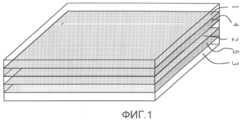
- Фигура 1, остекление, известное из уровня техники, сформированное из силикатной композиции, которую не высушивают, и листы стекла которой являются закаленными;- Figure 1, glazing, known from the prior art, formed from a silicate composition that is not dried, and the glass sheets of which are tempered;
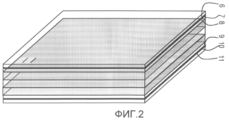
- Фигура 2, другое остекление, известное из уровня техники, с заламинированными листами стекла;- Figure 2, another glazing, known from the prior art, with laminated sheets of glass;
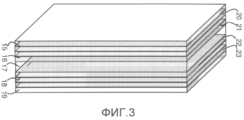
- Фигура 3, остекление, известное из уровня техники, сформированное из высушенных силикатных слоев;- Figure 3, glazing, known from the prior art, formed from dried silicate layers;
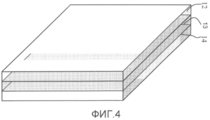
- Фигура 4, остекление по изобретению.- Figure 4, glazing according to the invention.
Остекления, представленные на фигурах, представляют собой остекления класса EI 60.The glazings shown in the figures are glazings of class EI 60.
Остекление, известное из уровня техники, согласно фигуре 1 формируется из трех листов стекла 1, 2 и 3. Эти листы имеют толщины около 5 мм каждый. Между этими листами стекла вводят два вспучивающихся слоя гидратированного силиката щелочного металла в форме литьевого раствора, который, при желании, гелируется при добавлении специфического агента. Рассматриваемые растворы имеют содержание воды около 47 мас.%. Толщина вспучивающейся композиции составляет около 5 мм для каждого из слоев 4 и 5.Glazing, known from the prior art, according to figure 1 is formed of three sheets of
Полная толщина остекления по предшествующему уровню техники составляет около 25 мм.The total glazing thickness of the prior art is about 25 mm.
Композиции с таким высоким содержанием воды имеют склонность к деформации текучести перед расширением под влиянием нагревания. Чтобы остекления были способны играть свою роль, лист, подвергаемый действию пламени, должен противостоять ему в течение времени, необходимого для достижения расширения вспучивающегося слоя. В частности, по этой причине, листы стекла формируют из закаленного стекла. Недостаток, как указано выше, состоит в том, что необходимо производить остекления непосредственно в конечных размерах, необходимых для применения.Compositions with such a high water content are prone to yield strain before expansion under the influence of heat. In order for the glazing to be able to play its role, the sheet exposed to the flame must resist it for the time necessary to achieve expansion of the intumescent layer. In particular, for this reason, sheets of glass are formed from tempered glass. The disadvantage, as indicated above, is that it is necessary to produce glazing directly in the final dimensions required for use.
Остекление по фигуре 2 также представляет собой продаваемое ранее остекление. Это остекление также содержит три листа стекла и два вспучивающихся слоя, причем эти слои имеют состав, подобный составу остекления по фигуре 1.The glazing of FIG. 2 also represents previously sold glazing. This glazing also contains three sheets of glass and two intumescent layers, these layers having a composition similar to the glazing composition of Figure 1.
В отличие от фигуры 1, эти листы стекла, по меньшей мере, на двух внешних сторонах, являются ламинированными. Каждый из этих листов содержит два листа стекла 6 и 8, или 9 и 11, соединенные посредством листа поливинилбутираля 7 и 10. Толщины листов стекла 6, 8, 9 и 11 составляют около 2,1 мм. Листы ПВБ составляют обычно 0,38 или 0,76 мм. Центральный лист является монолитным и имеет толщину 5 мм. Как и ранее, толщина конструкции составляет около 25 мм.Unlike figure 1, these sheets of glass, at least on two outer sides, are laminated. Each of these sheets contains two sheets of
В этой конфигурации листы стекла отожжены и, таким образом, имеется возможность разрезать их при обычных условиях для ламинированных стекол. Присутствие включений ПВБ дает возможность, по меньшей мере, поддерживать конструкцию в первые моменты испытания на огнестойкость, до расширения, по меньшей мере, одного вспучивающегося слоя. Более того, присутствие ПВБ дает этим остеклениям, вне испытания на огнестойкость, преимущественные свойства прочности при пластичном ударе.In this configuration, the sheets of glass are annealed and thus it is possible to cut them under normal conditions for laminated glasses. The presence of PVB inclusions makes it possible to at least maintain the structure in the first moments of the fire test until the expansion of at least one intumescent layer. Moreover, the presence of PVB gives these glazing, outside of the fire test, the advantageous strength properties of plastic impact.
Остекление предшествующего уровня техники, показанное на фигуре 3, представляет собой остекление, сформированное с высушенными слоями силиката щелочного металла 20, 21, 22 и 23. Рассматриваемые слои имеют содержание воды 23 мас.% с мольным отношением SiO2/M2O 3,3. Каждый вспучивающийся слой имеет толщину около 1,5 мм.The prior art glazing shown in FIG. 3 is a glazing formed with dried alkali metal silicate layers 20, 21, 22 and 23. The layers in question have a water content of 23 wt.% With a molar ratio of SiO 2 / M 2 O of 3.3 . Each intumescent layer has a thickness of about 1.5 mm.
Композиция этого остекления имеет 5 листов стекла 15, 16, 17, 18, 19, между которым находятся вспучивающиеся слои. Все эти листы изготовлены из отожженного стекла. Центральный лист 18 имеет толщину 8 мм. Другие листы имеют толщину 3 мм.The composition of this glazing has 5 sheets of
Полная толщина этого остекления, все еще класса EI 60, составляет 25 мм.The total thickness of this glazing, still of class EI 60, is 25 mm.
Остекление по фигуре 3 отличается от предшествующих остеклений, во-первых, высоким числом листов стекла и вспучивающихся слоев, но прежде всего тем фактом, что эти слои получены сушкой. Конструкция на основе идентичных листов (лист стекла 3 мм и вспучивающийся слой 1,5 мм), облегчает устройство этих остеклений. Однако, даже при том факте, что вспучивающиеся слои имеют относительно низкую толщину, время сушки остается главным ограничением этой методики.The glazing according to figure 3 differs from the previous glazing, firstly, by the high number of sheets of glass and intumescent layers, but above all by the fact that these layers were obtained by drying. The design on the basis of identical sheets (a sheet of
Фигура 4 показывает остекление по изобретению. Его формируют из двух листов отожженного стекла, 12 и 14, каждый толщиной 6 мм.Figure 4 shows the glazing according to the invention. It is formed from two sheets of annealed glass, 12 and 14, each 6 mm thick.
Для производства остекления, уплотняющий шов помещают по периферии. Этот шов удерживает листы 6 мм обособленно.For the production of glazing, a sealing joint is placed on the periphery. This seam holds
В пространство между этими двумя листами заливают заранее полученный раствор силиката щелочного металла (калия).A pre-prepared solution of alkali metal silicate (potassium) silicate is poured into the space between these two sheets.
Этот раствор получают из следующих компонентов:This solution is obtained from the following components:
- суспензия коллоидной двуокиси кремния, содержащая 50 мас.% двуокиси кремния, продаваемая под названием "Klebosol 50R50", 1218 г;- a suspension of colloidal silicon dioxide containing 50 wt.% silicon dioxide, sold under the name "Klebosol 50R50", 1218 g;
- раствор гидроксида калия, содержащий 50% воды, 472 г;- a solution of potassium hydroxide containing 50% water, 472 g;
- 99,5%-ный этиленгликоль, 58 г;- 99.5% ethylene glycol, 58 g;
- водный 25%-ный раствор ТМАГ, 60 г.- aqueous 25% solution of TMAH, 60 g.
Смешивание проводят постепенно, при поддерживаемой температуре 25°C. За этим следует дегидратация в течение 1 часа 30 минут при пониженном давлении (между 5 и 10 гПа) и при 30°C. Конечную дегазацию проводят при 25°C и давлении 40 гПа в течение 3 часов.Mixing is carried out gradually, at a maintained temperature of 25 ° C. This is followed by dehydration for 1 hour 30 minutes under reduced pressure (between 5 and 10 hPa) and at 30 ° C. Final degassing is carried out at 25 ° C and a pressure of 40 hPa for 3 hours.
Сформированный раствор, который является жидким и свободным от пузырьков, имеет содержание воды 38 мас.% и мольное отношение 4,6. Его заливают между двумя листами стекла.The formed solution, which is liquid and free of bubbles, has a water content of 38 wt.% And a molar ratio of 4.6. It is poured between two sheets of glass.
Окончательная отделка остекления включает пропускание через автоклав при давлении около 13×103 гПа и температуре не выше 70°C.Finishing the glazing involves passing through an autoclave at a pressure of about 13 × 10 3 hPa and a temperature not exceeding 70 ° C.
Испытания на огнестойкость проводят по условиям стандарта EN 1364-1. Теплоизоляция поддерживается более 60 минут, и проверка остекления продолжается, по меньшей мере, до 120 минут.Fire tests are carried out in accordance with EN 1364-1. Thermal insulation is maintained for more than 60 minutes, and glazing testing continues for at least 120 minutes.
Образцы, испытанные на их сопротивление старению при комнатной температуре, или ускоренному старению при 60°C или при УФ облучении, показывают хорошую стабильность. Появление "мутности" или пузырьков остается в пределах, требуемых для коммерческих использований.Samples tested for their resistance to aging at room temperature, or accelerated aging at 60 ° C or under UV irradiation, show good stability. The appearance of “turbidity” or bubbles remains within the range required for commercial uses.
Остекления по изобретению показывают большое преимущество по сравнению с предыдущими остеклениями, обладая большой гибкостью производства, но прежде всего имея, при равных характеристиках, более светлые и более тонкие структуры.The glazings according to the invention show a great advantage over previous glazings, having great manufacturing flexibility, but above all having, with equal characteristics, lighter and finer structures.
Результаты, полученные для остеклений EI 60, в отношении понижения массы и толщины, также обнаружены для продуктов других классов. Остекления класса EI 90 по изобретению могут быть сформированы, например, из трех листов стекла, каждый толщиной 5 мм, разделенных двумя вспучивающимися слоями толщиной также 5 мм.The results obtained for EI 60 glazing in terms of weight and thickness reduction are also found for products of other classes. Glazing of class EI 90 according to the invention can be formed, for example, of three sheets of glass, each 5 mm thick, separated by two intumescent layers also 5 mm thick.
Claims (6)


Applications Claiming Priority (3)
| Application Number | Priority Date | Filing Date | Title |
|---|---|---|---|
| EP08103722.8 | 2008-04-25 | ||
| EP08103722A EP2111977A1 (en) | 2008-04-25 | 2008-04-25 | Fireproof glazing |
| PCT/EP2009/054891 WO2009130278A1 (en) | 2008-04-25 | 2009-04-23 | Fire‑resistant glazing |
Publications (2)
| Publication Number | Publication Date |
|---|---|
| RU2010147858A RU2010147858A (en) | 2012-05-27 |
| RU2503543C2 true RU2503543C2 (en) | 2014-01-10 |
Family
ID=39722593
Family Applications (1)
| Application Number | Title | Priority Date | Filing Date |
|---|---|---|---|
| RU2010147858/05A RU2503543C2 (en) | 2008-04-25 | 2009-04-23 | Fireproof glazing |
Country Status (3)
| Country | Link |
|---|---|
| EP (2) | EP2111977A1 (en) |
| RU (1) | RU2503543C2 (en) |
| WO (1) | WO2009130278A1 (en) |
Families Citing this family (6)
| Publication number | Priority date | Publication date | Assignee | Title |
|---|---|---|---|---|
| EP2213635A1 (en) * | 2009-01-29 | 2010-08-04 | AGC Glass Europe | Layers of alkali silicates for fireproof glazing |
| BE1019263A3 (en) * | 2010-03-29 | 2012-05-08 | Agc Glass Europe | FIRE RESISTANT GLAZING. |
| DE102010037966A1 (en) | 2010-10-05 | 2012-04-05 | Schott Ag | laminated pane |
| WO2019158865A1 (en) | 2018-02-16 | 2019-08-22 | Saint-Gobain Glass France | Fire‑resistant glazing |
| WO2019158866A1 (en) | 2018-02-16 | 2019-08-22 | Saint-Gobain Glass France | Method for depositing an organic intumescent coating on a glass sheet |
| FR3119844A1 (en) | 2021-02-16 | 2022-08-19 | Saint-Gobain Glass France | Fire-resistant glazing comprising a sheet of glass coated with an intumescent coating |
Citations (6)
| Publication number | Priority date | Publication date | Assignee | Title |
|---|---|---|---|---|
| FR2679549A1 (en) * | 1991-07-24 | 1993-01-29 | Glaverbel | TRANSPARENT GLAZES RESISTANT TO FIRE. |
| WO2005090255A2 (en) * | 2004-03-05 | 2005-09-29 | Glaverbel | Glazing panel |
| WO2005115746A1 (en) * | 2004-05-27 | 2005-12-08 | Glaverbel | Fireproof glazing |
| WO2006092426A1 (en) * | 2005-03-02 | 2006-09-08 | Glaverbel | Fireproof glazing |
| RU2288898C1 (en) * | 2005-03-24 | 2006-12-10 | Закрытое акционерное общество "Соларекс" | Fire-resistant layered multi-glazing unit and a method of manufacture thereof |
| RU2292375C2 (en) * | 2002-08-10 | 2007-01-27 | Пилкингтон Плс | Fire-resistant glazing |
Family Cites Families (5)
| Publication number | Priority date | Publication date | Assignee | Title |
|---|---|---|---|---|
| GB9208502D0 (en) * | 1992-04-16 | 1992-06-03 | Glaverbel | Fire-retarding window assembly |
| DE19916506C1 (en) * | 1999-04-13 | 2000-07-13 | Flachglas Ag | Fire protection (safety) glass, useful in building, is made from primary products with fire-inhibiting layer on pane of glass by bonding 2 or more to another pane of glass by fire-inhibiting layers |
| DE102004031785A1 (en) * | 2004-07-01 | 2006-01-26 | Degussa Ag | Polyol-containing silica dispersion |
| EP1960317B1 (en) * | 2005-11-25 | 2018-01-31 | AGC Glass Europe | Fire-resistant glazing |
| EP1993828B1 (en) * | 2006-03-20 | 2017-08-16 | AGC Glass Europe | Fire-resistant glazing |
-
2008
- 2008-04-25 EP EP08103722A patent/EP2111977A1/en not_active Withdrawn
-
2009
- 2009-04-23 WO PCT/EP2009/054891 patent/WO2009130278A1/en not_active Ceased
- 2009-04-23 RU RU2010147858/05A patent/RU2503543C2/en not_active IP Right Cessation
- 2009-04-23 EP EP09735205A patent/EP2282889A1/en not_active Withdrawn
Patent Citations (7)
| Publication number | Priority date | Publication date | Assignee | Title |
|---|---|---|---|---|
| FR2679549A1 (en) * | 1991-07-24 | 1993-01-29 | Glaverbel | TRANSPARENT GLAZES RESISTANT TO FIRE. |
| RU2292375C2 (en) * | 2002-08-10 | 2007-01-27 | Пилкингтон Плс | Fire-resistant glazing |
| WO2005090255A2 (en) * | 2004-03-05 | 2005-09-29 | Glaverbel | Glazing panel |
| WO2005090255A3 (en) * | 2004-03-05 | 2006-04-13 | Glaverbel | Glazing panel |
| WO2005115746A1 (en) * | 2004-05-27 | 2005-12-08 | Glaverbel | Fireproof glazing |
| WO2006092426A1 (en) * | 2005-03-02 | 2006-09-08 | Glaverbel | Fireproof glazing |
| RU2288898C1 (en) * | 2005-03-24 | 2006-12-10 | Закрытое акционерное общество "Соларекс" | Fire-resistant layered multi-glazing unit and a method of manufacture thereof |
Also Published As
| Publication number | Publication date |
|---|---|
| WO2009130278A1 (en) | 2009-10-29 |
| EP2282889A1 (en) | 2011-02-16 |
| RU2010147858A (en) | 2012-05-27 |
| EP2111977A1 (en) | 2009-10-28 |
Similar Documents
| Publication | Publication Date | Title |
|---|---|---|
| JP4527876B2 (en) | Chemically reinforced boron-free float glass composition | |
| RU2736837C2 (en) | Fine colored chemically strengthened glass | |
| JP4284445B2 (en) | Glass composition and substrate made of chemically strengthened glass | |
| US9546514B2 (en) | Method for the production of fire resistant glazings | |
| EA017201B1 (en) | Fireproof glazing | |
| CN1253307C (en) | Fire resistant glazings | |
| CN101360692B (en) | Fire-resistant glazing | |
| US20180370194A1 (en) | Asymmetric laminated glass | |
| FR2697242A1 (en) | Chemical tempered glass. | |
| JP2013520388A (en) | Chemically tempered glass | |
| EP2252561B1 (en) | Light-permeable heat protection element with aluminate-modified or borate-modified silicon dioxide | |
| EA014547B1 (en) | Fire-resistant glazing | |
| CN100455531C (en) | Fire-resistant window glass | |
| DE60026690T2 (en) | FIRE PROTECTION GLASS | |
| RU2418754C2 (en) | Fire-resistant glasing | |
| EP2007574A1 (en) | Fireproof glazing | |
| EP2282889A1 (en) | Fire resistant glazing | |
| US20210370646A1 (en) | Glazing unit comprising a chemically toughened thin glass sheet | |
| EA023090B1 (en) | Fire-resistant glazing | |
| CN1257055C (en) | Production of refractory laminates | |
| JP6872158B2 (en) | Sound insulation board | |
| BE1012903A3 (en) | Fire glass transparent. | |
| WO2007118886A1 (en) | Fireproof glazing | |
| JP2018508456A (en) | Float glass composition suitable for chemical strengthening | |
| US20130157036A1 (en) | Fireproof glazing |
Legal Events
| Date | Code | Title | Description |
|---|---|---|---|
| MM4A | The patent is invalid due to non-payment of fees |
Effective date: 20200424 |