RU2412373C2 - Bench to test electrojet engine on iodine and method to test electrojet engine, operating on iodine as working substance, on bench - Google Patents
Bench to test electrojet engine on iodine and method to test electrojet engine, operating on iodine as working substance, on bench Download PDFInfo
- Publication number
- RU2412373C2 RU2412373C2 RU2008137447/06A RU2008137447A RU2412373C2 RU 2412373 C2 RU2412373 C2 RU 2412373C2 RU 2008137447/06 A RU2008137447/06 A RU 2008137447/06A RU 2008137447 A RU2008137447 A RU 2008137447A RU 2412373 C2 RU2412373 C2 RU 2412373C2
- Authority
- RU
- Russia
- Prior art keywords
- cryopanel
- iodine
- target
- engine
- hatch
- Prior art date
Links
- ZCYVEMRRCGMTRW-UHFFFAOYSA-N 7553-56-2 Chemical compound [I] ZCYVEMRRCGMTRW-UHFFFAOYSA-N 0.000 title claims abstract description 29
- 229910052740 iodine Inorganic materials 0.000 title claims abstract description 28
- 239000011630 iodine Substances 0.000 title claims abstract description 28
- 238000012360 testing method Methods 0.000 title claims abstract description 14
- 238000000034 method Methods 0.000 title abstract description 5
- 239000000126 substance Substances 0.000 title abstract description 5
- XKRFYHLGVUSROY-UHFFFAOYSA-N Argon Chemical compound [Ar] XKRFYHLGVUSROY-UHFFFAOYSA-N 0.000 claims abstract description 8
- PNDPGZBMCMUPRI-UHFFFAOYSA-N iodine Chemical compound II PNDPGZBMCMUPRI-UHFFFAOYSA-N 0.000 claims abstract description 6
- 230000005494 condensation Effects 0.000 claims abstract description 5
- 238000009833 condensation Methods 0.000 claims abstract description 5
- 238000001816 cooling Methods 0.000 claims abstract description 5
- 229910052786 argon Inorganic materials 0.000 claims abstract description 4
- 238000010438 heat treatment Methods 0.000 claims abstract description 3
- 239000012530 fluid Substances 0.000 claims description 8
- 239000011261 inert gas Substances 0.000 claims description 7
- 238000010998 test method Methods 0.000 claims description 3
- 238000011084 recovery Methods 0.000 claims 2
- 239000007789 gas Substances 0.000 abstract description 3
- 238000005086 pumping Methods 0.000 abstract description 3
- 238000004064 recycling Methods 0.000 abstract 3
- -1 for instance Substances 0.000 abstract 1
- QSHDDOUJBYECFT-UHFFFAOYSA-N mercury Chemical compound [Hg] QSHDDOUJBYECFT-UHFFFAOYSA-N 0.000 abstract 1
- 229910052753 mercury Inorganic materials 0.000 abstract 1
- 229910052724 xenon Inorganic materials 0.000 description 13
- FHNFHKCVQCLJFQ-UHFFFAOYSA-N xenon atom Chemical compound [Xe] FHNFHKCVQCLJFQ-UHFFFAOYSA-N 0.000 description 11
- IJGRMHOSHXDMSA-UHFFFAOYSA-N Atomic nitrogen Chemical compound N#N IJGRMHOSHXDMSA-UHFFFAOYSA-N 0.000 description 10
- 239000007788 liquid Substances 0.000 description 7
- 229910052757 nitrogen Inorganic materials 0.000 description 5
- 238000004519 manufacturing process Methods 0.000 description 3
- LFQSCWFLJHTTHZ-UHFFFAOYSA-N Ethanol Chemical compound CCO LFQSCWFLJHTTHZ-UHFFFAOYSA-N 0.000 description 2
- 239000001307 helium Substances 0.000 description 2
- 229910052734 helium Inorganic materials 0.000 description 2
- SWQJXJOGLNCZEY-UHFFFAOYSA-N helium atom Chemical compound [He] SWQJXJOGLNCZEY-UHFFFAOYSA-N 0.000 description 2
- 230000000704 physical effect Effects 0.000 description 2
- QJGQUHMNIGDVPM-BJUDXGSMSA-N Nitrogen-13 Chemical compound [13N] QJGQUHMNIGDVPM-BJUDXGSMSA-N 0.000 description 1
- RTAQQCXQSZGOHL-UHFFFAOYSA-N Titanium Chemical compound [Ti] RTAQQCXQSZGOHL-UHFFFAOYSA-N 0.000 description 1
- 230000001154 acute effect Effects 0.000 description 1
- 229910052782 aluminium Inorganic materials 0.000 description 1
- XAGFODPZIPBFFR-UHFFFAOYSA-N aluminium Chemical class [Al] XAGFODPZIPBFFR-UHFFFAOYSA-N 0.000 description 1
- 230000006735 deficit Effects 0.000 description 1
- 238000001704 evaporation Methods 0.000 description 1
- 230000008020 evaporation Effects 0.000 description 1
- 238000009434 installation Methods 0.000 description 1
- 229910052751 metal Inorganic materials 0.000 description 1
- 239000002184 metal Substances 0.000 description 1
- 150000002739 metals Chemical class 0.000 description 1
- 238000005065 mining Methods 0.000 description 1
- 239000010936 titanium Substances 0.000 description 1
- 229910052719 titanium Inorganic materials 0.000 description 1
- 150000003736 xenon Chemical class 0.000 description 1
Images
Landscapes
- Testing Of Engines (AREA)
- Compressors, Vaccum Pumps And Other Relevant Systems (AREA)
Abstract
Description
Предлагаемое изобретение относится к области электроракетных двигателей (ЭРД).The present invention relates to the field of electric rocket engines (ERE).
Электроракетные двигатели такие, как стационарные плазменные двигатели (СПД), двигатели с анодным слоем (ДАС), ионные двигатели (ИД) традиционно используют плазмообразующие вещества с большим атомным весом и низким потенциалом ионизации.Electric rocket engines such as stationary plasma engines (SPD), anode-layer engines (DAS), ion engines (ID) traditionally use plasma-forming substances with a large atomic weight and low ionization potential.
В настоящее время во всем мире предпочтение отдают инертным газам в качестве рабочего тела указанных выше ЭРД, в частности ксенону, имеющему наибольший атомный вес (131,3) и сравнительно низкий потенциал ионизации (12,1 эВ). По своим физическим свойствам и складированию он превосходит все остальные газы (при давлении 760 мм рт.ст. и температуре 20°С плотность составляет 0,00589 г/см2), при этом значительно уступая металлам. Он химически инертен и не конденсируется на элементах конструкции КА. Однако ксенон высокой чистоты является одним из самых дорогих рабочих тел. Кроме того, мировое производство ксенона составляет около 20 т в год. При развертывании широкомасштабных космических программ, таких как полет к Марсу, может возникнуть острый дефицит ксенона.Currently, all over the world, inert gases are preferred as the working fluid of the aforementioned EREs, in particular, xenon, which has the largest atomic weight (131.3) and a relatively low ionization potential (12.1 eV). In terms of its physical properties and storage, it surpasses all other gases (at a pressure of 760 mm Hg and a temperature of 20 ° C, the density is 0.00589 g / cm 2 ), while significantly inferior to metals. It is chemically inert and does not condense on the structural elements of the spacecraft. However, high-purity xenon is one of the most expensive working fluid. In addition, global xenon production is about 20 tons per year. When deploying large-scale space programs, such as flying to Mars, an acute xenon deficit may occur.
Особенностью функционирования рассматриваемых ЭРД является эксплуатация их в условиях глубокого вакуума не выше 10-4 мм рт.ст., при этом откачка вакуумной камеры, в которой работает ЭРД при наземной отработке, должна быть безмасляной, поскольку наличие паров масла снижает тяговые характеристики ЭРД и может привести к отказу двигателя. В связи с этим система откачки ксенона должна быть криогенной. Причем, учитывая физические свойства ксенона, (давление насыщенного пара ксенона 10-5 мм рт.ст. при температуре 63К) требуется установка гелиевых криопанелей, что значительно удорожает и усложняет особенно ресурсные испытания рассматриваемых ЭРД.A feature of the functioning of the considered electric propulsion engines is their operation in a deep vacuum of no higher than 10 -4 mm Hg, while the pumping out of the vacuum chamber in which the electric propulsion engine operates during surface mining should be oil-free, since the presence of oil vapor reduces the propulsion characteristics of the electric propulsion engine and can cause engine failure. In this regard, the xenon pumping system should be cryogenic. Moreover, taking into account the physical properties of xenon, (the pressure of saturated xenon vapor is 10 -5 mm Hg at a temperature of 63 K), the installation of helium cryopanels is required, which significantly increases the cost and complicates the especially resource tests of the considered electric propulsion engines.
За прототип предлагаемого изобретения принят стенд для ресурсных испытаний ионных двигателей, работающих на ксеноне (Y.Hayakawa, K.Miyazaki, S.Kitamura and H.Yoshida, Y.Yamamoto, K.Akai. Endurance test of 35-cm Xenon ion thruster. AIAA 2000-3530. 36 th AIAA/ASME/SAE/ASEE Joint Propulsion Conference and Exhibit. 16-19 July 2000/ Huntsville, Alabama). Стенд состоит из основной и вспомогательной камер, разделенных клапаном. Двигатель устанавливается на подвижном кронштейне. Большая часть истекающей из двигателя плазменной струи тормозится и частично адсорбируется на ионной мишени, выполненной в виде алюминиевого диска, на котором смонтированы титановые пластины, образующие ячейки, подобно коробке для яиц. Ионная мишень охлаждается основным холодильником. Отраженная от ионной мишени часть истекающей из двигателя струи плазмы адсорбируется цилиндрическими криопанелями, охлаждаемыми криогенераторами до температур (50-100) К.For the prototype of the invention, a stand for life tests of xenon-powered ion engines (Y. Hayakawa, K. Miyazaki, S. Kitamura and H. Yoshida, Y. Yamamoto, K. Akai. Endurance test of 35-cm Xenon ion thruster. AIAA 2000-3530. 36 th AIAA / ASME / SAE / ASEE Joint Propulsion Conference and Exhibit. 16-19 July 2000 / Huntsville, Alabama). The stand consists of a main and auxiliary chambers separated by a valve. The engine is mounted on a movable bracket. Most of the plasma jet flowing out of the engine is decelerated and partially adsorbed on an ion target made in the form of an aluminum disk on which titanium plates are mounted that form cells, like an egg box. The ion target is cooled by the main refrigerator. The part of the plasma jet flowing out of the engine reflected from the ion target is adsorbed by cylindrical cryopanels cooled by cryogenerators to temperatures (50-100) K.
За прототип способа обеспечения работы электроракетного двигателя (Y.Hayakawa, K.Miyazaki, S.Kitamura and H.Yoshida, Y.Yamamoto, K.Akai. Endurance test of 35-cm Xenon ion thruster. AIAA 2000-3530. 36 th AIAA/ASME/SAE/ASEE Joint Propulsion Conference and Exhibit. 16-19 July 2000 / Huntsville, Alabama), принят способ, реализованный на данном стенде и заключающийся в том, что истекающее рабочее тело затормаживают на мишени и осаждают на криопанели. После работы двигателя стенд развакуумируют, выпуская ксенон в атмосферу.For a prototype method of ensuring the operation of an electric rocket engine (Y. Hayakawa, K. Miyazaki, S. Kitamura and H. Yoshida, Y. Yamamoto, K. Akai. Endurance test of 35-cm Xenon ion thruster. AIAA 2000-3530. 36 th AIAA / ASME / SAE / ASEE Joint Propulsion Conference and Exhibit. 16-19 July 2000 / Huntsville, Alabama), a method is adopted that is implemented on this stand and that the expiring working fluid is braked on targets and deposited on a cryopanel. After engine operation, the booth will be evacuated by releasing xenon into the atmosphere.
К недостаткам стенда для испытаний двигателей, работающих на ксеноне, является необходимость охлаждения ионной мишени и криопанелей до очень низких температур (50-100) К, что значительно удорожает особенно ресурсные испытания двигателей. Причем затраты резко возрастают с увеличением мощности испытываемого двигателя.The disadvantages of the test bench for engines operating on xenon is the need to cool the ion target and cryopanels to very low temperatures (50-100) K, which significantly increases the cost of life tests of engines. Moreover, the costs increase sharply with increasing power of the tested engine.
Недостатком способа испытаний является выброс в атмосферу большого количества дорогостоящего ксенона.The disadvantage of the test method is the emission into the atmosphere of a large amount of expensive xenon.
Известна электроракетная двигательная установка (ЭРДУ) (Островский В.Г. Заявка на патент RU №2005102446, МПК F03H 1/00. Электроракетная двигательная установка и способ ее эксплуатации. Изобретения, 2006, №19), работающая на йоде. Йод значительно дешевле ксенона и имеет большую плотность, годовой объем добычи йода в ~500 раз превышает добычу ксенона.Known electric propulsion system (ERD) (Ostrovsky VG Patent application RU No. 2005102446, IPC
Задачей предлагаемого изобретения является снижение стоимости преимущественно ресурсных испытаний и утилизация рабочего тела (йода).The objective of the invention is to reduce the cost of mainly resource tests and the disposal of the working fluid (iodine).
Задача решается следующим образом.The problem is solved as follows.
В стенде для испытания электроракетного двигателя на йоде, состоящем из вакуумной камеры, системы вакуумирования, подвижного в продольном направлении кронштейна с установленным на нем электроракетным двигателем и системы торможения и конденсации истекающей из двигателя струи плазмы, включающей мишень и криопанель, снабженные системой подачи криоагента, мишень и криопанель дополнительно снабжены нагревателями и герметично связаны друг с другом, причем криопанель со стороны, обращенной к двигателю, снабжена люком, имеющим дистанционный привод и открытым при работе двигателя, а при закрытии - образующим герметичный отсек, при этом люк имеет герметично прикрепленный к его внутренней поверхности эластичный мешок, соединенный с баллоном, содержащим инертный газ, например аргон, причем герметичный отсек, образованный криопанелью, мишенью и люком, через разъемное соединение герметично связан с емкостью для утилизации йода, снабженной системой охлаждения и нагревателем.In the test bench for an iodine-based electric rocket engine, consisting of a vacuum chamber, a vacuum system, a longitudinally movable bracket with an electric rocket engine mounted on it, and a braking and condensation system for the plasma jet flowing out of the engine, including a target and a cryopanel equipped with a cryoagent supply system, the target and the cryopanel is additionally equipped with heaters and hermetically connected to each other, moreover, the cryopanel from the side facing the engine is equipped with a hatch having a remote drive and open when the engine is running, and when closed, forming a sealed compartment, while the hatch has an elastic bag hermetically attached to its inner surface, connected to a cylinder containing an inert gas, such as argon, moreover, the sealed compartment formed by a cryopanel, target and hatch through a detachable connection is tightly connected to the tank for the disposal of iodine, equipped with a cooling system and a heater.
В способе испытания на стенде электроракетного двигателя, работающего на рабочем теле - йоде, заключающемся в том, что истекающее рабочее тело затормаживают на мишени и осаждают на криопанели, при работе электроракетного двигателя криопанель и мишень охлаждают до температуры (минус 60… минус 70)°С, причем после выключения двигателя закрывают люк, увеличивают давление в вакуумной камере прекращением подачи криоагента в криопанель и мишень до (10-3…10-2) мм рт.ст., нагревают мишень и криопанель до температуры (100…110)°С, при этом емкость для утилизации йода охлаждают до температуры, не превышающей минус 50°С, подают инертный газ, нагретый до температуры (100…110)°С, в эластичный мешок, выдерживают паузу, прекращают откачку стенда вакуумной системой, открывают вакуумную камеру, отстыковывают разъемное соединение емкости для утилизации йода и с помощью ее подогрева повторно используют собранный йод.In the method of testing on the stand of an electric rocket engine running on a working fluid - iodine, namely, that the expiring working fluid is braked on a target and deposited on a cryopanel, when the electric rocket engine is running, the cryopanel and target are cooled to a temperature of (minus 60 ... minus 70) ° C and moreover, after the engine is turned off, the hatch is closed, the pressure in the vacuum chamber is increased by stopping the supply of the cryoagent to the cryopanel and the target to (10 -3 ... 10 -2 ) mm Hg, the target and the cryopanel are heated to a temperature of (100 ... 110) ° С, while the capacity for scrap The iodine is cooled to a temperature not exceeding minus 50 ° С, an inert gas heated to a temperature of (100 ... 110) ° С is fed into an elastic bag, paused, the pump is stopped by the vacuum system, the vacuum chamber is opened, and the container’s detachable connection is disconnected for utilizing iodine and using it to reuse the collected iodine.
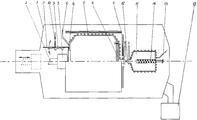
На чертеже представлен стенд для испытания электроракетного двигателя на йоде.The drawing shows a stand for testing an electric rocket engine on iodine.
В вакуумной камере 1 на подвижном в продольном направлении кронштейне 2 установлен электроракетный двигатель 3. Система торможения и конденсации истекающей из двигателя плазменной струи включает герметично связанные между собой мишень 4 и криопанель 5, охлаждаемые с помощью криогенератора жидкого азота (на чертеже не показан). Вход и выход жидкого азота в мишень и криопанель изображены стрелками 6. В качестве нагревателей криопанели 5 и мишени 4 могут быть использованы трубки 6, если по ним подавать нагретый теплоноситель (жидкий или газообразный). При этом криопанель 5 со стороны, обращенной к двигателю, снабжена люком 7, имеющим дистанционный привод 8 и открытым при работе двигателя, а при закрытии - образующим герметичный отсек. Люк 7 с внутренней стороны снабжен герметично прикрепленным к нему эластичным мешком 9, соединенным с баллоном, содержащим инертный газ, например аргон, вход которого в мешок 9 показан стрелкой 10. Герметичный отсек, образованный криопанелью 5, мишенью 4 и люком 7, герметично связан с емкостью для утилизации йода 11, снабженной разъемным соединением 12, системой охлаждения жидким азотом 13 и нагревателем 14. Вакуумная камера 1 снабжена вакуумными насосами 15.An
Работа стенда осуществляется следующим образом.The work of the stand is as follows.
Электроракетный двигатель монтируют в вакуумной камере 1. С помощью вакуумных насосов 15, а также охлажденным азотом из криогенератора 6 мишени 4 и криопанели 5 создают давление в вакуумной камере 1 порядка 10° мм рт.ст. Устанавливают двигатель 3 на подвижном в продольном направлении кронштейне 2 и перемещают его так, что при поднятом (как показано на чертеже) люке 7 выходное сечение двигателя обращено к мишени 4. Включают двигатель 3 и затормаживают и конденсируют истекающую из двигателя струю йодной плазмы на мишени 4 и криопанели 5, температуру которых поддерживают в диапазоне (минус 60 - минус 70)°С. После выключения двигателя с помощью подвижного кронштейна 2 отводят двигатель 3 от криопанели 5 и с помощью привода 8 закрывают люк 7. Прекращают подачу жидкого азота на вход 6 криопанели 5 и мишени 4, увеличивая при этом давление в вакуумной камере до (10-3…10-2) мм рт.ст. На вход 6 подают в трубопроводы криопанели и мишени жидкий или газообразный теплоноситель, нагретый до температуры (100-110)°С; при этом емкость для утилизации йода 11 охлаждают до температуры, не превышающей минус 50°С. Подают инертный газ, нагретый до температуры (100-110)°С, в эластичный мешок 9. Выдерживают паузу, достаточную для испарения йода в полости, образованной криопанелью 5, мишенью 4 и люком 7, и вытеснения его с помощью эластичного мешка 9 через разъемное соединение 12 в емкость для утилизации йода 11, в которой происходит конденсация йода при указанной температуре. Отстыковывают разъемное соединение 12 и демонтируют емкость для утилизации йода 11, содержащую йод. Остатки йода на элементах вакуумной камеры растворяют этанолом и удаляют из камеры. С помощью последующего подогрева емкости 11, содержащей йод, нагревателем 14 осуществляют его повторное использование.The electric rocket engine is mounted in the
К преимуществам предлагаемого изобретения можно отнести следующее:The advantages of the invention include the following:
отсутствует необходимость в гелиевых криогенераторах, способных охлаждать криопанели до температур до 50 К (криопанели охлаждаются жидким азотом до 213-203 К), что значительно удешевляет особенно ресурсные испытания электроракетных двигателей;there is no need for helium cryogenerators capable of cooling cryopanels to temperatures of up to 50 K (cryopanels are cooled by liquid nitrogen to 213-203 K), which significantly reduces the cost of life especially for electric rocket engines;
утилизация йода (с его дальнейшим использованием) также существенно снижает стоимость отработки электроракетных двигателей.Utilization of iodine (with its further use) also significantly reduces the cost of developing electric rocket engines.
Claims (2)
Priority Applications (1)
| Application Number | Priority Date | Filing Date | Title |
|---|---|---|---|
| RU2008137447/06A RU2412373C2 (en) | 2008-09-18 | 2008-09-18 | Bench to test electrojet engine on iodine and method to test electrojet engine, operating on iodine as working substance, on bench |
Applications Claiming Priority (1)
| Application Number | Priority Date | Filing Date | Title |
|---|---|---|---|
| RU2008137447/06A RU2412373C2 (en) | 2008-09-18 | 2008-09-18 | Bench to test electrojet engine on iodine and method to test electrojet engine, operating on iodine as working substance, on bench |
Publications (2)
| Publication Number | Publication Date |
|---|---|
| RU2008137447A RU2008137447A (en) | 2010-03-27 |
| RU2412373C2 true RU2412373C2 (en) | 2011-02-20 |
Family
ID=42137967
Family Applications (1)
| Application Number | Title | Priority Date | Filing Date |
|---|---|---|---|
| RU2008137447/06A RU2412373C2 (en) | 2008-09-18 | 2008-09-18 | Bench to test electrojet engine on iodine and method to test electrojet engine, operating on iodine as working substance, on bench |
Country Status (1)
| Country | Link |
|---|---|
| RU (1) | RU2412373C2 (en) |
Cited By (5)
| Publication number | Priority date | Publication date | Assignee | Title |
|---|---|---|---|---|
| RU2509228C2 (en) * | 2012-04-02 | 2014-03-10 | Открытое акционерное общество "Ракетно-космическая корпорация "Энергия" имени С.П. Королева" | Model of stationary plasma engine |
| RU2561801C1 (en) * | 2014-07-16 | 2015-09-10 | Открытое акционерное общество "Конструкторское бюро химавтоматики" | Method for testing electric propulsion motor (epm) and bench for its performance |
| RU2641983C2 (en) * | 2016-04-18 | 2018-01-23 | Открытое акционерное общество "Ракетно-космическая корпорация "Энергия" имени С.П. Королева" | Stand for testing electric rocket engine operating on iodine working body and method for testing electric rocket engine operating on iodine working body |
| RU2677439C1 (en) * | 2017-12-28 | 2019-01-16 | Акционерное общество "Конструкторское бюро химавтоматики" | Method for testing epe and stand for implementation thereof |
| RU2729857C1 (en) * | 2020-01-23 | 2020-08-12 | Закрытое акционерное общество "СуперОкс" (ЗАО "СуперОкс") | Vacuum apparatus for testing electric rocket engines |
Citations (3)
| Publication number | Priority date | Publication date | Assignee | Title |
|---|---|---|---|---|
| SU314919A1 (en) * | В. В. Пукас, Ю. С. Безрук, В. В. Царев, М. В. Бабкин, А. Ю. Блюмин, Н. А. Трощановский , В. В. Браткевич | TEST METHOD FOR INJECTION COOLING SYSTEMS FOR INTERNAL COMBUSTION ENGINES | ||
| RU2308610C2 (en) * | 2005-02-01 | 2007-10-20 | Открытое акционерное общество "Ракетно-космическая корпорация "Энергия" им. С.П. Королева" | Electric rocket engine plant and method of its operation |
| RU2312316C1 (en) * | 2006-02-20 | 2007-12-10 | Федеральное государственное унитарное предприятие "Научно-производственное объединение прикладной механики им. академика М.Ф. Решетнева" | Method and device for measuring thrust of electric jet engines |
-
2008
- 2008-09-18 RU RU2008137447/06A patent/RU2412373C2/en not_active IP Right Cessation
Patent Citations (4)
| Publication number | Priority date | Publication date | Assignee | Title |
|---|---|---|---|---|
| SU314919A1 (en) * | В. В. Пукас, Ю. С. Безрук, В. В. Царев, М. В. Бабкин, А. Ю. Блюмин, Н. А. Трощановский , В. В. Браткевич | TEST METHOD FOR INJECTION COOLING SYSTEMS FOR INTERNAL COMBUSTION ENGINES | ||
| SU345403A1 (en) * | В. М. Архангельский, В. В. Перекатов , С. С. Эпштейн Московский автомобильно дорожный институт | TESTING TRANSPORT ENGINES | ||
| RU2308610C2 (en) * | 2005-02-01 | 2007-10-20 | Открытое акционерное общество "Ракетно-космическая корпорация "Энергия" им. С.П. Королева" | Electric rocket engine plant and method of its operation |
| RU2312316C1 (en) * | 2006-02-20 | 2007-12-10 | Федеральное государственное унитарное предприятие "Научно-производственное объединение прикладной механики им. академика М.Ф. Решетнева" | Method and device for measuring thrust of electric jet engines |
Non-Patent Citations (1)
| Title |
|---|
| Y.HAYAKAWA. Endurance test of 35-cm Xenon ion thruster 36 th AIAA/ASME/SAE/ASEE Joint Propulsion Conference and Exhibit. 16-19 July 2000 / Huntsville, Alabama. * |
Cited By (5)
| Publication number | Priority date | Publication date | Assignee | Title |
|---|---|---|---|---|
| RU2509228C2 (en) * | 2012-04-02 | 2014-03-10 | Открытое акционерное общество "Ракетно-космическая корпорация "Энергия" имени С.П. Королева" | Model of stationary plasma engine |
| RU2561801C1 (en) * | 2014-07-16 | 2015-09-10 | Открытое акционерное общество "Конструкторское бюро химавтоматики" | Method for testing electric propulsion motor (epm) and bench for its performance |
| RU2641983C2 (en) * | 2016-04-18 | 2018-01-23 | Открытое акционерное общество "Ракетно-космическая корпорация "Энергия" имени С.П. Королева" | Stand for testing electric rocket engine operating on iodine working body and method for testing electric rocket engine operating on iodine working body |
| RU2677439C1 (en) * | 2017-12-28 | 2019-01-16 | Акционерное общество "Конструкторское бюро химавтоматики" | Method for testing epe and stand for implementation thereof |
| RU2729857C1 (en) * | 2020-01-23 | 2020-08-12 | Закрытое акционерное общество "СуперОкс" (ЗАО "СуперОкс") | Vacuum apparatus for testing electric rocket engines |
Also Published As
| Publication number | Publication date |
|---|---|
| RU2008137447A (en) | 2010-03-27 |
Similar Documents
| Publication | Publication Date | Title |
|---|---|---|
| US9597629B2 (en) | Method and device for separating off carbon dioxide from a gas mixture | |
| CN105067293B (en) | A kind of ion thruster life-span ground-testing plant | |
| KR102264967B1 (en) | Cryo pump, Vacuum processor | |
| JP6343156B2 (en) | Compression refrigerator | |
| JP6138957B2 (en) | Refrigerant circulation device, refrigerant circulation method, and acid suppression method | |
| US9623982B2 (en) | On-board aircraft nitrogen enriched air and cooling fluid generation system and method | |
| CN105000202A (en) | Vacuum pumping system of test equipment of ion thrusters | |
| Gusev | Thermodynamic peculiarities of low-temperature regeneration of cryosorption devices in heat-insulation cavities of hydrogenous cryogenic tanks | |
| RU2526505C1 (en) | Method of gas flow creation in aerodynamic tunnel and aerodynamic tunnel | |
| FR2775026A1 (en) | METHOD, CRYOPUMP AND ELECTRONIC MODULE FOR SELECTIVE GAS CONDENSATION AND DEFROSTING | |
| Muscatello et al. | Atmospheric processing module for Mars propellant production | |
| RU2008137447A (en) | THE STAND FOR TESTING THE ELECTRIC MISSION ENGINE ON IODINE AND THE METHOD OF TESTING ON THE STAND OF THE ELECTROMISSION ENGINE OPERATING ON THE WORKING BODY OF IODINE | |
| RU2308610C2 (en) | Electric rocket engine plant and method of its operation | |
| JP2007010149A (en) | Low temperature liquefied gas filling method | |
| RU2677439C1 (en) | Method for testing epe and stand for implementation thereof | |
| Vetrovec | Chemical oxygen-iodine laser with cryosorption vacuum pump | |
| Gupta et al. | Performance testing of the liquid nitrogen cooled sorption cryopump for application in SST-1 Tokamak | |
| US20250101571A1 (en) | Evaporation pump | |
| Amamchyan et al. | The economics of cryosorption pumping. The practice of using a cryosorption pump in an industrial pumping system | |
| RU2641983C2 (en) | Stand for testing electric rocket engine operating on iodine working body and method for testing electric rocket engine operating on iodine working body | |
| RU2561801C1 (en) | Method for testing electric propulsion motor (epm) and bench for its performance | |
| Batracov et al. | Neon cryovacuum system for endurance tests of electrojet propulsion systems | |
| US20170306940A1 (en) | Device for improving the vacuum in the housing of a machine | |
| Ketsdever | Design considerations for cryogenic pumping arrays in spacecraft-thruster interaction facilities | |
| JP3929477B1 (en) | Circulating internal pressure engine |
Legal Events
| Date | Code | Title | Description |
|---|---|---|---|
| MM4A | The patent is invalid due to non-payment of fees |
Effective date: 20180919 |