RU2397828C1 - Substance treatment process - Google Patents
Substance treatment process Download PDFInfo
- Publication number
- RU2397828C1 RU2397828C1 RU2009127283/03A RU2009127283A RU2397828C1 RU 2397828 C1 RU2397828 C1 RU 2397828C1 RU 2009127283/03 A RU2009127283/03 A RU 2009127283/03A RU 2009127283 A RU2009127283 A RU 2009127283A RU 2397828 C1 RU2397828 C1 RU 2397828C1
- Authority
- RU
- Russia
- Prior art keywords
- substances
- substance
- microparticles
- processing
- electrolyte
- Prior art date
Links
Images
Landscapes
- Processing Of Solid Wastes (AREA)
Abstract
Description
Изобретение относится к области переработки веществ в различных отраслях промышленности и так далее. В основном, оно может быть использовано в области переработки любых видов отходов, а также в тепло- и электроэнергетике. Утилизация отходов является важным условием для обеспечения безопасности жизнедеятельности.The invention relates to the field of processing of substances in various industries and so on. Basically, it can be used in the field of processing any kind of waste, as well as in the heat and power industry. Disposal of waste is an important condition for ensuring the safety of life.
Известно, что эффективность переработки веществ зависит от надежности, безопасности самого способа переработки, а также от его энергоемкости.It is known that the processing efficiency of substances depends on the reliability, safety of the processing method itself, as well as its energy intensity.
Считается, что цели известных способов в большинстве случаев связаны с обеспечением экономии энергоресурсов, а также улучшением экологической чистоты применяемого метода, обусловленного комплексом различных причин конструктивного, технологического и эксплуатационного характера. Основной задачей, решаемой при утилизации отходов, является обеспечение низкого энергопотребления и снижение выбросов, загрязняющих воздух, воду и почву.It is believed that the goals of the known methods in most cases are related to ensuring energy savings, as well as improving the environmental cleanliness of the method used, due to a variety of various reasons of a structural, technological and operational nature. The main task to be solved during waste disposal is to ensure low energy consumption and reduce emissions that pollute air, water and soil.
Известны способы [1] переработки, в частности, бытовых и промышленных отходов, когда используется термическая переработка. При этом применяют подготовку и загрузку в шахту отходов, при герметизации реакционного пространства печи. Нагрев производят последовательно в спутном потоке пламени топливных и плазменных горелок и на поверхности расплава шлака в окислительной среде. Отходящие газы поступают в систему газоочистки и на утилизацию. Недостатком являются большие затраты тепловой или электрической энергии, а также низкие экологические характеристики данного способа.Known methods [1] for processing, in particular, domestic and industrial waste, when thermal processing is used. In this case, the preparation and loading of waste into the mine is used, when sealing the reaction space of the furnace. Heating is carried out sequentially in a confluent flame stream of fuel and plasma burners and on the surface of the slag melt in an oxidizing medium. Waste gases enter the gas treatment system and are disposed of. The disadvantage is the high cost of thermal or electrical energy, as well as the low environmental characteristics of this method.
Известен также способ переработки веществ [2], включающий загрузку и пропускание веществ через реактор с теплоносителем, в виде расплава солей с электрохимическими катализаторами, в котором перерабатывают вещества. После загрузки вещества предварительно сортируют в ванной с органической жидкостью, а затем подают в основной реактор с расплавом солей с электрохимическими катализаторами - наборами неорганических веществ, которые образуют в том числе заряженные конденсаторы, протягивают вещества в расплаве между барабаном и кожухом с шипами для образования в слое веществ отверстий, добавляют в расплав растворители, производят микровзрывы и микроразряды внутри расплава и взрывным давлением, механическими, гидравлическими и термическими ударами разрывают вещества, чем уменьшают их вязкость и прочность и путем пиролиза превращают органические вещества в полезную продукцию.There is also known a method of processing substances [2], including loading and passing substances through a reactor with a coolant, in the form of a molten salt with electrochemical catalysts, in which substances are processed. After loading, the substances are pre-sorted in a bath with organic liquid, and then fed to the main reactor with molten salts with electrochemical catalysts - sets of inorganic substances that form, including charged capacitors, stretch the substances in the melt between the drum and the casing with spikes for formation in the layer substances of holes, add solvents to the melt, produce microexplosions and microdischarges inside the melt and with explosive pressure, mechanical, hydraulic and thermal shock times yvayut substance than reduce their viscosity and strength and by pyrolysis of the organic matter is converted into useful products.
Основными недостатками данного способа является его низкая эффективность, недостаточная надежность и ограниченная область применения. В процессе переработки вещества в расплаве реактора неизбежно появление включений, которые могут замедлить эффективность происходящих микроразрядов и микровзрывов за счет того, что заряженные конденсаторы работоспособны только в среде диэлектрика. Из-за посторонних включений диэлектрические свойства расплавов солей снижаются. Следовательно, эффективность данного способа ухудшается, что накладывает дополнительные требования к предварительной подготовке перерабатываемых веществ.The main disadvantages of this method is its low efficiency, lack of reliability and limited scope. In the process of processing a substance in a reactor melt, the appearance of inclusions is inevitable, which can slow down the efficiency of microdischarges and microexplosions due to the fact that charged capacitors are only operable in a dielectric medium. Due to foreign matter, the dielectric properties of molten salts are reduced. Therefore, the effectiveness of this method is deteriorating, which imposes additional requirements for the preliminary preparation of processed substances.
Задачей предлагаемого технического решения является повышение производительности, эффективности и расширение областей применения способа переработки вещества.The objective of the proposed technical solution is to increase productivity, efficiency and expand the scope of the method of processing substances.
Поставленная задача решается тем, что вещества, подвергаемые переработке, загружают и пропускают через реактор с жидкой субстанцией, в которой вещества расщепляют посредством микровзрывов и микроразрядов внутри субстанции, размещая в ней электроды, представляющие собой предварительно размельченные и засыпанные множественные частицы, а в качестве жидкой субстанции используют электролит (расплавы или растворы солей, кислот или щелочей). В электролите располагают электроды в виде множественных частиц таким образом, что в качестве «анода» служат микрочастицы металла, а в качестве «катода» - микрочастицы углерода. Затем подают окислитель, при этом в электролите происходят окислительно-восстановительные реакции, а микрочастицы заряжаются противоположными электрическими зарядами, притягиваются друг к другу, и при замыкании между собой - разряжаются с образованием электрической дуги, имеющей температуру, близкую к температуре плазмы. Управляют интенсивностью дуги магнитными полями, влияющими на движение заряженных частиц. Температуру и состав электролита подбирают в зависимости от вида перерабатываемого вещества. Таким образом, исходные вещества превращаются в полезную продукцию.The problem is solved in that the substances to be processed are loaded and passed through a reactor with a liquid substance, in which the substances are cleaved by microexplosions and microdischarges inside the substance, placing electrodes in it, which are pre-crushed and filled with multiple particles, and as a liquid substance use an electrolyte (melts or solutions of salts, acids or alkalis). The electrolyte contains electrodes in the form of multiple particles in such a way that the microparticles of metal serve as the “anode”, and carbon microparticles serve as the “cathode”. Then an oxidizing agent is supplied, while redox reactions occur in the electrolyte, and the microparticles are charged by opposite electric charges, attracted to each other, and when they are interconnected, they are discharged to form an electric arc having a temperature close to the temperature of the plasma. The intensity of the arc is controlled by magnetic fields that affect the movement of charged particles. The temperature and composition of the electrolyte are selected depending on the type of processed substance. Thus, the starting materials are converted into useful products.
По сравнению с прототипом, где применение жидкой субстанции ограничено расплавами солей, в заявляемом способе температура и состав электролита могут быть подобраны в зависимости от вида перерабатываемого вещества. Многие расплавы солей требуют поддержания высокой температуры, что неизбежно может привести к увеличению энергетических затрат. Применение наряду с расплавами растворов позволяет уменьшить потребную температуру в реакторе и соответственно снизить энергозатраты. По сравнению с прототипом в заявляемом способе подают окислитель, который способствует поляризации заряженных микрочастиц, которые притягиваются друг к другу, и при замыкании между собой - разряжаются с образованием электрической дуги, имеющей температуру, близкую к температуре плазмы. Интенсивностью дуги управляют магнитными потоками, влияющими на движение заряженных частиц.Compared with the prototype, where the use of a liquid substance is limited by molten salts, in the present method, the temperature and composition of the electrolyte can be selected depending on the type of processed substance. Many salt melts require maintaining a high temperature, which inevitably can lead to an increase in energy costs. The use of solutions along with the melts can reduce the required temperature in the reactor and, accordingly, reduce energy consumption. Compared with the prototype, the inventive method serves an oxidizing agent that promotes the polarization of charged microparticles, which are attracted to each other, and when shorted together, are discharged with the formation of an electric arc having a temperature close to the temperature of the plasma. The intensity of the arc is controlled by magnetic fluxes that affect the movement of charged particles.
Способ реализуется следующим образом.The method is implemented as follows.
При необходимости переработки различных веществ в полезную продукцию их загружают и пропускают через реактор с жидкой субстанцией, в которой исходные вещества расщепляют посредством микровзрывов и микроразрядов внутри субстанции, размещая в ней электроды, представляющие собой предварительно размельченные и засыпанные множественные частицы, а в качестве жидкой субстанции используют электролит (расплавы или растворы солей, кислот или щелочей). В электролите располагают электроды в виде множественных частиц таким образом, что в качестве «анода» служат микрочастицы металла, а в качестве «катода» - микрочастицы углерода. Затем подают окислитель, при этом микрочастицы заряжаются противоположными электрическими зарядами, притягиваются друг к другу, и при замыкании между собой - разряжаются с образованием электрической дуги, имеющей температуру, близкую к температуре плазмы. Управляют интенсивностью дуги магнитными полями, влияющими на движение заряженных частиц. Температуру и состав электролита подбирают в зависимости от вида перерабатываемого вещества.If it is necessary to process various substances into useful products, they are loaded and passed through a reactor with a liquid substance, in which the starting materials are cleaved by microexplosions and microdischarges inside the substance, placing electrodes in it, which are pre-crushed and filled with multiple particles, and are used as a liquid substance electrolyte (melts or solutions of salts, acids or alkalis). The electrolyte contains electrodes in the form of multiple particles in such a way that the microparticles of metal serve as the “anode”, and carbon microparticles serve as the “cathode”. Then an oxidizing agent is supplied, while the microparticles are charged with opposite electric charges, attracted to each other, and when they are interconnected, they are discharged with the formation of an electric arc having a temperature close to the plasma temperature. The intensity of the arc is controlled by magnetic fields that affect the movement of charged particles. The temperature and composition of the electrolyte are selected depending on the type of processed substance.
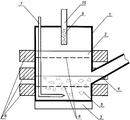
Пример 1. В реактор 1 установки (см. чертеж) объемом 1,7 дм3 заливается электролит 2 в количестве 1 дм3, который подогревается с помощью нагревателя 3. При температуре электролита 340°C загружается отработанное масло 4-800 г и древесные и пластиковые опилки 5-200 г. Для предотвращения всплытия перерабатываемого вещества и выпадения его в осадок в реакторе 1 установлены перфорированные экраны 6. Через специальный штуцер 7 подается окислитель. Снаружи установлены генераторы магнитного поля 8. Смесь перерабатывается в горючий газ 9 со скоростью 111 г/с, который удаляется через выходной штуцер 10.Example 1. In the
Пример 2. В реактор установки объемом 1,7 дм3 заливается электролит в количестве 1 дм3. При температуре электролита 480°C загружается резина весом 1,2 кг. После переработки получается 390 г печного топлива, 300 г технического углерода, остальное - горючий газ.Example 2. In the reactor of the installation with a volume of 1.7 dm 3 the electrolyte is poured in the amount of 1 dm 3 . At an electrolyte temperature of 480 ° C, rubber weighing 1.2 kg is loaded. After processing, 390 g of heating oil, 300 g of carbon black are obtained, the rest is combustible gas.
Пример 3. В реактор установки объемом 1,7 дм3 заливается электролит в количестве 1 дм3. При температуре электролита 830°C загружается 300 г нефтешлама, 300 г древесных и пластиковых опилок и бумаги, 400 г пищевых отходов. Получается 320 г технического углерода, 370 г горючего газа, остальное - шлаки.Example 3. In the reactor of the installation with a volume of 1.7 dm 3 the electrolyte is poured in the amount of 1 dm 3 . At an electrolyte temperature of 830 ° C, 300 g of oil sludge, 300 g of wood and plastic sawdust and paper, 400 g of food waste are loaded. It turns out 320 g of carbon black, 370 g of combustible gas, the rest is slag.
В каждом случае в горючих газах диоксины не обнаружены. Хлор и сера удаляются известными способами.In each case, no dioxins were found in combustible gases. Chlorine and sulfur are removed by known methods.
Применение заявляемого способа позволяет произвести переработку исходных веществ в полезную продукцию (например, отходов - в топливо) за минимальный промежуток времени. Предлагаемый способ позволяет интенсифицировать процесс переработки веществ, снизить потребные энергозатраты и существенно расширить область применения переработки веществ. Предлагаемый способ позволяет более полно использовать различные вещества, например загрязняющие компоненты, отходы, выбросы и т.д. Данный способ является энергетически выгодным, так как для образования микровзрывов и микроразрядов используется химическая энергия перерабатываемого вещества. При расщеплении органических веществ не происходит образование диоксинов в связи с тем, что на уровне отдельных молекул нет температурного градиента (наличие которого является условием образования диоксина), так как нагревание и расщепление отдельных молекул происходит мгновенно и так же мгновенно (до температуры электролита) продукты расщепления охлаждаются - происходит закалка образующихся газов.The application of the proposed method allows the processing of starting materials into useful products (for example, waste - into fuel) for a minimum period of time. The proposed method allows to intensify the process of processing substances, reduce energy consumption and significantly expand the scope of processing of substances. The proposed method allows more fully use various substances, such as polluting components, waste, emissions, etc. This method is energetically advantageous, since the chemical energy of the processed substance is used to form microexplosions and microdischarges. When organic substances are broken down, dioxins are not formed due to the fact that at the level of individual molecules there is no temperature gradient (the presence of which is a condition for the formation of dioxin), since the heating and splitting of individual molecules occurs instantly and just as quickly (to the electrolyte temperature), the cleavage products cooled - quenching of the resulting gases occurs.
Данный способ был апробирован с 6 по 17 апреля 2009 г. на территории базы ООО «Шакир», г.Уфа. Результаты подтверждены актом №7 от 17 апреля 2009 г.This method was tested from April 6 to April 17, 2009 at the base of LLC Shakir, Ufa. The results are confirmed by act No. 7 of April 17, 2009.
Источники информацииInformation sources
1. Панфилов С.А., Симонов А.А., Иляхин С.В. Способ термической переработки бытовых отходов и устройство для осуществления. Патент СССР 1836603 от 24.06.1991.1. Panfilov S.A., Simonov A.A., Ilyakhin S.V. Method for thermal processing of household waste and device for implementation. USSR patent 1836603 from 06.24.1991.
2. Шафоростов В.Я. Способ переработки вещества. Патент RU №2356655 от 09.12.2005.2. Shaforostov V.Ya. The method of processing the substance. Patent RU No. 2356655 dated December 9, 2005.
Claims (3)
Priority Applications (1)
| Application Number | Priority Date | Filing Date | Title |
|---|---|---|---|
| RU2009127283/03A RU2397828C1 (en) | 2009-07-08 | 2009-07-08 | Substance treatment process |
Applications Claiming Priority (1)
| Application Number | Priority Date | Filing Date | Title |
|---|---|---|---|
| RU2009127283/03A RU2397828C1 (en) | 2009-07-08 | 2009-07-08 | Substance treatment process |
Publications (1)
| Publication Number | Publication Date |
|---|---|
| RU2397828C1 true RU2397828C1 (en) | 2010-08-27 |
Family
ID=42798665
Family Applications (1)
| Application Number | Title | Priority Date | Filing Date |
|---|---|---|---|
| RU2009127283/03A RU2397828C1 (en) | 2009-07-08 | 2009-07-08 | Substance treatment process |
Country Status (1)
| Country | Link |
|---|---|
| RU (1) | RU2397828C1 (en) |
Citations (8)
| Publication number | Priority date | Publication date | Assignee | Title |
|---|---|---|---|---|
| RU2081642C1 (en) * | 1995-11-13 | 1997-06-20 | Акционерное общество закрытого типа "Агора Энтерпрайзис" Инк. | Method of processing of toxic industrial products and device for its embodiment |
| RU2111859C1 (en) * | 1995-03-16 | 1998-05-27 | Открытое акционерное общество "Троицкая Технологическая Лаборатория" | Processing of rubber articles |
| RU97103920A (en) * | 1997-03-11 | 1999-03-10 | И.Н. Фокин | WASTE RECYCLING METHOD |
| RU2146152C1 (en) * | 1998-06-09 | 2000-03-10 | Забурдаева Татьяна Андреевна | Garbage and waste reprocessing method |
| RU2193449C1 (en) * | 2001-03-05 | 2002-11-27 | Григорьев Юрий Васильевич | Process of electric and hydraulic crushing of reinforced concrete |
| RU2225762C1 (en) * | 2003-02-25 | 2004-03-20 | Общество с ограниченной ответственностью "Экология" | Method of processing of solid wastes or slimes |
| UA67473A (en) * | 2003-10-06 | 2004-06-15 | Volodymyr Yakovych Shaforostov | Pyrolysis apparatus for organic substances |
| RU2356655C2 (en) * | 2005-12-09 | 2009-05-27 | Владимир Яковлевич Шафоростов | Method for substance processing |
-
2009
- 2009-07-08 RU RU2009127283/03A patent/RU2397828C1/en not_active IP Right Cessation
Patent Citations (8)
| Publication number | Priority date | Publication date | Assignee | Title |
|---|---|---|---|---|
| RU2111859C1 (en) * | 1995-03-16 | 1998-05-27 | Открытое акционерное общество "Троицкая Технологическая Лаборатория" | Processing of rubber articles |
| RU2081642C1 (en) * | 1995-11-13 | 1997-06-20 | Акционерное общество закрытого типа "Агора Энтерпрайзис" Инк. | Method of processing of toxic industrial products and device for its embodiment |
| RU97103920A (en) * | 1997-03-11 | 1999-03-10 | И.Н. Фокин | WASTE RECYCLING METHOD |
| RU2146152C1 (en) * | 1998-06-09 | 2000-03-10 | Забурдаева Татьяна Андреевна | Garbage and waste reprocessing method |
| RU2193449C1 (en) * | 2001-03-05 | 2002-11-27 | Григорьев Юрий Васильевич | Process of electric and hydraulic crushing of reinforced concrete |
| RU2225762C1 (en) * | 2003-02-25 | 2004-03-20 | Общество с ограниченной ответственностью "Экология" | Method of processing of solid wastes or slimes |
| UA67473A (en) * | 2003-10-06 | 2004-06-15 | Volodymyr Yakovych Shaforostov | Pyrolysis apparatus for organic substances |
| RU2356655C2 (en) * | 2005-12-09 | 2009-05-27 | Владимир Яковлевич Шафоростов | Method for substance processing |
Similar Documents
| Publication | Publication Date | Title |
|---|---|---|
| Keçili et al. | Fluorescent nanosensors based on green carbon dots (CDs) and molecularly imprinted polymers (MIPs) for environmental pollutants: Emerging trends and future prospects | |
| Tatarova et al. | Plasmas for environmental issues: From hydrogen production to 2D materials assembly | |
| Arfelis et al. | Linking mechanochemistry with the green chemistry principles | |
| GB2570922A (en) | Purification of hydrocarbons | |
| CN108328898A (en) | A kind of recycling processing method and device of oily sludge | |
| CN107363072B (en) | The molten pool smelting method of waste | |
| KR101685033B1 (en) | Waste processing system for a printed circuit board | |
| Garibyan | Modelling of Technical Parameters of Discharge Reactor for Polymer Treatment. | |
| RU2397828C1 (en) | Substance treatment process | |
| CN112879910A (en) | Distributed solid waste continuous treatment device of controllable thermal plasma torch | |
| CN103170493A (en) | Comprehensive utilization process of household garbage renewable energy | |
| CN212396707U (en) | Plasma liquid phase processing device of fly ash | |
| CN203053206U (en) | Tailing smelting furnace with plasma torch heating system | |
| RU2356655C2 (en) | Method for substance processing | |
| CN215675197U (en) | Coal gangue treatment system | |
| RU2422493C1 (en) | Procedure for hydrocarbon cracking and plasma reactor for its implementation | |
| KR100855608B1 (en) | Waste plastic treatment method and device | |
| Chen et al. | The effect of plastic type on the product distribution and Cr (VI) removal in the co-pyrolysis of plastics and chromium-containing slag | |
| Vertakova et al. | Prospects for development of hydrocarbon raw materials resources reproduction | |
| RU106616U1 (en) | PLANT FOR PRODUCING A HIGH-CALORNY PLASMOGAS FROM CARBON-CONTAINING WATER-ORGANIC ULTRA-DISPERSION SYSTEMS | |
| Li et al. | Research on cavitation and impinging stream microelectrolysis reactor for treating organic wastewater | |
| Gado et al. | Supercritical Water Gasification (SCWG) Technology for Municipal Solid Waste (MSW) Treatment | |
| RU2503709C1 (en) | Processing method of oil and/or oil residues | |
| CN103846268B (en) | The method of Footwall drift copper from the copper cash being coated with chloride synthetic resin | |
| US20220395877A1 (en) | Waste volume-reduction processing method and waste volume-reduction processing system |
Legal Events
| Date | Code | Title | Description |
|---|---|---|---|
| MM4A | The patent is invalid due to non-payment of fees |
Effective date: 20120709 |