RU2392016C2 - Method of treatment of chronic spinal cord lesions in experiment - Google Patents
Method of treatment of chronic spinal cord lesions in experiment Download PDFInfo
- Publication number
- RU2392016C2 RU2392016C2 RU2008126325/14A RU2008126325A RU2392016C2 RU 2392016 C2 RU2392016 C2 RU 2392016C2 RU 2008126325/14 A RU2008126325/14 A RU 2008126325/14A RU 2008126325 A RU2008126325 A RU 2008126325A RU 2392016 C2 RU2392016 C2 RU 2392016C2
- Authority
- RU
- Russia
- Prior art keywords
- spinal cord
- treatment
- experiment
- stimulation
- transection
- Prior art date
Links
Images
Landscapes
- Electrotherapy Devices (AREA)
Abstract
Description
Изобретение относится к медицине, а также к физиологии движений и электрофизиологии, и может быть использовано для моделирования и обучения методам лечения и реабилитации людей с поражением спинного мозга.The invention relates to medicine, as well as to the physiology of movements and electrophysiology, and can be used to model and teach methods of treatment and rehabilitation of people with spinal cord lesions.
Количество таких больных во всем мире ежегодно увеличивается. Следствием повреждений позвоночника и спинного мозга часто является частичная обездвиженность. Несмотря на постоянно возникающие новые методы лечения и реабилитации таких больных, проблема восстановления движения остается нерешенной.The number of such patients worldwide is increasing annually. Damage to the spine and spinal cord often results in partial immobility. Despite the constantly emerging new methods of treatment and rehabilitation of such patients, the problem of restoring movement remains unresolved.
За ближайшие аналоги приняты способ лечения больных с хроническим поражением спинного мозга (Ru 2204423) и способ лечения больных с хроническим поражением спинного мозга (Ru 2000121379). В этих способах электрическая стимуляция поясничного утолщения спинного мозга с помощью электродов, наложенных на твердую мозговую оболочку спинного мозга (dura mater), вызывает движения ног при облегченном положении больного, лежащего на спине или на боку с подвешенными на балканских рамах ногами. Отличие между этими изобретениями состоит в том, что в одном из них (Ru 2000121379) предложен способ самостоятельной электростимуляции с помощью имплантированной на постоянной основе системы для хронической стимуляции. Эти способы лечения больных с хроническим поражением спинного мозга инвазивные, т.к. стимулирующие электроды накладывают на поверхность твердой мозговой оболочки спинного мозга для электрической стимуляции спинного мозга ниже уровня поражения. Реализация этих способов лечения требует оперативного вмешательства для постановки электродов и специфического медицинского обслуживания на весь период работы стимулирующих электродов на поверхности спинного мозга для предотвращения воспалительных реакций, отторжения электродов.The closest analogues are the method of treating patients with chronic spinal cord injury (Ru 2204423) and the method of treating patients with chronic spinal cord injury (Ru 2000121379). In these methods, electrical stimulation of the lumbar thickening of the spinal cord using electrodes applied to the dura mater of the spinal cord (dura mater) causes leg movements when the patient is in a lighter position, lying on his back or side with his legs suspended on Balkan frames. The difference between these inventions is that in one of them (Ru 2000121379) a method of self-stimulation using a permanent implanted system for chronic stimulation is proposed. These methods of treating patients with chronic spinal cord lesions are invasive, as Stimulating electrodes are applied to the surface of the dura mater of the spinal cord to electrically stimulate the spinal cord below the lesion level. The implementation of these methods of treatment requires surgical intervention for placing electrodes and specific medical care for the entire period of operation of stimulating electrodes on the surface of the spinal cord to prevent inflammatory reactions and electrode rejection.
Задача - неинвазивно вызвать движения обездвиженных конечностей модели при хроническом поражении спинного мозга.The task is to non-invasively cause the movement of the immobilized limbs of the model in chronic spinal cord lesions.
Сущность предложенного способа лечения хронического поражения спинного мозга в эксперименте состоит в полной перерезке спинного мозга на нижнегрудном уровне Th 9 и последующей электростимуляции, состоящей в размещении электродов на лбу и за ушами, стимуляцией с силой тока 0,7 мА, с частотой биполярных импульсов 70 Гц равных амплитуд, длительностью основного импульса 3,5 мсек и поддерживающего, противоположной полярности длительностью 10,9 мсек, курсом по 30 мин, 3 раза в неделю, на протяжении 6 недель.The essence of the proposed method for the treatment of chronic spinal cord lesions in the experiment consists in a complete transection of the spinal cord at the lower thoracic level Th 9 and subsequent electrical stimulation, consisting of placing electrodes on the forehead and behind the ears, stimulation with a current strength of 0.7 mA, with a frequency of bipolar pulses of 70 Hz equal amplitudes, the duration of the main pulse of 3.5 ms and a supporting, opposite polarity of 10.9 ms duration, a course of 30 minutes, 3 times a week, for 6 weeks.
Особенность заявляемого способа лечения хронического поражения спинного мозга в эксперименте состоит в транскраниальной электростимуляции. В экспериментах на взрослых крысах с хронической перерезкой спинного мозга на нижнегрудном уровне (Th 9) исследована способность транскраниальной электрической стимуляции активировать движения обездвиженных задних конечностей. Транскраниальную электрическую стимуляцию выполняли регулярно, начав сразу после перерезки спинного мозга. После такой 6-недельной терапии транскраниальная электрическая стимуляция инициировала шагоподобные движения задних конечностей.A feature of the proposed method for the treatment of chronic spinal cord lesions in the experiment consists in transcranial electrical stimulation. In experiments on adult rats with chronic transection of the spinal cord at the lower thoracic level (Th 9), the ability of transcranial electrical stimulation to activate the movements of immobilized hind limbs was studied. Transcranial electrical stimulation was performed regularly, starting immediately after transection of the spinal cord. After such a 6-week therapy, transcranial electrical stimulation initiated step-like movements of the hind limbs.
Двигательная активность восстанавливается без хирургического вмешательства и последующего трудоемкого медицинского обслуживания прооперированных, а также с отсутствием рисков, связанных с инородным телом, закрепленном на поверхности спинного мозга. Этот результат открывает перспективу использования транскраниальной электрической стимуляции для восстановления ходьбы у спинальных пациентов.Movement activity is restored without surgical intervention and subsequent labor-intensive medical care of the operated patients, as well as with the absence of risks associated with a foreign body fixed to the surface of the spinal cord. This result opens up the prospect of using transcranial electrical stimulation to restore walking in spinal patients.
Пример. Эксперимент выполнен на взрослых самках крыс линии Sprague-Dawley (200-250 г). Перерезку спинного мозга на нижнегрудном уровне Th 9 провели по стандартной методике, в соответствии с международными стандартами, под глубоким наркозом. Транскраниальную электрическую стимуляцию выполняли 3 раза в неделю, в 1-й, 3-й и 5-й дни недели по 30 мин, в течение 6 недель. Перед электрической стимуляцией крыс наркотизировали (кетамин, 50 мг/кг, внутримышечно). Один игольчатый раздвоенный стимулирующий электрод располагали подкожно, за ушами. Другой электрод располагали подкожно на лбу. Группа состояла из трех моделей. На время стимуляции крыс частично иммобилизировали в станке, обеспечивающем неподвижность туловища. Контрольную группу составляли животные (n=3), также на время стимуляции наркотизированные, иммобилизированные в станке, с введенными стимулирующими электродами, но электрически не стимулированные. Каждый первый день недели определяли подвижность задних конечностей в экспериментальной и контрольной группах до начала транскраниальной электрической стимуляции. Для этого была использована ВВВ-шкала (Basso-Beattie-Bresnahan scale, Basso et al., 1995, p.1-21), позволяющая в открытом поле исследовать стадии восстановления подвижности задних конечностей и функции поддержки веса тела у крыс с травмой спинного мозга.Example. The experiment was performed on adult female Sprague-Dawley rats (200-250 g). Spinal cord transection at the lower thoracic level Th 9 was performed according to a standard technique, in accordance with international standards, under deep anesthesia. Transcranial electrical stimulation was performed 3 times a week, on the 1st, 3rd and 5th days of the week for 30 minutes, for 6 weeks. Before electrical stimulation, rats were anesthetized (ketamine, 50 mg / kg, intramuscularly). One needle bifurcated stimulating electrode was placed subcutaneously behind the ears. Another electrode was placed subcutaneously on the forehead. The group consisted of three models. At the time of stimulation, the rats were partially immobilized in a machine that provided immobility of the body. The control group consisted of animals (n = 3), also anesthetized during the stimulation period, immobilized in the machine, with stimulating electrodes introduced, but not electrically stimulated. Every first day of the week, hind limb mobility was determined in the experimental and control groups before transcranial electrical stimulation. For this, the BBB scale (Basso-Beattie-Bresnahan scale, Basso et al., 1995, p.1-21) was used, which allows to study the stages of restoration of hind limb mobility and body weight support functions in rats with spinal cord injury in an open field. .
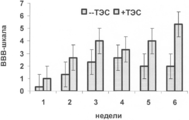
Воздействие транскраниальной электрической стимуляции на движения задних конечностей крыс с перерезкой спинного мозга на уровне Th 9 представлено на чертеже. По оси абсцисс приведены сроки (в неделях) после спинализации, совпадающие с количеством сеансов транскраниальной электрической стимуляции. По оси ординат - баллы ВВВ-шкалы. Горизонтальная штриховка столбиков - без транскраниальной электрической стимуляции, вертикальная штриховка столбиков - с транскраниальной электрической стимуляцией. Через шесть недель после перерезки спинного мозга у крыс, не подвергавшихся транскраниальной электрической стимуляции (-ТЭС на чертеже), оценки по ВВВ-шкале варьировали от «1» (слабые движения одного или двух суставов) до «3» (значительные движения в двух суставах). В эти же сроки у крыс, подвергавшихся транскраниальной электрической стимуляции (+ТЭС на чертеже), оценки по ВВВ-шкале варьировали от «3» до «7» (значительным движениям во всех трех суставах задней конечности). В группе крыс - ТЭС увеличение подвижности задних конечностей достигает максимума на 2-й неделе после перерезки спинного мозга («3» балла), к 6-й неделе наблюдается недостоверное уменьшение подвижности задних конечностей. В группе крыс +ТЭС наблюдалось непрерывное увеличение подвижности задних конечностей, не остановившееся к 6-й неделе. Достоверность увеличения подвижности задних конечностей в экспериментальной группе по сравнению с контрольной группой на 6-й неделе после перерезки спинного мозга доказана с помощью критерия Вилкоксона (p<0,05). Таким образом, курсовая транскраниальная электрическая стимуляция достоверно увеличивала подвижность обездвиженных задних конечностей у крыс с полной перерезкой спинного мозга на нижнегрудном уровне.The effect of transcranial electrical stimulation on the movements of the hind limbs of rats with spinal cord transection at the level of Th 9 is shown in the drawing. The abscissa shows the time (in weeks) after spinalization, which coincides with the number of transcranial electrical stimulation sessions. On the ordinate axis - points BBB-scale. Horizontal hatching of columns - without transcranial electrical stimulation, vertical hatching of columns - without transcranial electrical stimulation. Six weeks after spinal cord transection in rats that did not undergo transcranial electrical stimulation (TES in the drawing), the BBB scale scores ranged from “1” (weak movements of one or two joints) to “3” (significant movements in two joints ) At the same time, in rats subjected to transcranial electrical stimulation (+ TES in the drawing), the BBB scale scores ranged from “3” to “7” (significant movements in all three joints of the hind limb). In the group of rats - TPPs, an increase in hind limb mobility reaches its maximum at the 2nd week after spinal cord transection (“3” points), by the 6th week an unreliable decrease in hind limb mobility is observed. In the group of rats + TPP, a continuous increase in hind limb mobility was observed, which did not stop by the 6th week. The reliability of hind limb mobility increase in the experimental group compared to the control group at
Способ позволяет вызывать движения задних неподвижных конечностей у животных с полным перерывом спинного мозга. Назначение - в физиологии движений для изучения управления локомоторным поведением, а также для создания и освоения методов лечения и реабилитации людей с вертебро-спинальной патологией.The method allows to cause the movement of the hind limbs in animals with a complete break of the spinal cord. The purpose is in the physiology of movements for studying the control of locomotor behavior, as well as for creating and mastering methods of treatment and rehabilitation of people with vertebro-spinal pathology.
ЛИТЕРАТУРАLITERATURE
1. Лебедев В.П., Савченко А.Б., Отеллин В.А., Кучеренко Р.П. Участие серотонинового звена в нейрохимическом механизме транскраниальной электроанальгезии. Физиологический журнал СССР им. И.М.Сеченова, 1995, т.81, №10, с.36-43.1. Lebedev V.P., Savchenko A.B., Otellin V.A., Kucherenko R.P. The participation of the serotonin link in the neurochemical mechanism of transcranial electroanalgesia. Physiological Journal of the USSR I.M.Sechenova, 1995, vol. 81, No. 10, p. 36-43.
2. Barbeau H, Rossignol S. Initiation and modulation of locomotor pattern in the adult chronic spinal cat by noradrenergic, serotonergic and dopaminergic drugs. Brain Res 1991; 546: 250-260.2. Barbeau H, Rossignol S. Initiation and modulation of locomotor pattern in the adult chronic spinal cat by noradrenergic, serotonergic and dopaminergic drugs. Brain Res 1991; 546: 250-260.
3. Basso DM, Beattie MS, Bresnahan JC A sensitive and reliable locomotor rating scale for open field testing in rats. J Neurotrauma. 1995 Feb; 12 (1): 1-21.3. Basso DM, Beattie MS, Bresnahan JC A sensitive and reliable locomotor rating scale for open field testing in rats. J Neurotrauma. 1995 Feb; 12 (1): 1-21.
4. Способ лечения больных с хроническим поражением спинного мозга. Патент Ru 22204423.4. A method for the treatment of patients with chronic damage to the spinal cord. Patent Ru 22204423.
5. Способ лечения больных с хроническим поражением спинного мозга. Патент Ru 2000121379.5. A method for the treatment of patients with chronic damage to the spinal cord. Patent Ru 2000121379.
Claims (1)
Priority Applications (1)
| Application Number | Priority Date | Filing Date | Title |
|---|---|---|---|
| RU2008126325/14A RU2392016C2 (en) | 2008-06-27 | 2008-06-27 | Method of treatment of chronic spinal cord lesions in experiment |
Applications Claiming Priority (1)
| Application Number | Priority Date | Filing Date | Title |
|---|---|---|---|
| RU2008126325/14A RU2392016C2 (en) | 2008-06-27 | 2008-06-27 | Method of treatment of chronic spinal cord lesions in experiment |
Publications (2)
| Publication Number | Publication Date |
|---|---|
| RU2008126325A RU2008126325A (en) | 2010-01-10 |
| RU2392016C2 true RU2392016C2 (en) | 2010-06-20 |
Family
ID=41643638
Family Applications (1)
| Application Number | Title | Priority Date | Filing Date |
|---|---|---|---|
| RU2008126325/14A RU2392016C2 (en) | 2008-06-27 | 2008-06-27 | Method of treatment of chronic spinal cord lesions in experiment |
Country Status (1)
| Country | Link |
|---|---|
| RU (1) | RU2392016C2 (en) |
Citations (1)
| Publication number | Priority date | Publication date | Assignee | Title |
|---|---|---|---|---|
| US6904322B2 (en) * | 2002-02-15 | 2005-06-07 | Kalaco Scientific, Inc. | Transcranial electrostimulation apparatus and method |
-
2008
- 2008-06-27 RU RU2008126325/14A patent/RU2392016C2/en not_active IP Right Cessation
Patent Citations (1)
| Publication number | Priority date | Publication date | Assignee | Title |
|---|---|---|---|---|
| US6904322B2 (en) * | 2002-02-15 | 2005-06-07 | Kalaco Scientific, Inc. | Transcranial electrostimulation apparatus and method |
Non-Patent Citations (1)
| Title |
|---|
| ГОЛУБЕВ В. Г. Транскраниальная электротерапия пострадавших с механическими повреждениями и их последствиями. Мат. научной сессии РМАПО "Успехи теор. и клин. медицины". - М., 1995, с.123-124. * |
Also Published As
| Publication number | Publication date |
|---|---|
| RU2008126325A (en) | 2010-01-10 |
Similar Documents
| Publication | Publication Date | Title |
|---|---|---|
| US11691015B2 (en) | System for neuromodulation | |
| KR101866252B1 (en) | Charge-enhanced neural electric stimulation system | |
| Engineer et al. | Directing neural plasticity to understand and treat tinnitus | |
| RU2130326C1 (en) | Method for treating patients having injured spinal cord | |
| Park et al. | Effect of application of transcranial direct current stimulation during task-related training on gait ability of patients with stroke | |
| JP2025013960A (en) | Nerve block with subthreshold electrical pulses | |
| US7725188B2 (en) | Electrical stimulation treatment of hypotension | |
| WO2017116290A1 (en) | Device for non-invasive electrical stimulation of the spinal cord | |
| Frostig et al. | Electronarcosis in animals and in man | |
| Moshonkina et al. | Effects of spinal cord electrical stimulation in patients with vertebrospinal pathology | |
| US20170197078A1 (en) | Neuromuscular Stimulation System and Method | |
| Pavlova et al. | Restoration of motor functions in spinal rats by electrical stimulation of the spinal cord and locomotor training | |
| RU2392016C2 (en) | Method of treatment of chronic spinal cord lesions in experiment | |
| RU2531693C1 (en) | Method of treating acute cerebral ischemic stroke | |
| Hershberg et al. | Histologic changes in continuous, long-term electrical stimulation of a peripheral nerve | |
| RU2411589C1 (en) | Method of stimulating chronic spinal cord lesion and training to treat it in small laboratory animals | |
| Lontis et al. | Referred sensation areas in transpelvic amputee | |
| RU2832449C1 (en) | Method for diaphragm function recovery in patients with hemiparesis caused by stroke | |
| RU2418319C2 (en) | Method of modelling and teaching treatment of patients with chronic affection of spinal marrow | |
| RU2831229C2 (en) | Neuromodulation method for treating consequences of spinal cord injury | |
| Villar Ortega et al. | High-frequency transcutaneous cervical electrical stimulation: A pilot study | |
| Mikami et al. | Inducing peripheral sympathetic nerve activity by therapeutic electrical stimulation | |
| RU2809545C1 (en) | Method for treating consequences of spinal cord injuries in intermediate period | |
| WO2021118382A1 (en) | Method for increasing the effectiveness of arm motor rehabilitation after stroke | |
| Sugimachi et al. | Electrical acupuncture modifies autonomic balance by resetting the neural arc of arterial baroreflex system |
Legal Events
| Date | Code | Title | Description |
|---|---|---|---|
| MM4A | The patent is invalid due to non-payment of fees |
Effective date: 20100628 |