RU2344503C1 - Nuclear reactor neutrons reflector - Google Patents
Nuclear reactor neutrons reflector Download PDFInfo
- Publication number
- RU2344503C1 RU2344503C1 RU2007120205/06A RU2007120205A RU2344503C1 RU 2344503 C1 RU2344503 C1 RU 2344503C1 RU 2007120205/06 A RU2007120205/06 A RU 2007120205/06A RU 2007120205 A RU2007120205 A RU 2007120205A RU 2344503 C1 RU2344503 C1 RU 2344503C1
- Authority
- RU
- Russia
- Prior art keywords
- block
- cover
- beryllium
- gap
- reflector
- Prior art date
Links
Images
Classifications
-
- Y—GENERAL TAGGING OF NEW TECHNOLOGICAL DEVELOPMENTS; GENERAL TAGGING OF CROSS-SECTIONAL TECHNOLOGIES SPANNING OVER SEVERAL SECTIONS OF THE IPC; TECHNICAL SUBJECTS COVERED BY FORMER USPC CROSS-REFERENCE ART COLLECTIONS [XRACs] AND DIGESTS
- Y02—TECHNOLOGIES OR APPLICATIONS FOR MITIGATION OR ADAPTATION AGAINST CLIMATE CHANGE
- Y02E—REDUCTION OF GREENHOUSE GAS [GHG] EMISSIONS, RELATED TO ENERGY GENERATION, TRANSMISSION OR DISTRIBUTION
- Y02E30/00—Energy generation of nuclear origin
- Y02E30/30—Nuclear fission reactors
Landscapes
- Particle Accelerators (AREA)
Abstract
Description
Изобретение относится к области атомной энергетики и может быть использовано в конструкциях элементов из бериллия для отражения и замедления нейтронов в ядерных реакторах.The invention relates to the field of nuclear energy and can be used in the construction of elements from beryllium to reflect and slow down neutrons in nuclear reactors.
Наиболее важными требованиями, предъявляемыми к конструкции отражателя нейтронов из бериллия, являются его высокое сопротивление радиационному повреждению и сохранение целостности изделия до флюенсов не менее 7·1022 см-2 для нейтронов с энергией свыше 0,8 МэВ (Е≥0,8 МэВ).The most important requirements for the design of a beryllium neutron reflector are its high resistance to radiation damage and the integrity of the product to fluences of at least 7 · 10 22 cm -2 for neutrons with energies above 0.8 MeV (E≥0.8 MeV) .
В ядерных реакторах в качестве отражателей, а также замедлителей, нейтронов, как правило, используются конструкции в виде массивных, цельных пластин или блоков из металлического бериллия высотой до полуметра и более (Исследовательские реакторы института и их экспериментальные возможности. Под ред. В.А.Цыканова. НИИАР, Димитровград, 1992, с.13). Сверху и снизу такой блок ограничен металлическими фланцами (обычно из алюминия или нержавеющей стали), а несущим нагрузку, обеспечивающим цельность и жесткость конструкции является сам материал блока, бериллий. Недостатком данной конструкции является подверженность материала блока растрескиванию и последующему разрушению в процессе эксплуатации в активной зоне реактора при достижении флюенса из интервала (1,5-3)·1022 см-2 (Е≥0,8 МэВ). Причинами этого эффекта являются накопление радиационных повреждений в бериллии (радиационные дефекты типа дислокационных петель и атомы гелия, появившиеся при протекании ядерных реакций атомов бериллия с нейтронами) и наличие значительных по величине термических и других напряжений в массиве блока, возникающих вследствие неравномерности разогрева и радиационного повреждения блока по сечению и высоте. В результате деградации механических свойств бериллия, что выражается в охрупчивании и разупрочнении материала, напряжения в блоке приводят к образованию трещин и последующему их распространению по массиву блока, что ведет к его преждевременному выводу из эксплуатации.In nuclear reactors, as reflectors, as well as moderators, neutrons, as a rule, structures in the form of massive, solid plates or blocks of metallic beryllium up to half a meter or more in height are used (Institute research reactors and their experimental capabilities. Edited by V.A. Tsykanova, NIIAR, Dimitrovgrad, 1992, p.13). Above and below, such a block is limited by metal flanges (usually aluminum or stainless steel), and the material of the block itself, beryllium, is the load bearing ensuring the integrity and rigidity of the structure. The disadvantage of this design is the susceptibility of the material of the block to cracking and subsequent destruction during operation in the reactor core upon reaching a fluence from the interval (1.5-3) · 10 22 cm -2 (E≥0.8 MeV). The reasons for this effect are the accumulation of radiation damage in beryllium (radiation defects such as dislocation loops and helium atoms that appeared during the course of nuclear reactions of beryllium atoms with neutrons) and the presence of significant thermal and other stresses in the block array that arise due to uneven heating and radiation damage to the block by section and height. As a result of the degradation of the mechanical properties of beryllium, which is expressed in embrittlement and softening of the material, stresses in the block lead to the formation of cracks and their subsequent propagation through the block mass, which leads to its premature decommissioning.
В качестве прототипа, то есть наиболее близкого аналога к настоящему изобретению, рассматривается конструкция отражателя нейтронов ядерного реактора (В.П.Чакин, В.А.Казаков, А.В.Клинов, Р.Р.Мельдер, В.В.Пименов, М.Н.Святкин, А.В.Туктабиев, И.Б.Куприянов. Отражатель нейтронов ядерного реактора. Патент РФ №2192675, опубл. БИ №31 от 10.11.2002 г.), в которой блок из бериллия составлен из не менее чем трех частей, опорная конструкция выполнена в виде опорных элементов, проходящих внутри и снаружи блока, при этом между верхним и/или нижним торцами блока и соответствующими фланцами размещены упругие элементы. Недостатком данной конструкции является тот факт, что характер радиационного повреждения бериллия как материала блока в области эксплуатационных температур 60-100°С таков, что практически отсутствует релаксация внутренних напряжений, связанных с накоплением радиационных дефектов типа дислокационных петель и радиогенных атомов гелия. Это связано с тем, что в данной области температур, которая носит название низкотемпературной, диффузионная подвижность собственных атомов и радиогенных атомов гелия низка. В результате с ростом нейтронной дозы происходит накопление значительных по величине внутренних напряжений, которые при достижении предела прочности ведут к образованию, распространению трещин и фрагментации бериллиевого блока на мелкие части. Это приводит к значительному сокращению ресурса эксплуатации блока отражателя нейтронов в реакторе.As a prototype, that is, the closest analogue to the present invention, the design of the neutron reflector of a nuclear reactor is considered (V.P. Chakin, V.A. Kazakov, A.V. Klinov, R.R.Melder, V.V. Pimenov, M.N.Svyatkin, A.V. Tuktabiev, I. B. Kupriyanov, Neutron reflector of a nuclear reactor, RF Patent No. 2192675, publ. BI No. 31 of November 10, 2002), in which the beryllium block is composed of at least than three parts, the supporting structure is made in the form of supporting elements passing inside and outside the block, while between the upper and / or lower ends of the block and, respectively favoring flanges arranged resilient elements. The disadvantage of this design is the fact that the nature of radiation damage to beryllium as a block material in the range of operating temperatures of 60-100 ° C is such that there is practically no relaxation of internal stresses associated with the accumulation of radiation defects such as dislocation loops and radiogenic helium atoms. This is due to the fact that in this temperature range, which is called the low-temperature, the diffusion mobility of intrinsic atoms and radiogenic helium atoms is low. As a result, an increase in the neutron dose leads to the accumulation of significant internal stresses, which, upon reaching the ultimate strength, lead to the formation, propagation of cracks, and fragmentation of the beryllium block into small parts. This leads to a significant reduction in the service life of the neutron reflector block in the reactor.
Целью данного изобретения является увеличение ресурса отражателя нейтронов из бериллия путем создания конструкции, обладающей повышенным сопротивлением радиационному повреждению.The aim of this invention is to increase the life of a beryllium neutron reflector by creating a structure with increased resistance to radiation damage.
Поставленная цель достигается тем, что отражатель нейтронов ядерного реактора содержит герметичный чехол из конструкционного материала, внутри которого установлен блок из бериллия, причем блок составлен, по меньшей мере, из двух частей, а между блоком и чехлом выполнен зазор. При этом толщина чехла выбирается из условия обеспечения прочности и радиационной стойкости до достижения флюенса нейтронов не менее 7·1022 см-2 с энергией свыше 0,8 МэВ, а в качестве материала чехла выбран материал с низким сечением поглощения нейтронов и высокой радиационной стойкостью при флюенсе нейтронов не менее 7·1022 см-2 с энергией свыше 0,8 МэВ, преимущественно сплавы на основе алюминия или циркония. Зазор между блоком и чехлом составляет не менее 0,01 эффективного размера блока из бериллия. Для обеспечения зазора могут применяться дистанционаторы, которые выполнены, например, в виде упругих элементов. Зазор между блоком и чехлом может быть дополнительно заполнен инертным газом, в качестве которого выбран преимущественно криптон, ксенон или их смесь с гелием.This goal is achieved in that the neutron reflector of a nuclear reactor contains a sealed sheath of structural material, inside which a block of beryllium is installed, the block being composed of at least two parts, and a gap is made between the block and the sheath. The thickness of the cover is selected from the condition of ensuring strength and radiation resistance until the neutron fluence is at least 7 · 10 22 cm -2 with an energy of more than 0.8 MeV, and the material with a low neutron absorption cross section and high radiation resistance at neutron fluence of at least 7 · 10 22 cm -2 with an energy of more than 0.8 MeV, mainly alloys based on aluminum or zirconium. The gap between the block and the cover is at least 0.01 effective beryllium block sizes. To ensure the clearance can be used spacers, which are made, for example, in the form of elastic elements. The gap between the block and the cover can be additionally filled with an inert gas, which is mainly used krypton, xenon or their mixture with helium.
Размещение блока из бериллия в герметичном чехле из конструкционного материала позволяет принципиальным образом изменить характер радиационного повреждения бериллия, то есть снизить повреждающую способность нейтронного облучения. Это достигается в результате того, что изоляция бериллиевого блока от водяного теплоносителя приводит к увеличению температуры бериллия, которая достигает величины 300-400°С. В результате возрастает диффузионная подвижность собственных и газовых атомов, что приводит к образованию иной конфигурации радиационных дефектов. В частности, вместо дислокационных петель и находящихся в псевдорастворенном состоянии атомов гелия под облучением формируются радиационные дефекты в виде плоских газовакансионных пор шестиугольной формы. Результаты исследований механических характеристик показывают, что подобный характер микроструктуры является более благоприятным для свойств бериллия, то есть его склонность к охрупчиванию и образованию трещин значительно снижаются. Это происходит вследствие того, что при возрастании диффузионной подвижности атомы гелия более равномерно распределяются по структуре, в частности частично попадают внутрь плоских шестиугольных пор.Placing a beryllium block in an airtight case made of structural material allows you to fundamentally change the nature of radiation damage to beryllium, that is, reduce the damaging ability of neutron irradiation. This is achieved due to the fact that the isolation of the beryllium block from the water coolant leads to an increase in the temperature of beryllium, which reaches a value of 300-400 ° C. As a result, the diffusion mobility of intrinsic and gas atoms increases, which leads to the formation of a different configuration of radiation defects. In particular, instead of dislocation loops and pseudo-dissolved helium atoms, radiation defects are formed in the form of hexagonal flat gas-vacancy pores under irradiation. The results of studies of the mechanical characteristics show that a similar character of the microstructure is more favorable for the properties of beryllium, that is, its tendency to embrittlement and cracking is significantly reduced. This is due to the fact that with an increase in diffusion mobility, helium atoms are more uniformly distributed over the structure, in particular, partially fall inside flat hexagonal pores.
Кроме этого наружный чехол, являясь опорной конструкцией, позволяет сохранить работоспособность блока даже в случае его растрескивания, поскольку, как правило, признаком потери работоспособности бериллиевого блока является его фрагментация на части.In addition, the outer cover, being a supporting structure, allows you to maintain the health of the block even in case of cracking, since, as a rule, a sign of loss of health of the beryllium block is its fragmentation into parts.
Толщина стенки чехла выбирается исходя из условий сохранения достаточного уровня прочности и других свойств материала чехла, характеризующих его радиационную стойкость, то есть сопротивление радиационному повреждению до достижения флюенса нейтронов не менее 7·1022 см-2 с энергией свыше 0,8 МэВ, и устанавливается экспериментально. Данная величина флюенса нейтронов определяет существующий в настоящее время ресурс эксплуатации бериллиевых блоков в ядерном реакторе. Кроме того, появление в активной зоне реактора дополнительного конструкционного материала в виде герметичного чехла не должно приводить к существенному снижению нейтронно-физических характеристик отражателя нейтронов, поэтому в качестве материала чехла выбраны материалы, имеющие низкое сечение поглощения нейтронов, каковыми являются преимущественно сплавы на основе алюминия или циркония.The wall thickness of the cover is selected based on the conditions of maintaining a sufficient level of strength and other properties of the cover material, characterizing its radiation resistance, that is, resistance to radiation damage until the neutron fluence reaches at least 7 · 10 22 cm -2 with an energy of more than 0.8 MeV, and is established experimentally. This magnitude of the neutron fluence determines the current operating life of beryllium blocks in a nuclear reactor. In addition, the appearance in the reactor core of an additional structural material in the form of a sealed sheath should not lead to a significant decrease in the neutron-physical characteristics of the neutron reflector, therefore, materials having a low neutron absorption cross section, which are mainly aluminum-based alloys, are chosen as the sheath material zirconium.
Эффективный размер бериллиевого блока является его геометрической характеристикой, которая означает способность блока выполнять заданные функции отражателя или замедлителя нейтронов в активной зоне ядерного реактора. Экспериментально установлено, что оптимальной является величина зазора не менее 0,01 эффективного размера бериллиевого блока. Это определяется необходимостью обеспечения температуры облучения из области 300-400°С, которая является оптимальной с точки зрения достижения минимального радиационного повреждения бериллия. При величине зазора менее 0,01 эффективного размера бериллиевого блока температура облучения будет ниже 300°С, что приведет к сильному радиационному повреждению бериллия. Кроме того, в этом случае вследствие нарастания распухания бериллия с увеличением флюенса нейтронов в процессе облучения возможно появление значительных по величине напряжений в чехле, которые могут привести к его разрушению, поступлению воды внутрь чехла и снижению рабочей температуры бериллиевого блока с последующим его повреждением.The effective size of the beryllium block is its geometric characteristic, which means the ability of the block to perform specified functions of a neutron reflector or moderator in the core of a nuclear reactor. It has been experimentally established that the optimum gap is at least 0.01 effective beryllium block size. This is determined by the need to ensure the irradiation temperature from the region of 300-400 ° C, which is optimal from the point of view of achieving minimal radiation damage to beryllium. If the gap value is less than 0.01 of the effective size of the beryllium block, the irradiation temperature will be below 300 ° C, which will lead to severe radiation damage to beryllium. In addition, in this case, due to an increase in the swelling of beryllium with an increase in the neutron fluence during irradiation, significant stresses can appear in the cover, which can lead to its destruction, water entering the cover and lowering the operating temperature of the beryllium block with subsequent damage.
Разбиение блока из бериллия на две и более частей позволяет значительно снизить уровень напряжений, возникающих в материале при эксплуатации блока в реакторе, поскольку величина термических напряжений и напряжений, возникающих в массиве бериллиевого блока вследствие неравномерности радиационного повреждения различных его областей, пропорционально зависит от размера блока. Чем больше размер блока, тем выше напряжения. Поэтому разбиение блока на автономные части позволяет снизить общий уровень напряжений в материале блока. Поскольку величина нейтронного потока зависит от высоты активной зоны по функции косинуса, то степень радиационного повреждения материала блока и уровень возникающих напряжений в соответствующих точках будут находиться в такой же зависимости от высоты. Поэтому разбиение блока по высоте на несколько частей позволит в несколько раз снизить напряжения. Разбиение блока на составные части может быть проведено не только в сечениях по высоте и в перпендикулярном направлении, но и в промежуточных сечениях, то есть под углом 0-180° к вертикальной оси блока в зависимости от расчетной эффективности снижения уровня термических напряжений в блоке в результате подобного разбиения.Dividing a beryllium block into two or more parts can significantly reduce the level of stresses arising in the material during operation of the block in the reactor, since the magnitude of the thermal stresses and stresses arising in the beryllium block array due to uneven radiation damage to its various regions proportionally depends on the block size. The larger the block size, the higher the voltage. Therefore, dividing the block into autonomous parts can reduce the overall stress level in the block material. Since the magnitude of the neutron flux depends on the height of the core according to the cosine function, the degree of radiation damage to the material of the block and the level of stresses arising at the corresponding points will be in the same dependence on the height. Therefore, dividing the block in height into several parts will allow several times to reduce stress. The division of the block into components can be carried out not only in height and perpendicular sections, but also in intermediate sections, that is, at an angle of 0-180 ° to the vertical axis of the block, depending on the calculated efficiency of reducing the level of thermal stresses in the block as a result such a partition.
В качестве среды в зазоре между чехлом и бериллиевым блоком может быть использован инертный газ, имеющий низкую теплопроводность, например криптон, ксенон или их смесь с гелием. Низкая теплопроводность необходима для увеличения термического сопротивления газового зазора и, соответственно, повышения температуры облучения бериллия до оптимальной с точки зрения минимума радиационного повреждения (300-400°С). Экспериментально определяется и устанавливается также давление газа в зазоре исходя из вида и состава газа.An inert gas having low thermal conductivity, for example krypton, xenon, or a mixture of them with helium, can be used as a medium in the gap between the case and the beryllium block. Low thermal conductivity is necessary to increase the thermal resistance of the gas gap and, accordingly, increase the irradiation temperature of beryllium to the optimum in terms of minimum radiation damage (300-400 ° C). The gas pressure in the gap is experimentally determined and established based on the type and composition of the gas.
Новые существенные признаки в научной и технической литературе не обнаружены, предложенное решение не следует явным образом из уровня техники, совокупность признаков обеспечивает новые свойства, что позволяет сделать вывод, что заявляемое решение соответствует критерию изобретательский уровень.No significant new features were found in the scientific and technical literature, the proposed solution does not follow explicitly from the prior art, the combination of features provides new properties, which allows us to conclude that the claimed solution meets the criterion of inventive step.
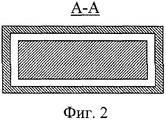
На фигуре 1 представлен чертеж отражателя нейтронов ядерного реактора СМ, на фигуре 2 - горизонтальное сечение. Отражатель нейтронов состоит из бериллиевого блока, составленного в данном случае из трех частей (1), которые размещены последовательно друг за другом по высоте внутри герметичного чехла (2) с зазором (3) между бериллиевым блоком и внутренней поверхностью чехла, который поддерживается дистанционаторами (4). Представленный вариант конструкции отражателя нейтронов из бериллия соответствует существующей компоновке активной зоны реактора СМ. Поперечное сечение отражателя прямоугольное, он расположен более протяженной стороной к активной зоне реактора. При высоте активной зоны реактора СМ 350 мм общая длина бериллиевого блока из трех частей составляет 500 мм. Эффективным размером бериллиевого блока в данном случае является ширина блока в направлении активной зоны, которая имеет величину 26 мм. Соответственно, минимальная величина зазора между бериллиевым блоком и внутренней поверхностью чехла составит 0,26 мм. Теплофизические расчеты показывают, что в случае использования в зазоре газа криптон величина зазора составит 0,8 мм при давлении 0,1 МПа. В качестве дистанционаторов использованы V-образные упругие элементы, выполненные из нержавеющей стали Х13. Толщина чехла в случае изготовления из сплава алюминия САВ-1 составит 1,2 мм, из сплава циркония Э110 - 1 мм.The figure 1 presents a drawing of a neutron reflector of a nuclear reactor SM, figure 2 is a horizontal section. The neutron reflector consists of a beryllium block, composed in this case of three parts (1), which are placed sequentially one after another in height inside a sealed cover (2) with a gap (3) between the beryllium block and the inner surface of the cover, which is supported by spacers (4 ) The presented design variant of the beryllium neutron reflector corresponds to the existing layout of the SM reactor core. The cross section of the reflector is rectangular; it is located with the longer side to the reactor core. With the height of the core of the SM reactor 350 mm, the total length of the beryllium block of three parts is 500 mm. The effective size of the beryllium block in this case is the width of the block in the direction of the core, which has a value of 26 mm. Accordingly, the minimum gap between the beryllium block and the inner surface of the cover will be 0.26 mm. Thermophysical calculations show that if krypton is used in the gas gap, the gap will be 0.8 mm at a pressure of 0.1 MPa. As spacers used V-shaped elastic elements made of stainless steel X13. The thickness of the cover in the case of manufacturing from SAV-1 aluminum alloy will be 1.2 mm, from the E110 zirconium alloy - 1 mm.
Предлагаемое техническое решение приблизительно в два-пять раз увеличит ресурс отражателя нейтронов из бериллия, что позволит достичь цели изобретения.The proposed solution is approximately two to five times increase the resource of the neutron reflector from beryllium, which will achieve the objective of the invention.
Claims (8)
Priority Applications (1)
| Application Number | Priority Date | Filing Date | Title |
|---|---|---|---|
| RU2007120205/06A RU2344503C1 (en) | 2007-05-30 | 2007-05-30 | Nuclear reactor neutrons reflector |
Applications Claiming Priority (1)
| Application Number | Priority Date | Filing Date | Title |
|---|---|---|---|
| RU2007120205/06A RU2344503C1 (en) | 2007-05-30 | 2007-05-30 | Nuclear reactor neutrons reflector |
Publications (1)
| Publication Number | Publication Date |
|---|---|
| RU2344503C1 true RU2344503C1 (en) | 2009-01-20 |
Family
ID=40376140
Family Applications (1)
| Application Number | Title | Priority Date | Filing Date |
|---|---|---|---|
| RU2007120205/06A RU2344503C1 (en) | 2007-05-30 | 2007-05-30 | Nuclear reactor neutrons reflector |
Country Status (1)
| Country | Link |
|---|---|
| RU (1) | RU2344503C1 (en) |
Cited By (3)
| Publication number | Priority date | Publication date | Assignee | Title |
|---|---|---|---|---|
| RU2524689C2 (en) * | 2012-08-14 | 2014-08-10 | Открытое акционерное общество "Государственный научный центр Научно-исследовательский институт атомных реакторов" | Method of making neutron moderator and reflector units of nuclear reactor |
| CN119673502A (en) * | 2024-12-19 | 2025-03-21 | 中国核动力研究设计院 | A beryllium sleeve, core assembly and research reactor irradiation test device |
| RU2840107C1 (en) * | 2024-06-05 | 2025-05-19 | Федеральное государственное казённое учреждение "12 Центральный научно-исследовательский институт" Министерства обороны Российской Федерации | Device for generating spatial distribution of neutron radiation of research nuclear reactors |
Citations (5)
| Publication number | Priority date | Publication date | Assignee | Title |
|---|---|---|---|---|
| GB1028248A (en) * | 1963-03-29 | 1966-05-04 | Great Lakes Carbon Corp | Neutron reflectors for nuclear reactors |
| US4783312A (en) * | 1984-07-25 | 1988-11-08 | Westinghouse Electric Corp. | Radial neutron refelector |
| RU443U1 (en) * | 1993-10-21 | 1995-05-16 | Государственное предприятие "Красная звезда" | Radiation Protection of a Space Nuclear Power Plant |
| RU2184401C1 (en) * | 2001-01-09 | 2002-06-27 | Государственный научный центр "Научно-исследовательский институт атомных реакторов" | Method for maintaining operation of beryllium block of nuclear reactor |
| RU2192675C1 (en) * | 2001-02-26 | 2002-11-10 | Государственный научный центр Российской Федерации "Научно-исследовательский институт атомных реакторов" | Nuclear reactor neutron reflector |
-
2007
- 2007-05-30 RU RU2007120205/06A patent/RU2344503C1/en not_active IP Right Cessation
Patent Citations (5)
| Publication number | Priority date | Publication date | Assignee | Title |
|---|---|---|---|---|
| GB1028248A (en) * | 1963-03-29 | 1966-05-04 | Great Lakes Carbon Corp | Neutron reflectors for nuclear reactors |
| US4783312A (en) * | 1984-07-25 | 1988-11-08 | Westinghouse Electric Corp. | Radial neutron refelector |
| RU443U1 (en) * | 1993-10-21 | 1995-05-16 | Государственное предприятие "Красная звезда" | Radiation Protection of a Space Nuclear Power Plant |
| RU2184401C1 (en) * | 2001-01-09 | 2002-06-27 | Государственный научный центр "Научно-исследовательский институт атомных реакторов" | Method for maintaining operation of beryllium block of nuclear reactor |
| RU2192675C1 (en) * | 2001-02-26 | 2002-11-10 | Государственный научный центр Российской Федерации "Научно-исследовательский институт атомных реакторов" | Nuclear reactor neutron reflector |
Cited By (3)
| Publication number | Priority date | Publication date | Assignee | Title |
|---|---|---|---|---|
| RU2524689C2 (en) * | 2012-08-14 | 2014-08-10 | Открытое акционерное общество "Государственный научный центр Научно-исследовательский институт атомных реакторов" | Method of making neutron moderator and reflector units of nuclear reactor |
| RU2840107C1 (en) * | 2024-06-05 | 2025-05-19 | Федеральное государственное казённое учреждение "12 Центральный научно-исследовательский институт" Министерства обороны Российской Федерации | Device for generating spatial distribution of neutron radiation of research nuclear reactors |
| CN119673502A (en) * | 2024-12-19 | 2025-03-21 | 中国核动力研究设计院 | A beryllium sleeve, core assembly and research reactor irradiation test device |
Similar Documents
| Publication | Publication Date | Title |
|---|---|---|
| CA2927573C (en) | Fuel rod cladding, fuel rod and fuel assembly | |
| Tanaka et al. | Fission gas release and swelling in uranium–plutonium mixed nitride fuels | |
| CN102789820B (en) | Nuclear fuel rod | |
| US4186050A (en) | Nuclear reactors | |
| KR20240046680A (en) | Nuclear reactor neutron reflector | |
| JP2018520369A (en) | Reactor | |
| US4289582A (en) | Nuclear reactor collecting tank with thermal insulation | |
| RU2691628C1 (en) | Nuclear fuel element of nuclear reactor | |
| RU2192675C1 (en) | Nuclear reactor neutron reflector | |
| CN207909506U (en) | A kind of annular fuel assembly of square double-sided cooling | |
| CN202205467U (en) | Tubular positioning grid of pressurized water reactor double-sided cooling fuel rod | |
| RU2077743C1 (en) | Control rod for nuclear reactor | |
| JP6695804B2 (en) | Lead-cooled fast reactor core | |
| US4576785A (en) | Reduction in rate of radiation exposure to excore nuclear reactor components | |
| KR101152301B1 (en) | A dual-cooled annular nuclear fuel rod and the fabrication method thereof | |
| RU2549371C1 (en) | Active zone, fuel elements and fuel assembly of fast neutron reactors with lead heat carrier | |
| Kim et al. | Design of a neutron screen for 6-inch neutron transmutation doping in HANARO | |
| RU113054U1 (en) | NON-VENTILATED NUCLEAR REACTOR FUEL | |
| Enin et al. | Design and experience of HEU and LEU fuel for WWR-M reactors | |
| RU2454480C2 (en) | Spacer grid for positioning of fuel rods | |
| RU2008146972A (en) | FUEL ROD CONSTRUCTIONS USING THE INTERNAL SPACING PART AND METHODS FOR USING THEM | |
| US4087324A (en) | Pile construction | |
| JP2005233751A (en) | Reflector-controlled fast reactor and its neutron reflector | |
| JP6030548B2 (en) | Control rods for light water reactors and their use | |
| RU2485612C1 (en) | Reactor core with quick-resonant spectrum of neutrons with supercritical water pressure |
Legal Events
| Date | Code | Title | Description |
|---|---|---|---|
| HK4A | Changes in a published invention | ||
| MM4A | The patent is invalid due to non-payment of fees |
Effective date: 20110531 |