RU2204016C1 - Method of oil pool development - Google Patents
Method of oil pool development Download PDFInfo
- Publication number
- RU2204016C1 RU2204016C1 RU2001127649/03A RU2001127649A RU2204016C1 RU 2204016 C1 RU2204016 C1 RU 2204016C1 RU 2001127649/03 A RU2001127649/03 A RU 2001127649/03A RU 2001127649 A RU2001127649 A RU 2001127649A RU 2204016 C1 RU2204016 C1 RU 2204016C1
- Authority
- RU
- Russia
- Prior art keywords
- aqueous solution
- calcium chloride
- sodium sulfate
- hydrochloric acid
- oil
- Prior art date
Links
- 238000000034 method Methods 0.000 title claims abstract description 19
- 239000007864 aqueous solution Substances 0.000 claims abstract description 28
- VEXZGXHMUGYJMC-UHFFFAOYSA-N Hydrochloric acid Chemical compound Cl VEXZGXHMUGYJMC-UHFFFAOYSA-N 0.000 claims abstract description 22
- UXVMQQNJUSDDNG-UHFFFAOYSA-L Calcium chloride Chemical compound [Cl-].[Cl-].[Ca+2] UXVMQQNJUSDDNG-UHFFFAOYSA-L 0.000 claims abstract description 14
- PMZURENOXWZQFD-UHFFFAOYSA-L Sodium Sulfate Chemical compound [Na+].[Na+].[O-]S([O-])(=O)=O PMZURENOXWZQFD-UHFFFAOYSA-L 0.000 claims abstract description 14
- 239000001110 calcium chloride Substances 0.000 claims abstract description 14
- 229910001628 calcium chloride Inorganic materials 0.000 claims abstract description 14
- 229910052938 sodium sulfate Inorganic materials 0.000 claims abstract description 14
- 235000011152 sodium sulphate Nutrition 0.000 claims abstract description 14
- 239000003153 chemical reaction reagent Substances 0.000 claims abstract description 13
- 238000002347 injection Methods 0.000 claims abstract description 11
- 239000007924 injection Substances 0.000 claims abstract description 11
- 229920002134 Carboxymethyl cellulose Polymers 0.000 claims abstract description 9
- 230000015572 biosynthetic process Effects 0.000 claims abstract description 7
- ZAMOUSCENKQFHK-UHFFFAOYSA-N Chlorine atom Chemical compound [Cl] ZAMOUSCENKQFHK-UHFFFAOYSA-N 0.000 claims abstract description 6
- 239000000460 chlorine Substances 0.000 claims abstract description 6
- 229910052801 chlorine Inorganic materials 0.000 claims abstract description 6
- 239000003599 detergent Substances 0.000 claims abstract description 4
- 239000007788 liquid Substances 0.000 claims description 8
- 238000005086 pumping Methods 0.000 claims 2
- 239000000243 solution Substances 0.000 abstract description 8
- 239000012530 fluid Substances 0.000 abstract description 5
- 238000011084 recovery Methods 0.000 abstract description 5
- 238000006073 displacement reaction Methods 0.000 abstract description 4
- 239000013049 sediment Substances 0.000 abstract description 3
- 239000000126 substance Substances 0.000 abstract description 2
- 238000005755 formation reaction Methods 0.000 abstract 3
- 239000001768 carboxy methyl cellulose Substances 0.000 abstract 1
- 235000010948 carboxy methyl cellulose Nutrition 0.000 abstract 1
- 239000008112 carboxymethyl-cellulose Substances 0.000 abstract 1
- XLYOFNOQVPJJNP-UHFFFAOYSA-N water Substances O XLYOFNOQVPJJNP-UHFFFAOYSA-N 0.000 description 16
- OSGAYBCDTDRGGQ-UHFFFAOYSA-L calcium sulfate Chemical compound [Ca+2].[O-]S([O-])(=O)=O OSGAYBCDTDRGGQ-UHFFFAOYSA-L 0.000 description 8
- 238000001914 filtration Methods 0.000 description 7
- 230000035699 permeability Effects 0.000 description 6
- 238000002474 experimental method Methods 0.000 description 4
- 238000005516 engineering process Methods 0.000 description 3
- 239000011435 rock Substances 0.000 description 3
- 150000003839 salts Chemical class 0.000 description 3
- 239000000654 additive Substances 0.000 description 2
- 238000006243 chemical reaction Methods 0.000 description 2
- 230000018109 developmental process Effects 0.000 description 2
- 150000007519 polyprotic acids Polymers 0.000 description 2
- 239000002244 precipitate Substances 0.000 description 2
- 229920006395 saturated elastomer Polymers 0.000 description 2
- 239000010802 sludge Substances 0.000 description 2
- 239000011734 sodium Substances 0.000 description 2
- 229910019142 PO4 Inorganic materials 0.000 description 1
- 239000006004 Quartz sand Substances 0.000 description 1
- VYPSYNLAJGMNEJ-UHFFFAOYSA-N Silicium dioxide Chemical compound O=[Si]=O VYPSYNLAJGMNEJ-UHFFFAOYSA-N 0.000 description 1
- FAPWRFPIFSIZLT-UHFFFAOYSA-M Sodium chloride Chemical compound [Na+].[Cl-] FAPWRFPIFSIZLT-UHFFFAOYSA-M 0.000 description 1
- 229910000831 Steel Inorganic materials 0.000 description 1
- 239000002253 acid Substances 0.000 description 1
- 229910052783 alkali metal Inorganic materials 0.000 description 1
- -1 alkali metal salt Chemical class 0.000 description 1
- 230000033558 biomineral tissue development Effects 0.000 description 1
- 230000000903 blocking effect Effects 0.000 description 1
- 150000004649 carbonic acid derivatives Chemical class 0.000 description 1
- 239000006185 dispersion Substances 0.000 description 1
- 239000008398 formation water Substances 0.000 description 1
- 230000004941 influx Effects 0.000 description 1
- 229910052751 metal Inorganic materials 0.000 description 1
- 239000002184 metal Substances 0.000 description 1
- 239000000203 mixture Substances 0.000 description 1
- 239000012071 phase Substances 0.000 description 1
- 235000021317 phosphate Nutrition 0.000 description 1
- 150000003013 phosphoric acid derivatives Chemical class 0.000 description 1
- 239000000047 product Substances 0.000 description 1
- 150000004760 silicates Chemical class 0.000 description 1
- 239000011780 sodium chloride Substances 0.000 description 1
- 239000007790 solid phase Substances 0.000 description 1
- 239000010959 steel Substances 0.000 description 1
- 150000003467 sulfuric acid derivatives Chemical class 0.000 description 1
- 238000005406 washing Methods 0.000 description 1
Images
Landscapes
- Separation Of Suspended Particles By Flocculating Agents (AREA)
Abstract
Description
Изобретение относится к нефтедобывающей промышленности и может быть использовано при разработке нефтяных пластов заводнением. The invention relates to the oil industry and can be used in the development of oil reservoirs by flooding.
Наиболее близким способом к предложенному является способ изоляции притока пластовых вод, являющийся, по существу, способом разработки нефтяной залежи, включающий закачку водного раствора соли многоосновной кислоты или смеси солей многоосновных кислот, в качестве которой могут использовать сульфаты, карбонаты, фосфаты и силикаты металлов, проталкивание водного раствора по пласту буферной жидкостью, в качестве которой используют воду, и последующую закачку соли щелочного металла и одноосновной кислоты (в т.ч. и хлорида кальция) и используют (RU 2108455). The closest method to the proposed one is a method of isolating the influx of formation water, which is essentially a method of developing an oil reservoir, which includes injecting an aqueous solution of a salt of a polybasic acid or a mixture of salts of polybasic acids, which can be used metal sulfates, carbonates, phosphates and silicates, pushing aqueous solution in the reservoir with a buffer liquid, which is used as water, and the subsequent injection of an alkali metal salt and monobasic acid (including calcium chloride) and using call (RU 2108455).
Данный способ позволяет снизить проницаемость водопромытых интервалов нефтяного пласта с целью перераспределения фильтрационных потоков в прискважинной зоне пласта скважины и в объеме пласта, а также подключение к разработке слабо дренируемых и застойных зон. This method allows to reduce the permeability of water-washed intervals of the oil reservoir in order to redistribute the filtration flows in the borehole zone of the well and in the volume of the reservoir, as well as connecting to the development of weakly drained and stagnant zones.
Увеличение нефтеотдачи в данном способе осуществляется за счет блокировки водонасыщенных и водопромытых интервалов пласта за счет создания в них нерастворимого осадка. Однако в ряде случаев количество и плотность получаемого осадка недостаточна для существенного увеличения нефтеотдачи. The increase in oil recovery in this method is carried out by blocking the water-saturated and water-washed intervals of the reservoir due to the creation of insoluble sediment in them. However, in some cases, the amount and density of the resulting sludge is insufficient to significantly increase oil recovery.
Задачей изобретения является повышение нефтеотдачи пласта за счет увеличения количества и плотности нерастворимого осадка. The objective of the invention is to increase oil recovery by increasing the amount and density of insoluble sediment.
Поставленная задача решается тем, что в способе разработки нефтяной залежи, включающем закачку водного раствора сульфата натрия, проталкивание водного раствора по пласту буферной жидкостью и последующую закачку водного раствора хлорсодержащего реагента, к обоим водным растворам добавляют 0,01-1,0 мас.% карбоксилметилцеллюлозы. The problem is solved in that in the method of developing an oil deposit, which includes injecting an aqueous solution of sodium sulfate, pushing an aqueous solution into the formation with a buffer liquid and then injecting an aqueous solution of a chlorine-containing reagent, 0.01-1.0 wt.% Carboxyl methylcellulose are added to both aqueous solutions .
В частных воплощениях изобретения поставленная задача решается тем, что:
- водный раствор сульфата натрия содержит 1-30 мас.% сульфата натрия;
- в качестве хлорсодержащего реагента используют хлористый кальций или соляную кислоту;
- водный раствор хлористого кальция содержит 1-30 мас.% хлористого кальция;
- водный раствор соляной кисло ты содержит 1-30 мас.% соляной кислоты;
- к обоим водным растворам дополнительно добавляют до 1 мас.% моющего средства;
- закачку реагентов и проталкивание буферной жидкостью повторяют.In private embodiments of the invention, the problem is solved in that:
- an aqueous solution of sodium sulfate contains 1-30 wt.% sodium sulfate;
- calcium chloride or hydrochloric acid is used as a chlorine-containing reagent;
- an aqueous solution of calcium chloride contains 1-30 wt.% calcium chloride;
- an aqueous solution of hydrochloric acid contains 1-30 wt.% hydrochloric acid;
- up to 1 wt.% detergent is additionally added to both aqueous solutions;
- injection of reagents and pushing with buffer fluid is repeated.
Сущность технологии состоит в следующем. В нефтяной пласт первоначально закачивают водный раствор сульфата натрия с добавками карбоксилметилцеллюлозы. Раствор проталкивается по пласту буферной жидкостью (водой). Затем закачивается водный раствор хлорида кальция (в ряде случаев вместо хлорида кальция возможна закачка соляной кислоты) с добавками карбоксилметилцеллюлозы. The essence of technology is as follows. An aqueous solution of sodium sulfate with carboxyl methyl cellulose additives is initially injected into the oil reservoir. The solution is pushed through the reservoir with a buffer fluid (water). Then, an aqueous solution of calcium chloride is pumped (in some cases, instead of calcium chloride, hydrochloric acid may be injected) with carboxyl methyl cellulose additives.
При этом протекают следующие реакции:
- при использовании сульфата натрия Na2SO4+CaCl2=CaSO4+2NaCl
Сульфат натрия частично сорбируется на поверхности породы, поэтому при фильтрации его раствора через пористую среду скорость распространения реагента вдоль пласта ниже, чем скорость закачиваемой воды и раствора хлорида кальция с добавками карбоксилметилцеллюлозы, который практически не сорбируется на породе. После закачки раствора сульфата натрия в пласт он начинает реагировать с минерализованной водой, что приводит к медленному выделению высокодисперсного осадка сульфата кальция. Появление твердой фазы в фильтрующей жидкости способствует росту фильтрационного сопротивления и, как следствие, уменьшению скорости фильтрации нагнетаемой воды.The following reactions occur:
- when using sodium sulfate Na 2 SO 4 + CaCl 2 = CaSO 4 + 2NaCl
Sodium sulfate is partially sorbed on the surface of the rock, therefore, when filtering its solution through a porous medium, the propagation speed of the reagent along the formation is lower than the speed of the injected water and calcium chloride solution with the addition of carboxyl methyl cellulose, which is practically not sorbed on the rock. After the sodium sulfate solution is pumped into the reservoir, it begins to react with saline water, which leads to the slow release of a finely divided precipitate of calcium sulfate. The appearance of a solid phase in the filter fluid promotes an increase in filtration resistance and, as a consequence, a decrease in the filtration rate of the injected water.
Далее после закачки буфера воды, обеспечивающего продвижение реагента в объем пласта, закачивают раствор хлорида кальция. В процессе распространения хлорида кальция в объеме пласта он реагирует с сульфатом натрия и образует массивный осадок кристаллического сульфата кальция, непосредственно снижающий фазовую проницаемость породы по воде и способствующий перераспределению фильтрационных потоков. Then, after injection of a buffer of water, which ensures the advancement of the reagent into the reservoir volume, a solution of calcium chloride is pumped. During the spread of calcium chloride in the reservoir, it reacts with sodium sulfate and forms a massive precipitate of crystalline calcium sulfate, which directly reduces the phase permeability of the rock through water and contributes to the redistribution of filtration flows.
Добавление карбоксилметилцеллюлозы на обоих стадиях процесса позволяет ускорить процесс образования сульфата кальция. Увеличивается его количество и плотность осадка на 3-5%. The addition of carboxyl methyl cellulose at both stages of the process accelerates the formation of calcium sulfate. Its quantity and sludge density increase by 3-5%.
Применение соляной кислоты целесообразно в том случае, если степень минерализации воды в скважине достаточно высока и сульфат кальция в больших количествах начинает осаживаться уже на первой стадии процесса. The use of hydrochloric acid is advisable if the degree of mineralization of water in the well is high enough and calcium sulfate in large quantities begins to precipitate already at the first stage of the process.
Для улучшения доотмыва нефти в водные растворы можно добавить до 1% любого моющего средства. Up to 1% of any detergent can be added to aqueous solutions to improve oil washing.
Примеры конкретного выполнения. Examples of specific performance.
Пример 1. Example 1
Лабораторные исследования предлагаемой технологии проводили на установке для изучения процессов вытеснения нефти химреагентами и фильтрации в пористых средах, сконструированной на базе стандартной установки типа УИПК. Laboratory studies of the proposed technology were carried out in a facility for studying the processes of oil displacement by chemicals and filtration in porous media, designed on the basis of a standard unit of the type UIPK.
Предварительные исследования проводили на имитирующей послойную неоднородность насыпной модели пласта, имеющей фильтрационные характеристики одного из реальных Сибирских месторождений. Модель готовили набивкой стальных колонок длиной 40 см и диаметром 3,7 см молотым кварцевым песком различной дисперсности. Абсолютная проницаемость колонок модели составляла: для низкопроницаемой колонки 1-4 мД, для высокопроницаемой - 239 мД. Preliminary studies were carried out on a bulk reservoir model simulating layer-by-layer heterogeneity, having the filtration characteristics of one of the real Siberian deposits. The model was prepared by stuffing steel columns with a length of 40 cm and a diameter of 3.7 cm with ground quartz sand of various dispersion. The absolute permeability of the model columns was: for a low permeability column 1-4 mD, for a high permeability - 239 mD.
В экспериментах использовали искусственно приготовленную воду с суммарным содержанием солей 12 г/л, а в качестве нефти - модель нефти того же месторождения. Artificial water with a total salt content of 12 g / l was used in the experiments, and a model of oil of the same field was used as oil.
Температура в экспериментах поддерживалась 72oС, давление - 12-15 МПа. Приготовленные для опыта колонки последовательно насыщали минерализованной водой, а затем нефтью. Далее нефть вытесняли минерализованной водой до 100%-ной обводненности извлекаемой жидкости. После этого в модель закачивали раствор, содержащий, мас.%: 10 Na2SO4, 0,1 карбоксилметилцеллюлозу, воду - остальное, затем буферную жидкость и раствор, содержащий, мас.%: 10 СаСl2, 0,05 карбоксилметилцеллюлозу, воду - остальное. Затем определяли прирост коэффициента нефтевытеснения, а также фиксировали изменение давления в системе и расход фильтрующихся через модель пласта жидкостей.The temperature in the experiments was maintained at 72 o C, pressure - 12-15 MPa. The prepared columns were sequentially saturated with mineralized water and then with oil. Further, the oil was displaced by mineralized water to 100% water cut of the recovered liquid. After that, a solution was pumped into the model containing, wt.%: 10 Na 2 SO 4 , 0.1 carboxyl methyl cellulose, water - the rest, then a buffer liquid and a solution containing, wt.%: 10 CaCl 2 , 0.05 carboxyl methyl cellulose, water - the rest. Then, the increase in the oil displacement coefficient was determined, and the change in pressure in the system and the flow rate of liquids filtered through the reservoir model were also recorded.
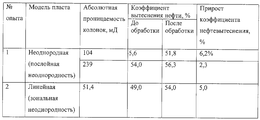
Результаты эксперимента представлены в таблице. The results of the experiment are presented in the table.
Пример 2. Example 2
Проводили исследования предлагаемой технологии на наборе линейной модели пласта, имитирующей зональную неоднородность. Модель готовили из цилиндрических образцов керна, вырезанных параллельно напластованию. Модель пласта имеет следующие характеристики: длина 12,37 см, диаметр 3 см, абсолютная проницаемость 51,4 мД. The proposed technology was studied on a set of a linear reservoir model simulating zonal heterogeneity. The model was prepared from cylindrical core samples cut parallel to the bedding. The reservoir model has the following characteristics: length 12.37 cm, diameter 3 cm, absolute permeability 51.4 mD.
Пластовую воду и нефть подготавливали в соответствии с примером 1. Produced water and oil were prepared in accordance with example 1.
Эксперимент проводили при постоянном расходе жидкости (5,4 мл/час), фиксируя изменения давления в системе и выделившееся количество жидкости. Закачку растворов проводили в соответствии с примером 1, но для предотвращения кольматации продуктами реакции входа в модель и более полного охвата модели воздействием по длине закачку реагентов проводили двумя циклами. The experiment was carried out at a constant flow rate (5.4 ml / h), recording changes in pressure in the system and the amount of liquid released. The injection of solutions was carried out in accordance with Example 1, but in order to prevent the products of the reaction from entering the model and to more fully cover the model by exposure along the length, the injection of reagents was performed in two cycles.
После закачки модель термостатировали в течение 24 часов при 72oС, затем продолжили закачку воды.After injection, the model was thermostated for 24 hours at 72 o C, then continued the injection of water.
Таким образом, как следует из таблицы, использование предложенного способа позволяет повысить нефтеотдачу пластов. Thus, as follows from the table, the use of the proposed method allows to increase oil recovery.
Claims (7)
Priority Applications (1)
| Application Number | Priority Date | Filing Date | Title |
|---|---|---|---|
| RU2001127649/03A RU2204016C1 (en) | 2001-10-12 | 2001-10-12 | Method of oil pool development |
Applications Claiming Priority (1)
| Application Number | Priority Date | Filing Date | Title |
|---|---|---|---|
| RU2001127649/03A RU2204016C1 (en) | 2001-10-12 | 2001-10-12 | Method of oil pool development |
Publications (1)
| Publication Number | Publication Date |
|---|---|
| RU2204016C1 true RU2204016C1 (en) | 2003-05-10 |
Family
ID=20253705
Family Applications (1)
| Application Number | Title | Priority Date | Filing Date |
|---|---|---|---|
| RU2001127649/03A RU2204016C1 (en) | 2001-10-12 | 2001-10-12 | Method of oil pool development |
Country Status (1)
| Country | Link |
|---|---|
| RU (1) | RU2204016C1 (en) |
Cited By (5)
| Publication number | Priority date | Publication date | Assignee | Title |
|---|---|---|---|---|
| RU2290501C1 (en) * | 2006-03-09 | 2006-12-27 | Михаил Юрьевич Ахапкин | Method for extracting an oil pool |
| RU2300628C1 (en) * | 2005-12-19 | 2007-06-10 | Государственное образовательное учреждение высшего профессионального образования "Санкт-Петербургский государственный горный институт имени Г.В. Плеханова (технический университет)" | Method for oil field development |
| RU2301327C1 (en) * | 2006-02-02 | 2007-06-20 | Государственное образовательное учреждение высшего профессионального образования "Санкт-Петербургский государственный горный институт имени Г.В. Плеханова (технический университет)" | Method for oil deposit development |
| RU2313662C1 (en) * | 2007-02-13 | 2007-12-27 | Открытое акционерное общество "Татнефть" им. В.Д. Шашина | Method for small or medium-size oil or gas deposit development |
| RU2723416C1 (en) * | 2019-06-06 | 2020-06-11 | Федеральное государственное бюджетное образовательное учреждение высшего образования "Кубанский государственный технологический университет" (ФГБОУ ВО "КубГТУ") | Method of repair-insulation works in oil and gas well |
Citations (3)
| Publication number | Priority date | Publication date | Assignee | Title |
|---|---|---|---|---|
| US3882938A (en) * | 1972-07-17 | 1975-05-13 | Union Oil Co | Process for recovering oil from heterogeneous reservoirs |
| RU2108455C1 (en) * | 1997-05-19 | 1998-04-10 | Владимир Владимирович Мазаев | Method for isolation of brine water inflow |
| RU2111351C1 (en) * | 1997-05-19 | 1998-05-20 | Владимир Владимирович Мазаев | Method of shutoff of formation water inflow |
-
2001
- 2001-10-12 RU RU2001127649/03A patent/RU2204016C1/en not_active IP Right Cessation
Patent Citations (3)
| Publication number | Priority date | Publication date | Assignee | Title |
|---|---|---|---|---|
| US3882938A (en) * | 1972-07-17 | 1975-05-13 | Union Oil Co | Process for recovering oil from heterogeneous reservoirs |
| RU2108455C1 (en) * | 1997-05-19 | 1998-04-10 | Владимир Владимирович Мазаев | Method for isolation of brine water inflow |
| RU2111351C1 (en) * | 1997-05-19 | 1998-05-20 | Владимир Владимирович Мазаев | Method of shutoff of formation water inflow |
Cited By (5)
| Publication number | Priority date | Publication date | Assignee | Title |
|---|---|---|---|---|
| RU2300628C1 (en) * | 2005-12-19 | 2007-06-10 | Государственное образовательное учреждение высшего профессионального образования "Санкт-Петербургский государственный горный институт имени Г.В. Плеханова (технический университет)" | Method for oil field development |
| RU2301327C1 (en) * | 2006-02-02 | 2007-06-20 | Государственное образовательное учреждение высшего профессионального образования "Санкт-Петербургский государственный горный институт имени Г.В. Плеханова (технический университет)" | Method for oil deposit development |
| RU2290501C1 (en) * | 2006-03-09 | 2006-12-27 | Михаил Юрьевич Ахапкин | Method for extracting an oil pool |
| RU2313662C1 (en) * | 2007-02-13 | 2007-12-27 | Открытое акционерное общество "Татнефть" им. В.Д. Шашина | Method for small or medium-size oil or gas deposit development |
| RU2723416C1 (en) * | 2019-06-06 | 2020-06-11 | Федеральное государственное бюджетное образовательное учреждение высшего образования "Кубанский государственный технологический университет" (ФГБОУ ВО "КубГТУ") | Method of repair-insulation works in oil and gas well |
Similar Documents
| Publication | Publication Date | Title |
|---|---|---|
| RU2078917C1 (en) | Method of development of nonuniform formations with cyclic waterflooding | |
| RU2039224C1 (en) | Flooded oil field exploitation method | |
| RU2060374C1 (en) | Method for developing nonuniform oil deposit with flooding | |
| RU2303047C1 (en) | Highly inhibited drilling | |
| RU2127802C1 (en) | Method for development of oil deposits | |
| RU2111351C1 (en) | Method of shutoff of formation water inflow | |
| RU2042800C1 (en) | Method for treatment of well perforated zone | |
| RU2080450C1 (en) | Method for isolation of brine water inflow | |
| RU2086760C1 (en) | Method for removing sedimentations from injection wells | |
| RU2098611C1 (en) | Method of developing deposit with high-viscosity oil | |
| RU2108455C1 (en) | Method for isolation of brine water inflow | |
| RU2174594C1 (en) | Composition for unclaying of formation bottom zone (versions) | |
| RU2213853C2 (en) | Method of massive oil pool development | |
| RU2114991C1 (en) | Method for isolation of brine water inflow | |
| RU2069260C1 (en) | Method for increase of oil recovery from formations | |
| RU2120546C1 (en) | Method of reagent demudding of wells | |
| RU2191894C1 (en) | Method of oil formation development control | |
| RU2168617C2 (en) | Method of developing oil deposit | |
| RU2475622C1 (en) | Lining method of bottom-hole zone of productive formation of gas wells | |
| RU2236559C1 (en) | Method for selective treatment of bed | |
| RU2139988C1 (en) | Compound for perforation of productive beds | |
| RU2102591C1 (en) | Method for treating productive bed | |
| RU2105141C1 (en) | Method for development of oil deposit with low-permeable clay-bearing reservoir | |
| RU2083809C1 (en) | Method for development of water-flooded oil deposit | |
| RU2011807C1 (en) | Method for petroleum deposit working |
Legal Events
| Date | Code | Title | Description |
|---|---|---|---|
| MM4A | The patent is invalid due to non-payment of fees |
Effective date: 20041013 |