RU2018564C1 - Foundation - Google Patents
Foundation Download PDFInfo
- Publication number
- RU2018564C1 RU2018564C1 SU5061961A RU2018564C1 RU 2018564 C1 RU2018564 C1 RU 2018564C1 SU 5061961 A SU5061961 A SU 5061961A RU 2018564 C1 RU2018564 C1 RU 2018564C1
- Authority
- RU
- Russia
- Prior art keywords
- shell
- enclosure
- radius
- base
- pyramid
- Prior art date
Links
- 239000002689 soil Substances 0.000 claims description 9
- 238000010276 construction Methods 0.000 abstract description 3
- 238000000034 method Methods 0.000 abstract 1
- 239000000126 substance Substances 0.000 abstract 1
- 238000004519 manufacturing process Methods 0.000 description 3
- 239000011150 reinforced concrete Substances 0.000 description 3
- 238000007654 immersion Methods 0.000 description 2
- 238000005056 compaction Methods 0.000 description 1
- 238000001556 precipitation Methods 0.000 description 1
- 239000013049 sediment Substances 0.000 description 1
Images

Landscapes
- Investigation Of Foundation Soil And Reinforcement Of Foundation Soil By Compacting Or Drainage (AREA)
Abstract
Description
Изобретение относится к строительству, а именно к конструкциям фундаментов-оболочек. The invention relates to the construction, namely, to the construction of the foundations, shells.
Цель изобретения - повышение несущей способности цилиндрических столбчатых фундаментов-оболочек и снижение трудоемкости их изготовления. The purpose of the invention is to increase the bearing capacity of cylindrical columnar foundations-shells and reduce the complexity of their manufacture.
Цель достигается тем, что в фундаменте, включающем вертикально погруженную в грунт оболочку и жесткий элемент, размещенный в полости оболочки, полость оболочки заполнена грунтом ненарушенной структуры, а жесткий элемент размещен соосно с оболочкой и имеет форму пирамиды или прямого кругового конуса, причем радиус основания конуса или радиус окружности, вписанной в основание пирамиды, определен по формуле
r = 
φ - угол внутреннего трения грунта, заполняющего полость оболочки, при этом острие жесткого элемента расположено выше уровня нижней кромки оболочки на 5-10 см.The goal is achieved in that in the foundation, which includes a shell vertically immersed in the ground and a rigid element located in the cavity of the shell, the cavity of the shell is filled with soil of an undisturbed structure, and the rigid element is placed coaxially with the shell and has the shape of a pyramid or a straight circular cone, and the radius of the base of the cone or the radius of the circle inscribed in the base of the pyramid is determined by the formula
r =
φ is the angle of internal friction of the soil filling the cavity of the shell, while the tip of the rigid element is located 5-10 cm above the level of the lower edge of the shell
На чертеже показан фундамент. The drawing shows the foundation.
Фундамент включает цилиндрическую вертикально погруженную в грунт 2 оболочку 1, из полости которой не разработан и не извлечен и в нем соосно с оболочкой размещен жесткий элемент 3, например забивной железобетонный, имеющий форму пирамиды или прямого кругового конуса, причем радиус основания конуса или радиус окружности, вписанной в основание пирамиды, определен по формуле
r = 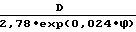
φ - угол внутреннего трения грунта, заполняющего полость оболочки, при этом острие жесткого элемента расположено выше уровня нижней кромки оболочки на 5-10 см.The foundation includes a cylindrical shell 1, vertically immersed in the
r =
φ is the angle of internal friction of the soil filling the cavity of the shell, while the tip of the rigid element is located 5-10 cm above the level of the lower edge of the shell
При погружении жесткого элемента 3 вокруг него образуется зона уплотненного грунта 4, диаметр которой может быть определен по формуле
С= 2,78 ˙r˙ ехр(0,024 ˙ φ ). Размер уплотненной зоны под нижним концом жесткого элемента составляет 5-10 см. Таким образом, практически весь объем внутренней полости оболочки составляет уплотненный грунт. В результате этого при приложении к фундаменту нагрузки его составляющие: жесткий элемент, уплотненная зона грунта и оболочка имеют высокую степень совместности работы, которая обусловлена тем, что: в пределах полости оболочки деформации уплотнения грунта отсутствуют; сразу же после приложения нагрузки вовлекаются в работу боковая поверхность оболочки и естественное основание, подстилающее подошву фундамента; осадки всех составляющих фундамента близки между собой; с появлением у фундамента осадки включается в работу наружная боковая поверхность оболочки. Вследствие этого предлагаемый фундамент позволяет существенно повысить несущую способность цилиндрических столбчатых фундаментов-оболочек. Существенное снижение трудоемкости процесса изготовления фундамента обусловлено необходимостью выполнения лишь двух технологических операций: погружение оболочки; погружение соосно с ней жесткого элемента.When immersing the
C = 2.78 ˙r˙ exp (0.024 ˙ φ). The size of the compacted zone under the lower end of the rigid element is 5-10 cm. Thus, almost the entire volume of the inner cavity of the shell is compacted soil. As a result of this, when a load is applied to the foundation, its components: a rigid element, a compacted soil zone and a shell have a high degree of work compatibility, which is due to the fact that: within the shell cavity, there are no soil compaction deformations; immediately after application of the load, the lateral surface of the shell and the natural base underlying the base of the foundation are involved in the work; precipitation of all components of the foundation are close to each other; with the appearance of sediment at the foundation, the outer side surface of the shell is included in the operation. As a result, the proposed foundation can significantly increase the bearing capacity of the cylindrical columnar foundations, shells. A significant reduction in the complexity of the foundation manufacturing process is due to the need to perform only two technological operations: immersion of the shell; immersion coaxially with it of the rigid element.
Для выполнения предлагаемого фундамента могут быть использованы стандартные сборные тонкостенные железобетонные оболочки диаметром 0,8-3 м и длиной до 6 м и сборные железобетонные жесткие элементы, имеющие форму пирамиды или прямого кругового конуса с радиусом основания конуса или радиусом окружности, вписанной в основание пирамиды, r = 0,2-0,5 м. To fulfill the proposed foundation, standard prefabricated thin-walled reinforced concrete shells with a diameter of 0.8-3 m and a length of up to 6 m and prefabricated reinforced concrete rigid elements having the shape of a pyramid or a straight circular cone with a radius of the base of the cone or a radius of a circle inscribed in the base of the pyramid can be used, r = 0.2-0.5 m.
Использование изобретения позволяет повысить несущую способность цилиндрических столбчатых фундаментов-оболочек, снизить трудоемкость и время их изготовления. Using the invention allows to increase the bearing capacity of cylindrical columnar foundations-shells, to reduce the complexity and time of their manufacture.
Claims (1)
r = D / 2,78˙exp(0,024˙φ) ,
где D - внутренний диаметр оболочки;
φ - угол внутреннего трения грунта, заполняющего полость оболочки,
при этом острие жесткого элемента расположено выше уровня нижней кромки оболочки на 5 - 10 см.BASE, including a cylindrical shell vertically immersed in the ground and a rigid element located in the cavity of the shell, characterized in that the cavity of the shell is filled with soil of undisturbed structure, and the rigid element is placed coaxially with the shell and has the shape of a pyramid or a straight circular cone, and the radius of the base of the cone or the radius of the circle inscribed in the base of the pyramid is determined by the formula
r = D / 2,78˙exp (0,024˙φ),
where D is the inner diameter of the shell;
φ is the angle of internal friction of the soil filling the cavity of the shell,
in this case, the tip of the rigid element is located 5-10 cm above the level of the lower edge of the shell.
Priority Applications (1)
| Application Number | Priority Date | Filing Date | Title |
|---|---|---|---|
| SU5061961 RU2018564C1 (en) | 1992-09-14 | 1992-09-14 | Foundation |
Applications Claiming Priority (1)
| Application Number | Priority Date | Filing Date | Title |
|---|---|---|---|
| SU5061961 RU2018564C1 (en) | 1992-09-14 | 1992-09-14 | Foundation |
Publications (1)
| Publication Number | Publication Date |
|---|---|
| RU2018564C1 true RU2018564C1 (en) | 1994-08-30 |
Family
ID=21613175
Family Applications (1)
| Application Number | Title | Priority Date | Filing Date |
|---|---|---|---|
| SU5061961 RU2018564C1 (en) | 1992-09-14 | 1992-09-14 | Foundation |
Country Status (1)
| Country | Link |
|---|---|
| RU (1) | RU2018564C1 (en) |
Cited By (1)
| Publication number | Priority date | Publication date | Assignee | Title |
|---|---|---|---|---|
| RU2367743C2 (en) * | 2007-06-18 | 2009-09-20 | Государственное образовательное учреждение высшего профессионального образования "Тольяттинский государственный университет" | Basement |
-
1992
- 1992-09-14 RU SU5061961 patent/RU2018564C1/en active
Non-Patent Citations (2)
| Title |
|---|
| 1. Тетиор А.Н. и Литвиненко А.Г. Фундаменты - Оболочки. М.: Стройиздат, 1975, с.136. * |
| 2. Авторское свидетельство СССР N 874876, кл. E 02D 27/01, 1981. * |
Cited By (1)
| Publication number | Priority date | Publication date | Assignee | Title |
|---|---|---|---|---|
| RU2367743C2 (en) * | 2007-06-18 | 2009-09-20 | Государственное образовательное учреждение высшего профессионального образования "Тольяттинский государственный университет" | Basement |
Similar Documents
| Publication | Publication Date | Title |
|---|---|---|
| RU2018565C1 (en) | Method for erection of foundation | |
| CN110306525A (en) | Treatment method of collapsible loess foundation | |
| DE102005044123B4 (en) | Energy storage device | |
| JPS55159024A (en) | Construction method for structure foundation | |
| GB2120304A (en) | Forming concrete piles | |
| GB2064625A (en) | Method of Hole Forming for Miniature Piles | |
| SU654746A1 (en) | Device for erecting built-in-place pile | |
| RU2004116382A (en) | METHOD FOR BUILDING A BASE | |
| RU2204653C2 (en) | Pile | |
| DE1957936A1 (en) | Method of making concrete piles | |
| SU1353871A1 (en) | Foundation under column | |
| Aponno et al. | An Evaluation of Carrying Capacity of Jack-in Piles with Base Enlargement in Soft Clay | |
| JPS6160928B2 (en) | ||
| RU2024681C1 (en) | Pile | |
| RU2027827C1 (en) | Method for pile installation | |
| SU844692A1 (en) | Foundation constructing method | |
| GB2064627A (en) | Method of Piling | |
| SU1456506A1 (en) | Method of constructing a foundation | |
| SU870586A1 (en) | Boring pile | |
| SU987031A1 (en) | Method of constructing sectionized hollow screw pile | |
| Menon | The “round mound” and its structural requirements: a possible scenario for the evolution of the form of the stupa | |
| RU93014281A (en) | METHOD OF STRENGTHENING THE FOUNDATION OF THE FOUNDATIONS | |
| SU1041639A1 (en) | Pile | |
| SU1726651A1 (en) | Device for sinkage of filling cased pile | |
| SU1596020A1 (en) | Method of errecting pile |