NL2011950C2 - Composition comprising furfuryl alcohol. - Google Patents
Composition comprising furfuryl alcohol. Download PDFInfo
- Publication number
- NL2011950C2 NL2011950C2 NL2011950A NL2011950A NL2011950C2 NL 2011950 C2 NL2011950 C2 NL 2011950C2 NL 2011950 A NL2011950 A NL 2011950A NL 2011950 A NL2011950 A NL 2011950A NL 2011950 C2 NL2011950 C2 NL 2011950C2
- Authority
- NL
- Netherlands
- Prior art keywords
- acid
- composition
- component
- humins
- furfuryl alcohol
- Prior art date
Links
- XPFVYQJUAUNWIW-UHFFFAOYSA-N furfuryl alcohol Chemical compound OCC1=CC=CO1 XPFVYQJUAUNWIW-UHFFFAOYSA-N 0.000 title claims abstract description 198
- 239000000203 mixture Substances 0.000 title claims abstract description 121
- 239000002663 humin Substances 0.000 claims abstract description 78
- 230000002378 acidificating effect Effects 0.000 claims abstract description 48
- 239000011347 resin Substances 0.000 claims abstract description 36
- 229920005989 resin Polymers 0.000 claims abstract description 36
- 230000001070 adhesive effect Effects 0.000 claims abstract description 19
- 239000000853 adhesive Substances 0.000 claims abstract description 18
- 239000003505 polymerization initiator Substances 0.000 claims abstract description 12
- 239000003795 chemical substances by application Substances 0.000 claims abstract description 5
- 239000003999 initiator Substances 0.000 claims description 54
- 239000002253 acid Substances 0.000 claims description 37
- -1 alkylevulinates Chemical compound 0.000 claims description 29
- 239000002023 wood Substances 0.000 claims description 29
- JOOXCMJARBKPKM-UHFFFAOYSA-N 4-oxopentanoic acid Chemical compound CC(=O)CCC(O)=O JOOXCMJARBKPKM-UHFFFAOYSA-N 0.000 claims description 28
- 238000000034 method Methods 0.000 claims description 27
- 239000000758 substrate Substances 0.000 claims description 24
- 238000010438 heat treatment Methods 0.000 claims description 23
- FPYJFEHAWHCUMM-UHFFFAOYSA-N maleic anhydride Chemical group O=C1OC(=O)C=C1 FPYJFEHAWHCUMM-UHFFFAOYSA-N 0.000 claims description 20
- 239000003085 diluting agent Substances 0.000 claims description 19
- 150000001875 compounds Chemical class 0.000 claims description 17
- 239000000178 monomer Substances 0.000 claims description 16
- 150000007513 acids Chemical class 0.000 claims description 14
- 150000001720 carbohydrates Chemical class 0.000 claims description 14
- 235000014633 carbohydrates Nutrition 0.000 claims description 14
- 229940040102 levulinic acid Drugs 0.000 claims description 14
- CSCPPACGZOOCGX-UHFFFAOYSA-N Acetone Chemical compound CC(C)=O CSCPPACGZOOCGX-UHFFFAOYSA-N 0.000 claims description 12
- HYBBIBNJHNGZAN-UHFFFAOYSA-N furfural Chemical compound O=CC1=CC=CO1 HYBBIBNJHNGZAN-UHFFFAOYSA-N 0.000 claims description 12
- LFQSCWFLJHTTHZ-UHFFFAOYSA-N Ethanol Chemical compound CCO LFQSCWFLJHTTHZ-UHFFFAOYSA-N 0.000 claims description 10
- 239000003426 co-catalyst Substances 0.000 claims description 10
- 239000000945 filler Substances 0.000 claims description 10
- ZWEHNKRNPOVVGH-UHFFFAOYSA-N 2-Butanone Chemical compound CCC(C)=O ZWEHNKRNPOVVGH-UHFFFAOYSA-N 0.000 claims description 9
- OKKJLVBELUTLKV-UHFFFAOYSA-N Methanol Chemical compound OC OKKJLVBELUTLKV-UHFFFAOYSA-N 0.000 claims description 9
- ZMXDDKWLCZADIW-UHFFFAOYSA-N N,N-Dimethylformamide Chemical compound CN(C)C=O ZMXDDKWLCZADIW-UHFFFAOYSA-N 0.000 claims description 9
- KRKNYBCHXYNGOX-UHFFFAOYSA-N citric acid Chemical compound OC(=O)CC(O)(C(O)=O)CC(O)=O KRKNYBCHXYNGOX-UHFFFAOYSA-N 0.000 claims description 9
- 239000011248 coating agent Substances 0.000 claims description 9
- 238000000576 coating method Methods 0.000 claims description 9
- XNGIFLGASWRNHJ-UHFFFAOYSA-N phthalic acid Chemical compound OC(=O)C1=CC=CC=C1C(O)=O XNGIFLGASWRNHJ-UHFFFAOYSA-N 0.000 claims description 8
- 229920000642 polymer Polymers 0.000 claims description 8
- 238000004519 manufacturing process Methods 0.000 claims description 7
- 238000006384 oligomerization reaction Methods 0.000 claims description 7
- NOEGNKMFWQHSLB-UHFFFAOYSA-N 5-hydroxymethylfurfural Chemical compound OCC1=CC=C(C=O)O1 NOEGNKMFWQHSLB-UHFFFAOYSA-N 0.000 claims description 6
- OFOBLEOULBTSOW-UHFFFAOYSA-N Propanedioic acid Natural products OC(=O)CC(O)=O OFOBLEOULBTSOW-UHFFFAOYSA-N 0.000 claims description 6
- WPYMKLBDIGXBTP-UHFFFAOYSA-N benzoic acid Chemical compound OC(=O)C1=CC=CC=C1 WPYMKLBDIGXBTP-UHFFFAOYSA-N 0.000 claims description 6
- VZCYOOQTPOCHFL-UPHRSURJSA-N maleic acid Chemical compound OC(=O)\C=C/C(O)=O VZCYOOQTPOCHFL-UPHRSURJSA-N 0.000 claims description 6
- 239000011976 maleic acid Substances 0.000 claims description 6
- BDAGIHXWWSANSR-UHFFFAOYSA-N methanoic acid Natural products OC=O BDAGIHXWWSANSR-UHFFFAOYSA-N 0.000 claims description 6
- 239000011120 plywood Substances 0.000 claims description 6
- VZCYOOQTPOCHFL-UHFFFAOYSA-N trans-butenedioic acid Natural products OC(=O)C=CC(O)=O VZCYOOQTPOCHFL-UHFFFAOYSA-N 0.000 claims description 6
- LRHPLDYGYMQRHN-UHFFFAOYSA-N N-Butanol Chemical compound CCCCO LRHPLDYGYMQRHN-UHFFFAOYSA-N 0.000 claims description 5
- 238000006297 dehydration reaction Methods 0.000 claims description 5
- 239000011094 fiberboard Substances 0.000 claims description 5
- DNXDYHALMANNEJ-UHFFFAOYSA-N furan-2,3-dicarboxylic acid Chemical compound OC(=O)C=1C=COC=1C(O)=O DNXDYHALMANNEJ-UHFFFAOYSA-N 0.000 claims description 5
- 239000011121 hardwood Substances 0.000 claims description 5
- RJGBSYZFOCAGQY-UHFFFAOYSA-N hydroxymethylfurfural Natural products COC1=CC=C(C=O)O1 RJGBSYZFOCAGQY-UHFFFAOYSA-N 0.000 claims description 5
- 150000002576 ketones Chemical class 0.000 claims description 5
- XLYOFNOQVPJJNP-UHFFFAOYSA-N water Substances O XLYOFNOQVPJJNP-UHFFFAOYSA-N 0.000 claims description 5
- BJEPYKJPYRNKOW-REOHCLBHSA-N (S)-malic acid Chemical compound OC(=O)[C@@H](O)CC(O)=O BJEPYKJPYRNKOW-REOHCLBHSA-N 0.000 claims description 4
- IAZDPXIOMUYVGZ-UHFFFAOYSA-N Dimethylsulphoxide Chemical compound CS(C)=O IAZDPXIOMUYVGZ-UHFFFAOYSA-N 0.000 claims description 4
- LGRFSURHDFAFJT-UHFFFAOYSA-N Phthalic anhydride Natural products C1=CC=C2C(=O)OC(=O)C2=C1 LGRFSURHDFAFJT-UHFFFAOYSA-N 0.000 claims description 4
- 239000004952 Polyamide Substances 0.000 claims description 4
- 150000001298 alcohols Chemical class 0.000 claims description 4
- BJEPYKJPYRNKOW-UHFFFAOYSA-N alpha-hydroxysuccinic acid Natural products OC(=O)C(O)CC(O)=O BJEPYKJPYRNKOW-UHFFFAOYSA-N 0.000 claims description 4
- 229910052796 boron Inorganic materials 0.000 claims description 4
- JHIWVOJDXOSYLW-UHFFFAOYSA-N butyl 2,2-difluorocyclopropane-1-carboxylate Chemical compound CCCCOC(=O)C1CC1(F)F JHIWVOJDXOSYLW-UHFFFAOYSA-N 0.000 claims description 4
- 230000018044 dehydration Effects 0.000 claims description 4
- 235000013312 flour Nutrition 0.000 claims description 4
- 239000001630 malic acid Substances 0.000 claims description 4
- 235000011090 malic acid Nutrition 0.000 claims description 4
- TZIHFWKZFHZASV-UHFFFAOYSA-N methyl formate Chemical compound COC=O TZIHFWKZFHZASV-UHFFFAOYSA-N 0.000 claims description 4
- 229920001281 polyalkylene Polymers 0.000 claims description 4
- 229920002647 polyamide Polymers 0.000 claims description 4
- 239000011122 softwood Substances 0.000 claims description 4
- OSWFIVFLDKOXQC-UHFFFAOYSA-N 4-(3-methoxyphenyl)aniline Chemical compound COC1=CC=CC(C=2C=CC(N)=CC=2)=C1 OSWFIVFLDKOXQC-UHFFFAOYSA-N 0.000 claims description 3
- 239000005711 Benzoic acid Substances 0.000 claims description 3
- AFVFQIVMOAPDHO-UHFFFAOYSA-N Methanesulfonic acid Chemical class CS(O)(=O)=O AFVFQIVMOAPDHO-UHFFFAOYSA-N 0.000 claims description 3
- XAGFODPZIPBFFR-UHFFFAOYSA-N aluminium Chemical compound [Al] XAGFODPZIPBFFR-UHFFFAOYSA-N 0.000 claims description 3
- 229910052782 aluminium Inorganic materials 0.000 claims description 3
- 235000010233 benzoic acid Nutrition 0.000 claims description 3
- 229910052804 chromium Inorganic materials 0.000 claims description 3
- 239000011651 chromium Substances 0.000 claims description 3
- 150000002148 esters Chemical class 0.000 claims description 3
- 239000000835 fiber Substances 0.000 claims description 3
- 235000019253 formic acid Nutrition 0.000 claims description 3
- 229910052500 inorganic mineral Inorganic materials 0.000 claims description 3
- XEEYBQQBJWHFJM-UHFFFAOYSA-N iron Substances [Fe] XEEYBQQBJWHFJM-UHFFFAOYSA-N 0.000 claims description 3
- 229910052742 iron Inorganic materials 0.000 claims description 3
- 239000011707 mineral Chemical class 0.000 claims description 3
- 239000011701 zinc Substances 0.000 claims description 3
- 229910052725 zinc Inorganic materials 0.000 claims description 3
- RSZZMVPSHLKFQY-UHFFFAOYSA-N 1-(furan-2-yl)-2-hydroxyethanone Chemical compound OCC(=O)C1=CC=CO1 RSZZMVPSHLKFQY-UHFFFAOYSA-N 0.000 claims description 2
- PXJJKVNIMAZHCB-UHFFFAOYSA-N 2,5-diformylfuran Chemical compound O=CC1=CC=C(C=O)O1 PXJJKVNIMAZHCB-UHFFFAOYSA-N 0.000 claims description 2
- ZCYVEMRRCGMTRW-UHFFFAOYSA-N 7553-56-2 Chemical compound [I] ZCYVEMRRCGMTRW-UHFFFAOYSA-N 0.000 claims description 2
- 235000008733 Citrus aurantifolia Nutrition 0.000 claims description 2
- 229920002292 Nylon 6 Polymers 0.000 claims description 2
- 229920002302 Nylon 6,6 Polymers 0.000 claims description 2
- 229920001283 Polyalkylene terephthalate Polymers 0.000 claims description 2
- 235000011941 Tilia x europaea Nutrition 0.000 claims description 2
- 210000000988 bone and bone Anatomy 0.000 claims description 2
- 239000004927 clay Substances 0.000 claims description 2
- 125000004427 diamine group Chemical group 0.000 claims description 2
- CHTHALBTIRVDBM-UHFFFAOYSA-N furan-2,5-dicarboxylic acid Chemical group OC(=O)C1=CC=C(C(O)=O)O1 CHTHALBTIRVDBM-UHFFFAOYSA-N 0.000 claims description 2
- 239000003365 glass fiber Substances 0.000 claims description 2
- 239000011630 iodine Substances 0.000 claims description 2
- 229910052740 iodine Inorganic materials 0.000 claims description 2
- 239000004571 lime Substances 0.000 claims description 2
- WSFSSNUMVMOOMR-NJFSPNSNSA-N methanone Chemical compound O=[14CH2] WSFSSNUMVMOOMR-NJFSPNSNSA-N 0.000 claims description 2
- 125000005487 naphthalate group Chemical group 0.000 claims description 2
- JOXIMZWYDAKGHI-UHFFFAOYSA-N p-toluenesulfonic acid Substances CC1=CC=C(S(O)(=O)=O)C=C1 JOXIMZWYDAKGHI-UHFFFAOYSA-N 0.000 claims description 2
- 239000004014 plasticizer Substances 0.000 claims description 2
- 229920000728 polyester Polymers 0.000 claims description 2
- BDERNNFJNOPAEC-UHFFFAOYSA-N propan-1-ol Chemical compound CCCO BDERNNFJNOPAEC-UHFFFAOYSA-N 0.000 claims description 2
- 239000000454 talc Substances 0.000 claims description 2
- 229910052623 talc Inorganic materials 0.000 claims description 2
- SMNDYUVBFMFKNZ-UHFFFAOYSA-N 2-furoic acid Chemical compound OC(=O)C1=CC=CO1 SMNDYUVBFMFKNZ-UHFFFAOYSA-N 0.000 claims 2
- 239000011093 chipboard Substances 0.000 claims 2
- 229920005594 polymer fiber Polymers 0.000 claims 2
- ZOXJGFHDIHLPTG-UHFFFAOYSA-N Boron Chemical compound [B] ZOXJGFHDIHLPTG-UHFFFAOYSA-N 0.000 claims 1
- 229920000049 Carbon (fiber) Polymers 0.000 claims 1
- 239000004760 aramid Substances 0.000 claims 1
- 229920003235 aromatic polyamide Polymers 0.000 claims 1
- 239000004917 carbon fiber Substances 0.000 claims 1
- 239000003086 colorant Substances 0.000 claims 1
- 229940098779 methanesulfonic acid Drugs 0.000 claims 1
- 230000003606 oligomerizing effect Effects 0.000 claims 1
- 125000005489 p-toluenesulfonic acid group Chemical class 0.000 claims 1
- 238000005470 impregnation Methods 0.000 abstract description 9
- 238000006116 polymerization reaction Methods 0.000 description 28
- 229920005610 lignin Polymers 0.000 description 19
- 239000002131 composite material Substances 0.000 description 18
- 239000000463 material Substances 0.000 description 14
- 230000008569 process Effects 0.000 description 14
- 238000009472 formulation Methods 0.000 description 10
- 238000006243 chemical reaction Methods 0.000 description 8
- 238000002360 preparation method Methods 0.000 description 7
- ASHVULSQMDWKFO-UHFFFAOYSA-N 5-(methoxymethyl)furan-2-carbaldehyde Chemical compound COCC1=CC=C(C=O)O1 ASHVULSQMDWKFO-UHFFFAOYSA-N 0.000 description 6
- 239000006227 byproduct Substances 0.000 description 6
- 238000002474 experimental method Methods 0.000 description 6
- 238000001757 thermogravimetry curve Methods 0.000 description 6
- OKTJSMMVPCPJKN-UHFFFAOYSA-N Carbon Chemical compound [C] OKTJSMMVPCPJKN-UHFFFAOYSA-N 0.000 description 5
- YLQBMQCUIZJEEH-UHFFFAOYSA-N Furan Chemical group C=1C=COC=1 YLQBMQCUIZJEEH-UHFFFAOYSA-N 0.000 description 5
- 229910052799 carbon Inorganic materials 0.000 description 5
- 230000001419 dependent effect Effects 0.000 description 5
- QVGXLLKOCUKJST-UHFFFAOYSA-N atomic oxygen Chemical compound [O] QVGXLLKOCUKJST-UHFFFAOYSA-N 0.000 description 4
- 230000000977 initiatory effect Effects 0.000 description 4
- 238000004537 pulping Methods 0.000 description 4
- 239000002841 Lewis acid Substances 0.000 description 3
- HEMHJVSKTPXQMS-UHFFFAOYSA-M Sodium hydroxide Chemical compound [OH-].[Na+] HEMHJVSKTPXQMS-UHFFFAOYSA-M 0.000 description 3
- 238000005903 acid hydrolysis reaction Methods 0.000 description 3
- 239000012298 atmosphere Substances 0.000 description 3
- RTZKZFJDLAIYFH-UHFFFAOYSA-N ether Chemical group CCOCC RTZKZFJDLAIYFH-UHFFFAOYSA-N 0.000 description 3
- 150000007517 lewis acids Chemical class 0.000 description 3
- 229920002521 macromolecule Polymers 0.000 description 3
- 229910052760 oxygen Inorganic materials 0.000 description 3
- 239000001301 oxygen Substances 0.000 description 3
- 239000002245 particle Substances 0.000 description 3
- 239000011541 reaction mixture Substances 0.000 description 3
- 238000003756 stirring Methods 0.000 description 3
- 239000000126 substance Substances 0.000 description 3
- 229920001187 thermosetting polymer Polymers 0.000 description 3
- RSWGJHLUYNHPMX-UHFFFAOYSA-N Abietic-Saeure Natural products C12CCC(C(C)C)=CC2=CCC2C1(C)CCCC2(C)C(O)=O RSWGJHLUYNHPMX-UHFFFAOYSA-N 0.000 description 2
- 229910021556 Chromium(III) chloride Inorganic materials 0.000 description 2
- 241000196324 Embryophyta Species 0.000 description 2
- UFHFLCQGNIYNRP-UHFFFAOYSA-N Hydrogen Chemical compound [H][H] UFHFLCQGNIYNRP-UHFFFAOYSA-N 0.000 description 2
- 229910021578 Iron(III) chloride Inorganic materials 0.000 description 2
- 150000001299 aldehydes Chemical class 0.000 description 2
- 125000002947 alkylene group Chemical group 0.000 description 2
- 239000004411 aluminium Substances 0.000 description 2
- 239000003054 catalyst Substances 0.000 description 2
- 229960000359 chromic chloride Drugs 0.000 description 2
- QSWDMMVNRMROPK-UHFFFAOYSA-K chromium(3+) trichloride Chemical compound [Cl-].[Cl-].[Cl-].[Cr+3] QSWDMMVNRMROPK-UHFFFAOYSA-K 0.000 description 2
- JMFRWRFFLBVWSI-NSCUHMNNSA-N coniferol Chemical compound COC1=CC(\C=C\CO)=CC=C1O JMFRWRFFLBVWSI-NSCUHMNNSA-N 0.000 description 2
- 230000000593 degrading effect Effects 0.000 description 2
- 238000010586 diagram Methods 0.000 description 2
- 229960001760 dimethyl sulfoxide Drugs 0.000 description 2
- 239000000975 dye Substances 0.000 description 2
- 125000004185 ester group Chemical group 0.000 description 2
- 229960002089 ferrous chloride Drugs 0.000 description 2
- 230000004907 flux Effects 0.000 description 2
- 239000008240 homogeneous mixture Substances 0.000 description 2
- 229910052739 hydrogen Inorganic materials 0.000 description 2
- 239000001257 hydrogen Substances 0.000 description 2
- 125000002887 hydroxy group Chemical group [H]O* 0.000 description 2
- NMCUIPGRVMDVDB-UHFFFAOYSA-L iron dichloride Chemical compound Cl[Fe]Cl NMCUIPGRVMDVDB-UHFFFAOYSA-L 0.000 description 2
- RBTARNINKXHZNM-UHFFFAOYSA-K iron trichloride Chemical compound Cl[Fe](Cl)Cl RBTARNINKXHZNM-UHFFFAOYSA-K 0.000 description 2
- 238000002156 mixing Methods 0.000 description 2
- 150000007524 organic acids Chemical group 0.000 description 2
- 239000003960 organic solvent Substances 0.000 description 2
- 239000000123 paper Substances 0.000 description 2
- 239000000047 product Substances 0.000 description 2
- 239000007787 solid Substances 0.000 description 2
- 241000894007 species Species 0.000 description 2
- LZFOPEXOUVTGJS-ONEGZZNKSA-N trans-sinapyl alcohol Chemical compound COC1=CC(\C=C\CO)=CC(OC)=C1O LZFOPEXOUVTGJS-ONEGZZNKSA-N 0.000 description 2
- 238000011282 treatment Methods 0.000 description 2
- BTXXTMOWISPQSJ-UHFFFAOYSA-N 4,4,4-trifluorobutan-2-one Chemical compound CC(=O)CC(F)(F)F BTXXTMOWISPQSJ-UHFFFAOYSA-N 0.000 description 1
- JOOXCMJARBKPKM-UHFFFAOYSA-M 4-oxopentanoate Chemical compound CC(=O)CCC([O-])=O JOOXCMJARBKPKM-UHFFFAOYSA-M 0.000 description 1
- BQACOLQNOUYJCE-FYZZASKESA-N Abietic acid Natural products CC(C)C1=CC2=CC[C@]3(C)[C@](C)(CCC[C@@]3(C)C(=O)O)[C@H]2CC1 BQACOLQNOUYJCE-FYZZASKESA-N 0.000 description 1
- 235000018185 Betula X alpestris Nutrition 0.000 description 1
- 235000018212 Betula X uliginosa Nutrition 0.000 description 1
- 239000007848 Bronsted acid Substances 0.000 description 1
- OYPRJOBELJOOCE-UHFFFAOYSA-N Calcium Chemical compound [Ca] OYPRJOBELJOOCE-UHFFFAOYSA-N 0.000 description 1
- 240000000731 Fagus sylvatica Species 0.000 description 1
- 235000010099 Fagus sylvatica Nutrition 0.000 description 1
- 239000004606 Fillers/Extenders Substances 0.000 description 1
- PCSKKIUURRTAEM-UHFFFAOYSA-N HMF acid Natural products OCC1=CC=C(C(O)=O)O1 PCSKKIUURRTAEM-UHFFFAOYSA-N 0.000 description 1
- YZCKVEUIGOORGS-UHFFFAOYSA-N Hydrogen atom Chemical compound [H] YZCKVEUIGOORGS-UHFFFAOYSA-N 0.000 description 1
- 239000004117 Lignosulphonate Substances 0.000 description 1
- UAGJVSRUFNSIHR-UHFFFAOYSA-N Methyl levulinate Chemical group COC(=O)CCC(C)=O UAGJVSRUFNSIHR-UHFFFAOYSA-N 0.000 description 1
- 241000218657 Picea Species 0.000 description 1
- KHPCPRHQVVSZAH-HUOMCSJISA-N Rosin Natural products O(C/C=C/c1ccccc1)[C@H]1[C@H](O)[C@@H](O)[C@@H](O)[C@@H](CO)O1 KHPCPRHQVVSZAH-HUOMCSJISA-N 0.000 description 1
- 229920002472 Starch Polymers 0.000 description 1
- QAOWNCQODCNURD-UHFFFAOYSA-N Sulfuric acid Chemical compound OS(O)(=O)=O QAOWNCQODCNURD-UHFFFAOYSA-N 0.000 description 1
- RSWGJHLUYNHPMX-ONCXSQPRSA-N abietic acid Chemical compound C([C@@H]12)CC(C(C)C)=CC1=CC[C@@H]1[C@]2(C)CCC[C@@]1(C)C(O)=O RSWGJHLUYNHPMX-ONCXSQPRSA-N 0.000 description 1
- OVXRPXGVKBHGQO-UHFFFAOYSA-N abietic acid methyl ester Natural products C1CC(C(C)C)=CC2=CCC3C(C(=O)OC)(C)CCCC3(C)C21 OVXRPXGVKBHGQO-UHFFFAOYSA-N 0.000 description 1
- DHKHKXVYLBGOIT-UHFFFAOYSA-N acetaldehyde Diethyl Acetal Chemical group CCOC(C)OCC DHKHKXVYLBGOIT-UHFFFAOYSA-N 0.000 description 1
- 239000003377 acid catalyst Substances 0.000 description 1
- 125000003545 alkoxy group Chemical group 0.000 description 1
- 125000005907 alkyl ester group Chemical group 0.000 description 1
- 125000000217 alkyl group Chemical group 0.000 description 1
- 150000003863 ammonium salts Chemical class 0.000 description 1
- 125000003118 aryl group Chemical group 0.000 description 1
- 230000008901 benefit Effects 0.000 description 1
- 230000015572 biosynthetic process Effects 0.000 description 1
- 239000011575 calcium Substances 0.000 description 1
- 229910052791 calcium Inorganic materials 0.000 description 1
- 150000001732 carboxylic acid derivatives Chemical class 0.000 description 1
- 230000015556 catabolic process Effects 0.000 description 1
- 210000002421 cell wall Anatomy 0.000 description 1
- 239000001913 cellulose Substances 0.000 description 1
- 229920002678 cellulose Polymers 0.000 description 1
- 239000004568 cement Substances 0.000 description 1
- LZFOPEXOUVTGJS-UHFFFAOYSA-N cis-sinapyl alcohol Natural products COC1=CC(C=CCO)=CC(OC)=C1O LZFOPEXOUVTGJS-UHFFFAOYSA-N 0.000 description 1
- 229940119526 coniferyl alcohol Drugs 0.000 description 1
- 239000000470 constituent Substances 0.000 description 1
- 238000005260 corrosion Methods 0.000 description 1
- 230000007797 corrosion Effects 0.000 description 1
- 238000000113 differential scanning calorimetry Methods 0.000 description 1
- 238000009826 distribution Methods 0.000 description 1
- 239000000428 dust Substances 0.000 description 1
- 230000000694 effects Effects 0.000 description 1
- OMRDZQXXMYCHBU-UHFFFAOYSA-N ethanol;propan-1-ol Chemical compound CCO.CCCO OMRDZQXXMYCHBU-UHFFFAOYSA-N 0.000 description 1
- 125000000816 ethylene group Chemical group [H]C([H])([*:1])C([H])([H])[*:2] 0.000 description 1
- 125000000524 functional group Chemical group 0.000 description 1
- 150000002240 furans Chemical class 0.000 description 1
- 230000002209 hydrophobic effect Effects 0.000 description 1
- 239000004615 ingredient Substances 0.000 description 1
- PNDPGZBMCMUPRI-UHFFFAOYSA-N iodine Chemical compound II PNDPGZBMCMUPRI-UHFFFAOYSA-N 0.000 description 1
- JEIPFZHSYJVQDO-UHFFFAOYSA-N iron(III) oxide Inorganic materials O=[Fe]O[Fe]=O JEIPFZHSYJVQDO-UHFFFAOYSA-N 0.000 description 1
- 239000002655 kraft paper Substances 0.000 description 1
- 229940058352 levulinate Drugs 0.000 description 1
- 235000019357 lignosulphonate Nutrition 0.000 description 1
- 230000005923 long-lasting effect Effects 0.000 description 1
- 238000010907 mechanical stirring Methods 0.000 description 1
- 230000007246 mechanism Effects 0.000 description 1
- 125000000956 methoxy group Chemical group [H]C([H])([H])O* 0.000 description 1
- OVXRPXGVKBHGQO-UYWIDEMCSA-N methyl (1r,4ar,4br,10ar)-1,4a-dimethyl-7-propan-2-yl-2,3,4,4b,5,6,10,10a-octahydrophenanthrene-1-carboxylate Chemical compound C1CC(C(C)C)=CC2=CC[C@H]3[C@@](C(=O)OC)(C)CCC[C@]3(C)[C@H]21 OVXRPXGVKBHGQO-UYWIDEMCSA-N 0.000 description 1
- 125000000325 methylidene group Chemical group [H]C([H])=* 0.000 description 1
- 150000007522 mineralic acids Chemical class 0.000 description 1
- 239000003921 oil Substances 0.000 description 1
- 235000019198 oils Nutrition 0.000 description 1
- 238000005580 one pot reaction Methods 0.000 description 1
- 235000005985 organic acids Nutrition 0.000 description 1
- 229930015763 p-coumaryl alcohol Natural products 0.000 description 1
- 230000037361 pathway Effects 0.000 description 1
- 238000005191 phase separation Methods 0.000 description 1
- 229920001568 phenolic resin Polymers 0.000 description 1
- 125000001997 phenyl group Chemical group [H]C1=C([H])C([H])=C(*)C([H])=C1[H] 0.000 description 1
- 238000006068 polycondensation reaction Methods 0.000 description 1
- 229920002959 polymer blend Polymers 0.000 description 1
- 238000003825 pressing Methods 0.000 description 1
- 230000005855 radiation Effects 0.000 description 1
- 239000000376 reactant Substances 0.000 description 1
- 239000012262 resinous product Substances 0.000 description 1
- 230000000717 retained effect Effects 0.000 description 1
- 239000004576 sand Substances 0.000 description 1
- 238000002791 soaking Methods 0.000 description 1
- UIIMBOGNXHQVGW-UHFFFAOYSA-N sodium;hydron;carbonate Chemical compound [Na+].OC(O)=O UIIMBOGNXHQVGW-UHFFFAOYSA-N 0.000 description 1
- 239000003381 stabilizer Substances 0.000 description 1
- 235000019698 starch Nutrition 0.000 description 1
- 239000008107 starch Substances 0.000 description 1
- 238000003860 storage Methods 0.000 description 1
- LSNNMFCWUKXFEE-UHFFFAOYSA-L sulfite Chemical compound [O-]S([O-])=O LSNNMFCWUKXFEE-UHFFFAOYSA-L 0.000 description 1
- 239000001117 sulphuric acid Substances 0.000 description 1
- 235000011149 sulphuric acid Nutrition 0.000 description 1
- 239000004634 thermosetting polymer Substances 0.000 description 1
- 239000002562 thickening agent Substances 0.000 description 1
- 210000001519 tissue Anatomy 0.000 description 1
- KHPCPRHQVVSZAH-UHFFFAOYSA-N trans-cinnamyl beta-D-glucopyranoside Natural products OC1C(O)C(O)C(CO)OC1OCC=CC1=CC=CC=C1 KHPCPRHQVVSZAH-UHFFFAOYSA-N 0.000 description 1
- PTNLHDGQWUGONS-UHFFFAOYSA-N trans-p-coumaric alcohol Natural products OCC=CC1=CC=C(O)C=C1 PTNLHDGQWUGONS-UHFFFAOYSA-N 0.000 description 1
- PTNLHDGQWUGONS-OWOJBTEDSA-N trans-p-coumaryl alcohol Chemical compound OC\C=C\C1=CC=C(O)C=C1 PTNLHDGQWUGONS-OWOJBTEDSA-N 0.000 description 1
- 235000015112 vegetable and seed oil Nutrition 0.000 description 1
- 239000008158 vegetable oil Substances 0.000 description 1
Classifications
-
- C—CHEMISTRY; METALLURGY
- C08—ORGANIC MACROMOLECULAR COMPOUNDS; THEIR PREPARATION OR CHEMICAL WORKING-UP; COMPOSITIONS BASED THEREON
- C08G—MACROMOLECULAR COMPOUNDS OBTAINED OTHERWISE THAN BY REACTIONS ONLY INVOLVING UNSATURATED CARBON-TO-CARBON BONDS
- C08G65/00—Macromolecular compounds obtained by reactions forming an ether link in the main chain of the macromolecule
- C08G65/34—Macromolecular compounds obtained by reactions forming an ether link in the main chain of the macromolecule from hydroxy compounds or their metallic derivatives
- C08G65/36—Furfuryl alcohol
-
- B—PERFORMING OPERATIONS; TRANSPORTING
- B27—WORKING OR PRESERVING WOOD OR SIMILAR MATERIAL; NAILING OR STAPLING MACHINES IN GENERAL
- B27K—PROCESSES, APPARATUS OR SELECTION OF SUBSTANCES FOR IMPREGNATING, STAINING, DYEING, BLEACHING OF WOOD OR SIMILAR MATERIALS, OR TREATING OF WOOD OR SIMILAR MATERIALS WITH PERMEANT LIQUIDS, NOT OTHERWISE PROVIDED FOR; CHEMICAL OR PHYSICAL TREATMENT OF CORK, CANE, REED, STRAW OR SIMILAR MATERIALS
- B27K3/00—Impregnating wood, e.g. impregnation pretreatment, for example puncturing; Wood impregnation aids not directly involved in the impregnation process
- B27K3/02—Processes; Apparatus
- B27K3/15—Impregnating involving polymerisation including use of polymer-containing impregnating agents
-
- B—PERFORMING OPERATIONS; TRANSPORTING
- B27—WORKING OR PRESERVING WOOD OR SIMILAR MATERIAL; NAILING OR STAPLING MACHINES IN GENERAL
- B27K—PROCESSES, APPARATUS OR SELECTION OF SUBSTANCES FOR IMPREGNATING, STAINING, DYEING, BLEACHING OF WOOD OR SIMILAR MATERIALS, OR TREATING OF WOOD OR SIMILAR MATERIALS WITH PERMEANT LIQUIDS, NOT OTHERWISE PROVIDED FOR; CHEMICAL OR PHYSICAL TREATMENT OF CORK, CANE, REED, STRAW OR SIMILAR MATERIALS
- B27K3/00—Impregnating wood, e.g. impregnation pretreatment, for example puncturing; Wood impregnation aids not directly involved in the impregnation process
- B27K3/34—Organic impregnating agents
- B27K3/343—Heterocyclic compounds
-
- C—CHEMISTRY; METALLURGY
- C08—ORGANIC MACROMOLECULAR COMPOUNDS; THEIR PREPARATION OR CHEMICAL WORKING-UP; COMPOSITIONS BASED THEREON
- C08L—COMPOSITIONS OF MACROMOLECULAR COMPOUNDS
- C08L71/00—Compositions of polyethers obtained by reactions forming an ether link in the main chain; Compositions of derivatives of such polymers
- C08L71/08—Polyethers derived from hydroxy compounds or from their metallic derivatives
- C08L71/14—Furfuryl alcohol polymers
-
- C—CHEMISTRY; METALLURGY
- C09—DYES; PAINTS; POLISHES; NATURAL RESINS; ADHESIVES; COMPOSITIONS NOT OTHERWISE PROVIDED FOR; APPLICATIONS OF MATERIALS NOT OTHERWISE PROVIDED FOR
- C09D—COATING COMPOSITIONS, e.g. PAINTS, VARNISHES OR LACQUERS; FILLING PASTES; CHEMICAL PAINT OR INK REMOVERS; INKS; CORRECTING FLUIDS; WOODSTAINS; PASTES OR SOLIDS FOR COLOURING OR PRINTING; USE OF MATERIALS THEREFOR
- C09D171/00—Coating compositions based on polyethers obtained by reactions forming an ether link in the main chain; Coating compositions based on derivatives of such polymers
- C09D171/08—Polyethers derived from hydroxy compounds or from their metallic derivatives
- C09D171/14—Furfuryl alcohol polymers
-
- C—CHEMISTRY; METALLURGY
- C09—DYES; PAINTS; POLISHES; NATURAL RESINS; ADHESIVES; COMPOSITIONS NOT OTHERWISE PROVIDED FOR; APPLICATIONS OF MATERIALS NOT OTHERWISE PROVIDED FOR
- C09J—ADHESIVES; NON-MECHANICAL ASPECTS OF ADHESIVE PROCESSES IN GENERAL; ADHESIVE PROCESSES NOT PROVIDED FOR ELSEWHERE; USE OF MATERIALS AS ADHESIVES
- C09J171/00—Adhesives based on polyethers obtained by reactions forming an ether link in the main chain; Adhesives based on derivatives of such polymers
- C09J171/08—Polyethers derived from hydroxy compounds or from their metallic derivatives
- C09J171/14—Furfuryl alcohol polymers
Landscapes
- Chemical & Material Sciences (AREA)
- Life Sciences & Earth Sciences (AREA)
- Chemical Kinetics & Catalysis (AREA)
- Organic Chemistry (AREA)
- Engineering & Computer Science (AREA)
- Wood Science & Technology (AREA)
- Health & Medical Sciences (AREA)
- Medicinal Chemistry (AREA)
- Polymers & Plastics (AREA)
- Forests & Forestry (AREA)
- Materials Engineering (AREA)
- Adhesives Or Adhesive Processes (AREA)
Abstract
Composition including a first component, including furfuryl alcohol and humins and a second component including an acidic polymerization initiator. The composition can be oligomerized to a resin, which has a viscosity in the range of 0.1 to 10,000 Pa·s at 25° C., determined according to ISO3219. The resin, or a blend of furfuryl alcohol and humins as a component A and an acidic polymerization initiator as a component B, separated from each other, may form a kit for an adhesive or impregnation agent.
Description
COMPOSITION COMPRISING FURFURYL ALCOHOL
The present invention relates to a composition comprising furfuryl alcohol, in particular a composition which comprises furfuryl alcohol and an acid. Such composition may be used for a variety of applications, including as impregnating agent, as resin, or as adhesive for e.g. wood, fibres and sand.
From WO 02/30638 a polymerizable solution is known containing at least furfuryl alcohol and an acid compound selected from maleic anhydride, phthalic anhydride, maleic acid, malic acid, phthalic acid and a combination thereof. The solution is used to impregnate wood and the impregnated wood thus obtained is subjected to a curing step, involving the heating of the impregnated wood at a temperature of 70 to 140 °C. The result is impregnated wooden article with an even dark colour. US 6747076 describes a two-part composition comprising furfuryl alcohol and a byproduct of a chemical pulping process as a first component and a maleic anhydride-containing catalyst composition as second component. The by-product is a lignin-comprising polymer mixture. The two-part composition according to US 6747076 is particularly suitable as wood adhesive. In that context a wooden surface to be bonded is coated with the composition and brought into contact with another wooden surface which may or may not have been coated with a similar or the same coating, and the contacting surfaces are allowed to bond under the influence of heat and pressure.
Lignin is a complex polymer of aromatic alcohols. It is commonly derived from wood and can be found in cell walls of plants. It is known as an adhesive in its natural state. Since dissolved lignin has some reactive groups that allow it to react with adhesive formulations, lignin has been employed in various wood adhesive formulations. Usually the lignin is employed as an extender in adhesives based phenol-formaldehyde resins and the like. Lignin is a cross-linked macromolecule which is relatively hydrophobic and aromatic in nature. The molecule consists of various types of substructures. The macromolecule is synthesized from various monomers, including p-coumaryl alcohol, coniferyl alcohol and sinapyl alcohol. The distribution of the monomers in lignin is dependent on plant species and tissues. However, typical structures for lignin are phenyl groups, hydroxyl and methoxy moieties and ether bonds.
Typical wood pulping processes include the Kraft and Soda processes. In these processes wood is contacted with a sodium hydroxide and some other chemicals to yield lignin. When wood pulping is carried out using the sulphite process, ligno-sulphonates are formed. In US 2006/0292366 a formulation for impregnating wood has been described wherein in addition to furfuryl alcohol and an acidic initiator, a water-soluble stabilizer, such as the calcium or ammonium salt of a lignosulphonic acid can be used. The most reactive lignins can be isolated from an organosolv process, in which wood is subjected to pulping using organic solvents such as ethanol and/or acetone. An organosolv process is described ine.g. US 2013/172628. US3293200 describes thermosetting adhesive compositions useful in the manufacture of plywood and containing, as essential ingredients, a water-soluble phenol-aldehyde resin and a water-insoluble, finely-divided humin material obtained from the manufacture of levulinic acid by acid hydrolysis of lignocellulose, i.e. a combination of carbohydrates and lignin. Although various procedures are known for the manufacture of levulinic acid from lignocellulose, the reaction generally is carried out under severe acid hydrolysis conditions at a temperature in excess of 150 °C, usually between 170 °C and 210 °C in the presence of a strong acid catalyst. During the reaction, the humin material is formed as a result of an acid breakdown of lignocellulose while substantially all of the carbohydrate portion of the lignocellulose is degraded and the hexosans converted to the desired levulinic acid. According to US3293200 humins are the water-insoluble solid residue, containing predominantly lignin compounds. Furthermore, US3293200 states that residues obtained from acid hydrolysis of pentosan-containing lignocellulose under mild conditions to yield furfural are not contemplated in the practice of this invention. Such materials contain a substantial proportion of the original unreacted carbohydrates which remain in the residues together with the lignin.
It has been found that the formulations comprising furfuryl alcohol and an acidic initiator and formulations comprising these components together with lignin fail to provide optimal results as wood adhesive or as impregnating agent for wood and other materials. Surprisingly, it was found that the addition of humins to furfuryl alcohol and acidic initiator provided improved results over the use of furfuryl alcohol and acidic initiator alone.
In this specification humins are the coloured bodies which are believed to be polymers containing moieties from hydroxymethylfurfural, furfural, carbohydrate and levulinic acid. These coloured bodies are i.a. produced as by-products in the partial degrading of carbohydrates by heat or other processing conditions, as described in e.g. EP 338151. The use of humins has been described in DE 3612517, where it is stated that the humins, i.e. the by-product of the preparation of alkoxymethylfurfural and alkyl levulinates from cellulose, lignocellulose or starch with an alcohol, can only be used for the provision of heat by combusting it. It would therefore be very advantageous, if humins can be used in a more environmentally-friendly and value-added application.
Accordingly, the present invention provides for a composition including a first component, comprising furfuryl alcohol and humins and a second component comprising an acidic polymerization initiator.
As indicated above, humins are coloured by-products of the degrading of carbohydrates. Suitably, the humins have been obtained from the dehydration of carbohydrates. More preferably, the humins have been obtained in the dehydration of carbohydrates in the manufacture of levulinic acid, 5-hydroxymethylfurfural and/or 5-alkoxymethylfurfural. An example of such a dehydration reaction is described in DE 3621517. Another example of such a process is described in W02007/104514. Humins are believed to be macromolecules containing furfural and hydroxymethylfurfural moieties. Further moieties that may be included in humins are carbohydrate, levulinate and alkoxymethylfurfural groups. A mechanism for the formation of humin molecules may be a polycondensation pathway, leading to a network of furan rings linked by ether and acetal bonds. A structure for humins is presented in I. van Zandvoort et al. ChemSusChem, 2013, 6, 1745 - 1758. In this journal article the humins structure is characterized by furan rings connected via alkylene moieties. Thus, typical for humins are furan rings and alkylene groups, such as methylene and ethylene groups, whereas other constituent groups may be hydroxyl, aldehyde, ketone, carboxylic acid and ester groups. When the dehydration of the carbohydrates into furan derivatives is carried out in the presence of an organic solvent other functional groups such as alkoxy and ester groups may be present.
Humins may also be characterized with reference to the Van Krevelen diagram. In such a diagram the hydrogen index, i.e. the atomic hydrogen:carbon ratio, and the oxygen index, i.e. the atomic oxygen:carbon ratio, are plotted against each other. It was found that humins suitably have an oxygen:carbon atomic ratio in the range of 0.20 to 0.50, preferably from 0.30 to 0.40 and a hydrogen:carbon atomic ratio in the range of 0.55 to 0.90, preferably from 0.65 to 0.80.
It has surprisingly been found that the polymerization of a mixture of humins and furfuryl alcohol can be carried out in a more controlled manner than the polymerization of furfuryl alcohol only. Whereas the exothermic polymerization of furfuryl alcohol runs the risk of a thermal runaway reaction, such risk is hardly present in the less exothermic and slower polymerization of the component comprising both furfuryl alcohol and humins.
The ratio of the furfuryl alcohol and the humins in the first component may vary within wide ranges. In a preferred embodiment the two-component composition comprises furfuryl alcohol and humins in a weight ratio of furfuryl alcohol to humins in the range of 1:10 to 10:1.
The first component can be reacted to polymerization by addition of an initiator. The initiator in the present composition is an acidic initiator. It has been found that a weak acidic initiator can be very advantageous, since the initiation reaction will proceed only very slowly. Due to the fact that the initiation proceeds slowly, also the polymerization hardly occurs, resulting in a viscous solution, or does not occur at all. Therefore, the pot life of the complete composition is long and the composition can thus be stored for a long period. The ultimate curing of such compositions may then take place via heating the composition so that a thermosetting polymer is obtained. The curing is suitably effected by heating the composition to a temperature in the range of 50 to 200°C, preferably from 90 to 160°C. In such a case the second component preferably comprises an acidic polymerization initiator which has a pKa at 25°C of at least 3. Such initiators can be selected from Bronsted and Lewis acids. The acidic initiators may be organic or inorganic. Examples of inorganic Lewis acids include aluminium trihalide, e.g. trichloride, boron halide, e.g. trichloride, zinc halide, e.g. dichloride, iron halide, such as ferrous chloride and ferric chloride, chromium halide, such as chromium trichloride, and iodine. Preferably, the acidic initiator is organic and suitably selected from maleic anhydride, phthalic anhydride, formic acid, maleic acid, malic acid, phthalic acid, furoic acid, benzoic acid, furan-dicarboxylic acid, citric acid, levulinic acid and combinations thereof.
The acidic initiator is suitably added in an amount that provides for a sufficiently fast and complete polymerization reaction, especially when heated to the desired thermosetting temperature. Preferably, the amount of acidic initiator is in the range of 0.5 to 10%wt, based on combined amount of furfuryl alcohol and humins.
When a relatively fast polymerization is desired and/or when the polymerization is preferably carried out at relatively low temperatures, the acid initiator may be selected from strong acids, i.e. acidic initiators with a pKa of less than 3. In such a case the acidic initiator is suitably added to the combination of furfuryl alcohol and humins just before the application of the complete composition.
The first component, the second component or both components may not only contain the compounds indicated, but may also include one or more additional compounds, optionally selected from additional monomers, co-catalysts, diluents, fillers and combinations thereof.
Additional monomers may advantageously be selected from 5-hydroxymethylfurfural (HMF), 2-(2-hydroxyacetyl)furan, 5-alkoxymethylfurfural, formaldehyde, methyl formate, levulinic acid, alkyl levulinates, 2,5-diformyl-furan, carbohydrates and furfural and combinations thereof. The use of these monomers has the advantage that similar moieties can already be present in the humins so that these additional monomers seamlessly integrate with the polymer of furfuryl alcohol and the humins. The relative amount of these additional monomers may vary within wide ranges. When they are elected from the compounds hereinabove, these compounds have groups that are also present in humins. Therefore they can be added to the humins in very small to extremely large quantities. Generally, economic considerations promote that a small amount of additional monomers is used and a large amount of the by-product humins. Commonly, the amount of additional monomers vary from 0 to 20 %wt, based on the combined amount of furfuryl alcohol and humins.
In addition, either of the components may also contain a prepolymer of furfuryl alcohol. The prepolymer is a resinous product and is available under the trademark BioRez™ and Furolite™ (ex TransFurans Chemicals). The preparation of these prepolymers is known in the art. An example of a known preparation method is described in US 2571994.
Additional co-catalysts are those compounds that facilitate the polymerization. Examples thereof include solid inorganic Lewis acids. In a preferred embodiment the co catalysts are selected from those compounds that have also been mentioned as suitable inorganic initiators. They may be added to the organic acidic initiators. Therefore, the cocatalysts are suitably selected from aluminium trihalide, e.g. trichloride, boron halide, e.g. trichloride, zinc halide, e.g dichloride, iron halide, such as ferrous chloride and ferric chloride, chromium halide, such as chromium trichloride, iodine, and combinations thereof. The amount of the co-catalyst in weight percent may vary, but is typically lower than the amount of the acidic initiator. Especially when the acidic initiator is an organic acid with a pKa of at least 3, the amount of the co-catalyst tends to be lower. Typically the co-catalyst is present in an amount of 10 to 70%wt, based on the weight of the acidic initiator.
The composition according to the present invention may also contain one or more diluents. The diluent is especially suitable when the viscosity of the composition is to be lowered, so that the application of the composition via impregnation or pouring is facilitated. It is evident that when the composition is applied as an adhesive, it may be desirable that the composition has a relatively high viscosity, so that a diluent is added in a limited amount or not at all. When a diluent is used, such a diluent has suitably been selected from water, alcohols, preferably methanol, ethanol, propanol or a butanol, ketones, preferably acetone or methyl ethyl ketone, dimethyl sulphoxide, dimethyl formamide and combinations thereof. The diluent can generally be present in a variety of amounts, dependent on the eventual use. Typical amounts of diluents range from 0 to 30%wt, based on the combined amount of furfuryl alcohol and humins.
In addition to monomers, co-catalysts and diluents, the composition may also comprise fillers. Fillers may be added for a variety of purposes. To promote additional adhesive properties, another adhesive compound may be added, e.g. lignin. Other fillers include plasticizers, such as vegetable oils, alkyl phthalates, alkyl furanoates and alkyl esters of rosin or abietic acid such as methyl abietate, talc, lime, dyestuffs, wood flour, saw dust, bone flour clay and combinations thereof. When a dyestuff is added, it has usually a relatively dark colour, since the dark-coloured humins tend to provide a grey to black colour to the polymer when it has been cured. As an example for a suitable the dyestuff the dark-red iron oxide can be referred to. It will be clear that the amount of fillers can vary over a wide range.
In practice, they may be added in amounts ranging from 1 to 300%wt, based on the weight of furfuryl alcohol, humins and acidic initiator. However, it is also possible to refrain from adding any filler at all.
The composition comprising furfuryl alcohol, humins and the acidic initiator tends to have a low viscosity. Therefore it is excellently suited for impregnating material, in particular wood. When the polymerization reaction is then started, the impregnated material gets reinforced and a cured material is obtained. When wood is used as material to be impregnated, the result is a pseudo hardwood that has excellent weather resistance and improved strength. However, when the composition is to be used as adhesive, the low viscosity may act as a drawback. When the low-viscosity composition is applied to a substrate, the layer of the composition on the substrate may then be so thin, that insufficient bonding is obtained after curing. It is therefore advantageous to increase the viscosity so that a sufficiently thick layer may be applied that provides bonding between two pieces of material. It is feasible to obtain a composition with a higher viscosity by adding thickeners. However, it is preferred to use an oligomer of a humins and furfuryl alcohol composition. Such oligomer can be produced by starting the polymerization of furfuryl alcohol and humins but without completing the polymerization, i.e. an oligomerization. Such can be achieved by heating a mixture of furfuryl alcohol and humins under mechanical stirring to a desired temperature typically in the range of 50 to 110°C such that the mixture allows for sufficient flow of the humins. The mixing was continued until a homogeneous blend was created. This means that no phase separation occurs when the stirring is stopped. A homogeneous mixture is generally obtained after 5 to 20 min of stirring whilst heating. When a homogeneous mixture is obtained a weak acidic initiator e.g. a weak acidic initiator as described above, is added to the mixture to start the polymerization of furfuryl alcohol and humins. In such a case the amount of acidic initiator is adapted such that it is preferably completely consumed before the polymerization is complete. The amount of acidic catalyst is then preferably in the range of 0.5 to 4.5 %wt based on the combined amount of furfuryl alcohol and humins. The heating is continued for a period, which typically is in the range of 10 to 45 min. When the reaction mixture presents the desired viscosity, the heating is stopped. Alternatively, the oligomer may be produced in one step, wherein furfuryl alcohol, humins and acidic initiator are stirred whilst heating, and the reaction is proceeded until the desired viscosity is obtained. The result is a resin that has a certain viscosity. This resin constitutes a prepolymer that can be polymerized further. The further polymerization is achieved by adding an additional amount of acidic initiator. This initiator may or may not be the same as the one that was used in the preparation of the oligomer. Accordingly, the present invention also provides a composition comprising a resin obtainable by the oligomerization of the above-described composition, which resin has a viscosity in the range of 0.1 Pa.s to 10,000 Pa.s at 25°C, preferably a viscosity of 1 Pa.s to 5000 Pa.s at 25 °C, determined according to ISO 3219 and an acidic polymerization initiator.
The resin may comprise any of the additional compounds that have been described above. Also the relative amounts and the reactants that have been described hereinabove may be comprised in the resin.
As indicated above, the acidic initiator is suitably such that it has a pKa of at least 3. This allows for a slow initiation and thus for a long shelf life. However, the mere presence of the initiator may cause some unintended polymerization. Therefore it is advantageous if the acidic initiator is not in contact with the first component or the resin obtained after oligomerization during storage. Accordingly, the present invention also provides for a kit for an adhesive or impregnating agent, containing, separated from each other, a first component comprising a blend of furfuryl alcohol and humins, or a resin obtainable by the oligomerization of such a blend, which has a viscosity in the range of 0.1 Pa.s to 10,000 Pa.s at 25°C, preferably a viscosity of 1 Pa.s to 5000 Pa.s at 25 °C, determined according to ISO 3219, as a component A, and an acidic polymerization initiator as a component B.
Component B is usually in combination with other compounds. Component B preferably comprises a solution of the acidic initiator in furfuryl alcohol and/or humins. This is particularly suitable in the case of a weakly acidic initiator. The composition of component B according to the present invention may also suitably contain one or more other diluents. The diluent is especially suitable when the viscosity of the composition, i.e. the combination of component A and B, is to be lowered so that the mixing of the components is made easier or the application of the mixture of components A and B via impregnation of pouring is facilitated. When the composition is used as an adhesive, it may be desirable that the composition has a relatively high viscosity, so that a diluent is added in only a limited amount, or not added at all. When a diluent is used, such a diluent has suitably been selected form the group consisting of water, alcohols, aldehydes, ketones, dimethyl sulphoxide, dimethyl formamide, esters and combinations thereof. Suitable alcohols include methanol, ethanol propanol and butanols. Suitable ketones include acetone and methyl ethyl ketone. A suitable ester is methyl levulinate. The amount of diluent may vary within wide ranges, dependent on the eventual use, as indicated already. Typical amounts of diluents range from 0 to 30%wt, based on the amount of furfuryl alcohol and humins.
Component B may also be provided in the absence of any furfuryl alcohol and/or humins. This will be especially advantageous when the acidic initiator is a strong acid. Since component B in such a situation is separate from the blend of furfuryl alcohol and humins or from the resin, the polymerization of the blend or resin is not initiated, thereby showing an excellent shelf life.
The kit may suitably comprise further additional compounds, optionally selected from additional monomers, co-catalysts, fillers and combinations thereof. These additional compounds may be added to one of the blend, resin or acidic initiator. Moreover, such additional compounds may be added to both component A and component B. However, it is preferred that these additional compounds have been packaged separately from the component A and component B.
The acidic initiator may be an acidic compound with a pKa of at least 3. Such acidic initiators being weak acids, tend to have a relatively low activity. When strong acids are being used, the initiation runs faster and the polymerization takes place a lot quicker. Therefore the use of such strong acids is usually avoided when the acidic initiator is stored in contact with the furfuryl alcohol and humins. However, when they are stored separately in a kit according to the invention it may be advantageous to use strong acids. Therefore the kit according to the present invention for certain applications preferably contains an acidic initiator of component B, selected from the group consisting of strong acids with a pKa at 25 °C of less than 3. Suitably, mineral inorganic acids or strong organic acids are being used, the initiator preferably being selected from the group consisting of p-toluene sulphonic acid, methane sulphonic acid, mineral acids, such as H2S04, HCI, H3P04 and HN03, and combinations thereof. The use of strong acids avoids the necessity to complete the polymerization by applying heat. However, when the complete polymerization must proceed quickly when strong acids (having a pKa at 25 °C of less than 3) are used, it may be advantageous to cure also these compositions by heating. In such cases when strong acids are used, the curing is suitably effected by heating the composition to a temperature in the range of 40 to 120 °C, preferably from 60 to 90 °C.
The composition according to the present invention may be prepared as follows. A carbohydrate may be converted to hydroxymethylfurfural, levulinic acid or their alkyl derivatives, e.g. as described in DE 3621517 or W02007/104514. In addition to the desired products, humins are produced. These humins are separated from the reaction mixture. Furfuryl alcohol is added in the desired quantity to the humins. Dependent on the acid initiator involved, a weak acid, i.e. an acid with a pKa of at least 3 at 25 °C, is added to the blend of humins and furfuryl alcohol. Alternatively, the acid initiator is kept separately from the blend and is not mixed with the blend until the complete composition is to be used, e.g. by impregnating a wooden object.
The composition can advantageously be used in a variety of applications, in particular for preserving and processing wooden materials. One advantageous application is the use of the composition in the impregnation of a wooden object so as to render it into a long-lasting, hardwood-type material. Thereto the invention provides a process for manufacturing reinforced objects comprising: providing a composition as described above; impregnating the object with the composition; and heating the thus impregnated object to obtain a reinforced object.
The process is especially suitable for the manufacture of reinforced wooden objects. Impregnation of the wooden object may be carried out by using an initial vacuum, e.g. 1 to 100 mbar, for a period of time, e.g. 0.1 to 0.5 hr, followed by applying a super-atmospheric pressure for another period, e.g. 0.1 to 1.0 hr. Such a super-atmospheric pressure may range up to 20 bar. The skilled person will realize that variations of pressure and reaction durations are possible. Other impregnation methods, e.g. soaking the object in a solution, are also possible.
The heating may also be carried out in a variety of ways. The wooden object may, after impregnation be exposed to a hot air oven, but also to steam, hot oil, water bath, IR radiation, microwave heating, sonification or to any other manner of applying heat. The temperature to which the wooden object is heated is typically in the range of 40 to 180 °C, preferably from 80 to 140 °C.
If the object tends to get burnt if it is exposed to hot air, it may be desirable to heat the impregnated object in an inert atmosphere, i.e. an atmosphere with a reduced amount of oxygen, i.e. below 20 vol%, based on the atmosphere.
The wooden object may be selected from any woody material, including shelves and veneer, but also wood composites, such as strand board, fibre board, particle board and plywood. The wood may originate from any wood species, including beech, birch, spruce, pinewood and any other wood species. Accordingly the wooden object may be selected from softwood, hardwood, plywood, wooden hardboard, strand board, fibre board, particle board or wood chips.
The impregnation can be carried out such that the amount of the composition according to the present invention in the wooden object is in the range of 1 to 60%wt, preferably 5 to 35 %wt, based on the weight of the wooden object and the composition according to the invention.
The impregnation and heating treatment may also be applied to objects that have been made from different materials. Hence, it is possible to apply these treatments to an object, suitably selected from the group consisting of glass fibres, carbon fibres, natural fibres, polymer fibres and combinations thereof, preferably polymer fibres, wherein the polymer is a polyester such as polyalkylene terephthalate, polyalkylene naphthalate or polyalkylene furandicarboxylate, polyamides, such as nylon-6,6, nylon-6 oraramide. Another suitable polyamide comprises 2,5-furandicarboxylate moieties and diamine residues, such as poly(hexamethylene-2,5-furandiamide).
Another advantageous use of the composition according to the present invention is its application as adhesive. The composition is thereto suitably first oligomerized to yield a resin with a viscosity of 0.1 to 10,000 Pa.s, according to ISO 3219, as described above. The thus obtained resin is suitably used as adhesive. Accordingly, the present invention also provides a process for binding an article to a substrate by providing a composition comprising a resin obtainable by the oligomerization of the composition as described above, which has a viscosity in the range of 0.1 to 10,000 Pa.s at 25°C, determined according to IS03219, and an acidic polymerization initiator; applying a coating of the composition to at least a part of at least one of the article and the substrate; contacting the article and the substrate to obtain a structure; and heating the structure to obtain a bonded structure.
The adhesive can be suitably applied in the foundry industry and in furan cement.
Also in this case, the process is suitably applied to a substrate and an article of which at least one is wood. Therefore, the process is preferably applied when at least one of the article and the substrate is made of wood. The wooden substrate and/or the wooden article may be of the same type as the wooden article described above. The heating step may be accompanied by the application of some pressure. However, it is observed that the pressure does not need to be very high. A mere assurance that the contact between the substrate and the article is not broken, suffices. Alternatively, a hot press may be applied. As is usual in the pressing of wooden products the preferred temperature range is from 80 to 250 °C, preferably from 140 to 220 °C. The duration of maintaining the contact of substrate and article tends to be dependent on the temperature. Typically, the duration is in the range of 0.1 to 1.0 hr.
The article or substrate may be selected from a variety of forms and shapes and material. Suitably, the article, the substrate, or both are selected from the group consisting of veneer, shelves, softwood, hardwood, plywood, wooden hardboard, strand board, fiber board, particle board, wood chips and combinations thereof.
The composition after polymerization provides a smooth and wear-resistant surface. Therefore it is very suitable as a coating to protect the substrate thereunder. The coating is suitably applied by a process, comprising: providing a composition comprising a resin obtainable by the oligomerization of the composition as described above, which has a viscosity in the range of 0.1 to 10,000 Pa.s at 25 °C, determined according to ISO 3219, and an acidic polymerization initiator; applying a coating of the composition to at least a part of a substrate; and heating the coated substrate.
The heating may be effected in the same temperature range as described in relation to impregnated objects or bonded structure. In this case the application of pressure is not needed. The coating is cured to a smooth surface, protecting the substrate against wear and corrosion.
It is evident that the present invention provides a versatile composition that can be used in a variety of applications.
The Figure shows the thermograms that were determined by Differential Scanning Calorimetry (DSC) for the polymerization of several polymerizable compositions.
The Figure shows the thermogram for a composition A, comprising 98%wt of furfuryl alcohol and 2%wt of maleic anhydride as acidic initiator. It further shows the thermograms for the polymerization of mixtures of 70 parts by weight (pbw) furfuryl alcohol and 30 pbw humins with different amounts of maleic anhydride as acidic initiator. Composition B contained 2.5 %wt maleic anhydride, Composition C contained 5%wt maleic anhydride and Composition D contained 7.5 %wt maleic anhydride, all percentages based on the combined amount of maleic acid and the mixture of furfuryl alcohol and humins.
The Figure shows that the heat flux of the polymerization of furfuryl alcohol takes place at a sharp peak, indicating that the increase of the heat flux is significant.
The thermogram for Compositions C and D are more flat and thus show that the polymerization takes place at a lower temperature and lower rate, so that the reactions are better controllable.
The thermograms for Compositions C and D show that up to a temperature of about 90 °C the polymerization does not occur. At higher temperature the polymerization only takes place at a very slow rate. The Figure further shows that the Compositions C and D can be excellently used for the preparation of a prepolymer or oligomer because the shelf lives for compositions C and D are excellent. Composition B does not cure until at more elevated temperature. The thermogram of this composition shows that the components can well be added together without significant reaction.
The invention will be further illustrated by means of the following examples. EXAMPLE 1 One-step preparation of resin
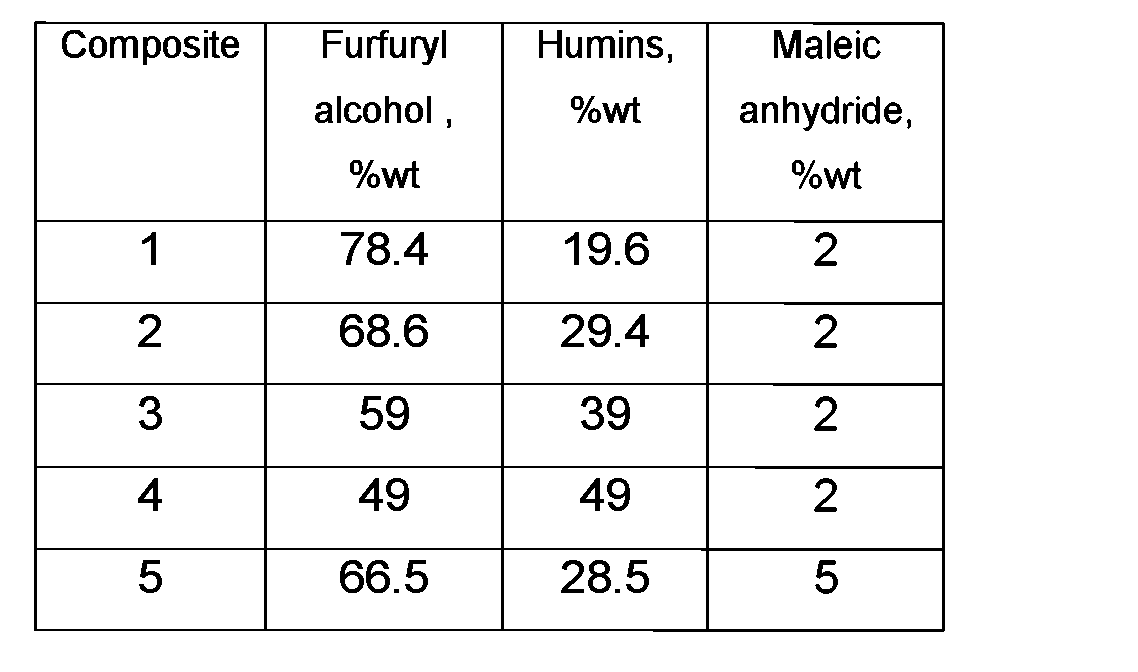
Furfuryl alcohol, humins (Table 1, Composites 1-4) and 2%wt maleic anhydride based on the amount of acid, furfuryl alcohol and humins or lignin, were mixed in one pot and heated at 125 °C for 30 minutes, subsequently heated for 30 minutes at 145 °C.
In another experiment furfuryl alcohol and humins (Table 1, Composite 5) were mixed at 105 °C for 20 minutes with 5%wt maleic anhydride, based on the amount of acid, furfuryl alcohol and humins. The temperature was retained for 10 minutes. After the period of heating, the mixtures were cooled down to room temperature and resins were obtained that could be stored for weeks. The viscosities of the resulting resins were between 1 Pa.s. and 5000 Pa.s at 25 °C.
Table 1
EXAMPLE 2 Two-step preparation of resin
In a two-step resin formulation procedure furfuryl alcohol and humins (Table 2, Composites 6-7) were mixed at 105 °C during 20 minutes. Maleic anhydride (2.5% by weight) was added and the mixture was heated at 120 - 130 °C for 30 to 60 minutes. After this step, the reaction mixture was cooled down to 80 °C and a second addition of acid initiator (2.5%wt, based on the amount of acid, furfuryl alcohol and humins) was made and at this temperature stirring was continued for 5 minutes. Subsequently, the resin was cooled down to room temperature. The viscosity thereof was determined at two temperatures. It could be stored for weeks without significant increase of the viscosity.
Table 2

EXAMPLE 3
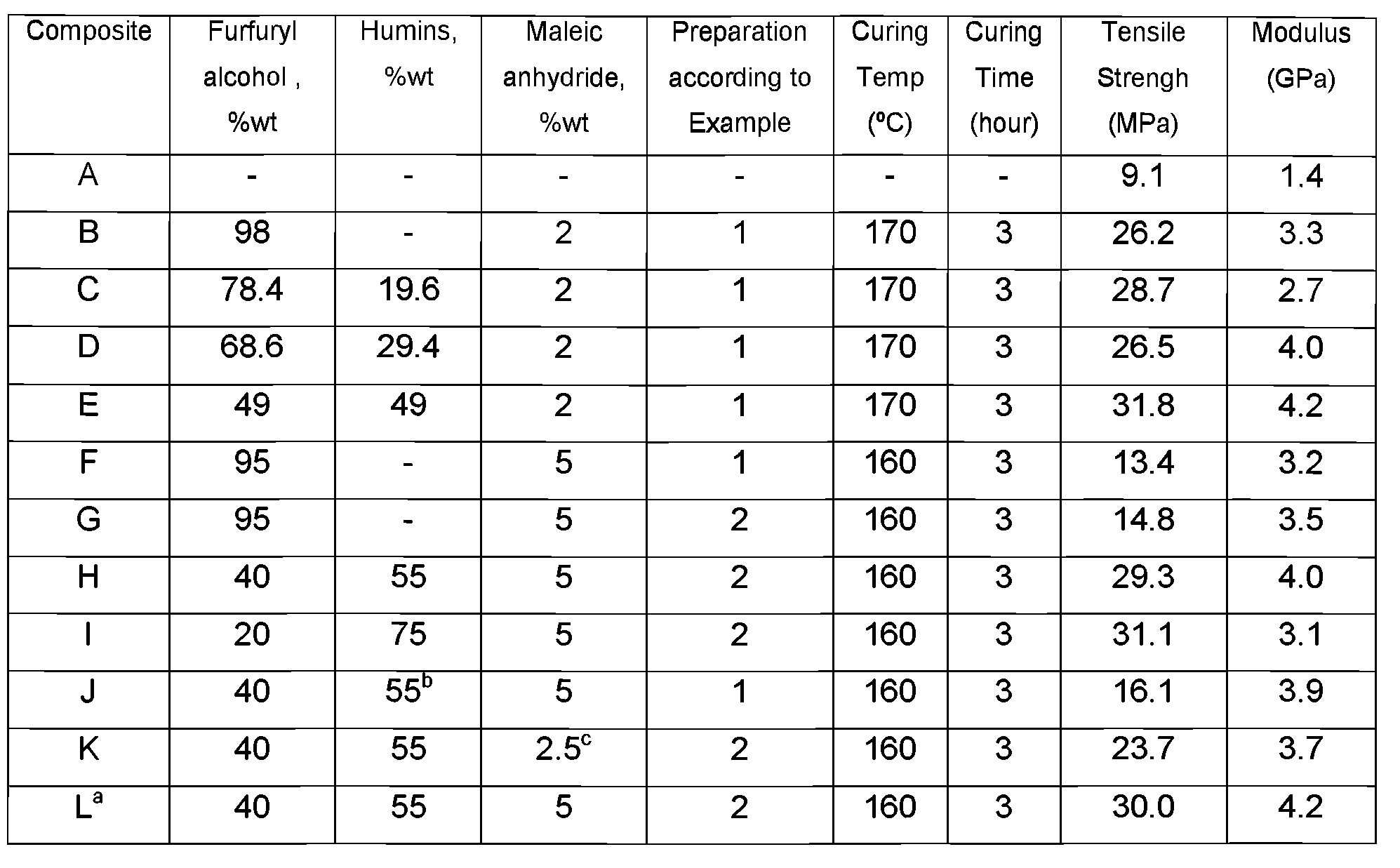
Resins of furfuryl alcohol and maleic anhydride were prepared using the method of Example 1 or 2. In an experiment (Table 3, Composite B and F) furfuryl alcohol was heated to 90 °C and 2%wt or 5%wt, respectively, of maleic anhydride, based on the amount of acid and furfuryl alcohol, was added and stirred for 60 min. After the period of heating, the mixtures were cooled down to room temperature and resins were obtained.
In another experiment (Table 3, Composite G) furfuryl alcohol and maleic anhydride (2.5% by weight) were mixed at 110 °C for 40 minutes. Thereafter the second addition of acid initiator (2.5% by weight) was made in the same way as for the experiment with furfuryl alcohol and humins, described in Example 2. The resin obtained was at room temperature. A further experiment was conducted using a humins component that was enriched with additional monomers, viz. 5-hydroxymethyll furfural (HMF), 5-methoxymethyl furfural (MMF) and levulinic acid (LA) (Table 3, Composite L). In other aspects it was the same as Composite H.
Also resins with different amounts of furfuryl alcohol, humins and maleic anhydride were made using the procedures of Example 1 or 2. One resin (Table 3, Composite K) was prepared similar to the procedure of Example 2, but the second addition of acid initiator was accomplished by the addition of 1%wt sulphuric acid in stead of 2.5%wt of maleic acid.
Finally, one resin was prepared using furfuryl alcohol, lignin and maleic anhydride (Table 3, Composite J). For the lignin formulation, the maleic anhydride addition was carried out at 80 °C and then the resin was cooled down immediately to room temperature in a water bath.
The amounts of the components are shown in Table 3.
Composites were made using Whatman 40 filter paper and resin at 50/50% by weight. The composites obtained were cured at 160 or 170 °C for 3 hours. Composites strips with 40x10x0.25mm as dimensions were made for each resin formulation. The mechanical properties (tensile strength and modulus) of the cured composites using different humins ratios and different curing conditions are presented in Table 3. For comparison reasons the tensile strength and modulus for the untreated filter paper were also determined (Composite A).
Table 3
a Humins in Composite L contained humins enriched with monomers MMF, HMF and LA. In other aspects it was the same as Composite H. b Organosolv lignin was used instead of humins. c In 2 step formulation first step was with 2.5%wt maleic anhydride, second step with 1 %wt H2S04.
The experiments show that the formulations that contained furfuryl alcohol and humins had a higher tensile strength and modulus than the corresponding resins containing furfuryl alcohol only. The results of composite J show that humins also perform better than lignin.
Claims (25)
Priority Applications (4)
| Application Number | Priority Date | Filing Date | Title |
|---|---|---|---|
| NL2011950A NL2011950C2 (en) | 2013-12-12 | 2013-12-12 | Composition comprising furfuryl alcohol. |
| US15/102,937 US9896543B2 (en) | 2013-12-12 | 2014-12-11 | Composition comprising furfuryl alcohol |
| EP14828325.2A EP3080188B1 (en) | 2013-12-12 | 2014-12-11 | Composition comprising furfuryl alcohol |
| PCT/NL2014/050852 WO2015088341A1 (en) | 2013-12-12 | 2014-12-11 | Composition comprising furfuryl alcohol |
Applications Claiming Priority (2)
| Application Number | Priority Date | Filing Date | Title |
|---|---|---|---|
| NL2011950 | 2013-12-12 | ||
| NL2011950A NL2011950C2 (en) | 2013-12-12 | 2013-12-12 | Composition comprising furfuryl alcohol. |
Publications (1)
| Publication Number | Publication Date |
|---|---|
| NL2011950C2 true NL2011950C2 (en) | 2015-06-15 |
Family
ID=50190664
Family Applications (1)
| Application Number | Title | Priority Date | Filing Date |
|---|---|---|---|
| NL2011950A NL2011950C2 (en) | 2013-12-12 | 2013-12-12 | Composition comprising furfuryl alcohol. |
Country Status (4)
| Country | Link |
|---|---|
| US (1) | US9896543B2 (en) |
| EP (1) | EP3080188B1 (en) |
| NL (1) | NL2011950C2 (en) |
| WO (1) | WO2015088341A1 (en) |
Families Citing this family (10)
| Publication number | Priority date | Publication date | Assignee | Title |
|---|---|---|---|---|
| JP6659007B2 (en) * | 2015-09-08 | 2020-03-04 | 株式会社ブリヂストン | Tire fiber, rubber / fiber composite and tire |
| US10752747B2 (en) | 2015-10-26 | 2020-08-25 | Furanix Technologies B.V. | Humins-containing foam |
| KR20170053416A (en) * | 2015-11-06 | 2017-05-16 | 주식회사 엘지화학 | Semiconductor device and manufacturing method of the same |
| US10208006B2 (en) | 2016-01-13 | 2019-02-19 | Stora Enso Oyj | Processes for the preparation of 2,5-furandicarboxylic acid and intermediates and derivatives thereof |
| WO2018062995A1 (en) | 2016-09-29 | 2018-04-05 | Avantium Knowledge Centre B.V. | Process for the modification of humins |
| WO2019014382A1 (en) | 2017-07-12 | 2019-01-17 | Stora Enso Oyj | Purified 2,5-furandicarboxylic acid pathway products |
| WO2019122385A1 (en) * | 2017-12-22 | 2019-06-27 | Avantium Knowledge Centre B.V. | A fibre |
| WO2020053818A1 (en) * | 2018-09-14 | 2020-03-19 | New Zealand Forest Research Institute Limited | Impregnated wood product |
| EP4470738A4 (en) * | 2022-01-28 | 2026-02-25 | Furanwood Co Ltd | METHOD FOR PRODUCING MODIFIED WOOD MATERIAL, 5-HMF RESINIZING SOLUTION AND MODIFIED WOOD MATERIAL |
| GB2636908A (en) * | 2024-07-12 | 2025-07-02 | Lionweld Kennedy Flooring Ltd | Resin-based flooring product, process, and composition |
Citations (4)
| Publication number | Priority date | Publication date | Assignee | Title |
|---|---|---|---|---|
| US3293200A (en) * | 1963-02-27 | 1966-12-20 | Crown Zellerbach Corp | Humin material extended-thermosetting adhesive, and process of making the same |
| WO2002068507A1 (en) * | 2001-02-27 | 2002-09-06 | Schneider Marc H | Furfuryl alcohol and lignin adhesive composition |
| WO2007149589A2 (en) * | 2006-06-23 | 2007-12-27 | Ashland Licensing And Intellectual Property Llc | Two-part bio-based furfuryl adhesive composition for engineered wood |
| WO2013180565A1 (en) * | 2012-05-31 | 2013-12-05 | Stichting Dienst Landbouwkundig Onderzoek | Lignocellulose preservative composition, process using such composition, preserved lignocellulosic material obtainable by such process and product comprising such material |
Family Cites Families (8)
| Publication number | Priority date | Publication date | Assignee | Title |
|---|---|---|---|---|
| US2571994A (en) | 1951-04-26 | 1951-10-23 | Delrac Corp | Furan resins |
| US3923200A (en) | 1974-06-03 | 1975-12-02 | Big Drum Inc | Feeder for sleeve-enclosed edible cones |
| US4762918A (en) | 1984-11-21 | 1988-08-09 | Staley Continental, Inc. | Decolorization of glycosides |
| DE3621517A1 (en) | 1986-06-27 | 1988-01-07 | Klaus Dipl Chem Dr Garves | Synthesis of alkoxymethylfurfurals and alkyl levulinates from cellulose or lignocelluloses or starch and alcohols |
| NO313183B1 (en) | 2000-10-12 | 2002-08-26 | Marc Schneider | Furan polymer-impregnated wood, method of preparation and use thereof |
| NO318253B1 (en) | 2002-07-26 | 2005-02-21 | Wood Polymer Technologies Asa | Furan polymer-impregnated wood, process for making same and using same |
| EP1834950A1 (en) | 2006-03-10 | 2007-09-19 | Avantium International B.V. | Method for the synthesis of 5-alkoxymethylfurfural ethers and their use |
| CA2803177C (en) | 2010-06-30 | 2018-07-24 | Suzano Canada Inc. | Organosolv process |
-
2013
- 2013-12-12 NL NL2011950A patent/NL2011950C2/en not_active IP Right Cessation
-
2014
- 2014-12-11 EP EP14828325.2A patent/EP3080188B1/en active Active
- 2014-12-11 WO PCT/NL2014/050852 patent/WO2015088341A1/en not_active Ceased
- 2014-12-11 US US15/102,937 patent/US9896543B2/en not_active Expired - Fee Related
Patent Citations (4)
| Publication number | Priority date | Publication date | Assignee | Title |
|---|---|---|---|---|
| US3293200A (en) * | 1963-02-27 | 1966-12-20 | Crown Zellerbach Corp | Humin material extended-thermosetting adhesive, and process of making the same |
| WO2002068507A1 (en) * | 2001-02-27 | 2002-09-06 | Schneider Marc H | Furfuryl alcohol and lignin adhesive composition |
| WO2007149589A2 (en) * | 2006-06-23 | 2007-12-27 | Ashland Licensing And Intellectual Property Llc | Two-part bio-based furfuryl adhesive composition for engineered wood |
| WO2013180565A1 (en) * | 2012-05-31 | 2013-12-05 | Stichting Dienst Landbouwkundig Onderzoek | Lignocellulose preservative composition, process using such composition, preserved lignocellulosic material obtainable by such process and product comprising such material |
Also Published As
| Publication number | Publication date |
|---|---|
| EP3080188B1 (en) | 2018-04-18 |
| WO2015088341A1 (en) | 2015-06-18 |
| EP3080188A1 (en) | 2016-10-19 |
| US9896543B2 (en) | 2018-02-20 |
| US20160376406A1 (en) | 2016-12-29 |
Similar Documents
| Publication | Publication Date | Title |
|---|---|---|
| US9896543B2 (en) | Composition comprising furfuryl alcohol | |
| US12139649B2 (en) | Method for producing a binder composition, binder composition, and wood product | |
| EP2831150B1 (en) | Use of low molecular weight lignin together with lignin for the production of a phenol-formaldehyde binder composition | |
| JP5922222B2 (en) | Binder composition manufacturing method, binder composition, adhesive composition, layered composite structure, and use of binder composition and adhesive composition | |
| FI126737B (en) | Process for treating lignin and preparing a binder composition | |
| US6747076B2 (en) | Furfuryl alcohol and lignin adhesive composition | |
| Dunky | Wood adhesives based on natural resources: A critical review: Part IV. special topics | |
| Dunky | Natural crosslinkers for naturally‐based adhesives | |
| AU2010329686A1 (en) | Resins | |
| Lei et al. | Recent Developments in Bioadhesives and Binders. | |
| EP3925775B1 (en) | Cross-laminated plywood production | |
| AU2003218011B2 (en) | Colorless phenol-formaldehyde resins that cure colorless | |
| Pizzi et al. | Bio-based Wood Adhesives: Recent Developments | |
| Pizzi | The Chemistry of Bioadhesives | |
| Siahkamari | Developing Lignin-Based Phenolic Adhesives for Engineered Wood Products | |
| US20240228849A9 (en) | Lignin-formaldehyde resins, related compositions, and related methods | |
| KR102893354B1 (en) | Novel coated articles and methods for their manufacture and use | |
| Pizzi et al. | Bioadhesives for Wood: Advances | |
| WO2026060004A1 (en) | Lignin wood adhesive | |
| Ugryumov | Furane oligomers in plywood and wood-board production |
Legal Events
| Date | Code | Title | Description |
|---|---|---|---|
| MM | Lapsed because of non-payment of the annual fee |
Effective date: 20180101 |