KR20230077458A - Fiber composite comprising 2-dimensional carbon nanomaterials and carbon nanotube and manufacturing method thereof - Google Patents
Fiber composite comprising 2-dimensional carbon nanomaterials and carbon nanotube and manufacturing method thereof Download PDFInfo
- Publication number
- KR20230077458A KR20230077458A KR1020210164747A KR20210164747A KR20230077458A KR 20230077458 A KR20230077458 A KR 20230077458A KR 1020210164747 A KR1020210164747 A KR 1020210164747A KR 20210164747 A KR20210164747 A KR 20210164747A KR 20230077458 A KR20230077458 A KR 20230077458A
- Authority
- KR
- South Korea
- Prior art keywords
- fiber composite
- carbon nanotubes
- carbon
- fiber
- weight
- Prior art date
- Legal status (The legal status is an assumption and is not a legal conclusion. Google has not performed a legal analysis and makes no representation as to the accuracy of the status listed.)
- Granted
Links
Images





Classifications
-
- D—TEXTILES; PAPER
- D01—NATURAL OR MAN-MADE THREADS OR FIBRES; SPINNING
- D01F—CHEMICAL FEATURES IN THE MANUFACTURE OF ARTIFICIAL FILAMENTS, THREADS, FIBRES, BRISTLES OR RIBBONS; APPARATUS SPECIALLY ADAPTED FOR THE MANUFACTURE OF CARBON FILAMENTS
- D01F9/00—Artificial filaments or the like of other substances; Manufacture thereof; Apparatus specially adapted for the manufacture of carbon filaments
- D01F9/08—Artificial filaments or the like of other substances; Manufacture thereof; Apparatus specially adapted for the manufacture of carbon filaments of inorganic material
- D01F9/12—Carbon filaments; Apparatus specially adapted for the manufacture thereof
-
- C—CHEMISTRY; METALLURGY
- C01—INORGANIC CHEMISTRY
- C01B—NON-METALLIC ELEMENTS; COMPOUNDS THEREOF; METALLOIDS OR COMPOUNDS THEREOF NOT COVERED BY SUBCLASS C01C
- C01B32/00—Carbon; Compounds thereof
- C01B32/15—Nano-sized carbon materials
- C01B32/158—Carbon nanotubes
- C01B32/159—Carbon nanotubes single-walled
-
- D—TEXTILES; PAPER
- D01—NATURAL OR MAN-MADE THREADS OR FIBRES; SPINNING
- D01D—MECHANICAL METHODS OR APPARATUS IN THE MANUFACTURE OF ARTIFICIAL FILAMENTS, THREADS, FIBRES, BRISTLES OR RIBBONS
- D01D10/00—Physical treatment of artificial filaments or the like during manufacture, i.e. during a continuous production process before the filaments have been collected
- D01D10/02—Heat treatment
-
- D—TEXTILES; PAPER
- D01—NATURAL OR MAN-MADE THREADS OR FIBRES; SPINNING
- D01D—MECHANICAL METHODS OR APPARATUS IN THE MANUFACTURE OF ARTIFICIAL FILAMENTS, THREADS, FIBRES, BRISTLES OR RIBBONS
- D01D5/00—Formation of filaments, threads, or the like
- D01D5/06—Wet spinning methods
-
- D—TEXTILES; PAPER
- D10—INDEXING SCHEME ASSOCIATED WITH SUBLASSES OF SECTION D, RELATING TO TEXTILES
- D10B—INDEXING SCHEME ASSOCIATED WITH SUBLASSES OF SECTION D, RELATING TO TEXTILES
- D10B2401/00—Physical properties
- D10B2401/06—Load-responsive characteristics
- D10B2401/061—Load-responsive characteristics elastic
-
- D—TEXTILES; PAPER
- D10—INDEXING SCHEME ASSOCIATED WITH SUBLASSES OF SECTION D, RELATING TO TEXTILES
- D10B—INDEXING SCHEME ASSOCIATED WITH SUBLASSES OF SECTION D, RELATING TO TEXTILES
- D10B2401/00—Physical properties
- D10B2401/06—Load-responsive characteristics
- D10B2401/063—Load-responsive characteristics high strength
Landscapes
- Engineering & Computer Science (AREA)
- Chemical & Material Sciences (AREA)
- Textile Engineering (AREA)
- Materials Engineering (AREA)
- Nanotechnology (AREA)
- Mechanical Engineering (AREA)
- Organic Chemistry (AREA)
- Chemical Kinetics & Catalysis (AREA)
- General Chemical & Material Sciences (AREA)
- Physics & Mathematics (AREA)
- Thermal Sciences (AREA)
- Inorganic Chemistry (AREA)
- Carbon And Carbon Compounds (AREA)
- Inorganic Fibers (AREA)
Abstract
Description
본 발명은 산화 그래핀과 탄소나노튜브를 포함하는 섬유 복합체 및 이의 제조방법에 관한 것으로서, 상기 섬유 복합체는 비강도, 비탄성률, 전기화학적 활성이 크게 향상된 것을 특징으로 한다.The present invention relates to a fiber composite comprising graphene oxide and carbon nanotubes and a method for producing the same, and the fiber composite is characterized by greatly improved specific strength, specific modulus, and electrochemical activity.
탄소나노튜브 또는 산화 그래핀은 기계적 특성, 열적, 전기적 특성이 우수하다. 개별적인 탄소나노튜브 또는 산화 그래핀이 아닌 연속상으로 존재하는 섬유상의 집합체, 즉 탄소나노튜브 또는 산화 그래핀 섬유는 섬유 형태 그대로 혹은 직물 형태로 제작하여 다양한 방식으로 활용할 수 있다. 탄소나노튜브 섬유는 구리와 같은 금속과 비교하였을 때도 밀도가 최대 1/5 수준으로 낮고, 전기 전도성이 기존 탄소 섬유와 비교하여 최대 10배 수준으로 높아 초경량 복합재료 분야와 같이 가볍고, 전도성이 우수하며, 강도가 높은 물질을 제작하는데 매우 효과적이다.Carbon nanotubes or graphene oxide have excellent mechanical properties, thermal and electrical properties. Fibrous aggregates, that is, carbon nanotubes or graphene oxide fibers, which exist in a continuous phase rather than individual carbon nanotubes or graphene oxide fibers, can be used in various ways as they are or manufactured in the form of fabrics. Carbon nanotube fibers have a density that is up to 1/5 lower than that of metals such as copper, and their electrical conductivity is up to 10 times higher than that of conventional carbon fibers. , it is very effective in fabricating materials with high strength.
다만, 탄소나노튜브 또는 산화 그래핀은 섬유화가 되었을 때, 섬유 내 패킹, 결함, 배향 문제 등에 인해 이를 실제로 적용하는 것은 제한적이다. 또한, 전기화학적 응용 측면에서도 기능화되지 않은 탄소나노튜브 섬유의 표면은 반응성이 매우 부족하기 때문에 기능화 및 이종 원소와의 복합화에 매우 불리하다. However, when carbon nanotubes or graphene oxide are fibrous, their practical application is limited due to problems such as packing, defects, and orientation in the fibers. In addition, in terms of electrochemical application, since the surface of non-functionalized carbon nanotube fibers has very low reactivity, it is very disadvantageous to functionalization and complexation with heterogeneous elements.
현재까지 알려진 탄소나노튜브 또는 산화 그래핀 섬유는 기계적 물성 및 표면의 전기화학적 활성이 만족할 만한 수준에 도달하지 못하여 이에 대해 개선이 요구된다.Carbon nanotubes or graphene oxide fibers known to date do not reach satisfactory levels of mechanical properties and surface electrochemical activity, and thus improvement is required.
본 발명은 탄소나노튜브 및 산화 그래핀을 포함하고, 비강도, 비탄성률, 전기화학적 활성이 우수한 섬유 복합체 및 이의 제조방법을 제공하는 것을 목적으로 한다.An object of the present invention is to provide a fiber composite containing carbon nanotubes and graphene oxide and having excellent specific strength, specific modulus, and electrochemical activity, and a manufacturing method thereof.
본 발명의 목적은 이상에서 언급한 목적으로 제한되지 않는다. 본 발명의 목적은 이하의 설명으로 더욱 분명해질 것이며, 특허청구범위에 기재된 수단 및 그 조합으로 실현될 것이다.The object of the present invention is not limited to the object mentioned above. The objects of the present invention will become more apparent from the following description, and will be realized by means and combinations thereof set forth in the claims.
본 발명의 일 실시예에 따른 섬유 복합체는 섬유의 형상을 갖고, 상기 섬유의 축방향으로 배향된 복수 개의 탄소나노튜브; 및 인접한 탄소나노튜브 사이에 충진된 판상형 탄소재;를 포함할 수 있다.A fiber composite according to an embodiment of the present invention has a fiber shape and includes a plurality of carbon nanotubes oriented in an axial direction of the fiber; and a plate-shaped carbon material filled between adjacent carbon nanotubes.
상기 탄소나노튜브의 직경은 1㎚ 내지 5㎚일 수 있다.The carbon nanotubes may have a diameter of 1 nm to 5 nm.
상기 탄소나노튜브의 종횡비는 1,000 내지 20,000일 수 있다.The aspect ratio of the carbon nanotubes may be 1,000 to 20,000.
상기 탄소나노튜브는 단일벽(Single wall) 탄소나노튜브, 이중벽(Double wall) 탄소나노튜브, 다중벽(Multiwall) 탄소나노튜브 및 이들의 조합으로 이루어진 군으로부터 선택된 적어도 어느 하나를 포함할 수 있다.The carbon nanotubes may include at least one selected from the group consisting of single wall carbon nanotubes, double wall carbon nanotubes, multiwall carbon nanotubes, and combinations thereof.
상기 탄소나노튜브의 IG/ID는 1 내지 200일 수 있다.I G /I D of the carbon nanotubes may be 1 to 200.
상기 판상형 탄소재는 그래핀, 산화 그래핀, 환원된 산화 그래핀, 그래핀 나노리본 및 이들의 조합으로 이루어진 군으로부터 선택된 적어도 어느 하나를 포함할 수 있다.The plate-like carbon material may include at least one selected from the group consisting of graphene, graphene oxide, reduced graphene oxide, graphene nanoribbon, and combinations thereof.
상기 판상형 탄소재의 탄소/산소 비율(C/O)은 1 내지 20일 수 있다.The carbon/oxygen ratio (C/O) of the plate-like carbon material may be 1 to 20.
상기 섬유 복합체는 상기 판상형 탄소재 0중량% 초과 및 90중량% 이하; 및 상기 탄소나노튜브 10중량% 이상 및 100중량% 미만;을 포함할 수 있다. The fiber composite is greater than 0% by weight and less than 90% by weight of the plate-like carbon material; and 10% by weight or more and less than 100% by weight of the carbon nanotubes.
상기 섬유 복합체는 평균 직경이 5㎛ 내지 100㎛일 수 있다.The fiber composite may have an average diameter of 5 μm to 100 μm.
상기 섬유 복합체는 밀도가 0.6g/cm3 내지 2.2g/cm3일 수 있다.The fiber composite may have a density of 0.6 g/cm 3 to 2.2 g/cm 3 .
상기 섬유 복합체는 비강도가 1cN/tex 이상, 비탄성률이 100cN/tex 이상, 선밀도가 0.05 tex 이상일 수 있다.The fiber composite may have a specific strength of 1 cN/tex or more, a specific modulus of 100 cN/tex or more, and a linear density of 0.05 tex or more.
본 발명의 일 실시예에 따른 섬유 복합체 제조용 조성물은 탄소나노튜브; 판상형 탄소재가 적층되어 조립된 형태를 갖는 탄소 입자; 및 용매;를 포함할 수 있다.A composition for producing a fiber composite according to an embodiment of the present invention is carbon nanotubes; Carbon particles having a form in which plate-like carbon materials are laminated and assembled; And a solvent; may include.
상기 탄소 입자의 입자 크기는 100㎚ 내지 100㎛일 수 있다.A particle size of the carbon particles may be 100 nm to 100 μm.
상기 용매는 클로로술폰산(Chlorosulfonic acid, CSA), 황산, 발연황산(Oleum), 플루오로술폰산(Fluorosulfonic acid), 삼불화아세트산, 삼불화메탄술폰산, 불화안티몬산, 카르보란산(Carborane acid) 및 이들의 조합으로 이루어진 군으로부터 선택된 적어도 어느 하나를 포함할 수 있다.The solvent is chlorosulfonic acid (CSA), sulfuric acid, fuming sulfuric acid (Oleum), fluorosulfonic acid, trifluoroacetic acid, trifluoromethanesulfonic acid, fluoroantimonic acid, carborane acid, and these It may include at least one selected from the group consisting of a combination of.
상기 탄소나노튜브와 판상형 탄소재는 라이오트로픽 네마틱상(Lyotropic nematic phase)을 나타낼 수 있다.The carbon nanotubes and plate-like carbon material may represent a lyotropic nematic phase.
상기 탄소나노튜브 및 탄소 입자의 농도는 5mg/mL 내지 100mg/mL일 수 있다.Concentrations of the carbon nanotubes and carbon particles may be 5 mg/mL to 100 mg/mL.
본 발명의 일 실시예에 따른 섬유 복합체의 제조방법은 탄소나노튜브, 판상형 탄소재가 적층되어 조립된 형태를 갖는 탄소 입자 및 용매를 포함하는 방사도프를 제조하는 단계; 상기 방사도프를 방사하는 단계; 및 방사된 결과물을 응고하는 단계;를 포함할 수 있다.Method for producing a fiber composite according to an embodiment of the present invention comprises the steps of preparing a spinning dope comprising carbon particles having a form in which carbon nanotubes and plate-like carbon materials are laminated and assembled, and a solvent; spinning the radiation dope; and coagulating the spun product.
상기 탄소나노튜브는 산소 분위기에서 400℃ 내지 600℃로 10분 내지 6시간 동안 열처리하여 산화시킨 것일 수 있다.The carbon nanotubes may be oxidized by heat treatment at 400° C. to 600° C. for 10 minutes to 6 hours in an oxygen atmosphere.
상기 제조방법은 방사된 결과물을 1.5 내지 10의 연신비로 연신한 뒤 응고하는 것일 수 있다.The manufacturing method may be to solidify after stretching the spun product at a draw ratio of 1.5 to 10.
본 발명에 따르면 비강도, 비탄성률, 전기화학적 활성이 우수한 섬유 복합체를 얻을 수 있다.According to the present invention, a fiber composite having excellent specific strength, specific modulus, and electrochemical activity can be obtained.
본 발명의 효과는 이상에서 언급한 효과로 한정되지 않는다. 본 발명의 효과는 이하의 설명에서 추론 가능한 모든 효과를 포함하는 것으로 이해되어야 할 것이다.The effects of the present invention are not limited to the effects mentioned above. It should be understood that the effects of the present invention include all effects that can be inferred from the following description.
도 1은 본 발명에 따른 섬유 복합체의 내부 미세 구조를 개략적으로 도시한 것이다.
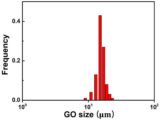
도 2는 실시예1 내지 실시예9에서 사용한 입자 크기가 15㎛인 산화 그래핀 입자를 동적광산란법으로 측정한 결과이다.
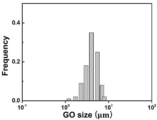
도 3은 실시예10 내지 실시예13에서 사용한 입자 크기가 60㎛인 산화 그래핀 입자를 동적광산란법으로 측정한 결과이다.
도 4는 실시예14 내지 실시예17에서 사용한 입자 크기가 4㎛인 산화 그래핀 입자를 동적광산란법으로 측정한 결과이다.
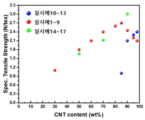
도 5는 실시예들에 따른 섬유 복합체에 대한 비강도 측정 결과이다.
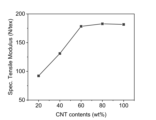
도 6은 실시예들에 따른 섬유 복합체에 대한 비탄성률 측정 결과이다.
도 7은 실시예들에 따른 섬유 복합체에 대한 비전기전도도 측정 결과이다.
도 8a는 실시예1에 따른 섬유 복합체의 단면을 주사전자현미경(TEM)으로 분석한 결과이다.
도 8b는 실시예6에 따른 섬유 복합체의 단면을 주사전자현미경(TEM)으로 분석한 결과이다.
도 8c는 실시예8에 따른 섬유 복합체의 단면을 주사전자현미경(TEM)으로 분석한 결과이다.
도 9a는 탄소나노튜브, 실시예14 내지 실시예16에 따른 섬유 복합체의 전기화학적 활성을 측정한 결과이다.
도 9b는 실시예3 내지 실시예5, 실시예7 및 실시예9에 따른 섬유 복합체의 전기화학적 활성을 측정한 결과이다.
도 9c는 실시예10 내지 실시예13에 따른 섬유 복합체의 전기화학적 활성을 측정한 결과이다.
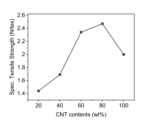
도 10은 실시예18 내지 실시예21의 섬유 복합체에 대한 비강도를 측정한 결과이다.
도 11은 실시예18 내지 실시예21의 섬유 복합체에 대한 비탄성률을 측정한 결과이다.
도 12는 실시예18 내지 실시예21의 섬유 복합체에 대한 비전기전도도를 측정한 결과이다.1 schematically shows the internal microstructure of a fiber composite according to the present invention.
2 is a result of measuring graphene oxide particles having a particle size of 15 μm used in Examples 1 to 9 by a dynamic light scattering method.
3 is a result of measuring graphene oxide particles having a particle size of 60 μm used in Examples 10 to 13 by a dynamic light scattering method.
4 is a result of measuring graphene oxide particles having a particle size of 4 μm used in Examples 14 to 17 by a dynamic light scattering method.
5 is a specific strength measurement result for a fiber composite according to embodiments.
6 is a result of measuring the inelastic modulus of a fiber composite according to embodiments.
7 is a result of measuring specific electrical conductivity of a fiber composite according to embodiments.
Figure 8a is a result of analyzing the cross section of the fiber composite according to Example 1 with a scanning electron microscope (TEM).
Figure 8b is a result of analyzing the cross section of the fiber composite according to Example 6 with a scanning electron microscope (TEM).
Figure 8c is a result of analyzing the cross section of the fiber composite according to Example 8 with a scanning electron microscope (TEM).
Figure 9a is the result of measuring the electrochemical activity of the fiber composite according to carbon nanotubes, Examples 14 to 16.
Figure 9b is the result of measuring the electrochemical activity of the fiber composites according to Examples 3 to 5, Examples 7 and 9.
Figure 9c is the result of measuring the electrochemical activity of the fiber composites according to Examples 10 to 13.
10 is a result of measuring the specific strength of the fiber composites of Examples 18 to 21.
11 is a result of measuring the inelastic modulus of the fiber composites of Examples 18 to 21.
12 is a result of measuring the specific electrical conductivity of the fiber composites of Examples 18 to 21.
이하에서 설명되는 본 창의적 사상(present inventive concept)은 다양한 변환을 가할 수 있고 여러 가지 실시예를 가질 수 있는 바, 특정 실시예들을 도면에 예시하고, 상세하게 설명한다. 그러나 이는 본 창의적 사상을 특정한 실시 형태에 대해 한정하려는 것이 아니며, 본 창의적 사상의 기술 범위에 포함되는 모든 변환, 균등물 또는 대체물을 포함하는 것으로 이해되어야 한다.Since the present inventive concept described below may be applied with various transformations and may have various embodiments, specific embodiments are illustrated in the drawings and described in detail. However, this is not intended to limit the present creative idea to a specific embodiment, and should be understood to include all transformations, equivalents, or substitutes included in the technical scope of the present creative idea.
이하에서 사용되는 용어는 단지 특정한 실시예를 설명하기 위해 사용된 것으로, 본 창의적 사상을 한정하려는 의도가 아니다. 단수의 표현은 문맥상 명백하게 다르게 뜻하지 않는 한, 복수의 표현을 포함한다. 이하에서, "포함한다" 또는 "가지다" 등의 용어는 명세서상에 기재된 특징, 숫자, 단계, 동작, 구성 요소, 부품, 성분, 재료 또는 이들을 조합한 것이 존재함을 나타내려는 것이지, 하나 또는 그 이상의 다른 특징들이나, 숫자, 단계, 동작, 구성 요소, 부품, 성분, 재료 또는 이들을 조합한 것들의 존재 또는 부가 가능성을 미리 배제하지 않는 것으로 이해되어야 한다.Terms used below are only used to describe specific embodiments, and are not intended to limit the present inventive idea. Singular expressions include plural expressions unless the context clearly dictates otherwise. Hereinafter, terms such as “comprise” or “have” are intended to indicate that there is a feature, number, step, operation, component, part, component, material, or combination thereof described in the specification, but one or the other It should be understood that the presence or addition of the above other features, numbers, steps, operations, components, parts, components, materials, or combinations thereof is not precluded.
도면에서 여러 층 및 영역을 명확하게 표현하기 위하여 두께를 확대하거나 축소하여 나타냈다. 명세서 전체를 통하여 유사한 부분에 대해서는 동일한 도면 부호를 붙였다. 명세서 전체에서 층, 막, 영역, 판 등의 부분이 다른 부분 "상에" 또는 "위에" 있다고 할 때, 이는 다른 부분의 바로 위에 있는 경우와 그 중간에 또 다른 부분이 있는 경우도 포함한다. 명세서 전체에서 제1, 제2 등의 용어는 다양한 구성 요소들을 설명하는데 사용될 수 있지만, 구성 요소들은 용어들에 의하여 한정되어서는 안 된다. 용어들은 하나의 구성 요소를 다른 구성 요소로부터 구별하는 목적으로만 사용된다.In the drawings, the thickness is enlarged or reduced to clearly express the various layers and regions. Like reference numerals have been assigned to like parts throughout the specification. Throughout the specification, when a part such as a layer, film, region, plate, etc. is said to be “on” or “above” another part, this includes the case where another part is directly on the other part and the case where another part is present in the middle. Throughout the specification, terms such as first and second may be used to describe various components, but the components should not be limited by the terms. Terms are used only to distinguish one component from another.
비록 제1, 제2 등의 용어가 여러 가지 요소들, 성분들, 영역들, 층들 및/또는 지역들을 설명하기 위해 사용될 수 있지만, 이러한 요소들, 성분들, 영역들, 층들 및/또는 지역들은 이러한 용어에 의해 한정되어서는 안 된다는 것을 이해할 것이다.Although the terms first, second, etc. may be used to describe various elements, components, regions, layers and/or regions, these elements, components, regions, layers and/or regions It will be understood that one should not be limited by these terms.
또한, 본 발명에서 설명하는 공정은 반드시 순서대로 적용됨을 의미하는 것은 아니다. 예를 들어, 제1단계와 제2단계가 기재되어 있는 경우, 반드시 제1단계가 제2단계보다 먼저 수행되어야 하는 것은 아님을 이해할 수 있다.Also, the processes described in the present invention are not necessarily meant to be applied in sequence. For example, when a first step and a second step are described, it is understood that the first step does not necessarily have to be performed before the second step.
도 1은 본 발명에 따른 섬유 복합체의 내부 미세 구조를 개략적으로 도시한 것이다. 이를 참조하면, 상기 섬유 복합체는 그 축방향으로 배향된 복수 개의 탄소나노튜브(10) 및 인접한 탄소나노튜브(10) 사이에 충진된 판상형 탄소재(20)를 포함할 수 있다. 여기서, '축방향으로 배향'된다는 것은 상기 탄소나노튜브(10)의 중심축이 섬유의 형상을 갖는 섬유 복합체의 중심축과 평행 내지 평행에 가깝게 배향된다는 것을 의미한다.1 schematically shows the internal microstructure of a fiber composite according to the present invention. Referring to this, the fiber composite may include a plurality of
탄소나노튜브와 산화 그래핀 등의 판상형 탄소재를 단순히 혼합하면 양 물질들이 무작위적으로 혼합되기 때문에 각 물질의 물성 또는 특징이 제대로 구현되지 않는다. 이에 본 발명은 도 1과 같이 탄소나노튜브(10)를 섬유 복합체의 축방향으로 일정하게 배향하고, 판상형 탄소재(20)가 상기 탄소나노튜브(10)를 에워싸면서 탄소나노튜브(10) 간에 형성되는 공간을 채우도록 하여 조밀화된(condensed) 세부 구조를 갖는 섬유 복합체를 구현한 것을 특징으로 한다. 본 발명에 따른 섬유 복합체는 탄소나노튜브(10)와 판상형 탄소재(20) 각각의 고유한 물성 또는 특징을 해하지 않으면서 양 구성이 상호 보완적으로 타 구성의 단점을 보완해 주기 때문에 비강도, 비탄성률, 전기화학적 물성 등이 매우 뛰어나다.When carbon nanotubes and planar carbon materials such as graphene oxide are simply mixed, physical properties or characteristics of each material are not properly implemented because both materials are randomly mixed. Accordingly, in the present invention, as shown in FIG. 1, the
이하, 각 구성에 대해 구체적으로 설명한다.Hereinafter, each configuration will be described in detail.
상기 탄소나노튜브(10)의 직경은 1㎚ 내지 5㎚일 수 있다. 상기 탄소나노튜브(10)의 직경이 5㎚를 초과하면 특정 방향으로의 배향 및 후술할 방사도프 내에서 특정한 액정상의 발현이 어려울 수 있다.The
상기 탄소나노튜브(10)의 종횡비는 1,000 이상, 예를 들어 1,000 내지 20,000, 또는 2,000 내지 10,000일 수 있다. 상기 탄소나노튜브(10)의 종횡비가 1,000 미만이면 물성발현 정도가 낮아지는 문제가 있을 수 있다.The aspect ratio of the
상기 탄소나노튜브(10)는 단일벽(Single wall) 탄소나노튜브, 이중벽(Double wall) 탄소나노튜브, 다중벽(Multiwall) 탄소나노튜브 및 이들의 조합으로 이루어진 군으로부터 선택된 적어도 어느 하나를 포함할 수 있다. 예를 들어, 상기 탄소나노튜브(10)는 단일벽 탄소나노튜브로만 이루어진 것, 단일벽 탄소나노튜브와 이중벽 탄소나노튜브를 40 : 60 내지 60 : 40의 비율로 혼합한 것, 또는 단일벽 탄소나노튜브와 다중벽 탄소나노튜브를 40 : 60 내지 60 : 40의 비율로 혼합한 것을 포함할 수 있다. 상기 다중벽 탄소나노튜브는 벽 수가 1 내지 5인 것일 수 있다.The
상기 탄소나노튜브(10)의 IG/ID는 1 이상, 또는 10 이상, 또는 20 이상일 수 있다. 상기 탄소나노튜브(10)의 IG/ID의 상한은 특별히 제한되지 않으나, 예를 들어 200 이하, 또는 150 이하, 또는 100 이하일 수 있다. 상기 탄소나노튜브(10)의 IG/ID가 1 미만이면 분산이 안되는 문제가 있을 수 있다.IG/ID of the
상기 판상형 탄소재(20)는 그래핀, 산화 그래핀, 환원된 산화 그래핀, 그래핀 나노리본 및 이들의 조합으로 이루어진 군으로부터 선택된 적어도 어느 하나를 포함할 수 있다.The plate-
상기 판상형 탄소재(20)의 탄소/산소 비율(C/O)은 1 이상, 예를 들어 1 내지 10일 수 있다. 상기 판상형 탄소재(20)의 탄소/산소 비율(C/O)이 1 미만이면, 결점이 너무 많아 물성이 낮아지는 문제가 있을 수 있고, 10를 초과하면 분산이 안 되는 문제가 있을 수 있다.The carbon/oxygen ratio (C/O) of the plate-
상기 섬유 복합체는 상기 판상형 탄소재(20)를 0중량% 초과 및 90중량% 이하로 포함하고, 상기 탄소나노튜브(10)를 10중량% 이상 및 100중량% 미만으로 포함할 수 있다. 다만, 각 성분의 함량은 이에 한정되는 것은 아니고 섬유 복합체의 용도, 구현하고자 하는 물성 등에 따라 적절히 변경할 수 있다.The fiber composite may include more than 0% by weight and less than 90% by weight of the plate-
상기 섬유 복합체의 평균 직경은 5㎛ 내지 100㎛이고, 밀도는 0.6g/cm3 이상, 또는 0.6g/cm3 내지 2.2g/cm3, 또는 1.0g/cm3 내지 2.0g/cm3일 수 있다. 상기 섬유 복합체의 평균 직경과 밀도가 위 범위에 속할 때, 상기 섬유 복합체의 비강도, 비탄성률, 전기화학적 활성을 개선할 수 있다.The fiber composite has an average diameter of 5 μm to 100 μm, and a density of 0.6 g/cm 3 or more, or 0.6 g/cm 3 to 2.2 g/cm 3 , or 1.0 g/cm 3 to 2.0 g/cm 3 . there is. When the average diameter and density of the fiber composites fall within the above ranges, the specific strength, specific modulus, and electrochemical activity of the fiber composites may be improved.
본 발명에 따른 섬유 복합체의 제조방법은 탄소나노튜브, 판상형 탄소재가 적층되어 조립된 형태를 갖는 탄소 입자 및 용매를 포함하는 방사도프를 제조하는 단계, 상기 방사도프를 방사하는 단계 및 방사된 결과물을 응고하는 단계를 포함할 수 있다.The method for manufacturing a fiber composite according to the present invention comprises the steps of preparing a spinning dope containing carbon particles and a solvent in which carbon nanotubes and plate-like carbon materials are laminated and assembled, spinning the spinning dope, and spinning the resulting product. It may include a coagulation step.
상기 탄소나노튜브는 상기 용매 내에서의 분산성을 높이기 위하여 산화 처리된 것일 수 있다. 예를 들어, 상기 탄소나노튜브는 산소 분위기에서 400℃ 내지 600℃로 10분 내지 6시간 동안 열처리하여 산화시킨 것일 수 있다.The carbon nanotubes may be oxidized to increase dispersibility in the solvent. For example, the carbon nanotubes may be oxidized by heat treatment at 400° C. to 600° C. for 10 minutes to 6 hours in an oxygen atmosphere.
상기 탄소 입자는 상기 판상형 탄소재가 면방향으로 적층되어 조립된(Condensed) 형태를 갖는 것일 수 있다. 예를 들어, 상기 탄소 입자는 판상형 탄소재인 산화 그래핀이 2 내지 10 층으로 적층 및 조립된 것일 수 있다.The carbon particles may have a condensed form in which the plate-like carbon materials are stacked in a plane direction. For example, the carbon particles may be obtained by stacking and assembling 2 to 10 layers of graphene oxide, which is a plate-like carbon material.
상기 탄소 입자의 입자 크기는 100㎚ 내지 100㎛일 수 있다. 상기 입자 크기는 레이저 회절 산란식 입도 분포 측정기, 예를 들어 마이크로 트랙 입도 분포 측정 장치를 이용하여 측정할 수 있다. 또한, 전자현미경 사진에서 임의로 일정 개수의 입자를 추출하고 이들의 평균 지름을 측정하여 산출할 수도 있다. 상기 탄소 입자의 입자 크기가 100㎚ 미만이면 물성상승효과가 어려운 문제가 있을 수 있고, 100㎛를 초과하면 분상이 어려운 문제가 있을 수 있다.A particle size of the carbon particles may be 100 nm to 100 μm. The particle size may be measured using a laser diffraction scattering type particle size distribution analyzer, for example, a micro track particle size distribution measuring device. In addition, it may be calculated by randomly extracting a certain number of particles from an electron micrograph and measuring their average diameter. If the particle size of the carbon particles is less than 100 nm, there may be a problem in that the synergistic effect of physical properties is difficult, and if the particle size exceeds 100 μm, there may be a problem in that it is difficult to powder.
상기 탄소나노튜브와 탄소 입자는 그 순도가 90% 이상인 것일 수 있다. 즉, 상기 탄소나노튜브와 탄소 입자는 금속 촉매, 무정형 탄소 등의 불순물의 함량이 10중량% 이하가 되도록 정제된 것일 수 있다. 상기 탄소나노튜브와 탄소 입자의 순도가 90% 미만이면 용매 내에서의 분산성이 저하되어 섬유의 형태로 방사하기 어려울 수 있고, 방사 후에도 잔존하는 불순물에 의해 섬유 복합체의 비강도, 비탄성률이 저하될 수 있다. 또한, 불순물이 많으면 전기전도성이 저하되거나 이종 원소와의 복합화 과정을 방해하여 전기화학적 활성이 크게 감소할 수 있다.The carbon nanotubes and carbon particles may have a purity of 90% or more. That is, the carbon nanotubes and carbon particles may be purified so that the content of impurities such as metal catalysts and amorphous carbon is 10% by weight or less. If the purity of the carbon nanotubes and carbon particles is less than 90%, the dispersibility in the solvent is lowered, making it difficult to spin in the form of fibers, and the specific strength and specific modulus of the fiber composite are lowered due to impurities remaining after spinning. It can be. In addition, if there are many impurities, electrical conductivity may be lowered or the electrochemical activity may be greatly reduced by interfering with a complexing process with a different type of element.
상기 용매는 상기 탄소나노튜브와 탄소 입자를 고르게 분산시킬 수 있는 것이라면 특별히 제한되지 않으나, 예를 들어 초강산 용매일 수 있다. 구체적으로 상기 용매는 클로로술폰산(Chlorosulfonic acid, CSA), 황산, 발연황산(Oleum), 플루오로술폰산(Fluorosulfonic acid), 삼불화아세트산, 삼불화메탄술폰산, 불화안티몬산, 카르보란산(Carborane acid) 및 이들의 조합으로 이루어진 군으로부터 선택된 적어도 어느 하나를 포함할 수 있다. The solvent is not particularly limited as long as it can evenly disperse the carbon nanotubes and carbon particles, but may be, for example, a super acid solvent. Specifically, the solvent is chlorosulfonic acid (CSA), sulfuric acid, fuming sulfuric acid (Oleum), fluorosulfonic acid, trifluoroacetic acid, trifluoromethanesulfonic acid, fluoroantimonic acid, carborane acid And it may include at least one selected from the group consisting of combinations thereof.
상기 방사도프는 상기 탄소나노튜브와 탄소 입자를 용매에 투입하고 50rpm 내지 30,000rpm으로 교반하여 제조할 수 있다.The spinning dope may be prepared by adding the carbon nanotubes and carbon particles to a solvent and stirring at 50 rpm to 30,000 rpm.
상기 방사도프 내에서 상기 탄소나노튜브와 탄소 입자를 합한 농도는 5mg/mL 내지 100mg/mL일 수 있다. 상기 농도가 위 범위에 속할 때, 섬유의 형상으로 원활하게 방사될 수 있다.The combined concentration of the carbon nanotubes and the carbon particles in the spinning dope may be 5 mg/mL to 100 mg/mL. When the concentration falls within the above range, it can be smoothly spun into a fiber shape.
전술한 각 물질의 특징, 교반 조건, 농도 등을 모두 만족할 때, 상기 방사도프 내에서 상기 탄소나노튜브와 판상형 탄소재(또는 탄소 입자)는 라이오트로픽 네마틱상의 액정상(Lyotropic nematic phase)을 나타낼 수 있다. 이와 같이 라이오트로픽 네마틱상이 발현되기 때문에 섬유 배향성 및 집속성이 좋아지게 되어 복합체의 비강도, 비탄성률 등의 역학적 성질이 개선될 수 있다.When all of the above-described characteristics, stirring conditions, concentration, etc. of each material are satisfied, the carbon nanotubes and plate-like carbon materials (or carbon particles) in the spinning dope exhibit a lyotropic nematic phase can Since the lyotropic nematic phase is expressed in this way, fiber orientation and bundling properties are improved, and mechanical properties such as specific strength and specific modulus of elasticity of the composite can be improved.
이후, 상기 방사도프를 습식 방사(wet spinning), 액정 방사(liquid crystal spinning) 등의 방법으로 방사하여 섬유 형태의 중간체를 얻을 수 있다.Thereafter, the spinning dope may be spun by a method such as wet spinning or liquid crystal spinning to obtain an intermediate in the form of a fiber.
본 발명은 방사된 상기 중간체를 연신한 뒤 응고하여 섬유 복합체를 제조하는 것을 특징으로 한다. 구체적으로 방사 단계에서 연신을 수행함으로써 탄소나노튜브가 섬유 복합체의 축방향으로 배향 및 집속화되고, 인접한 탄소나노튜브 사이에 형성되는 공간에 상기 탄소 입자로부터 기인한 판상형 탄소재가 충진될 수 있다. 이에 따라 상기 탄소나노튜브와 판상형 탄소재 간 접촉 면적이 넓어져 반데르발스 힘이 증가하고 섬유 복합체의 비강도 및 비탄성률이 크게 향상된다.The present invention is characterized in that the spun intermediate is stretched and then solidified to produce a fiber composite. Specifically, by performing stretching in the spinning step, the carbon nanotubes are oriented and concentrated in the axial direction of the fiber composite, and the plate-like carbon material derived from the carbon particles may be filled in the space formed between adjacent carbon nanotubes. Accordingly, the contact area between the carbon nanotubes and the plate-like carbon material is widened to increase the van der Waals force and greatly improve the specific strength and specific modulus of the fiber composite.
상기 중간체를 1.5 내지 10, 또는 1.5 내지 6의 비율로 연신할 수 있다. 연신비의 범위가 위와 같을 때, 비강도 및 비탄성률이 우수한 섬유 복합체를 얻을 수 있다.The intermediate may be stretched at a ratio of 1.5 to 10, or 1.5 to 6. When the range of the stretching ratio is as above, it is possible to obtain a fiber composite having excellent specific strength and specific modulus.
상기 중간체에 대한 연신비는 방사구 토출 속도와 권취 롤러의 회전 속도의 비율, 즉 상기 중간체에 가해지는 장력을 통해 조절할 수 있다. 다만, 연신비의 조절은 위 방법 외에도 상기 중간체를 해하지 않는다면 어떠한 방법으로도 수행할 수 있다.The stretching ratio of the intermediate body can be adjusted through the ratio of the spinneret discharge speed and the rotational speed of the take-up roller, that is, the tension applied to the intermediate body. However, the adjustment of the stretching ratio may be performed by any method other than the above method as long as the intermediate is not harmed.
이후, 연신된 결과물을 응고욕 등에 투입하여 응고시켜 섬유 복합체를 얻을 수 있다. Thereafter, the stretched product may be put into a coagulation bath or the like to be coagulated to obtain a fiber composite.
상기 제조방법은 응고된 섬유 복합체를 세정하고 건조하는 단계를 더 포함할 수 있다. 상기 세정 단계, 건조 단계는 본 발명이 속하는 기술 분야에서 널리 사용되는 방법 및 조건으로 수행할 수 있다. 예를 들어, 상기 섬유 복합체를 아세톤, 물 등의 용매로 세정하고 약 200℃ 이하의 온도에서 건조할 수 있다.The manufacturing method may further include washing and drying the coagulated fiber composite. The washing step and the drying step may be performed by methods and conditions widely used in the art to which the present invention belongs. For example, the fiber composite may be washed with a solvent such as acetone or water and dried at a temperature of about 200° C. or less.
위와 같은 방법으로 얻은 본 발명에 따른 섬유 복합체는 비강도가 1cN/tex 이상, 비탄성률이 100cN/tex 이상, 선밀도가 0.05 tex 이상인 것일 수 있다. 이를 하기 실시예를 통해 보다 상세하게 설명한다.The fiber composite according to the present invention obtained by the above method may have a specific strength of 1 cN/tex or more, a specific modulus of 100 cN/tex or more, and a linear density of 0.05 tex or more. This will be described in more detail through the following examples.
이하의 실시예 및 비교예를 통하여 본 발명의 예시적인 구현예들을 더욱 상세하게 설명한다. 단, 실시예 및 비교예는 기술적 사상을 예시하기 위한 것으로서 이들만으로 본 발명의 범위가 한정되는 것이 아니다.Exemplary embodiments of the present invention will be described in more detail through the following Examples and Comparative Examples. However, Examples and Comparative Examples are intended to illustrate the technical idea, and the scope of the present invention is not limited only to them.
비교예 1: 산화 그래핀 섬유의 제조 (Science, 372, 614-617 (2021)) Comparative Example 1: Preparation of graphene oxide fiber (Science, 372, 614-617 (2021))
산화 그래핀을 디메틸포름아마이드(Dimethylformamide)에 투입하여 방사도프를 제조하였다. 상기 방사도프를 응고 용액인 에틸 아세테이트가 담긴 응고조에 습식방사하였다. 잔류 용매를 제거하기 위해 방사된 산화 그래핀 섬유를 상온에서 약 3시간 건조하였다.A spinning dope was prepared by adding graphene oxide to dimethylformamide. The spinning dope was wet-spun in a coagulation bath containing ethyl acetate as a coagulation solution. The spun graphene oxide fibers were dried at room temperature for about 3 hours to remove residual solvent.
비교예 2: 산화 그래핀 섬유의 제조 (RSC Advances, 9, 4198-4202 (2019)) Comparative Example 2: Preparation of graphene oxide fiber (RSC Advances, 9, 4198-4202 (2019))
산화 그래핀은 Asbury 3061 흑연으로부터 modified Hummer's method로 제조하였다. 산화 그래핀을 증류수에 10 mg/mL의 농도로 투입하여 방사도프를 제조하였다. 상기 방사도프를 염화칼슘(CaCl2)이 5중량% 함유된 에탄올/증류수(1:3 부피%)의 응고조에 습식방사하였다. 방사된 산화 그래핀 섬유를 수세 후 상온에서 건조하였다.Graphene oxide was prepared from Asbury 3061 graphite by a modified Hummer's method. A spinning dope was prepared by adding graphene oxide to distilled water at a concentration of 10 mg/mL. The spinning dope was wet-spun in a coagulation bath of ethanol/distilled water (1:3 vol%) containing 5% by weight of calcium chloride (CaCl 2 ). The spun graphene oxide fibers were washed with water and then dried at room temperature.
비교예 3: 산화 그래핀 섬유의 제조 (Journal of Material Science, 55, 12065-12081 (2020)) Comparative Example 3: Preparation of Oxidized Graphene Fiber (Journal of Material Science, 55, 12065-12081 (2020))
산화 그래핀은 Pelable 흑연으로부터 modified Hummer's method로 제조하였다. 산화 그래핀을 증류수/에탄올 (3:1 부피%) 용액에 15 mg/mL 농도로 분산시켜 방사도프를 제조하고, 유리관을 통해 방사하였다. 방사된 산화 그래핀 섬유를 50℃에서 20분 동안 건조하고, 이어서 상온에서 2시간 동안 건조하였다. Graphene oxide was prepared from pelable graphite by a modified Hummer's method. A spinning dope was prepared by dispersing graphene oxide at a concentration of 15 mg/mL in a distilled water/ethanol (3:1 volume %) solution, and spinning was performed through a glass tube. The spun graphene oxide fibers were dried at 50° C. for 20 minutes and then at room temperature for 2 hours.
실시예Example 1 One
입자 크기가 15㎛인 산화 그래핀 입자 70중량% 및 탄소나노튜브 30중량%를 클로로술폰산(CSA)에 10mg/mL의 농도로 분산시켜 방사도프를 제조하였다. 도 2는 입자 크기가 15㎛인 상기 산화 그래핀 입자를 동적광산란법으로 측정한 결과이다. 상기 탄소나노튜브(Meijo DX-2)는 단일벽 탄소나노튜브와 이중벽 탄소나노튜브가 55:45의 비율로 혼합된 것을 사용하였다. 또한, 분산성을 높이기 위하여 상기 탄소나노튜브를 약 400℃에서 약 6시간 동안 열처리하여 산화시킨 뒤 용매에 투입하였다.A spinning dope was prepared by dispersing 70% by weight of graphene oxide particles having a particle size of 15 μm and 30% by weight of carbon nanotubes in chlorosulfonic acid (CSA) at a concentration of 10 mg/mL. 2 is a result of measuring the graphene oxide particles having a particle size of 15 μm by a dynamic light scattering method. As the carbon nanotubes (Meijo DX-2), single-walled carbon nanotubes and double-walled carbon nanotubes were mixed at a ratio of 55:45. In addition, in order to increase dispersibility, the carbon nanotubes were oxidized by heat treatment at about 400° C. for about 6 hours, and then put into a solvent.
상기 방사도프를 하루 이상 분산한 뒤, 실린지(syringe)를 이용하여 방사하였다. 직경이 0.26mm의 니들(needle)을 이용하여 방사를 하고, 약 2.0의 연신비로 연신하였다. 응고 용액은 아세톤을 이용하였고, 권취 후 내부의 클로로술폰산(CSA)을 제거하기 위해 약 170℃의 진공오븐에서 하루 이상 건조시켜 섬유 복합체를 얻었다.After dispersing the spinning dope for more than one day, it was spun using a syringe. Spinning was performed using a needle having a diameter of 0.26 mm, and stretching was performed at a draw ratio of about 2.0. Acetone was used as the coagulation solution, and after winding, it was dried in a vacuum oven at about 170 ° C. for one day or more to obtain a fiber composite in order to remove chlorosulfonic acid (CSA) inside.
실시예Example 2 2
입자 크기가 15㎛인 산화 그래핀 입자 50중량% 및 탄소나노튜브 50중량%를 사용하여 방사도프를 제조한 것을 제외하고는 실시예1과 동일하게 섬유 복합체를 제조하였다.A fiber composite was prepared in the same manner as in Example 1, except that a spinning dope was prepared using 50% by weight of graphene oxide particles having a particle size of 15 μm and 50% by weight of carbon nanotubes.
실시예Example 3 3
입자 크기가 15㎛인 산화 그래핀 입자 40중량% 및 탄소나노튜브 60중량%를 사용하여 방사도프를 제조한 것을 제외하고는 실시예1과 동일하게 섬유 복합체를 제조하였다.A fiber composite was prepared in the same manner as in Example 1, except that a spinning dope was prepared using 40% by weight of graphene oxide particles having a particle size of 15 μm and 60% by weight of carbon nanotubes.
실시예Example 4 4
입자 크기가 15㎛인 산화 그래핀 입자 30중량% 및 탄소나노튜브 70중량%를 사용하여 방사도프를 제조한 것을 제외하고는 실시예1과 동일하게 섬유 복합체를 제조하였다.A fiber composite was prepared in the same manner as in Example 1, except that a spinning dope was prepared using 30% by weight of graphene oxide particles having a particle size of 15 μm and 70% by weight of carbon nanotubes.
실시예Example 5 5
입자 크기가 15㎛인 산화 그래핀 입자 20중량% 및 탄소나노튜브 80중량%를 사용하여 방사도프를 제조한 것을 제외하고는 실시예1과 동일하게 섬유 복합체를 제조하였다.A fiber composite was prepared in the same manner as in Example 1, except that a spinning dope was prepared using 20% by weight of graphene oxide particles having a particle size of 15 μm and 80% by weight of carbon nanotubes.
실시예Example 6 6
입자 크기가 15㎛인 산화 그래핀 입자 15중량% 및 탄소나노튜브 85중량%를 사용하여 방사도프를 제조한 것을 제외하고는 실시예1과 동일하게 섬유 복합체를 제조하였다.A fiber composite was prepared in the same manner as in Example 1, except that a spinning dope was prepared using 15% by weight of graphene oxide particles having a particle size of 15 μm and 85% by weight of carbon nanotubes.
실시예Example 7 7
입자 크기가 15㎛인 산화 그래핀 입자 10중량% 및 탄소나노튜브 90중량%를 사용하여 방사도프를 제조한 것을 제외하고는 실시예1과 동일하게 섬유 복합체를 제조하였다.A fiber composite was prepared in the same manner as in Example 1, except that a spinning dope was prepared using 10% by weight of graphene oxide particles having a particle size of 15 μm and 90% by weight of carbon nanotubes.
실시예Example 8 8
입자 크기가 15㎛인 산화 그래핀 입자 5중량% 및 탄소나노튜브 95중량%를 사용하여 방사도프를 제조한 것을 제외하고는 실시예1과 동일하게 섬유 복합체를 제조하였다.A fiber composite was prepared in the same manner as in Example 1, except that a spinning dope was prepared using 5% by weight of graphene oxide particles having a particle size of 15 μm and 95% by weight of carbon nanotubes.
실시예Example 9 9
입자 크기가 15㎛인 산화 그래핀 입자 2중량% 및 탄소나노튜브 98중량%를 사용하여 방사도프를 제조한 것을 제외하고는 실시예1과 동일하게 섬유 복합체를 제조하였다.A fiber composite was prepared in the same manner as in Example 1, except that a spinning dope was prepared using 2% by weight of graphene oxide particles having a particle size of 15 μm and 98% by weight of carbon nanotubes.
실시예Example 10 10
입자 크기가 60㎛인 산화 그래핀 입자 15중량% 및 탄소나노튜브 85중량%를 사용하여 방사도프를 제조한 것을 제외하고는 실시예1과 동일하게 섬유 복합체를 제조하였다. 도 3은 입자 크기가 60㎛인 상기 산화 그래핀 입자를 동적광산란법으로 측정한 결과이다.A fiber composite was prepared in the same manner as in Example 1, except that a spinning dope was prepared using 15% by weight of graphene oxide particles having a particle size of 60 μm and 85% by weight of carbon nanotubes. 3 is a result of measuring the graphene oxide particles having a particle size of 60 μm by a dynamic light scattering method.
실시예Example 11 11
입자 크기가 60㎛인 산화 그래핀 입자 10중량% 및 탄소나노튜브 90중량%를 사용하여 방사도프를 제조한 것을 제외하고는 실시예1과 동일하게 섬유 복합체를 제조하였다.A fiber composite was prepared in the same manner as in Example 1, except that a spinning dope was prepared using 10% by weight of graphene oxide particles having a particle size of 60 μm and 90% by weight of carbon nanotubes.
실시예Example 12 12
입자 크기가 60㎛인 산화 그래핀 입자 5중량% 및 탄소나노튜브 95중량%를 사용하여 방사도프를 제조한 것을 제외하고는 실시예1과 동일하게 섬유 복합체를 제조하였다.A fiber composite was prepared in the same manner as in Example 1, except that a spinning dope was prepared using 5% by weight of graphene oxide particles having a particle size of 60 μm and 95% by weight of carbon nanotubes.
실시예Example 13 13
입자 크기가 60㎛인 산화 그래핀 입자 2중량% 및 탄소나노튜브 98중량%를 사용하여 방사도프를 제조한 것을 제외하고는 실시예1과 동일하게 섬유 복합체를 제조하였다.A fiber composite was prepared in the same manner as in Example 1, except that a spinning dope was prepared using 2% by weight of graphene oxide particles having a particle size of 60 μm and 98% by weight of carbon nanotubes.
실시예Example 14 14
입자 크기가 4㎛인 산화 그래핀 입자 50중량% 및 탄소나노튜브 50중량%를 사용하여 방사도프를 제조한 것을 제외하고는 실시예1과 동일하게 섬유 복합체를 제조하였다. 도 4는 입자 크기가 4㎛인 상기 산화 그래핀 입자를 동적광산란법으로 측정한 결과이다.A fiber composite was prepared in the same manner as in Example 1, except that a spinning dope was prepared using 50% by weight of graphene oxide particles having a particle size of 4 μm and 50% by weight of carbon nanotubes. 4 is a result of measuring the graphene oxide particles having a particle size of 4 μm by a dynamic light scattering method.
실시예Example 15 15
입자 크기가 4㎛인 산화 그래핀 입자 30중량% 및 탄소나노튜브 70중량%를 사용하여 방사도프를 제조한 것을 제외하고는 실시예1과 동일하게 섬유 복합체를 제조하였다.A fiber composite was prepared in the same manner as in Example 1, except that a spinning dope was prepared using 30% by weight of graphene oxide particles having a particle size of 4 μm and 70% by weight of carbon nanotubes.
실시예Example 16 16
입자 크기가 4㎛인 산화 그래핀 입자 10중량% 및 탄소나노튜브 90중량%를 사용하여 방사도프를 제조한 것을 제외하고는 실시예1과 동일하게 섬유 복합체를 제조하였다.A fiber composite was prepared in the same manner as in Example 1, except that a spinning dope was prepared using 10% by weight of graphene oxide particles having a particle size of 4 μm and 90% by weight of carbon nanotubes.
실시예Example 17 17
입자 크기가 4㎛인 산화 그래핀 입자 2중량% 및 탄소나노튜브 98중량%를 사용하여 방사도프를 제조한 것을 제외하고는 실시예1과 동일하게 섬유 복합체를 제조하였다.A fiber composite was prepared in the same manner as in Example 1, except that a spinning dope was prepared using 2% by weight of graphene oxide particles having a particle size of 4 μm and 98% by weight of carbon nanotubes.
평가예evaluation example 1: 비강도, 1: specific intensity, 선밀도linear density , , 비탄성율inelastic modulus , , 비전기전도도의non-conductive 측정 measurement
실시예 1 내지 17에 따른 섬유 복합체의 비강도, 비탄성률 및 전기전도도를 측정하였다. 위 물성은 FAVIMAT+(단섬유물성측정기)를 이용하여 측정하였다. 이 장비는 인장강도(N)와 선밀도(Linear density, tex)를 측정하고 비강도(Specific strength, N/tex)를 계산하는 장비이다.The specific strength, specific modulus and electrical conductivity of the fiber composites according to Examples 1 to 17 were measured. The above physical properties were measured using FAVIMAT + (short fiber property measuring instrument). This equipment measures tensile strength (N) and linear density (tex) and calculates specific strength (N/tex).
FAVIMAT은 섬유가 가지고 있는 고유 진동수를 이용하여 
비강도(Specific Tensile Strength, N/tex)는 FAVIMAT에서 계산된 선밀도와 인장시험에서 측정된 강도(Force, N)를 이용하여 계산한다.Specific Tensile Strength (N/tex) is calculated using the linear density calculated in FAVIMAT and the strength (Force, N) measured in the tensile test.
비탄성률(Specific Tensile Modulus, N/tex)은 연신율과 강도의 그래프에서 기울기를 나타낸다. 보통은 초기의 기울기값을 나타내며 연신율에 따라 강도가 일정하게 증가하는 구간을 계산하여 나타낸다. 연신율은 FAVIMAT에서 섬유의 인장시험을 통해 섬유가 파괴될 때까지의 최대 연신을 말한다. 연신율은 %로 나타낸다.Specific Tensile Modulus (N/tex) shows the slope in the graph of elongation and strength. Usually, it represents the initial slope value and calculates and displays the section where the strength constantly increases according to the elongation rate. The elongation rate refers to the maximum elongation until the fiber breaks through the tensile test of the fiber in FAVIMAT. Elongation is expressed in %.
비전기전도도(Specific Electrical Conductivity, S·m2/kg)는 저항을 측정하여 계산식에 따라 계산한다. 섬유 복합체에 실버 페이스트를 1cm 간격으로 찍은 뒤 저항을 측정한다. 그리고 FAVIMAT으로 측정된 선밀도를 cm/(Ω·tex)에 따라 계산한다. 여기서 L은 측정된 탄소나노튜브 섬유의 길이이다.Specific Electrical Conductivity (S·m 2 /kg) is calculated according to a formula by measuring resistance. After applying silver paste to the fiber composite at 1 cm intervals, measure the resistance. And the linear density measured by FAVIMAT is calculated according to cm/(Ω·tex). Here, L is the length of the measured carbon nanotube fiber.
사용한 산화 그래핀의 입자 크기에 따라 실시예들을 실시예1 내지 실시예9, 실시예10 내지 실시예13 및 실시예14 내지 실시예17로 분류하고 이들에 포함된 탄소나노튜브의 함량에 따른 물성의 차이를 분석하였다.The examples are classified into Examples 1 to 9, Examples 10 to 13, and Examples 14 to 17 according to the particle size of the graphene oxide used, and physical properties according to the content of carbon nanotubes included in them. The difference was analyzed.
도 5는 실시예들의 섬유 복합체에 대한 비강도 측정 결과이다. 도 6은 실시예들의 섬유 복합체에 대한 비탄성률 측정 결과이다. 도 7은 실시예들의 섬유 복합체에 대한 비전기전도도 측정 결과이다.5 is a specific strength measurement result for the fiber composites of Examples. 6 is a result of measuring the inelastic modulus of the fiber composites of Examples. 7 is a result of measuring the specific electrical conductivity of the fiber composites of Examples.
도 5 내지 도 7을 참조하면, 섬유 복합체 내의 탄소나노튜브의 함량이 증가함에 따라 섬유 복합체의 비강도, 비탄성률, 비전기전도도가 높아짐을 알 수 있다.Referring to FIGS. 5 to 7 , it can be seen that the specific strength, specific modulus, and specific electrical conductivity of the fiber composite increase as the content of carbon nanotubes in the fiber composite increases.
평가예evaluation example 3: 주사전자현미경 분석 3: scanning electron microscopy analysis
실시예1, 실시예6 및 실시예8의 섬유 복합체의 단면을 주사전자현미경(TEM)으로 분석하였다. 그 결과는 각각 도 8a 내지 도 8c와 같다. 이를 참조하면, 상기 섬유 복합체들은 탄소나노튜브와 산화 그래핀이 무작위적으로 혼합된 것이 아니라 탄소나노튜브 사이에 판상형 탄소재인 산화 그래핀이 적절히 분산 및 충진되어 있음을 알 수 있다. 결과적으로 본 발명에 따른 섬유 복합체는 상기 탄소나노튜브와 산화 그래핀의 접촉 면적이 매우 넓기 때문에 전술한 바와 같이 비강도, 비탄성률, 전기전도도 등이 매우 우수하다.Cross sections of the fiber composites of Examples 1, 6 and 8 were analyzed by scanning electron microscopy (TEM). The results are shown in FIGS. 8A to 8C , respectively. Referring to this, it can be seen that the fiber composites are not randomly mixed with carbon nanotubes and graphene oxide, but that graphene oxide, which is a plate-shaped carbon material, is properly dispersed and filled between carbon nanotubes. As a result, since the fiber composite according to the present invention has a very wide contact area between the carbon nanotubes and graphene oxide, as described above, the specific strength, specific modulus of elasticity, and electrical conductivity are very excellent.
평가예evaluation example 4: 섬유 복합체의 밀도 측정 4: Density measurement of fiber composites
실시예 1 내지 17에 따라 제조된 탄소나노튜브 섬유의 밀도를 측정하여 표 1에 나타내었다. 서로 다른 밀도를 가지는 두 용매를 혼합하여, 섬유가 용매 내에서 밀도 차이에 의해 위치하는 정도를 측정하는 방식인 밀도구배관을 이용하였다. 밀도구배관은 벤젠과 테트라브로모메탄 용매를 적절한 비율로 혼합하여 한 용매 내에서 밀도가 다른 환경을 조성한 장비이다. 해당 밀도는 이미 밀도를 알고 있는 참고용 구슬을 이용하여 밀도의 차이를 구분하였다. 제조된 용매에 탄소나노튜브 섬유를 넣은 뒤 섬유가 해당 밀도에 정확히 위치할 수 있도록 적어도 12시간 이상 방치한 뒤 섬유의 위치를 관찰하여 밀도를 측정하였다.The density of the carbon nanotube fibers prepared according to Examples 1 to 17 was measured and shown in Table 1. A density gradient tube, which is a method of measuring the degree to which fibers are positioned by the difference in density in the solvent by mixing two solvents having different densities, was used. The density gradient tube is a device that creates an environment with different densities within one solvent by mixing benzene and tetrabromomethane solvents in appropriate ratios. For the density, the difference in density was distinguished using beads for reference whose density was already known. After putting the carbon nanotube fibers in the prepared solvent, the fibers were left for at least 12 hours to be accurately positioned at the corresponding density, and then the location of the fibers was observed to measure the density.
[중량%]Content of graphene oxide particles
[weight%]
[중량%]Content of carbon nanotubes
[weight%]
(GPa)tensile strength
(GPa)
[g/cm3]density
[g/cm 3 ]
입자의 함량
[중량%]graphene nanoribbon
particle content
[weight%]
크기 [㎛]graphene nanoribbon
size [μm]
[중량%]Content of carbon nanotubes
[weight%]
(GPa)tensile strength
(GPa)
[g/cm3]density
[g/cm 3 ]
평가예evaluation example 5: 탄소나노튜브/ 5: carbon nanotube/ 산화그래핀graphene oxide 섬유 표면의 전기화학적 활성 측정 Measurement of the electrochemical activity of the fiber surface
실시예 1 내지 17에 따라 제조된 탄소나노튜브 섬유 표면의 전기화학적 활성을 측정하였다. 섬유 복합체를 일정 길이로 채취하여 단위 길이당 무게를 측정한 후, KOH 전해질을 사용한 3전극 실험을 통해서 전기화학 실험을 수행하였다. 전해질은 1M KOH 용액을 사용하였으며, -1V에서 0V 사이에서 실험을 진행하며 전해질 이온이 흡착되는 특성을 정량, 정성적으로 분석하였다.The electrochemical activity of the surface of the carbon nanotube fibers prepared according to Examples 1 to 17 was measured. After taking the fiber composite to a certain length and measuring the weight per unit length, an electrochemical experiment was performed through a three-electrode experiment using KOH electrolyte. A 1M KOH solution was used as the electrolyte, and the adsorption characteristics of electrolyte ions were quantitatively and qualitatively analyzed while conducting experiments between -1V and 0V.
도 9a는 탄소나노튜브, 실시예14 내지 실시예16에 따른 섬유 복합체의 전기화학적 활성을 측정한 결과이다. 도 9b는 실시예3 내지 실시예5, 실시예7 및 실시예9에 따른 섬유 복합체의 전기화학적 활성을 측정한 결과이다. 도 9c는 실시예10 내지 실시예13에 따른 섬유 복합체의 전기화학적 활성을 측정한 결과이다. 이를 참조하면, 본 발명에 따른 섬유 복합체는 탄소나노튜브에 비해 우수한 전기화학적 활성을 가지고 있음을 알 수 있다.Figure 9a is the result of measuring the electrochemical activity of the fiber composite according to carbon nanotubes, Examples 14 to 16. Figure 9b is the result of measuring the electrochemical activity of the fiber composites according to Examples 3 to 5, Examples 7 and 9. Figure 9c is the result of measuring the electrochemical activity of the fiber composites according to Examples 10 to 13. Referring to this, it can be seen that the fiber composite according to the present invention has excellent electrochemical activity compared to carbon nanotubes.
제조예manufacturing example
다중벽 탄소나노튜브(900 mg)을 진한 황산(216 mL)에서 1시간 동안 상온에서 교반하여 분산시켰다. 분산액에 24 mL의 인산을 첨가하였다. 혼합액을 15분간 상온에서 교반하였다. 상온에서 과망간산칼륨(KMnO4) 6.3 g을 첨가하고, 용액이 균질해질 때까지 교반하였다. 반응 혼합물을 70℃로 4시간 동안 가열하였다. 상온으로 식힌 반응 혼합물을 얼음에 붓고 14시간 동안 방치하여 침전시켰다. 상층액을 제거한 뒤에 남은 고체를 PTFE 필터를 통해 걸렀다. 이를 염산 수용액과 에탄올로 씻어주고 진공에서 건조하여, 그래핀 나노리본 (C/O=2.2 이하)을 얻었다. Multi-walled carbon nanotubes (900 mg) were dispersed in concentrated sulfuric acid (216 mL) by stirring at room temperature for 1 hour. 24 mL of phosphoric acid was added to the dispersion. The mixed solution was stirred at room temperature for 15 minutes. 6.3 g of potassium permanganate (KMnO 4 ) was added at room temperature and stirred until the solution became homogeneous. The reaction mixture was heated to 70 °C for 4 hours. The reaction mixture cooled to room temperature was poured into ice and allowed to stand for 14 hours to precipitate. After removing the supernatant, the remaining solid was filtered through a PTFE filter. It was washed with an aqueous hydrochloric acid solution and ethanol and dried in a vacuum to obtain a graphene nanoribbon (C/O=2.2 or less).
실시예Example 18 18
상기 제조예의 그래핀 나노리본 20중량% 및 탄소나노튜브 80중량%를 클로로술폰산(CSA)에 15mg/mL의 농도로 분산시켜 방사도프를 제조하였다. 상기 탄소나노튜브(Meijo DX-2)는 단일벽 탄소나노튜브와 이중벽 탄소나노튜브가 55:45의 비율로 혼합된 것을 사용하였다. 또한, 분산성을 높이기 위하여 상기 탄소나노튜브를 약 400℃에서 약 6시간 동안 열처리하여 산화시킨 뒤 용매에 투입하였다.A spinning dope was prepared by dispersing 20% by weight of graphene nanoribbons and 80% by weight of carbon nanotubes in Preparation Example in chlorosulfonic acid (CSA) at a concentration of 15mg/mL. As the carbon nanotubes (Meijo DX-2), single-walled carbon nanotubes and double-walled carbon nanotubes were mixed at a ratio of 55:45. In addition, in order to increase dispersibility, the carbon nanotubes were oxidized by heat treatment at about 400° C. for about 6 hours, and then put into a solvent.
상기 방사도프를 하루 이상 분산한 뒤, 실린지(syringe)를 이용하여 방사하였다. 직경이 0.26mm의 니들(needle)을 이용하여 방사를 하고, 약 2.0의 연신비로 연신하였다. 응고 용액은 아세톤을 이용하였고, 권취 후 내부의 클로로술폰산(CSA)을 제거하기 위해 약 170℃의 진공오븐에서 하루 이상 건조시켜 섬유 복합체를 얻었다.After dispersing the spinning dope for more than one day, it was spun using a syringe. Spinning was performed using a needle having a diameter of 0.26 mm, and stretching was performed at a draw ratio of about 2.0. Acetone was used as the coagulation solution, and after winding, it was dried in a vacuum oven at about 170 ° C. for one day or more to obtain a fiber composite in order to remove chlorosulfonic acid (CSA) inside.
실시예Example 19 19
상기 제조예의 그래핀 나노리본 40중량% 및 탄소나노튜브 60중량%를 사용하여 방사도프를 제조한 것을 제외하고는 실시예18과 동일하게 섬유 복합체를 제조하였다.A fiber composite was prepared in the same manner as in Example 18, except that a spinning dope was prepared using 40% by weight of graphene nanoribbons and 60% by weight of carbon nanotubes of the above Preparation Example.
실시예Example 20 20
상기 제조예의 그래핀 나노리본 60중량% 및 탄소나노튜브 40중량%를 사용하여 방사도프를 제조한 것을 제외하고는 실시예18과 동일하게 섬유 복합체를 제조하였다.A fiber composite was prepared in the same manner as in Example 18, except that a spinning dope was prepared using 60% by weight of graphene nanoribbons and 40% by weight of carbon nanotubes of the Preparation Example.
실시예Example 21 21
상기 제조예의 그래핀 나노리본 80중량% 및 탄소나노튜브 20중량%를 사용하여 방사도프를 제조한 것을 제외하고는 실시예18과 동일하게 섬유 복합체를 제조하였다.A fiber composite was prepared in the same manner as in Example 18, except that a spinning dope was prepared using 80% by weight of graphene nanoribbons and 20% by weight of carbon nanotubes of the Preparation Example.
평가예evaluation example 6: 비강도, 6: nasal intensity, 선밀도linear density , , 비탄성율inelastic modulus , , 비전기전도도의non-conductive 측정 measurement
실시예 18 내지 21에 따른 섬유 복합체의 비강도, 비탄성률 및 전기전도도를 측정하였다. 위 물성은 FAVIMAT+(단섬유물성측정기)를 이용하여 측정하였다. 이 장비는 인장강도(N)와 선밀도(Linear density, tex)를 측정하고 비강도(Specific strength, N/tex)를 계산하는 장비이다.The specific strength, specific modulus and electrical conductivity of the fiber composites according to Examples 18 to 21 were measured. The above physical properties were measured using FAVIMAT + (short fiber property measuring instrument). This equipment measures tensile strength (N) and linear density (tex) and calculates specific strength (N/tex).
FAVIMAT은 섬유가 가지고 있는 고유 진동수를 이용하여 
비강도(Specific Tensile Strength, N/tex)는 FAVIMAT에서 계산된 선밀도와 인장시험에서 측정된 강도(Force, N)를 이용하여 계산한다.Specific Tensile Strength (N/tex) is calculated using the linear density calculated in FAVIMAT and the strength (Force, N) measured in the tensile test.
비탄성률(Specific Tensile Modulus, N/tex)은 연신율과 강도의 그래프에서 기울기를 나타낸다. 보통은 초기의 기울기값을 나타내며 연신율에 따라 강도가 일정하게 증가하는 구간을 계산하여 나타낸다. 연신율은 FAVIMAT에서 섬유의 인장시험을 통해 섬유가 파괴될 때까지의 최대 연신을 말한다. 연신율은 %로 나타낸다.Specific Tensile Modulus (N/tex) shows the slope in the graph of elongation and strength. Usually, it represents the initial slope value and calculates and displays the section where the strength constantly increases according to the elongation rate. The elongation rate refers to the maximum elongation until the fiber breaks through the tensile test of the fiber in FAVIMAT. Elongation is expressed in %.
비전기전도도(Specific Electrical Conductivity, S·m2/kg)는 저항을 측정하여 계산식에 따라 계산한다. 섬유 복합체에 실버 페이스트를 1cm 간격으로 찍은 뒤 저항을 측정한다. 그리고 FAVIMAT으로 측정된 선밀도를 cm/(Ω·tex)에 따라 계산한다. 여기서 L은 측정된 탄소나노튜브 섬유의 길이이다.Specific Electrical Conductivity (S·m 2 /kg) is calculated according to a formula by measuring resistance. After applying silver paste to the fiber composite at 1 cm intervals, measure the resistance. And the linear density measured by FAVIMAT is calculated according to cm/(Ω·tex). Here, L is the length of the measured carbon nanotube fiber.
사용한 그래핀 나노리본과 탄소나노튜브의 함량에 따른 물성의 차이를 분석하였다.The difference in physical properties according to the content of the used graphene nanoribbon and carbon nanotube was analyzed.
도 10은 실시예18 내지 실시예21의 섬유 복합체에 대한 비강도를 측정한 결과이다. 도 11은 실시예18 내지 실시예21의 섬유 복합체에 대한 비탄성률을 측정한 결과이다. 도 12는 실시예18 내지 실시예21의 섬유 복합체에 대한 비전기전도도를 측정한 결과이다.10 is a result of measuring the specific strength of the fiber composites of Examples 18 to 21. 11 is a result of measuring the inelastic modulus of the fiber composites of Examples 18 to 21. 12 is a result of measuring the specific electrical conductivity of the fiber composites of Examples 18 to 21.
이상으로 본 발명의 실험예 및 실시예에 대해 상세히 설명하였는바, 본 발명의 권리범위는 상술한 실험예 및 실시예에 한정되지 않으며, 다음의 특허청구범위에서 정의하고 있는 본 발명의 기본 개념을 이용한 당업자의 여러 변형 및 개량 형태 또한 본 발명의 권리범위에 포함된다.As above, the experimental examples and examples of the present invention have been described in detail, the scope of the present invention is not limited to the above-described experimental examples and examples, and the basic concept of the present invention defined in the following claims Various modifications and improvements made by those skilled in the art are also included in the scope of the present invention.
10: 탄소나노튜브 20: 판상형 탄소재10: carbon nanotube 20: plate-shaped carbon material
Claims (19)
상기 섬유의 축방향으로 배향된 복수 개의 탄소나노튜브; 및
인접한 탄소나노튜브 사이에 충진된 판상형 탄소재;를 포함하는 섬유 복합체.has the shape of a fiber,
a plurality of carbon nanotubes oriented in the axial direction of the fiber; and
A fiber composite comprising a; plate-like carbon material filled between adjacent carbon nanotubes.
상기 탄소나노튜브의 직경은 1㎚ 내지 5㎚인 섬유 복합체.According to claim 1,
The carbon nanotubes have a diameter of 1 nm to 5 nm fiber composite.
상기 탄소나노튜브의 종횡비는 1,000 내지 20,000인 섬유 복합체.According to claim 1,
The aspect ratio of the carbon nanotubes is 1,000 to 20,000 fiber composite.
상기 탄소나노튜브는 단일벽(Single wall) 탄소나노튜브, 이중벽(Double wall) 탄소나노튜브, 다중벽(Multiwall) 탄소나노튜브 및 이들의 조합으로 이루어진 군으로부터 선택된 적어도 어느 하나를 포함하는 섬유 복합체.According to claim 1,
The carbon nanotube is a fiber composite comprising at least one selected from the group consisting of single wall carbon nanotubes, double wall carbon nanotubes, multiwall carbon nanotubes, and combinations thereof.
상기 탄소나노튜브의 IG/ID는 1 내지 200인 섬유 복합체.According to claim 1,
I G / I D of the carbon nanotubes is a fiber composite of 1 to 200.
상기 판상형 탄소재는 그래핀, 산화 그래핀, 환원된 산화 그래핀, 그래핀 나노리본 및 이들의 조합으로 이루어진 군으로부터 선택된 적어도 어느 하나를 포함하는 섬유 복합체.According to claim 1,
The plate-like carbon material is a fiber composite comprising at least one selected from the group consisting of graphene, graphene oxide, reduced graphene oxide, graphene nanoribbon, and combinations thereof.
상기 판상형 탄소재의 탄소/산소 비율(C/O)은 1 내지 20인 섬유 복합체.According to claim 1,
The carbon / oxygen ratio (C / O) of the plate-like carbon material is 1 to 20 fiber composite.
상기 판상형 탄소재 0중량% 초과 및 90중량% 이하; 및
상기 탄소나노튜브 10중량% 이상 및 100중량% 미만;을 포함하는 섬유 복합체.According to claim 1,
More than 0% by weight and less than 90% by weight of the plate-shaped carbon material; and
A fiber composite comprising 10% by weight or more and less than 100% by weight of the carbon nanotubes.
평균 직경이 5㎛ 내지 100㎛인 섬유 복합체.According to claim 1,
A fiber composite having an average diameter of 5 μm to 100 μm.
밀도가 0.6g/cm3 내지 2.2g/cm3인 섬유 복합체.According to claim 1,
A fiber composite having a density of 0.6 g/cm 3 to 2.2 g/cm 3 .
비강도가 1cN/tex 이상, 비탄성률이 100cN/tex 이상, 선밀도가 0.05 tex 이상인 섬유 복합체.According to claim 1,
A fiber composite having a specific strength of 1 cN/tex or more, a specific modulus of 100 cN/tex or more, and a linear density of 0.05 tex or more.
탄소나노튜브;
판상형 탄소재가 적층되어 조립된 형태를 갖는 탄소 입자; 및
용매;를 포함하는 섬유 복합체 제조용 조성물.As a composition for preparing a fiber composite according to any one of claims 1 to 11,
carbon nanotubes;
Carbon particles having a form in which plate-like carbon materials are laminated and assembled; and
A composition for producing a fiber composite comprising a solvent;
상기 탄소 입자의 입자 크기는 100㎚ 내지 100㎛인 섬유 복합체 제조용 조성물.According to claim 12,
The particle size of the carbon particles is 100 ㎚ to 100 ㎛ composition for preparing a fiber composite.
상기 용매는 클로로술폰산(Chlorosulfonic acid, CSA), 황산, 발연황산(Oleum), 플루오로술폰산(Fluorosulfonic acid), 삼불화아세트산, 삼불화메탄술폰산, 불화안티몬산, 카르보란산(Carborane acid) 및 이들의 조합으로 이루어진 군으로부터 선택된 적어도 어느 하나를 포함하는 섬유 복합체 제조용 조성물.According to claim 12,
The solvent is chlorosulfonic acid (CSA), sulfuric acid, fuming sulfuric acid (Oleum), fluorosulfonic acid, trifluoroacetic acid, trifluoromethanesulfonic acid, fluoroantimonic acid, carborane acid, and these A composition for preparing a fiber composite comprising at least one selected from the group consisting of a combination of.
상기 탄소나노튜브와 판상형 탄소재는 라이오트로픽 네마틱상(Lyotropic nematic phase)을 나타내는 섬유 복합체 제조용 조성물.According to claim 12,
The carbon nanotubes and the plate-like carbon material are composition for preparing a fiber composite showing a lyotropic nematic phase (Lyotropic nematic phase).
상기 탄소나노튜브 및 탄소 입자의 농도는 5mg/mL 내지 100mg/mL인 섬유 복합체 제조용 조성물.According to claim 12,
The concentration of the carbon nanotubes and carbon particles is 5mg / mL to 100mg / mL composition for producing a fiber composite.
탄소나노튜브, 판상형 탄소재가 적층되어 조립된 형태를 갖는 탄소 입자 및 용매를 포함하는 방사도프를 제조하는 단계;
상기 방사도프를 방사하는 단계; 및
방사된 결과물을 응고하는 단계;를 포함하는 섬유 복합체의 제조방법.As a method for producing the fiber composite of any one of claims 1 to 11,
Preparing a spinning dope comprising carbon particles and a solvent having a form in which carbon nanotubes and plate-like carbon materials are laminated and assembled;
spinning the radiation dope; and
Method for producing a fiber composite comprising a; step of solidifying the spun product.
상기 탄소나노튜브는 산소 분위기에서 400℃ 내지 600℃로 10분 내지 6시간 동안 열처리하여 산화시킨 것인 섬유 복합체의 제조방법.According to claim 17,
The method of producing a fiber composite in which the carbon nanotubes are oxidized by heat treatment at 400 ° C to 600 ° C in an oxygen atmosphere for 10 minutes to 6 hours.
방사된 결과물을 1.5 내지 10의 연신비로 연신한 뒤 응고하는 것인 섬유 복합체의 제조방법.According to claim 17,
A method for producing a fiber composite in which the spun product is stretched at a draw ratio of 1.5 to 10 and then solidified.
Priority Applications (2)
| Application Number | Priority Date | Filing Date | Title |
|---|---|---|---|
| KR1020210164747A KR102722324B1 (en) | 2021-11-25 | 2021-11-25 | Fiber composite comprising 2-dimensional carbon nanomaterials and carbon nanotube and manufacturing method thereof |
| PCT/KR2022/018863 WO2023096409A1 (en) | 2021-11-25 | 2022-11-25 | Fiber composite, composition for preparing same, and method for preparing same |
Applications Claiming Priority (1)
| Application Number | Priority Date | Filing Date | Title |
|---|---|---|---|
| KR1020210164747A KR102722324B1 (en) | 2021-11-25 | 2021-11-25 | Fiber composite comprising 2-dimensional carbon nanomaterials and carbon nanotube and manufacturing method thereof |
Publications (2)
| Publication Number | Publication Date |
|---|---|
| KR20230077458A true KR20230077458A (en) | 2023-06-01 |
| KR102722324B1 KR102722324B1 (en) | 2024-10-25 |
Family
ID=86540143
Family Applications (1)
| Application Number | Title | Priority Date | Filing Date |
|---|---|---|---|
| KR1020210164747A Active KR102722324B1 (en) | 2021-11-25 | 2021-11-25 | Fiber composite comprising 2-dimensional carbon nanomaterials and carbon nanotube and manufacturing method thereof |
Country Status (2)
| Country | Link |
|---|---|
| KR (1) | KR102722324B1 (en) |
| WO (1) | WO2023096409A1 (en) |
Cited By (1)
| Publication number | Priority date | Publication date | Assignee | Title |
|---|---|---|---|---|
| WO2025173815A1 (en) * | 2024-02-16 | 2025-08-21 | 한국전기연구원 | Method for producing carbon nanotube fibers comprising graphene oxide and carbon nanotube fibers prepared thereby |
Families Citing this family (1)
| Publication number | Priority date | Publication date | Assignee | Title |
|---|---|---|---|---|
| CN119465214B (en) * | 2024-11-07 | 2026-02-06 | 湖南大学 | A three-dimensional porous array carbon electrode, its preparation method and application |
Citations (2)
| Publication number | Priority date | Publication date | Assignee | Title |
|---|---|---|---|---|
| KR20170125444A (en) * | 2016-05-04 | 2017-11-15 | 재단법인차세대융합기술연구원 | Wet spinningMethod for preparing GO-CNT composite fibers, GO-Graphene composite fibers, GO-Grephene-CNT composite fibers |
| KR102322833B1 (en) * | 2020-05-15 | 2021-11-10 | 한국과학기술연구원 | High performance and lightweight carbon nanotube fiber and preparing method thereof |
Family Cites Families (4)
| Publication number | Priority date | Publication date | Assignee | Title |
|---|---|---|---|---|
| JP2013208725A (en) * | 2012-03-30 | 2013-10-10 | Mitsubishi Rayon Co Ltd | Carbon fiber-reinforced thermoplastic resin laminated body and method of producing the same |
| KR101438065B1 (en) * | 2012-12-14 | 2014-09-15 | 전남대학교산학협력단 | Hybrid nano-complex, method for producing the same, and electrode for supercapacitor comprising the same |
| KR20160024245A (en) * | 2014-08-25 | 2016-03-04 | 서울대학교산학협력단 | Method for manufacturing transparent and conductive films based on oxidized nano carbon |
| KR101670260B1 (en) * | 2014-12-22 | 2016-10-28 | 인하대학교 산학협력단 | Method of manufacturing for graphene/carbon nanotube composite membrane |
-
2021
- 2021-11-25 KR KR1020210164747A patent/KR102722324B1/en active Active
-
2022
- 2022-11-25 WO PCT/KR2022/018863 patent/WO2023096409A1/en not_active Ceased
Patent Citations (2)
| Publication number | Priority date | Publication date | Assignee | Title |
|---|---|---|---|---|
| KR20170125444A (en) * | 2016-05-04 | 2017-11-15 | 재단법인차세대융합기술연구원 | Wet spinningMethod for preparing GO-CNT composite fibers, GO-Graphene composite fibers, GO-Grephene-CNT composite fibers |
| KR102322833B1 (en) * | 2020-05-15 | 2021-11-10 | 한국과학기술연구원 | High performance and lightweight carbon nanotube fiber and preparing method thereof |
Cited By (1)
| Publication number | Priority date | Publication date | Assignee | Title |
|---|---|---|---|---|
| WO2025173815A1 (en) * | 2024-02-16 | 2025-08-21 | 한국전기연구원 | Method for producing carbon nanotube fibers comprising graphene oxide and carbon nanotube fibers prepared thereby |
Also Published As
| Publication number | Publication date |
|---|---|
| WO2023096409A1 (en) | 2023-06-01 |
| KR102722324B1 (en) | 2024-10-25 |
Similar Documents
| Publication | Publication Date | Title |
|---|---|---|
| Matsumoto et al. | Electrospun composite nanofiber yarns containing oriented graphene nanoribbons | |
| Guo et al. | Effect of electrophoretically deposited carbon nanotubes on the interface of carbon fiber reinforced epoxy composite | |
| Sundaram et al. | One-step purification of direct-spun CNT fibers by post-production sonication | |
| Qiu et al. | Iodine nanoparticle-enhancing electrical and thermal transport for carbon nanotube fibers | |
| Zhang et al. | Influence of geometries of multi-walled carbon nanotubes on the pore structures of Buckypaper | |
| Ramalingam et al. | Electrical measurement of PVA/graphene nanofibers for transparent electrode applications | |
| Chien et al. | Polyacrylonitrile fibers containing graphene oxide nanoribbons | |
| Li et al. | Electrospinning fabrication and in situ mechanical investigation of individual graphene nanoribbon reinforced carbon nanofiber | |
| KR20230064984A (en) | Producing method of polyimide based carbon composite fibers | |
| Liu et al. | Effect of multi-walled carbon nanotube additive on the microstructure and properties of pitch-derived carbon foams | |
| KR102722324B1 (en) | Fiber composite comprising 2-dimensional carbon nanomaterials and carbon nanotube and manufacturing method thereof | |
| KR102322833B1 (en) | High performance and lightweight carbon nanotube fiber and preparing method thereof | |
| Zheng et al. | Comparing effects of thermal annealing and chemical reduction treatments on properties of wet-spun graphene fibers | |
| Jain et al. | Polyacrylonitrile/carbon nanofiber nanocomposite fibers | |
| Li et al. | Carbonized electrospun cellulose composite nanofibres containing silicon carbide nanoparticles | |
| Seo et al. | Mild acid-based surfactant-free solutions of single-walled carbon nanotubes: Highly viscous, less toxic, and humidity-insensitive solutions | |
| Zhang et al. | Polyamide 6 composites reinforced with glass fibers modified with electrostatically assembled multiwall carbon nanotubes | |
| Kim et al. | Longitudinal alignment effect of graphene oxide nanoribbon on properties of polyimide-based carbon fibers | |
| Sun et al. | Carbon Nanoparticle Effects on PAN Crystallization for Higher-Performance Composite Fibers | |
| Jeong et al. | Coagulation engineering of surfactant-based wet spinning of carbon nanotube fibers | |
| Fraczek-Szczypta et al. | Carbon fibers modified with carbon nanotubes | |
| CN115961375A (en) | Spinning solution for aramid and carbon nanotube composite fiber and preparation method of aramid and carbon nanotube composite fiber using same | |
| KR102576931B1 (en) | Carbon nanotube fiber having improved property and preparing method thereof | |
| Liu et al. | Glassy carbon nanofibers from electrospun cellulose nanofiber | |
| KR102893545B1 (en) | Method of preparing carbon composite fiber and carbon composite fiber |
Legal Events
| Date | Code | Title | Description |
|---|---|---|---|
| PA0109 | Patent application |
St.27 status event code: A-0-1-A10-A12-nap-PA0109 |
|
| PA0201 | Request for examination |
St.27 status event code: A-1-2-D10-D11-exm-PA0201 |
|
| R17-X000 | Change to representative recorded |
St.27 status event code: A-3-3-R10-R17-oth-X000 |
|
| D13-X000 | Search requested |
St.27 status event code: A-1-2-D10-D13-srh-X000 |
|
| D14-X000 | Search report completed |
St.27 status event code: A-1-2-D10-D14-srh-X000 |
|
| PG1501 | Laying open of application |
St.27 status event code: A-1-1-Q10-Q12-nap-PG1501 |
|
| E902 | Notification of reason for refusal | ||
| PE0902 | Notice of grounds for rejection |
St.27 status event code: A-1-2-D10-D21-exm-PE0902 |
|
| T11-X000 | Administrative time limit extension requested |
St.27 status event code: U-3-3-T10-T11-oth-X000 |
|
| T11-X000 | Administrative time limit extension requested |
St.27 status event code: U-3-3-T10-T11-oth-X000 |
|
| T11-X000 | Administrative time limit extension requested |
St.27 status event code: U-3-3-T10-T11-oth-X000 |
|
| T11-X000 | Administrative time limit extension requested |
St.27 status event code: U-3-3-T10-T11-oth-X000 |
|
| T11-X000 | Administrative time limit extension requested |
St.27 status event code: U-3-3-T10-T11-oth-X000 |
|
| T13-X000 | Administrative time limit extension granted |
St.27 status event code: U-3-3-T10-T13-oth-X000 |
|
| E601 | Decision to refuse application | ||
| PE0601 | Decision on rejection of patent |
St.27 status event code: N-2-6-B10-B15-exm-PE0601 |
|
| PN2301 | Change of applicant |
St.27 status event code: A-3-3-R10-R13-asn-PN2301 St.27 status event code: A-3-3-R10-R11-asn-PN2301 |
|
| E13-X000 | Pre-grant limitation requested |
St.27 status event code: A-2-3-E10-E13-lim-X000 |
|
| P11-X000 | Amendment of application requested |
St.27 status event code: A-2-2-P10-P11-nap-X000 |
|
| P13-X000 | Application amended |
St.27 status event code: A-2-2-P10-P13-nap-X000 |
|
| PX0901 | Re-examination |
St.27 status event code: A-2-3-E10-E12-rex-PX0901 |
|
| PX0701 | Decision of registration after re-examination |
St.27 status event code: A-3-4-F10-F13-rex-PX0701 |
|
| X701 | Decision to grant (after re-examination) | ||
| GRNT | Written decision to grant | ||
| PR0701 | Registration of establishment |
St.27 status event code: A-2-4-F10-F11-exm-PR0701 |
|
| PR1002 | Payment of registration fee |
St.27 status event code: A-2-2-U10-U11-oth-PR1002 Fee payment year number: 1 |
|
| PG1601 | Publication of registration |
St.27 status event code: A-4-4-Q10-Q13-nap-PG1601 |